A garden with natural charm doesn’t happen by accident — it’s built from honest materials, time-worn textures, and a willingness to let beauty be a little imperfect. Rustic garden decor taps into something deeply satisfying: the pleasure of weathered wood beside living green, terracotta warming in afternoon sun, the soft clink of a wind chime made from river stones. It’s a style that asks nothing of you except curiosity and patience, and it rewards both generously. Here are 20 rustic garden decor ideas full of natural charm, every one of them worth saving.
Why Rustic Garden Decor Full of Natural Charm Works So Well
Rustic garden decor endures because it works with nature rather than against it. Where formal garden styles demand constant maintenance to hold their precise geometry, the rustic aesthetic improves with every season — moss fills in the cracks, climbers thicken on their frames, and weathered surfaces deepen in character. That collaborative relationship with time is the philosophical heart of this style.
The defining materials are entirely natural: unfinished or reclaimed timber, hand-thrown terracotta, rough-cut stone, galvanized metal, wicker, and wrought iron. The colour palette stays close to the earth — warm ochre, dusty sage, chalky limestone, faded copper green, and the particular silver-grey of wood that has spent years outdoors. These tones sit in harmony with living plant colour in a way that painted or synthetic materials never quite achieve.
Pinterest searches for “natural garden aesthetic,” “cottage garden charm,” and “rustic garden ideas” have grown consistently year on year, reflecting a broader cultural shift toward outdoor spaces that feel restorative rather than performative. People want gardens that look like they belong — to their landscape, their climate, and their own unhurried lives.
Even a balcony or a 3-metre-square courtyard can carry this aesthetic convincingly. A single aged terracotta pot, a length of reclaimed timber used as a low shelf, and a trailing plant are genuinely sufficient to establish the whole mood.
Lichen-Covered Stone Troughs Planted With Alpine Herbs
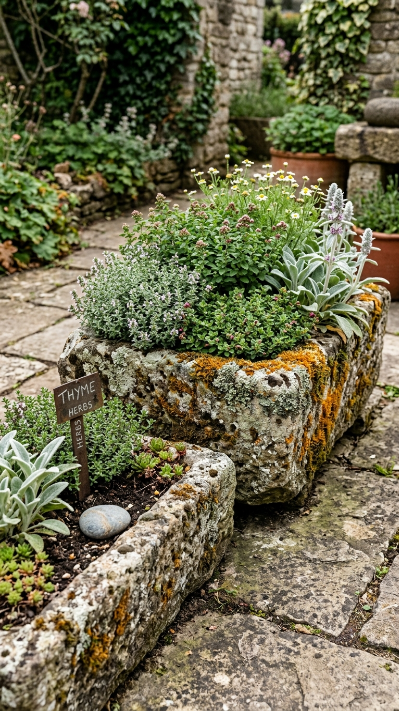
Vibe: Serene and unhurried — as though these troughs have been here since the garden’s beginning and intend to remain indefinitely.
What makes it work: The lichen covering is the decisive visual element — those layered patches of grey, green, and orange transform plain stone into something that reads as genuinely ancient. Alpine herbs are ideally scaled for troughs: compact, low-growing, and texturally varied in a way that reads beautifully against rough stone.
How to achieve it: Source reconstituted stone troughs from garden antique dealers or specialist stone suppliers — they age convincingly within a few seasons. Apply a 50/50 yogurt-and-water wash to accelerate lichen growth, then position in partial shade where moisture lingers.
💡 New hypertufa troughs — made from cement, perlite, and peat — can be cast at home for under £20 and age faster than solid stone.
Reclaimed Fence Board Planter Boxes With Wildflower Mix
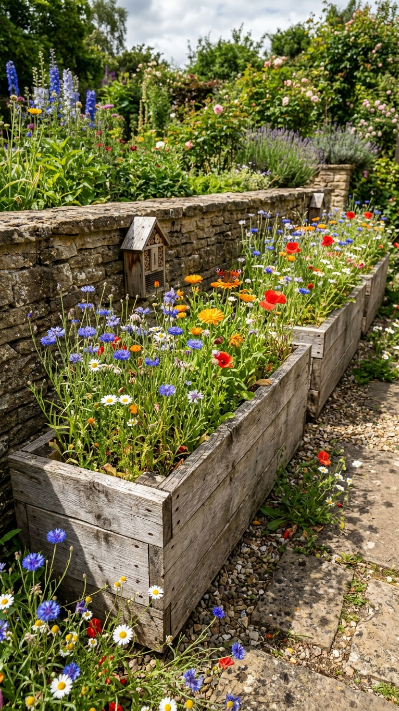
Vibe: The kind of planter that looks like it grew straight out of the wall it’s sitting on — colour and construction completely at ease with each other.
What makes it work: Reclaimed fence boards bring immediate, authentic texture that new timber simply cannot replicate — the irregular plank widths, visible grain, and colour variation read as genuinely handmade. Against that neutral grey-brown backdrop, wildflower colour is maximally vivid without appearing garish.
How to achieve it: Line reclaimed wood planters with thick polythene sheeting before filling to extend the wood’s life significantly. Sow a native wildflower seed mix directly into well-draining compost each spring — no thinning or deadheading required.
Iron Shepherd’s Hook Display With Hanging Terracotta Pots
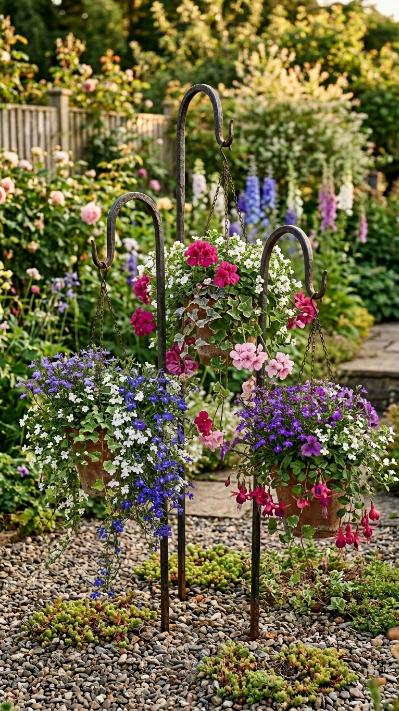
Vibe: Three small hanging pots can hold an entire corner of the garden together — animation, colour, and height in the most modest possible form.
What makes it work: Shepherd’s hooks add vertical interest without any construction — simply press them into the ground and adjust height to suit. Staggering three hooks at different heights creates a naturally dynamic arrangement that catches movement in any breeze, making the display feel genuinely alive.
How to achieve it: Drive shepherd’s hooks into firm soil or gravel using a rubber mallet — no tools or fixings needed. Use coir-lined wire baskets inside terracotta pots for superior moisture retention in hanging situations. Plant trailing varieties at the rim and a slightly more upright variety at the centre for the fullest silhouette.
💡 Grouping three shepherd’s hooks always outperforms a single one — the odd-number rule applies perfectly here.
Natural Charm Moss Wall Art Panel for a Garden Fence
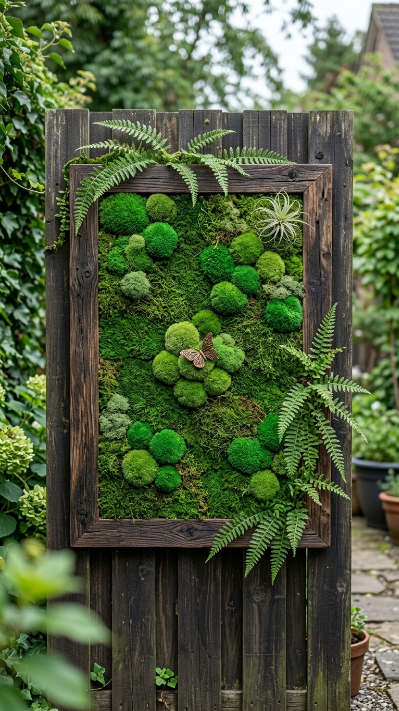
Vibe: A garden wall that breathes — literally textured, visually immersive, and completely unlike anything painted or planted conventionally.
What makes it work: Preserved moss panels bring a rich, gallery-quality vertical element that suits the rustic aesthetic perfectly — all natural material, zero rigid structure, and a depth of texture that rewards close inspection. On a dark fence background, vivid green moss becomes strikingly dramatic without any additional colour.
How to achieve it: Purchase preserved (not living) sheet and bun moss from craft suppliers — it requires no watering and maintains its colour for two to three years indoors or in a sheltered outdoor position. Mount on a timber frame using a strong exterior craft adhesive, and seal the backing with a coat of exterior wood treatment first.
Vintage Enamel Colander Planted With Tumbling Strawberries
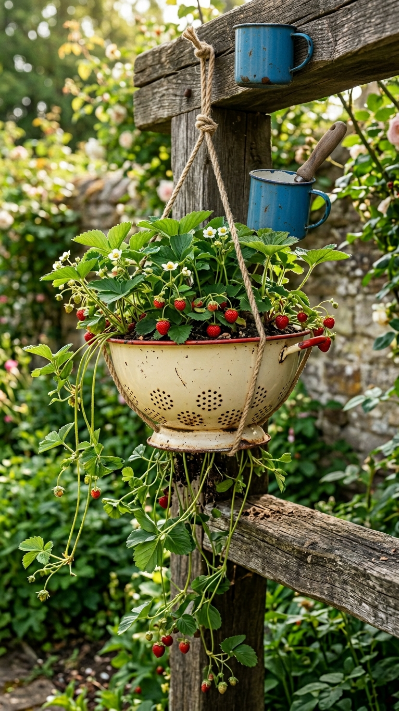
Vibe: Completely unexpected and completely right — a kitchen object reinvented as the most delightful small-space planter imaginable.
What makes it work: The visual tension between functional kitchenware and living plant life is what makes this idea so memorable. Vintage enamelware’s cream-and-red palette complements strawberry plants perfectly — it looks as though the two were designed together. The colander’s existing perforations provide ideal drainage, making it functionally as well as aesthetically perfect.
How to achieve it: Hunt for vintage enamel colanders at flea markets, charity shops, or online vintage platforms — pieces with chips and rust spots are preferable for authentic character. Thread heavy jute rope through two opposite holes at the top rim and tie securely to a beam or hook. Fill with free-draining compost and plant an everbearing variety like ‘Mara des Bois.’
Hazel Wigwam Bean Supports as Garden Sculpture
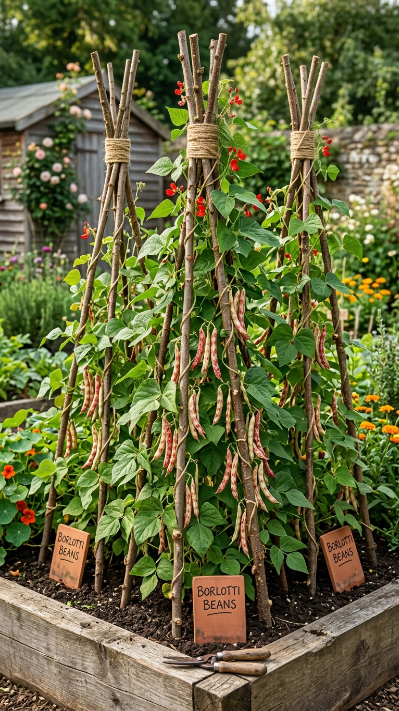
Vibe: Pure kitchen garden poetry — structure, abundance, and the seasonal satisfaction of watching something climb toward the sky.
What makes it work: Hazel wigwams function simultaneously as plant support, visual focal point, and vertical architectural element — they earn their place in the garden on multiple levels. Three arranged in a row create a rhythm that gives even a small kitchen garden a designed, intentional quality. The natural irregularity of hazel poles makes each wigwam unique.
How to achieve it: Source coppiced hazel poles from woodland craft suppliers — poles of 1.8–2.4m length are ideal. Push eight poles into the soil in a 60cm diameter circle, draw them together at the top, and bind firmly with jute twine. Sow two climbing bean seeds at the base of each pole.
💡 Bamboo canes work as a substitute, but hazel poles are almost always cheaper from woodland suppliers and vastly more beautiful.
Rusted Iron Garden Spheres Among Low Planting
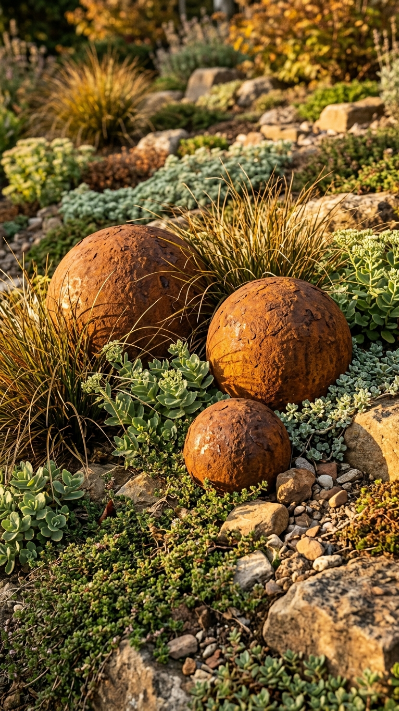
Vibe: Simple, heavy, and elemental — garden objects that look as though they’ve been in this spot since the garden was first made.
What makes it work: The warm orange-brown of weathered iron is one of the most naturally beautiful tones in any garden setting — it harmonizes with soil, stone, and autumn foliage simultaneously. Varying sphere sizes is essential: three of the same size reads as rigid and artificial, while graduating sizes creates natural rhythm.
How to achieve it: Find rusted iron spheres at garden centres, sculpture fairs, or online garden suppliers. Place directly on soil surface — no anchoring needed for large spheres. For a genuinely rustic look, allow the surrounding planting to partially engulf the lowest sphere over time rather than keeping it always fully visible.
Driftwood Mobile Hanging From a Garden Pergola
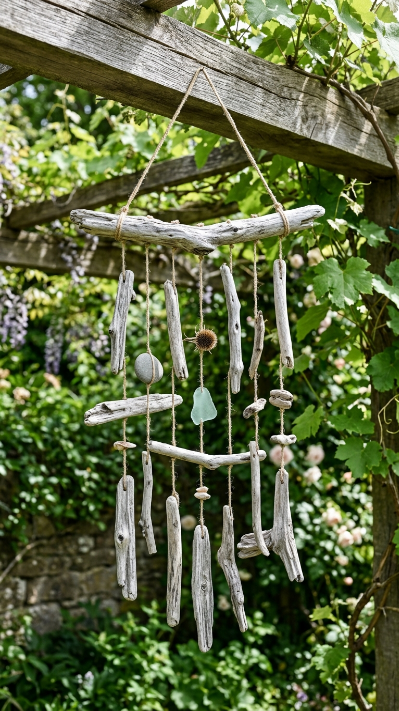
Vibe: The sound of this — small pieces of wood and stone just brushing each other in the breeze — is as much part of the pleasure as the sight of it.
What makes it work: A driftwood mobile brings movement, sound, and deeply personal curation to a garden space in a way nothing purchased can replicate. The bleached silver tone of driftwood is extraordinarily versatile — it harmonizes with any garden colour scheme without competing. Small found objects tied in give the mobile narrative and character.
How to achieve it: Collect driftwood from coastal beaches after storms (check local regulations for collection limits). Construct the mobile on a horizontal driftwood branch as the top bar, suspending vertical strings of varying lengths below. Tie found objects using waxed linen thread for weather resistance.
💡 Bleach fresh-found driftwood with a diluted hydrogen peroxide solution for 30 minutes to achieve the characteristic silver-white tone more quickly.
Slate Chalkboard Plant Labels on Copper Spike Stakes
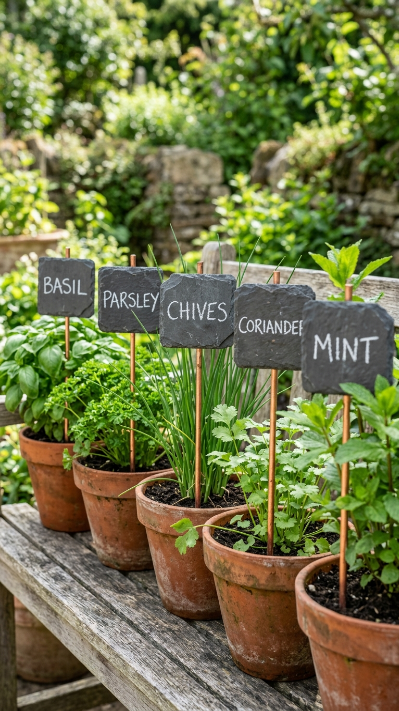
Vibe: A herb garden that’s organised and beautiful simultaneously — the labels are part of the decoration, not an afterthought.
What makes it work: Natural slate paired with copper is one of the most visually harmonious material combinations in rustic garden decor — the dark matte slate and the warm bright copper create a contrast that is both refined and entirely organic. Handwritten chalk lettering keeps everything personal and changeable.
How to achieve it: Source natural slate tiles from roofing suppliers or garden label specialists — irregular shapes are more beautiful than perfect rectangles. Drill a small hole and thread onto 3mm copper rod from a plumbing supplier, bent to a spike at the base. Write with chalk pencil or liquid chalk marker for longevity in rain.
Weathered Wooden Ladder Repurposed as Garden Display
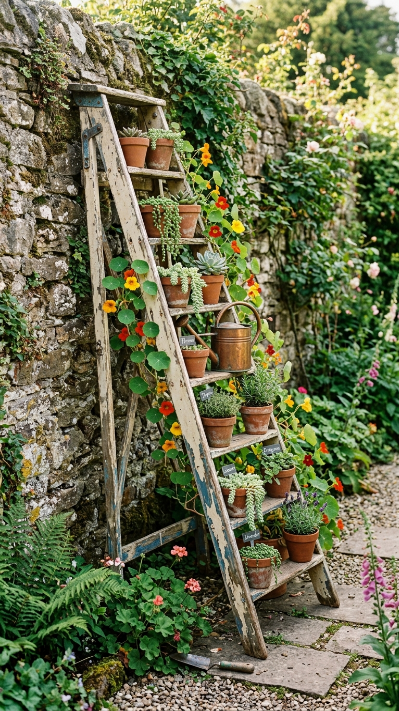
Vibe: Ingenious repurposing that makes the ladder itself as interesting as everything displayed on it.
What makes it work: An old ladder’s inherent design — multiple evenly-spaced horizontal surfaces at varying heights — is perfect for display. The visible paint history (layers of old colours chipping through) turns the ladder into an object of genuine visual interest in its own right, beyond what it holds.
How to achieve it: Stabilise a leaning ladder against a wall by screwing a short horizontal batten to the wall and resting the top rail on it — this prevents slipping without permanent fixing. Treat any bare wood with exterior-grade clear oil to prevent further deterioration while preserving the aged aesthetic.
💡 Look for old ladders at estate sales, barn clearances, or online — a genuinely weathered one with intact rungs costs very little and is impossible to fake convincingly.
Hand-Thrown Ceramic Wind Chimes With Natural Cord
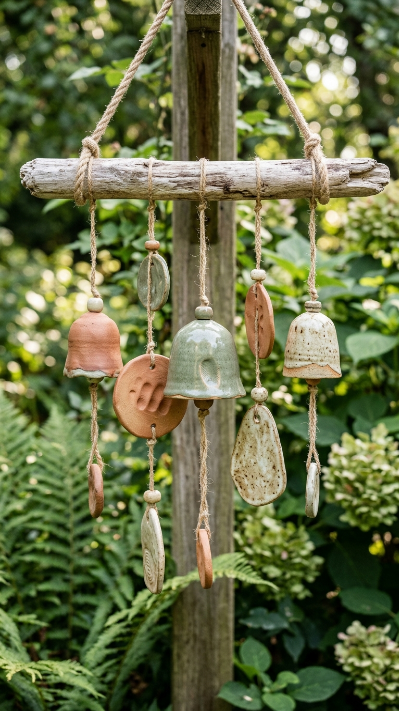
Vibe: Sound you can see — the promise of gentle music in any breeze, wrapped in the most beautiful rustic materials.
What makes it work: Hand-thrown ceramics are visually distinctive from mass-produced pottery the moment you see them — the slight irregularity, the glaze variation, the evidence of a maker’s hand. These qualities are precisely what rustic garden decor celebrates, making ceramic wind chimes an ideal expression of the whole style’s values.
How to achieve it: Source hand-thrown ceramic wind chimes from craft markets, independent ceramicists, or Etsy sellers specialising in garden ceramics. Alternatively, make simple ceramic pieces yourself using air-dry clay and glaze, drilling holes before drying. Suspend from a driftwood bar using waxed linen cord for weather resistance.
Rustic Garden Decor With a Willow Weave Garden Chair
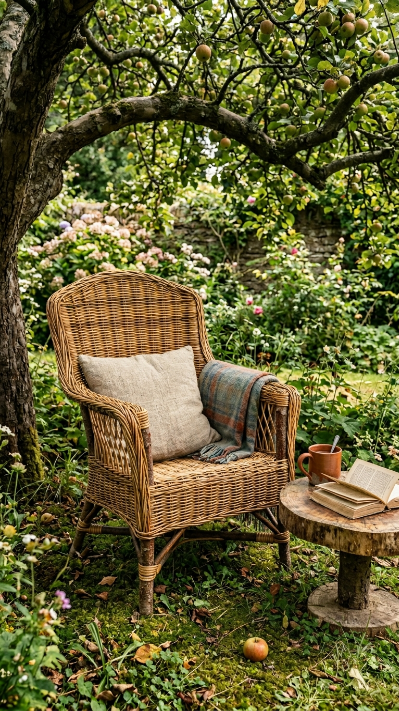
Vibe: The most restorative seat in the garden — and it looks as though the apple tree grew specifically to shade it.
What makes it work: A handwoven willow chair carries the entire rustic garden narrative in a single object: natural material, traditional craft, visible human skill. The honey-brown willow tones warm beautifully against green moss and grey bark, creating a naturally harmonious vignette that requires nothing additional to be visually complete.
How to achieve it: Commission a willow chair from a specialist basket-maker or folk craft supplier — these are made to last decades and represent genuine value for the quality. Treat annually with linseed oil to prevent cracking. Choose a coarse-weave, texture-rich linen cushion in warm oatmeal or undyed natural for the most sympathetic pairing.
Stone Sink Garden Feature With Miniature Water Plants
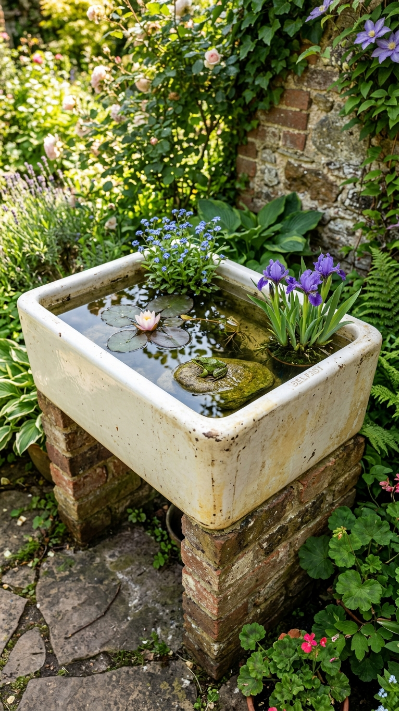
Vibe: A garden pond the size of a kitchen sink — and somehow just as satisfying as one three times its scale.
What makes it work: An old Belfast sink transformed into a miniature water garden is one of the most charming and achievable rustic garden features. The thick white ceramic, aged to a warm cream, provides a beautiful contrast with aquatic plant colour. The contained water surface creates reflections that animate the whole garden corner.
How to achieve it: Source reclaimed Belfast sinks from architectural salvage dealers — they’re widely available and generally inexpensive. Block the drain with an exterior-grade sealant plug. Set on two reclaimed brick piers at a comfortable viewing height (approximately 60cm). Plant miniature varieties specifically: Nymphaea ‘Pygmaea Helvola’ for water lily, Iris laevigata ‘Snowdrift’ for iris.
💡 Add a single submerged oxygenating plant to keep the water clear naturally — Ceratophyllum demersum (hornwort) is reliably effective and completely invisible below the surface.
Twisted Hawthorn Branch Trellis for Climbing Roses
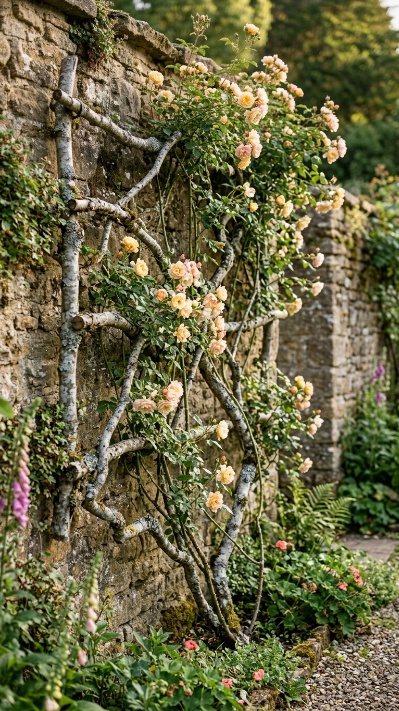
Vibe: Something a gardener made from what the hedgerow offered — and it happens to be extraordinarily beautiful.
What makes it work: Natural branch trellises have an organic, sculptural quality that manufactured trellising cannot approach. The natural forking points of hawthorn or apple branches provide ready-made anchor points for climbing rose stems — no wire, no clips, no tying-in required. The visual texture of twisted grey branch against warm stone is deeply satisfying.
How to achieve it: Cut naturally forked branches from hawthorn, elder, or fruit tree prunings during winter dormancy. Fix to a wall using vine eyes and stainless steel wire at key structural points — the branches can be bent gently while fresh and will hold their shape as they dry. Choose a flexible, long-stemmed climbing rose that naturally weaves.
Wicker Garden Trug Basket Filled With Cut Garden Flowers
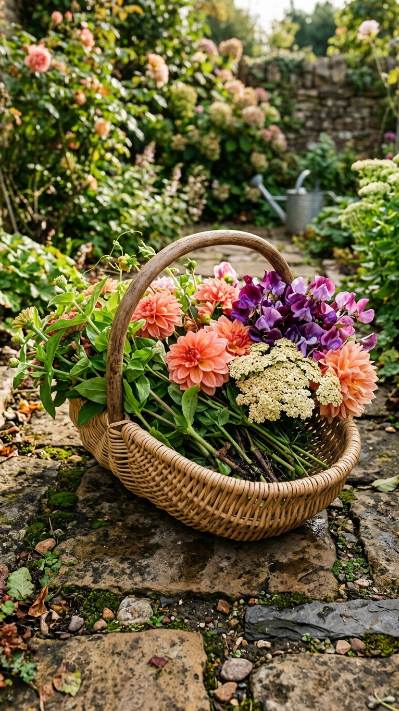
Vibe: The garden’s own harvest, carried lightly — abundance so casual it looks like it assembled itself.
What makes it work: A traditional wicker trug is one of those perfectly designed objects that looks better with use — the handle darkens where it’s been held, the wicker weaves gently in summer heat. As a display element rather than a working tool, a trug filled with garden flowers creates an immediate rustic vignette that reads as both styled and completely uncontrived.
How to achieve it: Source traditional English trugs from specialist basketry suppliers — Sussex trugs in particular are made to a centuries-old design and last a lifetime with minimal care. For display, lay a folded damp cloth inside before adding cut flowers to keep them fresh for several hours without a vase.
Reclaimed Chimney Pot Planted With Hardy Ferns
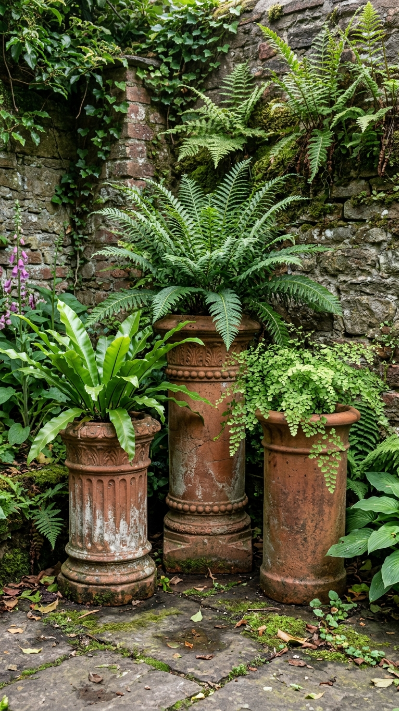
Vibe: Victorian in the very best way — objects that outlasted their original purpose by a century and look all the better for it.
What makes it work: Victorian chimney pots have extraordinary height and narrow profiles that create dramatic vertical punctuation in a garden corner — no standard pot achieves the same effect. Their aged terracotta, often cratered with lime deposits and surface crazing, is visually rich in a way that new ceramics simply cannot replicate. Ferns are ideal occupants: shade-tolerant, textured, and naturally drooping.
How to achieve it: Source reclaimed chimney pots from architectural salvage yards — they vary enormously in height and decorative detail. Cap the base opening with a circle of landscape fabric before filling with a free-draining compost-and-grit mix. Choose hardy ferns like Dryopteris filix-mas or Polystichum setiferum for reliable year-round interest.
💡 A chimney pot doesn’t require a drainage hole — its tubular form naturally limits waterlogging if planted with a gritty compost mix.
Straw Beehive Skep as Garden Ornament
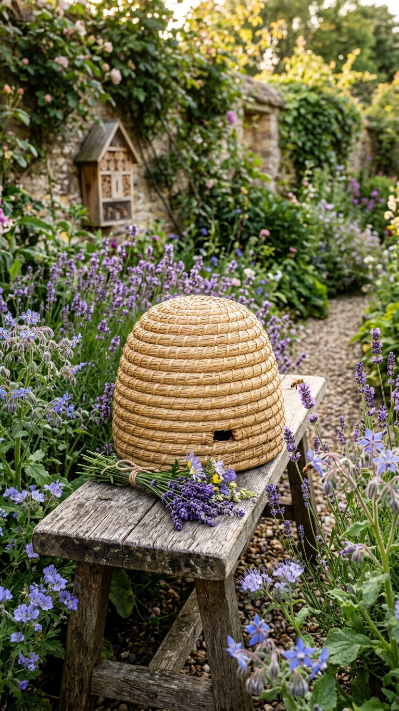
Vibe: An object that carries centuries of history — and sits in a lavender border as if it were placed there this morning.
What makes it work: The coiled straw skep is one of the most immediately recognisable symbols of the cottage garden tradition — its circular coil pattern and golden dome form are visually compelling from any distance. As a purely ornamental object (modern beekeeping uses wooden hives), it contributes history, texture, and a powerful sense of place to any garden corner.
How to achieve it: Source decorative straw skeps from country lifestyle suppliers or traditional craft makers — they are purely ornamental and require no maintenance beyond keeping them dry. Place under a small timber roof or eave if outdoors year-round. Surround with bee-friendly planting: lavender, borage, phacelia, and single-flowered dahlias.
Aged Copper Sundial on a Reclaimed Stone Plinth

Vibe: Time measured in shadow — a garden centrepiece that earns its position through genuine elegance rather than size alone.
What makes it work: A sundial is one of very few garden ornaments that is both functional and deeply symbolic — it makes a garden feel purposeful and considered in a way that purely decorative objects cannot. Copper’s natural patination from bright penny to deep verdigris-green is spectacularly beautiful, and a sundial face gives that process ample surface to develop across.
How to achieve it: Source antique or reproduction copper sundials from specialist garden ornament dealers or traditional metalworkers — quality reproduction pieces develop authentic patina within five to ten years. Position accurately on a south-facing axis using a compass for the gnomon shadow to read correctly. Mount on a reclaimed limestone or sandstone plinth for the most sympathetic material pairing.
Natural Charm Rustic Garden Decor With Dried Grass Wreaths
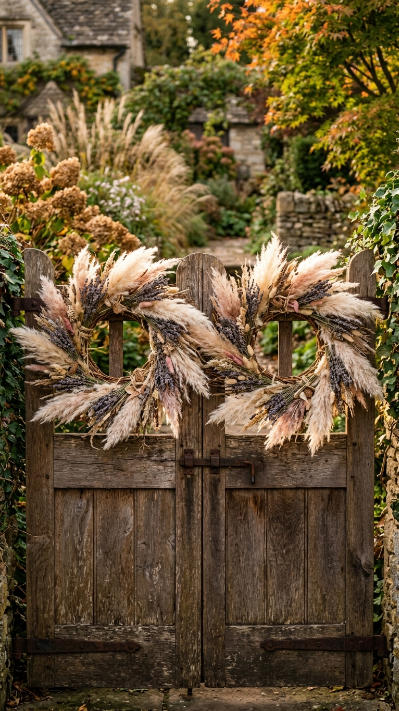
Vibe: Seasonal, honest, and completely arresting — a garden entrance transformed by two circles of dried grass and willow.
What makes it work: Dried botanical wreaths bring texture, movement, and a warm, harvest-season palette that live wreaths cannot sustain outdoors. Pampas grass plumes catch light with extraordinary delicacy — they shift from cream to warm gold depending on the angle of the sun, keeping the display visually alive throughout the day.
How to achieve it: Build wreaths on a twisted willow or wire base — willow is preferable for its rustic texture. Bind dried stems in small bunches using stub wire, layering bunches around the base in one direction. Mix pampas grass with dried lavender, wheat, and seed heads for textural variety. Seal with a light spray of exterior matte varnish to weatherproof.
💡 Dry pampas grass indoors for at least three weeks before using in wreaths — freshly cut plumes shed heavily once dried and handled.
How to Start Your Rustic Garden Transformation
The most common mistake when starting a rustic garden is trying to do too much at once. Choose one area — a garden corner, a wall, a path edge — and focus all your attention and budget there before moving on. A single beautifully composed corner will teach you more about what you love and what works than a dozen half-finished ideas scattered across the garden.
Start with materials rather than plants. Rustic garden decor lives or dies on the quality and authenticity of its hard elements — reclaimed stone, aged terracotta, natural timber — and those are harder to fake than planting style. Visit a salvage yard before a garden centre, and spend your budget on one genuine antique object rather than several new reproductions.
Avoid anything too perfect, too uniform, or too clearly mass-produced. The rustic style is rooted in imperfection — the slight lean of a post, the uneven surface of hand-thrown pottery, the irregular colour of reclaimed brick. These qualities are not shortcomings to hide but features to celebrate.
Give your first year entirely to observation. A rustic garden reveals its best spots and worst problems through a full season — where the light falls at different hours, where drainage is poor, where frost lingers. This knowledge is the foundation of everything beautiful that follows.
Frequently Asked Questions
How do I make my garden look rustic on a small budget?
Rustic garden decor is genuinely one of the most budget-accessible design styles because aged and imperfect objects are valued over new and perfect ones. Focus your spending on one quality anchor piece — a reclaimed stone trough, a vintage enamel piece, or a length of genuine reclaimed timber — and build outward from there using inexpensive elements like terracotta pots (aged yourself using yogurt wash), seed-grown wildflowers, and salvaged bricks for edging. A convincingly rustic garden corner can be achieved for under £100/$120 with careful sourcing.
What plants work best with rustic garden decor full of natural charm?
The best plants for rustic garden decor with natural charm are those that look beautiful slightly unruly — cottage garden perennials including foxgloves, echinacea, salvia, achillea, and verbena; climbing plants like Rosa ‘Gertrude Jekyll,’ sweet peas, jasmine, and Hydrangea anomala petiolaris; and structural herbs like rosemary, lavender, and sage. Grasses — particularly Stipa tenuissima and Deschampsia cespitosa — add movement and a wild-meadow quality that reinforces the rustic aesthetic beautifully. Native wildflowers seeded directly into borders or containers are the single most cost-effective planting investment.
What’s the difference between rustic garden decor and cottage garden style?
Rustic garden decor focuses primarily on materials and objects — the aged terracotta, reclaimed timber, wrought iron, and natural stone that form the structural aesthetic. Cottage garden style is principally a planting philosophy: dense, informal, mixed perennial planting with a deliberately unplanned character. The two are natural partners — most cottage gardens benefit enormously from rustic structural elements, and rustic gardens look most alive when planted in a loose cottage manner — but they can each exist independently.
How do I maintain rustic garden decor through winter?
Most rustic garden decor materials are naturally winter-hardy with minimal intervention. Reclaimed stone, fired terracotta, and wrought iron are essentially weatherproof. Wicker and willow pieces benefit from an annual coat of linseed oil in early autumn before hard frosts. Glazed ceramic pieces — including decorative pots and wind chimes — should be moved under cover in regions with hard freezes, as water trapped inside can crack the ceramic during frost expansion. Timber structures like pergolas, gates, and raised beds benefit from a coat of natural exterior oil every two to three years to prevent splitting.
Is rustic garden decor suitable for a modern urban garden?
Rustic garden decor translates exceptionally well into urban gardens precisely because it introduces warmth, texture, and organic character that hard urban surfaces — concrete, brick, metal fencing — completely lack. In a small city courtyard, a single reclaimed-wood raised bed, a cluster of aged terracotta, and a wall-mounted wicker lantern can transform the entire atmosphere. The key in an urban context is restraint: choose two or three carefully selected rustic elements rather than filling every surface, allowing each piece the breathing space to register its full visual impact.
Ready to Create Your Dream Rustic Garden Space Full of Natural Charm?
These 20 rustic garden decor ideas are as varied as the gardens they’re designed to inspire — from a straw skep in a lavender border to a handmade willow chair beneath an apple tree, from copper sundials to ceramic wind chimes that sing in the breeze. Pin the ideas that stopped you mid-scroll, because those instinctive responses are always telling you something true about what your garden needs. Remember that every great rustic garden started with one honest, imperfect object placed somewhere with intention. The charm builds from there — season by season, piece by piece — until the garden starts to feel entirely, unmistakably itself.