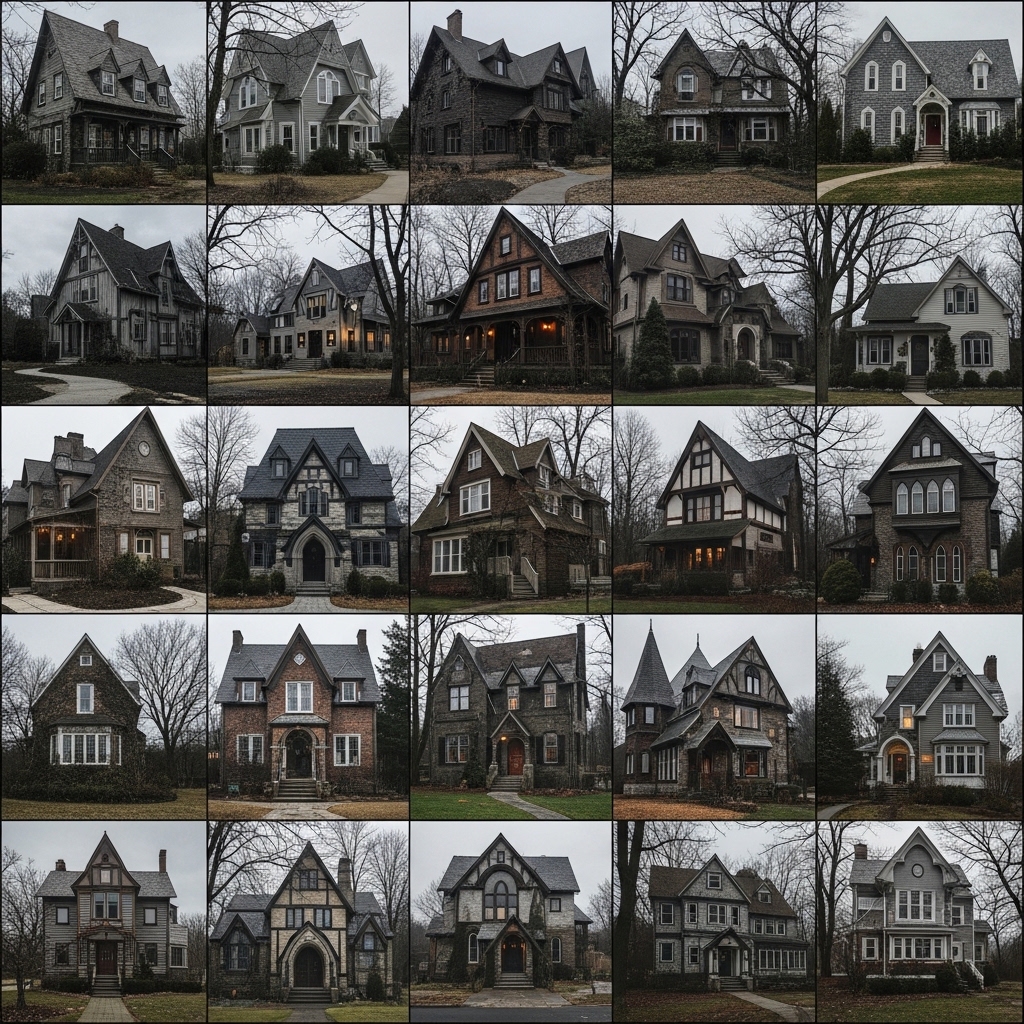
There’s something quietly rebellious about a home that refuses to be ordinary. Gothic farmhouse exteriors sit at this beautiful intersection — where centuries-old architectural drama meets the raw, unpretentious soul of rural living. Think weathered black siding kissed by climbing vines, arched windows that catch the light like cathedral glass, and wraparound porches draped in shadow and mystery. These aren’t just houses. They’re statements.
If you’ve ever driven past a home and felt your heart do something unexpected — a little skip, a sharp intake of breath — chances are it had that quality. That dark romance. That feeling of a place with stories to tell. Gothic farmhouse design captures exactly that energy, blending the moody, the ancient, and the beautifully worn into something that feels like home in the most soul-deep way.
Whether you’re building from scratch, planning a dramatic exterior refresh, or simply daydreaming from your Pinterest board (no judgment — we live here too), these 23 Gothic farmhouse exterior ideas will pull you in and refuse to let go. Save them, share them, and let yourself be inspired.
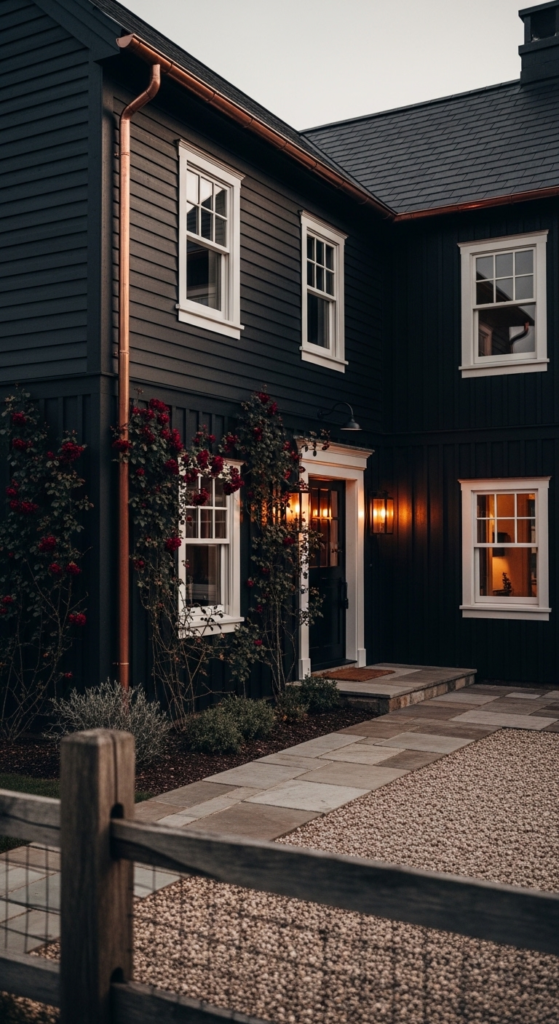
1. The Midnight Black Board-and-Batten Farmhouse
There is no exterior finish quite as commanding as full black board-and-batten siding, and when it’s done right on a farmhouse silhouette, the effect is nothing short of theatrical. Picture deep, matte charcoal — almost swallowing light — interrupted only by the crisp white geometry of window trim and the warm amber glow spilling from interior lanterns at dusk. This look is rooted in tradition. Board-and-batten has graced American farmhouses for generations, but swap the classic white for an ink-black hue and suddenly the whole thing transcends time.
Climbing roses in deep burgundy or dusty mauve soften the drama beautifully, trailing up the front facade and threading through a weathered wooden fence. Steel hardware on the front door — matte black, of course — ties it all together with industrial intention. This style is perfect for the homeowner who wants curb appeal that makes neighbors slow their cars down just to take a second look. Pair with a gravel drive and aged stone path for full effect.
Styling Tips: Use Benjamin Moore’s “Black Beauty” or Sherwin-Williams “Tricorn Black” for the siding. Add copper gutters for an oxidized, aged finish over time.
2. Arched Windows & Iron Accents: The Cathedral-Inspired Farmhouse
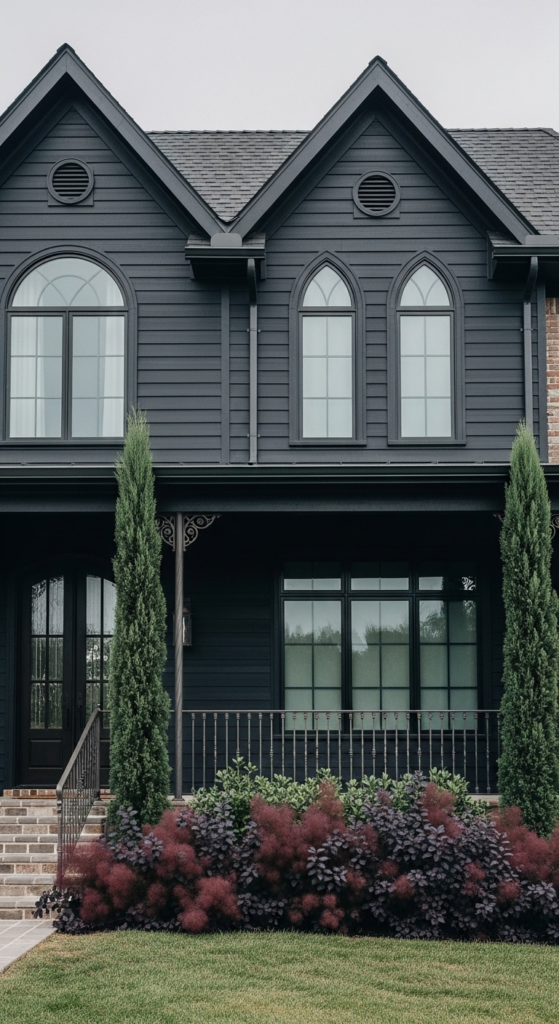
When Gothic architecture first emerged in medieval Europe, it was all about reaching upward — pointed arches, soaring lines, windows designed to flood sacred spaces with transcendent light. That same energy translates hauntingly well to a modern farmhouse exterior. Arched windows with dark iron muntins installed on a black or deep charcoal home create a silhouette that feels like a countryside manor pulled straight from a literary classic.
This design works especially well on two-story farmhouses where the verticality of the architecture can really sing. Pair leaded or slightly frosted glass panes with ornate iron porch railings and you’ve got a facade that reads as both ancient and freshly intentional. Tall, narrow cedar trees flanking the entrance — Italian cypress work beautifully here — reinforce the Gothic verticality. The beauty of this approach is that it’s deeply romantic without trying too hard. The architecture does the heavy lifting.
Styling Tips: Source custom arched window frames from local millwork shops. Plant dark foliage like Black Mondo Grass or Purple Smoke Bush along the foundation for a layered, mysterious landscape.
3. Weathered Wood & Wrought Iron: The Gothic Rustic Retreat
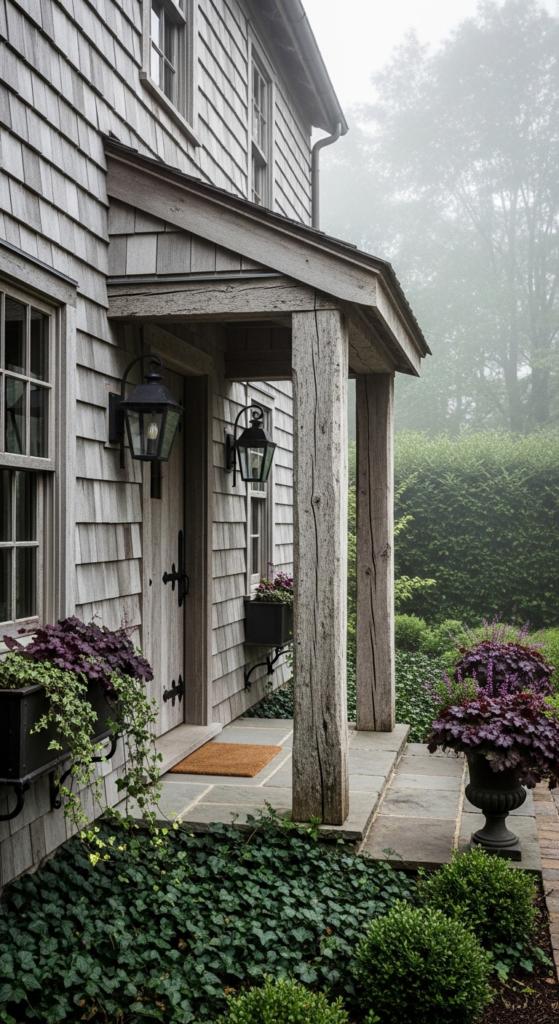
Not every Gothic farmhouse needs to be polished. Some of the most breathtaking examples of this aesthetic lean fully into decay — not in a neglected way, but in the way that speaks of deep history and unhurried living. Weathered grey wood siding, left to silver naturally over decades, has a texture and depth that no manufactured finish can replicate. When you pair that beautiful, time-worn exterior with hand-forged wrought iron details — porch lanterns, door hinges, window box brackets — the result is something that feels genuinely old world.
Add a covered porch with rough-hewn timber columns and stone flooring, and you’ve created an exterior that feels like it belongs on the edge of a misty moor. This look suits properties with mature trees, overgrown hedges, and a landscape that hasn’t been too aggressively tamed. It’s perfect for the homeowner who appreciates authenticity over perfection, and who finds beauty in the patina of things that have been well-loved and weathered by time.
Styling Tips: Let your wood siding grey naturally rather than painting it. Add hand-forged iron window boxes planted with trailing ivy and dark purple heuchera for a moody, living facade.
4. The Black Victorian Farmhouse with Gingerbread Trim
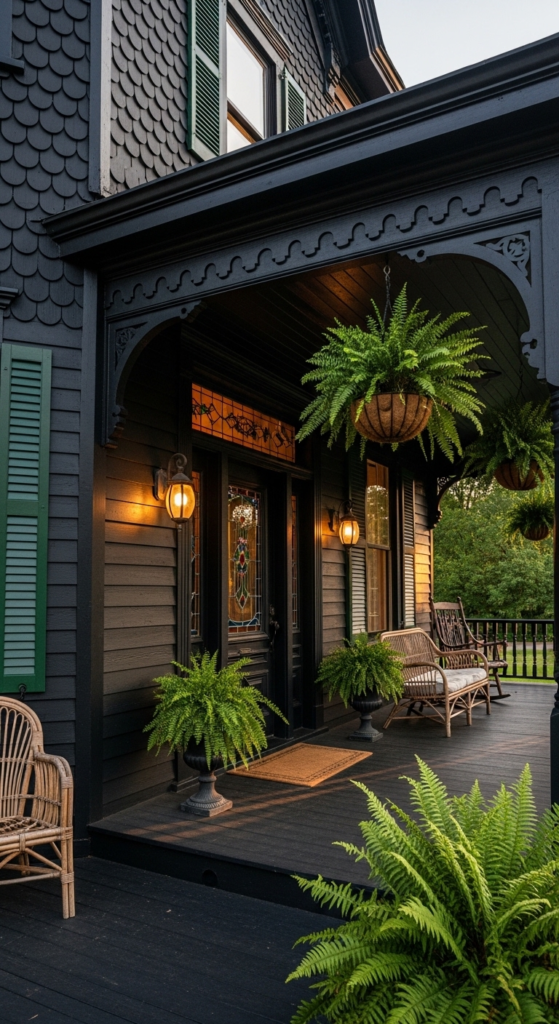
Victorian architecture gave us some of the most gloriously detailed exterior woodwork ever created — intricate gingerbread trim, scalloped shingles, decorative brackets, and ornate porch balustrades that look more like lacework than lumber. When you take that extraordinary level of detail and drench it in matte black paint, the effect is simultaneously spooky and sophisticated. The Gothic farmhouse aesthetic owes a significant debt to Victorian design, and this particular combination celebrates that lineage fully.
Imagine a two-story farmhouse with a wraparound porch, every inch of ornamental woodwork painted a deep, flat black, offset by midnight navy or deep forest green accent trim. Wicker porch furniture in aged rattan adds warmth and prevents the exterior from feeling stark. Stained glass inserts in the front door throw jewel-toned light across the porch at sunset, and oversized hanging ferns in iron baskets create movement and softness. This design is perfect for history-loving homeowners who want their home to feel like a beloved Victorian novel made real.
Styling Tips: Use exterior spray equipment for smooth, drip-free coverage on detailed trim work. Jewel tones — ruby, sapphire, deep teal — work beautifully as door and shutter accent colors.
5. Stone and Black Timber: The English Manor Farmhouse
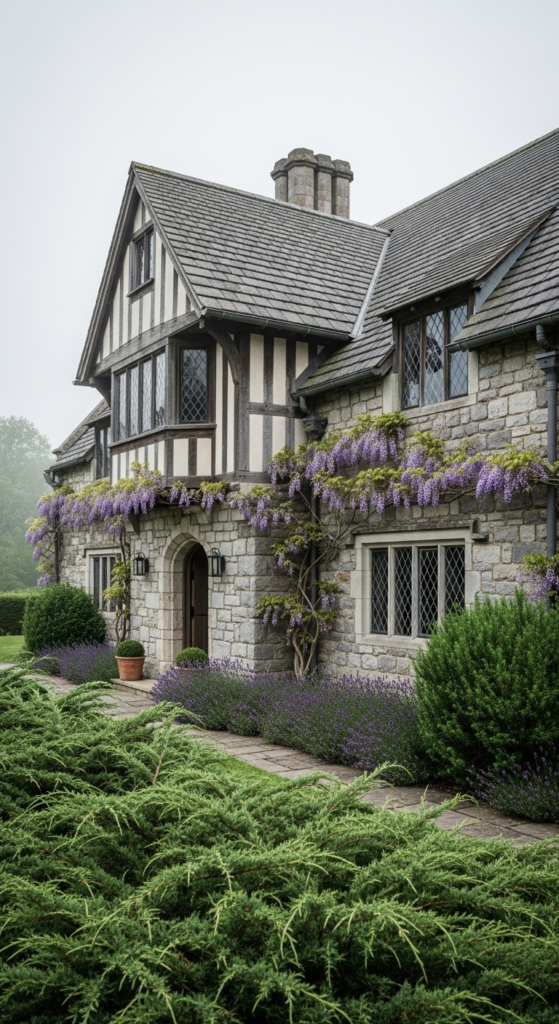
There is a particular kind of beauty in the combination of rough-cut stone and dark timber that speaks directly to the Gothic architectural tradition. English manor houses have used this pairing for centuries, and translated to a farmhouse scale, it creates something that feels both humble and majestic at once. The stone grounds the structure in the landscape — literally and aesthetically — while the dark timber framing above reads as dramatic contrast, especially against a grey sky.
Half-timbered exterior elements with wattle-and-daub-inspired infill panels, or modern board-and-batten used to mimic the traditional timber frame aesthetic, both work well here. A steeply pitched roof with slate or dark composite shingles completes the silhouette. Foundation plantings should lean into the wildness — lavender, rosemary, climbing wisteria, and sprawling juniper create a sense that the garden and the house have reached an agreement over many decades. This look is ideal for those who want their home to feel like it has always been there.
Styling Tips: Source locally quarried stone where possible for the most authentic regional character. Use real timber framing on at least the porch and entry elements even if the rest is simulated.
6. The Dramatic Black Metal Roof Farmhouse
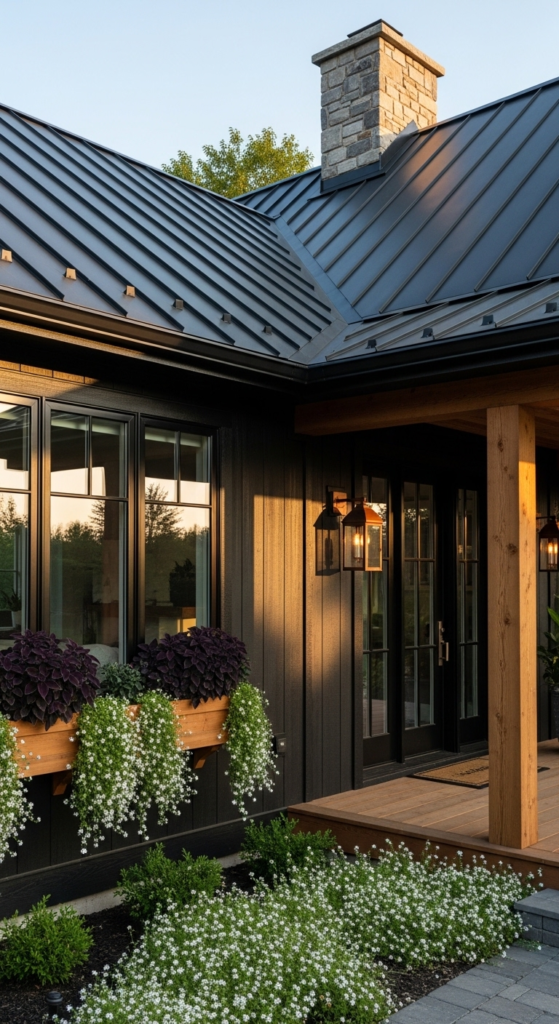
A standing seam metal roof has become one of the most distinctive elements of contemporary farmhouse design — but when you choose that roof in a deep, matte black rather than the traditional galvanized or barn red, something shifts dramatically. The entire exterior takes on a gravity and intentionality that elevates even a simple rectangular farmhouse into something with genuine architectural presence. Paired with black or deep charcoal siding, the monochromatic roofline creates a sleek, unified silhouette against the sky.
What prevents this from feeling cold or corporate is the warmth injected through natural materials — wood porch decking in a rich weathered cedar, copper or bronze light fixtures, and natural stone chimney stacks. Window boxes overflowing with dark-leafed coleus, trailing black sweet potato vine, and bright white bacopa create a living contrast that softens the monochrome palette. This design works beautifully on both traditional farmhouse forms and more contemporary, barn-influenced structures. It’s for homeowners who appreciate architectural rigor and aren’t afraid of a bold statement.
Styling Tips: Match your gutters, downspouts, and fascia to the roof color for a seamless, deliberate look. Install oversized windows to balance the visual weight of the dark roofline.
7. Gothic Farmhouse with a Turret: The Fairytale Exterior
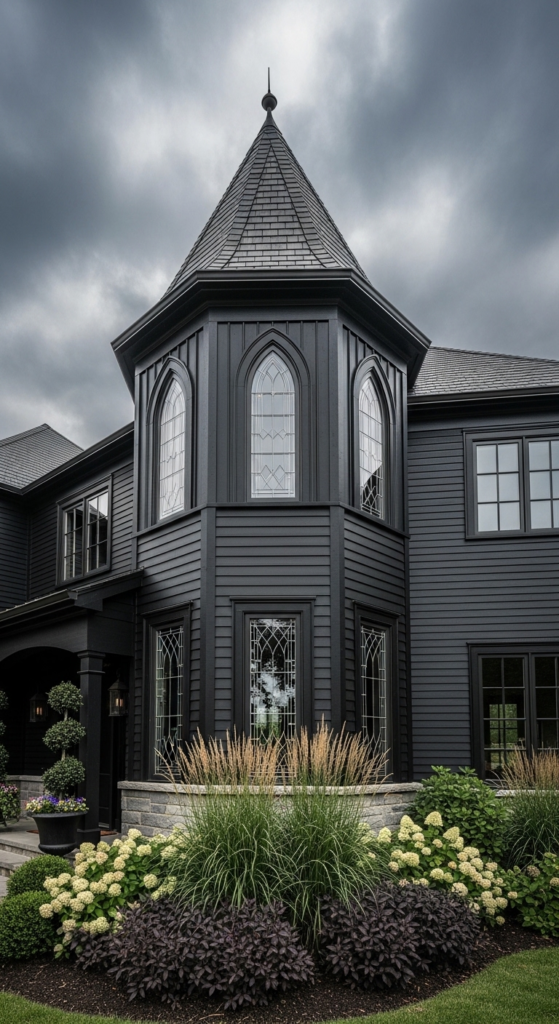
There is something wildly romantic about a turret. That circular, tower-like protrusion that juts above the roofline, its conical cap pointing skyward like an exclamation mark in architectural language — it transforms a farmhouse from a home into a destination. Gothic farmhouses with turret elements occupy a space between fairy tale and historical drama, and for homeowners with enough courage to commit, the results are absolutely unforgettable.
The turret works best when it anchors one corner of the home, rising a story above the main roofline with its own steeply pitched conical roof in dark slate or metal. Windows in the turret should be narrow and arched, perhaps with leaded glass for additional character. The rest of the home’s exterior can remain more restrained — black or deep charcoal board-and-batten, simple trim — so the turret reads as the intentional focal point it is. Surround the base with dramatic plantings: tall ornamental grasses, dark flowering shrubs, and sculptural topiaries in iron pots.
Styling Tips: Use the turret interior space as a reading nook, meditation room, or home office — it earns every inch of its drama both inside and out.
8. The Brooding Barn-Style Gothic Farmhouse
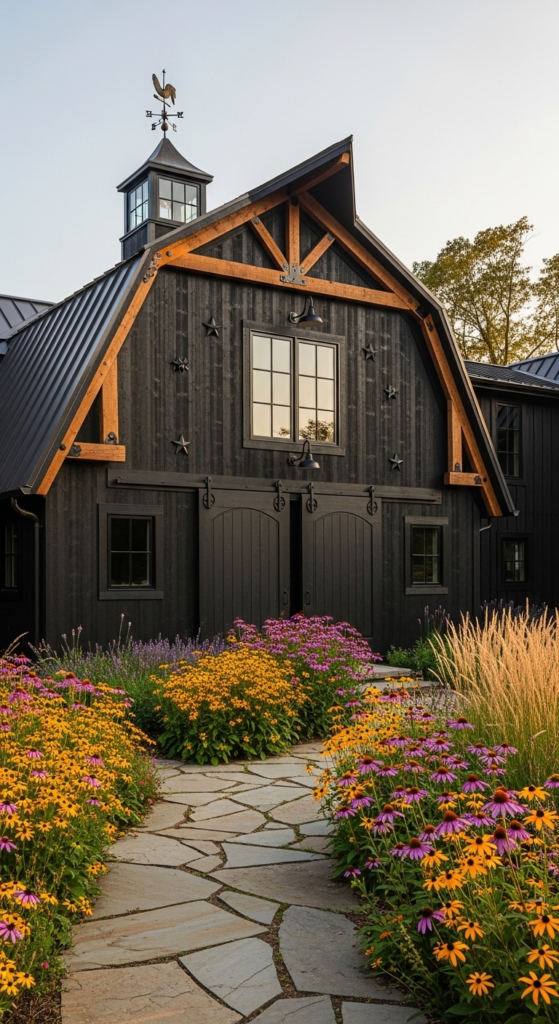
The American agricultural barn is one of the most iconic structures in the rural landscape — and its bones translate remarkably well to residential Gothic farmhouse design. A barn-style home with its dramatically pitched gambrel or gabled roof, wide sliding doors, and expansive exterior planes is a perfect canvas for Gothic treatment. Paint the whole structure in flat black or deepest charcoal, swap the traditional sliding doors for ones fitted with arched iron hardware, and suddenly the barn has a new life entirely.
Exposed timber purlins visible in the gable ends, iron star anchor bolts punctuating the siding at regular intervals, and black-framed cupolas with weathervanes all contribute to an exterior that feels simultaneously agricultural and ancient. A flagstone path winding through a wild meadow garden — filled with black-eyed Susans, purple echinacea, and ornamental grasses — softens the approach and grounds the home in its landscape. This is perfect for those who want the romance of a Gothic aesthetic without abandoning their love of honest, hardworking rural architecture.
Styling Tips: Retain or add cupolas to reinforce the barn silhouette. Choose oil-rubbed bronze or black iron for all exterior hardware to maintain material cohesion.
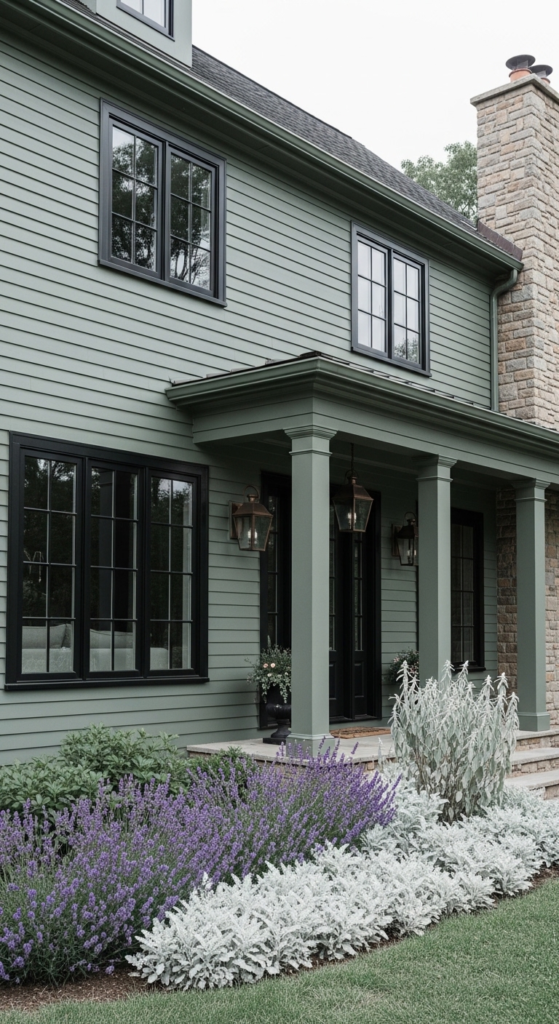
9. Moody Sage & Black: The Unexpected Gothic Color Combination
When people think Gothic farmhouse exteriors, they almost always think black — and black is indeed magnificent. But one of the most sophisticated and unexpected takes on this aesthetic involves pairing that dark drama with a deeply muted, almost grey sage green. The combination is quietly arresting. It reads as Gothic without being aggressive, moody without being oppressive, and it has a quality that feels somehow ancient and botanical at once.
Picture a clapboard farmhouse in a deep, desaturated sage — not the bright celery greens of coastal cottages, but something closer to the color of dried herbs or lichen on old stone. Black window trim, black porch columns, and a black front door provide the necessary drama and depth. Iron lanterns and bronze hardware warm the palette slightly. Foundation plantings lean heavily into silvery textures — lavender, lamb’s ear, dusty miller, artemisia — that echo and amplify the sage palette. This look suits homeowners who want something distinctive but perhaps not quite ready to commit to full black.
Styling Tips: Try Farrow & Ball “Mizzle” or Sherwin-Williams “Pewter Green” for that perfect desaturated sage. Keep all trim strictly black for the necessary contrast.
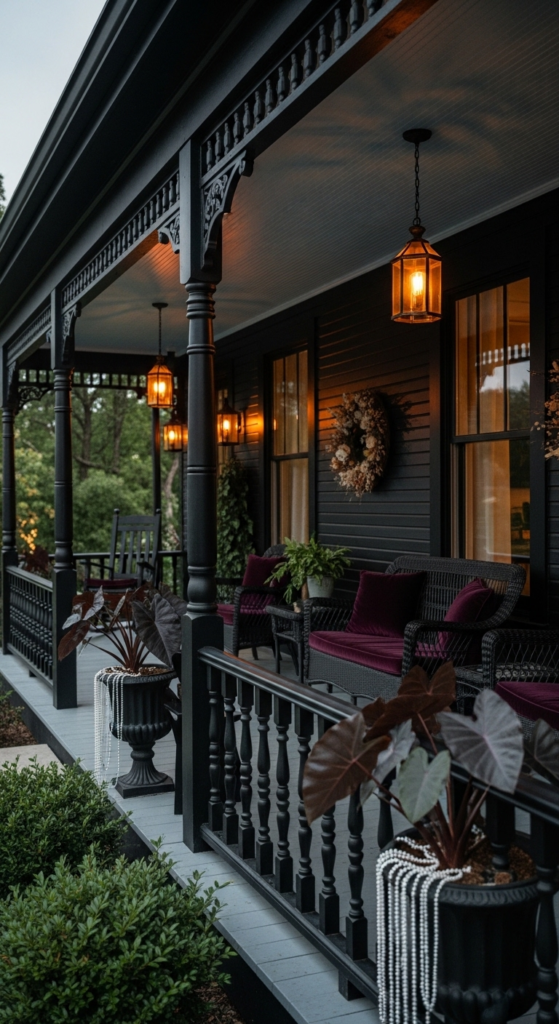
10. The Gothic Farmhouse with a Wraparound Porch from Another Century
The wraparound porch is the great American architectural gift — a transitional space between the private interior world and the public landscape, a room without walls where life happens slowly and deliberately. On a Gothic farmhouse, the wraparound porch takes on additional character. Painted black or deep grey, fitted with ornamental spindles, and furnished with dark wicker or iron furniture draped in velvet and linen cushions in deep jewel tones, it becomes one of the most atmospheric outdoor spaces imaginable.
Overhead, porch ceilings painted in a deep, dusty blue-grey — a traditional “haint blue” reimagined in Gothic tones — add unexpected depth when glimpsed from outside. Hanging lanterns at close intervals cast a warm amber glow at dusk that makes the porch irresistible. Potted dark-leafed elephant ears, trailing string of pearls in iron planters, and dried floral wreaths on the siding add layers of texture. This design is made for the homeowner who truly lives on their porch and wants that space to feel as considered and beautiful as any interior room.
Styling Tips: Install porch ceiling fans in matte black with rattan blades for function and aesthetic cohesion. Use outdoor-rated velvet or performance linen in deep plum and burgundy for cushions.
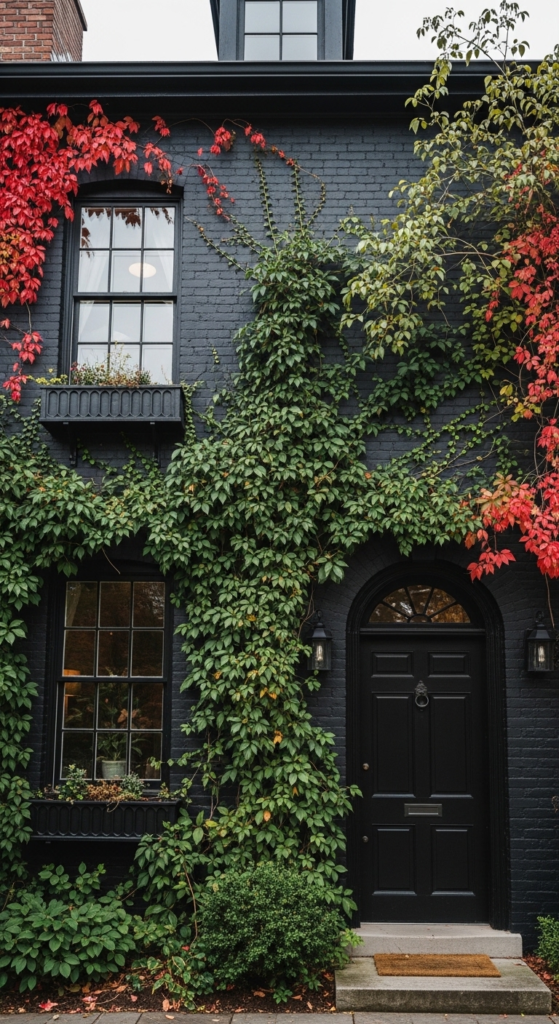
11. Climbing Vines & Black Brick: The Living Gothic Facade
There is nothing quite so romantically Gothic as a structure being slowly, willingly claimed by living things. Ivy, climbing hydrangea, Virginia creeper, and wisteria — these aren’t just plants, they’re collaborators in an architectural story that evolves season by season. On a Gothic farmhouse with black painted brick or dark stone, climbing vines create a living facade that is simultaneously dramatic and deeply, organically beautiful.
In summer, the green is lush and full against the dark wall, the contrast almost photographic in its clarity. In autumn, Virginia creeper turns a breathtaking scarlet, making the whole exterior look as though it’s on fire — in the most magnificent way. In winter, the bare skeletal branches against the dark brick create a pattern of extraordinary graphic beauty. This is a home that demands to be photographed in every season. It suits those who think of their home as a garden — a living, growing, ever-changing thing that they tend rather than simply maintain.
Styling Tips: Install proper climbing support systems — stainless wire or iron trellises — before vines become established to guide their growth away from windows and gutters.
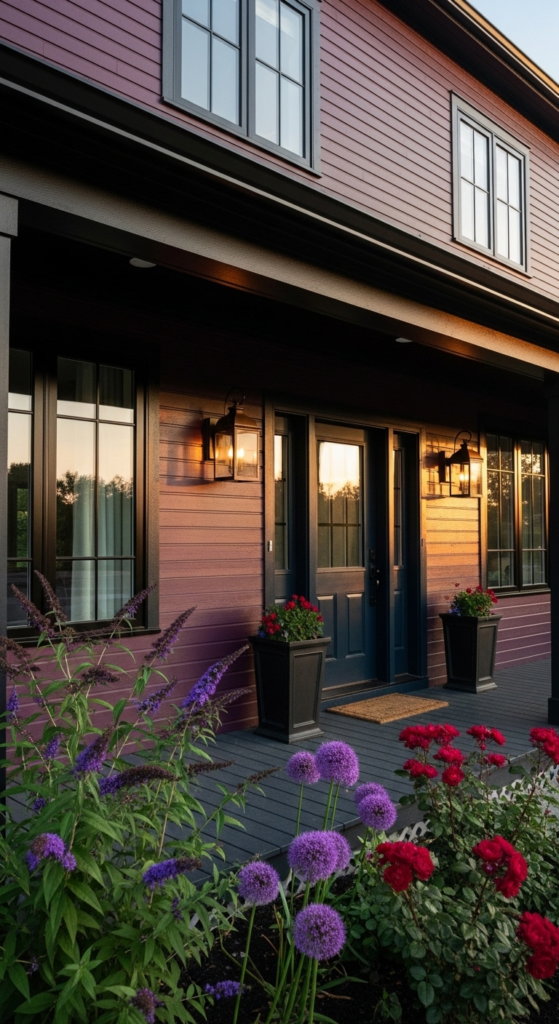
12. Deep Plum & Iron: The Unexpected Dark Jewel Farmhouse
Black may be the obvious choice for a Gothic farmhouse exterior, but deep plum — a color so dark it reads almost as black in certain light but blooms into rich violet in full sun — is the secret weapon of the most sophisticated Gothic homes. It carries the same darkness and drama but with an unexpected warmth and depth that feels simultaneously mysterious and welcoming. It’s the kind of color that makes people slow down, park their car, and stare.
Pair deep plum siding with iron-black trim, charcoal porch floors, and a front door in deepest forest green or midnight navy for a color combination that feels curated over decades rather than chosen from a paint chip in an afternoon. Exterior light fixtures in unlacquered brass or aged bronze warm the palette beautifully. Landscape plantings should embrace the jewel tones — Black Knight butterfly bush, deep purple allium, and dark red roses create a garden that feels like an extension of the exterior palette. This look is for the fearless homeowner who understands that a home can be a work of art.
Styling Tips: Test your plum exterior paint in multiple light conditions — morning, midday, dusk — before committing. The color shift is part of the magic but worth understanding fully.
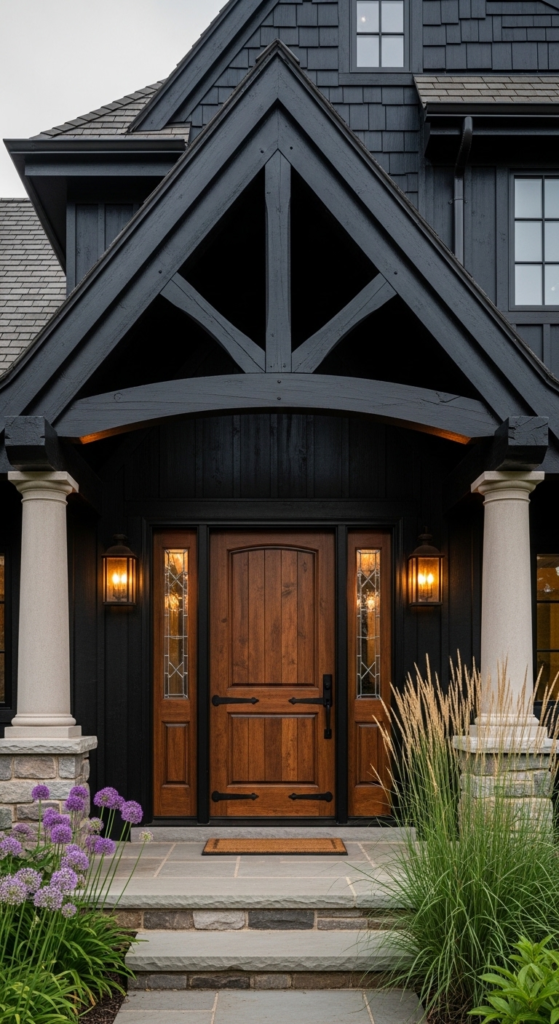
13. The Gothic Farmhouse with a Dramatic Gabled Entry
The gable — that simple triangular form created by a pitched roof — is one of architecture’s most ancient and enduring elements. When used deliberately at the main entrance of a Gothic farmhouse, scaled generously and executed with careful detail, the gabled entry becomes a portal. A threshold that announces you are about to enter somewhere meaningful. Extending the roofline forward to create a deep, covered entry porch with a steeply pitched gable overhead is one of the most impactful exterior moves possible.
Within that gabled entry, every detail matters. Exposed rafter tails painted black against the underside of the roof deck. Iron strap hinges on a solid wood door. Sidelights with leaded glass or iron grid muntins. A porch light in aged bronze or wrought iron on each side of the door, casting symmetrical pools of warm light. Stone thresholds and flanking stone columns. Plant the entry approach with tall, dramatic foliage — feather reed grass, ornamental allium stalks, dark-leafed pittosporum — and the arrival sequence becomes a full, considered experience.
Styling Tips: Commission a custom wood door for the entry — the craftsmanship and scale of a properly proportioned entry door elevates the entire exterior more than almost any other investment.
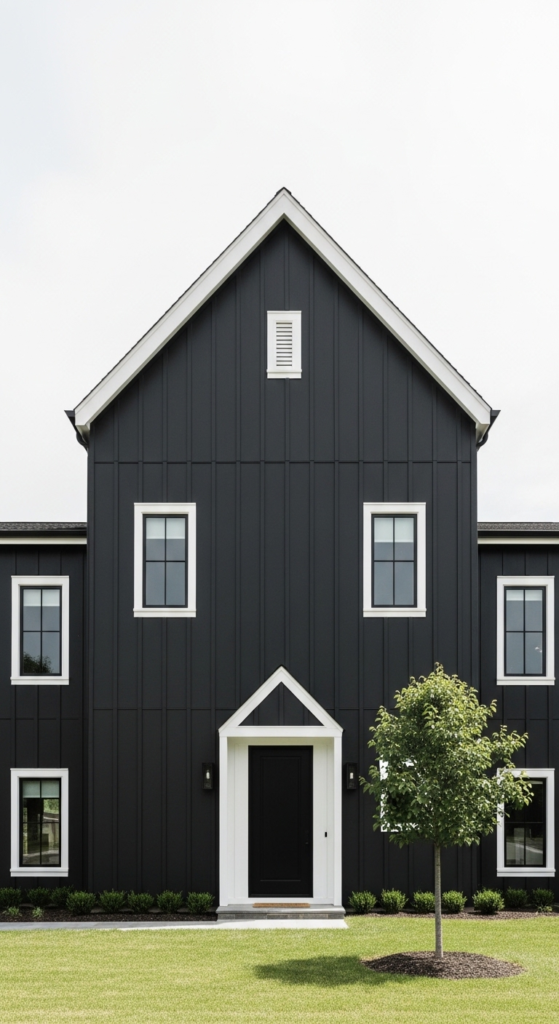
14. The Minimalist Gothic Farmhouse: Black, White, and Nothing More
In an era of maximalism and layered aesthetics, there is something almost radical about restraint. The minimalist Gothic farmhouse strips the aesthetic down to its structural bones — black siding, white trim, and not one element more than necessary. No ornamentation. No window boxes. No decorative brackets. Just geometry, proportion, and the extraordinary power of high-contrast color doing all the work. The result is a home that feels simultaneously austere and deeply, hauntingly beautiful.
This approach works best on homes with strong architectural forms — a classic cross-gabled farmhouse, a simple rectangular two-story, or a clean I-house plan. The integrity of the form is the entire story. Landscaping should be equally restrained: a lawn kept immaculate, perhaps a single specimen tree of architectural significance, and nothing else competing for visual attention. A matte black front door — no hardware visible from the street — reinforces the deliberate, almost philosophical restraint of the design. This is for the homeowner who believes that less is not just more, but everything.
Styling Tips: Invest in premium paint with excellent coverage and sheen uniformity — every imperfection shows on a minimalist facade. Architectural detailing must be flawless.
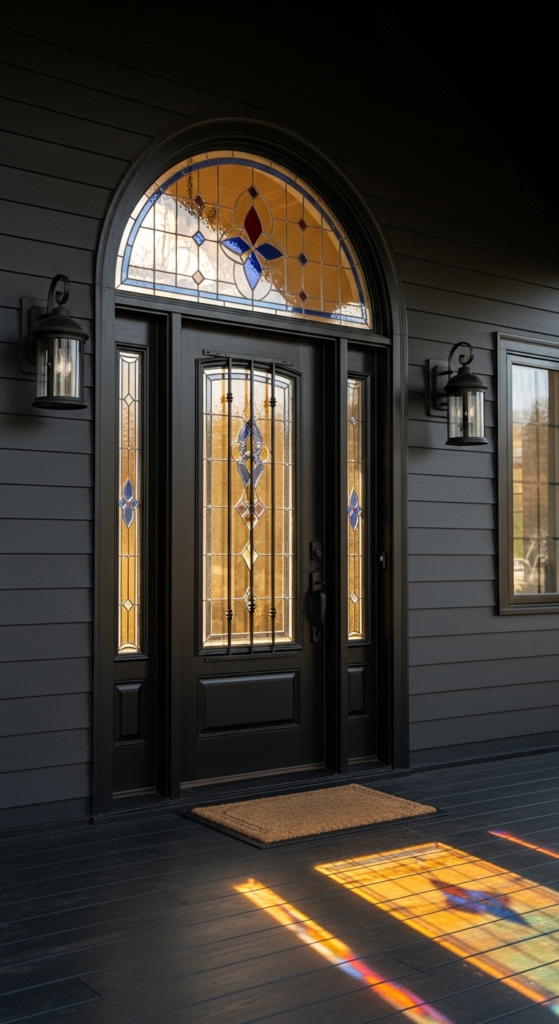
15. The Gothic Farmhouse with Stained Glass Accents
Color has no business being in a Gothic farmhouse exterior — until it does, and when it does, it arrives in the form of stained glass. A single leaded stained glass window above the front door, or flanking sidelights in jewel tones of ruby, sapphire, and amber, introduces color in a way that feels completely intentional and historically grounded. Gothic cathedrals used stained glass to tell stories and flood dark interiors with transformed light. The same principle applies, beautifully, to a residential exterior.
Against a matte black or deep charcoal facade, a stained glass window catches afternoon light and throws colored shadows across the porch floor — a moment of pure magic that can’t be manufactured any other way. The rest of the exterior should remain dark and restrained so that the glass reads as the precious, singular focal point it is. This look suits homeowners with an appreciation for craft and history, those who collect antiques and understand that the most meaningful elements of a home are ones made by human hands with extraordinary care and skill.
Styling Tips: Source antique leaded stained glass panels from architectural salvage yards for a genuinely historic piece. Have them fitted into custom-built frames that match your existing window system.
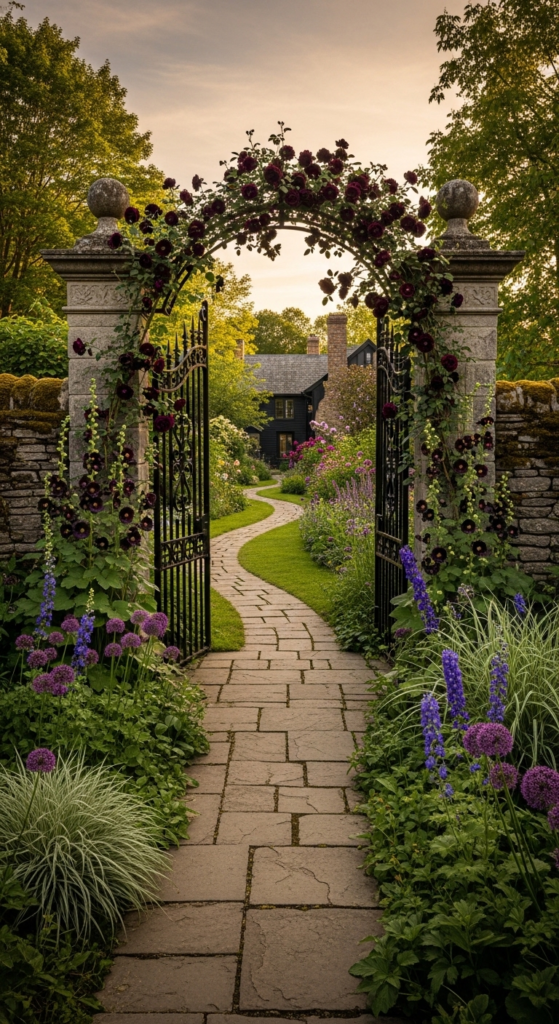
16. The Gothic Farmhouse with a Secret Garden Approach
The approach to a home — the driveway, the path, the way the landscape unfolds as you arrive — is as much a part of the exterior experience as the facade itself. A Gothic farmhouse with a secret garden approach creates an arrival sequence that builds anticipation slowly, deliberately. A winding stone path through an overgrown, wildly romantic garden, glimpsed through iron gates wrapped in climbing roses and flanked by tall stone pillars — this is how you make a house feel like a destination.
The garden itself should embrace the Gothic aesthetic: dark and overflowing, rich with textures and controlled wildness. Black hollyhocks, deep purple delphiniums, climbing dark red roses, ornamental grasses, and tall, architectural alliums create layers of height and drama. Moss-covered stone walls bordering the path add the patina of age and permanence. The farmhouse, glimpsed at the end of this passage, earns its impact completely. By the time you reach the front door, you’ve already been seduced. This design is for the romantic homeowner who wants their home to be experienced as a journey, not just a destination.
Styling Tips: Install low path lighting — small iron lanterns or recessed stone lights — to make the garden approach equally magical at night. Choose plants that offer sequential bloom for year-round drama.
17. Copper Details & Dark Exterior: The Patina Gothic Farmhouse
There is a particular kind of beauty that can only come with time — the slow, irreversible transformation of copper from its bright penny shine through green-tinged verdigris to the full, blue-grey patina of extreme age. Incorporating copper elements into a Gothic farmhouse exterior is a long-term design investment, one that pays increasingly beautiful dividends over the decades. Copper gutters, copper downspouts, copper porch lanterns, and copper-clad bay window roofs all develop their character gradually, telling the story of a home that has been lived in and loved.
Against a deep black or charcoal exterior, freshly installed copper reads as warm and luminous. Over five years, it shifts to a tarnished brown. Over twenty, it blooms into that magnificent verdigris green that makes the whole facade look like it has been standing for a century. This is for the homeowner with a long view — one who thinks of their home not as a project to be completed but as a living inheritance to be passed down. Pair with rough stone, aged timber, and climbing greenery for a facade that improves with every passing year.
Styling Tips: Allow copper to patina naturally — never coat it to slow or prevent the process. The transformation is the entire point of the material choice.
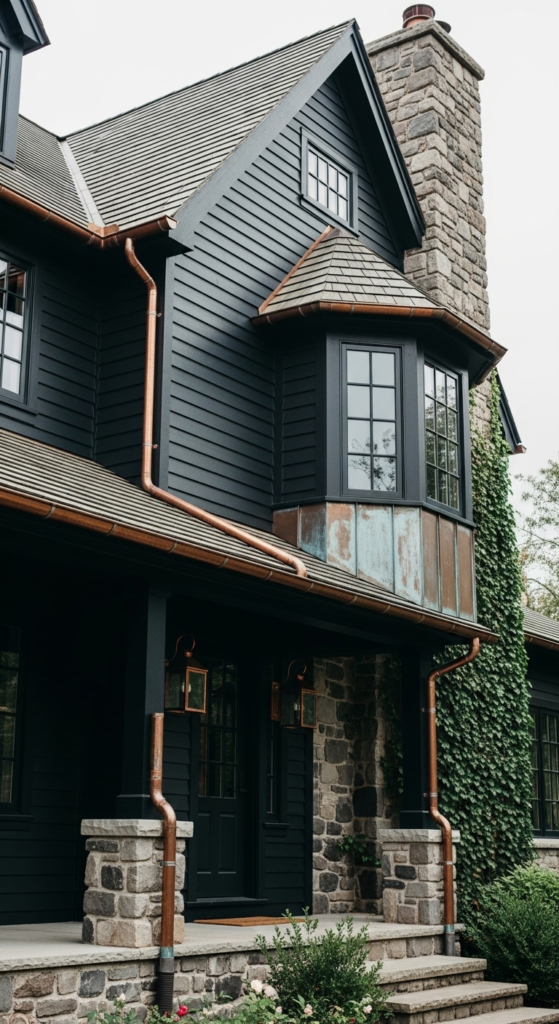
18. The Two-Tone Gothic Farmhouse: Charcoal & Deep Navy
Two-tone exterior color schemes are having a significant architectural moment, and the combination of deep charcoal and midnight navy — when applied thoughtfully to a Gothic farmhouse — creates something genuinely spectacular. The charcoal typically takes the siding while the navy anchors the trim, shutters, and door, but the arrangement can be reversed with equal impact. Together, these two colors are so closely related in value that the effect reads as sophisticated and unified rather than contrasting, while still offering enough variation to give the exterior real visual depth.
This palette is especially effective on homes with architectural details worth highlighting — decorative brackets, window trim, porch railings, corner boards — because the navy picks out these elements with a color that reads as distinctly different from the charcoal only at close range. At street scale, the whole exterior presents as a beautifully cohesive dark facade. Black iron hardware and fixtures tie both colors together, and landscape plantings in steely blue-green tones — blue fescue, Russian sage, blue oat grass — echo the palette beautifully into the surrounding garden.
Styling Tips: Use Farrow & Ball “Railings” for charcoal and “Hague Blue” for the navy in this combination — they were practically made for each other and for this exact effect.
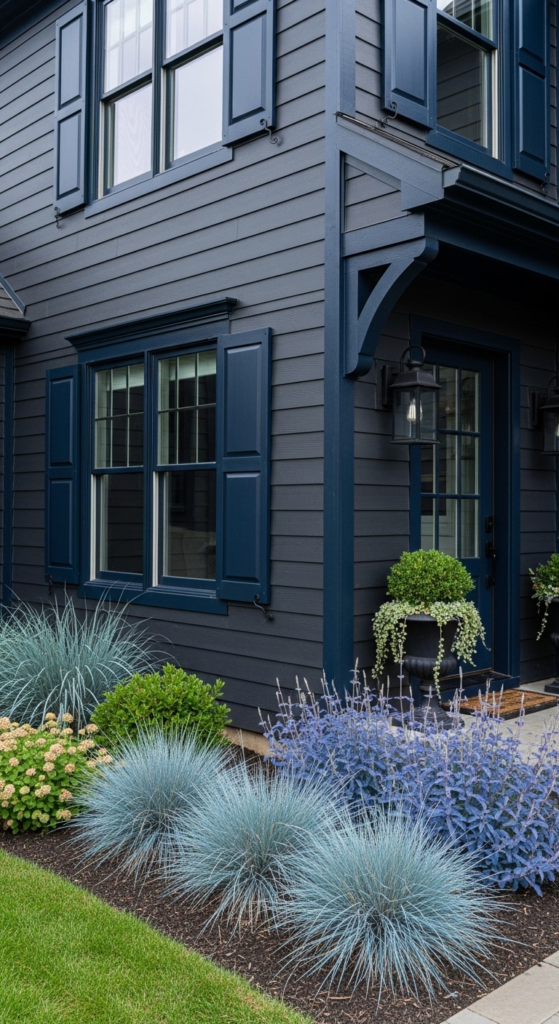
19. The Gothic Farmhouse in Winter: Ice, Snow & Dark Drama
Winter has a way of revealing the true character of an exterior. Without the softening effect of summer foliage, a Gothic farmhouse stands fully exposed against a pale sky — and what is revealed is almost always magnificent. The dark exterior becomes even more graphic and deliberate against white snow, the architectural silhouette reading with the clarity and intentionality of a woodcut print. This is a design that doesn’t just survive winter — it thrives in it.
Snow capping the roofline, filling window boxes, settling on porch railings and iron lanterns — all of it contrasts with the dark exterior in a way that is genuinely breathtaking. Ice forming on copper gutters, bare vine structures against the black siding, smoke rising from a stone chimney into a pale winter sky — these are the seasonal gifts unique to a dark-exterior home. Lanterns glowing warmly from within cast the kind of light that makes any passerby want to knock on the door and be welcomed inside. Plan your exterior with winter in mind, and every other season will be a bonus.
Styling Tips: Install exterior lighting on dimmers and set it slightly warmer in winter months to maximize the contrast between the amber glow and the snow-white landscape.
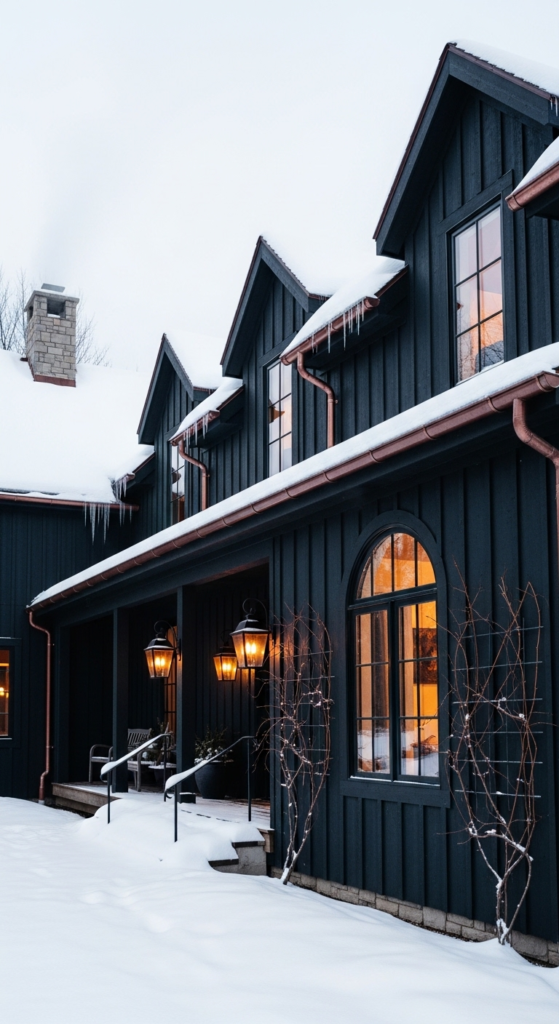
20. The Gothic Farmhouse Greenhouse Attached Addition
One of the most visually stunning — and functionally luxurious — additions to a Gothic farmhouse exterior is an attached greenhouse or conservatory. The combination of dark architectural mass and the transparent, light-filled glass structure creates an extraordinary visual tension that is simultaneously Gothic and otherworldly. Victorian Gothic architecture frequently incorporated elaborate greenhouse structures, and the tradition feels entirely at home on a contemporary Gothic farmhouse.
The greenhouse addition should use black iron framing — both for structural honesty and aesthetic cohesion — with large clear glass panes allowing full visibility of the lush interior plantings within. The contrast of all that living green against the dark iron frame and the dark farmhouse exterior behind it is arrestingly beautiful. Inside, the greenhouse can be styled as an interior garden room — stone floors, iron planters, climbing passion flower and jasmine, hanging air plants, and moss-covered surfaces. From the exterior, it reads as a luminous jewel box attached to a dark, mysterious home. This is for the plant-obsessed homeowner who wants their love of living things architecturally integrated into their home’s exterior story.
Styling Tips: Ensure the greenhouse foundation and footings are engineered for your climate. In cold climates, install in-slab radiant heat to keep it functional year-round.
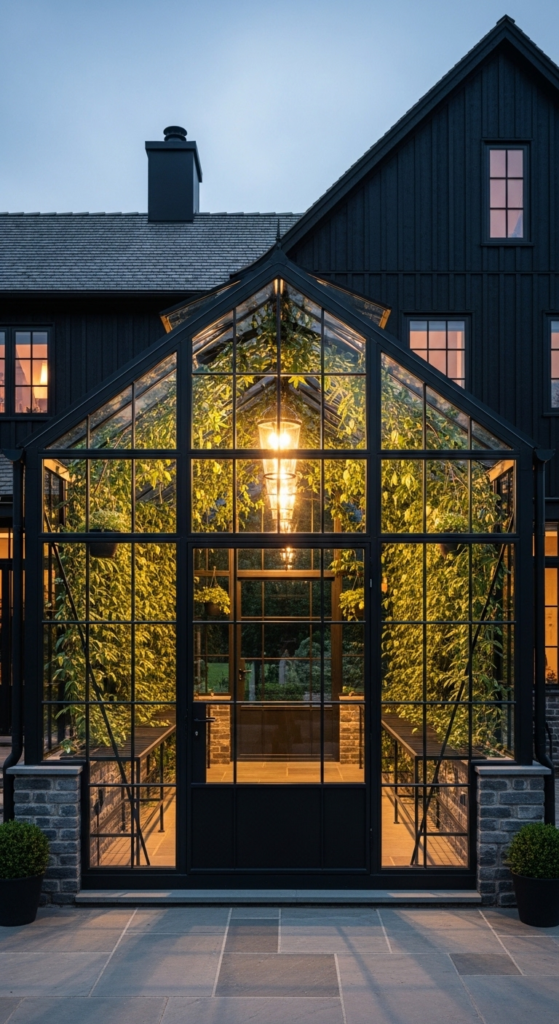
21. The Full Black Stone Gothic Farmhouse: Ultimate Drama
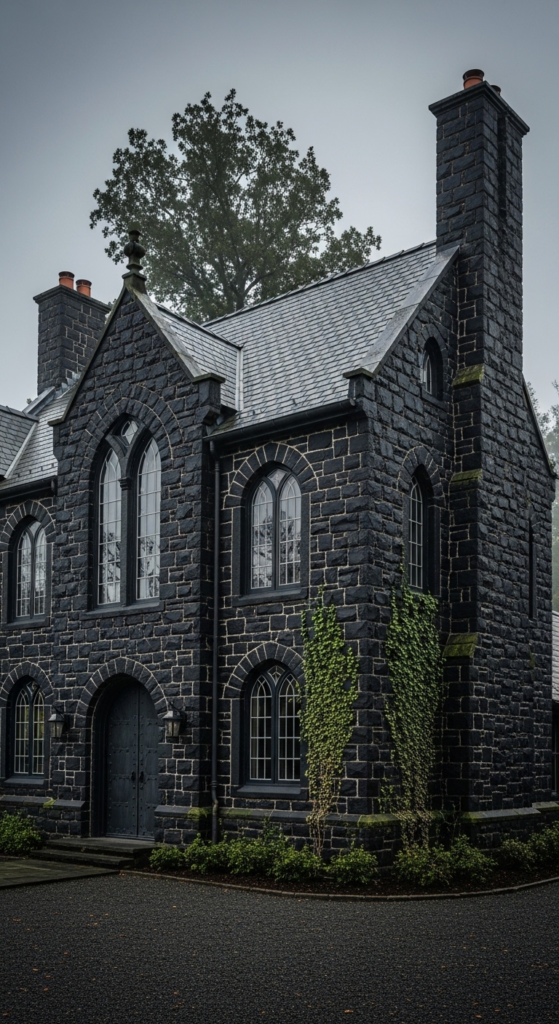
If there is an apex to the Gothic farmhouse exterior aesthetic — an end point where the drama reaches its absolute maximum — it is the full black stone farmhouse. Not painted stone. Not stone-look siding. Actual, genuine, field stone or quarried stone construction in deep charcoal, almost-black shades, mortared in dark grey joints, forming a structure that looks as though it has been pulled directly from the earth beneath it. This is architecture at its most primal and its most powerful.
Black stone homes of this caliber read as genuinely ancient — monuments to permanence and intentionality — even when newly constructed. Every stone face is unique, with its own crystalline variations, veining, and surface texture that catches light differently at every hour of the day. At sunrise, the stone glows with a deep warmth. At dusk, it absorbs the last of the light and becomes almost one with the shadows. In fog, it takes on an otherworldly presence that stops conversation. This design is the ultimate commitment — and the ultimate reward. It is for homeowners who build once, build beautifully, and build forever.
Styling Tips: Select your stone mason with extraordinary care. The quality of the craftsmanship in a full stone exterior is permanently visible and cannot be painted over or corrected without significant intervention.
Bring the Dark Drama Home: Your Pinterest Save Guide
There you have it — 21 extraordinary ways to bring the Gothic farmhouse exterior aesthetic to life, from the quiet restraint of a minimalist black-and-white facade to the full, primal drama of a black stone manor that looks as though it has stood for centuries. The Gothic farmhouse exterior isn’t about darkness for its own sake. It’s about depth, intention, and a refusal to be ordinary. It’s about building a home that has a feeling — one that makes your heart do something the moment you pull into the driveway.
Whether you’re deep in the planning stages of a new build, dreaming about a dramatic exterior refresh, or simply here for the beautiful, moody inspiration that makes Pinterest the most magnificent rabbit hole on the internet — we hope these ideas have sparked something real. Something you’ll carry with you into your home, your garden, and your design vision.
Save this article to your Gothic Home board. Share it with the friend who says their dream home is “dark and mysterious.” Pin your favorites and come back when it’s time to make the dream real. Because the most beautiful homes don’t happen by accident — they happen when someone brave enough to be different decides to commit to their vision, fully and without apology.
Your dark, beautiful, extraordinary home is waiting to be built. Start pinning.
Tags: gothic farmhouse exterior, black farmhouse exterior ideas, dark home exterior, gothic home design, farmhouse curb appeal, moody home exterior, black board and batten exterior, gothic architecture home, dark exterior paint colors, dramatic home design, Pinterest home inspiration, gothic aesthetic home