There’s a particular kind of home that stops you mid-stride. You’re driving down a country road, fields stretching out on either side, and then — there it is. Rising from the land with a quiet, dark confidence that feels both ancient and deliberate. The steep roofline cuts a dramatic silhouette against the sky. The exterior is painted in a color that seems to absorb light rather than reflect it. The porch wraps around in shadows, and something about the whole picture makes your heart beat just a little faster. Not from fear — from recognition. From the deep, instinctive understanding that this is a home with a soul.
That is the promise of the Gothic farmhouse exterior. And it is one of the most thrilling, most talked-about, most pinned aesthetic directions in home design right now.
The Gothic farmhouse is not simply a dark house on a farm. It is a very specific and very intentional collision of two powerful design traditions: the honest, grounded, deeply American spirit of the farmhouse — wide porches, practical bones, connection to the land — and the soaring, shadowed, romantically dramatic vocabulary of Gothic architecture, with its pointed arches, ornate bargeboards, vertical emphasis, and love of the beautifully mysterious. When these two traditions meet, the result is something that feels completely original and yet somehow also timeless — as though this style has always existed, and we’ve simply been waiting to rediscover it.
What makes this aesthetic so magnetic right now is precisely that it refuses to be categorized neatly. It is rustic but dramatic. It is rural but sophisticated. It is dark but deeply warm. It draws equally from the Victorian Gothic Revival farmhouses of the American countryside — those remarkable mid-19th century homes with their carpenter Gothic trim and steeply pitched roofs — and from the current design moment’s bold embrace of dark exteriors, maximalist landscaping, and the kind of deeply personal aesthetic choices that make a home unmistakably yours.
Whether you’re planning a full exterior renovation, building from the ground up, or simply dreaming and saving ideas for the day when you finally have that piece of land, this collection is for you. We’ve gathered 23 of the most breathtaking, most inspiring Gothic farmhouse exterior ideas — each one a different expression of this rich and endlessly fascinating aesthetic. From ink-black board-and-batten with cathedral windows to deep burgundy Victorian Gothic with ornate bargeboards, from moody slate exteriors with iron lanterns to rustic stone Gothic with wild overgrown gardens — there is a Gothic farmhouse here for every kind of dark romantic, every kind of free-spirited homeowner, every kind of person who has ever looked at a conventional beige house and felt absolutely nothing.
Come in. Stay a while. It’s beautiful in the dark.
1. Ink-Black Board-and-Batten with Cathedral Windows
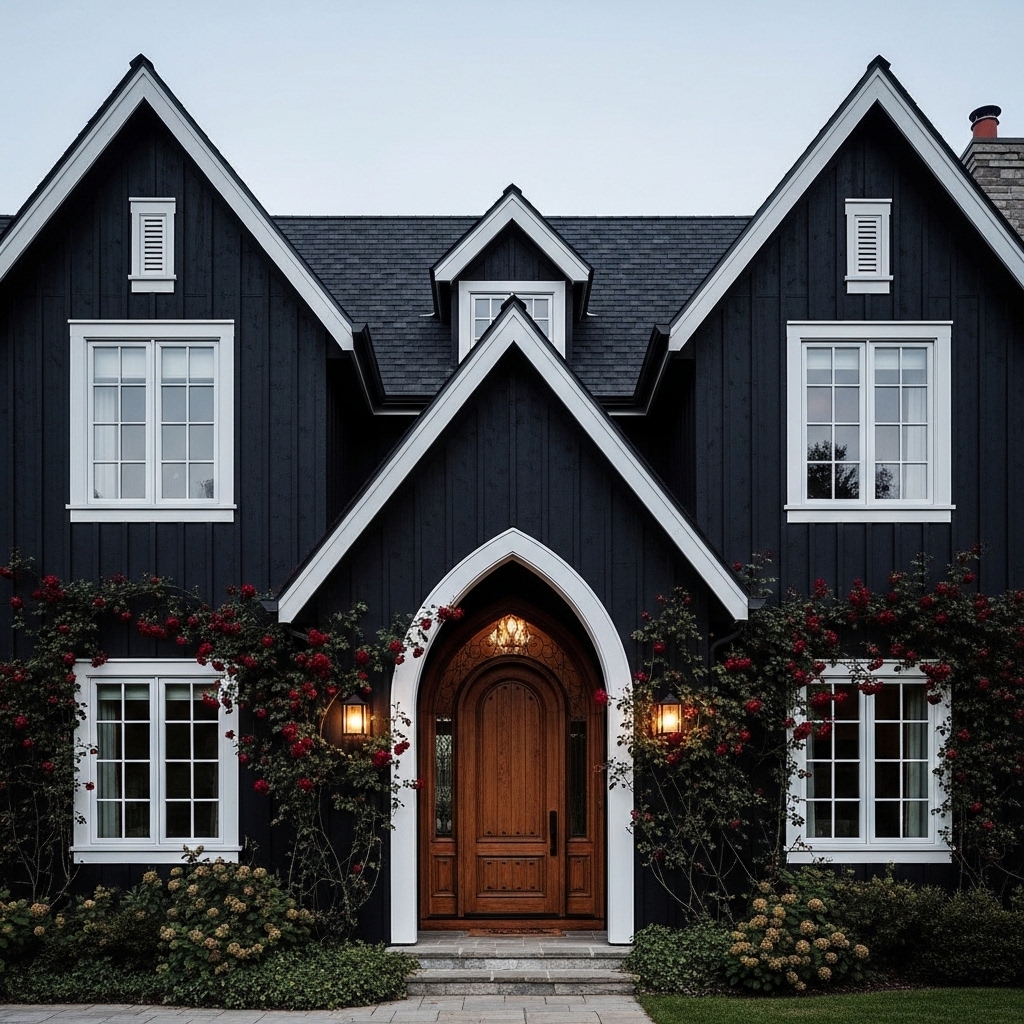
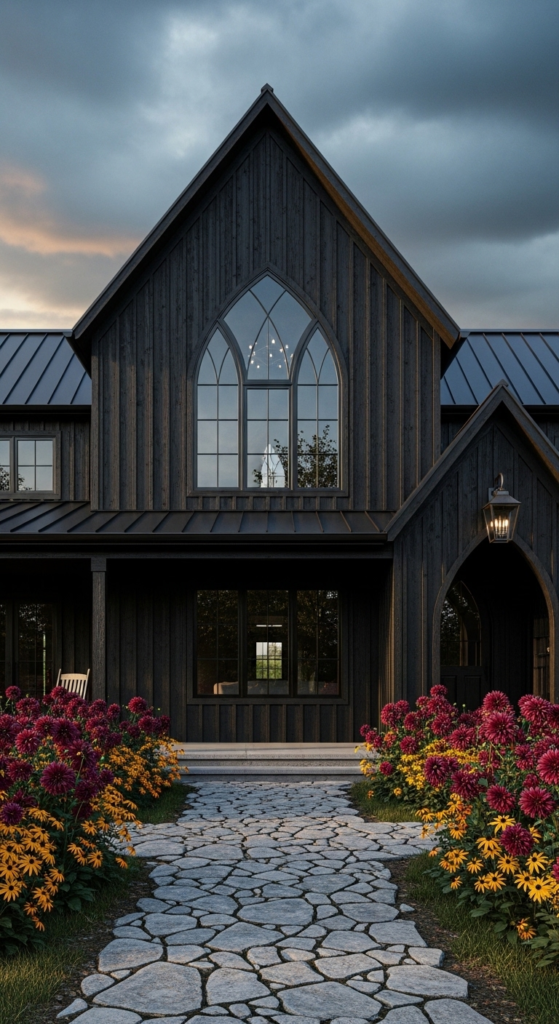
If there is a single image that most perfectly captures the Gothic farmhouse aesthetic in its purest, most contemporary form, it might be this one: a tall, narrow farmhouse clad entirely in ink-black board-and-batten vertical siding, its steep roofline slicing upward against a dramatic sky, its windows long and arched at the top in the unmistakable silhouette of cathedral glass. The board-and-batten itself is one of the most beloved materials in American farmhouse architecture — honest, durable, beautifully textural — and in black, it becomes something else entirely: bold, graphic, and powerfully atmospheric. The vertical lines of the batten draw the eye relentlessly upward, emphasizing the height of the roofline and giving the structure an almost ecclesiastical verticality. The arched windows — perhaps six over six pane in an aged black frame — are the Gothic detail that transforms the farmhouse into something genuinely extraordinary. Style the entry with iron lanterns, a rough stone pathway, and overgrown black-eyed Susans and dark burgundy dahlias. Perfect for bold design lovers, rural landowners, and those who dream in silhouette.
2. Deep Charcoal Victorian Gothic with Ornate Bargeboard Trim
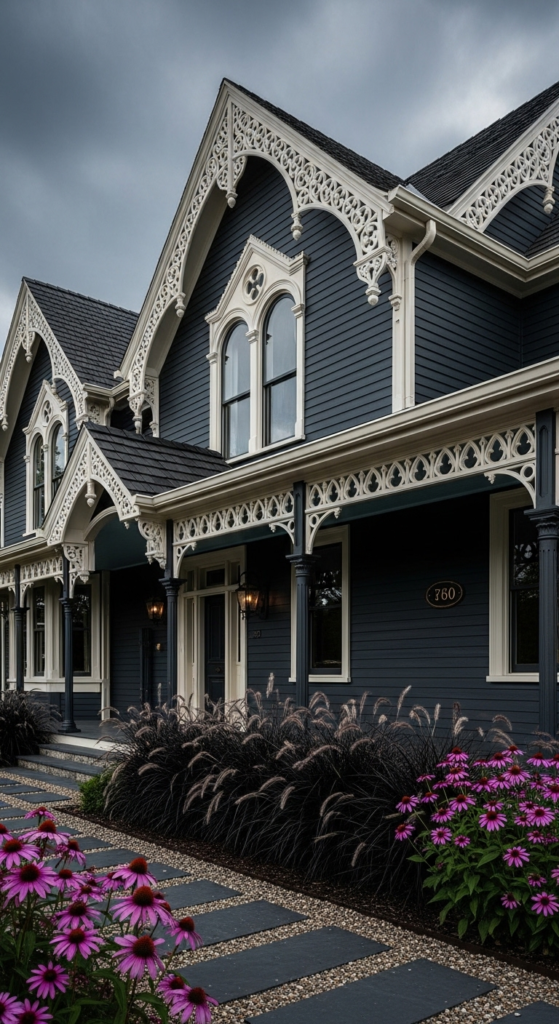
The bargeboard — that decorative wooden trim that runs along the sloping edges of a gabled roof — is one of the most distinctly Gothic architectural details available to a homeowner, and when it’s done with the intricacy and confidence of the Victorian Gothic Revival tradition, it is simply one of the most beautiful things you can put on a house. Imagine a farmhouse in deep charcoal gray — not quite black, but close enough to carry all the drama — its gable ends adorned with elaborately carved or fretwork bargeboard in a slightly lighter tone, perhaps a warm ivory or weathered cream, that allows every detail of the pattern to read clearly against the dark background. The pattern itself might feature pointed Gothic arches, trefoils, quatrefoils, or a lacy scallop design that creates the appearance of dark lace against the sky. The porch below carries the same trim detail along its fascia boards, creating a consistent decorative language throughout the exterior. Iron porch columns, dark slate stepping stones, and a garden of ornamental black grasses and deep purple coneflowers complete this extraordinary exterior. Perfect for Victorian Gothic Revival enthusiasts, architecture lovers, and anyone who believes that the trim on a house deserves to be considered a form of art.
3. Blood Red Farmhouse with Black Shutters and Iron Gate
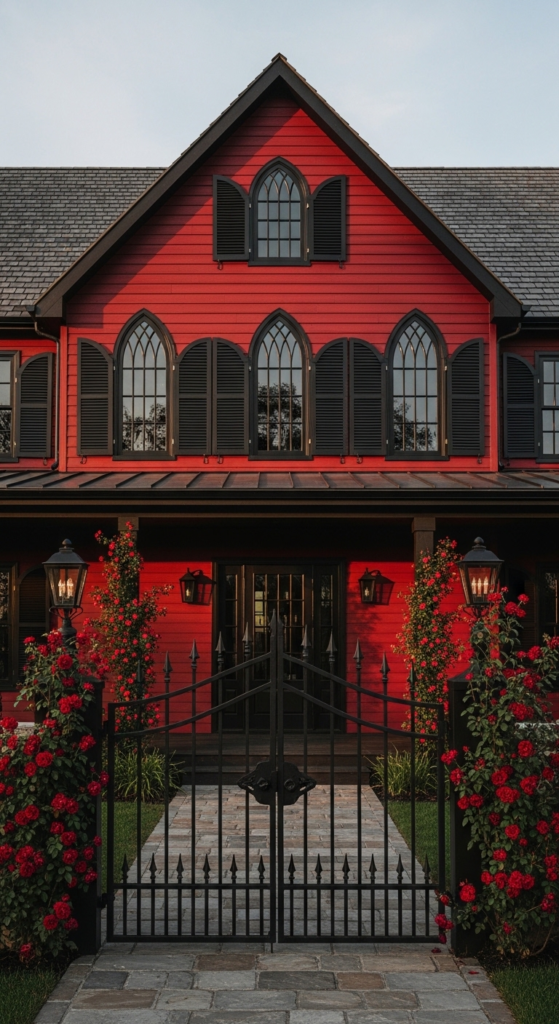
There is a long and noble history of red farmhouses in the American rural landscape — but nothing in that tradition quite prepares you for the Gothic version, where the red is pushed into a darker, richer, more blood-like territory and paired with elements that transform the familiar into the electrifyingly dramatic. This is not the cheerful barn red of a New England homestead. This is a deep, saturated crimson — almost burgundy, with a complexity that shifts from red to brown to almost purple depending on the light and the time of day — applied to a two-story farmhouse with a steep gabled roof and a full front porch. The black shutters beside each window are wide-plank wood with a Gothic arch cut-out detail at their tops, and they appear almost structural in their solidity. An imposing iron gate at the end of the front path — tall, with pointed finials at each post — frames the approach to the house in a way that is both welcoming and theatrical. Wild roses in deep red and nearly-black varieties climb the porch posts and iron gate. Perfect for those with a theatrical soul, a love of color, and at least a little dramatic flair in their blood.
4. Moody Slate Blue Farmhouse with Stone Foundation
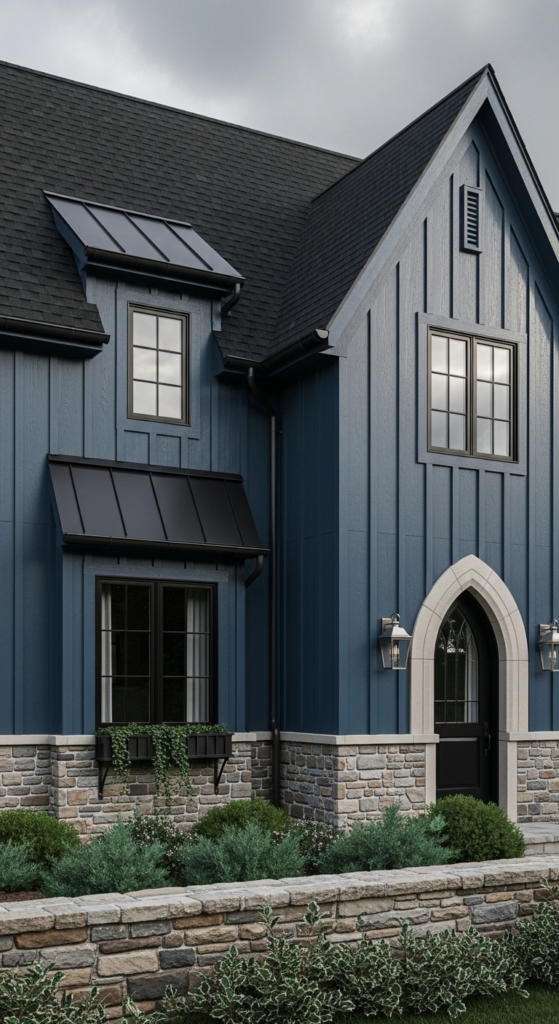
Not every Gothic farmhouse needs to live in the black and charcoal spectrum — and the deep slate blue exterior is proof that color can carry all the Gothic atmosphere you could ever want while also bringing a particular kind of haunting, almost supernatural beauty that the darkest palettes sometimes cannot achieve. Slate blue at this depth and saturation — think the color of storm clouds reflected in a still lake, or the sky at 5 AM in November — has a complexity and a mystery that makes it the ideal Gothic farmhouse exterior color for those who want drama without absolute darkness. Applied to a two-story farmhouse with a steep hip or gabled roof in dark charcoal, the slate blue reads differently throughout the day: cool and silvery in the morning light, deep and atmospheric at midday, almost glowing in the hour before a storm. The stone foundation — laid in irregular fieldstone or cut limestone in warm gray and cream tones — grounds the elevated blue walls in a material that is ancient and honest. Pewter lanterns, iron window boxes with trailing dark ivy, and a fieldstone garden wall complete the moody, romantic picture. Perfect for those drawn to water, weather, and the quiet drama of the in-between hours.
5. Carpenter Gothic Cottage with Pointed Arch Porch Detail
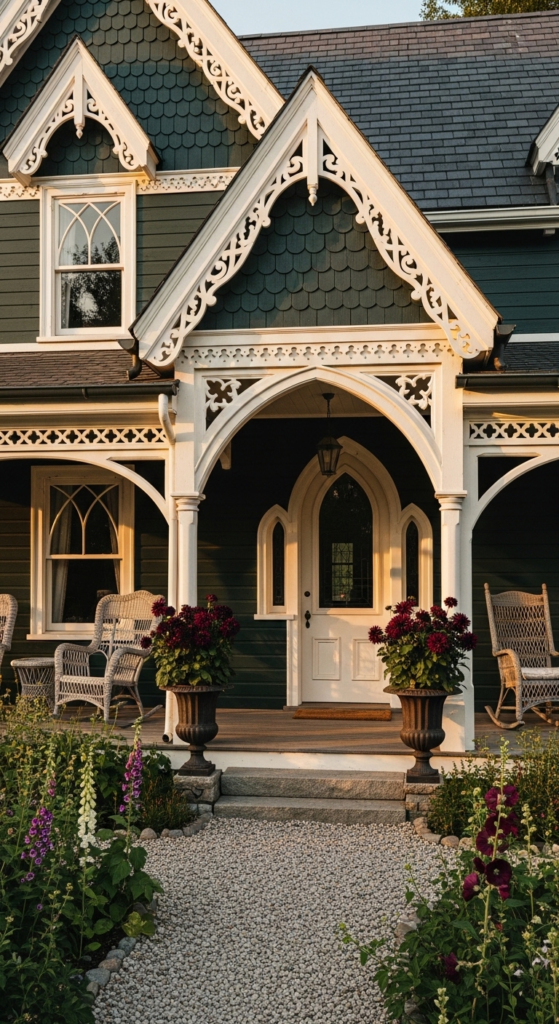
The Carpenter Gothic cottage represents one of the most purely romantic chapters in American architectural history — those mid-19th century homes built by craftsmen who translated the soaring stone language of European Gothic cathedrals into wood, using the new steam-powered scroll saw to create intricate decorative detail that was, for the first time, accessible to ordinary homeowners and builders. The result was a style of extraordinary charm and personality: modest in scale but ambitious in decoration, deeply rural in its setting but reaching architecturally toward something transcendent. The defining feature is the pointed arch — appearing in porch openings, window frames, doorways, and decorative vergeboard — and when this is painted in a crisp, surprising color against a dark exterior, the effect is breathtaking. Picture a two-story cottage in near-black forest green, its porch defined by three pointed Gothic arches in creamy white carved wood, its windows each topped with an arched hood molding, its vergeboard a delicate fretwork silhouette against the sky. Antique wicker furniture on the porch, overflowing baskets of dark flowers, and a gravel path through an overgrown cottage garden. Perfect for Americana lovers, architectural history enthusiasts, and romantic souls with a porch to fill.
6. Matte Black Farmhouse with Copper Gutters and Green Patina
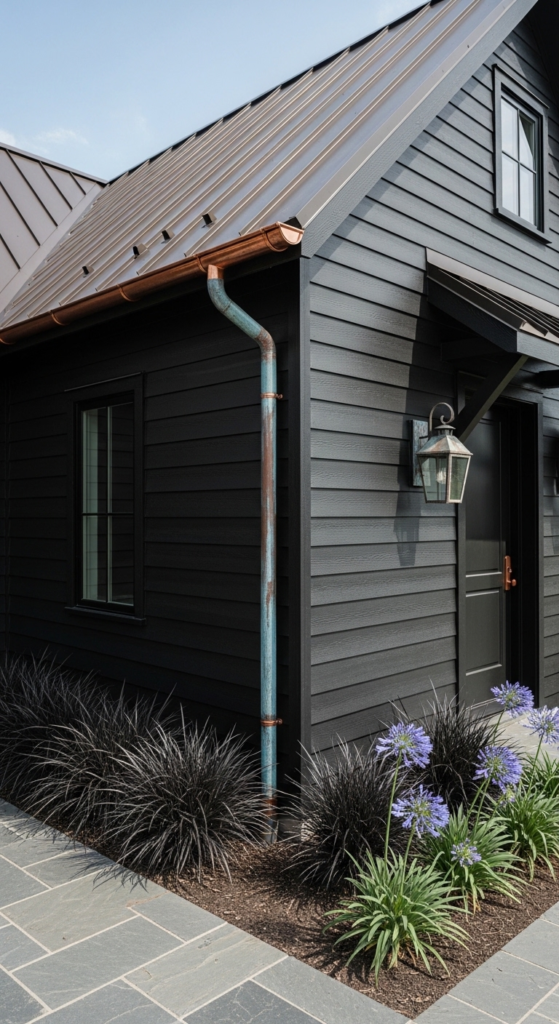
Here is a Gothic farmhouse exterior for the material obsessives — the ones who choose a house’s finish the way a jeweler chooses a setting, with absolute attention to how materials interact, age, and speak to one another over time. The matte black exterior is the foundation: a flat, light-absorbing black that makes the farmhouse look like a sketch against the landscape, all silhouette and clean architectural line. But it is the copper gutters and downspouts that elevate this exterior from striking to extraordinary. New copper is a warm, bright penny-tone that glitters beautifully against the matte black — but over months and years, as the copper oxidizes and develops its characteristic blue-green patina, the relationship between the two materials becomes something increasingly complex and beautiful, like a piece of sculpture aging in a garden. The patina’s organic, irregular quality is the perfect Gothic counterpoint to the precise geometry of the black exterior. Add iron porch lighting, a slate tile pathway, and a garden of ornamental grasses, black mondo grass, and deep teal-blue agapanthus. Perfect for design purists, material lovers, and patient homeowners who understand that the most beautiful things improve with time.
7. Gothic Stone Farmhouse with Wild Overgrown Garden
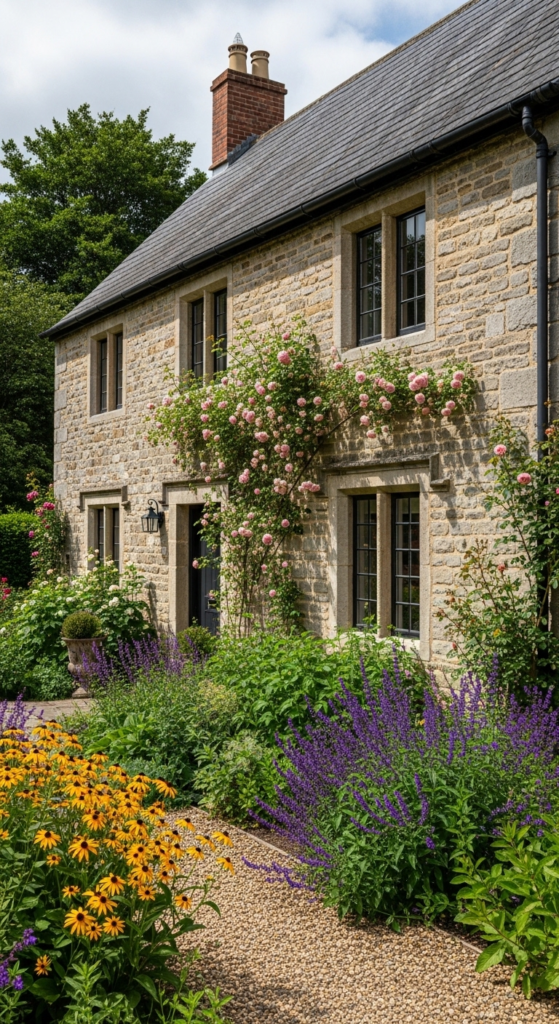
IMAGE PROMPT: Ancient Gothic stone farmhouse exterior with irregular hand-laid fieldstone walls in warm gray and cream tones, steeply pitched dark slate tile roof, deep-set arched window reveals casting dramatic shadows, overcast soft dramatic morning light creating timeless atmosphere, eye-level camera angle showing full stone facade, ancient and romantic mood, completely wild and overgrown cottage garden with dark climbing roses cascading over stone garden wall, black-eyed Susans seeding into irregular stone path, purple catmint and dark salvia spreading beyond borders, dark iron casement windows with leaded glass, heavy timber Gothic arched front door surround, climbing ivy on stone corners, stone and slate exterior materials, ultra-detailed photorealistic render, Pinterest vertical 2:3 ratio, no people, ancient romantic palette of warm fieldstone gray, dark slate, wild rose red, purple, and lush overgrown green.
8. Two-Tone Gothic Farmhouse: Black Body, Dark Forest Green Trim
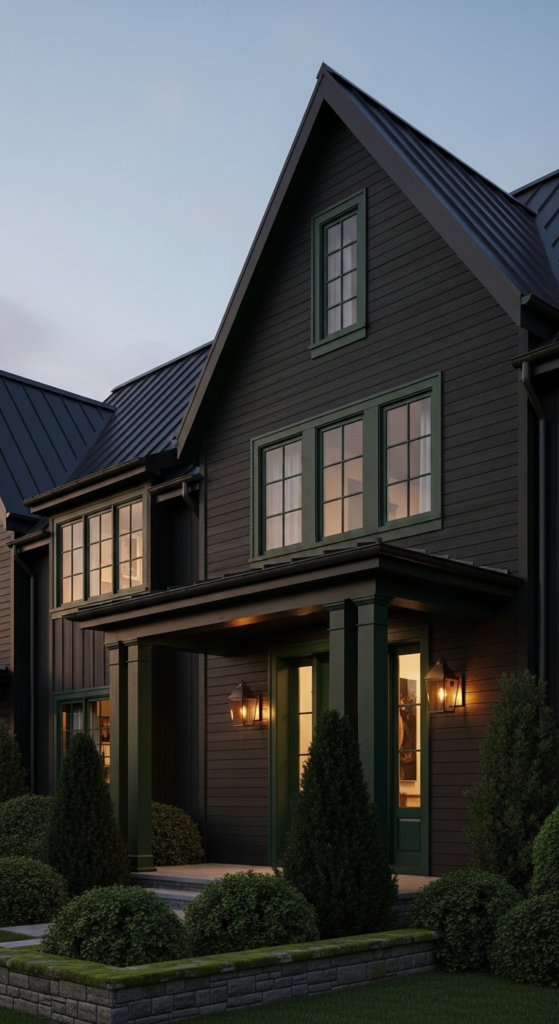
The decision to use two dark, deeply saturated colors on a Gothic farmhouse exterior — rather than the more conventional dark body with light trim approach — is a bold one, and it is also one of the most sophisticated and original exterior color moves available to a homeowner right now. The pairing of a matte or satin black body with dark forest green trim creates a color relationship that is rich, complex, and quietly thrilling: the two colors are close enough in value to create a moody, tone-on-tone effect from a distance, but distinct enough to reward closer inspection with beautiful depth and layering. The forest green appears on the trim boards, window casings, porch columns, front door, and fascia boards — everywhere that would typically be painted white in a conventional scheme — and the result is an exterior that feels lush and organic rather than stark, as though the house itself is growing out of the forest that surrounds it. Style the landscape to amplify this quality: dark boxwood hedges, spreading yews, black pine, and moss-covered stone. Perfect for forest dwellers, lovers of the deeply unconventional, and anyone who has always felt that white trim was someone else’s idea.
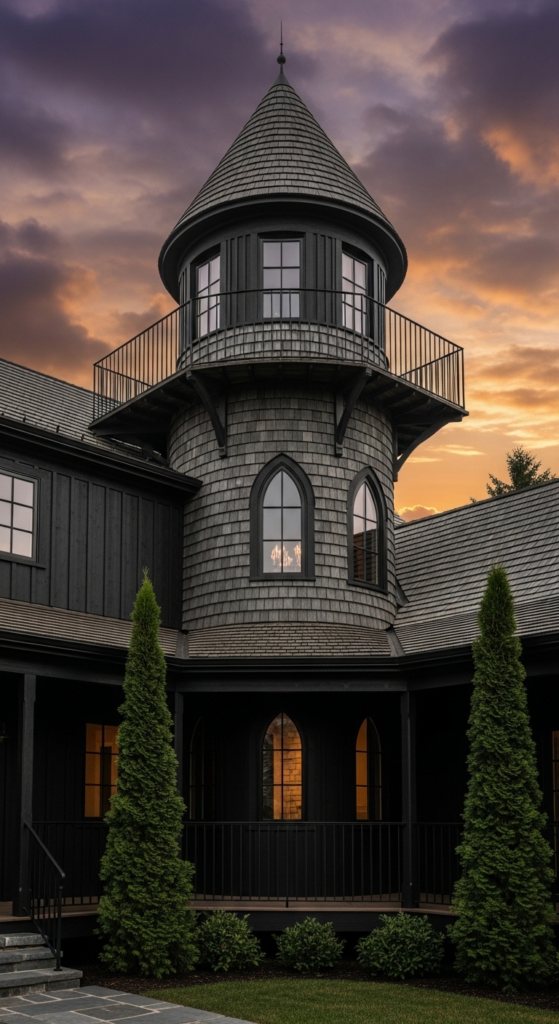
9. Gothic Farmhouse with Turret Addition and Widow’s Walk
Among all the architectural gestures available in the Gothic farmhouse vocabulary, the turret is perhaps the one that most powerfully tips the aesthetic from “dark farmhouse” into “Gothic farmhouse” — and when it is executed with the right proportion, material, and surrounding landscape, it is simply magnificent. The turret — a cylindrical or polygonal tower element rising from one corner of the farmhouse, typically one to two stories taller than the main roofline — creates a vertical drama and a fairy-tale quality that is rooted in the genuine tradition of Gothic Revival residential architecture. Combined with a widow’s walk — that small, railed platform at the highest point of the roof, originally practical and now purely atmospheric — the silhouette of this farmhouse against any sky is unmistakable and unforgettable. Clad the turret in the same dark siding as the main house, or differentiate it with dark shingles in a fish-scale pattern for added texture and visual interest. The widow’s walk railing should be iron, simple and elegant, its silhouette visible from the road. Plant dark cedar and arborvitae as vertical companions to the tower’s height. Perfect for dreamers, Gothic architecture lovers, and those who have always wanted a room with a truly extraordinary view.
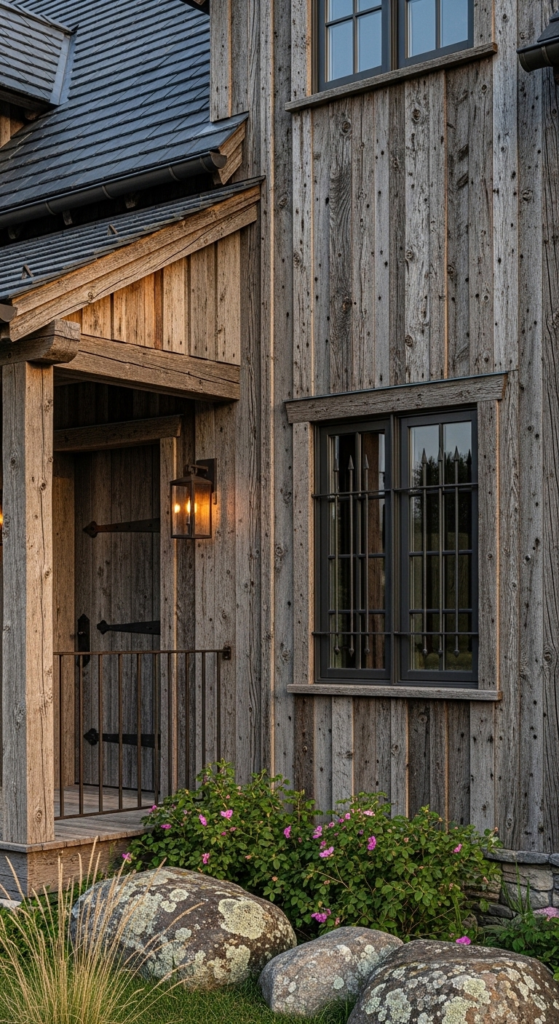
10. Rustic Gothic with Reclaimed Wood and Wrought Iron Details
The Rustic Gothic farmhouse exterior occupies a particular niche in the aesthetic spectrum — one that sits closest to the land, to craft, and to the honest beauty of materials that have lived a life before arriving at their current home. This approach uses reclaimed wood as its primary exterior material: wide, dark, deeply grained planks salvaged from old barns or industrial buildings, their surfaces marked by the weather of previous decades in a way that no new material could authentically replicate. The reclaimed wood is left in its natural dark gray and brown tones — perhaps with a protective clear coat to preserve its current state — or stained even darker to deepen and unify the variation. The wrought iron details are what bring the Gothic: hand-forged iron strap hinges on the heavy plank front door, iron window guards in a simple pointed-arch pattern on the lower windows, an iron porch railing with hand-hammered detail, iron lantern sconces beside the door. The landscape is appropriately rough and organic: native grasses, wild roses, and lichen-covered boulders. Perfect for those who value authenticity above all else and believe that the most beautiful materials are the ones that have already begun to tell their stories.
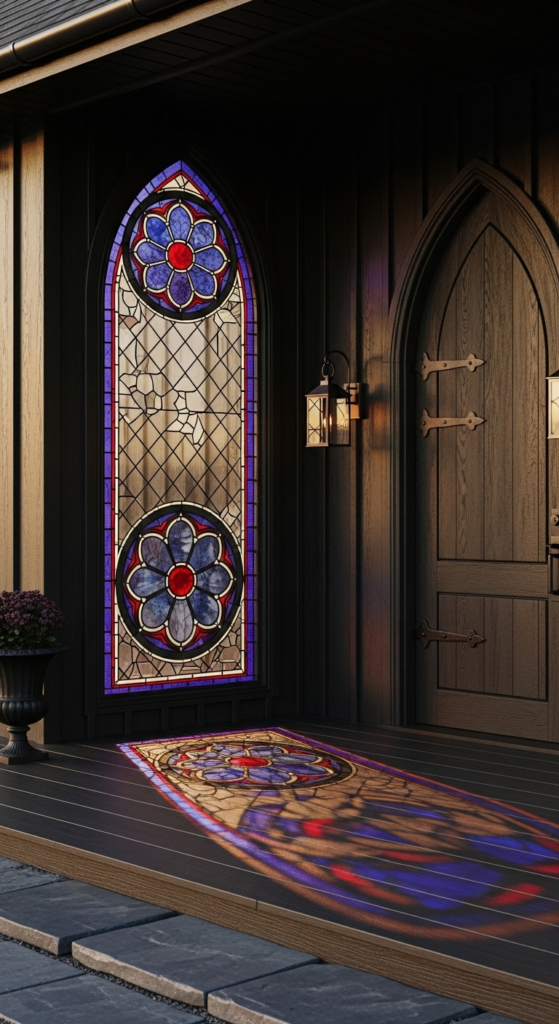
11. Gothic Farmhouse with Stained Glass Entry Window
Light is one of the most powerful tools in architectural design — and the introduction of a single panel of Gothic stained glass into an otherwise austere, dark farmhouse exterior creates a moment of such unexpected beauty that it can reduce even the most design-jaded observer to something resembling wonder. The stained glass appears in the entry: perhaps as a tall, pointed-arch window directly beside or above the front door, or as a transom window integrated into the door’s upper section. The design of the glass leans into the Gothic tradition: geometric tracery in deep jewel tones — cobalt blue, ruby red, amethyst purple, forest green — with lead lines that form pointed arches, trefoils, or a simple but deeply beautiful rose window pattern. Against the dark exterior of the farmhouse — black, charcoal, or deep navy — the stained glass window glows like a jewel set in iron, its colored light projecting onto the porch floor in shifting, prismatic patterns throughout the day. At night, with interior light behind it, the window becomes a beacon — warm, colored, and deeply welcoming in its Gothic beauty. Perfect for art lovers, design maximalists, and the deeply romantic homeowner who wants their front door to tell a story before it’s even opened.
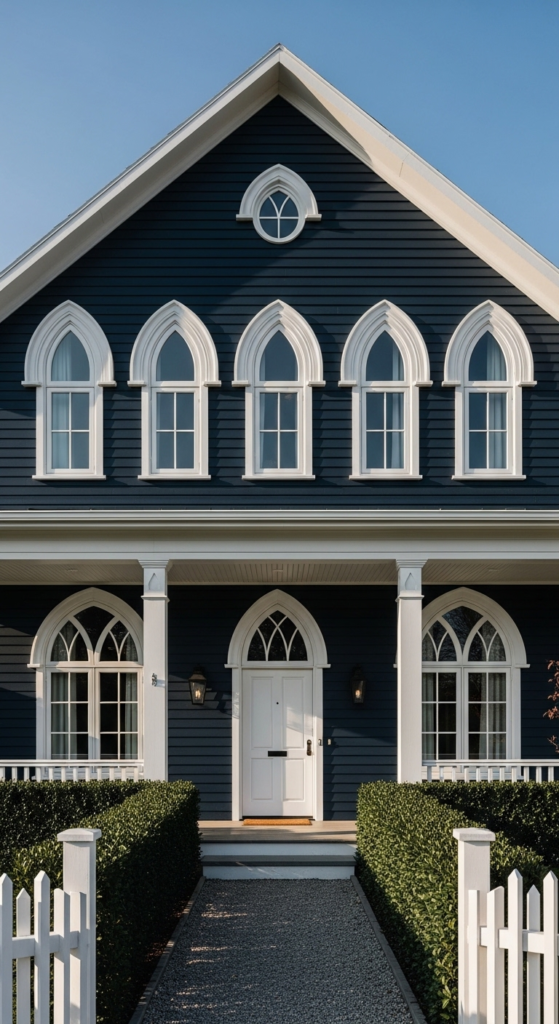
12. Midnight Navy Gothic Farmhouse with White Gothic Arch Windows
Navy has long been one of the most sophisticated exterior colors available — timeless in a way that trends cannot easily touch, and deeply versatile in the way it interacts with other colors and materials. At its deepest, most saturated extreme — the almost-black midnight navy that seems to contain the entire night sky within it — it becomes the perfect Gothic farmhouse color: dark enough to carry all the required drama and mystery, yet complex enough to reveal depth and life as the light changes across its surface. The defining decorative detail of this exterior is the windows: each one framed in brilliant white molding with a pointed Gothic arch hood above, the white surround creating a sharp, graphic contrast against the midnight navy that is simultaneously traditional and startlingly modern. The repeating pattern of these white arch window surrounds across the facade of the house creates a rhythm and a visual music that is deeply satisfying. A white painted front door with a pointed arch transom above ties the window detail to the entry. Iron lanterns, dark landscaping, and a white picket fence with Gothic pointed pickets complete the picture with charming period accuracy. Perfect for lovers of classic color executed with bold conviction.
13. Gothic Farmhouse with Wraparound Porch and Dark Rocking Chairs
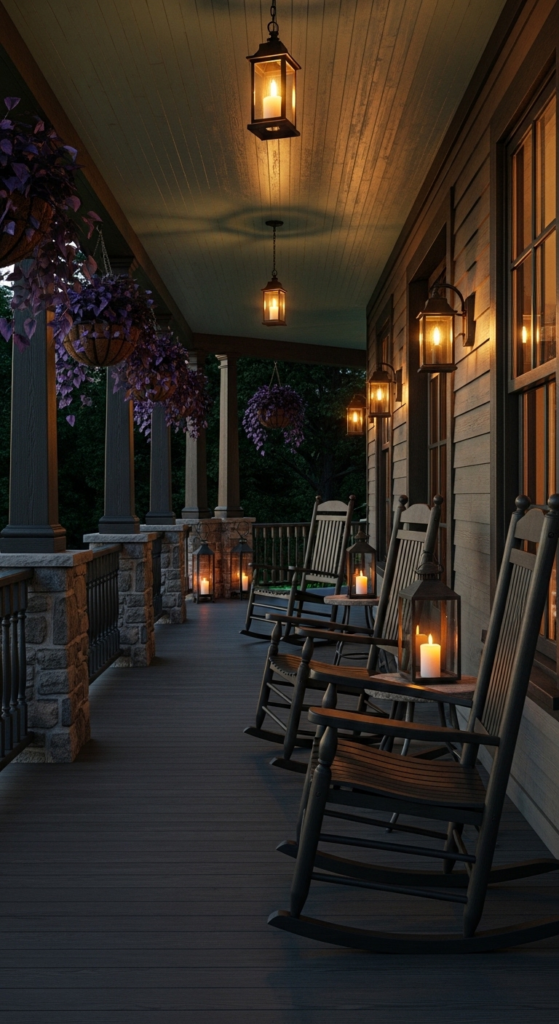
The wraparound porch is one of the most beloved features in American residential architecture — a democratic, generous space that blurs the boundary between inside and outside, between the private world of the home and the larger world of the landscape. In its farmhouse context, it carries associations of summer evenings, fireflies, and the deep satisfaction of a day of work completed. In the Gothic farmhouse context, it becomes something more complex and more compelling: that same invitation to linger, now shadowed and atmospheric, now framed by dark columns and lit by iron lanterns, now furnished with dark-painted rocking chairs that creak in the evening breeze in the most satisfying way imaginable. The porch wraps the house on three sides, its floor painted in deep charcoal or a near-black gray, its ceiling the traditional haint blue but deepened to a dark, smoky teal. Dark wooden rocking chairs with Gothic spindle backs are arranged in pairs at each corner. Iron side tables hold storm lanterns with real candles. Hanging baskets overflow with dark purple trailing plants. This is the porch you sit on until the stars come out — and then you stay. Perfect for porch lovers, slow living enthusiasts, and anyone who understands that the best conversations happen in the dark.
14. Gothic Farmhouse with Black Metal Roof and Copper Chimney Cap
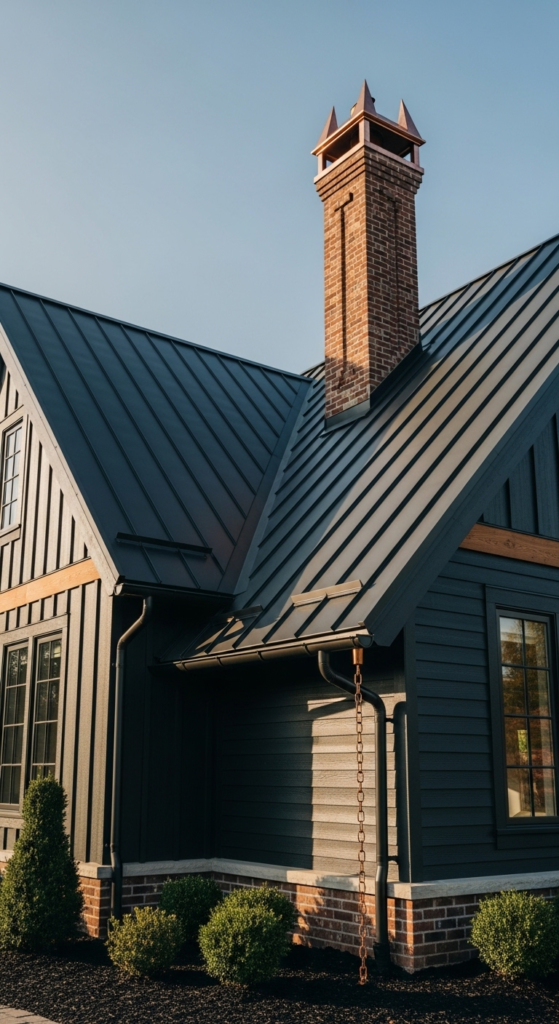
There is something about the sound of rain on a metal roof that is so deeply satisfying, so elemental, that it has become one of the most coveted sensory experiences in rural living. In the Gothic farmhouse context, the metal roof is not just an auditory pleasure — it is a major visual statement. A standing seam metal roof in flat, matte black is the single most impactful exterior upgrade available to a Gothic farmhouse aesthetic: it unifies the roofline in a crisp, graphic material that holds its color absolutely, ages without degradation, and provides the dramatic silhouette that Gothic architecture demands. Against a dark exterior, the black metal roof creates a tone-on-tone effect that emphasizes the architectural form itself — the steep pitches, the cross-gables, the ridge lines — rather than any particular surface color. The copper chimney cap is the jewelry of this exterior: a hand-formed copper cap in a simple Gothic finial shape, its bright new copper gradually developing the blue-green patina that will make it increasingly beautiful with each passing year. Perfect for those who invest in materials that improve with age and make architectural choices that will look extraordinary for decades.
15. Gothic Farmhouse with Espaliered Dark Trees on Facade
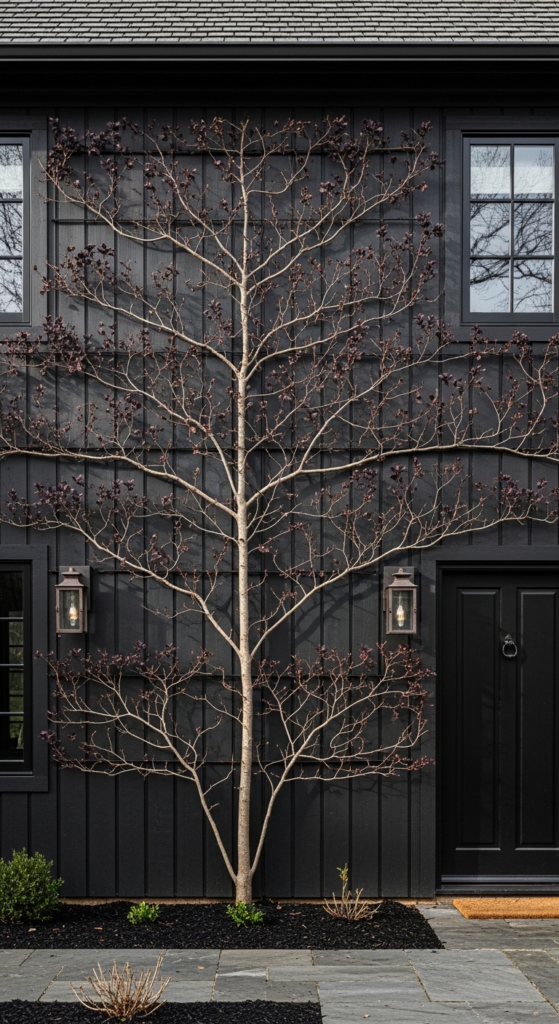
Espalier — the ancient horticultural practice of training trees and shrubs to grow flat against a wall in deliberate, geometric patterns — is one of those design techniques with such a long and distinguished history that it feels both deeply traditional and completely current at the same time. In the context of a Gothic farmhouse exterior, espaliered dark trees or shrubs against the main facade create something that is genuinely breathtaking: the organic, botanical form of the plant, constrained and shaped into an architectural pattern against the dark wall, creating a living decoration that changes with every season. In spring, the espalier might be covered in delicate blossoms — white pear or dark pink apple against black siding — that look like a painting. In winter, the bare branching structure becomes a stark, graphic tracery against the dark wall, like hand-drawn calligraphy. Choose trees with beautiful branch structure: Belgian fence apple, hornbeam, or dark-leafed purple smoke bush trained flat. The effect, especially against a matte black or deep charcoal board-and-batten exterior, is extraordinary. Perfect for gardener-homeowners, those with a love of living art, and patient souls who enjoy watching something beautiful evolve over years.
16. Gothic Farmhouse in Deep Plum with Black Iron Fence
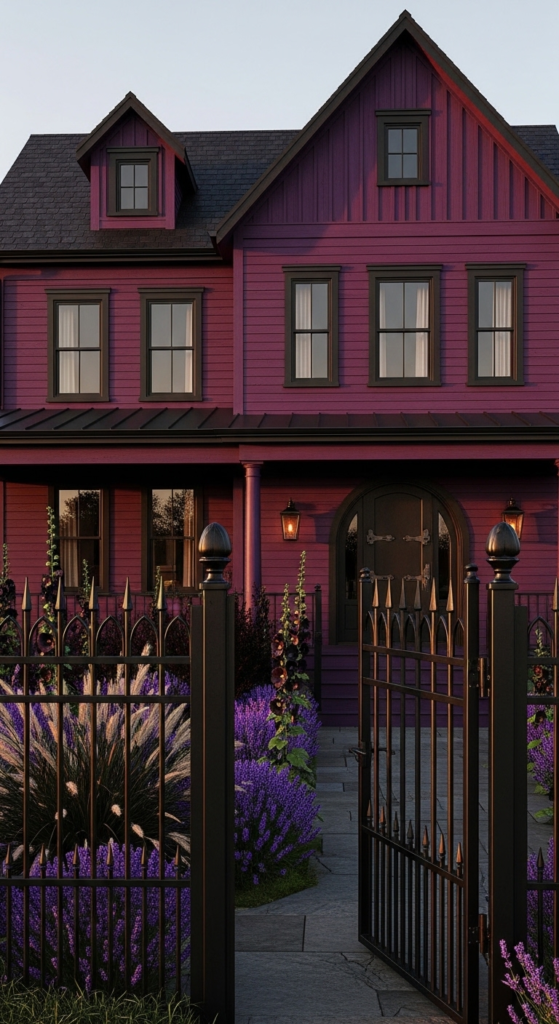
Deep plum is a color that lives at the most dramatic, most daring edge of the exterior color spectrum — far from conventional, impossible to ignore, and absolutely magnificent when executed with confidence and surrounding it with the right material partners. A Gothic farmhouse in deep plum — a rich, dark purple that sits between eggplant and burgundy, with enough red to keep it warm and enough blue to keep it complex — is the kind of exterior that people drive out of their way to see again. The color changes dramatically with the light: in full sun it reveals its warmth and richness, in shadow it deepens toward an almost black purple that is deeply atmospheric, and in the golden hour it absolutely glows. The black iron fence — a full perimeter fence in a Gothic style with pointed finials and ornate post caps — frames the property with a formal authority that is perfectly calibrated to the drama of the house within. Black painted window trim, a heavy iron-black front door, and a landscape of deep purple lavender, black hollyhocks, and dark ornamental grasses complete an exterior that is unlike anything else on any street. Perfect for the fearlessly individual homeowner who was never going to paint their house beige.
17. Scandinavian Gothic Farmhouse in Black with Snow Landscape
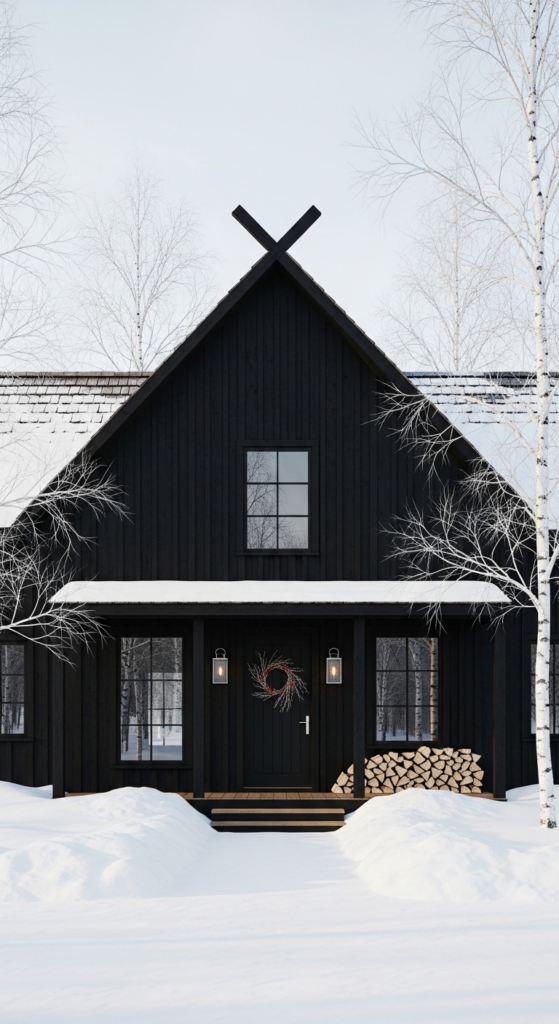
The Scandinavian design tradition and the Gothic aesthetic share more than might initially seem obvious — both place a deep value on the relationship between darkness and light, on the beauty of stark contrast, on the honesty of natural materials, and on a certain severity of form that is its own kind of elegance. The Scandinavian Gothic farmhouse takes this shared sensibility and expresses it in an exterior of spare, almost severe beauty: a simple, steeply-gabled form clad in black painted vertical board siding — in the Scandinavian tradition of black-painted timber farm buildings — with windows that are large, simple, and unadorned, letting in as much of the precious northern light as possible. In a winter landscape, with snow banked against the dark foundation and the bare branches of birch trees creating a delicate white tracery against the black walls, this farmhouse is simply one of the most beautiful things you have ever seen. Simple iron lanterns. A neat stack of split firewood. A single wreath of bare branches and red berries on the front door. Nothing unnecessary. Everything exactly right. Perfect for Scandinavian design lovers, minimalists with a dark side, and those who find deep beauty in a landscape of black, white, and gray.
18. Gothic Revival Farmhouse with Arched Doorway and Leaded Glass
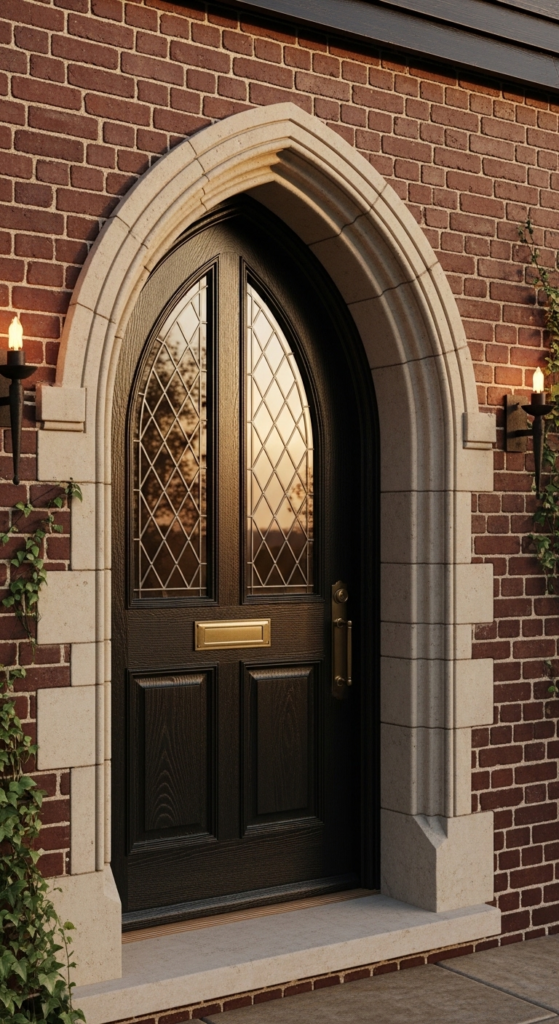
The Gothic Revival movement that swept through American and European residential architecture in the mid-19th century produced some of the most beautifully detailed, most romantically conceived homes ever built on this continent — and at the center of virtually every one of them was a front doorway of extraordinary character. The arched doorway is the Gothic Revival’s signature residential gesture: a pointed or rounded arch of stone, carved wood, or brick that frames the entry with the same vocabulary the great cathedrals used to frame their sacred spaces, translated into a domestic scale that manages to be both humble and magnificent at the same time. In this farmhouse interpretation, the arched doorway is built from hand-laid brick in a warm, dark red — the arch itself slightly pointed, with a keystone in cream limestone at its apex. The door within the arch is heavy, dark-stained oak with leaded glass panels in the upper section, the glass arranged in a simple diamond or Gothic tracery pattern. Iron exterior sconces on the brick flanking the arch. A stone threshold worn smooth by imagined generations of footsteps. This doorway alone would be enough to make a house extraordinary. Perfect for architecture enthusiasts, history lovers, and those who understand that how a door greets you says everything.
19. Gothic Farmhouse with Secret Garden Gate and Stone Wall
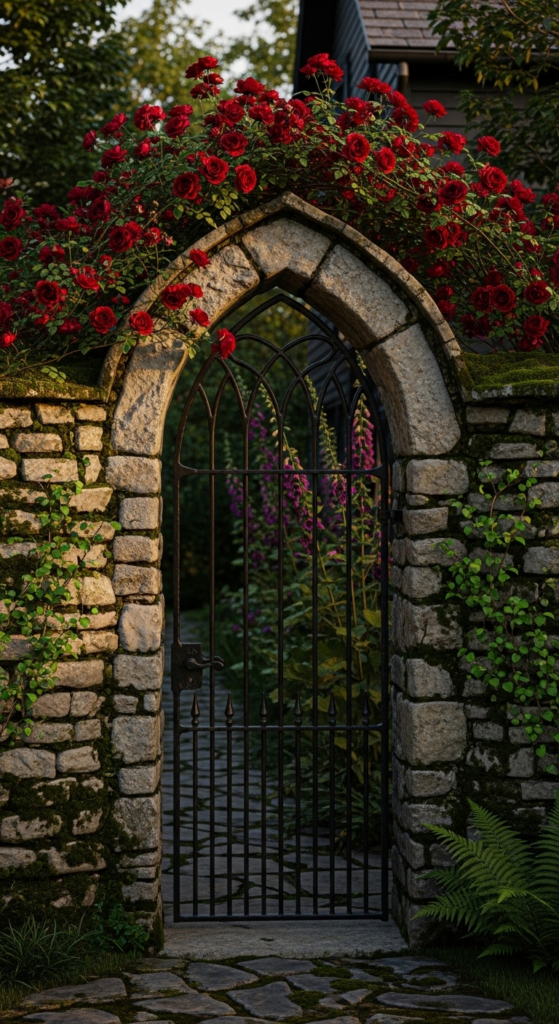
Every great Gothic farmhouse deserves a garden that matches its spirit — not the neatly bordered, symmetrically planted garden of a conventional home, but something wilder, more layered, more secretive. And the physical expression of that secret garden is a gate: a tall, narrow gate in weathered iron or dark-stained wood, set into a mossy stone wall that runs along the side or front of the property, offering a tantalizing glimpse of the lush, overgrown garden world beyond without fully revealing it. The gate itself might be iron with Gothic arch detail and pointed finials, or a heavy plank door of dark oak with iron strap hinges and a simple iron ring pull — either version creates that essential sense of a boundary between the known world and a more beautiful, more mysterious one. The stone wall on either side is colonized by moss, creeping fig, and small ferns in the mortar joints. Climbing roses spill over the top. The path beyond the gate disappears into a garden of dark hollyhocks, foxglove, black elder, and night-blooming jasmine. This element can be added to virtually any Gothic farmhouse exterior as a garden feature. Perfect for gardeners who believe that a garden should have atmosphere as well as flowers.
20. Gothic Farmhouse with Dramatic Exterior Lighting at Night
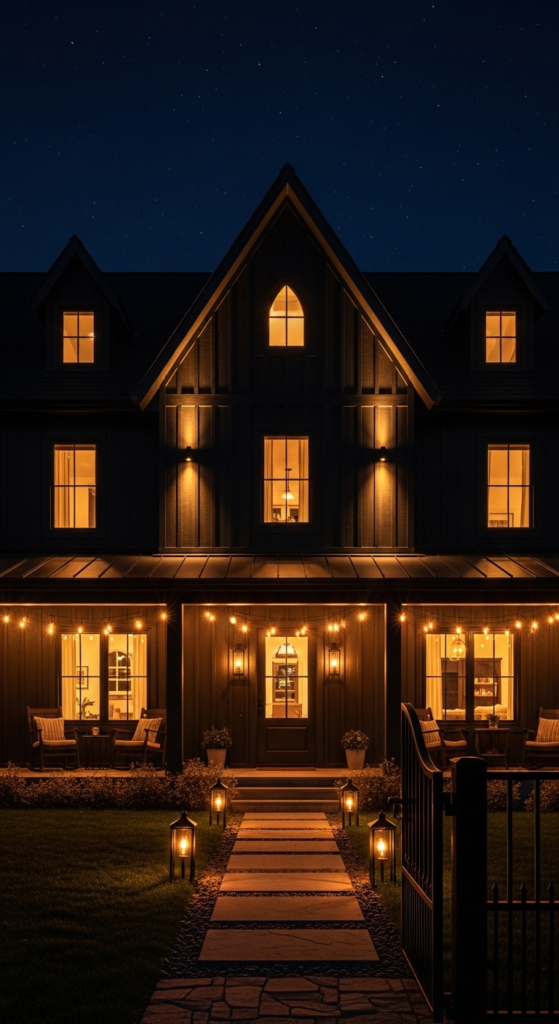
A Gothic farmhouse is, in one sense, built for the night. The dark exterior, the steep roofline, the pointed architectural details — all of these elements come into their full, extraordinary power after the sun has set, when the right exterior lighting can transform a beautiful daytime facade into something genuinely cinematic. The exterior lighting scheme for a Gothic farmhouse is as considered and deliberate as any other design choice, and it deserves the same attention. The approach: layered lighting at multiple levels, always in warm amber tones, always in iron or aged brass fixtures, never harsh or cold. Wall-mounted iron lanterns with real candle inserts or flicker-flame bulbs at either side of the front door. Recessed uplight fixtures buried in the garden beds casting warm amber light up the dark siding and illuminating the architectural details from below — bargeboards suddenly visible, porch columns glowing, the turret or gable silhouetted dramatically against the night sky. A string of Edison bulbs along the porch ceiling creating a warm canopy of light. Pathway lanterns in iron marking the route from gate to door. Every window glowing warmly from within. This is the Gothic farmhouse at its most theatrical and most beautiful. Perfect for dramatic homeowners who understand that a house should be as beautiful after dark as before it.
21. Gothic Farmhouse in Forest Setting with Fog and Ferns
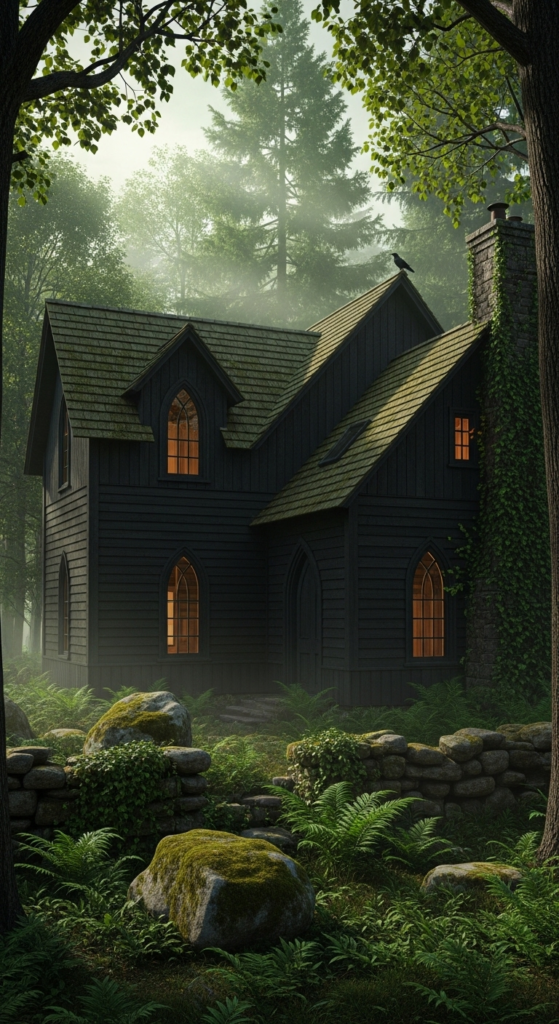
For the final idea in this collection, we’re giving you the complete picture — not just the exterior of the house, but the entire world it inhabits. Because a Gothic farmhouse in a forest setting, on a misty morning when low fog moves between the trees and ferns unfurl from the mossy ground at the foundation, is not simply a house. It is an experience. It is a feeling. It is the kind of image that stays with you for days after you’ve seen it, that makes you understand, at a cellular level, why people dedicate their lives and their savings to finding and creating homes of real character and presence. The house itself is deep, weathered charcoal — almost a natural dark that seems to belong to the forest — with simple Gothic arch windows and a steep roof that drips with dark moss at its edges. The surrounding landscape does most of the work: ancient oak and fir trees rising behind and above the roofline, their canopy filtering the morning light into something luminous and green. Ferns carpet the ground in every direction, punctuated by moss-covered stones and the occasional dark iris or jack-in-the-pulpit. Fog moves through the trees. A single crow sits on the ridgeline. This is the Gothic farmhouse of every dark romantic’s deepest dream. Perfect for the truly committed, the genuinely extraordinary, and those who have always known they were meant to live somewhere unforgettable.
22. Gothic Farmhouse with Dramatic Black Barn Doors and Exposed Timber Frame
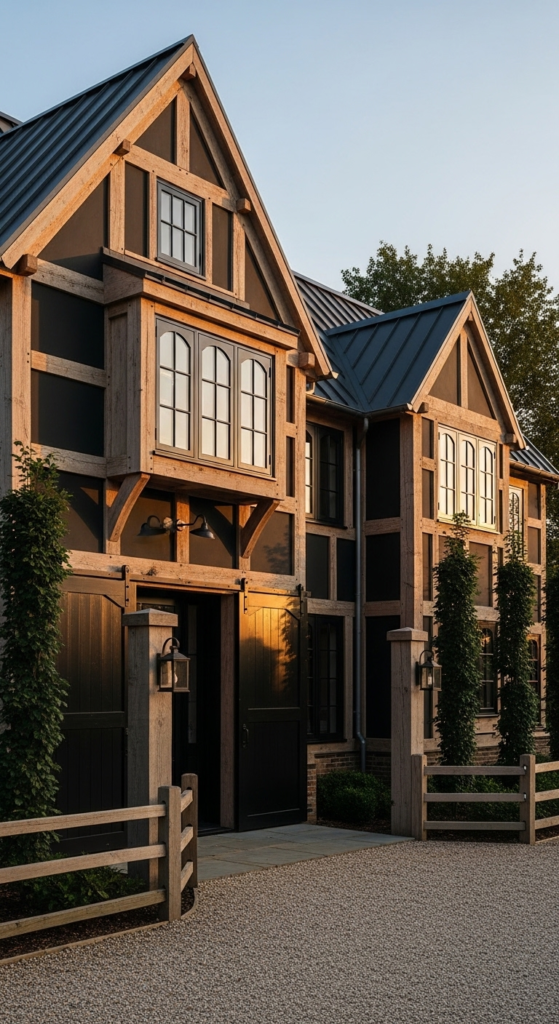
There is a particular kind of architectural honesty that comes from exposing the bones of a building — from letting the structural timber frame show itself on the exterior rather than hiding it behind cladding — and in a Gothic farmhouse context, this exposed timber framing becomes one of the most visually powerful and historically resonant design choices available. The tradition of timber framing is ancient, preceding the Gothic Revival movement by centuries, and the two vocabularies sit together with a naturalness and a rightness that feels completely inevitable. The heavy, dark-stained timber frame — oak or Douglas fir in substantial section sizes — creates a grid of structural lines across the facade that echoes the tracery of Gothic stonework in the most beautiful way. Between the timbers, the infill panels are painted in the deepest matte black, creating a dramatic contrast. But the statement element of this exterior is the pair of oversized black barn doors mounted on exposed iron hardware at the main entry or at the entrance to an attached barn wing — their scale deliberate, their hardware massive and hand-forged, their surface a deep, richly grained black-stained wood that catches light along every plank edge. The doors slide on industrial-weight iron rail hardware, their movement satisfying and weighty. Style the approach with a gravel drive, split-rail fencing in dark-stained timber, and a row of dark columnar hornbeam trees flanking the entry. This design is perfect for those who love structural beauty, the intersection of industrial and Gothic aesthetics, and homes that announce themselves with quiet, enormous confidence.
23. Gothic Farmhouse with Moody Herb and Black Flower Garden
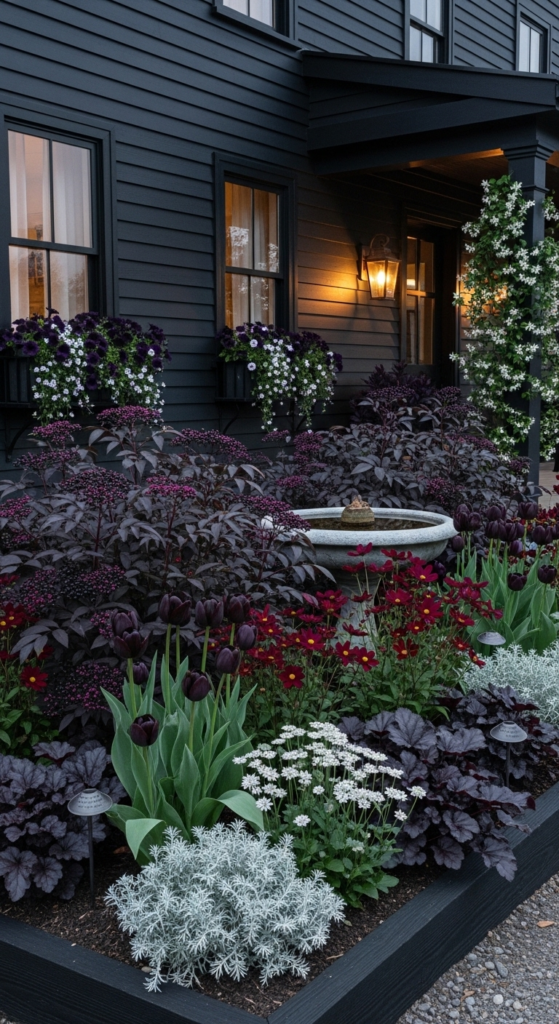
A Gothic farmhouse without a garden that matches its spirit is like a cathedral without its rose window — technically complete, but missing the element that elevates it from impressive to truly transcendent. This final idea is dedicated entirely to the exterior landscape: specifically, the creation of a front garden so deliberately, beautifully, and atmospherically planted that it becomes as much a part of the home’s Gothic identity as the architecture itself. The garden wraps the front of a deep charcoal or near-black farmhouse in layers of dark, moody planting that are as considered and as intentional as any interior design choice. The palette is built around the darkest cultivars available in each plant category: ‘Queen of Night’ tulips in near-black purple in spring, ‘Black Lace’ elderberry with its deeply cut dark purple foliage as a structural shrub, ‘Blackout’ petunias cascading from iron window boxes, ‘Chocolate’ cosmos in deep burgundy-brown, ‘Obsidian’ heuchera with its almost-black leaves at the border edges, and night-blooming jasmine trained up the porch posts for a fragrance that arrives only after dark. Between these dark cultivars, the occasional silvery artemisia or white astrantia creates a moonlit contrast that makes the dark colors sing. Raised beds are edged in weathered iron or dark-stained timber. Antique iron plant markers stand at each bed. A stone birdbath in weathered gray sits at the garden’s center, its basin filled with water that reflects the dark house and the sky above in equal measure. This garden is not only beautiful to look at — it is beautiful to be inside, and at dusk, when the night-blooming flowers open and the first stars appear above the dark roofline, it is one of the most magical outdoor spaces imaginable. Perfect for passionate gardeners, dark botanicals enthusiasts, and those who understand that the land around a home is not a backdrop but a living, breathing extension of everything the home is trying to say.
Save These Ideas — Your Gothic Farmhouse Dream Deserves to Be Remembered
Twenty-three Gothic farmhouse exteriors. Twenty-three different expressions of what it means to build a home that is dark and beautiful, dramatic and deeply personal, rooted in the land and reaching toward something extraordinary. From the bold graphic clarity of the ink-black board-and-batten with cathedral windows to the ethereal, fog-wrapped forest farmhouse that seems to exist at the edge of a dream — every one of these ideas is a genuine invitation to think differently about what a home can be and what it can make you feel.
The Gothic farmhouse exterior is not a trend. It is not a moment. It is an entire philosophy of living — one that says beauty doesn’t have to be bright to be beautiful, that drama and warmth are not opposites, that the most extraordinary homes are built by people who trusted their instincts and refused to be talked out of what they loved.
Whether you’re standing in front of a house that you’re about to transform, or sitting on your couch at midnight saving images to a board called “Someday” — this aesthetic is valid, it is achievable, and it will be worth every single choice you make in its direction.
📌 Pin this entire article to your dream home board right now — and save your individual favorites to the boards where you’re planning, gathering, and slowly building the vision of the home that is waiting for you. Share it with your partner, your architect, your contractor, or the friend who always said you had unusually good taste in houses.
You were never going to paint it beige anyway.
Go dark. Go Gothic. Go home.