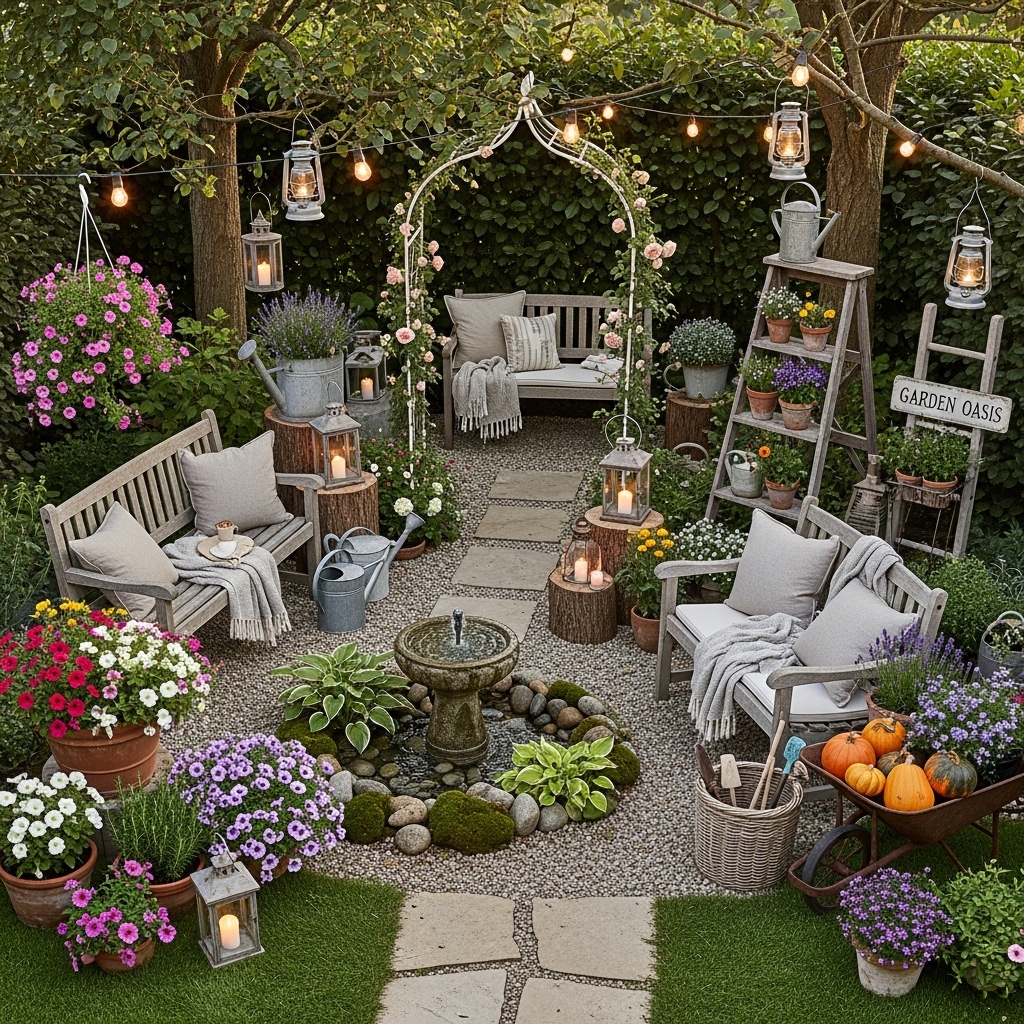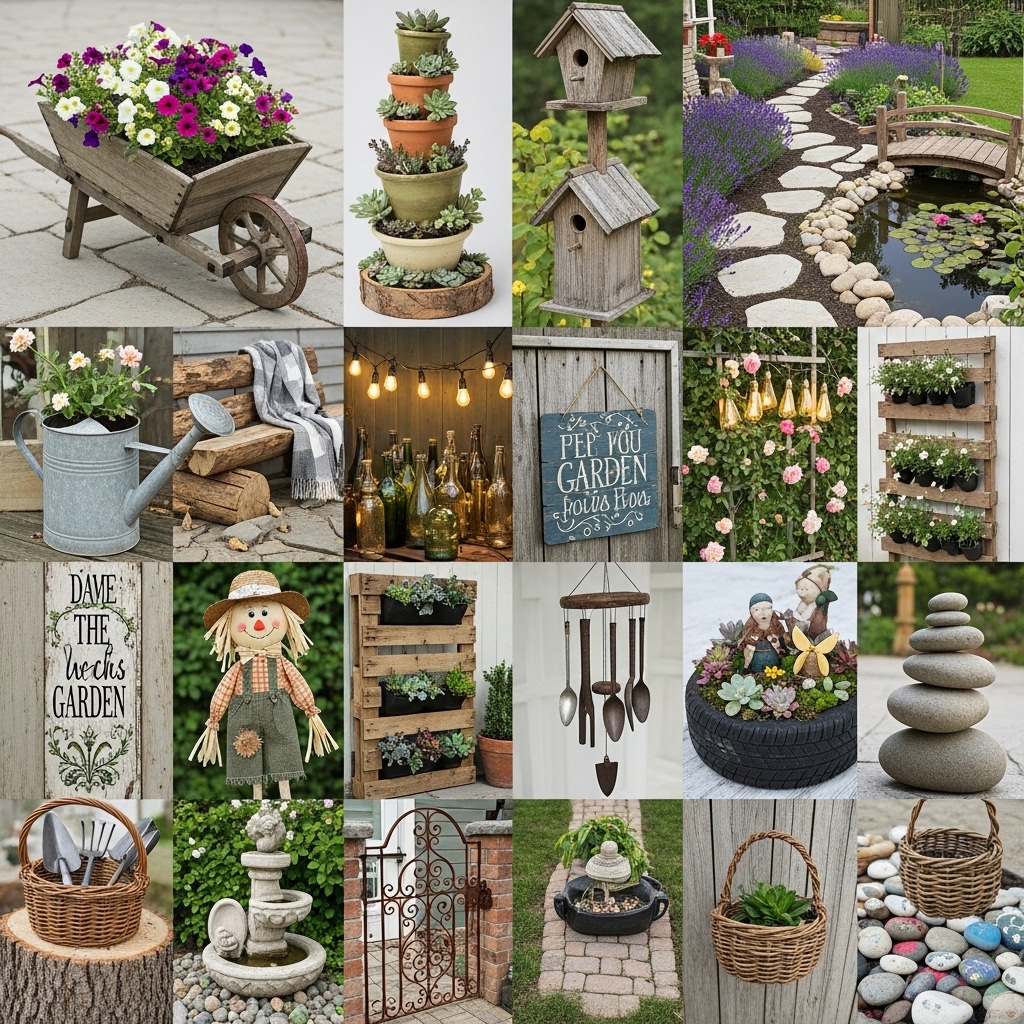
A backyard with real soul doesn’t happen overnight — it’s built slowly from honest materials, weathered surfaces, and plants that have been given time to settle into their places. Rustic garden decor has that rare quality of looking better with every passing season rather than demanding constant effort to maintain its appearance, which is exactly why it resonates so deeply with anyone who wants an outdoor space that feels genuinely lived in. Whether your backyard is a generous sweep of lawn or a compact paved courtyard, this style meets you exactly where you are and makes something beautiful from it. These 24 rustic garden decor ideas to inspire your backyard are specific, actionable, and full of the kind of detail that actually helps you get started. Here are 24 ideas worth saving.
Why Rustic Garden Decor Works So Well in a Backyard
Rustic garden decor succeeds because it builds on rather than fights against the natural processes already at work in any outdoor space. Weathering, moss growth, the slow patination of metals, the deepening grain of timber — all of these are welcome additions in the rustic aesthetic rather than problems to solve. That fundamentally collaborative approach to time and nature is what makes the style so enduring and so genuinely low-pressure to maintain.
The material palette is anchored in the honest and the handmade: reclaimed timber in aged grey-brown, wrought iron in deep charcoal-black, terracotta in warm orange and salmon, limestone and sandstone in chalky greige, galvanized steel in matte silver, and natural wicker and rope in warm honey-beige. These materials share a common quality — they all look better with use and age. Colour-wise, the rustic backyard stays firmly in the earth tones: dusty sage, faded ochre, warm cream, mossy green, and the deep brown of well-oiled wood.
Pinterest searches for “rustic backyard ideas,” “cottage garden inspiration,” and “natural outdoor decor” continue their sustained growth, reflecting a clear cultural appetite for outdoor spaces that prioritise character over perfection. The backyard is increasingly understood as a restorative space rather than a decorative one, and rustic decor supports that function perfectly.
The most encouraging aspect of this style is its scalability. A single reclaimed planter, a cluster of aged terracotta pots, or one well-chosen antique garden ornament is enough to establish the aesthetic in even the smallest backyard corner.
Reclaimed Brick Raised Beds With Tumbled Limestone Paths
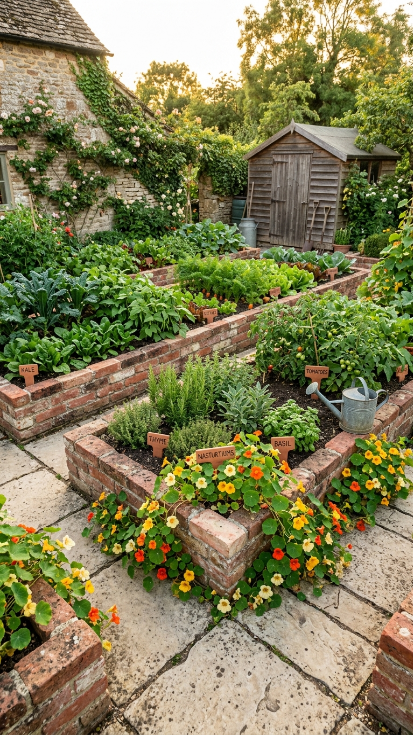
Vibe: A kitchen garden that earns its keep twice over — once in the harvest and again in the looking.
What makes it work: Reclaimed brick brings tonal variation that new brick simply cannot offer — the range from deep red to salmon to near-purple creates a naturally rich, painterly surface. Tumbled limestone paths add a material contrast that anchors the whole scheme while providing a warm, non-slip surface that compacts well in any weather.
How to achieve it: Source reclaimed Victorian or Edwardian brick from demolition contractors or salvage yards — specify ‘walling grade’ and expect tonal variation as a feature. Lay raised bed walls in a simple stretcher bond using lime mortar rather than cement for a more authentic, permeable finish.
💡 Lime mortar is more forgiving than cement for DIY bricklaying — small gaps and slight irregularities are features, not mistakes.
Rusted Steel Garden Edging Along Curved Borders
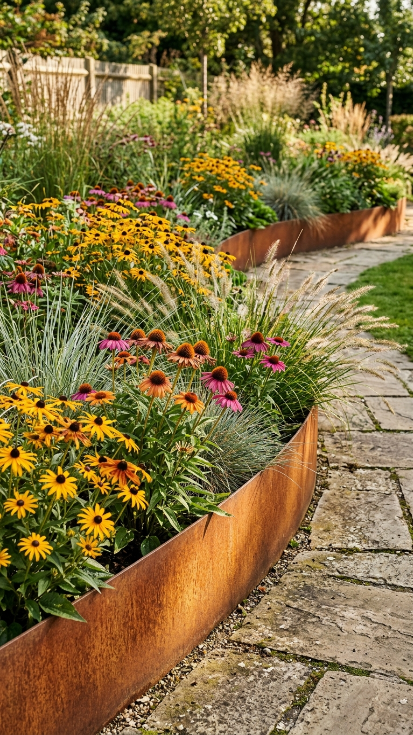
Vibe: Edging that is as much a design element as anything growing above it — a warm, continuous stroke of colour at ground level.
What makes it work: Corten steel edging serves the rustic backyard brilliantly because it weathers to a self-stabilizing rust that requires zero maintenance while remaining visually extraordinary. The warm orange-brown of weathered Corten harmonizes naturally with autumn-toned planting — rudbeckia, echinacea, ornamental grasses — creating a colour-coordinated scheme that appears deliberate without being forced.
How to achieve it: Source Corten steel garden edging strips from specialist suppliers in 3mm thickness — thin enough to bend for curves, substantial enough to hold its shape permanently. Install by driving the integrated anchor tabs into firm soil with a rubber mallet. Leave completely unsealed for authentic weathering.
Vintage Glass Bottle Tree as Backyard Folk Art
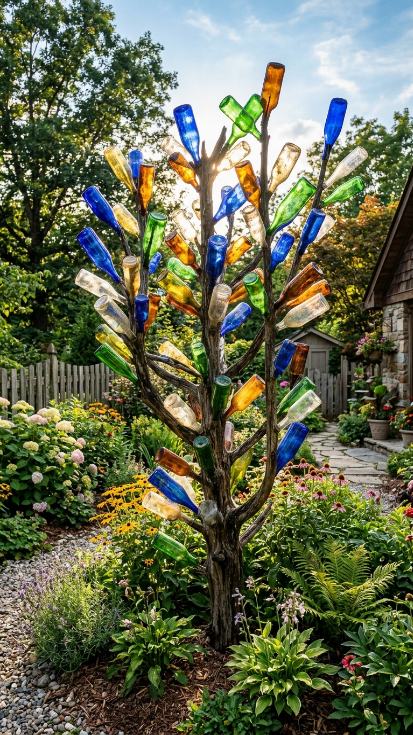
Vibe: Part sculpture, part wind instrument, part folk legend — a backyard addition that rewards every hour of different light differently.
What makes it work: A bottle tree is genuinely one of the most visually dynamic rustic garden installations — coloured glass in direct sunlight creates pools of coloured light on surrounding surfaces that move throughout the day as the sun angle changes. The contrast between the rough organic branch structure and the smooth manufactured glass creates a compelling material tension.
How to achieve it: Use a naturally gnarled dead branch or a metal pipe structure as the central form — secure in a concrete-filled post hole for stability. Collect coloured glass bottles in cobalt, amber, and green; clean thoroughly and push over branch ends. Arrange densest colour clusters at eye level for the best light effects.
💡 Cobalt blue glass bottles create the most dramatic light effects — wine bottles, medicine bottles, and olive oil bottles are ideal sources.
Rustic Garden Decor: Moss-Covered Concrete Sculptures

Vibe: Objects that appear to have been found rather than placed — swallowed gently by the garden over many years.
What makes it work: Moss completely transforms the character of concrete — where bare concrete reads as hard and industrial, moss-covered concrete reads as ancient and organic. Multiple moss species naturally colonise at different rates, creating a layered green surface of genuinely complex beauty. Grouping three different sculptural forms creates an installation quality without formal pretension.
How to achieve it: Apply a yogurt-and-water wash (50/50 ratio) to cleaned concrete surfaces, then place in a shaded, moist position — moss colonies establish within one to two seasons. Alternatively, blend fresh moss with yogurt in a blender and paint directly onto the surface for faster coverage.
Weathered Wooden Swing Bench Hung From a Mature Tree
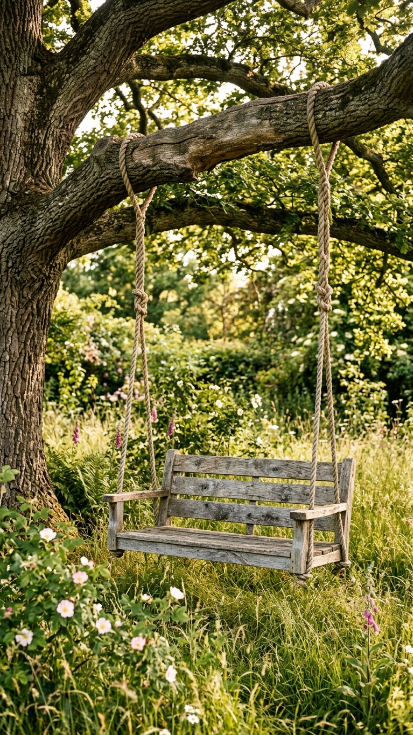
Vibe: The single most evocative rustic backyard addition — something that makes every adult feel eight years old again.
What makes it work: A tree swing bench works as rustic backyard decor because it engages the existing character of a mature tree — using the tree rather than working around it. The natural rope, reclaimed timber seat, and dappled canopy light create a composition that could exist in no other style. Proportion is critical: the rope must be genuinely thick (30mm minimum) to look appropriate rather than makeshift.
How to achieve it: Use 30mm natural Manila rope for its appearance and sufficient strength — thread through pre-drilled holes in a reclaimed oak or elm plank at least 50mm thick. Attach to the branch using a tree-safe hanging system: a wide nylon strap looped around the branch (never rope, which damages bark) connected to the Manila rope below.
💡 A saddle soap treatment on Manila rope once a year prevents deterioration and keeps the natural fibre supple and safe under load.
Terracotta Bell Pot Stack as a Backyard Focal Point
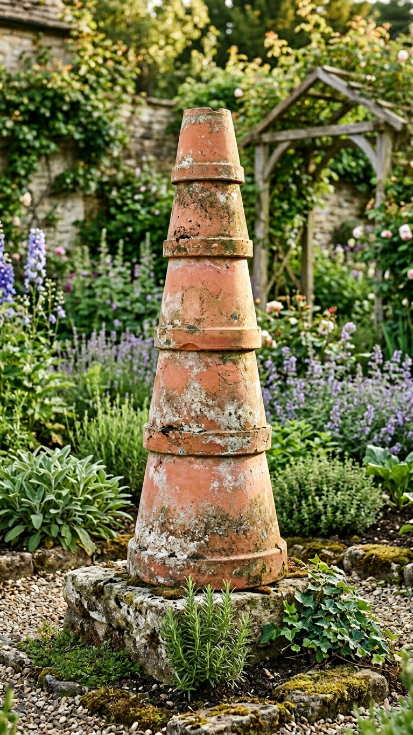
Vibe: Terracotta elevated to architecture — a column of stacked pots that reads as sculpture without trying to be.
What makes it work: Bell pots stacked in a diminishing tower create a naturally proportioned vertical form — the tapering profile is inherently elegant and draws the eye upward. The aged terracotta surface, with its mineral blooms and lichen patches at the base, gives the installation a sense of permanence and history that no new ceramic could replicate.
How to achieve it: Source large traditional bell pots (also called ‘forcing pots’) from specialist terracotta suppliers or French garden antique dealers — genuine aged examples are worth seeking. Stack on a flat limestone or sandstone plinth using a central wooden dowel threaded through the drainage holes to stabilize the tower against wind.
Rustic Garden Decor: Stone and Timber Outdoor Kitchen Corner
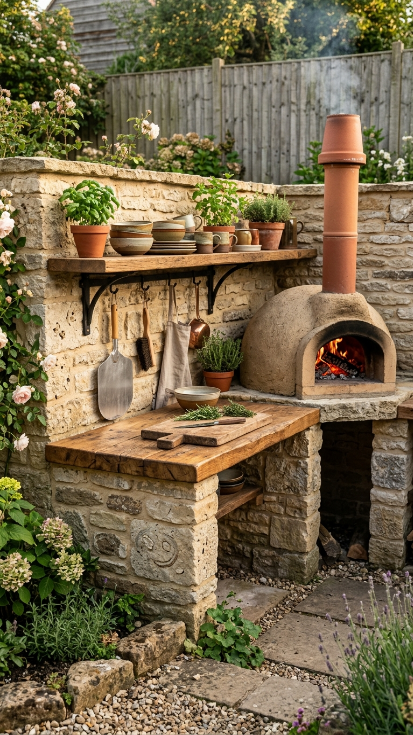
Vibe: An outdoor kitchen that looks like it was built by a craftsman who cared deeply about both cooking and beauty.
What makes it work: The combination of reclaimed limestone, oak, and cast iron creates a material hierarchy where every element belongs in the same natural register — nothing synthetic, nothing incongruous. A wood-fired oven with a terracotta chimney becomes the narrative centrepiece, combining rustic material character with a functional purpose that transforms backyard entertaining entirely.
How to achieve it: Build the base structure from reclaimed limestone or sandstone blocks using natural hydraulic lime mortar. Source a kit wood-fired oven from specialist suppliers — Forno Bravo and Alfa both offer excellent models that can be clad in stone. Top with a reclaimed oak slab sealed with exterior hard wax oil (Osmo PolyX recommended for food-safe outdoor surfaces).
Wild Hedgerow Border Along the Backyard Boundary
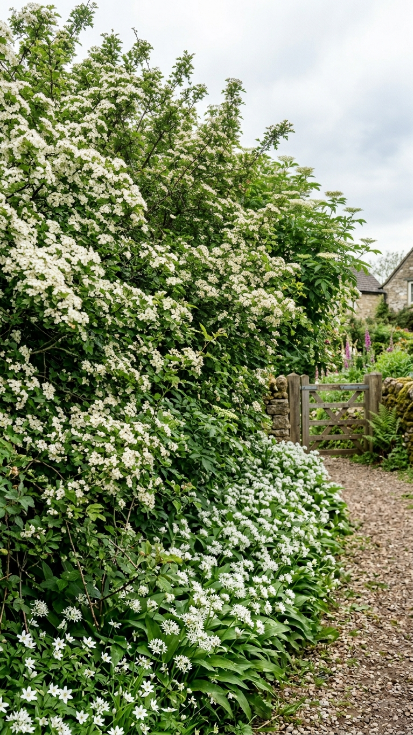
Vibe: A backyard boundary that is simultaneously garden, habitat, harvest, and one of the most beautiful things a garden can contain.
What makes it work: A mixed native hedgerow is the ultimate rustic backyard boundary — it provides privacy, wildlife habitat, seasonal interest across twelve months, and edible harvest (blackthorn sloes, elder flowers and berries, hawthorn haws) all in one low-maintenance planting. The deliberate wildness of mixed species is the opposite of a clipped formal hedge and far more appropriate to the rustic aesthetic.
How to achieve it: Plant bare-root native hedgerow whips in winter (November to March) — available from native plant nurseries in mixed packs very inexpensively. A typical mix includes hawthorn, blackthorn, field maple, dog rose, and hazel in roughly equal proportions. Plant at 30cm spacing in a double staggered row and cut hard back in the first spring to encourage dense base growth.
💡 Bare-root native hedgerow whips cost as little as £1/$1.20 each — a 10-metre boundary hedge planted for under £60/$75 total.
Cast Iron Urn With Seasonal Trailing Planting
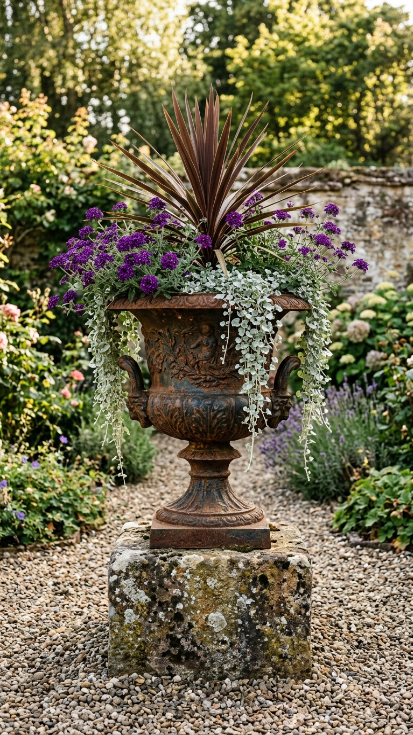
Vibe: Classical form worn down to something raw and more honest — the urn’s beauty deepened rather than diminished by time.
What makes it work: A cast iron urn carries visual authority that lighter materials never achieve — the sheer weight of the object reads at a distance, making it an effective focal point even in a large backyard. Rust developing through dark paint is not a deterioration to fix but a patination process that creates extraordinary surface complexity. The planting combination of trailing purple, silver, and bronze creates maximum contrast against the dark iron.
How to achieve it: Source antique cast iron urns from specialist garden antique dealers or auction houses — Victorian and Edwardian examples appear regularly and are genuinely collectible. Leave any developing rust entirely untreated for the most beautiful natural patina. Plant with a ‘thriller, filler, spiller’ combination: one tall structural plant, one mounding filler, and one trailing edge plant.
Rustic Backyard Decor With a Vine-Draped Timber Pergola
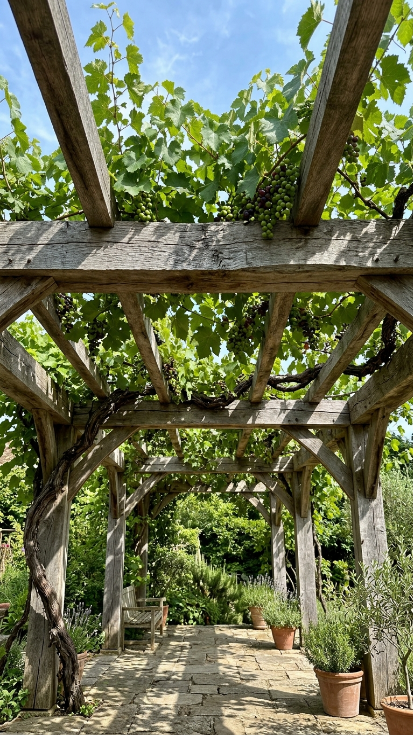
Vibe: Sitting beneath a grape vine on a hot afternoon is one of the great backyard experiences — shade, fragrance, and the quiet drama of fruit developing overhead.
What makes it work: A grape vine is the ideal rustic pergola climber — its gnarled, sculptural trunk structure becomes more beautiful with every year, its leaf canopy provides dense summer shade, and it produces a harvest with no additional effort beyond annual pruning. Rough-sawn oak posts and beams age to silver-grey naturally, creating a material harmony with the vine’s own woody structure.
How to achieve it: Build or commission a pergola from green oak — available from specialist timber frame suppliers who will cut to specification. Plant a Vitis vinifera ‘Brant’ (ornamental, reliable fruiting, superb autumn colour) at each corner post. Prune in late winter using the traditional rod system: retain main structural arms and prune all side shoots to two buds from the main rod.
Freestanding Wattle Screen as a Rustic Room Divider
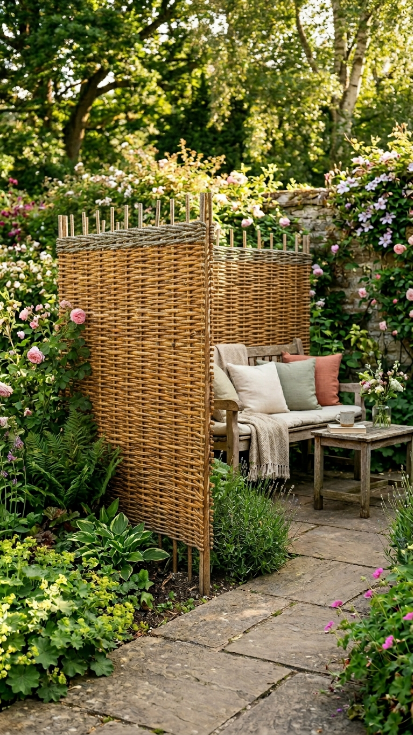
Vibe: A screen that creates shelter and privacy while carrying the distinctive, irreplaceable quality of something entirely made by hand.
What makes it work: Wattle hurdle screens are among the oldest garden structures in existence — the woven hazel technique has barely changed in two thousand years, and that historical continuity gives them an authority that modern alternatives cannot approach. As a backyard room divider, a wattle screen filters wind gently rather than blocking it completely, creating a sheltered microclimate that a solid fence does not.
How to achieve it: Source wattle hurdle panels from specialist coppice-craft suppliers in standard 1.8m x 1.8m sizes. Freestanding installation requires driving pointed timber posts at least 60cm into the ground at each panel edge — use hardwood (oak or chestnut) posts for greatest weather resistance. Wire hurdles to posts at top, middle, and base.
💡 Wattle hurdles last longer when kept clear of soil at the base — raise the panel edge 5cm above ground on stone chocks to prevent rot at the bottom weave.
Antique Stone Garden Roller as a Decorative Lawn Feature
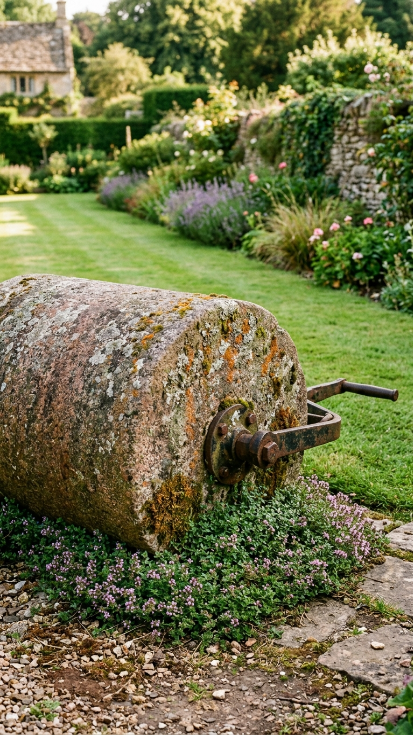
Vibe: An object so massive and so clearly old that the entire backyard seems to orient around it.
What makes it work: A stone garden roller has an elemental visual power that comes from sheer weight, age, and the evidence of sustained past use. Unlike decorative garden ornaments, a roller carries genuine working history — it was used to create the very lawns it now rests beside. That functional authenticity is precisely what rustic backyard decor celebrates.
How to achieve it: Source antique stone rollers from specialist garden antique dealers, estate sales, or farm auctions — granite rollers appear regularly and are often inexpensive relative to their visual impact. Position on a flat stone pad cut to size to prevent the drum sinking into soft ground. Allow moss and lichen to colonise naturally without intervention.
Rustic Garden Decor: Hand-Thrown Ceramic Water Bowl Feature
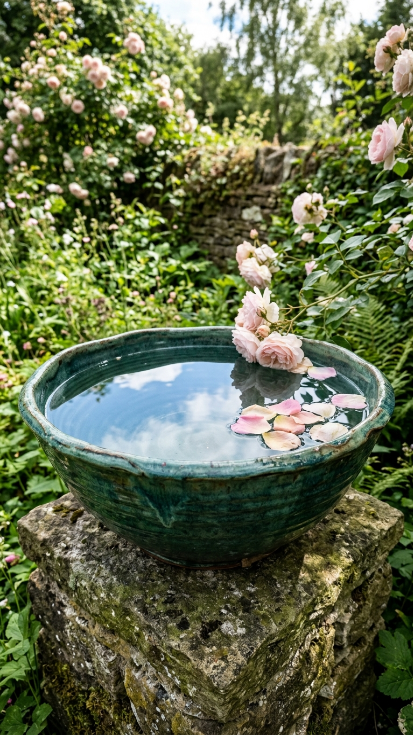
Vibe: Water held in something made by hand — simple, still, and unexpectedly moving.
What makes it work: A hand-thrown ceramic water bowl creates a garden water feature of exceptional intimacy — smaller than a pond but more personal than a fountain, it provides still water for birds and insects while functioning as a sculptural object of considerable beauty. The irregular rim and visible throwing marks of a genuinely hand-thrown piece are what distinguish it from cast versions.
How to achieve it: Commission a large water bowl from a local ceramicist — specify an unglazed exterior and a glazed interior in a deep teal, slate blue, or dark charcoal. Bowl should be at least 50cm diameter and 20cm deep for bird use and stable plinth placement. Seal any unglazed exterior sections with linseed oil for weather protection.
Rustic Backyard Decor: Painted Timber Beehive Backdrop
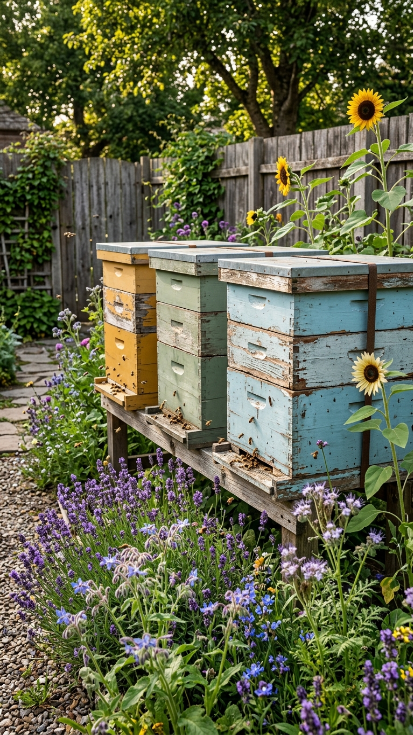
Vibe: A backyard corner with genuine purpose and extraordinary colour — productive and beautiful in exactly equal measure.
What makes it work: Painted beehives in heritage colours are among the most charming elements of traditional rustic garden design. The deliberate choice of different faded colours for each hive — robin’s egg blue, sage green, ochre — creates a composition that is visually rich without being chaotic. Paint chalking and fading at exposed surfaces adds the authentic weathered quality essential to rustic decor.
How to achieve it: Paint standard wooden hive bodies using exterior chalk paint or milk paint in heritage tones — avoid gloss finishes, which weather poorly and look wrong in a rustic context. Apply Farrow & Ball-adjacent shades: “Breakfast Room Green,” “Borrowed Light,” or “Babouche” for the most authentically aged colour palette. Position hives facing south-east for optimum colony health.
Interwoven Copper and Willow Garden Trellis Panel
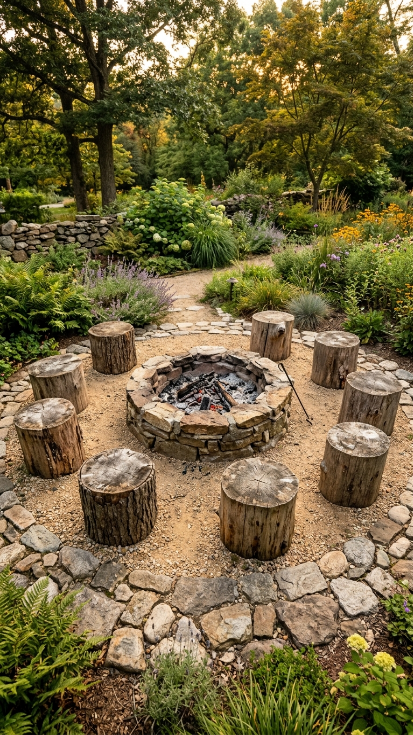
Vibe: A trellis panel that you’d stop to look at even if nothing were growing on it.
What makes it work: The combination of willow and copper is an inspired rustic material pairing — both are entirely natural, both patinate beautifully over time, and the warm honey-brown of willow against bright-to-verdigris copper creates an ongoing, slowly changing colour story. The geometric diamond lattice creates structural legibility while keeping both materials fully visible.
How to achieve it: Weave the panel on a timber frame using 10mm willow rods as the primary warp and 8mm copper pipe (available from plumbing suppliers) as the weft, alternating at each diamond intersection. Fix the completed panel to the wall using vine eyes and stainless steel wire. Leave all copper elements completely unsealed for natural patination.
Backyard Fire Pit Circle With Log Seating and Stone Surround
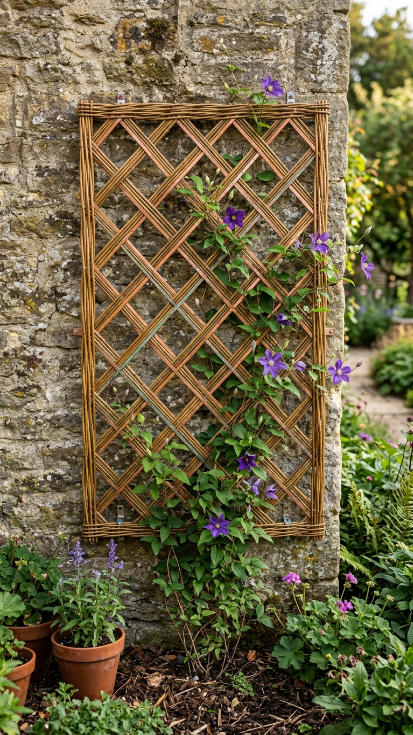
Vibe: The oldest kind of gathering place — a fire at the centre and seats arranged around it — made entirely from what the land offers.
What makes it work: A fire pit circle with log seating is the most elemental rustic backyard feature — it requires no manufactured furniture, no electrical installation, and improves with every fire lit and every season of weathering. Varying log slice diameters and tree species creates a naturally diverse seating composition where no two seats are identical.
How to achieve it: Build the fire pit wall from reclaimed limestone or fieldstone using a simple single-course circular form — no mortar needed for a decorative pit. Set log seat stools (minimum 40cm diameter, 45cm height) on individual flat stone pads to prevent ground moisture rotting the base. Apply boiled linseed oil to log seat tops annually to prevent cracking.
💡 Flat-cut hardwood rounds from a tree surgeon cost very little and look magnificent — oak, elm, and sweet chestnut all make exceptional outdoor seating with minimal treatment.
Rustic Garden Decor With Salvaged Chimney Pots as Planters
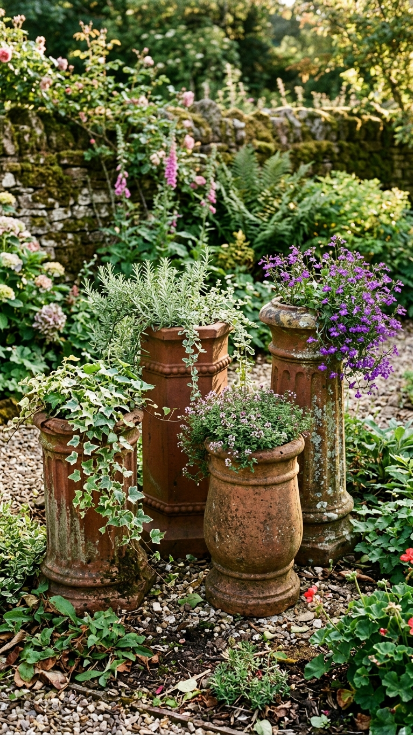
Vibe: Objects that served one purpose for a century and have discovered a second one is far more beautiful.
What makes it work: Grouping chimney pots of varied profiles creates immediate visual interest through the contrast of different decorative forms — fluted, beaded, and plain pots in the same aged terracotta share a material unity while differing completely in silhouette. The height variation of a loose cluster gives the arrangement a naturally dynamic quality that a symmetrical row never achieves.
How to achieve it: Source reclaimed Victorian chimney pots from architectural salvage yards — they vary greatly in height, diameter, and decorative detail, so specify ‘assorted styles’ for maximum variety. Block the base opening with a landscape fabric circle and fill with free-draining compost-and-perlite mix. Choose trailing plants that drape over the tall rims: trailing rosemary, creeping Jenny, ivy, and scaevola.
Handmade Twig and Branch Garden Arch
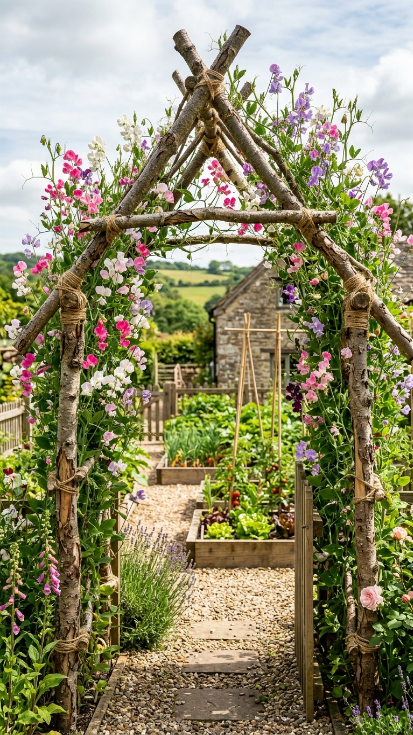
Vibe: An arch that looks as though the garden itself built it — and sweet peas chose to live there.
What makes it work: A branch-built garden arch carries a hand-crafted quality that no manufactured metal arch can approach — the natural bends, bark texture, and visible jute lashing all communicate human making in the most direct way. As a frame for sweet peas, it provides numerous natural anchor points for tendrils that wire or metal provides far less naturally.
How to achieve it: Collect naturally forked branch lengths of 2–3 metres from hazel, elder, or young birch during winter pruning. Assemble by crossing two A-frames at the apex and lashing with natural jute twine at all crossing points — no tools or hardware needed. Plant sweet peas at each leg base in autumn for maximum coverage by early summer.
Rustic Backyard Decor: Natural Stone Birdbath on a Boulder Plinth
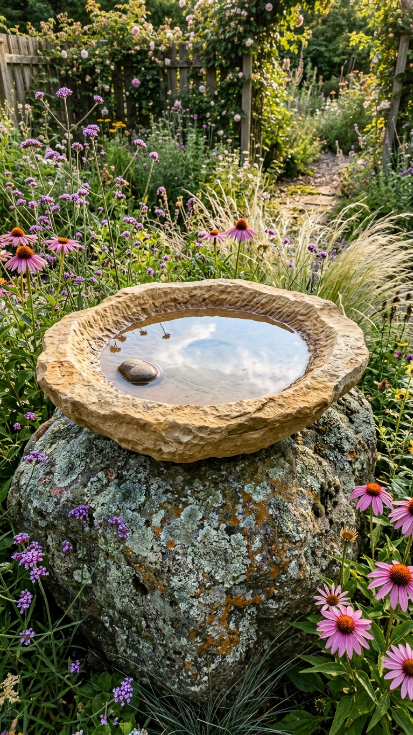
Vibe: Water held in stone — the simplest possible material in the simplest possible form — and it is completely sufficient.
What makes it work: A natural stone birdbath on a boulder plinth reads as something placed by the landscape rather than the gardener — it has a found quality that manufactured birdbaths lack entirely. The rough boulder plinth, with its lichen colonisation and irregular form, creates a visually interesting two-tier composition that elevates the birdbath well above the surrounding planting for maximum visual presence.
How to achieve it: Source a shallow sandstone or limestone dish from a stone mason or specialist garden supplier — specify a hand-finished edge rather than machine-cut for the most natural appearance. Balance on a stable large decorative boulder (available from landscape suppliers). Place a flat pebble inside the basin for birds to stand on while bathing in the shallow water.
💡 Refresh the water daily — birds return to reliable, clean water sources repeatedly, making this one of the best wildlife-watching investments in any backyard.
Espaliered Fig Tree Against a South-Facing Backyard Wall
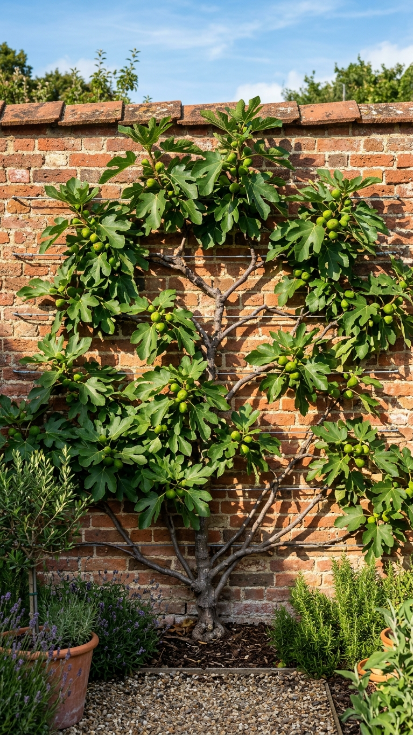
Vibe: Mediterranean abundance against warm brick — a combination so visually satisfying it seems to raise the backyard’s temperature by several degrees.
What makes it work: A fig tree espaliered on a warm brick wall creates one of the most dramatically beautiful wall features in any rustic backyard — the enormous, deeply lobed leaves cast graphic shadows on the brick surface that change throughout the day, effectively creating a living installation. The warm brick retains and radiates heat, advancing fruit ripening and creating the Mediterranean microclimate that figs prefer.
How to achieve it: Plant Ficus carica ‘Brown Turkey’ (the most reliable UK/US variety) 20cm from the wall base in well-drained soil. Train a fan espalier by selecting two main arms at 45 degrees initially, then bending gradually to horizontal as they extend. Restrict the root zone in a large container sunk into the ground to encourage fruiting rather than leaf growth.
Dry-Stack Stone Retaining Wall as a Planting Feature
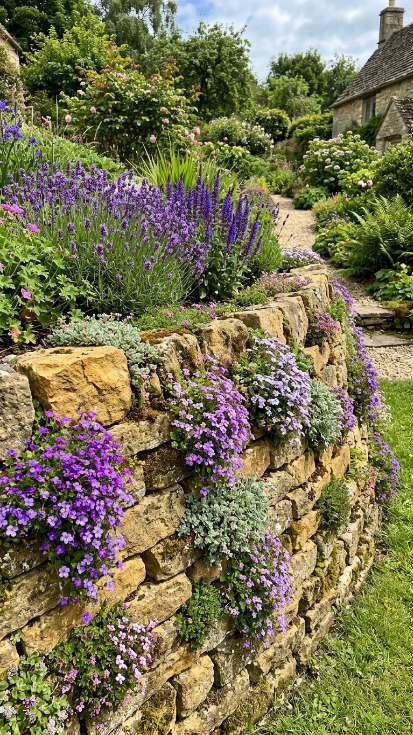
Vibe: A retaining wall that earns its place twice — holding the slope and covering itself in something extraordinary at the same time.
What makes it work: Dry-stack retaining walls are the most ecologically and aesthetically productive hard landscaping element in the rustic backyard — the mortarless construction creates naturally occurring crevices that support an enormous diversity of plant life, invertebrates, and small reptiles. Golden sandstone is particularly beautiful as a wall material: its warm amber tone deepens in wet weather and lightens in sun, keeping the wall visually alive through all conditions.
How to achieve it: Build the wall with a gentle batter (lean back) of approximately 1:10 — for every 10cm of height, lean 1cm into the bank. Use the largest, flattest stones at the base and reserve the most attractive, irregular-faced stones for the visible front course. Plant crevices with plug-sized alpines by wrapping roots in damp sphagnum moss and inserting with a wooden dibber.
Rustic Garden Decor: Lantern-Lit Garden Path at Dusk
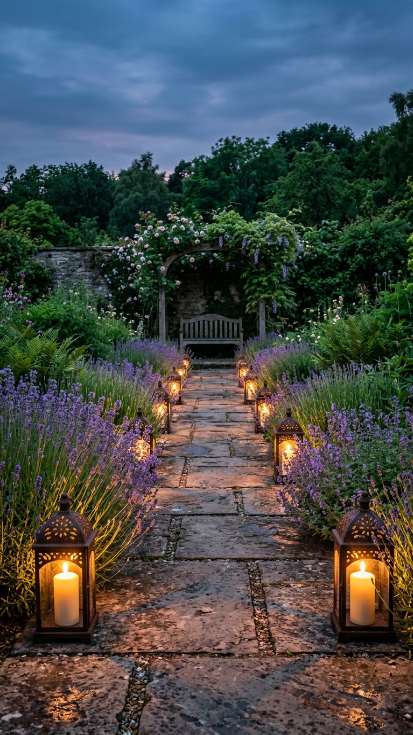
Vibe: The moment a backyard becomes somewhere you never want to leave — lit, fragrant, and completely beautiful.
What makes it work: Low pathway lanterns at dusk transform a backyard entirely — the transition from daytime garden to candle-lit evening space is one of the most effective and achievable backyard experiences available. Cast iron lanterns cast patterned shadow from their pierced sides, effectively turning the path stones into a moving light installation. The convergence of light lines along the path creates natural perspective that makes even a short path feel longer and more significant.
How to achieve it: Space cast iron lanterns at 90cm intervals on each side of the path — stagger the positions slightly rather than opposing them exactly for a more natural rhythm. Use large pillar candles in warm white or unbleached cream — avoid scented versions outdoors as the garden’s own fragrance is always preferable. Alternatively, use high-quality LED flame candles on the flame-flicker setting.
How to Start Your Rustic Backyard Transformation
The most effective first step is always a single anchor piece chosen with care rather than multiple smaller additions scattered without intention. In a backyard, this might be a set of reclaimed brick raised beds, a stone birdbath, a timber pergola, or a substantial cast iron urn — something with enough visual weight to establish the style’s character and give everything that follows a point of reference.
Resist the impulse to buy everything from the same supplier in a single session. Rustic backyard decor derives enormous character from the accumulation of objects from different sources and different periods — a salvage yard find alongside a market discovery alongside something made by hand. That layered, unhurried acquisition process is part of what gives the best rustic backyards their distinctive, personal quality.
The most common mistake is excessive uniformity — matching sets of planters, perfectly symmetrical arrangements, or planting that is too neat and regimented. Rustic decor is asymmetrical by nature; plant in odd numbers, vary pot sizes dramatically, and resist the urge to tidy everything into perfect order.
Budget sensibly: a transformative rustic backyard is very achievable at £400–£800/$450–$950 over one to two full seasons. Spend proportionally on the materials that age best — reclaimed stone, genuine terracotta, real iron — and keep costs down on planting by growing from seed.
Frequently Asked Questions
What are the best rustic garden decor ideas to inspire a small backyard?
For small backyards, the most effective rustic ideas work vertically rather than horizontally — an espaliered fruit tree on a wall, a tiered iron plant stand, a vine-draped pergola, or a wattle hurdle screen all create significant visual impact without consuming floor space. A stone birdbath or ceramic water bowl on a plinth becomes a genuine focal point in a compact space. Limit your material palette to three or four elements — reclaimed timber, terracotta, and natural stone together are sufficient to establish the full rustic aesthetic without creating visual fragmentation.
How do I make a brand-new backyard look rustic and established?
The fastest way to add apparent age to a new backyard is through three specific techniques: applying yogurt-water wash to new concrete, stone, or terracotta surfaces to encourage moss and lichen growth; planting climbing and trailing plants that establish quickly (nasturtiums, sweet peas, and Russian vine in the first year; clematis and roses by year two); and introducing genuinely old objects — antique garden rollers, Victorian chimney pots, cast iron urns — that carry authentic age regardless of how new the surrounding space is. One genuinely old object lends credibility to an entire backyard.
What colours work best for rustic garden decor in a backyard?
The rustic backyard palette stays firmly in the earth tones: warm terracotta orange, chalky limestone cream, dusty sage green, weathered silver-grey timber, ochre yellow, and deep iron black. For painted elements like pergola posts, garden furniture, or beehive boxes, choose exterior chalk paint or milk paint in muted heritage tones — Farrow & Ball’s “Mizzle,” “Mouse’s Back,” “Pigeon,” or “String” all translate beautifully outdoors. Avoid bright, saturated, or synthetic-looking colours; the rustic aesthetic depends entirely on the muted, time-worn quality of its palette.
Is rustic garden decor expensive to achieve in a backyard?
Rustic garden decor is one of the more budget-friendly garden styles precisely because it values aged, imperfect, and reclaimed objects over new and pristine ones. Salvage yards, estate sales, farm auctions, and online secondhand platforms are the primary sources — and prices are generally far below equivalent new items. The most expensive elements tend to be structural: a timber pergola, reclaimed stone paths, or railway sleeper raised beds. These are worth investing in because they last for decades and improve visually over time. Planting costs can be kept very low by growing from seed and taking cuttings.
How do I maintain rustic garden decor through winter in a backyard?
Most rustic backyard materials are inherently winter-hardy with minimal intervention. Cast iron, stone, reclaimed timber, and terracotta all weather winter well — in fact, frost and rain accelerate the patination processes that make them more beautiful. The main precautions: move glazed ceramics under cover in hard-frost regions; treat structural timber with exterior linseed or hard wax oil every two to three years; protect the tops of log seat stools with a coat of boiled linseed oil before the first frost; and bring any wicker or willow decorative items under cover during extended wet periods. Winter is the best time to plan additions for the following growing season.
Ready to Inspire Your Backyard With Rustic Garden Decor?
These 24 rustic garden decor ideas to inspire your backyard cover everything from the grandest structural investments — an outdoor kitchen, a vine pergola, railway sleeper beds — to the smallest, most immediately achievable changes, like handpainted rock labels or a vintage bottle tree. Pin your favourites before you close this page, because returning to them in a few days will tell you exactly which ideas have genuinely taken hold. Every beautiful rustic backyard starts with a single decision: one weathered pot placed thoughtfully, one climbing plant given a wall to work with, one reclaimed stone laid as the beginning of something. The garden does the rest, in its own unhurried time.