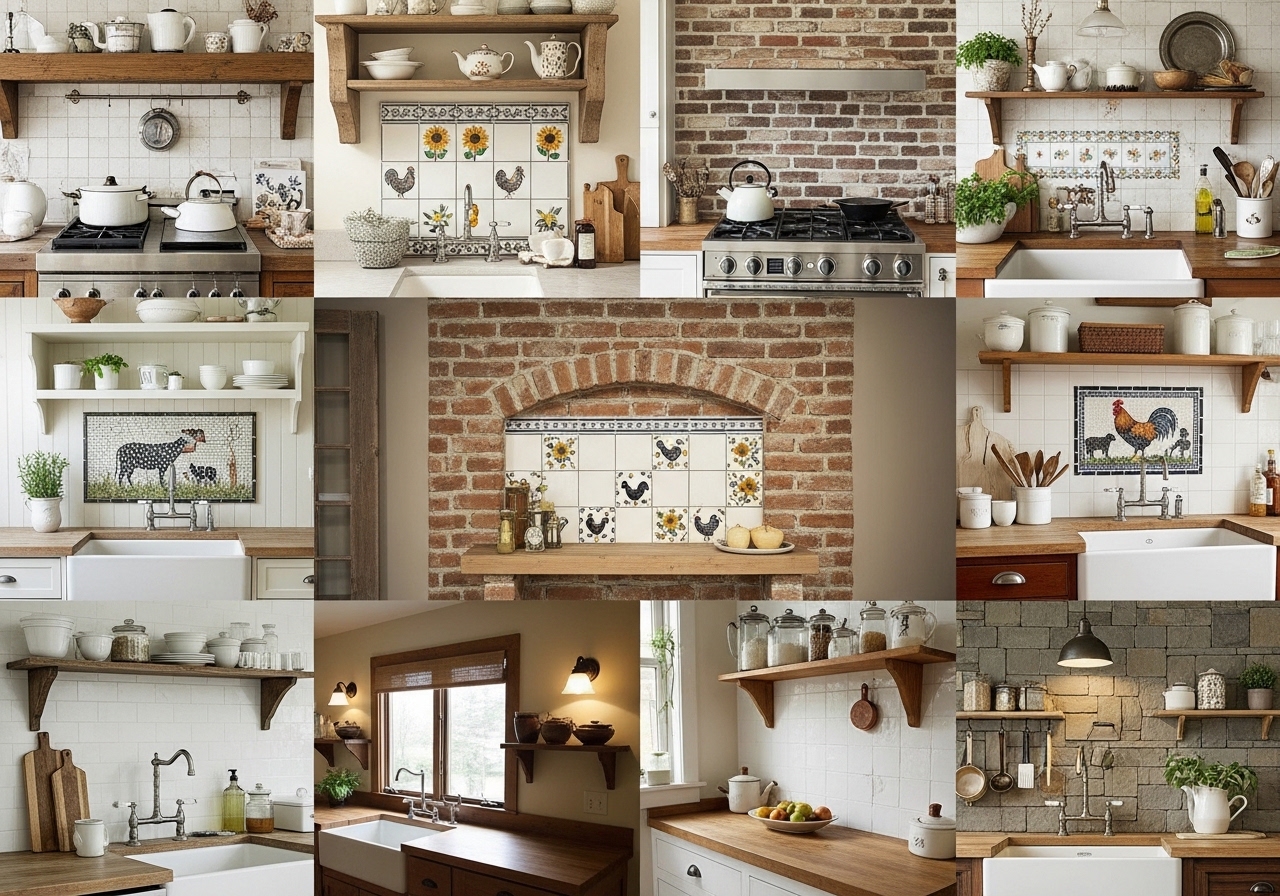
There’s something about a country kitchen that feels like the warmest room in any home — the kind of space where bread is always baking, herbs hang from the ceiling, and every surface tells a story. The backsplash, often overlooked in favor of countertops or cabinetry, is actually one of the most character-defining elements in a country kitchen — a canvas for texture, pattern, color, and craft. These 25 country kitchen backsplash ideas span everything from hand-painted Portuguese tiles to classic white subway with dark grout, so whether your style leans rustic farmhouse, English cottage, or French provincial, you’ll find ideas worth pinning immediately. Here are 25 ideas worth saving.
Why Country Style Works So Well
Country kitchen style endures because it taps into something genuinely timeless: the idea of a kitchen that has been used, loved, and accumulated character over generations. Unlike trend-driven modern aesthetics, country style doesn’t require perfection — in fact, slight imperfection is part of the appeal. A handmade tile with an uneven glaze, a slightly worn wooden shelf, a backsplash that mixes two complementary patterns — these are features, not flaws.
The core palette of country kitchen design is drawn directly from nature and the farmyard: warm whites, buttery creams, sage greens, dusty blues, terracotta, and the deep ochres of dried wheat and autumn harvests. Materials are honest and tactile — ceramic, stone, raw wood, linen, and ironwork. Nothing is trying to look like something it isn’t.
Right now, country kitchen backsplash ideas are surging on Pinterest as a direct counter-reaction to the years of cold white marble and handleless grey cabinetry. Searches for “cottage kitchen tile,” “farmhouse backsplash ideas,” and “hand-painted kitchen tiles” have climbed sharply, reflecting a broader cultural hunger for warmth, personality, and genuine craft in the home.
The beautiful truth about country backsplash design is that it scales perfectly to any kitchen size. A small galley kitchen with hand-painted Delft tiles or a cream subway backsplash with dark grout reads just as authentically country as a sprawling farmhouse kitchen with full stone walls. Proportion matters; budget matters far less than intention.
Classic White Subway Tile With Charcoal Grout
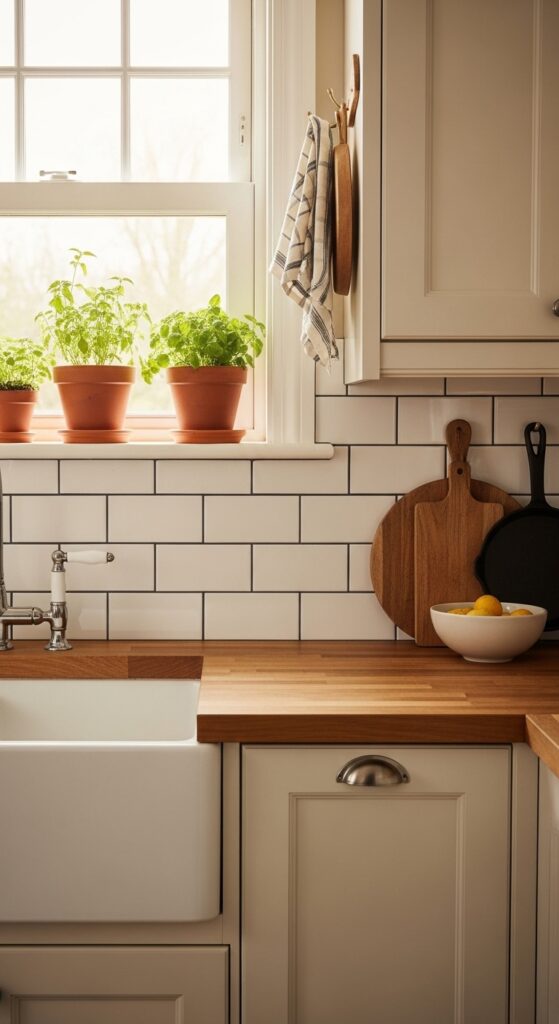
Vibe sentence: Honest, unfussy, and quietly beautiful — this is the backsplash that never goes out of style because it never tried to be fashionable in the first place.
What makes it work: The real magic here is the grout, not the tile. White subway tile with white grout reads as flat and clinical; the same tile with charcoal grout suddenly has graphic definition, warmth, and visual texture. The grid becomes visible, the pattern becomes intentional, and the whole backsplash reads as a considered design choice rather than a default.
How to achieve it: Use standard 3×6 white ceramic subway tiles installed in a traditional brick offset pattern. Specify Laticrete “Charcoal” or Mapei “Charcoal” unsanded grout — both are widely available at hardware stores. Pair with cream or warm white shaker cabinets, never bright white, to keep the palette cohesive and warm.
💡 Request a slightly wider grout joint (3/16 inch instead of the standard 1/16) — it makes the charcoal grid bolder and more characterful.
Hand-Painted Delft Blue and White Tile Panels
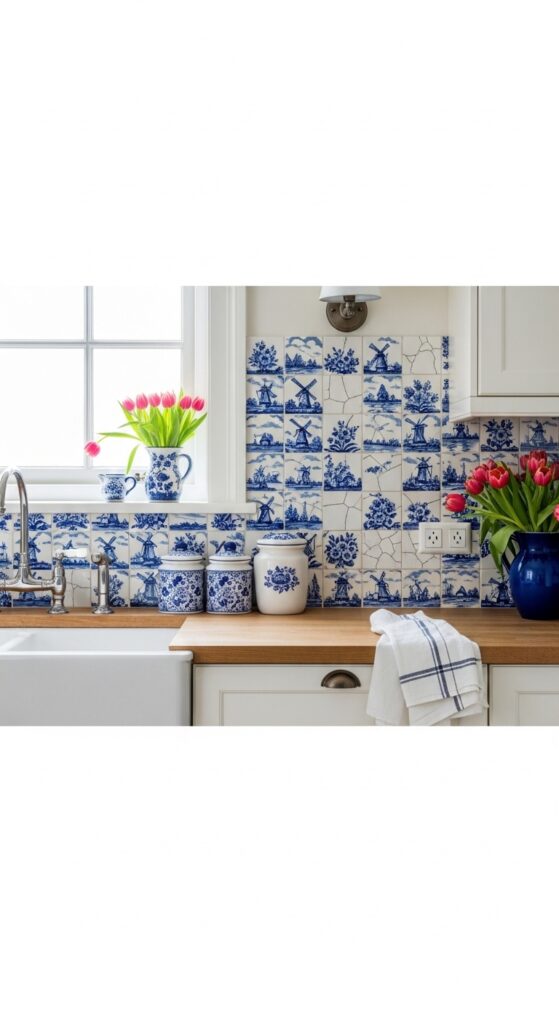
Vibe sentence: Every tile tells its own tiny story, and together they turn a kitchen wall into something you could look at for years without ever getting bored.
What makes it work: Hand-painted Delft tiles work on the principle of narrative texture — each tile is a miniature artwork, which means the backsplash rewards close inspection in a way no mass-produced material ever can. The cobalt-and-white palette is simultaneously bold enough to be a statement and neutral enough to work with almost any cabinet color.
How to achieve it: Authentic Delft tiles are sourced from Dutch importers or specialty tile shops, typically ranging from $8–$25 per tile. For a more affordable version, look for blue-and-white transfer-print ceramic tiles from Fired Earth or Topps Tiles. Install with bright white grout and keep the rest of the kitchen in calm, solid tones so the tiles remain the star.
Warm Terracotta Saltillo Tile Backsplash
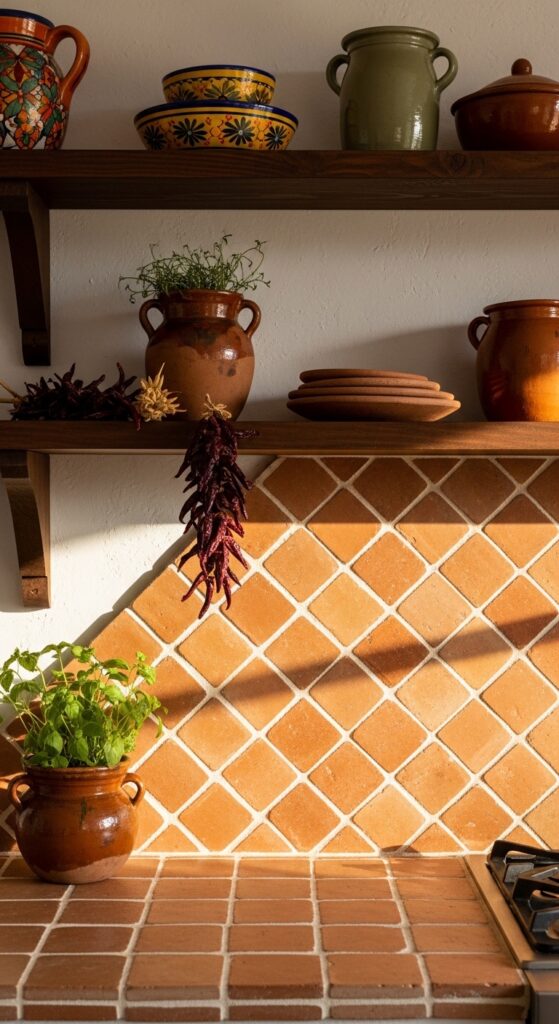
Vibe sentence: Warm as sunbaked earth and full of character — this backsplash carries the soul of a hacienda kitchen into any home.
What makes it work: Saltillo tiles are handmade from natural clay, which means no two tiles are identical — the color variation ranges from pale peach to deep rust, creating a naturally rich, layered surface. Installed diagonally, the movement of the pattern adds energy while the irregular warm tones prevent the earthy palette from feeling monotonous.
How to achieve it: Source authentic Saltillo tiles from Mexican tile importers or specialty suppliers; they typically cost $2–$5 per tile but must be properly sealed with a penetrating stone sealer before and after grouting to prevent staining. Pair with cream grout, never white — white looks jarring against the warm clay tones.
💡 A single coat of linseed oil applied after sealing deepens the color and brings out the beautiful natural variation in each tile.
Vintage-Style Green Glossy Subway Tile
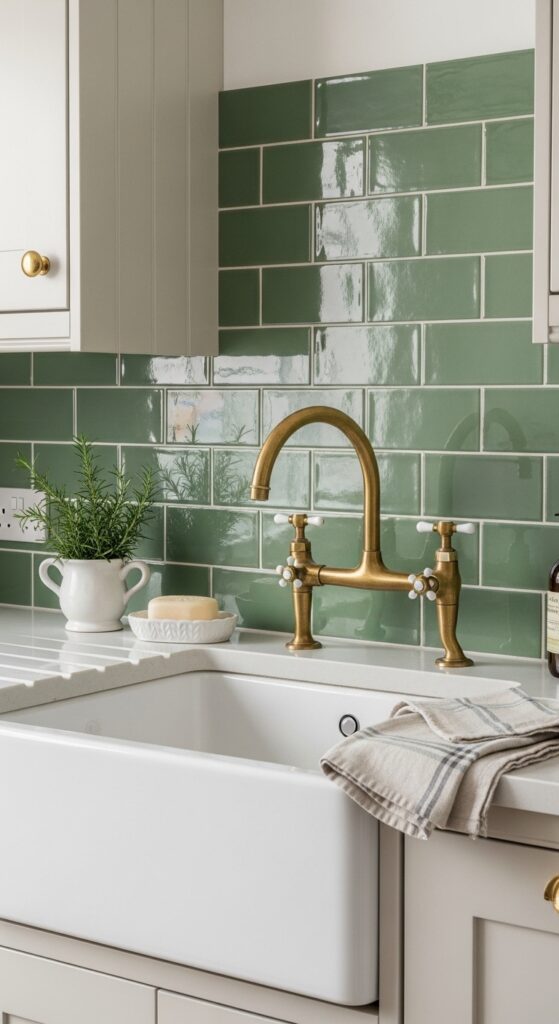
Vibe sentence: There is nothing quite as quietly nostalgic as a green-tiled kitchen — it’s the color of every English cottage kitchen you’ve ever dreamed about.
What makes it work: Green subway tile carries enormous heritage associations — Victorian butlers’ pantries, Edwardian sculleries, 1920s farmhouse kitchens — which gives it an automatic sense of history and depth. The gloss finish amplifies light and creates a beautiful reflective quality that matte tile simply cannot match, especially important in kitchens that face north or lack abundant natural light.
How to achieve it: Look for tiles in “sage,” “bottle green,” or “forest green” gloss from Fired Earth, Topps Tiles, or Fireclay Tile. Specify cream or off-white grout rather than bright white — it softens the contrast and reinforces the vintage character. Pair exclusively with warm brass or unlacquered bronze hardware.
Reclaimed Stone Brick Backsplash With Open Shelving
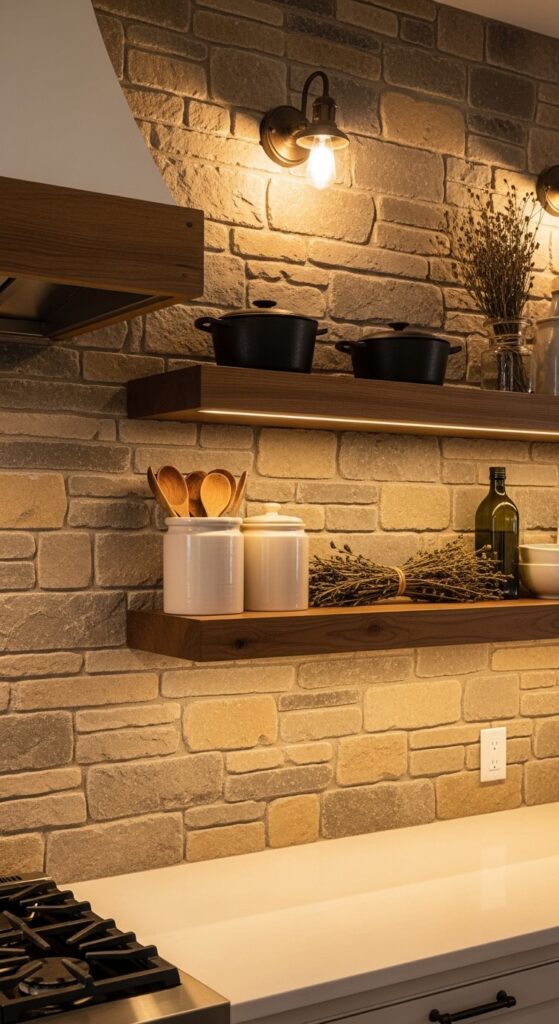
Vibe sentence: This kitchen looks like it predates the house itself — in the most beautiful way possible.
What makes it work: Reclaimed stone or tumbled brick veneer creates an unmatched sense of age and permanence. The irregular surface catches light differently across the day, creating a living, animated quality that smooth tile never achieves. Floating wooden shelves mounted against the stonework add a layer of warmth and create a practical display surface that feels completely at home against the rough texture behind it.
How to achieve it: Use tumbled travertine, reclaimed brick slips, or manufactured stone veneer panels (brands like Eldorado Stone offer realistic options at lower cost). Apply with a slightly raked-back mortar joint using a traditional pointing tool to enhance the aged appearance.
Checkered Black and White Tile in a Country Context
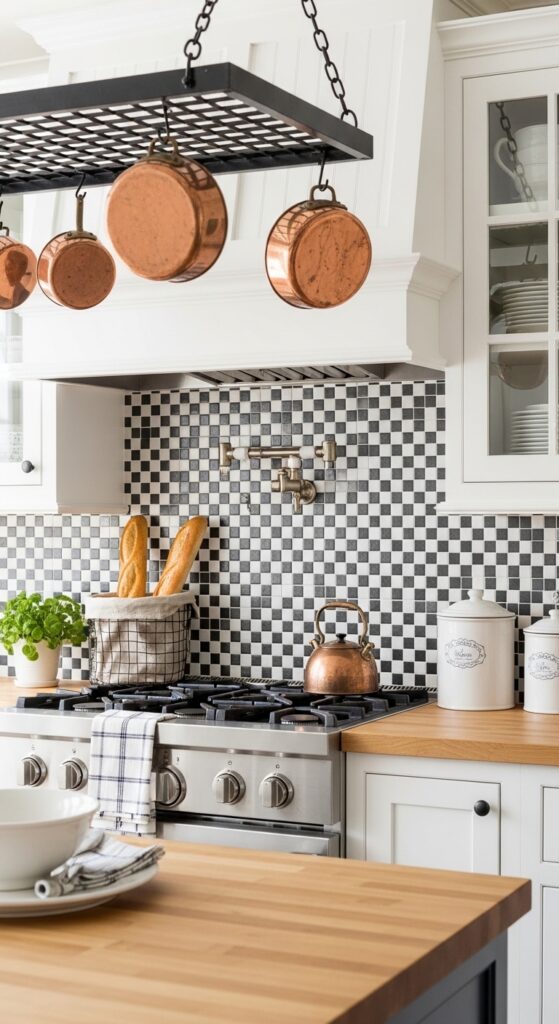
Vibe sentence: Graphic yet completely at home in a country kitchen — the checkered tile is one of those rare patterns that belongs in every era simultaneously.
What makes it work: Small-format checker tiles (2×2 or 1×1 inch) read very differently from large-format versions — at this scale, the pattern becomes a rich surface texture rather than a bold graphic statement, which is why it integrates so naturally into country-style kitchens. The classic black-and-white combination provides the visual interest of pattern without introducing color competition.
How to achieve it: Source penny tile or small mosaic-sheet checker tiles from the Tile Shop or Floor & Decor — they come pre-mounted on mesh sheets for easier installation. Use white or pale gray grout to maintain the crispness of the pattern. Pair with warm-toned countertops and copper or brass accents to prevent the palette from reading as too stark.
💡 Use the same checker tile as a border detail even if you use a solid tile for the main field — it adds a charming French country edge.
Hand-Painted Spanish or Talavera Tile Accents
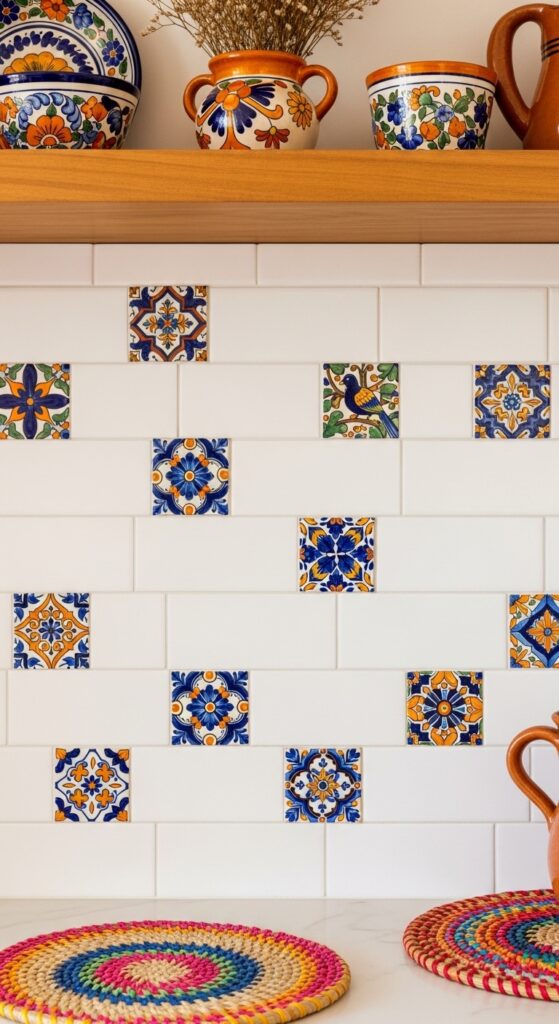
Vibe sentence: These tiles carry the energy of a Mexican mercado — colorful, handmade, and completely impossible to stop looking at.
What makes it work: Using Talavera tiles as accent pieces within a neutral field tile is a masterclass in restraint and generosity simultaneously. The white subway field gives the eye a place to rest, which makes each individual painted tile feel like a gift. Spacing them irregularly — rather than in a rigid grid — reinforces the handcrafted, collected feeling.
How to achieve it: Source authentic Talavera tiles from Mexican importers or Etsy artisan sellers; expect to pay $3–$10 per accent tile. Install one accent tile for every 8–12 field tiles to achieve the scattered, artisanal effect. The key is irregular spacing — avoid any symmetrical or grid-based placement.
Tongue-and-Groove Painted Paneling as Backsplash
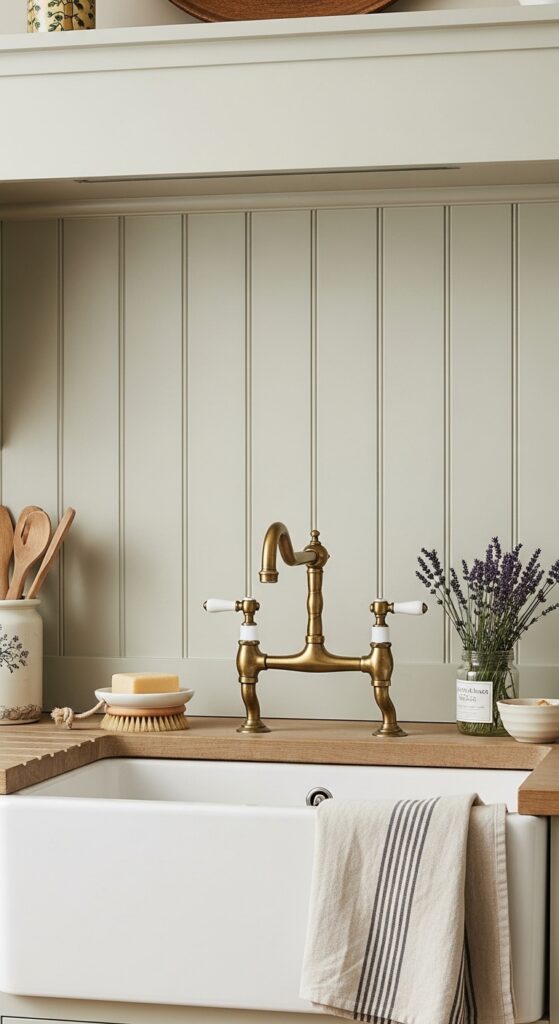
Vibe sentence: Wood paneling as a backsplash makes a country kitchen feel genuinely rooted — less designed, more inherited.
What makes it work: Tongue-and-groove paneling introduces the vertical lines and tactile warmth of wood craftsmanship in a space typically dominated by tile and stone. The shadow lines between boards create a fine-grained visual texture that reads as deeply artisanal, while a high-quality eggshell paint finish makes it practical and moisture-resistant enough for kitchen use.
How to achieve it: Use MDF tongue-and-groove paneling boards (more moisture-stable than solid wood) and apply two coats of eggshell kitchen paint in a color like Farrow & Ball “Mizzle,” “Cromarty,” or “Pale Powder.” Seal all edges and joints with a flexible kitchen sealant where the paneling meets the countertop.
💡 Horizontal tongue-and-groove paneling gives a more coastal or Scandinavian feel; vertical reads more traditional English or American farmhouse.
Limestone or Travertine Slab Backsplash
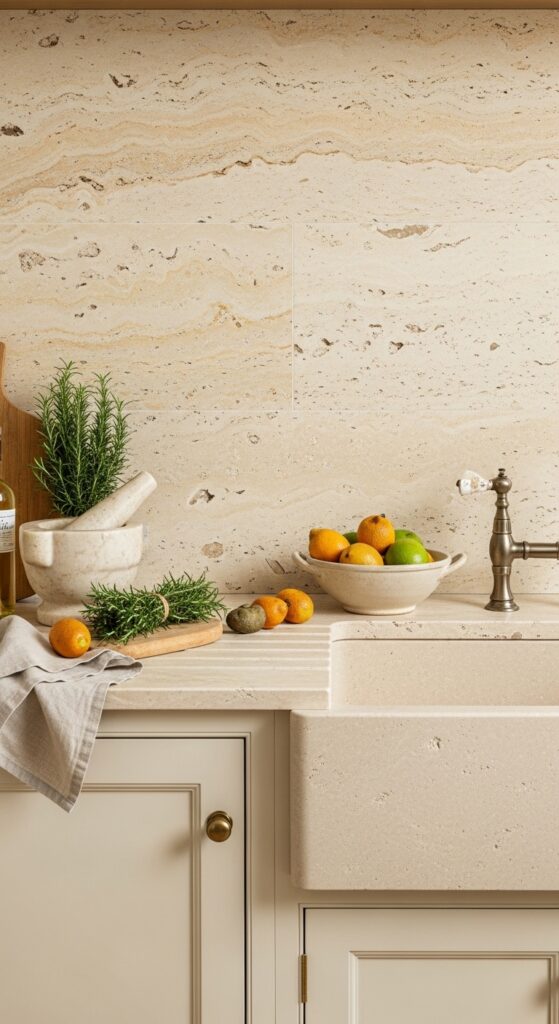
Vibe sentence: There is a serenity to natural stone that no manufactured tile has ever quite replicated — it makes a kitchen feel as permanent as the landscape itself.
What makes it work: Honed limestone and travertine have a softness and warmth in their tones that polished marble lacks — they look like stones found in a French riverbed, which is entirely appropriate in a country kitchen. The natural variation in tone, veining, and fossil inclusions means no two slabs are alike, giving the backsplash an inherently unique quality.
How to achieve it: Use 12×24 or 18×24 honed limestone or travertine tiles for a near-slab effect at a fraction of the cost of full slabs. Seal generously with a penetrating stone sealer before and after grouting. Specify a matching limestone or warm beige grout to minimize visible joint lines and maintain the slab-like appearance.
Cobalt Blue Moroccan Fish Scale Tiles
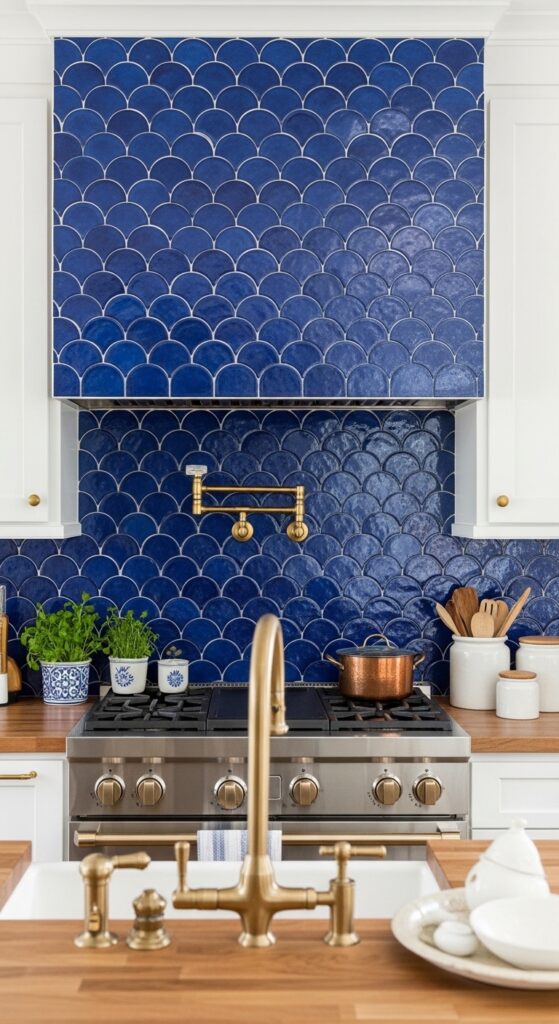
Vibe sentence: Cobalt fish scale tiles behind a stove turn cooking into something that happens in the most beautiful room in the house.
What makes it work: The curved, overlapping shape of fish scale tiles creates a three-dimensional surface that catches and scatters light in a way flat tiles cannot — the backsplash literally shimmers slightly as light changes throughout the day. Used in a deep cobalt glaze, this effect is amplified, creating something between a mosaic and a textile in its visual richness.
How to achieve it: Fish scale tiles are available from the Tile Bar, Granada Tile, and many Etsy ceramic studios. Install with thin white grout to keep the focus on the tile color and form. Use exclusively in one focal zone (the stove alcove) if full coverage feels too bold — it’s an equally stunning approach.
Cream Brick Backsplash With Limewash Finish
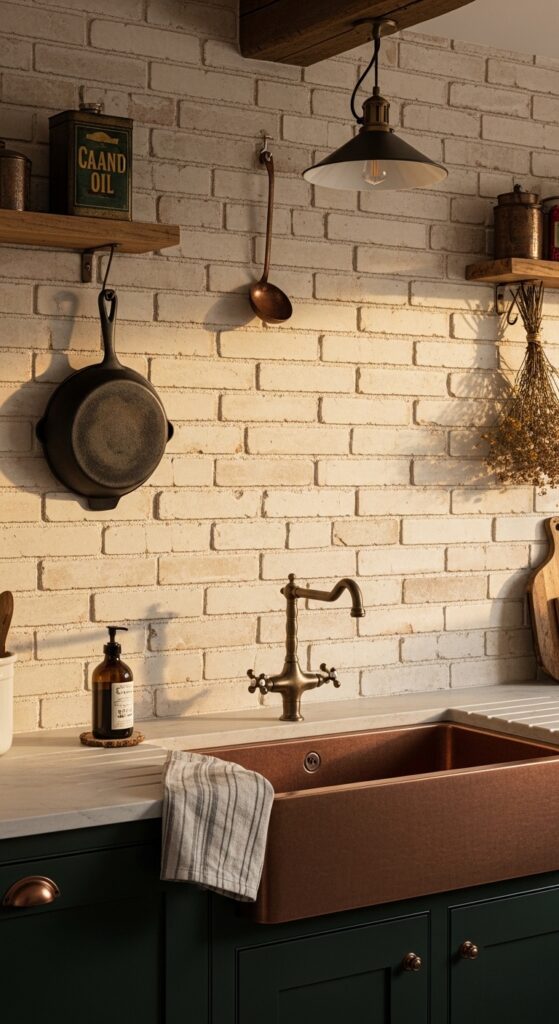
Vibe sentence: A limewashed brick backsplash brings the texture and warmth of a centuries-old Italian farmhouse kitchen into any modern home.
What makes it work: Limewash finish on brick creates a beautiful layered, patchy effect — the pigment settles into the porous brick surface unevenly, creating natural variation that mimics authentic aged plaster over brick. This is an effect that genuinely improves with time as the finish weathers and deepens slightly with kitchen use.
How to achieve it: Apply real brick slips (thin brick veneers) to the backsplash wall using appropriate adhesive, then apply a limewash paint (Bauwerk or Roman Clay brands work well) in thin, uneven layers with a wide brush. Allow each layer to dry before adding the next for the most authentic aged result.
Patterned Encaustic Cement Tile in Country Colors
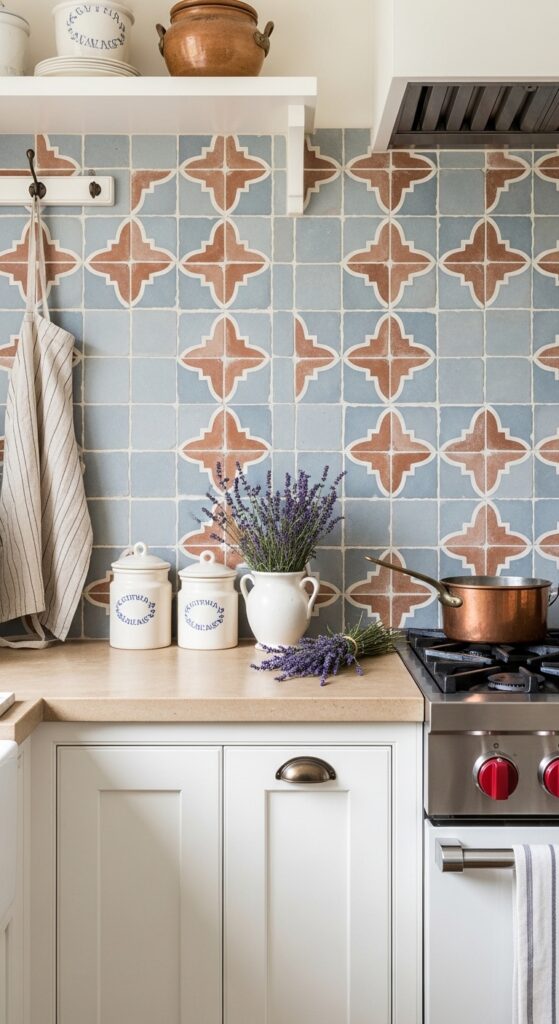
Vibe sentence: Encaustic tiles have been made by hand in the same way for over 150 years — and every single one of them looks at home in a country kitchen.
What makes it work: The matte, powdery surface of encaustic cement tile absorbs light rather than reflecting it, creating a depth of color that ceramic glazed tiles simply don’t achieve. The slight irregularities in hand-poured tiles — small variations in color saturation, edges that aren’t perfectly uniform — are what give encaustic work its essential authenticity and warmth.
How to achieve it: Source encaustic cement tiles from Cement Tile Shop, Clé Tile, or Moroccan import suppliers. They require sealing with a penetrating sealer both before and after grouting (grout can stain the porous surface permanently if this step is skipped). Use a cream or sand-toned grout for a softer, more traditional look.
💡 Seal encaustic tiles with a food-safe penetrating sealer, not a topcoat sealer — topcoats trap moisture and can cause tiles to crack over time.
Vertical Stack Bond White Tile With Dark Wood Shelf
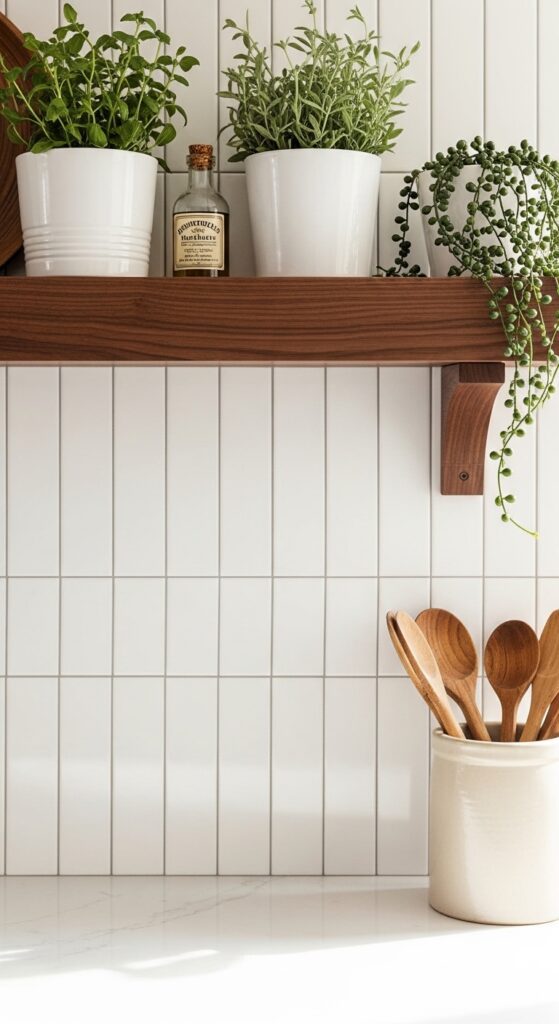
Vibe sentence: The same white tile you’ve seen a thousand times looks entirely different installed vertically — suddenly more architectural, more intentional, more interesting.
What makes it work: Rotating subway tile to a vertical stack bond orientation changes its visual character completely — the lines now draw the eye upward instead of across, adding height to any kitchen, and the pattern feels decidedly more modern and considered than the traditional horizontal brick lay. A single thick walnut shelf floating in front of the tile adds warmth and breaks the field beautifully.
How to achieve it: Standard 3×6 subway tiles work perfectly in this orientation. Specify a narrow grout joint (1/16 inch) with white or light gray grout to maintain the clean, architectural look. For the floating shelf, use a solid walnut board minimum 2 inches thick — the mass and weight of the timber is important to the look.
Sage Green Zellige Moroccan Tile
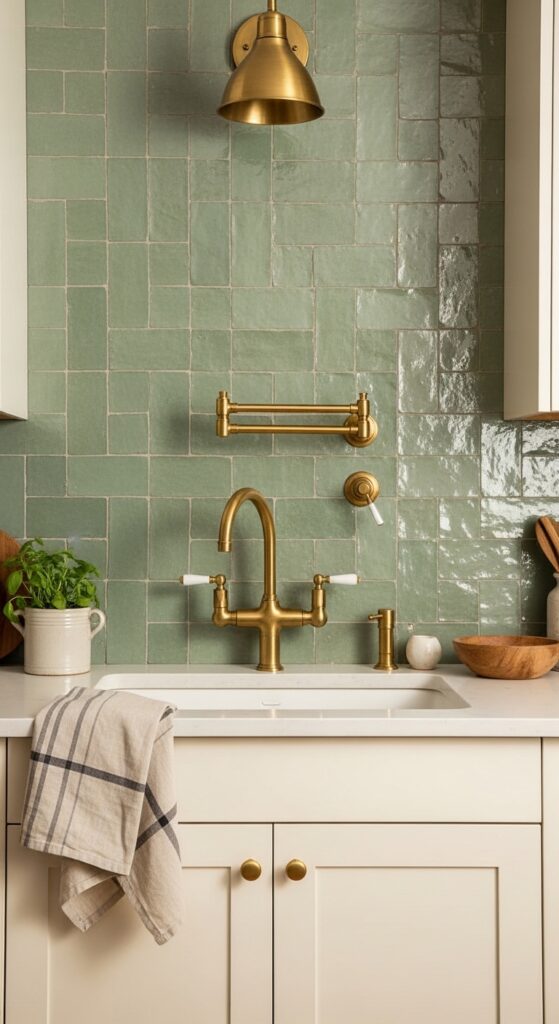
Vibe sentence: Zellige tiles are made exactly the way they’ve always been made — by hand, one at a time — and that process is visible in every luminous, imperfect surface.
What makes it work: What distinguishes Zellige from ordinary ceramic tile is its handmade quality: the surface is intentionally uneven, and the glaze varies in intensity across each tile. This creates a backsplash that shimmers with depth and movement, catching light at different angles throughout the day. In sage green, the effect is organic and deeply calming — like a moss-covered stone wall brought indoors.
How to achieve it: Authentic Zellige tiles are imported from Fez, Morocco, and available from specialist suppliers like Zia Tile or Clé Tile; expect $20–$40 per square foot. Install with a slightly wider grout joint (1/8 inch) to accommodate the naturally irregular edges. Use a cream or warm gray grout that won’t clash with the subtle tone variations in the tiles.
Painted Brick Wall Backsplash in White
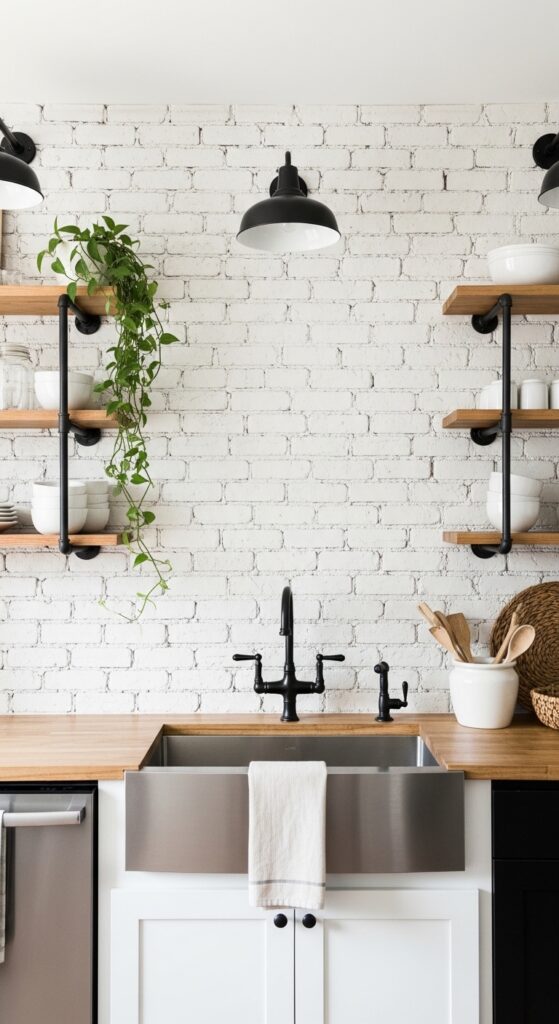
Vibe sentence: Painted white brick is the backsplash that somehow manages to be both rustic and completely fresh at the same time.
What makes it work: A single coat of white masonry paint over exposed brick allows the texture of the brick — its bumps, the mortar shadow lines, the irregular surface — to remain fully visible while unifying the palette. The result is a surface that has all the depth and character of exposed brick with none of the heaviness of the raw red tone.
How to achieve it: Use a masonry or chalk-mineral paint (Rust-Oleum Chalked or Roman Clay) applied with a thick nap roller for full coverage, then a brush worked into the mortar joints. One coat is intentionally thin and painterly; two coats creates a cleaner, more unified look — choose based on how much brick texture you want to preserve.
💡 A limewash paint instead of masonry paint allows even more brick texture to show through, with a beautifully uneven, aged patina effect.
Antique Mirror or Smoked Glass Backsplash Panel
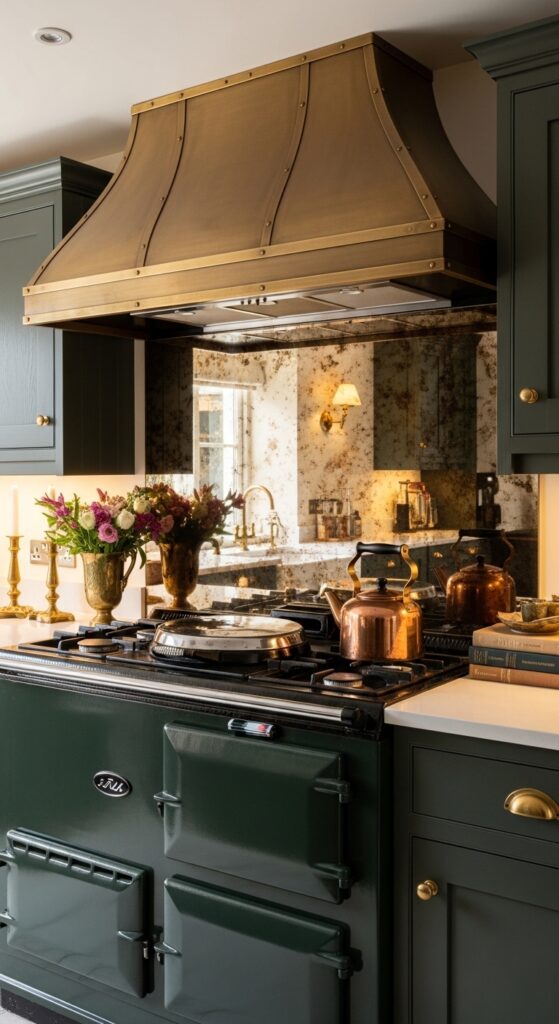
Vibe sentence: No other backsplash material adds light, depth, and a frisson of quiet glamour quite like antique smoked mirror glass.
What makes it work: An antique mirror backsplash works because it does several things at once — it reflects light back into the kitchen, it creates a sense of depth and distance behind the stove, and the warm amber foxing of aged mirror glass introduces color and warmth that standard clear mirror completely lacks. It is simultaneously the most practical and most theatrical backsplash choice in this list.
How to achieve it: Order custom-cut smoked or antiqued mirror panels from a specialist glass supplier — specify “aged” or “antique” finish for the foxed warm-toned effect. Install using mirror-safe adhesive (standard tile adhesive can damage the silvering). Seal all perimeter edges with a clear silicone sealant rated for kitchen use.
Butcher Tile Apron-Style Half Backsplash
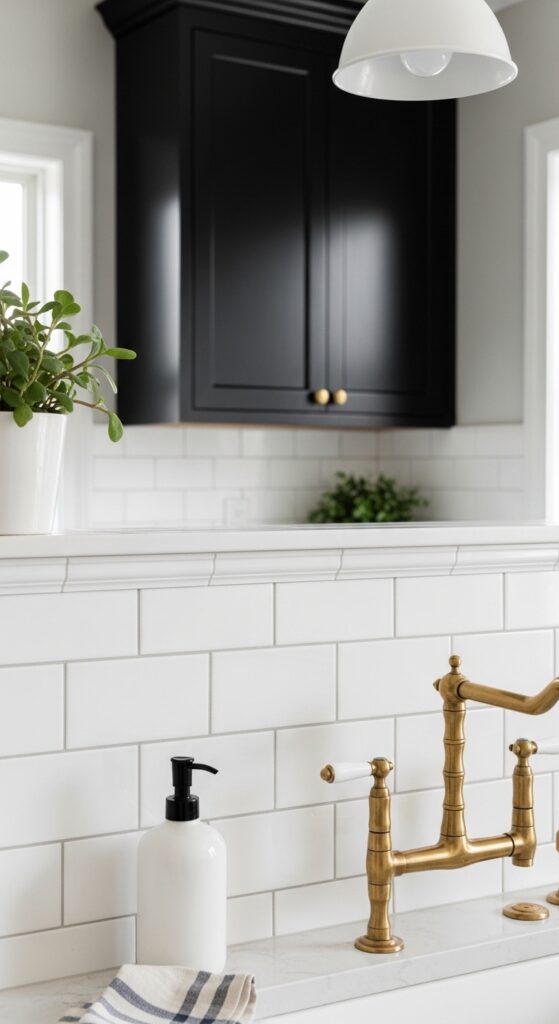
Vibe sentence: The beveled tile apron is a decision that speaks of European café kitchens and professional cookery — purposeful, elegant, and entirely unpretentious.
What makes it work: Beveled subway tiles catch light along their raised edges, creating a subtle three-dimensional shimmer that flat tiles lack. The half-height apron installation, finished with a bullnose cap, creates a deliberately architectural moment — a clean horizontal line that separates the tiled working zone from the painted wall above in a way that feels both functional and beautifully considered.
How to achieve it: Use 4×8 or 3×9 beveled white ceramic tiles installed in a traditional horizontal brick offset to the counter height (typically 18 inches from the counter), finished with a matching white bullnose tile along the top edge. Use bright white grout for a classic bistro look, or warm gray for a softer, more country feel.
Pecky Cypress or Barn Wood Plank Backsplash
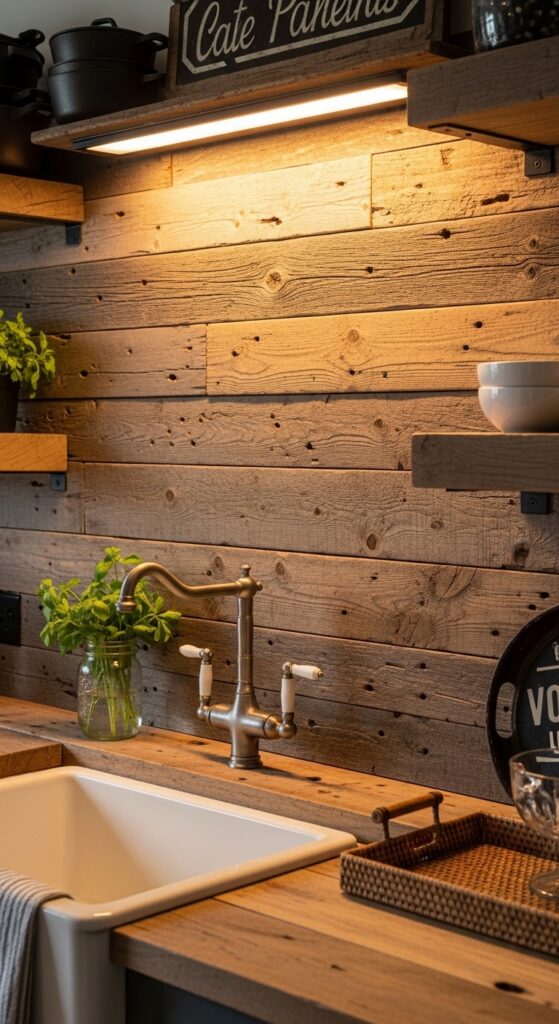
Vibe sentence: Reclaimed barn wood as a backsplash is the single most textured, most storied, most unapologetically country choice you can make.
What makes it work: Each plank of reclaimed barn wood carries visible evidence of its previous life — nail holes, weathering, color shifts from exposure and age — and that accumulated history is precisely what makes it so visually rich. The variation in plank width and tone means the eye never settles; there’s always another detail to notice.
How to achieve it: Source kiln-dried reclaimed barn wood from specialty lumber suppliers or Etsy sellers to ensure stability. Apply a generous coat of food-safe penetrating oil (like Rubio Monocoat or Osmo Polyx) to seal the wood against moisture and grease. Avoid polyurethane topcoats, which sit on the surface and can peel in a kitchen environment.
Scalloped Shell-Shape Backsplash in Creamy White
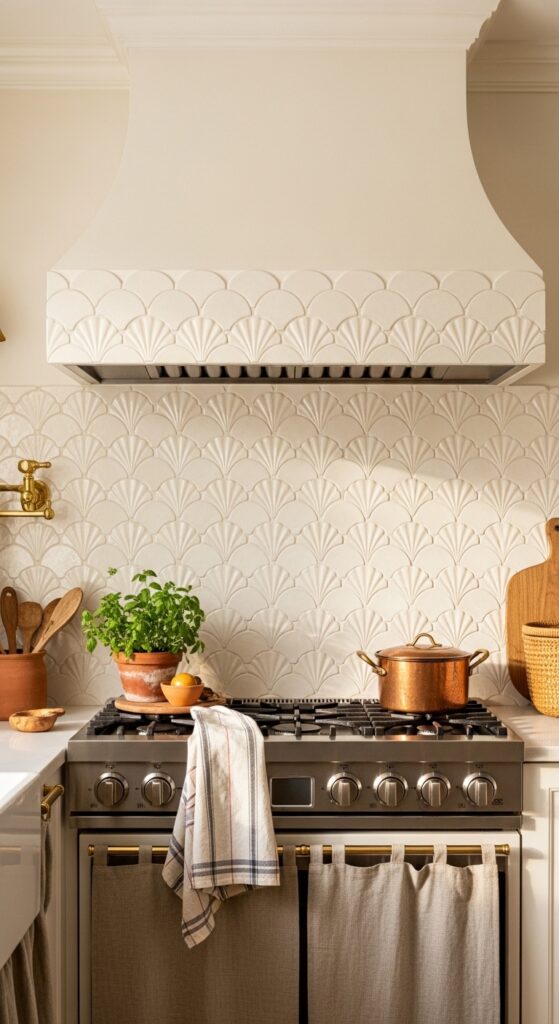
Vibe sentence: Scalloped tiles are the most inherently romantic choice in any backsplash — they look like something a French grandmother would have chosen, and she would have been absolutely right.
What makes it work: The scalloped or shell shape introduces a soft, organic curve into a space dominated by straight lines and right angles. In cream or off-white, the effect is delicate rather than bold — the pattern reads as texture rather than pattern at a distance, with the individual shell forms becoming apparent only on closer inspection. It is one of the most charming backsplash details in country design.
How to achieve it: Scalloped tiles are available from Tile Bar, Cle Tile, and Wayfair. Install with the pointed end facing downward (like fish scales hanging from the wall) and use a cream-toned grout that closely matches the tile — this softens the appearance and keeps the look refined rather than graphic.
Hand-Painted Mural Tile Panel Behind the Range
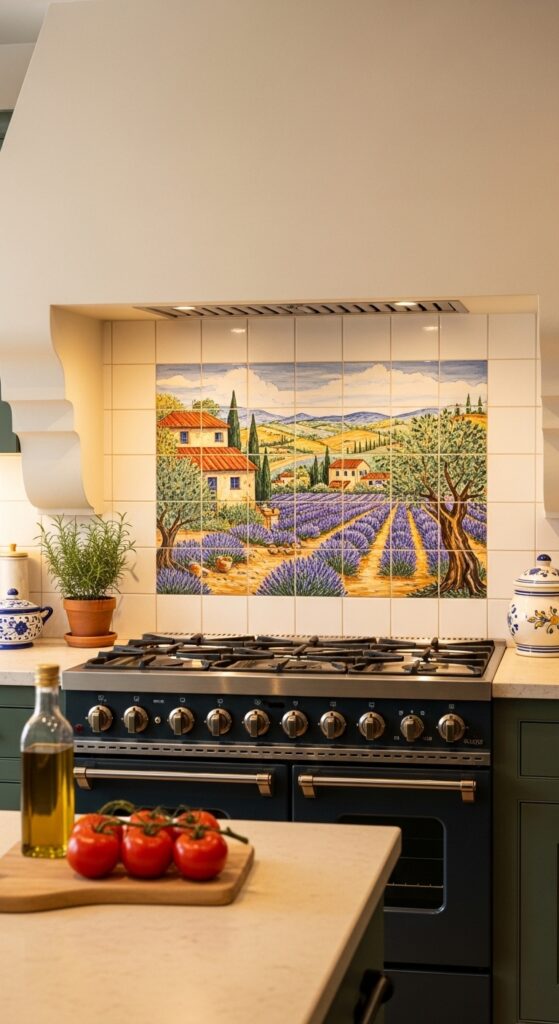
Vibe sentence: A hand-painted tile mural behind the stove transforms cooking into something that happens in the presence of art.
What makes it work: A mural panel works as a focal point because it occupies the most visually prominent position in any kitchen — directly behind the range — while the surrounding field tiles keep the rest of the space calm and ordered. The hand-applied quality of a ceramic mural, with visible brush texture in the glaze, means it can never be mistaken for a printed reproduction.
How to achieve it: Commission a custom ceramic mural panel from an artisan tile painter on Etsy or through specialist companies like Tile Murals Online or the Walker Zanger custom program; prices typically range from $200–$800 depending on size and complexity. Plan the panel size to match your range width exactly for a built-in, architectural look.
Dark Grout Grid Tile in Warm Greige
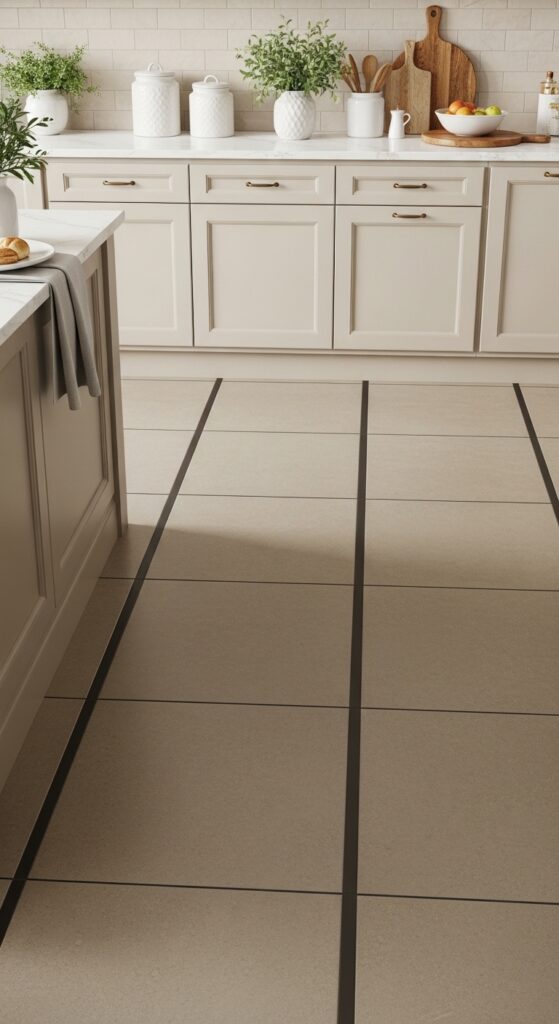
Vibe sentence: Greige tile with dark grout is the warm, grown-up version of the black-and-white grid — sophisticated enough for a design magazine, comfortable enough for a country kitchen.
What makes it work: Wide, dark grout lines on a warm-toned tile create a grid that functions as surface pattern in its own right — the darker the grout relative to the tile, the more graphic and prominent the grid effect. Greige (warm gray-beige) is one of the most versatile neutrals in kitchen design, working equally well with cream cabinetry, warm wood, and both cool and warm metal finishes.
How to achieve it: Use a 6×6 or 8×8 matte ceramic tile in a warm greige (try Daltile “Hazel” or a similar warm neutral). Specify Mapei “Mocha” or “Chocolate” unsanded grout at a 3/16-inch joint width. The wider joint combined with the square format gives the grid a bold, confident presence.
💡 Clean dark grout immediately after installation with a grout sealer — applying sealer before the grout fully cures is the easiest way to prevent permanent staining.
Basket Weave Marble Mosaic at a Country Scale
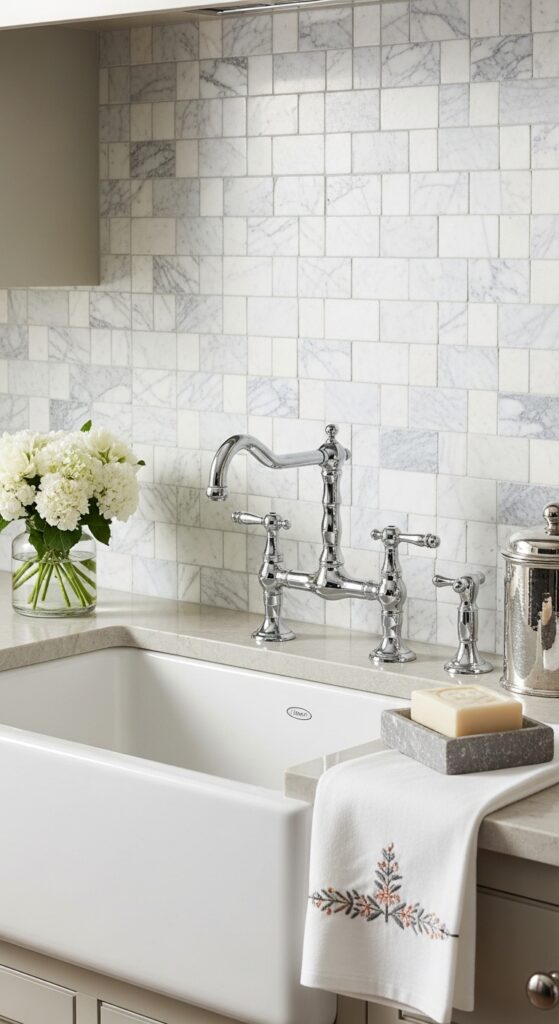
Vibe sentence: The basket weave pattern has been used in kitchens and bathrooms for well over a century — it feels both utterly traditional and completely current.
What makes it work: The basket weave mosaic is one of the most enduring patterns in classical tile design, and its appeal is architectural rather than trend-driven. In natural marble, the pattern’s repetitive geometry is softened by the organic variation in the stone’s veining and tonal range — no two sections look exactly alike, which prevents the highly structured pattern from feeling rigid or cold.
How to achieve it: Marble basket weave mosaic tiles come pre-mounted on mesh sheets from most tile retailers — the Tile Shop and Ann Sacks both carry extensive ranges. Use a gray or warm white grout that matches the secondary marble tone; this maintains the contrast of the weave pattern without making the grout lines overly dominant.
Painted Plaster Texture With Embedded Tile Border
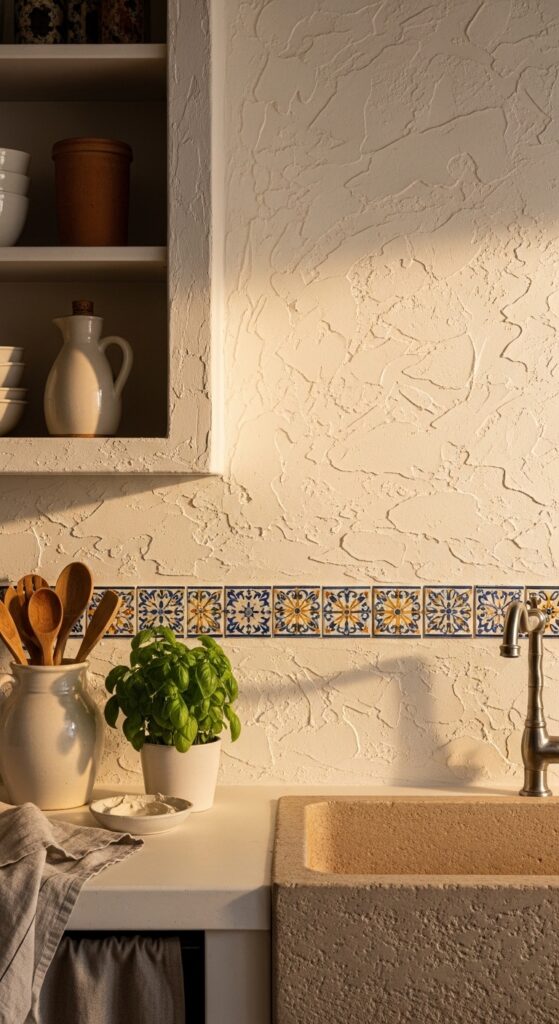
Vibe sentence: Limewash plaster with a tile border is the most authentically old-world backsplash treatment you can achieve — it looks like it belongs in a Provençal farmhouse that’s been standing since 1740.
What makes it work: The combination of textured plaster as the primary surface with a single decorative tile border creates a layered visual language — the rough, organic plaster provides the backdrop, while the precision of the decorative tile introduces pattern and color at eye level. The border is both practical (protecting the most splash-prone area) and deeply decorative.
How to achieve it: Apply Venetian plaster or a limewash paint (Bauwerk Colour or Portola Paints) in two or three layers with a steel trowel, burnishing for sheen or leaving rough for a matte aged look. Install a single row of 4×4 hand-painted decorative border tiles at the counter junction using standard tile adhesive and white grout.
How to Start Your Country Kitchen Backsplash Transformation
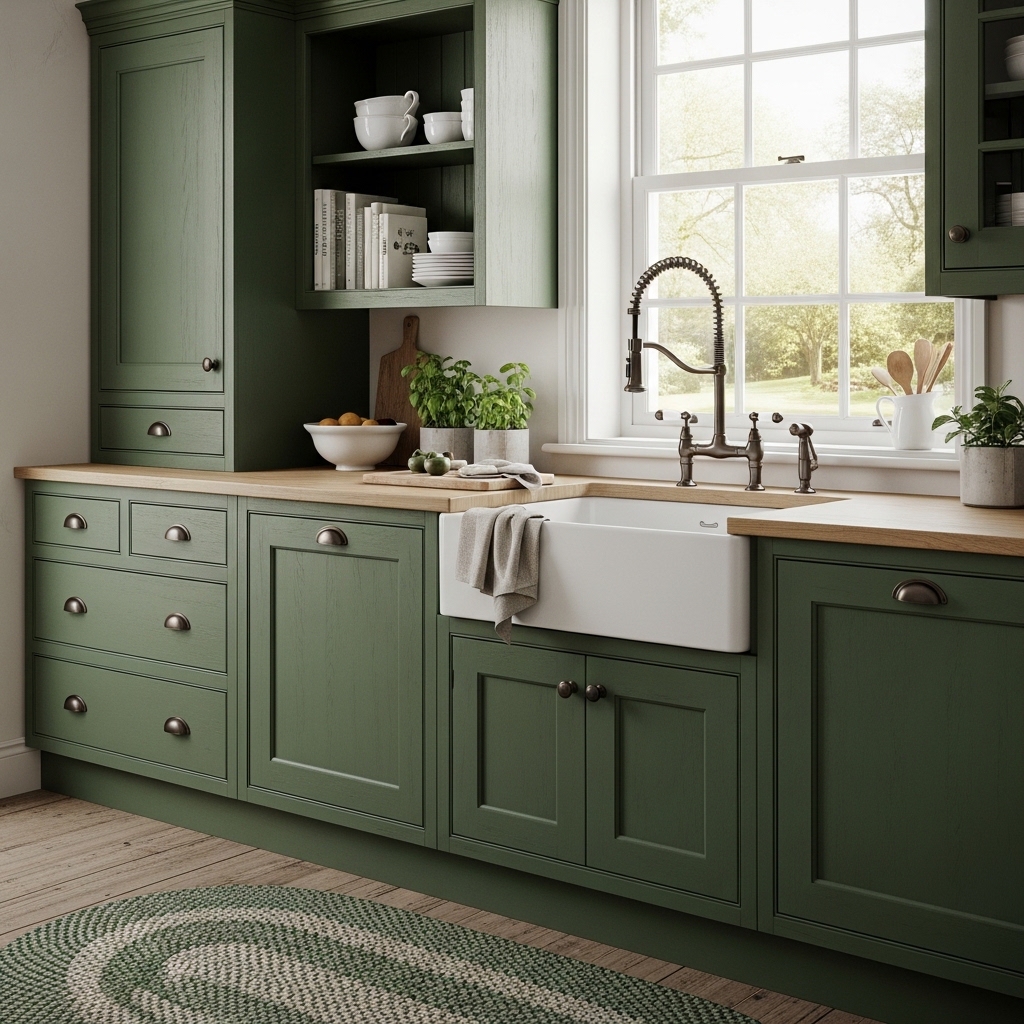
The best starting point for any country kitchen backsplash project is your existing cabinet color. Your tile needs to either contrast, complement, or echo the cabinetry — never compete with it. If your cabinets are cream or white, you have the widest range of choices. If they’re a specific color like green or navy, you’ll need to sample tiles in the actual space under your kitchen lighting before committing.
The most common mistake in country backsplash projects is choosing a tile that looks perfect in the showroom but reads differently in the kitchen. Tile samples should always be viewed vertically, taped to the actual wall, at different times of day and under both natural and artificial light. What looks warm in a showroom can read cooler or darker in your specific space.
Budget-friendly entry points include painted tongue-and-groove paneling ($50–$150 in materials), white subway tile with dark grout ($2–$4 per square foot), and encaustic-style vinyl peel-and-stick tiles ($1–$3 per tile). For a 10-square-foot backsplash area — typical for a galley kitchen — these options can achieve a full transformation for under $200.
For a standard backsplash project, budget one weekend: Saturday for preparation and installation, Sunday for grouting and sealing. Hiring a professional tiler adds $300–$600 in labor but is worth considering for complex patterns like herringbone or fish scale, where alignment mistakes become very visible.
Frequently Asked Questions
What is the most popular country kitchen backsplash tile right now?
White subway tile with dark charcoal or warm gray grout is consistently the most-searched country kitchen backsplash choice on Pinterest and Google. It’s closely followed by sage green Zellige tile, hand-painted Delft blue-and-white tiles, and encaustic cement tile in terracotta and cream palettes. The current trend is moving toward warmer, more textured surfaces — handmade, imperfect, and natural materials are significantly outperforming the polished white marble that dominated the previous decade.
How do I choose a backsplash that works with cream or off-white cabinets?
Cream and off-white cabinets are the most flexible pairing in a country kitchen — they work with virtually every backsplash option from deep cobalt blue to warm terracotta to simple white subway. The key rule is to match the undertone: if your cabinets have a yellow-warm undertone (butter cream), choose tiles with warm undertones too — terracotta, sage green, warm white, or gold-toned stone. If your cabinets lean toward a cooler gray-cream, tiles in blue-gray, white marble, or soft greige will feel cohesive.
Can I use wood as a kitchen backsplash?
Yes, with proper sealing. Tongue-and-groove painted wood paneling, reclaimed barn wood, and pecky cypress are all viable backsplash materials provided they are sealed with a food-safe, waterproof finish such as Rubio Monocoat, Osmo Polyx, or a high-quality kitchen eggshell paint. Wood backsplashes are not recommended immediately behind a stove or cooktop due to heat and grease exposure — use a non-combustible material like tile or stone behind any heat source, and keep wood paneling to areas away from direct cooking splash zones.
What grout color works best for a country kitchen backsplash?
In country kitchens, warm grout colors consistently outperform cool ones. Warm gray, cream, sand, and espresso brown all work better than bright white or cool light gray because they reinforce the organic, unhurried aesthetic of country style. For white or light tiles, a warm gray grout adds definition without harshness; for terracotta or earth-toned tiles, a sand or buff grout blends beautifully; for dark dramatic tiles, a matching dark grout creates a seamless, immersive effect. Bright white grout, while popular in minimalist spaces, tends to make country kitchens feel clinical.
Is a patterned backsplash too busy for a small country kitchen?
Not at all — in fact, a small kitchen can often carry more pattern than a large one, because the pattern never overwhelms when there’s less of it. The key is to use patterned tile in one zone only: either the full backsplash with simple everything else, or a focal panel behind the range with plain tile on either side. Avoid combining a patterned backsplash with patterned countertops or curtains — in country kitchens, the rule is one dominant pattern per zone, with everything else supporting rather than competing.
Ready to Create Your Dream Country Kitchen Backsplash?
You now have 25 country kitchen backsplash ideas spanning everything from humble painted wood paneling to hand-painted Italian tile murals — and every single one of them has the warmth, character, and charm that makes a country kitchen feel like the heart of a home. Save your favorites, take a few tile samples home to test in your actual light, and remember that the most beautiful country kitchens were never designed in a single decision. Start with one change — perhaps a fresh coat of paint behind open shelves, or a sample of sage green Zellige taped to your backsplash wall — and let the space guide you from there. A country kitchen doesn’t need to be perfect; it just needs to feel like yours.