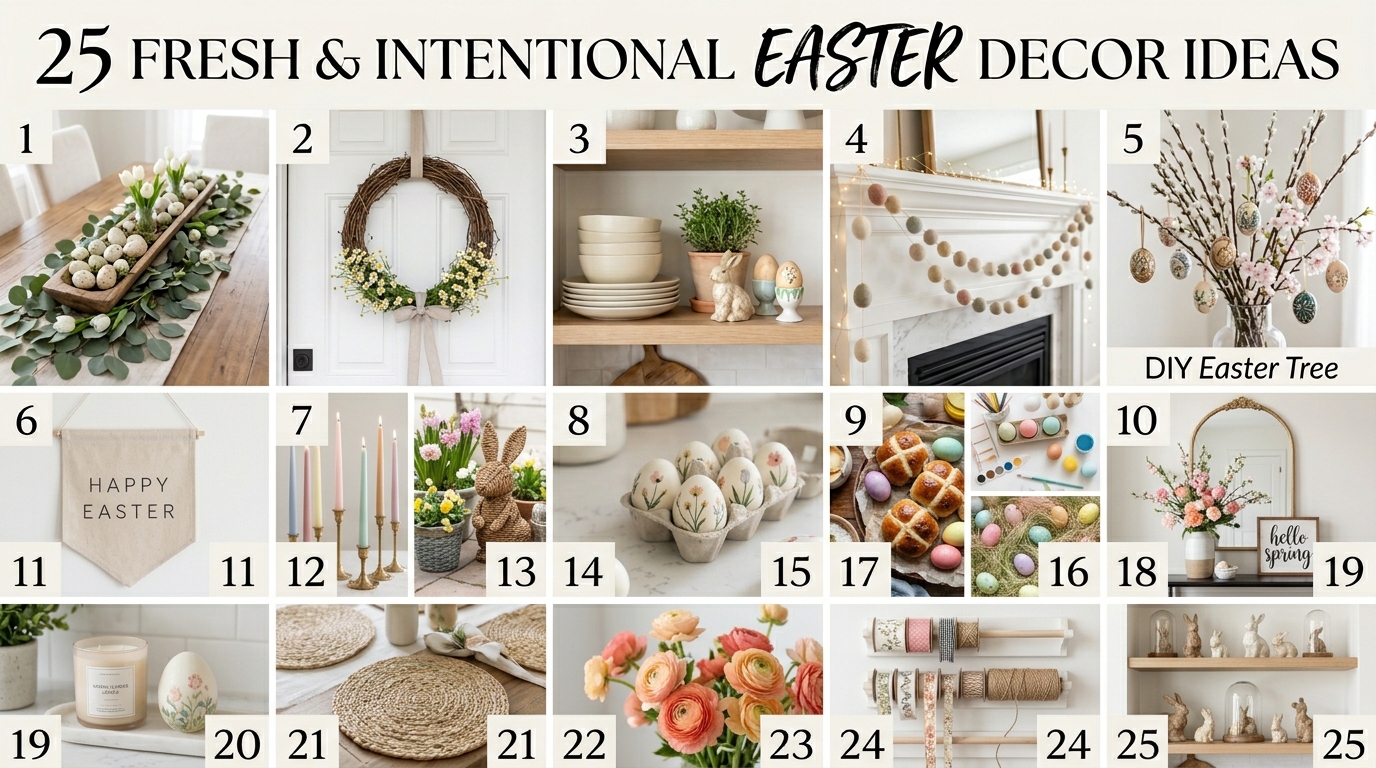
There’s a particular kind of joy that comes from walking into a home that’s been quietly, thoughtfully dressed for spring — not overdone, not cluttered with plastic basket grass, but genuinely beautiful in a way that makes the whole season feel celebratory. Easter home decor has evolved far beyond the expected pastels and bunny figurines into something that blends seasonal warmth with real interior design intention. Whether your home leans farmhouse, modern, coastal, or bohemian, there are ideas here that will slot naturally into your existing aesthetic and make your spaces feel alive again after a long winter. Here are 25 Easter decor ideas for the home worth saving — and a few worth starting today.
Why Easter Home Decor Works So Well
Easter sits at a uniquely compelling moment in the decorating calendar. Unlike Christmas, which arrives with a fairly fixed visual language, Easter decor is genuinely open to interpretation — it can be as traditional or as design-forward as you want it to be. That creative latitude is exactly what makes it so satisfying to style.
The core palette of Easter home decor — soft blush, dusty lavender, sage green, warm butter yellow, and crisp white — happens to align perfectly with the broader interior design movement toward nature-inspired, organic living. These tones don’t fight with most existing home color stories; they layer beautifully over neutral bases and warm wood tones that characterize contemporary home styling.
Pinterest trend data consistently shows a significant seasonal surge in searches for “spring home decor,” “Easter table setting ideas,” and “Easter mantel decor” beginning in February. What’s driving this moment is a cultural shift away from holiday maximalism toward what designers are calling “quiet seasonal styling” — thoughtful, curated touches that nod to the season without overwhelming the space.
The most important thing to understand about Easter home decor is that proportion matters more than quantity. Three beautifully chosen vignettes throughout your home will always outperform fifteen scattered, unfocused decorative moments. Restraint is the aesthetic skill that elevates seasonal decorating from cute to genuinely compelling.
1. Moss-Covered Easter Egg Wreath on the Front Door
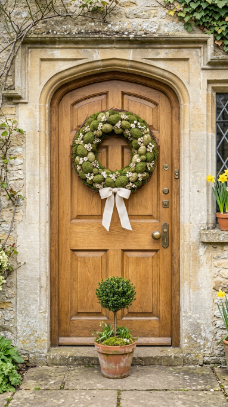
Vibe sentence: This wreath announces Easter without a single bunny in sight — just texture, greenery, and quiet elegance at the front door.
What makes it work: Covering foam eggs entirely in preserved sheet moss creates a tonal, all-green composition that reads as sophisticated rather than seasonal. The varied egg sizes across the wreath create visual rhythm, while the natural grapevine base adds organic warmth that a wire frame simply cannot replicate.
How to achieve it: Hot-glue preserved sheet moss (available at craft stores) onto foam eggs in small overlapping patches for the most natural coverage. Group eggs by size as you attach them to the wreath base — larger eggs at the center, smaller toward the edges — for a naturally balanced composition.
💡 A wide ribbon in cream linen tied at the bottom adds elegance for under $5 in fabric from a craft store.
2. Pastel Egg Tree as a Living Room Focal Point
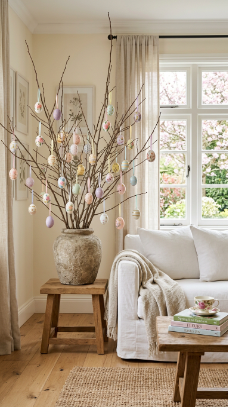
Vibe sentence: An Easter egg tree fills vertical space with color and movement in the most charming, unexpected way.
What makes it work: Bare branches create natural hooks for hanging decorations while contributing their own sculptural quality — the tree itself is part of the display. The visual lightness of hollow eggs hanging on fine ribbon gives the whole piece an airy, floating quality that feels unlike any other seasonal decoration.
How to achieve it: Collect bare branches from your yard or purchase dried branches from a floral supplier. Anchor them in a heavy vase weighted with sand or pebbles. Blow out real eggs (pierce both ends and blow gently) for the most authentic, lightweight ornaments that hang beautifully.
3. Spring Tablescape with Linen and Botanical Prints
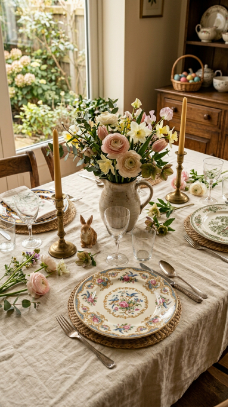
Vibe sentence: A tablescape that looks collected rather than matched is the mark of someone who knows exactly what they’re doing.
What makes it work: Mismatched vintage china creates the illusion of a curated collection gathered over years — it reads as far more sophisticated than a perfectly matched set. Botanical print napkins carry spring’s color and theme without requiring a single figurine or Easter-specific decoration.
How to achieve it: Thrift stores are the best source for mismatched vintage china — look for pieces that share one common color (a blue rim, a floral motif) so they feel intentionally collected rather than random. Layer a textured linen tablecloth beneath as the unifying foundation.
4. Nest Bowl Centerpiece on the Coffee Table
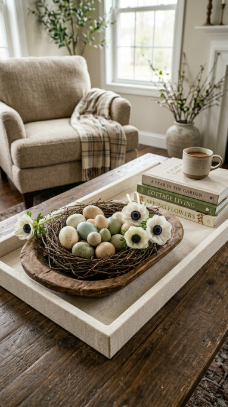
Vibe sentence: A wooden dough bowl filled with a nest of speckled eggs is Easter decor at its most elemental — and its most beautiful.
What makes it work: Dough bowls carry a functional, historical quality that elevates whatever is placed inside them. The contrast between the rough, hewn wood and the smooth porcelain surfaces of decorative eggs creates satisfying tactile contrast. Adding real or faux anemone stems bridges the gap between decor and florals.
How to achieve it: Source wooden dough bowls from antique markets, Etsy shops, or stores like World Market. Fill the base with dried Spanish moss or twig material from a craft store before nesting your eggs — the base material adds depth and prevents eggs from rolling.
5. Mantel Display with Trailing Greenery and Candles
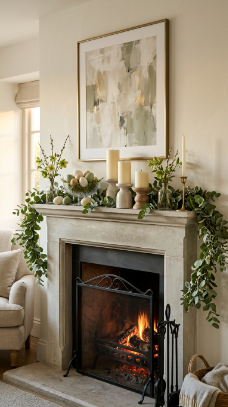
Vibe sentence: The Easter mantel is the home’s headline moment — and greenery plus candlelight will always get it right.
What makes it work: Trailing garland that spills slightly off both ends of the mantel creates generous, abundant energy without requiring a large volume of decor. The asymmetrical egg placement — clustered in one spot rather than evenly distributed — gives the mantel a curated, styled-but-relaxed quality.
How to achieve it: Fresh eucalyptus garland from a florist or Trader Joe’s lasts 1–2 weeks without water when kept away from heat. Drape it first, then position candles and accessories afterward — this ensures the greenery sits naturally beneath the hard objects rather than looking forced.
6. Woven Easter Basket Display for an Entryway
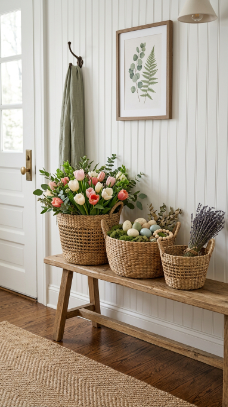
Vibe sentence: Grouped baskets in an entryway turn a utilitarian space into the first design moment of your home.
What makes it work: Using three baskets in varied sizes creates a composition that follows the classic design rule of odd-number groupings — inherently more visually interesting than two or four. Giving each basket a different content (florals, eggs, dried herbs) adds variety that rewards a closer look.
How to achieve it: Stack the largest basket slightly behind and between the other two for a layered composition that has depth. Choose baskets with different weave patterns — chunky seagrass beside fine rattan — so the texture story is as interesting as the Easter content inside.
💡 Baskets from IKEA, TJ Maxx, or thrift stores layered together look more expensive than any single designer piece.
7. Easter Chalkboard Sign in the Kitchen
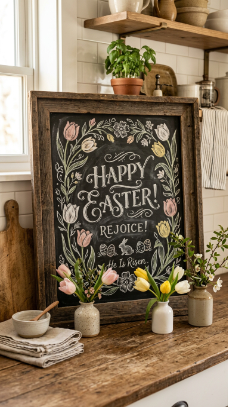
Vibe sentence: There is something deeply warm about hand-lettered seasonal decor — it carries the quality of something made with actual care.
What makes it work: A chalkboard sign’s matte black surface creates strong contrast that makes hand-lettering pop visually, while the medium itself implies a kind of casual, impermanent creativity that feels personal. The drawn floral border turns a message into something genuinely decorative.
How to achieve it: Use chalk markers (not regular chalk) for crisp lettering that won’t smudge when touched. Sketch your layout lightly in regular chalk first, then trace over with chalk marker for the final version. A simple tulip or leaf border drawn freehand always looks more charming than it sounds.
8. Terrarium Filled with Spring Moss and Eggs
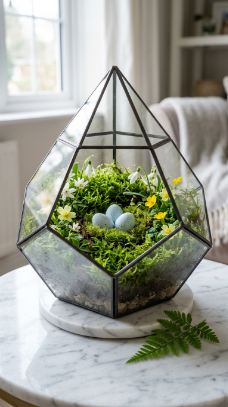
Vibe sentence: A spring terrarium is a tiny contained world — Easter decor at its most intimate and considered.
What makes it work: The glass enclosure of a terrarium frames its contents like a display case, giving even simple moss and eggs the visual weight of a curated exhibit. The geometric frame (typically brass or black metal) adds modern structure that prevents the arrangement from feeling too precious or craft-like.
How to achieve it: Use preserved sheet moss (it won’t require watering) layered over a base of pebbles inside the terrarium. Tuck decorative eggs into the moss at slightly different depths so they appear to be nestled naturally rather than placed on top.
9. Easter-Themed Tiered Tray on the Kitchen Counter
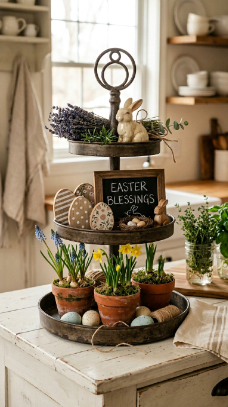
Vibe sentence: A tiered tray gives you permission to collect every tiny Easter thing you love into one intentional, composed display.
What makes it work: Tiered trays are inherently space-efficient — they create a vertical display that occupies minimal counter footprint while offering multiple levels of visual interest. Varying the texture and material at each tier (terracotta, wood, ceramic) prevents the display from feeling monotonous.
How to achieve it: Style the bottom tier with the largest, heaviest elements, then reduce scale as you move up. Mix three to four materials maximum across the tiers — too many material types create visual chaos at small scale. One seasonal “anchor” piece (a small bunny, a painted egg) per tier is enough.
10. Pastel Balloon Cluster for Easter Entertaining
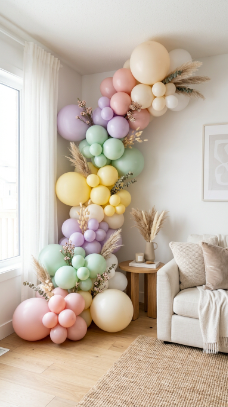
Vibe sentence: A pastel balloon cluster in an Easter palette hits the sweet spot between celebration and sophisticated home styling.
What makes it work: Organic-style balloon clusters (as opposed to structured arches) have a natural, imperfect quality that photographs beautifully and works in residential settings. Weaving in dried flower stems — strawflowers, pampas, or lavender — elevates the installation from party supply to genuine decor.
How to achieve it: Create an organic cluster by tying groups of three to four balloons together, then connecting groups with balloon tape. Vary balloon sizes significantly — use 5-inch, 11-inch, and 16-inch balloons for a professional-looking organic shape. Insert dried stems through balloon tape for floral detail.
💡 Use matte balloons rather than glossy — they photograph better and feel more like decor than party supplies.
11. Spring Gallery Wall Refresh with Botanical Prints
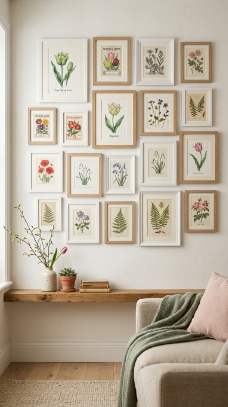
Vibe sentence: Swapping two or three prints in an existing gallery wall is the quickest seasonal refresh that costs almost nothing.
What makes it work: Botanical prints carry a timeless, educational quality — they feel less like seasonal decorations and more like art that happens to be appropriate for spring. Mixing vintage seed packet art with contemporary botanical illustrations creates a gallery wall that looks collected over time rather than assembled all at once.
How to achieve it: Free botanical prints are available through sites like Unsplash or vintage botanical archives — download, print at home or at a print shop, and slide them into existing frames. This is a seasonal swap that takes under 20 minutes and costs under $10.
12. Bunny Silhouette Cut-Outs as a Window Display
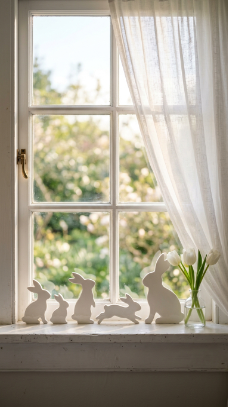
silhouette cut-outs displayed on the sill in varying sizes, backlit by morning natural light that makes them glow softly against a sheer white linen curtain. Lighting: bright natural backlit morning light. Camera angle: eye-level. Mood: soft and whimsical. Key details: silhouette-only bunny forms with no facial features, varied sizes, warm window glow through sheer linen. Decor accents: a small bud vase of white tulips beside the largest bunny, a white-painted windowsill. Color palette: pure white, warm ivory light, sheer linen, soft morning glow. Style tags: photorealistic, 8K resolution, interior design photography, Pinterest vertical 2:3 ratio, no people, magazine quality.
Vibe sentence: Backlit against a sheer curtain, even the simplest bunny silhouette becomes something quietly beautiful.
What makes it work: Silhouette forms — stripped of color and detail — depend entirely on shape for their impact, and a bunny’s rounded, long-eared outline is inherently charming. Backlighting from a window transforms flat white forms into glowing, dimensional objects that catch the eye immediately.
How to achieve it: Cut bunny silhouettes from heavy white cardstock using a craft knife or cutting machine like a Cricut. Varying sizes from 3 to 8 inches creates a family-of-rabbits narrative without a single word. Stand them upright using small adhesive easel backs.
13. Herb Garden Windowsill with Spring Styling
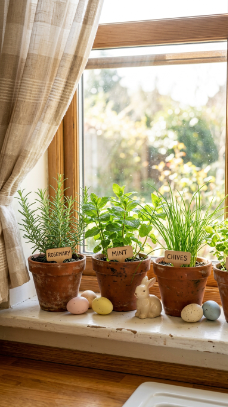
Vibe sentence: The most effortless Easter kitchen styling doubles as your herb garden — alive, fragrant, and genuinely useful.
What makes it work: Integrating seasonal Easter accents (eggs, a small ceramic bunny) among functional herb pots creates a display that feels organic rather than staged. The terracotta of the herb pots carries a warm earthiness that pairs beautifully with spring greens and pastel accents.
How to achieve it: Keep the decorative accents small and restrained — two or three decorative eggs and a single small figurine maximum. The herbs should remain the primary element; the Easter touches are supporting cast. Wooden clay plant labels painted in a pastel color add another seasonal detail without clutter.
14. Dyed Linen Napkins as Easter Table Decor
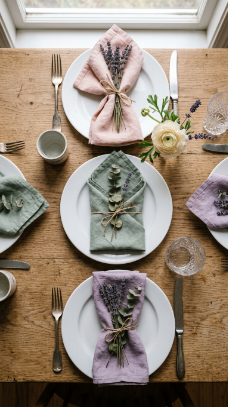
Vibe sentence: Hand-dyed linen napkins are the kind of quiet detail that guests notice without quite knowing why the table feels so beautiful.
What makes it work: The slightly uneven, organic quality of hand-dyed linen reads as artisanal in a way that machine-printed napkins cannot replicate. Varying the dye color slightly at each place setting — blush at one, sage at the next — creates a cohesive but gently varied rhythm around the table.
How to achieve it: Dye plain white linen napkins with Rit Dye in pastels — use less dye than recommended for a faded, washed-out result that looks intentional. Tie each napkin with a sprig of dried lavender or a single flower stem for a detail that functions as both décor and a guest gift.
15. Moss Letter Display for “HOP” or “SPRING”
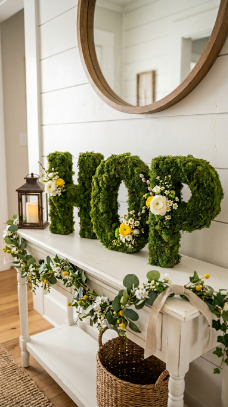
Vibe sentence: Moss-covered letters feel like something grown rather than made — seasonal decor with a genuinely organic personality.
What makes it work: Large letter forms create immediate graphic impact that smaller decor cannot. Covering them in preserved sheet moss adds texture and color simultaneously, while the Easter-adjacent word “HOP” communicates the season without resorting to overtly themed decoration.
How to achieve it: Purchase papier-mâché letters from a craft store (typically $3–$6 each). Apply preserved sheet moss using a hot glue gun in small overlapping sections, pressing firmly for full coverage. Tuck a few small flower stems into the moss using floral picks for a finishing touch.
16. Spring Throw Pillow Swap for the Living Room
Vibe sentence: Nothing refreshes a living room for Easter faster than a pillow swap — ten minutes, and the whole room feels like spring.
What makes it work: Pillow texture does as much work as color in a spring refresh. A woven sage green pillow, a smooth embroidered blush, and a nubby cream ticking stripe together create multi-layered visual richness that a single material cannot. The Easter-friendly palette does all the seasonal heavy lifting without a single egg in sight.
How to achieve it: Start with a neutral base (cream or white sofa or armchair) and add two accent pillows in your chosen spring palette, plus a lumbar for proportion. H&M Home, IKEA, and Amazon carry beautiful seasonal pillow covers at low price points — buy covers, not insert-included pillows, to reuse your existing inserts.
💡 The rule of three works for pillows: two matching accent pillows plus one contrasting lumbar creates instant, professional-looking styling.
17. Glass Cloche Collection with Spring Vignettes
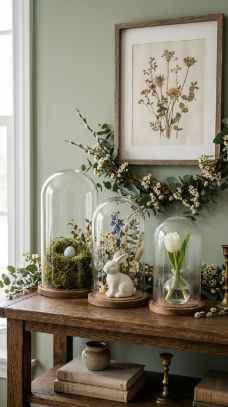
Vibe sentence: A glass cloche turns even the smallest Easter scene into something that deserves careful looking.
What makes it work: Cloches function as miniature display cases — they frame and elevate whatever is inside, lending it the visual importance of a museum exhibit. Using three of varying heights creates a composition that has its own architecture, with natural high-medium-low visual flow.
How to achieve it: Shop for cloches at HomeGoods, World Market, or antique markets. Vary the height significantly — aim for a smallest cloche of about 8 inches and a tallest of 14–16 inches. The contrast in height is what makes the grouping feel deliberate rather than repeated.
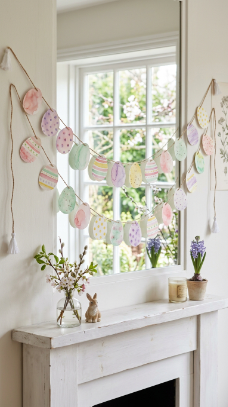
18. Watercolor Easter Egg Garland for a Window or Mantel
Vibe sentence: A handmade watercolor egg garland carries the same energy as a handwritten note — imperfect, intentional, and completely irreplaceable.
What makes it work: Watercolor washes on cut paper eggs create a translucency that catches window light beautifully, making the garland glow rather than simply hang. The handmade quality is the point — slight variations in each egg add character that a printed or manufactured garland cannot replicate.
How to achieve it: Cut egg shapes from heavy watercolor paper (140 lb. weight minimum) and apply diluted watercolor paint in single wash strokes — one color per egg, allowed to bloom wet-on-wet for natural variation. Punch a hole at the top, thread onto natural twine, and space approximately 3 inches apart.
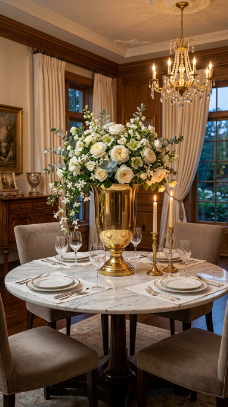
19. Botanical Centerpiece in a Brass Urn
Vibe sentence: A polished brass urn takes an Easter flower arrangement from seasonal to statement — it’s the container that does half the design work.
What makes it work: Brass has experienced a significant interior design revival and reads as simultaneously traditional and contemporary. An overflowing, slightly imperfect arrangement — with jasmine trailing over the urn’s edge — softens the formality of the brass and creates an effortlessly luxurious look.
How to achieve it: Line a brass urn with a plastic vessel that fits inside — this protects the metal and holds water. Choose an all-white and cream flower palette to let the brass do the color work. Allow at least two or three stems to trail naturally downward over the urn’s edge.
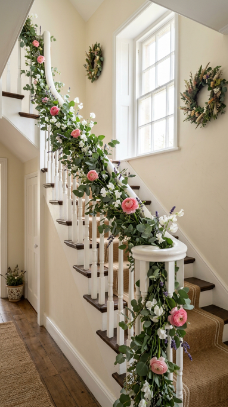
20. Staircase Banister Garland with Spring Flowers
Vibe sentence: A staircase garland is the most generous gesture in Easter home decorating — it welcomes you the entire length of the climb.
What makes it work: Staircases are one of the most high-traffic, high-visibility areas of a home, and a garland that runs the full length commands attention in a way that no single surface display can. Spacing flowers at irregular intervals — clustered in some spots, sparse in others — looks far more natural than even distribution.
How to achieve it: Start with a long eucalyptus garland as the base (Trader Joe’s regularly carries these seasonally). Attach flower stems using small floral wire ties, working from bottom to top. Keep flowers on the outward-facing side of the banister so they’re fully visible from the hallway.
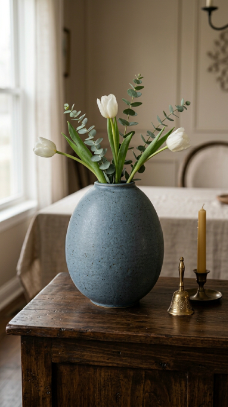
21. Decorative Egg Vase as a Table Accent
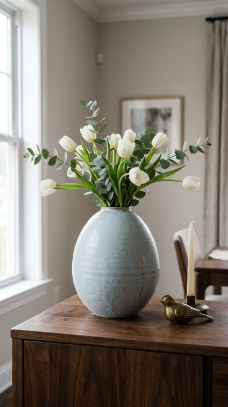
Vibe sentence: An egg-shaped ceramic vase is the most elegantly subtle Easter decor reference — the shape does the seasonal work without a single bunny or chick in sight.
What makes it work: A large ceramic egg-form vase communicates Easter through shape alone — it’s a sophisticated wink at the season rather than an overt declaration. The egg shape also creates a beautiful silhouette that reads as sculptural even when unflowered.
How to achieve it: Look for egg-shaped vases at ceramic studios, Etsy shops, or West Elm. A matte glaze in pale blue, sage green, or warm cream reads as most sophisticated. Because the opening is typically small, only a handful of stems are needed — which keeps the arrangement cost low.
22. Apothecary Jars Filled with Pastel Candy and Eggs
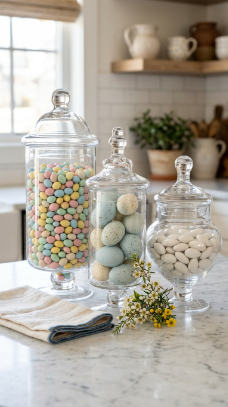
Vibe sentence: Apothecary jars filled with pastel Easter candy are equal parts home decor and the most popular thing at your Easter gathering.
What makes it work: Clear glass apothecary jars transform their contents into display objects — the candy’s color palette becomes the décor’s color palette. Varying the jar heights creates visual rhythm, while differing contents (chocolates, almonds, decorative eggs) add variety that rewards the eye.
How to achieve it: Choose jars with lids for a cleaner, more styled look — lidless jars can feel unfinished. Fill the back jar tallest, the front jar shortest, with the middle jar at an intermediate height. Jordan almonds, speckled eggs, and pastel M&Ms all work beautifully and are widely available in spring.
23. Aged Terracotta Pots Clustered on a Doorstep
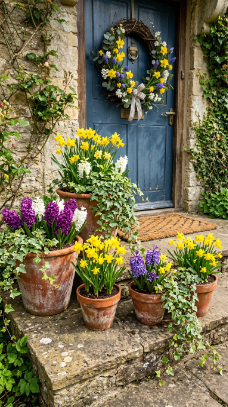
Vibe sentence: A cluster of aged terracotta pots at the front door is the kind of welcome that makes guests feel they’ve arrived somewhere special.
What makes it work: Terracotta’s warm, earthy tones create natural contrast against cool-toned spring blooms in purple and white — that opposition is what makes the palette so visually alive. Clustering pots of varying sizes creates a composition with natural depth; spread out, the same pots would look sparse and random.
How to achieve it: Age new terracotta pots quickly by applying a thin wash of white exterior paint diluted 80% with water, then wiping back — this mimics years of weathering in minutes. Cluster in a triangular grouping with the tallest pots at the back and lower pots at the front.
💡 Plant bulbs in pots now and you’ll have a doorstep display ready year after year with no restocking costs.
24. Easter Advent-Style Countdown Boxes
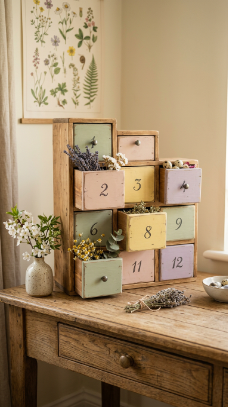
Vibe sentence: An Easter countdown display does for spring what an Advent calendar does for December — it turns anticipation into its own kind of decoration.
What makes it work: Countdown displays create ongoing engagement with the holiday across multiple days rather than a single-day decoration. The small scale of individual boxes means each element is precious and considered, giving the whole display a jewel-box quality.
How to achieve it: Source a wooden advent-style box from Amazon, Etsy, or craft stores and repaint in Easter pastels using chalk paint — it requires no sanding and adheres beautifully to wood. Fill boxes with small treats, notes, flower seeds, or tiny trinkets for children to discover each day leading up to Easter.
25. A Spring-Scented Simmer Pot as Invisible Easter Decor
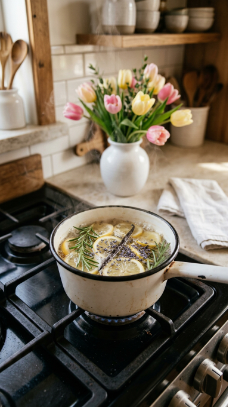
Vibe sentence: The most powerful Easter decor you can create is something no guest will ever see — a spring simmer pot that makes your home smell exactly like the season.
What makes it work: Scent is the most emotionally resonant sense, and a spring simmer pot — lemon, lavender, rosemary, and vanilla — creates an immediate, visceral impression of freshness and celebration the moment guests walk through the door. It requires no styling skill and costs almost nothing.
How to achieve it: Combine sliced lemon, a few sprigs of fresh rosemary, a tablespoon of dried lavender, and half a vanilla bean in a small pot of water. Simmer on the lowest heat setting for one to two hours before guests arrive, adding water as needed. For an Easter-specific variation, add a cinnamon stick and a few cardamom pods for warmth.
💡 Run the simmer pot for 30 minutes before guests arrive, then lower to the minimum — the scent will linger for hours without the pot running continuously.
How to Start Your Easter Home Decor Transformation
The most common mistake in Easter decorating is buying too much at once and then struggling to make it all feel cohesive. Instead, start with one or two anchor pieces — a beautiful wreath for the front door and a centerpiece for the dining table — and build outward from there. These two high-visibility spots deliver the most impact per dollar and per minute invested.
Avoid the trap of matching everything perfectly. Easter home decor that feels genuinely designed uses a palette (two to three colors maximum) rather than a theme. Once you have a palette — say, sage green, blush, and cream — every individual purchase becomes easier because you’re asking one question: does this fit my palette?
Budget-friendly entry points are everywhere in spring. Grocery store tulips and daffodils, thrift store baskets and vases, and craft store moss and eggs can produce results that are genuinely design-forward when styled with intention. The vessel matters as much as the flowers.
Set realistic expectations: transforming your home for Easter doesn’t require replacing everything at once. Two well-chosen vignettes and one fresh Easter flower arrangement will make your home feel intentionally dressed for the season — and that’s genuinely all that’s needed.
Frequently Asked Questions
What are the best colors for Easter home decor?
The most versatile Easter home decor palette combines soft blush pink, sage green, warm butter yellow, dusty lavender, and crisp white. This five-color palette can be used selectively — choosing two or three tones — to suit any interior style from farmhouse to modern. For a more contemporary approach, an all-green and white palette using eucalyptus, moss, and white flowers communicates spring without any traditional Easter color associations.
How do I decorate for Easter without it looking too childish or themed?
Focus on natural materials and organic textures rather than novelty objects. Moss-covered eggs, botanical prints, spring florals, and linen textiles all communicate the season beautifully without relying on plastic decorations or cartoon imagery. The rule of thumb is: if it would look beautiful any time of year, it belongs in sophisticated seasonal styling. Reserve overtly themed pieces (bunnies, chicks) for one contained vignette rather than scattering them throughout the home.
How early should I start decorating for Easter?
Most interior designers recommend starting Easter home decor two to three weeks before the holiday — typically right after St. Patrick’s Day. This gives you time to bring in spring florals in stages (long-lasting eucalyptus and dried elements first, fresh flowers in the final week) and to adjust your styling as the season progresses. Starting earlier than four weeks risks decor fatigue before the actual holiday arrives.
Is Easter home decor expensive to pull off well?
It genuinely doesn’t have to be. Some of the most effective Easter decor comes from natural, inexpensive materials: fresh grocery store tulips ($5–$8 per bunch), preserved moss from a craft store ($8–$12), thrifted woven baskets ($3–$10), and seasonal botanical prints downloaded for free and printed at home. The key cost-savers are investing in reusable vessels (cloches, apothecary jars, woven baskets) that earn their cost across multiple seasons.
What’s the difference between spring decor and Easter decor?
Spring decor focuses on the broader seasonal transition — florals, greenery, light pastel colors, organic textures — and can be displayed from February through May without feeling specifically tied to one holiday. Easter decor incorporates seasonal symbols (eggs, nests, bunnies, spring blooms) in a more holiday-specific way. The smartest approach layers both: a foundation of timeless spring styling that can remain throughout the season, with a few specifically Easter-themed accents added in the final two weeks before the holiday.
Ready to Create Your Dream Easter Home?
These 25 Easter decor ideas for the home span everything from a five-minute simmer pot to a full staircase garland — because there’s an idea here for every home, every budget, and every amount of time you have to give. Save the ones that made you stop scrolling, start with just one, and watch how quickly one beautiful vignette inspires the next. Seasonal decorating at its best isn’t about perfection — it’s about creating a home that feels alive to the time of year, welcoming to everyone who walks through the door, and genuinely lovely to live inside. This Easter, let your home feel like spring arrived on purpose.