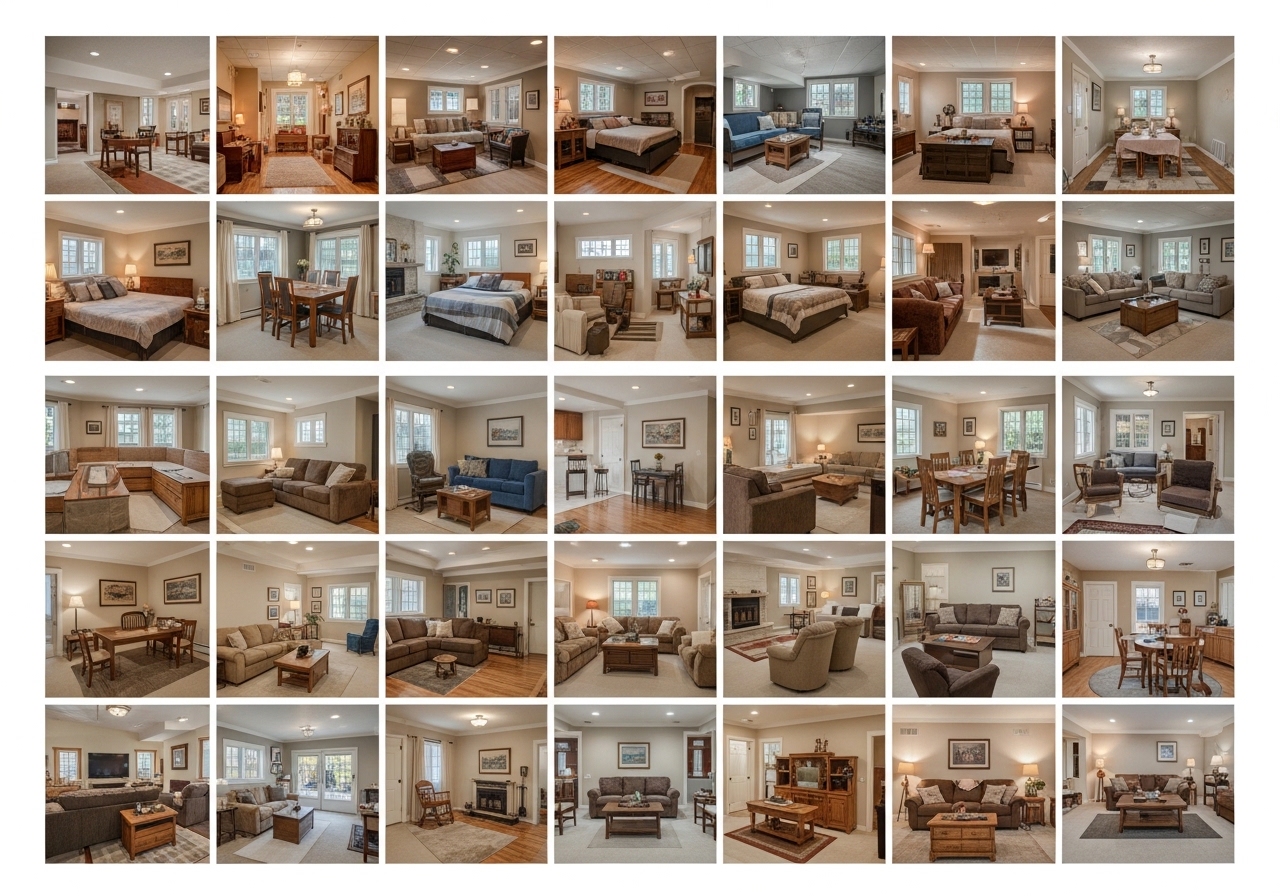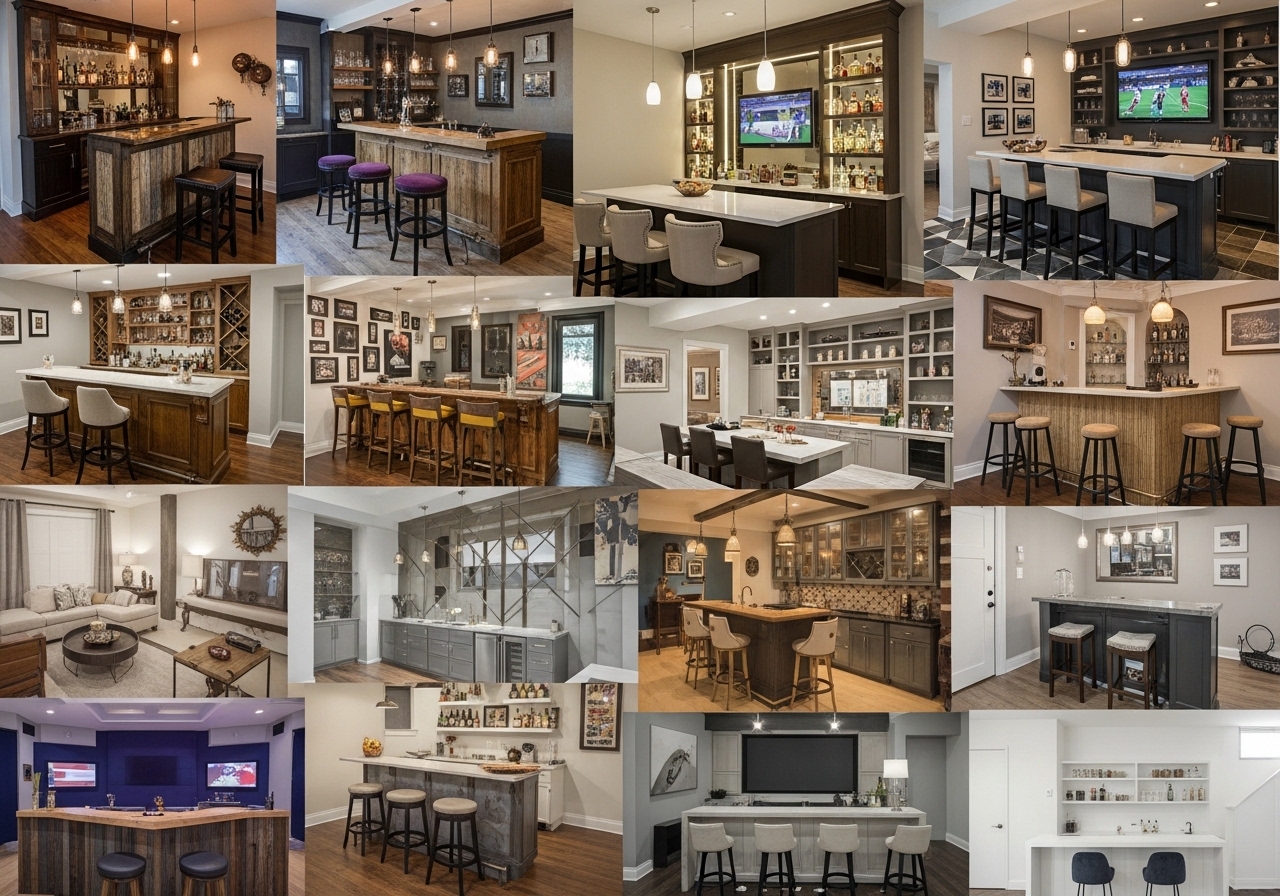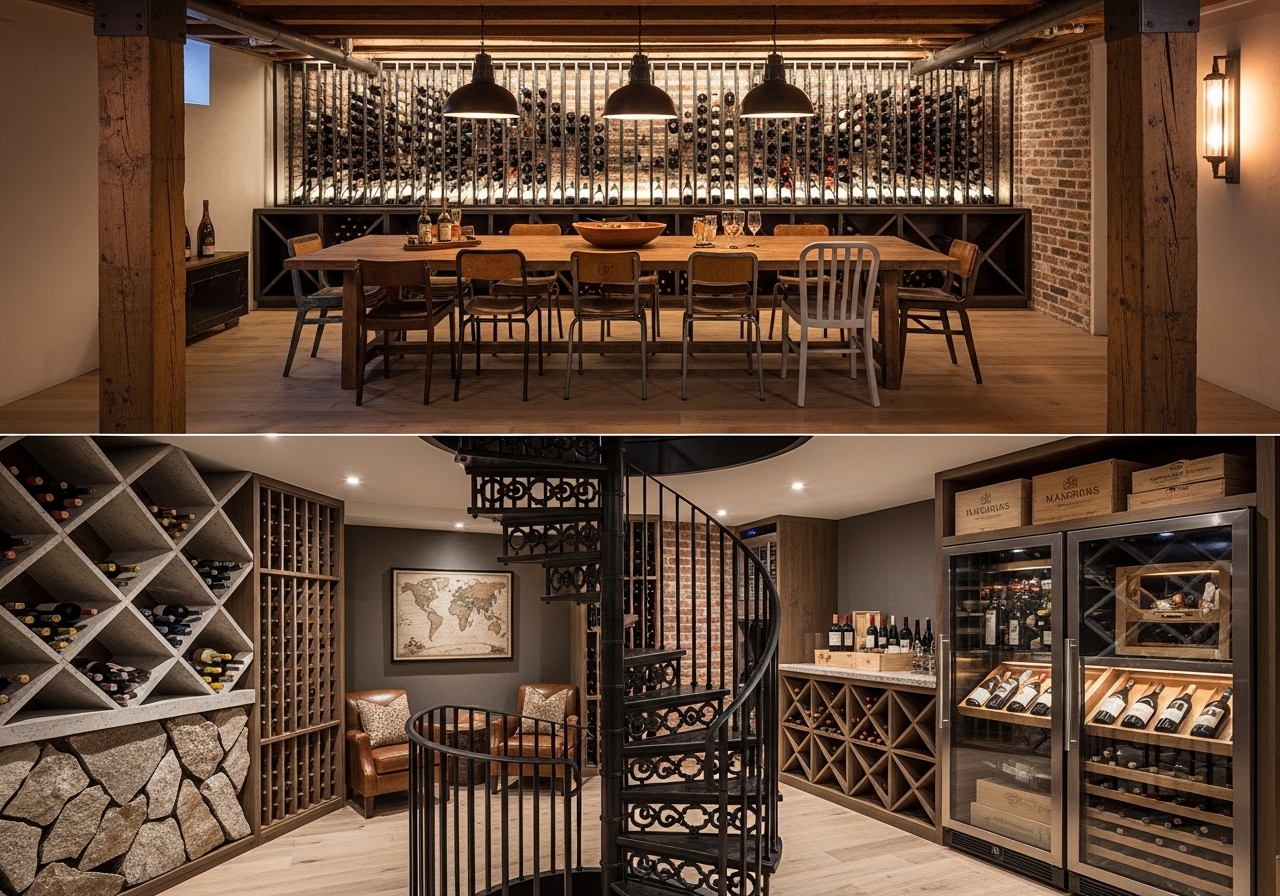
There’s something undeniably romantic about descending into a beautifully designed wine cellar — the cool air, the soft glow of carefully placed lighting, the satisfying rows of bottles resting at just the right angle. A basement wine cellar transforms otherwise forgotten square footage into one of the most impressive, personal spaces in a home. Whether you’re a casual collector or a dedicated oenophile, the right design makes every visit feel like a ritual. The good news? You don’t need a château in Bordeaux to pull this off. Here are 28 wine cellar basement ideas worth saving.
Why Wine Cellar Design Works So Well
Wine cellar design is one of those rare interior categories where function and atmosphere are inseparable. Every design decision — from the racking system to the flooring — serves both a practical and an aesthetic purpose. That dual nature is what makes these spaces so deeply satisfying to create and experience.
The visual language of a great wine cellar draws from rich, timeless materials: reclaimed wood, wrought iron, hand-laid stone, aged brick, and dark-stained hardwoods. These aren’t trends — they’re materials that have lined the world’s finest cellars for centuries, which is exactly why they feel so right together. Paired with moody, amber-toned lighting, they create a depth and warmth that few other rooms in a home can replicate.
Right now, wine cellars are having a genuine cultural moment. Pinterest searches for “home wine room” and “basement wine cellar ideas” have surged as homeowners reclaim basement spaces with intention. The pandemic-era push toward elevated home entertaining never fully faded — if anything, it deepened.
The best part? Even a modest basement corner can be transformed. A small 6×8 foot dedicated space with proper insulation, a through-the-wall cooling unit, and well-chosen racking can hold 200+ bottles and feel genuinely luxurious.
Old World Stone Wall Wine Cellar
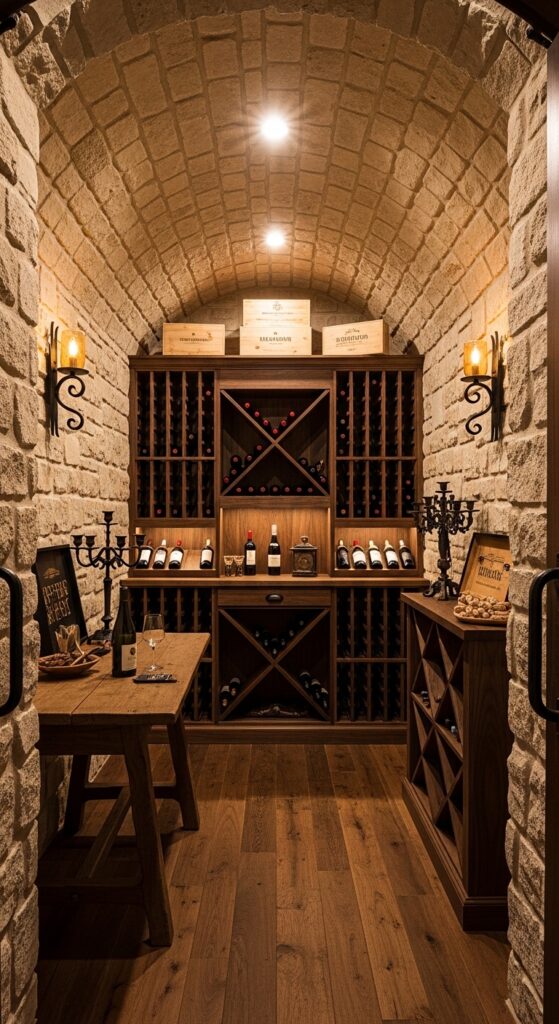
Vibe sentence: This is the wine cellar that whispers of Burgundy châteaux and centuries-old stone corridors — moody, weighty, and unforgettable.
What makes it work: The rough, irregular texture of hand-laid limestone creates an immediate sense of age and authenticity that no paint or wallpaper can replicate. Paired with dark walnut racking, the contrast between cool stone and warm wood produces exactly the kind of visual tension that makes a room feel designed rather than decorated. The arched ceiling amplifies the old-world drama exponentially.
How to achieve it: Look for dry-stack stone veneer panels — they install over standard drywall without structural changes and cost $8–$15 per square foot. Choose a warm buff or cream limestone tone rather than grey to keep the space feeling inviting rather than cold.
💡 Faux stone panels from brands like GenStone can replicate this look for a fraction of real masonry cost.
Modern Glass-Enclosed Wine Room
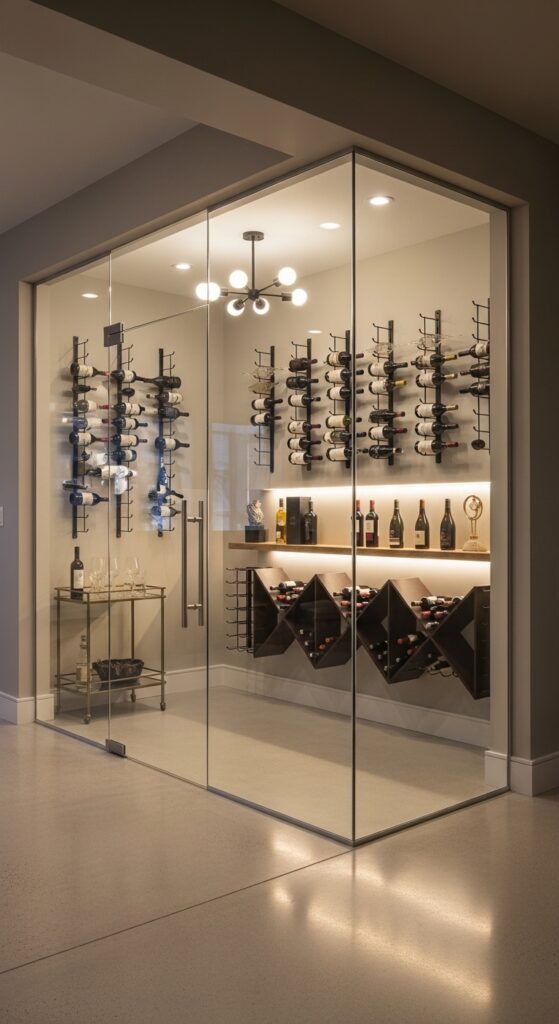
Vibe sentence: Cool, precise, and quietly spectacular — this glass wine room is as much gallery as it is cellar.
What makes it work: Frameless glass walls create a display effect that makes your collection the art. Every bottle becomes part of the visual composition, and the transparency prevents the room from absorbing square footage visually, even within a finite basement layout. Geometric metal racking reinforces the architectural, gallery-like feel.
How to achieve it: Work with a glazier who specializes in frameless structural glass. Specify low-iron glass (also called “Starphire”) for a crystal-clear look rather than the standard slight green tint. Pair with matte black metal racking in modular grid systems for a cohesive, contemporary finish.
Rustic Reclaimed Wood Barrel Cellar
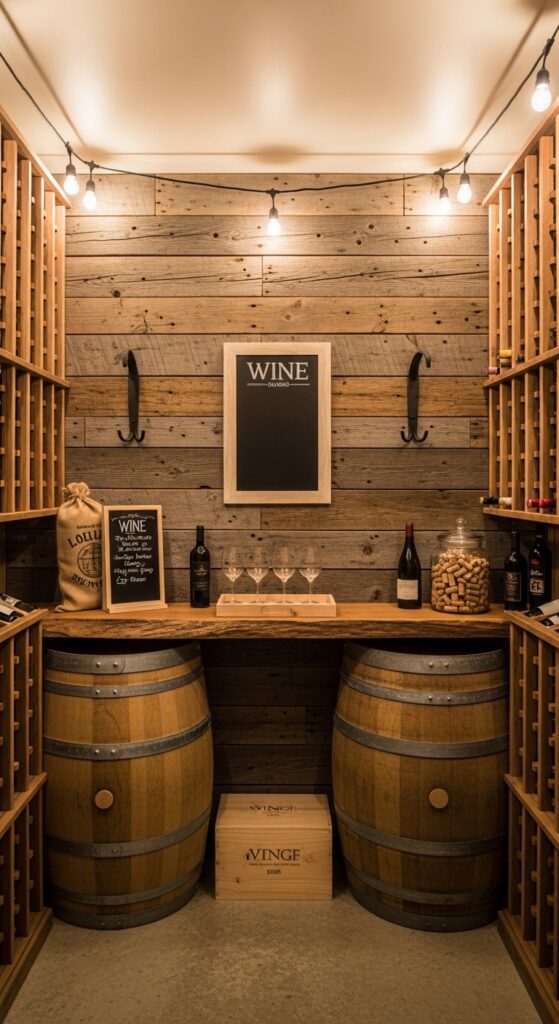
Vibe sentence: Every knot and grain tells a story — this cellar feels like it was built slowly, lovingly, over generations.
What makes it work: Reclaimed wood brings immediate visual character that new lumber simply can’t manufacture. The natural weathering, nail holes, and grain variation create a layered, authentic texture that reads as genuinely aged rather than artificially distressed. Barrel accents reinforce the winery atmosphere without feeling costume-y.
How to achieve it: Source reclaimed Douglas fir or oak planks from architectural salvage dealers. For racking, horizontal plank-style wine holders integrate seamlessly with the wood walls — build them from the same reclaimed material for a fully cohesive look.
💡 Etsy sellers offer pre-made reclaimed wood wine racks shipped flat-pack — a weekend install.
Intimate Brick Archway Wine Alcove
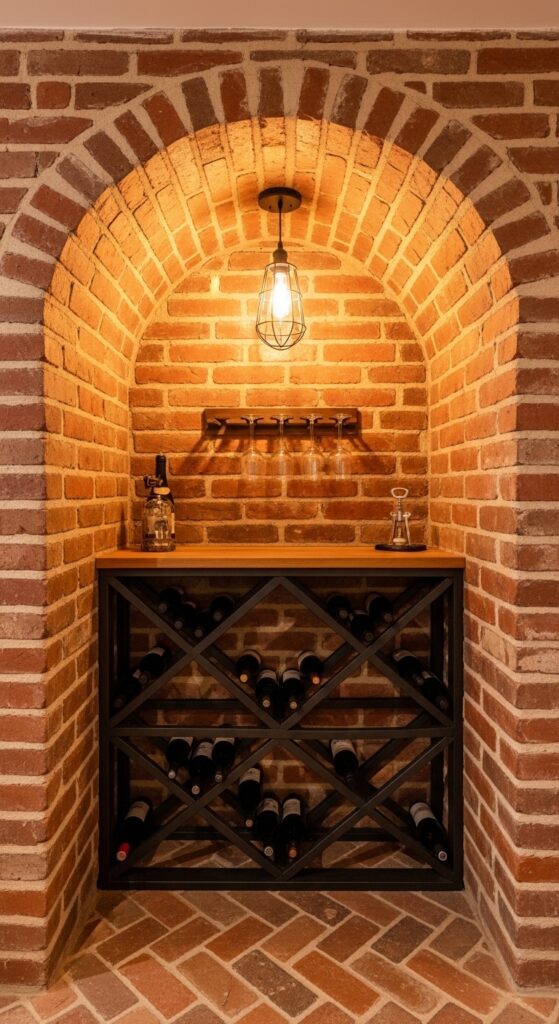
Vibe sentence: Small, arched, and glowing with amber light — this alcove feels like discovering a secret corner of an Italian enoteca.
What makes it work: The arched brick opening frames the wine collection like a painting, creating a focal point that punches far above its square footage. Exposed brick naturally absorbs and reflects warm light in a way that painted drywall never can, adding immediate depth and age. The containment of an alcove makes even a modest collection feel curated and intentional.
How to achieve it: If your basement has an existing niche or soffit, this is an ideal conversion. Use iron diamond bin racking — it installs directly into brick with masonry anchors and holds up to 20 bottles per panel. Add a vintage-style cage pendant light for $40–$80 to complete the bistro mood.
Dark & Dramatic Black Cellar Aesthetic
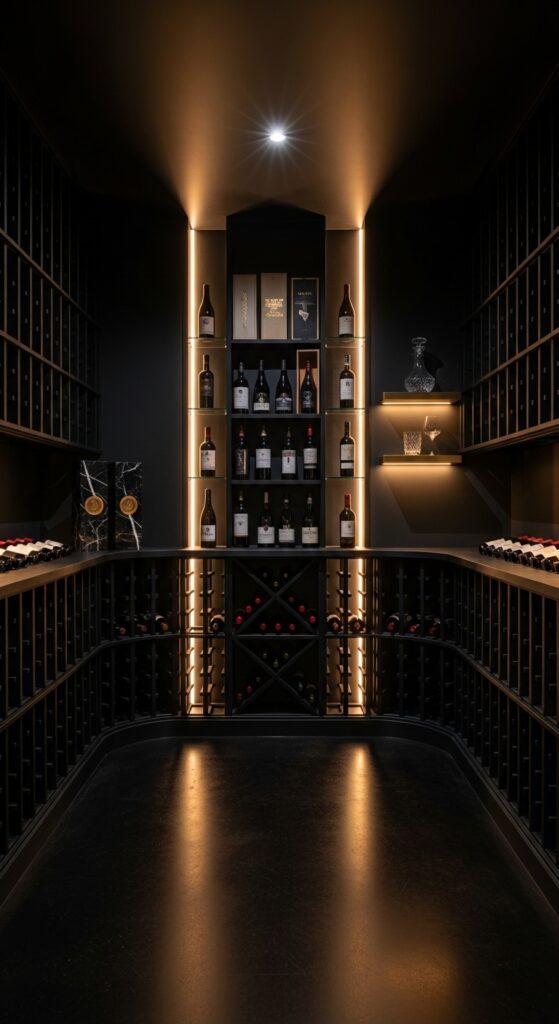
Vibe sentence: Unapologetically dark, extraordinarily dramatic — this cellar is designed to impress before a single bottle is opened.
What makes it work: An all-dark palette in a wine cellar eliminates visual distraction, putting the collection itself center stage. Warm amber pin-spot lighting against a matte black wall creates a depth and dimensionality that lighter rooms can’t achieve. The restraint of the design — black, black, black — actually requires more confidence and pays off more visibly.
How to achieve it: Use Benjamin Moore’s “Black Panther” or Farrow & Ball’s “Railings” in a matte finish on all surfaces. Pair with thin-profile black powder-coated metal racking rather than bulkier wood systems to maintain the sleek silhouette.
💡 Matte black spray paint can refresh an existing wood rack for under $20 — transformative overnight.
Climate-Controlled Concrete Modern Cellar
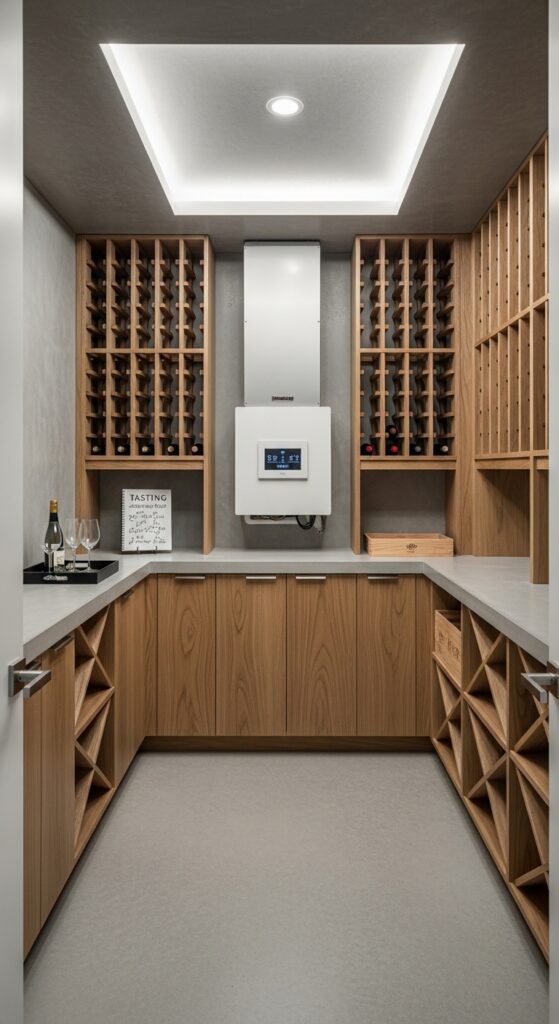
Vibe sentence: This is a cellar built on precision — where temperature is dialed in, the collection is serious, and every element earns its place.
What makes it work: The combination of raw concrete and warm blonde ash wood creates a sophisticated tension between industrial and organic — cold and warm, rough and smooth. Clean-line modular racking in a light wood tone prevents the all-concrete space from feeling oppressive or cave-like. The visible climate unit is treated as a design feature, not hidden — a confident nod to function-as-form.
How to achieve it: Install a through-the-wall wine cooling unit (CellarPro or WhisperKool are reliable brands) before finishing the space. Modular ash or oak racking from WineRacks America assembles without tools and can be reconfigured as your collection grows.
Cottage-Style White-Painted Wine Cellar
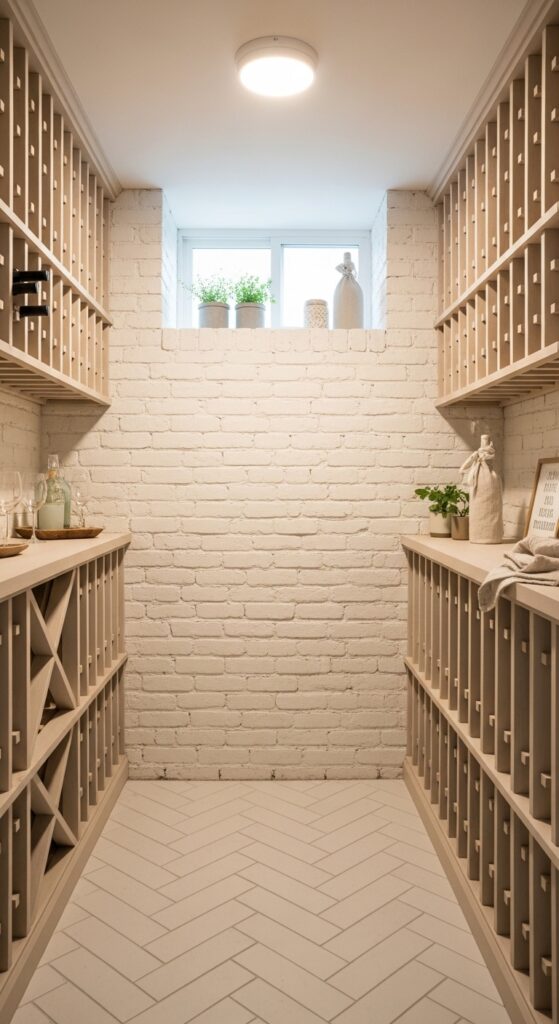
Vibe sentence: Bright, effortless, and quietly charming — this cellar proves that wine rooms don’t have to be dark to be beautiful.
What makes it work: White-painted brick retains all the texture and depth of exposed masonry while dramatically brightening the space — it’s the best of both worlds for basements that feel too dim. Cream-toned wood racking in an unfussy plank style keeps the aesthetic casual and approachable rather than formal or intimidating. The herringbone tile adds pattern without competing with the collection.
How to achieve it: Paint existing basement brick with masonry paint in Benjamin Moore’s “White Dove” for a warm, not stark, white. Choose cream or linen-toned wood racking rather than bright white to maintain softness throughout the palette.
Industrial Pipe and Steel Wine Storage
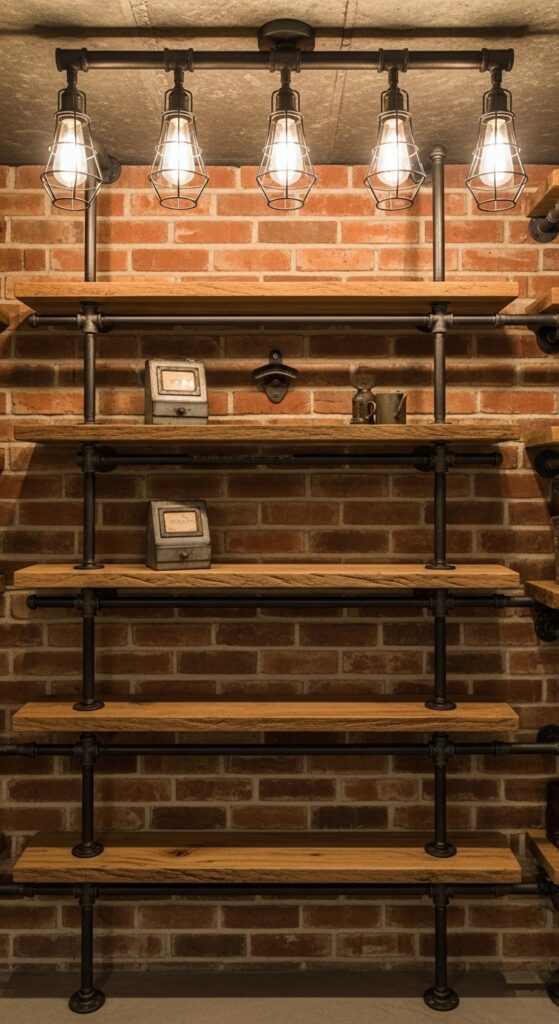
Vibe sentence: Raw, unapologetic, and effortlessly cool — this industrial wine wall belongs in a converted loft as much as a basement.
What makes it work: Black iron pipe fittings are a design-savvy choice because they carry visual weight without bulk. The contrast between hard metal and warm reclaimed wood creates a textural story that reads as deeply considered rather than random. Exposed elements — pipes, fittings, visible wall — feel intentional in an industrial design context.
How to achieve it: Kee Klamp and similar pipe fitting systems are sold at home improvement stores and many online DIY retailers — search “pipe shelving kits” for pre-packaged options. Pair with 2-inch thick reclaimed oak shelving cut to custom lengths for maximum grip and character.
💡 This is one of the most beginner-friendly DIY wine walls — no finish carpentry required.
Tuscan-Inspired Terracotta Wine Vault
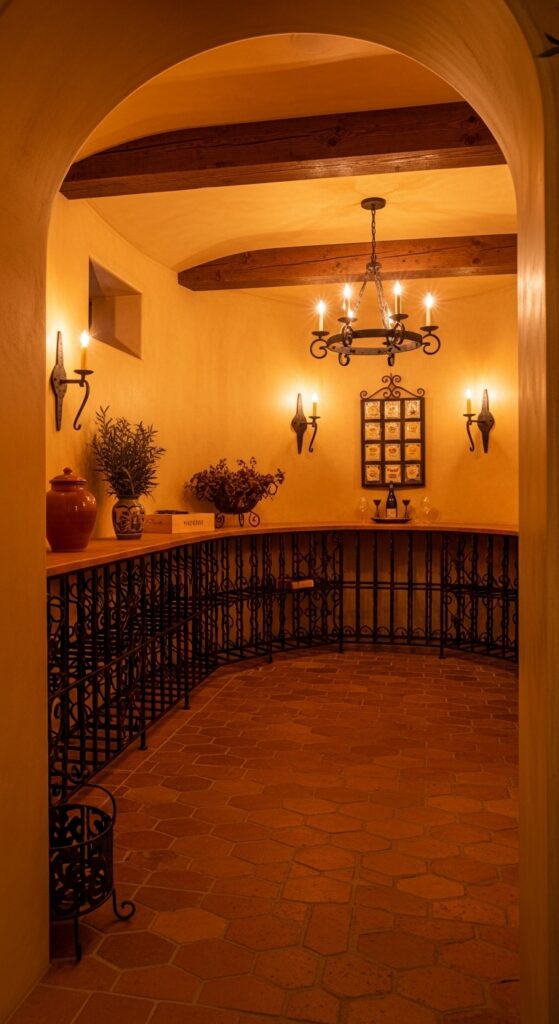
Vibe sentence: Warm as a summer evening in Siena — this cellar wraps you in terracotta, plaster, and the slow romance of Tuscan wine culture.
What makes it work: Ochre-toned plaster walls and terracotta tile create a palette that’s inherently warm and light-absorbing, making the space feel like it’s been inhabited and loved for decades. Exposed wooden ceiling beams add an essential overhead element that grounds the room and gives the eye somewhere to travel. Wrought iron racking ties the entire material story together beautifully.
How to achieve it: Venetian plaster in a warm ochre or honey tone (try Portola Paints’ Roman Clay in “Straw” or “Honey”) is an excellent DIY-accessible application with incredible depth. Pair with terracotta hexagonal floor tiles — widely available and easy for a tile professional to install in a weekend.
Speakeasy-Inspired Hidden Wine Cellar
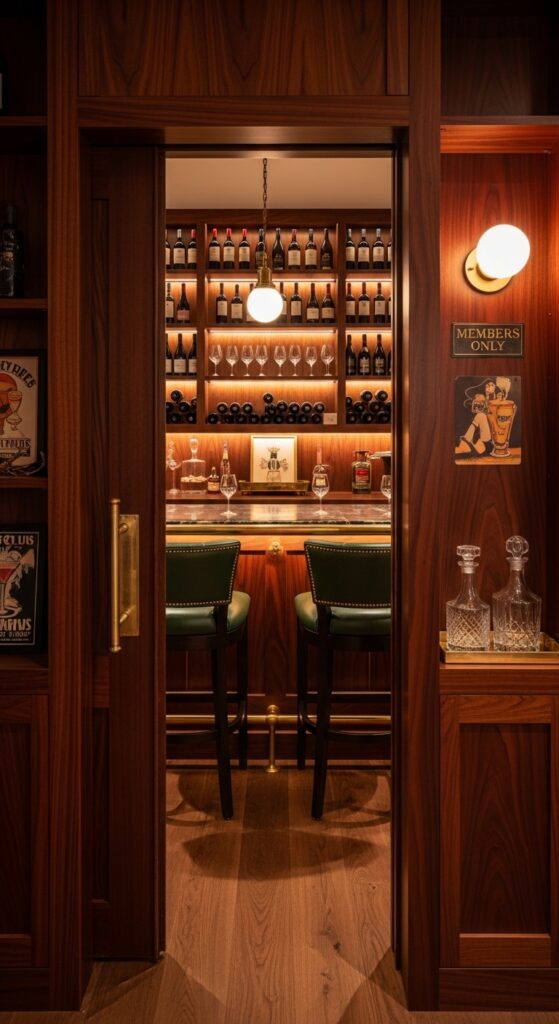
Vibe sentence: There’s something thrillingly illicit about a hidden door that opens into a perfectly stocked, perfectly lit wine room.
What makes it work: The hidden entrance — whether a bookshelf door, a panel door, or a rotating wall section — creates a theatrical reveal that elevates the entire experience of the space. Dark mahogany paneling and green leather seating reference 1920s private club aesthetics, which pair perfectly with wine culture. The drama starts before you’re even inside.
How to achieve it: Murphy Door makes ready-to-install bookshelf doors in multiple widths — no custom carpentry needed. Dark walnut or mahogany-stained MDF paneling on the walls is a cost-effective alternative to solid wood that photographs identically.
💡 A brass bar rail ($30–$60 per foot) instantly signals “bar” and ties the speakeasy story together.
Minimalist Scandinavian Wine Room
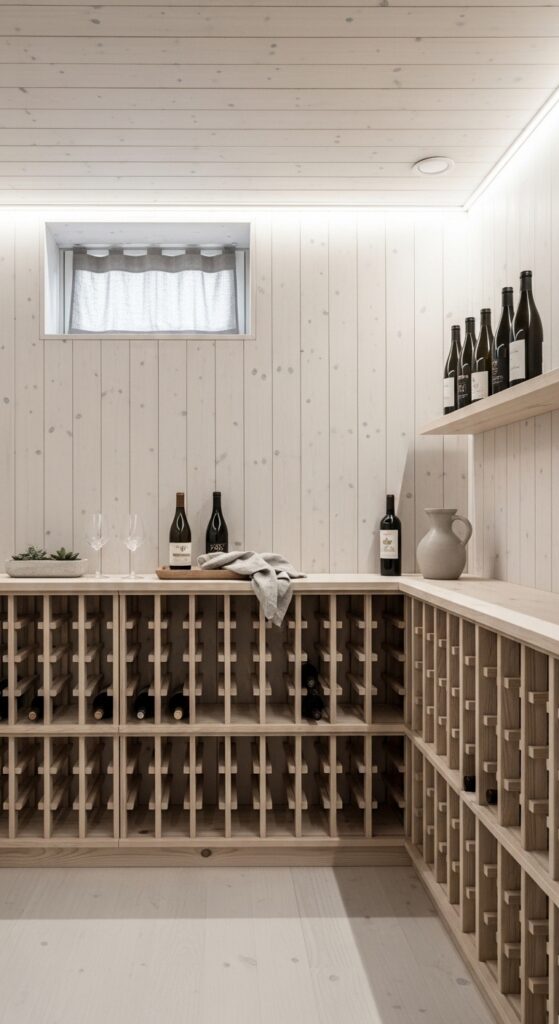
Vibe sentence: The quietest room in the house — and somehow the most interesting.
What makes it work: Scandinavian wine cellar design succeeds through radical restraint. White-washed pine walls read as textured without being heavy, and blonde birch racking keeps the space airy even when fully stocked. The deliberate elimination of ornamentation forces every element to be beautiful on its own terms — and the result feels genuinely sophisticated.
How to achieve it: Use IKEA’s KALLAX shelving units (turned sideways) as modular wine storage — each square holds a bottle perfectly and the system is infinitely expandable. White-wash raw pine boards with a 1:3 mixture of white paint and water, apply with a rag, then wipe back for natural grain visibility.
Farmhouse Cellar with Shiplap Walls
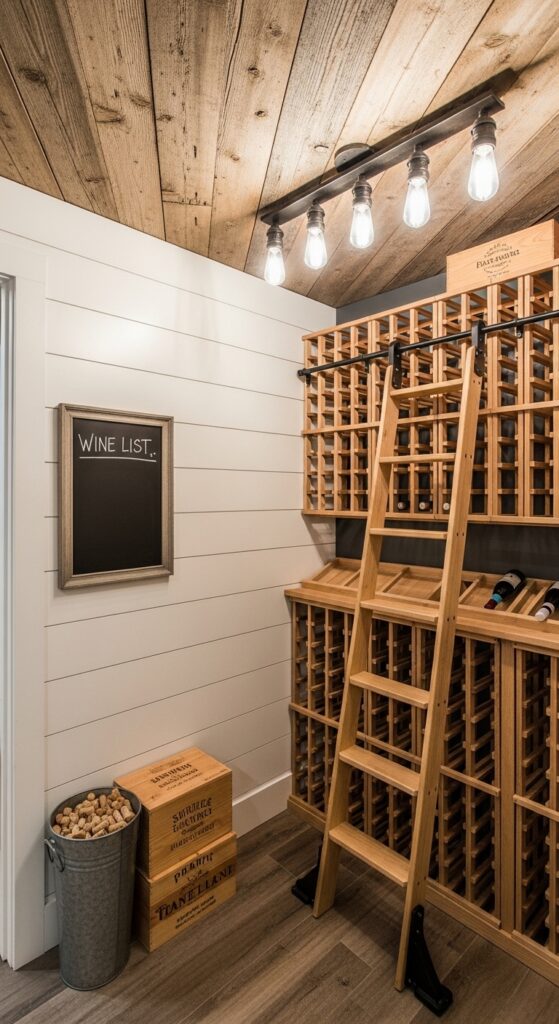
Vibe sentence: Relaxed, genuine, and warmly American — this cellar feels like the best version of a farmhouse pantry all grown up.
What makes it work: Shiplap’s horizontal lines add a subtle rhythm that guides the eye along the wall, making even a small basement cellar feel longer and more purposeful. The shadow gap between boards adds depth without ornament — a hallmark of genuinely good shiplap work. Natural pine racking against white shiplap is a classic light-on-light contrast that stays bright and inviting.
How to achieve it: Install primed MDF shiplap boards (available pre-cut at home improvement stores) at 3/8-inch gaps with a nickel spacer during installation. Paint in Benjamin Moore’s “Chantilly Lace” for the crispest white that doesn’t veer cold.
Grand Library-Style Wine Wall
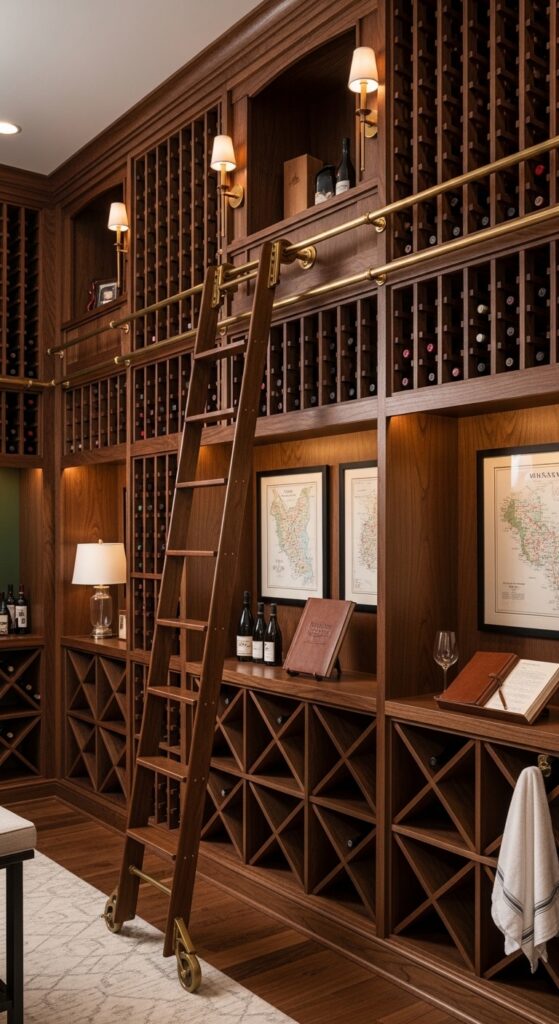
Vibe sentence: Floor-to-ceiling walnut racking with a rolling ladder signals one thing: this collection is taken seriously.
What makes it work: The library ladder is the single most dramatic functional element you can add to a wine cellar — it’s practical for high storage and instantly communicates scale and seriousness. Deep walnut built-ins give the room gravitas and warmth simultaneously, while the floor-to-ceiling height maximizes storage without expanding the room’s footprint.
How to achieve it: Custom built-ins are the gold standard, but modular wine racking towers from VintageView or Vigilant can be stacked to ceiling height and finished with crown moulding for a built-in look at roughly 40% of the custom cost. Antique brass rolling ladder hardware ships ready-to-install from several online suppliers.
💡 A single rolling ladder on a brass rail can be sourced for $300–$600 — the room’s entire visual statement.
Barrel Room Aesthetic in a Basement
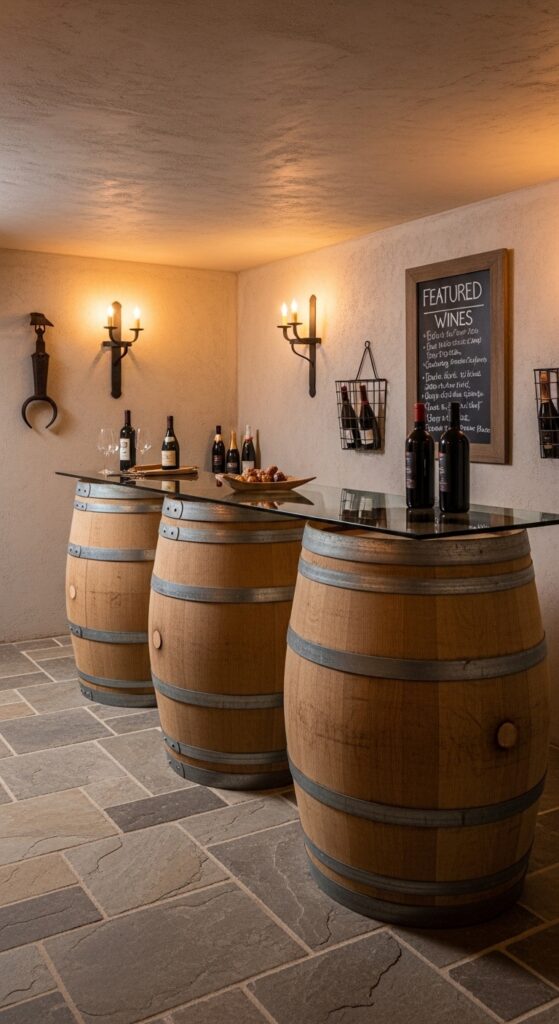
Vibe sentence: Close your eyes, and you could be walking a tour through a Napa working winery — except this is your basement.
What makes it work: Genuine French oak wine barrels carry an aroma, a visual weight, and an authenticity that no prop or replica can replicate. Using barrels as furniture — stacked as a tasting bar, arranged as seating risers — grounds the winery aesthetic in real objects with real wine histories. Rough plaster walls and stone floors complete the working-winery picture.
How to achieve it: Used French oak wine barrels sell for $50–$150 each at winery liquidation sales and online at sites like Houzz Marketplace. Request “once-used” barrels — they’ve held wine long enough to carry the aroma but remain structurally sound. Stand them on end and add a glass or slate top for a characterful tasting surface.
Nook Wine Cellar Under the Stairs
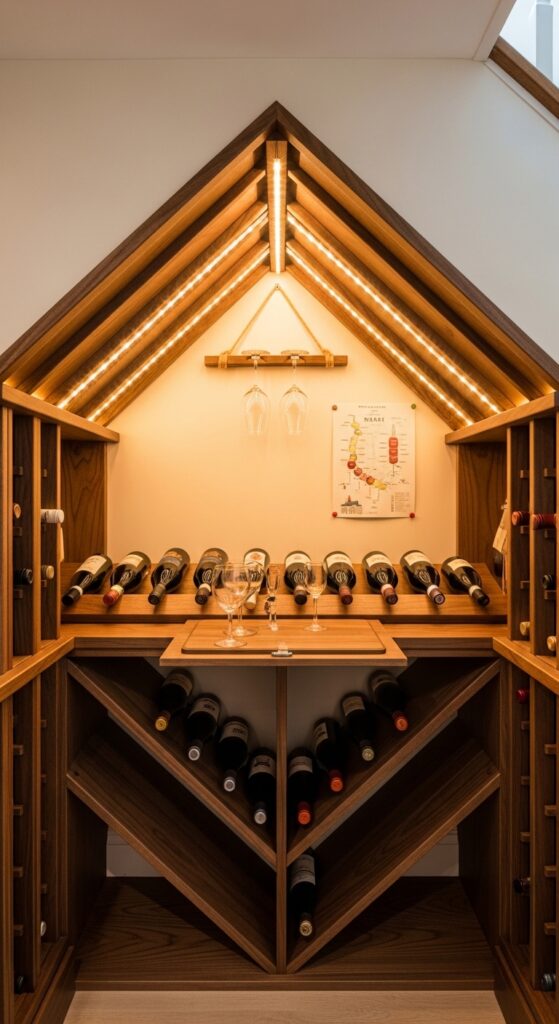
Vibe sentence: The most overlooked space in a basement becomes, with the right design, its most delightful surprise.
What makes it work: Under-stair wine storage works because the angled ceiling, which makes the space useless for most purposes, is actually ideal for diagonal bottle racking — the natural angle keeps corks moist without additional hardware. LED strip lighting beneath each row serves double duty as task lighting and ambient drama. It’s one of the most efficient uses of dead space in any basement.
How to achieve it: Measure the full triangular footprint of your under-stair space and order a custom-cut modular racking kit — many online wine racking companies offer this service from $150. Install LED warm-white strip lights (2700K color temperature) on the underside of each rack row for that warm, backlit effect.
Art Deco Wine Room with Geometric Tiles
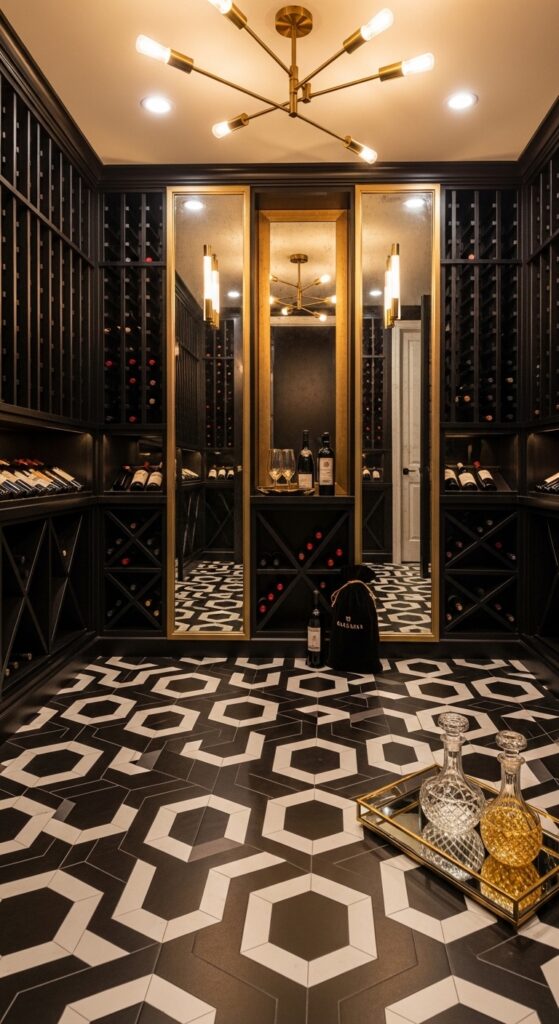
Vibe sentence: Dramatic geometry, warm gold light, and a tile floor you want to photograph every time you visit — this is wine storage as high glamour.
What makes it work: Art Deco’s signature geometric vocabulary — hexagons, chevrons, angular forms — works beautifully in a contained space like a wine cellar because it creates pattern and visual complexity without overwhelming the primary function. Gold accents against black and white is a timeless, high-contrast combination that photographs spectacularly and never trends out.
How to achieve it: Black and white hex tile is available from Wayfair, Bedrosians, and most tile showrooms starting at $3–$5 per square foot. Add stick-on mirror panels with gold-leaf edging between racking columns for the Art Deco glamour at a fraction of custom mirror cost.
Rustic Wine Cave with Stone Floor
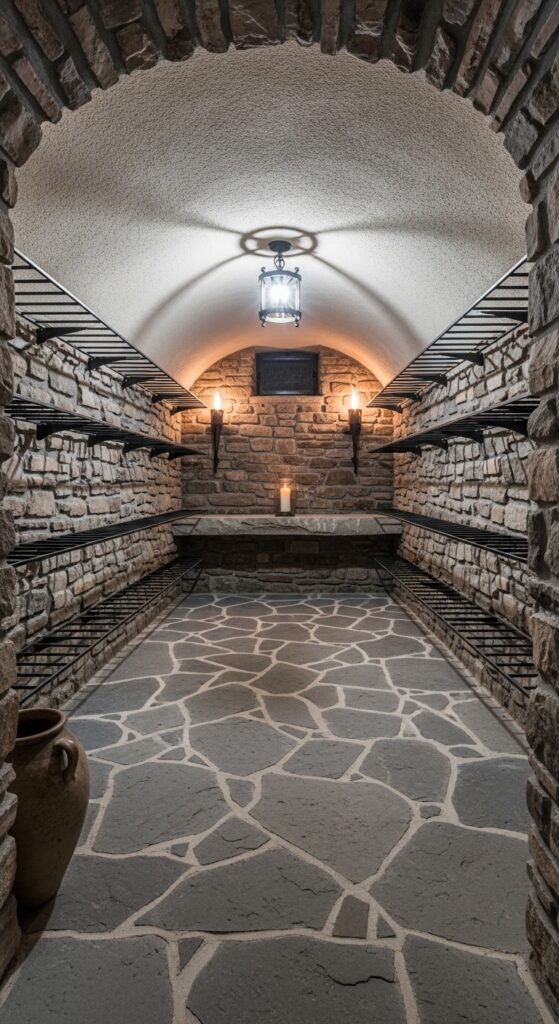
Vibe sentence: Raw, primal, and strangely serene — stepping into this cellar feels like descending into a space that the earth itself made.
What makes it work: The deliberate roughness of flagstone flooring and natural stone walls succeeds because it never tries to be refined — it leans fully into the cave aesthetic. That commitment is what reads as intentional design rather than unfinished construction. Low iron torch sconces are the ideal lighting choice because they reinforce the atmosphere without requiring elaborate wiring.
How to achieve it: Irregular flagstone flooring is available at landscape supply yards and stone merchants for $2–$6 per square foot and can be set in mortar over a concrete subfloor. For the walls, dry-stack natural fieldstone veneer goes directly over existing drywall with construction adhesive.
Contemporary White Oak Wine Cellar
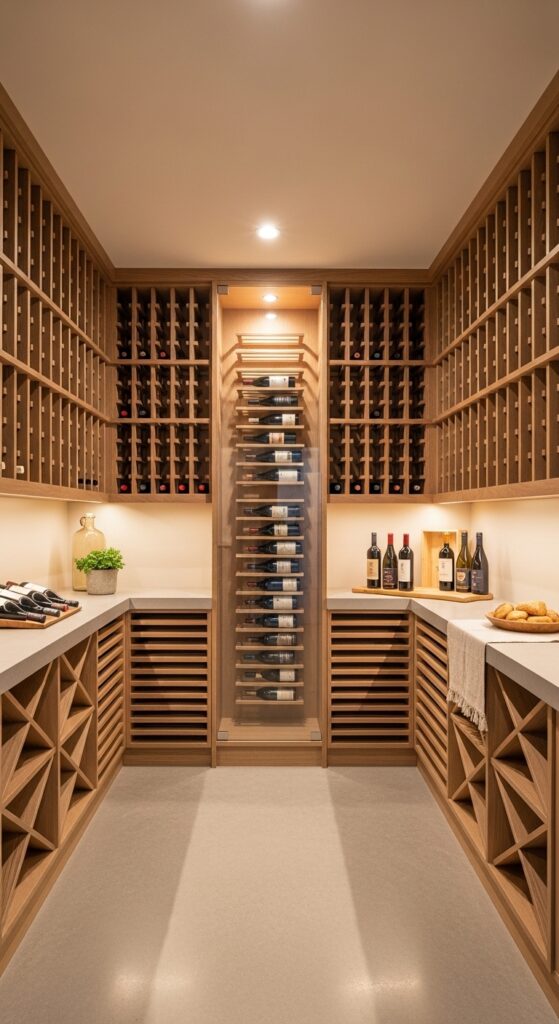
Vibe sentence: Warm, precise, and quietly architectural — this cellar speaks in the measured language of contemporary design without a single cold moment.
What makes it work: White oak’s tight, consistent grain is one of the most sophisticated wood choices in contemporary interiors right now — it reads as warm without the yellow tone of pine or the heaviness of walnut. LED lighting embedded directly into the oak slats eliminates the need for pendant fixtures and creates an even, flattering glow across every bottle.
How to achieve it: White oak wine racking is available through custom millwork shops and through specialty suppliers like VintageView whose “Wall Series” uses a similar clean horizontal aesthetic. Specify quarter-sawn cut for the most consistent, tight grain pattern.
Wine Cellar with Built-In Tasting Table
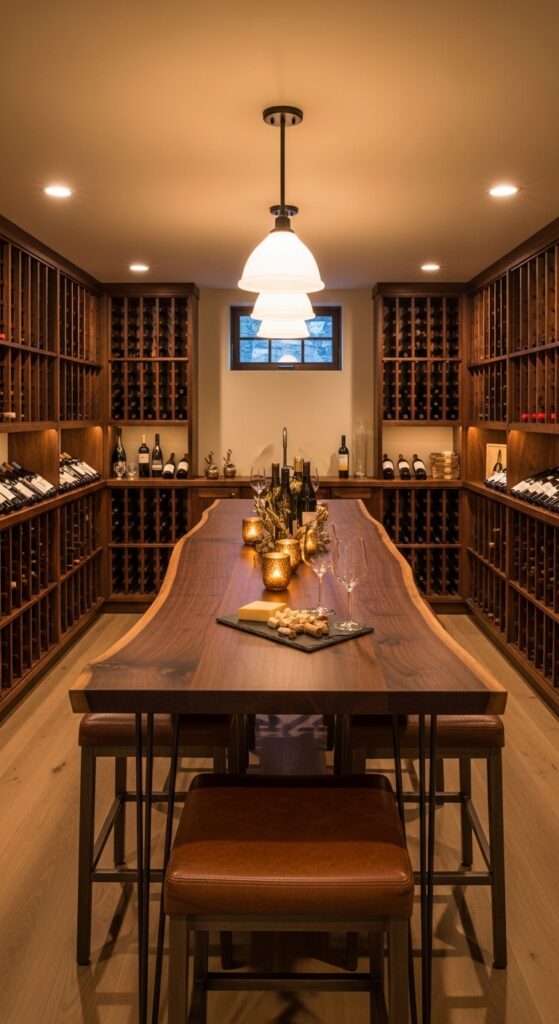
Vibe sentence: This is where the evening actually begins — before the dinner table, the real conversation happens down here.
What makes it work: A central tasting table transforms a storage room into an entertainment destination. The juxtaposition of floor-to-ceiling wine storage on both walls with a hospitality-focused center island creates two clear functions in one room — collect and celebrate. Walnut surfaces on both the table and racking create total material cohesion.
How to achieve it: A walnut butcher block countertop (available from IKEA or lumber yards) cut to length and mounted on simple metal hairpin legs makes an excellent tasting table that looks custom. Pair with leather counter stools in a cognac or espresso tone for a warm, rich contrast.
💡 Hairpin leg tasting tables can be assembled for under $400 total — high-end appearance, weekend build.
Compact Apartment-Friendly Wine Wall
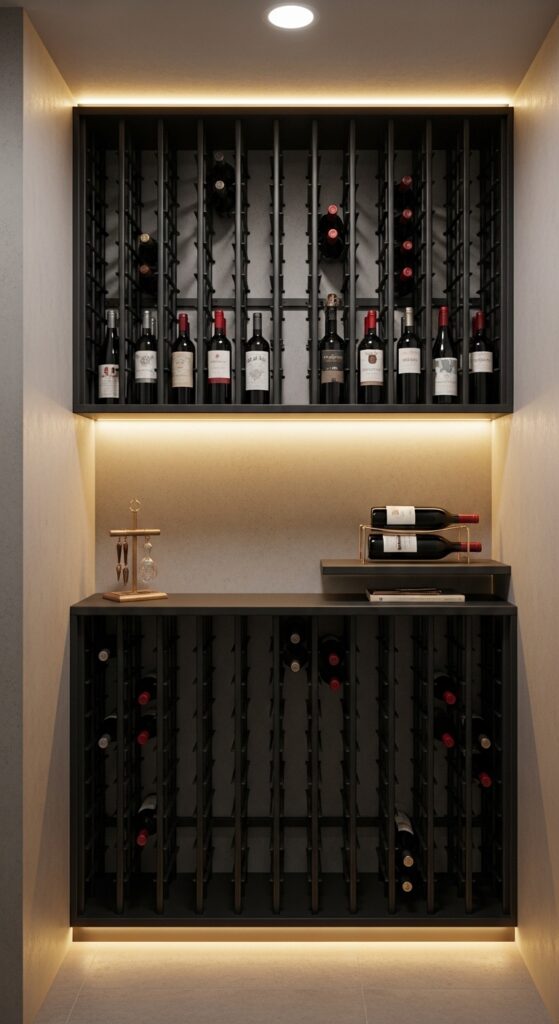
Vibe sentence: Small footprint, serious collection — proof that great wine storage is about intention, not square footage.
What makes it work: Thin-profile metal modular racking maximizes every inch of vertical space in a narrow alcove without the visual bulk of wood racking systems. The vertical emphasis draws the eye up, making the ceiling feel higher and the collection feel more substantial. Warm LED strip at top and bottom frames the entire wall as a single designed element.
How to achieve it: IWA Wine Accessories and WineRacksAmerica both offer modular stackable metal racking in matte black that starts at under $50 per module. Begin with a single 3×3 module and add vertically as your collection grows — the modular design makes this completely scalable.
Mediterranean Blue Wine Cellar
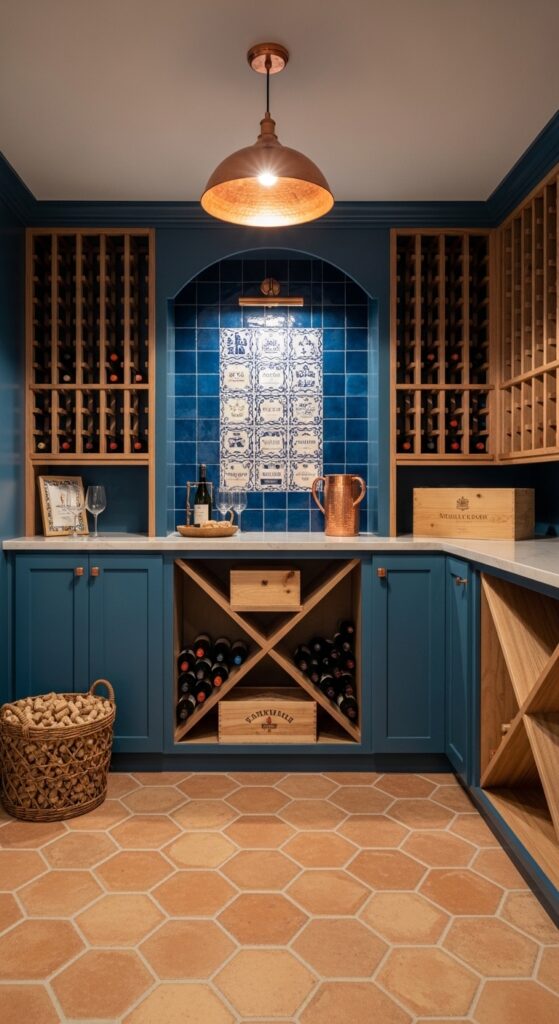
Vibe sentence: Warm, sun-soaked, and steeped in the slow pleasures of Mediterranean living — even the basement.
What makes it work: A deep, saturated blue wall in a wine cellar reads as rich rather than cold because it’s warmed by the terracotta floor and copper lighting. The three materials — blue, terracotta, copper — are a Mediterranean color triad that has worked for centuries precisely because each element warms and balances the others. This palette is unexpectedly effective in basement spaces because the depth of color makes low ceilings feel intentional.
How to achieve it: Try Sherwin-Williams “Aegean Teal” or Benjamin Moore “Aegean Teal” on the walls in a flat/matte finish. Pair with unlacquered copper pendant lighting — the patina deepens with age, making the room more beautiful over time rather than less.
Vertical Wine Display Wall Feature
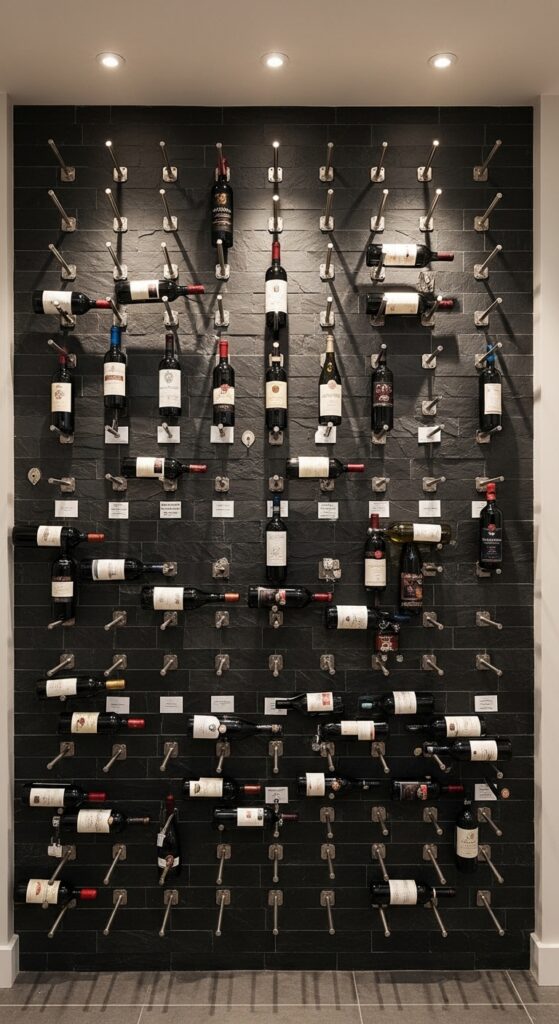
Vibe sentence: This is less wine storage and more living art installation — a curated, ever-changing gallery where every bottle is displayed with intention.
What makes it work: Individual label-forward pegs mounted to a dark feature wall transform wine bottles into display objects, turning the collection into the room’s primary art piece. The label-forward orientation means the visual composition shifts every time a bottle is added or removed — making the wall inherently dynamic. Directional spotlights treat each bottle like a gallery artifact.
How to achieve it: VintageView’s “Freewall” individual bottle peg system mounts directly to any wall surface — tile, plaster, or wood — with simple screws. Each peg holds a single bottle horizontally at a label-display angle and starts at $5 per peg. Design your grid on paper first, then transfer measurements to the wall.
Cozy Low-Ceiling Cellar with Exposed Beams
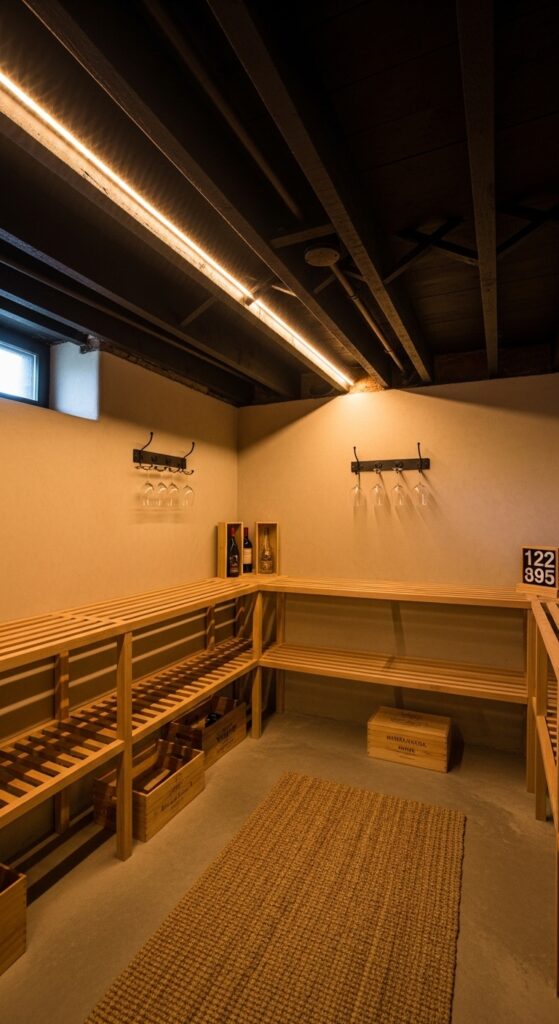
Vibe sentence: Low ceilings aren’t a problem here — they’re the entire point, making this cellar feel like the coziest room in the house.
What makes it work: Painting exposed beams matte black draws the eye upward while simultaneously making them feel structural and intentional rather than merely utilitarian. The low ceiling becomes an asset — it creates intimacy and enclosure that a higher-ceilinged space simply can’t manufacture. Warm LED strips between the beams provide task lighting without any visible fixture.
How to achieve it: Wrap existing steel I-beams or standard joists in faux wood beam wraps (available in multiple widths online) then paint in Benjamin Moore “Wrought Iron” flat. This creates the appearance of solid, heavy timber without any structural work required.
Wine Cellar with Dedicated Decanting Station
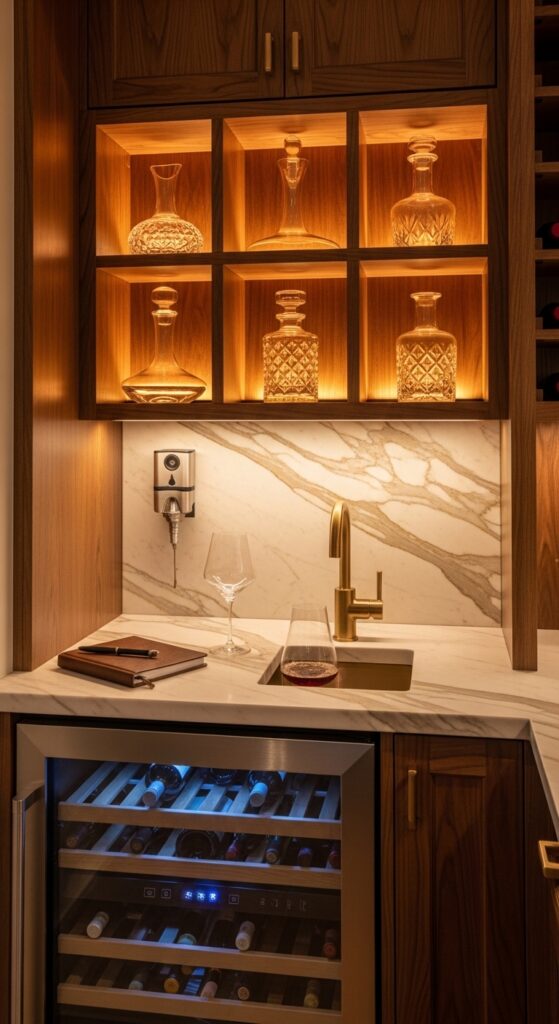
Vibe sentence: The ritual of decanting deserves its own dedicated stage — and this marble station delivers it.
What makes it work: A dedicated decanting station signals that the cellar is designed for the full wine experience, not just storage. Backlit decanter cubbies serve both functional (easy identification) and dramatic (glowing crystal as art) purposes simultaneously. A marble surface is the ideal material choice — it’s cool to the touch, easy to clean, and visually luxurious.
How to achieve it: Commission a local cabinet maker to build a wall niche with LED-lit interior and a marble slab top — specify 3cm Calacatta or Carrara marble for a genuine stone surface. Add an undercounter 24-bottle wine fridge (Newair and EdgeStar make excellent compact models) for serving-temperature wines separated from the main cellar storage.
💡 A backlit niche for decanters can be built with a simple box frame, LED strip, and frosted acrylic back panel — DIY for under $100.
Chic Feminine Wine Cellar in Blush and Brass
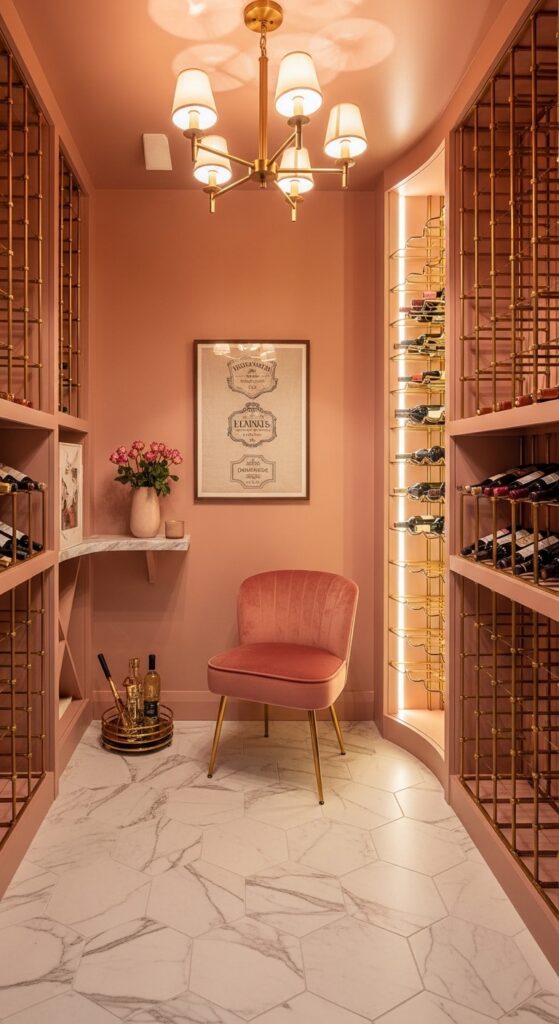
Vibe sentence: Unexpected, elegant, and quietly revolutionary — this blush and brass wine cellar breaks every expectation of what a cellar can be.
What makes it work: Blush pink plaster walls work in a wine cellar because the color is warm, not sweet — especially when used in matte texture against polished brass hardware. The open brass wire racking silhouette is the design masterstroke here: it’s light, sculptural, and feminine without sacrificing storage capacity. This combination photographs beautifully for the same reason it looks beautiful in person — the warm tones create an inherently flattering light quality.
How to achieve it: Portola Paints’ Roman Clay in “Ballet Pink” or “Dusty Rose” gives the matte, textured plaster effect with a DIY-accessible application method. Open brass wire racking is available through Pottery Barn Wine Storage and similar lifestyle retailers.
Statement Ceiling Wine Cave with Mosaic Tile
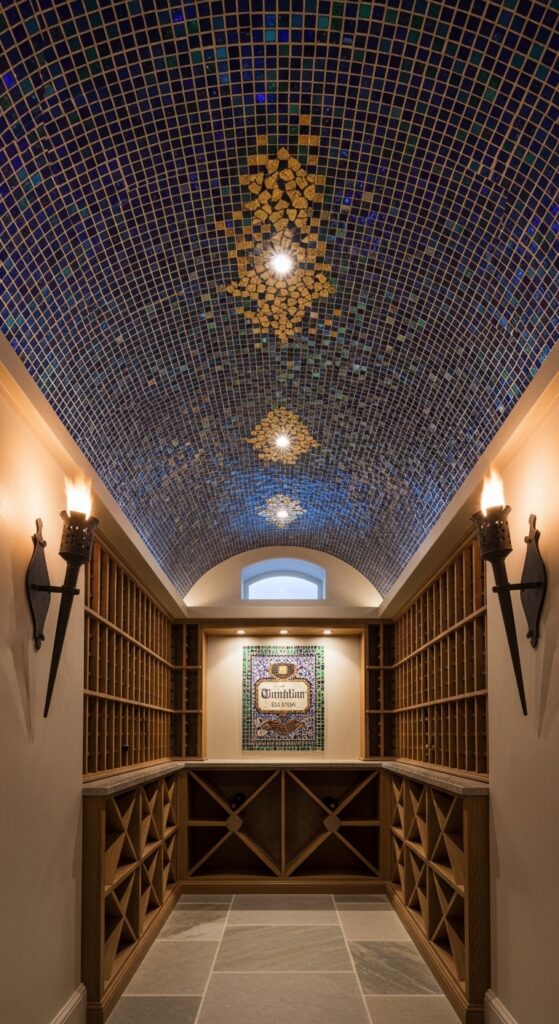
Vibe sentence: Look up — because in this cellar, the ceiling is the undeniable star of the entire room.
What makes it work: Making the ceiling the statement surface in a wine cellar is a genuinely inspired design move — it’s the one surface where a wine rack can’t compete, leaving it fully available for drama. Mosaic tile in jewel tones refracts ambient light in a way that flat painted surfaces never can, creating a living, shifting ceiling that changes with every adjustment to the lighting.
How to achieve it: Glass mosaic tile sheets in jewel tones are available from Fireclay Tile, Tile Bar, and similar specialty tile companies. Hire a tile professional for arched ceiling application — the curved surface requires specific technique. Keep the walls and floors deliberately simple so the ceiling reads without competition.
Wine Cellar with Built-In Sommelier Reference Library
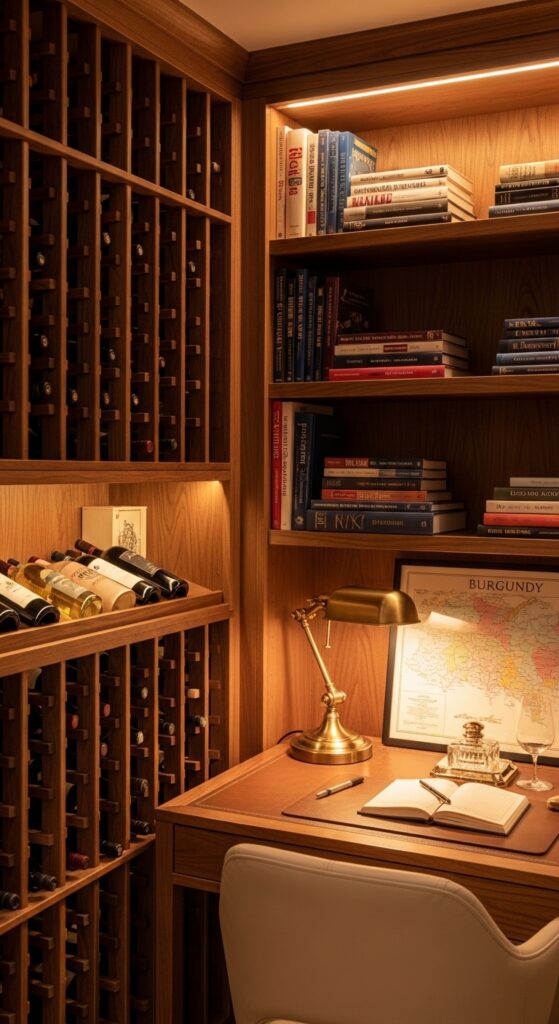
Vibe sentence: This is a cellar for someone who loves wine the way a reader loves books — as a lifelong pursuit, not a pastime.
What makes it work: Adding a reference library wall to a wine cellar is a declaration that this space is for the study and enjoyment of wine culture, not just its storage. The visual tension between ordered wine racking on one wall and casually stacked books on the adjacent wall creates a room with genuine character and warmth. The small leather desk anchors both functions beautifully.
How to achieve it: Simple walnut-stained built-in shelving can be constructed from face-frame box units (IKEA Billy units painted and trimmed with walnut veneer face frames is a proven hack). Add brass cabinet lights to illuminate spines. Collect wine books intentionally — seek out regional maps, vintage guides, and memoir-style wine writing.
Dramatic Red Accent Wine Cellar
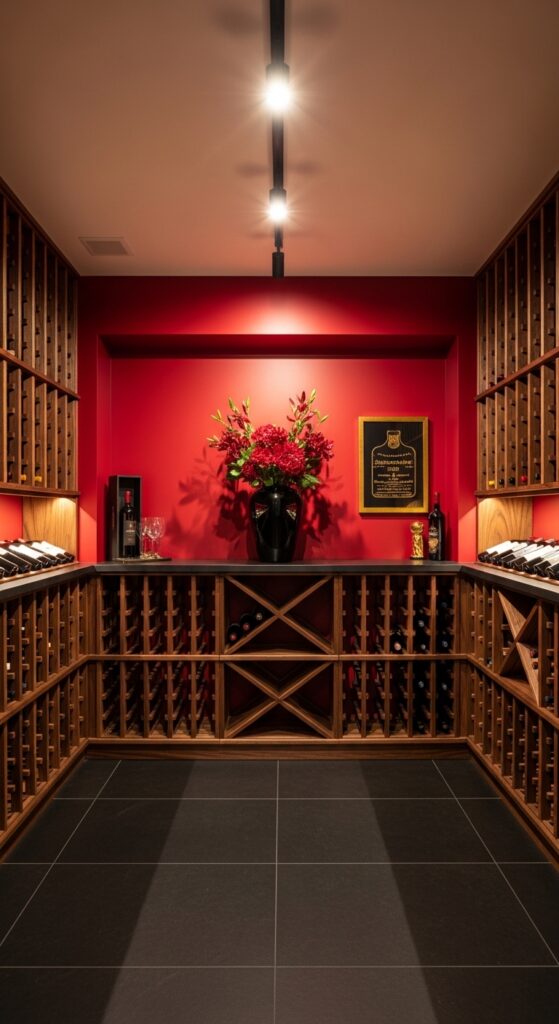
Vibe sentence: Rich, confident, and deeply appropriate — this deep Bordeaux red wall makes every bottle look like it belongs in the best cellar in the world.
What makes it work: A single deeply saturated wine-red accent wall behind the main racking display is one of the highest-impact design choices available in a cellar — the color is thematically perfect, visually dramatic, and immediately elevating for any collection displayed against it. Dark walnut racking on red creates a tone-on-tone depth that feels luxurious without being busy.
How to achieve it: Try Benjamin Moore “Bordeaux” or Farrow & Ball “Rectory Red” in a dead-flat matte finish — matte is essential for this depth of color as any sheen will read as theatrical rather than sophisticated. Apply two full coats for complete coverage at this deep saturation level.
💡 One accent wall in Bordeaux red costs a single can of paint — and changes the entire character of the room.
How to Start Your Wine Cellar Basement Transformation
The most common mistake when planning a basement wine cellar is starting with aesthetics and working backwards. The right sequence is the opposite: start with climate control, then racking, then design.
Begin by assessing your basement’s existing temperature and humidity. Wine stores best at 55°F with 60–70% humidity — if your basement already runs cool and slightly damp, your climate control investment will be minimal. If it’s dry and variable, budget for a dedicated cooling unit before a single rack goes in.
Once climate is addressed, choose your racking system. Modular metal or wood racking is the most beginner-friendly starting point — it requires no construction, can be expanded as your collection grows, and is available at multiple price points. Custom built-ins come later, once you know the layout that works for how you actually use the space.
For design, the easiest entry point is a single strong material choice — stone veneer, shiplap, or a deep paint color — applied to one wall. A feature wall with simple racking in front costs far less than a full room renovation and creates immediate visual impact. Add lighting intentionally: warm LEDs at 2700K will make any racking system look like a curated installation.
Realistic timeline: a simple modular setup with a feature wall can be completed in a weekend. A full custom cellar with cooling, built-ins, and tasting furniture is a 4–8 week project.
Frequently Asked Questions
What temperature should a home wine cellar basement be?
The ideal temperature for long-term wine storage is 55°F (13°C), though any consistent temperature between 45°F and 65°F is acceptable. Consistency matters more than the exact degree — fluctuations in temperature are more damaging to wine than a slightly warmer or cooler steady temperature. Invest in a quality wine cellar cooling unit (CellarPro, WhisperKool, or Wine Guardian are reliable residential brands) rather than relying on natural basement temperatures, which vary seasonally.
How much does it cost to build a basement wine cellar?
Costs vary widely depending on scope. A basic modular racking setup in an existing basement space can be done for $500–$2,000. A mid-range wine cellar with climate control, custom racking, and design finishes typically runs $5,000–$15,000. A fully custom wine cellar with built-in millwork, glass walls, cooling system, and tasting furniture can reach $20,000–$50,000+. The largest cost variables are climate control (a quality cooling unit runs $800–$3,000) and racking (custom built-ins vs. modular systems make the biggest price difference).
Do I need a permit to build a wine cellar in my basement?
In most jurisdictions, a basic wine cellar built within an existing finished basement space does not require a permit. However, if you’re adding a cooling unit that requires new electrical circuits (typically a dedicated 20-amp circuit), a licensed electrician must do this work and it may require an electrical permit. Structural changes — like cutting into a foundation wall for a cooling unit vent — may also trigger permitting. Always check with your local building department before beginning any mechanical work.
What’s the best wine racking material for a basement wine cellar?
Redwood and mahogany are traditionally considered the best wood choices for wine cellar racking because they are naturally resistant to mold and moisture — important in basement environments. Pine is the most affordable wood option and works perfectly in a properly climate-controlled space. Metal racking (powder-coated steel or aluminum) is the most moisture-resistant and longest-lasting choice in any basement setting. For high-humidity basements without full climate control, metal racking is the safest recommendation to avoid warping over time.
How many bottles can a basement wine cellar hold?
A standard 750ml bottle requires approximately 3.5 inches of linear racking space when stored horizontally. A 10×10 foot wine cellar with floor-to-ceiling racking on all four walls can typically hold 1,000–1,500 bottles depending on racking configuration. Under-stair conversions typically accommodate 100–300 bottles. A single 8-foot wall of floor-to-ceiling racking holds approximately 200–400 bottles. When planning your cellar, design for double your current collection — wine collections grow faster than anticipated.
Ready to Create Your Dream Wine Cellar Space?
You’ve just explored 28 distinct wine cellar basement ideas — from Old World stone vaults and Tuscan barrel rooms to minimalist Scandinavian setups and glass-enclosed contemporary galleries. The range is intentional: there is no single correct wine cellar aesthetic, only the one that reflects how you live with and love wine. Save or pin the ideas that made you pause and say that one — because that instinct is exactly right.
Transformation doesn’t require the whole vision at once. Start with a great feature wall and a modular racking system. Get the climate right. Then let the space evolve with you and your collection. The most beautiful wine cellars aren’t the most expensive — they’re the ones that feel genuinely inhabited and loved.
Your basement is waiting. The wine is patient. The only question is: where do you begin?