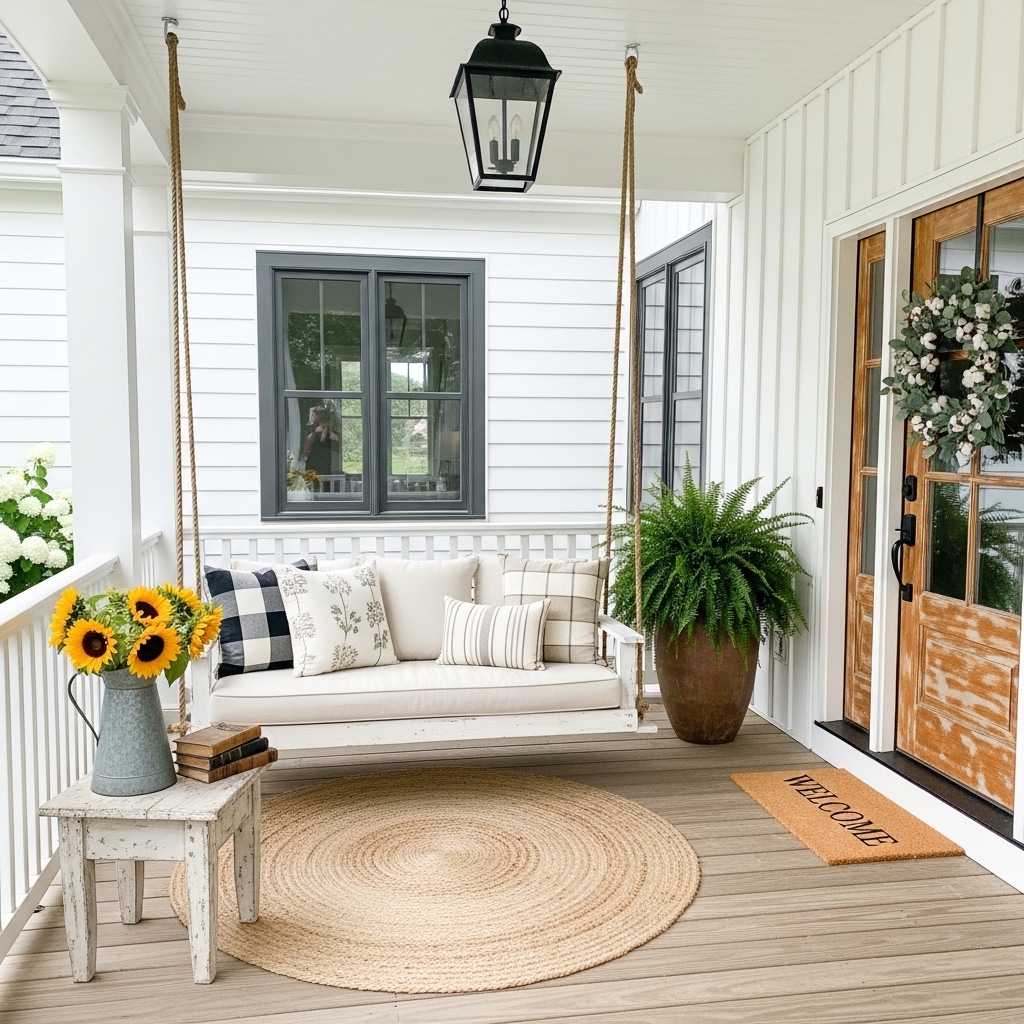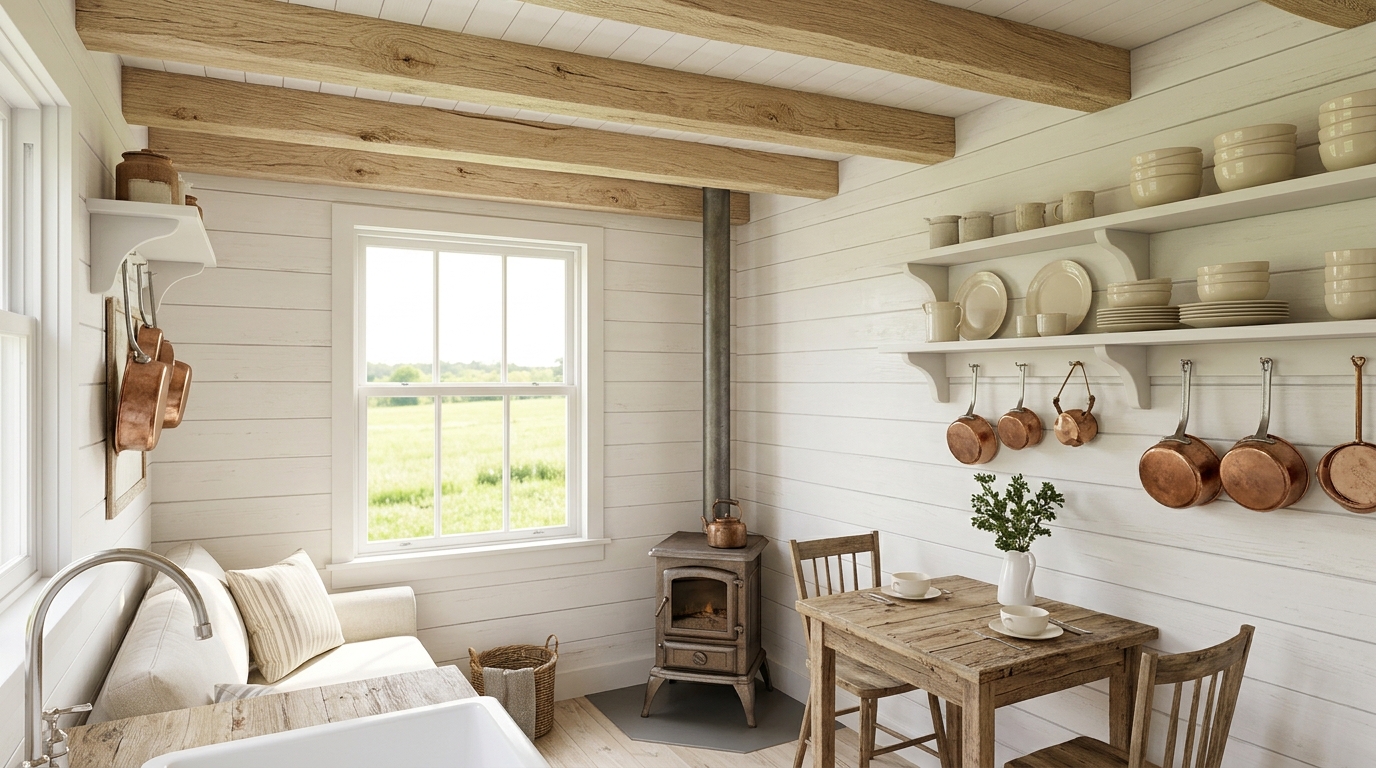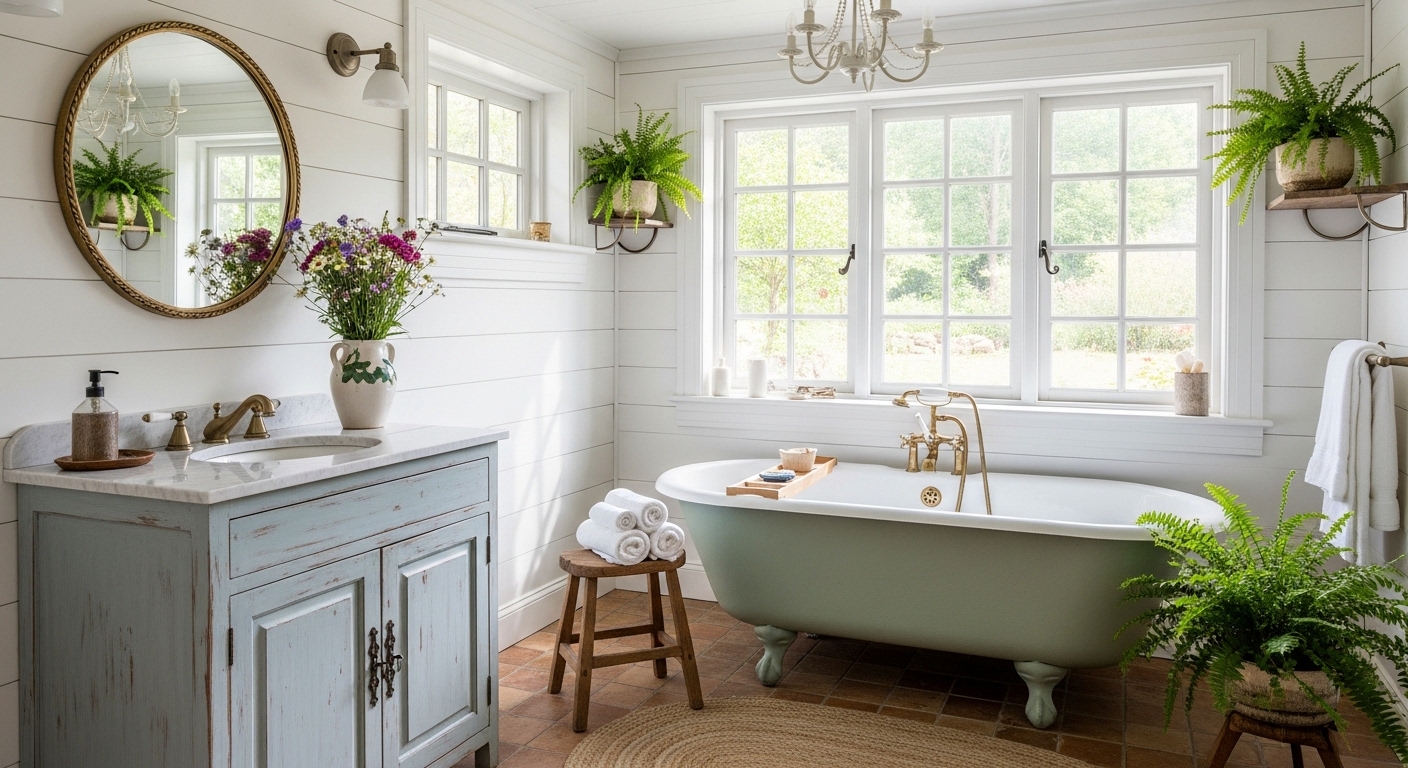
There’s something deeply satisfying about a home that feels like a genuine retreat — a place where the outside world softens the moment you step through the gate. Exterior wall design for privacy is one of the most powerful transformations you can make to your property, turning an exposed yard or patio into a sheltered, serene sanctuary that still looks architecturally beautiful. Whether you’re shielding a ground-floor bedroom, carving out a private garden room, or simply craving a backyard that feels like yours alone, the right wall design makes all the difference. These 29 exterior wall design ideas for privacy are real, buildable, and visually stunning — ranging from natural living walls to bold architectural screens. Let’s explore every one of them.
Why Exterior Privacy Wall Design Works So Well
Privacy walls have moved far beyond the standard timber fence. Today’s exterior wall design draws from landscape architecture, interior design principles, and materials science to create boundary structures that are as beautiful as they are functional. The best examples don’t look like barriers at all — they look like intentional design features that happen to also block the neighbor’s view.
The defining characteristic of modern privacy wall design is the deliberate use of material contrast. Rough stone paired with smooth concrete, warm timber against cold steel, or a lush green planted wall against white render — these contrasts create depth and visual interest that a single-material solution never achieves. The wall becomes part of the home’s overall architectural language rather than an afterthought.
Privacy-focused landscaping and wall design is experiencing a significant cultural moment driven by two parallel trends: the dramatic rise of outdoor living (spurred by pandemic-era home investment) and growing interest in biophilic design, which incorporates natural materials and living plants into built environments. Pinterest searches for “privacy wall garden,” “outdoor screen ideas,” and “living wall exterior” have surged consistently over the past three years.
Even a small courtyard or a narrow side passage can be transformed with the right wall treatment. Vertical height, material warmth, and texture layering matter far more than square footage when it comes to creating a sense of private enclosure.
1. Horizontal Timber Slat Screen Wall
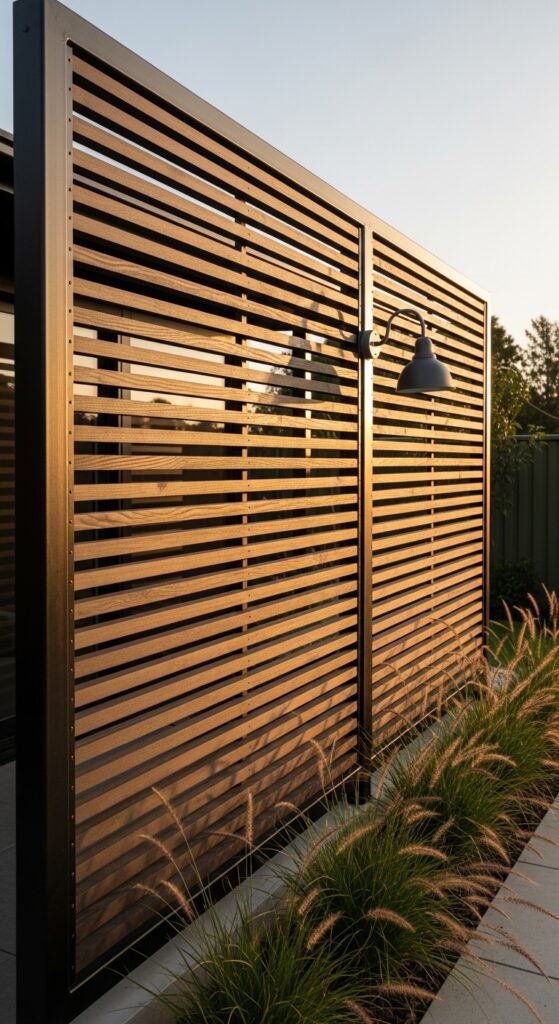
Vibe: Clean-lined and quietly commanding — a wall that says “private” in the most architecturally sophisticated way possible.
What makes it work: The horizontal slat orientation creates strong visual lines that draw the eye along the wall’s length rather than upward, making it feel expansive rather than imposing. The deliberate gap spacing is the genius detail — it provides genuine privacy when viewed straight-on, while still allowing cross-ventilation and filtered light, preventing the oppressive enclosed feel of a solid fence.
How to achieve it: Choose a naturally durable, dimensionally stable timber such as Accoya, Western red cedar, or thermally modified ash. Set slats at 50–60mm spacing for optimal privacy without creating a wind trap. Mount within a steel RHS frame for longevity — timber-only posts will move and warp over years, opening gaps unevenly.
💡 Composite timber-look cladding boards (available from brands like Trex) deliver near-identical aesthetics with zero maintenance and a 25-year warranty.
2. Stacked Stone Retaining Privacy Wall
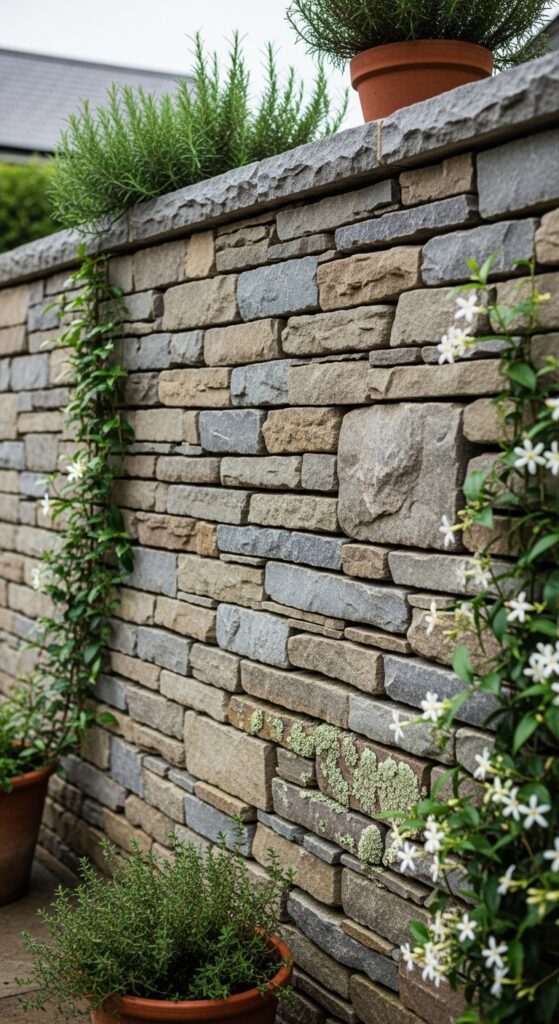
Vibe: Timeless and rooted — as though the wall has always been here, and always will be.
What makes it work: Natural stone walls carry a visual weight and permanence that no manufactured material can replicate. The irregular coursing creates unpredictable shadow patterns that shift throughout the day, making the wall visually dynamic without any additional decoration. Stone also improves aesthetically over time, as lichen, moss, and climbing plants colonize the surface naturally.
How to achieve it: Source locally quarried stone where possible — it integrates more naturally with the surrounding landscape and typically costs 30–40% less than imported varieties. For DIY construction, dry-stack walls under 600mm need no mortar; above that height, engage a stonemason or landscape contractor for structural safety.
3. Painted Concrete Block Wall with Climbing Vines
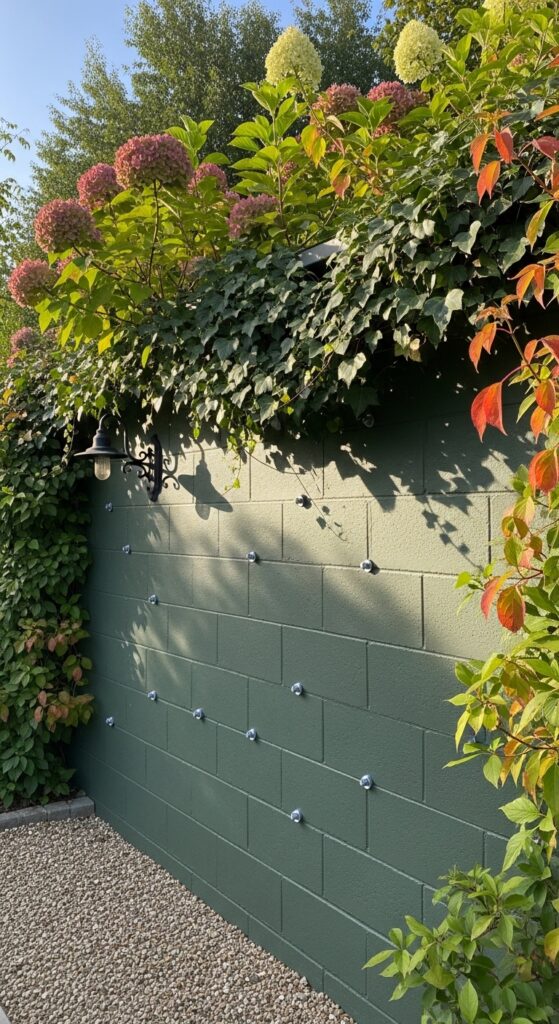
Vibe: Architecture and nature in quiet collaboration — a wall that the garden is slowly, beautifully claiming.
What makes it work: A rendered and painted concrete block wall gives climbing plants a clean, high-contrast backdrop that makes foliage color and texture pop dramatically. The painted surface also gives you design flexibility that raw concrete block lacks — you can shift the palette simply by repainting, while the plants mature independently.
How to achieve it: Apply a waterproof exterior lime render over concrete block before painting for a smooth finish that resists moisture and cracking. Install stainless steel eye-bolts in a grid pattern 400mm apart before painting — this creates an invisible climbing support system that guides vines without visible wire frames. Choose self-clinging climbers like Boston ivy or climbing hydrangea for wire-free coverage.
💡 A single bag of exterior limewash (about $40) can transform a painted concrete wall into a beautiful, breathable, aged-looking surface.
4. Gabion Stone-Filled Metal Cage Wall
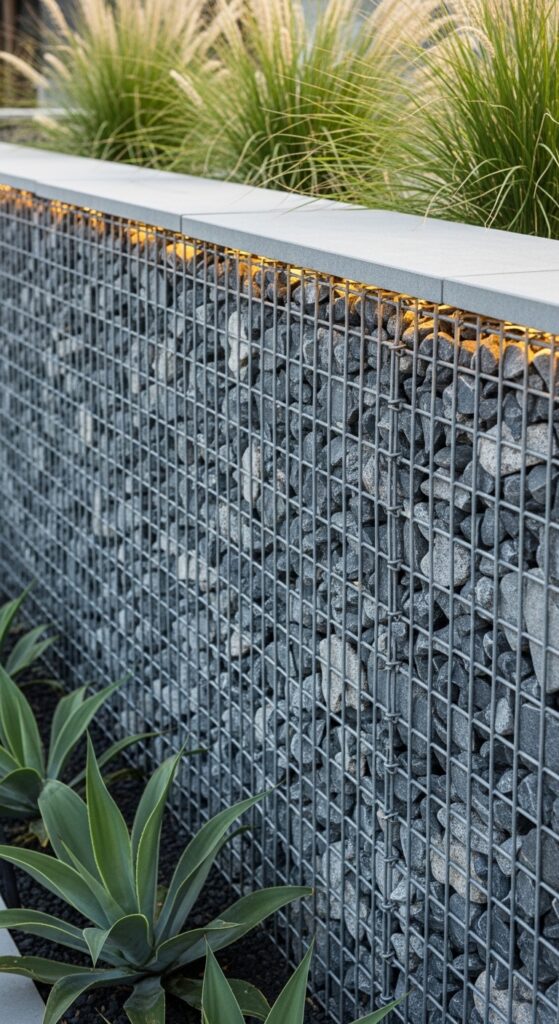
Vibe: Unapologetically structural and unexpectedly beautiful — industrial engineering dressed in river stone.
What makes it work: Gabion walls achieve something visually unique — the texture and warmth of natural stone with the geometric precision of engineered construction. The visible wire mesh grid creates a strong geometric pattern that reads as intentionally modern rather than utilitarian, especially when filled with carefully selected stone in a cohesive color range.
How to achieve it: Source galvanized or PVC-coated gabion cage panels from landscaping suppliers — standard units are 1m x 1m x 0.5m and stack without mortar. Fill with stone between 50–200mm diameter for the best visual effect and structural stability. Lay a geotextile membrane behind the cages to prevent soil migration through the gaps.
5. Bamboo Privacy Screen Panel Wall
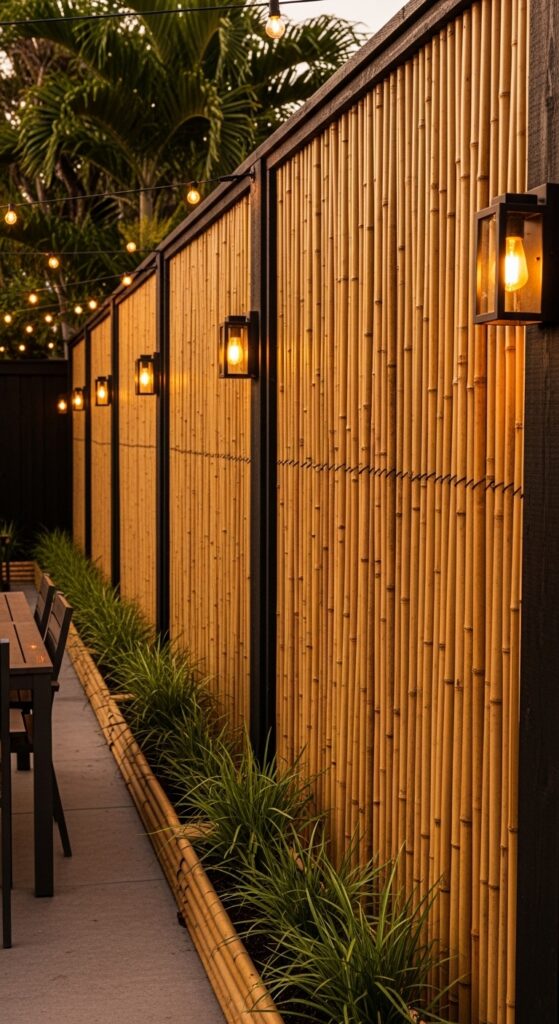
Vibe: Bali-resort calm transplanted into your backyard — effortlessly warm and thoroughly transportive.
What makes it work: Bamboo panels introduce an organic warmth and texture that no synthetic material replicates, and the vertical pole orientation creates a beautiful rhythm of light and shadow across the screen’s surface. Pre-built bamboo panel systems make installation accessible without specialist skills, while the material’s natural color shifts beautifully to a silver-grey as it weathers.
How to achieve it: Choose pressure-treated or kiln-dried bamboo panels for outdoor use — untreated bamboo will split and crack within two seasons in most climates. Frame panels in powder-coated steel or hardwood posts for structural longevity. Seal with exterior bamboo oil annually to slow the natural weathering process.
💡 Roll-up bamboo screening (available at IKEA and most garden centers for $30–60 per roll) is a fast, rental-friendly alternative to built panel systems.
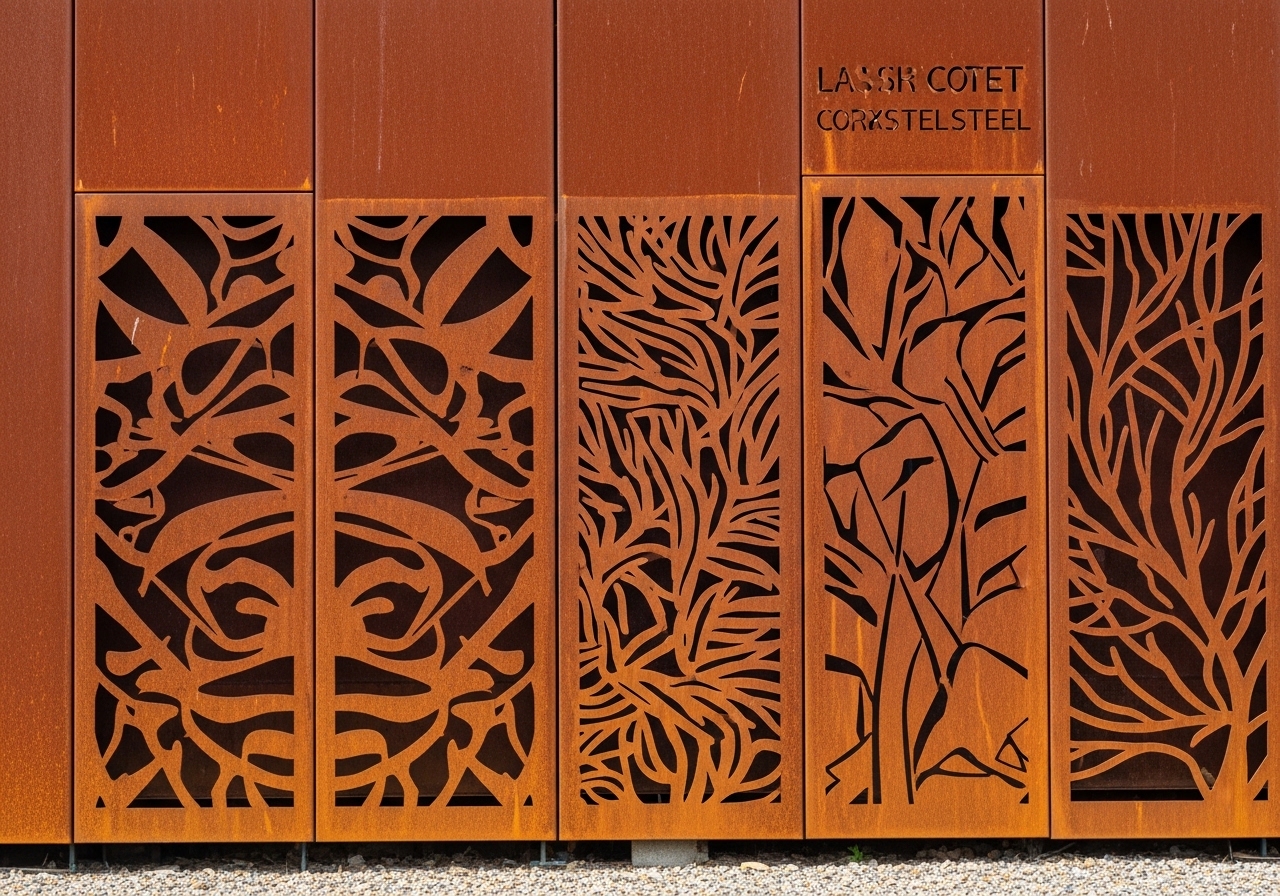
6. Laser-Cut Corten Steel Privacy Screen
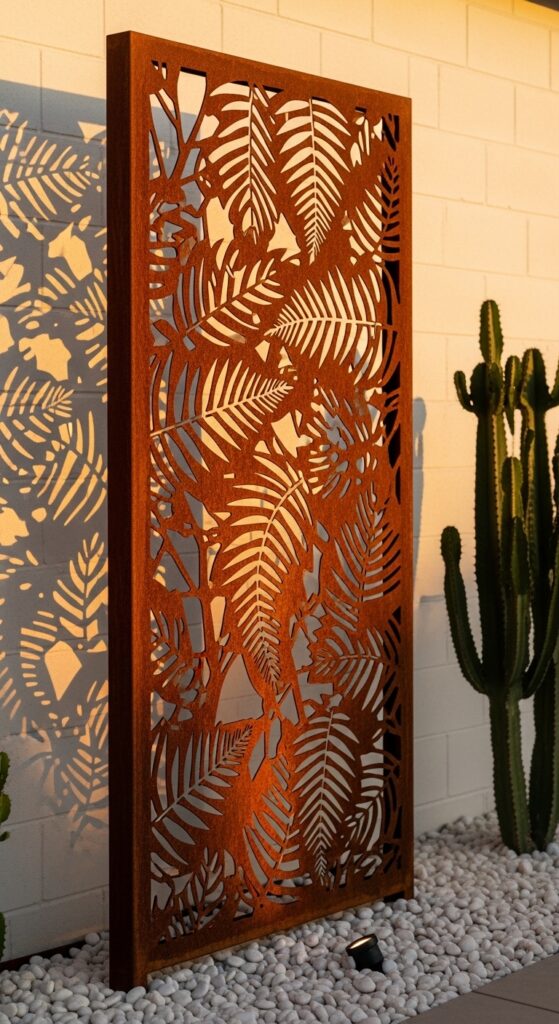
Vibe: Where industrial fabrication meets botanical art — a screen that is simultaneously a piece of architecture and a gallery work.
What makes it work: Corten steel’s self-oxidizing rust patina is one of the most distinctive and low-maintenance exterior finishes available, developing a rich, multi-toned amber-rust surface that never looks the same twice. Laser-cut patterns transform a privacy panel into a sculptural feature — the shadow patterns cast by sunlight through the cut design create a living, shifting artwork across adjacent walls and ground surfaces.
How to achieve it: Commission laser-cut Corten panels from metal fabricators who specialize in architectural screening — a standard 1m x 2m panel in 3mm Corten typically costs $400–800 depending on pattern complexity. Allow the steel to weather naturally through two to three rain cycles before the stable patina develops. Apply clear wax to prevent rust transfer onto light-colored surfaces below.
7. Espalier Fruit Tree Living Wall
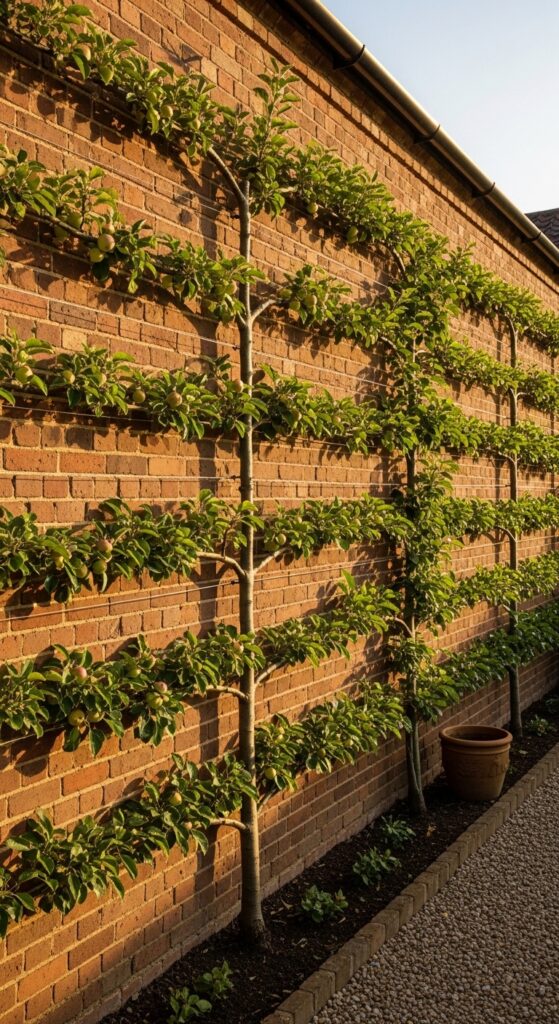
Vibe: French kitchen garden formality — centuries of horticultural craft made visible in every carefully trained branch.
What makes it work: Espalier training flattens a tree’s growth into a two-dimensional form against a wall, creating a living screen that provides privacy, seasonal beauty, fruit production, and habitat for birds — all in a single structural element. The geometric precision of the training wires gives the wall a tailored, architectural quality that purely ornamental climbing plants lack.
How to achieve it: Install horizontal tensioned wires 40cm apart using vine eyes screwed into the wall. Purchase two- or three-year-old pre-started espalier trees from specialist nurseries — starting with trained trees cuts 3–4 years off the time to achieve coverage. Apple and pear varieties are best for espalier; avoid stone fruit in colder climates.
8. Precast Concrete Breeze Block Privacy Wall
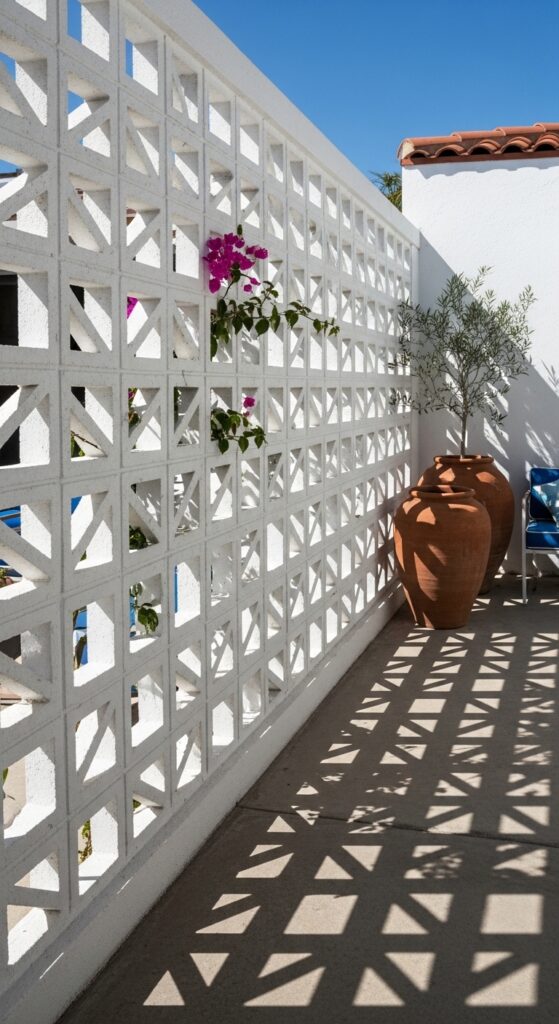
Vibe: Midcentury Palm Springs meets Mediterranean courtyard — bold geometry and blazing sun in perfect partnership.
What makes it work: Decorative breeze blocks create privacy while simultaneously functioning as sun-control screens, with their geometric openings casting extraordinary geometric shadow patterns that shift as the sun moves throughout the day. This makes the wall visually engaging at every hour — the shadow patterns are as much a design element as the blocks themselves.
How to achieve it: Decorative concrete screen blocks are available from specialized concrete suppliers and some landscape yards, typically costing $8–20 per block. Lay in standard masonry bond pattern using regular mortar, with reinforcing rods through every third vertical row for structural integrity. Paint with exterior masonry paint in a single strong color — brilliant white, terracotta, or charcoal all produce striking results.
💡 Reproduction mid-century screen block moulds are available online for $40–80, letting you cast your own blocks from ready-mix concrete.
9. White Rendered Wall with Arched Openings
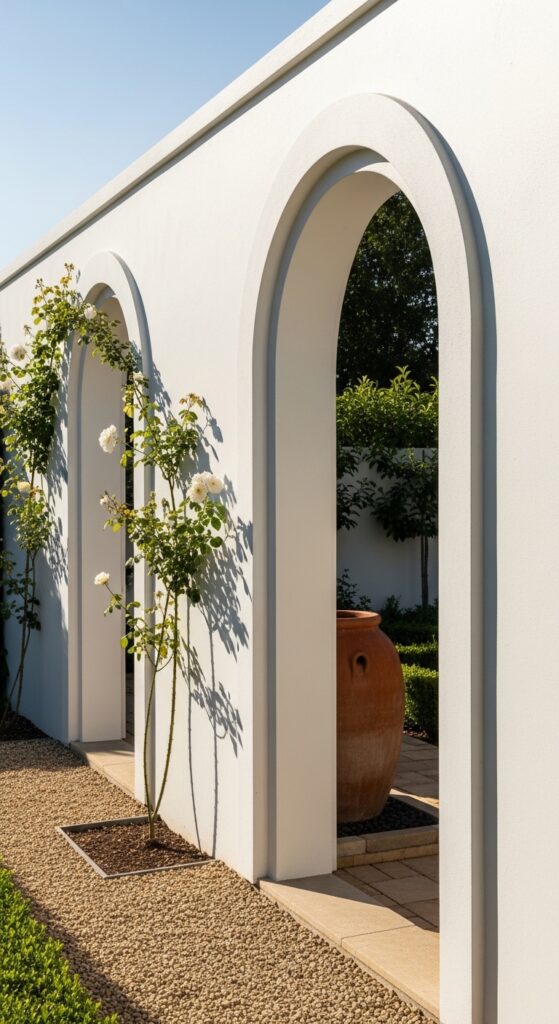
Vibe: Ancient and refined — a wall that creates a sense of arrival, transition, and hidden garden magic.
What makes it work: Arched openings in a solid privacy wall solve the psychological problem of enclosed spaces feeling too closed-off or claustrophobic. By framing deliberate views through carefully placed openings, the wall creates a sense of mystery and depth — you can see through, but not into, the private space beyond. The arch form itself is one of architecture’s most universally beautiful shapes.
How to achieve it: Use a steel arch former (available from masonry suppliers) as the centering for the arch during construction. Smooth render requires two to three coats of base render followed by a fine finishing coat — hire a plasterer for the finest result. Apply a breathable silicate exterior paint rather than standard masonry paint for a lime-render wall.
10. Vertical Garden Living Wall Panel
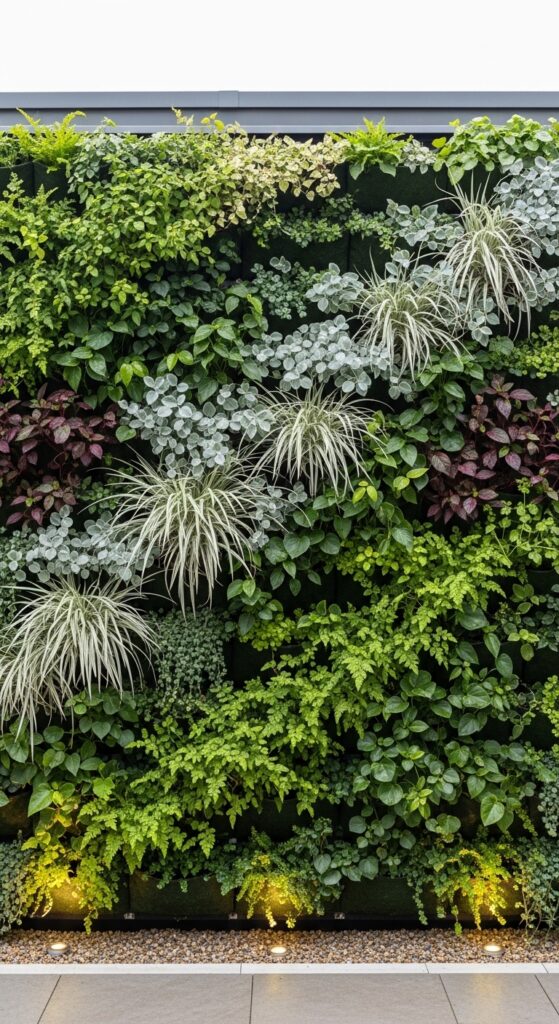
Vibe: A wall that breathes — verdant, alive, and completely transformative even in the smallest urban space.
What makes it work: Living walls solve the privacy challenge in urban settings where ground-level planting space is limited — they deliver maximum green coverage and air-quality benefits in a minimal footprint. The textural variety of different plant species across the wall surface creates a complexity and depth that no single material can match.
How to achieve it: Modular living wall systems (from brands like Woolly Pocket, Vertiss, or ANS Global) make installation far more accessible than built-from-scratch systems. Budget for a drip irrigation system from the outset — hand-watering a living wall panel is impractical and invariably fails. Choose a plant palette of 70% reliable survivors (ferns, sedums, mondo grass) and 30% statement species for visual interest.
11. Brushed Steel and Glass Panel Screen
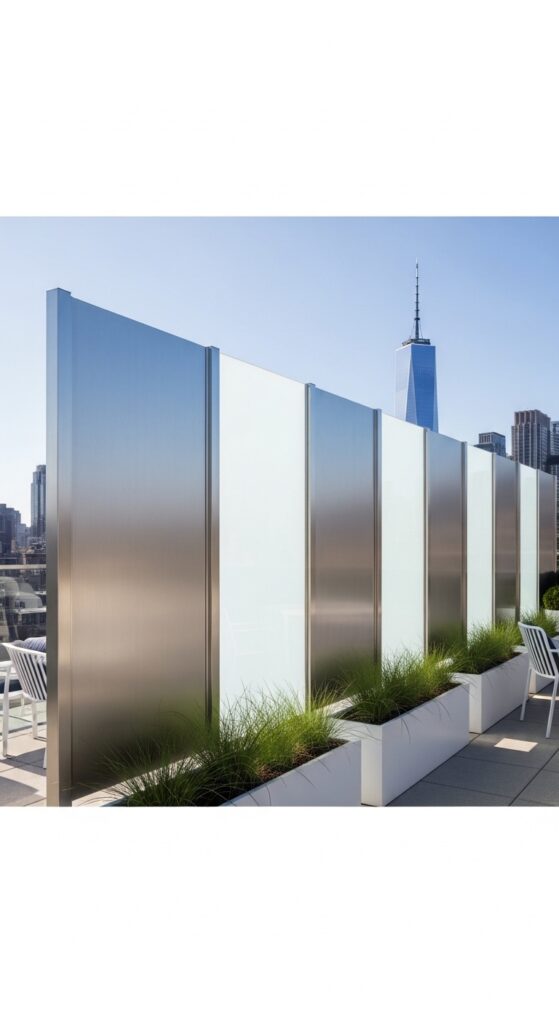
Vibe: Rooftop Manhattan sophistication — high-spec materials, city views, and absolute privacy in elegant equilibrium.
What makes it work: The alternation between opaque steel and translucent frosted glass creates a pattern of light and shadow that shifts throughout the day — steel panels glow warm gold at dusk, while frosted glass panels glow luminous white at midday. The combination gives you genuine privacy while maintaining a sense of lightness that solid walls lack.
How to achieve it: Use marine-grade 316 stainless steel for coastal or high-humidity environments to prevent surface oxidation. Frosted glass panels should be minimum 10mm tempered safety glass in an outdoor screen application. Base-channel fixing systems are structurally superior to post-frame systems and give a cleaner, more contemporary finish.
12. Hedge Wall of Italian Cypress Trees
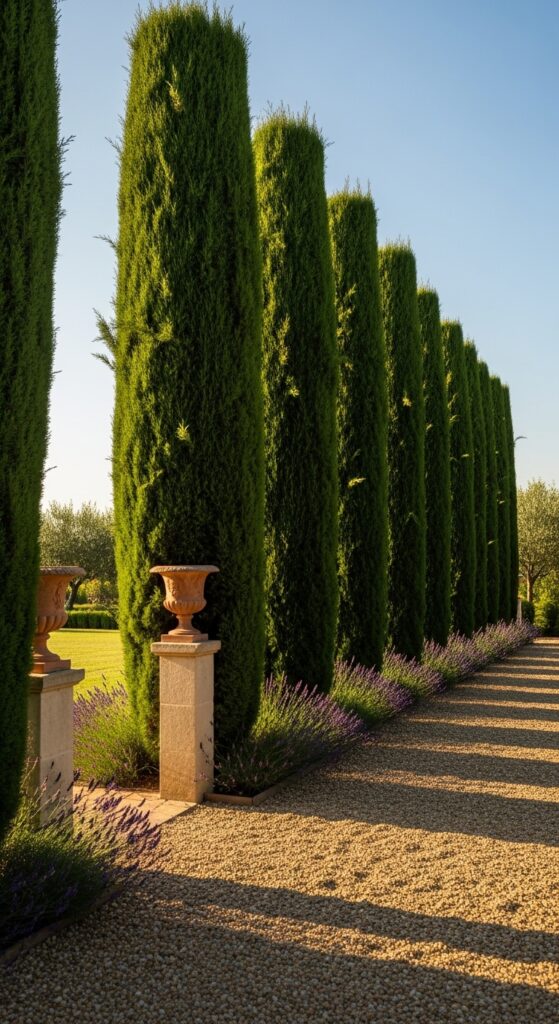
Vibe: Tuscany in your garden — formal, ancient, and impossibly beautiful in the afternoon light.
What makes it work: Italian cypress trees achieve something no built structure can — a living privacy wall that grows more beautiful and more effective with every passing year, while simultaneously providing habitat, cooling, and sound absorption. The tight columnar form means they take up minimal ground footprint while delivering maximum vertical coverage.
How to achieve it: Plant Italian cypress at 80–100cm spacing for a solid privacy screen within three to five years. Ensure soil is well-drained — cypress roots are deep and don’t tolerate waterlogging. Stake young trees in their first two growing seasons against wind rock, and water deeply but infrequently once established.
13. Woven Wire and Timber Trellis Panel System
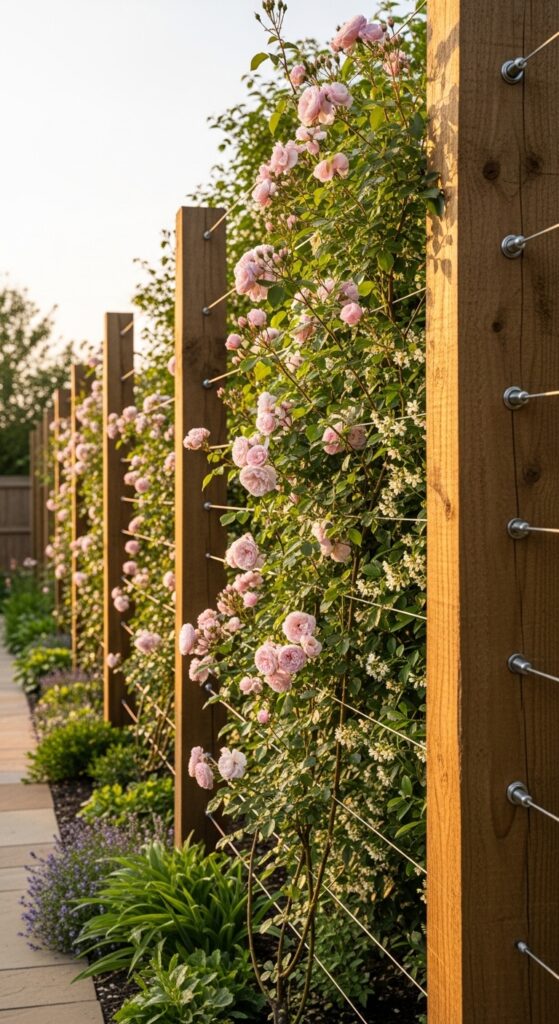
Vibe: Romantic, cottage-garden perfection — a wall of flowers that scents the air and stops everyone in their tracks.
What makes it work: A tensioned wire trellis system combines the structural permanence of a built fence with the living beauty of climbing plants, achieving privacy that improves seasonally as plants fill in. The horizontal wire system is less visible and more structurally taut than traditional wooden trellis panels, making it a cleaner, more contemporary choice.
How to achieve it: Tension wires using vine eye bolts with built-in tensioners — tighten annually as the wire stretches. For climbing roses specifically, choose repeat-flowering, disease-resistant varieties such as Rosa ‘New Dawn’ or ‘Cecile Brunner,’ which provide maximum coverage. Train new shoots horizontally along the wires rather than upward to encourage maximum flower production.
💡 A single climbing rose plant ($30–50) trained along a full 6-meter trellis will cover it completely within three seasons.
14. Rammed Earth Privacy Wall
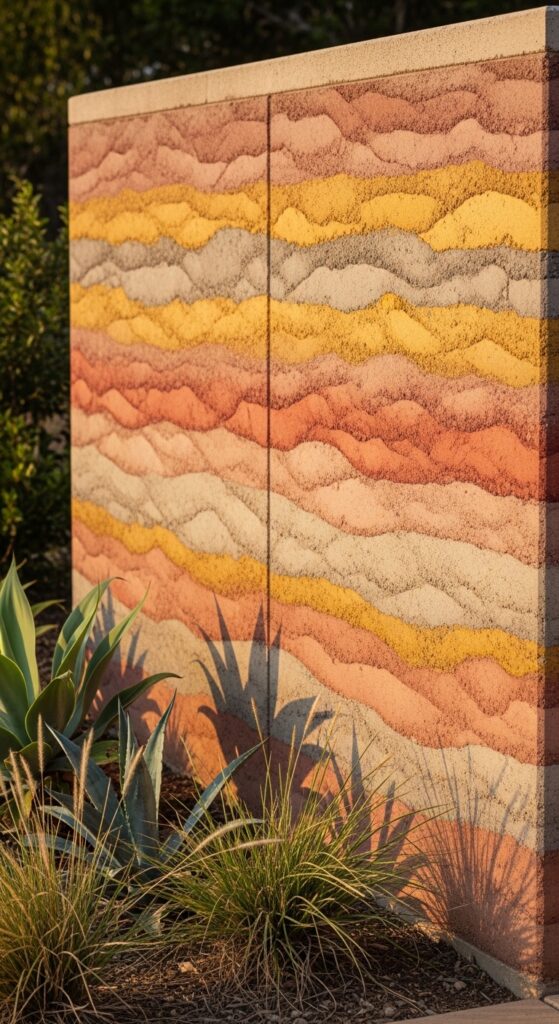
Vibe: Pulled straight from the earth — ancient, sculptural, and completely irreplaceable in its beauty.
What makes it work: Rammed earth walls have a stratified layered quality — visible bands of different-colored earth compacted into horizontal strata — that is genuinely unique among building materials. No two rammed earth walls look alike, and the material’s connection to the natural landscape gives garden spaces a sense of geological authenticity impossible to achieve with manufactured products.
How to achieve it: Rammed earth construction requires specialist contractors and soil testing to achieve a stable mix — typically 70% gravel aggregate, 20% sand, and 10% clay content with 6–8% cement stabilizer. Budget from $400–600 per square meter for professionally constructed rammed earth. In drier climates, unstabilized rammed earth can work without cement; in wetter areas, cement stabilization is essential.
15. Tall Timber Board and Batten Privacy Fence Wall
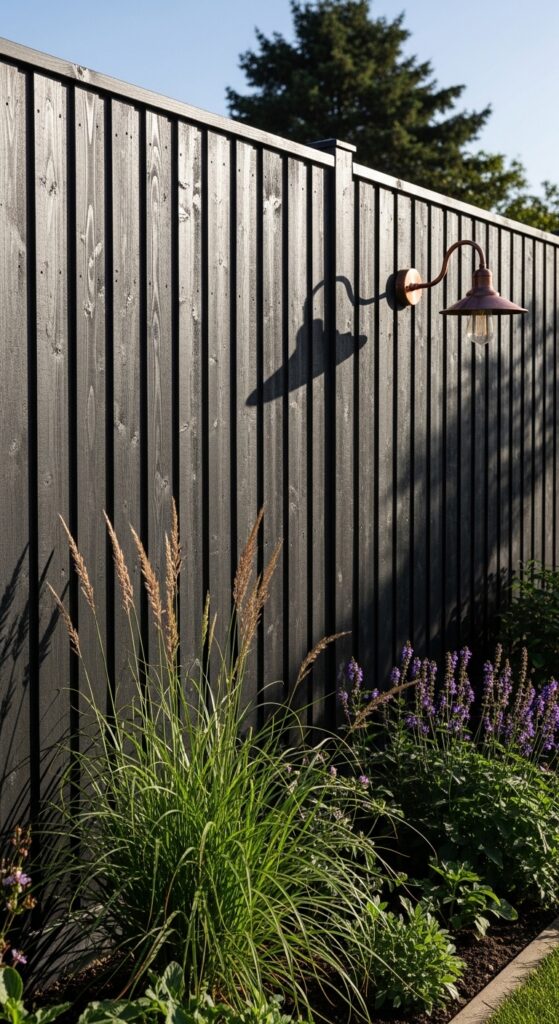
Vibe: Dark, graphic, and completely modern — the kind of fence that makes a garden feel like a designed outdoor room.
What makes it work: Board and batten adds the visual rhythm of vertical lines and strong shadow depth that flat fence panels completely lack. In a deep charcoal stain, the fence recedes visually rather than advancing, making the garden in front appear larger and more vibrant by contrast. The fence becomes a backdrop rather than a boundary.
How to achieve it: Use 150mm-wide cedar or thermally modified timber boards at 25mm spacing, covered with 50mm battens centered over each gap. Pre-stain all timber before installation including cut ends, which are the most vulnerable entry points for moisture. Choose a penetrating oil-based stain rather than an opaque paint — it maintains timber’s natural movement without cracking.
16. Curved Adobe-Style Plastered Wall
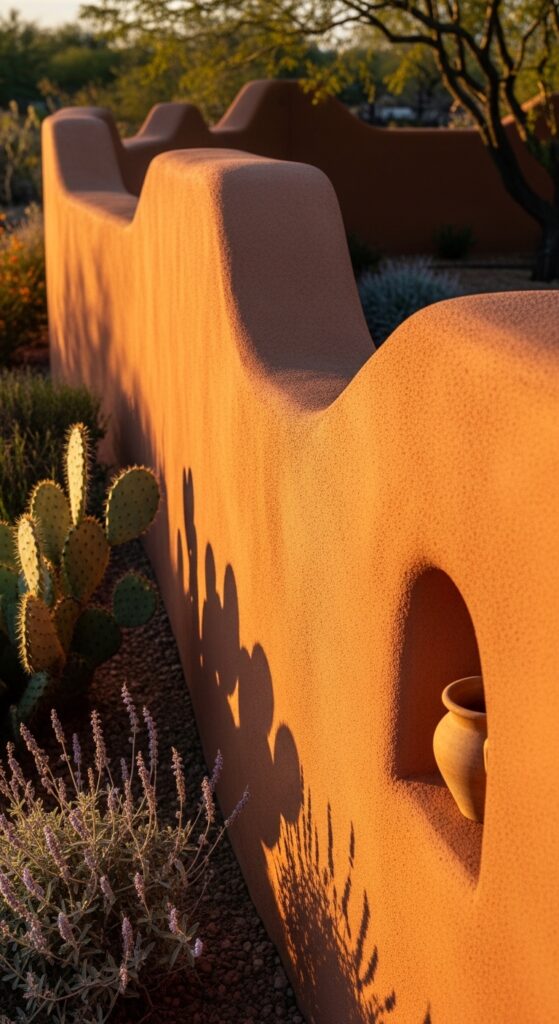
Vibe: Sculptural and sun-baked — a wall that feels hand-shaped by someone who loved the landscape it sits in.
What makes it work: Curved adobe-style walls break the tyranny of straight lines in garden design, introducing a softness and organic quality that relates directly to the natural landscape. The rounded top edge (no hard coping) and the gentle variation in height create a wall that feels grown rather than built — it references thousands of years of vernacular architecture in hot, dry climates.
How to achieve it: Build the structural core from conventional block or brick, then apply two to three coats of lime-based render, finishing with a hand-troweled plaster coat in a warm ochre or terracotta pigment. Work the final troweled coat with a damp sponge to soften tool marks and round the top edge by hand. Apply a breathable mineral exterior paint or seal with a lime wash in a complementary tone.
17. Mirrored Panel Wall for Garden Depth
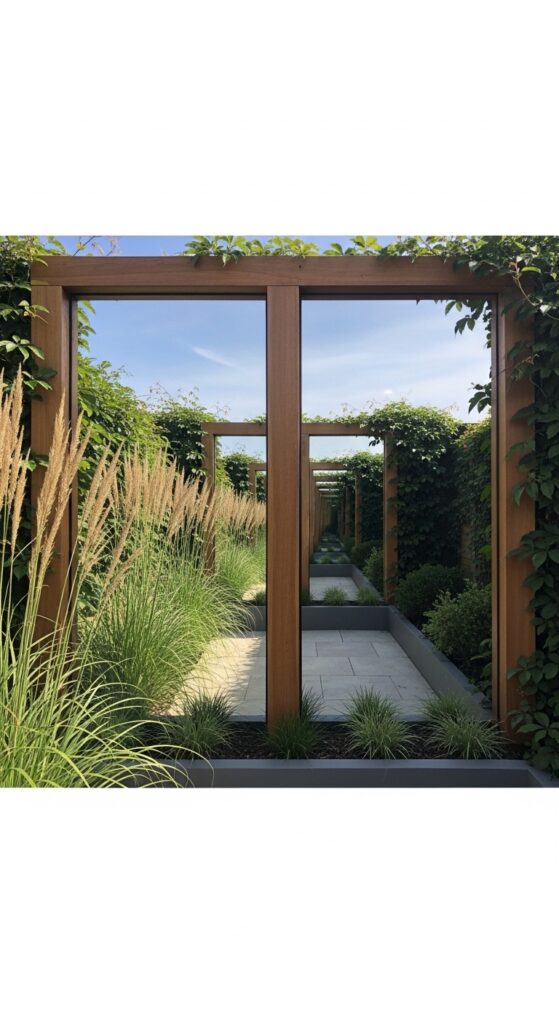
Vibe: Magical and wonderfully deceptive — a wall that makes your garden feel twice as large and infinitely more mysterious.
What makes it work: Outdoor mirrors don’t just add visual interest — they physically transform the perceived size of a garden space by reflecting the full planting and sky opposite, creating the illusion of depth and continuation beyond the wall. Positioned at the far end of a narrow garden, a mirror panel can double the apparent length of the space convincingly.
How to achieve it: Use only mirror glass specifically manufactured for outdoor use — standard interior mirror silvering corrodes and develops black edge spots within months when exposed to moisture. Frame in powder-coated aluminum or hardwood for weather resistance. Position mirrors to reflect garden planting rather than the viewer’s face for the most convincing garden-extension illusion.
💡 Garden mirror panels from specialist outdoor suppliers start at around $150 for a 600x900mm panel — one or two well-placed panels can transform a narrow garden.
18. Pleached Tree “Wall on Stilts”
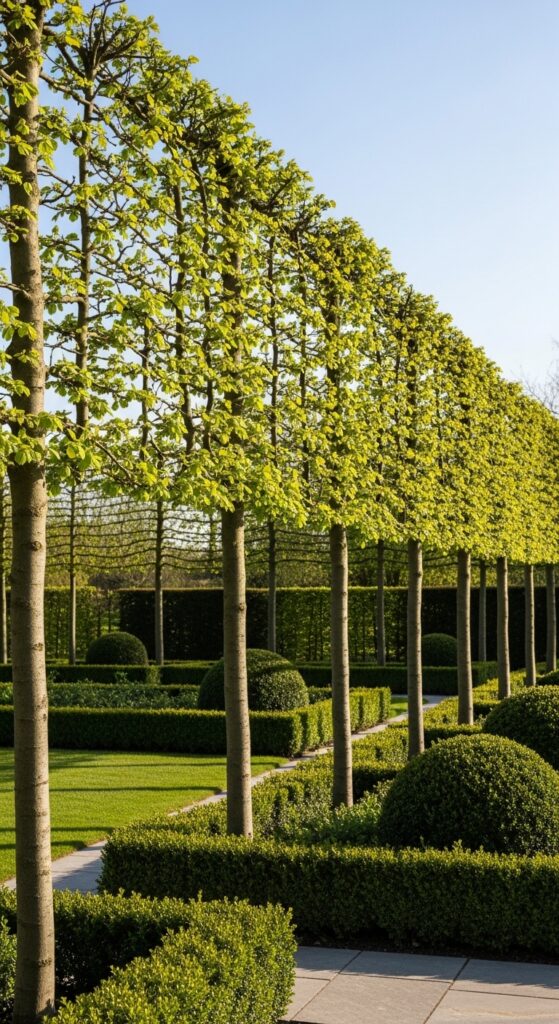
Vibe: European formality at its most refined — privacy that floats above eye level like a living green canopy on stilts.
What makes it work: Pleached trees solve the uniquely challenging privacy problem of overlooking from elevated positions — upstairs windows, raised terraces, or neighboring properties on higher ground — because they deliver privacy at canopy height (2–3 meters) while keeping the view open and spacious at ground level. The clear stem zone below creates an airy, unobstructed feeling completely unlike a solid fence.
How to achieve it: Hornbeam (Carpinus betulus) and lime (Tilia cordata) are the classic pleaching species — both train easily and maintain structure. Purchase pre-started pleached trees on 1.8m clear stems for immediate impact, though at higher cost. Annual pruning in late winter maintains the flat canopy form and keeps the structure dense.
19. Brick Privacy Wall in Herringbone Pattern
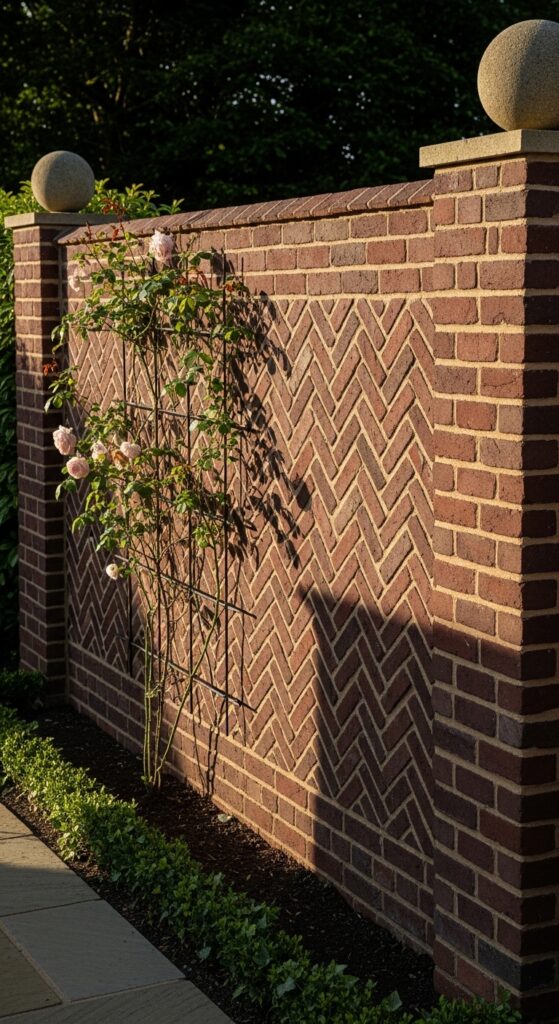
Vibe: Crafted and enduring — the kind of brick wall that improves with every passing decade and every climbing rose.
What makes it work: Herringbone brickwork transforms a standard brick wall into a genuine craft object — the diagonal pattern creates dynamic visual energy that standard stretcher-bond brickwork simply doesn’t have. The pattern also requires no special bricks or tools, just a skilled layer willing to cut each brick to the diagonal return at the wall edges.
How to achieve it: Use wire-cut or handmade bricks rather than machine-extruded stock bricks — their slightly irregular faces and richer color variation suit the craft character of herringbone pattern. A structural garden wall requires a minimum 215mm (two-brick) thickness at heights above 1.5m. Always consult local building regulations for wall height and foundation requirements.
20. Shou Sugi Ban Charred Timber Screen Wall
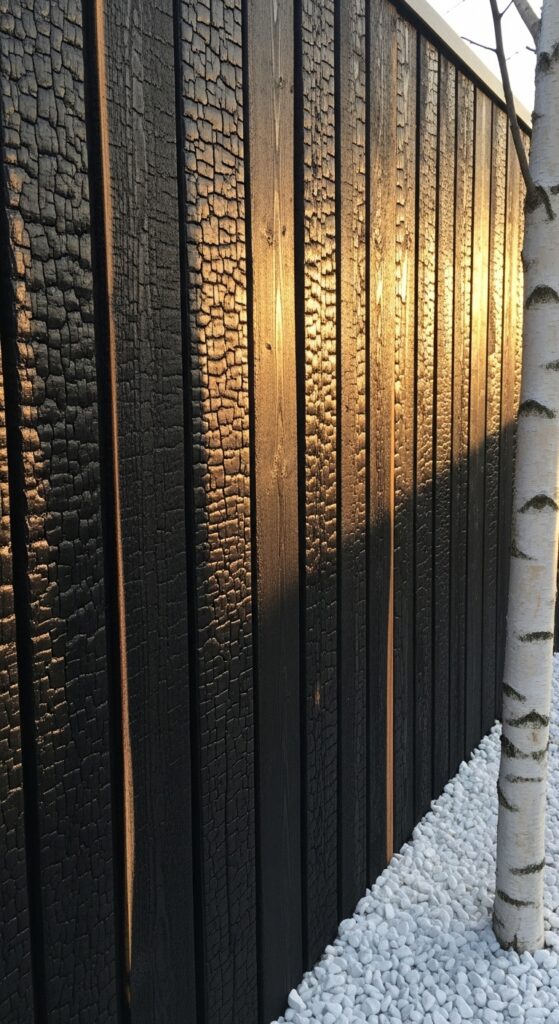
Vibe: Bold, ancient, and completely arresting — a wall that commands attention without saying a single word.
What makes it work: Shou Sugi Ban (the Japanese technique of charring timber to preserve and beautify it) creates a surface unlike any other exterior material — deep matte black with a cracked, almost geological texture that catches light in unpredictable, beautiful ways. Against white render, white gravel, or pale limestone, the contrast is visually extraordinary.
How to achieve it: Shou Sugi Ban can be applied to cedar, larch, or pine using a propane torch — char the surface until the wood alligator-cracks, then brush away loose carbon and seal with exterior oil. Commercial pre-charred boards are available from specialist timber suppliers, eliminating the DIY process. The charred surface requires no paint and is naturally resistant to fire, insects, and rot.
21. Steel Pergola Frame with Privacy Curtain Panels
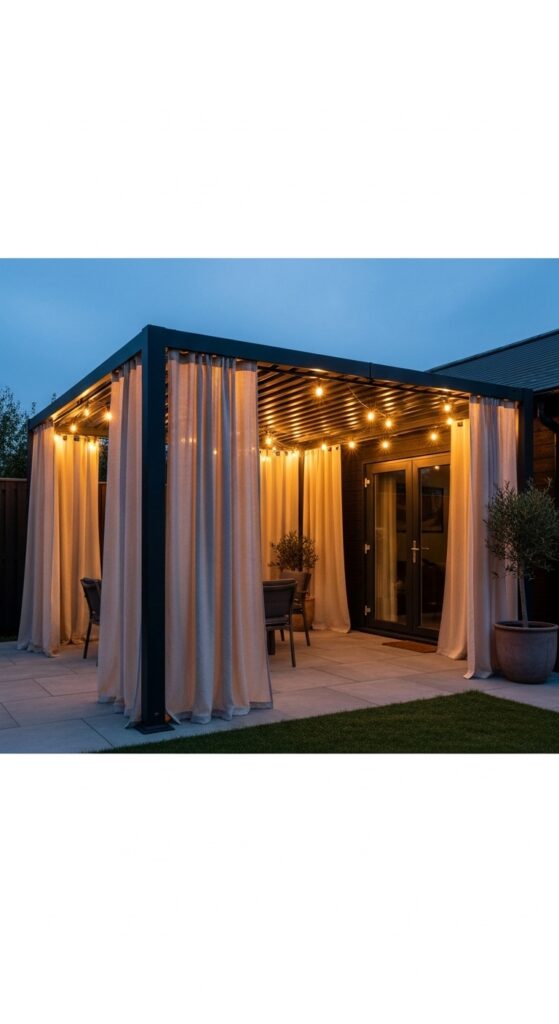
Vibe: An outdoor room that belongs entirely to you — shielded, softly lit, and complete in itself.
What makes it work: Outdoor curtain panels on a pergola frame solve the privacy challenge flexibly — pull them closed for a private evening, open them wide for a breezy afternoon. The soft, drapery quality of outdoor linen curtains also introduces a domestic warmth into the garden that structural screens or fences never achieve. The full-length floor-to-ceiling drop is essential — curtains that fall short look unfinished and feel less private.
How to achieve it: Use outdoor-rated solution-dyed acrylic fabric (from brands like Sunbrella) rather than standard linen for weather resistance — it looks and feels like linen but resists mildew and UV fade. Install curtain tracks rather than rods on the pergola frame for smooth operation. Choose neutral ivory, warm sand, or deep charcoal for the most versatile and refined palette.
22. Geometric Cinder Block Privacy Wall in Bold Color
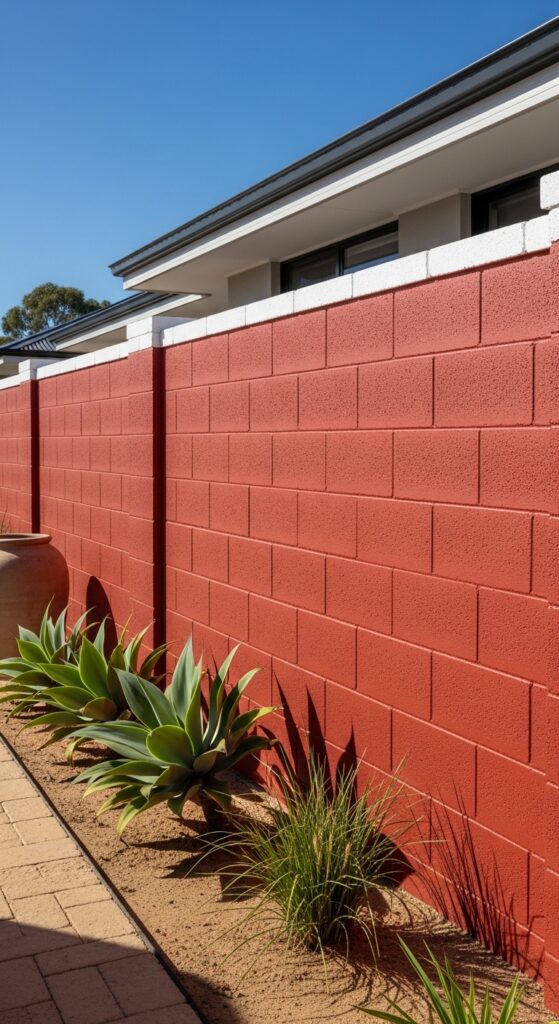
Vibe: Honest and unafraid — a wall that makes a design statement through color and the beauty of exposed structure.
What makes it work: Exposed concrete block, far from being utilitarian, has a graphic quality that renders beautifully in strong exterior paint colors. The regular coursing pattern and slightly textured block faces become a feature rather than an embarrassment when treated with a strong, intentional color — terracotta, ochre, deep sage, or charcoal all transform the humble CMU block into a design element.
How to achieve it: Apply exterior masonry paint directly to clean concrete block without render for the most graphic, block-pattern-visible result. Two coats of a quality mineral exterior paint provide excellent coverage and durability. Choose a color that relates to your soil, planting palette, or house exterior for the most coherent result.
23. Hazel or Willow Woven Hurdle Fence Wall
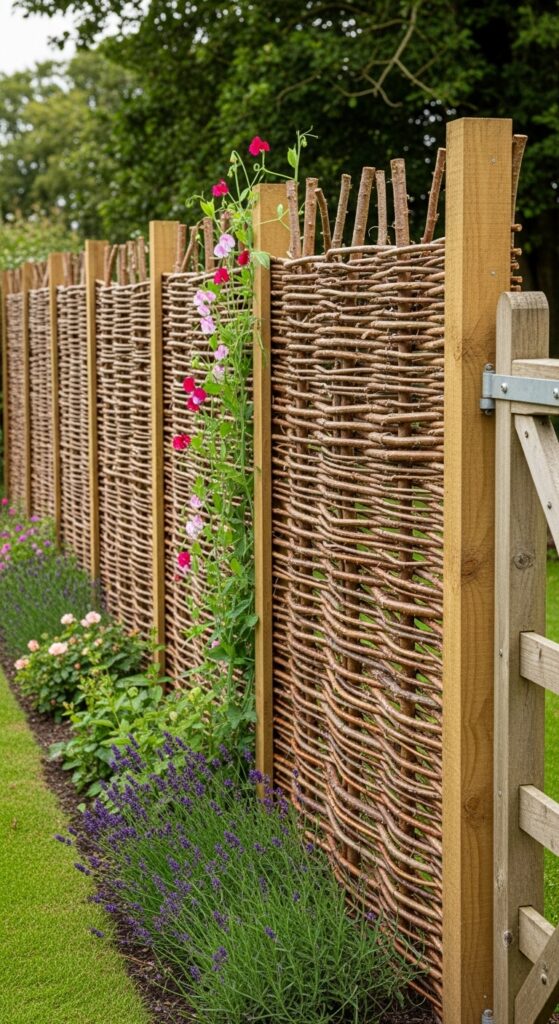
Vibe: Centuries-old craft made tangible — a wall woven from the hedgerow itself, entirely at home in the landscape.
What makes it work: Woven hurdle panels bring a handcraft quality to garden privacy that no manufactured fence or screen achieves — each panel is unique, slightly irregular, and visually rich with the texture of woven branches. The natural material weathers to a beautiful silver-grey over time, relating naturally to bark, stone, and other organic garden materials.
How to achieve it: Hazel hurdle panels are available from woodland craft suppliers in 1.8m x 0.9m standard sizes. Install upright wooden posts at 1.8m spacing and simply slot or tie hurdle panels between them. Life expectancy is 8–12 years depending on climate — in shaded or very damp positions, expect shorter life but faster moss and lichen colonization, which adds to the aesthetic.
24. Planted Gabion Wall with Sedum Roof Planting
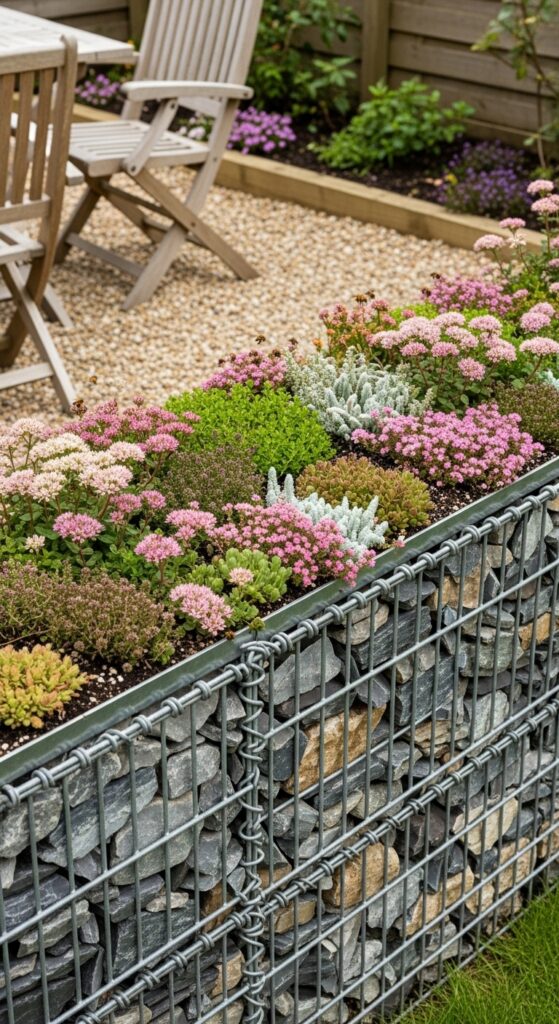
Vibe: Engineering and ecology in effortless combination — a wall that is also a meadow, a habitat, and a display garden.
What makes it work: Topping a gabion wall with a planted trough or a layer of growing medium transforms a purely structural element into an ecological one — sedum, thyme, and alpine plants colonize the top surface, attracting pollinators and softening the industrial cage structure dramatically. The combination of industrial material below and delicate plant life above creates a sophisticated material contrast.
How to achieve it: Build the gabion wall to the desired height, then fabricate a shallow steel trough to sit in the top course. Fill with a free-draining alpine growing medium — 50% grit, 30% topsoil, 20% compost. Plant at 200mm spacing with a mix of sedum species, creeping thyme, and rock cress for a four-season planted display.
25. Timber Frame with Translucent Polycarbonate Panels
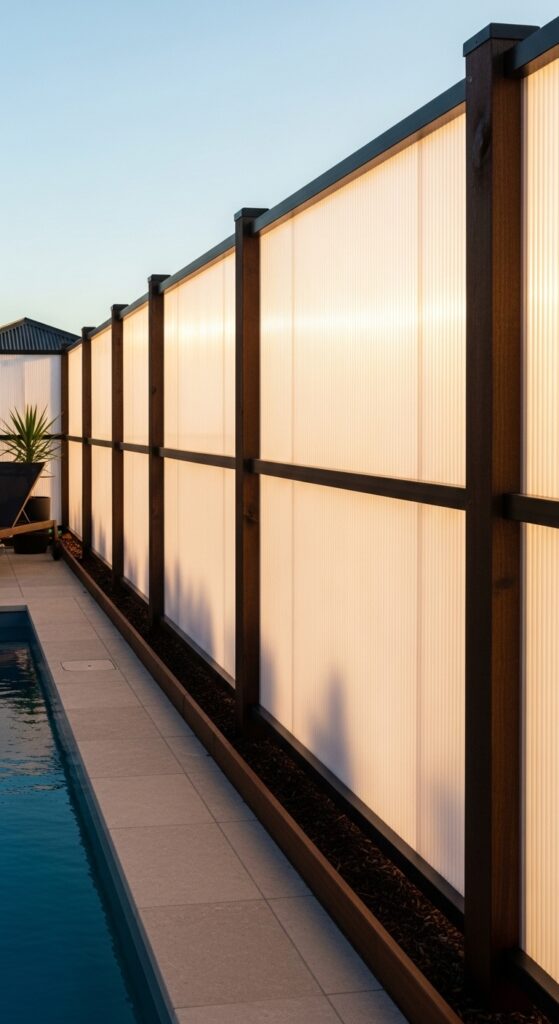
Vibe: Contemporary and luminous — a wall that glows rather than blocks, turning privacy into something almost beautiful.
What makes it work: Translucent polycarbonate panels create privacy through light diffusion rather than solid opacity — they obscure clear views while allowing a warm, diffused glow of light to pass through, keeping the space bright on both sides. At night, when interior or pool lighting is on, the panels glow from within, creating a striking lantern effect.
How to achieve it: Use twin-wall or corrugated polycarbonate sheeting in opal rather than clear for best privacy while maintaining light transmission. Fix with UV-stabilized polycarbonate screws and closed-cell foam closure strips at the top and bottom rails to prevent insect ingress. Choose hardwood or powder-coated aluminum frames rather than timber for longevity adjacent to pool environments.
26. Brick Pier Wall with Open Steel Infill Panels
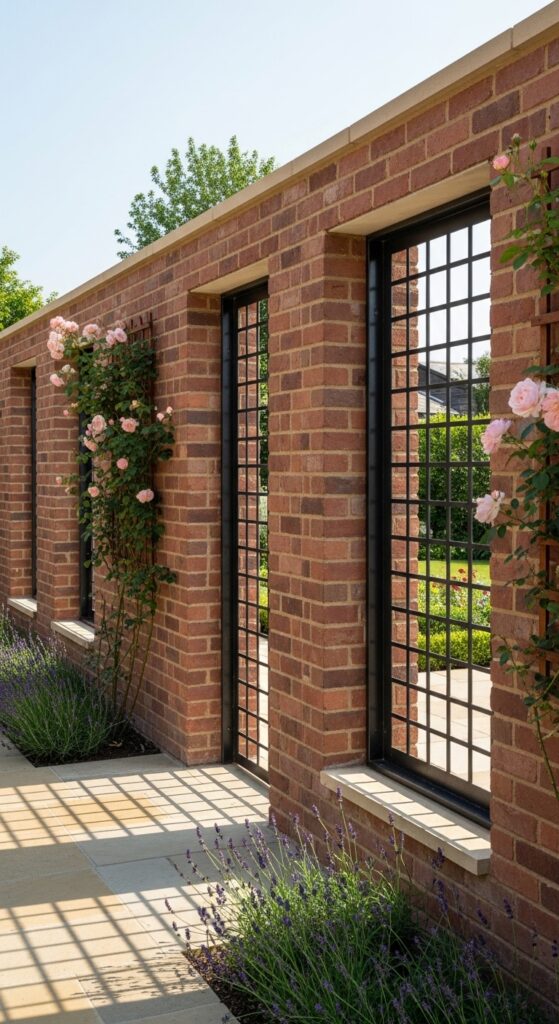
Vibe: Traditional structure meets industrial precision — a wall that bridges two centuries of design thinking effortlessly.
What makes it work: Combining masonry piers with metal infill panels creates a structural and aesthetic hybrid that is richer than either material alone. The brick piers anchor the wall to the building’s traditional architecture, while the steel grid infill introduces contemporary precision and openness — together they achieve a privacy wall that reads as genuinely considered rather than off-the-shelf.
How to achieve it: Build brick piers to full height with a rebated channel or angle iron support built into the inner face to receive steel panel infill. Commission flat laser-cut or fabricated steel infill panels from a local metalworker — standard grid patterns are among the most cost-effective designs. Galvanize and powder-coat for corrosion resistance before installation.
27. Planted Earth Berm Privacy Mound
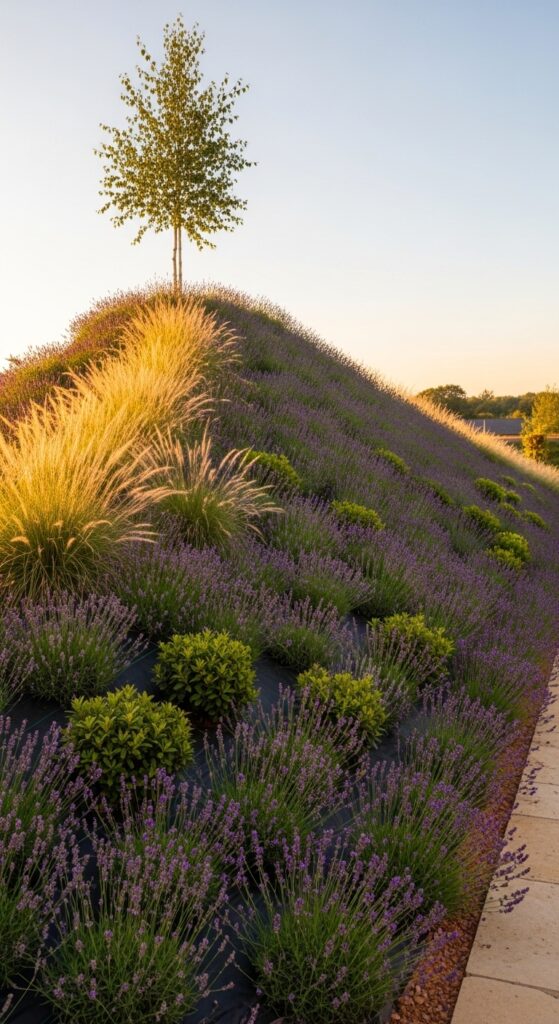
Vibe: A landscape-scale solution — privacy that looks like it grew from the earth rather than being placed upon it.
What makes it work: Earth berms provide privacy through landscape rather than construction — they use mass and height of planted ground form to screen views naturally. A well-planted berm also provides noise reduction, habitat value, drainage management, and wind shelter simultaneously, making it one of the most ecologically functional privacy solutions available.
How to achieve it: Shape the berm in a gradual mound no steeper than 1:3 slope ratio to prevent erosion. Layer geotextile over the shaped earth before planting to suppress weeds. Plant at 150–200% of standard density for immediate coverage, using a backbone of evergreen structural shrubs (box, holly, pittosporum) with ornamental grasses and perennials filling in between.
28. Painted Timber Paling Fence with Climbing Hydrangea
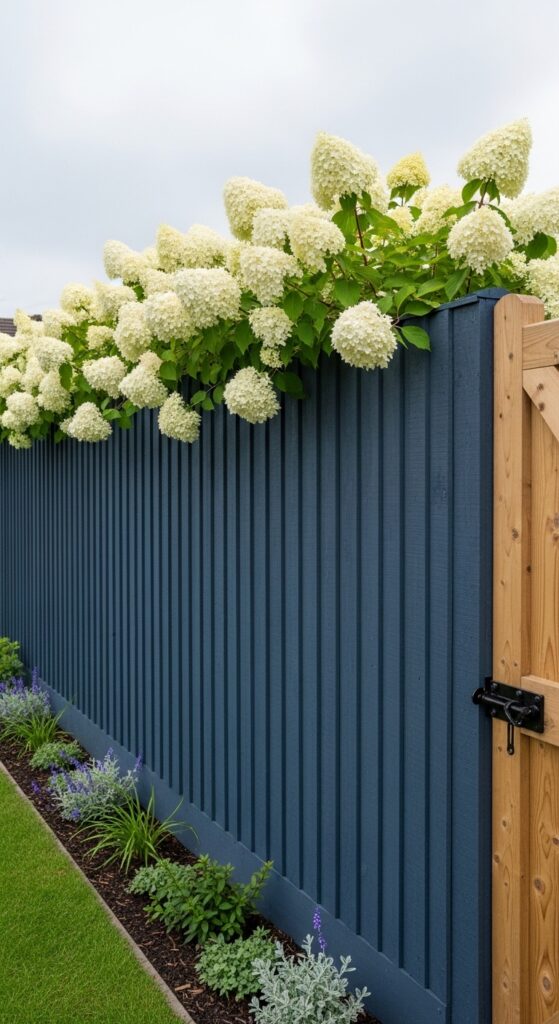
Vibe: Garden sophistication at its most achievable — the kind of fence that makes neighbors stop and ask what that plant is.
What makes it work: Deep slate blue is one of the most flattering backdrop colors for garden planting — it makes foliage appear more vivid and flowers more luminous by contrast, functioning like a jeweler’s black velvet pad for the climbing plant display above. Climbing hydrangea is the perfect companion because it is genuinely self-clinging, needing no wires or support once established.
How to achieve it: Apply two coats of exterior timber paint in Farrow & Ball’s “Hague Blue,” Dulux Heritage “Steel Symphony,” or similar deep blue-grey. Climbing hydrangea is slow to establish in its first two seasons but grows vigorously thereafter — patience is the primary requirement. Apply a fresh coat of exterior paint every three to four years, cutting back any stems adhering to the fence face before repainting.
💡 If deep blue feels too bold, try Farrow & Ball’s “Mizzle” (a blue-green grey) — it has the same flattering effect on planting but reads as more neutral in most gardens.
29. Architectural Green Roof Wall with Planted Top Cap
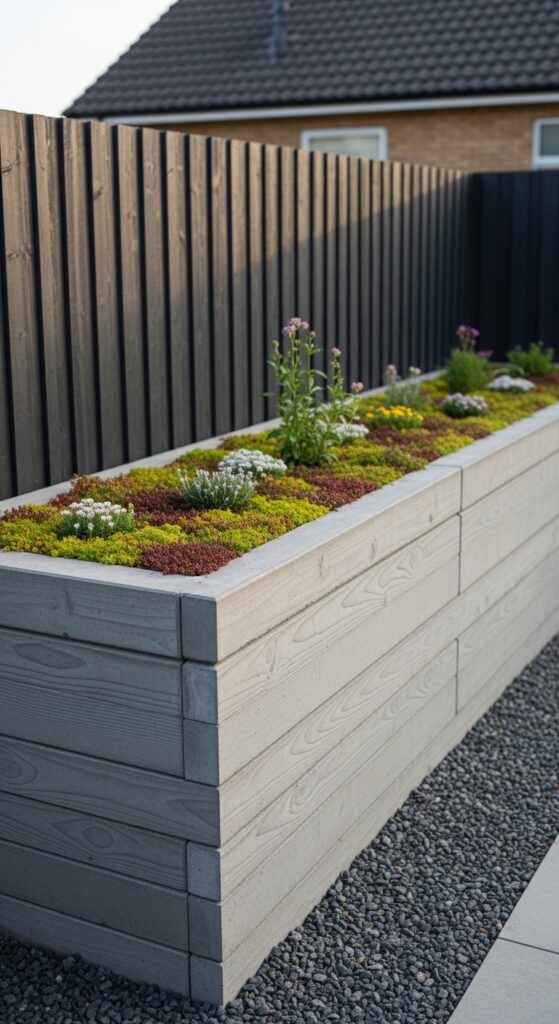
Vibe: Architecture and ecology seamlessly unified — a wall whose top surface belongs entirely to the plant world.
What makes it work: A green roof capping on a garden wall represents the ultimate integration of structure and landscape — the wall provides privacy and architectural definition, while the planted top brings ecological value, visual softness, and a genuine point of design difference. Board-formed concrete for the wall body reinforces the contemporary architectural language while providing a long-lasting, zero-maintenance substrate.
How to achieve it: The wall structure must be designed to carry the additional load of a planted green roof — typically 80–150kg/m² when saturated. Install a waterproofing membrane, drainage layer, geotextile, and a shallow green roof growing medium (minimum 75mm depth). Plant with pre-grown sedum blanket, which can be rolled directly onto the prepared substrate for immediate coverage.
How to Start Your Exterior Privacy Wall Transformation
Begin by identifying exactly what you’re screening from — a neighbor’s upstairs window, a road, a shared fence line, or an elevated vantage point — because the height, position, and opacity of your solution depends entirely on the viewing angle you need to block. Stand at the most-used outdoor spaces in your garden at different times of day and identify precisely where the overlooking comes from. This clarity prevents the most common mistake: building a wall that looks impressive but doesn’t actually solve the specific privacy problem.
Next, assess your material and maintenance appetite honestly. Natural stone, brick, and rammed earth are essentially permanent and improve with age but involve significant upfront investment. Timber screens look beautiful immediately but require annual maintenance. Living walls and planted solutions take time to establish but ultimately deliver the richest result for the lowest ongoing cost.
Budget starting points: peel-and-stick bamboo roll screening can cost as little as $50–100 for a 6-meter run; a basic timber slat screen with steel frame runs $800–1,500 installed per panel; bespoke Corten steel laser-cut screens start around $800–1,200 per panel; professional living walls with irrigation from $400–600 per square meter.
Set realistic expectations around time. Structural wall solutions deliver privacy immediately; planted and living solutions take one to three seasons to reach full effectiveness. The patience required for planted privacy is always rewarded — a mature climbing rose hedge or pleached tree row is more beautiful than any built structure.
Frequently Asked Questions
How tall should a privacy wall be?
The standard garden privacy fence height in most residential zones is 1.8–2.1 meters (6–7 feet), which is sufficient to block eye-level views from a standing adult next door. If you’re screening from elevated positions — upstairs windows, raised terraces, or neighboring properties on higher ground — you’ll need either a taller structure (typically 2.5–3 meters, which may require planning permission) or a planted solution such as pleached trees or tall hedge species that can grow significantly higher without the same regulatory restrictions. Always check local building regulations before constructing walls above 1.8 meters.
What is the most low-maintenance exterior privacy wall?
Stone walls, brick walls, and rammed earth are the lowest-maintenance privacy solutions long-term — they require essentially no intervention once built and improve aesthetically with age. Among planted solutions, established hedge species such as hornbeam (Carpinus betulus) or yew (Taxus baccata) require only one to two annual clips and become more effective privacy screens with each passing year. Avoid untreated timber screens if minimizing maintenance is your priority — even premium cedar requires annual oiling or staining to prevent weathering and splitting.
Can I build a privacy wall on a rental property?
Most rental agreements prohibit permanent structural changes, but several excellent privacy solutions work without permanent construction. Freestanding privacy screens in powder-coated steel or timber can be positioned without any fixing. Large planter boxes with tall ornamental grasses, bamboo, or architectural shrubs create an effective planted privacy screen that moves with you. Roll-out bamboo or reed screening attached to an existing fence with cable ties requires no tools and no damage. Always read your tenancy agreement and seek landlord permission for anything structural, even lightweight.
What exterior wall material works best in coastal or humid climates?
In coastal environments with salt air and high humidity, material selection is critical. Choose 316 marine-grade stainless steel over standard mild steel for any metal elements. For timber, Accoya, thermally modified ash, or naturally durable species such as Iroko and Western red cedar outperform standard pine by decades. Fiber cement cladding panels are an excellent alternative to timber in high-moisture environments — they look similar but are completely rot-proof. Avoid standard galvanized steel in coastal locations, where salt air will corrode the zinc coating within five to eight years.
How do I achieve privacy without making my garden feel enclosed?
The key is choosing solutions that filter rather than block completely — a horizontal timber slat screen with deliberate gaps, a tensioned wire trellis covered in climbing plants, or a pleached tree screen all provide genuine privacy while maintaining a sense of lightness and air movement. Avoid solid, opaque walls on all sides simultaneously; instead, focus your privacy screening on the specific angles of overlooking and leave other aspects more open. Using translucent materials (frosted glass, opal polycarbonate, fine mesh panels) achieves privacy through diffusion rather than obstruction, preserving brightness and visual openness within the screened space.
Ready to Create Your Dream Exterior Privacy Space?
These 29 exterior wall design ideas for privacy cover every material, every budget, and every style — from the elegance of a pleached hornbeam screen to the primal beauty of a rammed earth wall. The best privacy solution is never the one that looks most impressive in isolation, but the one that integrates most naturally with your home’s architecture, your garden’s character, and your genuine lifestyle. Save the ideas that speak to your space specifically and return to them as your project develops.
Remember: privacy transformation can begin with a single panel, a few planted pots, or one climbing plant on a wire. You don’t need to build the entire vision before you start — the most beautiful gardens are built incrementally, one good decision at a time. Choose the idea that feels most immediately right, begin there, and let the space grow from that first committed step.