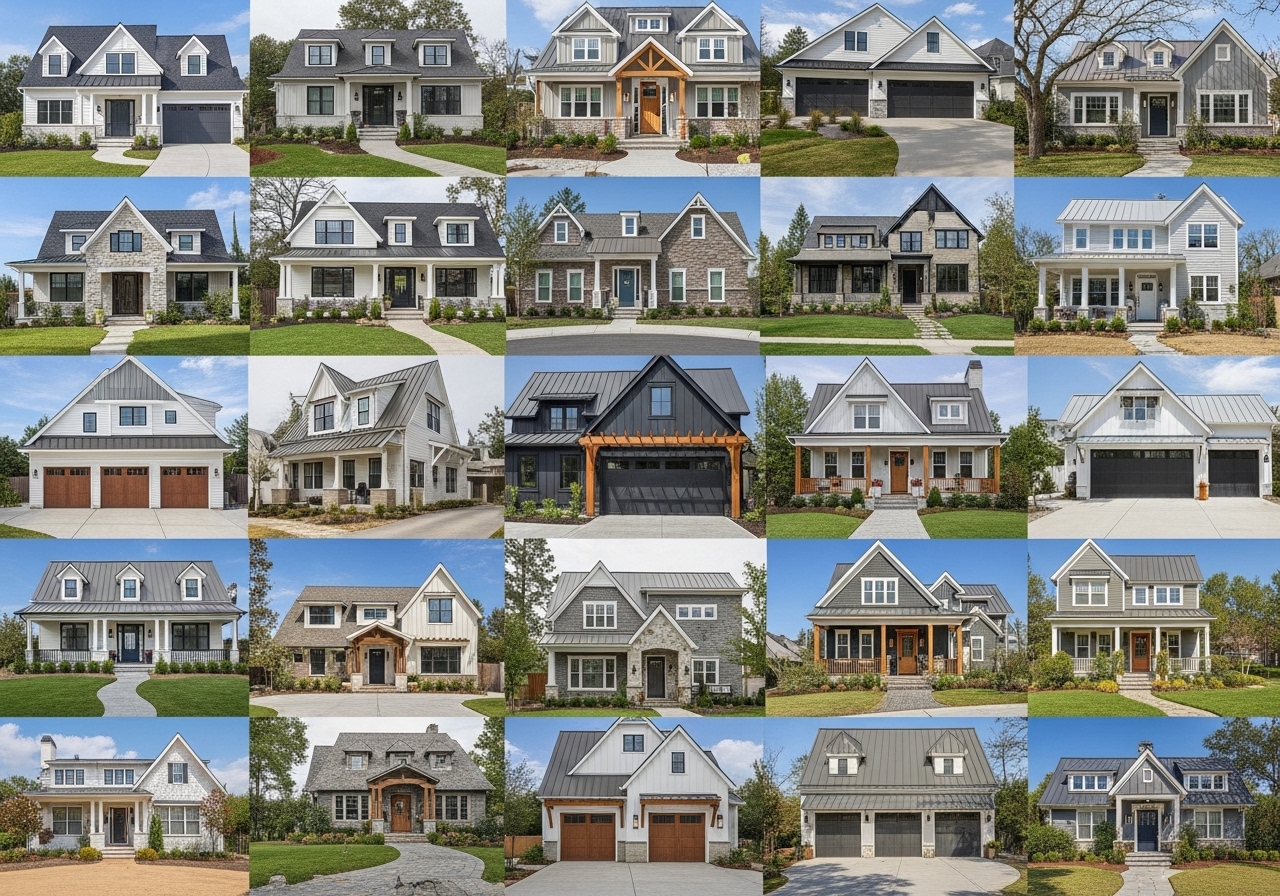
There’s a particular kind of magic that happens when a home’s exterior stops you mid-stride — when clean architectural lines meet weathered wood, when a crisp white facade catches the afternoon light just right, and the whole thing feels simultaneously brand-new and timelessly rooted. Modern farmhouse exterior design has that effect, consistently and reliably. It’s a style that honors the working honesty of traditional farmhouse architecture while editing it with contemporary restraint — less ornamentation, sharper silhouettes, better proportions. Whether you’re planning a full exterior renovation or simply looking for the right front door color, these 29 ideas will give you a clear, actionable vision. Let’s explore every one of them.
Why Modern Farmhouse Exterior Design Works So Well
Modern farmhouse exterior design endures because it resolves a tension most architectural styles can’t — the pull between the warmth of the past and the clean confidence of the present. Traditional farmhouses were built for function: wide porches for shade, metal roofs for durability, board-and-batten siding for weather resistance. Modern farmhouse design keeps that functional logic but strips away the decorative excess, leaving something that feels genuinely purposeful rather than merely pretty.
The material palette is where this style defines itself most clearly. Black-framed windows against white or light gray siding. Horizontal wood cladding alongside vertical board-and-batten. Natural stone at the foundation. Standing seam metal roofing. These are materials with real weight and real history — and they read that way from the curb.
Right now, modern farmhouse exteriors are dominating Pinterest’s home design categories for a reason that goes beyond trend. People are building longer-term relationships with their homes, and they want exteriors that age gracefully rather than date quickly. A black window frame and white board-and-batten combination will look as current in fifteen years as it does today.
Even modest homes — ranches, cottages, split-levels — can adopt this vocabulary convincingly. The modern farmhouse exterior is less about square footage and more about material honesty, deliberate proportion, and a color palette that lets the architecture speak.
1. Classic White Board-and-Batten with Black Windows
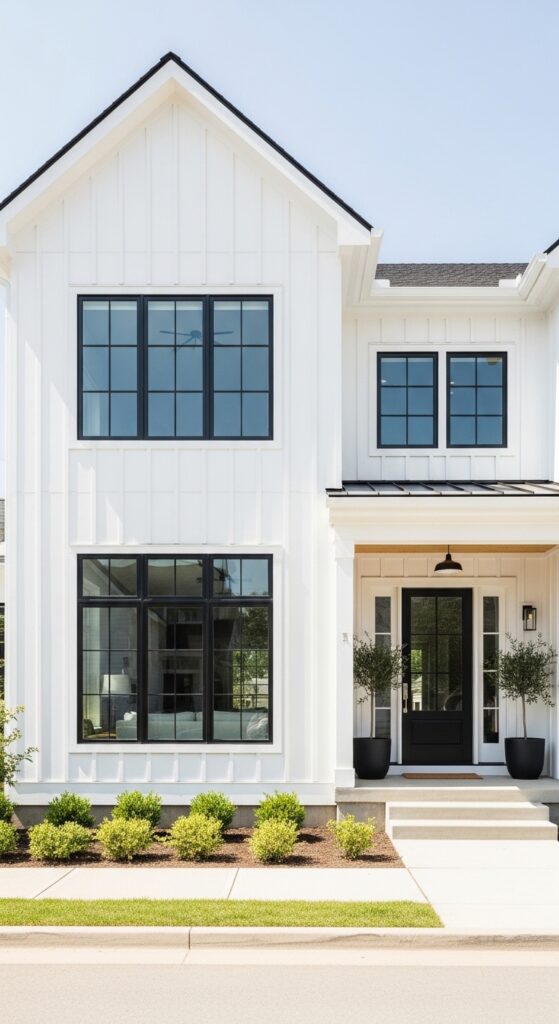
Vibe sentence: White board-and-batten with black windows is the modern farmhouse exterior’s foundational look — and it earns that status completely.
What makes it work: The vertical rhythm of board-and-batten siding gives the facade a strong graphic quality that reads beautifully from the street. Matte black window frames create bold contrast without adding color, keeping the palette clean and the architecture as the visual focus.
How to achieve it: James Hardie’s HardiePanel in “Arctic White” with board-and-batten trim is the industry-standard choice — fiber cement resists moisture, insects, and warping far better than wood. Pair with black aluminum-clad windows from Marvin or Pella for the crispest result.
💡 If replacing windows isn’t in budget, black window frame paint (Rust-Oleum’s “Gloss Black” works on vinyl) transforms existing windows for under $40.
2. Standing Seam Metal Roof in Charcoal
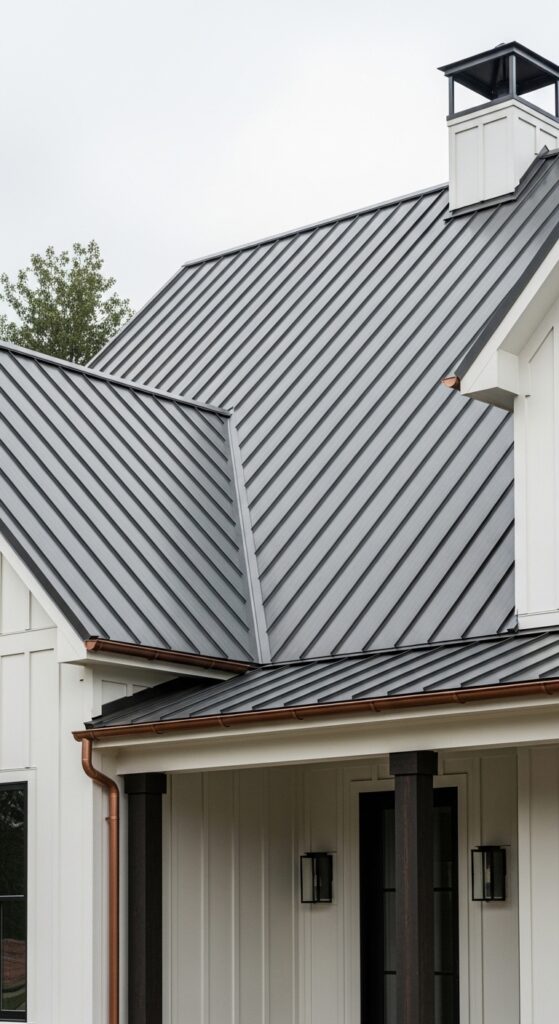
Vibe sentence: A standing seam metal roof isn’t just a material choice — it’s an architectural statement that the whole exterior answers to.
What makes it work: The clean vertical lines of standing seam roofing complement the vertical rhythm of board-and-batten siding in a way that asphalt shingles simply cannot. Charcoal specifically gives the roofline weight and presence without competing with the white facade below.
How to achieve it: Standing seam metal roofing in Galvalume or Kynar-coated steel is the durability standard — expect 40–70 years of service life with minimal maintenance. Specify 16-inch panel width for a traditional farmhouse proportion; wider panels read as more contemporary.
3. Wraparound Porch with Bead Board Ceiling
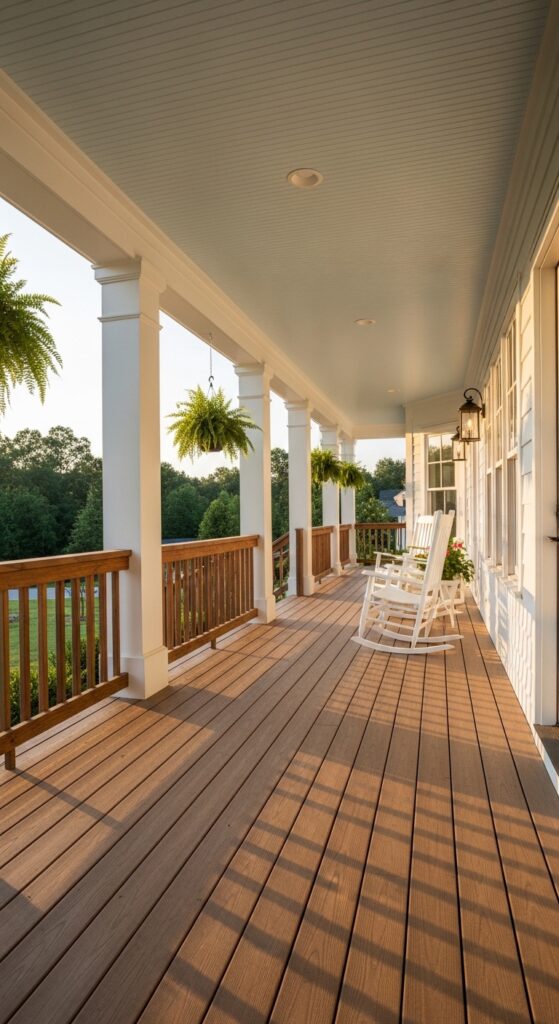
Vibe sentence: A wraparound porch doesn’t just add square footage — it adds an entirely different relationship between the home and the world outside.
What makes it work: The porch ceiling painted in traditional “haint blue” — a soft gray-blue — is a Southern farmhouse custom dating back centuries and remains one of the most charming details a porch can have. It bounces light beautifully and creates a visual sky-like quality that makes the porch feel genuinely outdoor-connected even when fully shaded.
How to achieve it: Paint the porch ceiling in Sherwin-Williams “Watery” or “Comfort Blue” — both read as haint blue in changing light conditions. Use Azek or TimberTech composite decking for the porch floor; it handles moisture, foot traffic, and temperature change far better than real wood in an exposed application.
💡 Adding porch bead board ceiling panels to an existing flat porch ceiling costs $3–$6 per square foot in materials and transforms the porch entirely.
4. Dark Charcoal Exterior with Warm Wood Accents
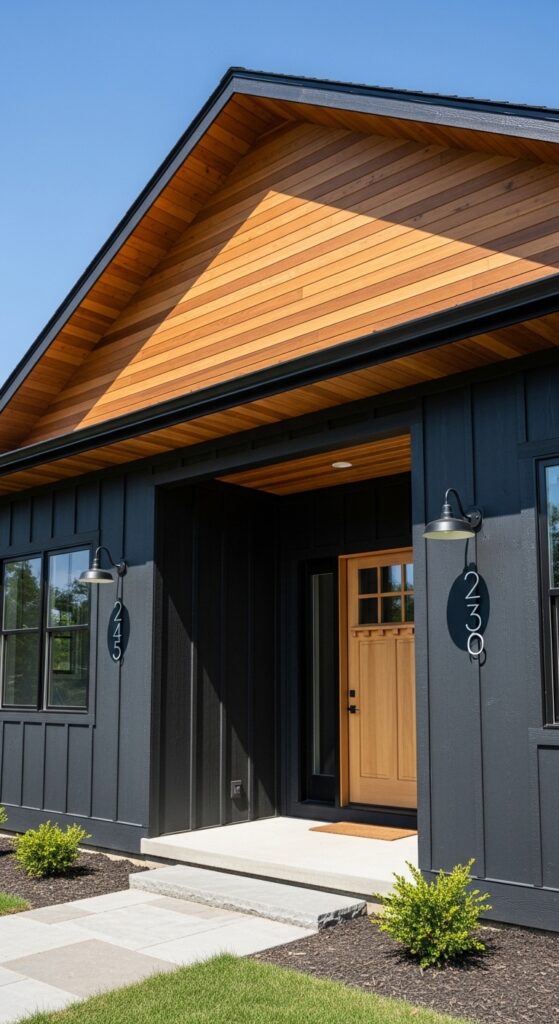
Vibe sentence: A dark charcoal farmhouse exterior is a bold inversion of the classic — and it works precisely because it commits completely.
What makes it work: The contrast between a near-black exterior and warm cedar wood accents is one of the most sophisticated moves in modern farmhouse design. The dark field recedes visually, making the cedar grain and natural wood details pop with an almost luminous warmth. It turns a house into something that looks more like an architectural object.
How to achieve it: Sherwin-Williams “Iron Ore” or “Tricorn Black” are the go-to charcoal exterior colors for modern farmhouse — both read as very dark without going fully black, which can look harsh. Cedar soffit panels should be sealed with a penetrating oil finish like Penofin to maintain their honey warmth without peeling.
5. Gabled Dormer Windows with Metal Roofing
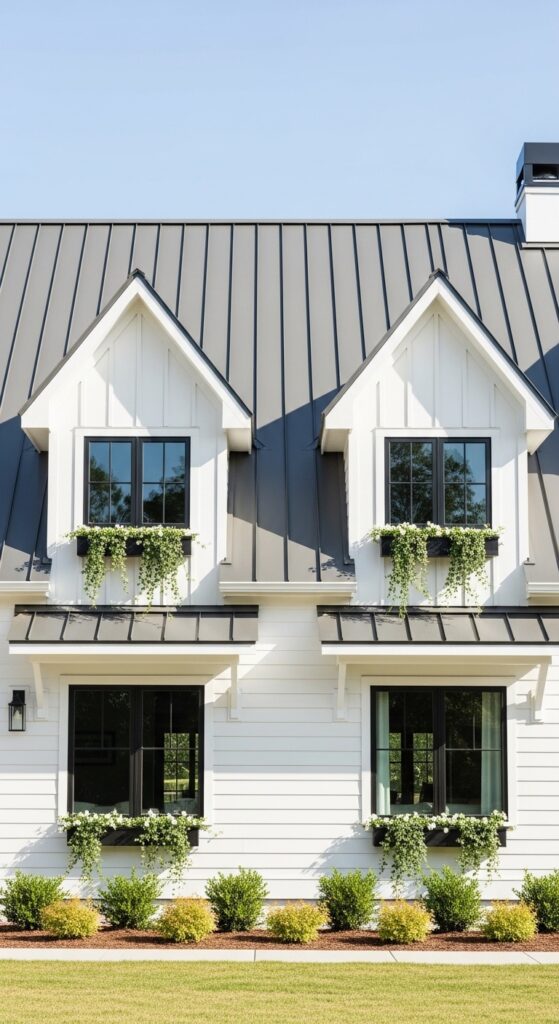
Vibe sentence: Dormer windows on a farmhouse roofline give the house a skyward ambition — like it’s always reaching a little further up.
What makes it work: Symmetrically placed gable dormers create architectural rhythm on an otherwise flat roofline and add significant visual height. When clad in matching standing seam metal roofing, they reinforce the cohesion of the exterior rather than looking like afterthoughts.
How to achieve it: Window boxes beneath dormer windows are the detail that makes this composition genuinely charming. Use Hooks & Lattice powder-coated steel window boxes in matte black — they’re maintenance-free and proportioned perfectly for farmhouse facades. Plant with trailing English ivy or white petunias for seasonal drama.
6. Mixed Siding — Board-and-Batten Upper, Horizontal Lap Lower
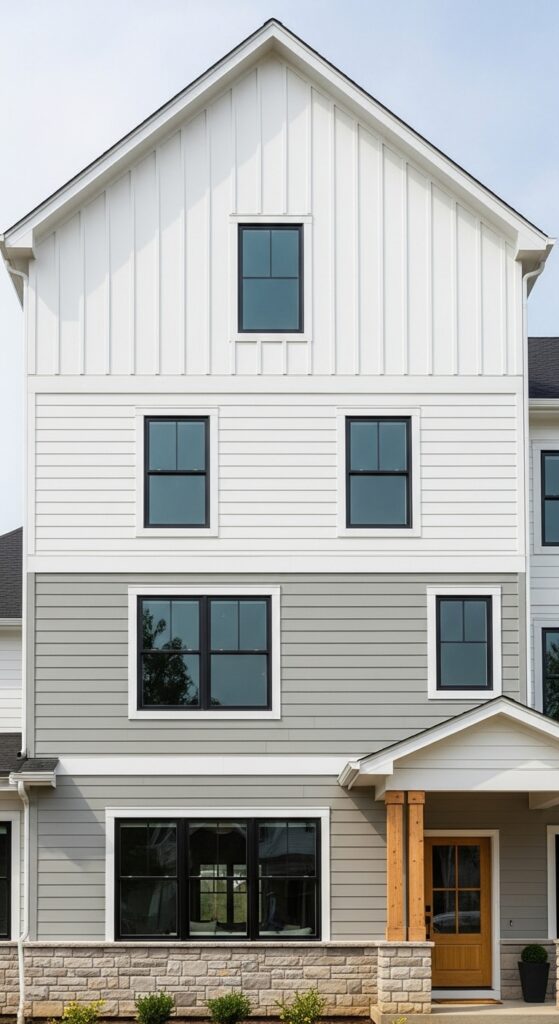
Vibe sentence: Mixing siding profiles is the architectural equivalent of mixing textures in interior design — it creates depth that a single material simply cannot.
What makes it work: The transition between vertical board-and-batten and horizontal lap siding at a mid-story trim band creates a visual “grounding” effect — the horizontal lower story feels anchored and stable, while the vertical upper story feels taller and lighter. It’s a proportion trick that makes two-story homes feel more dynamic.
How to achieve it: Keep the two siding colors closely related — bright white and warm light gray rather than dramatically contrasting shades — so the textural variation carries the distinction rather than color contrast. The trim band separating them should be at least 4 inches wide in white for clean definition.
7. Black Barn-Style Garage Doors
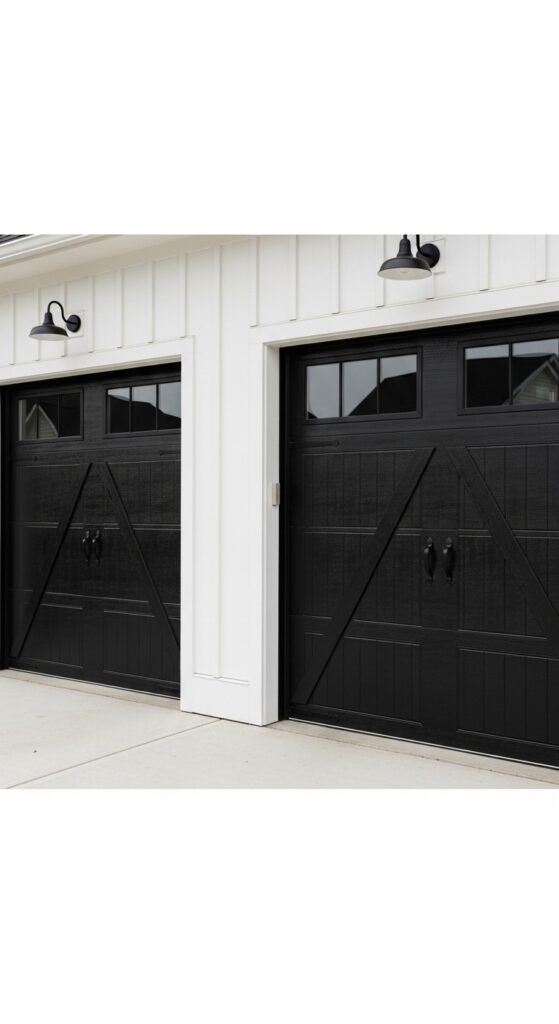
Vibe sentence: Black barn-style garage doors are the detail that instantly signals “modern farmhouse” from the end of the driveway.
What makes it work: Garage doors occupy a significant portion of most home facades — which makes them one of the highest-impact exterior elements. The barn door silhouette with X-brace hardware references agricultural architecture directly while the matte black finish keeps it firmly in the modern era.
How to achieve it: Clopay’s “Gallery Collection” in matte black offers an excellent wood-grain steel garage door with authentic barn detailing at a fraction of custom wood door prices. Specify the carriage house hardware package with black strap hinges and pull handles for the full effect.
💡 Painting existing garage doors matte black is a single-day project that dramatically shifts a home’s curb appeal — Rust-Oleum’s porch and floor paint adheres to most garage door materials.
8. Natural Stone Foundation Accent
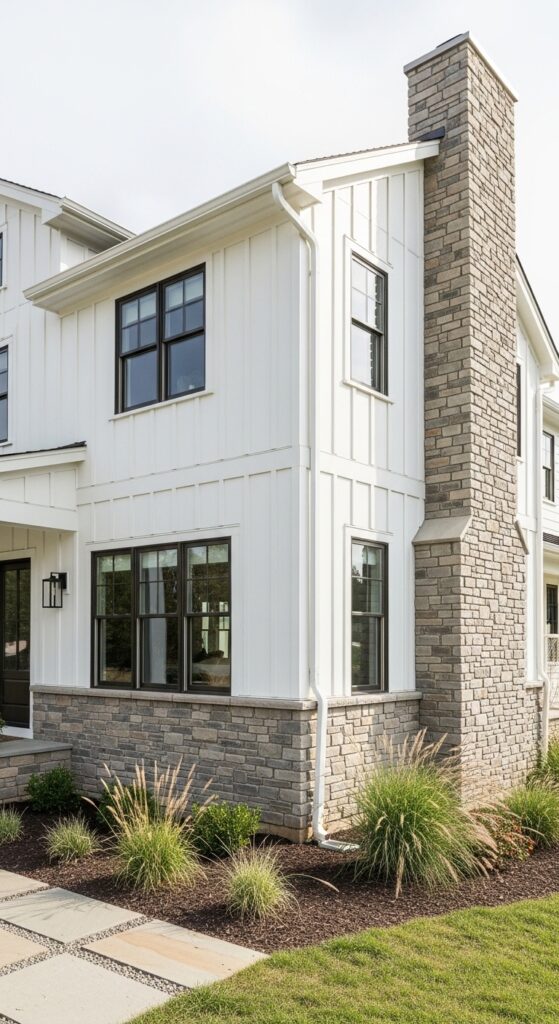
Vibe sentence: Natural stone at the foundation anchors a modern farmhouse to the earth in the most literal and beautiful way possible.
What makes it work: Stone at the foundation creates a visual weight that prevents a fully white exterior from looking like it’s floating. It also introduces natural color variation — the warm tans, cool grays, and rust undertones of real stone — that gives the facade genuine material richness.
How to achieve it: Eldorado Stone and Cultured Stone both offer mortared ledger stone veneer panels that install over existing siding or sheathing — no full masonry required. Choose a panel with a dominant warm gray tone to complement rather than compete with white board-and-batten above.
9. Dramatic Black Front Door with Transom Window
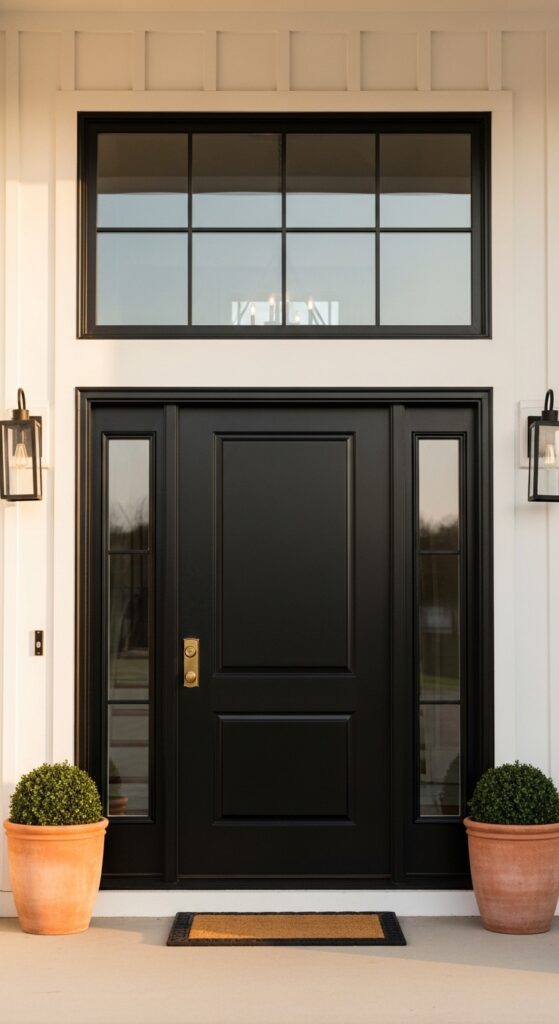
Vibe sentence: A matte black front door with a transom window isn’t just an entrance — it’s the moment the home introduces itself.
What makes it work: The combination of a tall black door, transom, and sidelights creates a vertical composition that reads as grand without being imposing. The transom window draws natural light into the entry hall while maintaining the visual architecture of the threshold from the exterior.
How to achieve it: Order a solid wood or fiberglass door in a simple flat or craftsman panel profile — avoid ornate moldings that conflict with the modern farmhouse’s clean lines. Schlage or Baldwin brass hardware in an unlacquered or aged finish provides the warmth that keeps a black entry from feeling cold.
10. Corrugated Metal Accent Panel
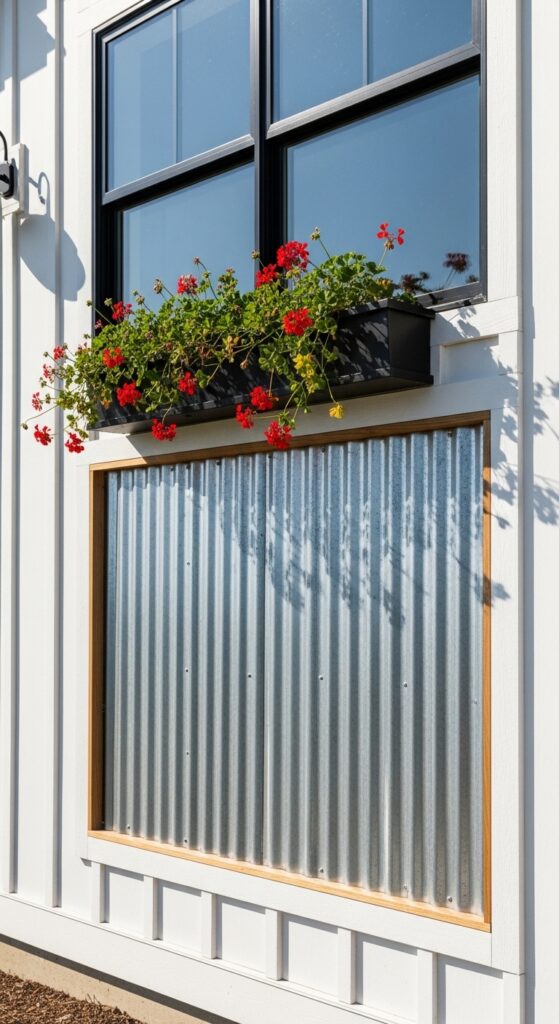
Vibe sentence: A corrugated metal accent panel says “working farmhouse” in the most architecturally compelling way.
What makes it work: The wave profile of corrugated metal catches light and shadow in a way that’s uniquely dynamic — it changes appearance throughout the day as the sun moves. Used as an accent panel rather than full cladding, it adds material contrast without overwhelming the facade’s cleaner elements.
How to achieve it: Use pre-painted corrugated metal roofing panels in a galvanized or weathering steel finish as a decorative wall accent — they’re available at any roofing supply store. Frame the panel cleanly in white painted wood trim so it reads as intentional rather than unfinished.
11. Cedar Wood Soffit and Overhang Details
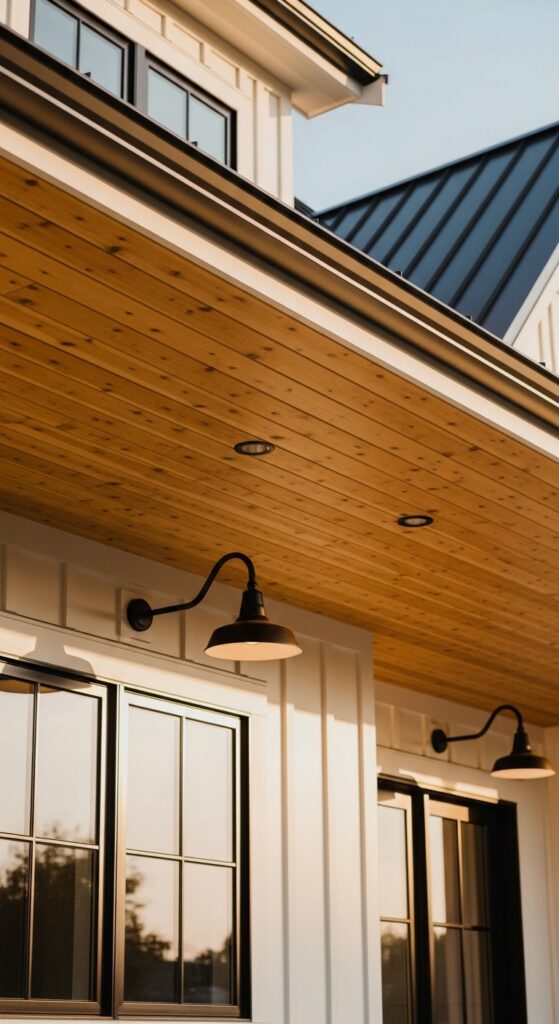
Vibe sentence: Exposed cedar soffits are what happens when a house lets its structure become its decoration.
What makes it work: The warm honey grain of cedar contrasts dramatically with white painted board-and-batten below and dark metal roofing above, creating a three-material layer that reads as richly detailed without appearing busy. The wide overhang itself is also deeply practical — it protects windows and siding from weather while providing natural shading.
How to achieve it: Use 1×6 clear cedar boards installed horizontally with tight joints and sealed with a UV-stable penetrating oil. Specify a minimum 24-inch overhang for the most authentic farmhouse proportion — wider overhangs are both more functional and more architecturally impactful.
12. Gooseneck Barn Lights Flanking the Entry
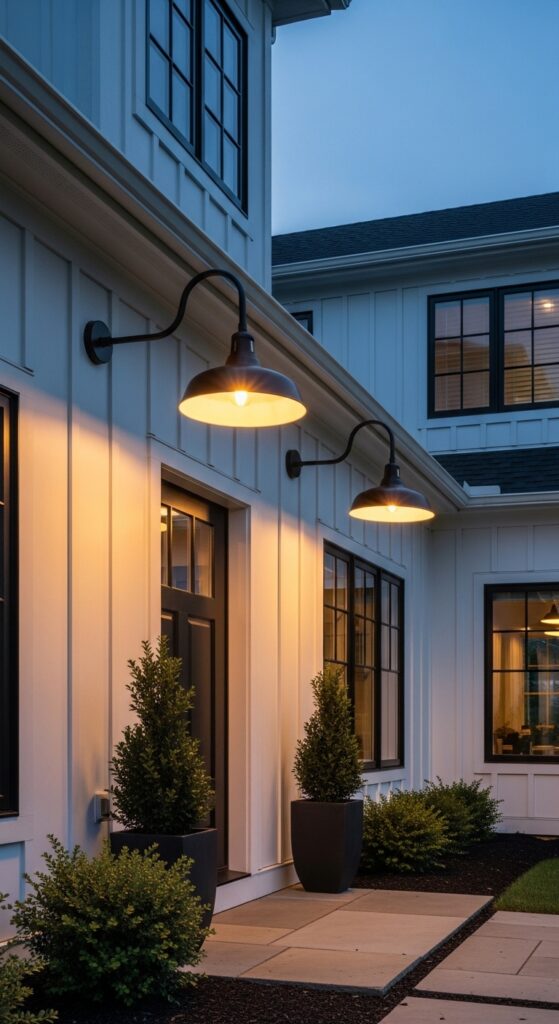
Vibe sentence: Gooseneck barn lights at dusk are when a modern farmhouse exterior stops being architecture and starts being atmosphere.
What makes it work: The gooseneck barn light silhouette is one of the most recognizable farmhouse exterior details — it references agricultural utility buildings directly. In matte black with an Edison bulb, it bridges the historical reference with a contemporary finish that complements black window frames throughout.
How to achieve it: Choose lights with a shade diameter of at least 12 inches for a properly scaled exterior appearance — small shades look undersized against a full facade. Barn Light Electric and Rejuvenation both offer excellent US-made options in multiple finishes and arm lengths.
💡 Barn lights are available at Home Depot for $40–$80 each — a fraction of specialty lighting brands — and the installation is a straightforward outdoor fixture swap.
13. Modern Farmhouse in Warm Greige
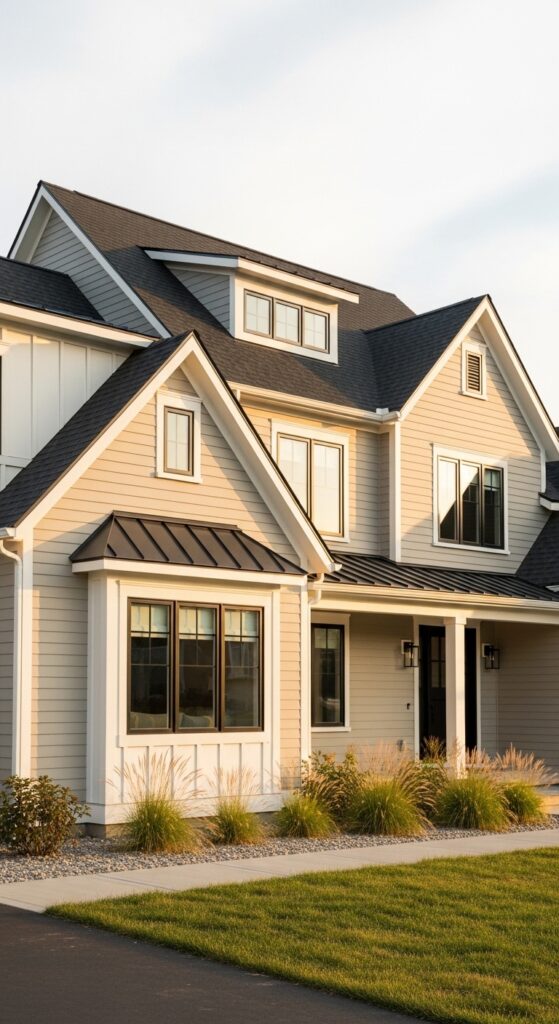
Vibe sentence: Warm greige on a farmhouse exterior is the answer for anyone who loves white but wants their home to feel more grounded and nuanced.
What makes it work: Greige — that soft hybrid of gray and beige — picks up warm undertones in morning light and cooler gray tones in overcast conditions, making the house feel subtly alive throughout the day. It’s the most versatile neutral in exterior design and reads differently in every season.
How to achieve it: Sherwin-Williams “Accessible Beige,” “Agreeable Gray,” or “Worldly Gray” are the three definitive greige exterior choices for modern farmhouse homes. Always test at least a 12×12-inch painted sample directly on your home’s exterior before committing — greige shifts significantly depending on surrounding landscape and light exposure.
14. Oversized Picture Windows
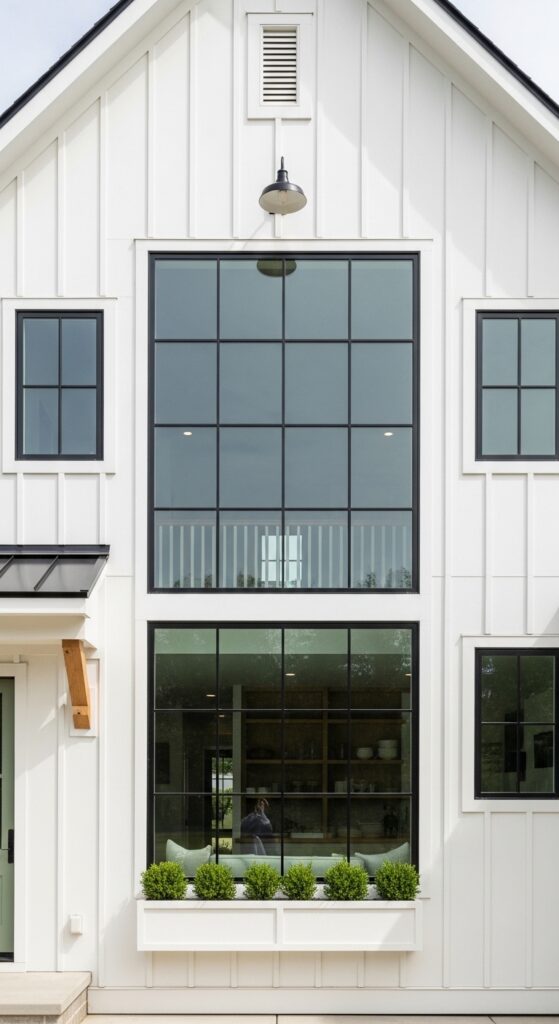
Vibe sentence: An oversized picture window on a farmhouse exterior is the architectural equivalent of making eye contact — direct, confident, impossible to ignore.
What makes it work: The proportion shift created by one significantly larger window among standard-sized ones creates instant visual hierarchy. The eye goes there first, reads the home’s interior life through the glass, and understands the architecture as a considered composition rather than a default facade.
How to achieve it: Modern farmhouse design benefits from windows with minimal sight lines — look for aluminum-clad or fiberglass frames with the slimmest possible profile. The larger the window, the thinner the frame should be proportionally, to avoid the window looking like it’s caged rather than open.
15. Horizontal Wood Cladding in Dark Stain
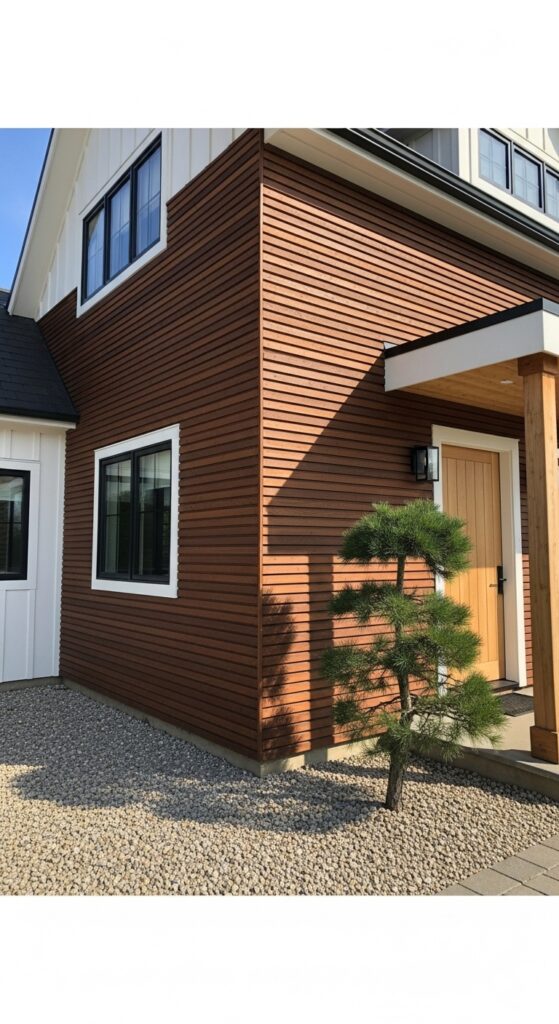
Vibe sentence: Dark-stained horizontal wood cladding brings the kind of quiet gravity that only natural materials can — warm, honest, and completely unhurried.
What makes it work: Horizontal wood cladding in a deep stain reads very differently than painted siding — the visible grain and the way stain penetrates rather than coats the wood gives it an organic depth. The tight gap between boards casts a consistent shadow line that gives the facade strong horizontal rhythm and architectural definition.
How to achieve it: Western red cedar or Shou Sugi Ban (Japanese charred cedar) are the most durable and visually compelling options. Shou Sugi Ban in particular is nearly impervious to rot and insects and develops a striking carbonized texture that weathers beautifully over decades with zero maintenance.
16. Clerestory Windows Under the Roofline
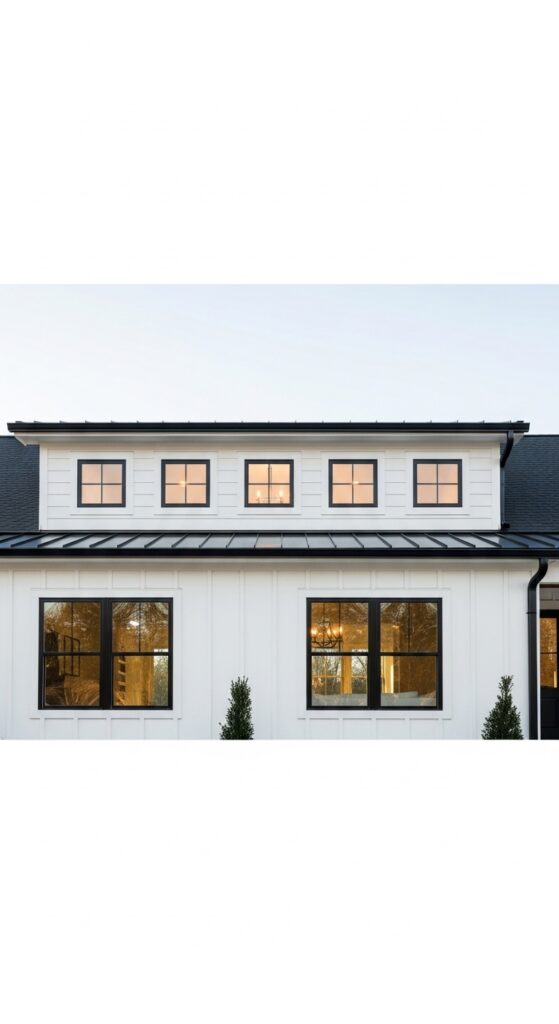
Vibe sentence: Clerestory windows near the roofline are the detail that separates a farmhouse from a farmhouse that’s been genuinely thought through.
What makes it work: A row of small clerestory windows just below the roofline creates a strong horizontal band that ties the facade together while bringing a stream of high natural light into the interior. It also signals architectural intention — this isn’t a default farmhouse, it’s a considered one.
How to achieve it: Clerestory windows work especially well on single-story modern farmhouses where ceiling height allows it. Specify fixed-pane windows (non-operable) in the same black frame as your primary windows for visual cohesion. The light they admit at the interior ceiling level creates a luminous glow that standard windows cannot replicate.
17. X-Brace Shutters on Board-and-Batten
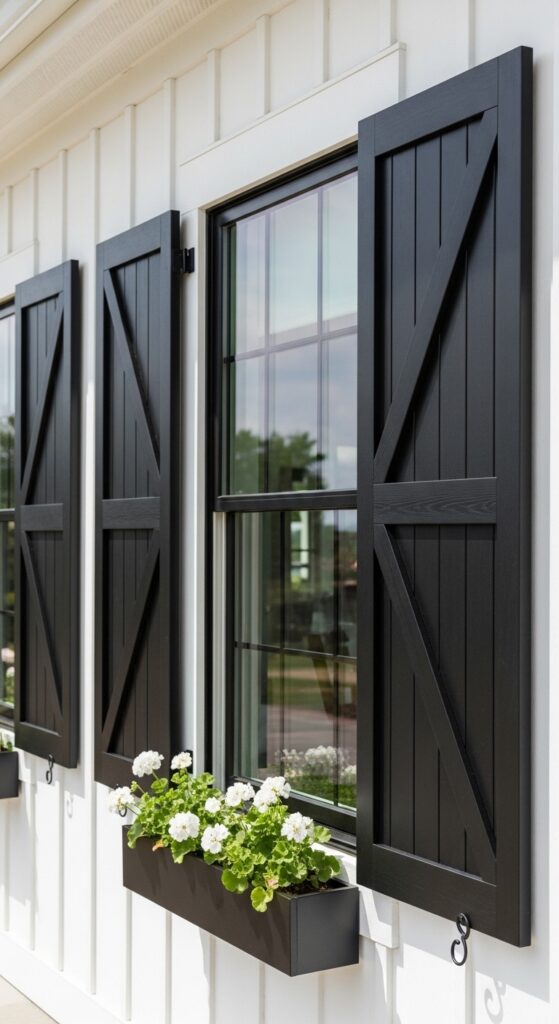
Vibe sentence: X-brace shutters are direct agricultural references — barn door details translated to the window scale with graphic confidence.
What makes it work: The X-brace pattern echoes the garage door hardware and barn door silhouette seen throughout modern farmhouse exterior design, creating a coherent visual language across the entire facade. Functional shutters properly scaled to cover each window read as authentic rather than decorative.
How to achieve it: Size shutters so each panel equals exactly half the window width — incorrectly proportioned shutters that are too narrow are the most common exterior decorating mistake. Paint in the same matte black as window frames for a unified palette. Exterior-grade PVC shutters maintain their finish far longer than wood in exposed conditions.
18. Covered Breezeway Connecting Garage
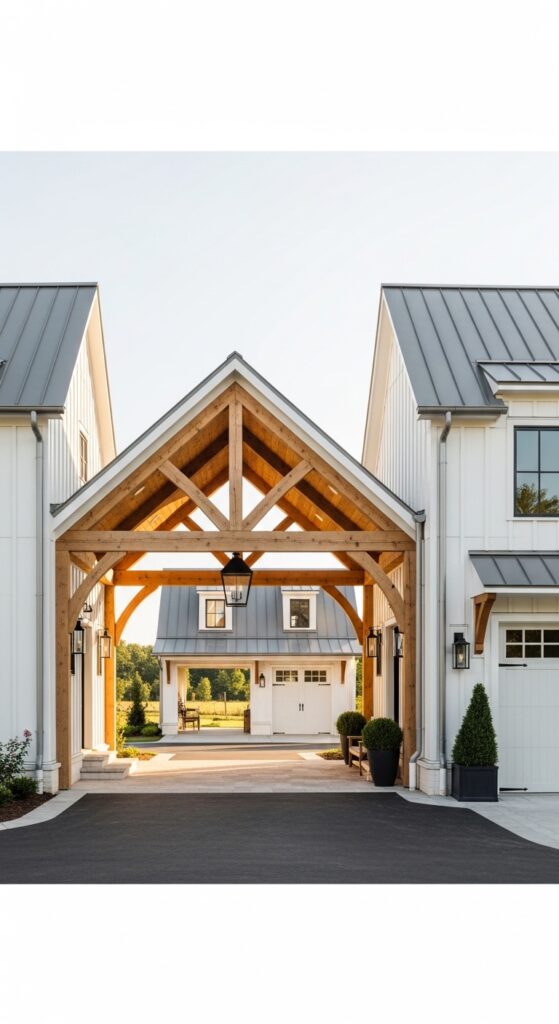
Vibe sentence: A covered breezeway makes a home feel like it grew thoughtfully over time rather than arriving all at once.
What makes it work: The breezeway creates a compositional connection between the house and garage that reads as intentional and generous. It also frames a view through to the landscape beyond, creating a layered depth to the exterior that a flat attached garage facade cannot achieve.
How to achieve it: Exposed timber frame construction — even with engineered LVL beams stained to look like natural wood — gives the breezeway its character. Match the standing seam metal roofing to the main house roof for cohesion. Keep the breezeway open on both sides for maximum light and visibility.
19. Asymmetric Rooflines and Shed Dormers
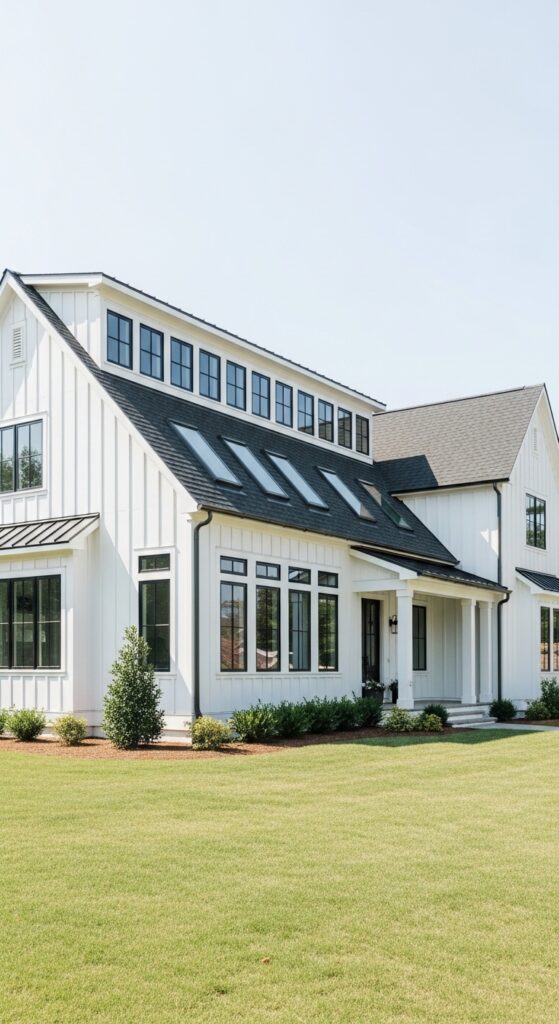
Vibe sentence: An asymmetric roofline gives the farmhouse a compositional tension that makes it impossible to look away from.
What makes it work: Symmetry is reassuring; asymmetry is interesting. A shed dormer running horizontally across one slope of the roof creates a strong architectural gesture that reads as a design decision — not a default. The row of evenly spaced windows in the dormer face also creates a powerful horizontal band that anchors the roofline.
How to achieve it: This is an architectural feature best incorporated at new construction or during a major renovation. Work with an architect to ensure the shed dormer proportions are calculated relative to the main gable roof — the dormer should feel like it belongs, not like it was added as an afterthought.
20. Flagstone or Bluestone Front Walkway
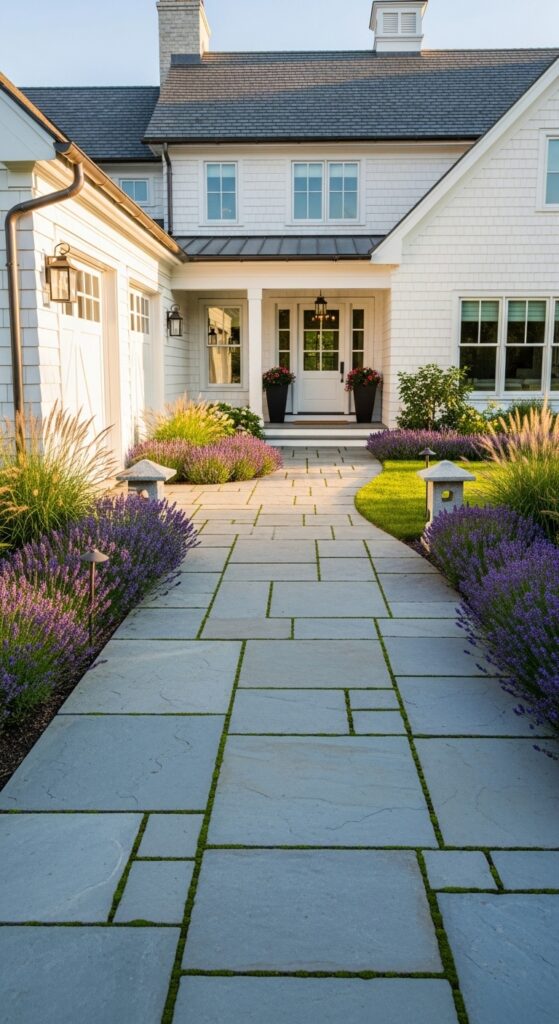
Vibe sentence: A flagstone walkway is the home’s first sentence — and bluestone says it with a quiet, unhurried confidence.
What makes it work: The organic irregularity of flagstone contrasts with the geometry of the house in a way that immediately makes the approach feel natural and rooted. Bluestone specifically has a blue-gray tone that complements white siding and charcoal roofing beautifully, tying the exterior’s color palette down into the landscape.
How to achieve it: Set bluestone flags on a dry-laid crushed stone base with polymeric sand joints for a maintenance-free result. For a more naturalistic look, plant creeping thyme or Irish moss between the joints — it handles light foot traffic and releases a pleasant fragrance when touched.
💡 Concrete stepping stones in an irregular flagstone mold are available at garden centers for $3–$8 each and are visually convincing from a distance at a fraction of real stone cost.
21. Board-and-Batten in Soft Sage Green
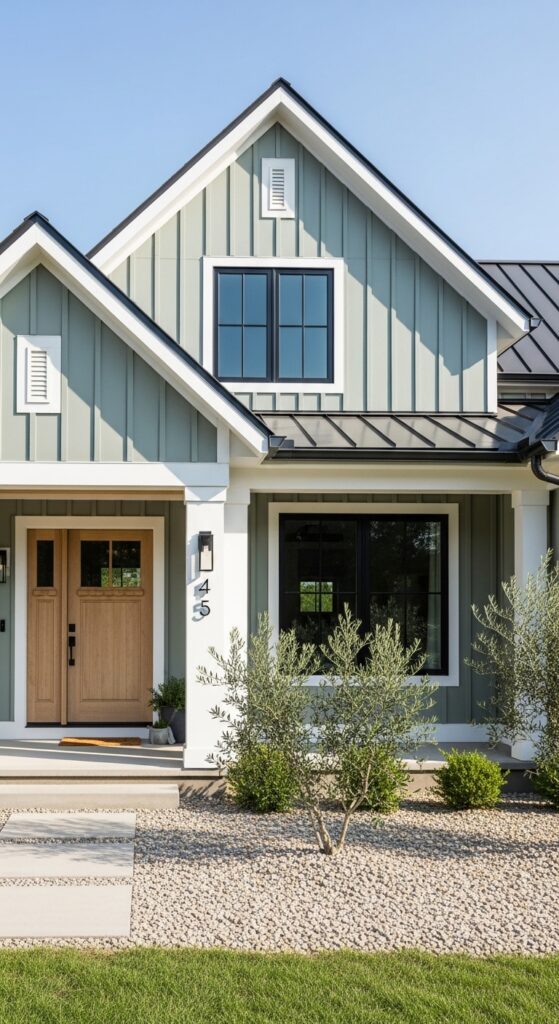
Vibe sentence: Sage green board-and-batten feels like the farmhouse exhaled — still rooted, still natural, but suddenly breathing.
What makes it work: Sage green is the exterior color choice that reads differently in every season — it harmonizes with spring growth, stands out quietly against summer blue skies, and positively glows against fall foliage. Against white trim and black windows, it creates a complete palette that needs nothing added.
How to achieve it: Farrow & Ball’s “Mizzle” or Sherwin-Williams “Retreat” are the benchmark sage exterior colors — both lean slightly gray, which prevents them from looking too bright or too yellow in direct sunlight. Always specify exterior-grade paint with a satin finish for board-and-batten to protect the deep reveals from moisture accumulation.
22. Exposed Timber Frame Porch Entry
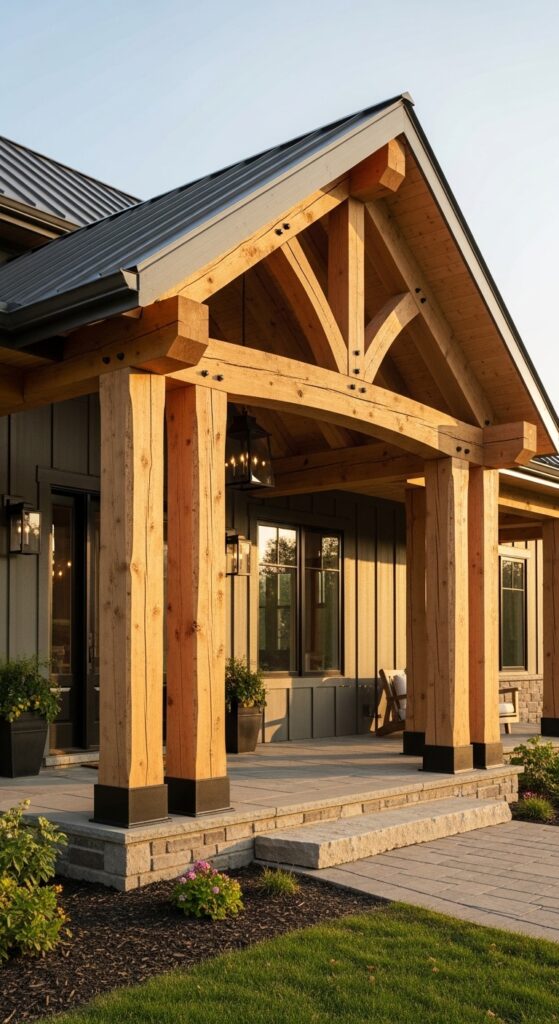
Vibe sentence: An exposed timber frame entry porch announces the house with the quiet authority of something built to last a century.
What makes it work: Heavy timber — real or engineered — conveys structural honesty that painted wood columns simply cannot. The visible beam-and-column grammar of a timber frame porch reads as genuinely architectural, elevating even a simple facade into something that feels considered and intentional.
How to achieve it: Douglas fir, white oak, and reclaimed barn timber are the most commonly used species. Steel column bases and beam connectors in matte black both support the structure and become design details. Treat exposed timber with a clear UV-resistant penetrating finish — avoid opaque stains that hide the grain.
23. Modern Farmhouse Ranch with Long Low Roofline
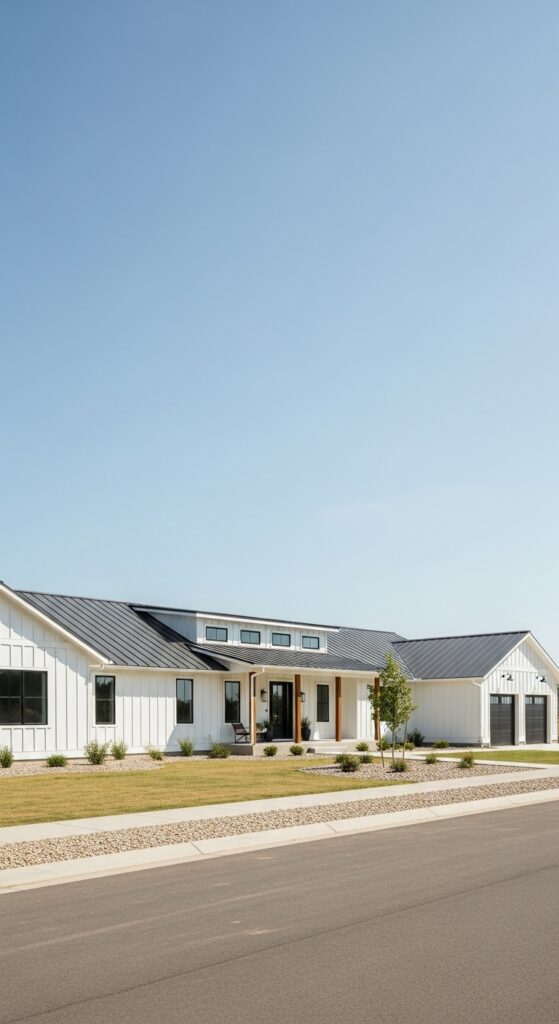
Vibe sentence: A ranch-style modern farmhouse owns the horizontal — it stretches confidently across the land rather than reaching up from it.
What makes it work: Ranch homes have a natural affinity for modern farmhouse styling — the low roofline, wide eaves, and single-story profile echo the working farm building typology directly. A long consistent facade in white board-and-batten with a metal roof is genuinely striking in its simplicity.
How to achieve it: The key to a ranch-style modern farmhouse facade is maintaining design consistency across its full width — same siding profile, same window style, same trim detailing throughout. Any break in consistency reads as incoherent across a long facade. Work with a designer to ensure rhythm and proportion hold at full scale.
24. Farmhouse with a Black Metal Roof and White Trim
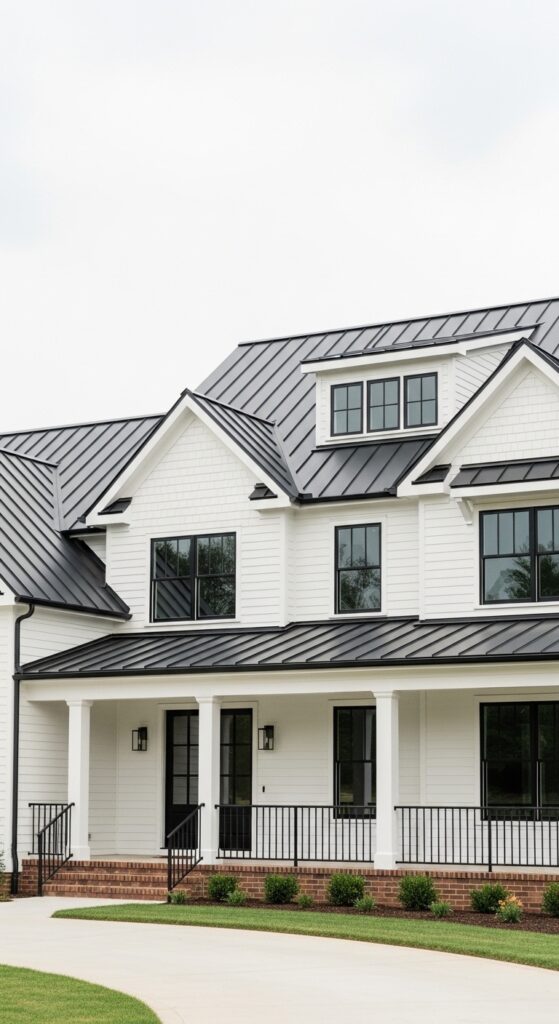
Vibe sentence: Black metal roof against bright white siding is the modern farmhouse exterior’s most graphic moment — unapologetic, timeless, perfectly resolved.
What makes it work: The high contrast between a near-black metal roof and bright white siding creates a graphic boldness that reads with equal power from the end of a long driveway and up close at the front door. It’s also a genuinely historical combination — black metal roofs on white painted farmhouses have existed in American vernacular architecture for over 150 years.
How to achieve it: Specify Kynar-coated steel roofing in “Matte Black” or “Charcoal” — the Kynar finish resists fading, chalking, and UV degradation for 30–40 years. Ensure all trim, fascia, and gutter elements are bright white to maintain the clean contrast across every edge of the home.
25. Raised Garden Beds and Herb Garden at the Entry
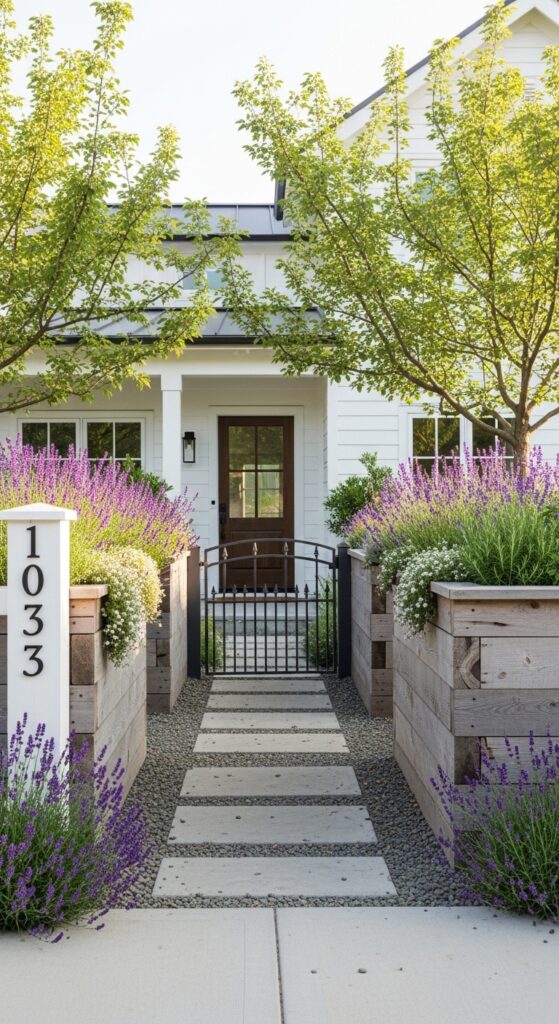
Vibe sentence: Raised garden beds at the front entry are the farmhouse’s way of saying “something grows here” — productive, beautiful, and entirely honest.
What makes it work: The raised bed silhouette creates a formal framing element for the entry approach that feels both structured and abundantly alive. The combination of edible herbs and flowering perennials — lavender, rosemary, salvia, thyme — is distinctly farmhouse in its practicality-meets-beauty philosophy.
How to achieve it: Build raised beds from cedar 2×10 boards — cedar’s natural oils resist rot without chemical treatment. Plant in a combination of flowering lavender at the front edge, structural rosemary in the middle, and trailing thyme at the corners. This layered planting creates a full, overflowing look within one growing season.
💡 Cedar raised bed kits from Amazon or your local garden center cost $60–$120 and require no tools beyond a screwdriver to assemble.
26. Shutterless Windows with Thick Casing Trim
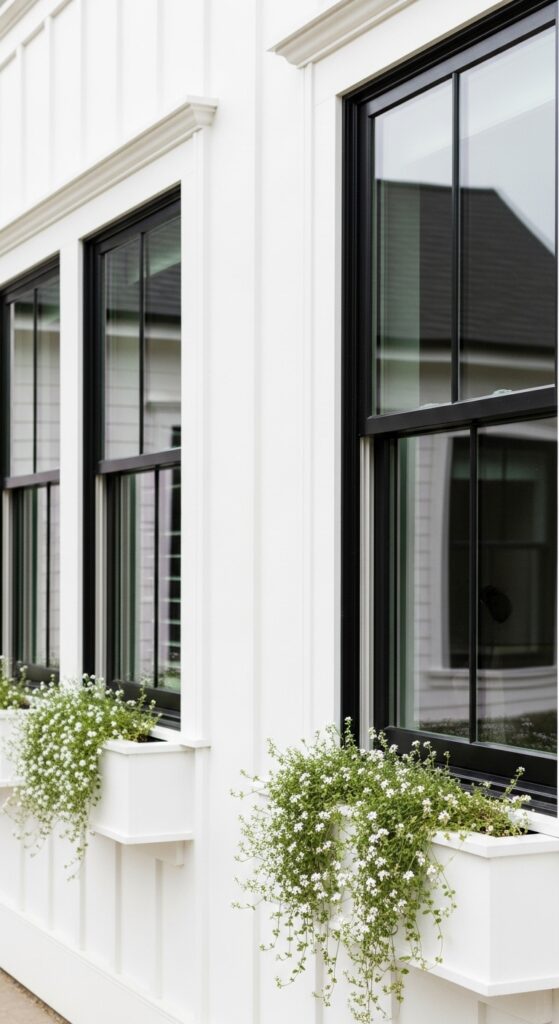
Vibe sentence: Removing shutters and widening the trim casing is modern farmhouse’s clearest editorial move — subtracting decoration to reveal pure proportion.
What makes it work: Wide casing trim — 5 to 6 inches of flat white painted wood around each window — gives the window its own architectural presence without relying on shutters for visual weight. The result is cleaner, bolder, and more contemporary than traditional shutter-flanked windows.
How to achieve it: Install 5/4×6 flat pine board trim as window casing, mitered at the corners. Paint in the same white as the rest of the trim and facade — this unity prevents the casing from looking like it’s competing with the wall. The corner blocks and sill detail should be simple and flat, without decorative routing.
27. Fire Pit Courtyard as Outdoor Living Extension
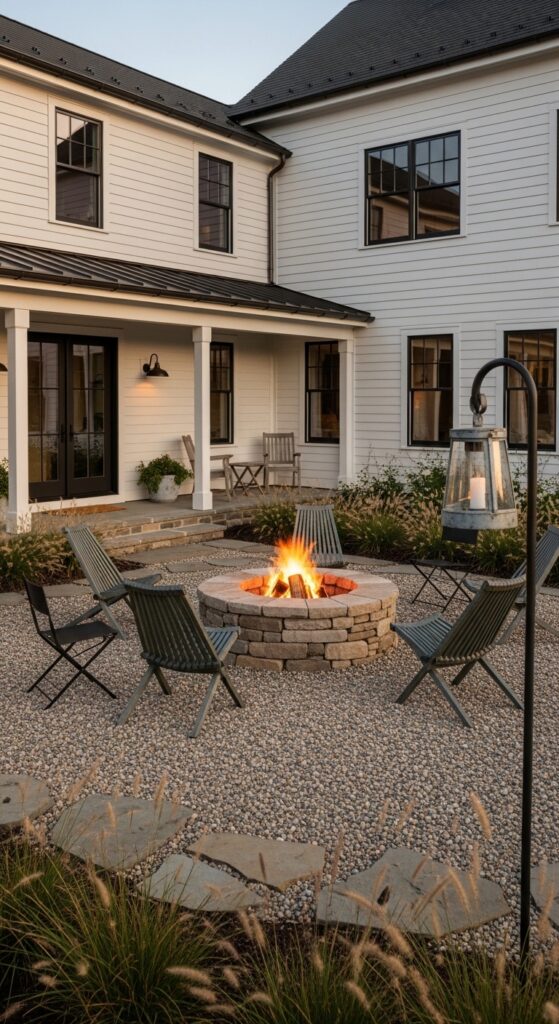
Vibe sentence: A fire pit courtyard extends the farmhouse’s warmth outward — the home and the land become one cohesive living space.
What makes it work: A defined outdoor living area adjacent to the farmhouse facade creates an exterior composition that reads as an estate rather than a house with a yard. The gravel and stone materials echo the farmhouse’s exterior palette, tying the landscape to the architecture without forcing it.
How to achieve it: Define the courtyard with a 4-inch deep compacted gravel base in a pea gravel or decomposed granite finish. Build the fire pit from dry-stacked natural fieldstone or bluestone — no mortar needed for a simple ring design. Keep furniture simple and natural — teak, iron, or painted metal in black or dark bronze.
28. Contrasting Dark Siding on the Garage Wing
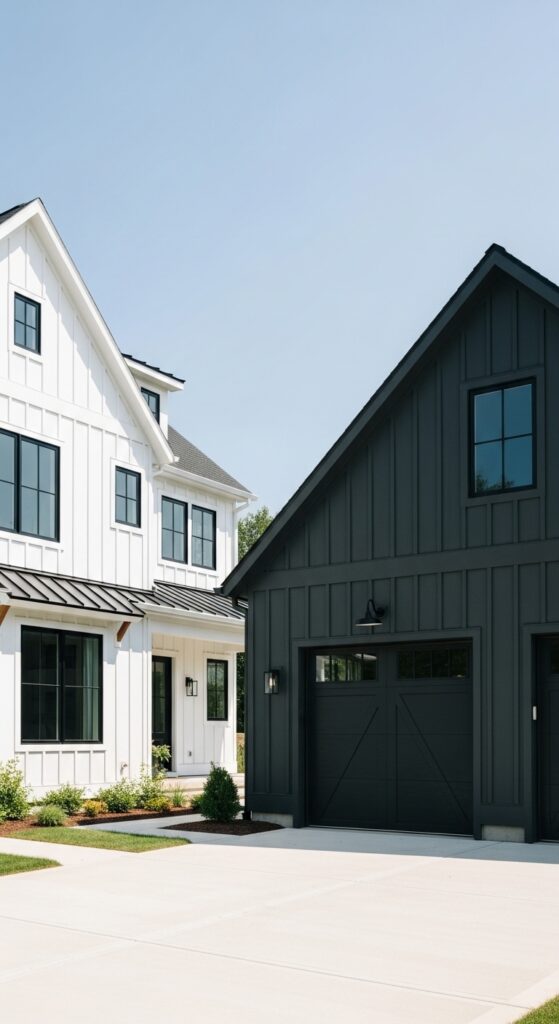
Vibe sentence: A dark garage wing against a white main house creates a composition that looks like it was drawn before it was built.
What makes it work: Using contrasting tones on different masses of the same exterior is an architectural technique borrowed from Scandinavian and Japanese vernacular design. The white main house reads as the primary form; the dark garage reads as a subordinate accent — and the relationship between them creates visual hierarchy and genuine sophistication.
How to achieve it: Maintain the same siding profile — board-and-batten — across both wings so the tonal contrast carries the distinction. Use the same trim details, window style, and hardware throughout for cohesion. Avoid mixing siding profiles AND colors simultaneously; that creates confusion rather than composition.
29. Simple White Picket Fence with Native Plantings
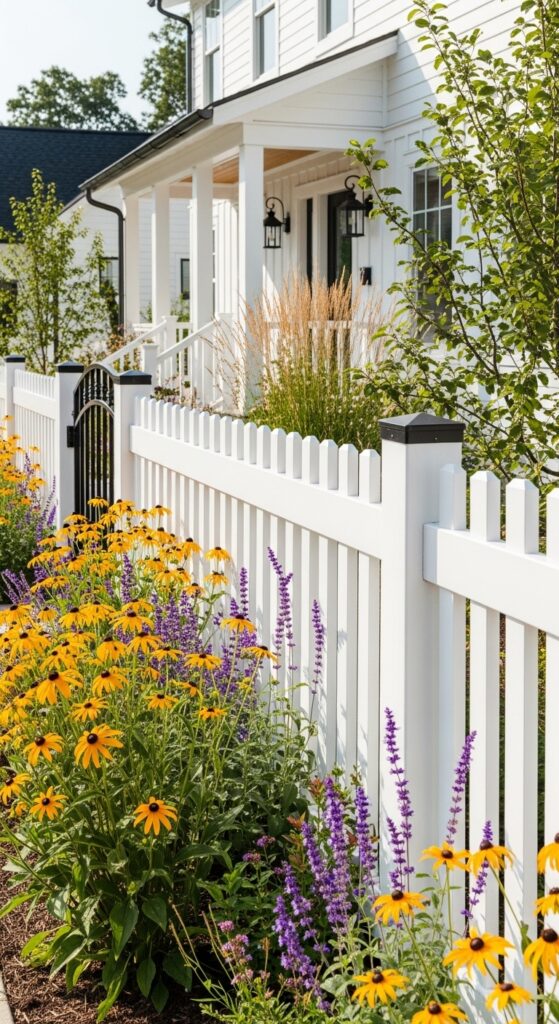
Vibe sentence: A white picket fence with native wildflowers is the modern farmhouse’s most genuine gesture — it says “welcome” in the oldest possible language.
What makes it work: The updated flat-top picket profile (rather than the traditional pointed version) keeps the fence feeling contemporary and aligned with modern farmhouse’s clean lines. Native plantings — black-eyed Susans, salvia, ornamental grasses — replace the manicured foundation shrubs of traditional landscaping with something that feels genuinely wild and alive.
How to achieve it: Specify white vinyl or Azek PVC fence panels in a flat-top picket profile — both are zero-maintenance and hold their white color without repainting. Plant native perennials at the fence base in a naturalistic scatter pattern rather than rows — this is critical for achieving the “found” rather than “planted” aesthetic.
💡 Native seed mixes for meadow-style planting are available from American Meadows for under $30 and reseed themselves each year with zero effort.
How to Start Your Modern Farmhouse Exterior Transformation
Begin where the biggest visual impact is, and that’s almost always the front door and entry lighting. A fresh coat of matte black paint on the front door paired with two gooseneck barn lights costs under $150 total and immediately communicates the modern farmhouse vocabulary to anyone approaching. It’s a single afternoon’s work with a weekend’s worth of compliments.
From there, address the garage doors if yours are a dated color or profile. Painting them to match or complement the front door color creates instant facade cohesion. After the door and garage are resolved, the next priority is the siding color — particularly if your home is currently in a dated tan or rose beige that fights the farmhouse palette rather than supporting it.
The most common exterior renovation mistake is tackling one element in isolation without considering how it relates to the whole. A beautiful new front door means very little if it’s surrounded by mismatched trim, dated light fixtures, and an overgrown entry. Always visualize the entry zone as a complete composition before making any single purchase.
Budget-wise, a meaningful modern farmhouse exterior refresh — new paint, door, lighting, and a few landscaping touches — can be accomplished for $500–$1,500 without touching the siding or roofing. A more comprehensive transformation including new siding, windows, and roof is a $20,000–$60,000+ investment, but the curb appeal and home value return is genuinely significant.
Frequently Asked Questions
What colors are most popular for modern farmhouse exterior siding?
The dominant modern farmhouse exterior palette centers on bright white, warm white, warm greige, and dark charcoal — with sage green rapidly growing in popularity. Bright white in a warm-toned formula (Benjamin Moore “Chantilly Lace” or Sherwin-Williams “Extra White”) is the most classic choice. Greige options like Sherwin-Williams “Agreeable Gray” suit homeowners wanting warmth without the maintenance of a true white. Dark charcoal options like Sherwin-Williams “Iron Ore” have become increasingly popular for bold, dramatic single-story homes. Avoid cool blue-grays or purple-influenced grays — they conflict with the warm, natural material philosophy of the style.
Is board-and-batten siding expensive to install?
Board-and-batten siding ranges from $6–$12 per square foot installed, depending on the material. Wood board-and-batten is the least expensive material but requires repainting every 5–7 years. James Hardie fiber cement board-and-batten panels run $8–$14 per square foot installed but carry a 30-year warranty and require painting only every 10–15 years. Engineered wood options from LP SmartSide fall in the middle — around $6–$10 installed — with good durability and a realistic wood-grain texture. For most modern farmhouse projects, James Hardie is the professional recommendation for its combination of longevity, paintability, and dimensional stability.
How do I choose between a black or white window frame for a modern farmhouse?
Both work — the choice depends on your exterior’s overall contrast level. Black window frames are the bolder, more graphic choice and work best on white or very light siding where the contrast reads clearly. On darker exteriors — charcoal siding, dark brown wood cladding — black windows can disappear into the facade; in those cases, consider bronze or dark brown aluminum-clad frames instead. White window frames on a white farmhouse are appropriate for a softer, more traditional look, though they lack the graphic punch of the black-on-white combination. A useful rule: match window frame color to your darkest exterior accent element — roof, door, or shutters — for a cohesive result.
What landscaping style suits a modern farmhouse exterior best?
Modern farmhouse exteriors are most coherent with naturalistic, low-maintenance landscaping. Native ornamental grasses, lavender, black-eyed Susans, coneflowers, and rosemary all suit the style’s practical, nature-forward philosophy. Avoid highly manicured, formal hedging — it conflicts with the relaxed confidence of the farmhouse aesthetic. Gravel mulch beds rather than dyed wood mulch read as cleaner and more contemporary. Raised garden beds near the entry are a distinctly farmhouse touch that adds character and seasonal interest simultaneously. The landscaping should look like it belongs to the land — not imported from a garden center catalog.
Can a brick or stucco home be updated to look like a modern farmhouse exterior?
Yes — both materials can be incorporated into a modern farmhouse aesthetic with thoughtful updating. Brick homes can be limewashed (a reversible, historically authentic process) to create a soft, textured white or greige surface that reads as farmhouse without covering the brick permanently. German Smear technique produces a more textured, European farmhouse feel. Stucco homes can be painted in the farmhouse palette and updated with board-and-batten accent panels on gable ends or the garage wing. In both cases, the window frames, front door, light fixtures, and roofing materials matter as much as the primary wall surface — updating those elements in the modern farmhouse vocabulary is often enough to shift the overall read significantly.
Ready to Create Your Dream Modern Farmhouse Exterior Space?
You now have 29 modern farmhouse exterior ideas spanning every element of the facade — from the roofline to the garden gate, from the garage door to the porch ceiling. Save the ones that speak to the version of your home you’re working toward, because this style rewards the patient collector of ideas more than the impulsive renovator. Your modern farmhouse exterior doesn’t need to happen all at once — it can begin with a paint color, a pair of barn lights, or a front door that finally feels right. Each small decision compounds into something that, one day, makes you stop mid-stride on your own driveway and exhale with satisfaction. That’s the modern farmhouse promise.