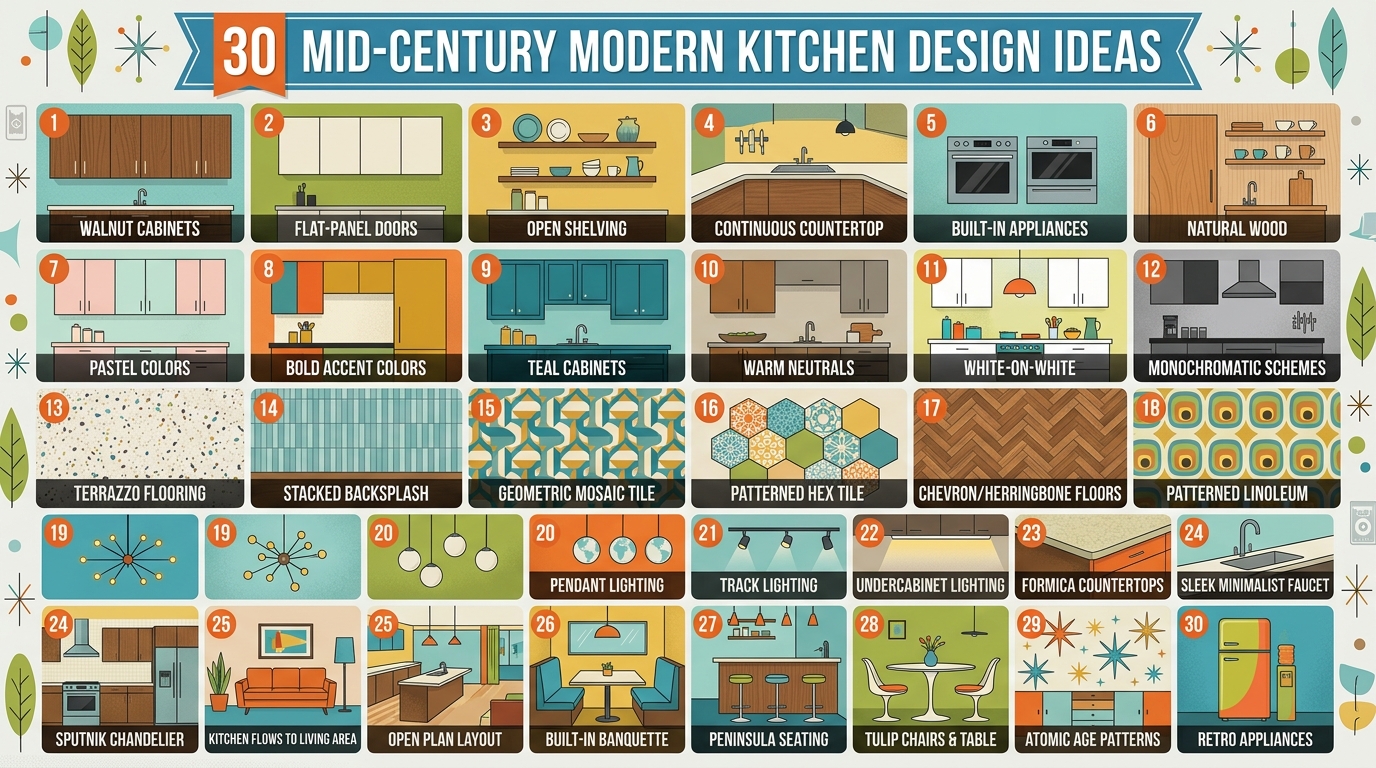
Mid-century modern is a design movement born between the 1940s and 1960s, defined by clean lines, organic forms, warm wood tones, and the radical idea that everyday objects deserve to be beautiful. These 30 mid century modern kitchen design ideas cover everything from cabinet hardware and color palettes to lighting, layout, and small-space adaptations — so you can find exactly what works for your kitchen.
There’s a particular confidence to a mid century modern kitchen. It doesn’t try to charm you with softness or overwhelm you with pattern. It draws you in with proportion — the way a walnut drawer front sits against a matte avocado tile, the way a Sputnik pendant throws light across a terrazzo floor, the way the whole room feels like it was designed by someone who thought very carefully and then stopped. Here are 30 ideas worth saving — and stealing.
Why Mid Century Modern Works So Well
Mid century modern design emerged in the United States and Scandinavia in the post-World War II era, shaped by architects and designers including Charles and Ray Eames, Eero Saarinen, and Danish master Hans Wegner. The style was a direct response to the ornate excess of pre-war interiors — a declaration that good design should be democratic, functional, and optimistic. What makes it distinct from contemporary minimalism is its warmth: MCM always includes organic curves, natural wood, and a playful confidence with color that pure minimalism avoids.
The core materials are warm-toned woods — teak, walnut, and oiled white oak — paired with terrazzo, matte ceramic tile, and brushed brass or chrome hardware. Color palettes draw from a specific mid century register: avocado green, burnt orange, harvest gold, and warm teal play against warm white, cream, and rich walnut. Surfaces tend to be either very matte (flat-front cabinets in a chalky paint) or very tactile (handmade tile with slight surface variation).
Mid century modern is experiencing a renaissance right now for a clear reason: people are exhausted by cold, grey, all-white kitchens. After years of the subway-tile-and-quartz aesthetic dominating renovation culture, there’s a hunger for warmth, personality, and color — and MCM delivers all three without requiring maximalist chaos. Pinterest search data shows “mid century modern kitchen” has grown steadily since 2021, driven by younger homeowners renovating 1950s–1970s homes authentically.
Small kitchens can absolutely achieve this style. Prioritize hardware first: replacing cabinet pulls with solid brass bar pulls or round knobs costs under $100 and shifts the entire aesthetic immediately. In tight kitchens, avoid the walnut-everything approach — one walnut island or a single floating walnut shelf provides the warmth without visual weight.
| Element | Core Trait 1 | Core Trait 2 |
| Philosophy | Form follows function | Organic meets geometric |
| Materials | Teak, walnut, terrazzo, brushed brass | Matte ceramic, chrome, molded plywood |
| Color palette | Avocado green, harvest gold, burnt orange | Warm white, teak brown, warm teal |
1. Flat-Front Walnut Cabinet Doors with Integrated Pulls
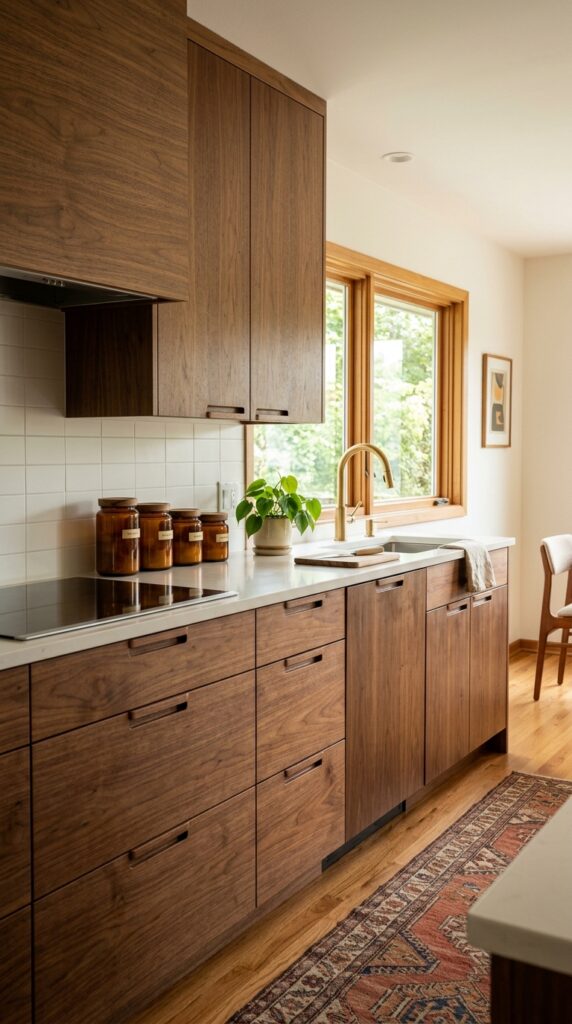
Vibe: Warm and deliberate — the kind of kitchen where every surface rewards a closer look.
Why it works: Integrated routed pulls eliminate the need for external hardware, keeping the cabinet face completely flush and uninterrupted — a core mid century modern principle of letting material speak for itself. Walnut’s open grain structure absorbs light rather than reflecting it, giving the cabinet faces a matte, almost tactile quality. The warm amber-brown of walnut also reads as the room’s anchor tone, grounding brighter accent colors without competing with them.
How to get it: If full cabinet replacement isn’t in budget, apply walnut veneer sheets ($25–$45 per sheet from Certainly Wood or Oakwood Veneer) to existing flat-front MDF cabinet faces using contact cement. Route a 3/4″ horizontal channel along the top edge of each door using a handheld router — this becomes the pull. Finish with Rubio Monocoat “Walnut” for an oil-finished look.
💡 Quick Win: Peel-and-stick walnut wood grain contact paper ($18–$28 on Amazon) applied to flat cabinet fronts and drawers creates a convincing wood-tone update in one afternoon.
🛍️ Shop the Look — Amazon Product Ideas
| # | Product Search Phrase | Why It Fits |
| 1 | walnut veneer peel and stick cabinet contact paper | Wood tone update |
| 2 | integrated routed pull flat front cabinet door hardware | No-hardware aesthetic |
| 3 | amber glass spice jar storage set with labels | MCM kitchen counter |
| 4 | small indoor philodendron plant in ceramic pot | Organic accent touch |
| 5 | solid brass kitchen faucet single handle | Warm metal finish |
2. Avocado Green Lower Cabinets with Warm White Upper
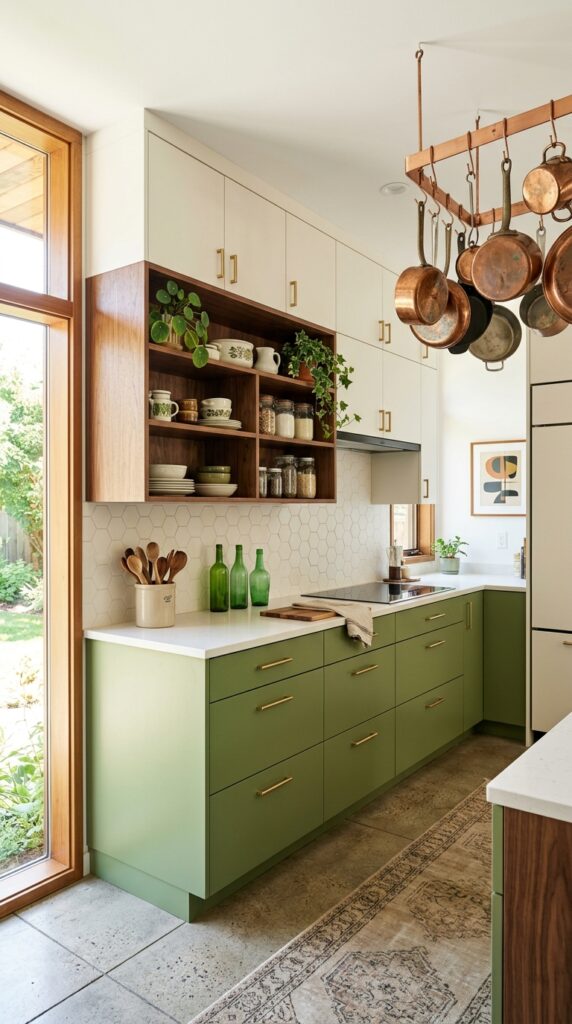
Vibe: Confident and sun-warmed — this kitchen knows exactly what it is.
Why it works: Two-tone cabinet treatment is a foundational MCM kitchen move because it prevents the color from becoming overwhelming while maintaining the style’s commitment to non-neutral choices. Lower cabinets in a saturated tone feel grounded (they’re below eye level and anchored to the floor) while white uppers keep the room from closing in visually. The walnut open shelf between acts as a “material transition zone,” bridging the two halves of the palette.
How to get it: Benjamin Moore “Dried Thyme” (HC-168) and “Avocado” (2145-30) are the two most authentic avocado-family greens for MCM cabinets — both have the yellow undertone that distinguishes period-accurate MCM green from cooler modern sage. Apply with a foam roller for a factory-smooth finish.
🛍️ Shop the Look — Amazon Product Ideas
| # | Product Search Phrase | Why It Fits |
| 1 | brushed brass bar pull cabinet hardware set 96mm | MCM two-tone cabinets |
| 2 | walnut floating wall shelf with invisible bracket | Upper lower transition |
| 3 | ceramic utensil holder crock matte white | Counter top styling |
| 4 | green glass bottle set kitchen counter decor | Tonal color layering |
| 5 | copper hanging pot rack ceiling mount | Vintage kitchen utility |
3. Sputnik Pendant Light over the Kitchen Island
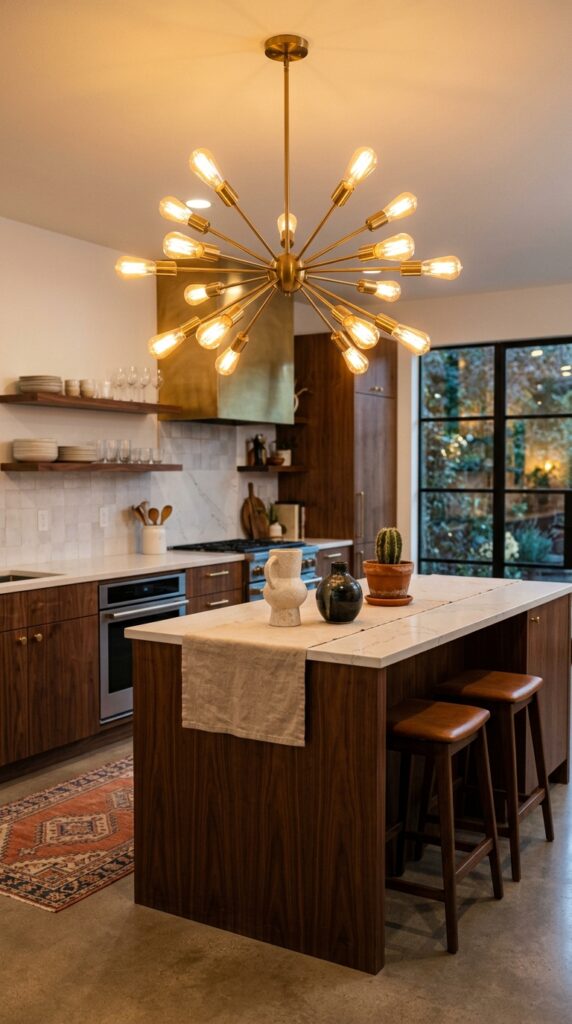
Vibe: Theatrical and warm — this pendant makes the island feel like the center of the world.
Why it works: The Sputnik chandelier is one of the most recognizable mid century modern lighting forms, designed to evoke the excitement of the Space Age — its starburst form creates radial symmetry that draws the eye upward and outward simultaneously. Hung over an island, it performs the spatial function of a chandelier (visual anchor, light distribution, height emphasis) while adding sculptural interest that no recessed can light could approach. The brass finish connects the warm wood tones to the metal hardware.
How to get it: Hang a Sputnik pendant so the lowest bulb tip is 30–34 inches above the island countertop — this is the sweet spot for task light coverage without blocking sightlines. Pair with 2200K Edison-style bulbs for the warmest, most period-accurate light quality.
💡 Quick Win: A 6-arm mini Sputnik pendant in matte brass runs $45–$85 on Amazon and works over a small breakfast nook or single-pendant application without requiring an electrician if swapping an existing fixture.
🛍️ Shop the Look — Amazon Product Ideas
| # | Product Search Phrase | Why It Fits |
| 1 | mid century sputnik chandelier brass 12 arm | Signature MCM lighting |
| 2 | Edison vintage filament bulb E26 2200K warm | Period-accurate bulb color |
| 3 | cactus small potted plant terracotta planter | Desert organic accent |
| 4 | linen table runner natural undyed kitchen island | Soft surface layering |
| 5 | sculptural ceramic vase set matte organic form | Counter art objects |
4. Terrazzo Tile Backsplash in Warm Tones
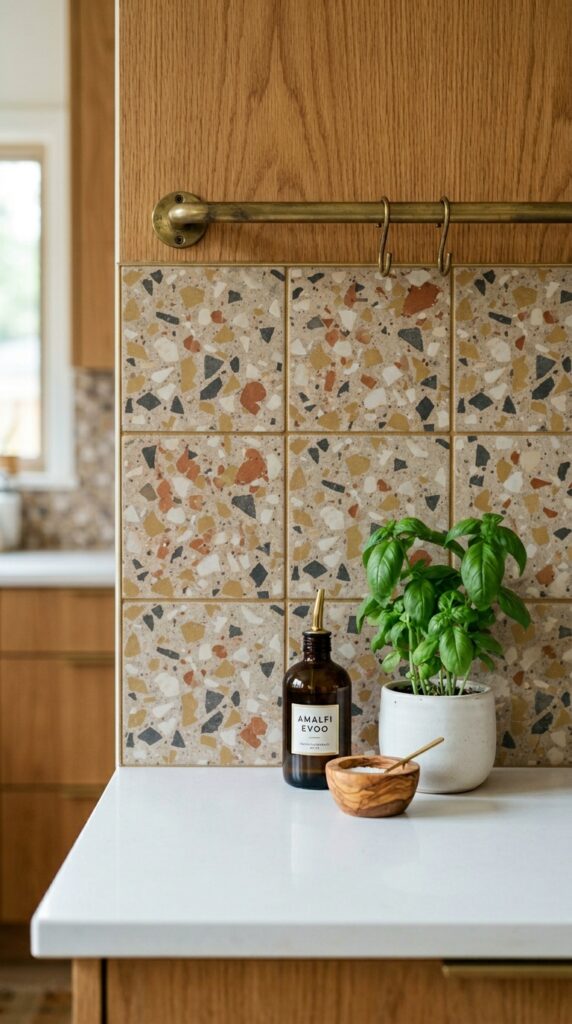
Vibe: Textured and grounded — a backsplash that rewards the closer you get to it.
Why it works: Terrazzo was the defining floor material of mid century modern public architecture — its speckled chip pattern mimics the visual complexity of stone while offering the controlled regularity of tile. In a kitchen backsplash application, terrazzo-look ceramic tiles deliver that same visual richness without the installation challenges of true poured terrazzo. The multi-tonal chip pattern means it integrates naturally with warm wood, brass, and both cool and warm countertop materials.
How to get it: Source terrazzo-look porcelain tiles from TileBar, Fireclay Tile, or BuildDirect in 4″x4″ or 6″x6″ sizes — the smaller format reads more period-authentic than large-format terrazzo slabs. Grout in warm greige (Mapei “Warm Gray”) rather than white to prevent the joint lines from competing with the chip pattern.
🛍️ Shop the Look — Amazon Product Ideas
| # | Product Search Phrase | Why It Fits |
| 1 | terrazzo look porcelain tile sample set backsplash | Tile selection aid |
| 2 | greige sanded grout kitchen bathroom 25lb | Warm grout color |
| 3 | small fresh herb plant pot window kitchen | Live counter accent |
| 4 | Italian olive oil bottle decorative kitchen counter | Mediterranean styling |
| 5 | brass mounted wall rail kitchen utensil bar | MCM wall organization |
5. Open Floating Walnut Shelves Instead of Upper Cabinets
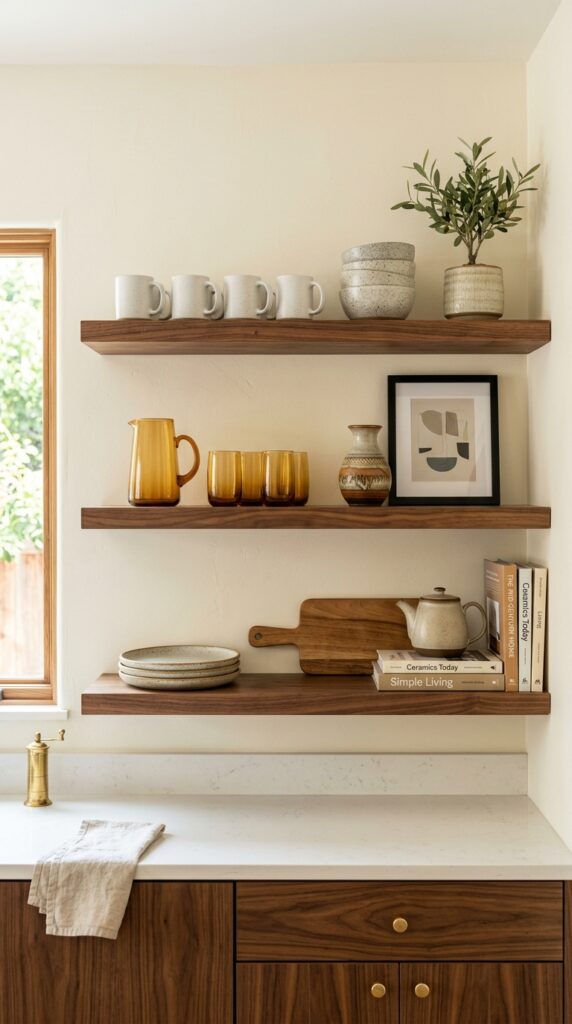
Vibe: Airy and intentional — every object earns its place on these shelves.
Why it works: Replacing upper cabinets with floating shelves opens the upper portion of the wall visually, making even a galley kitchen feel more spacious. The key is the material: walnut at 1.5″ thickness reads as substantial and furniture-quality rather than DIY, and its warm brown tones prevent the open wall from feeling cold or sparse. The discipline required to style open shelves — keeping only items you love — also improves the entire kitchen’s visual organization.
How to get it: Purchase pre-cut walnut live-edge or flat-sawn slabs from a local lumber yard, sand to 220-grit, and finish with Osmo Polyx Oil “Natural” for a durable, food-safe surface. Install using Floating Shelf Hardware’s “Heavy Duty” blind rod system (rated to 300 lbs) — available on Amazon for $28–$45 per shelf.
💡 Quick Win: IKEA’s solid pine “Lack” shelf ($12) stained with Minwax “Dark Walnut” gel stain creates a convincing walnut floating shelf for under $25 installed.
🛍️ Shop the Look — Amazon Product Ideas
| # | Product Search Phrase | Why It Fits |
| 1 | floating shelf hardware heavy duty blind rod brackets | Invisible shelf support |
| 2 | speckled stoneware bowl set handmade style | Shelf ceramic styling |
| 3 | amber glass drinking glasses set of 6 | Warm glass shelf accent |
| 4 | matte white ceramic mug set minimalist kitchen | Open shelf dishware |
| 5 | small olive tree indoor ceramic planter | Kitchen shelf plant |
6. Harvest Gold Tile Accent Wall Behind the Range
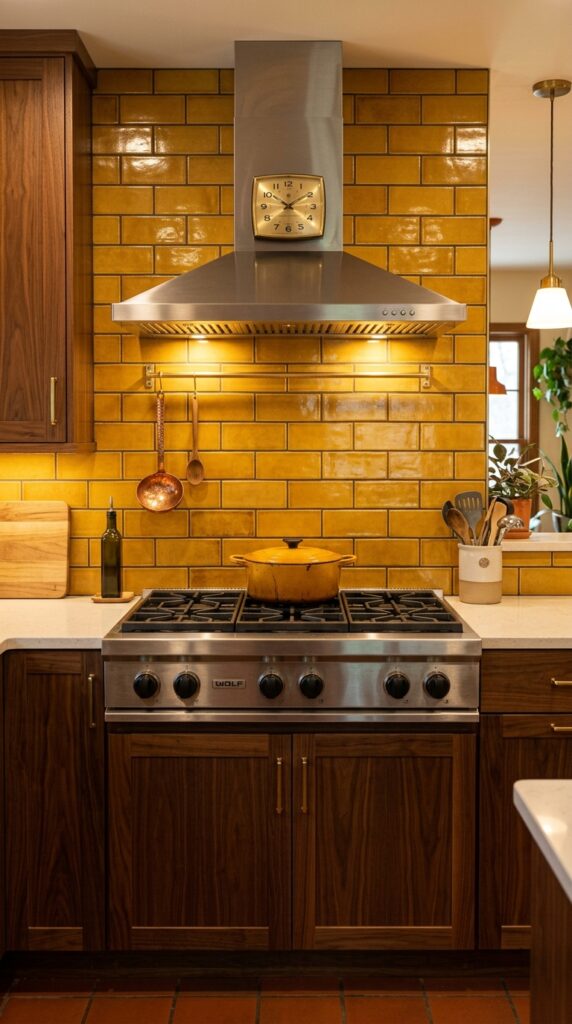
Vibe: Energized and warm — the range becomes the kitchen’s focal point rather than a utilitarian box.
Why it works: A single accent tile run behind the range concentrates color in the kitchen’s most visually active zone — the cooking area — without requiring a commitment to color across the entire room. Harvest gold sits at the warm end of the yellow-green spectrum, which historically places it directly in the MCM palette. Dark grout lines (charcoal or near-black) provide the contrast that makes the tile color read as deliberate rather than dated.
How to get it: Fireclay Tile’s “Harvest” glaze on their 3″x6″ handmade subway tile ($18–$24 per square foot) is the most authentic period-correct option. For a budget version, Daltile’s “Midas Touch” glazed wall tile achieves a similar warm gold at $4–$7 per square foot. Grout in Laticrete “Midnight Black” for maximum contrast.
🛍️ Shop the Look — Amazon Product Ideas
| # | Product Search Phrase | Why It Fits |
| 1 | gold glazed ceramic subway tile 3×6 sample | Accent tile testing |
| 2 | black unsanded grout tile joints kitchen | High-contrast grout |
| 3 | vintage retro kitchen wall clock mid century | Range hood accent |
| 4 | copper kitchen ladle hanging utensil set | Warm metal cooking tool |
| 5 | enameled cast iron dutch oven colorful | MCM range styling |
7. Round Tulip-Style Dining Table in a Kitchen Nook
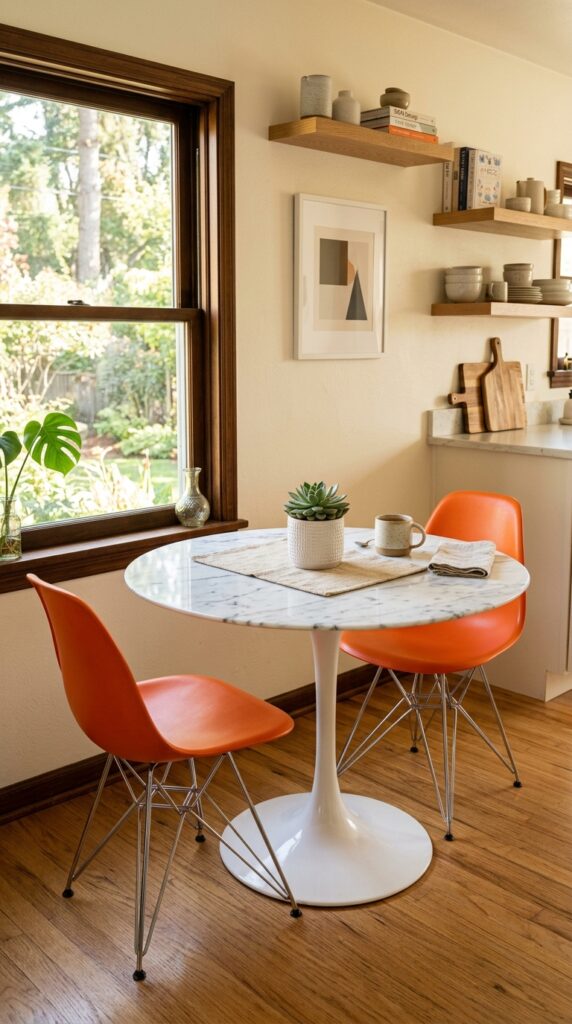
Vibe: Sun-warmed and quietly optimistic — breakfast in this nook feels like a small daily event.
Why it works: The tulip table base — originally designed by Eero Saarinen in 1956 — eliminates the visual clutter of four individual table legs by replacing them with a single sculptural pedestal. In a kitchen nook where space is limited, this reduces the number of visual interruptions at floor level and makes the space read as larger. Round tables also allow more flexibility in seating arrangement and prevent the sharp-corner problem in tight spaces.
How to get it: Replica Saarinen-style tulip tables are widely available at $250–$600 depending on top material. For small nooks, a 36″ diameter round top is the right starting size — it seats two comfortably and four in a pinch. Choose a laminate top for a more period-authentic look; marble-top versions read as more contemporary.
💡 Quick Win: A round wooden folding table with a white-painted top paired with two secondhand shell chairs sourced from Facebook Marketplace ($20–$50 each) creates this exact nook moment for under $150 total.
🛍️ Shop the Look — Amazon Product Ideas
| # | Product Search Phrase | Why It Fits |
| 1 | mid century round pedestal dining table white 36 inch | MCM nook centerpiece |
| 2 | molded plastic shell chair wire legs dining | Eames-inspired seating |
| 3 | marble look round vinyl placemat set | Table surface protection |
| 4 | small ceramic succulent planter white round | Table center styling |
| 5 | linen napkin set undyed natural fiber | Textural table layering |
8. Teak Wood Island with Butcher Block Surface
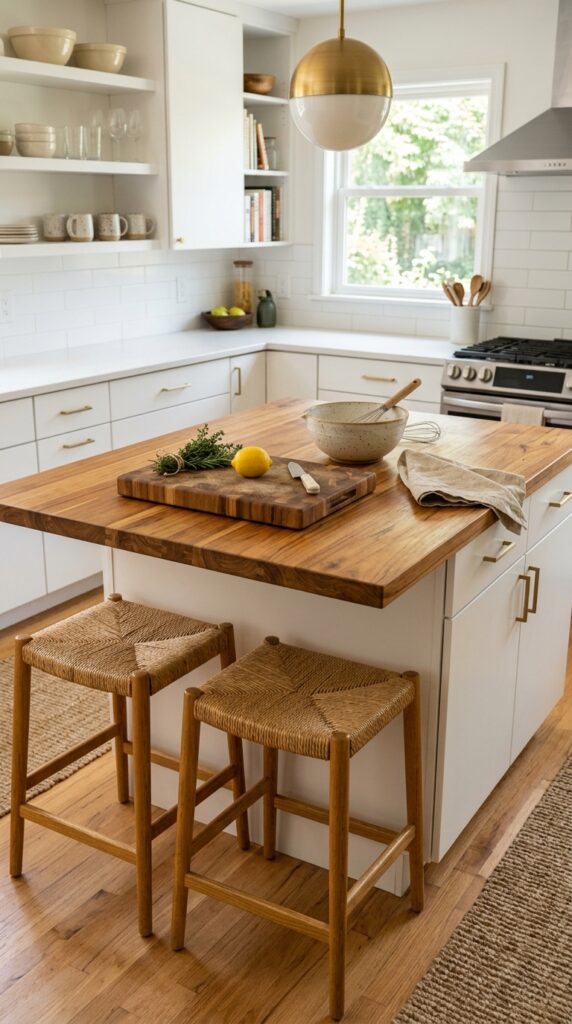
Vibe: Functional and warm — a kitchen that’s clearly meant to be cooked in.
Why it works: Teak is the MCM wood of choice for its exceptionally high natural oil content, which makes it water-resistant without requiring heavy lacquer finishes — ideal for a countertop that will be touched constantly. The warm honey-to-amber tones of oiled teak sit in the exact color register of period furniture, and its tight grain holds up to daily cutting and prep without the deep scarring that softer butcher blocks accumulate. Paired with a white base, the island reads as a furniture piece rather than built-in cabinetry.
How to get it: Apply Howard Butcher Block Conditioner (food-safe mineral oil and beeswax blend, $12–$16) monthly to a teak butcher block surface. Never use olive oil — it goes rancid inside the wood. Treat any cuts or water stains with 180-grit sandpaper followed by a fresh oil treatment.
🛍️ Shop the Look — Amazon Product Ideas
| # | Product Search Phrase | Why It Fits |
| 1 | teak butcher block countertop island panel | MCM island surface |
| 2 | butcher block conditioner food safe beeswax oil | Wood maintenance |
| 3 | mid century bar stool walnut legs set of 2 | Island seating |
| 4 | large ceramic mixing bowl handmade speckled | Counter functional decor |
| 5 | marble pastry board wooden handle | Prep surface accent |
9. Pendant Track Lighting in Brushed Brass
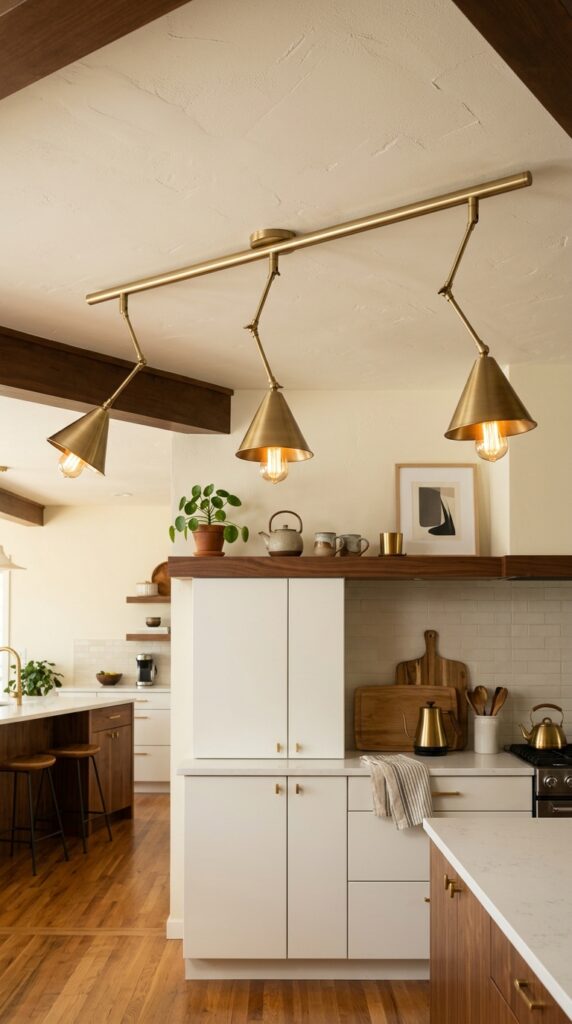
Vibe: Precise and warm — light directed exactly where it belongs, without fuss.
Why it works: Track lighting was a mid century innovation that allowed flexible, adjustable task lighting without multiple ceiling cutouts — and brushed brass track systems bring that same utility with period-appropriate warmth. Three cone-head pendants on a single track cover a kitchen run more evenly than a single pendant, and the articulation of each head allows the light to follow the counter rather than the ceiling’s center line. This solves a common kitchen lighting problem without requiring new electrical rough-in.
How to get it: Replace existing track hardware on any J-box-mounted track system with brushed brass pendants. Rejuvenation, Schoolhouse Electric, and several Amazon sellers offer individual brass track heads at $25–$65 each that fit standard H-track rails — no full replacement needed.
🛍️ Shop the Look — Amazon Product Ideas
| # | Product Search Phrase | Why It Fits |
| 1 | brushed brass track lighting head H-track compatible | Warm metal task light |
| 2 | adjustable track lighting pendant cone shade brass | Articulated kitchen light |
| 3 | vintage Edison bulb G40 globe warm white | Period-accurate bulb |
| 4 | dimmer switch single pole for track lighting | Ambiance control |
| 5 | brass ceiling medallion light fixture surround | Ceiling detail accent |
10. Burnt Orange Ceramic Pendant Over Sink
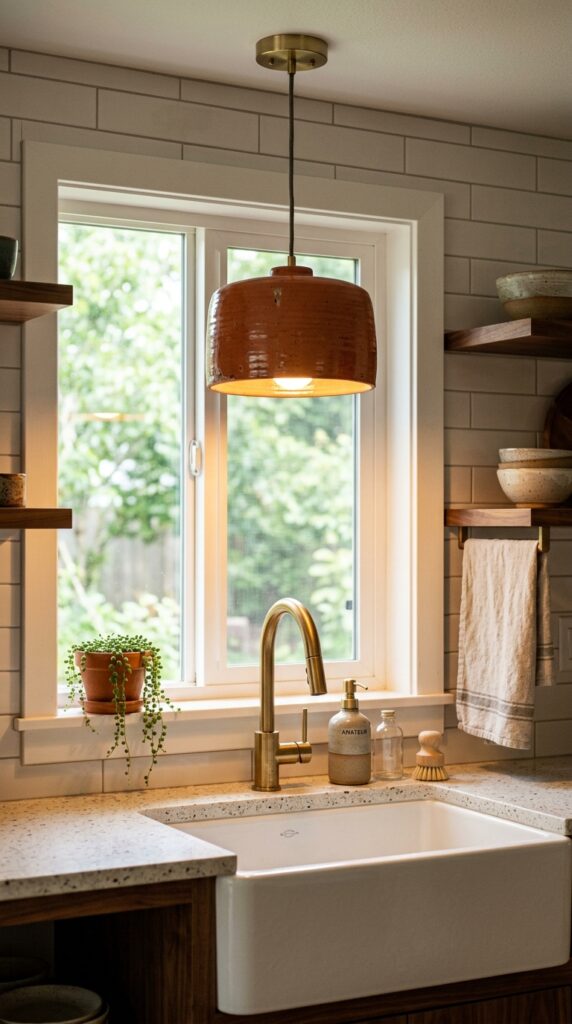
Vibe: Warm and handmade — the pendant makes the sink feel like the most considered spot in the room.
Why it works: A ceramic pendant over the sink introduces a handcrafted material into a zone that’s typically entirely industrial (faucet, sink basin, cabinet hardware). The contrast between the organic character of hand-thrown ceramics and the precision of the kitchen’s built components is a core MCM tension — the movement always balanced industrial manufacturing with an appreciation for craft. Burnt orange specifically pulls from the kitchen’s warmest tones and amplifies them at eye level.
How to get it: Ceramic pendant lights are available from Etsy makers at $85–$200 for handmade versions; mass-produced ceramic pendants from CB2 or Pottery Barn run $75–$150. Look for thrown ceramics with visible texture — not slip-cast smooth surfaces — for the most authentic craft quality.
💡 Quick Win: A matte terracotta-glazed ceramic pendant shade can be DIY’d using an air-dry clay slab draped over an inverted bowl form, dried 48 hours, and wired with a pendant cord kit from the hardware store — total cost under $35.
🛍️ Shop the Look — Amazon Product Ideas
| # | Product Search Phrase | Why It Fits |
| 1 | ceramic pendant light shade terracotta burnt orange | MCM handcraft lighting |
| 2 | pendant cord kit with canopy brass socket | DIY pendant wiring |
| 3 | stoneware soap dispenser matte glaze kitchen | Sink styling ceramic |
| 4 | linen hand towel natural undyed kitchen | Sink area textile |
| 5 | small terracotta planter windowsill herb pot | Kitchen windowsill plant |
11. Graphic Black and White Geometric Floor Tile
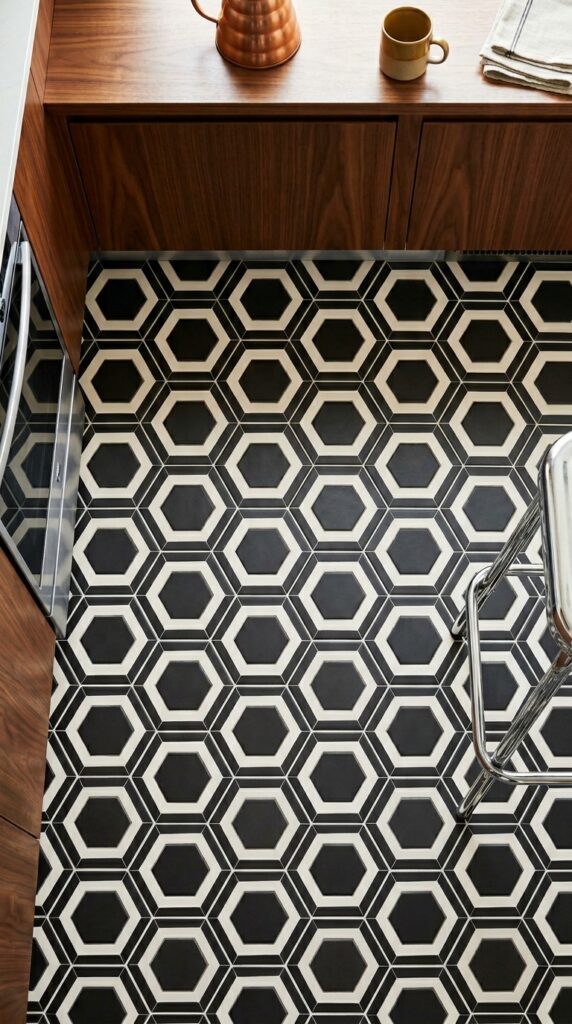
Vibe: Graphic and grounded — a floor that does half the room’s decorating work on its own.
Why it works: Black-and-white geometric tile was omnipresent in mid century kitchens and bathrooms, and its appeal is structural: the repeating geometric pattern creates visual rhythm that the eye reads as organized and energetic simultaneously. In a kitchen, this pattern works against solid-color cabinets (where the floor becomes the pattern) and warm wood tones (where the high-contrast floor anchors the warmer palette above). The key is matte grout — glossy grout reads as bathroom; matte reads as period-authentic kitchen.
How to get it: Porcelain hexagon mosaic sheets in 2″ size come pre-mounted on mesh backing ($4–$9 per square foot at TileBar or BuildDirect) for DIY installation. Order 15% extra for cuts around cabinets and appliances. Self-leveling underlayment is essential before tiling if the existing floor has any flex — tile cracks on a subfloor that moves.
🛍️ Shop the Look — Amazon Product Ideas
| # | Product Search Phrase | Why It Fits |
| 1 | black white hexagon mosaic tile floor 2 inch | MCM floor pattern |
| 2 | white unsanded grout tile joints floor | Matte grout finish |
| 3 | self leveling floor underlayment compound | Subfloor prep for tile |
| 4 | tile installation kit grout float squeegee set | DIY tiling tools |
| 5 | chrome kitchen counter stool adjustable height | MCM seating accent |
12. Recessed Under-Cabinet LED Strip in Warm White
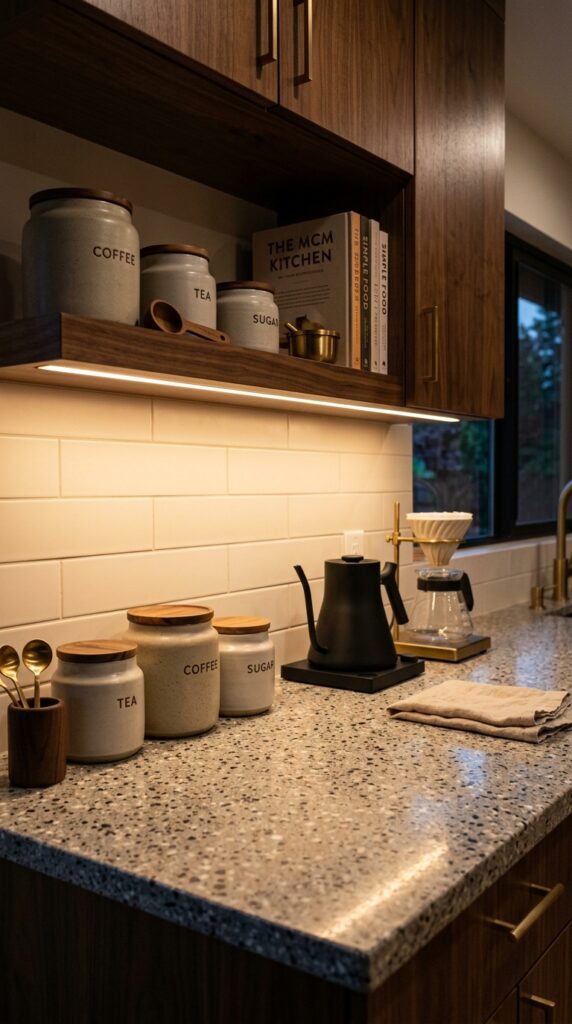
Vibe: Intimate and amber-warm — the counter glows like the kitchen is lit by candlelight.
Why it works: Under-cabinet lighting at 2700K color temperature turns a countertop into a display surface and a workspace simultaneously — the warm pool of light defines the counter zone and makes it feel intentional rather than incidental. Recessing the strip behind a front lip (either the shelf’s front edge or a thin wood batten) hides the LED source completely, leaving only the glow rather than the hardware. This is how under-cabinet lighting graduates from practical to atmospheric.
How to get it: Install Govee or Kasa smart LED strip lights ($25–$45 for a 16-foot roll) in 2700K color temperature, recessed behind a 3/4″ x 3/4″ wood batten glued to the cabinet’s underside front edge. Connect to a smart home system for dimming control — under-cabinet lights at 30% brightness create the most flattering kitchen ambiance.
💡 Quick Win: Plug-in under-cabinet LED bars ($15–$30 on Amazon) in warm white require no hardwiring — they tap into a standard outlet and can transform the counter atmosphere in 20 minutes.
🛍️ Shop the Look — Amazon Product Ideas
| # | Product Search Phrase | Why It Fits |
| 1 | under cabinet LED strip light warm white 2700K plug in | Warm counter lighting |
| 2 | smart dimmer plug in outlet control | Ambiance adjustment |
| 3 | terrazzo effect kitchen canister set | Counter storage MCM |
| 4 | walnut wood spice rack wall mounted | Shelf organization |
| 5 | linen kitchen curtain panel window treatment | Soft window light filter |
13. Cream Boucle Bar Stools with Walnut Legs
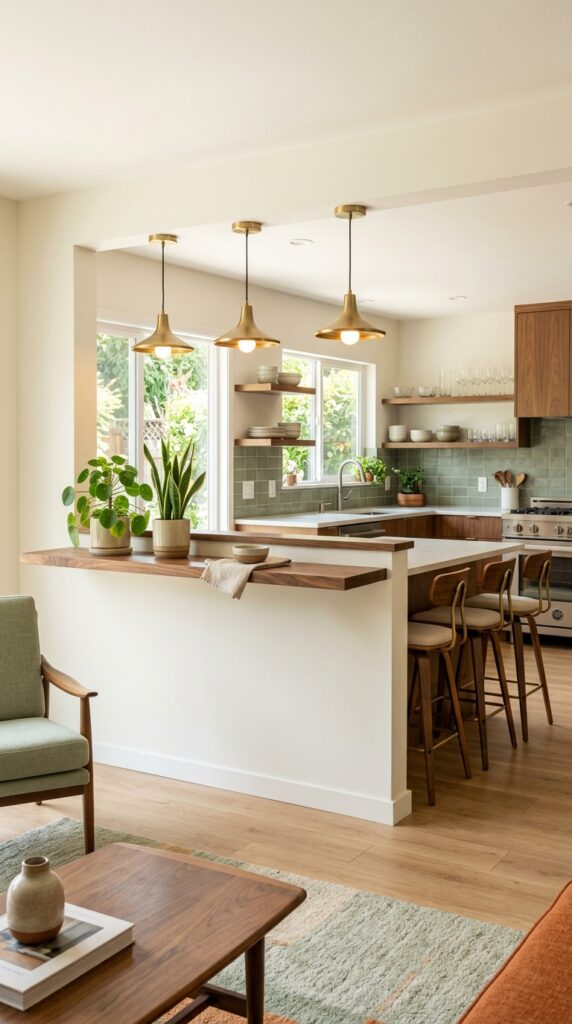
Vibe: Tactile and warm — seating you want to run your hand across before you sit.
Why it works: Boucle became synonymous with mid century modern interiors because its looped texture was a favorite of designers who valued tactile richness over visual complexity — it’s a single-color fabric that achieves depth through surface rather than pattern. The cream tone bridges warm white cabinet finishes and warm walnut tones without belonging fully to either. Tapered walnut legs with an angled splay replicate the exact silhouette of 1950s–1960s seating, placing the stool clearly within the MCM vocabulary.
How to get it: Look for boucle stools with a seat height of 26″ for standard kitchen counters (36″ high) or 30″ for island breakfast bars (42″ high). Confirm the leg material is solid wood — not painted MDF wrapped in vinyl — before purchasing; the leg material determines whether the stool reads as MCM or contemporary.
🛍️ Shop the Look — Amazon Product Ideas
| # | Product Search Phrase | Why It Fits |
| 1 | boucle counter stool cream upholstered walnut legs | Signature MCM seating |
| 2 | tapered wood leg replacement furniture hardware set | Leg upgrade existing stool |
| 3 | brass bar stool footrest ring replacement | Hardware accent detail |
| 4 | matte ceramic mixing bowl speckled set | Island counter styling |
| 5 | counter stool seat cushion boucle wool round | Stool seat upgrade |
14. Open Plan Kitchen with Partial Dividing Wall
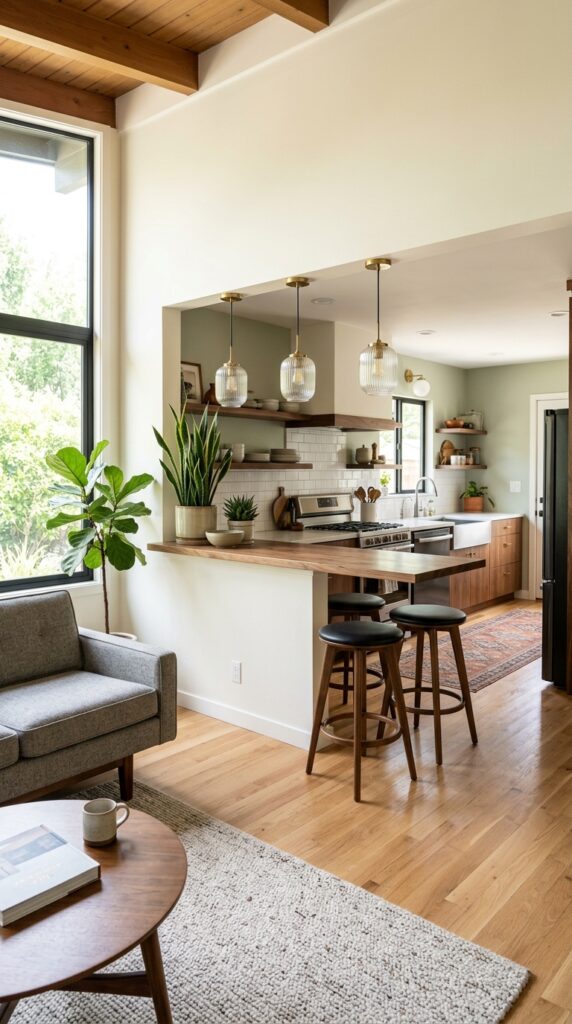
Vibe: Connected and open — the kitchen and living room share light without sharing walls.
Why it works: The partial dividing wall is a spatial solution from mid century architecture — it defines zones without blocking the visual continuity that makes open-plan homes feel generous. Setting the wall at 42 inches keeps the sight-line open while providing a natural bar-height counter shelf on the kitchen side. The walnut cap rail on top of the wall performs double duty as a surface and as a material connection between the kitchen’s wood tones and the living space.
How to get it: A partial wall can be built from standard 2″x4″ framing with drywall, capped with a walnut slab countertop at 42″ height ($80–$180 for the slab from a lumber yard). The counter shelf can cantilever up to 12″ without additional support if properly bolted to the wall framing below.
💡 Quick Win: A freestanding kitchen island positioned perpendicular to the main cabinetry creates the same spatial division as a partial wall — with no construction required.
🛍️ Shop the Look — Amazon Product Ideas
| # | Product Search Phrase | Why It Fits |
| 1 | freestanding kitchen island wood top rolling | Movable zone divider |
| 2 | walnut wood live edge bar shelf counter top | Dividing wall cap material |
| 3 | hanging pendant light plug in cord black | No-wire zone pendant |
| 4 | mid century plant stand indoor wood legs | Partial wall plant display |
| 5 | bar height stool backless wood seat | Pass-through seating |
15. Warm Teal Refrigerator as a Statement Appliance
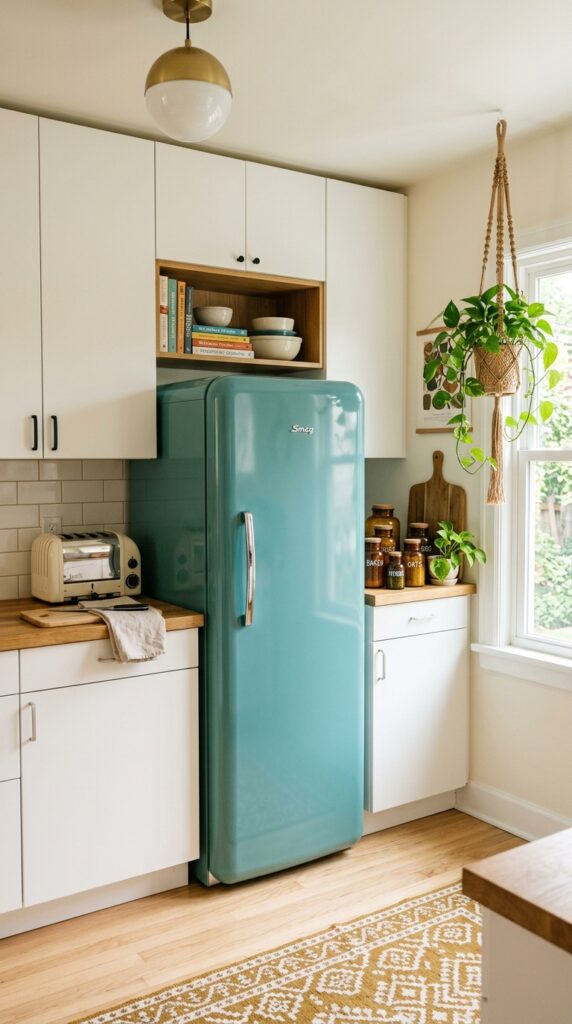
Vibe: Playful and grounded — the kind of kitchen that makes people smile when they walk in.
Why it works: Retro-styled colored appliances from brands like Big Chill, Smeg, and Elmira Stoveworks replicate the rounded forms and enamel colors of 1950s–1960s kitchen appliances with modern functionality. Warm teal — specifically with a slight blue-green-grey undertone rather than a bright blue-green — is one of the four signature MCM colors and immediately places the kitchen’s aesthetic. Against white cabinets, the teal refrigerator operates as a “hero piece” — one statement object that sets the room’s entire color intention.
How to get it: Smeg’s FAB refrigerators (24″ wide, $1,800–$2,200) offer the most authentically period-correct form with modern cooling technology. For a fraction of the cost, wrap an existing refrigerator in adhesive vinyl in a teal color ($30–$60 for a full-size fridge wrap) — a fully reversible update.
🛍️ Shop the Look — Amazon Product Ideas
| # | Product Search Phrase | Why It Fits |
| 1 | teal appliance vinyl wrap removable refrigerator | Budget color update |
| 2 | retro toaster 2 slice chrome teal accents | MCM appliance styling |
| 3 | macramé hanging planter wall indoor plant | Bohemian MCM texture |
| 4 | amber glass kitchen canister set airtight | Counter storage color |
| 5 | chrome kitchen towel ring wall mount | Teal-chrome accent pair |
16. Galley Kitchen with Mirror-Finish Splashback
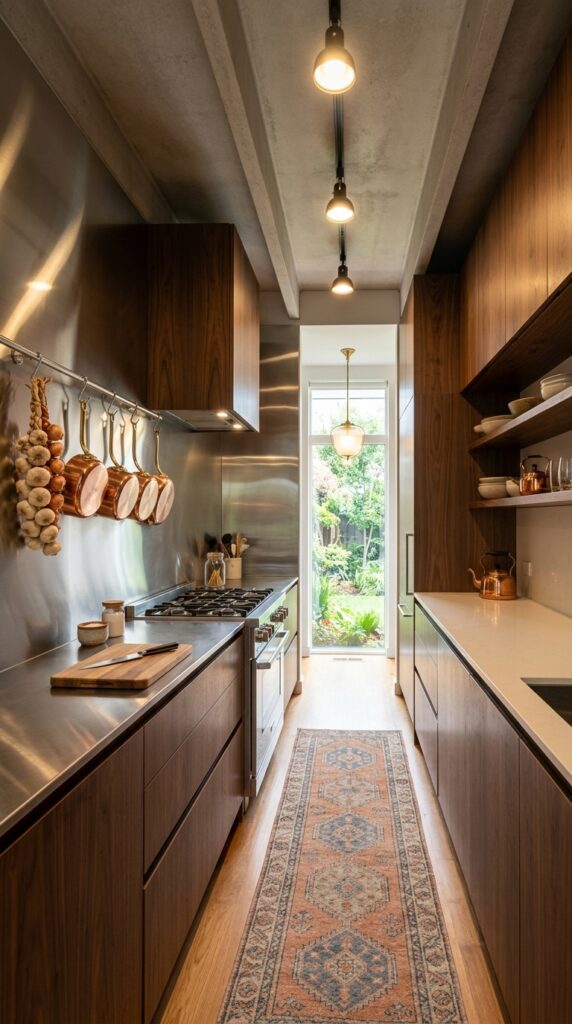
Vibe: Luminous and purposeful — the galley becomes a proper cook’s kitchen.
Why it works: A full-height metal splashback in a galley kitchen performs three simultaneous functions: it reflects light (making the narrow space feel wider), it provides a hygienic, durable surface behind the range, and it introduces the cool metallic register that prevents a walnut-heavy kitchen from reading too dark. Brushed stainless reads as more contemporary; polished steel reads as more period-appropriate for a true MCM kitchen — the reflection creates visual depth rather than a mirror effect.
How to get it: 304 stainless steel sheet in 20-gauge (0.036″) can be ordered cut to size from Online Metals or Metal Supermarkets ($60–$120 per linear foot depending on width). Install with construction adhesive directly over existing tile — no specialized fabricator required for a smooth installation.
💡 Quick Win: A large metallic subway tile in silver or chrome tone achieves the same light-reflective quality as a steel panel for $3–$6 per square foot and can be installed as a DIY tile project.
🛍️ Shop the Look — Amazon Product Ideas
| # | Product Search Phrase | Why It Fits |
| 1 | stainless steel sheet adhesive backsplash panel | Metal splashback DIY |
| 2 | copper pot hanging rack wall mounted rail | Galley pot organization |
| 3 | metallic silver subway tile glossy 3×6 | Budget light-reflect tile |
| 4 | garlic braid hanging kitchen storage decor | Rustic galley accent |
| 5 | brass rail kitchen wall mounted utensil bar | Cooking zone organization |
17. Sculptural Ceramic Fruit Bowl as Counter Centerpiece
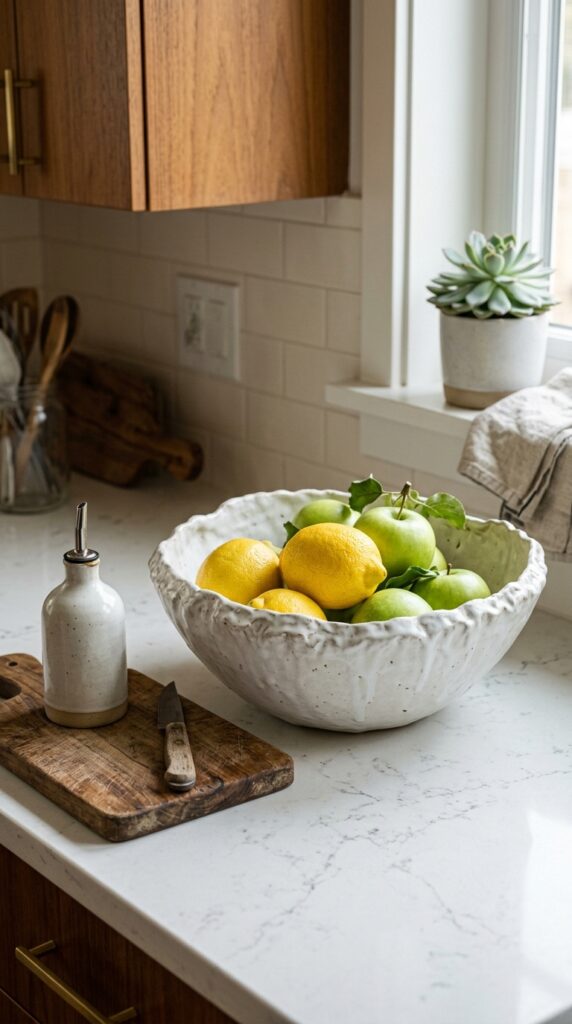
Vibe: Grounded and quietly artful — the counter becomes a still life.
Why it works: MCM interiors consistently incorporated studio ceramics as functional art — the discipline rejected the boundary between useful objects and art objects. A large sculptural ceramic bowl on a kitchen counter fulfills this principle: it functions (fruit storage) while operating as a visual centerpiece that gives the counter a focal point. The organic asymmetry of hand-thrown ceramics contrasts productively with the geometric precision of flat-front cabinets, softening the room’s architectural edges.
How to get it: Studio ceramic bowls from Etsy makers in the $65–$180 range deliver the most authentic hand-thrown quality. Look specifically for pieces with visible throwing lines, natural glaze breaks, and weighted-irregular rims — the imperfection is the design feature. Alternatively, local ceramic studios and farmers markets often sell comparable quality at similar prices.
🛍️ Shop the Look — Amazon Product Ideas
| # | Product Search Phrase | Why It Fits |
| 1 | large handmade ceramic fruit bowl organic form | Counter art centerpiece |
| 2 | honed white quartz countertop sample tile | Surface context |
| 3 | ceramic olive oil dispenser bottle matte glaze | Counter functional art |
| 4 | small walnut wood cutting board handle hole | Counter prep surface |
| 5 | woven linen bread bag kitchen storage | Counter textile accent |
18. Dark Charcoal Island in a White Kitchen
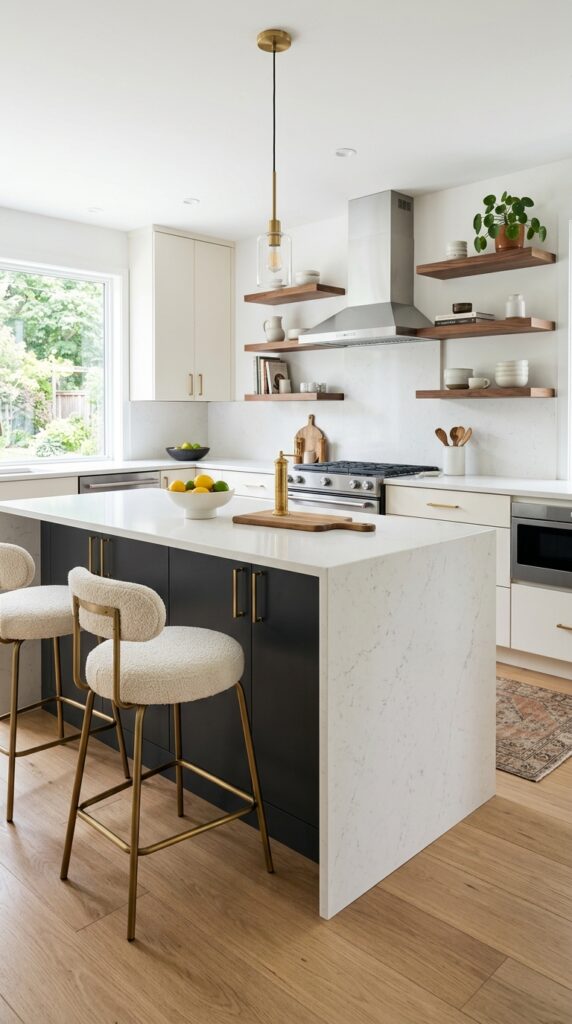
Vibe: Graphic and confident — the island commands the room without overwhelming it.
Why it works: A dark island in a white kitchen works on the principle of intentional visual weight — the eye goes immediately to the darkest object in the room, which makes the island function as an architectural focal point rather than simply a work surface. Charcoal (specifically warm charcoal rather than cool grey) reads as sophisticated because its undertones complement both the warm brass hardware and the warm walnut shelf accents. The white waterfall countertop provides the visual relief that prevents the dark island from reading as heavy.
How to get it: Farrow & Ball “Railings” (No. 31) and Benjamin Moore “Wrought Iron” (2124-10) are the two most commonly recommended charcoals for MCM-style cabinet painting — both have warm (not blue) undertones. Apply with a spray gun for a factory-smooth finish, or use a fine-nap foam roller with three thin coats for an acceptable brush-free result.
🛍️ Shop the Look — Amazon Product Ideas
| # | Product Search Phrase | Why It Fits |
| 1 | charcoal cabinet paint chalk mineral based flat finish | Dark island painting |
| 2 | white quartz waterfall countertop edge sample | Island countertop material |
| 3 | brass bar pull set 5 inch center to center | Dark island hardware |
| 4 | boucle bar stool set of 2 cream seat | Island seating contrast |
| 5 | white matte ceramic bowl large serving | Island counter styling |
19. Rattan Cabinet Door Inserts
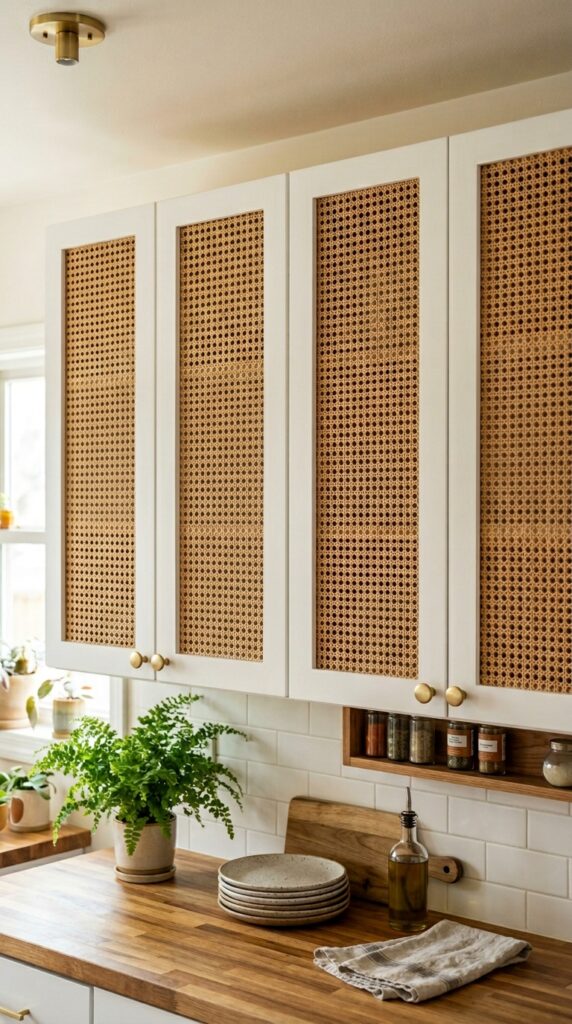
Vibe: Warm and slightly tropical — rattan turns cabinets into something between furniture and basketry.
Why it works: Rattan cane webbing inserts in kitchen cabinet doors introduce organic texture into the kitchen’s most geometric element — the flat grid of upper cabinet fronts. The woven pattern creates visual interest without color, and the slight transparency of the weave adds depth (objects behind it are visible but softened). Rattan was a fixture of mid century interiors because it bridged the modernist love of natural materials with the era’s interest in non-Western design influences, particularly Southeast Asian and Pacific Island craft traditions.
How to get it: Pre-woven rattan cane webbing is available in rolls from Etsy craft suppliers ($20–$40 for a 24″x72″ roll). Route a 1/4″ rabbet channel around the inside of an existing cabinet door panel opening, soak the rattan in warm water for 30 minutes to make it pliable, press into the channel, and secure with a narrow wood spline. As it dries, the rattan tightens to a drum-taut finish.
💡 Quick Win: Cabinet door rattan insert kits (pre-cut rattan plus spline and instructions, $35–$60 per door) sold on Etsy eliminate the routing step for a full DIY-ready solution.
🛍️ Shop the Look — Amazon Product Ideas
| # | Product Search Phrase | Why It Fits |
| 1 | rattan cane webbing roll natural pre-woven | Cabinet insert material |
| 2 | cabinet door router bit rabbet set | Routing channel tool |
| 3 | round brass cabinet knob solid set of 10 | Cabinet hardware MCM |
| 4 | small indoor fern plant hanging or counter | Kitchen plant texture |
| 5 | cabinet spline insertion tool cane webbing | DIY rattan installation |
20. Full-Height Window with No Upper Cabinets
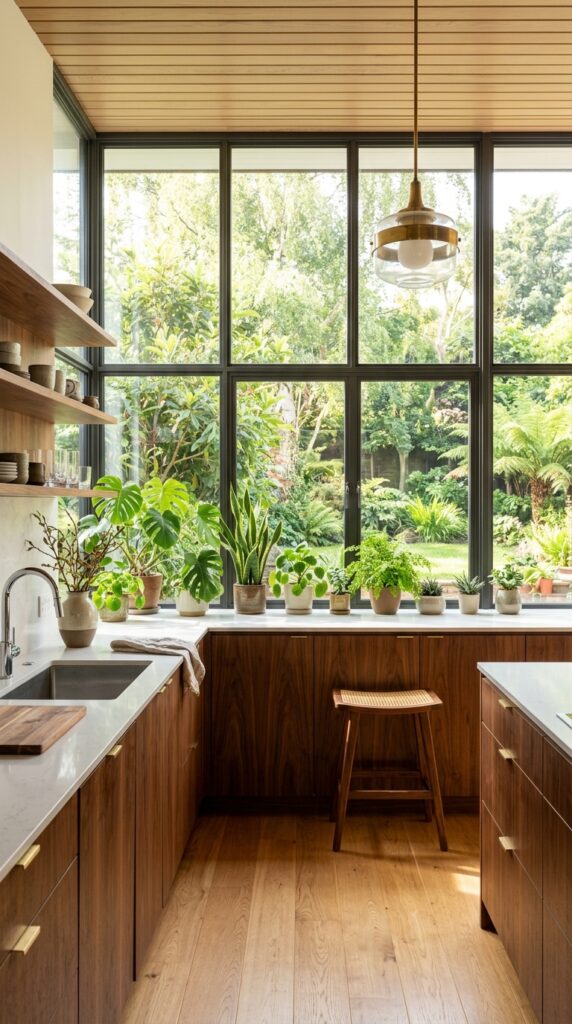
Vibe: Luminous and plant-filled — a kitchen where morning light does all the decorating.
Why it works: Mid century modern architecture consistently prioritized the relationship between indoors and outdoors — large windows, sliding glass doors, and the elimination of visual barriers between interior and garden were defining MCM architectural moves. Removing upper cabinets from a window wall restores that relationship in an existing kitchen, flooding the space with natural light and replacing storage with living things (plants, seasonal objects, herbs). The tradeoff of storage is real — compensate with lower cabinet depth and a pantry elsewhere.
How to get it: Before removing upper cabinets, locate all plumbing and electrical runs in that wall — some upper cabinet zones contain wiring for outlets or lighting that will require rerouting. If the wall is clean, cabinet removal is a DIY project; patching and painting the wall behind takes an additional day.
🛍️ Shop the Look — Amazon Product Ideas
| # | Product Search Phrase | Why It Fits |
| 1 | indoor herb garden window kit grow light | Windowsill kitchen garden |
| 2 | walnut wood window bench seat small | Below-window seating |
| 3 | aluminum window planter box interior | Windowsill plant display |
| 4 | sheer linen curtain panel natural light filter | Soft window diffusion |
| 5 | grow light full spectrum bulb Edison style | Plant-friendly light |
21. Harvest Gold Range Hood with Custom Tile Surround
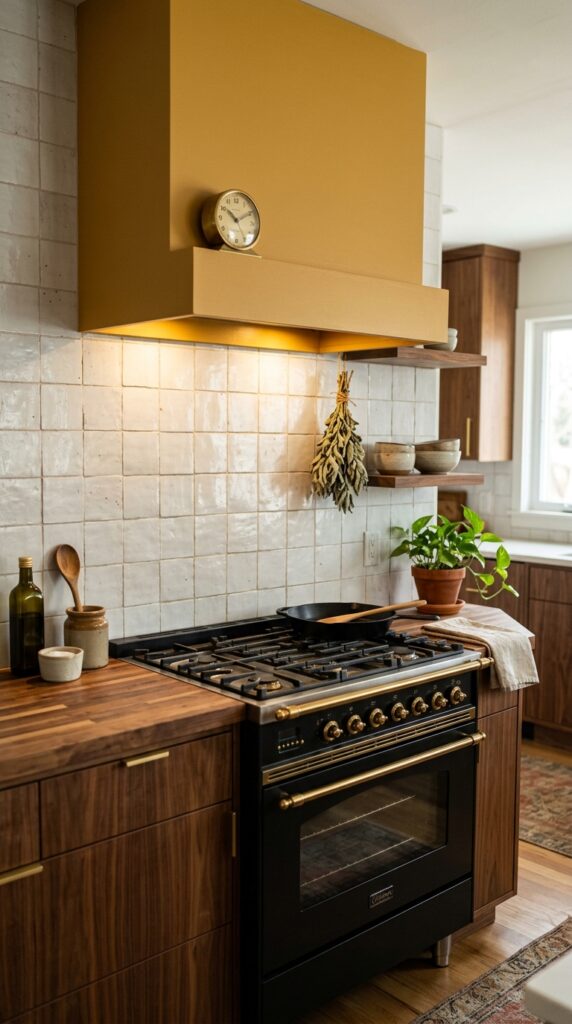
Vibe: Artisanal and warm — the range hood becomes the kitchen’s focal architectural moment.
Why it works: A custom-painted range hood pulls the eye upward and gives the cooking zone the visual weight it deserves as the kitchen’s functional centerpiece. Harvest gold paint on a hood works because it’s anchored by the substantial form of the hood itself — unlike a small object, the hood’s size gives the color room to breathe and read as intentional rather than accidental. The matte white tile surround provides a neutral field that makes the gold read richer by contrast.
How to get it: Any existing drywall or metal range hood can be painted with Benjamin Moore “Aura” cabinet paint in a harvest gold tone — “Golden Straw” (2152-40) or “Hawthorne Yellow” (HC-4) are the most MCM-appropriate options. Apply two coats with a fine-nap foam roller; no primer required if the surface is clean and sanded to 120-grit.
💡 Quick Win: A basic builder-grade range hood costs $80–$120 at any hardware store and can be painted and tiled in a weekend to create the custom-built effect.
🛍️ Shop the Look — Amazon Product Ideas
| # | Product Search Phrase | Why It Fits |
| 1 | handmade white ceramic tile 4×4 matte kitchen | Custom hood surround |
| 2 | cabinet paint brush foam roller set smooth finish | Hood painting tools |
| 3 | dried herb bunch sage lavender kitchen decor | Range hood garland accent |
| 4 | small vintage kitchen clock wall-mounted retro | Hood ledge accent piece |
| 5 | range hood under cabinet light warm LED | Hood task lighting |
22. Slim Galley Kitchen Maximized with Mirrored Backsplash
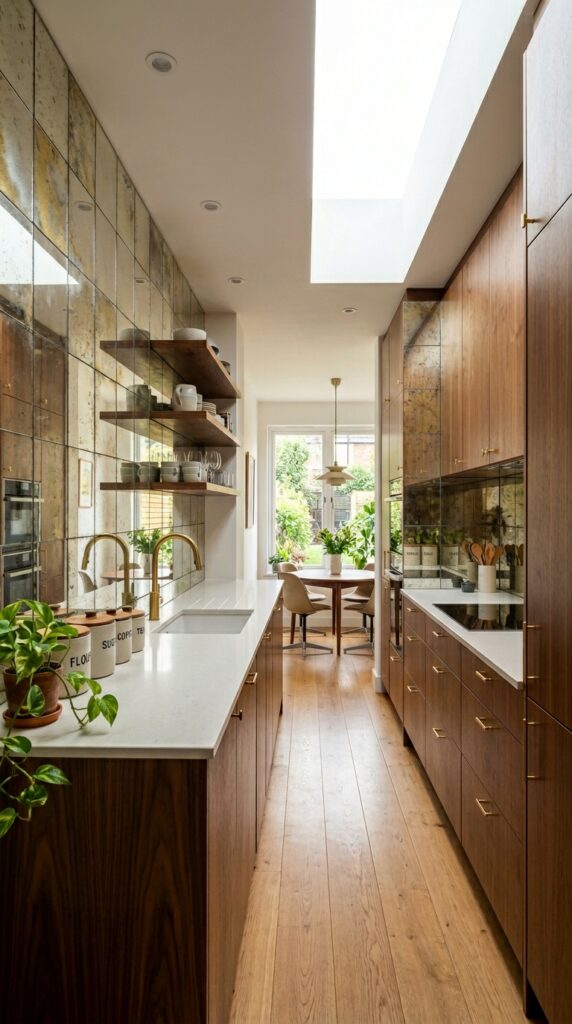
Vibe: Airy and elongated — the mirrored wall makes the galley feel twice its actual width.
Why it works: In a narrow galley kitchen (8 feet wide or less), a mirrored backsplash is the most effective single intervention for creating a sense of width. Antique mirror (with slight amber tint and foxed areas) reads as decorative rather than purely functional, placing it within the MCM aesthetic without creating the too-bright quality of polished mirror. The reflection of warm walnut cabinets on the opposite wall creates a visual echo that the eye reads as depth.
How to get it: Antique mirror tiles in 4″x4″ or 6″x12″ sizes are available from Wayfair, Amazon, and specialty mirror suppliers at $8–$18 per square foot. Install with mirror-safe adhesive only (standard construction adhesive contains solvents that permanently damage mirror backing). Leave 1/16″ gaps between tiles and fill with clear silicone caulk rather than grout.
🛍️ Shop the Look — Amazon Product Ideas
| # | Product Search Phrase | Why It Fits |
| 1 | antique mirror tile backsplash peel stick | Space-expanding wall tile |
| 2 | mirror safe adhesive panel installation | Non-damaging mirror glue |
| 3 | ceramic kitchen canister set 3 piece airtight | Galley counter storage |
| 4 | single handle bridge faucet brass kitchen | Small kitchen faucet MCM |
| 5 | under cabinet hanging mug rack wood mounted | Galley vertical storage |
23. Brass and Walnut Open Shelving Cart on Wheels
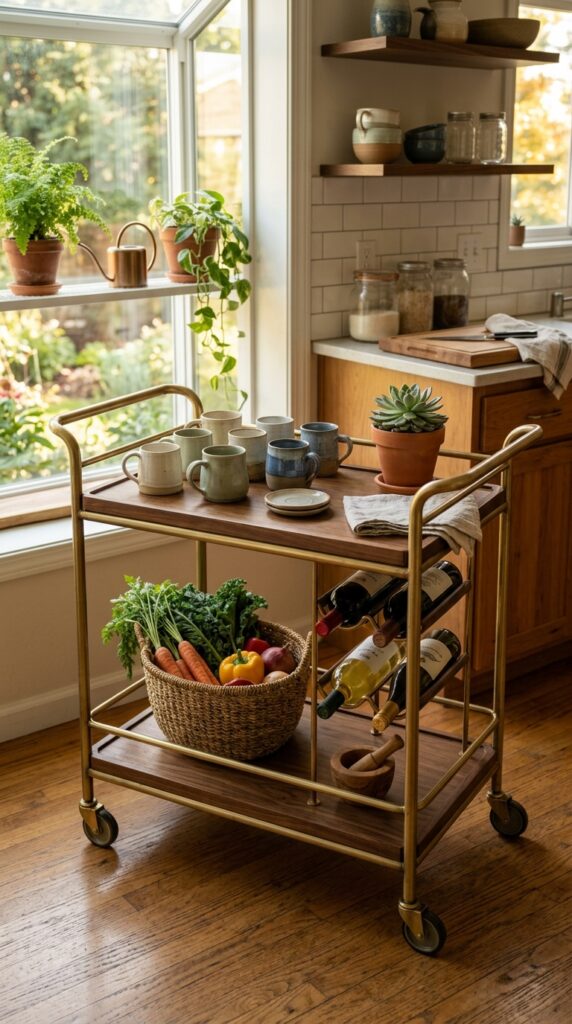
Vibe: Functional and warm — the kind of piece that looks like it belongs in a kitchen that actually cooks.
Why it works: A rolling cart in brass and walnut is the MCM solution to the small-kitchen storage problem — it provides a movable work surface and additional storage without the commitment of a built-in island. The brass tubular frame references the period’s love of metal-and-wood furniture combinations (think the Eames wire base chairs) while the walnut shelves maintain material continuity with the kitchen’s fixed cabinetry. Locking casters are the practical necessity that makes it actually usable as a prep surface.
How to get it: IKEA’s “Råskog” cart ($30) with walnut contact paper applied to the shelves and gold spray paint on the metal frame is a widely replicated MCM hack that costs under $60 total. For a fully authentic piece, Rejuvenation and Schoolhouse Electric sell brass-and-wood rolling carts at $300–$500.
💡 Quick Win: Spray painting any metal kitchen cart with Rust-Oleum “Brass Metallic” ($8) instantly shifts it from industrial to MCM without changing its form.
🛍️ Shop the Look — Amazon Product Ideas
| # | Product Search Phrase | Why It Fits |
| 1 | rolling kitchen cart brass frame wood shelf | MCM mobile storage |
| 2 | gold metallic spray paint furniture safe | Cart color update hack |
| 3 | walnut wood contact paper shelf liner roll | Cart shelf upgrade |
| 4 | wine bottle rack insert cabinet rolling | Cart lower shelf use |
| 5 | wicker storage basket with handle kitchen | Cart lower shelf basket |
24. Vintage Poster Art as Kitchen Wall Decor
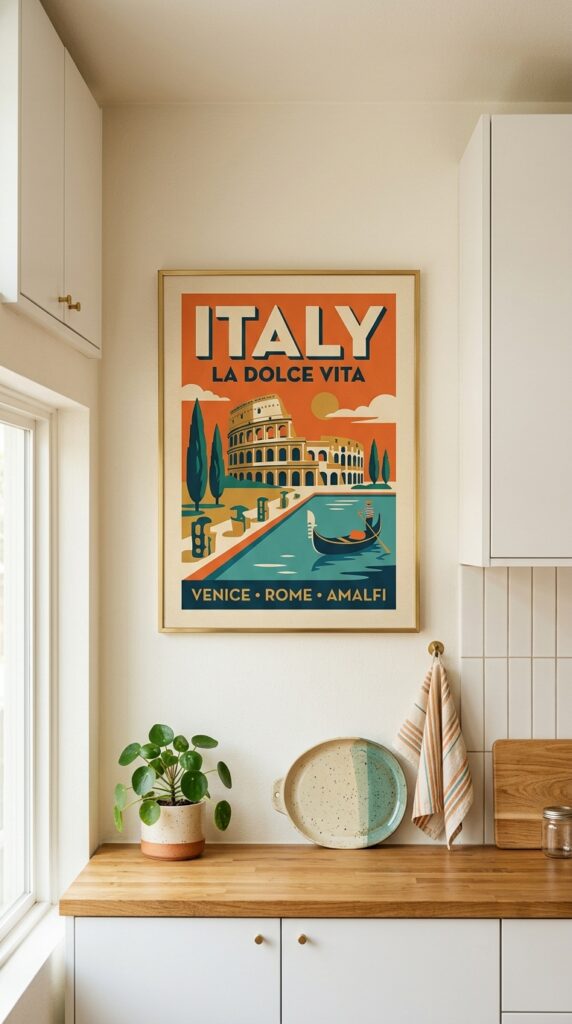
Vibe: Cultured and warm — the kitchen feels inhabited by someone with real visual opinions.
Why it works: MCM interiors consistently incorporated graphic print culture — travel posters, exhibition prints, and abstract lithographs were common in period-authentic kitchens and dining areas. The graphic flatness of mid century poster art (bold shapes, limited palette, clean typography) is directly complementary to flat-front cabinet kitchens, where both the art and the cabinetry share a commitment to two-dimensional clarity. A single large framed poster functions better than a gallery wall in an MCM kitchen — the style values edited confidence over layered abundance.
How to get it: Etsy’s digital print market offers authentic-style MCM travel and exhibition posters at $5–$15 as instant downloads — print at FedEx Office in 18″x24″ or 24″x36″ on heavyweight matte paper ($8–$15 per print). Frame in a thin brass or gold-tone frame.
🛍️ Shop the Look — Amazon Product Ideas
| # | Product Search Phrase | Why It Fits |
| 1 | mid century modern travel poster art print vintage | Kitchen wall graphic art |
| 2 | brass thin profile picture frame 18×24 | Warm metal art frame |
| 3 | art print poster display ledge shelf wall | Art display alternative |
| 4 | framing mat board white 24×30 backing | Print presentation |
| 5 | abstract geometric print mid century kitchen art | MCM wall graphics |
25. Open-Plan Kitchen with Sunken Living Area
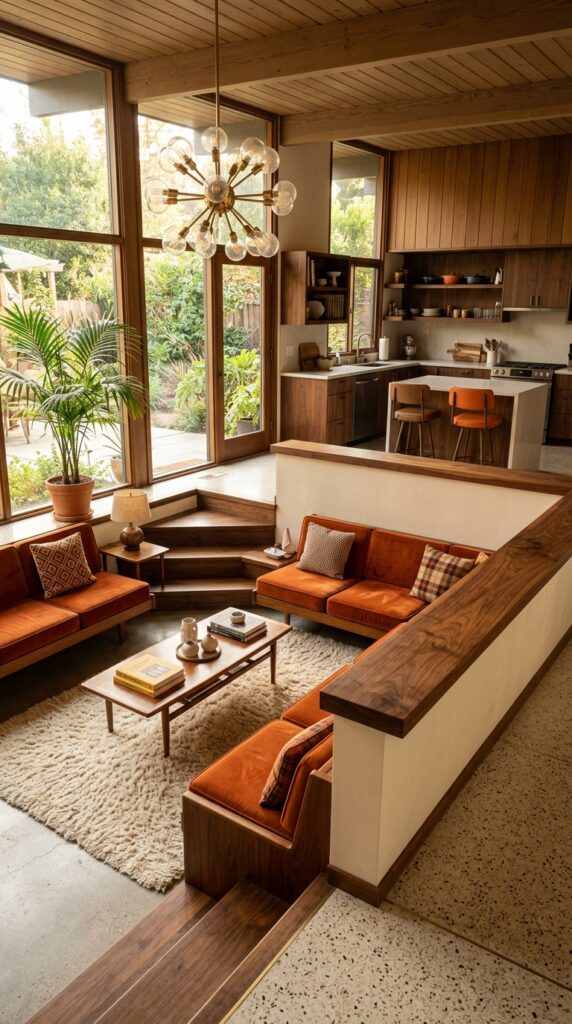
Vibe: Architectural and warm — a spatial arrangement that feels genuinely designed, not just furnished.
Why it works: The sunken conversation pit is one of the most iconic spatial gestures of mid century modern architecture, used to define a social zone without walls — the level change creates intimacy and enclosure in an open-plan space. An open-plan kitchen overlooking a sunken living area replicates the spatial drama of period MCM homes, where the kitchen was never hidden away but presented as part of the home’s social architecture. The walnut cap rail on the transition wall anchors both levels materially.
How to get it: Creating a genuine sunken floor requires structural work and is a significant renovation. As a non-structural alternative, a raised kitchen platform (2–4 inches, created by floating a plywood subfloor over the existing floor) creates the same level change with far less construction — and can be removed without damage.
🛍️ Shop the Look — Amazon Product Ideas
| # | Product Search Phrase | Why It Fits |
| 1 | orange upholstered lounge chair MCM style teak legs | Sunken living accent |
| 2 | large indoor palm tree plant pot floor standing | Corner architectural plant |
| 3 | shag area rug warm tones living room 8×10 | Sunken zone flooring |
| 4 | low slung sectional sofa burnt orange retro style | Conversation pit seating |
| 5 | large arc floor lamp brass mid century | Overhead living zone light |
26. Spice Wall in Labeled Amber Glass Jars
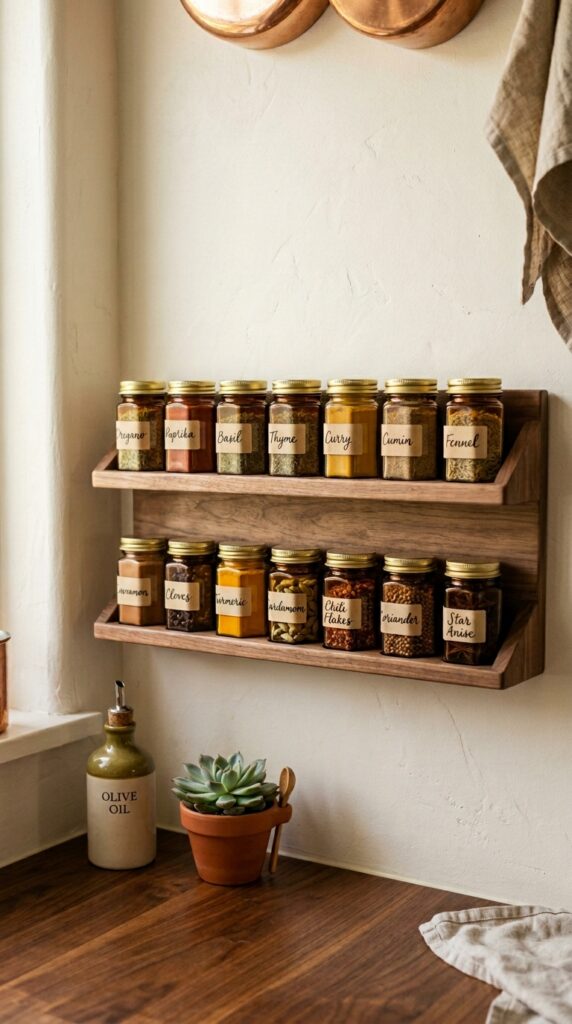
Vibe: Organized and warm — functional storage that doubles as kitchen art.
Why it works: Wall-mounted spice organization solves the counter clutter problem that derails many MCM kitchens — the style’s commitment to clear surfaces is easy to articulate but hard to maintain. Amber glass is the right material because it’s period-appropriate (it appeared in kitchens and labs throughout the mid century) and because its warm amber tone reads as a honey-yellow accent against white walls and walnut wood, adding color without demanding a decorating decision. The brass lids connect the spice wall to the kitchen’s broader hardware palette.
How to get it: Amber glass hexagonal spice jars with gold lids ($28–$45 for a set of 24) are widely available on Amazon. Mount them on a walnut wood rack with routed circles — this can be DIY’d from a 1″x6″ walnut board with a 1 3/4″ Forstner bit (spice jar diameter) drilled at regular intervals, then mounted with two screws through a French cleat.
💡 Quick Win: A simple magnetic spice rack in brass-tone with amber glass jars ($35–$50 as a complete set) mounts to a refrigerator side panel or tile wall with no drilling.
🛍️ Shop the Look — Amazon Product Ideas
| # | Product Search Phrase | Why It Fits |
| 1 | amber glass spice jar set 24 piece brass lid | MCM spice storage set |
| 2 | walnut wood wall mounted spice rack routed | Warm wood jar display |
| 3 | magnetic spice rack refrigerator mount brass tone | No-drill spice storage |
| 4 | chalkboard label set jar marking kitchen | Handwritten label system |
| 5 | ceramic oil and vinegar bottle set countertop | Counter functional pairing |
27. Matte Black Hardware Across All Cabinets
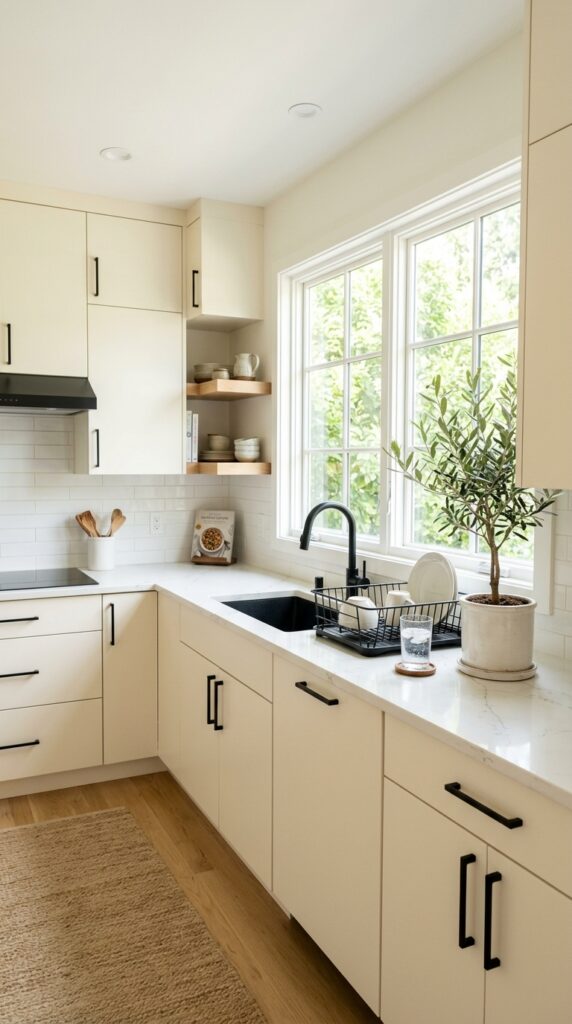
Vibe: Crisp and considered — the hardware reads as punctuation, not decoration.
Why it works: Matte black hardware in a white MCM kitchen works through the principle of graphic repetition — the same bar pull at consistent spacing across every cabinet creates a visual rhythm that makes the kitchen feel designed rather than assembled. Black prevents the hardware from disappearing (as chrome or white hardware would on white cabinets) while the matte finish keeps it from competing with any natural light or warm material tones in the room. This is the MCM approach to restraint: one strong choice, repeated with discipline.
How to get it: Replace all cabinet hardware in a single session for visual consistency — mixing pull lengths or styles breaks the effect. Choose a bar pull length proportional to the drawer or door width: 5″ for small doors and 4″ drawers, 8″ for standard 18″ cabinets, 12″ or longer for wide pantry doors. Amazon’s “Franklin Brass” and “Hickory Hardware” lines both offer matte black bar pulls at $2–$5 each.
🛍️ Shop the Look — Amazon Product Ideas
| # | Product Search Phrase | Why It Fits |
| 1 | matte black bar pull cabinet hardware 96mm 10 pack | MCM cabinet hardware set |
| 2 | matte black kitchen faucet single handle | Hardware coordination |
| 3 | small indoor olive tree ceramic pot | Kitchen counter organic |
| 4 | matte black dish rack countertop drying | Coordinated kitchen tool |
| 5 | flat front cabinet door replacement ready to paint | Cabinet update base |
28. Compact Peninsula Layout with Bar Seating
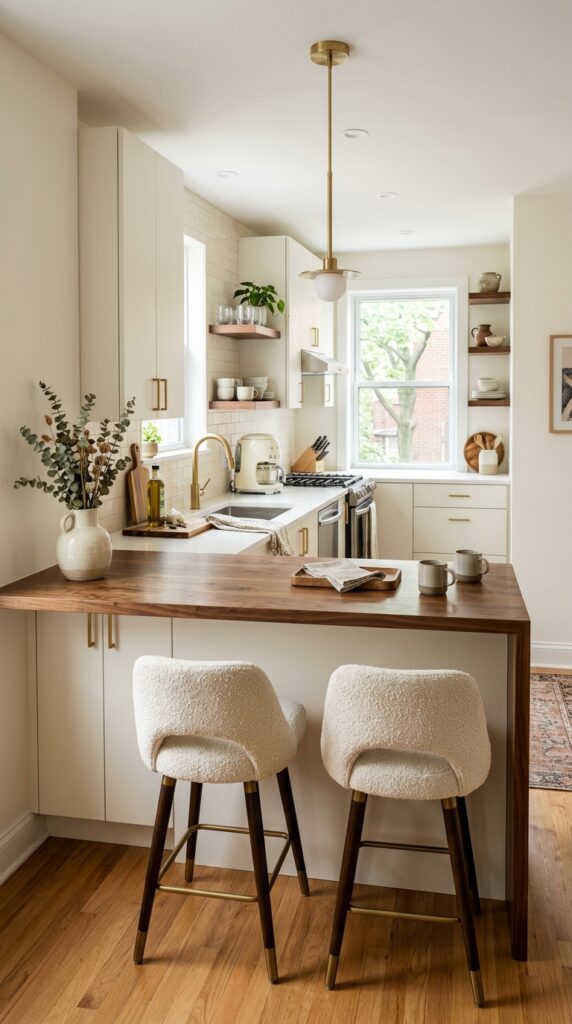
Vibe: Airy and compact — this kitchen does more with its square footage than most rooms twice its size.
Why it works: A peninsula is the small-kitchen alternative to an island — it requires only 42 inches of clearance on three sides (versus an island’s required clearance on four sides) and borrows structural support from the existing counter run, eliminating the need for independent base cabinets. A walnut-topped peninsula in a white kitchen provides both the material warmth MCM demands and a defined social zone where the kitchen meets the living space. The seating overhang requires a minimum 12″ depth for knee clearance.
How to get it: A peninsula can be constructed by extending an existing lower cabinet run with a single standard base cabinet box ($80–$150 from IKEA or a kitchen supplier) finished with a walnut butcher block top. Alternatively, a freestanding kitchen island rolled into a peninsula position and secured to the wall provides the same function without construction.
🛍️ Shop the Look — Amazon Product Ideas
| # | Product Search Phrase | Why It Fits |
| 1 | small kitchen island butcher block top movable | Peninsula alternative |
| 2 | counter height bar stool 24 inch boucle seat | Peninsula seating |
| 3 | plug-in mini pendant light brass small | Peninsula light source |
| 4 | walnut butcher block panel 36 inch wide | Peninsula top material |
| 5 | base cabinet ready to assemble white flat front | Peninsula cabinet box |
29. Statement Clock as Kitchen Wall Art
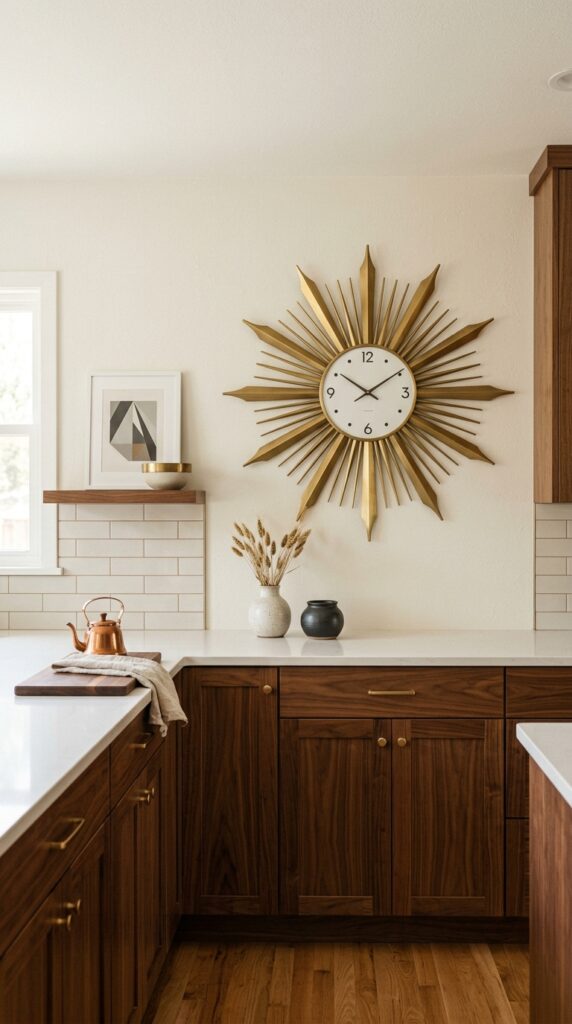
Vibe: Warm and graphic — the clock reads as sculpture first, timekeeper second.
Why it works: The sunburst clock is one of the defining decorative objects of mid century modern interiors — its radiating form references both atomic-age imagery and natural sunlight patterns, and its scale (24–36 inches) gives it the visual authority of wall art without requiring framing or hanging costs. In a kitchen where wall space is typically dominated by cabinets, a statement clock above the cabinet run uses dead vertical space productively. Brass construction connects it to the kitchen’s hardware palette.
How to get it: Vintage 1950s–1960s sunburst clocks from estate sales and eBay run $60–$250 depending on maker. New reproduction versions from Howard Miller ($80–$180) and numerous Amazon sellers offer faithful reproductions with battery movements at $35–$80. Look for solid metal construction — plastic sunburst clocks read as costume rather than authentic.
🛍️ Shop the Look — Amazon Product Ideas
| # | Product Search Phrase | Why It Fits |
| 1 | mid century sunburst wall clock brass 24 inch | Signature MCM wall art |
| 2 | atomic age starburst clock gold metal large | Period-authentic design |
| 3 | small ceramic bud vase set 3 piece matte | Below-clock counter accent |
| 4 | wall clock battery movement silent sweep | Clock mechanism upgrade |
| 5 | floating wall shelf walnut narrow display | Clock accompaniment shelf |
30. Terrazzo Countertops in Warm Aggregate
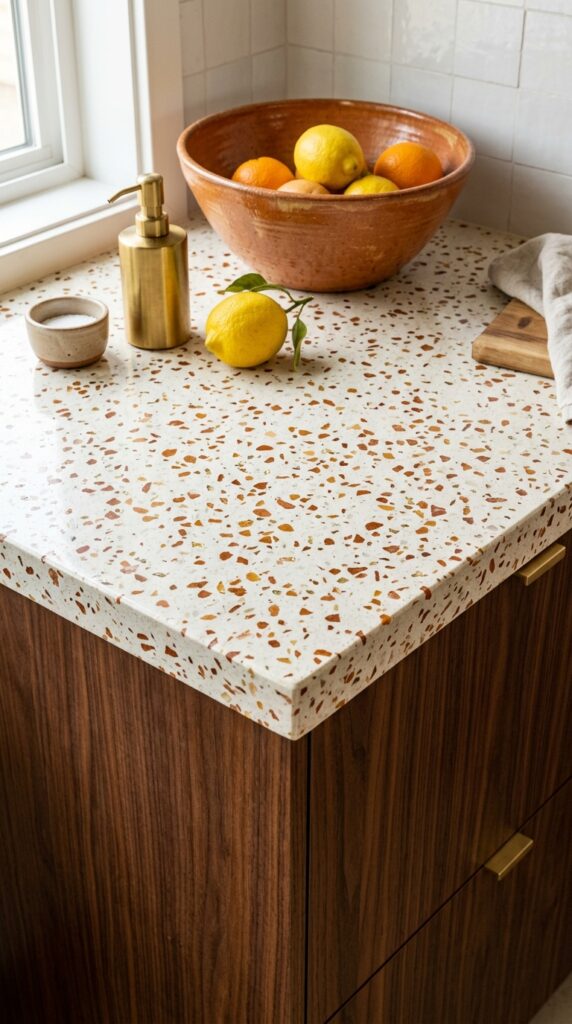
Vibe: Rich and grounded — a countertop that looks better every year it’s used.
Why it works: Terrazzo countertops are the luxury MCM kitchen material — they were used in public architecture throughout the mid century precisely because their speckled surface hides wear while developing patina over time. The warm aggregate chips (terracotta, amber, brass) create a countertop that simultaneously references three other MCM material choices (the terracotta of ceramics, the amber of glassware, the brass of hardware), pulling the room’s palette into material coherence. Unlike quartz or granite, terrazzo improves with age.
How to get it: Custom poured terrazzo countertops from a local terrazzo contractor run $100–$200 per square foot installed — a significant investment but one that is permanent and unreplicable in its authenticity. DIY terrazzo using Cement-All rapid-setting concrete mixed with aggregates and poured into a mold is achievable at $15–$25 per square foot and produces a genuine terrazzo result with proper finishing (grind, fill, polish sequence).
💡 Quick Win: Terrazzo-look porcelain tile laid as a countertop surface (tiled over existing laminate with proper adhesive and grout) achieves 85% of the visual effect at $8–$18 per square foot installed.
🛍️ Shop the Look — Amazon Product Ideas
| # | Product Search Phrase | Why It Fits |
| 1 | terrazzo look porcelain countertop tile sample warm | Countertop tile option |
| 2 | rapid setting cement concrete countertop mix | DIY terrazzo base |
| 3 | decorative aggregate chip terracotta glass mixed | Terrazzo chip material |
| 4 | brass liquid soap dispenser pump countertop | Counter styling hardware |
| 5 | concrete countertop sealer matte food safe | DIY surface protection |
How to Start Your Mid Century Modern Kitchen Transformation
Start with the hardware. Replacing every cabinet pull and knob with solid brass bar pulls is the single highest-impact change you can make in one afternoon — it shifts the entire kitchen’s visual register from generic to intentional. Specifically, look for 96mm center-to-center bar pulls in a brushed (not polished) brass finish; the brushed surface is more period-authentic and more forgiving of fingerprints. Everything else you do afterward will immediately look more deliberate.
The most common beginner mistake in MCM kitchens is choosing a warm grey paint for the cabinets instead of a true color. Warm grey reads as contemporary minimalism, not mid century — the MCM palette requires a genuine hue commitment: avocado green, harvest gold, warm teal, or a rich walnut tone. Grey feels safe but it flattens the style into something that looks like no style at all. Commit to one real color, even on just the island or lower cabinets.
Three items under $50 that deliver immediate MCM impact: a set of 12 amber glass kitchen canisters with brass lids (complete the counter in one purchase), a large format vintage-style lithograph print (digital download, printed locally), and a single sunburst mirror or clock in brass hung above the cabinet line.
Realistically, a hardware-and-styling refresh (new pulls, art, accessories) takes one weekend and costs $150–$400. A partial cabinet repaint and new lighting adds another $300–$800 and two weekends. A full MCM kitchen renovation with new tile, countertops, and custom cabinets runs $8,000–$35,000 and takes six to twelve weeks.
Frequently Asked Questions About Mid Century Modern Kitchen Design
What is the difference between mid century modern and retro kitchen design?
Mid century modern is a design movement with specific historical origins (roughly 1945–1969) and a coherent design philosophy: clean lines, organic forms, natural materials, and the belief that good design should be democratic and functional. Retro kitchen design is a broader, looser term that describes any nostalgic aesthetic — it can include 1950s diner styling, 1970s avocado-everything, or 1980s pastel. MCM is always a subset of retro, but retro is not always MCM. The clearest distinction: true MCM design is interested in furniture silhouette, material quality, and the relationship between form and function — retro design is primarily interested in nostalgia and color recognition.
What paint colors work best in a mid century modern kitchen?
The authentic MCM kitchen palette draws from four color families: avocado green (Benjamin Moore “Avocado” or Sherwin-Williams “Rosemary”), harvest gold (Benjamin Moore “Golden Straw” HC-9), warm teal (Farrow & Ball “Vardo” No. 288), and warm walnut brown (as a stain or veneer rather than paint). These all have yellow-warm undertones — the MCM palette runs warm, not cool. For walls, warm white is the right neutral: Benjamin Moore “White Dove” or Sherwin-Williams “Alabaster” both have the slightly cream undertone that prevents the kitchen from reading as sterile.
Is mid century modern kitchen design expensive to achieve?
MCM can be achieved at almost any budget level because its core elements — flat-front cabinets, warm wood tones, specific hardware — are widely available across all price points. At the entry level, replacing hardware ($100–$300 for a full kitchen) and adding an amber glass accessory collection ($40–$80) creates immediate MCM character. At the mid level, a cabinet repaint ($300–$600 DIY, $1,500–$3,000 with a painter) plus new pendant lighting ($100–$400) produces a convincing kitchen transformation. Full renovation with custom teak cabinets, terrazzo counters, and imported tile runs $20,000–$50,000.
Can I mix mid century modern with Scandinavian or bohemian style?
MCM and Scandinavian design mix naturally because they share origins — both movements emerged from the same post-war design philosophy, with Scandinavian designers like Hans Wegner and Finn Juhl contributing directly to what Americans called “mid century modern.” The combination leans into natural wood, clean lines, and warm neutrals. MCM and bohemian design can coexist but require more careful editing: introduce boho elements (rattan, macramé, pattern) in textiles and small accessories, and keep the architectural elements (cabinets, counters, lighting) firmly in the MCM vocabulary. Let MCM be the structure and let boho be the texture.
What lighting works best in a mid century modern kitchen?
The three most authentic MCM lighting choices for kitchens are: the Sputnik chandelier (starburst form, brushed brass or chrome, 12+ arms with exposed bulbs) for over an island or dining area; cone-shade pendants in brass or ceramic for over a sink or task area; and recessed track lighting with brass-finish heads for general illumination. Avoid recessed can lights wherever possible — they were not a mid century technology and they flatten the ceiling visually. Under-cabinet lighting in warm white (2700K) is the one contemporary lighting solution that reads as compatible with MCM because it pools warm light on the counter surface rather than filling the room with overhead brightness.
Ready to Create Your Dream Mid Century Modern Kitchen?
These 30 ideas have ranged across the full width of what an MCM kitchen can be — from bold avocado cabinet colors and terrazzo countertops to compact peninsula layouts, hardware choices, lighting strategies, and small-space solutions that work in any kitchen size. You don’t need to do all of this at once — and you shouldn’t. Starting with hardware replacement or a single statement paint color gives you the room to live with the change and let the rest of the direction reveal itself naturally. This week, swap out one cabinet pull for a brushed brass bar pull and hold it up against your existing cabinets — that single piece of metal will tell you more about what your kitchen wants to become than any mood board. When it’s done well, an MCM kitchen feels like a room with a point of view: warm, confident, and completely unbothered by trends. Pin the ideas where you stopped and thought “that’s the one” — especially the lighting choices and the cabinet color options, which are where MCM kitchens tend to come alive.