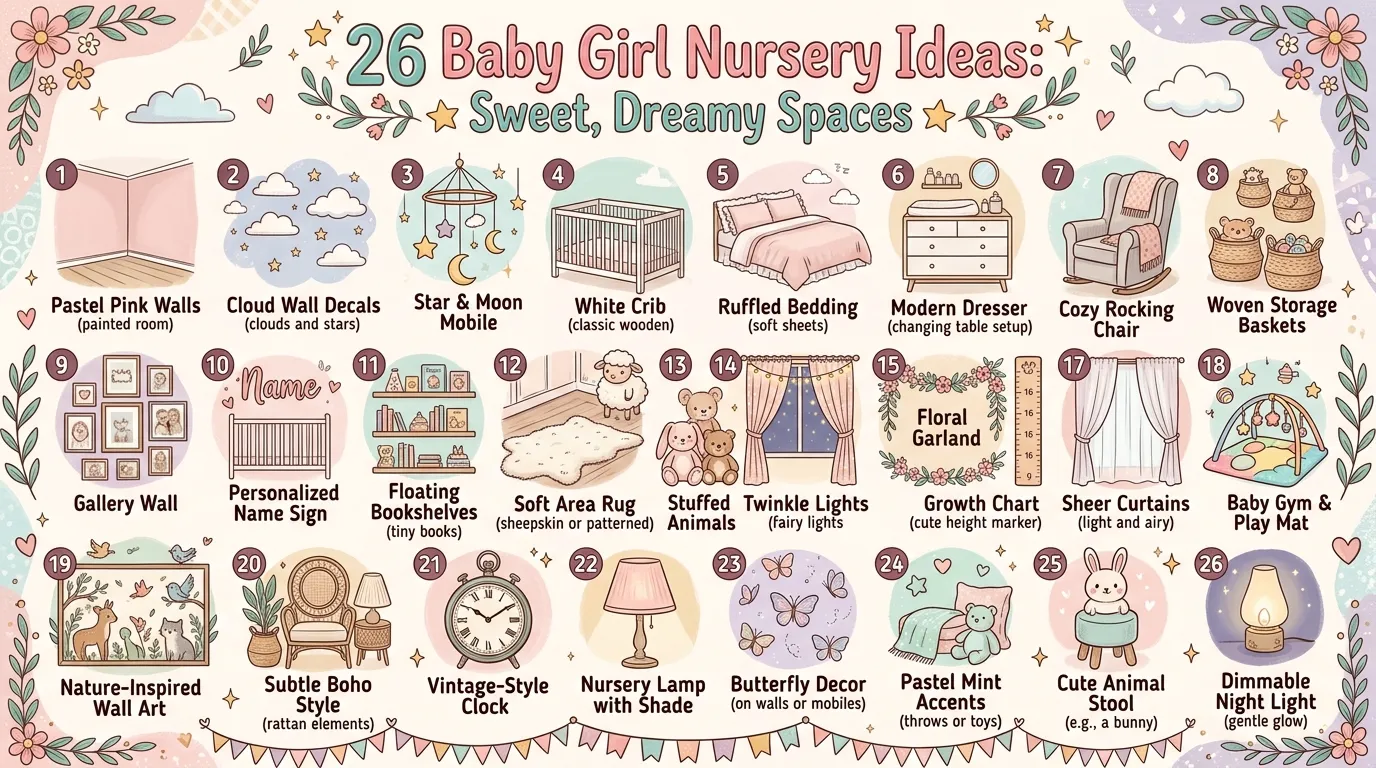
A baby girl nursery is a room designed around softness, warmth, and a sense of tender calm — built before she arrives, and grown into for years. This article gives you 26 baby girl nursery ideas spanning color, lighting, furniture, materials, and small-space solutions so you have everything you need to plan, design, and shop.
There’s something almost sacred about a nursery done right. Soft light filtering through linen curtains. The weight of a velvet rocking chair pulled close to a crib. A room that smells like cedar and lavender and new beginnings. A space that holds both the practicality of sleepless nights and the quiet poetry of a child growing up. Here are 26 ideas worth saving — and stealing.
Why Baby Girl Nursery Design Works So Well
Baby girl nurseries have evolved far beyond pink-everything rooms. Today’s most coveted designs draw from Scandinavian minimalism, French country softness, and biophilic design — pairing gentle feminine tones with organic materials and thoughtful spatial planning. The result is a room that feels curated, not cutesy. It’s a design aesthetic that respects both the child and the parent who will spend many late hours in that space.
The core materials are natural and tactile: unfinished white oak for cribs and dressers, undyed linen for curtains and crib skirts, rattan baskets for toy storage, and milky white ceramic for lamp bases and decor. Color palettes lean into gentle warmth — dusty blush, warm ivory, sage green, lavender mist, and muted terracotta — colors that feel timeless rather than trendy and that won’t feel dated by age two.
This aesthetic is trending now for very specific reasons. Post-pandemic, parents began investing seriously in home spaces for young children, viewing the nursery as a sanctuary rather than a utility room. Pinterest searches for “organic nursery,” “boho baby girl room,” and “Japandi nursery” have surged as parents prioritize non-toxic materials, low-stimulation palettes, and rooms that support calm sleep environments. There’s a cultural shift away from novelty décor toward enduring design.
Even a 10×10 nursery can absolutely achieve this look. In smaller spaces, prioritize a single statement wall (a limewash paint treatment or peel-and-stick botanical wallpaper) over multiple furniture pieces. Use a convertible crib that grows with the child. Mount shelves vertically to draw the eye upward. The constraints of a small room often produce the most intentional, beautiful nurseries.
Style at a Glance
| Element | Soft Organic | French Boho |
| Philosophy | Calm, tactile simplicity | Romantic layering |
| Materials | White oak, linen, rattan | Velvet, cane, cotton gauze |
| Color palette | Warm ivory, dusty blush, sage | Lavender, blush, warm cream |
26 Baby Girl Nursery Ideas
1. Dusty Blush Walls with Warm Ivory Trim
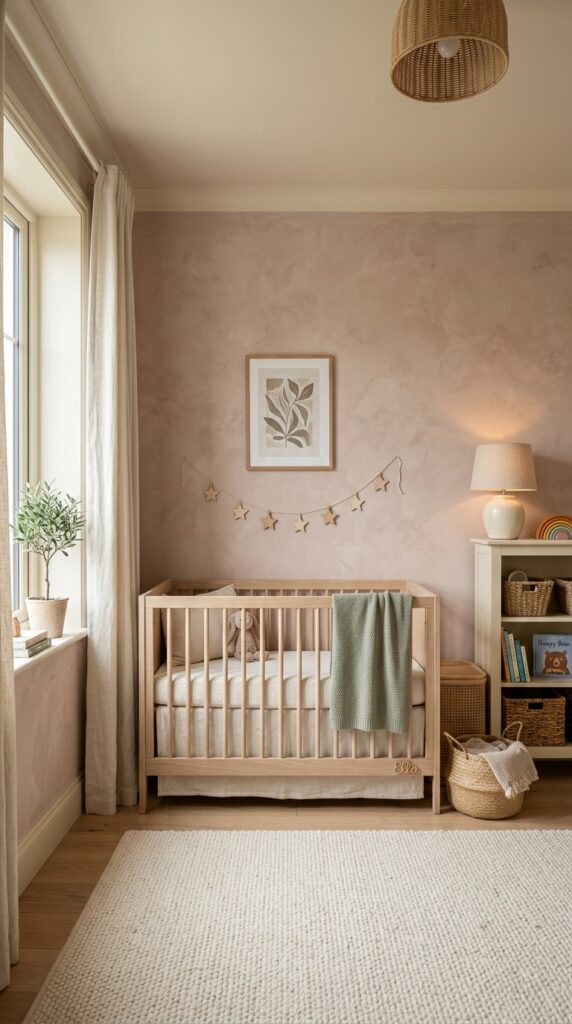
Vibe: Hushed — the kind of room that makes you lower your voice the moment you walk in.
Why it works: Limewash paint on walls introduces tonal depth through its naturally uneven finish, which means the blush shifts subtly with light throughout the day — warmer in morning, cooler and softer at dusk. The contrast with bright white trim creates just enough visual boundary without harshness. This interplay of warm and neutral tones is what separates a sophisticated nursery palette from a flat, paint-chip pink.
How to get it: Apply limewash paint (try Portola Paints’ “Blush” or Roman Clay in similar tones) in overlapping circular strokes with a chip brush for maximum texture. Paint the trim and ceiling in Benjamin Moore “White Dove” OC-17, which has a warm undertone that won’t clash with blush walls.
💡 Quick Win: Purchase a single sample pot of limewash paint and test a 2×2 foot patch before committing — the texture looks completely different wet versus dry.
🛍️ Shop the Look — Amazon Product Ideas
| # | Product Search Phrase | Why It Fits |
| 1 | dusty blush nursery crib bedding set | Anchors the color palette |
| 2 | white oak finish baby dresser | Warm, natural wood tone |
| 3 | ivory linen blackout curtain panel | Softens light, warm base |
| 4 | rattan laundry hamper with lid | Natural texture, functional |
| 5 | white ceramic table lamp nursery | Clean neutral accent |
2. White Oak Crib as the Anchor Piece
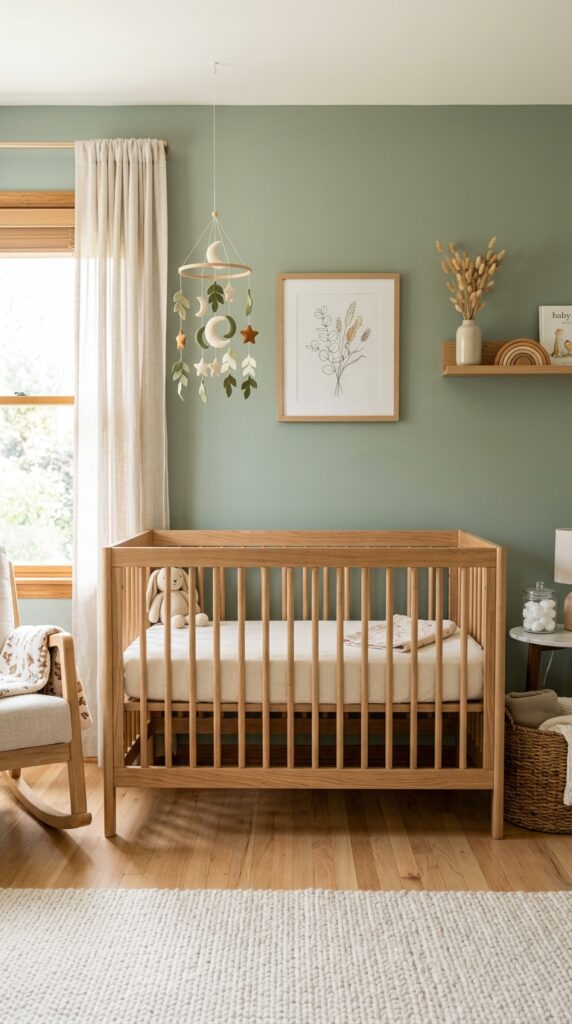
Vibe: Grounded — furniture that feels permanent and trustworthy in the best possible way.
Why it works: Unfinished white oak carries warmth without darkness — its pale, golden grain reads as natural and organic rather than heavy. As the visual anchor of any nursery, the crib sets the material language for the entire room. When the crib is natural wood, every other choice becomes easier: linen, rattan, cotton, and ceramic all speak the same soft, organic vocabulary.
How to get it: Look for cribs made with FSC-certified white oak or beech with a non-toxic water-based finish. Choose a convertible crib (one that converts to a toddler bed and full bed) — it’s one of the highest-value investments you can make, typically in the $400–$900 range for quality construction.
🛍️ Shop the Look — Amazon Product Ideas
| # | Product Search Phrase | Why It Fits |
| 1 | convertible white oak finish crib | Central furniture piece |
| 2 | organic cotton muslin fitted crib sheet | Breathable, natural layer |
| 3 | minimalist macramé crib mobile | Texture overhead |
| 4 | natural beeswax wood conditioner nursery | Maintains oak finish |
| 5 | white oak finish changing topper dresser | Matching material set |
3. Rattan Rocker in the Reading Corner
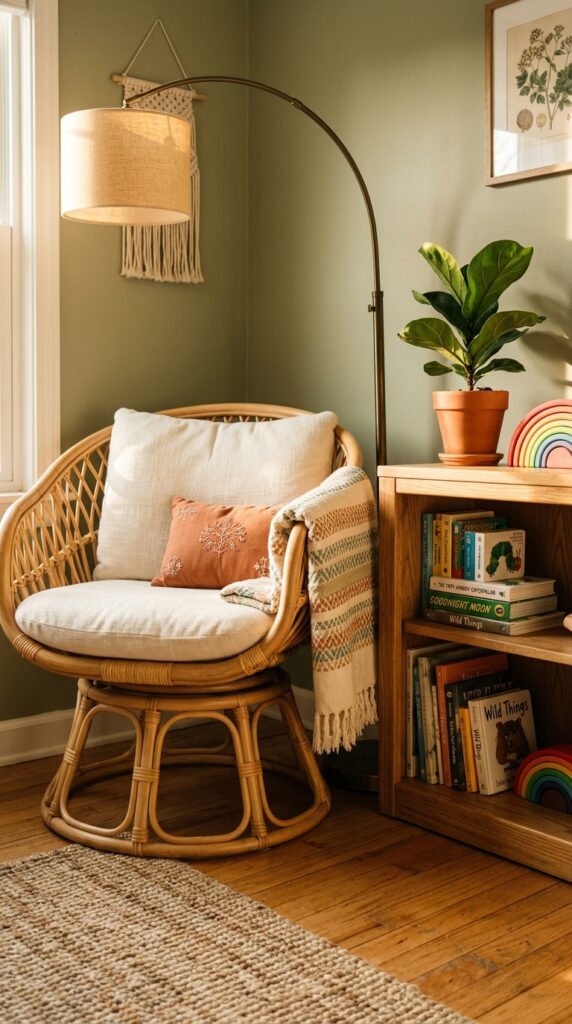
Vibe: Layered — a corner that could belong in a boutique hotel, not just a nursery.
Why it works: A rattan chair introduces organic texture at eye level — one of the most visually effective design moves in any room. Its curved, rounded silhouette counters the hard lines of a crib and dresser, creating contrast through form rather than color. The visual weight of rattan is light; it fills a corner without closing the space off, which makes it ideal for rooms where scale is a concern.
How to get it: Pair a rattan accent chair with a low-profile arc floor lamp positioned just above and behind the chair to create a warm reading light pool. Style the floor around it with a small jute rug, stacked picture books, and a ceramic planter — three items that together cost under $80 and complete the vignette.
💡 Quick Win: A $35 rattan catchall basket placed beside the chair doubles as a side table for a baby monitor and burp cloths — practical and visually cohesive.
🛍️ Shop the Look — Amazon Product Ideas
| # | Product Search Phrase | Why It Fits |
| 1 | round rattan accent chair with cushion | Textural organic anchor |
| 2 | black arc floor lamp nursery | Warm reading light source |
| 3 | small jute nursery rug natural fiber | Grounds the corner vignette |
| 4 | low wooden toddler bookshelf nursery | Accessible at child height |
| 5 | terracotta blush plant pot 4 inch | Warm accent, living element |
4. Sage Green Accent Wall with Botanical Prints
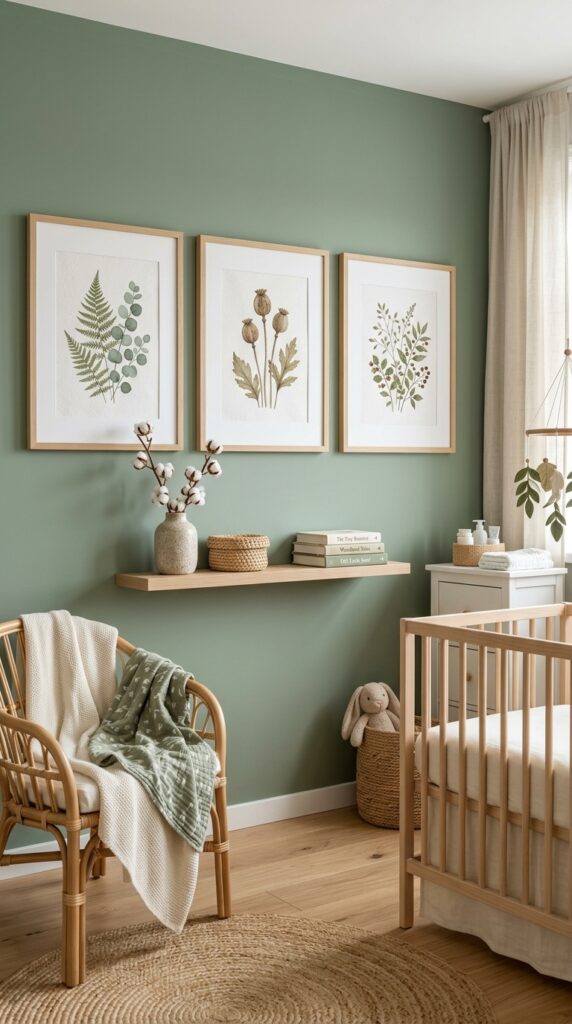
Vibe: Still — like walking into a greenhouse that has been very quietly organized.
Why it works: A single sage accent wall grounds a room in nature without overwhelming it — the restrained color creates a visual backdrop that makes everything placed in front of it pop with clarity. Botanical prints in white oak frames extend the nature narrative without relying on literal decor like artificial plants. The key design principle here is repetition and restraint: three matching frames, all the same size, hung at consistent eye level with even spacing.
How to get it: Paint just the wall behind the crib in a matte sage — try Farrow & Ball “Mizzle” No. 266 or Benjamin Moore “Saybrook Sage” HC-114. Hang three A4 or 5×7 botanical prints in matching frames at crib-height level, spaced 6 inches apart.
🛍️ Shop the Look — Amazon Product Ideas
| # | Product Search Phrase | Why It Fits |
| 1 | sage green nursery botanical print set | Coordinated wall art trio |
| 2 | white oak gallery frame set nursery | Cohesive framing |
| 3 | dried cotton stems floral arrangement | Low-maintenance natural decor |
| 4 | sage green crib skirt linen | Extends palette downward |
| 5 | white floating nursery shelf with lip | Sage wall display surface |
5. Sheer Linen Curtains for Soft Filtered Light
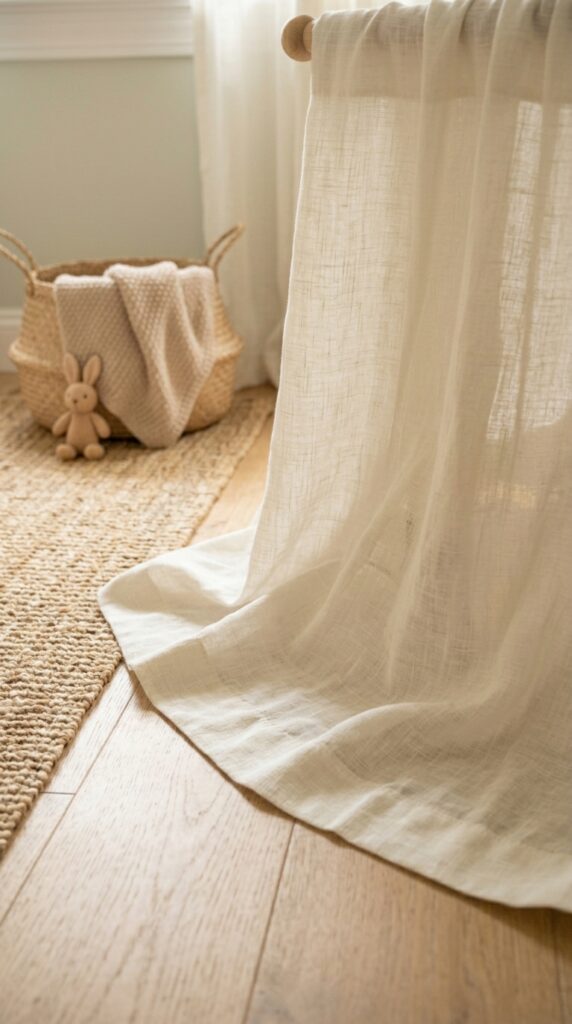
Vibe: Luminous — the room glows gently, like light through a paper lantern.
Why it works: Light is the most underrated material in nursery design, and sheer linen curtains are how you sculpt it. When backlit, natural linen transforms harsh daylight into warm, diffused illumination that softens every surface in the room. Hanging curtains from ceiling to floor — even on short windows — draws the eye upward and makes ceilings feel higher, one of the most reliable tricks for adding perceived space without adding square footage.
How to get it: Mount curtain rods 4–6 inches above the window frame and extend the rod 8–10 inches beyond the frame on each side. This technique widens the perceived window and lets maximum light in when curtains are open. Layer a cellular honeycomb blackout blind behind the sheers for nap time — you get both the visual softness and the light control.
💡 Quick Win: Order curtain panels 12 inches longer than your floor-to-ceiling measurement for a gentle pool — this single detail elevates a $30 panel to look like a custom drape.
🛍️ Shop the Look — Amazon Product Ideas
| # | Product Search Phrase | Why It Fits |
| 1 | ivory sheer linen curtain panel 96 inch | Central light-filtering element |
| 2 | white wood curtain rod with finials | Clean, classic hardware |
| 3 | cellular blackout honeycomb blind nursery | Nap-time light control layer |
| 4 | natural linen tie-back curtain holder | Soft styling detail |
| 5 | linen fabric valance nursery window | Top treatment, light control |
6. Convertible Dresser-Changing Table Combo
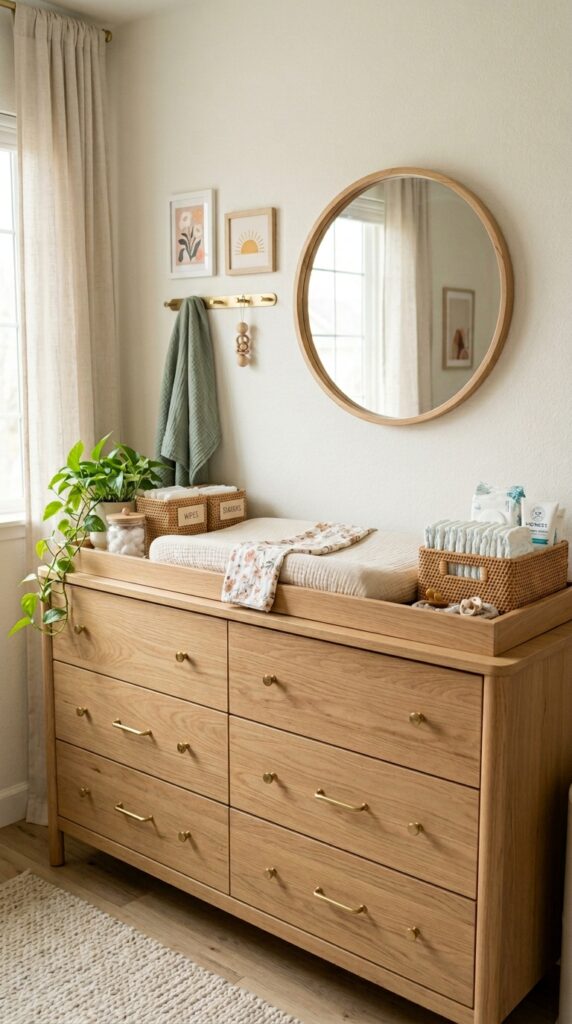
Vibe: Organized — the kind of calm that only comes from surfaces designed to be touched and used.
Why it works: The dresser-changing table combo is one of the smartest pieces of furniture in a well-planned nursery because it serves two critical functions without doubling the floor footprint. The design principle at work is vertical efficiency: a tall 6-drawer dresser uses wall height, not floor space. Brushed brass hardware is the single most impactful finish upgrade — it elevates a simple white oak dresser from functional to curated without replacing the piece.
How to get it: Choose a dresser with solid-panel drawer fronts rather than routed or carved detail — the cleaner the face, the more versatile the piece as the room evolves. Install a Universal Guard Changing Kit on top, which bolts to most flat-top dressers and removes cleanly once the child outgrows it.
🛍️ Shop the Look — Amazon Product Ideas
| # | Product Search Phrase | Why It Fits |
| 1 | white oak 6-drawer nursery dresser | Anchor furniture piece |
| 2 | brushed brass cup pull hardware set | Elevated hardware detail |
| 3 | removable changing pad topper white | Safety and function layer |
| 4 | woven seagrass dresser basket set | Drawer-top storage |
| 5 | glass cotton ball organizer nursery | Small surface organization |
7. Soft Lavender and Ivory Color Blocking
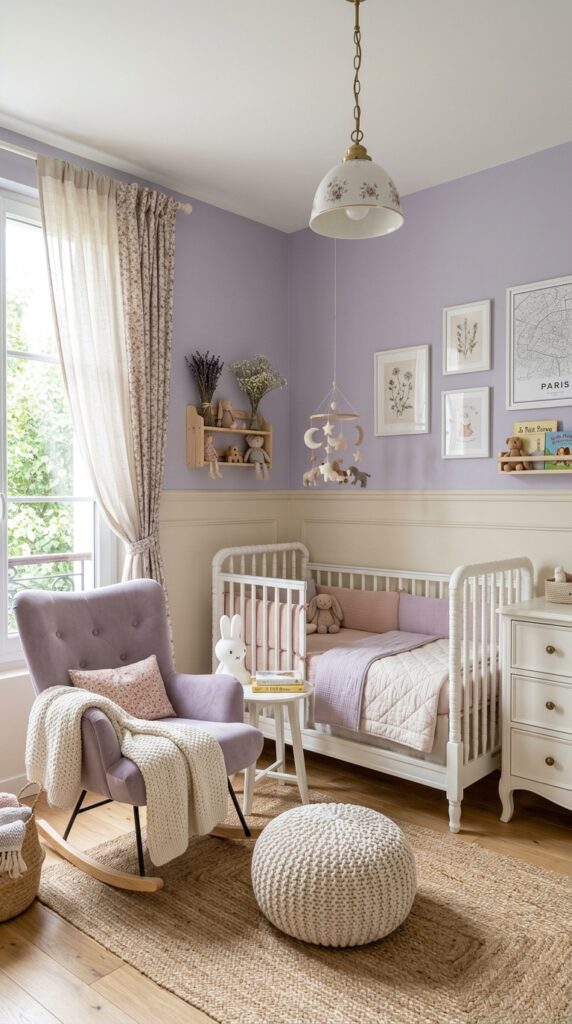
Vibe: Romantic — soft enough to be dreamy, structured enough to feel grown-up.
Why it works: Color blocking on nursery walls is one of the most impactful and reversible ways to add architectural interest to a plain room. The design principle is visual anchoring: painting the lower portion of the wall in a deeper, warmer tone (ivory or cream) grounds the room and makes the lighter lavender above feel like it’s floating. The painted border where the two tones meet acts as a faux dado rail — adding structure without the commitment of actual molding.
How to get it: Use painter’s tape and a level to mark your dividing line at 36 to 40 inches from the floor. Apply the upper lavender first (try Benjamin Moore “Wisteria” 2071-60), then the lower ivory, overlapping slightly at the tape line for a clean edge. Remove tape while paint is still slightly tacky.
💡 Quick Win: A single can of sample paint (roughly $5–$8) tests this technique on a 2×4 foot section before you commit to full gallons.
🛍️ Shop the Look — Amazon Product Ideas
| # | Product Search Phrase | Why It Fits |
| 1 | lavender velvet nursery glider rocking chair | Key color accent seat |
| 2 | white porcelain globe ceiling light nursery | Clean overhead fixture |
| 3 | cream knit nursery pouf ottoman | Soft textural floor accent |
| 4 | lavender linen crib sheet set | Palette extension in textiles |
| 5 | ivory arched nursery mirror small | Reflective light, French detail |
8. Pendant Lamp with Paper Globe Shade
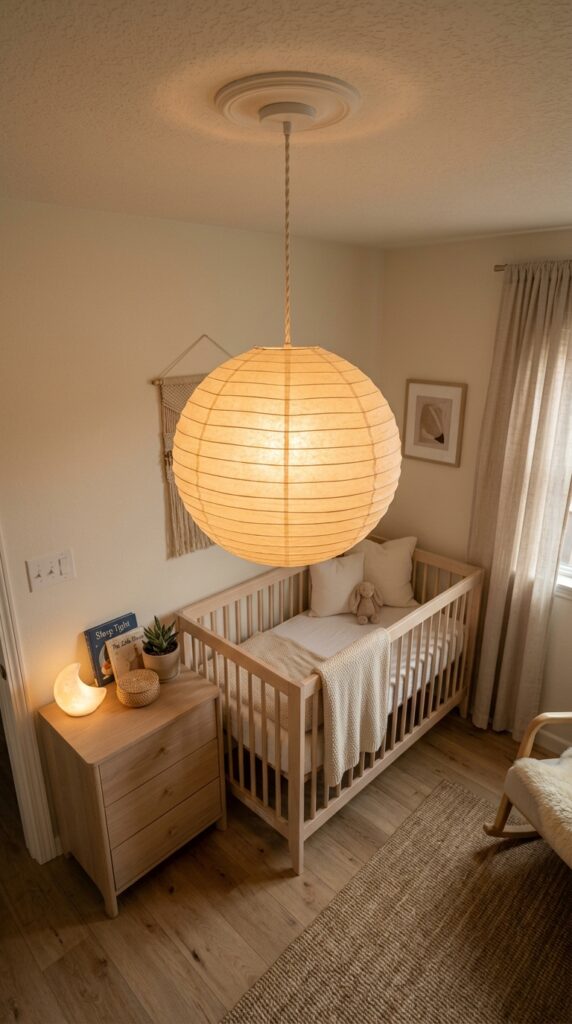
Vibe: Warm — the glow of this lamp alone changes the feeling of a room at dusk.
Why it works: Overhead lighting is the most commonly underthought element in nursery design. A paper globe pendant does something a recessed light cannot: it creates a warm, diffused glow that eliminates harsh shadows and wraps the room in comfort. The design principle is light behavior — a warm-toned paper shade (particularly washi or rice paper) filters the bulb’s light through its fibers, creating a soft, almost candlelike quality that’s genuinely calming for both baby and parent.
How to get it: Wire a pendant on a dimmer switch — this is non-negotiable in a nursery. A 2700K LED bulb inside a paper globe pendant gives warm amber light for bedtime without being stimulating. Hang the pendant so the bottom of the shade sits at approximately 7 feet from the floor, well above any standing adult.
🛍️ Shop the Look — Amazon Product Ideas
| # | Product Search Phrase | Why It Fits |
| 1 | large white paper globe pendant nursery light | Central ambient light source |
| 2 | in-wall rotary dimmer switch light control | Essential nursery lighting tool |
| 3 | 2700K warm white LED globe bulb E26 | Warm-toned light source |
| 4 | white braided fabric pendant cord kit | Elevated cord styling |
| 5 | moon star soft night light nursery | Secondary ambient nightlight |
9. Macramé Wall Hanging as Textile Art
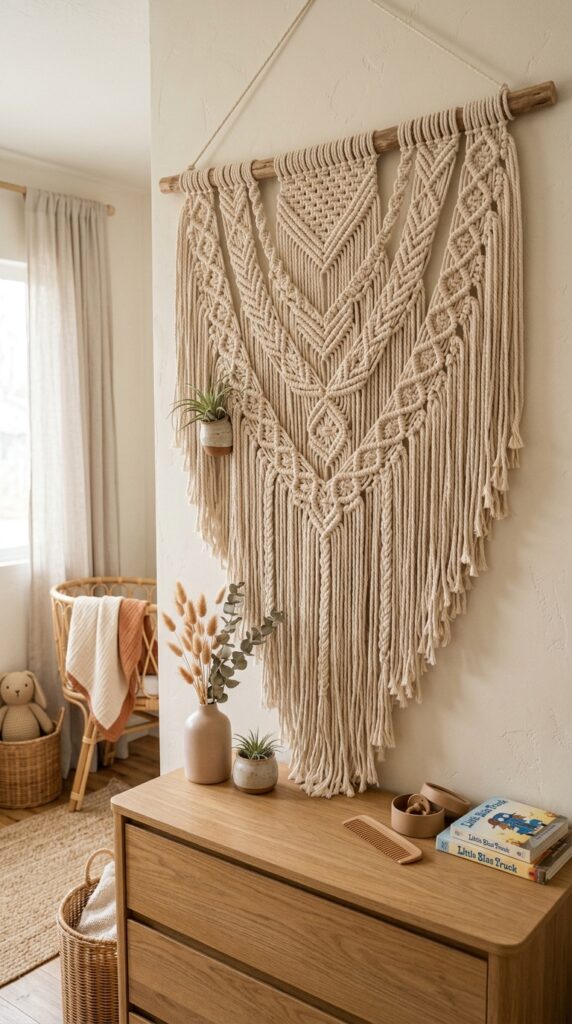
Vibe: Layered — textured walls that make you want to reach out and touch them.
Why it works: Textile art solves a specific design problem: nurseries need visual interest on walls, but framed prints can feel flat in rooms that are otherwise full of soft, touchable materials. A macramé wall hanging introduces three-dimensional texture at a scale that commands attention. The material principle here is shadow and depth — the raised fibers of macramé cast subtle shadows as light moves through the day, meaning the piece looks slightly different at every hour.
How to get it: Hang macramé on a wooden dowel mounted with two small brass hooks drilled directly into a wall stud. For a cohesive look, choose a macramé piece in natural undyed cotton — it works with every nursery palette and never dates. Size should be at least 18 inches wide for it to register as a statement piece.
🛍️ Shop the Look — Amazon Product Ideas
| # | Product Search Phrase | Why It Fits |
| 1 | large natural cotton macramé wall hanging nursery | Primary textile wall art |
| 2 | wooden dowel rod macramé hanger | Rustic mounting detail |
| 3 | air plant set small tillandsia nursery | Living accent in weave |
| 4 | matte white ceramic bud vase small | Dresser top styling |
| 5 | brass picture rail hook set wall mount | Clean hanging hardware |
10. Terracotta Blush and Warm Cream Palette
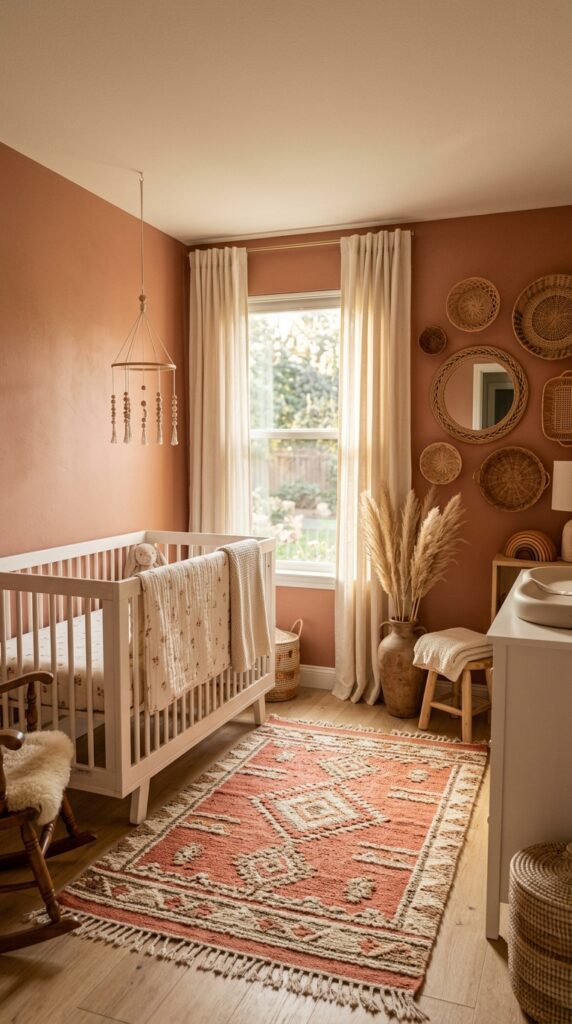
Vibe: Sun-warmed — the color of late afternoon light held inside a room.
Why it works: Terracotta blush is one of the most sophisticated choices for a baby girl nursery precisely because it avoids the pink nursery cliché while still feeling unmistakably warm and feminine. This palette borrows from Southwestern and Mediterranean interiors, where earthy pigments interact with natural light to create rooms that feel lived-in and soulful from day one. The design rule is tonal harmony: pairing terracotta with warm cream rather than cool white keeps the entire palette in the same temperature family, which reads as seamlessly cohesive.
How to get it: Choose Benjamin Moore “Terracotta Tile” 2090-40 or Sherwin-Williams “Cavern Clay” SW 7701 for the walls. Use cream-white (not bright white) for all trim, ceiling, and crib to maintain the warm palette consistently.
💡 Quick Win: A $25 pampas grass stem bundle in a tall ceramic vase instantly extends the warm, earthy palette into a vertical dimension.
🛍️ Shop the Look — Amazon Product Ideas
| # | Product Search Phrase | Why It Fits |
| 1 | terracotta blush nursery wallpaper peel stick | Warm wall treatment alternative |
| 2 | handwoven cotton area rug cream coral | Grounded floor texture |
| 3 | tall ceramic floor vase nursery terracotta | Earthy decor anchor |
| 4 | dried pampas grass bundle natural | Warm organic stem decor |
| 5 | woven seagrass wall basket set display | Textural wall accent |
11. Open-Concept Closet Nursery Nook
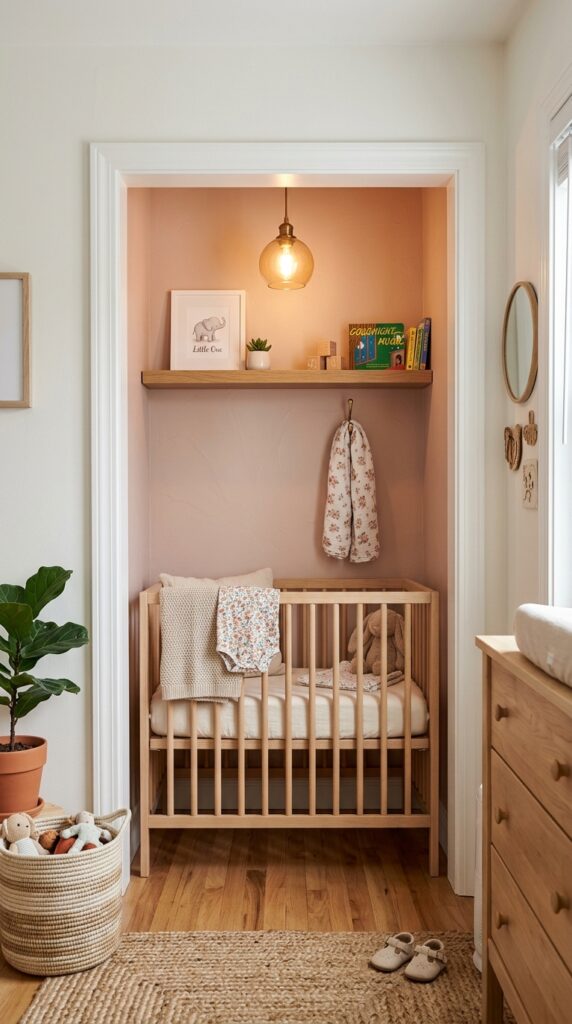
Vibe: Cozy — enclosed just enough to feel like a secret garden for sleeping.
Why it works: In apartments or shared spaces where a dedicated nursery room isn’t possible, a closet nook conversion is one of the most effective small-space solutions in residential design. The principle is zone definition through enclosure: painting the interior of the nook a soft blush color differentiates it visually from the rest of the room and signals to the baby (and parent) that this is specifically a sleep space. The defined ceiling height of a closet nook also creates an acoustic pocket that can slightly reduce ambient room noise.
How to get it: Remove closet doors completely. Paint the interior back wall and ceiling of the nook in a matte dusty blush. Install a mini crib (IKEA Sniglar or similar compact options) — they typically fit 24×38 inch spaces. Mount a single floating shelf above crib height for a small nightlight and white noise machine.
🛍️ Shop the Look — Amazon Product Ideas
| # | Product Search Phrase | Why It Fits |
| 1 | compact mini crib with mattress small space | Core nook furniture |
| 2 | plug-in mini pendant light cord nursery | Nook-specific lighting |
| 3 | floating wall shelf nursery small 24 inch | Above-crib storage |
| 4 | white noise machine compact nursery | Sleep zone acoustics |
| 5 | blush pink hook rail wall mount | Swaddle and accessory hang |
12. Cloud-Painted Ceiling as a Statement
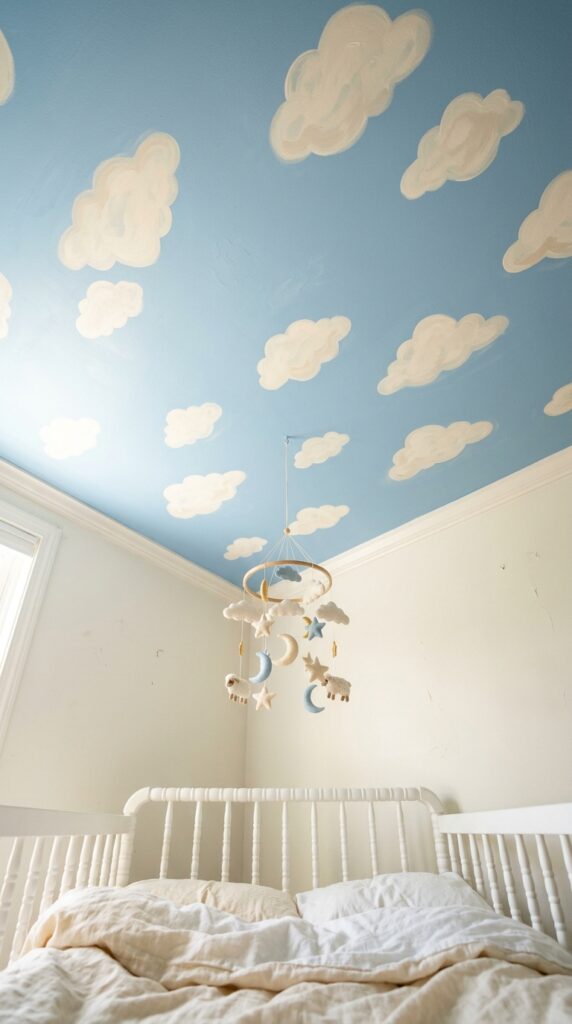
Vibe: Airy — the ceiling becomes the most whimsical square footage in the house.
Why it works: Designers refer to the ceiling as the “fifth wall,” and in a nursery, painting it is one of the highest-impact changes you can make per dollar spent. A painted cloud ceiling draws the eye upward and adds apparent height — the light, airy colors make a room feel taller than it is, a visual illusion achieved through color value contrast. From a baby’s perspective, it’s also the most-viewed surface in the room: they spend hours on their back looking up.
How to get it: Paint the ceiling in Benjamin Moore “Breath of Fresh Air” 806 (a barely-there sky blue). Let it dry fully, then use a sea sponge dampened with ivory-white paint to dab soft, irregular cloud shapes. Work wet-on-wet for soft, feathered edges. No artistic skill required — imperfection is what makes this look organic.
💡 Quick Win: Peel-and-stick cloud ceiling decals (under $20) give the same effect without any painting — ideal for renters.
🛍️ Shop the Look — Amazon Product Ideas
| # | Product Search Phrase | Why It Fits |
| 1 | cloud ceiling wall decal nursery peel stick | Renter-friendly ceiling art |
| 2 | sky blue ceiling paint nursery sample pot | First step test color |
| 3 | hanging fabric mobile stars clouds nursery | Overhead visual for baby |
| 4 | linen white crib bedding set organic | Below-sky neutral base |
| 5 | ivory knit nursery blanket swaddle | Soft surface layer in room |
13. Velvet Glider in a Deep Dusty Rose
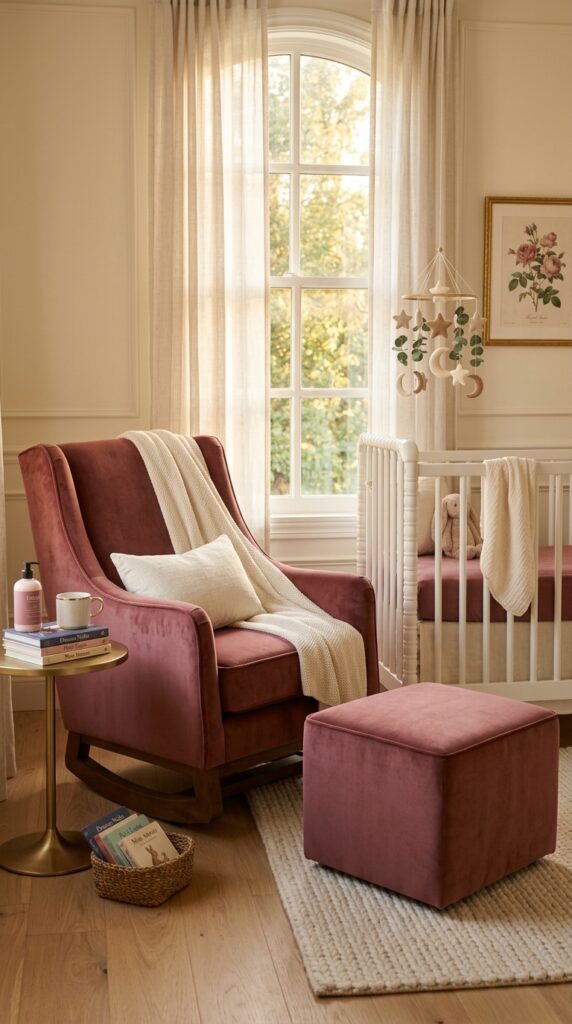
Vibe: Romantic — a chair that looks expensive and feels even better at 3 AM.
Why it works: Velvet in a nursery is a polarizing choice — but when done right, it anchors a room with visual depth that linen and cotton cannot achieve. The key principle is material contrast: the dense, reflective pile of velvet against the matte, airy surfaces of linen walls and white furniture creates a layer of visual richness that makes the room feel considered. Deep dusty rose reads as sophisticated — it has enough grey in its pigment to feel moody rather than infantile.
How to get it: Choose a glider with a solid, non-rocking base for safety around a baby. Look for velvet with a performance or stain-resistant coating (Crypton or equivalent) — it will be more forgiving for the feeding chair it inevitably becomes. Keep the velvet piece singular — one velvet chair in a sea of natural materials is luxurious; velvet curtains and velvet bedding and a velvet chair becomes heavy.
🛍️ Shop the Look — Amazon Product Ideas
| # | Product Search Phrase | Why It Fits |
| 1 | dusty rose velvet glider chair nursery | Primary seating statement |
| 2 | upholstered ottoman foot rest matching nursery | Companion comfort piece |
| 3 | linen lumbar pillow natural nursery chair | Textural contrast cushion |
| 4 | brushed gold side table round nursery | Glider companion surface |
| 5 | nursing station organizer caddy tote | Function beside glider |
14. Warm Edison Bulb String Lights Above Crib
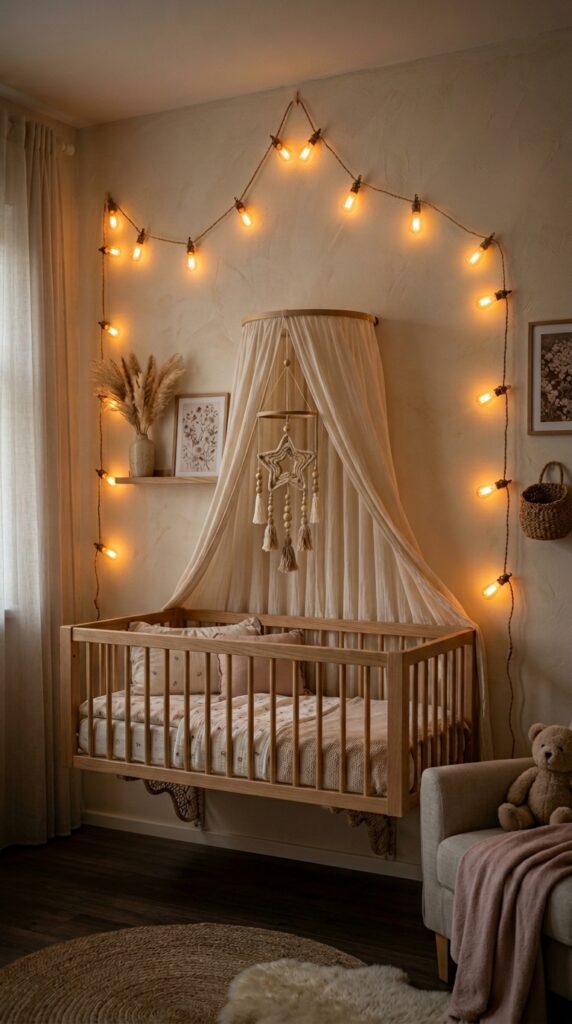
Vibe: Warm — the amber glow turns bedtime into the coziest part of the day.
Why it works: String lights in a nursery serve a precise function that standard lamps don’t: they provide a distributed ambient glow rather than a single point of light, which is significantly less stimulating for a baby’s developing visual system. The design principle is light distribution — warm Edison bulbs cast soft amber light that mimics sunset tones, naturally cuing circadian rhythms toward sleep. Mounting them above and behind the crib (never inside or reachable) creates a visual canopy effect without the fabric safety concerns of traditional canopies.
How to get it: Use USB-powered string lights with a remote dimmer, so you never have to locate a wall switch in the dark. Mount adhesive cable clips in a gentle arc on the wall above the crib headboard. Keep all wiring tucked behind furniture and out of reach — never drape in a way the baby could pull.
🛍️ Shop the Look — Amazon Product Ideas
| # | Product Search Phrase | Why It Fits |
| 1 | warm white Edison string lights USB remote | Primary ambient nursery glow |
| 2 | cotton gauze sheer canopy nursery crib | Soft backdrop behind lights |
| 3 | adhesive cord clips cable management nursery | Safe wire mounting |
| 4 | woven star wall hanging small nursery | Surrounding wall accent |
| 5 | linen blush ruffled crib skirt | Below-crib soft detail |
15. Vertical Shiplap Accent Wall
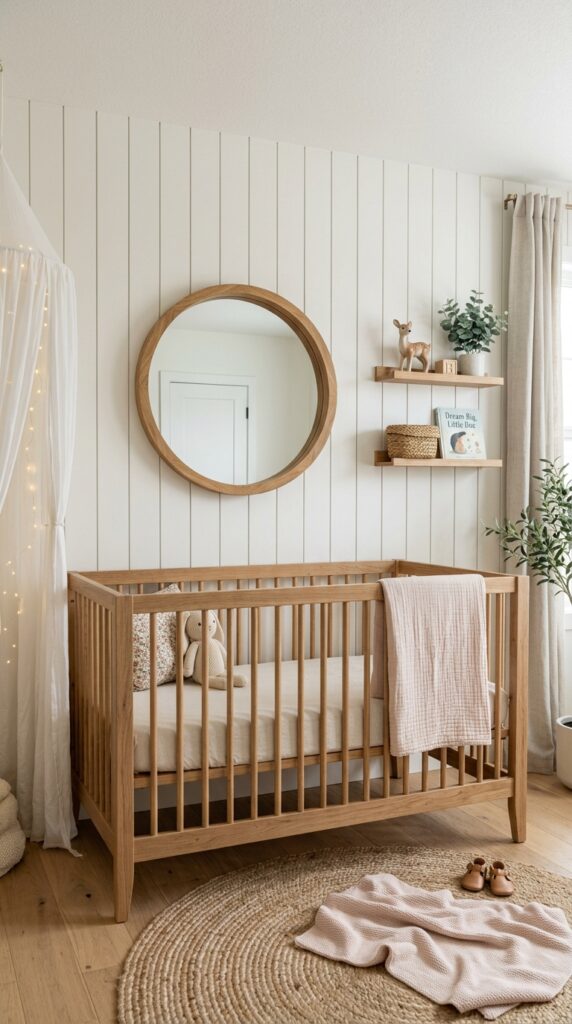
Vibe: Grounded — the structured vertical lines give a room backbone.
Why it works: Vertical shiplap is a deliberate alternative to the more common horizontal installation. The distinction matters: horizontal planks draw the eye along the wall, emphasizing its width, while vertical planks pull the eye upward, making ceilings feel dramatically taller. In a nursery with standard 8-foot ceilings, this is one of the fastest ways to add perceived height without structural changes. Painted in warm white (not bright white), the subtle groove lines between planks add depth without heaviness.
How to get it: Use ¼-inch MDF beadboard panels rather than actual shiplap boards — they’re significantly cheaper, install in sheets rather than individual boards, and take paint beautifully. Paint in Benjamin Moore “Simply White” OC-17 for warmth. Install vertically with construction adhesive and finish nails.
💡 Quick Win: Peel-and-stick shiplap wallpaper panels (available for $30–$50 per roll) let renters achieve this look without any tools.
🛍️ Shop the Look — Amazon Product Ideas
| # | Product Search Phrase | Why It Fits |
| 1 | peel stick shiplap wallpaper white renter | Renter-safe wall texture |
| 2 | round natural wood mirror nursery 20 inch | Focal point above crib |
| 3 | white floating nursery shelf with rail 12 inch | Shiplap wall display shelf |
| 4 | ceramic animal figurine set nursery decor | Shelf styling accents |
| 5 | white oak finish picture ledge shelf nursery | Gallery ledge option |
16. Botanical Peel-and-Stick Wallpaper Feature Wall
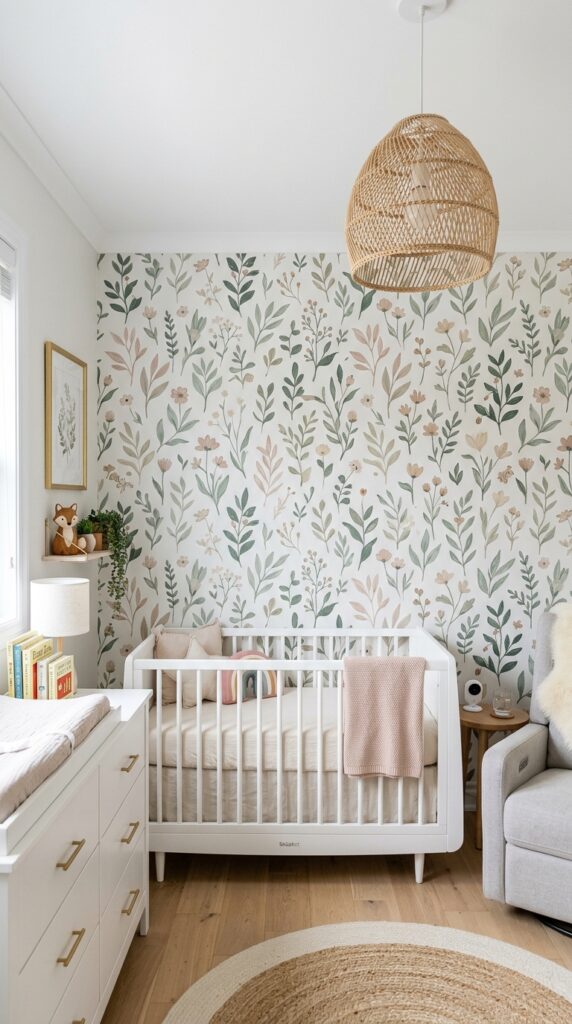
Vibe: Layered — like the room has grown a garden on one wall overnight.
Why it works: Peel-and-stick botanical wallpaper hits every design priority for a nursery at once: it adds pattern, color, and visual interest without paint, it’s fully removable without wall damage, and botanical illustrations carry natural warmth that geometric patterns lack. The design principle is focal point creation — one fully papered wall naturally draws every eye in the room to it, making the crib placement feel intentional and anchored. Keep the remaining three walls in a quiet warm white to let the botanical wall breathe.
How to get it: Apply peel-and-stick wallpaper to a clean, dry, flat-paint wall starting from the center of the wall and working outward to match the pattern precisely. Smooth from the center outward with a credit card or wallpaper smoother to eliminate bubbles. Work slowly — it’s forgiving, but rushing creates visible misalignment.
🛍️ Shop the Look — Amazon Product Ideas
| # | Product Search Phrase | Why It Fits |
| 1 | botanical floral peel stick wallpaper nursery | Core feature wall material |
| 2 | wallpaper smoother plastic scraper tool | Clean application tool |
| 3 | cream linen crib bedding standard size | Quiet base against pattern |
| 4 | rattan pendant ceiling light plug-in | Natural material overhead |
| 5 | sage linen curtain panel 84 inch | Palette pick-up at window |
17. Floating Book Ledge Shelves at Child Height
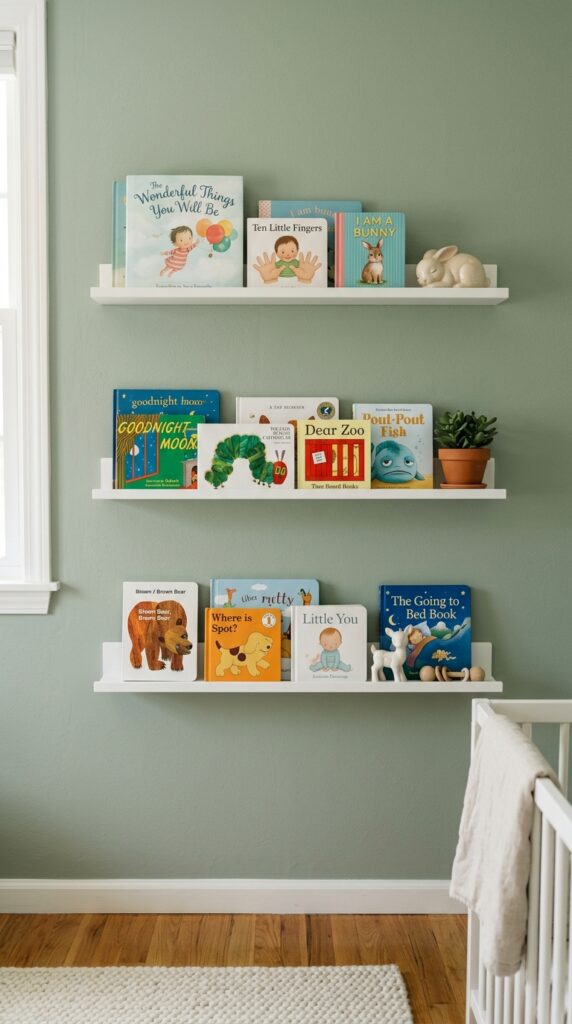
Vibe: Calm — books displayed as art, not stuffed into a bin.
Why it works: Displaying board books with their covers facing outward rather than spines-out is a well-researched early literacy technique: children choose books based on covers, and this display method makes the visual choice visible and inviting. Picture-ledge shelves at low heights — the lowest at around 18 inches from the floor — are also a developmental environment choice, encouraging early independent book selection. The design effect is gallery-like: books as curated objects rather than storage items.
How to get it: Mount three IKEA Mosslanda picture ledges (or equivalent) at staggered heights — 18 inches, 32 inches, and 46 inches from the floor. Use a level and toggle bolts anchored into wall studs. Keep the book selection curated and rotating rather than cramming every book on display.
💡 Quick Win: Three identical ledge shelves from IKEA cost under $30 total — this is one of the most impactful nursery upgrades available at any budget.
🛍️ Shop the Look — Amazon Product Ideas
| # | Product Search Phrase | Why It Fits |
| 1 | white picture ledge shelf 45 inch nursery | Core floating book display |
| 2 | board book set baby girl first year | Face-out shelf content |
| 3 | ceramic bunny figurine nursery shelf | Shelf styling accent |
| 4 | small succulent plant pot white nursery | Living shelf detail |
| 5 | level tool magnetic small hanging shelf | Accurate level mounting tool |
18. Jute and Cotton Layered Rug Combination
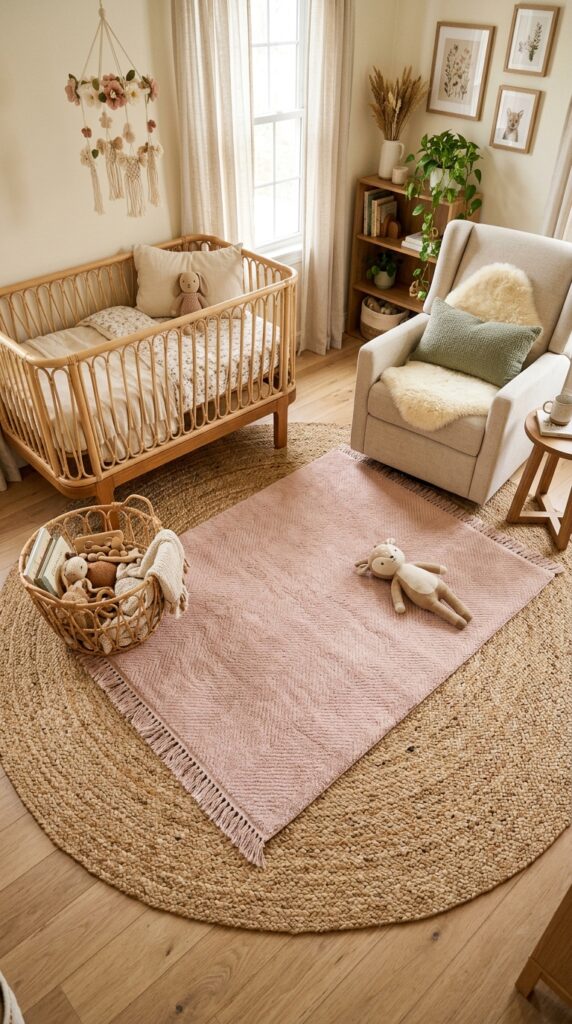
Vibe: Layered — the floor becomes as intentional as the walls.
Why it works: Layering rugs is one of the most effective interior design techniques for nurseries because it solves two problems at once: it creates visual depth and it adds soft cushioning to a hard floor without committing to a single large, expensive rug. The material contrast principle is at work here — the rough, woven texture of natural jute against the soft cotton pile of a smaller blush rug creates a tactile interplay that reads as deliberately designed. Jute also naturally deters slipping when the cotton rug is placed flat on top.
How to get it: Size the base jute rug to extend at least 18 inches beyond the perimeter of the cotton layer on all sides — the size difference is what creates the framing effect. Anchor the top rug with a non-slip pad cut to size, and choose a washable cotton layer for the top piece (the one that will be closest to a crawling baby).
🛍️ Shop the Look — Amazon Product Ideas
| # | Product Search Phrase | Why It Fits |
| 1 | natural jute rug 5×7 nursery | Base layer natural texture |
| 2 | blush pink washable cotton rug 3×5 | Soft top layer for baby |
| 3 | non-slip rug pad cut to size nursery | Safety and grip layer |
| 4 | natural fiber toy basket with handle | Jute rug companion storage |
| 5 | blush pink stuffed bunny rabbit plush | Soft decor on rug |
19. Arched Wooden Frame as Crib Canopy
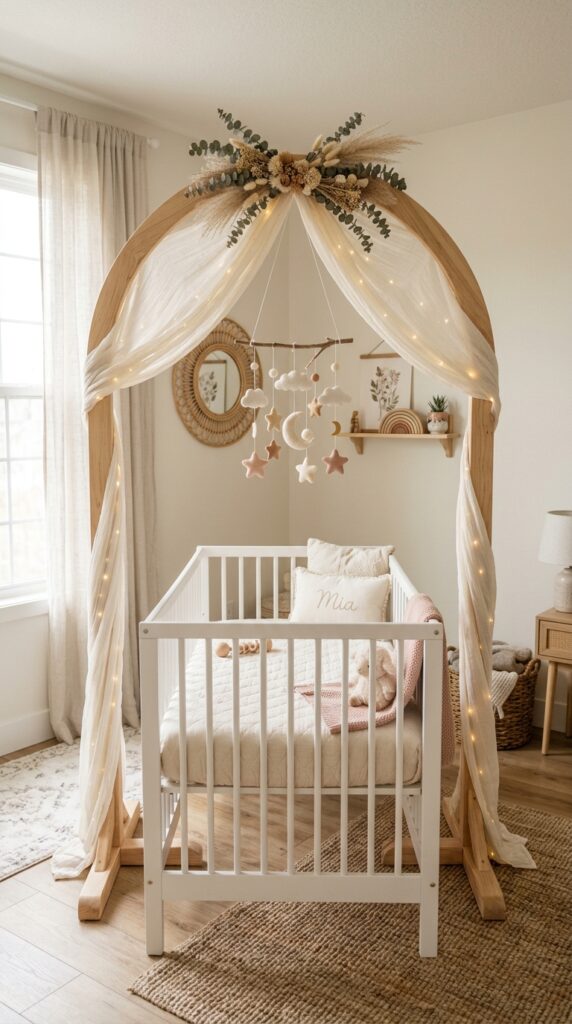
Vibe: Serene — the arch transforms a standard crib into a sanctuary within a sanctuary.
Why it works: An arched frame creates a sense of enclosure and visual hierarchy — it frames the crib as the central, most important element in the room. In architectural design, arches signal threshold and passage; here, that symbolism works beautifully to mark the sleep space as something set apart. The design principle is negative space framing: the arch itself is empty, and that emptiness draws the eye to what it contains. Draped sheer fabric softens the geometry without obscuring the structure.
How to get it: Freestanding wooden arch frames designed for nurseries typically stand 72–78 inches tall and require no drilling or wall anchors. Drape lightweight cotton gauze fabric over the arch by threading it through the top curve, letting it fall naturally on both sides. Keep all fabric away from the crib sleeping area.
🛍️ Shop the Look — Amazon Product Ideas
| # | Product Search Phrase | Why It Fits |
| 1 | natural wood arch frame nursery freestanding | Central architectural accent |
| 2 | ivory cotton gauze fabric yard draping | Soft fabric canopy material |
| 3 | dried eucalyptus stem garland wreath | Organic arch decoration |
| 4 | star felt banner nursery garland | Soft string accent |
| 5 | blush gauze canopy fabric panel 108 inch | Flowing backdrop drape |
20. Sage and Mushroom Earthy Neutral Palette
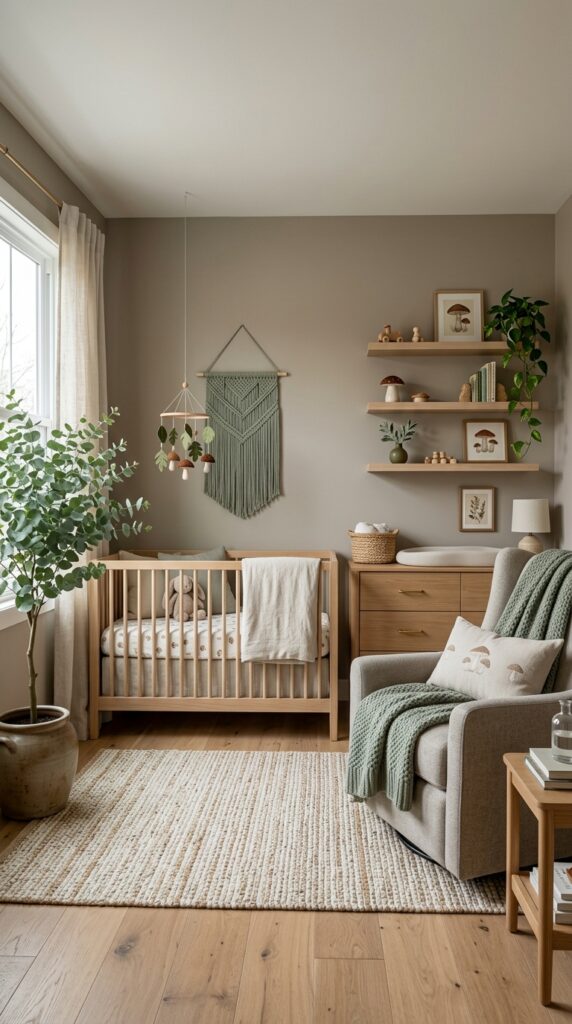
Vibe: Still — a palette that asks nothing loud of you.
Why it works: The sage and mushroom palette is notable for what it avoids: pink. This combination creates a baby girl nursery that reads as genuinely sophisticated — warm without being saccharine, nature-inspired without being literal. The design strategy is tonal grounding: mushroom greige (a warm grey-beige hybrid) on the walls absorbs light rather than reflecting it, making the room feel solid and calm at any time of day. Sage accents introduced through textiles and plants provide the color without applying it to an immovable surface.
How to get it: Paint walls in Benjamin Moore “Muskoka” CC-70 or Sherwin-Williams “Grizzle Gray” SW 7068 for the mushroom greige. Layer in sage through a single throw blanket on the glider, one sage crib sheet, and a small potted eucalyptus in a ceramic pot — the rule is sage as accent, not as base.
🛍️ Shop the Look — Amazon Product Ideas
| # | Product Search Phrase | Why It Fits |
| 1 | sage green knit throw blanket nursery | Key textile color accent |
| 2 | mushroom linen lumbar pillow cover nursery | Neutral palette textile |
| 3 | potted eucalyptus artificial plant nursery | Living-look sage accent |
| 4 | white oak open shelf bookcase nursery | Natural material display unit |
| 5 | greige linen crib sheet nursery | Warm neutral crib textile |
21. Soft Sculpture Mobile Above the Crib
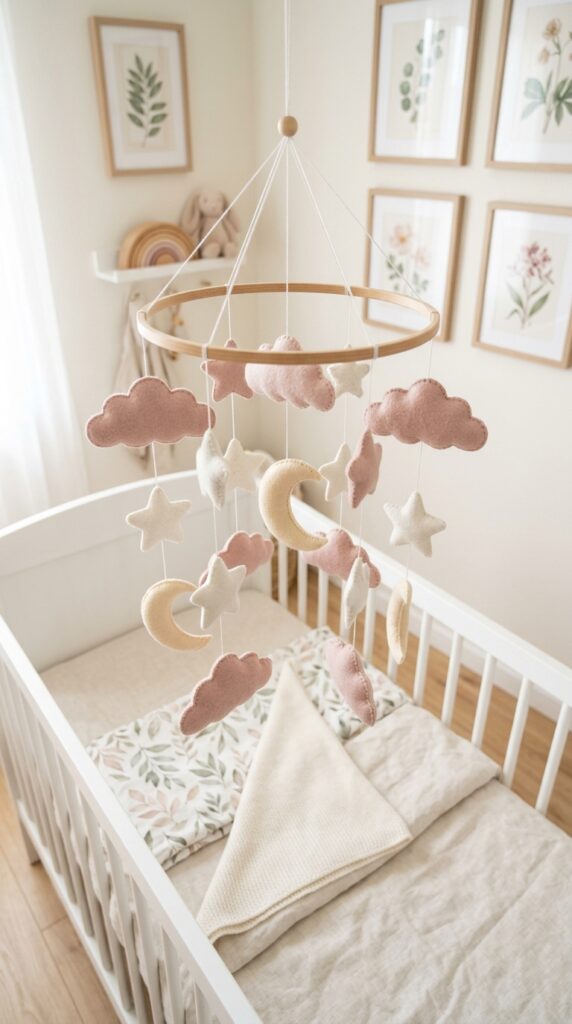
Vibe: Gentle — the kind of thing a baby stares at for forty minutes without blinking.
Why it works: A crib mobile serves a genuine developmental function — high-contrast shapes and slow gentle movement support early visual tracking and focus in newborns. But the design value is equally significant: a soft sculpture mobile in curated, palette-matching colors is essentially ceiling art that moves. The visual rhythm at play — shapes hung at varied heights creating a sense of depth and movement — is the same principle used in wind chimes and kinetic sculpture. The irregular spacing is what makes it feel handmade and precious rather than mass-produced.
How to get it: A hand-sewn felt mobile requires only a wooden embroidery hoop, fishing line, felt, and a needle. Basic cloud and moon shapes can be cut and stuffed in one afternoon. If purchasing, look for mobiles where shapes hang between 12 and 18 inches below the hoop — they need to be visible to a baby lying flat but fully out of reach.
💡 Quick Win: A premade soft sculpture mobile kit under $35 comes with pre-cut felt shapes and assembly instructions — a two-hour project with genuinely stunning results.
🛍️ Shop the Look — Amazon Product Ideas
| # | Product Search Phrase | Why It Fits |
| 1 | felt cloud moon star nursery mobile kit | Primary overhead art |
| 2 | natural wood embroidery hoop mobile base | DIY mobile base option |
| 3 | blush ivory felt fabric sheet set sewing | DIY mobile material |
| 4 | clear nylon fishing line mobile suspension | Near-invisible hanging thread |
| 5 | mobile arm crib attachment swivel | Crib mount for mobile |
22. Mini Gallery Wall with Personalized Name Art
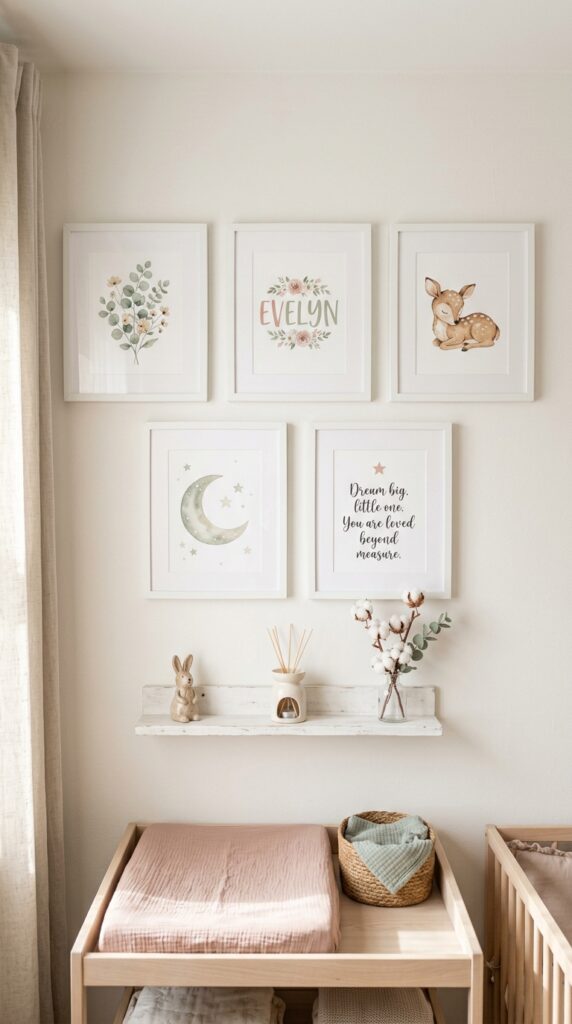
Vibe: Warm — a wall that tells a story before the child is old enough to read one.
Why it works: A mini gallery wall creates what designers call a curated moment — a cluster of intentional objects that reads as a complete composition. The design rules for gallery walls are strict: consistent frame color (all matching), consistent mat width, and a balanced distribution of content types (not all words, not all illustrations). A personalized name print anchors the arrangement with meaning, while botanical and animal prints add color and visual variety. Odd numbers of frames (three or five) are visually easier to balance than even groupings.
How to get it: Lay all frames on the floor first to test the arrangement before putting a single nail in the wall. Use paper templates cut to the size of each frame, tape them to the wall, and adjust until the spacing feels even (3–4 inches between frames). Then use a small laser level to align the center points.
🛍️ Shop the Look — Amazon Product Ideas
| # | Product Search Phrase | Why It Fits |
| 1 | personalized baby name watercolor print nursery | Anchor meaningful print |
| 2 | white nursery gallery frame set 5×7 | Uniform frame set |
| 3 | botanical nursery art print set blush sage | Style-cohesive art prints |
| 4 | simple animal illustration nursery print | Soft illustration accent |
| 5 | command picture hanging strip large | Damage-free gallery hanging |
23. Limewash Paint for a Soft Textured Wall
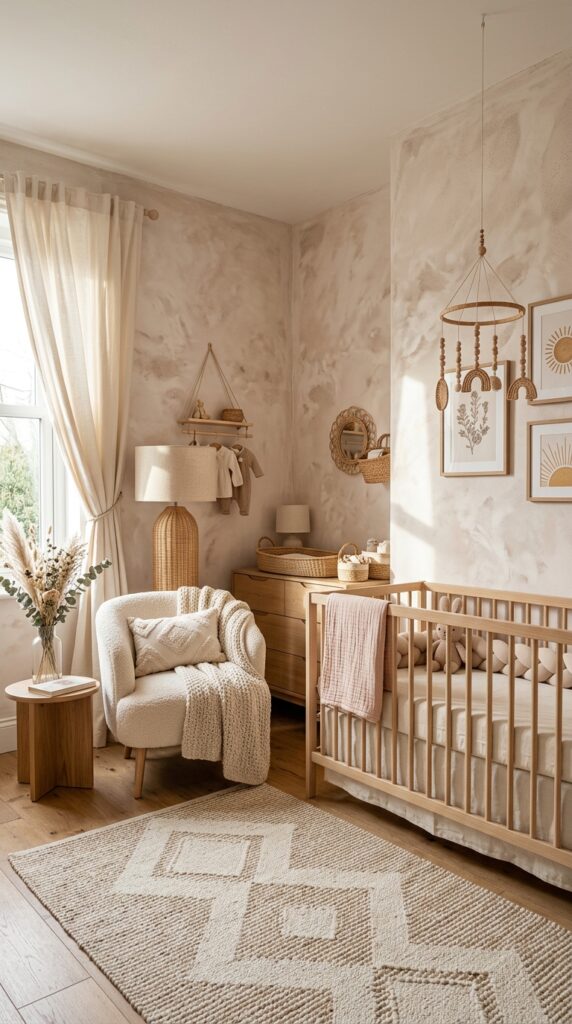
Vibe: Tactile — a wall that looks like it has a history, even in a brand new room.
Why it works: Limewash paint has a biological quality that standard paint lacks: because it’s applied in layers and partially wiped away, it creates depth and variation that responds to light differently across the wall’s surface. This is called tonal variation through technique, and it’s what gives aged Italian villas and French farmhouses their characteristic warmth. In a nursery, it avoids the flatness of a solid painted wall and creates a backdrop that makes every piece of furniture placed against it look more expensive.
How to get it: Limewash paint is applied with a chip brush in overlapping figure-eight strokes, then partially wiped with a damp cloth within 2–4 minutes before it fully sets. The more you wipe, the lighter and more mottled the finish. Test on a hidden wall section first — the technique is forgiving but the timing window is shorter than standard paint. Brands like Portola Paints and Romabio make nursery-safe, zero-VOC limewash specifically.
🛍️ Shop the Look — Amazon Product Ideas
| # | Product Search Phrase | Why It Fits |
| 1 | limewash paint blush white interior wall | Core textured wall material |
| 2 | chip brush wide bristle limewash technique | Correct application brush |
| 3 | rattan arc floor lamp nursery natural | Warm textural lighting pair |
| 4 | cream linen pillow cover 18 inch nursery | Warm neutral textile |
| 5 | white oak frame mirror 24 inch nursery | Light reflection on textured wall |
24. Corner Storage Basket Tower
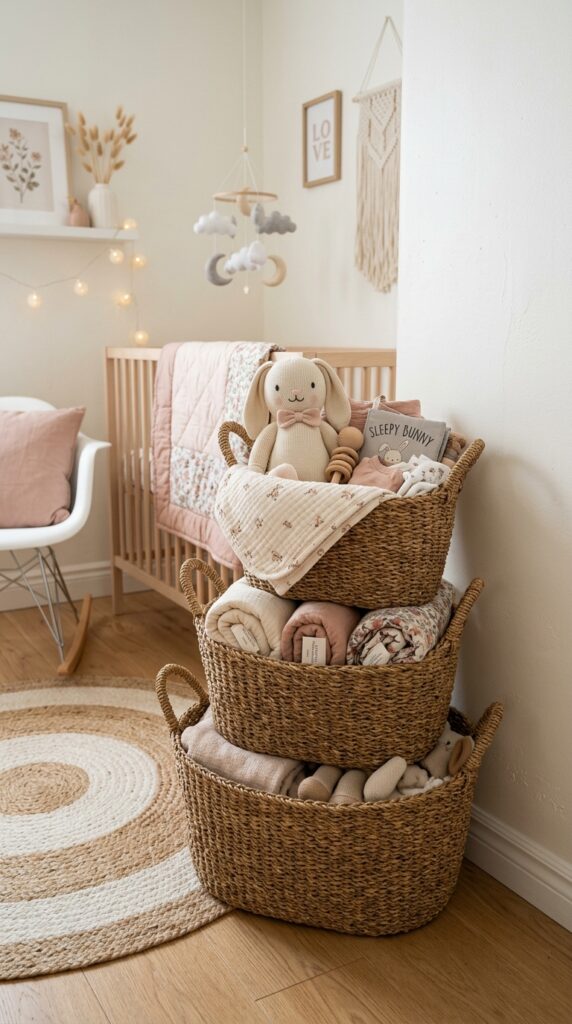
Vibe: Organized — storage that looks intentional rather than apologetic.
Why it works: A corner basket tower addresses one of nursery design’s most persistent challenges: the volume of stuff that accompanies a baby. The design principle is visual grouping — clustering multiple storage elements in a single corner makes the storage feel like a design decision rather than a necessity. Graduated sizes (largest on the bottom, smallest on top) follow the same compositional rule as styling a bookshelf: heaviest visual weight at the base, lighter at the top. Natural seagrass reads as warm and organic rather than plasticky.
How to get it: Stack three woven seagrass baskets in sizes S/M/L in a corner near the changing station. Use the largest for extra blankets and swaddles, the medium for toys, and the smallest for smaller accessories and pacifiers. Label each with a simple leather tag for practical daily use without losing the aesthetic.
💡 Quick Win: A set of three graduated seagrass baskets typically costs $30–$45 as a bundle — one of the most cost-effective nursery organization systems available.
🛍️ Shop the Look — Amazon Product Ideas
| # | Product Search Phrase | Why It Fits |
| 1 | woven seagrass basket set 3 graduated sizes | Core stacked storage |
| 2 | leather label tag basket set nursery | Organizational label detail |
| 3 | cotton gauze swaddle blanket set muslin | Basket overflow storage |
| 4 | fabric bin storage cube nursery closet | Closet-level storage extension |
| 5 | small toy organizer plush bin nursery | Top basket companion storage |
25. Mirror Gallery Wall for a Small Nursery
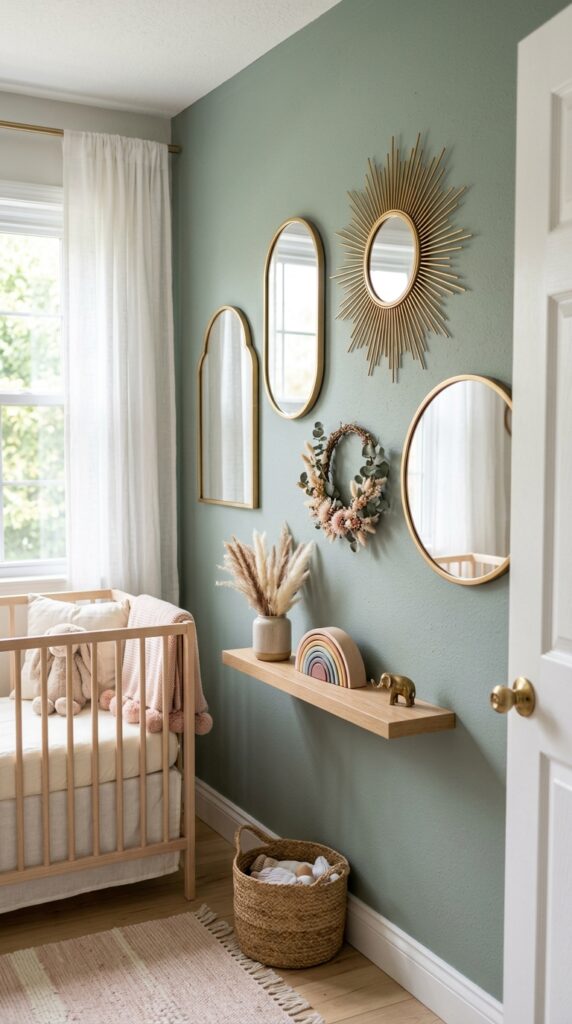
Vibe: Luminous — the room breathes and expands whenever the light shifts.
Why it works: Mirrors are the most underutilized small-space tool in nursery design. A collection of decorative mirrors on one wall does two things simultaneously: it bounces natural light across a room (effective even with a single window), and it creates visual depth by reflecting the opposite wall, making the room appear nearly twice as large. Mixed shapes — an arch, an oval, a sunburst — feel collected and curated rather than matched and clinical. Consistently warm-toned frames (brushed gold or antiqued brass) tie the collection together without requiring uniformity of shape.
How to get it: Position the mirror grouping on the wall that receives the most reflected light from your window — this maximizes the light-bouncing effect. Use command strips rated for the mirror weight for renters. Prioritize placing the largest mirror first, then fill around it with smaller shapes.
🛍️ Shop the Look — Amazon Product Ideas
| # | Product Search Phrase | Why It Fits |
| 1 | arch mirror gold frame nursery 20 inch | Primary statement mirror |
| 2 | sunburst decorative mirror gold nursery | Radiating accent mirror |
| 3 | small oval mirror brushed gold nursery | Soft-shaped grouping mirror |
| 4 | dried flower mini wreath wall decor | Between-mirror botanical accent |
| 5 | command strip mirror hanging kit large | Damage-free renter mounting |
26. Soft Gingham or Check Print Textiles for a Vintage Touch
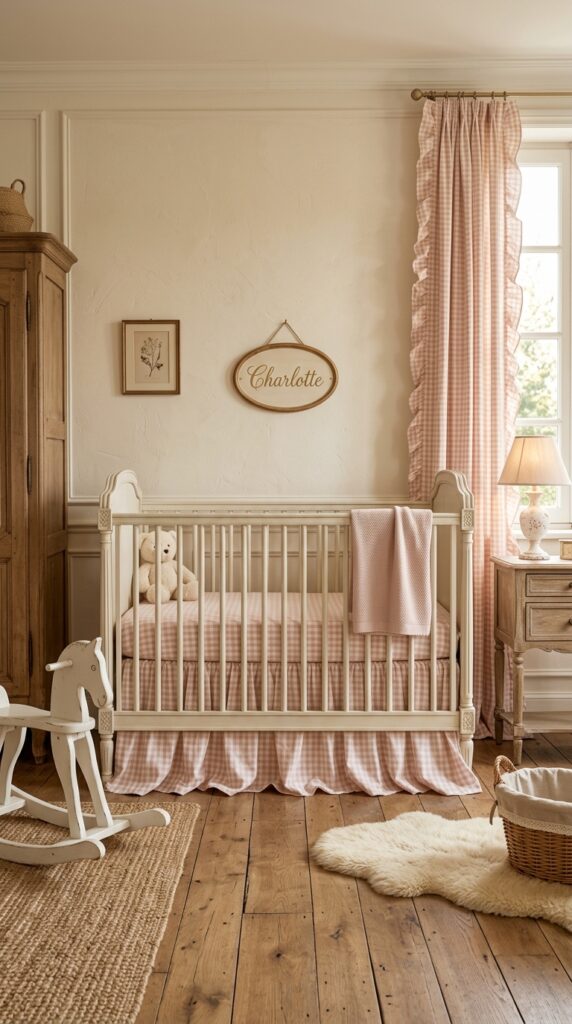
Vibe: Nostalgic — a room that feels like it could have belonged to a grandmother’s favorite memory.
Why it works: Gingham in a baby girl nursery is a pattern choice with genuine design intention behind it: small-scale check prints read as quiet and orderly at a distance while revealing subtle warmth on close inspection. The principle is pattern scale and restraint — a fine-scale gingham (½ inch or smaller) reads almost as a texture from across the room, which means it functions more like a solid tone than an active pattern. Using the same check in two applications (crib sheet and curtain) creates repetition without excess, a technique called controlled pattern layering.
How to get it: Use gingham as no more than two textile applications in the room — crib sheet and curtains, or curtains and a single throw pillow. Keep all other textiles in the room solid to avoid pattern competition. Blush pink gingham on white ground is the most versatile starting point, and it pairs naturally with every palette on this list.
🛍️ Shop the Look — Amazon Product Ideas
| # | Product Search Phrase | Why It Fits |
| 1 | blush gingham check crib sheet cotton | Primary pattern textile |
| 2 | pink gingham ruffled crib skirt standard | Coordinated crib detail |
| 3 | gingham check curtain panel blush nursery | Pattern repetition at window |
| 4 | white rocking horse nursery wooden | Vintage-style nursery accent |
| 5 | small porcelain table lamp nursery | Soft classic lighting detail |
How to Start Your Baby Girl Nursery Transformation
Start with the crib placement. Before choosing a single paint color or ordering a single piece of furniture, identify where the crib will live. The crib placement dictates everything: where the accent wall goes, where the glider will sit, where light enters the space, and what the room’s visual flow will be. In most nurseries, the crib belongs on the wall opposite the window — it receives reflected natural light without direct glare, and the crib becomes the room’s natural focal point when you walk in the door.
The most common mistake is choosing cool-toned white for trim. Bright, cool whites like “Bright White” or “Ultra Pure White” clash with every warm-toned nursery palette on this list. They read as clinical next to blush walls, greige walls, and sage walls. The fix is simple: choose an off-white or warm white like Benjamin Moore “White Dove” OC-17 or Sherwin-Williams “Alabaster” SW 7008 — they have cream and warm undertones that harmonize with organic materials and soft nursery palettes.
Three items under $50 for immediate impact: A single pampas grass stem in a matte terracotta ceramic bud vase ($15–$22). A set of three IKEA Mosslanda picture ledges for book display ($9 each, $27 total). A warm white LED Edison string light strand with remote dimmer ($18–$28).
Realistic expectations: A single weekend and $200–$400 can accomplish paint, curtains, and a few key accessories. A fully furnished nursery with quality furniture typically runs $1,500–$3,500. Custom or handmade elements (macramé, arch frames, gallery walls) can be phased in over the six months before and after arrival.
Frequently Asked Questions About Baby Girl Nursery Design
What’s the difference between a baby girl nursery and a gender-neutral nursery?
A baby girl nursery traditionally incorporates softer, warmer tones — dusty blush, lavender, sage, terracotta — while gender-neutral nurseries lean on greiges, warm whites, and yellows with no implied gender association. The line between the two has blurred significantly: many of the organic, Scandinavian, and boho-inspired nurseries in this article read as feminine through material warmth (rattan, velvet, botanical prints) rather than through overtly pink color choices. The distinction is less about pink versus no pink and more about decorative approach — a baby girl nursery is generally more layered and textile-rich.
What colors work best for a baby girl nursery that won’t look dated in two years?
Dusty rose, sage green, warm ivory, and terracotta blush are the most enduring choices because they’re anchored in nature rather than trend. Avoid bright candy pinks or heavily saturated purples — these date fastest. Benjamin Moore “Pale Blush” OC-71 and Farrow & Ball “Mizzle” No. 266 (sage) have appeared consistently on nursery design boards for five-plus years without feeling tired. Earthy, muted palettes also transition naturally into a toddler room without repainting.
How much does it typically cost to decorate a baby girl nursery?
A budget nursery using IKEA furniture, peel-and-stick wallpaper, and Amazon accessories can come in at $600–$900 fully furnished. A mid-range nursery with solid wood furniture, quality textiles, and curated décor typically runs $2,000–$4,000. A high-end or designer nursery with custom furniture, wallpaper, window treatments, and lighting fixtures can reach $8,000 and above. The highest-impact cost-per-dollar items are almost always paint, curtains, and lighting — not furniture.
Can I use a baby girl nursery design in a shared room with an older sibling?
Yes, but the approach changes. In a shared room, use color zoning rather than whole-room color: paint an accent wall or use a canopy arch only in the baby’s corner to create a distinct baby zone without redecorating the entire room. Choose neutral base furniture (white oak, natural wood) that the older child already has, and introduce baby-specific elements through soft accessories — a crib mobile, a basket tower, a textile canopy — that can be removed when no longer needed.
What type of flooring works best in a baby girl nursery?
Hardwood or engineered hardwood in a warm honey or light oak tone is the most practical and most design-flexible choice — it’s easy to clean, doesn’t harbor allergens the way carpet does, and works beautifully with any rug layering strategy. If the room already has carpet, a large washable cotton rug placed over it creates a clean, soft crawling surface. Avoid vinyl plank flooring with heavy cool-grey tones — they clash with warm nursery palettes and can make the room feel cold.
Ready to Create Your Dream Baby Girl Nursery?
These 26 ideas span every dimension of nursery design — from color and texture to furniture scale, small-space solutions, and statement lighting — so that wherever you are in the planning process, you have something concrete and actionable to work with. Transformation doesn’t have to happen all at once: painting one accent wall or hanging a set of floating book ledges this weekend is a perfectly valid starting point, and it’s often the most satisfying approach because you see results immediately. Take one action today — order paint samples or clip three product ideas that speak to the look you want — and let the space come together gradually. When the room is done, you’ll walk in and feel held by it: warm and quiet and completely ready. Pin your favorites now, especially the limewash paint ideas and the botanical feature wall — those are the ones that consistently inspire the most saves.