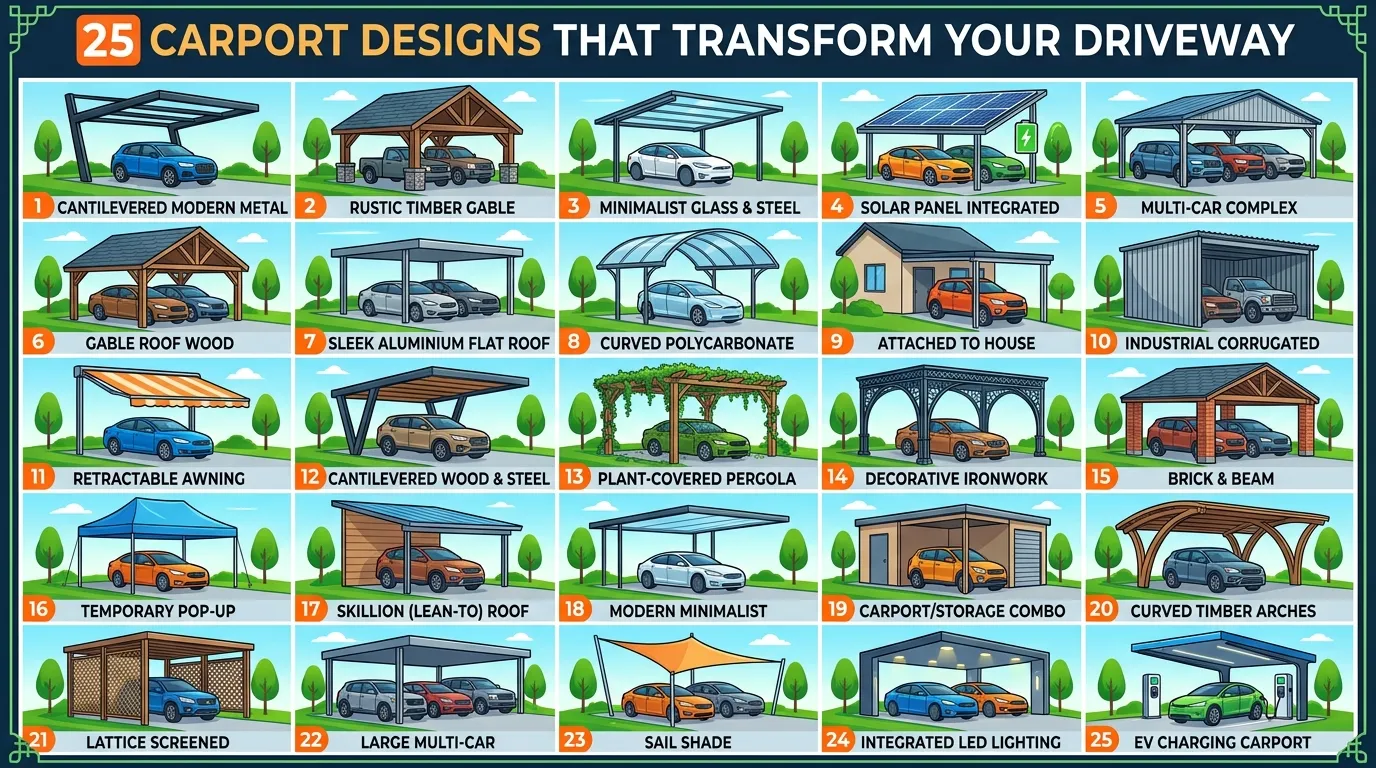
A carport is a semi-open, freestanding or attached shelter that protects vehicles from weather without the full enclosure of a garage. This article gives you exactly 25 carport design ideas — spanning modern, rustic, minimalist, and multi-functional styles — to help you find the right fit for your home, budget, and driveway layout.
There’s something grounding about a well-designed carport. It frames the front of a home with intention, turns a plain driveway into a structured arrival moment, and brings architecture right to the edge of the street. The best carport designs don’t just shelter your car — they extend your home’s personality into the landscape. Here are 25 ideas worth saving — and stealing.
Why Carport Design Works So Well
A carport is one of the oldest vehicle shelters in residential architecture, tracing its origins to Frank Lloyd Wright, who coined the term in 1936. Unlike garages, carports prioritize flow, airflow, and visual openness — making them ideal for climates that don’t demand full enclosure. What sets a great carport apart from a purely functional one is integration: the shelter responds to the home’s material language, roof pitch, and siting rather than sitting in front of it as an afterthought.
The materials that define high-quality carport design include powder-coated steel, raw or oiled spotted gum timber, polycarbonate roofing panels, and galvanized Colorbond steel. Color palettes tend toward warm charcoal, warm white, natural timber honey, and deep forest green — tones that age gracefully with exterior facades and garden plantings.
Carports are trending sharply upward right now for a specific reason: the rise of EV ownership has made covered, accessible parking a genuine utility investment rather than a luxury. Pinterest searches for “modern carport design” grew over 200% in the past two years, and homeowners are increasingly treating the driveway as an extension of outdoor living space rather than purely a parking surface.
Even compact driveways can achieve strong carport design. Narrow single-car freestanding structures with a flat or skillion roof are the ideal entry point for small blocks — they occupy minimal footprint while delivering maximum visual impact. The key for small spaces is keeping the post profile slim (steel over timber), the roofline clean, and the color consistent with the house facade.
Style at a Glance
| Element | Value |
| Philosophy | Functional shelter that extends home architecture |
| Materials | Steel, treated timber, polycarbonate, Colorbond |
| Color palette | Warm charcoal, natural timber, warm white, forest green |
25 Carport Designs That Transform Your Driveway
1. Skillion-Roof Steel Carport With Angled Drama

Vibe: Raw and directional — this carport doesn’t apologize for being functional.
Why it works: The skillion (mono-pitch) roofline creates visual movement on a static facade, drawing the eye up and across rather than stopping abruptly at the roofline. The angled pitch also manages rainwater efficiently without gutters. Slim square steel posts — typically 75mm to 100mm — keep sightlines open while the structural depth lives in the beam, not the column.
How to get it: Specify 2mm wall square hollow section (SHS) powder-coated in Dulux ‘Monument’ or equivalent. Keep the low end of the skillion at 2.1m clearance for comfortable car access and angle the rise to match or complement your roofline pitch.
💡 Quick Win: A single ornamental grass like Pennisetum advena ‘Rubrum’ planted at the base of each post costs under $15 per plant and softens the industrial steel without competing with the architecture.
🛍️ Shop the Look — Amazon Product Ideas
| # | Product Search Phrase | Why It Fits |
| 1 | Powder coated steel post cap 4×4 matte black | Finishes raw post tops cleanly |
| 2 | Clear polycarbonate roofing sheet 8ft | Lightweight translucent roof panel |
| 3 | Dark grey outdoor gravel landscape rock | Grounds post base neatly |
| 4 | LED outdoor dusk to dawn carport light | Functional post-mount lighting |
| 5 | Stainless steel bolt-down post base anchor | Structural clean concrete footing |
2. Spotted Gum Timber Battens Over Steel Frame

Vibe: Sun-warmed and considered — the kind of carport that makes the whole street slow down.
Why it works: Timber battens introduce natural texture contrast against a steel-dominant structure, breaking up the industrial quality of exposed metal without sacrificing contemporary lines. The 20mm gap spacing between 90mm battens creates a rhythm that filters light and wind while maintaining visual privacy from the street. Spotted gum is particularly durable outdoors, hardness-rated at 11 kN on the Janka scale.
How to get it: Source kiln-dried spotted gum in 90x19mm profile, pre-oiled with Cutek CD50 in Jarrah or clear. Fix to steel-framed secondary mullions at 600mm centers with stainless Tek screws to avoid rust staining in wet climates.
🛍️ Shop the Look — Amazon Product Ideas
| # | Product Search Phrase | Why It Fits |
| 1 | Hardwood outdoor decking oil clear UV protection | Preserves natural timber grain |
| 2 | Stainless steel wood decking screws 50mm | Rust-proof fasteners for battens |
| 3 | Timber batten clip hidden fixing system | Clean no-face-fix look |
| 4 | Outdoor wood post cap galvanized steel | Protects beam end grain |
| 5 | Brushed charcoal steel post bracket | Steel-to-timber joist connector |
3. Double-Wide Flat Roof Carport With Louvres

Vibe: Hushed and precise — every component is doing exactly one job, and doing it well.
Why it works: Adjustable louvres on a side screen give this design a functional edge: they can be angled to block western afternoon sun, deflect wind-driven rain, or open fully for cross-ventilation. The flat roof’s internal fall (minimum 1:100) drains toward a concealed gutter without visible pitch, preserving the horizontal profile. This typology works especially well on homes with a flat or near-flat roofline.
How to get it: Specify extruded aluminium louvre blades in 150mm or 200mm width, manually adjustable or motorized via a rod-and-crank system. Finish in Dulux Pale Eucalypt or Surfmist Colorbond to match common residential palettes.
💡 Quick Win: Add a single downpipe at one corner connected to a slimline rainwater tank — a 200L tank ($80–$150) transforms the carport into a passive water harvesting system.
🛍️ Shop the Look — Amazon Product Ideas
| # | Product Search Phrase | Why It Fits |
| 1 | Aluminium louvre blade privacy screen panel | Core louvre screen component |
| 2 | Flat roof carport bracket kit galvanized | Structural framing connection |
| 3 | Slimline rainwater tank 200L grey | Roof-fed water collection |
| 4 | Agave blue glow potted plant outdoor | Architectural corner planting |
| 5 | Concrete grey exterior paver 600×600 | Driveway-to-entry paving |
4. Freestanding Pergola-Style Carport With Climbing Vines

Vibe: Layered and unhurried — the kind of driveway structure that grows better every year.
Why it works: Open timber rafters create the structural bones while the vine canopy does the seasonal work — providing summer shade when leaves are full and allowing winter sun when they’re bare. This design leverages the design principle of temporal change: the carport improves aesthetically with each passing season. Wisteria, Virginia creeper, and ornamental grape are the most structurally compatible climbers for this application.
How to get it: Use 200x200mm rough-sawn pine posts treated to H4 hazard level for in-ground contact. Install galvanized tensioned wire at 300mm spacing across the rafters to guide vine growth and prevent rafter shading accumulation.
🛍️ Shop the Look — Amazon Product Ideas
| # | Product Search Phrase | Why It Fits |
| 1 | Galvanized tensioned garden wire vine training | Guides vine across rafters |
| 2 | Rough sawn pine pergola rafter 140×45 | Main overhead beam component |
| 3 | Solar hanging lantern outdoor bronze finish | Warm evening carport lighting |
| 4 | Natural limestone driveway gravel 20kg | Permeable ground surface |
| 5 | Stainless steel wire tensioner eye bolt | Cleanly terminates vine wire |
5. Colorbond Steel Gable Roof Carport

Vibe: Settled and resolved — it looks like it was always supposed to be there.
Why it works: Matching the carport’s roof pitch and material to the home’s existing roof is the single most powerful integration strategy in residential carport design. It uses the Gestalt principle of continuation — the eye reads the structures as one composition rather than two. Colorbond steel in matching tone (Ironstone, Monument, or Basalt) costs approximately $25–$35 per linear meter installed and requires minimal maintenance over a 20+ year lifespan.
How to get it: Specify that the carport roof pitch match the house pitch within 5 degrees. Use the same Colorbond profile (corrugated or Trimdek) and same colour — your local hardware store can match from the home’s roof sample. Keep the fascia and barge the same profile as the house eaves.
💡 Quick Win: Sourcing Colorbond offcuts from a local roofing supplier can reduce roof cladding cost by 30–40% for single-car spans under 6 meters.
🛍️ Shop the Look — Amazon Product Ideas
| # | Product Search Phrase | Why It Fits |
| 1 | Colorbond steel roof screw hex head metal | Matching roof fixing fastener |
| 2 | Charcoal ridge cap flashing metal roof | Gable apex weatherproofing |
| 3 | Fascia board galvanized metal dark grey | Matching eave/fascia detail |
| 4 | Low border hedge plant pot ready to plant | Neat driveway edge planting |
| 5 | Carport gutter half round galvanized steel | Rainwater management on gable |
6. Cantilevered Concrete Wall Carport

Vibe: Still and monumental — this is architecture, not just shelter.
Why it works: The structural logic here is honest: a reinforced concrete blade wall becomes both structure and visual anchor, from which a thin steel plate roof cantilevers without visible support. The absence of front posts creates unobstructed drive-in access and maximum visual openness. Board-formed concrete — poured against timber formwork — retains the grain texture of the boards, adding warmth to an otherwise stark material.
How to get it: This design requires an engineer — the concrete wall must be designed for both lateral wind loads and the cantilevered roof moment. Engage a structural engineer early and specify 32MPa concrete minimum. Budget $8,000–$15,000 for concrete and steel work alone.
🛍️ Shop the Look — Amazon Product Ideas
| # | Product Search Phrase | Why It Fits |
| 1 | Concrete wall texture stamp board form effect | DIY concrete surface finish |
| 2 | Large outdoor ceramic tall planter grey | Architectural focal planting |
| 3 | Cycas revoluta sago palm outdoor pot | Structural bold plant form |
| 4 | Brushed steel flat bar outdoor trim 3mm | Raw steel edge profile |
| 5 | Concrete sealer matte penetrating waterproof | Protects exposed concrete wall |
7. Translucent Polycarbonate Roof Carport

Vibe: Luminous and clean — like parking under a softbox.
Why it works: Twin-wall polycarbonate panels in opal transmit approximately 70–80% of daylight while diffusing harsh direct sun into even, shadow-free light. The aluminium glazing bar system spans between steel or timber purlins and creates a visible grid pattern overhead — a design detail, not just a fixing method. This roof type is ideal for workshop-adjacent carports where ambient light underneath matters.
How to get it: Specify 16mm twin-wall polycarbonate in opal (not clear, which creates harsh concentrated patches) and ensure a minimum 5° pitch to drain condensation. Allow 6–10mm thermal expansion gap at each panel end.
💡 Quick Win: Adding two 600mm roof vents at the ridge will prevent heat buildup in summer — polycarbonate roofs trap radiant heat, and ventilation drops the temperature under the carport by 8–12°C on hot days.
🛍️ Shop the Look — Amazon Product Ideas
| # | Product Search Phrase | Why It Fits |
| 1 | Twin wall polycarbonate roofing sheet opal 16mm | Primary carport roof panel |
| 2 | Aluminium glazing bar 6m polycarbonate fixing | Panel-to-frame fixing system |
| 3 | Ridge vent aluminium roof ventilation 600mm | Heat escape at roof apex |
| 4 | Aluminium H-bar polycarbonate joiner cap | Panel edge and joining detail |
| 5 | Succulent outdoor cactus low water garden plant | Drought-tolerant driveway edge |
8. Side-Entry Carport That Maximises Street Frontage

Vibe: Open and generous — the home breathes again without a car dominating the front.
Why it works: Repositioning the carport to a side-entry layout uses the urban design principle of active frontage: the pedestrian streetscape is preserved while vehicle infrastructure moves to the side. This arrangement also typically reduces the visual scale of the carport structure from the street, since viewers see the narrow depth rather than the full width of the shelter.
How to get it: The critical dimension for a side-entry carport is the turning radius: most standard vehicles need a 5.5m internal turning radius. Map this onto your site plan before committing to the position. A 5.5m wide driveway lane plus 3m carport depth is the minimum comfortable configuration.
🛍️ Shop the Look — Amazon Product Ideas
| # | Product Search Phrase | Why It Fits |
| 1 | Vertical steel batten driveway gate powder coat | Street-entry gate panel |
| 2 | Low garden wall block retaining concrete grey | Carport to garden boundary |
| 3 | Driveway turning radius guide template DIY | Planning tool for side entry |
| 4 | Solar driveway bollard light stainless steel | Lane edge nighttime safety |
| 5 | Native ornamental grass plant low water | Side driveway edge planting |
9. Carport With Built-In Storage Wall

Vibe: Organised and calm — the carport does the work a garage would, without closing in.
Why it works: A full-height storage wall along the carport’s side boundary wall turns dead space into a functional asset. VJ louvred door panels allow ventilation inside the storage zone — critical for petrol, fertilisers, and other chemicals that off-gas. Continuous full-height cabinetry (no gap between top of cupboard and ceiling) also creates a cleaner visual line than individual units.
How to get it: Build the storage wall from treated MDF carcasses with exterior-grade paint, hung on a timber frame attached to the carport side wall. Install a 300mm deep internal shelf run at 400mm spacing with an adjustable pin system. Budget approximately $1,200–$2,500 for a 4-meter wall.
🛍️ Shop the Look — Amazon Product Ideas
| # | Product Search Phrase | Why It Fits |
| 1 | Louvred cabinet door panel timber VJ white | Ventilated storage door panel |
| 2 | Satin black flush pull cabinet handle | Clean recessed door hardware |
| 3 | Heavy duty wall mounted bicycle hook storage | Overhead bike hanging |
| 4 | Adjustable shelf pin kit 5mm | Internal shelving flexibility |
| 5 | Treated MDF sheet moisture resistant white | Carport cabinetry substrate |
10. Carport Integrated With Front Fence Line

Vibe: Composed and deliberate — the street boundary and the carport are one resolved object.
Why it works: Connecting the carport roofline to the boundary fence at matching height creates a continuous datum line that reads as a single architectural gesture from the street. This is a classic contemporary facade move that uses horizontal continuity to compress and unify disparate elements. The vertical batten fence flanking the car opening maintains privacy and picks up the material language of the carport structure.
How to get it: The carport roof must be designed to cantilever to the fence line without posts in the fence itself — typically achieved with a single outboard beam and a slim fascia that caps the fence post heads. Check your local council’s fence height and setback allowances before locking in this design.
💡 Quick Win: Exposed aggregate concrete driveways cost roughly 20–30% more than plain broom-finished concrete but dramatically lift the curb appeal — a $2,000–$4,000 investment for a single driveway that lasts 30+ years.
🛍️ Shop the Look — Amazon Product Ideas
| # | Product Search Phrase | Why It Fits |
| 1 | Steel RHS beam 100×50 3mm wall powder coat | Carport-to-fence spanning beam |
| 2 | Vertical steel batten fence panel charcoal | Street-boundary fence panels |
| 3 | Olive tree advanced pot large outdoor | Formal driveway tree specimen |
| 4 | Exposed aggregate concrete sealer matte | Driveway finish protection |
| 5 | Square steel post 75×75 galvanized 3m | Fence and carport post structure |
11. Carport in Warm Rammed Earth Tones

Vibe: Warm and elemental — this carport feels grown rather than built.
Why it works: A rammed earth feature wall behind the carport introduces material warmth and visual mass that counters the lightness of the steel roof. The horizontal striations in rammed earth — created by compacting successive 150mm lifts of damp soil — are a natural texture that no applied finish can replicate. The colour comes from the soil itself, meaning it ages in place and never needs repainting.
How to get it: Rammed earth walls must be designed by a structural engineer and built by a specialist contractor. For a carport application (non-load-bearing backdrop wall), budget approximately $3,000–$5,000 for a 3m x 2.4m wall. Seal with a penetrating siloxane sealer to resist moisture penetration without altering the earthy surface appearance.
🛍️ Shop the Look — Amazon Product Ideas
| # | Product Search Phrase | Why It Fits |
| 1 | Siloxane concrete masonry sealer penetrating | Rammed earth moisture protection |
| 2 | Terracotta outdoor planter large ribbed | Matching warm earthen tones |
| 3 | Clumping grass ornamental pennisetum bronze | Earthy textural planting |
| 4 | Corten steel wall panel textured rust finish | Warm alternative to rammed earth |
| 5 | Charcoal steel flat bar 50x5mm | Roof edge trim detail |
12. Carport With Solar Panel Roof Integration

Vibe: Purposeful and forward-leaning — this carport generates as much as it protects.
Why it works: A solar carport uses a roof surface that would otherwise be wasted to generate electricity — a direct offset against the carport’s construction cost. A 6-panel array (approximately 6kW) oriented north at 20–25° pitch can generate 24–28 kWh per day in a temperate climate, offsetting the average home’s daily consumption. The key design principle is orientation: the carport roof must be positioned correctly for solar, which may differ from your preferred structural orientation.
How to get it: Work with a CEC-accredited solar installer who has experience with carport mounting. Specify monocrystalline 400W+ panels in an all-black format (black cells, black frame) for the best visual integration. Include an EV charging circuit during construction — retrofitting is significantly more expensive.
💡 Quick Win: A 7.5kW single-phase inverter with a smartphone monitoring app (typically included in modern units) lets you see live carport energy production on your phone, making the system feel genuinely rewarding to own.
🛍️ Shop the Look — Amazon Product Ideas
| # | Product Search Phrase | Why It Fits |
| 1 | Solar panel rail mounting kit aluminum carport | Panel-to-frame racking system |
| 2 | EV car charger Level 2 outdoor wall mount | Carport EV charging point |
| 3 | Monocrystalline solar panel 400W all black | Primary solar roof component |
| 4 | Rain chain black copper downspout decorative | Stylish carport water drainage |
| 5 | Solar monitoring inverter display smart wifi | Live production monitoring |
13. Narrow Carport for Tight Side Boundary

Vibe: Efficient and quiet — everything accounted for, nothing wasted.
Why it works: A narrow carport (3.0–3.2m internal width) works for standard vehicles (most passenger cars are 1.8–2.0m wide) and is ideal for sites with tight side boundaries. The key design move is using the existing boundary wall as the fourth side of the structure, eliminating one post row. This not only reduces cost but also makes the carport feel more enclosed and defined. A concealed gutter in the carport-to-wall junction manages rain without visible downpipes.
How to get it: Confirm your vehicle’s width plus at least 600mm clearance each side before fixing the 3m internal width. Use 75mm SHS posts rather than 90mm to save every centimeter on the tight driveway side. Install a linear drainage channel along the boundary wall base to manage water sheeting off the wall.
🛍️ Shop the Look — Amazon Product Ideas
| # | Product Search Phrase | Why It Fits |
| 1 | Linear drain channel stainless steel 1m | Wall base water management |
| 2 | Concealed box gutter aluminium flat roof | Hidden internal drainage |
| 3 | SHS 75×75 steel hollow section 3mm | Slim structural post profile |
| 4 | Uplighter wall mounted outdoor IP65 | Boundary wall lighting |
| 5 | Stepping stone concrete round grey | Driveway-to-door path detail |
14. Carport Roof as Alfresco Ceiling Extension

Vibe: Seamlessly connected — the car parks under the same sky as the dinner table.
Why it works: Extending the alfresco roof over the carport creates a single coherent outdoor structure with two programs sharing the same covered area. This typology is most common in rear-of-home carport layouts and works by using one continuous roof beam spanning the full combined width. The structural logic is the same — a deeper beam, wider post spacing — but the spatial result is dramatically more coherent than two separate structures.
How to get it: The combined span for a 4m alfresco + 6m double carport = 10m clear span, which requires an LVL (laminated veneer lumber) beam of 300–400mm depth or an equivalent steel portal. Engage a structural engineer for beam sizing and confirm with your local council that the combined structure falls within permitted development.
💡 Quick Win: Ceiling fans installed in the alfresco-carport junction zone ($150–$300 each) draw the covered outdoor area back into the home’s occupiable zone on warm evenings — a small addition with a big spatial payoff.
🛍️ Shop the Look — Amazon Product Ideas
| # | Product Search Phrase | Why It Fits |
| 1 | Outdoor ceiling fan alfresco timber blade 52 inch | Alfresco-carport junction fan |
| 2 | LVL beam connector bracket structural steel | Main spanning beam connection |
| 3 | Recycled brick cladding panel interior exterior | Feature wall between zones |
| 4 | Outdoor string lights festoon patio warm white | Evening ambience carport alfresco |
| 5 | Timber post cap decorative outdoor 140×140 | Matching post top detail |
15. Two-Tone Colour Carport Facade

Vibe: Quietly bold — a carport that introduces the home’s color palette before you reach the door.
Why it works: A two-tone carport uses the design principle of chromatic layering: one neutral anchor color (the structural steel) and one warmer accent (the cladding or panel) creates depth without complexity. Sage green — specifically in the Dulux range at ‘Muted Sage’ or Porter’s ‘Mountain Gum’ — is the current exterior color gaining significant traction as a softer alternative to the overused dark charcoal monofinish that dominated the previous decade.
How to get it: Paint the VJ or shiplap side panel in Dulux Weathershield exterior in your chosen sage. The critical rule: the accent color should appear in at least one other place on the home (front door, letterbox, pot) to read as intentional rather than accidental. Don’t use the accent on the structural posts — they should stay neutral to let the panel color breathe.
🛍️ Shop the Look — Amazon Product Ideas
| # | Product Search Phrase | Why It Fits |
| 1 | VJ board cladding exterior 300mm wide timber | Sage painted side panel material |
| 2 | Dulux exterior weathershield sage green paint | Accent panel exterior paint |
| 3 | Timber wall letterbox sage green powder coat | Matching street-level accent |
| 4 | Ornamental grass olive pennisetum large clump | Tonal garden accent planting |
| 5 | Charcoal steel downpipe round 90mm | Matching structural steel finish |
16. Rustic Corrugated Iron Farmhouse Carport

Vibe: Raw and time-worn — the kind of structure that looks like it survived three owners and will survive three more.
Why it works: The combination of rough-sawn hardwood posts and galvanised corrugated iron is a farmhouse architecture vernacular that has genuine historical roots — these two materials have been used together in Australian and American rural construction since the 1880s. Their longevity is structural and aesthetic: the galvanised iron self-heals its zinc coating around scratches, and the timber deepens in color and character with UV exposure. No paint required, ever.
How to get it: Source rough-sawn hardwood (spotted gum or ironbark) from a local sawmill rather than a hardware chain — cost is roughly half and the section sizes are more generous. Galvanised corrugated iron in the standard 762mm cover width is available from roofing suppliers. Install the corrugated iron vertically rather than horizontally on any side cladding for the most traditional farmhouse profile.
🛍️ Shop the Look — Amazon Product Ideas
| # | Product Search Phrase | Why It Fits |
| 1 | Corrugated galvanized steel roofing sheet 8ft | Classic farmhouse roof material |
| 2 | Cast iron wall mounted lantern outdoor black | Rustic carport lighting fixture |
| 3 | Boot scraper cast iron antique style | Period-appropriate entry detail |
| 4 | Timber post saddle bracket galvanized 200×200 | Post base connection hardware |
| 5 | Driveway gravel large bag limestone natural | Permeable farmhouse driveway |
17. Monochrome All-Black Carport Statement

Vibe: Graphic and uncompromising — a single decisive color choice that controls the entire composition.
Why it works: An all-black carport against a white facade uses maximum contrast as the design tool — it draws the eye precisely because nothing else on the facade competes. The monochrome discipline means every component (post, beam, gutter, fascia) must be matched in the same finish. Matte powder coat on structural steel is the correct finish: gloss black on large outdoor surfaces reflects sky and shows fingerprints and dust disproportionately.
How to get it: Specify Interpon D1036 matte black powder coat on all steel components. Request ‘Woodland Grey’ or ‘Ironstone’ Colorbond for the roof panel — not a true black but close enough for visual continuity and more UV-stable than custom powder-coated sheet. Avoid mixing matte and satin finishes across different components — the sheen inconsistency registers immediately.
🛍️ Shop the Look — Amazon Product Ideas
| # | Product Search Phrase | Why It Fits |
| 1 | Matte black outdoor post lamp LED wall mount | Monochrome carport lighting |
| 2 | Black bamboo phyllostachys nigra outdoor pot | Dramatic black foliage accent |
| 3 | Black flat bar steel 50x5mm 3m length | Detail edge trimming in black |
| 4 | Matte black fascia gutter bracket powder coat | Matching gutter hardware |
| 5 | Fine black gravel decorative garden stone | Monochrome ground surface |
18. Curved Roof Sail Carport

Vibe: Airy and coastal — the car parks under something that feels like a wave frozen mid-break.
Why it works: A tensioned shade sail uses the structural geometry of a hyperbolic paraboloid — the saddle curve created when each corner is pulled to a different height — which is inherently rigid without framing. This double-curvature surface sheds wind by splitting it, rather than presenting a flat surface for wind to push against. Shade sails rated to AS/NZS 4174 can withstand wind loads up to 170km/h when correctly tensioned and post-anchored.
How to get it: Angled posts (not vertical) are critical — they reduce bending moment at the base and give the sail its characteristic outward lean. Posts must be set in reinforced concrete footings 450mm diameter x 800mm deep. Engage a licensed installer for the footings and tensioning — an under-tensioned sail sags, pools water, and fails structurally.
💡 Quick Win: Replacing a standard shade sail every 10 years costs approximately $1,200–$2,500 — a fraction of replacing a fixed roof — making this the most cost-effective weather protection option for a temporary or rental property.
🛍️ Shop the Look — Amazon Product Ideas
| # | Product Search Phrase | Why It Fits |
| 1 | Shade sail HDPE UV block sand triangle large | Primary carport sail canopy |
| 2 | Stainless steel shade sail tensioner kit | Corner attachment hardware |
| 3 | Steel post base anchor bolt down concrete | Post footing anchor plate |
| 4 | Succulent ground cover outdoor low water mat | Low-maintenance post base plant |
| 5 | Heavy duty D ring stainless steel 10mm | Sail attachment ring at corner |
19. Carport With Decorative Laser-Cut Screen Panel

Vibe: Layered and detailed — the light does the decorating.
Why it works: A laser-cut steel screen uses negative space as the design element: the pattern is not what’s there but what’s cut away. When backlit by afternoon sun, the shadow cast onto the driveway surface becomes a secondary decorative layer — a form of projected artwork that changes through the day. The visual principle at work is perforation patterning, common in high-end architectural facades and domestic privacy screens.
How to get it: Custom laser-cut panels in mild steel from a local metalwork shop typically cost $300–$800 per panel in 1.2m x 2.4m size, depending on pattern complexity. Order in 4mm mild steel (not 2mm, which can flex under wind) and specify a hot-dip galvanised primer coat before powder coating for maximum outdoor durability.
🛍️ Shop the Look — Amazon Product Ideas
| # | Product Search Phrase | Why It Fits |
| 1 | Laser cut steel privacy screen panel garden | Pre-cut decorative screen panel |
| 2 | Powder coat spray primer metal galvanized | Steel panel priming coat |
| 3 | M10 stainless countersunk bolt flush fixing | Panel-to-frame flush fixing |
| 4 | Shadow pattern outdoor rug geometric grey | Echoes screen pattern on ground |
| 5 | Metal plant stand geometric outdoor black | Coordinating decorative metalwork |
20. Green Roof Carport With Planted Top

Vibe: Lush and quietly radical — a carport that gives more to the landscape than it takes.
Why it works: A sedum green roof on a carport delivers multiple performance benefits: it reduces the urban heat island effect by 4–7°C at the roof surface, manages stormwater by retaining 50–70% of rainfall, and extends roof membrane lifespan by protecting it from UV and thermal cycling. The visual benefit from neighbouring buildings and elevated vantage points turns a typically unattractive flat roof into a garden feature.
How to get it: A green roof requires a dedicated structural system: the roof must be engineered for a wet load of 120–180 kg/m² (sedum substrate is heavy when saturated). Specify a root-resistant EPDM membrane (not standard TPO) beneath an 80–100mm drainage layer, then a 100mm growing medium layer topped with pre-grown sedum matting.
🛍️ Shop the Look — Amazon Product Ideas
| # | Product Search Phrase | Why It Fits |
| 1 | Sedum green roof mat pre-grown hardy | Primary green roof planting layer |
| 2 | EPDM rubber roofing membrane flat roof | Root-resistant waterproof base |
| 3 | Drainage board membrane green roof system | Water management layer |
| 4 | Aluminium flat roof edge coping trim 100mm | Clean green roof perimeter cap |
| 5 | Echeveria succulent flat growing low water | Secondary planting for texture |
21. LED Lighting Strip Integrated Into Carport Beam

Vibe: Warm and resolved — the carport glows like it was always meant to be lit this way.
Why it works: LED strip lighting integrated flush into the underside of a structural beam eliminates the need for pendant fixtures, downlights, or exposed cabling — the light source is the architecture. A continuous run of 2700K warm white LEDs at 12–15W per meter provides approximately 1000–1200 lux at driveway level — more than adequate for car maneuvering and security without the harshness of fluorescent alternatives.
How to get it: Mount the LED strip inside an aluminium channel profile (20mm x 10mm) with a diffuser cover to eliminate the individual LED hotspot effect. Use a 12V waterproof LED strip rated IP67 for outdoor use. Install a PIR motion sensor at the beam end so the light activates on approach — most modern LED drivers support this directly.
💡 Quick Win: Warm white (2700K) LEDs make steel and concrete look significantly warmer at night than neutral or cool white (4000–5000K) options — a choice that costs nothing but makes a visible difference to the carport’s nighttime character.
🛍️ Shop the Look — Amazon Product Ideas
| # | Product Search Phrase | Why It Fits |
| 1 | LED strip light 12V waterproof IP67 warm white | Primary beam underside light |
| 2 | Aluminium LED channel profile 2m diffuser cover | Strip light housing channel |
| 3 | PIR motion sensor 12V outdoor carport trigger | Approach-activated sensor |
| 4 | LED strip power supply driver 12V 60W | Transformer for LED strip |
| 5 | Path light solar stainless steel low voltage | Garden path beyond carport |
22. Tandem Carport for Two Cars in Single Lane

Vibe: Pragmatic and clean — two cars covered, zero site wasted.
Why it works: A tandem (end-to-end) carport configuration is the most space-efficient solution for narrow blocks where a side-by-side double carport would require a driveway wider than the site allows. The standard tandem configuration is 5.5m per car, meaning the full roof structure runs approximately 10–11m. A skillion roof is the most structurally efficient for this span because the single pitch eliminates the need for a ridge and allows longer purlin spans.
How to get it: Four posts at equal 3m spacing over a 9m span is the standard structural layout. The front and rear posts carry the majority of load; the intermediate posts primarily resist lateral racking. Specify 100x100mm SHS posts for a 10m span to ensure adequate stiffness. Confirm your council’s maximum length for a permitted development carport — some restrict to 9m without a development application.
🛍️ Shop the Look — Amazon Product Ideas
| # | Product Search Phrase | Why It Fits |
| 1 | SHS steel post 100×100 3mm wall 3m length | Tandem carport structural post |
| 2 | Carport beam connector plate galvanized | Post-to-beam structural bracket |
| 3 | Driveway number letterbox stainless modern | Street entry identification |
| 4 | Concrete driveway crack sealant grey | Long driveway maintenance |
| 5 | Outdoor security camera wifi driveway mount | Tandem driveway surveillance |
23. Carport With Outdoor Shower and Wash Station

Vibe: Clean and considered — this carport treats car maintenance as part of the home’s design, not an afterthought.
Why it works: Integrating a wash station into one end of the carport turns a purely passive shelter into an active utility space. The key design principle is zone separation: the wash station end has a textured non-slip concrete pour, a linear drain channel (ACO or equivalent), and wall-mounted fixtures — all contained within the carport footprint. The car stays dry under the roof while being washed at the exposed end. This is a particularly effective solution for pet owners and families with sporting equipment to clean.
How to get it: Install a linear drainage channel (minimum 110mm internal drain body) across the carport floor at the wash station junction. Connect to the existing stormwater system with a sediment arrestor. Supply hot and cold water if possible — a single hot/cold mixer with a garden hose thread costs $150–$300 installed.
🛍️ Shop the Look — Amazon Product Ideas
| # | Product Search Phrase | Why It Fits |
| 1 | Wall mounted hose reel retractable matte black | Neat carport wash station reel |
| 2 | ACO linear drain channel stainless 1m | Wash station floor drainage |
| 3 | Chrome wall mount garden tap outdoor mixer | Hot cold wash station tap |
| 4 | Non-slip outdoor concrete sealer additive | Textured wash area surface |
| 5 | Car wash brush long handle soft bristle | Mounted wash station tool |
24. Japanese-Inspired Carport With Shou Sugi Ban Cladding

Vibe: Serene and meditative — a carport that belongs in a design magazine and a Zen garden simultaneously.
Why it works: Shou sugi ban (literally “burnt cedar board” in Japanese) is an ancient Japanese wood preservation technique in which the timber surface is charred, brushed, and oiled. The charred carbon layer is naturally insect-resistant, moisture-resistant, and fire-retardant — making it a rare instance of a visually dramatic finish that is also a structurally functional one. The deep black surface absorbs light rather than reflecting it, creating a quietness that white or light-colored cladding cannot achieve.
How to get it: Source pre-finished shou sugi ban cypress or western red cedar boards from a specialist supplier — avoid DIY charring on cypress with a blowtorch, which creates uneven results and doesn’t penetrate deep enough for durability. Fix in vertical orientation with concealed clip fixings (no face-fixed screws) and oil every 5–7 years with Rubio Monocoat or similar penetrating oil.
💡 Quick Win: White decorative gravel raked in a simple linear pattern beneath and around the carport costs under $60 for a 25kg bag covering approximately 3m² at 30mm depth, and creates an immediate Zen garden reference that amplifies the Japanese character of the shou sugi ban cladding.
🛍️ Shop the Look — Amazon Product Ideas
| # | Product Search Phrase | Why It Fits |
| 1 | Shou sugi ban charred cedar cladding board | Primary burnt timber cladding |
| 2 | White garden pebble gravel decorative 25kg | Japanese Zen ground cover |
| 3 | Rubio Monocoat wood oil exterior clear | Charred timber maintenance oil |
| 4 | Clip fix hidden fastener cladding system | No-face-fix cladding installation |
| 5 | Raked gravel garden tool Japanese style | Zen carport ground maintenance |
25. Compact Flat-Roof Single Carport for Small Urban Block

Vibe: Quiet and unassuming — a carport that knows its place and plays it perfectly.
Why it works: On a small urban block where every square meter counts, the flat-roof single carport succeeds through restraint. The design principle here is minimum intervention: slim 75mm SHS posts, a 50mm fascia (not a deep decorative beam), and no overhang beyond the post line. This keeps the carport from competing with the home’s facade, which is the most common small-site mistake. A white fascia on a dark roof also appears lighter and less substantial from the street than a dark fascia would.
How to get it: Keep the flat roof pitch at 1:100 internal fall only — no external visible pitch. Use a 0.42mm Colorbond roof sheet (standard residential) and a 50mm square aluminium fascia. For a 3m x 5.5m single carport, total material cost runs approximately $1,800–$3,500 depending on post specification and finish.
🛍️ Shop the Look — Amazon Product Ideas
| # | Product Search Phrase | Why It Fits |
| 1 | 50mm aluminium square fascia extrusion white | Minimal carport fascia profile |
| 2 | SHS steel post 75×75 2.4m galvanized | Slim structural post for tight site |
| 3 | Lemon scented gum small pot indoor outdoor | Compact urban pot specimen |
| 4 | House number sign brushed steel modern | Clean street-number detail |
| 5 | Colorbond roofing screw hex head woodland grey | Flat roof fixing hardware |
How to Start Your Carport Transformation
The single best first move for any carport project is to commit to one roofline decision — flat, skillion, or pitched — before choosing any other material or finish. The roof profile determines everything downstream: post height, drainage direction, structural span, and ultimately how the carport integrates with your home’s existing architecture. Changing your mind on the roofline after posts are in the ground is expensive and sometimes impossible.
The most common beginner mistake is mismatching post size to span. Homeowners frequently spec 75mm SHS posts for double-width spans where 100mm is structurally required, resulting in a carport that feels (and sometimes physically is) insufficiently rigid in high winds. The fix: always oversize your posts by one SHS increment — the cost difference is minimal, the structural confidence is significant.
For under $50, three items will immediately improve any existing carport: a wall-mounted retractable hose reel ($30–$45) to eliminate trip-hazard hoses on the floor; a pack of heavy-duty adhesive cable clips ($12) to tame any dangling light or power cables; and a 5L tin of concrete sealer in a satin finish ($35–$45) to stop oil stains from penetrating the driveway surface.
A practical carport from slab to first rain is a 6–10 week process for a contractor-built structure: 2 weeks for council approvals (if required), 1 week for footings and posts, 1 week for roof framing, 1–2 weeks for roofing and finishes. Budget $5,000–$9,000 for a basic single carport, $10,000–$18,000 for a double with good finishes, and $20,000+ for integrated solar, storage, or rammed earth elements.
Frequently Asked Questions About Carport Designs
What is the difference between a carport and a garage?
A carport is an open or semi-open structure that shelters a vehicle on at least two sides and the top, without full enclosure. A garage is fully enclosed on all sides with a door, which provides greater security and weather protection but costs significantly more to build — typically 3–5x the price of an equivalent carport. For homeowners in temperate climates who primarily need weather protection and UV coverage rather than full security, a carport delivers 80% of the functional value at 20–30% of the cost.
What colour carport looks best on a white house?
Matte charcoal (equivalent to Dulux ‘Monument’ or Colorbond ‘Ironstone’) is the most widely successful carport colour on a white or light-rendered facade. It creates strong contrast without the harshness of pure black, ages gracefully, and matches most fence, window frame, and door colours in contemporary Australian and US residential design. A sage green carport ($200–$400 in exterior paint) is the fastest-growing alternative for homeowners wanting warmth over severity.
How much does a carport cost to build?
A basic single-car carport using Colorbond or polycarbonate roofing and treated pine or SHS steel posts costs approximately $3,500–$6,000 installed. A double-width carport with good-quality steel posts and Colorbond roof runs $8,000–$14,000 installed. Feature carports with solar panels, rammed earth walls, laser-cut screens, or green roofs can reach $20,000–$40,000 depending on specification. DIY flatpack carport kits start at $800–$1,500 for materials only, but require adequate concrete footings and tool access.
Can a carport be added to any house style?
Yes — carports are among the most stylistically adaptable structures in residential design. A farmhouse-style home suits rough-sawn hardwood posts with corrugated iron roofing; a mid-century modern home suits a flat-roof steel structure; a coastal home suits a shade sail or polycarbonate panel carport. The compatibility test is simple: match one material from the carport to one material already present on the home (roof, cladding, fence), and the structure will read as belonging even if the carport style is different.
Do I need council approval to build a carport?
In most Australian states and US municipalities, a standard single carport meeting minimum setback requirements qualifies as permitted development and requires only a building notification rather than a full development application. However, carports attached to the house, those exceeding 50m² in area, those with boundary setbacks under 1m, or those in heritage overlay zones typically do require a development application. Always check with your local council before pouring footings — the cost of an approval is far less than the cost of a demolition order.
Ready to Create Your Dream Carport Driveway?
From skillion-roof steel structures to Japanese shou sugi ban cladding, solar-integrated roofs to compact urban flat-tops, these 25 carport designs cover an enormous range of budgets, styles, and site conditions — so the right starting point is genuinely here. Transformation doesn’t require doing it all at once — committing to your roofline profile and post specification this week puts you 80% of the way toward a finished design. Your most concrete action today: walk your driveway with a measuring tape and record the available width and depth — that single measurement will eliminate half the options on this list and sharpen the other half considerably. A carport done right doesn’t just protect your car — it composes the first impression of your home and turns a transitional space into one you’re glad to arrive at. Save the designs that made you pause — and come back to them when the measuring tape comes out.