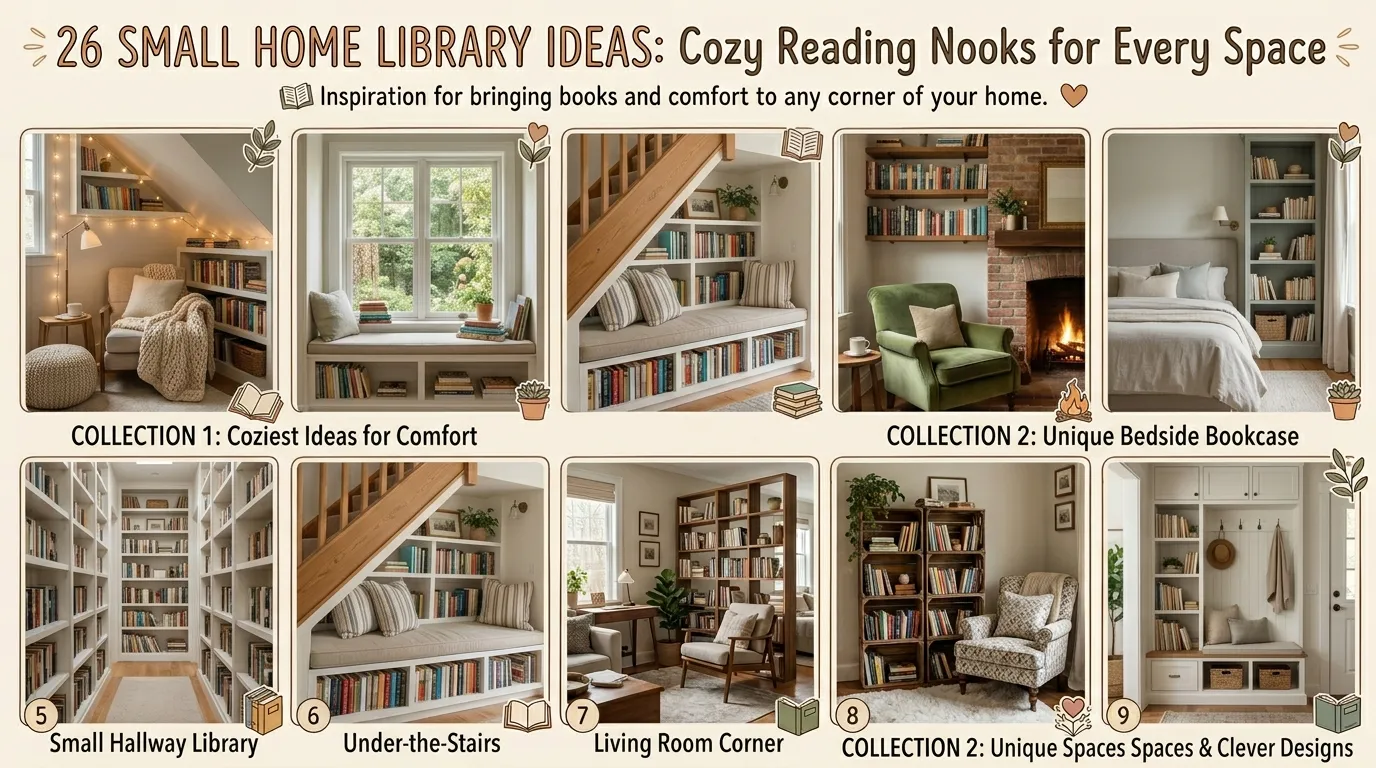
A small home library is a dedicated reading environment — shelving, seating, and lighting arranged to make books both accessible and beautiful, even within a few square feet. This article gives you 26 distinct ideas across color, materials, lighting, furniture, layout, accessories, and compact space solutions so you can build your own reading sanctuary at any scale.
There’s a particular kind of quiet that lives in a room full of books. The weight of spines lined up in rows, the smell of paper and aged binding, the sense that time moves differently here than anywhere else in the house. A small home library doesn’t need a whole room — it needs intention. Here are 26 ideas worth saving — and stealing.
Why Small Home Library Decor Works So Well
Why the Cozy Reading Nook Style Works So Well
The small home library draws from a confluence of design traditions — the English country study, the French bibliothèque, and the Scandinavian concept of the læsehjørne, or reading corner. What unifies them is a shared philosophy: that books are not storage items but architectural materials, and that the spaces built around them should feel earned, layered, and slightly apart from the rest of the house. The modern small library movement has refined this into something more democratic — achievable in an alcove, a window bay, or a section of a living room wall.
The materials that define this style are tactile and warm. Think dark-stained oak shelving, aged brass reading lamps with green glass shades, tufted leather or linen armchairs, sisal or Persian-style wool rugs, and velvet cushions in deep jewel tones — forest green, sapphire, burgundy. The color palette runs from warm ivory and parchment through tobacco brown, deep walnut, dusty sage, and rich charcoal. These are tones that absorb and soften light, making a reading space feel enclosed in the best sense.
The trend is culturally grounded in something real. Post-pandemic home design saw a dramatic reorientation toward purposeful rooms — spaces designed for a single, meaningful activity rather than multi-functional utility. Pinterest searches for “home library ideas” and “reading nook” surged over 60% in 2021 and have remained elevated. The small home library answers a genuine hunger for analog refuge in a screen-saturated world.
Small spaces can absolutely achieve this style — and in some ways they do it better. The coziness of a reading nook is directly proportional to its enclosure. A narrow alcove with floor-to-ceiling shelving on two walls and a single armchair reads as more immersive than a large open reading room. Prioritize depth of experience over square footage.
Style at a Glance
| Element | Detail |
| Philosophy | Books as architecture; the reading space as intentional refuge |
| Materials | Dark oak, aged brass, leather, velvet, sisal, linen, green glass |
| Color Palette | Parchment, tobacco brown, deep walnut, dusty sage, forest green, charcoal |
26 Small Home Library Ideas
1. Floor-to-Ceiling Built-In Bookshelves

Vibe: Grounded — a wall of books that feels like it’s been there for decades.
Why it works: Floor-to-ceiling shelving exploits vertical space — the single most underutilized dimension in small rooms. By drawing the eye upward to the ceiling, tall built-ins create the illusion of greater room height while simultaneously providing significant storage capacity. The design principle is visual mass balanced by order: a wall of books is heavy, but color-organized or spine-coordinated arrangements impose just enough visual rhythm to keep the eye comfortable.
How to get it: IKEA Billy bookcases with panel extensions reach ceiling height for a fraction of custom cost. Add a trim panel across the top to close the gap between the cabinet top and ceiling, and swap the standard shelves for solid oak boards ($12–$18 per shelf) for warmth and depth. Finish with a thin brass strip along the front edge of each shelf for a built-in look.
💡 Quick Win: A rolling library ladder kit (rail, ladder, and hardware) is available on Amazon for $180–$350. Even without built-ins, it leaning against a freestanding bookcase immediately reads as intentional library design.
🛍️ Shop the Look — Amazon Product Ideas
| # | Product Search Phrase | Why It Fits |
| 1 | rolling library ladder kit brass rail 8 foot | Signature library element |
| 2 | solid oak adjustable shelf board 36 inch | Warm-grain shelf upgrade |
| 3 | brass shelf edge strip trim 36 inch | Built-in finish detail |
| 4 | adjustable bookshelf bracket set heavy duty | Custom shelf support hardware |
| 5 | ceramic bud vase set neutral tones shelf decor | Book-row accent pieces |
2. The Window Seat Reading Nook

Vibe: Serene — reading here feels like being inside the afternoon.
Why it works: A window seat reading nook creates a sense of enclosure — the architectural equivalent of a cave with a view. The shelving on either side frames the window and reinforces the sense that this corner is deliberately separate from the rest of the room. The design principle is the Goldilocks zone of light: enough natural light to read without strain, but the seat position beside (not directly in front of) the window prevents glare on the page.
How to get it: Window seat depth should be at minimum 20 inches — anything shallower and you can’t comfortably sit with legs extended. The cushion should be at least 4 inches thick (look for high-density foam wrapped in batting, not cheap polyester fill). Flanking bookshelves don’t need to be built-in — two freestanding bookcases positioned on either side of a window create the same visual effect for a fraction of the cost.
🛍️ Shop the Look — Amazon Product Ideas
| # | Product Search Phrase | Why It Fits |
| 1 | window seat cushion custom foam 60 inch sage | Bench seat primary comfort |
| 2 | botanical print throw pillow set 2 dusty green | Nook accent textile |
| 3 | sheer linen curtain panel natural white | Light-filtering window layer |
| 4 | small round side table wood 18 inch | Beside-bench companion table |
| 5 | narrow freestanding bookcase white 72 inch | Flanking shelf element |
3. Dark Forest Green Walls

Vibe: Intimate — the walls hold the room in.
Why it works: Dark, saturated wall colors in a small reading space are counterintuitively effective — they make the room feel intentionally cocooned rather than accidentally small. Forest green in particular is the library color with the deepest design heritage, used in private libraries and studies for centuries precisely because it absorbs incandescent light warmly, makes books on shelves appear more saturated, and creates a sense of separation from the rest of the house. Farrow & Ball’s Minster Green or Sherwin-Williams’ Ripe Olive (SW 6209) in a matte finish are the closest commercially available equivalents to the classic English library tone.
How to get it: Paint all four walls and the ceiling in the same dark tone for a fully enveloping effect — stopping at the ceiling creates a visual cutoff that undermines the cocooning quality. Use a flat or matte finish, not eggshell or satin, as sheen on dark colors reflects light inconsistently and creates a plasticky appearance.
💡 Quick Win: A single can of deep green sample paint ($6–$8 at most hardware stores) covers enough wall area to test the color in your actual room lighting before committing. Dark colors look dramatically different at noon versus 8 PM — test both.
🛍️ Shop the Look — Amazon Product Ideas
| # | Product Search Phrase | Why It Fits |
| 1 | forest green interior paint matte quart | Wall color primary element |
| 2 | tufted leather armchair cognac brown | Warm seating library anchor |
| 3 | brass floor reading lamp arched | Warm-tone task lighting |
| 4 | Persian wool area rug navy red 5×7 | Ground-level richness |
| 5 | white crown molding trim lightweight DIY | Molding contrast detail |
4. The Book-as-Color-Palette Approach

Vibe: Airy — a library that feels like a painting.
Why it works: Organizing books by spine color is a polarizing technique — purists resist it, designers love it — but it works because it transforms a bookshelf from a storage system into a visual composition. The design principle is color gradation as a form of visual rhythm: the eye follows the color shift from warm to cool across the shelf, creating movement that a random arrangement doesn’t offer. Leaving occasional gaps with small ceramic accents or trailing plants introduces breathing room.
How to get it: Don’t attempt a perfect rainbow — aim for a warm-to-cool gradation: ivory, yellow, ochre, terracotta, rust, burgundy, green, navy, charcoal. Sort in your living room floor before reshelving — it takes about two hours for a full bookcase. Place ceramic accents at the color transition points (where warm meets cool) to punctuate the shift.
🛍️ Shop the Look — Amazon Product Ideas
| # | Product Search Phrase | Why It Fits |
| 1 | small ceramic bud vase set 5 piece neutral | Shelf color-break accent |
| 2 | mini trailing pothos plant artificial shelf | Organic shelf break element |
| 3 | bookend set matte black simple minimalist | Edge holders for color sections |
| 4 | decorative small sculpture abstract neutral | Color-section punctuation |
| 5 | clear book stand display easel set | Feature book display between spines |
5. Vintage Brass Reading Lamp

Vibe: Hushed — the kind of lamp that means someone has sat here for years.
Why it works: Lighting is the single factor most responsible for whether a reading space feels cozy or clinical. A focused task lamp — specifically a brass articulating arm lamp with a green or amber glass shade — concentrates warm light onto the reading surface while leaving the surrounding space in softer shadow. This contrast is the principle of chiaroscuro applied to room design: the interplay of light and dark creates depth, drama, and intimacy that overhead lighting destroys.
How to get it: Look for lamps with a color temperature of 2700K or lower — this is the range that reads as warm amber rather than neutral white. Green glass shades filter the light into a slightly cooler, more saturated warmth that’s specifically associated with library and study environments. Avoid LED bulbs in brass lamps unless they’re specifically rated at 2700K — many “warm white” LEDs still read too blue.
💡 Quick Win: A brass banker’s lamp with a green glass shade runs $35–$65 on Amazon. Pair it with a $4–$6 vintage-style Edison LED bulb at 2700K for the authentic library glow without the heat of an incandescent bulb.
🛍️ Shop the Look — Amazon Product Ideas
| # | Product Search Phrase | Why It Fits |
| 1 | brass banker lamp green glass shade desktop | Signature library task light |
| 2 | articulating brass arm reading lamp floor | Over-chair task reading lamp |
| 3 | Edison LED bulb 2700K vintage filament style | Warm-tone lamp bulb upgrade |
| 4 | leather bookmark handmade personalized | Functional library accessory |
| 5 | small brass side table round | Lamp and book companion surface |
6. Velvet Armchair in Jewel Tone

Vibe: Luminous — the velvet drinks the lamplight and gives it back richer.
Why it works: Velvet in a reading space exploits the material’s unique optical property: it appears to change color depending on the angle of light and the direction of the pile, making a single chair read as several shades across the day. This visual dynamism means a jewel-toned velvet piece is never static — it’s always doing something. Deep sapphire, forest green, and burgundy are the most effective library tones because they sit adjacent to the dark wall colors and rich wood tones that define the style.
How to get it: When choosing a velvet armchair, prioritize pile direction and pile density over color alone — a high-pile velvet in the right shade that flattens after a week is a disappointment. Look for “performance velvet” or “velvet with a tight pile” in product descriptions. Test the pile by running your hand against the grain — it should spring back immediately. Button-tufting (deep, visible buttons) creates the most visual texture and holds the shape of the back over time.
🛍️ Shop the Look — Amazon Product Ideas
| # | Product Search Phrase | Why It Fits |
| 1 | velvet tufted armchair sapphire blue | Jewel-tone primary seating piece |
| 2 | woven wool throw blanket navy cream | Textile arm drape accent |
| 3 | brass arc floor lamp over chair | Warm task-lighting arc |
| 4 | dark walnut side table round small | Chair companion surface |
| 5 | velvet cushion cover forest green 20 inch | Color-coordinate accent pillow |
7. Built-In Alcove Nook with Curtain

Vibe: Enclosed — the rest of the world becomes entirely optional.
Why it works: The alcove with a drawn curtain is the purest expression of the reading nook principle: a space within a space. Psychologically, enclosure signals safety — it’s the same reason we feel comfortable in a booth at a restaurant rather than a table in the middle of a room. The curtain makes the enclosure controllable, which is as important as the enclosure itself. The design relies on the principle of architectural compression: a tighter space feels more immersive, not smaller.
How to get it: If a true built-in alcove isn’t possible, create a faux version by placing a bookcase against two walls in a corner and hanging a ceiling-mounted curtain track in an L-shape in front of it. A small tension-mounted curtain track ($25–$45) handles this without any ceiling hardware. Use a full-length linen curtain — the drop to the floor is important for the feeling of total enclosure.
💡 Quick Win: A ceiling-mounted curtain track with a curve attachment ($30–$55) can turn any corner into an alcove nook. Hang it 84 inches from the floor and use an unlined linen panel — light filters through when open, but the enclosed feeling is preserved.
🛍️ Shop the Look — Amazon Product Ideas
| # | Product Search Phrase | Why It Fits |
| 1 | ceiling mounted curtain track curved system | Alcove enclosure mechanism |
| 2 | heavy linen curtain panel ivory 84 inch | Enclosure drape element |
| 3 | small Edison pendant light plug-in cord | Alcove interior warm light |
| 4 | compact reading chair small armchair beige | Alcove-width seating |
| 5 | wall-mounted book ledge small 24 inch | Inner alcove shelf element |
8. The Under-Stair Library

Vibe: Clever — every inch of this house is doing its job.
Why it works: Under-stair spaces suffer from awkward geometry that defeats standard furniture, which is exactly why converting them to bookshelves works so well — shelves can be cut to any depth and angle, and books stack at any height, making the triangular void useful in a way that a chair or cabinet cannot be. The design principle is using architectural constraint as creative opportunity: the sloped ceiling becomes a feature rather than a limitation.
How to get it: Measure the full under-stair volume carefully: width, maximum standing height, and the angle of the stair slope. Build shallow shelves (8–10 inches deep) on the back wall of the nook using simple plywood painted to match the wall — the shallow depth keeps the interior from feeling cluttered. Install a plug-in pendant lamp at the highest point of the space for overhead light that doesn’t require an electrician.
🛍️ Shop the Look — Amazon Product Ideas
| # | Product Search Phrase | Why It Fits |
| 1 | plug-in pendant light cord fabric braided | Under-stair overhead light |
| 2 | compact upholstered bench narrow 36 inch | Under-stair seating element |
| 3 | floating shelf set white adjustable | Angled nook wall shelving |
| 4 | small navy cushion cover 18 inch | Bench textile accent |
| 5 | compact potted fern artificial low light | Organic low-clearance accent |
9. Warm Parchment and Cream Color Palette

Vibe: Sun-warmed — the room feels like a letter written in good light.
Why it works: A parchment-and-cream palette is the antidote to the dark moody library — it creates warmth through saturation rather than shadow. Parchment (a yellow-warm off-white, distinct from cool grey-white) reads as aged and gentle in daylight and glows amber under incandescent light. The design principle is tonal unity: when walls, shelves, textiles, and books occupy a similar light-value range, the space reads as calm rather than chaotic, and the slight variations within the palette create interest without contrast.
How to get it: Benjamin Moore’s Pale Oak (OC-20) or Farrow & Ball’s String (no. 8) are the standard references for this tone. Both have yellow-warm undertones that prevent the “cold white” reading that plagues many small rooms. Pair with natural linen shelf liners (cut to size from a yard of fabric) to add texture to the back panel of each shelf.
🛍️ Shop the Look — Amazon Product Ideas
| # | Product Search Phrase | Why It Fits |
| 1 | warm white interior paint parchment cream | Wall tone primary element |
| 2 | natural linen fabric yard shelf liner | Shelf back panel texture |
| 3 | rattan armchair cushioned reading | Warm organic seating |
| 4 | cream woven throw blanket cotton | Neutral textile accent |
| 5 | antique brass desk lamp small warm | Tone-matching task light |
10. Stack-and-Style Book Display

Vibe: Collected — shelves that look like they grew this way.
Why it works: Alternating vertical and horizontal book stacks breaks the monotony of an unbroken row of spines without sacrificing the library feeling. The horizontal stacks create natural platforms for small objects — a ceramic dish, a trailing plant, a small brass sculpture — which transforms the shelf from a storage surface into a curated display. The design principle is rhythm through interruption: every three to five vertical books, introduce a horizontal stack, then resume the vertical pattern.
How to get it: Horizontal stacks should contain three to five books maximum — taller stacks look precarious and usually are. Place the tallest and most visually interesting object on top of each horizontal stack. The trailing vine is particularly effective: a small pothos cutting in a ceramic pot spills down over the book spines below, creating an organic connection between shelf levels.
💡 Quick Win: A small trailing pothos plant in a terracotta pot costs under $8 at most grocery stores and hardware stores. It’s the single most effective living element for bookshelves — it grows slowly, needs almost no light, and improves visually with age.
🛍️ Shop the Look — Amazon Product Ideas
| # | Product Search Phrase | Why It Fits |
| 1 | brass decorative magnifying glass vintage | Classic library desk object |
| 2 | decorative hourglass sand timer brass | Study-style shelf accent |
| 3 | small terracotta plant pot set 3 inch | Trailing plant vessel |
| 4 | framed quote print literary theme 5×7 | Bookshelf wall art element |
| 5 | trailing pothos artificial plant small shelf | Low-maintenance organic accent |
11. Leather-Bound and Spine-Out Shelving

Vibe: Hushed — a wall that holds its own secrets.
Why it works: Spine-out shelving — placing books so the page edges face the room — creates a uniform, textural wall of layered cream paper that reads as intentionally designed rather than simply stored. The slight variation in page-edge color from book to book, and the way raking light catches the slight unevenness of each stack, gives the shelf a quality that no spine arrangement can replicate: it looks like a material, not a collection. The technique is borrowed from high-end interior photography and works particularly well in moody, dark-walled spaces.
How to get it: Not every book needs to turn — mix one section of spine-out books with adjacent sections of spine-in. The contrast between the cream paper wall and a row of colorful spines beside it is more interesting than either approach alone. Group spine-out books in runs of 10–20 at a time, and vary the block widths so they don’t look mechanical.
🛍️ Shop the Look — Amazon Product Ideas
| # | Product Search Phrase | Why It Fits |
| 1 | leather journal set decorative blank bound | Leather spine display elements |
| 2 | classic literature hardcover collection set | Spine-quality library books |
| 3 | brass bookend set pair simple minimal | Edge holders for spine-out runs |
| 4 | book display easel small wooden | Feature-book display piece |
| 5 | antique-look gold foil bookmark set | In-book styling accessory |
12. The Floating Shelf Library Wall

Vibe: Airy — a library that breathes.
Why it works: Floating shelves at varied heights create an asymmetrical composition across an entire wall, which is more visually dynamic than a grid of matching bookshelves. The design principle is visual counterpoint: a longer shelf at lower height on one side balanced by a shorter shelf at greater height on the other, with books and objects distributed to balance the visual weight. Floating shelves also open the floor, maintaining the perception of space in a small room.
How to get it: Plan the shelf arrangement on paper or digitally before drilling — use the rule of thirds to position shelves. No two shelves should be the same length. Install the longest shelf first, then build the arrangement around it. Use heavy-duty concealed brackets rated for at least 30 pounds per shelf, and always locate wall studs or use wall anchors rated for the intended weight.
🛍️ Shop the Look — Amazon Product Ideas
| # | Product Search Phrase | Why It Fits |
| 1 | floating wood shelf white oak 36 inch | Primary shelf element |
| 2 | floating shelf 24 inch solid wood short | Secondary shorter shelf element |
| 3 | concealed shelf bracket heavy duty pair | Load-bearing invisible mount |
| 4 | small succulent set artificial shelf decor | Low-care shelf plant accent |
| 5 | gallery frame set white 5×7 4×6 mixed | Mixed-size art for shelves |
13. Antique Globe and Map Accents

Vibe: Adventurous — a shelf that suggests someone here has been somewhere.
Why it works: Globes and maps introduce narrative into a bookshelf — they imply curiosity, travel, and a relationship to the wider world that transforms a book collection from a hobby into a worldview. The design principle at work is the anchor object: a globe is large, spherical, and three-dimensional — its shape contrasts with the rectangular uniformity of books in a way that instantly creates a focal point. An object of this visual weight commands the shelf and gives smaller surrounding objects something to orbit.
How to get it: A vintage-style antique brass globe on a mahogany base, 12 inches in diameter, is the ideal library scale — large enough to read as a statement, small enough not to overwhelm a standard bookshelf. Position it at the front edge of the shelf, slightly off-center, with books behind and smaller objects — a magnifying glass, a small map — flanking it.
💡 Quick Win: A wax seal kit with a monogram stamp and sealing wax costs $15–$25 on Amazon and looks genuinely beautiful displayed in a small open dish or tray on a bookshelf. It suggests correspondence and ceremony in equal measure.
🛍️ Shop the Look — Amazon Product Ideas
| # | Product Search Phrase | Why It Fits |
| 1 | antique brass desktop globe 12 inch mahogany | Library focal shelf object |
| 2 | rolled antique-style map set decorative | Companion cartographic accent |
| 3 | wax seal kit monogram stamp set | Desk-style shelf accessory |
| 4 | leather travel journal blank cover | Shelf narrative element |
| 5 | large ceramic vessel floor vase natural | Map scroll holder vessel |
14. Kids’ Reading Nook with Low Shelving

Vibe: Playful — small and warm enough to belong entirely to a child.
Why it works: Children’s reading nooks work on the same psychological principle as adult alcoves — enclosure signals safety and invitation. But for children, the critical difference is scale: a nook that’s sized for a small body (low ceiling, narrow opening, floor-level seating) feels exclusively theirs in a way that adult furniture cannot offer. Forward-facing bookshelves — shelves designed to display book covers rather than spines — dramatically increase independent book selection for pre-readers and early readers, who navigate by cover image rather than title.
How to get it: A canvas play teepee positioned in a corner with forward-facing bookshelves on either side creates an effective freestanding nook without any construction. Position shelves so the tallest shelf is at adult standing-reach for new book loading, but all books are accessible from a seated-on-the-floor position (under 36 inches high).
🛍️ Shop the Look — Amazon Product Ideas
| # | Product Search Phrase | Why It Fits |
| 1 | children’s teepee play tent white canvas | Kids’ nook enclosure structure |
| 2 | forward-facing bookshelf kids wood low | Book-cover display shelf |
| 3 | foam floor cushion round mustard yellow | Floor-level reading seat |
| 4 | fairy light string battery warm white | Enclosed nook interior glow |
| 5 | children’s woven basket toy storage small | Nook companion organizer |
15. Dark Walnut and Warm Metal Shelving

Vibe: Confident — a bookshelf that looks like it was designed to stay.
Why it works: The combination of dark walnut and matte black steel is the industrial-meets-warm material pairing that’s dominated contemporary interior design for good reason: steel pipe brackets are structurally honest (they show their own construction without pretense), and dark walnut board is one of the warmest-toned hardwoods commercially available. Together, they create a shelf that reads as both handmade and intentional. The darkness of both materials makes books of any color appear more vivid beside them.
How to get it: Pipe-and-board shelving kits are available pre-drilled for under $80 per shelf from multiple Amazon suppliers. Choose boards at least 1.5 inches thick — thinner boards deflect visibly under book weight. Sand the walnut to 220 grit and finish with a single coat of Danish oil rather than polyurethane — it penetrates the grain rather than sitting on top, and deepens the color without plastic-looking sheen.
🛍️ Shop the Look — Amazon Product Ideas
| # | Product Search Phrase | Why It Fits |
| 1 | pipe shelf bracket kit matte black 12 inch | Industrial structural hardware |
| 2 | dark walnut wood shelf board 48 inch | Warm-grain primary shelf material |
| 3 | Danish oil wood finish natural dark | Grain-penetrating shelf finish |
| 4 | dark ceramic vase matte shelf decor | Tone-matching vessel accent |
| 5 | small brass vintage alarm clock desk | Warm metal shelf accent |
16. The Reading Chair with Ottoman

Vibe: Lived-in — this chair knows the shape of someone.
Why it works: A reading chair with a matching or complementary ottoman solves the practical problem of leg fatigue in extended reading sessions, while also creating a visual unit — the chair-and-ottoman becomes a furniture cluster that reads as a defined zone within a larger room. The wooden tray on the ottoman is the design detail that converts functional furniture into a styled vignette: it implies use, ceremony, and comfort simultaneously.
How to get it: For a reading chair, seat depth is as important as cushion softness — you want to be able to sit fully back in the chair with your feet reaching the ottoman, which typically means a seat depth of 22–24 inches. A round or square ottoman at 16–18 inches height matches most standard chair seat heights. The key pairing rule: ottoman fabric and chair fabric should share a color but differ in texture — linen chair, velvet ottoman, for example.
💡 Quick Win: A small wooden serving tray ($18–$30) on an ottoman transforms it from functional footrest to styled surface. Stack it with a ceramic mug, one small candle, and a folded linen napkin — the tray keeps them from sliding and creates an intentional composition.
🛍️ Shop the Look — Amazon Product Ideas
| # | Product Search Phrase | Why It Fits |
| 1 | rolled arm reading chair linen tobacco | Classic library seating form |
| 2 | round tufted ottoman velvet small 18 inch | Chair companion foot support |
| 3 | small wooden serving tray oval handles | Ottoman styled surface |
| 4 | stoneware mug handmade ceramic large | Reading companion vessel |
| 5 | linen napkin set natural unbleached 4 pack | Tray textile accent |
17. Bi-Fold Door Nook Conversion

Vibe: Enclosed — a closet that became the best room in the house.
Why it works: A standard bedroom or hallway closet is typically 24–30 inches deep and 36–60 inches wide — exactly the footprint of a cozy reading alcove. Removing the bi-fold doors and installing shallow shelves on both interior walls creates an instant library nook with zero additional floor space used. The small overhead pendant — hung from an existing closet ceiling fixture or a simple plug-in cord — makes the space feel complete. Heavy curtains replace the doors and provide the enclosure quality the doors previously offered.
How to get it: Start by removing the closet rod and shelf. Install 8-inch deep floating shelves on both side walls (they’ll fit books easily and leave room to sit comfortably in the center). A plug-in pendant lamp with a fabric cord ($25–$45) runs through a small hook at the ceiling without requiring an electrician. The bench at the back can be as simple as a wooden board on two small corbels, padded with a seat cushion.
🛍️ Shop the Look — Amazon Product Ideas
| # | Product Search Phrase | Why It Fits |
| 1 | plug-in pendant light cord fabric 10 foot | Closet-nook overhead light |
| 2 | velvet curtain panel teal deep 84 inch | Nook enclosure door replacement |
| 3 | narrow floating shelf set 8 inch deep | Side-wall closet shelving |
| 4 | small upholstered bench cushion seat narrow | Nook back-wall seating |
| 5 | curtain rod ceiling mount bracket set | Nook curtain hanging hardware |
18. Gallery of Literary Art Prints

Vibe: Layered — a wall that takes 20 minutes to fully read.
Why it works: A salon-style gallery wall — dense, floor-to-ceiling, with prints hung close together — is the decorating equivalent of a packed bookshelf: it rewards sustained attention. Uniformity in frame color (all matte black) allows radical variety in print content and size without chaos. The design principle is controlled variety: one consistent variable (the frame) holds diverse content together. In a small reading room, this approach can fill an entire wall without requiring a bookshelf, saving floor space.
How to get it: Lay all frames on the floor and arrange before hanging a single nail. Start with the largest print centered at eye level (57 inches to the center of the frame is the standard gallery height). Work outward and downward, keeping consistent spacing of two to three inches between frames. The density is the point — resist leaving large gaps.
🛍️ Shop the Look — Amazon Product Ideas
| # | Product Search Phrase | Why It Fits |
| 1 | black picture frame set mixed sizes 4×6 5×7 8×10 | Gallery wall uniformity |
| 2 | vintage botanical illustration print set | Warm-toned gallery content |
| 3 | hand-lettered literary quote print 8×10 | Thematic reading room art |
| 4 | vintage portrait engraving art print framed | Library-appropriate print style |
| 5 | gallery wall template planning kit | Pre-hang layout tool |
19. Warm Amber and Cognac Tones

Vibe: Rich — a room the color of aged whiskey and afternoon light.
Why it works: The amber-cognac palette is the most warming color scheme available to a reading space — it draws from the same color family as candlelight and firelight, meaning it reads as inherently cozy under any light condition. The design principle is warm saturation: using multiple tones within the amber-to-cognac range (honey, butterscotch, tobacco, caramel) creates a palette that reads as complex and considered without requiring contrast. Books in tan, beige, and warm brown spines are plentiful at any used bookstore, making this palette achievable without buying specialty items.
How to get it: A cognac or tan leather chair or loveseat is the investment anchor piece for this palette — genuine leather in cognac or whiskey tones develops the most beautiful patina over time. If genuine leather is out of budget, bicast leather in cognac reads almost as well in this color range, and faux leather in amber tone is a $200–$400 alternative to a $1,000+ leather chair.
🛍️ Shop the Look — Amazon Product Ideas
| # | Product Search Phrase | Why It Fits |
| 1 | cognac leather accent chair reading | Warm palette primary seating |
| 2 | amber glass table lamp warm light | Tone-matching ambient light |
| 3 | honey oak floating shelf board natural | Warm-grain shelf surface |
| 4 | cognac leather journal hardcover | Amber palette accessory |
| 5 | caramel wool throw blanket large | Warm-tone textile layer |
20. Compact Corner Library with Ladder Shelf

Vibe: Efficient — a corner that earns every inch.
Why it works: A leaning ladder shelf is the most space-efficient freestanding shelving solution for a small reading area: it requires no wall mounting, takes up minimal floor space (typically 20–24 inches deep at the base, tapering to 8–10 inches at the top), and its tapering silhouette creates a sense of lightness — it visually lifts rather than presses down on a space. The narrow upper shelves naturally limit the objects placed there, which prevents overcrowding at eye level.
How to get it: Place the ladder shelf in a corner where it can lean against two walls simultaneously — this gives it significantly more stability than a free-standing placement against one wall. Use the wider lower shelves for books (heaviest items) and the narrow upper shelves for lightweight objects — a small plant, a single candle, a framed print.
💡 Quick Win: A white oak ladder shelf runs $85–$140 on Amazon and assembles without tools in under 20 minutes. It immediately reads as “styled reading corner” rather than “extra storage.”
🛍️ Shop the Look — Amazon Product Ideas
| # | Product Search Phrase | Why It Fits |
| 1 | leaning ladder shelf white oak 5 tier | Compact corner shelving unit |
| 2 | small arc floor lamp white modern | Over-chair corner task light |
| 3 | trailing string of pearls artificial plant | Narrow upper-shelf drape |
| 4 | ceramic mug set neutral 4 piece | Lower-shelf lifestyle accessory |
| 5 | compact reading accent chair small | Corner nook seating partner |
21. Herringbone Wood Floor Accents

Vibe: Grand — a room that feels bigger than its square footage.
Why it works: Herringbone flooring is a layout technique, not just a material — the angled pattern creates diagonal sightlines across a room, which the eye reads as greater width than the room actually has. In a small library room, herringbone in a light oak tone maximizes this effect while providing the warm natural material that complements dark bookshelves. The design principle is visual expansion through pattern: diagonal lines always make a room read as larger than horizontal or vertical lines.
How to get it: Engineered hardwood in herringbone pattern is more accessible than ever — peel-and-stick and click-lock versions are available at $3–$6 per square foot and install without adhesive or professional help. A 10×10 room costs under $400 in material. Lay herringbone pointing toward the room’s natural light source (the window) for maximum visual depth.
🛍️ Shop the Look — Amazon Product Ideas
| # | Product Search Phrase | Why It Fits |
| 1 | herringbone peel stick floor tile light oak | DIY pattern floor upgrade |
| 2 | small Persian style wool rug 4×6 navy | Floor layering library anchor |
| 3 | brass chandelier small 4 light traditional | Overhead warm-tone fixture |
| 4 | dark walnut bookcase freestanding 72 inch | Wall-depth bookshelf pair |
| 5 | floor transition strip brass self-adhesive | Floor join finish detail |
22. Reading Hammock or Swing Chair

Vibe: Airy — reading suspended in the afternoon.
Why it works: A hanging swing chair or hammock chair introduces the element of gentle motion into a reading space, which research on reading environments consistently identifies as a comfort enhancer — the gentle rocking movement activates the vestibular system in a way that promotes relaxed focus. Architecturally, a hanging chair also introduces a vertical design element that draws the eye upward, making the room feel taller. It requires no floor space — its footprint is only the shadow it swings over.
How to get it: A ceiling hook rated for at least 300 pounds is essential — use a stud finder to locate a ceiling joist and install a lag bolt directly into it. The chain or rope length should position the seat at 17–20 inches from the floor for most adults. Choose a chair with a solid frame (rattan or steel) rather than a pure fabric hammock for a reading chair — you need something to lean your back against while holding a book.
🛍️ Shop the Look — Amazon Product Ideas
| # | Product Search Phrase | Why It Fits |
| 1 | macramé hanging swing chair indoor cream | Airy suspended reading seat |
| 2 | ceiling hook joist mount heavy duty 300lb | Safe hanging mount hardware |
| 3 | woven cushion round terracotta 18 inch | Swing chair comfort insert |
| 4 | rattan hanging chair with frame indoor | Structured swing alternative |
| 5 | trailing pothos artificial long 6 foot | Overhead shelf organic drape |
23. Portable Library: Brass Book Cart

Vibe: Clever — a library that moves with you.
Why it works: A rolling book cart solves the apartment or rental home dilemma: how to create a library feeling without any permanent installation. A brass bar cart repurposed for books is particularly effective because its frame reads as decorative rather than utilitarian — it suggests intentionality rather than improvisation. The portability is also genuinely useful: the cart can move to wherever you’re reading, making it a functional and atmospheric addition simultaneously.
How to get it: Look for a bar cart with at least two tiers and at minimum 12 inches of clearance per tier (standard paperback height is 8–9 inches; hardcovers run 10–11). Brass-finish carts are the most versatile for this use — gold-tone metal in a reading context reads as warm and antique rather than flashy. Load books vertically on the lower shelf and use the upper shelf for objects — a plant, a candle, a glass.
💡 Quick Win: A matte brass bar cart ($65–$120) from Amazon immediately functions as a portable mini-library. Load it with 15–20 of your most visually interesting books and it becomes a room object as much as a storage piece.
🛍️ Shop the Look — Amazon Product Ideas
| # | Product Search Phrase | Why It Fits |
| 1 | brass bar cart 2 tier rolling gold finish | Portable book cart base |
| 2 | bookend set brass animal shaped decorative | Cart shelf book holders |
| 3 | velvet ribbon bookmark set jewel tones | Hanging cart accent detail |
| 4 | mini brass plant pot succulent size | Cart-top organic element |
| 5 | small portable LED reading lamp clamp | Cart-mounted task light |
24. Natural Light Optimization with Mirrors

Vibe: Luminous — a room that makes the most of every photon it’s given.
Why it works: Strategic mirror placement is the most effective tool for amplifying natural light in a small reading room — particularly important because reading requires good light, and small rooms often struggle with it. Placing a large mirror on the wall directly opposite a window reflects the window’s light back into the room, effectively doubling the perceived brightness. An arched mirror in a brass or natural wood frame adds the decorative element that makes the mirror read as an intentional design choice rather than a bathroom fixture.
How to get it: The mirror should be at minimum 24 inches wide and 36 inches tall to capture a significant portion of the window light. Position it so the center of the mirror aligns with the window’s center horizontally. The reading chair should sit between the window and the mirror — so the reader benefits from both the direct light and the reflected light simultaneously, without either source causing direct glare.
🛍️ Shop the Look — Amazon Product Ideas
| # | Product Search Phrase | Why It Fits |
| 1 | arched mirror brass frame 24×36 inch wall | Light-doubling reflective element |
| 2 | linen reading chair natural ivory | Light-optimized seating position |
| 3 | sheer linen curtain panel natural 84 inch | Light-diffusing window layer |
| 4 | brass wall hook decorative 3 pack | Mirror-adjacent accessory |
| 5 | clear glass bud vase set 3 piece | Light-passing decorative element |
25. The Night-Owl Library: Moody Lighting Setup

Vibe: Intimate — a room that only exists after dark.
Why it works: Evening reading environments are fundamentally different from daytime ones, and designing for nighttime use requires layering multiple low-level warm light sources rather than relying on a single overhead fixture. The design principle is distributed intimacy: five small light sources at 2700K create a more comfortable reading environment than one bright overhead at the same total wattage, because they eliminate the harsh shadows that overhead lighting casts on the page and face. Deep charcoal walls absorb the ambient light and make the warm pools appear richer.
How to get it: Layer at minimum three light sources: a task lamp positioned to the left or right of the reading chair (not behind it), a shelf light or picture light illuminating books, and a string of warm Edison bulbs at low level. All should be independently switchable — you want to combine them differently for reading versus atmosphere. A simple plug-in smart dimmer ($15–$25) on each lamp allows instant mood adjustment without rewiring.
🛍️ Shop the Look — Amazon Product Ideas
| # | Product Search Phrase | Why It Fits |
| 1 | brass banker lamp green shade adjustable | Primary task reading light |
| 2 | plug-in picture light bronze warm | Book-illuminating shelf accent |
| 3 | Edison string lights warm white plug-in 25 bulb | Ambient shelf glow layer |
| 4 | smart plug-in dimmer adapter 2 pack | Layered light control |
| 5 | dark charcoal interior paint flat finish | Evening-library wall tone |
26. The Full Small Library Moment

Vibe: Abundant — this is the whole picture, every layer earning its place.
Why it works: The complete small home library is a composition across every zone of the room: the shelving zone (walls, storage, display), the seating zone (chair, ottoman, lamp), the floor zone (rug, texture, layering), and the ambient zone (lighting layers, mirror, art). Each zone serves a different function — shelving is practical and beautiful, seating is comfort-centered, the floor grounds the space, and the ambient zone creates the emotional atmosphere that makes you want to stay. When all four zones are considered, the room becomes a library rather than a room with books in it.
How to get it: Begin with the seating zone — choose your chair first, because everything else in a reading room serves the reader. Build the shelving around the chair’s position, the lighting around the chair’s needs, and the floor treatments around the chair’s footprint. The final step is the ambient layer: mirrors, art, and lighting are the finishing elements that transform a furnished room into an atmospheric one.
💡 Quick Win: The single item that most transforms a reading corner into a library feeling is a floor lamp with a directional reading head positioned behind and to the left of the chair. Under $60, it changes everything about how the space reads and functions simultaneously.
🛍️ Shop the Look — Amazon Product Ideas
| # | Product Search Phrase | Why It Fits |
| 1 | arc floor lamp brass adjustable head | Seating zone task light anchor |
| 2 | forest green velvet armchair tufted | Primary library seating piece |
| 3 | rolling brass book cart 2 tier | Portable library companion |
| 4 | Persian style area rug 5×7 traditional | Floor zone grounding element |
| 5 | smoked antique mirror arched brass frame | Ambient zone light amplifier |
How to Start Your Small Home Library Transformation
The single best first move is to choose and position your reading chair before buying a single shelf or decorative object. Every decision in a home library — where shelves go, where the lamp goes, which wall gets the mirror — flows from where the reader sits. A deep-seated linen armchair or a tufted leather chair in cognac is the anchor that makes the rest of the room legible. Specifically, look for a chair with a seat depth of 22 inches or more and a seat height of 17–18 inches: these dimensions allow you to sit fully back with your feet flat, which is the reading posture you can sustain for two hours.
The most common beginner mistake is buying bookcases that are too shallow. Standard builder-grade shelves run 8–10 inches deep — fine for paperbacks, but unable to accommodate the 11–12-inch depth of most hardcovers, art books, and encyclopedias. Books left protruding past the shelf edge look unstable and read as careless. Always confirm shelf depth before purchasing, and aim for 12 inches minimum. If you already own shallow shelves, position large-format books spine-out flat on their sides rather than upright.
Three specific items under $50 that create immediate library atmosphere: a brass banker’s lamp with a green glass shade ($35–$55), a set of five ceramic bud vases in neutral tones to intersperse on shelves ($18–$28), and a single trailing artificial pothos plant in a small terracotta pot ($8–$12). These three objects, added to even a single bookcase, shift the room from “storage” to “library” within an afternoon.
Realistic expectations: A single reading corner refresh — new lamp, rearranged books, one textile added — takes three hours and costs under $150. A full small library transformation with new shelving, chair, rug, and lighting takes three to five weekends and a budget of $500–$1,500 for quality pieces that will last. The shelving is the biggest variable: built-ins can run $200–$800 for a DIY version; custom carpentry adds $1,500 and up.
Frequently Asked Questions About Small Home Library Decor
What is a small home library and how is it different from just having bookshelves?
A small home library is a space designed around the act of reading — it combines dedicated shelving with intentional seating, layered lighting, and atmospheric design to create a room that functions as a reading environment, not simply book storage. The difference is intentionality: a bookcase in a living room is storage; the same bookcase paired with a reading chair, a task lamp at the correct height, and a rug that defines the zone creates an invitation to read. Even a single corner of a room can function as a library if those four elements — shelving, seating, light, and a defined floor area — are present.
What paint colors work best for a cozy home library?
The most effective library colors are deep, saturated tones that absorb and warm incandescent light: forest green (Sherwin-Williams Ripe Olive, SW 6209), deep navy, warm charcoal, and rich burgundy are the classic library palette. For smaller or darker rooms where a deep tone feels too heavy, warm parchment — Benjamin Moore’s Pale Oak (OC-20) or similar yellow-warm off-whites — creates coziness through warmth rather than depth. The one color to avoid in reading rooms is cool grey or blue-white — both read as clinical under incandescent light and make text harder to focus on visually.
How much does it cost to create a small home library?
A functional and well-styled reading corner can be created for $150–$400 using a secondhand armchair, a floor lamp, floating shelves, and a small rug. A fully outfitted small library room with new bookshelves, quality seating, layered lighting, and art runs $800–$2,500 for a mid-range build. Built-in shelving is the biggest cost variable: DIY Billy bookcase built-ins cost $300–$600 for one wall; custom carpentry for the same wall runs $1,500–$4,000. The investment pieces that deliver the highest long-term value are a quality reading chair and a proper task lamp — both used daily.
Can a small bedroom or apartment have a home library?
Yes — and small rooms often create better reading atmospheres than large ones, because the enclosure is built in. A 10×10 room with bookshelves on two walls and a compact reading chair has all the ingredients of a functional library. In a studio apartment, a leaning ladder shelf beside a reading chair and a floor lamp defines the reading zone without requiring a dedicated room. The key in very small spaces is keeping the seating zone clear of visual clutter: books on shelves, not stacked on the floor; one textile (a throw), not three.
What kind of lighting is best for reading in a home library?
The best reading lighting combines two sources: a focused task lamp at the correct angle (positioned to the reader’s left or right, not behind or directly overhead, at approximately 40–42 inches from the floor to the light center) and a softer ambient source — a table lamp across the room or a string of warm Edison lights — to reduce the contrast between the bright reading zone and the surrounding dark room. All light sources should be rated at 2700K or lower for warmth. Overhead lighting alone is the worst reading environment: it creates harsh downward shadows on the page and flattens the face, making sustained reading uncomfortable within 20 minutes.
Ready to Create Your Dream Small Home Library?
These 26 ideas span the full range of what a reading nook can be — from bold wall color strategies and material pairings like dark walnut and steel pipe, to lighting setups, compact closet conversions, floor-level children’s nooks, and full room compositions where every zone works together. Start with one good chair and one good lamp — that’s the irreducible minimum of a library, and it’s enough to change how you feel in your own home. The most actionable thing you can do today is move your reading chair to a corner, angle it at 45 degrees, and sit in it with a lamp turned on and nothing else changed — you’ll immediately see the potential. When this style is done well, the reading nook becomes the room you instinctively move toward at the end of the day, the space where the rest of the house recedes and the only urgency is the next page. Save the ideas that made you stop — those are the ones that belong in your home.