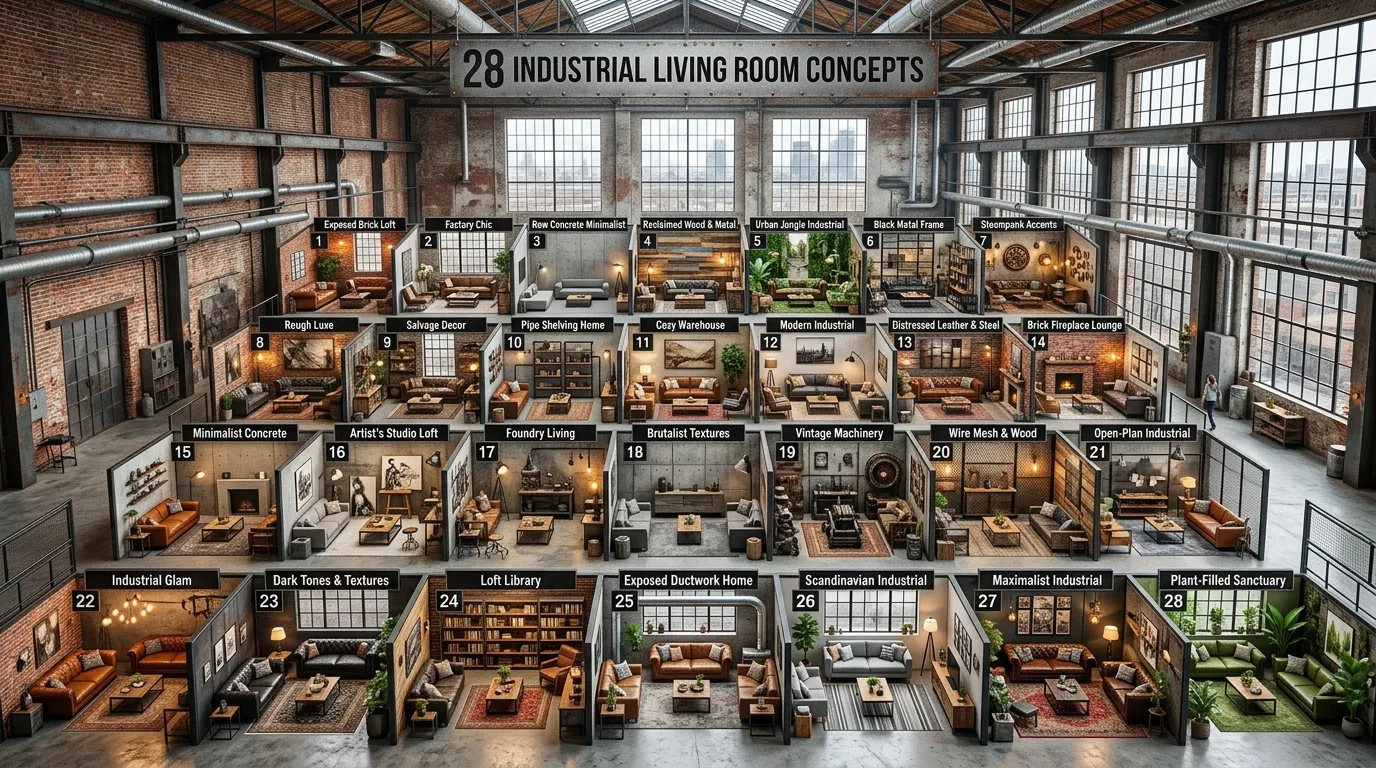
Industrial living room design is a style rooted in the raw, unfinished aesthetics of converted factories and urban lofts — exposed structure, honest materials, and deliberate restraint in decoration. Here are 28 specific concepts, from bold material choices to compact urban adaptations, to help you build or reimagine a living room with genuine industrial character.
There is a particular energy in a well-executed industrial living room — the weight of steel against the warmth of aged leather, concrete that holds the cold of early morning while a pendant light throws amber across it by evening. It is a style that does not pretend, does not conceal its bones, and does not apologize for its origins. Here are 28 ideas worth saving — and stealing.
Why Industrial Living Room Design Works So Well
Industrial design as a residential aesthetic traces its origins to the SoHo loft conversions of 1970s New York, when artists began inhabiting decommissioned manufacturing buildings and treating their raw architectural bones — exposed brick, steel beams, concrete floors, oversized windows — as the décor itself. It draws equally from the Bauhaus movement’s conviction that structure and function are sufficient aesthetic, and from the utilitarian honesty of mid-century American factory design. What separates true industrial style from its many imitations is intentionality: every exposed element was kept exposed for a reason, not for effect.
The material vocabulary is specific and non-negotiable. Think weathered reclaimed oak, cold-rolled and blackened steel, raw or polished concrete, exposed red or grey brick, and aged leather in dark cognac or near-black tones. Metal finishes run to matte black, brushed gunmetal, and oxidized bronze — never chrome, never polished brass. Textiles are kept spare: heavy cotton canvas, worn denim, chunky wool in charcoal or oatmeal. Colors anchor in warm charcoal (Sherwin-Williams Urbane Bronze), deep slate, oxidized red, and raw concrete grey, with warm amber light as the unifying tonal thread.
The style’s resurgence is directly tied to a cultural appetite for authenticity in the face of mass-produced interiors. Pinterest searches for “industrial living room” consistently rank among the top home décor queries, and the movement connects to broader sustainability values: reclaimed materials, durable construction, nothing disposable. In an era of fast furniture, a room built from steel and solid reclaimed wood signals a different relationship to objects and space.
Small spaces can absolutely achieve this style — urban apartments were where industrial design lived first. Prioritize ceiling height over square footage, keep furniture profiles low and spare, and let one raw material element (an exposed brick wall, a steel-framed window, a concrete fireplace surround) carry the character of the entire room. Do not attempt to layer every material at once in a small space — industrial restraint is the point.
| Element | Core Trait 1 | Core Trait 2 |
| Philosophy | Structural honesty | Utilitarian beauty |
| Materials | Cold-rolled steel, reclaimed oak, raw concrete | Aged leather, exposed brick, heavy cotton canvas |
| Color palette | Warm charcoal, oxidized red, raw concrete grey | Deep slate, aged cognac, warm amber light |
28 Industrial Living Room Concepts
1. Exposed Concrete Ceiling with Steel I-Beam

Vibe: Raw — a ceiling that tells you exactly how this building was made.
Why it works: Leaving a concrete ceiling fully exposed, formwork marks and all, is the single most committed act of structural honesty in industrial design — it refuses decoration at the most visible surface in the room. The steel I-beam running overhead serves a dual purpose: structurally it transfers load, and visually it creates a strong horizontal datum that anchors the vertical space without closing it. The contrast between the cold grey of concrete and the warm amber of low-hung pendant lights is the room’s central compositional tension — industrial cool tempered by human warmth.
How to get it: If your ceiling is already drywall, exposing the structure requires a structural assessment first. For a non-structural option, specify 3D concrete-look ceiling panels in grey — Barrisol or similar stretch ceiling systems achieve the look at low cost. Hang steel I-beam sections as decorative structural elements from existing ceiling joists using threaded rod at $12–$18 per foot.
💡 Quick Win: A 4-foot section of reclaimed steel I-beam mounted horizontally above a sofa as a display shelf — bolted to wall studs with threaded rod — costs $80–$140 and reads as genuinely architectural.
Shop the Look
| Product |
| Black steel I-beam shelf bracket wall mount |
| Cognac dark leather sofa mid-century modern |
| Factory cage pendant light black industrial |
| Concrete side table round indoor modern |
| Architectural coffee table book set neutral |
2. Exposed Brick Feature Wall
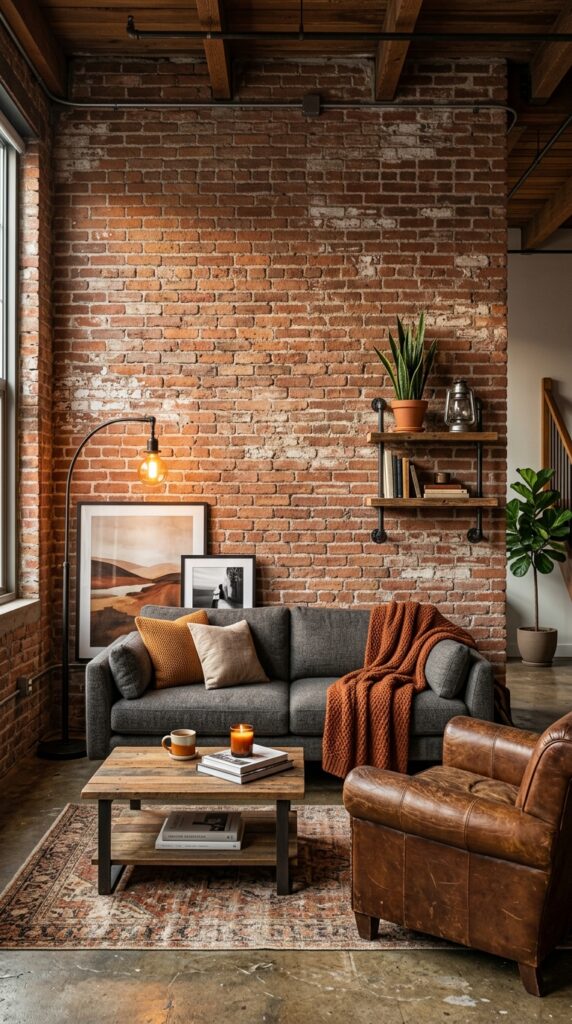
Vibe: Warm — a wall with a history written in every colour variation.
Why it works: Exposed brick is the material that most reliably communicates authentic industrial character, because its variation — colour shifts, old paint traces, repaired sections — is evidence of time and use that no new material can replicate. It functions as a textural anchor in the room, providing visual complexity that means every other surface can remain spare. The warm red-orange of fired clay plays beautifully against cool charcoal and black steel, creating the warm-cool contrast that makes industrial interiors feel inviting rather than institutional.
How to get it: If your brick is painted, use a chemical paint stripper rated for masonry (Peel Away or Dumond Smart Strip) rather than sanding — sanding destroys the surface texture permanently. Unsealed, slightly porous brick reads best in this style; if the wall is damp-prone, apply a clear breathable silicone masonry sealer (not a topcoat film).
Shop the Look
| Product |
| Iron pipe wall shelf bracket set reclaimed wood |
| Charcoal wool area rug modern industrial |
| Vintage factory floor lamp arc black iron |
| Reclaimed wood floating shelf rustic modern |
| Steel-frame canvas art print industrial |
3. Overscale Factory Window Frames

Vibe: Luminous — light arrives in a grid, marking the floor and the sofa with geometry.
Why it works: Multi-pane factory windows — the Crittall type or similar — do something that standard windows cannot: they frame the exterior as a series of smaller compositions rather than a single view, which creates visual rhythm across the wall and filters light into the room as a structured pattern. The shadow grid cast on the floor in afternoon light becomes a second design element. Deep window reveals — 6 to 8 inches of raw concrete or plaster — add shadow and depth that flush-frame windows entirely lack. Leave these windows untreated; curtains would defeat the architecture.
How to get it: Source powder-coated steel window frames from specialist fabricators — Crittall Windows, Hope’s Windows, or domestic equivalents — in matte black with 1.5-inch profile width. The slim profile is what differentiates architectural-grade frames from standard steel windows.
💡 Quick Win: Interior steel-look window dividers — thin metal strips adhered directly to existing glass using window film adhesive — cost $30–$60 per window and create the factory-pane aesthetic on any standard glazed window without replacement.
Shop the Look
| Product |
| Rubber tree plant indoor large modern |
| Matte black oversized floor planter pot |
| Crittall look window film strip adhesive |
| Concrete finish coffee table rectangular |
| Steel window frame wall art industrial print |
4. Reclaimed Wood and Black Steel Shelving System

Vibe: Curated — the shelves hold objects chosen with the same discipline as the room itself.
Why it works: The black iron pipe-and-reclaimed-wood shelving system is a foundational element of the industrial living room because it makes its construction logic completely legible: you can see exactly how it works, and that transparency is the point. The contrast between rough-hewn reclaimed wood and the precision of threaded pipe and flanges produces the material tension that defines industrial style. Scale matters here — use 2-inch-thick planks minimum, and extend shelving floor-to-ceiling rather than floating a few shelves mid-wall; the commitment to the full wall is what reads as architectural rather than decorative.
How to get it: Source reclaimed pine or oak from local salvage yards and cut to consistent depth (10–12 inches) but variable length — the slight inconsistency in plank width and grain reads as authentic. Sand lightly with 120-grit to remove splinters without losing surface character, then finish with raw linseed oil for protection.
Shop the Look
| Product |
| Black iron pipe shelf bracket set wall mount |
| Reclaimed wood plank shelf board natural |
| Wire mesh metal storage bin industrial |
| Cast iron bookend set modern minimal |
| Dried botanical arrangement brown glass vessel |
5. Polished Concrete Floors with Area Rug Zoning
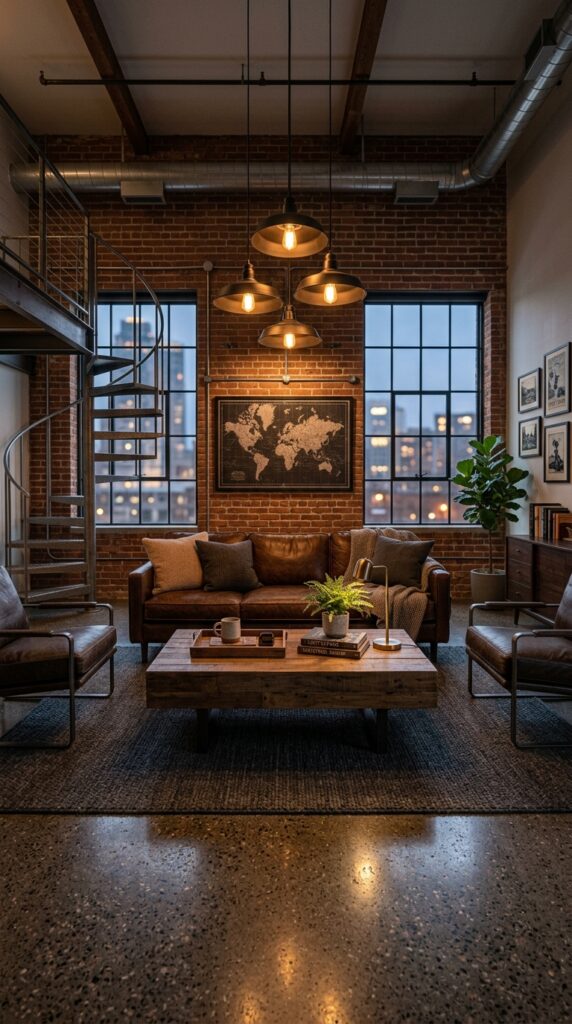
Vibe: Grounded — the rug draws a room within the room, pulling warmth from the cold floor beneath.
Why it works: Polished concrete in an industrial living room reads as both floor and material statement — its aggregate visible beneath the surface, its reflectivity shifting with light throughout the day. But raw concrete alone can feel unanchored in a large room, which is where the area rug performs its spatial function: defining the seating zone as a distinct territory within the open plan. The rug’s colour should hold a close value relationship with the concrete — charcoal over dark grey, or warm oatmeal over a lighter mix — so the transition reads as tonal rather than contrasting.
How to get it: Specify a 3000 PSI slab poured to a minimum 4-inch depth and polished to a Level 2 finish (visible aggregate at the surface) using a planetary grinder. Seal with a penetrating densifier, not a topcoat, to preserve the natural aggregate character.
Shop the Look
| Product |
| Charcoal wool area rug 9×12 industrial modern |
| Reclaimed wood serving tray handles dark |
| Large framed world map art print black steel frame |
| Low profile steel frame coffee table glass top |
| Industrial floor lamp tripod matte black |
6. Edison Bulb Pendant Cluster

Vibe: Moody — the room exists only within the amber radius of those bulbs.
Why it works: A cluster of Edison pendants at varied heights creates a lighting focal point that is simultaneously functional and sculptural — the bulbs themselves are the art. The visible filament of a carbon-filament Edison bulb at 2200K produces the warmest, most amber light available in residential fixtures, shifting the room’s entire tonality toward evening warmth regardless of the hour. Varying cord lengths by 12-inch increments, from 24 to 72 inches, creates a cascading form that fills dead ceiling height without structure. A single multi-port canopy accepts up to 9 cords and keeps the ceiling installation clean.
How to get it: Wire all pendants to a single dimmer circuit — the cluster effect depends entirely on dimming capability. At full brightness, Edison clusters read as workspace lighting; at 40–60%, they become the atmosphere the style requires.
💡 Quick Win: A 9-pendant Edison cluster kit with canopy, cords, and bulbs runs $85–$150 online and replaces a standard ceiling fixture in under two hours with a basic ceiling medallion and junction box.
Shop the Look
| Product |
| Edison bulb pendant cluster kit 9 light black canopy |
| Carbon filament Edison bulb set warm 2200K |
| Single pole dimmer switch black modern |
| Ceiling medallion plaster round minimal |
| Round reclaimed wood coffee table industrial |
7. Channel-Tufted Leather Sofa in Dark Cognac

Vibe: Sun-warmed — full-grain leather in the afternoon light is one of the warmest things in any room.
Why it works: Full-grain leather in dark cognac is the textile choice that most directly references the industrial interior’s historical origins — the worn leather of factory seating, tool bags, and aprons. Unlike aniline-dyed or corrected grain leathers, full-grain develops a patina over years of use that deepens the colour and character of the piece, making it a material that improves with time rather than deteriorating. Channel tufting — horizontal rows of stitched channels — is the construction detail that elevates the sofa from purely utilitarian to architecturally considered, providing surface texture that reads beautifully against the flat planes of concrete and steel.
How to get it: When sourcing leather sofas, request the leather grade specifications — “full-grain” is the only grade that develops patina. Pull-up or aniline leather shows the natural grain; avoid “bonded leather” or “PU leather” entirely in this style. Condition the leather with Leather Honey conditioner every six months.
Shop the Look
| Product |
| Full grain leather sofa cognac channel tufted |
| Chunky knit throw blanket charcoal grey |
| Worn leather accent pillow brown vintage |
| Steel end table round industrial modern |
| Leather honey conditioner furniture care |
8. Vintage Industrial Floor Lamp

Vibe: Intimate — the lamp draws the chair into its own small world.
Why it works: An articulated factory floor lamp — the type derived from drafting and industrial workstation lamps — brings task-lighting logic into the living room with functional honesty. Its adjustability is not a decorative feature but a structural truth: the arm moves because it was designed to move, and that mechanical legibility is precisely what the industrial style prizes. The spun aluminium shade directs light with precision rather than diffusing it in all directions, creating pools of warm light that give the room depth and shadow — which flat ambient lighting never achieves.
How to get it: Source vintage or vintage-reproduction industrial floor lamps from brands like Jielde (the French original) or domestic reproductions. The key quality signal is weight — an authentic cast iron base should be heavy enough to require two hands to relocate. Fit with a 40W equivalent warm LED globe bulb at 2700K.
💡 Quick Win: A single Jielde-style articulated floor lamp reproduction from a domestic retailer runs $80–$180 and transforms the corner of any living room — pair it with a leather chair and a stack of books for the full composition.
Shop the Look
| Product |
| Industrial articulated floor lamp black iron |
| Vintage style arc arm reading lamp adjustable |
| Leather reading chair accent cognac |
| Book stack decorative hardcover neutral |
| Small steel tray rectangular black modern |
9. Gunmetal and Rust Accent Color Palette

Vibe: Layered — the rust reads as earned, not applied, and the room feels like it has been here for decades.
Why it works: The gunmetal-to-rust palette is the most specifically industrial colour story available because both tones reference actual material processes: gunmetal is the tone of cold-rolled steel fresh from the mill, and rust orange is what happens to that steel when time and moisture interact. Using both in a single room references the lifecycle of the material — new and aged simultaneously. Rust orange works best in small doses — one ceramic vessel, one pillow cover, the face of a fireplace surround — against larger fields of gunmetal grey and concrete. Too much rust reads as autumnal farmhouse; too little reads as an accident.
How to get it: Mix the rust accent by applying iron powder plaster (Meoded Paint or similar) to one surface — a fireplace surround, a console table top, a section of wall — and activating it with an acidic solution to produce genuine oxidization in controlled patterns. Budget $60–$90 for a 20-square-foot section.
Shop the Look
| Product |
| Rust orange ceramic decorative vessel modern |
| Iron powder wall paint industrial finish |
| Gunmetal grey linen pillow cover set |
| Steel fireplace surround minimal modern |
| Concrete shelf bracket wall mount industrial |
10. Oversized Industrial Clock as Focal Point
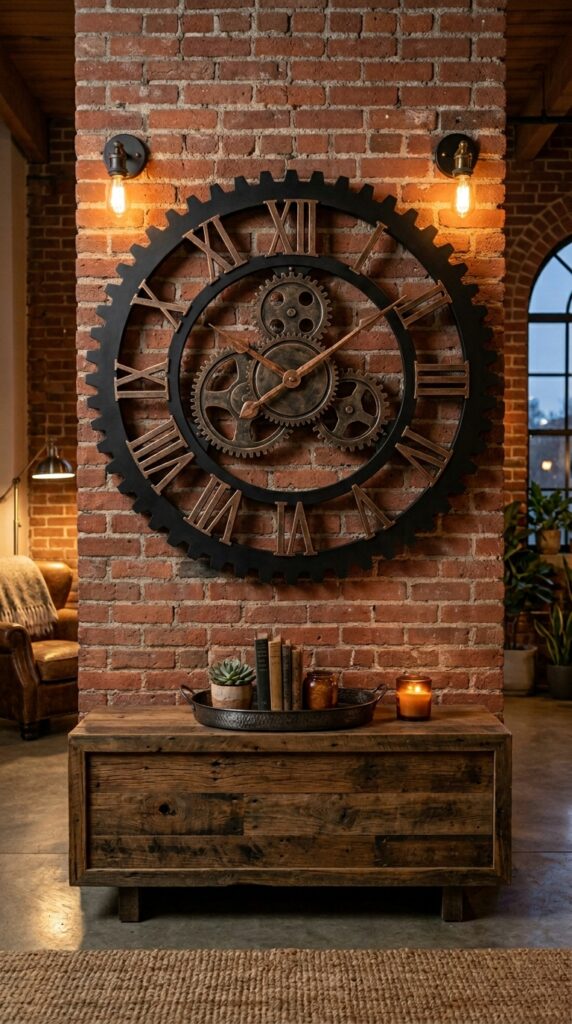
Vibe: Graphic — the clock commands the wall the way a factory foreman commanded the floor.
Why it works: An oversized industrial clock functions as the living room’s primary focal element because it provides scale, geometry, and a reference to time — the organizing principle of industrial work culture — in a single object. At 36 inches in diameter or larger, the clock becomes architectural rather than decorative, its circular form contrasting with the rectangular geometry of everything else in the room. The Roman numeral face and visible gear mechanism are design details that communicate mechanical heritage; avoid digital or minimal-dial faces, which lose the referential value entirely.
How to get it: Position the clock at eye level when seated — approximately 58 to 62 inches from floor to centre — rather than at standard picture-hanging height (which reads too high for an object this large). Use four anchor points through the drywall into studs; a 36-inch iron clock weighs 8–14 lbs and requires genuine wall anchoring.
Shop the Look
| Product |
| Oversized iron wall clock 36 inch industrial gear |
| Reclaimed wood credenza sideboard dark |
| Metal decorative tray black industrial |
| Industrial wall sconce plug-in black |
| Aged bronze candle holder set |
11. Matte Black Metal Furniture Frames

Vibe: Precise — furniture reduced to its structural minimum.
Why it works: Using matte black metal frames consistently across multiple pieces of furniture — sofa, coffee table, shelving, side table — creates a visual grammar that unifies the room without requiring identical pieces. The frame becomes the common language: you can mix a reclaimed wood coffee table top with a linen sofa cushion with a glass shelf and they read as part of the same family because the structural skeleton is the same material in the same finish. Powder-coated flat-bar steel is the most refined option; avoid tubular steel frames, which read as institutional office furniture.
How to get it: Prioritise pieces with welded (not bolted) corner connections — the weld creates a cleaner corner and signals quality of construction. Feel the frame thickness: 2mm flat bar minimum on a coffee table; thinner steel flexes under load and reads as cheap regardless of the finish.
💡 Quick Win: Replace a standard wood-frame coffee table with a flat-bar steel version at $180–$300 — this single swap immediately shifts the room’s material register toward genuinely industrial.
Shop the Look
| Product |
| Flat bar steel coffee table reclaimed wood top |
| Matte black steel frame sofa modern industrial |
| Steel frame bookshelf wall unit black |
| Cream linen throw pillow set modern |
| Ceramic accent bowl small minimal |
12. Concrete Fireplace Surround

Vibe: Elemental — a fireplace that looks like the wall decided to become warm.
Why it works: A monolithic poured concrete fireplace surround is the most architecturally resolved option for an industrial living room because it treats the fireplace as a continuation of the wall rather than an object placed against it. No tile, no brick, no mantle moulding — just the same material flowing from floor to ceiling, with a single horizontal shelf integrated at mantle height and a linear steel insert recessed into the mass. The scale should be proportional to the room: a surround that runs 12 to 14 feet to the ceiling transforms a standard fireplace into a room-defining architectural gesture.
How to get it: GFRC (Glass Fibre Reinforced Concrete) panels are the practical alternative to monolithic poured concrete for retrofit situations — they can be fabricated off-site, delivered in sections, and adhered to an existing fireplace surround for $2,000–$5,000, compared to $8,000–$15,000 for poured-in-place concrete.
Shop the Look
| Product |
| Concrete look fireplace mantel shelf modern |
| Linear black steel fireplace insert cover |
| Large ceramic vessel fireplace mantle decor |
| Tall taper candle holder iron modern |
| GFRC concrete wall panel grey interior |
13. Industrial Pipe Shelving with Raw Plank
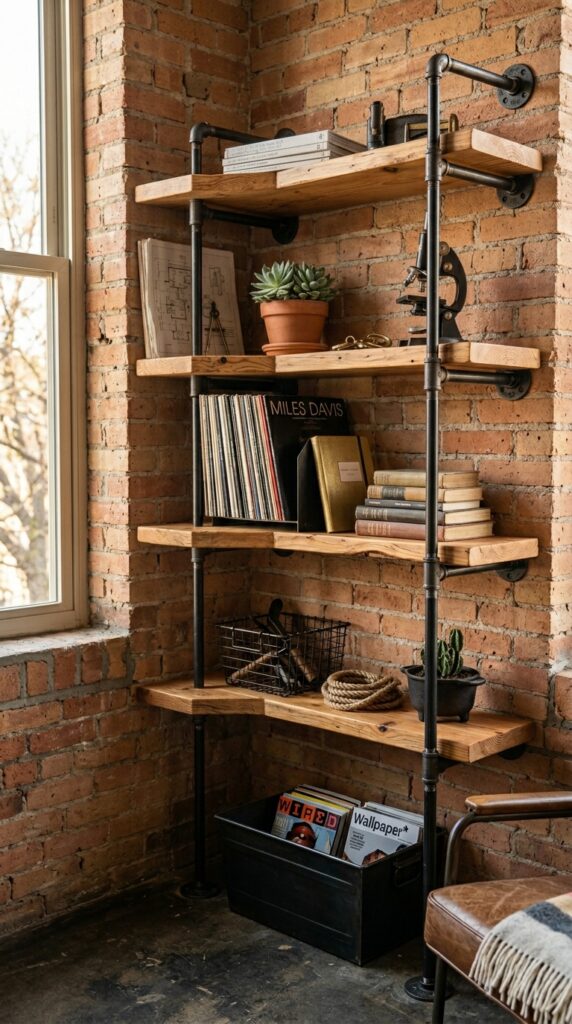
Vibe: Utilitarian — shelving that would look right in a hardware store and somehow looks right here too.
Why it works: Black iron pipe shelving shows its structural logic entirely — you see the floor flange, the upright, the elbow, the horizontal run, the bracket, the shelf — every connection is legible and purposeful. This total transparency of construction is the defining value of industrial design expressed in a functional storage element. Corner installations are especially effective because the pipe structure wraps the corner, creating a three-dimensional armature that reads as genuinely site-specific rather than furniture placed in a room.
How to get it: Source plumbing-grade black iron pipe from any hardware store — 3/4-inch pipe is the standard for shelving applications. Cut to length with a pipe cutter ($25) and thread the ends with a die set for a fully custom installation. Leave the pipe unfinished for authentic patina, or seal with matte furniture wax to prevent transfer marks.
Shop the Look
| Product |
| Black iron pipe shelf kit flanges fittings |
| Magazine holder iron bin industrial |
| Vinyl record storage stand steel black |
| Cast iron plant pot small succulent |
| Raw pine wood plank board shelf natural |
14. Deep Charcoal Painted Walls
Vibe: Enveloping — a room that wraps around you rather than opening up.
Why it works: Deep charcoal walls — specifically tones with a brown or red undertone, like Sherwin-Williams Urbane Bronze SW 7048 or Farrow & Ball Railings — do something in an industrial living room that grey or black cannot: they read as warm at night under artificial light while remaining graphically dark during the day. The warm undertone prevents the room from feeling cold or oppressive. Crucially, dark walls eliminate the wall as a background and make every object — a natural oak shelf, a leather sofa, an amber pendant — appear to float forward with heightened presence.
How to get it: Paint the walls in deep charcoal but keep the ceiling white (Benjamin Moore White Dove or similar) — the contrast between the dark field and the bright ceiling is what maintains the room’s sense of volume. Avoid taking the dark paint onto the ceiling; it shrinks the space irreversibly.
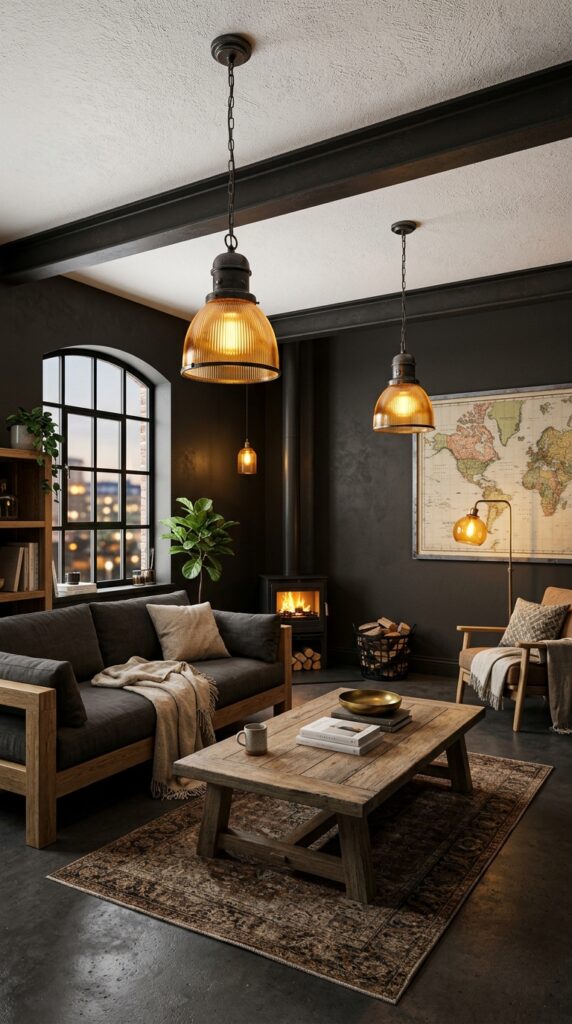
💡 Quick Win: One litre of Farrow & Ball Railings as a sample tested on a full 4×4-foot section of wall, viewed under both daylight and evening lamplight, is the only way to commit to a dark paint choice correctly. Budget $18 for the sample before committing to 3 gallons.
Shop the Look
| Product |
| Deep charcoal interior wall paint sample modern |
| Amber glass pendant light industrial vintage |
| Vintage map art print steel frame large |
| Natural oak accent table minimal |
| Linen throw natural grey chunky weave |
15. Poured Concrete Coffee Table
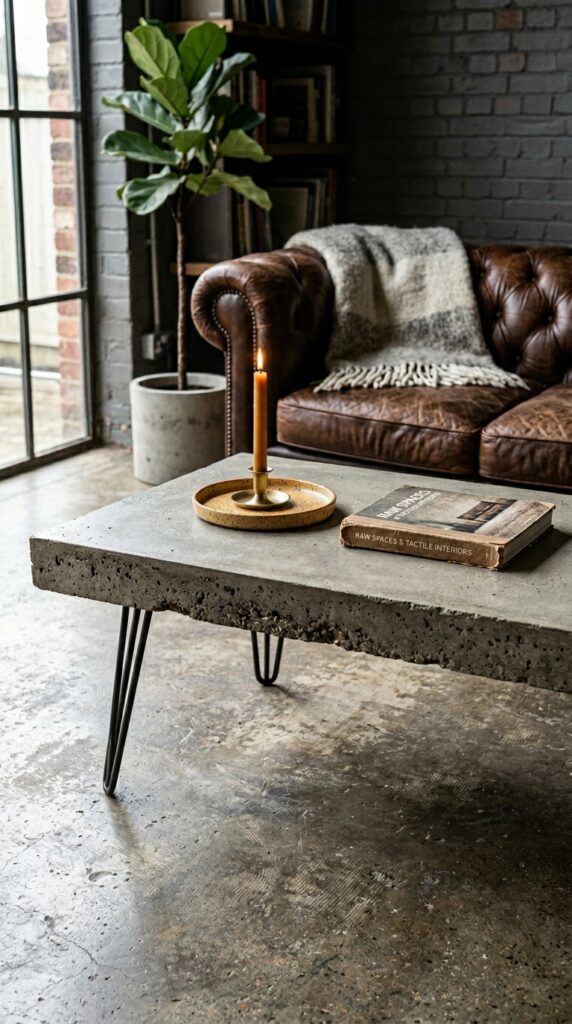
Vibe: Tactile — a surface you find yourself running a hand across without thinking about it.
Why it works: A poured concrete coffee table is one of the most materially specific choices in the industrial living room because it is genuinely heavy, genuinely cold to the touch, and genuinely demanding of its space — qualities that distinguish it from lightweight furniture that reads as temporary. The aggregate visible through the sealed surface connects to the material honesty of concrete floors and walls, reinforcing the room’s internal material logic. Hairpin legs in blackened steel provide structural contrast — the slim legs against the massive top — that is both engineering-honest and visually dynamic.
How to get it: DIY concrete coffee tables using Quikrete 5000 or similar high-strength mix in a melamine mold are fully achievable at $80–$150 in materials. The key is vibrating out air bubbles with a orbital sander applied to the outside of the mold while the concrete is wet, and sealing with a penetrating sealer (not an epoxy) after 28-day cure.
Shop the Look
| Product |
| Concrete coffee table poured modern industrial |
| Hairpin leg set 4 steel blackened 16 inch |
| Ceramic decorative tray industrial modern |
| Concrete look candle pillar holder |
| Industrial coffee table book architecture |
16. Salvaged Factory Doors as Room Dividers
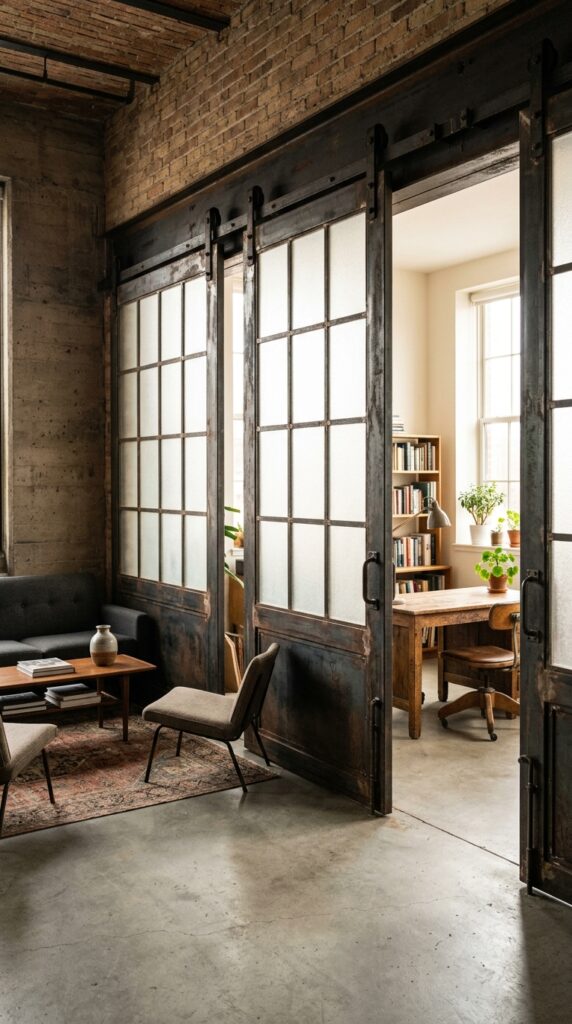
Vibe: Architectural — the boundary between rooms is itself an artefact.
Why it works: Salvaged factory doors used as room dividers serve a specific spatial function in open-plan industrial living rooms: they create permeability between zones — allowing light and sightlines to pass through the glass panels while providing acoustic separation when closed — without the finality of a solid wall. The visible age and patina of original factory steel reads as authentically industrial in a way that new manufactured sliding glass doors cannot replicate. The overhead track and exposed hardware continue the room’s vocabulary of visible construction logic.
How to get it: Source salvaged steel-and-glass factory doors from architectural salvage dealers, or from industrial buildings undergoing renovation. Standard factory door sizes run 36 to 48 inches wide — two doors hung side by side create a full room-width divider. Install on a commercial-grade overhead track rated for the door weight (typically 80–150 lbs per leaf).
Shop the Look
| Product |
| Industrial steel frame glass sliding door kit |
| Commercial barn door track hardware black |
| Frosted glass window film panel privacy |
| Steel door pull handle industrial black |
| Floor guide stop bar sliding door hardware |
17. Open-Plan Kitchen-Living Zone with Steel Island

Vibe: Purposeful — a room organised around the serious pleasure of cooking and gathering.
Why it works: The kitchen island in an open-plan industrial loft is the room’s primary organising element — it defines the kitchen zone, provides a social surface for gathering, and carries the room’s material identity in a single object. A welded blackened steel frame with a reclaimed oak top is the most materially resolved option: the steel carries the kitchen’s functional identity and the reclaimed wood provides warmth and horizontal visual anchor. Open lower shelving keeps cast iron and kitchen objects visible, which is appropriate to the style’s commitment to functional honesty.
How to get it: Size the island at a minimum 36 inches deep and 72 inches long — smaller islands read as furniture, not architecture. Position it so that the long axis runs parallel to the main sight line from the living zone, making the reclaimed wood top visible as a horizontal datum from across the room.
💡 Quick Win: Replace standard kitchen cabinet hardware with blackened steel pulls ($8–$15 per pull) and update the island countertop with a peel-and-stick reclaimed wood veneer — both changes together run under $200 and shift the kitchen’s register entirely.
Shop the Look
| Product |
| Blackened steel kitchen island frame DIY |
| Reclaimed wood butcher block countertop dark |
| Cast iron skillet set kitchen display |
| Industrial pendant light over island black |
| Matte black kitchen cabinet pull hardware |
18. Vintage Map or Blueprint Wall Art
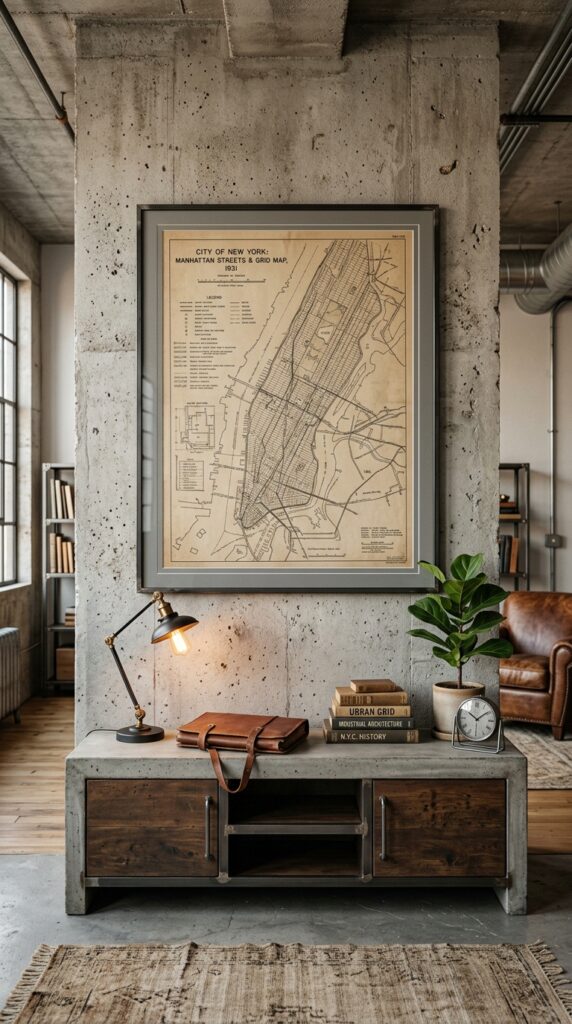
Vibe: Intellectual — a room that suggests someone here thinks carefully about the world.
Why it works: Vintage blueprints, architectural drawings, or city maps at large scale function as industrial living room art for a precise reason: they reference the technical documentation culture of manufacturing and design — the blueprints from which objects were built, the surveys from which cities were planned. Their graphic quality (fine lines, technical notation, monochrome or sepia tones) sits naturally within the industrial palette without competing with the room’s material richness. At 36×48 inches or larger, a single framed architectural print has the visual weight to anchor a full wall above a credenza.
How to get it: Source vintage engineering drawings, USGS topographic maps, or patent drawings through Library of Congress digital collections (public domain, free to download and print) or through specialist art print retailers. Have them printed at a reprographics centre on 24-lb bond paper at $15–$40 per print, then frame in thin-profile steel.
Shop the Look
| Product |
| Large framed blueprint city map print industrial |
| Thin black steel picture frame 36×48 |
| Industrial desk lamp articulated arm black |
| Leather portfolio folio cover dark brown |
| Low concrete credenza sideboard modern |
19. Layered Industrial Rugs — Jute Over Sisal

Vibe: Warm — two natural textures competing gently for the same space, and both winning.
Why it works: Layering rugs in an industrial living room solves a specific problem: a single rug on concrete reads as insufficient — not enough material warmth to balance the hard surfaces overhead and on the walls. Two layered rugs, offset so the lower layer is visible on all sides, create a zone with genuine textile depth without requiring a large luxury rug investment. Natural fibre on natural fibre — sisal and jute, or jute and hemp — maintains material honesty and avoids the synthetic quality of nylon or polyester pile rugs, which read as incongruous in this style.
How to get it: Always place the larger, lower-pile rug as the base (sisal or seagrass) and the smaller, textured rug on top (jute or wool). Offset the top rug by 12 to 18 inches toward the primary seating direction. Use a non-slip rug pad between the two layers to prevent movement.
Shop the Look
| Product |
| Natural sisal area rug 9×12 modern industrial |
| Chunky jute rug natural 6×9 layering |
| Non-slip rug pad for hard floors |
| Terracotta plant pot cactus large |
| Low steel frame sofa industrial modern |
20. Reclaimed Wood Accent Wall
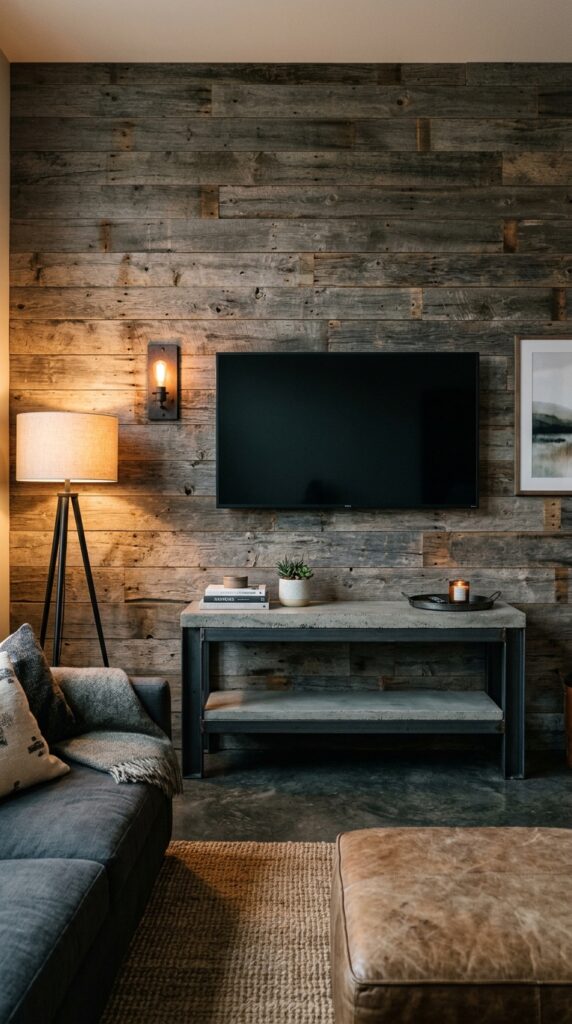
Vibe: Warm — the wall reads like a surface that has been somewhere before this room.
Why it works: Reclaimed barn wood installed horizontally creates a strong directional accent that extends the perceived width of a living room while delivering a concentrated dose of material history — the nail holes, surface patina, and colour variation of wood that has weathered for decades. As a TV wall, it solves the visual problem of the television — a black rectangle on a white wall reads as an intrusion, while the same screen against the graphic texture of reclaimed wood becomes part of a composed scene. The horizontal grain direction also echoes the low window bands and shelving datums that characterise good industrial interiors.
How to get it: Source reclaimed barn wood planks pre-cut and kiln-dried to remove moisture (raw barn wood installed on interior walls will warp as it acclimates — kiln-drying is non-negotiable). Install horizontally with a 1/8-inch gap between boards using a consistent spacer. Leave unsealed for the first 6 months to allow the wood to finish acclimating, then apply a clear satin furniture wax.
Shop the Look
| Product |
| Reclaimed barn wood wall plank peel stick |
| Floating TV console steel and wood industrial |
| Industrial iron wall sconce plug-in black |
| TV wall mount tilt swivel black |
| Clear satin wax furniture finish indoor wood |
21. Low-Slung Leather Sofa with Metal Legs
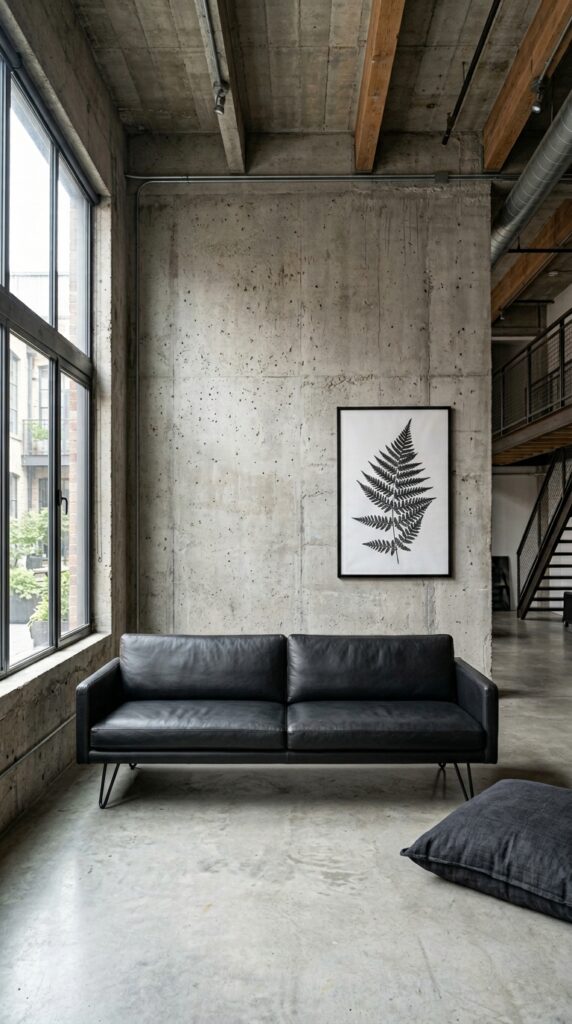
Vibe: Cool — low furniture in a high room is a specific architectural conversation about scale.
Why it works: A low-slung sofa — seat height 14 to 16 inches — in a room with high ceilings creates an exaggerated sense of vertical space by pushing the primary furniture plane as far from the ceiling as possible. This is a compositional technique from mid-century Japanese and European design: the contrast between the low horizontal of the seating and the tall vertical of the room makes both dimensions feel more extreme. Black leather on hairpin legs maintains the formal language of the room while the reduced profile gives the floor — concrete, in this case — the visual prominence it deserves.
How to get it: Replace standard sofa legs with a set of custom hairpin legs at the appropriate height — most sofas accept removable legs in standard thread sizes. Hairpin leg sets in blackened steel at 8-inch height run $45–$90 for a set of four and lower any existing sofa into this more resolved proportion.
Shop the Look
| Product |
| Hairpin leg set 4 blackened steel 8 inch sofa |
| Large botanical art print black frame modern |
| Black full grain leather sofa modern minimal |
| Oversized floor cushion grey linen |
| Concrete finish floor sealer matte |
22. Industrial Pendant Over Reading Nook

Vibe: Intimate — this corner has been claimed for serious reading.
Why it works: A reading nook in an industrial living room succeeds when the pendant light defines the zone from above — the cone of light from a factory shade draws an invisible circle on the floor that makes the armchair feel as though it occupies a dedicated room within the room. The shade geometry matters: a deep dome or cone shade (12 to 16 inches in depth) directs light downward with precision; a shallow shade floods the room and loses the intimate quality entirely. The pendant should hang at 58 to 62 inches from floor level when serving a seated person — lower than standard pendant height.
How to get it: A cord-and-canopy pendant kit in matte black with a 14-inch spun steel shade runs $45–$90 and can be installed at any height over a standard ceiling outlet. Use a cloth-wrapped twisted cord rather than plastic-sheathed wire — the textile cord is the visible detail that communicates intentionality.
💡 Quick Win: A plug-in pendant with a cloth cord, hung from a ceiling hook (no electrical work required), costs $35–$65 and creates the nook effect in an afternoon. Drill a single hook into a joist, plug in, and position.
Shop the Look
| Product |
| Plug-in pendant light factory shade black cord |
| Cast iron side table industrial small round |
| Worn leather armchair vintage cognac |
| Ceramic mug minimalist black |
| Book stack set decorative hardcover |
23. Brick-and-Steel Corner Fireplace
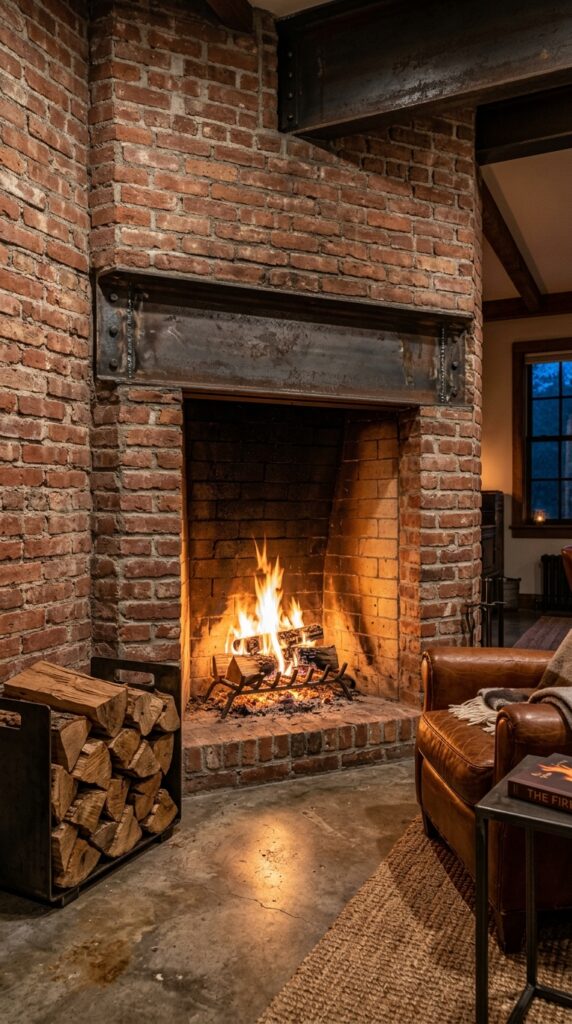
Vibe: Raw — the fire here looks exactly like fire looked in the building this room once was.
Why it works: A corner fireplace with a raw steel lintel and no decorative surround achieves maximum material honesty in the industrial idiom — nothing is added to the structural and thermal logic of the object. The exposed fire brick interior, the angle-iron lintel, and the bare brick flanking walls are all materials that are performing a function rather than performing a style. Corner placement is particularly effective in a barn or loft plan because it activates two walls simultaneously and provides warmth to a larger area of the room.
How to get it: If building new, specify a masonry corner fireplace with a structural steel angle-iron lintel at 1/4-inch plate minimum and leave all surfaces unsealed. If retrofitting, strip existing mantel moulding back to the brick surround and fabricate a replacement lintel in flat-bar steel, painted with high-temperature Rustoleum flat black.
Shop the Look
| Product |
| Steel angle iron lintel fireplace blackened |
| Fire brick replacement tile interior |
| Firewood log rack holder iron black |
| High temp flat black fireplace paint spray |
| Leather fireside gloves industrial |
24. Exposed Ductwork and Mechanical Ceiling

Vibe: Honest — a ceiling that refuses to pretend the building is anything other than what it is.
Why it works: Painting all exposed ceiling mechanical systems — ductwork, conduit, sprinkler pipes — in a single uniform matte black and leaving them exposed achieves a specific visual result: the ceiling reads as a single dark field rather than a collection of miscellaneous objects. The uniformity of colour is the key technique; leaving systems in their native colours (silver duct, grey conduit, red sprinklers) creates visual chaos rather than industrial character. The dark ceiling plane also makes any furniture below appear to recede from the ceiling, exaggerating perceived room height.
How to get it: Use Rust-Oleum Chalked Ultra Matte paint in Carbon or a dedicated appliance-grade black for the ductwork — standard flat wall paint at ceiling temperature will peel within 18 months. Clean all surfaces with a degreaser before painting; dust and grease contamination is the primary reason this finish fails.
Shop the Look
| Product |
| Matte black chalk spray paint metal surfaces |
| Track lighting kit matte black ceiling mount 4 head |
| Metal degreaser cleaner industrial spray |
| Black EMT conduit connector hardware set |
| Industrial style ceiling mount light track rail |
25. Vintage Leather Trunk as Coffee Table
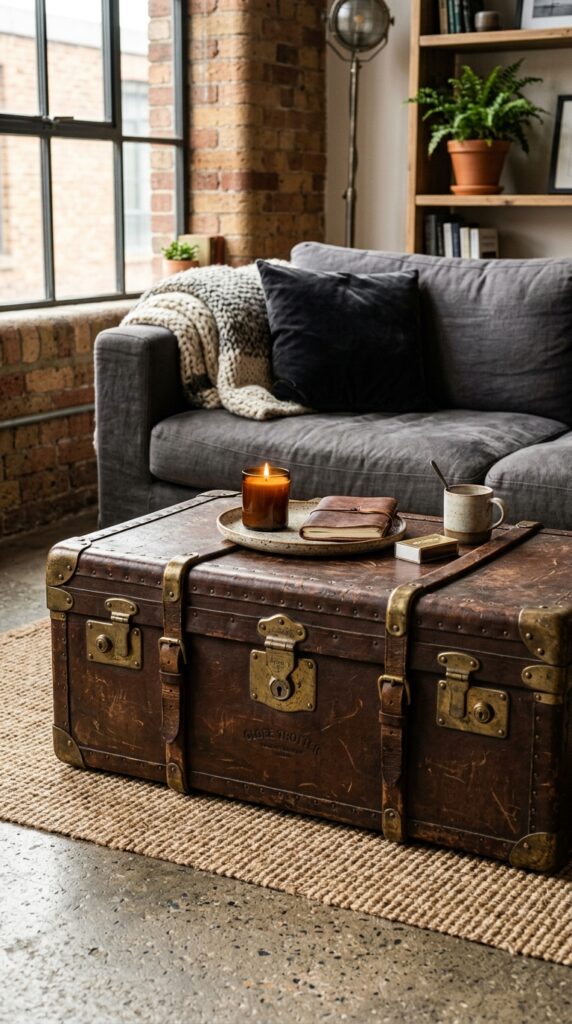
Vibe: Storied — a piece that carries years of use as a form of decoration.
Why it works: A vintage leather trunk repurposed as a coffee table is one of the most effective single objects in an industrial living room because it provides surface, storage, and a level of material age that no new piece can replicate — and it does all three things simultaneously. The patina of a genuine leather trunk develops over decades into a surface that reads as living history, connecting the room’s industrial philosophy to actual time and use. The aged brass hardware at the corners provides the room’s warmest metal tone, balancing the cooler black steel elements throughout the space.
How to get it: Source vintage steamer trunks from estate sales, antique markets, or specialist online dealers. Size matters: a trunk that functions as a coffee table needs a minimum 36-inch length and 18-inch height — larger trunks (42-inch and above) have enough surface area for practical daily use. Line the interior with cedar for storage of textiles.
💡 Quick Win: A modern reproduction leather trunk at $150–$250 provides the storage and surface functionality immediately — condition it with neatsfoot oil and set it in direct sunlight for one afternoon to begin accelerating the patina development.
Shop the Look
| Product |
| Vintage leather trunk storage coffee table |
| Cedar liner closet organizer shelf insert |
| Small decorative objects set industrial aesthetic |
| Aged brass tray serving rectangular |
| Neatsfoot leather conditioner oil natural |
26. Compact Industrial Living Room — Small Space Adaptation
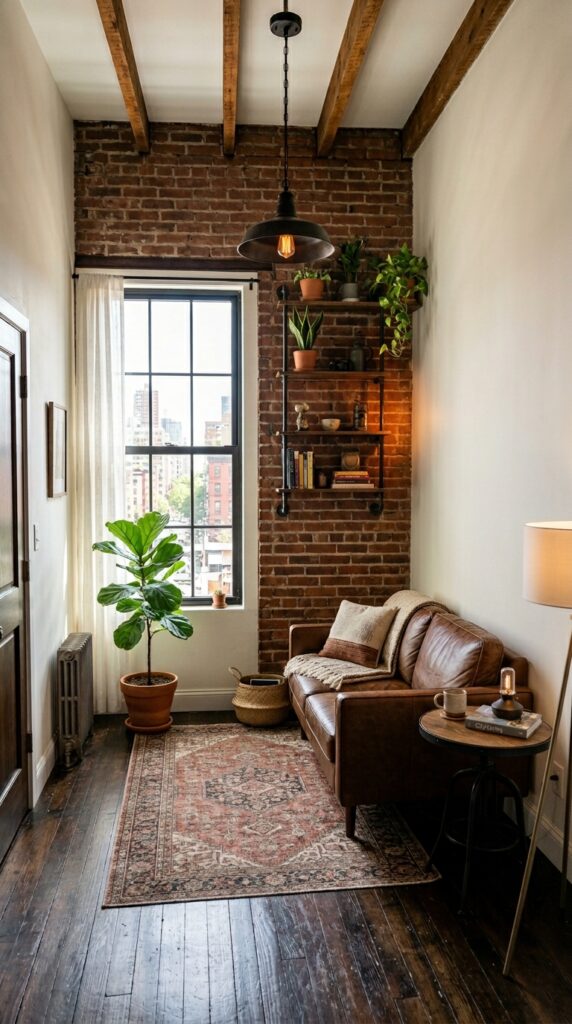
Vibe: Warm — a small room that knows exactly what it is and commits to it entirely.
Why it works: In a small industrial living room, the design rule is radical editing: one raw material feature (a single brick wall, or exposed concrete on just the ceiling) anchors the room’s identity, while all other surfaces remain white plaster to preserve light and perceived volume. Mounting all storage on the walls via pipe shelving keeps the floor entirely clear — the visual expanse of uninterrupted flooring is the single most effective technique for making a small room read larger. Low-profile furniture with exposed legs rather than skirts allows light to pass beneath, reinforcing the open quality.
How to get it: In a small room, resist the urge to add multiple industrial features — the stacked effect becomes claustrophobic. Choose one anchor material and build around it. If you have exposed brick, skip the pipe shelving and use simple bracket shelves in matte black instead, so the brick wall remains the visual hero.
Shop the Look
| Product |
| Compact two-seat leather sofa apartment size |
| Matte black shelf bracket minimal pair |
| Small iron round side table black |
| Large indoor plant fiddle leaf dark pot |
| Simple white pendant lamp minimal ceiling |
27. Steel-Frame Bookshelf as Room Divider
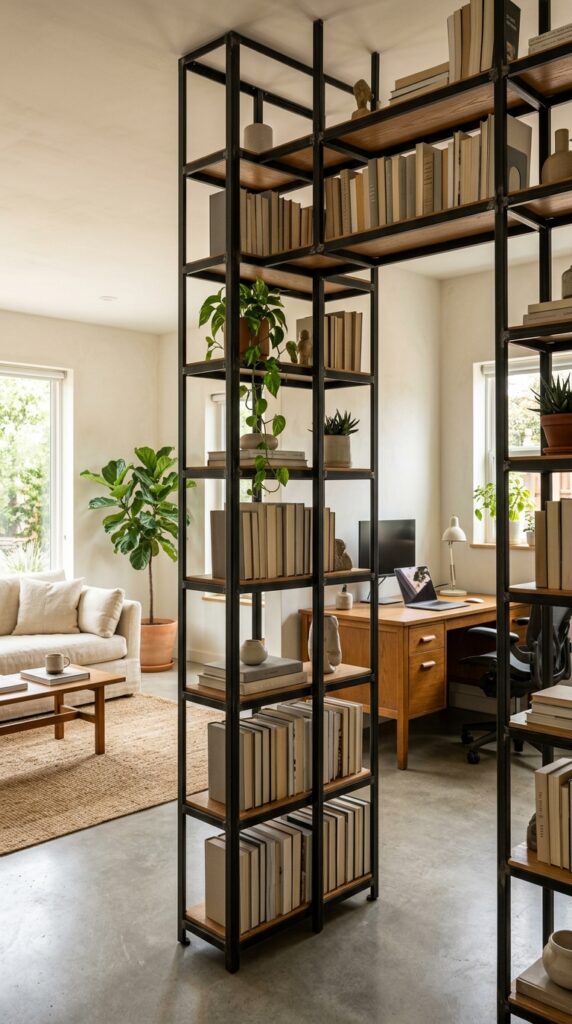
Vibe: Architectural — the boundary between rooms is made of things you love.
Why it works: An open steel-frame bookshelf used as a room divider is one of the most spatially intelligent moves in a small industrial loft or apartment — it defines two zones without closing off either, allows light to pass freely between spaces, and provides storage accessible from both sides simultaneously. The matte black steel frame reads as a continuation of the room’s iron pipe shelving vocabulary. At 84 inches (floor-to-ceiling), the unit creates a visual zone boundary at ceiling height, reinforcing the division without a physical wall.
How to get it: Specify a bookshelf unit with 12-inch shelf depth on both sides — standard single-sided bookshelves are typically 12 inches deep, which works for access from one side only. Custom fabrication in 1.5mm cold-rolled steel with powder-coat finish runs $800–$1,400 for an 84×48 inch unit.
💡 Quick Win: Two identical 84-inch IKEA Billy bookcases in black-brown, placed back-to-back and secured to each other and the ceiling with anti-tip hardware, creates the functional equivalent for $200–$300 and can be disassembled when you move.
Shop the Look
| Product |
| Floor to ceiling steel bookcase room divider black |
| Anti-tip furniture strap ceiling anchor kit |
| Trailing pothos plant small hanger |
| Neutral linen book cover set library |
| Ceramic object set shelf display industrial |
28. Dark Moody Accent — Charcoal, Velvet, and Steel
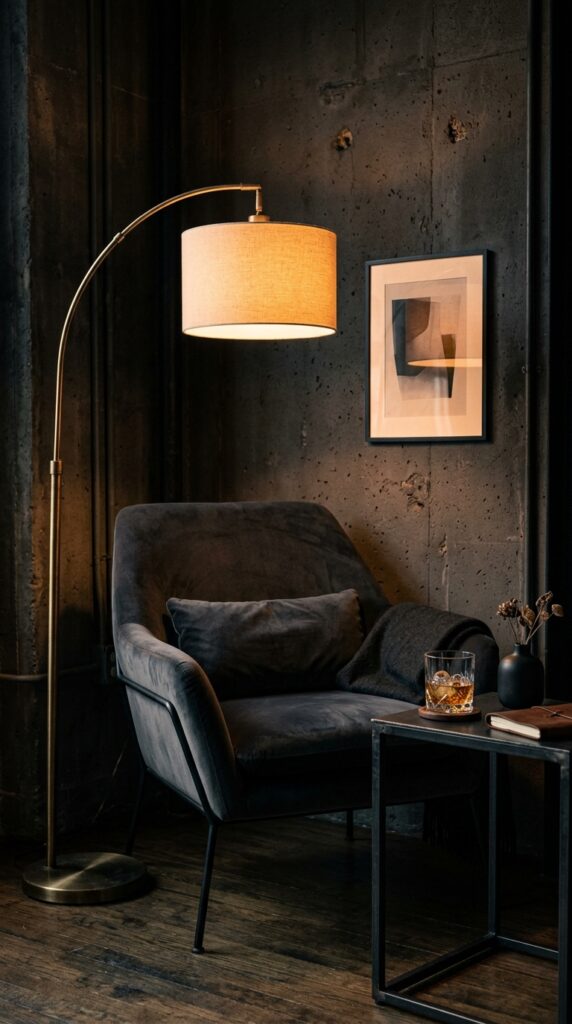
Vibe: Moody — a corner that makes you want to sit down and stay for a long time.
Why it works: Introducing a single velvet accent into an otherwise hard-material industrial room creates a sensory counterpoint that deepens the room’s atmosphere rather than compromising its character. Velvet in deep charcoal, grey-green, or ink blue reads as masculine and restrained — not decorative or soft — and its light-absorbing quality means it shifts tone dramatically between morning and evening light, giving the chair a different character depending on when you use it. The aged brass arc lamp is the only warm metal in the room, and its contrast with the matte black and concrete surroundings makes the amber light it produces feel especially generous.
How to get it: Choose velvet upholstery with a cotton or linen base rather than polyester — cotton velvet crushes differently than polyester pile and develops a more natural, less synthetic character over time. The crush marks in the fabric from daily use become part of the material record, consistent with the industrial style’s acceptance of wear as beauty.
Shop the Look
| Product |
| Charcoal velvet accent chair steel legs modern |
| Aged brass arc floor lamp linen shade |
| Blackened steel round side table small |
| Dark concrete look wall paint interior grey |
| Whiskey glass set rocks glasses heavy base |
How to Start Your Industrial Living Room Transformation
Start with one decision: replace your light bulbs with 2200K carbon-filament Edison bulbs throughout the entire room in a single evening. This is the intervention with the highest immediate impact at the lowest cost — it shifts every surface in the room, from concrete to leather to brick to plaster, toward a warmer, moodier tonality that is the atmospheric foundation of industrial design. Once the light is right, every subsequent choice becomes easier to evaluate correctly, because you are seeing the room at its intended temperature.
The most common mistake is treating industrial style as a collection of props — adding a few pipes, some Edison bulbs, and calling it done — without addressing the room’s fundamental architecture. The specific error is leaving ceilings in standard 8-foot height with flat white paint and trying to compensate with accessories. In this style, the ceiling is the room. If you cannot raise it, paint it: a deep charcoal ceiling in an 8-foot room creates perceived depth that a white ceiling at the same height cannot. Flat accessories on a bland ceiling do not overcome the architectural limitation; addressing the ceiling directly does.
Three specific items under $50 that create immediate industrial impact: a set of four vintage-style metal outlet and switch covers in matte black ($18 for a set of four at any hardware store), a concrete candle holder set in raw grey finish ($24–$32 at most homeware retailers), and a single 36-inch section of black iron pipe mounted horizontally on the wall as a hanging rail for blankets or bags ($28–$45 in plumbing supplies).
A starter transformation — new bulbs, one paint colour on a feature wall, two or three key accessories — runs $300–$700 and takes a committed weekend. A full living room transformation including key furniture, lighting, and one structural material element (brick exposure, concrete application, or steel shelving system) runs $4,000–$12,000 and takes two to four months of sourcing and installation. Patience in sourcing — waiting for the right vintage leather trunk, the right salvage find — always produces a better result than buying new equivalents at speed.
Frequently Asked Questions About Industrial Living Room Design
What is industrial living room design and how is it different from rustic style?
Industrial design is rooted in the genuine architecture of urban factories and warehouse conversions — it prizes structural exposure (steel beams, concrete ceilings, ductwork), honest materials left in their natural or minimally processed state, and a restrained approach to decoration. Rustic style, by contrast, uses natural and aged materials (reclaimed wood, stone, linen) to create a warm country-cottage atmosphere without reference to urban manufacturing culture. The clearest distinction: industrial style embraces steel, concrete, and mechanical systems as primary aesthetic elements; rustic style avoids them entirely in favour of organic warmth.
What colours work best for an industrial living room?
The most successful industrial palette anchors in warm charcoal for walls (Sherwin-Williams Urbane Bronze SW 7048 or Farrow & Ball Railings), raw concrete grey for floors and feature surfaces, and dark cognac or near-black for leather upholstery. The key detail is undertone: choose charcoals with a warm brown or red undertone, not a blue or green undertone — blue-grey reads as cold and contemporary rather than industrial. Single accent colours, when used, should reference material processes: oxidized rust orange, aged brass, or deep forest green.
How much does it cost to achieve an industrial living room look?
A convincing starter industrial living room — including one feature element (an exposed brick wall, concrete application, or steel shelving system), key furniture in leather and steel, and industrial lighting — runs $3,000–$8,000 for a standard living room in 2025. A full architectural treatment including structural ceiling work, polished concrete floors, and custom steel windows will reach $25,000–$60,000 depending on scope and region. For renters or those on tight budgets, a paint-and-lighting update combined with one or two quality furniture pieces in the correct materials (full-grain leather, matte black steel) can achieve 70% of the character for $800–$2,000.
Can industrial style work in a small apartment living room?
Yes — in fact, industrial design has its origins in small urban apartments. The key adaptation for small spaces is radical material editing: choose one raw material feature (a single brick wall or a concrete-look painted ceiling) and let it carry the room’s entire industrial identity. Keep all other walls white plaster to preserve light and perceived volume. Use wall-mounted pipe shelving to keep the floor clear, and choose low-profile furniture with exposed legs so light travels beneath the pieces. Avoid the instinct to add multiple industrial elements — in a small room, one strong material feature reads as intentional; three reads as cluttered.
What type of lighting is most important in an industrial living room?
Directional task lighting at low levels is the defining lighting strategy — pools of warm amber from pendant fixtures and floor lamps rather than uniform overhead illumination. Pendant lights should hang low (60 to 70 inches from floor for dining pendants, 58 to 64 inches for reading pendants) and use bulbs rated at 2200K to 2700K for warmth. The critical rule is avoiding recessed downlighting as the primary source — it produces flat, even illumination that eliminates shadow and destroys the depth and atmosphere that define the style. Dimmer controls on every circuit are non-negotiable; industrial interiors live at 40 to 60% brightness in the evening hours.
Ready to Create Your Dream Industrial Living Room?
These 28 concepts have moved through every dimension of the style — from foundational structural choices like exposed concrete ceilings and brick walls, through the material specifics of full-grain leather and matte black steel, to the atmospheric subtleties of lighting temperature, rug layering, and the moody corner composition that makes a room feel genuinely inhabited. Transformation in this style is earned incrementally: start with the light, then the ceiling, then the anchor material, and allow each decision to inform the next rather than buying everything at once. The one action you can take today is to replace every bulb in your living room with 2200K Edison-style LED bulbs — it costs under $40 and shows you immediately what this style actually feels like in your specific room. When industrial design lands, it produces a space that feels both honest and deeply personal — raw materials made comfortable, structure made warm, the evidence of how things are built turned into the reason the room is worth staying in. Save the concepts that stopped your scroll — in this style, the instinct that pauses you on an image is the one that knows what the room wants to become.