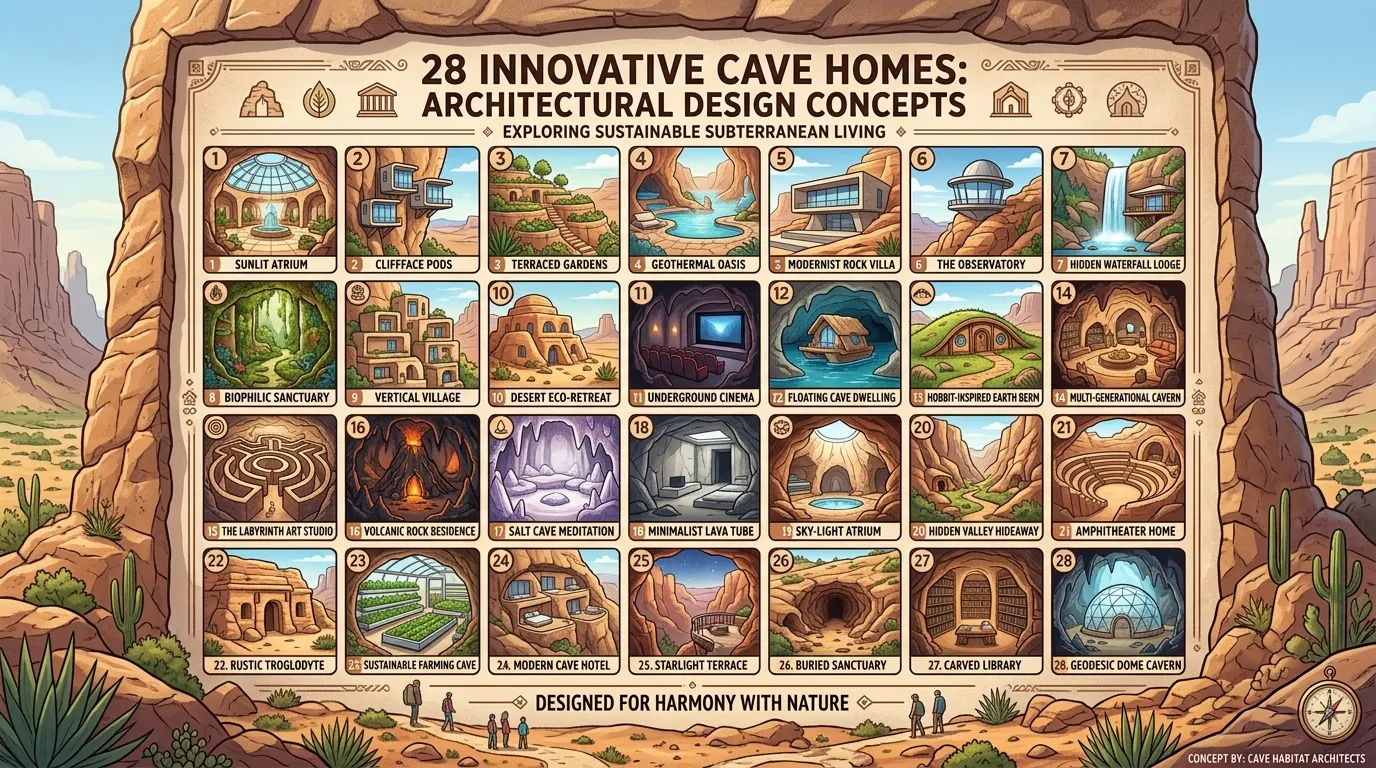
Cave home design is a style of architecture and interior design that draws from earth-sheltered dwellings, troglodyte traditions, and organic form-building — spaces carved from, built into, or shaped to mimic the curving, textured walls of natural rock formations. This article gives you 28 cave home design concepts spanning materials, lighting, layout, furniture, color, and atmosphere — everything you need to imagine and build one.
There is something primal about a home that holds you rather than merely contains you. Cave design wraps its inhabitants in curved plaster, raw stone, and honeyed candlelight — the walls breathe, the ceiling arcs, and the temperature stays steady no matter the season outside. It is quiet in a way that modern construction rarely achieves. Here are 28 ideas worth saving — and stealing.
Why Cave Home Design Works So Well
Cave home design is rooted in some of the oldest human shelter traditions on Earth — troglodyte communities in Cappadocia, Turkey; Sassi dwellings in Matera, Italy; and the earth-sheltered homes of the American Southwest. What makes the style architecturally distinct is its rejection of the rectilinear box. Walls curve, ceilings arch, openings become portals. The home does not impose geometry on the earth — it negotiates with it.
The material palette is emphatically tactile. Raw limestone, tadelakt plaster in warm sand and clay tones, unfinished travertine, rammed earth, and rough-hewn sandstone form the primary surfaces. Colors are almost universally pulled from geology: warm bone white, iron ochre, terracotta blush, greige, deep umber, and the cool blue-gray of shadowed rock faces. Every finish is matte — nothing reflective, nothing lacquered.
Cave design is trending now for reasons that go beyond aesthetics. Post-pandemic domestic life reoriented people toward shelter that genuinely shelters — not open-plan glass boxes, but spaces that feel private, contained, and thermally stable. Simultaneously, the sustainability movement has rehabilitated earth-sheltered construction as one of the most energy-efficient building strategies available, requiring a fraction of the heating and cooling energy of conventional homes.
Small spaces can absolutely achieve this style. In fact, compact rooms benefit from cave design’s embrace of imperfect curves and organic niches — there is no need to square off every corner. Prioritize one statement curved wall treated in tadelakt or limewash plaster, then layer in textiles and candlelight. Scale matters less than surface quality.
Style at a Glance
| Element | Cave / Troglodyte | Earth-Sheltered Modern |
| Philosophy | Shelter as embrace | Harmony with landscape |
| Materials | Limestone, tadelakt, rammed earth | Concrete, raw stone, clay plaster |
| Color palette | Ochre, bone, umber, terracotta | Greige, warm gray, slate, sand |
28 Cave Home Design Concepts
1. Tadelakt Curved Wall Living Room

Vibe: Still — the way light moves across a hand-finished wall makes you slow down involuntarily.
Why it works: Tadelakt is a traditional Moroccan lime plaster technique that, once polished with a river stone and treated with black soap, becomes naturally waterproof and develops a living, marbled surface that no two applicators replicate identically. The curved application eliminates corner shadows, bathing the room in an even, warming glow. The material’s thermal mass absorbs daytime heat and releases it slowly through the evening, making the room feel regulated without mechanical intervention.
How to get it: Hire a tadelakt specialist rather than attempting a DIY lime plaster application — the polishing sequence is time-sensitive. Request a warm sand or raw sienna tone in the pigment mix rather than stark white, which reads clinical against stone floors. Keep all adjacent surfaces matte to let the subtle sheen of the tadelakt read as intentional luxury.
Shop The Look
| Product |
| Terracotta ceramic floor vase large handmade |
| Wool boucle throw blanket cream natural fiber |
| Low-profile linen sectional sofa curved modern |
| Dried pampas grass stems large natural |
| Raw clay candle holder set rustic handmade |
2. Rammed Earth Accent Wall with Embedded Stone

Vibe: Raw — the geological strata on the wall make you feel like you are inside the earth, not just decorated to resemble it.
Why it works: Rammed earth walls compress damp clay soil, chalk, and aggregate into dense, load-bearing panels — the horizontal banding is structural, not decorative. Embedding river stones into the surface as it is tamped creates a mosaic of natural color variation: cream quartz, grey granite, ochre ironstone. The thermal mass is exceptional, storing up to 10 times more heat per volume than timber-frame construction.
How to get it: For a faux rammed earth finish in an existing room, apply a layered clay render in three tones — start with a mid-ochre base, then a darker umber layer, then a pale sand skim — and use a pool trowel to compress and drag each layer before it sets. Press smooth river pebbles into the penultimate coat while still workable, then skim lightly over them so their tops remain exposed.
💡 Quick Win: A bag of natural clay wall paint in ochre (under $40 at most art supply or specialty paint stores) can transform a single wall with one application and no sanding or priming required on plaster surfaces.
Shop The Look
| Product |
| River stone decorative bowl large natural |
| Woven cotton wall hanging bohemian macrame neutral |
| Hammered copper decorative bowl artisan |
| Olive branch faux stem arrangement neutral |
| Clay pigment wall paint ochre natural mineral |
3. Deep-Set Arched Niches for Display
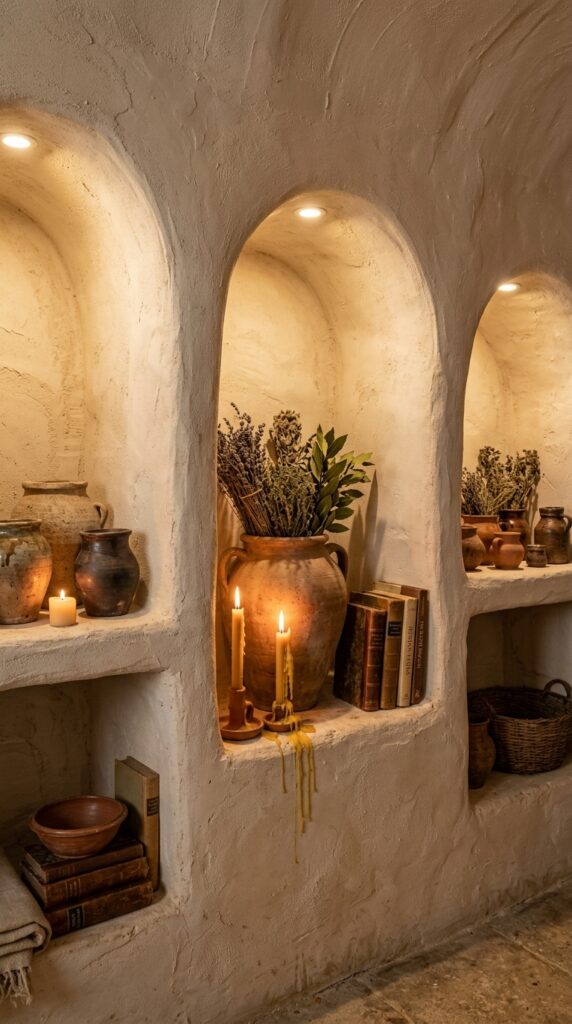
Vibe: Luminous — each niche holds its own small world of light.
Why it works: In Moroccan and Andalusian architecture, niches (known as taqas) replaced furniture as display and storage surfaces, keeping floor plans uncluttered while giving every object a framed, intentional home. The arched form follows the structural logic of masonry — the arch distributes load from above — but in a modern plaster application, it reads as pure architectural drama. Layered niche lighting using 2700K warm LED puck lights creates depth without overhead harshness.
How to get it: Frame shallow niches (10–14 inches deep) between existing wall studs and finish the interior in smooth clay plaster one shade darker than the surrounding wall — this creates a shadow effect that reads as genuine depth even when the actual recess is modest. Use a single 3-inch recessed warm LED in the niche ceiling.
Shop The Look
| Product |
| Recessed LED puck light warm 2700K battery operated |
| Handmade terracotta bud vase small set of 3 |
| Beeswax pillar candles unscented natural |
| Stacked linen hardcover decorative books neutral |
| Dried herb bundle lavender sage wall display |
4. Organic Concrete Ceiling with Exposed Aggregate

Vibe: Grounded — the ceiling pulls the eye upward in the way clouds do.
Why it works: Conventional concrete ceilings are flat and industrial. Cave home design exploits the material’s pre-hardening plasticity to create undulating ceilings that reference natural rock formations. Exposed aggregate — created by washing the surface before the concrete fully cures — reveals the river gravel or crushed stone within, adding organic color variation. The ceiling becomes the most visually active surface in the room, allowing walls and floors to remain calmer.
How to get it: In renovation contexts, a spray-applied skim coat of concrete over an existing ceiling can be sculpted with a trowel into gentle undulations before hardening, then exposed aggregate achieved by light acid washing. Hire a decorative concrete specialist — the timing window for surface washing is approximately 4–8 hours after application.
Shop The Look
| Product |
| Rattan woven pendant light shade large bohemian |
| Sheepskin throw rug genuine wool natural ivory |
| Low linen platform sofa natural tone modern |
| Concrete candle tray decorative grey matte |
| Hemp rope pendant light fixture handwoven |
5. Candlelit Stone Table Dining Cave
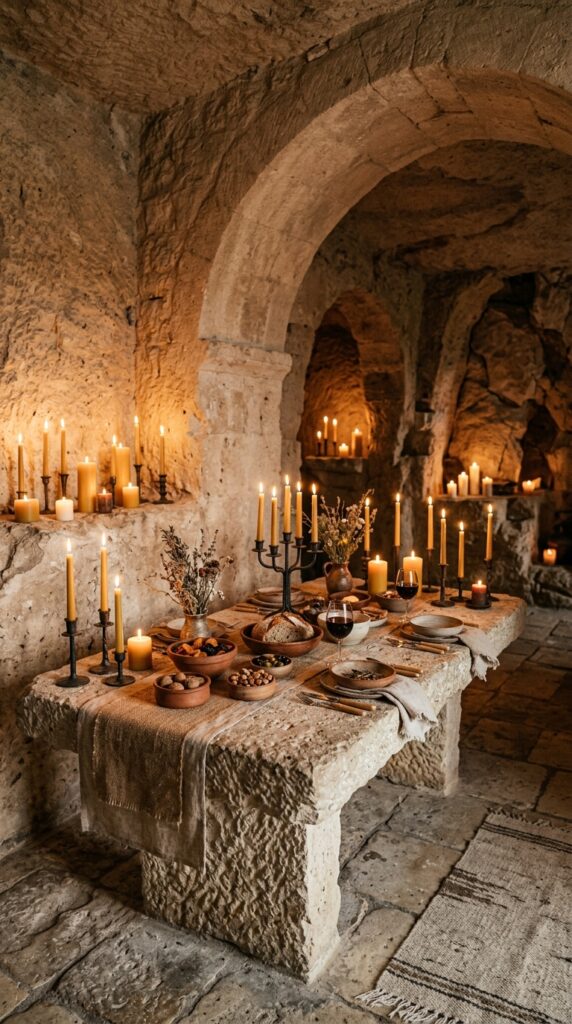
Vibe: Sun-warmed — even at night, the limestone radiates warmth absorbed through the day.
Why it works: Cave dining spaces eliminate the visual formality of conventional dining rooms by embedding the table within the architecture itself. A limestone slab table on rough-cut stone legs integrates with the room’s geology rather than sitting atop it. Candlelight at this scale — 20 or more pillar candles — is not decorative but functional, providing the primary illumination and eliminating the institutional quality of overhead dining fixtures.
How to get it: Source a local limestone or travertine slab at a stone yard and have it cut to dining table dimensions (72″×36″ is standard for six). Legs can be rough-cut stone blocks or blackened steel hairpin legs — both read as authentic to the aesthetic. Keep the surface unsealed on the top for texture; seal the underside and legs for durability.
💡 Quick Win: A set of 12 unscented white pillar candles on a large slate tile instantly creates a cave dining atmosphere for under $30 — no renovation required.
Shop The Look
| Product |
| Wrought iron pillar candle holders set of 3 tall |
| Slate serving board large natural stone |
| Natural fiber table runner jute linen neutral |
| Pillar candle set unscented white 3 inch |
| Iron trivet set rustic handmade |
6. Warm Ochre and Raw Umber Color Palette
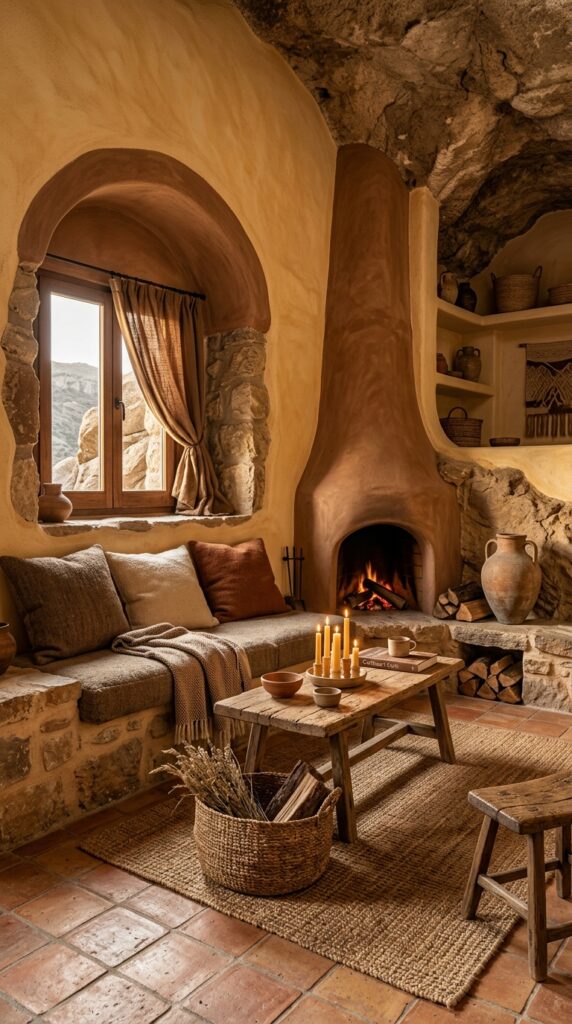
Vibe: Layered — the whole room reads like strata of the same geological formation.
Why it works: Ochre is iron-rich clay pigment — literally the color of earth — and it has been used in interior finishes since the Paleolithic period. When applied in a limewash medium rather than standard emulsion paint, it develops depth and variation as it dries, mimicking the tonal shifts of natural rock faces. Using four tones from the same geological family (ochre, umber, sienna, bone) creates a monochromatic richness that reads as sophisticated rather than flat.
How to get it: Apply limewash paint in Benjamin Moore’s Mustard Field or Farrow & Ball’s India Yellow in multiple diluted coats, allowing each to dry and then buffing lightly with a dry cloth before the next application. The variation this creates is far more convincing than a single flat coat.
Shop The Look
| Product |
| Limewash interior paint ochre warm earth tone |
| Terracotta ceramic planter large floor pot |
| Woven seagrass floor basket large storage |
| Ochre linen curtain panel set natural tone |
| Beeswax block candle raw unscented |
7. Stone Floor with Radiant Heat Underfloor System

Vibe: Hushed — bare stone floors in a warm space carry a meditative quality that carpet never achieves.
Why it works: Irregular sandstone or travertine tiles eliminate the grid uniformity of conventional tiling, introducing organic edge variation that references the cave floor. Stone is the ideal medium for radiant underfloor heat — its high thermal mass accepts the gentle warmth of hydronic or electric heating mats and radiates it evenly upward without hot spots. The combination means the room heats from the ground up, making low seating arrangements genuinely comfortable.
How to get it: Choose tumbled travertine or honed limestone tiles in sizes 12″×24″ or larger, with unfilled voids where they occur for textural authenticity. Use an unsanded grout in a tone slightly darker than the tile — this emphasizes the individual stone shape rather than the grid.
💡 Quick Win: A genuine sheepskin rug (under $45 on Amazon) placed on any stone or tile floor immediately communicates cave home warmth and grounds a low seating arrangement.
Shop The Look
| Product |
| Genuine sheepskin area rug ivory natural |
| Low floor meditation cushion linen large |
| Travertine coaster set natural stone |
| Underfloor electric heating mat thermostat |
| Stone floor cleaning concentrate natural |
8. Carved Sleeping Alcove Bed Niche
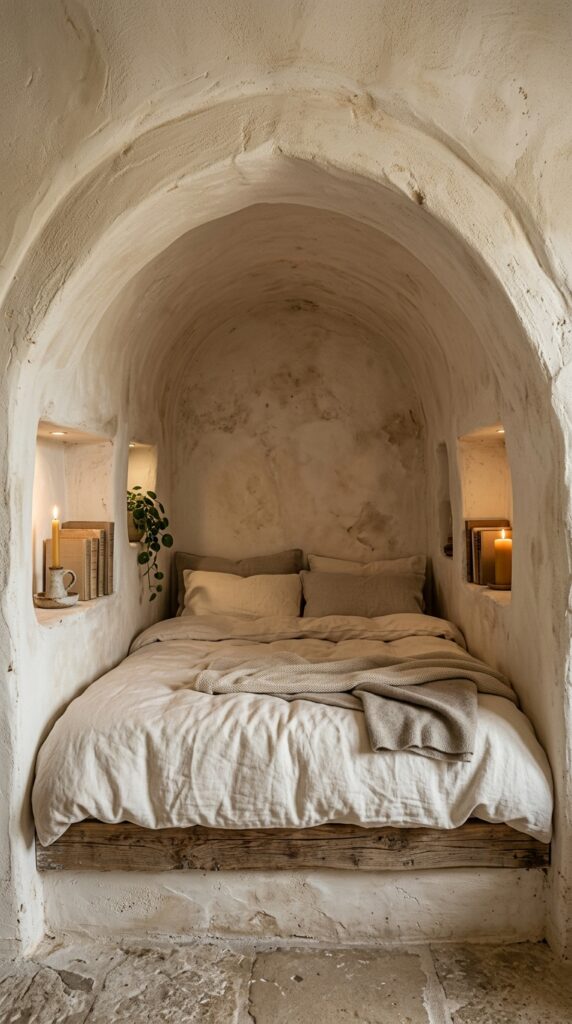
Vibe: Still — a sleeping alcove compresses the bedroom to its essential function and removes everything else.
Why it works: The lit (French for bed alcove) is an ancient sleeping arrangement — recessing the bed into a niche in the wall creates a micro-room within a room, with the thick plaster or stone walls acting as thermal insulation and acoustic dampening. The ceiling overhead is lower than the main room, triggering a psychological sense of shelter and intimacy. Modern interpretations fit a platform frame with a quality mattress directly into a framed niche, finished in smooth plaster.
How to get it: Frame the niche to fit your mattress dimensions with 6 inches of clearance on each side. Finish interior walls in tadelakt or smooth clay plaster — the niche interior should be one shade deeper than the room’s walls. Install two recessed 2700K LEDs in the ceiling of the niche on a dimmer. Leave the niche entry unframed — the arch is sufficient closure.
Shop The Look
| Product |
| Linen bedding set warm ivory duvet cover |
| Low platform bed frame solid wood minimalist |
| Ceramic taper candle holder handmade small |
| Small trailing pothos plant hanging indoor |
| Linen decorative pillow cover set warm natural |
9. Stalactite-Inspired Plaster Ceiling Texture
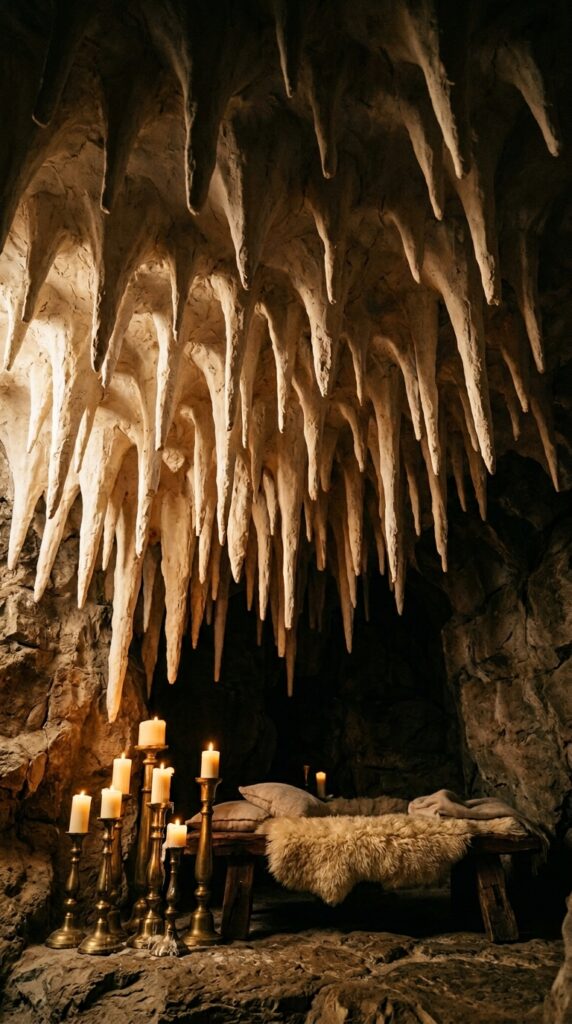
Vibe: Luminous — the candlelight catches each plaster point and sends layered shadows across the ceiling.
Why it works: Stalactite plasterwork references the muqarnas of Islamic architecture — the honeycomb vaulted ceilings of the Alhambra and Moroccan medersas — but simplified for residential scale. Varying the length and density of hand-sculpted plaster forms across the ceiling creates a rhythm that reads as geological rather than decorative. The visual weight of the ceiling pushes perception of the room’s proportions downward, reinforcing the sheltered, cave-like atmosphere.
How to get it: Commission a decorative plaster artist to apply drip-formed shapes using a mix of fibrous plaster and lime putty — the fiber prevents cracking as the forms cure. An alternative for DIYers is expanding foam sprayed in organic clusters and then coated with several layers of thin clay plaster to smooth and unify the surface.
Shop The Look
| Product |
| Brass pillar candle cluster holder set large |
| Low wooden bench natural wood minimalist |
| Fibrous plaster mix decorative application |
| Warm bone matte ceiling paint mineral |
| Cluster pendant light drip organic ceramic |
10. Moroccan Zellige Tile Water Feature Wall
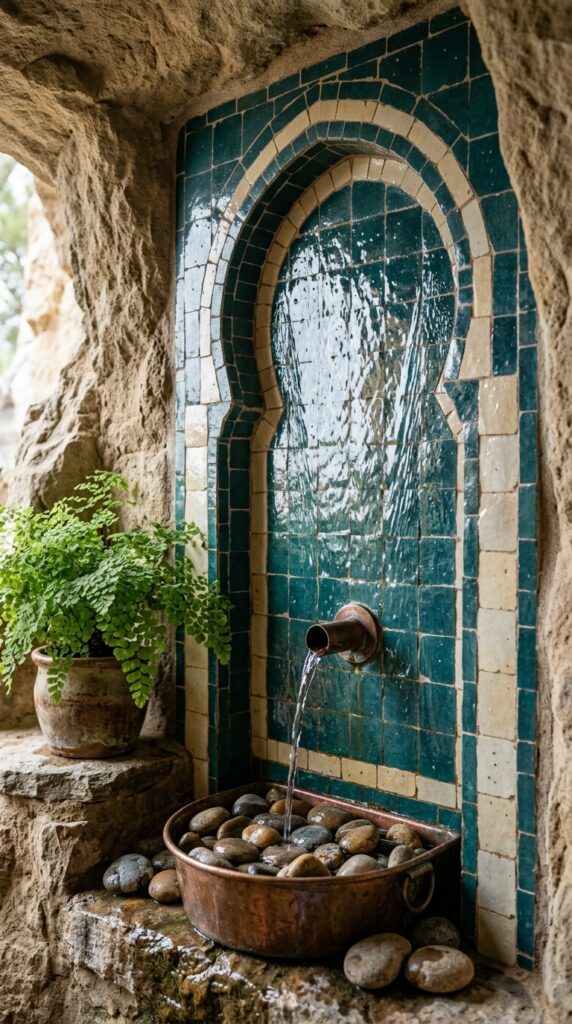
Vibe: Serene — moving water in a cave-like space creates the precise acoustic signature of a natural grotto.
Why it works: Water features in cave homes are not ornamental — they address the one sensory element that raw plaster and stone alone cannot: sound. A thin-sheet water wall using a recirculating pump behind zellige tile adds the audio layer of a natural spring without needing a large footprint. Zellige tile, hand-cut from kiln-fired clay with deliberately irregular edges, breaks the light in multiples — each facet catches its own angle — making even a modest feature visually active.
How to get it: A 24″-wide by 48″-tall wall water feature requires only a small basin, a submersible recirculating pump, and a tile-clad wall panel. Use traditional Moroccan zellige in a deep teal (Bejmat blue) set in white grout — the contrast between the irregular tile and the precision of the water sheet is the whole effect.
💡 Quick Win: A tabletop stone water fountain (under $45) placed on a tile or slate surface delivers 80% of the acoustic effect of a wall feature with zero installation.
Shop The Look
| Product |
| Tabletop stone water fountain indoor small |
| Zellige ceramic tile set deep teal handmade |
| Potted live fern indoor tropical plant |
| Copper decorative basin bowl large |
| River stone mosaic mat natural small |
11. Deep-Set Arched Doorways and Passages

Vibe: Layered — a corridor of arches creates a sense of movement and discovery that flat-walled passages never achieve.
Why it works: The arch is the defining structural element of cave architecture — in natural caves, roof collapse forms inverted catenaries; in constructed cave dwellings, the arch is the most efficient load-distributing shape for thick masonry walls. Deep-set arches (12–18 inches of plaster return) create strong shadow lines that give the corridor visual rhythm and scale. The slightly irregular handmade arch reads as carved rather than built.
How to get it: Frame arched openings using a plywood template cut to the desired curve, then pack either side with metal lath and two coats of clay plaster — a rough scratch coat followed by a smooth finish coat. Use a hand tool to introduce slight variations between arches rather than repeating an identical template.
Shop The Look
| Product |
| Moroccan hanging lantern iron punched large |
| Potted olive tree indoor large faux |
| Woven jute hallway runner natural narrow |
| Arch doorway metal lath sheet plastering |
| Warm bone limewash paint interior matte |
12. Cave Home Library with Built-In Stone Shelving

Vibe: Hushed — a library this quiet rewards attention to every detail.
Why it works: Integrating shelving into the wall thickness rather than mounting bookcases against it keeps floor space entirely clear — a critical advantage in a style where the floor level is often the primary seating zone. Stone or plaster shelves 14–18 inches deep can hold books at two depths or accommodate objects in front of book stacks. The visual weight of the shelves blends with the wall, maintaining the monolithic quality essential to cave aesthetics.
How to get it: Build recessed shelf boxes from plywood, insert between wall studs at varying depths, and finish all surfaces — including shelf underside — in the same clay plaster as the surrounding wall. The edge of each shelf should be rounded slightly with a rasp before plastering to prevent the sharp line that gives away a built-in.
Shop The Look
| Product |
| Leather reading chair wingback dark brown |
| Iron table lamp with linen shade warm |
| Wool chunky knit throw blanket charcoal |
| Bookend set natural stone travertine |
| Decorative hardcover book set neutral spine |
13. Earthy Cave Home Color: Terracotta and Bone

Vibe: Sun-warmed — the terracotta holds afternoon light the way fired clay holds kiln heat.
Why it works: Terracotta and bone is the most fundamentally geological color pairing in cave design — iron-rich clay against bleached limestone. The contrast between the warm red-orange of terracotta (closest paint match: Portola Paints Siena or Farrow & Ball’s Red Earth) and the cool neutrality of bone white creates a space that reads vibrant during daylight hours and cocoon-like after dark. The key is using both tones at the same matte finish — sheen difference undermines the geological believability of the palette.
How to get it: Apply terracotta clay plaster to three walls and leave the fourth (the window wall) in bone white limewash — this keeps the room from reading too dark while maximizing the color impact. Use warm-toned linen in ivory for all soft furnishings to bridge the two tones.
Shop The Look
| Product |
| Terracotta clay plaster wall finish kit |
| Ivory linen duvet cover set natural fiber |
| Beeswax taper candle set unscented |
| Small potted sage herb in terracotta pot live |
| Raw wood bedside table natural solid |
14. Firepit Sunken Living Room
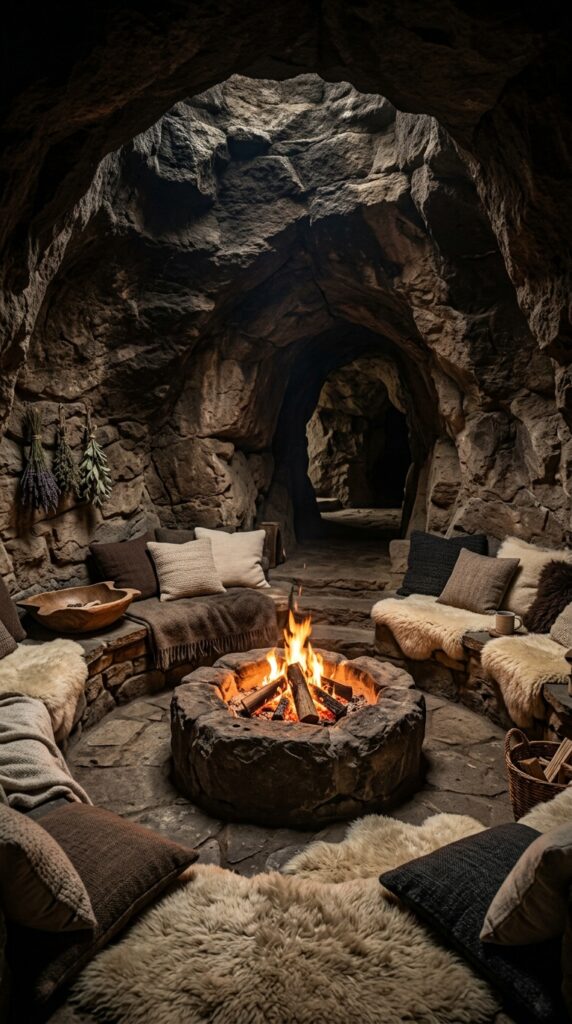
Vibe: Grounded — dropping the floor level creates a gravitational center that draws people inward instinctively.
Why it works: The sunken conversation pit was a mid-century invention (the Keck & Keck “conversation pit” of the 1950s) but it reads as far older in a cave home context — the central hearth is one of humanity’s oldest architectural gestures. Sinking the living area 18–24 inches below the main floor level achieves several things simultaneously: it creates a defined social zone without walls, improves the heat efficiency of a central fire, and dramatically lowers the effective ceiling height over the seating area, increasing the cave-like enclosure.
How to get it: Frame a sunken living zone by excavating during construction or, in renovation, by building up the surrounding floor level rather than dropping the existing slab. Use structural concrete for the pit surround, finish in stone cladding, and line the inner edge with a continuous upholstered bench in wool felt or leather.
💡 Quick Win: A round stone-look fire bowl (under $45 from outdoor/patio retailers) placed at the center of a ground-level seating arrangement with floor cushions creates a sunken-pit effect without any construction.
Shop The Look
| Product |
| Round stone fire bowl outdoor decorative propane |
| Large floor meditation cushion round wool |
| Sheepskin floor pillow oversized ivory |
| Carved wooden serving bowl large dark wood |
| Hanging herb bundle dried decorative farmhouse |
15. Brass and Iron Fixtures on Raw Stone
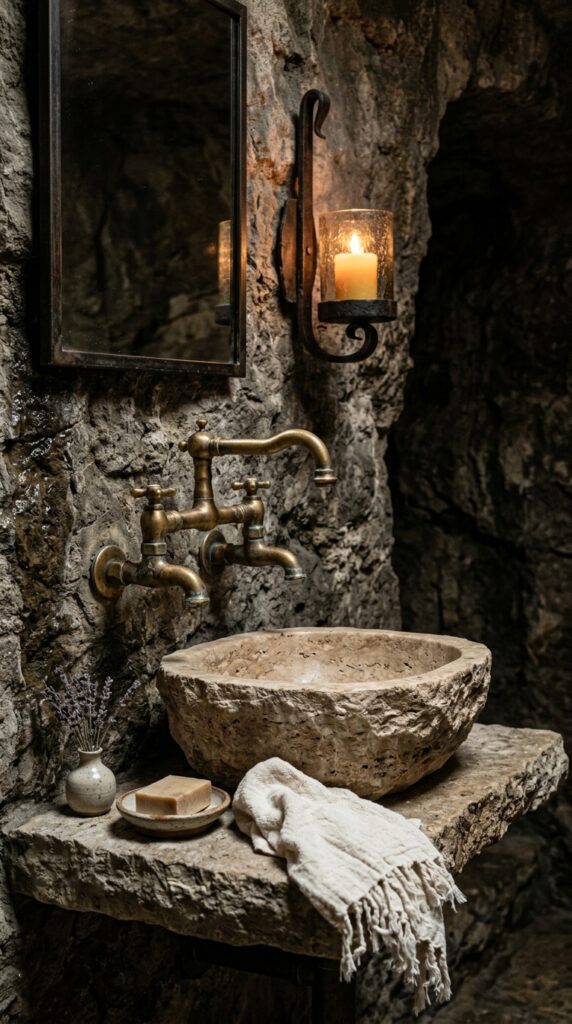
Vibe: Raw — unlacquered metal in a stone room develops a shared patina over time, the metal becoming part of the geology.
Why it works: The choice between unlacquered brass (which oxidizes to warm amber tones) and blackened iron (which remains flat and matte) is an essential one in cave home design. Both are historically authentic to earth-sheltered dwellings — one references Mediterranean and North African architecture, the other Northern European and Anatolian traditions. The key is that both must be used without chrome, satin nickel, or any reflective-modern finish, which reads as anachronistic and breaks the spatial illusion.
How to get it: Specify unlacquered brass (also called “living finish”) for faucets and cabinet hardware — the Waterworks JULIA collection or Kohler’s unlacquered brass line are reliable options. Mount sconces directly into stone or thick plaster using iron standoff arms rather than flush plates, so the hardware reads as hammered in rather than surface-applied.
Shop The Look
| Product |
| Unlacquered brass wall sconce iron arm |
| Travertine stone bathroom basin vessel |
| Linen hand towel set natural cream |
| Ceramic soap dish handmade rustic |
| Beeswax votive candle set small |
16. Cave-Style Studio Apartment: One-Wall Everything

Vibe: Serene — when every zone shares the same material language, a small space reads as intentional rather than cramped.
Why it works: In small cave-style spaces, visual cohesion is the primary spatial strategy. Using the same clay plaster finish across kitchen, sleeping niche, and living zone eliminates the zone-change visual noise of conventional apartments — different paint colors, different cabinet finishes, different flooring materials. Defining zones by floor material change (travertine in kitchen, concrete in living, wood planks in sleeping niche) instead of walls preserves openness while maintaining readable order.
How to get it: Choose one plaster color for every vertical surface — warm bone or raw sienna work across all zones — and differentiate each functional area exclusively at floor level. Keep kitchen cabinetry integrated into the plaster wall by finishing cabinet fronts in the same plaster and using push-to-open hardware with no visible pulls.
Shop The Look
| Product |
| Iron bar stool set of 2 industrial modern |
| Woven seagrass storage basket large with lid |
| Potted ficus tree large indoor faux |
| Push-to-open cabinet hardware set modern |
| Travertine trivet kitchen stone natural |
17. Natural Stone Arch Window with Deep Sill Seating
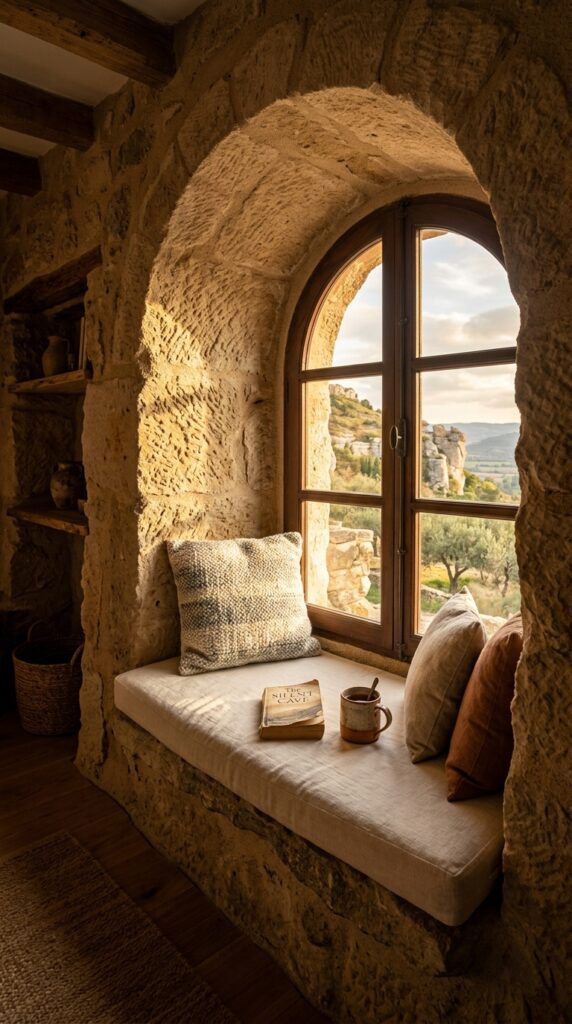
Vibe: Sun-warmed — the deep stone sill captures and concentrates afternoon light into something almost physical.
Why it works: Window reveals in thick-walled architecture serve multiple design functions: they soften the hard edge of an exterior wall, create a transition zone between outside light and interior shadow, and — when fitted with a cushion — generate one of the most desirable spaces in any home. The deep-sill window reading nook is a consistent feature of Cappadocian cave homes, where walls frequently exceed 24 inches in thickness. The stone itself acts as a thermal buffer, keeping the sill warm in winter and cool in summer.
How to get it: If retrofitting an existing window, build a false wall in front of it to create the visual depth of a thick stone reveal — extend the sill outward to 16–20 inches and clad all surfaces in stone veneer or clay plaster. The effect depends on shadow depth, not actual stone mass.
Shop The Look
| Product |
| Window seat cushion custom linen natural large |
| Linen lumbar throw pillow cover ivory |
| Stone veneer panel peel stick travertine look |
| Small ceramic espresso cup handmade |
| Natural beeswax lip balm tin mini accessories |
18. Cave Kitchen: Open Hearth and Plaster Oven
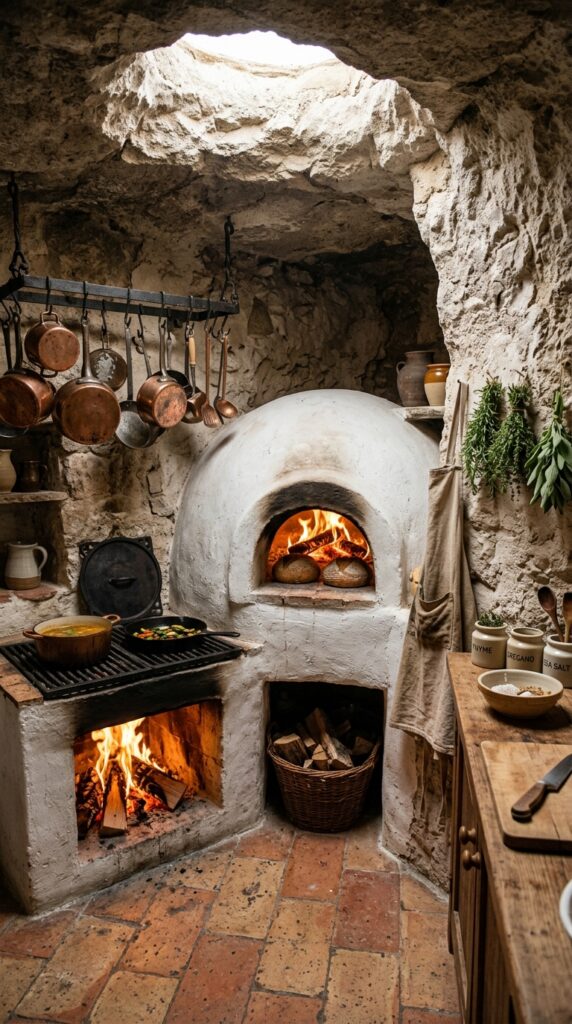
Vibe: Grounded — a kitchen built around fire is a kitchen built around the most fundamental human act.
Why it works: The integrated plaster bread oven — a horno in Pueblo tradition, a tannour in the Middle East — is the archetypal cave kitchen element. Its dome form is structurally efficient and thermally massive: once heated, it maintains baking temperature for hours. In modern cave home kitchens, a plaster oven can be built nonfunctionally for atmosphere, or fully functional using refractory plaster over a metal frame. Hanging copper pots on a wrought iron rail above the hearth consolidates the kitchen’s visual weight into one warm-toned column.
How to get it: Build a nonfunctional plaster oven dome using an inflated exercise ball as a form — apply chicken wire and then three coats of refractory plaster over the ball, deflate and remove when cured. Finish with a warm white limewash for the characteristic clay-oven look.
💡 Quick Win: A set of three copper-tone hanging pots on a ceiling-mounted iron S-hook rail (under $40 total) immediately reads as cave kitchen without any structural work.
Shop The Look
| Product |
| Copper hanging pot set 3 piece kitchen |
| Wrought iron ceiling pot rack wall mount |
| Terracotta spice crock set kitchen ceramic |
| Rough linen kitchen apron natural |
| Cast iron Dutch oven 5 quart dark |
19. Warm Gray and Slate Cave Color Scheme
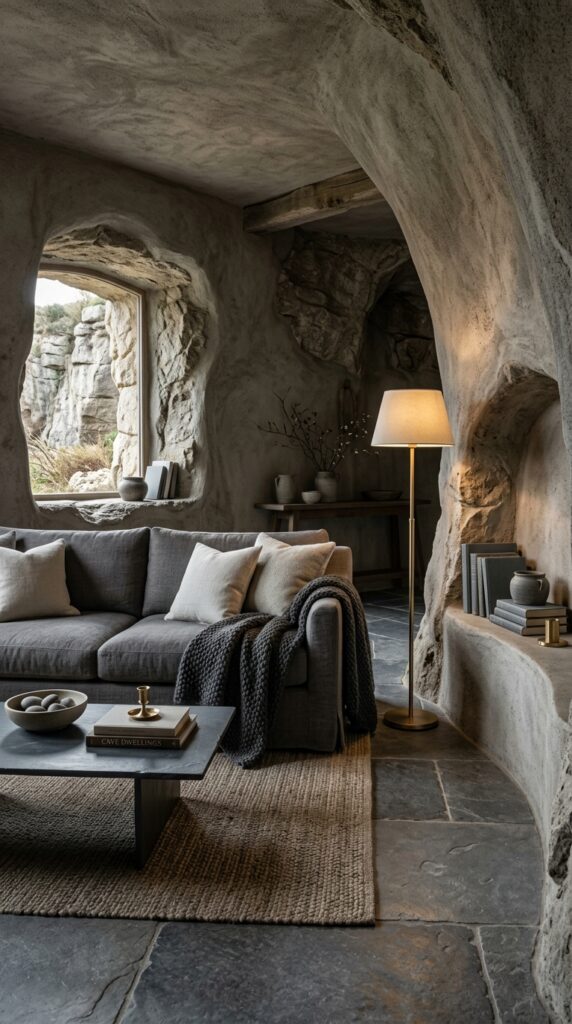
Vibe: Still — cool grays in a cave space don’t read cold; they read geological, like standing inside a granite formation.
Why it works: Where ochre and terracotta reference Mediterranean and North African cave traditions, warm gray and slate read more Northern European — the basalt caves of Iceland, the granite formations of Brittany. This palette works by applying warmth through light temperature (2700K lamps) rather than wall color, allowing the mineral neutrality of the surfaces to feel grounded rather than cold. The critical distinction between warm gray (which has an undertone of brown or taupe) and cool gray (which reads blue or green) is the difference between cave and hospital.
How to get it: Use Farrow & Ball’s Mole’s Breath or Beton Brut by Bauwerk Color for walls — both read as warm gray even in overcast light. Specify unlacquered brass for every metal element in the space to inject warmth without changing the wall palette.
Shop The Look
| Product |
| Warm gray concrete look interior wall paint |
| Charcoal wool upholstered sofa mid-century |
| Brass arc floor lamp modern warm |
| Slate stone coaster set 4 natural dark |
| Pale linen throw pillow cover set charcoal natural |
20. Stalactite Pendant Cluster Lighting

Vibe: Luminous — a cluster of pendants at varying heights dissolves the ceiling boundary and pulls light into the mid-space.
Why it works: The stalactite pendant cluster mimics the geological formation while solving the practical lighting challenge of cave home spaces, which rarely have recessed ceiling infrastructure. By suspending pendants at three different heights — 48″, 60″, and 72″ from the floor — the cluster creates a vertical light gradient that softens the transition from lit surface to unlit ceiling. Matte ceramic shades in bone or raw clay absorb light rather than reflecting it, producing a warmer, more diffuse illumination than glass pendants.
How to get it: Source organic drip-form ceramic pendants individually from ceramic artists on Etsy — look for makers using stoneware clay in matte finishes, and order in batches of 3–7 for cluster arrangements. Vary drop lengths by 12-inch increments. Use a 4-inch ceiling canopy with multiple hooks rather than a cluster canopy to allow independent height adjustment.
Shop The Look
| Product |
| Organic ceramic drip pendant light matte clay |
| Pendant light ceiling canopy multi-hook 4-inch |
| Rough linen table runner long natural neutral |
| Olive branch faux stem tall arrangement |
| Clay bowl set handmade matte terracotta |
21. Sunken Bathtub Carved from Stone
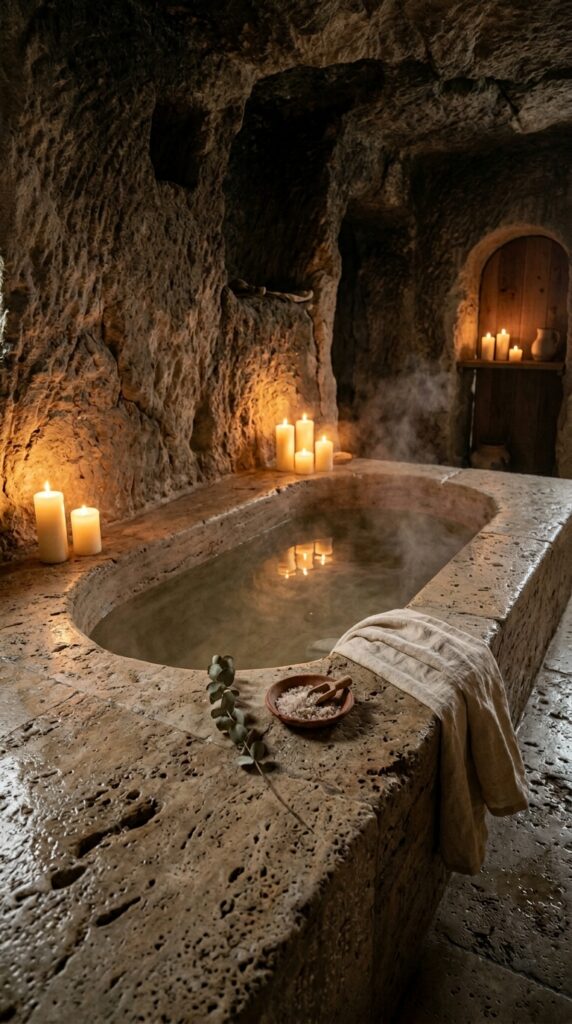
Vibe: Serene — bathing in a stone vessel feels less like hygiene and more like a geological ritual.
Why it works: A sunken stone bath eliminates the visual interruption of the bath’s vertical sides — the water surface becomes part of the floor plane, and the bather is held within the earth rather than set atop it. Travertine and limestone are ideal materials because their unfilled natural voids and color variation reference the geological formations cave homes draw from. The thermal mass of stone keeps bath water warm considerably longer than cast iron or acrylic.
How to get it: Carved stone baths are available from several Italian and Portuguese stone yards in standard sizes — budget $2,000–$6,000 depending on stone type and finish. For a sunken installation, the tub must be set into the floor slab, requiring a plumber to run the drain below the slab level and adequate structural reinforcement for the stone weight (travertine baths typically weigh 400–800 lbs).
Shop The Look
| Product |
| Stone bath salts mineral natural large jar |
| Linen bath towel set waffle weave ivory |
| Pillar candle holder stone slate platform |
| Small clay salt dish handmade bathroom |
| Natural loofah sponge large body bath |
22. Compressed Earth Block Construction Visible Interior
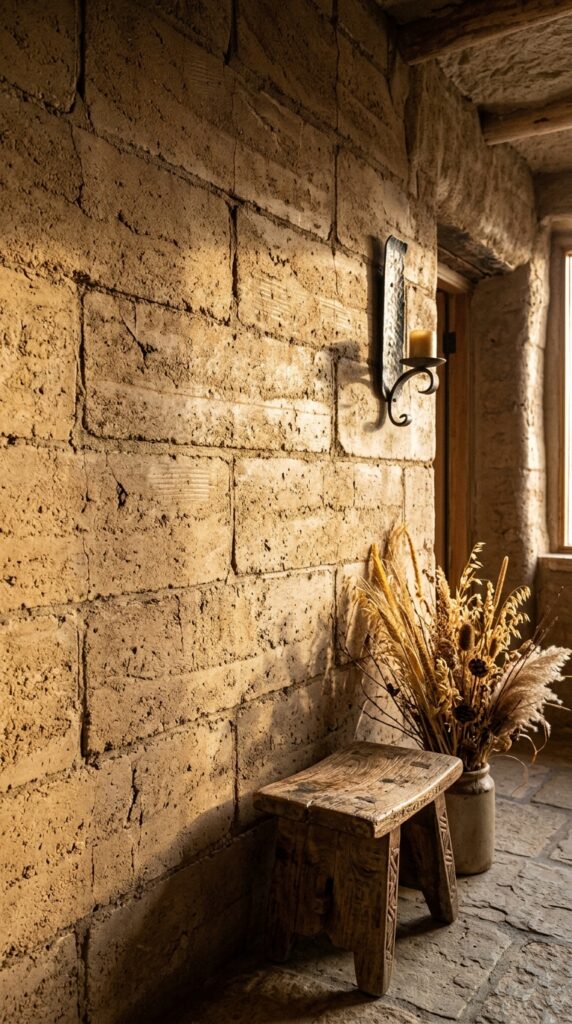
Vibe: Raw — compressed earth blocks are geology made modular, and leaving them unsealed is the most honest possible finish.
Why it works: Compressed earth blocks (CEB) are made by pressing moistened clay-rich soil into a machine mold under hydraulic pressure — the result is a structurally sound masonry unit with a naturally textured surface showing the compression mark from the press. Unlike adobe (which is sun-dried), CEBs can be fired or left natural. Left unsealed on interior walls, they provide exceptional thermal mass and regulate humidity naturally, absorbing excess moisture and releasing it as conditions dry. The earth tone variation between blocks — no two are identical — creates a wall surface as visually interesting as expensive stone at a fraction of the cost.
How to get it: Specify compressed earth blocks from regional natural building suppliers and use an earthen mortar in the same soil composition as the blocks — this makes joints nearly invisible, reading as continuous earth rather than block and mortar construction.
💡 Quick Win: A single dried pampas grass stem in a raw iron wall-mounted sconce holder (under $30) creates the exact spare, geological styling that suits a CEB wall.
Shop The Look
| Product |
| Iron wall sconce arm single industrial |
| Carved wooden stool small natural |
| Dried pampas grass stems natural bundle |
| Earth pigment mineral powder ochre raw |
| Compressed earth block texture wall panel |
23. Cave Home Office: Stone Desk in an Alcove

Vibe: Hushed — working inside a stone alcove produces a quality of concentration that open-plan offices never approach.
Why it works: The alcove office uses the psychological principle of territorial enclosure — being flanked on three sides by a surface creates a micro-territory that focuses attention and reduces distracting peripheral movement. In cave home design, this translates to carving or framing a niche specifically for the work surface, with thick plaster walls on three sides and an open face to the room. The acoustic dampening of earth and plaster walls is measurable — rammed earth and clay plaster walls absorb mid-frequency sound (the frequency range of speech) 30–50% more effectively than drywall.
How to get it: Frame a desk alcove 24 inches deep to accommodate a standard monitor and working depth. Use a single limestone slab or solid oak board as the desk surface, resting on two corbel brackets plastered flush into the side walls. Keep the back wall of the alcove plain — no shelving, no decor — to preserve the sense of a view into the earth.
Shop The Look
| Product |
| Brass swing arm desk task lamp adjustable |
| Leather desk pad large natural tan |
| Handmade ceramic pen holder small |
| Solid oak floating wall shelf bracket set |
| Small potted succulent live 4-inch pot |
24. Cave Entrance Foyer: Raw Stone and Iron
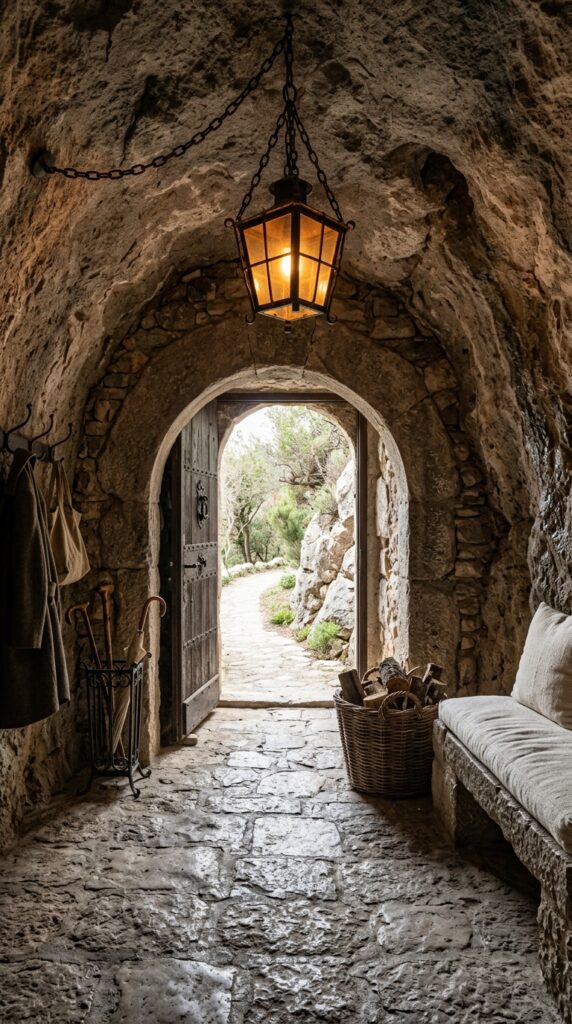
Vibe: Grounded — walking through an irregular stone arch reorients you to a different relationship with space before you’ve crossed the threshold.
Why it works: The foyer in a cave home performs transition more dramatically than in conventional architecture — the shift from outside to inside should feel like descent or immersion, not just a change of room. A raw stone entry with a hanging iron lantern achieves this by engaging all senses simultaneously: the coolness of stone underfoot, the visual complexity of unfinished rock walls, the warm pool of lantern light at human head height. The arch overhead compresses the entry vertically, making the main space beyond feel more expansive by contrast.
How to get it: Clad the foyer walls and floor in the same undressed stone — tumbled slate, rough-faced limestone, or irregular fieldstone — and avoid any grout color lighter than the stone. Use a single large hanging lantern on a chain (not a flush or close-to-ceiling fixture) as the sole light source for the most dramatic entry effect.
Shop The Look
| Product |
| Large iron chain hanging lantern entry |
| Woven rattan firewood holder basket large |
| Iron umbrella stand rustic heavy |
| Stone bench cushion linen cover removable |
| Rough slate floor tile natural cleft finish |
25. Organic Wood Furniture Carved from Single Pieces

Vibe: Raw — a piece of wood that still holds its original form is honest furniture.
Why it works: Cave home design rejects the homogenizing precision of furniture manufacturing. Single-slab tables with live edges, hand-carved stools with irregular seats, bent-twig chairs — each piece retains evidence of its origin material. The design principle at work is material honesty: the wood’s grain, voids, and growth rings are not defects to be hidden but the furniture’s primary visual interest. Against rough plaster and stone, these organic forms create a visual conversation between two kinds of natural surface.
How to get it: Source live-edge slabs from local sawmills or specialty lumber yards — look for olive, walnut, or elm, which have the most visually interesting grain. Apply only a single coat of raw tung oil finish (no stain, no polyurethane) — this preserves the wood’s natural color without building up a surface layer that reads as plastic.
Shop The Look
| Product |
| Live edge wood serving board charcuterie large |
| Raw tung oil wood finish natural quart |
| Hand-carved wooden stool rustic natural |
| Stone coaster set natural travertine round |
| Raw clay decorative bowl handmade large |
26. Subterranean Garden Courtyard with Sky Opening

Vibe: Luminous — when light falls vertically into a stone-walled garden, it has a quality you cannot replicate with horizontal windows.
Why it works: The sunken garden courtyard — common in traditional Tunisian and Libyan cave homes known as ghorfa — brings natural light and planting into the deepest part of an earth-sheltered home. The sky aperture creates a light shaft that shifts angle through the day, animating the walls with moving shadows. Planting lavender, rosemary, and citrus inside the courtyard introduces scent into the most enclosed space of the home — the sensory contrast between stone and plant is the defining experience of cave home living.
How to get it: In new cave home construction, plan the courtyard at the design stage — retrofit is costly. The minimum viable sky aperture is approximately 8 feet by 8 feet for a garden at 8-foot depth to receive adequate daily sunlight in temperate latitudes. Plant drought-tolerant Mediterranean species — lavender, rosemary, pomegranate, fig — which thrive in the reflected heat of stone walls.
💡 Quick Win: A self-contained indoor pomegranate tree in a large terracotta pot (under $45 from specialty nurseries) delivers the same visual effect for an interior courtyard corner.
Shop The Look
| Product |
| Large terracotta floor planter outdoor wide |
| Lavender live plant 4-inch pot aromatic |
| Rough pebble stepping stone path garden |
| Stone garden bench solid outdoor rustic |
| Rosemary topiary live plant medium |
27. Cave Bathroom with Grotto Shower
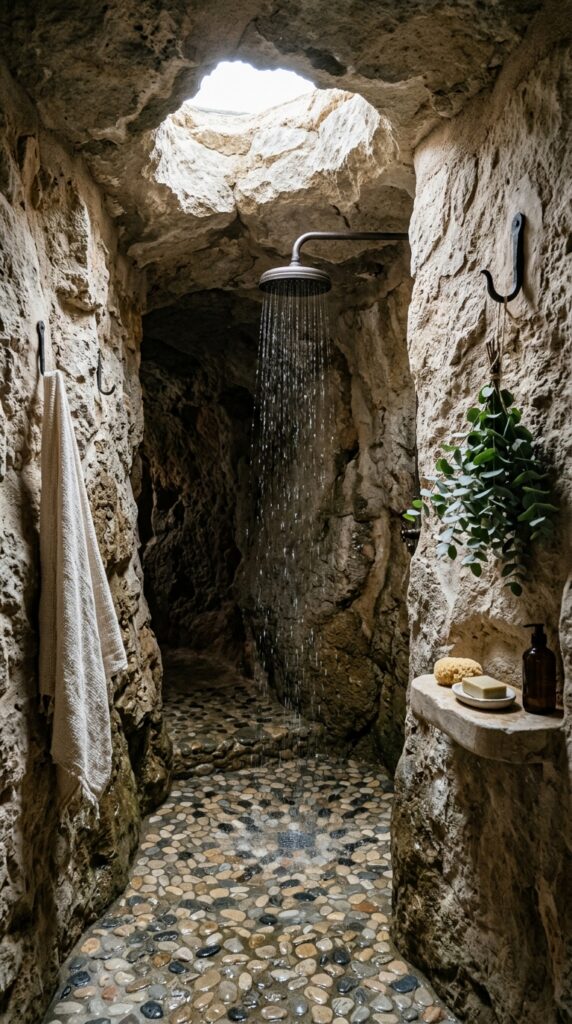
Vibe: Serene — a shower without a door in a stone enclosure is the closest thing to bathing in a natural spring.
Why it works: The doorless grotto shower is the cave home bathroom’s most iconic element. Its design logic is simple: the shower is carved deep enough into the wall or into an adjacent room that water spray cannot reach the main bathroom — typically 48 inches of depth minimum. The irregular stone walls function as the shower’s enclosure, removing the need for glass or curtain framing. River pebble mosaic floors provide grip through textural friction while adding organic color variation underfoot.
How to get it: Specify a linear drain running the full width of the shower mouth rather than a central drain — this allows water to flow efficiently without any slope-toward-center issue in a large, irregular-walled enclosure. Use a brushed iron rainfall head mounted into the stone ceiling rather than a wall-mounted arm — this keeps the plumbing invisible and the water fall vertical.
Shop The Look
| Product |
| River pebble mosaic tile sheet natural 12×12 |
| Linear shower drain stainless brushed iron 36 inch |
| Rainfall shower head overhead iron matte black |
| Eucalyptus bundle fresh shower hanging |
| Stone soap dish bathroom natural travertine |
28. Cave Home Lighting: Recessed Niche Candle Walls
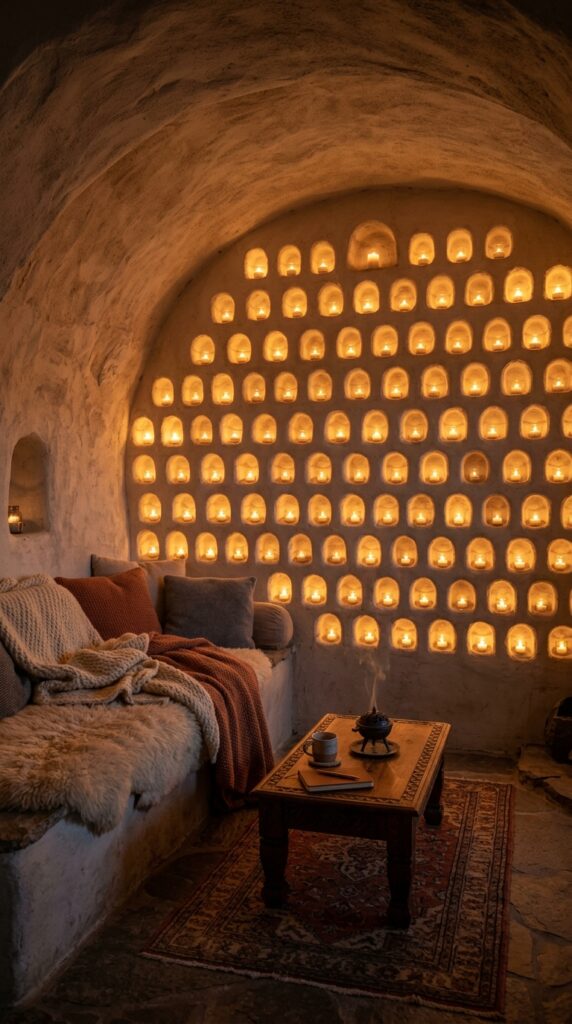
Vibe: Luminous — forty candles in a plastered wall do not add up to a single bright light; they create something closer to bioluminescence.
Why it works: A niche candle wall is the cave home’s answer to a chandelier — distributed warm light from dozens of small sources rather than a single bright overhead fixture. Each niche, roughly 6 inches wide by 8 inches tall by 4 inches deep, functions as a reflector for its candle, amplifying the light while the plaster returns around it catch and soften the glow. The visual effect is that the wall itself appears to generate light — a fundamentally different experience from any electric fixture.
How to get it: Frame the niches between wall studs using off-cut lumber at standard 4-inch depths, clustered in an irregular grid across the wall face. Finish the interior of each niche in smooth lime plaster (not clay — lime is non-combustible). Use LED flameless votives for everyday safety with real beeswax votives reserved for formal occasions.
Shop The Look
| Product |
| LED flameless votive candle set 12 warm flicker |
| Beeswax votive candle bulk set 20 pack |
| Smooth lime plaster interior finish kit |
| Iron incense burner holder decorative |
| Low carved wooden coffee table dark natural |
How to Start Your Cave Home Transformation
Your single best first move is a tadelakt or limewash plaster application on one curved or irregular wall — preferably the wall you face most often in your primary living space. This one surface does more to establish cave home atmosphere than any furniture purchase or accessory arrangement, because it changes the fundamental texture of the room. Once the wall exists, every subsequent choice calibrates to it rather than to paint-grade drywall.
The most common beginner mistake is applying cave home materials in a space with too many right angles left untreated. A hand-plastered wall flanked by square-cornered drywall, hard-edged window trim, and conventional baseboard reads as a feature wall rather than a cave — the style needs rounded transitions and soft geometry to work as a whole. Fix this by applying flexible corner bead and plaster to soften at least the two corners adjacent to your statement wall.
Three immediate impact items under $50: a large genuine sheepskin rug ($38–$45 on Amazon), a dozen beeswax pillar candles arranged on a raw slate tile ($22–$30 for the candles, $8–$12 for the slate), and a single bunch of dried pampas grass in a raw clay pot ($15–$25). These three items alone, on any existing floor, shift the atmosphere toward cave warmth.
A realistic weekend transformation involves one limewashed wall and restyled surfaces — budget $80–$200 and expect strong results. A single-room full transformation (new stone floor, plastered walls, integrated niche shelving, furniture update) realistically costs $3,000–$8,000 and takes 4–6 weeks across trades. A full cave home build or renovation runs $150–$350 per square foot for earth-sheltered construction, significantly above conventional build costs, but energy savings offset this over a 15–20 year horizon.
Frequently Asked Questions About Cave Home Design
What is cave home design and how is it different from Japandi or Wabi-Sabi?
Cave home design is an architecture and interior style rooted in earth-sheltered dwellings, drawing from troglodyte building traditions in Cappadocia, Matera, and the American Southwest. Where Japandi emphasizes refined minimalism with Japanese and Scandinavian line work, and Wabi-Sabi focuses on imperfection as aesthetic philosophy, cave home design is more specifically geological — it references the forms, materials, and spatial qualities of natural rock formations. The most important distinction is structural: cave design prioritizes curved or irregular wall geometry and high-thermal-mass materials (rammed earth, limestone, tadelakt), not just a particular visual mood.
What colors work best for a cave home interior?
The authentic cave home palette is pulled from geology: warm bone white (similar to Benjamin Moore’s White Dove), iron ochre, raw sienna, deep umber, terracotta blush (like Farrow & Ball’s Red Earth), and the cool blue-gray of shadowed limestone. Avoid cold grays (those with blue or green undertones) and stark white — both read as modern and break the earth-sheltered atmosphere. The most versatile single-color choice is a warm greige limewash — it reads bone in direct light and golden ochre in raking light, giving one wall two personalities through the day.
How much does it cost to create a cave-style room?
A starter cave room transformation — limewash paint on one wall, stone-look accessories, candle styling — can be achieved for $150–$400. A full room renovation with clay plaster walls, stone or travertine tile floors, integrated niche shelving, and updated fixtures typically runs $4,000–$12,000 depending on room size and material grade. Purpose-built or retrofitted earth-sheltered cave homes start at around $150 per square foot for construction in regions with suitable geology, rising to $300+ per square foot for premium natural stone finishes throughout.
Can cave home design work in a modern apartment with flat walls and square corners?
Yes, with intentional prioritization. The most effective single intervention in a flat-walled apartment is a limewash or clay paint application on one wall — this introduces the tonal variation and matte texture essential to the style without touching the architecture. Adding curved furniture profiles (an arched sofa back, oval coffee table), organic textiles (sheepskin, boucle, jute), and concentrated candlelight then layered atop it completes the effect. What cannot be achieved without structural intervention is deep niche shelving, arched doorways, or sunken floor levels — accept those as aspirational and focus on surfaces, light, and textiles first.
What is tadelakt and is it suitable for a home bathroom?
Tadelakt is a traditional Moroccan lime plaster technique in which a pigmented lime plaster is applied, then polished with a smooth river stone to compress the surface, and finally treated with black Savon Beldi soap, which reacts with the lime to create a naturally waterproof seal. It is not only suitable for bathrooms — it was developed specifically for hammam (bathhouse) applications and performs better in high humidity than most conventional finishes. The cost for professional tadelakt application runs $25–$60 per square foot depending on region and complexity. The finish must be resealed annually with black soap to maintain its water resistance and developing patina.
Ready to Create Your Dream Cave Home Space?
These 28 ideas range from geological color palettes and rammed earth walls to stalactite pendant clusters, sunken bathtubs, and grotto showers — the full material and atmospheric spectrum of cave home design. Transformation is incremental, and starting with a single limewashed wall or a slate-and-candle arrangement is not the slow path — it is the right path, because cave home design rewards patience and accumulation over wholesale replacement. Today, order one genuine sheepskin rug and place it on your existing floor near your lowest seating point — that single change will show you exactly what this style does to a room. When the space is done, you will not feel like you decorated it; you will feel like you found it, already waiting inside the walls. Save the ideas that made you pause — especially the ones involving candlelight and plaster — because those are the ones that will still be right six months from now.