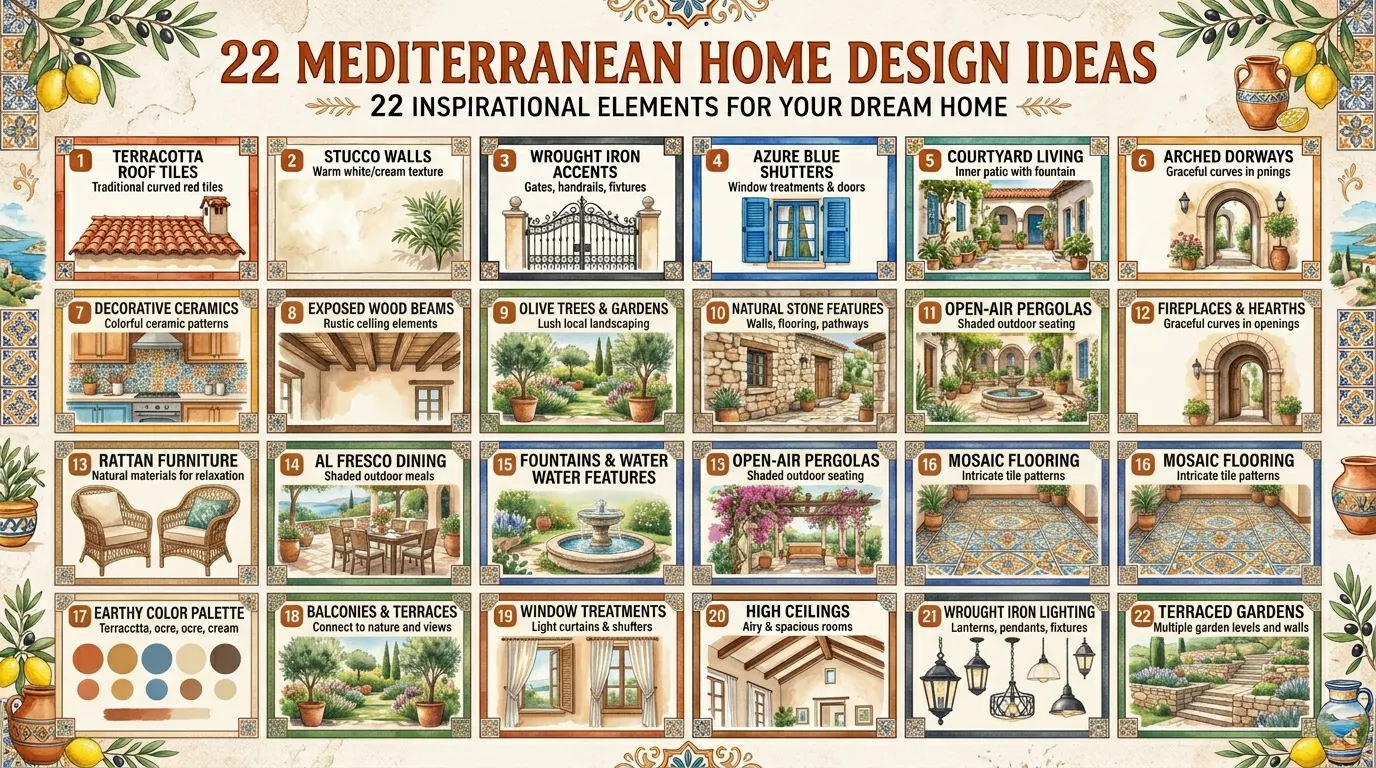
Mediterranean home design is a sun-drenched architectural style rooted in the coastal regions of Southern Europe — drawing from Spanish, Italian, Greek, and Moroccan traditions to create homes that feel simultaneously ancient and alive. This article gives you 22 specific, actionable Mediterranean home design ideas covering color, materials, lighting, furniture, layout, accessories, and small-space solutions.
Step through an arched doorway into cool terracotta tile. Feel the texture of whitewashed plaster against your palm. The air carries a faint suggestion of citrus and warm stone, and somewhere beyond a wrought-iron window, the afternoon light is doing something magnificent. Mediterranean design doesn’t ask you to decorate a room — it asks you to build a world. Here are 22 ideas worth saving — and stealing.
Why Mediterranean Style Works So Well in a Home
Mediterranean design is not a single country’s invention — it is the distilled wisdom of civilizations that spent millennia solving the same problem: how to live well in a warm, sun-abundant climate with abundant natural stone, clay, and timber. Spanish hacienda architecture, Italian Tuscan farmhouse design, Greek island whitewash, and Moroccan riad geometry all contribute to what we now call Mediterranean style. What unifies them is the logic of the courtyard, the arch, the thick wall, and the handmade surface — design rooted in function that became beauty.
The material vocabulary is specific and generous. Terracotta tile (saltillo or Spanish tile, 12–18 inch squares) for floors. Whitewashed or lime-plastered walls in warm white, aged alabaster, or sun-bleached ochre. Exposed rough-hewn wood ceiling beams in reclaimed pine or Douglas fir. Wrought iron in window grilles, light fixtures, and furniture hardware. Ceramic tile in hand-painted blue, cobalt, and warm saffron for backsplashes and accent surfaces. Linen, cotton canvas, and kilim textiles. Olive green, terracotta blush, cobalt blue, warm saffron, dusty rose, and the white of sun-bleached plaster define the palette.
Mediterranean design is experiencing a significant resurgence driven by two converging cultural forces: a post-pandemic desire for homes that feel like destinations, and a broad rejection of cold Scandinavian minimalism in favor of warmth, texture, and material richness. Pinterest searches for “Mediterranean living room,” “terracotta floor tile,” and “arched doorways interior” have grown consistently since 2022, and the style’s emphasis on natural, artisan-made materials aligns with the sustainability values of a new generation of homeowners.
Small spaces genuinely thrive in Mediterranean style — perhaps better than any other design tradition, because the style was historically practiced in dense Mediterranean villages where homes were compact and every surface and architectural detail carried visual weight. In a small room, focus on one large-scale terracotta floor tile, one whitewashed wall, and one arched detail — a doorway, a mirror frame, or a window niche — and the room will read as Mediterranean without needing to address its size at all.
Style at a Glance
| Element | Mediterranean Trait | Design Principle |
| Philosophy | Artisan craft, indoor-outdoor living | Beauty through function |
| Materials | Terracotta, lime plaster, wrought iron, hand-painted tile | Natural, tactile, handmade |
| Color Palette | Terracotta blush, cobalt blue, warm ochre, whitewash | Sun-saturated earth and sea tones |
22 Mediterranean Home Design Ideas
1. Terracotta Saltillo Tile Flooring
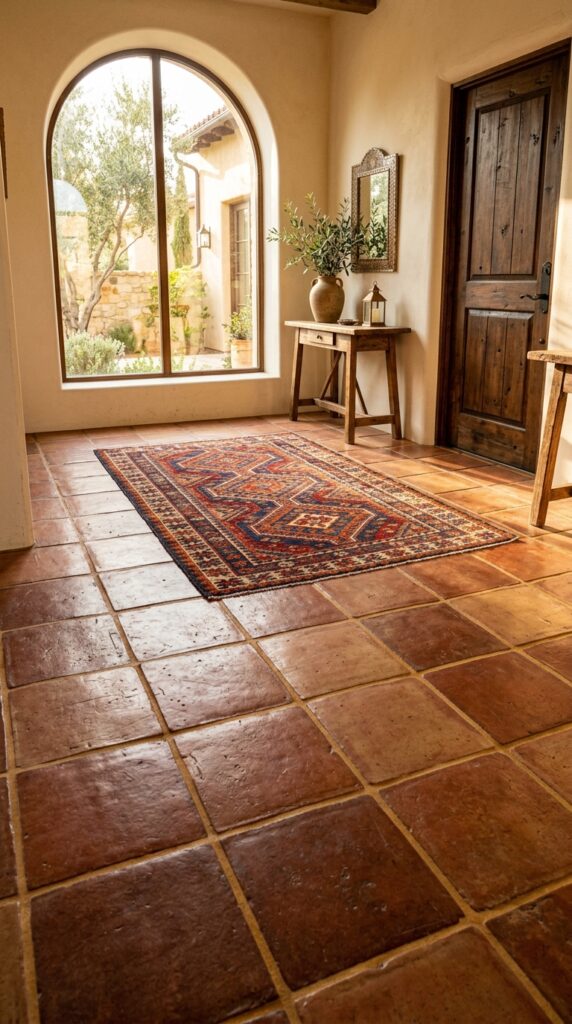
Vibe: Sun-warmed — the floor holds the heat of a day that hasn’t ended yet.
Why it works: Saltillo terracotta is the foundational floor material of Mediterranean design because it embodies the style’s central philosophy: beauty that comes from nature and time rather than manufacturing precision. Each tile is hand-formed, kiln-fired, and slightly irregular — no two are identical in tone or surface — and the variation is the point. The design principle at work is natural imperfection as pattern: the tonal variation across a saltillo floor creates a visual complexity that no uniform tile can replicate, and it deepens with age and use rather than wearing out.
How to get it: Saltillo tile requires a penetrating sealer applied before grouting and again after (use a matte or low-sheen sealer — a glossy sealer produces a plastic-looking finish that kills the natural quality of the tile). Grout in warm ochre or buff — never white, which creates an artificial, high-contrast grid. Space tiles at 3/16-inch joints minimum to accommodate the slight size variation of hand-formed tile.
💡 Quick Win: A single saltillo tile trivet or cutting board on a kitchen counter costs $8–$15 and immediately introduces the warm terracotta tone to test against your existing palette before committing to a floor installation.
Shop The Look
| Product |
| Saltillo terracotta tile 12×12 natural unglazed |
| Saltillo tile sealer penetrating matte finish |
| Warm ochre sanded grout floor tile |
| Woven kilim area rug vintage style |
| Terracotta planter large indoor clay |
2. Whitewashed Lime Plaster Walls

Vibe: Ancient — a wall that has witnessed several lifetimes of morning light.
Why it works: Lime plaster walls are to Mediterranean design what linen is to Japandi — the foundational textural surface that makes everything else feel authentic. Unlike smooth painted drywall, hand-applied lime plaster has micro-variation in surface depth that catches light and creates subtle shadow gradients throughout the day, making the wall itself animated. The warm white tone of lime plaster (slightly cream, never stark) connects to bleached limestone, whitewashed village walls, and the light-reflective surfaces that kept Mediterranean homes cool before air conditioning.
How to get it: Venetian plaster (readily available in pre-mixed tubs) is the most accessible lime plaster product for DIY application — apply two to three coats with a stainless steel trowel in figure-eight strokes, lightly burnishing the final coat for a soft sheen. American Clay and Portola Paints both produce authentic lime plaster wall finishes specifically for North American applications.
Shop The Look
| Product |
| Venetian plaster pre-mixed warm white interior |
| Lime wash paint wall finish aged white |
| Stainless steel venetian plaster trowel set |
| Limewash wall paint kit warm white |
| Plaster wall texture brush stipple finish |
3. Arched Doorways and Pass-Throughs
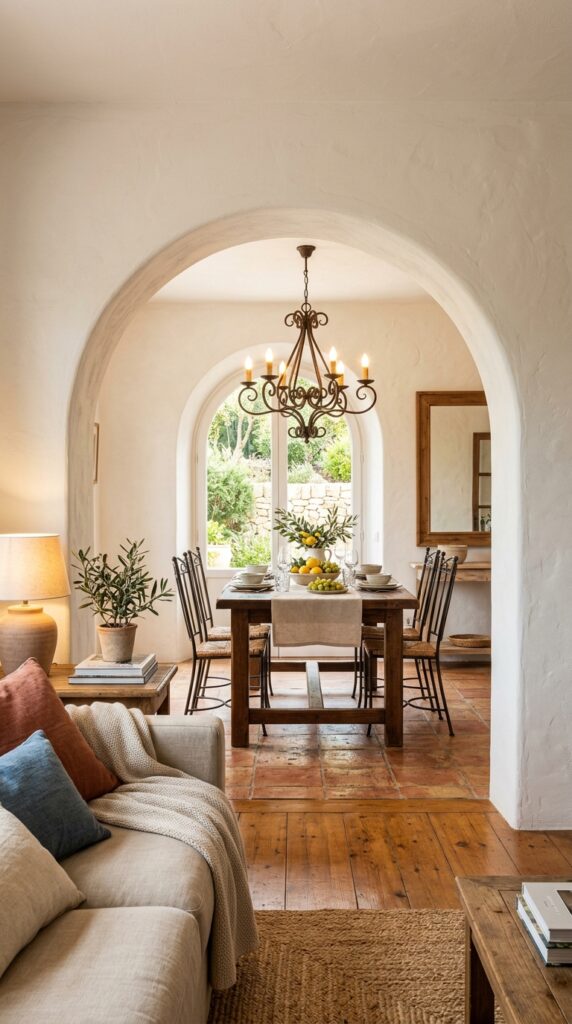
Vibe: Inviting — every doorway is a frame for what comes next.
Why it works: The arch is Mediterranean architecture’s most powerful single element because it does three things simultaneously: it softens the rectilinear geometry of modern construction, it references centuries of Roman, Moorish, and Spanish Colonial architectural tradition, and it creates a visual threshold — a moment of transition between spaces that a square opening simply cannot provide. In a domestic interior, arched pass-throughs also create the layered, glimpsed-interior quality of a Mediterranean village, where you’re always seeing one room framed by another.
How to get it: A standard square doorway can be converted to an arch using flexible drywall bead and joint compound — no structural changes required unless the doorway is load-bearing. The curve radius for a standard 36-inch doorway should be 18 inches (a full semicircle) for the most classical proportion. Shallower arches read as modern; full semicircles read as authentically Mediterranean.
💡 Quick Win: An arched mirror (available in most home stores for $80–$200) placed against a flat wall introduces the arch form immediately without any construction work.
Shop The Look
| Product |
| Arched wall mirror large Mediterranean style |
| Flexible drywall arch bead corner bead |
| Joint compound finishing plaster drywall |
| Arched decorative frame wall mount |
| Arched cabinet door replacement set |
4. Wrought Iron Light Fixtures and Hardware
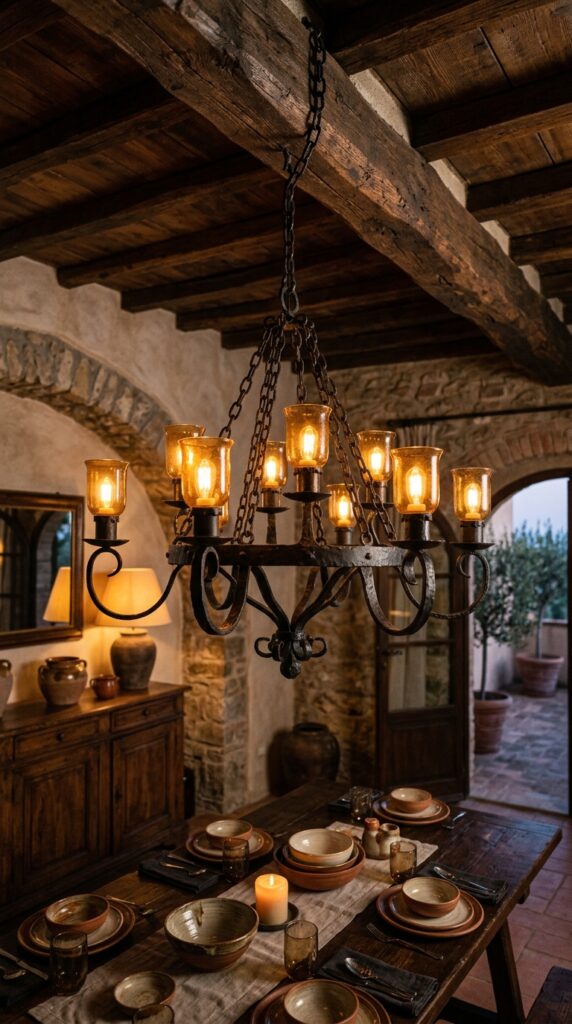
Vibe: Dramatic — a light fixture that makes dinner feel like a ritual.
Why it works: Wrought iron is the connective material of Mediterranean design — it appears in window grilles, door hardware, chandeliers, furniture frames, and stair railings, providing a consistent dark accent that anchors the warm, sun-bleached palette. The design principle is material repetition: when the same material — here, dark forged metal — appears in multiple objects across a room, the eye registers it as intentional and the room feels cohesive rather than collected. Wrought iron’s visible hammer marks and slight irregularity also align with the style’s celebration of handcraft.
How to get it: Source wrought iron fixtures from Spanish or Mexican metalcraft suppliers for authentic hand-forged quality — production cast-iron pieces lack the surface variation that makes hand-forged ironwork beautiful. Pair with Edison-style filament bulbs at 2200K for the warmest possible amber light that complements the terracotta and plaster palette.
Shop The Look
| Product |
| Wrought iron chandelier candle style 8 light |
| Edison filament bulb 2200K warm amber E26 |
| Wrought iron wall sconce candle style pair |
| Forged iron door handle set rustic |
| Wrought iron curtain rod with finials |
5. Hand-Painted Talavera Tile Backsplash
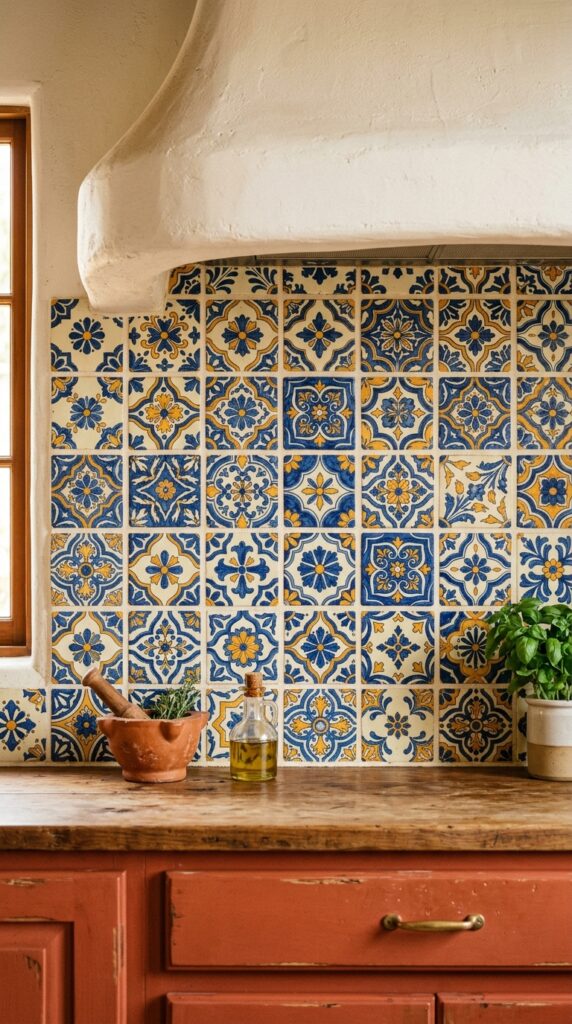
Vibe: Vibrant — a surface that was made by a specific pair of hands.
Why it works: Talavera tile introduces the full Mediterranean color palette — cobalt, saffron, warm white — in one concentrated surface that anchors the entire kitchen’s visual identity. The hand-painted quality means each tile is slightly different from its neighbors, creating organic variation across the backsplash surface that machine-printed tile cannot replicate. This follows the wabi-sabi-adjacent Mediterranean appreciation for handcraft: the slight inconsistencies in glaze and pattern are evidence of making, and making is beautiful. Talavera’s bold pattern also provides a pattern anchor that allows surrounding surfaces (plaster walls, terracotta floor, wood cabinets) to remain simple.
How to get it: Use Talavera tile as a single-zone feature — backsplash only, or the front face of a kitchen island — rather than covering every surface. Surrounding surfaces should be simple and matte to let the tile’s pattern breathe. Install with white or cream grout in a 1/8-inch joint; the tile’s variations mean a thin joint is more forgiving than a wide one.
Shop The Look
| Product |
| Talavera hand-painted ceramic tile 4×4 cobalt blue |
| Hand-painted Mexican ceramic tile set mixed |
| Spanish tile backsplash decorative ceramic |
| Cream unsanded grout ceramic tile |
| Talavera tile sample set assorted |
6. Exposed Rough-Hewn Wood Ceiling Beams
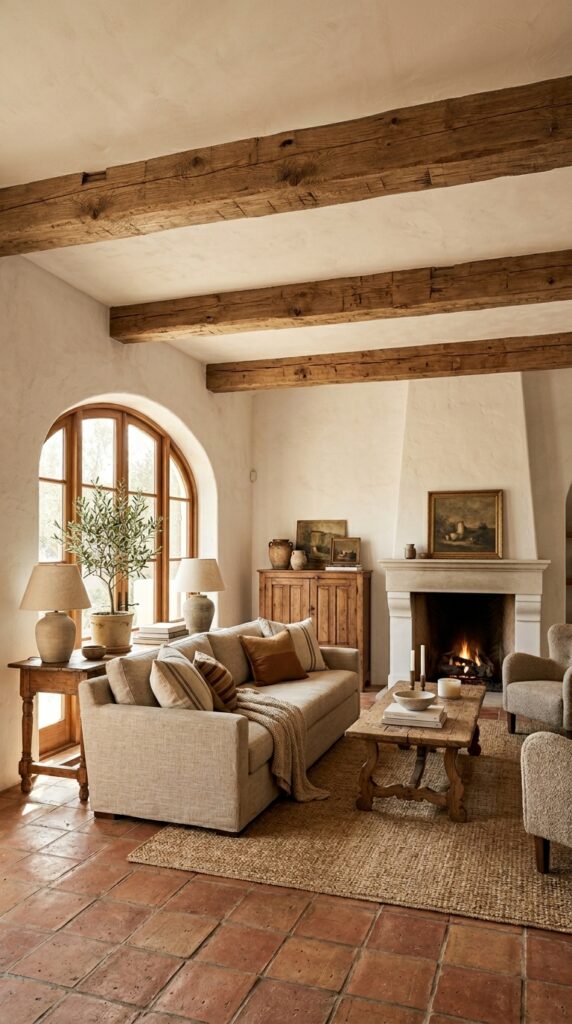
Vibe: Grounded — a ceiling that has the weight of a centuries-old farmhouse.
Why it works: Exposed ceiling beams in a Mediterranean interior create what architects call revealed structure — making the building’s physical construction visible as a design element. The rough surface of hand-hewn or reclaimed beams is critical: smooth, machined beams read as modern rustic; rough, irregular beams read as Mediterranean. The beams also provide vertical scale reference in high-ceiling rooms, making the ceiling feel anchored rather than distant, and they connect the horizontal and vertical elements of the room visually.
How to get it: Faux wood beams in polyurethane — available from companies like Barron Designs — are structurally hollow and install in a half-day with construction adhesive and screws into ceiling joists. They are visually indistinguishable from solid reclaimed wood at 8 feet and above. For genuine reclaimed beams, source from architectural salvage yards for authentic patina and grain character.
Shop The Look
| Product |
| Faux wood ceiling beam polyurethane rustic brown |
| Reclaimed wood beam mantel shelf rustic |
| Wood beam bracket iron support decorative |
| Faux wood beam kit installation hardware |
| Ceiling beam stain dark walnut interior |
7. Cobalt Blue and Terracotta Color Palette

Vibe: Sun-drenched — the room looks like it was painted by the sea itself.
Why it works: Cobalt blue and terracotta are the Mediterranean palette’s most iconic pairing because they are near-complementary colors — blue and orange sit across from each other on the color wheel — meaning they intensify each other by contrast. This is not an accidental folk tradition; it is a sophisticated color strategy developed over centuries of craftsmanship in Portuguese azulejo tile, Moroccan zellige, and Spanish ceramics. The key to making this pairing feel sophisticated rather than loud is proportion: terracotta as the dominant wall and floor tone (70%), warm linen as the neutral base (20%), and cobalt as the accent (10%).
How to get it: Use Benjamin Moore “Inca Gold” or Sherwin-Williams “Fired Brick” for terracotta walls, and introduce cobalt through ceramic vessels, throw pillows, and a kilim rug rather than painting walls blue. Blue on walls competes with the terracotta; blue in objects adds rhythm without competing for dominance.
Shop The Look
| Product |
| Cobalt blue ceramic vase set Mediterranean |
| Kilim area rug cobalt blue terracotta geometric |
| Terracotta throw pillow covers linen set |
| Cobalt blue throw pillow outdoor indoor |
| Terracotta wall paint sample warm clay |
8. Courtyard-Inspired Indoor-Outdoor Living
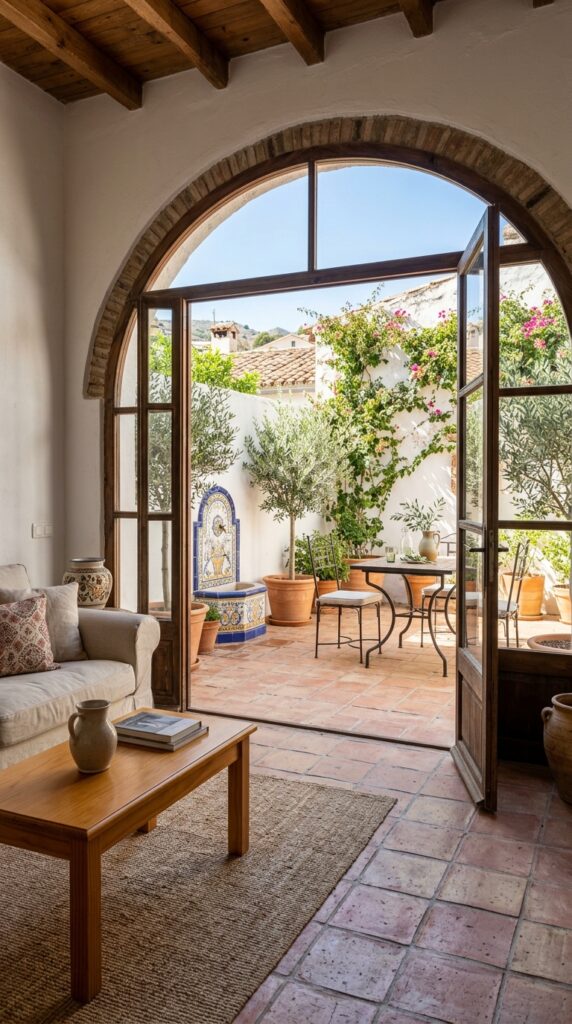
Vibe: Open — the house and the garden are the same conversation.
Why it works: The indoor-outdoor transition is the defining spatial characteristic of Mediterranean living — historically, the courtyard (patio in Spanish, cortile in Italian) was the center of domestic life, a private exterior room that regulated temperature, provided natural light to surrounding rooms, and served as the family’s primary living space during warm months. Recreating this in a modern home means treating the transition zone as a room in its own right: continuous flooring material, matching planter scale, coordinated furniture, and doors that disappear into the wall when open.
How to get it: Use the same terracotta tile inside and outside the threshold — specify frost-resistant terracotta for the exterior portion if you’re in a climate with freezing temperatures. Extend the tile at least 6 feet into the exterior space to establish the visual connection. A single large olive tree in a terracotta pot at the threshold reinforces the Mediterranean identity instantly.
Shop The Look
| Product |
| Wrought iron bistro set outdoor table chairs |
| Large terracotta planter outdoor 18 inch |
| Frost resistant terracotta tile outdoor |
| Ceramic tabletop fountain small courtyard |
| Olive tree topiary live indoor outdoor |
9. Moroccan Lantern Lighting
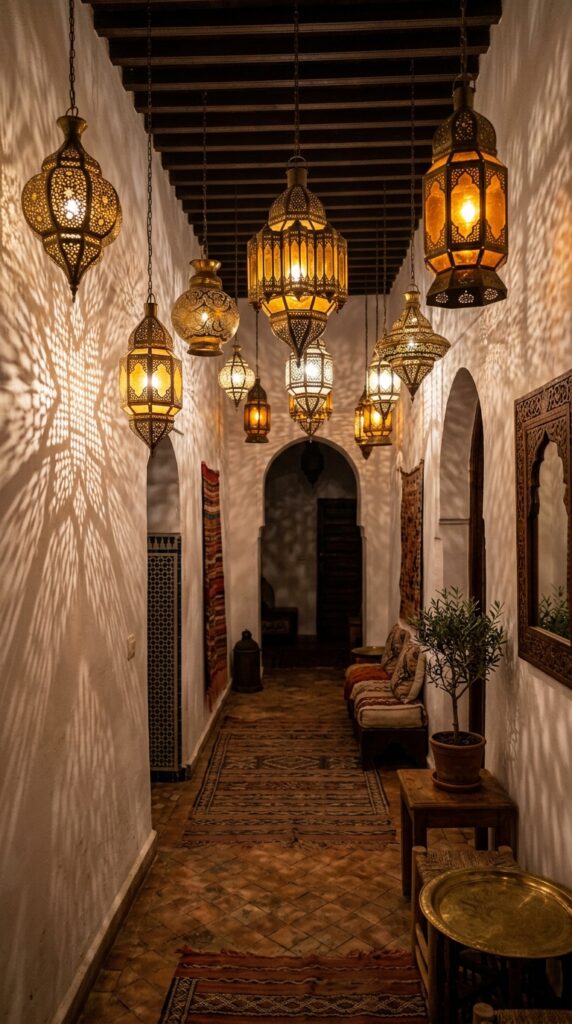
Vibe: Romantic — the light arrives as pattern before it arrives as illumination.
Why it works: Moroccan pierced metal lanterns are one of the most powerful lighting tools in Mediterranean design because they perform double duty: they provide warm ambient light and simultaneously project intricate geometric shadow patterns across every surrounding surface. This transforms the act of lighting a room into a theatrical event — the walls, ceiling, and floor become part of the light fixture’s output. The design principle is light as texture: in a room with whitewash plaster walls and terracotta floor, the shadow pattern becomes a second layer of visual complexity applied at no material cost.
How to get it: Group three to five lanterns at varying heights rather than hanging a single fixture — a cluster of lanterns at different drop lengths creates a more dynamic shadow composition than one large lantern. Use amber-tinted LED candle bulbs (2200K) inside each lantern; cool bulbs flatten the pattern effect by reducing shadow contrast.
💡 Quick Win: A single Moroccan lantern on a side table with a candle inside costs $20–$45 and immediately introduces the shadow-pattern quality to any Mediterranean room without any electrical work.
Shop The Look
| Product |
| Moroccan hanging lantern brass pierced metal |
| Moroccan lantern table lamp amber glass |
| Moroccan pendant light cluster kit hanging |
| Candle bulb amber 2200K E12 flame tip |
| Brass lantern wall sconce outdoor indoor |
10. Linen and Cotton Canvas Soft Furnishings

Vibe: Relaxed — the furniture has been here long enough to feel inevitable.
Why it works: Mediterranean design uses natural fabric as a temperature and texture regulator — linen and cotton canvas breathe in warm climates, age gracefully (linen becomes softer with every wash), and connect to the natural material vocabulary of the style. The loose, slipcover quality of well-done Mediterranean upholstery — slightly oversized cushion covers, natural wrinkles, undyed or sun-faded tones — creates a lived-in aesthetic that is completely intentional. Tight, tailored upholstery reads as modern or formal; loose, natural-fiber upholstery reads as Mediterranean.
How to get it: Source loose linen slipcovers rather than permanently upholstered furniture — they can be removed and washed, which suits the breezy quality of Mediterranean design. Avoid polyester-blend fabrics, which pill and don’t drape with the same natural weight. IKEA’s EKTORP sofa with TOTEBO natural slipcover is a legitimate Mediterranean-look starting point at an accessible price.
Shop The Look
| Product |
| Linen sofa slipcover loose fit warm greige |
| Cotton canvas throw blanket natural undyed |
| Linen throw pillow covers terracotta set |
| Woven cotton kilim floor cushion round |
| Linen ottoman slipcover natural oversized |
11. Olive Trees and Mediterranean Botanicals
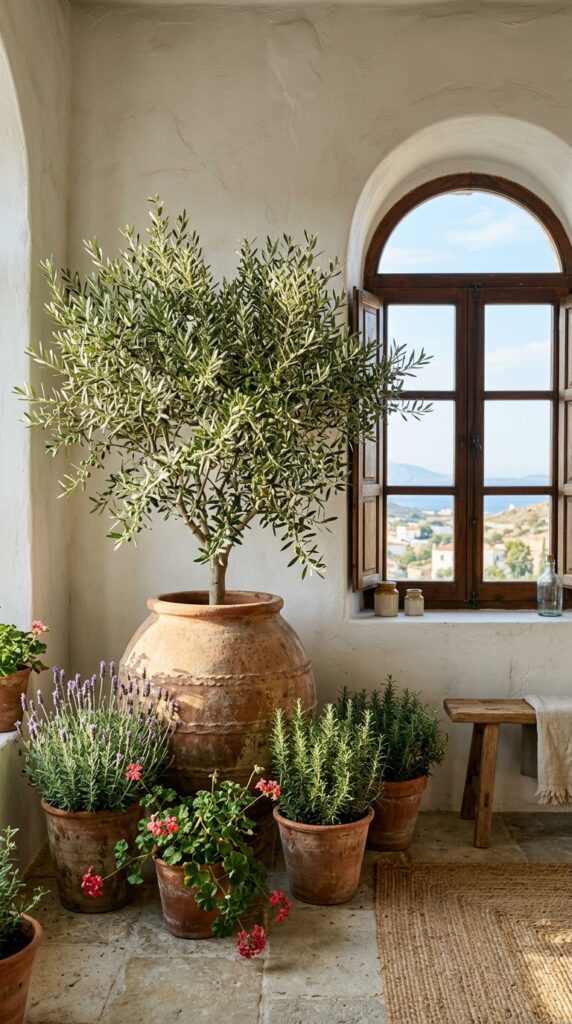
Vibe: Alive — a room that breathes through its plants.
Why it works: Mediterranean design is inseparable from its botanical context — olive trees, rosemary, lavender, citrus, and geranium are not decorative choices but cultural signifiers that connect the interior to the landscape of Southern Europe. Indoor olive trees specifically serve a precise design function: their silvery-grey-green leaf color introduces a cool foil to the warm terracotta and ochre palette without introducing an artificial color, and their irregular, windswept branch structure provides the kind of organic asymmetry that no manufactured object can replicate.
How to get it: Olive trees require very bright indirect or direct light — south or west-facing windows only. An established 4-to-6-foot olive tree in a 14-inch terracotta pot (approximately $80–$180 from specialty nurseries or online) is a statement-scale plant that immediately reads as a design decision. Arbequina and Picholine varieties adapt well to indoor container growing.
Shop The Look
| Product |
| Olive tree live indoor container Arbequina |
| Large terracotta pot planter 14 inch natural |
| Rosemary topiary live herb indoor |
| Lavender plant live indoor container |
| Terracotta pot set nesting sizes natural |
12. Zellige and Encaustic Cement Tile Accents
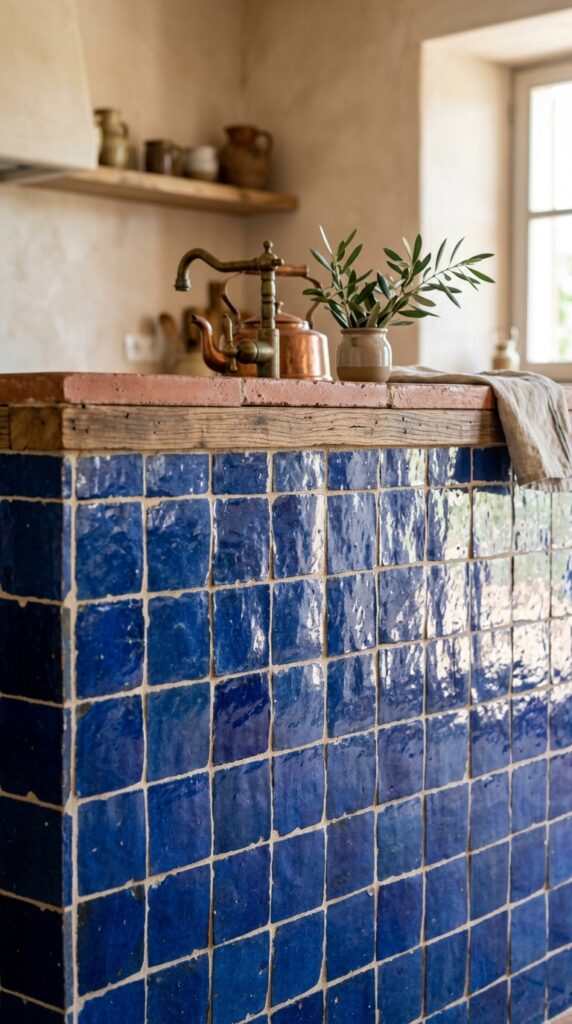
Vibe: Vibrant — a surface that is different every time you look at it.
Why it works: Zellige tile — hand-cut from individually glazed terracotta pieces — is the most texture-rich tile option in the Mediterranean palette because each piece is slightly different in glaze depth, surface angle, and edge finish. When assembled, this variation creates an almost mosaic-like shimmer across the surface, as each tile reflects light from a slightly different angle. The design principle is aggregate variation: the beauty emerges from the assembly of imperfect individual units rather than from precision. Machine-cut “zellige-look” tiles deliver the color but none of the shimmer.
How to get it: Use zellige as a single-zone accent — the front face of a kitchen island, a bathroom floor, a fireplace surround — rather than an all-over surface. The visual complexity requires surrounding surfaces to be completely simple. Source from Moroccan importers or specialty tile shops (Cle Tile, Fireclay Tile, or Moroccan Mosaic & Tile House carry authentic zellige). Budget $18–$35 per square foot for authentic hand-cut pieces.
Shop The Look
| Product |
| Zellige tile cobalt blue 4×4 hand cut |
| Encaustic cement tile geometric pattern |
| Moroccan mosaic tile set deep blue |
| Encaustic tile blue terracotta geometric |
| Cement tile sealer penetrating matte |
13. The Mediterranean Kitchen: Plaster Range Hood
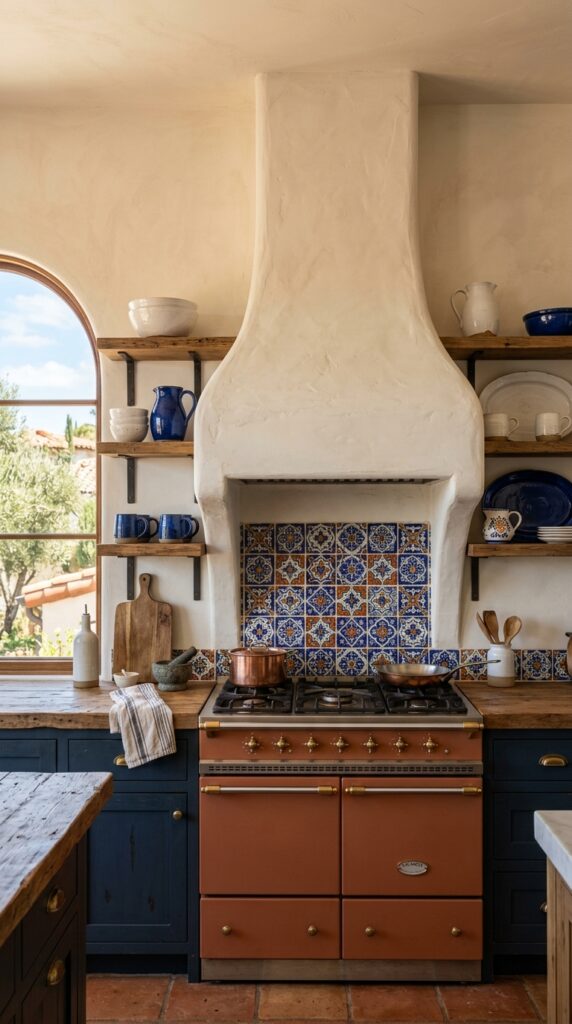
Vibe: Artisan — a kitchen built by someone who cared about cooking and architecture equally.
Why it works: A plaster range hood is the single most transformative element in a Mediterranean kitchen because it turns a purely functional appliance enclosure into a sculptural focal point. Unlike stainless steel or painted wood hoods, a plaster hood is organic in form — slightly irregular, hand-finished — and it visually connects the kitchen to the lime plaster walls of the broader home. The design principle is material continuity: when the hood is made from the same material as the walls, the kitchen ceases to feel like a separate utilitarian zone and becomes a natural extension of the home’s interior architecture.
How to get it: A plaster range hood is built over a sheet metal liner and framed with cement board, then finished with two to three coats of base coat plaster and one coat of Venetian or finish plaster. The total material cost is $200–$600; labor from a skilled plasterer adds $400–$1,200. The sculptural curved form is the most Mediterranean — a squared plaster hood reads as Scandinavian or modern farmhouse rather than Mediterranean.
💡 Quick Win: A plaster-textured range hood cover kit (available from several Etsy vendors) slips over an existing metal hood and can be finished with lime wash paint for $150–$300 in total cost.
Shop The Look
| Product |
| Venetian plaster kit warm white range hood |
| Cement board backer sheet 3×5 |
| Open wood shelf bracket kitchen rustic iron |
| Hand-thrown ceramic bowl set white |
| Cobalt blue ceramic pitcher decorative kitchen |
14. Rattan and Wicker Furniture
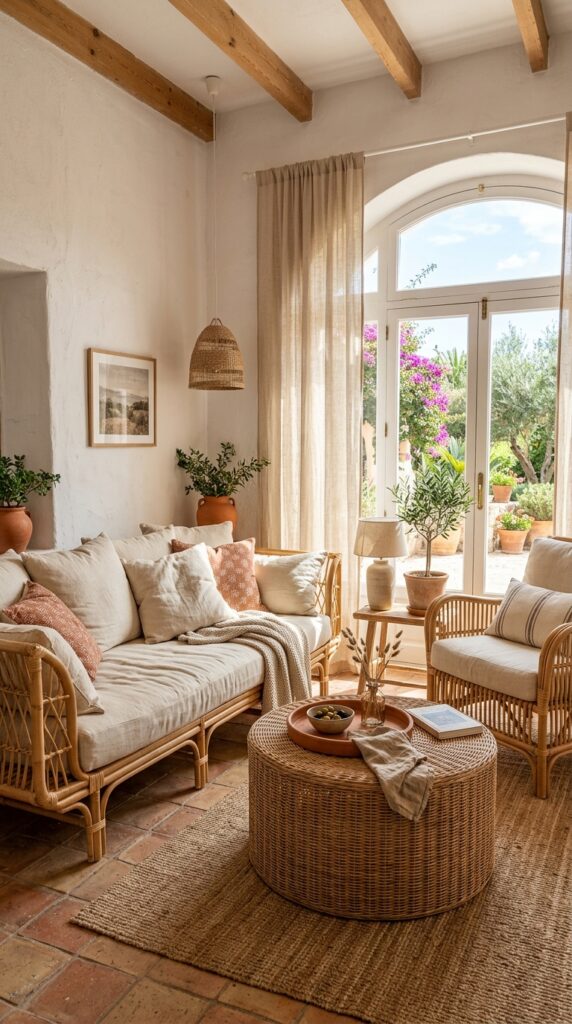
Vibe: Breezy — furniture that belongs as much outside as in.
Why it works: Rattan and wicker introduce Mediterranean design’s most important spatial quality: the sense that the boundary between inside and outside is negotiable. These materials are structurally outdoor furniture brought in — they reference terrace dining, courtyard sitting, and the breezy indoor-outdoor life of Mediterranean summers. The open weave of rattan also allows light to pass through and around the furniture, keeping the visual weight of the room lower than solid upholstered pieces would — an important quality in warm-climate design where rooms should feel airy.
How to get it: Natural rattan (not synthetic resin wicker) has a warm honey-to-amber tone that deepens with age and connects to the terracotta and wood palette. Source from manufacturers who use real rattan — Serena & Lily, World Market, and Anthropologie all carry genuine rattan furniture at various price points. Avoid furniture labeled “all-weather wicker” for indoor use — it is synthetic and reads as pool furniture, not Mediterranean.
Shop The Look
| Product |
| Rattan sofa frame natural indoor linen cushions |
| Wicker coffee table natural rattan round |
| Rattan armchair natural honey indoor |
| Wicker basket tray terracotta planter storage |
| Natural rattan pendant light shade |
15. Warm Ochre and Saffron Accent Palette
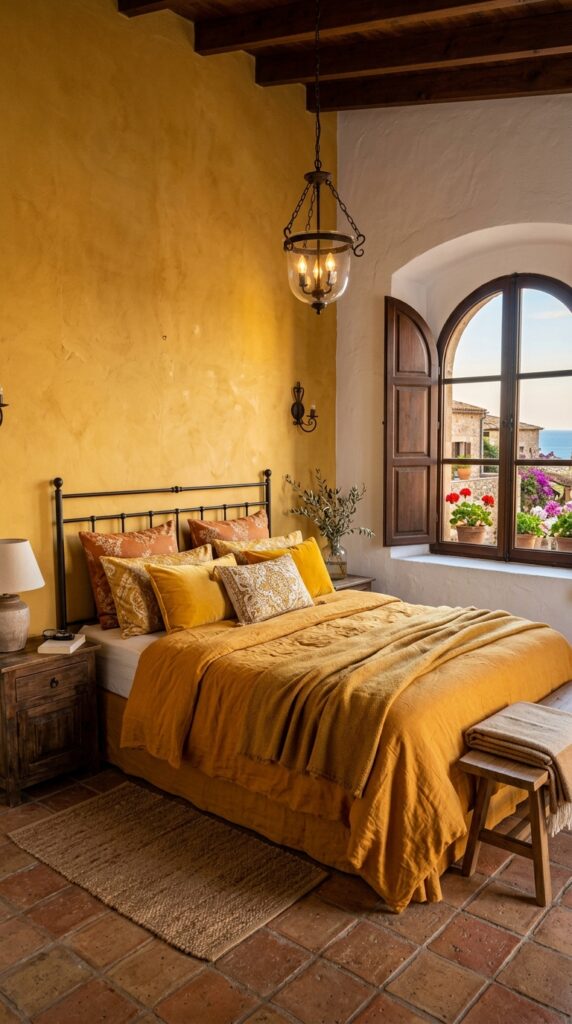
Vibe: Luminous — the room is storing sunlight.
Why it works: Warm ochre and saffron are the color of Southern European light itself — the tone of sandstone at midday, of wheat fields in August, of the walls of a Tuscan hill town. In a Mediterranean interior, these tones function as a warm light amplifier: they reflect warm-spectrum light back into the room, making the space feel perpetually sun-drenched even at dusk. The design principle is color temperature harmony — ochre and saffron share warm yellow undertones with the terracotta floor and the honey wood beams, so the entire palette reads as one cohesive thermal family.
How to get it: Use Benjamin Moore “Golden Straw” or Farrow & Ball “Sudbury Yellow” for an ochre wall — test both in the same natural light conditions, as ochre tones shift dramatically between north-facing and south-facing rooms. Use ochre on one wall only (typically the fireplace or focal wall) and let plaster white handle the remaining walls.
Shop The Look
| Product |
| Ochre yellow throw pillow covers linen set |
| Saffron linen throw blanket warm gold |
| Ochre and gold embroidered cushion cover |
| Saffron silk pillow cover decorative |
| Warm gold geometric throw pillow set |
16. The Mediterranean Bedroom: Layered Textile Canopy

Vibe: Romantic — a bed that takes ten minutes to leave in the morning.
Why it works: The canopy bed is a Mediterranean design tradition rooted in the practical need to hang mosquito netting in warm climates — form following climate function, becoming beautiful in the process. In a contemporary Mediterranean bedroom, the canopy frame (wrought iron is the authentic material) provides a vertical architectural element in a room where everything else is horizontal, drawing the eye upward and creating a room-within-a-room sleeping enclosure. The layered textile approach — linen underneath, embroidered cotton over, kilim at the foot — embodies the Mediterranean tradition of textile accumulation, where each layer references a different regional craft.
How to get it: A wrought iron canopy bed frame (available from $300–$800) is the structural foundation. Hang four panels of sheer linen or cotton voile from the canopy corners, allowing them to pool slightly on the floor for the most romantic drape. Do not tie them back symmetrically — asymmetric or loose draping reads as Mediterranean; tied-back symmetrical draping reads as colonial.
Shop The Look
| Product |
| Wrought iron canopy bed frame queen |
| Sheer linen canopy drape panel cream |
| Embroidered cotton coverlet white Mediterranean |
| Kilim throw blanket colorful woven |
| Iron bed crown canopy hardware wall mount |
17. Natural Stone Feature Wall

Vibe: Ancient — a wall that predates the house it is in.
Why it works: Natural stone on an interior wall introduces the most powerful time-reference available in Mediterranean design — rough-cut limestone and travertine are the building materials of the ancient world, and their presence in a contemporary room creates an immediate connection to that history. The design principle is material authenticity: unlike stone-look wallpaper or printed tile, genuine stone has depth variation, fossil inclusions, and surface texture that cannot be replicated, and these qualities give the wall a presence and authority that no synthetic material can achieve.
How to get it: Thin-cut stone veneer panels (1-inch thick limestone or travertine slices adhered to a mesh backing) are available from stone suppliers at $8–$20 per square foot and can be mortared to drywall without structural reinforcement. Use a buff or warm grey mortar joint color — white mortar on warm stone looks like a swimming pool rather than a farmhouse wall.
Shop The Look
| Product |
| Limestone thin veneer stone panel wall cladding |
| Travertine stacked stone veneer panel |
| Warm grey mortar stone wall installation |
| Fireplace surround natural stone tile |
| Stone sealer travertine limestone penetrating |
18. Small Mediterranean Bathroom: Zellige Floor and Plaster Walls
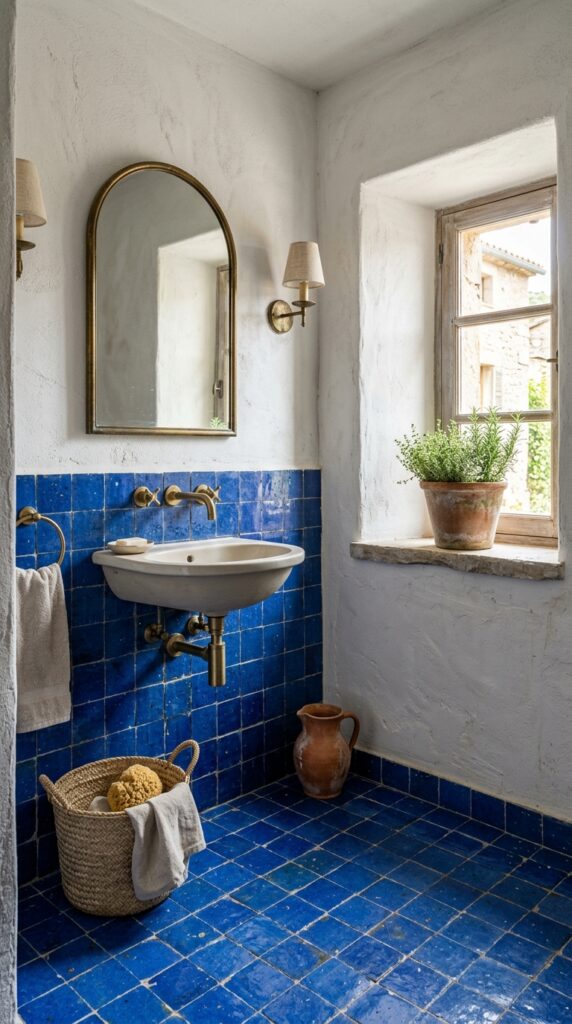
Vibe: Vibrant — a small room that earns more attention per square foot than any other in the house.
Why it works: A small bathroom is the ideal canvas for Mediterranean tile because the limited square footage makes artisan tile affordable — 40–60 square feet of zellige or encaustic cement tile costs $800–$2,000, a fraction of what it would cost for an entire living room floor. The design principle for small Mediterranean bathrooms is total immersion: commit fully to one strong surface (the cobalt zellige floor), keep all other surfaces simple (plaster walls, simple brass fixtures), and let that single material carry the entire room’s visual identity. Restraint on the walls amplifies the floor.
How to get it: In a bathroom under 50 square feet, use one strong pattern tile on the floor and lime plaster or a single-color solid tile on the walls — not both patterned. The combination of a patterned floor and patterned walls creates visual chaos in a small room. Keep the vanity as simple as possible — a wall-mounted basin or simple undermount with plaster surround — to give the floor maximum visibility.
💡 Quick Win: A single zellige or encaustic cement tile used as a soap dish or small tray on the vanity counter introduces the tile’s visual character to a bathroom for under $30, testing the cobalt tone against your existing wall color before committing.
Shop The Look
| Product |
| Cobalt blue zellige floor tile bathroom |
| Aged brass wall mirror arched bathroom |
| Warm brass bathroom faucet set |
| Lime plaster wall paint bathroom humid |
| Brass towel ring wall mount bathroom |
19. Mediterranean Entryway: Arch, Tile, and Iron

Vibe: Welcoming — you know immediately what kind of home this is.
Why it works: The entryway is the single room where all three of Mediterranean design’s signature elements — the arch, the terracotta floor, and the wrought iron — can be presented simultaneously in a compact space. When all three appear together at the threshold of the home, they function as a complete design statement that sets expectations for every room beyond. The ceramic tile border at baseboard height — a band of hand-painted decorative tile running at the base of the plaster wall — is a specifically Spanish and Portuguese tradition (azulejo wainscot) that adds pattern at floor level without disrupting the simplicity of the wall above.
How to get it: The ceramic tile border should run at 6 inches high — the height of two standard 3×6 tiles placed horizontally — and should be installed before the baseboard trim to allow the baseboard to cap the top edge cleanly. Use the same cobalt or saffron palette as the rest of the home’s accent tiles for visual consistency.
Shop The Look
| Product |
| Wrought iron console table entry rustic |
| Hand-painted ceramic tile border decorative strip |
| Ceramic bowl decorative terracotta warm white |
| Saltillo terracotta entryway tile set |
| Iron umbrella stand wall mount entry |
20. The Mediterranean Dining Room: Long Table and Ceramic Tableware
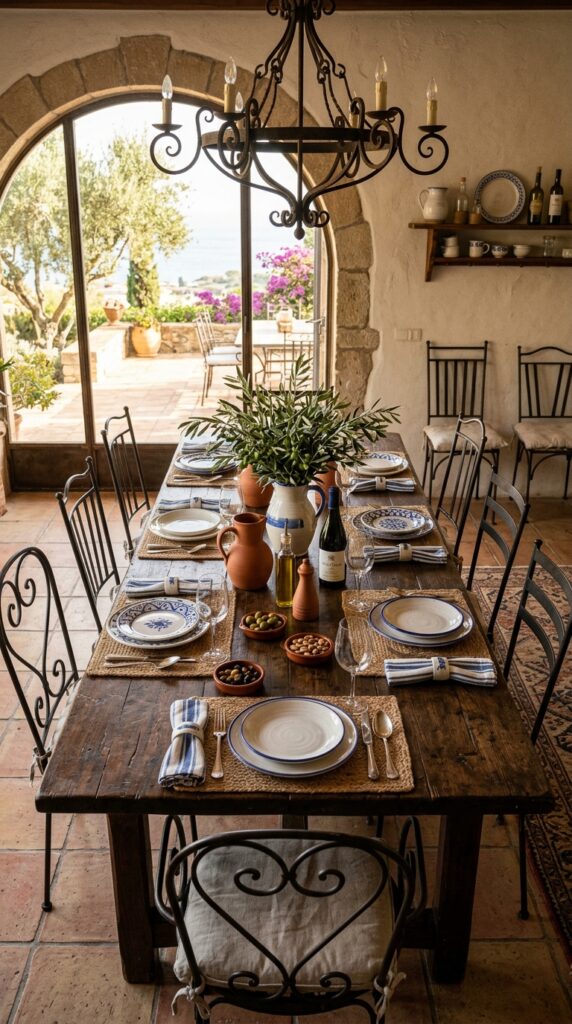
Vibe: Generous — a table that was built for more people than expected.
Why it works: The Mediterranean dining room centers on one object: a long, heavy, dark wood table that communicates hospitality through sheer scale. The tradition of the long communal table — mesa grande — is foundational to Mediterranean food culture and its design logic follows: a table that seats eight when only four are expected. Mismatched wrought iron chairs (slightly different designs, unified by the same black iron material) embody the Mediterranean tradition of accumulated objects — the room looks as though the chairs arrived one by one over generations rather than in a set from a store.
How to get it: Source the dining table from reclaimed or live-edge wood suppliers — a dark-stained or naturally aged surface with visible knots and grain is essential. Avoid furniture-grade smooth-finish tables; the rough surface is load-bearing for the aesthetic. Mix two or three similar wrought iron chair styles rather than buying a matched set of eight.
Shop The Look
| Product |
| Reclaimed wood dining table 8 foot rustic |
| Hand-thrown ceramic dinner plates set warm white |
| Wrought iron dining chair set rustic |
| Cobalt blue ceramic tapas dish set |
| Olive branch dried centerpiece decor |
21. The Gallery Wall: Antique Maps and Ceramic Plates

Vibe: Collected — a wall that tells the story of a life spent traveling toward the sea.
Why it works: The Mediterranean gallery wall is distinguished from other gallery wall traditions by the combination of two-dimensional frames and three-dimensional ceramic plates mounted directly to the wall — the depth variation between the flat maps and the protruding plates creates a dimensional quality that conventional picture-only gallery walls cannot achieve. Antique or reproduction maps of the Mediterranean region introduce a specific cultural narrative — these are not abstract art choices but geographic self-identifications. The dark wood frames and cobalt plates connect directly to the room’s broader palette.
How to get it: Use plate-hanging adhesive discs (available at hardware stores for $8–$15 per pack) to mount ceramic plates directly to the plaster wall — no hardware required. Arrange maps and plates together on the floor before hanging to find the composition. The rule: plates and maps should alternate rather than cluster — no two plates adjacent to each other.
Shop The Look
| Product |
| Mediterranean map antique reproduction print set |
| Ceramic decorative plate cobalt blue wall hanging |
| Plate hanging disc adhesive set |
| Dark wood picture frame set assorted sizes |
| Wrought iron wall sconce single arm |
22. Small Space Mediterranean: The Tiled Niche Bookshelf

Vibe: Layered — a wall that does four things at once and makes it look effortless.
Why it works: The arched tiled niche bookshelf is the ultimate small-space Mediterranean solution because it converts dead wall volume into storage, display, and a design statement without consuming any floor space. The Talavera-tiled back interior of the niche functions as the room’s pattern anchor — visible from across the room, framed by the arch, the cobalt tile reads as a jewel inside a whitewash setting. This technique is drawn directly from Spanish colonial interior design, where recessed niches (hornacinas) were tiled and used to display ceramics and religious objects. The arched opening and tiled interior transform a practical shelf into an architectural feature.
How to get it: A niche bookshelf can be built between two studs in a non-load-bearing wall by a carpenter — depth is typically 3.5 inches for a single-stud-bay niche, or 7 inches for a double bay. Tile the back wall before installing the shelves. The arch at the top is formed with flexible drywall bead and plastered to match the surrounding wall — the same technique as the doorway arch in idea 3.
Shop The Look
| Product |
| Talavera tile cobalt saffron set niche backsplash |
| Arched niche shelf wood floating set |
| Flexible drywall bead arch framing |
| Small ceramic pot indoor plant terracotta mini |
| Decorative book stack display set neutral |
How to Start Your Mediterranean Home Transformation
The single most impactful first move is painting one room’s walls with a warm lime wash or Venetian plaster paint in a warm white tone — specifically Portola Paints “Roman Clay” in “Blanc” or American Clay’s “Marrakech” finish. This choice anchors everything that follows because it establishes the textural, organic surface quality that separates authentic Mediterranean style from a collection of Mediterranean-themed objects placed on painted drywall. The wall is the foundation; everything decorative placed against it will immediately feel more grounded and intentional.
The most common mistake in Mediterranean design is buying a terracotta vase and a kilim throw and calling it done, while leaving cool grey walls and chrome fixtures untouched. The contrast between those warm Mediterranean objects and cold modern surfaces creates visual incoherence — the objects look placed, not integrated. The fix is addressing surfaces before accessories: wall texture first, flooring second, hardware third, then decorative objects. Mediterranean design works because the entire room is warm, not because warm objects are floating in a neutral space.
Three items under $50 that create immediate Mediterranean impact: a bundle of dried olive branches in a tall terracotta pot ($15–$25 from a florist or craft store), a set of hand-painted Talavera coasters or small decorative tiles placed on a coffee table or kitchen counter ($12–$20 from Mexican import stores or online), and a single Moroccan lantern with an amber candle bulb installed on a side table ($20–$45 at most home goods stores).
A starter room refresh — lime wash paint, new throw pillows and a kilim, one terracotta planter with an olive tree — runs $250–$600 and can be completed over a weekend. A mid-range transformation adding terracotta floor tile, new lighting, and rattan or linen furniture runs $2,000–$6,000. A full Mediterranean renovation with arched doorways, exposed beams, plaster range hood, and Talavera tile throughout runs $15,000–$50,000 depending on the scope and market.
Frequently Asked Questions About Mediterranean Home Design
What is the difference between Mediterranean, Spanish Colonial, and Tuscan design styles?
All three are sub-traditions within the broader Mediterranean family. Spanish Colonial draws from the architecture brought to the Americas — terracotta roofs, white plaster walls, wrought iron, and Talavera tile are its hallmarks. Tuscan style emphasizes the warmth of the Italian countryside: reclaimed stone, warm ochre and sienna plaster walls, dark walnut furniture, and olive trees. Greek Mediterranean is the most minimal of the three — whitewash, cobalt blue, and clean geometric forms. The “Mediterranean” label as used in North American interior design typically blends Spanish and Italian influences most heavily, with Moroccan details added for warmth and pattern.
What paint colors work best for Mediterranean interior walls?
Mediterranean walls work best in warm whites with cream or ochre undertones — never stark or cool white. Top options include Benjamin Moore “White Dove” (OC-17), Farrow & Ball “Pointing” (32), Sherwin-Williams “Antique White” (SW 6119), and Benjamin Moore “Navajo White” (OC-95). For accent walls or full-room warmth, terracotta tones like Benjamin Moore “Moroccan Spice” or Sherwin-Williams “Fired Brick” (SW 6327) deliver the full palette shift. Avoid grey-toned whites and any cool-leaning neutral — they fight the warm materials of the style at every turn.
How much does a Mediterranean home renovation typically cost?
The range is wide because the style can be achieved at multiple investment levels. A surface-level refresh — lime wash paint, new textiles, rattan furniture, botanical styling — runs $500–$2,500 per room. A tile and fixture upgrade adding terracotta floors, Talavera backsplash, and wrought iron lighting runs $5,000–$15,000 per room with professional installation. Full architectural changes — arched doorways, exposed beams, plaster walls throughout, courtyard additions — run $20,000–$80,000 for a whole home depending on home size and market. Terracotta tile is the single biggest cost driver at $3–$18 per square foot plus $8–$15 per square foot for installation.
Can Mediterranean design work in a cold-climate home?
Absolutely — and it often works better than expected. The warm color palette, textured surfaces, and natural materials of Mediterranean design are thermally and visually warming, making cold-climate homes feel cozy rather than austere. The key adaptation is material weight: add heavier wool and chunky linen textiles, thicker window treatments, and warmer wood tones than you would in a warm-climate application. The terracotta floor, which can feel cool underfoot in winter, works best over radiant floor heating in cold climates. The arch, the plaster wall, and the wrought iron fixture translate perfectly regardless of climate.
What is the best way to incorporate Mediterranean design into an open-plan home?
In an open-plan home, establish one Mediterranean anchor per zone: terracotta floor tile throughout the ground floor (the most unifying single choice), a plaster range hood in the kitchen zone, a wrought iron chandelier above the dining table, and a linen and rattan seating arrangement in the living zone. Use the same warm whitewash plaster paint color on all walls to connect the zones visually. Avoid introducing Mediterranean elements in isolation — a single Moroccan lantern in a white modern kitchen without any other Mediterranean material references will read as a misplaced object rather than a design choice.
Ready to Create Your Dream Mediterranean Home?
These 22 ideas have spanned the full reach of Mediterranean design — from foundational surface choices like terracotta floor and lime plaster walls, to architectural gestures like arched doorways and exposed beams, to the layered accessories, botanicals, lanterns, and textiles that give the style its warmth and narrative depth. Authentic transformation happens one material decision at a time — choosing a genuine saltillo tile over a porcelain imitation, a hand-thrown ceramic over a mass-produced one, a lime wash finish over standard paint — and those individual decisions compound into something that feels less like decoration and more like a world. Start today by ordering a sample pot of warm lime wash paint and holding it against your wall in the afternoon light — that single test will tell you everything about whether the palette is right, and it costs less than a dinner out. When the room is finished, you’ll feel it before you see it: the warmth in the air, the way the light moves across textured plaster, the sense that the house has always been exactly this way. Pin the ideas that felt like coming home.