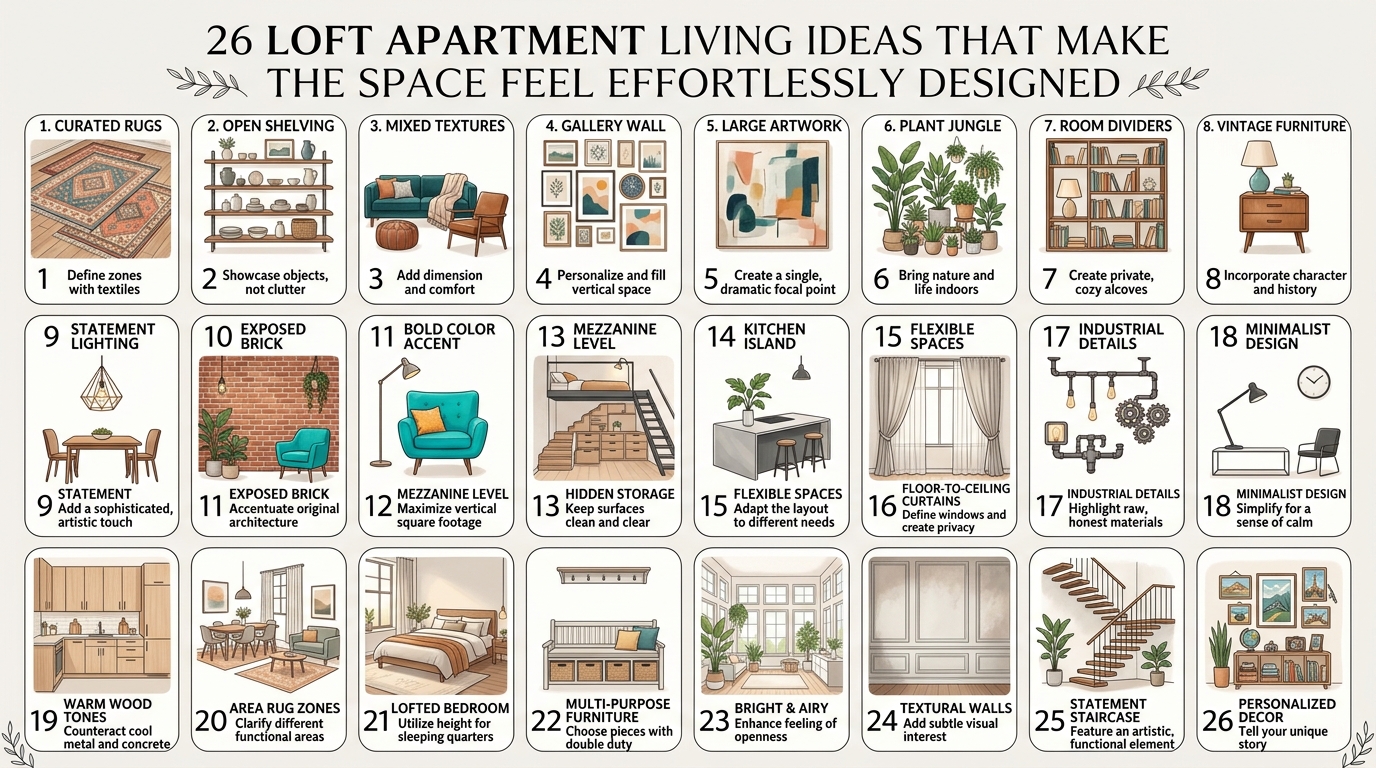
A loft apartment is a large, open-plan residential space — typically a converted industrial or commercial building — defined by high ceilings, exposed structural elements, and an absence of interior walls dividing the floor plan. This article delivers exactly 26 loft apartment living ideas covering zoning, materials, lighting, furniture, color, and finishing details that make open industrial spaces feel genuinely inhabited rather than cavernously empty.
There’s a specific quality to a loft done right — the way afternoon light crosses an uninterrupted concrete floor, the way a single pendant hangs thirty feet of air below an exposed beam, the way a room with no walls still manages to feel like several distinct places. Loft apartment living demands a different design logic than a standard room: the scale is bigger, the structure is visible, and the empty space is part of the design itself. Here are 26 ideas worth saving — and stealing.
Why Loft Apartment Living Design Works So Well
The loft as a residential typology originated in 1950s and 1960s lower Manhattan, where artists and musicians began illegally occupying former factory and warehouse spaces for both living and studio use. The aesthetic — exposed brick, timber beams, concrete floors, oversized windows — was initially a function of poverty and resourcefulness, not design intention. By the 1970s and 1980s, the loft had been legitimized and romanticized, codified into New York City law as a residential use, and adopted by architects like Richard Meier and developers who recognized that the raw industrial aesthetic carried genuine cultural cachet. The style that emerged from those conversions — honest materials, visible structure, open plan — remains the most coherent and widely influential residential aesthetic of the past fifty years.
The material palette of loft apartment living is specific and historically grounded: poured or polished concrete floors, exposed brick in warm red-brown or painted white, timber beams in dark-stained or natural Douglas fir and white oak, steel-framed windows in matte black or aged bronze, and raw or blackened steel in structural and decorative elements. Color comes from material rather than paint — the warm ochre of old brick, the cool grey of concrete, the honey of untreated oak. Soft materials — heavyweight linen, worn leather in caramel and tobacco, aged Turkish or Persian rugs — are introduced to counter the hardness of the structural palette.
The loft aesthetic is experiencing its deepest mainstream penetration precisely because it is the antidote to the decade of hyper-decorated, gallery-wall, throw-pillow maximalism that preceded it. Pinterest searches for “industrial loft living room,” “open plan loft apartment,” and “loft bedroom ideas” continue to climb as homeowners and renters seek spaces that feel architecturally grounded rather than trend-dependent. The loft aesthetic is also the logical home design expression of the sustainability movement — exposing existing structure rather than covering it, using reclaimed materials, investing in pieces built to last generations.
The loft aesthetic is achievable in smaller open-plan apartments — not just genuine converted warehouses. The principles transfer: expose or emphasize the ceiling structure, treat the floor as a continuous material plane, use furniture to define zones rather than walls, and allow empty space to exist without filling it. In a 600-square-foot open-plan apartment, these moves create the same spatial logic as a 3,000-square-foot warehouse conversion — just at a different scale.
Style at a Glance
| Element | Key Trait | Detail |
| Philosophy | Honest structure, open plan | Expose what’s there, don’t decorate over it |
| Key Materials | Concrete, exposed brick, timber, steel | Raw, aged, patinated — never precious |
| Key Colors | Warm grey, brick ochre, dark timber | Material color, not painted color |
26 Loft Apartment Living Ideas
1. Define Zones With Large-Scale Area Rugs Instead of Walls
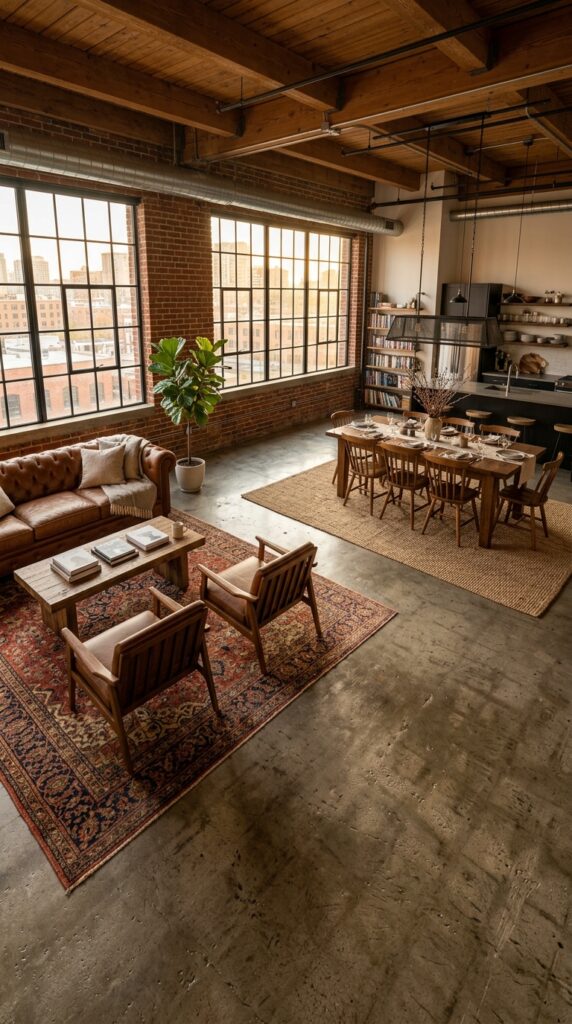
Vibe: Layered — a loft floor plan organized by rugs feels discovered rather than installed.
Why it works: In an open-plan loft with no interior walls, area rugs perform the spatial function that walls perform in subdivided apartments — they define zones by anchoring furniture groupings to specific floor areas and creating visual boundaries the eye reads as room divisions without physical separation. The technique works because the brain interprets a rug’s edge as a spatial boundary even when the floor continues uninterrupted beyond it. Using two different rug styles (a patterned vintage rug for the living zone, a textural flatweave for the dining zone) reinforces the zone distinction through material differentiation while the continuous floor material beneath maintains the loft’s spatial continuity.
How to get it: Size rugs generously — in a loft living zone, the rug should extend 24 inches beyond the sofa on each side, large enough that all four legs of every sofa and chair sit on the rug rather than half-on, half-off. A rug that’s too small for its zone looks like a bath mat dropped in the middle of the room and actively undermines the spatial logic it’s meant to create.
💡 Quick Win: A vintage-style kilim or Persian rug (available from online vintage rug retailers at $200–600 for a quality 8×10) does more to define a loft living zone and introduce warmth and history than any single furniture purchase at the same price point.
Shop The Look
| Product |
| Vintage Persian style area rug 8×10 red navy wool |
| Natural jute flatweave area rug 6×9 dining |
| Non-slip rug pad for hardwood concrete floor 8×10 |
| Leather sofa mid-century modern walnut legs |
| Walnut dining table solid wood industrial |
2. Expose and Emphasize the Ceiling Structure
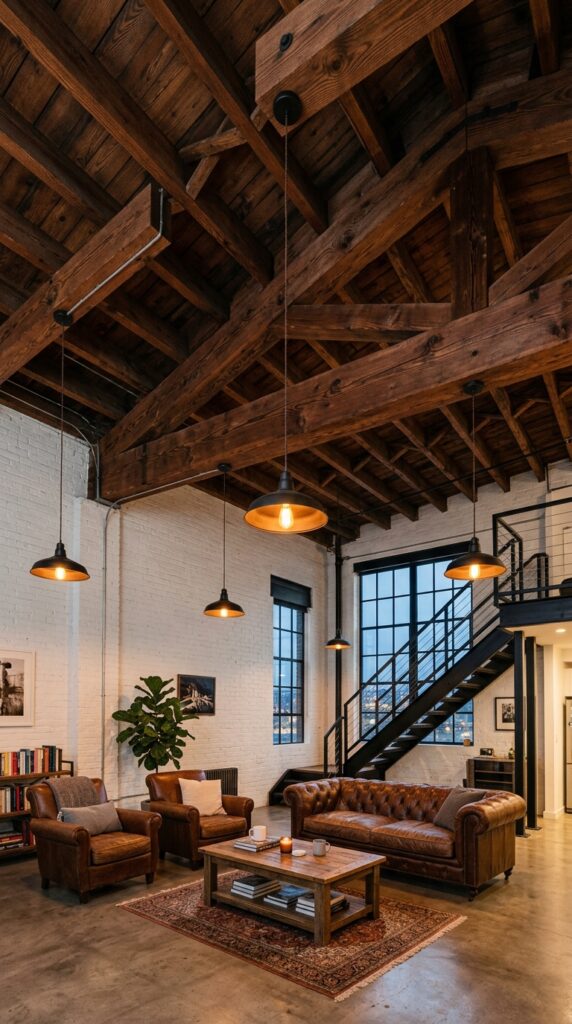
Vibe: Structural — a ceiling that tells the story of the building it belongs to.
Why it works: Exposing the ceiling structure — removing a dropped ceiling to reveal original timber joists, concrete decking, or steel beams — is the single highest-impact design move available in a loft conversion because it immediately changes the perceived volume of the entire space. The increase in ceiling height (often 2–4 feet when a dropped ceiling is removed) is measurable and dramatic. But the greater gain is visual: the exposed structure adds texture, warmth, and historical authenticity that no decorative ceiling treatment can replicate. Douglas fir joists in a dark-stained or natural finish carry warm amber tones that soften the hardness of concrete and brick below.
How to get it: Before removing any dropped ceiling, commission a building inspection to confirm no structural, electrical, or HVAC systems are concealed within the plenum that require access or relocation. Many dropped ceilings in converted industrial buildings conceal plumbing runs — these can sometimes be rerouted to maintain open ceiling aesthetics, at additional cost.
Shop The Look
| Product |
| Matte black iron pendant light Edison bulb |
| Dark walnut wood stain interior timber |
| Exposed beam ceiling mounting bracket steel |
| Edison vintage bulb 60w warm amber pack of 6 |
| Black iron pipe ceiling hook heavy duty |
3. Use a Bookshelf Wall as a Soft Room Divider
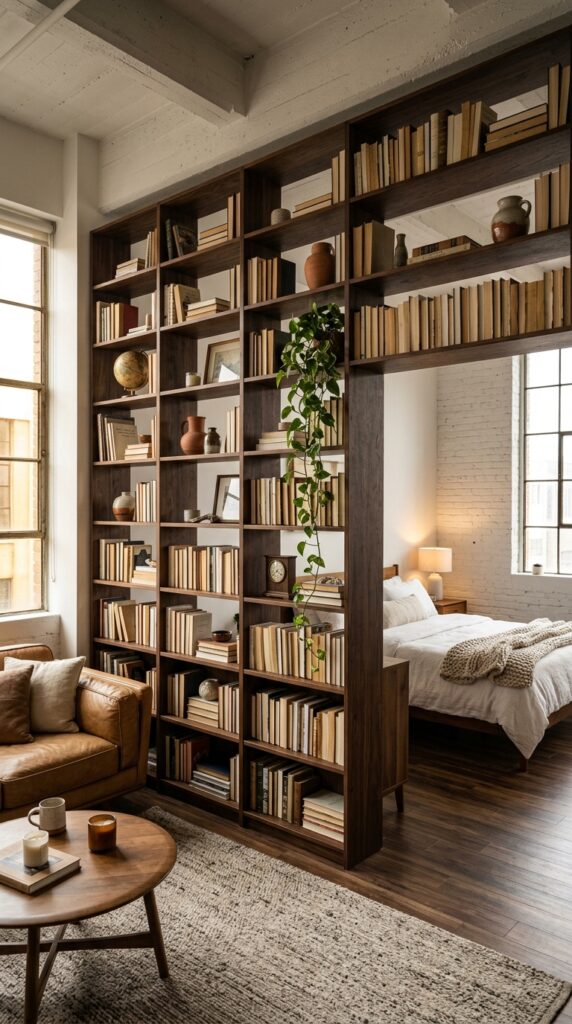
Vibe: Warm — a bookshelf wall is the most intellectually generous room divider available.
Why it works: An open bookshelf used as a zone divider in a loft achieves spatial separation without visual closure — light, sound, and sightlines pass through it, maintaining the open-plan quality of the loft while creating a psychological sense of distinction between zones. The books and objects on the shelf add material warmth and human scale to the large vertical surfaces of the loft, which often feel bare or institutional without intervention. A floor-to-ceiling unit (requiring a library ladder for upper shelves) also responds correctly to the vertical scale of the loft — a standard 6-foot bookshelf in a 12-foot-ceiling room reads as a piece of furniture; a 12-foot unit reads as architecture.
How to get it: Build or specify a freestanding bookshelf unit that can be stabilized to the concrete or timber floor with floor-mounting hardware rather than wall-mounting — in many loft conversions, the structural walls are brick or concrete that requires specialist fixings. A freestanding unit on a plinth base (a 4-inch raised platform) adds visual weight and permanence without wall attachment.
💡 Quick Win: Arrange books with spines facing inward (pages facing out) on every other shelf — the cream and white page edges create a softer, more tonal display than the visual noise of mixed spine colors, and the effect reads as deliberately curated.
Shop The Look
| Product |
| Floor to ceiling bookshelf dark walnut modular |
| Library ladder rolling hook rail system |
| Ceramic vessel set decorative shelf styling |
| Bookshelf floor mounting anti-tip bracket kit |
| Vintage brass globe desk ornament |
4. Polished Concrete Floor as the Room’s Anchor Material
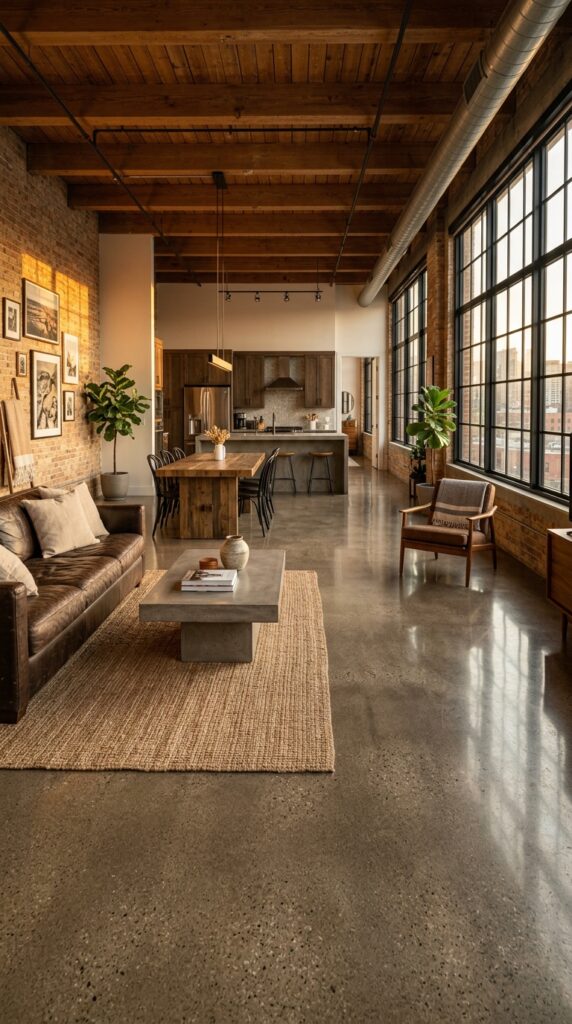
Vibe: Grounded — a concrete floor makes the whole loft feel like it was poured, not assembled.
Why it works: A continuous polished concrete floor is the material foundation of loft apartment living — it unifies all zones of the open plan under a single material language, creating spatial coherence that individual room flooring choices in subdivided apartments cannot achieve. Polished concrete’s warm grey tone (with undertones that range from blue-grey to warm taupe depending on aggregate composition) serves as a neutral base that accommodates every material layered above it: dark timber, aged leather, exposed brick, natural linen. Its subtle light-reflective quality also contributes to the sense of openness in large loft spaces.
How to get it: If an existing concrete subfloor is present (common in commercial-to-residential conversions), grinding and polishing it in place costs $3–8 per square foot — significantly less than installing new flooring on top of it. Specify a matte or satin finish (Mohs hardness level 3–4) rather than high-gloss (level 6–8), which produces an overly commercial appearance more appropriate to retail spaces.
Shop The Look
| Product |
| Concrete floor polish sealant matte finish |
| Concrete floor grinder pad set coarse medium fine |
| Concrete densifier hardener floor treatment |
| Floor squeegee for concrete maintenance large |
| Concrete look epoxy floor coating kit grey |
5. Industrial Pendant Cluster Over the Dining Zone
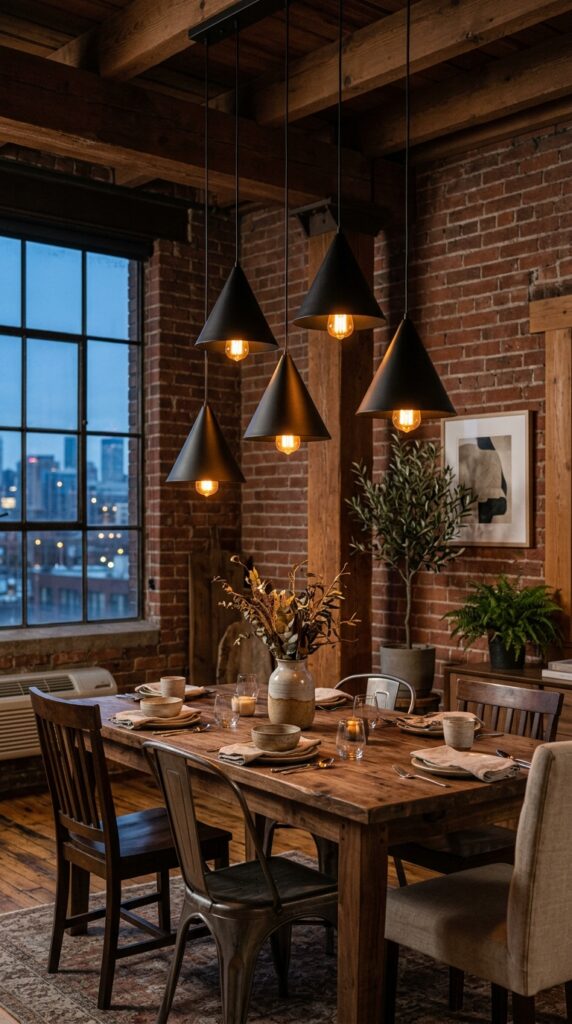
Vibe: Warm — pendant clusters above a dining table turn eating into an event without trying.
Why it works: A cluster of pendant lights above the dining zone serves two simultaneous functions: it provides the concentrated task lighting needed for a dining surface and it visually anchors the dining zone in an open-plan space by creating a ceiling-level element that frames and defines the area below. In a high-ceilinged loft, a single pendant over a dining table reads as insufficient — both visually (a small object in a large vertical space) and functionally (insufficient light spread). A cluster of five pendants at staggered heights fills the vertical space more appropriately and creates a sculptural ceiling composition that reads from across the entire open floor plan.
How to get it: Drop the lowest pendant to 30 inches above the table surface — the standard for task-appropriate dining illumination — and stagger the remaining four pendants between 36 and 54 inches above the table. Install all pendants on separate dimmers so the cluster can be adjusted between bright dining light and ambient evening atmosphere.
💡 Quick Win: A canopy adapter ($15–25) allows multiple pendant cords to emerge from a single electrical box — no electrician needed beyond the initial connection — making a five-pendant cluster achievable from a single ceiling fixture point.
Shop The Look
| Product |
| Matte black cone pendant light set of 3 industrial |
| Multi pendant canopy adapter ceiling mount 5 port |
| Edison bulb filament vintage warm 40w pack |
| Solid walnut dining table 72 inch modern |
| Dimmer switch in-wall single pole compatible LED |
6. Exposed Brick Wall Left Raw and Unsealed
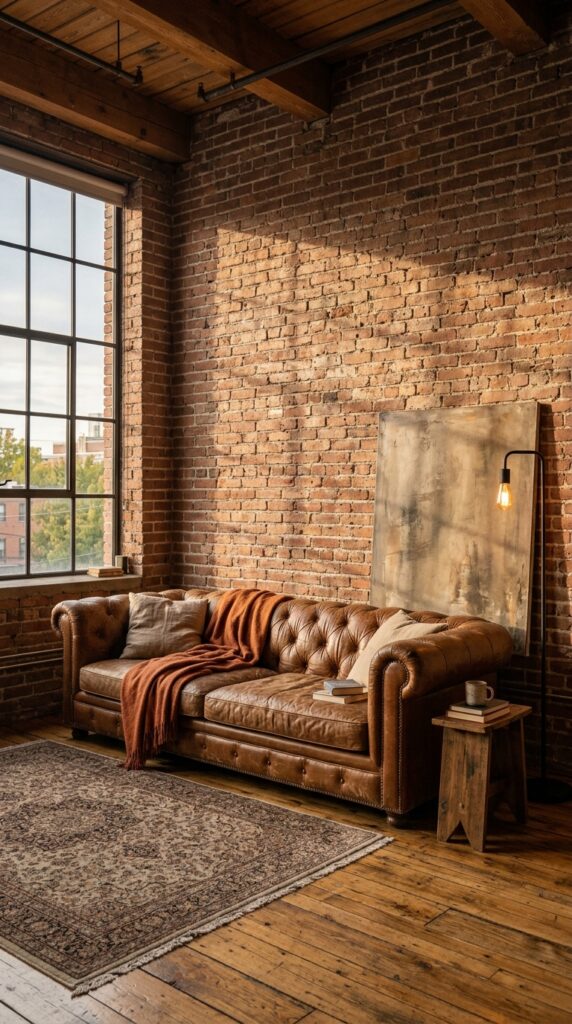
Vibe: Raw — an unsealed brick wall has the kind of age you can’t buy and can’t fake.
Why it works: Original exposed brick is the most irreplaceable material asset in a loft conversion and the one most frequently compromised by well-meaning renovators who seal, paint, or skim-coat it. Raw unsealed brick has a natural color variation — from warm ochre to deep red-brown to cool grey in the mortar — that produces a wall surface of genuine visual depth. Sealing it with a gloss or semi-gloss product flattens this variation and gives the wall a plastic quality that reads as a renovation rather than an original. The correct approach is to clean the brick (a diluted muriatic acid wash removes efflorescence and old mortar stain), repair damaged mortar, and leave the surface entirely untreated.
How to get it: Repoint any crumbling mortar joints with a color-matched mortar before any other treatment — compromised mortar allows moisture infiltration that will damage the wall over time regardless of surface treatment. Use a natural bristle brush and stiff trowel rather than power tools for repointing work near historic brick, which is softer than modern brick and can be damaged by mechanical tools.
Shop The Look
| Product |
| Brick mortar repair compound color match tan |
| Natural bristle scrub brush brick cleaning |
| Muriatic acid brick cleaner wash concentrate |
| Caramel leather sofa mid century modern |
| Iron floor lamp adjustable arm industrial |
7. The Loft Bedroom: Platform Bed With Curtain Privacy Screen
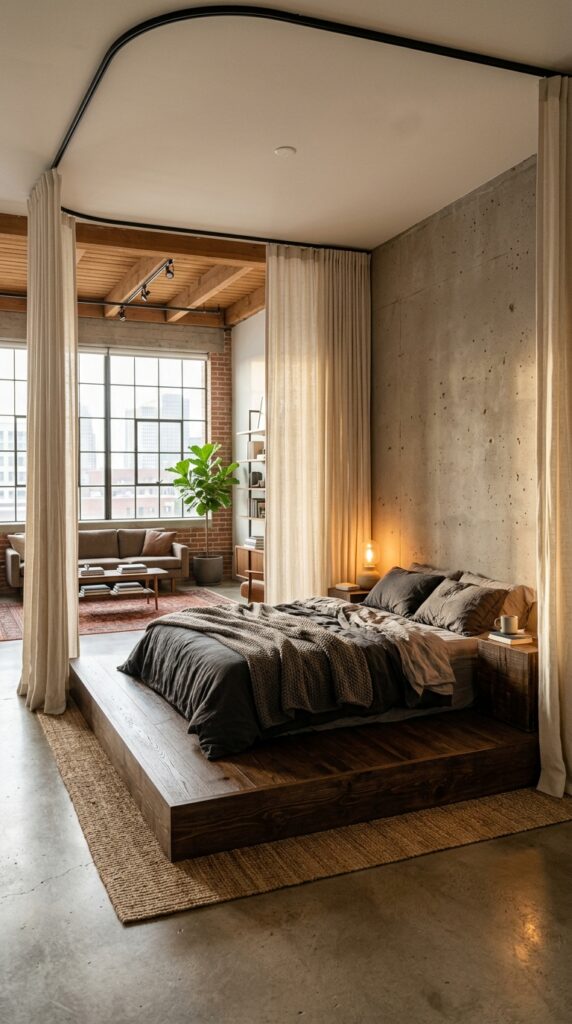
Vibe: Serene — linen curtains as walls are the softest possible form of architectural separation.
Why it works: In a true open-plan loft without a dedicated bedroom, creating a sleeping zone requires privacy without enclosure. Floor-to-ceiling curtains on ceiling-mounted tracks are the most elegant solution: when open, the loft reads as continuous open space; when closed, the curtains create a fully enclosed bedroom without any permanent construction. Heavyweight linen (minimum 300 GSM) in ivory or warm white filters morning light beautifully, producing the diffused glow of a shoji screen. The raised timber platform beneath the bed defines the bedroom zone even when curtains are open, adding an architectural layer of zone definition without using walls.
How to get it: Install the curtain track directly to the underside of a ceiling beam or on a ceiling-mounted rigid track system — specify a track with a smooth glide mechanism (hospital-grade curtain track systems are the most reliable for heavy linen panels). Budget for 2.5 times the track length in fabric width to achieve full, floor-touching panels with genuine weight and drape.
Shop The Look
| Product |
| Heavyweight linen curtain panel ivory floor length |
| Ceiling mounted curtain track system linear |
| Low platform bed frame dark timber natural wood |
| Dark linen duvet cover set king |
| Woven wool rug bedroom 6×9 natural grey |
8. Steel-Framed Interior Windows Between Zones
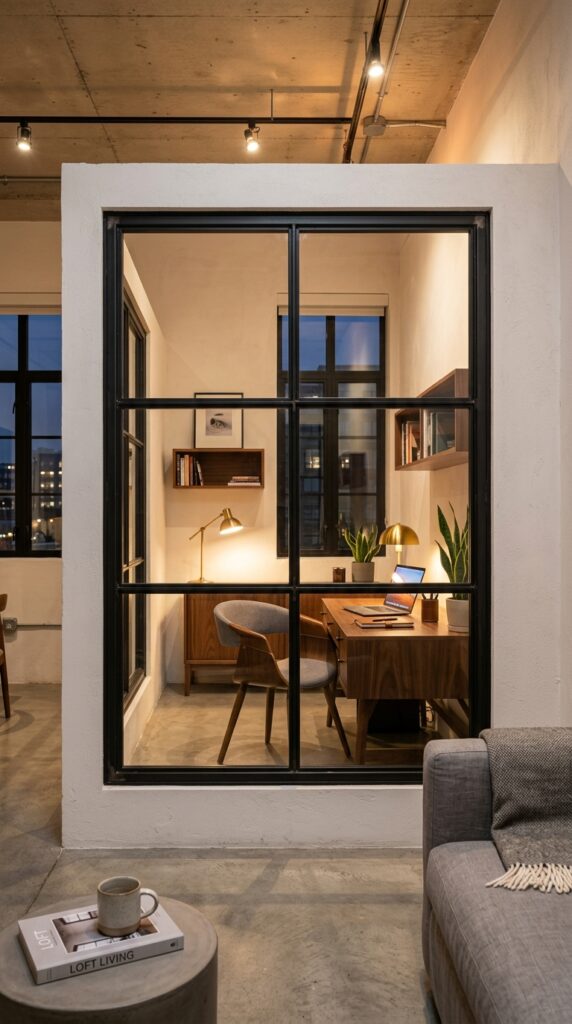
Vibe: Architectural — a steel interior window makes a partial wall feel like a design decision, not a compromise.
Why it works: Steel-framed interior windows — fixed or operable glass panels set in matte black steel frames within a partial dividing wall — are borrowed directly from the factory and warehouse buildings that loft apartments typically occupy. In a loft context, they introduce zone separation without visual closure: you can see through the glass from one zone to another, maintaining the spatial depth that makes lofts feel expansive while creating a functional boundary between, for example, a home office and a living room. The matte black steel frame is the visual thread connecting the interior window to the loft’s structural steel vocabulary.
How to get it: Steel-framed interior windows are available as prefabricated units from specialty metal fabricators ($400–1,200 per panel depending on size) or can be fabricated to order. Install in a new partial stud wall rather than an existing structural wall — partial walls (non-load-bearing partitions stopping 18–24 inches below the ceiling) are a common loft design technique that creates separation without enclosure and typically doesn’t require a building permit.
💡 Quick Win: A steel-framed barn door with a glass insert ($350–600 as a prefabricated unit) achieves the same interior window aesthetic while also providing movable privacy — it slides open to connect spaces and closed to create separation.
Shop The Look
| Product |
| Steel frame interior window black fixed panel |
| Partial wall steel frame glass panel loft |
| Matte black barn door with glass insert sliding |
| Barn door hardware track kit matte black |
| Clear tempered glass panel replacement interior |
9. Vintage Industrial Leather Sofa as the Living Zone Anchor
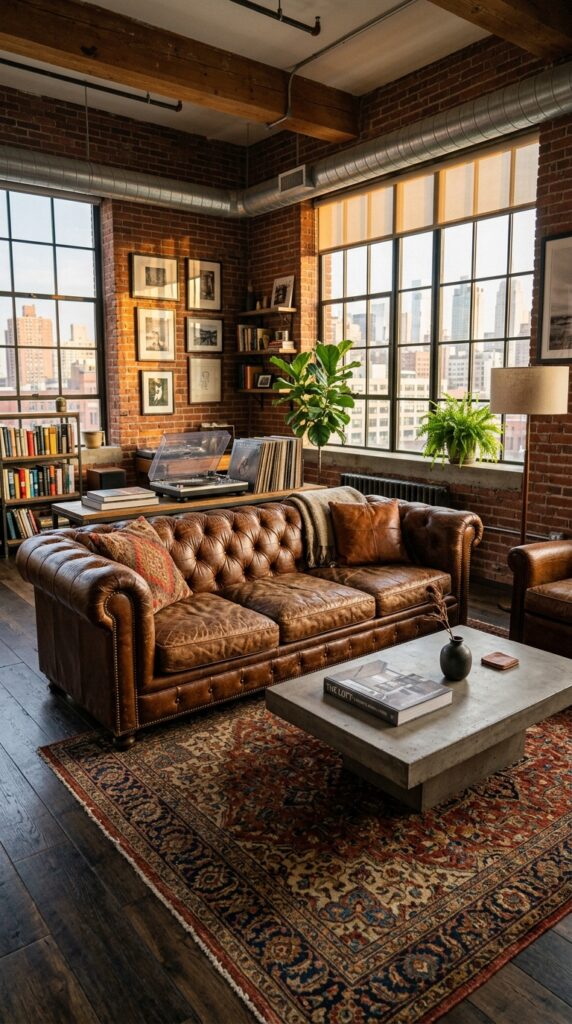
Vibe: Collected — a leather sofa with genuine patina is the loft equivalent of a good pair of broken-in boots.
Why it works: Full-grain leather furniture with visible wear and patina carries the material philosophy of the loft aesthetic at its most concentrated: honest, aged, improved by use. A worn tobacco leather sofa in a large-scale track-arm or Chesterfield profile has both the material authenticity and the physical scale required to anchor a loft living zone — it reads as a serious piece of furniture rather than a placeholder. The patina on full-grain leather (the subtle darkening at armrests and seat edges, the slight crease pattern of use) is a quality signal that new leather or leather alternatives cannot fake. In a loft with concrete floors and exposed brick, this material resonance is the entire point.
How to get it: Source vintage full-grain leather sofas from estate sales, architectural salvage dealers, or specialty vintage furniture retailers — a well-maintained vintage piece ($400–1,200) frequently outperforms a new leather sofa at the same price in both material quality and visual authenticity. Condition the leather with a beeswax or lanolin-based leather conditioner twice a year to maintain suppleness.
Shop The Look
| Product |
| Leather conditioner beeswax furniture treatment |
| Tobacco leather accent chair vintage style |
| Concrete look coffee table rectangle indoor |
| Vintage style leather throw pillow brown |
| Low profile media console walnut dark wood |
10. Blackened Steel Kitchen Island in an Open Plan
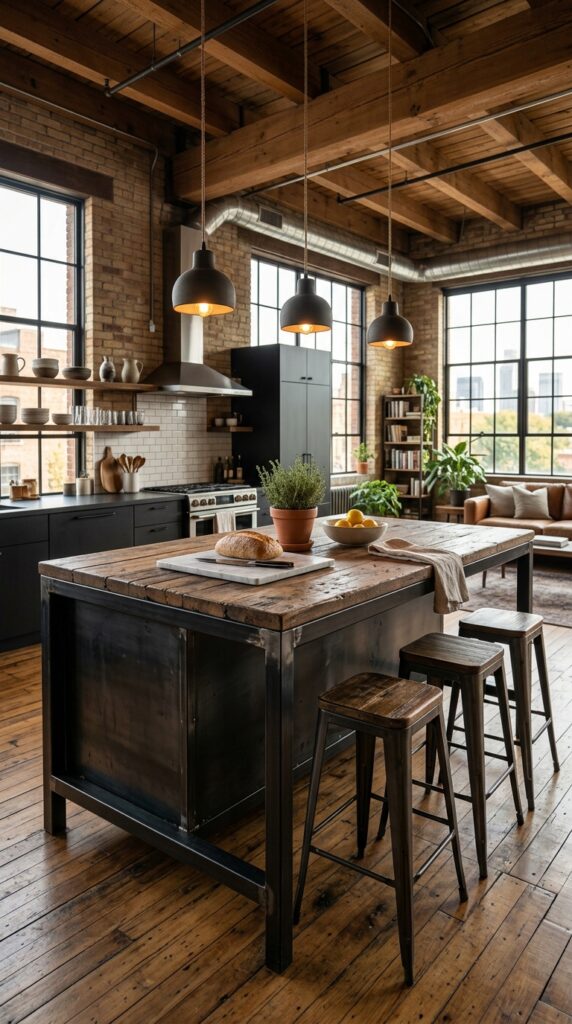
Vibe: Grounded — a blackened steel island looks like it was lowered into the loft from above and decided to stay.
Why it works: In an open-plan loft where the kitchen is integrated into the primary living space without separation, the kitchen island becomes a furniture-scale object visible from every zone in the apartment — it must be designed as such. A blackened steel frame island (with visible welded joints, in the tradition of industrial fabrication) with a reclaimed timber top responds to the loft’s structural vocabulary while providing the warmth that a purely steel or concrete counter would lack. It also defines the kitchen zone within the open plan, functioning as a soft boundary that the eye reads as the kitchen’s limit without any wall doing so.
How to get it: Custom blackened steel kitchen islands can be fabricated by a local metal fabricator for $800–2,500 depending on size — provide a sketch with dimensions and specify 1.5-inch square steel tubing for the frame. The blackened finish is achieved with a chemical patination process (liver of sulfur or black oxide treatment) followed by a matte clear coat sealer to prevent rust in a kitchen environment.
Shop The Look
| Product |
| Industrial bar stool matte black steel set of 2 |
| Reclaimed wood kitchen island top custom cut |
| Matte black steel pipe shelving bracket set |
| Marble cutting board large kitchen |
| Pendant light ceramic dome above island |
11. Mezzanine Level for Sleeping or Working
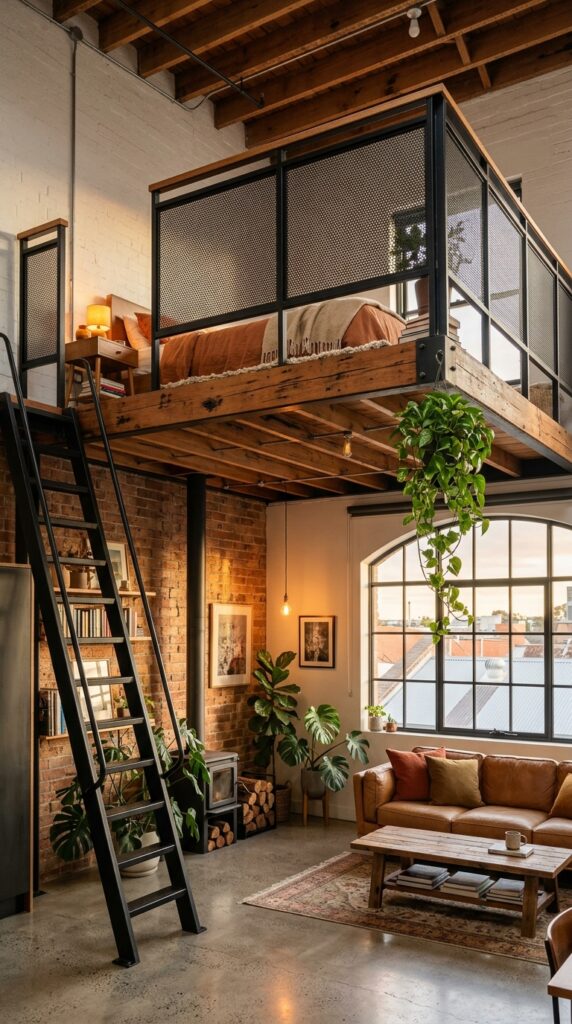
Vibe: Architectural — a mezzanine is the most honest possible answer to the question of how to sleep in a space with no walls.
Why it works: A mezzanine level exploits the vertical volume of the loft — typically the most underutilized spatial dimension in these apartments — by inserting a habitable platform that creates an upper zone for sleeping or working while leaving the floor plan below completely unobstructed. The construction materials for the mezzanine (blackened steel structural frame, timber deck boards in Douglas fir or white oak) should visually echo the loft’s existing structural elements to maintain material coherence. A perforated steel guardrail (rather than a solid wall) maintains visual connection between levels and allows light to pass freely between them.
How to get it: A mezzanine addition requires a structural engineer’s sign-off and typically a building permit — budget for engineering fees ($800–2,000) alongside the construction cost ($8,000–20,000 for a professionally built mezzanine in most markets). The minimum ceiling height for a comfortable sleeping mezzanine is 7 feet of clearance below the mezzanine deck; verify this before proceeding with structural design.
Shop The Look
| Product |
| Mezzanine ship ladder matte black steel wall mount |
| Perforated steel guardrail panel loft mezzanine |
| Douglas fir deck board natural 2×6 |
| Hanging planter hook ceiling heavy duty |
| Compact low profile mattress mezzanine 8 inch |
12. Concrete Coffee Table as the Living Zone’s Material Statement
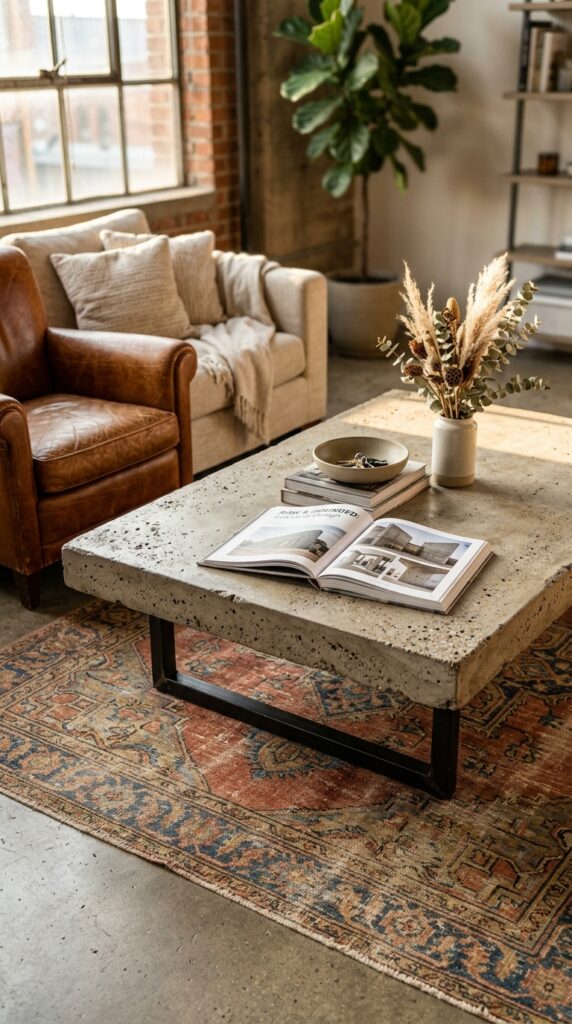
Vibe: Grounded — a concrete coffee table has a physical presence that glass and wood simply don’t.
Why it works: A concrete coffee table introduces the loft’s primary floor material at furniture scale, creating material continuity between the floor plane and the living zone’s central object. The visual weight of concrete — its density and solidity — anchors the living zone in a way that lighter materials (glass, lucite, pale timber) cannot in a high-ceilinged open space. Hand-poured concrete with visible aggregate and slight surface irregularity reads as artisanal rather than industrial, which is the essential distinction between a loft that feels lived-in and one that feels like a photo set. Sealing the surface with a matte penetrating concrete sealer protects it without adding gloss.
How to get it: Cast your own concrete coffee table using a melamine-coated formwork mold ($30–50 in materials) and a fiber-reinforced concrete mix — a 48×24×4-inch tabletop poured at home costs $80–150 in materials and produces a genuinely unique result. Embed steel hairpin legs into the wet concrete during the pour for a clean, integrated base.
💡 Quick Win: Concrete look porcelain tile (24×48-inch format) adhered to a plywood base with construction adhesive creates a convincing concrete coffee table surface for under $80 in materials — the large-format tile mimics the continuous surface of poured concrete at fraction of the weight.
Shop The Look
| Product |
| Concrete coffee table rectangular steel base |
| Hairpin leg set 16 inch steel set of 4 |
| Penetrating concrete sealer matte clear |
| Ceramic decorative bowl neutral matte large |
| Dried botanical arrangement vessel neutral |
13. Oversized Abstract Art Scaled to the Loft Wall
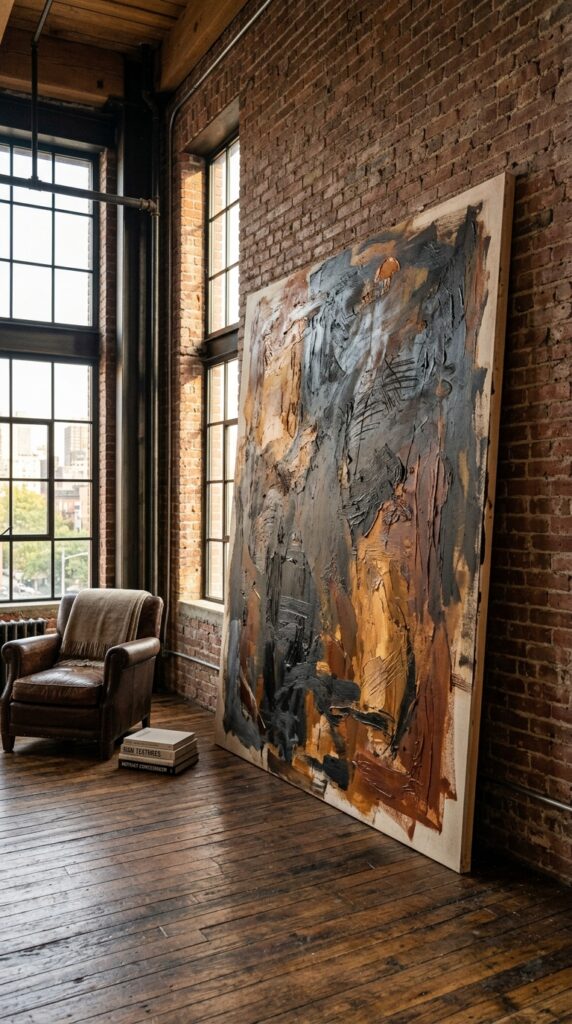
Vibe: Confident — oversized art leaned against a wall is the loft move that looks like it took no effort and took the most.
Why it works: In a loft with 12–16-foot ceilings and large unbroken wall planes, standard-sized art (18×24 inches, 24×36 inches) reads as a postage stamp — too small for the scale of the wall and visually disconnected from the room. Art must be scaled to the wall, not to the conventional frame size. A single canvas at 60×80 inches or larger, leaned against the wall rather than hung, introduces two additional qualities: the lean (rather than the hang) reads as casual and unfinished in the right way — the kind of space where a serious piece of art lives in the room rather than being displayed in it. The canvas edge and stretcher bars visible from the side add authenticity.
How to get it: Commission a large abstract piece from an independent artist through Saatchi Art, Artsy, or directly from an artist’s studio — a 60×80-inch original oil or acrylic abstract runs $500–3,000 from emerging artists. Alternatively, a large-format art print on canvas (unstretched, edge-wrapped around a DIY stretcher frame) can be assembled for $80–200 and reads as original at distance.
Shop The Look
| Product |
| Large abstract canvas print oversized 60×80 |
| Canvas stretcher bar frame set 60×80 |
| Artist canvas staple gun kit framing |
| Easel floor stand large art display wood |
| Ochre abstract art print canvas warm tones |
14. A Freestanding Bathtub in an Open-Plan Loft Bathroom
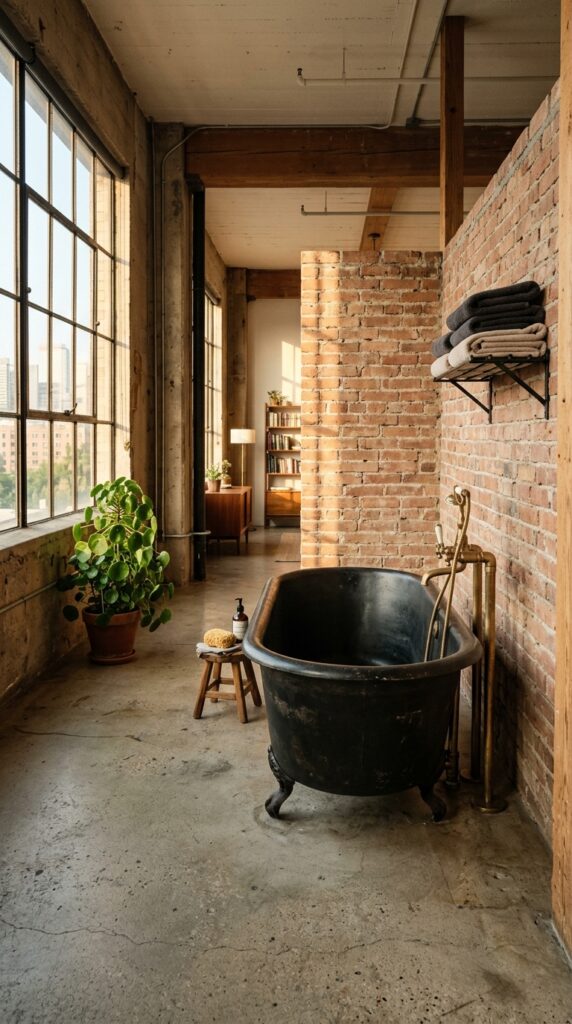
Vibe: Indulgent — a bathtub with no walls around it is a lifestyle statement made in cast iron.
Why it works: In a genuine loft conversion, the bathroom is often not a sealed room but a zone created by partial walls, curtains, or simply by the placement of fixtures in an open or semi-open area. A freestanding bathtub in this context becomes a sculptural object in the loft’s overall composition rather than a fixture hidden in a sealed room. Cast iron tubs (in raw, painted, or powder-coated black exteriors) have the material weight and historical reference appropriate to a converted industrial space — they belong in these buildings in a way that acrylic tubs fundamentally do not.
How to get it: A floor-mounted tap and spout (rather than wall-mounted) is essential for a truly freestanding bathtub — it maintains the tub’s sculptural independence and eliminates the need for plumbing access in the surrounding walls. Floor-mounted tap units require a floor flange and sub-floor plumbing stub-out positioned precisely to the tub’s drain location — specify this before the floor is finished.
Shop The Look
| Product |
| Cast iron freestanding bathtub slipper style |
| Floor mounted brass bathtub tap filler |
| Iron shelf bathroom wall mount industrial |
| Oversized linen bath sheet warm grey |
| Freestanding tub floor drain cover brass |
15. Warm Ambient Lighting Grid Across an Open Ceiling
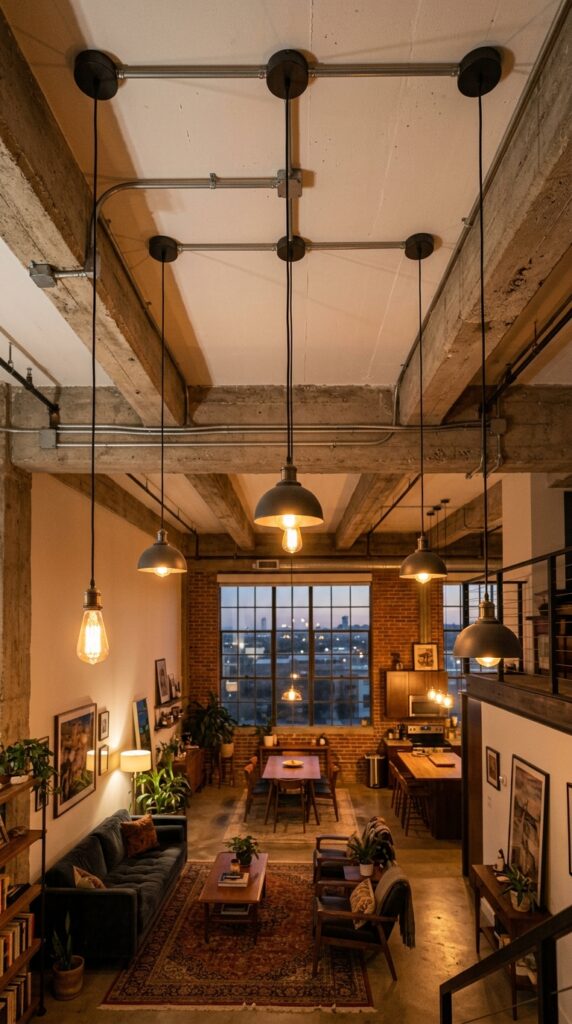
Vibe: Composed — a deliberate ceiling light grid makes the space below feel orchestrated.
Why it works: In an open-plan loft, a single overhead light source is functionally insufficient and aesthetically crude — one fixture attempting to illuminate 1,500+ square feet produces flat, even light that eliminates shadow and destroys the spatial drama that makes lofts compelling. A designed ceiling lighting grid — multiple pendants at varied heights, positioned to correspond to the zones below (dining, living, kitchen, reading) — creates a map of the apartment’s spatial organization in the ceiling plane. Each pendant marks a zone; together, they define the room’s structure from above in the same way that furniture defines it from below.
How to get it: Install a ceiling lighting track system (available in 8 and 12-foot lengths, connectable into an L or T configuration) that runs along the beam structure — individual pendant adaptors can then be positioned anywhere along the track without requiring individual electrical boxes for each light. A track system converts one electrical feed into multiple independently positionable light points.
💡 Quick Win: Add a single additional pendant light on a long cord (10–15 feet) to an existing electrical box — drop it to 7 feet above the floor in a zone that currently lacks a dedicated light source. This single addition creates a new zone definition and contributes to the ceiling composition simultaneously.
Shop The Look
| Product |
| Pendant light track adapter ceiling mount black |
| Ceiling lighting track system 8 foot black |
| Long pendant cord 15 foot black fabric covered |
| Bare bulb pendant socket black minimal |
| Dome shade pendant light small matte black |
16. Reclaimed Timber Dining Table as the Social Centerpiece
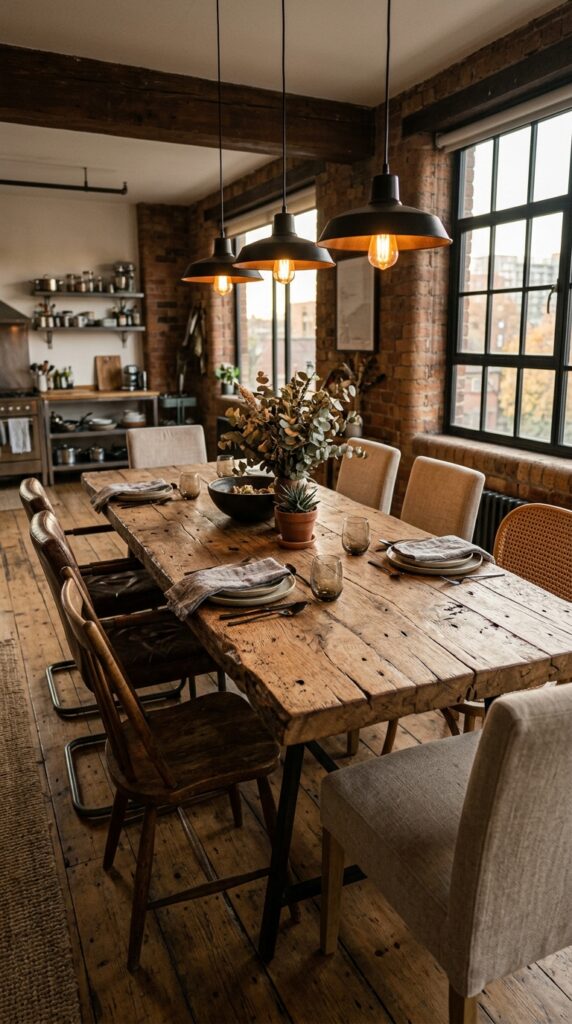
Vibe: Social — a table this specific is the reason people stay at dinner for four hours.
Why it works: A reclaimed timber dining table brings irreplaceable material history into the loft — original nail holes, saw blade marks, stain traces, and structural cracks filled with dark resin are evidence of the material’s previous life that no new timber can replicate. In a loft context, this material honesty resonates with the aesthetic philosophy of the space: both the building and the table have been used for something else before being adapted to their current purpose. The scale (8 feet minimum for a loft dining table) is as important as the material — a small table in a large loft reads as underscaled and timid.
How to get it: Source reclaimed timber table tops from architectural salvage dealers, reclaimed lumber yards, or online platforms specializing in live-edge and reclaimed slabs. Specify a minimum 2.5-inch thickness for a table top — thinner slabs read as lightweight and undermine the material’s visual authority. Finish with a penetrating hardwax oil rather than polyurethane, which produces a plastic quality that obscures the timber’s natural character.
Shop The Look
| Product |
| Reclaimed timber dining table 8 foot industrial |
| Hardwax oil finish natural timber maintenance |
| Linen dining chair seat cover natural |
| Ceramic vase centerpiece matte neutral tall |
| Linen napkin set natural undyed 6 pack |
17. Using Dark Paint on One Structural Column as an Accent
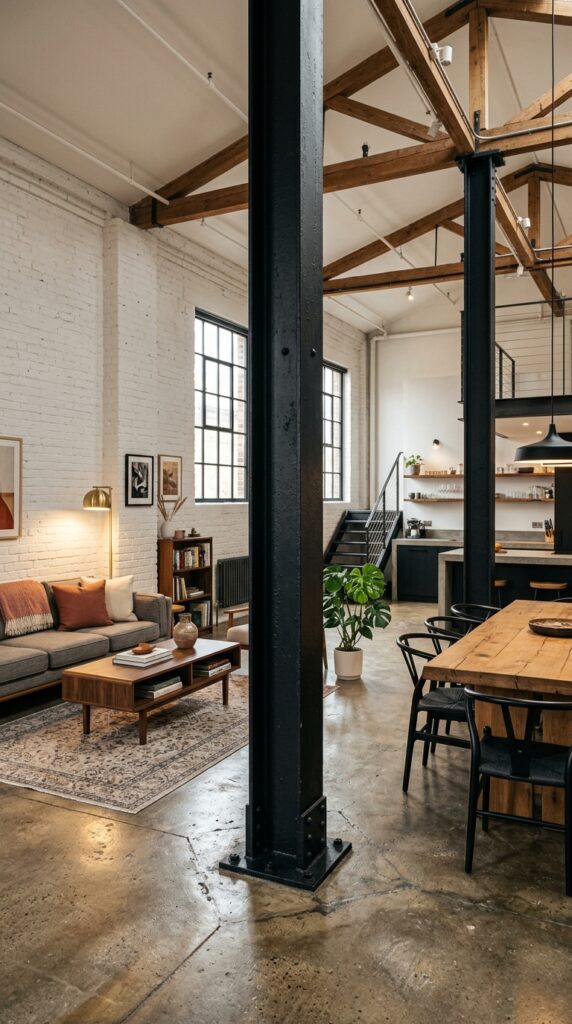
Vibe: Deliberate — a painted structural column stops being a problem and becomes the reason the room has good bones.
Why it works: Structural columns in a loft conversion are often treated as obstacles — furniture arranged awkwardly around them, or worse, encased in drywall to hide them. The correct design response is the opposite: celebrate the column by painting it in a color that distinguishes it from the surrounding walls and makes its structural role explicit. Flat matte black on a steel or concrete column creates a crisp architectural accent that reinforces the industrial vocabulary of the space. The column also serves a secondary design function — positioned between zones, it acts as a soft spatial divider that marks a transition without creating a barrier.
How to get it: Prepare steel columns with a rust-inhibiting primer before applying the topcoat — bare steel in a converted building often has surface oxidation that will bleed through unprepared paint within one season. Use a direct-to-metal flat black paint (not interior wall paint, which doesn’t adhere correctly to metal) and apply two coats with a short-nap roller for a smooth, consistent finish.
Shop The Look
| Product |
| Direct to metal flat black paint interior |
| Rust inhibiting primer steel metal surface |
| Short nap paint roller 4 inch metal application |
| Column base trim cover architectural steel |
| Matte black spray paint touch up architectural |
18. Vintage Map or Blueprint as Oversized Wall Art
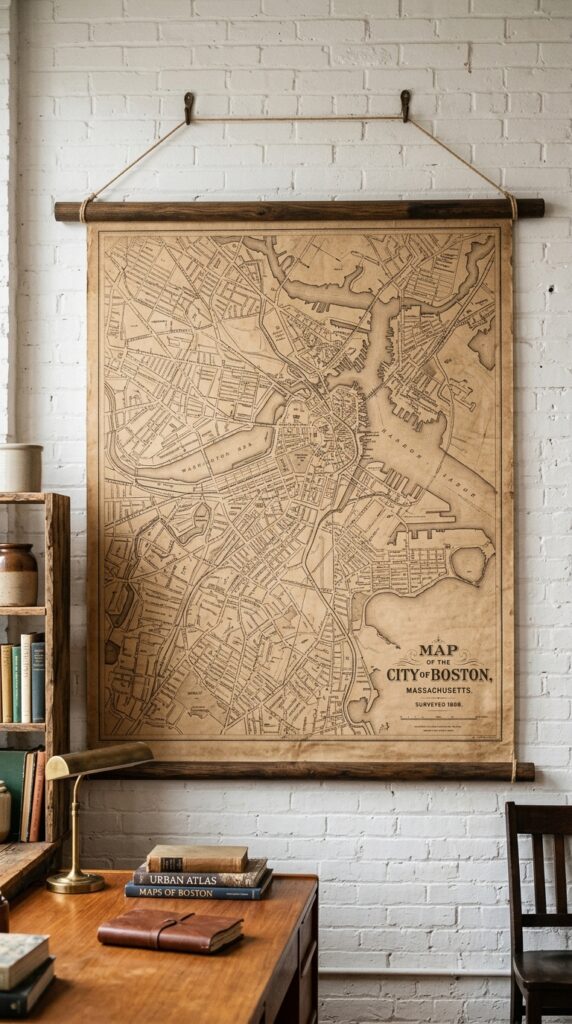
Vibe: Intellectual — a vintage blueprint in a converted building is art that understands where it lives.
Why it works: Oversized vintage maps, architectural blueprints, or topographic prints carry a specific cultural reference — they belong to the same world of technical drawing and industrial precision that produced the buildings lofts occupy. Displayed at large scale (48×60 inches minimum), they fill the wall plane appropriately for loft proportions while introducing a graphic, slightly faded palette (sepia, aged blue, raw paper white) that complements the brick and concrete tones of the space. The content — maps of places, blueprints of structures — also adds intellectual dimension to the space that abstract art alone cannot provide.
How to get it: Source high-resolution scans of vintage maps from the Library of Congress digital archive (freely downloadable in high resolution) and print through a large-format print service on natural or aged paper stock. Mount on a wooden dowel rod with binder clips for a clean, frameless presentation that references architectural drawings’ traditional mounting method.
💡 Quick Win: A large-format print mounted on a wooden dowel (a 1-inch diameter oak or pine dowel, $4–8 at any hardware store) costs under $30 total to produce and install, and reads as a considered design choice rather than a budget solution.
Shop The Look
| Product |
| Vintage city map large format print antique |
| Wooden dowel rod oak 1 inch diameter 36 inch |
| Binder clip large silver set for map mounting |
| Large format print service canvas or paper |
| Thin matte black poster frame 24×36 |
19. Ficus or Fiddle Leaf Fig at Architectural Scale

Vibe: Alive — a plant at architectural scale turns a corner of a loft into an actual place.
Why it works: Standard-sized houseplants (6–10 inches in a pot) are proportionally invisible in a loft with 12-foot ceilings — they read as desktop objects in an airport terminal. Plants in a loft must be scaled to the room: a fiddle leaf fig (Ficus lyrata) or mature ficus (Ficus benjamina) at 6–8 feet tall has the vertical presence required to make a visual impression at loft scale. A single oversized plant in a well-chosen location does more to humanize and warm a large open space than a dozen small plants scattered throughout it. The plant’s verticality also draws the eye upward, which amplifies the perceived height of the ceiling.
How to get it: Source large fiddle leaf figs (6+ feet) from specialty plant nurseries or online plant retailers that ship large specimens — big-box stores rarely stock plants above 3 feet. Repot into a pot proportional to the plant: for a 7-foot tree, a pot 16–20 inches in diameter and 16 inches tall is the minimum for visual balance. Place in the brightest available spot — fiddle leaf figs require bright indirect light to maintain their size and foliage density.
Shop The Look
| Product |
| Fiddle leaf fig live plant large 10 inch pot |
| Large concrete pot indoor planter 18 inch round |
| Plant dolly rolling base large heavy duty |
| Moisture meter plant care indoor large |
| Fiddle leaf fig fertilizer liquid concentrate |
20. Vintage Persian or Turkish Rug as the Color Palette Source
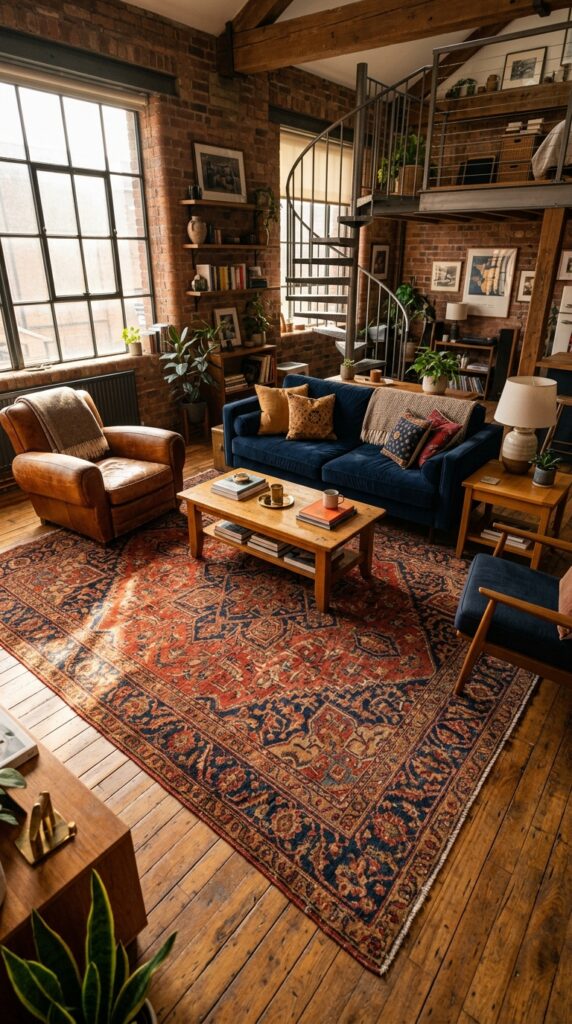
Vibe: Warm — a great vintage rug is the room’s color brief, not its decoration.
Why it works: A vintage Persian or Turkish rug is the most powerful color palette tool available in loft apartment design — it introduces a complex, historically developed color composition (the color relationships in traditional rug design have been refined over centuries) that any designer would struggle to assemble from scratch. The correct approach is to treat the rug not as a finishing touch but as the primary design decision: choose the rug first, then pull every furniture and textile color from the rug’s palette. A cognac leather sofa that echoes the rug’s warm red, a navy cushion that responds to the rug’s deep blue, a warm honey timber that answers its ochre — the room coheres because its colors share a source.
How to get it: Shop vintage rugs in person when possible — rug colors photograph unreliably, with camera white balance consistently skewing the actual color toward cool or towards saturation. In person, hold any potential purchase against the floor material it will sit on (concrete, timber) to assess whether the rug’s palette works against the background you have.
Shop The Look
| Product |
| Vintage Turkish rug wool 8×10 red navy ochre |
| Cognac leather accent chair mid century legs |
| Navy linen cushion cover set of 2 |
| Warm honey oak side table round small |
| Rug cleaning dry powder organic formula |
21. Open-Plan Home Office With Industrial Shelving System
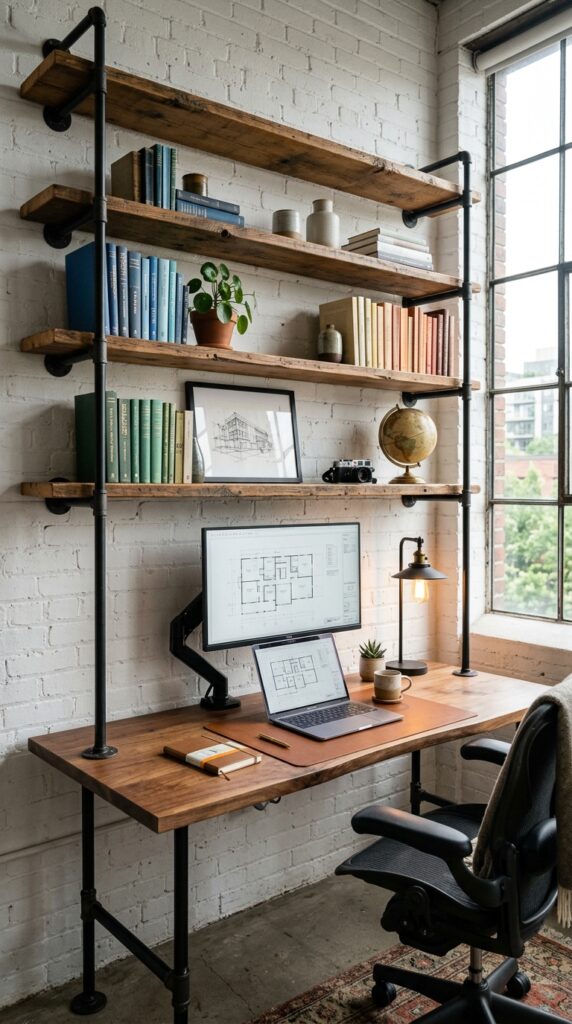
Vibe: Functional — a pipe shelf system looks like it was designed for the building, not brought in after.
Why it works: Industrial pipe shelving (black iron pipes as horizontal brackets supporting reclaimed timber shelf boards) is a direct reference to the plumbing and mechanical systems visible in the industrial buildings that loft apartments occupy — it reads as contextually appropriate in a way that standard floating shelves or bookcase units do not. Mounted on a white brick wall above a walnut desk, the system integrates the home office zone into the loft’s material vocabulary while providing genuinely substantial storage. The varied shelf heights (not rigidly spaced) create a composition that reads as architectural rather than utilitarian.
How to get it: Iron pipe shelf systems use standard plumbing flanges and pipes (available at any hardware store for $3–8 per component) assembled with a pipe wrench and mounted directly into brick or concrete with masonry anchors. A 6-foot-wide, four-shelf system in a loft requires approximately $80–150 in pipe and flange hardware and $60–100 in reclaimed timber planks — total material cost under $250 for a custom result.
💡 Quick Win: Pre-made iron pipe shelf kits ($45–90 for a two-bracket set) eliminate the assembly complexity and are available in black powder coat — combine two kits to build a wider system.
Shop The Look
| Product |
| Black iron pipe shelf bracket kit set of 2 |
| Reclaimed timber shelf board 8 inch wide 48 inch |
| Walnut floating desk 48 inch wall mount |
| LED desk lamp warm white task light |
| Masonry anchor screw set brick wall mounting |
22. Loft Small Space: Studio Apartment With Murphy Bed Integration
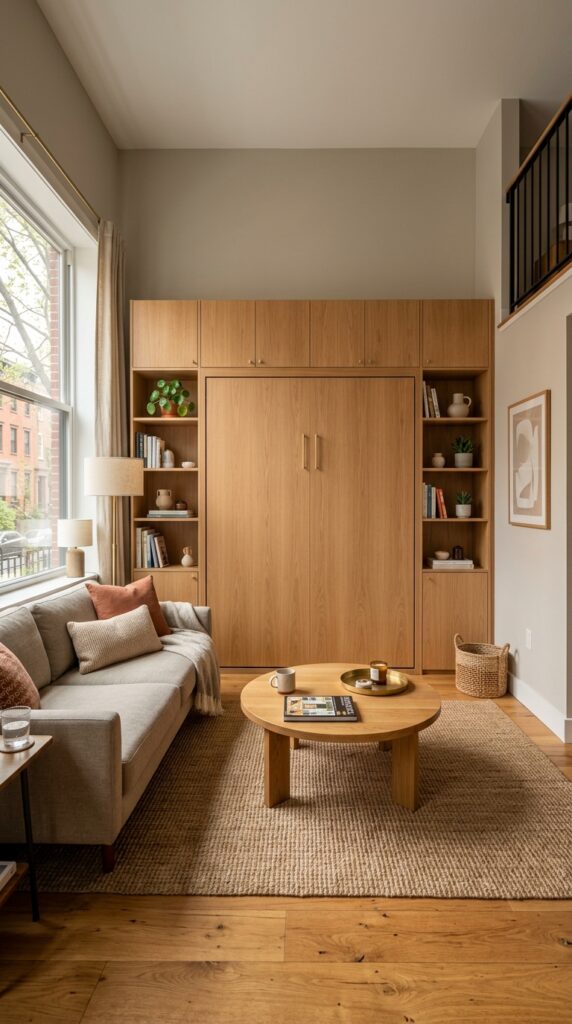
Vibe: Resolved — a Murphy bed in a loft studio is the answer to the question the space was asking.
Why it works: In a studio loft (under 600 square feet with no separate bedroom), a Murphy bed (wall bed) integrated into a custom cabinetry system converts the sleeping zone from a permanent visual presence that dominates the space to a concealed option that disappears entirely during waking hours. The loft can then function as a genuine living room — with a properly sized sofa, a coffee table, and clear floor area — rather than a bedroom with furniture competing for space around the bed. The cabinetry surrounding the Murphy bed (matching shelving, a desk fold-out, or wardrobe sections) makes the unit read as intentional architecture rather than a space-saving device.
How to get it: Murphy bed frame hardware kits ($400–700) allow custom cabinet construction around a standard mechanism — pair the hardware with white oak plywood cabinetry (built or purchased flat-pack) for a high-quality custom result at significantly less than bespoke cabinet pricing. Specify soft-close hinges and a piston-assist mechanism for the bed panel — these additions make daily operation smooth and silent.
Shop The Look
| Product |
| Murphy wall bed frame hardware kit queen |
| White oak plywood sheet cabinet grade |
| Soft close hinge set cabinet installation |
| Compact sofa apartment size linen greige |
| Murphy bed mattress 10 inch low profile |
23. Statement Staircase in Steel and Timber
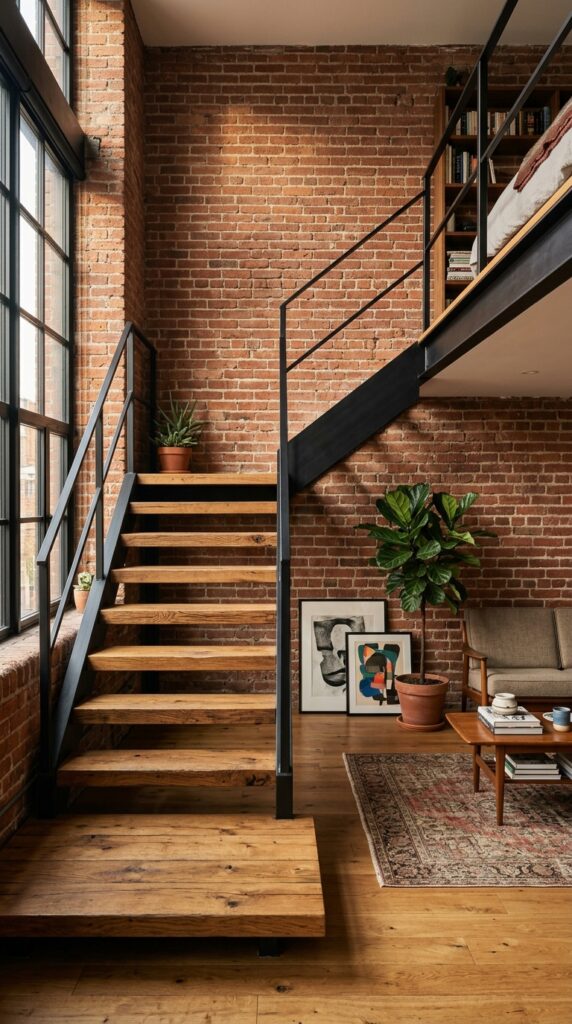
Vibe: Architectural — a staircase designed this precisely is the first thing anyone notices when they walk in.
Why it works: In a loft with a mezzanine or multi-level floor plan, the staircase is the most prominent architectural element in the entire space — it is visible from virtually every position on the ground floor and its profile is silhouetted against the wall or window behind it. An open-riser design (treads supported by steel stringers with no vertical riser boards between them) maintains visual transparency — the wall behind reads continuously through the stair structure, preventing the staircase from visually blocking the space it passes through. Matte black steel stringers and reclaimed oak treads respond precisely to the loft’s structural vocabulary.
How to get it: An open-riser stair requires a structural engineer’s calculation for the stringer sizing and tread connection — the absence of risers changes the load distribution significantly compared to a standard closed stair. Budget for engineering alongside fabrication; a custom steel-and-timber stair from a local metal fabricator typically costs $4,000–9,000 including installation.
Shop The Look
| Product |
| Steel stair stringer bracket kit matte black |
| Reclaimed oak stair tread board 48 inch |
| Stair tread mounting screw countersink steel |
| Open riser stair railing cable system |
| Stair tread oil finish hardwax natural |
24. Concealed Storage Behind Full-Height Flush Panels
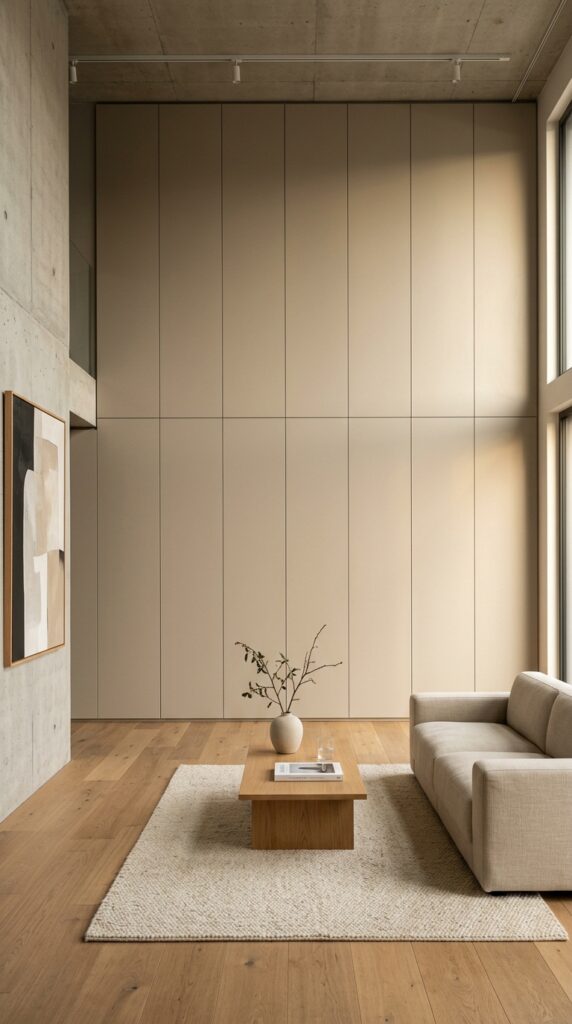
Vibe: Clean — when storage has nowhere to be seen, the room can breathe.
Why it works: In an open-plan loft where all zones are permanently visible, the visual noise of everyday storage — books, electronics, household items, clothing — competes continuously with the spatial quality of the room. Full-height flush-panel storage walls (floor-to-ceiling cabinetry with invisible push-to-open hardware and no visible pulls or handles) resolve this tension by treating storage as architecture rather than furniture. The panel surface reads as a wall, not a cabinet — the room gains a clean wall plane while housing all of the household’s storage volume within it. This is the same technique used in the best Scandinavian and Japanese residential design.
How to get it: IKEA PAX wardrobe systems fitted with aftermarket slab-front doors (from Semihandmade, Reform, or similar) achieve this result for $1,500–4,000 for a full wall, depending on the wall width — a fraction of custom cabinetry. Specify push-to-open hinges (Grass or Blum brands, available from kitchen hardware suppliers) to eliminate all visible hardware.
💡 Quick Win: Paint an existing mismatched set of bedroom or hallway doors the same color as the surrounding wall — when door panels and walls share a tone, the doors recede visually and the wall reads as a continuous architectural surface, approximating the flush-panel effect without any carpentry.
Shop The Look
| Product |
| Push to open hinge cabinet hardware Blum set |
| Flat slab door front MDF primed custom size |
| Greige interior paint warm neutral wall |
| Cabinet interior organizer pull out drawer |
| Floor mounted cabinet leveling leg set |
25. Raw Linen and Heavyweight Cotton Textiles Throughout
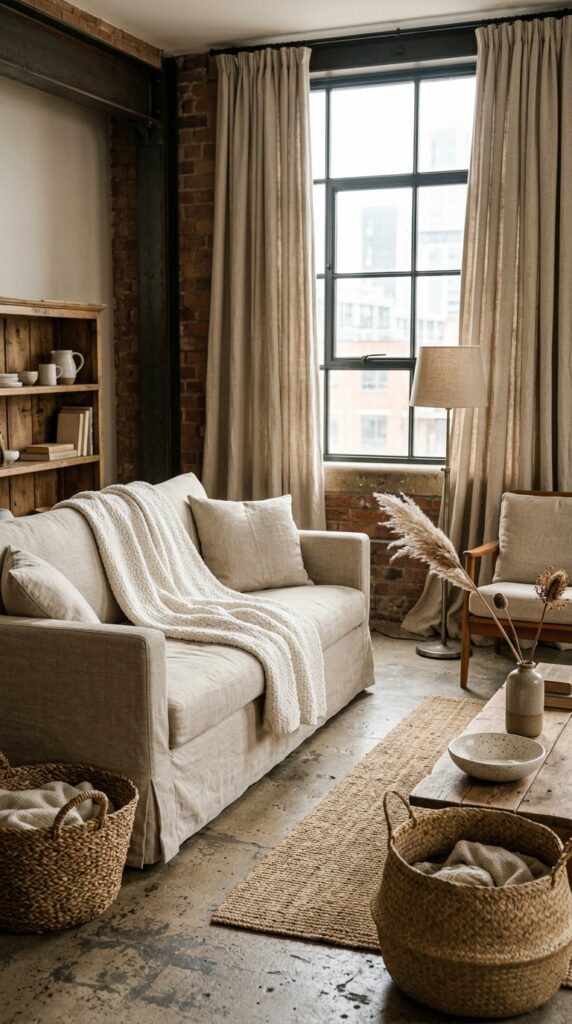
Vibe: Warm — natural textiles in an industrial space are the equivalent of a human voice in a cathedral.
Why it works: The hardness of a loft’s primary materials — concrete, brick, steel, timber — requires soft material counterweight to prevent the space from feeling institutional. Natural textiles (heavyweight linen, raw cotton, undyed wool) introduced consistently throughout the space provide this counterweight through material softness and the organic warmth of natural fiber. The key is consistency of tone: all textiles in the same warm neutral family (oatmeal, natural, ivory, warm grey) rather than mixed colors, which allows the textiles to function as a unified soft layer rather than individual decorative accents. Floor-length curtains that pool slightly on the concrete floor introduce an unexpected softness that is particularly effective against hard industrial surfaces.
How to get it: Wash linen and cotton textiles before introducing them to the space — pre-washing relaxes the fibers and produces the natural wrinkle and drape that gives these materials their character. Unwashed linen reads as stiff and commercial; washed linen reads as lived-in and genuine.
Shop The Look
| Product |
| Heavyweight linen sofa slipcover oatmeal |
| Floor length linen curtain panel natural ivory |
| Undyed cotton throw blanket natural white |
| Woven seagrass basket storage large round |
| Dried pampas grass stem large natural |
26. The Finished Loft: Editing Down to What Earns Its Place
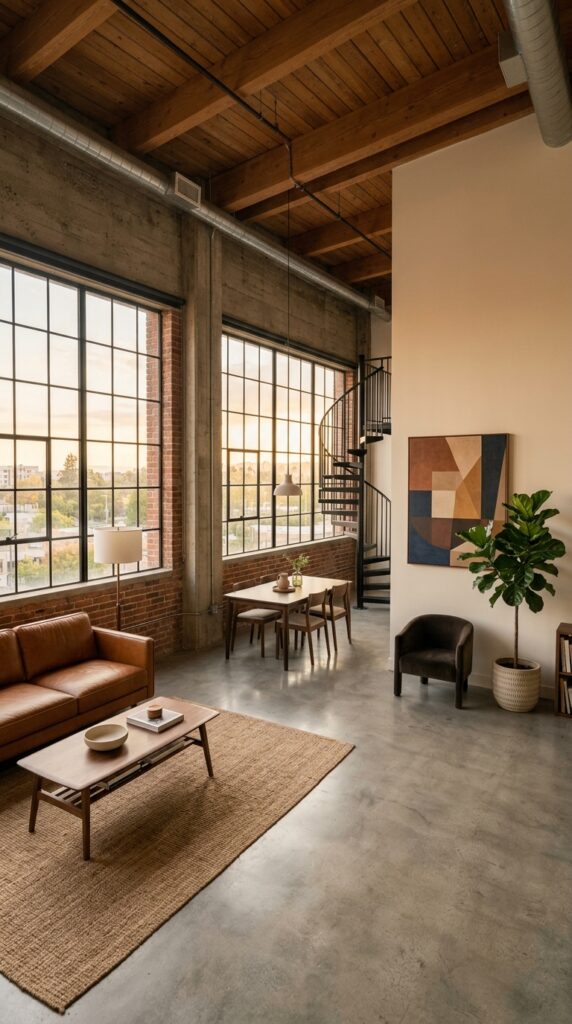
Vibe: Confident — the most resolved loft rooms are the ones that had the courage to remove things.
Why it works: The defining design move in loft apartment living is not addition but subtraction — the willingness to leave open floor area empty, to resist filling every wall, to allow the architecture to be the design. Empty space in a loft is not wasted space; it is the spatial quality that makes the loft a loft rather than a stuffed apartment. The principle of negative space — the deliberate preservation of empty areas that give occupied areas visual meaning — is the master skill of loft apartment design. A sofa that floats in generous open space reads as a design decision; a sofa pushed against a wall surrounded by furniture reads as insufficient planning.
How to get it: Perform a furniture edit: remove every item from the loft and replace only what is genuinely necessary, one piece at a time, stopping when the space feels right rather than when it feels full. The first time you stop replacing and realize the room is complete, it will have fewer objects than you expected — that is the design working correctly.
💡 Quick Win: Move your sofa 18 inches away from the wall behind it — floating furniture away from walls into the center of the space is the single fastest move that shifts an apartment interior from furnished to designed. Furniture against walls is a habit, not a rule.
Shop The Look
| Product |
| Furniture coaster moving pad set non scratch |
| Floor anchor furniture felt pad set large |
| Minimalist shelf styling object set ceramic |
| Object tray display wooden rectangle |
| Architectural design book large format hardcover |
How to Start Your Loft Apartment Living Transformation
The single most important first move in a loft apartment transformation is to address the floor. In most loft spaces, the existing concrete subfloor can be ground, densified, and sealed for $3–8 per square foot — a process that transforms a dusty, utilitarian surface into the polished concrete anchor that defines the entire room’s material register. If the floor is already covered with carpet or vinyl, removing it to reveal the concrete below is the first step — and frequently, what’s underneath is better than what was on top. Every other design decision in the loft responds to the floor material, so getting this right before purchasing any furniture is critical.
The most common mistake in loft apartment design is filling the open space too quickly — bringing in too much furniture, too many rugs, too many decorative objects — out of discomfort with the empty volume. Empty space in a loft is not a problem to be solved; it is the room’s primary spatial quality. The fix is counterintuitive: remove furniture rather than add it. If the loft feels wrong, start by taking things out. A loft with one great sofa, one great dining table, and generous empty floor around both will always outperform one crammed with adequate furniture at every scale.
Three items under $50 that create immediate loft apartment impact: a bottle of dark charcoal grout colorant ($15–20) applied to any light-grouted tile that interrupts the floor’s visual continuity; a single long pendant cord in black fabric ($18–30) that drops an existing ceiling bulb 8 feet lower, immediately referencing the loft’s vertical scale; and a large vintage-style world map or blueprint print mounted on a wooden dowel ($25–40 total) that fills a bare wall with scale-appropriate art without touching a frame.
A single-weekend transformation — floor polish, pendant drop, furniture edit, and rug placement — costs $150–400 and shifts the spatial quality of a loft apartment more dramatically than months of gradual accessory accumulation. A full transformation including custom mezzanine, built-in storage, and bespoke lighting is an 8–18-month project at $15,000–60,000 depending on specification and market. Start with the floor and the light; everything else follows.
Frequently Asked Questions About Loft Apartment Living
What is the difference between a loft apartment and an open-plan apartment?
A loft apartment is specifically a converted former industrial or commercial space — a warehouse, factory, printing house, or commercial floor — characterized by exposed structural elements (brick, concrete, timber beams, steel columns), oversized windows, and very high ceilings, typically 11–16 feet. An open-plan apartment is any residential unit without interior walls dividing the main living areas, regardless of the building’s original use or architectural character. All lofts are open-plan; not all open-plan apartments are lofts. The material vocabulary — exposed raw structure rather than finished residential surfaces — is what distinguishes a true loft from a modern open-plan flat.
What colors work best in a loft apartment?
Loft apartments work best when color comes from material rather than paint — the warm ochre of original brick, the cool grey of concrete, the honey amber of Douglas fir beams, and the dark richness of aged leather form a complete and historically grounded color palette without a single painted surface. When painted walls are needed, warm white (specifically a white with yellow or red undertones, like Farrow & Ball “All White” or Benjamin Moore “White Dove”) works as a neutral that reads warm against concrete and brick rather than cold. Deep accent colors — forest green, navy, dark charcoal — work effectively on a single partial wall or column where they emphasize the structural element without competing with the material palette of the space.
How much does it cost to furnish a loft apartment?
A minimally but well-furnished loft (one quality leather or linen sofa, a reclaimed timber dining table and chairs, a large area rug, layered pendant lighting, and a few large-scale accessories) costs $8,000–18,000 in mid-range quality furniture. A fully resolved loft with custom built-in storage, bespoke lighting design, high-quality vintage rugs, and investment furniture pieces runs $25,000–60,000. The highest-return investments at any budget level are the rug (choose vintage — it does more than any new rug at the same price), the sofa (choose quality full-grain leather or heavyweight linen that will age well), and the dining table (choose reclaimed or solid timber that develops character over time).
Can loft design work in a small studio apartment?
Yes, but the approach requires deliberate adaptation of the core principles. In a studio under 600 square feet, the loft aesthetic translates through material choices rather than spatial gestures: concrete-look flooring (porcelain tile or polished microtopping over existing floors), exposed or emphasized ceiling structure (even painted black pipes read as industrial), dark or warm wall tones, industrial-style lighting on longer cord drops, and furniture with authentic material quality. A Murphy bed integrated into a custom cabinetry wall solves the bedroom-in-a-studio problem while maintaining the spatial openness that defines the loft experience. Scale every decision to the actual room — one large plant, not five medium ones; one oversized art piece, not a gallery wall.
What is the best flooring for a loft apartment?
Polished or sealed concrete is the most authentic and highest-performing flooring choice for a loft apartment — it is the original floor material of the industrial buildings these spaces occupy, requires no installation beyond treatment of the existing substrate, and develops a natural patina over time that improves with age. Where concrete isn’t available or practical, large-format concrete-look porcelain tile (24×48-inch format in warm grey) is the closest visual and functional alternative. Engineered or reclaimed timber (white oak, Douglas fir) is appropriate for sleeping zones or mezzanine levels where warmth underfoot is a priority. Avoid carpet in a loft context — it references residential domesticity in a way that undermines the industrial architectural character.
Ready to Create Your Dream Loft Apartment Living Space?
These 26 ideas cover every layer of what makes a loft apartment genuinely work — from the foundational floor and ceiling decisions that establish the room’s structural character, to the furniture scale and zone-definition techniques that organize open space without walls, to the material and textile choices that bring warmth to honest industrial bones. Every loft transformation worth making starts with one clear-eyed decision: choose one thing that is wrong about the space right now and fix it with the best possible version of the right answer. Today, move your sofa 18 inches off the wall and observe what happens — that single shift, costing nothing, will tell you more about how your loft wants to be arranged than any amount of planning. When the space is resolved — the floor continuous, the lighting layered, the furniture floating in generous space, each object chosen once and committed to — the loft stops feeling like a space you live in and starts feeling like a space that lives with you. Pin the ideas that made the scale of the thinking click, especially the zone-definition and lighting details — in a loft, those are the moves that separate an empty room from an effortless one.