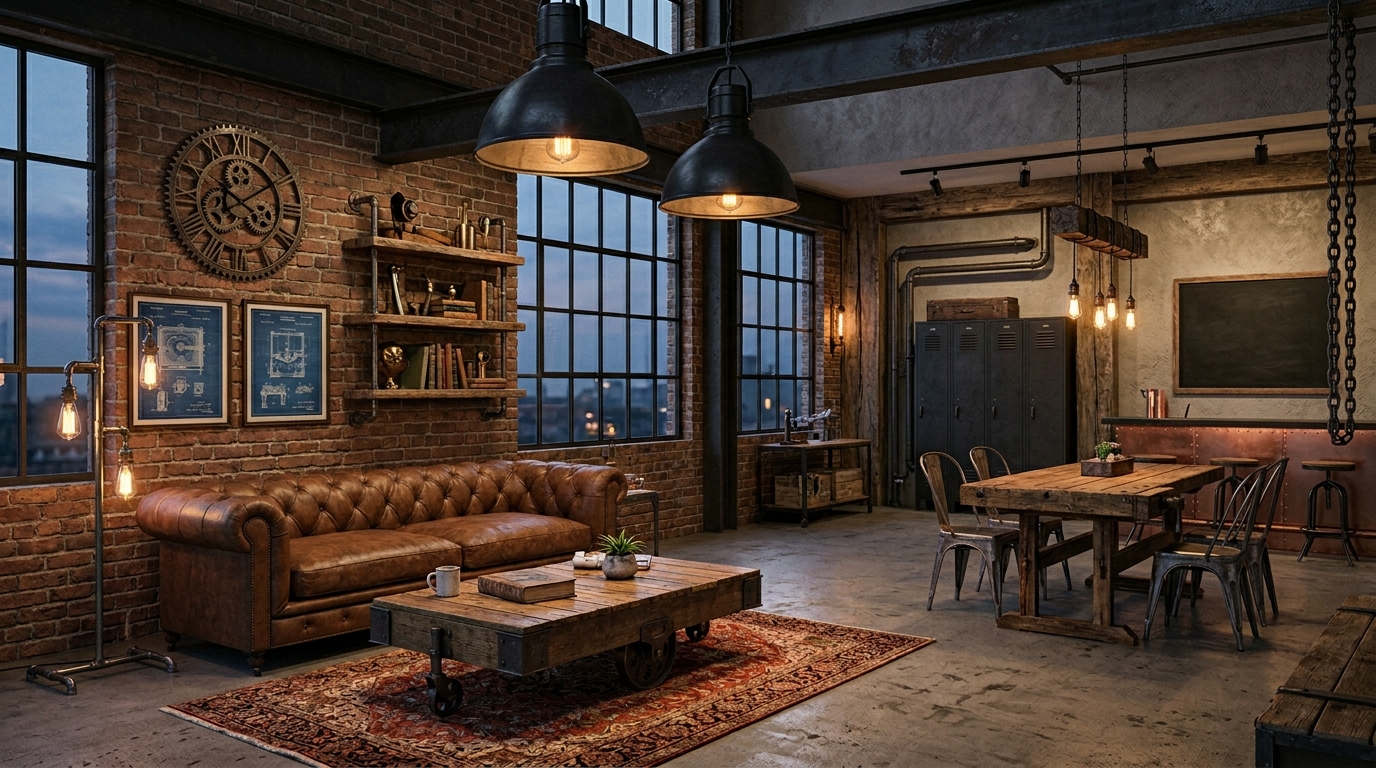
Moody industrial decor is an interior design style rooted in the repurposed aesthetic of 19th-century factories, warehouses, and urban lofts — characterized by exposed structural elements, raw materials, and a deliberately dark, atmospheric palette. This article gives you 23 moody industrial decor concepts spanning color, materials, lighting, furniture, layout, accessories, and small-space solutions — everything you need to design a space that feels both raw and intentional.
There is a particular honesty to a room that shows its bones. Bare steel pipes, blackened brick, poured concrete floors — moody industrial decor does not dress up its structure; it makes the structure the decoration. The result is a space that feels earned rather than assembled, heavy with atmosphere in the best possible way. Here are 23 ideas worth saving — and stealing.
Why Moody Industrial Decor Works So Well
Moody industrial style emerged from the loft conversion movement of 1970s New York, when artists colonized derelict SoHo warehouses and left the exposed brick, cast-iron columns, and overhead ductwork intact — not from poverty of aesthetic ambition but because the raw architecture was more interesting than anything applied over it. The style draws from brutalism’s material honesty, the Arts and Crafts movement’s reverence for craft process, and the early-20th-century factory aesthetic where structure and function were one. What distinguishes moody industrial from its lighter, more Scandinavian-inflected sibling (raw industrial) is the deliberate embrace of shadow, depth, and atmospheric darkness — this is not a style that wants to be bright.
The material palette is unapologetically heavy. Exposed brick in dark mortar, unfinished concrete in warm charcoal, blackened steel and iron, reclaimed timber in dark stain or untreated patina, aged leather in tobacco and cognac, and Edison-bulb glass anchor every surface. Colors are geological and shadow-toned: warm charcoal, deep slate, iron black, raw umber, dark tobacco, oxblood, and the particular blue-black of aged cast iron. Every finish is matte or naturally oxidized — polished chrome and high-gloss lacquer are the only genuine design errors in this style.
Moody industrial is trending now for reasons that intersect meaningfully with the current cultural moment. After years of all-white interiors and Millennial gray, design culture has moved decisively toward depth, warmth, and material authenticity. Pinterest data shows searches for “dark moody interiors” up over 200% since 2021. Simultaneously, the sustainability movement has rehabilitated reclaimed and repurposed materials — the reclaimed oak beam and the salvaged factory pendant are now design-forward choices, not budget concessions.
Small spaces can achieve this style effectively — and sometimes more powerfully than large ones, because the moody atmosphere concentrates rather than disperses. Prioritize one dark wall, one statement light fixture, and one raw material surface (exposed brick, concrete, or dark-stained timber). Let the shadows do the work of decoration.
Style at a Glance
| Element | Moody Industrial | Raw Urban Industrial |
| Philosophy | Shadow as design material | Structure as decoration |
| Materials | Blackened steel, dark brick, aged leather, reclaimed timber | Concrete, pipe, wire glass, raw wood |
| Color palette | Charcoal, iron black, oxblood, warm umber | Cool gray, raw concrete, natural oak |
23 Moody Industrial Decor Concepts
1. Exposed Brick Wall in Dark Mortar

Vibe: Raw — a brick wall lit by a single raking light source reveals a surface that flat illumination renders completely invisible.
Why it works: Exposed brick is the foundational element of moody industrial design — it provides the primary texture, the primary color (warm red-brown against dark mortar), and the primary historical reference to the industrial building stock the style draws from. Dark mortar joints — achieved either by original construction or by raking out standard gray mortar and repointing with a dark charcoal mix — dramatically increase the visual depth of the wall surface. The iron oxides in aged brick absorb and reflect warm light differently from every angle, making the wall a living surface that changes quality through the day.
How to get it: If your brick has been painted, use a gel paint stripper (Peel Away 1 Heavy Duty) to strip back to raw brick — the result will be uneven and slightly bleached, which is ideal. For new faux brick applications, use real thin brick veneer slips set in dark charcoal thinset mortar with narrow 3/8-inch joints. Avoid grout-painted or printed brick wallpaper — the texture difference reads immediately in raking light.
💡 Quick Win: Dark charcoal grout pen ($12–$18 at hardware stores) applied to existing light-grouted brick instantly increases the wall’s visual depth and moody quality without any demolition.
Shop The Look
| Product |
| Industrial pipe wall sconce Edison bulb iron |
| Dark charcoal grout pen brick mortar repair |
| Thin brick veneer slip tile red brown |
| Single black iron wall hook heavy duty |
| Trailing preserved moss wall panel natural |
2. Blackened Steel Pipe Shelving

Vibe: Hushed — a wall of pipe shelving loaded with dark objects has the visual weight of a library built for a century.
Why it works: Black iron pipe shelving is the most recognizable signature element of moody industrial interiors — and it works because the structural logic is completely transparent. The pipe, the flanges, the nipples, and the fittings are all visible and unadorned. The shelf construction shows exactly how it is held to the wall, which gives the piece an honesty that concealed-bracket shelving cannot match. Pairing the pipe with reclaimed dark-stained wood planks (not light oak or pine) keeps the moody tonal consistency — pale wood undermines the atmospheric depth immediately.
How to get it: Use 3/4-inch black iron pipe from a plumbing supply store — not chrome or galvanized. Cut to length and connect with standard iron pipe fittings (floor flanges, elbows, tees). For the shelves, source reclaimed oak boards and finish with Minwax Dark Walnut stain followed by a flat oil finish — no polyurethane. Secure floor flanges directly to wall studs with 3/8-inch lag screws rated for shelf load.
Shop The Look
| Product |
| Black iron pipe shelf bracket kit hardware |
| Reclaimed wood shelf board dark walnut stain |
| Dark walnut wood stain quart interior |
| Leather-bound journal set vintage style |
| Antique brass scale decorative tabletop |
3. Deep Charcoal and Iron Black Color Palette
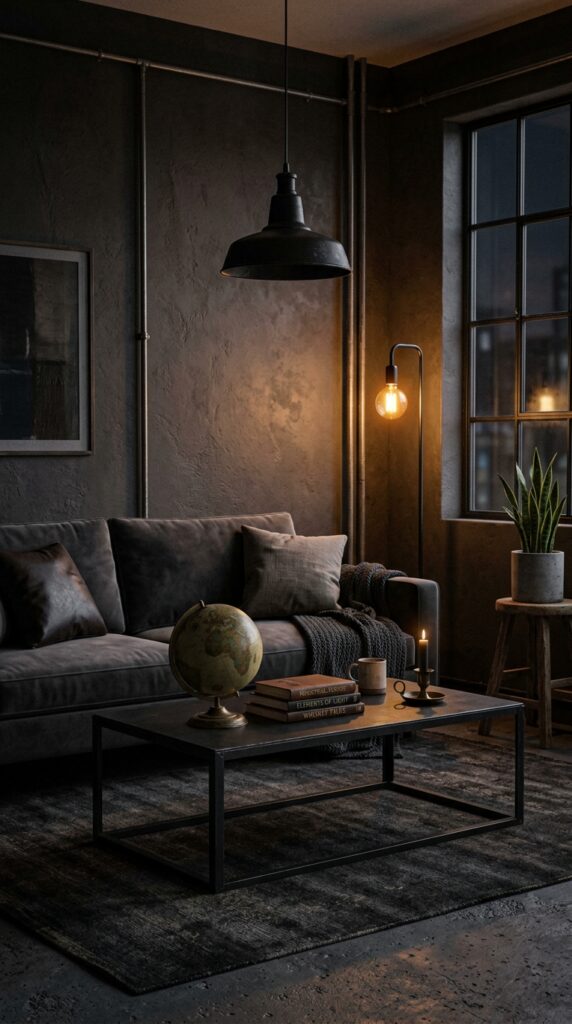
Vibe: Layered — when the walls are as dark as the furniture, the room stops being a box and starts being an atmosphere.
Why it works: The charcoal and iron black palette works because it exploits the behavior of shadow and warm light simultaneously — dark walls absorb light during the day and glow warmly at night when lit by low, warm sources. The critical distinction is the undertone of the charcoal: it must be warm (with a slight brown or green undertone, like Farrow & Ball’s Off-Black 57 or Benjamin Moore’s Wrought Iron HC-107) rather than cool blue-gray, which reads as corporate and cold. Iron black accents — matte finish only — deepen the palette without creating contrast, maintaining the room’s tonal unity.
How to get it: Apply the charcoal wall color in a flat or eggshell finish — never satin, which reflects too much light and breaks the atmosphere. Use Benjamin Moore’s Wrought Iron HC-107 or Sherwin-Williams’ Iron Ore SW-7069 for a warm charcoal that reads deep but not depressing. Pair with unlacquered or matte black fixtures exclusively — satin nickel and brushed chrome are the fastest way to break this palette.
Shop The Look
| Product |
| Charcoal velvet sofa modern low profile |
| Matte black steel coffee table industrial |
| Dark iron floor lamp Edison bulb vintage |
| Dark leather throw pillow cover square |
| Vintage-style globe decorative antique |
4. Edison Bulb Pendant Cluster Over Dining Table
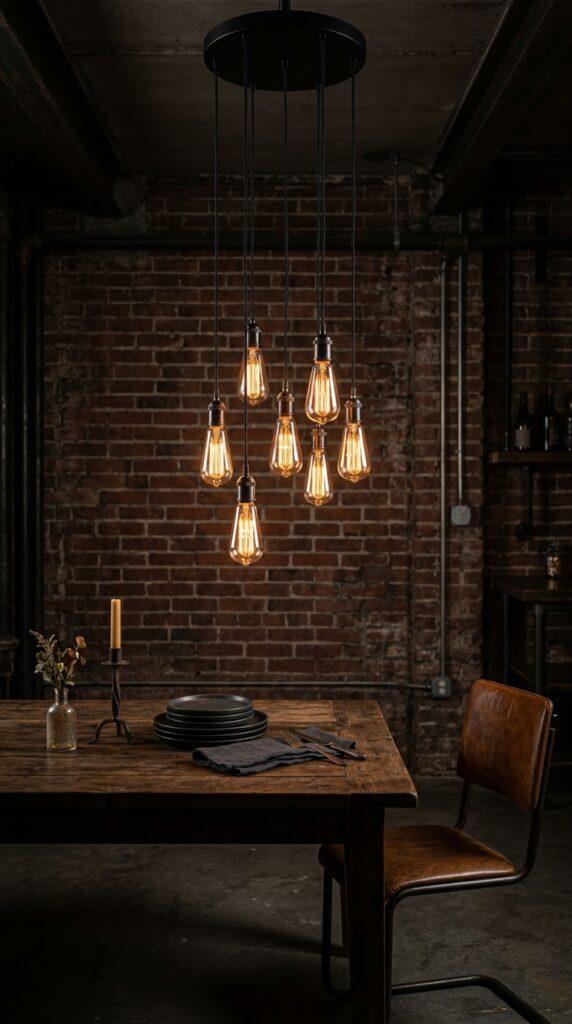
Vibe: Warm — a cluster of Edison filament bulbs at varying heights turns a dining table into a campfire-quality social magnet.
Why it works: The Edison bulb pendant cluster works on two design principles simultaneously: the warm 2200K color temperature of carbon filament bulbs flatters every skin tone and material surface beneath it, and the varying drop heights — staggered in a 12-inch range — create a visual rhythm that is more interesting than any single fixture at the same height. The filament itself is visible and active, making the light source an object of attention rather than a background utility. Specify ST64 or T30 bulb shapes for the most dramatic filament visibility; avoid the clear globe shapes, which look cleaner but less industrial.
How to get it: Mount a 4-inch round matte black ceiling canopy with 7 individual pendant cord knockouts, all on a single electrical connection. Vary cord lengths between 36 and 60 inches in increments of 4–6 inches. Use 4-watt carbon filament LED bulbs (not incandescent — they overheat in clusters) rated at 2200K. Keep all cord and canopy finishes in matte black — no chrome, no fabric cord in this style.
Shop The Look
| Product |
| Carbon filament Edison bulb ST64 2200K LED set |
| Matte black pendant cord set multi-cluster |
| Multi-pendant ceiling canopy matte black 7-port |
| Reclaimed dark wood dining table industrial |
| Tobacco leather dining chair vintage |
5. Oxidized Copper and Iron Accent Wall
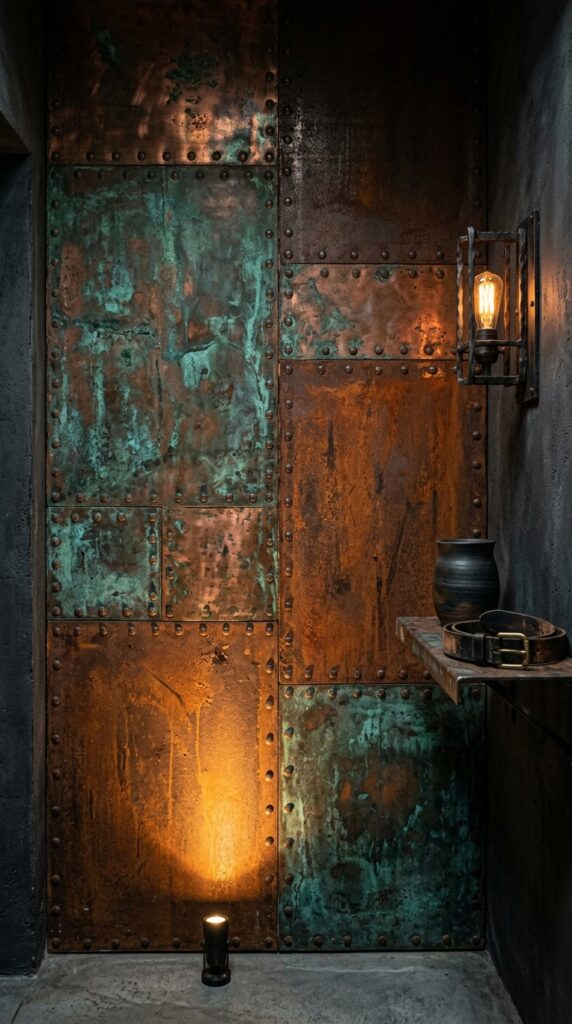
Vibe: Raw — an oxidized metal wall is the only surface that looks genuinely better the longer it is left alone.
Why it works: The pairing of oxidized copper and weathering iron on a single accent wall delivers two complementary patina processes — the blue-green verdigris of copper oxidization against the warm rust-orange of iron oxidation. Both are the result of elemental chemistry interacting with air and moisture, giving the wall surface a geological authenticity impossible to achieve with paint or wallpaper. The material contrast — cool verdigris alongside warm rust — creates color tension that makes the wall visually active without any additional decoration.
How to get it: Source thin-gauge copper sheet (0.016 inches, available from metal suppliers) and standard 16-gauge cold-rolled steel sheet. Accelerate copper patination by spraying with a 50:50 ammonia and water solution inside a sealed box for 24 hours. Allow steel to develop rust naturally outdoors for 3–4 weeks, then fix permanently with a clear matte metal sealer (Krylon Crystal Clear). Mount both materials directly to the wall using construction adhesive and countersunk screws for larger panels.
💡 Quick Win: Copper spray paint plus a green patina antiquing solution (both available for under $15 total at craft stores) applied to a single accent panel creates a convincing oxidized copper surface for a fraction of the sheet metal cost.
Shop The Look
| Product |
| Copper sheet thin gauge roll metalwork |
| Metal patina antiquing solution green verdigris |
| Clear matte metal sealer spray exterior |
| Iron wall sconce single arm industrial |
| Dark ceramic tall vessel handmade matte |
6. Aged Leather Sofa with Nail Head Trim
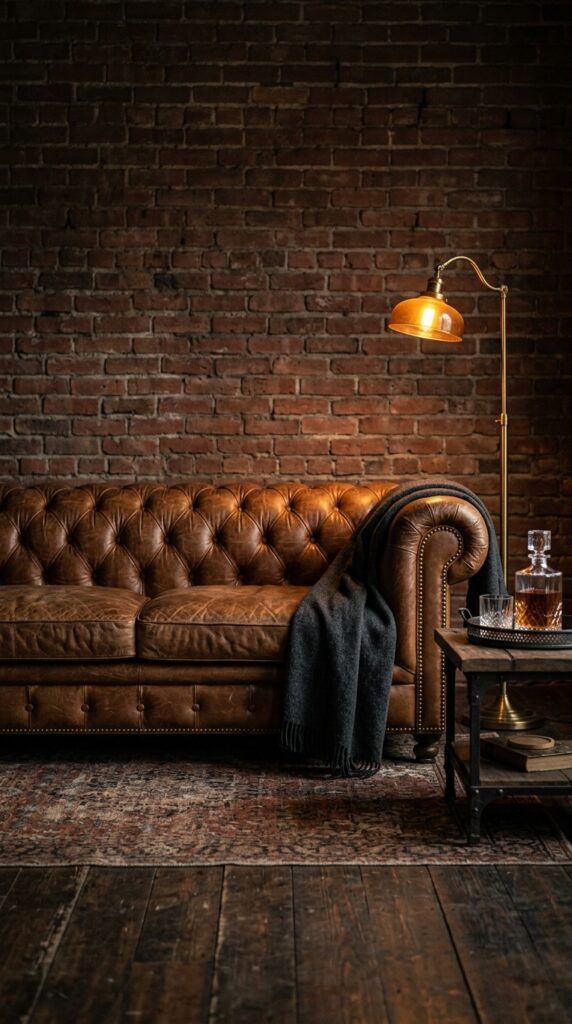
Vibe: Grounded — a tobacco leather Chesterfield against dark brick is so complete a composition it needs nothing else in the room.
Why it works: Top-grain or full-grain leather ages through use — oils from hands, minor scuffs, and ambient light conspire to develop a patina that reads as irreplaceable history. In the context of moody industrial design, this living quality of aged leather echoes the patina of brick, timber, and iron — all materials that look better with decades on them than they did new. The brass nail head trim is the key detail: it introduces a warm metallic element at a small scale without competing with the larger iron and steel fixtures, and its pattern at the sofa edge reads as industrial riveting translated into furniture.
How to get it: Source a genuine leather Chesterfield in full-grain or top-grain aniline leather in a tobacco, cognac, or dark brown tone — not bonded leather, which cracks rather than developing patina. To accelerate patina on new leather, apply a thin coat of leather conditioner (Leather Honey or Lexol) and allow it to darken the surface naturally. Avoid treating with anything that adds sheen — the matte, lived-in quality is the whole point.
Shop The Look
| Product |
| Genuine leather Chesterfield sofa dark brown |
| Dark wool throw blanket charcoal large |
| Whiskey decanter set glass vintage style |
| Iron serving tray rectangular large dark |
| Leather conditioner natural color-safe |
7. Concrete Floor with Dark Wax Finish
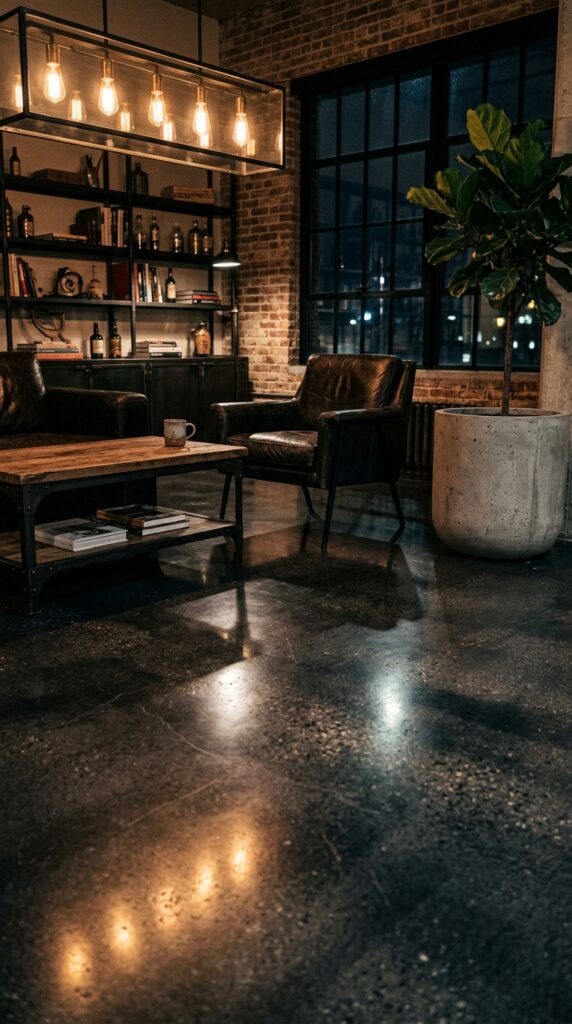
Vibe: Moody — a dark-waxed concrete floor extends the room’s atmosphere all the way to the ground, making the space feel like a unified volume of shadow.
Why it works: Raw concrete floors in moody industrial spaces are commonly left unsealed or sealed in a standard gray — but dark wax finish transforms the floor into an active element of the color palette rather than a neutral ground. Dark floor wax (a blend of tinted paste wax applied and buffed into the concrete surface) penetrates the pores and develops a subtle, low-sheen glow that reflects warm light sources without the mirror-like quality of polyurethane sealer. The dark tone also makes the floor functionally part of the “shadow zone” that defines moody industrial’s atmospheric quality.
How to get it: Apply Bona or Trewax paste wax in a dark charcoal or ebony tone to clean, dry concrete — work in 4-foot sections, allow to haze (approximately 10 minutes), then buff with a floor polisher at low speed. Two coats produce the optimal depth. Reapply annually. Do not use on concrete that has been previously sealed with a topical sealer — strip first with a chemical floor stripper.
Shop The Look
| Product |
| Dark charcoal floor wax paste concrete wood |
| Industrial iron coffee table dark metal |
| Concrete floor buffer polisher small electric |
| Dark leather accent chair low modern |
| Large concrete decorative planter indoor |
8. Moody Industrial Bedroom: Dark Walls and Iron Bed Frame
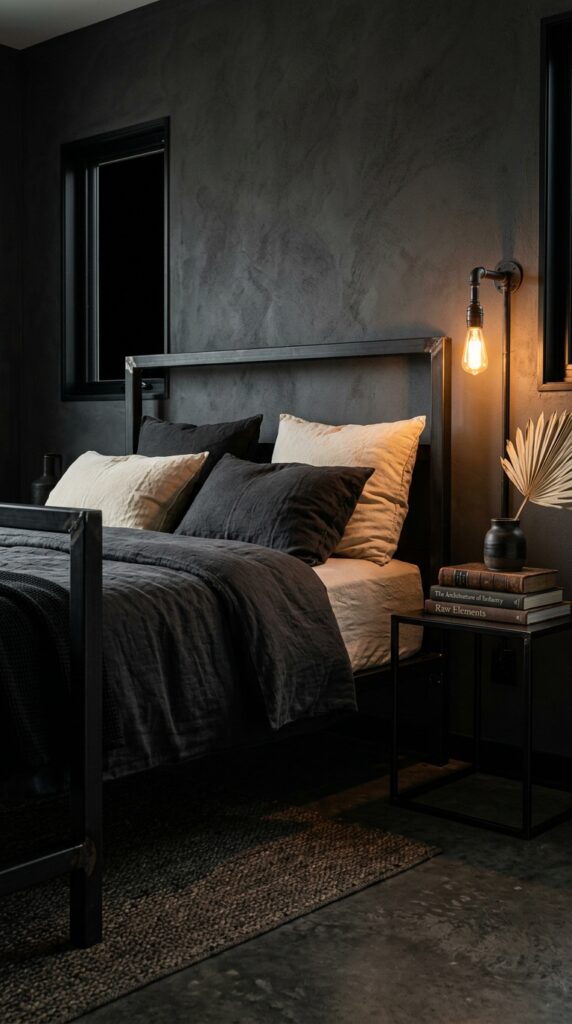
Vibe: Serene — a bedroom stripped to iron, linen, and shadow is the most restful kind of dark room.
Why it works: The matte black iron bed frame is the moody industrial bedroom’s defining piece — its visible welded joints and square-tube construction read as fabricated rather than manufactured, giving the room its essential handmade industrial quality. Against deep charcoal walls, the frame reads as a silhouette rather than a feature, which is exactly the right relationship: the bed structure defines the room without dominating it. Bedside wall-mounted pipe sconces on individual switches allow asymmetric lighting for reading — one on, one off — which generates the asymmetric shadow play that makes a dark bedroom feel designed rather than merely dark.
How to get it: Source a square-tube matte black steel bed frame from an industrial furniture maker (many Etsy fabricators offer custom sizes). Specify flat-black powder coat, not semi-gloss. Layer bedding in two tones only — dark charcoal duvet and warm ivory linen sheets — with no patterned textiles, which break the tonal discipline of the palette.
Shop The Look
| Product |
| Matte black iron bed frame industrial steel |
| Dark charcoal linen duvet cover set |
| Pipe wall sconce bedside industrial black |
| Iron industrial side table small nightstand |
| Dried palm leaf large decorative natural |
9. Reclaimed Timber Beam Ceiling
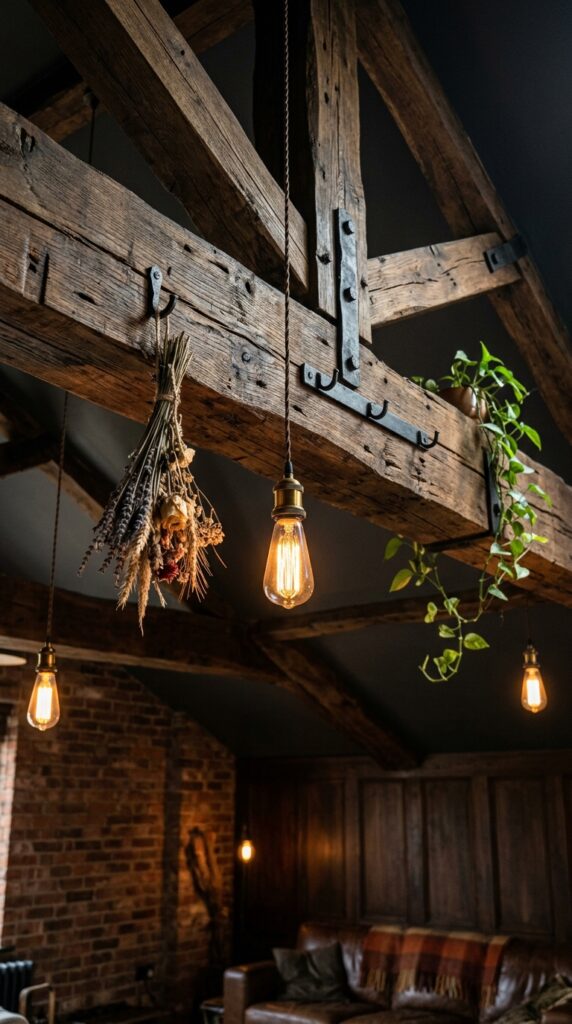
Vibe: Grounded — a ceiling of reclaimed timber beams compresses the room downward in a way that makes everything below feel more intimate.
Why it works: Reclaimed timber beams introduce the horizontal rhythm of industrial construction — the spacing of structural members across a ceiling is a direct reference to factory, mill, and warehouse architecture. Genuine reclaimed beams carry saw marks from original milling, nail holes, and weathering patina that new timber cannot replicate. The surface color of aged oak (deep amber-brown with gray undertones from weathering) occupies a warm zone in the palette that both concrete and steel are too cool to provide, giving the ceiling warmth without lightening the room’s overall tone.
How to get it: Source genuine reclaimed beams from architectural salvage dealers — specify Douglas fir or oak for the most authentic industrial appearance. Apply a single coat of Rubio Monocoat in a Charcoal or Black Wash tint to unify color variation between beams without obliterating the patina. Mount beams using black iron beam hanger hardware (Simpson Strong-Tie makes a range of appropriate profiles) with no attempt to conceal the connection — the hardware is part of the composition.
💡 Quick Win: Faux reclaimed beam wraps in polyurethane (under $40 per 8-foot section at Home Depot) mounted over smooth ceilings deliver the visual effect convincingly — specify a dark walnut or weathered gray finish.
Shop The Look
| Product |
| Faux reclaimed wood beam wrap dark walnut |
| Black iron beam hanger hardware Simpson |
| Dried botanicals hanging bundle large |
| Iron hook rail strip wall mount |
| Dark charcoal ceiling paint flat finish |
10. Wire Glass and Steel Room Divider
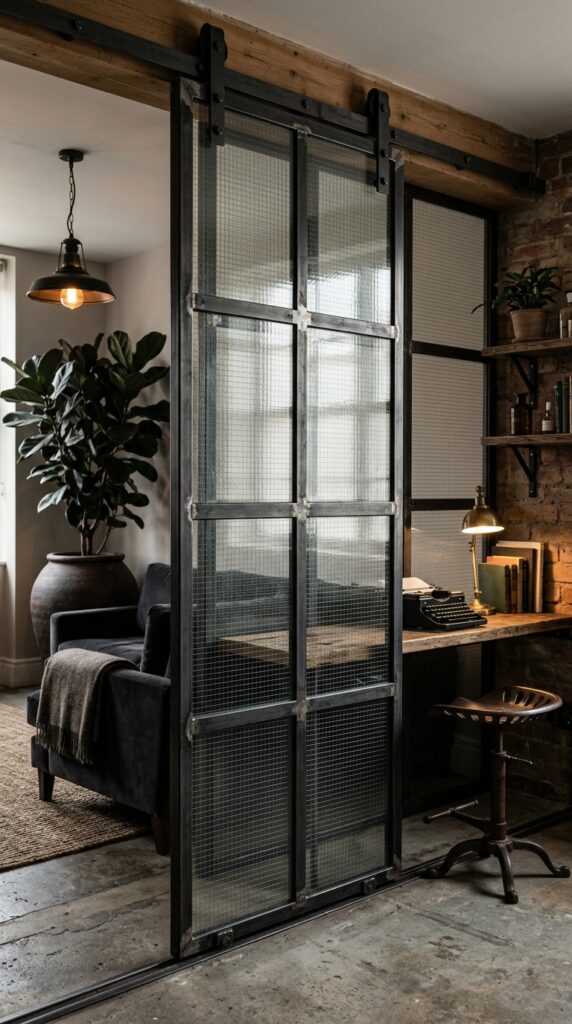
Vibe: Architectural — a wire glass partition divides space without ending it, and the wire grid inside the glass is its own decoration.
Why it works: Wire glass — safety glass with a welded wire mesh embedded during manufacturing — is the original industrial glazing material, developed in the 1890s for factory skylights and fire doors. Its visible grid references the structural engineering logic of the industrial building tradition while allowing light transmission between zones. A black steel frame divided into rectangular panes (referencing factory window glazing bars) intensifies the architectural reading. This partition is particularly effective in loft spaces where preserving visual depth between zones is as important as defining them.
How to get it: Use black powder-coated steel box section (1.5″×1.5″) for the frame and source wire glass panels (available from glass suppliers as “Georgian wired cast glass”) at 1/4-inch thickness. Hang on a ceiling-mounted sliding track system for flexibility. For a more budget-conscious application, black-framed steel window panels (available from industrial window suppliers) can be floor-mounted as fixed partitions.
Shop The Look
| Product |
| Industrial steel frame sliding door hardware black |
| Wire glass panel replacement Georgian cast |
| Iron industrial bar stool adjustable height |
| Dark steel bracket shelf industrial wall |
| Large indoor dark green plant tropical |
11. Moody Industrial Bathroom: Matte Black Fixtures Throughout
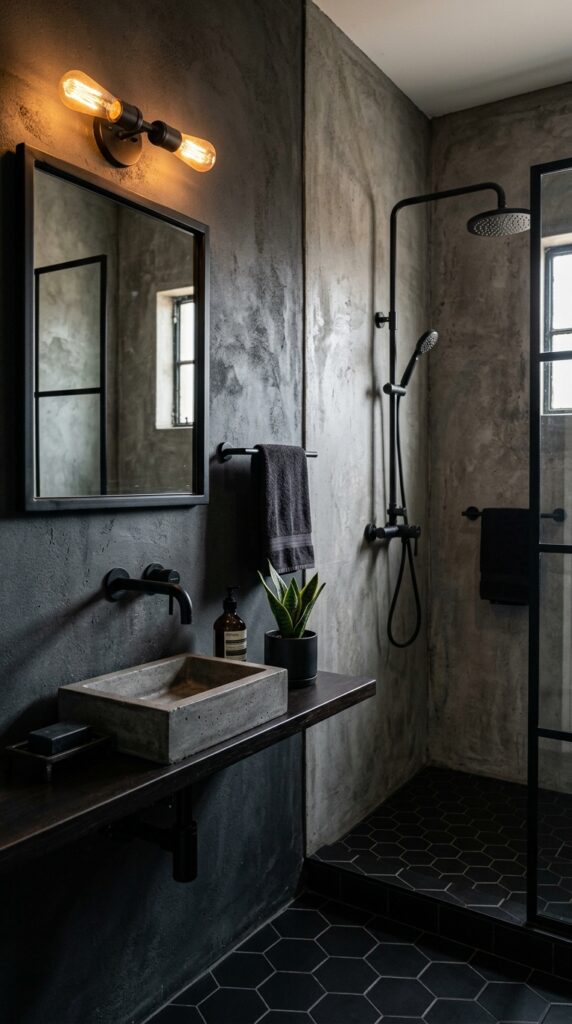
Vibe: Confident — an all-matte-black fixture bathroom reads like a room that made one decision and committed entirely.
Why it works: The matte black bathroom works because it replaces the visual noise of multiple metallic tones — chrome faucet, satin nickel towel bar, brushed hardware — with a single material decision applied consistently to every fixture. The result is a room that reads as designed rather than specified, where the eye moves across surfaces without interruption. Matte black is more forgiving of water spots than chrome (which requires polishing to maintain its appearance) and develops no patina — it reads identically at installation and a decade later.
How to get it: Specify all plumbing fixtures, towel hardware, mirror frame, and shower hardware from the same manufacturer’s matte black collection — Kingston Brass, Delta’s Trinsic collection in matte black, or Vigo Industries all offer comprehensive ranges. Mixing matte black from different manufacturers risks tone mismatches (some read blue-black, some read warm black) — verify all finishes in person before purchasing. Pair with dark charcoal concrete plaster walls and black 1-inch hex floor tile for tonal unity.
Shop The Look
| Product |
| Matte black wall-mount bathroom faucet |
| Matte black towel bar set bathroom 3-piece |
| Black hex porcelain floor tile 1-inch mosaic |
| Edison bulb vanity light strip matte black |
| Iron soap dish matte black bathroom |
12. Industrial Kitchen: Open Steel Shelving and Concrete Countertops
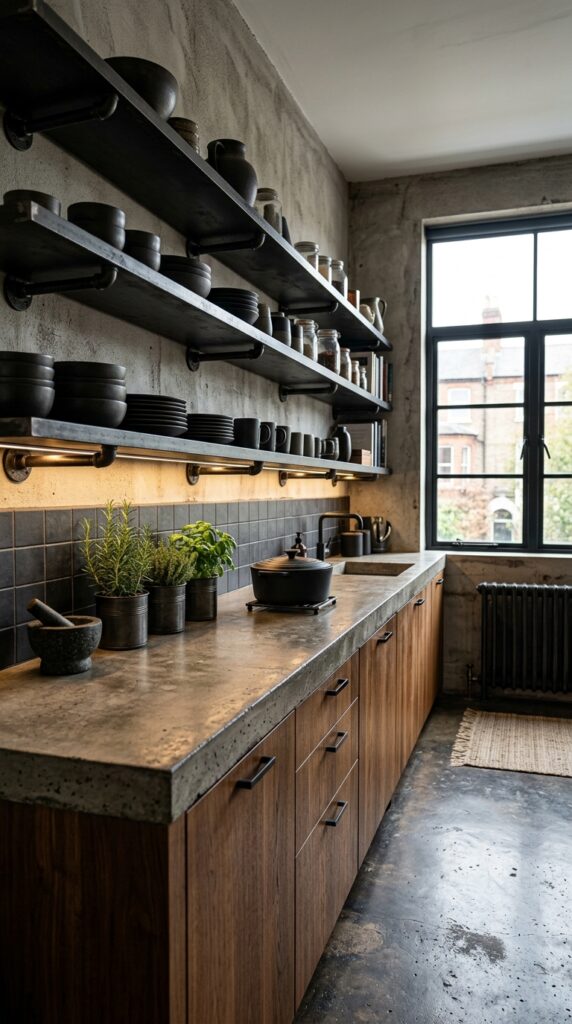
Vibe: Grounded — an open-shelf industrial kitchen that displays its objects like specimens is a kitchen that has nothing to hide.
Why it works: Open steel shelving in a kitchen replaces the visual mass of upper cabinets with a structural display system — the objects become as much the decoration as the shelving itself. This requires a commitment to curation: every item on the shelf is visible and should earn its place. Dark ceramic dishware (matte black or dark navy glazes), cast iron cookware, and iron pots all maintain the palette coherence. The concrete countertop provides the necessary textural weight at the working surface level, keeping the kitchen grounded rather than sparse.
How to get it: Replace standard upper cabinets with 3/4-inch reclaimed dark-stained wood shelves on black iron pipe brackets (see Idea 2 for construction details). For the backsplash, use dark charcoal subway tile in 3″×6″ laid in a stacked bond (not offset) with dark charcoal grout — the stacked pattern reads more industrial than the traditional brick pattern.
Shop The Look
| Product |
| Dark matte ceramic dinner plate set industrial |
| Cast iron dutch oven 5qt dark enamel |
| Charcoal subway tile 3×6 matte dark backsplash |
| Matte black cabinet pull set hardware |
| Iron herb pot wall mount kitchen small |
13. Oxblood Accent Wall with Dark Leather and Iron
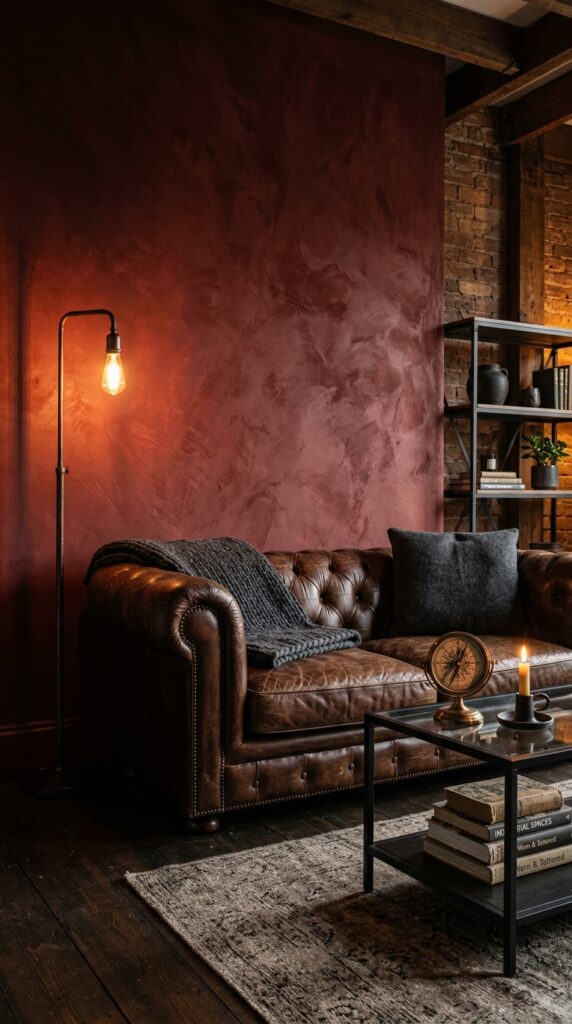
Vibe: Moody — oxblood red in a limewash finish is the only warm color that deepens rather than brightens a moody industrial space.
Why it works: Oxblood — a deep blue-red derived from iron oxide, literally the color of dried blood — is the moody industrial palette’s most powerful accent color. It occupies the same dark tonal register as charcoal and iron black but introduces warmth through color temperature rather than pigment brightness. Applied in a limewash medium, it develops tonal variation that reads as geological rather than decorative — the wall appears to have depth rather than just surface color. Against tobacco leather and dark iron, oxblood creates a triad of warm dark tones that is more atmospheric than any two-tone combination.
How to get it: Use Portola Paints or Pure & Original Classico Limewash in a deep oxblood tone — mix to approximate Farrow & Ball’s Preference Red or Benjamin Moore’s Sangria 2082-20 in a limewash medium. Apply in three coats with a wide masonry brush, working in circular motions and allowing variation between strokes. Do not attempt to create uniform coverage — the variation is the effect.
Shop The Look
| Product |
| Limewash interior paint oxblood deep red |
| Dark wool throw pillow cover charcoal |
| Iron candle holder pillar large dark |
| Antique compass decorative desk piece |
| Iron glass side table industrial small |
14. Moody Industrial Home Office with Exposed Ductwork
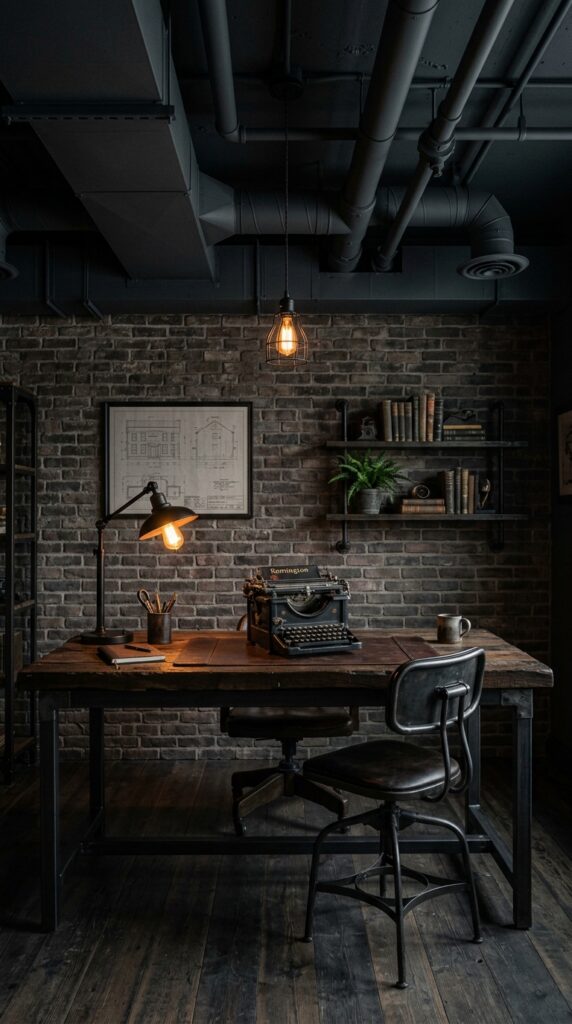
Vibe: Hushed — the weight of an industrial ceiling overhead makes concentration feel natural rather than forced.
Why it works: Exposed ductwork painted out in the same charcoal as the ceiling — rather than left in the silver tone most HVAC installations produce — creates a ceiling that reads as one unified dark plane rather than a collection of mechanical components. This “painting out” technique is how architects unify complex ceilings: by matching all elements to a single dark tone, the individual pieces dissolve into a single atmospheric canopy. The dark ceiling then functions as the moody industrial equivalent of a lowered ceiling — it brings the room’s vertical dimension into a more intimate register.
How to get it: Use a matte black or charcoal spray paint rated for metal (Rust-Oleum Painter’s Touch Ultra Cover in Flat Black works well on ductwork) and apply in two light coats rather than one heavy coat to prevent runs. Paint the surrounding ceiling in the same flat charcoal simultaneously — this is the critical step, as ductwork against a white ceiling always reads as mechanical regardless of paint color.
Shop The Look
| Product |
| Flat black spray paint metal ductwork |
| Leather desk pad large dark tan |
| Iron pen holder desk organizer dark |
| Vintage-style typewriter decorative display |
| Industrial task lamp adjustable arm black |
15. Dark Moody Gallery Wall with Industrial Framing
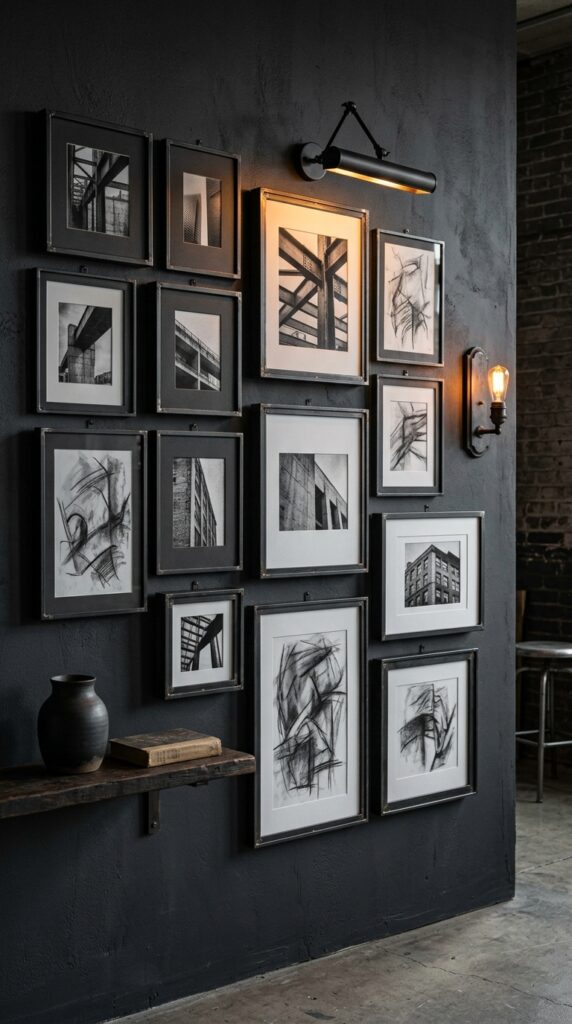
Vibe: Layered — a black-framed gallery wall on a dark wall disappears the frames entirely and leaves only the images floating in shadow.
Why it works: A gallery wall in the moody industrial context operates differently than in lighter interiors — the frames and wall tone are matched deliberately so the frame edge disappears into the wall, making the prints appear frameless and suspended. This requires matte black frames (not semi-gloss, which creates a halo in ambient light) on a charcoal wall within 2–3 tones of the frame color. The prints should be exclusively black-and-white or monochromatic — any color print breaks the atmospheric discipline and reads as an error rather than an accent.
How to get it: Source metal-frame gallery frames with matte non-reflective glass in 2–3 sizes (8″×10″, 11″×14″, and 16″×20″ work well together). Arrange asymmetrically — all frames in a perfect grid reads as decorative rather than collected. Install at slightly varying heights within a general horizontal band. Print black-and-white architectural or industrial photography from public domain sources (Library of Congress, Wikimedia Commons) for zero cost.
💡 Quick Win: Three matte black frames with black-and-white industrial prints (factory photography, bridge engineering, urban landscapes) available as free public domain downloads from the Library of Congress instantly creates a gallery wall with genuine historical reference for under $40.
Shop The Look
| Product |
| Matte black metal gallery frame set mixed sizes |
| Non-glare museum glass replacement panel |
| Picture light wall mount warm black |
| Dark ceramic wall shelf bracket mount |
| Black and white architectural photography print |
16. Moody Industrial Small Space: Studio Apartment
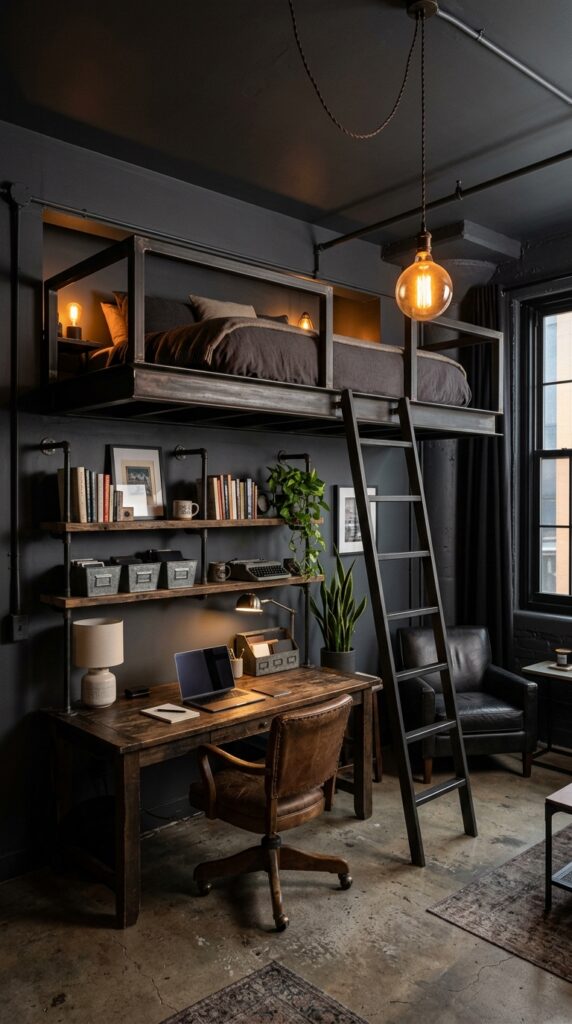
Vibe: Grounded — a studio apartment painted charcoal on every surface stops feeling small and starts feeling like a deliberate capsule.
Why it works: In small moody industrial spaces, the counter-intuitive move is to darken every surface — walls, ceiling, and floor — rather than lightening them to create the illusion of space. Matching all surfaces to one dark tone eliminates the edges and corners that define a room’s dimensions, making the boundaries visually ambiguous and the space feel contained rather than cramped. The lofted steel bed frame divides the vertical dimension of the studio into two functional zones (sleeping above, living and working below) without any additional construction — the height is the architecture.
How to get it: Paint ceiling, walls, and any built-in elements (shelving, closet doors) in the same flat charcoal tone — no breaks, no trims in a lighter color. Use LED strip lighting under the loft bed frame and beneath shelves to create pools of warm working light that give the space dimension without brightening the walls. Keep all furniture in the same dark tonal register — light furniture in a dark room creates visual noise that breaks the atmosphere.
Shop The Look
| Product |
| Loft bed frame steel matte black adult |
| Charcoal flat wall and ceiling paint gallon |
| Iron storage bin set industrial wire |
| LED strip light warm white under-shelf |
| Leather desk chair vintage dark brown |
17. Concrete and Steel Fireplace Surround
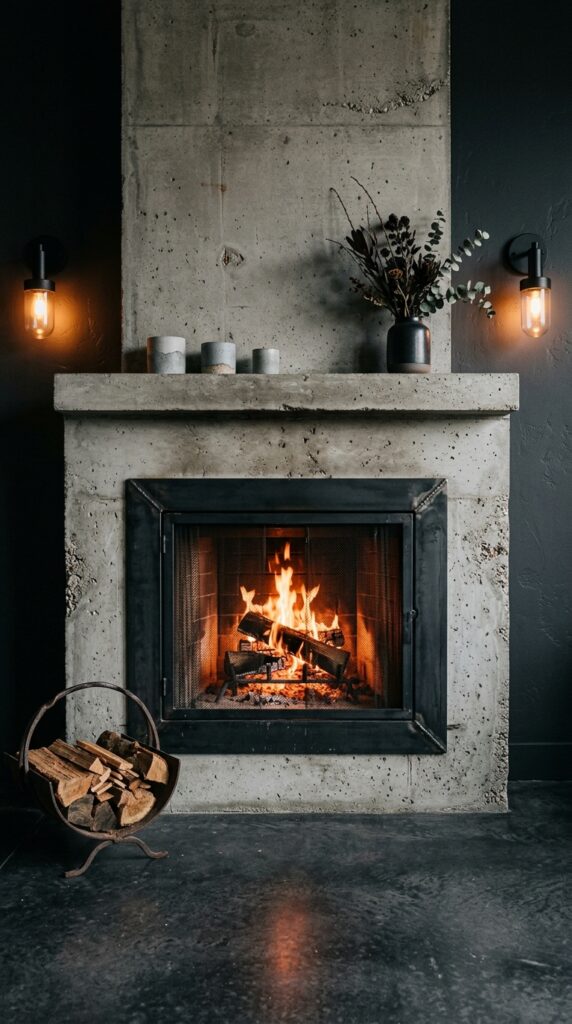
Vibe: Warm — a concrete and steel fireplace surround makes fire look like the most essential architectural element in the room.
Why it works: The concrete-and-steel fireplace surround is the moody industrial style’s most powerful focal point — it combines the two primary materials of industrial construction (concrete and steel) around the most primal domestic element (fire). The raw edge of the concrete mantel — where the aggregate is exposed at the front face — introduces the same geological quality as a board-formed or exposed aggregate surface. The welded steel firebox frame replaces the ornamental vocabulary of traditional mantelpieces with an engineering vocabulary: the frame’s purpose is containment, and it looks like what it is.
How to get it: Cast the concrete mantel off-site using melamine form work, incorporating a steel angle iron at the front edge to prevent chipping. Weld the firebox frame from 1/4-inch steel plate and finish with a heat-rated matte black paint (Rust-Oleum High Heat in flat black). Mount the concrete surround to the existing fireplace structure using construction adhesive and countersunk anchor bolts.
Shop The Look
| Product |
| Iron fireplace log holder dark large |
| Concrete vessels set matte gray decorative |
| Flat black high-heat spray paint metal |
| Dark dried botanical arrangement large |
| Matte black wall sconce pair fireplace flanking |
18. Moody Industrial Dining Room: Long Dark Table and Bench
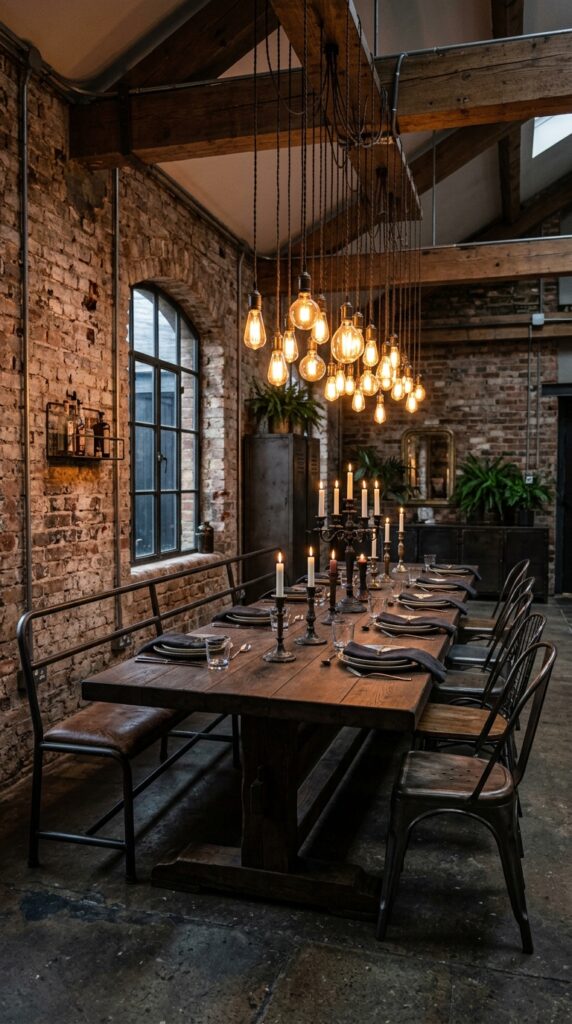
Vibe: Warm — a long trestle table under Edison pendants is a setting that makes any gathering feel historic.
Why it works: The moody industrial dining room works through deliberate asymmetry — bench seating on one side, mixed iron chairs on the other — which references the improvised quality of industrial loft living, where furniture was collected rather than purchased as a set. The long dark trestle table grounds the room spatially: its horizontal mass anchors the eye at mid-height, between the dark floor and the pendant cluster overhead. An iron candelabra centerpiece with mismatched taper candles extends the warm light source from ceiling to table level, filling the vertical space between them.
How to get it: Source a reclaimed oak trestle table and apply Minwax Ebony or Jacobean stain to darken while preserving wood grain. Pair with a steel tube bench — weld from 1.5-inch square steel tube and finish in flat black powder coat — and 4–6 mismatched iron or steel dining chairs sourced individually from salvage markets for visual variety within a coherent material family.
Shop The Look
| Product |
| Dark stain reclaimed wood dining table industrial |
| Iron candelabra tall centerpiece dining |
| Mismatched iron dining chair vintage industrial |
| Dark linen napkin set natural black |
| Ebony wood stain quart interior |
19. Factory Pendant Light: Warehouse Shade
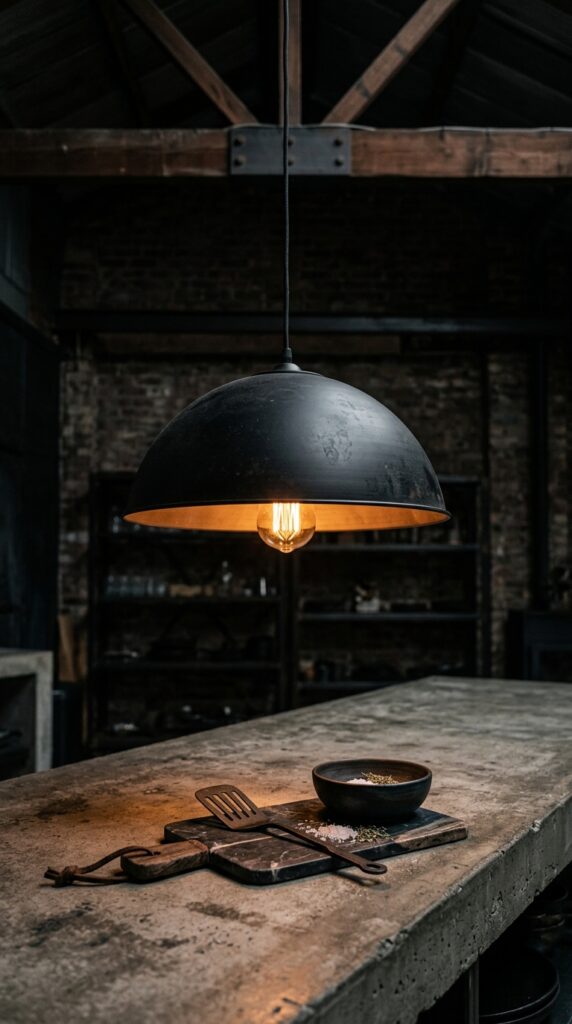
Vibe: Grounded — a single large factory pendant creates a pool of warm light that defines a zone more precisely than any architectural element.
Why it works: The deep-dome warehouse pendant shade — originally designed for factory floor illumination, where directing light downward onto a work surface was the priority — is one of the most functionally honest light fixtures available. Its form follows precisely from its purpose, and that structural logic is what makes it beautiful in a moody industrial interior. A 14–16-inch dome at the correct height (32–36 inches above the counter surface) illuminates a 48-inch-diameter zone with warm, directed light while keeping the ceiling and surrounding walls in productive shadow.
How to get it: Source a genuine industrial enamel warehouse shade (Barn Light Electric, Schoolhouse Electric, or vintage factory surplus from eBay) rather than a decorative replica — the pressed steel construction and enamel finish of original factory shades have a material quality that cast resin reproductions cannot match. Hang on a long black textile cord at the correct height — too high and the shade reads as decorative; at the right height, it reads as working light.
💡 Quick Win: A matte black deep dome pendant shade replacement (under $35 from lighting supply stores) fitted to any existing ceiling pendant socket immediately transforms it into a factory-style fixture without any electrical work.
Shop The Look
| Product |
| Factory dome pendant shade matte black large |
| Black textile pendant cord replacement set |
| Dark marble cutting board large rectangle |
| Iron kitchen utensil set dark handle |
| Dark ceramic mixing bowl large matte |
20. Moody Industrial Entryway: Dark and Functional
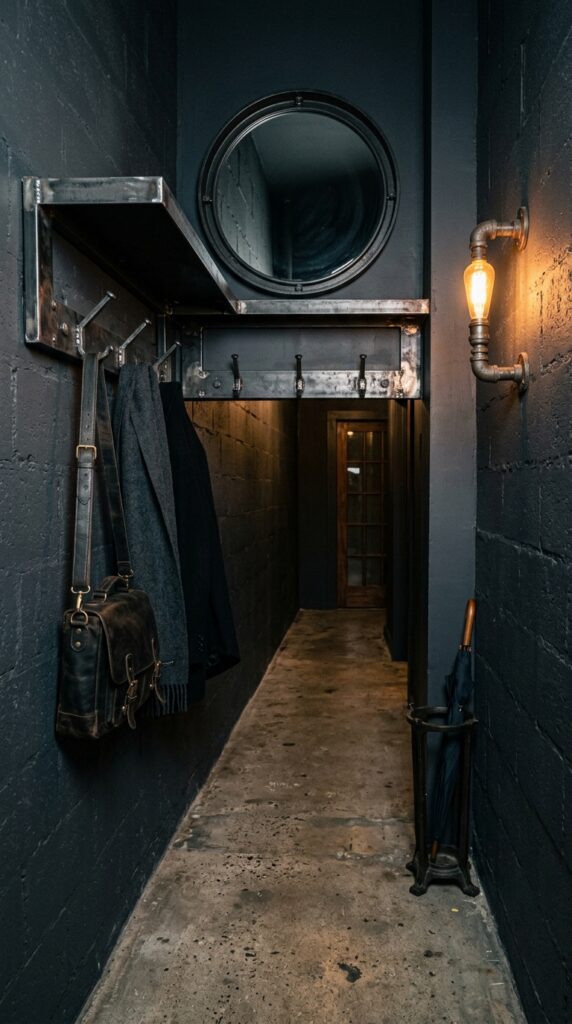
Vibe: Grounded — a dark entryway that greets you with iron and concrete sets the atmospheric register for everything beyond it.
Why it works: The moody industrial entryway is the most compressed expression of the style — in a narrow corridor, every element must be both functional and atmospheric. A welded steel coat rack with visible welds (not hidden behind a wood panel) combines storage with raw structural honesty. The dark mirror in a welded frame serves the functional requirement of a hall mirror while maintaining the tonal palette — a gilded or chrome-framed mirror in this space would be the design equivalent of a wrong note in a strong musical phrase. A single pipe sconce at eye level provides exactly enough light to function and no more.
How to get it: Fabricate or source a welded steel coat rack with a simple horizontal bar and projecting arms at 60, 48, and 36-inch heights — the varied heights accommodate coats, bags, and hats simultaneously. Apply a flat black powder coat and mount directly to wall studs with visible lag bolt heads (do not countersink and fill — the bolt heads are part of the aesthetic). Install the mirror at 58-inch center height, slightly lower than standard to account for the lower light level.
Shop The Look
| Product |
| Welded steel wall coat rack industrial black |
| Iron hook rail strip wall mount black |
| Dark industrial mirror iron frame large |
| Iron umbrella stand dark metal |
| Pipe wall sconce Edison industrial single |
21. Vintage Industrial Accessories: Gears, Gauges, and Glass

Vibe: Hushed — a collection of genuine industrial objects on a dark shelf reads as archaeology, not decoration.
Why it works: Vintage industrial accessories succeed as decoration because they carry genuine functional history — a brass pressure gauge was calibrated and read by a machinist; a cast iron gear transferred torque in a specific machine. This embedded history is what separates authentic vintage industrial styling from manufactured “industrial look” decor. The key curation principle is material consistency: arrange objects from the same material families (brass, cast iron, glass, copper) and similar eras together — a unified collection reads as a coherent world, while a mixed-era collection reads as random.
How to get it: Source vintage industrial objects from architectural salvage dealers, estate sales, and industrial auction houses rather than new reproduction pieces. Look for objects with legible function — gauges, valves, clamps, pulleys — rather than purely decorative items. Arrange in odd-numbered groupings (3 or 5 objects per cluster) at varying heights using stacked books or iron blocks as risers.
Shop The Look
| Product |
| Vintage brass pressure gauge decorative antique |
| Cast iron gear wheel decorative display |
| Antique glass laboratory flask decor |
| Iron industrial table clock vintage |
| Aged leather map document display frame |
22. Moody Industrial Living Room: No Overhead Lighting Rule
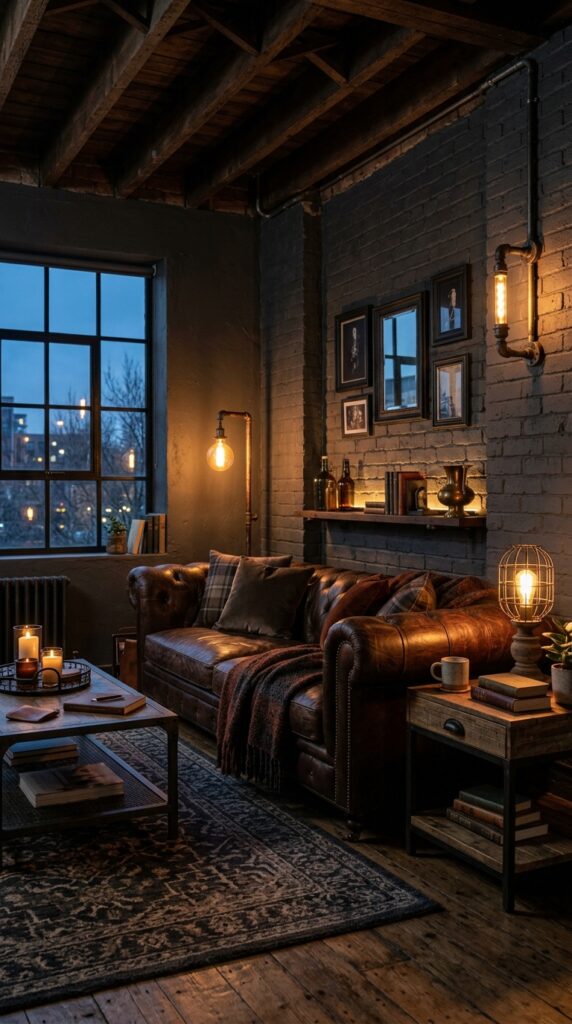
Vibe: Layered — a room with no overhead light and five warm sources at different heights has an atmosphere that no overhead fixture can replicate.
Why it works: The “no overhead lighting” rule — a well-established principle in atmospheric interior design — is particularly essential in moody industrial spaces. Overhead ceiling fixtures flood a room with even, downward light that eliminates shadow entirely, destroying the very quality that dark walls and raw materials create. Layer lighting instead at floor level (floor lamps), table level (table lamps), wall level (sconces), and shelf level (uplights or LED strips beneath objects) — all at 2200–2700K. The ceiling remains dark, the upper walls remain in shadow, and the room generates atmosphere from below rather than from above.
How to get it: Remove or cap any existing overhead light (or replace with a switched outlet) and redistribute the budget across four light sources: one floor lamp (1,000 lumens minimum) behind or beside the primary seating, one table lamp per side table (400–600 lumens each), two wall sconces at 60-inch height, and LED strip lighting beneath any floating shelf. Put all sources on individual switches or smart bulb controls for scene flexibility.
Shop The Look
| Product |
| Iron arc floor lamp matte black large |
| Industrial table lamp pipe base dark shade |
| LED uplight shelf light warm 2700K battery |
| Dark wool area rug charcoal large |
| Iron tray rectangle large dark metal |
23. Moody Industrial Touches in a Neutral Base Room
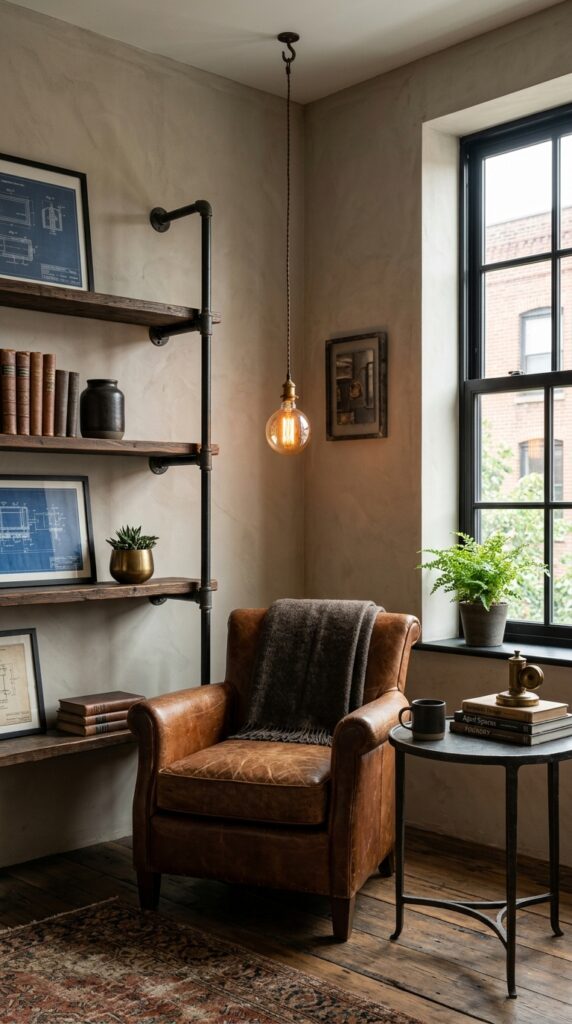
Vibe: Grounded — moody industrial accents in a neutral room are not a compromise; they are a calibration — the style at a volume the room can hold.
Why it works: Not every space is suited to full dark-wall moody industrial treatment — north-facing rooms with limited natural light, rental apartments with restrictions on paint, or rooms that serve multiple functions requiring daytime brightness all benefit from a softer entry into the aesthetic. In a warm neutral base (greige walls, natural concrete or hardwood floors), three or four signature moody industrial elements — pipe shelving, an Edison pendant, a leather chair, iron side table — carry the style clearly without the atmospheric compression of a dark room. The key is that the industrial elements must be fully committed to: matte black, raw iron, genuine leather — not decorative approximations.
How to get it: Choose greige in a warm undertone — Benjamin Moore’s Edgecomb Gray HC-173 or Sherwin-Williams’ Accessible Beige SW-7036 — so the wall reads warm rather than cold beside the iron accents. The single most impactful move in this approach is replacing the ceiling light fixture with an industrial Edison pendant on a long cord — this one change resets the entire room’s atmosphere even with neutral walls.
💡 Quick Win: A single black iron pipe shelf bracket set with a dark-stained wood plank (total cost under $45) installed in any room immediately introduces the moody industrial material vocabulary without painting, renovating, or committing to full aesthetic transformation.
Shop The Look
| Product |
| Black pipe shelf bracket hardware set single |
| Dark-stained wood plank shelf 36 inch |
| Tobacco leather accent chair reading vintage |
| Iron industrial side table small black |
| Warm greige interior paint sample set |
How to Start Your Moody Industrial Decor Transformation
The single most impactful first move in moody industrial design is painting one wall — your primary wall, the one you face most often — in a warm charcoal. Not a feature wall treated differently from the rest of the room, but a wall that is simply darker than what surrounds it and draws the eye without effort. Sherwin-Williams’ Iron Ore SW-7069 in a flat finish is the most reliable first choice: it reads charcoal in daylight, near-black in the evening under warm light, and never crosses into the cold blue-gray territory that breaks the industrial atmosphere. This one surface recalibrates the entire room’s emotional register without a single piece of furniture moving.
The most common beginner mistake is mixing metallic finishes. Moody industrial design demands one metallic tone throughout — matte black or raw iron — applied consistently to every fixture, frame, hardware piece, and accent. Introducing a chrome faucet, a brushed nickel lamp, or a gold picture frame into a room that is otherwise committed to matte black is the fastest way to make the space read as unresolved. The fix is absolute: audit every metallic element in the room and replace any that don’t conform. This is not expensive — cabinet hardware, towel bars, and light switch plates are the highest-impact and lowest-cost replacements.
Three immediate-impact items under $50: a single vintage-style Edison ST64 bulb set at 2200K in any existing lamp ($12–$18 for a four-pack), a dark charcoal grout pen for any existing light-grouted brick or tile ($14–$18), and one roll of black iron pipe cut to a single shelf length with two flanges ($25–$35 at a plumbing supply store). Each of these changes the atmospheric quality of an existing room without painting, renovating, or purchasing furniture.
A weekend transformation — new wall paint, lighting swap, one pipe shelf, and restyled accessories — is achievable for $150–$350. A full single-room moody industrial transformation (dark walls, new fixtures, leather and iron furniture, pipe shelving throughout) typically runs $1,500–$4,000 depending on furniture sourcing strategy. Genuine vintage industrial furniture sourced from salvage markets can reduce this significantly — an $80 salvage leather chair beats a $400 reproduction every time.
Frequently Asked Questions About Moody Industrial Decor
What is moody industrial decor and how is it different from regular industrial style?
Moody industrial decor applies all the material elements of standard industrial style — exposed brick, steel, pipe, concrete, reclaimed timber — but combines them with a deliberately dark, shadow-forward color palette: deep charcoal, oxblood, iron black, and warm umber rather than the cooler, lighter grays of standard industrial. Where regular industrial style is often bright and open-plan, moody industrial embraces enclosed, atmospheric spaces where shadow is as important a design element as the raw materials themselves. The emotional register is entirely different — regular industrial reads as energetic and urban; moody industrial reads as intimate, grounded, and slightly melancholic in the best possible way.
What colors work best for moody industrial interiors?
The most effective moody industrial palette anchors in warm charcoal (Farrow & Ball Off-Black 57, Benjamin Moore Wrought Iron HC-107, or Sherwin-Williams Iron Ore SW-7069) with accents in oxblood, tobacco brown, aged brass, and dark umber. The critical specification is undertone: all charcoals and blacks must have a warm (brown or green) undertone — cool blue-black reads as corporate, not industrial. The only true accent color in this palette is oxblood red; all other variation comes from material texture and warm light temperature rather than color contrast.
How expensive is it to achieve moody industrial style?
Moody industrial is one of the more budget-accessible design styles because it celebrates raw and reclaimed materials over polished or expensive ones. A genuine leather Chesterfield sofa from a vintage market ($200–$600) outperforms a new reproduction ($1,200+) aesthetically. Black iron pipe shelving costs $80–$180 to build versus $300–$600 for equivalent manufactured shelving. Dark wall paint (one gallon covers approximately 400 square feet at $30–$55) is the single highest-impact and lowest-cost transformation available. A fully realized moody industrial living room can be achieved for $800–$2,000 if vintage furniture sourcing is prioritized.
Can moody industrial decor work in a small apartment or rental?
Yes, with specific adaptations for each constraint. For small spaces, use dark paint on all surfaces including the ceiling — the tonal unification expands rather than compresses the perceived space (see Idea 16). For rental restrictions on paint, removable dark wallpaper (Tempaper and Chasing Paper both offer dark charcoal options) achieves most of the wall effect, and dark-framed gallery walls cover significant wall area without painting. Freestanding pipe shelving on floor flanges (not wall-mounted) avoids permanent holes. A single factory pendant on a long cord over the primary seating area transforms the room’s atmosphere without any permanent alteration.
What is the best furniture material for moody industrial decor?
Top-grain or full-grain leather in tobacco, cognac, or dark brown is the primary upholstery choice — it ages into the aesthetic rather than away from it. For case goods (tables, shelving, storage), the most authentic combination is blackened steel for frames and reclaimed dark-stained timber for surfaces. Avoid upholstered furniture in patterned fabric, light-colored velvet (dark velvet in charcoal or forest green is acceptable), or any material with a sheen. Concrete, both poured and precast, is ideal for coffee tables and side tables. The general rule: if the material would look wrong in a 1920s machinist’s workshop, it doesn’t belong in the moody industrial palette.
Ready to Create Your Dream Moody Industrial Space?
These 23 concepts have covered the full material and atmospheric range of moody industrial design — from oxblood limewash accent walls and oxidized copper panels to factory pendants, concrete floors, and the no-overhead-lighting rule that changes a room’s emotional quality more than any single piece of furniture. Starting small is not a concession to this style — it is actually how moody industrial spaces are meant to accumulate, layer by layer, object by object, the way a genuine industrial space fills up over decades. Today, change one light bulb to a 2200K Edison carbon filament type in the lamp you use most — the shift in light temperature alone will show you exactly what this style does to a room. When the space is finally done, it will feel less like something you chose and more like something that was always there, waiting for the right materials to find it. Save the ideas that made you slow down — the pipe shelving loaded with leather books, the oxblood wall at dusk — those are the ones you’ll build first.