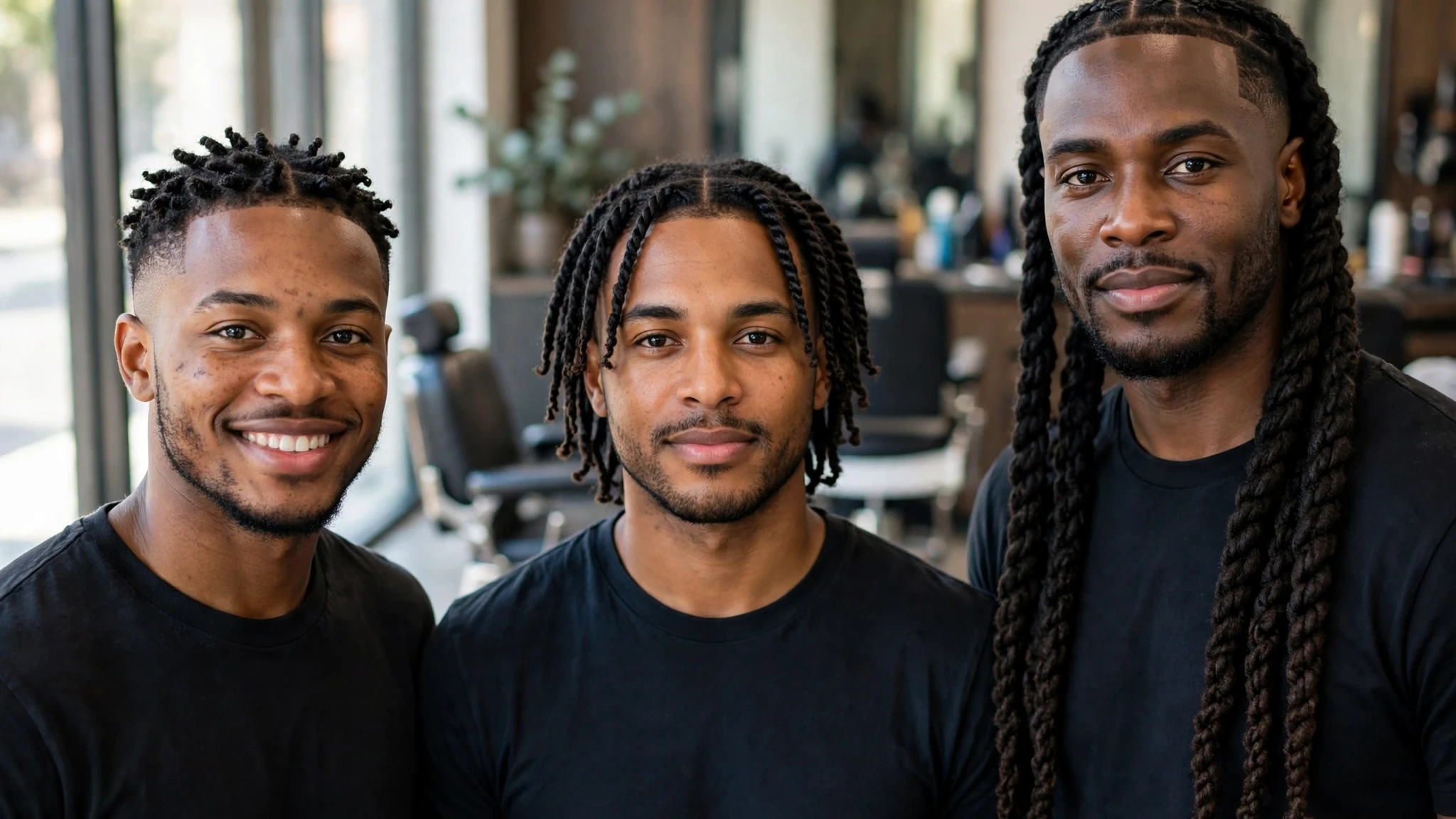
Two strand twists are the most versatile protective style a man can wear, and the biggest decision is not the twist itself — it is the length. The same technique reads completely differently at two inches than it does at twelve: short twists look sharp and barbershop-clean, medium twists start to move, swing and hang, and long twists turn into full rope-like lengths you can tie up, braid back or let fall down your spine.
This list is organized exactly that way — by length, from short to long — so you can find the version that matches the hair you have right now or the length you are growing toward. Every idea names the twist size, fade, part, colour or finish that makes it work, how to ask your barber or loctician for it, and the products that keep it looking fresh between retwists.
1. Classic Short Two Strand Twists
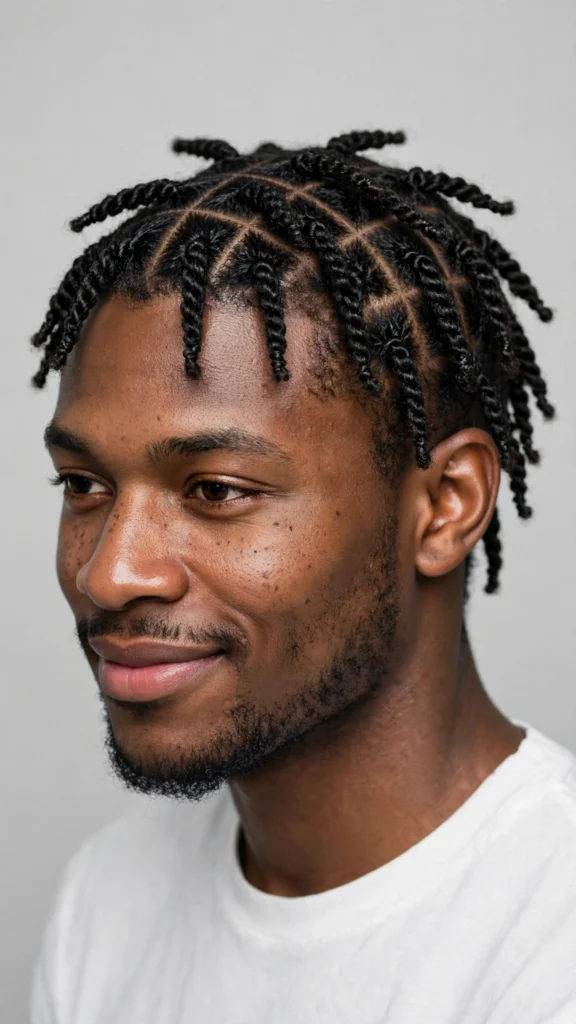
Why it works: This is the starter length that made the style mainstream: at two to three inches the twists are long enough to show the rope pattern but short enough to stay neat for weeks with almost no daily effort. Uniform sizing and square parts give it that clean, deliberate finish that suits any face and any dress code.
Get the look: Ask for two strand twists with medium-sized sections on hair at least two inches long, and keep the parts square rather than free-parted for the tidiest grid. Maintain it with a light mist of water and leave-in every couple of days and a satin durag at night so the twists keep their shape instead of flattening.
Products to help you get this look:
- Lock and twist gel for men — Search on Amazon
- Satin durag for waves and twists — Search on Amazon
- Leave-in conditioner spray for natural hair — Search on Amazon
- Rat tail comb for parting hair — Search on Amazon
- Hair sectioning clips pack — Search on Amazon
2. Short Twists with a Low Taper Fade

Why it works: The low taper keeps the edges soft and grown-up, so the short twists look intentional instead of unfinished, and the whole style sits comfortably in an office or a formal setting. It is also the most forgiving fade as it grows out, stretching the time between barber visits.
Get the look: Ask for the twists on top first, then a low taper that only cleans the perimeter — the fade should start low around the ears and nape, not climb into the twist zone. Book the taper touch-up every two weeks and retwist the top every three to four, and the style stays in balance.
Products to help you get this look:
- Shea butter twisting cream — Search on Amazon
- Argan oil hair shine spray — Search on Amazon
- Boar bristle brush for men — Search on Amazon
- Satin durag for waves and twists — Search on Amazon
- Moisturizing hair mist spray bottle — Search on Amazon
3. Short Twists with a High Skin Fade

Why it works: The high skin fade strips the sides down to almost nothing, so all the visual weight sits in the twists — the contrast is sharp, graphic and youthful. It also keeps the head cool and the silhouette clean, which makes it a favourite for athletes and anyone who wants a low-maintenance perimeter.
Get the look: Ask for a high bald fade that starts above the temple curve, and make sure your barber leaves enough length on top for the twists to form fully — two inches minimum. The fade needs refreshing every ten to fourteen days to stay this sharp, while the twists themselves can run three weeks or more.
Products to help you get this look:
- Twist and loc gel strong hold — Search on Amazon
- Edge control gel for hairline — Search on Amazon
- Hair moisturizer for men daily cream — Search on Amazon
- Satin durag for waves and twists — Search on Amazon
- Tea tree scalp oil — Search on Amazon
4. Mini Twists on Short Hair

Why it works: Mini twists squeeze the most texture out of the shortest hair — even an inch and a half is enough — and the fine size makes the whole head look fuller and denser. They also double as the perfect foundation if you later want to start locs, because the small sections lock cleanly.
Get the look: Ask for small, consistent sections and a firm twist gel so each mini holds its coil; the install takes longer than standard twists because there are so many more of them. Protect them at night religiously and refresh with a fine mist rather than heavy creams, which weigh the small twists down and blur the pattern.
Products to help you get this look:
- Lock and twist gel for men — Search on Amazon
- Rat tail comb for parting hair — Search on Amazon
- Hair sectioning clips pack — Search on Amazon
- Rosewater hair moisturizing spray — Search on Amazon
- Silk pillowcase for hair protection — Search on Amazon
5. Short Twists with a Sharp Line-Up
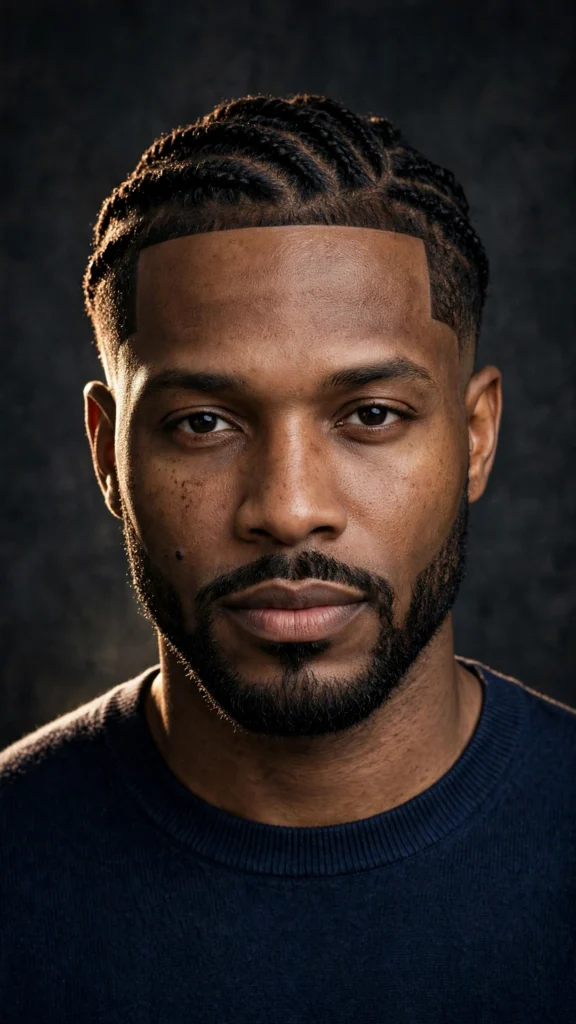
Why it works: Nothing frames short twists like a geometric line-up — the straight forehead edge and squared temples make the whole style read as deliberate and expensive. It is the detail that separates a good twist install from a great one in photos.
Get the look: Ask your barber to finish with a full edge-up across the forehead, temples and beard cheek lines, keeping the corners square rather than rounded. The line-up grows out fastest of any element, so plan a quick edge refresh weekly even if the twists themselves go a month between sessions.
Products to help you get this look:
- Edge control gel for hairline — Search on Amazon
- Shea butter twisting cream — Search on Amazon
- Satin durag for waves and twists — Search on Amazon
- Boar bristle brush for men — Search on Amazon
- Hair moisturizer for men daily cream — Search on Amazon
6. Short Twists with a Temple Fade
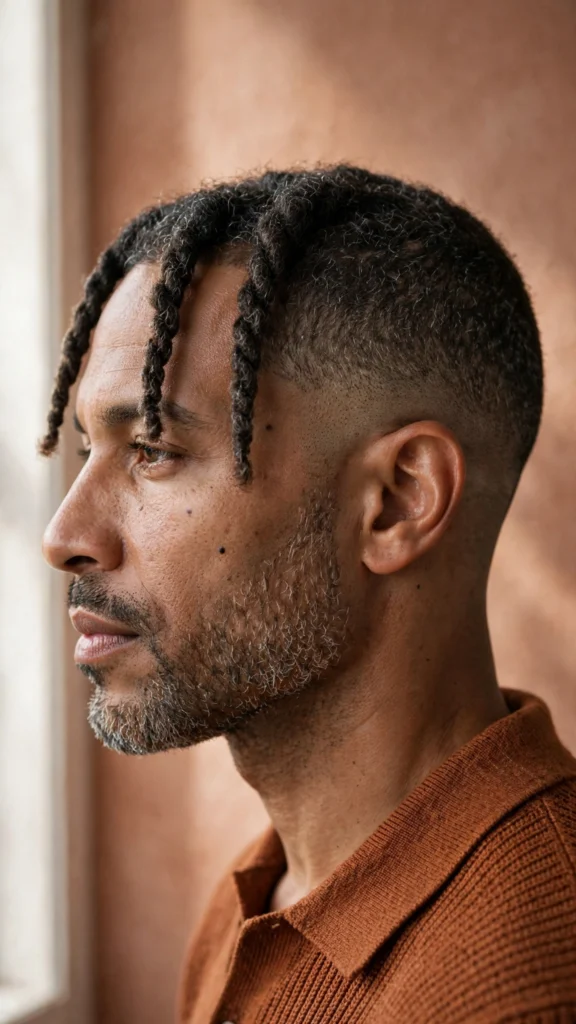
Why it works: The temple fade is the most subtle option in this list — it only sharpens the frame around the ears and sideburns, so short twists keep a natural, textured outline instead of a hard barbered edge. It suits men who want clean without looking overly styled, and it flatters glasses wearers because the fade keeps the temple area tidy under the arms.
Get the look: Ask for a temp fade only, with the rest of the sides scissor-trimmed or clippered long so the twists blend down gradually. Because the faded zone is small, a quick ten-minute clean-up every two weeks keeps it looking deliberate.
Products to help you get this look:
- Shea butter twisting cream — Search on Amazon
- Tea tree scalp oil — Search on Amazon
- Leave-in conditioner spray for natural hair — Search on Amazon
- Satin durag for waves and twists — Search on Amazon
- Wide tooth detangling comb — Search on Amazon
7. Short Twists with a Drop Fade
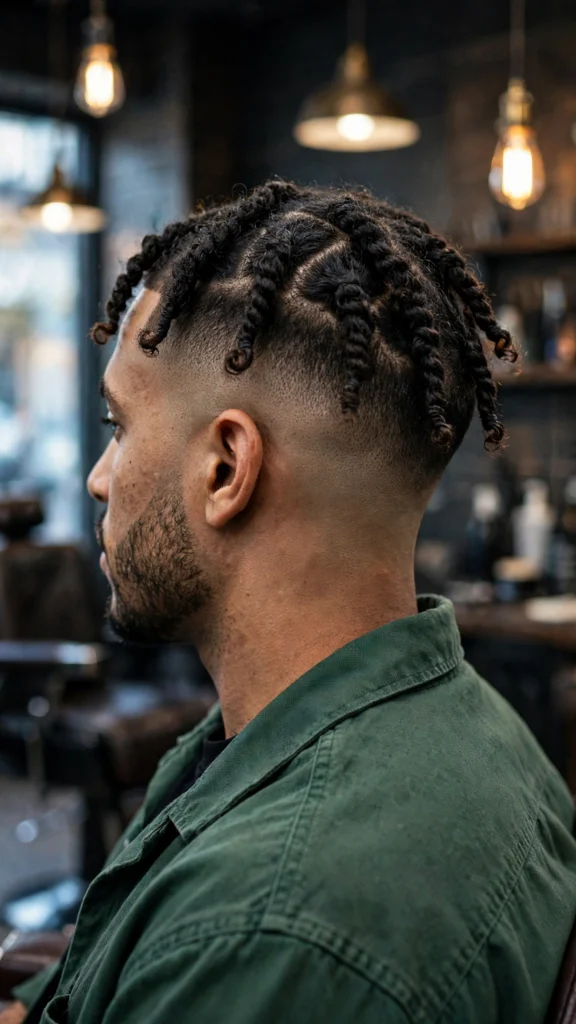
Why it works: The drop fade follows the curve of the skull, dipping behind the ear instead of running straight, which gives short twists a rounded, sculpted silhouette from every angle. From the back — the angle most fades fail at — this one looks the best, because the arc frames the nape cleanly.
Get the look: Ask specifically for a drop fade, mid height, and check the back in the mirror before you leave the chair — the dip should sit at the occipital bone. Keep the twists moisturized so the top stays plump against the tight fade, since dryness shows more where the contrast is strongest.
Products to help you get this look:
- Lock and twist gel for men — Search on Amazon
- Argan oil hair shine spray — Search on Amazon
- Hair moisturizer for men daily cream — Search on Amazon
- Edge control gel for hairline — Search on Amazon
- Satin durag for waves and twists — Search on Amazon
8. Chunky Short Twists

Why it works: Going chunky at short length flips the usual formula: instead of many fine twists, a couple of dozen fat ropes give bold texture you can read from across the room. The install is faster, the retwist is faster, and the plump twists hold moisture better, so they stay glossy longer.
Get the look: Ask for large sections — roughly an inch square each — and a butter-based twisting cream rather than a watery gel, so each rope stays plump instead of shrinking thin. Chunky twists unravel more noticeably at the ends, so have your stylist coil the tips or finish them with a tiny dab of firm gel.
Products to help you get this look:
- Shea moisture twisting butter — Search on Amazon
- Twist and loc gel strong hold — Search on Amazon
- Coconut oil for hair treatment — Search on Amazon
- Hair sectioning clips pack — Search on Amazon
- Silk pillowcase for hair protection — Search on Amazon
9. Short Twists with a Center Part
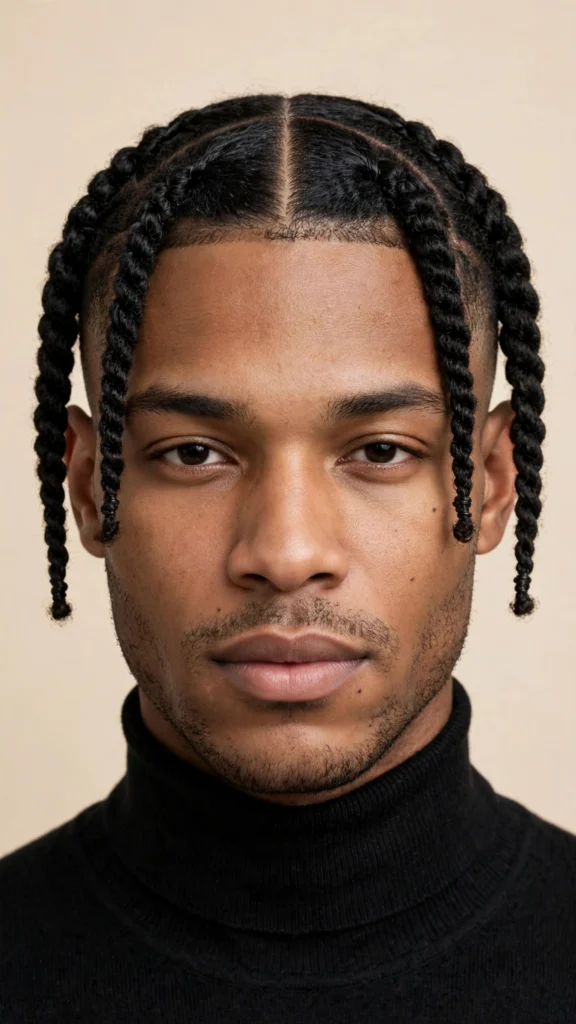
Why it works: A centre part gives short twists instant structure — the mirrored fall on both sides looks intentional and fashion-forward rather than accidental. It also balances a longer face nicely, since the twists add a little width at both temples.
Get the look: The part has to be cut into the sectioning from the start, so tell your stylist before the first twist goes in that you want a true middle part running the full length of the head. At home, re-trace the part with the end of a rat-tail comb after every wash so it never closes up.
Products to help you get this look:
- Rat tail comb for parting hair — Search on Amazon
- Lock and twist gel for men — Search on Amazon
- Leave-in conditioner spray for natural hair — Search on Amazon
- Satin durag for waves and twists — Search on Amazon
- Hair wax stick for flyaways — Search on Amazon
10. Short Twists with a Side Part
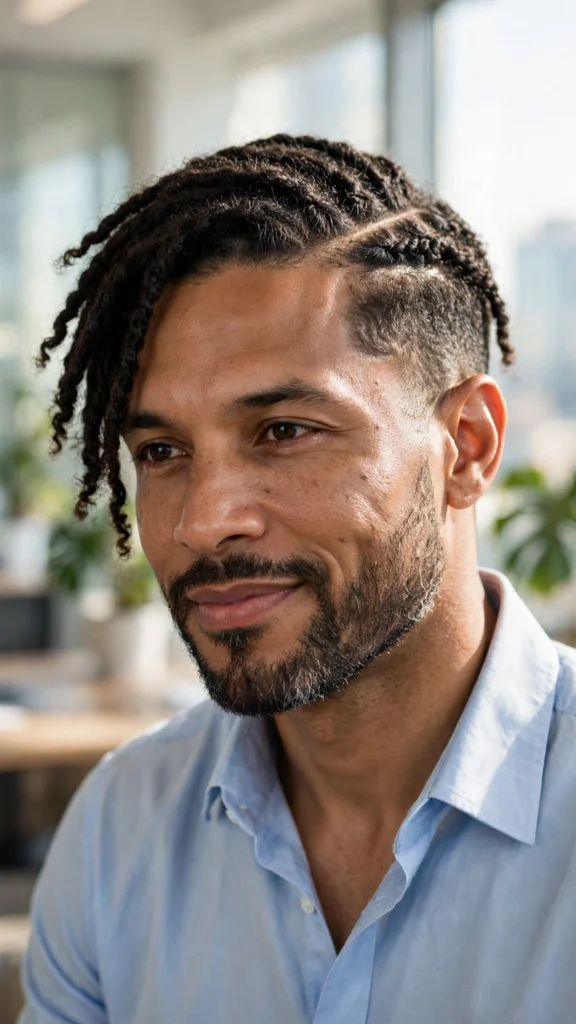
Why it works: The side part is the classic gentleman's move applied to twists — it creates direction, tidies the silhouette and makes short twists read as a considered hairstyle rather than a protective style you happen to be wearing. The asymmetry also adds interest to otherwise uniform short length.
Get the look: Have the part shaved in lightly or sectioned in during the install above whichever temple suits your face — most men part against their natural growth swirl for lift. Train the direction nightly under a durag so the twists learn to fall that way on their own.
Products to help you get this look:
- Edge control gel for hairline — Search on Amazon
- Shea butter twisting cream — Search on Amazon
- Boar bristle brush for men — Search on Amazon
- Argan oil hair shine spray — Search on Amazon
- Satin durag for waves and twists — Search on Amazon
11. Short Twists with Honey Blonde Tips

Why it works: Colour only on the tips is the lowest-commitment way to make short twists pop — the honey blonde catches light on every rope end while the dark roots keep it grounded and masculine. Because only the ends are bleached, growing it out or trimming it off is painless.
Get the look: Ask a colourist to lift just the last inch of each twist after the install, not before, so the colour lands exactly on the visible tips. Bleached ends dry out faster than the rest, so work a drop of oil through the tips every other day to keep them soft instead of brittle.
Products to help you get this look:
- Argan oil hair shine spray — Search on Amazon
- Leave-in conditioner spray for natural hair — Search on Amazon
- Purple shampoo for blonde hair — Search on Amazon
- Hair moisturizer for men daily cream — Search on Amazon
- Satin durag for waves and twists — Search on Amazon
12. Short Twists Styled Forward
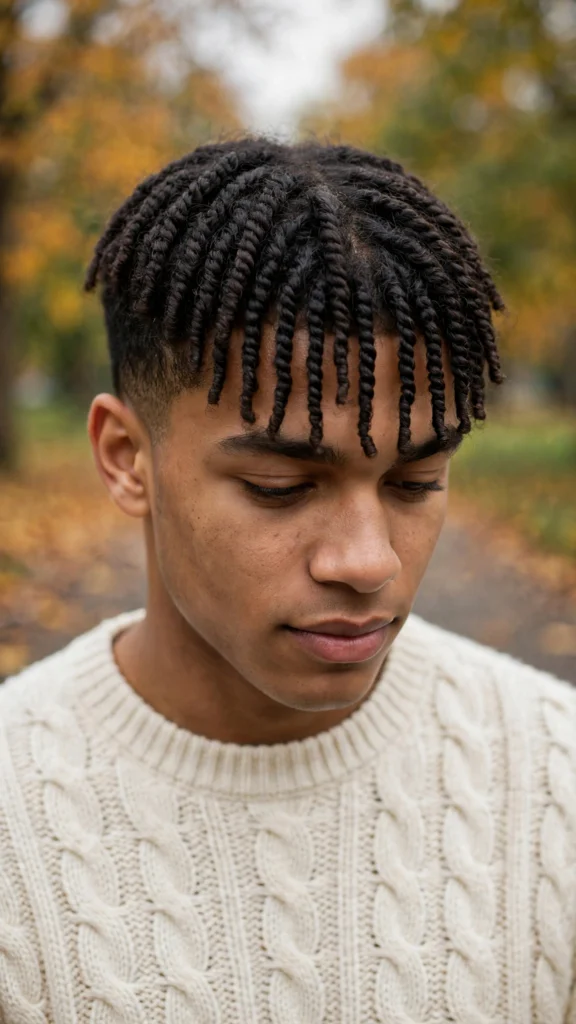
Why it works: Pushing short twists forward turns them into a fringe, which softens a high forehead and gives the style a relaxed, youthful energy the upright version does not have. It also hides a maturing hairline better than any other short option on this list.
Get the look: The front row needs a little extra length — ask your stylist to leave the fringe twists a half inch longer than the rest so they actually reach the forehead. Each morning, mist, shake the twists forward with your fingers and let them air-dry in place; never brush them back or the set is lost.
Products to help you get this look:
- Moisturizing hair mist spray bottle — Search on Amazon
- Shea butter twisting cream — Search on Amazon
- Hair wax stick for flyaways — Search on Amazon
- Satin durag for waves and twists — Search on Amazon
- Microfiber hair towel anti frizz — Search on Amazon
13. Medium-Length Classic Twists

Why it works: Medium is where twists come alive — long enough to hang, swing and be styled, short enough to stay neat without constant tying up. The classic uniform version is the reference point every other medium variation on this list is built from, and it suits virtually every face shape.
Get the look: You need five to seven inches of hair for this hang; ask for medium sections and consistent tension so every rope lands at a similar length. Shake and separate the twists each morning rather than combing, and retwist the front rows halfway through the style's life to keep the perimeter fresh.
Products to help you get this look:
- Lock and twist gel for men — Search on Amazon
- Rosewater hair moisturizing spray — Search on Amazon
- Satin durag for waves and twists — Search on Amazon
- Tea tree scalp oil — Search on Amazon
- Wide tooth detangling comb — Search on Amazon
14. Medium Twists with a Mid Fade
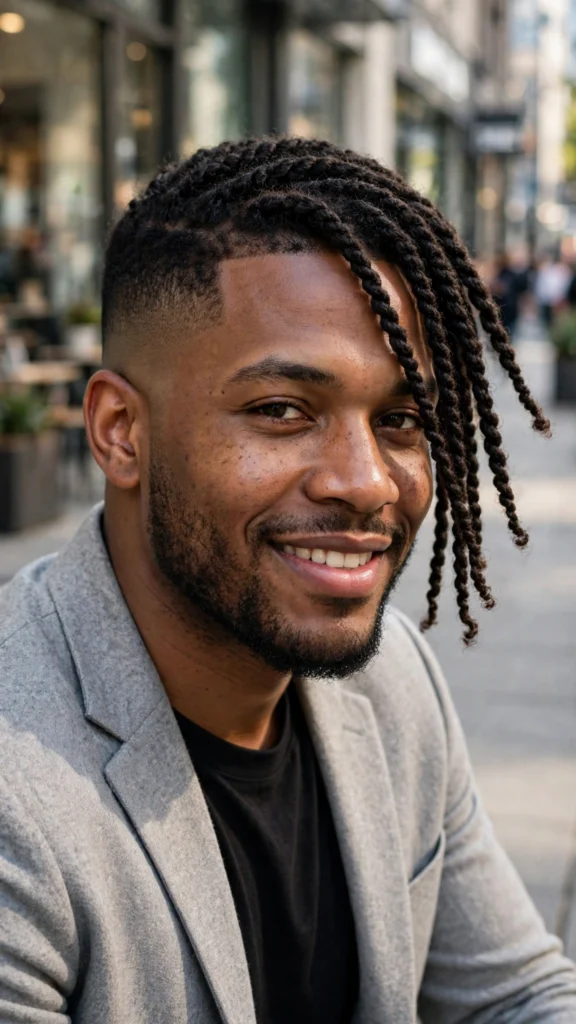
Why it works: The mid fade is the balanced middle ground — higher and cleaner than a taper, softer than a skin fade — and it stops medium twists from looking heavy at the sides. Letting the top twists fall slightly forward over the fade line adds movement and keeps the silhouette modern.
Get the look: Ask for a mid fade with the guideline set at the temple, and have the barber blend up into the twist base rather than undercutting it, so there is no harsh shelf. Refresh the fade every two weeks; the twists on top can be retwisted on a four-week cycle without the style losing shape.
Products to help you get this look:
- Shea butter twisting cream — Search on Amazon
- Edge control gel for hairline — Search on Amazon
- Argan oil hair shine spray — Search on Amazon
- Satin durag for waves and twists — Search on Amazon
- Hair moisturizer for men daily cream — Search on Amazon
15. Medium Twists in a Top Knot Bun

Why it works: The top knot is the first real styling payoff of medium length — the twists coil into a bun with built-in texture no straight hair can copy. It clears the face for work, training or heat while still showing off the length you grew.
Get the look: You need roughly six to seven inches so the twists reach the crown without pulling; secure with a soft no-snag tie, never a rubber band, and wrap the twists around themselves rather than forcing a tight knot. Take it down at night — sleeping in a tight bun strains the front roots and edges.
Products to help you get this look:
- No snag elastic hair ties for men — Search on Amazon
- Leave-in conditioner spray for natural hair — Search on Amazon
- Satin durag for waves and twists — Search on Amazon
- Tea tree scalp oil — Search on Amazon
- Hair wax stick for flyaways — Search on Amazon
16. Medium Twists in a High Ponytail
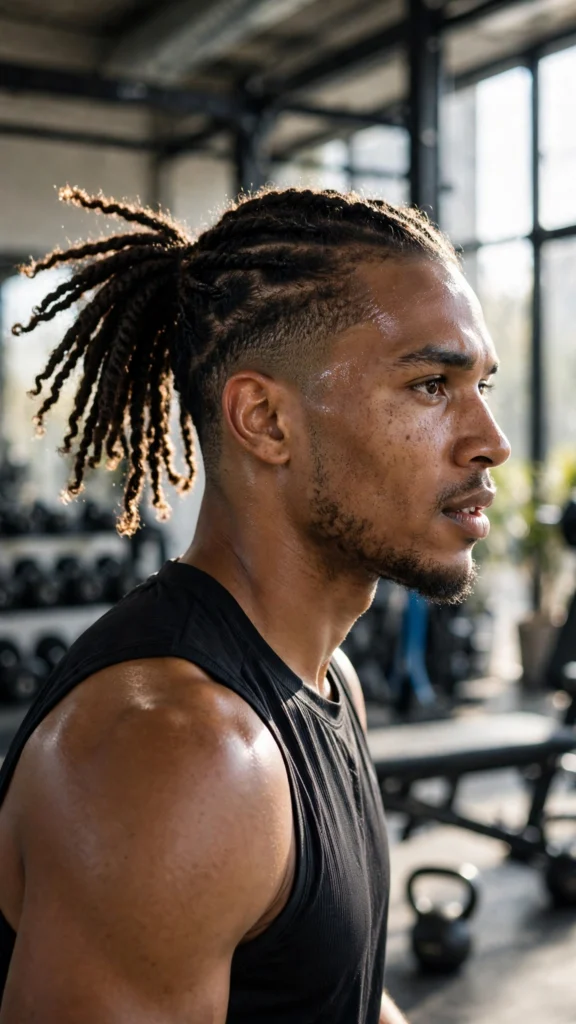
Why it works: A high ponytail keeps every twist off the face and neck while training, and the gathered ropes fan out into a shape that looks sporty rather than severe. It is also a growth milestone style — the first point where your twists behave like long hair.
Get the look: Gather with your fingers, not a brush, to keep the root pattern visible, and use two soft ties for security during workouts instead of one tight one. If the front twists cannot reach yet, pin the short ones back with a small amount of edge control until they grow in.
Products to help you get this look:
- No snag elastic hair ties for men — Search on Amazon
- Edge control gel for hairline — Search on Amazon
- Moisturizing hair mist spray bottle — Search on Amazon
- Satin durag for waves and twists — Search on Amazon
- Microfiber hair towel anti frizz — Search on Amazon
17. Medium Twists with Cornrowed Sides
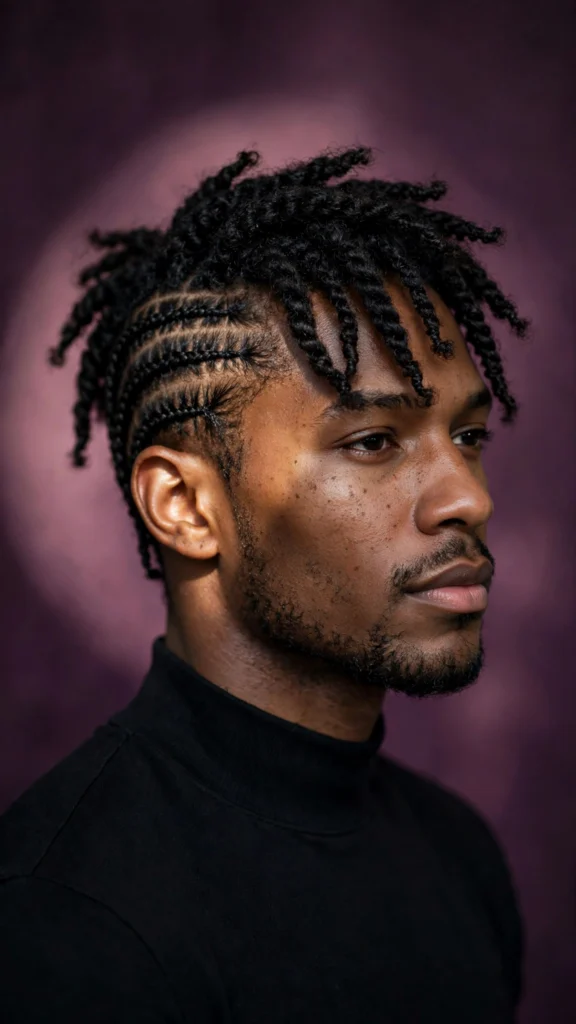
Why it works: Cornrowing the sides flat while twists stay free on top gives you two textures in one style — sleek at the edges, full in the middle — and it removes the bulky side growth that makes medium twists widen the head. It is one of the most photographed combinations because the contrast reads instantly.
Get the look: This is a two-skill install, so book a stylist who both braids and twists, and decide the boundary line in the mirror first — usually just above the ear following the head's curve. The cornrows will need redoing around week three while the top twists can continue to week five, so plan a partial refresh.
Products to help you get this look:
- Lock and twist gel for men — Search on Amazon
- Braiding gel for cornrows edges — Search on Amazon
- Rat tail comb for parting hair — Search on Amazon
- Argan oil hair shine spray — Search on Amazon
- Satin durag for waves and twists — Search on Amazon
18. Medium Twists with Bleached Blonde Colour
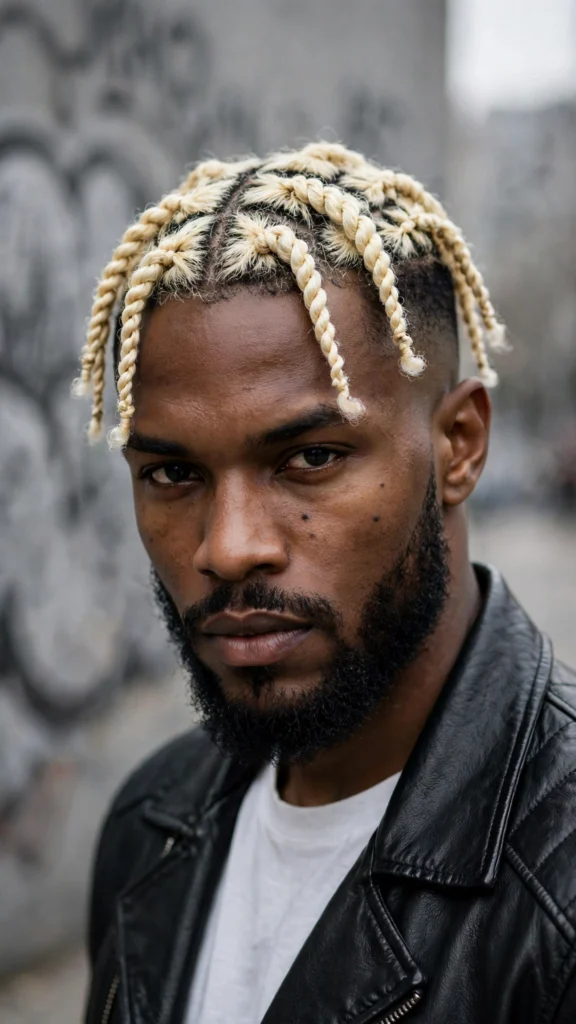
Why it works: Full bleached blonde on medium twists is a statement — the pale ropes against dark faded sides and a dark beard create a frame that turns heads in any room. Medium length is the sweet spot for it: long enough to show the colour fully, short enough that regrowth and upkeep stay manageable.
Get the look: Bleach weakens hair, so have the colour done professionally on healthy hair and deep-condition before the twists go in; many stylists colour first, then twist a week later. Use a purple shampoo wash every other week to stop the blonde going brassy, and moisturize daily — bleached twists drink product.
Products to help you get this look:
- Purple shampoo for blonde hair — Search on Amazon
- Deep conditioner for bleached hair — Search on Amazon
- Leave-in conditioner spray for natural hair — Search on Amazon
- Argan oil hair shine spray — Search on Amazon
- Satin durag for waves and twists — Search on Amazon
19. Medium Twists with Copper Highlights
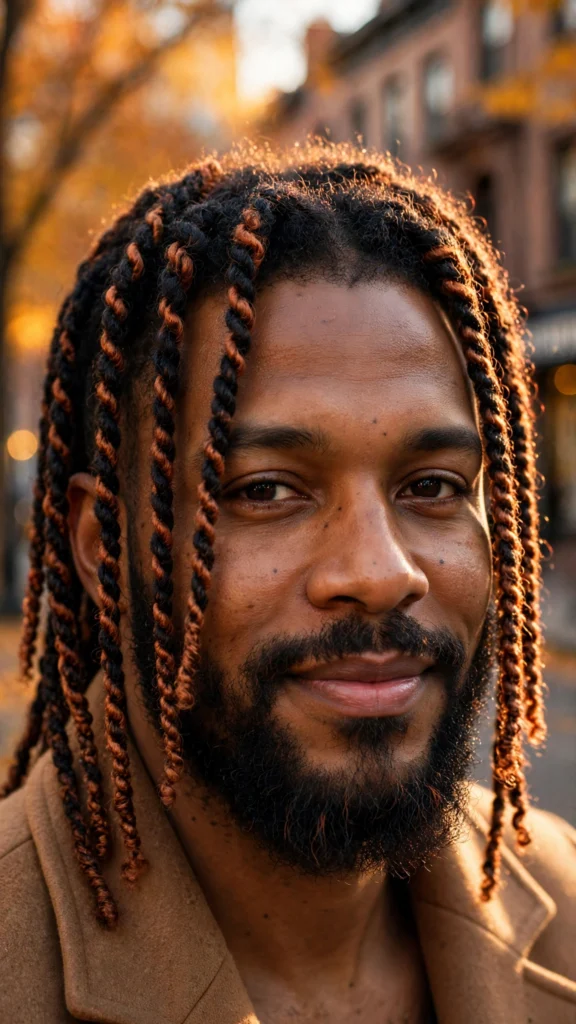
Why it works: Scattered copper twists warm up the whole style without the commitment of a full dye job — the colour flashes when the twists move and hides when they settle. It is especially flattering on warm and deep skin tones, where copper reads as glow rather than contrast.
Get the look: Ask your colourist to select individual twists after the install and lift only those, so the highlight pattern follows the finished style instead of random sections. Copper fades faster than most colours, so wash with cool water and a colour-safe shampoo to stretch it to the next retwist.
Products to help you get this look:
- Colour safe shampoo sulfate free — Search on Amazon
- Argan oil hair shine spray — Search on Amazon
- Hair moisturizer for men daily cream — Search on Amazon
- Shea butter twisting cream — Search on Amazon
- Silk pillowcase for hair protection — Search on Amazon
20. Medium Twists with Beads and Cuffs
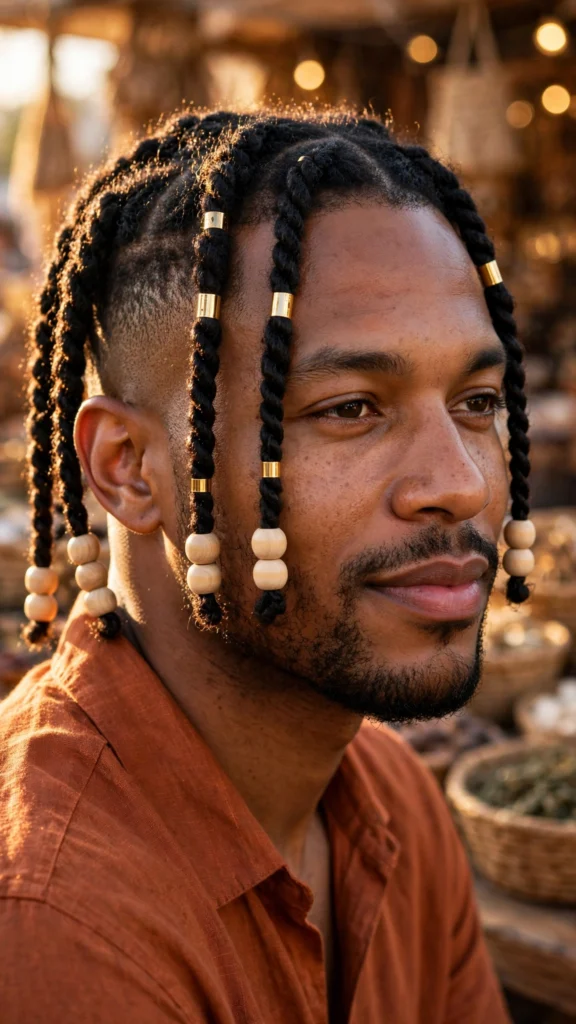
Why it works: A few well-placed cuffs and beads turn medium twists into jewellery — the front twists catch light like earrings do, and the beads add weight that makes the ends swing and click softly as you move. It personalizes a classic install without changing the haircut itself.
Get the look: Add accessories after the install on fully dry twists, concentrating cuffs on the front and beads on the longest side twists so the weight hangs evenly. Choose smooth, snag-free pieces sized for your twist thickness, and remove beads before wash day so moisture never sits trapped inside them.
Products to help you get this look:
- Gold hair cuffs for locs and twists — Search on Amazon
- Wooden hair beads for dreadlocks and twists — Search on Amazon
- Hair jewelry rings and charms set — Search on Amazon
- Rosewater hair moisturizing spray — Search on Amazon
- Satin durag for waves and twists — Search on Amazon
21. Medium Twists Swept Back
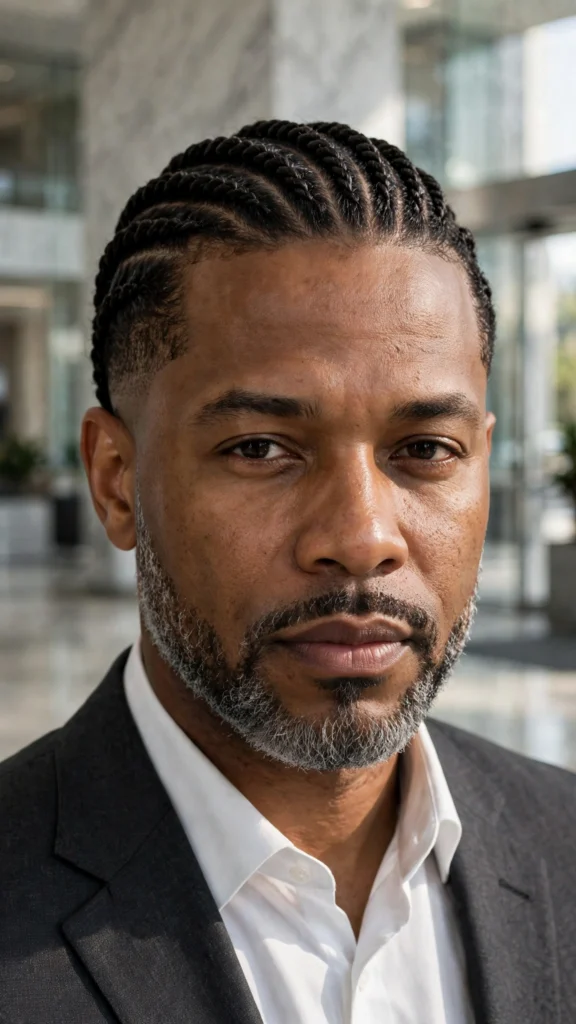
Why it works: Sweeping medium twists straight back is the most formal direction they can take — it opens the whole face, shows a clean hairline and reads as polished in a suit. The parallel rows have a quiet architectural quality that forward or hanging styles do not.
Get the look: The install must be sectioned with a backward direction in mind, so tell your stylist the goal before starting; twists set forward resist being swept later. Each morning, mist lightly, smooth the twists back with your palms and hold them under a durag for ten minutes while you get ready — the set lasts all day.
Products to help you get this look:
- Hair wax stick for flyaways — Search on Amazon
- Boar bristle brush for men — Search on Amazon
- Shea butter twisting cream — Search on Amazon
- Satin durag for waves and twists — Search on Amazon
- Argan oil hair shine spray — Search on Amazon
22. Medium Twists with a Burst Fade Mohawk
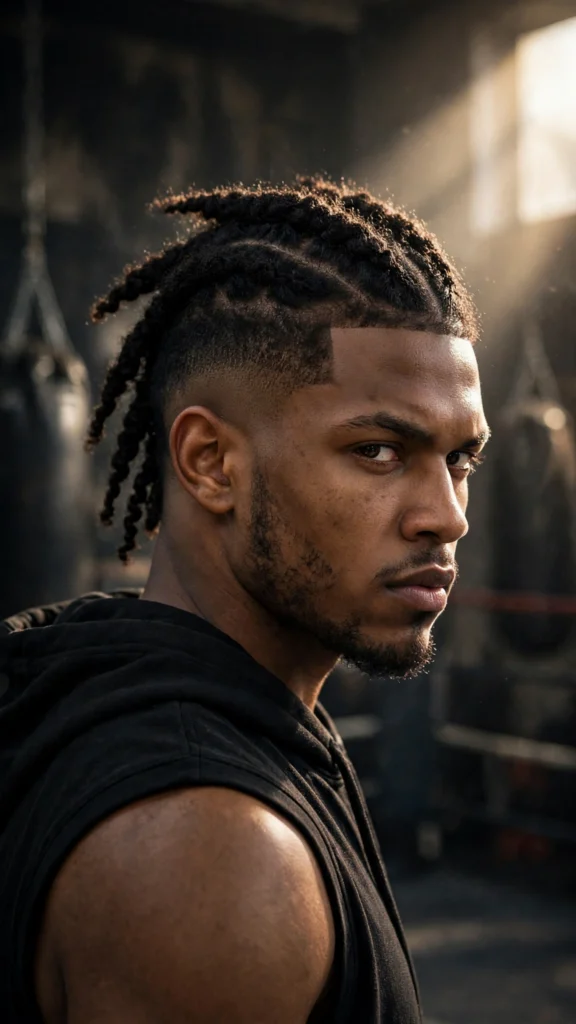
Why it works: Restricting medium twists to a centre strip over a burst fade creates a true mohawk with rope texture — aggressive, sculptural and impossible to ignore. The burst fade's semicircular blend around the ear is the detail that makes it look barbered rather than just shaved at the sides.
Get the look: Decide the strip width with your barber using your natural hairline — about the width between your eyebrows' outer edges usually looks best — and keep the twists in the strip at a consistent medium size. The burst fade needs a refresh every ten days or the semicircle loses its clean fan shape.
Products to help you get this look:
- Twist and loc gel strong hold — Search on Amazon
- Edge control gel for hairline — Search on Amazon
- Hair sectioning clips pack — Search on Amazon
- Tea tree scalp oil — Search on Amazon
- Satin durag for waves and twists — Search on Amazon
23. Medium Twists Half-Up Half-Down

Why it works: Half-up half-down is the medium length's most versatile styling trick: you get the face-clearing benefit of tying twists up and the fullness of wearing them loose, in the same style. It also shows off growth — you need genuine length for both zones to read clearly.
Get the look: Part the twists horizontally ear-to-ear with your fingers, tie the top zone loosely at the crown with a soft tie, and let the bottom zone hang untouched. Keep the knot loose on purpose — a relaxed top section is what separates this from a plain top knot and keeps the tension off your edges.
Products to help you get this look:
- No snag elastic hair ties for men — Search on Amazon
- Rosewater hair moisturizing spray — Search on Amazon
- Leave-in conditioner spray for natural hair — Search on Amazon
- Gold hair cuffs for locs and twists — Search on Amazon
- Silk pillowcase for hair protection — Search on Amazon
24. Long Rope Twists Down the Back

Why it works: This is the destination length — twists that fall like ropes down the back carry a presence no other length can match, and the weight of long twists actually helps them hang straighter and neater. From behind, the layered ropes look almost woven, which is why this is the most saved reference photo in the whole style family.
Get the look: Long twists are usually built with added braiding hair for length and fullness unless you have grown fourteen inches yourself, so discuss extension matching with your stylist for an invisible blend. Sleep with the twists gathered in a loose low ponytail under a long bonnet or satin scarf, because loose long twists tangle against cotton bedding fast.
Products to help you get this look:
- Satin bonnet for long hair men — Search on Amazon
- Lock and twist gel for men — Search on Amazon
- Rosewater hair moisturizing spray — Search on Amazon
- No snag elastic hair ties for men — Search on Amazon
- Tea tree scalp oil — Search on Amazon
25. Long Twists in a Low Ponytail
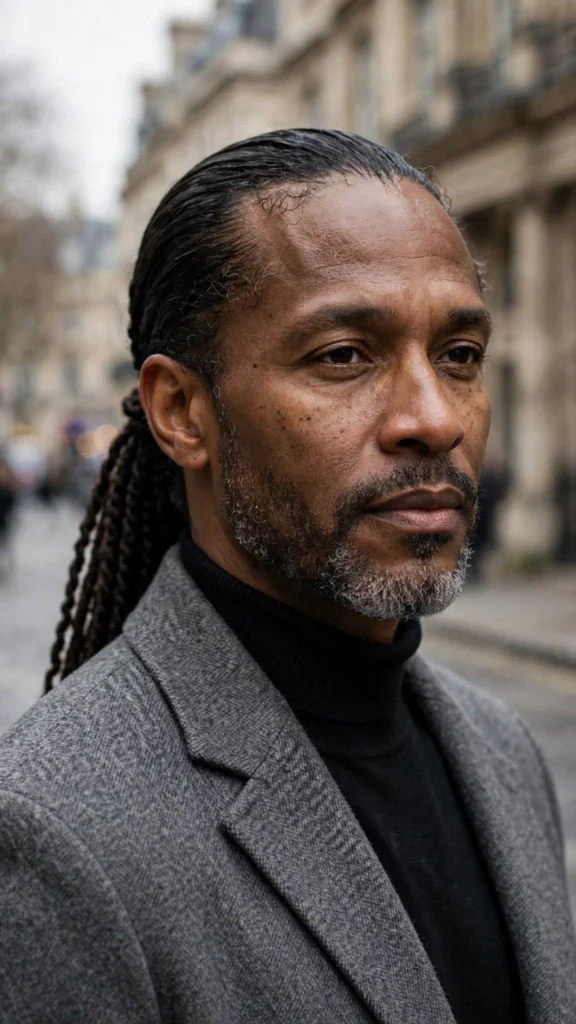
Why it works: The low ponytail is how long twists do formal — it tames twelve inches of rope into one clean bundle that sits neatly under a coat collar and reads as deliberate and mature. It is the long-length equivalent of a slicked-back style, with far more texture.
Get the look: Smooth the twists back with your palms and a light mist, gather at the nape — not the crown — and secure with a wide soft tie or a short satin scrunchie that will not dent the ropes. Alternate the ponytail position slightly day to day so the same roots are not under constant tension.
Products to help you get this look:
- Satin scrunchies for thick hair — Search on Amazon
- Hair wax stick for flyaways — Search on Amazon
- Boar bristle brush for men — Search on Amazon
- Leave-in conditioner spray for natural hair — Search on Amazon
- Satin bonnet for long hair men — Search on Amazon
26. Long Twists Styled into a Single Braid
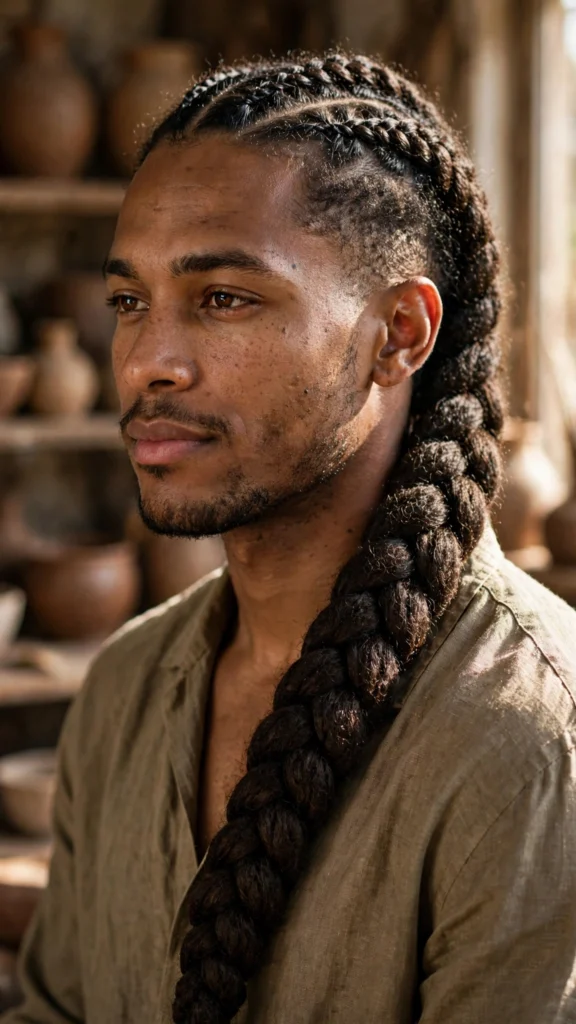
Why it works: Braiding long twists into one plait doubles the pattern — ropes woven into a bigger rope — and it keeps maximum length completely controlled for work, sport or travel. It also protects the ends, which are the oldest and most fragile part of long twists, by tucking them into the braid's structure.
Get the look: You need at least ten to twelve inches for a braid that holds without slipping; gather the twists, split into three even bundles of whole twists and plait loosely so the ropes are not crushed flat. Secure the end with a small clear elastic and undo it at night to let the twists breathe and reset.
Products to help you get this look:
- Small clear elastic hair bands — Search on Amazon
- Argan oil hair shine spray — Search on Amazon
- Gold hair cuffs for locs and twists — Search on Amazon
- Satin bonnet for long hair men — Search on Amazon
- Moisturizing hair mist spray bottle — Search on Amazon
27. Long Twists with a High Bun
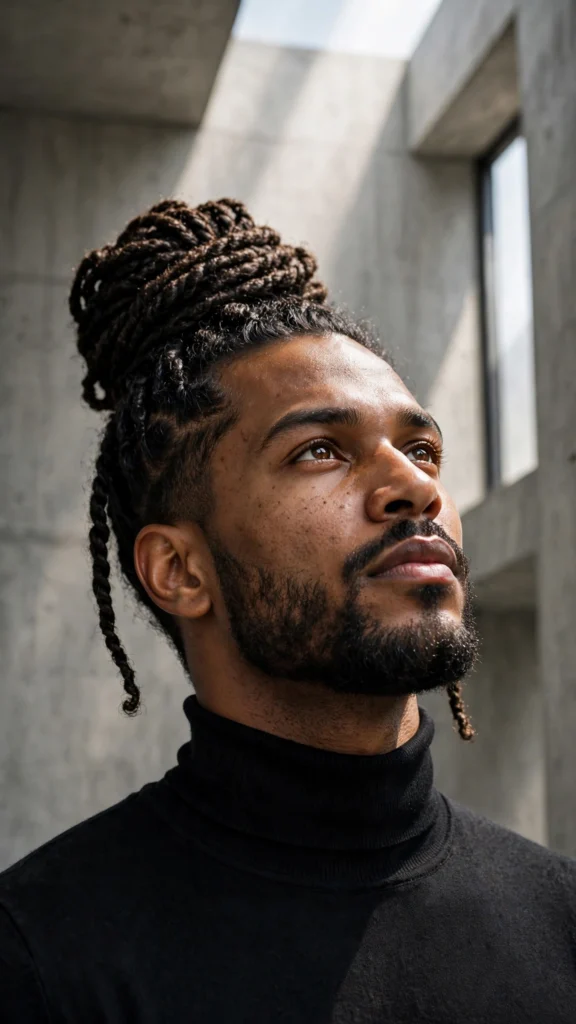
Why it works: A high bun made of long twists has a volume and woven texture that a straight-hair bun cannot approach — it looks like a crown of rope. It is the fastest way to take maximum length completely off the neck and shoulders while keeping a strong silhouette.
Get the look: Flip your head forward, gather all the twists at the crown, twist the bundle around itself and pin or tie it once — long twists are heavy, so a second tie crossed over the first keeps it secure all day. Build in looseness at the front roots; a bun this heavy worn too tight will stress the hairline within weeks.
Products to help you get this look:
- No snag elastic hair ties for men — Search on Amazon
- Large hair pins for thick hair — Search on Amazon
- Tea tree scalp oil — Search on Amazon
- Hair wax stick for flyaways — Search on Amazon
- Satin bonnet for long hair men — Search on Amazon
28. Long Twists with Ombré Tips
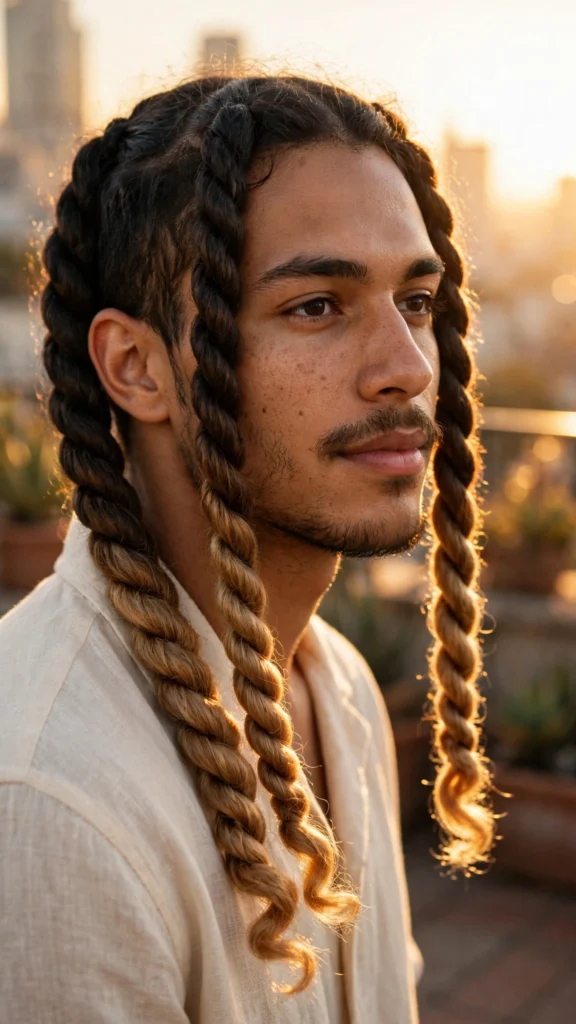
Why it works: Ombré puts the colour where long twists show it best — the moving ends — while the dark roots keep the style growing out gracefully with no harsh line. The gradient along each rope adds depth, so the twists look longer and more dimensional in photos.
Get the look: The colour melt should be done on the finished twists by a colourist who paints the gradient by hand, keeping the lightest shade for the last few inches only. The lightened ends are the driest part of the style, so seal them with oil after every mist and trim a quarter inch at each retwist to stop split ends travelling up the rope.
Products to help you get this look:
- Colour safe shampoo sulfate free — Search on Amazon
- Argan oil hair shine spray — Search on Amazon
- Deep conditioner for bleached hair — Search on Amazon
- Leave-in conditioner spray for natural hair — Search on Amazon
- Satin bonnet for long hair men — Search on Amazon
29. Jumbo Long Twists

Why it works: Jumbo sizing at long length is pure drama — a small count of very thick ropes reads as bold and sculptural, and each twist's spiral ridge is visible in detail. The practical payoff is real too: jumbo twists install in half the time and come down in minutes.
Get the look: Ask for extra-large sections, roughly an inch and a half square, and expect added hair to be worked in so each rope stays thick along its whole length instead of tapering thin. Jumbo twists are heavy when wet, so wash in sections, support the weight with your hands, and dry them fully — thick ropes hold water at the core.
Products to help you get this look:
- Shea moisture twisting butter — Search on Amazon
- Hair sectioning clips pack — Search on Amazon
- Microfiber hair towel anti frizz — Search on Amazon
- Tea tree scalp oil — Search on Amazon
- Satin bonnet for long hair men — Search on Amazon
30. Long Twists with Shaved Sides

Why it works: Shaving the sides under long twists gives you the drama of length with none of the bulk — the ropes fall from a narrow top panel, so the head keeps a slim profile while the hair itself looks enormous. The hard disconnection line is a deliberate design feature, not a grow-out accident.
Get the look: Ask for a true undercut with clippers stopping at a line you choose together — usually just above the ears curving to the back — and keep the transition unblended on purpose. The shaved zone needs a five-minute clipper pass weekly at home to stay crisp, which is far easier than maintaining a fade.
Products to help you get this look:
- Lock and twist gel for men — Search on Amazon
- Edge control gel for hairline — Search on Amazon
- Hair clippers for men cordless trimmer — Search on Amazon
- Argan oil hair shine spray — Search on Amazon
- Satin durag for waves and twists — Search on Amazon
31. Long Twists Draped to One Side
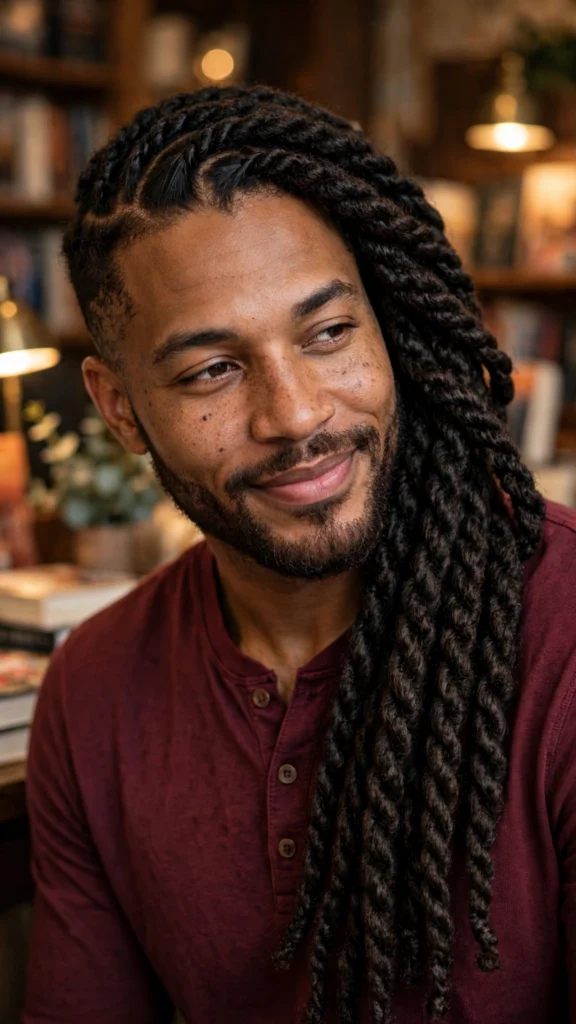
Why it works: Draping all the length over one shoulder concentrates the drama in a single cascade and leaves the other side of the face and neck clean — an asymmetric balance that photographs beautifully. It is also genuinely practical, keeping twists out of a bag strap, seatbelt or jacket zip on the free side.
Get the look: Train the direction gradually: after each wash, part the twists where you want the sweep to start and wear them draped while they dry so the roots set that way. A couple of cuffs placed low on the draped side keep the cascade together instead of separating across your chest.
Products to help you get this look:
- Gold hair cuffs for locs and twists — Search on Amazon
- Rosewater hair moisturizing spray — Search on Amazon
- Leave-in conditioner spray for natural hair — Search on Amazon
- Satin bonnet for long hair men — Search on Amazon
- Wide tooth detangling comb — Search on Amazon
32. Long Twists with a Middle Part
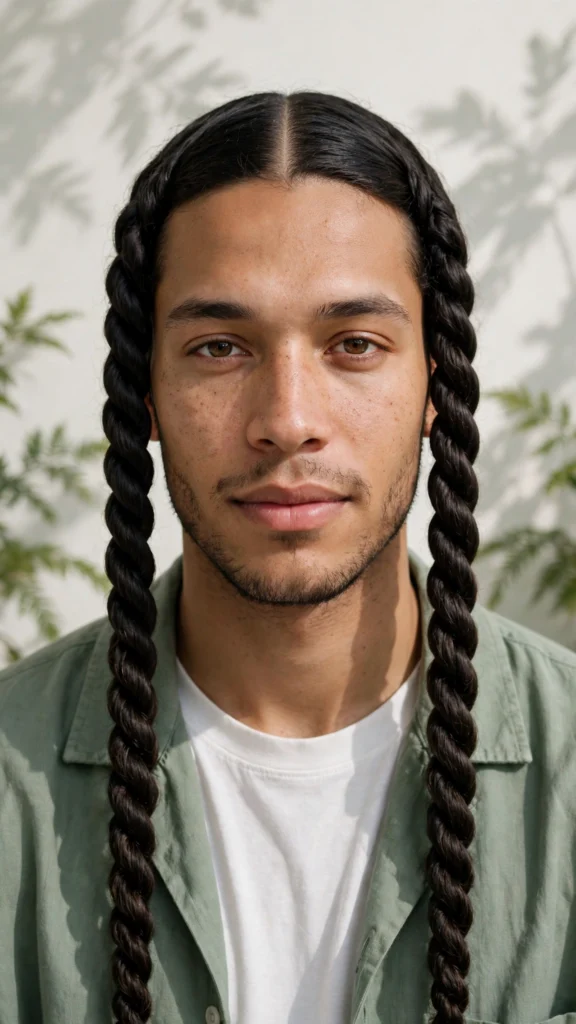
Why it works: At long length the middle part becomes a curtain frame — twists fall evenly on both sides and give the face a symmetrical, almost regal border. It is the long version of the short centre part from earlier in this list, grown out into something far more dramatic.
Get the look: The part must be sectioned in at the install in a dead-straight line, because long twists will not hold a centre part they were not built with. Keep the line open by re-tracing it with a comb tail after washes, and let the twists dry hanging on their own sides so gravity locks the curtain shape in.
Products to help you get this look:
- Rat tail comb for parting hair — Search on Amazon
- Lock and twist gel for men — Search on Amazon
- Hair wax stick for flyaways — Search on Amazon
- Satin bonnet for long hair men — Search on Amazon
- Tea tree scalp oil — Search on Amazon
33. Long Twists in a Half-Up Top Knot
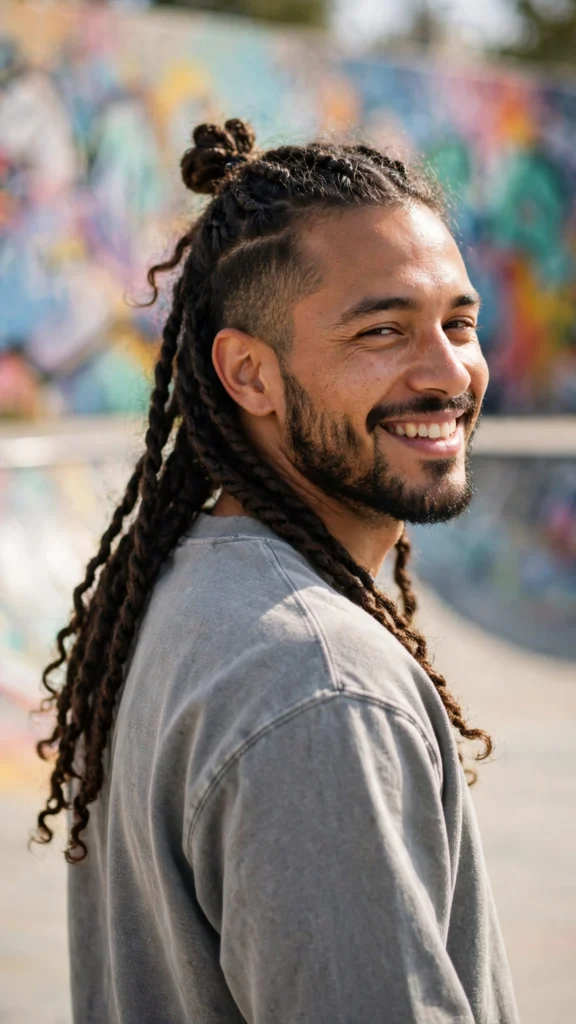
Why it works: The half-up top knot is long twists' most balanced everyday style: the knot lifts the front and crown clear, while the loose lower half still shows the full length you grew. It works precisely because both halves are genuinely long — a combination medium twists can only hint at.
Get the look: Section horizontally from ear to ear over the crown, knot the top half loosely once, and arrange the loose half evenly before you check the mirror — asymmetry is where this style usually goes wrong. Swap which twists sit in the knot every few days so the same front ropes are not always carrying the tension.
Products to help you get this look:
- No snag elastic hair ties for men — Search on Amazon
- Moisturizing hair mist spray bottle — Search on Amazon
- Gold hair cuffs for locs and twists — Search on Amazon
- Satin bonnet for long hair men — Search on Amazon
- Hair moisturizer for men daily cream — Search on Amazon
34. Extra-Long Waist-Length Twists
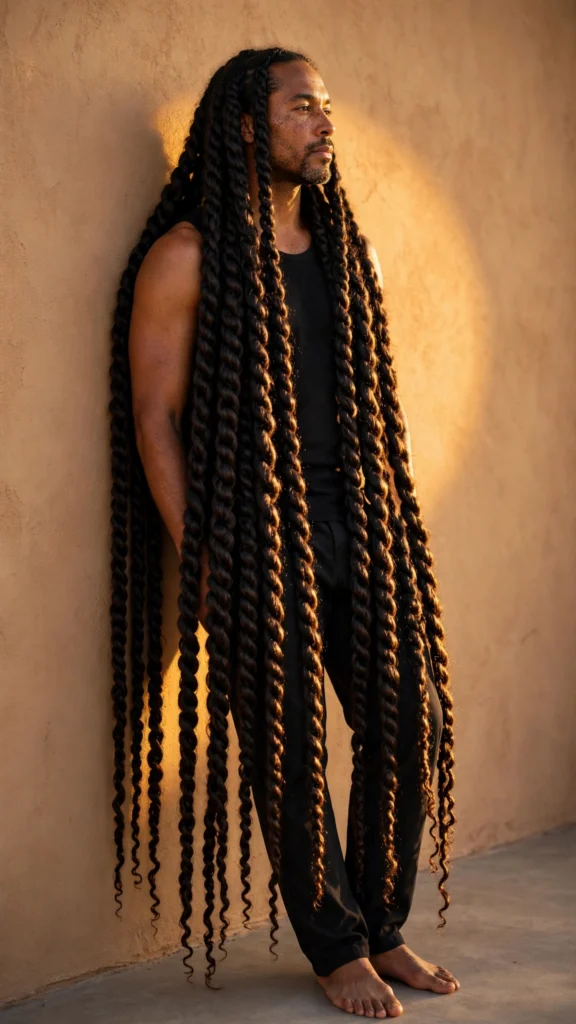
Why it works: Waist length is the final form of this style — twists this long move like a single curtain of rope and carry a quiet, powerful presence that needs no fade, colour or accessory. Very few men commit to the years of growth or the extension work it takes, which is exactly why it stops people when they see it.
Get the look: Realistically, this length is built with premium braiding hair blended into your own over a long install session, or grown over several years of continuous protective styling. Care scales with length: wash in four braided sections, never let the full weight hang wet and unsupported, and keep the ends — the oldest hair — oiled daily, because they decide whether the whole curtain looks healthy.
Products to help you get this look:
- Satin bonnet for long hair men — Search on Amazon
- Tea tree scalp oil — Search on Amazon
- Microfiber hair towel anti frizz — Search on Amazon
- Rosewater hair moisturizing spray — Search on Amazon
- Wide tooth detangling comb — Search on Amazon
FAQs
How much hair do I need to start two strand twists at each length? Short twists can start on as little as two inches of hair, and mini twists work from about an inch and a half, because the coils hold even when they are tiny. Medium twists that actually hang need five to seven inches, and anything past ten inches is long territory — most men build that length with braiding hair added unless they have grown it out over years of protective styling.
How long do two strand twists last before they need a retwist? Short and medium twists typically look their best for three to five weeks, while long and jumbo twists often stretch to six weeks because the weight keeps them lying neatly. The front rows and hairline fuzz first, so many men refresh just the perimeter at the halfway point and keep the rest of the install going.
Can two strand twists turn into locs if I keep them in? Yes — leaving twists in and retwisting only the new growth at the roots is one of the most common ways to start locs, and this length progression is exactly the journey they take as they mature. If you do not want them to lock, take the style fully down by the six-week mark, detangle each twist carefully with conditioner, and give your hair a rest week before the next install.
Quick Wrap-Up
From two-inch starter twists to a waist-length curtain of rope, the two strand twist grows with you — the technique never changes, but the fade, part, colour and finish choices keep reinventing it at every length. Pick the section that matches your hair today, show your barber or loctician the photo, and let the next retwist take you one step further down the list.