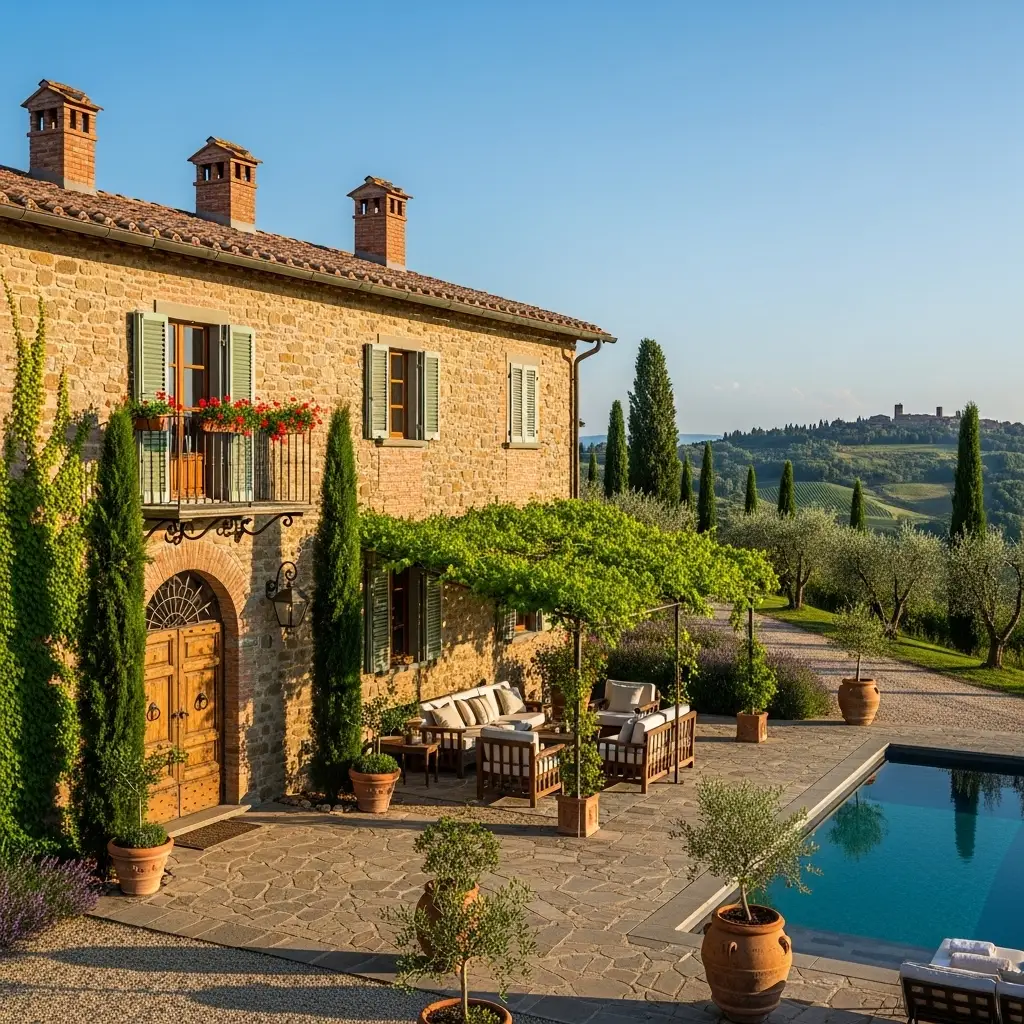
Your dream home is closer than you think — and it smells like lavender, old stone, and wood smoke
There are homes you walk past and forget. And then there are homes that stop you completely — the kind that make you grip your phone, snap a photo, and spend the next hour imagining your whole life differently. Italian farmhouse exteriors are absolutely, undeniably the second kind.
There’s a reason this aesthetic has taken over Pinterest boards, Instagram feeds, and interior design magazines worldwide. It’s because Italian farmhouse style does something almost no other architectural style manages to do: it makes luxury feel lived-in. It makes beauty feel effortless. It makes a home feel like it has always been there, like it grew up out of the earth alongside the olive trees and the grapevines surrounding it.
We’re talking about sun-warmed plaster walls the color of fresh cream. We’re talking about terracotta roof tiles that have faded and deepened over decades of Mediterranean sun. We’re talking about wooden shutters that creak just slightly when the evening breeze moves through them, iron lanterns casting golden pools of light on cobblestone paths, and roses — always roses — climbing the walls like they own the place.
This is not a trend. This is a way of building that has been refined over centuries in the hills of Tuscany, the valleys of Umbria, the sun-soaked plains of Sicily. And the most extraordinary thing? You can bring every single element of it to your own home, no matter where in the world you happen to live.
Whether you are planning a full exterior renovation, building your dream home from the ground up, or simply gathering inspiration for a future project, these 20 Italian farmhouse exterior ideas are going to feed your soul and fill your saved folders. Each one is distinct. Each one is deeply beautiful. And each one is entirely achievable with the right vision and the right details.
Get your favorite drink, settle in, and let yourself dream a little. You deserve it.
1. Sun-Bleached Limewash Walls That Glow Like Warm Honey
Walls that look like they’ve been kissed by a hundred Italian summers — soft, imperfect, and impossibly beautiful in every season.
There is truly nothing in the world of exterior finishes that compares to the warmth and depth of a properly applied limewash wall. Unlike paint, which sits on the surface of a wall like a coat, limewash actually soaks into the material beneath it, creating a finish that shifts and breathes and catches the light differently at every hour of the day. In the morning it reads almost white. By late afternoon it glows a deep amber gold. At dusk it turns the color of warm beeswax, and you will not be able to stop staring at it.
Styling Tips: Apply limewash in two to three thin coats, allowing each coat to dry partially before the next application. Work in irregular, overlapping strokes rather than even, smooth passes — the variation is the whole point. For the most authentic Italian farmhouse look, choose warm-toned limewash shades rather than cool grey-whites. Colors like “Venetian Cream,” “Aged Parchment,” “Warm Bisque,” or “Antique Linen” will give you that signature sun-bleached glow. For contrast, keep all window trim, shutters, and door frames in a slightly deeper tone — dusty terracotta, aged olive green, or dark walnut brown work beautifully. Add large terracotta urns flanking the front entry filled with trailing rosemary or lavender, and the scene is complete.
Perfect for: Homeowners renovating older brick or concrete block homes, or anyone building new who wants an exterior that looks like it has been standing for two hundred years. Also stunning on garden walls, boundary walls, and outbuildings.
Color Palette: Antique linen, warm honey, dusty terracotta trim, aged olive green shutters, warm stone path
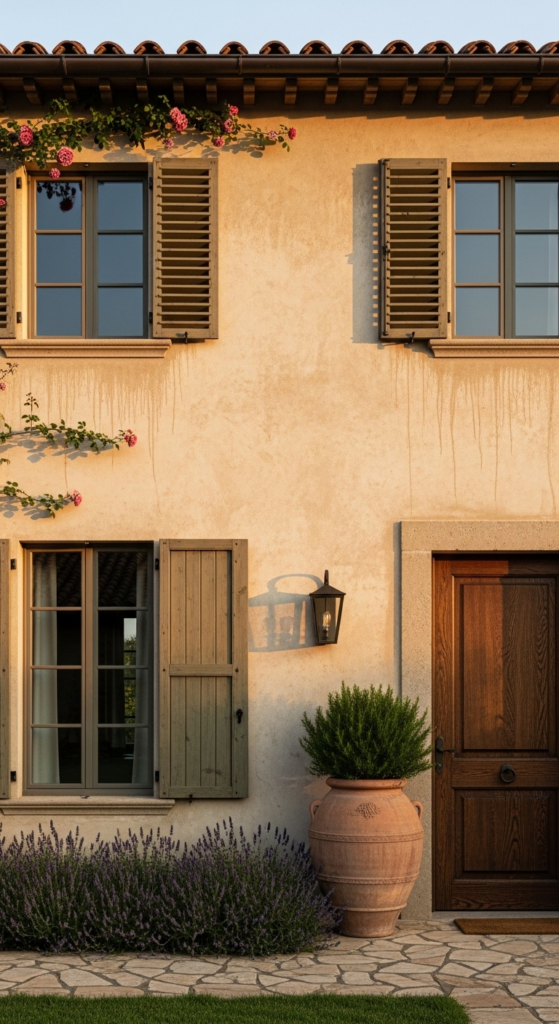
2. Stone Archway Entrance Draped in Cascading Wisteria
Walking through a wisteria-covered stone arch every single day would make you believe, without question, that you are living your very best life.
A stone archway is one of those architectural gestures that costs relatively little in terms of materials but pays back in pure beauty tenfold. In Italian farmhouse design, archways appear everywhere — at garden gates, at courtyard entrances, framing doorways, and bridging garden walls. They are one of the oldest structural forms in architecture, and there is a reason the Romans built with arches for everything: they are structurally brilliant and visually magnificent.
When you train wisteria — that most theatrical of climbing plants — over a stone arch, you create something that moves people. In spring, when the pendulous clusters of lavender-purple blooms are hanging down through the arch opening, it genuinely looks like something out of a film set. But even in winter, when the blooms are long gone, the twisted and gnarled grey branches of a mature wisteria vine have their own sculptural, dramatic beauty.
Styling Tips: Build the arch from natural fieldstone, limestone, or reclaimed brick. Avoid perfectly uniform stone — the character comes from the variation in size, color, and texture of the individual stones. Install a wrought iron gate within the arch for added drama and security. Plant wisteria on both sides of the arch and train it upward and over with galvanized wire guides attached to the stone. For a longer flowering season, combine Wisteria sinensis (which blooms in spring) with Wisteria floribunda (which blooms slightly later). Add stone lanterns or wrought iron wall sconces at either side of the arch for evening atmosphere.
Perfect for: Homes with a defined entry path or driveway, garden gates, and any property with a walled boundary that needs a spectacular focal point.
Color Palette: Warm grey fieldstone, lavender purple wisteria, deep forest green foliage, aged black wrought iron
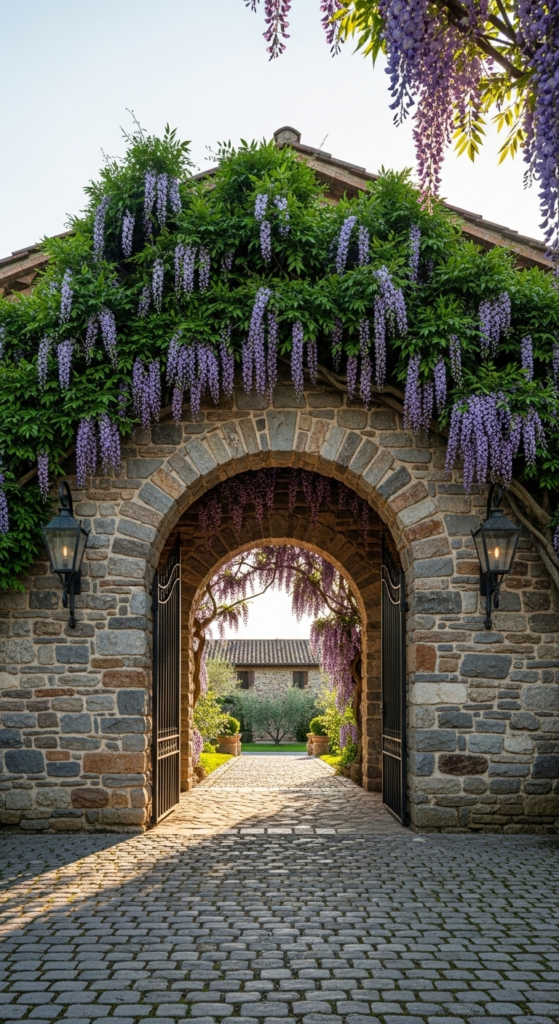
3. Terracotta Barrel Roof Tiles in a Weathered Rust Blend
Those curved clay tiles, faded and mottled and imperfectly perfect — they are the crown of every Italian farmhouse, and they never, ever go out of style.
If limewash walls are the skin of an Italian farmhouse, then the terracotta barrel tile roof is unquestionably its crown. There is no substituting it, no adequately approximating it, no architectural element that communicates “authentic Italian farmhouse” more immediately and powerfully than a roof of curved, weathered clay tiles in those gorgeous shades of rust and burnt orange and earthy brown.
What makes vintage or weathered terracotta tiles so much more beautiful than new ones is the patina — the way the color has deepened in some places and faded in others, the way moss and lichen have begun to colonize the shadier portions of the roof, the way the tiles have settled slightly unevenly over time so the roof surface has gentle undulations rather than a ruler-flat plane.
Styling Tips: If you are installing new terracotta tiles, look for suppliers who offer a “weathered blend” or “antique mix” — tiles that are deliberately varied in tone so the new roof immediately looks aged. Better still, source reclaimed terracotta tiles from demolition salvage companies; they are often available in large quantities and the authentic patina is completely irreplaceable. Pair the roof with wide overhanging eaves supported by exposed, heavy timber beams in dark walnut or aged oak. The shadow line created by a deep overhang is one of the most architecturally beautiful elements of this style. Keep the chimney stacks rendered in the same limewash finish as the walls and cap them with traditional terracotta chimney pots.
Perfect for: Anyone building new or re-roofing an existing home who wants the single most impactful element of Italian farmhouse style.
Color Palette: Weathered rust, burnt orange, mottled brown, dusty rose-terracotta, aged timber dark walnut
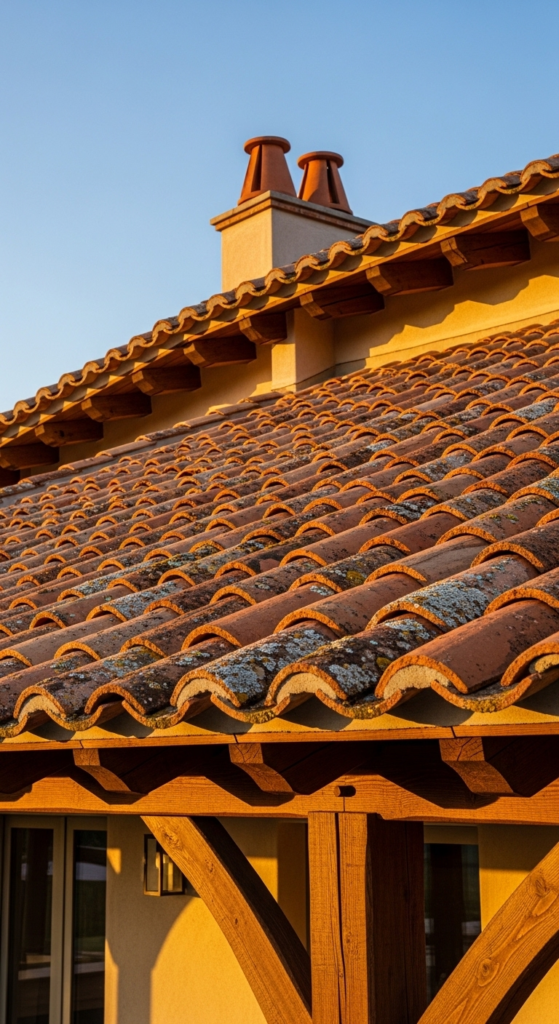
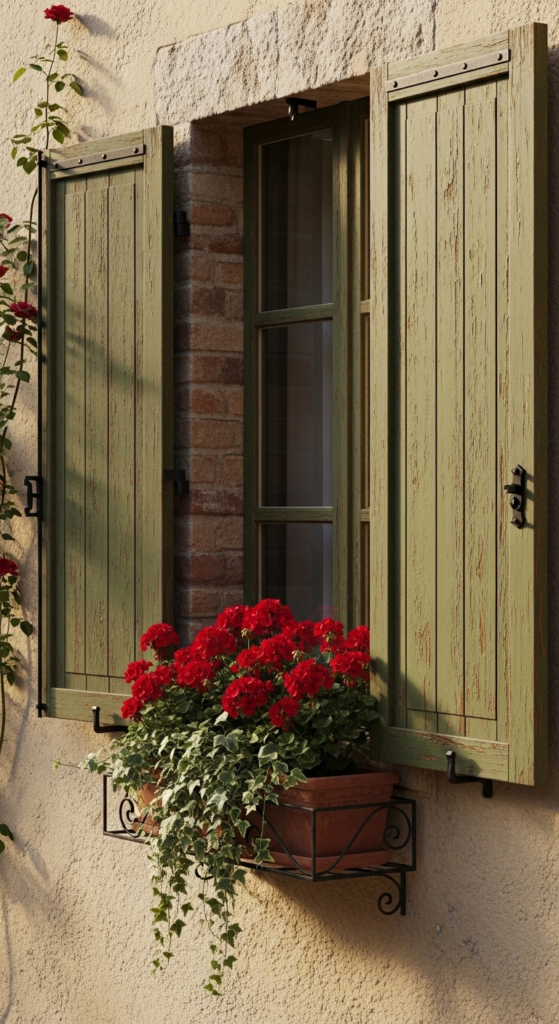
4. Weathered Green Wooden Shutters with Window Box Geraniums
Faded, slightly warped, painted in the green of old olive leaves — these shutters have a thousand stories in every chip of paint, and you will love every single one.
Here is a truth that every great Italian farmhouse exterior designer knows: shutters are not decorative. Or rather, they should not be merely decorative. The shutters on a traditional Italian farmhouse are solid, functional, full-panel wooden shutters that actually close over the windows — protecting the interior from the fierce summer sun during the hottest part of the day, and from cold winds in winter. And they are always, always painted in a muted, slightly faded color that references the natural landscape around them.
The green ones are particularly extraordinary. Not a bright, fresh green — never that. A green that has been bleached by years of sun, that has faded at the edges and deepened at the recesses, that has been touched up once or twice over the decades with a slightly different shade so there are subtle variations in tone across the surface. This is the green of old olive leaves, of ancient cypress bark, of the hills themselves in late summer.
Styling Tips: Paint shutters in muted, desaturated greens — look for shades with names like “Aged Olive,” “Cypress Shadow,” “Faded Sage,” “Dried Herb,” or “Muted Moss.” Apply in thin coats and sand back the edges gently before the final coat to create built-in distressing. Install wrought iron shutter dogs — those S-shaped hooks that hold the shutters open against the wall — for an authentic period detail. Below every shuttered window, hang a terracotta window box and plant it abundantly with cherry-red or coral-pink geraniums. The contrast of weathered green shutters against warm plaster walls with that punch of geranium red is simply one of the most beautiful color combinations in the exterior design world.
Perfect for: Any farmhouse-style home, cottages, villas, and particularly beautiful on stone-walled properties where the color contrast between green shutters and pale stone is especially dramatic.
Color Palette: Faded olive green, aged cream plaster, cherry red geraniums, warm terracotta window box, wrought iron black
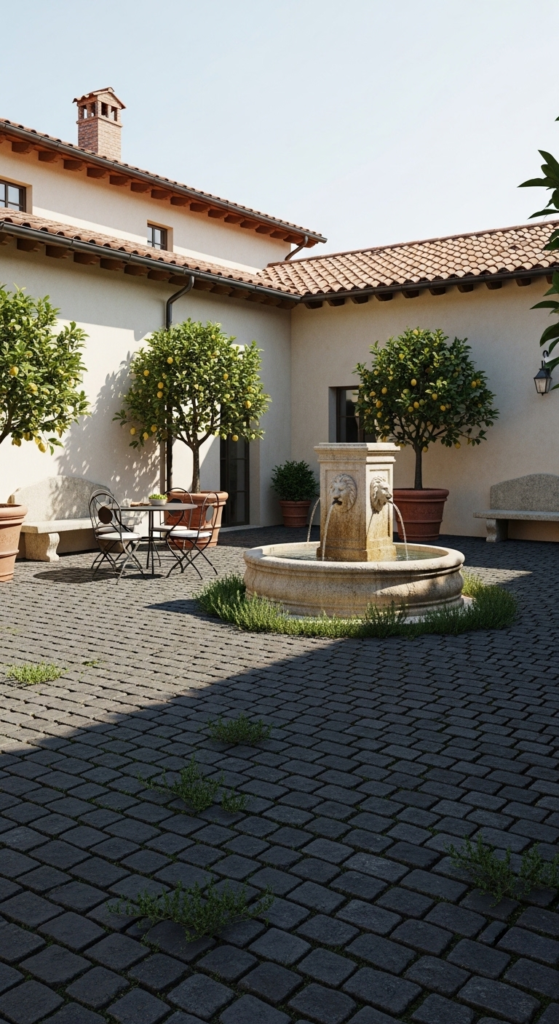
5. Cobblestone Entry Courtyard with a Carved Stone Fountain
There is something about the sound of water in a stone fountain, surrounded by cobblestones worn smooth by generations of footsteps, that makes time slow down completely.
The enclosed entry courtyard is one of the most deeply satisfying spatial experiences in Italian farmhouse design. It is the moment of transition between the outside world and your private sanctuary — a space that is neither fully public nor fully private, but something beautifully in between. And when that courtyard is paved in traditional cobblestones and anchored by a carved stone fountain, it becomes something genuinely magical.
In the Italian farmhouse tradition, the courtyard — or cortile — was the working heart of the farm. Animals were kept here, grapes were pressed here, and the whole extended family gathered here for meals in summer. Today, the working elements are gone but the spirit remains: the courtyard is still the heart of the home, still the gathering place, still the space where the boundary between indoors and outdoors dissolves entirely.
Styling Tips: Pave the courtyard with traditional sampietrino cobblestones — those small, roughly square volcanic basalt stones used throughout central Italy — or with larger irregular flagstones of limestone or travertine. For the fountain, commission or source a hand-carved stone fountain in aged limestone or travertine. A simple single-basin design with a carved lion mask or cherub spout is entirely authentic. Plant creeping thyme or Corsican mint in the gaps between cobblestones — they release fragrance when stepped on. Position large terracotta lemon trees in pots around the perimeter, and add a pair of stone benches for seating.
Perfect for: U-shaped or L-shaped farmhouse layouts where a natural courtyard space exists, and for anyone with an enclosed front garden space they want to transform into something extraordinary.
Color Palette: Dark charcoal cobblestone, aged honey limestone, dusty sage creeping thyme, warm ivory rendered walls, terracotta pot orange
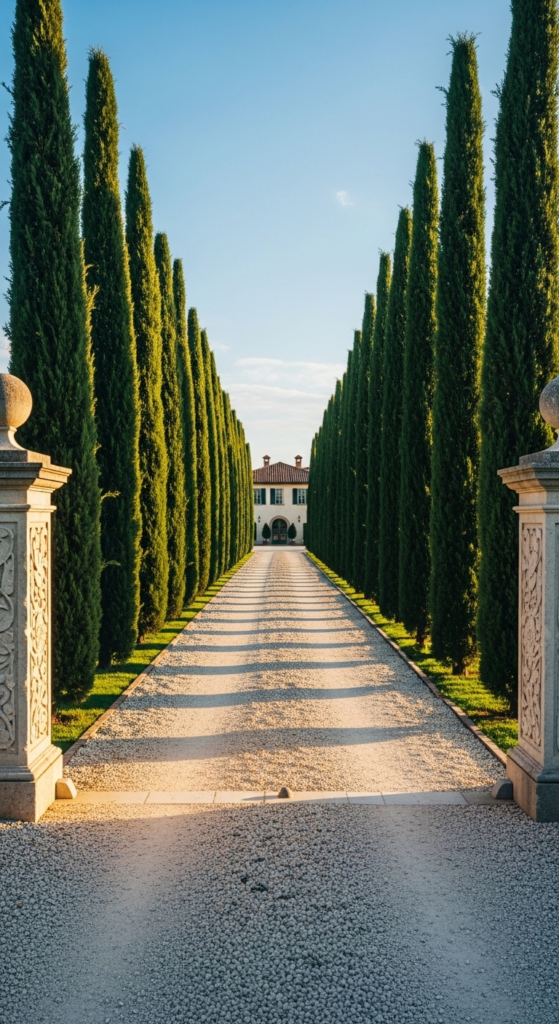
6. Cypress Tree-Lined Gravel Driveway Entrance
Long, straight, impossibly dramatic — a driveway flanked by tall dark cypress trees is the Italian farmhouse’s version of a red carpet, and it never fails to impress.
There is a driveway, and then there is a cypress-lined driveway. These are two entirely different experiences. The first gets you from the road to your house. The second makes arriving home feel like the beginning of something wonderful — like the opening scene of a film set in the Italian countryside, or the first page of a novel you already know you’re going to love.
The Italian cypress (Cupressus sempervirens) is one of the most architecturally distinctive trees in the world. Tall — sometimes extraordinarily tall, reaching 20 to 30 meters at full maturity — narrow, columnar, and darkly, richly evergreen, these trees have been planted along Italian farm driveways and boundaries for centuries. They serve practical purposes — windbreaks, boundary markers, shade provision — but their visual impact is purely and powerfully emotional.
Styling Tips: Plant Italian cypress trees in pairs at regular intervals of three to four meters along both sides of the driveway. For the driveway surface itself, use pale cream or light grey crushed gravel — the contrast between the dark green of the cypress and the pale gravel is part of what makes this look so visually striking. Frame the beginning of the driveway with a pair of stone gateposts topped with carved stone balls or terracotta finials. Keep the grass or ground cover between the trees short and well-maintained for a clean, sculptural look. Add small solar ground lights along the driveway edges for beautiful evening ambiance.
Perfect for: Country properties, rural homes, and any property with sufficient driveway length to accommodate a row of trees on each side. Even a short driveway with just three or four pairs of cypresses is dramatically transformed.
Color Palette: Deep bottle green cypress, pale cream gravel, warm grey limestone gateposts, bright blue Italian sky
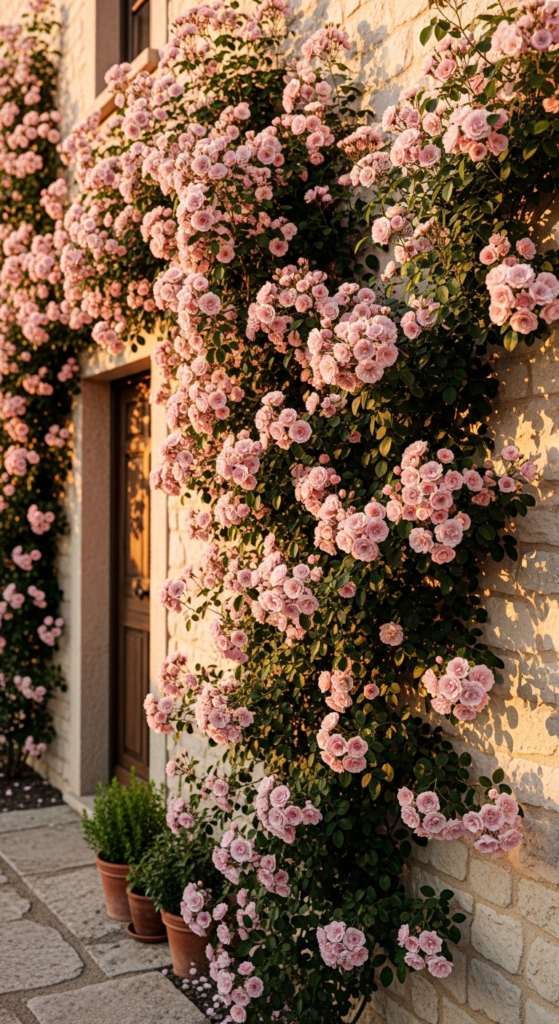
7. Climbing Roses Cascading Over a Rendered Stone Wall
Old roses, the kind with a hundred petals and a scent you remember forever — climbing, cascading, filling the air with something that feels almost like nostalgia itself.
If you were to ask ten different people to describe the most beautiful exterior detail of the most beautiful Italian farmhouse they have ever seen, at least seven of them would mention climbing roses. Not because climbing roses are exclusively Italian — they are beloved the world over — but because something about the combination of old roses against warm plaster or stone walls, in that particular Mediterranean light, is unlike anything else in the garden world.
The roses that work best for this look are the old climbing varieties and the vigorous ramblers — Rosa ‘New Dawn’ with its soft blush pink flowers and extraordinary vigor, Rosa ‘Madame Alfred Carrière’ with its creamy white blooms, Rosa ‘Veilchenblau’ with its unusual purple-violet flowers, or the deeply fragrant Rosa ‘Generous Gardener’. These are roses that want to climb, that will cover an entire wall face if you let them, that bloom in such abundance in early summer that the wall beneath almost disappears.
Styling Tips: Install a grid of galvanized wire fixed horizontally across the wall face at 30cm intervals, attached with vine eyes — this is the most discreet and effective support system for climbing roses. Train the main structural branches horizontally along the wires, then allow the flowering stems to hang down freely — this horizontal training encourages the plant to produce far more blooms. Feed generously in spring with a rose-specific fertilizer. In terms of color choice, soft pinks, creams, and white roses against warm cream or terracotta walls are the most classically Italian combination, though a deep red climbing rose against a pale limewash wall is breathtaking in its drama.
Perfect for: Any farmhouse exterior with a large, south or west-facing wall surface, and particularly beautiful framing front doors, garage walls, and garden boundary walls.
Color Palette: Soft blush pink rose, warm cream plaster wall, deep green rose foliage, aged stone trim details
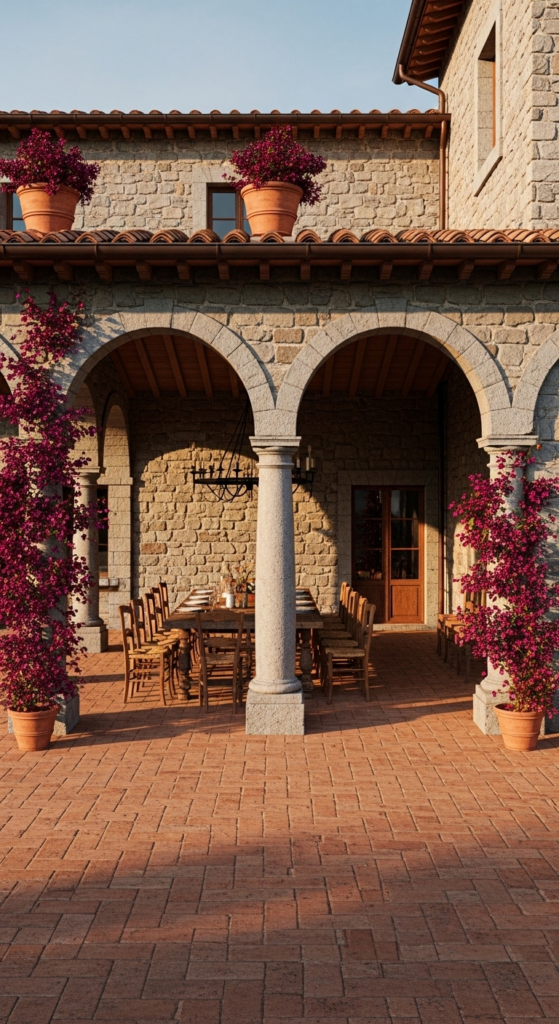
8. Grand Loggia with Arched Stone Columns
A loggia is not just a covered porch — it is a philosophy. It says: the boundary between your home and the world outside is negotiable, and that is a beautiful thing.
The loggia is one of the most magnificent architectural gifts of the Italian Renaissance to domestic architecture. Put simply, a loggia is a covered gallery or corridor open to the outside along one side through a series of arches or columns. In a farmhouse context, it functions as a shaded outdoor living space — a place to eat, rest, and receive guests during the long, hot Italian summer — while also providing one of the most visually spectacular exterior features a home can have.
A loggia running along the full width of a farmhouse facade, with a series of rounded stone arches supported on stone or render-covered columns, gives a single-story farmhouse a grandeur and architectural presence that is completely unmatched by any other addition. The interplay of light and shadow within the loggia arcades, particularly in the late afternoon when the sun is low and the shadows are long, is one of those things that makes you stop and stare every single time you see it.
Styling Tips: Construct the loggia arches and columns in natural stone, or use rendered masonry that matches the main house walls exactly. Keep the column proportions generous — slender columns look delicate and wrong on a farmhouse; you want something that feels ancient and structural and confident. Pave the loggia floor in large terracotta tiles or worn limestone slabs. Furnish it simply and generously: a long refectory-style dining table in reclaimed oak, mismatched vintage chairs, a pair of rattan daybeds, and terracotta pots overflowing with jasmine and bougainvillea climbing the columns. Install a wrought iron chandelier or string terracotta pendant lights along the loggia ceiling.
Perfect for: New builds and substantial renovations where this feature can be incorporated into the structural design. Worth every penny of investment — this is genuinely a life-changing architectural feature.
Color Palette: Warm grey stone columns, aged terracotta floor tiles, cream rendered ceiling, deep magenta bougainvillea, reclaimed oak table
9. Ancient Olive Tree as a Front Garden Focal Point
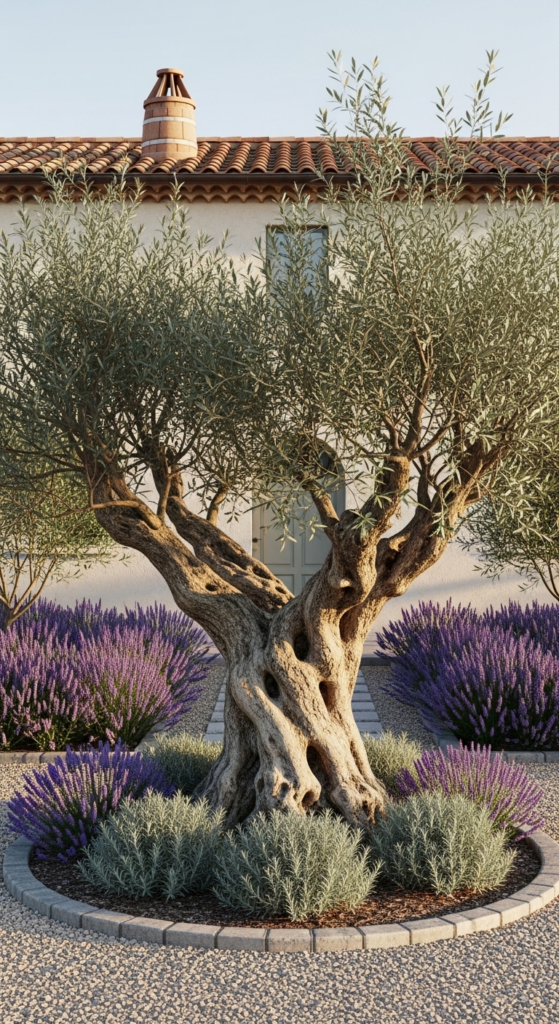
There is nothing on this earth that looks more like time itself than an ancient olive tree — gnarled, silver, magnificent, and completely, utterly at home in front of an Italian farmhouse.
An ancient or semi-mature olive tree positioned as the central focal point of a front garden is one of those design decisions that elevates an exterior from beautiful to extraordinary. The olive tree (Olea europaea) is one of the most visually extraordinary plants in the world — its bark twists into extraordinary sculptural forms as it ages, its canopy is a constantly moving shimmer of silver-green, and it is impossibly evocative of every romantic idea we have ever had about Mediterranean life.
The oldest cultivated olive trees in Italy are thousands of years old, their trunks twisted into shapes that look more like abstract sculpture than living wood. You cannot replicate that extreme antiquity in a garden, but you can purchase semi-mature olive trees — 50, 80, even 100 years old — from specialist growers. These trees arrive already with character, already with that beginning of the beautiful gnarling and twisting that makes them so magnificent.
Styling Tips: Position the olive tree as a free-standing specimen in a circular planted bed of gravel or naturalistic planting — wild lavender, rosemary, and Cistus work beautifully beneath an olive’s canopy. Use uplighting — two or three well-positioned LED ground spots — to illuminate the trunk and lower canopy at night, creating extraordinary shadows on the wall and ground behind. Avoid planting olive trees in manicured grass — the contrast between the ancient, wild character of the olive and perfectly maintained lawn is jarring. Gravel, wildflower, or Mediterranean herb planting is far more sympathetic.
Perfect for: Medium to large front gardens, any farmhouse exterior looking for a signature landscape element, and particularly stunning against white or very pale limewash walls where the silver-green of the olive canopy creates a beautiful color contrast.
Color Palette: Silver grey olive foliage, gnarled warm brown trunk, lilac lavender, pale cream gravel, dusty green rosemary
10. Pergola with Grapevines and String Lights
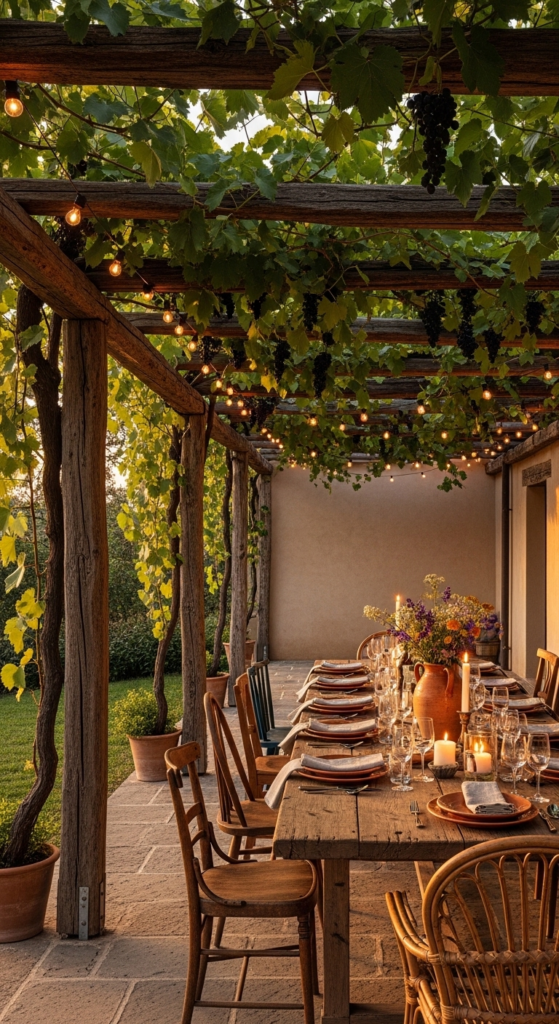
Sitting under a pergola dripping with grapevines while golden light filters through the leaves and string lights begin to glow in the dusk — this is Italian summer, bottled and kept forever.
The vine-covered pergola is perhaps the most emotionally loaded of all Italian outdoor spaces. It is the place where long lunches happen and somehow become long dinners. It is the place where good wine is opened and stories are told and children run between the adult chairs and summer evenings stretch on and on. It is not just a structural element — it is an experience, a way of living, a declaration that shade and slowness and the pleasure of being outdoors together are among the most important things in life.
In the Italian farmhouse tradition, the pergola is typically constructed from rough-hewn timber or stone columns, and it is positioned immediately adjacent to the house — extending the living space outdoors in a way that blurs the boundary between inside and outside. Grapevines are trained overhead on horizontal wires, providing dense shade in summer, and the sight of actual bunches of grapes hanging between the leaves overhead is one of the most abundantly, sensuously beautiful things a garden can offer.
Styling Tips: Construct the pergola structure from heavy, rough-hewn timber beams — avoid thin, lightweight timber which looks wrong. Treat the wood with a natural oil finish rather than paint or varnish. Plant one or two grapevines at the base of the main structural posts and train them up and over the horizontal beams — within three to five years they will cover the entire structure. Wind vintage-style warm white string lights through the overhead vine canopy for evening illumination. Furnish beneath with a long farmhouse table in reclaimed oak or stone, mismatched chairs, and terracotta pots of herbs at the base of each structural post.
Perfect for: Farmhouse homes with a south or west-facing outdoor space adjacent to the house, and particularly beautiful when the pergola can be seen from the main living room interior — bringing the garden visually inside.
Color Palette: Rich green grapevine, warm amber string light glow, reclaimed oak timber, warm stone, deep purple hanging grapes
11. Exposed Stone Feature Wall with Trailing Jasmine
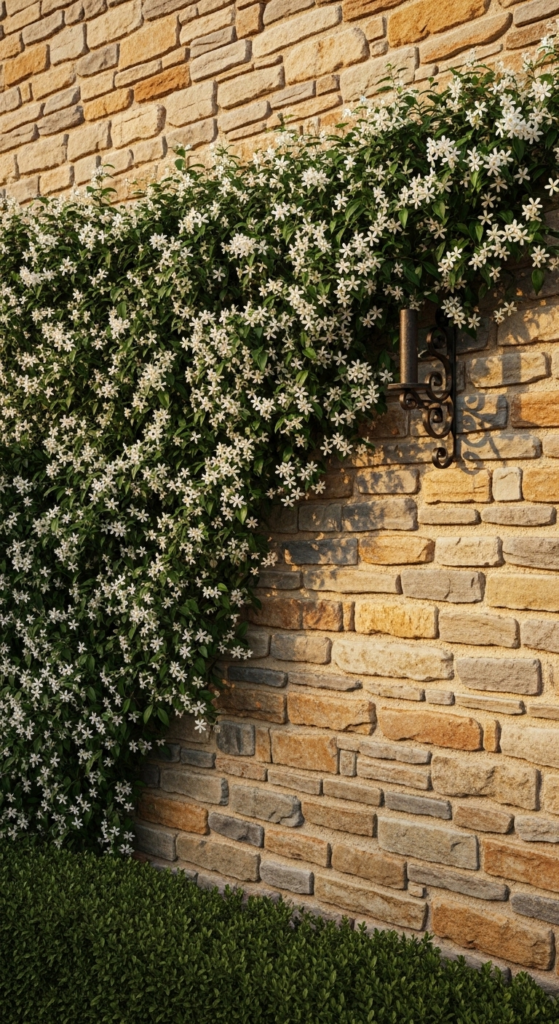
A wall of ancient stone, half-hidden under cascades of white jasmine in full bloom — it is impossible to look at this combination and not feel something move in your chest.
Not every wall of an Italian farmhouse exterior needs to be rendered and limewashed. In fact, one of the most beautifully atmospheric exteriors you can create involves leaving a section of structural stone wall completely exposed — celebrating the raw material beneath rather than covering it. Whether the underlying stone is golden limestone, warm sandstone, rough volcanic basalt, or cool grey granite, the exposed texture and color of real structural stone is one of the most luxurious things an exterior can offer.
When you add jasmine — Jasminum officinale, the white star jasmine, or the even more vigorous Trachelospermum jasminoides — to a stone wall, what happens in late spring and early summer is nothing short of extraordinary. The wall becomes covered in thousands of tiny white star-shaped flowers, and the fragrance — the jasmine fragrance that is simultaneously one of the most complex and most innocent scents in the natural world — fills the entire exterior space. Visitors will comment on it every time.
Styling Tips: If exposing an existing rendered wall, hire a skilled stonemason to carefully remove the render and repoint the exposed stonework. Look for a reclaimed stone supplier if building new — salvaged stone always has more character than new quarried stone. Plant jasmine at the base of the wall and install horizontal wire guides at 30cm intervals across the wall face for the vine to climb. Keep the rest of the exterior planting simple and let the stone and jasmine be the star. At the base of the wall, plant a low hedge of clipped box or rosemary for structure.
Perfect for: Older stone-built properties, renovations where original stone fabric is being uncovered, and new builds using reclaimed stone material.
Color Palette: Warm golden limestone, brilliant white jasmine flower, deep glossy green jasmine foliage, dark grey repointing mortar, clipped dark green box hedge
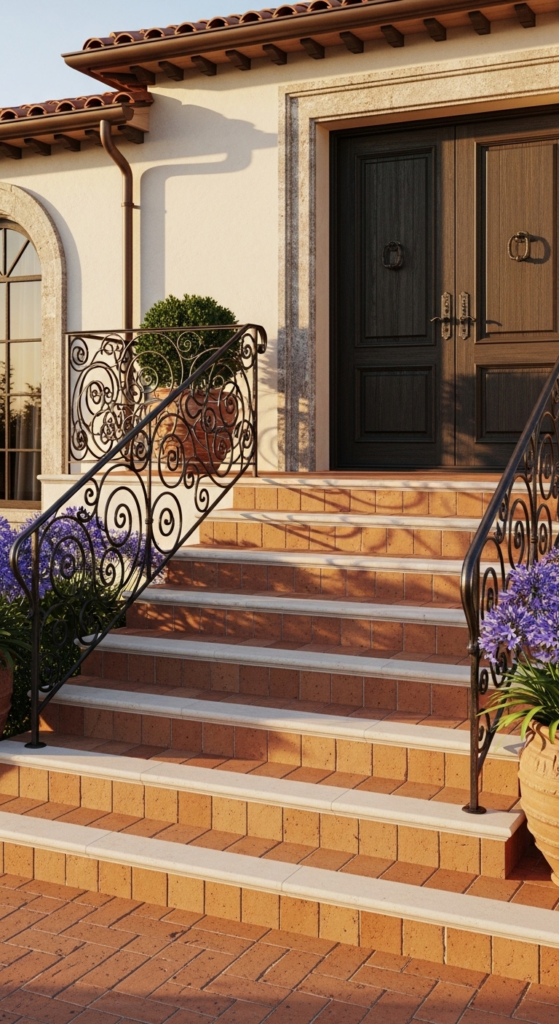
12. Terracotta-Tiled Front Steps with Iron Railing
Wide, generous, slightly uneven terracotta steps with a scrolled iron railing — every time you climb them, you feel as though you are arriving somewhere that matters.
The approach to the front door of an Italian farmhouse is a journey in miniature — and every element of it matters. The steps, if there are any, are typically constructed of terracotta tile or stone, wide and generous in their proportions, and accompanied by a wrought iron railing of scrolled and handcrafted character. These steps are not merely a functional necessity; they are an introduction to the home, a statement of welcome, a prelude to everything that comes after.
Wide steps — three to five steps of generous depth and width, perhaps 1.5 to 2 meters across — give a farmhouse entrance a sense of grandeur that is completely disproportionate to their actual cost to install. The terracotta tile surface, warm and slightly rough underfoot, already communicates everything about the character of the home before you have even touched the door handle.
Styling Tips: Use unglazed terracotta floor tiles for the step surfaces — choose a slightly aged or antique finish rather than bright new tiles. Edge the steps in a contrasting material — smooth limestone or travertine edging on the step nosings provides a beautiful refinement against the rougher terracotta surface. Commission or source a wrought iron railing with traditional scrollwork for one or both sides of the steps — even a simple scroll design in flat or round bar iron looks a thousand times more authentic than a tubular steel rail. Plant terracotta pots of agapanthus, bay trees, or clipped standard roses on either side of the lowest step.
Perfect for: Any farmhouse exterior where the front entrance is raised above ground level, and particularly stunning on entrance porticos and covered entry vestibules.
Color Palette: Warm burnt terracotta step tile, smooth limestone nosing, aged wrought iron black railing, cream limewash wall, deep blue agapanthus
13. Stone-Framed Windows with Deep Reveals
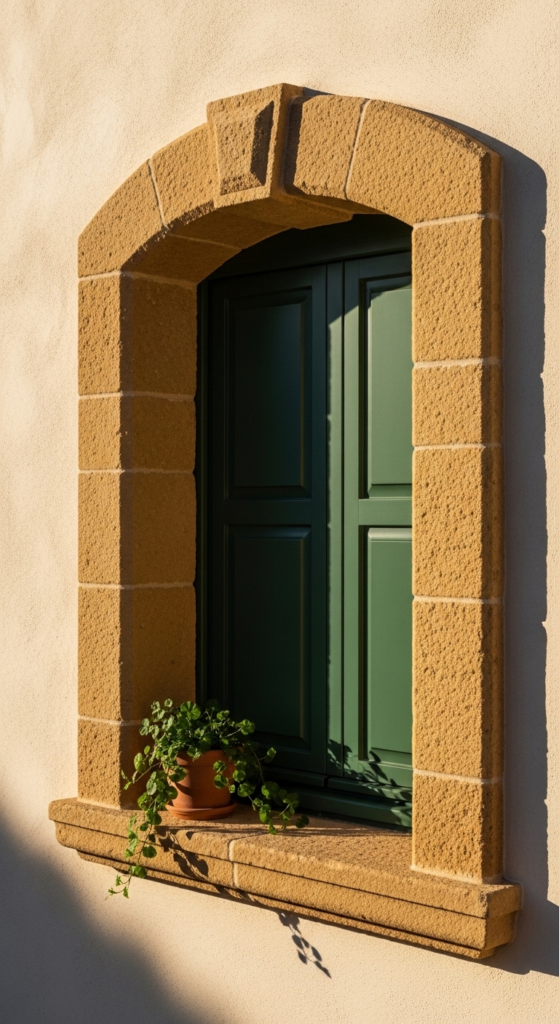
Deep-set windows framed in carved stone, with thick walls that speak of age and solidity — they look out at the world with a quiet confidence that only centuries of standing can give.
In authentic Italian farmhouse construction, the walls are thick. Not the 20cm hollow cavity wall of modern construction, but genuinely thick — 50, 60, even 80cm of solid stone or brick, designed to keep the interior cool in summer and warm in winter through sheer thermal mass. And the wonderful byproduct of these thick walls, from an exterior aesthetic perspective, is the deep window reveal — that beautiful inset effect where the window plane sits well back from the outer wall face, creating a shadow and depth around every window opening that gives the facade enormous visual richness.
Even if your home is built with modern thin walls, you can create the visual impression of thick walls and deep reveals by adding a stone or rendered masonry architrave — a frame — around every window opening, projecting several centimeters forward from the main wall surface. The shadow line this creates does much of the visual work that a genuine deep reveal would provide.
Styling Tips: Frame windows in natural stone — limestone, sandstone, or travertine all work beautifully depending on your regional palette. Keep the stone dressing simple and classical: a flat surround with a slightly projecting keystone at the top of the arch, or a simple rectangular frame with a projecting sill of smooth stone. Paint the window frames themselves in a contrasting color — deep forest green, charcoal grey, or warm walnut — rather than leaving them white. Add a pair of traditional solid panel shutters within the reveal for the full effect.
Perfect for: New builds where deep reveals can be built in from the start, and for renovation projects where window surrounds can be added to upgrade an existing plain exterior.
Color Palette: Warm honey limestone frame, deep forest green window frame, aged cream limewash wall, warm grey stone sill, terracotta floor
14. Lavender Bordered Stone Garden Path
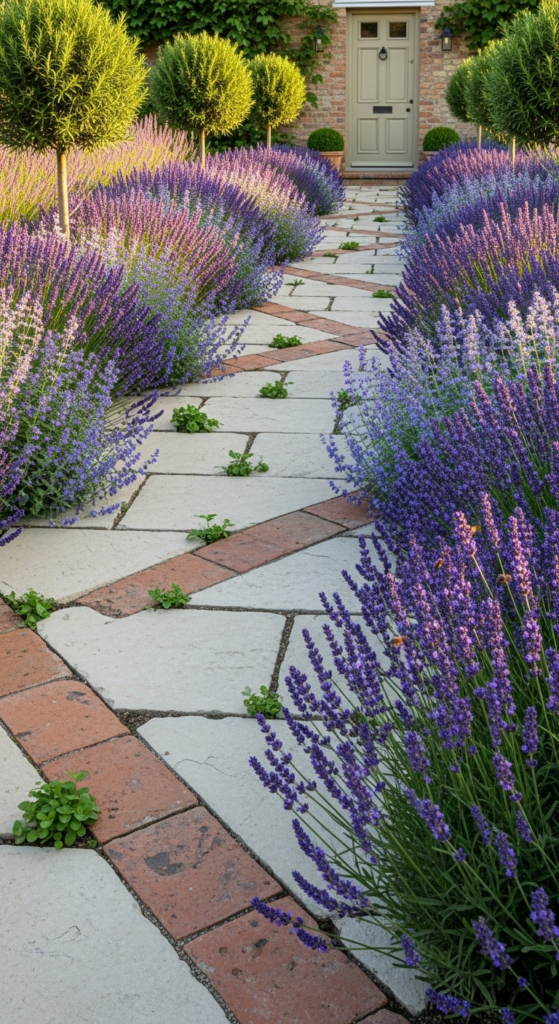
Walking toward your front door along a path edged in flowering lavender, the air around you fragrant and purple and humming with bees — this is what arriving home should feel like.
The garden path leading from the gate or driveway to the front door is one of the most frequently overlooked opportunities in exterior design — and one of the most rewarding when given proper attention. In the Italian farmhouse tradition, this path is typically constructed from irregular limestone or sandstone flags, laid with slightly uneven gaps filled with low-growing herbs, and bordered on both sides by planting that provides color, fragrance, and seasonal interest throughout the year.
Lavender (Lavandula angustifolia or the more architectural Lavandula stoechas) is the quintessential bordering plant for an Italian farmhouse path. It is tough and drought-tolerant — perfectly suited to the well-drained, sunny conditions of Mediterranean-style planting. In midsummer, when it is in full bloom, the border of purple-blue lavender against pale stone flags is one of the most instantly recognizable and endlessly beautiful garden pictures in the world.
Styling Tips: Lay the path flags slightly irregularly — not in a perfectly straight or uniform pattern but with gentle variation in the gap widths and occasional slight unevenness in level. This irregularity is essential to the rustic Italian character. Plant lavender densely on both sides, clipping it lightly after flowering each year to maintain a good bushy shape. Intersperse with standard-trained rosemary bushes at regular intervals for structural punctuation, and add a few clumps of catmint (Nepeta) for additional soft blue-purple color. Edge the lavender borders with reclaimed terracotta edging tiles laid diagonally.
Perfect for: Any farmhouse exterior with a defined approach path, and particularly beautiful in gardens that receive full sun and have free-draining soil.
Color Palette: Pale limestone flag, lavender purple blue, silver grey lavender foliage, deep green rosemary, warm terracotta edging
15. Bougainvillea-Draped Garden Wall in Deep Magenta
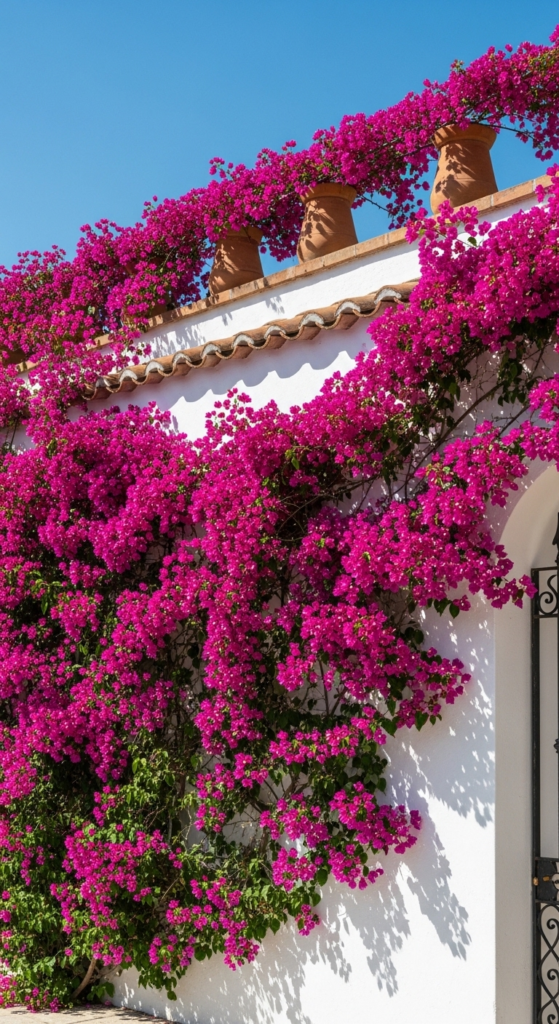
When bougainvillea decides to cover a wall, it does not do so quietly. It blazes. It riots. It turns a simple boundary wall into something that stops traffic and breaks hearts simultaneously.
If wisteria is the romantic dreamer of Italian farmhouse climbing plants, then bougainvillea is the passionate, dramatic one — the one who arrives at a party and owns the entire room within minutes. In the warmer regions of Italy — Sicily, Calabria, the Amalfi coast, coastal Sardinia — bougainvillea covers entire house facades, spills over garden walls, drapes across pergola roofs, and erupts in extraordinary cascades of deep magenta, coral pink, or vivid orange at multiple points throughout the year.
The visual impact of bougainvillea against a warm white or cream wall is operatic in its intensity. Those bracts — technically the colored parts are modified leaves called bracts rather than petals — are a color that almost hurts to look at in bright sunlight. Deep magenta, vivid cerise, electric coral: these are colors that sing, that vibrate, that make everything around them more alive.
Styling Tips: Bougainvillea requires a warm, frost-free or near frost-free climate — in cooler regions, it can be grown in large pots and moved under cover in winter, though it will not achieve the same spectacular coverage. For maximum impact on a wall, train the main structural branches along horizontal wires spaced 40cm apart across the full width of the wall. Allow the flowering stems to hang down freely from the horizontal training. Feed with a potassium-rich fertilizer in spring and early summer to encourage maximum bract production. For a classic Italian color combination, choose deep magenta or hot pink bougainvillea against a brilliant white wall.
Perfect for: Warm climate homes, coastal properties, south-facing walled gardens, and anyone prepared to either brave frost protection or commit to the most spectacular summer display imaginable.
Color Palette: Deep magenta hot pink bougainvillea, brilliant white wall, deep green bougainvillea foliage, warm terracotta tiles, vivid blue sky
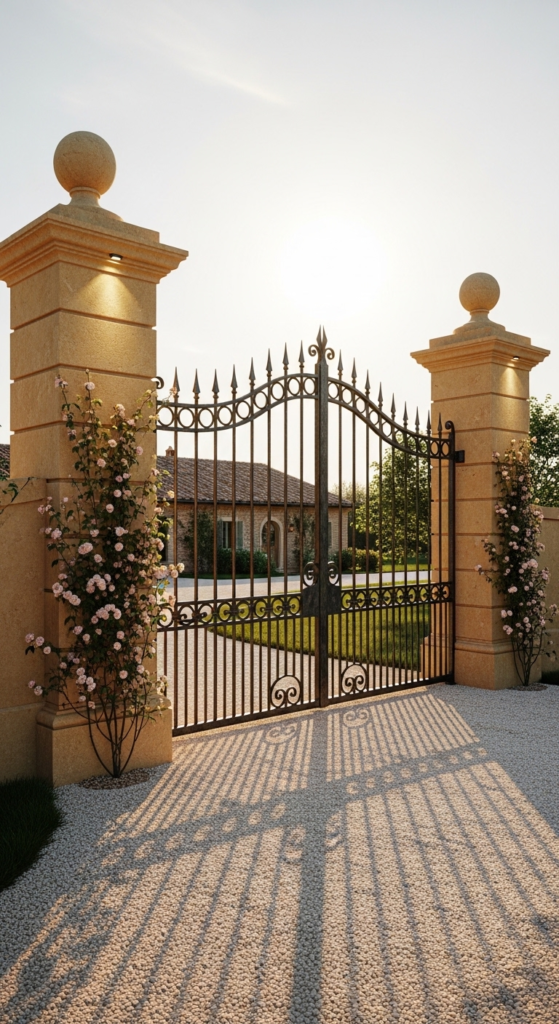
16. Wrought Iron Gate with Stone Pillars at the Property Entrance
A pair of tall stone pillars, a heavy wrought iron gate between them — the moment you pass through it, you understand that this is a home that takes its welcome seriously.
The property entrance — the moment where the public road or street gives way to your private domain — is one of the most important design opportunities of the entire exterior. In Italian farmhouse tradition, this threshold is always clearly and beautifully marked. A pair of generously proportioned stone pillars, topped with carved stone balls, terracotta finials, or stone eagles, frames a set of wrought iron gates that communicate, without ambiguity, that beyond this point lies a private world of beauty and intention.
The wrought iron gate itself is a piece of functional sculpture. Traditionally crafted by blacksmiths, wrought iron gates feature scrollwork, spear-point finials, and decorative panels that cast extraordinary shadows on the ground and wall surfaces in directional light. The way a wrought iron gate looks at golden hour — when the low sun casts its scrolled shadow pattern across a stone-paved entrance — is one of the most beautiful details in the entire vocabulary of Italian farmhouse exterior design.
Styling Tips: Build gate pillars from natural stone — limestone, sandstone, or travertine — and keep their proportions generous. A gate pillar that is too narrow looks mean and wrong. Commission or source wrought iron gates with traditional scrollwork and decorative detailing rather than simple tubular steel gates — the investment in authentic ironwork is repaid tenfold in beauty and longevity. Plant climbing roses or jasmine at the base of the pillars and allow them to climb — within a few years the pillars will appear to be growing out of the garden itself. Install recessed pillar lighting in the tops of the pillars for beautiful low-level evening illumination.
Perfect for: Country properties, larger suburban homes with a defined driveway entrance, and any property where security and beauty need to work together.
Color Palette: Warm golden limestone pillars, aged black wrought iron gate, cream gravel driveway, deep green climbing rose foliage, blush pink rose bloom
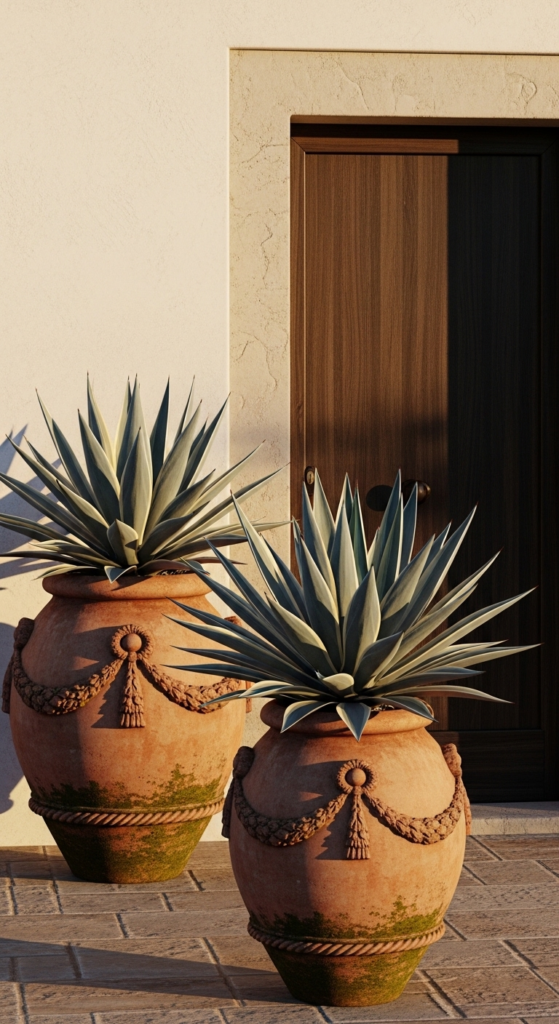
17. Terracotta Urn Planters with Architectural Agave
A terracotta urn, ancient in feeling and generous in scale, with a blue-green agave rising from its center like a piece of living sculpture — simple, striking, and completely unforgettable.
There is a particular kind of restraint that takes confidence — the confidence to place one perfect object in exactly the right position and allow it to be enough. The terracotta urn planter, when it is the right shape and scale and is planted with the right architectural specimen, is exactly that kind of perfect object. It does not need to be part of a crowd. It does not need supplementary decoration. It simply needs to exist in its chosen spot, catching the light, casting its shadow, and being quietly, magnificently itself.
The agave (Agave americana or the more compact Agave attenuata) is one of the most architecturally spectacular plants for this purpose. Its symmetrical rosette of thick, sculptural, blue-grey leaves — often edged in cream or yellow — has an almost geometric perfection that looks extraordinary against the warm terracotta of a clay urn. A large agave in a generous terracotta urn, positioned flanking a front door or at the corner of a terrace, is one of the simplest and most effective exterior styling moves you can make.
Styling Tips: Choose terracotta urns of substantial scale — the Italian tradition favors large, generous vessels rather than modest ones. Look for urns with traditional decorative detailing: rope-twist rims, applied swag decoration, or classical lion mask handles. Age new terracotta urns quickly by painting them with a diluted yogurt solution and leaving them outside in a damp shaded spot — within a few weeks, moss and algae will begin to colonize the surface. Use well-draining gritty compost for agave planting. In pairs, flanking a front door or gateway, the effect is particularly powerful.
Perfect for: Entrance areas, terrace corners, loggia entrances, and any exterior space that needs a strong sculptural focal point with year-round architectural presence.
Color Palette: Warm aged terracotta urn, blue-grey agave, cream agave leaf margin, warm stone paving, dusty amber afternoon light
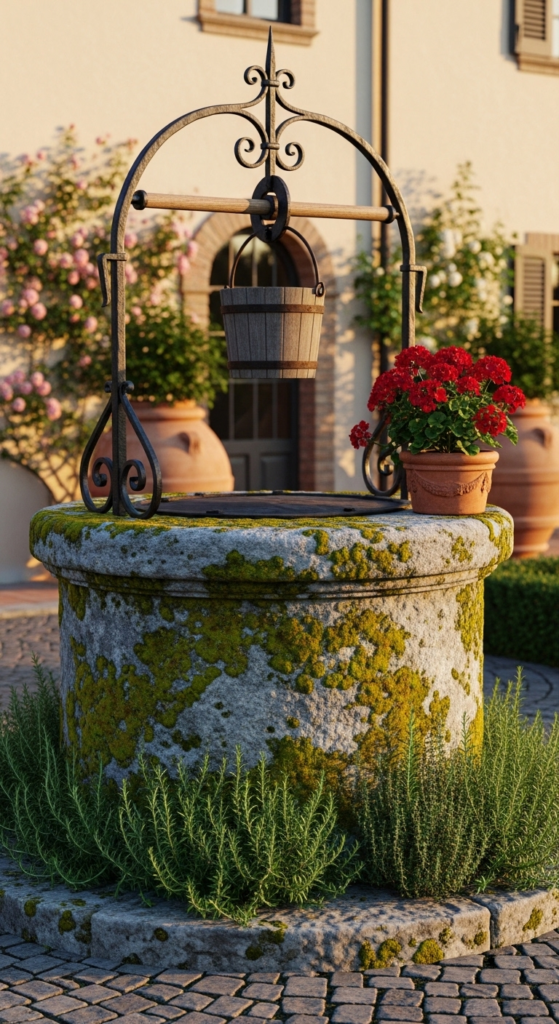
18. Rustic Stone Well as a Garden Focal Point
An old stone well in the garden, thick with moss and years, a wrought iron wheel still turning — it is not a water source anymore. It is a poem written in stone.
Every element of the traditional Italian farmhouse was originally functional — born from necessity, from the demands of agricultural life, from the need to sustain a household through drought and abundance alike. The stone well was as essential as any element of the farm — the source of water for the household, for the animals, for the garden. Today, functioning wells are no longer necessary, but their presence in an Italian farmhouse garden has taken on a new and perhaps even more powerful purpose: they are the most evocative of all garden ornaments, the most deeply connected to the history and character of the place.
A carved stone well — cylindrical, perhaps 70 to 90cm in diameter and 80cm high, with a wrought iron winding frame above — positioned in a garden courtyard or at the meeting of two garden paths, immediately becomes the focal point of the entire space. It is the object your eye finds first and returns to repeatedly. It is the thing visitors photograph. And it ages more beautifully than almost anything else you can place in a garden.
Styling Tips: Source an antique or reclaimed stone well surround from an architectural salvage dealer — these appear regularly and are generally less expensive than you might expect. Alternatively, commission a stone mason to carve a new one from aged limestone. Plant prostrate rosemary or creeping thyme around the base of the well, allowing it to soften the base edge. Add a terracotta pot with geraniums on top of the well coping for a charming detail. Position the well where it can be seen from a key viewpoint — from the loggia, from a main window, or from the garden gate.
Perfect for: Enclosed garden spaces, courtyard gardens, and any farmhouse garden seeking a timeless, deeply characterful focal point.
Color Palette: Aged grey limestone well, wrought iron black wheel frame, green moss patina, creeping thyme, warm terracotta geranium pot
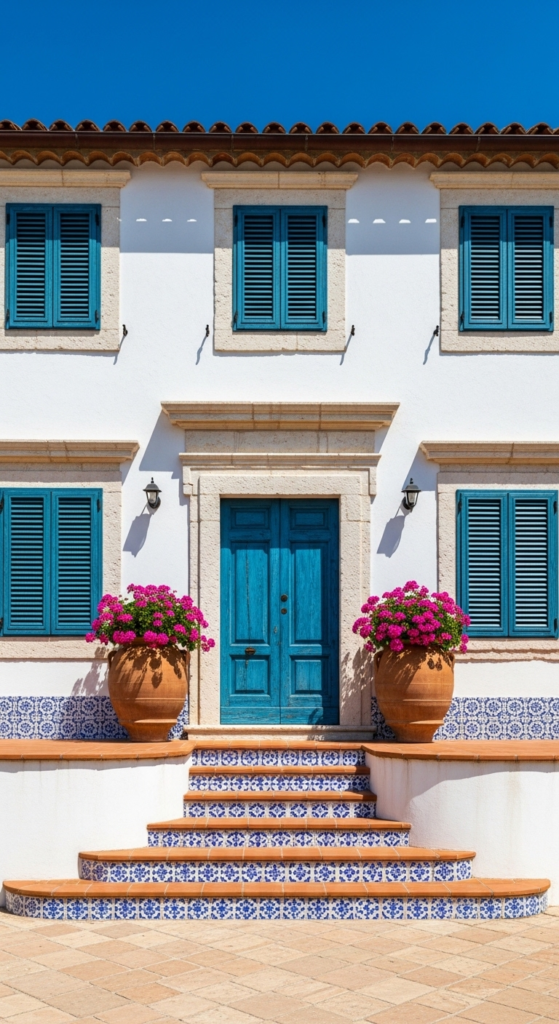
19. Whitewashed Stone Exterior with Bright Blue Accents
White walls and that particular shade of blue — not navy, not royal, but something between sky and sea — this is the Mediterranean at its most joyful and most purely itself.
While the warm cream and terracotta tones of Tuscan farmhouse style are the most internationally recognized expression of the Italian farmhouse aesthetic, there is another equally beautiful regional tradition — particularly associated with the south of Italy, with Sicily, Puglia, and the islands — that uses brilliant white and vivid blue in a combination that is pure, joyful, and impossible to look at without smiling.
The tradition of whitewashing stone buildings is ancient and practical — the lime-based whitewash reflects heat, inhibits insects, and has a natural antiseptic quality. In the whitewashed villages of southern Italy, these practical walls are then accented with the deep blue-green of painted doors and shutters — a blue that references the sea visible from almost every point in the landscape, the sky overhead in the long hot summer, the glazed ceramic tiles that decorate fountains and floor surfaces throughout the region.
Styling Tips: Use a true mineral limewash for the walls — brilliant white with a slight warm undertone, applied in the traditional manner. For the accent color, choose a muted but rich blue-green — something in the tradition of Majorelle blue but with slightly more grey in it, more aged and faded. “Mediterranean Blue,” “Aegean Sea,” “Sicilian Blue,” or “Cerulean Sage” are all directions to explore. Paint every accent element — shutters, front door, gate, window frames — in this same unified blue. Add bright ceramic tiles in blue and white patterns on step risers, around the front door frame, or on external walls as decorative panels.
Perfect for: Coastal homes, southern or warm-climate properties, and anyone who wants an exterior that feels joyful, sunny, and uniquely personal while remaining within the Italian farmhouse tradition.
Color Palette: Brilliant white limewash, Sicilian blue-green shutters, deep blue ceramic tile accents, warm terracotta step tiles, vivid blue sky
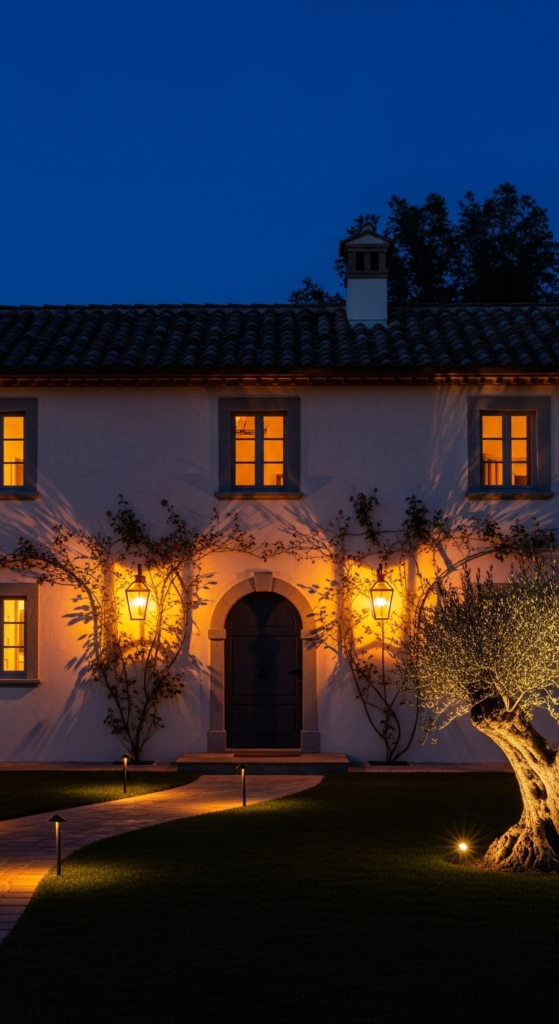
20. Evening Illuminated Farmhouse Facade with Lantern Lighting
When the sun goes down and the lanterns come on — warm amber light spilling across stone and plaster — the Italian farmhouse becomes something almost unbearably beautiful in the dark.
We spend so much time thinking about how our homes look in daylight that we often forget the extraordinary opportunity of the nighttime exterior. And the Italian farmhouse, with its combination of warm plaster walls, textured stonework, climbing plants, terracotta tiles, and wrought iron details, is one of the most beautifully illuminated building types in the world when the right exterior lighting is applied.
The key to Italian farmhouse exterior lighting is to use warm light sources — genuinely warm, amber-toned light, in the 2,000K to 2,700K color temperature range — and to use them to graze the wall surfaces at a low angle rather than flooding the facade with flat, even light. When a low-mounted wall light throws warm amber light upward or sideways across a limewash plaster surface, it catches every texture variation, every undulation in the plaster, every shadow cast by climbing rose stems or vine branches — and the result is a wall surface that looks three-dimensional, alive, and extraordinary.
Styling Tips: Use wrought iron wall lanterns with warm amber glass panels rather than clear glass — the amber glass colors the light beautifully. Mount them at a lower height than you might initially think appropriate — 1.5 to 1.8 meters from ground level rather than the standard 2.2 meters, so the light source itself is at human scale and the upward and downward throw of light is maximized. Add low-level path lighting along garden paths. Use uplighting at the base of the main tree or climber specimens. Never use cool white or daylight-spectrum bulbs on a farmhouse exterior — they destroy the entire character of the scene instantly.
Perfect for: Every Italian farmhouse exterior, absolutely without exception. Good exterior lighting is not an optional luxury — it is the finishing touch that makes everything else twice as beautiful.
Color Palette: Warm amber lantern light, deep charcoal wrought iron lantern, warm cream limewash wall in amber shadow and light, dark night sky, deep green climbing plant silhouettes
Save These Ideas — Your Dream Exterior Is Waiting for You
Pin this now. Come back to it often. Let yourself be inspired every single time.
There you have it — twenty Italian farmhouse exterior ideas that cover every element of this timeless, deeply beautiful aesthetic, from the grand gestures of cypress-lined driveways and arched loggias to the intimate details of wrought iron lanterns and geranium-filled window boxes.
The Italian farmhouse exterior is not one thing. It is a philosophy, a layering of textures and materials and plants and light that builds up over time into something greater than the sum of its parts. You don’t have to do everything at once. You can start with a can of limewash paint and a pair of terracotta urns and a packet of climbing rose seeds, and you will already be on your way. Every addition, every detail, every plant that grows a little more each year takes you further into this world.
The most important thing to remember is this: the Italian farmhouse aesthetic rewards patience and authenticity. It does not like shortcuts or synthetic substitutes. Give it real materials, real plants, and real time — and it will give you back a home that is genuinely, lastingly beautiful. A home that improves with every passing season. A home that feels, from the very first glance, like it has always been there.
So go ahead and save this post to your Pinterest board. Share it with the person you’re going to build that dream home with. Come back to it when you need a reminder of what you’re working toward. And most importantly — start. Even the most magnificent Italian farmhouse exterior began with a single decision to make something beautiful.
Buona fortuna — and may your walls glow like honey in the afternoon sun.
Loved these ideas? Save this pin to your Dream Home or Exterior Design board so you never lose it!