
There’s something about a rustic garden that feels like stepping into a storybook — weathered wood, trailing vines, the soft clink of terracotta pots catching the afternoon light. It’s the kind of outdoor space that doesn’t try too hard, yet somehow looks effortlessly beautiful at every turn. Whether you have a sprawling backyard or a tiny courtyard, rustic garden decor has a way of making every corner feel lived-in, loved, and full of character. These 23 rustic garden decor ideas are packed with real, actionable inspiration you can actually use — from one bold statement piece to a full garden transformation. Let’s explore every one of them.
Why Rustic Style Works So Well in the Garden
Rustic garden decor draws its power from imperfection. Unlike polished, high-maintenance garden styles, the rustic aesthetic actively celebrates aged wood, chipped paint, moss-covered stone, and the kind of patina that only time can create. That honest, unpretentious quality is exactly what makes it so enduringly appealing — it feels like it belongs to the earth rather than fighting against it.
The core palette leans into nature: warm terracotta, faded sage green, chalky white, sun-bleached grey, and the deep brown of untreated timber. Materials like reclaimed wood, wrought iron, galvanized metal, and hand-thrown ceramics are the building blocks of this style. Texture layering is everything — a smooth stone path next to rough-hewn raised beds, linen cushions beside an iron lantern.
Right now, rustic garden decor is experiencing a genuine cultural renaissance. Pinterest searches for “cottage garden ideas” and “farmhouse garden decor” have surged, driven by a collective hunger for outdoor spaces that feel restorative and human-scaled. People want beauty without rigidity.
The best part? You don’t need acres of land. A single vintage watering can, a cluster of mismatched terracotta pots, or a reclaimed wood planter can instantly shift the entire mood of even the smallest balcony or patio corner.
Weathered Wood Raised Garden Beds With Stone Edging
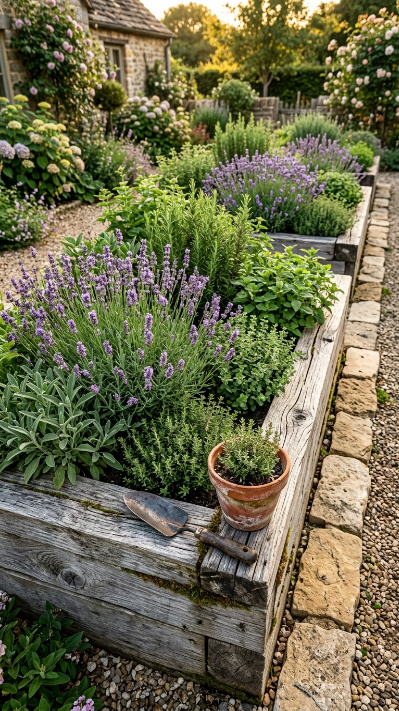
Vibe: This is the garden equivalent of a well-worn leather chair — substantial, grounding, and instantly at home in its surroundings.
What makes it work: Weathered cedar naturally takes on a silver-grey tone that harmonizes beautifully with stone, soil, and foliage without competing. The rough limestone edging adds an irregular, hand-placed quality that feels genuinely old-world rather than kit-built. Together, the two textures create a layered ground-level composition that photographs brilliantly.
How to achieve it: Source reclaimed cedar boards from salvage yards or let new cedar weather naturally for one season before sealing lightly with linseed oil. Pair with irregular fieldstone or limestone for edging rather than uniform bricks.
💡 Skip the expensive stone edging — tumbled concrete pavers aged with a diluted yogurt wash grow moss within weeks.
Vintage Galvanized Metal Planters Clustered at the Entry
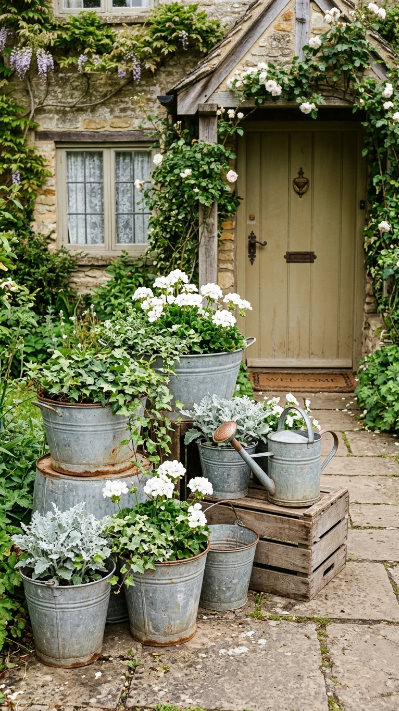
Vibe: Generous, slightly ramshackle, and completely irresistible — the kind of entry that makes visitors slow their step before they’ve even knocked.
What makes it work: The key is contrast in scale. Clustering a tall watering can beside a wide shallow tub and a small bucket creates visual rhythm without symmetry — and asymmetry is the hallmark of authentic rustic style. The matte galvanized finish reflects light softly and complements virtually every plant color.
How to achieve it: Hunt for galvanized pieces at flea markets, farm supply stores, or online vintage shops. Drill drainage holes in the base of any piece you’ll plant in. Group in odd numbers — threes and fives always photograph better than pairs.
Reclaimed Wood Garden Gate With Trailing Roses
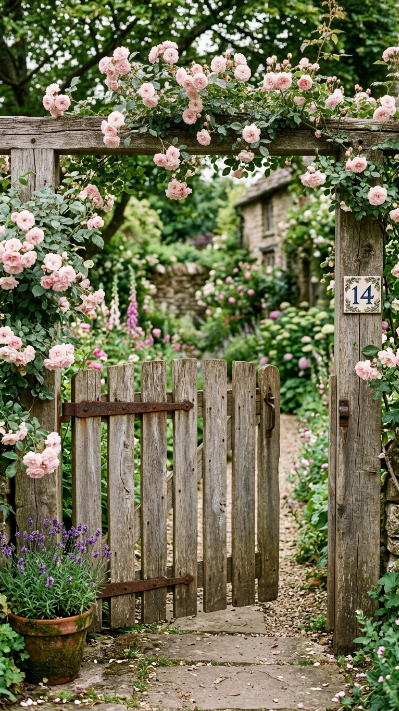
Vibe: This is every countryside dream condensed into a single frame — old wood, wild roses, the promise of something beautiful beyond.
What makes it work: The deliberate imperfection of mismatched plank widths and visible joinery gives this gate genuine character. Blush climbing roses soften the roughness of the wood in the most perfect color pairing — romantic without being saccharine.
How to achieve it: Commission a local carpenter to build a simple vertical-plank gate from reclaimed pallet wood or salvaged fence boards. Plant a climbing rose (‘Cecile Brunner’ or ‘New Dawn’ are both reliably vigorous) at the base and train early with soft garden twine.
💡 If you can’t plant climbers, attach a wire trellis panel to the gate face and grow an annual jasmine for fragrance and visual fullness within one season.
Stone Birdbath Surrounded by Wild Cottage Plantings
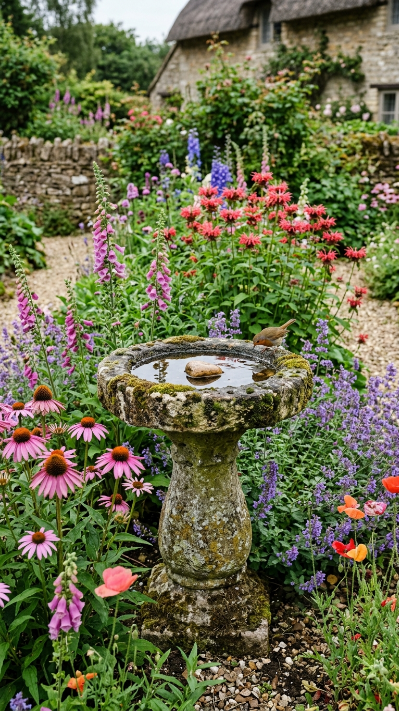
Vibe: Still and somehow alive at the same time — a focal point the garden seems to have grown around organically.
What makes it work: A birdbath elevated on a pedestal draws the eye upward and creates a vertical moment in an otherwise horizontal planting scheme. The lichen and moss on cast stone signal age and permanence, lending instant authority to even a newly planted garden bed.
How to achieve it: Accelerate moss growth by painting the stone with a 50/50 blend of plain yogurt and water, then placing it in partial shade. Surround with a ‘wild’ plant palette of echinacea, salvia, and verbena for maximum cottage effect.
Rustic Lantern Pathways With River Stone Borders
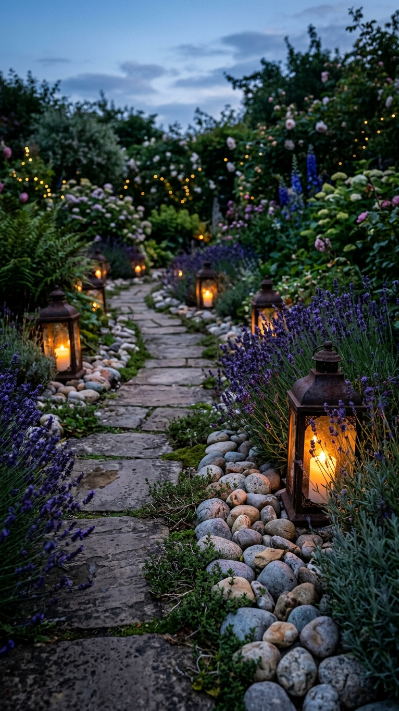
Vibe: Walking this path at dusk feels like something from a fairy tale — all warmth and shadow and the faint scent of lavender.
What makes it work: The combination of hard iron and smooth river stone creates a pleasing tactile contrast, while the low placement of lanterns keeps the lighting intimate rather than clinical. Solar-powered lanterns in a vintage iron style eliminate wiring entirely.
How to achieve it: Set river stone borders by laying them in a shallow trench of dry sand — no mortar needed. Plant creeping thyme between path stones for fragrance, texture, and weed suppression simultaneously.
💡 Solar-powered Edison lanterns from garden centres now look nearly identical to real flame lanterns — check the flame-flicker setting for the most convincing effect.
Wooden Barrel Planter With Trailing Herbs
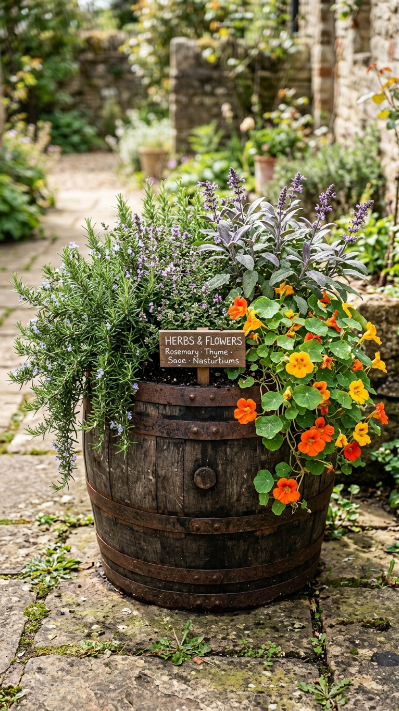
Vibe: Practical and gorgeous — the kind of planter that perfumes the air every time you brush past.
What makes it work: Oak barrel halves have extraordinary visual weight that anchors a patio space far better than standard plastic pots. The curved form softens hard paving beautifully. Mixing culinary herbs with edible flowers like nasturtiums gives the planting a wild, abundant quality while keeping it genuinely useful.
How to achieve it: Source barrel halves from wine merchants, farm supply stores, or online. Line with a thick hessian layer before filling with free-draining compost. Plant trailing varieties at the edges and taller, structural herbs like rosemary at the center.
Antique Iron Garden Bench Beneath a Fruit Tree
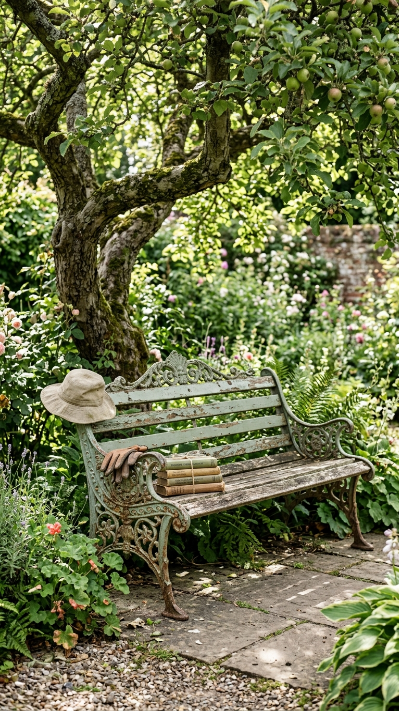
Vibe: A place to sit for just ten minutes that somehow becomes an entire afternoon.
What makes it work: Faded sage green against the rough brown bark of an old fruit tree is one of the most naturally harmonious garden color pairings. The ornate ironwork reads as a counterpoint to the organic wildness of the tree — structured detail within a loose, natural setting.
How to achieve it: Search architectural salvage dealers for antique cast iron benches — they appear regularly and are far more affordable than reproduction pieces. If painting, use Farrow & Ball’s “Mizzle” or “Sage” for an authentically aged tone.
Terracotta Pot Collection on Reclaimed Wood Shelving
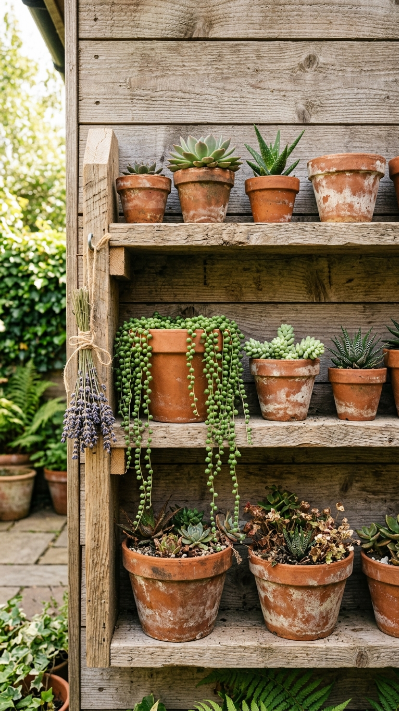
Vibe: The garden’s version of a perfectly curated bookshelf — humble objects arranged with quiet intention.
What makes it work: Terracotta’s warm orange-red is one of the few colors that becomes more beautiful with age and weathering — the white mineral blooms and darkening from moisture are features, not flaws. Staggering pot sizes creates natural visual hierarchy without overthinking the arrangement.
How to achieve it: Speed up the aged terracotta look by soaking new pots in water, then leaving outdoors in partial shade for several weeks. Display on shelves made from reclaimed scaffold boards, which are widely available cheaply from timber merchants.
💡 A single coat of diluted white vinegar on new terracotta instantly creates an aged, mineral-bloom effect.
Moss-Covered Stone Wall With Espaliered Fruit
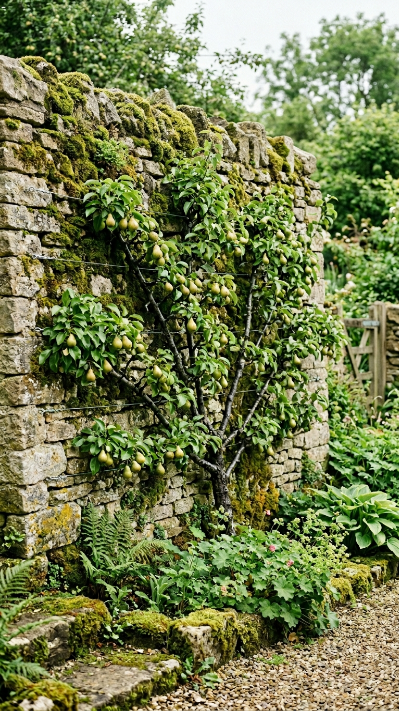
Vibe: This wall looks like it’s been here for two centuries — and somehow that makes everything growing against it look more precious.
What makes it work: Espaliering a fruit tree against a stone wall is both supremely practical (the wall retains heat, advancing fruit ripening) and visually extraordinary — the geometric discipline of trained branches against the random texture of stacked stone creates electric contrast.
How to achieve it: Choose a self-fertile pear or apple variety (‘Doyenné du Comice’ or ‘Egremont Russet’) and plant 20cm from the wall base. Train horizontal tiers using bamboo canes and soft garden twine, pruning to a fan or cordon shape each winter.
Wildflower Meadow Patch With a Driftwood Border
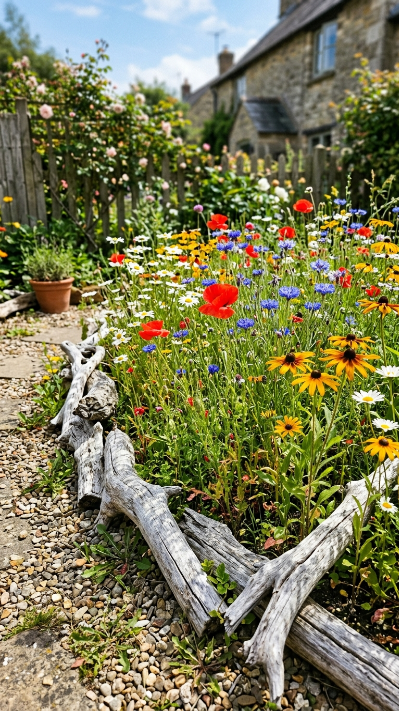
Vibe: Controlled wildness — a burst of pure color that looks like it seeded itself but was secretly planned.
What makes it work: A driftwood border is the perfect rustic framing device — it defines the meadow patch without imposing any rigidity. The grey-silver of weathered wood makes every flower color sing against it, acting almost as a neutral ground for the color composition above.
How to achieve it: Sow a native wildflower seed mix directly onto bare soil in autumn or early spring — no need to dig deep, just scarify the surface. Edge with driftwood pieces collected from beaches or bought from craft suppliers.
Hanging Wicker Lanterns in a Garden Canopy
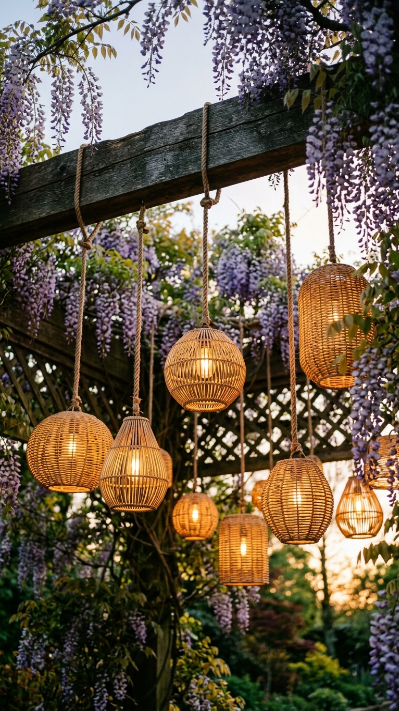
Vibe: Dining under this canopy at dusk feels like the best dinner party you’ve ever hosted.
What makes it work: Varying lantern heights prevents the visual monotony of a flat light installation and creates a sense of movement and depth. Wicker’s organic texture absorbs and softens artificial light in a way that metal or glass never quite achieves — the glow through the weave is particularly warm.
How to achieve it: Hang lanterns from a pergola using natural jute rope at three distinct lengths — roughly 30cm, 60cm, and 90cm drops — in groups of three. Use warm-white LED Edison bulbs at 2700K for the most flattering, flame-like quality.
💡 Outdoor-rated battery-operated Edison bulbs mean zero wiring — simply swap batteries at the start of each season.
Rustic Garden Potting Bench With Open Pegboard Storage
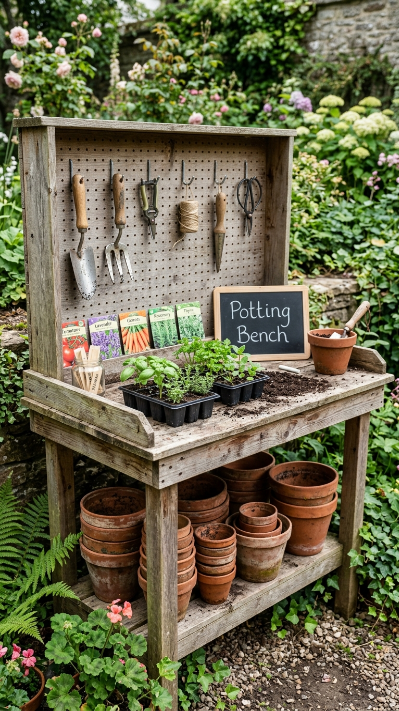
Vibe: Beautifully functional — the kind of workspace that makes you want to spend an entire Saturday morning in the garden.
What makes it work: A potting bench transforms everyday gardening from a scramble into something pleasantly intentional. The pegboard back is the key feature — tools hung visibly are accessible immediately and contribute to the visual character of the bench rather than hiding in a drawer.
How to achieve it: Build a simple potting bench from reclaimed scaffold boards and basic lumber — many plans are available freely online. Mount a sheet of galvanized pegboard as a backsplash and equip with S-hooks for tools. Rough up all surfaces with coarse sandpaper before oiling for an instantly aged finish.
Climbing Hydrangea on a Weathered Trellis Panel
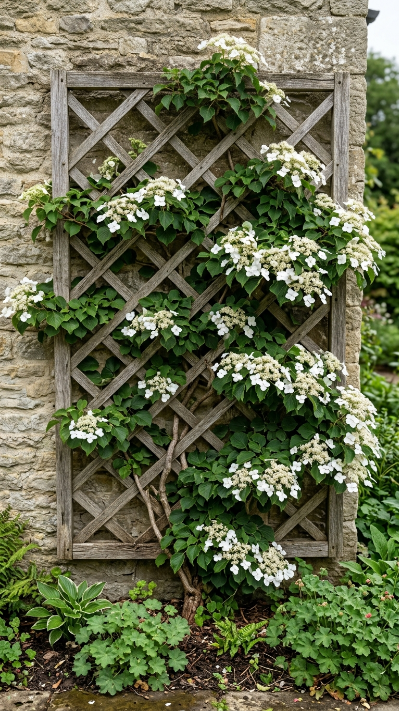
Vibe: Extravagant in the most unassuming way — a wall transformed into something genuinely breathtaking.
What makes it work: Climbing hydrangea (Hydrangea anomala petiolaris) is one of the few vigorous climbers that thrives on a north-facing wall, making it invaluable in tricky spots. The lacecap flower form is finer and more airy than the mophead varieties — it reads as elegant rather than heavy against the rustic trellis.
How to achieve it: Fix a weathered hardwood trellis panel at least 5cm from the wall to allow good air circulation. Plant climbing hydrangea in well-amended soil — it establishes slowly for two years, then grows with remarkable enthusiasm. No regular tying-in required once established.
Stacked Vintage Crates as Garden Side Tables
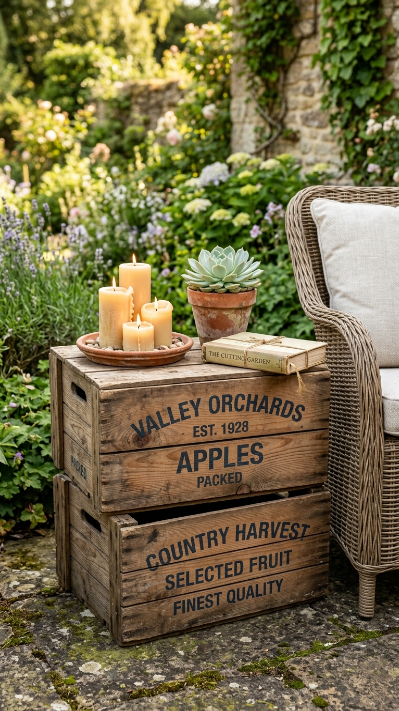
Vibe: Nothing here costs much, and somehow the whole arrangement looks like it belongs in an editorial spread.
What makes it work: Stacking crates at a slight offset angle — rather than perfectly aligned — creates a more dynamic, natural silhouette. The varied interior spaces of the crates (open grid, slatted face) add layered texture that a standard side table simply cannot offer.
How to achieve it: Source vintage wooden fruit or wine crates at markets, antique fairs, or online. Seal lightly with exterior varnish thinned 30% with white spirit to protect without hiding the natural wood character. Stack with the bottom crate closed-side up for stability.
💡 A sheet of tempered glass cut to size rests perfectly on top for a practical surface — any local glazier will cut to measure inexpensively.
Handmade Willow Hurdle Fencing With Cottage Plantings
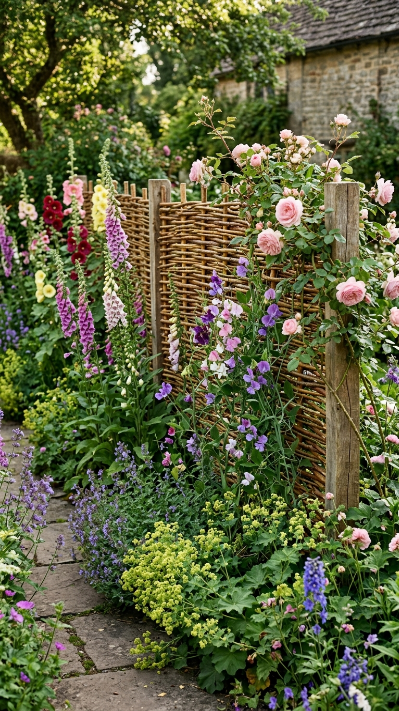
Vibe: This is garden-making at its most elemental — woven wood, climbing flowers, and the feeling that the whole thing grew rather than was installed.
What makes it work: Willow hurdle panels have extraordinary rustic texture — the woven pattern catches light differently throughout the day, moving from warm gold to deep brown. Their semi-permeable structure lets air through, which cottage plants love, while still defining boundaries clearly.
How to achieve it: Buy willow hurdle panels from garden suppliers or estate fencing companies — they come in standard widths of 90cm to 180cm. Drive pointed timber posts 45cm into the ground and wire panels to them. Plant sweet peas at the base in autumn for self-weaving flowering coverage by summer.
Copper Garden Watering Cans as Decorative Accents
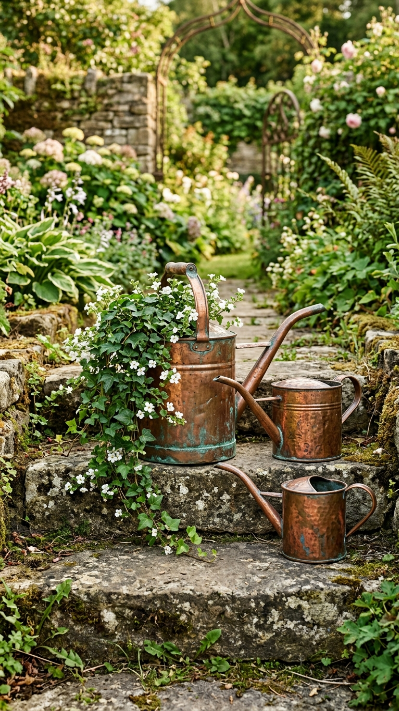
Vibe: Functional objects elevated to art — the patina does all the work.
What makes it work: Copper is one of the most naturally beautiful metals in a garden context — it ages from bright penny to deep verdigris, and every stage of that journey is visually interesting. Grouped in three sizes on steps, copper watering cans create a vignette that reads as curated without feeling overthought.
How to achieve it: Find copper watering cans from antique dealers, or buy new and accelerate patina by wiping with a salt-and-vinegar solution and leaving outdoors through rain. The contrast between bright and aged areas on the same piece is the most attractive outcome.
Rustic Timber Pergola Draped With Wisteria
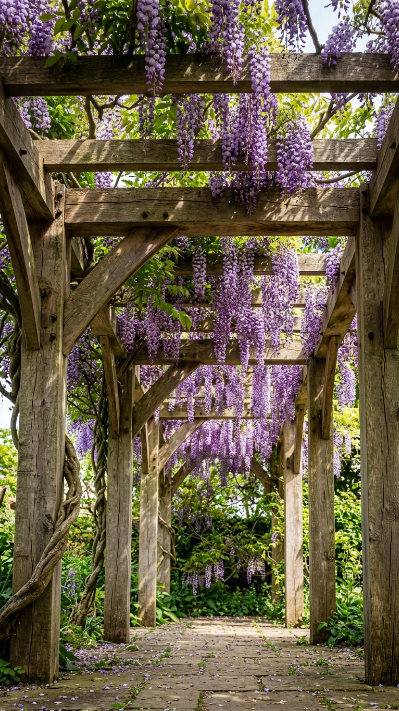
Vibe: Standing beneath this in May, breathing in the wisteria, is one of the most reliably transcendent garden experiences available.
What makes it work: A pergola built from rough-sawn oak rather than smooth lumber carries immediate rustic weight — the visible toolmarks and uneven grain make it feel hand-crafted. Wisteria is the perfect rustic climber: twisting, ancient-looking trunks that only improve with age, and a flowering display of absolutely stunning drama.
How to achieve it: Build or commission a pergola from green oak — it will lighten to silver-grey naturally over two to three years without treatment. Plant Wisteria sinensis ‘Amethyst’ or ‘Prolific’ at the base and prune twice yearly (August and February) for the best flowering.
💡 Buy a grafted wisteria rather than a seedling — it will flower three to five years earlier, which matters enormously with a slow-growing specimen.
Aged Terra Cotta Strawberry Tower for a Kitchen Garden Corner
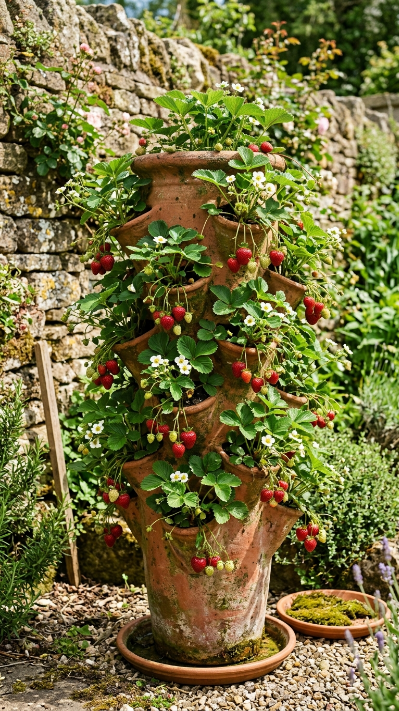
Vibe: Abundance in vertical form — the garden equivalent of a well-stocked larder.
What makes it work: The layered architecture of a strawberry tower gives visual interest at every height simultaneously — trailing runners drape, flowers dot white across the surface, and red fruits appear in clusters throughout. An aged terracotta version brings all that productivity within a beautifully weathered, rustic shell.
How to achieve it: Choose a ‘everbearing’ strawberry variety like ‘Albion’ or ‘Mara des Bois’ for the longest fruiting season. Fill the tower with a mix of multipurpose compost and perlite for excellent drainage. Water from the top and let gravity distribute moisture through each pocket.
Reclaimed Brick Garden Path With Moss Between Joints
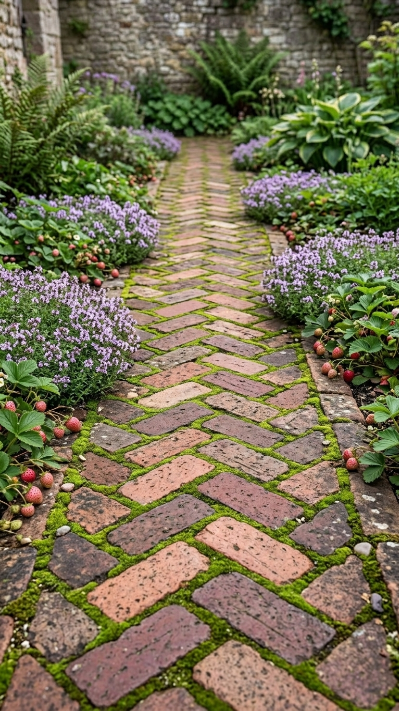
Vibe: Every step feels like walking through something that has been quietly beautiful for a hundred years.
What makes it work: Reclaimed brick varies in color from batch to batch — deep reds, salmons, even near-purples — and that variation creates an organic, painterly surface underfoot that new uniform brick never achieves. Moss-filled joints soften the geometry and reinforce the ancient quality beautifully.
How to achieve it: Source Victorian or Edwardian reclaimed bricks from demolition suppliers — specify ‘paving grade’ for outdoor use. Lay on a sharp sand bed with a 3mm joint gap to encourage moss. Apply a yogurt wash to joints to accelerate moss colonization in the first season.
Woven Seagrass Outdoor Rug Under a Garden Dining Table
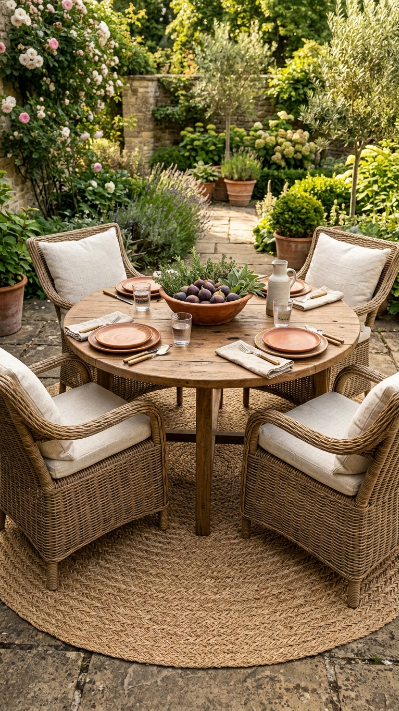
Vibe: An outdoor dining room that makes you forget you’re outside — in the very best way.
What makes it work: A rug beneath an outdoor dining set instantly defines the space as a room — it gives the arrangement permanence and intention. Seagrass is the ideal rustic outdoor textile: its natural colour and weave pattern harmonize with virtually every garden material, and it’s genuinely weather-resistant.
How to achieve it: Choose a seagrass rug at least 30cm wider on all sides than the table diameter to accommodate chairs pushed back. Look for UV-stabilized outdoor seagrass specifically — standard indoor seagrass fades and deteriorates outdoors within one season.
💡 A non-slip rug pad beneath extends outdoor rug life significantly and prevents dangerous sliding on hard surfaces.
Driftwood Garden Sculpture as a Natural Focal Point
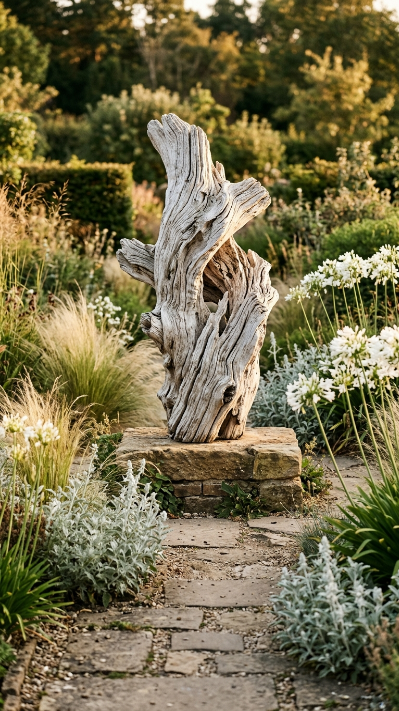
Vibe: Something the sea made over decades — placed here to anchor this specific corner of the garden.
What makes it work: Large-scale natural sculpture gives a garden a gallery-like quality without any artifice. Driftwood is particularly powerful because its form is entirely unpredictable and unrepeatable — and that unique quality is visible immediately to anyone looking at it. Pairing with silver-toned foliage plants creates tonal harmony.
How to achieve it: Collect large pieces from beaches after storms (check local regulations), or purchase from specialist wood dealers. Mount on a flat stone or concrete pad with a stainless steel threaded rod embedded in the base for stability. Seal with matte exterior varnish to prevent rapid re-weathering inland.
Rustic Garden Arch With Sweet Peas and Climbing Beans
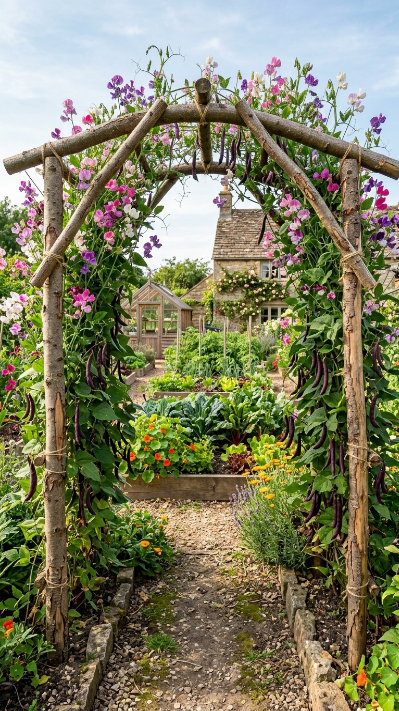
Vibe: Every vegetable garden deserves an entrance this beautiful — purposeful and floriferous in equal measure.
What makes it work: A rustic arch made from natural hazel or chestnut poles (known as ‘coppiced’ material) brings an irreplaceable handmade quality — no two are ever symmetrical, and that imperfection is the point. Sweet peas and climbing beans make ideal companions: one provides fragrance and colour, the other provides harvest.
How to achieve it: Source hazel coppice poles from woodland craft suppliers or cut your own from established hazel shrubs after leaf fall. Construct a simple A-frame arch by crossing pairs of poles at the apex and securing with galvanized wire. Sow sweet pea seeds in autumn for a head start, and climbing beans in late spring.
Antique Garden Cloche Collection on a Stone Ledge
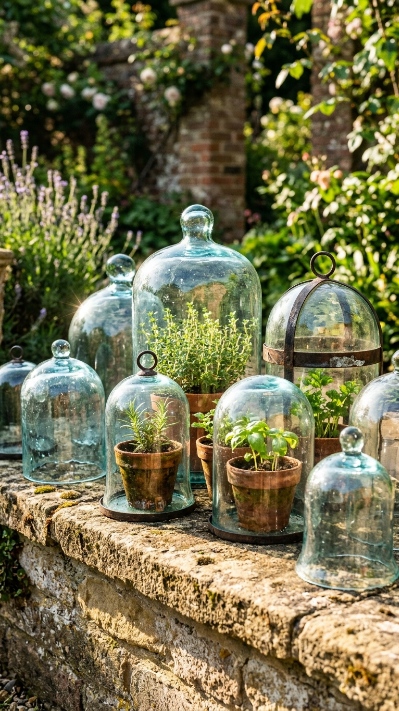
Vibe: Objects with genuine history, doing what they were made to do — and looking impossibly romantic in the process.
What makes it work: Vintage glass cloches catch and play with light in a way that modern plastic or acrylic never can — the slight irregularities in the glass create refractions and prismatic effects that are genuinely beautiful. Arranged in graduated sizes, they create a compelling collection with strong visual rhythm.
How to achieve it: Source vintage glass cloches at antique fairs, specialist garden antique dealers, or salvage yards — French market cloches are particularly beautiful. In a pinch, modern reproductions in thick glass work well. Group in odd numbers and vary sizes dramatically for the best effect.
💡 Even a single antique glass cloche on a potting bench transforms the aesthetic of an entire garden corner instantly.
Rustic Garden Potager With Wicker Obelisks
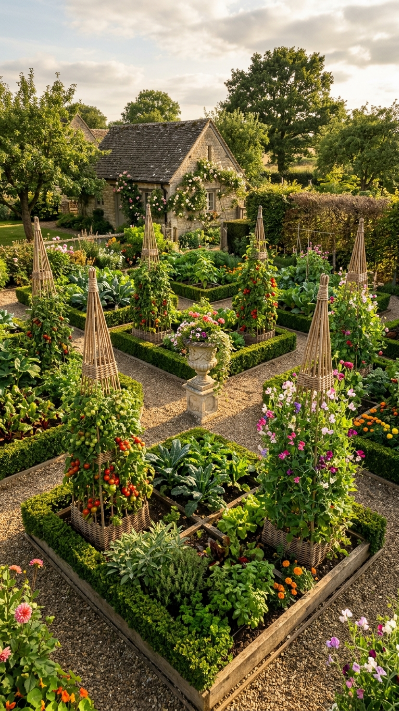
Vibe: The potager — French kitchen garden — is the original idea that you can grow food AND have a beautiful garden simultaneously, and this version proves it definitively.
What makes it work: Wicker obelisks provide instant vertical structure within raised beds while keeping the whole scheme firmly in the rustic, artisanal register. The formal geometry of the bed layout contrasts brilliantly with the unruly abundance of what grows within — that tension is the defining quality of a great potager.
How to achieve it: Start with a simple four-bed layout of 1.2m x 2.4m beds (reachable from all sides without stepping in). Place a wicker obelisk in each bed for height and structure. Grow a combination of ornamental and productive plants — climbing beans, sweet peas, calendula, tomatoes, and kale.
How to Start Your Rustic Garden Decor Transformation
Begin with one anchor piece rather than trying to transform everything simultaneously. A reclaimed wood raised bed, a stone birdbath, or a cluster of aged terracotta pots will do more for your garden’s atmosphere than a dozen small miscellaneous additions scattered without intention.
The most common mistake in rustic garden styling is buying everything new. This style genuinely requires aged, weathered, or imperfect objects — so embrace the flea market, the salvage yard, and the end-of-season clearance. New items can be artificially aged with the techniques described throughout this guide, but found objects with genuine history are always worth seeking first.
Budget-friendly entry points include terracotta pots (extremely inexpensive and age beautifully), reclaimed bricks for edging or paths (often available cheaply from demolition sites), and seed-grown wildflowers (a packet of mixed native seeds costs almost nothing and transforms large areas dramatically).
Give yourself at least one full growing season before judging the results. Rustic gardens improve with time — the moss fills in, the climbers establish, the wood weathers — and what looks sparse in April will look extraordinary by August. Patience is genuinely part of the process.
Frequently Asked Questions
What are the best plants for a rustic garden decor style?
The most compatible plants for rustic garden decor are those that look beautiful slightly dishevelled — cottage garden perennials like foxgloves, echinacea, salvia, and alliums are ideal. Climbing roses (particularly old-fashioned varieties like Rosa ‘Gertrude Jekyll’ or Rosa ‘Albéric Barbier’), wisteria, and sweet peas add the romance essential to this style. Herbs including lavender, rosemary, and thyme contribute fragrance, texture, and a sense of purposeful abundance that aligns perfectly with rustic garden values.
How do I create a rustic garden decor look on a small budget?
Rustic garden decor is genuinely one of the most budget-friendly styles because imperfection is the goal, not the compromise. Start by visiting reclamation yards for bricks, stone, and timber — materials that would cost a premium if new are often sold cheaply as salvage. Grow plants from seed (wildflower mixes, sweet peas, and climbing beans all germinate very reliably), collect terracotta pots gradually from markets, and age new galvanized or terracotta pieces yourself using the salt-vinegar or yogurt-wash methods described above. A complete rustic garden corner can be achieved for under £150 / $180.
What colours work best for rustic garden decor?
The rustic garden palette mirrors natural materials: warm terracotta orange, sage green, dusty lavender, chalky white, silver-grey weathered wood tones, and the warm brown of untreated timber. Paint colours for structures like benches, pergola posts, or planters work best in muted, historically-derived shades — Farrow & Ball’s “Pigeon,” “Mouse’s Back,” or “Mizzle” translate particularly well outdoors. Avoid bright, saturated colours; they fight the organic, time-worn quality that rustic decor depends on.
What’s the difference between rustic and cottage garden style?
Rustic garden decor emphasizes materials — weathered wood, aged metal, natural stone, terracotta — and the beauty of imperfection and age. Cottage garden style is primarily a planting style emphasizing dense, informal, mixed plantings of traditional perennials and climbers with a deliberately unplanned appearance. The two styles overlap significantly and pair naturally together: most cottage gardens benefit enormously from rustic structural elements, and rustic gardens look most alive when planted in a loose, cottage-garden manner. Think of rustic as the bones and cottage style as the planting philosophy.
Is rustic garden decor high maintenance?
Rustic garden decor is inherently lower maintenance than formal styles because the aesthetic actively embraces the effects of weathering, ageing, and organic change — moss, patina, and the slight lean of an old fence post are features rather than problems to correct. The planting palette of cottage perennials and climbers is largely self-sustaining once established. The main ongoing tasks are seasonal pruning of climbers (particularly wisteria and climbing roses), top-dressing raised beds with compost annually, and occasional oiling of any structural timber that needs protection beyond natural weathering.
Ready to Create Your Dream Rustic Garden Space?
These 23 rustic garden decor ideas cover everything from the grandest structural gestures — a wisteria-draped pergola, a reclaimed brick path — to the smallest, most achievable changes, like a cluster of aged terracotta pots or a single antique glass cloche. Every transformation starts with just one decision: one piece chosen with intention, placed with care. Save the ideas that spoke to you most directly, because returning to them in a few days will clarify exactly where to begin. A rustic garden rewards patience, forgives imperfection, and becomes more beautiful with every passing season — and that, in itself, makes the whole endeavour entirely worthwhile.