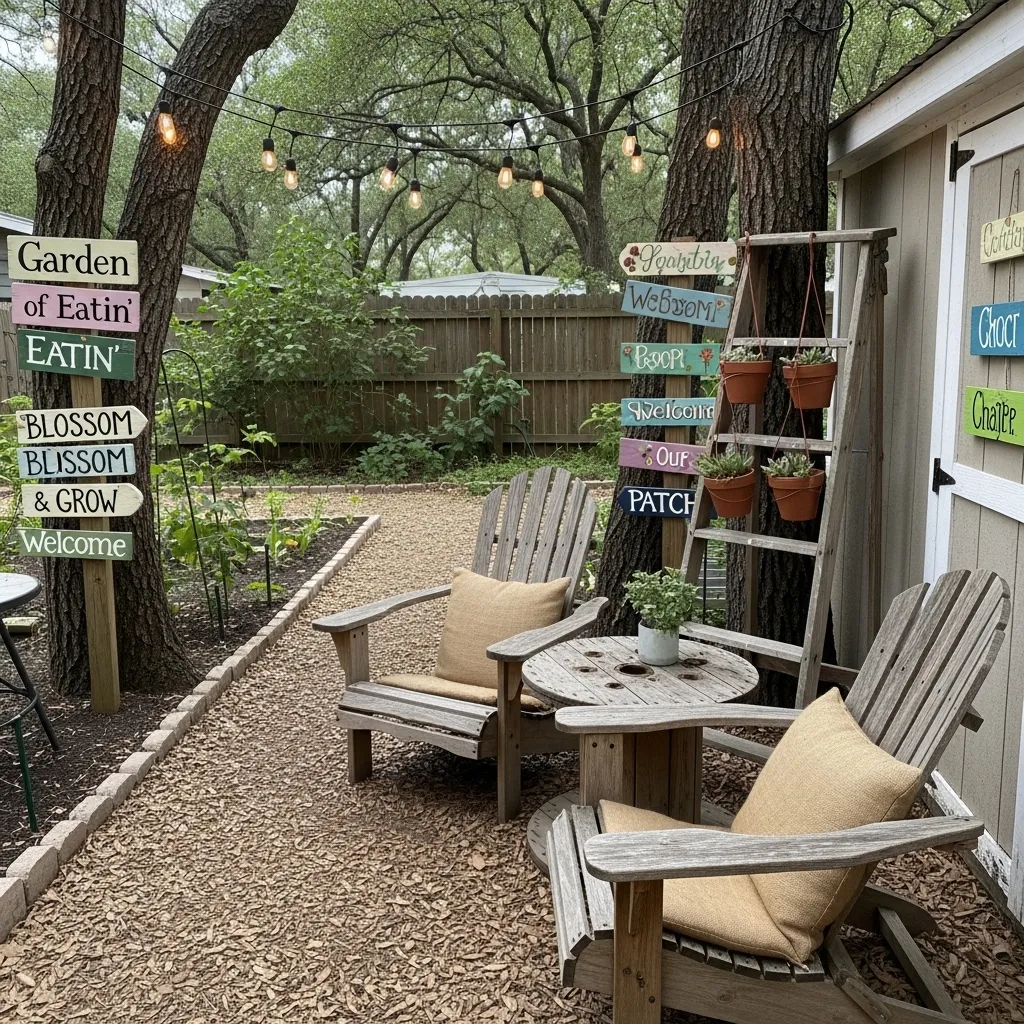
A yard that feels genuinely alive — full of weathered wood, mossy stone, trailing vines, and the kind of beauty that only comes with time — is one of the most quietly powerful things a home can have. Rustic garden decor achieves exactly that, turning any outdoor space into somewhere you actually want to linger, work with your hands, and return to at the end of a long day. Whether you’re working with a generous backyard, a compact courtyard, or a narrow side passage, these 27 rustic garden decor ideas that transform any yard are built to be used, not just admired. Every one of them is specific, actionable, and genuinely achievable without a professional landscaper or a bottomless budget. Let’s explore every one of them.
Why Rustic Garden Decor Works So Well in Any Yard
Rustic garden decor is among the most democratically beautiful design styles in existence — it asks for imperfection, rewards patience, and improves with every passing season rather than requiring constant upkeep to maintain its appeal. That fundamental quality makes it uniquely suited to real gardens lived in by real people, where things chip, weather, and grow slightly sideways.
The defining materials are honest and tactile: reclaimed timber, wrought and cast iron, hand-thrown terracotta, rough-cut limestone and sandstone, galvanized steel, wicker, and natural rope. The colour palette follows suit — weathered silver-grey, warm terracotta, aged iron black, chalky limestone, sage green, and the deep brown of oiled or untreated wood. These tones are drawn directly from the natural world and therefore sit in instinctive harmony with soil, foliage, and sky.
Culturally, rustic outdoor aesthetics are experiencing a sustained surge in interest. Pinterest searches for “rustic yard ideas,” “cottage garden transformation,” and “natural garden decor” have grown year on year, reflecting a broader shift away from high-maintenance, uniform outdoor spaces toward gardens that feel personal, layered, and quietly wild.
The best news: even the smallest yard can be transformed meaningfully by a single well-chosen rustic element. A reclaimed wood planter, a stone birdbath, or a cluster of aged terracotta — any one of these shifts the atmosphere of an entire space.
Reclaimed Railway Sleeper Raised Beds That Anchor the Whole Yard
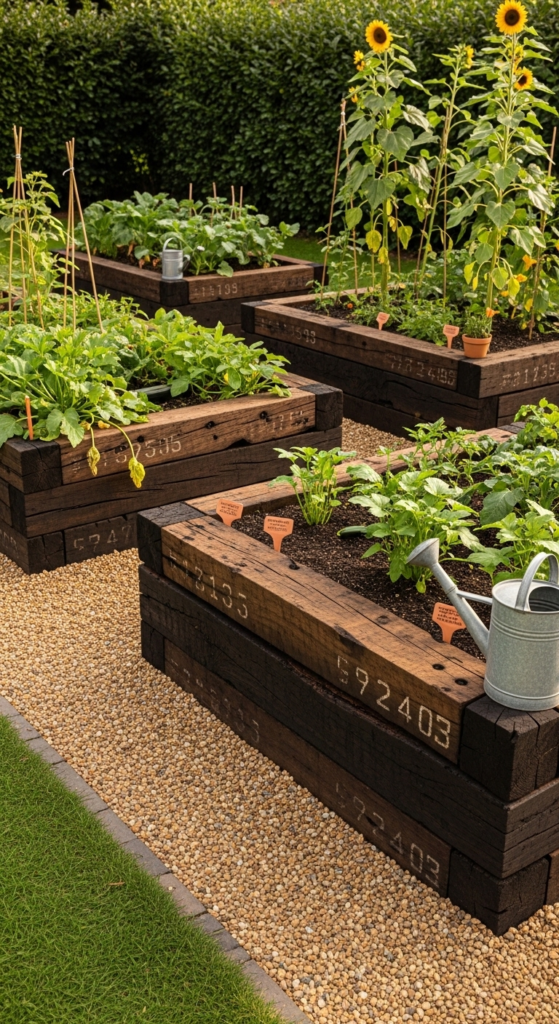
Vibe: Solid, purposeful, and instantly authoritative — raised beds built from railway sleepers look like they belong to the landscape rather than sitting on top of it.
What makes it work: Railway sleepers have extraordinary visual mass — their scale and density give a raised bed design a permanence that lighter timber cannot match. The dark, richly grained oak surface provides maximum contrast against green plant growth, making even a newly planted bed look dramatically alive. The irregular surface texture of reclaimed sleepers adds visual depth at every angle.
How to achieve it: Source reclaimed softwood or oak railway sleepers from specialist timber merchants or salvage yards — reclaimed pieces are cheaper and already have the weathered character that new sleepers take years to develop. Stack two sleepers high for a standard bed depth of approximately 45cm, securing corners with long threaded steel rods.
💡 Check that reclaimed sleepers are untreated (no creosote) before planting edibles — untreated oak sleepers are safe for food production and widely available.
Tumbledown Stone Wall Transformed Into a Rock Garden
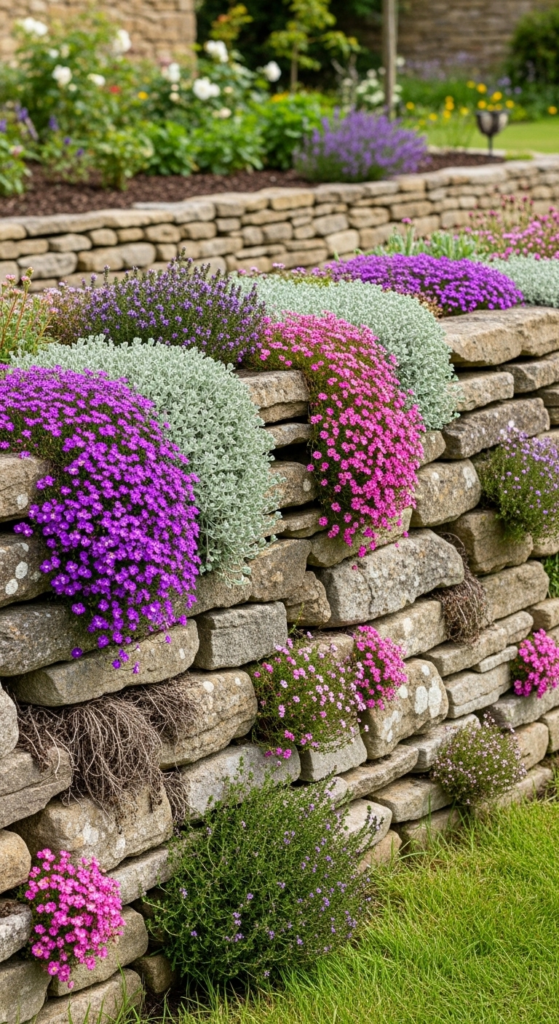
Vibe: A wall that has become a garden — every crack and crevice colonised by something small and quietly spectacular.
What makes it work: Dry-stone walls are one of the most visually complex structures in any garden — the irregular block sizes, varied stone tones, and deep shadow lines between courses create a surface that rewards long looking. Planting alpine and rock garden species directly into the wall face transforms it from a boundary into a vertical garden of extraordinary detail.
How to achieve it: Plant into existing wall crevices using small, bare-root or plug-sized alpines — push roots carefully into gaps with a thin wooden dibber and pack in with a gritty soil mix. Choose naturally compact, drought-tolerant species: Sempervivum, Sedum spathulifolium, Thymus serpyllum, and Aubrieta varieties.
Rusted Metal Garden Art Installed as a Focal Point

Vibe: A moment of genuine drama at the end of the garden — something that stops you mid-stride.
What makes it work: Corten steel is the ideal rustic garden art material — it weathers to a deep, stable rust surface that is both visually extraordinary and entirely self-maintaining. The warm orange-red of rusted steel against dark evergreen hedging creates one of the most powerful colour contrasts available in a garden setting. Even a relatively simple sculptural form reads as significant at the right scale.
How to achieve it: Commission a Corten steel piece from a local metal fabricator or source from garden sculpture suppliers — Corten is relatively affordable as metals go, and a simple silhouette form can be made very cost-effectively. Install on a concrete pad with a welded base plate for stability.
💡 Allow Corten steel to weather naturally through its first two seasons before sealing — the initial orange rust will stabilise to a rich, permanent brown-red without treatment.
Winding Gravel Path Edged With Hand-Set Cobblestones
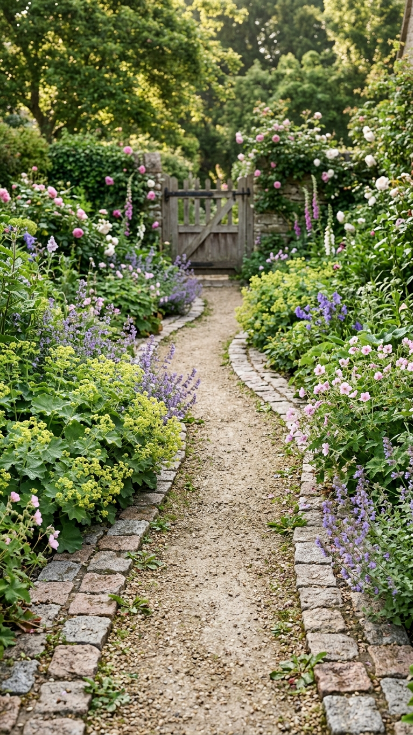
Vibe: Every step along this path feels like a small decision — where to look next, what’s around the bend.
What makes it work: The gentle curve of a winding path creates anticipation and visual mystery that a straight path never achieves — the destination is always just slightly concealed. Cobblestone edging does two jobs simultaneously: it defines the path boundary and adds a layer of beautiful, historic texture at ground level. Planting that spills over the edge softens the boundary between path and border.
How to achieve it: Set cobblestones on a 5cm bed of sharp sand with no mortar — this allows adjustment and looks more naturally irregular than mortared edging. Use granite setts sourced from salvage yards for the most authentic character. Fill between with self-binding gravel (hoggin) rather than loose gravel for a surface that compacts firmly and drains well.
Vintage Cast Iron Pump as a Garden Water Feature

Vibe: Something that looks as though it has supplied this garden with water for a hundred years — and perhaps has.
What makes it work: An antique cast iron pump is one of the most narrative-rich objects available in rustic garden decor — it tells an immediate story about the garden’s history, real or imagined. The combination of ornate Victorian ironwork, hunter green paint weathering to grey, and the cool stone of the surrounding trough creates a vignette of extraordinary character.
How to achieve it: Source restored antique pumps from architectural salvage specialists or garden antique dealers — working models are available but purely decorative installations are simpler and more affordable. Mount on a limestone or reclaimed sandstone plinth using stainless steel base fixings. Surround with moisture-loving shade plants: hostas, ferns, and astilbe.
💡 A decorative pump connected to a recirculating pump hidden inside the stone trough creates the sound and appearance of running water without plumbing.
Espaliered Apple Tree on a Warm South-Facing Wall
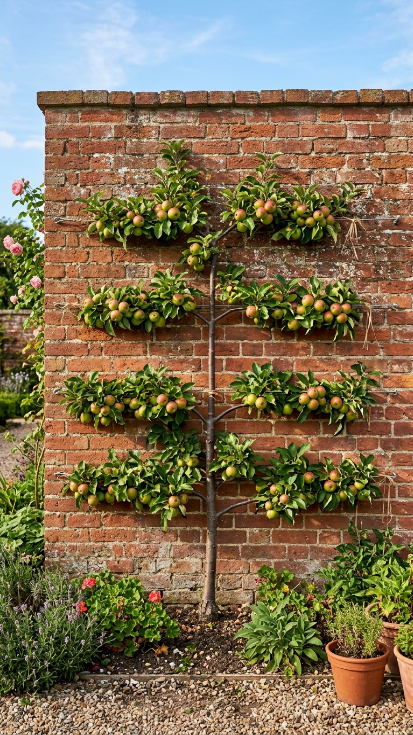
Vibe: One of the great garden disciplines — where patience and care become something genuinely breathtaking over time.
What makes it work: An espaliered fruit tree against a warm wall is simultaneously the most productive and most beautiful use of a flat vertical surface in a garden. The geometric discipline of trained horizontal tiers against the organic texture of an old brick wall creates a tension that is visually extraordinary — structured living sculpture growing more impressive with every year.
How to achieve it: Fix horizontal training wires to vine eyes at 45cm vertical intervals across the wall. Plant a two-year-old part-trained espalier from a specialist fruit nursery — starting from a trained tree saves three to four years of development time. Prune in late summer (August) to the modified Lorette system: shortening side shoots to three leaves for best fruiting.
Handbuilt Cob Garden Seat Integrated Into a Boundary Wall
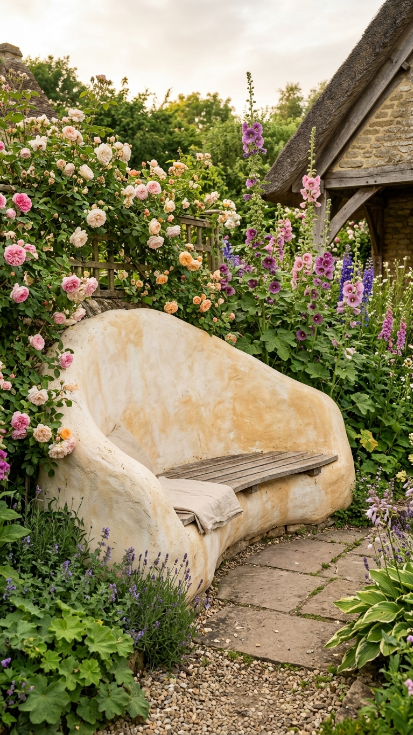
Vibe: Sitting here feels like sitting somewhere that has been a meeting place for generations — the seat itself shaped by human hands from the earth beneath your feet.
What makes it work: Cob construction — earth, straw, and water mixed and built by hand — creates the most organically beautiful structures in garden design. No two cob forms are ever identical, and the gentle undulations of a hand-built seat carry an irreplaceable human quality. Limewashed in warm cream, it glows in afternoon light and weathers beautifully over successive seasons.
How to achieve it: Cob building courses are widely available and accessible for complete beginners — building a simple garden seat is an excellent first cob project. Use subsoil with a high clay content mixed with straw and water. Finish with natural hydraulic lime render and limewash for weather protection.
💡 Apply a fresh coat of limewash in warm white each spring — one hour of work that refreshes the entire seat and any weathered areas from winter moisture.
Rustic Garden Decor: Galvanized Stock Tank Pond With Aquatics
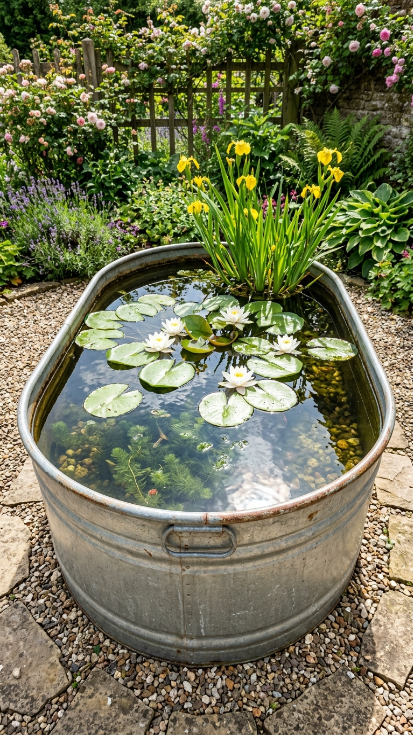
Vibe: A fully functioning garden pond in a single afternoon — and considerably more beautiful than most permanent installations.
What makes it work: Galvanized stock tanks have become one of the most popular rustic garden repurposing ideas for good reason — their oval form, matte silver finish, and robust construction make them genuinely attractive as water features. The reflective silver surface catches sky and cloud, making the tank appear to contain more than water: it holds light itself.
How to achieve it: Seal the drain plug with exterior-grade silicone and position on a level surface before filling. Aquatic plants should be potted in aquatic compost in mesh baskets and positioned at the appropriate depth — water lilies at 30–45cm, marginals at 15–20cm. Add a small solar-powered pump for gentle water circulation and oxygenation.
Twisted Wrought Iron Plant Stand Holding a Tower of Herbs
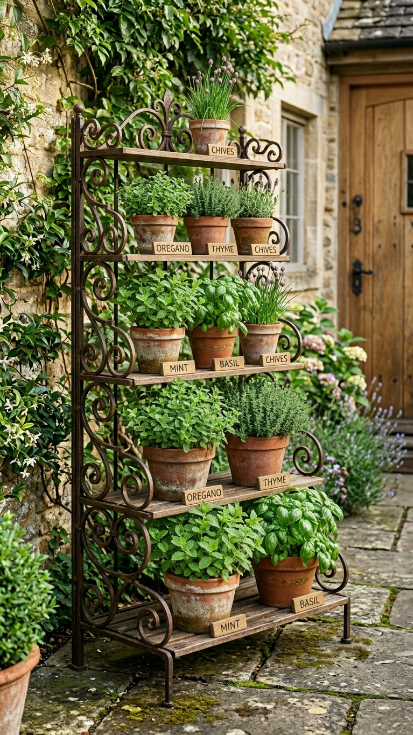
Vibe: Everything you need for cooking growing at arm’s reach from the kitchen door, stacked with the elegance of a Parisian market stall.
What makes it work: A tiered iron plant stand solves the rustic garden’s fundamental challenge — how to create significant vertical interest without building anything permanent. The ornate scrollwork of traditional wrought iron stands looks infinitely better than modern powder-coated tubular versions, and the dark patina contrasts beautifully with terracotta and herb foliage simultaneously.
How to achieve it: Source ornate wrought iron tiered stands from garden antique dealers, French market suppliers, or specialist ironwork companies. Place near the kitchen door for convenience — herbs decline rapidly if not harvested regularly. Position in a spot receiving at least six hours of direct sun for most culinary herbs.
💡 Move the entire stand indoors in winter — terracotta and herbs both survive cold but not frost combination, and the stand makes a superb indoor focal point until spring.
Sun-Bleached Driftwood Fence Panels Along a Coastal Yard
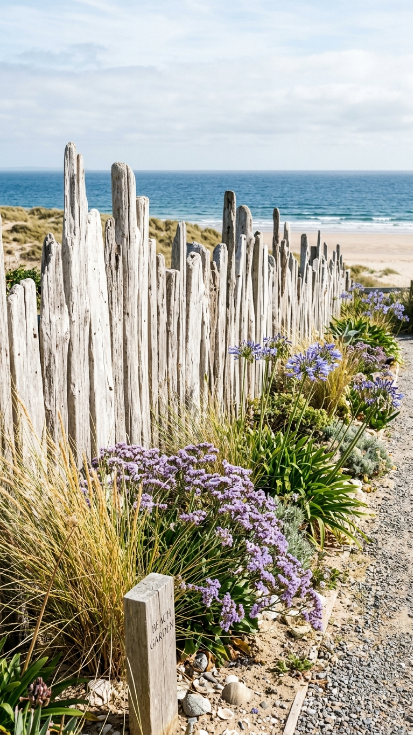
Vibe: A fence that looks like the sea made it — bleached, irregular, and entirely at home in its surroundings.
What makes it work: A driftwood fence is the coastal-rustic version of a statement boundary — the irregular plank heights create a deliberately uneven top line that is far more interesting than a uniform fence, while the silver-white bleached tone reflects coastal light beautifully. Pairing with salt-tolerant coastal planting completes a garden narrative that feels completely coherent.
How to achieve it: Construct using lengths of untreated timber left outdoors to bleach naturally, or source genuinely weathered coastal timber from salvage suppliers. Attach planks to horizontal rails at varying heights using stainless steel screws — stainless is essential in any salt-air environment. Plant sea lavender (Limonium latifolium), agapanthus, and Festuca glauca at the base.
Copper Garden Pipe Irrigation System as Visible Feature
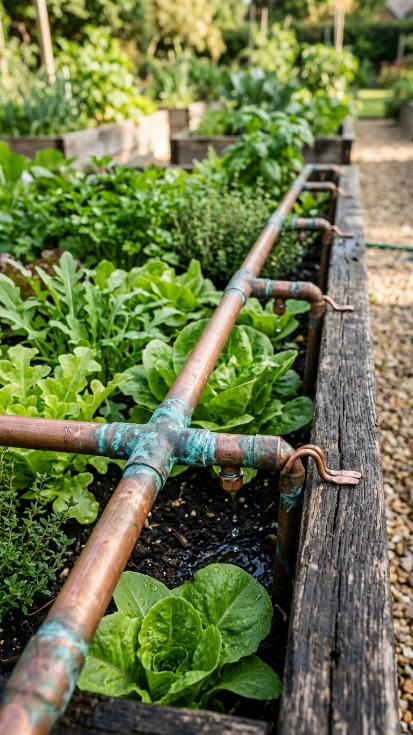
Vibe: Functional infrastructure treated as sculpture — and achieving it more convincingly than most deliberate art installations.
What makes it work: Copper pipe is one of the most naturally beautiful utilitarian materials — its journey from bright penny to green verdigris is a continuous, years-long aesthetic event. Making an irrigation system visible rather than burying it transforms a practical necessity into a genuine garden feature. The warm copper tones complement both timber raised beds and plant foliage with equal elegance.
How to achieve it: Install 15mm copper pipe along the inner top edge of raised beds, soldered at corners and connected to a garden tap with a timer unit. Use threaded copper drip emitters at each planting position. Leave entirely unsealed — the verdigris patina that develops at soldered joints is the most beautiful part of the installation.
💡 A basic copper pipe irrigation system for a four-bed kitchen garden costs approximately £200–£300 in materials and dramatically reduces watering time throughout the growing season.
Rustic Garden Decor With a Reclaimed Door as Garden Art
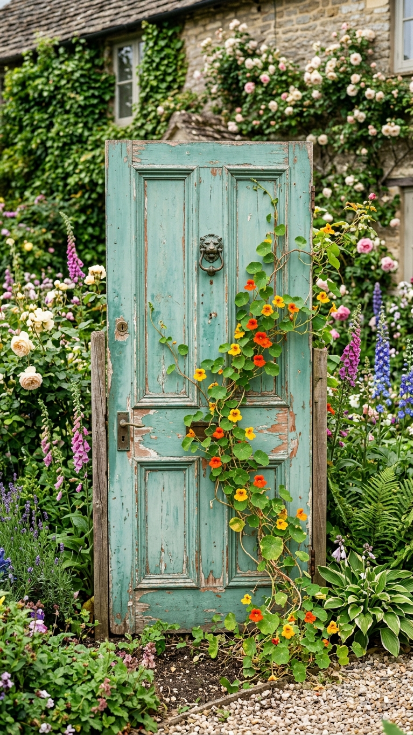
Vibe: A door that leads somewhere — even though it’s standing in the middle of a garden border with nowhere to go.
What makes it work: A reclaimed door installed as vertical garden art brings an element of surreal wit to the rustic garden — it implies narrative and mystery with complete simplicity. The paint history of an old door (multiple layers of different colours chipping through) creates more visual complexity than any deliberate paint effect. A vintage door knocker left in place adds humour and specificity.
How to achieve it: Fix the door vertically by setting two steel posts into concrete and securing the door to them with through-bolts — the posts are hidden behind the door width. Paint any bare wood areas with exterior primer before installation to slow deterioration. Plant climbing nasturtiums at the base for fast coverage that doesn’t damage old paint.
Antique Terracotta Roof Tiles Used as Pathway Edging
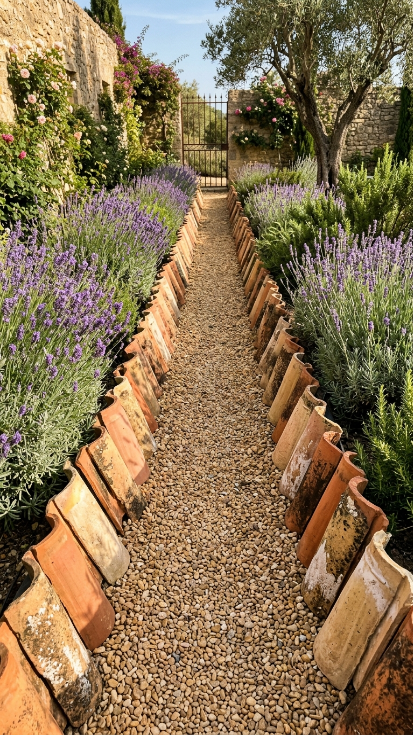
Vibe: A garden path that carries the warmth of the Mediterranean in every curved, sun-baked tile.
What makes it work: Setting curved terracotta pantiles on edge as path edging creates a rhythmic, undulating border that is far more visually interesting than straight brick or timber. The alternating lean angle creates a serrated profile that casts dynamic shadows throughout the day, making the edging appear different in morning and afternoon light.
How to achieve it: Source reclaimed curved terracotta pantiles from salvage yards or demolition merchants — these appear regularly from older roof restorations. Set on edge into a shallow trench of compacted sand, leaning in alternating directions at approximately 15 degrees from vertical. No mortar or fixings needed — the alternating lean pattern is self-supporting.
💡 Mix terracotta tones deliberately — the variation from deep orange to pale salmon is far more beautiful than perfectly uniform tiles, and salvage yard pieces always come mixed.
Garden Gate Constructed From Reclaimed Wrought Iron Railings
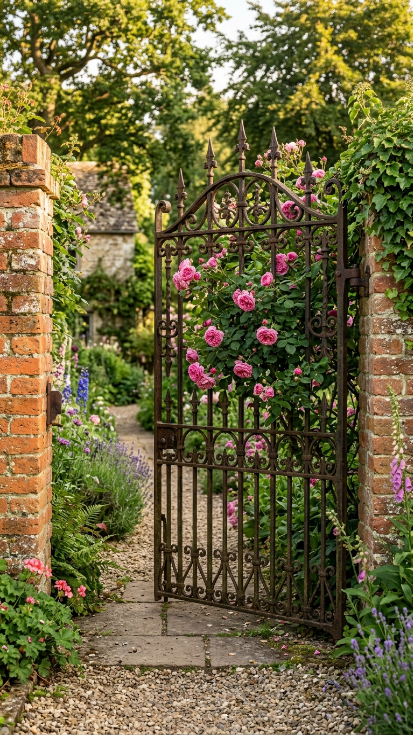
Vibe: A gate that suggests the garden beyond it deserves the formality of a proper entrance — even when it absolutely doesn’t.
What makes it work: Reclaimed Victorian railing sections have an ornamental quality — spear tops, decorative collars, cast finials — that was designed for exactly this purpose. Combining salvaged sections into a gate frame preserves all that Victorian craftsmanship while creating something entirely bespoke. Climbing roses through ironwork is one of the most timeless rustic garden pairings available.
How to achieve it: Source reclaimed wrought iron railing sections from architectural salvage dealers — they often come in matching batches from period property restorations. Have a local metalworker weld sections into a gate frame and fit with period-appropriate hinges and a ring latch. Treat welded joints with a rust-inhibiting primer before any surface finish.
Slate Stepping Stone Path Through a Wild Garden Area
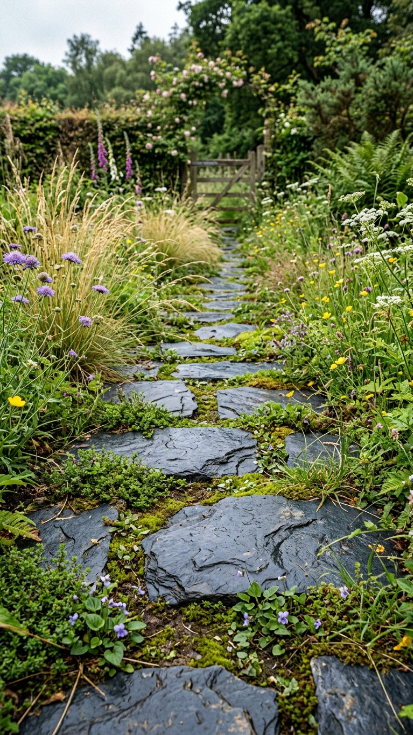
Vibe: A path that doesn’t impose itself on the garden — it suggests a route through it, gently and without insistence.
What makes it work: Large irregular slate stepping stones have a visual weight and gravity that smaller pavers never achieve — each stone reads as a considered placement rather than a repeating unit. The dark charcoal-blue of Welsh slate is particularly beautiful in a wild garden context, where it appears like fragments of a deeper geological layer surfacing through the meadow.
How to achieve it: Set large slate pieces individually onto a bed of sharp sand — each stone should be at least 45cm in its shortest dimension to feel comfortable underfoot. Space stones at a natural walking pace (approximately 45–60cm between centres). Leave wide, irregular joints and plant creeping thyme (Thymus serpyllum) and Viola odorata directly into the gaps.
Rustic Garden Decor: Willow Fedge as a Living Boundary
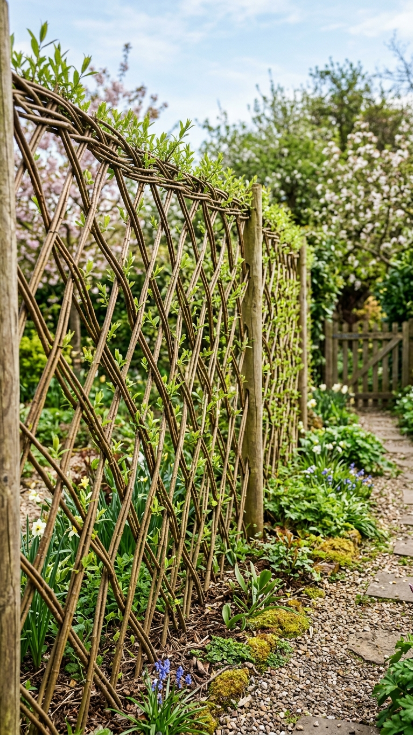
Vibe: A boundary that is alive — growing, greening, and changing with every week of the growing season.
What makes it work: A living willow fedge is the most dynamic garden boundary available — it starts as woven bare rods and becomes a dense, leafy screen within one growing season, providing privacy, habitat, and constant visual interest simultaneously. The diamond lattice weave pattern remains visible even through leaf cover, maintaining the structural quality throughout summer.
How to achieve it: Plant willow rods (Salix viminalis or Salix purpurea) in late winter while dormant — push 60cm into the ground at 45-degree angles in two directions to create the diamond lattice. Weave rods together at crossing points using biodegradable raffia. Cut all rods back hard each winter and re-weave new growth in spring.
💡 Willow rods can be cut from an established plant rather than purchased — one mature willow provides hundreds of whips for an extensive fedge project.
Night-Scented Garden Corner With Reclaimed Stone Lanterns
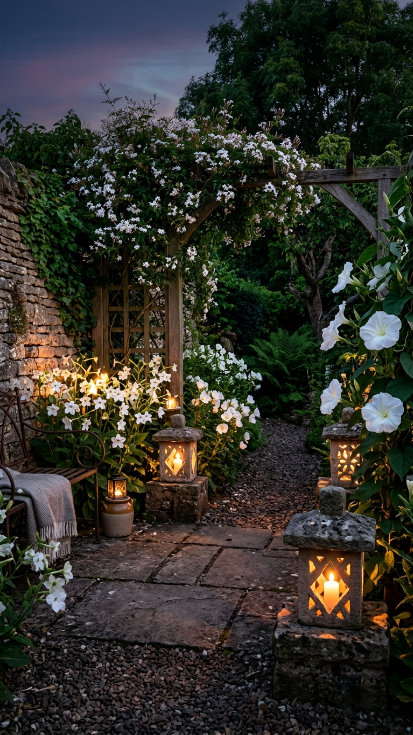
Vibe: A garden that saves its best performance for after dark — fragrance and warmth and the kind of quiet that dissolves a long day.
What makes it work: Night gardens are the most underused opportunity in rustic garden decor — designating even one corner specifically for evening use transforms how the whole garden is experienced. White flowers are naturally luminous in low light, making them the ideal night-garden palette. Reclaimed stone lanterns at low ground level create intimate, non-glaring light that enhances rather than disrupts the evening atmosphere.
How to achieve it: Plant white night-scented varieties: Nicotiana sylvestris, Oenothera biennis (evening primrose), white Matthiola incana (stocks), and Jasminum officinale. Position stone lanterns at ground level on stable flat stones — no electrical installation required with quality pillar candles or high-quality LED flame candles.
Bespoke Log Slice Garden Table With Stone Bench Seating
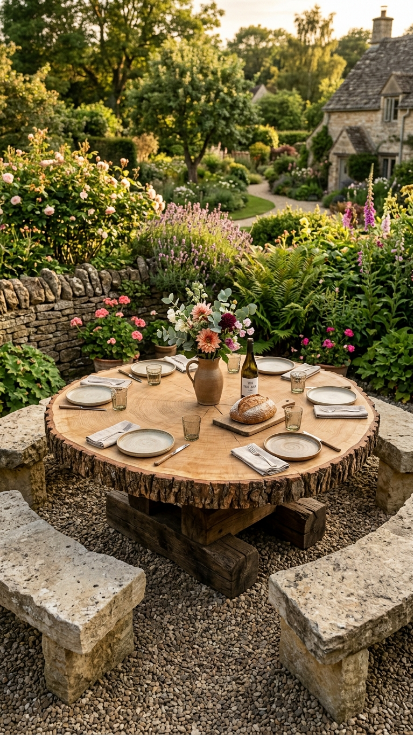
Vibe: A dining table that looks like it was felled, carried here, and placed — and somehow that makes every meal feel slightly more significant.
What makes it work: A live-edge log slice table is one of the most powerful single objects in rustic garden design — the visible growth rings, bark edge, and natural form carry an irreplaceable authenticity. Pairing with low stone block benches keeps the material palette entirely natural and eliminates the visual clutter of chair legs from the composition.
How to achieve it: Source large oak or elm cross-sections from specialist timber merchants or tree surgeons who work with hardwood slabs. Sand the surface to 120 grit and apply two coats of exterior-grade hard wax oil — Osmo PolyX is particularly good for outdoor use. Keep the live edge natural, removing only loose bark.
Rustic Garden Decor With a Painted Beehive Backdrop Feature
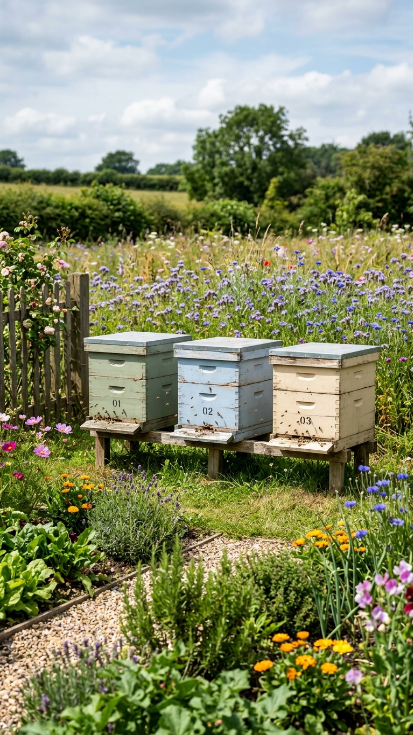
Vibe: The most productive corner of the garden — and somehow the most beautiful as well.
What makes it work: Painted beehives are among the most charming elements of traditional rustic garden design — their simple rectangular forms painted in faded heritage colours create a composition that is both artlessly beautiful and deeply purposeful. The combination of faded sage green, pale blue, and warm cream is a quintessentially rustic colour palette that harmonises with wildflower planting perfectly.
How to achieve it: Paint standard wooden Langstroth hive boxes in exterior-grade chalk paint or milk paint — these finishes weather authentically rather than peeling as gloss does. Choose Farrow & Ball-adjacent tones: “Mizzle,” “Borrowed Light,” or “String.” Position facing south-east for the best early-morning sun warm-up, ideally backed by a wildflower hedge or meadow strip.
💡 Even non-functional decorative hive boxes (available from garden suppliers) create this look instantly — though real hives are an extraordinary addition to any garden.
Esparto Grass Rope and Timber Hanging Garden Shelf
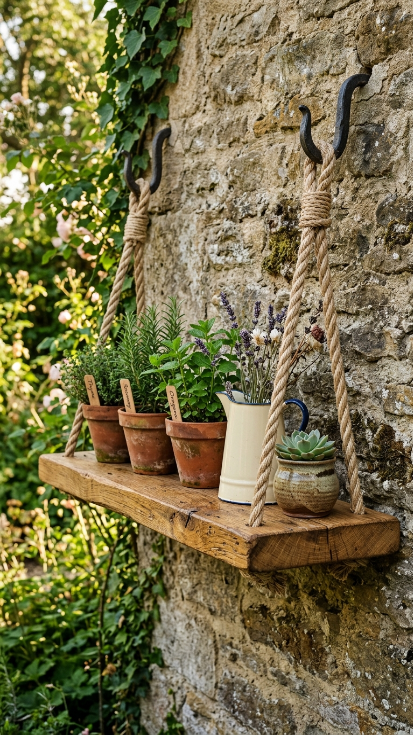
Vibe: Everything about this shelf communicates handmade — the rope, the timber, the hooks — and that total commitment to material honesty is deeply satisfying.
What makes it work: A rope-hung timber shelf creates significant visual interest through the mechanics of how it’s supported — the thick braided rope and iron hooks are as much part of the aesthetic as the shelf itself. Esparto grass rope has a warm, coarse texture that complements both oak timber and terracotta beautifully, keeping the material palette entirely within the natural register.
How to achieve it: Use a reclaimed oak plank of at least 40mm thickness — thinner boards flex dangerously under load when hung. Thread thick esparto rope (25mm diameter minimum) through pre-drilled holes at each end and knot below the shelf. Fix to the wall with heavy-duty iron butcher’s hooks or forged iron ring hooks.
Handpainted Rock Garden Labels as Decorative Markers
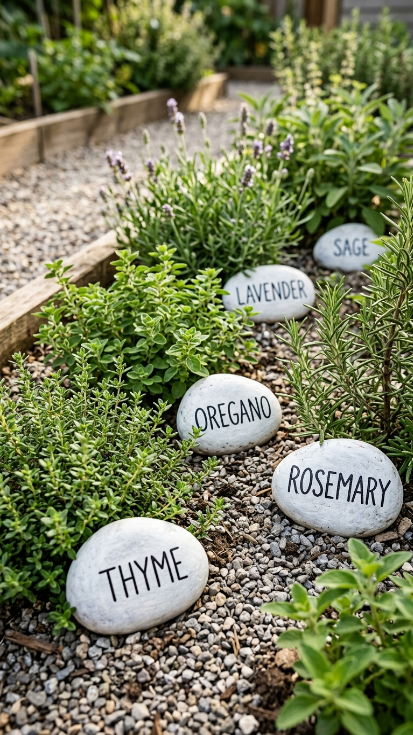
Vibe: The most personal, lowest-cost garden decor idea on this entire list — and genuinely one of the most beautiful.
What makes it work: Smooth rounded river pebbles have a natural sculptural quality that make them intrinsically appealing as objects. A white-washed base and hand-lettered black text turns each one into a miniature art object that belongs completely in a rustic garden context. The irregularity of natural pebble sizes creates visual variety that stamped metal or printed labels cannot achieve.
How to achieve it: Collect smooth pebbles from beaches or rivers, or purchase from garden centres. Apply one coat of white exterior masonry paint as a base. Letter using a fine waterproof paint pen or black outdoor enamel paint applied with a small brush. Seal with exterior matte varnish for weather durability.
💡 Waterproof chalk markers are the fastest and most beginner-friendly option — they write on any surface and last a full season outdoors without sealing.
Rustic Garden Decor: Woven Reed Screen for Instant Privacy
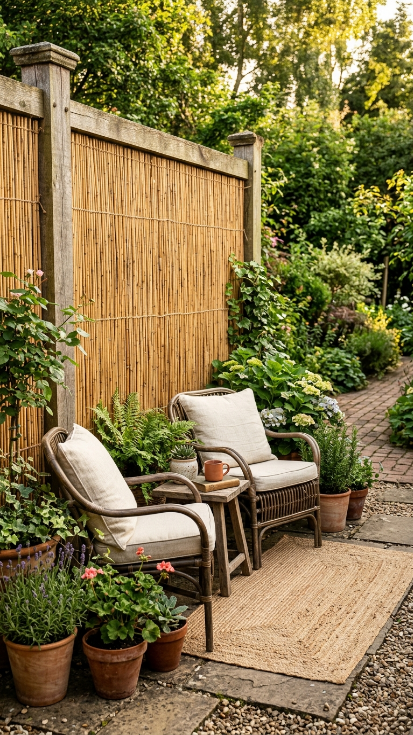
Vibe: Privacy that feels generous rather than defensive — a warm, textured backdrop that makes any seating area feel considered.
What makes it work: Natural woven reed panels have a warm honey-golden colour that is uniquely flattering as a backdrop — it reflects afternoon light softly and makes cushion colours, plant foliage, and any decorative objects placed in front of it appear beautifully warm. Unlike fence panels, reed screening has a slight visual permeability that feels inviting rather than enclosing.
How to achieve it: Fix reed screening panels to a timber post frame using stainless steel staples and horizontal battens — the panels must be fully supported at top, middle, and bottom to prevent sagging in wind. Reed panels are lightweight but can act as a wind sail, so post foundations should be at least 60cm deep in concrete. Replace every three to five years as the natural reed weathers.
Antique Garden Roller Used as a Statement Ornament
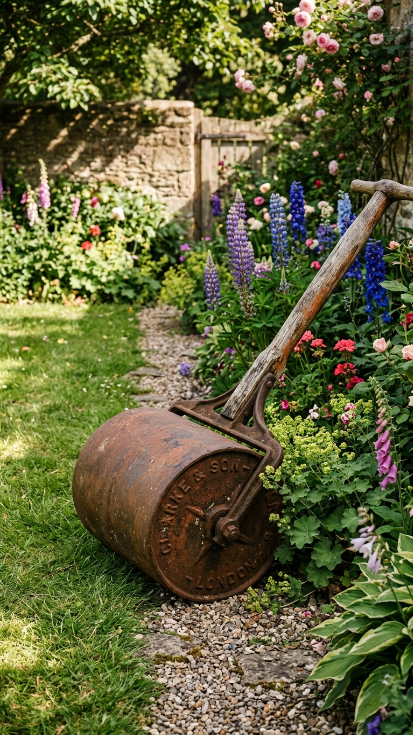
Vibe: An object of such obvious, honest weight that it seems to anchor the entire garden to the ground beneath it.
What makes it work: Antique garden rollers have exceptional visual authority — their sheer mass, the industrial quality of cast iron construction, and their deep connection to gardening history give them an immediate presence. Positioned at the end of a path or as a focal point within a border, a roller reads as found sculpture of the highest order.
How to achieve it: Source antique garden rollers from specialist garden antique dealers, estate sales, or auction houses — they appear regularly and are genuinely collectible. Leave entirely untreated — the developing rust patterns are the primary aesthetic feature. Position on a flat stone pad to prevent the roller from sinking into lawn or border soil over time.
Stacked Cordwood Feature Wall Along a Garden Boundary
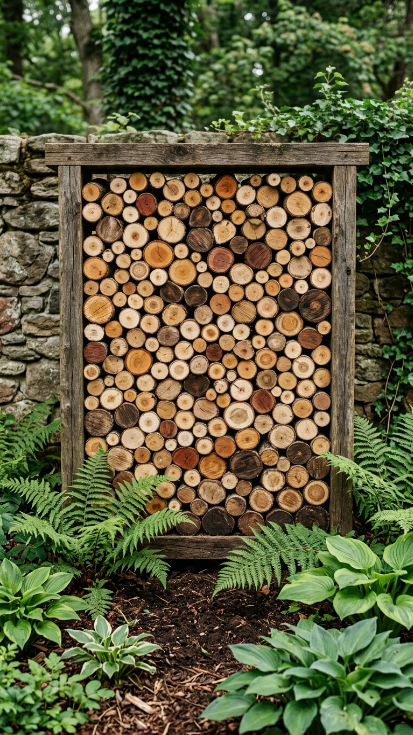
Vibe: Practical winter fuel storage transformed into one of the most texturally interesting surfaces in the garden.
What makes it work: The cut ends of stacked firewood create a naturally occurring circular mosaic that is visually extraordinary — varying wood species and diameters mean no two rounds are identical, and the tonal range from pale cream to deep espresso creates a composition of genuine complexity. As wildlife habitat, a cordwood stack also provides shelter for beetles, solitary bees, and spiders.
How to achieve it: Build a simple rectangular frame from reclaimed timber to contain and support the stack. Use a mix of hardwood species for maximum tonal variety — oak, ash, birch, and cherry all cut to the same 30–40cm depth. Site against a fence or wall for support and partial weather protection.
💡 A log store that doubles as a garden feature means every piece of practical storage becomes a visual asset — the best kind of rustic garden multitasking.
How to Start Your Rustic Garden Transformation
Begin not with a shopping list but with a slow walk through your yard at different times of day. Where does light pool in the morning? Which corner gathers warmth in the afternoon? What currently feels exposed, unloved, or empty? One area of genuine attention will transform a yard’s atmosphere far more than scattered smaller improvements across the whole space.
The most important early investment is in one significant anchor piece — a set of railway sleeper raised beds, a stone birdbath, a reclaimed gate, or a substantial terracotta urn. This anchor establishes the style’s character and gives everything that follows something to relate to.
Avoid the common mistake of buying everything new. Rustic garden decor is specifically a style that requires aged, imperfect, or genuinely old objects — salvage yards, architectural antique dealers, farm sales, and estate auctions are your primary suppliers, not garden centres. New items can be aged using the specific techniques described throughout this guide, but genuine found objects are always preferable.
Budget realistically: a transformative rustic yard is achievable for £300–£600/$350–$700 across one to two seasons. Grow plants from seed and cuttings wherever possible — the most beautiful rustic gardens are made slowly, and time is your most powerful ingredient.
Frequently Asked Questions
How do I transform a modern yard into a rustic garden decor style?
The fastest transformation comes from replacing or covering the elements that read as most obviously modern — smooth rendered walls, uniform concrete paving, and standardised fencing. Start by adding reclaimed stone or brick edging to existing paths, replacing concrete planters with aged terracotta, and introducing a climbing plant on any flat wall surface. One reclaimed timber raised bed placed in a previously plain area shifts the entire atmosphere of a yard. Paint any rendered boundary walls in a limewash finish in warm white or aged cream — Bauwerk or Edward Bulmer Natural Paint are particularly good ranges — for an instantly rustic, deeply textured surface.
What are the most budget-friendly rustic garden decor ideas for any yard?
The highest-value, lowest-cost rustic garden improvements include: handpainted rock garden labels (cost: zero beyond the paint), seed-grown wildflower patches (a packet of mixed native seeds covers a large area for under £5/$6), aged terracotta pots using the yogurt-wash technique, reclaimed brick edging sourced from demolition sites (often free), and climbing plants grown from cuttings or seed. These approaches deliver substantial visual transformation for almost nothing, and they embody the rustic aesthetic more authentically than expensive purchases.
How do I make a small yard feel bigger with rustic garden decor?
In a small yard, rustic garden decor works best when it creates visual layers rather than filling floor space. Vertical elements — a climbing plant on a trellis, a tiered iron plant stand, a wall-mounted hanging shelf, or an espaliered fruit tree — draw the eye upward and create the impression of a more generous space. A winding path (even a short one) creates the suggestion of distance by concealing its destination. Use a limited material palette — no more than three or four materials — to prevent visual fragmentation, which makes small spaces feel cluttered.
Which rustic garden decor ideas work best for transforming a yard quickly?
For rapid yard transformation, prioritise ideas that deliver significant visual impact without long growing seasons: a galvanized stock tank pond (complete in one afternoon), a cluster of aged terracotta pots, a reclaimed door installed as garden art, handpainted rock labels across an existing planting area, and a woven reed privacy screen. These can be installed within a single weekend and immediately shift the atmosphere of any yard. Combine two or three within one focused area rather than spreading them across the whole space for the most concentrated effect.
Is rustic garden decor suitable for low-maintenance yards?
Rustic garden decor is genuinely one of the most low-maintenance design styles for outdoor spaces — its aesthetic embraces the effects of weathering, ageing, and organic growth rather than requiring their prevention. Stone, iron, terracotta, and reclaimed timber all require minimal maintenance beyond occasional treatment. Choose a planting palette of self-seeding perennials (echinacea, foxglove, verbena, achillea) and ground-covering thyme or sedum that require no deadheading, minimal watering once established, and create a naturally abundant appearance with almost no intervention. A rustic yard genuinely improves on its own.
Ready to Transform Your Yard With Rustic Garden Decor?
These 27 rustic garden decor ideas cover the full range of what a yard transformation can look like — from a single handpainted pebble label to a living willow fedge that changes with every season, from a night-scented garden corner to a log-slice dining table built to last decades. Pin the ideas that felt most immediately like yours, because that instinct is telling you exactly where to begin. Every great rustic yard started with one decision: one reclaimed object placed with care, one climbing rose planted at the base of a fence, one terracotta pot filled with something fragrant. The rest follows naturally — because this is a style that, once begun, the garden itself seems to want to continue.