The moment a fresh spring bloom appears on a shelf or table, something shifts — the whole room exhales and remembers that winter is finally over. Easter floral decor carries that feeling throughout your home, layering color, fragrance, and a gentle seasonal joy into spaces that have been too quiet for too long. Whether you gravitate toward loose, garden-gathered arrangements or prefer something more structured and styled, there are countless ways to bring this kind of beauty into your everyday rooms. These 28 Easter floral decor ideas span everything from a single stem on a nightstand to a full dining table transformation — all of them real, achievable, and genuinely worth trying. Here are 28 ideas worth saving.
Why Easter Floral Decor Works So Well
Easter floral decor sits in a uniquely satisfying design space — it’s festive without being loud, seasonal without being kitschy. Unlike Christmas or Halloween decorating, which rely heavily on themed props and saturated colors, Easter florals work with nature’s own palette: soft lavender, blush pink, butter yellow, sage green, and crisp white. These colors layer harmoniously into almost any existing interior without requiring you to redecorate around them.
What distinguishes Easter floral decor from general spring styling is its inherent symbolism of renewal — and that meaning gives even simple arrangements a sense of occasion. A jam jar of daffodils on a kitchen windowsill feels intentional at Easter in a way it might not in August. The seasonal specificity is part of the appeal.
The current design movement strongly favors the “organic and gathered” aesthetic — loose arrangements, imperfect stems, and natural materials like terracotta, linen, and raw wood as vessels. This has made Easter floral decor more accessible than ever, because the most beautiful look right now is the most effortless one. You’re not arranging flowers; you’re gathering them.
Even the smallest apartment benefits. A trio of bud vases on a bathroom shelf, one flowering branch in a tall vase by the door, or a moss-filled cloche on a coffee table — Easter floral decor scales beautifully to any space or budget.
Loose Ranunculus Bunches in Linen-Wrapped Mason Jars
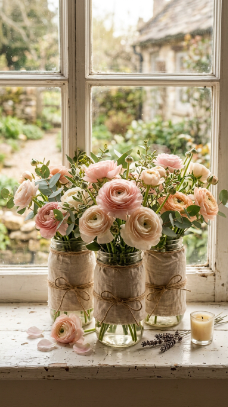
Vibe: Softly imperfect and genuinely lovely — the kind of arrangement that looks like it took five minutes and a lot of taste.
What makes it work: Linen-wrapped jars solve the most common Easter floral decor problem: plain glass is too transparent and clinical for soft spring flowers. The natural texture of linen bridges the flowers and the vessel into a cohesive visual story. Grouping three jars of slightly different heights creates composition without requiring a florist’s skill.
How to achieve it: Cut linen fabric into 4-inch strips, wrap tightly around each jar, and tie with 2mm jute twine. Choose ranunculus in the softest blush and cream tones — “Cloni Hanoi” or “Cloni Success” varieties are widely available at florists in spring and last 10–12 days.
💡 A half-yard of natural linen from a fabric store costs under $6 and wraps eight to ten jars.
Cascading Floral Garland Along a Mantle
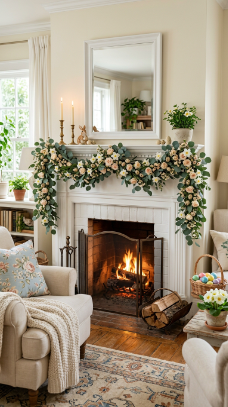
Vibe: Romantic abundance — the kind of Easter floral decor that makes a living room feel like a celebration without a single banner or egg-print pillow in sight.
What makes it work: A mantle garland uses vertical space that most Easter decor ignores entirely, drawing the eye upward and making even a modest fireplace feel architectural and important. The combination of dense eucalyptus with the delicacy of narcissus and roses creates textural contrast that reads as sophisticated rather than simply full.
How to achieve it: Build on a pre-made eucalyptus garland base (available at craft stores or online) and wire fresh flower clusters in at intervals. Work from the center outward for symmetry. Secure the garland to the mantle with floral wire anchored around small hooks or tape.
Terracotta Pot Tower with Stacked Spring Blooms
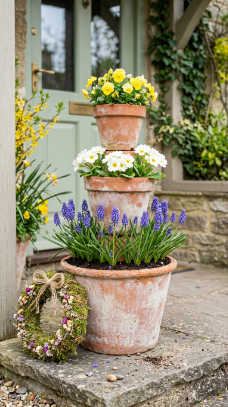
Vibe: Like a tiny living Easter garden — joyful, unpretentious, and genuinely alive.
What makes it work: Stacking pots in decreasing sizes creates vertical interest and sculptural form from the simplest garden-center materials. Each tier showcasing a different color and bloom type provides botanical variety without requiring a large footprint. The terracotta’s warm earthiness prevents the cheerful colors from reading as childish.
How to achieve it: Stack pots by inverting the middle and upper pots on wooden dowels pushed through the drainage holes for stability. Fill each with fresh potting mix and a purchased flowering plant — muscari, primrose, and violas are all cold-hardy and widely available in early spring.
💡 Garden-center primrose pots typically cost $3–$5 each and are already in full bloom — no growing required.
Blue and White Chinoiserie Vase with Blush Peonies
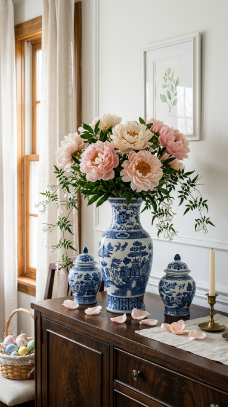
Vibe: Classically refined — this Easter floral decor idea belongs in a room where things are chosen slowly and kept forever.
What makes it work: Chinoiserie’s bold graphic pattern creates a statement vessel that makes even a simple bloom look curated. Blush peonies against cobalt blue is a warm-cool contrast with centuries of design precedent — it works because the eye enjoys the tension between the two. The dark walnut sideboard anchors the arrangement against the risk of looking too decorative.
How to achieve it: Source chinoiserie vases from antique stores, TJ Maxx, or online — quality reproduction pieces are available from $25 upward. Buy peony stems just as the bud begins to soften — they’ll open fully within 48 hours in a warm room.
Driftwood and Wildflower Coastal Easter Display
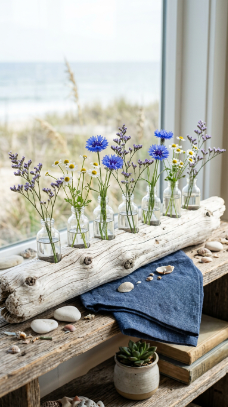
Vibe: Easter at the beach house — effortlessly relaxed and genuinely beautiful.
What makes it work: Driftwood as a base creates horizontal visual flow and a natural organizing structure that makes a collection of small bottles feel intentional rather than scattered. The coastal material palette — bleached wood, clear glass, white flowers, blue cornflowers — draws on the season’s natural coastal aesthetic without leaning into nautical clichés.
How to achieve it: Collect driftwood from beaches or purchase from craft stores. Hot-glue small glass bottle bases to the driftwood surface to prevent tipping. Fill with single stems of sea lavender (dried, available from florists year-round) and fresh chamomile or cornflowers.
White Lace Table Runner with Fresh Flower Vignettes
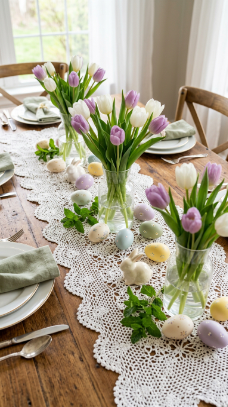
Vibe: Heirloom sweetness — like your grandmother’s best table linen met a florist on the way to Easter Sunday.
What makes it work: A lace runner introduces fine texture and delicate pattern that flowers alone can’t achieve. The visual contrast between the intricate lace and the simple, clean glass vases demonstrates a key styling principle: pair something ornate with something plain so neither overwhelms. The herbal accent of mint adds fragrance and an unexpected green note.
How to achieve it: Source vintage lace runners from estate sales, eBay, or Etsy — genuine vintage pieces typically run $15–$40 and elevate any table setting dramatically. Position three small glass vases at staggered heights (4, 7, and 10 inches) for natural rhythm.
Dried Flower Easter Wreath in Earthy Tones
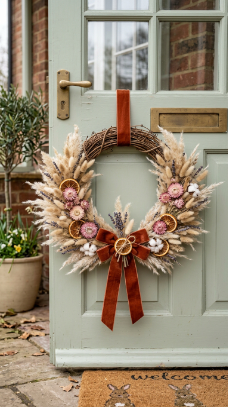
Vibe: A front door that feels like a warm handshake — welcoming, intentional, and made to last.
What makes it work: Dried botanical wreaths solve the longevity problem — fresh flower wreaths often last only 3–5 days, while a well-made dried wreath lasts through the entire Easter season and beyond. The earthy color palette of cream, dusty rose, and terracotta gives Easter floral decor a more sophisticated, adult quality than the typical pastel wreath.
How to achieve it: Build on a grapevine base and attach dried elements in clusters using hot glue or floral wire, working from one side of the ring around in a single direction. Dried pampas, strawflowers, and bunny tail grass are available in large bunches from craft stores for under $20 total.
💡 Seal finished dried wreaths with hairspray to prevent petal drop and shedding.
Hyacinth and Moss Terrarium Bowl
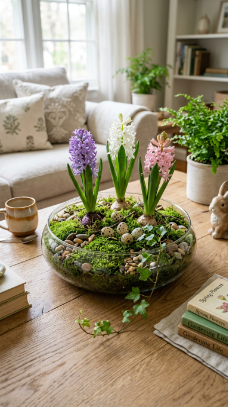
Vibe: A living Easter garden in miniature — grounding, fragrant, and quietly spectacular.
What makes it work: The terrarium format creates a self-contained world that draws the eye and invites a closer look — it functions as a centerpiece with more visual depth than a vase arrangement. Three hyacinths in complementary colors (purple, white, pink) form a naturally harmonious grouping without requiring any design skill to arrange them.
How to achieve it: Place a layer of gravel at the bowl’s base for drainage, then add potting mix, position hyacinth bulbs (purchased pre-started from garden centers), and pack sheet moss tightly around the base. Keep in bright light and mist the moss every two days to maintain its color.
Easter Floral Decor with Feathers and Foliage in a Clear Vase
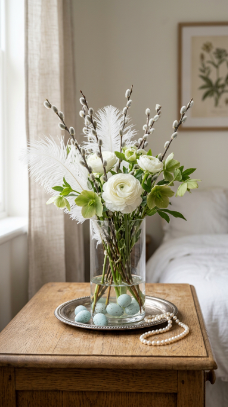
Vibe: Like spring whispering to itself — delicate, barely-there, and deeply serene.
What makes it work: Feathers and botanicals belong to the same organic vocabulary, which makes combining them feel natural rather than odd. The silvery tones of pussy willow buds and white feathers create a monochromatic base that makes the green hellebores feel like a quiet revelation. A clear cylindrical vase allows you to appreciate the stem architecture inside the water as part of the arrangement.
How to achieve it: Choose a vase with a narrow neck (3–4 inches) to keep stems grouped naturally. Add feathers last, placing them at the arrangement’s outer edges so they’re visible but not dominant. White craft feathers are available at craft stores; hellebores are available from florists in late winter through spring.
Watercolor-Effect Easter Floral Decor with Mixed Pastel Anemones
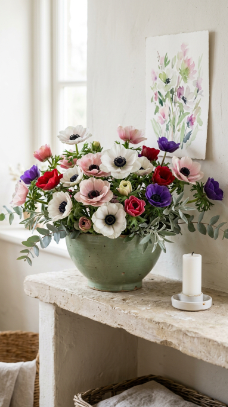
Vibe: An Easter floral decor idea that looks as though a painting has climbed off the wall.
What makes it work: Anemones’ dramatic black centers create strong graphic anchors within what is otherwise an extremely soft, pastel-heavy arrangement — this contrast is what prevents the bowl from looking saccharine. Varying the opening stages (some tight buds, some fully open) creates natural depth and a sense of the arrangement being alive and changing.
How to achieve it: Buy anemones in a mixed color bunch and recut stems under water at a sharp angle before arranging — this prevents air bubbles from blocking water uptake, which is the most common reason anemones wilt prematurely. A sage green matte ceramic bowl from a ceramics studio or home store is the ideal foil.
💡 Anemones are phototropic — they turn toward light. Rotate your arrangement each morning for an even display.
Hanging Egg Garland with Fresh Flower Clusters
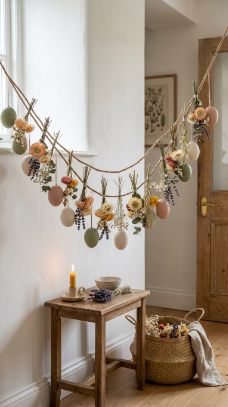
Vibe: A wall installation that makes an entryway feel like Easter arrived and decided to stay.
What makes it work: A garland-style display brings the decorating onto the wall — a plane that Easter floral decor rarely occupies — creating impact without claiming any surface space. The combination of eggs and dried flower clusters creates a material dialogue: one organic and smooth, one papery and textured, both in the same gentle color family.
How to achieve it: Stretch natural jute twine between two cup hooks. Tie blown eggs with thin twine at varying lengths (6–14 inches). Wire small dried flower clusters directly onto the main twine between the eggs using 26-gauge floral wire. Space clusters and eggs alternately along the full length.
Garden Cloche with Moss Bunny and Spring Flowers
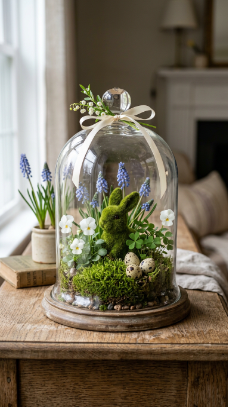
Vibe: A tiny, enchanted Easter world under glass — the detail that stops every guest in their tracks.
What makes it work: A cloche creates a frame and an implied preciousness around whatever it covers — even the most basic elements become curated and special under glass. The moss bunny figure adds narrative charm without crossing into overly kitsch territory, because the botanical materials (real moss, real flowers) ground it in the natural world.
How to achieve it: Source small ceramic animal figurines from garden centers or home decor stores. Apply preserved sheet moss with a strong craft adhesive, pressing firmly and allowing to dry. Arrange miniature flowers (muscari, violas) in small water picks hidden beneath the moss layer.
Abundant Easter Floral Decor in a Galvanized Wash Tub
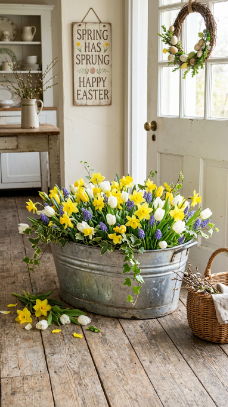
Vibe: Spring arrived in quantity — this arrangement is unapologetically generous and full of life.
What makes it work: A galvanized wash tub introduces industrial texture that makes spring flowers feel more grounded and less precious — the tension between rough metal and delicate blooms is exactly what gives this arrangement its character. The large scale means you can use inexpensive grocery store flowers in bulk and still achieve a truly lavish result.
How to achieve it: Place a large water-filled bucket or multiple water jars inside the tub to hold flowers without committing the tub itself to water. Fill abundantly — the rule with this format is more, not less. Yellow, white, and purple is a naturally harmonious Easter palette that works in any proportion.
💡 Galvanized tubs from farm supply stores cost $15–$25 and become a permanent Easter decor investment.
Spring Botanical Print Gallery Wall with Fresh Flower Accent
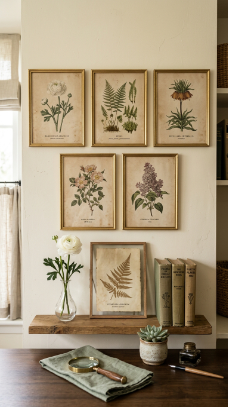
Vibe: The Easter floral decor idea for people who love flowers the way a scientist loves specimens.
What makes it work: Pairing vintage botanical prints with a single living stem creates a meta-conversation between the illustrated and the real — the print shows what the flower is, the vase shows what it does. This gives an otherwise static gallery wall a living, changing element that makes it feel curated rather than decorated.
How to achieve it: Source vintage botanical prints from Etsy, antique markets, or download free public-domain illustrations from sources like the Biodiversity Heritage Library. Frame in thin brass or gold frames in 5×7 or 8×10. Add a small ledge shelf (IKEA MOSSLANDA works perfectly) below the cluster.
Easter Table with Individual Egg Cup Flower Holders
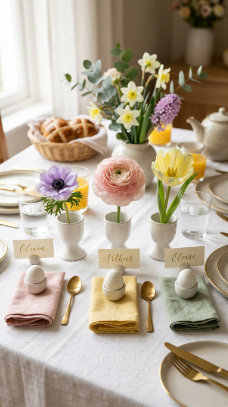
Vibe: The Easter breakfast table that makes everyone feel like a guest of honor.
What makes it work: Repurposing egg cups as miniature bud vases creates a delightfully unexpected double function — the object performs its traditional Easter role (holding a boiled egg) and a new decorative one simultaneously. One perfect stem per cup is the styling principle here: restraint and specificity, not abundance.
How to achieve it: Fill each egg cup with a small water-soaked cotton ball rather than water directly, which prevents spills on the table. Cut stems to exactly 2 inches above the cup rim. Choose flowers with upright stems — tulips and ranunculus hold their position better than floppy varieties in such small vessels.
Blush and Gold Easter Floral Decor on a Bar Cart
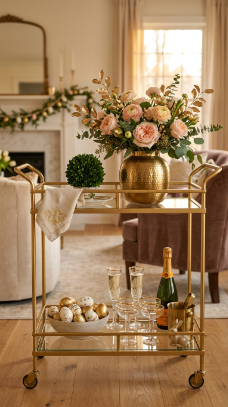
Vibe: Easter done with a celebratory wink — grown-up, glamorous, and ready for guests.
What makes it work: A bar cart offers two distinct surface levels, which creates natural opportunity for varied display heights — a fundamental visual principle. Blush roses against gold metallic accents plays on the warm-warm color harmony, which feels rich rather than competing. Gold-leafed branches (available at craft stores) extend the height without adding more flowers.
How to achieve it: Style the top shelf as the “arrangement” tier (flowers, height, visual interest) and the lower shelf as the “functional” tier (glasses, serving items). Gold-leaf branches are simply regular branches sprayed with gold metallic spray paint — the effect is instant and dramatic.
💡 A small box of gold metallic paint spray costs around $8 and transforms any foraged branch.
Lavender and Eucalyptus Bathroom Spa Bundle
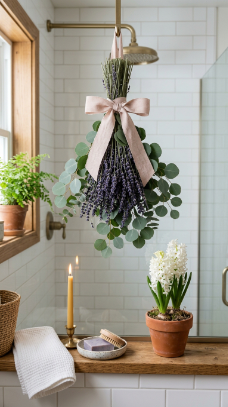
Vibe: Your bathroom reimagined as a fragrant spring retreat — sensory Easter floral decor that works even when no one can see it.
What makes it work: Shower steam activates the essential oils in both lavender and eucalyptus, intensifying their fragrance and creating a genuinely aromatherapeutic experience. This means the “arrangement” doubles as functional wellness decor — it’s beautiful to look at and actively improves the space’s ambiance.
How to achieve it: Tie a large bunch of fresh lavender and silver-dollar eucalyptus tightly with waterproof floral tape first, then add the decorative ribbon over it. Hang from the showerhead with a simple S-hook or a loop of twine. Replace every 1–2 weeks as the steam dries the botanicals out.
Moss-Filled Wooden Egg Crate with Seedlings
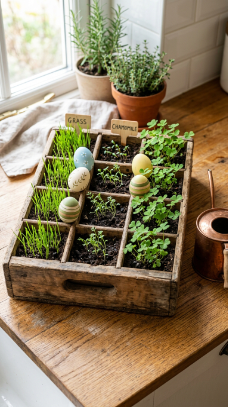
Vibe: The Easter decor idea that’s actually a garden project — living, growing, and deeply satisfying.
What makes it work: A growing seedling display turns Easter floral decor into an experience with a timeline — guests and family can watch it develop over the days before Easter. The egg crate’s compartmentalized structure creates a naturally organized layout without any styling effort, and the vivid green of new growth against aged wood is a beautiful contrast.
How to achieve it: Sow wheatgrass or chamomile seeds directly into small amounts of potting soil in each compartment, 10–14 days before Easter for peak growth timing. Line compartments with cling film to protect the wood from moisture before adding soil.
Garden Rose and Lemon Verbena Arrangement in Stoneware
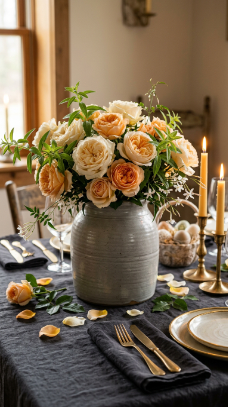
Vibe: The arrangement that makes dinner guests ask where you trained as a florist — when the honest answer is your own kitchen.
What makes it work: Apricot and cream roses are warmer than pink or blush and pair more richly with candlelight, which deepens their tones beautifully as the evening progresses. Lemon verbena introduces an intensely fragrant herbal note and a fine-leaved texture that garden roses alone can’t provide. The stoneware crock’s matte grey surface acts as a sophisticated neutral.
How to achieve it: Source apricot roses from a florist (Keira and Juliet David Austin varieties are widely available and exceptionally ruffled). Cut lemon verbena from a garden plant or purchase from farmers’ markets. Arrange roses first in the crock, then weave herb stems through afterward.
💡 Rub lemon verbena leaves between your fingers to release their citrus fragrance while arranging — guests will notice.
Ombre Flower Arrangement from White to Deep Purple
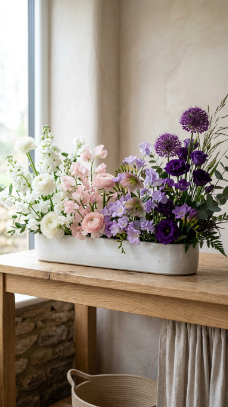
Vibe: Like a watercolor wash of spring — the arrangement that makes you stop and just look.
What makes it work: Ombre arrangements use color theory deliberately — the gradual transition from white through lavender to deep purple creates a visual journey that holds attention longer than any single-color arrangement. This technique works especially well with Easter’s naturally pastel palette, because the full spectrum from light to dark is available within the season’s own color family.
How to achieve it: Divide your rectangular vessel mentally into five sections and commit a specific color to each zone. Insert flowers in tight clusters within their zone rather than blending — the color transition reads more clearly with deliberate groupings than with mixing. A ceramic window box (12–16 inches long) is the ideal vessel.
Potted Flowering Branches in a Tall Rattan Basket
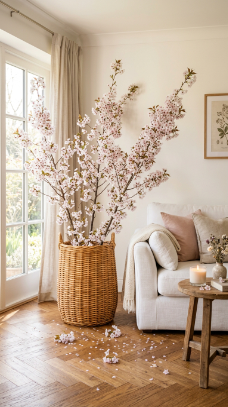
Vibe: The Easter floral decor equivalent of a standing ovation — unmissable, luminous, and worth every fallen petal.
What makes it work: Flowering branches achieve a scale that is simply impossible with cut flowers in a vase — they bring the full architecture of a blooming tree indoors. Cherry blossom or forsythia branches in a tall rattan basket create a corner installation that transforms the room rather than merely decorating it. Fallen petals on the floor should be left — they’re part of the moment.
How to achieve it: Source cherry blossom, quince, or forsythia branches from a florist or garden supplier. Place a large water-filled bucket inside the rattan basket, hidden from view. Branches last 10–14 days indoors in fresh water; hammer the bottom inch of the stem to help them drink.
Repurposed Wine Bottles with Single Flower Stems
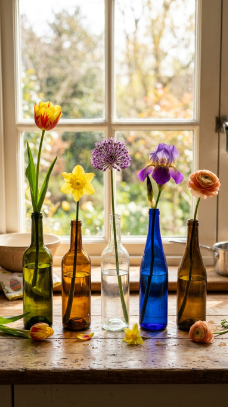
Vibe: Five flowers in five bottles — and somehow it’s the most beautiful thing in the kitchen.
What makes it work: Colored glass bottles lit from behind by natural window light function as their own light source, creating a stained-glass effect that elevates the simplest single-stem arrangement to something genuinely dramatic. The variety of glass colors means no two stations in the row look identical, giving the collection natural visual rhythm.
How to achieve it: Soak wine bottle labels off in warm water with a few drops of dish soap — most labels release within 20 minutes. Arrange bottles from tallest to shortest or vary intentionally. The single-stem rule is essential: one flower per bottle, no exceptions. Discipline creates beauty here.
Easter Floral Decor with Painted Terracotta and Succulents
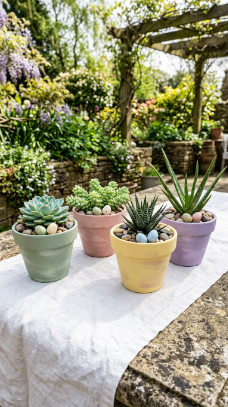
Vibe: Easter with a modern-bohemian sensibility — soft pastel color without a single plastic egg in sight.
What makes it work: Succulents are structurally interesting enough to function as floral decor in their own right — their geometric rosette forms and blue-green tones add a contemporary graphic quality that traditional Easter flowers don’t have. The hand-painted terracotta pot becomes the floral element, carrying Easter’s pastel palette while the succulent provides form.
How to achieve it: Paint standard terracotta pots with chalk paint in pastel shades — chalk paint adheres to terracotta without priming and dries with the perfect matte finish. Apply with a wide, dry brush for a slightly textured result. These pots continue as garden decor long after Easter ends.
💡 Chalk paint from craft stores costs around $10 a jar and covers approximately eight medium terracotta pots.
Easter Floral Decor Ceiling Installation with Dried Botanicals
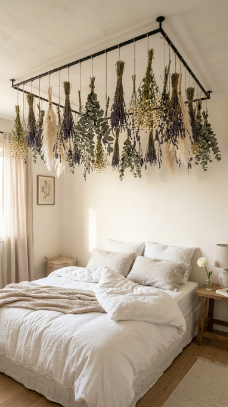
Vibe: Waking up inside a spring garden — the kind of bedroom that makes Monday mornings more bearable.
What makes it work: Ceiling installations claim the most under-used surface in any room and create an immersive environment rather than a decorated one. Dried botanicals are essential here — they’re lightweight, won’t drop petals onto bedding, and maintain their visual and fragrant quality for weeks without any water or maintenance.
How to achieve it: Install a simple curtain rail or wooden dowel above the bed using ceiling brackets. Tie individual botanical bundles (purchased at craft stores or dried from garden plants) with jute twine at varying lengths and hang directly from the rod with small S-hooks. Aim for 15–20 bundles for genuine visual density.
Pressed Wildflower Lantern for Easter Floral Decor
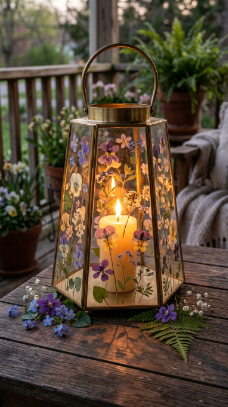
Vibe: The Easter floral decor idea that’s also an event — watching botanical shadows dance on the table as evening falls.
What makes it work: Pressed flowers applied to the inside of a glass lantern act as a botanical stained-glass filter for candlelight — the effect is genuinely theatrical and creates a beautiful interplay between the decoration and the light source. This works because the flowers become translucent when pressed thin, allowing light to pass through and project their outlines.
How to achieve it: Press flowers (pansies, violets, and ferns press flattest and fastest) between heavy books for 10–14 days. Apply to the inside of lantern glass panels using a thin layer of Mod Podge — let each petal dry before adding the next. Place a battery-operated candle inside for a safer version of the same effect.
How to Start Your Easter Floral Decor Journey
The most important first step is identifying your two or three highest-impact surfaces — the dining table, the front door, and the entryway collectively account for the majority of what guests and family actually see and experience. Focus your effort and budget on these before adding accents elsewhere.
Avoid the most common Easter floral decor mistake: buying flowers before you have a vessel. Your container determines the arrangement’s style, height, and character far more than any specific flower. Spend five minutes finding an interesting container — a thrifted stoneware crock, a vintage tin, a glass bottle — and then buy flowers that suit it.
Budget-wise, meaningful Easter floral decor is genuinely achievable for $30–$50 across your whole home. A $4 tulip bunch at the grocery store, three mason jars from your kitchen cupboard, and a spool of jute twine from the dollar store is all you need to start. Dried elements — pampas, lavender, strawflowers — are a one-time investment that pays off across multiple Easters.
Timeline expectations: fresh flower arrangements take 15–30 minutes to assemble and look best when made 1–2 days before Easter. Dried and botanical installations can be built weeks ahead and stored easily. Start small, resist the urge to do everything at once, and let one beautiful corner inspire the next.
Frequently Asked Questions
What is the best Easter floral decor for a dining table?
A floral table runner or a low central arrangement that keeps sightlines open across the table are both excellent choices for Easter dining. The key is proportion — your arrangement should not be taller than 10–12 inches if guests need to see each other across the table. A mix of blush garden roses, eucalyptus, and scattered votives in the $25–$40 range creates a genuinely lavish look without specialist skills.
How do I make Easter floral decor last through the holiday weekend?
Choose flowers that are still in bud stage when you purchase them — they’ll open gradually and look their best on Easter day itself. Recut stems at a 45-degree angle every two days, change water daily, and remove any leaves below the waterline. Keep arrangements away from heat sources, direct sunlight, and fruit bowls. Tulips, ranunculus, and chrysanthemums are the longest-lasting options, typically holding 10–14 days in fresh water.
What are the most budget-friendly Easter floral decor ideas?
Dried botanical wreaths, painted terracotta pot displays, and bud vase collections are the three most budget-friendly approaches. A beautiful dried wreath can be assembled for under $20 using craft store materials. Wheatgrass seedling trays cost almost nothing to grow from seed. Single-stem bud vase collections rely on grocery store flowers — daffodils, tulips, and alstroemeria — which regularly cost $3–$6 per bunch. Foraging greenery from your garden (eucalyptus, rosemary, ivy) dramatically reduces the cost of any floral arrangement.
How do I incorporate Easter floral decor without making my home look too themed?
The key is choosing flowers and vessels over Easter-specific props. A terracotta pot of purple hyacinth on a shelf is spring decor and Easter decor simultaneously — it doesn’t require a bunny print or egg motif to feel seasonal. Stick to the natural Easter palette (soft lavender, blush, sage, cream, butter yellow) and use it in containers and botanicals rather than in patterned textiles or themed figurines. One or two small nods to Easter (a few speckled eggs tucked into a moss arrangement) are more effective than covering every surface.
Can I use Easter floral decor outdoors as well as indoors?
Absolutely — in fact, front porch and garden Easter floral displays often have the most impact because they set the tone before guests even enter. Planted containers (terracotta pots, wooden crates, galvanized tubs) are ideal for outdoor Easter floral decor because they hold up to weather better than cut flower arrangements. Choose cold-hardy spring plants like primrose, violas, pansies, and muscari, which thrive in the cool temperatures of early spring and last throughout the Easter season.
Ready to Create Your Easter Floral Decor?
You now have 28 genuinely different Easter floral decor ideas — from five-minute window-sill bud vase groupings to full ceiling installations and flowering branch corners that transform a room entirely. The beauty of Easter floral decorating is that it meets you wherever you are: one perfect stem in a vintage bottle is enough to make a space feel intentional and seasonal. Pin the ideas that feel most like your home, gather your containers before your flowers, and remember that the most beautiful Easter floral decor is rarely the most complicated. Let spring in, one bloom at a time.