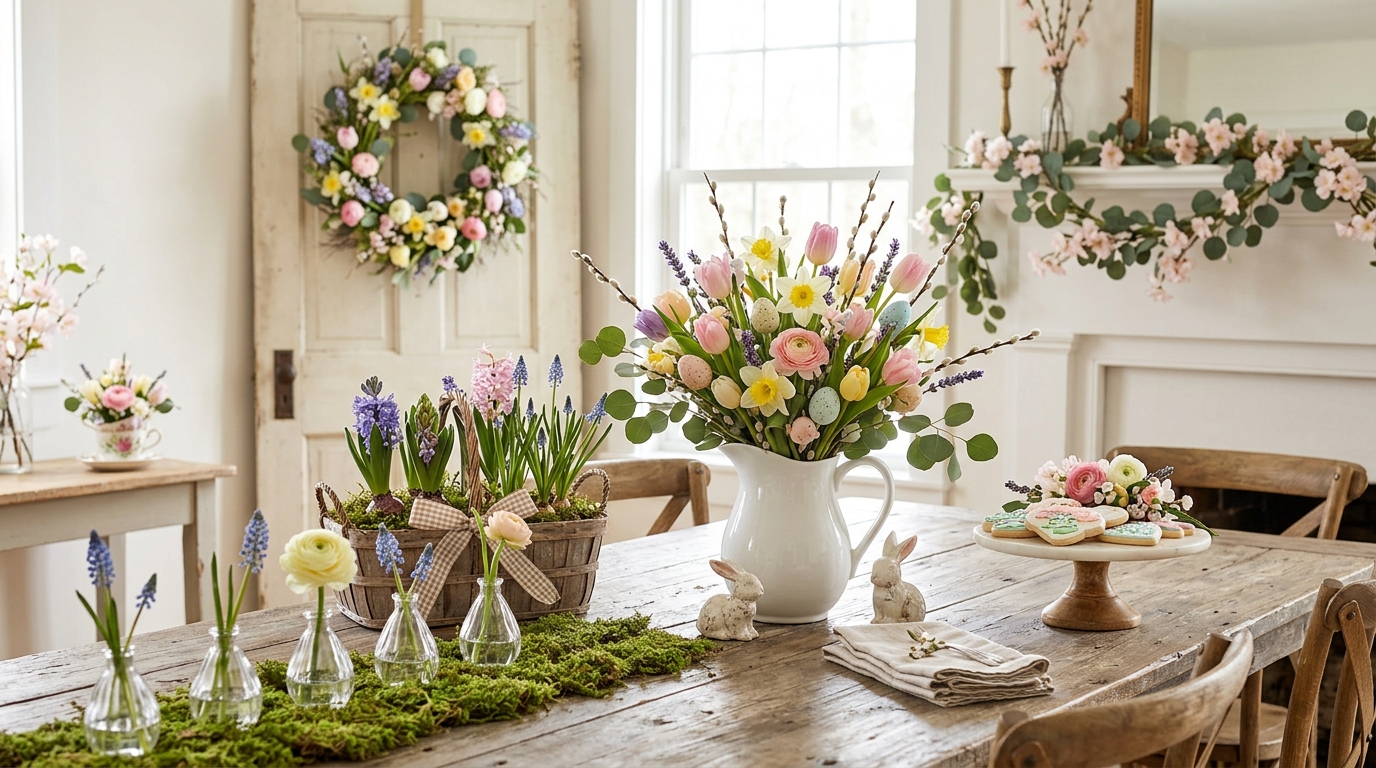
There’s a particular kind of magic that arrives with spring flowers — the way a single tulip on a kitchen counter can shift the entire mood of a morning, or how a generous bowl of ranunculus on a dining table turns an ordinary Tuesday into something worth noticing. Easter floral arrangements capture that magic at its fullest, weaving together the season’s most beautiful blooms into displays that feel both celebratory and deeply personal. Whether you’re styling a grand tablescape for a family gathering or simply want one perfect vase on a windowsill, there’s an Easter floral arrangement here that was made for your space. Here are 29 ideas worth saving.
Why Easter Floral Arrangements Work So Well
Easter floral arrangements occupy a uniquely beautiful corner of seasonal decorating because they draw directly from nature at its most generous moment. Spring is the season when the natural world is essentially doing the hard work for you — the colors, textures, and forms that appear in April and May are already in perfect harmony with each other.
The defining palette is built on softness and contrast: blush and coral against sage green, lavender beside warm white, butter yellow paired with deep violet. These aren’t arbitrary aesthetic choices — they’re the actual colors of spring meadows, which is why they feel so instinctively right together. Materials that frame these arrangements best include aged terracotta, hand-thrown stoneware, weathered wicker, and vintage glass — all of them warm, tactile, and humble enough to let the flowers lead.
Culturally, Easter floral design is having a significant moment. Pinterest data consistently shows spring tablescape and floral arrangement searches surging from February onward, driven by a broader appetite for slow living and intentional seasonal ritual. People are actively choosing to mark the turning of the year with beautiful things, and flowers are the most immediate way to do that.
What makes this style especially accessible is its flexibility of scale. A single hyacinth in a ceramic mug does meaningful design work on a bathroom shelf. Three mason jars of daffodils on a kitchen table require ten minutes and ten dollars. The investment scales to your ambition — and even the smallest Easter floral arrangement delivers a disproportionate return in beauty and mood.
Loose Tulip Bunch in a Linen-Wrapped Jar
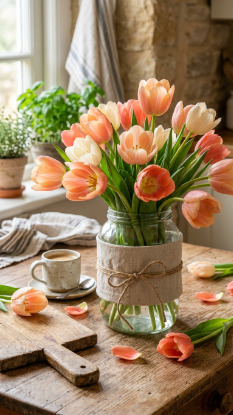
Vibe sentence: This arrangement has that rare quality of looking like you barely tried — which, of course, is the most sophisticated effect of all.
What makes it work: Wrapping a plain glass jar in linen instantly elevates it into a vessel with warmth and texture, while still allowing stem visibility through the glass. The loose, unconstrained placement of tulips — some upright, some curved naturally outward — creates the “just gathered” effect that styled symmetry can never quite achieve.
How to achieve it: Buy two bunches of tulips in tones within the same warm family. Cut all stems to the same length, then place them loosely together and drop them into the jar as a group rather than arranging individually. Wrap the jar in a linen square secured with jute twine, leaving the top few centimeters of glass visible.
💡 Grocery store tulips work perfectly here — buy them tightly budded and let them open at room temperature over two days for the best result.
Tiered Cake Stand Floral and Egg Display
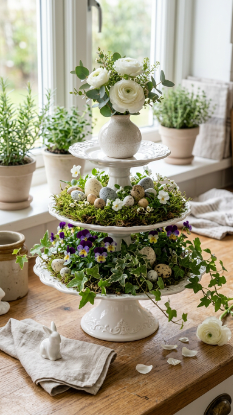
Vibe sentence: Repurposing a cake stand into an Easter vignette is the kind of creative reuse that looks intentional, considered, and completely original.
What makes it work: The tiered structure creates instant visual hierarchy — your eye travels from the topmost bloom downward, making even simple elements feel curated. Each tier tells its own small story while contributing to a unified whole, and the elevation gets flowers off the flat table surface for a more dynamic display.
How to achieve it: Work from top to bottom: place the smallest bud vase at the apex, a soft textural element (moss, eggs) on the middle tier, and trailing or low-growing elements on the widest base tier. Choose a color story across all three tiers and stick to it — two colors maximum keeps it cohesive.
Windowsill Row of Hyacinths in Bud Vases
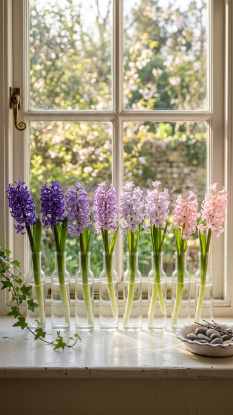
Vibe sentence: A color gradient of hyacinths across a windowsill is essentially a piece of art — one that also perfumes the entire room.
What makes it work: The ombré color progression from deep to light (or reverse) transforms a simple row of flowers into a deliberate design statement. Backlit by window light, the hyacinth florets glow with an almost stained-glass quality. The repetition of identical vessels makes the color variation the single hero element.
How to achieve it: Buy hyacinth stems in three to four tones within the same color family — violet, mid-purple, pale lilac, and blush creates a beautiful gradient. Use matching slim bud vases for uniformity. Position deeper-colored stems at one end and graduate naturally toward the palest tones at the other.
💡 Hyacinths are also sold as growing bulbs in pots — cut single stems and they last just as long as florist-bought cuts, at a fraction of the cost.
Overflowing Garden-Style Compote Arrangement
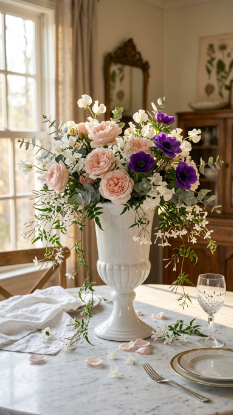
Vibe sentence: A compote arrangement is floral design with genuine ambition — elevated above the table surface, it commands the room in the most beautiful way.
What makes it work: The pedestal of a compote vase elevates the arrangement so flowers spill downward, creating a cascade effect impossible with a flat-based vessel. This downward flow gives the display a sense of romantic abundance. Mixing flower sizes — large roses as anchors, delicate sweet peas as airiness — creates the layered depth of a professionally designed arrangement.
How to achieve it: Fill the compote bowl with crumpled chicken wire to support stems without foam. Build from the center outward and downward, allowing trailing elements like jasmine or ivy to fall naturally over the edge. Keep the arrangement slightly asymmetric — perfect symmetry reads as stiff in a garden-style display.
Moss-Lined Wooden Box Centerpiece
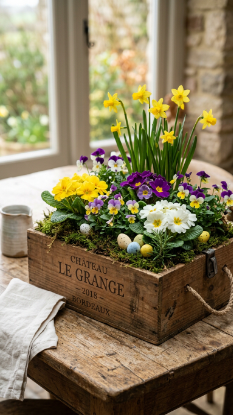
Vibe sentence: A wooden crate full of spring flowers is simultaneously a garden and a centerpiece — the kind of display that makes guests reach for their phones.
What makes it work: The low, wide format of a wooden crate keeps the arrangement well below sightline, making it ideal for dining tables where you need to see and talk across the room. Planting (rather than cutting) flowers in moss means the display stays fresh and alive for the entire Easter weekend without any maintenance.
How to achieve it: Line a wooden crate or shallow box with heavy-duty plastic before adding potting soil and moss. Plant a mix of primroses, violas, and small narcissus — all available as tiny potted plants from garden centers. Tuck sheet moss around the base of each plant to conceal soil and create a unified green ground.
Blush Peony Bouquet in a Fluted Glass Vase
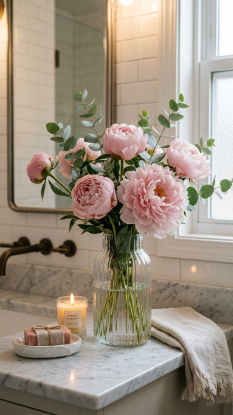
Vibe sentence: Peonies in a bathroom feel like an extraordinary indulgence — and that is precisely why you should put them there.
What makes it work: The fluted glass vase refracts light beautifully, adding luminosity that particularly suits the peony’s soft, layered petals. Buying peonies at multiple opening stages — some tight buds, some half-open, some fully bloomed — means the arrangement tells a story of unfolding over several days.
How to achieve it: Buy peonies two to three days before Easter so tight buds have time to open. Cut stems at a sharp 45-degree angle and place in fresh, cold water — warmth accelerates opening. Add three to four eucalyptus stems for silver-green contrast that prevents the all-blush palette from feeling one-dimensional.
Trailing Ivy and Narcissus Table Runner
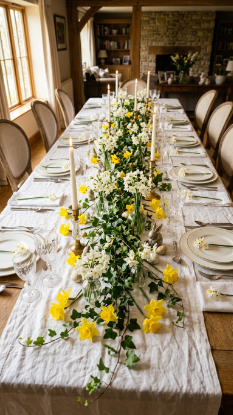
Vibe sentence: A floral table runner created from living plants and trailing vines makes a table feel like a garden has grown through the middle of it.
What makes it work: Running the design the full length of the table rather than centering a single arrangement creates an immersive experience that surrounds every guest equally. Placing small bud vases within the trailing greenery rather than a single large arrangement means guests seated anywhere along the table have flowers close to them.
How to achieve it: Lay the linen table runner first as the foundation. Trail ivy lengths along its center, then position bud vases at intervals within the greenery — three, five, or seven depending on table length. Fill any gaps with individual flower heads placed directly on the linen for that effortlessly scattered look.
💡 Cut trailing ivy from a garden (it grows prolifically) rather than buying it — free, and it lasts beautifully out of water for a full day on a table.
Vintage Watering Can Wildflower Arrangement
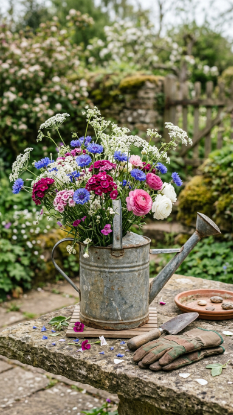
Vibe sentence: A vintage watering can filled with wildflowers is the Easter arrangement that looks as though it belongs equally indoors and out — which is its entire appeal.
What makes it work: The vessel does most of the storytelling here — a weathered watering can implies garden, seasons, and time in a way no ceramic vase can. Fine, airy flowers like cow parsley create a floating “halo” around denser blooms, giving the arrangement a naturalistic lightness that styled bouquets often lack.
How to achieve it: Fill the watering can with a water-filled jar placed inside if it has drainage holes. Use at least one fine, airy stem variety as filler — cow parsley, baby’s breath, or love-in-a-mist. Cut all stems at very varied lengths for an authentically wild look; a 15cm height difference between shortest and tallest is ideal.
Dried and Fresh Mixed Spring Arrangement
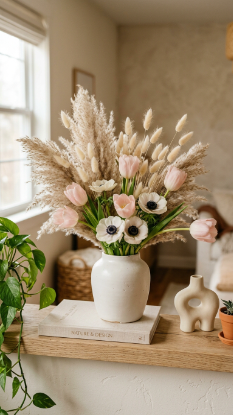
Vibe sentence: Mixing dried and fresh flowers in one arrangement creates a beautiful dialogue between past and present seasons — and the texture contrast is extraordinary.
What makes it work: Dried elements like bunny tail grass and pampas provide permanent structure and pale neutral tones that let fresh flowers truly pop. The textural contrast between feathery dried grasses and the silky, smooth petals of fresh tulips or anemones is genuinely striking in a way that an all-fresh arrangement can rarely achieve.
How to achieve it: Build the arrangement base with dried grasses first, then add fresh stems into gaps. Choose fresh flowers in clear, defined colors — blush, white, or deep violet — so they read distinctly against the neutral dried palette. A matte ceramic vessel in warm white or terracotta unifies both elements.
Potted Primrose Rainbow Display
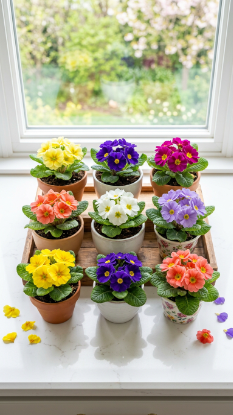
Vibe sentence: Nine primroses in nine different colors lined up in a grid is simultaneously a design statement and pure, unfiltered joy.
What makes it work: The grid format imposes order on what could easily become visual chaos with this many colors. Structure enables the rainbow to read as intentional rather than accidental. Primroses are especially suited to this because their flat, round faces all face forward uniformly, creating graphic consistency across the display.
How to achieve it: Source primroses from a garden center in the widest color range available — they’re typically sold in mixed packs in early spring. Arrange in a three-by-three or two-by-four grid, placing complementary rather than matching colors beside each other. After Easter, plant them all outside for spring color that continues for weeks.
💡 Primroses are among the most affordable potted flowering plants available — this entire display typically costs under $20.
Single Amaryllis Stem in a Tall Stoneware Vase
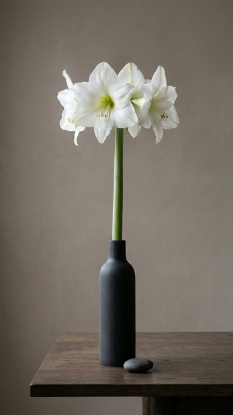
Vibe sentence: One amaryllis in a simple vase is a lesson in restraint that makes every other decorating choice look overcomplicated.
What makes it work: Amaryllis has genuine sculptural authority — a single stem commands a room in a way that requires no supporting cast. Placing it in a matte black vessel creates maximum contrast against white blooms, and the deliberate minimalism around it amplifies its presence rather than diminishing it.
How to achieve it: Support hollow amaryllis stems by placing a slender wooden stick or bamboo skewer inside before putting in the vase — this prevents the heavy bloom head from causing the stem to collapse. Use a narrow-necked vase to hold the stem upright without foam. Allow complete negative space around it; resist the urge to add anything.
Floral Letter Spelling “EASTER”
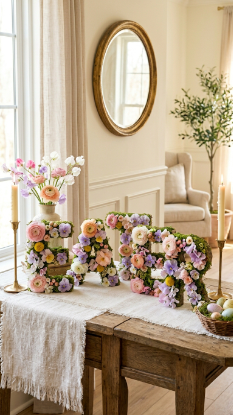
Vibe sentence: Floral letters are the Easter floral arrangement idea that photographs like a professional installation but costs almost nothing to create.
What makes it work: Letters offer a pre-built armature that takes all the structural decision-making out of the arrangement process — you simply fill the surface. The combination of different bloom sizes (small violas filling gaps, larger ranunculus as focal points) across a flat format creates a mosaic effect that’s genuinely stunning.
How to achieve it: Purchase papier-mâché letters from a craft store and cover the top surface with double-sided tape. Press moss as a base layer first, then add flower heads (stems trimmed very short) individually. Work from largest to smallest blooms. Mist gently with water twice daily to keep flowers fresh for up to three days.
Hanging Dried Flower Bundles Above a Doorway
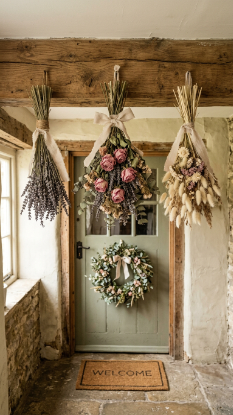
Vibe sentence: Dried flower bundles above a doorway create a gentle ritual of entry — you pass beneath something beautiful every time you move through the house.
What makes it work: Hanging elements above a doorway draws the eye upward and adds vertical dimension to a threshold that’s usually overlooked. Dried flowers in faded, muted tones create a gentle contrast with the bright fresh flowers elsewhere in the house, giving the display a sense of continuity between seasons.
How to achieve it: Bunch flowers tightly and tie with twine before hanging upside-down to dry for two weeks in a warm, dark space. Once dried, wrap with a prettier ribbon for display. Three bundles in odd numbers and varying widths at slightly different heights look more considered than a uniform row.
Apothecary Bottle Wildflower Collection
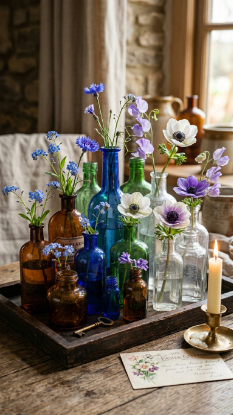
Vibe sentence: A collection of apothecary bottles becomes something far greater than the sum of its parts — each one a tiny portrait, all of them a gallery.
What makes it work: The varied glass colors — amber, clear, green, cobalt — layer their own visual interest before a single flower is added. Confining the collection to a tray creates unity without requiring the bottles to match, and the tight grouping creates critical visual mass from individually tiny vessels.
How to achieve it: Collect mismatched bottles from thrift stores, charity shops, and kitchen cupboards — no purchase required if you already have pasta sauce jars and empty perfume bottles. Use only one or two stems per bottle to prevent overcrowding. Group on a tray or cutting board to keep the arrangement mobile and easily transported between rooms.
💡 Forget-me-nots are especially beautiful in apothecary bottles — their tiny scale suits the narrow necks perfectly, and they’re often free from a garden.
Easter Egg Tree with Floral Base
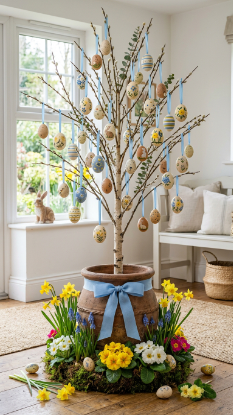
Vibe sentence: An Easter egg tree with a floral base is a living installation that children and adults find equally irresistible.
What makes it work: Adding a ring of living flowers around the base of an egg tree grounds an otherwise floating display and connects it to the floral theme of the season. The contrast between the delicate hanging eggs and the dense, earthy flowers at the base creates a beautiful tension between fragile and grounded.
How to achieve it: Secure a large branch in a terracotta or ceramic pot using wet sand or small rocks for stability. Hang eggs using thin satin ribbon in lengths of 10–20cm for natural movement. Ring the base with small potted plants tucked tightly together and covered with sheet moss to conceal individual pots.
Muscari and White Tulip Arrangement in Aged Brass
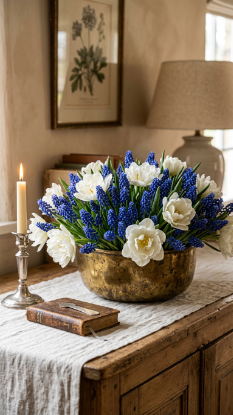
Vibe sentence: The deep blue of muscari against white tulips in an aged brass bowl is the Easter floral arrangement equivalent of a perfectly tailored suit — elegant, and completely assured.
What makes it work: Blue and white is an underused Easter palette that reads as sophisticated rather than predictably pastel. Muscari’s dense, grape-like clusters provide rich texture at a scale that makes them punch well above their modest size. The warm aged-brass vessel provides the warm neutral grounding that keeps the cool blue palette from feeling cold.
How to achieve it: Use a wide, shallow bowl (a kenzan pin holder inside helps position stems at precise angles). Place muscari stems first as a low, dense base, then add white tulip stems taller above — the height difference creates two distinct visual planes. Source muscari as cut stems from florists, or grow your own from bulbs planted in autumn.
Fresh Herb Wreath with Spring Flowers
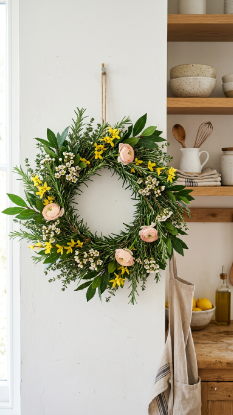
Vibe sentence: A wreath made from kitchen herbs has a sensory layering that purely floral wreaths can never quite match — you smell it before you see it.
What makes it work: Herbs provide a structured, fragrant base that holds its form and color for weeks, long after cut flowers would fade. Tucking flowering stems into the herb base creates a beautiful contrast between the textured, matte green foliage and the delicate petal colors — without requiring floral foam or complex construction.
How to achieve it: Build the wreath on a wire form, wiring herb bundles at intervals until the frame is covered. Then tuck fresh flower stems into the herb base, securing with small pieces of wire. Mist the wreath daily to keep herbs from drying too quickly. When flowers fade, remove and replace — the herb base remains.
Terrarium Bowl Spring Garden
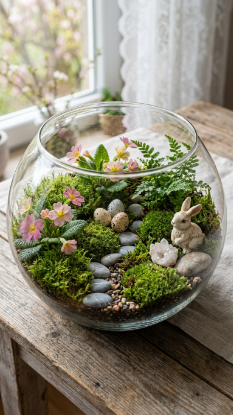
Vibe sentence: A terrarium garden is a world in miniature — an Easter scene you create once and watch quietly come to life over the days that follow.
What makes it work: The curved glass of a bowl concentrates and slightly magnifies the scene within, creating a jewel-box effect that flat surface arrangements can’t replicate. The combination of live plants, decorative elements, and natural materials creates a display with genuine narrative depth — it tells a small story.
How to achieve it: Layer drainage pebbles at the bottom, then add potting mix before placing plants. Keep primroses and ferns in their nursery pots sunk into the mix for easy swapping. Cover exposed soil with sheet moss. Add decorative elements — eggs, a tiny figurine, smooth stones — last.
Ranunculus and Olive Branch Arrangement
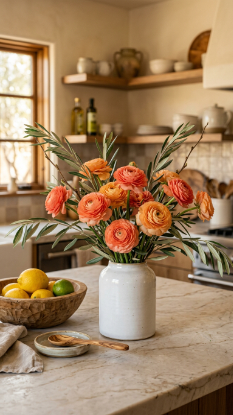
Vibe sentence: Olive branches bring an ancient, almost biblical beauty to an Easter arrangement that feels entirely right for the season.
What makes it work: Olive branches are long, architectural, and full of the kind of grey-green tones that make any flower placed alongside them look more vibrant by contrast. Their association with peace and the Mediterranean adds a quietly resonant layer to an Easter display without requiring explicit symbolism.
How to achieve it: Use olive branches (available at specialty florists and garden centers) as the structural skeleton of the arrangement, placing them first before adding flower stems. Choose ranunculus in warm tones — coral, apricot, peach — which glow against the cool silver-green olive leaves. Source olive branches from a florist or, in mild climates, from a garden center plant.
Cherry Blossom and Gypsophila Cloud Arrangement
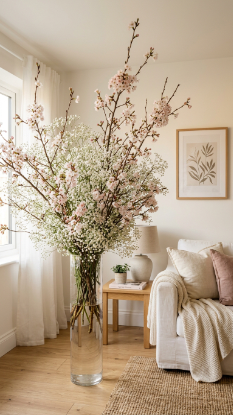
Vibe sentence: Cherry blossom and gypsophila together create an arrangement that looks less like flowers in a vase and more like a small weather event happening inside your living room.
What makes it work: Gypsophila, when used in significant volume rather than as token filler, creates a genuine cloud effect that gives any arrangement an ethereal quality. Combined with the Japanese-garden delicacy of cherry blossom branches, the pairing reads as both deliberately considered and naturally effortless.
How to achieve it: Use a tall, heavy glass cylinder vase filled with fresh water. Place cherry blossom branches first, choosing ones with natural curves that create movement. Then fill surrounding space generously with gypsophila stems — far more than feels instinctively right. The volume is what creates the cloud.
💡 Gypsophila is one of the most affordable cut flowers available — a large bunch typically costs under $5 and provides enough filler for three or four arrangements.
Spring Flowers in Vintage Teacups
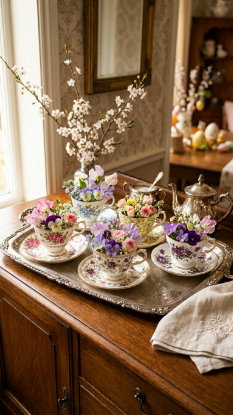
Vibe sentence: Flowers in teacups feel genuinely touching — as if someone has placed a tiny bouquet at every guest’s spot just to make them feel welcome.
What makes it work: The teacup vessel transforms small flowers — the stems too short for a tall vase — into the perfect focal point. The pattern and color variation across mismatched china creates an inherently collected, personal quality that uniform vessels can never replicate. A silver tray unifies the collection visually.
How to achieve it: Fill teacups with water (a small piece of floral foam inside helps if cups are deep). Use flowers with naturally short stems — violas, sweet peas, and miniature roses are ideal. Vary flower species per cup but maintain a cohesive color palette across the group. Display on a tray for easy positioning and a unified presentation.
Festive Floral and Candle Bathroom Vignette
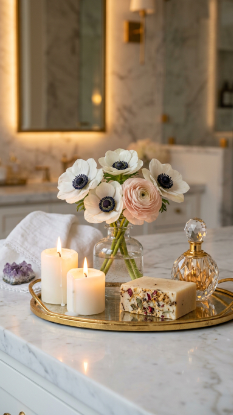
Vibe sentence: A bathroom vignette with flowers and candles transforms a functional space into something that feels like a private retreat.
What makes it work: The gold tray creates a defined “stage” that elevates every object placed on it, however simple. Limiting the floral element to three or four stems rather than a full arrangement keeps the proportion right for a smaller surface, and the candlelight makes anemone petals glow in a way daylight cannot.
How to achieve it: Use a small gold or silver tray as the containing element. Choose a petite, geometric glass vase — square or hexagonal works well. Limit flowers to three to five stems maximum and choose white or very pale tones that reflect candlelight most beautifully. Replace flowers every three days to keep the vignette feeling fresh.
Spring Flower Press Art Installation
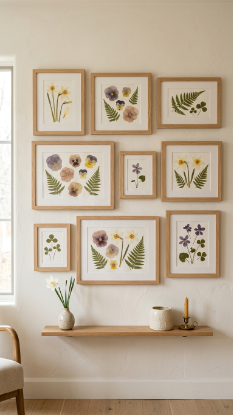
Vibe sentence: A pressed botanical gallery wall is an Easter floral arrangement that lasts indefinitely — art made from the very flowers the season gives you.
What makes it work: The gallery wall format gives pressed botanical art the same visual weight as framed photography or prints, legitimizing it as serious décor rather than a craft project. Varying frame sizes within a cohesive style (all the same finish, black or natural wood) creates rhythm without uniformity.
How to achieve it: Press flowers and leaves between parchment paper in heavy books for a minimum of two weeks. Frame each piece on a simple cream or white mat that allows the botanical to breathe within the frame space. Plan the wall arrangement on the floor first before hanging, playing with composition until it feels balanced.
Wisteria and White Rose Abundance Arrangement
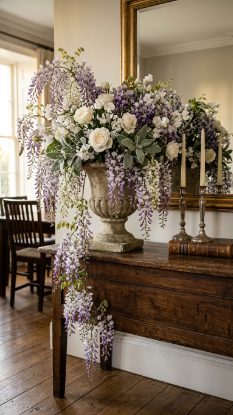
Vibe sentence: Wisteria trailing from a stone urn is the Easter floral arrangement equivalent of a poem — every element earned its place, and the result feels both inevitable and extraordinary.
What makes it work: The downward trail of wisteria dramatically extends the visual footprint of the arrangement far beyond its vessel, creating a cascade that genuinely commands a room. Placing the arrangement in front of a mirror doubles it visually, creating the perception of twice the floral volume for the same investment.
How to achieve it: Use a heavy, wide-based urn or ceramic vessel for stability — wisteria branches are heavier than they appear. Source wisteria from a specialty florist or cut from a garden in season. Support the arrangement with chicken wire inside the urn rather than foam, allowing the trailing tendrils to hang naturally.
Kitchen Shelf Spring Floral Vignette
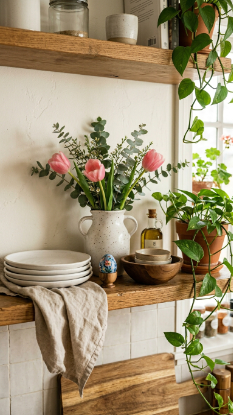
Vibe sentence: A single small arrangement on a kitchen shelf does more styling work than a full counter rearrangement — it’s the smallest intervention with the largest impact.
What makes it work: Open shelving creates natural opportunities for small floral moments that function within an existing domestic scene rather than demanding their own dedicated surface. The key is scale — a small ceramic pitcher with three to five stems looks intentional, while a larger arrangement on a shelf looks like it has nowhere else to go.
How to achieve it: Choose a vessel that already lives on the shelf — a ceramic pitcher, a small jug — and simply add three to five fresh stems. This integrates the flowers into the existing display rather than disrupting it. Eucalyptus or olive sprigs work especially well because they last without water for a day or two.
💡 Two or three tulip stems in a small pitcher cost almost nothing and take thirty seconds to arrange — the most efficient floral upgrade in any home.
Foraged Branch and Bloom Arrangement
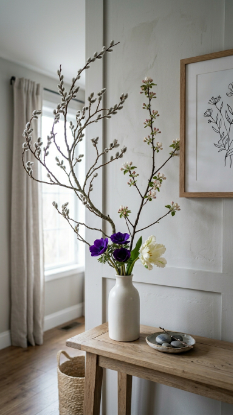
Vibe sentence: Foraged branches bring a scale and wildness indoors that purchased flowers simply cannot — this arrangement makes the room feel twice as tall.
What makes it work: Long branches establish dramatic vertical dimension that completely transforms a room’s spatial perception. Pussy willow’s silver catkins are visually extraordinary at close range — a texture so unusual that guests invariably want to touch them. The combination of two branch species with three to four flower stems creates sophisticated proportion with minimal effort.
How to achieve it: Cut branches in late winter or early spring — apple, cherry, forsythia, or pussy willow. Make a deep cross-cut at the base of woody stems to help them take up water. Place in a heavy vase with a small amount of water (branches don’t need much) and allow to stand at room temperature to coax buds into opening.
Easter Sunday Brunch Flower Pot Place Settings
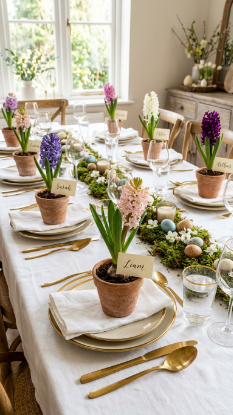
Vibe sentence: When every guest receives their own flower at the table, a meal becomes a memory — this is the Easter detail that people mention for years afterward.
What makes it work: Individual flowers as place settings serve double duty as décor and gift, which gives the design enormous emotional return for its cost. Different hyacinth colors per setting allows each guest their own version of the theme — personal within a unified display. Terracotta pots as holders feel warm and purposeful rather than fussy.
How to achieve it: Buy individual hyacinth stems or small potted plants and cut to a consistent height. Insert into small terracotta pots using a water tube or damp oasis foam hidden inside. Write guest names on small recycled card labels and tuck them in. Each guest takes their flower home — the most practical party favor imaginable.
How to Start Your Easter Floral Arrangement Transformation
Begin with your dining table — it’s the heart of Easter gathering and the surface that delivers the most visual impact per dollar invested. Resist the temptation to tackle every room simultaneously. One beautifully considered arrangement on a table seen by everyone is more powerful than six rushed vases scattered through the house.
The most common mistake is buying flowers too close to Easter itself. Tight buds purchased two to four days ahead will peak exactly on the day you need them most. Flowers bought the morning of will either not have opened yet or, if forced, will drop petals by afternoon. Give yourself the gift of timing.
Budget-friendly entry points are genuinely accessible this season. Potted hyacinths, primroses, and narcissus from a garden center cost a fraction of florist-arranged bouquets and last significantly longer. A $15–$20 investment in three or four small potted plants plus one bunch of cut flowers creates a display far more generous than its price suggests.
Expect the whole process to take two to three enjoyable hours spread across the days leading to Easter. This isn’t a rush job — it’s a ritual. Set aside an afternoon with good music and treat it as a creative exercise rather than a chore, and the results will show it.
Frequently Asked Questions
What are the most popular flowers for Easter floral arrangements?
Tulips, hyacinths, daffodils, narcissus, ranunculus, and anemones are the most widely used and widely available Easter flowers. Hyacinths are particularly beloved because they combine strong visual impact with an extraordinary perfume that single-handedly changes the atmosphere of a room. Ranunculus have surged in popularity recently because their layered, peony-like appearance photographs beautifully — they’re a favorite for Easter tablescapes and styling content. For more dramatic arrangements, amaryllis and cherry blossom branches add impressive scale. All of these are available at florists, garden centers, and most supermarkets from February through April.
How long do Easter flower arrangements typically last?
Cut flower arrangements typically last five to ten days depending on species and care. Tulips and sweet peas are on the shorter end at five to seven days; ranunculus and anemones often reach eight to ten days with fresh water changes every two days. Potted flowering plants — hyacinths, primroses, narcissus — last two to four weeks indoors before needing to move outside. To maximize vase life for any cut flower, cut stems at a 45-degree angle before placing in water, change the water every two days, and keep arrangements away from direct sun and ripening fruit. Adding a small amount of flower food (sugar and a drop of bleach in a pinch) genuinely extends life.
What colors work best for Easter floral arrangements?
The classic Easter floral palette draws from spring itself: blush pink, soft lavender, butter yellow, pale violet, coral, and white are enduringly popular. For a more sophisticated or contemporary approach, consider limiting yourself to two tones — all white and green reads as extremely elegant, while deep violet and white creates a dramatic, unexpected palette that avoids the overtly pastel aesthetic. If you prefer warmth, coral, peach, and apricot tones together create a rich, sunset-toned Easter display that works beautifully in rooms with warm wood tones or natural materials. The key rule is consistency — choose two or three tones per arrangement and stick to them.
Can I make Easter floral arrangements without going to a florist?
Absolutely — some of the most beautiful Easter arrangements come entirely from garden centers, supermarkets, and even your own garden. Garden centers in spring stock potted hyacinths, primroses, narcissus, violas, and ranunculus that can be combined with foraged branches and garden ivy for displays that rival professional floristry. Supermarket flower sections carry bunched tulips, mixed spring bouquets, and often individual stems during the Easter period. For foraged elements, pussy willow branches, forsythia, cherry blossom, and apple blossom can often be cut freely from gardens. The skills required for beautiful Easter arrangements are minimal — it’s primarily about vessel choice, color cohesion, and confident stem-cutting.
How do I stop Easter flower arrangements from wilting too quickly?
The most effective steps are the simplest: always re-cut stems at a 45-degree angle under running water before placing in a clean vase, use room-temperature water (cold water slows uptake for many species), and change the water every two days. Keep arrangements out of direct sunlight and away from heat sources — a cool room dramatically extends vase life. Remove any leaves that would sit below the waterline, as these rot and produce bacteria that shortens the life of the entire arrangement. If you notice a flower wilting prematurely, cut the stem shorter and place it in a separate deep container with cool water for several hours — this often revives it completely.
Ready to Create Your Dream Easter Floral Arrangement Space?
You now have 29 genuine, distinct Easter floral arrangement ideas to choose from — ranging from a single amaryllis stem in a sculptural vase to a full wisteria cascade trailing from a stone urn, with every scale and budget in between. There is an arrangement here for every home, every surface, and every level of confidence with flowers.
Save the ideas that made you stop scrolling — those instinctive pauses are your best design compass. Start with just one: a cluster of hyacinths in a basket, or tulips wrapped in linen, or a row of bud vases across a windowsill. That single arrangement will make your home feel transformed in a way that no other decoration can quite replicate.
Easter floral arrangements are, at their core, an act of attention — a deliberate choice to mark the season with something living and beautiful. The flowers won’t last forever, but they don’t need to. That’s what makes them perfect.