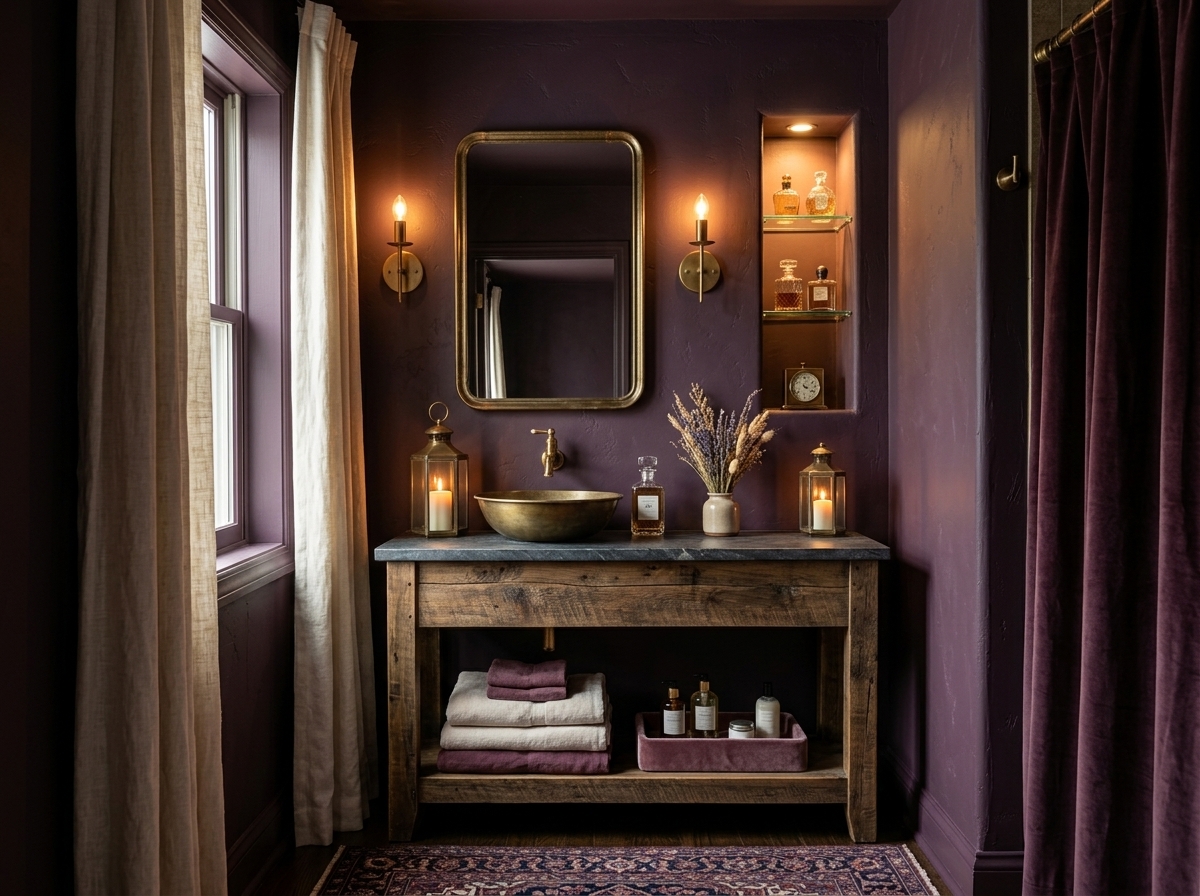
There’s something quietly thrilling about a small bathroom that’s been done right — where every inch is intentional, every shelf earns its place, and the whole space feels like a miniature spa rather than a cramped afterthought. Small bathroom design has undergone a genuine revolution in recent years, moving far beyond “make it look bigger” tricks toward something more interesting: making it feel better. Whether you’re working with a 40-square-foot powder room or a narrow ensuite, these 26 creative small bathroom ideas prove that limited square footage is a design constraint worth embracing. Here are 26 ideas worth saving — and building your most functional, beautiful bathroom around.
Why Creative Small Bathroom Design Works So Well
Small bathrooms are, paradoxically, one of the most exciting spaces to design. Because there’s no room for filler — every decision counts, and every element does double duty as both functional object and design statement. That constraint breeds ingenuity, and the results are often more characterful than their larger counterparts.
What defines the best small bathroom ideas right now is the fusion of storage intelligence and genuine style. Gone are the days when a cramped bathroom meant a white box with a tension-rod shower curtain. Today’s small bathroom aesthetic draws from boutique hotel design, Japandi minimalism, and European apartment living — all traditions built on doing more with less.
The materials and textures that anchor these spaces matter enormously: fluted glass, unlacquered brass, handmade zellige tiles, warm oak floating shelves, and textured plaster finishes all punch above their weight visually, making small rooms feel curated rather than crammed.
Even genuinely tiny bathrooms — under 35 square feet — benefit from these principles. In fact, jewel-box intimacy is a real design quality that only small rooms can achieve. A moody, well-lit 30-square-foot bathroom with thoughtful storage and beautiful hardware will always feel better than a large, poorly considered one.
Floating Vanity with Open Shelving Underneath
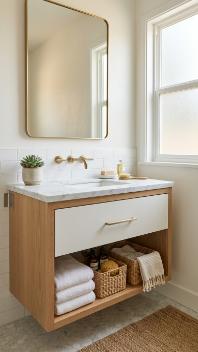
A floating vanity instantly opens up a small bathroom floor — the visual gap between cabinet and floor creates the illusion that the room exhales.
What makes it work: Wall-mounting a vanity frees up 6–10 inches of floor-level visibility, which tricks the eye into reading the room as larger than it is. Open lower shelving replaces the dead storage of a closed cabinet with accessible, styled storage — folded towels and a couple of wicker baskets become part of the visual composition rather than things you’re trying to hide.
How to achieve it: Look for floating vanities in warm white oak or painted MDF with wall-mount brackets — IKEA’s Godmorgon system is one of the most customizable at any budget. Set the mount height slightly higher than standard (around 36 inches vs. the typical 32) — it elongates the floor-to-counter proportion and feels more modern.
💡 A plumber can wall-mount almost any standard vanity for $150–$300 in labor — you don’t need to buy a purpose-built floating unit.
Recessed Niche Shelving in the Shower Wall
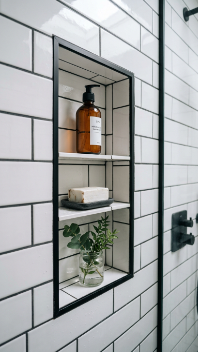
A recessed shower niche is the single smartest storage decision you can make in a small bathroom — it adds shelving without adding a single inch to the room’s footprint.
What makes it work: Built-in niches sit flush with the wall plane, meaning they create usable shelf space from what is otherwise dead wall cavity. They also eliminate shower caddies — those wire or plastic rack systems that clutter small showers and make them look perpetually messy.
How to achieve it: A standard niche is built between studs (typically 14.5 inches wide) and tiled to match the surrounding wall — plan them during any bathroom renovation before the walls close. Finish the niche interior in a contrasting tile or grout color for an intentional, architectural look rather than a seamless blend.
Tall Ladder Shelf for Vertical Storage Drama
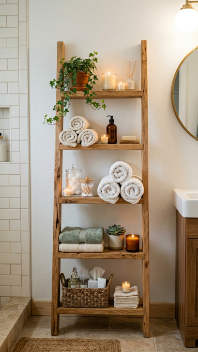
A ladder shelf turns the most awkward corner of a small bathroom into its best-looking moment — vertical storage that doubles as a styled vignette.
What makes it work: Ladder shelves exploit vertical wall space that would otherwise go entirely unused in a small bathroom, and they do it without requiring any drilling or wall anchoring. The tiered, asymmetric silhouette adds visual height to a room, making ceilings feel taller — a crucial trick in low-ceiling bathrooms.
How to achieve it: Teak and bamboo ladder shelves are moisture-resistant and ideal for humid bathrooms — avoid untreated pine, which warps and discolors over time. Style each rung with a mix of functional items (rolled towels, cotton rounds) and purely decorative ones (a candle, a plant) to make storage feel intentional rather than overcrowded.
💡 A natural wood ladder shelf from Amazon or Target runs $40–$80 and requires zero installation — perfect first-step storage for renters.
Medicine Cabinet with Mirrored Front Door
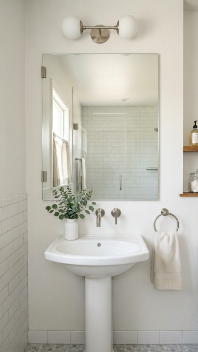
A recessed medicine cabinet is the original small bathroom hack — it gives you a mirror, a light reflector, and three to five shelves of hidden storage in the space of a single wall cavity.
What makes it work: Recessed medicine cabinets do the work of both a mirror and a storage unit without projecting into the room at all — the cabinet sits inside the wall rather than on it, which is a meaningful space gain in a bathroom where even two inches matters. The full mirrored face also doubles the visual size of the space behind you.
How to achieve it: Look for recessed models sized to fit between standard 16-inch stud spacing — the Kohler “Verdera” and American Pride “Bryn Mawr” are both widely recommended. If recessing isn’t possible, a surface-mount cabinet with a deep mirror door achieves similar storage and reflection without the carpentry.
Open Wooden Shelves Above the Toilet
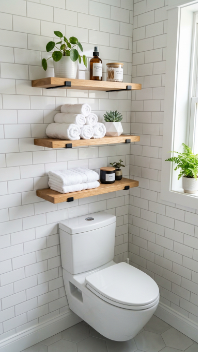
The wall above the toilet is the most underused real estate in any bathroom — floating shelves here transform dead space into your most visible storage and styling moment.
What makes it work: Three staggered shelves above the toilet can store the equivalent of a small linen closet — extra towels, toilet paper reserves, and toiletry backstock — while also functioning as the room’s primary styling moment. The key is keeping the bottom shelf at a comfortable reach height (around 30 inches above the toilet lid).
How to achieve it: Use floating shelves in white oak or painted MDF, mounted with concealed brackets so the shelf appears to float from the wall. Keep the top shelf purely decorative (plants, a candle, a small print) and the lower two shelves functional — this gradient from decorative to practical feels intentional.
💡 IKEA’s Lack shelf in white costs $9–$14 and holds up to 22 lbs — adequate for towels and toiletries and virtually undetectable once styled.
Floor-to-Ceiling Tile to Elongate the Room
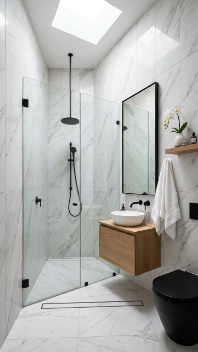
Taking tile from floor all the way to the ceiling removes every horizontal line that would otherwise divide and visually compress the room — suddenly the eye travels upward and the ceiling feels sky-high.
What makes it work: Horizontal breaks in wall covering — where tile ends and paint begins — create a visual “ceiling” lower than the actual one. Eliminating that break by running tile to the full height removes the interruption, and the eye follows the unbroken vertical surface upward. Large-format tiles (24×48 inches or bigger) also reduce the number of grout lines, which further simplifies the visual field.
How to achieve it: Choose large-format tiles oriented vertically for maximum height effect — a 24×48 inch tile set portrait creates an almost architectural column effect. Porcelain tiles with a marble or stone effect achieve a luxury look at a fraction of the cost of real stone, and they’re far easier to maintain in humid conditions.
A Pocket Door to Reclaim Lost Floor Space
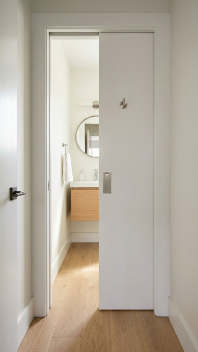
A pocket door doesn’t just save floor space — it changes the entire geometry of a small bathroom by eliminating the 9 square feet a standard swing door’s arc consumes.
What makes it work: A standard 30-inch bathroom door requires a 9-square-foot clearance arc that forces you to position everything in the bathroom around it. A pocket door slides into the wall cavity instead, freeing that arc entirely — meaning you can place a towel rail, a small shelf, or even a narrow storage unit exactly where the door swing used to dominate.
How to achieve it: Pocket door installation requires a false wall cavity or a recessed wall channel — best planned during a renovation, but retrofittable in many layouts. Johnson Hardware and Hafele both make reliable sliding door hardware for standard door weights. Alternatively, a barn door on a surface-mount rail achieves a similar space saving at lower installation cost.
Mirrored Wall Panel to Double the Visual Space
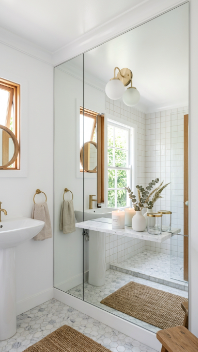
A wall-to-wall mirror panel is the oldest visual expansion trick in interior design — and in a small bathroom, it genuinely transforms the spatial experience rather than just fooling the eye slightly.
What makes it work: A full-height, full-width mirror doesn’t just reflect — it creates a visual duplicate of the room that reads as a continuation of the space. In a bathroom with a window, the mirror multiplies the natural light, bouncing it across both surfaces and making the room feel genuinely brighter rather than artificially lit.
How to achieve it: Source large mirror panels from glass suppliers or mirror specialty shops — custom-cut panels are often cheaper than you’d expect (around $5–$8 per square foot for standard mirror glass). Secure with mirror adhesive and J-channel edge trim for a built-in, frameless finish.
💡 Covering the wall opposite your window with mirror can entirely eliminate the need for additional lighting fixtures in a small bathroom.
Zellige Tile Feature Wall Behind the Vanity
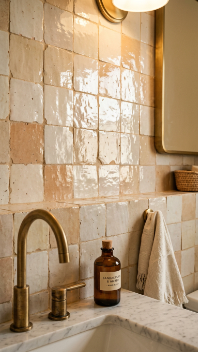
Zellige tiles are the interior design equivalent of a perfect imperfection — every tile is slightly different in glaze and surface, and the combined effect is something no factory tile can replicate.
What makes it work: The handmade irregularity of zellige tiles means each one catches light differently, creating a constantly shifting, almost living surface. In a small bathroom, using them on a single feature wall (behind the vanity or in the shower) gives the room enormous character without the visual noise of an all-over pattern.
How to achieve it: Zellige tiles are available from specialty tile suppliers like Cle Tile, Moroccan mosaic retailers, and Etsy artisan importers. Focus the investment on the most-seen wall (directly behind the vanity mirror) and keep surrounding surfaces simple and neutral. Budget around $25–$45 per square foot for authentic handmade zellige.
Built-In Banquette Bench with Hidden Storage Lid
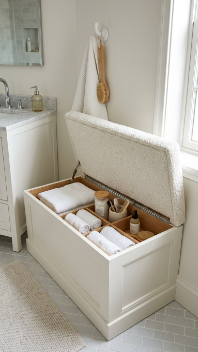
A built-in bench with hidden storage is the kind of idea that makes people say “why doesn’t every bathroom have this?” — it seats you while dressing, stores bulk supplies below, and looks like it was always meant to be there.
What makes it work: The bench sits against the wall and takes up no more floor space than a standard baseboard, but provides roughly 4 cubic feet of hidden storage per linear foot of bench — enough for spare towels, cleaning supplies, and seasonal toiletry backstock. The seat surface doubles as a landing zone for towels and clothes.
How to achieve it: A basic built-in bench is a beginner-level carpentry project: a plywood box on a recessed toe-kick base, piano-hinged lid, and a waterproof or wipeable cushion on top. Paint to match the walls for a seamless, built-in look. Use a friction stay hinge so the lid stays open while your hands are inside.
Wall-Mounted Faucet to Clear Counter Space
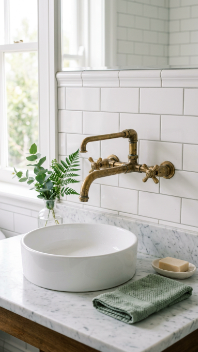
A wall-mounted faucet removes everything from the counter that doesn’t need to be there — and what’s left feels deliberate, clean, and quietly expensive.
What makes it work: Deck-mounted faucets require countertop holes and their bases occupy roughly 3–4 inches of counter space on either side of the spout — not much individually, but meaningful in a vanity under 24 inches wide. Moving the faucet to the wall returns the full counter surface to usable space and creates a much cleaner visual line.
How to achieve it: Wall-mount faucets require in-wall supply lines — a plumber can usually retrofit them during a bathroom renovation for $200–$400 in additional labor. Unlacquered brass develops a living patina over time and is one of the most characterful choices for a small bathroom with a boutique-hotel ambition.
💡 Pair a wall-mount faucet with a vessel sink rather than an undermount — the visual drama of the combination justifies the cost of both.
Wicker and Rattan Baskets for Styled Open Storage
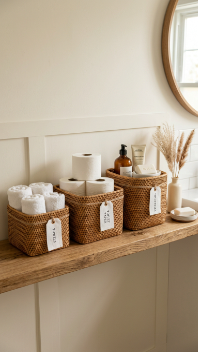
Wicker baskets on open shelving do two things simultaneously: they contain the visual chaos of bathroom supplies and they add a layer of warm organic texture that no closed cabinet can.
What makes it work: Open shelving in a small bathroom risks looking cluttered unless the contents are contained — baskets provide that containment while remaining visually warm and interesting. The natural fiber texture also contrasts beautifully with the typically hard, reflective surfaces of a bathroom (tile, porcelain, mirror), adding tactile depth.
How to achieve it: Use baskets with lids for items you genuinely want hidden (cleaning products, feminine hygiene supplies) and lidless baskets for rolled towels and toilet paper that benefit from being visible and accessible. Label each basket with a simple linen tag for a spa-organized feel.
Fluted Glass Shower Screen for Light and Privacy
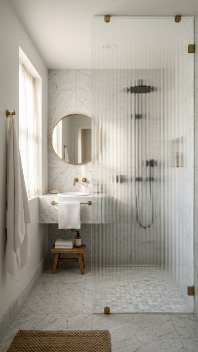
Fluted glass is the material moment in bathroom design right now — it provides privacy without blocking light, and the ribbed texture turns an ordinary shower screen into a sculptural architectural feature.
What makes it work: Standard clear glass shower screens solve the light problem but sacrifice privacy. Frosted glass solves the privacy problem but looks cold and institutional. Fluted glass does both — the ridges obscure direct sight lines while allowing soft, diffused light to pass through, making the whole bathroom feel brighter than it would with a solid or tiled shower wall.
How to achieve it: Fluted glass panels are available as custom shower screens through glass suppliers and specialty bathroom retailers — budget around $400–$900 for a single panel screen depending on size. They work equally well in both brass and black matte frames, so the hardware choice can anchor the whole bathroom’s metal finish.
Over-Door Organizer for the Back of the Door
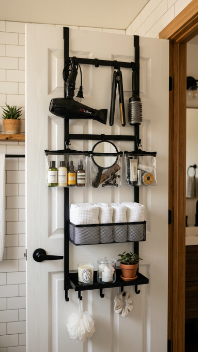
The back of the bathroom door is completely free square footage — in a small bathroom, a well-chosen over-door organizer can hold the equivalent of an entire under-sink cabinet.
What makes it work: Most bathroom doors are 80 inches tall and 28–30 inches wide — that’s roughly 16 square feet of vertical surface being used for absolutely nothing. An over-door organizer converts that dead space into accessible storage for the items that typically clutter countertops and vanity surfaces: hair tools, small bottles, hooks for robes and towels.
How to achieve it: Choose an over-door organizer in the same metal finish as your bathroom hardware (matte black, brushed nickel, or brass) so it reads as intentional rather than utilitarian. Models with a combination of hooks, pockets, and flat shelves are the most versatile — one hook for the hair dryer, pockets for small products, a shelf for a small mirror.
💡 An over-door hook rail in brushed brass costs under $25 and adds 4–6 hooks instantly — no tools or wall damage needed.
Narrow Floating Shelf Above the Bathtub
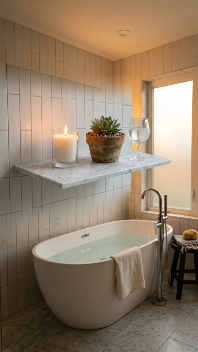
A slim marble shelf above the bathtub is the closest thing to a real spa experience you can add to a small bathroom — it turns a weeknight bath into a ritual.
What makes it work: A floating shelf beside or above the bathtub keeps candles, a book, and a glass of water within arm’s reach without cluttering the bath rim, which instantly makes the bathing experience feel more intentional and luxurious. Even a 4-inch deep shelf provides enough surface for the key elements of a proper bath ritual.
How to achieve it: Use a marble slab cut to a depth of 4–6 inches, mounted with concealed floating shelf brackets rated for stone weight. Position it at a height you can reach comfortably while lying in the bath — approximately 8–12 inches above the tub rim. A single matching stone shelf feels more architectural than a wooden one in this context.
Moody Dark Grout with White Tile for Maximum Impact
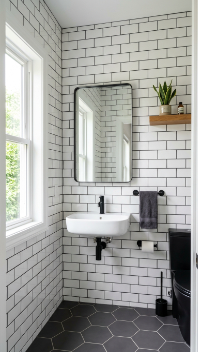
White subway tile with dark charcoal grout is one of the most graphic, high-impact design decisions available in a small bathroom — and it costs exactly the same as white tile with white grout.
What makes it work: The color of grout lines determines whether tile reads as a quiet background or an active pattern. Dark grout with white tile turns every grout line into a visible graphic element, creating a grid pattern across the entire wall that gives a small bathroom enormous visual energy and personality. It also hides staining far better than white grout.
How to achieve it: Standard white subway tile with Laticrete “Charcoal” or Custom Building Products “Charcoal” grout achieves the look immediately. Seal the dark grout at installation and annually thereafter to prevent white calcium deposits from washing out the contrast over time.
Corner Shower Shelf in Matching Tile
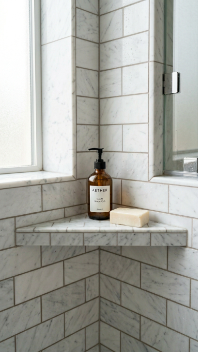
A corner shelf tiled to match the surrounding shower walls is so seamless it looks like the architect planned it — and in a small shower, it keeps products off the floor entirely.
What makes it work: Corner shelves exploit the one part of a shower that never otherwise gets used — the angled dead space where two walls meet. A tiled-in-place triangular corner shelf feels built-in and intentional rather than like an afterthought accessory, and keeping the tile matching makes it virtually disappear into the wall plane.
How to achieve it: Corner shelves can be built as part of any new tile installation — they’re simply a three-sided tile box anchored into the corner at the desired height. Build two: one at about 48 inches for shampoos and one at about 36 inches for conditioner and soap. A tile contractor can add them for minimal extra labor.
💡 Pre-made corner shelf inserts in matching porcelain formats are available from Schluter Systems — they simply tile over the top for a fully finished, waterproof built-in look.
Bold Wallpaper on the Ceiling as a Surprise Statement
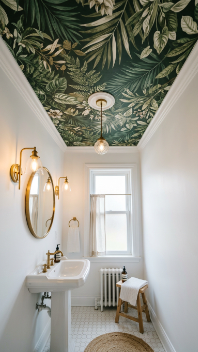
Wallpaper on the ceiling of a small bathroom is the design world’s best-kept secret — it adds maximum drama while leaving the walls clean and the room feeling open.
What makes it work: Ceiling wallpaper turns the fifth wall — the one that’s almost always ignored — into the room’s primary design moment. Because the walls stay plain, the room doesn’t feel visually crowded or heavy. But the ceiling draws the eye upward, which actually makes the room feel taller in practice.
How to achieve it: Choose a bold, large-scale pattern — botanicals, graphic geometrics, or maximalist florals all work well overhead. Paste-the-wall wallpapers are significantly easier to install on a ceiling than paste-the-paper types. One single roll often covers a small bathroom ceiling entirely, making this one of the most dramatic transformations available for under $100.
Under-Sink Curtain for Hidden Storage
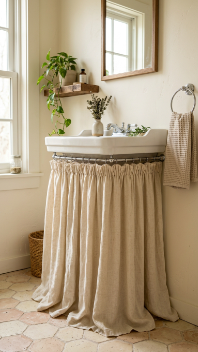
A linen curtain under a pedestal sink is the oldest storage trick in the book — and in the right fabric and color, it’s also one of the loveliest.
What makes it work: Pedestal sinks offer no inherent storage, leaving the under-sink area open and exposed — an immediate visual clutter problem in a small bathroom. A gathered curtain on a tension rod conceals everything behind the sink while adding a soft textile element that balances the hard surfaces of porcelain and tile.
How to achieve it: A simple tension rod installed at sink-level and a length of linen or cotton canvas hemmed to floor length is all it takes. Choose a fabric in the same tone as the walls — ivory on white, warm linen on cream — for a seamless, built-in feel rather than a clearly added afterthought.
Brushed Brass Hardware Throughout for Cohesion
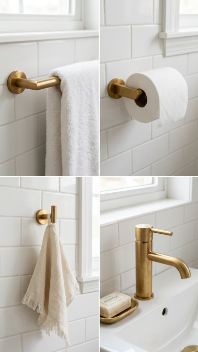
Matching all hardware to a single finish is the simplest, most cost-effective way to make a small bathroom feel professionally designed rather than pieced together.
What makes it work: Hardware is often an afterthought — towel bar from one brand, toilet paper holder from another, faucet from a third — and the inconsistency reads as unintentional, even if every individual piece is nice. Committing to one finish (brushed brass, matte black, or brushed nickel) across every hardware touchpoint creates an invisible but powerful thread of cohesion.
How to achieve it: Replace hardware as a complete set rather than individually — most suppliers sell bathroom hardware in coordinating collections. Brushed brass is the warmest choice and one of the most forgiving for small bathrooms because it complements both warm and cool wall colors. Budget $150–$300 for a complete set of four pieces (faucet, towel bar, robe hook, toilet roll holder).
💡 Brushed brass hardware is available at every price point — Amazon Basics and Moen both make reliable sets under $80 for the complete collection.
Textured Plaster Walls for an Artisan Feel
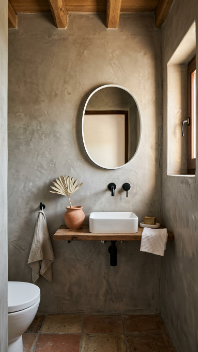
Textured plaster walls in a small bathroom do something that paint simply cannot — they create a surface that changes character with every shift in light, making the room feel alive and handmade.
What makes it work: Flat painted walls are static — they look the same under morning light as evening light. Tadelakt, limewash, or Venetian plaster finishes have depth and surface variation that means the wall reads differently throughout the day, which creates an artisanal quality that makes a small bathroom feel genuinely special rather than merely well-decorated.
How to achieve it: Tadelakt is a traditional Moroccan waterproof lime plaster ideal for bathrooms — it can go directly in wet areas without tile. Limewash is easier to DIY and works beautifully in non-wet zones. Both are available as kits from suppliers like Portola Paints; a professional application typically costs $8–$15 per square foot.
Sconce Lighting on Either Side of the Mirror
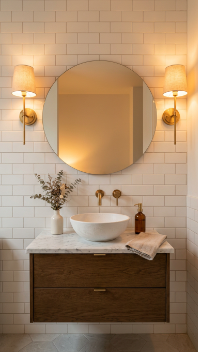
Two sconces flanking a bathroom mirror provide the single most flattering lighting available — it eliminates the harsh overhead shadows that make overhead bathroom lighting so unpleasant.
What makes it work: Overhead vanity lighting — the standard in most bathrooms — throws light downward, creating unflattering shadows under the eyes and chin. Side-mounted sconces at face height illuminate from the sides, which is how studio portrait lighting works and why it’s so universally flattering. In a small bathroom, they also add warmth and visual balance to the mirror wall.
How to achieve it: Position sconces at eye height — approximately 60–65 inches from floor to center of fixture — and at least 28 inches apart (14 inches each side of the mirror’s center) for optimal shadow elimination. Choose bulbs at 2700K color temperature for the warmest, most flattering result.
Penny Round Floor Tile for Vintage Character
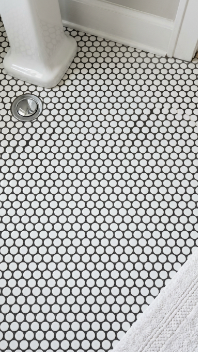
Penny round floor tiles are one of the most enduringly beloved choices in bathroom design — and in a small bathroom, their small scale makes the floor appear larger rather than busier.
What makes it work: Smaller tiles on a small floor counterintuitively read as more spacious than large tiles — the repetition of a small module tricks the eye into perceiving more floor area because it needs more reference points to process. The curved shape of penny rounds also softens a small bathroom’s typically hard geometry.
How to achieve it: White penny rounds with charcoal grout are the classic combination and the one most likely to add genuine resale value. Source them on mesh-backed mosaic sheets for much easier installation — standard penny round sheets are 12×12 inches and roughly $8–$15 per square foot. A small bathroom floor can typically be tiled in a single weekend.
A Statement Mirror to Anchor the Whole Room
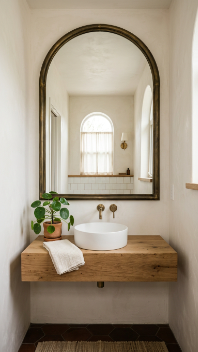
A large, architecturally shaped mirror does more work in a small bathroom than almost any other single element — it anchors the room, expands the space visually, and functions as the primary art piece simultaneously.
What makes it work: An oversized mirror — one that extends well beyond the vanity width — creates the effect of a window in a small room, pulling the eye toward it and making the room feel larger in every direction. An arched or shaped frame adds architectural drama that a rectangular mirror never achieves.
How to achieve it: Choose a mirror that’s at least as wide as the vanity and ideally wider — for a 24-inch vanity, a 30–36 inch mirror feels more dramatic and intentional. Arched mirrors in unlacquered brass are widely available through Anthropologie, West Elm, and ARHAUS in the $150–$400 range and consistently elevate even the most basic bathroom instantly.
💡 An oversized arched mirror from a thrift store or Facebook Marketplace, spray-painted in gold or brass metallic, achieves the same effect for under $30.
Warm Wood Tones Against Bright White for Natural Contrast
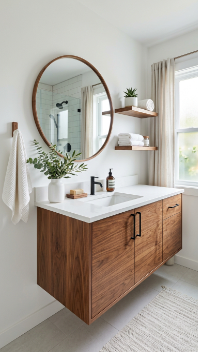
Warm walnut wood against crisp white walls creates the most reliably beautiful contrast in small bathroom design — it’s the combination that defines contemporary Scandinavian and Japanese aesthetics globally.
What makes it work: White walls maximize light reflection in a small bathroom, but an all-white space risks feeling cold or clinical. Introducing walnut or teak wood in the vanity cabinetry adds biological warmth — humans are neurologically predisposed to find natural wood surfaces calming and pleasant, which is why this combination appears in every high-end spa and boutique hotel.
How to achieve it: A walnut-faced floating vanity is the anchor piece — source from specialist bathroom furniture suppliers or commission a custom unit from a local carpenter using walnut-veneer MDF for cost efficiency. Keep the countertop in white quartz or white marble to maintain the bright-to-warm contrast at the room’s eye level.
How to Start Your Small Bathroom Storage and Style Transformation
Begin with an honest audit of what you actually need to store — most small bathroom overwhelm comes from products that have been accumulated rather than intentionally chosen. Before adding a single shelf, edit down to what you actually use weekly, and you’ll find the storage problem is often much more manageable than it appeared.
The single highest-impact change in most small bathrooms is lighting. Replacing an overhead flush mount with flanking sconces and a dimmer switch costs under $200 and completely transforms how the room feels in the morning and evening — it’s the change that makes every other element look better.
For budget-friendly starting points: a new mirror ($50–$150), matching hardware in one finish ($80–$200), and a can of paint ($40–$60) can collectively transform a small bathroom’s character for under $400. Tackle storage second — once the visual bones feel right, the storage solutions feel like refinements rather than retrofits.
Realistically, a small bathroom can be meaningfully transformed in a single weekend without any structural work. Deeper renovations — adding a niche, installing a pocket door, or re-tiling — take two to four days of professional work and $1,500–$4,000 depending on scope. Both timelines are achievable; it’s simply a question of how far you want to go.
Frequently Asked Questions
How do I make a very small bathroom feel bigger?
The most effective tricks operate on the visual field: a large mirror or mirrored wall panel, floor-to-ceiling tile, and a floating vanity that clears the floor are the top three. Beyond those, keeping the color palette tightly cohesive (two to three tones maximum) prevents the eye from being interrupted by contrast, which makes the space feel continuous and larger. Avoid heavy window coverings — even a small frosted window left bare adds more light and perceived space than any decorating trick.
What is the best storage solution for a small bathroom with no cabinet?
The most versatile combination is: a recessed medicine cabinet above the sink (hidden storage behind the mirror), a ladder shelf or floating shelves above the toilet (open storage for towels and accessories), and a set of wicker baskets on any available shelf (corralling loose products). This three-part approach handles most storage needs without requiring any built-in carpentry or major renovation work.
What tile makes a small bathroom look larger?
Large-format tiles (18×18 inches or bigger) with minimal grout lines create the most visually expansive floor and wall surfaces — fewer lines means the eye travels farther without interruption. Running the same tile continuously from floor to lower wall (“wet room” style) removes the horizontal break that typically divides and compresses a small room. If you love small-format tiles, penny rounds or small hexagons work because their repetition reads as texture rather than busyness.
How much does a small bathroom renovation typically cost?
Cosmetic updates — paint, hardware, mirror, lighting, and new accessories — typically run $300–$800 and can be largely DIY. A mid-range renovation involving new tile, vanity, toilet, and fixtures (no structural changes) typically costs $5,000–$12,000 depending on material choices and labor rates. A full structural renovation with layout changes, custom tile work, and premium fixtures can reach $15,000–$25,000. The most reliable budget advice: spend on tile and fixtures (visible, tactile, long-lasting) and save on vanities and mirrors (easy to swap later).
What color makes a small bathroom feel cozy rather than cramped?
Warm, mid-value colors — mushroom taupe, warm sage green, dusty blush, and warm greige — create coziness without the heaviness of very dark colors. These mid-depth tones absorb enough light to feel enveloping without making the room feel claustrophobic. The key is avoiding both extremes: stark bright white (clinical, cold) and very dark jewel tones (beautiful, but requires careful lighting to prevent a cave-like feeling in rooms with limited natural light). A warm greige like Sherwin-Williams’ “Accessible Beige” or a muted sage like Benjamin Moore’s “Saybrook Sage” are consistently reliable starting points.
Ready to Create Your Dream Small Bathroom?
You’ve just explored 26 creative small bathroom ideas spanning storage ingenuity, material beauty, and spatial transformation — and the most important thing to know is that a limited square footage is never the real obstacle. The real obstacle is defaulting to the first, most obvious solution rather than the most considered one. Save the ideas that made you pause, pick one that you can act on this weekend, and start there. Small bathrooms reward commitment and intention more than any other room in the house — because when every decision counts, every decision shows.