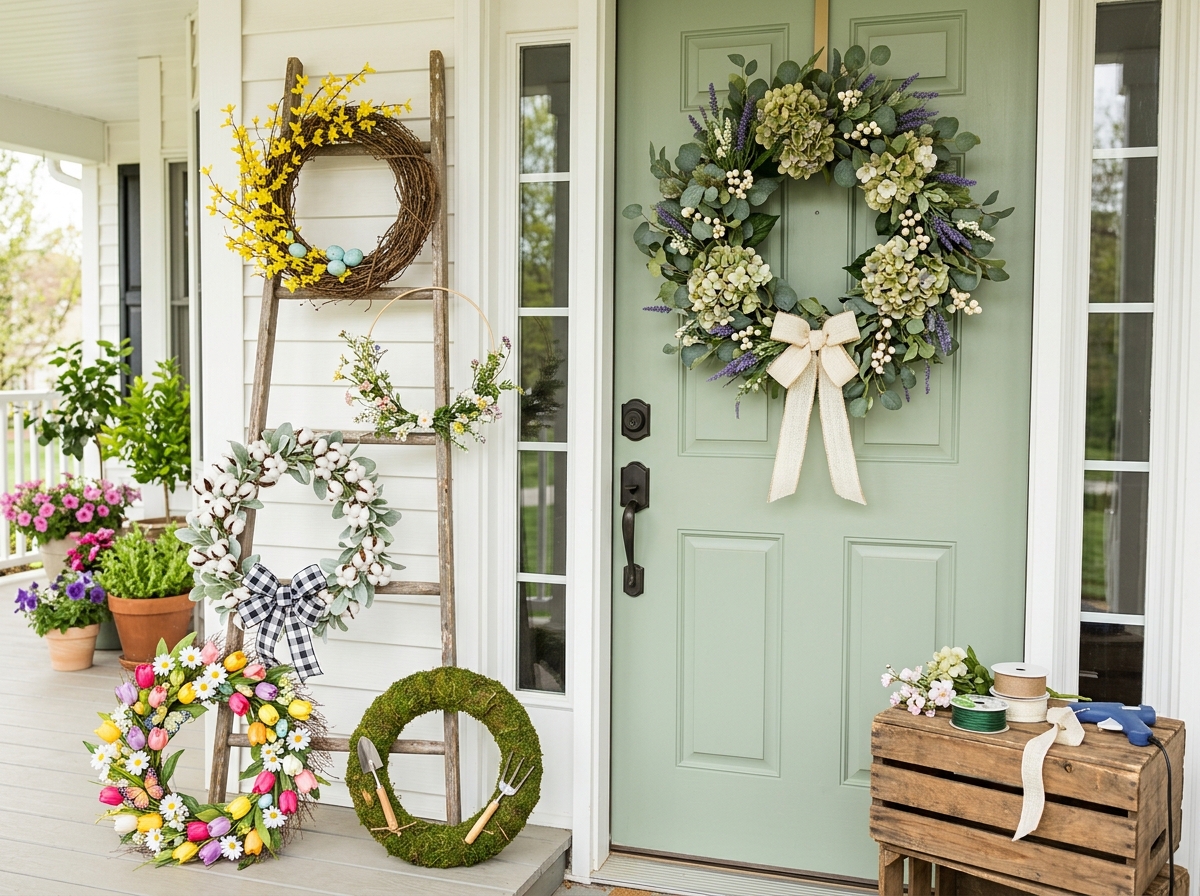
There’s a particular kind of joy that comes from hanging something handmade on your front door — something that says welcome before anyone even knocks. Spring wreaths capture that feeling perfectly: a burst of blooms, fresh greenery, and seasonal color that transforms a plain front porch into something that genuinely stops people mid-stride. The best part is that you don’t need a florist’s training or a designer’s budget to make one worth admiring. Here are 29 DIY spring wreath ideas worth saving — and making — this season.
Why DIY Spring Wreaths Work So Well
Spring is the most wreath-friendly season in the design calendar, and the reason is simple: the materials are everywhere. From grocery store tulips to backyard clippings of forsythia and flowering dogwood, spring gives even beginner wreath makers access to an abundance of beautiful, seasonal ingredients that practically arrange themselves.
What makes DIY spring wreaths such an enduring Pinterest category is the sheer range of styles achievable with the same basic structure. A grapevine base becomes rustic farmhouse with cotton stems and burlap ribbon; the same base becomes romantic cottage with pink peonies and trailing ivy; swap in dried citrus and eucalyptus and it reads as modern botanical. The base is just the beginning.
The materials that define the best spring wreaths right now lean toward the organic and the imperfect: dried and preserved florals alongside fresh ones, mixed stem heights, visible wire and twine as design elements rather than things to hide. This “undone” aesthetic — beautifully imperfect rather than stiffly formal — is exactly what makes handmade wreaths feel special compared to mass-produced alternatives.
Even complete beginners can achieve stunning results on a first attempt. Spring wreaths are forgiving: add more where it looks sparse, trim what looks heavy, and rotate the focal point until it feels balanced. The process is as satisfying as the finished piece — which is exactly why so many people make two.
Classic Tulip Bundle Wreath on a Grapevine Base
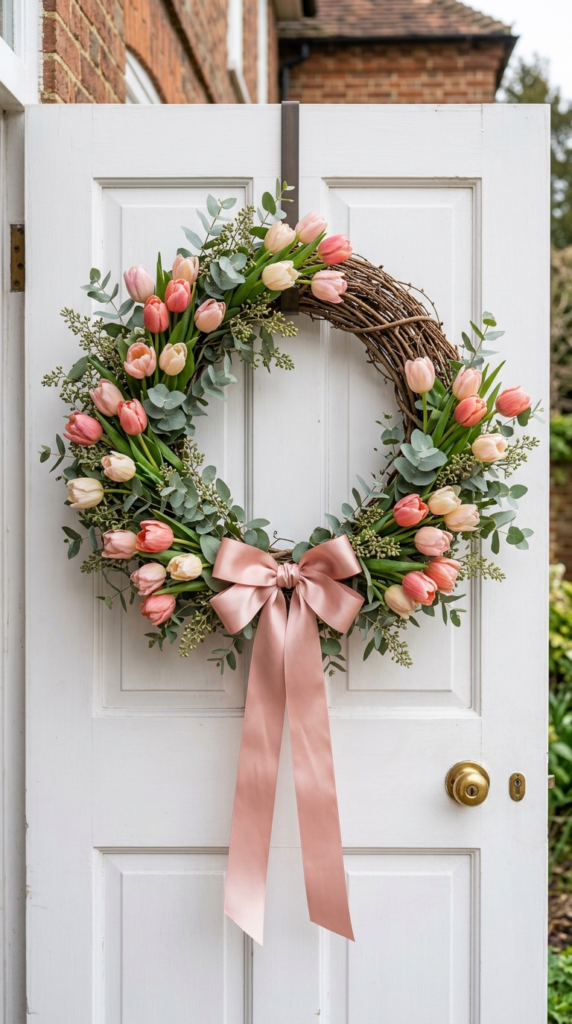
Nothing announces spring quite as directly as a wreath full of tulips — their cupped shapes and saturated colors carry the whole season in a single glance.
What makes it work: Tulips have enough visual weight individually to read clearly from a distance, which makes them ideal as the primary focal flower on a front door wreath. Grouping them in odd-numbered clusters of three to five rather than distributing them evenly creates natural-looking focal points — the way flowers actually grow in a garden rather than the way they’re arranged in a supermarket bucket.
How to achieve it: Use a 14–16 inch grapevine wreath base and floral wire to secure bundles of faux or fresh tulip stems in clusters around the ring. Alternate blossom heights within each cluster for a natural silhouette, and tuck eucalyptus or seeded greenery between clusters to fill negative space without flattening the composition.
💡 High-quality faux tulip stems from Afloral or Michael’s look nearly indistinguishable from fresh at front-door distance and last the entire season.
Wildflower Meadow Wreath in a Loose, Undone Style
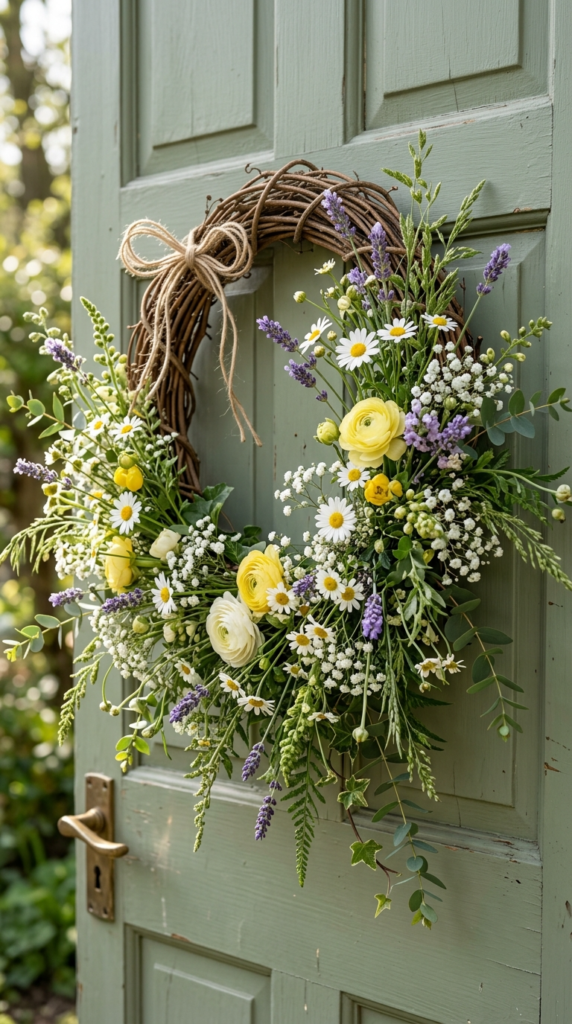
A wildflower wreath looks like you gathered an armful of blooms on a country walk and simply shaped them into a circle — which is exactly the effect you’re aiming for.
What makes it work: The “undone” meadow style succeeds because it breaks the rigid circular silhouette that makes many wreaths look stiff and commercial. Allowing stems to extend beyond the frame and varying flower heights dramatically creates movement and a sense of abundance that a neatly contained wreath never achieves.
How to achieve it: Start with a grapevine or straw base and work with floral picks rather than pre-cut stems — the longer the stem, the more freedom you have to angle and extend each bloom beyond the edge. Mix at least five different flower types in varied scales: one large focal flower (ranunculus), two medium fillers (daisies, chamomile), and two airy elements (baby’s breath, lavender).
Dried Pampas and Bunny Tail Wreath for Boho Spring
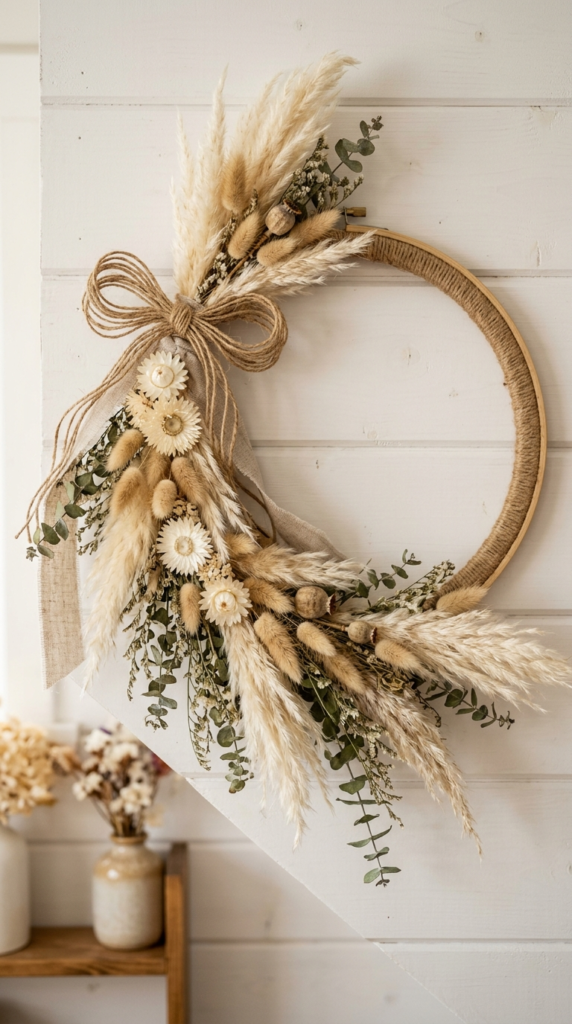
Pampas and bunny tail grasses bring a soft, feathery texture to spring wreaths that no flower can replicate — and because they’re dried, this wreath lasts long beyond the season.
What makes it work: Dried grasses create movement even in still air — the plumes shift slightly with any breeze, giving the wreath a living quality that dried flowers rarely have. The neutral, warm-ivory palette of pampas and bunny tails works with nearly any front door color, from deep navy to soft sage to classic black.
How to achieve it: Use an embroidery hoop wrapped in jute twine as the base — it’s lighter and more architecturally interesting than a grapevine ring for this style. Glue or wire pampas plumes first as the largest element, then fill with bunny tails and dried florals. Arrange everything to one side or cluster at the bottom for an asymmetric, editorial composition.
💡 Dried pampas grass and bunny tails are available in bulk on Etsy for $15–$25 per bunch — far cheaper than craft stores and often better quality.
Fresh Lemon and Herb Wreath for the Kitchen Door
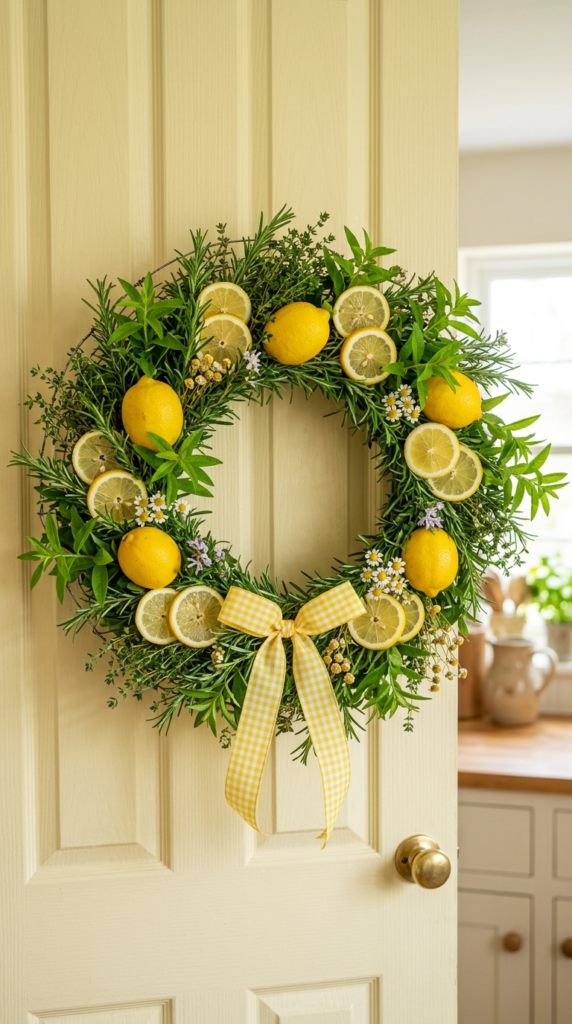
A lemon and herb wreath smells as good as it looks — and the contrast between the deep, aromatic green of fresh rosemary and the bright pop of lemon yellow is genuinely stunning up close.
What makes it work: Lemons and fresh herbs share a visual language — both are organic, textured, and saturated — but they contrast dramatically in color and scale. The lemons act as focal points while the herbs create the lush, dense base that makes them pop. This wreath is especially effective on a kitchen or back door where the fragrance can be appreciated close-up.
How to achieve it: Wire a thick foam or wire ring base with fresh rosemary and thyme bundles, overlapping each bundle to conceal the wire. Thread whole lemons or dried lemon slices onto floral wire and push into the base at regular intervals. Refresh with a light mist of water every few days to extend the fresh herb life to two to three weeks.
Pastel Ribbon and Flower Hoop Wreath
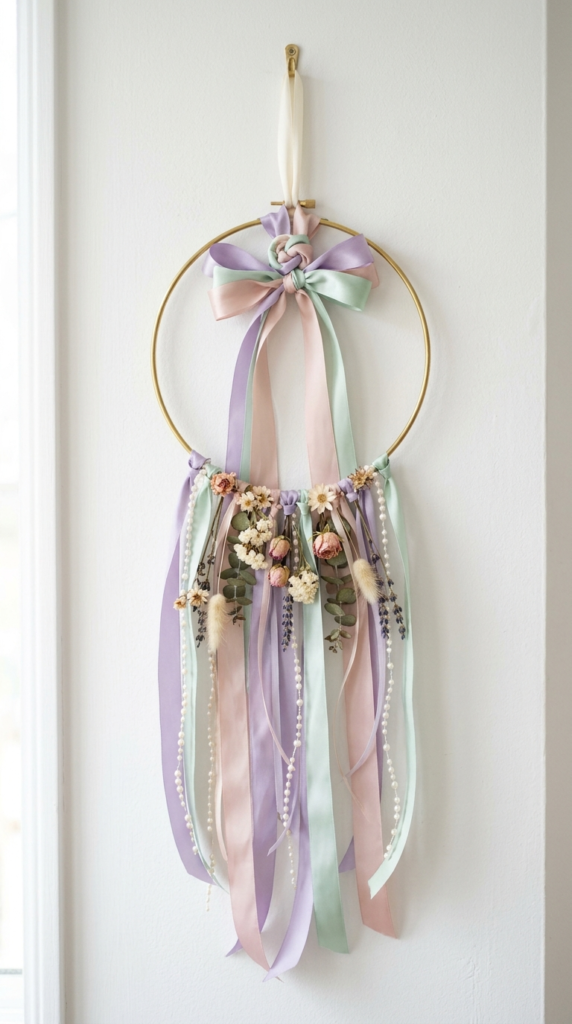
A ribbon hoop wreath is the most beginner-friendly version on this list — no floral wire, no hot glue, just ribbon, a brass hoop, and an eye for color.
What makes it work: The open negative space of a hoop wreath with trailing ribbons creates an airy, modern composition that looks deliberately designed rather than assembled. The ribbons move in any breeze, adding kinetic life that solid wreaths lack, and the contrast of the thin brass ring against flowing soft ribbon is inherently sophisticated.
How to achieve it: Use a 10–14 inch brass embroidery hoop and cut ribbons in three to five complementary pastel tones at varying lengths — the longest should reach about 18 inches below the hoop. Tie them in simple knots at the top arc of the hoop and tuck dried flower heads into the knot junctions with a small dab of hot glue. The whole project takes under 20 minutes.
Peony and Eucalyptus Wreath for Romantic Porch Style
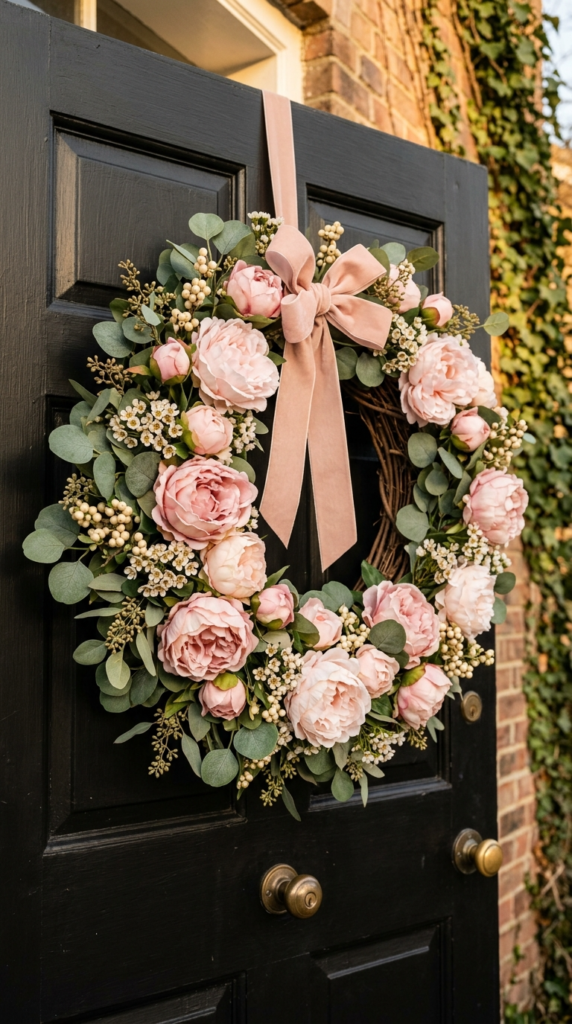
A peony wreath in full bloom is arguably the most romantic thing you can hang on a front door — lush, soft, and undeniably celebratory.
What makes it work: Peonies are naturally dramatic because of their sheer volume — a single fully open bloom can be four to five inches across — and that scale means even a 16-inch wreath feels abundant with just five to seven blooms. Using blooms at different stages of opening (tight bud to fully open) creates the natural variation that makes the wreath look grown rather than manufactured.
How to achieve it: Attach peony stems at three main focal points — one at the top, one at each side — then fill with eucalyptus until the base is fully concealed. Avoid spacing blooms evenly around the ring; cluster them with deliberate gaps filled by greenery to create a more organic, garden-cut arrangement.
💡 Afloral’s faux peonies are consistently ranked as the most realistic available and go on sale at 30–40% off in late winter — stock up then for spring wreath making.
Grapevine Wreath with Moss and Succulents
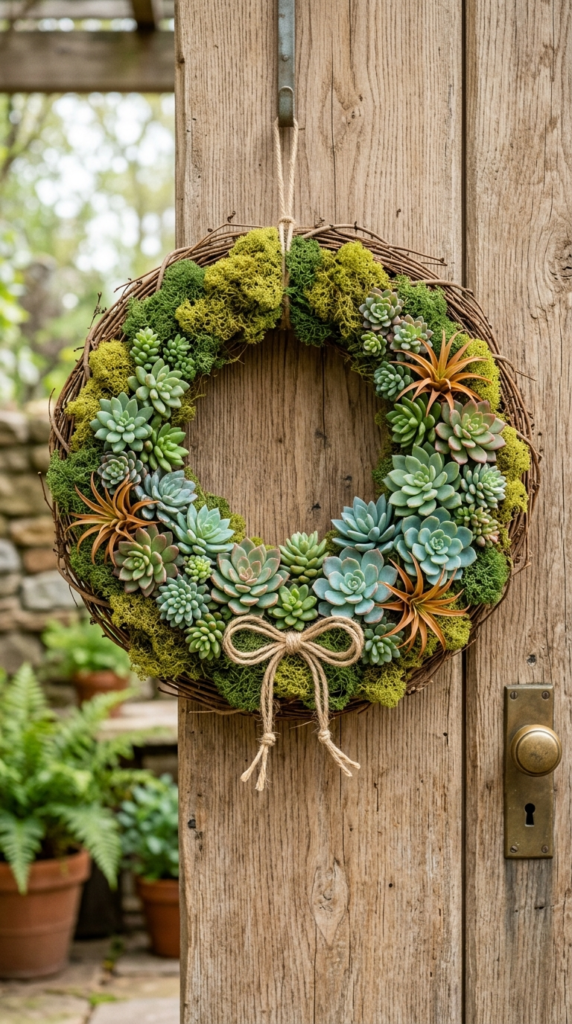
A succulent and moss wreath is the choice for people who love the idea of spring gardening translated directly onto a front door — earthy, textural, and unlike anything you can buy.
What makes it work: Succulents have extraordinary visual variety within a single color family — rosette shapes, paddle shapes, trailing forms — and combining them creates a wreath that reads as complex and considered without requiring a diverse flower palette. The preserved moss base provides a cohesive green ground that ties every element together.
How to achieve it: Hot-glue patches of preserved sheet moss to a grapevine base until roughly 70% of the base is covered, leaving some grapevine visible at the outer edges for texture contrast. Attach faux or real succulent cuttings (real ones can be pinned and will root into the moss) using floral pins or hot glue, varying sizes from large centerpiece rosettes to small filler types.
Butterfly and Wildflower Whimsy Wreath
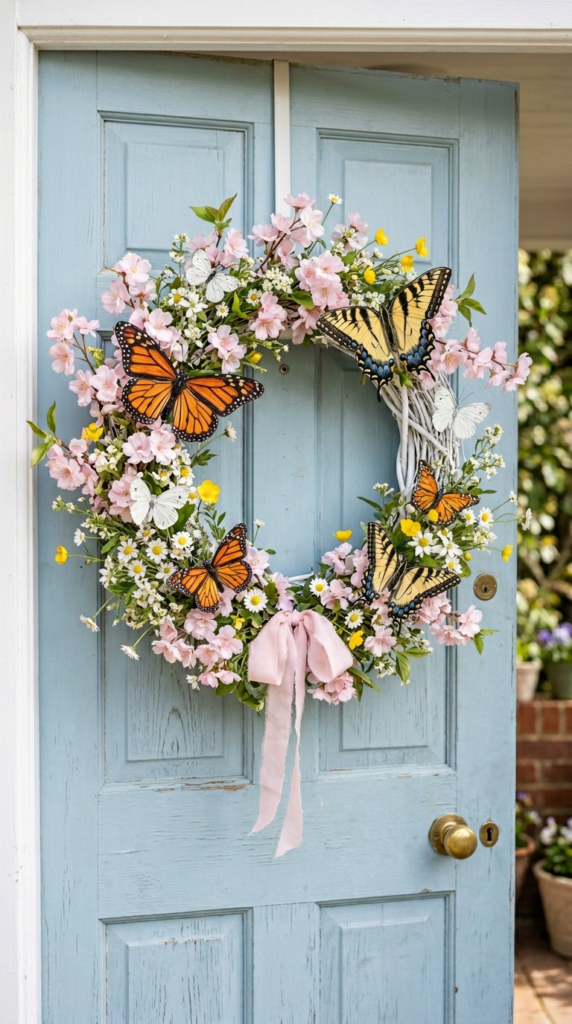
A butterfly wreath with wildflowers taps into something genuinely childlike and joyful — it looks like spring arrived, landed, and decided to stay.
What makes it work: Butterfly picks add a narrative element to a wreath that flowers alone can’t — the suggestion of motion and arrival makes a static object feel alive and story-full. The key is positioning butterflies as though they’ve genuinely landed: some facing inward toward flowers, some at the outer edge as if just arriving, at slightly different angles.
How to achieve it: Build the floral base first using cherry blossom branches and wildflower picks, then add butterflies last. Use wire-stemmed butterfly picks and bend the wire so each butterfly tilts at a different angle — flat-mounted butterflies look decorative, while angled ones look like they’ve genuinely landed. Three to five butterflies is enough; more reads as a theme park.
Sunflower and Greenery Wreath for a Cheerful Entry
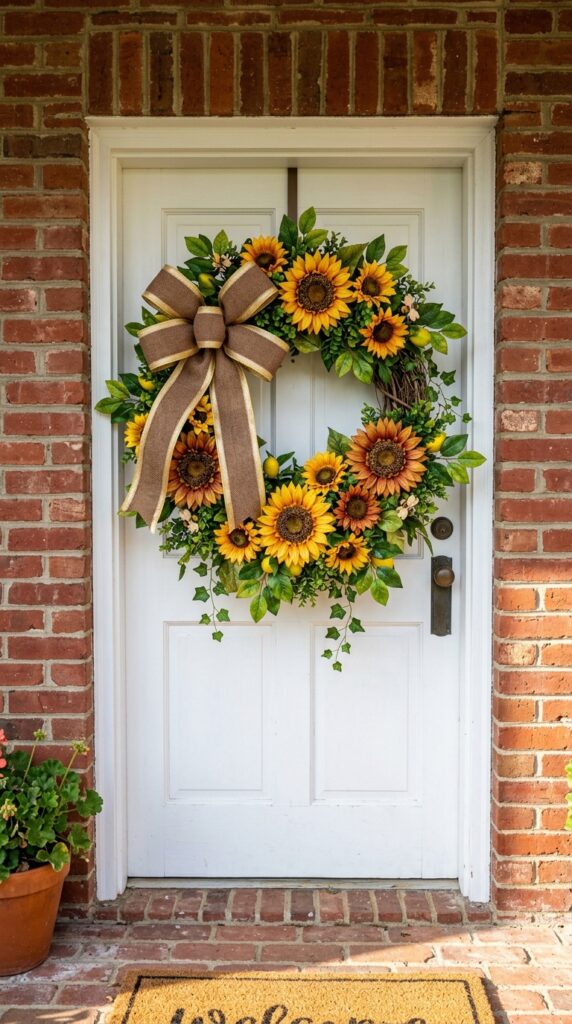
Sunflowers on a front door radiate a welcome that is almost unreasonably cheerful — bold, warm, and instantly mood-lifting for anyone who approaches.
What makes it work: Sunflowers have the perfect front-door scale — large enough to read clearly from the street, simple enough in form to work with almost any architectural style. Mixing standard and miniature sunflower sizes within the same wreath creates depth and prevents the flat, repetitive look of single-size floral wreaths.
How to achieve it: Use a 16–18 inch grapevine base and build a dense boxwood or lemon-leaf base layer first, then add sunflowers in clusters of mixed sizes — one large, two medium, two small per cluster. Add accent picks (small berries, wooden bee decorations, burlap ribbon) last and use warm brown or gold tones exclusively to keep the palette cohesive.
💡 Dollar Tree sunflower picks are universally praised in the DIY wreath community — buy 30–40 stems for under $15 and they hold up brilliantly through an entire season.
Lambs Ear and White Bloom Wreath for Silver-Green Elegance
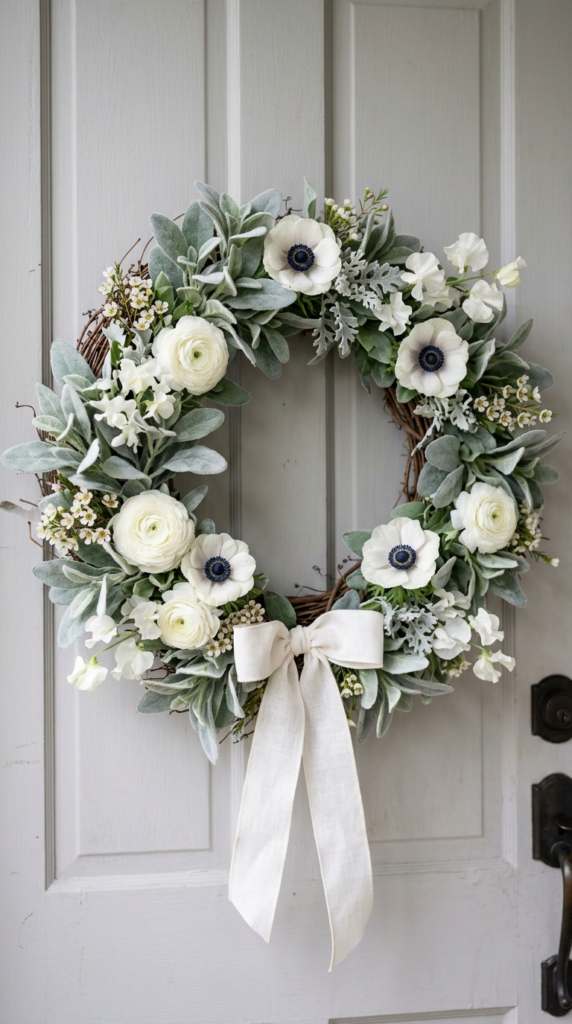
Lamb’s ear foliage is the secret weapon of wreath makers who want something that looks expensive without relying on showstopper flowers — the silvery-green velvet leaves are extraordinary on their own.
What makes it work: Lamb’s ear’s silvery, velvet-textured leaves provide a completely different visual quality from the typical glossy or matte greens used in wreaths — they catch light in a uniquely soft, almost luminous way that elevates everything placed against them. All-white flowers against this silver-green base look couture rather than simply pretty.
How to achieve it: Fresh lamb’s ear is widely available at garden centers and farmers markets in spring and can be wired directly onto a grapevine base. If using faux versions, look for ones with visible texture — the velvety surface is the whole point. Place white blooms in a crescent across the bottom third of the wreath for an asymmetric, garden-gathered look.
Lavender Bundle Wreath for a Provençal Front Door
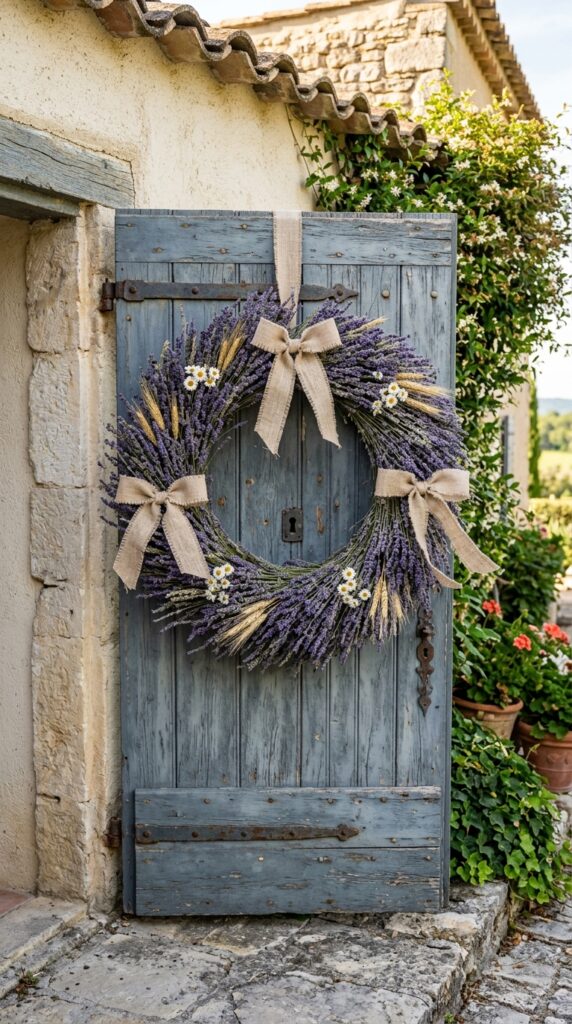
A lavender wreath is a sensory experience, not just a visual one — anyone who passes by will pause, and that particular fragrance is one of the most universally beloved in the world.
What makes it work: Lavender bundles have a natural sculptural quality — the tight, parallel stems grouped together and the haze of purple blooms at the tips create a form that’s as satisfying to look at as it is to smell. Wrapping bundles tightly around a wire ring creates a dense, full profile that looks far more elaborate than the simple construction behind it.
How to achieve it: Purchase dried lavender in bulk (around 200–300 stems for a full 14-inch wreath) and wire bundles of 10–15 stems onto a wire wreath ring, overlapping each bundle to conceal the wire and stems. Work in one direction all the way around, finishing by tucking the last bundle under the first. Tie linen ribbon bows at the 12 o’clock position for the finishing detail.
Floral Letter Wreath: Your Initial in Full Bloom
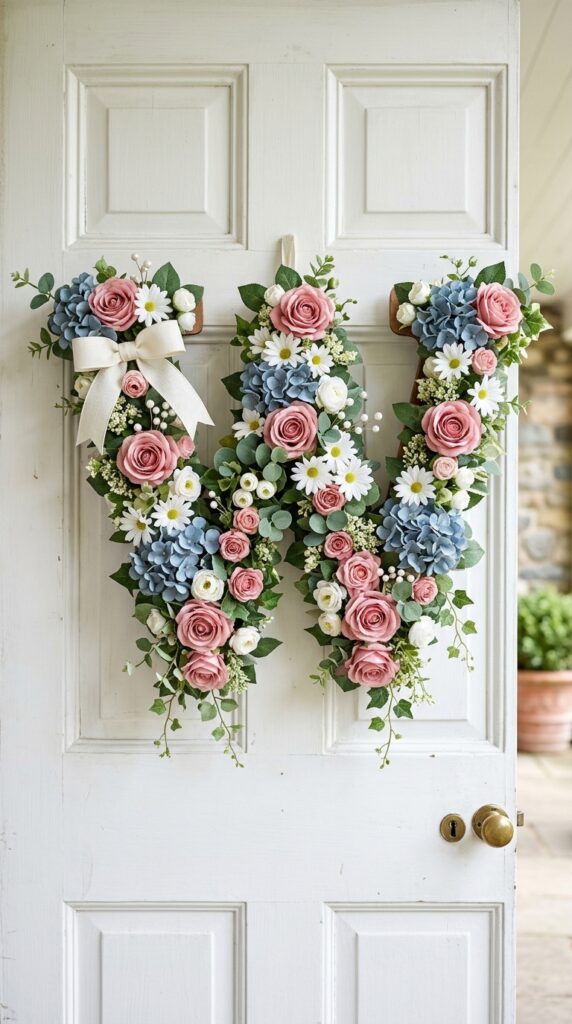
A floral letter wreath is the most personal front door statement you can make — a monogram in full bloom that announces both your surname and your taste simultaneously.
What makes it work: The letter form provides a clear silhouette that reads instantly from a distance — far more distinctive than a round wreath at first glance. The blooms add softness to what would otherwise be a graphic shape, balancing personal with beautiful. It works especially well in spring because the density and variety of spring blooms fills the letter form without looking thin.
How to achieve it: Source wooden or foam letter forms at Michael’s or craft suppliers — foam is lighter and easier to pin into. Hot-glue faux florals starting with the largest blooms to establish coverage, then fill gaps with medium florals and finally small filler flowers and leaves. Cover every surface of the letter, including the sides, for a professional finish visible from all angles.
💡 A 12-inch foam letter costs $3–$5 at Michael’s, and a completed floral letter wreath typically uses $20–$40 in craft florals — under $50 total for something that looks like a $150 boutique purchase.
Spring Green Wreath in All-Eucalyptus and Herbs
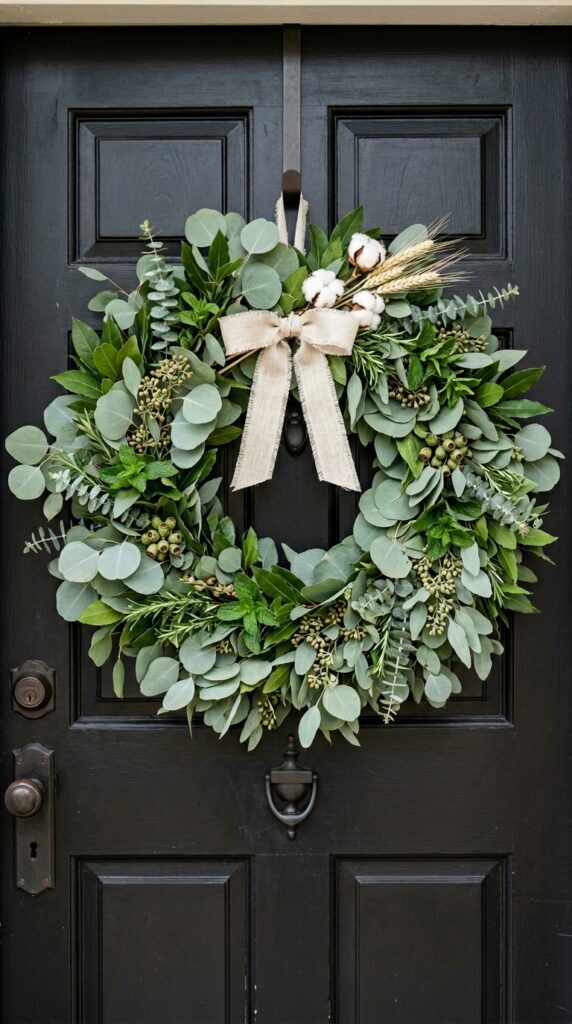
An all-green eucalyptus wreath is the most sophisticated choice on this list — it trusts texture and form entirely, with no flowers needed to make it beautiful.
What makes it work: Eucalyptus is one of the few plants that provides enough visual variety within a single genus to fill an entire wreath without it looking monotonous. Silver dollar, seeded, and spiral eucalyptus varieties have dramatically different leaf shapes and tones, and combining them creates a subtly complex composition that rewards close inspection.
How to achieve it: Wire or rubber-band bundles of mixed eucalyptus varieties onto a wire ring base, alternating varieties as you work around the ring. Add fresh mint or rosemary for contrasting leaf texture and a beautiful fragrance. Spray lightly with water every few days if using fresh eucalyptus — it will dry in place beautifully over two to three weeks.
Preserved Rose and Cotton Stem Farmhouse Wreath
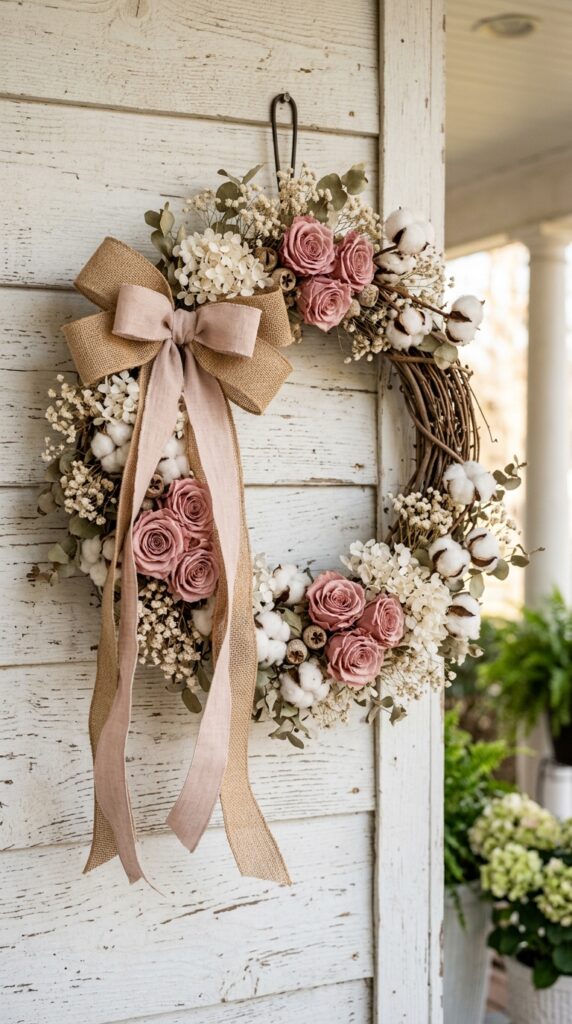
Cotton bolls and preserved roses are the farmhouse aesthetic in its most distilled form — organic, warm, and quietly beautiful in a way that never goes out of season.
What makes it work: Cotton bolls provide a textural contrast to rose petals that is deeply satisfying — the fluffy, three-dimensional cotton against the layered, smooth-edged petals creates the kind of tactile richness that makes people reach out to touch a wreath. Preserved roses (rather than faux) have a realistic softness and slight color variation that elevates the whole composition.
How to achieve it: Purchase preserved roses from specialty floral suppliers — they feel and look like real dried roses but hold their shape for months or years. Build a base of dried baby’s breath and eucalyptus, then add preserved roses at three focal clusters. Tuck cotton stem picks between rose clusters for the farmhouse contrast that makes this style distinctive.
Paper Flower Wreath: Handmade Blooms That Last Forever
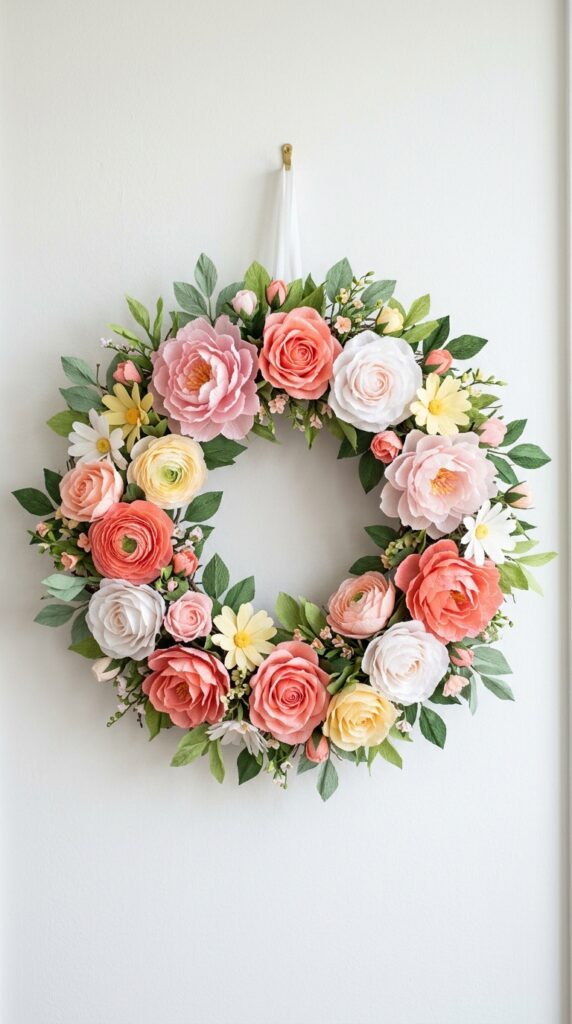
Paper flowers are the wreath-maker’s superpower — you can make blooms in colors that don’t exist in nature, at scales no real flower grows, and they last indefinitely.
What makes it work: Crepe paper flowers have a translucency and petal crinkle that reads as genuinely floral at most viewing distances, and the ability to customize every color and size means the wreath can be tuned perfectly to a specific door color or porch palette. Large-scale paper blooms (four to six inches) fill a wreath efficiently — you need far fewer than with small florals.
How to achieve it: Download a free crepe paper peony or ranunculus template and cut petals from 180-gram Italian crepe paper — the heavier weight holds shape and curls beautifully. Assemble petals around a small foam ball center using hot glue, stretching each petal slightly before gluing for a cupped, realistic form. Five to seven large blooms fill a standard 14-inch wreath base.
Cherry Blossom Branch Wreath in Minimal Japanese Style
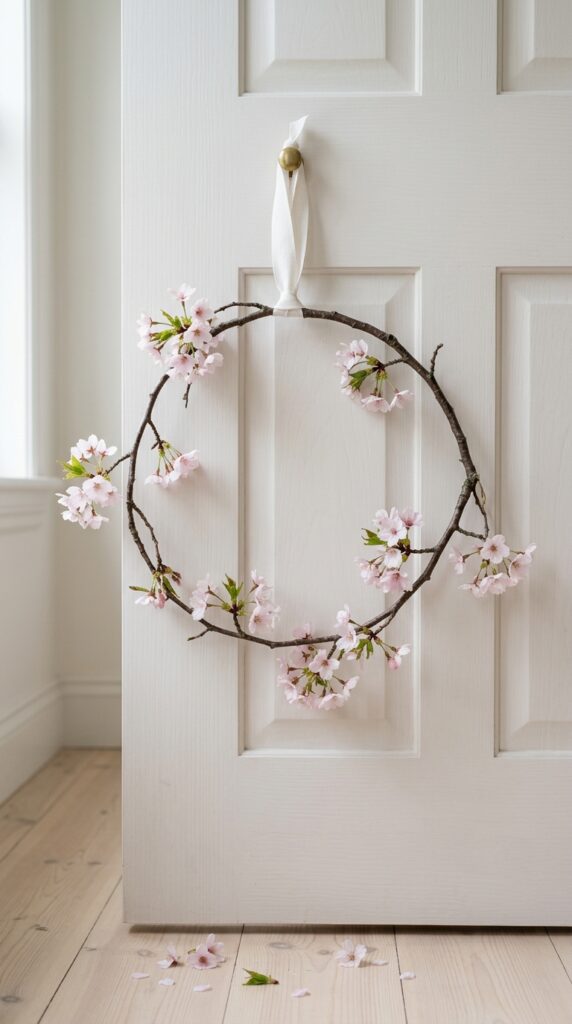
A single cherry blossom branch shaped into a loose circle is the most minimal and architectural wreath on this list — and in its restraint, it’s also one of the most striking.
What makes it work: The Japanese concept of ma — meaningful empty space — is exactly what makes this wreath compelling. The negative space inside and around the branch is as important as the branch itself, and the imperfect circle shape tells you immediately that this is handmade and intentional rather than manufactured. It reads as art more than decoration.
How to achieve it: Use a flexible cherry blossom branch (faux versions with wired stems are ideal for shaping) and gently curve it into a loose circle, securing the overlapping ends with clear floral wire. Hang with a single linen ribbon rather than a bow — any additional decoration would undermine the minimalist intention.
Rainbow Floral Wreath for a Colorful Front Door
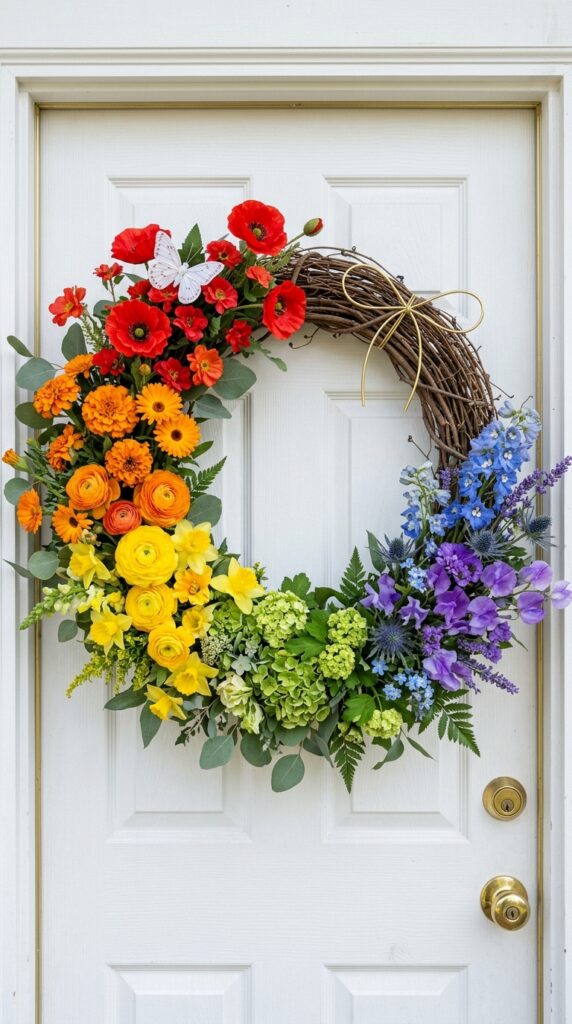
A rainbow wreath is the most unapologetically joyful thing you can put on a front door — and arranged with intention, it reads as sophisticated rather than chaotic.
What makes it work: The rainbow succeeds as a wreath concept only when the color transitions are gradual and the flowers themselves are consistent in scale and style — a smooth gradient feels curated, while abrupt color jumps look assembled. Using similar flower types throughout (all small to medium round blooms) creates visual cohesion that lets the color do the work.
How to achieve it: Lay the wreath base flat and assign each color to a segment of the circle before attaching anything — this prevents color imbalances that are very difficult to fix once stems are glued in. Work from the outer edge inward within each segment, keeping flower heads at a consistent height for a smooth, even surface.
💡 Faux florals in a full rainbow set are available as curated bundles on Amazon and Etsy specifically for rainbow wreath projects — saves the sourcing effort entirely.
Wreath with Trailing Ribbons and Spring Fabric Blooms
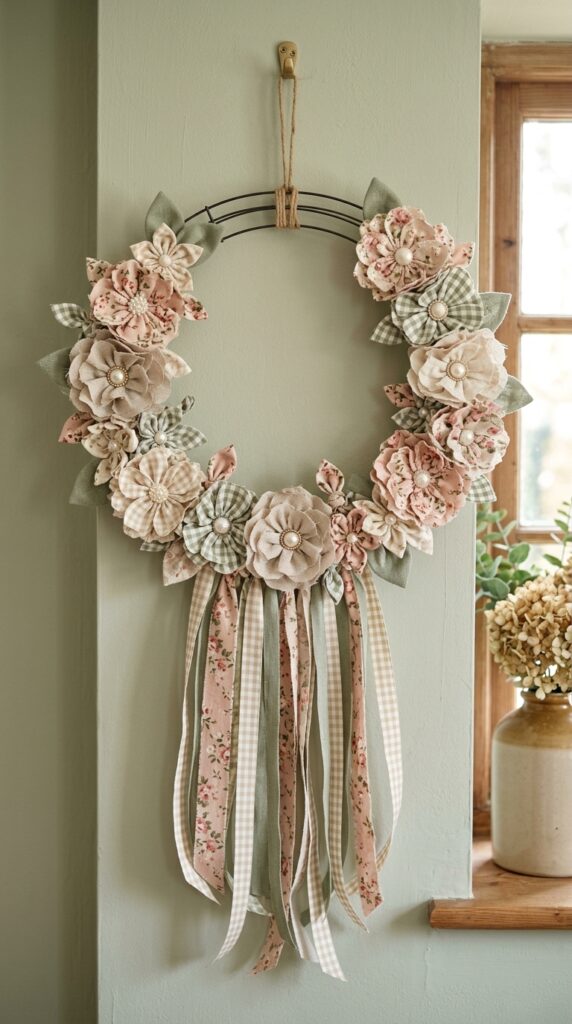
Fabric flowers bring the fabric stash to the front door — and the combination of textile prints and trailing ribbons creates a wreath that looks uniquely personal and completely handcrafted.
What makes it work: Fabric flowers have a warmth and tactility that faux plastic florals can’t match — the weave and drape of cotton and linen feel genuinely domestic and handmade in a way that reads as intentional and skilled. Mixing two to three complementary fabric prints (a floral, a stripe, a solid) within the same wreath creates visual complexity without color chaos.
How to achieve it: Cut fabric circles in graduated sizes and stack them to form simple kanzashi-style flowers, securing with a button at the center. Attach to a wire hoop with hot glue, alternating fabric prints as you work around the ring. Cut ribbon tails in four to six lengths and knot them to the bottom of the hoop, allowing them to fall naturally.
Deco Mesh Spring Wreath in Coral and Lime
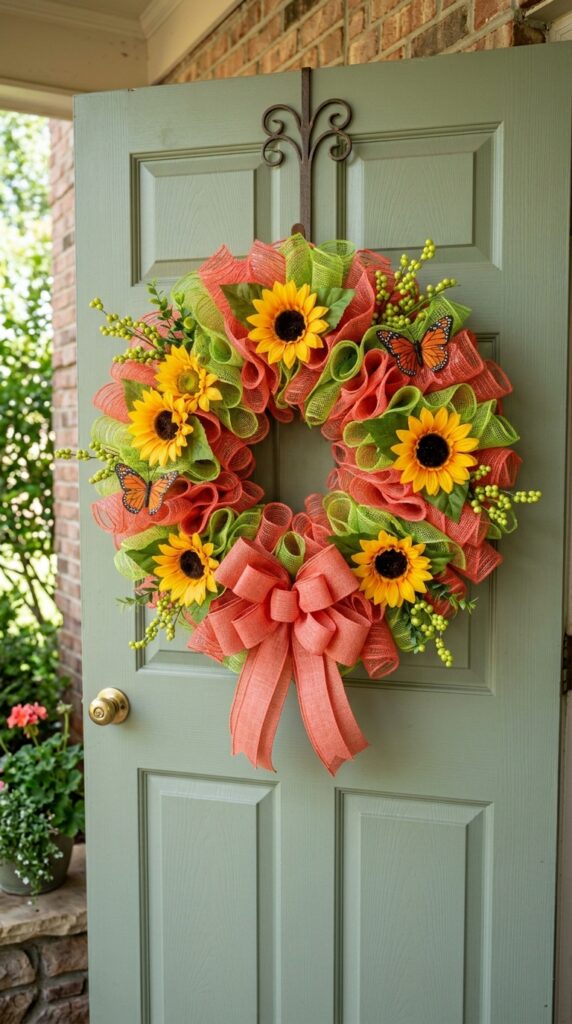
A deco mesh wreath is the easiest way to achieve a full, voluminous spring wreath from scratch — the ruffled mesh creates three-dimensional body that flowers alone rarely produce.
What makes it work: Deco mesh’s looped and ruffled texture catches light from multiple directions simultaneously, creating an almost pom-pom-like density that reads as lush and full even from a distance. Coral and lime is one of the most reliably energetic spring color combinations — complementary enough to vibrate slightly against each other, which makes the wreath feel alive.
How to achieve it: Attach deco mesh to a wire wreath frame by looping and ruching 10-inch sections of mesh onto the frame’s outer, middle, and inner rings, alternating colors as you work. Use pipe cleaners rather than wire for attaching — they grip the mesh without tearing it. Add floral picks last, pushing stems through the mesh layers to secure at the wire frame.
Vintage Teacup and Flower Wreath for a Cottage Entry
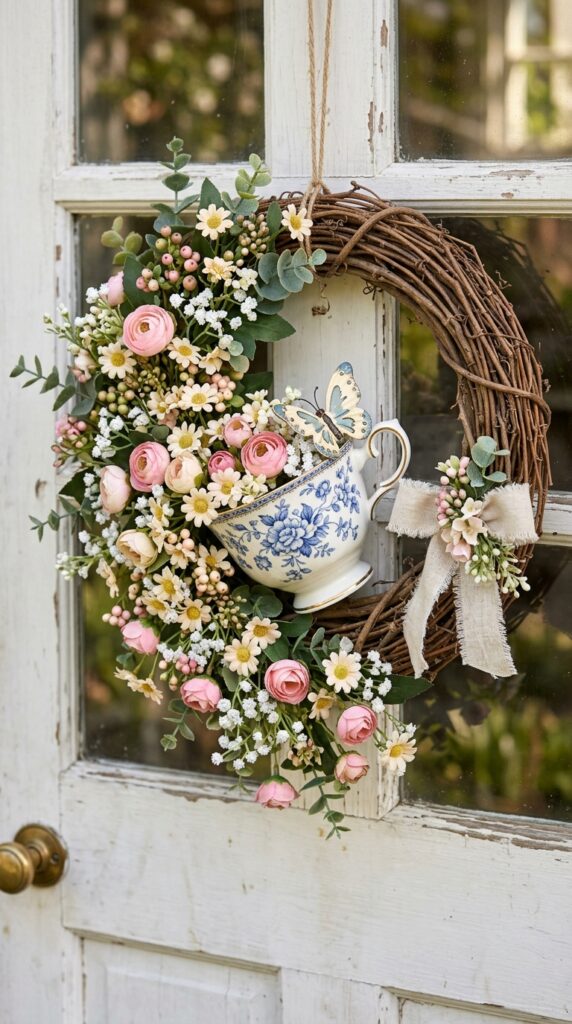
A wreath with a teacup overflowing with blooms is the most storybook thing you can create for a cottage-style front door — whimsical, specific, and completely unmistakable.
What makes it work: The teacup introduces a non-floral, narrative object into the wreath composition that immediately draws the eye and prompts a smile — it’s the kind of detail that makes people stop and look more closely. The visual joke of flowers “overflowing” from the cup is both charming and compositionally clever, providing a clear focal point.
How to achieve it: Secure a vintage teacup (sourced from a thrift store for under $2) to the lower third of a grapevine wreath using strong craft adhesive or heavy-gauge wire looped through the handle. Fill the cup with floral foam, then arrange small faux rosebuds and filler flowers as though they’re spilling over the rim and down onto the wreath below.
💡 Thrift stores and estate sales are endlessly reliable sources of vintage floral teacups — budget $2–$5 per cup and buy a few extras to experiment with.
Wreath with Moss Letters Spelling HELLO or BLOOM
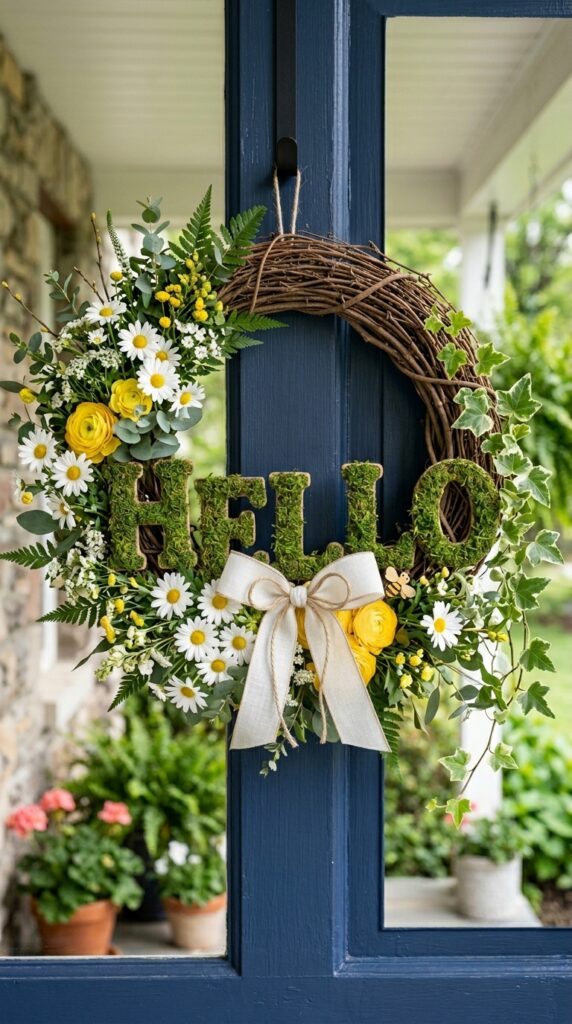
Moss letters give a spring wreath a literal voice — and there’s something inherently welcoming about a front door that says HELLO in living green.
What makes it work: Adding a word to a wreath transforms it from decoration to communication — it gives the wreath a message and the home a personality. Moss-covered letters feel organic and hand-finished rather than commercial, and the word itself (“HELLO,” “BLOOM,” “SPRING,” or a family name) makes the wreath completely unique to the household.
How to achieve it: Purchase wooden letters at a craft store and coat them with preserved or artificial moss using craft adhesive — press the moss firmly and allow it to dry completely before attaching to the wreath. Secure the letters to the wreath base using heavy-gauge wire threaded through the wreath and bent flat against the back of each letter.
Pink Dogwood Branch Wreath for a Southern Spring Porch
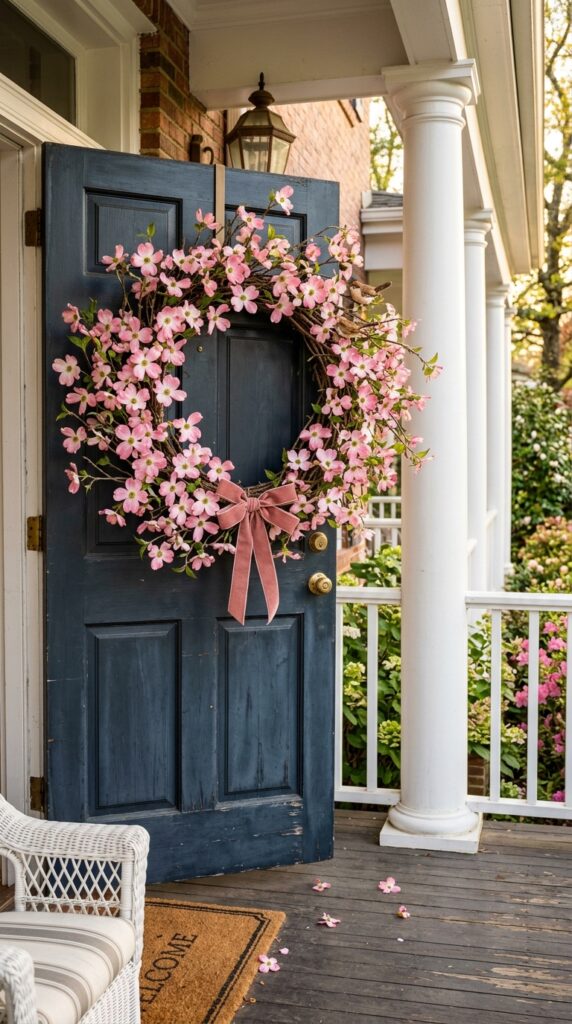
Pink dogwood is one of the most specifically seasonal flowers in the American spring — and a wreath built entirely from its branches and four-petaled blooms is pure Southern porch poetry.
What makes it work: Dogwood branches have a natural sculptural quality — they curve and angle in ways that create movement within a circular wreath form. The distinctive four-petaled flowers with notched tips are visually specific enough that the wreath is immediately recognizable and evocative of a particular place and season.
How to achieve it: Use faux dogwood branch picks available from craft retailers in late winter through spring. Build the wreath by wiring overlapping branch sections onto a heavy wire frame, allowing branches to extend naturally beyond the perfect circle for an organic silhouette. A velvet ribbon in dusty rose or blush is the only accent needed.
Upcycled Book Page Wreath with Paper Florals
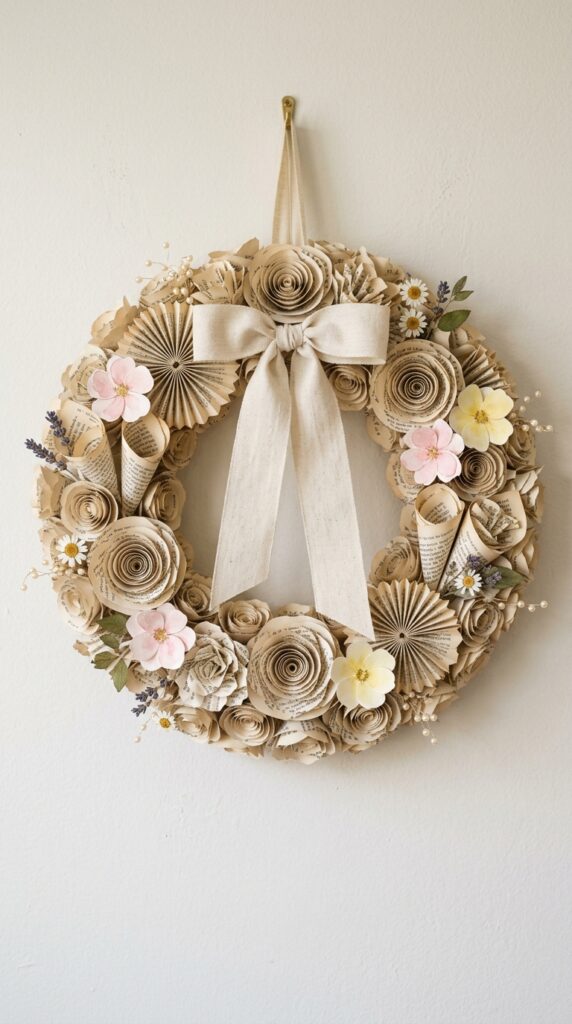
An upcycled book page wreath is the most literary thing you can put on a door — a repurposed novel or poetry collection turned into something beautiful and entirely new.
What makes it work: Paper rosettes made from book pages have an extraordinarily fine texture — the folded paper edges catch light and create shadow in a way that resembles real petals far more than expected. The tonal cohesion of cream-on-cream paper throughout gives the wreath a sophisticated, monochromatic quality that feels intentional and refined.
How to achieve it: Tear pages from an inexpensive vintage paperback (thrift stores sell them for $0.50) and roll half into tight paper roses by rolling diagonally from corner to corner, securing with hot glue. Fold the other half into accordion fans and pinch at the center for carnation-style flowers. Cover the entire wreath base before adding any painted paper accents.
Wooden Bead and Spring Flower Wreath
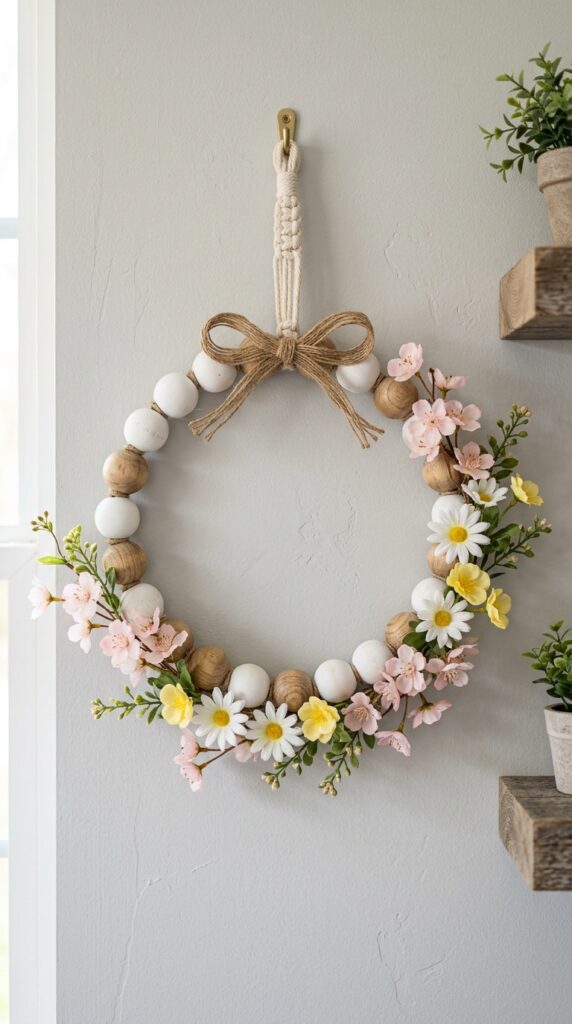
A wooden bead wreath brings a completely different material vocabulary to spring decorating — warm, tactile, and playful in a way that instantly feels current.
What makes it work: The wooden bead base provides a structural clarity and modern simplicity that grapevine and foam bases don’t — the graphic repetition of spheres gives the wreath a visual rhythm that holds together even before the flowers are added. It’s architectural where most wreaths are organic, and that contrast makes it stand out.
How to achieve it: String large wooden beads (25–35mm) onto a length of jute cord in your chosen pattern — alternating natural and white is classic — and tie the cord ends into a circle. Attach floral clusters at evenly spaced intervals using hot glue or by tying stems directly to the cord between beads. Keep florals small-scaled so they complement rather than overwhelm the bead base.
Giant 24-Inch Oversized Wreath for a Statement Porch
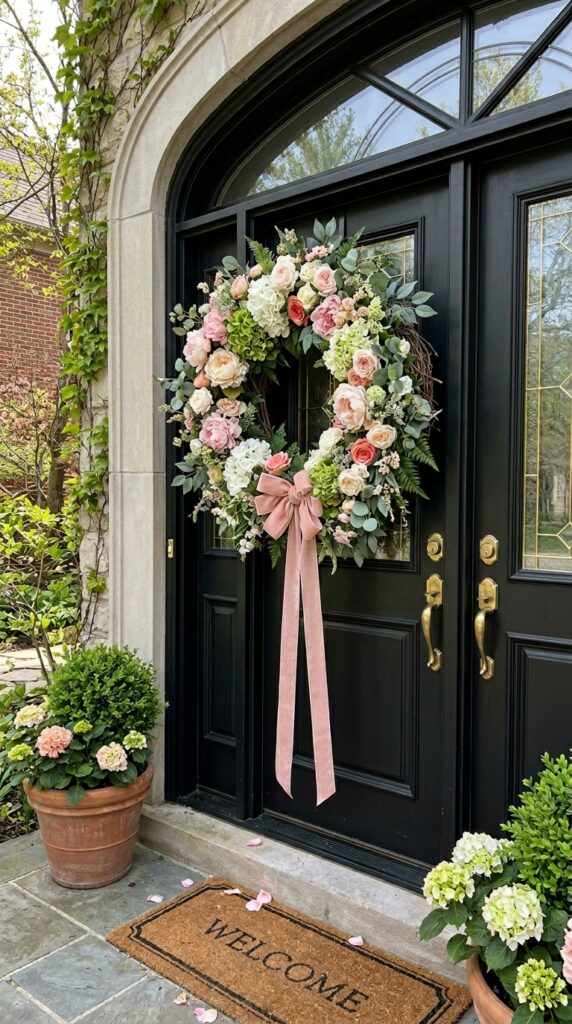
An oversized wreath is a commitment — and it pays off spectacularly. At 24 inches, a spring wreath stops being decoration and starts being architecture.
What makes it work: Scale is the most underused tool in front porch decorating. A 14-inch wreath on a standard 36-inch door disappears. A 24-inch wreath dominates the door in the best possible way — it fills the visual field, commands attention from the street, and signals exactly the kind of considered, confident decorating that makes a home memorable.
How to achieve it: Build on an 18–24 inch grapevine base and commit to proportionally large blooms — peonies, hydrangea clusters, and garden roses rather than small accent flowers that would be lost at this scale. A large wreath needs a heavy-duty wreath hanger rated for at least 5 lbs — standard wire hooks will bend under the weight.
💡 Double-back ribbon bow tails proportional to the wreath: for a 24-inch wreath, ribbon tails should extend at least 18–24 inches below the bow to balance the scale.
Spring Nest Wreath with Robin’s Egg Details
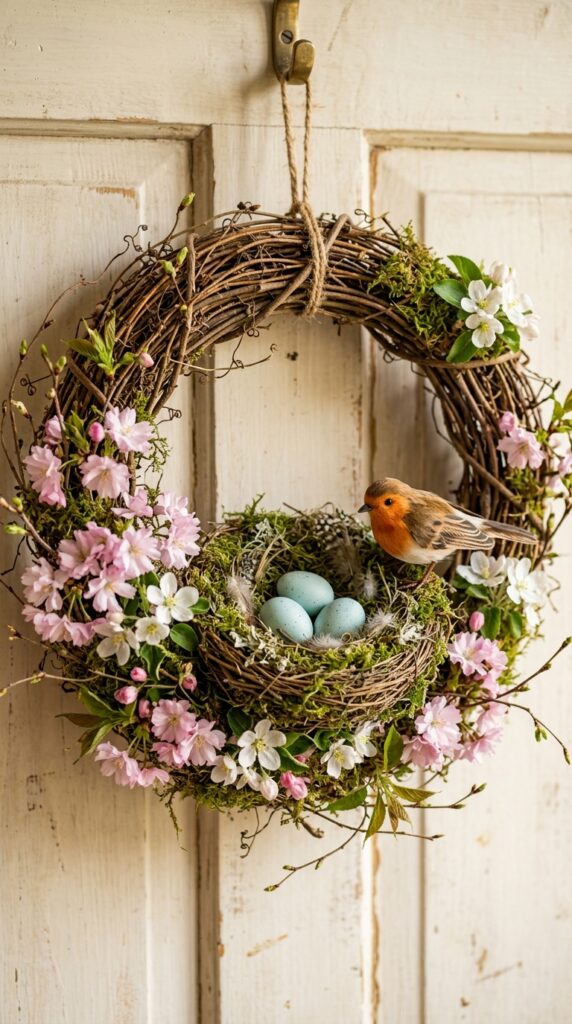
A spring wreath with a bird’s nest is one of the most universally beloved seasonal compositions — there is simply something in human nature that finds a nest with eggs irresistible.
What makes it work: The nest introduces a narrative moment into the wreath — a story of nesting, new life, and spring renewal that resonates emotionally in a way that flowers alone don’t. Positioning it at the lower third of the wreath (rather than the center) creates a natural composition that looks discovered rather than placed.
How to achieve it: Purchase a small decorative bird’s nest and faux robin’s eggs from a craft store — these are widely available and inexpensive in spring. Secure the nest firmly to the wreath base using hot glue and floral wire threaded through the nest base. Tuck cherry blossom or apple blossom picks around the nest to frame it, and add a small faux bird on the nest edge for the full storybook effect.
How to Start Your DIY Spring Wreath Transformation
The most common mistake first-time wreath makers make is buying too many different flowers before committing to a palette — the result is a wreath that looks like it couldn’t decide what it wanted to be. Before purchasing a single stem, choose two to three colors maximum and one clear style direction (romantic, rustic, minimal, wild), then buy accordingly.
Start with the base: a 14–16 inch grapevine wreath is the most forgiving and widely available, costs $5–$10, and works with virtually every style on this list. Smaller bases (10–12 inch) are better for indoor use; larger ones (18–24 inch) create more porch impact but require proportionally more materials.
The most budget-friendly entry point is to combine one bunch of faux florals ($8–$15) with greenery cut from your garden or a grocery store bunch of eucalyptus ($3–$5). Together they build a complete, well-balanced wreath for under $30 — and the skill transfers to every wreath you make afterward.
Wreath-making is genuinely fast once you understand the process: most of the designs in this list take 30–60 minutes to complete. The first one always takes longer while you find your rhythm; the second one will surprise you with how quickly it comes together.
Frequently Asked Questions
What is the best base for a DIY spring wreath?
A 14–16 inch grapevine wreath base is the most versatile choice for beginners — it has natural texture that shows through floral arrangements, is rigid enough to hold heavy stems, and is inexpensive at $5–$10 from any craft store. Wire wreath frames work better for deco mesh and ribbon-style wreaths because they provide multiple rings to attach material to. Foam bases are ideal for wreaths where you’ll be pushing stem picks directly into the base, like succulent and paper flower wreaths. Embroidery hoops (brass, 10–14 inches) are the best base for minimal ribbon and dried flower designs.
How do I make a spring wreath last the whole season outdoors?
Use UV-resistant faux florals rather than fresh ones for outdoor wreaths — look for stems specifically labeled “UV-protected” or “outdoor-safe” as these resist fading in direct sunlight far longer than standard craft florals. Avoid placing wreaths in full direct afternoon sun if possible — a covered porch or shaded entryway dramatically extends the life of both faux and fresh materials. Spray faux florals with a UV-protectant clear coat (available at hardware stores) for additional protection. Most well-made faux wreaths stored properly between seasons will last three to five years.
How much does it cost to make a DIY spring wreath?
A basic DIY spring wreath using craft store materials typically costs $20–$50 in supplies — significantly less than comparable retail wreaths which run $60–$150 for similar quality. The main cost variables are the floral stems (faux versus preserved versus fresh), the base, and any specialty elements like preserved roses or imported eucalyptus. The greatest savings come from sourcing faux florals from dollar stores and Etsy wholesale sellers rather than full-price craft store stems, and from reusing the base and ribbon across multiple seasons.
What ribbon looks best on a spring wreath?
Ribbon choice should match the wreath’s overall aesthetic — wide velvet ribbon (2.5–4 inches) in dusty rose, sage green, or blush feels romantic and lush; natural jute or linen ribbon reads as farmhouse or organic; gingham in yellow, green, or pink reads as cottage-casual; thin satin ribbon in pastel tones reads as delicate and feminine. As a general rule, choose ribbon that is at least 2.5 inches wide for wreaths 14 inches and larger — thinner ribbon gets visually lost against a full floral arrangement. Wired ribbon is far easier to shape into professional-looking bows than non-wired.
Can I make a spring wreath without hot glue?
Yes — and for many wreath styles, it’s actually preferable. Floral wire is the primary alternative: wrapping stems onto a grapevine or wire base with floral wire creates a fully removable, adjustable attachment that you can reposition without damage. Floral picks (wooden or wire-tipped) can be pushed directly into foam bases and grapevine without any adhesive. For ribbon and dried flower wreaths, simple knotting and looping around the base frame creates secure attachments. Hot glue is fastest and most permanent, but wired attachments often look more natural because stems can be angled freely.
Ready to Transform Your Front Porch This Spring?
You’ve just explored 29 DIY spring wreath ideas covering every style from barefoot-simple cherry blossom minimalism to opulent 24-inch peony showstoppers — and the most important thing to remember is that the best wreath is the one you actually make. Pin the three that made you stop scrolling, gather your materials this weekend, and start with the simplest one on the list. Spring is the most forgiving season for beginner makers: the materials are beautiful, the colors practically arrange themselves, and even an imperfect first wreath looks like intention from six feet away. Your front door — and everyone who walks past it — is waiting.