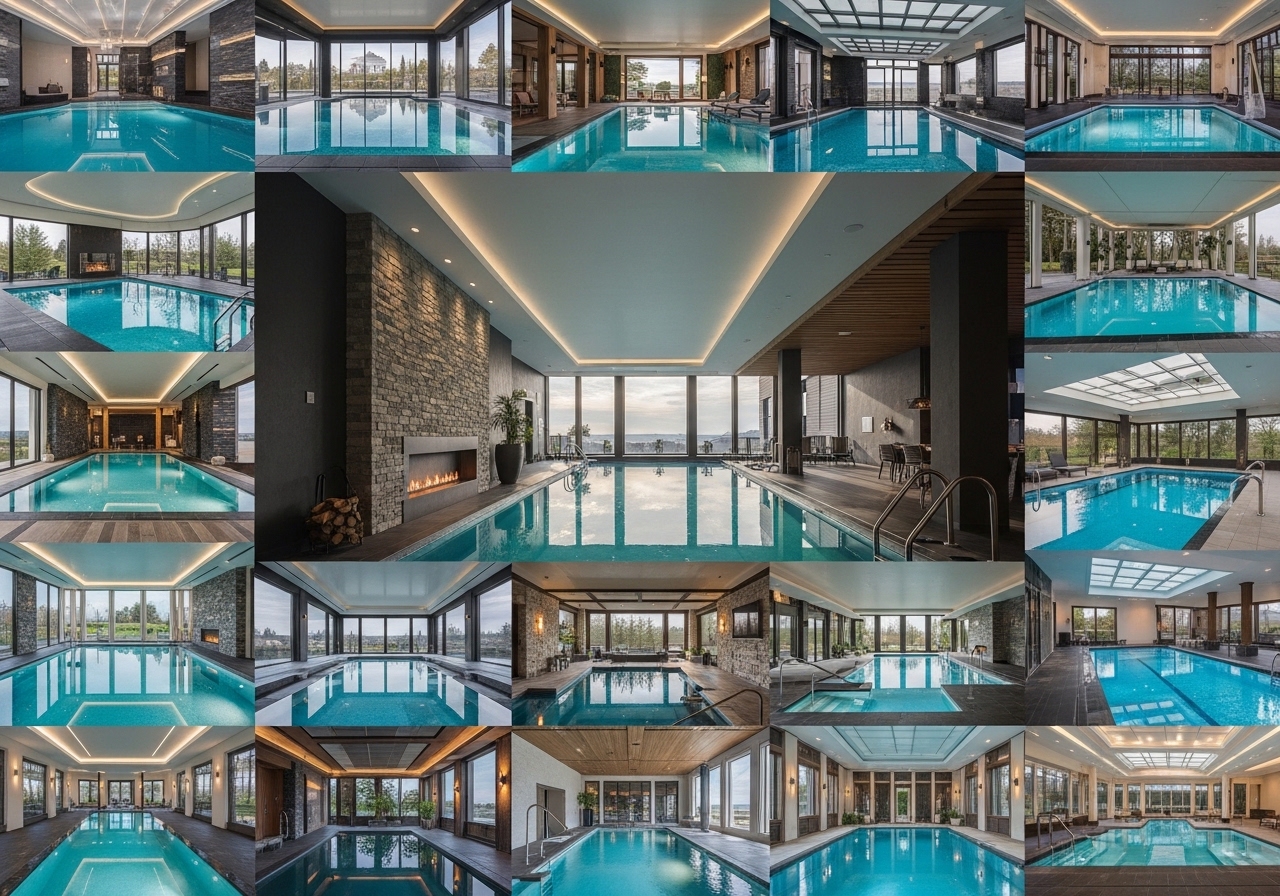
There is a particular kind of calm that only a body of still, indoor water can produce — the way it holds the light, shifts it across walls and ceilings, and transforms an entire room into something that feels less like architecture and more like atmosphere. Modern indoor pool design has evolved far beyond the chlorine-scented, echoing natatoriums of decades past into something genuinely extraordinary: spaces where water, light, material, and structure work together to create the most dramatic and serene rooms in a home. Whether you are planning a full-scale architectural build or simply dreaming your way toward a future project, these 30 modern indoor pool designs will give you ideas worth saving, sharing, and returning to for years. Let’s explore every one of them.
Why Modern Indoor Pool Design Works So Well
The modern indoor pool succeeds as a design statement because it operates at the intersection of the two things contemporary architecture does best: material honesty and light manipulation. A modern pool enclosure is never decorative in the traditional sense — there are no columns for their own sake, no ornamental flourishes. Every element earns its place because it either shapes the light, frames the water, or defines the relationship between inside and outside.
What defines the modern indoor pool aesthetic is restraint applied to luxury. The core material vocabulary — polished concrete, large-format stone tile, structural glass, dark-stained timber, and still water — is intentionally limited. Fewer materials, chosen with precision, create an environment of concentrated sensory richness that maximizes the impact of each surface. The water becomes the art; the architecture becomes the frame.
The cultural moment for modern indoor pools is genuine and growing. Rising interest in wellness architecture, biophilic design, and the home as a complete lifestyle environment has driven extraordinary innovation in residential pool design over the past decade. Pinterest searches for “indoor pool house,” “luxury pool room,” and “modern natatorium” have surged as homeowners increasingly treat the indoor pool not as an amenity but as the architectural centerpiece of the home.
What makes this design category so compelling to explore is its genuine range. A modern indoor pool can be a 60-foot lap lane in a dedicated glass pavilion, or a 12-foot plunge pool set into a polished concrete wellness room. The principles that make them both work — light, water, material, proportion — scale beautifully to any size and any budget level.
30 Modern Indoor Pool Designs
1. Glass Pavilion Pool House with Floor-to-Ceiling Views
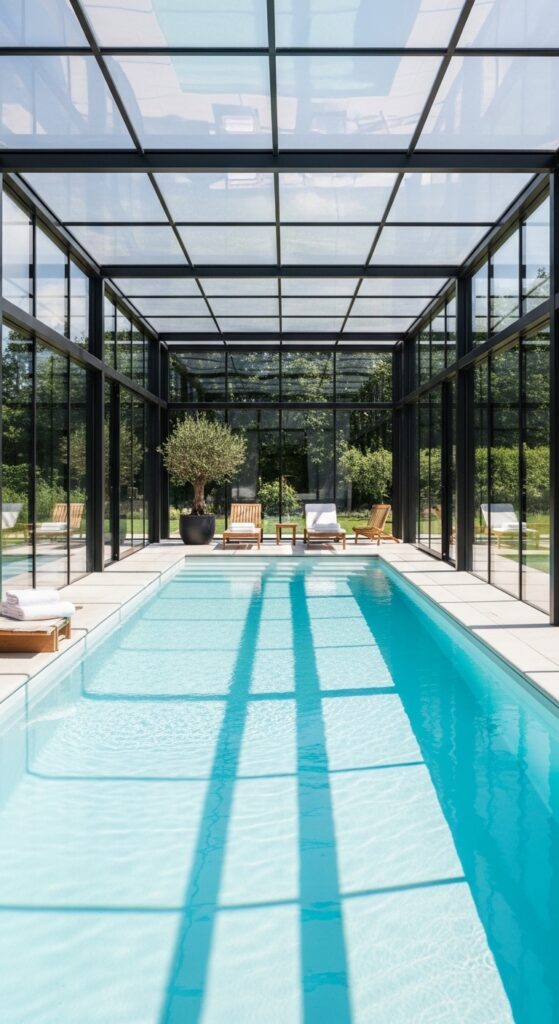
Vibe: Swimming here feels like moving through open air — the glass dissolves the boundary between the pool and the sky beyond it entirely.
What makes it work: A full glass pavilion pool house solves the modern indoor pool’s greatest challenge — natural light — by removing the barrier entirely. The slim black steel framing creates a geometric cage that is structural and beautiful simultaneously, casting precise shadow lines across the water surface as the sun moves throughout the day.
How to achieve it: Thermally broken black powder-coated steel and glass systems from manufacturers like Vario or Reynaers Aluminium are the industry standard for this aesthetic. Specify triple-glazed Low-E panels to manage heat gain and condensation — the two most significant operational challenges in glass pool pavilions.
💡 A single large specimen olive tree inside a glass pool pavilion costs under $800 and reads as a ten-thousand-dollar design decision.
2. Dark Moody Pool Room with Black Plaster Walls and Ambient Lighting
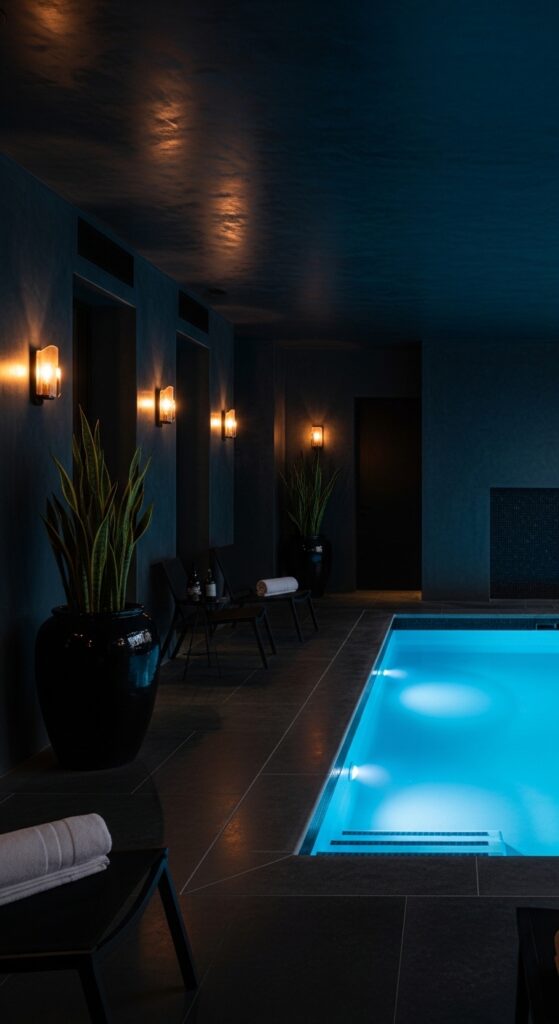
Vibe: Entering this pool room is like descending into a very beautiful secret — dark, glowing, and completely removed from the ordinary world above.
What makes it work: Dark-walled indoor pools create a grotto-like atmosphere that amplifies the luminosity of the water itself — against charcoal plaster or black tile, the aquamarine of pool water appears to glow from within rather than simply reflecting light. The contrast between the dark surround and the bright water is one of the most dramatic effects achievable in residential architecture.
How to achieve it: Specify polished Venetian plaster or Roman Clay in deep charcoal for pool room walls — these finishes are inherently moisture-resistant and develop a beautiful depth under low ambient light. Pair with dark-tiled pool interiors in charcoal or black mosaic to complete the moody aesthetic.
3. Minimalist White Concrete Pool with a Single Skylight
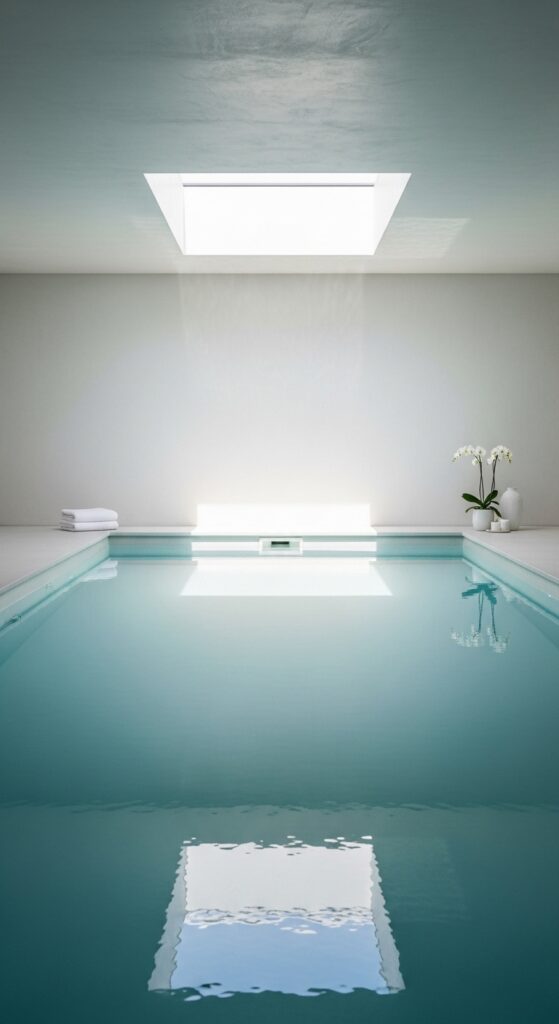
Vibe: Still, pure, and meditative — a pool room so reduced to its essentials that it approaches something spiritual.
What makes it work: The single skylight is a masterclass in restraint — instead of filling the ceiling with light sources, one precisely placed aperture focuses a beam of natural light directly onto the water surface, creating a kinetic light display as the sun tracks across the sky. The white concrete surround amplifies every lumen without adding visual noise.
How to achieve it: Specify a fixed-pane skylight with a minimum 4-foot square opening centered above the pool’s midpoint. Velux and Fakro both manufacture commercial-grade skylight units suitable for pool room humidity levels. Polish the concrete surround to a Class 3 or Class 4 finish for maximum reflectivity.
4. Tropical Indoor Pool with Living Plant Walls and Natural Stone
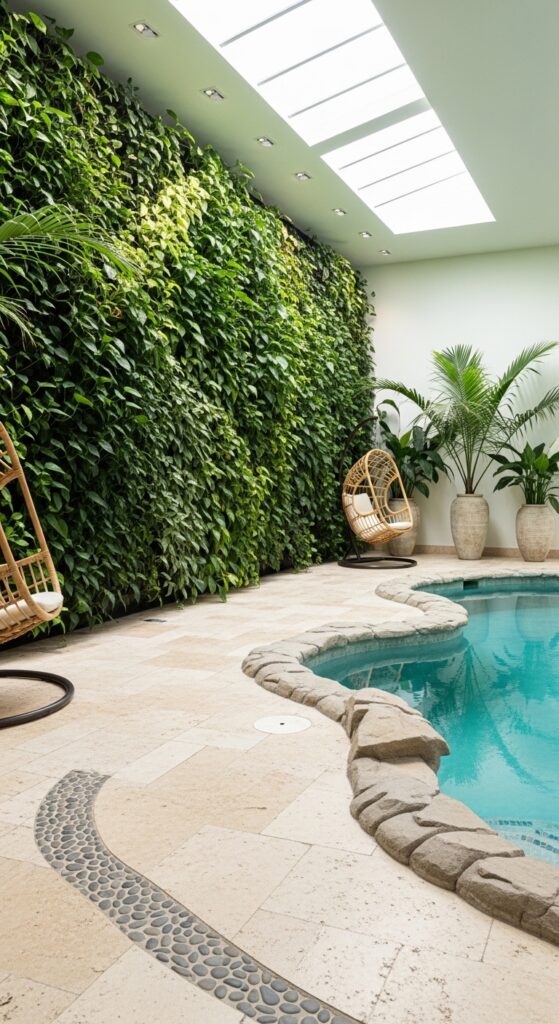
Vibe: Lush, oxygen-rich, and completely transporting — the feeling of swimming in a private jungle clearing, entirely indoors.
What makes it work: A living plant wall adjacent to a pool creates an indoor biophilic environment that is genuinely unmatched by any other design intervention. The plants manage humidity, improve air quality, and create a sensory richness — fragrance, movement, texture — that transforms the pool room from a purely architectural space into a living ecosystem.
How to achieve it: Specify a hydroponic living wall system from companies like Naava or ANS Global — these self-irrigating vertical garden systems are designed for high-humidity environments like pool rooms and require minimal maintenance. Choose moisture-loving tropical species: pothos, philodendrons, ferns, and peace lilies all thrive in pool room conditions.
5. Infinity Edge Indoor Pool Overlooking a Garden or Valley
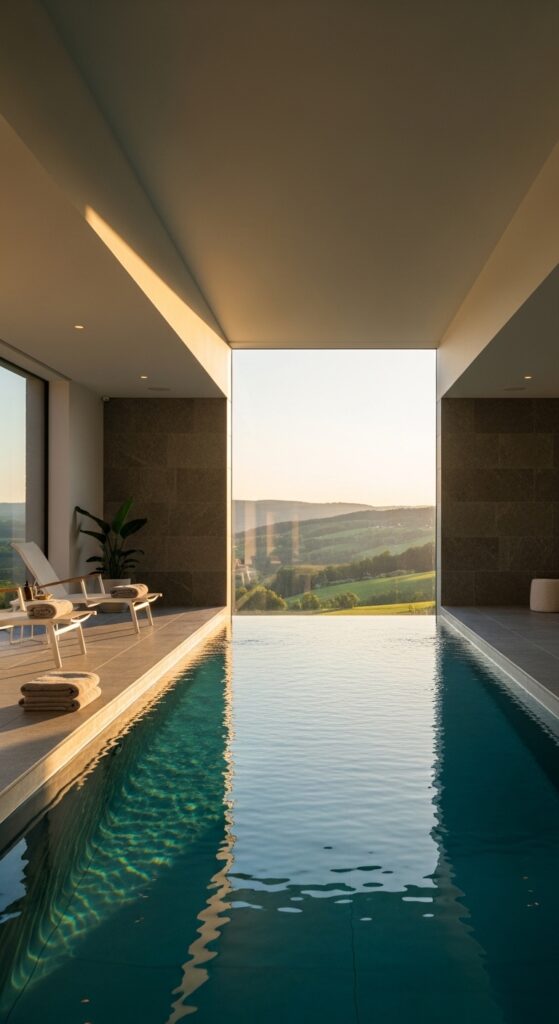
Vibe: The water doesn’t end — it simply continues into the view, making the world outside feel like an extension of the pool itself.
What makes it work: An indoor infinity edge pool with a full glass end wall is the architectural equivalent of a sleight of hand — it makes the room feel boundless by dissolving the boundary between interior water and exterior landscape. The optical illusion of the pool merging with the horizon beyond is most powerful at golden hour, when the light entering through the glass tints the water surface gold.
How to achieve it: The infinity edge requires a precisely engineered catch basin below the overflow lip — this must be designed by a pool structural engineer, not retrofitted. The glass wall should be structural laminated glass with minimal framing — a single uninterrupted pane dramatically outperforms a framed alternative. Minimum recommended glass thickness for structural pool room applications is 17.5mm laminated.
💡 Positioning the infinity edge on the west-facing wall maximizes the golden hour visual effect for the most dramatic daily light show.
6. Japanese Zen Pool Room with Tatami Lounge and Bamboo
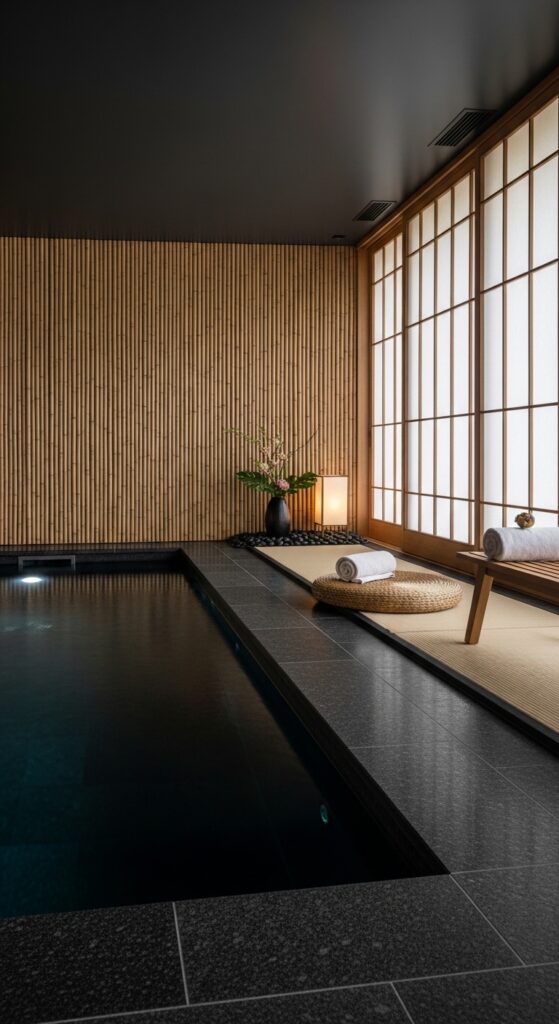
Vibe: Stillness has a physical form here — the dark water, the whisper of bamboo, the paper-filtered light all conspire to slow the mind to match the room.
What makes it work: The Japanese aesthetic applied to pool design reduces the space to its purest elements — still water, natural material, controlled light — and eliminates everything else with complete discipline. The dark granite pool interior makes the water appear deep and reflective, like a natural onsen, while the bamboo wall provides organic warmth that prevents the room from feeling clinical.
How to achieve it: Line the pool interior with black or dark grey granite tiles — Absolute Black granite or Nero Marquina marble are the most appropriate materials. Specify shoji-inspired translucent panel systems from companies like Lualdi or custom millwork shops to diffuse artificial light into the room’s characteristic soft, even glow.
7. Industrial Exposed Concrete and Steel Pool Room
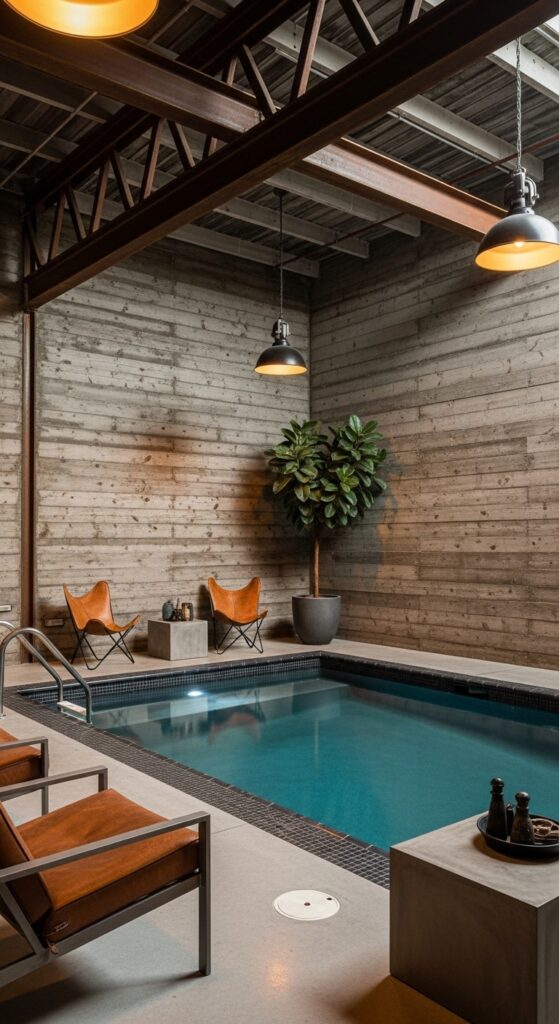
Vibe: Powerful, raw, and completely unapologetic — a pool room that treats luxury and industrial materials as equally valid expressions of the same ambition.
What makes it work: Board-formed concrete walls in a pool room create a surface of extraordinary textural richness — the wood grain pattern pressed into the concrete during forming gives each wall a unique, unrepeatable character that becomes more beautiful as it ages. Exposed steel beams overhead reinforce the industrial narrative while providing a legitimate structural system for spanning large pool room openings.
How to achieve it: Board-formed concrete requires careful specification of form lumber and release agent to achieve clean, consistent results. Use 2×6 or 2×8 rough-sawn pine boards with a consistent grain direction. Seal the finished concrete with a penetrating silane-siloxane sealer rated for humid environments before the pool room becomes operational.
8. Scandinavian Sauna and Pool Suite with Pale Wood and White Plaster
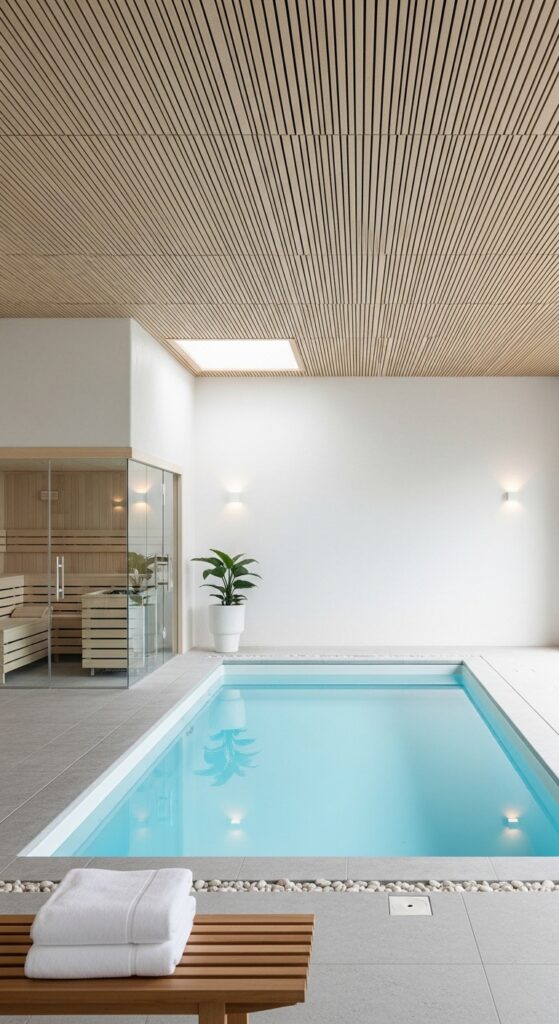
Vibe: Clean, restorative, and deeply Nordic — a space that feels designed around the serious business of feeling genuinely well.
What makes it work: The Scandinavian indoor pool aesthetic prioritizes the wellness experience over visual drama — soft natural light, pale natural materials, and the integration of sauna and pool create a circuit of thermal contrast that is both physiologically beneficial and architecturally cohesive. Pale birch wood on the ceiling introduces warmth that prevents the all-white palette from reading as cold.
How to achieve it: Specify thermally modified ash or birch for ceiling slats — thermal modification makes wood dimensionally stable in humid pool room conditions without chemical treatment. Glass-walled saunas from manufacturers like Tylö or Helo can be integrated into pool room design as a structural element, not merely an addition.
💡 The hot-cold wellness circuit of sauna-to-pool is physiologically most effective when the two spaces are within 10 steps of each other.
9. Underground Grotto Pool with Vaulted Stone Ceiling
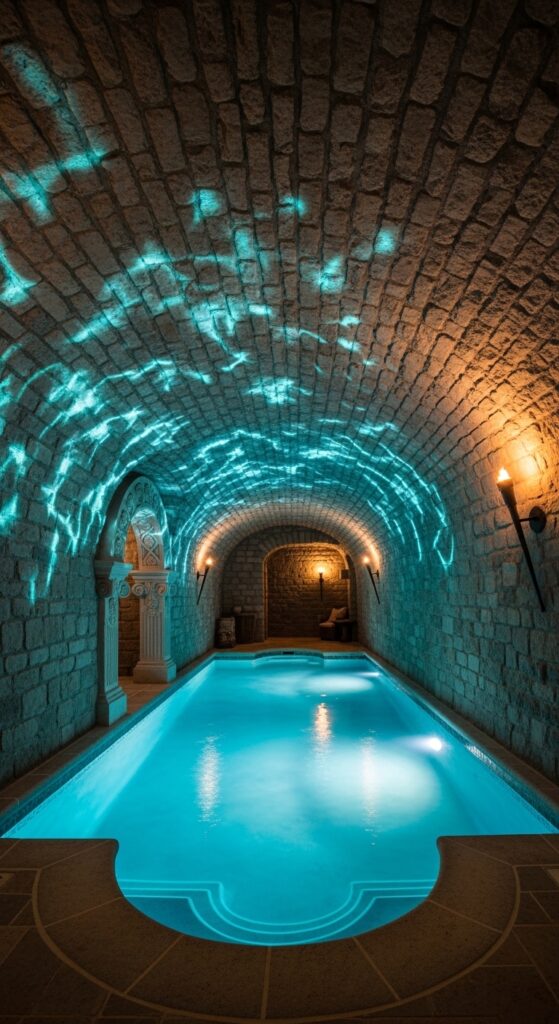
Vibe: Ancient and extraordinary — a pool carved into the earth itself, where the light from the water maps itself onto stone above like a living fresco.
What makes it work: The vaulted stone ceiling is the key element that elevates this from basement pool to architectural experience — the curved surface captures and redistributes the dynamic light patterns generated by the moving water surface, covering the entire vault in a constantly shifting aquamarine light display. No other ceiling form does this as effectively.
How to achieve it: Vaulted stone ceilings in residential pool rooms are typically achieved with gunite (shotcrete) formed over a curved rebar armature, then finished with a stone-look textured plaster or natural stone veneer. Alternatively, real stone can be laid over a formed concrete vault by specialist masonry contractors. Waterproof all surfaces to a minimum of 500mm above the waterline.
10. Mid-Century Modern Pool Room with Terrazzo and Teak
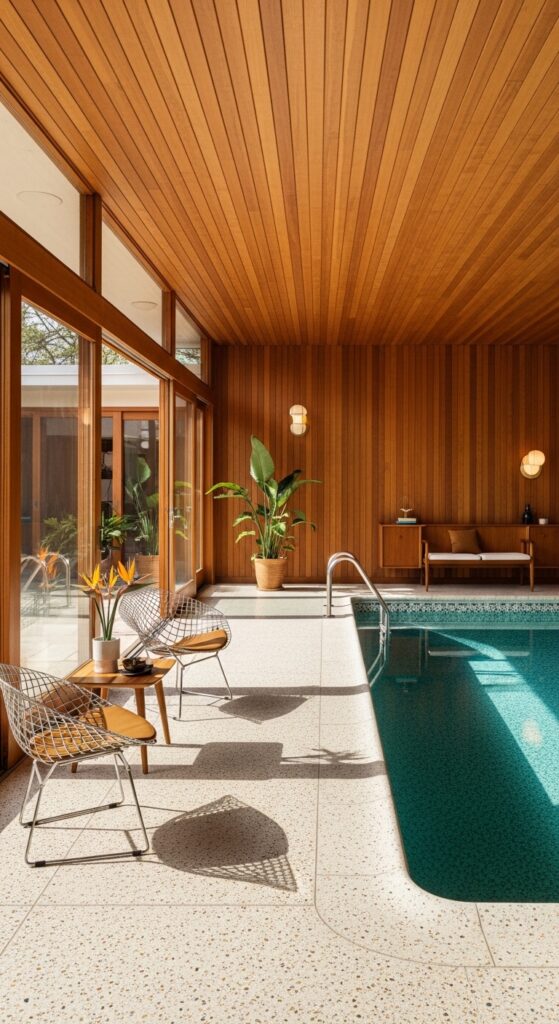
Vibe: The golden age of residential design made material — warm, precise, and radiating the confidence of a period when architecture believed completely in itself.
What makes it work: Mid-century modern materials age extraordinarily well in pool environments — terrazzo is virtually indestructible, teak is naturally water-resistant, and the mosaic tile that lined pools of that era has become a design icon. Together they create an interior that feels genuinely historical rather than merely period-inspired.
How to achieve it: Source genuine terrazzo tiles from manufacturers like Concreate or Palazzo for the pool surround — specify a large chip pattern (minimum 6mm aggregate) for period authenticity. Teak ceiling slats should be kiln-dried to 8–10% moisture content and finished with a non-yellowing marine-grade oil for humidity resistance.
11. Modern Farmhouse Pool Room with Exposed Timber Trusses
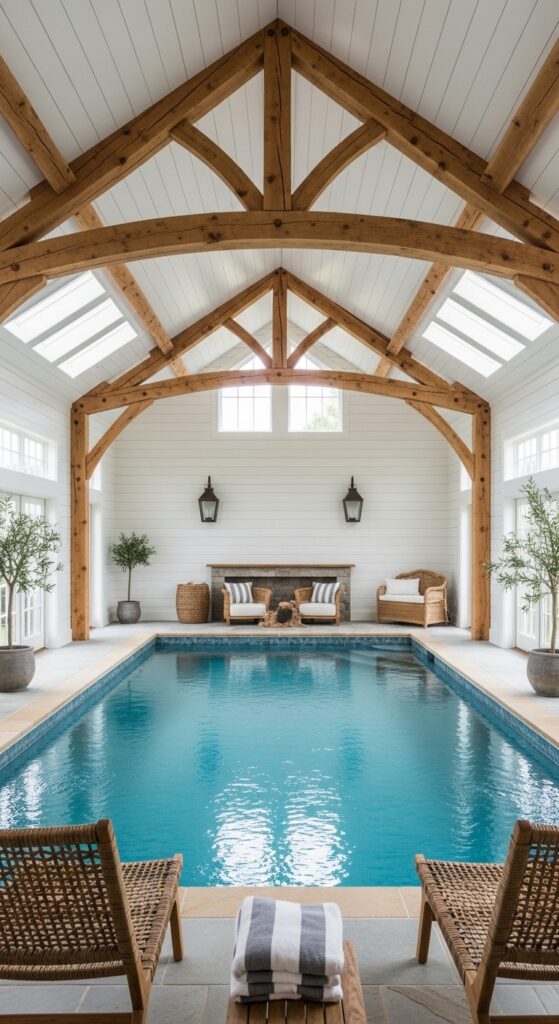
Vibe: Barn-grand and deeply welcoming — the kind of pool room that makes you feel like you’ve earned something by living somewhere this generous.
What makes it work: Exposed timber trusses in a pool enclosure serve both structural and experiential functions — they span the large openings required for a pool room without requiring interior columns that would interrupt the deck space, and their warm natural material immediately humanizes what might otherwise feel like an institutional space.
How to achieve it: Timber king post or scissor trusses in Douglas fir or glulam (glued laminated) timber are the most cost-effective structural solution for pool room spans of 30–60 feet. Specify a clear penetrating oil finish — never paint structural timber in a pool room, as moisture cycling will cause paint failure within two to three seasons.
💡 Clerestory windows at gable ends are the most efficient natural lighting strategy for pool rooms with high-pitched timber roofs.
12. Rooftop Indoor Pool with Retractable Glass Roof
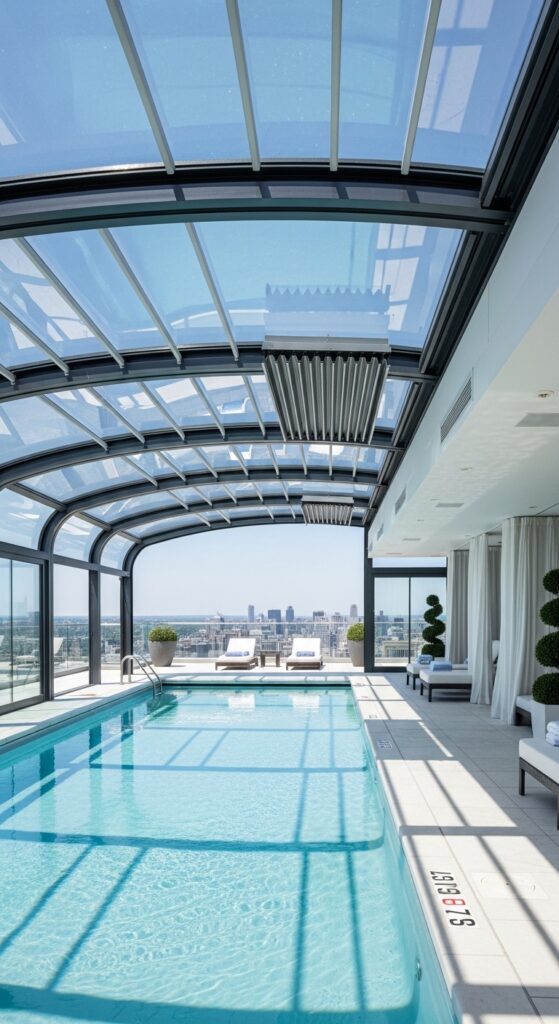
Vibe: Sky above, city below, water between — the sensation of swimming at the top of the world.
What makes it work: A retractable glass roof pool room is the architectural response to the fundamental tension of indoor pool design — you want weather protection but you also want open air. The retractable roof delivers both: fully enclosed for winter swimming, fully open on warm days, and partially open for the most dramatic in-between condition where rain falls on one end of the pool while you swim in sun at the other.
How to achieve it: Retractable glazing systems from manufacturers like Vitrocsa, Sky-Frame, or Schüco are the premium specification for this application. The roof mechanism requires careful waterproofing at all junction points and a dedicated drainage system for the frame channels. Structural load calculations must account for both snow load (closed) and wind uplift (open positions).
13. Biophilic Pool Room with Tree Growing Through the Deck
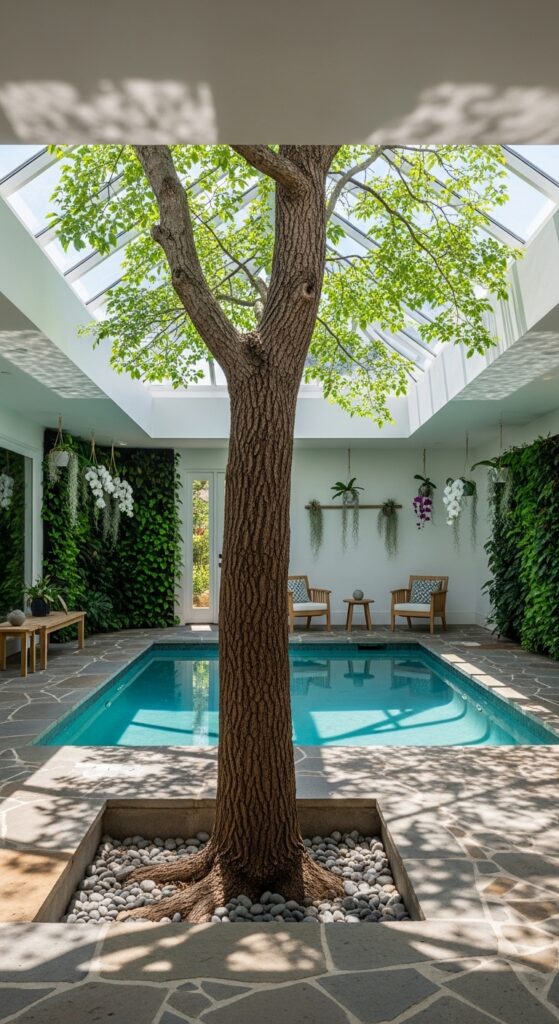
Vibe: Architecture and nature have genuinely merged here — the house doesn’t surround the tree, it simply makes room for it.
What makes it work: A mature specimen tree growing through a pool deck is the single most powerful biophilic design statement available in residential architecture. Its effect on the room is total — dappled light, natural fragrance, sound of leaves, seasonal change — and no designed feature can replicate what a living tree contributes to the experience of the space.
How to achieve it: This requires planning from initial design — the tree pit must be engineered with deep soil volume (minimum 10,000 liters for a mature specimen), root barrier membranes, and aeration pipe systems. Native species are more successful than exotic ones. Consult an arborist alongside the structural engineer from the earliest design stages.
14. Art Deco Pool Room with Geometric Mosaic and Gold Accents
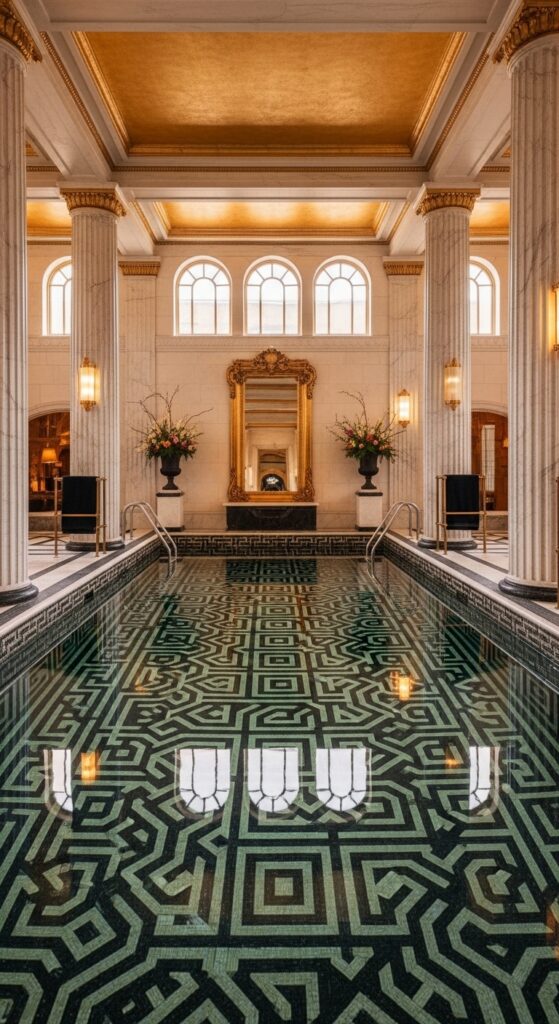
Vibe: Outrageously beautiful and completely unashamed — a pool room that understands that architecture can be a form of theater.
What makes it work: The Art Deco pool aesthetic draws on the great public natatoriums of the 1920s and 1930s — the Piscine Molitor in Paris, the Bath Club in Miami — where swimming was understood as a glamorous social ritual deserving the most lavish architectural setting. Geometric mosaic in the pool interior is the defining feature: visible through the water, it shifts and ripples as the surface moves.
How to achieve it: Custom geometric mosaic for pool interiors is available from specialists like Bisazza, Sicis, or New Ravenna — specify glass mosaic rather than ceramic for interior pool use, as it resists chemical degradation from pool water chemistry. Design the mosaic pattern at 1:1 scale on paper before commissioning to ensure the geometry resolves correctly at the pool’s actual dimensions.
15. Indoor Plunge Pool for Wellness with Cold and Hot Zones
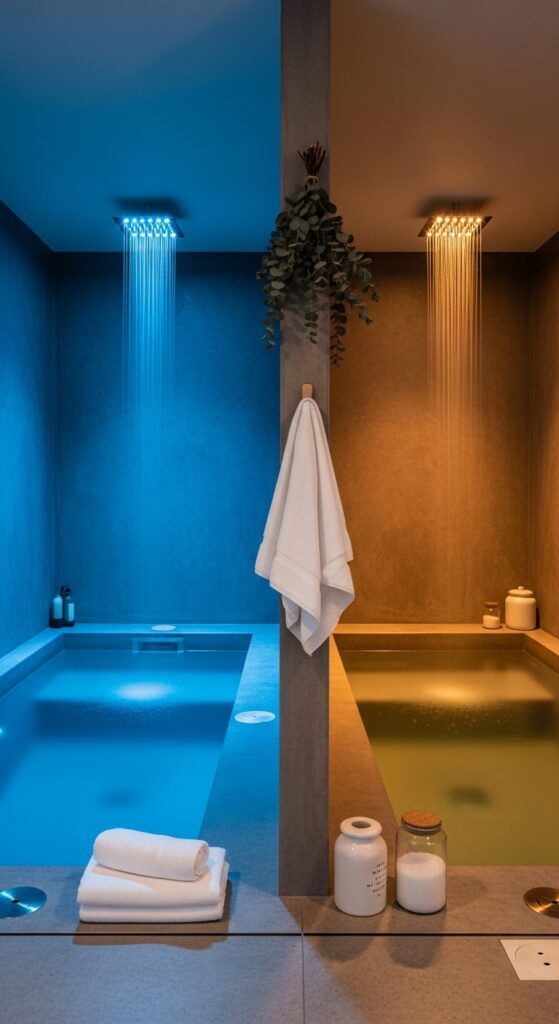
Vibe: Clinical in the best sense — a space entirely focused on the body’s own intelligence and what it needs to recover and reset.
What makes it work: The dual plunge pool wellness room is the fastest-growing category in residential pool design, driven by the explosion of interest in thermal contrast therapy — alternating between cold (10–15°C) and hot (38–40°C) water for circulatory and recovery benefits. Architecturally, the two zones create visual contrast that reinforces their functional difference.
How to achieve it: Cold plunge pools require a chiller unit — Endless Pools and AquaSource both manufacture residential cold plunge systems that maintain water at therapeutic temperatures. Hot plunge pools use a standard heat pump system. Minimum dimensions for an effective plunge pool are 1.5m x 1.5m x 1.2m depth — enough to fully submerge to the neck.
💡 A cold plunge pool can be built in as little as 25 square feet of floor space, making it achievable in most home wellness rooms without requiring pool room scale construction.
16. Coastal Pool Room with Whitewashed Wood and Sea Glass Tile
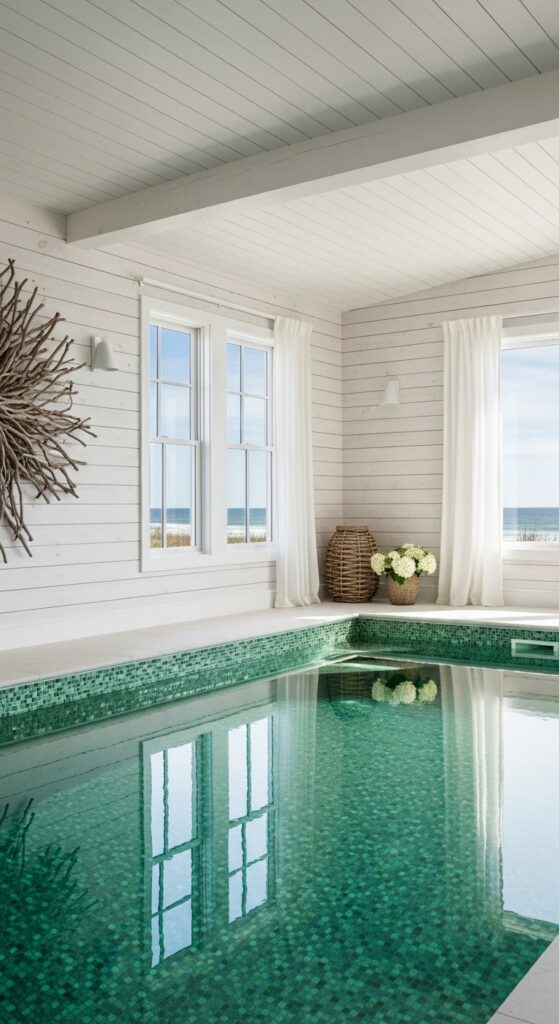
Vibe: The sea has come inside — green-tinted water, bleached wood, and salt air made tangible through every surface choice.
What makes it work: Sea glass mosaic tile in a pool interior produces one of the most beautiful water colors available — a green-tinged aquamarine that references the color of shallow ocean water over pale sand. Against whitewashed timber walls and white painted ceilings, the effect is a room that feels genuinely coastal rather than merely decorated with coastal objects.
How to achieve it: Sea glass effect glass mosaic tiles are available from Oceanside Glasstile and Walker Zanger — both offer colors in the green-aqua range that produce the desired water color effect. Note that tile color significantly affects perceived water color: green tiles read as sea green, white tiles read as aquamarine, and dark blue tiles read as deep navy.
17. Contemporary Pool with LED Color-Changing Underwater Lighting
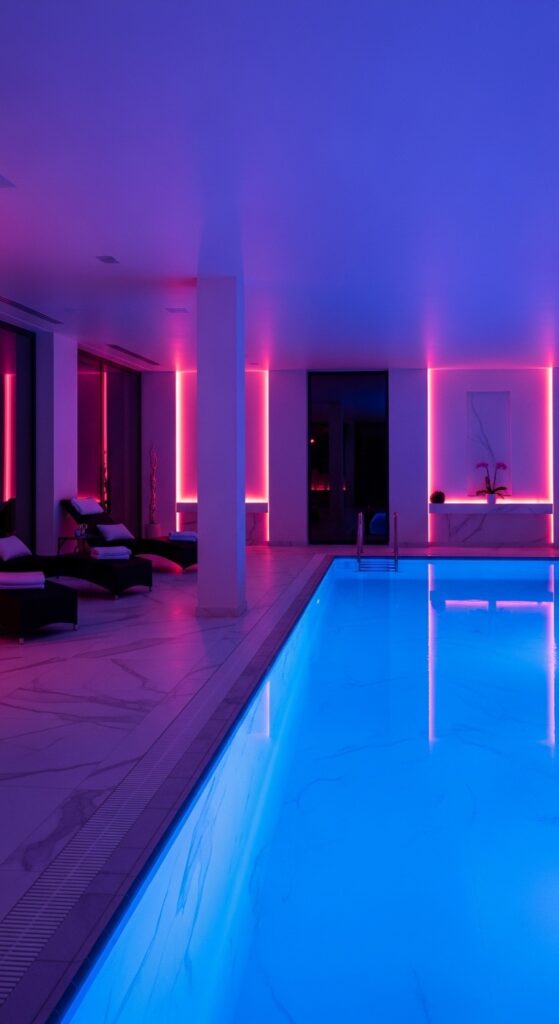
Vibe: Completely transformed by nightfall — the same pool that was serene and aquamarine by day becomes something electric and otherworldly after dark.
What makes it work: LED color-changing underwater lighting turns an indoor pool into a fully programmable sensory environment — the color of the water, the mood of the room, and the atmosphere of the space are all controlled through a single interface. This technology has become exceptionally sophisticated, enabling gradients, scenes, and sequences that transform the space dramatically.
How to achieve it: Specify RGBW LED underwater pool lights from Hayward, Pentair, or Spa Electrics — all three offer app-controlled color systems with thousands of programmable color options. Install a minimum of one fixture per 4 meters of pool length for even color coverage. White or light-colored pool interiors respond to color lighting most dramatically.
18. Minimalist Lap Pool with Perimeter Overflow Channel
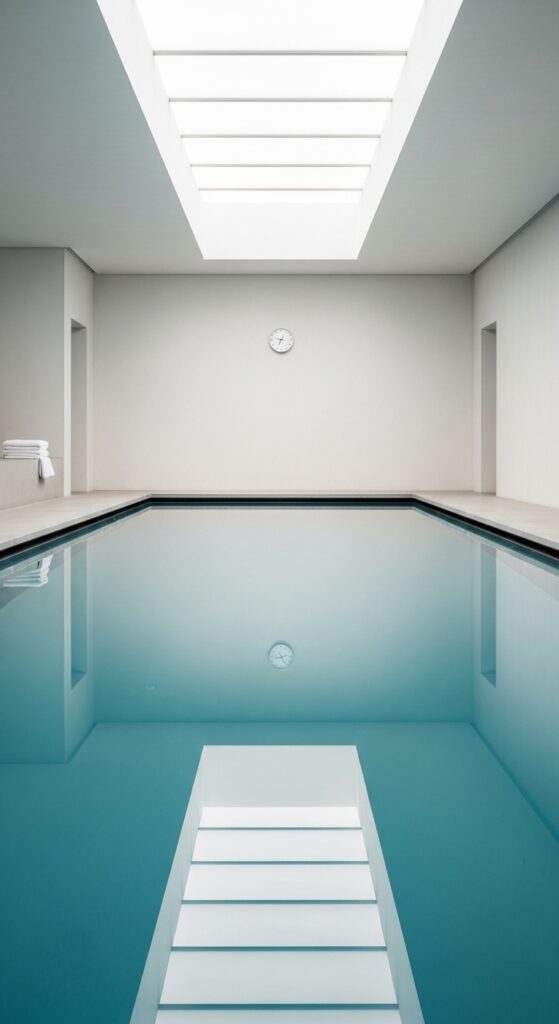
Vibe: The water and the room are one surface — an exercise in architectural precision so complete it reads as absolute.
What makes it work: The perimeter overflow system creates a water level flush with the pool deck — the water appears to extend horizontally to the wall, creating a mirror surface of extraordinary stillness and reflective quality. This engineering sophistication is the technical foundation of the most minimalist and visually dramatic contemporary pool designs.
How to achieve it: Perimeter overflow channels require a precisely engineered balance tank, overflow gutter system, and water level control system — this is a specialist pool engineering application. The gutter width must be calculated based on the pool’s surface area and the maximum expected bather load. Herzog & de Meuron’s Natatorium projects are the canonical architectural reference for this approach.
💡 A perimeter overflow pool requires approximately 15–20% more water volume than a conventional pool of the same size, due to the balance tank requirement.
19. Mexican Hacienda Pool Room with Talavera Tile and Arched Colonnade
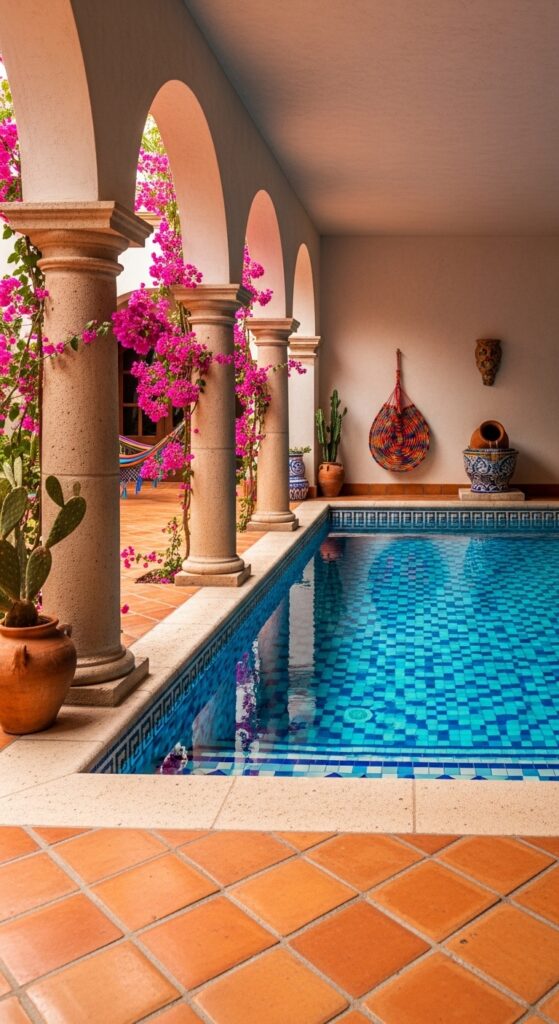
Vibe: Color and warmth without apology — a pool room that celebrates the Mexican tradition of architecture as joy made visible.
What makes it work: Talavera tile in a pool interior produces a water color of extraordinary vibrancy — the blue and white geometric pattern, visible and distorted through moving water, creates a constantly shifting visual field that no single-color pool interior can approach. The arched colonnade frames the pool as a courtyard, referencing centuries of Mexican hacienda spatial logic.
How to achieve it: Authentic hand-painted Talavera pool tile from Puebla, Mexico is available through importers like Mexican Tile Designs and Talavera Vazquez. Note that traditional Talavera is earthenware and must be sealed with a pool-safe penetrating sealer before installation — specify a product rated for continuous water immersion.
20. Modern Pool Room with a Living Moss Wall and Water Feature Wall
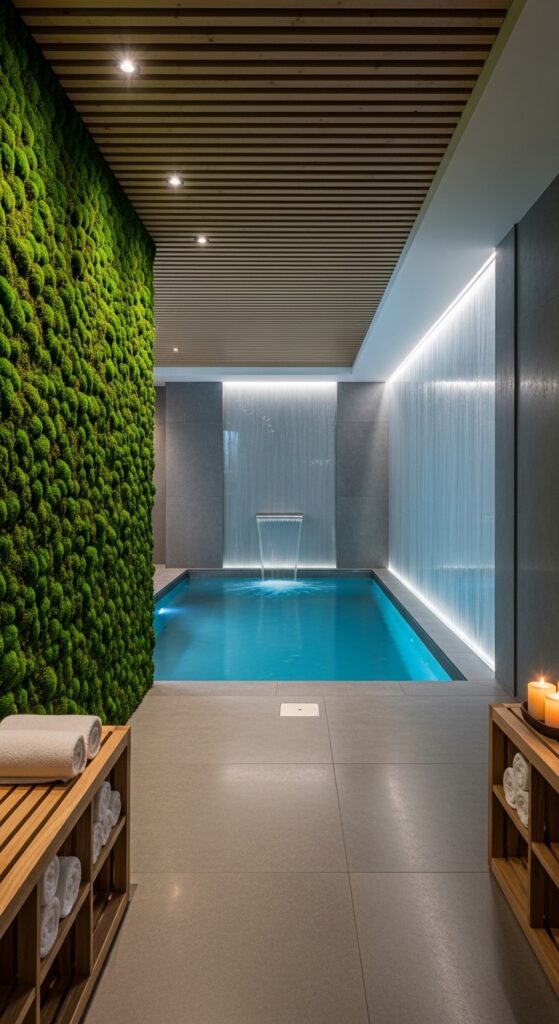
Vibe: Two elements in perfect opposition — the permanence of the moss and the constant movement of water — creating an environment of effortless sensory balance.
What makes it work: Placing a preserved moss wall opposite a water feature wall creates a room with two distinct sensory anchors at opposite ends of the pool: one silent and textural, one kinetic and auditory. Swimming between them, you experience both simultaneously — the silence of the moss end and the white noise of the water wall, which also masks pool mechanical equipment sound effectively.
How to achieve it: Preserved moss walls use real moss treated with glycerin to maintain color and texture indefinitely without water or maintenance — a critical advantage in pool rooms where maintenance access is limited. Nordgröna and Green Mood both supply large-format preserved moss panels suitable for commercial and residential pool room installation.
21. Copper and Dark Timber Pool Room with Fireplace
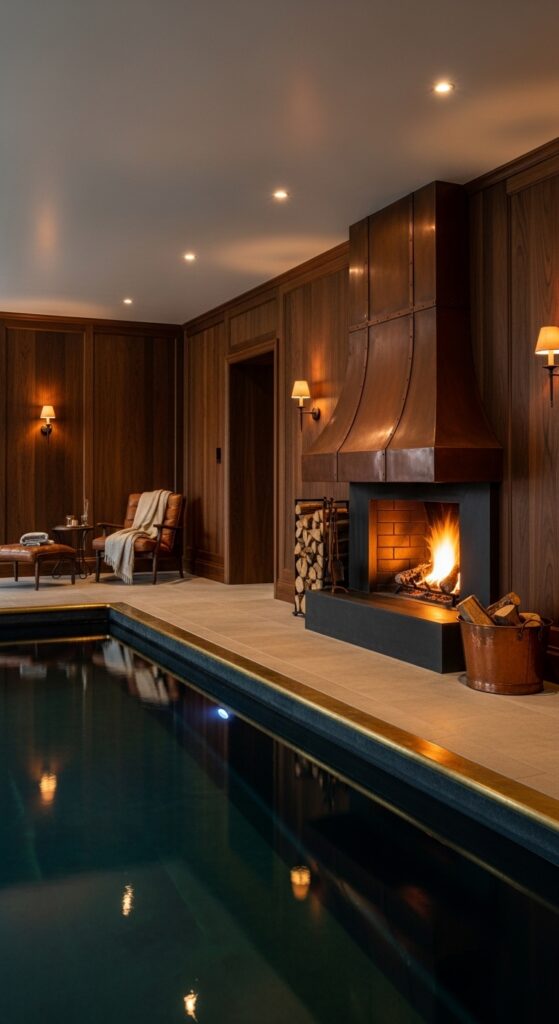
Vibe: The most counterintuitive combination in pool design — fire beside water, warmth beside coolness — somehow resolving into something deeply right.
What makes it work: A fireplace at the end of an indoor pool room solves the temperature comfort problem that plagues many indoor pool spaces — the evaporative cooling effect of pool water can make a pool room feel chilly even in summer. A fire source at one end creates a thermal gradient across the room, making the transition from water to deck genuinely comfortable rather than cold.
How to achieve it: Specify a sealed gas fireplace rated for high-humidity environments — standard open-fireplaces are not suitable for pool rooms due to chloramine gas interactions. The firebox must be sealed from the pool room atmosphere. Direct-vent gas fireplace inserts from Escea or Spark Modern Fires are specifically engineered for this application.
22. Mirrored Ceiling Pool Room for Infinite Reflection
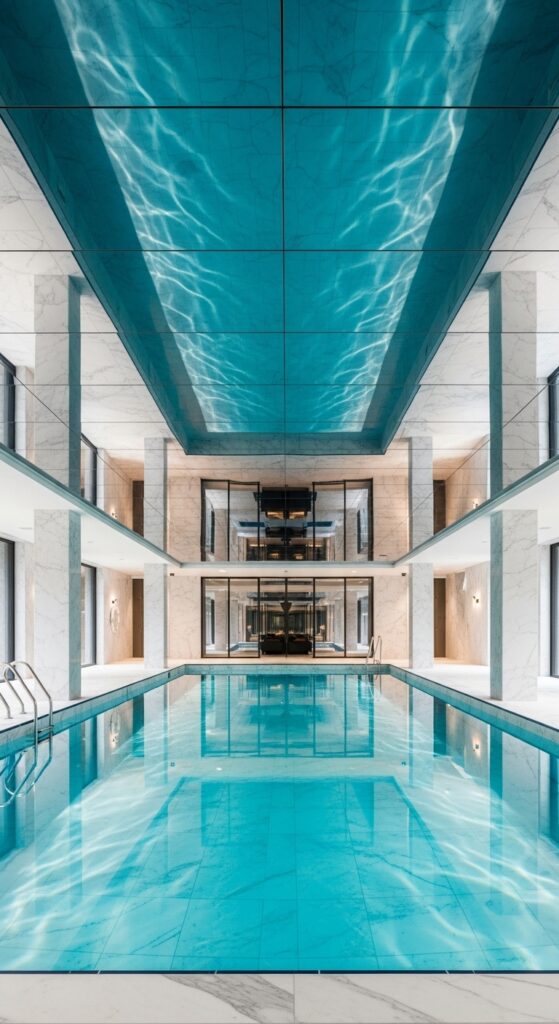
Vibe: You are swimming inside a light — above, below, and around you, the water’s refraction becomes the room’s entire architecture.
What makes it work: A mirrored ceiling over an indoor pool creates an optical experience unlike any other in residential design — the water’s constantly shifting light patterns are reflected upward and then back down again in an infinite regress that makes the room feel boundless. It is one of the very few design moves that genuinely cannot be achieved with any other material.
How to achieve it: Specify polished stainless steel sheet panels rather than glass mirror for pool room ceilings — glass mirrors are hazardous if they fall, and polished stainless provides an equally reflective surface with far greater durability and safety compliance. Seal all panel joints with silicone rated for pool room humidity, and specify panels with a minimum 2mm thickness to prevent oil-canning.
23. Modern Gothic Pool Room with Vaulted Arches and Dark Materials
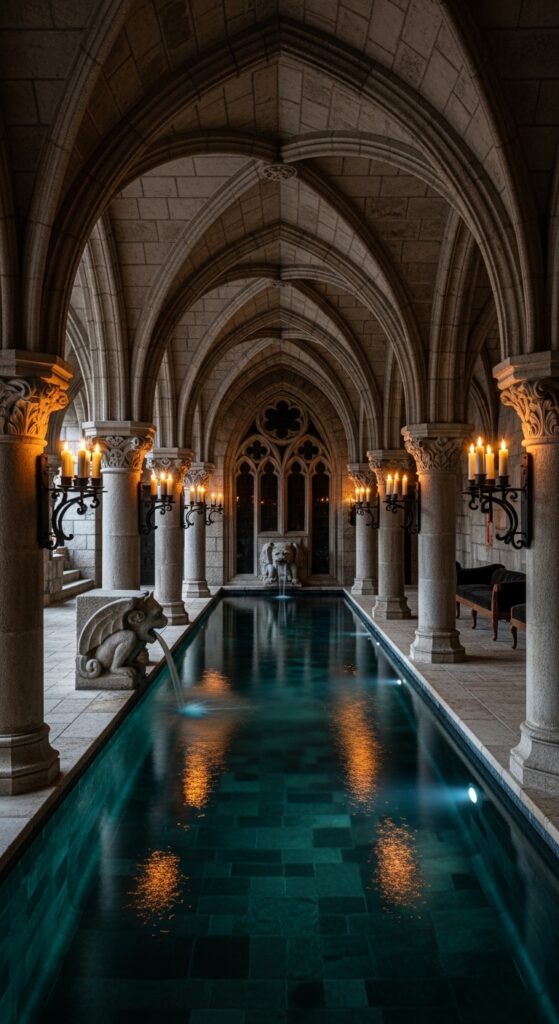
Vibe: You have descended into a cathedral of water — ancient, dramatic, and utterly impossible to forget.
What makes it work: Gothic pointed arches in a pool room achieve a ceiling height and structural elegance that no other arch form quite matches — they draw the eye upward with an almost physical urgency and create deep shadow in the spandrels between arches, which makes the pool’s glow appear even more luminous by contrast.
How to achieve it: Gothic arches for residential applications can be achieved in reinforced concrete formed to the pointed arch profile, then faced in stone veneer. Cast stone column capitals are available from architectural salvage suppliers or custom stone carvers — Far West Stone and Haddonstone both supply period-appropriate profiles for residential projects.
24. Outdoor-Indoor Sliding Glass Pool Room for Seasonal Flexibility
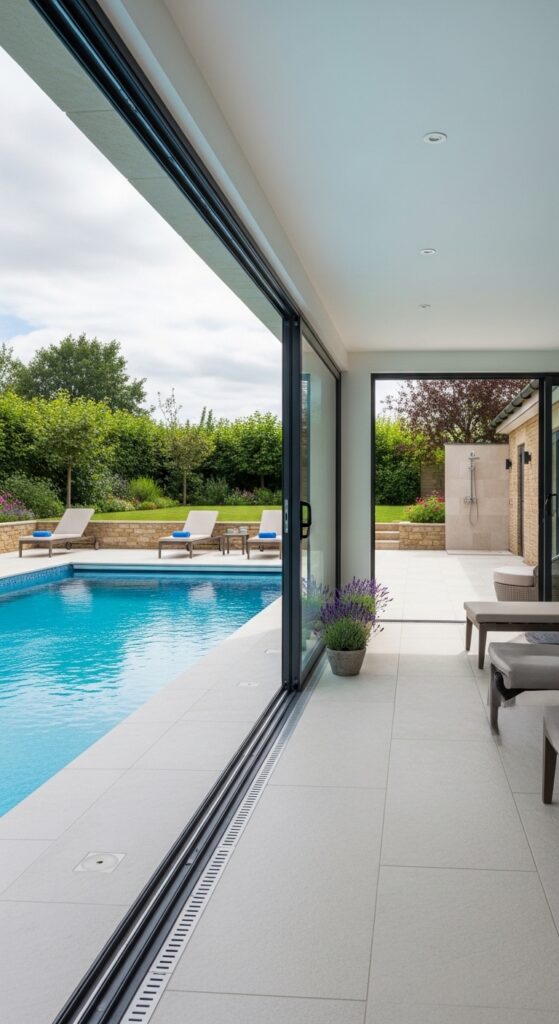
Vibe: The room and the garden are the same room — a boundary exists only when the weather requires it.
What makes it work: A pool room with one fully openable glass wall creates the best of both worlds — complete weather enclosure when needed and genuine open-air swimming when conditions allow, without requiring a second outdoor pool. The key is continuous stone deck material inside and outside the threshold, which optically eliminates the distinction between the two zones.
How to achieve it: Specify large-format porcelain deck tiles rated for both indoor and outdoor use — 600x1200mm or larger format minimizes grout lines and creates the most seamless indoor-outdoor visual continuity. The sliding glass wall system must incorporate a flush threshold detail with a concealed drainage channel to prevent water ingress when closed.
💡 Specifying the same tile inside and outside the glass threshold reduces apparent material cost by eliminating the need for two separate deck tile selections.
25. Concrete and Glass Brutalist Pool Room
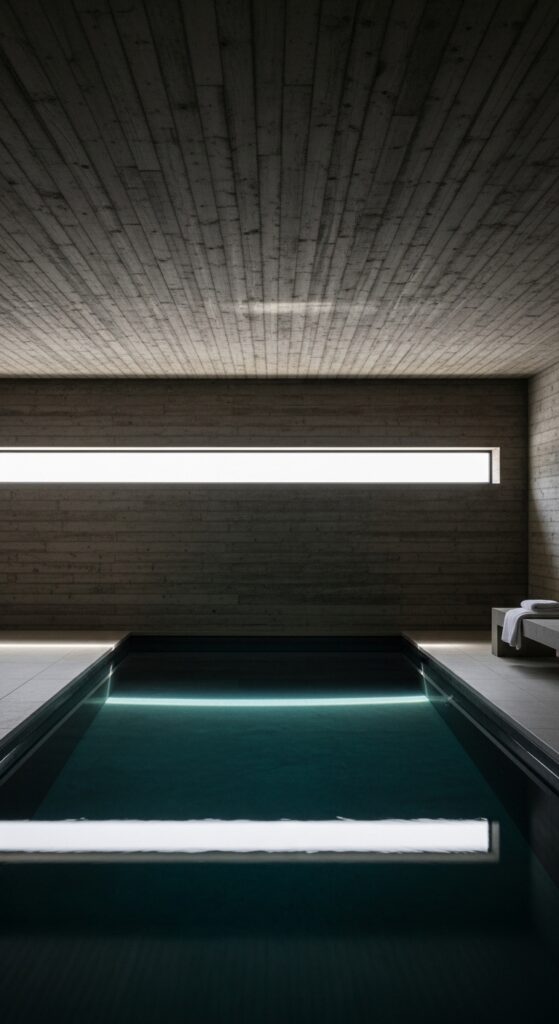
Vibe: Brutally, uncompromisingly beautiful — a space that insists on the inherent dignity of raw material and admits no apology for its power.
What makes it work: Brutalist architecture’s principles apply with extraordinary force to pool room design — the honesty of raw concrete, the drama of a single controlled light source, and the complete absence of ornament create an environment of pure sensory intensity. The horizontal slot window casting a single blade of light across the water surface is one of the most powerful architectural devices in the canon.
How to achieve it: The horizontal slot window must be positioned with precise solar modeling — in the Northern Hemisphere, a south-facing slot at 0.9–1.2m above the water surface will produce a light beam that crosses the full pool width at midday. Commission a light study from an architectural lighting consultant before finalizing the window position.
26. Tuscan Villa Pool Room with Frescoed Ceiling and Terracotta
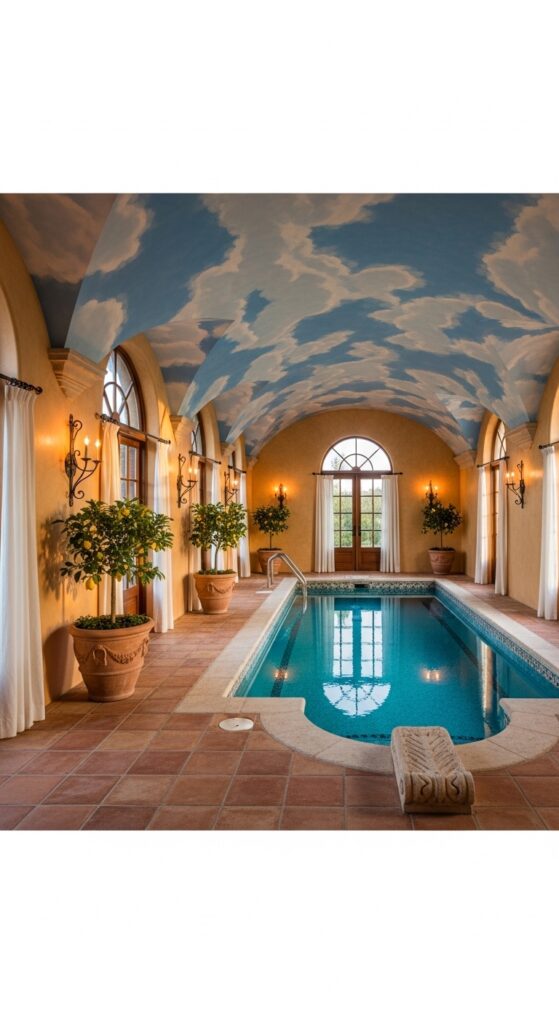
Vibe: Swimming beneath painted clouds and sky inside a warm Italian room — a small, private piece of the Renaissance made habitable.
What makes it work: A trompe-l’oeil sky fresco on a vaulted pool room ceiling is the ultimate trick of spatial expansion — it makes the room feel genuinely open to the sky while maintaining the architectural enclosure. Against warm terracotta floors and a blue mosaic pool, the ceiling fresco creates a complete Italian sensory world that requires remarkable commitment to execute and delivers remarkable results.
How to achieve it: Commission a trompe-l’oeil fresco from a decorative painting specialist — artists specializing in this technique can be found through the Decorative Arts Society. Specify an oil or mineral-based fresco medium rather than acrylic for a period-authentic matte surface. The vaulted ceiling form must be plaster-finished before painting begins.
27. Infinity Pool Room Cantilevered Over a Hillside
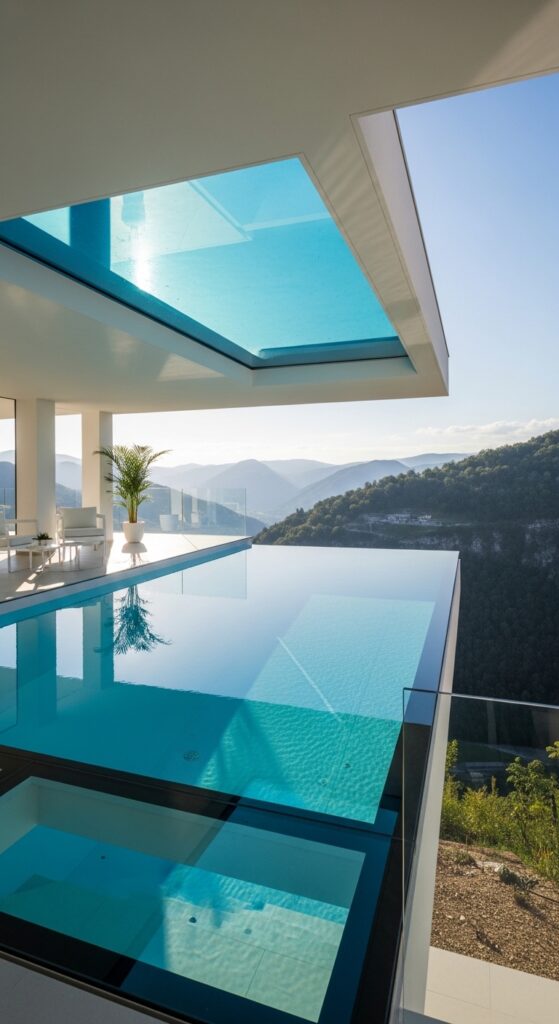
Vibe: The ground has disappeared beneath you — this pool exists in pure air, suspended between sky and valley in a feat of engineering made beautiful.
What makes it work: The cantilevered pool room over a hillside is the apex of site-responsive modern pool design — the structure uses its landscape position as its defining feature rather than despite it. A glass floor section at the pool’s edge is the kinetic flourish: you swim above a visible drop, which intensifies the spatial drama to genuinely unforgettable levels.
How to achieve it: Cantilevered pool rooms require specialist structural engineering — the cantilever loads are extreme and must be countered by significant rear anchorage into the hillside. Glass floor panels require laminated structural glass to BS EN ISO 12543 standards with a minimum 40mm total thickness. This is definitively an architect-and-engineer project, not a contractor-only build.
28. Basement Pool Room Converted from Existing Foundation
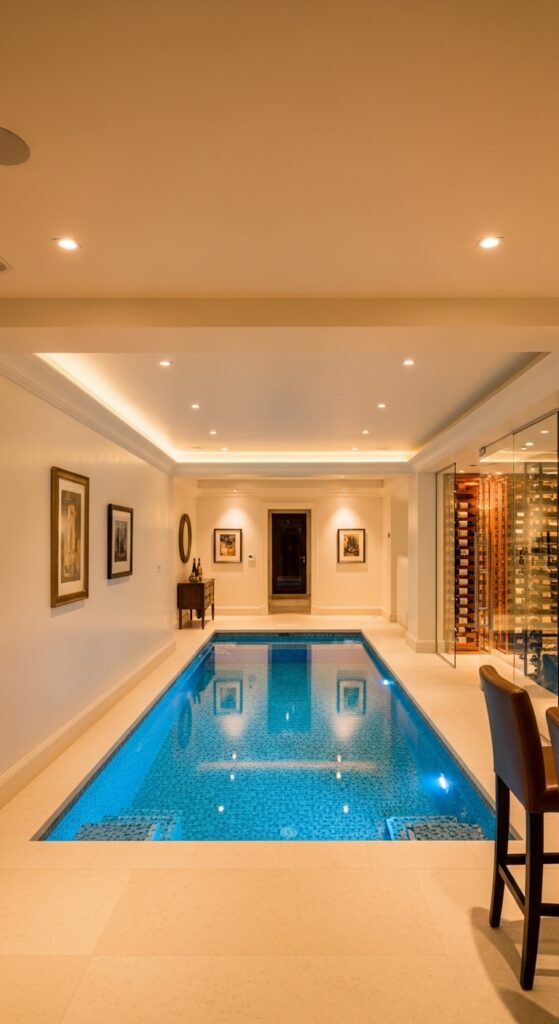
Vibe: Unexpected and private — a basement transformed into the most sophisticated room in the house, existing entirely on its own terms below ground.
What makes it work: Basement pool rooms solve the fundamental acoustic and privacy challenges of indoor pool design by placing the pool below grade — the mechanical noise stays underground, the humidity is contained within a defined envelope, and the space has an inherent sense of retreat that above-grade pool rooms must work to achieve.
How to achieve it: Basement pool installations require full waterproofing of the structural slab and walls using tanking membranes rated for hydrostatic pressure — Sika and Mapei both supply systems specifically rated for below-grade pool installation. The ventilation system is critical: specify a dehumidification system sized for the pool surface area to prevent moisture damage to the structure.
💡 A basement pool conversion typically costs 20–30% less than building a new structure above grade, making it the most cost-effective path to an indoor pool.
29. Modern Moroccan Pool Room with Zellige Tile and Moucharabieh Screens
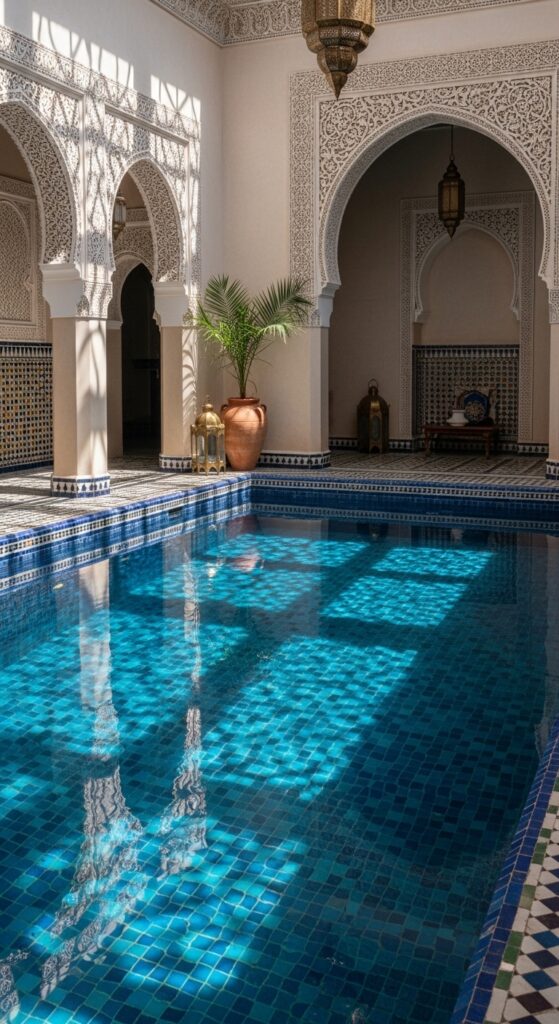
Vibe: Ancient and endlessly complex — a pool room that gives the eye so much to find that an hour passes before you’ve seen all of it.
What makes it work: Zellige tile’s handcrafted irregular surface creates an iridescence under water that machine-made tile cannot replicate — the slight variation in each tile’s glaze catches light from multiple angles simultaneously, producing a shifting, jewel-like luminosity. Moucharabieh screens filtering light onto the water surface multiply this effect, casting geometric patterns that animate constantly as the sun moves.
How to achieve it: Authentic hand-cut zellige tile is produced in Fez, Morocco, and is available through importers like Mosaic House and Dar Ceramics. Specify pool-grade zellige with waterproof grout in an antique white or ivory tone — the grout color significantly affects the overall palette. Moucharabieh plaster screens can be replicated using CNC-routed MDF finished with exterior-grade stucco.
30. Pool Room Integrated with Home Gym and Spa for a Complete Wellness Suite
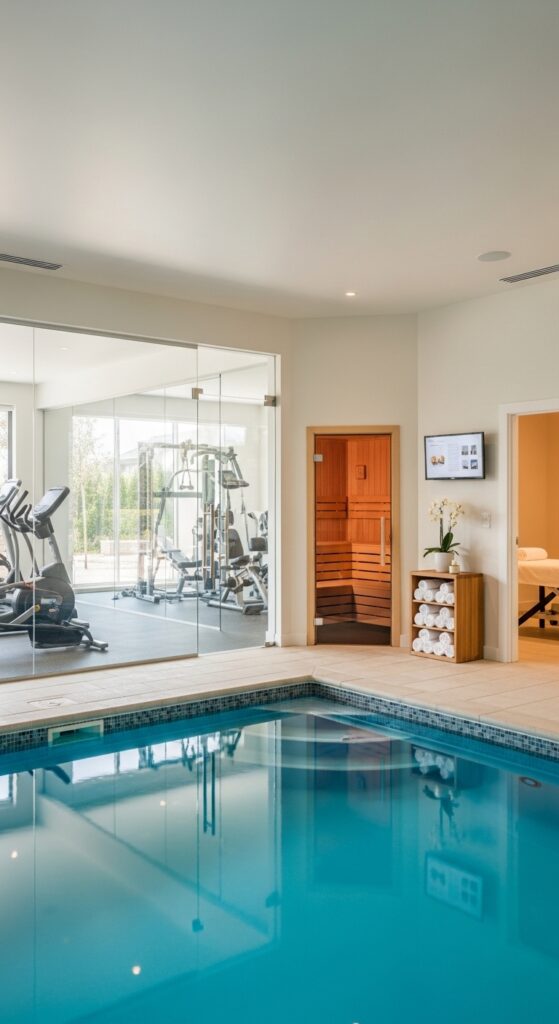
Vibe: This isn’t a room — it’s an entire philosophy of living well, given walls and water and form.
What makes it work: Integrating a pool with a gym, sauna, and treatment room into a single wellness suite creates a spatial logic that is greater than the sum of its parts — each element informs the use of every other, and the ability to move fluidly between cold pool, hot sauna, exercise space, and treatment room without leaving the suite creates a genuine wellness circuit that no single amenity alone can replicate.
How to achieve it: Wellness suites work best when designed from the inside out — establish the use sequence first (warm up → exercise → sauna → cold pool → treatment → rest), then arrange the rooms to support that flow with minimal doors and transitions. Allow a minimum of 1,500 square feet for a functional four-component suite. A dedicated HVAC zone for the wellness suite is essential — pool humidity must never be allowed to migrate into gym or treatment spaces.
How to Start Your Modern Indoor Pool Transformation
Before any design decision, before any contractor conversation, the most important first step in planning a modern indoor pool is establishing the room’s purpose with precision. A lap pool for serious training has fundamentally different space, light, and material requirements than a plunge pool wellness suite or a social entertaining pool. Architects, pool engineers, and interior designers all need to know what you’re actually building before they can contribute meaningfully.
From there, the non-negotiable structural conversation is ventilation and humidity control. More indoor pools fail as architectural spaces — regardless of how beautiful they initially were — due to inadequate dehumidification than any other single factor. Specify a dedicated pool room dehumidification system sized to your pool’s surface area before finalizing any other design decision.
The most common mistake in modern indoor pool design is underestimating the relationship between pool interior color and water appearance. The tile or plaster you choose for the pool’s interior directly determines the color the water appears — and this affects everything: the mood of the room, the color palette of the surround materials, the character of the lighting. Sample pool interior finishes in water before committing.
Budget-wise, residential indoor pool construction ranges from $150,000 for a modest basement conversion to over $2 million for a full glass pavilion with integrated wellness suite. The most cost-effective entry point is a basement conversion or a simple addition to an existing structure — both avoid the significant cost of purpose-built pool pavilion construction. Whatever the budget, investing in quality pool engineering and structural waterproofing is non-negotiable: remedial waterproofing costs multiples of preventive specification.
Frequently Asked Questions
How much does a modern indoor pool cost to build?
Residential indoor pool costs vary enormously based on size, construction type, and finish quality. A basic lap pool in a converted basement starts around $150,000–$200,000 including construction, waterproofing, mechanical systems, and basic finishes. A purpose-built glass pool pavilion with premium finishes typically ranges from $400,000–$800,000. Full integrated wellness suites with gym, sauna, and pool can exceed $1.5–$2 million. The largest cost variables are the structure type (conversion versus new build), the glazing specification, and the pool interior finish — glass mosaic tile runs approximately three to four times the cost of plaster.
What is the best pool interior finish for a modern indoor pool?
The three most popular modern indoor pool finishes are polished white plaster (produces classic aquamarine water color), dark grey or black plaster (produces dramatic deep navy water), and glass mosaic tile (produces the most luminous and visually complex water color, varying by tile color chosen). For a minimalist aesthetic, polished plaster in Pebblefina or Diamond Brite finishes offers the cleanest result. For a luxury statement, Bisazza or Sicis glass mosaic is unmatched in visual quality. Plaster is the most cost-effective; mosaic tile is the most durable and visually sophisticated.
How do I control humidity in an indoor pool room?
Humidity control is the most critical mechanical specification in any indoor pool design. The industry standard approach is a dedicated Pool Dehumidification Unit (PDU) sized to the pool’s surface area — calculate approximately 20–25 BTU of dehumidification capacity per square foot of water surface area. Brands like Dectron, Seresco, and PoolPak manufacture residential and light commercial PDU systems specifically designed for pool room applications. The PDU should be supplemented by a positive-pressure fresh air supply that prevents the pool room from becoming negatively pressurized, which would draw humid pool air into adjacent building spaces.
Can I add a fireplace or wood burning elements to an indoor pool room?
Open wood-burning fireplaces are not recommended in indoor pool rooms due to the interaction between chloramine gases (produced by pool water chemistry) and combustion air. Gas fireplaces are suitable only if they are sealed direct-vent units that draw combustion air from outside the pool room and exhaust directly to exterior — the firebox must be completely isolated from the pool room atmosphere. Escea, Spark Modern Fires, and Ortal all manufacture sealed direct-vent units appropriate for this application. Electric fireplaces have no combustion concerns and are the simplest solution for pool room use.
What lighting works best for a modern indoor pool room?
Modern indoor pool lighting operates at three scales: natural light (skylights, clerestory windows, glass walls), underwater pool lighting (LED fixtures in RGBW color or white, recessed into pool walls), and ambient room lighting (wall sconces, recessed ceiling fixtures, pendant lights). The most sophisticated contemporary pool rooms layer all three — natural light as the primary daytime source, warm ambient room lighting for evening use, and underwater LED color for dramatic nighttime effect. Specify all pool room fixtures at IP68 waterproof rating minimum, and use 2700K color temperature for warm ambient sources to complement the cool aquamarine of the water.
Ready to Create Your Dream Modern Indoor Pool Design?
You now have 30 extraordinary modern indoor pool designs spanning every material, every mood, every architectural tradition, and every lifestyle intention — from the meditative simplicity of a white concrete plunge pool with a single skylight to the theatrical opulence of an Art Deco natatorium with gold-leaf ceilings and geometric mosaic. Save the ideas that made you stop and look twice, pin the combinations that feel genuinely achievable, and remember that every extraordinary indoor pool began as exactly what this is: an idea worth taking seriously. The water is waiting. Now you know precisely what to build around it.