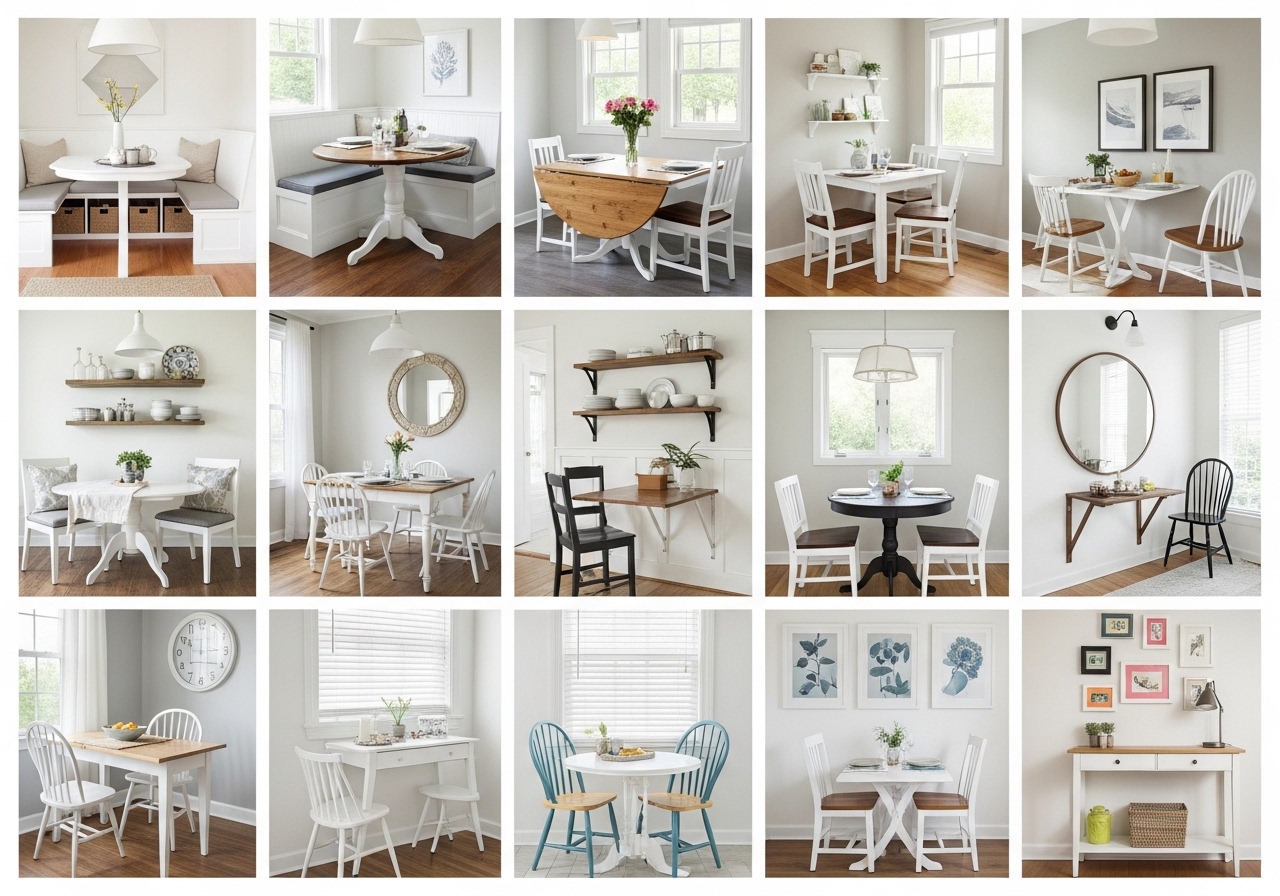
There is something genuinely magical about a small dining room that has been styled with real intention — it becomes the coziest, most intimate space in a home, the kind of room where dinners stretch long past the last course because nobody wants to leave. The challenge of a small dining room isn’t the size; it’s knowing which ideas to lean into and which instincts to resist. These 27 small dining room decor ideas cover every style, every budget, and every square footage, from the tiniest apartment dining nook to the compact formal dining room that punches well above its weight. Here are 27 ideas worth saving.
Why Small Dining Room Decor Works So Well
Small dining rooms succeed precisely because of their constraints. Intimacy is not a compromise in a dining room — it is, arguably, the whole point. The best dinner conversations happen when people are close enough to speak at a normal volume, when the candlelight reaches every face at the table, and when the room itself feels like a considered, deliberately scaled space rather than an afterthought between the kitchen and the living room.
The core design principles of small dining room decor are clarity, proportion, and warmth. Every piece of furniture must earn its place — not just functionally, but visually. A chair that is two inches too wide, a pendant light that hangs three inches too low, or a rug that is six inches too small can make an otherwise well-styled small dining room feel cramped and unresolved. Conversely, when the proportions are right, a small dining room reads as perfectly curated rather than merely compact.
Small dining room design is surging on Pinterest and in interior design publications right now, driven by a broader cultural appreciation for spaces that prioritize quality of experience over quantity of square footage. Apartment living, open-plan conversions, and a renewed interest in the ritual of eating together have all contributed to a collective desire to style small dining spaces with the same ambition previously reserved for grand formal dining rooms.
The best news about small dining rooms is that they respond faster and more dramatically to design changes than any other room in a home. A new pendant light, a coat of paint, a mirror on the right wall, or a well-chosen rug can transform the entire character of the space in a single weekend — and the relative scarcity of surfaces means every decor choice is genuinely visible and genuinely impactful.
Round Pedestal Table for Maximum Space Efficiency
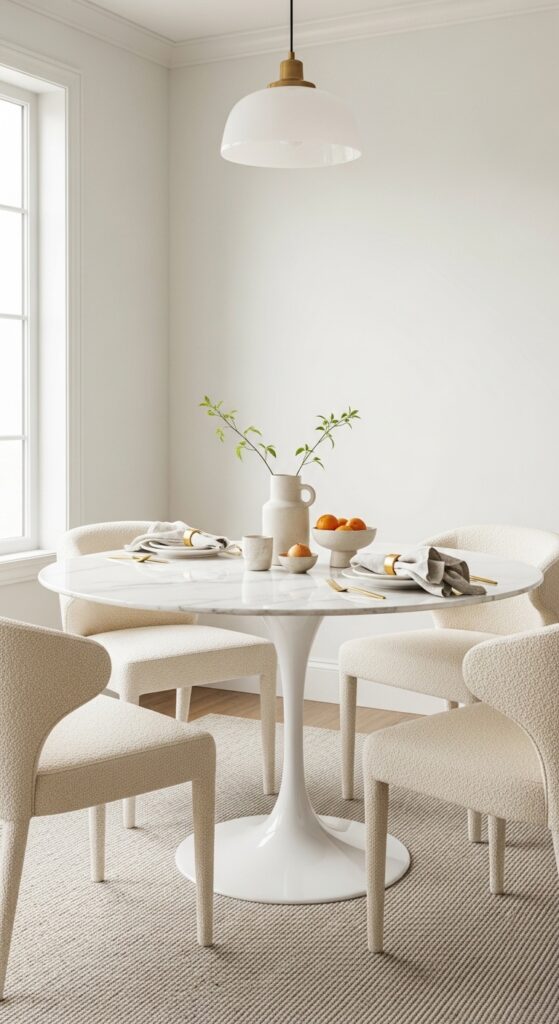
Vibe sentence: A round pedestal table in a small dining room is a quiet act of genius — it seats the same number of people as a rectangular table while making the room feel twice as spacious.
What makes it work: The single pedestal base is the critical detail — without corner legs, chairs can be pulled in from any angle and the floor plane remains visually open, which is the single most effective technique for making a small dining room read larger. The round form also eliminates the psychological hierarchy of a rectangular table, making every seat feel equally welcoming — an important quality in a room designed for conversation.
How to achieve it: Look for tulip-style or single column pedestal tables in marble, painted wood, or lacquered MDF. A 36-inch diameter round table seats four comfortably; a 42-inch diameter seats four to five. Pair with chairs that have a slim, curved profile — heavy square-backed chairs visually overwhelm a round pedestal table.
💡 Choose a pedestal table with a weighted base rather than a tripod base — tripod bases catch feet and bags, which immediately undermines the space-saving benefit.
Banquette Seating Built Into a Corner Nook
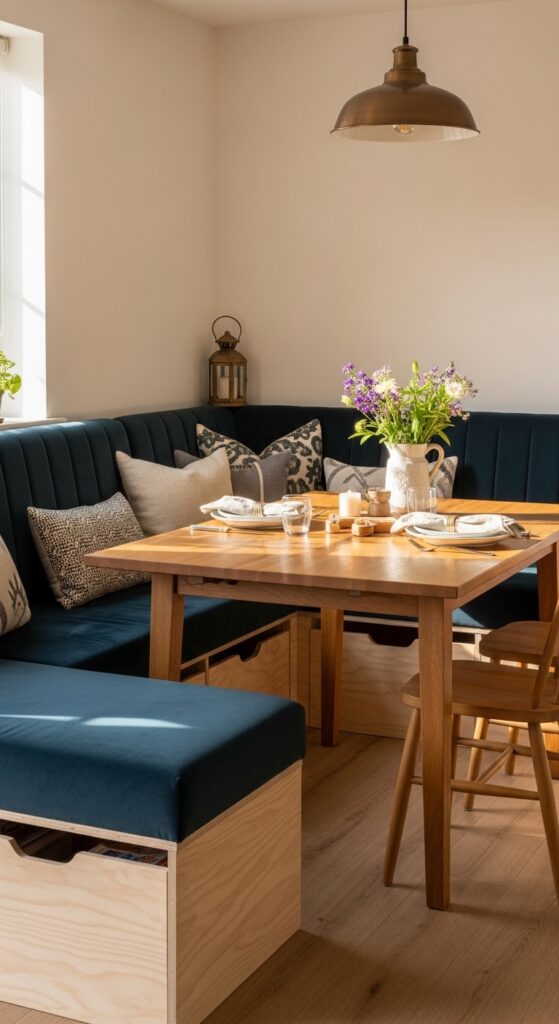
Vibe sentence: A corner banquette transforms wasted architectural space into the most coveted seat in the house.
What makes it work: A built-in banquette is the single most space-efficient seating solution in a small dining room — it seats more people per square foot than any freestanding chair arrangement while simultaneously creating visual order by anchoring the furniture to the architecture. The storage drawers built into the banquette base solve a second problem that small homes always face: where to put the things that have nowhere else to go.
How to achieve it: Build a simple banquette base from plywood with piano hinge lids for storage access, upholstered in a performance velvet or bouclé. IKEA KALLAX shelving units can serve as the structural base for a budget-friendly version. A banquette cushion should be 18–20 inches deep and 18 inches from the floor for comfortable seating height.
Bold Wallpaper to Create a Jewel Box Effect
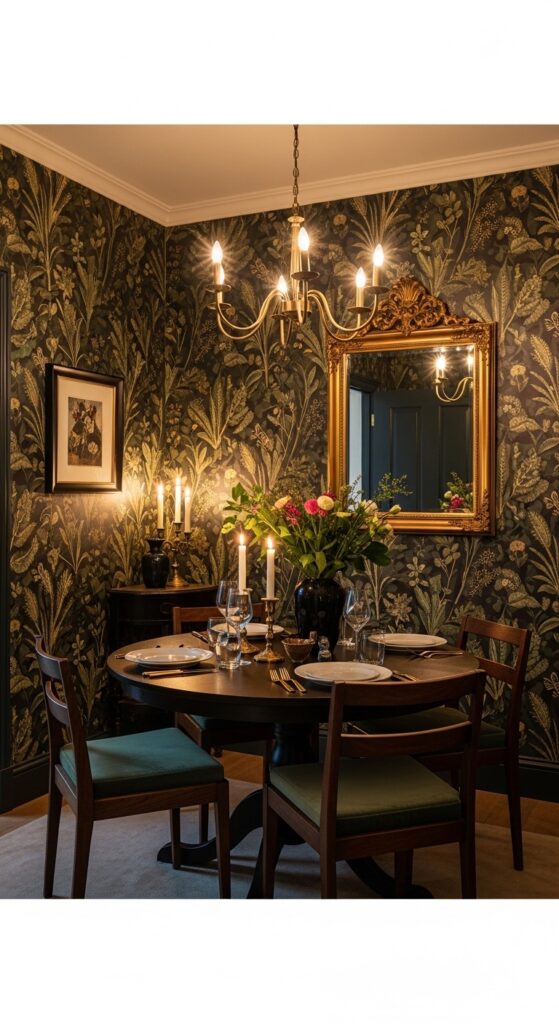
Vibe sentence: A small dining room is the one space in a home where going completely, unapologetically all-in on wallpaper always, always pays off.
What makes it work: In a small room, covering all four walls — and optionally the ceiling — in a bold pattern creates an immersive jewel box effect that is impossible to achieve in a larger space. The contained scale means the pattern wraps rather than overwhelms, and the intimacy of the room amplifies the drama. This is a rare case where limited square footage is a genuine design advantage.
How to achieve it: Choose wallpaper with a dark or saturated background — deep green, navy, burgundy, or charcoal — so the room reads as intentionally intimate rather than accidentally dark. Brands like Cole & Son, Sanderson, and Rifle Paper Co. offer designs at various price points. A single double roll typically covers 56 square feet — calculate carefully before ordering.
💡 Extend the wallpaper onto the ceiling using the same pattern — the “enveloping” effect is significantly more dramatic and the seam between wall and ceiling disappears entirely.
Slim Rectangular Table With Bench on One Side
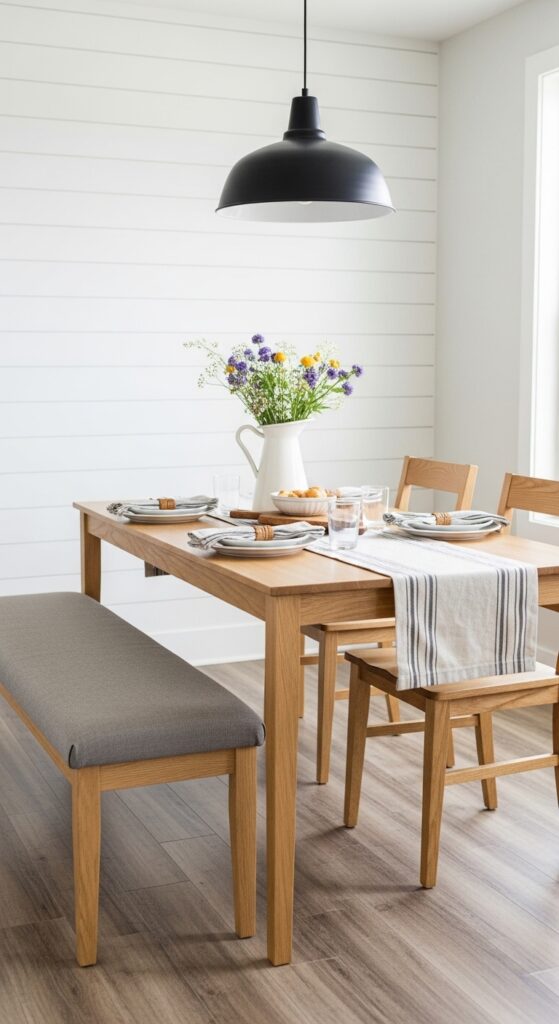
Vibe sentence: A bench on one side of the table seates more people, takes up less room, and somehow makes every meal feel more communal and effortless.
What makes it work: A dining bench seats two to three people in the same width that a single chair occupies, which makes it extraordinarily space-efficient for a small dining room. Unlike a chair, a bench can be slid fully under the table when not in use, reclaiming precious floor space. It also creates a visual asymmetry — bench on one side, chairs on the other — that feels deliberately styled rather than simply functional.
How to achieve it: Choose a bench 4–6 inches shorter than the table length for ideal visual proportion. For comfort, ensure the seat is upholstered or add a long cushion in a washable performance fabric — wooden benches without cushioning become uncomfortable after 20 minutes. The bench seat height should match the table height minus 10–12 inches for comfortable clearance.
Large Mirror to Double the Visual Space
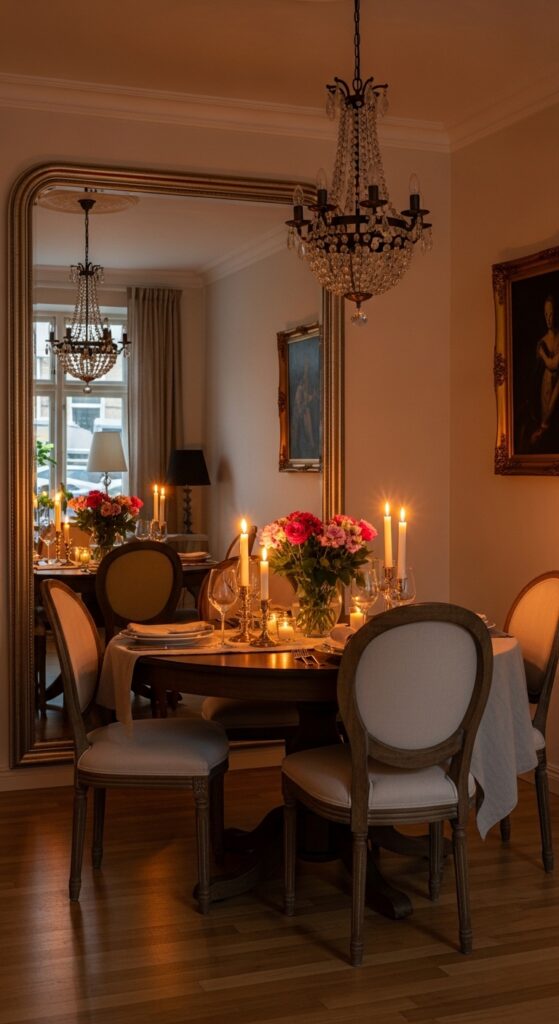
Vibe sentence: A full-wall mirror in a small dining room isn’t a decorating trick — it’s a genuine transformation, turning one room into the convincing suggestion of two.
What makes it work: A large mirror on the wall opposite or adjacent to the primary window reflects natural light back into the room, effectively doubling the amount of illumination without adding a single light fixture. In the evening, it reflects candlelight and lamp glow, creating a warm, romantic depth that has no equal in small dining room design. The reflection of diners also creates a sense of social animation that makes the room feel more populated and lively.
How to achieve it: Hang the mirror so its center sits at 57–60 inches from the floor — the same standard gallery height — and ensure it spans at minimum 60% of the wall width for the “room-within-a-room” effect. Leaning an oversized mirror against the wall (rather than hanging it) is a renter-friendly alternative that often looks even more deliberate and styled.
Dramatic Black Walls for an Intimate Evening Atmosphere
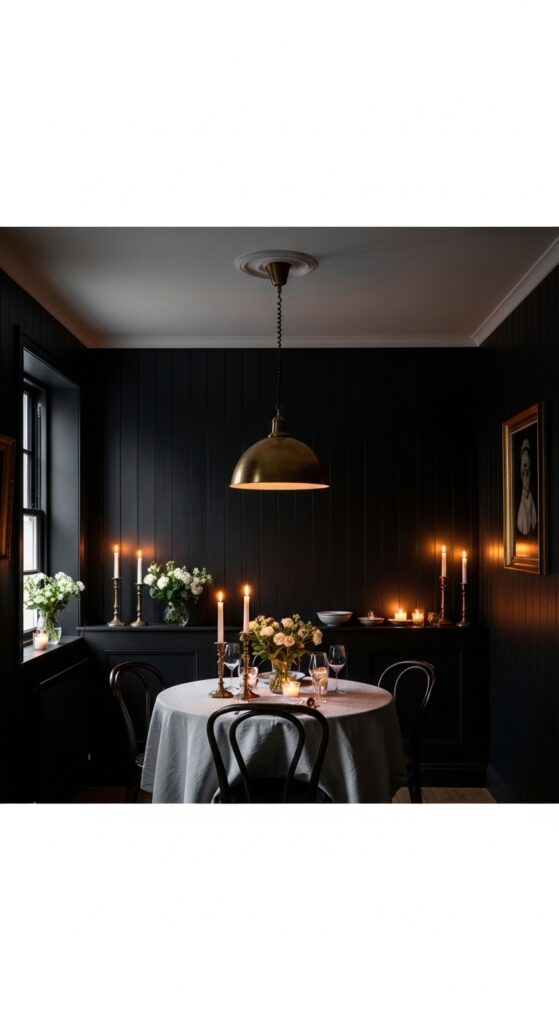
Vibe sentence: A black dining room is the most counterintuitive and most spectacular decision you can make with a small space — darkness, paradoxically, dissolves the walls.
What makes it work: Painting all four walls and the ceiling in a dark matte color removes the visual definition of the room’s boundaries, creating a sense of boundless depth rather than confined space. This is a design principle called “visual dissolution” — when walls disappear into darkness, the room’s actual dimensions become irrelevant, and what remains is pure atmosphere. Candlelight in a black room glows with extraordinary warmth and intensity.
How to achieve it: Use Farrow & Ball “Railings,” “Off-Black,” or “Pitch Black” in a matte finish — the dead flat surface absorbs light completely and prevents the walls from reflecting back any harsh light. Pair exclusively with warm brass, gold, and cream accessories; cool metals like chrome or silver would feel jarringly clinical in a dark room.
Folding or Extendable Table for Flexible Dining
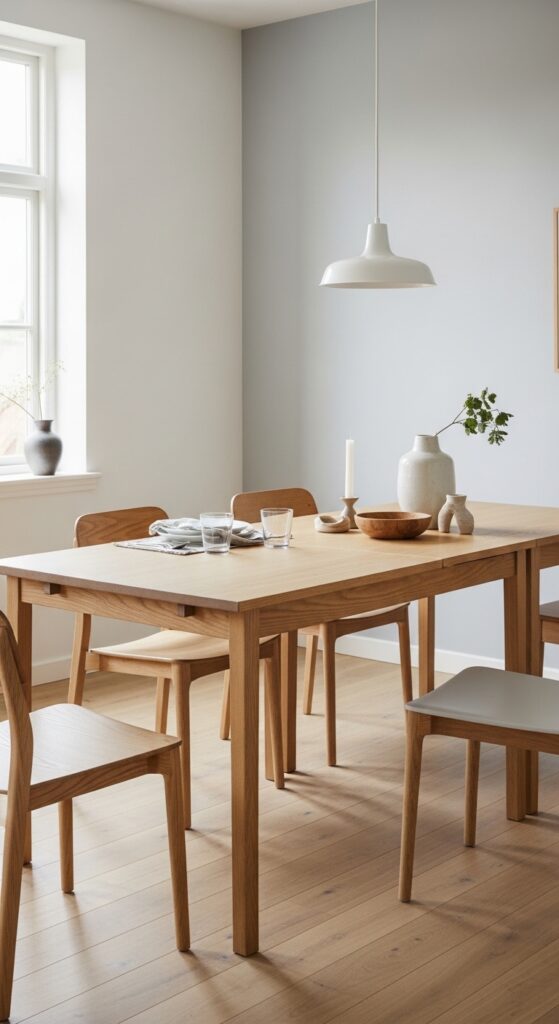
Vibe sentence: A beautifully designed extendable table is the most honest and intelligent solution for a small dining room that occasionally needs to be a bigger one.
What makes it work: The best extendable tables hide their mechanism completely — when closed, they look like a perfectly proportioned permanent table; when open, they reveal a seamless extension that doubles the seating capacity without the visual awkwardness of obvious hinges or visible leaf edges. The discipline of choosing the table in its closed everyday form forces a design that is genuinely beautiful at small scale.
How to achieve it: Brands like BoConcept, HAY, and Muuto design extendable tables that conceal their mechanisms beautifully. Look for a butterfly leaf mechanism (hidden inside the table when closed) rather than a separate stored leaf, which requires finding somewhere to put it during everyday use. A table that extends from 36 to 60 inches handles both a quiet weeknight dinner and a weekend gathering comfortably.
💡 Style the table as if it will never extend — the discipline of keeping it beautiful at everyday scale is what separates a well-designed space from a practical but aesthetic compromise.
Gallery Wall Above a Compact Sideboard
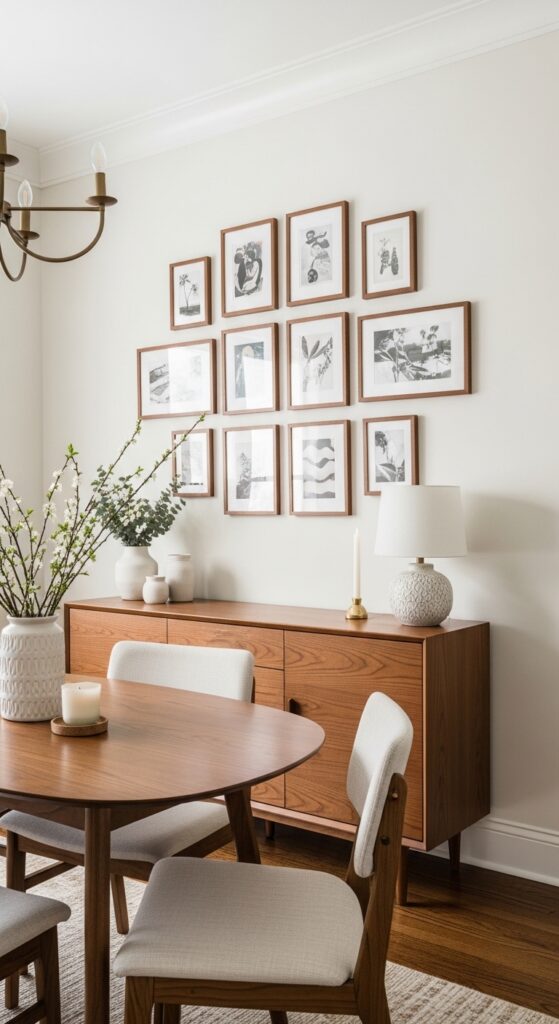
Vibe sentence: A gallery wall above a sideboard turns the most underused wall in a small dining room into its most beautiful and personal feature.
What makes it work: The sideboard-plus-gallery-wall combination is one of the most effective visual techniques for a small dining room wall because it occupies the vertical real estate all the way from counter height to ceiling, creating a sense of fullness and richness without any furniture touching the floor except at the sideboard’s legs. The gallery wall adds personality and depth; the sideboard adds storage and a display surface.
How to achieve it: Choose a sideboard that is no deeper than 14 inches — any deeper and it will compromise the walking clearance between the table and the wall in a small room. Arrange gallery frames starting from the center and working outward, keeping the lowest frame 6–8 inches above the sideboard surface. Use picture-hanging strips for a rental-friendly, damage-free installation.
Rattan or Cane Chairs for Lightweight Visual Warmth
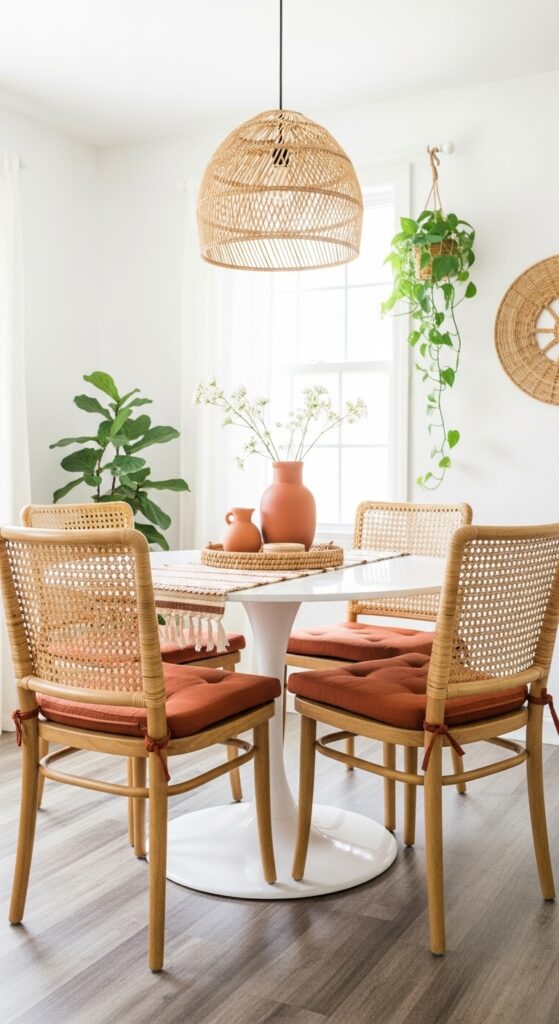
Vibe sentence: Rattan chairs in a small dining room do something almost no other chair material can — they add warmth and character while visually nearly disappearing.
What makes it work: The open weave of rattan and cane chairs allows the eye to see through the chair back, which is critical in a small dining room — solid upholstered backs create a dense visual barrier around the table, while rattan backs let light and sight lines pass through, preserving the sense of space. The natural warm tone of unfinished rattan also adds organic warmth without any color commitment.
How to achieve it: Look for rattan dining chairs from Serena & Lily, World Market, or Etsy vintage sellers. Ensure the seat cushion is in a washable performance fabric — dining chairs take daily wear and rattan seat pads without cushions become uncomfortable quickly. A mix of rattan chairs with one or two upholstered armchairs at the head positions creates a collected, eclectic look.
Statement Pendant Light as Functional Sculpture
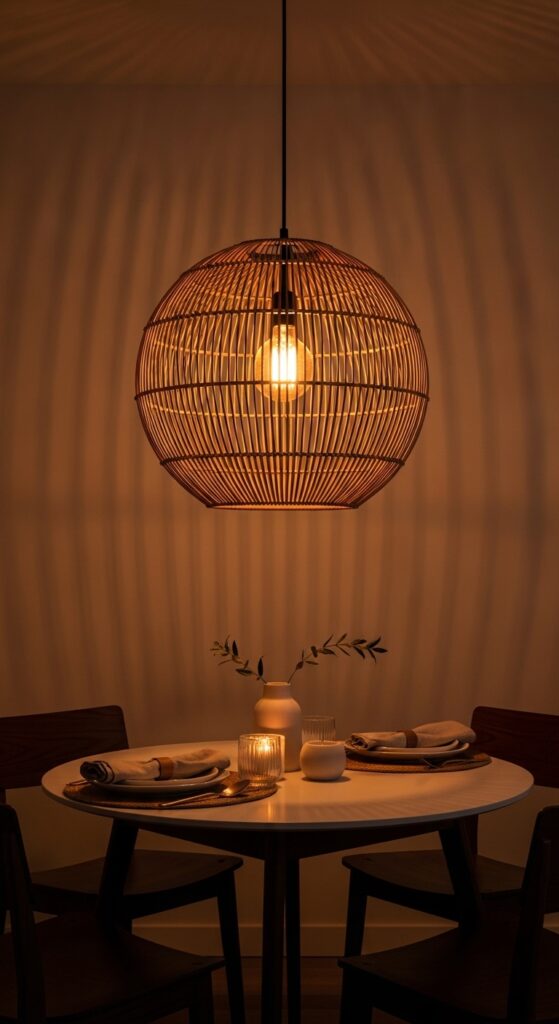
Vibe sentence: The right pendant light above a dining table doesn’t just illuminate the meal — it defines the room entirely.
What makes it work: A pendant light hung 30–34 inches above the dining table surface creates a defined cone of warm light that encloses the table and its occupants in an intimate, flattering glow — this is the “campfire effect” in interior lighting design. An oversized pendant in a small dining room works because it draws the eye upward and fills the vertical space above the table, reducing the perceived emptiness of the upper room while also functioning as the room’s primary piece of decor.
How to achieve it: The pendant diameter should be roughly half the width of the table — for a 36-inch table, a pendant of 16–20 inches in diameter is ideal. Always fit with a warm 2700K or warmer 2200K Edison-style bulb — cool white bulbs in a dining room pendant are one of the most commonly made and most immediately damaging lighting mistakes.
Floating Shelves Instead of a Sideboard
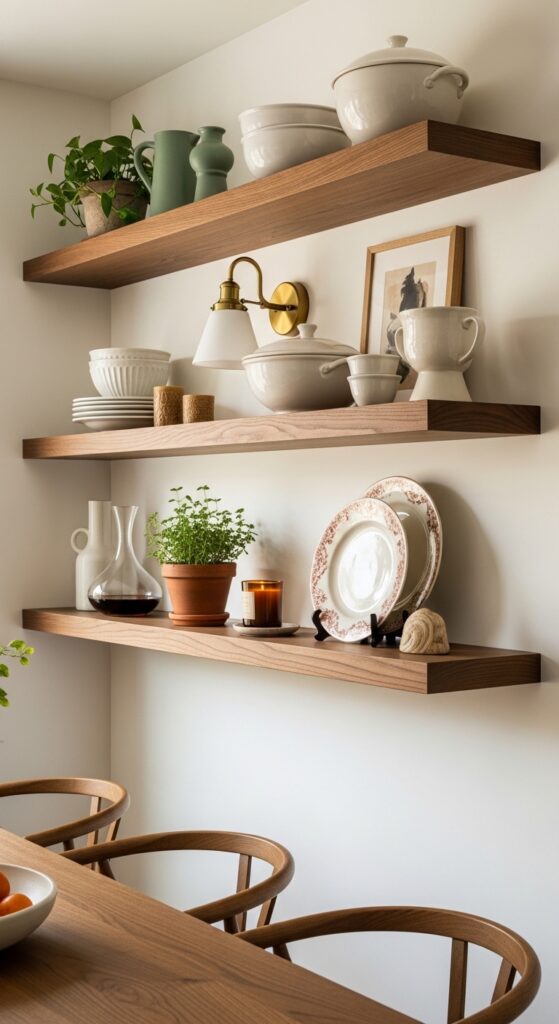
Vibe sentence: Floating shelves give a small dining room the storage and personality of a sideboard without consuming a single inch of floor space.
What makes it work: Floating shelves solve the small dining room’s perennial tension between storage need and space constraint — they provide a surface for displaying and storing dining essentials while keeping the floor completely clear. The visual lightness of shelves with no visible support (or with minimal concealed brackets) means they add richness to the wall without the visual weight of freestanding furniture.
How to achieve it: Install solid wood floating shelves using heavy-duty concealed shelf supports rated for at minimum 50 pounds per shelf — dining accessories and ceramics are heavier than they appear. Space shelves 12–14 inches apart vertically for comfortable access and an airy, open look. Style in odd-numbered groupings of objects with varying heights.
💡 Install one wall sconce between the upper and lower shelves — it provides functional task lighting and transforms the shelf wall into a genuinely designed feature.
Warm Terracotta Paint for an Earthy Intimate Feel
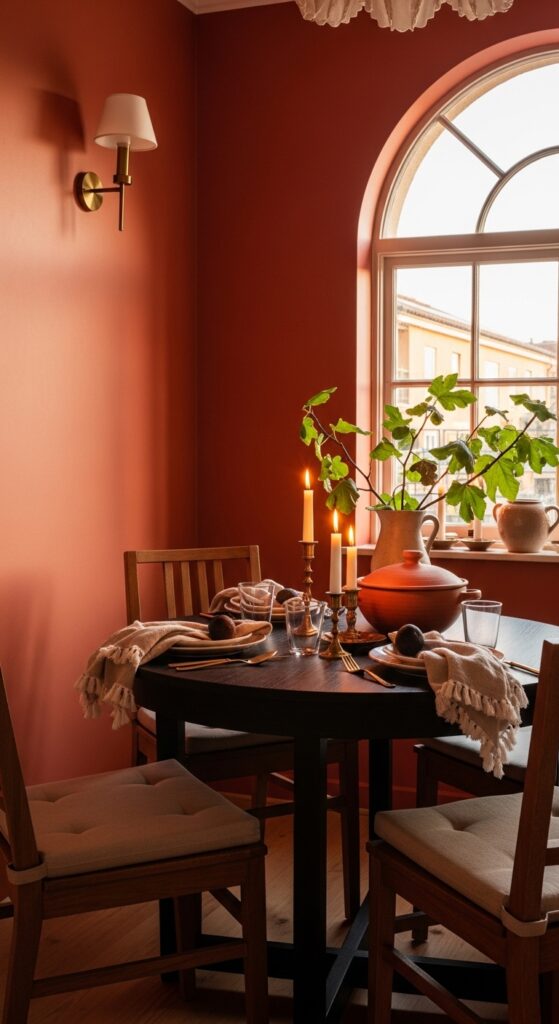
Vibe sentence: Terracotta walls in a small dining room feel like eating at sunset every single evening — endlessly warm, endlessly flattering, endlessly inviting.
What makes it work: Terracotta is uniquely suited to dining rooms because it performs two design functions simultaneously: it makes the room feel warm and intimate (essential in a dining space), and it is extraordinarily flattering in its reflected light — skin tones glow warmly under candlelight against a terracotta wall in a way that no other paint color quite replicates. Its popularity in Michelin-starred restaurant design is not accidental.
How to achieve it: Apply in a limewash or Roman clay finish for the most authentic, textured result — flat latex paint in terracotta reads as flat and slightly artificial. Portola Paints Roman Clay in “Pompeii” or “Desert,” or Bauwerk Colour limewash in warm earth tones, both achieve the dimensional painted-plaster quality. Pair with warm brass and dark wood exclusively — chrome or cool metals immediately undercut the warmth.
Transparent or Ghost Chairs for Visual Spaciousness
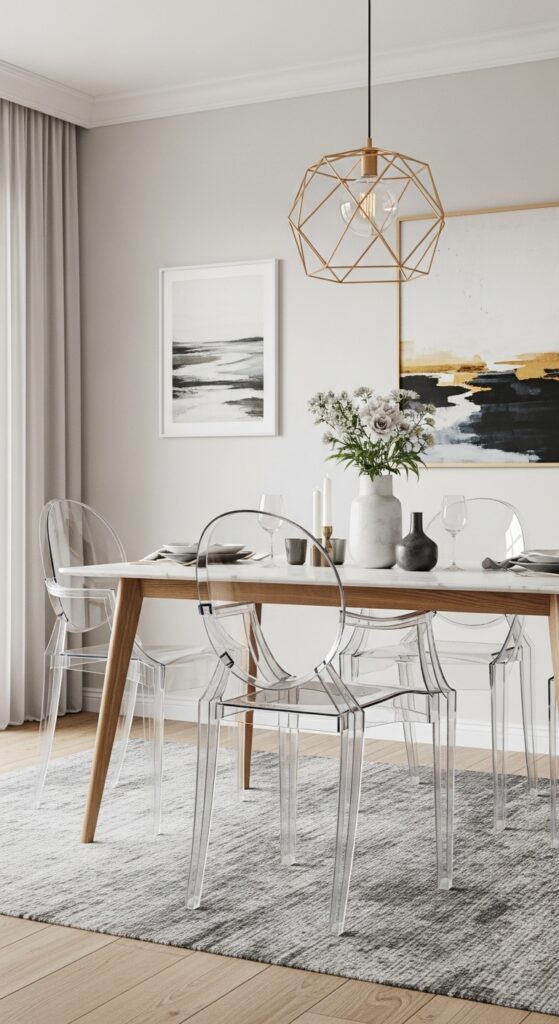
Vibe sentence: Ghost chairs are genuinely magical in a small dining room — four chairs that are there and not there simultaneously, seating four people while visually seating none.
What makes it work: Clear polycarbonate chairs allow the eye to travel through them to whatever is behind — the rug, the wall, the window — which prevents the seating from creating the visual mass and density that conventional chairs generate. In a small dining room, where four chairs can easily consume 60% of the visual field, making those chairs transparent reduces their perceived presence dramatically.
How to achieve it: Kartell’s Louis Ghost chair is the iconic original at around $300 per chair; many quality reproductions are available for $80–$150 each. Keep the chairs scrupulously clean — fingerprints and scratches on clear acrylic are significantly more visible than on opaque materials. Pair with a table in any material and color; the transparent chairs work with literally everything.
Intimate Candlelit Table Styling as Daily Practice

Vibe sentence: Candles on a dining table don’t require a special occasion — they require only the decision to make every meal feel like one.
What makes it work: Candles transform the quality of light in a dining room from the overhead wash of a ceiling fixture into a warm, low, directional glow that flatters both the food and the faces around the table. The principle of “low and warm” in dining lighting is well established in restaurant design — the best dining experiences worldwide share this commitment to intimate, candle-level illumination regardless of the room’s size or formality.
How to achieve it: Invest in a collection of brass candlesticks in three different heights — the variety of heights creates a small landscape of light across the table. Use genuine beeswax or high-quality paraffin tapers in cream or ivory only — colored candles introduce unnecessary visual complexity. Votives and tea lights scattered between the candlesticks extend the illumination without formality.
Nature-Inspired Botanical Centerpiece Year-Round
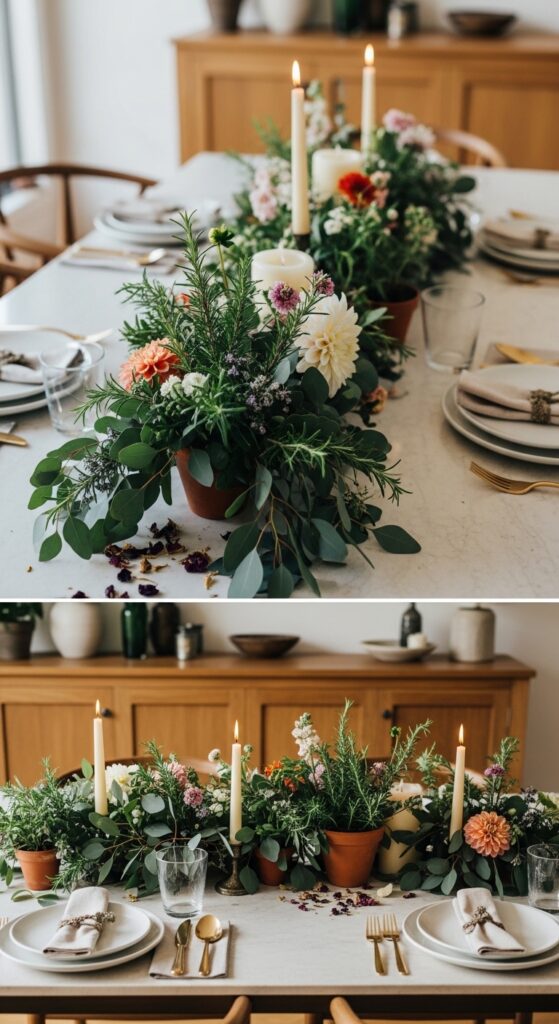
Vibe sentence: A low botanical table runner makes even a weekday dinner feel like a celebration of the season.
What makes it work: Low centerpieces — anything below 10 inches in height — preserve sightlines across the table, which is both practically important (guests can see each other) and aesthetically essential in a small dining room where a tall arrangement immediately dominates and overwhelms. A loosely arranged botanical runner along the table’s length is far more expansive-looking than a single centered vase and feels genuinely styled rather than simply decorated.
How to achieve it: Build the table runner starting with longer sprigs of eucalyptus or rosemary as a base, then layer in smaller blooms and herbs. Use small bud vases rather than one large arrangement — this allows you to adjust and replenish individual elements as they fade. The finished runner should never exceed 8–10 inches in height at its tallest point.
💡 Grocery store herb bunches (rosemary, thyme, sage) cost $2–$3 each and look indistinguishable from florist greenery in a botanical arrangement.
Slim Console Table as a Space-Saving Dining Surface
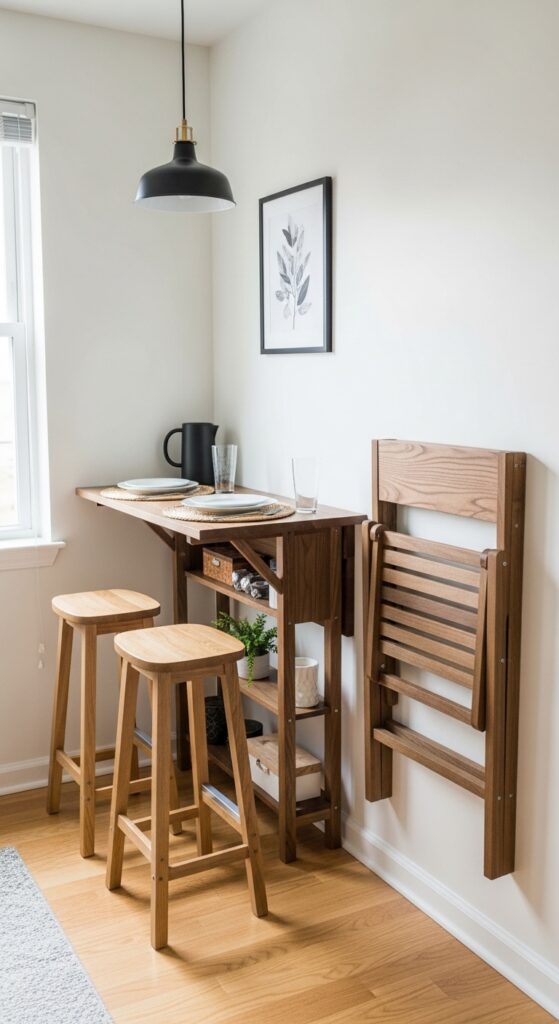
Vibe sentence: When there is almost no room at all, the right table is the one that nearly disappears when you’re not using it.
What makes it work: A console-style dining table that runs along one wall — with stools tucked fully beneath it when not in use — reduces the dining area’s footprint to almost nothing in its inactive state. The wall-mounted folding chairs take this principle further: flat against the wall, they claim zero floor space and read as a designed wall feature rather than stored furniture.
How to achieve it: Source a wall-mounted folding dining table (Ikea NORBERG is a classic budget option) or a slim console table in walnut or oak. Counter-height stools should have a seat height 10–12 inches below the table surface and a footprint of no more than 16×16 inches for maximum space efficiency.
Mixed Chair Styles for an Eclectic Collected Look
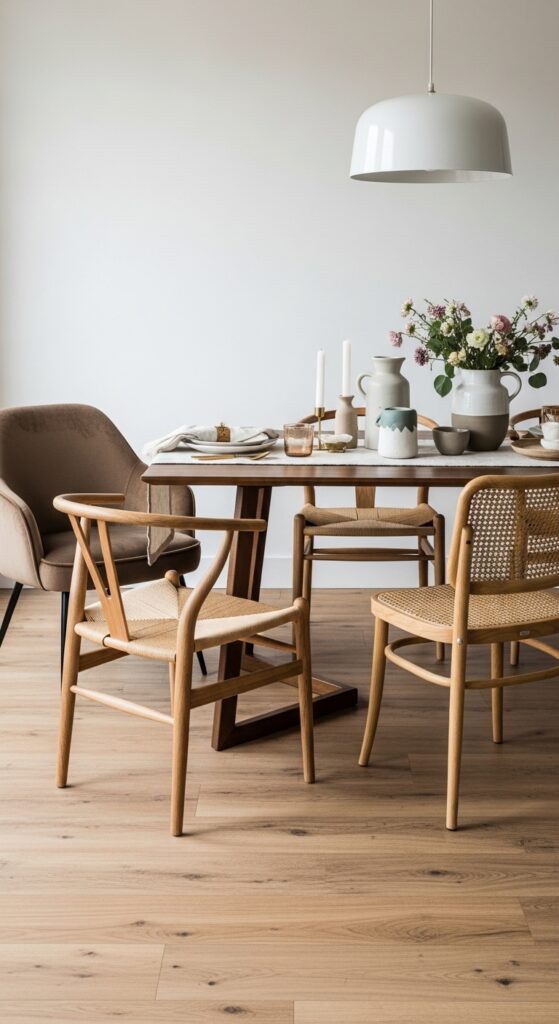
Vibe sentence: A dining table surrounded by chairs that all came from different places and different times tells the best possible story about the person who set it.
What makes it work: Mixed dining chairs work when they share one unifying element — either a color family (all warm wood tones, all painted in the same color), a material (all with rattan elements, all with upholstered seats), or a scale (all similarly proportioned). Without this unifying thread, the mix reads as random rather than curated. With it, the variety becomes the most compelling design feature in the room.
How to achieve it: Start with two matching chairs as the anchor, then introduce one or two additional styles that share the same undertone or material detail. A practical rule: never mix more than three different chair designs at a single dining table — beyond three distinct styles, the composition tips from eclectic to chaotic.
Wainscoting and Chair Rail for Architectural Richness
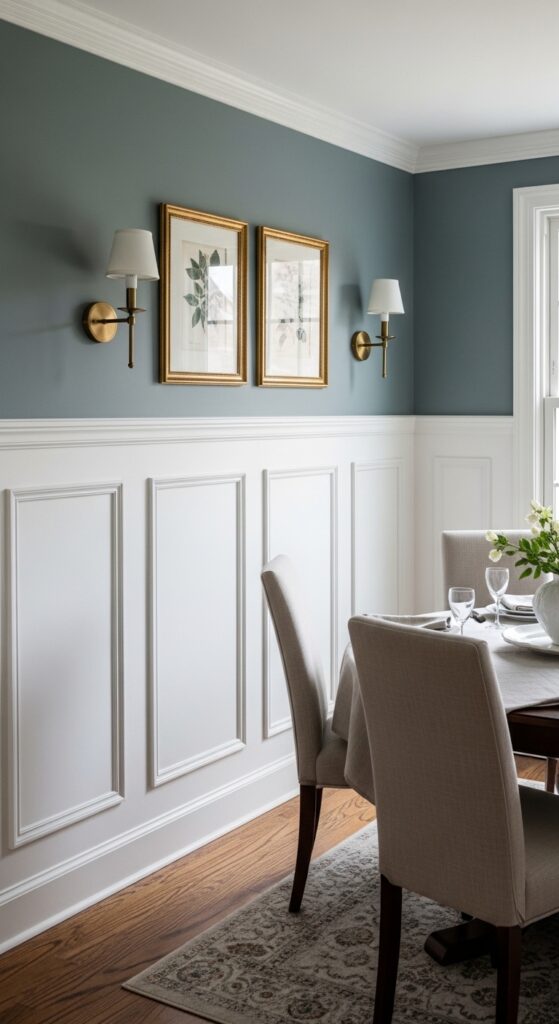
Vibe sentence: Wainscoting makes a small dining room feel like it has always been there — not styled, but inherited, which is a different and more powerful thing entirely.
What makes it work: Wainscoting and chair rail molding divide the wall into two deliberate zones, which visually increases the wall’s complexity and richness without requiring art, wallpaper, or additional furniture. The horizontal line of the chair rail also anchors the room at dado height, making ceilings feel taller by establishing a strong midpoint that draws the eye both downward and upward simultaneously.
How to achieve it: Pre-primed MDF wainscoting panel kits are available from most hardware retailers — they can be installed with construction adhesive over drywall with minimal carpentry skill. Standard chair rail height is 32–36 inches from the floor. Paint the lower panels in semi-gloss white for durability in a dining context; use matte paint on the upper wall to maintain the contrast between zones.
Printed Linen Curtains as a Soft Backdrop
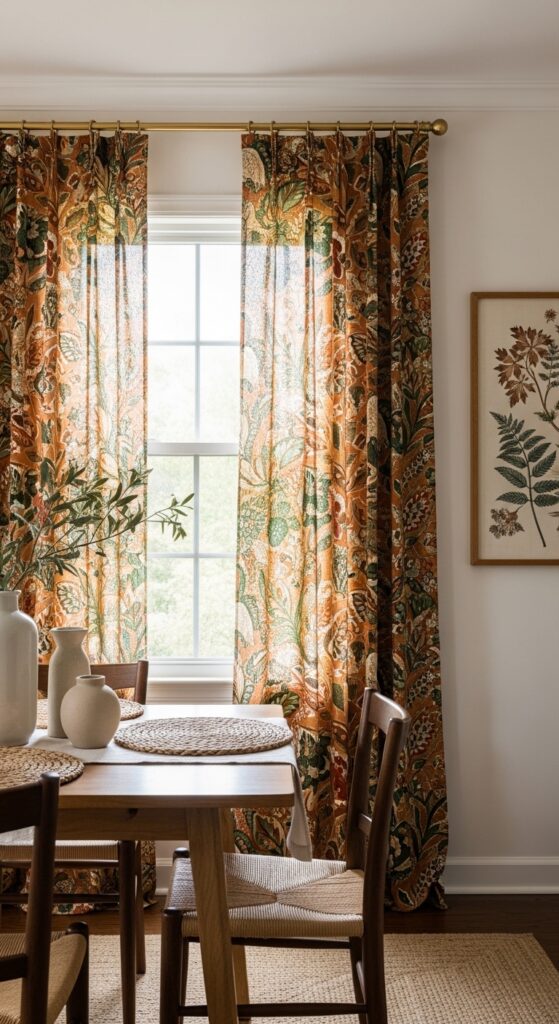
Vibe sentence: Printed linen curtains at ceiling height add more warmth, pattern, and character to a small dining room than almost any other single intervention.
What makes it work: Floor-to-ceiling curtains draw the eye upward and increase perceived ceiling height — the taller the curtain, the taller the room appears. A bold printed pattern on linen introduces the visual complexity of wallpaper with the practical softness of a textile, and the translucency of linen allows natural light to pass through, creating a warm, dappled, luminous quality that wallpaper cannot replicate.
How to achieve it: Always hang curtain rods at ceiling height rather than just above the window frame — the visual difference is dramatic. Choose curtains that pool slightly on the floor (add 1–2 inches to the measured floor-to-ceiling height when ordering). Block print linen curtains from Indian textile studios on Etsy are consistently beautiful and affordable at $40–$100 per panel.
💡 Iron or steam curtains immediately after hanging — creases in linen curtains undermine even the most beautiful print pattern.
Plant Ledge or Shelf at Ceiling Height for Greenery
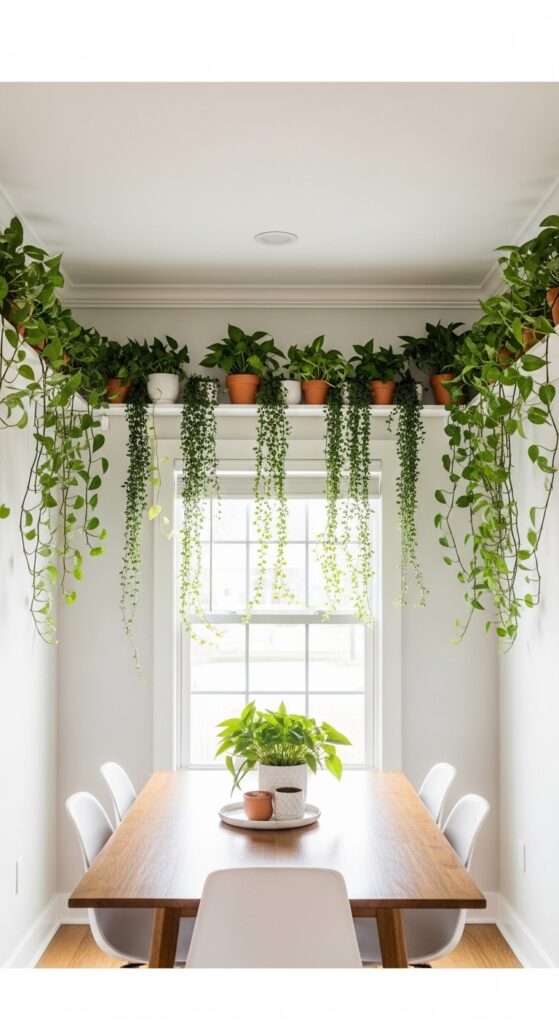
Vibe sentence: A ceiling-height plant shelf transforms the vertical space above the dining table into a living, breathing garden canopy.
What makes it work: Trailing plants installed at ceiling height and allowed to cascade downward use the only space in a small dining room that is usually completely empty — the upper vertical zone. The cascading foliage creates a sense of enclosure and intimacy above the table without occupying any floor space at all, and the softness of trailing plant forms introduces an organic, living quality that no decorative object can replicate.
How to achieve it: Install a simple 6–8 inch deep shelf using heavy-duty floating shelf supports at ceiling height (or 12 inches below if the ceiling is very high). Pothos, string-of-pearls, heartleaf philodendron, and English ivy are the most effective trailing varieties. Allow at least 6 months for the plants to reach a cascading length — begin with longer cuttings to establish the effect sooner.
Painted Ceiling as a Design Feature
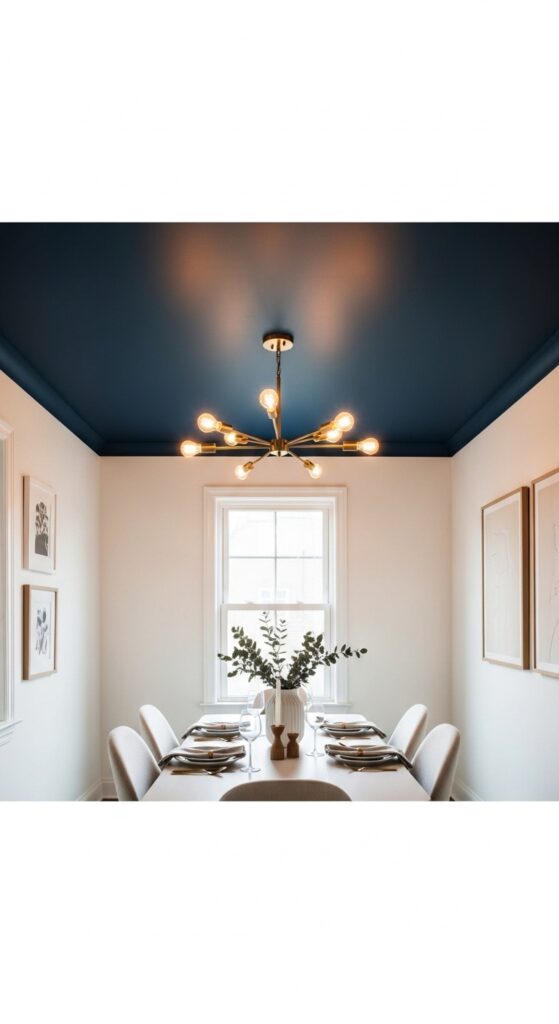
Vibe sentence: Painting the ceiling is the most unexpected and most elegant design decision in a small dining room — it creates an intimate overhead canopy that transforms every meal beneath it.
What makes it work: A painted ceiling in a contrasting color creates a “room within a room” effect — the colored plane above the dining table defines the dining zone architecturally, providing a visual ceiling that makes the space feel more deliberate and enclosed. It also draws the eye upward, which paradoxically makes the room feel taller rather than lower.
How to achieve it: Use the same color for the ceiling as you would consider for an accent wall — deep navy, forest green, terracotta, burgundy — but always in a flat or matte finish to minimize the appearance of any ceiling imperfections. Paint just 2 inches down the wall where the wall meets the ceiling to create a clean, intentional color transition rather than a slightly missed line.
Vintage or Antique Furniture Mix for Timeless Character
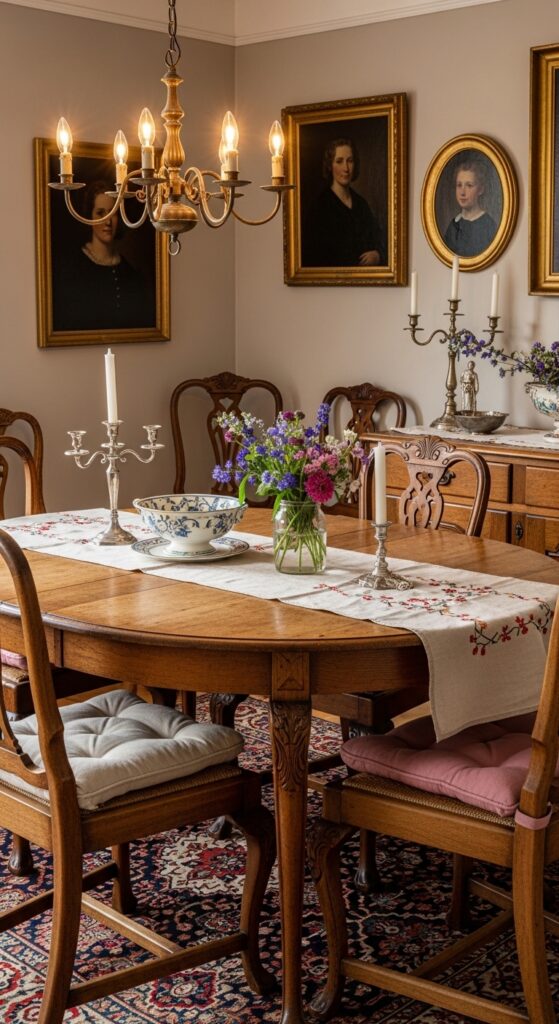
Vibe sentence: A dining room furnished entirely with vintage and antique pieces never needs to be decorated — it simply is, completely and gloriously, itself.
What makes it work: Vintage and antique furniture carries visual depth that new furniture simply cannot purchase — the patina of aged wood, the slight imperfections in hand-carved details, and the warm tones of naturally darkened varnish all create a richness that reads immediately as genuine and irreplaceable. In a small dining room, this depth of character makes the space feel significantly more substantial than its dimensions suggest.
How to achieve it: Source a vintage dining table from local antique markets or Facebook Marketplace — oval and round tables from the 1930s–1960s are particularly beautiful and often underpriced. Mix antique dining chairs freely as long as they share the same broad era (pre-1970) and similar scale. Avoid mixing antique furniture with very modern pieces in a small dining room — the contrast works in large spaces but feels unresolved in compact ones.
Layered Rug to Define the Dining Zone
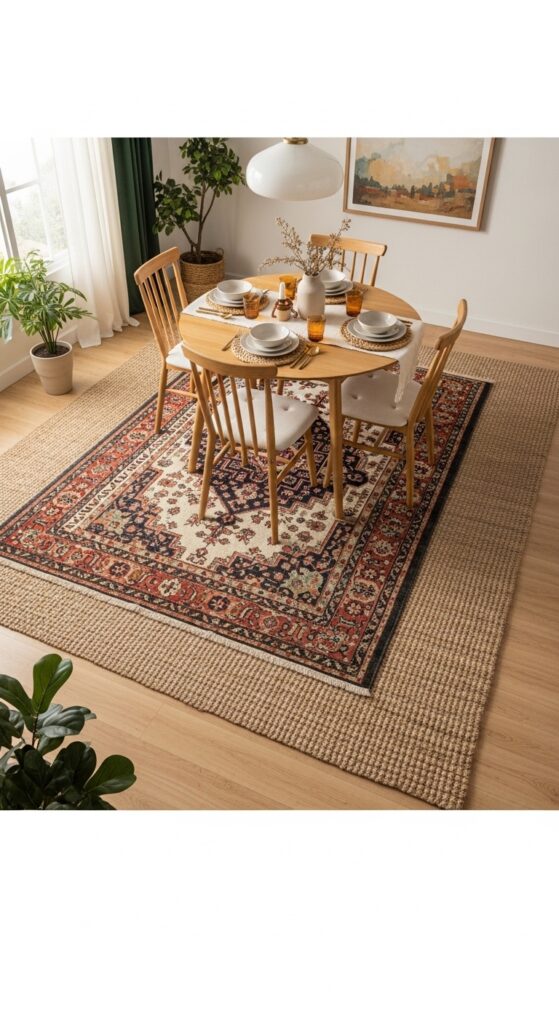
Vibe sentence: The right rug beneath a dining table doesn’t just warm the floor — it defines the dining room itself, giving the space edges and an identity it might otherwise lack.
What makes it work: In an open-plan living space or a room without natural architectural definition, a rug beneath the dining table is what creates the dining room — it draws an invisible boundary around the table that the eye reads as a room. A layered rug adds pattern and color in a way that a single rug cannot, and the visual richness of two overlapping textures makes the dining zone feel significantly more designed and considered.
How to achieve it: The base rug must be large enough that all chair legs sit within it even when the chairs are pulled out — add a minimum of 24 inches beyond the table on all sides. For a 36-inch round table with chairs, a 6×9 foot base rug is the minimum comfortable size. The layered top rug should be roughly 50–60% of the base rug’s area.
Wall Sconces for Warm Atmospheric Side Lighting
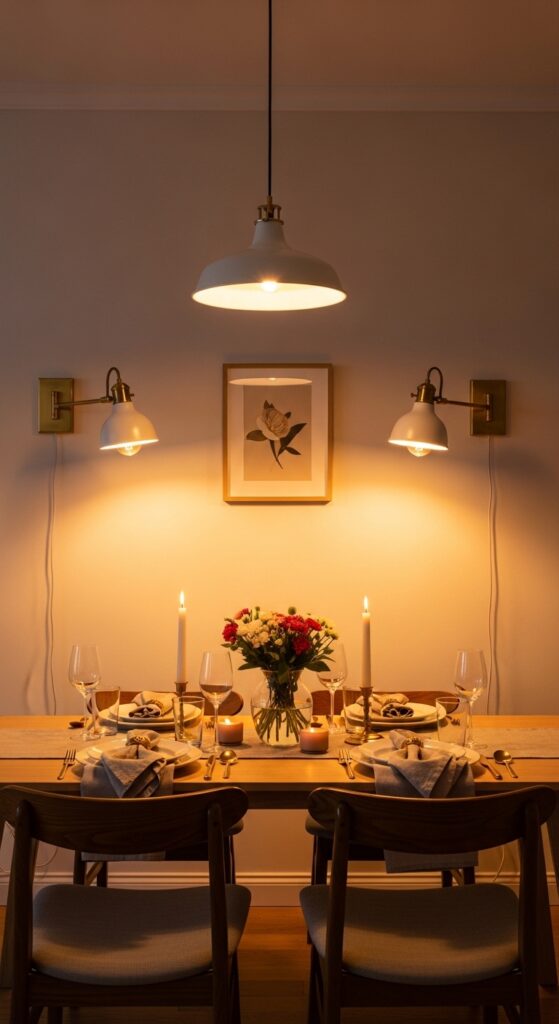
Vibe sentence: Wall sconces in a dining room do what no ceiling fixture ever can — they bring the light down to human level, where it flatters everything and everyone.
What makes it work: A single ceiling pendant provides one level of light in a dining room; wall sconces add a second, lower layer that fills the room with warm ambient glow from the sides. This multi-source, multi-height lighting approach is the technique used in every well-lit restaurant, and it makes an immediate and dramatic difference to the warmth and atmosphere of any dining space, regardless of its size.
How to achieve it: Mount wall sconces at 60 inches from the floor — this is the ideal height for side lighting in a dining room, sitting just below standing eye level. Hardwired sconces provide the cleanest look, but plug-in sconces with a cord concealed in a cable channel are a renter-friendly alternative that installs in under an hour.
💡 Install sconces on a dimmer circuit separate from the main pendant — the ability to use sconces alone at dinner creates the most atmospheric possible lighting.
Herb Garden Window Display Above a Small Table
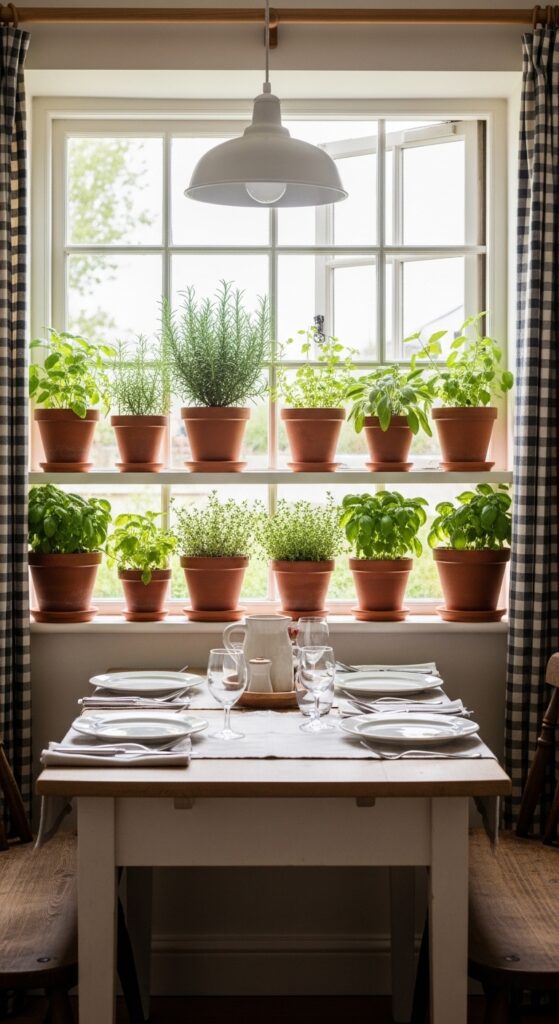
Vibe sentence: Dining beside a herb garden window is the most quietly domestic, genuinely joyful thing a small dining room can offer.
What makes it work: A windowsill herb garden in a dining room does multiple jobs simultaneously: it adds living greenery at eye level, introduces fragrance (rosemary, thyme, and basil are particularly aromatic), and creates a practical backdrop for the table that is also genuinely usable — herbs can be snipped directly to garnish or season food at the table. It’s the most functional form of dining room decor that exists.
How to achieve it: South or east-facing windows provide the best light for culinary herbs. Use matching terracotta pots in graduating sizes — uniformity in the pot material unifies even a diverse collection of plants. Line the sill with a waterproof tray to protect the sill surface and make watering easier. Rotate herbs regularly as they grow toward the light to maintain compact, bushy shapes.
Dark Wood Furniture Against Light Walls for Contrast
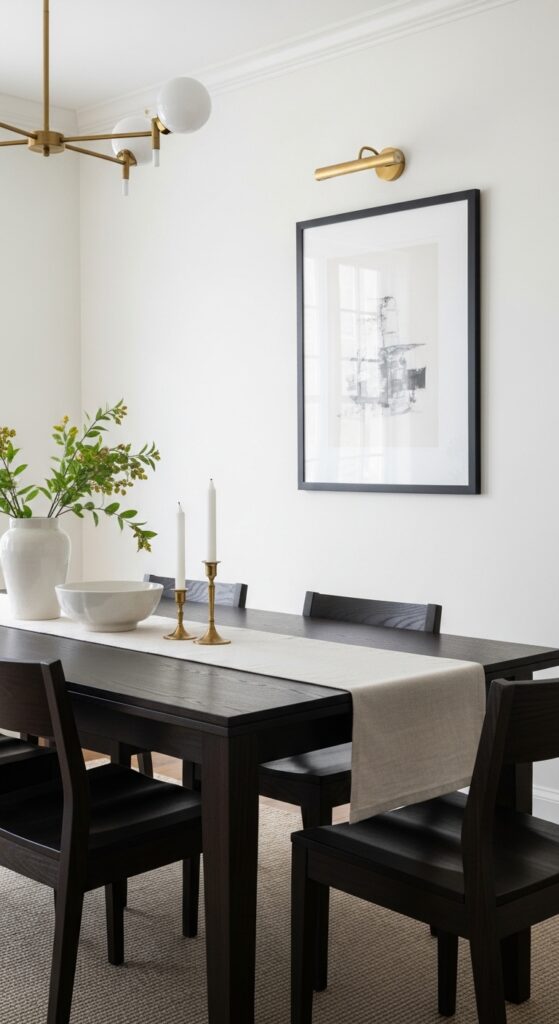
Vibe sentence: Dark wood furniture against bright white walls is one of the oldest and most resolved design combinations in existence — it has never been fashionable because it has never stopped being right.
What makes it work: The contrast between dark wood furniture and white walls is essentially the same principle as black ink on white paper — clarity, legibility, and timeless elegance. The dark furniture reads as substantially and beautifully crafted against the light wall, while the brightness of the surrounding surfaces prevents the dark wood from making the room feel heavy or confined.
How to achieve it: Ensure the walls are a warm white rather than a cool or bright white — Farrow & Ball “Pointing,” “White Tie,” or Benjamin Moore “White Dove” all carry the warm undertone that prevents the high contrast from reading as too stark. Introduce brass hardware and cream linen as the middle tones that bridge the extreme contrast between the dark furniture and the bright walls.
How to Start Your Small Dining Room Decor Transformation
The very first decision in a small dining room transformation should be the table — specifically its shape and its base. A round or oval table with a pedestal base is almost always the right choice for a small dining room, and if you currently have a rectangular table with four legs, swapping it for a round pedestal table will immediately and dramatically improve the room’s sense of space without changing anything else.
The most common mistake in small dining room decor is under-scaling the lighting. People consistently choose pendants and chandeliers that are too small for the dining table below — a pendant that looks generously sized in a showroom or online can look timid and insignificant hanging above a dining table in real space. Use this rule: pendant diameter in inches should equal roughly half the table diameter in inches.
Budget-friendly entry points that make an immediate impact include: repainting walls in a warm, saturated color ($40–$80 in paint), adding a statement pendant light ($60–$200), styling the table with candles and a low botanical centerpiece ($20–$40), and hanging an oversized mirror on the wall opposite the window (sourced secondhand for $30–$100). Together these four changes cost under $400 and transform the character of any small dining room completely.
Resist the urge to buy a matching dining suite — table, chairs, sideboard, and lighting all from the same range. Matched suites read as showroom-styled rather than genuinely lived in, and in a small dining room the lack of variety makes the space feel smaller and less interesting. Mix one or two chair styles, source the lighting independently, and let the room develop its own identity rather than a retailer’s.
Frequently Asked Questions
What size dining table is best for a small dining room?
For a small dining room, a round table between 36 and 48 inches in diameter is the most space-efficient and socially comfortable choice, seating four to six people depending on diameter. If a rectangular table is preferred, aim for a maximum width of 32–36 inches and consider an extendable model that stays compact at everyday scale. The critical measurement is clearance: leave a minimum of 36 inches between the table edge and the nearest wall or furniture piece to allow comfortable chair movement — 48 inches is ideal if space allows.
How do I make a small dining room feel bigger?
The most effective techniques are: using a round pedestal table to open the floor plane, hanging a large mirror on the wall opposite the window, choosing chairs with visual lightness (transparent acrylic, rattan cane, or slim-profile wooden chairs rather than heavy upholstered ones), and keeping the floor clear of non-essential furniture. Painting the walls in a warm, saturated color — counterintuitively — also makes a small dining room feel more intentional and resolved, which the eye reads as spacious rather than as confined.
What lighting works best in a small dining room?
The ideal small dining room lighting combines a pendant hung 30–34 inches above the table surface as the primary source, with at least one secondary source — wall sconces, a buffet lamp on a sideboard, or candles — at a lower level. The pendant should be warm (2700K or warmer), and ideally on a dimmer to allow atmosphere adjustment from bright practical dining to intimate evening mood. Avoid recessed ceiling lighting as the sole source — it provides flat, unflattering overhead illumination that removes all atmospheric quality from the dining experience.
What should I put on the walls in a small dining room?
In a small dining room, the walls are your greatest decorative asset — they are close enough to be seen in detail and numerous enough to carry real design weight. The most impactful wall treatments are: a large mirror (reflects light and space), a bold wallpaper (creates the jewel box effect), a gallery wall above a sideboard (adds personality and art), and wainscoting with a contrasting upper wall (adds architectural richness). Avoid leaving all dining room walls bare — in a small room, empty walls read as unfinished rather than restfully minimal.
Is a rug necessary in a small dining room?
A rug is not strictly necessary but is strongly recommended in most small dining rooms for three reasons: it defines and anchors the dining zone visually, it adds warmth and softness to a space dominated by hard surfaces, and it significantly reduces noise — chair scraping on bare floor in a small room is considerably louder and more disruptive than in a large one. The rug must be large enough to keep all chair legs on it even when pulled out from the table — this is the single most important rug-sizing rule, and the most commonly violated one. A rug that is too small looks worse than no rug at all.
Ready to Create Your Dream Small Dining Room?
You now have 27 small dining room decor ideas to work with — from the jewel box drama of full-room wallpaper to the quiet intelligence of a round pedestal table, from cascading ceiling-height plants to the timeless elegance of candlelight and dark wood. Save your favorites, start with the one change that costs the least and delivers the most — almost always the lighting or the paint — and remember that a small dining room is not a compromise. It is an opportunity to create the most intimate, most considered, most genuinely beautiful room in your home. Every meal deserves a room worth lingering in. Make yours that room.