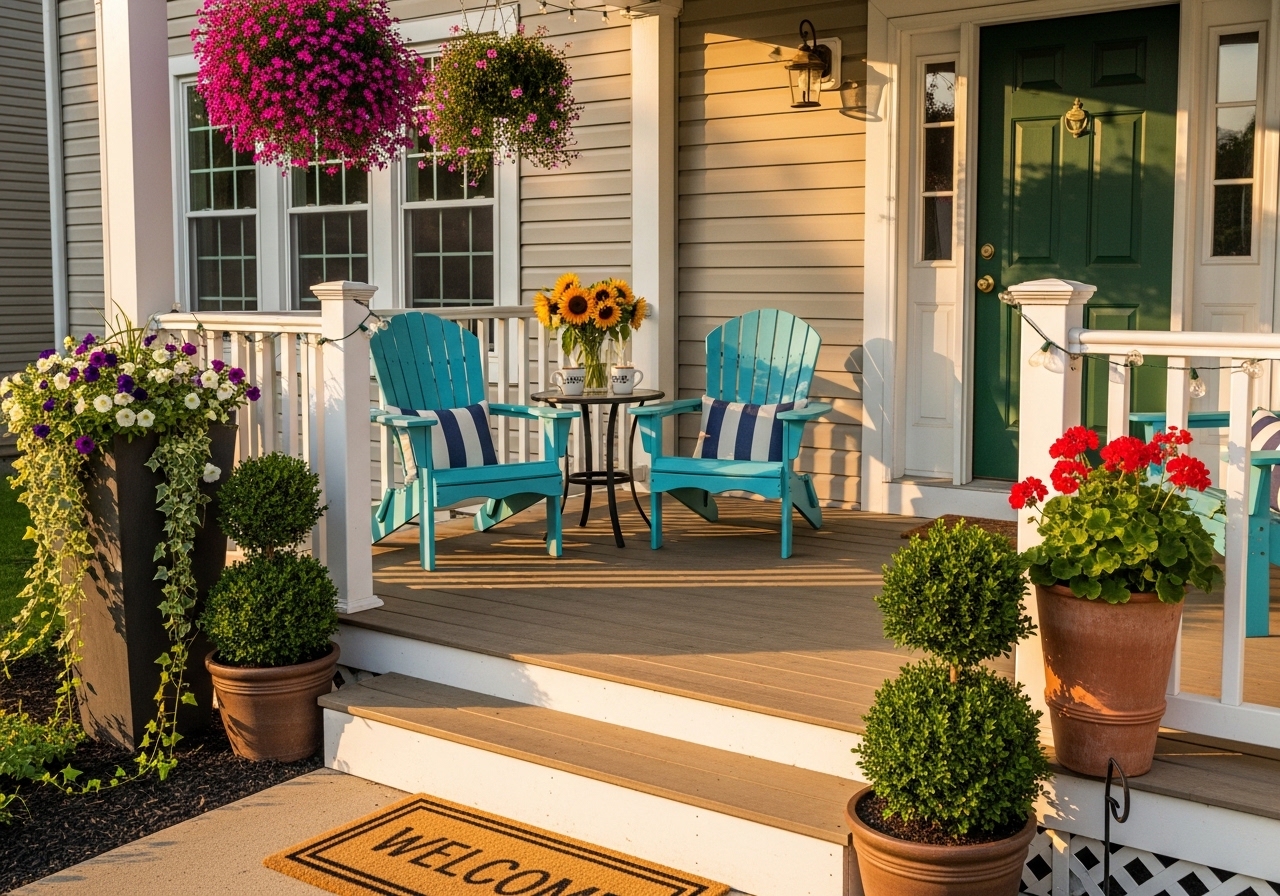
There is a particular kind of pride that comes from pulling into your own driveway and feeling genuinely delighted by what you see — a front porch that looks so welcoming, so considered, so completely right that the whole street feels better for it. Front porch curb appeal is one of the most rewarding design investments a homeowner can make, because unlike interior renovations that only you and your guests enjoy, a beautiful front porch gives something back to the neighborhood every single day. Whether your porch is a grand wraparound veranda, a compact stoop with just enough room for two chairs, or anything in between, the right combination of color, planting, lighting, and styling can transform it from overlooked to unforgettable. These 28 front porch ideas for instant curb appeal are real, actionable, and visually stunning — spanning every architectural style, budget, and square footage. Let’s explore every one of them.
Why Front Porch Curb Appeal Works So Well
The front porch occupies a unique position in residential architecture — it is simultaneously the home’s most public room and its most personal statement. Unlike the interior, which visitors only see by invitation, the front porch speaks to everyone who passes: neighbors, delivery drivers, potential buyers, and strangers walking dogs at dusk. Every design choice made on the porch communicates something about the people who live there, which is precisely what makes it such a powerful and emotionally resonant design opportunity.
What distinguishes great curb appeal from merely tidy exteriors is the deliberate use of layering — the combination of architectural elements, planting, lighting, color, and styling that creates depth and visual interest from the street. A freshly painted door is a start; a freshly painted door flanked by matching topiaries, illuminated by statement lanterns, and framed by a seasonal wreath is a destination. The difference is the layering of details that invites the eye to travel inward rather than simply registering the facade and moving on.
Current front porch design is experiencing a significant renaissance driven by two parallel cultural forces: the post-pandemic rediscovery of outdoor living and the surge of interest in what design editors have begun calling “arrivals” — the choreographed sequence of visual moments that welcome you home. Pinterest searches for “front porch curb appeal,” “porch makeover ideas,” and “cottage front door styling” have surged dramatically, reflecting a generation of homeowners finally investing in exterior spaces with the same intentionality previously reserved for interiors.
Even the most architecturally unremarkable porch — a flat concrete stoop, a narrow covered entry, a suburban ranch-house front — responds dramatically to thoughtful design intervention. Scale, symmetry, color, and planting are available to every homeowner regardless of budget, and the visual return on even modest investments in curb appeal consistently exceeds any equivalent spend inside the house.
1. Statement Front Door in a Bold Color
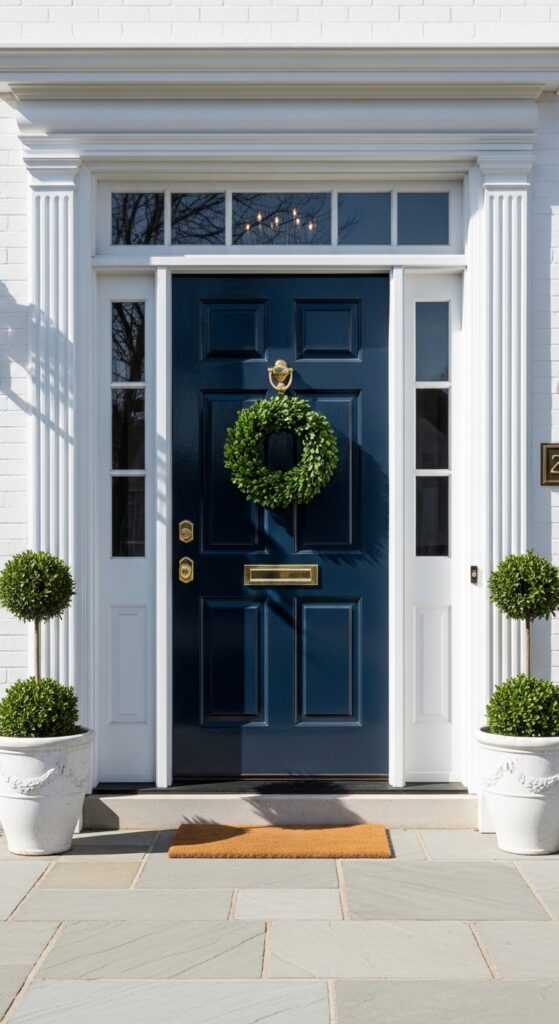
Vibe: The front door that introduces the house before you’ve even knocked — confident, polished, and impossible to walk past without noticing.
What makes it work: A high-gloss finish on a front door amplifies color depth and creates a lacquered quality that matte or eggshell finishes cannot replicate, making the door appear almost jewel-like in natural light. Deep navy reads as both traditional and contemporary depending on the surrounding trim color — against crisp white, it sits firmly in the classic architectural tradition; against dark grey or charcoal trim, it becomes dramatically modern.
How to achieve it: Use exterior gloss alkyd or water-based enamel paint for front doors — these finishes are specifically formulated for the expansion and contraction cycles of an exterior door in all weather conditions. Sand the door lightly between coats for a flawless finish, and apply a minimum of two full coats. Farrow & Ball “Hague Blue,” Sherwin-Williams “Naval,” and Benjamin Moore “Hale Navy” are the three most frequently cited curb-appeal navy choices, each with slightly different undertones worth sampling before committing.
💡 Replace standard builder-grade brass hardware with aged brass or unlacquered brass — the difference in perceived quality is immediate and transformative.
2. Matching Symmetrical Planters Flanking the Door
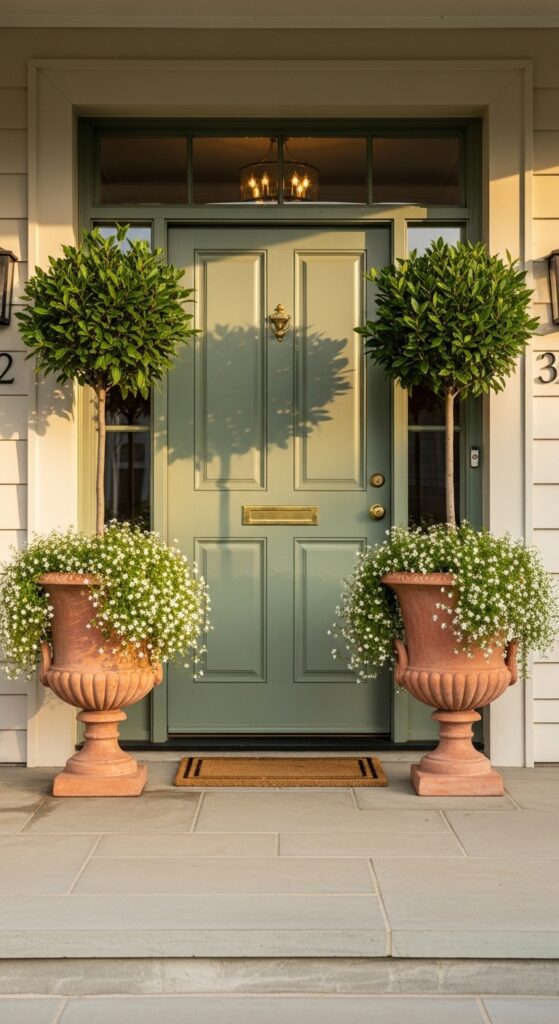
Vibe: Formal without being stiff — a perfectly balanced entrance that says both “welcome” and “we pay attention to details.”
What makes it work: Symmetry in front porch design draws on one of architecture’s most powerful compositional principles — bilateral symmetry signals order, intentionality, and considered design in a way the brain registers immediately and positively. Matching planters flanking a door frame the entrance as a focal point, directing the eye precisely to the home’s threshold and making even a modest porch feel architecturally significant.
How to achieve it: The planters must be genuinely identical — same pot, same size, same plant, same underplanting, at the same height — for symmetry to work. Even slight variation breaks the visual principle and reads as approximation rather than intention. Choose frost-resistant glazed ceramic or fibreglass pots if your climate includes freezing winters, as terracotta will crack in a hard frost. Top-dress both pots with the same mulch or grit for a polished finishing touch.
3. Wraparound String Lights Along the Porch Ceiling
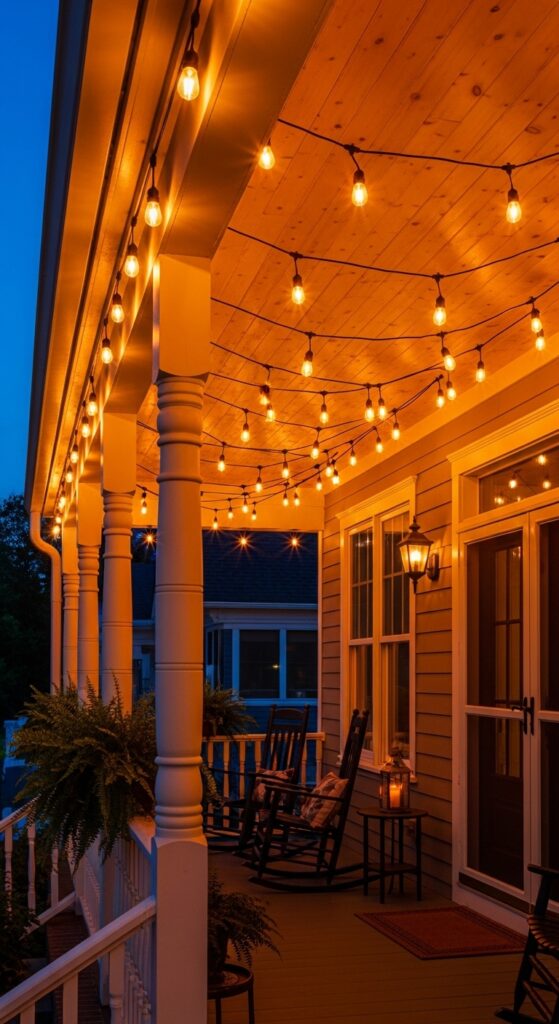
Vibe: The porch that glows like a lantern from the street — warm, welcoming, and making every evening feel like a celebration.
What makes it work: String lights transform a front porch from a daytime architectural feature into an evening destination, making the home’s exterior visible, warm, and welcoming after dark in a way that standard porch light fixtures cannot approach. The Edison filament style specifically creates a warm amber glow at 2200K color temperature — significantly warmer than standard warm white LEDs — that flatters both the architecture and the people gathered beneath it.
How to achieve it: Install small screw-in eye hooks along the porch ceiling at 600mm intervals to create attachment points for the string light runs. Use outdoor-rated string lights with S14 Edison bulbs rather than smaller globe bulbs for the most impactful visual effect from the street — the larger bulb size reads clearly at distance. Connect multiple runs via a single timer-controlled outdoor outlet to automate the evening-on, midnight-off cycle.
💡 Solar-powered string lights eliminate the need for an outdoor outlet entirely — modern solar string lights maintain an 8–10 hour run time from a single day’s charge.
4. Classic Rocking Chairs in White or Natural Wood
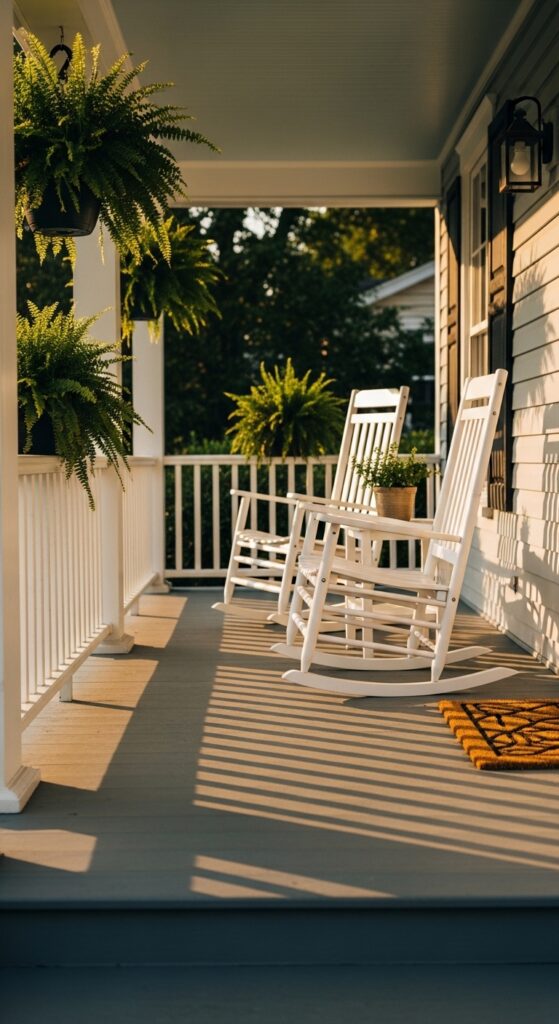
Vibe: Timeless American front porch perfection — chairs that have been having the best conversations for a hundred years and show no signs of stopping.
What makes it work: Rocking chairs signal something deeply specific about a home — that there are people inside who know how to slow down, who value the front porch as a room rather than a transitional space, and who understand the particular pleasure of watching the world pass from a comfortable seat. Their presence on a porch communicates warmth and domesticity more effectively than almost any other single piece of furniture.
How to achieve it: Position rocking chairs with enough clearance to rock freely without hitting walls, railings, or each other — allow minimum 600mm of clearance behind and 400mm between chairs. Poly lumber (recycled plastic composite) rocking chairs are now essentially indistinguishable in appearance from painted wood at a distance, but require zero maintenance — no painting, no sealing, no seasonal covering — making them far more practical for year-round porch use.
5. Lush Hanging Fern Baskets Along the Porch Ceiling
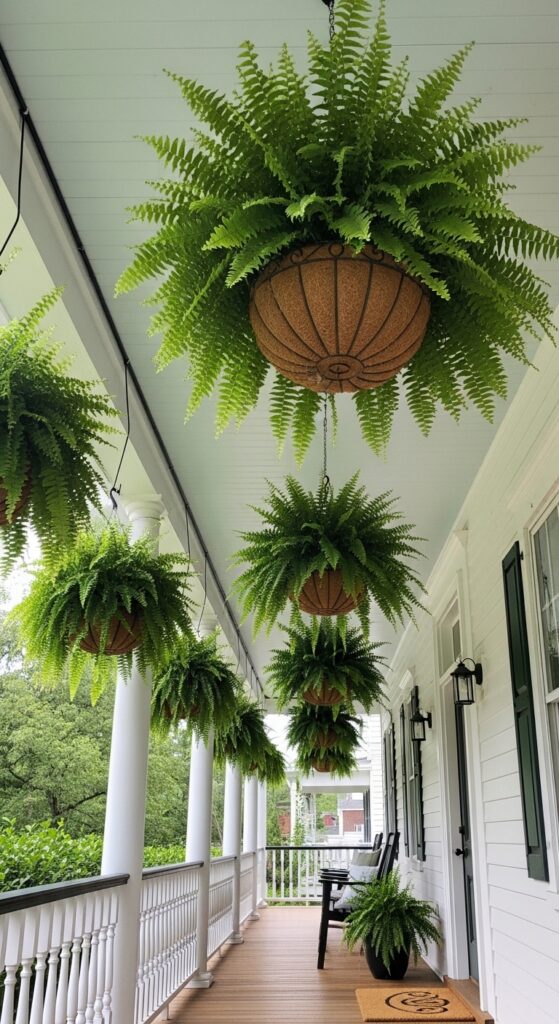
Vibe: A living green ceiling — generous, verdant, and making the porch feel like the most welcoming room in the garden.
What makes it work: A row of matching hanging ferns creates a visual rhythm and green canopy effect that transforms the porch’s vertical dimension — the eye moves along the row of baskets, registering the repetition as intentional design rather than casual decoration. The cascading frond habit of Boston ferns specifically creates maximum volume and presence relative to basket size, giving an impression of lavish abundance.
How to achieve it: Boston ferns require consistent moisture and benefit from daily misting in dry climates — install a drip irrigation system along the porch ceiling that delivers water to each basket simultaneously if daily watering is impractical. Choose baskets sized at minimum 14 inches for outdoor display — smaller baskets dry out too quickly in full porch exposure and look proportionally inadequate against a full-sized porch ceiling.
6. Painted Porch Floor in a Classic Pattern
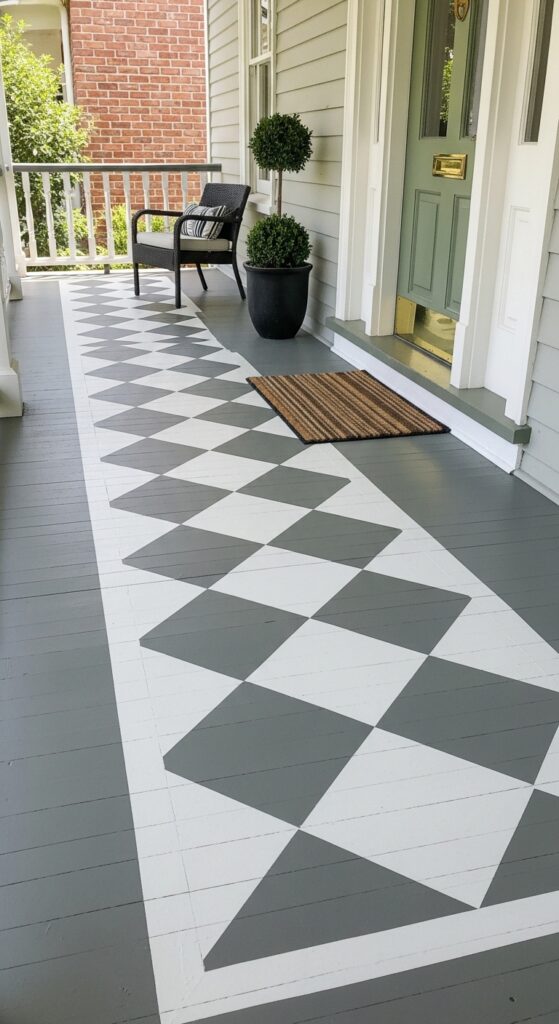
Vibe: A floor so beautiful it stops you before you’ve even reached the door — a painted pattern that turns every arrival into a small delight.
What makes it work: A painted porch floor pattern transforms one of the most overlooked surfaces in exterior design into a genuine design feature — the floor becomes the visual anchor of the porch composition and the first thing visitors register as they approach. Diamond checkerboard patterns work particularly well because the diagonal orientation creates an implied directional line leading toward the door.
How to achieve it: Prepare the floor surface thoroughly — sand, prime with exterior primer, and apply two base coats before masking the pattern. Use a laser level and chalk line to establish perfectly straight diagonal grid lines before applying the contrasting color. Seal with two to three coats of exterior porch enamel clear sealer for maximum durability — a painted porch floor without sealer will chip and wear within a single season of foot traffic.
7. Layered Seasonal Planting in a Large Porch Urn
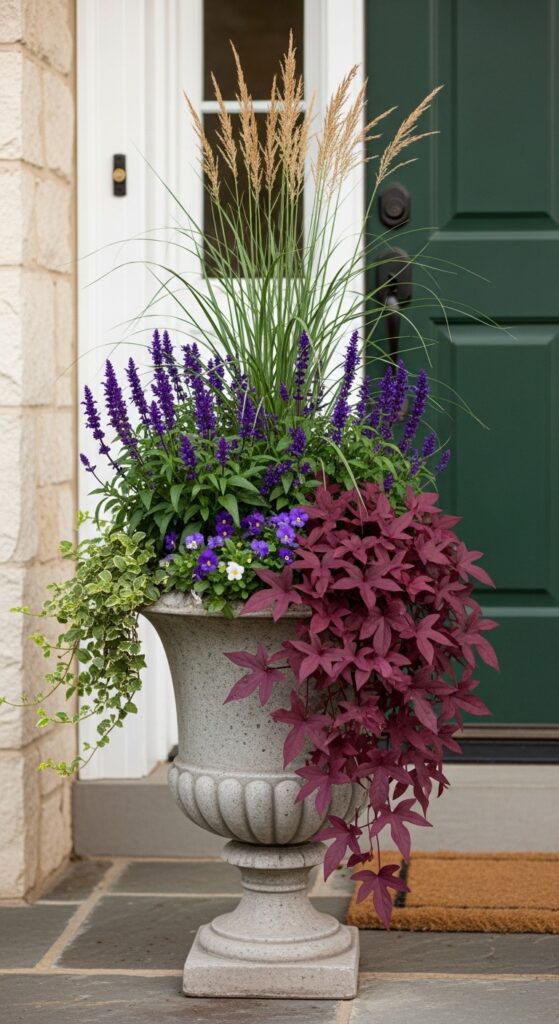
Vibe: A planting composition so good it looks professionally designed — and it is, by you, with three plants and one good urn.
What makes it work: The thriller-filler-spiller planting formula is the professional landscaper’s most reliable tool for container planting — a tall central thriller plant provides height and drama, a medium filler plant creates mass and color, and a trailing spiller plant softens the container edge and adds movement. Applied to a single large porch urn, it creates a planting composition that reads as designed rather than assembled.
How to achieve it: Choose the largest urn your porch can accommodate — undersized containers always look inadequate against a full-scale porch facade. Ensure adequate drainage holes in the base and use a lightweight perlite-enriched potting mix rather than heavy garden soil to prevent the urn from becoming unmanageably heavy. Replace seasonal plantings three times per year: spring bulbs and pansies, summer tropicals and annuals, autumn ornamental cabbage and chrysanthemums.
8. Board and Batten Porch Skirt in Fresh White
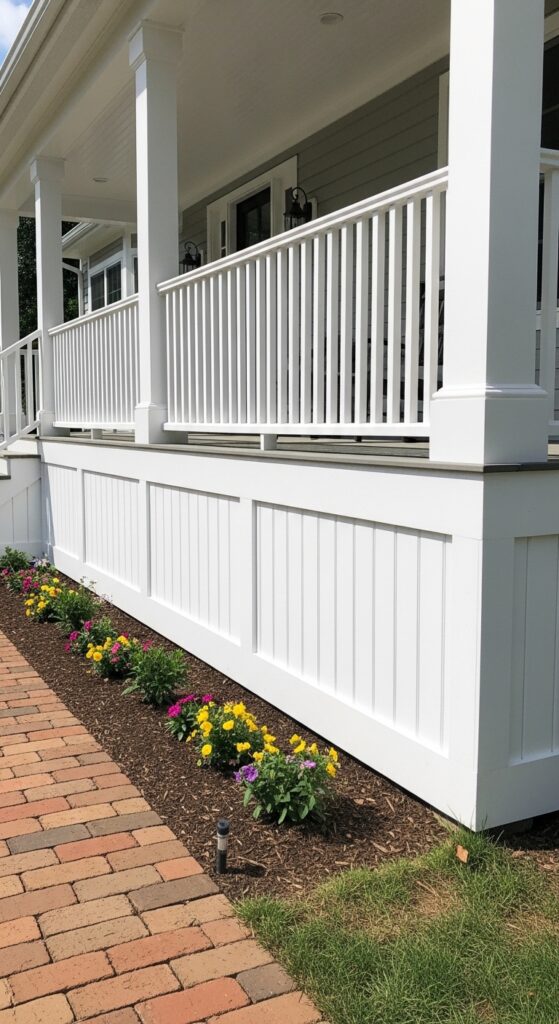
Vibe: The finishing touch that makes a raised porch look complete — a skirting so clean and crisp the whole house seems to stand a little straighter.
What makes it work: Board and batten porch skirting solves one of the most common visual problems in residential exteriors — the unfinished, dark void beneath a raised porch that interrupts the clean line of the facade. A well-executed painted skirting creates a visual base for the porch that ties the structure to the ground plane and makes the overall composition appear architecturally resolved.
How to achieve it: Use 150mm-wide timber boards with 50mm batten cover strips, or composite board-and-batten panels available pre-assembled from cladding suppliers for faster installation. Include removable access panels in at least two locations for under-porch access to utilities. Use a quality exterior primer and two coats of exterior gloss in brilliant white — this surface is exposed to splash-back and weathering and requires the most durable finish available.
💡 Lattice panels painted to match the house trim are a faster alternative to board and batten for enclosing underporch spaces, with a more traditional cottage aesthetic.
9. Dramatic Black and White Exterior Color Scheme
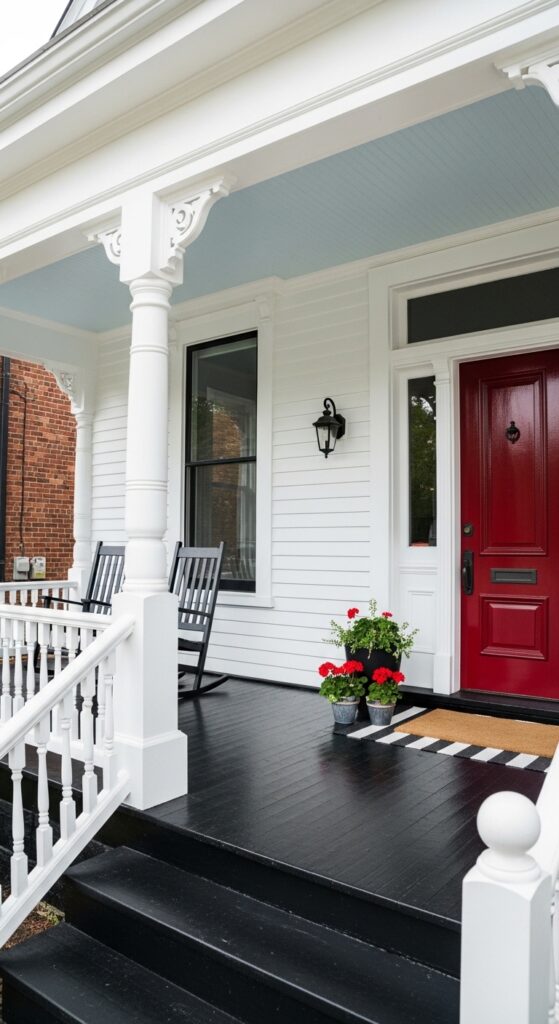
Vibe: Graphic, fearless, and entirely memorable — a porch color scheme that commits completely and looks extraordinary for it.
What makes it work: Black and white in exterior design creates maximum contrast and visual drama — the two colors define each other’s edges with unusual sharpness, making architectural details appear crisper and more three-dimensional than any other color combination. A single accent color (the red door) provides the visual resolution that prevents the scheme from feeling clinical or austere.
How to achieve it: Paint the porch ceiling a very light blue-grey rather than pure white — a tradition originating in the American South where a specific shade called “haint blue” was believed to ward off spirits, but which has an enduring practical benefit: it reflects light downward onto the porch and reduces the visual appeal of wasps and mud daubers who mistake the color for sky. Use exterior floor enamel for the black porch floor — it requires a paint specifically formulated for foot traffic.
10. Stone or Tile Path Leading to the Porch Steps
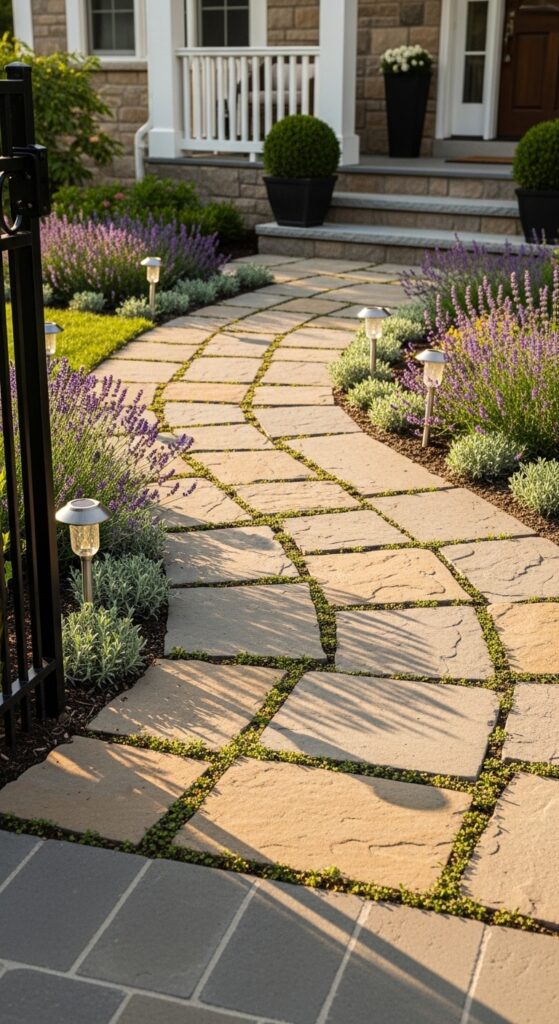
Vibe: An arrival that begins at the garden gate — every step toward the front door a small pleasure, the house better with every pace.
What makes it work: The path to a front porch is one of the most overlooked curb appeal elements — it literally choreographs how visitors approach and experience the home, yet most suburban homes make do with a straight concrete walkway that offers no visual interest or journey. A natural stone or flag path with planted edges creates a sequence of arrival that makes the approach to the front door as welcoming as the door itself.
How to achieve it: Natural flagstone path installation requires setting stones on a compacted sand and gravel base minimum 100mm deep for stability without mortar, or mortar-setting on a concrete base for a more formal result. Allow 600mm minimum path width for comfortable single-file walking, 1.2m for side-by-side walking. Low-growing ground cover plants such as thyme, creeping Jenny, or mind-your-own-business planted in the joints between stones soften the hard edges and suppress weeds naturally.
11. Lantern-Style Porch Lighting in Aged Brass or Black
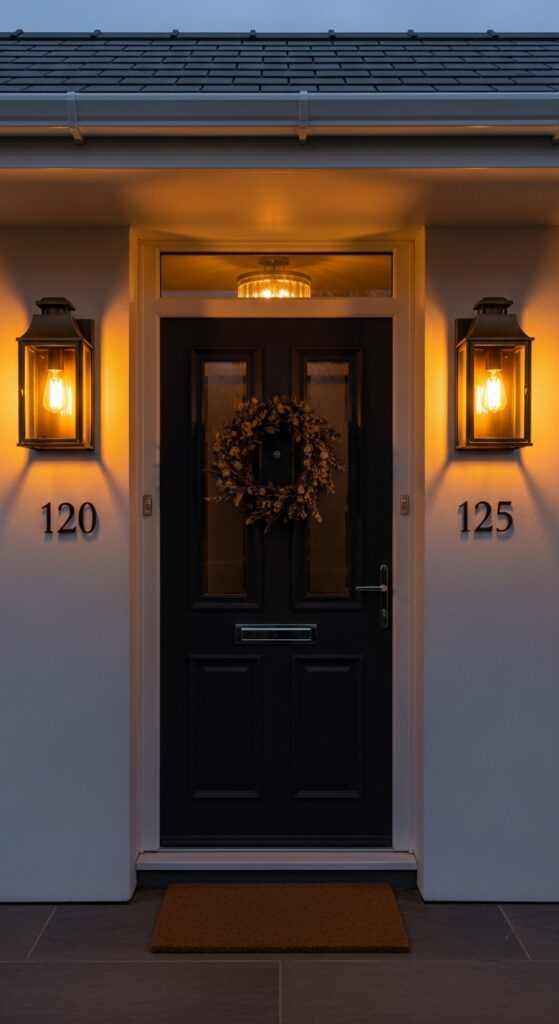
Vibe: The kind of lanterns that make every guest feel expected and every evening feel like an occasion.
What makes it work: Oversized lanterns flanking a front door work on an architectural principle — the lantern scale should relate to the door height, not to a generic hardware store standard. Most builder-installed porch lights are undersized relative to the door and entry surround, which makes the entrance feel incomplete. Increasing lantern size to approximately one-quarter of the door height instantly elevates the entrance to a more considered, architectural scale.
How to achieve it: Measure your door height and divide by four — this is your minimum lantern height for correct architectural proportion. Most doors are 2.1m, suggesting minimum 525mm lanterns, yet the majority of builder lights are 250–300mm. Aged brass and matte black are the two exterior lighting finishes with the greatest design longevity — avoid bright polished chrome, which looks dated within five years. Always choose fixtures with an IP rating of IP44 minimum for covered porch use.
12. Porch Swing with Outdoor Cushions and Throw
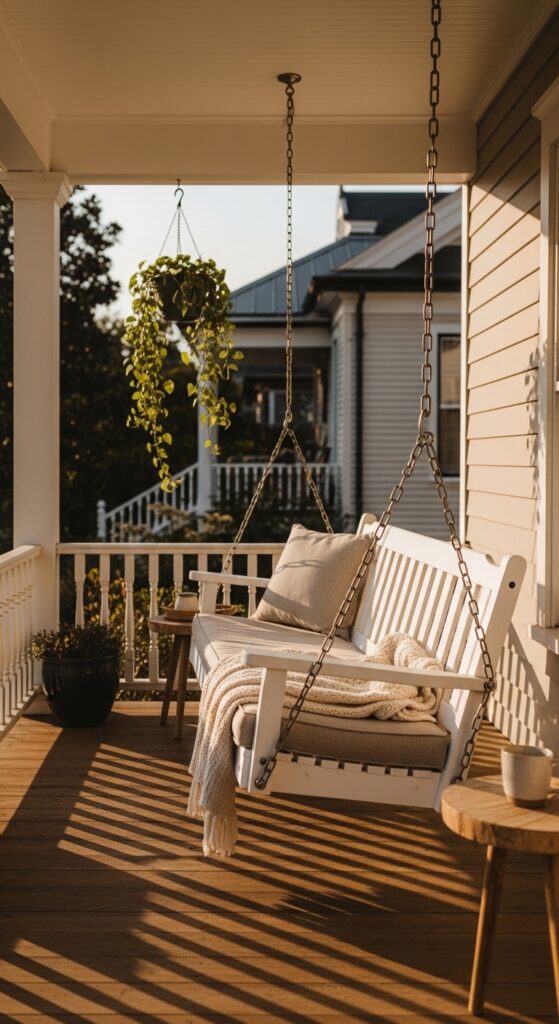
Vibe: A porch swing that makes time slow down and conversations run long — the piece of furniture that defines the entire porch’s character.
What makes it work: A porch swing communicates something deeply aspirational about a home — the presence of people who have cultivated the art of being still, of watching the world from a comfortable seat, of investing in a piece of furniture whose only function is to make sitting outside more pleasurable. From the street, a porch swing signals warmth and hospitality more eloquently than any other single element.
How to achieve it: Install porch swing ceiling hardware into structural ceiling joists — not drywall or fascia — using threaded eye bolts rated for dynamic loading of minimum 250kg per attachment point. Hang the swing at seat height 450–500mm from the floor, allowing 300mm clearance between the swing back and the porch wall at rest. Choose outdoor-rated foam cushion inserts wrapped in solution-dyed acrylic fabric (Sunbrella or similar) for weather resistance without sacrificing comfort or appearance.
13. Topiary Ball Standards Flanking the Entry
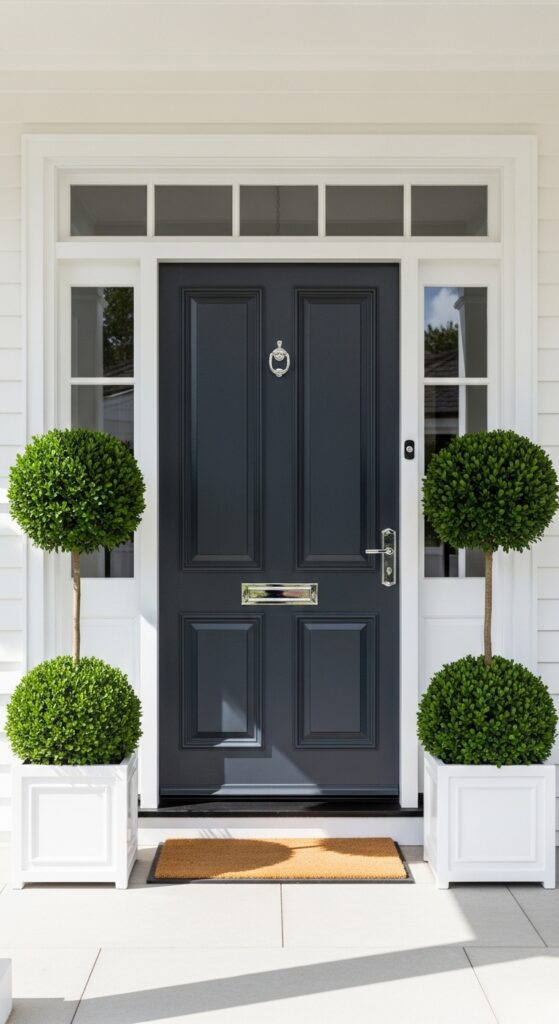
Vibe: Garden formality at its most satisfying — topiaries that have been waiting patiently their whole lives to stand exactly here, looking exactly this good.
What makes it work: Clipped topiary standards combine two of formal garden design’s most powerful tools — sculptural form and living material — in a scale perfectly suited to flanking a domestic entry. The geometric sphere contrasts beautifully with the organic nature of the plant itself, and the identical pairing creates a bilateral symmetry that frames the door with commanding authority regardless of the house’s architectural style.
How to achieve it: Boxwood standard topiaries require clipping two to three times per year to maintain the sphere form — use sharp bypass shears and work around the ball systematically, standing back frequently to check the outline. In climates with boxwood blight pressure (humid summers, warm winters), substitute with Japanese holly (Ilex crenata), which is visually identical, slightly faster growing, and completely blight-resistant. Versailles planters can be purchased pre-made or built from 18mm marine plywood and painted with exterior wood paint.
14. Front Door Wreath for Every Season
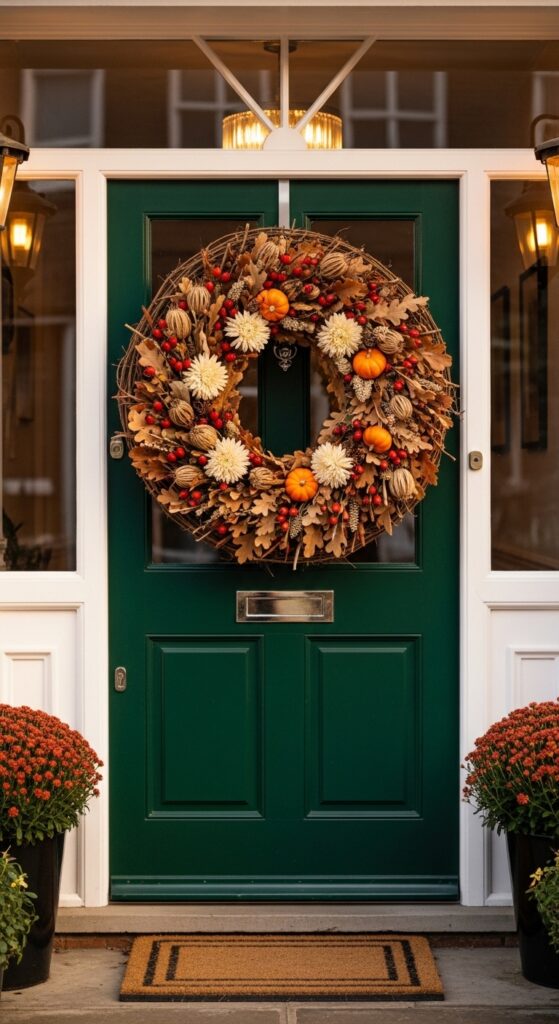
Vibe: The front door that keeps the season — a wreath so beautiful it stops people on the pavement to admire it.
What makes it work: A well-scaled, seasonally appropriate wreath transforms a front door from a functional portal into an expressive design statement that signals attention, care, and seasonal awareness. The critical variable is scale — a wreath should be a minimum of two-thirds the door width to read clearly from the street; the most common mistake is choosing a wreath that looks substantial on the hook but disappears against the door from thirty feet away.
How to achieve it: Target a minimum 500mm diameter wreath for a standard 900mm wide door — this scale reads correctly from street distance. Hang from an over-door wreath hanger rather than a nail through the door surface to protect the paint finish and allow easy seasonal swapping. Rotate wreaths four times per year: spring (tulips, narcissus, pussy willow), summer (eucalyptus, lemon leaf, dried botanicals), autumn (dried leaves, seed heads, mini gourds), winter (evergreen, berries, dried orange slices, cinnamon).
15. Wicker or Rattan Porch Furniture Set
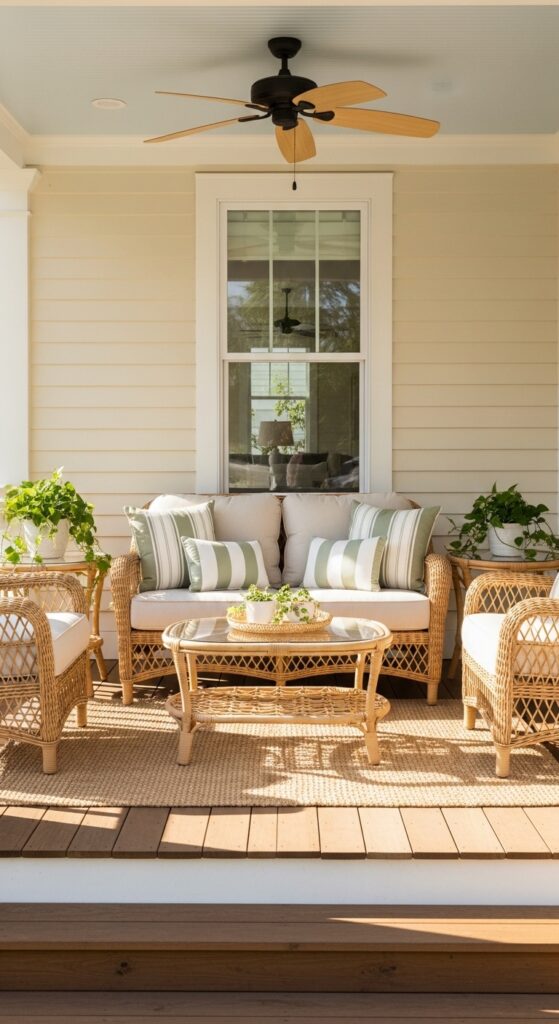
Vibe: A front porch that is genuinely, thoroughly lived in — a room that happens to be outside, dressed for comfort and ready for company.
What makes it work: A full furniture set on a front porch changes the psychological relationship between the house and the street — it signals that this is a room, not a transitional space. Wicker and rattan furniture in particular communicate a relaxed, organic warmth that metal or plastic furniture cannot replicate, and the natural material connects the porch to the garden and landscape in a visually cohesive way.
How to achieve it: Synthetic resin wicker (not natural wicker) is the correct specification for any furniture left outdoors year-round — natural wicker is a beautiful indoor or sheltered porch material that will deteriorate rapidly if exposed to direct rain or humidity. High-quality synthetic wicker from brands like Pottery Barn Outdoor, Restoration Hardware, or Lloyd Flanders is indistinguishable from natural wicker in appearance but completely weatherproof and UV stable.
16. Painted Concrete Porch Steps in a Contrasting Color
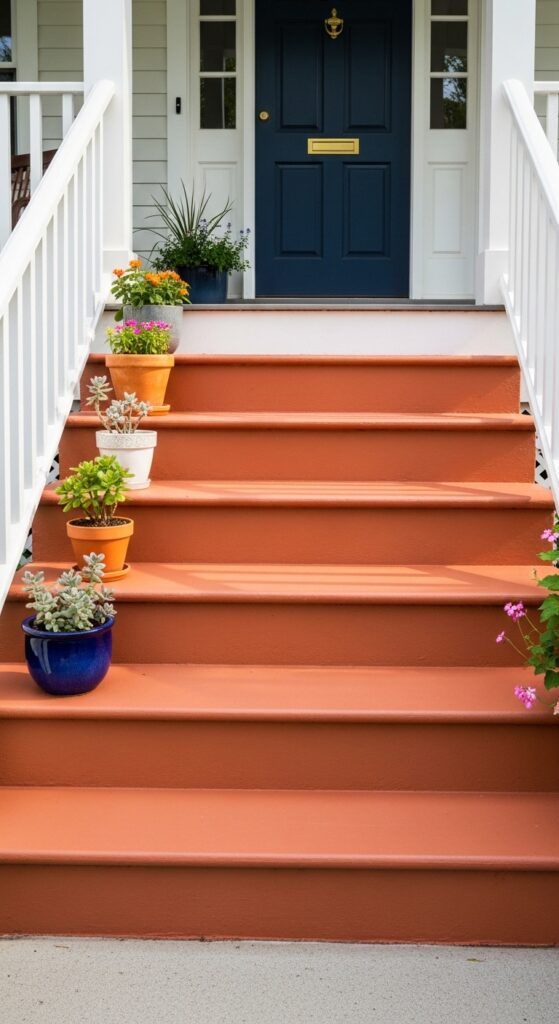
Vibe: The steps that begin the welcome before you’ve reached the top — warm, colorful, and climbing toward an even better door.
What makes it work: Painted porch steps draw the eye upward in a visual sequence that guides visitors naturally toward the front door — each step is a moment of color and design that builds anticipation for the entry itself. A contrasting color between the steps and the porch deck or surround creates a defined architectural reading of each individual tread, making the steps appear more sculptural and considered.
How to achieve it: Use exterior floor and step enamel specifically formulated for the abrasion demands of foot traffic — standard exterior wall paint will wear through within weeks on a step tread. Apply a non-slip additive (fine silica sand or commercial anti-slip granules) to the wet final coat on horizontal tread surfaces for safety. Seal the painted steps with an exterior concrete sealer annually to maintain color integrity and prevent moisture penetration.
💡 Stenciling a simple geometric border along the step risers adds a decorative detail that is visible from the street and costs under $20 in materials.
17. Copper or Aged Metal Planter Vessels
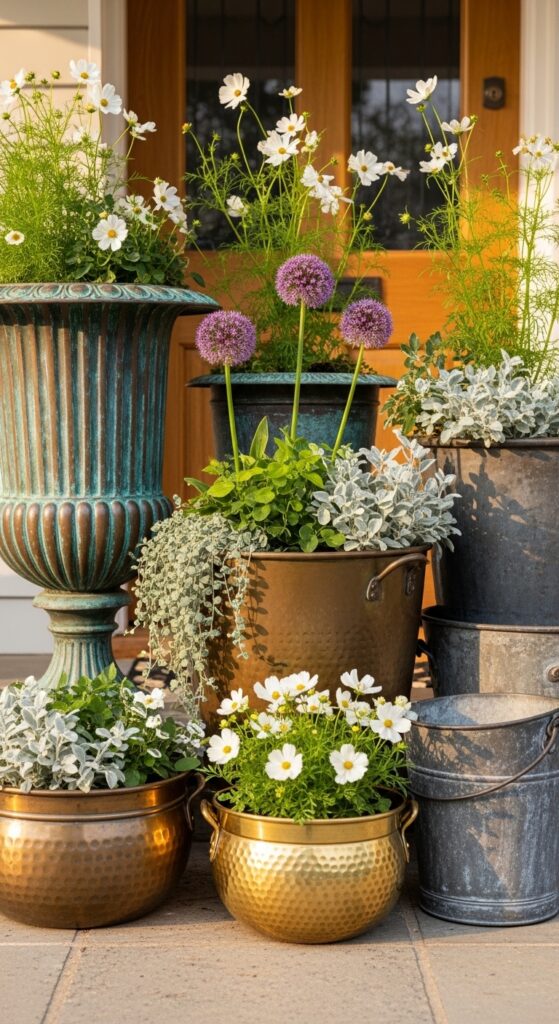
Vibe: Collected over a lifetime rather than purchased in an afternoon — vessels that glow with age and character and tell the story of someone with genuinely good taste.
What makes it work: Aged metal planters introduce a material warmth and patina that new terracotta, glazed ceramic, or fibreglass containers simply cannot replicate. The green oxidation on copper and the warm surface variation of hammered brass create vessels that become more beautiful with age and weathering — a direct reversal of most exterior materials, which deteriorate rather than improve over time.
How to achieve it: Source genuine aged copper and brass planters from antique markets, architectural salvage yards, and specialist garden antique dealers — the authentic patina of aged metal is nearly impossible to replicate convincingly with new faux-aged products. Alternatively, new copper planters will develop their own genuine patina within 12–24 months of outdoor exposure. Drill drainage holes in the base if not already present, using a metal drill bit with cutting oil.
18. Climbing Rose or Clematis on a Porch Column
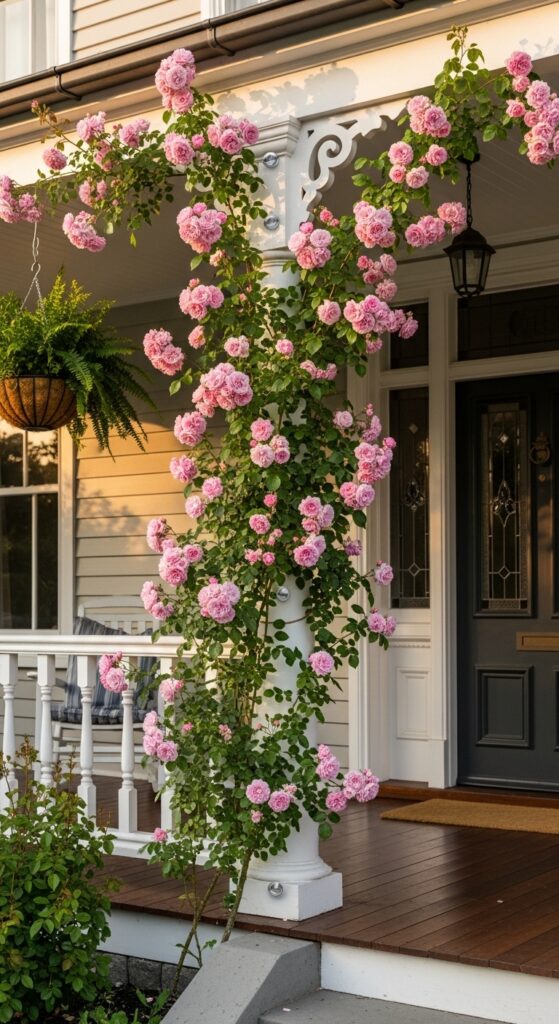
Vibe: The house that the rose chose — romantic, scented, and impossible not to stop and photograph from the pavement.
What makes it work: A climbing rose on a porch column achieves something no manufactured decoration can — a living, scented, seasonally evolving architectural feature that improves with every year of growth and becomes inseparably identified with the house itself. The rose frames the porch entrance organically, softening hard architectural lines and connecting the structure to the garden in the most beautiful way imaginable.
How to achieve it: Install stainless steel eye bolts in a spiral pattern up the column to guide the rose’s climbing stems — tie stems loosely with soft jute twine, never wire. Choose a repeat-flowering, disease-resistant climbing rose variety for maximum seasonal performance: Rosa ‘New Dawn,’ ‘Cecile Brunner,’ or ‘Compassion’ are classic choices with proven porch-pillar performance. Train horizontal rather than vertical stems wherever possible — horizontally trained stems produce dramatically more blooms than vertical ones.
19. Vertical Garden Wall Panel Beside the Door
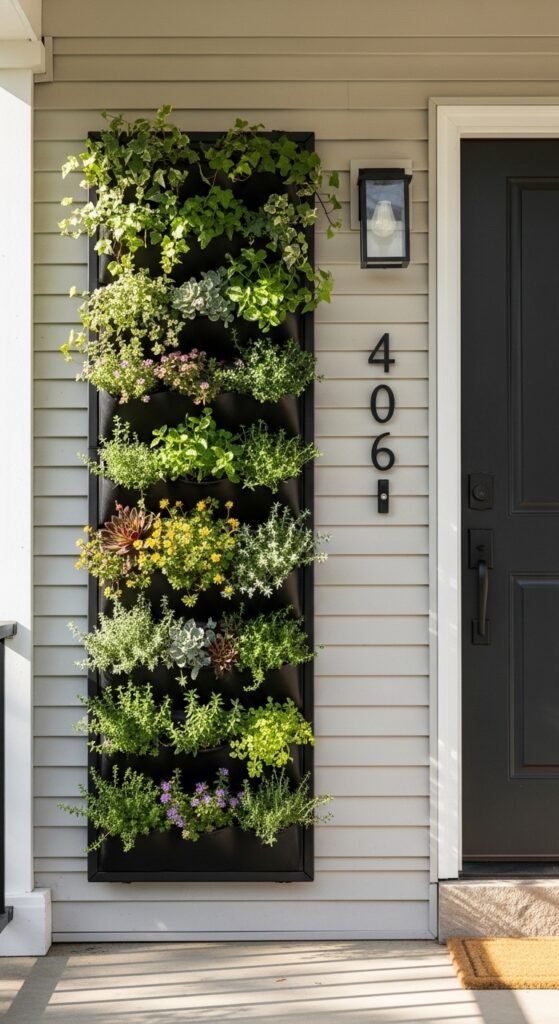
Vibe: A front door that arrived with its own garden — vertical, alive, and making the most of every available wall surface.
What makes it work: A vertical garden panel beside a front door solves the specific curb appeal challenge of a narrow porch with minimal floor space — it delivers maximum planting impact in a minimal footprint by using the vertical wall surface rather than competing for floor area with the door swing or foot traffic path. The living wall also provides a genuinely unique design element that no neighboring house is likely to replicate.
How to achieve it: Choose a modular pocket-system panel with built-in drip irrigation — hand-watering a vertical panel is impractical and will result in uneven plant health. Plant with a combination of trailing plants (ivy, string of pearls for sheltered porches), rosette forms (succulents, sempervivums), and upright herbs (thyme, oregano) for the most visually textured composition. Ensure the porch wall can support the combined weight of the panel system, growing medium, and plants when saturated — typically 40–60kg per square meter.
20. House Numbers as a Design Feature
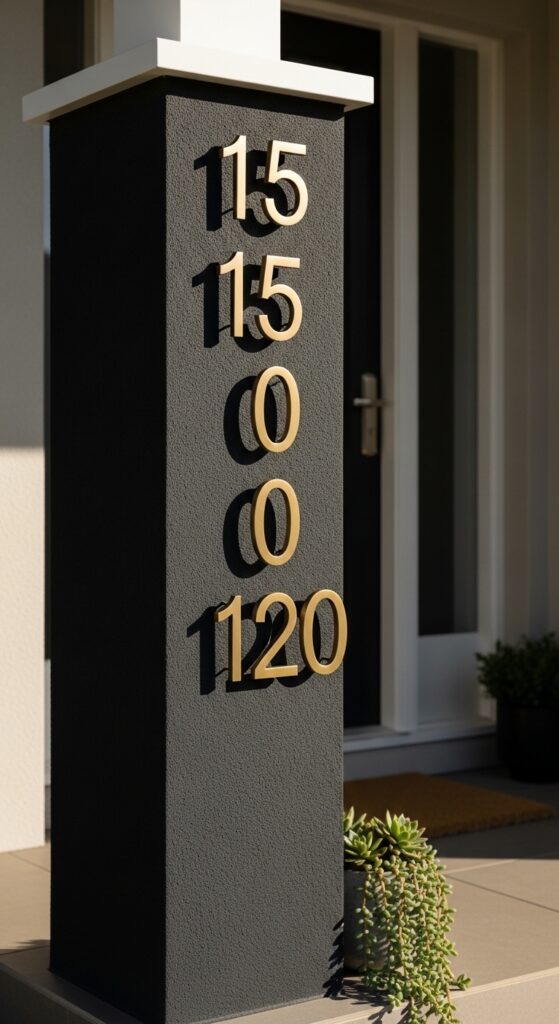
Vibe: An address that commands attention — house numbers so considered they become the detail everyone notices and no one can quite explain.
What makes it work: House numbers are among the most overlooked curb appeal elements despite being visible on every facade — the default small, flush-mounted numbers that come with most homes are a missed design opportunity. Oversized architectural numerals in a quality metal finish function simultaneously as a practical address marker and a genuine design feature, elevating the entire entrance composition through the addition of a single refined detail.
How to achieve it: Size numerals relative to the mounting surface — on a full pilaster, 150–200mm height reads correctly; on a smaller side panel, 100–120mm. Space individual numerals at 1–1.5 times the numeral width for breathing room. Mount on standoffs (small cylindrical spacers that hold the numeral 10–15mm from the wall surface) to create shadow depth and a three-dimensional quality — flush-mounted numbers always read as an afterthought by comparison.
💡 A contrasting painted backing panel in a darker tone behind the house numbers makes them legible from the street even in low light conditions.
21. Porch Ceiling Painted in “Haint Blue”
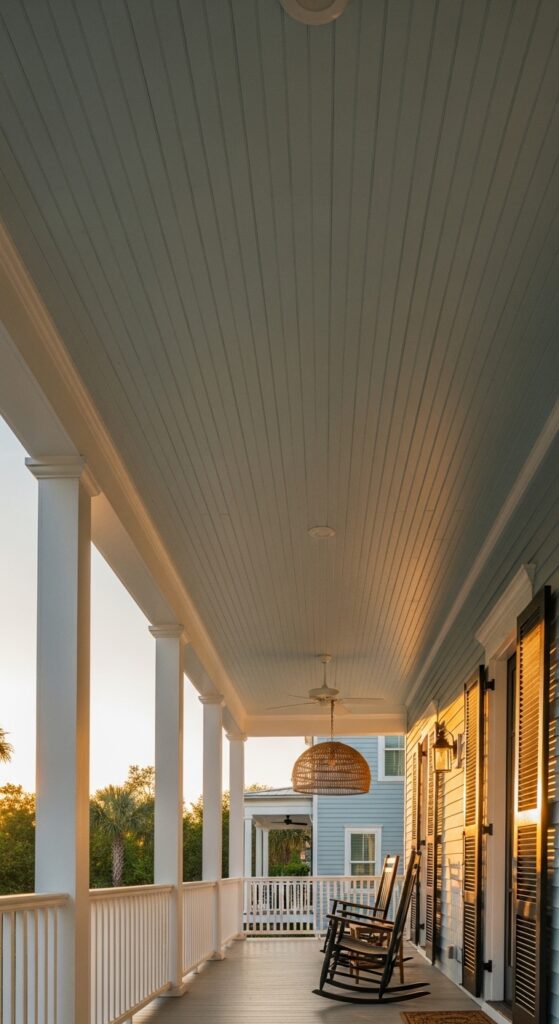
Vibe: A color with centuries of history and a porch that wears it with complete confidence — the blue that makes you look up and stay longer.
What makes it work: Haint blue porch ceilings are one of the most distinctive regional American architectural traditions, originating in the Gullah culture of the South Carolina Lowcountry and spreading across the American South as both superstition and extraordinarily effective design practice. The blue-grey color creates a visual extension of the sky, making the porch ceiling appear to recede and the space feel more open and airy than it physically is.
How to achieve it: Classic haint blue shades include Sherwin-Williams “Watery,” “Comfort Blue,” and “Quietude”; Benjamin Moore “Marlboro Blue” and “Palladian Blue”; and Farrow & Ball “Borrowed Light.” Apply in exterior eggshell rather than flat — the slight sheen reflects light downward onto the porch and is easier to clean than flat paint in an outdoor environment. The color should have a clear blue-grey or blue-green quality rather than lavender or pure blue.
22. Layered Door Mat and Rug Styling
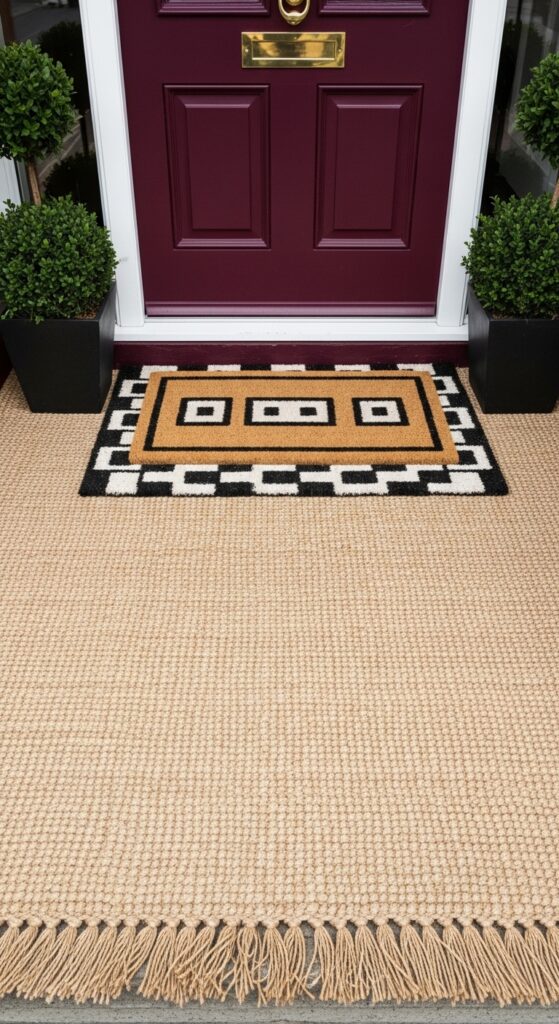
Vibe: The detail that stops every stylist in their tracks — a doorstep so considered it makes the rest of the street look like they forgot to finish.
What makes it work: Layered door mats apply the same design principle as layered rugs in interior design — the combination of a large neutral base layer with a smaller, more graphic top layer creates depth and visual richness that a single mat never achieves. The layered approach also makes a small porch stoop feel more generously proportioned and designed than its actual dimensions allow.
How to achieve it: Size the base jute rug to extend at least 150mm beyond the upper mat on all four sides — the border of the larger mat framing the smaller one is the entire visual logic of the layering. Use a non-slip pad between the two mats to prevent the upper mat from shifting and creating a trip hazard. Replace coir mats annually — they degrade significantly with weathering and foot traffic, and a worn doormat undermines all other curb appeal investments.
23. Potted Olive Tree as a Statement Porch Specimen
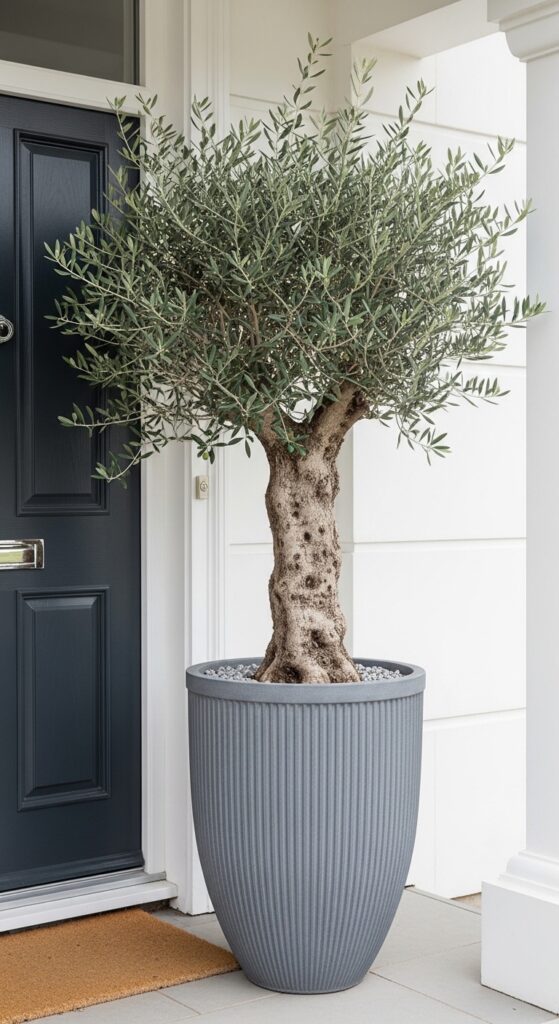
Vibe: Mediterranean permanence and silvery elegance — an olive tree that makes a front door feel like a villa entrance.
What makes it work: A potted olive tree brings a quality of permanence and sculptural character that seasonal flowering plants cannot approach — the gnarled, silver-barked stems and grey-green foliage create an architectural presence that reads from the street as a genuinely considered design choice. Unlike most porch specimens, an olive tree genuinely improves with age, developing more character and visual interest with every passing year.
How to achieve it: Olives in containers require excellent drainage — place the urn on pot feet for airflow beneath and ensure the drainage hole is generous and unobstructed. In climates with cold winters, choose frost-hardy olive varieties (Olea europaea ‘Cipressino’ tolerates temperatures to -10°C) or plan to overwinter the tree in a frost-free space. Top-dress the urn with silver pebble or grit for a clean, Mediterranean aesthetic.
24. Pergola or Trellis Frame Over the Porch Entry
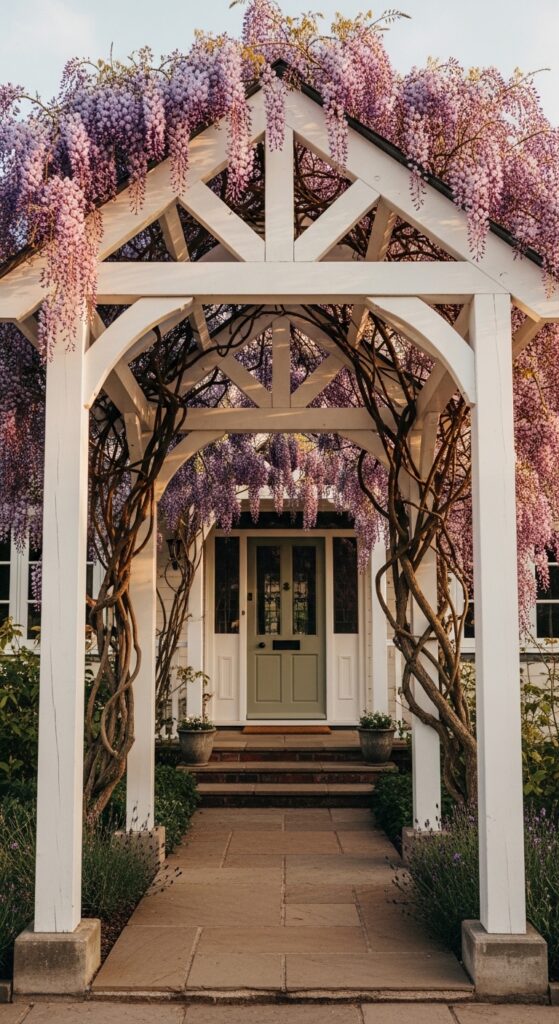
Vibe: The front entry that looks like a painting and smells like paradise for three weeks every spring — completely, embarrassingly beautiful.
What makes it work: A pergola or trellis entry frame creates an architectural transition between the garden and the house — a defined threshold that makes arriving home a choreographed experience with a beginning, middle, and end. Covered in a flowering climbing plant, the pergola becomes the single most visually dramatic curb appeal feature available, creating a seasonal spectacle that no paint, planting, or decoration at grade level can match.
How to achieve it: Construct the pergola frame from 100x100mm painted timber posts and 75x50mm rafters — these dimensions read as substantial and architectural rather than the spindly garden-center trellis structures that collapse under the weight of a mature climber within five years. Wisteria is spectacularly beautiful but vigorous and heavy — ensure the frame is properly engineered and the posts concreted into the ground minimum 600mm depth. Chinese wisteria (Wisteria sinensis) blooms before leaf break for maximum visual impact.
25. Outdoor Ceiling Fan for All-Season Comfort
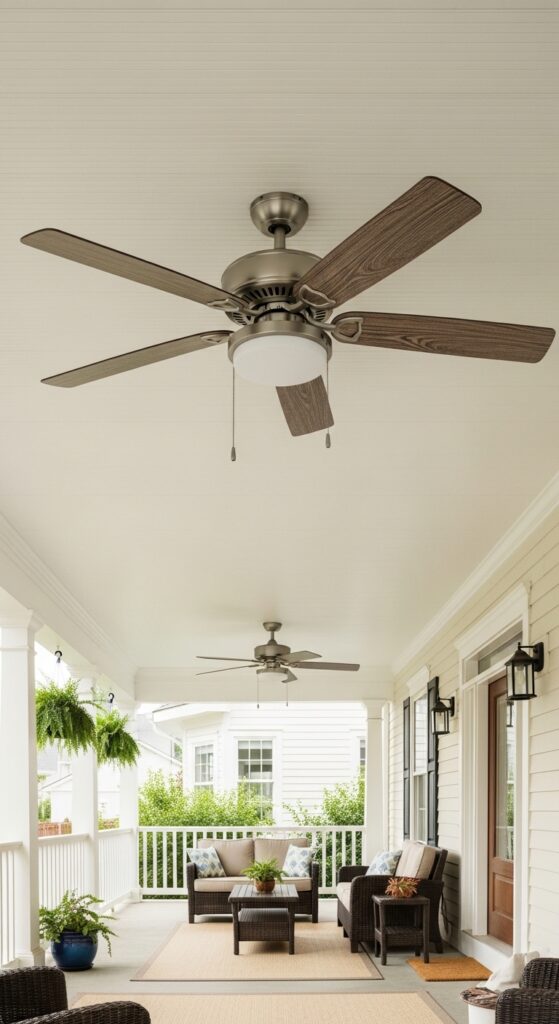
Vibe: The porch detail that turns a pleasant space into an all-season destination — cool in summer, de-stratified in winter, and constantly useful.
What makes it work: An outdoor ceiling fan transforms a covered front porch from a space that is uncomfortably hot three months of the year into a genuinely usable room across eight to ten months — making it one of the highest functional-return investments in porch improvement. In summer, the airflow makes humid heat bearable; in winter, running the fan in reverse at low speed de-stratifies warm air from the ceiling downward, adding measurable warmth.
How to achieve it: Choose a fan with an Outdoor or Wet rating (not simply Damp rated) for any porch exposed to occasional rain splash or humidity. Blade span should be sized to the porch area — 1.2m span for porches up to 15 square meters, 1.5m for larger spaces. Install on a fan-rated electrical box rated for the fan’s weight — standard light fixture boxes are not structurally adequate for ceiling fan installation.
26. Seasonal Container Garden Vignette on the Steps
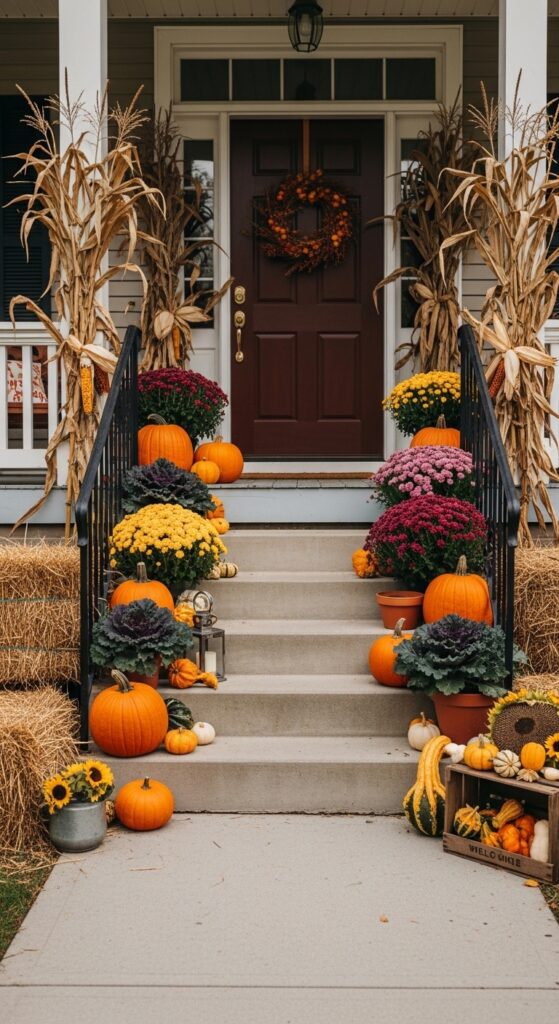
Vibe: An autumn welcome so generous and layered it stops people on the pavement — a step display that knows exactly how to celebrate the season.
What makes it work: A container vignette arranged across front steps applies the interior design principle of vignette styling to an exterior context — grouping objects at varied heights, textures, and scales to create a composed, narrative arrangement rather than a random collection. The steps themselves provide ready-made height levels that make the vignette naturally three-dimensional without any additional furniture or risers.
How to achieve it: Work in groupings of odd numbers — three pots, five gourds, seven stems — for arrangements that read more naturally than even-numbered compositions. Anchor the tallest elements at one side (corn stalks, tall lanterns, standard topiaries) and allow the display to graduate in height toward the lower steps. Replace the full display seasonally: spring bulbs in terracotta, summer annuals and grasses, autumn harvest, winter evergreen and berry.
27. Reclaimed Wood or Brick Porch Accent Wall
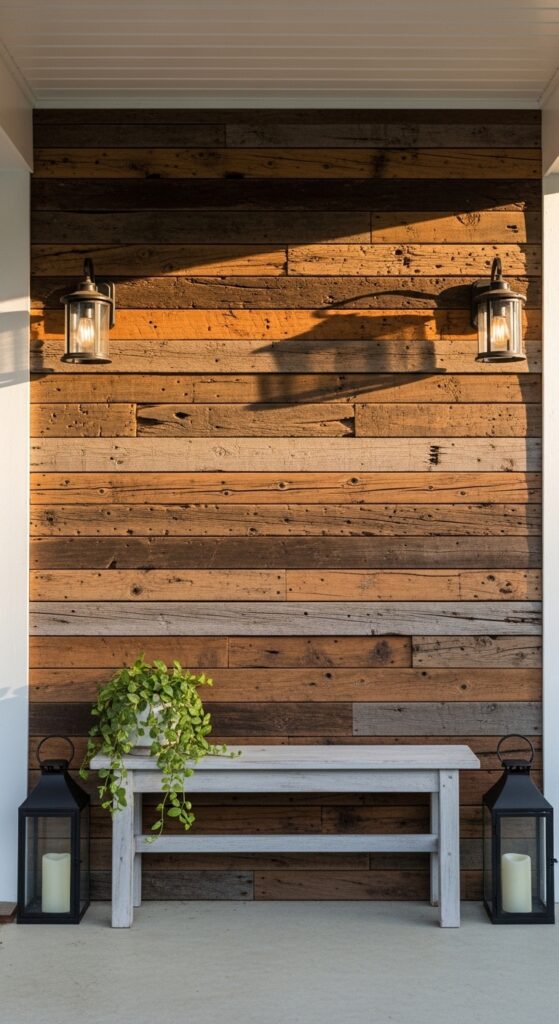
Vibe: A wall that has already lived a full life before it arrived at your porch — textured, warm, and carrying the most interesting stories.
What makes it work: Reclaimed timber brings a material authenticity and visual richness to a porch accent wall that new materials cannot approach — the varied weathering, nail holes, saw marks, and color variation of genuinely aged timber create a surface of extraordinary visual complexity that improves with examination. Against the simplicity of a painted porch surround, the reclaimed wall becomes an immediate focal point.
How to achieve it: Source reclaimed barn timber, pallet planks, or demolition timber from architectural salvage yards or specialist reclaimed timber suppliers — ensure any reclaimed exterior timber is clean of lead paint, structural nails, and rot before installation. Fix horizontally to vertical timber battens screwed to the existing porch wall, leaving a small shadow gap of 5–10mm between boards for drainage and the shadow-line aesthetic. Apply a penetrating oil sealer to stabilize the varied surfaces without obscuring the natural color variation.
💡 Reclaimed brick slips (thin brick veneers from demolished buildings) achieve a similar character on a porch accent wall with lower weight and simpler installation than full brick.
28. Monochromatic Porch Styling in One Refined Color
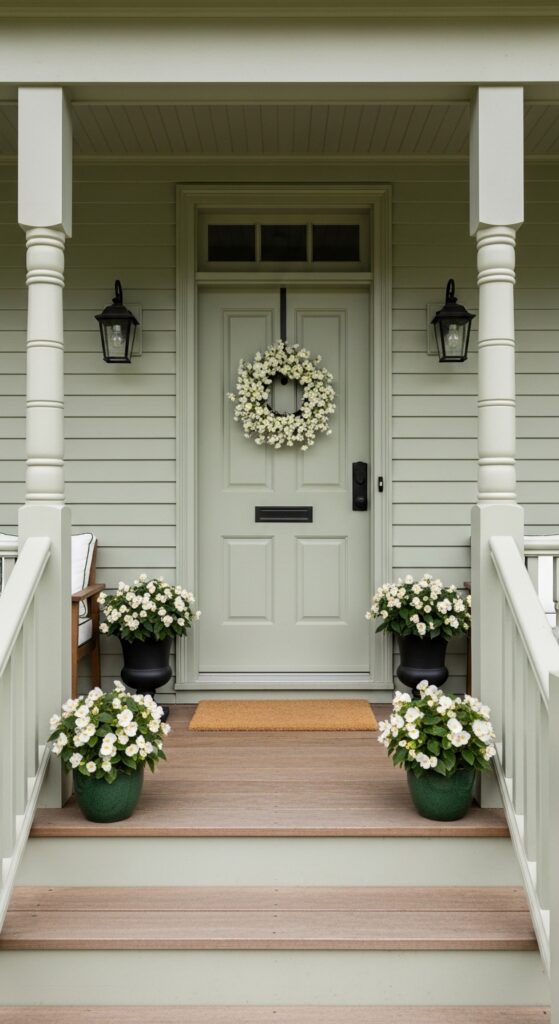
Vibe: The porch that proves that one color, done with complete conviction, is always more powerful than many colors done with hesitation.
What makes it work: Monochromatic exterior color schemes create a visual unity and sophistication that multi-color approaches rarely achieve — the eye reads the entire porch composition as a single, resolved design statement rather than a collection of separate choices. The deliberate repetition of a single color across multiple surfaces (door, railings, planters, cushions) has a cumulative visual weight that far exceeds the sum of its individual applications.
How to achieve it: The success of a monochromatic porch depends entirely on color quality — choose a sage green with a clear grey-green character rather than a yellow-green or blue-green variation, as the grey undertone keeps the composition sophisticated rather than playful. Paint all elements in the same exterior paint from the same batch to ensure absolute color consistency — subtle batch variations that seem minor at the paint desk become obvious when two surfaces are placed side by side.
How to Start Your Front Porch Curb Appeal Transformation
Begin with an honest assessment from the street. Walk to the edge of your property, turn, and look at your front porch as a stranger would — identifying what draws the eye first, what feels unresolved, and what is simply absent. Take a photograph from this position on your phone and study it on screen, which reveals visual imbalances and proportion issues that your eye habituates to in person. This single exercise will identify your two or three highest-priority changes more accurately than any amount of browsing inspiration images.
The most universally impactful starting point for any porch is the front door — specifically its paint color and hardware. A freshly painted door in a considered, bold color paired with quality hardware (door knocker, handle, letter box, and house numbers in a coordinated metal finish) transforms the primary focal point of the facade at relatively modest cost. Budget $150–300 for a full door repaint with quality exterior enamel and new hardware, and expect a curb appeal return that consistently exceeds any equivalent interior spend.
Once the door is addressed, move outward in concentric circles of influence: the door surround and trim, then the porch floor and ceiling, then the flanking planting and lighting, then the path and garden. This sequence ensures each investment builds on the previous one rather than competing with an unresolved centerpiece.
Budget realistically: the highest-impact curb appeal changes — door repaint, new hardware, matching planters, quality lanterns, and a seasonal wreath — can be achieved for $500–1,000 and will transform the facade visibly. More substantial investments in porch furniture, overhead lighting, structural additions like pergolas, and climbing plants extend that transformation into a genuinely complete outdoor room design over a longer timeline and larger budget.
Frequently Asked Questions
What color should I paint my front door for maximum curb appeal?
The front door colors with the most consistently positive curb appeal impact are deep navy, forest green, classic red, glossy black, and warm terracotta — in that approximate order of current design popularity. The most important principle is contrast: the door should be distinctly darker or distinctly lighter than the surrounding trim and facade, creating a clear focal point. In a high-gloss finish, almost any strong color reads as intentional and sophisticated. Navy and forest green are the most versatile choices across the widest range of architectural styles and facade colors; black works best on homes with white or near-white exteriors; terracotta suits warm-toned brick or render facades particularly well.
How do I add curb appeal to a very small front porch or stoop?
Small or minimal porch spaces respond best to vertical investments rather than horizontal ones — a bold door color, quality lanterns at the correct architectural scale, a statement wreath, and tall potted topiaries on either side of the door all add visual impact without requiring floor space. A layered door mat arrangement defines the threshold clearly on even the smallest stoop. If the stoop has any steps, styling them with a graduated container vignette uses the existing architectural geometry to create the impression of a more generous porch space than actually exists. Avoid cluttering a small space with too many elements — three to four well-chosen, correctly scaled pieces always read better than eight underdeveloped ones.
What plants work best in front porch containers?
The most reliable front porch container plants are those that perform through your longest seasonal window without constant intervention. For full-sun south or west-facing porches: geraniums, petunias, calibrachoa, and annual salvias in summer; pansies and cyclamen in spring and autumn. For shaded or north-facing porches: impatiens, begonias, fuchsias, and ferns in summer; cyclamen year-round. For year-round structure regardless of aspect: clipped boxwood or Japanese holly topiaries, bay standards, and olive trees in containers provide permanent architectural presence that seasonal annuals cannot. The thriller-filler-spiller formula applies to every container regardless of plant selection — one tall central plant, medium filler, trailing edge plant.
How much does a front porch makeover typically cost?
Front porch curb appeal makeovers range from under $200 (fresh door paint, new hardware, two matching planters with seasonal plants, a quality wreath) to $5,000–15,000 (new porch furniture, professional landscaping, electrical work for new lighting, pergola installation, and full exterior repaint). The majority of the ideas in this article fall in the $100–500 range per individual element, making it entirely realistic to achieve a dramatic full porch transformation for $1,500–3,000 through a combination of DIY and selective professional work. The highest-value investments in terms of visual return per dollar spent are consistently: front door repaint, quality lanterns, matching planters with topiaries, and porch string lighting.
How do I choose the right scale of furniture and accessories for my porch?
The most common curb appeal mistake is undersized accessories — lanterns too small for the doorway, planters too small for the facade, a doormat too narrow for the door width. Scale everything to the largest architectural element it relates to: lanterns to door height (minimum one-quarter the door height), planters to the door width (each planter should be minimum one-third of the door width), and the doormat to the door width (minimum as wide as the door itself). From the street, details read at significantly reduced scale — what feels generous in person reads as correct from the pavement. When in doubt, choose the larger option.
Ready to Create Your Dream Front Porch?
These 28 front porch curb appeal ideas cover every dimension of exterior transformation — from the first coat of bold door paint to the mature climbing rose that frames the entrance with scented abundance. The most important thing to remember is that curb appeal is cumulative: each thoughtful detail adds to the ones before it, building toward a front porch that is greater than the sum of its parts. Save the ideas that speak most directly to your home’s architectural character, your personal style, and your practical constraints — and begin with the single change that will have the most immediate and visible impact.
A beautiful front porch doesn’t announce itself loudly. It simply makes everyone who approaches feel unexpectedly, inexplicably glad to be arriving — which is the most generous thing a home can do for the people who love it. Start with one decision, make it with confidence, and let the porch build from there. The street is ready to be surprised.