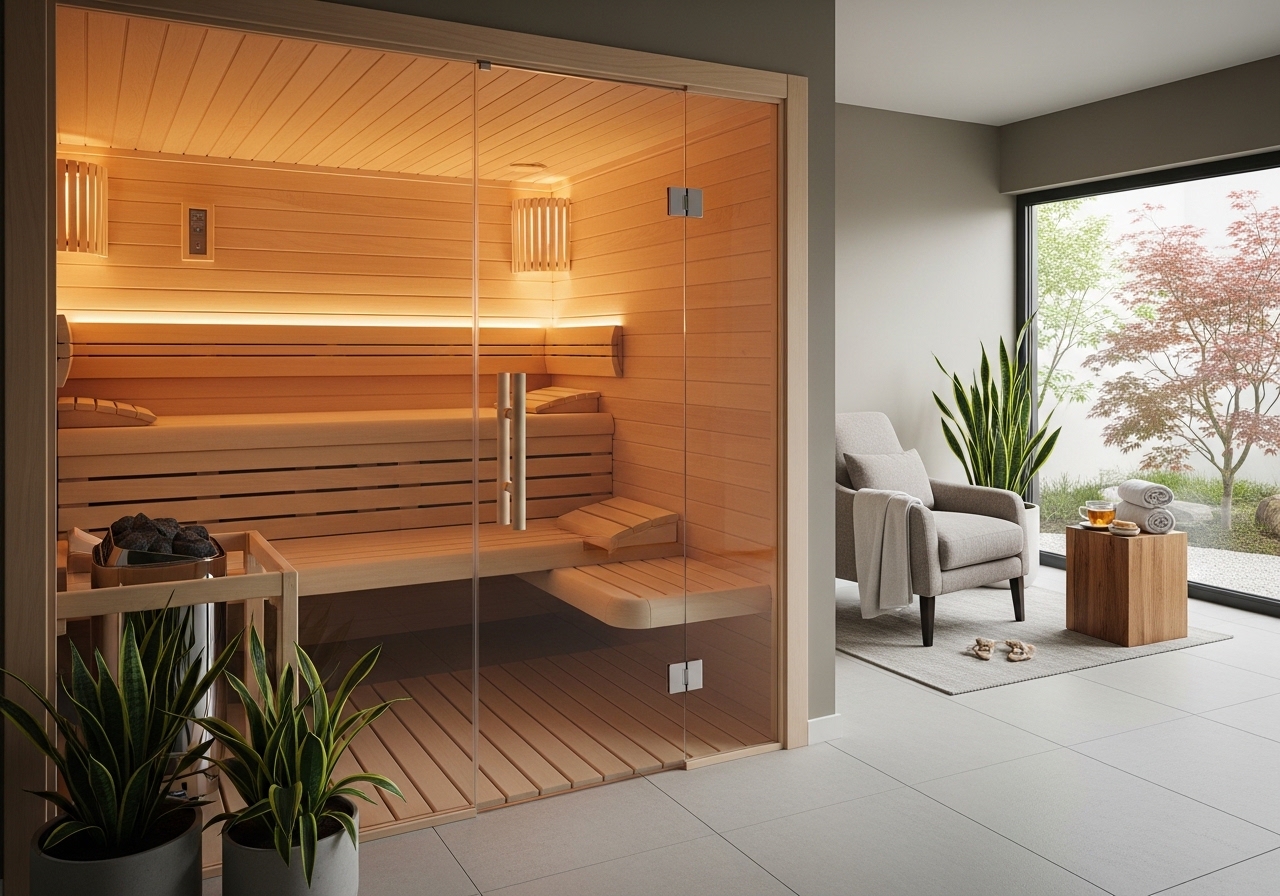
Something shifts the moment you step into a beautifully designed sauna — the noise of the day falls away, the body surrenders to the heat, and for a while, nothing exists except the warmth of wood and the quiet of a space built entirely for restoration. A home sauna retreat styled with genuine intention is not a luxury in the traditional sense; it is a daily gift to the self, as essential and as nourishing as any other act of care. These 30 completely fresh sauna aesthetic ideas explore angles, concepts, and design directions entirely different from the familiar — from cave-inspired rock grottos to minimalist glass pods, from maximalist botanical sanctuaries to raw concrete and steel industrial wellness rooms. Every idea here is specific, achievable, and worth saving. Here are 30 ideas worth exploring.
Why Sauna Aesthetic Home Spa Design Works So Well
The home sauna aesthetic works as a design category because it operates at the intersection of two powerful human needs: the need for genuine physical restoration and the need for a space that feels meaningfully set apart from ordinary life. When a sauna is designed with real aesthetic intention — not merely installed as an appliance but conceived as an environment — it creates a psychological threshold that the body recognizes and responds to before the heat even begins to work.
What distinguishes exceptional sauna aesthetic design from merely functional sauna installation is the understanding that every sensory channel matters simultaneously. The visual warmth of the materials, the sound of water on hot stones, the aromatic complexity of heated wood, the tactile contrast between smooth bench and rough stone — these are not decorative extras but the fundamental ingredients of a restorative experience. Great sauna design orchestrates all of them deliberately.
The home spa and sauna movement continues to accelerate across every segment of residential design, from compact urban apartments to expansive rural retreats. What has changed most significantly in recent years is the democratization of the aesthetic — the understanding that a beautifully designed sauna experience does not require a vast dedicated space or an unlimited budget, but rather the same qualities that distinguish any well-designed room: clarity of intention, quality of material, and genuine attention to how the space will be experienced by the human body moving through it.
The most exciting frontier in contemporary sauna aesthetic design is the integration of sauna spaces with the broader architectural and landscape context of the home — saunas that emerge from garden landscapes, that frame views of water or forest, that connect interior and exterior through glass and deck and water in ways that make the wellness ritual feel genuinely embedded in the life of the home rather than appended to it.
Raw Concrete and Cedar Contrast Interior
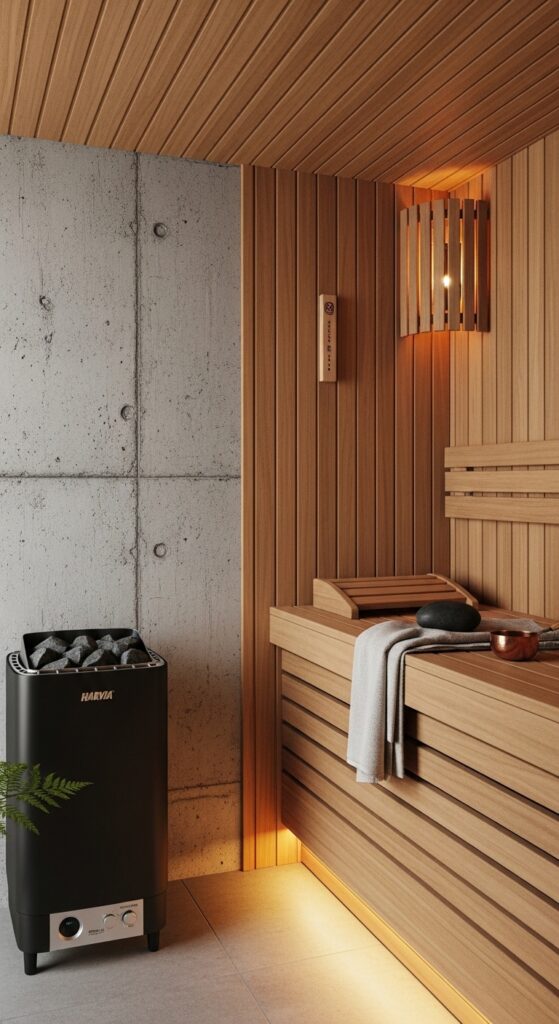
Vibe sentence: Raw concrete beside warm cedar is the material conversation that defines contemporary wellness design — industrial honesty meeting ancient warmth in a single room.
What makes it work: The deliberate pairing of poured concrete (cool, dense, structural) with cedar paneling (warm, aromatic, organic) creates a textural and tonal contrast that makes both materials read more intensely than they would in isolation. The concrete’s cool gray amplifies the warmth of the cedar beside it, while the cedar prevents the concrete from reading as cold or uninviting. This is a design tension that feels genuinely resolved rather than merely experimental.
How to achieve it: Use board-formed concrete panels (pre-cast concrete panels with formwork texture) as a cladding system applied over standard wall framing — this avoids the structural complexity of poured-in-place concrete while achieving the identical visual result. Ensure the concrete surface is sealed with a heat-stable penetrating sealer before installation. Pair with vertical cedar paneling on the opposing walls and a matte black kiuas for complete palette cohesion.
💡 Leave the concrete unsealed on the lower 12 inches of the wall — the slight moisture darkening that occurs near floor level deepens the material character beautifully.
Cave Grotto Sauna With Natural Rock Walls
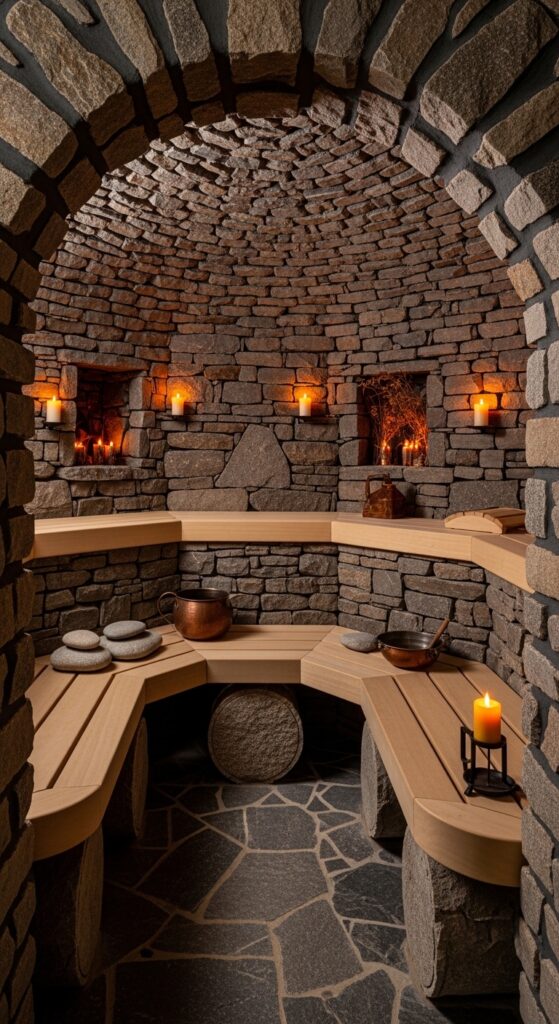
Vibe sentence: A cave grotto sauna returns the heat ritual to its most ancient and instinctive form — the warm stone shelter that has been humanity’s refuge since the beginning.
What makes it work: Natural stone has one of the highest thermal masses of any building material — once heated, it stores and radiates warmth for hours after the heat source has been reduced. A stone-walled sauna therefore develops a deeply enveloping, radiant warmth that feels qualitatively different from a wood-paneled interior — softer, more surrounding, more ancient. The irregular surfaces of natural fieldstone also create extraordinary acoustic absorption, making stone saunas remarkably quiet and still.
How to achieve it: Use natural fieldstone or basalt veneer panels (available from stone merchants as thin-cut facing stone) over standard wall framing — full-thickness stone construction is structurally impractical in most residential settings. Apply with heat-stable natural hydraulic lime mortar, which has a softer, more organic appearance than Portland cement. Embed waterproof warm amber LED puck lights in the mortar joints during construction for integrated ambient lighting.
Scandinavian All-White Sauna With Snow View
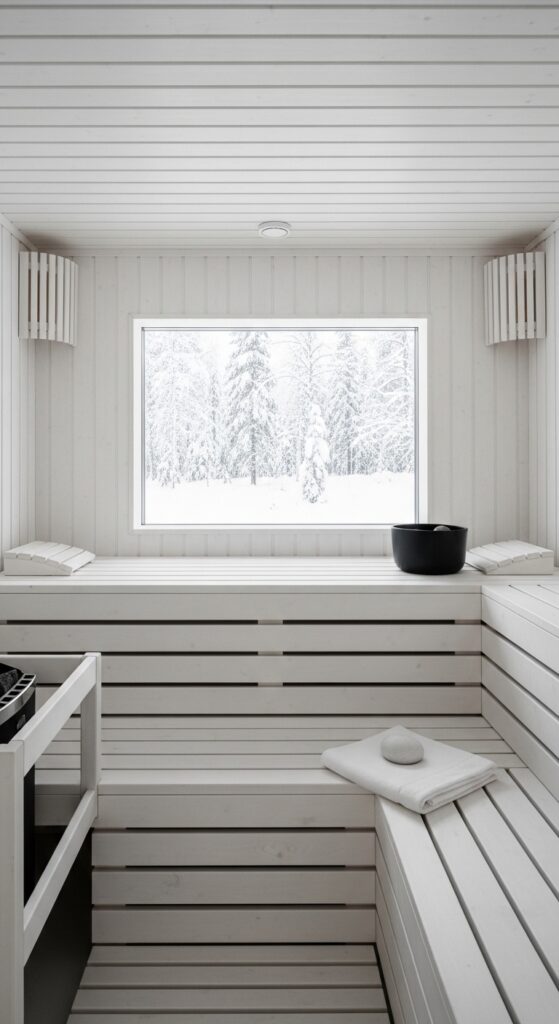
Vibe sentence: An all-white sauna in winter is a meditation on the beauty of nothing — pure, cold light from the snow outside, pure warm air within.
What makes it work: White-painted sauna interiors are a distinctly contemporary Scandinavian design choice — the paint does not affect the wood’s ability to breathe or regulate humidity when a heat-stable, water-based mineral paint is used, while the white surface reflects light back into the sauna, creating a brighter, more expansive interior that reads as luxurious in a different register from the warmth of natural wood. Against a winter snow landscape visible through a large window, the effect is extraordinary.
How to achieve it: Use a heat-stable, zero-VOC mineral or chalk-based paint rated for sauna use — standard latex paints will off-gas in high heat. Saunainter and Supi Saunavaha both manufacture sauna-specific white treatments. Paint all surfaces including bench tops, then seal bench surfaces only with a heat-stable sauna wax for skin comfort. Maintain the single-dark-element rule rigorously — the matte black kiuas as the sole contrast is essential to the design.
Treehouse Sauna Platform in the Forest Canopy
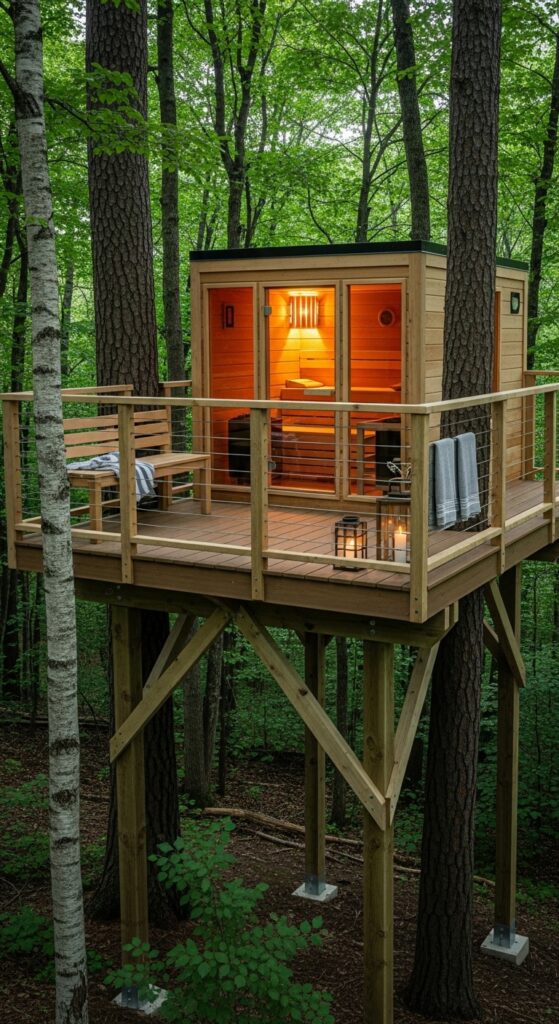
Vibe sentence: A treehouse sauna at canopy level makes every session feel like the beginning of a fairytale — warm, suspended, entirely removed from the ground and everything on it.
What makes it work: Elevation transforms the sauna experience by changing the relationship between the interior and the surrounding landscape — at canopy level, the bather is immersed in the forest from within rather than looking up at it from below. The rustling of leaves, the filtered quality of light through the canopy, and the sense of suspension above the earth all contribute to a profoundly meditative quality that ground-level structures cannot achieve regardless of their design quality.
How to achieve it: Build the platform structure from pressure-treated timber posts with a composite or hardwood decking surface. The sauna cabin itself sits on the platform on a standard floor framing system — the platform simply replaces the ground as the foundation. Ensure structural engineering review for the post foundation system, particularly in areas with frost heave or wind loading. A compact 6×8 foot sauna cabin at platform level is typically sufficient for one to two people.
Industrial Steel Frame Sauna With Wire Glass Panels
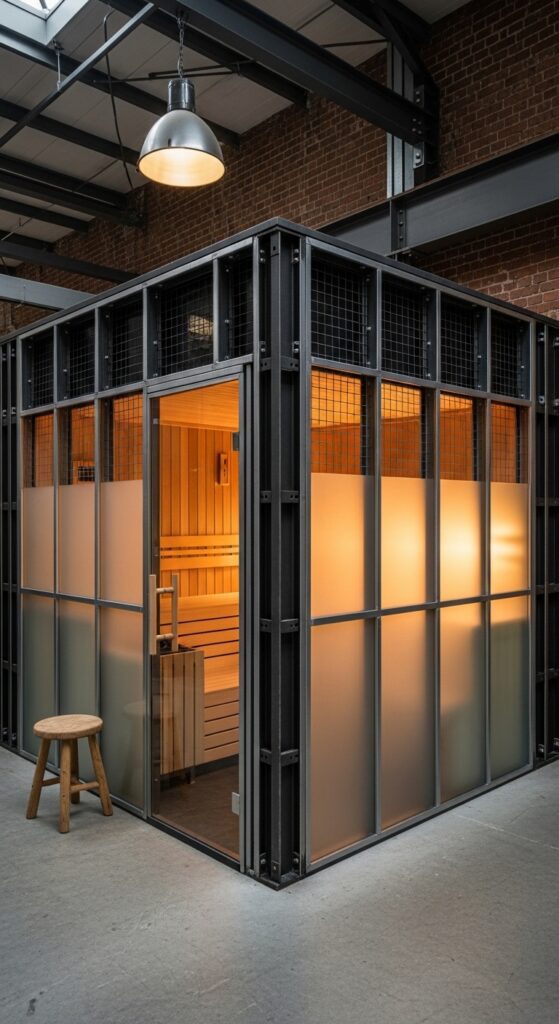
Vibe sentence: A steel-framed glass sauna enclosure in an industrial loft is the most architecturally honest thing you can build in a converted warehouse — it makes no apology for what it is.
What makes it work: Using an exposed structural steel frame as the sauna enclosure in an industrial loft setting creates a building-within-a-building effect that is both architecturally compelling and practically excellent — the sauna’s thermal envelope is clearly defined, the surrounding loft space remains open and unconstrained, and the warm cedar glow visible through the glass panels creates a beautiful visual focal point in the larger space. The steel frame also allows the enclosure to be disassembled and reconfigured, making it appropriate for rental spaces.
How to achieve it: Fabricate the steel frame from 100x100mm box section steel with a matte black powder coat finish. Infill with 10mm toughened safety glass (frosted or clear) in steel glazing beads. The cedar interior is a self-contained lining within the steel frame, with appropriate thermal breaks between the steel and the interior to prevent the frame from conducting heat to the exterior glass panels. Ensure adequate ventilation in the surrounding loft space.
Desert Adobe Sauna With Earthen Plaster Walls
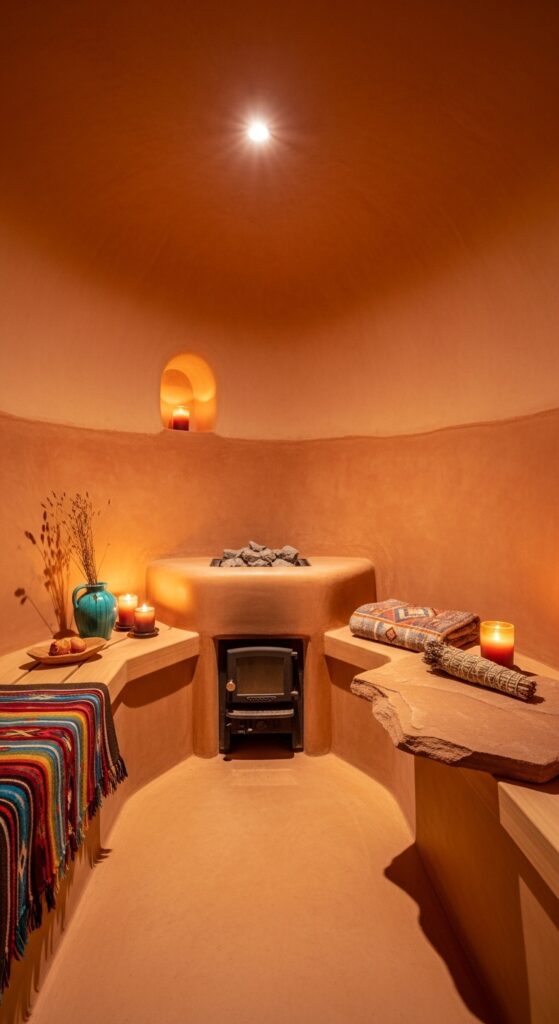
Vibe sentence: An adobe sauna draws on 5,000 years of desert peoples understanding the restorative power of dry heat within earthen walls — and every session honors that lineage.
What makes it work: Earthen plaster (adobe or cob) is one of the oldest and most thermally intelligent building materials in existence — it has exceptional thermal mass, regulates humidity naturally, and creates the dry heat environment that is both the traditional and physiologically optimal condition for a desert-style sauna. The smooth, hand-troweled surface of earthen plaster develops a subtle color variation across its area that is impossible to replicate with any manufactured finish.
How to achieve it: Apply earthen plaster (a mix of clay, sand, and natural fiber such as chopped straw) in two or three coats over standard drywall or a scratch coat base. American Clay and Clayworks both manufacture ready-mixed earthen plaster in a range of warm desert tones. The final burnished coat, applied with a steel trowel while still slightly wet, creates the characteristic smooth, slightly mottled surface. Seal with a natural linseed oil wash for moisture resistance.
💡 Add a small amount of mica powder to the final earthen plaster coat for a subtle mineral shimmer that catches candlelight beautifully.
Floating Sauna on a Private Lake or River
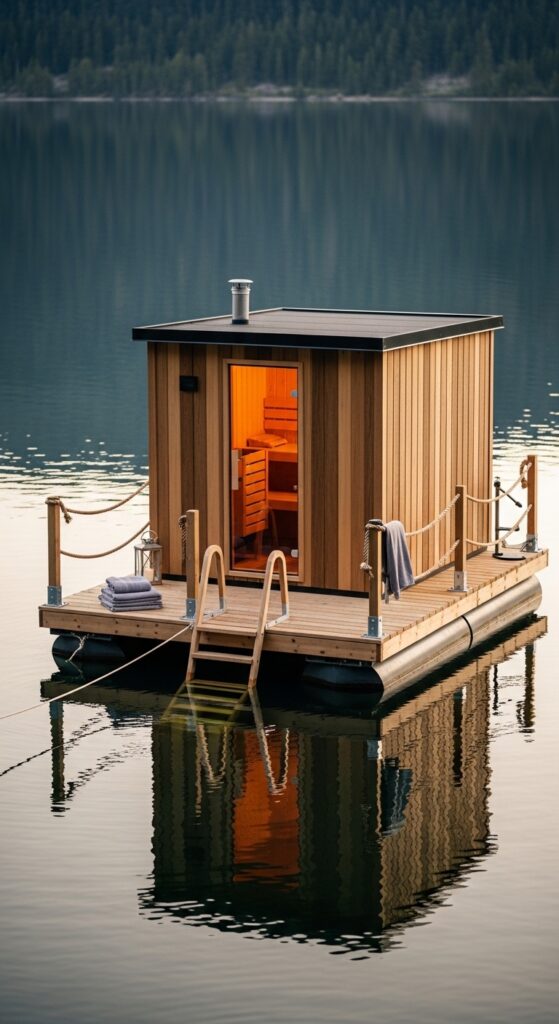
Vibe sentence: A floating sauna on still water makes the cold plunge not merely possible but inevitable and magnificent — you simply open the door, walk three steps, and enter the lake.
What makes it work: A floating sauna eliminates entirely the spatial and logistical challenge of creating a cold plunge facility — the cold water is already there, surrounding the structure on all sides, accessible from a simple deck ladder. The experience of moving from a 185°F sauna interior directly into a cold lake or river is one of the most physiologically powerful wellness protocols available, and the visual experience of the water landscape in all directions amplifies the psychological impact of the session immeasurably.
How to achieve it: Floating sauna pontoons are available as manufactured platforms from specialist marine construction companies, or can be built from steel box section with HDPE foam flotation blocks. The sauna cabin sits on the pontoon deck on standard floor framing with appropriate marine-grade fixings. Ensure compliance with local maritime and waterway regulations — permits are typically required for permanent floating structures on navigable waterways.
Maximalist Botanical Sauna With Dried Flower Ceiling
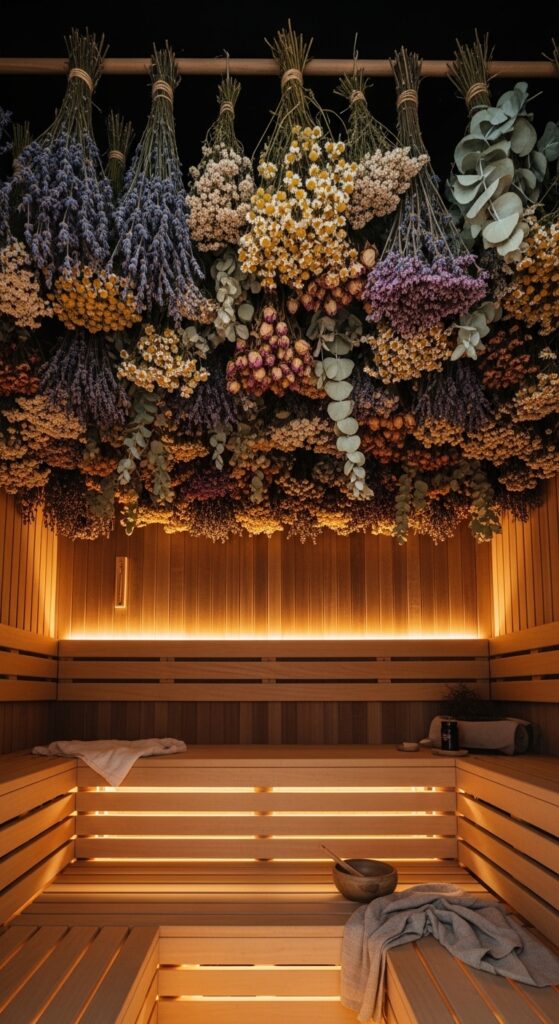
Vibe sentence: A ceiling of suspended dried botanicals in a sauna turns aromatherapy from an accessory into an architecture — you are quite literally bathing inside the herbs.
What makes it work: Dried botanicals suspended from the ceiling of a sauna release their essential oils gradually and continuously as the ambient temperature rises, creating a layered aromatic environment that evolves throughout the session as different botanical compounds volatilize at different temperatures. Lavender releases linalool at lower temperatures; eucalyptus releases cineole at higher heat; chamomile releases warm, apple-scented esters throughout — the aromatic experience is genuinely complex and genuinely therapeutic.
How to achieve it: Suspend dried botanical bundles from ceiling-mounted wooden dowels using natural jute twine — the hanging system should allow bundles to be replaced individually as their aromatic potency diminishes. Use only heat-safe, untreated botanical material: commercial dried flowers are often treated with preservatives that off-gas unpleasant compounds in heat. Source directly from herb farms or dry your own. Replace botanicals every four to six weeks or when aroma diminishes.
Scandinavian Smoke Sauna (Savusauna) Aesthetic
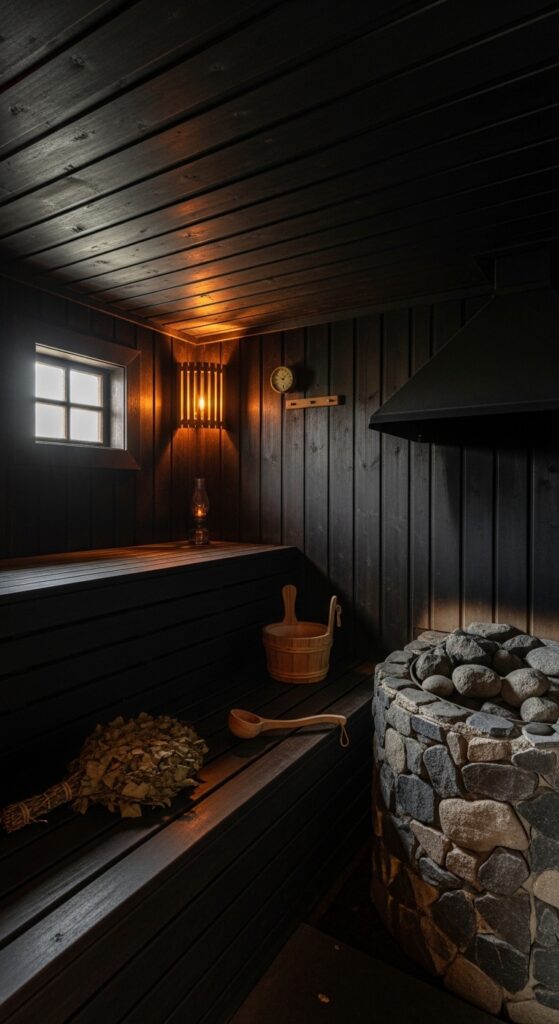
Vibe sentence: The savusauna is the oldest sauna in human history — no chimney, no electricity, no compromise — just fire, stone, smoke, and the profound simplicity of a tradition unchanged for a thousand years.
What makes it work: The smoke sauna (savusauna) predates the chimney by centuries — the kiuas is heated for several hours by an open fire inside the sauna, which fills the space with smoke. Once the fire dies and the smoke clears (2–4 hours), the sauna reaches its bathing temperature and the smoke-blackened interior releases a complex, resinous warmth unlike any other sauna experience. The steam produced by water on smoke-sauna stones is described by those who have experienced it as softer, silkier, and more enveloping than conventional sauna steam.
How to achieve it: Authentic savusauna construction requires a specialist experienced in traditional Finnish smoke sauna building — the kiuas size, firebox design, and ventilation system are specific and cannot be improvised safely. Finnish sauna builders such as Helo and specialist traditional constructors offer savusauna design services. Ensure local fire safety and planning regulations are consulted before construction — the open fire and lack of chimney present specific regulatory considerations in most Western jurisdictions.
Mirrored Ceiling Sauna for Infinite Reflection
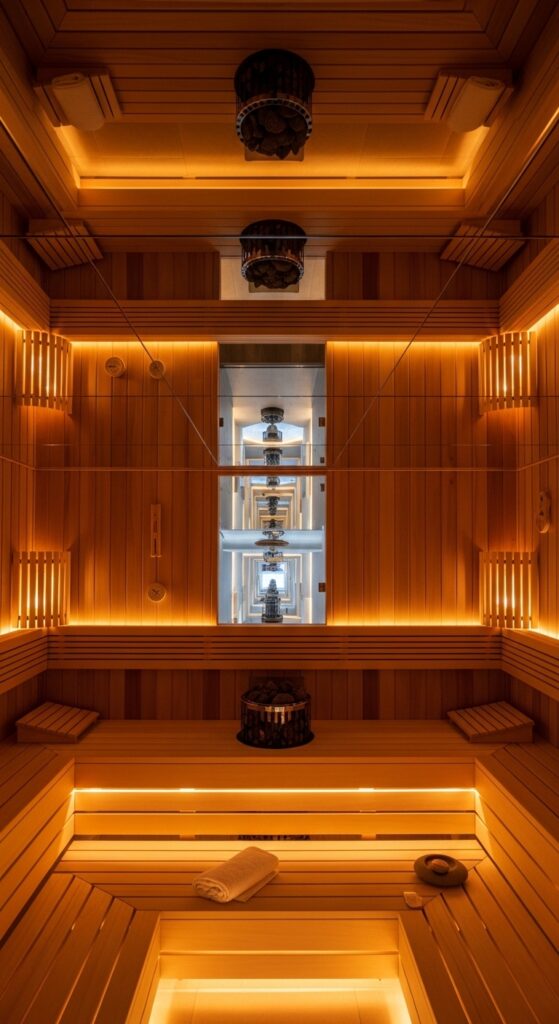
Vibe sentence: A mirrored ceiling in a sauna dissolves the boundary between the room and its reflection, creating a space that feels genuinely boundless — the most unexpected luxury.
What makes it work: A mirror ceiling in a compact sauna interior eliminates the psychological experience of a low ceiling — the reflected space appears to extend upward indefinitely, transforming a small enclosure into a room of apparent limitless vertical scale. The reflection of warm amber lighting and cedar paneling in the mirror creates a doubled warmth that amplifies the visual richness of the interior significantly, while the reflection of the rising steam creates a meditative, almost hypnotic visual movement during active sessions.
How to achieve it: Standard mirrors are not appropriate for sauna installation — the heat and humidity will degrade the silver backing within months. Specify heat-rated stainless steel mirror panels or a specialist sauna mirror system. Install on a ventilated backing to allow moisture to escape from behind the panel. Ensure all fixings are stainless steel rather than standard zinc or nickel, which will corrode in the humid environment.
Tented Fabric Sauna Pavilion for Garden Events
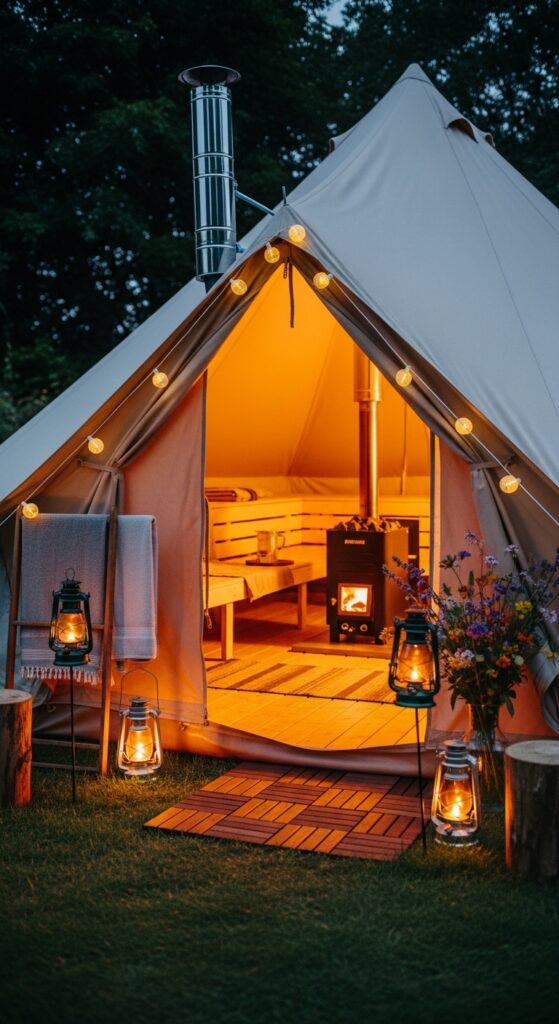
Vibe sentence: A canvas tent sauna in a garden on a summer evening is the most communal, most romantic, most wonderfully impermanent wellness experience you can create.
What makes it work: Canvas naturally regulates humidity — the breathable fabric allows moisture to escape while retaining heat, creating a naturally balanced sauna environment without mechanical ventilation. The warm glow of a lit canvas tent from outside is one of the most visually beautiful effects in any garden setting, and the temporary, gathering-oriented nature of a tent sauna makes it inherently social in a way that a permanent structure often is not.
How to achieve it: Source a heavyweight (400–600gsm) natural canvas bell tent of minimum 5 meters diameter — smaller tents heat rapidly but provide limited space for movement. Use a specifically designed tent wood stove with a chimney pipe and canvas flashing kit — never use a standard indoor stove in a tent environment without the appropriate chimney exit. Install a wooden board floor or interlocking deck tiles over the ground for comfort and hygiene.
💡 Line the interior tent walls with a thin reflective thermal blanket behind a cotton inner lining to significantly improve heat retention.
Sauna With Integrated Cold Waterfall Feature
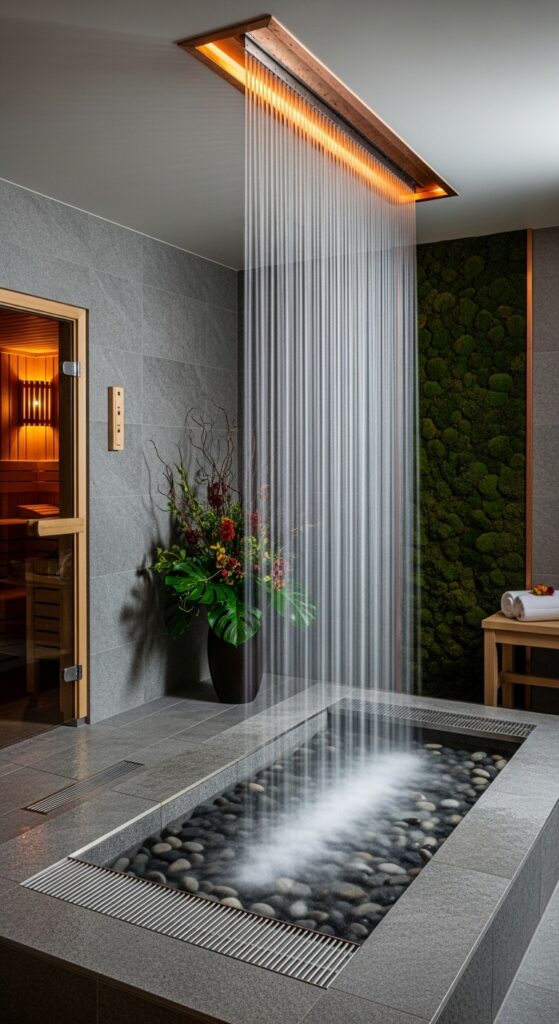
Vibe sentence: A cold waterfall sheet you walk through on the way from the sauna is the single most dramatically satisfying wellness moment a home can contain.
What makes it work: A sheet waterfall cold shower provides a full-body cold exposure experience that is simultaneously more controlled and more dramatic than a standard shower or plunge pool — the thin, even curtain of cold water covers the entire body simultaneously in a single step-through motion, creating an instant and complete thermal contrast that triggers the full vasoconstrictive physiological response in seconds. The visual and acoustic qualities of falling water also contribute significantly to the sensory richness of the space.
How to achieve it: A sheet waterfall is created by a linear overflow channel (in copper, stone, or stainless steel) with a precisely leveled lip that allows water to flow evenly across its full width. The channel is fed by a recirculating pump drawing from the collection pool below, passing through a chiller unit to maintain cold temperature. The entire system requires plumbing, electrical, and potentially refrigeration engineering — budget accordingly for professional installation.
Japanese Ofuro Bathing Room Adjacent to Sauna
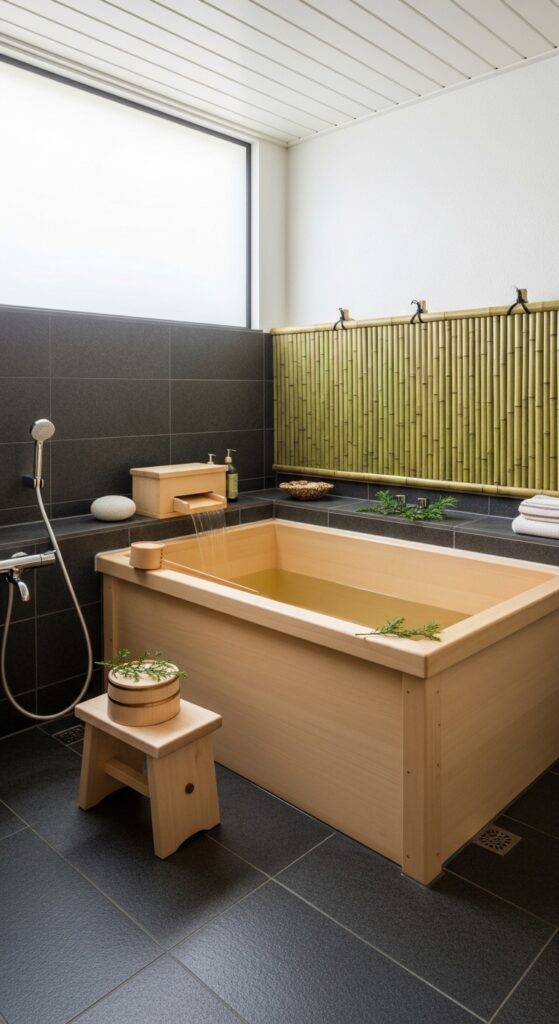
Vibe sentence: A hinoki ofuro tub beside a sauna completes the full Japanese bathing ritual — purification, heat, and deep soaking water, in sequence.
What makes it work: The Japanese ofuro (deep soaking tub, traditionally in hinoki cypress) used in conjunction with a sauna creates a complete bathing ritual that addresses the body’s needs more comprehensively than either practice alone. The sequence — rinse, sauna, cold plunge or cool shower, ofuro soak — follows the traditional Japanese sento protocol and produces a level of physical and psychological restoration that Western bathing culture rarely achieves. The hinoki wood of the tub releases the same citrus-cedar aromatics as the sauna interior, creating olfactory continuity across the entire ritual.
How to achieve it: Hinoki ofuro tubs are available from Japanese bathing specialists and some Western luxury bathroom suppliers. A standard two-person ofuro measures approximately 60×30 inches in plan and 24 inches in depth — significantly deeper than a Western bath, which is essential for the full-body immersion the practice requires. Install adjacent to the sauna with a shared changing area to minimize the distance and transition time between the two experiences.
Sauna Loft With Reading Nook Above the Bench Level
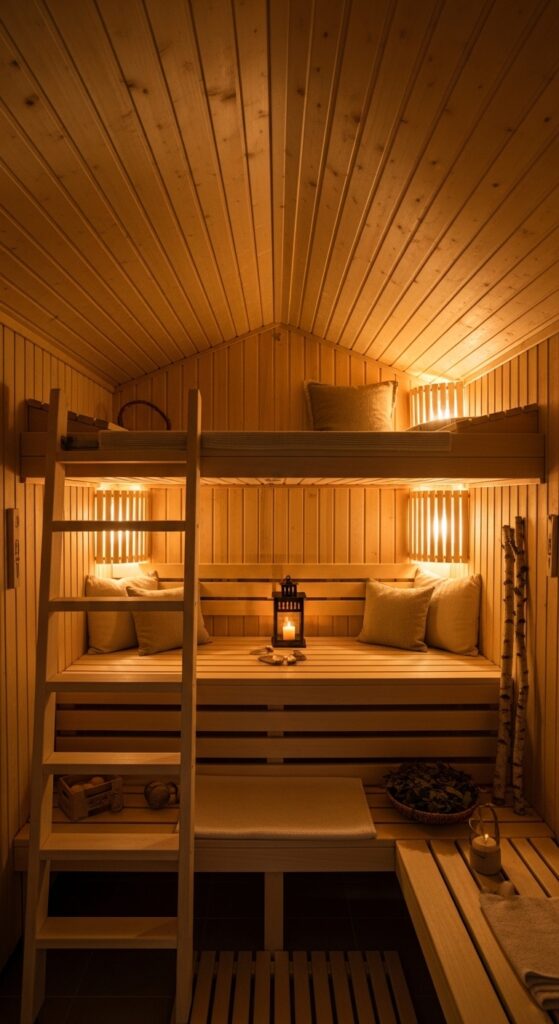
Vibe sentence: A sauna loft nook at ceiling height is the warmest, most private, most completely enclosed rest space in any home — the body has nowhere to go but fully still.
What makes it work: Hot air rises, which means the upper level of a double-height sauna is significantly hotter than the lower bench — typically 15–25°F warmer at the same time point in the heating cycle. A loft nook at the apex of the sauna capitalizes on this thermodynamic reality, providing a lying-flat hot space at maximum temperature for those seeking the most intense heat experience, while the lower bench provides a more moderate option. The psychological enclosure of the low-ceilinged loft further amplifies the cocooning quality of the heat.
How to achieve it: A double-height sauna requires a minimum ceiling height of approximately 8.5–9 feet to accommodate both the standard bench level (at 24 inches) and a usable loft space (at 66–72 inches) with comfortable access via a ladder. The loft platform is framed from the same timber as the bench system and lined with the same tongue-and-groove paneling as the walls. Ensure the upper level has appropriate ventilation as overheating is a genuine safety consideration at the apex of a high sauna.
Sauna With Integrated Visualization Projection
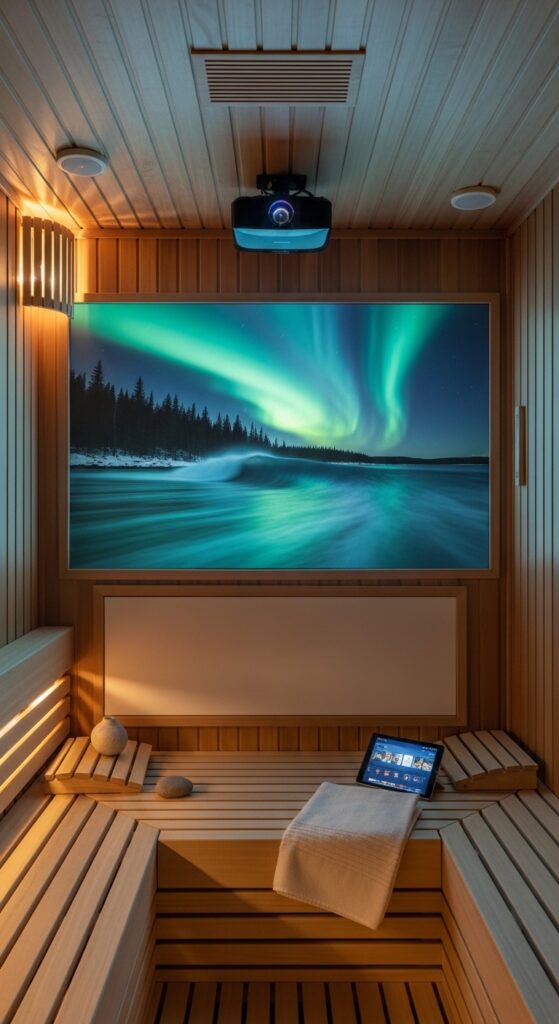
Vibe sentence: A nature projection wall in a sauna creates a fourth sensory dimension — the body experiences heat while the eyes travel through arctic forests and ocean depths simultaneously.
What makes it work: Guided visualization combined with thermal therapy is an established practice in clinical wellness settings — the combination of heat-induced physical relaxation with visually calming natural imagery produces measurably deeper parasympathetic nervous system activation than heat alone. A slow-motion forest, aurora borealis, or deep ocean projection provides the visual journey that many bathers find difficult to achieve through closed-eye meditation, particularly those new to sauna practice.
How to achieve it: Use a heat-rated short-throw projector mounted in a recessed, ventilated ceiling housing with a heat-stable lens cover. Project onto a matte white panel flush-mounted within the cedar wall paneling — the panel material must be rated for the sauna temperature range. Connect to a tablet or media player in the mechanical room outside the sauna for content management. Maintain the remaining walls in natural cedar to preserve the warmth and authenticity of the material environment.
💡 Commission a custom 60-minute slow-motion nature film — forest rainfall, arctic midnight sun, ocean waves — specifically for sauna visualization use; several sauna-specific content creators offer these commercially.
Sauna With Traditional Finnish Log Construction
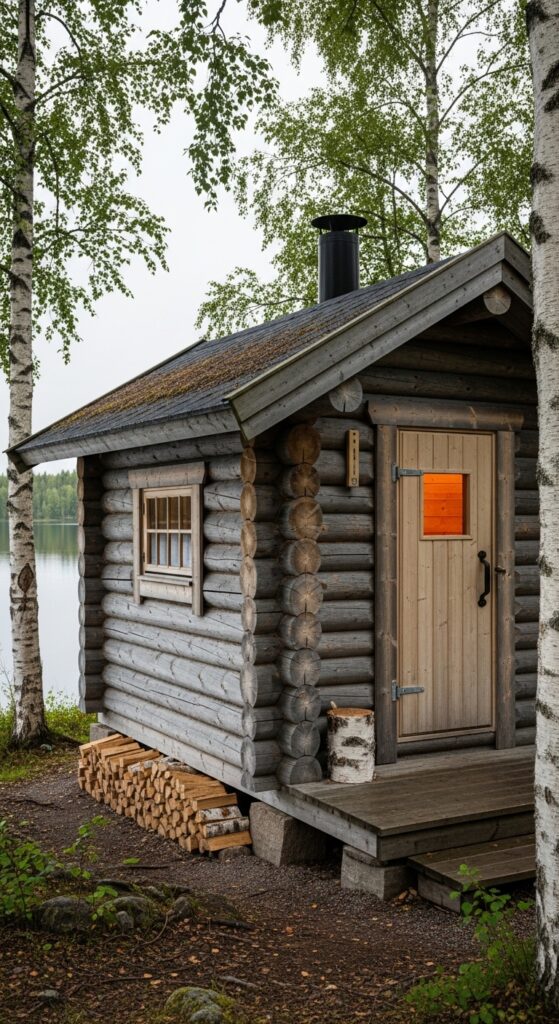
Vibe sentence: A hand-hewn log sauna beside a Finnish lake is not a building — it is the physical expression of a culture’s most essential understanding of what it means to be at home in the world.
What makes it work: Traditional log construction achieves a thermal performance through mass and natural insulation that modern lightweight framing requires significant additional insulation to replicate. The full-round logs with their saddle-notch corners — a joinery technique refined over centuries of Nordic construction — create a building that is structurally self-supporting without any metal fasteners, and the natural compression of the log stack over decades gradually improves the seal between courses, making old log saunas often more efficient than new ones.
How to achieve it: Traditional log sauna construction requires a specialist log builder experienced in Nordic or North American log building traditions — the corner joinery and settling calculations are specific skills that cannot be improvised. Log sauna kits with pre-cut and notched logs are available from Finnish manufacturers including Pollarwood and Honka, allowing a skilled builder to assemble an authentic structure without the full hand-hewn process.
Sauna With Natural Swimming Pond as Cold Plunge
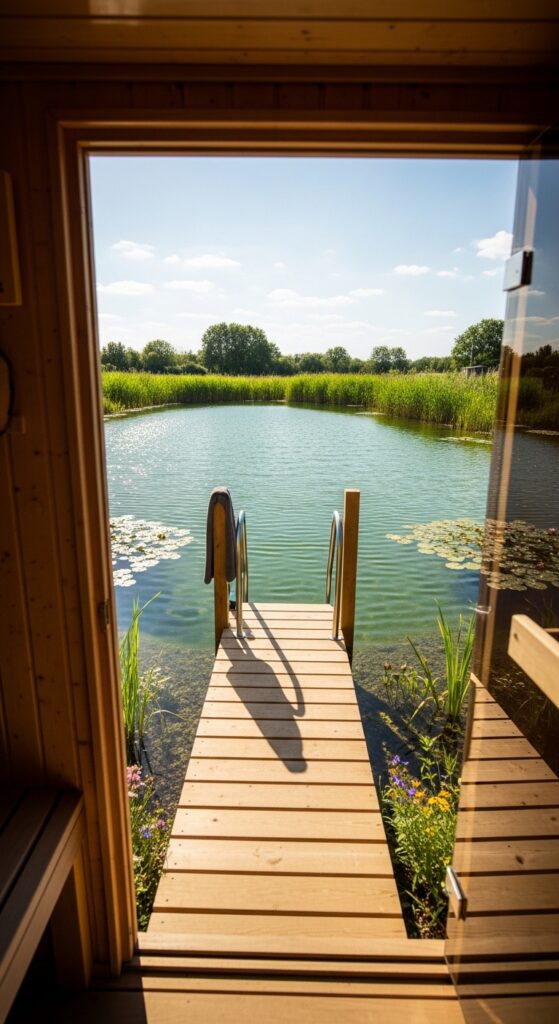
Vibe sentence: A natural swimming pond beside a sauna is the most ecological, most beautiful, and most completely alive cold plunge experience available — the water is inhabited, filtered, and genuinely of the earth.
What makes it work: A naturally filtered swimming pond (using aquatic plants and a gravel biofilter rather than chemicals) provides cold plunge water that is chemically clean, ecologically alive, and temperature-stable in a way that mechanically chilled systems cannot replicate. The presence of aquatic plants, pond life, and natural water clarity creates an immersive natural experience that transforms the cold plunge from a functional protocol step into a genuinely restorative encounter with living water.
How to achieve it: Natural swimming pond design is a specialist discipline — companies including Biotop Natural Pool and Clear Water Revival design and install ecologically filtered swimming ponds ranging from compact 4×6 meter designs to large landscape features. A minimum volume of approximately 50 cubic meters is required for stable ecological filtration. The sauna is positioned at the pond edge with a dock extending 1–2 meters over the water to provide direct entry access.
Copper-Clad Sauna Exterior as Garden Sculpture
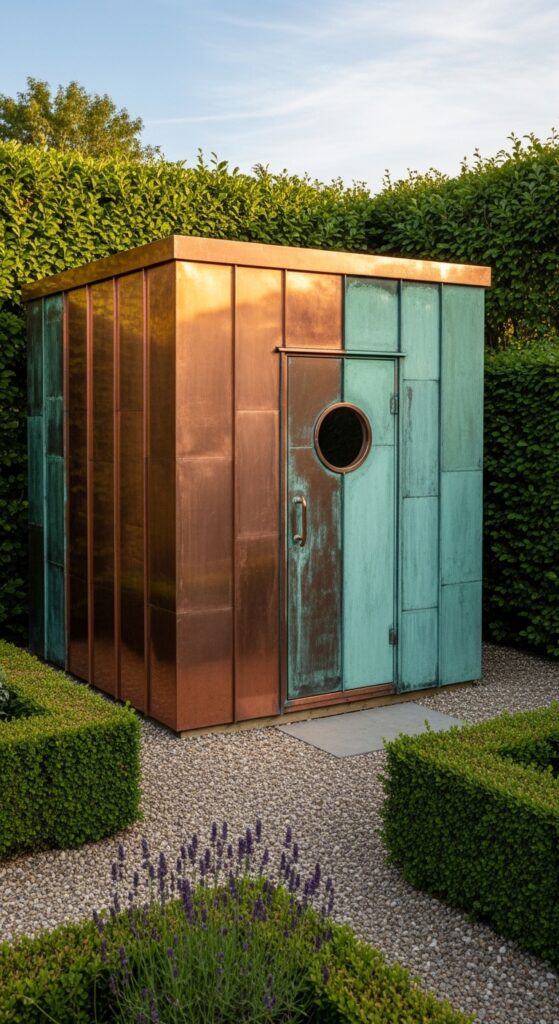
Vibe sentence: A copper-clad sauna in a garden is a building that changes every season — aging, patinating, greening — becoming more beautiful with every year of weather.
What makes it work: Copper cladding on an outdoor structure is one of the most extraordinary long-term design investments possible — new copper begins as a bright amber-gold, gradually developing through brown and chocolate tones before eventually settling into the characteristic blue-green verdigris that has been the defining aesthetic of copper architecture for centuries. The material literally improves with time and weather, making a copper-clad sauna cabin a garden feature that becomes more beautiful the older it gets.
How to achieve it: Use standing seam copper cladding (0.6mm or 0.7mm sheet copper) over a waterproof breathable membrane on standard timber frame construction. The standing seam profile conceals fixings completely and manages thermal expansion of the copper panels through the seam fold. Accelerate natural patination with a commercial copper patination solution if the verdigris appearance is desired immediately rather than allowing the natural 10–15 year development timeline.
Sauna With Integrated Meditation Altar Space
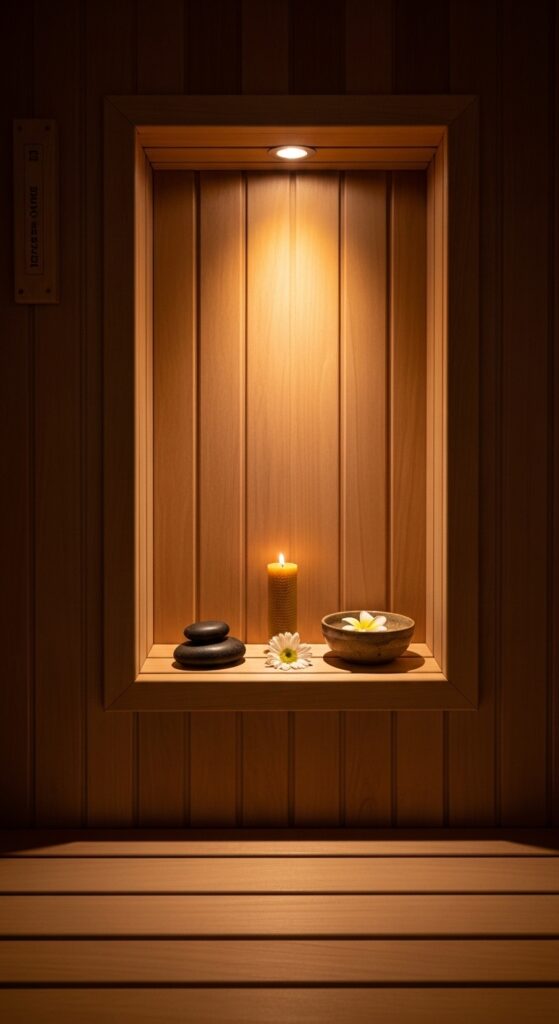
Vibe sentence: A meditation altar in a sauna gives the session a direction — it becomes not merely heat therapy but a practice, with an intention set before the first stone is doused.
What makes it work: The deliberate inclusion of an altar or intention space within the sauna interior transforms the session from passive heat tolerance into an active contemplative practice. The warm, enclosed, sensory-simplified environment of a sauna is physiologically ideal for meditation — cortisol is already reduced by heat, the parasympathetic nervous system is activated, and the sensory simplicity of the space removes the visual distractions that make seated meditation difficult in ordinary rooms.
How to achieve it: Build a recessed alcove into the sauna wall opposite the bench — approximately 24 inches wide, 12 inches tall, and 8 inches deep — at seated eye level (approximately 48 inches from the floor). Line the alcove interior in the same cedar paneling as the wall, or use a contrasting material such as slate or smooth plaster for visual distinction. Install a single warm LED spotlight recessed in the alcove ceiling to illuminate the space gently.
Sauna With Outdoor Viewing Terrace at Treetop Level
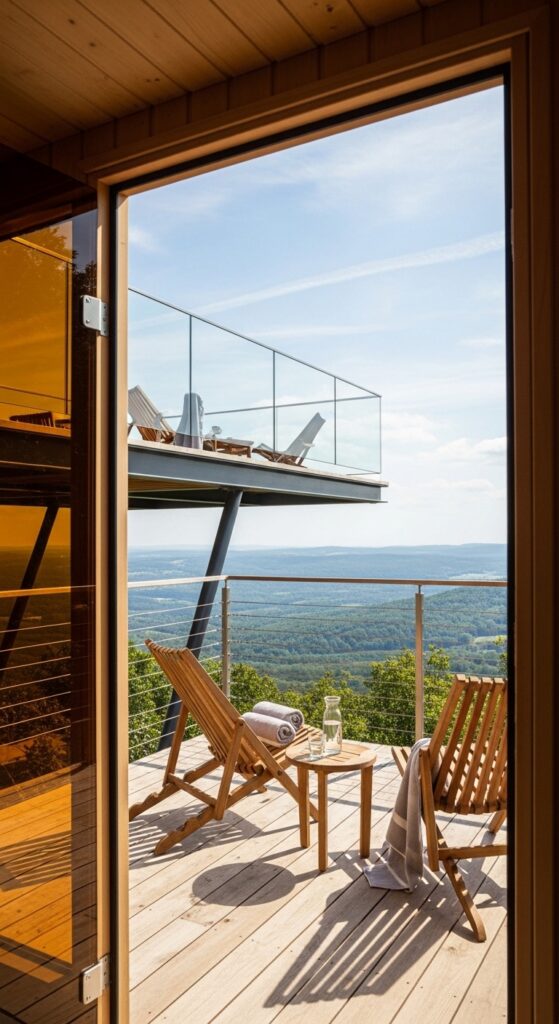
Vibe sentence: Stepping from a hot sauna onto a cantilevered terrace above a valley or forest is the single most physically exhilarating transition in any wellness design.
What makes it work: The post-sauna cool-down on an exposed outdoor terrace at elevation uses the natural environment as the cooling mechanism — cool air, wide sky, the psychological expansion of a vast view — all working together to lower the body temperature and activate the restorative parasympathetic response simultaneously. The contrast between the enclosed, dark, warm sauna interior and the open, bright, cool terrace is as extreme as any cold plunge in its physiological effect, while being dramatically more visually extraordinary.
How to achieve it: A cantilevered terrace requires structural engineering appropriate to the cantilever span and load requirements — typically a steel moment frame concealed within the deck structure. Use a glass or slim cable railing system to maintain the unobstructed visual connection to the landscape. Orient the terrace to face the best available view from the site, even if this requires an unconventional sauna orientation.
Sauna With Polished Black Granite Kiuas Surround
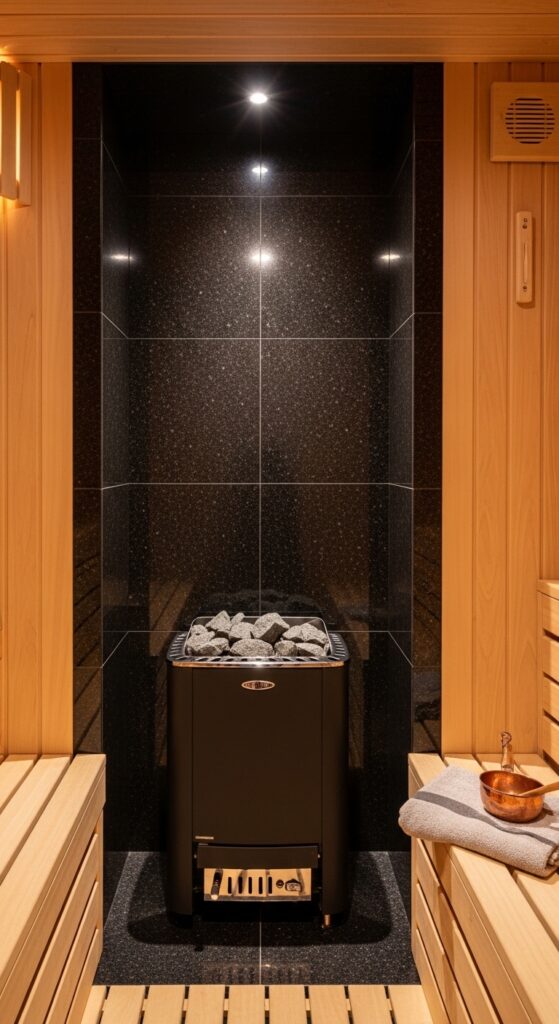
Vibe sentence: A polished black granite kiuas surround makes the stove look like an altar — and in a sauna, that is exactly what it is.
What makes it work: Polished black absolute granite has the highest surface reflectivity of any common stone material — it functions almost as a dark mirror, reflecting the warm amber sauna light back across the room from its position as the focal point. This creates a second, reflected light source that warms the space visually from the kiuas end of the room, while the contrast between the cool, precise geometry of the polished stone and the warm, organic grain of the cedar walls creates a material tension that reads as genuinely luxurious.
How to achieve it: Use 20mm polished absolute black granite in a simple rectangular panel arrangement from floor to ceiling behind and beside the kiuas, maintaining the manufacturer’s required clearance distances from the stove body. Granite requires professional cutting and installation — source from a specialist stone fabricator who can cut the panels to precise dimensions and drill any required fixing holes cleanly. Ensure heat clearance specifications from the kiuas manufacturer are strictly observed.
Sauna With Integrated Chromotherapy LED System
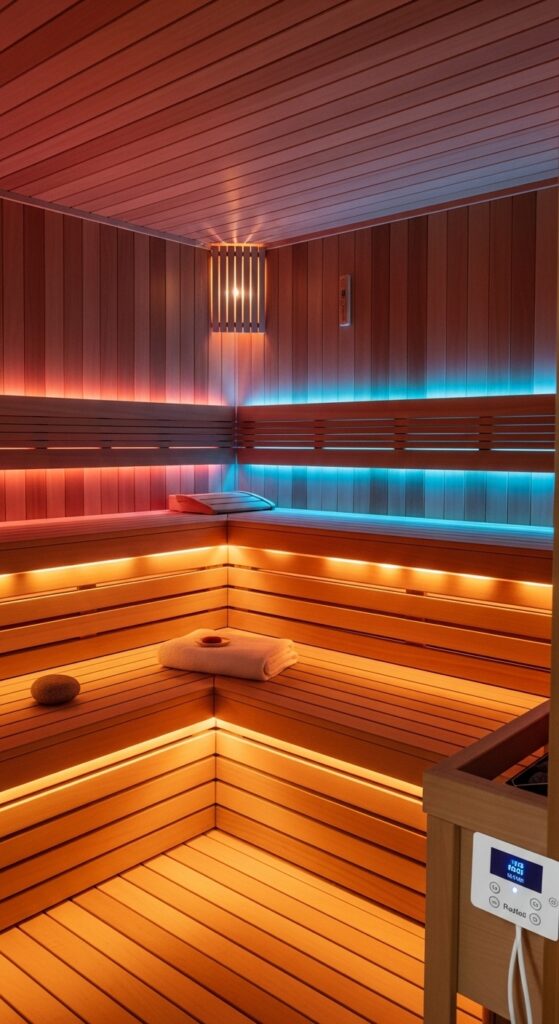
Vibe sentence: Chromotherapy in a sauna transforms the session from a single-sense experience into a full-spectrum sensory environment — warmth you feel, warmth you see.
What makes it work: Chromotherapy — the therapeutic use of colored light frequencies — has a substantial evidence base for specific psychological and physiological effects: amber and red wavelengths stimulate circulation and energy; blue and green frequencies promote calm and reduce anxiety; rose and pink tones support emotional warmth and social openness. In a sauna, where the body is already in a highly receptive, relaxed physiological state, chromotherapy effects are amplified significantly compared to ordinary room settings.
How to achieve it: Specify an RGBW LED strip system rated for sauna temperatures (minimum 120°F operating temperature) installed in recessed channels along the bench front edge, floor perimeter, and ceiling line. Connect to a waterproof control panel (rated IP65 minimum) mounted outside the sauna door. Program preset therapeutic sequences — a 30-minute session protocol cycling from energizing amber through calming green to restorative rose is a standard chromotherapy sauna program.
Sauna With Hand-Thrown Ceramic Water Vessel Collection
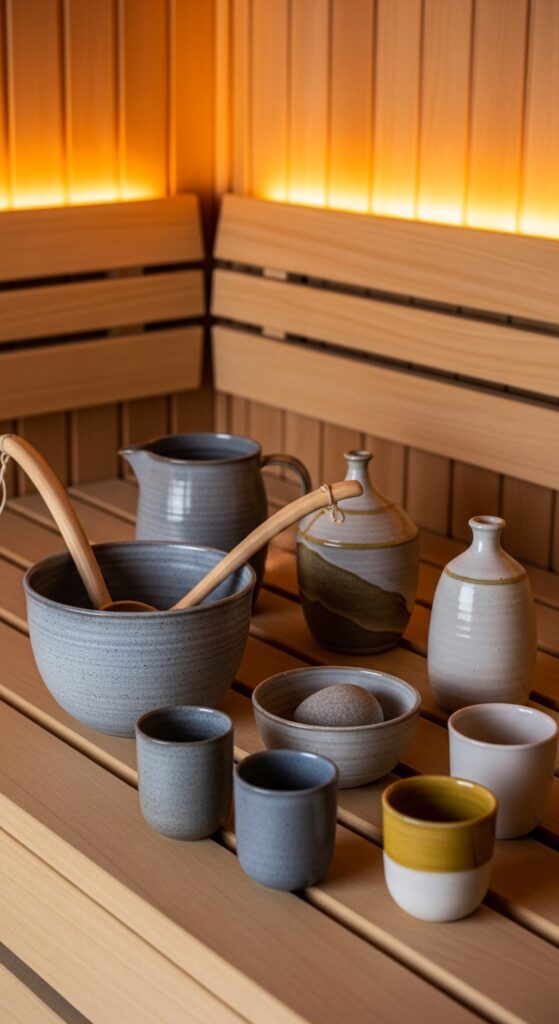
Vibe sentence: A collection of hand-thrown ceramics in a sauna is the most intimate possible curation — each piece chosen and placed because it is genuinely beautiful and because beauty in this space is genuinely therapeutic.
What makes it work: Hand-thrown ceramics introduce a quality of individual craft attention into the sauna space that speaks directly to the intention behind the wellness ritual — both the ceramic maker and the sauna practitioner are engaged in acts of deliberate, slow, skilled attention to material and form. The slight imperfection of hand-thrown work — the throwing lines, the glaze variations, the asymmetries — creates objects that reward close attention and reward the slowed perception that sauna sessions cultivate.
How to achieve it: Source a collection of hand-thrown ceramics from a single maker whose work shares a consistent aesthetic language — material coherence is more important than variety. Commission pieces specifically for sauna use: a wide, low water bowl for the ladle, a narrow-necked vessel for aromatic oils, a simple drinking cup for post-session hydration. Specify cone 10 stoneware with an ash or shino glaze for maximum heat tolerance and visual warmth.
💡 Commission the ceramics from a local studio and describe the sauna’s specific material palette — a maker who understands the context will design pieces that genuinely belong.
Sauna With Underground Earthen Floor Heating
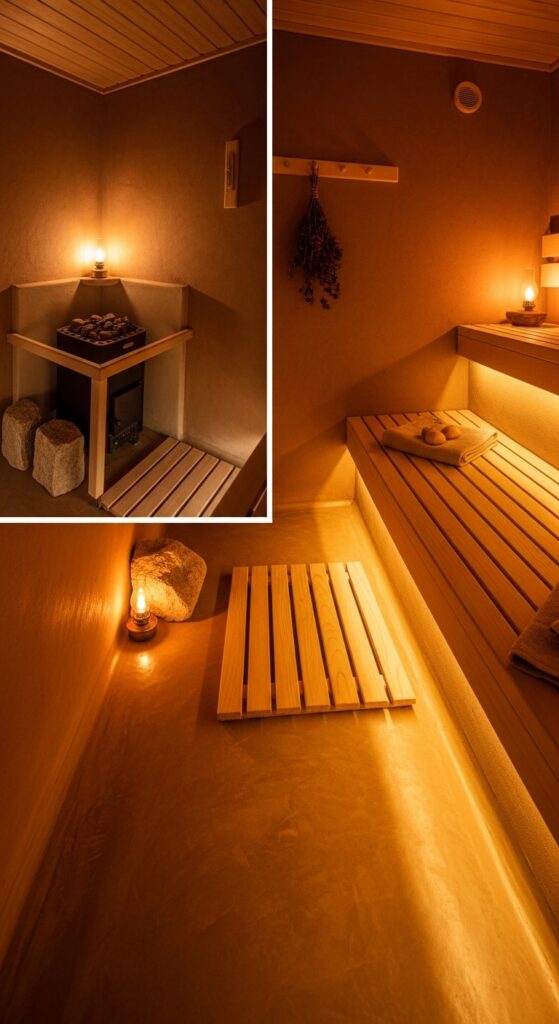
Vibe sentence: An earthen floor in a sauna connects the experience to the ground beneath in the most literal possible way — warm, living earth under bare feet is an entirely different sensation from tile or timber.
What makes it work: A compressed and burnished earthen floor (limecrete or rammed earth with a sealed surface) provides warmth through thermal mass — it absorbs heat from the kiuas and radiates it back slowly through the session, maintaining a consistent floor temperature that is warmer than any tile floor and more comfortable barefoot than any stone. The earthen material also connects visually and materially with the earthen plaster walls, creating a fully coherent material language from floor to ceiling.
How to achieve it: Use a limecrete floor mix (natural hydraulic lime, sharp sand, and aggregate) poured to 100mm depth over a damp-proof membrane and insulation layer. Finish with a burnished natural wax sealant for moisture resistance and a smooth, warm tactile quality. Install wooden duck board panels over the central floor area for hygienic barefoot contact during active sessions.
Sauna With Wraparound Water Moat and Stepping Stones
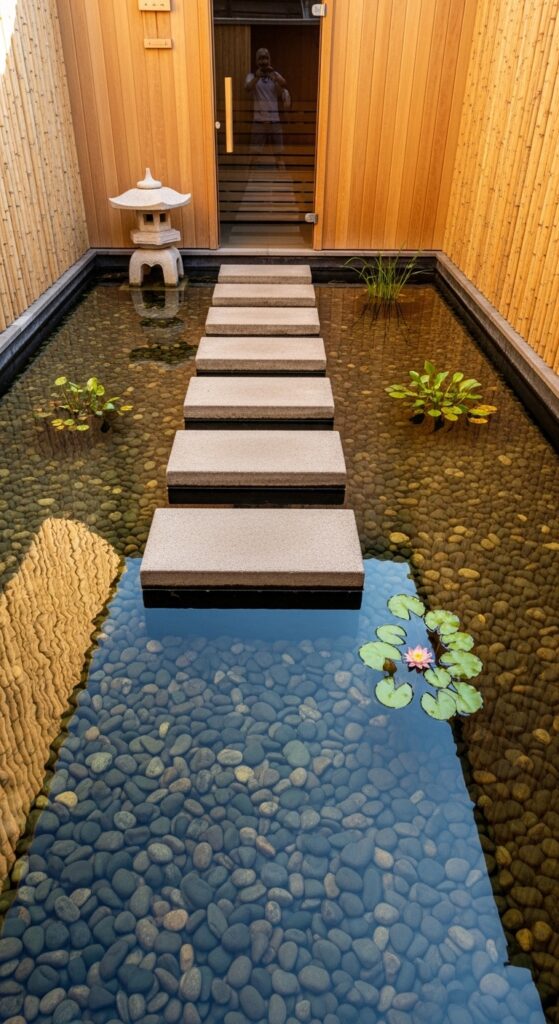
Vibe sentence: Crossing stepping stones over a water moat to reach the sauna door is a ritual of arrival that prepares the mind before the body has even met the heat.
What makes it work: The water moat surrounding a sauna structure borrows from Japanese garden design’s understanding of transition — the act of crossing water marks a deliberate boundary between the ordinary space and the sacred one. Even a shallow, decorative moat with stepping stones requires a moment of attention and deliberateness from anyone approaching the sauna, creating a small but psychologically significant ritual of arrival that primes the meditative quality of the session.
How to achieve it: A shallow water feature moat (300mm deep, lined with a butyl rubber pond liner) surrounds the sauna structure on the accessible sides. The stepping stones are simple, heavy concrete or natural stone pads placed at comfortable stride intervals (approximately 18–24 inches center to center). Maintain the water with a small submersible filter pump and introduce one or two aquatic plants for ecological balance and visual beauty.
Sauna With Reclaimed Railway Sleeper Construction
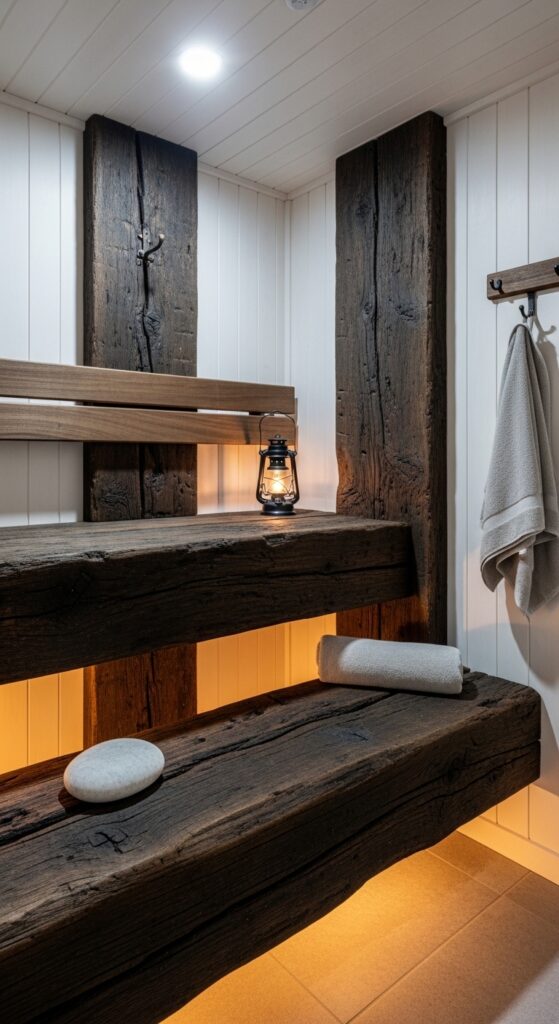
Vibe sentence: Reclaimed railway sleepers carry the weight of history in their grain — they have crossed continents, supported industry, and now in their third life they support the most restorative room in the home.
What makes it work: Reclaimed oak railway sleepers are among the densest and most thermally stable wood products available — the combination of old-growth oak’s natural density with decades of creosote impregnation (most of which has fully cured in old sleepers) creates a material of extraordinary hardness and thermal mass. As sauna bench surfaces, the sleeper’s mass retains heat differently from conventional bench timber, providing a radiant warmth from the bench surface that conventional sauna boards cannot match.
How to achieve it: Source reclaimed railway sleepers from specialist reclaimed timber merchants — ensure they are classified as “de-tarred” or “low-creosote” old sleepers appropriate for interior use, as some older sleepers contain creosote levels that off-gas in heat. Sand bench contact surfaces smooth and seal with a heat-stable, food-safe oil (Rubio Monocoat or Osmo Polyx) to prevent splinters while preserving the dark aged appearance.
How to Start Your Sauna Aesthetic Home Spa Retreat
Before any material is chosen or any design direction is committed to, the single most important question to answer is deceptively simple: how will you actually use this sauna, and how often? A sauna that is used three times a week as part of a daily wellness routine has entirely different design priorities than one intended for occasional social gatherings or weekly solo meditation sessions. The answer determines everything from size and heat source type to the design of the adjacent relaxation space and the priority given to cold plunge integration.
The most common design mistake in home sauna projects — beyond the first article’s notes on space allocation — is neglecting the approach sequence. The path from the home to the sauna is a significant part of the experience: a well-designed approach through a garden, across a deck, or through a dedicated changing area creates psychological transition that amplifies the restorative quality of the session itself. A sauna accessed directly through a utility room or an awkward internal route loses something essential regardless of how beautiful its interior may be.
For those starting from zero with a limited budget, the most impactful entry point is a pre-built barrel or cabin sauna unit combined with a purpose-designed approach and relaxation area — the unit itself can cost $3,000–$8,000, while the deck, landscaping, and relaxation furniture around it can transform a functional installation into a genuine retreat experience for an additional $1,000–$3,000. Prioritize the quality of the immediate surroundings over the specification of the sauna unit itself.
For indoor installations, the design priority should be the room immediately outside the sauna — the shower or plunge facility, the relaxation seating, the ambient lighting, and the material continuity between the sauna interior and its surrounding space. A beautifully specified infrared sauna unit installed in a poorly considered room setting delivers a significantly diminished experience compared to a more modest unit surrounded by genuinely considered design.
Frequently Asked Questions
How hot should a home sauna be for the best health benefits?
The optimal temperature range depends on the sauna type and the individual bather’s experience level. Traditional Finnish saunas operate most effectively between 170–195°F at the upper bench level — this temperature range produces the cardiovascular response, growth hormone elevation, and deep muscle relaxation associated with the most significant health benefits. Beginners should start at the lower bench level where temperatures typically range from 140–160°F and build tolerance gradually over several weeks. Infrared saunas operate at 120–150°F but penetrate body tissue more directly, providing similar cardiovascular benefits at lower ambient temperatures. The single most important health principle is listening to the body — dizziness, nausea, or a feeling of distress are signals to exit the sauna immediately regardless of elapsed time.
What is the ideal sauna session length and protocol?
The traditional Finnish protocol consists of multiple shorter sessions rather than one long one: 10–15 minutes in the heat, followed by a cold plunge or cool shower of 30–60 seconds, followed by 10–15 minutes of rest, then repeated two to three times. This alternating protocol produces significantly greater cardiovascular and hormonal benefit than a single long session. The total bathing time of 30–45 minutes across multiple rounds is the sweet spot for most regular practitioners. Daily sauna use for 15–20 minutes, as practiced widely in Finland, has been associated in epidemiological research with significantly reduced cardiovascular mortality, improved cognitive function, and reduced incidence of depression and anxiety.
Can a home sauna add value to a property?
A well-designed, well-integrated home sauna adds measurable value in most real estate markets, particularly at the upper end of the market where wellness amenities are increasingly expected. The key determinants of value addition are quality of construction (a poorly built or visually unappealing sauna subtracts rather than adds value), integration with the home’s overall design aesthetic, and the inclusion of complementary facilities such as a cold plunge, outdoor shower, or relaxation room. A professionally built outdoor sauna pavilion with deck, plunge pool, and relaxation space typically adds 1.5 to 2 times its construction cost to property value in premium residential markets.
What maintenance does a home sauna require?
Regular maintenance for a wood-paneled sauna consists of: ventilating the space fully after each session by leaving the door open for 30–60 minutes; wiping bench surfaces with a damp cloth weekly; scrubbing bench surfaces with a soft brush and warm water monthly; checking and cleaning the kiuas stones annually (replace any stones that show cracking or excessive scaling); and inspecting the door seal and hinges annually for wear. Electric kiuas elements typically last 8–12 years; wood-burning firebox components require annual inspection of the chimney and flue for creosote buildup. The most important ongoing maintenance task is ensuring adequate ventilation after every session — a sauna that is closed while still wet after use will develop mold and wood degradation within weeks.
Is it possible to build a DIY home sauna on a limited budget?
Absolutely — a functional and genuinely beautiful home sauna can be built on a budget of $1,500–$3,000 with basic carpentry skills. The most cost-effective approach is a small indoor room conversion (a walk-in closet, a spare bathroom, or an underused utility room) lined with kiln-dried spruce tongue-and-groove paneling, a single-tier bench system, and a compact electric kiuas. Spruce paneling typically costs $1.50–$3.00 per square foot, bench timber $2–$4 per linear foot, and compact electric kiuas units from brands like Vevor or Finlandia begin at approximately $300–$600 for a four-to-six kilowatt unit appropriate for a small room. Add warm amber recessed lighting, a simple sand timer, a wooden bucket and ladle, and a good linen towel — the total material cost for a genuinely functional and well-appointed six-by-six foot sauna room is achievable for under $2,500.
Ready to Create Your Dream Sauna Aesthetic Home Spa Retreat?
You now have 30 completely fresh sauna aesthetic ideas to explore — from the primordial warmth of a cave grotto sauna to the suspended magic of a treehouse canopy session, from the ancient Finnish savusauna tradition to the contemporary drama of a copper-clad garden sculpture that slowly turns green with the seasons. Save the three ideas that made you stop and breathe differently, and start there. The most important thing is not to wait for the perfect space, the perfect budget, or the perfect plan — a single well-chosen linen towel, a copper ladle, and a warm amber bulb in an existing sauna transforms the experience immediately. Begin with what you have. Build toward what you dream. The heat, the wood, the water, and the silence are always ready when you are.