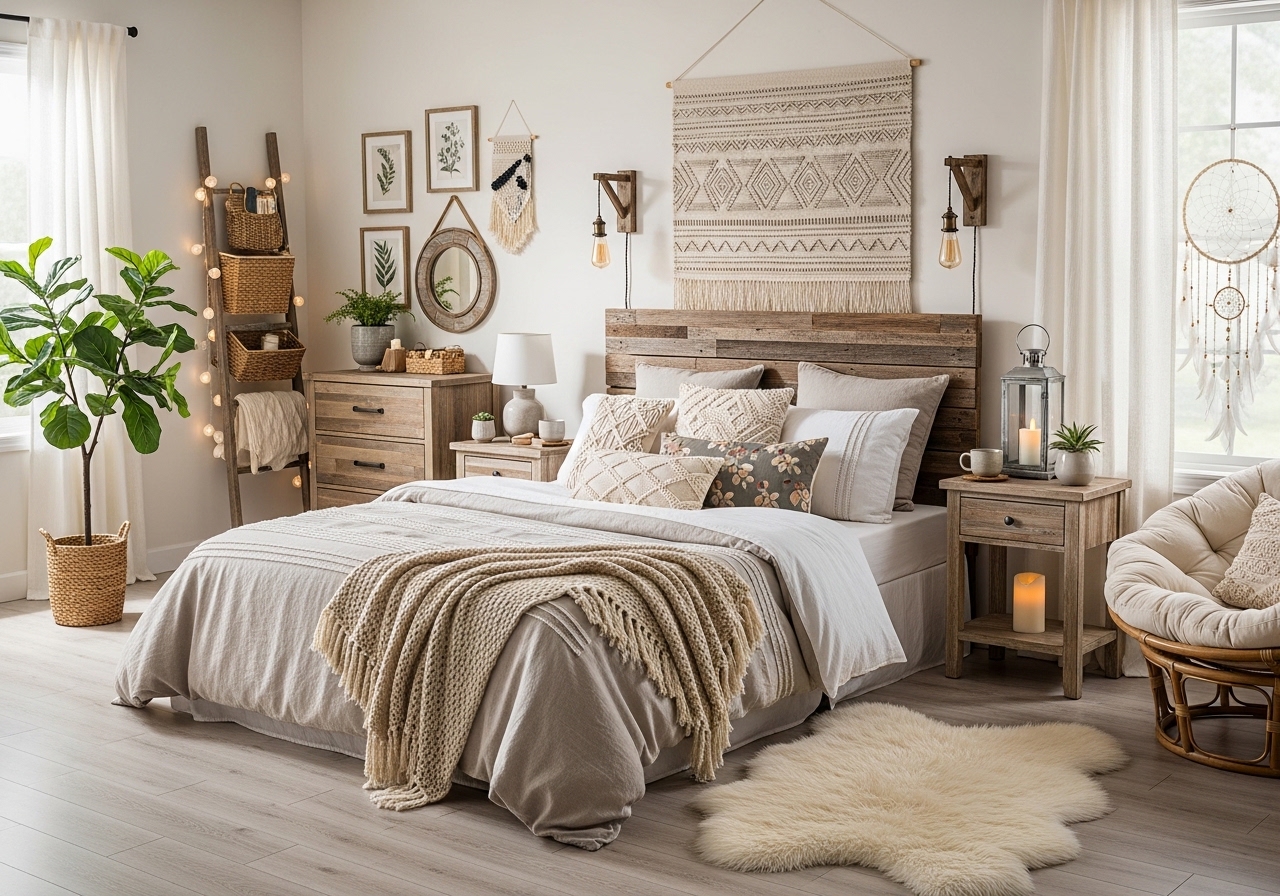
There’s a particular kind of bedroom that feels like it was assembled not in an afternoon but over a lifetime — layered with textures that invite touch, warmed by materials that feel genuinely earned, and softened with the kind of effortless bohemian spirit that never quite looks like it was trying. Boho farmhouse bedroom design captures exactly that feeling, merging the raw, grounded honesty of farmhouse style with the free-spirited, globally influenced warmth of bohemian aesthetics into something entirely its own. The result is a bedroom that breathes — one where a macramé wall hanging lives comfortably beside shiplap, where linen bedding layers over a vintage kilim, and where dried pampas grass in a clay pot feels just as right as a clipped boxwood would feel wrong. These 29 boho farmhouse bedroom ideas are dreamy, actionable, and deeply personal. Here are 29 ideas worth saving.
Why Boho Farmhouse Works So Well
The boho farmhouse bedroom aesthetic succeeds because it resolves a design tension that most decorating styles leave unaddressed — the conflict between order and freedom, between the structured and the organic. Farmhouse design brings the structure: honest materials, neutral palettes, architectural elements like shiplap and exposed beams, and the quiet pride of a well-made, well-kept space. Bohemian design brings the freedom: global textiles, layered pattern, abundant plants, artisan objects, and the confidence to mix sources and periods without apology. Together, they create a bedroom that feels both intentional and unhurried.
The defining materials of a boho farmhouse bedroom are precisely the ones that age best and photograph most beautifully — weathered wood, raw linen, rattan, macramé, terracotta, dried botanicals, and hand-thrown ceramics. These are materials with warmth and texture built into their DNA, which means the more layers you add, the richer and more considered the room appears. Unlike minimalist aesthetics where every addition must justify its presence, the boho farmhouse bedroom actively improves with accumulation — more throws, more plants, more woven wall art, more mismatched pillows.
Pinterest and interior design media have embraced boho farmhouse as one of the decade’s most enduring style movements precisely because it is accessible at every budget and achievable in any architectural shell. A basic rental apartment bedroom can achieve the aesthetic with a secondhand rattan headboard, layered thrifted textiles, a bundle of dried pampas grass, and a few well-placed plants — no structural renovation required.
What keeps the look from veering into chaos is the disciplined use of a warm neutral palette as the through-line — warm white, oatmeal, cream, dusty rose, terracotta, and sage — with pattern and texture providing all the visual interest. When every element, however eclectic, shares the same warm, muted color family, the room coheres beautifully regardless of how many different sources and styles are represented.
1. Rattan Arch Headboard Against White Shiplap
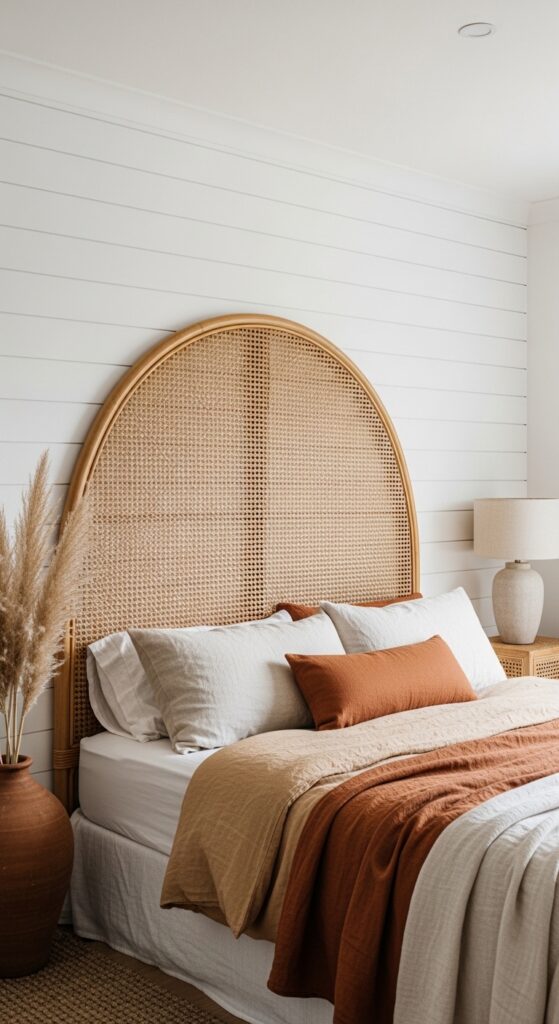
Vibe: The headboard that makes the whole room — arched, organic, and deeply warm against the clean lines of white shiplap behind it.
What makes it work: The arch form of a rattan headboard introduces a soft, organic silhouette that contrasts beautifully with the strict horizontal geometry of shiplap — the curved top edge of the rattan reads as a visual focal point that draws the eye upward, making the wall composition feel taller and more considered. Natural honey rattan against white shiplap delivers the perfect boho farmhouse material contrast in a single, powerful pairing.
How to achieve it: Wall-mounted rattan headboards (as opposed to frame-mounted) allow you to position the arch at any height, and look more substantial and intentional than floor-standing versions. Look for headboards with a minimum 1.2m width for a queen bed and 1.4m for a king — undersized headboards look inadequate against the visual weight of a shiplap wall. Secure to wall studs or use heavy-duty wall anchors rated for the headboard weight.
💡 A full-length rattan arch panel (available as a room divider) mounted horizontally as a headboard costs significantly less than a purpose-made headboard and delivers a more dramatic arch scale.
2. Macramé Wall Hanging Above the Bed
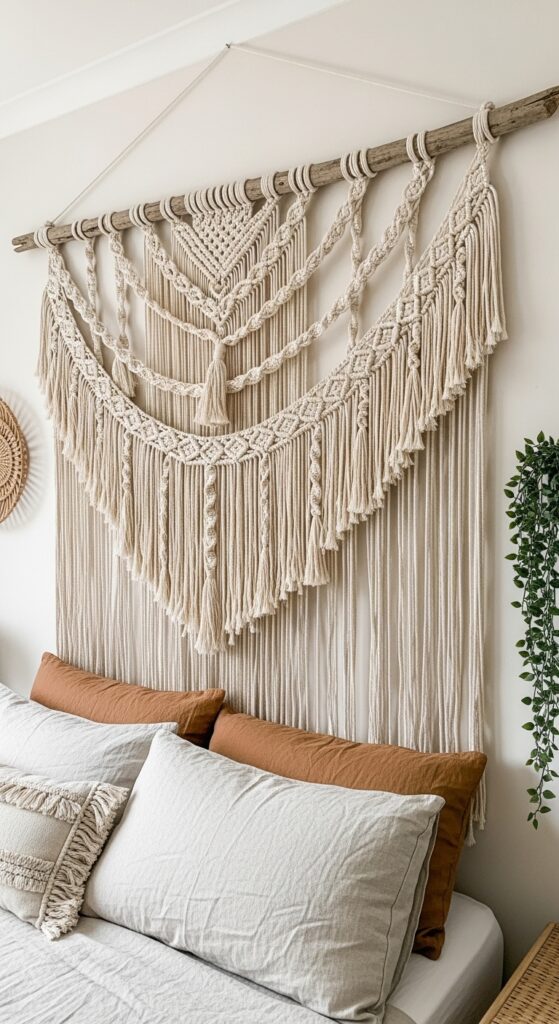
Vibe: Handcrafted, unhurried beauty — a wall hanging that makes you want to run your fingers through it and stay in bed all morning.
What makes it work: Macramé above a bed solves the headboard wall challenge in a distinctly boho farmhouse way — it adds height, texture, and artisan character simultaneously without the permanence of a built-in or the formality of a framed artwork. The varied knotwork catches light differently throughout the day, creating a wall surface that is visually active without demanding attention in the way a gallery wall or bold wallpaper would.
How to achieve it: Size the macramé piece to span at minimum two-thirds of the bed width — for a queen bed, this means a minimum 1.2m wide hanging. The driftwood or dowel mounting bar should extend 100–150mm beyond the macramé edges on each side for a finished look. Commission from Etsy artisans for custom sizing and genuine handcraft quality, or use a pre-made piece as the starting point and add additional fringe strands to increase the bottom weight and movement.
3. Layered Linen and Vintage Kilim Bedding
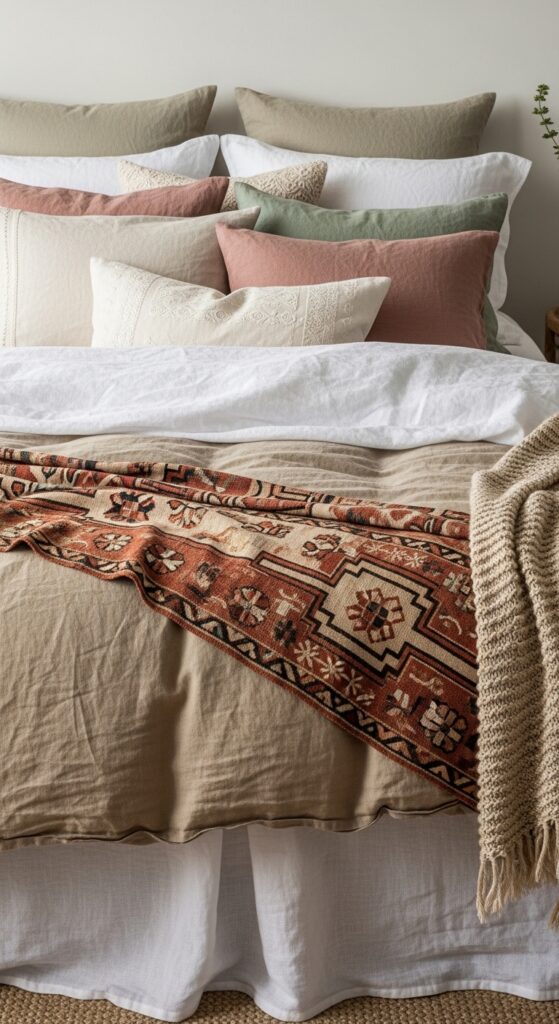
Vibe: Bedding that took years to collect and five minutes to arrange — deeply layered, impossibly comfortable, and always slightly rumpled in the best way.
What makes it work: The kilim throw across the bed foot is the defining boho farmhouse bedding moment — it introduces geometric pattern and global provenance into a palette of soft neutrals, providing exactly the right amount of visual complexity without overpowering the calm of the linen base. Authentic vintage kilim patterns have a color depth and tonal variation that modern reproductions rarely capture, making secondhand sourcing genuinely worthwhile.
How to achieve it: Build the bed from the base up in order of weight — fitted sheet, flat sheet (optional), duvet, additional quilt or blanket, then the kilim throw positioned across the lower third to halfway up the bed. Layer pillow covers in three to four complementary tones rather than perfectly matching sets — slight tonal variation between covers creates a collected, artisan quality that matching sets explicitly lack. Source vintage kilim throws from Turkish and Persian textile dealers on Etsy or at local antique markets.
4. Exposed Wooden Ceiling Beams for Farmhouse Character
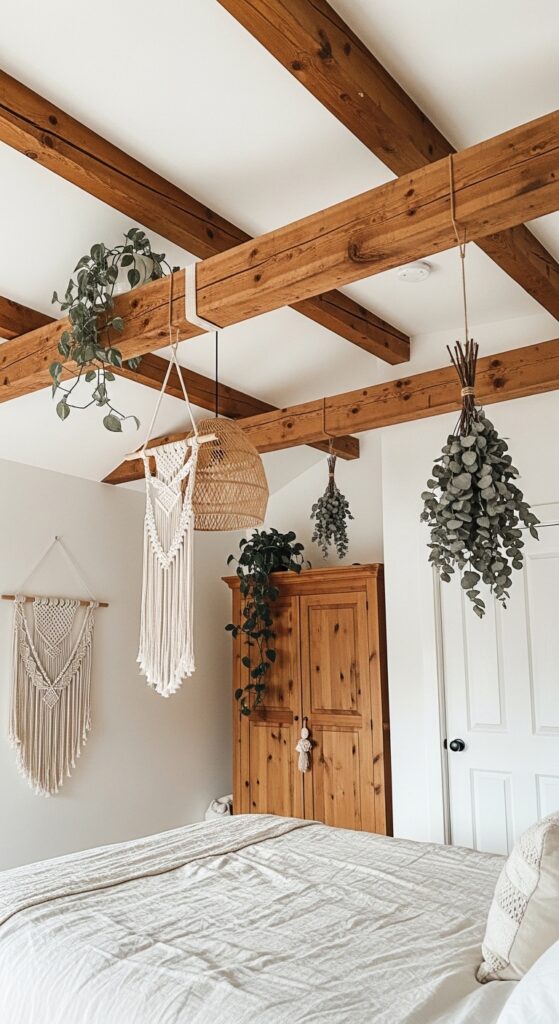
Vibe: The bedroom that feels like a converted barn and a luxury retreat simultaneously — rough timber above, soft linen below, and everything exactly right.
What makes it work: Exposed ceiling beams are the single most powerful farmhouse element available in a bedroom — they introduce horizontal scale, material warmth, and architectural authenticity that no surface treatment applied to walls or floors can replicate. In a boho farmhouse context, the beams also function as a structural display system — dried botanicals, macramé hangings, and string lights can all be attached directly to beams without wall fixings.
How to achieve it: Genuine structural beams are a feature of older construction — if your bedroom has them hidden behind drywall, removing that ceiling section is a renovation project requiring structural assessment. For contemporary homes, decorative beam wraps in real timber veneer or high-quality polyurethane foam (from suppliers like Faux Wood Beams) are convincingly realistic from floor level and install in an afternoon without structural work. Space decorative beams at 900mm–1.2m intervals for the most authentic barn-ceiling proportion.
5. Terracotta and Sage Green Color Palette
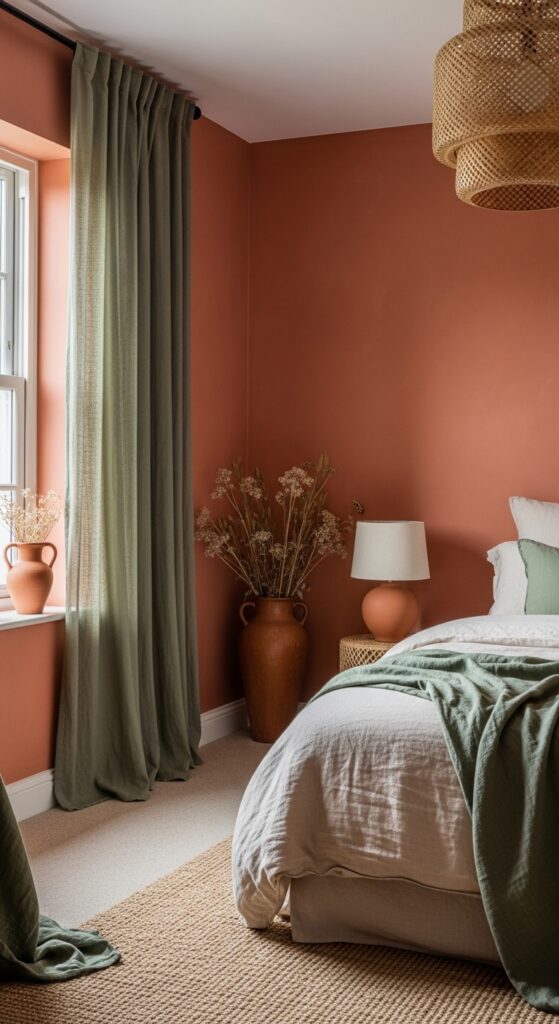
Vibe: Earth and garden in complete harmony — a bedroom that feels like it was colored by the landscape outside the window.
What makes it work: Terracotta and sage green is the boho farmhouse color pairing that most directly references the natural world — terracotta echoes the warmth of clay soil and sun-baked earth, while sage green reflects the muted, grey-green tones of drought-tolerant herbs and silvery foliage. Together they create a palette that is warm without being yellow, natural without being beige, and deeply on-trend without relying on any single fashionable hue.
How to achieve it: Apply terracotta wall paint using a limewash or sponging technique rather than a straight roller — the slight texture and tonal variation created by a textured application suits the boho farmhouse aesthetic far better than a flat, uniform coverage. Farrow & Ball “Red Earth,” Benjamin Moore “Pueblo,” or Sherwin-Williams “Fired Brick” are excellent terracotta starting points. Introduce sage green exclusively through soft furnishings (curtains, cushions, throw) rather than paint to keep the palette balanced.
💡 A single terracotta limewash wall — one accent wall behind the bed — delivers the full palette impact at one-quarter of the paint and labor cost.
6. Dried Pampas Grass in Oversized Floor Vases
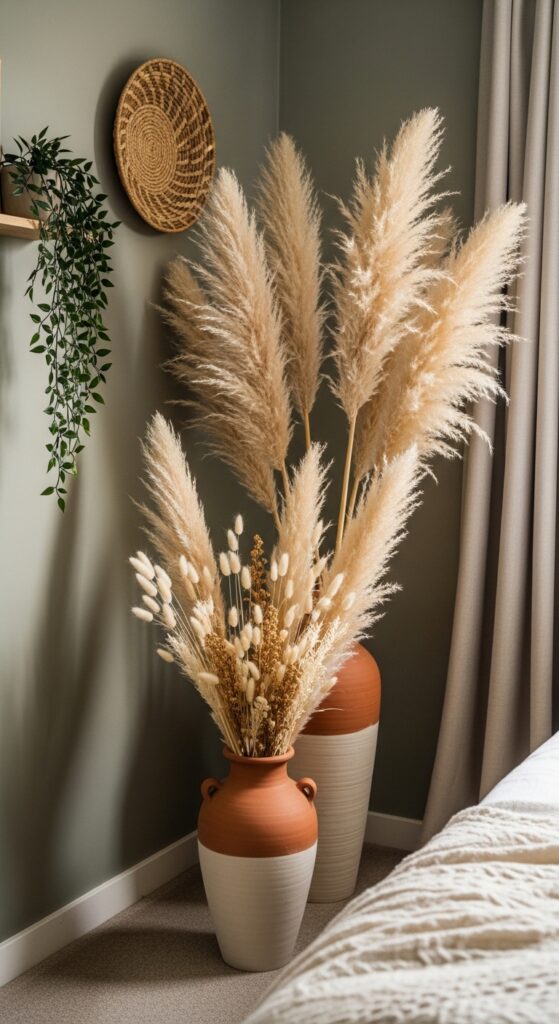
Vibe: The corner of a room that became a whole mood — dried botanicals so abundant and beautiful they need no other decoration.
What makes it work: Oversized dried botanical arrangements in floor vases occupy the visual space of furniture without the visual weight — they fill a bedroom corner vertically, reaching toward the ceiling and creating a dramatic sculptural composition that is simultaneously maximalist in scale and organic in material. The feathery texture of pampas plumes is uniquely light-catching, glowing warmly in afternoon light and creating beautiful soft shadows.
How to achieve it: Use a minimum of three stems of pampas grass per arrangement and add supporting dried grasses (bunny tails, cortaderia, dried miscanthus) for textural variety and visual fullness. Vary the stem heights significantly — the tallest stems should reach to at least 1.5m above the vase lip for an appropriately dramatic scale. Spray dried pampas with hair spray to reduce shedding, which can be significant without this treatment.
7. Woven Jute or Sisal Area Rug Layered with Vintage Runner
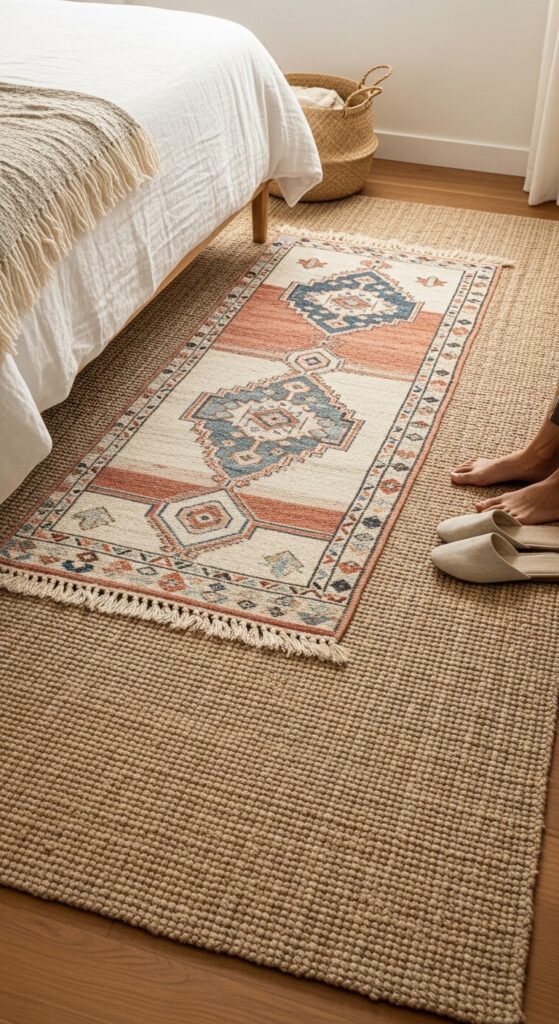
Vibe: A floor that tells a story — two rugs from two different worlds sharing the same space with complete ease.
What makes it work: Layered rugs are the boho farmhouse designer’s most reliable tool for adding warmth, pattern, and visual depth to a bedroom floor without committing to a single statement rug. The natural jute base provides organic texture and grounds the room in an earthy warmth, while the vintage runner introduces color, pattern, and provenance — the combination creating a floor composition richer than either rug could achieve independently.
How to achieve it: Size the base jute rug to extend a minimum of 600mm beyond the bed on three accessible sides — this is the minimum proportion for a rug to read as intentional rather than accidental. Place the vintage runner off-center to one side of the bed rather than perfectly centered — this asymmetry is characteristic of the boho approach and prevents the layering from looking too formal. Use a non-slip rug pad between layers to prevent the runner shifting underfoot.
8. Linen Curtains in Floor-to-Ceiling Panels
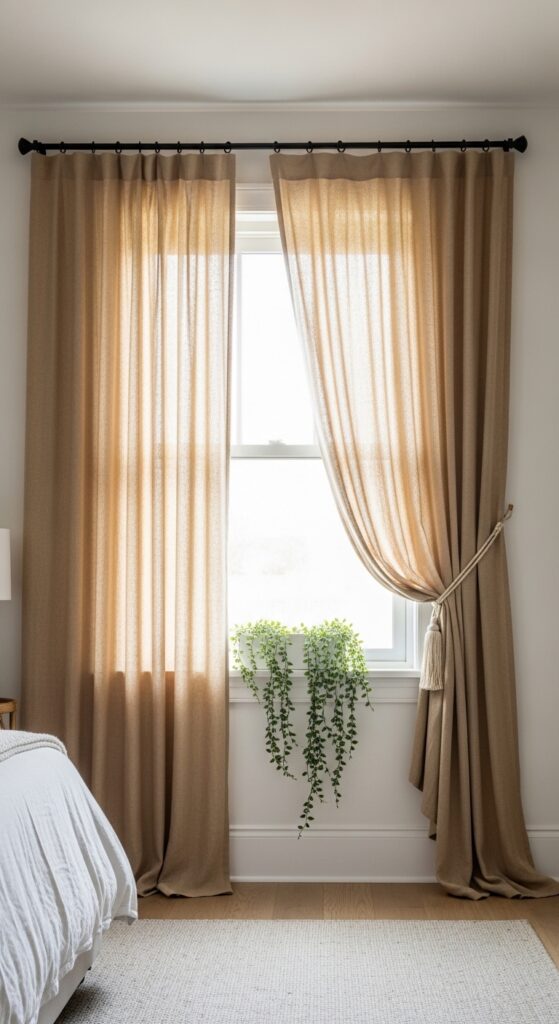
Vibe: Morning light through linen — there is genuinely no more beautiful thing a bedroom window can do.
What makes it work: Ceiling-mounted curtain rods with floor-length panels perform two critical visual functions simultaneously — they make ceilings appear taller by drawing the eye from floor to ceiling in an unbroken vertical line, and they make windows appear larger by framing them with fabric that begins above and extends beyond the actual window aperture. The linen fabric’s natural slub and weave diffuses light beautifully without blocking it, keeping the room luminous while maintaining privacy.
How to achieve it: Mount the curtain rod 50–100mm below the ceiling rather than above the window frame — this single change transforms both the curtain’s visual impact and the room’s apparent ceiling height. Allow a fabric quantity of 2–2.5 times the rod width for each panel to achieve full, gathered drape — a flat, understuffed curtain reads as budget regardless of fabric quality. Choose linen with a weight of at least 180gsm for a curtain that falls and drapes beautifully rather than floating awkwardly.
9. Whitewashed Wood Nightstands with Woven Baskets Below
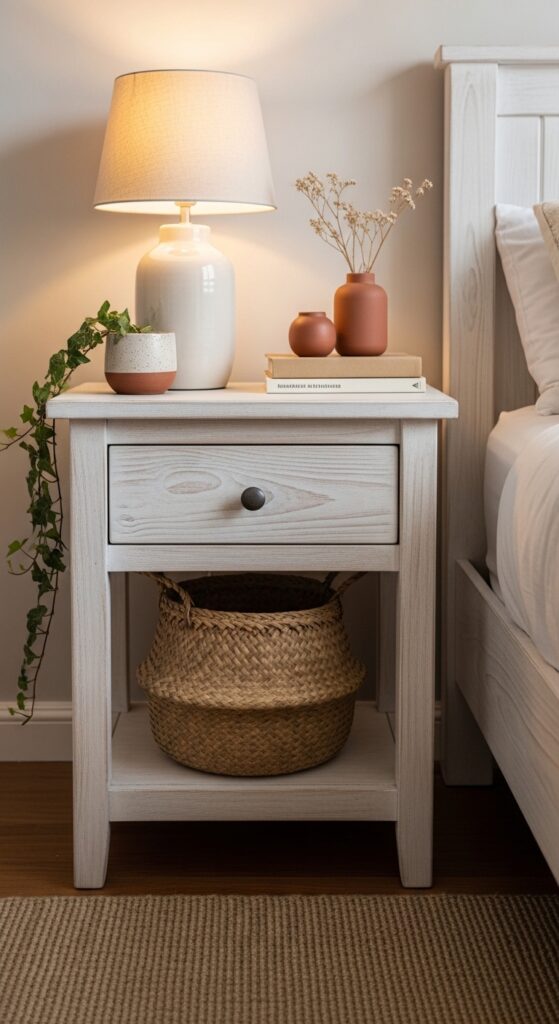
Vibe: A bedside table that looks like it was found rather than purchased — honest, warm, and styled with the kind of casual precision that takes years to develop.
What makes it work: Whitewashing timber preserves the visual warmth and grain character of natural wood while lightening its tone to sit harmoniously within a pale boho farmhouse palette — it occupies the perfect middle ground between raw dark wood and painted furniture. The woven basket beneath functions as practical storage while reinforcing the natural, organic material story of the wider room.
How to achieve it: Whitewash existing nightstands by mixing white chalk paint with water at a 1:2 ratio (one part paint to two parts water) and applying with a damp cloth, working quickly and wiping back immediately to achieve a translucent, grain-revealing finish. Build up in multiple thin coats for deeper coverage where needed. Seal with a matte clear wax for durability without adding sheen. Source large round seagrass baskets to sit neatly beneath the nightstand shelf.
10. Gallery Wall of Botanical Prints and Woven Baskets
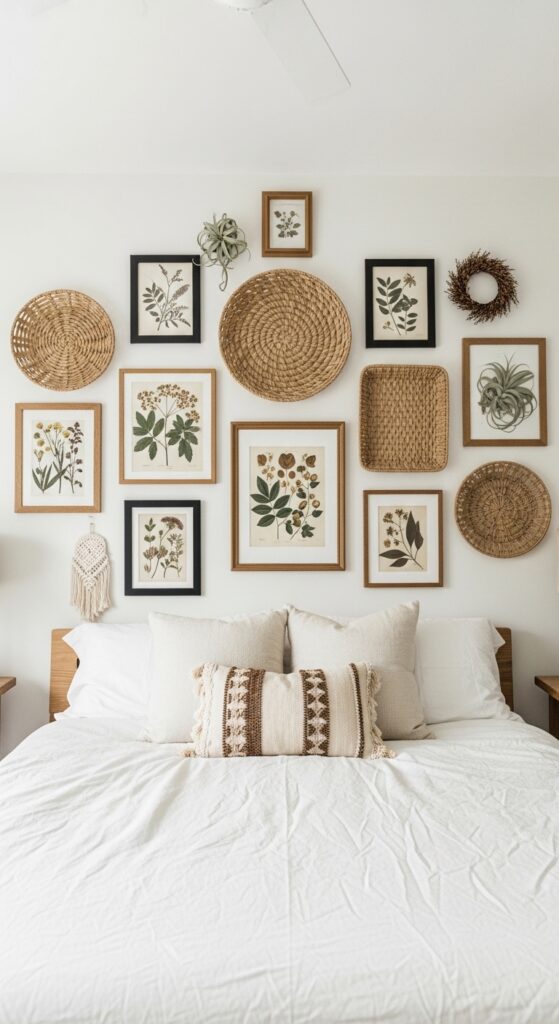
Vibe: A wall assembled by someone who loves plants, travels with intention, and never passes a good frame without stopping — deeply personal and entirely beautiful.
What makes it work: Mixing flat framed prints with three-dimensional woven baskets in a gallery wall arrangement introduces physical depth and textural contrast that an all-print gallery wall lacks. The woven baskets catch light and cast shadows, making the wall composition visually dynamic rather than flat. The organic arrangement style — intentionally asymmetric, varied in object type — is the defining characteristic of boho gallery walls that distinguishes them from more formal gallery arrangements.
How to achieve it: Lay the full arrangement on the floor before committing to wall fixtures — photograph from directly above to assess the composition. Begin hanging from the center of the arrangement and work outward, using painter’s tape to mark positions before nailing. Mix frame sizes deliberately — at least three different sizes — and ensure the woven baskets are distributed throughout the composition rather than clustered together. Leave a consistent 50–80mm gap between each element for breathing room.
💡 Free botanical prints from Rawpixel.com, printed at home on cream cardstock and placed in thrifted frames, make a complete gallery wall for under $30.
11. Canopy Bed with Draped Linen or Gauze Fabric
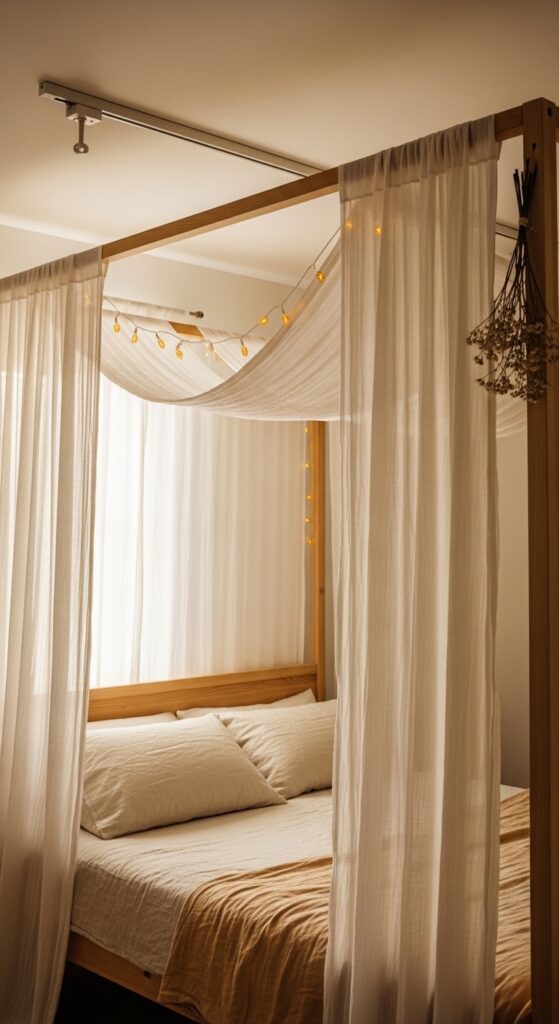
Vibe: Sleeping inside a cloud — soft-edged, warmly lit, and making every morning feel like a dream you don’t want to leave.
What makes it work: A draped canopy transforms a bed from furniture into architecture — it creates a room within a room, a defined sleep sanctuary with its own micro-atmosphere distinct from the surrounding bedroom space. The loose, intentionally casual draping is the key boho detail that prevents the canopy from feeling formal or dated — it should look as though the fabric was placed rather than arranged, with natural folds and varying panel lengths.
How to achieve it: Use 4–6 meters of lightweight cotton gauze, muslin, or voile in ivory or warm white per canopy — lightweight fabric drapes naturally rather than hanging stiffly. A ceiling-mounted curtain track in a rectangle above the bed is the most versatile canopy support, allowing the fabric to slide and adjust. Alternatively, a simple wooden dowel ceiling-mounted above the headboard with single panel falling each side achieves a half-canopy effect with 2–3 meters of fabric.
12. Shiplap Wall in a Warm Greige Tone
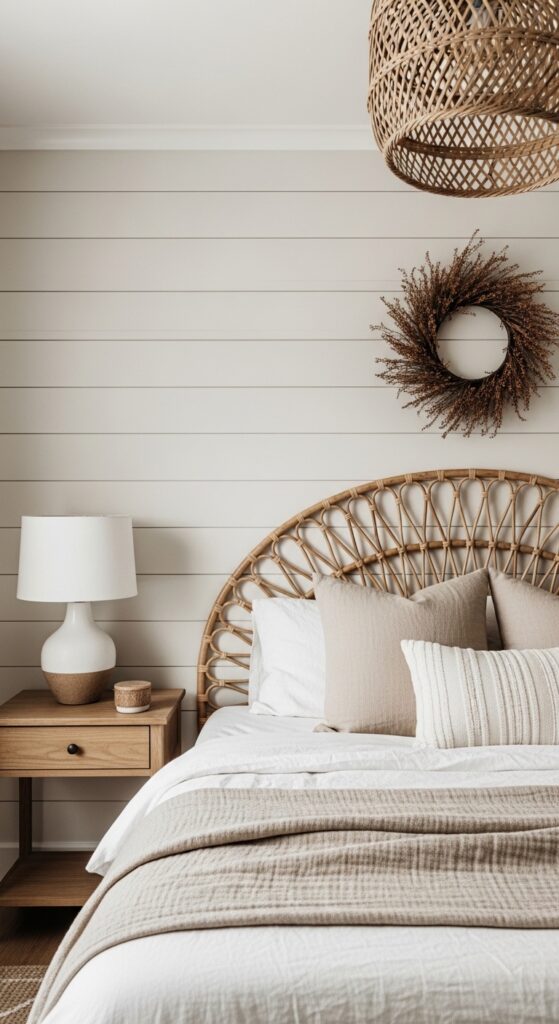
Vibe: Shiplap with sophistication — the same farmhouse architecture as brilliant white, but warmer, richer, and considerably more nuanced.
What makes it work: Warm greige shiplap occupies the most versatile position in the boho farmhouse palette — it is neutral enough to work with every accent color from dusty rose to sage to terracotta, warm enough to prevent the coolness that grey shiplap can introduce, and distinctive enough to read as a considered choice rather than a default. The shadow lines of the shiplap boards create visual texture within a single paint color, keeping the wall interesting without pattern.
How to achieve it: Sherwin-Williams “Accessible Beige,” Benjamin Moore “Pale Oak,” and Farrow & Ball “Elephant’s Breath” represent the warm greige spectrum from warmer to cooler — sample all three on your specific shiplap wall before committing, as the existing wall tone and natural light direction will shift each color’s apparent warmth significantly. Apply in eggshell rather than flat for a shiplap bedroom wall — the slight sheen emphasizes the board shadow lines more than flat finish.
13. Natural Wood Floating Shelves Styled with Plants and Pottery
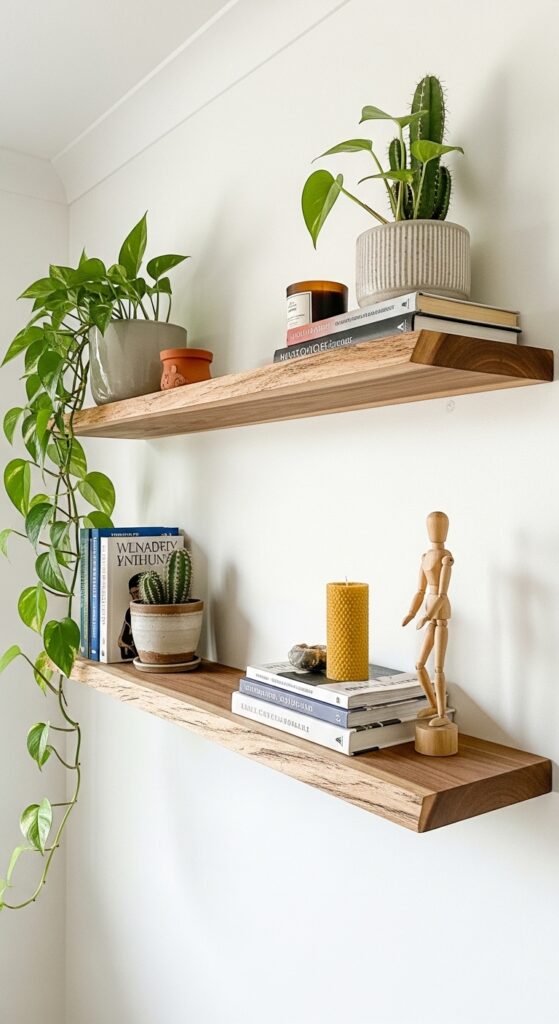
Vibe: Shelves that look like they styled themselves — organic, plant-full, and assembled with the kind of taste that only looks effortless.
What makes it work: Live-edge wood floating shelves introduce one of the most characteristic boho farmhouse design details — the deliberate preservation and celebration of a material’s natural edge, in direct contrast to the precision-cut regularity of standard shelving. The organic profile of a live-edge slab reads as genuinely unique and artisan, and the warm oil finish allows the full color and grain complexity of the timber to remain visible.
How to achieve it: Source live-edge slabs from local sawmills, woodworking studios, or specialty timber suppliers — walnut, oak, and maple are the most commonly available species with the most beautiful grain patterns. Thickness of 40–50mm reads as most substantial on a wall. Mount on floating shelf hardware concealed within the slab — two concealed brackets per shelf, secured into wall studs, provide adequate support for the styling loads a bedroom shelf typically carries.
14. Woven Wall Baskets in a Curated Cluster
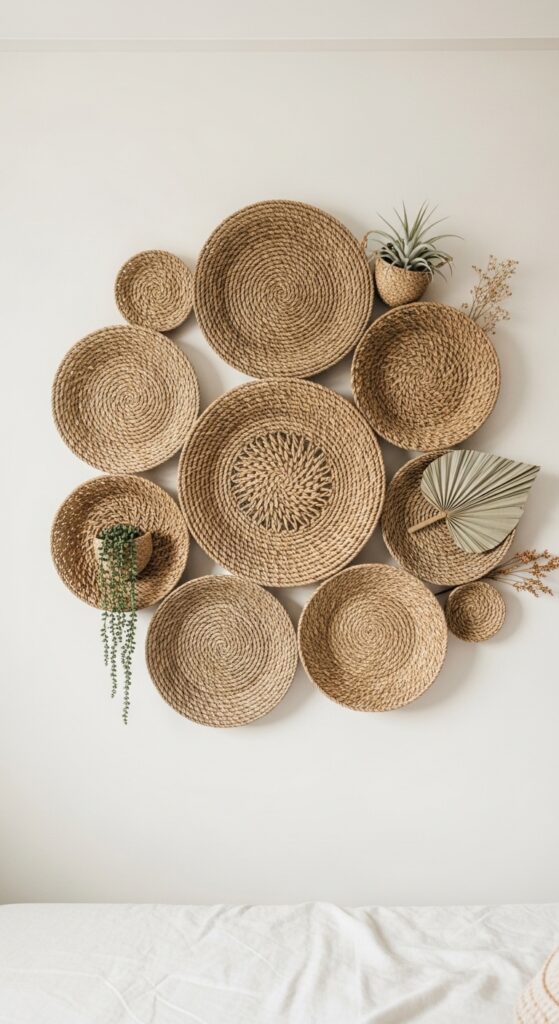
Vibe: A wall that traveled — each basket from a different hand, a different weave, a different story, and all of them exactly right together.
What makes it work: A cluster of woven wall baskets delivers textural depth and global warmth to a bedroom wall in a way that framed artwork cannot replicate — the three-dimensional quality of the baskets creates physical shadows and actual surface depth, making the wall composition feel tangible rather than flat. The natural variation between different weave types and materials (seagrass, wicker, palm leaf, jute) creates a richness of texture that reads as genuinely collected over time.
How to achieve it: Aim for a minimum of five baskets in genuinely different sizes for the cluster to read as a considered composition — three baskets of similar size looks like an incomplete attempt. Use the largest basket (minimum 500mm diameter) as the visual anchor, positioning it at the center or slightly off-center of the arrangement, then build the cluster outward with progressively smaller baskets. Mount on picture hooks rated for the basket weight, using the existing weave on the back as the hanging point.
15. Aged Brass or Unlacquered Brass Fixtures and Handles
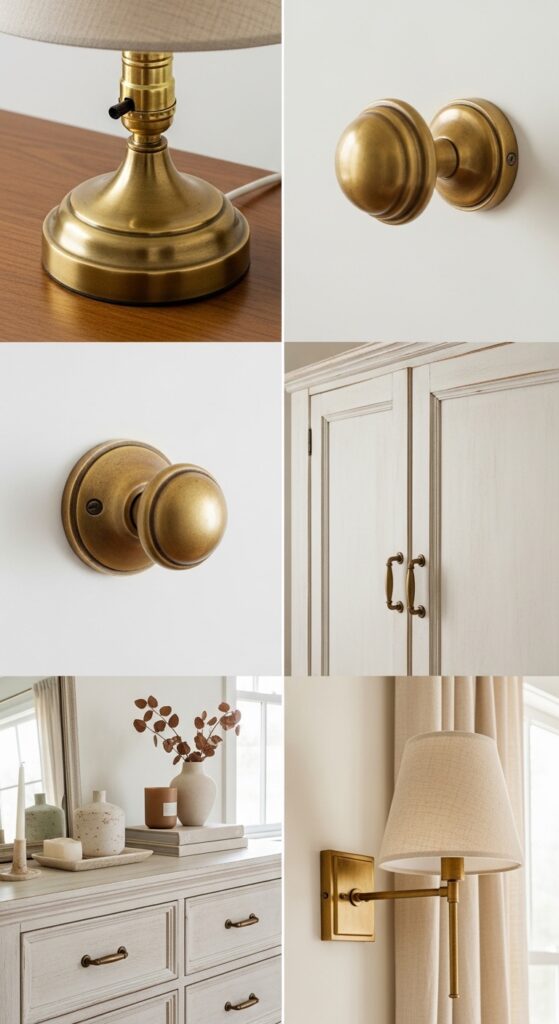
Vibe: The metallic thread that ties everything together — aged brass that glows like afternoon sunlight and improves with every year of handling.
What makes it work: Unlacquered or aged brass develops a living patina over time — darkening in recessed areas and warming on high-touch surfaces — creating a warmth and depth that polished or lacquered brass lacks entirely. In a boho farmhouse bedroom, this quality of honest aging directly mirrors the wider aesthetic’s embrace of materials that improve rather than deteriorate with use.
How to achieve it: Replace hardware across the bedroom — drawer pulls, curtain rod brackets, lamp bases, wall hooks, and curtain finials — with aged or unlacquered brass pieces from the same supplier to ensure a consistent tone. Sources include Rejuvenation Hardware, House of Antique Hardware, and specialist Etsy hardware suppliers. Avoid mixing aged brass with polished chrome or brushed nickel in the same room — even one piece in a different metal finish disrupts the cohesion of the brass story.
💡 Spray-paint existing hardware with metallic brass spray paint and apply a light coat of brown-tinted furniture wax over the top — an effective and inexpensive way to create an aged brass appearance.
16. Boho Farmhouse Reading Nook with Floor Cushions
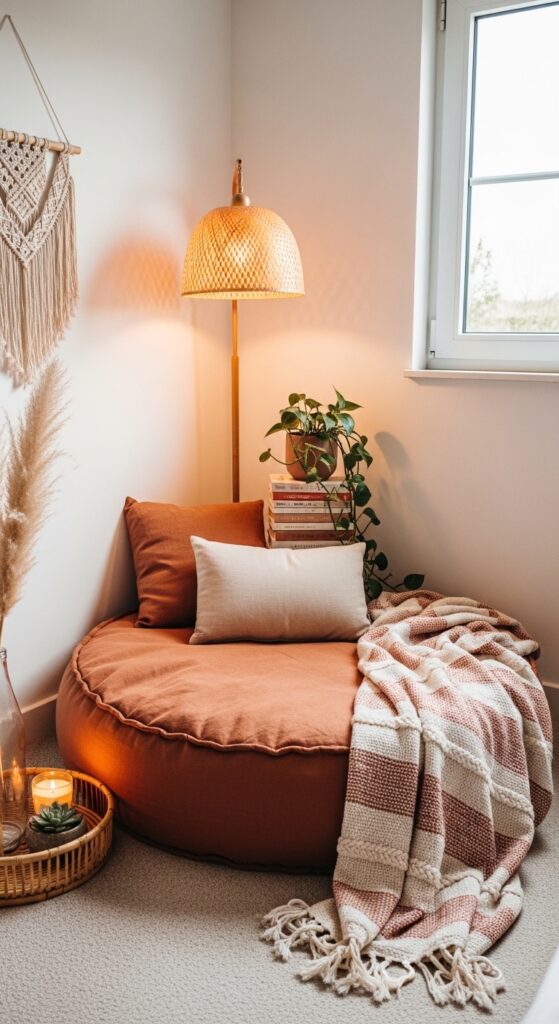
Vibe: The corner of the room that becomes your favorite — warm, low, and requiring absolutely nothing of you except that you stay a little longer.
What makes it work: A floor-level reading nook in a bedroom corner applies the boho aesthetic’s most characteristic spatial principle — the embrace of floor living and low seating as an intentional design choice rather than a compromise. The corner location creates a natural three-sided enclosure that feels intimate and separate from the bed, giving the bedroom a dual-purpose quality without requiring any additional furniture or construction.
How to achieve it: A large round floor cushion (minimum 80cm diameter) requires a firm foam insert of 15–20cm depth to maintain shape under seated weight — pre-made cushion covers with high-quality foam inserts are available from specialist floor cushion suppliers. Add a floor lamp positioned behind and to one side of the cushion for optimal reading light without glare. A low rattan tray beside the cushion corrals books, candles, and a small plant into a composed vignette that makes the nook feel styled rather than improvised.
17. Distressed Wooden Dresser with Boho Styling
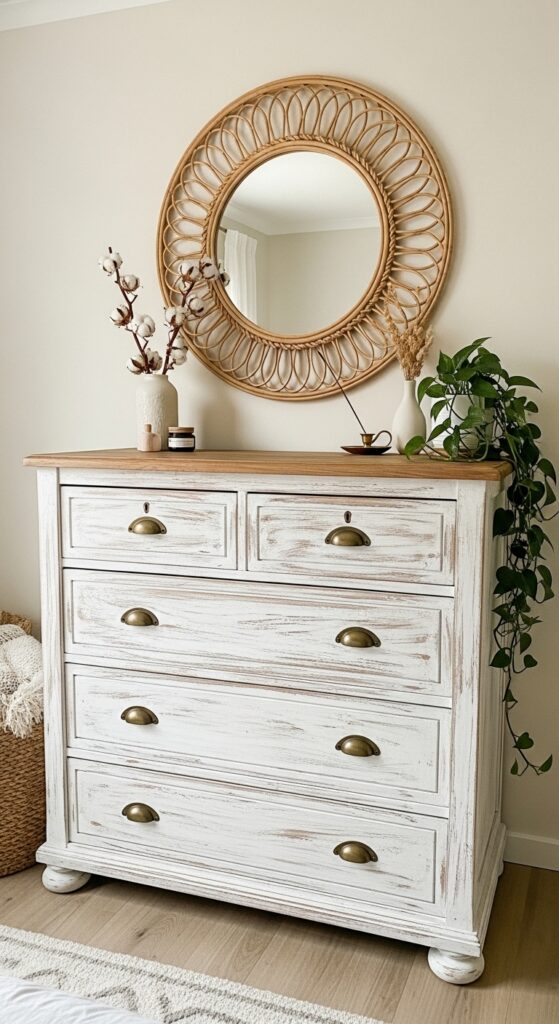
Vibe: A dresser that has clearly been loved for decades — imperfect, warm, and styled with the kind of accumulated beauty that only time produces.
What makes it work: A deliberately distressed dresser surface adds the quality of age and provenance that is central to the boho farmhouse aesthetic — it communicates that the piece was found rather than purchased, loved rather than merely owned. The rattan-framed round mirror above reinforces the boho material story while the circular form provides a strong visual focal point above the dresser’s rectangular horizontal.
How to achieve it: Distress existing furniture by sanding painted edges, corners, and drawer fronts to reveal the timber below — focus on high-wear areas where natural distressing would authentically occur. Apply chalk paint in a warm white and distress while still slightly wet by wiping back with a damp cloth on raised areas. Wax with dark furniture wax worked into distressed areas to simulate decades of accumulated patina. Replace existing hardware with aged brass drop-pull handles — this single change transforms the character of the entire piece.
18. Boho Dreamcatcher as Bedroom Art
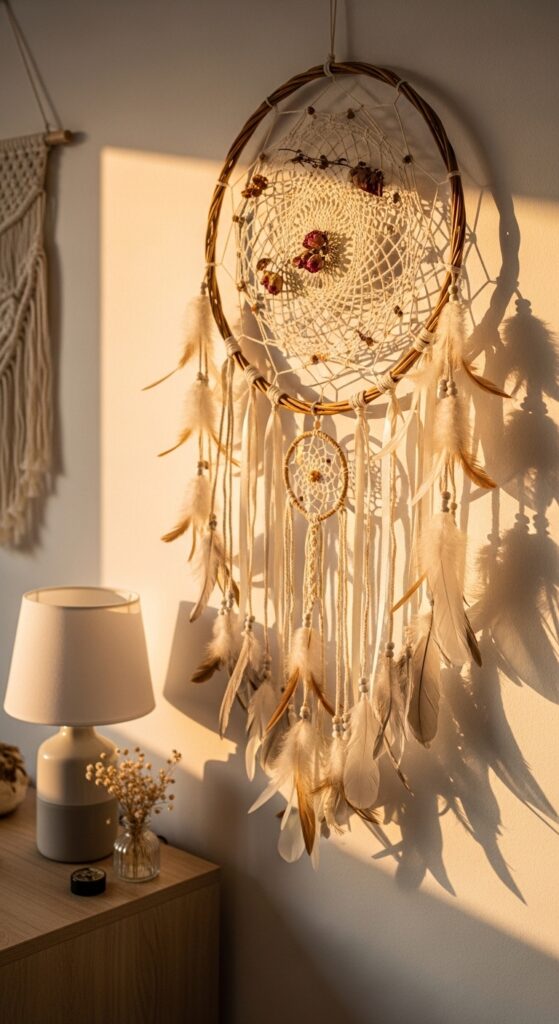
Vibe: Art with intention — a dreamcatcher so beautifully made it works equally as craft object, wall art, and quiet bedroom talisman.
What makes it work: A large, artisan-quality dreamcatcher introduces a different creative tradition into the boho farmhouse bedroom — the intricate woven web, natural materials, and flowing feathers and ribbons create a composition that is simultaneously geometric and organic, structured and free-moving. The gentle movement of feathers and ribbons in air currents gives the piece a living quality that static wall art lacks.
How to achieve it: Size is critical — a dreamcatcher for bedroom wall art should be a minimum of 300mm diameter hoop for a bedside position, or 500mm and above for a headboard wall feature. Commission from Indigenous or Native American artisan sellers on Etsy where possible to support authentic craft traditions and ensure genuine materials. Source handmade versions rather than mass-produced imports, which typically use synthetic materials and lack the fine web detail of authentic craft.
19. Exposed Brick Interior Wall Painted White
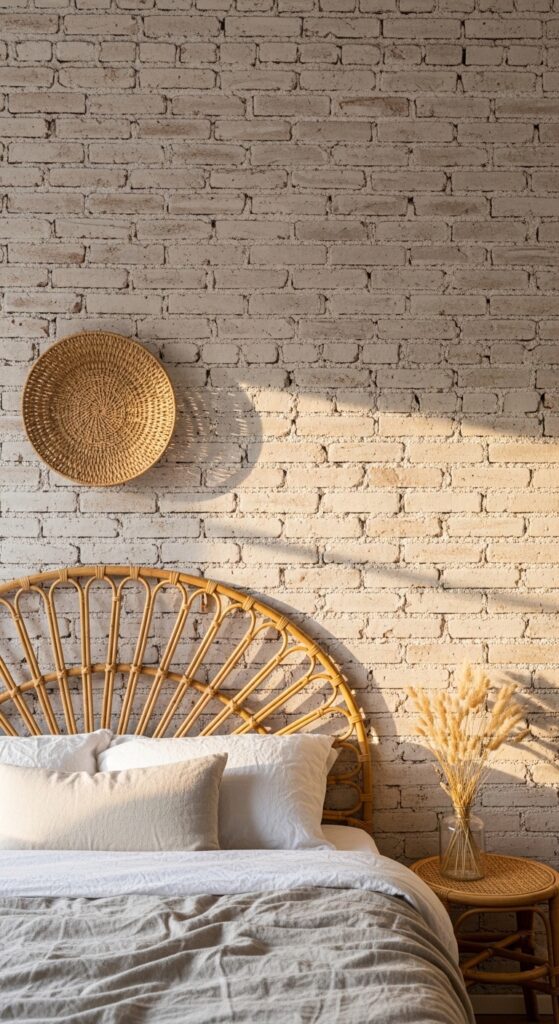
Vibe: A wall that has been here long before the furniture and will be here long after — imperfect, warm, and entirely irreplaceable.
What makes it work: Limewashed white brick delivers a wall surface of extraordinary textural richness — the translucent white coating simultaneously brightens the brick and preserves every detail of its irregular surface, mortar joints, and tonal variation. Against the clean lines of linen bedding and the organic warmth of rattan, the limewashed brick creates the perfect boho farmhouse material contrast — rough and smooth, old and new.
How to achieve it: Apply exterior-grade limewash paint (not standard latex paint, which sits on the surface rather than penetrating the brick) in thin, irregular coats using a natural bristle brush. Work the brush in multiple directions to ensure paint penetrates mortar joints. The level of white coverage can be controlled by diluting the limewash further for a more translucent result or applying additional coats for denser coverage. Test on an inconspicuous section first — limewash is permanent and difficult to remove from masonry.
20. Fairy Light Canopy Across the Bedroom Ceiling
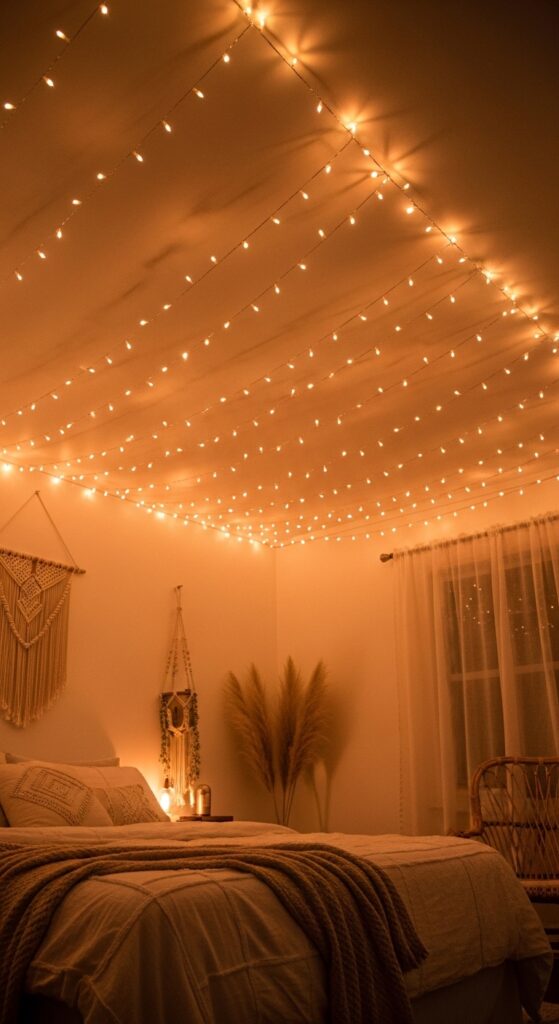
Vibe: A bedroom ceiling turned night sky — warm, quiet, and making every evening feel like sleeping under the stars.
What makes it work: A fairy light canopy across the bedroom ceiling is one of the most romantically transformative and budget-accessible bedroom design interventions available — it completely changes the room’s atmosphere after dark, converting a plain ceiling into a softly glowing canopy that makes the bedroom feel like a private, magical space. The warm amber color temperature (2200K) specifically creates a flame-like warmth that is deeply calming for a sleep environment.
How to achieve it: Use battery-operated or USB-powered micro fairy lights — standard plug-in lights require ceiling-level outlets that are rarely present in bedrooms, while battery or USB versions offer complete placement flexibility. Run parallel rows of lights from one wall to the opposite using small ceiling hooks or Command strips, spacing rows 150–200mm apart. A 10m string of micro lights typically covers approximately 0.5 square meters of ceiling — calculate the number of strings needed based on the ceiling area you want to cover.
💡 A smart plug timer set to activate the fairy lights at dusk and switch off at midnight automates the magical evening atmosphere entirely.
21. Chunky Knit Throw in Cream or Warm Ivory
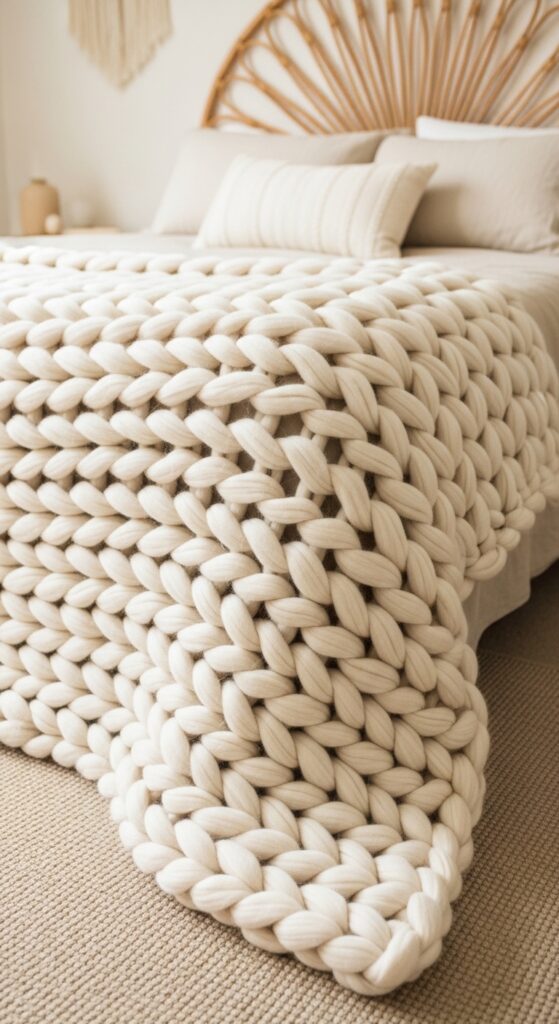
Vibe: A throw so thick and warm it functions as its own weather system — the textile equivalent of a long, slow exhale.
What makes it work: Chunky knit throws introduce the most dramatically textural element available in bedroom soft furnishings — the oversized stitch scale creates visual depth and shadow that no woven, printed, or quilted textile can replicate. In warm ivory or cream, the throw anchors the entire bed composition in warmth without introducing color complexity, functioning as both a practical layer and the room’s most tactilely compelling decorative element.
How to achieve it: Arm-knit throws in genuine merino or Peruvian highland wool (the material that gives chunky throws their characteristic soft weight) are best sourced from independent Etsy makers who use high-quality fiber — mass-produced versions in acrylic feel plasticky and photograph poorly. A queen-bed throw requires approximately 4–5kg of arm-knitting yarn. Wash only with cold water and a wool-safe detergent, laying flat to dry to preserve the stitch structure.
22. Indoor Plants at Every Level — Floor, Shelf, and Hanging
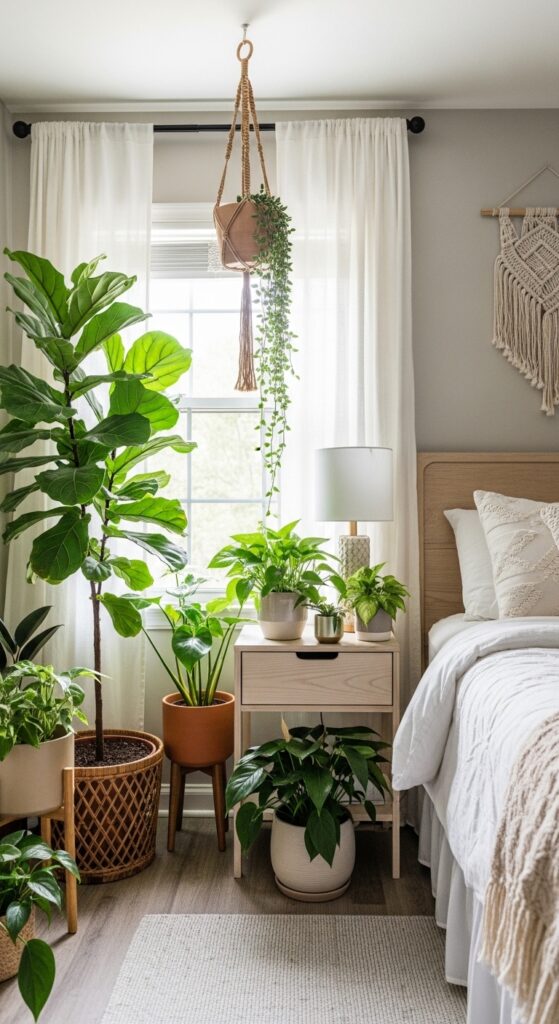
Vibe: A bedroom that breathes — genuinely alive at every level, green in every corner, and making the air itself feel different.
What makes it work: Plants at three vertical levels — floor, surface, and hanging — create a genuinely immersive indoor garden atmosphere that transforms the room’s spatial character. The vertical layering of foliage at different heights mirrors the structure of a natural plant community, creating visual continuity from floor to ceiling that makes the room feel both larger and more alive. Each plant level serves a distinct visual purpose: floor plants anchor the room, surface plants bridge to furniture, and hanging plants activate the overhead space.
How to achieve it: Choose plants for each level based on their natural growth habit: tall architectural species (fiddle-leaf fig, bird of paradise, monstera) for floor level; spreading and trailing varieties (pothos, heartleaf philodendron, tradescantia) for surfaces; and naturally pendulous trailing species (string of pearls, string of hearts, trailing pothos) for hanging positions. Assess the light level in each position before purchasing — most bedroom plants require bright indirect light, and positions more than 2m from a window are typically too dim for sustained plant health.
23. Mud Cloth or African Print Accent Pillow Collection
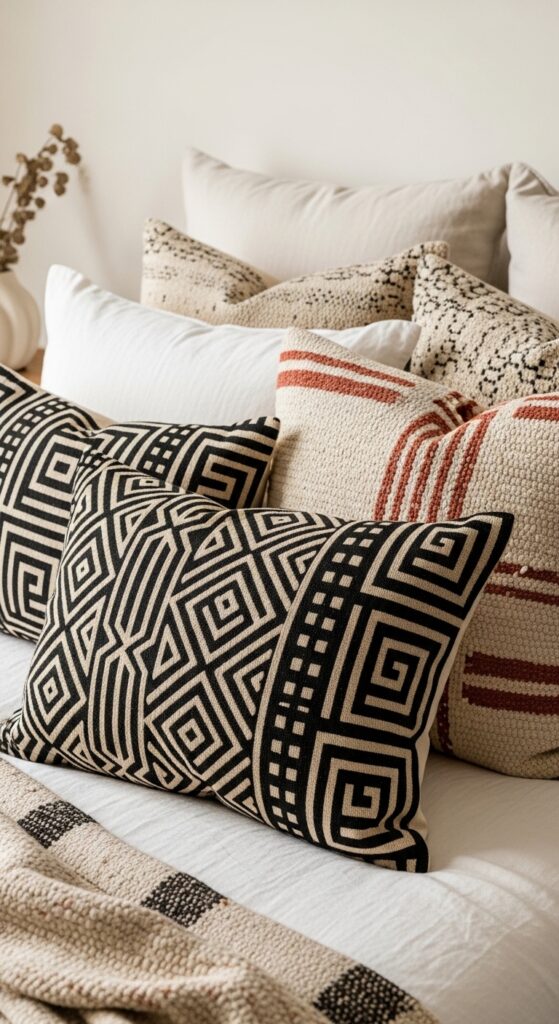
Vibe: Pillows with provenance — each one a textile tradition, assembled together into a bed that feels like it has been somewhere.
What makes it work: Authentic mud cloth (bogolan) introduces a textile tradition of extraordinary richness into the boho farmhouse bedroom — the hand-painted geometric patterns in organic mineral pigments create a depth of surface texture that machine-printed fabrics cannot replicate. The black-and-cream palette of mud cloth is one of the few bold, high-contrast pattern combinations that integrates naturally into a warm neutral boho palette without competition.
How to achieve it: Source authentic Malian mud cloth from specialist African textile dealers or fair-trade artisan importers — authentic pieces have the slightly irregular geometric patterns and natural mineral pigment depth that machine-made reproductions lack. Have authentic fabric pieces made into pillow covers by a local upholsterer — this allows you to use genuine textile at a fraction of the cost of purpose-made mud cloth cushions. Mix a maximum of two mud cloth pillows with three to four complementary plain linen or woven covers to prevent the pattern from overwhelming the bed composition.
24. Antique Mirror or Arched Floor Mirror
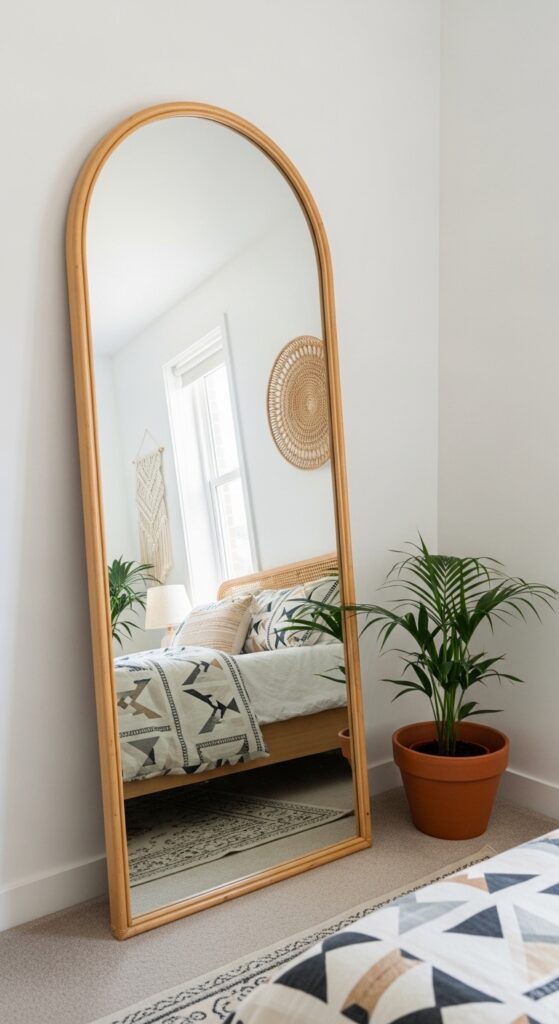
Vibe: A mirror that doubles the room and triples the light — the one piece of furniture that makes every bedroom feel larger, brighter, and more beautifully itself.
What makes it work: An arched floor mirror performs multiple design functions simultaneously in a boho farmhouse bedroom — it reflects natural light deeper into the room (critical in bedrooms with limited windows), doubles the visual depth of the space, and functions as a vertical focal point that anchors the room’s corner or wall composition. The arch form is specifically suited to the boho farmhouse aesthetic because it introduces the curved silhouette that counterbalances the straight lines of shiplap, furniture, and geometric textiles.
How to achieve it: Size the mirror relative to the wall — a floor mirror should be a minimum of 1.5m tall for a standard bedroom ceiling height of 2.4m, with taller mirrors (1.8m+) preferable if ceiling height allows. Lean rather than mount — the leaning position is more flexible and distinctly more casual and boho than a wall-mounted mirror. Position to reflect the room’s most beautiful element (a window, a plant, the styled bed) rather than pointing toward a blank wall.
25. Handmade Ceramic Bedside Accessories
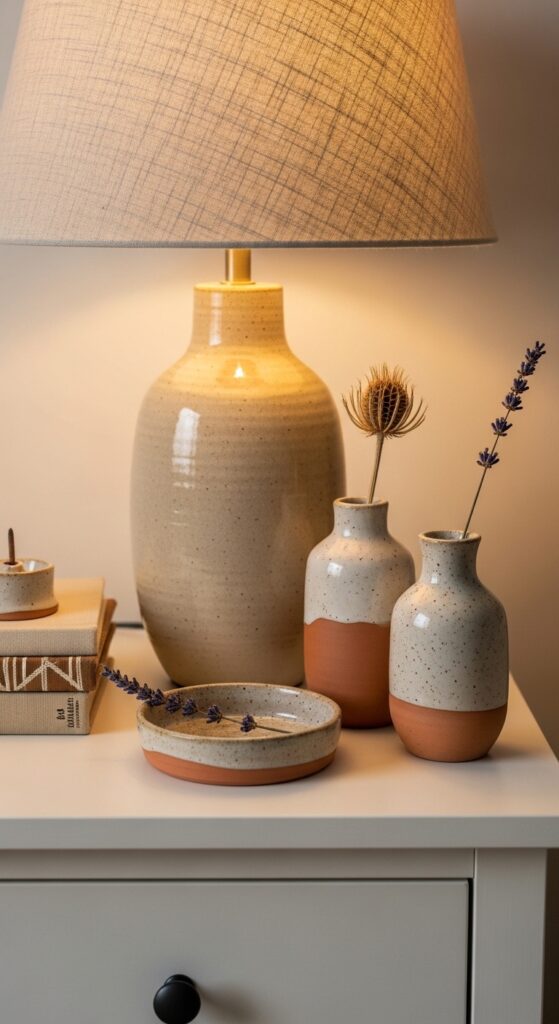
Vibe: A bedside table styled by someone who understands that the most beautiful objects are always the ones made by hand.
What makes it work: Handmade ceramics introduce a quality of uniqueness and imperfection that is central to the boho farmhouse aesthetic — the slight variation in throwing marks, glaze depth, and form between pieces gives each object an individual character that mass-produced accessories categorically lack. When multiple handmade ceramic pieces share a complementary glaze palette on the same surface, they create a beautifully cohesive still-life composition.
How to achieve it: Source handmade ceramics from local pottery studios, craft markets, and specialist Etsy ceramic artists — look specifically for visible throwing marks, glaze variation, and deliberate imperfection in form rather than the machine-like uniformity of production ceramics. Building a collection gradually over time rather than purchasing a matched set produces the most genuinely boho result — slight variations in maker and period add richness. Group three to five pieces at varied heights for the most composed bedside vignette.
26. Sliding Barn Door for the Bedroom Entrance
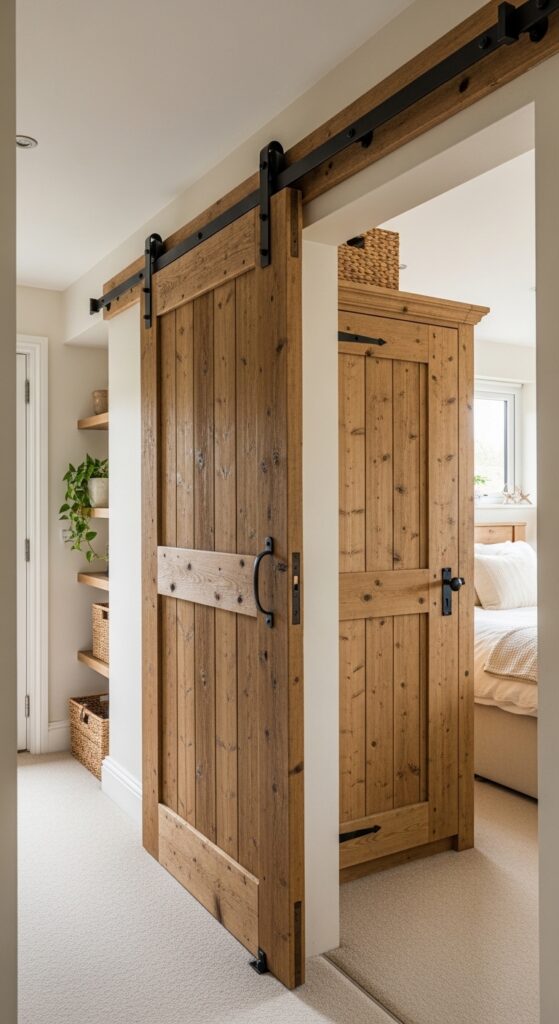
Vibe: The door that announces the room before you’ve even entered — a farmhouse statement in reclaimed timber and black iron that sets the entire aesthetic tone.
What makes it work: A sliding barn door at the bedroom entrance is the single most powerful farmhouse architectural detail available as a retrofit addition — it transforms the threshold of the bedroom into a design moment while eliminating the floor clearance requirement of a standard hinged door. The visible hardware track becomes a deliberate industrial-farmhouse detail that contributes to the room’s aesthetic rather than simply functioning as concealed mechanism.
How to achieve it: Barn door hardware kits with a 2m track are available from hardware retailers and specialist suppliers for $150–350 — the kit includes the rolling hardware, rail, and fixings. The door panel itself can be a reclaimed timber plank door sourced from architectural salvage (the most characterful option), a new solid timber door constructed from rough-sawn boards, or a standard hollow-core door reskinned with pallet wood strips for a budget-friendly reclaimed appearance. Install the rail into wall studs at ceiling height — the combined weight of door and hardware requires structural fixing.
27. Neutral Boho Color Palette with Warm White Walls
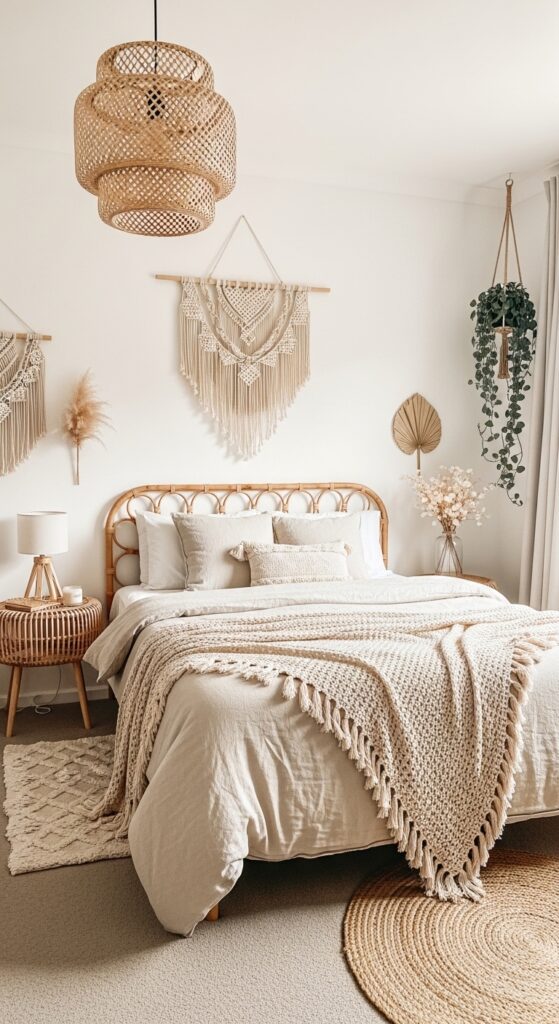
Vibe: A room where texture is the language and warmth is the message — neutral without emptiness, minimal without coldness.
What makes it work: An all-neutral boho farmhouse bedroom succeeds precisely because it demonstrates that visual richness in design is a function of texture and material quality rather than color variety. When every element shares the same warm neutral color family — warm white, oatmeal, cream, natural — the eye is freed to appreciate the extraordinary variety of textures: linen slub, rattan weave, jute fiber, macramé knot, dried botanical stem. The result is a room that feels simultaneously calm and complex.
How to achieve it: The key to a successful all-neutral palette is strict adherence to warm rather than cool neutrals throughout — any single cool-toned neutral (a blue-white, a grey linen, a silver-toned rattan) will stand out against the warm palette as a discordant note. Test every element — paint, fabric, timber, natural material — in the room’s natural light before committing. Introduce the sole color accent (one healthy plant in a terracotta pot) last, after all other elements are in place.
28. Reclaimed Wood Accent Wall with Varied Plank Widths
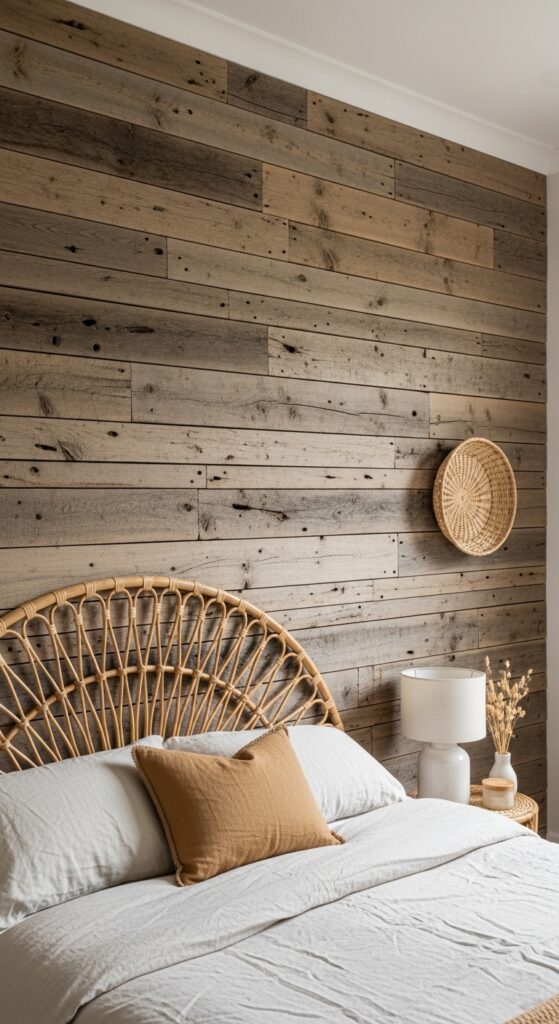
Vibe: A wall with a past — reclaimed timber that has already lived a full life and brings every year of it to the bedroom wall.
What makes it work: Reclaimed timber installed in varied widths creates a wall surface of exceptional visual richness — the irregular alternation of plank widths generates a horizontal rhythm that is distinctly different from the uniform repetition of shiplap, while the authentic age variation, nail holes, and tonal differences across individual planks create a depth of surface detail that approaches the visual complexity of natural stone.
How to achieve it: Source reclaimed timber from barn demolitions, factory salvage, or specialty reclaimed wood suppliers — genuine reclaimed boards typically show nail holes, surface weathering, and varied color that distinguishes them from artificially distressed new timber. Fix to a timber batten framework attached to the wall rather than directly to drywall — this allows the reclaimed planks to be fastened securely without relying on the varying thickness of aged boards to provide a flat final surface. Seal with a matte penetrating oil rather than a surface finish to preserve the natural aged appearance.
29. Boho Farmhouse Vignette on a Vintage Dresser Tray
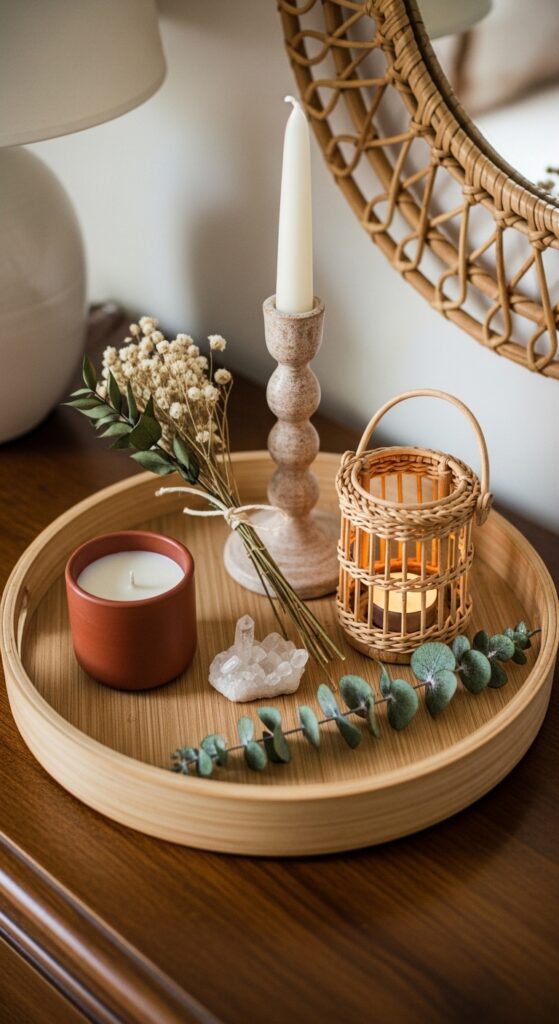
Vibe: A small world contained within a tray — objects gathered for the pleasure of looking at them, arranged with the kind of care that turns a surface into a story.
What makes it work: A styled tray vignette applies the curatorial principle of the still life to a functional bedroom surface — the tray’s boundary defines and contains the arrangement, preventing it from spreading into clutter while concentrating the visual interest of multiple small objects into a single composed focal point. In a boho farmhouse bedroom, the tray vignette is the micro-scale expression of the aesthetic’s larger collecting and layering philosophy.
How to achieve it: Use the rule of odd numbers — three, five, or seven objects per tray — arranged at deliberately varied heights. Include at minimum one tall element (a bud vase, a candle stick), one medium element (a small potted plant, a ceramic bowl), and one low horizontal element (a crystal, a small stack of cards, dried petals). Leave negative space within the tray — the objects should occupy approximately 60–70% of the tray surface, with the remainder left open for visual breathing room.
How to Start Your Boho Farmhouse Bedroom Transformation
Begin with the bedding — not the walls, not the furniture, and not the accessories. The bed is the visual center of any bedroom, and the layered linen-and-textile approach of a boho farmhouse bed is both the most immediately impactful and the most easily reversible change available. Invest in a quality linen duvet cover in warm oatmeal or warm white, layer a vintage kilim throw across the foot, and add a collection of complementary pillow covers in two to three related neutral tones. This single change will transform the bedroom’s character and give you a clear sense of whether the boho farmhouse direction feels right before any structural or furniture investment is made.
Once the bed is established as the anchor, identify your headboard wall as the next priority — it is the room’s most photographed and highest-impact surface. A rattan headboard against white shiplap, a large macramé wall hanging above an existing bed frame, or a reclaimed timber accent wall all deliver dramatic results from a single focused intervention. Choose the one that best suits your existing room and budget, and commit to it fully before adding surrounding accessories.
The most common mistake in boho farmhouse bedroom design is attempting everything simultaneously — too many textures, too many plants, too many wall hangings competing for attention in an underdeveloped room. The aesthetic rewards patience and accumulation. Begin with the bed and one wall treatment, then add layer by layer — a rug, then a floor plant, then a nightstand vignette, then wall baskets — allowing each addition to settle before assessing what the room still needs.
Budget starting points are genuinely accessible: a linen duvet cover ($80–180), a macramé wall hanging from Etsy ($60–150), a secondhand rattan headboard ($100–300), dried pampas grass ($30–60 for a generous arrangement), and a woven jute rug ($120–250) together constitute a near-complete boho farmhouse bedroom transformation for under $800.
Frequently Asked Questions
What is the difference between boho and boho farmhouse style?
Pure bohemian bedroom design is globally eclectic, maximalist, and pattern-heavy — it draws freely from Moroccan, Indian, South American, and African textile traditions with a confident mixing of color, pattern, and cultural reference that can feel visually intense. Boho farmhouse adds a disciplined farmhouse framework to this eclecticism — the neutral palette of warm whites, oatmeal, and cream restrains the color intensity; the farmhouse architectural elements (shiplap, exposed beams, barn doors, reclaimed timber) provide structural grounding; and the overall effect is warmer, more cohesive, and more accessible as a full-room design approach. The boho farmhouse bedroom looks collected rather than assembled and feels calm rather than energized — the bohemian spirit is present in the eclectic sourcing and natural materials, while the farmhouse structure keeps the room from tipping into visual chaos.
How do I achieve the boho farmhouse look on a tight budget?
The boho farmhouse aesthetic is genuinely one of the most budget-accessible interior design styles because many of its most characteristic elements are either free, thrifted, or inexpensive. Dried botanicals can be harvested from gardens and roadsides. Vintage kilim throws and mud cloth pillow covers are consistently available at thrift stores and antique markets for a fraction of their retail price. Macramé wall hangings can be made at home with $30 of cotton rope and a YouTube tutorial. Shiplap walls can be simulated with paint-grade pine boards from any lumber yard. Rattan headboards and wicker furniture appear regularly in secondhand marketplaces. The boho farmhouse bedroom’s embrace of imperfection, natural aging, and eclectic sourcing means that the best results often come from the most economical sources — the aesthetic actively rewards the thrifted, the handmade, and the found over the purchased and the new.
What plants work best in a boho farmhouse bedroom?
The most successful boho farmhouse bedroom plants are those that combine visual drama with genuine low-maintenance character — because the aesthetic is rooted in authenticity, a thriving plant always reads better than a struggling one. Pothos (Epipremnum aureum) is the quintessential boho farmhouse plant — its heart-shaped leaves and trailing habit work at every level from shelf to hanging, and it tolerates the lower light levels typical of bedrooms. Fiddle-leaf fig (Ficus lyrata) delivers the architectural drama of a large floor plant but requires bright indirect light. Monstera deliciosa introduces the large tropical leaf form that photographs beautifully in boho contexts. String of pearls (Senecio rowleyanus) is the ideal hanging plant but requires brighter light than most bedrooms provide. For genuinely low-light bedrooms, ZZ plant (Zamioculcas zamiifolia) and snake plant (Sansevieria trifasciata) are the most reliable performers.
How many patterns can I mix in a boho farmhouse bedroom?
The boho farmhouse bedroom can successfully accommodate three to five distinct patterns simultaneously if they share a cohesive color palette — this is the criti