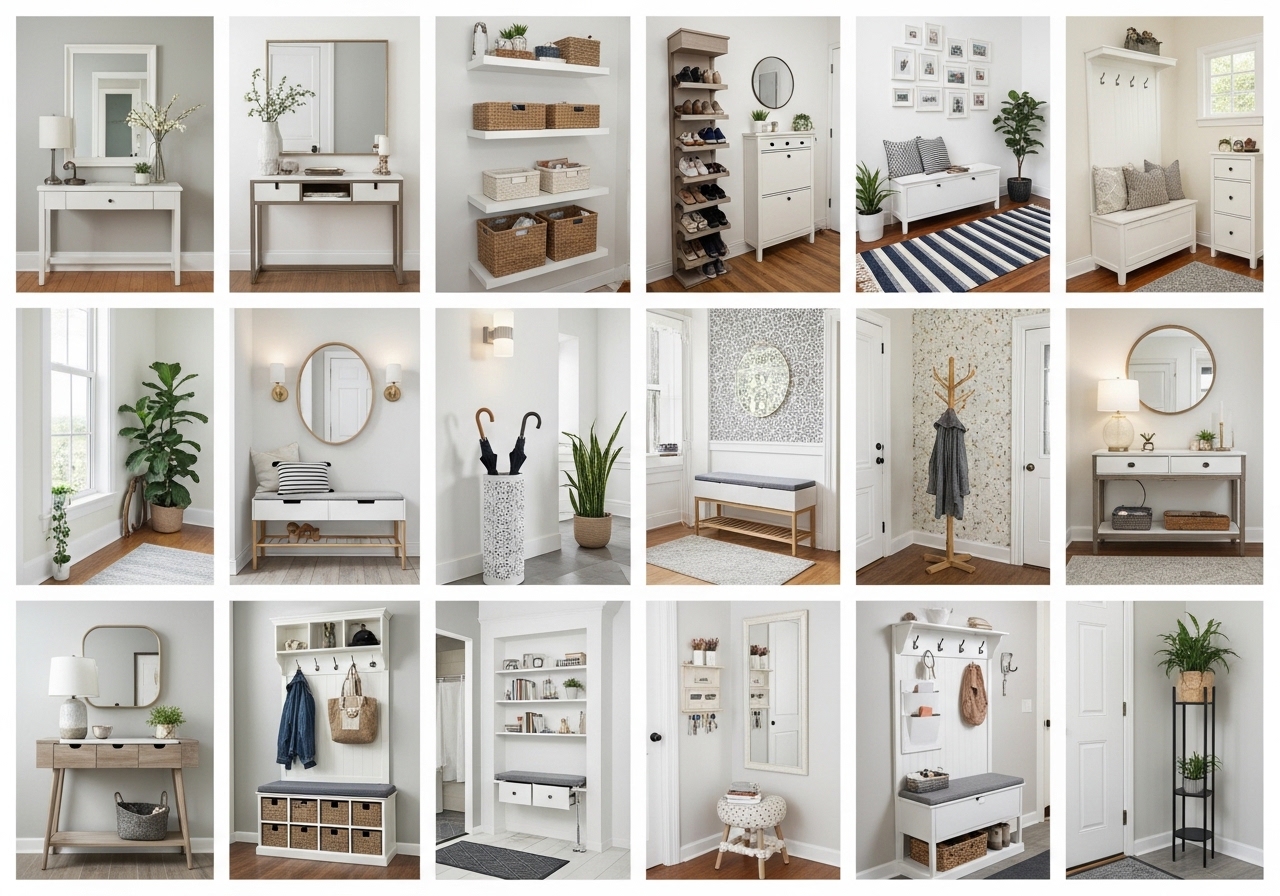
A narrow entrance hall has a reputation it doesn’t deserve. Yes, it’s tight. Yes, it’s the first thing guests see and the last thing you look at before you leave the house. But squeeze the right ideas into that slim corridor and something remarkable happens — it stops feeling like a passage and starts feeling like a proper room with real personality. The secret isn’t a bigger space; it’s smarter decisions about every single surface, every inch of wall, and every piece of furniture that earns its place. These 25 narrow entrance hall smart decor ideas are proof that constraint is just creativity in disguise. Let’s explore every one of them.
Why Smart Narrow Hallway Decor Works So Well
Narrow entrance halls operate by a completely different set of design rules than other rooms — and that’s precisely what makes them so interesting to work with. The limitations force intentionality. Every choice must pull double or triple duty: a mirror that reflects light and creates depth, a bench that provides seating and conceals storage, a console table that anchors the space and holds the everyday essentials.
The materials and finishes that perform best in a narrow entrance hall tend toward the reflective and the light — lacquered surfaces, warm-toned mirrors, glossy subway tile, and metallic hardware in unlacquered brass or brushed gold. These elements bounce natural and artificial light down the corridor, optically widening and lengthening the space in a way that matte, heavy materials simply cannot.
Narrow hallway transformations are consistently among the most-saved interior content on Pinterest, and for good reason — the before-and-after potential is dramatic. A coat of the right paint, a floor-to-ceiling mirror, and a slim console table can make a 36-inch-wide hallway feel like a design feature rather than a design problem. These are the kinds of rooms that punch far above their physical weight.
Even the narrowest entrances — those barely wide enough for two people to pass — can accommodate a wall-mounted key rail, a vertical mirror, a small sconce, and a runner rug. That’s a complete entrance hall. Scale is never the true limiting factor. Thinking is.
1. Floor-to-Ceiling Mirror on the Longest Wall
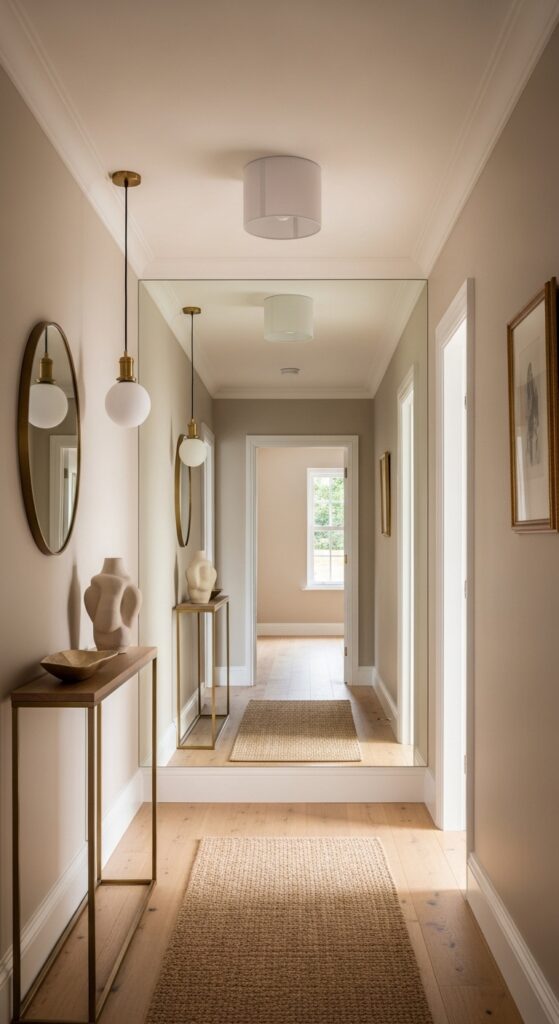
Vibe sentence: One mirror, one wall — and the hallway suddenly feels twice the size it actually is.
What makes it work: A floor-to-ceiling mirror on the longest wall of a narrow entrance hall creates a visual doubling effect that no other single element can replicate. It reflects the opposite wall, the ceiling, and any light source in the hall — multiplying brightness and perceived depth simultaneously. The frameless or slim-framed version works best because it reads as an architectural feature rather than hung decor.
How to achieve it: Have a glass supplier cut a mirror to your exact wall dimensions and adhere using mirror adhesive clips rated for the weight — avoid adhesive-only mounting on large panels. Polish-edge frameless mirrors from companies like Fab Glass and Mirror can be ordered to custom dimensions for surprisingly reasonable prices.
💡 Place a slim console table directly in front of the mirror at one end — the reflection makes it look like two tables flanking a passage, which is a classic designer trick.
2. Slim Console Table with Legs to Keep the Floor Visible
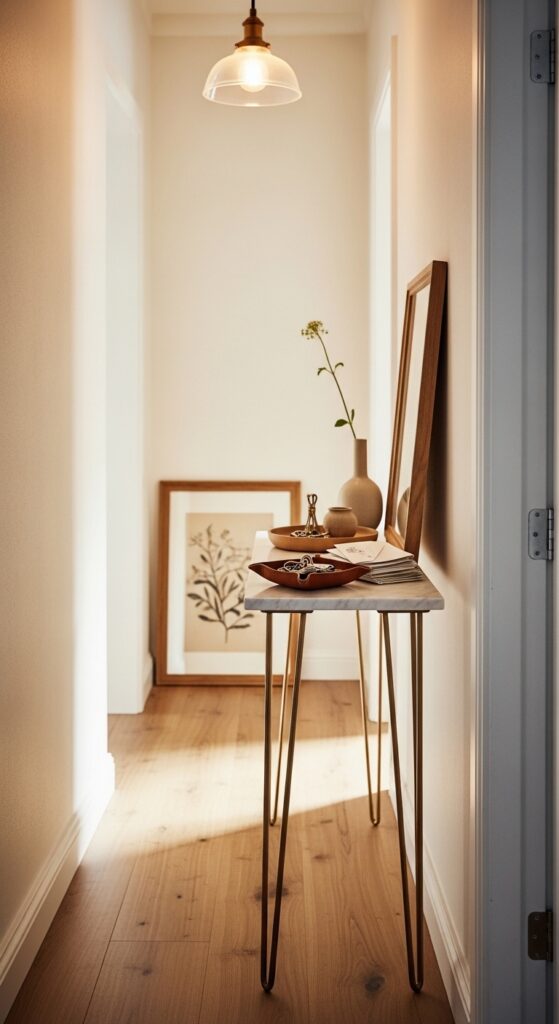
Vibe sentence: Legs change everything — a console table on legs floats rather than blocks, and that distinction transforms a narrow hall.
What makes it work: In a narrow entrance hall, solid-base furniture acts as a visual dam — it stops the eye and makes the space feel shorter and heavier. A console table on legs, particularly in a light metal or pale wood, allows the floor to continue visually beneath and beyond it, maintaining the corridor’s sense of flow and length.
How to achieve it: Look for console tables with a depth of 8–12 inches — anything deeper starts to genuinely impede traffic flow in a narrow hall. IKEA’s LUNNARP and similar slim-profile options work beautifully, or have a tabletop cut from marble or wood and mounted on hairpin legs from a hardware supplier for a custom look at low cost.
3. Vertical Shiplap Accent Wall for Height Illusion
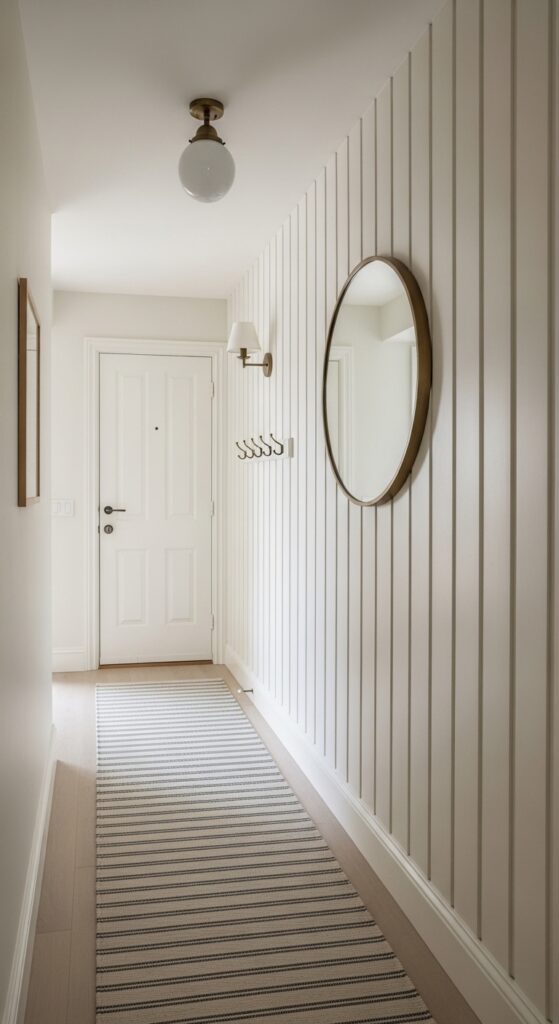
Vibe sentence: Vertical lines do to a room what vertical stripes do to a silhouette — everything looks taller, immediately.
What makes it work: Vertical shiplap (boards installed vertically rather than the traditional horizontal) creates strong upward-moving lines that draw the eye toward the ceiling rather than across the narrow width of the hall. This is one of the most effective optical tools for making a low or narrow space feel taller and more generous.
How to achieve it: Standard 1×4 pine boards with a 1/8-inch gap between them installed vertically achieve the shiplap effect without requiring specially milled boards. Paint boards and wall the same color for maximum impact — the shadow gap does the visual work without needing color contrast.
💡 Paint the ceiling the same color as the vertical shiplap wall — it removes the visual “lid” and makes the space feel even taller.
4. Gallery Wall of Vertical Artwork to Draw the Eye Down the Hall
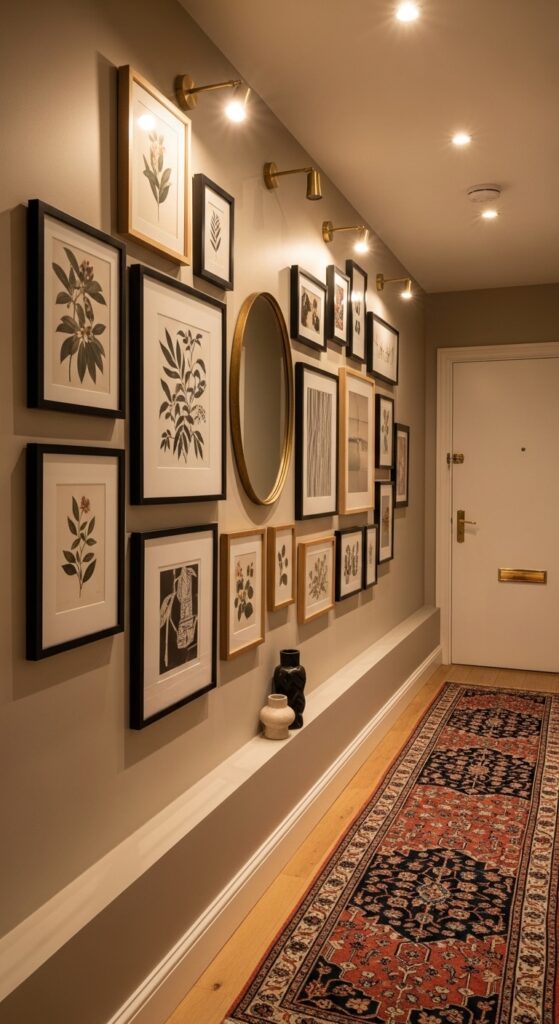
Vibe sentence: A gallery wall running the length of a narrow hall turns a transit corridor into a private museum — every step reveals something new.
What makes it work: Artwork arranged in a linear run along a hallway wall actively encourages movement — the eye wants to follow the sequence, which makes the hall feel longer and more purposeful. Vertically oriented frames within the gallery reinforce height, while a consistent frame palette (all black, or all brass) prevents visual chaos in a tight space.
How to achieve it: Lay the gallery arrangement on the floor first to finalize spacing before hanging anything. Use a consistent mat width (3–4 inches) across all frames for a cohesive look even when frame sizes vary. Command strips rated for the frame weight are ideal for hallways — they avoid wall damage and allow repositioning.
5. Statement Wallpaper on One Wall Only
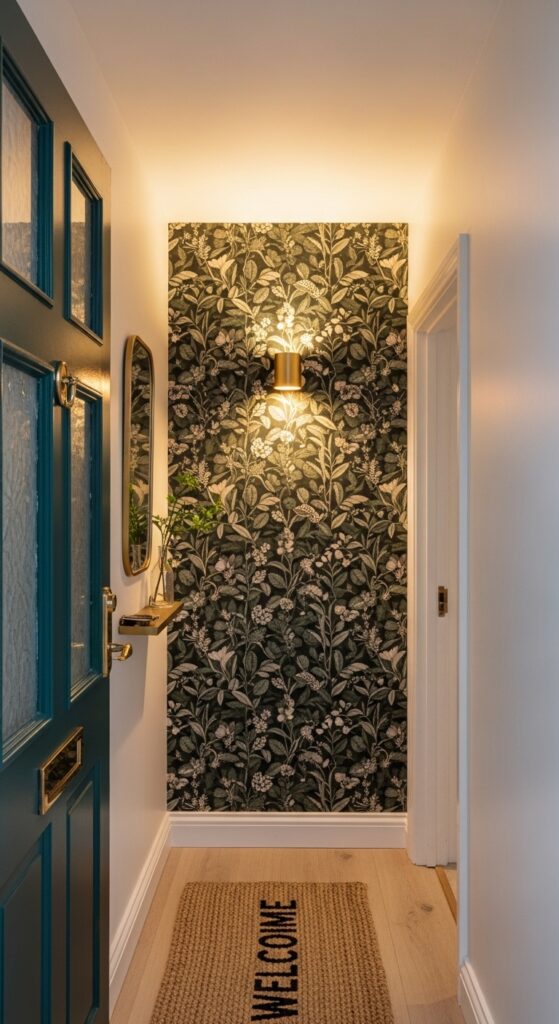
Vibe sentence: One bold wall at the end of the hall is the first thing every guest sees — make it count.
What makes it work: Papering only the end wall — the one you walk toward — creates a focal point that pulls you through the space and makes the corridor feel purposeful rather than transitional. A large-scale botanical or geometric pattern on this single wall is dramatically more impactful than the same paper applied to all walls, which in a narrow hall can feel overwhelming.
How to achieve it: Choose paste-the-wall wallpaper rather than paste-the-paper for easier installation in a tight space — you don’t need to handle wet, floppy paper in a confined corridor. Dark or richly colored wallpaper works particularly well on end walls in halls that receive artificial rather than natural light — the depth of the color is flattering under warm bulbs.
6. Recessed Wall Niches for Display Without Depth Intrusion
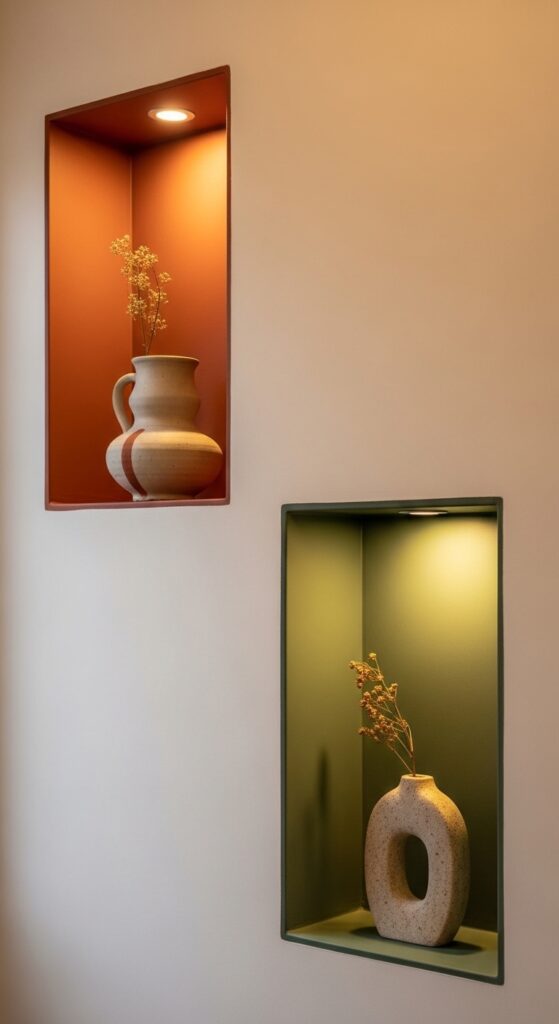
Vibe sentence: Display that lives inside the wall takes up zero floor space and adds maximum character — the cleverest trick in a narrow hall.
What makes it work: Recessed wall niches provide display and visual interest without projecting a single millimeter into the hallway’s precious width. Painting the inside of each niche a contrasting accent color to the surrounding wall creates a jewel-box effect that makes each object displayed inside look intentional and curated.
How to achieve it: Niches can be created between wall studs (standard 16-inch on-center spacing allows for niches roughly 14 inches wide) without structural alteration. Finish the interior with plaster or smooth joint compound, paint a contrasting color, and install a recessed LED puck light or strip at the top of the niche interior.
💡 An arched niche top (versus a square one) reads as more architectural and requires only a jigsaw to cut — no special tools needed.
7. Painted Ceiling in a Contrasting Color
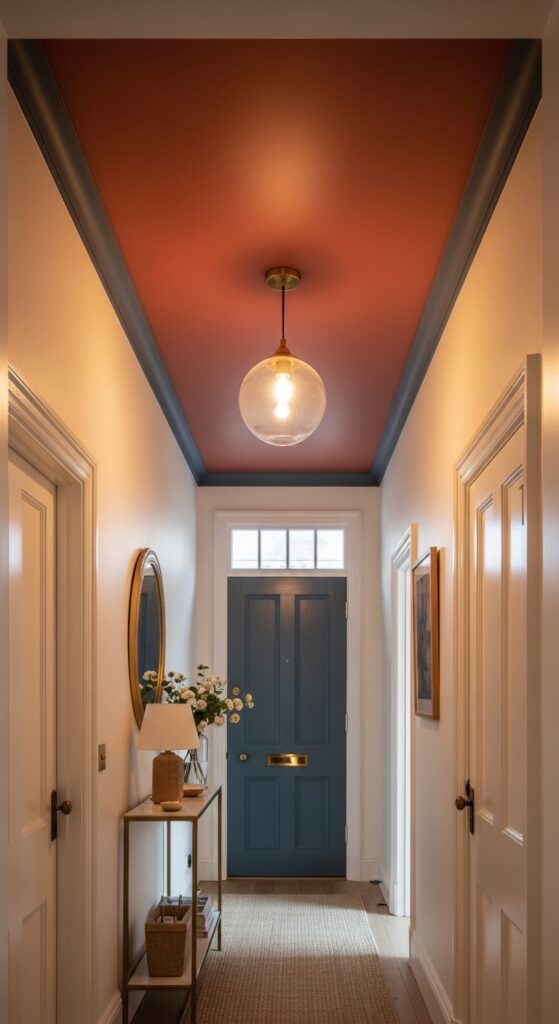
Vibe sentence: Look up — a painted ceiling turns a narrow hall into a room with a sky of its own.
What makes it work: A contrasting ceiling color in a narrow hallway does something counterintuitive — instead of making the space feel smaller, it makes it feel intentional and enveloping. The narrow walls become a frame for the ceiling rather than a constraint. Deep tones like terracotta, dusty blue, or sage green are particularly effective because they feel rich under warm artificial light.
How to achieve it: Paint the ceiling color two inches down onto the wall before adding crown molding — this “wraps” the color slightly and makes it feel more architectural and less like a paint mistake. Use an eggshell sheen on the ceiling rather than flat — it reflects more light and is easier to wipe clean in an entrance area.
8. Built-In Coat Hooks with a Mudroom Shelf Above
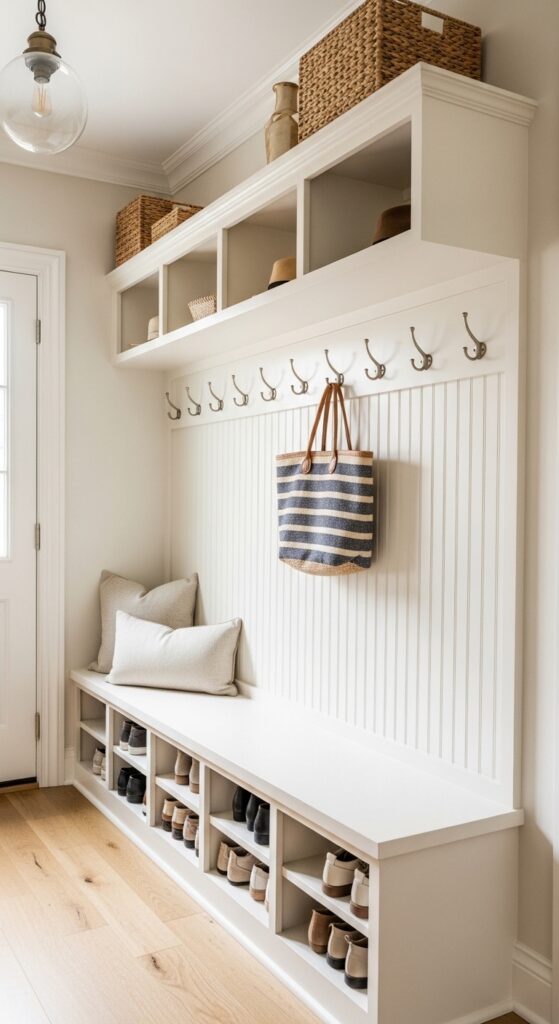
Vibe sentence: This is the entrance hall that handles real life — coats, bags, shoes, and everything in between — without showing a single seam of effort.
What makes it work: A built-in coat and storage unit painted to match the wall color blends into the architecture rather than reading as furniture — which is the key distinction in a narrow hall. The vertical layering of shoe storage, bench, hooks, and overhead shelf uses one wall’s full height to handle every entrance hall function simultaneously.
How to achieve it: Build the unit from painted MDF with a standard depth of 14–16 inches — deep enough for functional use but not so deep it narrows the walkway significantly. Install the shelf at 72–74 inches high so bags hung from hooks below don’t drag on the bench cushion.
9. Dark Moody Paint with High-Gloss Finish for Depth
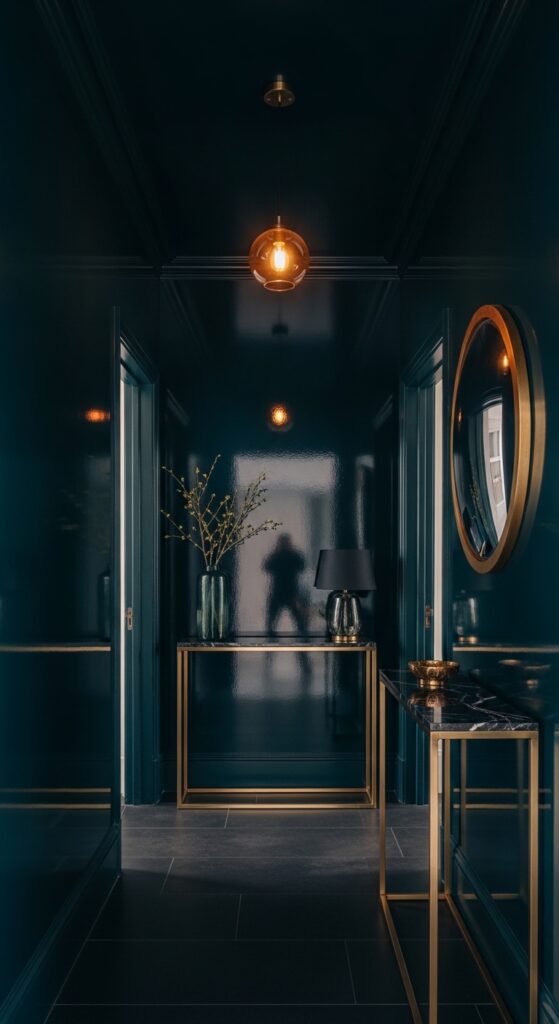
Vibe sentence: Dark and glossy is the design equivalent of confidence — this hall doesn’t try to look bigger, it simply commands attention.
What makes it work: High-gloss dark paint in a narrow hallway works because the reflectivity of the gloss finish bounces light similarly to a mirror — the wall surface itself becomes part of the lighting scheme. Painting the ceiling the same dark color removes the visual “box” effect and creates a fully immersive, jewel-box atmosphere that feels sophisticated rather than claustrophobic.
How to achieve it: Use Farrow & Ball’s “Studio Finish” (their high-gloss line) in colors like “Railings” or “Teal Blue,” or Benjamin Moore’s “High Gloss” formula in comparable deep tones. The surface preparation for high-gloss paint is critical — any wall imperfection will be amplified, so sand and prime meticulously before the first coat.
10. Runner Rug That Runs the Full Length of the Hall
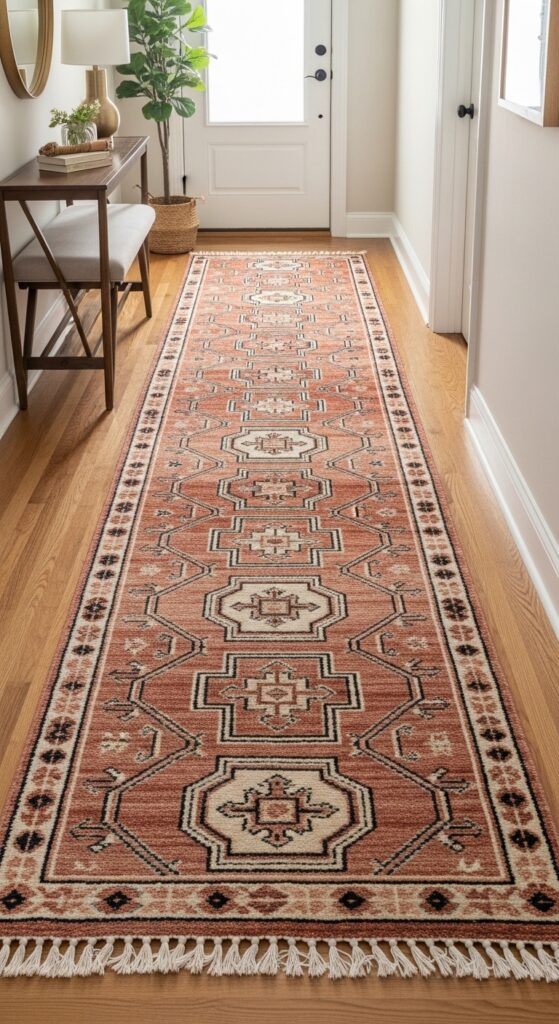
Vibe sentence: A rug that runs the full length of the hall turns a corridor into a red carpet — even if it’s terracotta.
What makes it work: A runner rug that extends nearly the full length of a narrow hallway does two critical things simultaneously: it leads the eye down the corridor (lengthening the perceived space) and introduces color, pattern, and softness underfoot that no hard flooring can provide. The visible strip of hard floor on each side frames the runner and makes the rug’s pattern the deliberate design choice it is.
How to achieve it: Size your runner to leave 2–4 inches of floor visible on each side — a runner that’s too wide looks like a room rug cut down; too narrow looks like an afterthought. Always use a runner pad underneath — on hard floors, an unpadded runner slides and bunches, which is both a tripping hazard and a visual mess.
💡 A Turkish or Moroccan-style vintage runner adds far more character than a new geometric — check eBay, Etsy, and local estate sales for pieces under $150.
11. Wall-Mounted Folding Seat for Tight Spots
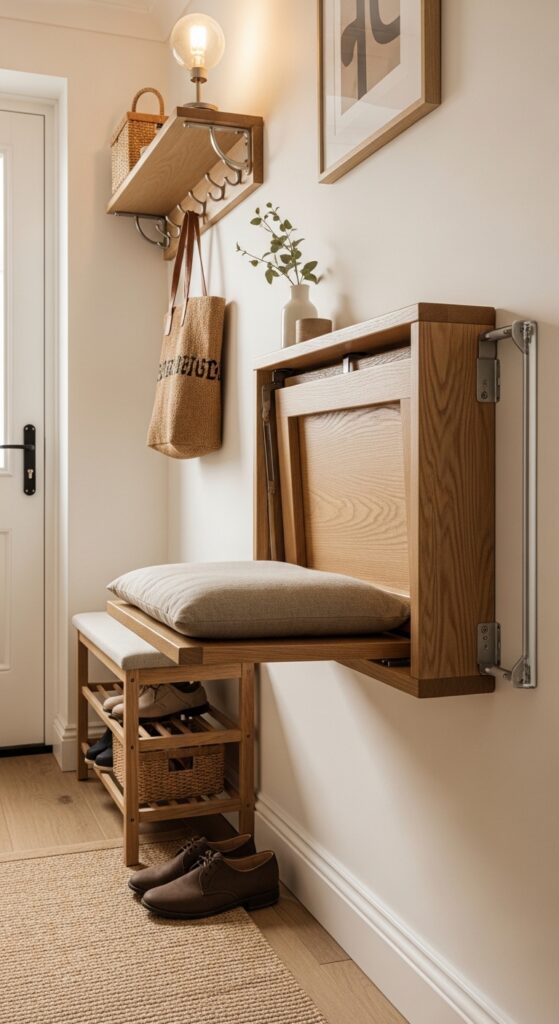
Vibe sentence: A seat that disappears when you don’t need it is the most honest piece of furniture a narrow hall can have.
What makes it work: A wall-mounted folding seat solves the narrow hall’s cruelest problem — the need for a place to sit while putting on shoes, with absolutely no floor space to spare. When folded flush against the wall, it projects only 2–3 inches — genuinely negligible in any hallway. In oak or painted wood matching the trim, it reads as a built-in detail rather than a workaround.
How to achieve it: Tuck-away wall-mounted folding seats are available from Ikea (NORBO), specialist woodworking companies, and custom joinery workshops. Mount into wall studs or use wall anchors rated for a minimum of 250 lbs — the leverage created by someone sitting on a wall-mounted seat places significant force on the mounting point.
12. Pendant Light as a Jewelry Piece for the Hall
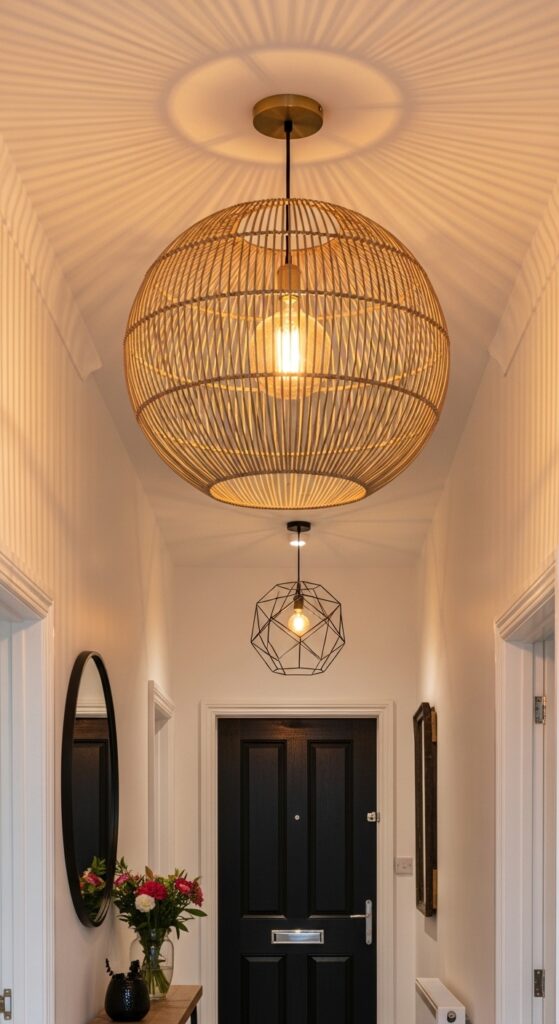
Vibe sentence: A great pendant light in a narrow hall is the equivalent of a statement earring — small space, big impact, immediately noticed.
What makes it work: In a narrow hall where there’s limited wall and floor space for decor, the ceiling becomes prime real estate. A sculptural pendant — oversized relative to the hall’s footprint — works precisely because the hall’s narrowness means it’s always viewed close-up and from below, where its form and glow are most dramatic.
How to achieve it: Hang the pendant at 7 feet from the floor rather than the standard 8-foot clearance — the lower height increases its visual presence and warm glow in the space below. Choose a rattan, linen, or woven pendant for maximum warmth, or a matte black geometric for a modern, graphic edge.
13. Half-Wall Paneling with Paint Contrast Above
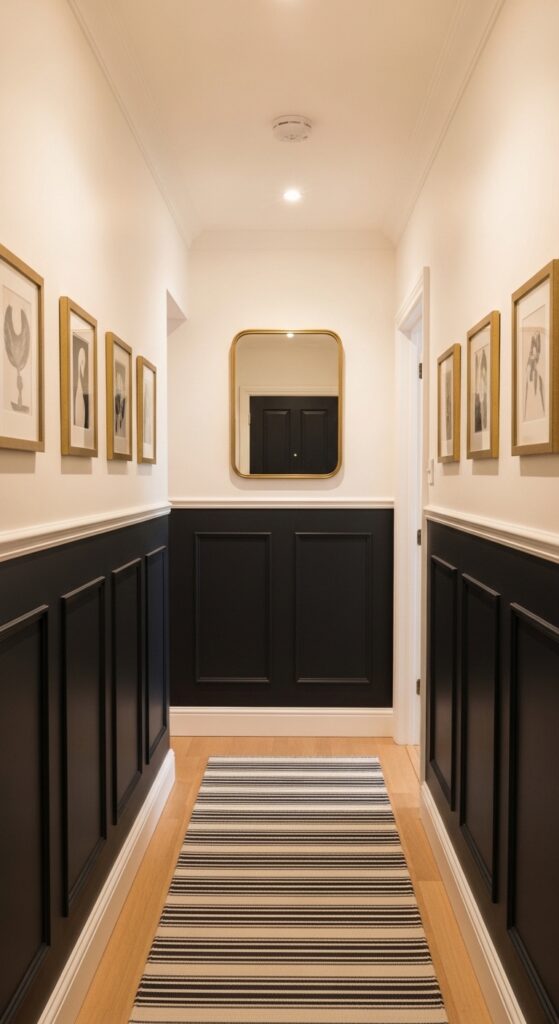
Vibe sentence: A chair rail and two-tone paint turns a plain corridor into a hallway with genuine architectural presence.
What makes it work: Two-tone paint with a strong horizontal line at chair-rail height creates a visual datum that makes the hallway feel wider — the eye reads the horizontal band across the full width of the space, which emphasizes the width dimension rather than the narrow one. Dark below and light above is the classic combination because it grounds the space without weighing down the ceiling.
How to achieve it: Standard chair-rail height is 32–36 inches from the floor — in a narrow hall, going slightly higher (to 42 inches) makes the dark lower section feel more substantial and the light upper section feel more airy. Install a simple 2.5-inch colonial chair rail molding from any hardware store to create the clean dividing line.
14. Sconce Lighting Pairs for Warm Layered Light
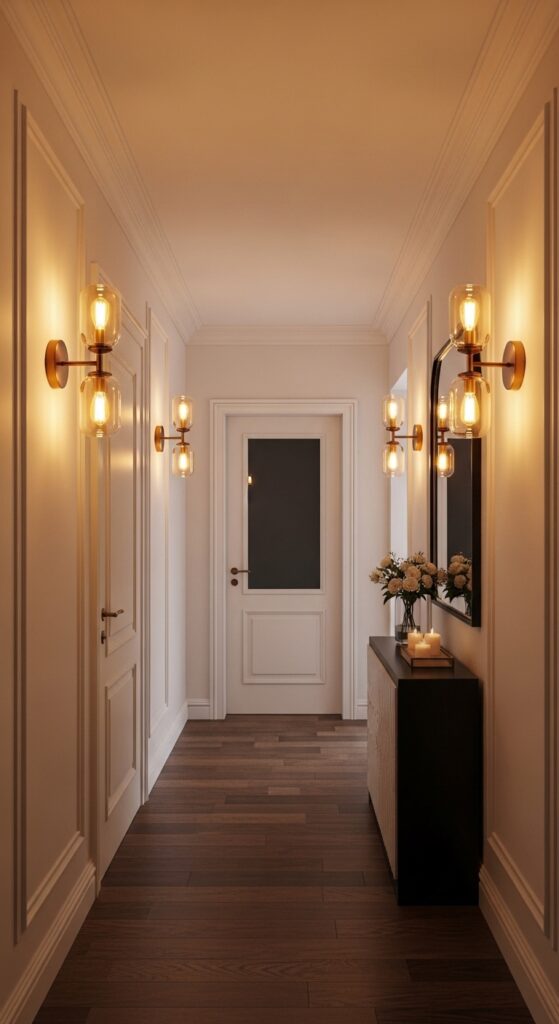
Vibe sentence: Two sconces facing each other in a narrow hall create a warmth so flattering it almost feels like candlelight.
What makes it work: Mounting sconces on opposing walls in a narrow hallway — rather than on just one wall — lights both surfaces equally, eliminating the harsh shadow on the unlit side that single-source lighting creates. The bouncing warm light between the two walls makes the hallway feel wider and significantly more welcoming.
How to achieve it: If hardwiring sconces is not possible, plug-in sconces with cord covers painted to match the wall are a completely acceptable alternative — the cord cover blends into the wall and the effect is nearly identical. Mount sconces at 60–66 inches from the floor — eye level when standing — for maximum warmth on faces and walls.
💡 Use a warm 2200K Edison or globe bulb in hallway sconces — the amber tone is the most welcoming light for a first impression.
15. Floating Shelves Instead of a Console Table
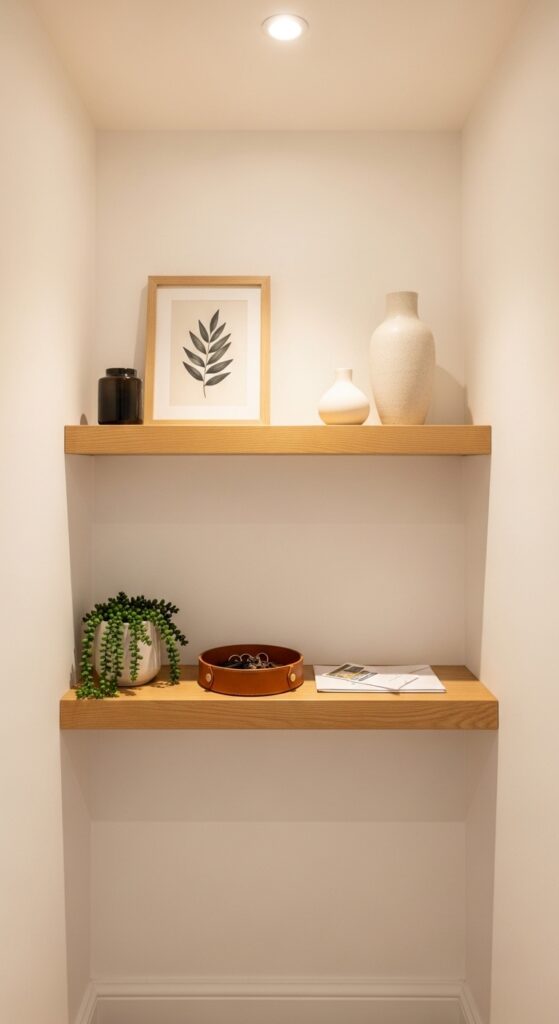
Vibe sentence: No legs, no base, no footprint — floating shelves give you all the function of a console table and return the entire floor to the hall.
What makes it work: In the narrowest hallways where even a slim console table on legs feels like an intrusion, floating shelves provide every functional surface you need — a place for keys, mail, small objects — while maintaining a completely unobstructed floor from wall to wall. The visual lightness of a floating shelf is unmatched by any floor-standing alternative.
How to achieve it: Use invisible shelf brackets (like the IKEA BETYDLIG or Floating Shelf Hardware heavy-duty versions) rated for the shelf material’s weight. Oak floating shelves at 10 inches deep provide ample surface area without projecting significantly into the corridor. Space two shelves 16–18 inches apart vertically for a proportional, purposeful look.
16. Hooks at Multiple Heights for Whole-Family Functionality
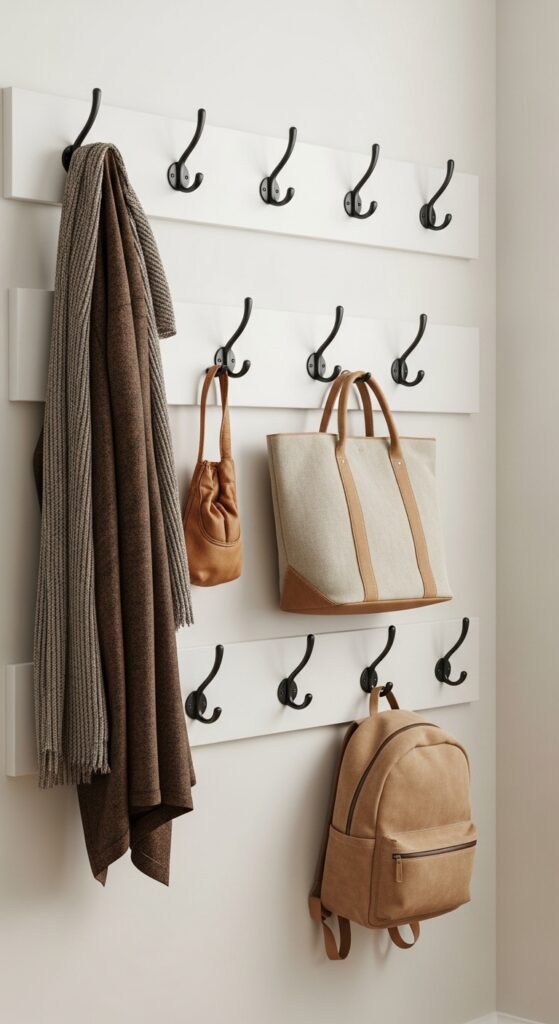
Vibe sentence: Every person in the house gets their own level — which means everything has a home, and the floor stays clear.
What makes it work: A single hook height works for one person. Multiple heights — staggered across the wall’s available span — means adults, children, and bag-level mid-hooks all have their own dedicated zone. Mounting all hooks on a painted MDF backboard rather than directly into the wall creates a clean, cohesive panel that reads as designed rather than DIY-improvised.
How to achieve it: Standard adult coat hook height is 66–72 inches; bag hooks work well at 52–58 inches; children’s hooks at 36–42 inches, descending with the child’s height as they grow. Choose cup hooks (round, with a lip that prevents things from falling off) over peg hooks for items that will be grabbed in a hurry.
17. Painted Floor Pattern to Distinguish the Entrance Zone
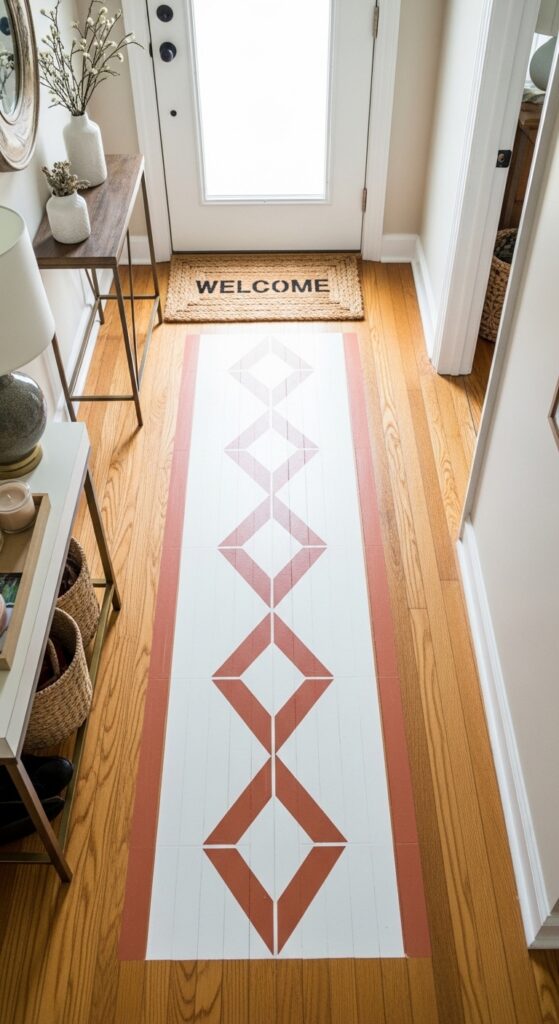
Vibe sentence: A painted floor pattern signals that this entrance hall was designed, not defaulted into.
What makes it work: A painted or stenciled floor pattern in a narrow hallway draws every eye downward and forward — which is exactly the optical direction that makes corridors feel longer. The pattern also visually defines the entrance zone as a distinct room rather than simply a pass-through, which gives the narrow space a sense of purpose and arrival.
How to achieve it: Use porch and floor paint in two coordinating colors and a geometric stencil from an online stencil supplier — the diamond pattern is the most forgiving for imperfect walls because it doesn’t require perfectly parallel reference lines. Apply three thin coats of each color and finish with two coats of matte polyurethane for durability underfoot.
💡 Tape the stencil in the center of the hall first, then work outward to each wall — this ensures the pattern is centered rather than cutting off awkwardly at one side.
18. A Single Piece of Oversized Art as Focal Point
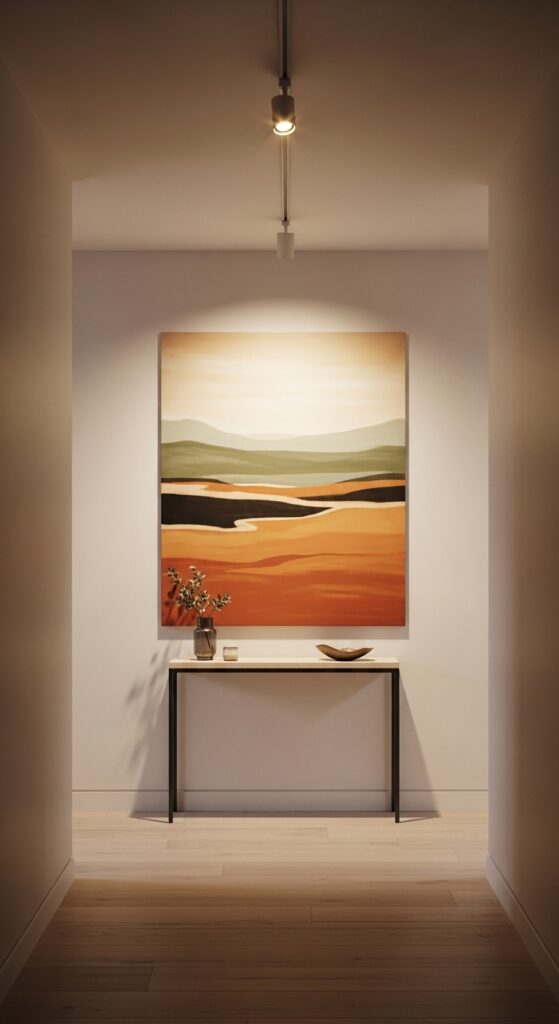
Vibe sentence: One large piece of art at the end of a hallway gives every person who enters a reason to walk toward it.
What makes it work: A single oversized artwork on the end wall of a narrow hall works as a visual anchor that pulls you down the corridor — the eye targets the art and the hall feels like a purposeful approach rather than an afterthought. Oversized art in this context works better than a gallery of smaller pieces, which can feel busy in a tight space.
How to achieve it: Size the artwork to fill 75–80% of the end wall’s width — smaller than this reads as floating and uncertain; larger fills the space with authority. Abstract or landscape art in muted, sophisticated tones tends to work better in narrow halls than figurative or highly detailed work, which demands closer inspection than the corridor allows.
19. Mirrored Console Table for Double the Light and Space
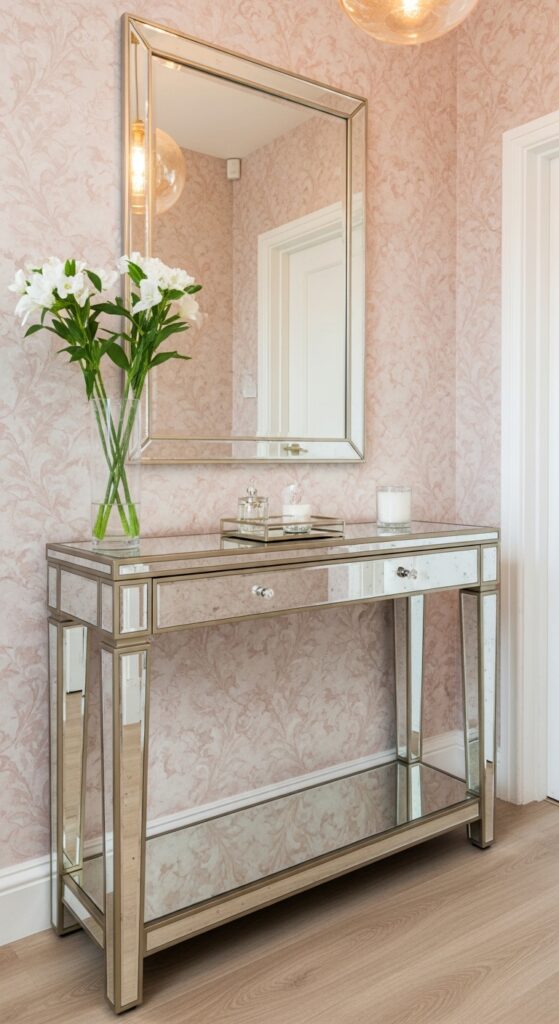
Vibe sentence: A mirrored console reflects not just the room but the light — it’s the most hardworking surface a narrow hall can have.
What makes it work: A fully mirrored console table in a narrow hall does the work of a mirror and a table in one footprint. Every surface — legs, frame, shelf — bounces light and reflects the opposite wall, creating a compounding spatial illusion that genuinely fools the eye into reading the hall as wider and more open than it is.
How to achieve it: Look for mirrored console tables from Wayfair, CB2, or West Elm — the price range is wide. Wipe mirrored furniture with a microfiber cloth and glass cleaner weekly in entrance areas; fingerprints and dust accumulate quickly on horizontal reflective surfaces and dull the effect significantly.
20. Shoe Storage Bench with Hidden Drawer
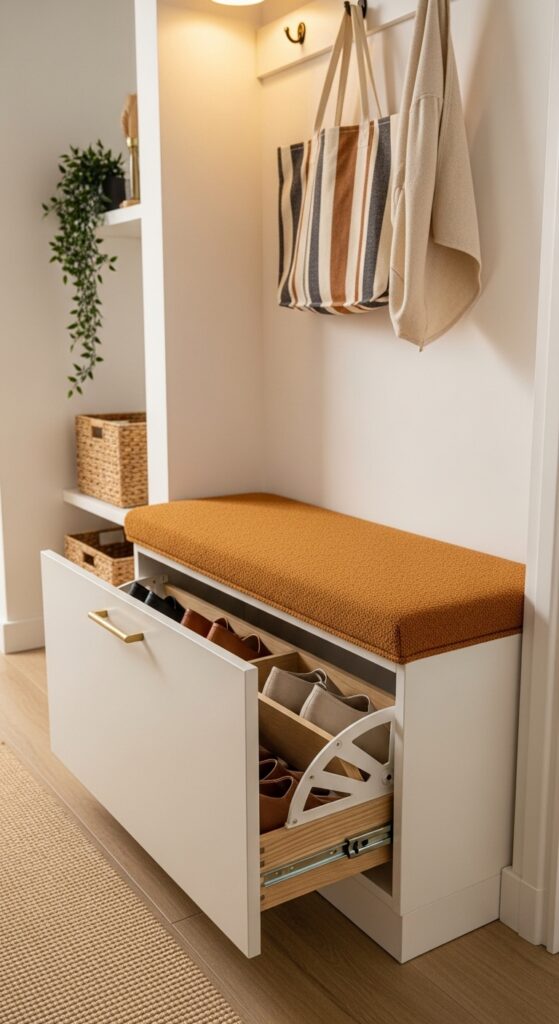
Vibe sentence: The bench that handles the shoe situation without ever letting anyone know there’s a shoe situation.
What makes it work: A dedicated shoe storage drawer built into a bench solves the single biggest chaos trigger in most entrance halls — shoes scattered across the floor — while providing the sit-and-remove seating that makes shoe removal feel intentional rather than awkward. The upholstered seat adds softness and color that a plain bench box cannot.
How to achieve it: Look for hallway storage benches with integrated pull-out drawers from furniture brands like IKEA (HEMNES shoe cabinet with bench top) or specialty entryway furniture brands. Size to fit 3–4 pairs of shoes in the drawer — this handles the daily rotation without needing large, closet-scale storage.
21. Hanging Plants for Vertical Greenery Without Floor Space
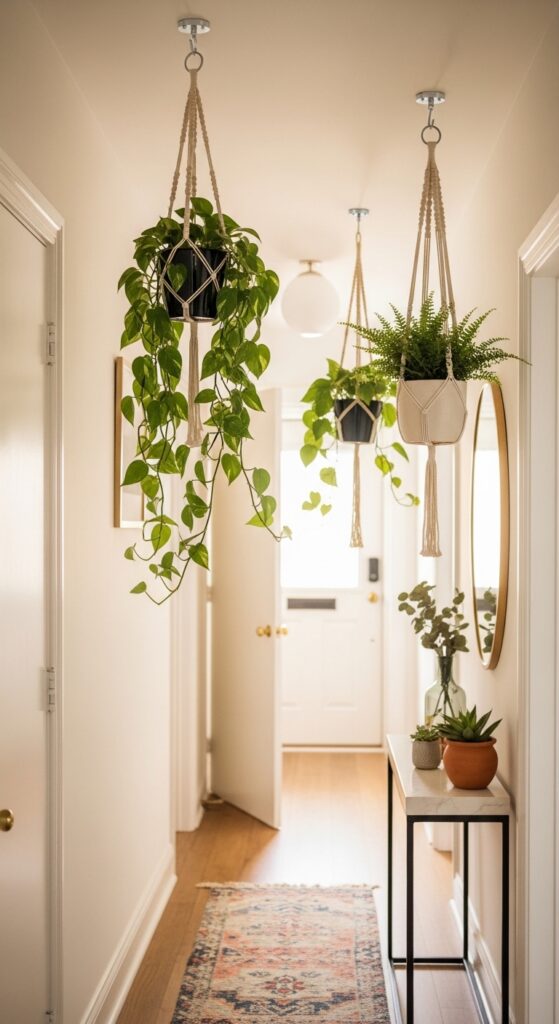
Vibe sentence: Plants that hang from the ceiling bring nature into the hall without touching a single inch of the floor.
What makes it work: Hanging plants are the narrow hallway’s perfect greenery solution — they occupy vertical space that would otherwise be empty while bringing the softness, life, and air-purifying benefits of plants into a space that often has no room for floor-level pots. Trailing varieties like pothos and string of hearts cascade beautifully and thrive in the indirect light typical of interior hallways.
How to achieve it: Use ceiling hooks rated for at least 25 lbs screwed into a ceiling joist — never into drywall alone for hanging plants, which can be heavy when wet. Macramé hangers are the most popular and decorative option; alternatively, simple S-hook-and-ring systems from a hardware store work well for ceramic hanging pots.
💡 Pothos is the most forgiving hanging plant for dark or low-light hallways — it genuinely thrives on neglect and trails beautifully within a single season.
22. Arched Mirror to Soften a Box-Like Corridor
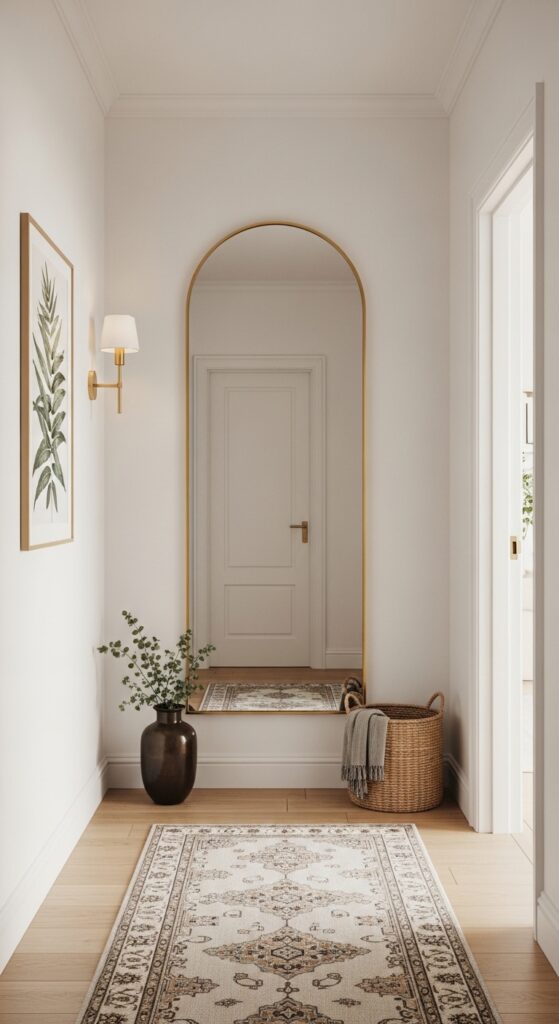
Vibe sentence: The arc of a mirror softens every hard angle in a box-shaped corridor — and a narrow hall has a lot of hard angles.
What makes it work: Arched mirrors introduce a curved form that contrasts beautifully with the straight lines of a rectangular corridor, immediately softening the space visually. The vertical proportion of a tall arch mirror also draws the eye upward, increasing the perceived ceiling height. At a typical 70 inches tall, it also functions as a full-length dressing mirror — practical in an entrance hall where you check your appearance before leaving.
How to achieve it: Lean a tall arched mirror against the end wall rather than hanging it — the slight lean forward from vertical reads as intentional and relaxed. Secure it with mirror safety clips or a furniture anti-tip strap anchored to the wall stud behind. Brass-framed arched mirrors are widely available from H&M Home, Anthropologie, and similar retailers at accessible price points.
23. Chalkboard Paint Section for Household Notes
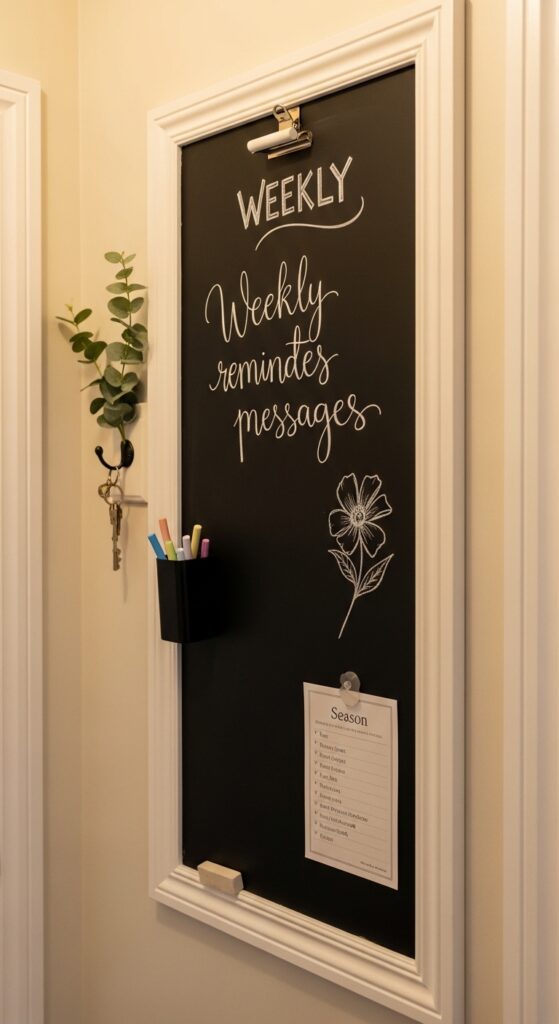
Vibe sentence: A chalkboard wall in a narrow hall is the most useful square foot in the house — a message board, reminder system, and personality all in one.
What makes it work: Framing a chalkboard paint section with simple molding transforms it from a painted patch into a deliberate architectural feature — the frame is what makes the difference between “DIY project” and “design choice.” In an entrance hall, a chalkboard captures daily reminders, grocery lists, and messages in the one spot everyone passes through multiple times a day.
How to achieve it: Apply chalkboard paint within a molding frame (primed and painted first) using a small foam roller for a smooth, even surface. Season the board before first use by rubbing the entire surface with chalk and wiping clean — this prevents ghosting of the first messages written on an unseasoned board.
24. A Curated Collection of Hats as Wall Decor
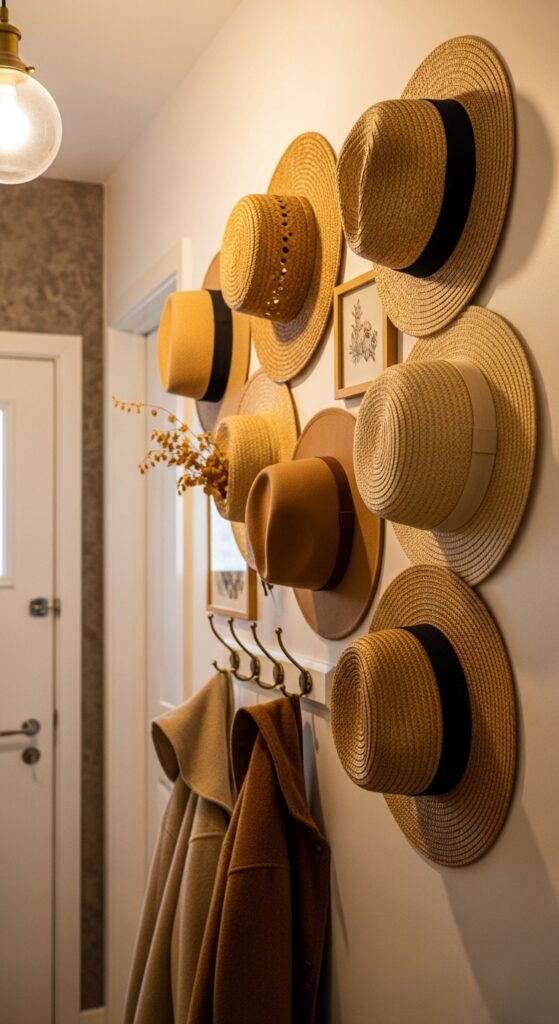
Vibe sentence: When your collection is beautiful enough to display, storage and art become the same thing.
What makes it work: Hat walls work in narrow entrance halls because hats are inherently flat — they project minimally from the wall surface while occupying significant visual area. A curated mix of textures (straw, felt, woven raffia) creates an organic, gallery-like arrangement that looks collected over time and expresses genuine personality in a space that often defaults to generic decor.
How to achieve it: Start with three hats in complementary textures and build outward — an odd number of pieces always reads more naturally than an even pair. Use simple brass cup hooks spaced 6–10 inches apart and arrange hats slightly overlapping for a layered, effortless effect rather than a regimented row.
💡 Rotate seasonal hats in and out of the display — a straw hat in summer, a felt hat in winter — and the wall always feels current and lived-in.
25. Pocket Door to Maximize Every Usable Inch
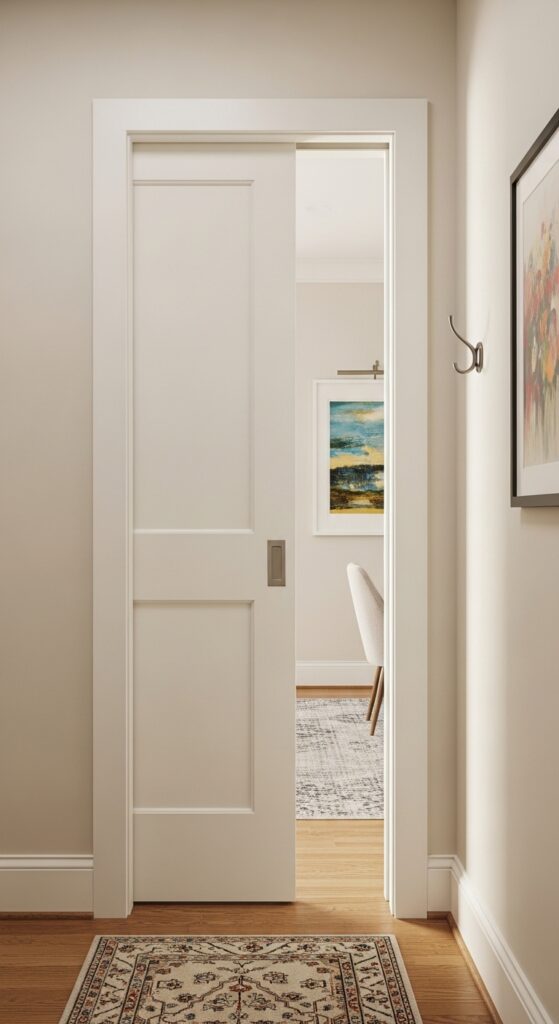
Vibe sentence: A pocket door returns every square inch of swing clearance to the people who need it most.
What makes it work: In a narrow entrance hall, a traditional hinged door can consume 7–10 square feet of usable floor space in its swing arc — often making an already-tight space genuinely difficult to navigate. A pocket door slides completely into the wall cavity, returning that entire area to the hall. Painting it the same color as the surrounding wall makes it effectively disappear when open.
How to achieve it: Pocket door installation in an existing wall is a significant carpentry project requiring removal of the wall section, installation of a pocket door frame kit, and subsequent drywall repair. For existing hallways, retrofit kits from companies like Johnson Hardware are designed to simplify the process. Ensure no electrical wiring or plumbing runs through the wall section before beginning.
How to Start Your Narrow Entrance Hall Transformation
The single most impactful first step in any narrow entrance hall is paint — specifically, choosing a color with intention rather than defaulting to builder’s white. A warm greige, a soft sage, or even a dramatic deep tone applied consistently to walls, trim, and ceiling creates immediate cohesion that no amount of accessorizing can replicate. Start here before purchasing a single piece of furniture.
The most common mistake in narrow hallways is over-furnishing. Resist the urge to fill every wall — negative space in a narrow corridor reads as breathing room, not emptiness. Two or three well-chosen elements (a mirror, a hook rail, a runner rug) will always outperform seven competing pieces of decor fighting for attention in a tight space.
Budget-friendly entry points with the highest visual impact: a new runner rug ($80–$200), a large arched mirror ($150–$400), and a set of matching coat hooks ($30–$80). These three items alone transform the feel of almost any entrance hall for under $700.
Realistically, a thoughtful narrow hallway transformation requires more planning than spending — measure everything before purchasing anything, and always test paint colors in the actual corridor light before committing to a full application. Hallway light is often quite different from room light, and colors shift dramatically.
Frequently Asked Questions
What colors make a narrow entrance hall look wider?
Warm whites and soft warm neutrals — like Benjamin Moore “White Dove,” Sherwin-Williams “Accessible Beige,” or Farrow & Ball “String” — are the most reliably widening colors for narrow hallways because they reflect light evenly across all surfaces. Contrary to popular advice, dark colors can also make a narrow hall feel wider when applied in a high-gloss finish, because the reflectivity compensates for the depth of tone. Avoid cool greys and stark whites in narrow halls with limited natural light — they can feel clinical and highlight the narrowness rather than counteract it.
What is the minimum width for a functional entrance hallway?
Building codes in most countries require a minimum corridor width of 36 inches (approximately 90cm) for accessibility compliance. In practice, a 36-inch wide hall is genuinely usable but leaves no room for furniture with any depth — wall-mounted solutions only. A 42-inch wide hall allows for a very slim console table (8–10 inches deep) on one side. At 48 inches and above, most slim console tables and built-in bench configurations work comfortably. If your hall is narrower than 36 inches, focus entirely on wall-mounted hooks, floating shelves, and mirrors — no floor furniture at all.
How do I add storage to a narrow hallway without making it feel cluttered?
The key is to keep all storage vertical and wall-mounted wherever possible, and to contain it within consistent visual boundaries — a painted backboard for hooks, a single floating shelf unit, or a slim built-in run all read as one element rather than multiple competing pieces. Use closed storage (baskets, boxes with lids, cabinet doors) for anything that creates visual noise, and reserve open surfaces for one or two beautiful objects only. A narrow hall that holds the same amount of stuff as a cluttered one but does so in organized, wall-mounted systems feels significantly more open.
What size rug works best in a narrow entrance hallway?
A runner rug of 2 feet by 8 feet is the standard starting size for a narrow hallway, but for longer corridors, a 2.5-by-10 or 2.5-by-12 runner is significantly more impactful. The most common mistake is choosing a runner that’s too short — a runner that stops abruptly mid-hall looks like a remnant rather than a design choice. Aim for the runner to begin within 12 inches of the front door and end within 12 inches of the transition to the main room, leaving 2–3 inches of floor visible on each side. Always use a runner pad — on hardwood, an unpadded runner is a genuine safety hazard.
How do I make a dark entrance hallway feel brighter without adding windows?
Layering light sources is the most effective approach — combine an overhead fixture with wall sconces or uplighters to eliminate the single-source shadow that makes dark halls feel dim. Mirrors are the second most powerful tool — a full-length mirror or mirrored console table bounces existing light sources dramatically. Choose warm white LED bulbs (2700K–3000K) for all hallway fixtures — cool daylight bulbs (5000K+) in a dark hall make the space feel grey and unwelcoming rather than bright. Finally, gloss or satin paint finishes reflect significantly more light than flat or matte — switching paint sheen alone can visibly brighten a dark corridor.
Ready to Make Your Narrow Entrance Hall Work Smarter?
You now have 25 narrow entrance hall smart decor ideas to pull from — ranging from a single arched mirror leaned against an end wall to a full built-in storage system that handles every coat, shoe, and bag your household generates. Save the ideas that feel most like your home, and start with the one change that solves your biggest daily frustration — whether that’s the shoe pile, the dark corridor, or the lack of anywhere to put a bag down. Narrow entrance halls reward cleverness more than any other room in the house. The constraint is the challenge, and the challenge is what makes the solution so satisfying when it clicks into place.