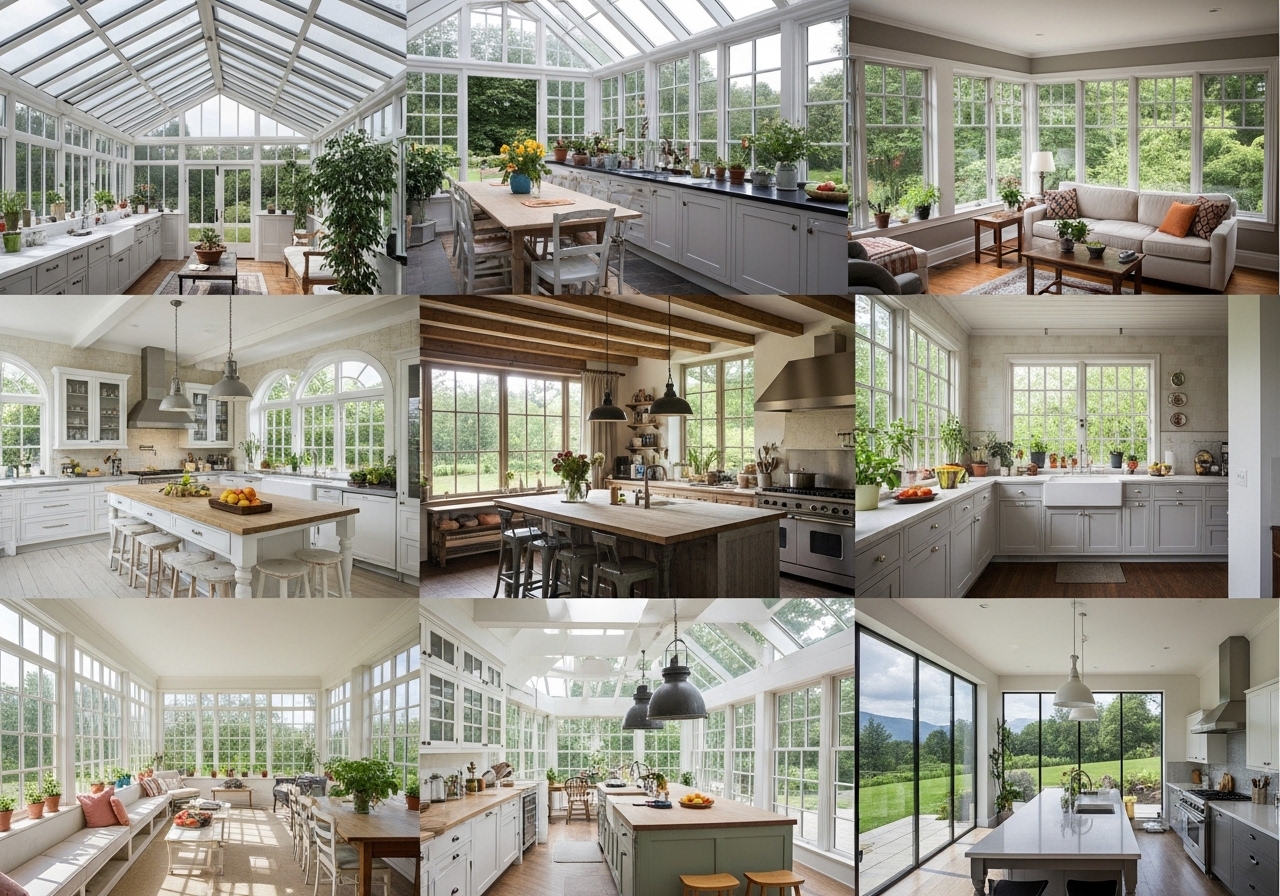
There is a particular kind of morning that only a solarium kitchen can give you — warm glass-filtered light falling across a stone countertop, the garden visible just beyond the panes, coffee steaming in the kind of quiet that feels genuinely earned. A solarium kitchen is the room where the boundary between indoors and outdoors dissolves entirely, where cooking becomes something closer to a ritual than a chore. If you’ve been drawn to the idea of a kitchen bathed in natural light, framed by glass and greenery, surrounded by the feeling of living inside the landscape — you are in exactly the right place. Here are 29 solarium kitchen ideas worth saving, pinning, and dreaming over.
Why Solarium Kitchen Design Works So Well
A solarium kitchen works because it solves the single greatest design challenge of any interior space: the feeling of being cut off from the natural world. By extending the kitchen into a glass-enclosed structure — or by designing the kitchen itself around maximum glazing — solarium design restores the connection between daily domestic life and the living landscape outside. The result is a room that feels genuinely alive, shifting with the light, the seasons, and the weather in ways that no painted wall or decorative plant can replicate.
The material palette of a great solarium kitchen draws directly from its environment. White-painted iron or powder-coated steel frames, aged brass hardware, terracotta and limestone flooring, natural rattan pendant lights, raw linen Roman shades, and weathered wood shelving are the signature elements — chosen because they echo the organic world visible through the glass. These are materials that age beautifully, which matters enormously in a room where natural light exposes every surface with unforgiving clarity.
Right now, solarium kitchen design is experiencing a cultural peak that shows no signs of slowing. The broader design movement toward biophilic interiors — spaces designed to foster human connection with nature — has made the glass-enclosed kitchen its most compelling residential expression. Pinterest searches for “sunroom kitchen,” “conservatory kitchen,” and “glass kitchen extension” have climbed steadily as homeowners recognize that light is the single most transformative design material available.
What makes this aesthetic especially compelling is its accessibility. A true Victorian conservatory extension is one version of the solarium kitchen — but so is a kitchen redesigned around a single glass wall, a skylight-dense ceiling, or a garden-facing glazed extension added to an existing home. The principle scales beautifully across budgets and architectural styles.
White Iron Frame Glass Kitchen with Climbing Vines
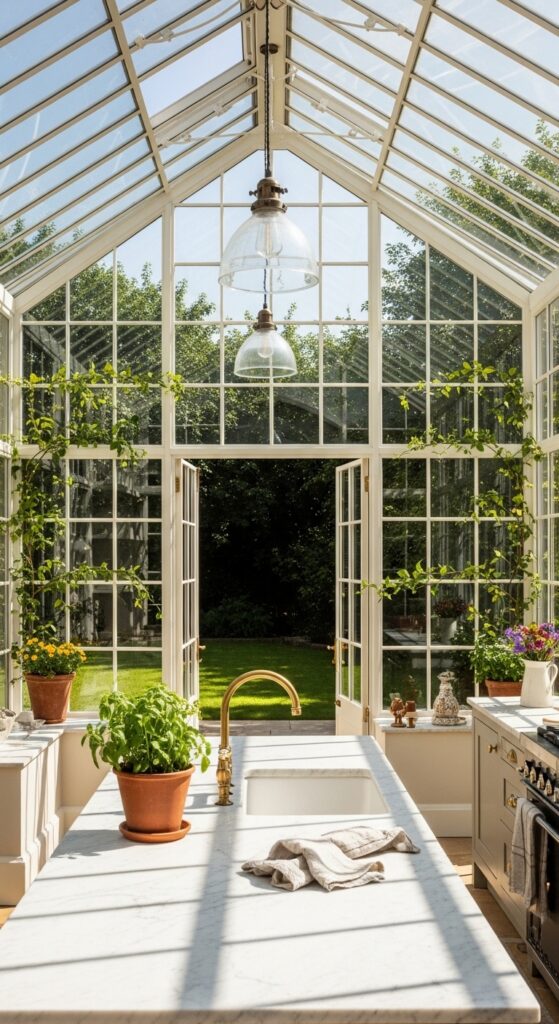
Vibe sentence: This is the kitchen that feels like stepping into a painting — glass, iron, vine, and marble in the kind of morning light that makes everything look effortless.
What makes it work: White powder-coated iron glazing frames are the structural signature of the Victorian conservatory aesthetic, and they remain timelessly beautiful because their slender profile maximizes glass area while introducing geometric rhythm through the shadow lines they cast across interior surfaces. Climbing vines on the exterior frame soften the structural rigidity beautifully, adding organic movement and seasonal change to the architecture.
How to achieve it: Specify thermally broken steel or aluminum slim-profile glazing systems from manufacturers like Crittall or its equivalents — they replicate the Victorian iron frame aesthetic with modern thermal efficiency. For the vine, Trachelospermum jasminoides (star jasmine) is an ideal choice: evergreen, fragrant, and manageable in growth rate. Plant at the base of each exterior corner column for symmetrical coverage within three to five seasons.
💡 White-painted aluminum framing costs 30–40% less than steel while replicating the same slim glazing bar aesthetic.
Arched Glass Ceiling Kitchen with Skylight Drama
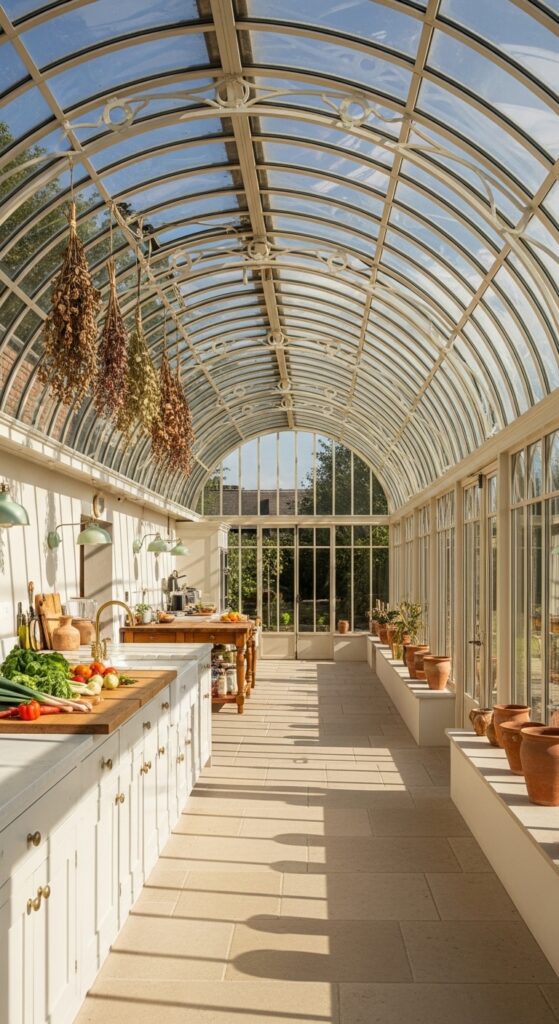
Vibe sentence: Cooking beneath a barrel-vaulted glass ceiling is the closest a kitchen can come to feeling like its own cathedral — and once you’ve experienced it, nothing else will do.
What makes it work: The barrel vault draws the eye immediately upward and along its length, making any kitchen beneath it feel dramatically elongated and proportionally magnificent. The parallel light shafts that a curved glass ceiling casts across the floor shift throughout the day, turning the floor itself into a living sundial. White cabinetry and pale limestone flooring below the arch act as reflective surfaces, bouncing and amplifying the overhead light throughout the entire room.
How to achieve it: Barrel-vaulted glass roof systems are a specialist glazing product — companies like Apropos Conservatories, David Salisbury, and similar bespoke glazing firms offer these as standard extension products for residential kitchens. Specify self-cleaning glass for the curved panels — the roof angle makes manual cleaning nearly impossible, and self-cleaning coatings use UV light to break down organic debris.
Scandinavian Solarium Kitchen with Pale Wood and White Glass
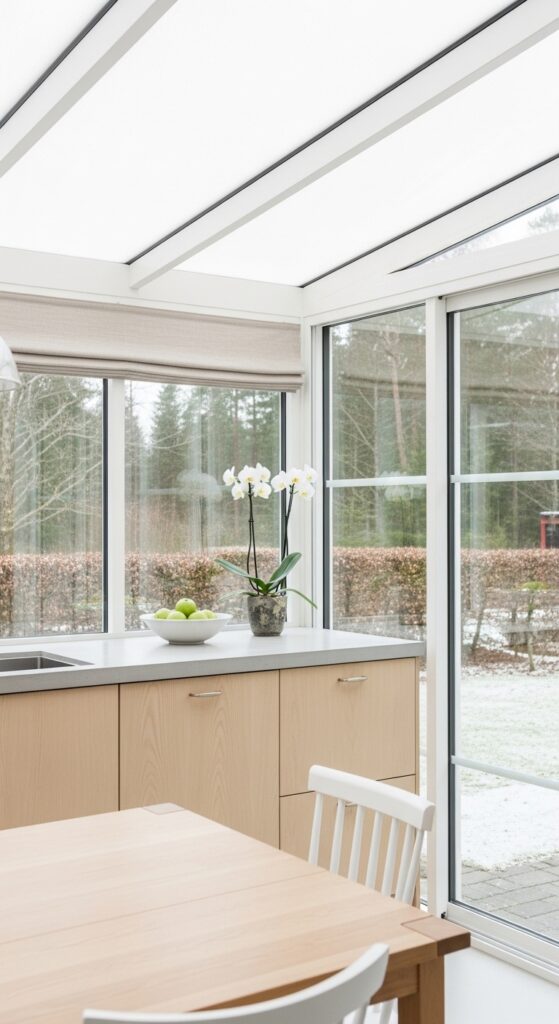
Vibe sentence: Clean, quiet, and lit by the kind of soft northern light that makes everything look like it belongs in a carefully composed photograph.
What makes it work: Scandinavian solarium kitchens succeed because they apply the Nordic design principle of maximizing natural light with absolute material restraint — no competing colors, no decorative excess, nothing that draws attention away from the quality of the light itself. Pale birch cabinetry reads warm without being heavy, and white concrete countertops have a matte, light-diffusing quality that works particularly beautifully under the soft, even light of a glass-walled kitchen.
How to achieve it: White concrete countertops are achievable as a DIY project using Ardex Feather Finish applied over existing countertops — no demolition required. Apply in two thin coats over clean laminate or tile, sand between coats, and seal with a matte concrete sealer. The result is indistinguishable from poured concrete at roughly one-fifth of the cost.
Tropical Solarium Kitchen with Palm Leaf Canopy
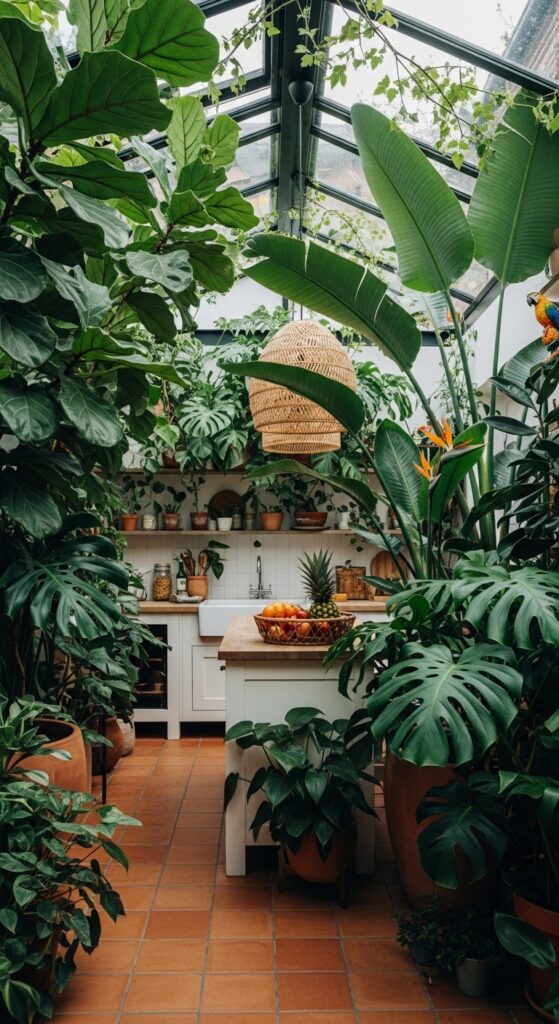
Vibe sentence: When the plants are large enough to form a canopy, the kitchen stops being a room and starts being a garden you cook in.
What makes it work: The dappled light effect created by large tropical leaves against a glass ceiling is one of the most beautiful lighting phenomena achievable in an interior — it moves with any breeze, shifts with the sun’s angle, and turns the kitchen floor into a living, changing pattern. Terracotta flooring is the ideal material choice beneath a tropical plant collection because its warm reddish-orange tone complements deep tropical greens perfectly and hides the inevitable soil scatter of large plantings.
How to achieve it: Fiddle leaf figs and bird of paradise plants thrive in the high-light, humid conditions of a glass kitchen — the environment that kills them in standard rooms is exactly what they need. Position the largest specimens in floor planters directly beneath the highest glass area. Use terracotta pots for all planting — their porosity regulates moisture in a way that glazed pots can’t, reducing root rot risk considerably.
💡 A single large fiddle leaf fig (6–7 feet) from a plant nursery costs $80–$150 and immediately establishes the tropical canopy scale.
French Country Solarium Kitchen with Stone Floors
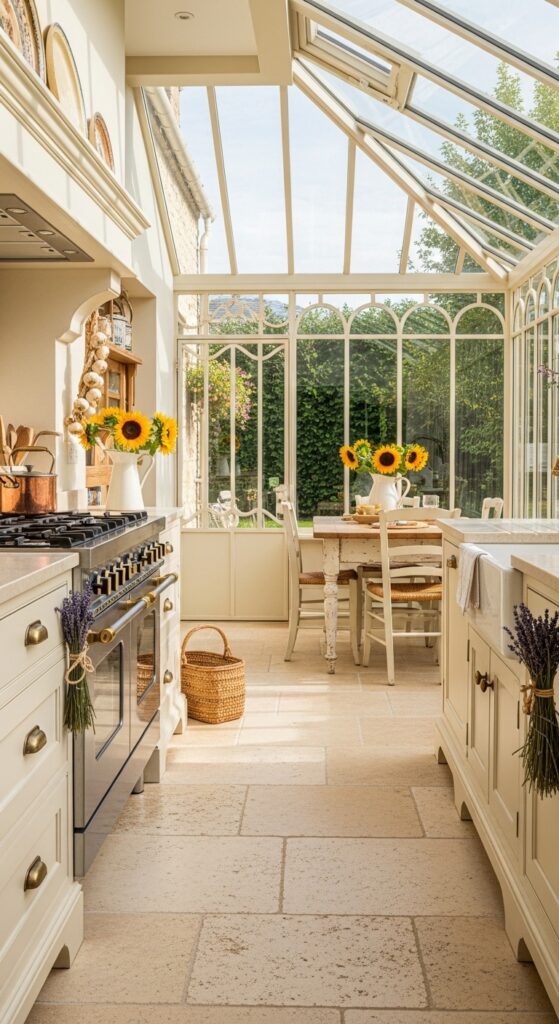
Vibe sentence: Warm limestone, cream paint, afternoon sun, and the smell of lavender — this kitchen is Provence distilled into four walls and a glass ceiling.
What makes it work: French country solarium kitchens work because every material choice references the agricultural, artisanal world visible just beyond the glass. Limestone floors are the cornerstone — their warm, natural variation and gentle surface imperfection create immediate authenticity that no tile can replicate. Antique brass hardware ages alongside the stone and paint, creating a material story of genuine use and time that defines the French country aesthetic.
How to achieve it: Reclaimed French limestone flooring is available through specialty stone importers — expect to pay $15–$30 per square foot for genuine reclaimed stone. If budget is a constraint, tumbled travertine in a warm cream tone is an excellent alternative at $5–$12 per square foot that reads identically in a glass-lit space. Seal with a penetrating stone sealer annually to protect against kitchen oils and moisture.
Minimalist Black Frame Glass Kitchen Extension
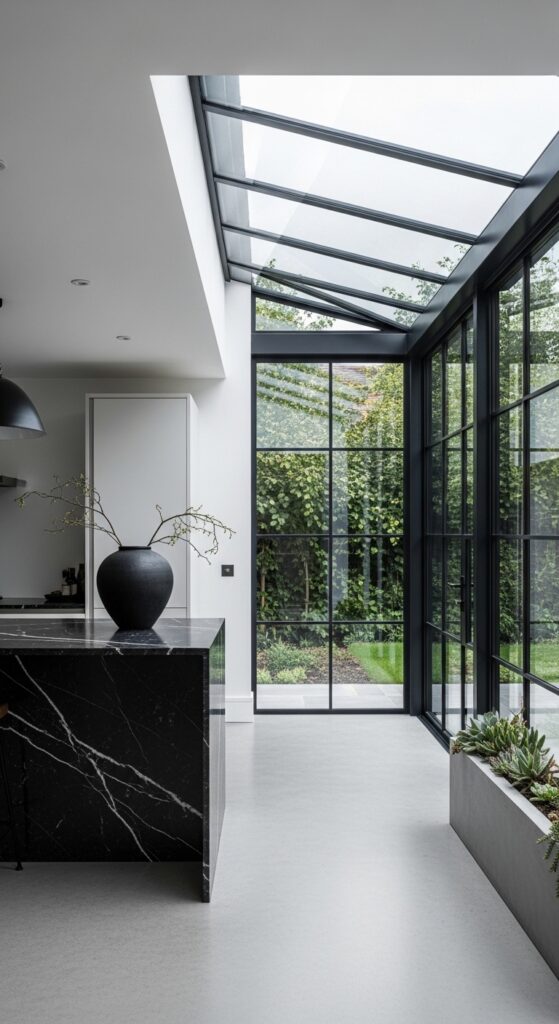
Vibe sentence: Black frames against a green garden is the architectural decision that separates a glass kitchen from a truly great glass kitchen.
What makes it work: Matte black steel glazing frames do something white frames cannot — they disappear visually against a dark garden backdrop, making the glass panels appear to float without structural support. This creates a dramatic, almost frameless effect that maximizes the visual connection to the garden. Black marble inside continues the dark frame’s color story while introducing the warmth and variation of natural stone veining.
How to achieve it: Specify Crittall-style steel windows in RAL 9005 (jet black matte) for the most authentic contemporary steel frame effect. Interior surfaces should echo the frame in material weight — black or dark grey concrete floors, black marble or dark stone countertops — so the architectural palette reads as fully committed rather than accidental.
Rustic Solarium Kitchen with Exposed Brick and Glass
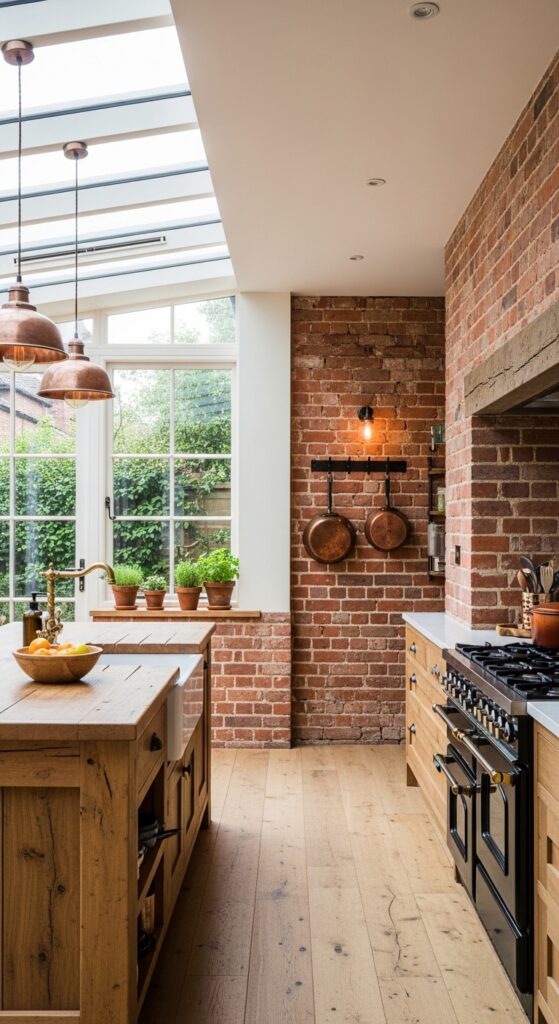
Vibe sentence: Old brick and new glass in the same room is a conversation between centuries — and it is always worth listening to.
What makes it work: The juxtaposition of exposed brick and glass creates a material dialogue that is richer than either element alone. The brick carries history, warmth, and texture; the glass brings light, modernity, and transparency. Where they meet — at the corner or the threshold — is the room’s most interesting design moment. Reclaimed wood in between acts as the mediating material, sharing organic warmth with the brick while bridging visually to the natural world beyond the glass.
How to achieve it: If your existing kitchen has a brick exterior wall, expose it fully before adding the glass extension — the contrast will be the room’s defining feature. Use a wire brush to clean the brick rather than sandblasting, which damages the surface texture. Repoint damaged mortar in a warm ivory tone rather than bright white, which reads as too sharp against aged brick.
💡 Lime-based repointing mortar in a buff or ivory tone costs $15–$25 per bag and makes old brick look genuinely restored.
Greenhouse-Style Solarium Kitchen with Potting Shelf
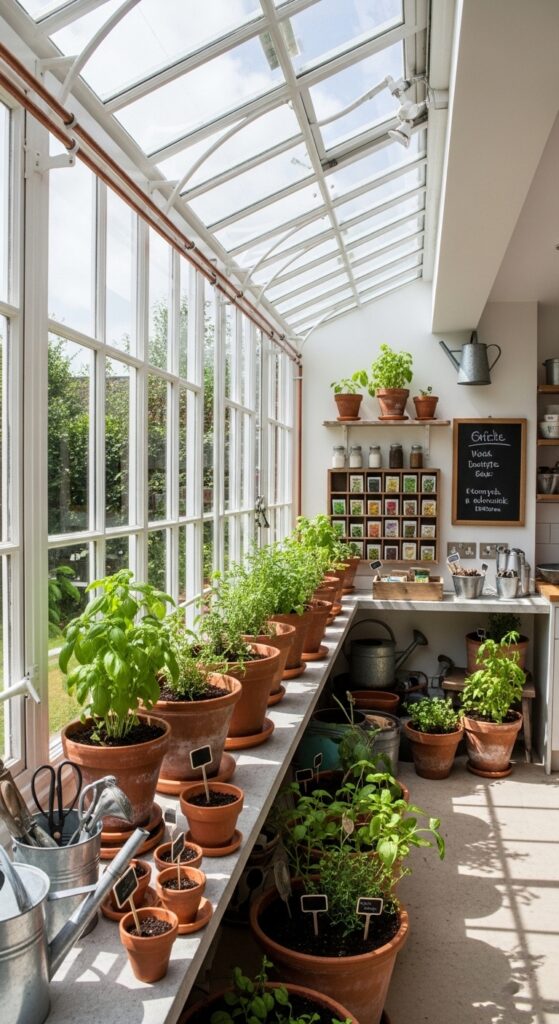
Vibe sentence: This kitchen grows what it cooks — and that connection, visible in every terracotta pot on the sunlit shelf, changes the entire experience of preparing food.
What makes it work: A dedicated interior potting shelf running along the glass wall creates a transitional zone between the functional kitchen and the garden beyond — it’s simultaneously a kitchen feature and a growing space. Terracotta pots in graduating sizes have a natural compositional rhythm that reads as curated without appearing staged. The presence of actual growing herbs makes the kitchen olfactory as well as visual, adding a sensory layer that no decorative element can provide.
How to achieve it: Build a simple 12-inch deep shelf from painted MDF or reclaimed timber at windowsill height along the glass wall — this depth accommodates a standard 6-inch terracotta pot with room for drainage trays. Install a thin copper pipe along the back of the shelf as a simple drip irrigation system for automated watering. Herbs that thrive in high-light glass environments include basil, rosemary, thyme, and chives.
Coastal Solarium Kitchen with Weathered Wood Beams

Vibe sentence: Weathered beams, sea glass blue, and coastal light through glass — this kitchen smells of salt air even when you’re standing at the stove.
What makes it work: Heavily weathered timber ceiling beams introduce a material honesty and sense of age that new construction rarely achieves — they carry the suggestion of decades of salt air and sun exposure, which is the entire atmospheric story of coastal living. Sea glass blue cabinetry is the ideal color partner for both the grey-white beams and the natural coastal light flooding through the glass, sharing the bleached, sun-faded quality of genuine coastal materials.
How to achieve it: Source genuine reclaimed driftwood or heavily weathered timber beams from architectural salvage yards for authentic surface character. If budget is tight, new pine beams can be whitewashed with a diluted grey-white paint (1:4 paint-to-water ratio, applied and partially wiped back) and wire-brushed to raise the grain for a convincing weathered effect. For the cabinet color, try Benjamin Moore “Sea Salt” or Farrow & Ball “Mizzle.”
Italian Courtyard-Inspired Glass Kitchen with Terracotta
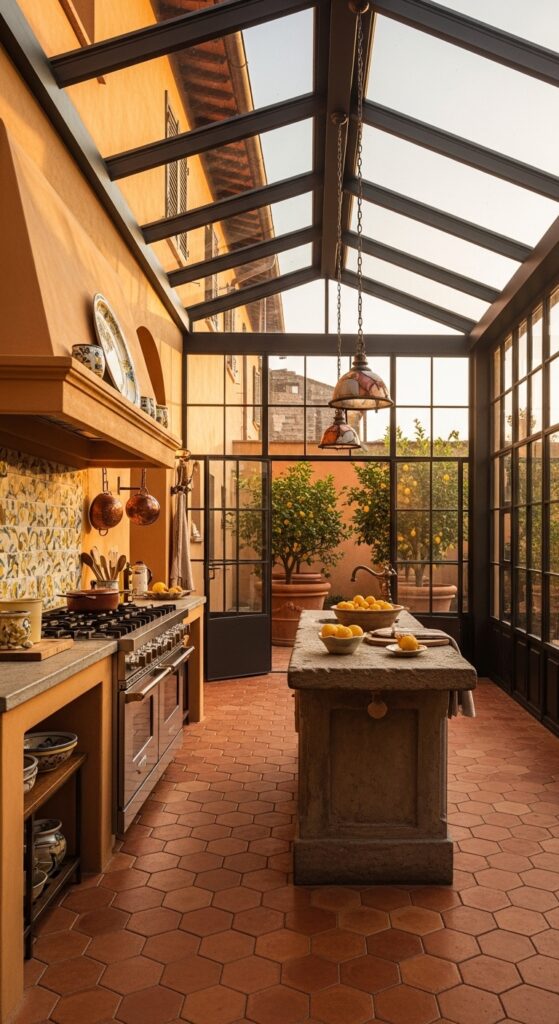
Vibe sentence: Terracotta, ochre, and warm glass light — this kitchen puts you in a Florentine courtyard every morning without leaving home.
What makes it work: The Italian courtyard kitchen achieves its atmosphere through the deliberate layering of warm-toned natural materials that reflect and amplify golden Mediterranean light. Hexagonal terracotta tiles are the floor pattern most associated with Italian domestic architecture — their small scale and warm color create an immediate sense of place that larger format tiles cannot. The ochre plaster wall provides the warm, sun-baked backdrop that makes the glass walls read as an opening to the Italian exterior rather than a structural element.
How to achieve it: Terracotta hexagonal floor tiles are widely available from Italian tile importers — look for genuine fired terracotta rather than porcelain imitations, which lack the surface variation and warmth. Seal with a linseed oil-based sealer rather than synthetic coatings — it deepens the natural color beautifully and is the traditional Italian finishing method. Apply Portola Paints Roman Clay in “Honey” or “Straw” for the ochre plaster wall effect.
Modern Farmhouse Solarium Kitchen with Shiplap Ceiling
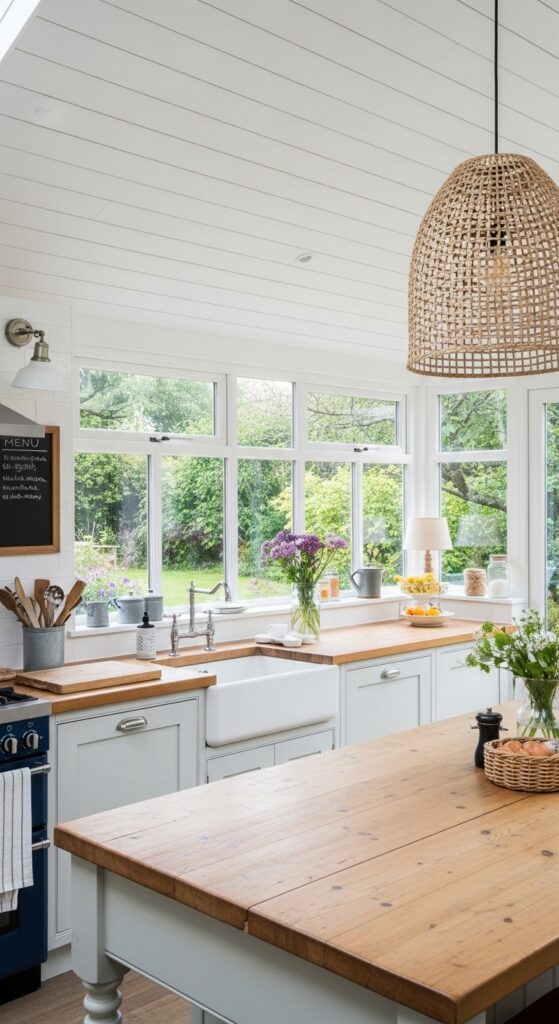
Vibe sentence: Honest, bright, and genuinely happy — this is the kitchen that makes you want to bake bread at 7am on a Saturday.
What makes it work: A shiplap ceiling in a glass-walled kitchen creates a beautiful material contrast — the horizontal wood boards overhead are warm, textured, and traditional, while the glass walls below are open, modern, and transparent. This tension between enclosure (the ceiling) and openness (the glass) gives the room a particularly comfortable quality — sheltered above, connected to the landscape on all sides. The farmhouse sink, positioned to face the garden through the glass, transforms washing up into an intentionally pleasant experience.
How to achieve it: Primed MDF shiplap boards applied to the ceiling with a 3/8-inch gap create the farmhouse ceiling for approximately $2–$4 per square foot in materials. Paint in Benjamin Moore “Chantilly Lace” for the crispest farmhouse white that reads warm rather than clinical under natural light. Install a rattan pendant at 30–36 inches above the island surface for the ideal balance of ambient and task lighting.
Victorian Conservatory Kitchen with Original Period Details
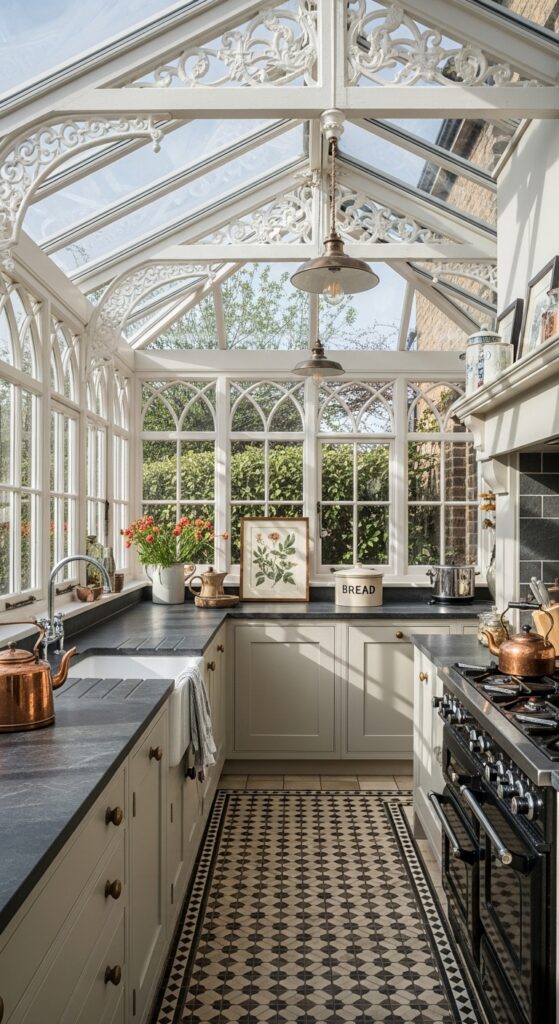
Vibe sentence: A Victorian conservatory kitchen is an act of architectural devotion — and every period detail, from ridge cresting to encaustic tile, earns its place with decades of proven beauty.
What makes it work: Authentic Victorian conservatory details — the ridge cresting, the finials, the decorative iron castings — succeed because they are ornamental in a way that serves the structural narrative of the building. Every flourish references the decorative vocabulary of a specific historical moment, creating a room with genuine architectural identity. Encaustic floor tiles are the ideal companion: hand-laid, pattern-rich, and deeply beautiful under the bright light of a glass enclosure.
How to achieve it: Period-style cast iron ridge cresting and finials are available from architectural salvage specialists and reproduction ironmongery companies — these are worth sourcing authentically rather than in reproduction. For encaustic tiles, Original Style and Fired Earth are excellent UK suppliers with geometric pattern ranges faithful to Victorian originals; international shipping is available.
Japanese-Inspired Solarium Kitchen with Zen Garden View
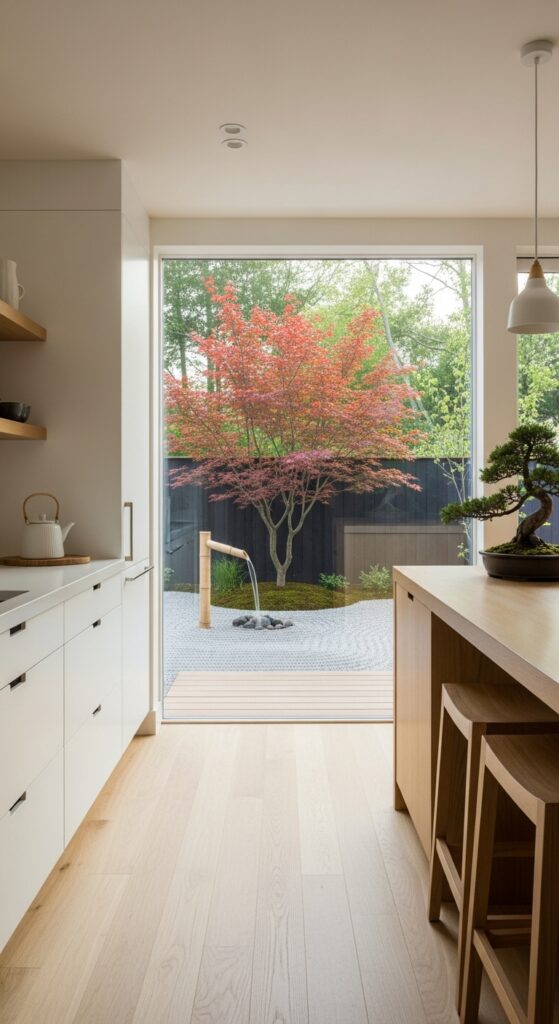
Vibe sentence: A Zen garden framed by a kitchen window isn’t a view — it’s a daily practice in stillness delivered while you make your morning tea.
What makes it work: The Japanese-inspired solarium kitchen works by designing the exterior view as carefully as the interior. A raked gravel garden with a single specimen tree is an exercise in intentional simplicity — every element earns its presence, and the result is a view that is calming rather than stimulating. This is the precise quality needed in a kitchen, where visual rest from the garden counterbalances the productive energy of cooking.
How to achieve it: A simple raked gravel Zen garden requires only a timber border frame, a 3-inch layer of fine decomposed granite or river pebble, and a wooden raking tool — achievable in a single weekend for under $300. Select a Japanese maple (Acer palmatum) as the specimen tree — even a young 4-foot specimen has extraordinary visual presence, especially when backlit by morning light through the glass.
Provençal Herb Garden Solarium Kitchen
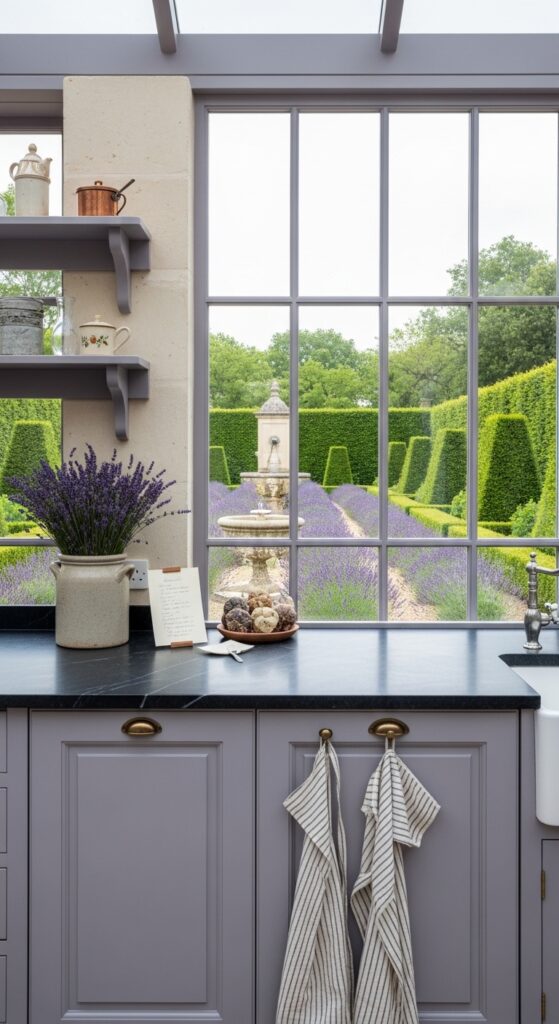
Vibe sentence: When the garden is planted in lavender rows and the kitchen walls are glass, cooking becomes something genuinely indistinguishable from poetry.
What makes it work: The Provençal solarium kitchen succeeds by creating a complete sensory world — the lavender-grey cabinetry echoes the actual lavender visible in the garden beyond the glass, creating a material and color conversation between interior and exterior that feels deeply considered. Soapstone countertops are a superb choice in a kitchen with significant natural light because their matte, dark surface absorbs light rather than reflecting it, grounding the room and providing visual relief from the brightness of the glass walls.
How to achieve it: Soapstone countertops are available from quarry suppliers at $70–$120 per square foot and are among the most maintenance-friendly natural stone options — they require only periodic oiling with mineral oil rather than chemical sealing. For the lavender-grey cabinet color, try Farrow & Ball “Brassica” or Sherwin-Williams “Jubilee” in eggshell finish.
Sunroom Breakfast Nook Solarium Kitchen Combo
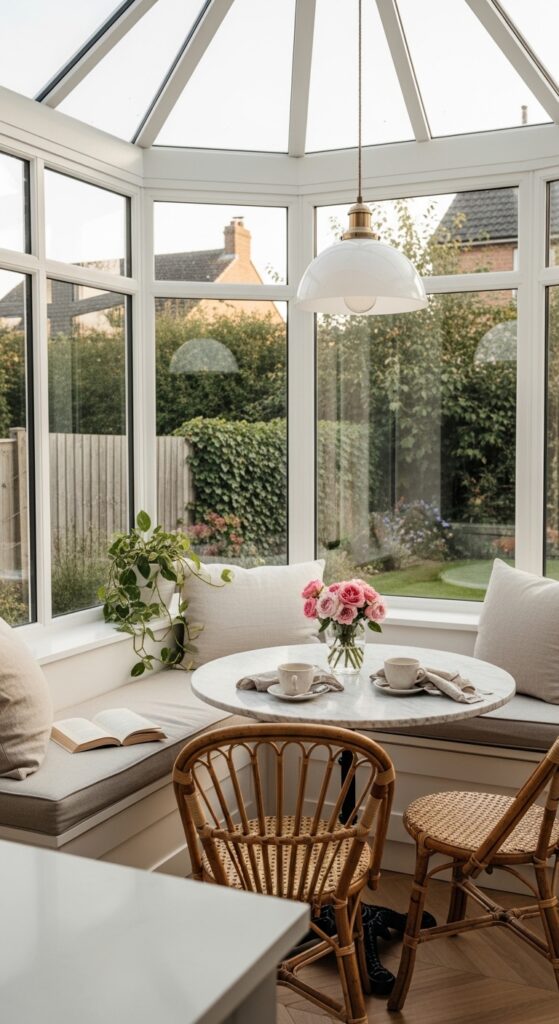
Vibe sentence: The breakfast nook is where a solarium kitchen reveals its truest purpose — not cooking, but the perfect sitting-still morning.
What makes it work: A glass-enclosed breakfast nook creates a room-within-a-room that gives the solarium kitchen emotional anchor. The curved or angled bay provides a sense of enclosure and destination within the larger glass space, making the nook feel like a discovered retreat rather than a designed feature. Built-in window seating maximizes the use of the structural reveal and adds the comfortable softness that glass and marble alone cannot provide.
How to achieve it: A built-in window seat requires only a simple MDF box structure, 3-inch foam cushion cut to the bay dimensions, and fabric of your choice — a complete DIY project for under $300. Specify linen or heavy cotton in a warm natural tone for maximum durability in a high-light environment (avoid synthetics, which fade and pill in direct sun). Add a small round marble bistro table — widely available in various sizes from $80–$250.
💡 Outdoor-rated linen fabric resists UV fading far better than standard upholstery fabric — ideal for a sun-flooded window seat.
Night Garden Solarium Kitchen with Statement Lighting
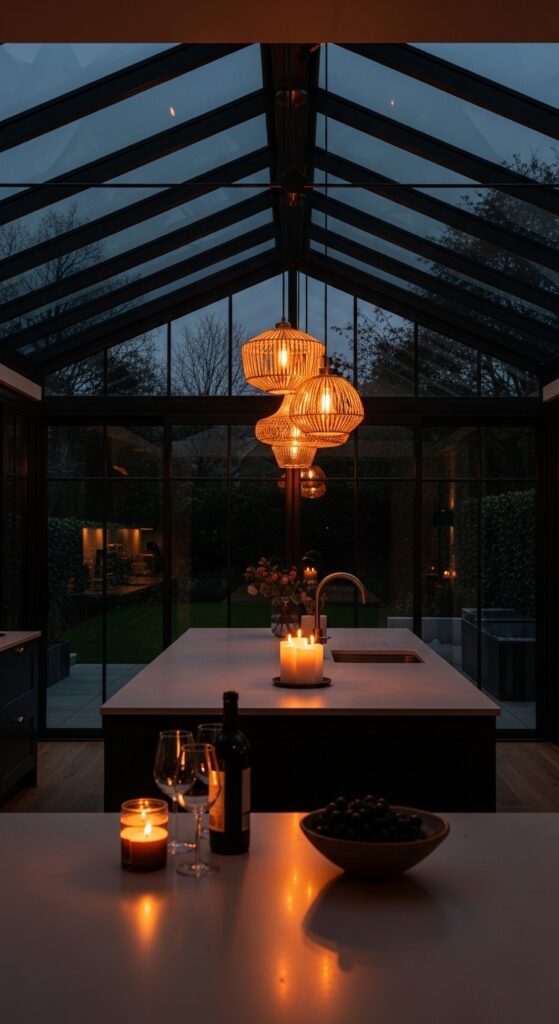
Vibe sentence: At dusk, the solarium kitchen transforms completely — the glass that was transparent all day becomes a warm, dark mirror, and the room doubles itself in reflection.
What makes it work: The evening solarium kitchen is often overlooked in design planning, but it is a genuinely distinct and beautiful room — one where the glass walls become mirrors that multiply the warm interior lighting and create a sense of infinite depth. This transformation is most dramatic when the pendant lighting is clustered and warm-toned, creating pools of amber that reflect in every glass panel simultaneously. The room becomes richer and more intimate at night than at any point during the day.
How to achieve it: Plan your pendant lighting cluster deliberately for the evening effect. Group three to five pendants of varying drop heights over the island — mixed materials (brass, glass, rattan) create more interesting reflections than matching sets. Set all lighting on dimmers at 2700K for the warmest possible amber tone at night. Add a secondary layer of candles on the island for an entirely passive, beautiful light source that transforms the glass walls further.
Solarium Kitchen with Living Wall of Ferns
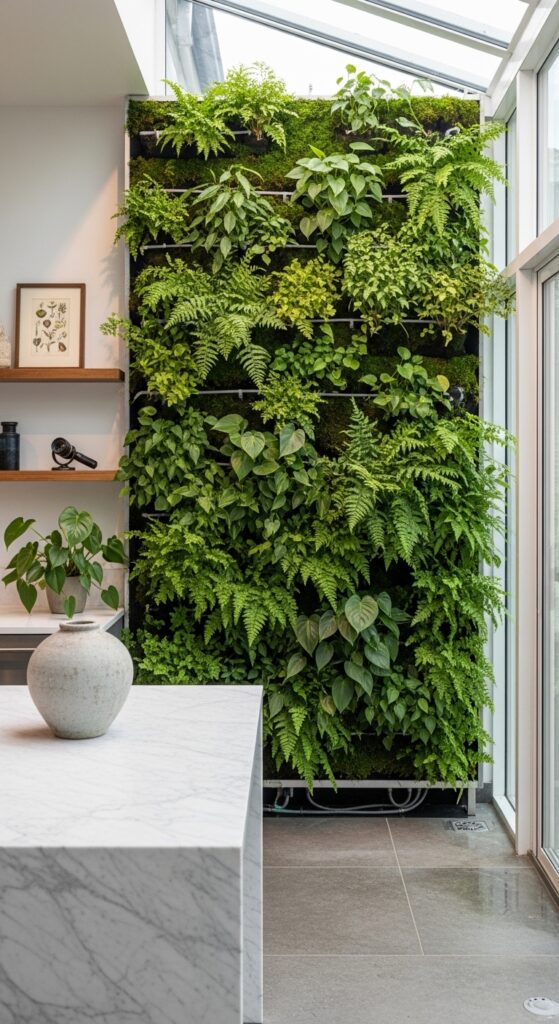
Vibe sentence: A living fern wall in a glass kitchen is the most literal possible interpretation of bringing the garden inside — and it is extraordinary.
What makes it work: A living wall facing a glass wall creates a remarkable ecological loop — the natural light from the glass feeds the plants, the plants humidify and oxygenate the kitchen air, and the visual effect of dense green ferns against a bright glass backdrop is simply magnificent. Ferns are ideal living wall plants for a kitchen context because they thrive in humidity and indirect light — the steam from cooking actually benefits them. The contrast between the wild, organic living wall and the clean marble island in front is the room’s defining visual tension.
How to achieve it: Modular living wall systems from companies like Naiku, Tournesol, and Florafelt provide the structural framework — plant pockets with integrated drip irrigation that connects to a standard water supply. For a kitchen living wall, choose Boston ferns, asparagus ferns, moss varieties, and heartleaf philodendron — all moisture-tolerant and low-maintenance. Install a simple grow-light strip at the top of the wall for winter months when natural light is insufficient.
Glass Kitchen Extension with Polished Concrete Floor
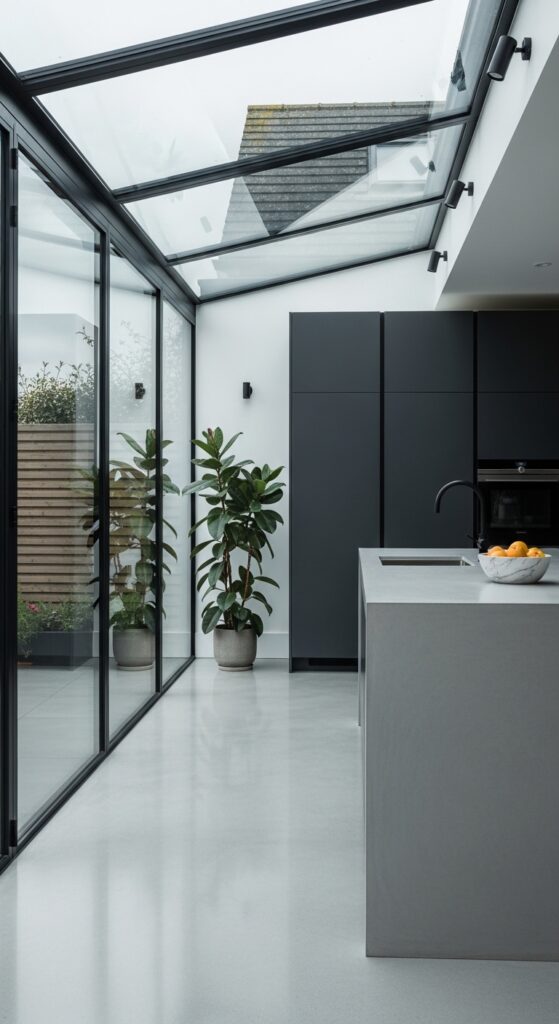
Vibe sentence: Polished concrete under a glass ceiling creates a room that reflects itself — sky above, sky below, and the kitchen floating perfectly between.
What makes it work: Polished concrete flooring in a glass kitchen is a masterstroke because its reflective surface acts as a secondary glazing element — it bounces light from the ceiling back upward, creating a bright, even luminosity throughout the space that no other floor material replicates. The seamless, joint-free nature of concrete also eliminates the visual fragmentation of tiles, letting the room read as one uninterrupted plane of material from glass ceiling to floor.
How to achieve it: Polished concrete is achieved by grinding and burnishing an existing concrete slab through progressively finer grits (50 → 100 → 200 → 400 → 800 grit) using a diamond-head floor grinder — a process best contracted to a concrete polishing specialist. Costs run $5–$15 per square foot depending on the starting condition of the slab. Seal with a lithium silicate densifier for the hardest, most reflective finish.
Solarium Kitchen with Vintage Botanical Print Collection
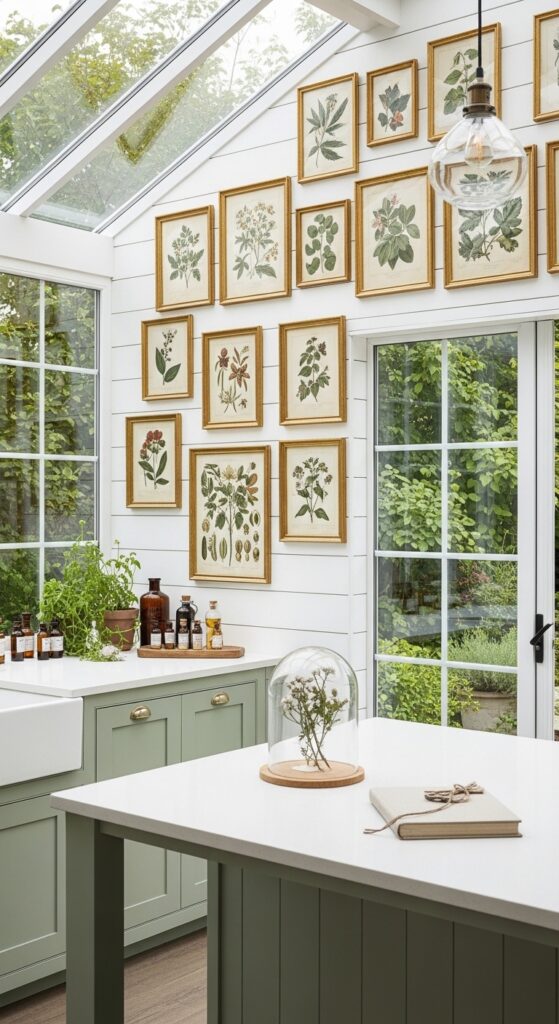
Vibe sentence: Vintage botanical prints in a glass kitchen are a love letter to the garden visible just beyond the glass — the same plants, drawn with devotion, framed in gold.
What makes it work: Botanical prints in a glass kitchen create a layered visual experience — the actual living garden beyond the glass, the illustrated scientific record of similar plants on the wall, and the growing herbs on the shelves all occupy the same space simultaneously. This thematic consistency between the room’s views, its decor, and its function as a place where plant-based food is prepared gives the kitchen a coherent, deeply considered identity.
How to achieve it: Vintage botanical prints are available through Etsy, antique print dealers, and auction sites — search for Ernst Haeckel prints, Curtis’s Botanical Magazine plates, or Basilius Besler illustrations for museum-quality originals at surprisingly accessible prices. Frame consistently in simple gold-leaf frames from IKEA’s RIBBA range (repainted in gold leaf spray) for a collected-over-time look at minimal cost.
💡 Public domain botanical illustrations from biodiversitylibrary.org can be downloaded and printed professionally at large scale for under $20.
Solarium Kitchen with Custom Stained Glass Panels
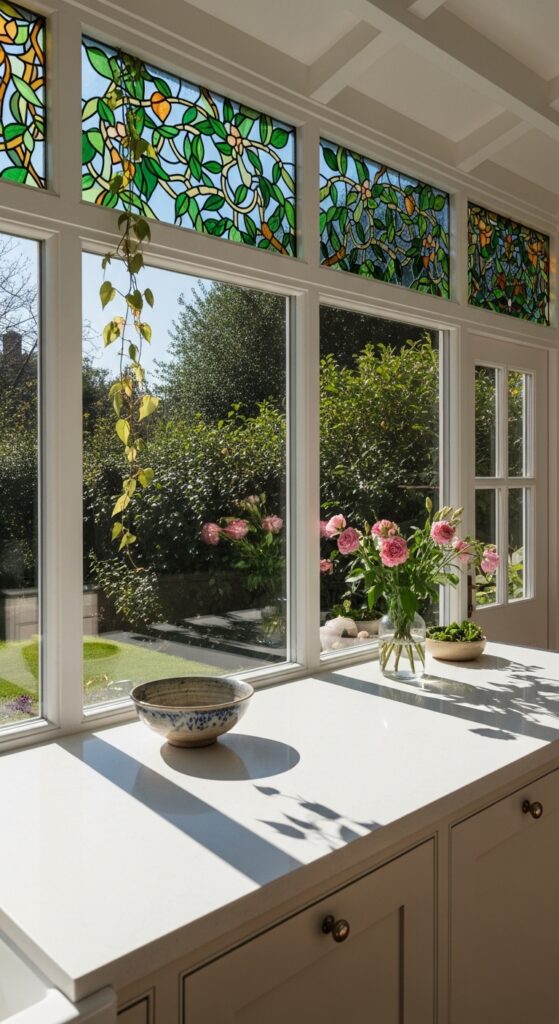
Vibe sentence: Stained glass turns natural light into something you couldn’t have designed — jewel-toned pools that move across the kitchen all morning, impossible to replicate and impossible to improve upon.
What makes it work: Stained glass panels in the upper sections of a glass kitchen wall allow maximum clear-glass visibility at eye level (preserving the garden view) while introducing color and artistic detail above — precisely where the light enters at its most direct and dramatic angle. The shifting colored light pools across white countertops throughout the morning are genuinely mesmerizing and entirely passive — no switches, no staging.
How to achieve it: Commission a local stained glass studio to create custom botanical panels sized to fit your existing glazing sections — glass studios typically charge $150–$300 per square foot for custom leaded work. Brief the studio on the specific plants in your garden for panels that echo your actual exterior landscape. Botanical motifs in emerald and amber work particularly well as they echo foliage and sunlight simultaneously.
Solarium Kitchen with Integrated Indoor Citrus Trees
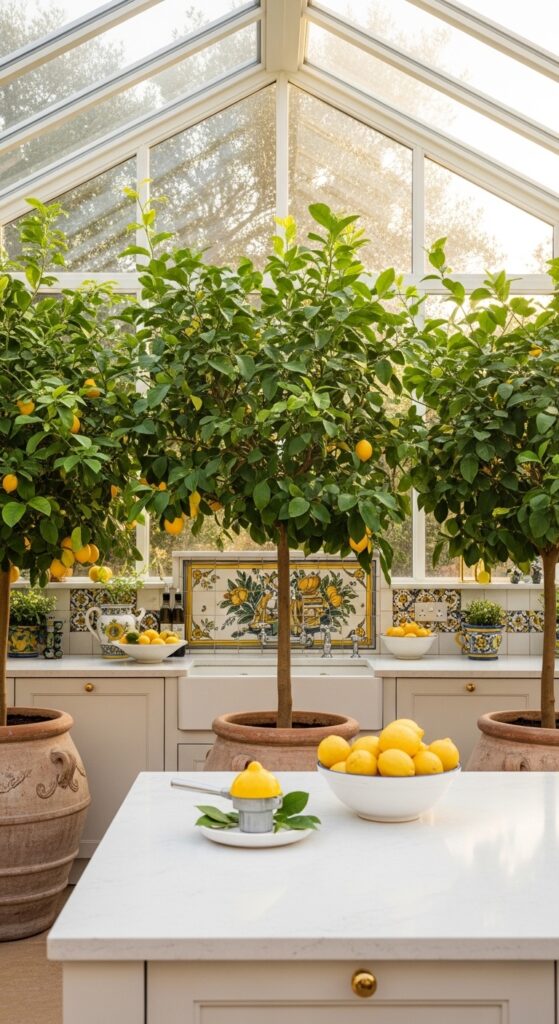
Vibe sentence: Meyer lemon trees in a glass kitchen are functional, beautiful, fragrant, and productive — the four things every great kitchen element should be simultaneously.
What makes it work: Citrus trees in a glass kitchen work on every level simultaneously: aesthetically (the yellow fruit against deep green leaves is one of the most naturally beautiful color combinations in existence), functionally (fresh lemons on demand from your own kitchen), and atmospherically (citrus blossom fragrance fills the glass space during flowering). The scale of a mature lemon tree in a large terracotta pot gives the kitchen a living focal point that no appliance or furniture piece can match.
How to achieve it: Meyer lemon trees are the most reliable indoor citrus variety — they tolerate container growing, produce fruit within the first year of maturity, and thrive in the high-light conditions of a glass kitchen. Source trees from specialist citrus nurseries rather than garden centers for mature, established plants already in fruit. Use a well-draining citrus potting mix and feed with a high-potassium liquid fertilizer every two weeks during the growing season.
Raw Concrete and Glass Brutalist Solarium Kitchen
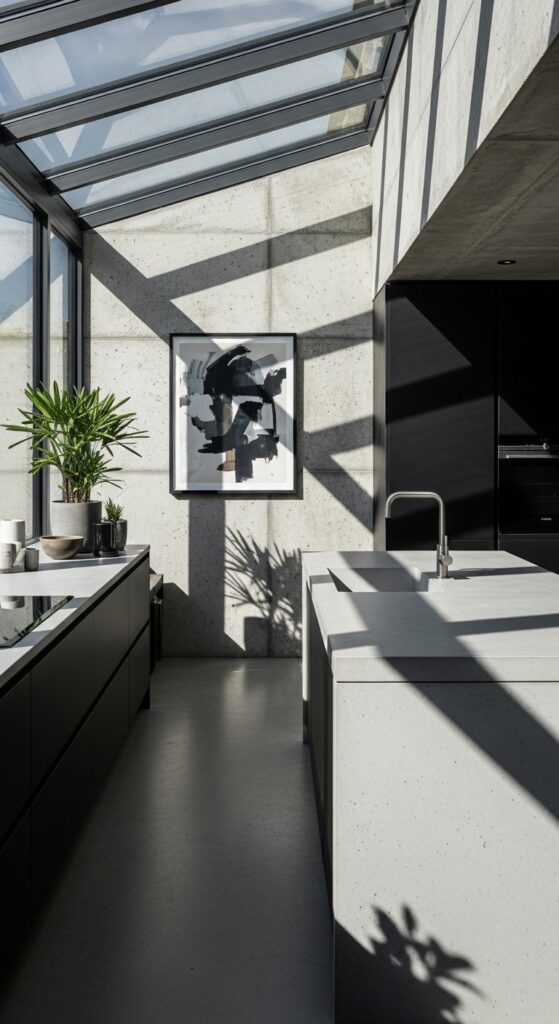
Vibe sentence: This kitchen doesn’t ask for your approval — it exists on its own architectural terms, and the raw concrete surfaces are more honest than anything finished could ever be.
What makes it work: Brutalist solarium kitchen design succeeds by leaning into the raw honesty of its materials — concrete that shows its formwork marks, steel that remains unpolished, glass that is purely functional rather than decorative. The hard shadow geometry created by direct sunlight on concrete surfaces turns the room into a constantly shifting light study that is genuinely arresting. This aesthetic demands confidence from the designer but rewards it with a room of extraordinary visual power.
How to achieve it: Board-formed concrete walls (where the concrete is poured against rough timber boards leaving the wood grain impression in the cured surface) are achievable as a specialist plastering technique using GFRC (glass-fibre reinforced concrete) panels applied to existing stud walls — no structural changes required. Specify matte sealer only — any sheen destroys the raw material authenticity.
Romantic Rose Garden Solarium Kitchen
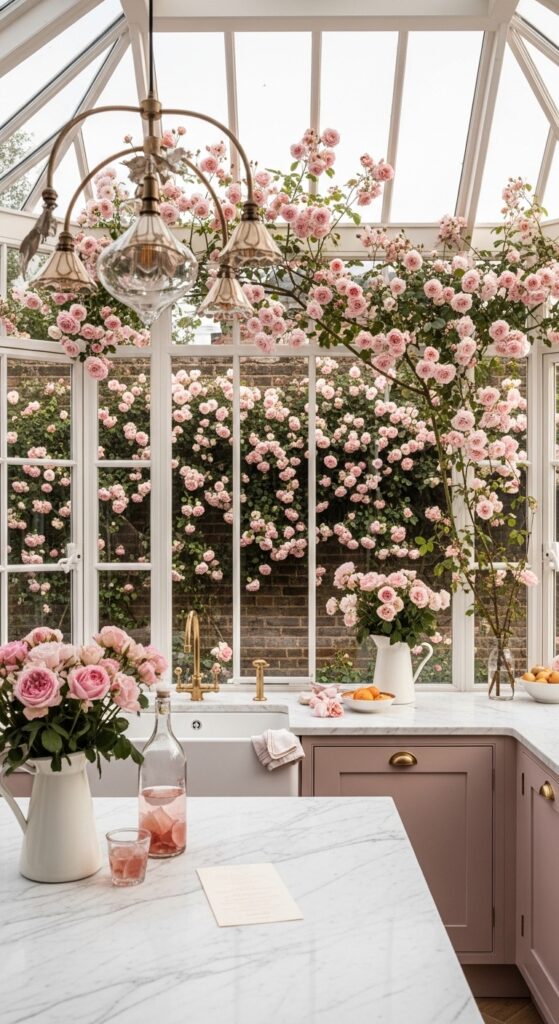
Vibe sentence: When climbing roses press against the glass in full bloom, the kitchen becomes the most romantic room in the house — effortlessly, immediately, completely.
What makes it work: The romance of this solarium kitchen is generated almost entirely by the exterior planting — climbing roses trained to grow against and over the glass frame bring the blowsy, perfumed abundance of a walled rose garden directly to the glass surface. Blush pink cabinetry inside echoes the rose color with restraint, connecting interior and exterior palette without literalism. The marble countertop provides the cool, classical surface that anchors the room’s romantic softness.
How to achieve it: Rosa ‘New Dawn,’ Rosa ‘Félicité Perpétue,’ and Rosa ‘Cécile Brunner’ are the three climbing varieties best suited to training against glass structures — all are vigorous, repeat-flowering, and disease-resistant. Plant at the base of each exterior glazing column and train horizontally along the frame using soft ties. For the interior, try Farrow & Ball “Middleton Pink” or Benjamin Moore “Pale Rose” for a soft, sophisticated blush rather than a saccharine pink.
💡 Bare-root climbing roses planted in late winter establish faster and cost 40% less than container-grown plants.
Solarium Kitchen with Rainforest View Extension
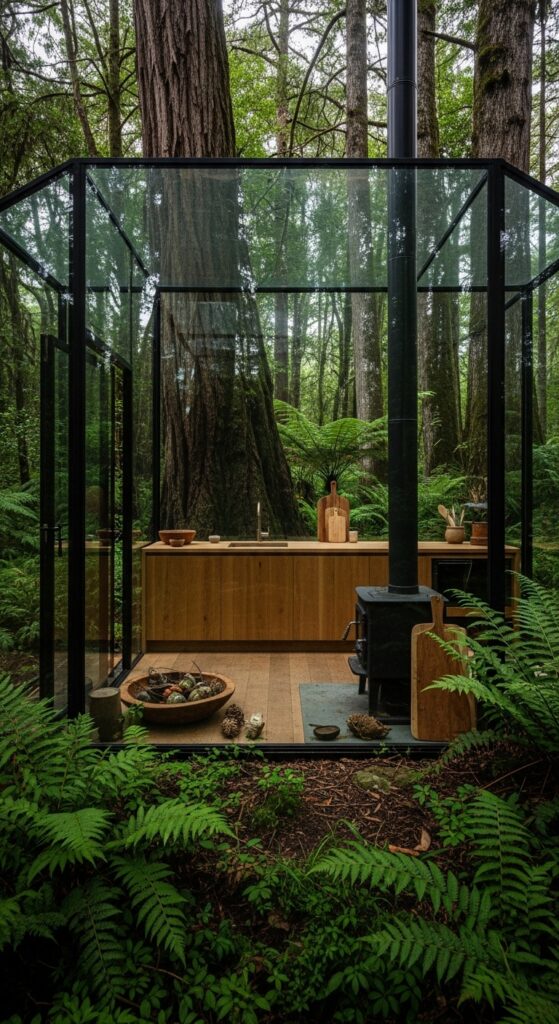
Vibe sentence: This kitchen doesn’t look into a garden — it looks into a forest, and the scale of the trees against the glass is something that rewires what a kitchen can feel like.
What makes it work: The forest solarium kitchen works at a completely different scale to a garden solarium kitchen — tree trunks visible at close range through the glass create a sense of the kitchen being inside the landscape rather than adjacent to it. The dappled, complex light through tree canopy is ever-changing in a way that cultivated garden light is not — it shifts, dims, brightens, and plays across interior surfaces all day. The interior design response to such an extraordinary exterior is correctly minimal — simple natural wood that defers entirely to the view.
How to achieve it: If your property has established trees, position the glass kitchen extension to maximize the proximity of the nearest significant specimens — even partial tree views dramatically amplify the forest immersion effect. Specify minimal glazing bar profiles to eliminate as much visual obstruction as possible. Inside, use only natural, unfinished or oiled wood for all surfaces — the forest demands material authenticity.
Solarium Kitchen with Copper Roof and Aged Patina
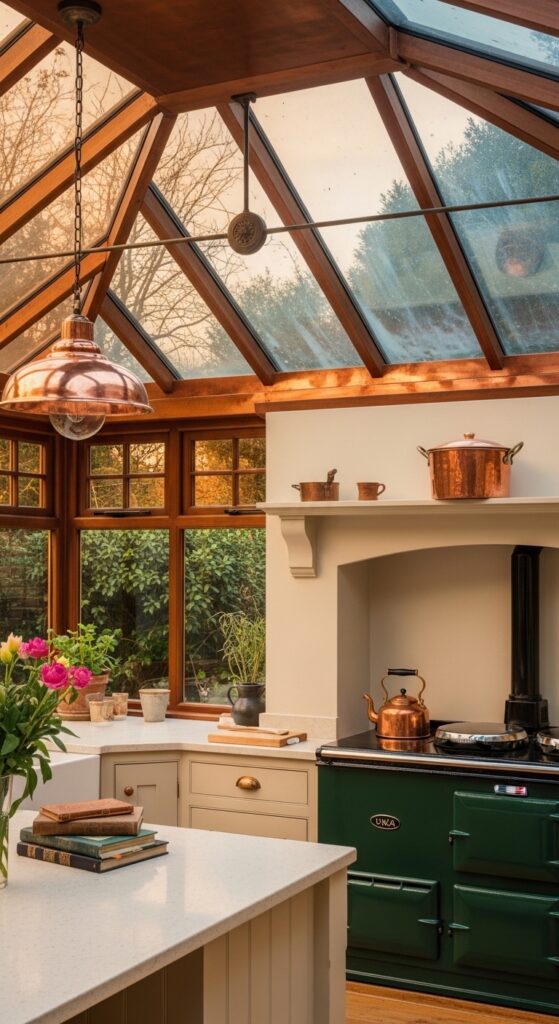
Vibe sentence: A copper roof that has aged to blue-green patina is one of the most beautiful materials on earth — and cooking beneath it, in warm filtered light, is an extraordinary daily privilege.
What makes it work: Copper roofing is exceptional for a solarium kitchen because it serves three simultaneous design functions: it is structurally functional, aesthetically magnificent in its aged patina state, and it creates a subtly warm, amber-tinted light quality as natural light passes through or reflects from the copper panels. The combination of aged copper externally with a dark forest green Aga internally is a pairing of two historically significant, deeply British design objects that feel absolutely right together.
How to achieve it: Copper standing seam roofing panels are available from specialist metal roofing suppliers — specify pre-weathered copper if you want the immediate blue-green patina rather than waiting 10–15 years for natural weathering. An Aga range cooker in forest green (“Hunter Green”) is the ideal interior anchor — Aga’s electric and gas models bring the iconic aesthetic without requiring solid fuel.
Solarium Kitchen with Open-Plan Garden Room Flow
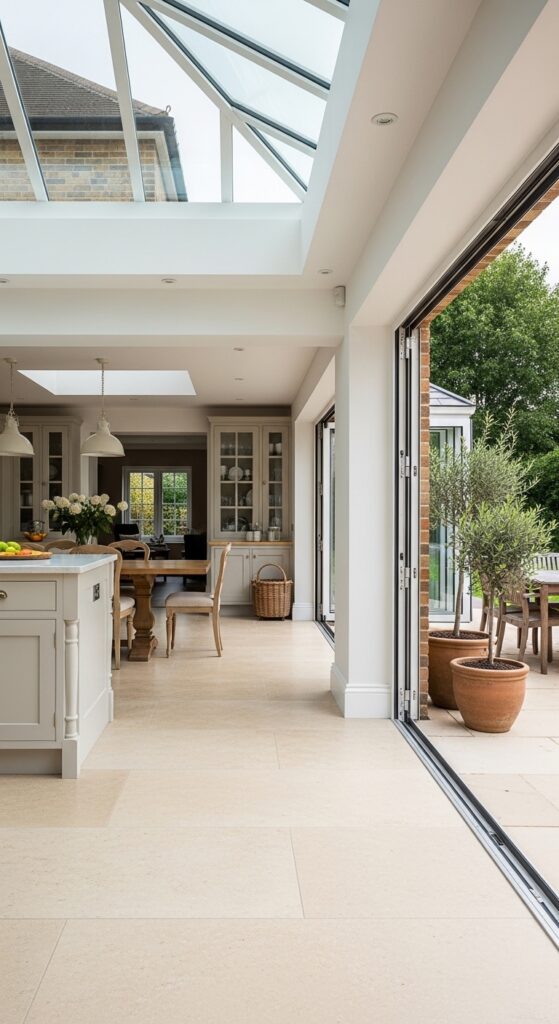
Vibe sentence: When the kitchen, the garden room, and the garden itself share one uninterrupted floor, the question of where inside ends and outside begins becomes genuinely impossible to answer.
What makes it work: The open-plan solarium kitchen-to-garden flow creates what designers call a “borrowed space” effect — each zone feels larger because it visually incorporates the zones beyond it. The critical detail is the continuous floor material running through all three spaces: when the flooring doesn’t change at the threshold, the spaces merge. Folding glass walls that fully retract allow the merge to be both visual and physical, eliminating the boundary between cooking space and garden entirely.
How to achieve it: Specify the same large-format limestone, concrete, or porcelain tile for the kitchen floor, garden room floor, and exterior patio — laid continuously without a change in material, direction, or grout line. Use a tile rated for both interior and exterior use (porcelain with a minimum R10 slip rating for outdoor areas). Folding glass wall systems from companies like NanaWall or IQ Glass allow complete wall retraction in panels as narrow as 600mm.
Solarium Kitchen with Wildflower Meadow Backdrop
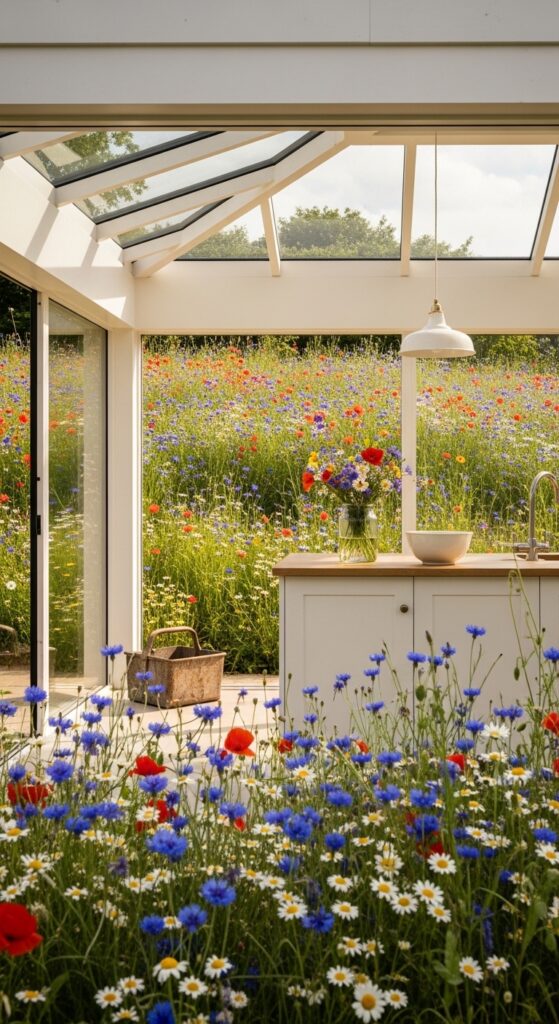
Vibe sentence: A wildflower meadow seen through a glass kitchen wall is not a view — it is a painting that moves, changes colour, and never repeats itself.
What makes it work: A naturalistic wildflower planting is the most dynamic possible garden backdrop for a glass kitchen because it is in constant motion — flowers nod in breeze, butterflies move through it, the color composition shifts as different species peak and fade through the season. The deliberate contrast between the wild, uncontrolled exterior planting and the clean, white-painted kitchen interior creates the most compelling possible inside-outside dialogue. The interior design is correctly minimal — anything elaborate would compete with the meadow.
How to achieve it: A wildflower meadow requires the complete removal of existing grass and topsoil — wildflowers need poor, well-drained soil to outcompete grass. Sow a cornflower and poppy annual mix in autumn for first-year flowers, then supplement with native perennial plug plants (oxeye daisy, field scabious, knapweed) for an established perennial structure from year two. Seed mixes from Pictorial Meadows and Landlife Wildflowers are specifically formulated for UK/US climates.
💡 A wildflower meadow costs approximately $0.02 per square foot in seed — among the most cost-effective garden investments available.
How to Start Your Solarium Kitchen Transformation
The first decision in any solarium kitchen project is whether you are building a new glass extension or transforming an existing room — and that choice determines everything that follows. A new glass extension requires an architect and planning permission in most jurisdictions; an existing room can often be solarium-ized through glazing upgrades, skylights, and garden-facing glass doors without structural intervention.
If you’re working with an existing kitchen, begin with glazing. Replacing a standard exterior wall with a floor-to-ceiling glass sliding or folding door system is the single highest-impact change available — it introduces both light and the visual connection to the garden that defines the solarium aesthetic. This is often achievable without planning permission as permitted development, depending on your location and the extent of the structural opening.
Common mistakes in solarium kitchen design include underestimating solar gain (glass kitchens get very hot in summer without appropriate shading or ventilation — specify opening roof vents and consider external blinds before the build begins) and over-filling the glass space with furniture and objects. The discipline of keeping the interior minimal is what allows the glass, light, and garden view to perform as the room’s primary design elements.
Budget-friendly entry point: a single glass roof lantern added to an existing flat-roofed kitchen extension, combined with garden-facing bifold doors, can achieve the core solarium kitchen experience from approximately $8,000–$15,000 in structural work — a fraction of a full glass extension build.
Frequently Asked Questions
Do solarium kitchens get too hot in summer?
Solar gain is the primary practical challenge in a glass kitchen and must be addressed at the design stage rather than as an afterthought. Specify self-shading or solar-control glass (with a g-value of 0.3–0.4) for roof panels — this dramatically reduces heat gain while maintaining light transmission. Add opening roof vents at the ridge for cross-ventilation, and consider external automated blinds on south and west-facing glass panels. Properly specified, a solarium kitchen is comfortable year-round; improperly specified, it becomes a greenhouse in July.
What is the best flooring for a solarium kitchen?
Natural stone — limestone, travertine, slate, or sandstone — is the ideal solarium kitchen flooring choice for three reasons: it handles the thermal cycling of a glass space better than most materials, its natural variation looks increasingly beautiful under the honest light of a glass room, and it connects authentically to the garden aesthetic the solarium kitchen is designed to express. Porcelain in a natural stone finish is a practical and cost-effective alternative. Avoid standard hardwood floors in a glass extension — UV exposure and humidity fluctuation cause significant warping and fading over time.
How much does a glass kitchen extension cost?
Costs vary significantly by geography, complexity, and specification. A basic timber-framed glass extension in the UK typically costs £1,500–£2,500 per square meter for the structure alone; a premium steel and glass extension with slim-profile glazing bars runs £3,000–£5,000 per square meter. In the US, comparable structures range from $300–$800 per square foot for the extension structure. Full fit-out including kitchen cabinetry, flooring, and lighting adds 40–60% to the structural cost. Budget realistically and prioritize glazing quality over decorative finishes — the glass is the room.
What plants thrive best in a solarium kitchen?
The glass kitchen environment — high light, warmth, and kitchen humidity — suits a specific plant group beautifully. Herbs thrive universally: basil, rosemary, thyme, sage, and chives all produce more prolifically in a glass kitchen than anywhere else in the home. Fruiting plants including Meyer lemon, fig, and dwarf olive trees perform exceptionally in glass kitchens given sufficient root space. For dramatic foliage, bird of paradise, fiddle leaf fig, and large-format monstera love the conditions. Avoid cacti and succulents — they prefer dry heat without kitchen humidity.
Do I need planning permission for a glass kitchen extension?
In the UK, most single-storey glass extensions fall within Permitted Development rights — meaning no planning application is required — provided the extension doesn’t exceed 4 meters in height, covers less than 50% of the original house footprint, and doesn’t extend beyond the principal elevation facing a highway. In the US, building permits are generally required for any structural addition, though the process is typically straightforward for single-storey glass extensions. Always consult your local planning authority before beginning any structural work — rules vary significantly by location, and non-compliant structures can be ordered removed.
Ready to Create Your Dream Solarium Kitchen Space?
You’ve just explored 29 genuinely distinct solarium kitchen ideas — from Victorian conservatory grandeur and Japanese Zen garden views to wildflower meadow backdrops and copper-roofed Aga kitchens — and the breadth of what’s possible within this one luminous design direction is precisely the point. A solarium kitchen is not a single aesthetic. It is a commitment to light, to the landscape, and to the idea that the daily act of cooking deserves a room that is genuinely extraordinary. Save and pin the ideas that made you stop mid-scroll.
Your transformation begins with one window, one glass door, or one skylight. The moment you introduce a direct visual connection between your kitchen and the living world outside, something fundamental shifts in how the room feels to inhabit. Natural light is the most powerful design material available to any home — and a solarium kitchen is its fullest, most generous expression. The garden is waiting just beyond the glass. All you have to do is let it in.