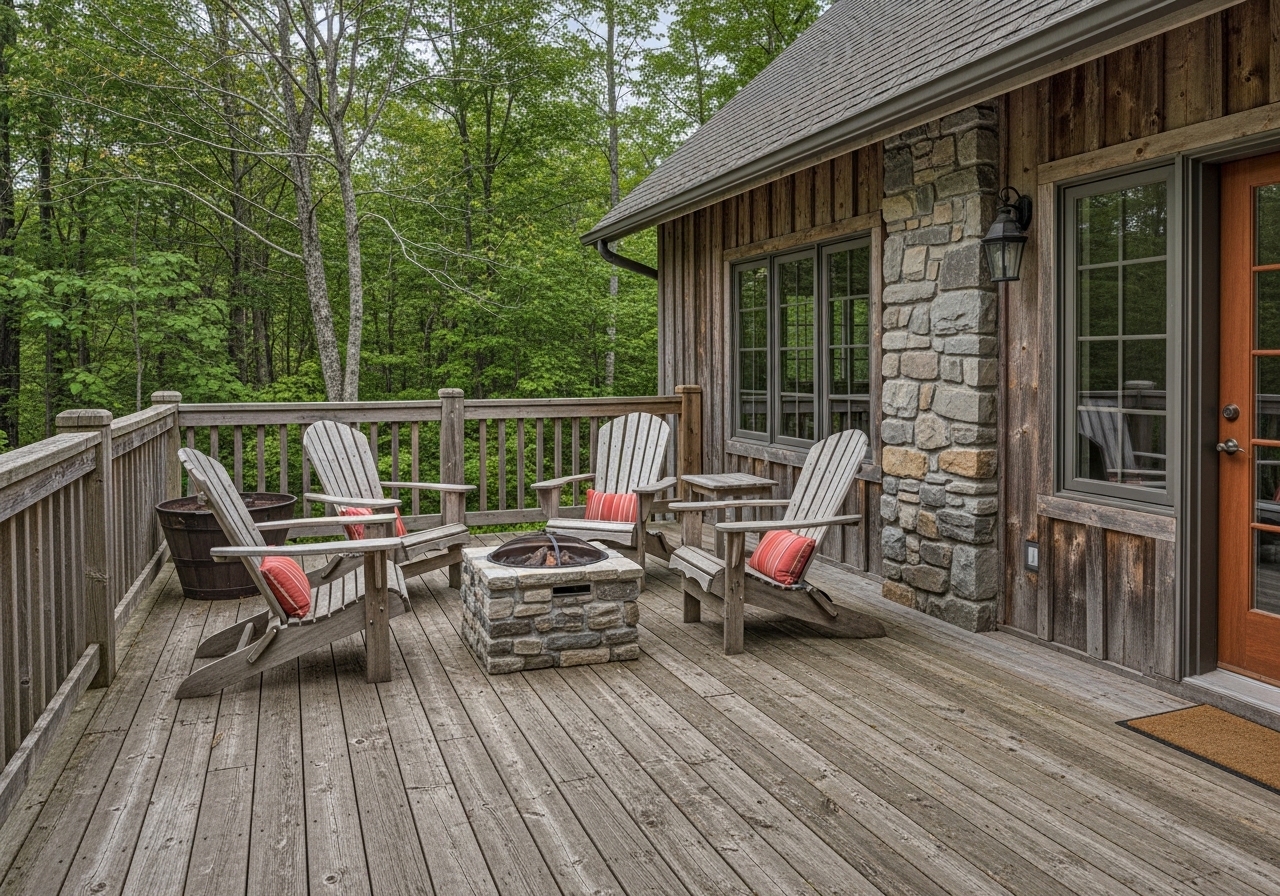
There’s a particular kind of magic that happens when a back deck is done right — the kind that pulls you outside before your morning coffee is even finished and keeps you there long after the sun goes down. A thoughtfully designed outdoor deck isn’t just extra square footage; it’s where summer memories are made, where slow Sunday mornings become a ritual, and where the line between inside and outside beautifully blurs. Whether you’re starting from bare concrete or reimagining weathered boards that have seen better days, the right ideas can turn any back deck into the outdoor room you’ve always wanted. Here are 26 ideas worth saving, pinning, and building.
Why Outdoor Deck Design Works So Well as a Design Investment
A back deck occupies a unique position in home design — it’s simultaneously architecture, garden, and living room. Unlike interior rooms, decks exist in conversation with the sky, the seasons, and the surrounding landscape, which means good design here rewards you differently every single day.
The materials and textures that define a stunning deck are wonderfully varied: natural teak and ipe hardwoods that silver beautifully with age, composite decking in warm greige tones that require almost no maintenance, powder-coated steel that holds its finish through hard winters, and outdoor-rated performance fabrics in linen, canvas, and woven polyester that look indoor-quality while surviving rain and UV.
Outdoor living is genuinely one of the most searched and saved categories on Pinterest right now — “back deck ideas,” “outdoor living room,” and “deck transformation” consistently rank among the top home content searches year over year. Homeowners have realized that a well-finished deck adds meaningful square footage to a home’s livable space without the cost of a full addition.
Even a modest 10×12 deck can be transformed into a layered, intentional outdoor room with the right furniture arrangement, lighting strategy, and plant placement. Scale is never the limiting factor — intention is.
1. Floating Deck with Composite Decking in Warm Greige
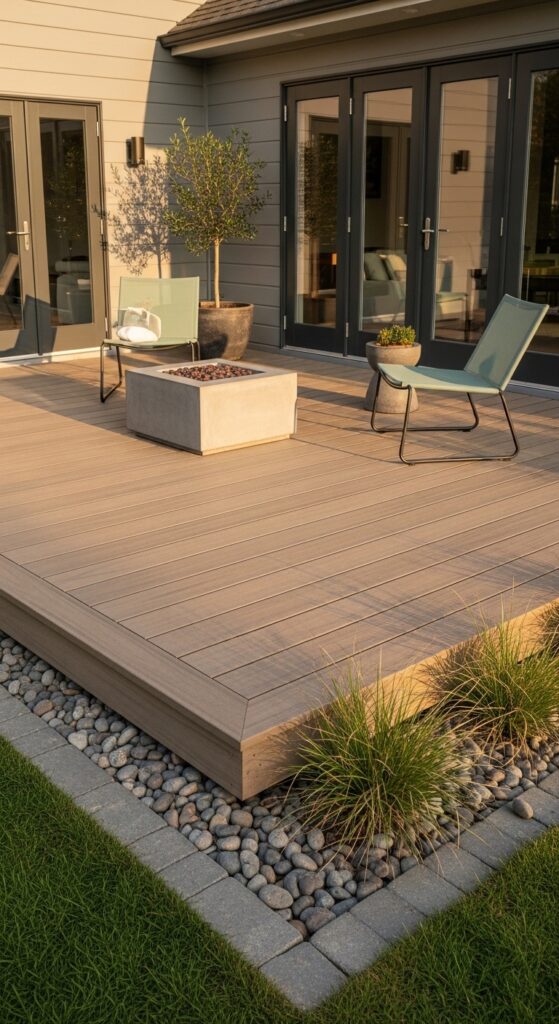
Vibe sentence: Low to the ground and completely unpretentious, this deck feels like it grew out of the garden rather than being placed on top of it.
What makes it work: Floating decks sit close to grade without requiring structural railings, which keeps sightlines open and makes the outdoor space feel larger and more connected to the yard. Composite decking in greige tones reads as natural wood from a distance while requiring nothing more than an occasional rinse — no staining, no sealing, no annual maintenance weekend.
How to achieve it: Choose composite decking boards from Trex or TimberTech in a mid-toned greige — avoid the very lightest tones, which show dirt quickly, and the very darkest, which absorb heat uncomfortably in direct sun. Install with hidden clip fasteners for a surface with no visible screws.
💡 Composite decking off-cuts make excellent garden bed borders — ask your installer to save the pieces rather than toss them.
2. String Light Canopy Overhead for Instant Evening Ambiance
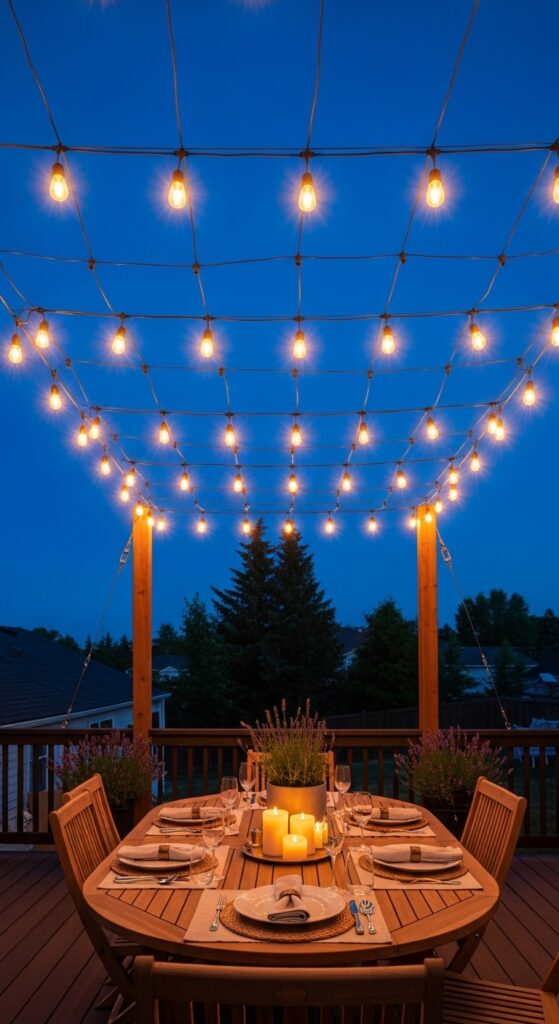
Vibe sentence: The moment the sun goes down and those bulbs glow on, every dinner becomes a dinner party.
What makes it work: A string light canopy does something overhead lighting on a deck rarely achieves — it defines the space without enclosing it. The warm amber glow of Edison-style bulbs is flattering, festive, and completely weatherproof in heavy-duty outdoor-rated versions. The grid pattern of lights creates a visual “ceiling” that makes an uncovered deck feel like an outdoor room.
How to achieve it: Use 18-gauge or heavier outdoor-rated string lights on black rubber cable — cheaper versions on thin wire sag and burn out quickly. Anchor to 4×4 wooden posts set in concrete or screw-in ground anchors, running turnbuckle tensioners at each end to keep lines taut.
3. Built-In L-Shaped Bench Seating with Storage Below
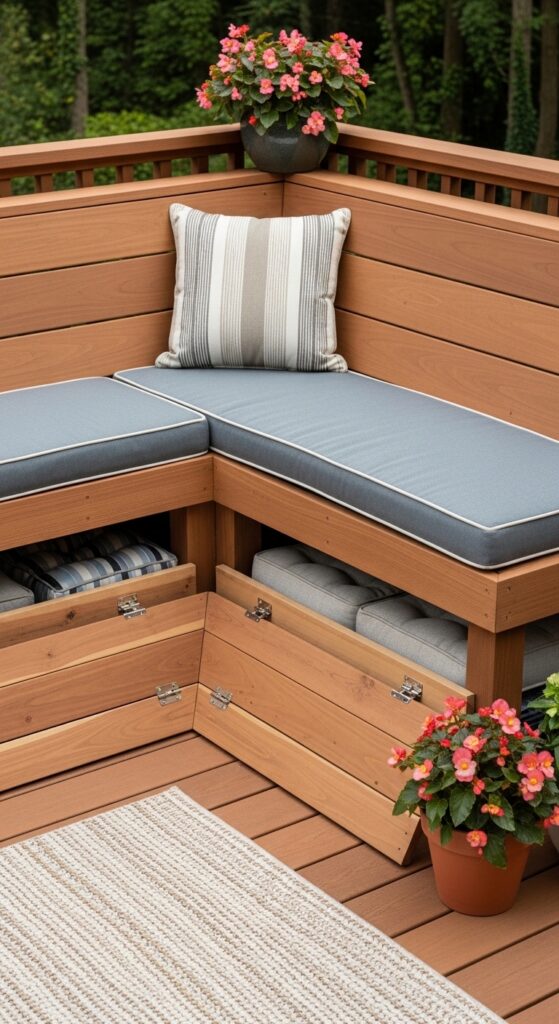
Vibe sentence: Built-in seating that solves two problems at once — where everyone sits and where everything gets stored.
What makes it work: L-shaped bench seating built along deck railings uses the perimeter of the space efficiently without crowding the center. The hinged storage below becomes an outdoor linen closet — perfect for cushions, throws, games, and garden accessories that would otherwise clutter the garage.
How to achieve it: Frame bench boxes from pressure-treated 2x4s and face with the same decking boards used on the floor to create a cohesive, intentional look. Line the interior with cedar planks — the natural oils resist moisture and repel insects without any chemical treatment.
💡 Use piano hinges rated for outdoor use (stainless steel, not zinc) — standard indoor hinges rust within one season.
4. Pergola with Climbing Vines for Natural Overhead Cover
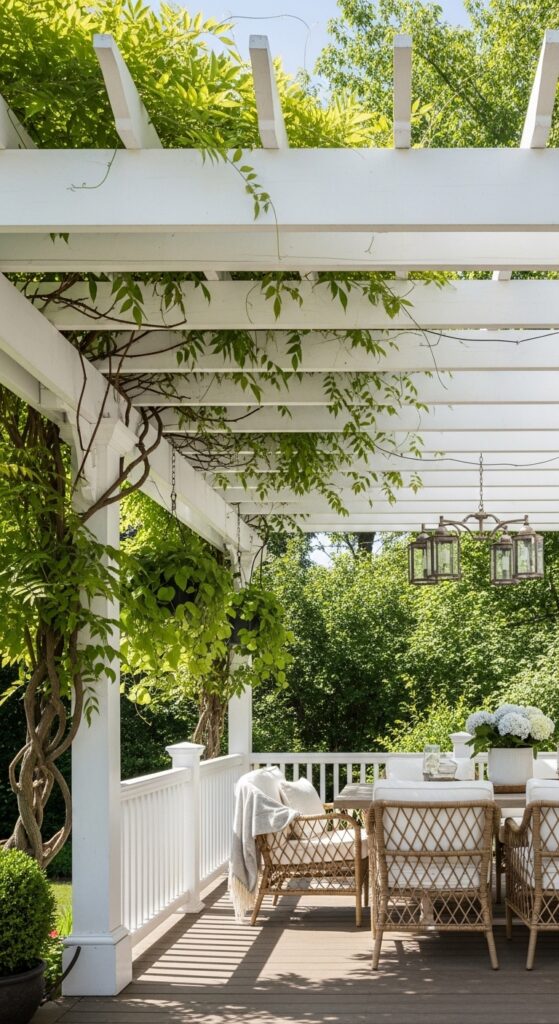
Vibe sentence: Sitting under a vine-covered pergola is the closest most of us will get to dining in an Italian garden.
What makes it work: A pergola provides structure and the suggestion of shelter without the darkness of a solid roof — light filters through in constantly shifting patterns that make the deck feel alive. Climbing vines like wisteria, jasmine, or climbing hydrangea add fragrance, seasonal interest, and a sense of organic permanence that no furniture or decor item can replicate.
How to achieve it: Plant fast-growing climbing vines like clematis or Virginia creeper at each pergola post base — these establish within one season and reach full coverage in two to three years. Attach galvanized wire horizontally between posts to guide early growth before vines find the beams themselves.
5. Outdoor Kitchen Built-In with Concrete Countertop
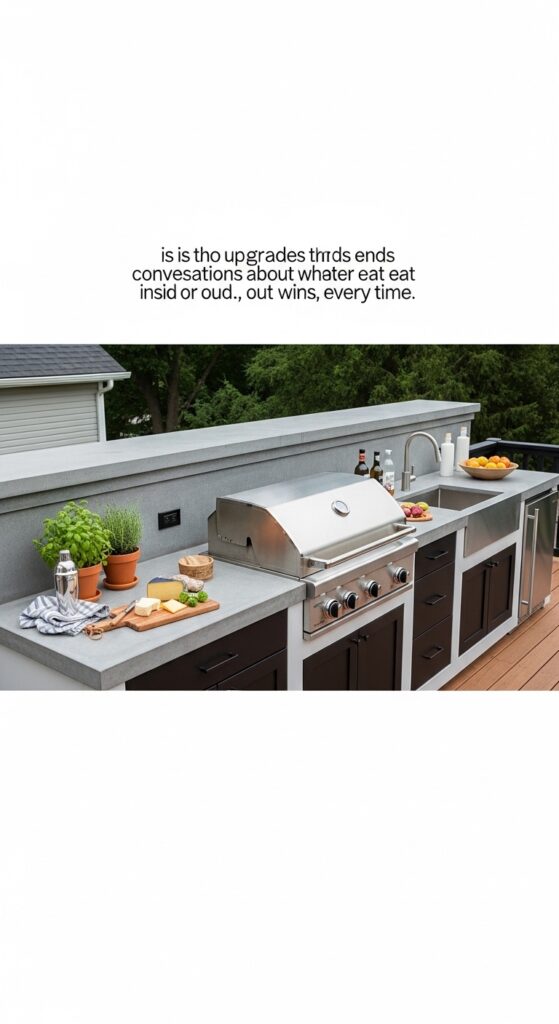
Vibe sentence: This is the upgrade that ends all conversations about whether to eat inside or out — out wins, every time.
What makes it work: A built-in outdoor kitchen anchors the deck as an entertainment destination rather than simply a seating area. Concrete countertops are ideal outdoors — they’re genuinely weatherproof, heat-resistant, and develop a beautiful patina over time that no manufactured surface can replicate.
How to achieve it: Use GFRC (glass fiber reinforced concrete) for outdoor countertops rather than standard poured concrete — it’s lighter, less prone to cracking, and can be cast offsite then installed. Pair with weatherproof marine-grade plywood cabinet boxes faced with fiber cement panels or powder-coated aluminum.
6. Multi-Level Deck with Connected Stair Transitions
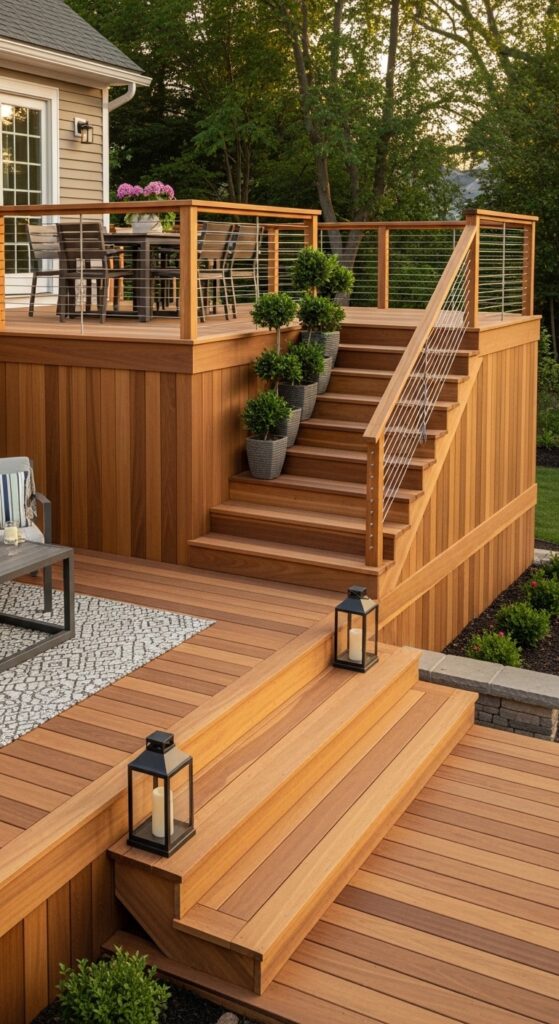
Vibe sentence: Two levels, one cohesive space — a multi-level deck turns a simple backyard into something that feels genuinely designed.
What makes it work: Level changes on a deck create natural zones without walls or dividers — dining up top, lounging down below, with the staircase as a graceful transition between moods. Using the same decking material across both levels unifies what could otherwise feel like two separate structures.
How to achieve it: Design the step riser height to match standard interior stair dimensions (7 inches) for comfortable, natural movement between levels. Wide, open treads without closed risers keep the lower level visible and connected, preventing the staircase from acting as a visual barrier.
7. Horizontal Cable Railing for Unobstructed Views
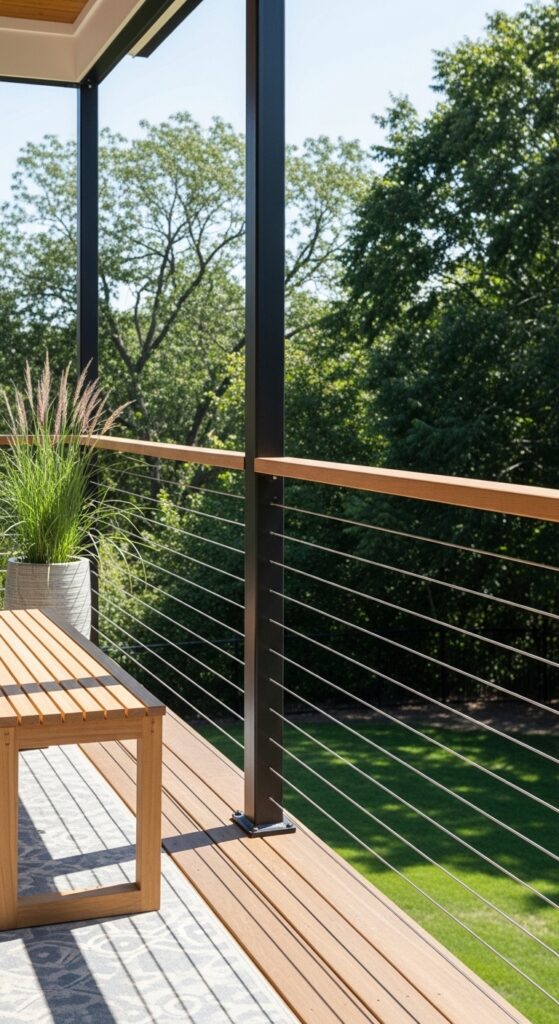
Vibe sentence: The railing that makes you forget the railing is even there.
What makes it work: Cable railing systems allow the eye to travel straight through to the landscape beyond, which makes any outdoor space feel dramatically larger. The contrast between slim matte black steel posts and the silver cable creates a graphic, modern profile that reads as intentional and architectural from every angle.
How to achieve it: Space cable runs at 3-inch vertical intervals maximum to meet residential code requirements in most jurisdictions. Use a cable tension tool (ratchet tensioner) at one post end to achieve taut, vibration-free cable runs — loose cables are both a safety issue and visually sloppy.
💡 Wipe cable lines down annually with a stainless steel cleaner to prevent mineral deposits that dull the finish over time.
8. Outdoor Living Room Setup with Weather-Resistant Sofa
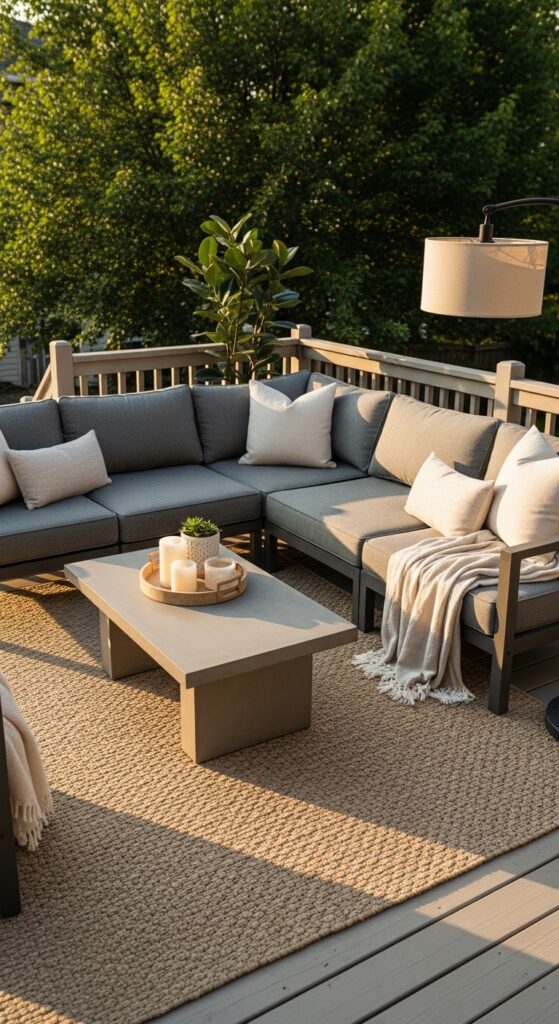
Vibe sentence: The outdoor room so comfortable that guests genuinely can’t tell they’ve left the living room.
What makes it work: Treating the back deck exactly like an interior living room — with a centered rug, a proper sofa, a coffee table, and ambient lighting — is the single biggest shift that transforms a deck from “patio furniture storage” to an actual room. Deep-seat sectionals with performance fabric cushions now exist that are genuinely weatherproof and as comfortable as indoor upholstery.
How to achieve it: Look for performance fabric rated at 50,000+ double rubs — brands like Sunbrella, Perennials, and Outdura make fabric that resists fading, mold, and moisture while looking and feeling like indoor linen. A large outdoor rug (at minimum 8×10) is non-negotiable — it visually defines the seating zone.
9. Deck Privacy Screen with Slatted Wood Panels
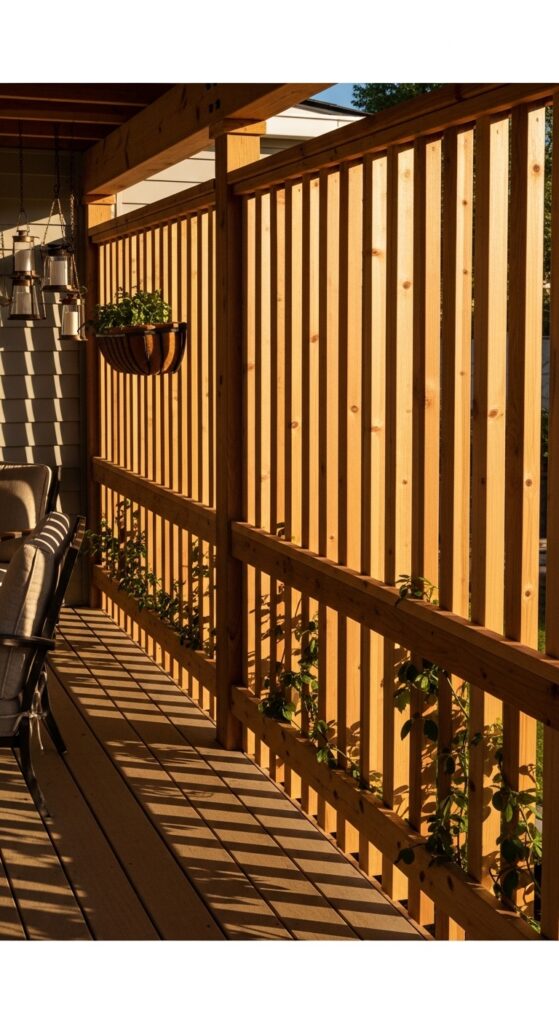
Vibe sentence: The screen that gives you privacy without making you feel boxed in — slatted light is its own kind of beautiful.
What makes it work: Vertical cedar slatted screens provide meaningful privacy from neighbors while allowing air to circulate and dappled light to pass through — unlike solid fences or walls that can make a deck feel like an enclosed pen. The shadow pattern the slats cast across the deck surface changes throughout the day in a quietly dramatic way.
How to achieve it: Use 1×4 cedar boards spaced 1 inch apart on a 4×4 post frame — this ratio provides good privacy while maintaining good airflow. Seal cedar with a clear penetrating oil like Danish Oil annually to maintain the warm honey color and prevent greying.
10. Fire Pit Seating Area at Deck’s Edge
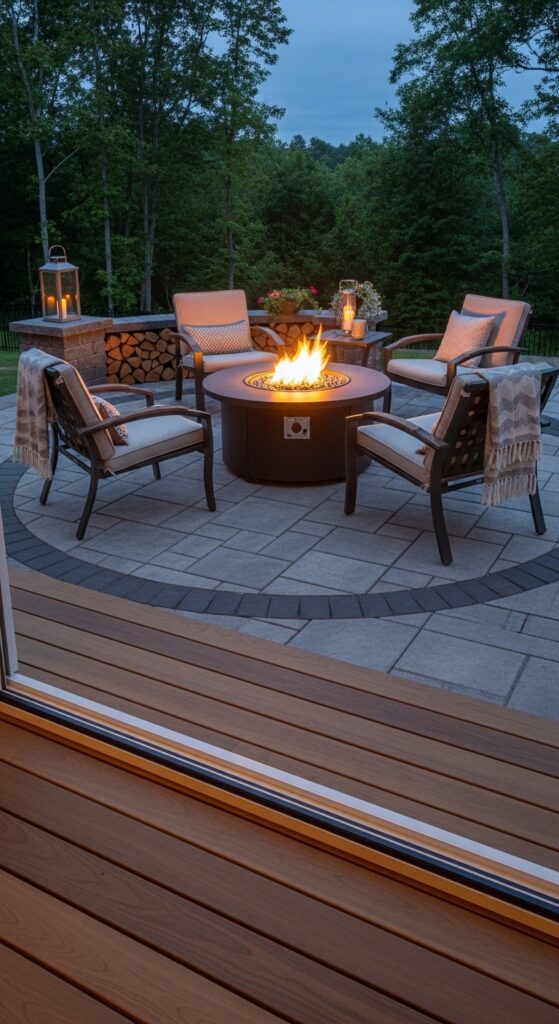
Vibe sentence: Fire at the edge of the deck extends every outdoor evening by at least two hours — no exceptions.
What makes it work: Transitioning from decking to concrete pavers around a fire table is both a safety best practice and a smart design move — the material change signals a zone shift and adds visual interest at the far end of the deck. A gas fire table provides instant, controllable flame without the ash and smoke of a wood fire.
How to achieve it: Maintain a minimum 3-foot clearance between any deck rail or wood surface and a gas fire table — most code-compliant models specify required clearances in their installation guides. Choose a fire table with a concealed propane tank storage compartment in the base for a clean, finished look.
11. Outdoor Dining Zone with Teak Table and Mismatched Chairs
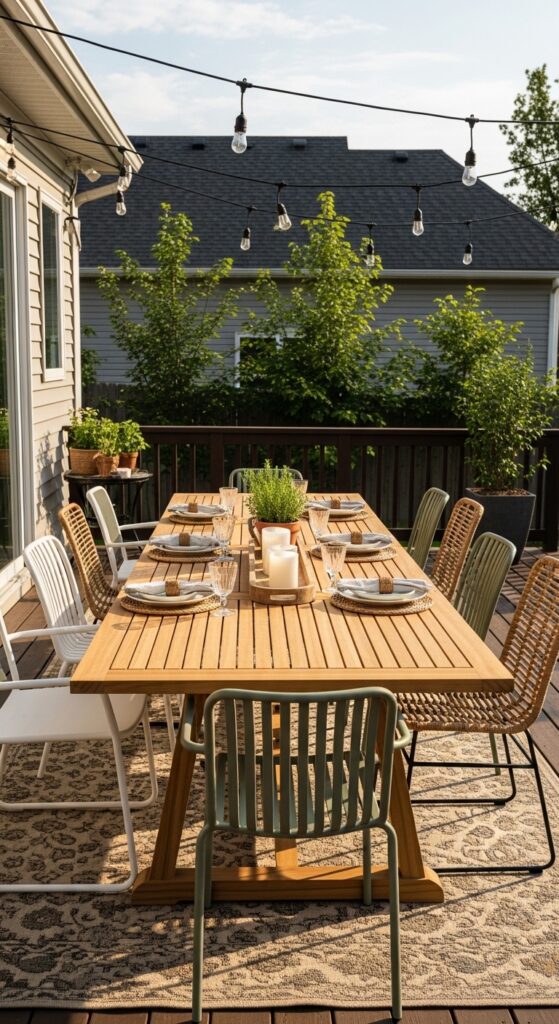
Vibe sentence: The table that says every guest matters enough to have their own special seat.
What makes it work: Intentionally mismatched outdoor chairs around a unified teak table create a collected, lived-in energy that a matching set simply cannot achieve. The key is keeping the color palette cohesive — all chairs within the same warm neutral family — so the mix reads as curated rather than accidental.
How to achieve it: Shop outdoor chair sales at the end of summer season (August–September) when retailers discount heavily — mix two from one sale and two from another for an affordable eclectic set. A teak table is the one piece worth investing in — properly cared for, it will last 25+ years outdoors.
💡 Apply teak oil to your teak table twice a year to maintain the warm honey color — without it, teak greys beautifully but permanently.
12. Deck with Integrated Planter Boxes Along the Perimeter
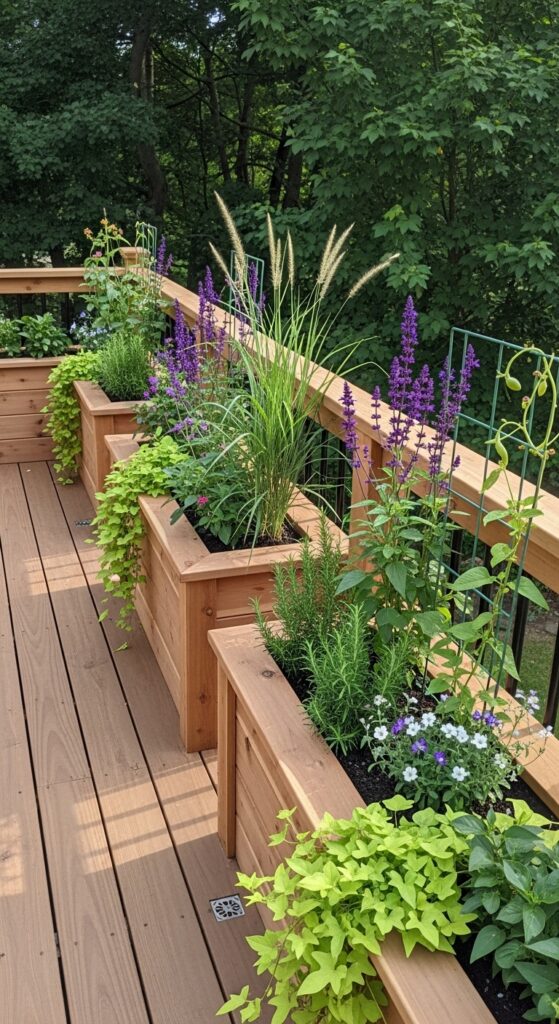
Vibe sentence: When the deck grows its own garden, the line between structure and nature disappears in the best way.
What makes it work: Built-in perimeter planters do double duty — they replace traditional railings in some configurations, and where they sit alongside railings, they soften the edge of the deck and create an immersive garden atmosphere. Plants at deck height bring color and fragrance to eye level and sitting level, where you’ll actually appreciate them.
How to achieve it: Line cedar planter boxes with heavy-duty pond liner stapled inside before planting — this protects the wood from constant moisture and extends the life of the boxes by years. Include a drainage gap at the bottom of each box and plant trailing varieties at the outer edges to cascade decoratively downward.
13. Black Deck with Gold Accents for a Dramatic Statement
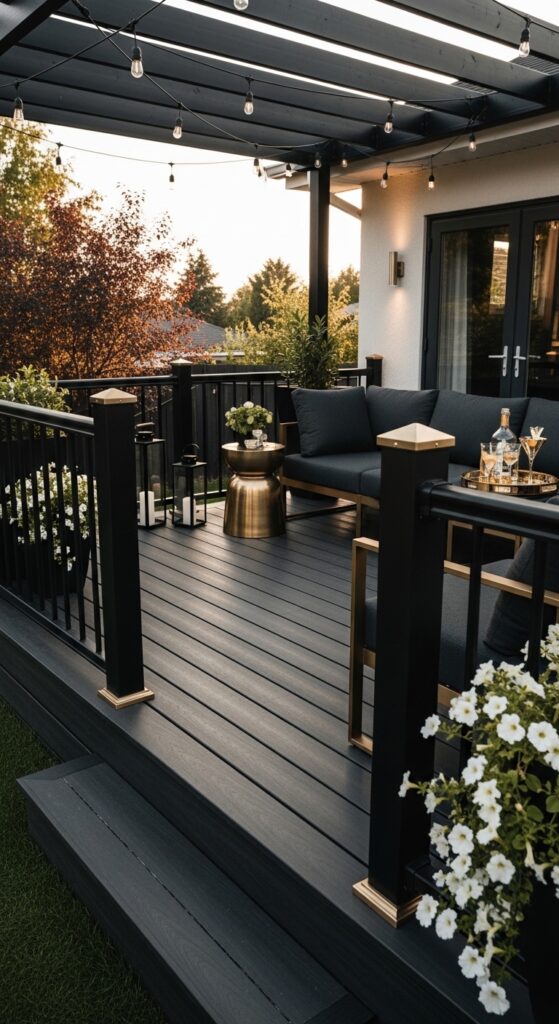
Vibe sentence: Bold enough to stop the scroll, sophisticated enough to live with every single day.
What makes it work: A monochromatic dark deck palette has an immediate, magazine-worthy impact that lighter decks simply don’t achieve in photos — and in person. The gold hardware accents prevent the dark scheme from reading as oppressive by introducing warmth and reflection that catches light dynamically throughout the day.
How to achieve it: Choose composite decking in “Ebony” or “Charcoal” tones — these colors disguise dirt and debris between cleanings far better than lighter options. Use black powder-coated aluminum for all metal elements rather than painted steel, which chips over time with outdoor temperature swings.
14. Wraparound Deck with Multiple Zones
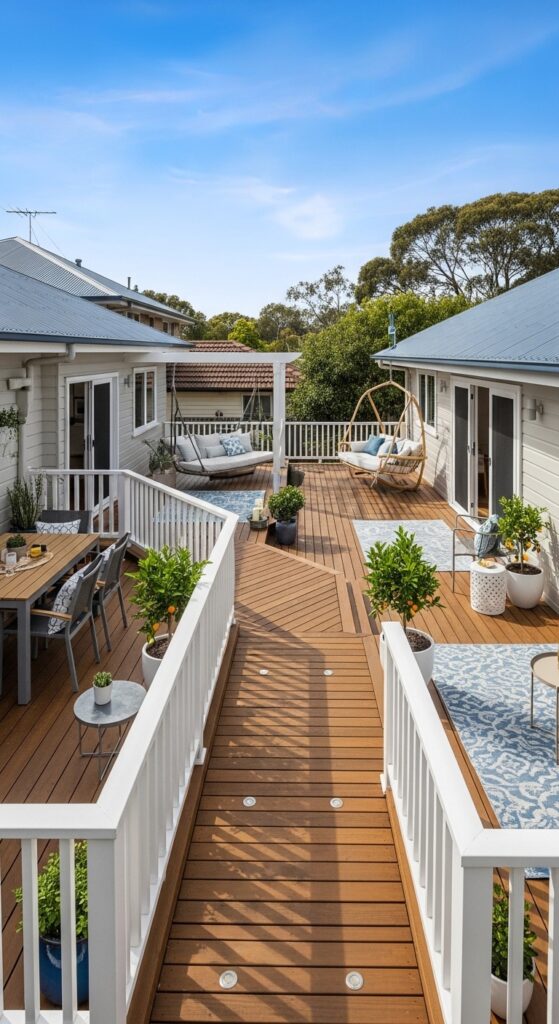
Vibe sentence: A wraparound deck follows the sun throughout the day — you simply move with it.
What makes it work: Wraparound deck configurations naturally create multiple distinct zones without any built dividers — the corner becomes the transition point between dining and lounging, and you always have sun or shade depending on the time of day. This is particularly valuable in climates with strong seasonal sun shifts.
How to achieve it: Use consistent railing style and decking material across the entire wraparound to make it read as one cohesive structure — mixing materials at corners makes it look like two separate projects bolted together. Differentiate zones purely through furniture groupings and outdoor rugs rather than any built-in separation.
15. Deck Lighting with In-Board Recessed LED Step Lights
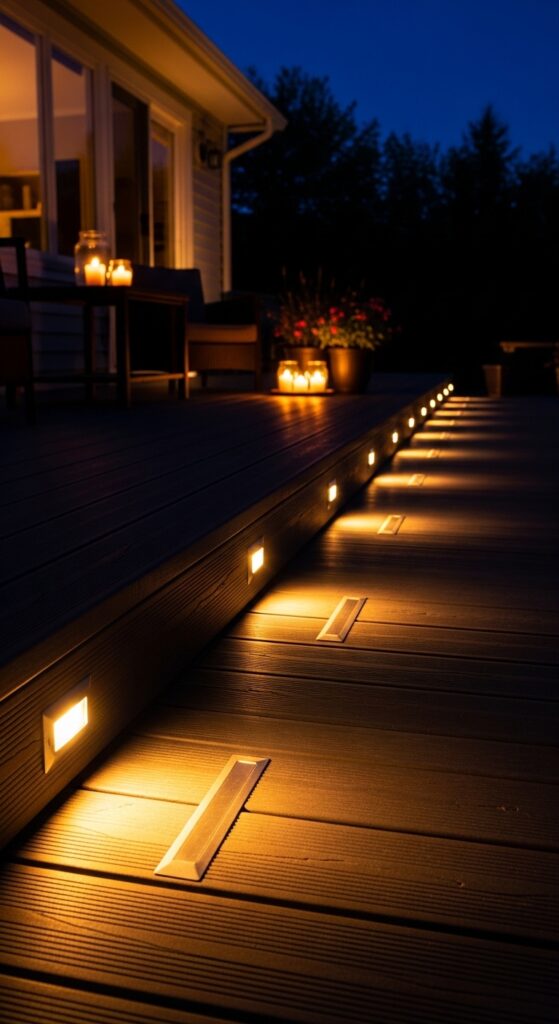
Vibe sentence: The best deck lighting is the kind you almost don’t notice — until you see the deck without it.
What makes it work: Recessed LED step and pathway lights installed flush with the deck surface provide safety lighting without any fixtures breaking the clean surface line of the boards. The warm 2700K color temperature is critical — cool white LEDs outdoors feel clinical and harsh; warm tones feel inviting and residential.
How to achieve it: Install recessed deck lights during construction, not after — surface-mounted lights added later never look as clean. Run low-voltage wiring through the deck framing before boards go down, and use deck-board-mount LED fixtures rated for outdoor wet conditions with stainless bezels.
💡 A simple timer or dusk-to-dawn sensor means your deck is always lit safely without any manual switching — essential for stairs.
16. Outdoor Rug Layering for Defined Zones
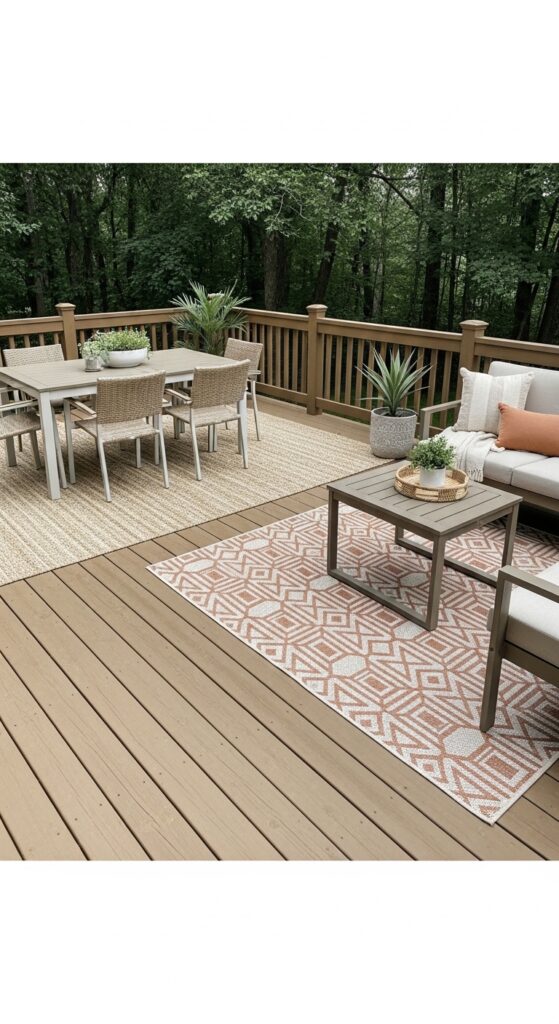
Vibe sentence: Two rugs, two zones, one seamlessly organized deck — it’s zone planning without a single wall.
What makes it work: Using outdoor rugs to define zones on an open deck is the most cost-effective and reversible way to organize a large outdoor space. Two rugs in complementary but distinct patterns keep each zone visually interesting while a shared color thread between them ties the overall deck palette together.
How to achieve it: Choose flat-weave polypropylene rugs for decks — they dry fast, don’t trap debris, and don’t develop mold under the pile the way thicker rugs can. Size each rug generously: for dining, all chair legs should sit on the rug even when pulled out; for lounging, the full sofa and coffee table should sit on the rug.
17. Shade Sail Overhead in a Geometric Configuration
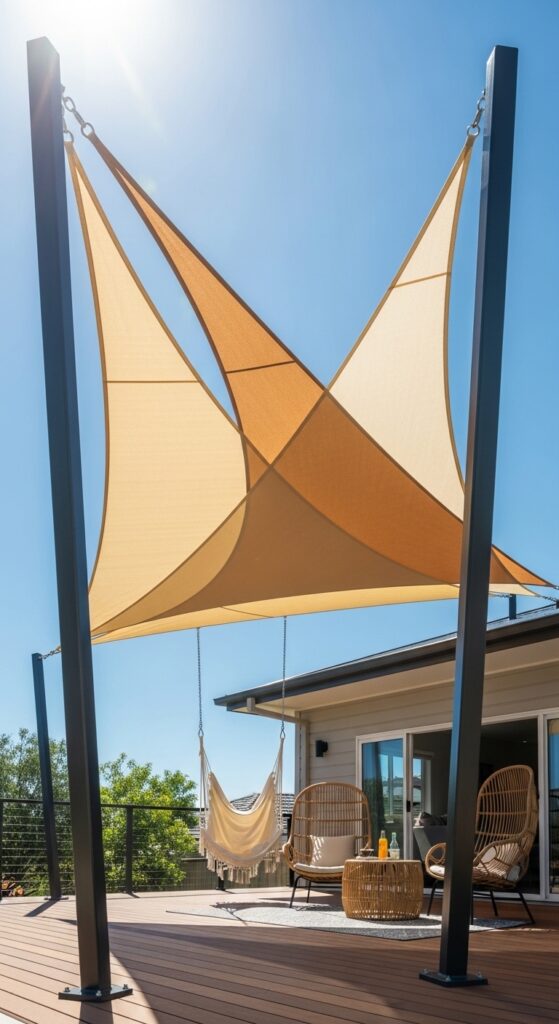
Vibe sentence: Shade sails have a geometry that no umbrella or pergola can replicate — angular, graphic, and somehow both modern and relaxed.
What makes it work: Multiple overlapping shade sail triangles solve the coverage problem of a single sail while creating a visually dynamic configuration that looks intentionally designed rather than practically applied. HDPE shade cloth blocks 90–95% of UV while allowing air to pass through — decks stay significantly cooler underneath than under a solid roof.
How to achieve it: Anchor shade sail posts in concrete footings sized for your local wind load — most residential shade sail applications require at least 18-inch diameter footings at 24 inches deep. Attach to the house fascia board using stainless eye bolts rated for the tension load specified by the sail manufacturer.
18. Daybed Swing Hung from Pergola Beams
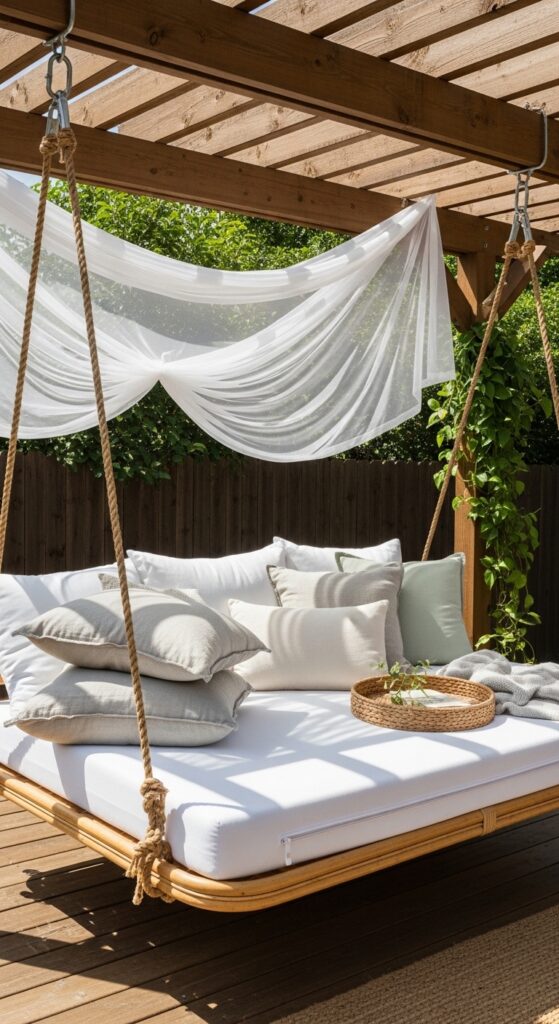
Vibe sentence: A hanging daybed turns a back deck into a destination — the kind of place you’d plan your entire afternoon around.
What makes it work: A suspended daybed adds a sensory experience no static furniture piece can — the gentle sway, the slight height off the deck, the canopy-like enclosure of the pergola overhead. It becomes the focal point of the entire outdoor space and the first thing every guest gravitates toward.
How to achieve it: Ensure pergola beams are structural — a hanging daybed with occupant can load 400+ lbs dynamically with swinging. Use lag bolts through the full depth of the beam into solid wood, not just into the bottom face. Choose stainless swivel S-hooks rather than fixed hooks to allow natural rotation during use.
💡 A lightweight clip-on mosquito net ($25–$40) hung from the pergola overhead transforms the daybed into a fully enclosed sleeping space for warm evenings.
19. Vertical Garden Wall Mounted on Deck Railing or Screen
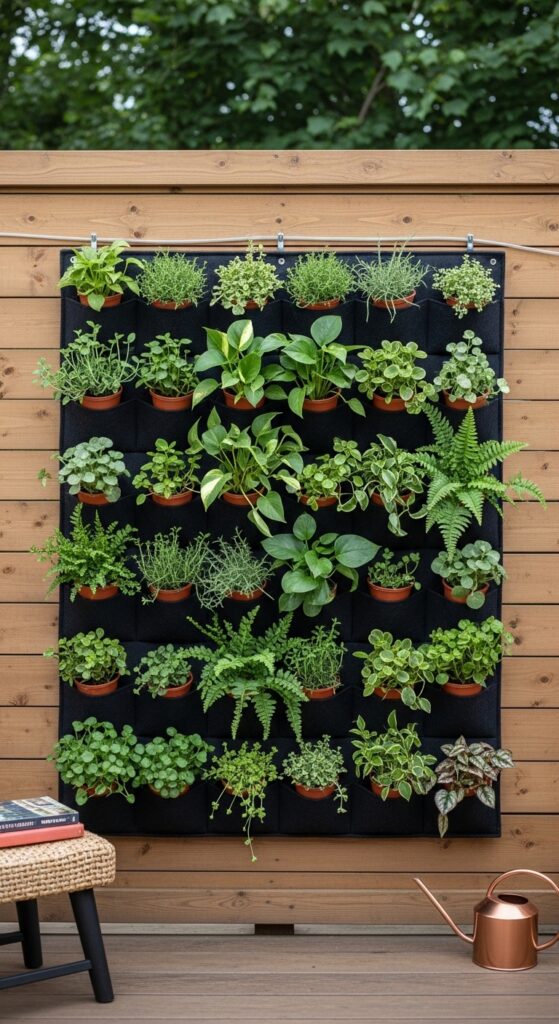
Vibe sentence: A living wall turns a blank screen into something that breathes — and the effect is immediately restorative.
What makes it work: Vertical garden panels reclaim wall space that would otherwise be decoratively inert — a deck wall or privacy screen gains texture, color, and living interest without consuming any precious floor area. Mixed planting that includes trailing, upright, and textural varieties creates visual depth that flat paint or cladding cannot.
How to achieve it: Use modular felt pocket planter panels (available as ready-to-mount systems from companies like Woolly Pockets or Florafelt) rather than building from scratch — they’re lightweight, drain well, and are designed to mount flat against vertical surfaces. Connect to a simple drip irrigation timer to automate watering.
20. Sunken Deck Design with Surrounding Garden at Grade
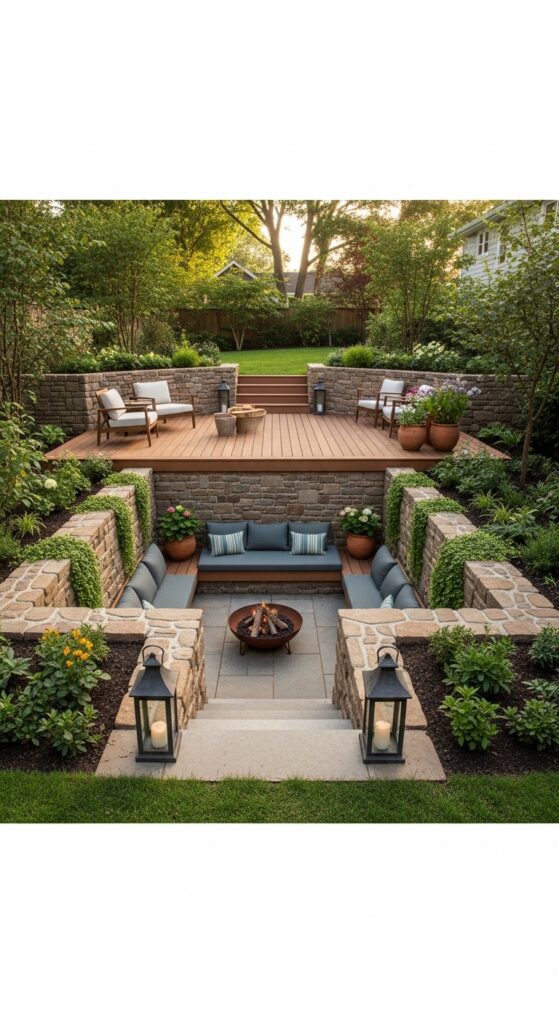
Vibe sentence: Being below the garden line — surrounded on all sides by planting at eye level — is a completely different relationship with the outdoors.
What makes it work: Sunken decks create an enclosed, sheltered quality that elevated decks can’t achieve — you feel held by the garden rather than looking down at it. The stone retaining walls that make the sunken level possible become beautiful architectural features in their own right, especially when planted with trailing varieties in the gaps.
How to achieve it: Consult a structural engineer before excavating for a sunken deck — drainage is the critical concern, as a sunken space can collect water without a properly designed drainage system beneath the deck framing. Install a French drain perimeter before deck framing begins.
21. Concrete and Wood Mixed Material Deck
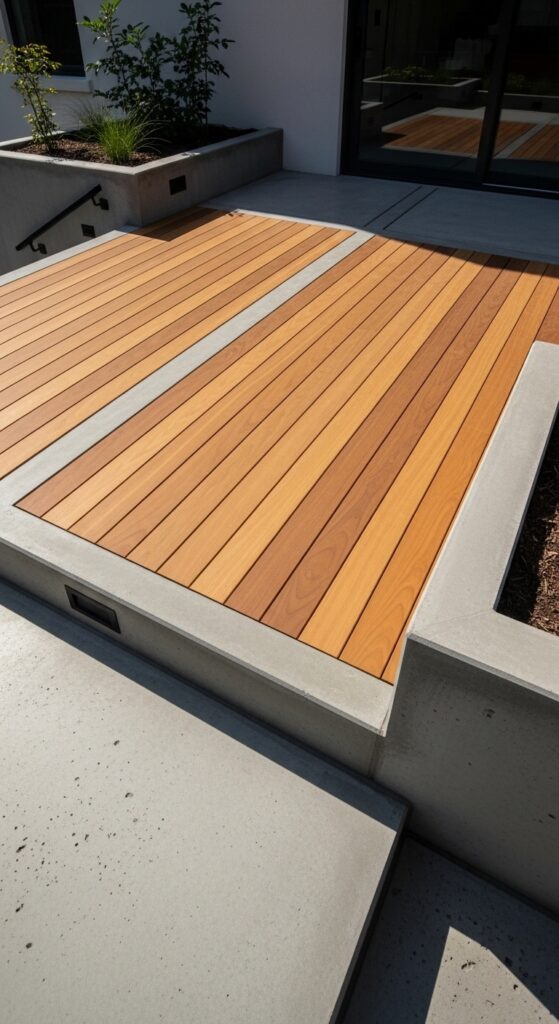
Vibe sentence: Two materials that shouldn’t work together — and absolutely do.
What makes it work: The textural contrast between smooth poured concrete and warm wood grain creates a graphic, high-design statement that neither material achieves alone. Concrete brings permanence and modernity; wood brings warmth and softness. The flush, seamless transition between them signals precision and craftsmanship.
How to achieve it: This design requires concrete formwork to be planned with wood inlay recesses before the pour — it cannot be added after concrete sets. Use ipe or teak for the wood inlay sections — both are naturally resistant to moisture and won’t cup or crack with the seasonal movement that softer woods would experience beside concrete.
22. Deck with Outdoor Shower Station
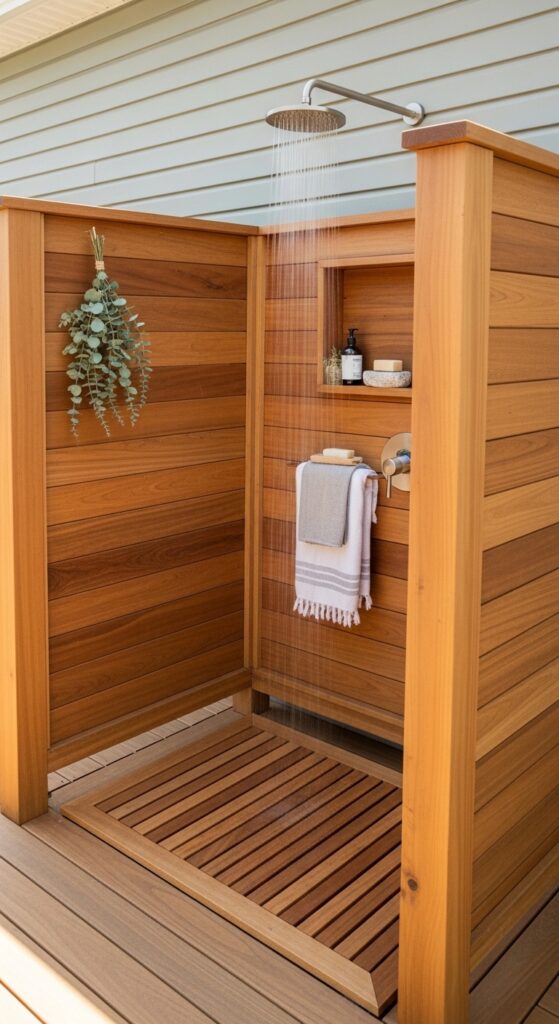
Vibe sentence: An outdoor shower makes any backyard feel like a private resort — and once you have one, you’ll wonder how you lived without it.
What makes it work: An outdoor shower on a back deck serves multiple practical purposes — rinsing off after a pool, garden, or beach trip before entering the house — while adding an unmistakably luxurious dimension to the space. A teak slatted floor panel keeps feet off wet concrete and adds warmth and beauty to a potentially utilitarian corner.
How to achieve it: Connect outdoor shower plumbing to your home’s hot and cold lines through an exterior wall — a licensed plumber can typically complete this in a half-day. Use a thermostatic shower valve to preset temperature and avoid scalding, and choose a brushed nickel or stainless showerhead rated specifically for outdoor use.
💡 Drain the shower line before first winter frost if you’re in a freeze-prone climate — an outdoor shutoff valve makes this a 30-second task.
23. Pergola with Retractable Canvas Roof Panels
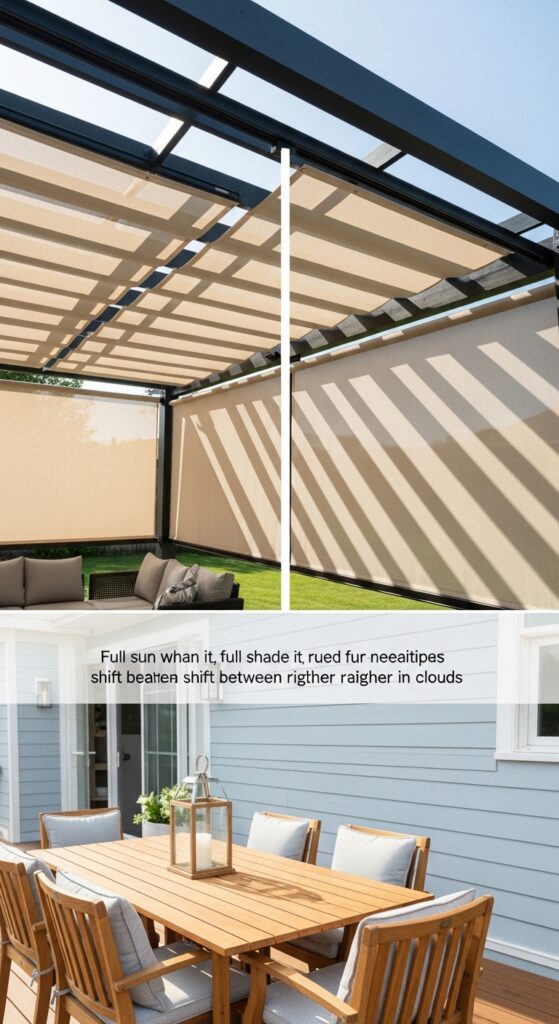
Vibe sentence: Full sun when you want it, full shade when you need it — this pergola adapts to the weather rather than surrendering to it.
What makes it work: Retractable canvas panels installed between pergola beams provide the best of both worlds — open-air dining on mild days, full shade coverage during peak summer heat, with the ability to shift between them mid-meal if clouds change. Solution-dyed acrylic canvas (like Sunbrella) won’t fade, rot, or hold moisture between panels.
How to achieve it: Look for pergola retractable shade panel systems sold specifically for between-rafter installation — brands like Coolaroo and Sunesta make track-mounted systems designed to retrofit into existing pergola bays. Each bay can be independently operated for granular shade control.
24. Deck Hot Tub Integration with Surrounding Decking
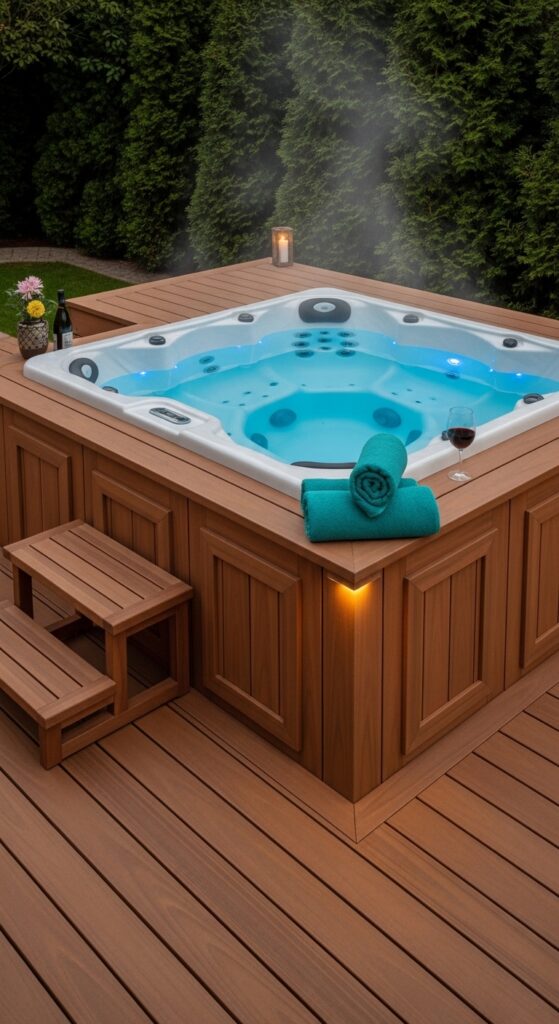
Vibe sentence: A hot tub surrounded and integrated into the deck disappears into the architecture — all that’s left is the water.
What makes it work: In-deck hot tub integration — where the decking surface wraps around and meets the tub’s acrylic shell at the same level — transforms a freestanding spa into a seamless architectural feature. This approach requires planning before deck construction but produces a result that looks custom-designed rather than placed.
How to achieve it: Design the deck framing with the hot tub “pocket” dimensions before pouring footings — the tub must be lowered into place before surrounding decking is built. Ensure access panels are incorporated into the surrounding deck surface for future servicing of the tub’s mechanical components.
25. Industrial Pipe Railing with Reclaimed Wood Decking

Vibe sentence: Raw, honest materials treated with full respect — this deck looks like it earned its character.
What makes it work: Industrial pipe railing systems use standard black iron plumbing components — flanges, elbows, and nipples — assembled into railings that look custom-fabricated but cost a fraction of specialty railing systems. Against reclaimed wood decking, the combination reads as intentionally industrial-rustic with genuine material integrity.
How to achieve it: Source reclaimed fir or pine decking from architectural salvage yards — seal with a penetrating exterior oil (not surface film finish) to protect without obscuring the aged character. Standard plumbing pipe components are available at any hardware store; seal with a clear matte spray to prevent rust before installation.
💡 Apply a coat of beeswax to black iron pipe railing annually — it maintains the matte finish and prevents surface rust without altering the color.
26. Cozy Reading Nook Corner with Outdoor Daybed and Curtains
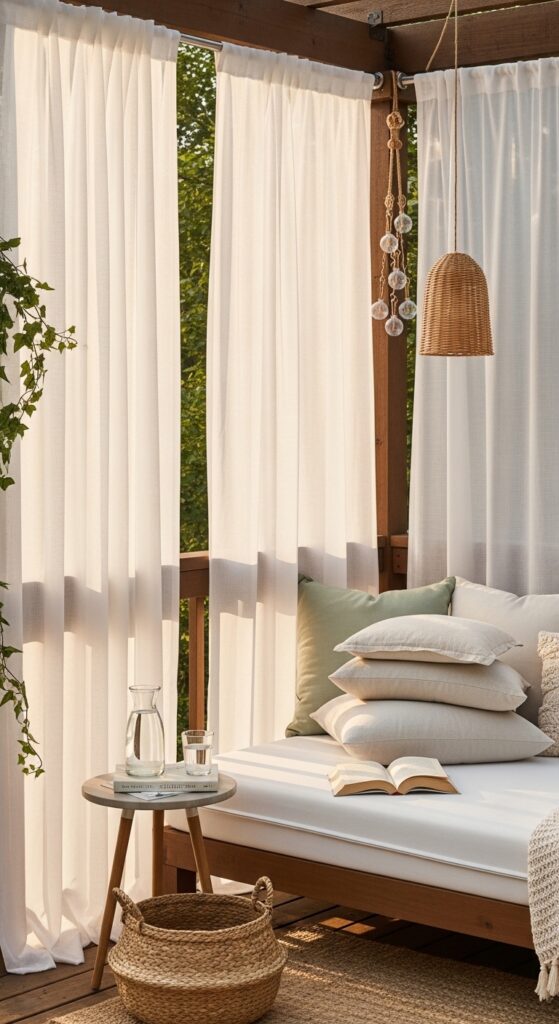
Vibe sentence: The corner of the deck that makes everything else — the noise, the schedule, the to-do list — completely irrelevant.
What makes it work: Curtains on an outdoor deck do something furniture and rugs cannot — they create enclosure and intimacy on an otherwise completely open structure. Sheer outdoor linen filters light beautifully while providing psychological privacy without blocking airflow or natural light. This corner becomes the most sought-after seat on the deck within minutes of any gathering.
How to achieve it: Use outdoor-rated sheer fabric on stainless tension rods stretched between pergola posts — look for fabrics labeled “solution-dyed” to prevent fading in UV. Weigh curtain hems with clip-on curtain weights or a sewn-in chain hem to prevent billowing in light wind.
How to Start Your Back Deck Transformation
Begin with the bones before the beauty. Walk your deck and honestly assess the structural condition — any soft spots, rot, or failing fasteners need to be addressed before any styling decisions are made. A beautifully decorated deck on failing boards is a safety issue and a wasted investment. If your deck is structurally sound, your first design decision is the surface: refinishing or replacing decking boards creates a near-total visual transformation for a fraction of the cost of a full rebuild.
The most common mistake in deck transformations is under-scaling furniture. Decks are outdoor rooms and need furniture sized accordingly — a small bistro table on a 400-square-foot deck looks like a forgotten afterthought. Measure your deck and scale your furniture to fill the space with intention.
For budget-friendly entry points, focus on lighting first — string lights, recessed step lights, and pathway lighting dramatically change the usability and atmosphere of any deck for $100–$500. Layer in outdoor rugs next, then cushions, then plants.
Realistically, a full back deck transformation including new decking, furniture, lighting, and landscaping takes one full season to complete and settle — don’t judge the result at week two. Live with it through spring, summer, and fall before making final decisions on what’s working.
Frequently Asked Questions
What is the best decking material for a back deck?
For low maintenance and long-term durability, composite decking from brands like Trex, TimberTech, or Fiberon is the best choice for most homeowners — it resists fading, scratching, and moisture without requiring annual sealing or staining. For a natural wood look and feel, ipe and teak hardwoods are premium options that last 25–40 years with proper care, though they require seasonal oiling. Pressure-treated pine is the most budget-friendly option at $3–$8 per square foot, but it requires staining every 2–3 years and is prone to cracking and splintering as it dries.
How do I add privacy to my back deck without a fence?
The most effective privacy solutions that don’t require a full fence include slatted wood privacy screens mounted to the deck structure, outdoor curtains hung between pergola posts, and strategic planting of tall ornamental grasses or bamboo in perimeter planters. Shade sails installed at an angle can also provide overhead privacy from elevated neighbors. For immediate privacy without any construction, large potted arborvitae or columnar boxwood placed at deck corners and along the exposure side create an effective green screen within one growing season.
How much does a back deck transformation typically cost?
A cosmetic transformation — new stain, outdoor rugs, furniture, string lights, and cushions — typically runs $1,500–$5,000 depending on the size of the deck and quality of materials chosen. A mid-range renovation including new composite decking, built-in seating, a pergola, and a fire table typically runs $10,000–$30,000. A full custom deck with outdoor kitchen, hot tub integration, multi-level design, and professional landscaping can range from $40,000–$100,000+. The highest-ROI improvements are always new decking surfaces, overhead structure, and lighting — these three elements change the experience of the space most dramatically.
What outdoor furniture materials hold up best in all weather?
Teak and ipe hardwood furniture are the gold standard for weather resistance, handling rain, UV, and temperature extremes without warping, cracking, or rusting. Powder-coated aluminum is the best choice for metal furniture — it’s lightweight, rust-proof, and available in virtually any color finish. For upholstered pieces, look specifically for Sunbrella or similar solution-dyed acrylic fabric — it’s the only outdoor fabric category that genuinely resists fading, mold, and moisture at the level needed for year-round outdoor use. Avoid “water resistant” fabrics labeled without specific UV ratings — they fade and mold within one season.
Do I need a permit to build or transform a back deck?
In most municipalities, any structural deck construction — including new builds, additions, or significant structural repairs — requires a building permit. Cosmetic work like staining, replacing like-for-like boards, adding furniture, rugs, or lighting typically does not require a permit. The key trigger is structural change: new footings, framing, or any change to the footprint or height of the deck. Contact your local building department before any construction begins — unpermitted deck work can create issues during home sale inspections and may affect your homeowner’s insurance coverage in the event of a structural failure.
Ready to Transform Your Back Deck Into Your Favorite Outdoor Space?
You now have 26 back deck ideas spanning every style, budget, and square footage — from a simple string light canopy to a fully integrated hot tub and outdoor kitchen. Save the ones that make you stop scrolling, pin the ones that match your space, and start with just one change. The most beautiful back decks rarely happened all at once — they evolved one intentional decision at a time, season after season. Whether your first step is a can of deck stain or a set of Edison string lights, the outdoor space you’ve been imagining is closer than you think. Now go build it.