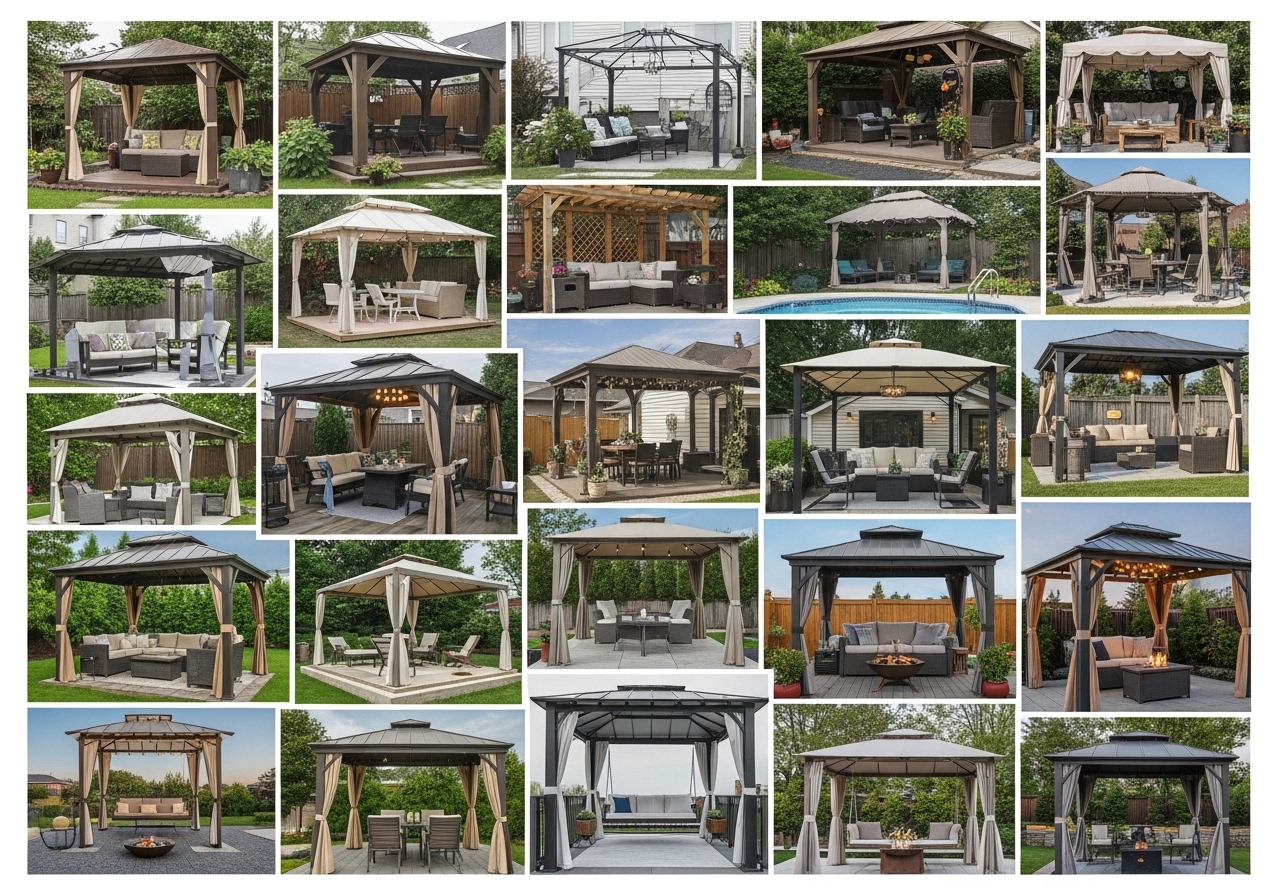
There’s something almost magical about a backyard gazebo — that threshold between indoors and outside, sheltered enough to linger but open enough to feel the breeze, hear the rain, and watch the sky shift from gold to violet. A well-designed gazebo transforms an ordinary backyard into a destination, a place you actually go rather than just pass through. Whether you’re dreaming of a candlelit dinner spot, a morning coffee retreat, or a full outdoor living room, the right gazebo idea can make it real. Here are 30 backyard gazebo ideas worth saving — every one of them designed to inspire your own outdoor escape.
Why Backyard Gazebos Work So Well
A gazebo occupies a unique design category that neither a pergola nor a covered patio can fully replicate. The defining feature — a fully enclosed roof with open or screened sides — creates genuine shelter without sacrificing the open-air feeling that makes outdoor living so appealing. That combination is precisely why gazebos have anchored garden design from Victorian estates to modern suburban backyards for centuries.
Structurally, a gazebo creates what designers call a “garden room” — a defined space within the larger landscape that gives the eye a place to land and the body a reason to settle. Without that anchor, even a beautiful backyard can feel like an undifferentiated expanse. A gazebo solves that problem architecturally, instantly organizing the outdoor space around a focal point.
From a trends perspective, the gazebo is experiencing a genuine renaissance driven by the broader outdoor living movement. Pinterest searches for “backyard gazebo ideas,” “outdoor gazebo decor,” and “gazebo lighting ideas” have surged significantly as homeowners invest in making their outdoor spaces as livable as their interiors.
The most compelling contemporary gazebos share a design philosophy: they borrow from interior design — layered textiles, ambient lighting, rugs, even art — and apply those principles outside. The result feels intentional, personal, and deeply inviting rather than purely functional.
1. Wisteria-Draped White Gazebo with String Lights
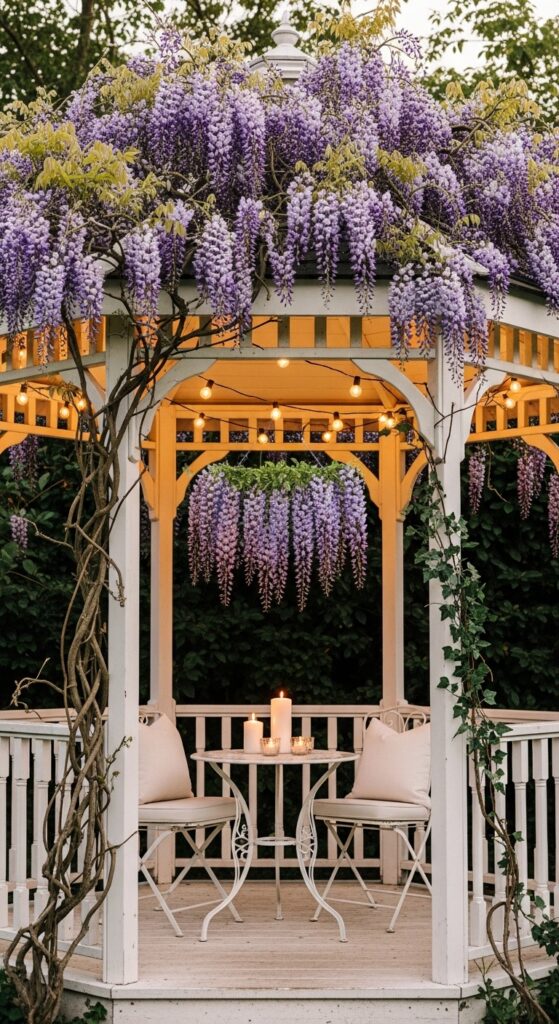
Vibe sentence: This is the gazebo that makes every evening feel like the opening scene of a garden wedding.
What makes it work: Wisteria is arguably the most photogenic climbing plant in the garden world — its long, pendulous purple blooms transform a plain painted structure into a living, breathing canopy. The string lights woven through the vines multiply the warmth once the blooms fade seasonally, ensuring the gazebo is magical year-round.
How to achieve it: Plant wisteria at the base of two opposing posts and train it along the roofline with galvanized wire guides — it takes 2–3 years to achieve full coverage. While it establishes, hang faux wisteria garland (remarkably convincing silk versions are available on Amazon for $20–$35 per strand) to achieve the look immediately.
💡 Cafe-style S14 Edison string lights on a timer cost under $40 and create instant ambiance without any electrical work beyond an outdoor outlet.
2. Modern Black Steel Gazebo with Minimalist Furniture
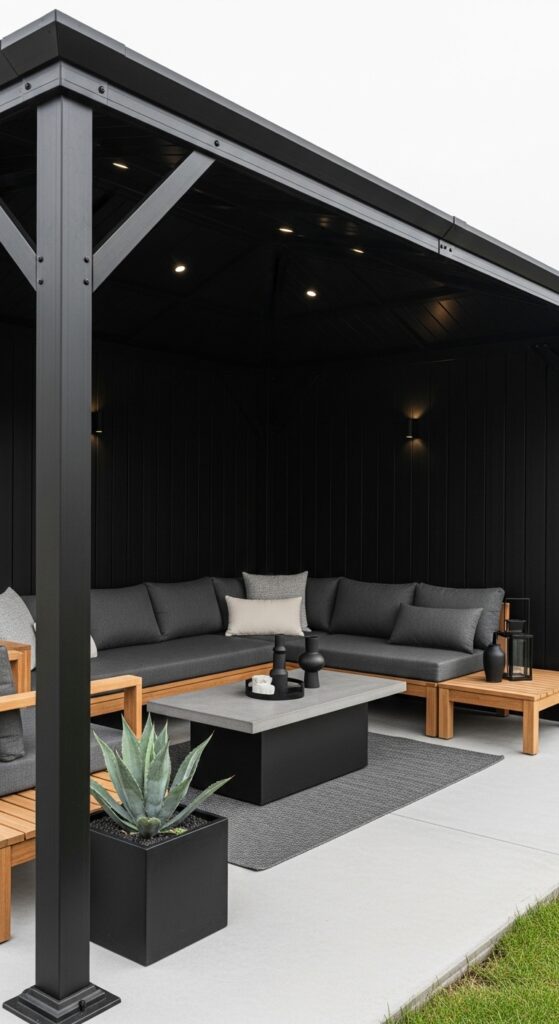
Vibe sentence: The modern black gazebo is the outdoor equivalent of a perfectly tailored suit — severe in the best possible way.
What makes it work: Matte black powder-coated steel reads as premium and architectural against green landscaping — the contrast is dramatic and deliberate. Keeping the interior furniture equally restrained (low profile, neutral tones, natural teak) prevents the space from feeling heavy or overdone despite the bold structural color.
How to achieve it: Prefabricated steel gazebo kits in matte black are available from brands like Sojag, Yardistry, and Amazon-exclusive brands in the $800–$3,000 range. Pair with teak furniture, which weathers beautifully without any treatment, and charcoal Sunbrella-fabric cushions rated for UV and moisture resistance.
3. Bohemian Outdoor Gazebo with Macramé and Floor Cushions
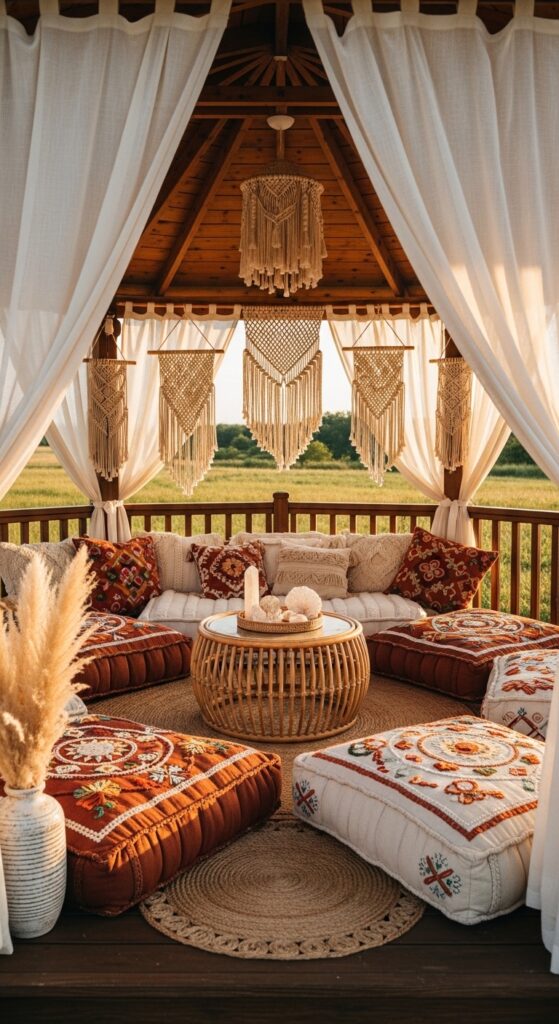
Vibe sentence: This gazebo doesn’t ask you to sit up straight — it invites you to sink in, stay longer, and let the afternoon disappear.
What makes it work: Floor-level seating removes the visual weight of chair legs and frames, making the interior feel expansive and lounge-like regardless of the gazebo’s actual footprint. The macramé, sheer curtains, and embroidered textiles all share a handmade, natural-fiber quality that creates cohesion without matching.
How to achieve it: Source oversized floor cushions with removable, washable covers in outdoor-rated or quick-dry fabric — Serena & Lily and World Market carry excellent options. Mount macramé hangings using removable adhesive hooks on interior posts to avoid drilling into the structure.
4. Gazebo with Built-In Outdoor Kitchen and BBQ
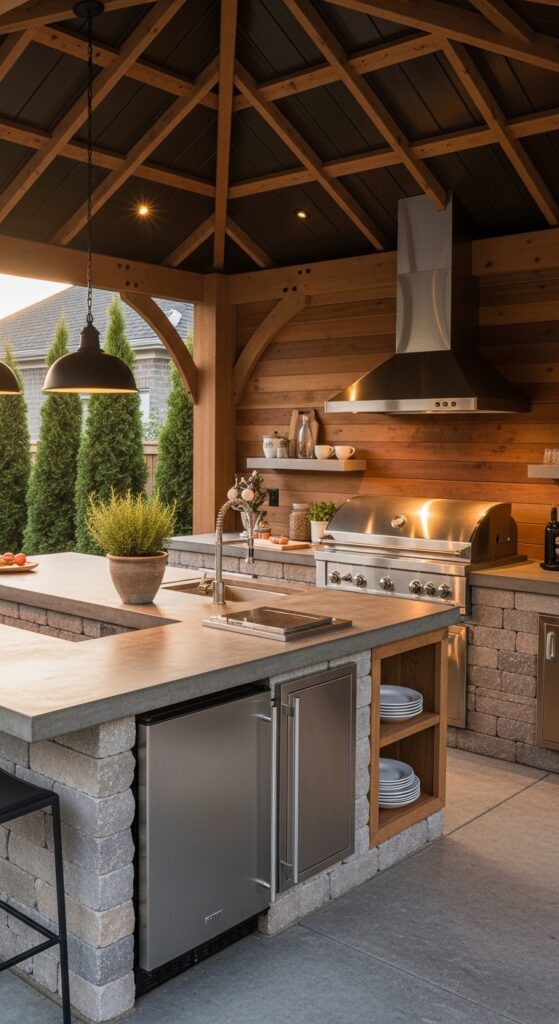
Vibe sentence: When the gazebo becomes the kitchen, every backyard gathering turns into a proper event.
What makes it work: Housing the outdoor kitchen inside a gazebo solves the single biggest frustration of open-air outdoor cooking: weather interruption. The structure provides shade for the cook, keeps rain off the grill, and creates a defined “cooking zone” that organizes the entertaining space logically.
How to achieve it: Concrete block or steel stud construction wrapped in stone veneer creates the most durable outdoor kitchen island base. A built-in 36-inch stainless grill from Weber or Napoleon runs $800–$2,500 and should be vented with the prevailing wind in mind — never position a grill beneath a solid roof section without adequate ventilation clearance.
5. Rustic Log Gazebo with Stone Fireplace
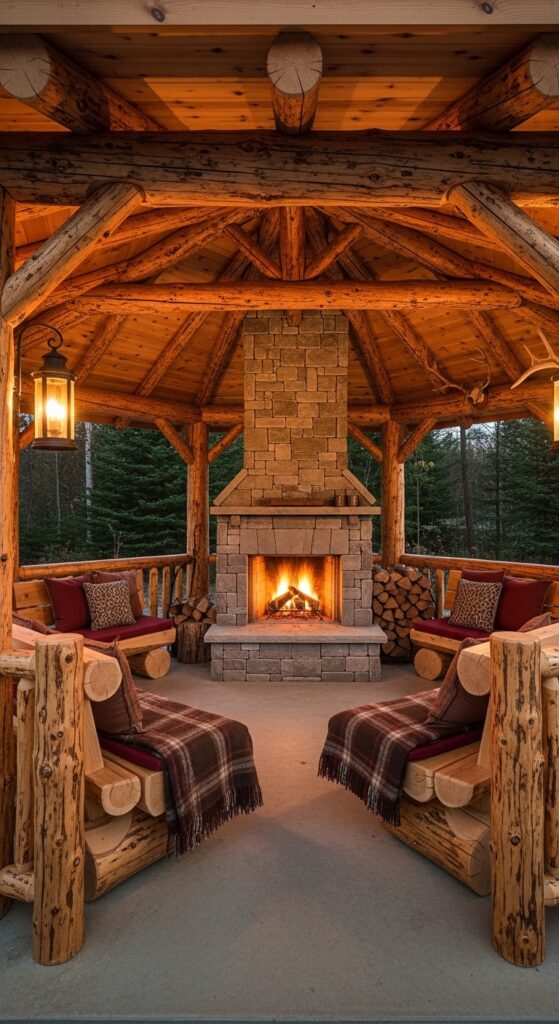
Vibe sentence: A log gazebo with a stone fireplace is less outdoor furniture and more a return to something ancient and grounding.
What makes it work: The combination of raw log structure and stacked stone fireplace creates a material harmony rooted in the natural landscape — both materials read as genuinely aged and elemental. Built-in bench seating along the perimeter is both practical (no furniture to move or weather-proof) and structurally connected to the gazebo’s rustic character.
How to achieve it: Log gazebo kits are available from manufacturers like Timber Frame HQ and Amish Country Gazebos, starting around $4,000–$8,000 for materials. The stone fireplace requires a poured concrete pad foundation rated for the weight and a licensed mason for safe construction — budget $3,000–$6,000 for fireplace construction.
6. Screened Gazebo with Mosquito Netting Curtains
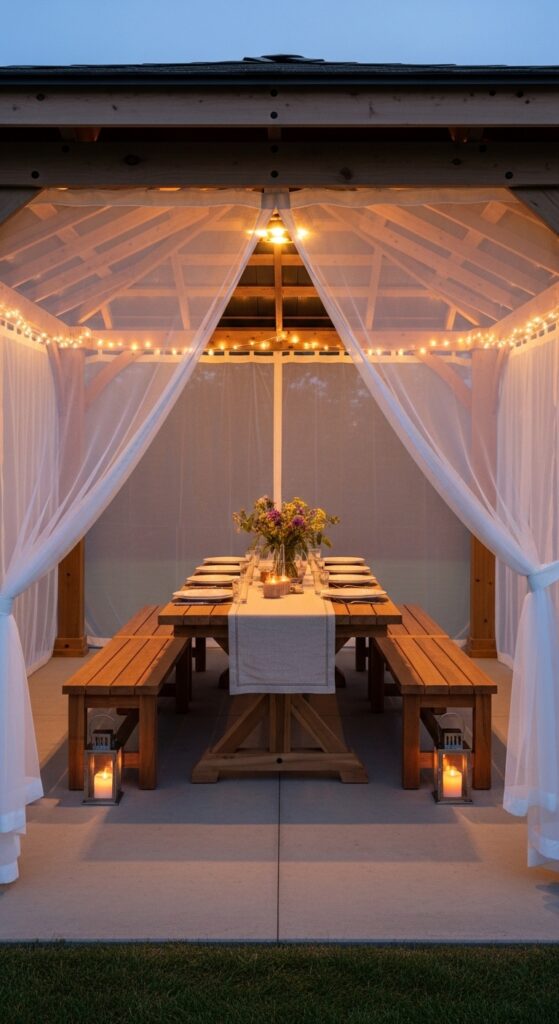
Vibe sentence: Mosquito netting turns a simple outdoor dining space into something ethereal — and solves every summer evening’s biggest enemy.
What makes it work: The semi-transparency of netting creates a soft visual enclosure that feels like a room without the visual heaviness of solid walls. The glow of interior lighting seen through white netting at dusk creates an effect that’s genuinely magical — like a lit lantern in the garden.
How to achieve it: Install curtain rod hardware or tension wire between gazebo posts and hang outdoor-rated sheer netting in full-length panels (floor to roof edge). Look for PEVA or polyester mesh fabric rated for outdoor use — it resists mold and UV degradation. Weighted hem tape keeps panels from billowing excessively in wind.
💡 Pre-made mosquito netting curtain panels with grommet tops fit standard 10×10 gazebo posts and cost $25–$60 for a full set of four.
7. Pergola-Style Gazebo Covered in Climbing Roses
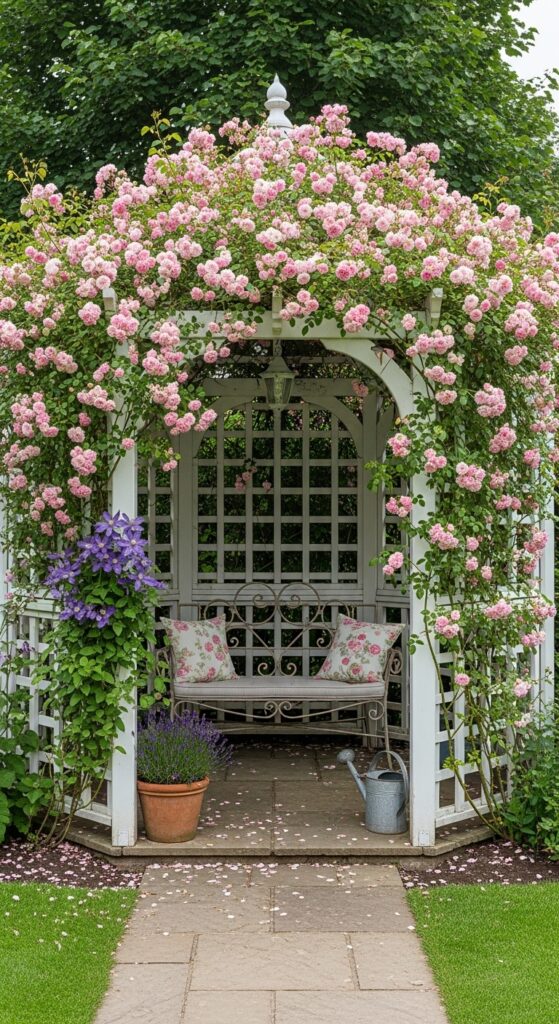
Vibe sentence: A rose-covered gazebo is a garden cliché only because it’s perpetually, undeniably perfect.
What makes it work: Climbing roses transform the static geometry of a painted wood structure into a living, seasonal spectacle. The key is choosing a repeat-blooming variety — once-blooming roses provide a single flush of flowers, while repeat bloomers like ‘New Dawn,’ ‘Blaze,’ or David Austin’s ‘Generous Gardener’ provide color from late spring through autumn.
How to achieve it: Train climbing roses by tying canes horizontally along the gazebo lattice rather than letting them climb vertically — horizontal canes produce dramatically more blooms per plant. Plant bare-root roses in early spring 12–18 inches from the post base. Full coverage takes 3–4 growing seasons but begins looking beautiful in year two.
8. Tiki-Style Thatched Roof Gazebo with Tropical Decor
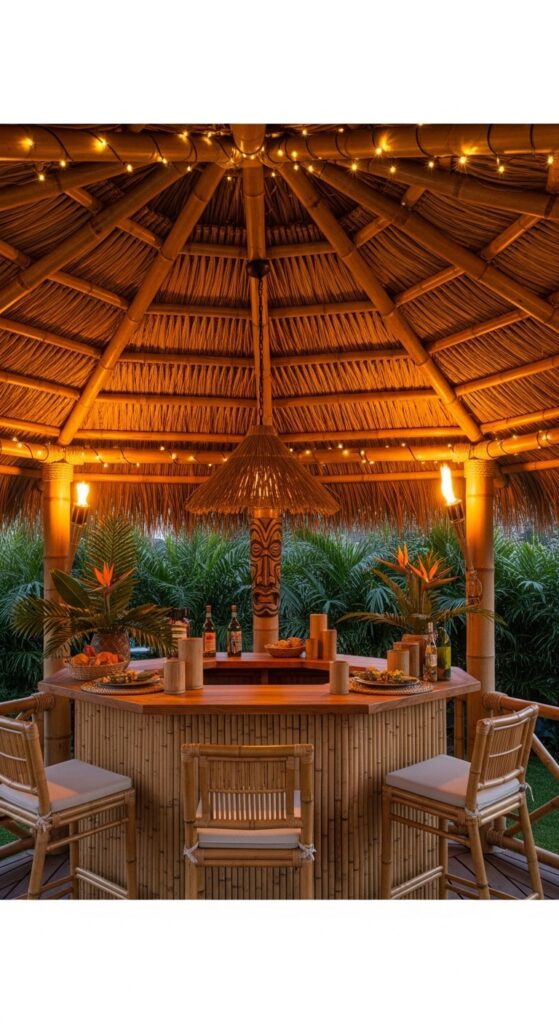
Vibe sentence: Close your eyes, open them again, and the tiki gazebo makes you genuinely question what continent you’re on.
What makes it work: The thatched roof is the single material choice that does the most work in this look — it signals “tropical retreat” more powerfully than any furniture or accessory could. Synthetic thatch (made from UV-stabilized polypropylene) is available for DIY installation and lasts 15–20 years without the fire risk or decomposition of natural palm.
How to achieve it: Synthetic thatch roofing panels from brands like Exotic Thatch or Caribbean Thatch can be applied over an existing gazebo frame. Bamboo railing inserts and a bamboo bar front kit (available from online bamboo retailers for $150–$400) complete the transformation without a full rebuild.
9. Gazebo Hot Tub Enclosure with Cedar and Candlelight
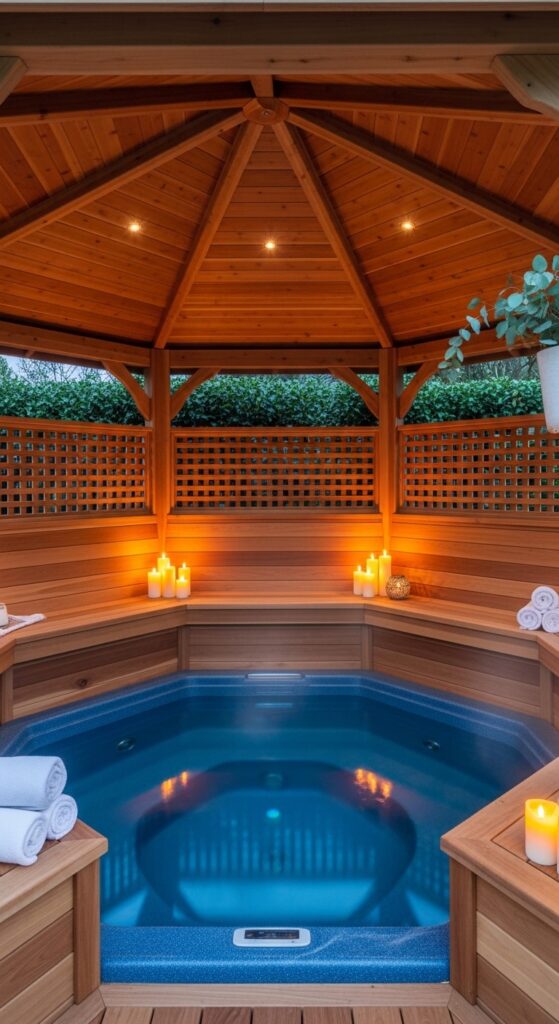
Vibe sentence: A gazebo built around a hot tub isn’t a luxury upgrade — it’s a complete philosophy about how evenings should end.
What makes it work: Cedar is the ideal material for a hot tub gazebo because of its natural resistance to moisture, insects, and rot — and it develops a beautiful silver-gray patina over time if left unsealed. The half-lattice wall design allows steam to ventilate while maintaining privacy and shelter from wind.
How to achieve it: Commission or build the gazebo structure before installing the hot tub — the access logistics are significantly easier. Minimum interior clear diameter for a hot tub gazebo is 12 feet; 14 feet is more comfortable. Ensure your deck or patio foundation is rated for the combined weight of the gazebo, hot tub, water, and occupants (easily 5,000+ lbs total).
💡 Cedar gazebo kits sized for hot tubs start around $2,500–$5,000 and are available from Wayfair and specialty gazebo manufacturers shipped flat-pack.
10. Farmhouse Gazebo with Shiplap Interior and Lanterns
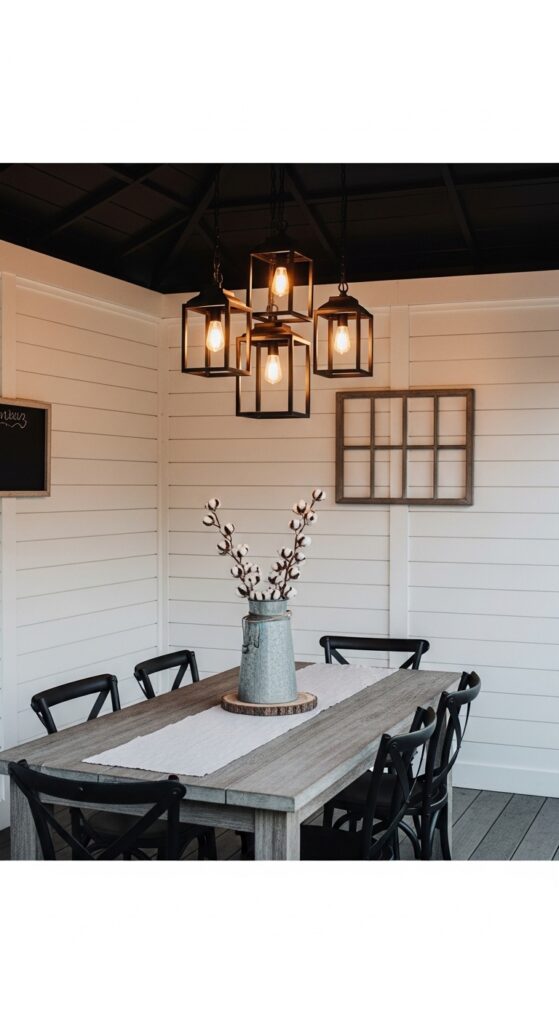
Vibe sentence: The farmhouse gazebo feels like the best part of a barn wedding, permanently installed in your backyard.
What makes it work: Adding shiplap paneling to the interior walls of a standard gazebo instantly elevates it from prefab structure to designed space — it introduces a material that reads as intentional and interior-quality. Hanging multiple black lantern pendants at varying drop heights adds drama and layers the light beautifully.
How to achieve it: Install horizontal shiplap boards (or shiplap-look MDF panels rated for exterior use) on the interior walls of the gazebo’s closed sides. Use exterior-grade primer and paint in a flat white for an authentic farmhouse finish. Pendant lights require either hardwired electrical or solar-charged LED pendant alternatives, which have become convincingly bright.
11. Minimalist Japanese-Inspired Garden Gazebo
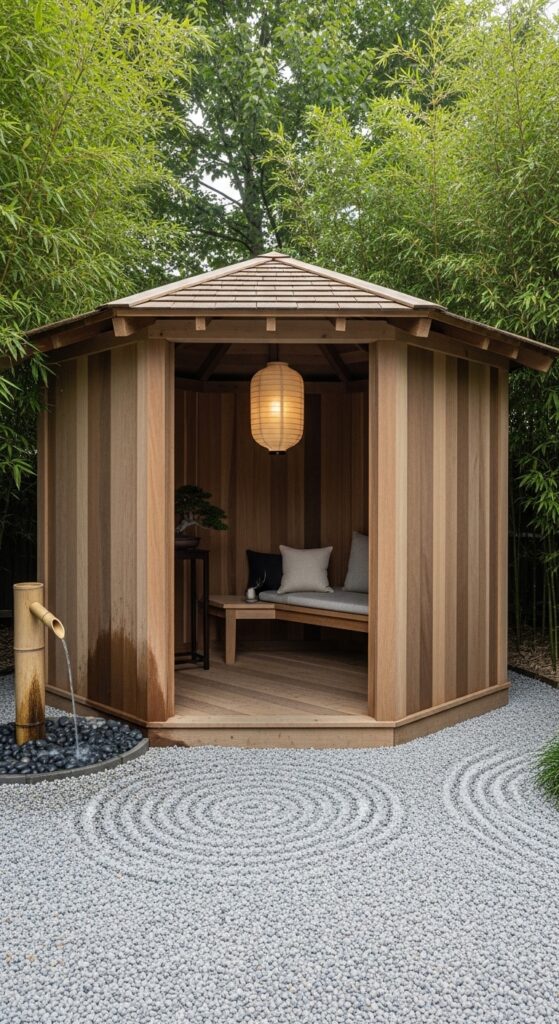
Vibe sentence: A Japanese-inspired gazebo doesn’t just shelter you from the elements — it shelters you from everything else too.
What makes it work: Japanese garden design philosophy prioritizes negative space — what is absent is as important as what is present. A minimally furnished interior with a single meaningful object (a bonsai, a stone lantern) communicates intention and restraint in a way that a fully furnished gazebo simply cannot.
How to achieve it: Achieve the slightly curved roofline by using flexible ridge board techniques or by commissioning a carpenter familiar with Japanese architectural joinery. Surround the structure with mass plantings of a single species (black bamboo, ornamental grasses, or Japanese forest grass) to create the immersive, singular landscape these structures require.
12. Outdoor Movie Gazebo with Projector Screen
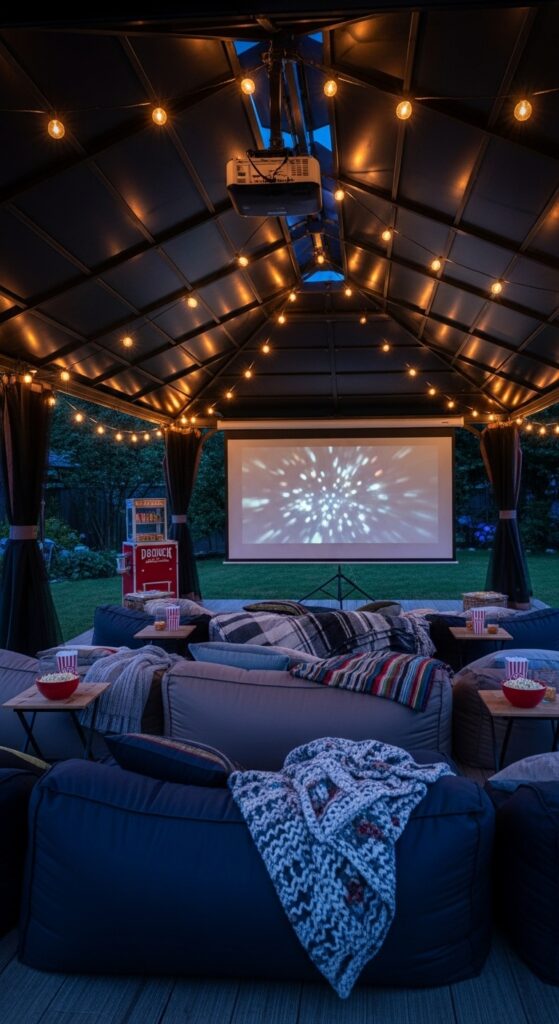
Vibe sentence: A movie night in a backyard gazebo is the kind of evening that makes staying home feel like the best decision you’ve ever made.
What makes it work: The gazebo roof solves outdoor cinema’s biggest technical challenge — ambient light interference. Even without total darkness, the roof dramatically reduces sky glow that washes out projector images. Bean bags and mixed blankets replace rigid seating, reinforcing the informal, come-as-you-are atmosphere.
How to achieve it: A 1080p outdoor projector (Epson or BenQ make well-reviewed models starting around $500–$800) paired with a 100-inch pull-down screen ($80–$150) delivers an excellent cinema experience in a gazebo. Run a dedicated 20-amp outdoor circuit for projector and audio equipment — extension cords for this application are a fire and tripping hazard.
💡 A $25 portable Bluetooth speaker paired with a $15 outdoor projector stand from Amazon delivers passable audio until you’re ready to invest in a proper outdoor sound system.
13. Coastal White Gazebo with Navy Blue Accents
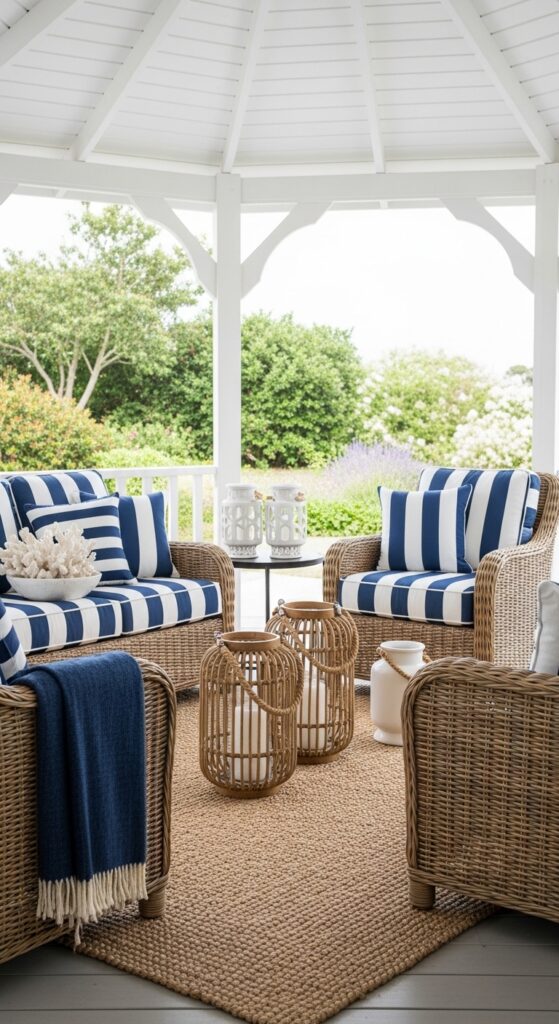
Vibe sentence: Navy and white in an outdoor gazebo is the design combination that smells like salt air even miles from the coast.
What makes it work: The nautical palette of navy and white is timeless precisely because it references the natural environment — the sky and the sea — rather than a passing trend. Wicker furniture in this color scheme has an authenticity that metal or plastic alternatives lack; the natural fiber material anchors the coastal narrative.
How to achieve it: Sunbrella fabric in a navy awning stripe pattern is the gold standard for outdoor cushion upholstery — it’s UV-resistant, mold-resistant, and available from fabric retailers by the yard for around $30–$50/yard. A seagrass rug in a flatweave finish ($80–$200 depending on size) grounds the space and is surprisingly durable outdoors with periodic hosing.
14. Gazebo with Outdoor Fireplace and Wraparound Seating
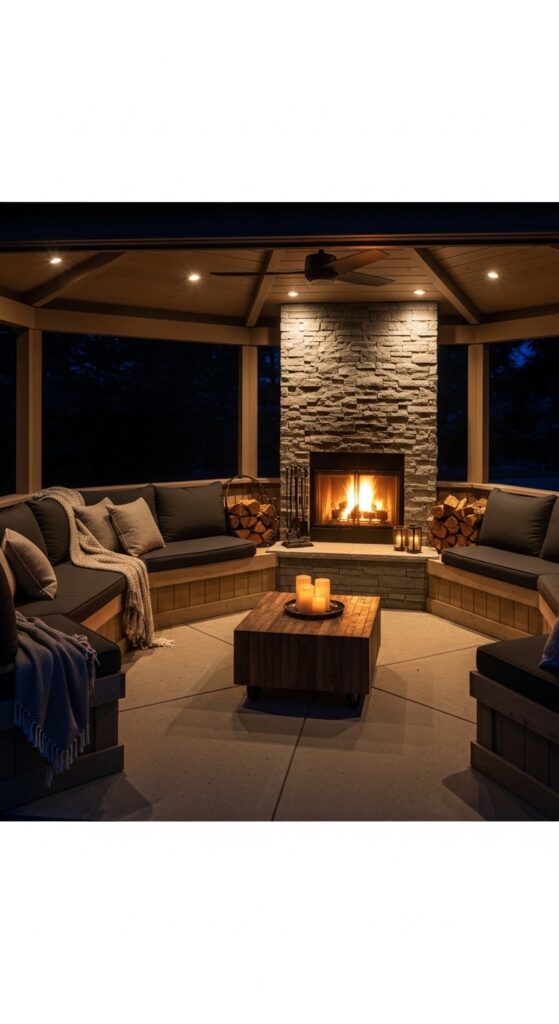
Vibe sentence: A fireplace inside a gazebo extends outdoor living from a summer indulgence to a three-season commitment.
What makes it work: The fireplace serves as both a functional heat source and an irresistible focal point — it gives the eye a place to rest and the body a reason to orient toward the center of the space. Built-in bench seating wrapping two walls eliminates the visual clutter of individual chairs while maximizing seating capacity for larger gatherings.
How to achieve it: A freestanding wood-burning or propane outdoor fireplace rated for covered outdoor use (ensure adequate ventilation clearance from the roof — minimum 18 inches per most manufacturers) runs $300–$1,500. Built-in bench seating is essentially box framing in pressure-treated lumber with a 2×6 top cap — a skilled DIYer can build a 10-foot run over a weekend.
15. Vine-Covered Gazebo with Bistro Lighting and Vintage Furniture
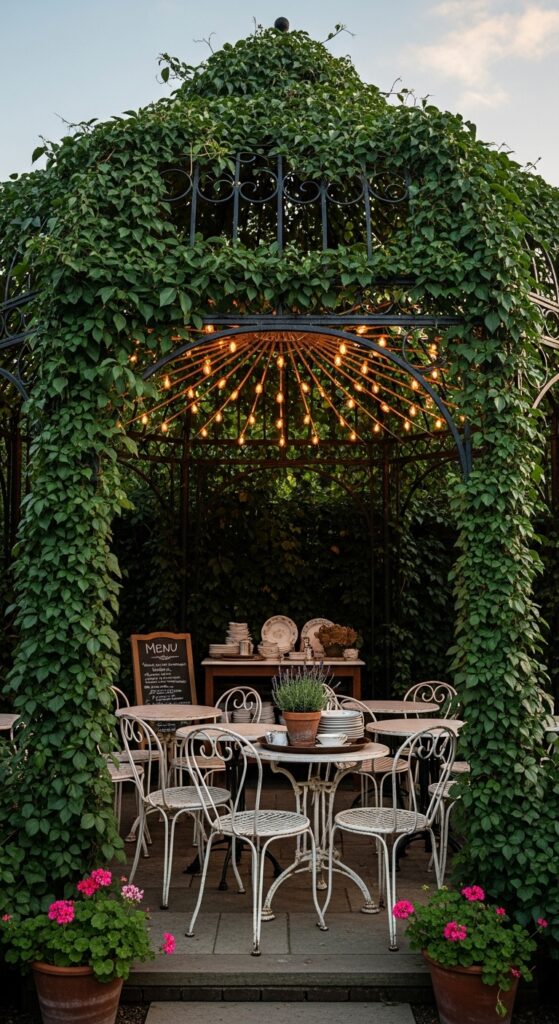
Vibe sentence: Mismatched bistro chairs under an ivy-covered gazebo is the French countryside fantasy that somehow works perfectly in suburban New Jersey.
What makes it work: The intentional mismatch of vintage bistro seating creates an “collected over time” feeling that no matching set can replicate. Each chair having its own slightly different patina, color, or style suggests history and personality — it’s the outdoor furniture equivalent of an eclectic bookshelf.
How to achieve it: Source mismatched bistro chairs from antique markets, Facebook Marketplace, and thrift stores — French café-style chairs in cast iron or bent wire are widely available. Virginia creeper (Parthenocissus quinquefolia) is a faster-growing, lower-maintenance alternative to ivy that turns a spectacular scarlet in autumn.
16. Greenhouse-Style Glass Gazebo for Year-Round Use
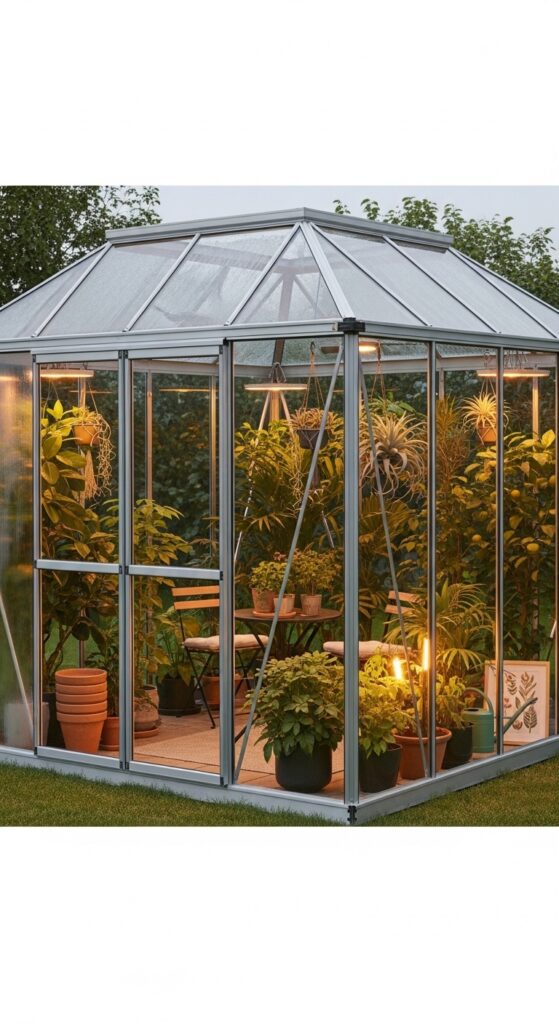
Vibe sentence: A glass gazebo is secretly two things at once — a garden retreat in summer and a botanical refuge when everything else in the yard goes dormant.
What makes it work: The glass structure maximizes solar gain in cooler months, making the space usable well into autumn and even winter in mild climates. The interior doubles as a conservatory for overwintering tender plants — citrus trees, bougainvillea, and tropical specimens that couldn’t otherwise survive outdoor winters.
How to achieve it: Aluminum and glass gazebo structures (essentially residential greenhouse kits) from brands like Palram, Juliana, or Rion start around $1,500–$4,000 and include all framing and polycarbonate or glass panels. Install a small baseboard heater or mini-split for true year-round use in cold climates.
17. Fairy-Light Canopy Gazebo for Magical Garden Events
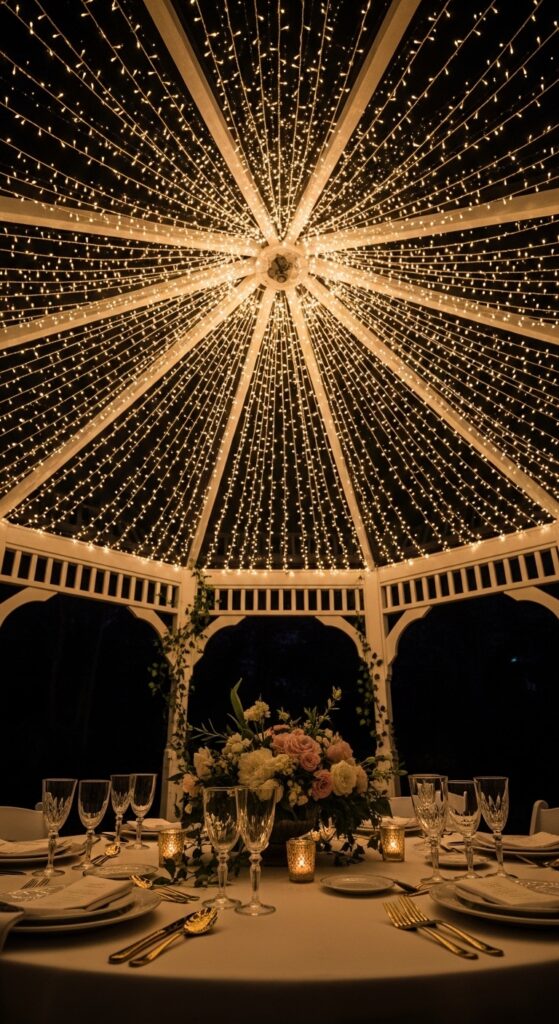
Vibe sentence: A fairy-light ceiling canopy inside a gazebo turns an ordinary dinner into something guests describe for years afterward.
What makes it work: The psychological effect of thousands of small warm light points overhead mimics a night sky — it creates a sense of expansiveness and wonder that overhead pendant lighting simply cannot achieve. Density is the key variable: sparse fairy lights look halfhearted, while truly dense coverage (500+ lights per 10×10 space) achieves the immersive, canopy effect.
How to achieve it: Use plug-in or battery-operated micro-LED fairy lights on copper wire (rather than green wire) for the most subtle, organic look. Attach to the gazebo ceiling using small command hooks rated for outdoor use. A timed smart plug lets the lights come on automatically at dusk.
💡 Two 300-count warm white copper wire fairy light strands (about $12 each on Amazon) cover a 10×10 gazebo ceiling densely when layered and overlapped.
18. Luxury Gazebo with Outdoor Sofa and Side Tables
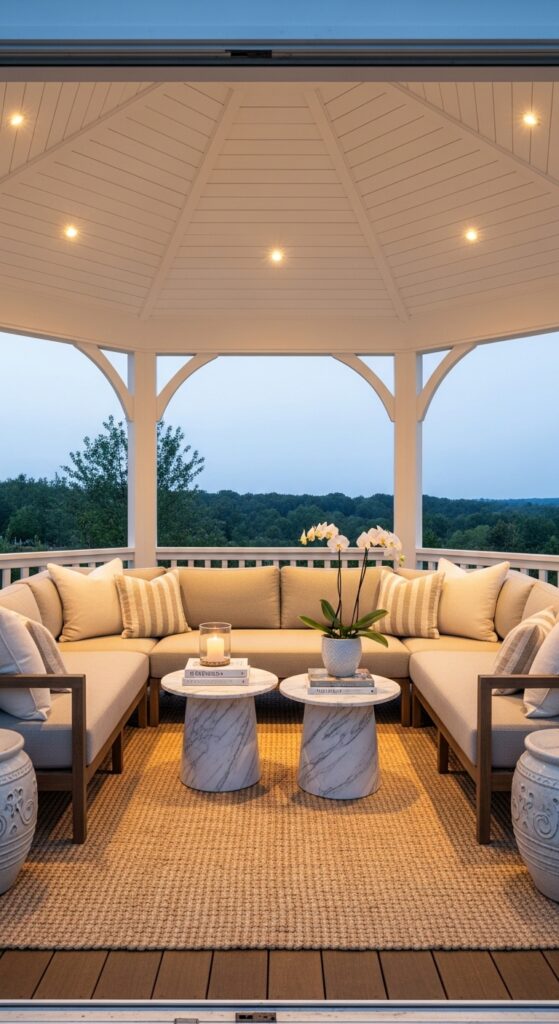
Vibe sentence: A gazebo furnished like this makes the boundary between indoors and outdoors feel like a technicality.
What makes it work: Treating the gazebo interior exactly like an indoor living room — with a sectional sofa, area rug, side tables, and considered accessories — elevates the entire outdoor space. The greige upholstery sits in a neutral zone between warm and cool, working with any surrounding landscape palette.
How to achieve it: All-weather sectionals in performance fabric (Sunbrella or equivalent) from brands like Restoration Hardware Outdoor, Article, or Wayfair’s Better Homes collection range from $800–$4,000. A flatweave jute or sisal rug rated for outdoor use grounds the seating arrangement — place furniture feet on the rug, not around it, for a more deliberate, interior-design-quality composition.
19. Pergola Gazebo Hybrid with Partial Roof and Draping Fabric
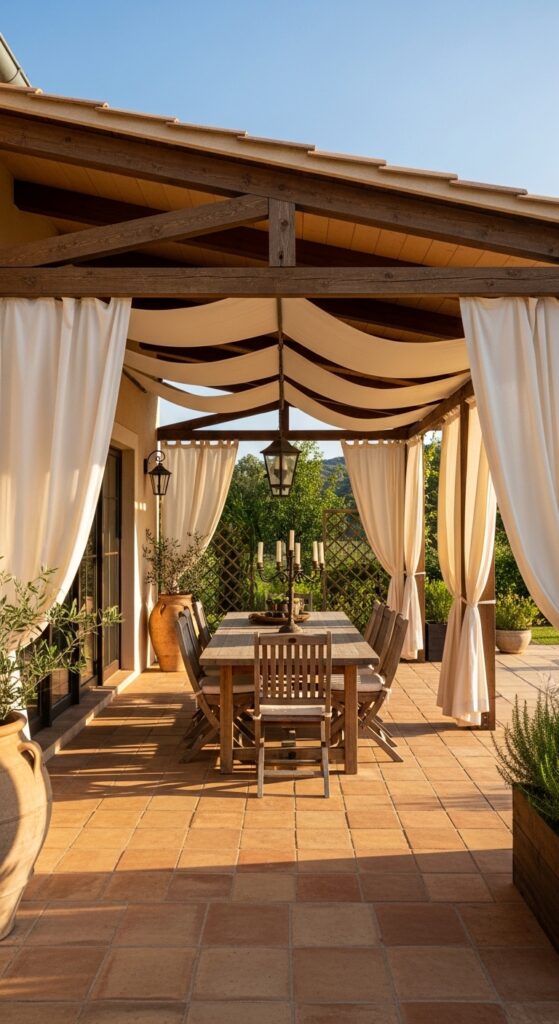
Vibe sentence: The pergola-gazebo hybrid is for people who want the freedom of open air but the option to close the curtains on the world.
What makes it work: Combining a solid weather-proof roof section over the seating/dining core with an open lattice outer zone gives the space genuine flexibility — full shelter where it matters most, dappled light and airflow beyond. Draping fabric panels from the lattice beams takes minutes to install and provides immediate shade on demand.
How to achieve it: Canvas outdoor curtain panels designed for pergola use are available in cream and white from Pottery Barn Outdoor, Wayfair, and Etsy in pre-made sizes. Use marine-grade stainless steel cable and hooks to hang them from lattice beams — they’ll withstand significant wind loading without tearing.
20. Rustic Wooden Gazebo with String Lights and Hammock
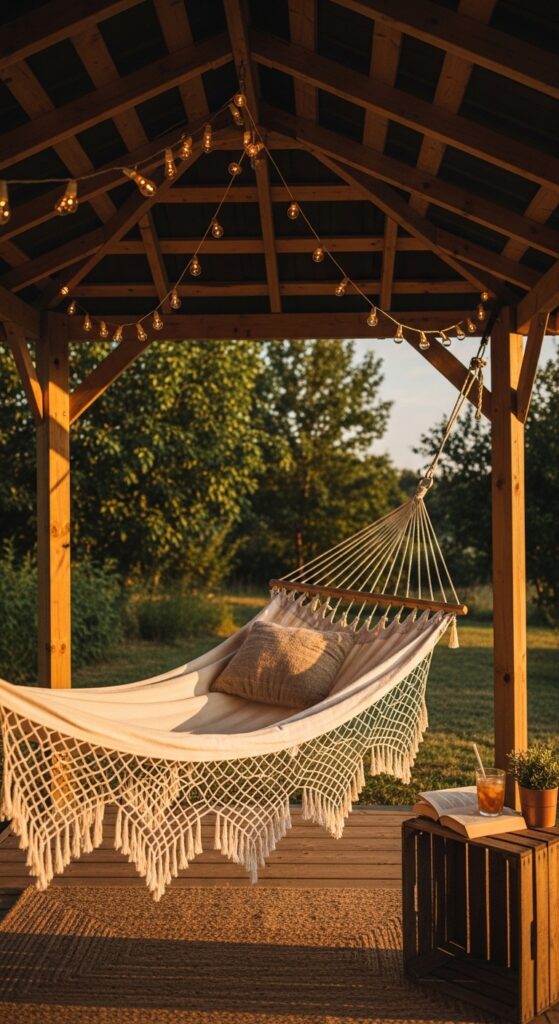
Vibe sentence: A hammock inside a gazebo is the most honest design statement in outdoor living: this is a place for doing nothing.
What makes it work: Stringing a hammock diagonally between two corner posts — rather than parallel between two walls — maximizes swing clearance and creates a more dynamic sightline through the structure. The crate side table is the detail that makes it functional: a hammock without somewhere to set a drink is only half the idea.
How to achieve it: Heavy-duty hammock hooks rated for 400+ lbs, screwed directly into structural corner posts, are the simplest and most secure mounting method. A woven cotton hammock runs $40–$120 from ENO, Vivere, or Brazilian hammock suppliers. At a 15-foot diagonal in a 10×10 gazebo, hanging angle and height are easily achievable.
💡 A $15 wooden crate from the craft store stained with exterior wood stain makes the perfect hammock side table and stores folded blankets underneath.
21. Tuscan-Inspired Stone Gazebo with Grape Vines
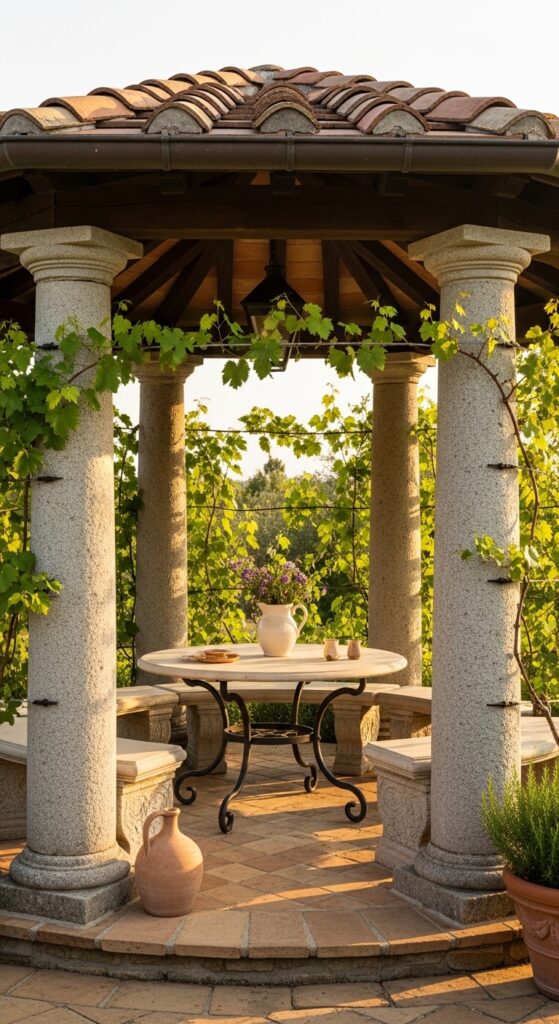
Vibe sentence: A stone gazebo with grapevines isn’t garden decor — it’s a lifestyle aspiration rendered in limestone and leaves.
What makes it work: The material pairing of rough limestone and terracotta tile is quintessentially Mediterranean — both materials weather and age beautifully, gaining character with every passing season rather than deteriorating. Training grapevines (ornamental or fruiting varieties) along horizontal wires between columns creates a natural wall of foliage that provides both privacy and shade.
How to achieve it: Faux limestone column wraps made from high-density polyurethane foam (available from columns manufacturers like Fypon) can retrofit standard wooden posts convincingly at $150–$300 per column. Muscadine grapes or ornamental ‘Purpurea’ grapevines are among the most vigorous climbers for this application.
22. Outdoor Yoga and Meditation Gazebo
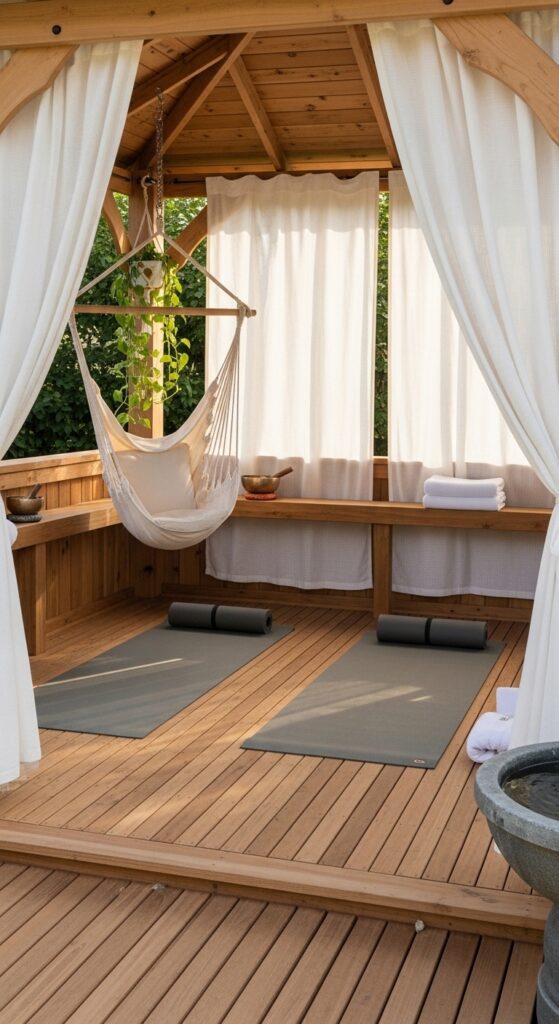
Vibe sentence: A dedicated outdoor yoga gazebo changes your practice the way a dedicated studio does — it tells your body it’s time before you’ve even unrolled the mat.
What makes it work: Removing furniture and dedicating the space entirely to movement and stillness creates an environment that signals purpose clearly. The teak slatted floor provides a forgiving, slightly springy surface that’s comfortable for yoga without being as uneven as grass.
How to achieve it: Teak deck tiles (interlocking, no-tool installation) can cover the floor of an existing gazebo for $3–$6 per square foot — a 100 sq ft gazebo floor runs $300–$600 in materials. Keep all accessories minimal, in natural materials, and stored neatly when not in use to maintain the meditative atmosphere.
23. Eclectic Vintage Gazebo with Mismatched Lanterns
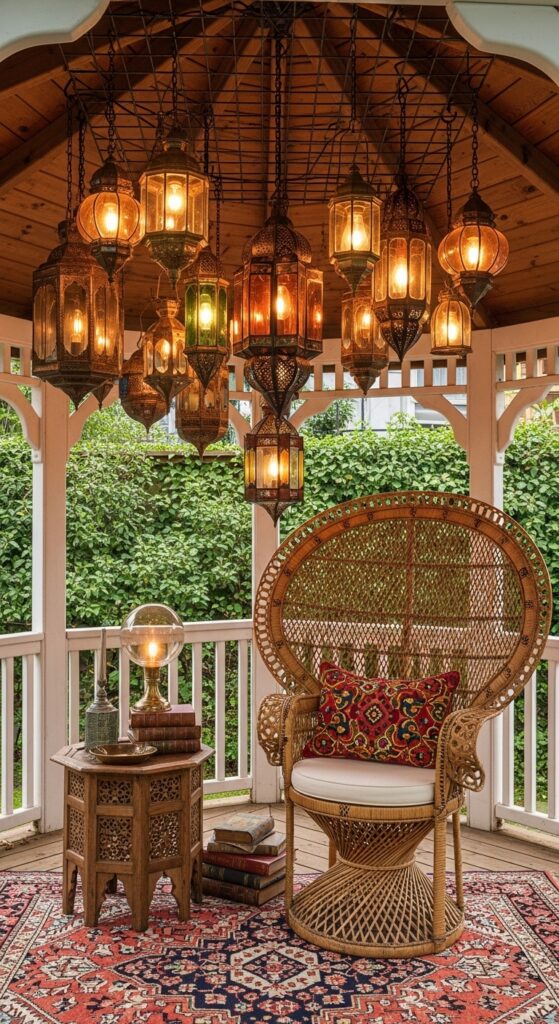
Vibe sentence: A collection of mismatched lanterns overhead turns looking up inside a gazebo into its own kind of adventure.
What makes it work: Grouping varied lanterns works because they share a common function (light source) and common warmth (amber flame or warm-toned bulb) even when they differ in style, material, and scale. The variation in hanging heights — some at 6 feet, some at 9 feet — creates a cascading, gallery-like installation effect.
How to achieve it: Collect lanterns over time from antique markets, HomeGoods, Moroccan import shops, and World Market. Install a ceiling grid of screw-in hooks at varied heights from the gazebo rafters. Solar-powered lanterns eliminate the need for outdoor electrical and are now available in convincingly decorative styles.
24. Modern Farmhouse Gazebo with Shiplap and Board-and-Batten
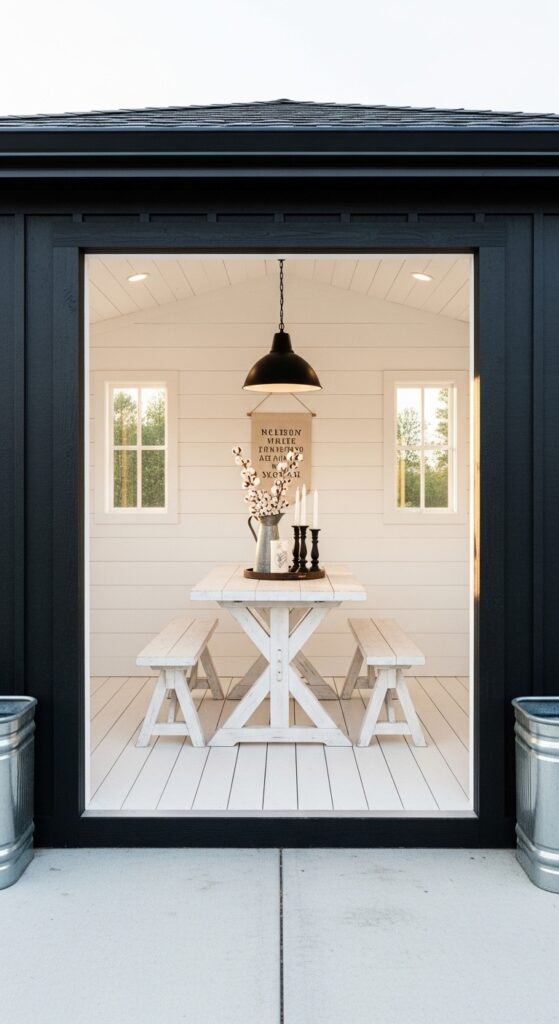
Vibe sentence: Black exterior, white interior — this is the modern farmhouse gazebo equivalent of a bow tie: simple, graphic, and impossible to get wrong.
What makes it work: The deliberate contrast between black board-and-batten exterior and white shiplap interior is a modern farmhouse design signature that photographs extraordinarily well. The black exterior recedes into the surrounding landscape while the bright white interior creates a bright, welcoming “reveal” as you approach the entrance.
How to achieve it: Apply board-and-batten trim to an existing gazebo exterior with 1×6 boards and 1×2 battens, then paint in a deep matte black (Sherwin-Williams “Tricorn Black” is the standard benchmark). Interior shiplap panels in white add approximately $200–$400 in materials to a 10×10 gazebo.
25. English Garden Gazebo with Foxgloves and Ferns
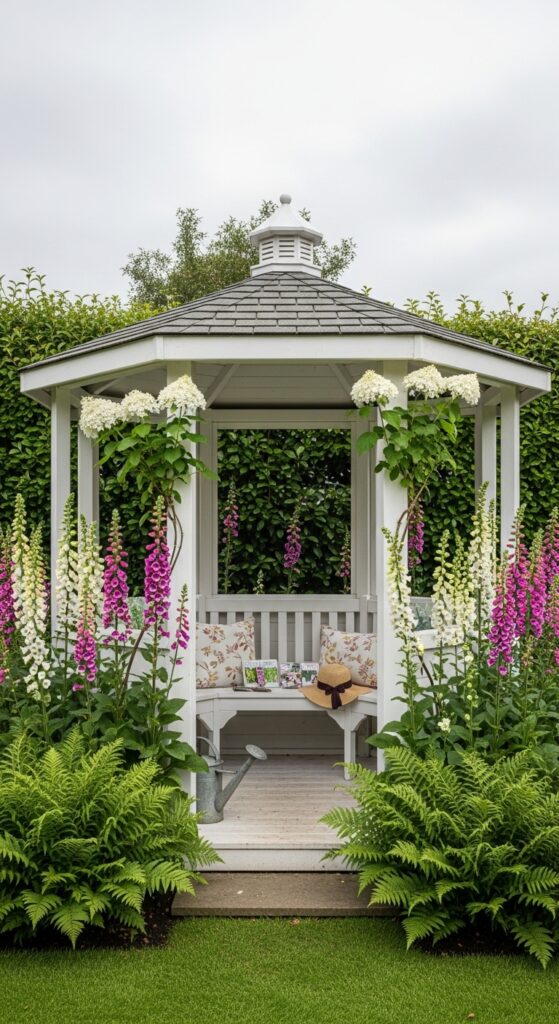
Vibe sentence: The right planting around a gazebo is what separates a structure in a garden from a garden moment.
What makes it work: Foxgloves are architectural plants — their tall spires provide vertical emphasis that draws the eye upward and frames the gazebo’s roofline rather than competing with it. Layering low ferns at the base beneath tall foxgloves creates a planting with clear height stratification, which reads as designed and intentional rather than randomly planted.
How to achieve it: Foxgloves are biennial — plant them as young plants in autumn for first-summer blooms, and they’ll self-seed reliably afterward, naturalizing around the structure over time. Underplant with ostrich fern (Matteuccia struthiopteris) or Japanese painted fern for contrast in lower layers.
26. Southwestern Adobe-Style Gazebo with Terracotta and Turquoise
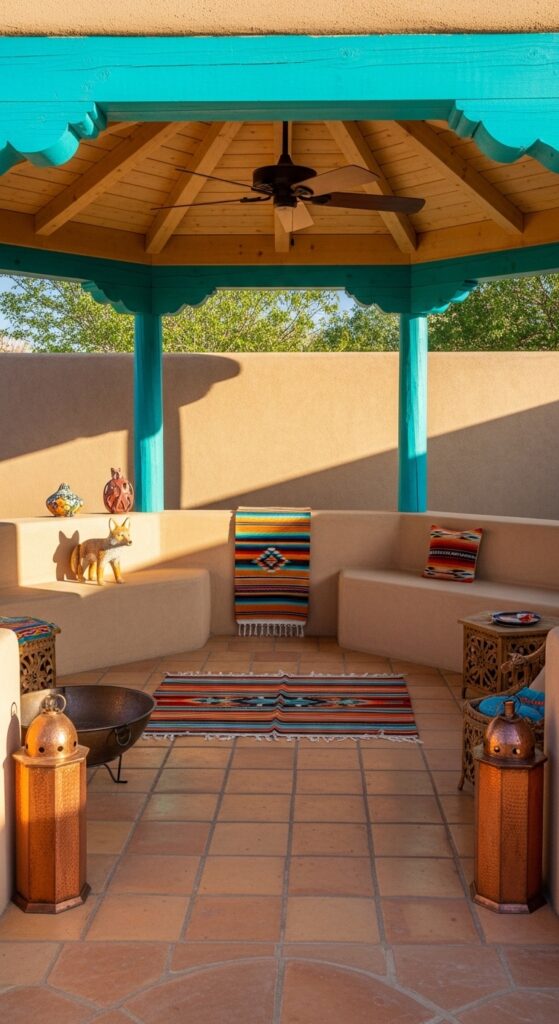
Vibe sentence: Turquoise and terracotta in a Southwestern gazebo is pure sun — unapologetic, warm, and grounded in the earth.
What makes it work: Saltillo terracotta tile flooring is the foundation that makes this palette land — its variation in color (no two tiles are identical) creates warmth and visual interest that ceramic tile cannot replicate. Turquoise, a color with deep roots in Pueblo and Navajo design traditions, pops dramatically against adobe cream and warm terracotta tones.
How to achieve it: Authentic Saltillo tile ($1.50–$3 per square foot) requires sealing with a penetrating stone sealer before and after grouting to prevent staining. Apply textured exterior stucco paint (Behr or Sherwin-Williams offer stucco-look exterior paint) to two interior wall panels for an affordable adobe appearance.
27. Modern Industrial Gazebo with Corrugated Metal Roof
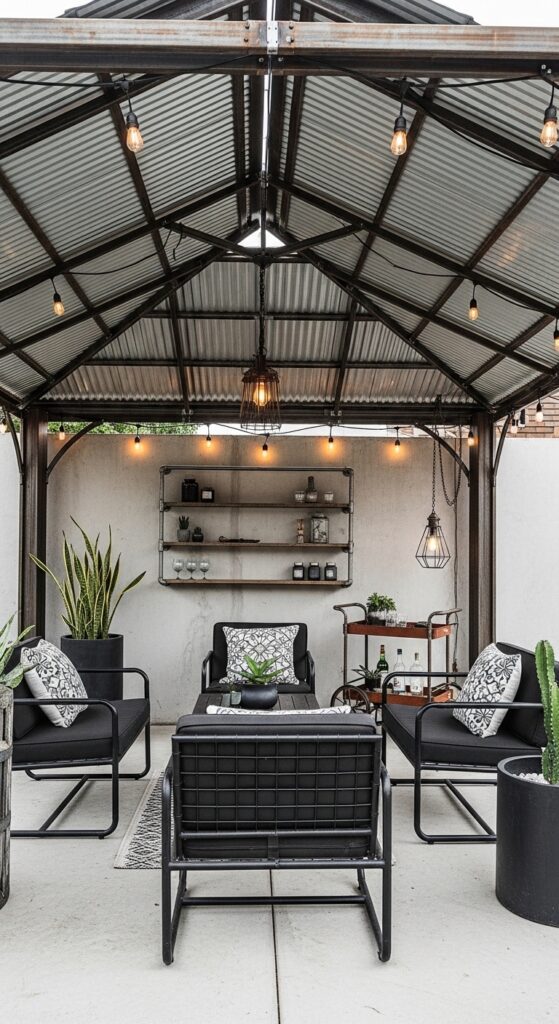
Vibe sentence: This gazebo leans into the beauty of raw industrial materials with the confidence of a Brooklyn loft transported outdoors.
What makes it work: Corrugated metal roofing has a distinctly industrial character and a beautiful acoustic quality — rain on corrugated metal is one of outdoor living’s most satisfying sensory experiences. The galvanized steel catches and reflects ambient light in a way that keeps the space from feeling heavy despite the dark furniture palette.
How to achieve it: Corrugated galvanized steel roofing panels are available at any farm supply store (Tractor Supply, Rural King) or home center for $0.60–$1.00 per square foot — among the most cost-effective roofing materials available. Build the support structure from 4×4 steel square tube welded or bolted together for a fully industrial material palette.
💡 Corrugated metal panels over a DIY-built pressure-treated lumber frame gazebo keeps total material costs under $500 for a 10×10 structure.
28. Cottagecore Gazebo with Wildflower Meadow Surroundings
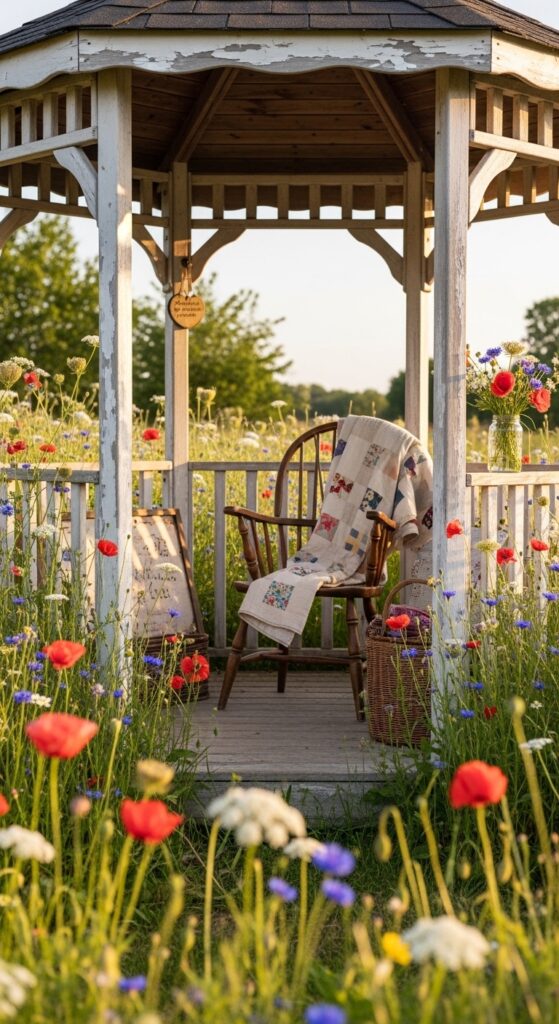
Vibe sentence: A cottagecore gazebo in a wildflower meadow doesn’t need one piece of furniture to justify its existence — the planting does all the work.
What makes it work: Surrounding the gazebo with a naturalistic wildflower meadow rather than manicured lawn planting creates an immersive environment where the structure feels discovered rather than installed. The slightly weathered, imperfect paint on the gazebo is not a flaw in this context — it’s essential to the lived-in, nostalgic character.
How to achieve it: Sow a British wildflower seed mix (or American prairie mix depending on your region) in a 15-foot radius around the gazebo in early spring or autumn. Clear the turf first with cardboard sheet mulching over winter. The meadow self-maintains — mow once annually in early spring and scatter additional seed as desired.
29. Outdoor Bar Gazebo with Pendant Lighting and Bar Cart
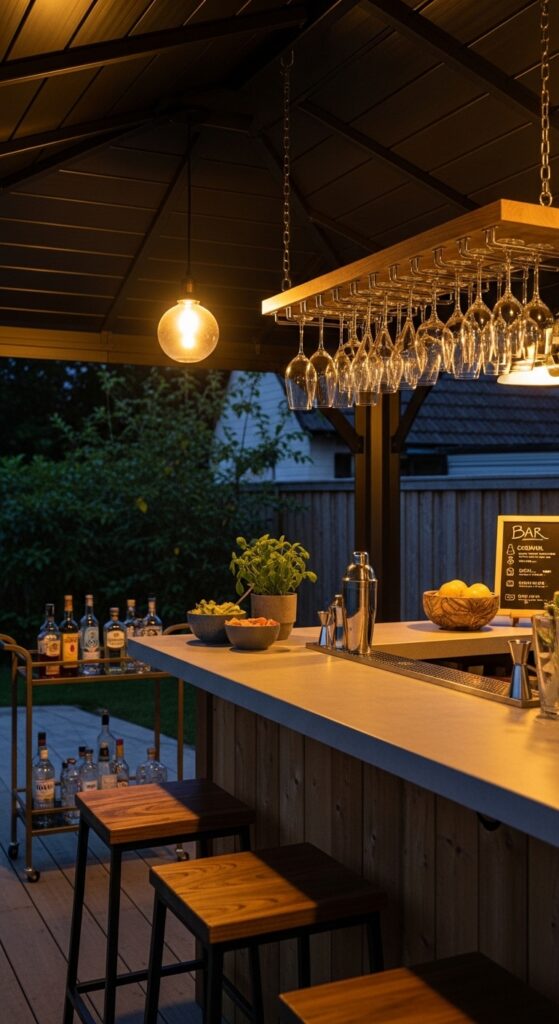
Vibe sentence: A dedicated outdoor bar gazebo tells every arriving guest exactly what kind of evening this is going to be.
What makes it work: The hanging stemware rack above the bar is both functional (freeing up counter space) and deeply atmospheric — a row of hanging wine or cocktail glasses catches light beautifully and signals “proper bar” in a way that glasses on a shelf cannot replicate. The built-in counter anchors the bar identity and makes the space feel permanent rather than improvised.
How to achieve it: A bar counter can be built from a standard 36-inch-high base using pressure-treated lumber framing with a poured concrete, tile, or mahogany wood bar top. A wooden stemware rack (available from bar supply companies for $40–$100) mounts to the gazebo ceiling joists and holds 12–20 glasses overhead.
30. Romantic Canopy Gazebo with Four-Poster Bed Swing
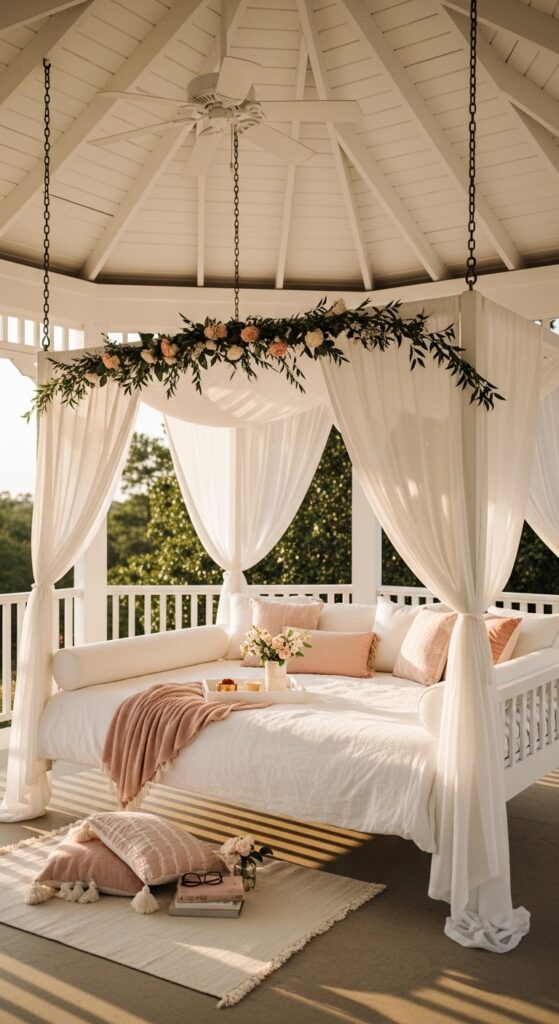
Vibe sentence: A suspended daybed inside a gazebo is the single most aspirational piece of outdoor furniture that actually exists in real life — and it is exactly as wonderful as it looks.
What makes it work: The four-poster daybed frame hung from gazebo ceiling beams creates a sense of enclosure-within-enclosure — a room inside a room — that feels simultaneously grand and intimate. The gauze curtains tied at each corner post complete the canopy effect without blocking airflow, maintaining the outdoor experience while adding layers of visual softness.
How to achieve it: Suspended daybed swings require structural ceiling joists rated for dynamic load — a minimum 4×6 beam is standard for supporting a swing that may hold two adults plus the furniture weight (200–400 lbs combined). Use 3/8-inch galvanized eye bolts and rated swing hardware — never decorative hooks — for the suspension points.
How to Start Your Backyard Gazebo Transformation
Start with the single decision that determines everything else: is your gazebo primarily a shelter (weather protection), a social space (entertaining), or a retreat (solitude and relaxation)? The answer shapes your size requirements, furniture choices, and which features — fireplace, bar, hammock, screen enclosure — are genuinely useful versus decorative.
The most common mistake is under-sizing. A 10×10 gazebo feels spacious in a showroom and genuinely tight once a dining table, four chairs, a side table, and two people are inside. If your budget allows, step up to 12×12 or 12×16 — the extra square footage transforms the experience from functional to genuinely comfortable.
Before purchasing, check your local building codes. Most jurisdictions require a permit for a permanent gazebo structure, and some have setback requirements from property lines that affect placement. HOA rules may restrict colors, materials, or placement. A 30-minute call to your building department before any purchase saves significant trouble later.
Budget entry points vary widely: a quality prefabricated kit from brands like Yardistry, Sojag, or Shelter Logic runs $500–$3,000 and is assembler-DIY-friendly. A custom-built cedar structure with electrical runs $5,000–$20,000 depending on size and finishes. In either case, foundation preparation (a level concrete pad, pavers, or compacted gravel base) typically adds $300–$800 and should not be skipped — it’s the difference between a structure that lasts decades and one that warps and settles within five years.
Frequently Asked Questions
What size gazebo works best for a backyard?
For most residential backyards, a 10×10 or 10×12 foot gazebo provides adequate space for a small seating group or a compact dining table. For outdoor dining with six or more guests, a 12×16 or 14×14 foot structure is more comfortable — plan for approximately 25 square feet of interior space per person as a comfortable benchmark. Octagonal gazebos are typically sold in diameter measurements (10-foot, 12-foot, 14-foot diameter); note that the usable interior square footage of an octagon is approximately 83% of the equivalent square footage of a same-dimension rectangle.
What is the most durable material for a backyard gazebo?
Cedar and pressure-treated pine are the most popular structural materials, with cedar being the premium choice — it contains natural oils that resist insects and rot without chemical treatment, and it weathers gracefully to a silver-gray patina if left unsealed. Aluminum gazebo frames are the most low-maintenance option, requiring zero treatment and weighing significantly less than wood. Vinyl (PVC) gazebos never rot or need painting but can crack in severe cold and lack the warmth of natural materials. For a permanent structure built to last 20–30+ years, cedar or Douglas fir with a quality exterior stain or sealant is the standard recommendation.
Do backyard gazebos add value to a home?
A well-built, code-compliant gazebo on a proper foundation can add modest value to a home by expanding functional outdoor living space — buyers increasingly prioritize outdoor areas, and a furnished gazebo is a visible, tangible selling point. However, a poorly constructed or poorly maintained gazebo can actually reduce perceived value if it appears structurally unsound or requires immediate removal. Pergolas typically offer a higher return on investment than gazebos in standard real estate appraisals, but a gazebo that is beautifully integrated into the landscape and clearly in excellent condition is a genuine asset during a home sale.
How do I add lighting to a backyard gazebo without hardwiring?
The most practical no-wire lighting options for gazebos have improved enormously in recent years. Solar-powered string lights in warm Edison or micro-LED styles charge during the day and automatically illuminate at dusk, providing 6–8 hours of light. Battery-operated LED lanterns and pendants now run for 50–200 hours per charge cycle and are available in convincingly decorative styles. For a permanent installation, a low-voltage outdoor lighting system powered by a transformer near the house can run wire discretely along the gazebo framing — the system runs on 12V rather than 120V and is safe for DIY installation without an electrician in most jurisdictions.
Can a gazebo be used year-round?
With the right design choices, yes — a gazebo can function comfortably for three or four seasons in most climates. Key modifications for extended-season use include: a solid, insulated or polycarbonate roof rather than open lattice; removable polycarbonate side panels or mosquito screen panels that can be added in cold or wet weather; a heat source such as a propane patio heater, electric infrared heater, or wood-burning fire element; and outdoor-rated rugs and textiles that don’t retain moisture. In climates with genuine winter (below 20°F regularly), a fully enclosed and heated glass conservatory-style gazebo is the only truly year-round option.
Ready to Create Your Dream Backyard Gazebo Escape?
You now have 30 complete, specific backyard gazebo ideas spanning every style from rustic log lodges to sleek modern steel, from bohemian floor-cushion retreats to fully equipped outdoor bars. Whether you’re working with a tight urban yard or a sprawling suburban lot, there’s a configuration here that makes sense for your space, your aesthetic, and your vision of what outdoor living should feel like.
Save the ideas that made you stop scrolling — those instinctive favorites tell you more about your style direction than any mood board exercise. Then take the first real step: walk your backyard, measure the space, and pick your placement. Every remarkable backyard gazebo began not with a contractor call or a catalog order, but with someone standing in their yard, pointing at a patch of ground, and saying there. Your escape is waiting.