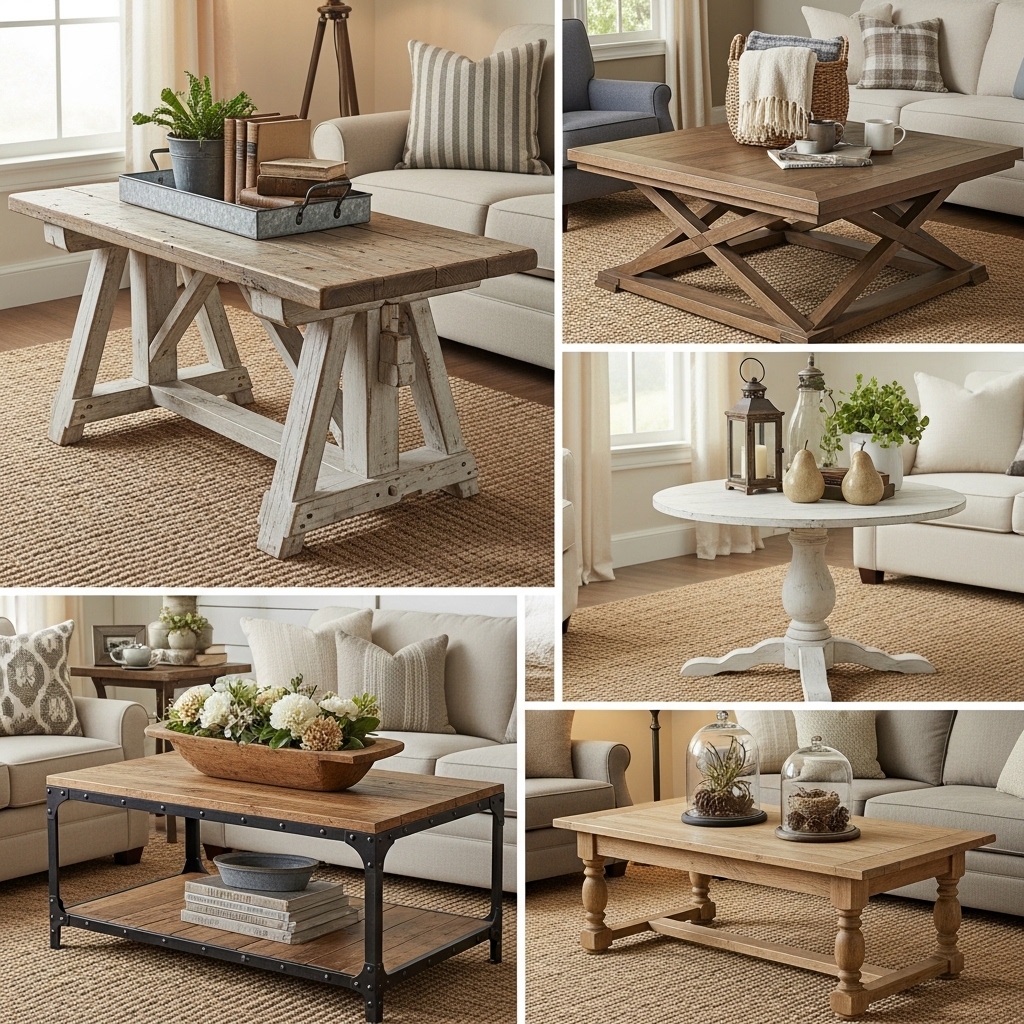
Farmhouse style is a design approach rooted in rural American and European cottage aesthetics — characterized by natural materials, worn finishes, and unpretentious, lived-in warmth. These 18 farmhouse coffee table ideas cover everything from raw wood slabs to painted finishes, tray styling to mixed-material combinations, so you can find exactly what works for your living room.
There’s a particular stillness that settles into a room when a farmhouse coffee table is done right. You feel the grain of unfinished oak under your fingertips, the weight of a hand-thrown ceramic bowl, the honesty of something that wasn’t designed to impress — only to belong. Light moves differently across these surfaces. Nothing tries too hard. Here are 18 ideas worth saving — and stealing.
Why Farmhouse Style Works So Well
Farmhouse design draws from the working interiors of 18th- and 19th-century rural American homesteads and English country cottages — spaces built for function first, with beauty that arrived almost accidentally through the patina of daily use. It’s distinct from rustic style (which leans darker and more rugged) and from shabby chic (which prioritizes distress for its own sake). Farmhouse style is grounded. It uses imperfection as a design feature, not a flaw.
The palette is anchored in warm whites, soft creams, and weathered greiges — think Benjamin Moore “White Dove” or Sherwin-Williams “Alabaster.” Layered over those neutrals are the textures: shiplap paneling, unfinished white oak, aged pine, galvanized metal, undyed linen, woven jute, hand-thrown stoneware in matte ivory or speckled charcoal. You could build an entire room from this paragraph alone.
The style is surging again right now, and not by accident. After years of ultra-minimal interiors, people are craving warmth and story — rooms that feel like someone actually lives in them. Pinterest’s 2024 trend reports showed a sharp climb in searches for “cozy farmhouse living room” and “natural wood coffee table,” driven by a post-pandemic desire for home as sanctuary rather than showroom.
Small spaces can absolutely achieve this style — with one important caveat. In tight living rooms, prioritize one statement piece (the coffee table itself) and let everything around it breathe. Resist the urge to fill every surface. Farmhouse clutter reads as chaos; farmhouse restraint reads as intention.
| Element | Philosophy | Key Materials | Key Colors |
| Core trait | Imperfect beauty, functional warmth | Unfinished oak, aged pine, galvanized steel, jute, linen | Warm white, cream, weathered greige, soft black |
1. Raw-Edge Live-Edge Slab Table
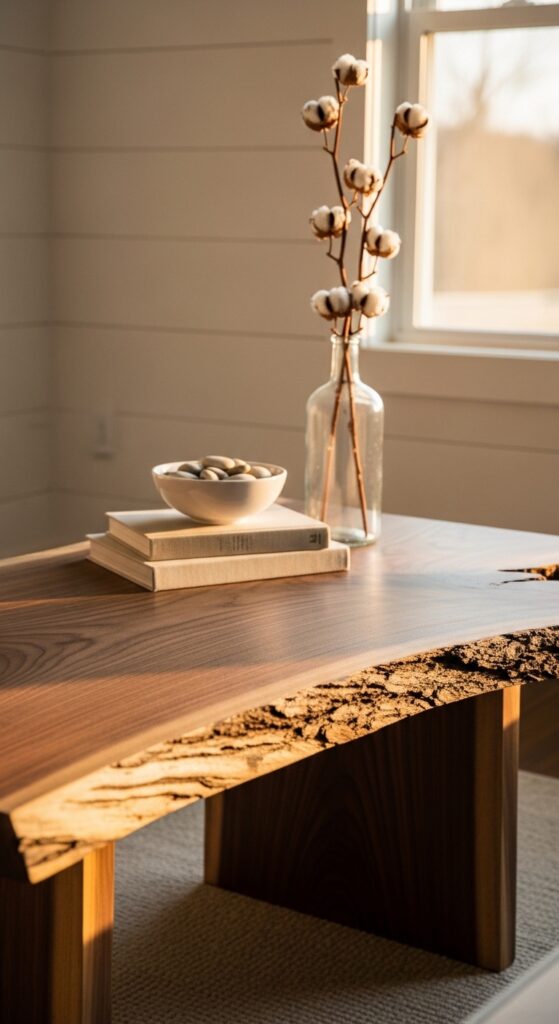
Vibe: Sun-warmed and rooted — this table looks like it came directly from the land it grew on.
Why it works: The live edge introduces organic asymmetry into what is otherwise a rectangular room — and that tension is exactly what makes a space feel curated rather than catalog-assembled. The natural bark boundary creates visual interest that no carved detail could replicate. Against white walls, the warm walnut reads as a grounding anchor without visually shrinking the room.
How to get it: Source live-edge slabs from Etsy sellers or local lumber mills rather than furniture retailers — you’ll pay $200–$400 for a raw slab versus $1,200+ for a finished piece. Sand to 220-grit and apply a single coat of Rubio Monocoat in “Pure” to preserve the natural color while adding washable durability.
💡 Quick Win: A small cutting board with a live edge, placed as a tray on top of a plain coffee table, gives you the same organic-wood moment for under $40.
2. White Chalk-Painted Finish with Visible Grain
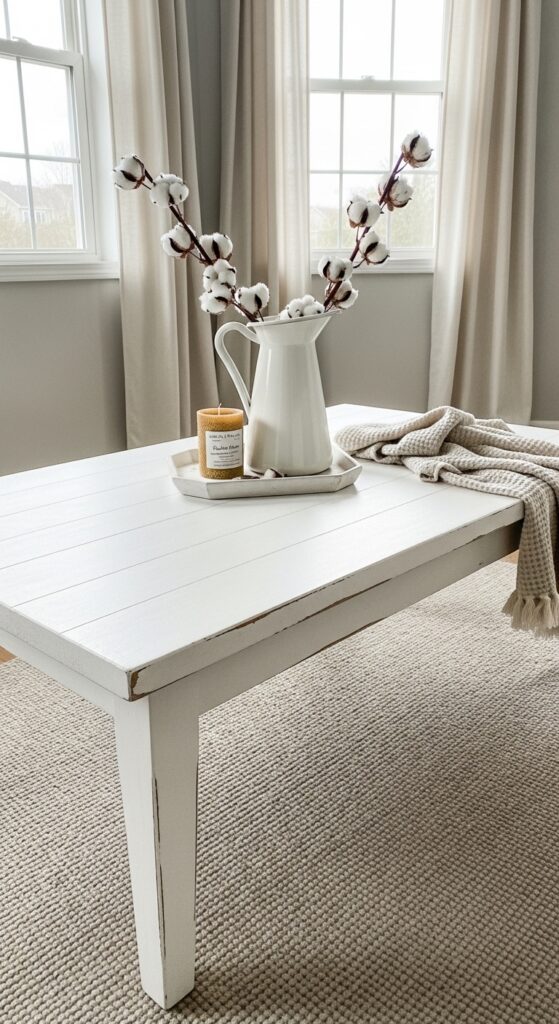
Vibe: Hushed and soft — like a room in the hour before the rest of the house wakes up.
Why it works: Chalk paint creates a flat, low-reflectance surface that absorbs light rather than bouncing it, which is what makes a white coffee table feel cozy instead of clinical. The visible grain beneath the paint adds texture without color complexity — the eye reads it as depth rather than pattern. This is the principle of tonal layering: same hue, different materials.
How to get it: Annie Sloan “Old White” chalk paint applied with a wide wax brush in two thin coats (no sanding prep required) gives the most authentic farmhouse finish. Distress edges lightly with 120-grit sandpaper while the final coat is still slightly soft — not bone dry — for a natural-worn look rather than an obviously sanded one.
3. Industrial Pipe Legs with Reclaimed Wood Top
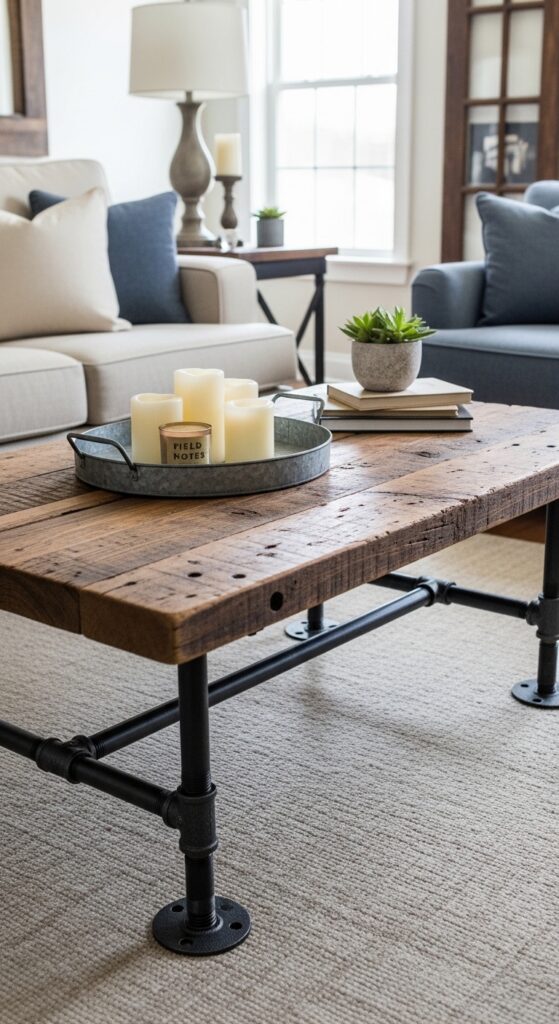
Vibe: Raw and a little rebellious — the industrial element makes the whole room feel less precious.
Why it works: The contrast between the organic imperfection of reclaimed wood and the precision of black iron pipe hardware creates what designers call “visual tension” — two opposing material vocabularies in the same piece, which the eye finds more interesting than either material alone. The knots, nail holes, and saw marks in aged pine are the farmhouse equivalent of artwork.
How to get it: Black iron pipe fittings from a hardware store and a length of reclaimed barn wood (available from Habitat for Humanity ReStores for $5–$15 per board) make this an under-$80 DIY. Cut the wood to 48″ x 24″, attach four 3/4″ pipe flanges with wood screws, and thread in 16″ nipples as legs. No finishing required — the whole point is the age.
💡 Quick Win: Rustoleum “Flat Black” spray paint transforms any wood table’s existing legs into the industrial pipe look in under an hour, for about $8.
4. Warm Linen and Woven Jute Tray Styling
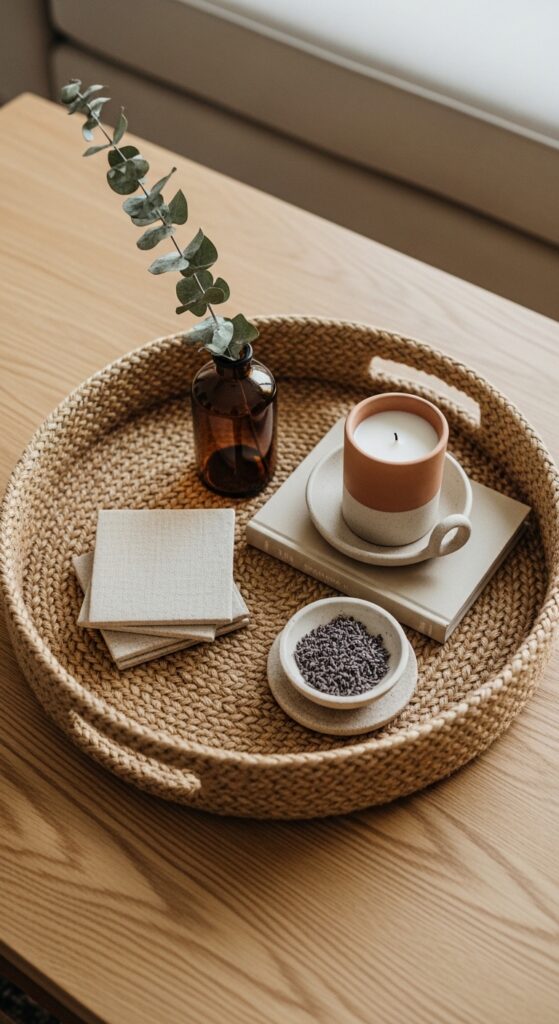
Vibe: Layered and considered — nothing placed accidentally.
Why it works: A tray on a coffee table works on a design principle called “visual containment” — it tells the eye where to look by grouping objects into one coherent unit. Without the tray, even a well-chosen set of objects can read as scattered. The natural fiber of a jute tray adds a third texture layer (alongside wood and ceramic) without adding color complexity, which is how farmhouse style achieves richness without clutter.
How to get it: Work in odd numbers — three items inside the tray feels balanced; four reads crowded. Include one tall element (a candle or small bud vase), one mid-height element (a small book or ceramic bowl), and one low element (a stone coaster or small dish). The McGee & Co. “Thayer Tray” in natural jute ($68) is a reliable starting point; Amazon’s equivalent runs about $24.
5. Cane-Wrapped Table Legs for Warmth and Texture
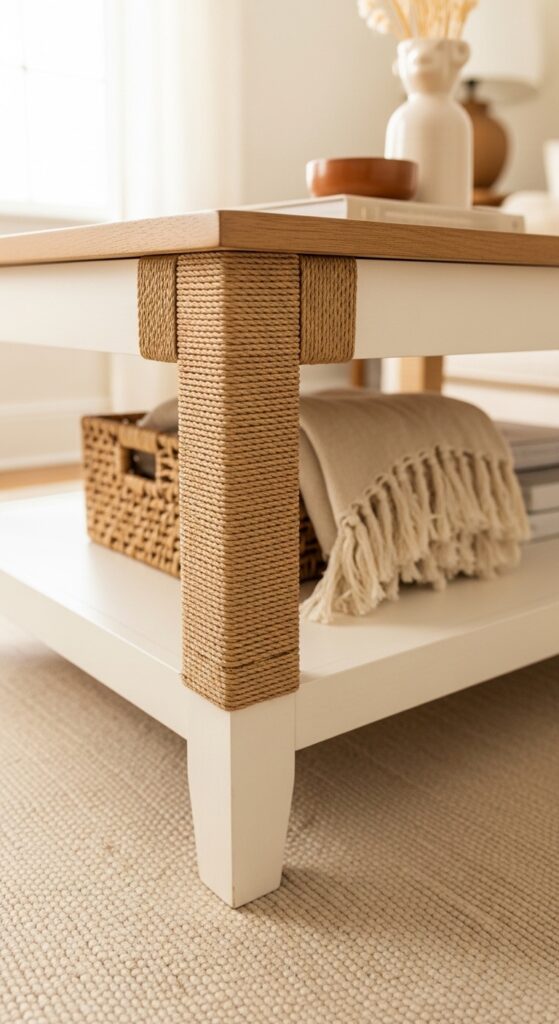
Vibe: Handcrafted and warm — like something a grandmother would have made, but make it modern.
Why it works: Cane wrapping on table legs introduces a third material into the piece without changing its silhouette — which is the more sophisticated way to add texture compared to swapping the whole table. The natural tan of cane sits in the exact tonal middle ground between bare wood and white paint, making it a natural bridge between the two most common farmhouse color families. It also adds visual weight at the base, which grounds a table that might otherwise feel too light.
How to get it: Purchase flat-reed cane from a craft supplier ($12–$18 per coil) and wrap existing painted legs yourself, securing with a dab of wood glue and a final wrap of natural jute twine at top and bottom. This works on any square leg up to 2.5″ wide.
💡 Quick Win: A cane-seat side table pulled in as a coffee table alternative costs $40–$80 at thrift stores — the cane detail is already built in.
6. Layered Rugs Underneath for Zone Definition
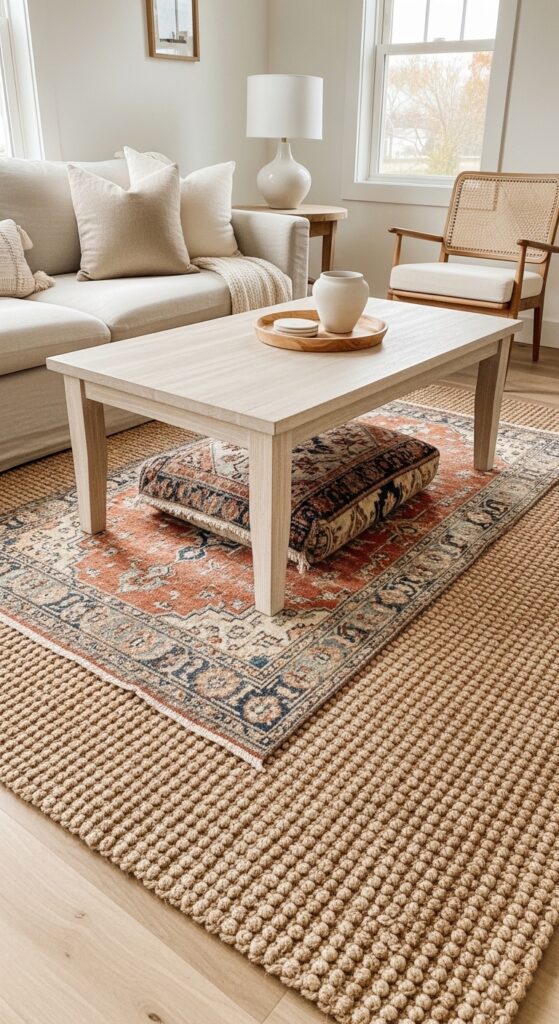
Vibe: Grounded and richly layered — the kind of room that looks like it evolved over time rather than being assembled in an afternoon.
Why it works: Layering two rugs creates a defined zone for the coffee table and seating area — a layout technique that replaces the visual function of walls in open-plan spaces. The base layer (a sisal or jute rug) provides farmhouse-appropriate texture, while the top layer (a faded wool or cotton rug in terracotta, dusty blue, or worn cream) adds pattern and warmth. The coffee table’s legs framing both rugs anchor the whole composition.
How to get it: The base rug should extend 18–24 inches beyond the sofa’s front legs on all sides. The layered top rug should be 2–3 feet smaller on all sides, sitting centered beneath the coffee table. IKEA’s “Lohals” sisal rug ($49–$129 depending on size) makes an excellent base.
7. Muted Sage Green Paint — a Color Accent
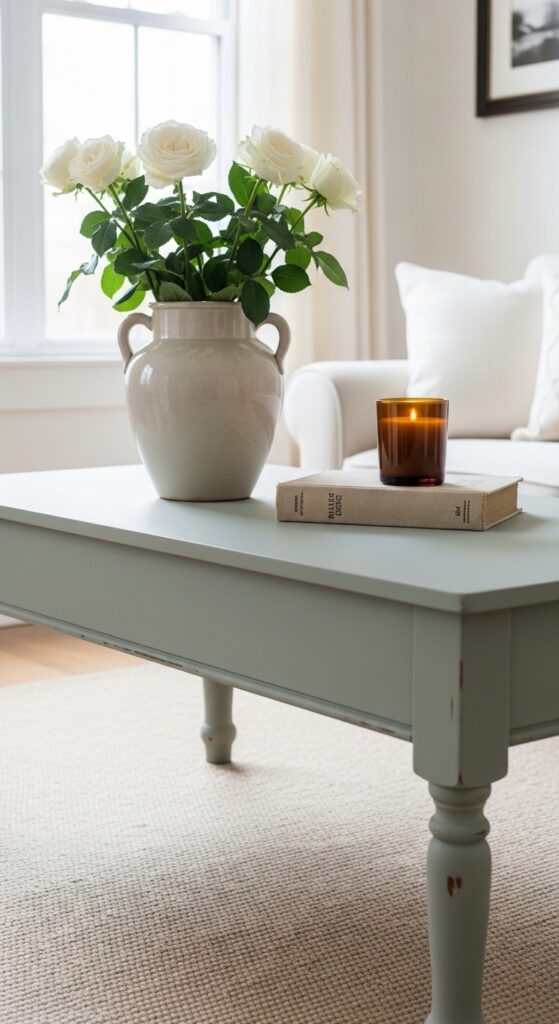
Vibe: Serene — the color feels less painted-on and more like it was always meant to be there.
Why it works: Muted sage works in farmhouse rooms because it contains both grey and green undertones, which anchor it to both the cool tones of white walls and the warm tones of natural wood. This is the principle of “undertone bridging” — a color that shares undertones with the neutrals around it reads as belonging rather than popping. Avoid bright or lime-leaning greens; they read as trend-chasing rather than timeless.
How to get it: Farrow & Ball “Mizzle” (No. 266) is the gold standard for this tone — a soft greyed-sage that shifts from green to grey depending on light direction. For a $15 option, Rust-Oleum Chalk Paint in “Sage” hits the same register. Apply in two coats with a foam roller for a smooth matte finish, then distress edges only.
💡 Quick Win: Paint just the legs of an existing table in muted sage — leave the top in natural wood. The two-tone look costs under $15 and refreshes the whole piece.
8. Nesting Tables in Unfinished Oak
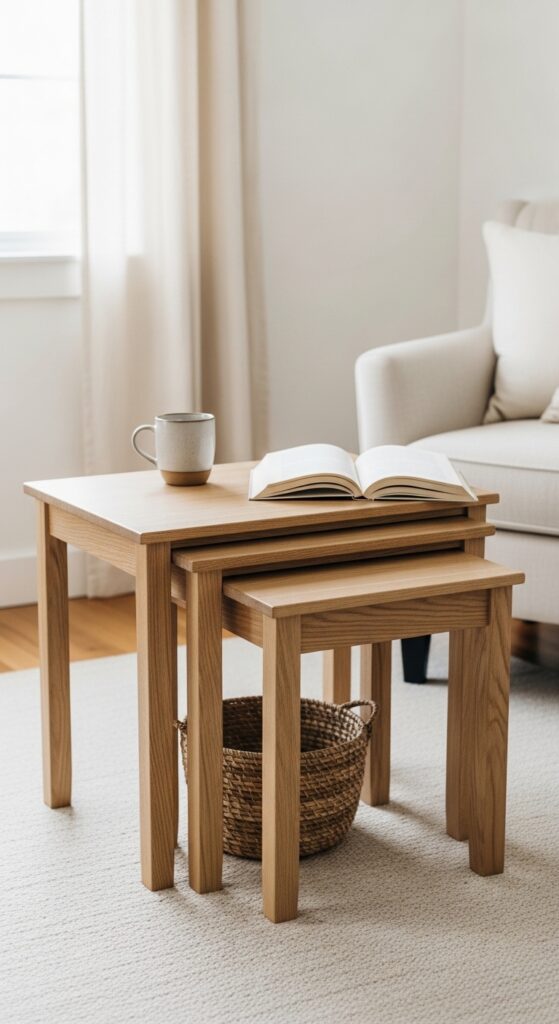
Vibe: Still and practical — the room feels ready for anything without trying to announce it.
Why it works: Nesting tables solve a real small-space problem: you need surface area for a gathering but want openness day-to-day. Unfinished white oak reads as farmhouse immediately because of its grain pattern — wide, open grain with visible medullary rays that catches light differently than pine or poplar. The height difference between the two tables creates visual rhythm, which is why nesting sets feel more interesting than a single large surface.
How to get it: Leave unfinished oak untreated for the first 3–6 months to let it oxidize naturally to a warmer honey tone. After that, a single coat of pure tung oil will lock in the color and add light water resistance without changing the matte character of the wood.
9. Candlelit Centerpiece with Varying Heights
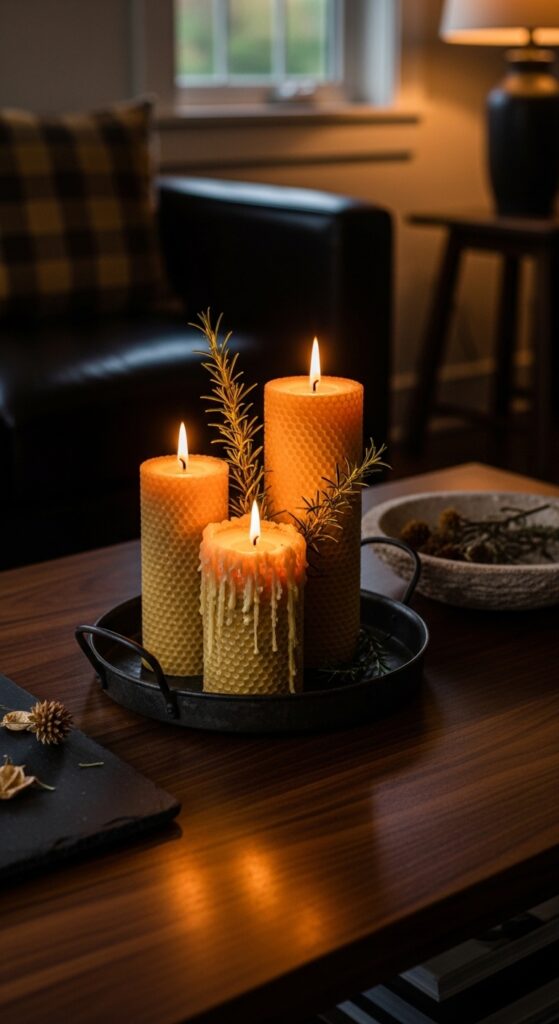
Vibe: Warmly lit and unhurried — evenings feel entirely different in this room.
Why it works: Varying candle heights on a coffee table works on the principle of “graduated elevation” — the eye naturally follows height differences, which creates movement and depth in an otherwise horizontal display. Three heights is the minimum for this effect; two reads as a pair and loses the dynamic quality. Beeswax candles specifically fit the farmhouse aesthetic because of their natural warm-honey color and the faint honey scent when burned — synthetic paraffin reads as too perfect.
How to get it: Set candles directly into a low galvanized metal tray or a slate cheese board to protect the table surface — no candle holders required. This creates a more organic, gathered feeling than individual holders. Prices: beeswax pillar candles at farmers markets or Etsy typically run $8–$18 each.
💡 Quick Win: Three beeswax pillar candles from IKEA’s “Jubla” range ($3–$6 each) on a $12 galvanized tray from the gardening section create this exact moment for under $30.
10. Ottoman-as-Coffee-Table in Woven Seagrass
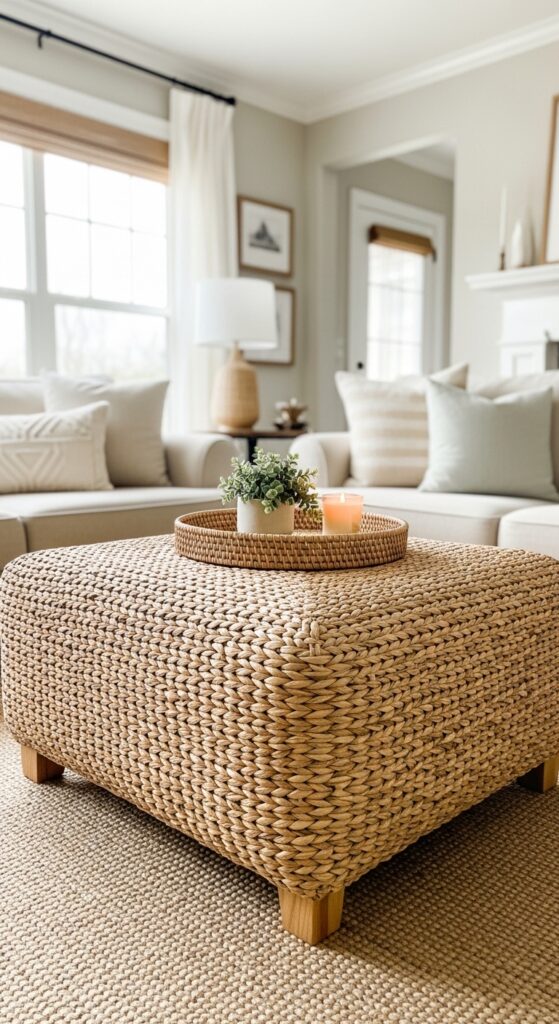
Vibe: Lived-in and generous — this is a room that invites feet on the furniture.
Why it works: A woven seagrass ottoman used as a coffee table introduces a curved, soft element into what is typically the room’s one hard, flat surface — and that softness completely changes the room’s energy. The natural seagrass fiber sits in the same material family as jute and sisal, so it reads as cohesive with other farmhouse textures rather than out of place. The required tray on top provides the hard surface for drinks without sacrificing the soft look.
How to get it: Size matters: an ottoman-as-coffee-table should be within 1–2 inches of sofa seat height (typically 17–19 inches). Pottery Barn’s “Havana” seagrass ottoman ($299) or IKEA’s “Alseda” banana fiber ottoman ($179) both hit the right height and material register. The tray on top should be at least 16″ x 16″ to function as an actual surface.
11. Herringbone Wood Pattern Top
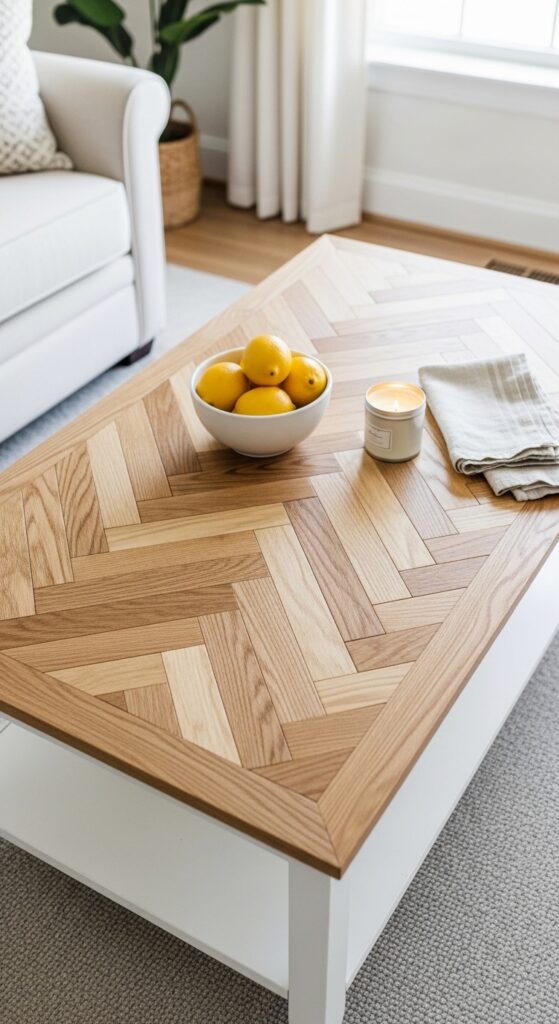
Vibe: Airy and quietly geometric — the pattern works without announcing itself.
Why it works: A herringbone wood pattern on a coffee table top introduces visual texture without adding color — which is exactly how farmhouse style achieves complexity while remaining calm. The alternating grain direction in each piece creates a subtle light-and-shadow play as daylight moves across the surface throughout the day. Paired with white painted legs, the pattern carries all the visual interest the piece needs.
How to get it: Build a herringbone top using 1.5″-wide pine strips cut at 45-degree angles and glued to a plywood base — no special woodworking skills required, only a miter saw and wood glue. For a ready-made version, look for herringbone parquet tiles from a flooring supplier ($18–$25 per square foot) and apply them to an existing table top using construction adhesive.
💡 Quick Win: Peel-and-stick herringbone wood veneer tiles ($20–$35 on Amazon) applied to the top of a thrifted table create this look in under two hours.
12. Galvanized Metal Tray as a Centerpiece
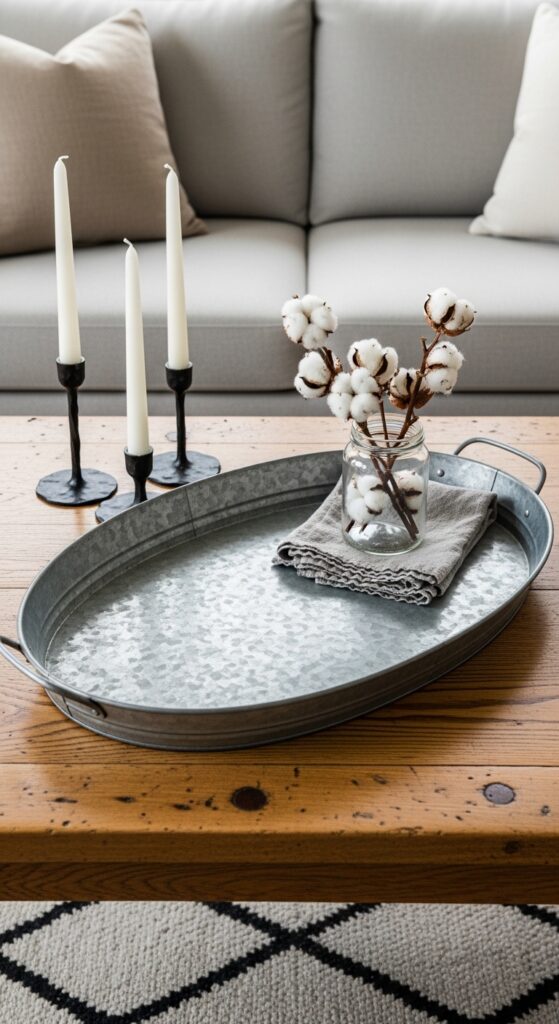
Vibe: Honest and grounded — nothing here is trying to be elegant, and that restraint makes it elegant.
Why it works: Galvanized metal brings an industrial material into a warm, organic space — a contrast that is central to modern farmhouse style specifically. The natural oxidation patterns in galvanized steel are the metal equivalent of wood grain: no two pieces look the same, and that variation reads as authenticity. Against warm oak tones, the cool grey of galvanized steel creates a subtle temperature contrast that keeps the overall palette from reading as too uniform.
How to get it: Large galvanized trays are available in the garden section of home improvement stores (look near the planters) for $15–$30 — often the same product sold as “farmhouse decor” elsewhere for three times the price. The slight imperfection of the gardening version actually looks more authentic.
13. Low-Profile Table to Make a Small Room Feel Larger
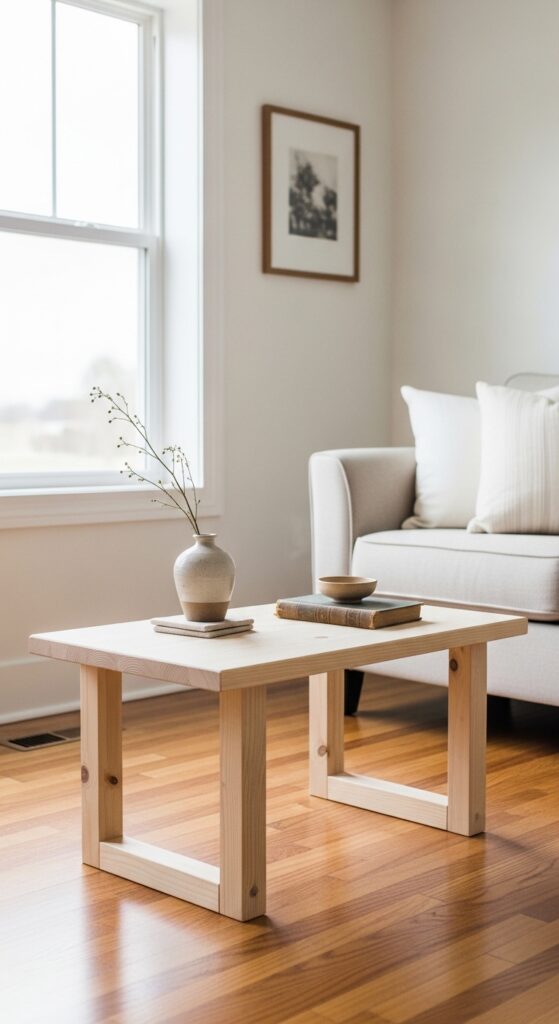
Vibe: Airy and open — the room breathes differently when the table gets out of the way.
Why it works: A table with a 12–14 inch height (4–6 inches lower than standard coffee table height) allows the sight-line to travel across the room uninterrupted, which visually expands the space. This works because the human eye perceives a room as larger when it can see more wall area — a low table simply gets out of the way. This is particularly effective in rooms with beautiful hardwood floors: the low table becomes a frame for the floor rather than a barrier across it.
How to get it: When shopping for low-profile tables, filter by “cocktail table” or “Japanese-style coffee table” — these terms consistently return lower-height options. Keep the surface styling equally minimal: one object maximum, chosen for its silhouette rather than its story.
💡 Quick Win: Shortening existing coffee table legs by 3–4 inches (remove, trim, reattach — 45 minutes of work) transforms a standard-height table into a low-profile one at zero cost.
14. Driftwood Sculptural Base
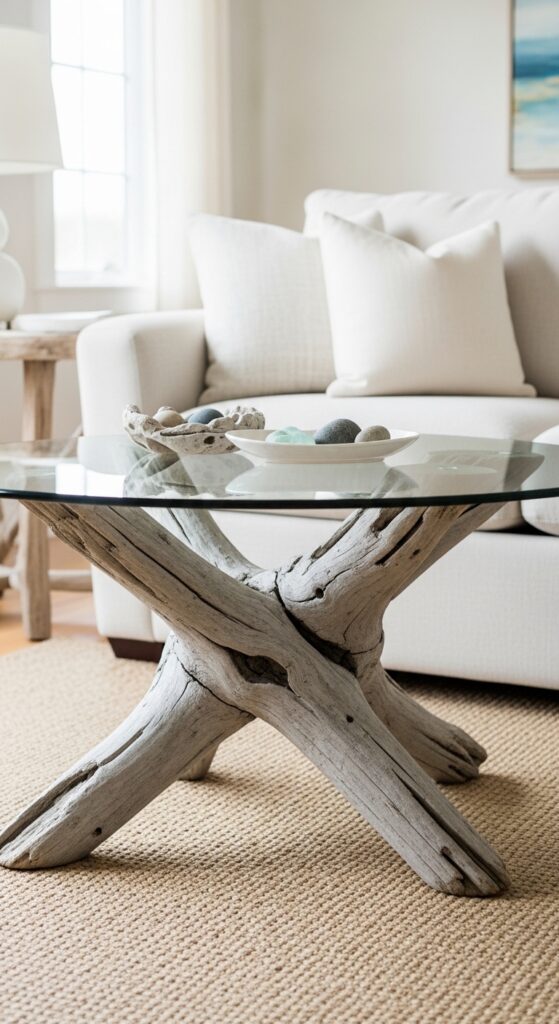
Vibe: Organic and still — like the room found this piece on a shore somewhere.
Why it works: A driftwood base introduces a sculptural element into the living room without requiring any artwork or decorative objects — the table IS the art. The silvery-grey weathering of driftwood occupies an interesting tonal position: cool enough to read with whites and creams, warm enough to harmonize with oak and pine. Clear glass on top keeps the visual weight minimal, letting the base remain the focal point rather than competing with a solid top.
How to get it: Coastal home stores and Etsy sellers offer driftwood base coffee tables ranging from $180–$600 depending on the piece. DIY version: source large driftwood logs from a coastal beach (check local regulations about collection) or from landscape supply companies, seal with a clear matte exterior polyurethane, and have a local glass shop cut a 3/8″ tempered glass top to fit.
15. Whitewashed Pine with Open Lower Shelf
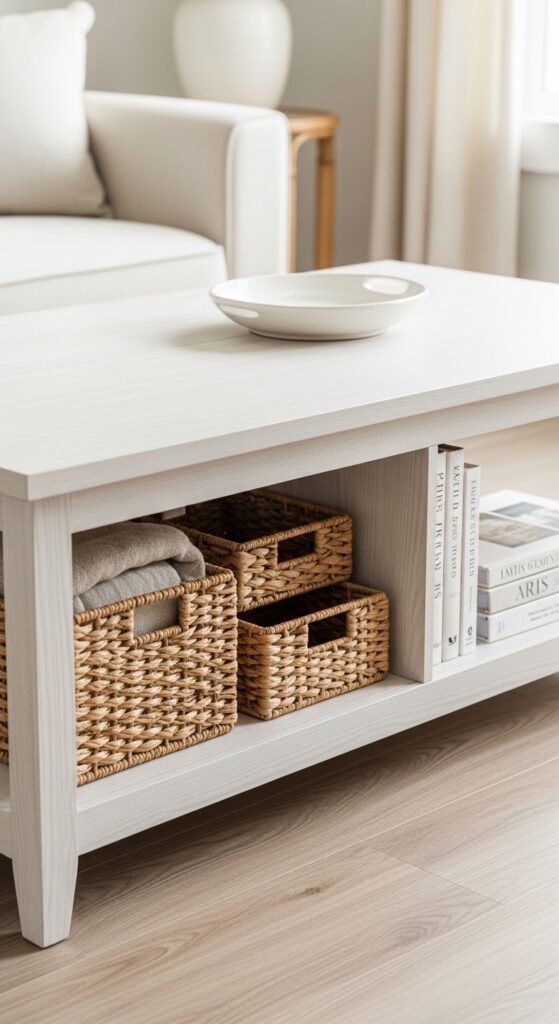
Vibe: Warm and quietly organized — functional without ever looking like furniture from a storage catalog.
Why it works: An open lower shelf on a coffee table creates what designers call a “display tier” — a secondary surface that the eye reads as part of the table’s overall composition rather than as storage. Baskets fill the shelf without making it look cluttered because they share the same material vocabulary as the rest of the farmhouse room. The whitewash technique preserves the wood grain’s visual texture while unifying the color to the room’s white-and-cream palette.
How to get it: Whitewash your own pine table with a 1:1 mix of white latex paint and water. Apply with a wide brush, then immediately wipe back with a rag to reveal the grain beneath. This is called “liming” when done with white wax, and “pickling” when done with diluted paint — both achieve the same translucent effect. Let dry 24 hours before use.
💡 Quick Win: Three identical woven baskets from Target’s “Threshold” line ($12–$18 each) lined up on any open-shelf coffee table instantly create this organized farmhouse look.
16. Warm Edison Bulb Table Lamp Placed on the Coffee Table
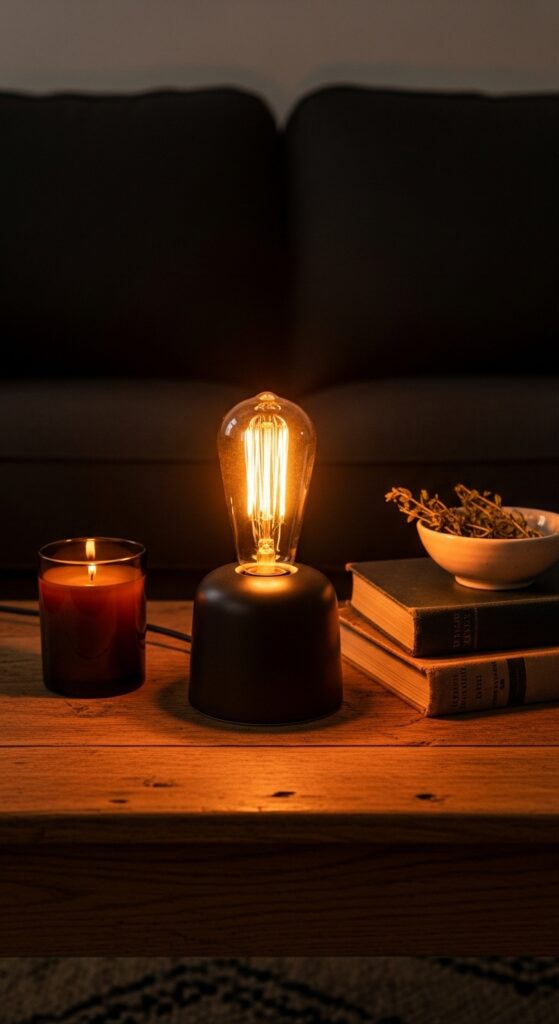
Vibe: Intimate and amber-warm — the kind of light that makes everything look like a memory.
Why it works: Placing a small lamp directly on the coffee table rather than on a side table drops the light source lower in the room, which fundamentally changes the mood. Overhead and side-table lighting creates a “task” feeling; low light pooling up from below eye level creates an “evening” feeling even at 7pm. Edison bulbs specifically emit at around 2200K color temperature — warmer than incandescent (2700K) and dramatically warmer than daylight (5000K+), which makes skin, wood, and ceramics all read as their warmest, most beautiful versions.
How to get it: A plug-in Edison bulb lamp with a black ceramic base from Schoolhouse Electric ($85–$125) or Rejuvenation ($95) is the refined version. IKEA’s “Rollsbo” lamp with a warm Edison-style bulb runs $25 and hits the same effect.
17. Concrete and Warm Wood Combination
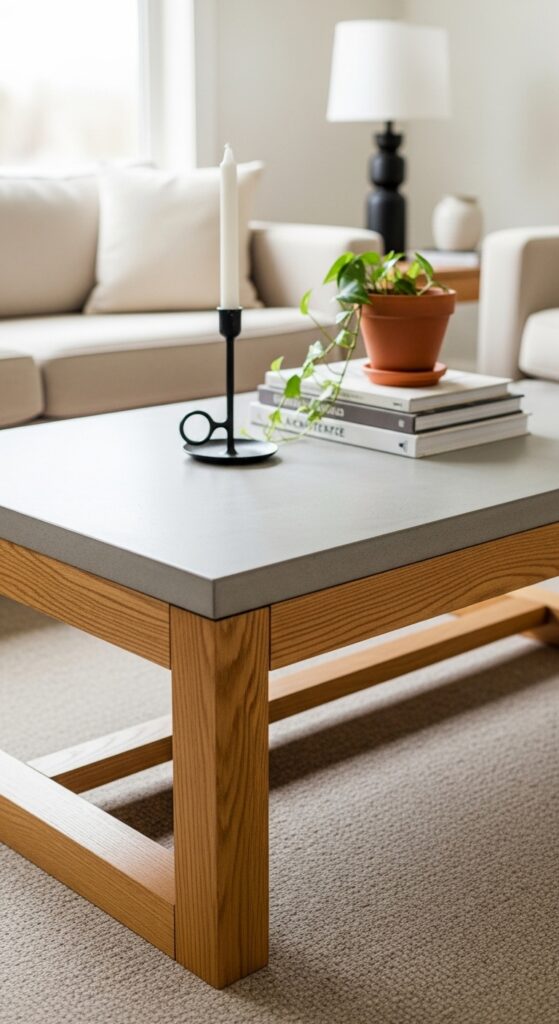
Vibe: Raw and balanced — the concrete keeps the wood from going too sweet, and the wood keeps the concrete from going cold.
Why it works: Concrete and warm wood work together because they sit at opposite ends of the organic-industrial spectrum, and their combination creates the material tension that defines modern farmhouse style. Concrete’s cool grey undertone provides a visual counterweight to the amber warmth of unfinished oak — without it, a room full of warm wood tones can feel heavy. Together, they achieve a balance that feels simultaneously cozy and architecturally considered.
How to get it: Ardex Feather Finish concrete overlay ($35 for a 10 lb bag) applied over an existing table top (sanded to 80-grit first) creates a genuine concrete look without the weight of a full concrete slab. Apply in two thin coats with a flexible trowel, then seal with Penetron concrete sealer for a water-resistant matte finish.
💡 Quick Win: Contact paper in a concrete texture ($15–$20 for a 2-foot roll on Amazon) applied to an existing table top creates a surprisingly convincing effect for a temporary refresh.
18. A Curated Trio of Botanicals in Different Vessels
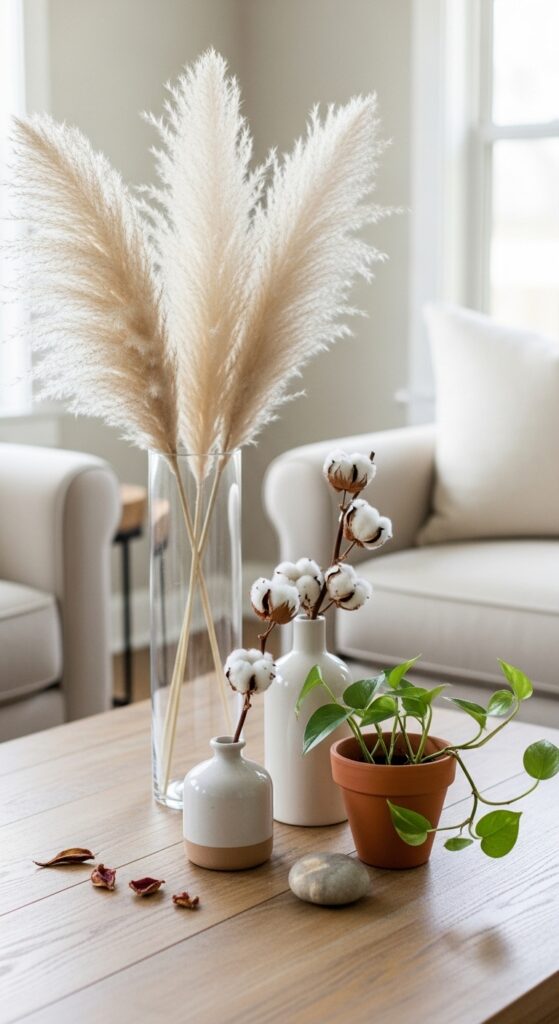
Vibe: Layered and quietly alive — the botanicals make the room feel like it’s breathing.
Why it works: Grouping three botanical vessels of different heights works on the principle of “triangular composition” — the tallest piece forms the apex, the mid-height piece forms one base corner, and the lowest piece anchors the other. This arrangement, borrowed from classical still-life painting, gives the eye a natural path to follow. Different vessel materials (glass, matte ceramic, terracotta) add texture variety without color complexity, which is the farmhouse approach to accessorizing: vary materials, not colors.
How to get it: The three-vessel rule: one tall (12″+), one medium (6–8″), one low (3–4″). Choose vessels in the same color family — whites, creams, terracotta — even if the materials differ. Dried botanicals (pampas grass, cotton stems, dried eucalyptus) require no water and last for years. MUJI’s small white ceramic vessels ($8–$15) and Target’s terracotta pots make this grouping achievable under $40 total.
How to Start Your Farmhouse Coffee Table Transformation
Start with the table’s finish, not the table itself. Before adding a single object, determine whether your table’s current color is working with or against your room. Sherwin-Williams “Alabaster” (SW 7008) applied to a wood table’s base coat creates the warm, slightly cream white that reads as farmhouse rather than sterile — it’s the specific undertone that matters. Everything you layer on top will feel intentional once the foundation color is right.
The most common mistake beginners make is choosing a too-cool, too-bright white. True white with blue undertones reads as coastal or contemporary in a farmhouse room — not farmhouse. Look for paints labeled “warm white” or “soft white” and hold them against a piece of unfinished pine: the right white will pull yellow or cream undertones from the wood rather than contrasting against it.
Three items under $50 that create immediate farmhouse impact on any coffee table: a matte black iron candle tray ($14–$20 at HomeGoods or TJ Maxx), a set of natural dried pampas grass stems in a clear glass cylinder vase ($18–$22 on Amazon), and a set of four round unglazed terracotta coasters ($12–$16 from Etsy sellers).
A realistic starting transformation — tray styling, a coat of paint, two or three new accessories — takes one weekend and runs $50–$150. A full farmhouse living room with a new coffee table, rug, and coordinated accessories realistically costs $800–$2,500 and takes three to six months of sourcing and living with choices before it feels finished.
Frequently Asked Questions About Farmhouse Coffee Tables
What is the difference between farmhouse style and rustic style for coffee tables?
Farmhouse and rustic style share natural materials but diverge significantly in feel. Rustic leans darker, rougher, and more rugged — think dark walnut, exposed bark, iron hardware, and a hunting-lodge quality. Farmhouse style is lighter, cleaner, and more refined in its imperfection: warm whites, aged pine, linen, and a sense that the wear on the wood came from daily family life rather than deliberate distressing. A farmhouse coffee table will typically have a painted or whitewashed element alongside the natural wood; a rustic table rarely would. If your walls are white and your sofa is linen, you want farmhouse — if your walls are exposed stone, you want rustic.
What colors work best on a farmhouse coffee table?
The safest farmhouse coffee table colors are warm white, chalk cream, muted sage green, and natural wood tones ranging from bleached pine to honey oak. Avoid cool greys, navy, or bright colors — they pull the table toward a different aesthetic. Farrow & Ball “Old White” and Sherwin-Williams “Alabaster” are the two most reliable painted finishes. If you prefer natural wood, look for unfinished white oak or lightly oiled pine — both warm to honey tones that sit perfectly within the farmhouse palette.
Is farmhouse-style furniture expensive to achieve?
Farmhouse style is one of the most budget-accessible design aesthetics because its core appeal is imperfection and age — qualities that thrift stores, estate sales, and DIY projects deliver naturally. A solid-looking farmhouse coffee table can be sourced for $20–$60 at Habitat for Humanity ReStores or Facebook Marketplace, then updated with a $15 can of chalk paint. The one area where spending more pays off is textiles: a quality undyed linen throw ($60–$120) reads immediately as high-quality and ages beautifully, whereas a cheap synthetic will look tired within a season.
Can I mix farmhouse style with other decorating styles?
Farmhouse pairs naturally with several other aesthetics — particularly coastal (shared natural materials), Japandi (shared preference for natural wood and restraint), and vintage traditional (shared comfort with aged patinas). The key is identifying what farmhouse and your other style have in common and leaning into that overlap. Where it conflicts is with ultra-contemporary and ultra-minimalist styles: a farmhouse coffee table’s visible grain, worn finish, and organic styling can read as visually noisy against very clean-lined, monochromatic modern interiors. A simple rule: if your room has more than three materials already, farmhouse adds texture well. If it has only one or two, introduce it carefully.
What plants work best on a farmhouse coffee table?
Dried botanicals outperform living plants for farmhouse coffee table styling because they require no water (and therefore no drip tray), maintain their form indefinitely, and have natural tones — ivory pampas, silvery dried eucalyptus, wheat-toned dried grasses — that fit directly into the farmhouse palette. For living plants, a small trailing pothos in a terracotta pot or a single sprig of fresh rosemary in a small clear bottle (refreshed weekly) both read as appropriately farmhouse. Avoid succulents in modern geometric pots — they read as contemporary, not farmhouse — and avoid orchids, which read as formal.
Ready to Create Your Dream Farmhouse Coffee Table?
These 18 ideas have moved across the full range of what farmhouse coffee table styling can be — from raw live-edge slabs and chalk-painted finishes to lighting choices, botanical groupings, material combinations, and small-space adaptations. Transformation doesn’t have to happen all at once. Starting with a single element — a new finish, a curated tray, a shift in how you group objects — is not just acceptable, it’s the right approach; the best farmhouse rooms evolve rather than arrive complete. This week, pull one piece of natural wood into your styling — a tray, a wooden bowl, a single cutting board propped against the wall — and watch how the rest of the room settles around it. When this is done well, you’ll feel it before you can explain it: a room that’s quieter, warmer, and more yours. Pin the ideas that made you stop scrolling — the ones where you thought “that’s exactly it” — and let those be your compass.