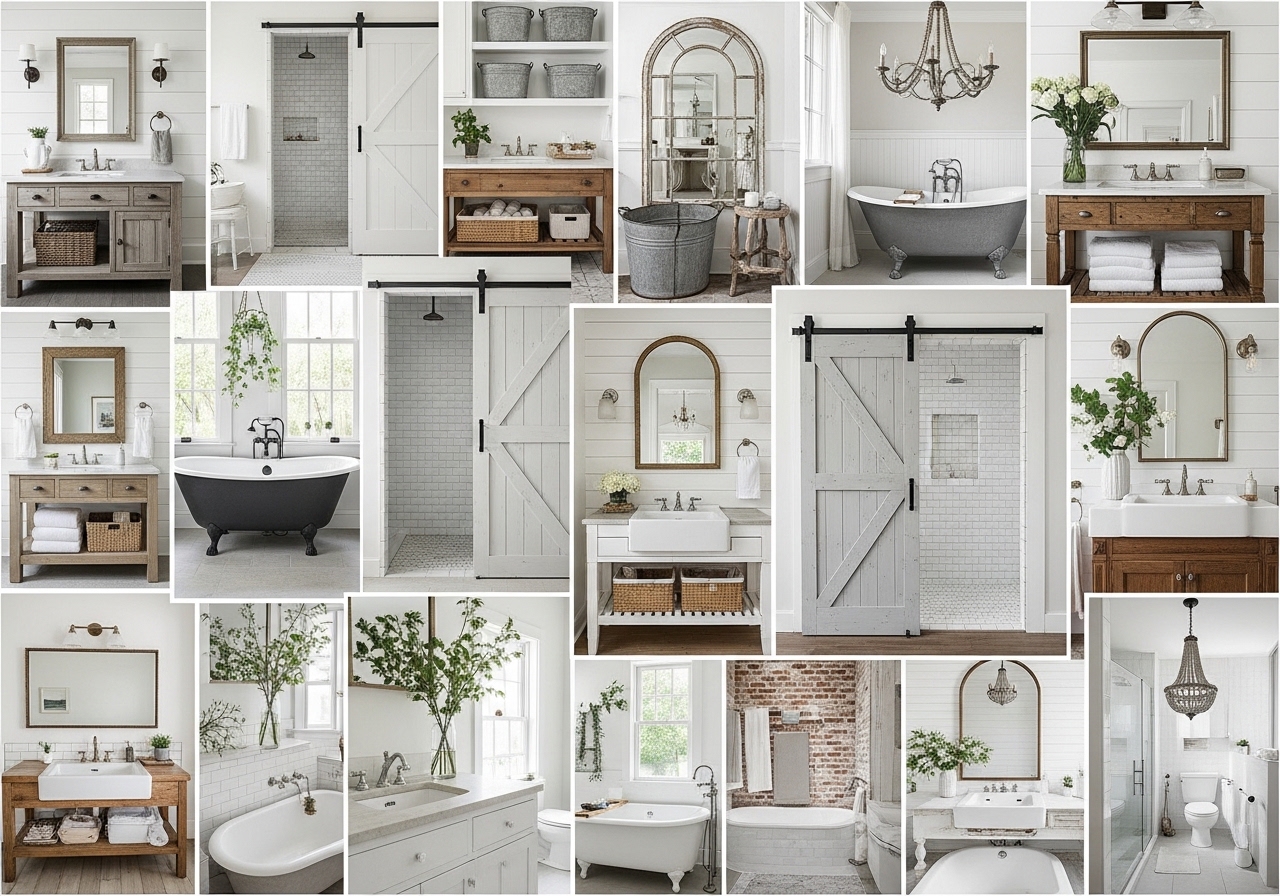
Farmhouse style is the art of pairing raw, humble materials — reclaimed wood, aged metal, worn linen — with a warm, unhurried aesthetic that makes a space feel lived-in and intentional at the same time. These 21 farmhouse bathroom ideas give you exactly what you need to build that feeling, from paint palette to final accessory.
There’s a particular kind of stillness that only a farmhouse bathroom can hold. It’s in the grain of the shiplap, the weight of a cast iron tub, the soft thud of bare feet on matte stone tile. Light moves differently here — slower, warmer, more forgiving. This style doesn’t ask you to curate perfection. It asks you to let things breathe. Here are 21 ideas worth saving — and stealing.
Why Farmhouse Style Works So Well
Farmhouse design has its roots in 19th-century American vernacular architecture — the working farmhouses of the Midwest and South that prioritized durability, warmth, and unpretentious comfort over ornament. Unlike its close cousin, rustic design, farmhouse style isn’t about roughness for its own sake. It’s about honest materials used well, with a quiet elegance that comes from restraint rather than absence.
The core palette is warm and earthy: warm white (think Benjamin Moore “White Dove” or Sherwin-Williams “Alabaster”), soft greige, dusty sage, muted black, and occasionally a note of terracotta or aged brass. Materials are equally specific — shiplap paneling, unfinished or whitewashed oak, brushed nickel and matte black hardware, undyed linen, clawfoot or apron-front fixtures, and handmade ceramic vessels. Every surface has a story built into its texture.
Farmhouse style is having a sustained cultural moment because it answers a real emotional need. After years of hyper-curated, trend-driven interiors, people are craving spaces that feel genuinely personal. Pinterest searches for “farmhouse bathroom” and “cozy rustic bathroom” have remained in the top 10 home decor searches for five consecutive years — not because the style is new, but because it doesn’t go stale. It reflects a broader post-pandemic shift toward slower living and spaces that actually feel like home.
Even a small bathroom can carry this style beautifully. In compact spaces, prioritize three things: a single shiplap accent wall (floor-to-ceiling), matte black or brushed brass fixtures as visual anchors, and linen or cotton textiles in place of heavy window treatments. Scale down the hardware, not the character.
| Element | Core Farmhouse Trait | Grounding Detail |
| Philosophy | Honest, humble beauty | Warmth without fuss |
| Materials | Shiplap, oak, cast iron | Linen, stone, aged brass |
| Color palette | Warm white, soft greige | Dusty sage, matte black |
1. Shiplap All the Way Up
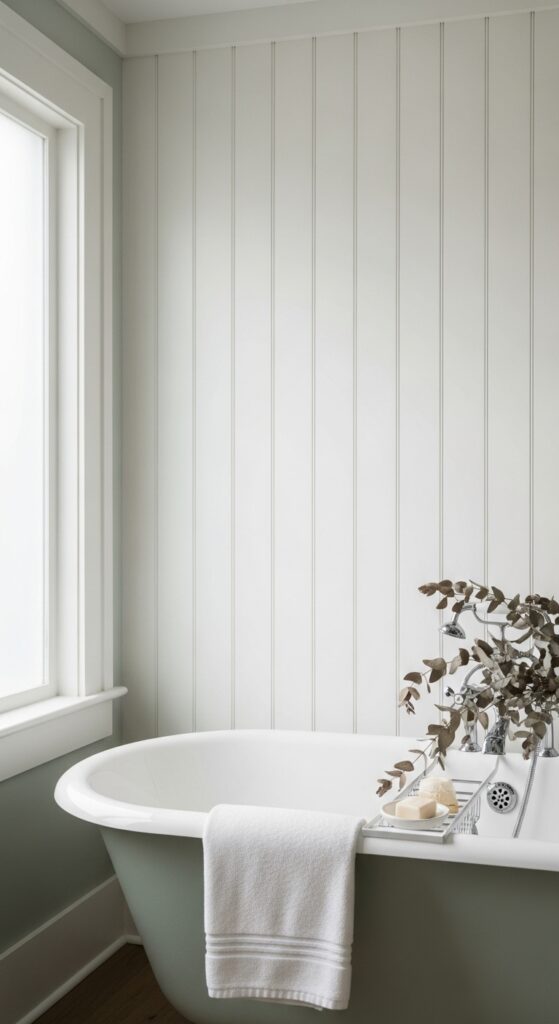
Vibe: Still — like a room that has been quietly exhaling for a hundred years.
Why it works: Shiplap’s horizontal or vertical lines create a strong visual rhythm that adds architectural interest without competing with fixtures or décor. Painted in a warm white like Benjamin Moore “Chantilly Lace,” the boards reflect soft, diffused light differently across the day — catching shadow in the grooves at noon, glowing warmly at dusk. That constant, gentle variation is what gives a shiplap bathroom its living quality. It never feels flat.
How to get it: Install tongue-and-groove pine boards (½” thick, 3½” wide) horizontally from floor to ceiling on one accent wall — behind the vanity or the tub. Prime with a shellac-based primer before painting to prevent bleed-through from wood tannins. One wall delivers full impact without overwhelming the room.
💡 Quick Win: Peel-and-stick shiplap panels from RoomMates or NovaBrik run about $30–$45 per pack and require zero tools — a strong weekend shortcut for renters.
2. Warm Greige: The Palette That Does the Heavy Lifting
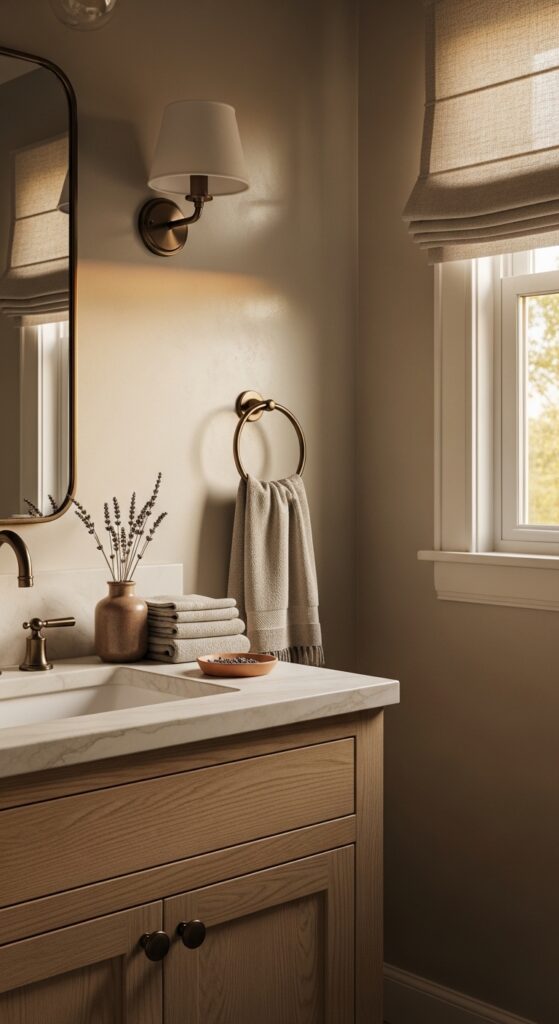
Vibe: Sun-warmed — like late afternoon light trapped inside the walls themselves.
Why it works: Greige — that precise balance of gray and beige — succeeds where pure white fails in many bathrooms: it reads warm even in north-facing rooms and doesn’t shift lavender or blue under artificial light the way cool grays do. Sherwin-Williams “Accessible Beige” (SW 7036) and Benjamin Moore “Pale Oak” are the two most reliable farmhouse greiges because both carry golden undertones that enhance natural wood without fighting it. The result is a room that feels cohesive even when the materials are varied.
How to get it: Test your greige in a 12″ × 12″ painted swatch and observe it at three different times — morning, midday, and evening lamplight. Greige is notoriously undertone-sensitive; a 2-degree shift in formula creates an entirely different result. If your bathroom lacks natural light, lean toward Pale Oak rather than Accessible Beige — it reads a half-shade warmer in artificial light.
3. The Clawfoot Tub as Anchor
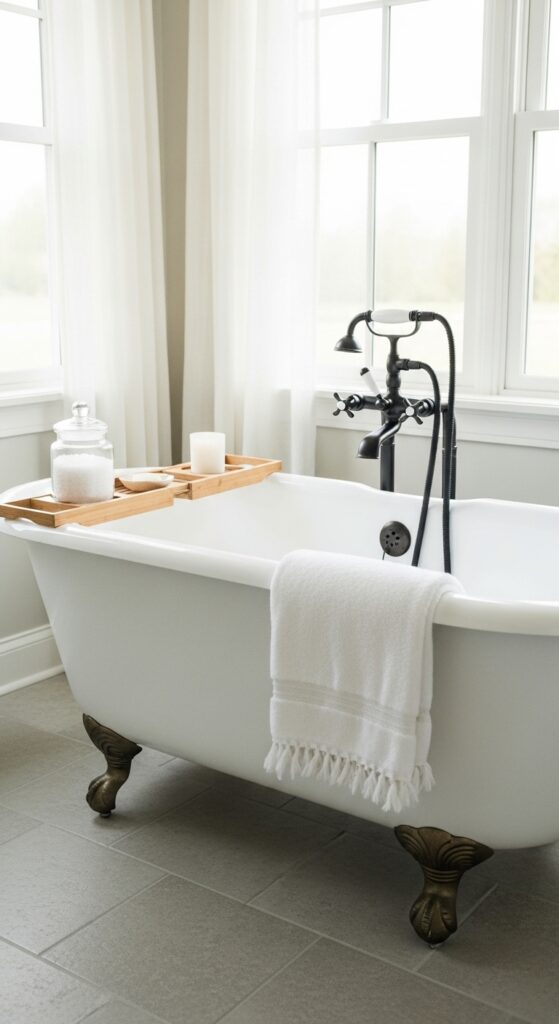
Vibe: Hushed — the kind of quiet that only a room with one important thing in it can hold.
Why it works: A clawfoot tub functions as a piece of furniture — it commands the room the way a statement sofa anchors a living room. The principle at play is visual weight and negative space: one heavy, characterful object surrounded by intentional breathing room makes a stronger design statement than a room filled with many smaller things. The tub’s curved silhouette also provides essential softness in a room that might otherwise feel too hard-edged from tile and fixtures.
How to get it: Position the tub at least 6″ from all walls on every side — the surrounding floor space is part of the composition. Pair with a floor-mount tub filler rather than a wall-mount to keep the tub’s profile clean. Vintage cast iron clawfoot tubs can be found on Facebook Marketplace for $200–$600; have them professionally re-glazed for $300–$500 for a fraction of new cost.
4. Open Shelving with Honest Display
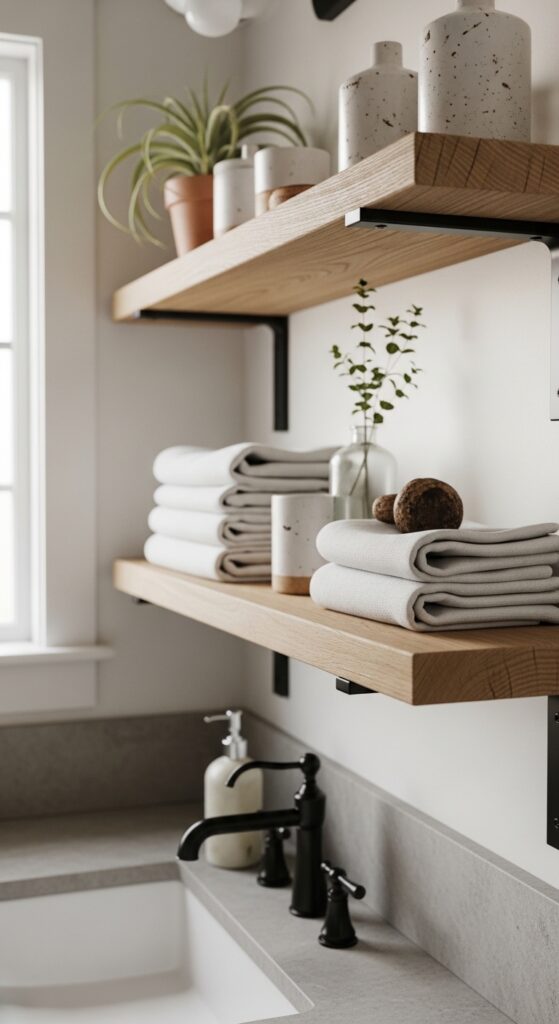
Vibe: Grounded — as if someone lived here long enough to know exactly where everything belongs.
Why it works: Open shelving in a farmhouse bathroom works because it treats functional objects as part of the design — folded towels become texture, ceramic vessels become sculpture. The design principle is honest display: everything visible should be either beautiful in itself or beautiful when grouped. The contrast between the raw, warm wood shelf and matte black brackets creates a sharp, graphic moment that reads modern-farmhouse rather than purely rustic.
How to get it: Limit each shelf to three categories maximum — towels, vessels, and one botanical. Use the rule of odds: three items, five items, never four or six. Source unfinished white oak shelves from a local lumber yard (cut to size and sanded to 220 grit) and mount on Rejuvenation’s Industrial Utility brackets in matte black at around $28 each.
💡 Quick Win: Roll linen hand towels tightly and stand them upright in a wide-mouth ceramic crock — it costs nothing and transforms a functional item into a display piece instantly.
5. Matte Black Fixtures: The Modern Edge
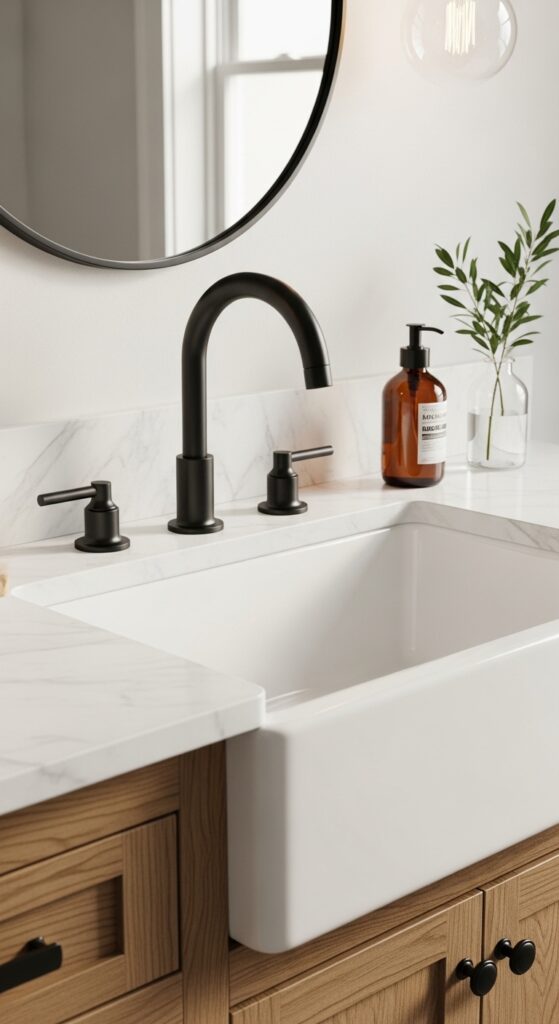
Vibe: Raw — with exactly the right amount of edge.
Why it works: Matte black fixtures function as punctuation in a farmhouse bathroom — they’re the visual full stops that keep the palette from reading as undefined or beige-heavy. The design principle here is value contrast: the dark fixture against a warm white wall creates a crisp focal point that makes the surrounding materials — wood grain, linen, ceramic — look more intentional by comparison. Unlike polished chrome, matte black doesn’t require a perfect background to look good.
How to get it: When switching to matte black fixtures, replace all hardware in a room at once — a single polished piece will read as a mistake rather than a choice. Signature Hardware and Kingston Brass both offer full matte black farmhouse collections (faucet, towel ring, toilet paper holder, robe hooks) for under $400 total. Avoid matte black in high-traffic areas with very hard water — mineral deposits are more visible than on polished finishes.
6. Apron-Front Sink Vanity
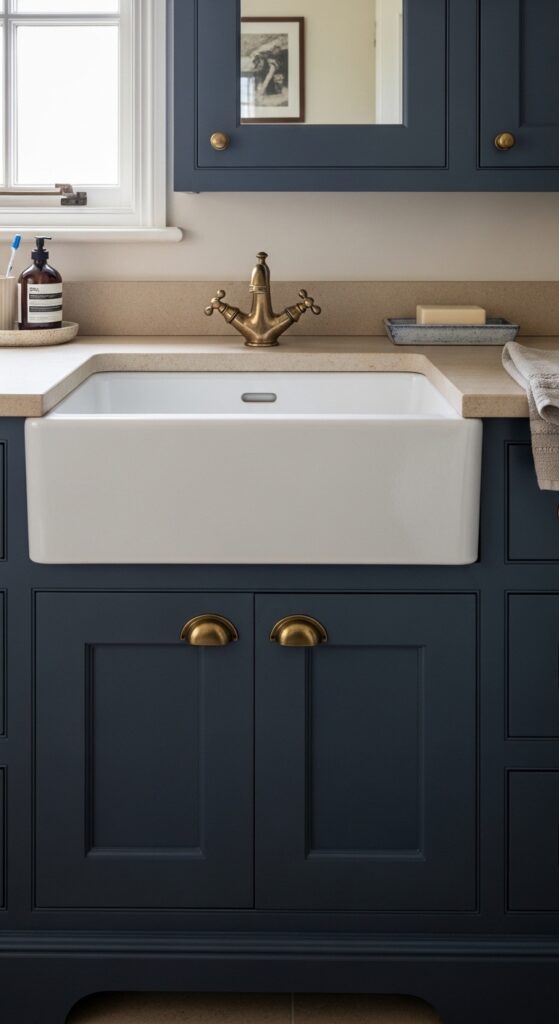
Vibe: Layered — like a space that holds years of quiet, daily ritual.
Why it works: The apron-front sink brings the visual language of a farmhouse kitchen directly into the bathroom, creating the same sense of honest utility dressed up with care. Pairing it with a painted Shaker cabinet introduces color without pattern, depth without busyness. The aged brass pulls bridge the gap between the sink’s white glaze and the cabinet’s painted surface — a detail that costs very little but reads as deeply considered.
How to get it: IKEA’s HAVSEN apron-front sink ($299) is a fireclay alternative that accepts most standard Shaker base cabinets — you can build a custom-looking vanity for under $600 by pairing it with their HEMNES base and painting it in Farrow & Ball “Hague Blue” or a close dupe from Clare Paint. Replace stock hardware with aged brass cup pulls from Anthropologie’s home line (around $15 each).
💡 Quick Win: An apron-front look can be faked with a curved, painted wood panel applied to the front of an existing under-sink cabinet — it costs about $40 in materials and adds immediate character.
7. Layered Linen: Texture Over Pattern
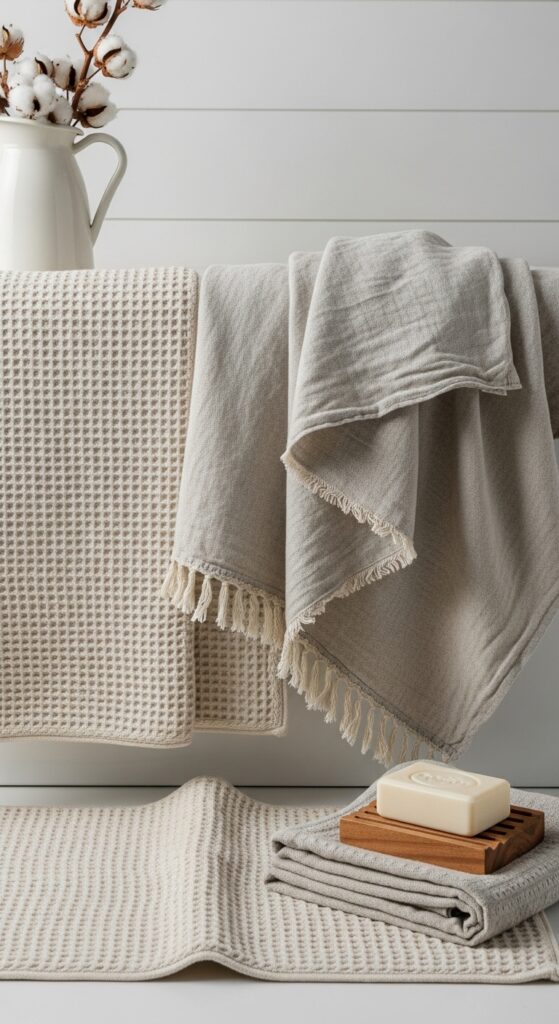
Vibe: Hushed — the way a room feels when every surface has a little give to it.
Why it works: Linen in a farmhouse bathroom works because of what designers call texture layering — placing multiple materials with similar tones but different weave densities so the room reads rich rather than flat. A waffle-weave mat, a loose-woven shower curtain, and a tightly folded hand towel share the same natural palette but offer three different tactile experiences. That variety of texture in a single tonal family is the hallmark of sophisticated, effortless styling.
How to get it: Source undyed Belgian linen from Libeco or a close dupe from IKEA’s ÄNGSJÖN line. The key is keeping all textiles in the same undertone family — linen and cotton have different undertones (linen reads golden-warm; cotton reads cooler), so mix them intentionally rather than randomly. Wash linen before styling; the laundered texture is softer and more natural than the stiff off-the-shelf version.
8. Warm Ambient Lighting: Ditch the Overhead Glare
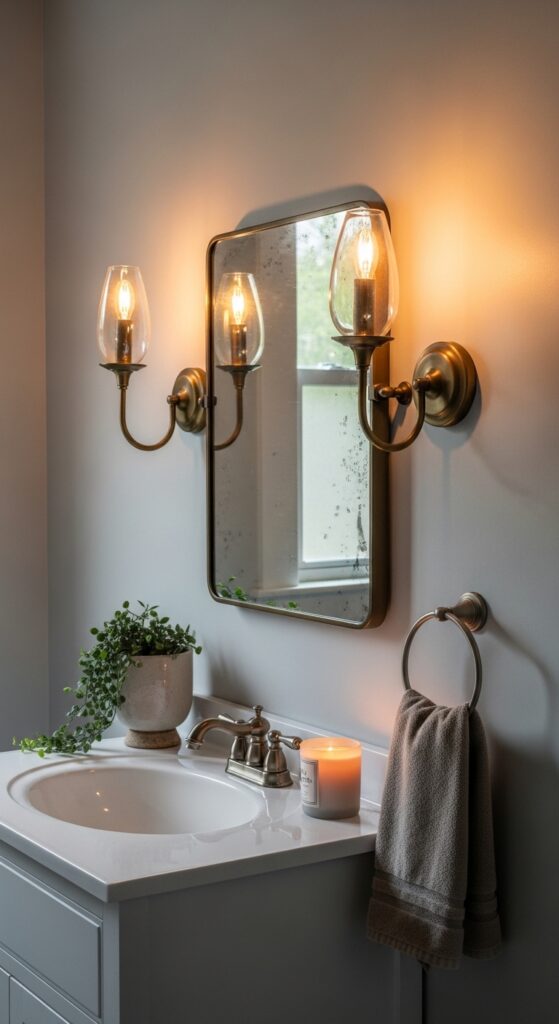
Vibe: Romantic — the kind of warm that makes everything look like it belongs.
Why it works: Most bathrooms suffer from a single overhead fixture that creates harsh downward shadows — unflattering, clinical, and fundamentally at odds with a farmhouse aesthetic. Side-mounted sconces at eye level (roughly 65–68″ from floor to center) light the face evenly and spread a warm ambient glow that transforms the room’s entire atmosphere. The light behavior of aged brass sconces with a 2700K bulb replicates candlelight in a way that no overhead fixture can match.
How to get it: Replace a single overhead bar light with two flanking sconces — one on each side of your mirror, spaced 28–36″ apart (center to center). Schoolhouse Electric and Rejuvenation both offer farmhouse-appropriate sconces in aged brass from $85–$180 each. Pair with a 40W-equivalent LED bulb in 2700K for the warmest, most natural light output.
💡 Quick Win: Plug-in sconces (no electrician needed) from Amazon or West Elm start around $45 and can be mounted with two screws — a genuine weekend upgrade that changes the whole mood.
9. Vintage Mirror, Intentional Frame
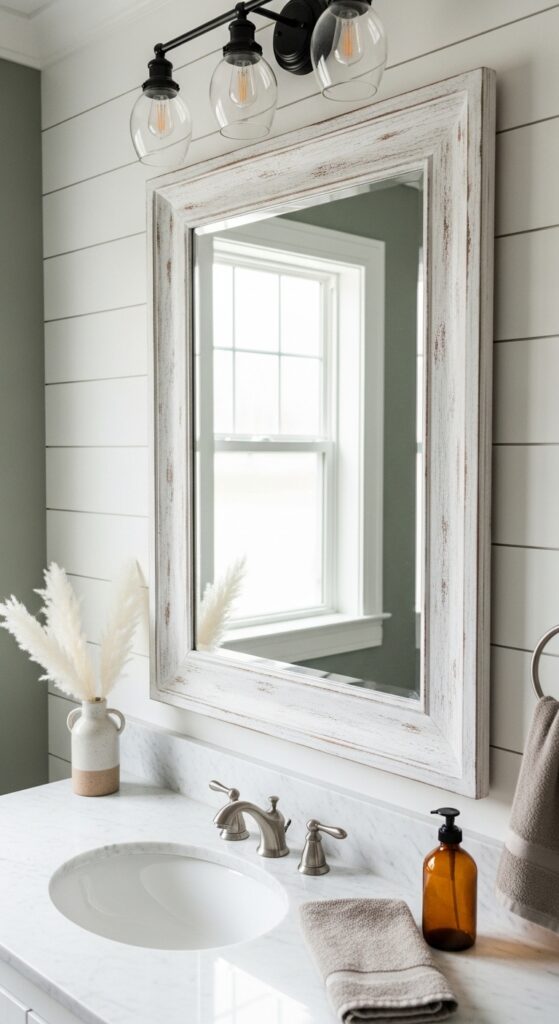
Vibe: Airy — the kind of room that seems twice its actual size.
Why it works: A mirror in a farmhouse bathroom does double design duty: it amplifies light and adds visual depth through reflection, while the frame itself acts as art. The key principle is proportion — the mirror should be at least as wide as the vanity below it, and ideally 80–90% of the vanity width. An undersized mirror reads as an afterthought; a correctly scaled mirror makes the whole wall feel considered. Distressed or whitewashed frames carry the farmhouse patina without requiring any other antique elements in the room.
How to get it: Look for oversized vintage mirrors at estate sales, Chairish, or Facebook Marketplace — frames can always be repainted or gently distressed with sandpaper. To distress a frame: paint in Benjamin Moore “White Dove,” let dry fully, then lightly sand at corners and edges with 80-grit sandpaper to reveal the wood beneath. One strategic pass is enough.
10. Reclaimed Wood Floating Vanity
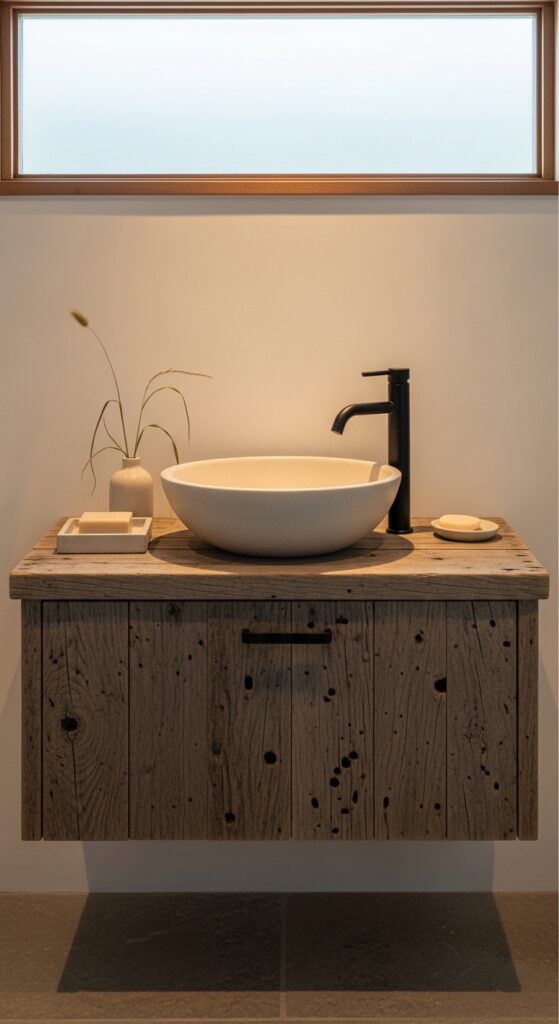
Vibe: Raw — like the wood has earned every one of its years.
Why it works: A floating vanity eliminates visual floor clutter, making the room read larger and more open — an effect called visual floor extension. When built from reclaimed barn wood, the piece carries the farmhouse aesthetic at its most authentic: no two slabs are identical, every knot and nail hole is part of the character. The contrast between the rough-hewn wood and a smooth ceramic vessel sink creates a textural opposition that’s the backbone of modern-farmhouse design.
How to get it: Source reclaimed barnwood slabs from Elmwood Reclaimed Timber or a local architectural salvage yard. Have the top sealed with a matte-finish water-based polyurethane (3 coats minimum) before installing near water. Mount on a French cleat with concealed wall brackets rated for at least 150 lbs. The floating mount keeps the floor visible, making even small bathrooms feel more spacious.
💡 Quick Win: A reclaimed wood look can be achieved with new pine boards stained with Varathane “Classic Gray” and sealed matte — total cost under $80 for a small vanity top.
11. Wainscoting + Wallpaper: A Two-Texture Wall
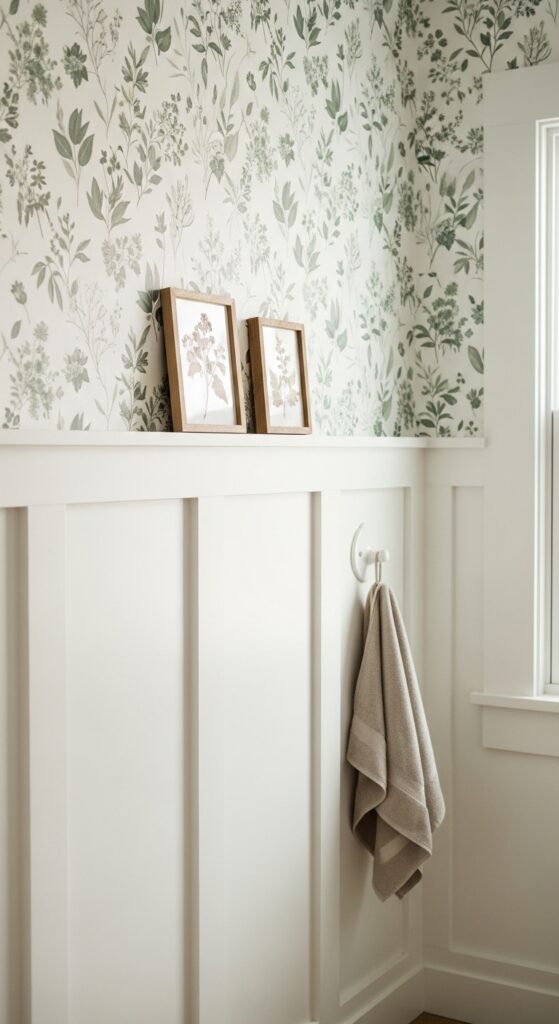
Vibe: Warm — like a room someone designed with a specific kind of morning light in mind.
Why it works: Board-and-batten wainscoting introduces strong vertical and horizontal lines that give a bathroom genuine architectural bones — without them, farmhouse accessories can feel pasted onto an undefined space. Layering wallpaper above the rail adds pattern and color while keeping the lower half protected and easy to clean. This two-zone wall treatment is a professional design technique for adding complexity to a room without clutter; it works especially well in bathrooms with standard 8-foot ceilings.
How to get it: Install 1×4″ boards vertically every 12–16″ between a top rail and baseboard, painted in Benjamin Moore “Simply White.” Above the rail, use a removable peel-and-stick botanical wallpaper from Tempaper or Chasing Paper ($2–$5 per sq ft) for a commitment-free version. The rail height should sit at approximately 40–42% of ceiling height.
12. Black-and-White Hex Tile: The Timeless Floor
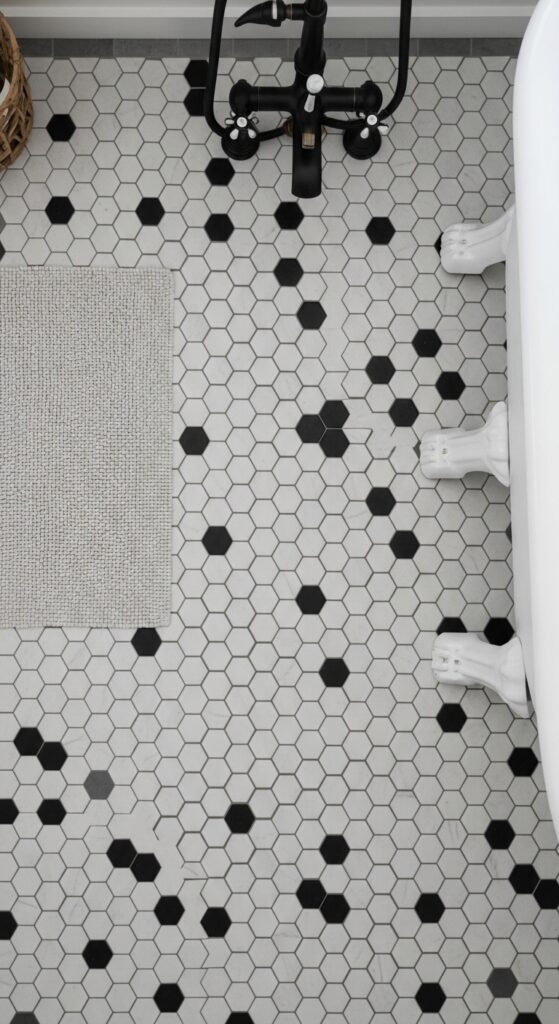
Vibe: Crisp — like a room that takes its history seriously.
Why it works: Small-format hex tile creates a visual texture on the floor rather than a flat field of color — this texture has enormous power in a farmhouse bathroom, grounding the space and adding genuine age. The black-and-white combination is not a trend but a vernacular — it appeared in American farmhouse bathrooms as early as the 1890s and has never actually left. The principle is pattern as anchor: a patterned floor means the walls and fixtures can afford to be quieter and still feel complete.
How to get it: Use 2″ white hex tile with a 25–30% black accent tile dropped in the pattern at regular intervals — the ratio creates energy without visual chaos. Specify unsanded grout in a medium gray (not bright white, which emphasizes grout lines; not charcoal, which reads too dark). Daltile and Jeffrey Court both carry penny and hex mosaic sheets starting around $4–$8 per square foot.
💡 Quick Win: A hex-patterned vinyl floor mat from Society6 or Target’s Threshold line runs $35–$60 and works beautifully in rentals — the floor illusion reads as convincing from normal standing distance.
13. Clutter-Free Counter: The Tray Edit
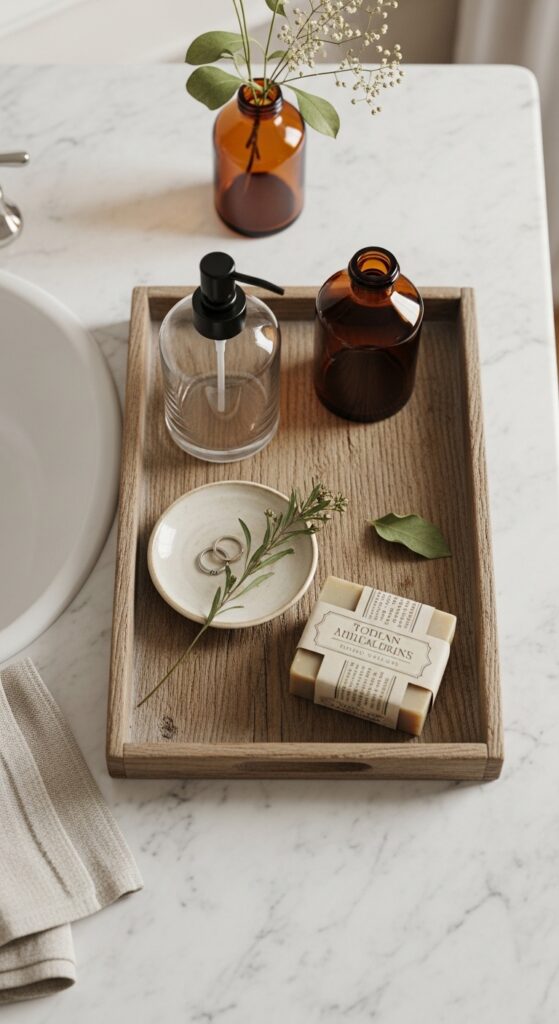
Vibe: Still — like someone pressed pause and everything landed exactly right.
Why it works: The tray acts as a visual container — it defines a zone on the counter and tells the eye where to look. Without it, even a few objects read as clutter; with it, the same objects read as a considered collection. This is the principle of contained grouping: objects within a defined boundary feel intentional; objects outside one feel random. Farmhouse styling relies heavily on this technique because the materials themselves (wood, ceramic, glass) tend to look more beautiful when grouped by material or tone.
How to get it: Use a single tray — white ceramic, weathered wood, or beaten copper — no larger than 14″ × 8″ for most vanities. Fill it with three to five items maximum, all functional. Edit everything else into drawers or baskets below. The rule: if it lives on the counter, it must either earn its visual weight or be removed entirely.
14. Indoor Plants for Living Texture
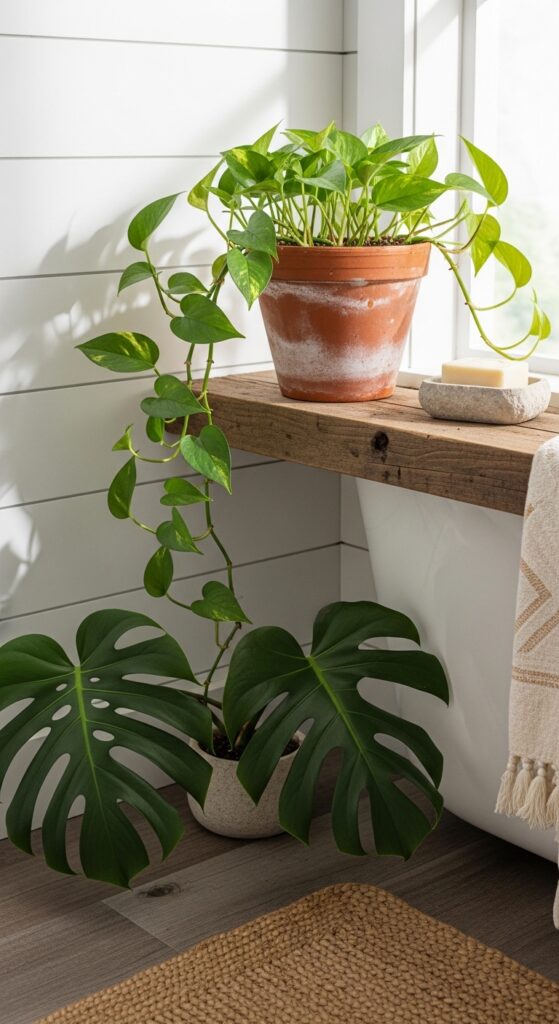
Vibe: Alive — the way a room feels when something in it is actually growing.
Why it works: Plants in a farmhouse bathroom serve a design function beyond aesthetics: they introduce organic form — irregular edges, asymmetry, layered depth — that no purchased décor object can replicate. The principle is living texture: a trailing pothos on a shelf adds vertical movement; a floor-level monstera adds horizontal mass. Together, they occupy the corners and edges that are the hardest zones to design, without requiring any built architecture.
How to get it: Choose plants suited to bathroom humidity and variable light: pothos, ZZ plants, and peace lilies thrive in low-light bathrooms; bird-of-paradise and monstera need a bright window. Plant them in handmade terracotta (not plastic nursery pots) — the material reads immediately as farmhouse and the clay breathes, benefiting the plant as well as the aesthetic.
💡 Quick Win: A single large pothos cutting rooted in a glass jar on a shelf costs under $5 at a plant swap or grocery store and transforms a plain shelf instantly.
15. Shaker Cabinetry in a Statement Color
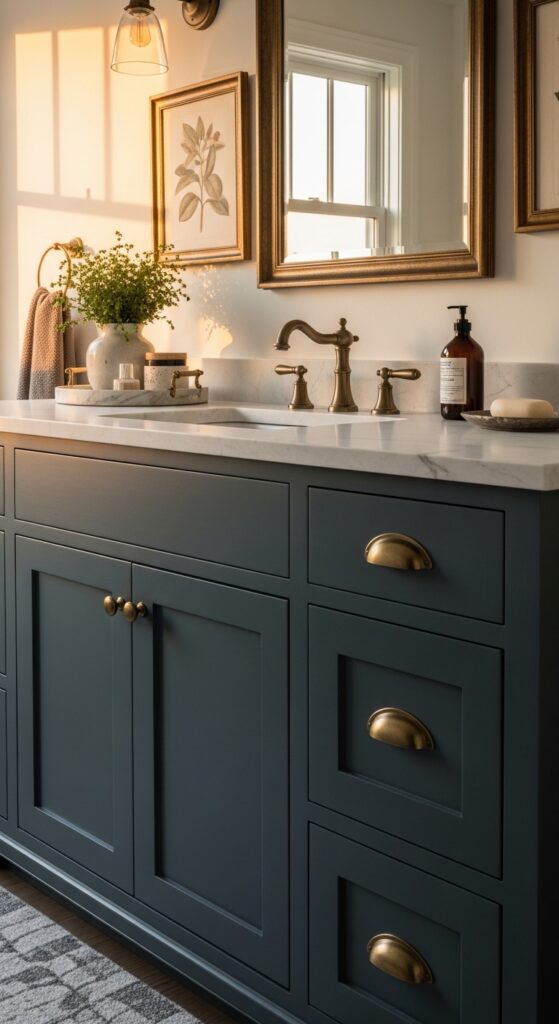
Vibe: Confident — the way a room feels when one piece knows exactly what it is.
Why it works: A Shaker cabinet in a deep, muted color — navy, forest green, or charcoal — functions as the room’s visual anchor. In design terms, it creates a low center of gravity, pulling the eye downward and making the rest of the room (light walls, bright fixtures) feel more open by contrast. The Shaker door profile is the ideal farmhouse cabinet style because its recessed center panel gives the door genuine architectural dimension without any fussiness or ornament.
How to get it: Paint existing Shaker cabinets rather than replacing them — preparation is 80% of the result. Sand with 150-grit, prime with Zinsser BIN shellac-based primer, then apply Benjamin Moore Advance paint in “Newburyport Blue” (HC-155) with a 4″ foam roller. Two thin coats outperform one thick one. Replace stock hardware with aged brass cup pulls from House of Antique Hardware.
16. Walk-In Shower with Frameless Glass
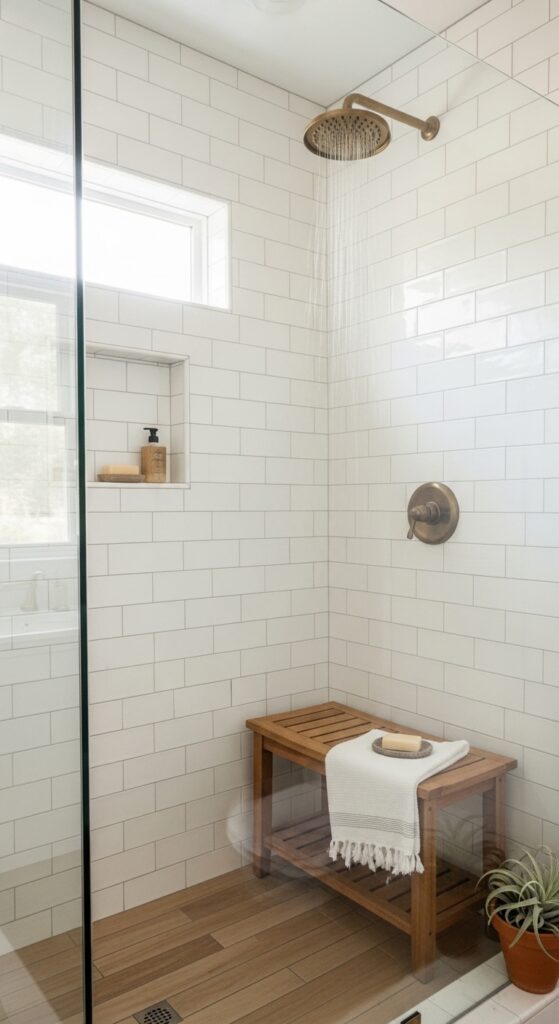
Vibe: Serene — like a room that has already forgiven the day’s commotion.
Why it works: A frameless glass enclosure does something a framed shower door never can: it keeps the floor visible from edge to edge, elongating the perceived length and width of the room without removing a single square foot. In farmhouse terms, the key is the tile inside — white subway tile in a classic brick pattern (3″×6″, laid horizontally with warm gray grout) creates the right historic reference without veering into sterile minimalism. The aged brass fixture is the element that pulls it back to farmhouse warmth.
How to get it: Specify warm gray or greige grout — never bright white, which marks easily and makes the tile look clinical. Laticrete’s “Antique White” or “Warm Gray” are both reliable farmhouse grout colors. For the fixture, specify a 10″ or 12″ rainfall head in aged brass or matte black — oversized heads require checking your home’s water pressure (minimum 45 PSI recommended).
💡 Quick Win: Re-grouting existing shower tile with a warmer grout color is a weekend project under $80 that transforms the mood of the entire shower enclosure.
17. Wicker and Rattan: Woven Softness
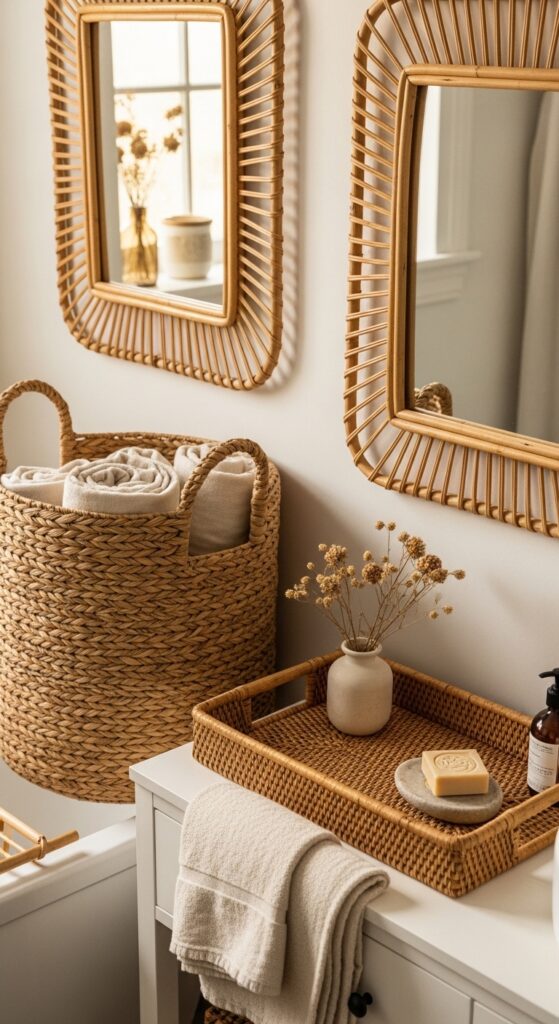
Vibe: Warm — an effortless warmth that reads as handmade and unhurried.
Why it works: Wicker and rattan introduce a material warmth that wood and ceramic alone can’t achieve — their irregular weave creates micro-shadows across the surface that shift throughout the day as light moves. In design terms, this is material contrast at the micro scale: the tight geometry of tile and cabinetry becomes more interesting when set against the organic irregularity of woven fiber. Rattan specifically carries a cross-cultural resonance that feels simultaneously antique American and globally artisan — a quality that lifts it above a merely rustic accessory.
How to get it: Use rattan in at least two places in the same bathroom for it to read as an intentional design element rather than a random accessory — mirror frame plus storage basket, or shelf liner plus side table. IKEA’s SOLLERÖN rattan mirror ($49) is an accessible starting point; pair it with a rattan lidded basket from World Market ($25–$45).
18. Black Steel Window Frame: Architectural Drama
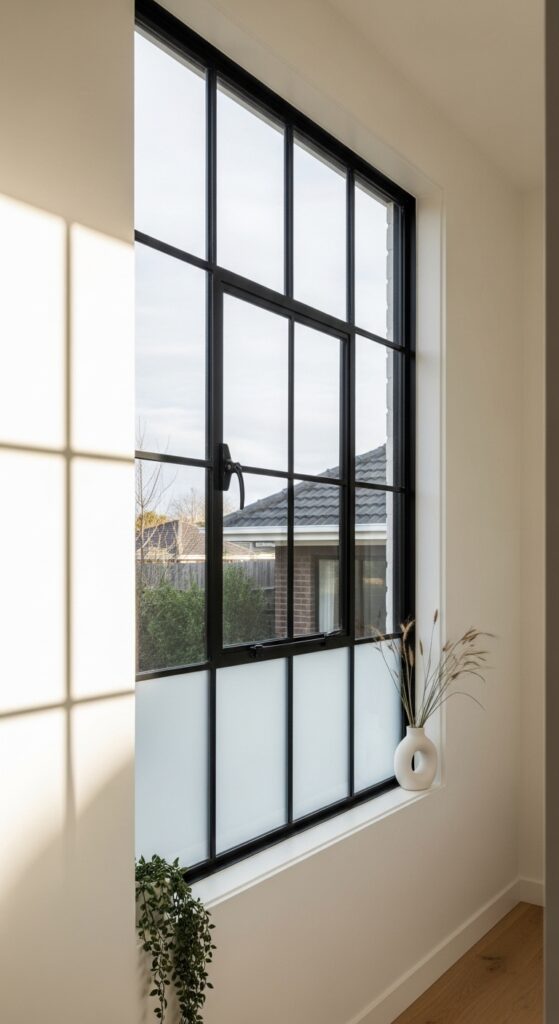
Vibe: Luminous — the kind of light that makes you stop what you’re doing.
Why it works: Black steel-frame windows — sometimes called Crittal-style after the British manufacturer — introduce strong graphic geometry and an industrial-meets-farmhouse aesthetic that reads unmistakably architectural. The divided light panes cast grid shadows that move across the wall through the day, making light itself a design element. In a white bathroom, these moving shadows provide constant, subtle visual interest that no amount of decorating can replicate. The black frame also anchors the color palette in a room where matte black fixtures might otherwise feel isolated.
How to get it: For existing windows, a Crittal-style vinyl overlay kit (under $200) replicates the grid pattern without replacing the window. For interior pass-through windows between a bathroom and hallway, steel frame kits from companies like Steelsmith or Colonial Elegance start around $400–$800 and install in a standard rough opening.
💡 Quick Win: A Crittal-style adhesive window film from Etsy ($25–$40 per sheet) applied to a plain bathroom window gives the divided-light grid effect at almost no cost.
19. Vintage Artwork: Framed and Unexpected
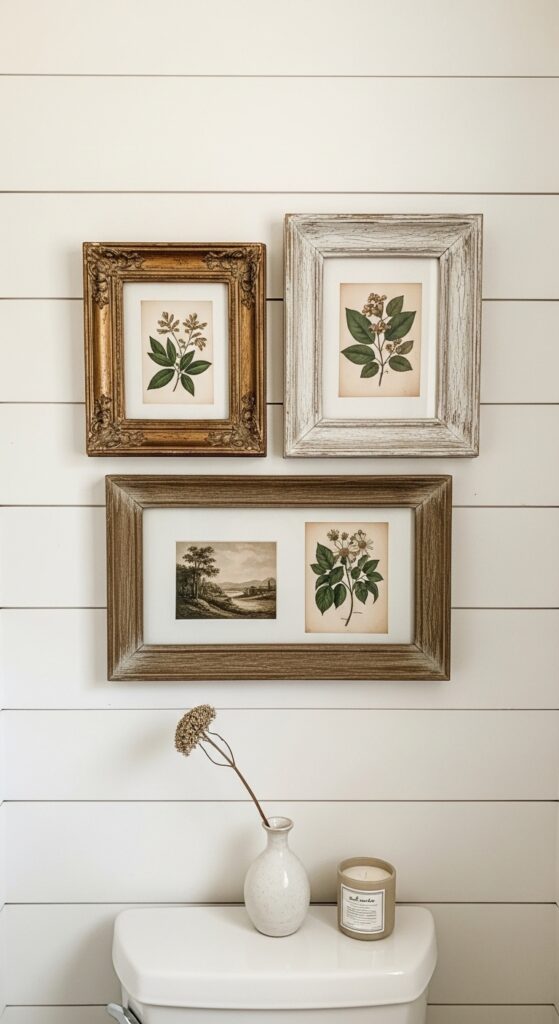
Vibe: Curated — with the specific warmth of a space that tells its own story.
Why it works: Art in a bathroom is underused and wildly effective. The principle is unexpected vertical emphasis: a gallery arrangement above the toilet fills the one wall that most bathrooms leave entirely bare, and it fills it with something that rewards close looking. Vintage botanical and topographic prints carry the farmhouse’s historical sensibility and look genuinely right against shiplap without requiring any special curation beyond frame consistency. The key is keeping the frames within one finish family — all gilded, all painted white, all tortoiseshell — while varying sizes and shapes.
How to get it: Source vintage botanical prints from Etsy’s printable downloads ($3–$8 each, print at home), then frame in thrifted frames spray-painted in a unified finish (Rust-Oleum “Aged Gold” or “Flat White”). Arrange three frames in a tight cluster — largest in the center flanked by smaller frames — before hammering any nails. Use a paper template taped to the wall first.
20. Natural Stone Countertop: Honed Not Polished
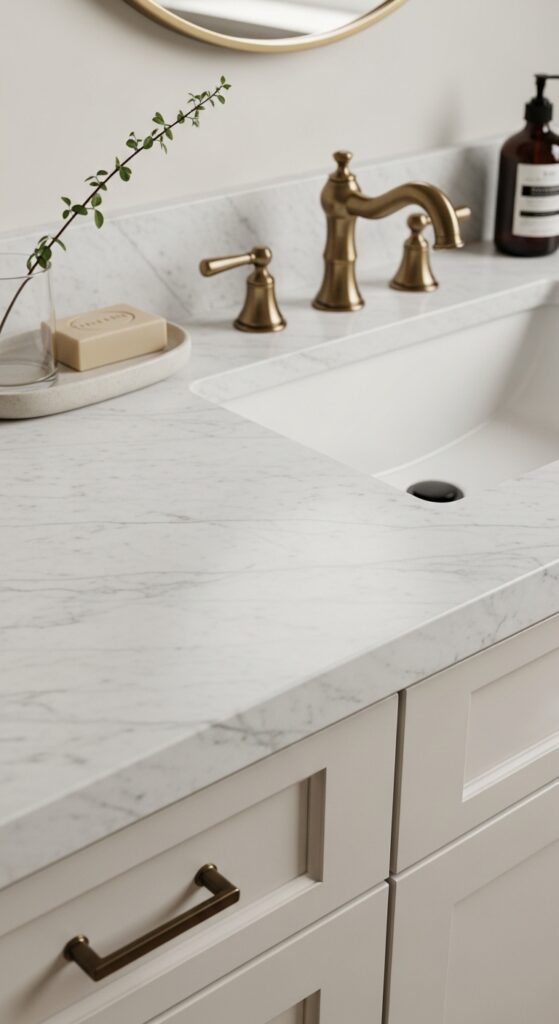
Vibe: Serene — the specific calm of materials that have nothing to prove.
Why it works: A honed (matte) stone finish is fundamentally more appropriate for farmhouse bathrooms than polished stone because it absorbs light rather than reflecting it — creating a quieter, more grounded surface quality. Honed Carrara marble, honed absolute black granite, or soapstone all carry the same honest, tactile quality that defines farmhouse materials. The eased edge profile (a subtle rounded edge, not a sharp 90-degree cut) reinforces this — it reads as worn by use rather than precision-cut.
How to get it: Specify honed finish when ordering stone — it’s usually the same price as polished and sometimes less. Seal honed stone every 12 months with an impregnating sealer like Miracle Sealants 511; unlike polished stone, honed is more porous and needs more consistent maintenance. Soapstone (from Vermont Soapstone starting around $90–$120/sq ft) is the most forgiving farmhouse stone — it develops a patina over time and minor scratches can be sanded out.
💡 Quick Win: Honed marble contact paper from Wallpaper Warehouse ($18–$25/roll) is a surprisingly convincing countertop update for renters — apply carefully around fixtures and seal the edges.
21. Candlelight and Warmth: Ambient Layering
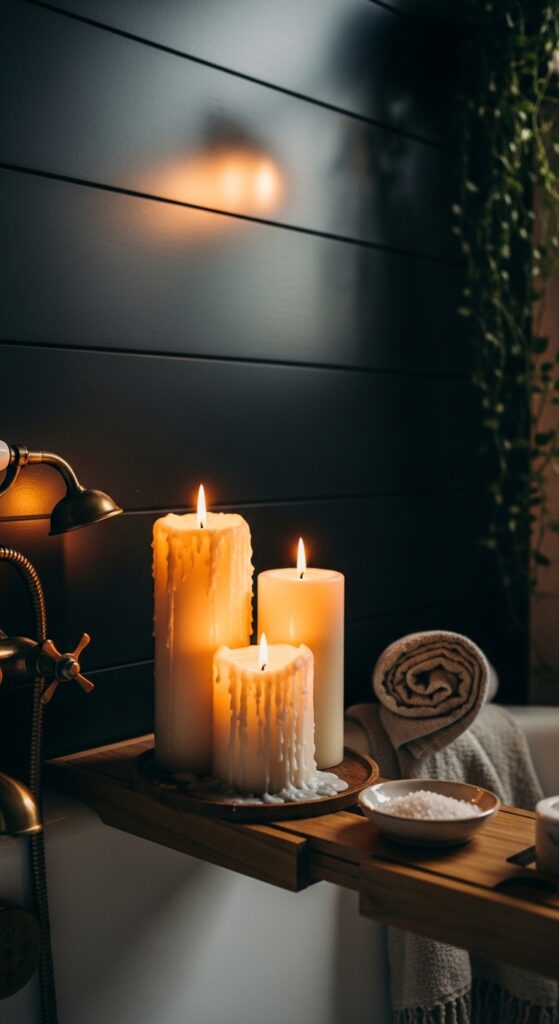
Vibe: Moody — the specific beauty of a space that changes entirely after sundown.
Why it works: Layered ambient lighting — combining sconces, candles, and natural materials — is what distinguishes a farmhouse bathroom that photographs well from one that actually feels like a retreat. The design principle is light at multiple heights: overhead light creates flatness; combining a sconce at shoulder height with candles at tub level creates depth, warmth, and the kind of atmosphere that overhead fixtures simply cannot produce. Unscented pillar candles in beeswax or plain white wax read more authentically farmhouse than highly branded candle jars.
How to get it: Position three pillar candles in varying heights (3″, 6″, and 9″) on a single weathered wood tray — the tray keeps them contained and safe while reinforcing the farmhouse material palette. Beeswax pillars from a farmers market or Etsy supplier ($12–$25 each) burn cleaner and longer than paraffin. Battery-operated LED pillar candles from Luminara are a practical alternative with a convincing flicker for families with children.
How to Start Your Farmhouse Bathroom Transformation
Start with paint. Apply Benjamin Moore “White Dove” (OC-17) from floor to ceiling and let it do the work for two full weeks before adding anything else. This warm, slightly creamy white is the single most important decision in a farmhouse bathroom because it sets the tonal temperature everything else must match. It reflects warmth in any light and makes wood, ceramic, and linen look like they were always meant to be together.
The most common beginner mistake is mixing warm and cool metals. Farmhouse bathrooms live and die by tonal consistency — a single chrome faucet in a room full of brushed brass and matte black breaks the spell instantly, not because chrome is wrong, but because its cool, bright reflectiveness belongs to a completely different aesthetic register. The fix is simple: commit to one metal family (aged brass, matte black, or brushed nickel) and replace every piece — faucet, towel ring, toilet paper holder, and robe hook — in one coordinated sweep.
Three specific items under $50 that create immediate farmhouse impact: a white ceramic soap pump from Hearth & Hand at Target ($14), a bundle of three beeswax pillar candles from a local co-op ($18–$22), and a waffle-weave linen hand towel in natural undyed cotton from IKEA’s VALLASÅN line ($6 each).
A genuine bathroom transformation takes longer than a weekend but less than a month. A starter version — new paint, new hardware, new textiles — runs $150–$400 and can be done in two days. A fuller transformation with new vanity, tile, and fixtures realistically costs $2,000–$6,000 and takes two to four weeks including installation. Start with the first tier and let it settle before committing to the second.
Frequently Asked Questions About Farmhouse Bathroom Style
What is the difference between farmhouse style and rustic bathroom design?
Farmhouse style and rustic design share a love of natural materials, but farmhouse is fundamentally more refined. Where rustic embraces raw, unfinished surfaces and darker tones — think rough-hewn log walls and dark stained wood — farmhouse leans toward warm whites, painted Shaker cabinetry, and materials that feel cared-for rather than untouched. Farmhouse style also incorporates modern fixtures (matte black faucets, frameless glass) in a way that pure rustic rarely does. Think of it this way: rustic is a cabin; farmhouse is the 1890s homestead that’s been lovingly maintained.
What colors work best in a farmhouse bathroom?
The farmhouse bathroom palette centers on warm white as the primary tone — Benjamin Moore “White Dove” or Sherwin-Williams “Alabaster” are the industry standards. Accent colors work best when muted rather than saturated: dusty sage, soft terracotta, warm greige, and deep navy all feel authentic. Avoid cool-toned whites (anything with blue or gray undertones), which fight against the warm wood and brass tones that define the style. For small bathrooms, keep 80% of the room in the warm white family and introduce one accent color through textiles or a single painted cabinet.
Is farmhouse bathroom design expensive to achieve?
Not necessarily. The farmhouse aesthetic prioritizes authenticity and texture over luxury, which means many of its best elements are actually accessible: shiplap (real or faux) costs $1–$3 per square foot; linen towels from IKEA run $6 each; vintage mirrors and frames can be thrifted and repainted for under $30. The expensive elements — a clawfoot tub, stone countertops, handmade tile — are optional aspirational pieces, not the foundation. A convincing farmhouse bathroom can be built for under $500 by focusing on paint, hardware swaps, and textile choices before committing to any structural changes.
Can I mix farmhouse style with other design styles?
Yes, and the most interesting farmhouse bathrooms usually do. The most successful combinations are farmhouse-Japandi (warm materials, extreme restraint in accessories), farmhouse-coastal (natural linen + whitewashed wood + woven textures), and farmhouse-transitional (Shaker cabinetry + matte black hardware + a more contemporary tile). The rule for mixing: share the material palette (natural, organic, matte) but allow the proportions to shift. Where you’ll run into trouble is mixing farmhouse with cool-modern or industrial styles — the warm, soft quality of farmhouse and the cool precision of modern steel-and-glass resist each other at the tonal level.
What plants work best in a farmhouse bathroom?
Pothos, ZZ plants, and peace lilies are the most reliably successful farmhouse bathroom plants because they tolerate low light and high humidity equally well. For bathrooms with a south or east-facing window, a trailing string of pearls or a small fiddle-leaf fig adds genuine sculptural drama. Always plant in handmade terracotta or ceramic rather than plastic nursery pots — the material reads as integral to the farmhouse aesthetic, and the clay’s breathability benefits the plant’s root health. Avoid fussy orchids or succulents in bathrooms with low natural light; the contrast between a clearly struggling plant and a carefully designed room is difficult to ignore.
Ready to Create Your Dream Farmhouse Bathroom Retreat?
These 21 ideas cover the full range of what makes a farmhouse bathroom genuinely work — from the architectural moves (shiplap, wainscoting, hex tile) to the quiet material decisions (honed stone, undyed linen, aged brass) to the atmospheric layers (candlelight, vintage art, living plants) that most guides never get to. Real transformation is incremental, and starting with one wall, one fixture, or one shelf display is not just acceptable — it’s the right approach. This weekend, pull one natural element into your bathroom — a terracotta pot with a trailing plant, a wooden tray on the counter, a beeswax candle beside the sink — and watch how it changes the room’s entire emotional register. A farmhouse bathroom isn’t built in a day; it’s built in exactly the moments when you choose something real over something convenient. Pin your favorites from this list and let them be the blueprint — the warm whites and honest textures will guide every decision that follows.