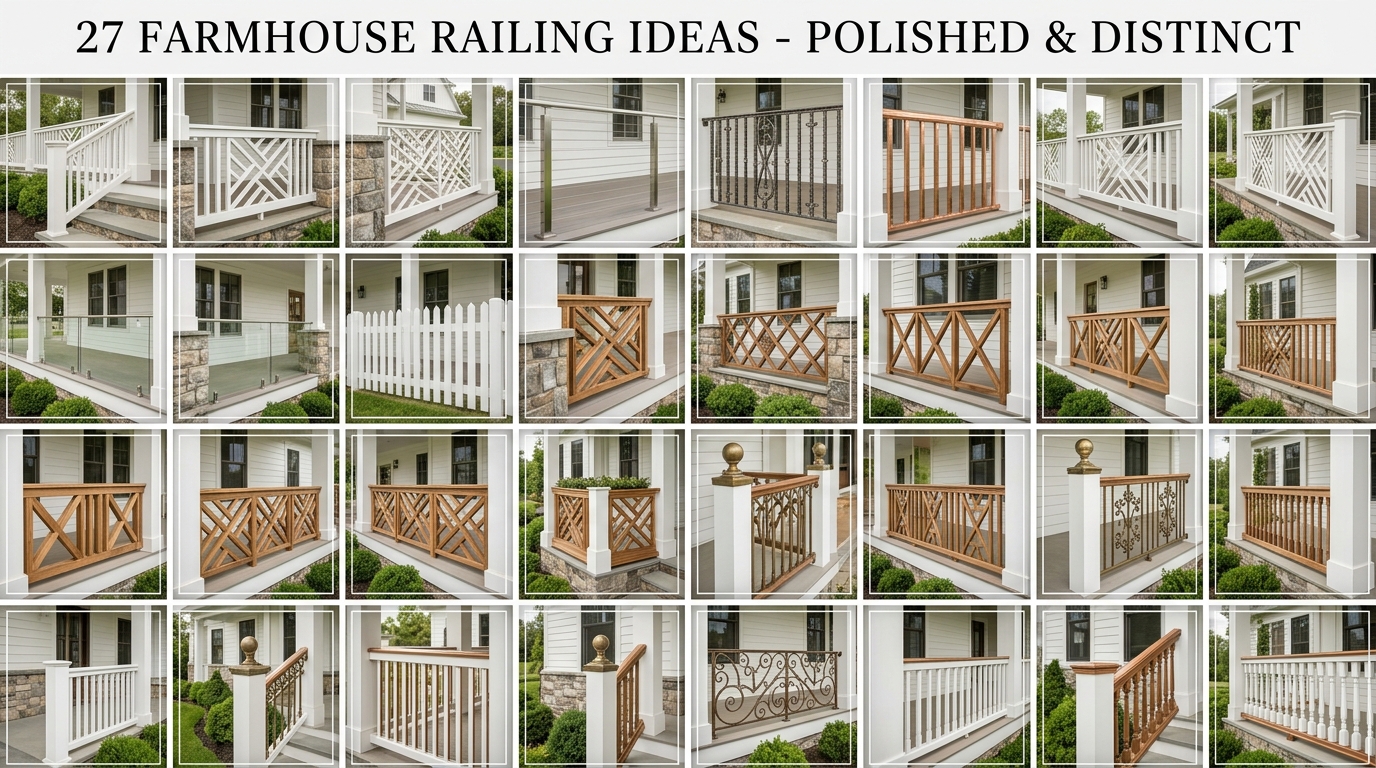
Farmhouse porch railings are the structural fence-like barriers along a porch’s open edges — built for safety, but styled in the earthy, hand-crafted materials of American rural architecture to feel like they belong to the house rather than bolted onto it. This article gives you exactly 27 farmhouse porch railing ideas, ranging from classic white-painted spindle systems to cable wire accented with cedar posts, every one designed to look considered, not just compliant.
There’s a particular satisfaction in a porch railing that feels like it grew from the house itself — wood that shows its grain, paint that breathes a little, hardware that looks hand-selected rather than pulled from a hardware bin. Farmhouse style earns its warmth one material choice at a time. It doesn’t rush to polish, and it never apologizes for the texture that comes with age. Here are 27 ideas worth saving — and stealing.
Why Farmhouse Porch Railings Work So Well
Farmhouse architecture draws from the functional vernacular building tradition of 19th-century American rural life — homes designed to be durable, adaptable, and built from locally available materials rather than imported finishes. Porch railings in this tradition were originally structural necessities built in pine or cedar, painted for protection rather than aesthetics. Modern farmhouse railing design honors that lineage by keeping materials honest and forms straightforward, while layering in the character that comes from slightly imperfect finishes, exposed joinery, and weather-touched patina.
The material palette for farmhouse porch railings is specific and shopable. Cedar and pressure-treated pine are the most common rail and post materials, finished in antique white, warm greige, or left in a natural honey tone sealed with penetrating oil. Galvanized steel, oil-rubbed bronze, and matte black are the hardware metals of choice. Rope, cable wire, and horizontal boards have replaced traditional spindles as the dominant rail infill options, each bringing its own material texture — braided fiber, tensioned metal line, or flat-cut board face.
Farmhouse porch railing ideas have held consistent Pinterest search volume through the mid-2020s, driven by a broader cultural shift toward outdoor living investment and the post-pandemic reevaluation of home exteriors as primary living spaces rather than afterthoughts. Homeowners who spent years interior-decorating have moved outward — and the porch railing, once purely functional, is now approached with the same intentionality as a kitchen backsplash or living room feature wall.
Even a small front stoop with just a few steps and minimal railing run can achieve this style. Prioritize the post caps and hardware finish first — a cedar post with a pyramid cap and a matte black post cap ring reads as farmhouse even before the rail is installed. Small-porch railings benefit from horizontal board infill rather than spindles, which creates a cleaner, less visually busy look in compact spaces.
Style at a Glance
| Element | Detail |
| Philosophy | Structural honesty; beauty through material authenticity and unpretentious craftsmanship |
| Key Materials | Cedar, pressure-treated pine, galvanized steel, cable wire, natural rope, matte black hardware |
| Key Colors | Antique white, warm greige, honey cedar, matte black, oil-rubbed bronze, natural rope tan |
27 Farmhouse Porch Railing Ideas
1. Classic White-Painted Spindle Railing with Square Posts
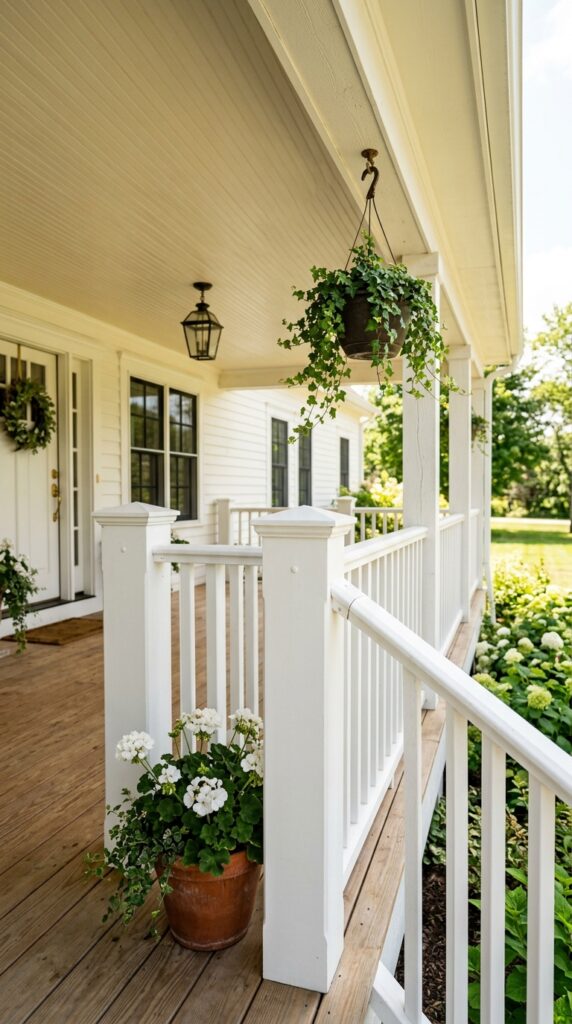
Vibe: Hushed — the white railing disappears into the porch architecture rather than announcing itself, and that restraint is the whole point.
Why it works: A white-painted spindle railing is the most historically accurate farmhouse porch railing choice — it references the painted millwork of Greek Revival and Craftsman-era farmhouses built between 1850 and 1930. Evenly spaced square spindles (typically 3.5-inch on-center spacing to meet code) create a visual rhythm that is orderly without being rigid. Square posts rather than turned or decorative posts keep the profile flat and simple, which is the authentic rural farmhouse aesthetic rather than the fancier Victorian cottage version.
How to get it: Use exterior alkyd paint rather than latex for porch railings — alkyd dries harder, resists chipping and scuffing from hands and pets, and maintains its sheen for 2–3 more seasons than latex equivalents. Apply two coats over a bonding primer to wood surfaces, sanding lightly between coats with 220-grit for a glass-smooth finish that reads as freshly painted for years.
💡 Quick Win: A single large pot of white geraniums at each porch post base costs $8–12 per pot and adds a traditional farmhouse planting detail that makes even a plain square post look intentionally placed.
🛍️ Shop the Look — Amazon Product Ideas
| # | Product Search Phrase | Why It Fits |
| 1 | white square porch spindle baluster pack 36-inch | Classic white infill detail |
| 2 | exterior alkyd porch paint bright white quart | Hard-wearing rail finish |
| 3 | pyramid post cap wood 4×4 painted white | Traditional post topper |
| 4 | white geranium artificial plant outdoor UV resistant | Classic farmhouse planting |
| 5 | hanging basket with liner porch ceiling mount | Trailing plant bracket |
2. Horizontal Board Railing in Natural Cedar
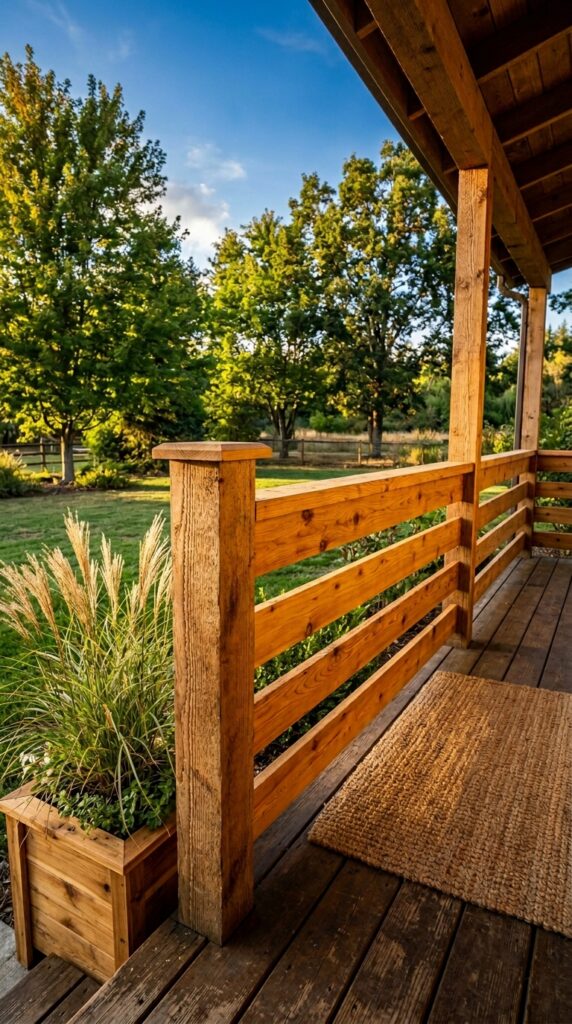
Vibe: Grounded — a railing that looks like it was built by someone who knew this porch would still be here in forty years.
Why it works: Horizontal board railings replace the traditional vertical spindle with a cleaner, more contemporary farmhouse line — three or four boards running parallel to the ground rather than dozens of uprights running perpendicular to it. The result reduces visual clutter dramatically, allowing the view past the railing to breathe. Natural cedar in a honey-sealed finish (rather than painted) keeps the material story honest: you’re meant to see the wood, the grain, and the occasional knot rather than covering them.
How to get it: Space horizontal boards to meet IRC railing code — a 4-inch maximum gap between boards prevents the passage of a 4-inch sphere, which satisfies most residential building codes. Install boards with hidden face-mount clips rather than through-screws to eliminate visible fastener holes and achieve a cleaner face profile.
🛍️ Shop the Look — Amazon Product Ideas
| # | Product Search Phrase | Why It Fits |
| 1 | cedar deck board 1×6 natural grain fence rail | Horizontal rail material |
| 2 | hidden deck clip fastener stainless steel | Clean face-mount solution |
| 3 | penetrating teak oil cedar outdoor sealer | Natural wood preservation |
| 4 | cedar post cap flat 4×4 natural finish | Post topper detail |
| 5 | ornamental grass outdoor planter cedar box | Post base planting |
3. Black Metal Baluster Railing with White Posts
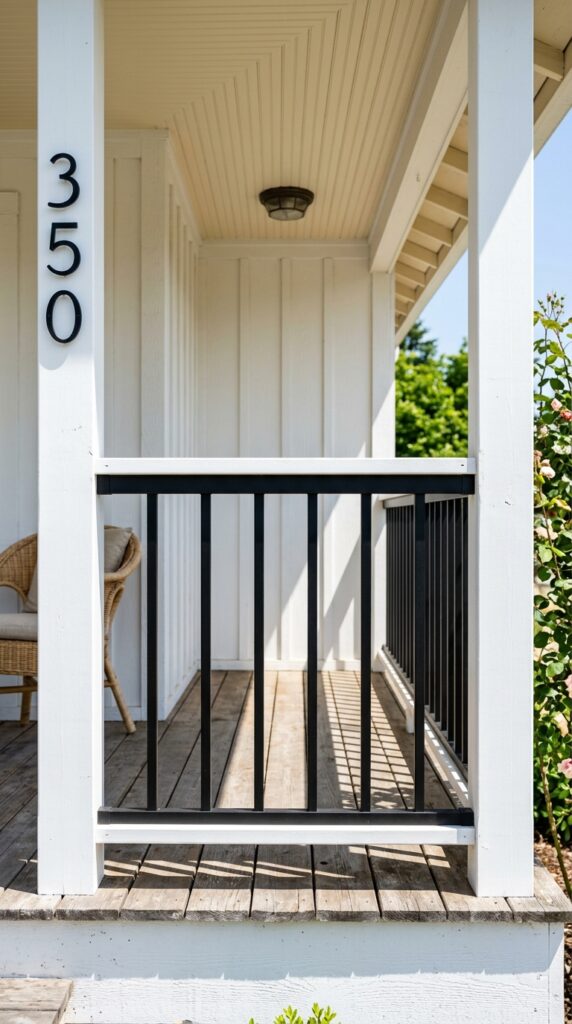
Vibe: Crisp — the kind of contrast that photographs sharp from the street and reads as intentional before you’ve even parked.
Why it works: White posts with matte black metal balusters apply the same two-tone contrast logic that makes farmhouse kitchen hardware so effective — the dark element does all the visual work while the white provides the clean architectural base. Matte black flat-bar steel (rather than round or decorative profiles) keeps the industrial reference quiet and subordinate to the overall farmhouse warmth. The contrast also improves railing visibility from a distance, making the home’s exterior architecture more readable.
How to get it: Purchase pre-fabricated black metal baluster panels in 36-inch or 42-inch heights and cut to fit between posts — this is significantly faster than installing individual balusters and produces a more consistent gap spacing. Many come with a built-in top and bottom channel that slides directly into a routed groove in the rail.
💡 Quick Win: Matte black house numbers mounted directly on the post rather than beside the door create a purposeful, graphic detail that costs $15–25 and immediately modernizes a farmhouse porch exterior.
🛍️ Shop the Look — Amazon Product Ideas
| # | Product Search Phrase | Why It Fits |
| 1 | matte black flat bar metal baluster panel 36-inch | Core contrast infill piece |
| 2 | white square porch post 4×4 sleeve wrap | Clean post exterior |
| 3 | matte black house numbers modern farmhouse | Graphic accent detail |
| 4 | black metal baluster installation bracket kit | Panel mounting hardware |
| 5 | white porch rail top cap 2×4 exterior | Top rail finishing piece |
4. Cable Wire Railing with Cedar Posts
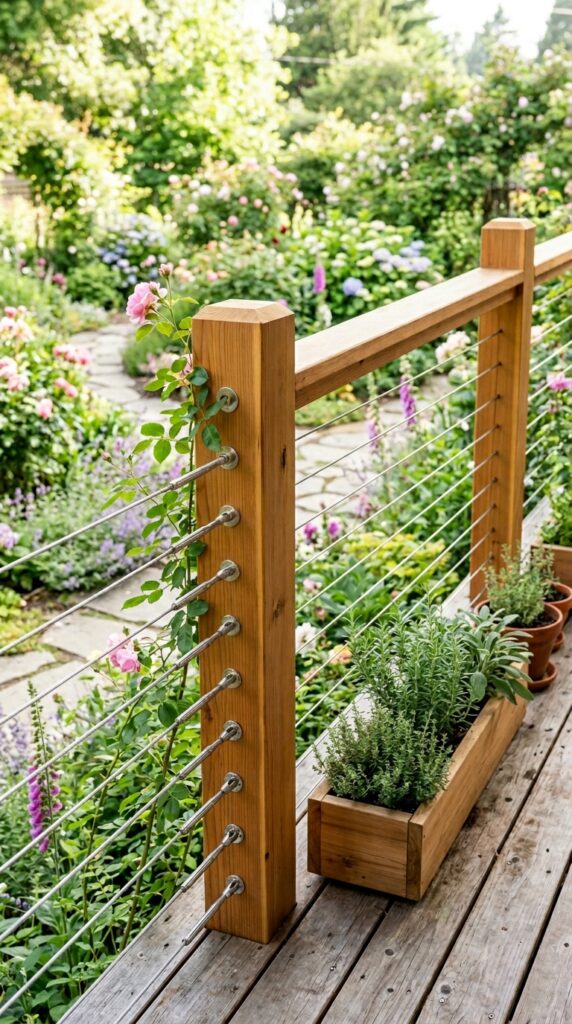
Vibe: Airy — this railing barely interrupts the view, and that invisible quality is the most luxurious thing about it.
Why it works: Stainless cable railing achieves the nearly unobstructed sightline of no railing while still meeting building code — the horizontal cables are visually minimal compared to any spindle system. Paired with cedar posts rather than steel or aluminum, the cable hardware reads as farmhouse-industrial rather than purely contemporary, grounded by the warm wood against the cool silver tension wire. The contrast between natural fiber and engineered metal is the defining tension of this look.
How to get it: Use 1/8-inch stainless Type 316 marine-grade cable for outdoor installations — it resists coastal and humid-climate corrosion significantly better than Type 304. Cable must maintain 3-inch maximum spacing to meet IRC code, which typically means 11–13 cable runs on a 36-inch tall railing. Allow for tensioning at one end post using a threaded lag fitting, which lets you retighten the cables each spring as wood posts settle.
🛍️ Shop the Look — Amazon Product Ideas
| # | Product Search Phrase | Why It Fits |
| 1 | stainless steel cable railing kit 1/8 inch marine grade | Core structural wire |
| 2 | cedar 4×6 deck post rough sawn | Natural wood post material |
| 3 | cable railing end fitting swage tensioner | Cable termination hardware |
| 4 | chamfered wood post cap cedar 6×6 | Finished post top detail |
| 5 | climbing rose live plant trellis outdoor | Organic post softener |
5. Rope-Wrapped Railing Posts for Coastal Farmhouse
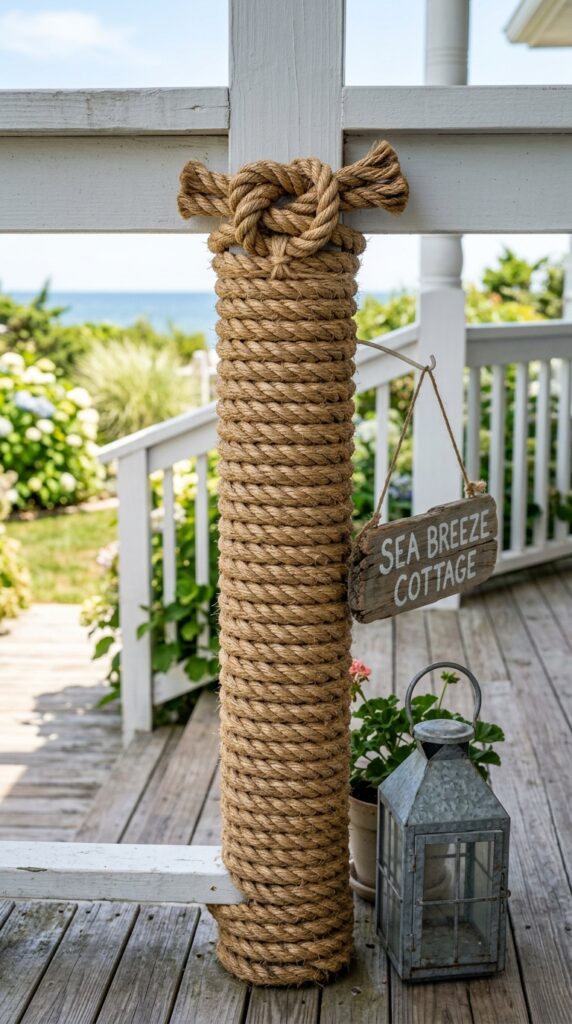
Vibe: Sun-warmed — the kind of porch that smells like rope and cedar and the beginning of summer.
Why it works: Wrapping a post in natural rope transforms its visual category from architectural element to handcrafted object — the same logic that makes rope-wrapped pendant lights feel more artisanal than painted ones. Manila rope in its natural undyed tan reads as coastal, farmhouse, and bohemian simultaneously, making this the most style-bridging treatment in this list. The helical wrap also adds a subtle taper illusion to square posts, making them look slimmer and more refined than their actual dimensions.
How to get it: Wrap posts starting from the bottom, applying marine adhesive every 6–8 inches of wrap to prevent the rope from unraveling in wind or rain. Use 3/4-inch or 1-inch diameter manila rather than anything thinner — the chunkier scale reads as intentional and architectural; thin rope reads as a craft project. Seal finished wraps with a clear outdoor UV spray to prevent yellowing and fiber degradation in sun exposure.
💡 Quick Win: Even one rope-wrapped post among standard square posts creates a focal accent moment — you don’t need to wrap every post to get the coastal farmhouse character.
🛍️ Shop the Look — Amazon Product Ideas
| # | Product Search Phrase | Why It Fits |
| 1 | natural manila rope 3/4 inch thick outdoor 100ft | Post wrapping material |
| 2 | marine adhesive outdoor waterproof rope glue | Wrapping adhesive |
| 3 | UV resistant clear outdoor spray sealer | Rope protection coat |
| 4 | driftwood farmhouse sign small hanging | Coastal accent prop |
| 5 | galvanized metal lantern floor outdoor farmhouse | Grounding dark accent |
6. Whitewashed Railing with Potted Herb Rail Planters
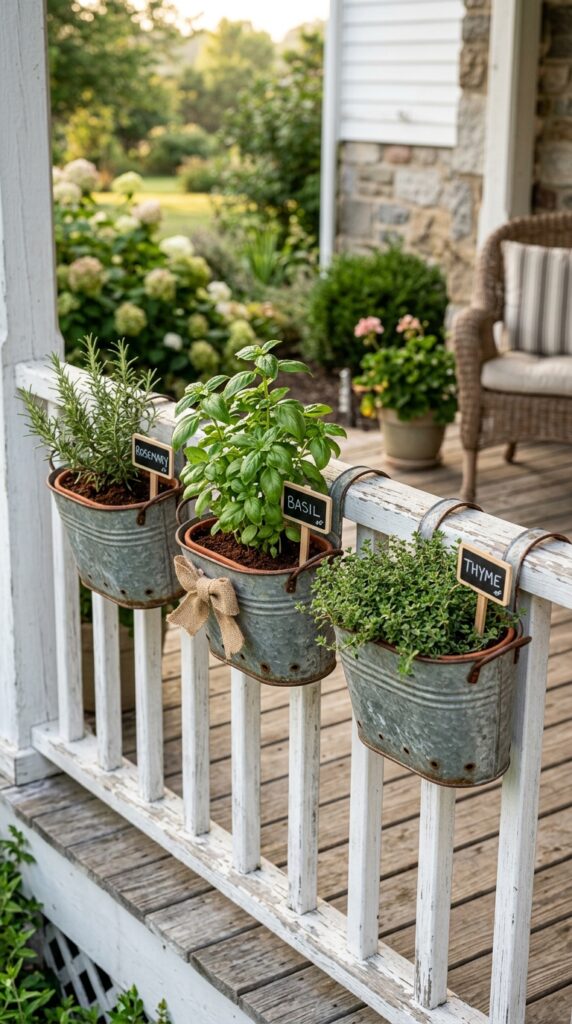
Vibe: Layered — a railing that feeds you and frames your porch at the same time.
Why it works: Rail planters activate the top rail as a living edge rather than a passive safety barrier — a functional upgrade with significant aesthetic payoff. The galvanized metal of the planters coordinates naturally with farmhouse hardware choices while adding an industrial-practical note that is entirely consistent with agricultural design heritage. Varying herb heights create organic rhythm along the rail line, preventing the uniform “nursery display” look that planted rails can fall into when everything is the same size.
How to get it: Choose rail planters rated for your top rail width — most standard residential top rails are 2×4 or 2×6, so look for a planter with an adjustable clamp that fits both. Line with coco coir inserts rather than plastic liners, which degrade in UV exposure within one season; coco coir breathes, drains, and looks appropriate to the farmhouse material story.
🛍️ Shop the Look — Amazon Product Ideas
| # | Product Search Phrase | Why It Fits |
| 1 | galvanized metal rail planter hanging railing clip | Herb planter mount system |
| 2 | coco coir liner insert small planter natural | Natural breathable liner |
| 3 | chalkboard herb label stake set garden | Labeling accent detail |
| 4 | rosemary herb live plant 4-inch pot | Fragrant herb planting |
| 5 | chalk paint white quart exterior furniture | Whitewash rail finish |
7. Shiplap-Panel Lower Rail with Open Top Baluster
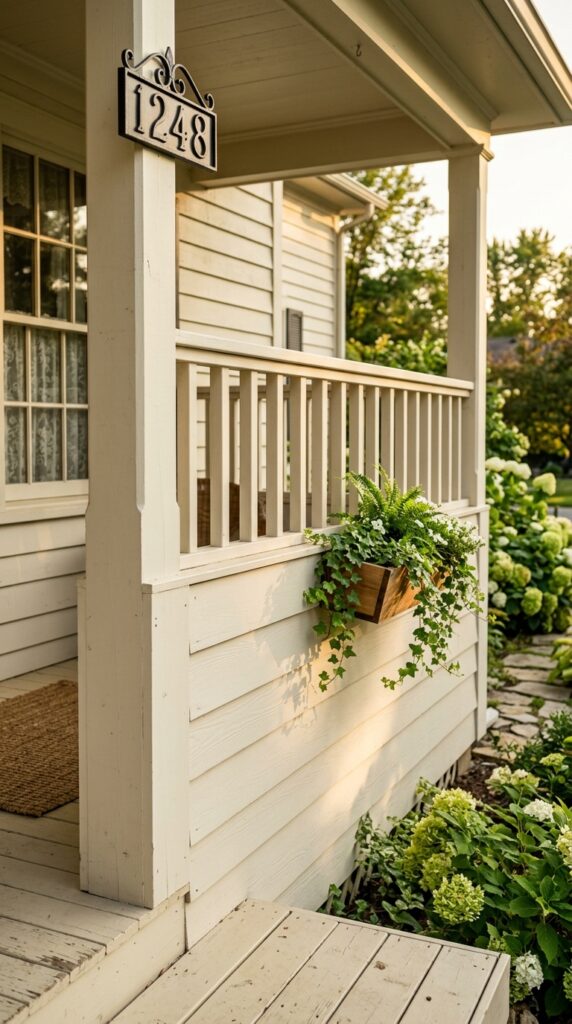
Vibe: Warm — shiplap on the porch exterior says the same thing it says in every farmhouse living room: this house has considered itself.
Why it works: A shiplap-paneled lower rail section creates a visual base to the railing that reads as furniture rather than barrier — the horizontal board lines carry the eye along the porch length in the same way a chair rail or wainscoting does indoors. The transition to open balusters at the upper section provides necessary code compliance while preserving the view above waist height. The shadow lines between shiplap boards add dimensional texture that flat-panel or solid-board lower sections lack.
How to get it: Install the shiplap panels as a pre-assembled frame — build the lower section on a flat surface, then drop the whole panel between posts as a unit and fasten from behind. This produces perfectly consistent horizontal lines without the difficulty of aligning individual boards in place. Use 1/2-inch grooved plywood shiplap sheets rather than solid boards for the frame build — they’re lighter and won’t warp as aggressively in outdoor humidity.
💡 Quick Win: A small window box bracket-mounted to the shiplap panel turns the lower rail section into a planting zone without requiring any structural modification — mount through the shiplap into the post or blocking behind it.
🛍️ Shop the Look — Amazon Product Ideas
| # | Product Search Phrase | Why It Fits |
| 1 | shiplap porch panel white primed 4-inch groove | Lower panel material |
| 2 | white square baluster 36-inch spindle railing | Upper open section filler |
| 3 | window box bracket mount wall exterior white | Panel-mounted planter |
| 4 | trailing ivy artificial outdoor UV resistant | Cascading green accent |
| 5 | metal address sign farmhouse house numbers black | Post graphic detail |
8. Galvanized Pipe Rail with Reclaimed Wood Top Cap
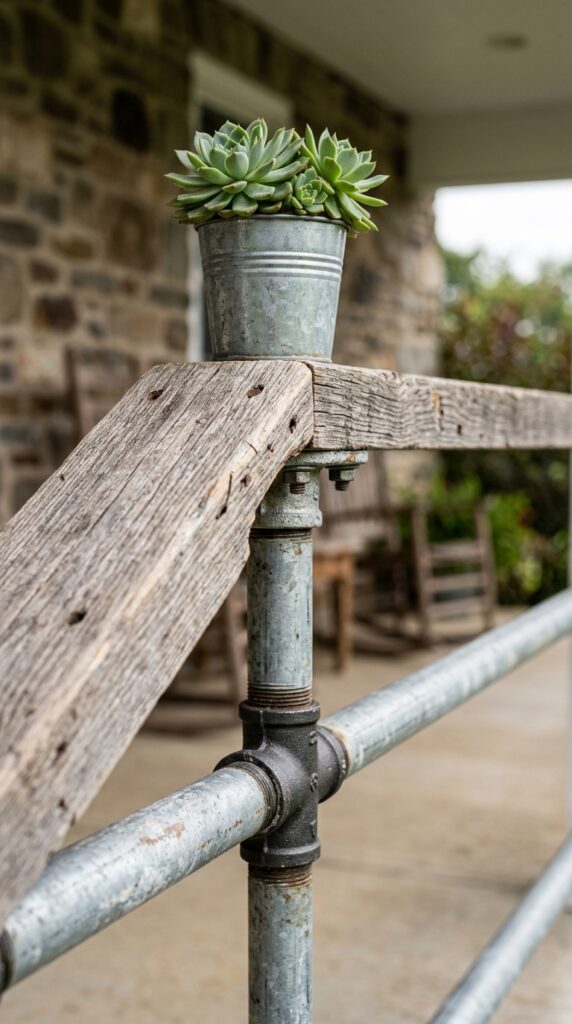
Vibe: Raw — a railing that belongs in a workshop and a farmhouse simultaneously, and is comfortable in both.
Why it works: Galvanized pipe as a railing material brings an explicitly industrial-farmhouse crossover that is deeply consistent with the American agricultural tradition of using available industrial materials for farm construction. The pipe’s honest, threaded, pipe-fitting-exposed joinery references utility rather than decoration — and farmhouse design is always at its strongest when utility drives form. The reclaimed wood top cap introduces natural warmth and an aging material story that pure metal railings lack.
How to get it: Use plumbing-grade 1-inch galvanized pipe (not EMT conduit, which is thinner-walled) and standard pipe flanges to mount vertical pipes to the porch deck. Top cap the rail with a single reclaimed 2×6 plank, routed on the underside to capture the pipe top ends for a clean connection. Source reclaimed wood from a local architectural salvage company — online faux-aged barn wood lacks the color depth and character of genuine aged material.
🛍️ Shop the Look — Amazon Product Ideas
| # | Product Search Phrase | Why It Fits |
| 1 | galvanized steel pipe 1-inch plumbing grade 10-foot | Industrial rail material |
| 2 | pipe flange wall mount galvanized steel | Structural connection hardware |
| 3 | reclaimed barn wood plank 2×6 weathered grey | Organic warm top cap |
| 4 | galvanized tin planter pot small with drainage | Matching metal accent |
| 5 | pipe elbow joint 90 degree galvanized 1-inch | Corner joinery detail |
9. Sage Green Railing with White Porch Floor Contrast
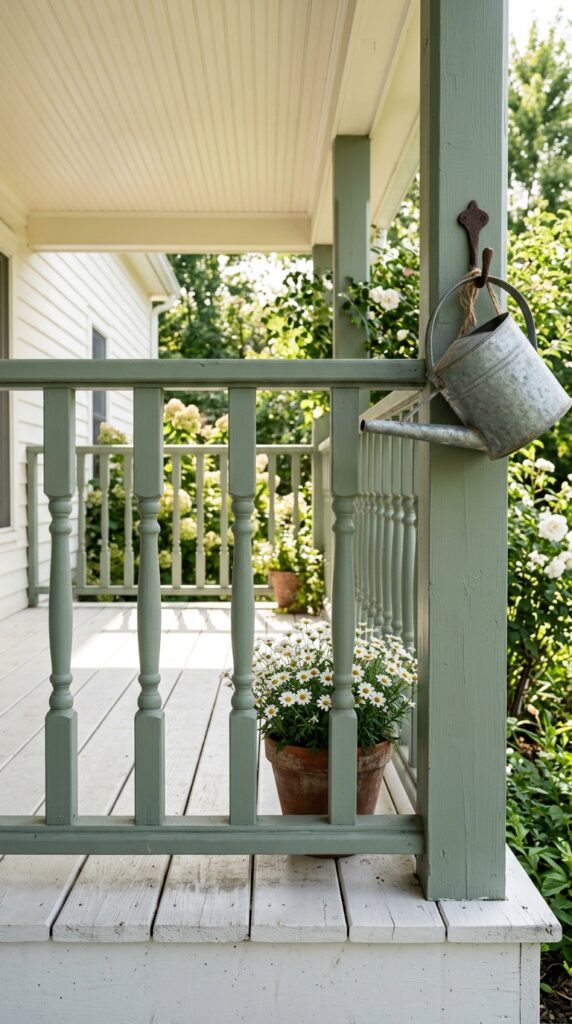
Vibe: Still — a porch so color-coherent it feels like a single exhale.
Why it works: Painting the railing in a single accent color — dusty sage — against an otherwise all-white porch envelope creates a moment of deliberate color that reads as designed rather than cautious. Sage green works particularly well for this application because it functions simultaneously as a neutral (low saturation, grey-toned) and as color (recognizably green, visually warm), giving it the flexibility of a greige without the blandness. The contrast with the white floor creates a shadow-line at the base of the railing that adds architectural definition without any additional detailing.
How to get it: Apply the sage in exterior chalk paint — the matte finish is essential here, as any sheen on a railing surface will highlight every brush mark and hardware imperfection. Sherwin-Williams “Comfort Gray” (SW 6205) brushed onto primed wood produces a dusty sage exterior read that holds its tone through seasons without fading to yellow.
🛍️ Shop the Look — Amazon Product Ideas
| # | Product Search Phrase | Why It Fits |
| 1 | exterior chalk paint dusty sage green quart outdoor | Sage rail finish |
| 2 | porch and floor paint white exterior low-sheen | White floor paint base |
| 3 | galvanized watering can small vintage farmhouse | Post-hung accent prop |
| 4 | white daisy potted plant faux outdoor UV | Classic white flower accent |
| 5 | post hook single black iron outdoor farmhouse | Watering can mount |
10. Lattice Panel Lower Railing with Black Cap Rail
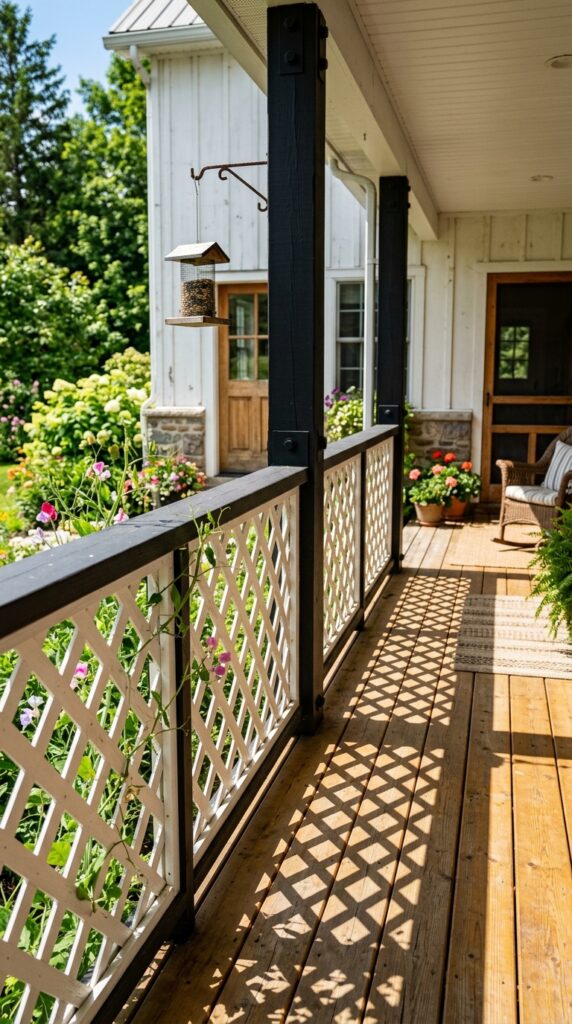
Vibe: Layered — light falls through the lattice in a shifting pattern that changes all afternoon.
Why it works: Diamond lattice is one of the oldest American vernacular porch details — present in pattern books dating to the 1870s as a combination privacy screen and climbing plant trellis. The shadow pattern it throws on a porch floor at midday creates decorative interest that no solid panel or spindle railing can produce. Black cap rail and posts against white lattice apply the two-tone contrast logic that modernizes the lattice detail without erasing its historical character.
How to get it: Use PVC lattice panels rather than wood — wood lattice warps, rots at the intersections, and requires annual repainting. PVC lattice holds its white finish, resists moisture, and can be cut to exact frame dimensions with a circular saw. Mount within a wood-frame box screwed between posts for clean edges on all four sides of the panel.
💡 Quick Win: Sweet pea or morning glory seeds planted at the base of a lattice railing in spring cost $3–5 per packet and grow to full coverage within 8–10 weeks, turning the lattice into a living garden wall.
🛍️ Shop the Look — Amazon Product Ideas
| # | Product Search Phrase | Why It Fits |
| 1 | white PVC diamond lattice panel 4×8 sheet | Core lattice panel material |
| 2 | matte black porch cap rail 2×4 painted | Contrasting top rail finish |
| 3 | sweet pea climbing vine seed packet annual | Lattice climbing plant |
| 4 | bird feeder post hook bracket black outdoor | Post accent accessory |
| 5 | lattice frame trim molding white exterior 1×2 | Panel edge framing detail |
11. Farmhouse Railing with Lantern Post Caps
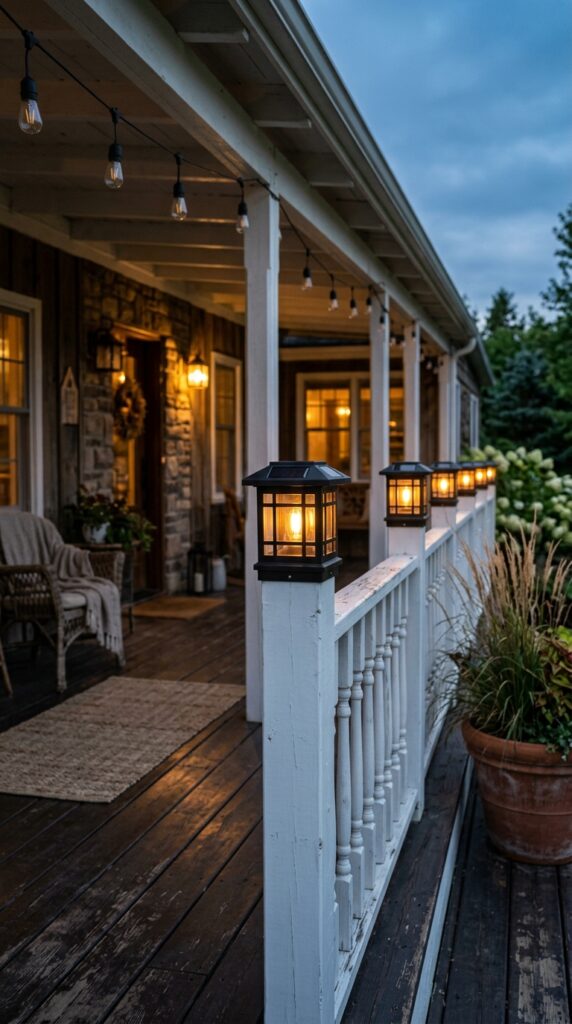
Vibe: Luminous — at dusk this porch turns into the kind of place neighbors slow down to look at.
Why it works: Post cap lanterns transform the porch railing from a daytime architectural element into an evening lighting feature without adding any additional fixture mounting — the cap simply replaces the standard flat or pyramid cap already on the post. Solar-powered LED versions eliminate wiring completely while producing a 2700–3000K amber glow that reads as candlelit warmth rather than outdoor utility lighting. The repetition of identical lanterns along the railing line creates the same lighting rhythm as café string lights — warm, evenly distributed, and architecturally integrated.
How to get it: Choose solar post cap lanterns rated for your post size — most standard residential posts are 4×4 or 6×6, and the wrong size cap sits unstably and looks mismatched. Opt for a unit with a dusk-to-dawn sensor rather than one requiring manual switching; automatic illumination means the light comes on reliably every evening without requiring any management.
🛍️ Shop the Look — Amazon Product Ideas
| # | Product Search Phrase | Why It Fits |
| 1 | solar post cap lantern black metal 4×4 LED warm white | Post-top lighting hero |
| 2 | outdoor string lights Edison bulb warm 2700K | Ceiling accent pairing |
| 3 | dusk to dawn sensor solar outdoor light | Automatic lighting control |
| 4 | terracotta pot large 12-inch with saucer outdoor | End post planting |
| 5 | ornamental grass fountain grass outdoor large | Tall post-flanking plant |
12. Narrow Porch Railing with Built-In Bench Seat
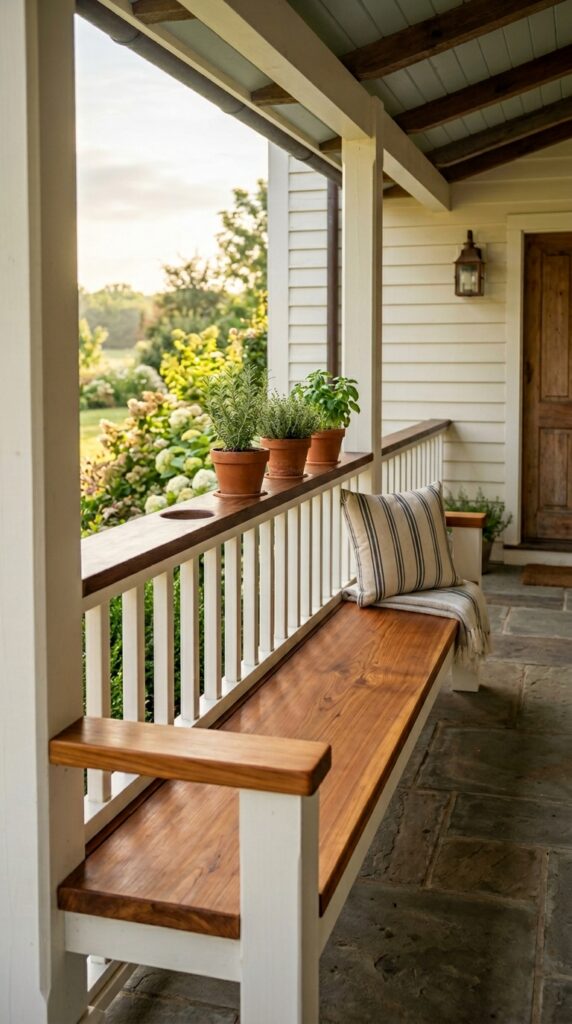
Vibe: Grounded — this railing is doing two things and apologizing for neither.
Why it works: A built-in bench seat integrated into the railing structure is the most efficient use of a narrow porch’s perimeter — it adds seating without occupying floor space, and it converts a code-required structural element into functional furniture. The seat board at standard bench height (17–19 inches) also provides a natural visual break in the railing’s vertical face, creating a horizontal line that makes the railing read as furniture rather than barrier. This technique works particularly well on porches less than 6 feet deep where free-standing chairs feel tight.
How to get it: Frame the bench seat into the railing structure at the design stage — retrofitting a bench seat to an existing railing is structurally complex. Build bench framing between posts using doubled 2×4 blocking at seat height, then lap the seat board (a 2×10 or 2×12 cedar plank) over the top and fasten through the outer face of the railing frame. The seat should overhang the interior face by 1–2 inches to form a proper lip edge.
💡 Quick Win: A striped outdoor cushion cut to the bench length (available in custom cuts from online sources) transforms the bare wood bench into a finished seating surface immediately — no sewing or fabrication required.
🛍️ Shop the Look — Amazon Product Ideas
| # | Product Search Phrase | Why It Fits |
| 1 | cedar bench seat board 2×10 outdoor smooth sanded | Integrated bench surface |
| 2 | striped outdoor bench cushion custom length | Upholstered seat detail |
| 3 | bench railing bracket steel black heavy duty | Structural support bracket |
| 4 | outdoor cushion cover oatmeal stripe UV resistant | Weather-durable textile |
| 5 | herb plant set indoor outdoor living wall small pots | Top-rail herb garden |
13. Terracotta-Painted Railing for a Warm Climate Porch
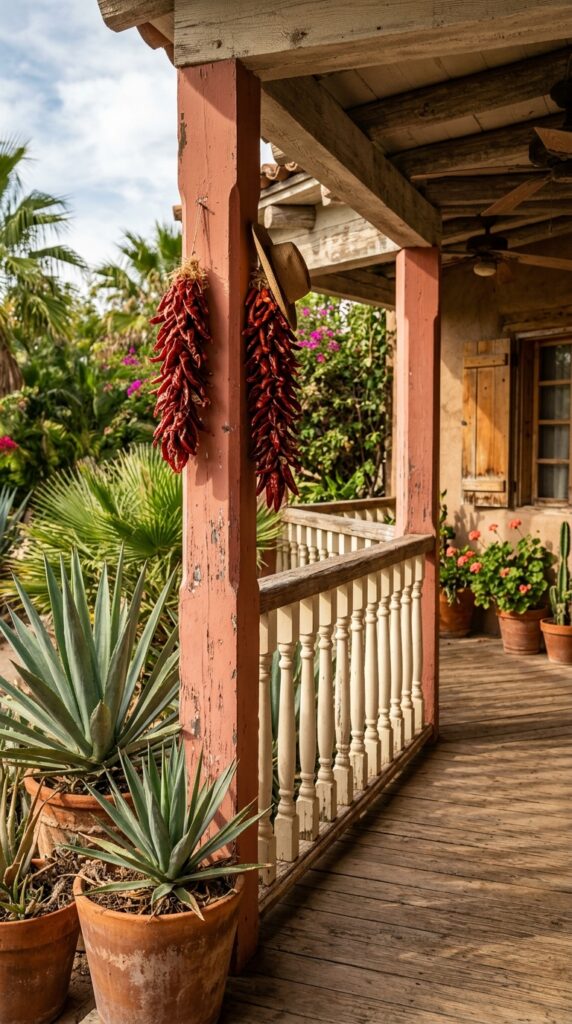
Vibe: Sun-warmed — a railing that looks like the afternoon heat has been settling into it for decades.
Why it works: Using the posts as the primary color element while keeping balusters in a lighter cream creates a weight-and-lightness contrast that makes the railing feel architecturally sophisticated rather than uniformly painted. Terracotta blush posts read as structural — heavier, anchor the eye — while cream balusters recede and allow light through. This color-field-within-a-field approach references traditional Southwest and Mediterranean adobe construction where thick structural elements are darker and infill elements lighter.
How to get it: Mix standard terracotta exterior paint with 15% warm white chalk paint and apply with a wide natural-bristle brush in vertical strokes to posts only. Then apply cream latex to balusters in a separate session, taping off the post faces at the junction. The two application sessions and separate finishes (chalk on posts, latex on balusters) ensure the color difference is visible and the surface textures remain distinct.
🛍️ Shop the Look — Amazon Product Ideas
| # | Product Search Phrase | Why It Fits |
| 1 | terracotta blush exterior chalk paint quart | Post color medium |
| 2 | cream white exterior latex paint quart | Baluster contrasting color |
| 3 | large terracotta pot outdoor 14-inch with saucer | Post base vessel |
| 4 | agave plant artificial outdoor realistic large | Structural green accent |
| 5 | dried chili ristra hanging bundle natural | Regional farmhouse accent |
14. Glass Panel Railing Insert for an Unobstructed View
Vibe: Luminous — the view is the railing.
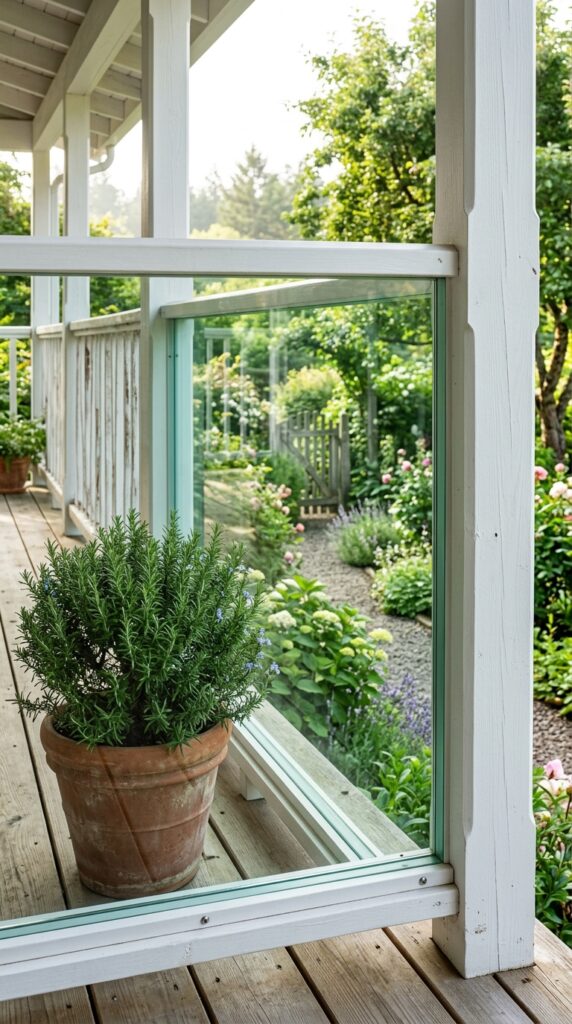
Why it works: Tempered glass inserts remove the visual interruption of balusters entirely while keeping the structural post-and-top-rail framework intact — the posts remain architecturally visible and farmhouse-appropriate while the infill disappears. This works particularly well on porches with significant landscape views: a garden, a body of water, or open countryside that would be subdivided and diminished by any spindle or cable system. The glass also reflects morning and evening sky, creating a dynamic light element in the railing that changes all day.
How to get it: Order glass panels to exact dimension from a local glass supplier — tempered safety glass cannot be cut to size after tempering, so measurements must be precise before ordering. Design posts with a routed channel in the inside face (typically 3/4-inch wide, 1-inch deep) to receive the glass edge, held in place with clear silicone glazing caulk and stainless set screws at the bottom channel.
🛍️ Shop the Look — Amazon Product Ideas
| # | Product Search Phrase | Why It Fits |
| 1 | clear tempered glass railing panel 36-inch custom deck | View-through infill panel |
| 2 | glass railing channel aluminum bottom track | Glass mounting channel |
| 3 | silicone glazing caulk clear weatherproof | Panel sealing adhesive |
| 4 | stainless steel glass railing set screw clamp | Panel securing hardware |
| 5 | rosemary topiary ball shaped large outdoor | Formal accent planting |
15. Farmhouse Railing with Hanging Lantern Rail Hook
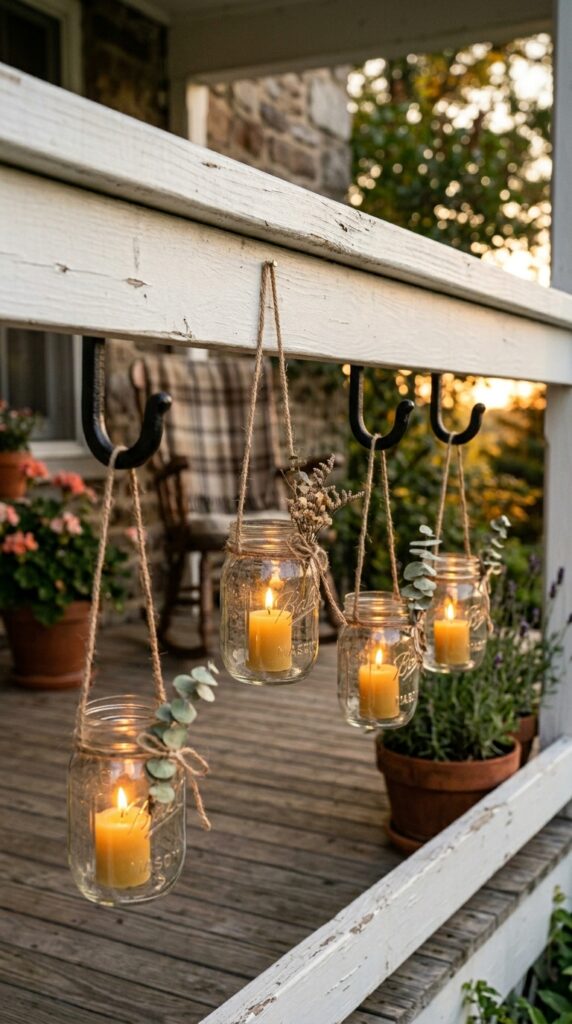
Vibe: Romantic — a railing that turns the ordinary act of sitting on the porch into an occasion.
Why it works: Mounting hanging lanterns beneath the top rail rather than on posts or ceiling activates an otherwise unused zone — the space between the top of the rail and eye level when seated. This is the same design logic that makes pendant lights over a dining table so effective: light at seated eye level creates intimacy that ceiling-height lighting cannot. The repetition of identical lanterns at varying heights introduces visual rhythm without requiring any permanent wiring.
How to get it: Mount J-hooks through the underside of the top rail using a drill and washer-backed bolt — this prevents the hook from pulling through the rail face under the weight of the lantern. Space hooks every 18–24 inches for a lantern-per-section look, or cluster three hooks at 6-inch intervals to create a grouped statement rather than an evenly distributed one.
💡 Quick Win: Mason jar candle holders assembled at home — a wide-mouth jar, a piece of twine tied below the ring band, and a small beeswax tea light — cost under $3 each and look completely intentional as hanging lanterns.
🛍️ Shop the Look — Amazon Product Ideas
| # | Product Search Phrase | Why It Fits |
| 1 | cast iron J-hook rail mount black outdoor | Hanging hardware mount |
| 2 | mason jar hanging candle holder set with twine | Lantern vessel and hanger |
| 3 | beeswax tea light candles unscented natural | Warm flame source |
| 4 | dried eucalyptus bundle small wreath accent | Fragrant botanical detail |
| 5 | outdoor LED candle flameless amber flicker | Safe evening light option |
16. Horizontal Fence-Style Railing for a Modern Farmhouse
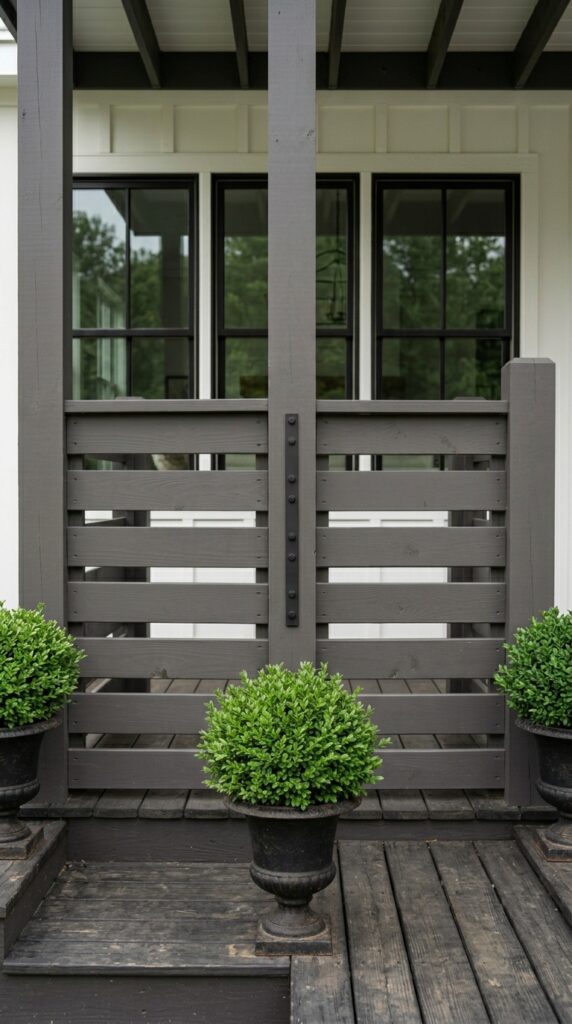
Vibe: Crisp — graphic enough to read from the street, warm enough to feel like it belongs.
Why it works: A close-spaced horizontal board railing in dark charcoal paint reads simultaneously as a modern farmhouse exterior element and a traditional board fence — which is exactly the dual reference that makes it so effective in the current design moment. The tight 1.5-inch gaps meet code while creating a near-solid face that has visual weight and graphic strength from the street. Charcoal grey rather than black preserves the warmth that farmhouse style requires — pure black reads as contemporary minimalist, while warm charcoal stays rural.
How to get it: Paint boards before installation using a paint sprayer for the fastest, most even coverage — installing boards first and painting in place results in unpainted back faces that can absorb moisture and accelerate rot. Spray front, back, and edges of each board before mounting, then touch up visible fastener points after installation.
🛍️ Shop the Look — Amazon Product Ideas
| # | Product Search Phrase | Why It Fits |
| 1 | 1×4 cedar deck board fence rail smooth face | Horizontal board material |
| 2 | exterior paint warm charcoal grey quart outdoor | Rail color medium |
| 3 | paint sprayer electric hvlp outdoor furniture | Even coat application tool |
| 4 | large black iron planter outdoor with drainage | Post-base planting vessel |
| 5 | boxwood topiary ball artificial outdoor UV | Clipped formal greenery |
17. Railing with Decorative Corbel Brackets at Posts
Vibe: Warm — a railing that rewards close looking, detail by detail.
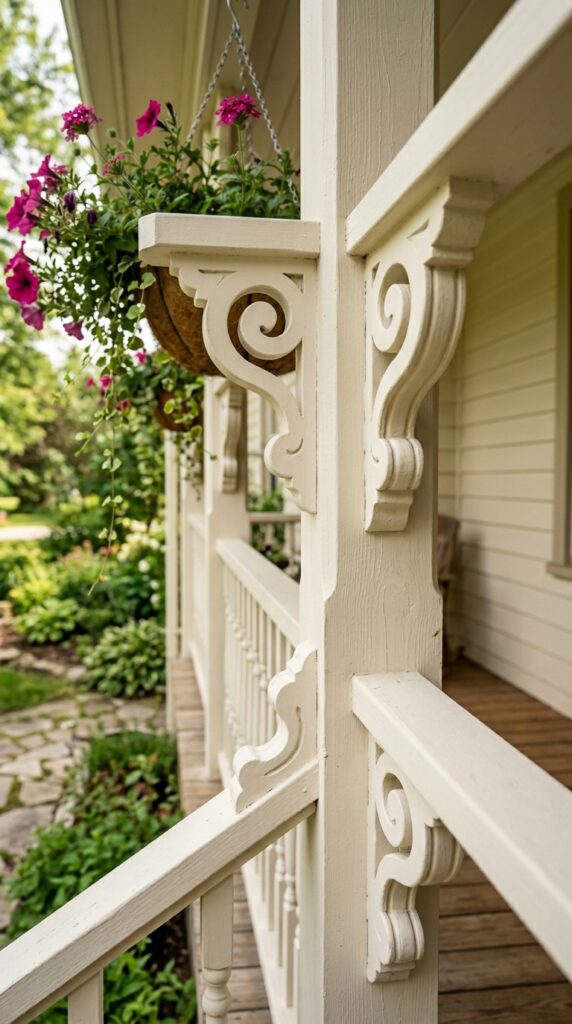
Why it works: Corbel brackets at the post-to-rail junction solve a common farmhouse railing problem: the junction between post and rail is typically the weakest visual point — where the two main elements meet and neither one dominates. A corbel bracket at this junction creates a designed transition rather than an abrupt connection, referencing Classical and Victorian-era porch millwork details that gave 19th-century farmhouses their particular sense of considered craftsmanship.
How to get it: Purchase pre-made wood corbel brackets from architectural millwork suppliers (available online in pine or poplar starting at $8–15 each) and paint to match the post before installation. Mount with two stainless screws — one into the post face and one into the rail face — from behind where possible to keep fasteners hidden. Prime and paint the corbel in the same exterior alkyd as the railing system for a seamless material finish.
🛍️ Shop the Look — Amazon Product Ideas
| # | Product Search Phrase | Why It Fits |
| 1 | decorative wood corbel bracket porch white painted | Post-rail junction detail |
| 2 | exterior alkyd paint antique white trim | Seamless paint match |
| 3 | pine corbel S-curve scroll 6-inch unpainted | Unfinished architectural piece |
| 4 | hanging basket liner replacement coco coir | Flower basket liner |
| 5 | trailing petunia faux plant outdoor realistic | Post-hung floral accent |
18. Unpainted Natural Pine Rail for a Raw Farmhouse Look
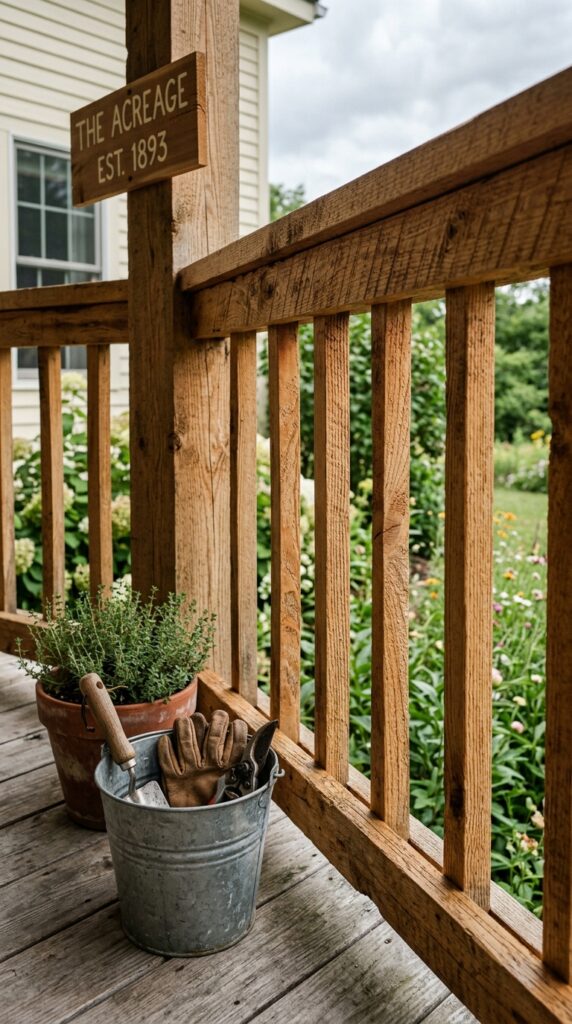
Vibe: Raw — this is a railing that knows what it is and makes no effort to be anything else.
Why it works: Leaving pine rails in their natural rough-sawn state is a deliberate choice that references the working farmhouse aesthetic — before paint and trim work, the structure itself was the visual statement. Rough-sawn surfaces retain the parallel ridges of the bandsaw that cut them, creating a directional texture that catches light differently depending on the viewing angle. Amber penetrating oil deepens the natural resin pockets and grain without film-forming, so the surface breathes and ages naturally rather than peeling.
How to get it: Order rough-sawn rather than S4S (surfaced four sides) lumber from a sawmill or specialty lumber yard — standard home improvement store lumber is always surfaced smooth. Rough-sawn costs the same or less per board foot while providing significantly more visual character. Apply boiled linseed oil (not raw linseed oil, which never fully dries) in a single thin wipe-on coat, wiping off excess after 30 minutes to prevent a tacky surface.
💡 Quick Win: A rough-cut cedar board with a simple branded or burned word (HOME, WELCOME) mounted on a natural pine post costs under $20 in materials and reads as the most authentic farmhouse exterior detail available.
🛍️ Shop the Look — Amazon Product Ideas
| # | Product Search Phrase | Why It Fits |
| 1 | rough sawn pine board 2×4 natural sawmill cut | Raw natural rail material |
| 2 | boiled linseed oil wood finish exterior quart | Amber penetrating sealer |
| 3 | galvanized bucket garden tool holder farmhouse | Functional porch prop |
| 4 | wood burning tool pyrography kit beginner | DIY sign making tool |
| 5 | cedar sign blank unfinished 12×6 natural | DIY post sign base |
19. Painted Railing with Stenciled Porch Floor Pattern
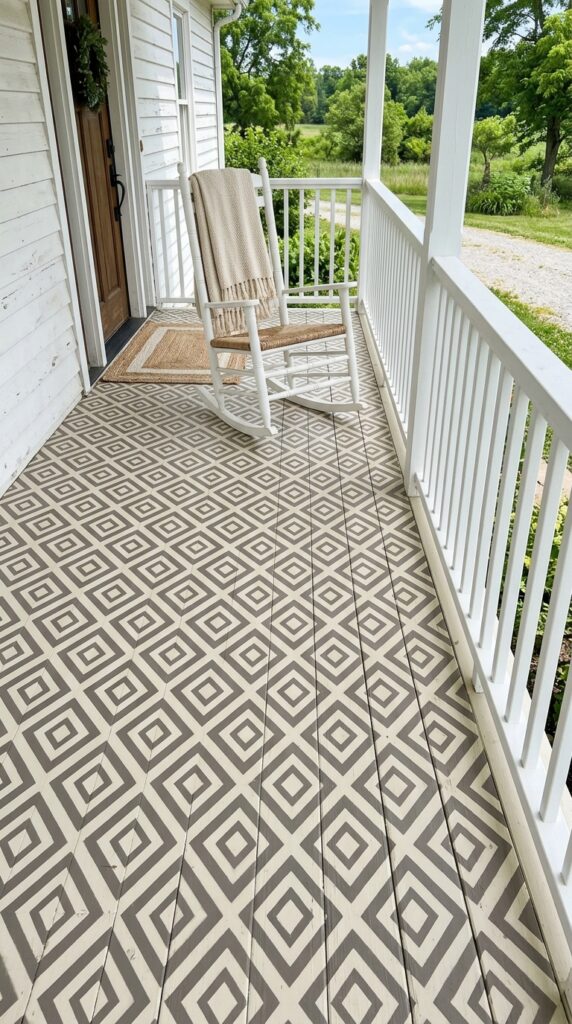
Vibe: Layered — when the floor competes with nothing, it wins everything.
Why it works: Stenciling the porch floor creates a visual anchor zone for the railing by defining the “room” that the railing encloses — a painted floor pattern signals that this porch is a considered space rather than a functional threshold. The railing, kept plain white, acts as the neutral frame for the floor pattern rather than competing with it. This layout approach — one elaborate element, all others quiet — is a reliable design technique that prevents visual overload in a small exterior space.
How to get it: Use porch and floor paint rated for foot traffic in the same exterior alkyd formulation as the railing — standard interior paint on a porch floor wears through within one season. Apply the base coat first, let cure for 72 hours minimum, then tape and stencil the pattern in a second color. Finish with two coats of porch floor clear sealer to protect the stencil from foot traffic and moisture.
🛍️ Shop the Look — Amazon Product Ideas
| # | Product Search Phrase | Why It Fits |
| 1 | porch floor stencil geometric diamond repeat large | Floor pattern template |
| 2 | porch and floor paint grey exterior alkyd quart | Stencil color paint |
| 3 | porch floor clear sealer polyurethane exterior | Pattern protection coat |
| 4 | white rocking chair outdoor porch wood | Classic railing companion |
| 5 | cotton outdoor rug natural stripe 3×5 | Entry zone softener |
20. Farmhouse Railing with Window Box Below Top Rail
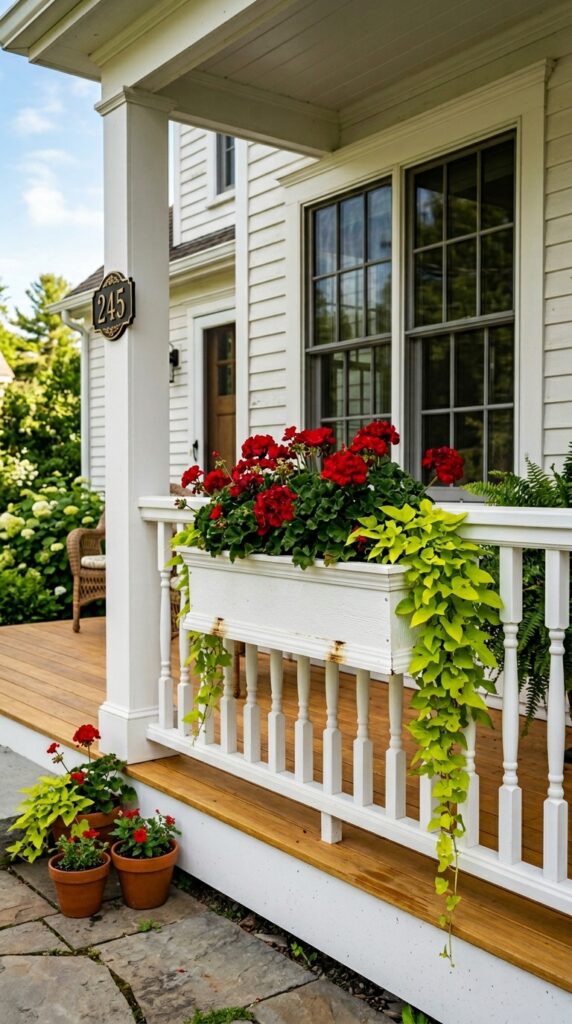
Vibe: Sun-warmed — a porch that announces summer before you’ve even reached the front door.
Why it works: A window box mounted below the exterior top rail face transforms the railing from a code element into a planting structure — one of the most effective outdoor design upgrades available at any budget. The box’s position just below the top rail creates a continuous green-and-flower band that visually softens the railing’s architectural line and connects the structure to the garden. Red geraniums with chartreuse trailing sweet potato vine is the most classic farmhouse planting combination: high-contrast, heat-tolerant, and effective from curb distance.
How to get it: Mount window boxes using heavy-duty rail-mount brackets rated for at least 30 lbs when wet — fully planted boxes are significantly heavier than they appear. Attach the bracket to the rail structure (not the rail face alone) and use stainless or galvanized screws that won’t rust and stain the box exterior below the mount point.
🛍️ Shop the Look — Amazon Product Ideas
| # | Product Search Phrase | Why It Fits |
| 1 | white window box railing mount cedar 30-inch | Exterior rail planter box |
| 2 | rail mount window box bracket heavy duty | Structural mounting bracket |
| 3 | geranium live plant red 4-inch pot | Classic color planting |
| 4 | sweet potato vine ornamental trailing chartreuse | Trailing contrast plant |
| 5 | self-watering window box insert liner | Reduced maintenance planting |
21. Driftwood Grey Railing for a Weathered Cottage Look
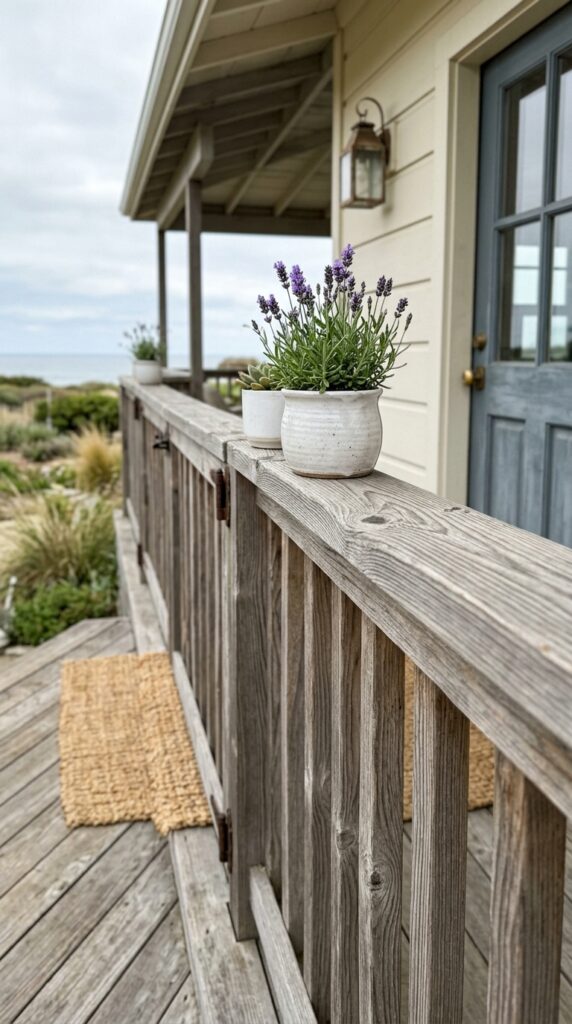
Vibe: Still — this railing looks like the sea already got to it before you did.
Why it works: A semi-transparent driftwood grey stain achieves an aged coastal look that opaque paint can never replicate — the wood grain visible through the stain creates the dimensional depth of naturally weathered wood rather than the flat coverage of paint. This approach works best on pine or cedar (tight-grained species resist stain penetration; open-grained species absorb it unevenly and interestingly). The driftwood grey color family sits at the intersection of warm and cool — it avoids the yellowness of natural wood and the coldness of blue-grey, landing in a balanced neutral that works in any landscape.
How to get it: Apply semi-transparent exterior wood stain in a driftwood or silver-grey tone using a wide brush in long strokes in the direction of the grain. Two coats produce the deepest color; one coat produces a lighter wash effect. Cabot “Driftwood Gray” semi-transparent deck stain is a widely available product that produces an authentic coastal-weathered tone without artificial-looking uniformity.
💡 Quick Win: Driftwood grey stain can be applied to an existing painted railing only if you strip the paint first — but on bare new wood, a single afternoon coat of semi-transparent stain achieves a 5-year-weathered look instantly.
🛍️ Shop the Look — Amazon Product Ideas
| # | Product Search Phrase | Why It Fits |
| 1 | semi-transparent wood stain driftwood grey exterior | Core weathered finish |
| 2 | wide brush natural bristle exterior stain 4-inch | Stain application tool |
| 3 | small white ceramic pot set outdoor | Rail-top plant vessels |
| 4 | lavender plant live 4-inch outdoor fragrant | Fragrant rail-top planting |
| 5 | woven jute natural doormat rectangle large | Entry zone grounding |
22. Railing with Black Chain Link Accent Festoon Lighting
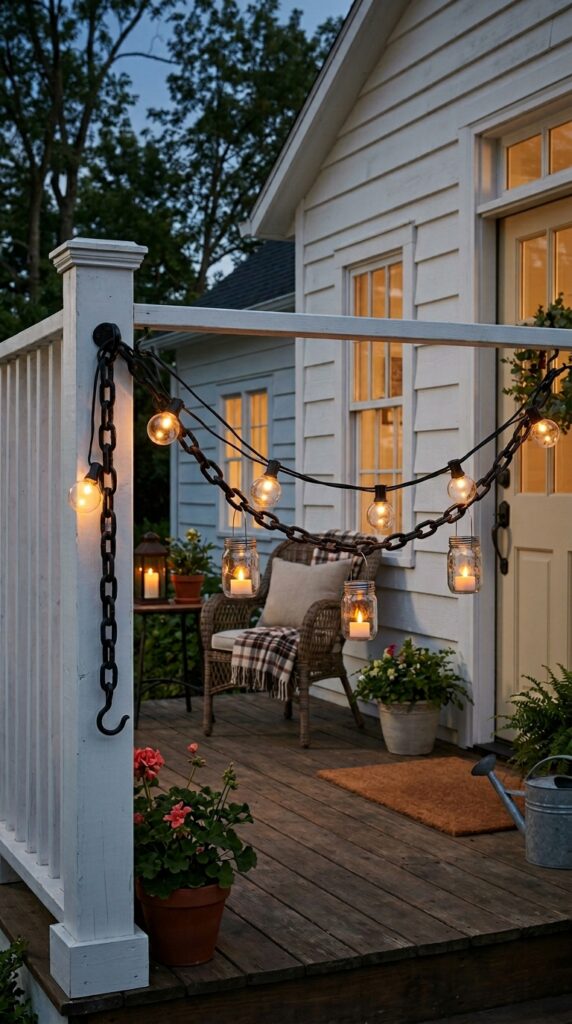
Vibe: Romantic — this porch looks like it throws parties without being asked.
Why it works: Decorative chain swags between posts is a Victorian-era porch detail that has been largely forgotten — which is exactly what makes it feel fresh and distinctive now. The chain provides a structural drape guide for the festoon lights while adding material weight and texture that bare wire can’t achieve. The catenary curve of the chain between posts is inherently elegant — the same natural curve that suspension bridges use — and reads as deliberate ornamentation rather than DIY hack.
How to get it: Mount a black cast iron cup hook to each post at the same height — approximately 6 inches below the top rail — and hang the chain between cups in the natural curve it wants to take. Weave globe light wire through the chain links before hanging, spacing globes every 8–12 inches for consistent illumination along the swag.
🛍️ Shop the Look — Amazon Product Ideas
| # | Product Search Phrase | Why It Fits |
| 1 | black chain link decorative swag 3/4-inch vinyl coated | Decorative chain accent |
| 2 | outdoor globe festoon string lights warm white 25ft | Woven light chain |
| 3 | black cast iron cup hook outdoor mount | Chain hanging hardware |
| 4 | battery powered tea light candle mason jar set | Chain-hung accent lights |
| 5 | outdoor extension cord black weatherproof 25ft | Light power supply |
23. Corner Porch Railing with Wraparound Planter Built-In
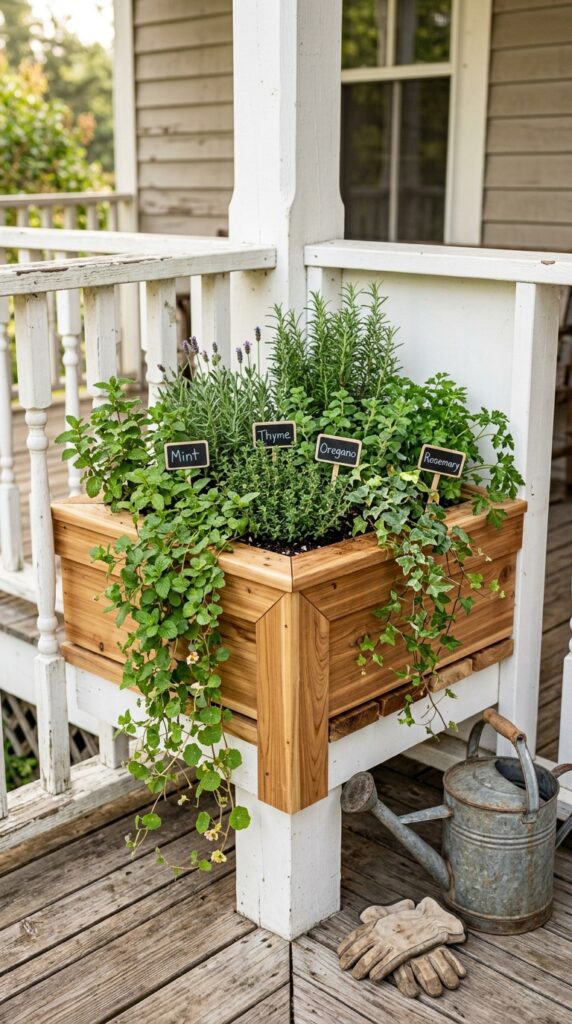
Vibe: Layered — the corner that usually does nothing now does everything.
Why it works: A corner post is the railing’s most structurally significant element — it anchors two railing runs and must be post-set to code — but visually it’s typically the least interesting point. Building a wraparound planter at the corner activates this underused structural moment, turning structural necessity into a design opportunity. The L-shaped geometry of the planter box mirrors the corner post geometry exactly, creating a fit that looks custom-designed rather than added on.
How to get it: Build the L-shaped box from 1×8 cedar boards, mitering the corner joint at 45 degrees for a seamless exterior face. Line the interior with a heavy-duty garbage bag or pond liner before filling with soil — the liner protects the cedar from moisture without requiring internal waterproofing treatment. Mount the box to the corner post using interior wood screws through the liner zone that won’t be visible from outside.
💡 Quick Win: Mint planted in a corner post planter creates both beauty and function — pinch it back regularly and it overflows in a lush cascade that also keeps mosquitoes at bay due to its natural scent.
🛍️ Shop the Look — Amazon Product Ideas
| # | Product Search Phrase | Why It Fits |
| 1 | corner L-shaped planter box cedar natural | Corner post planter form |
| 2 | cedar board 1×8 fence rail smooth | DIY box building material |
| 3 | pond liner heavy duty waterproof flexible | Interior planter lining |
| 4 | mint live herb plant outdoor 4-inch pot | Fragrant cascading filler |
| 5 | chalkboard plant label stake set small | Herb identification accent |
24. Wide Handrail Cap in Exotic Hardwood Contrast
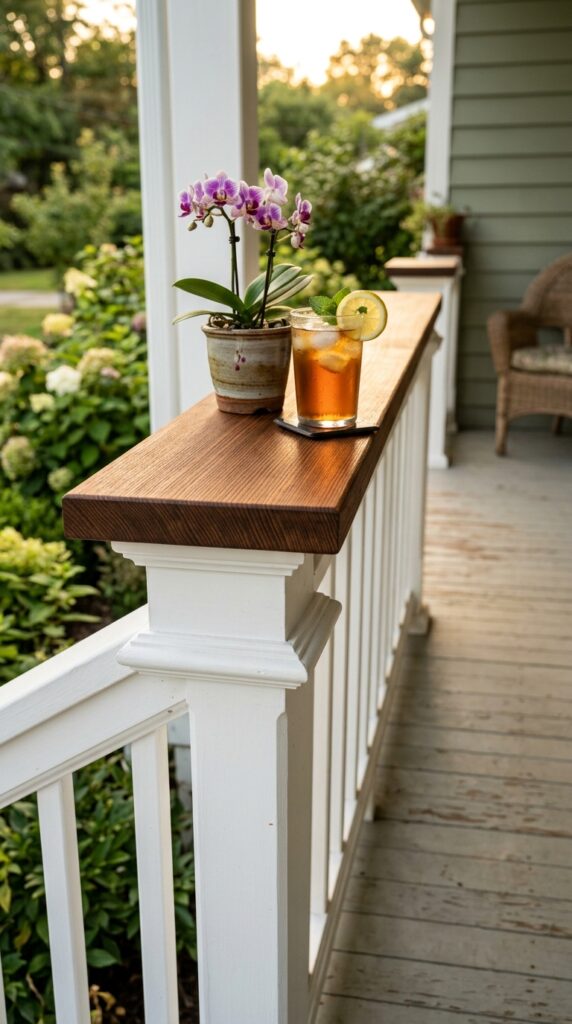
Vibe: Luminous — the dark cap rail makes every white element around it look brighter.
Why it works: A dark hardwood cap rail on a white railing body applies the same contrast logic as a dark countertop on white cabinets — the dark top edge grounds the composition and makes the white below appear intentionally selected rather than simply default. Ipe (Brazilian walnut) or teak as cap rail materials also provides a functional upgrade: both species are among the hardest available, virtually rot-proof without treatment, and develop a beautiful silver-grey patina if left unsealed or maintain their deep brown if oiled annually.
How to get it: Source ipe or teak cap rail from a specialty deck lumber supplier — neither is available at standard home improvement stores. Cut to length and screw from below through the rail top into the cap to hide all fasteners, using stainless steel screws (regular steel will leave rust bleed stains through the wood). Apply Ipe Oil annually to maintain the dark brown tone; leave unsealed if you prefer the natural silver-grey patina.
🛍️ Shop the Look — Amazon Product Ideas
| # | Product Search Phrase | Why It Fits |
| 1 | ipe wood deck board 2×6 hardwood cap rail | Dark hardwood cap material |
| 2 | ipe oil hardwood deck cleaner and sealer | Annual maintenance oil |
| 3 | stainless steel decking screws hidden fastener | Rust-free fastening |
| 4 | white orchid plant faux outdoor realistic | Elegant rail-top accent |
| 5 | glass pitcher outdoor acrylic iced beverage | Styled rail surface prop |
25. Farmhouse Railing with Seasonal Wreath Post Decor
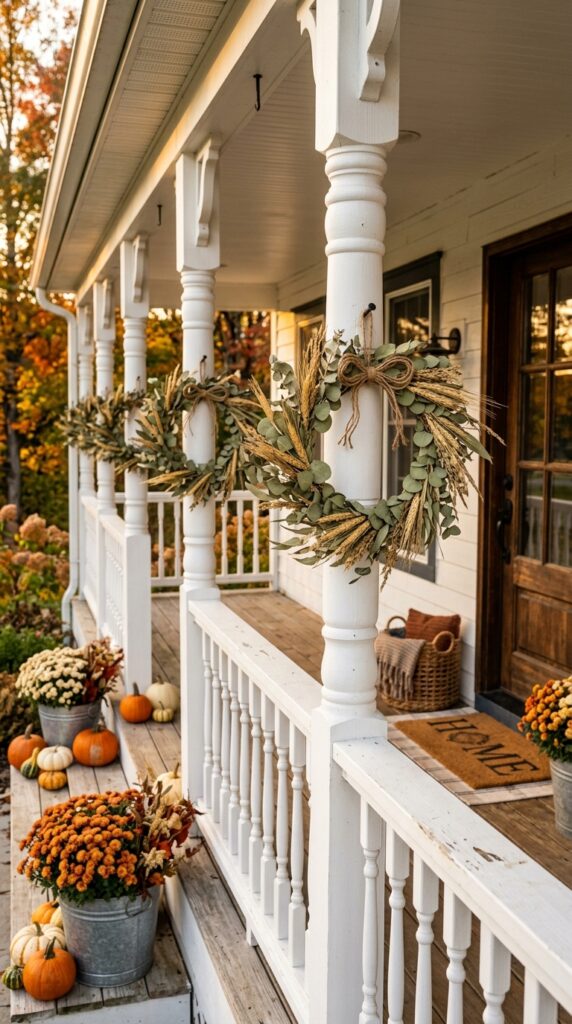
Vibe: Warm — a porch that knows what season it is and dresses accordingly.
Why it works: Hanging identical wreaths at consistent heights on each post creates a powerful repetition effect — the pattern reinforces the railing’s architectural rhythm rather than working against it. Dried botanical wreaths (rather than artificial or fresh-cut) age in place gracefully, shifting from vibrant green to muted grey over weeks in a way that reads as naturally seasonal rather than neglected. The simplicity of a single black nail and a jute bow keeps the attachment visible and intentional rather than hidden — a confidence that is entirely consistent with farmhouse aesthetic values.
How to get it: Make dried wreaths yourself from bundles of dried eucalyptus and wheat stems (available in bulk from craft suppliers) wrapped over a wire wreath form and secured with florist wire, then finished with a jute bow. A 12-inch wreath requires approximately two bundles of eucalyptus and costs $10–15 in materials — less than 20 minutes of construction per wreath.
🛍️ Shop the Look — Amazon Product Ideas
| # | Product Search Phrase | Why It Fits |
| 1 | dried eucalyptus wreath 12-inch natural farmhouse | Post-hung botanical wreath |
| 2 | dried wheat stem bundle natural craft wreath | Wreath building material |
| 3 | jute twine bow natural rope tie | Wreath hanging accent |
| 4 | small pumpkin set artificial outdoor fall | Seasonal post base prop |
| 5 | galvanized pot mum planter outdoor fall | Seasonal color planting |
26. Steel Hog Wire Infill Railing for Rustic Farmhouse
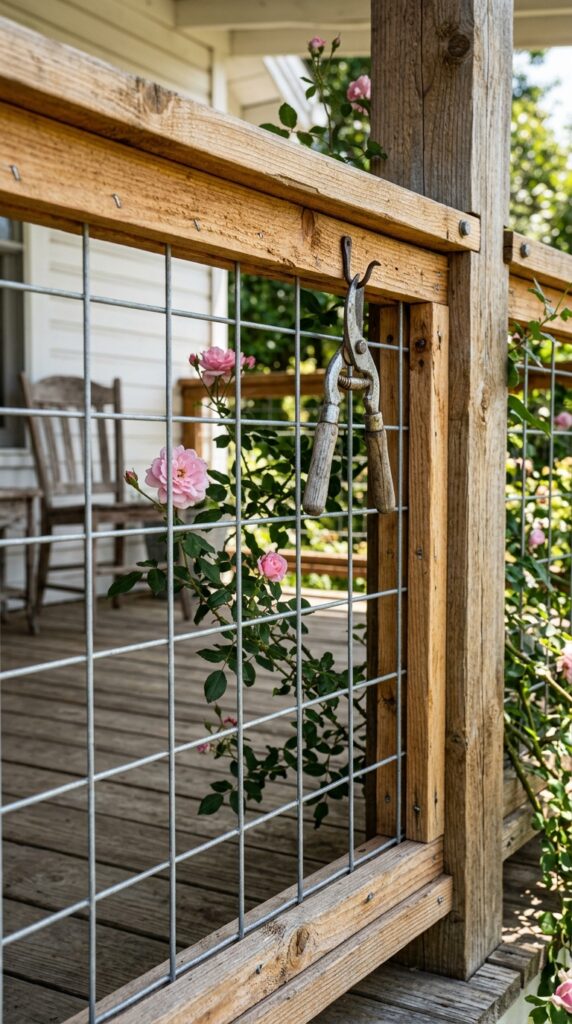
Vibe: Raw — this railing came straight from the working farm and doesn’t mind being recognized.
Why it works: Hog wire railing infill is the most direct reference to agricultural building materials in the farmhouse design vocabulary — livestock fence panels repurposed as a structural design element. The 4×4-inch wire grid is visually open (nearly as see-through as cable wire), weatherproof, extremely durable, and — when framed in cedar — reads as a deliberate design choice rather than improvised construction. Climbing roses threaded through the wire grid bring the softening organic element that prevents the agricultural reference from reading as utilitarian.
How to get it: Purchase galvanized livestock panel in standard 16-foot lengths from an agricultural supply store at approximately $25–35 per panel — significantly less than custom railing materials. Cut to width with bolt cutters and stretch-mount within a cedar frame built between posts. Staple the wire to the inside face of the frame using a heavy-duty staple gun and 1/2-inch galvanized staples for a clean edge.
💡 Quick Win: Hog wire framed in cedar and mounting a simple clip-on plant holder along the inside face of the wire creates an instant vertical garden on your porch railing for under $30 in hardware.
🛍️ Shop the Look — Amazon Product Ideas
| # | Product Search Phrase | Why It Fits |
| 1 | galvanized hog wire livestock panel 4×4 grid | Core agricultural infill |
| 2 | cedar frame board 2×4 rough sawn natural | Wire panel framing material |
| 3 | bolt cutter heavy duty wire panel cutting | Panel cutting tool |
| 4 | climbing rose bare root David Austin live | Organic wire softener |
| 5 | plant clip holder wire fence mount small | Vertical garden attachment |
27. All-Natural Railing with Wisteria-Trained Post Columns
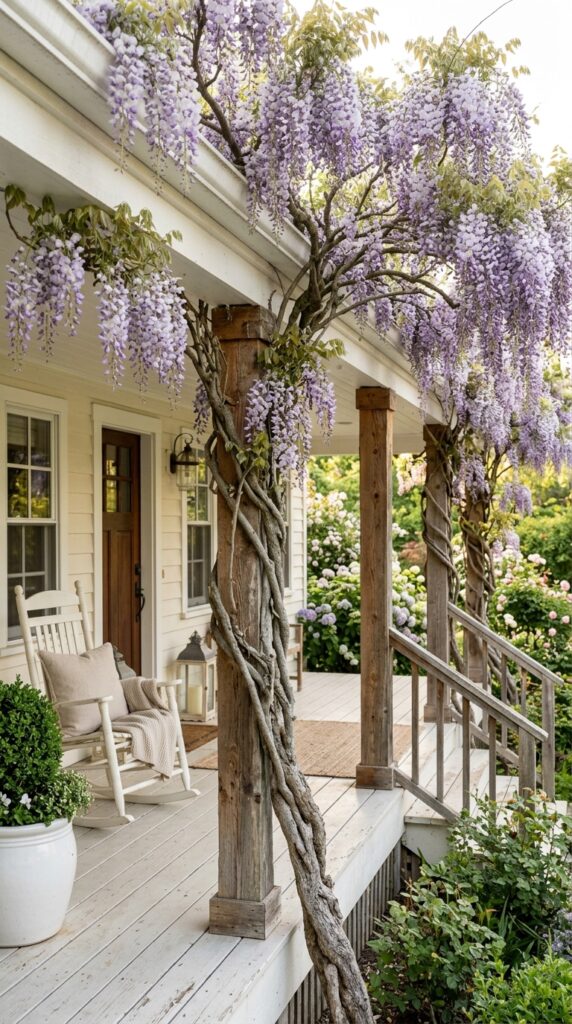
Vibe: Romantic — when the flowers open in May, this porch becomes a destination rather than an entrance.
Why it works: Training wisteria on porch posts creates a living architectural frame that makes the railing feel like part of the landscape rather than applied to it — the ultimate expression of farmhouse design’s commitment to honest, natural materials. The wisteria trunk wraps and grips the post over years, creating a permanent organic structure that outlasts any painted or stained finish. The pale lavender flower clusters against cedar or white posts create a color contrast that is entirely natural — no styling required when the plant is in bloom.
How to get it: Plant wisteria (Wisteria frutescens ‘Amethyst Falls’ for a manageable, less-aggressive American species) at the base of each post and train the main stem upward using soft cotton ties looped loosely around both vine and post. Do not use wire ties, which will girdle the vine as it thickens. Wisteria requires 3–5 years to reach full post coverage but is vigorous once established; prune back hard each February before new growth begins to maintain form.
🛍️ Shop the Look — Amazon Product Ideas
| # | Product Search Phrase | Why It Fits |
| 1 | wisteria frutescens Amethyst Falls live plant | Non-invasive trained vine |
| 2 | soft cotton plant tie garden training loop | Vine training material |
| 3 | white painted rocking chair outdoor farmhouse | Classic porch companion |
| 4 | white ceramic pot large boxwood topiary | Between-post formal accent |
| 5 | boxwood topiary ball shaped large artificial | Permanent evergreen form |
How to Start Your Farmhouse Porch Railing Transformation
Start with the post hardware — specifically, replace every piece of visible post mounting hardware (lag bolts, post bases, rail brackets) with oil-rubbed bronze or matte black equivalents before touching paint, stain, or plants. Hardware is the grammar of a railing system: when it’s mismatched or builder-grade silver, it signals an unfinished design regardless of how good everything else looks. Consistent hardware finish costs $40–80 to upgrade a standard porch railing and immediately reads as a considered decision.
The most common beginner mistake in farmhouse railing design is using a cool-white paint on the railing against a warm-cream porch ceiling — the undertone clash between cool-white spindles and warm-cream overhead reads as a mistake rather than a choice. Always sample your rail paint color against your existing porch ceiling and floor before committing: hold a painted sample board at the ceiling and floor junction to check for undertone agreement in actual outdoor light, not in the paint store.
Three specific items under $50 that create immediate farmhouse railing impact: a set of four matching solar post cap lanterns in matte black ($28–40 for a pack of two at most online retailers), a bundle of dried eucalyptus tied with jute twine and hung from a single black nail on each post ($12–16 for five stems), and a galvanized window box bracket-mounted to the exterior rail face with trailing sweet potato vine ($18–22 total for box and plant). Each of these adds material, texture, or light without requiring any construction.
A basic farmhouse railing upgrade — new hardware, a fresh paint coat, and two or three accessory additions — takes a weekend and costs $150–400 depending on railing length. A full railing replacement with new infill style (cable, horizontal board, or hog wire), new post caps, and built-in planters runs $800–2,500 for a standard front porch and takes 2–4 weekends. Structural changes require permit in most municipalities — budget 2–4 weeks for permit approval before breaking ground.
Frequently Asked Questions About Farmhouse Porch Railings
What’s the difference between a farmhouse porch railing and a regular deck railing?
A standard deck railing prioritizes code compliance — typically aluminum or composite balusters in silver or black — with little regard for visual character. A farmhouse porch railing uses the same structural logic (posts, rails, infill at code spacing) but selects materials, colors, and details that reference American rural architectural tradition: cedar, painted wood, galvanized hardware, rope, or agricultural fence panels. The difference is entirely in material selection and finish choice rather than structural form. Farmhouse railings avoid composite and vinyl materials, which lack the texture and aging quality that define the style’s authenticity.
What colors work best for farmhouse porch railings?
Antique white is the most versatile and historically accurate farmhouse railing color — it references the painted millwork of American farmhouses built between 1870 and 1940. Warm greige (a grey-beige blend) and driftwood grey are the best alternatives for a more contemporary farmhouse look that doesn’t require repainting every 3–4 years. Sherwin-Williams “Alabaster” (SW 7008) for white and Sherwin-Williams “Functional Gray” (SW 7024) for greige are widely available exterior colors that deliver an authentic farmhouse tone without reading as too yellow or too blue in outdoor light.
How much does a farmhouse porch railing cost to build or install?
A basic painted wood farmhouse railing with standard spindles and cedar posts runs $25–50 per linear foot installed — a 20-foot front porch railing costs approximately $500–1,000 with professional installation. DIY installation of the same materials cuts this to $200–400 in materials only. Upgraded systems — cable wire with cedar posts, or hog wire in cedar frames — run $60–120 per linear foot installed due to increased hardware costs. Built-in planter additions add $150–400 per planter depending on size and materials.
Can farmhouse porch railings work on a modern or craftsman-style home?
Farmhouse railing elements — natural cedar, matte black hardware, horizontal board infill — translate naturally to Craftsman, cottage, and transitional styles because all of these share the same commitment to natural materials and visible craftsmanship. On a modern home with clean geometric lines, the best approach is to use one farmhouse material (cedar posts, for example) with a more minimal infill (cable wire rather than spindles) to bridge the styles. Avoid combining farmhouse railings with ultra-contemporary homes featuring flat rooflines and steel cladding — the material warmth conflicts with the cold industrial exterior palette.
What is the easiest farmhouse porch railing infill style to DIY install?
Horizontal board infill is the most DIY-accessible farmhouse railing style — it requires only a miter saw, drill, and basic carpentry skills that any weekend builder can execute. Cedar 1×4 boards cut to the space between posts and mounted with hidden clip fasteners produce a clean, professional result without complex joinery or specialized tools. Pre-cut boards also allow you to complete one bay at a time, making it possible to finish a full porch railing over two or three weekend sessions. Cable wire infill, by comparison, requires specific tensioning tools and is less forgiving of measurement errors.
Ready to Create Your Dream Farmhouse Porch Railing?
These 27 farmhouse porch railing ideas cover the full design spectrum — from natural materials and color choices to lighting solutions, layout strategies, and small-space adaptations — giving you a complete toolkit for transforming your porch’s most visible architectural element. Start small: this week, replace just the post cap hardware on your existing railing with matte black equivalents — it’s a two-hour swap that costs under $40 and immediately changes how the entire railing reads from the street. When every detail of your porch exterior has been considered — the grain of the cedar, the matte of the black, the weight of the rope — you’ll feel what farmhouse design has always offered: the satisfaction of a home that looks exactly like itself. Pin the railing idea that made you stop scrolling, and keep it somewhere you’ll return to when the weekend rolls around and the lumber yard is open.