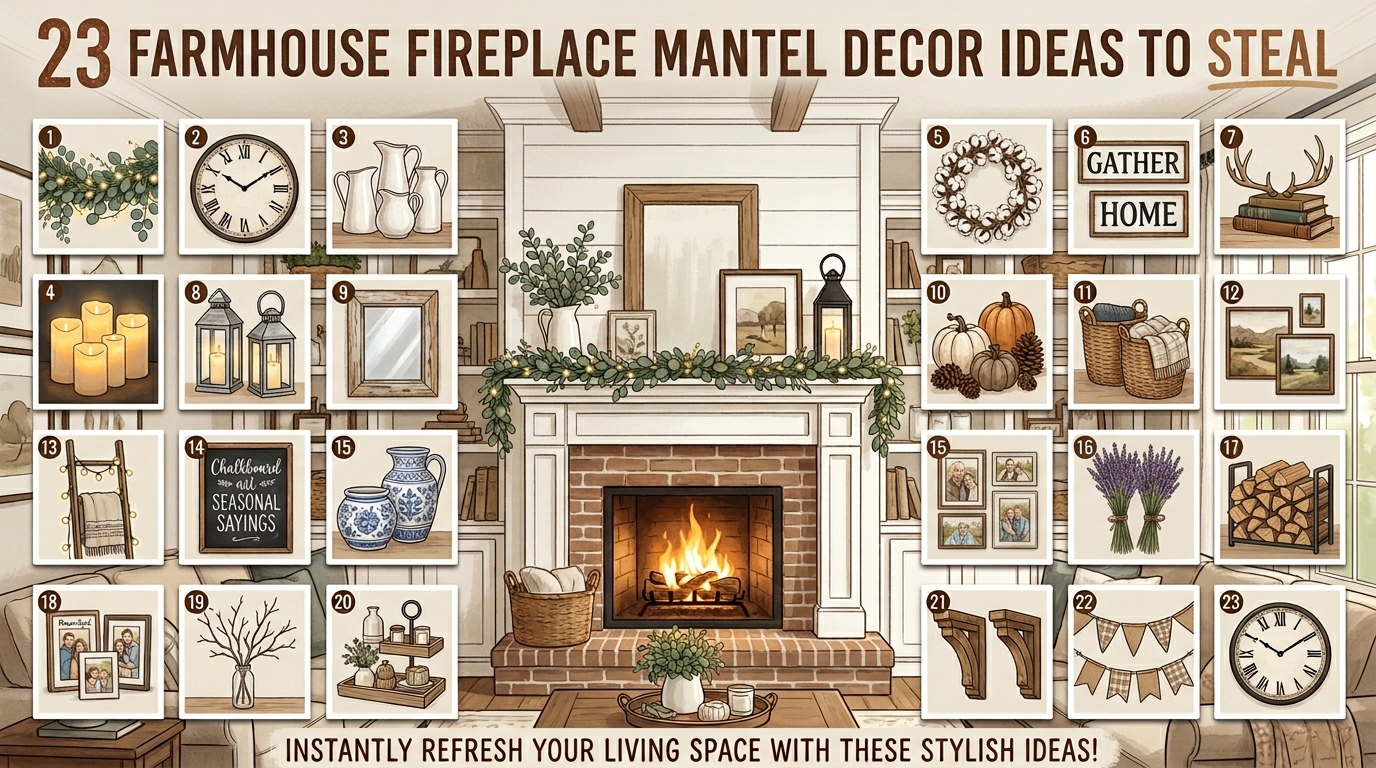
Farmhouse style is a design philosophy rooted in American rural tradition — warm, unpretentious, and built around natural materials, handcrafted textures, and a quiet sense of belonging. This article gives you all 23 farmhouse fireplace mantel decor ideas, organized from bold focal-point statements to small, budget-friendly finishing touches you can pull off this weekend.
There’s something deeply grounding about a farmhouse mantel. It carries the heft of raw wood, the softness of aged linen, the quiet glow of candlelight on matte ceramics. It doesn’t try to impress — it simply settles you. Here are 23 ideas worth saving — and stealing.
Why Farmhouse Style Works So Well
True farmhouse design emerged from 19th-century American agrarian life, where beauty was a byproduct of function, not the goal. It draws from Shaker simplicity, European country aesthetics, and the American frontier tradition of making much from little. What separates it from rustic or shabby chic is its restraint — it never clutters for the sake of coziness, and it never sacrifices warmth for minimalism.
The material palette is tactile and earthy: shiplap and whitewashed wood, unfinished white oak and reclaimed pine, hand-thrown stoneware, raw linen and cotton muslin. Colors stay grounded — warm white (think Benjamin Moore’s White Dove), greige, dusty sage, muted terracotta blush, and warm charcoal. Brushed brass and aged black iron are the metals of choice, never chrome or polished nickel.
Farmhouse is trending powerfully right now because it answers a post-pandemic hunger for home as sanctuary. After years of being design-forward or on-trend, many people are turning toward spaces that feel like they’ve been lived in — genuinely, warmly. Pinterest search data confirms this shift, with farmhouse and “cozy home” aesthetics continuing to dominate saves year over year.
Small spaces can absolutely achieve this look. The secret is editing hard. One statement piece — a large shiplap mirror or a single architectural clock — does more for a small mantel than a dozen accessories. Prioritize scale over quantity, and let negative space breathe.
Style at a Glance
| Element | Details |
| Philosophy | Warmth through simplicity; beauty through function |
| Key Materials | Reclaimed wood, raw linen, stoneware, aged iron, shiplap |
| Key Colors | Warm white, greige, dusty sage, terracotta blush, warm charcoal |
23 Farmhouse Fireplace Mantel Decor Ideas
1. The Shiplap Mirror Statement
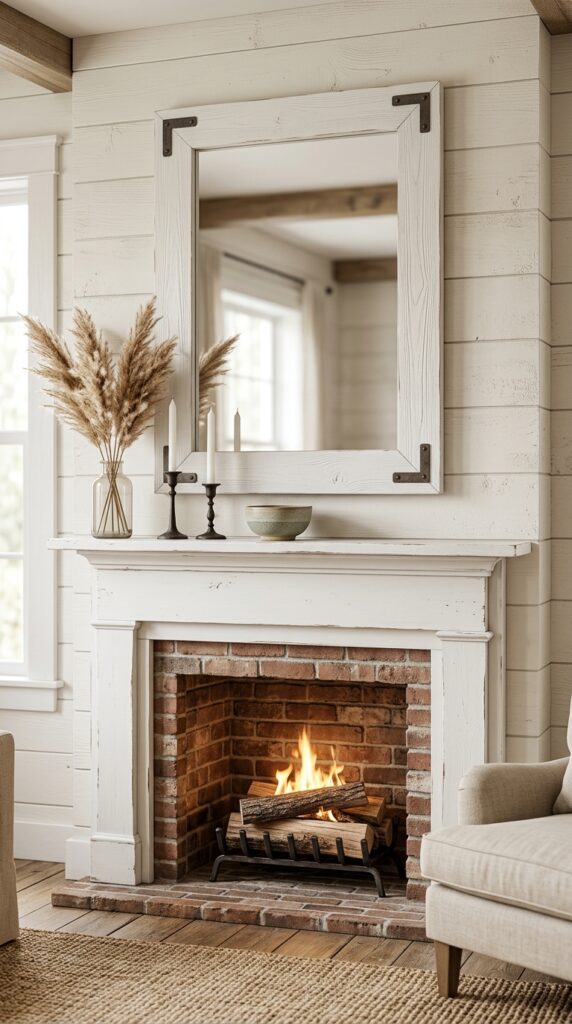
Vibe: Still — the kind of room that exhales when you walk in.
Why it works: A large shiplap mirror above a mantel creates a vertical axis that pulls the eye upward, establishing the fireplace as the true architectural anchor of the room. The horizontal board lines of the shiplap echo the mantel shelf itself, creating visual repetition that feels intentional without being rigid. The reflective surface bounces natural light into the room, which is critical in a style that depends on warmth rather than drama.
How to get it: Source a flat rectangular mirror from any home goods retailer and wrap the frame in thin shiplap boards cut to size — you can find peel-and-stick shiplap planks that require no demo work. Paint in Benjamin Moore’s White Dove OC-17 for that signature warm-white farmhouse tone. Hang it at eye level, not ceiling level; this keeps the composition grounded.
💡 Quick Win: A pre-made shiplap mirror in white or natural wood finish, sized 36″–40″ wide, is the fastest single upgrade you can make to any fireplace wall. Search “shiplap wall mirror farmhouse” and look for options under $120.
🛍️ Shop the Look — Amazon Product Ideas
| # | Product Search Phrase | Why It Fits |
| 1 | Farmhouse shiplap wood framed wall mirror 36 inch | Signature focal point piece |
| 2 | White iron taper candle holders set of 2 | Aged metal anchor |
| 3 | Dried pampas grass bundle cream | Soft natural texture |
| 4 | Matte white stoneware decorative bowl | Grounded ceramic accent |
| 5 | Benjamin Moore White Dove peel and stick paint sample | Color foundation |
2. Layered Neutral Linen Texture
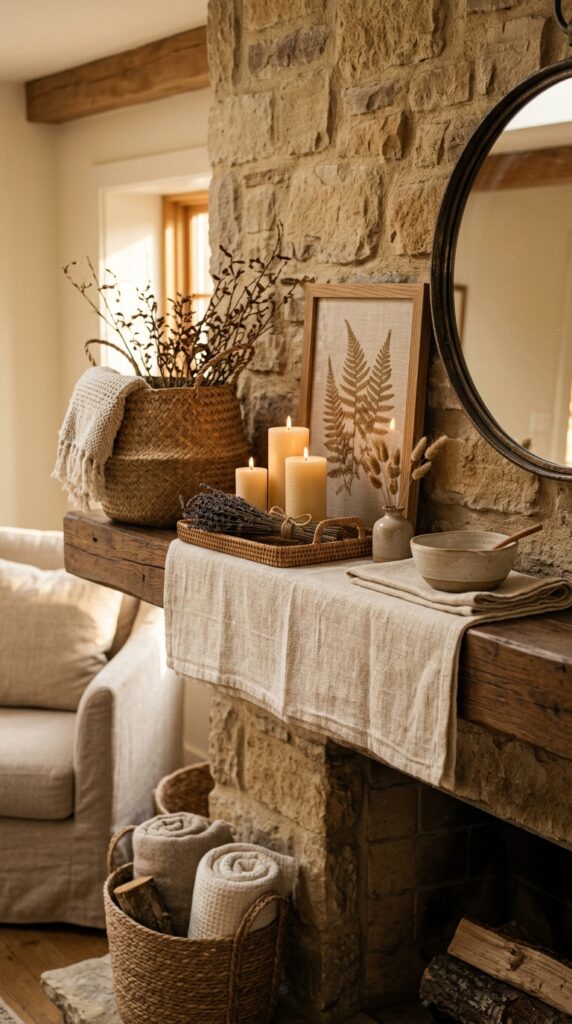
Vibe: Hushed — like Sunday morning light through a cotton curtain.
Why it works: Texture layering is one of the most powerful tools in farmhouse design, and the mantel shelf is the perfect place to practice it. Raw linen against smooth painted wood creates tactile contrast — your eye travels between the surfaces, never getting bored. The key design principle here is tonal layering: keeping colors within the same warm neutral family while varying sheen and weave creates richness without visual noise.
How to get it: Lay a 12″×36″ linen table runner flat on the mantel shelf as your base layer. Add a woven rattan tray to one side to organize smaller objects, and drape a small linen-wrapped or burlap-backed art print casually against the wall. The rule of three applies — runner, tray, leaning print — and nothing else needs to touch that surface.
🛍️ Shop the Look — Amazon Product Ideas
| # | Product Search Phrase | Why It Fits |
| 1 | Natural linen table runner 12×36 cream | Texture base layer |
| 2 | Rattan woven decorative tray oval farmhouse | Tray organizer accent |
| 3 | Beeswax taper candles cream set of 6 | Warm unscented glow |
| 4 | Dried lavender bundle natural purple | Botanical fragrance accent |
| 5 | Burlap wrapped botanical art print 8×10 | Casual leaning artwork |
3. Reclaimed Wood Floating Shelf Above Brick
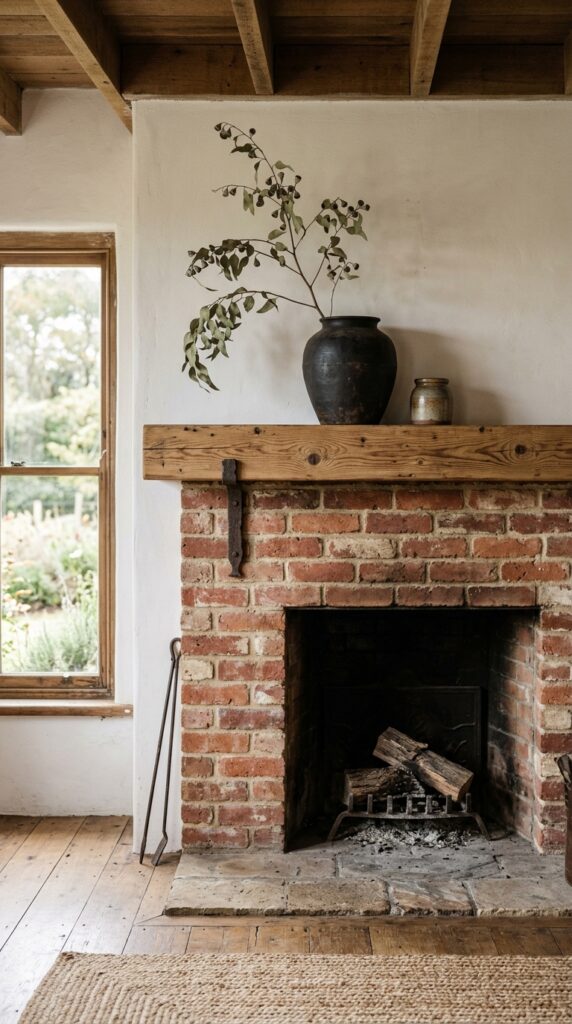
Vibe: Raw — honest materials with nothing to prove.
Why it works: Pairing a reclaimed wood shelf directly with exposed brick amplifies both materials — the warmth of aged pine picks up the red undertones in the brick, creating a naturally cohesive palette without any paint or styling required. This is the design principle of material harmony: letting two organic textures speak without decoration mediating between them. The visible knots and saw marks in reclaimed wood also add visual interest that a smooth painted mantel simply cannot replicate.
How to get it: Look for reclaimed pine or Douglas fir floating shelf blanks at lumber yards or on Etsy — aim for pieces at least 3″ thick so they read as architectural rather than decorative. Mount with heavy-duty metal L-brackets in aged black or oil-rubbed bronze. Style with a maximum of three items: one tall statement vessel, one mid-height botanical, one small low accent.
💡 Quick Win: Search “reclaimed wood floating mantel shelf with brackets” on Amazon. Kits that include the shelf and matching metal supports run $80–$150 and require only basic wall anchoring.
🛍️ Shop the Look — Amazon Product Ideas
| # | Product Search Phrase | Why It Fits |
| 1 | Reclaimed wood floating shelf with iron brackets 48 inch | Core architectural element |
| 2 | Matte black iron decorative urn large | Tall statement vessel |
| 3 | Dried eucalyptus stem bundle natural green | Tall botanical texture |
| 4 | Small stoneware jar with lid cream | Low accent piece |
| 5 | Oil rubbed bronze heavy duty shelf bracket set | Hardware finish match |
4. Warm White Fireplace Paint Refresh
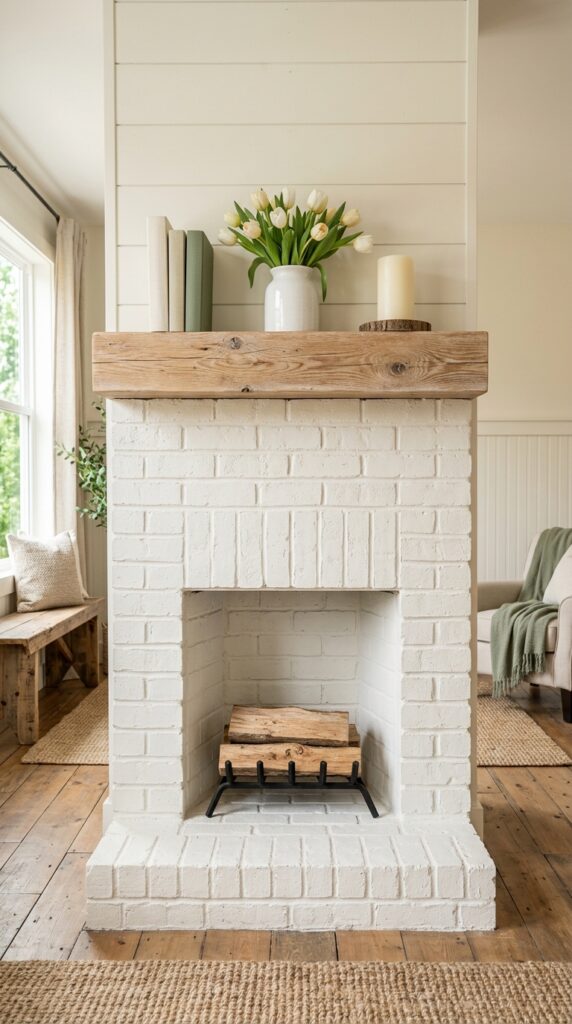
Vibe: Luminous — a room that feels scrubbed clean and full of promise.
Why it works: Color transformation is the highest-impact, lowest-effort tool in farmhouse decorating. Painting a brick or tile fireplace surround in warm white — not cool white, this distinction matters enormously — immediately shifts the entire fireplace from architectural obstacle to design anchor. The design principle at play is visual weight reduction: a dark or dated surround competes with everything around it, while warm white recedes and lets the mantel decor take center stage.
How to get it: Use a chalk-finish or mineral paint formulated for masonry — Annie Sloan’s Old White or Rust-Oleum Chalked in Linen White both adhere to brick without primer. Apply with a stiff bristle brush to work paint into mortar lines. Two coats, light sanding between. Do not seal — the matte finish is essential to the farmhouse aesthetic.
🛍️ Shop the Look — Amazon Product Ideas
| # | Product Search Phrase | Why It Fits |
| 1 | Rust-Oleum chalked paint linen white 30oz | Brick-safe matte paint |
| 2 | Stiff bristle masonry brush 3 inch | Brick painting tool |
| 3 | White ceramic bud vase 8 inch farmhouse | Simple floral accent |
| 4 | Wooden slab round slice for candle display | Natural base layer |
| 5 | White pillar candle 4×6 unscented | Warm texture candle |
5. Vintage Architectural Clock as Focal Point
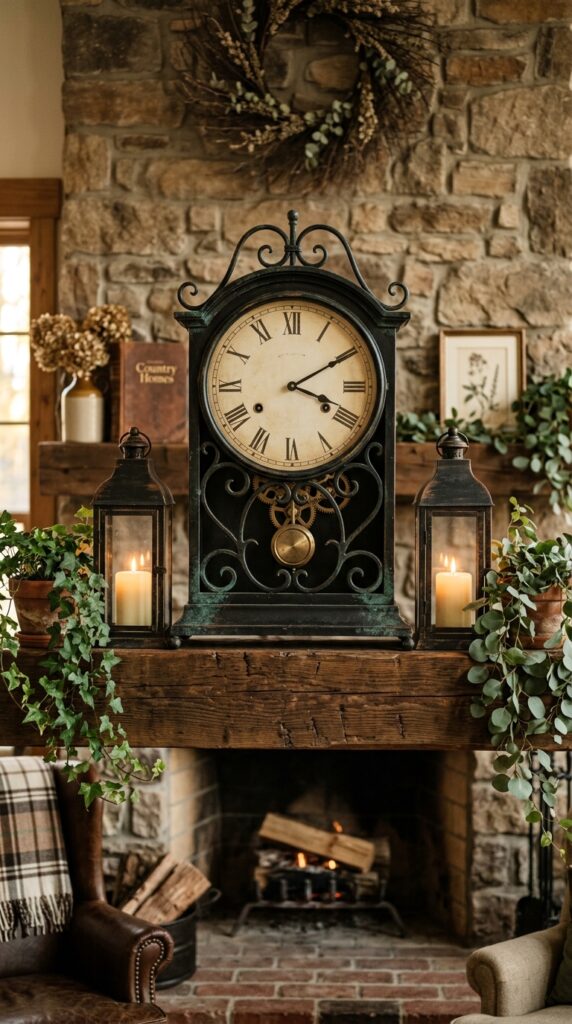
Vibe: Grounded — the room belongs to this one piece.
Why it works: A large mantel clock is perhaps the most historically authentic farmhouse accessory — clocks were cherished centerpieces in 19th-century homesteads, often the only precise timekeeping in a home. Using a clock as the anchor applies the design principle of singular dominance: one large, meaningful object that organizes everything else around it through symmetry. The proportional rule here is critical — a clock should be at least 40–50% of the mantel width to read as a statement rather than an afterthought.
How to get it: Search for mantel clocks in aged black iron or dark bronze finish, with cream or parchment dial faces. Measure your mantel width first — a 16″–22″ clock works for standard 48″–60″ mantels. Flank with matching pairs: two lanterns, two small potted plants, two candles. Symmetry is the fastest way to achieve a polished farmhouse look, even for beginners.
💡 Quick Win: A 16″ aged iron Roman numeral mantel clock can be found on Amazon for under $45 and immediately transforms an empty shelf into an intentional display.
🛍️ Shop the Look — Amazon Product Ideas
| # | Product Search Phrase | Why It Fits |
| 1 | Farmhouse mantel clock aged black iron Roman numerals | Primary focal point |
| 2 | Iron lantern candle holder small set of 2 | Flanking symmetry pair |
| 3 | Small terracotta pot with trailing ivy live | Living green accent |
| 4 | Short pillar candle cream 3×4 set of 2 | Low candle layering |
| 5 | Aged black iron candlestick holder tall | Vertical height element |
6. Dried Botanical Arrangement in Stoneware
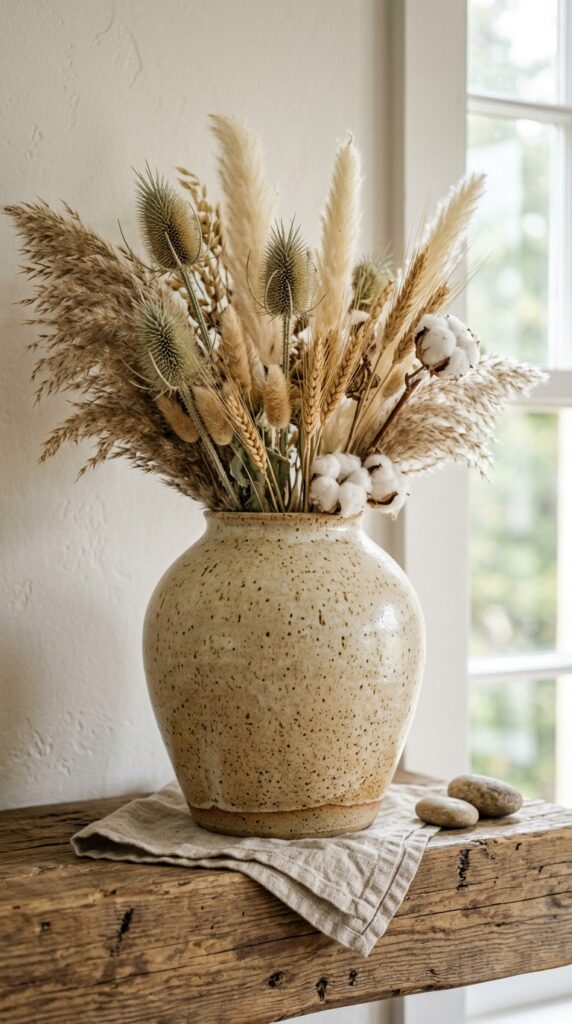
Vibe: Serene — nature edited down to its quietest form.
Why it works: Dried botanicals outperform fresh flowers in farmhouse interiors because they have year-round staying power and improve with age, getting softer and more textural over time — a design quality called patina. The reactive glaze stoneware vase adds further interest through its naturally imperfect surface, where the glaze pools differently on every piece. The combination of organic vessel + organic botanicals creates a sensory richness that mass-produced decor simply can’t replicate.
How to get it: Build the arrangement from tallest to shortest: pampas grass stems first, then medium wheat or dried thistle, then shorter cotton stems at the front edge. Use dried floral foam or crumpled paper inside the vase to control stem placement. The key styling rule: let stems lean and cross naturally — forced symmetry defeats the organic intention of this look.
🛍️ Shop the Look — Amazon Product Ideas
| # | Product Search Phrase | Why It Fits |
| 1 | Speckled cream reactive glaze stoneware vase large | Artisan vessel anchor |
| 2 | Dried pampas grass stems natural cream tall | Tall botanical layer |
| 3 | Dried cotton stem bundle natural farmhouse | Mid-level softness |
| 4 | Dried wheat bunch bundle natural | Textural base botanical |
| 5 | Dried purple thistle stems bundle | Color accent botanical |
7. Matte Black Sconce Pair for Flanking Light
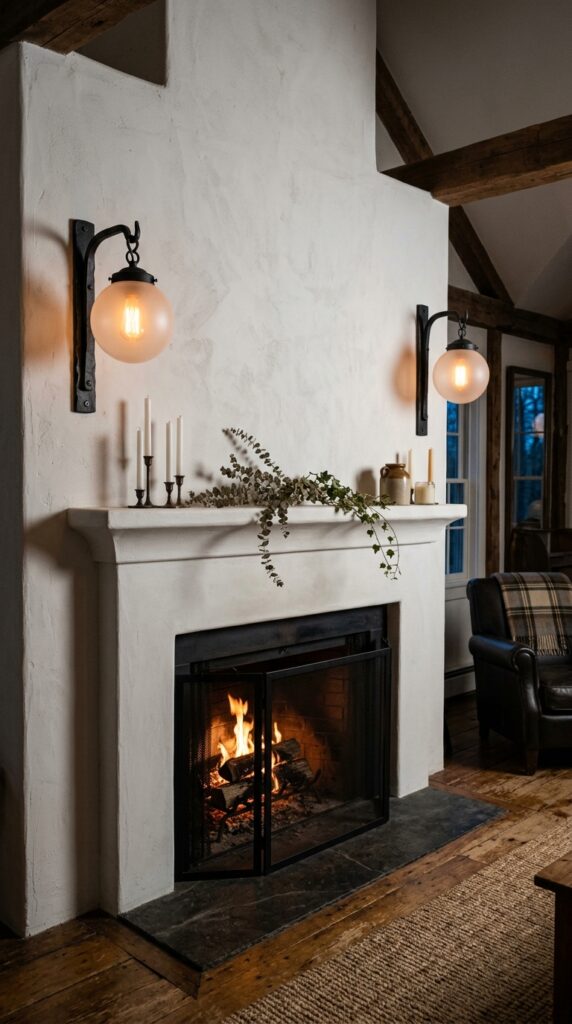
Vibe: Sun-warmed — even at night, this room feels like late afternoon.
Why it works: Flanking sconces transform a fireplace from a daytime feature into an all-hours anchor. The design principle here is layered lighting: combining the warm flicker of fire with the directional warmth of sconce light creates depth that overhead lighting never can. Matte black iron sconces in particular provide strong graphic contrast against a white or cream wall, giving the mantel a clear visual boundary that grounds the entire composition.
How to get it: Mount sconces 60″–66″ from the floor (center of shade) and 18″–24″ out from the mantel edge on each side — this spacing feels balanced on standard 8′ ceilings. Use Edison ST19 bulbs in 2200K color temperature for the warmest, most amber-toned light. If hardwiring isn’t an option, plug-in sconces with a cord cover are widely available and install in under an hour.
💡 Quick Win: Plug-in wall sconces in matte black with a cord cover kit run $35–$65 per pair on Amazon — no electrician required. Search “plug-in wall sconce matte black farmhouse with cord cover.”
🛍️ Shop the Look — Amazon Product Ideas
| # | Product Search Phrase | Why It Fits |
| 1 | Matte black plug-in wall sconce farmhouse with cord cover | Key lighting fixture |
| 2 | Edison bulb ST19 2200K warm white E26 | Warmest amber light tone |
| 3 | White taper candle set of 12 unscented | Fireplace mantel layering |
| 4 | Trailing pothos small plant in white pot | Living green accent |
| 5 | Cord cover kit paintable white 5 foot | Cord concealment essential |
8. Terracotta and Sage Color Story
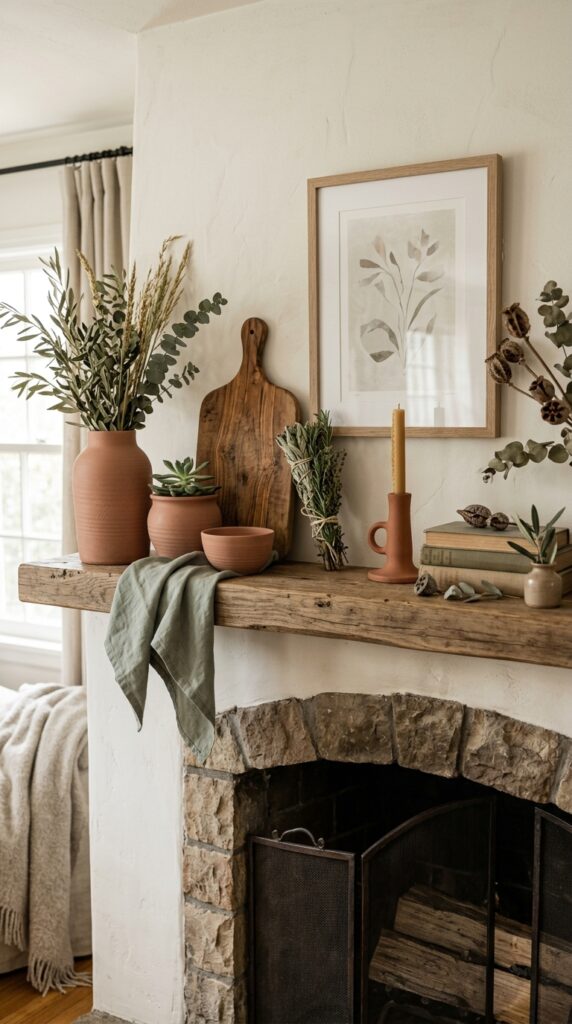
Vibe: Layered — the kind of color story that deepens the longer you look at it.
Why it works: Terracotta and dusty sage are analogous on the warm-neutral color wheel — they share the same warm undertones, which means they never clash. The contrast between them (clay orange versus muted green) is just enough to create interest without the room feeling color-heavy. This is called split-complementary harmony, and it’s one of the most reliable color techniques for interiors. The matte finishes on both ceramic and fabric prevent any individual element from dominating.
How to get it: Build the palette in three tones: lightest (warm white background/mantel), mid (dusty sage linen), darkest (terracotta clay). Shop for matte terracotta vessels in varying heights — 4″, 7″, and 10″ — for a graduated cluster. Avoid glossy glazes; they read modern rather than farmhouse. Spray paint inexpensive terra cotta nursery pots in dusty sage for a DIY accent.
🛍️ Shop the Look — Amazon Product Ideas
| # | Product Search Phrase | Why It Fits |
| 1 | Matte terracotta ceramic vase set of 3 varying heights | Color palette anchor vessels |
| 2 | Dusty sage linen table runner narrow | Soft fabric color note |
| 3 | Olive wood serving board small decorative | Natural organic accent |
| 4 | Dried sage bundle farmhouse herb | Botanical color echo |
| 5 | Terracotta chalk spray paint matte | DIY color accent tool |
9. Vintage Wood Sign or Typography Art
Vibe: Familiar — words you’ve known your whole life, rendered in wood and paint.
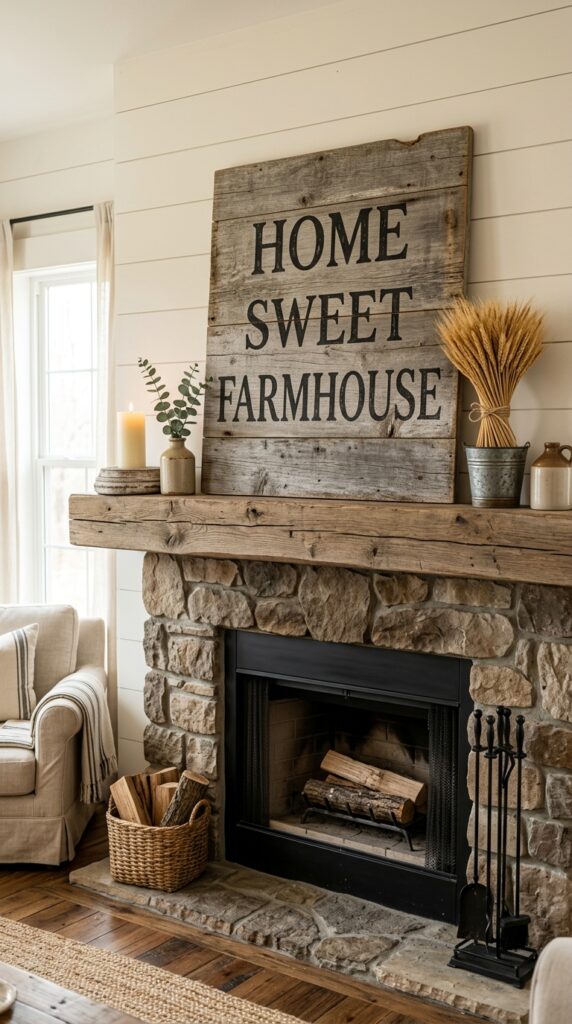
Why it works: Typography on the mantel introduces negative space in an unexpected way — the letters themselves become graphic shapes that balance the organic softness of botanicals and ceramics. Using a leaning sign rather than a hung one is intentional: it signals casualness and layers depth between the back wall and the shelf surface. Distressed barn wood provides the material storytelling that is central to farmhouse aesthetics — a sign that looks like it came from a 100-year-old general store adds history that new furniture simply cannot.
How to get it: Choose a sign with a simple word or short phrase — “gather,” “home,” “rest” — in a classic serif font. The sign should be at least 60% of your mantel width to read as intentional rather than filler. Lean it directly on the shelf with a slight backward tilt, not flush against the wall, to create a three-dimensional shadow effect.
🛍️ Shop the Look — Amazon Product Ideas
| # | Product Search Phrase | Why It Fits |
| 1 | Farmhouse wood sign gather distressed typography large | Primary typographic focal point |
| 2 | Galvanized metal bucket small decorative | Classic farmhouse vessel |
| 3 | Dried wheat bundle natural rustic | Harvest botanical accent |
| 4 | Wood candle riser round 4 inch | Layered height accent |
| 5 | Black iron book end set farmhouse | Grounding side elements |
10. Stacked Stone or Brick Hearth Extension
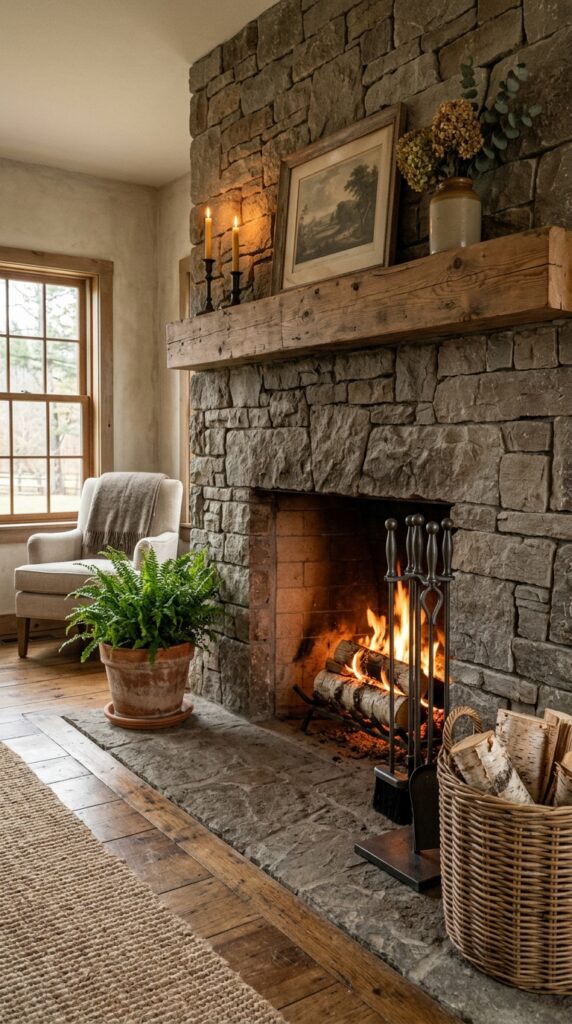
Vibe: Grounded — this room has been here a long time, and it knows it.
Why it works: Treating the hearth and mantel as a unified vertical composition rather than separate zones is a layout principle that dramatically increases the visual power of any fireplace. When the hearth styling (log basket, fireplace tools, plants) echoes the mantel styling (wood, ceramics, botanicals) in palette and material, the entire wall reads as one cohesive installation rather than a collection of objects. This is called zone integration, and it’s the difference between a styled room and a magazine room.
How to get it: Ground the hearth with a natural fiber hearth rug in cream or oat — this defines the zone visually and adds warmth. Place a woven rattan or wire log basket to the left, iron fireplace tool set to the right. Add one living plant — a fern or trailing pothos in a simple clay pot — somewhere on the hearth to bridge the gap between organic and industrial.
💡 Quick Win: A woven seagrass log basket runs under $40 on Amazon and instantly organizes a hearth while adding natural texture. Search “woven rattan log holder basket farmhouse.”
🛍️ Shop the Look — Amazon Product Ideas
| # | Product Search Phrase | Why It Fits |
| 1 | Woven rattan log basket holder firewood farmhouse | Hearth zone anchor |
| 2 | Matte black iron fireplace tool set 5 piece | Essential hearth hardware |
| 3 | Cream wool hearth rug small 2×3 | Hearth zone definition |
| 4 | Birch logs decorative bundle 10 piece | Firebox natural styling |
| 5 | Small clay pot with fern live plant | Living green on hearth |
11. Minimalist Ironwork Candle Arrangement
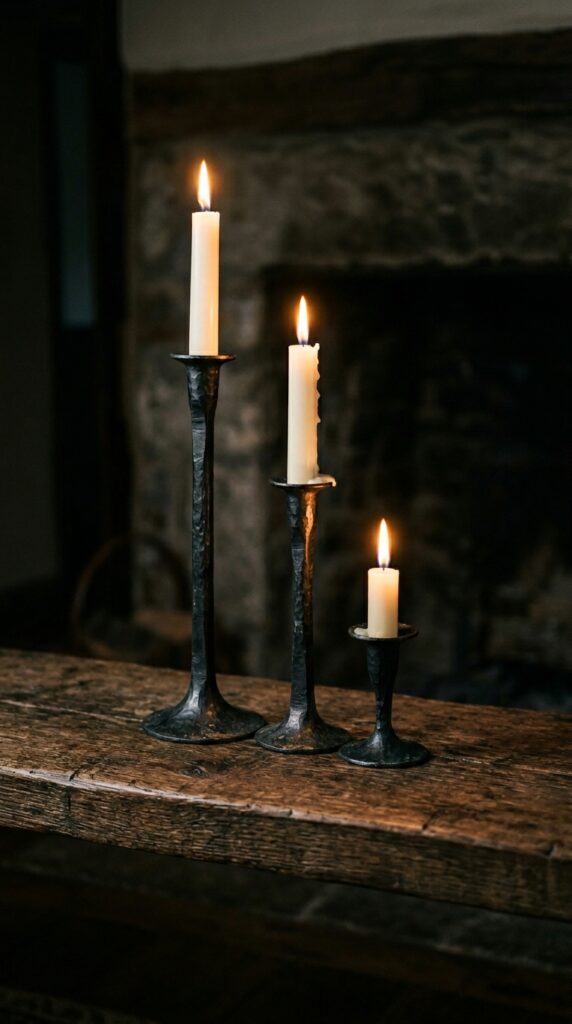
Vibe: Still — everything in this room has been placed with intention.
Why it works: An odd-numbered grouping of candlesticks in varying heights is one of the most studied styling principles in interior design — it works because the eye naturally seeks balance without symmetry, and an asymmetrical cluster satisfies that search. Restricting the palette to just iron and white creates a study in restraint; the visual interest comes entirely from the variation in proportion and the play of shadow between candlesticks. This is negative space working at the object level.
How to get it: Source a set of at least three iron candlesticks in different heights — 6″, 12″, and 18″ are ideal. Cluster them asymmetrically, with the tallest toward the back-center and the shortest at the front. Place all on a small iron or dark wood tray to visually unify the grouping. Use only white or cream tapers — mixed colors defeat the monochromatic discipline of this look.
🛍️ Shop the Look — Amazon Product Ideas
| # | Product Search Phrase | Why It Fits |
| 1 | Iron taper candlestick holders set of 3 varying heights | Centerpiece ironwork trio |
| 2 | White taper candles 12 inch unscented set of 12 | Consistent palette candles |
| 3 | Small iron decorative tray rectangle 8×12 | Grouping base organizer |
| 4 | Dried rosemary bundle fragrant herb | Subtle botanical accent |
| 5 | Short pillar candle white 3×3 rustic | Low-level candle layer |
12. Greenery Garland Along the Mantel Edge
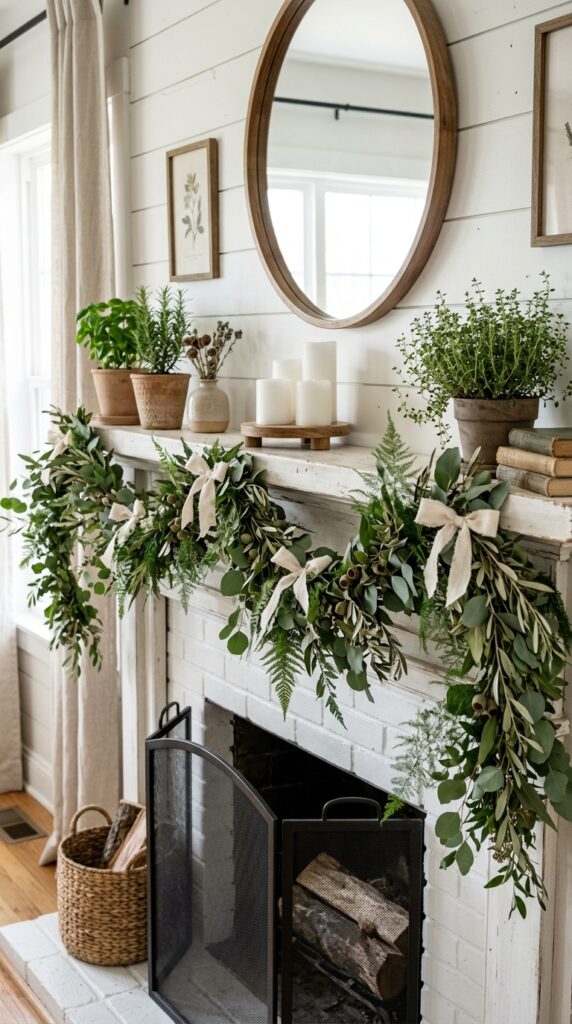
Vibe: Airy — nature brought indoors and asked to stay awhile.
Why it works: A garland draped along the mantel edge applies the design principle of horizontal layering — it extends the visual interest of the mantel downward toward the firebox, filling what would otherwise be dead visual space between shelf and surround. The draping also introduces an organic silhouette that softens the hard horizontal line of the mantel edge. Mixing multiple greenery types — sage eucalyptus, dark fern, lighter olive — adds tonal depth within a single color family.
How to get it: Use a pre-made eucalyptus garland as your base, then weave in loose stems of fern or olive branches by tucking them into the garland’s wire frame. Drape with a slight dip in the center for a natural swag effect. Secure lightly with clear floral wire at the mantel corners if needed. Fresh garlands last 2–3 weeks; dried versions are essentially permanent.
💡 Quick Win: A 6-foot preserved eucalyptus garland runs $25–$40 on Amazon and requires zero maintenance — it stays green-gray and aromatic for months. Search “preserved eucalyptus garland 6 foot farmhouse.”
🛍️ Shop the Look — Amazon Product Ideas
| # | Product Search Phrase | Why It Fits |
| 1 | Preserved eucalyptus garland 6 foot natural green | Full mantel length garland |
| 2 | Dried olive branch stems bundle | Darker tonal garland accent |
| 3 | Small potted herb plants 4 inch set of 2 | Living corner accents |
| 4 | Cream linen ribbon roll natural 1.5 inch | Garland tie detail |
| 5 | Clear floral wire 24 gauge | Invisible garland securing |
13. Antique Window Frame as Wall Art
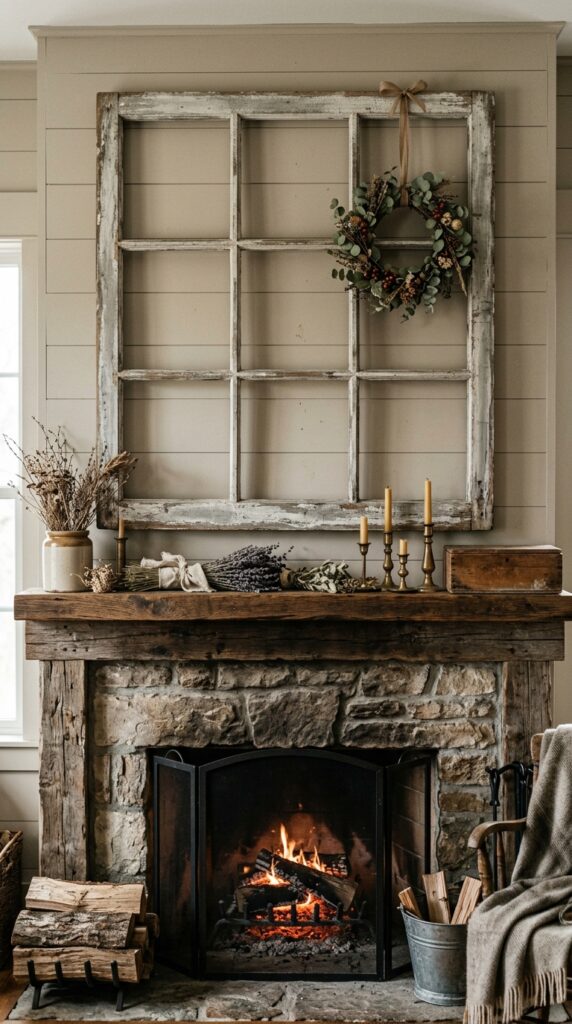
Vibe: Nostalgic — the kind of piece that makes you wonder who hung it first.
Why it works: An antique window frame hung as art is one of the most authentically farmhouse decor moves available — it references the agricultural architecture from which the style originates, where windows were repurposed and moved between buildings as structures were built and rebuilt over generations. The divided lite grid creates strong graphic lines while the distressed wood adds patina, and the depth of an actual frame (not a flat print) creates shadow and dimension on the wall that two-dimensional art cannot.
How to get it: Source antique window frames from estate sales, architectural salvage shops, or Facebook Marketplace — look for ones with divided panes (4 or 6 lights) in any size that spans at least 70% of your mantel width. Sand lightly, apply a thin wash of warm white chalk paint if needed, and hang with heavy-duty French cleats. Leave without glass — the shadow play through open panes is the point.
🛍️ Shop the Look — Amazon Product Ideas
| # | Product Search Phrase | Why It Fits |
| 1 | Farmhouse window frame wall decor distressed wood | Architectural art piece |
| 2 | Small dried herb wreath eucalyptus 10 inch | Pane accent wreath |
| 3 | French cleat picture hanging kit heavy duty | Secure mounting hardware |
| 4 | White chalk paint 16oz small project | Frame finishing paint |
| 5 | Dried lavender bundle botanical accent | Shelf botanical below |
14. Galvanized Metal and Rustic Wood Combo
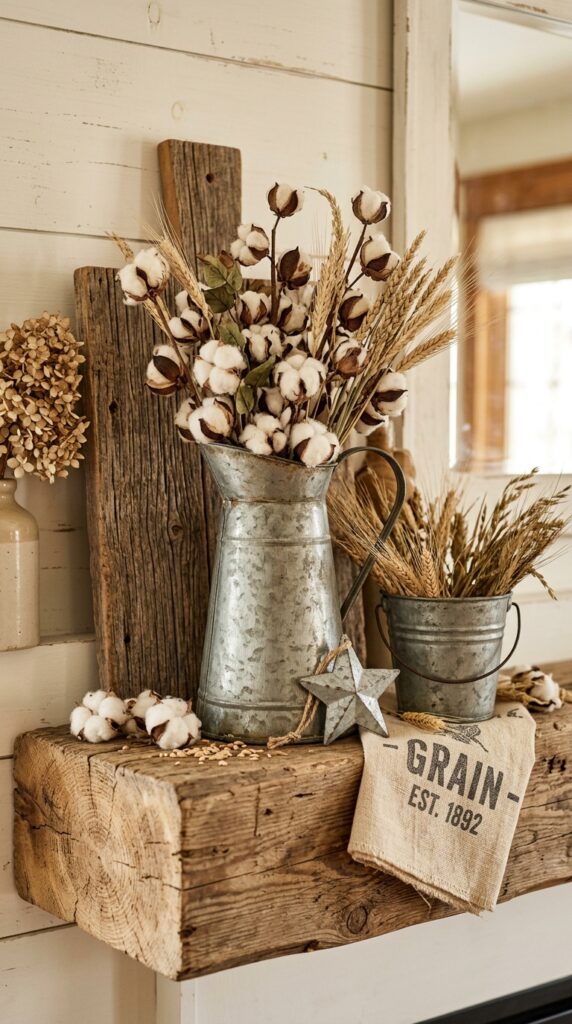
Vibe: Sun-warmed — the scent of hay and old wood on a bright morning.
Why it works: Galvanized metal is one of the most quintessentially farmhouse materials precisely because it was not chosen for aesthetics originally — it was the utilitarian choice for water troughs, milk cans, and storage buckets on working farms. Pairing it with rough-hewn wood applies the farmhouse principle of found beauty: two humble, functional materials that gain charm by being placed together with intention. The gray of galvanized metal also acts as a neutral, harmonizing with nearly any color palette.
How to get it: Group galvanized containers in odd numbers — one large pitcher, one medium bucket, one small can — at varying heights. Fill the largest with cotton stems or dried grain, leave the middle one empty as a sculptural form, and use the smallest as a base layer accent. Add a grain sack pattern linen swatch beneath to introduce softness against the metal’s hardness.
🛍️ Shop the Look — Amazon Product Ideas
| # | Product Search Phrase | Why It Fits |
| 1 | Galvanized metal pitcher farmhouse vintage style | Tall container anchor |
| 2 | Small galvanized metal bucket decorative 6 inch | Mid-level metal accent |
| 3 | Dried cotton boll stems bundle 12 stems | Fill botanical for pitcher |
| 4 | Grain sack striped linen pillow cover 14×22 | Fabric texture accent |
| 5 | Galvanized metal star ornament farmhouse | Small detail accent piece |
15. Warm White + Warm Wood Tonal Layering
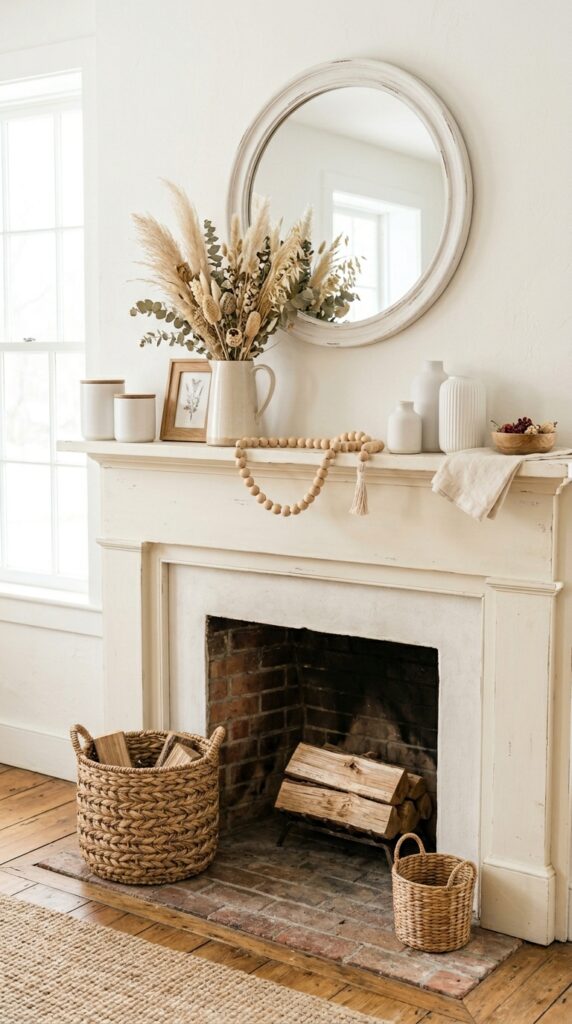
Vibe: Luminous — like winter light on fresh snow, warm underneath.
Why it works: Tonal decorating — working entirely within one color family — is a sophisticated design technique that creates rooms of exceptional visual calm. The key to making a white-on-white farmhouse mantel work is tonal variation: warm white paint (with a slight yellow or red undertone) against the cooler white of matte stoneware, against the cream of dried botanicals, against the yellow warmth of unfinished oak. The differences are subtle, but they prevent the composition from feeling flat or sterile.
How to get it: Start by painting the mantel in Benjamin Moore’s Chantilly Lace (OC-65) for a true warm white, then source accessories only in warm neutrals — oat, cream, unbleached linen, light wood. Avoid anything cool-toned (blue-white, gray, silver). Three textures minimum: ceramic, fabric, and wood.
💡 Quick Win: A set of three matte white ceramic canisters in varying heights costs under $35 and immediately creates a tonal grouping that reads as professionally styled.
🛍️ Shop the Look — Amazon Product Ideas
| # | Product Search Phrase | Why It Fits |
| 1 | Matte white stoneware canister set of 3 farmhouse | Tonal ceramic grouping |
| 2 | Unfinished wood bead garland natural | Light wood texture accent |
| 3 | Cream linen napkin set natural undyed | Soft fabric layer |
| 4 | Dried oat straw bundle natural cream | Pale botanical filler |
| 5 | Benjamin Moore Chantilly Lace peel-stick sample | Foundation color sample |
16. Cozy Corner Mantel in a Small Space
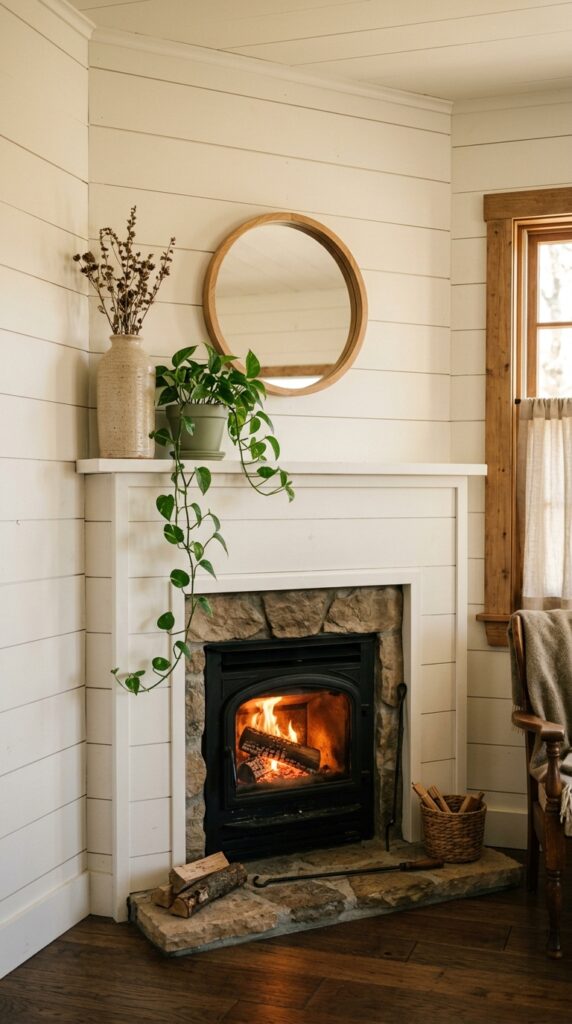
Vibe: Cozy — intimate by design, not by limitation.
Why it works: Small mantel shelves require a fundamentally different design approach: instead of distributing accessories across the full shelf, concentrate everything into a single deliberate cluster on one side, leaving the other side completely clear. This is the principle of asymmetric negative space, and it actually reads as more sophisticated than a filled shelf because the empty space becomes intentional. For small farmhouse mantels, scale is everything — every piece should be at least 20% smaller than you would use in a larger space.
How to get it: Choose one vertically oriented piece (a tall vase or ceramic jug) as your anchor. Add one trailing plant to the opposite end — the diagonal flow of the trailing stems creates movement across the shelf without adding visual mass. Place a small round mirror (16″–20″ diameter) above the anchor piece. Three elements, maximum — this is the small-space limit.
🛍️ Shop the Look — Amazon Product Ideas
| # | Product Search Phrase | Why It Fits |
| 1 | Small round wood mirror 18 inch farmhouse | Compact scale mirror |
| 2 | Tall slim ceramic jug cream farmhouse 10 inch | Vertical small-space anchor |
| 3 | Small trailing pothos plant 4 inch pot | Movement across shelf |
| 4 | Mini linen table runner 8×24 inch | Compact shelf liner |
| 5 | Small woven basket 5 inch with handles | Petite texture accent |
17. Iron and Rope Textural Contrast
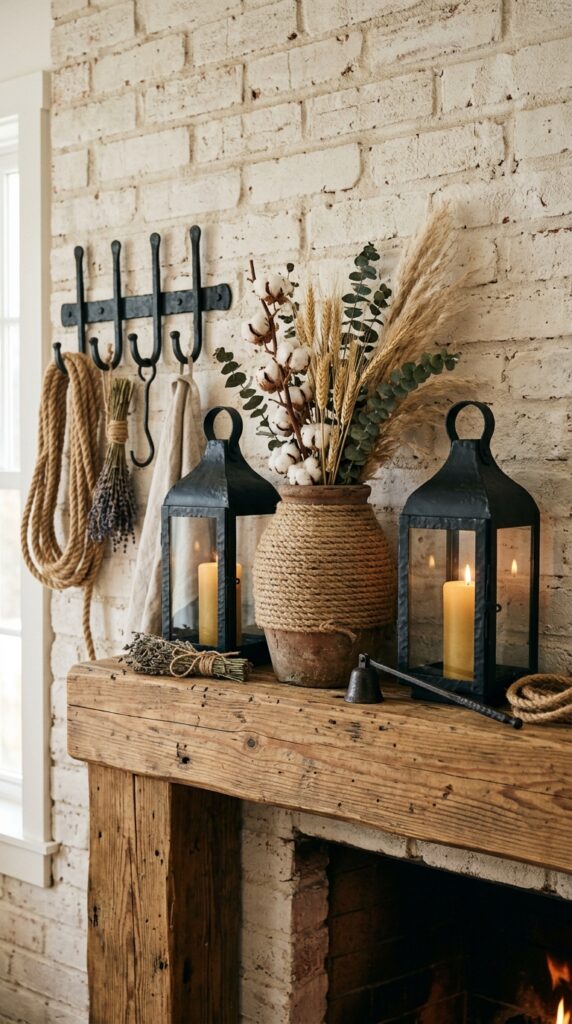
Vibe: Raw — two materials in honest conversation.
Why it works: Iron and rope represent two ends of the farmhouse material spectrum — hard/industrial versus soft/handcrafted — and placing them in direct proximity activates the design principle of textural opposition. The eye moves between the hard, reflective iron and the soft, matte rope surface and finds the contrast satisfying because neither material dominates. Historically, rope and iron coexisted on working farms in barn rigging, well systems, and tool storage — so this pairing carries authentic material storytelling.
How to get it: Wrap an inexpensive glass or clay vase with thick jute rope using strong craft glue — work in rows from the bottom up, keeping tension consistent. Place it beside an iron lantern for the immediate textural contrast. For a more architectural effect, mount a simple iron hook rack on the fireplace surround and hang rope-looped driftwood or small botanical bundles from it.
🛍️ Shop the Look — Amazon Product Ideas
| # | Product Search Phrase | Why It Fits |
| 1 | Thick natural jute rope 1 inch diameter 50 feet | Rope wrapping material |
| 2 | Iron wall hooks set of 3 farmhouse black | Mounting anchor hooks |
| 3 | Matte black iron lantern with handle medium | Hard iron contrast piece |
| 4 | Driftwood piece natural small decorative | Rope-hung botanical anchor |
| 5 | Jute rope wrapped decorative vase cream | Pre-made rope texture vessel |
18. Earthy Ceramic Collection Display
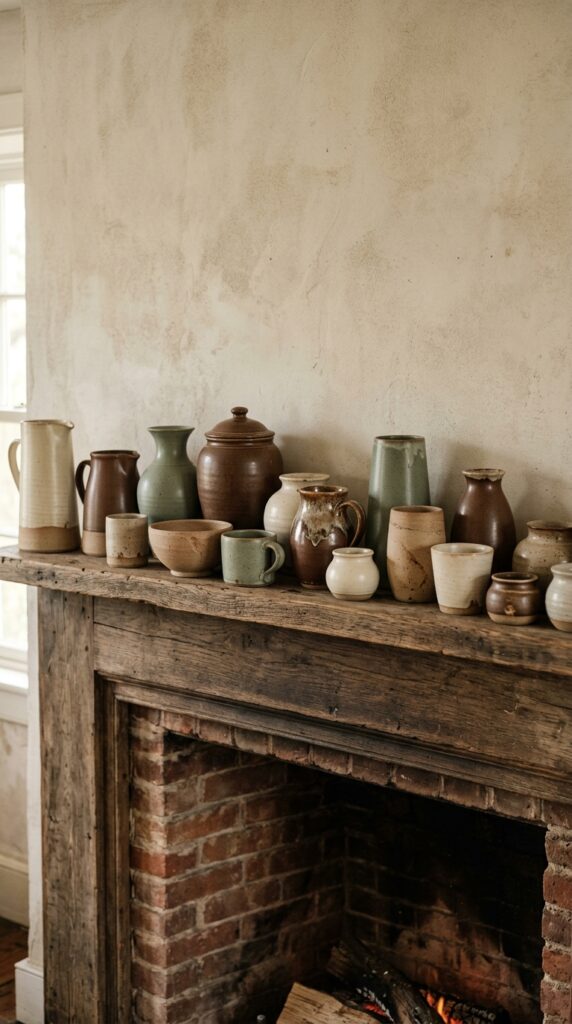
Vibe: Grounded — these pieces look like they were dug from the earth and fired last week.
Why it works: Displaying a collection of hand-thrown ceramics as a singular installation applies the gallery principle to everyday objects — the collection reads as art when each individual piece is thoughtfully selected. The key to making it work is color restraint: all pieces within the same warm-neutral palette, and all with matte finishes. The variety comes entirely from form — tall necks, wide bellies, small footed bowls — and from the subtle glaze variations between pieces, which are the fingerprints of handcraft.
How to get it: Build the collection gradually — you don’t need to buy all at once. Start with three pieces in your established palette: one large, one medium, one small. Add new pieces from the same maker or in the same glaze family as budget allows. Arrange by height from left to right in a gradual descending line, with a slight staggering to prevent too-rigid a lineup.
💡 Quick Win: Etsy’s “farmhouse stoneware vase” search will surface individual hand-thrown pieces starting around $18–$28 each. Buying three from the same seller ensures a cohesive glaze family.
🛍️ Shop the Look — Amazon Product Ideas
| # | Product Search Phrase | Why It Fits |
| 1 | Handmade stoneware vase set matte cream reactive glaze | Collection anchor vessels |
| 2 | Small ceramic lidded jar farmhouse mocha glaze | Collection lidded accent |
| 3 | Wide belly ceramic vase sage green matte | Mid-size color note vessel |
| 4 | Raw clay ceramic bud vase small 4 inch | Low front collection piece |
| 5 | Ceramic pinch bowl set of 2 earth tones | Smallest collection base element |
19. Shiplap Accent Wall Behind the Mantel
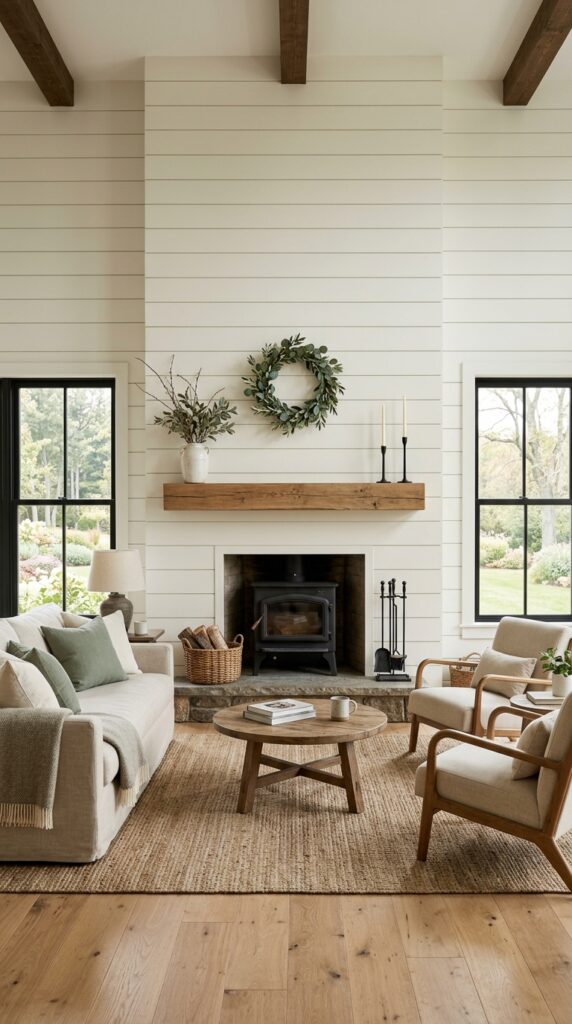
Vibe: Architectural — this room has real bones.
Why it works: A shiplap accent wall behind the mantel solves a common design problem: the fireplace surround and wall compete for attention rather than working together. By making the wall itself the textural statement — all one tone, all one material — the mantel becomes a refined foreground element set against a deliberately crafted backdrop. The shadow grooves between shiplap boards create linear detail that reads beautifully in both natural and artificial light, shifting throughout the day.
How to get it: Peel-and-stick shiplap planks in MDF or real wood are available at major home improvement retailers and require no major demo. Apply horizontal rows starting at the mantel height line and working up to the ceiling — this focuses attention where it belongs. Paint the entire wall, including planks and existing trim, in a single warm white for a seamless, architectural look. Stop at the ceiling for the shiplap — don’t wrap it around corners unless you’re committed to a full room.
🛍️ Shop the Look — Amazon Product Ideas
| # | Product Search Phrase | Why It Fits |
| 1 | Peel and stick shiplap wall planks white 20 pack | Shiplap application material |
| 2 | Farmhouse wreath eucalyptus greenery 24 inch | Centered mantel focal point |
| 3 | Level magnetic small tool for shiplap install | Installation essential tool |
| 4 | White caulk paintable trim sealant | Seam finishing material |
| 5 | Wide painters tape 2 inch blue | Clean edge painting tool |
20. Vintage Farmhouse Books as Decor

Vibe: Warm — books that have been read, touched, and loved.
Why it works: Stacked books serve a double function in farmhouse mantel styling: they create organic height variation for layering smaller objects on top, and they add the warmth of personal history that is central to the farmhouse ethos — this is a home that has been lived in. The design principle at play is scale bridging: a book stack at 6″–8″ tall fills the awkward middle scale between the flat shelf and the taller pieces behind it, giving the composition a graduated depth from front to back.
How to get it: Wrap unattractive books in brown kraft paper or plain cream paper for a cohesive look — use a brush of watered-down coffee to lightly age the paper if desired. Stack three to four books horizontally and use the stack as a riser for a small ceramic piece. Tuck a dried flower or herb into the top book as a casual botanical note. Lean one larger book vertically behind the stack as a graphic backdrop.
🛍️ Shop the Look — Amazon Product Ideas
| # | Product Search Phrase | Why It Fits |
| 1 | Vintage linen cover decorative books set of 3 cream | Ready-made book styling set |
| 2 | Kraft paper book cover wrapping paper roll | DIY book recovery material |
| 3 | Antique brass reading glasses decorative prop | Nostalgic storytelling accent |
| 4 | Dried lavender single stem pressed | Book-tucked botanical detail |
| 5 | Small ceramic mug cream matte farmhouse 8oz | Book-top displayed piece |
21. Statement Wreath as Seasonal Anchor
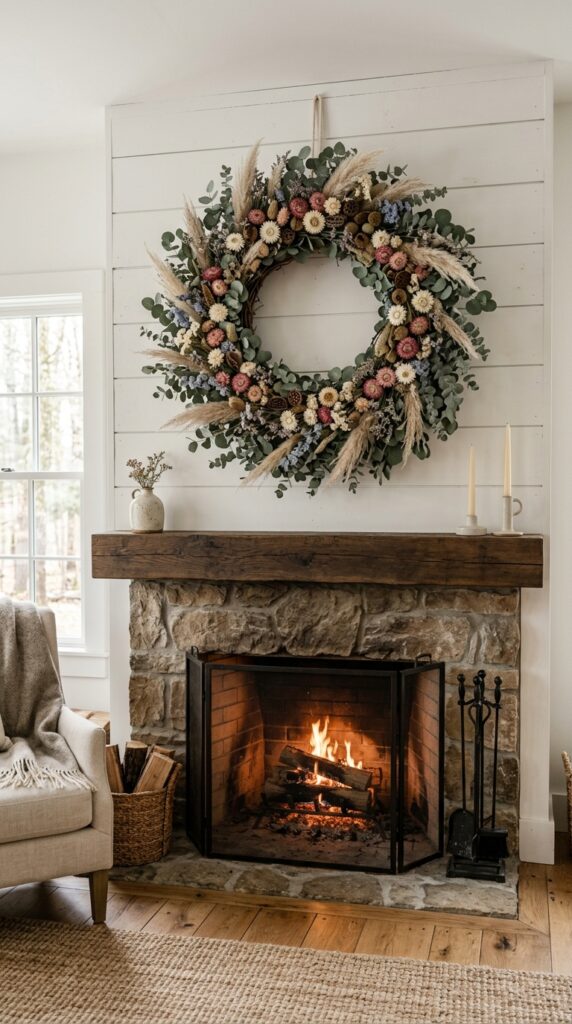
Vibe: Airy — a wreath this alive makes everything beneath it feel curated.
Why it works: An oversized wreath hung above the mantel — rather than on the mirror or against a door — is a proportional move that works by scale surprise. At 28″–36″ in diameter, a full eucalyptus wreath fills the wall space above the mantel in a way that no framed art can replicate organically. It introduces the curve into what is otherwise a composition of horizontal lines (mantel shelf, board-and-batten, shiplap), and curves in a room of straight lines always draw the eye first. This is the principle of shape contrast at architectural scale.
How to get it: Hang a wreath from a single command hook rated for at least 5 lbs, using a length of natural cotton cord or a linen ribbon for visible hanging detail. The bottom of the wreath should hang roughly 6″–8″ above the mantel shelf — close enough to appear connected to the display below, far enough not to interfere with it. Go larger than feels comfortable: 30″+ is almost always the right call.
💡 Quick Win: A preserved eucalyptus wreath in the 24″–30″ range runs $35–$55 on Amazon and will stay green and fragrant for 6–12 months without any care. Search “preserved eucalyptus wreath 24 inch farmhouse.”
🛍️ Shop the Look — Amazon Product Ideas
| # | Product Search Phrase | Why It Fits |
| 1 | Preserved eucalyptus wreath 30 inch dried farmhouse | Large statement wreath |
| 2 | Cotton linen ribbon 2 inch natural wreath hanger | Wreath hanging detail |
| 3 | Command strip hook heavy duty 5 lb | Damage-free wreath mounting |
| 4 | Dried wildflower wreath mixed florals cream | Floral wreath alternative |
| 5 | Small cream matte stoneware vase 6 inch | Minimal mantel beneath |
22. Mason Jar and Herb Garden Display
Vibe: Airy — a mantel that smells like a kitchen garden.
Why it works: Mason jars are perhaps the most universally understood symbol of farmhouse design — their utilitarian origins as food preservation vessels give them an authenticity that no purpose-made decor piece can replicate. Using them as a grouped display applies the principle of collected abundance: many small objects of the same type, loosely organized, create warmth through repetition and variation. The slight imperfection of handwritten chalk labels adds human touch — the sense that someone actually lives and works in this home.
How to get it: Use a variety of mason jar sizes — quart, pint, half-pint — and mix their uses: one planted with a small herb, one holding a single rosemary or thyme stem in water, one empty with a candle inside. Tie a short length of natural jute twine around each neck for consistency. Group on a small raw wood board or cutting board to prevent them from spreading across the shelf.
🛍️ Shop the Look — Amazon Product Ideas
| # | Product Search Phrase | Why It Fits |
| 1 | Ball wide mouth mason jars variety sizes 12 pack | Primary display vessels |
| 2 | Mini chalkboard label tags set of 20 | Handwriting detail label |
| 3 | Natural jute twine 3 ply thin | Neck-tie botanical detail |
| 4 | Small herb plant starts rosemary thyme set | Living kitchen garden accent |
| 5 | Small raw wood board serving tray 10×6 | Grouping organization base |
23. Layered Art and Texture Gallery Ledge
Vibe: Layered — every time you look, you notice something new.
Why it works: The gallery ledge treatment is the most sophisticated small-space technique available for farmhouse mantels. By layering objects at multiple depths — prints leaning at the back, ceramics in the middle, small botanicals at the front edge — you create a composition with genuine three-dimensional depth that photographs as well as it reads in person. The design principle is called depth layering, and it solves the flatness problem that plagues mantels where everything sits at the same level. The variety of frame materials (wood, iron, linen-wrapped) is what gives the layered look a collected, curated feeling rather than a random one.
How to get it: Start with the back layer: lean two or three framed pieces of different widths against the wall, slightly overlapping. Middle layer: place ceramics and vessels in front of the frames, obscuring the lower third of each. Front layer: add trailing botanicals or small flat objects at the very edge of the shelf. Rule of thumb — the front layer should never exceed 3″ in height, or it hides too much of the mid layer.
🛍️ Shop the Look — Amazon Product Ideas
| # | Product Search Phrase | Why It Fits |
| 1 | Botanical print set of 3 farmhouse framed 5×7 | Back-layer leaning art |
| 2 | Small round antique mirror 10 inch aged bronze | Reflective back-layer piece |
| 3 | Linen canvas wrapped neutral abstract art 8×10 | Texture-wrapped art layer |
| 4 | Cream ceramic decorative figurine small farmhouse | Mid-layer ceramic object |
| 5 | Trailing ivy small 4 inch potted plant | Front-layer living edge |
How to Start Your Farmhouse Fireplace Transformation
The single most important first move you can make is painting your mantel and surround in a warm white. This one step — choosing Benjamin Moore’s White Dove or Sherwin-Williams’ Alabaster rather than a cool white or builder-grade off-white — will anchor everything else. Warm white reflects the amber tones of candlelight and wood grain, creating the tonal cohesion that makes the rest of your styling decisions easier. Everything else layers on top of this foundation.
The most common beginner mistake in farmhouse mantel decorating is scale error — choosing accessories that are too small for the space. A 6″ ceramic vase on a 60″ mantel is invisible. A 12″ candlestick that you’re worried is too tall is usually exactly right. When in doubt, go larger than feels comfortable and remove rather than add. Farmhouse style breaks down when it’s cluttered, and clutter almost always starts with undersized accessories.
Three items under $50 that create immediate farmhouse impact: a single dried pampas grass stem in a matte black ceramic bud vase ($14–$22), a white iron taper candle holder set of two ($18–$28), and a preserved eucalyptus bundle laid flat on the shelf ($12–$18). These three elements together achieve texture, height, and organic warmth — the three pillars of farmhouse mantel styling.
Realistically, a starter farmhouse mantel transformation — new accessories, a wreath, and a paint refresh on the surround — runs $150–$300 and can be completed in a weekend. A full transformation including a shiplap accent wall, sconce installation, and complete accessory overhaul typically runs $400–$900 depending on your existing mantel and takes two to four weekends. Start with accessories, let the room tell you what else it needs.
Frequently Asked Questions About Farmhouse Fireplace Mantel Decor
What is the difference between farmhouse style and rustic decor?
Farmhouse and rustic design share natural materials and warm palettes, but they’re meaningfully different in finish and restraint. Rustic decor leans into darkness — rough-hewn logs, dark iron, and deep wood stains — while farmhouse style prioritizes warmth over drama, favoring warm whites, painted wood, and a curated lightness. A farmhouse fireplace mantel would feature a white-painted surround with aged iron accents; a rustic one would feature bare stone, dark wood, and fur throws. Farmhouse is also more deliberately styled — it borrows from Shaker minimalism in its editing — while rustic skews toward abundance and heaviness.
What colors work best on a farmhouse fireplace mantel?
The most reliable palette starts with warm white as the base — specifically a white with a yellow or red undertone like Benjamin Moore’s White Dove (OC-17) or Sherwin-Williams’ Alabaster (SW 7008). From there, layer in warm neutrals: greige, oat linen, and unbleached cream. Accent colors that pair beautifully with farmhouse include dusty sage, muted terracotta blush, and warm charcoal. Avoid cool grays, navy, and any bright or saturated tones — they fight the inherent warmth of the style and make natural materials look dingy by comparison.
How much does it cost to decorate a farmhouse fireplace mantel?
A well-styled farmhouse mantel can be achieved for as little as $75–$150 using the core elements: a dried botanical arrangement, a pair of iron candlesticks, and one statement piece (clock or mirror). A more complete look with a shiplap mirror or large wreath, coordinated ceramics, and textile accents typically runs $200–$450. If you’re painting the surround and adding sconces, budget another $100–$200. The good news is that farmhouse style rewards a gradual, collected approach — many of the best pieces come from thrift stores, estate sales, and Marketplace for under $20.
Can modern farmhouse decor work with a traditional or Victorian mantel?
Yes — and it often works remarkably well. The key is leaning into the mantel’s existing architectural detail rather than fighting it. For a Victorian mantel with ornate millwork, paint the entire surround in warm white (it immediately modernizes the profile) and use accessories that are simple and natural — hand-thrown ceramics, dried botanicals, and aged iron. Avoid the impulse to add more decorative elements to an already detailed mantel; the farmhouse discipline of restraint is what makes the combination work. The ornate mantel becomes the art; the accessories stay quiet.
What size mirror should go above a farmhouse fireplace mantel?
The standard guideline is that a mirror should be between 75% and 100% of the mantel width — so for a 48″ mantel, a mirror between 36″ and 48″ wide is ideal. For farmhouse style specifically, lean toward the larger end: a 40″–48″ mirror has the visual mass to serve as a true focal point. Height matters equally — a mirror that’s too short (under 24″ tall) looks like a mistake, while one that extends 36″+ toward the ceiling creates the vertical anchor that farmhouse design depends on. Shiplap frames, distressed wood frames, and aged black iron frames are the most authentic frame styles for this aesthetic.
Ready to Create Your Dream Farmhouse Fireplace Mantel?
These 23 ideas span the full range of what farmhouse fireplace mantel decor can be — from bold material choices in reclaimed wood and galvanized metal, to quiet tonal arrangements of warm white ceramics, to the layered depth of a gallery ledge display. Transformation doesn’t have to happen all at once — some of the most compelling farmhouse mantels were assembled one piece at a time over years, each addition chosen because it earned its place beside what was already there. The one thing you can do today: order a peel-and-stick paint sample of Benjamin Moore’s White Dove and hold it against your mantel surround in both natural and evening light. That single step will tell you whether a paint refresh is your first move — and it will cost you $3. When you’ve found the combination that finally feels like home, save your favorites here: those dried botanicals and aged iron candlesticks are worth remembering.