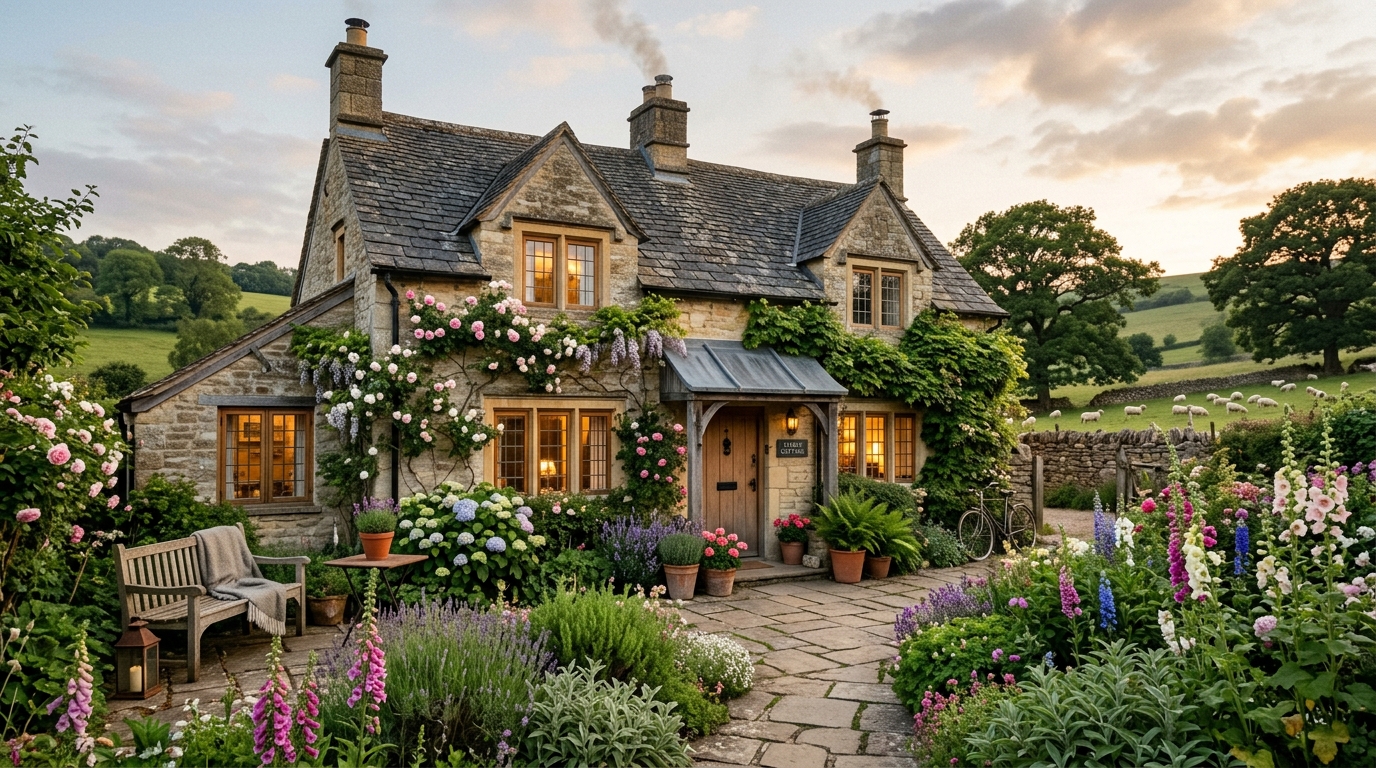
Cottage farmhouse style is the marriage of two beloved aesthetics — the soft, romantic warmth of English cottage design and the grounded, practical soul of American farmhouse living. This article gives you exactly 20 cottage farmhouse ideas, each one specific enough to steal for your own home today.
There’s a particular stillness that settles into a cottage farmhouse room — linen curtains catching afternoon light, a wooden bowl holding nothing but air and intention, the faint smell of beeswax from a cluster of taper candles. It’s a style that never shouts. It earns its warmth quietly, through texture and patina and the courage to leave a little space empty. Here are 20 ideas worth saving — and stealing.
Why Cottage Farmhouse Style Works So Well
Cottage farmhouse design emerged from the overlap of two vernacular traditions: the English countryside cottage, rooted in pre-industrial simplicity and garden-connected living, and the American working farmhouse, defined by honest materials and purposeful furniture. Unlike modern farmhouse — which skews minimal and monochrome — cottage farmhouse leans softer, more layered, and slightly imperfect by design. It’s the style that makes a chipped ceramic pitcher feel like the right choice.
The material palette is where this style earns its depth. Think unfinished white oak, reclaimed pine, aged wrought iron, and slubby linen in natural weaves. Colors run toward warm white, antique cream, dusty sage, muted terracotta blush, and soft greige — never cold, never stark. Brushed brass and oil-rubbed bronze bring quiet metal warmth, while wicker and seagrass add organic texture without weight.
Cottage farmhouse is surging right now for a reason that feels almost sociological. After years of screen-heavy living, people are decorating toward slowness — spaces that feel handmade, unhurried, and rooted. Pinterest searches for “cottage core bedroom” and “cozy farmhouse living room” have climbed steadily since 2021, and the movement shows no sign of cooling. It’s a design response to overstimulation.
Small spaces can absolutely achieve this style — in fact, the cottage part of the equation was made for compact rooms. The key is restraint in furniture scale and generosity in texture. Choose one statement piece (a painted hutch, a linen sofa), let walls breathe, and layer through soft goods rather than adding more furniture.
Style at a Glance
| Element | Trait |
| Philosophy | Warmth through imperfection; beauty in the functional |
| Key Materials | Reclaimed pine, linen, wicker, wrought iron, aged ceramic |
| Key Colors | Warm white, antique cream, dusty sage, terracotta blush, greige |
20 Cottage Farmhouse Ideas Full of Cozy Character
1. Shiplap Walls in Warm White, Not Bright White
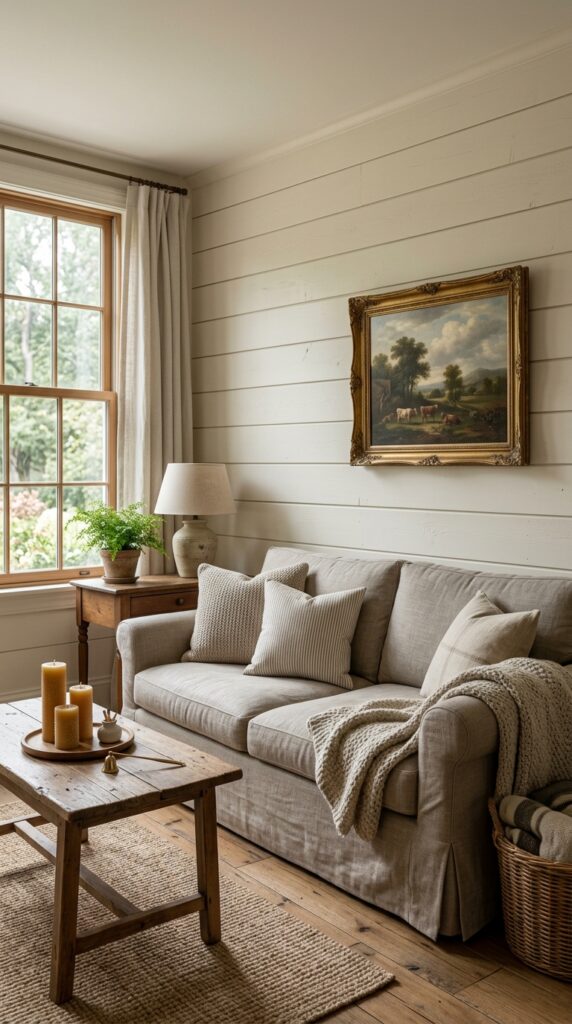
Vibe: This wall has a hushed quality — it absorbs sound, diffuses light, and somehow makes every piece of furniture look more intentional.
Why it works: The horizontal lines of shiplap create a natural visual anchor, elongating walls without adding visual clutter. The critical detail most people miss is paint temperature — bright white reads as modern farmhouse, while warm white (think Benjamin Moore’s Chantilly Lace or even a tinted Swiss Coffee) stays in true cottage farmhouse territory. The matte finish is non-negotiable; any sheen pushes the surface toward contemporary and kills the aged-plaster quality that makes this style work.
How to get it: Source pre-primed MDF shiplap planks from a home improvement store, install horizontally at ¼-inch spacing, and roll on two coats of flat-finish warm white. The shadow gap between boards does the decorative work for you.
💡 Quick Win: Buy peel-and-stick shiplap panels for a rental-friendly version — when installed in a single accent wall section, they photograph almost identically to real wood planks.
🛍️ Shop the Look — Amazon Product Ideas
| # | Product Search Phrase | Why It Fits |
| 1 | Peel and stick shiplap wall panels white | Budget accent wall solution |
| 2 | Linen slipcover sofa cover cream | Soft, washable seating fabric |
| 3 | Beeswax taper candles ivory set | Warm natural light source |
| 4 | Round wooden serving tray with handles | Candle grouping base |
| 5 | Gilded ornate picture frame 8×10 | Aged gold wall accent |
2. Dusty Sage Green as Your Dominant Color
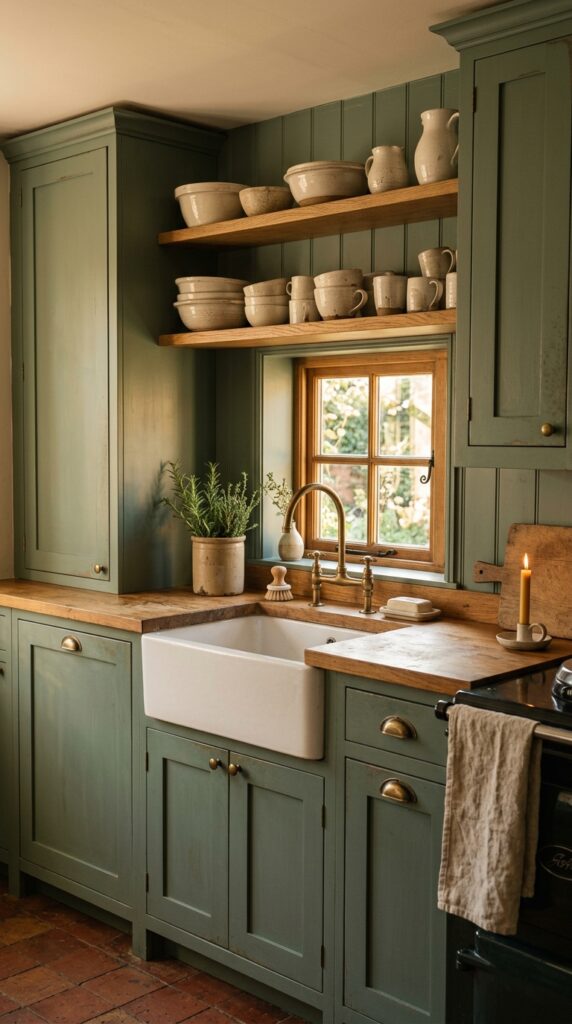
Vibe: The room feels sun-warmed and slightly antiqued, like a kitchen that’s been loved for decades rather than renovated last Tuesday.
Why it works: Dusty sage works in cottage farmhouse interiors because it carries both the green of the garden and the grey of aged paint — it reads as color and neutral simultaneously. This dual quality means it pairs naturally with warm wood tones, cream ceramics, and aged brass without competing. The “dusty” quality (achieved through grey undertones) is what separates this from a brighter kelly green that would skew too modern or bohemian.
How to get it: Look for paints with LRV (Light Reflectance Value) between 35–50 for a medium sage that reads true in both natural and artificial light. Farrow & Ball’s Mizzle or Sherwin-Williams’ Sage are reliable starting points. Apply to cabinetry only and leave walls in warm white to prevent the room from closing in.
🛍️ Shop the Look — Amazon Product Ideas
| # | Product Search Phrase | Why It Fits |
| 1 | Brass cup pull cabinet hardware set of 10 | Warm metal cabinet accent |
| 2 | Stoneware crock utensil holder farmhouse | Handcrafted kitchen organizer |
| 3 | Cream ceramic open shelf display set | Coordinated shelf styling |
| 4 | Linen kitchen hand towel stripe natural | Soft farmhouse textile |
| 5 | Herb pot set windowsill terracotta | Living kitchen greenery |
3. Layered Linen in Three Tones on a Bed
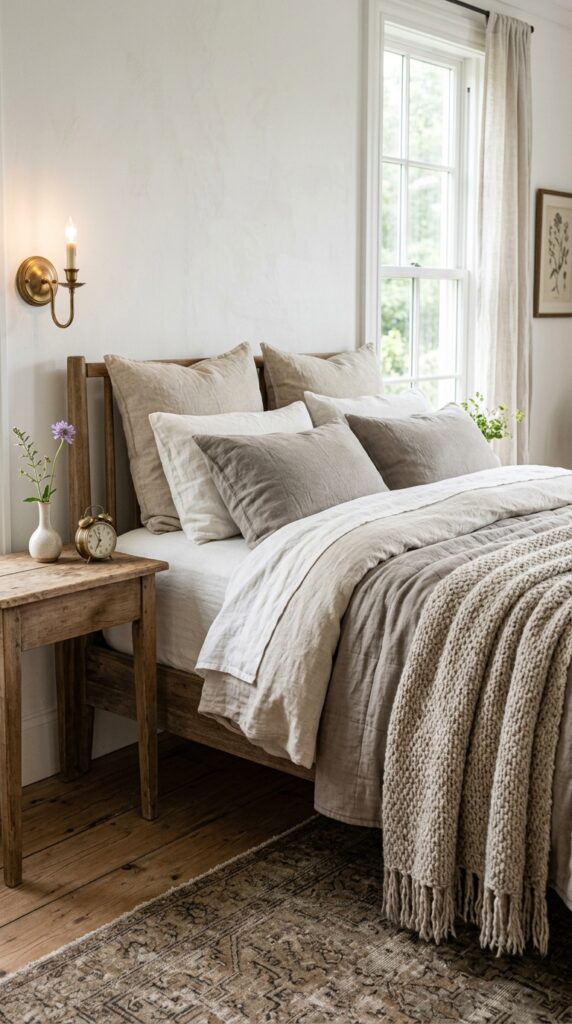
Vibe: The bed feels still — the kind you photograph before you leave for work and think about all day.
Why it works: Tonal layering — using three values of the same color family rather than contrasting colors — creates visual depth without busyness. The slight variation between natural oat (the duvet), antique white (the pillowcases), and warm greige (the throw) gives the eye somewhere to travel without introducing pattern. Linen specifically earns its place here because its natural slub texture means the layers differentiate even in low light, where cotton blends would read flat.
How to get it: Start with a washed linen duvet cover in natural oat. Add euro shams in antique white, and fold a textured throw — chunky cotton or loose-weave linen — across the lower third of the bed. The mismatched-but-related tones are the entire technique.
💡 Quick Win: You don’t need to replace your whole bedding set. Add two linen euro shams in a complementary tone and your existing bed will immediately read as cottage farmhouse.
🛍️ Shop the Look — Amazon Product Ideas
| # | Product Search Phrase | Why It Fits |
| 1 | Washed linen duvet cover natural oat queen | Core bedding texture layer |
| 2 | Euro pillow shams linen antique white set of 2 | Tonal pillow variation |
| 3 | Chunky knit cotton throw blanket cream | Foot-of-bed texture anchor |
| 4 | Ceramic bud vase matte white small | Single stem bedside accent |
| 5 | Brass wall sconce plug-in farmhouse | Warm bedside lighting |
4. An Apron-Front Sink as the Kitchen’s Soul
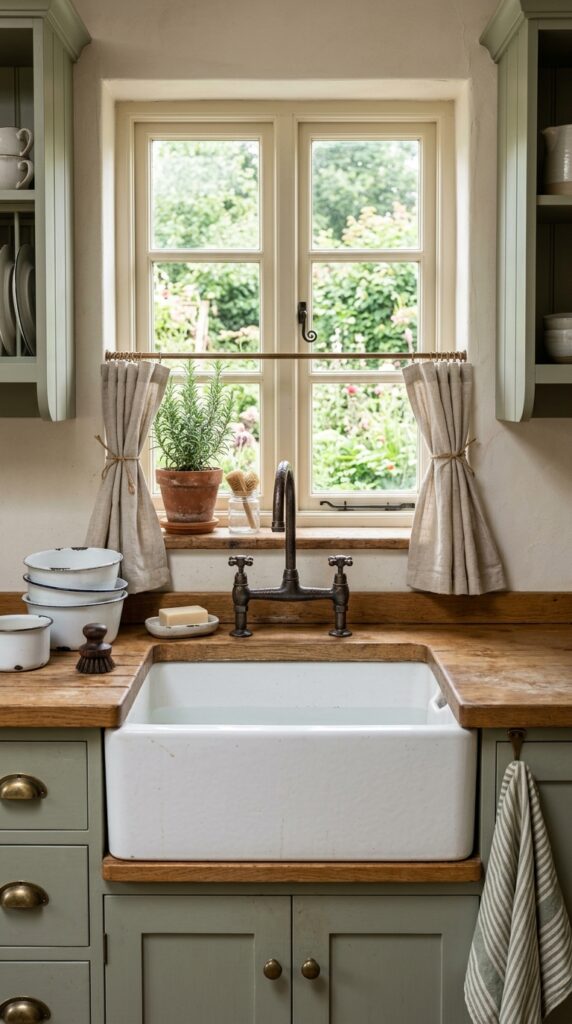
Vibe: The kitchen feels raw — honest and purposeful, like it was designed around this one piece.
Why it works: An apron-front sink is a load-bearing design decision in a cottage farmhouse kitchen. Its exposed front panel creates a strong horizontal visual anchor, and its generous bowl references the working farmhouse aesthetic without feeling like a costume. Fireclay is the preferred material over cast iron because it maintains a matte, slightly imperfect surface that ages beautifully — cast iron can read too sleek under certain lighting. Pair it with an unlacquered brass or oil-rubbed bronze bridge faucet to reinforce the vintage utility narrative.
How to get it: If a full sink replacement isn’t in budget, change only the faucet first. Swapping a chrome modern faucet for an oil-rubbed bronze bridge style (available from $80–$150) changes the entire character of a basic sink.
🛍️ Shop the Look — Amazon Product Ideas
| # | Product Search Phrase | Why It Fits |
| 1 | Oil rubbed bronze bridge kitchen faucet | Vintage-style hardware piece |
| 2 | White enamelware colander farmhouse kitchen | Functional display accessory |
| 3 | Linen cafe curtain panel natural with ties | Soft window treatment |
| 4 | Potted rosemary herb plant farmhouse | Living windowsill greenery |
| 5 | Wooden dish drying rack countertop | Farmhouse-style utility piece |
5. Exposed Ceiling Beams in Natural or Painted Wood
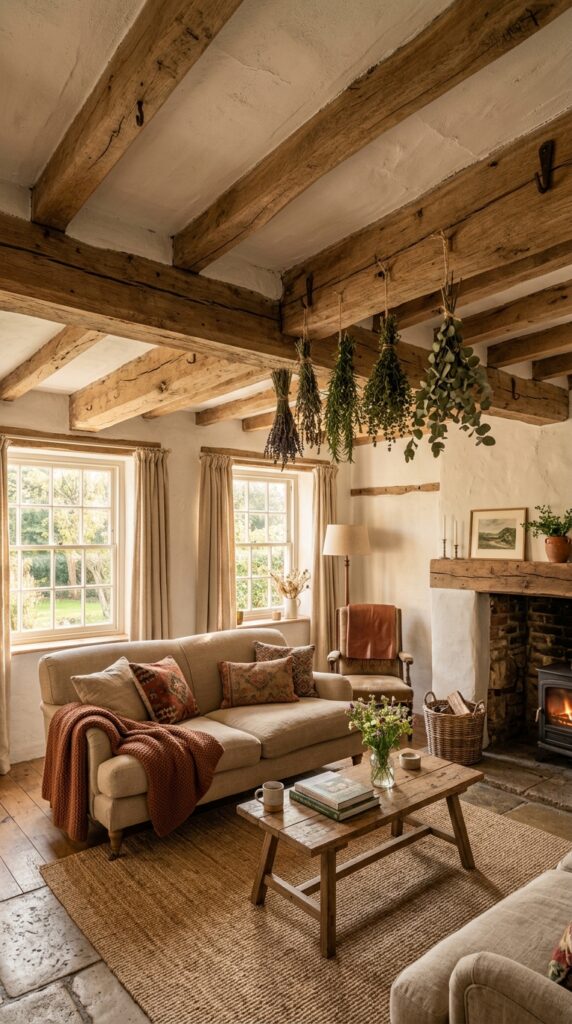
Vibe: This room feels layered — every surface is doing something, and the ceiling is finally part of the design.
Why it works: Exposed beams add vertical rhythm to a horizontal space and introduce the raw material contrast that defines cottage farmhouse at its best — rough-hewn timber against smooth plaster is a pairing with roots in vernacular British and early American architecture. The principle at play is visual weight distribution: when the ceiling carries texture, the furniture below can stay simpler without the room feeling sparse. Dark-stained beams lower perceived ceiling height; for rooms under 8 feet, opt for natural or whitewashed beams to maintain openness.
How to get it: Install hollow faux beam sleeves in reclaimed-look polyurethane — they’re lightweight, affordable, and require only a few screws. Paint or stain them after installation. Space three beams evenly across a living room ceiling for maximum architectural impact.
💡 Quick Win: A single beam above a dining table (not spanning the full ceiling) creates the farmhouse character at a fraction of the cost and installation complexity.
🛍️ Shop the Look — Amazon Product Ideas
| # | Product Search Phrase | Why It Fits |
| 1 | Faux wood ceiling beam sleeves reclaimed look | Lightweight beam installation |
| 2 | Dried herb bundle lavender for hanging | Rustic ceiling decoration |
| 3 | Jute area rug natural 5×8 | Grounded floor texture |
| 4 | Whitewash wood stain quart | Beam finish in light tone |
| 5 | Linen throw pillow cover natural set of 2 | Soft sofa accent textile |
6. Vintage Butter-Yellow as a Surprise Accent
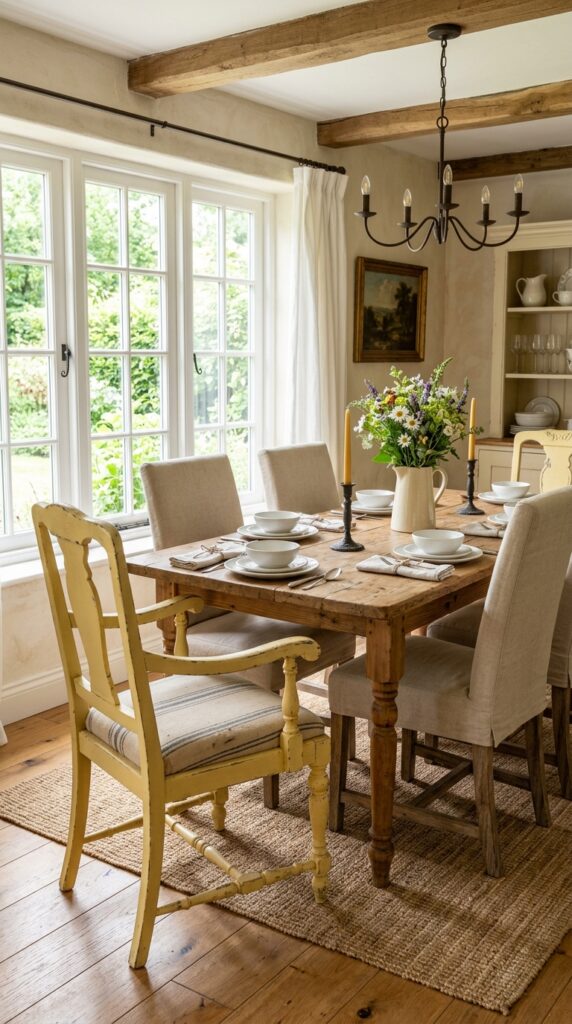
Vibe: The chair arrives in the room the way a good story does — luminous and slightly unexpected, instantly the thing you remember.
Why it works: Vintage butter-yellow occupies a unique tonal position: it reads as warm, historical, and softly feminine without tipping into primary-color brightness. In a room of neutrals, one piece in this tone creates what designers call a “jewel accent” — a single color decision that makes the whole palette feel curated rather than accidental. The key is finding true butter-yellow (with cream and ochre undertones) rather than lemon-yellow, which goes cold and modern under natural light.
How to get it: Source a secondhand wooden chair at a thrift store or Facebook Marketplace and repaint it with chalk paint in a butter-yellow tone — Rust-Oleum’s Chalked in “Sunstruck” or Annie Sloan’s Arles are both reliable options. Lightly distress the edges with 220-grit sandpaper before sealing with matte wax.
🛍️ Shop the Look — Amazon Product Ideas
| # | Product Search Phrase | Why It Fits |
| 1 | Chalk paint butter yellow furniture paint | DIY chair transformation tool |
| 2 | Grain sack stripe chair cushion farmhouse | Historical textile seat pad |
| 3 | Wrought iron taper candle holder set | Dark metal table accent |
| 4 | White stoneware dinner plate set of 4 | Simple farmhouse place setting |
| 5 | Reclaimed wood dining table rustic | Anchor furniture for the room |
7. Woven Pendant Lights Over Every Gathering Space
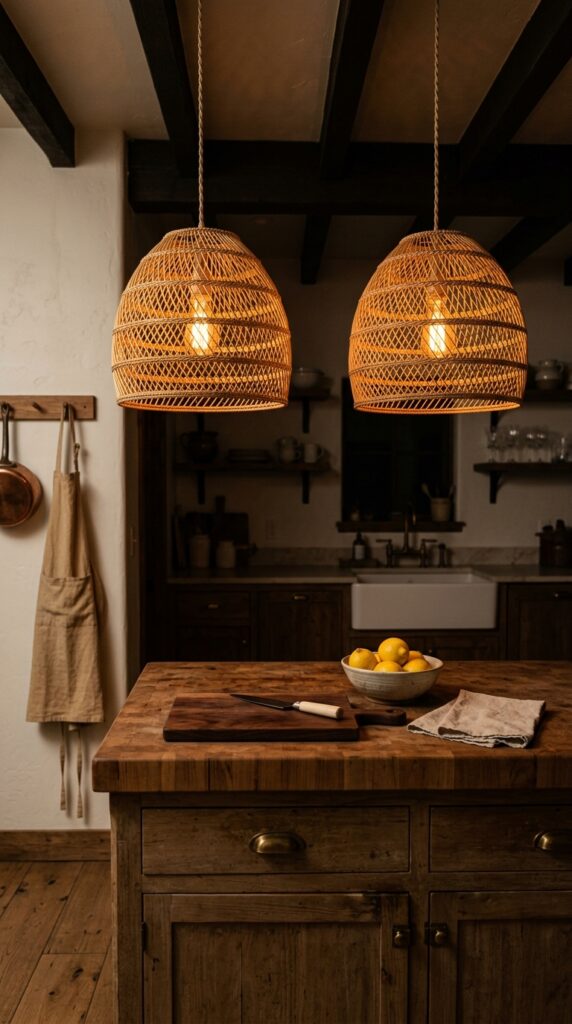
Vibe: The light in this kitchen feels amber-pooled — focused and warm, like it was designed for lingering.
Why it works: Woven pendant lights accomplish two things simultaneously: they define a zone (the island, the table, the reading nook) and they introduce organic texture overhead, where most cottage farmhouse rooms remain bare. The open weave is functionally important — it allows light to spill through the rattan pattern and cast dappled shadows on surrounding surfaces, which multiplies visual warmth without additional fixtures. Hang pendants so the bottom of the shade sits 30–34 inches above the counter surface for optimal task and ambient balance.
How to get it: Use a swag kit (a plug-in pendant adapter) to convert a hardwired pendant into a no-electrician, renter-friendly installation. Run the cord along the ceiling edge and conceal with a cord cover in matching white.
💡 Quick Win: Two mismatched-but-complementary woven shades hanging at slightly different heights read as intentional cottage character, not an error.
🛍️ Shop the Look — Amazon Product Ideas
| # | Product Search Phrase | Why It Fits |
| 1 | Rattan woven pendant light shade large | Core cottage lighting element |
| 2 | Plug-in pendant light swag kit ceiling | No-electrician installation |
| 3 | Edison vintage bulb ST64 warm white | Warm amber light source |
| 4 | Cord cover ceiling adhesive white | Cord concealment for renters |
| 5 | Butcher block cutting board large island | Natural wood island accent |
8. A Painted Vintage Hutch as Statement Storage

Vibe: The hutch feels collected — like it holds every decade it’s been through, and that’s precisely why it belongs here.
Why it works: A hutch solves a dual design problem: storage and storytelling. Its vertical profile draws the eye upward in rooms with standard 8-foot ceilings, creating perceived height. The beadboard back (painted white) inside the hutch acts as a built-in backdrop for displayed pieces, giving mismatched ceramics visual unity. The principle of framed display — using cabinet edges as a frame — makes even secondhand pottery look deliberately curated.
How to get it: Thrift a hutch in any condition — the paint finish is completely replaceable. Strip hardware, apply chalk paint in your chosen tone (a sage-cream is forgiving and photographable), and replace knobs with glass or ceramic hardware from a hardware store. Budget: $40–$100 total for a complete transformation.
🛍️ Shop the Look — Amazon Product Ideas
| # | Product Search Phrase | Why It Fits |
| 1 | Glass cabinet knob antique style set of 6 | Vintage-style hutch hardware |
| 2 | Ironstone white pitcher vintage farmhouse | Classic hutch display piece |
| 3 | Mismatched white ceramic mug set | Hutch shelf display ceramics |
| 4 | Grain sack stripe table runner natural | Lower shelf textile layer |
| 5 | Small terracotta succulent pot set | Living hutch shelf accent |
9. Terracotta Blush Accents in a Mostly Neutral Room

Vibe: The room feels sun-warmed from the inside — the terracotta does exactly what the sun does to old clay rooftops.
Why it works: Terracotta blush (a terracotta tone desaturated toward dusty pink) functions as a warm neutral rather than a true accent color — it integrates into a cream-and-linen room without creating the jarring contrast of a full-saturation color. The design principle here is tonal punctuation: repeating the same hue in different scales (small: a throw pillow, medium: a pot, large: a wall print) tricks the eye into seeing a composed palette rather than scattered accessories. Use it in odd numbers — three terracotta moments feel balanced; four starts to feel labored.
How to get it: Start with a single matte terracotta planter (under $20) and a velvet throw pillow in the same tone. Place both in the same sightline. You don’t need to repaint anything.
💡 Quick Win: A cheap terracotta clay pot from a garden center, left unglazed, looks more intentional in a cottage farmhouse room than any painted or glazed ceramic at twice the price.
🛍️ Shop the Look — Amazon Product Ideas
| # | Product Search Phrase | Why It Fits |
| 1 | Matte terracotta planter pot large with saucer | Core warm accent piece |
| 2 | Velvet throw pillow cover dusty clay 18×18 | Soft terracotta textile moment |
| 3 | Pampas grass dried natural stems large | Tall organic focal element |
| 4 | Abstract watercolor print terracotta warm | Wall art in matching palette |
| 5 | Woven seagrass coffee table with shelf | Natural material base piece |
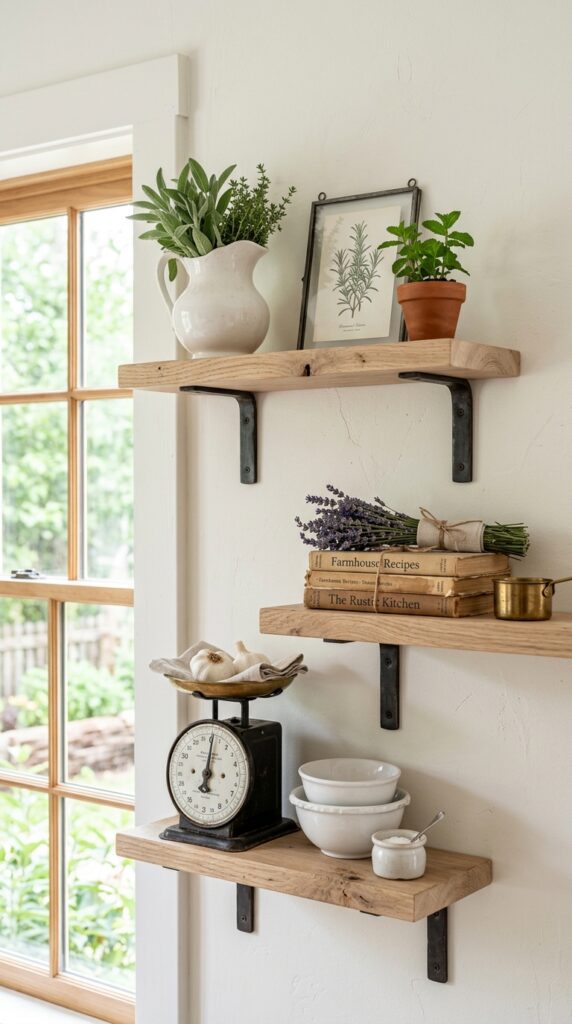
10. Narrow Floating Shelves as a Micro Gallery Wall
Vibe: The shelves feel considered — not decorated, but assembled over time, piece by piece.
Why it works: Floating shelves succeed in cottage farmhouse spaces because they expose the wall behind them, preserving the sense of air and light that distinguishes this style from cluttered country décor. The visual trick is asymmetric staggering — shelves at different heights with different lengths prevent the installation from looking like retail fixtures. Use wrought iron or matte black L-brackets exposed (rather than hidden) to reinforce the utilitarian-cottage narrative.
How to get it: Mount shelves using floating shelf brackets rated for the load you intend. For the unfinished oak look, buy common board from a hardware store and sand to 220-grit — don’t stain or seal, as the natural tone is the point. One coat of raw tung oil keeps dust off without adding sheen.
🛍️ Shop the Look — Amazon Product Ideas
| # | Product Search Phrase | Why It Fits |
| 1 | Wrought iron shelf bracket matte black heavy duty | Exposed utilitarian shelf hardware |
| 2 | Botanical print set framed kitchen art | Small wall art for shelf display |
| 3 | Miniature terracotta herb pot set of 6 | Living shelf accent plants |
| 4 | Vintage kitchen scale antique brass | Styled functional display piece |
| 5 | Linen twine roll natural 3-pack | Styling and tying accessory |
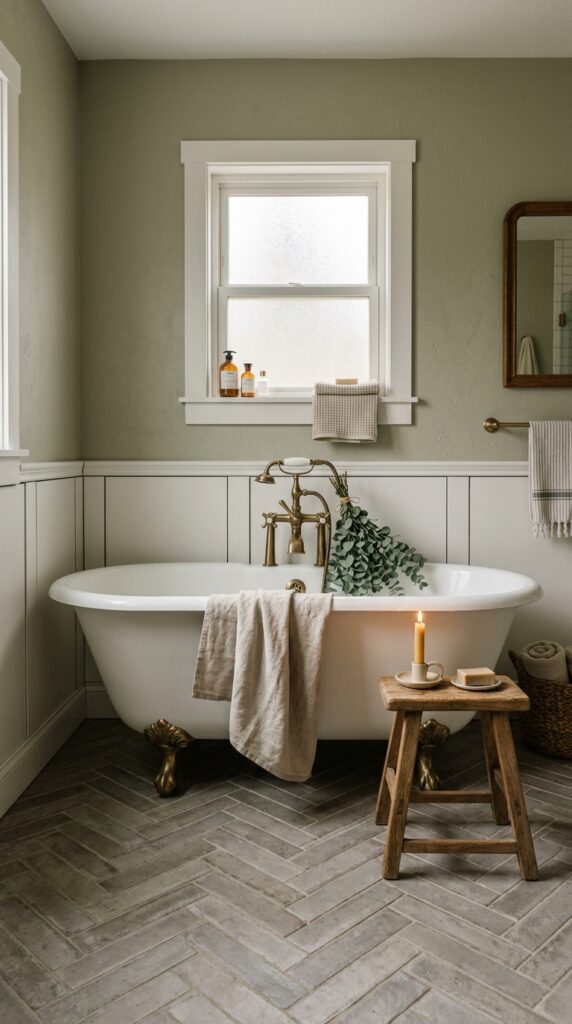
11. A Clawfoot Tub as the Bathroom’s Centrepiece
Vibe: The bathroom feels romantic — the kind that makes you slow down before you even turn on the tap.
Why it works: A freestanding clawfoot tub transforms a bathroom from a utility space into a cottage destination. Its sculptural quality means it earns the role of focal point without any styling whatsoever — but the design principle of negative space is essential. Don’t fill the room around it. Let the tub float. The empty floor on three sides is as important as the fixture itself. Aged brass feet and faucet hardware do the period-appropriate detailing; chrome or nickel would snap the spell immediately.
How to get it: Refinish an existing clawfoot tub in matte white epoxy (DIY kits available, ~$50) rather than replacing it. Replace original feet with reproduction aged-brass claw feet (available online as sets) to modernize the vintage base.
💡 Quick Win: Tie a bundle of fresh or dried eucalyptus to the faucet with twine — steam from the bath releases the fragrance, and it photographs as a fully styled bathroom accessory.
🛍️ Shop the Look — Amazon Product Ideas
| # | Product Search Phrase | Why It Fits |
| 1 | Clawfoot tub faucet aged brass with hand shower | Period-appropriate bath hardware |
| 2 | Eucalyptus bundle dried for shower or bath | Fragrant bath styling element |
| 3 | Wooden bath stool teak small | Natural beside-tub surface |
| 4 | Linen waffle weave bath towel oat | Textured natural fiber towel |
| 5 | White clawfoot bathtub refinishing kit | Tub restoration DIY solution |
12. A Wraparound Reading Nook with Built-In Storage
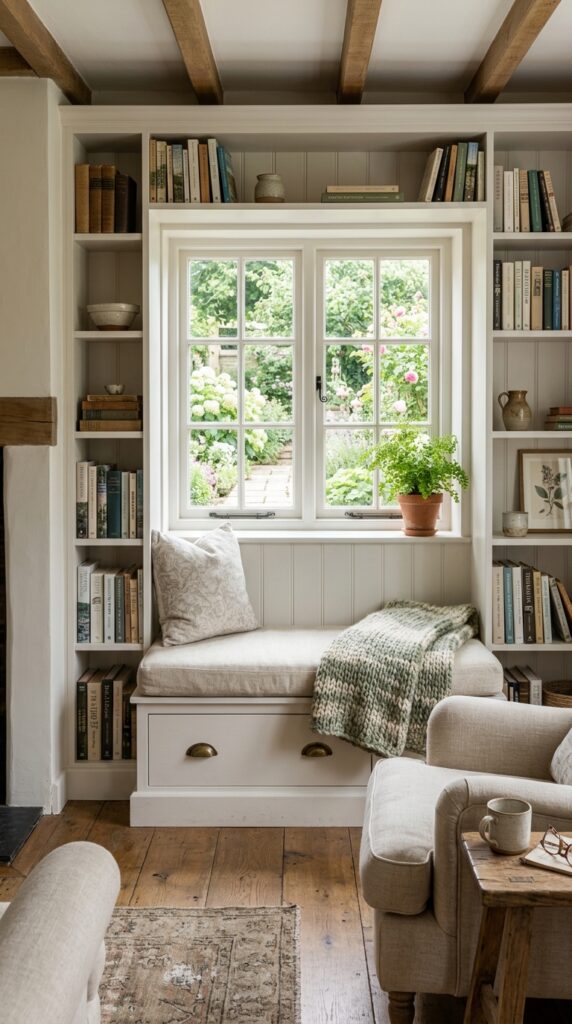
Vibe: This corner feels serene — the kind of place that quietly rearranges your priorities.
Why it works: A reading nook creates what designers call a defined micro-zone — a space within a space that has a single, clear purpose. In cottage farmhouse design, this purpose-driven specificity feels historical and grounded, referencing the inglenook and window seat traditions of English country homes. The built-in shelves flanking the seat use vertical space efficiently and create a sense of architectural embrace — the nook “holds” you, which is precisely the psychological comfort this style promises.
How to get it: Build the bench using IKEA KALLAX units turned on their sides (with the openings facing out for storage), topped with a custom cushion in a linen or ticking stripe fabric. This IKEA hack costs under $300 and reads as fully custom in photographs.
🛍️ Shop the Look — Amazon Product Ideas
| # | Product Search Phrase | Why It Fits |
| 1 | Window seat cushion linen cream custom size | Nook seating upholstery layer |
| 2 | Ticking stripe throw pillow farmhouse | Classic nook textile accent |
| 3 | Small indoor fern plant potted | Living bookshelf greenery |
| 4 | Hardcover decorative books neutral spine | Styled shelf book collection |
| 5 | Beadboard wallpaper peel and stick white | Nook back panel shortcut |
13. Wrought Iron Hardware Throughout the Kitchen
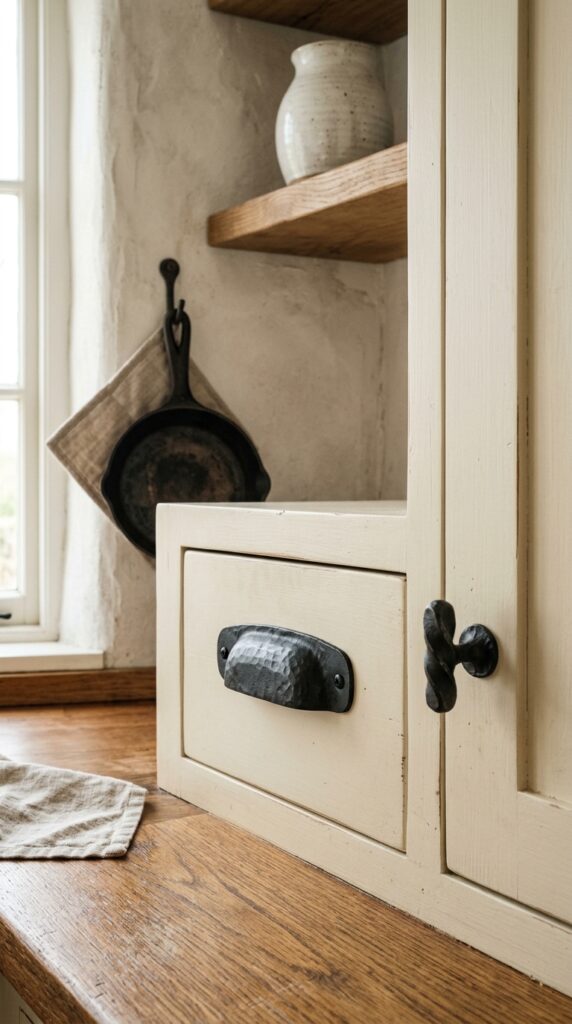
Vibe: The kitchen feels raw — every touch point carries a slight roughness that makes the whole room feel less manufactured.
Why it works: Hardware is the smallest investment with the most immediate visual return in a kitchen. Wrought iron or hand-forged matte black hardware introduces organic texture at the exact scale where human hands interact with the space — the pull of a drawer, the turn of a knob. This tactile design principle means the material registers not just visually but physically. It also contrasts with the softness of linen and cream paint, reinforcing the farmhouse tension between rough utility and domestic comfort.
How to get it: Replace cabinet hardware across an entire kitchen in one afternoon with a screwdriver. Match screw hole spacing to your existing hardware (standard is 3-inch center-to-center for pulls). Budget: $1.50–$4 per pull, $0.75–$2 per knob.
💡 Quick Win: Replace only the most visible hardware first — the island drawers and upper cabinets — and add the rest over time as budget allows. The transformation reads as complete even at 50%.
🛍️ Shop the Look — Amazon Product Ideas
| # | Product Search Phrase | Why It Fits |
| 1 | Wrought iron bin pull cabinet hardware 3 inch set | Core kitchen hardware element |
| 2 | Hand forged matte black cabinet knob round set of 10 | Matching knob hardware |
| 3 | Cast iron skillet wall hook farmhouse kitchen | Functional kitchen wall display |
| 4 | Linen pot holder set natural with hanging loop | Textile kitchen functional piece |
| 5 | Cream chalk paint quart cabinet painting | Cabinet color refresh tool |
14. A Galvanized Metal Trough as a Planter
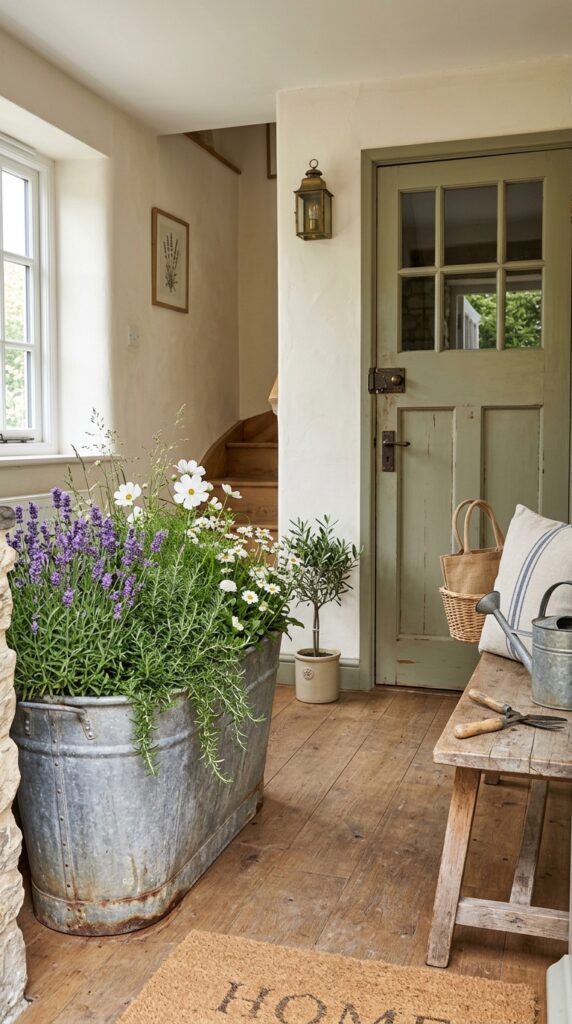
Vibe: The entryway feels garden-connected — the outside has been invited in, informally, the way it always is in working farmhouses.
Why it works: Galvanized metal brings industrial utility into cottage farmhouse design, which sounds contradictory until you understand that both traditions share a roots-in-function aesthetic. The trough’s agricultural origin is the point — it’s not pretending to be decorative, which is what makes it fit so naturally. Oversized scale matters here: a small trough looks lost; a 36-inch or wider trough creates the generous, slightly unwieldy quality of something truly farmhouse rather than farmhouse-adjacent.
How to get it: Drill four drainage holes in the trough base before planting. Layer with gravel, then potting soil. Plant tall herbs (rosemary, lavender) in the center, trailing plants (thyme, creeping jenny) at the edges.
🛍️ Shop the Look — Amazon Product Ideas
| # | Product Search Phrase | Why It Fits |
| 1 | Galvanized metal trough planter large 36 inch | Core rustic planter piece |
| 2 | Lavender plant live small pot set of 3 | Fragrant cottage garden plant |
| 3 | Woven jute doormat natural rectangle | Garden-connected entry textile |
| 4 | Reclaimed wood garden bench entryway | Natural wood entryway seating |
| 5 | Garden shears vintage-style rust-resistant | Styled functional tool accent |
15. A White-on-White Kitchen with Texture as the Hero

Vibe: The kitchen feels luminous — white has never looked less empty.
Why it works: A monochromatic white kitchen succeeds only when texture does the heavy lifting. The design principle here is tonal and textural contrast within a single color family: the slight warmth difference between bright shiplap, cream linen, and antique beadboard creates enough variation that the eye reads depth rather than flatness. This is advanced decorating — it requires confidence in material selection rather than color selection, which is why most people never attempt it and why it reads as truly sophisticated when done well.
How to get it: Commit to varying every white surface — never let two adjacent surfaces share the same finish. Flat-painted walls + satin-painted cabinets + matte ceramic + polished marble creates a full textural range in a single palette.
💡 Quick Win: Add a white-on-white textured throw pillow or a handmade white ceramic canister to any neutral room — the texture-within-tone technique works at any scale.
🛍️ Shop the Look — Amazon Product Ideas
| # | Product Search Phrase | Why It Fits |
| 1 | Handmade white ceramic canister set kitchen | Textured monochromatic display |
| 2 | Marble pastry board white veined natural | White kitchen surface accent |
| 3 | Linen roman blind natural white window | Textured window treatment |
| 4 | White ironstone jug pitcher vintage | Classic white display vessel |
| 5 | Beadboard wallpaper white peel and stick cabinet | Cabinet texture shortcut |
16. A Pegboard or Shaker Rail as Entryway Organization
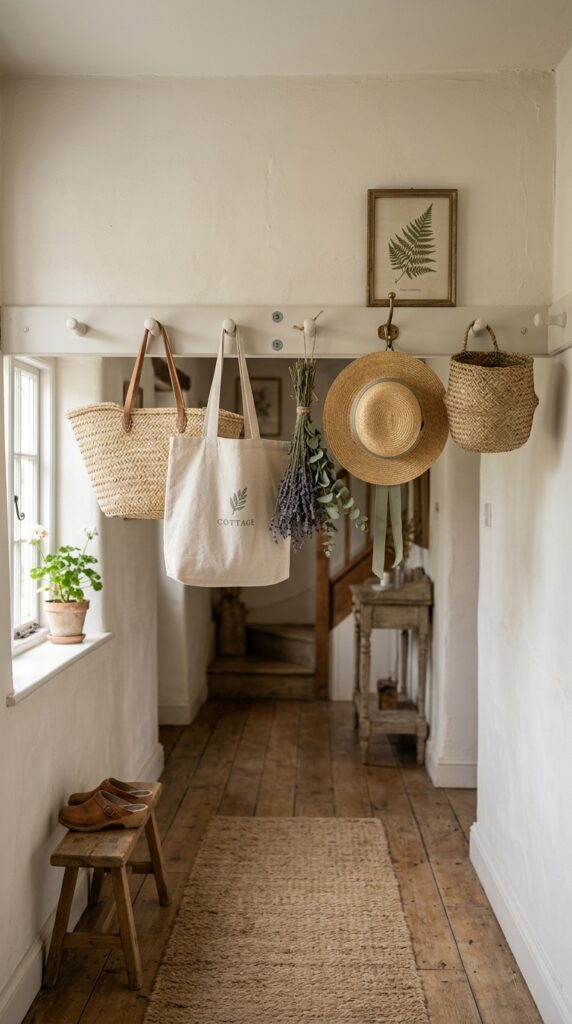
Vibe: The hallway feels calm — organised without looking organised, the way a home that has its rhythm always does.
Why it works: A Shaker peg rail is one of the most historically authentic elements in cottage farmhouse design, originating in 19th-century Shaker communities where every object had a purpose and a place. Its power in a modern entryway is the functional display principle: everyday objects — hats, bags, keys — become the décor when elevated to eye level on a considered rail. This eliminates the need for additional art or accessories in a narrow hallway where space is limited and visual noise is the enemy.
How to get it: Install a pre-made Shaker peg rail (available in 24, 36, or 48-inch lengths) at 66–72 inches from the floor for adult use. Paint to match trim for a built-in look, or leave in natural wood for warmth.
🛍️ Shop the Look — Amazon Product Ideas
| # | Product Search Phrase | Why It Fits |
| 1 | Shaker peg rail wood white painted 36 inch | Authentic hallway storage rail |
| 2 | Woven seagrass wall basket set hanging | Decorative functional storage |
| 3 | Natural straw market tote bag | Styled hanging everyday bag |
| 4 | Botanical print set small framed 4×6 | Small-scale wall art for rail |
| 5 | Dried lavender bundle for hanging | Fragrant peg rail accent |
17. Reclaimed Wood as a Dining Table Centerpiece
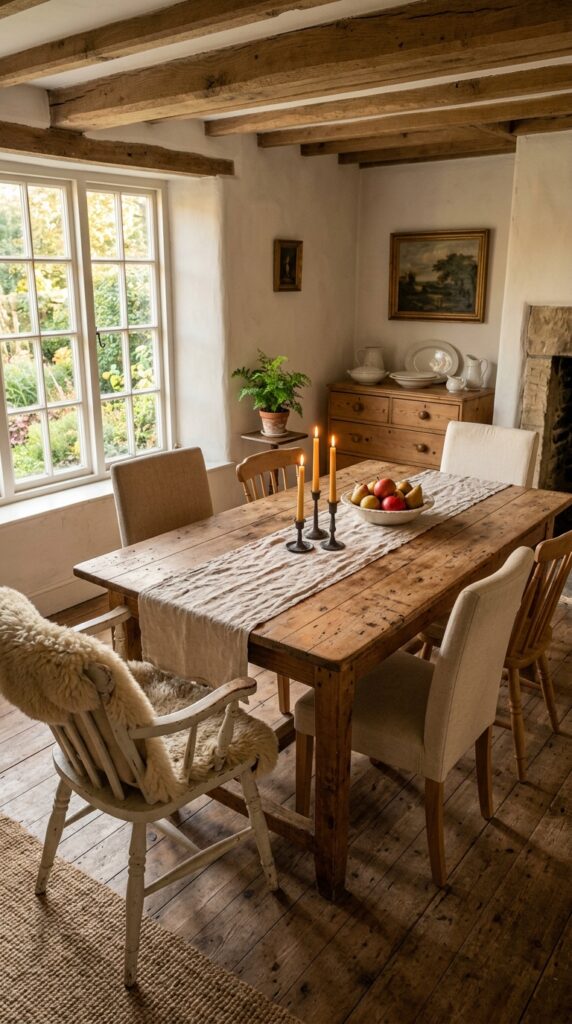
Vibe: The table feels collected — like it knows exactly how many meals have been eaten at it.
Why it works: A reclaimed wood dining table is the cottage farmhouse room’s emotional centre. Its imperfections — nail holes, checking, uneven plank tones — tell a material story that no new piece of furniture can replicate. The design principle at play is authentic patina: the visual evidence of a previous life adds depth that manufactured distressing never achieves. Surrounding it with mismatched seating (a mix of chair styles in a unified color palette) reinforces the collected, grown-over-time quality that defines the style.
How to get it: If a full reclaimed table is outside budget, a new solid wood table can be aged using a wire brush (to open the grain), dark walnut gel stain applied and wiped off (to fill grain and create patina), and a matte finish topcoat. The process takes an afternoon.
💡 Quick Win: A linen table runner in natural oat — left slightly wrinkled rather than ironed flat — does more for a basic wood dining table than almost any other single addition.
🛍️ Shop the Look — Amazon Product Ideas
| # | Product Search Phrase | Why It Fits |
| 1 | Linen table runner natural oat 90 inch | Core dining table textile |
| 2 | Ironstone serving bowl white large | Classic farmhouse table centerpiece |
| 3 | Beeswax pillar candle natural set of 3 | Warm natural table light |
| 4 | Dark walnut gel stain quart wood aging | Table patina DIY tool |
| 5 | Linen dining chair slipcover cream | Chair upholstery unifier |
18. Mirrors with Aged or Distressed Frames
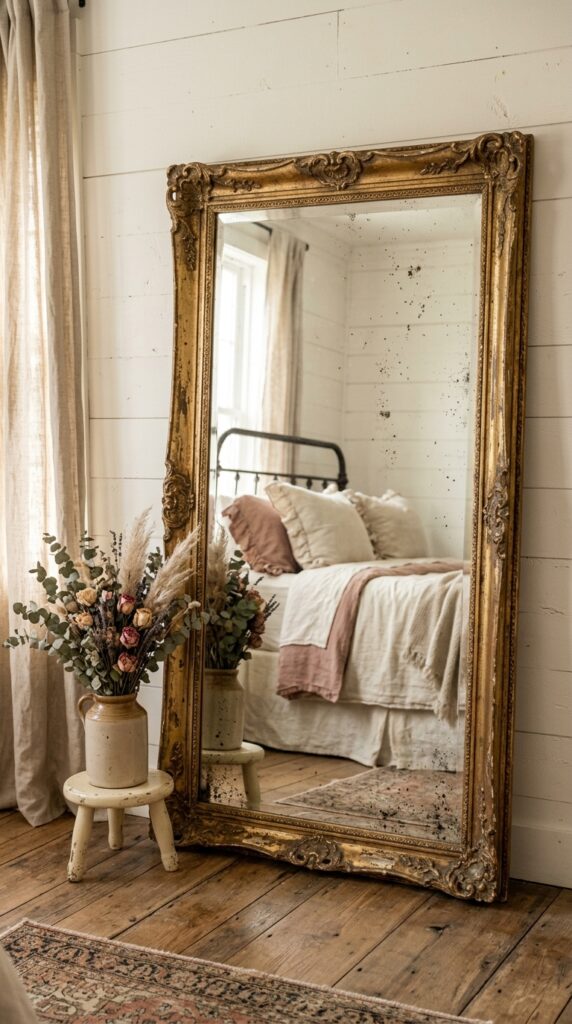
Vibe: The mirror makes the room feel romantic — as if it remembers a more unhurried version of this house.
Why it works: Aged mirrors perform two functions in a cottage farmhouse bedroom: they amplify natural light (which is always a priority in this style’s soft, layered palette) and they introduce the visual complexity of a period piece without requiring a full antique furniture purchase. A distressed gilt frame specifically bridges the cottage (ornate, romantic) and farmhouse (worn, unpretentious) halves of the style — the frame says “beautiful” and the distressing says “this beauty has history.”
How to get it: Lean a floor mirror rather than hanging it — the leaning position reads as cottage-casual and requires no wall damage. Age a new mirror frame yourself with gold leaf paint applied over dark base paint, then rubbed back with fine sandpaper at the edges.
🛍️ Shop the Look — Amazon Product Ideas
| # | Product Search Phrase | Why It Fits |
| 1 | Ornate gold distressed floor mirror leaning large | Statement aged mirror piece |
| 2 | Gold leaf paint kit antique effect | DIY frame ageing technique |
| 3 | Dried floral arrangement large natural tones | Beside-mirror floor styling |
| 4 | Small ceramic garden stool white | Mirror prop surface accent |
| 5 | Linen curtain panel eyelet natural 84 inch | Light-catching bedroom textile |
19. A Small-Space Cottage Farmhouse Bathroom on a Budget
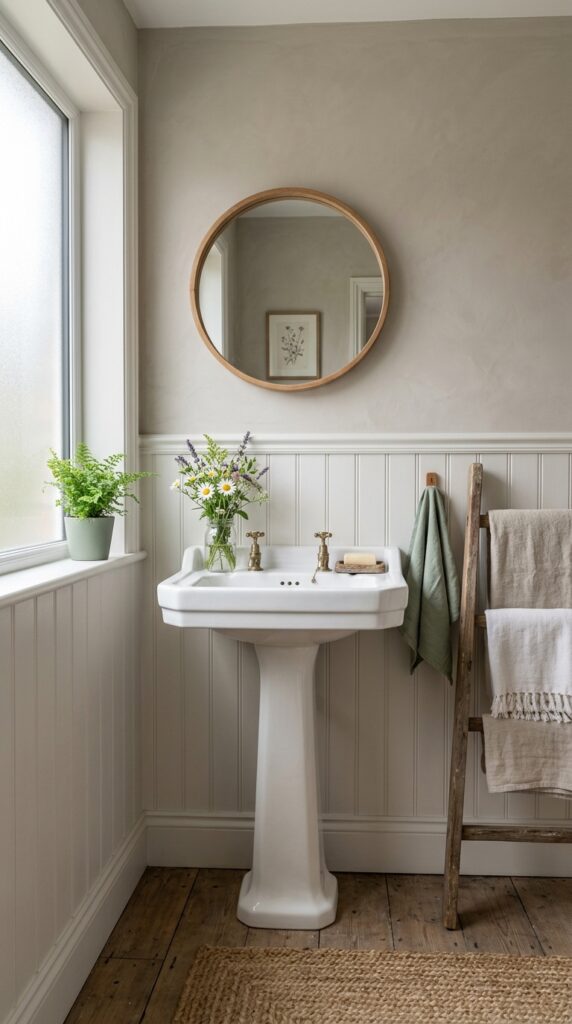
Vibe: The bathroom feels hushed — even at 40 square feet, it has the quality of a room that was thought about.
Why it works: Small bathrooms are actually ideal cottage farmhouse candidates because the style’s core tools — wainscoting, a pedestal sink, a round mirror, a ladder for towels — are all compact by nature. Beadboard wainscoting to chair-rail height (about 36 inches) does double duty: it adds texture and it visually divides a small wall into two zones, making the room feel taller. A round mirror rather than a rectangular one avoids the boxy visual weight that shrinks compact rooms further.
How to get it: Install peel-and-stick beadboard panels to chair-rail height in a single weekend. Paint from the panel top to the ceiling in a slightly lighter or slightly warmer tone than the wainscoting — this subtle two-tone wall effect adds significant depth at zero extra cost.
💡 Quick Win: A wooden blanket ladder holding folded linen towels takes up 6 inches of floor depth, costs under $40, and completely eliminates the need for a towel bar installation.
🛍️ Shop the Look — Amazon Product Ideas
| # | Product Search Phrase | Why It Fits |
| 1 | Wooden blanket ladder towel holder farmhouse | Space-saving towel storage |
| 2 | Round wood mirror small bathroom 24 inch | Compact vanity mirror |
| 3 | Beadboard peel and stick wallpaper white | Renter-friendly wainscoting |
| 4 | Wooden soap dish teak bathroom | Natural material sink accessory |
| 5 | Linen hand towel fringe edge set of 2 | Textured natural fiber hand towel |
20. Dried Botanicals and Preserved Stems as Year-Round Décor
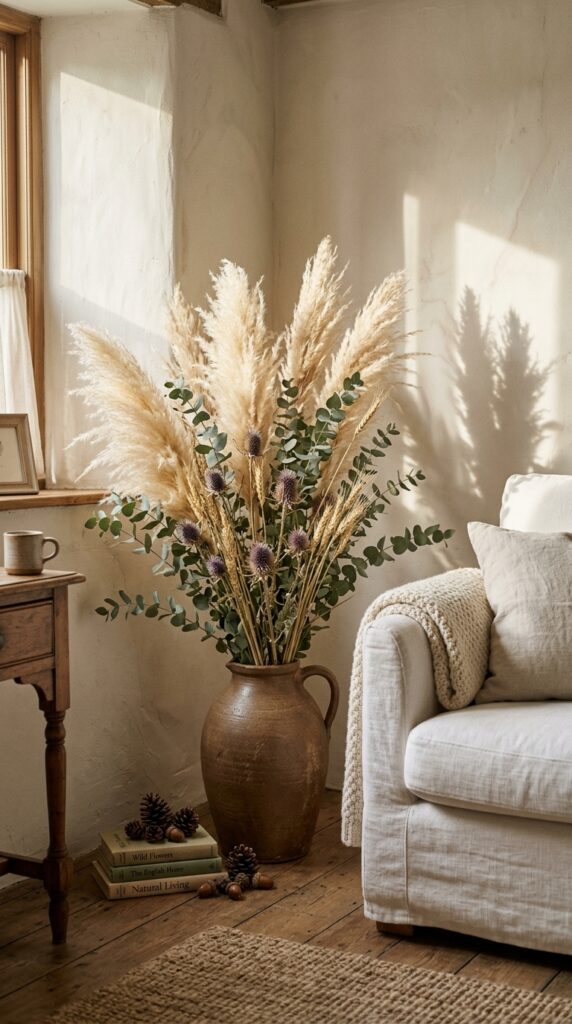
Vibe: The corner feels organic — as if something from the garden decided to stay.
Why it works: Dried botanicals are one of the most cost-effective tools in cottage farmhouse decorating because they function as architectural accessories — their height, volume, and shadow patterns do work that furniture cannot. The design principle is sculptural negative space: the airy, open structure of dried stems and grasses fills a corner without blocking light, while their shadows animate the surrounding walls as the daylight shifts. They also require no maintenance, no water, and no replacement — making them the most sustainable decorative investment in the category.
How to get it: Combine three different dried stem types at three different heights in a single vessel for the most natural-looking arrangement. The rule: one tall structural element (pampas or tall dried grass), one mid-height filler (preserved eucalyptus, dried thistle), one low accent (wheat stalks, dried lavender). Never arrange stems of identical height.
🛍️ Shop the Look — Amazon Product Ideas
| # | Product Search Phrase | Why It Fits |
| 1 | Pampas grass dried stems natural large bunch | Tall structural dried element |
| 2 | Preserved eucalyptus dried stems bundle | Mid-height dried filler stems |
| 3 | Earthenware vase jug large matte brown | Rustic vessel for dried stems |
| 4 | Dried thistle stems purple natural bunch | Texture contrast dried element |
| 5 | Dried wheat stalks bundle natural | Low accent stem filler |
How to Start Your Cottage Farmhouse Transformation
Begin with paint — but choose the right one. Your single most impactful first move is painting your largest room in Benjamin Moore’s White Dove (OC-17), a warm white with the barest ivory undertone that works with natural light, linen textiles, reclaimed wood, and aged metal simultaneously. It doesn’t fight any material and it anchors every other decision without locking you into a specific direction.
The most common beginner mistake is buying furniture that is too large for the room. Cottage farmhouse is not maximalist — it has density of texture, not density of objects. An oversized sectional in a living room eliminates the breathing room that makes this style feel like a cottage rather than a stuffed showroom. Measure before purchasing any sofa or table, and aim to leave at least 18 inches of open floor visible on every side of major furniture pieces.
Three items under $50 that create immediate cottage farmhouse impact: a single stem of dried pampas grass in a thrifted ceramic jug (~$15 for the stems), a linen tea towel with a subtle stripe hung through an oven handle or folded on a shelf (~$12), and a pack of beeswax taper candles in ivory placed in a vintage-style iron candlestick (~$18). All three are available online and all three photograph better than pieces costing ten times more.
Realistic expectations matter here. A weekend can transform a single room with paint, new hardware, and textiles — budget $150–$400 for a strong starter version. A full cottage farmhouse room with furniture, lighting, and architectural detail (shiplap, beams, built-ins) realistically costs $1,500–$4,000 and takes 4–8 weeks. Most people build the look over 6–12 months, and the style actually rewards that pace — pieces added gradually look more collected than rooms designed in a single shopping trip.
Frequently Asked Questions About Cottage Farmhouse Style
What is the difference between cottage farmhouse and modern farmhouse style?
Modern farmhouse — popularized largely by Chip and Joanna Gaines — leans toward clean lines, shiplap in pure white, and a restrained black-and-white palette with minimal soft goods. Cottage farmhouse is warmer, softer, and more layered, drawing on English country and vintage aesthetics for its personality. Where modern farmhouse says “clean and structured,” cottage farmhouse says “worn and collected.” Think more florals, more linen, more aged patina, and a palette that includes dusty sage, terracotta blush, and antique cream alongside white.
What colors work best in a cottage farmhouse bedroom?
The most livable cottage farmhouse bedroom palette builds from warm white walls (Benjamin Moore White Dove or Sherwin-Williams Alabaster) layered with antique cream bedding, dusty sage or terracotta blush accents, and aged wood tones. Avoid cool whites (anything with a blue or grey undertone) as they drain warmth from the space. Dusty rose — specifically a desaturated, clay-based rose rather than bubblegum pink — is having a strong moment in cottage farmhouse bedrooms and pairs naturally with natural linen and wrought iron.
How much does it cost to decorate a cottage farmhouse living room?
A starter cottage farmhouse living room — paint, new hardware, a few key textiles, and dried botanical accents — can be achieved for $200–$500. A fully furnished room with a linen sofa, reclaimed wood coffee table, woven pendants, and architectural details like shiplap or beams typically runs $2,500–$6,000 depending on whether you source secondhand or buy new. The style actually rewards thrifting: a $30 wooden hutch repainted in chalk paint looks more authentic than a $600 new piece from a big box store.
Can cottage farmhouse style work in a contemporary open-plan home?
Yes, but it requires zone definition. In open-plan homes without natural room boundaries, cottage farmhouse works best when applied as a layer of texture within a contained zone — a dining area anchored by a reclaimed wood table and woven pendant, a reading nook defined by a built-in shelf and linen chair — rather than spread thinly across the entire footprint. The style’s intimacy comes from contained, purposeful spaces, so working within an open plan rather than against it is the key. Use rugs, shelving, and lighting to draw the zones first.
What kind of curtains go in a cottage farmhouse room?
Linen is the non-negotiable answer. Specifically, look for 100% linen or linen-cotton blend panels in natural oat, antique white, or soft greige. They should hang from simple iron rings on a black or natural wood rod — no grommets, which read as too contemporary. Hang the rod 4–6 inches above the window frame and extend it 6–8 inches on either side of the frame to maximize perceived window size. Let the panels puddle slightly on the floor — a 1–2 inch puddle is deliberate and cottage-appropriate; anything more reads as untidy.
Ready to Create Your Dream Cottage Farmhouse Home?
From the tonal linen layering on a bed to the sculptural presence of dried botanicals in a corner, these 20 ideas cover every element that gives cottage farmhouse its particular warmth — color, material, light, layout, and the small accessories that hold it all together. Transformation doesn’t need to happen all at once — in fact, the rooms that look most genuinely cottage farmhouse are the ones that grew over time, one considered piece at a time. Start today by picking up a jar of warm white paint and a handful of dried pampas stems — those two moves alone will shift the entire register of a room. Done well, this style doesn’t just change what your home looks like; it changes how you feel when you walk through the door — unhurried, held, and at ease. Save the ideas that stopped your scroll — the ones that felt like your version of this — because that instinct is where the best rooms begin.