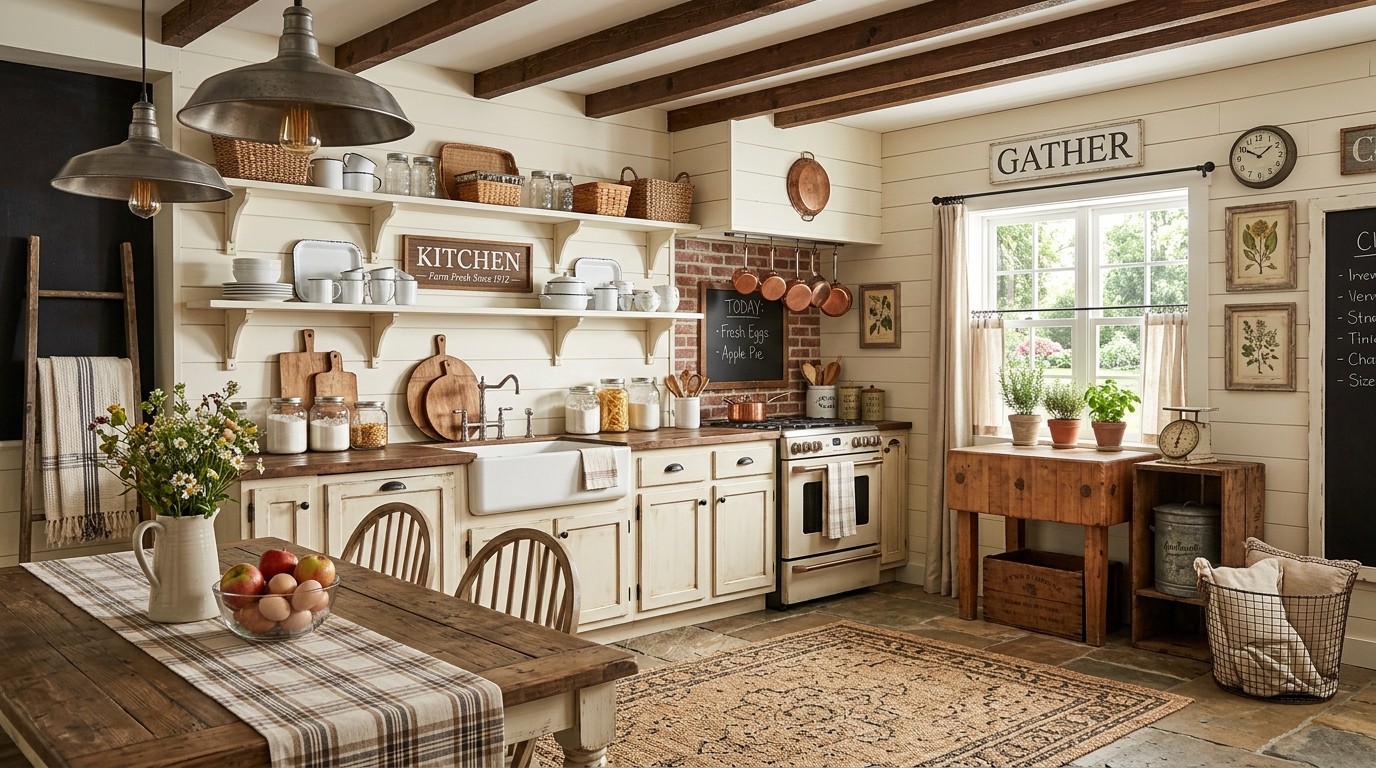
21 Farmhouse Kitchen Decor Ideas
Farmhouse kitchen style blends rustic warmth with lived-in functionality — it’s the design language of old farmhouses where beauty and practicality were never separate. This article gives you exactly 21 farmhouse kitchen decor ideas, each one specific enough to act on today.
There’s something deeply grounding about a farmhouse kitchen. The scent of wood and linen, the glint of an antique faucet, the soft thud of a heavy ceramic mug on a worn countertop — it’s a space that breathes. Natural light filters through simple windows and lands on creamy walls that have seen a thousand Sunday mornings. This isn’t decor for show. It’s a kitchen that actually feels like the heart of a home. Here are 21 ideas worth saving — and stealing.
Why Farmhouse Kitchen Decor Works So Well
Farmhouse kitchen design has American and Northern European roots in the working kitchens of rural homesteads from the 18th and 19th centuries. Unlike many contemporary styles that emerged from urban design studios, this one evolved from pure function — kitchens where every shelf, hook, and open rack served a daily purpose. What makes it distinct from industrial or rustic styles is its warmth: farmhouse design is deliberately inviting, never cold, and balances roughness with softness in ways that feel human-scaled.
The material palette is defining. Think unfinished white oak and reclaimed pine, shiplap paneling in warm white, cast iron and brushed nickel hardware, raw linen dish towels, and handthrown stoneware in cream and sage. Colors stay in the family of warm whites (Benjamin Moore White Dove OC-17), greige, dusty sage, muted terracotta, and deep charcoal for accents. Every surface invites touch — nothing is lacquered or glossy.
The resurgence of farmhouse style post-2020 is no accident. As people spent more time at home, the demand for spaces that feel restorative over impressive skyrocketed. Pinterest reported a 42% increase in farmhouse kitchen searches during the early pandemic years. The style also aligns perfectly with a broader sustainability shift: reclaimed materials, vintage pieces, and “buy once, keep forever” furniture values match how many people now want to spend their decorating dollars.
Small kitchens can absolutely achieve this style — but the priority order matters. Start with surfaces and hardware before adding textiles or decor. In a compact space, creamy painted cabinets and simple cup-pull hardware in matte black deliver the entire aesthetic signature without needing a single shelf or sign. Clutter is the enemy of small farmhouse kitchens; curated minimalism is the play.
Style at a Glance
| Element | Detail |
| Philosophy | Functional warmth; beauty through utility |
| Key Materials | Shiplap, white oak, cast iron, raw linen, stoneware |
| Key Colors | Warm white, greige, dusty sage, soft terracotta, charcoal |
21 Farmhouse Kitchen Decor Ideas
1. Warm White Shiplap Accent Wall
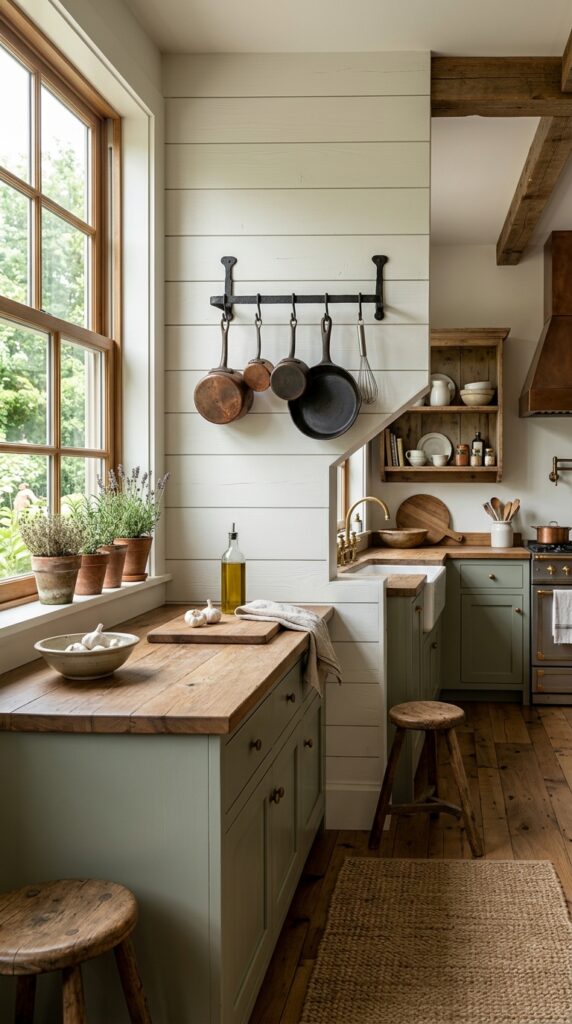
Vibe: Sun-warmed and still, like a kitchen that’s been quietly loved for decades.
Why it works: Shiplap creates horizontal movement across a wall, making narrow kitchens read wider while adding tactile depth that flat drywall simply can’t match. The thin shadow gap between each board acts as an architectural detail at essentially zero cost, and warm white paint keeps the texture soft rather than stark. It’s the difference between a wall that recedes into the background and one that anchors the entire space.
How to get it: Use 1×6 or 1×8 pine boards installed horizontally with a quarter-inch spacer between each plank. Paint in a warm white — Benjamin Moore White Dove OC-17 or Sherwin-Williams Alabaster SW 7008 — rather than bright or cool whites, which read clinical under natural light.
💡 Quick Win: Peel-and-stick shiplap panels (search “peel and stick wood wall planks white”) achieve this look in a weekend without nails or compound work — ideal for renters.
🛍️ Shop the Look — Amazon Product Ideas
| # | Product Search Phrase | Why It Fits |
| 1 | Peel and stick shiplap wall planks white | Easy renter-friendly install |
| 2 | Small cast iron pot rack wall mounted | Rustic functional accent |
| 3 | Terracotta mini herb pot set | Earthy kitchen windowsill detail |
| 4 | White Dove paint sample peel stick | Swatch before committing |
| 5 | Dried lavender bundle kitchen decor | Natural farmhouse filler |
2. Open Wooden Floating Shelves
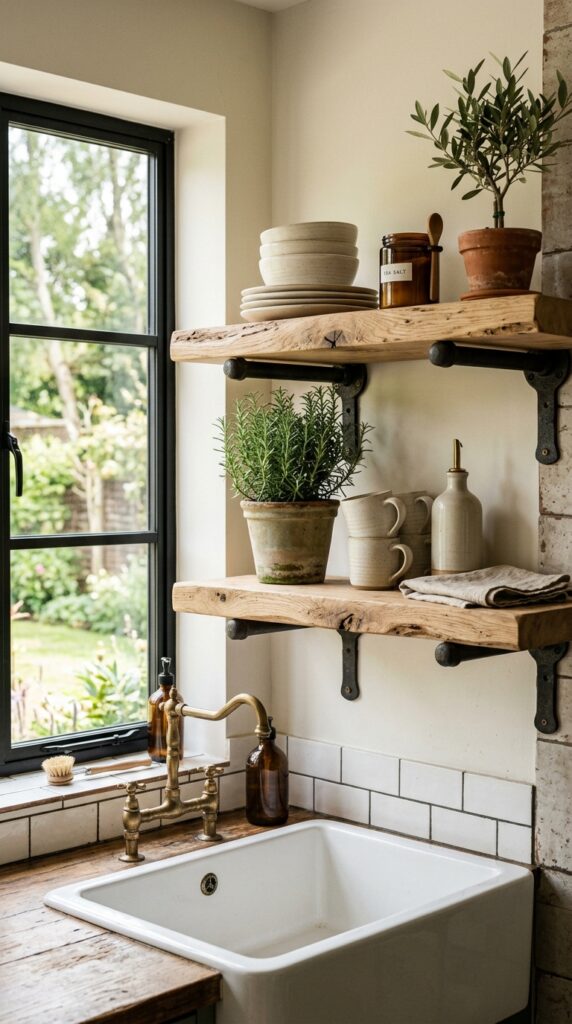
Vibe: Layered and considered, like shelves built up slowly over years.
Why it works: Open shelving is the foundational farmhouse move because it serves display and function simultaneously — which is the entire philosophy of the style in material form. Raw white oak shelves with iron pipe brackets provide a natural contrast of warm wood against cool metal, while the visible texture of unfinished grain brings life to an otherwise flat wall plane. Items styled on open shelves become part of the room’s visual composition, not hidden away.
How to get it: Mount 2-inch-thick live-edge white oak slabs (available from lumber yards or Etsy woodworkers) on iron pipe shelf brackets in a matte black finish. Keep spacing at 14–16 inches between shelves so taller items like pitchers and mason jars fit without crowding.
🛍️ Shop the Look — Amazon Product Ideas
| # | Product Search Phrase | Why It Fits |
| 1 | Rustic wood floating shelf brackets iron pipe | Signature farmhouse look |
| 2 | Cream stoneware mug set handmade style | Open shelf styling hero |
| 3 | Mason jar set wide mouth clear glass | Pantry styling on shelves |
| 4 | White oak live edge shelf board | Raw material focal point |
| 5 | Small linen plant pot cover set | Textile softness on shelves |
3. Vintage Pendant Lights Over the Island
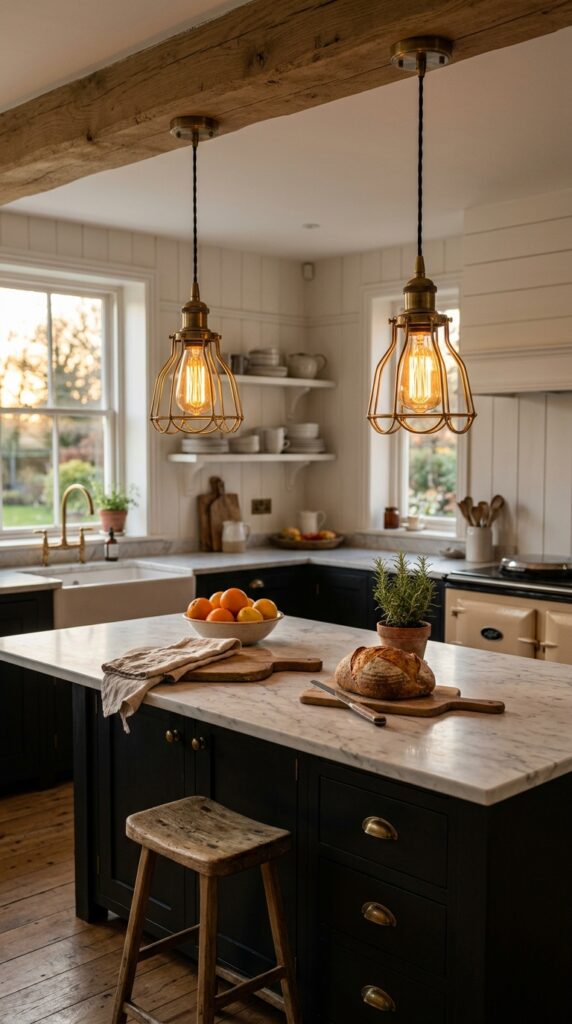
Vibe: Amber and hushed, like a kitchen at 7pm when everything slows down.
Why it works: Pendant lighting over an island operates on the design principle of visual weight distribution — it pulls the eye down toward the work surface while creating a sense of enclosure and intimacy in a room that might otherwise feel cavernous. Aged brass finishes warm up the entire kitchen color temperature, casting a soft glow that flatters every material beneath it — white marble, cream plaster, raw wood alike. The exposed bulb adds texture even when the light is off.
How to get it: Hang pendants so the bottom of the shade sits 30–36 inches above the countertop surface. For islands over 5 feet long, two pendants feel right — three becomes busy. Stick to Edison-style filament bulbs (2200K color temperature) rather than standard LEDs, which read too blue.
💡 Quick Win: Plug-in pendant lights with a fabric-wrapped cord eliminate the need for an electrician — hang on a ceiling hook and plug into a nearby outlet for a $40–$60 total investment.
🛍️ Shop the Look — Amazon Product Ideas
| # | Product Search Phrase | Why It Fits |
| 1 | Farmhouse pendant light aged brass Edison | Signature fixture for island |
| 2 | Edison filament bulb warm 2200K E26 | Authentic warm glow |
| 3 | Plug in pendant light fabric cord black | No electrician required |
| 4 | Adjustable pendant cord cover brass | Clean installation finish |
| 5 | Vintage cage pendant shade antique finish | Style-specific shade option |
4. Apron Front Farmhouse Sink
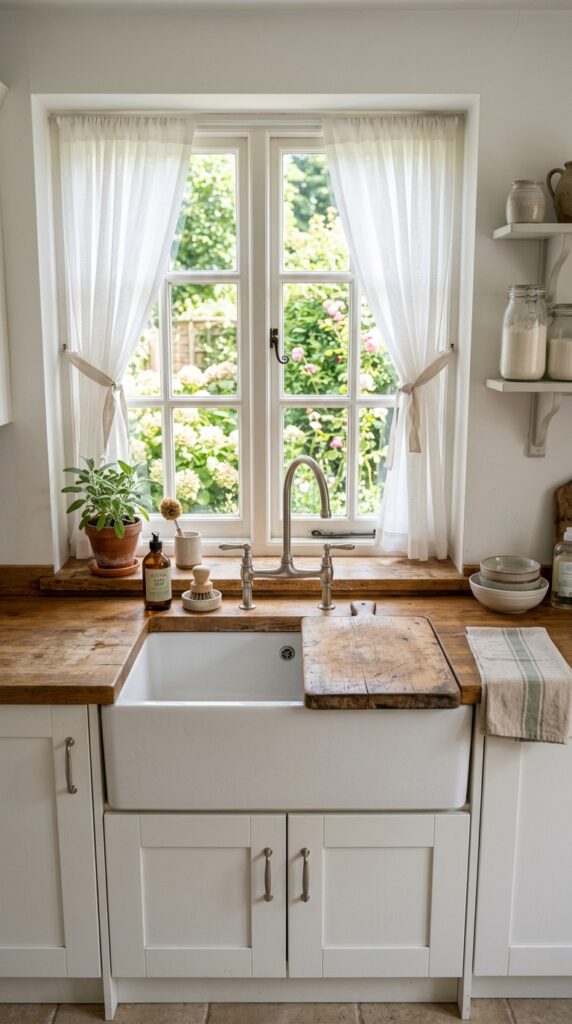
Vibe: Raw and honest, with the no-nonsense grace of a working kitchen.
Why it works: The apron-front (also called farmhouse) sink is the single most architecturally significant fixture in this design language. Its exposed front face breaks the conventional cabinet line, creating a visual moment that says “this kitchen was designed with intention.” Fireclay is the authentic material — heavier and more textural than composite alternatives, it chips slightly over time in a way that looks earned rather than damaged. The large single basin accommodates oversized pots and sheet pans that smaller divided sinks cannot.
How to get it: Pair with a bridge-style faucet in brushed nickel or matte black — avoid polished chrome, which reads too modern. Keep the cabinet below open (no doors) or use a simple farmhouse curtain panel for a classic period look that costs almost nothing to execute.
🛍️ Shop the Look — Amazon Product Ideas
| # | Product Search Phrase | Why It Fits |
| 1 | Farmhouse apron sink fireclay white 30 inch | Hero sink fixture |
| 2 | Bridge faucet kitchen brushed nickel two handle | Period-correct faucet pairing |
| 3 | Under sink curtain rod farmhouse | Cabinet-free sink styling |
| 4 | Linen under sink curtain panel cream | Soft cabinet-door alternative |
| 5 | Wooden cutting board large end grain | Functional sink-side styling |
5. Sage Green Lower Cabinets, White Uppers
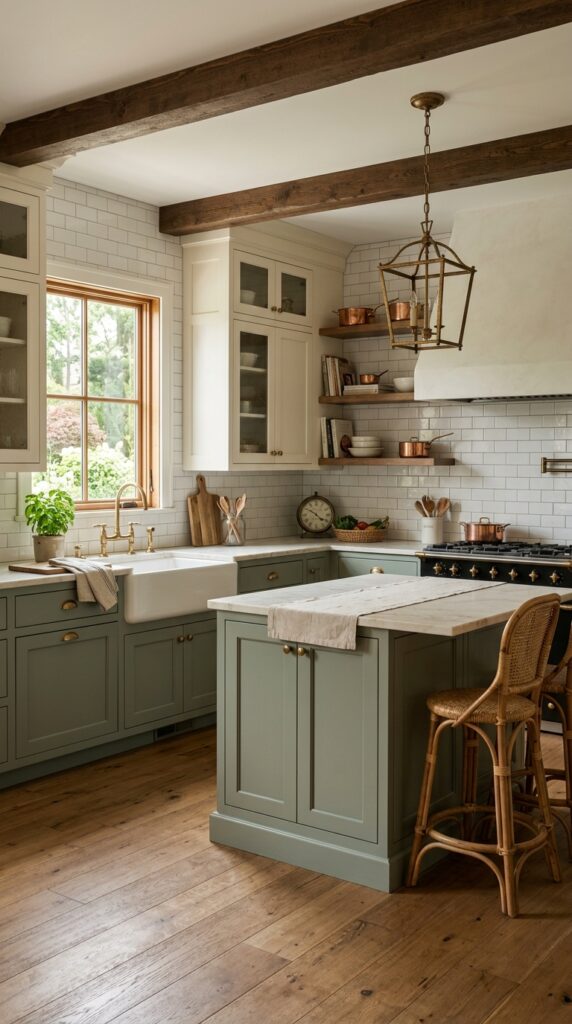
Vibe: Serene and grounded, like a kitchen that grew up alongside a garden.
Why it works: Two-tone cabinetry works because it uses visual weight to anchor the lower half of the room while keeping the upper half light and open — a classic design principle of proportional contrast. Dusty sage (think Farrow & Ball Mizzle or Benjamin Moore Pale Avocado) reads as inherently “natural” because it mimics the gray-green tones found in dried herbs and weathered wood, both central farmhouse references. The warm white uppers bounce light back into the space rather than absorbing it.
How to get it: If repainting existing cabinets, use a chalk-based cabinet paint in a flat or eggshell finish — higher sheens look plasticky on wood. Replace all hardware simultaneously in aged brass or unlacquered brass for an instant tonal upgrade.
💡 Quick Win: Swap hardware first before committing to paint. A set of aged brass cup pulls ($1.50–$3 per pull) transforms white or beige cabinets into something that reads significantly more farmhouse immediately.
🛍️ Shop the Look — Amazon Product Ideas
| # | Product Search Phrase | Why It Fits |
| 1 | Chalk paint sage green cabinets kitchen | Farmhouse two-tone paint |
| 2 | Cup pull cabinet hardware aged brass set | Signature farmhouse hardware |
| 3 | White subway tile peel stick backsplash | Classic backsplash without grout |
| 4 | Cabinet paint brush flat finish foam | Clean, drip-free cabinet application |
| 5 | Color match paint chip sage green kitchen | Shade planning before buying |
6. Woven Rattan Bar Stools
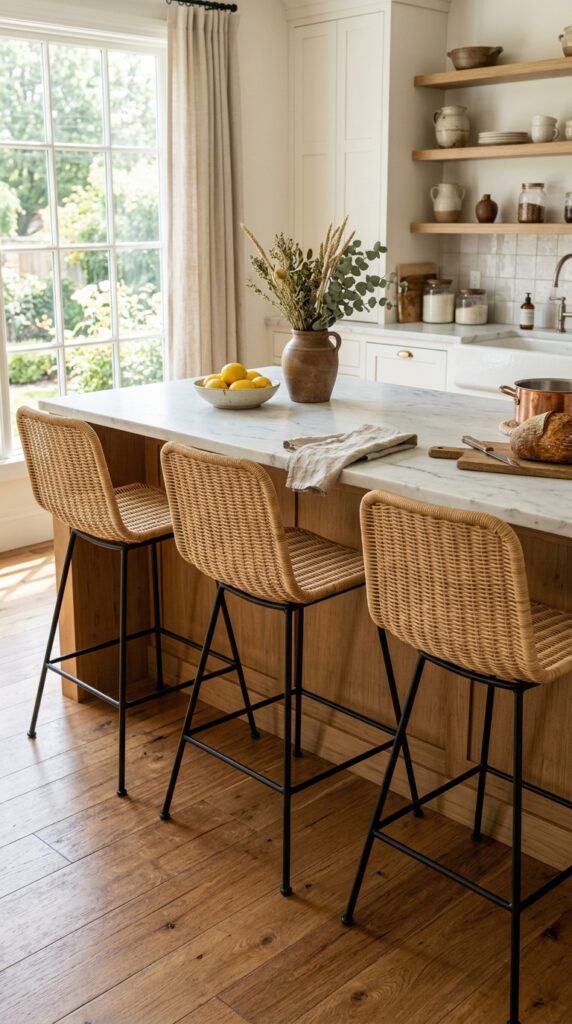
Vibe: Airy and unhurried, like a kitchen built for long Saturday breakfasts.
Why it works: Rattan introduces organic texture at seat height — the zone where eyes spend the most time in a kitchen. The material’s natural straw color pulls warm undertones from wood floors and wood shelving, creating tonal continuity without matching. The slight roughness of woven rattan against the smooth marble of an island creates texture contrast — one of the fundamental techniques of layered farmhouse interiors. Metal legs keep the stool from reading as too boho or beach-house.
How to get it: Choose counter-height stools (24–26 inch seat height) for standard kitchen islands and bar-height (28–30 inch) for raised breakfast bars. Leave 6–8 inches of space between each stool so they don’t feel crowded when occupied.
🛍️ Shop the Look — Amazon Product Ideas
| # | Product Search Phrase | Why It Fits |
| 1 | Rattan counter stool black metal legs farmhouse | Core seating piece |
| 2 | Natural rattan bar stool cushion round | Added comfort on woven seat |
| 3 | Counter height stool set of 2 woven seat | Efficient two-stool purchase |
| 4 | Marble contact paper countertop self adhesive | Marble-look island update |
| 5 | Jute placemat round natural kitchen | Coordinating table textile |
7. Galvanized Metal Storage Canisters
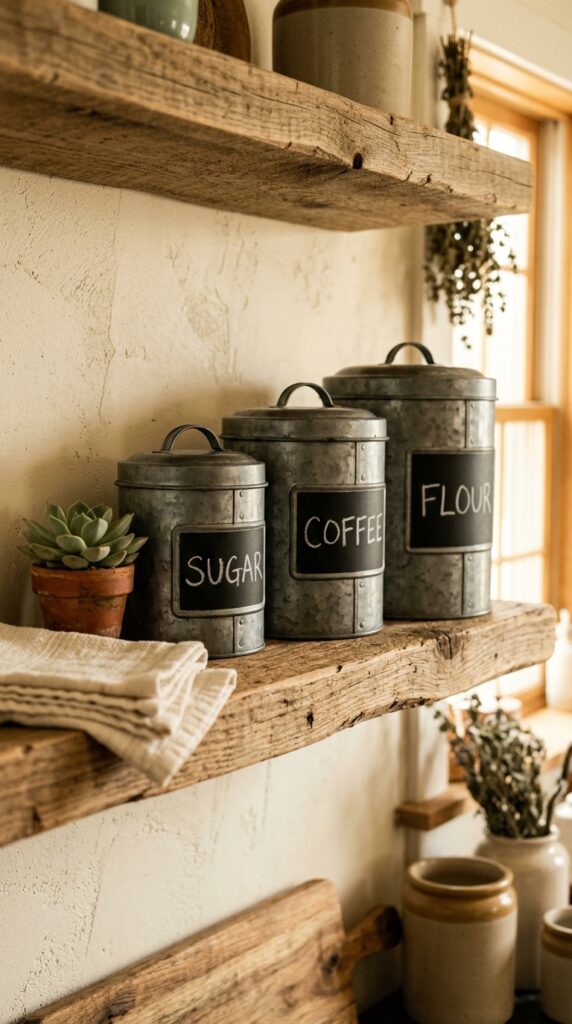
Vibe: Grounded and purposeful, like a pantry that’s been curated over years of weekly cooking.
Why it works: Galvanized metal introduces an industrial edge that prevents farmhouse kitchens from reading as overly sweet or country-kitsch. A set of graduated canisters creates visual rhythm through repetition — the same form in escalating sizes — which is one of the most reliable tools in shelf styling. Chalk labels add handcrafted detail while remaining functional and changeable, which is deeply aligned with the farmhouse philosophy of beauty-through-use.
How to get it: Style canisters in groups of odd numbers — three or five — and vary their heights so the eye moves naturally across the shelf. Place the tallest at one end rather than the center, which creates a more organic asymmetry than a pyramid arrangement. Fill with flour, coffee, dried pasta, or grain for authenticity over empty decorative staging.
💡 Quick Win: Galvanized metal canister sets of three are widely available for under $30. Pair with a $3 chalk pen and hand-label each lid for instant personalized farmhouse character.
🛍️ Shop the Look — Amazon Product Ideas
| # | Product Search Phrase | Why It Fits |
| 1 | Galvanized metal canister set kitchen farmhouse | Hero storage accessory |
| 2 | Chalk pen white liquid set | Custom label writing tool |
| 3 | Linen dish towel set cream stripe | Coordinating textile detail |
| 4 | Small terracotta succulent pot set | Natural accent near canisters |
| 5 | Reclaimed wood kitchen shelf bracket set | Shelf for canister display |
8. Subway Tile Backsplash in Warm White
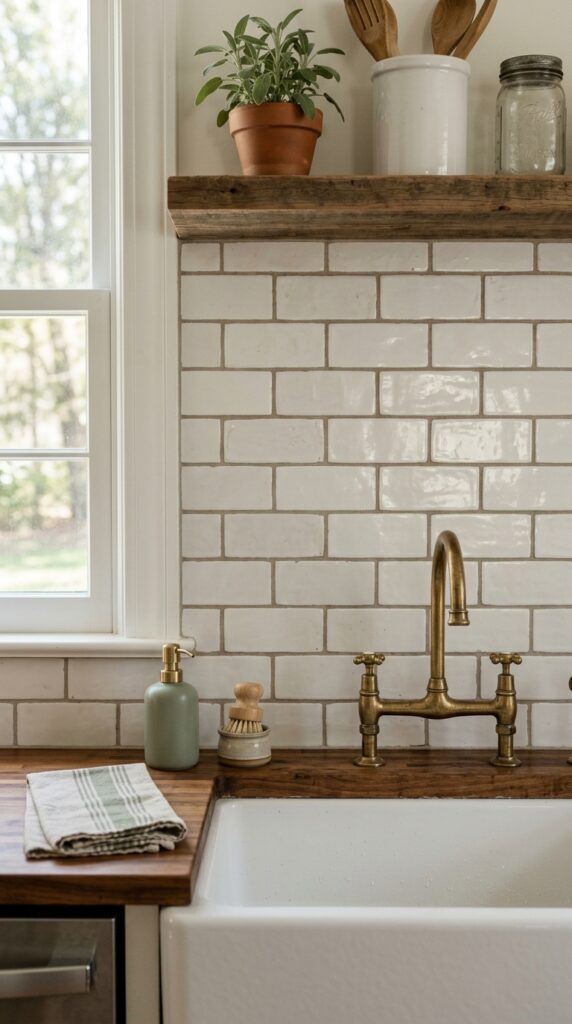
Vibe: Clean and luminous, with just enough variation to feel handmade.
Why it works: Subway tile in farmhouse kitchens works because it traces directly to the style’s historical origins — white tile was the utilitarian surface choice in early 20th-century kitchens and farmhouse outbuildings. The key design principle here is grout contrast: warm gray or greige grout (not bright white) keeps the overall palette warm while making the individual tile geometry readable. Slightly textured or “handmade-style” tiles with minor surface variation elevate the look far beyond generic builder-grade options.
How to get it: Install in a classic brick-offset (running bond) pattern rather than stacked — the offset prevents the backsplash from reading as too graphic or modern. Use unsanded grout in a warm gray like Mapei Warm Gray 54 or Antique White 04.
🛍️ Shop the Look — Amazon Product Ideas
| # | Product Search Phrase | Why It Fits |
| 1 | Peel and stick subway tile backsplash warm white | No-grout rental solution |
| 2 | Handmade style subway tile 3×6 ceramic | Textured authentic tile option |
| 3 | Tile grout warm gray sanded Mapei | Essential grout pairing |
| 4 | Tile installation grout float tool set | DIY backsplash installation |
| 5 | Subway tile trim pieces edge finisher | Professional edge installation |
9. Wooden Herb Garden on the Windowsill
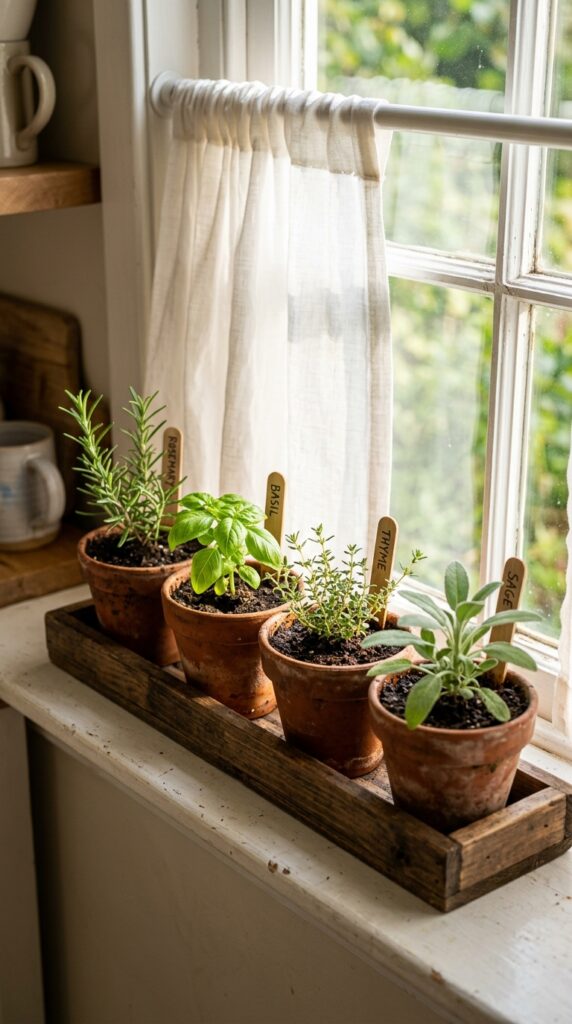
Vibe: Alive and unpretentious, like something that belongs here as naturally as the sink.
Why it works: Live herbs on a windowsill introduce the one element no amount of decor shopping can replicate — actual growth and change. The design principle at work is sensory layering: the visual green of leaves, the texture of terracotta, the smell of rosemary when someone brushes past. All three pull the kitchen into the realm of something genuinely lived in. Terracotta pots specifically echo the warm orange tones in exposed wood and aged brass without being forced.
How to get it: Use a narrow window box tray in raw wood or galvanized metal to corral pots and catch watering runoff. Stick to terracotta clay pots — never glossy ceramic or plastic in farmhouse kitchens. Wooden plant markers labeled with a chalk pen cost under $5 for a full set and add significant detail.
🛍️ Shop the Look — Amazon Product Ideas
| # | Product Search Phrase | Why It Fits |
| 1 | Terracotta pot set small kitchen herb garden | Authentic material choice |
| 2 | Wooden windowsill herb tray indoor planter | Corralling and drainage tray |
| 3 | Herb starter kit kitchen grow your own | Live plant starting kit |
| 4 | Wooden chalk plant label stakes set | Handwritten marker detail |
| 5 | Linen kitchen valance white simple | Soft window frame backdrop |
10. Butler’s Pantry With Glass-Front Cabinets
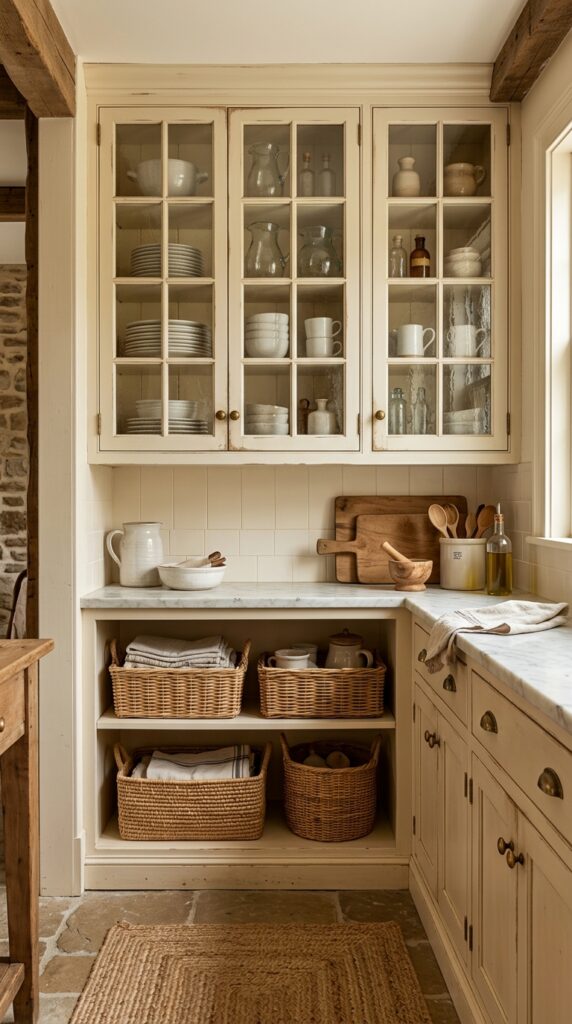
Vibe: Layered and warm, with the quiet abundance of a kitchen that feeds people well.
Why it works: Glass-front cabinets solve a key tension in farmhouse kitchens between open shelving (maximally warm, maximally demanding of curation) and solid cabinet doors (practical but flat). The glass face lets you display but also contain — and the slight imperfection of antique-style bubbled glass softens what would otherwise be a very formal element. When cabinets are cream rather than pure white, the stoneware inside — which is rarely a clean bright white — doesn’t clash or read as dingy.
How to get it: Replace solid center panels on existing cabinet doors with glass inserts rather than replacing the entire cabinet. Ripple glass or seeded glass (both available at glass shops for $15–$30 per panel) adds period-appropriate texture to otherwise modern cabinet profiles.
🛍️ Shop the Look — Amazon Product Ideas
| # | Product Search Phrase | Why It Fits |
| 1 | Glass cabinet insert kit rippled texture | Upgrade existing cabinet doors |
| 2 | Antique brass round knob cabinet set | Hardware for glass-front cabinets |
| 3 | Cream stoneware dinnerware set 12 piece | Display-worthy everyday dishes |
| 4 | Vintage glass pitcher clear kitchen | Glass display accent |
| 5 | Woven rattan basket pantry storage small | Texture variety inside cabinet |
11. Butcher Block Countertop Section
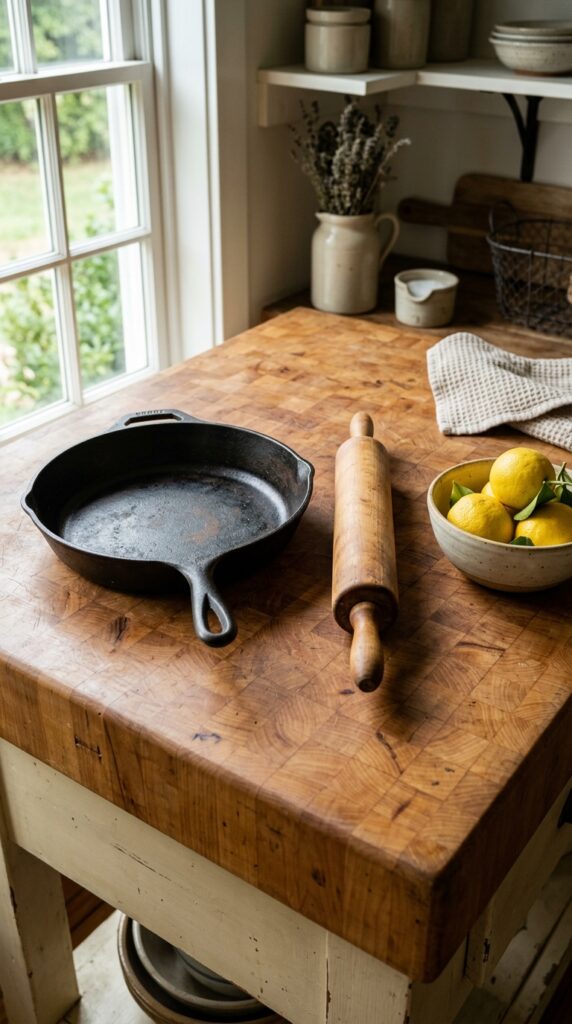
Vibe: Raw and functional, with the gravity of a surface that’s actually meant to be used.
Why it works: Butcher block countertops introduce warmth and texture that stone simply cannot — the way wood absorbs light rather than reflecting it creates a fundamentally different atmospheric quality. End-grain (blocks arranged so the wood’s cross-section faces up) is the superior material choice over edge-grain because it’s self-healing to knife marks and shows dramatically more visual character. The design principle in play is material contrast: butcher block paired with painted cabinets or marble on an adjacent run reads as more considered than a full uniform counter run.
How to get it: Use butcher block for an island top or prep area section and keep a harder material (quartz, marble, or porcelain) for the perimeter runs around the sink and stove. Treat the wood with food-safe mineral oil monthly during the first year to build protection without sealing the pores.
💡 Quick Win: Butcher block contact paper (search “butcher block adhesive vinyl countertop”) is a shockingly convincing temporary upgrade that costs $20–$40 for a standard counter run.
🛍️ Shop the Look — Amazon Product Ideas
| # | Product Search Phrase | Why It Fits |
| 1 | Butcher block contact paper wood grain countertop | Rental-friendly surface update |
| 2 | Food safe mineral oil wood cutting board conditioner | Essential maintenance product |
| 3 | Cast iron skillet 10 inch pre-seasoned | Authentic countertop prop |
| 4 | Wood rolling pin farmhouse kitchen handle | Functional display accessory |
| 5 | End grain butcher block cutting board large | Portable version of the look |
12. Vintage-Style Open Kitchen Cart
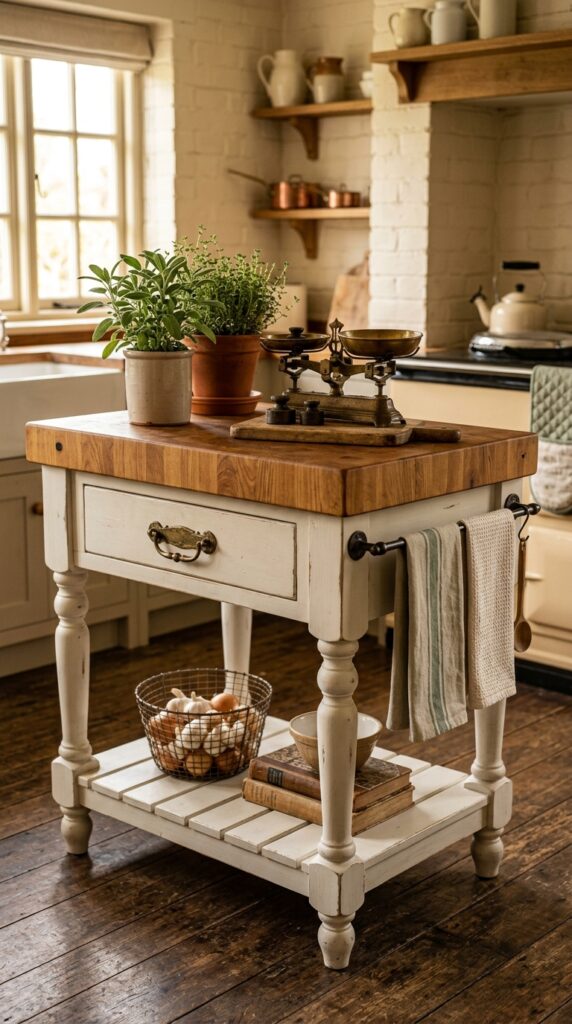
Vibe: Grounded and generous, like a piece that wandered in from a farmhouse decades ago and never left.
Why it works: A freestanding kitchen cart solves small kitchen layout problems by adding both storage and prep surface without the commitment of built-in cabinetry. The furniture-style profile — turned legs, a visible base structure, an open bottom shelf — directly references the hoosier cabinets and kitchen dressers of period farmhouses, making it one of the most historically authentic items in this design vocabulary. It also moves, which creates flexibility that fixed kitchens rarely allow.
How to get it: Place the cart in a corner away from the main work triangle so it reads as a moment rather than clutter. Use the bottom shelf for heavy items (stand mixer, large cast iron pans) which improves stability and keeps visual bulk low. Avoid carts with solid sides — open structures feel much lighter in smaller kitchens.
🛍️ Shop the Look — Amazon Product Ideas
| # | Product Search Phrase | Why It Fits |
| 1 | Farmhouse kitchen cart butcher block top white | Hero furniture piece |
| 2 | Vintage kitchen scale antique style cream | Decorative cart top accent |
| 3 | Hanging kitchen towel rail bar cart attachment | Functional side rail detail |
| 4 | Wicker basket under cart storage | Lower shelf organizer |
| 5 | Small wooden spice rack countertop display | Cart top organization |
13. Exposed Brick or Faux Brick Accent
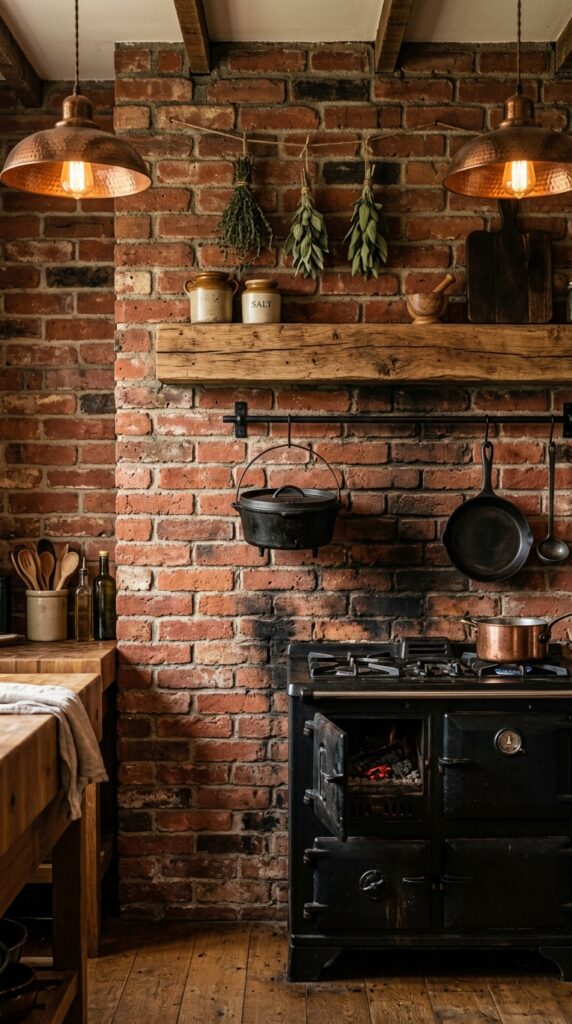
Vibe: Warm and raw, with the history of a building that was built to last.
Why it works: Exposed brick behind a range creates one of the most impactful farmhouse moments possible because it introduces authentic texture, historical weight, and natural warm color all at once. The design principle is focal point creation — a brick wall functions as artwork and architecture simultaneously, eliminating any need for decorative tiles or a decorative hood surround. The rough mortar texture contrasts beautifully against the smooth surface of appliances, and the natural variation in brick color (from cream to deep rust) picks up and amplifies the warm tones elsewhere in the kitchen.
How to get it: True exposed brick requires removing drywall and hoping for brick behind — not always possible. Brick veneer panels (thin sliced real brick adhered to a backing sheet) achieve the same texture at a fraction of the cost and install over drywall with mastic adhesive. Seal with a matte masonry sealer to prevent dust and make cleaning easier.
💡 Quick Win: Brick peel-and-stick panels are available for $40–$60 per box (covering approximately 8 square feet) and look surprisingly convincing in photography and real life alike when grouted correctly.
🛍️ Shop the Look — Amazon Product Ideas
| # | Product Search Phrase | Why It Fits |
| 1 | Brick veneer panel thin real brick kitchen | Authentic material alternative |
| 2 | Peel stick brick wallpaper textured kitchen | Budget no-install option |
| 3 | Masonry sealer matte brick wall interior | Essential finishing product |
| 4 | Iron pot hanging rail wall mounted | Functional brick wall accent |
| 5 | Reclaimed wood shelf mantel fireplace style | Above-range shelf option |
14. Cotton Grain Sack Dish Towels
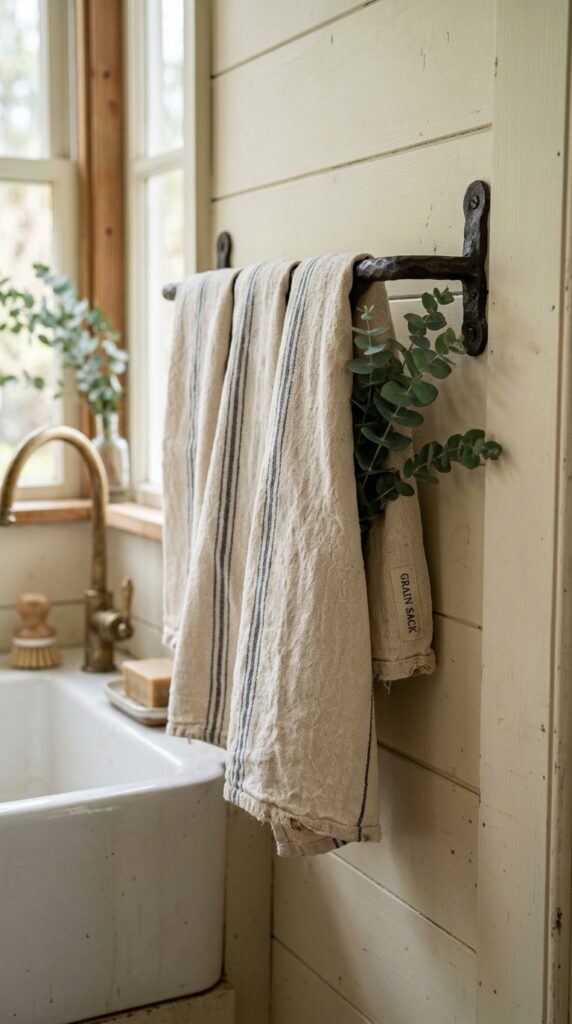
Vibe: Still and considered, like the most functional textile in the room is also the most graceful.
Why it works: Grain sack textiles trace directly to 19th-century European farm culture, where flour and grain were stored in sturdy cotton or linen sacks that were then repurposed as household textiles. Their signature blue or red stripe on cream is one of the most recognizable shorthand signals for farmhouse authenticity, working at the level of texture, pattern, and material simultaneously. In a kitchen, dish towels are the most frequently handled textile — choosing them well pays off every single day.
How to get it: Hang in threes draped over an iron or brushed nickel rail rather than folded flat in a drawer. The slight asymmetry of hand-hung towels looks more natural than a retailer’s display. Tuck a small sprig of dried eucalyptus, lavender, or rosemary behind the rail for an unexpected sensory detail.
🛍️ Shop the Look — Amazon Product Ideas
| # | Product Search Phrase | Why It Fits |
| 1 | Grain sack dish towel set cream blue stripe | Hero farmhouse textile |
| 2 | Iron kitchen towel rail wall mount | Towel display hardware |
| 3 | Dried eucalyptus bundle kitchen decor | Aromatic styling accent |
| 4 | Linen apron farmhouse stripe cooking | Coordinating kitchen textile |
| 5 | Cotton tea towel set natural cream stripe | Softer grain sack alternative |
15. Matte Black Hardware Throughout
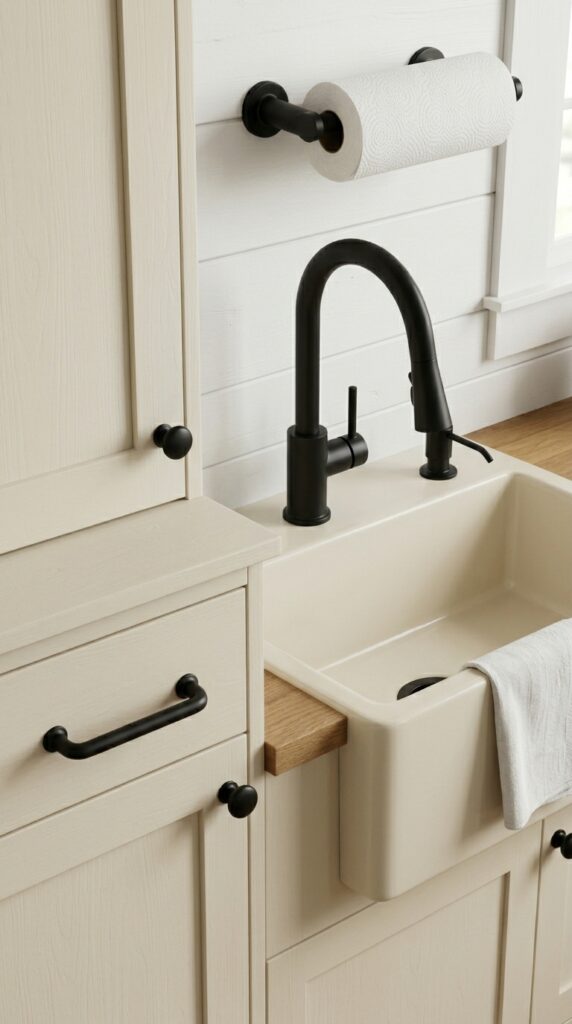
Vibe: Grounded and precise, with just enough edge to keep the warmth from getting too soft.
Why it works: Matte black hardware anchors a farmhouse kitchen in the present without betraying its historical spirit — it references cast iron and wrought iron work tools while reading as cleanly contemporary. The design principle is tonal contrast: matte black against cream or warm white cabinets creates the highest-contrast pairing in the kitchen without introducing a third color. Equally important is uniformity — when every metal finish in the room matches (faucet, pulls, light switches, towel bar, paper towel holder), the space reads as intentional rather than assembled over time from whatever was available.
How to get it: Replace hardware in a single Saturday by starting with cabinet pulls, then the faucet, then accessories. Commit to one finish and don’t mix metals — even small deviations (a polished chrome towel bar, a brushed nickel switch plate) will read as an oversight at this scale.
🛍️ Shop the Look — Amazon Product Ideas
| # | Product Search Phrase | Why It Fits |
| 1 | Matte black cabinet pull set kitchen 10 pack | Core hardware upgrade |
| 2 | Matte black kitchen faucet single handle | Faucet finish match |
| 3 | Matte black soap dispenser kitchen | Counter accessory match |
| 4 | Matte black paper towel holder countertop | Surface accessory match |
| 5 | Matte black outlet cover plates switch set | Wall finish coordination |
16. Pendant Lantern Light Over the Sink
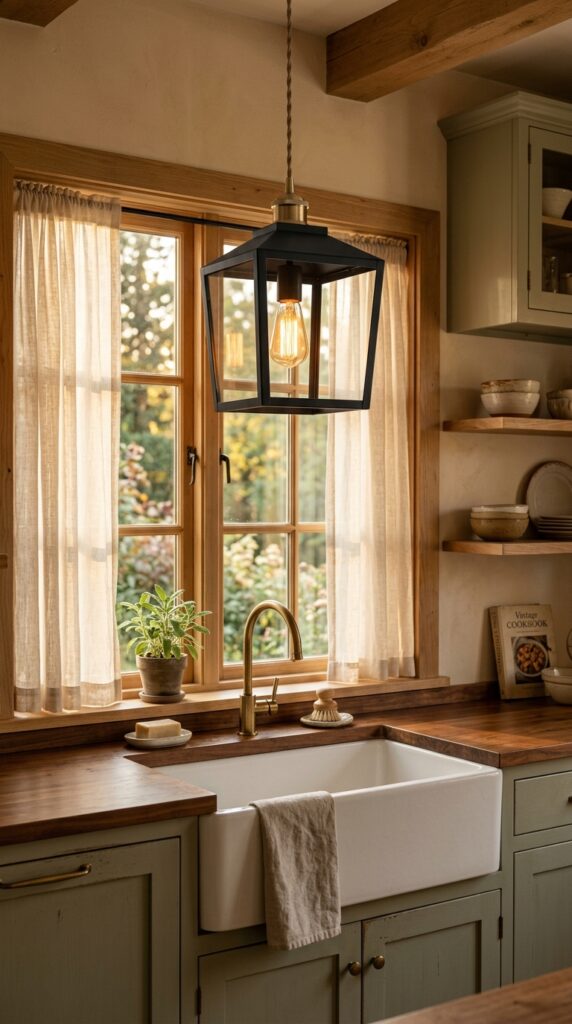
Vibe: Romantic and still, like the last 20 minutes of light before dinner.
Why it works: A pendant directly over the sink is one of the most underused moments in kitchen lighting design. The combination of natural light from a window behind the sink and warm artificial light from a pendant above creates a layered light condition that makes the entire sink area feel intentional — a workspace that’s also a place you actually want to stand and wash dishes. The lantern form, with its geometric metal frame and visible bulb, adds architectural presence above a functional zone.
How to get it: Position the pendant so it hangs 18–24 inches above the faucet at its tallest extension — close enough to cast useful light, high enough not to block the view of the window. A single lantern works better than two smaller pendants here; the sink area doesn’t need the rhythm of multiples.
🛍️ Shop the Look — Amazon Product Ideas
| # | Product Search Phrase | Why It Fits |
| 1 | Black lantern pendant light kitchen farmhouse | Hero sink area fixture |
| 2 | Plug in pendant light black farmhouse cage | Non-hardwired option |
| 3 | Sheer linen curtain panel window white | Soft window backdrop |
| 4 | Vintage Edison globe bulb warm G25 | Visible filament bulb in cage |
| 5 | Pendant canopy mount ceiling cap black | Clean ceiling installation |
17. Compact Kitchen Corner Command Center
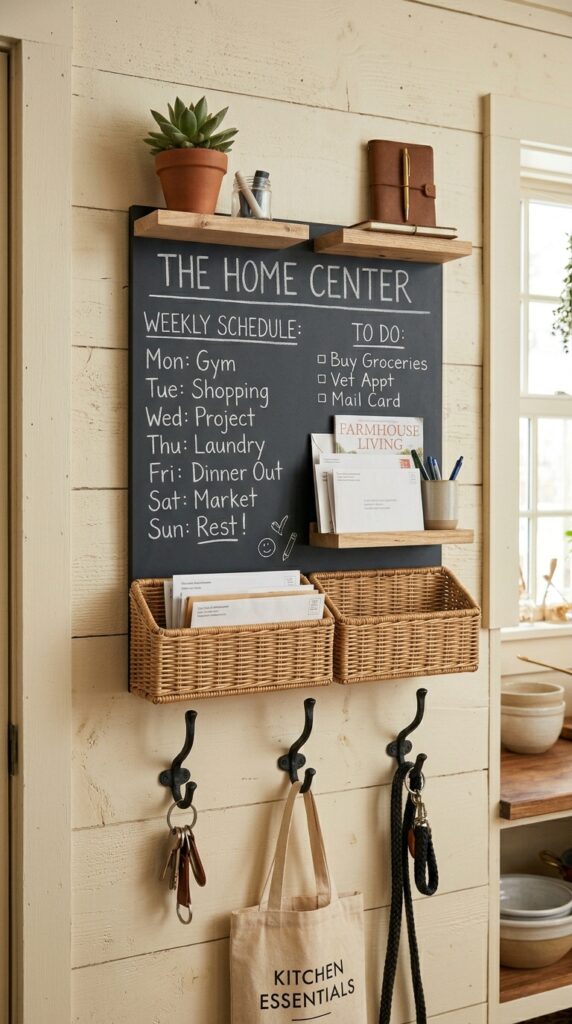
Vibe: Organized and purposeful, proving that a corner can carry an entire room’s sense of order.
Why it works: In small kitchens, wasted corner square footage is a real design problem — and a corner command center solves it by layering multiple functions (note-taking, key storage, mail sorting, daily schedule) into a single 24-inch wall section. The chalkboard paint panel functions simultaneously as a visual anchor and a practical tool, which is quintessential farmhouse — nothing purely decorative that doesn’t work. Iron hooks, small shelves, and a wicker tray add texture variety without requiring much depth.
How to get it: Apply chalkboard paint to a 24×36-inch panel of MDF (or directly on the wall) and frame it with simple 1-inch wood trim painted white or left natural. Mount two floating shelves above for plants and small items, and three iron hooks below at staggered heights for bags, keys, and aprons.
💡 Quick Win: Chalkboard paint (Rust-Oleum 30-oz can, under $15) applied over any painted surface creates the functional centerpiece; add iron hooks ($12–$20 for a set of three) and the whole corner transformation costs under $50.
🛍️ Shop the Look — Amazon Product Ideas
| # | Product Search Phrase | Why It Fits |
| 1 | Chalkboard paint black wall kitchen | Command center background |
| 2 | Iron wall hooks set 3 matte black farmhouse | Key and bag hooks |
| 3 | Wicker letter mail tray organizer | Small shelf organizer |
| 4 | Chalk pen set white liquid | Chalkboard writing tool |
| 5 | Small floating shelf set wood bracket kitchen | Command center upper shelves |
18. Woven Seagrass Pendant Light
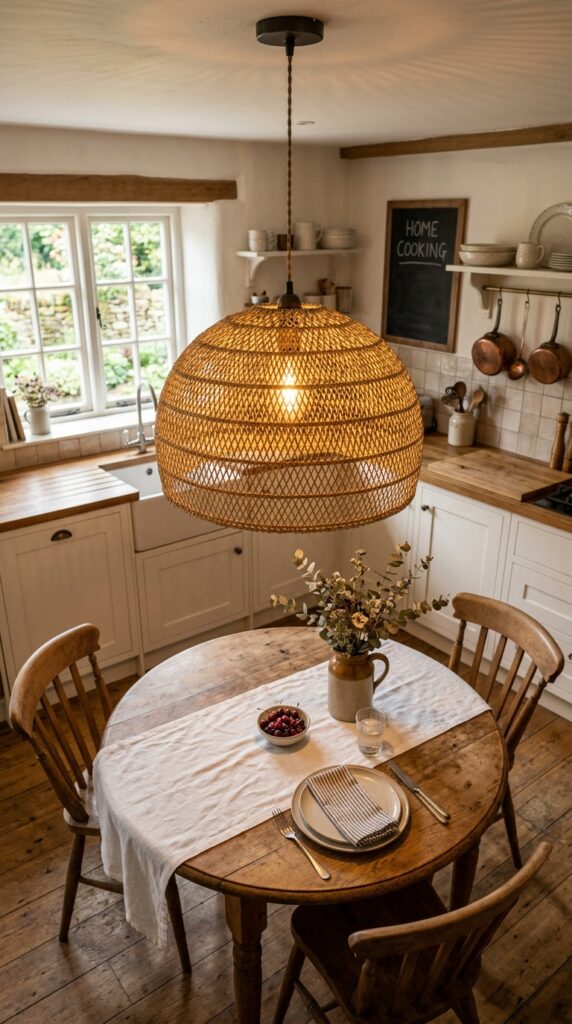
Vibe: Layered and luminous, the kind of light that makes everyone at the table look their best.
Why it works: Woven pendant shades add texture overhead — the most neglected plane in kitchen design. Unlike metal or glass shades that create a contained pool of light below, seagrass and rattan pendants cast filtered light outward in every direction, creating organic patterns on surrounding walls and ceilings that shift slightly as the weave moves. The natural straw color pulls warmth into the overhead zone, preventing a ceiling from reading as a cold hard lid above a warm room.
How to get it: Choose a shade with an inner liner if using over a dining table — unlined rattan diffuses light beautifully for ambient mood but doesn’t provide enough focused illumination for task areas. For over a table, a 20–30-inch diameter shade creates the right scale relationship without overwhelming a standard 4-person round table.
🛍️ Shop the Look — Amazon Product Ideas
| # | Product Search Phrase | Why It Fits |
| 1 | Woven seagrass pendant light large shade natural | Hero overhead fixture |
| 2 | Rattan pendant shade replacement boho farmhouse | Shade-only replacement |
| 3 | Round farmhouse dining table white wood | Table pairing for pendant |
| 4 | Linen tablecloth natural color round | Dining table textile |
| 5 | Pendant light cord plug in ceiling hook | No-hardwire hanging solution |
19. Farmhouse Kitchen Sign or Typography Art
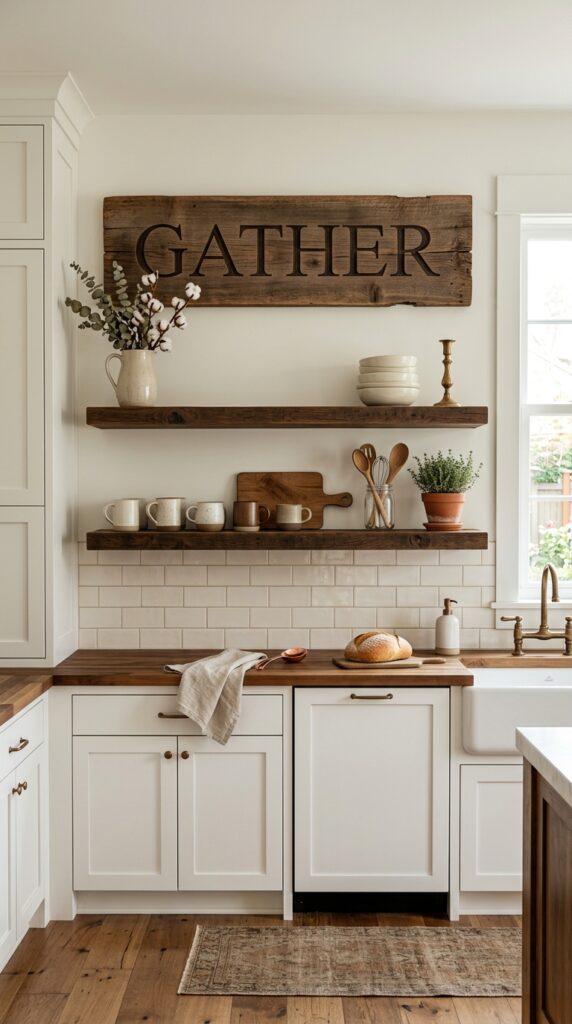
Vibe: Collected and quiet, like a word that gets truer every time you read it.
Why it works: Typography in farmhouse interiors works because the style is rooted in a time when painted or carved words on surfaces were both practical and ornamental. A single strong word — Gather, Bake, Harvest — functions as both art and philosophy, adding meaning at a scale where decorative objects cannot. Reclaimed wood as the substrate prevents the sign from reading as a mass-produced import: the grain character, old nail holes, and color variation make it visually unique in a way no two signs share.
How to get it: Mount horizontally as wide as possible — a farmhouse sign should span at least two-thirds of the available wall width to feel architectural rather than decorative. Avoid signs with multiple words, cursive scripts that are hard to read, or busy frames; the simpler the typography, the more authority it carries.
🛍️ Shop the Look — Amazon Product Ideas
| # | Product Search Phrase | Why It Fits |
| 1 | Gather wood sign farmhouse kitchen rustic | Classic farmhouse wall art |
| 2 | Reclaimed wood wall art carved word kitchen | Authentic material sign option |
| 3 | Farmhouse kitchen quote wall decor large | Wide-format typography art |
| 4 | Dark walnut wood stain furniture wax | Sign finishing product |
| 5 | Picture hanging strip heavy duty large | No-nail sign mounting |
20. Linen Roman Shade at the Kitchen Window
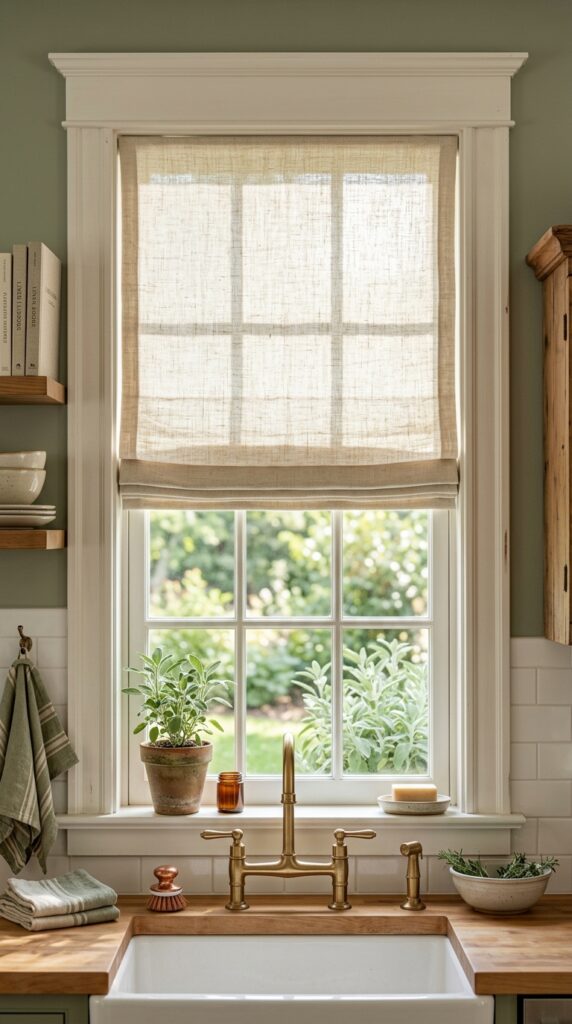
Vibe: Still and luminous, the kind of window that makes you want to stand still for a minute.
Why it works: Roman shades in natural linen occupy the exact midpoint between curtains (soft, romantic, fabric-heavy) and nothing (maximum light, no privacy). They add fabric texture and warmth to the window zone without competing with the rest of the room’s materials because linen — with its visible weave, slight unevenness, and neutral tone — reads as naturally as the wood and stone it shares the room with. The flat fold style specifically is more architectural and less frilly than a traditional Roman fold, which keeps the farmhouse look grounded rather than cottage-cute.
How to get it: Mount inside the window frame rather than outside for a cleaner look — the outside mount works when windows are smaller than desired and you want to fake width, but inside mounting lets the trim frame the shade beautifully. Choose “light filtering” rather than “blackout” for kitchens so light remains generous even when the shade is closed.
🛍️ Shop the Look — Amazon Product Ideas
| # | Product Search Phrase | Why It Fits |
| 1 | Linen Roman shade natural cream flat fold | Core window treatment |
| 2 | Inside mount Roman shade fabric kitchen | Correct mounting style |
| 3 | Custom Roman shade cordless linen natural | Cordless for clean operation |
| 4 | Woven jute window shade natural texture | Textural alternative to linen |
| 5 | White window trim frame paint Benjamin Moore | Window trim finishing option |
21. Small Kitchen Farmhouse Styling With Mirrors
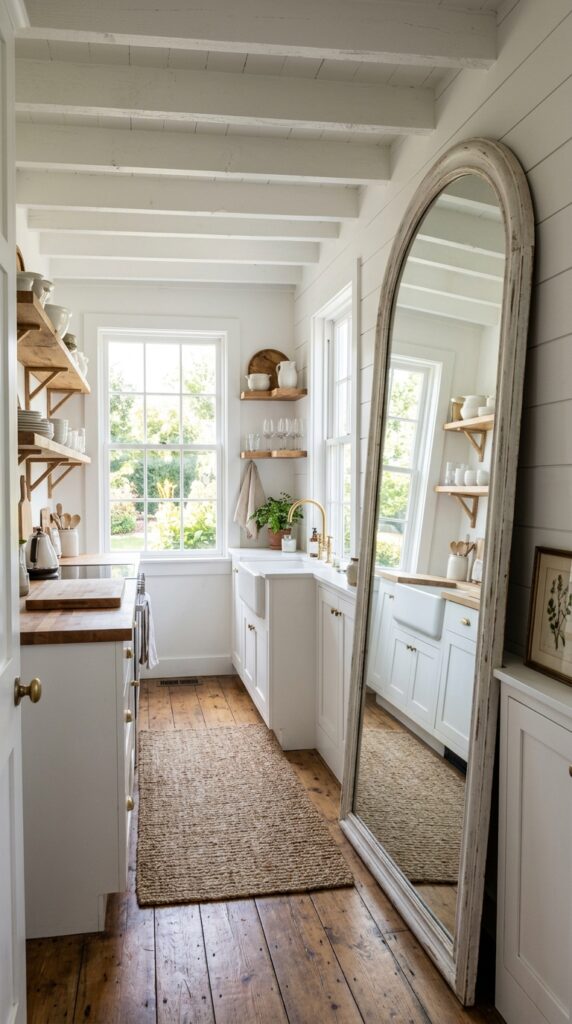
Vibe: Luminous and expansive, proving that a 9-foot kitchen can feel twice its size.
Why it works: Mirrors in small kitchens exploit one of the most fundamental principles of light behavior — reflection doubles the apparent depth of a room and multiplies available light without adding a single fixture. An arched mirror in a white-painted wood frame references the farmhouse architecture of windows, doorways, and transom shapes without introducing a hard decorative element. The arch specifically softens what can be a very rectilinear kitchen geometry and creates a sense of permanence even when the mirror is simply leaning rather than wall-mounted.
How to get it: In a narrow kitchen under 8 feet wide, place the mirror at the far end of the galley to extend the perceived length. In an open-plan kitchen, position it to reflect the best view — a window, a styled shelf, or the outdoor scene beyond. An arched mirror 24–36 inches wide is the minimum size for meaningful visual impact; smaller mirrors read decorative rather than spatial.
💡 Quick Win: Oversized arch mirrors are widely available at major retailers for $80–$150 and require no installation at all when leaned — making this one of the highest-impact, lowest-commitment moves in small-space decorating.
🛍️ Shop the Look — Amazon Product Ideas
| # | Product Search Phrase | Why It Fits |
| 1 | Arched floor mirror white wood frame large | Space-expanding hero piece |
| 2 | Leaning mirror farmhouse arch 24×36 | Proportioned small kitchen size |
| 3 | Decorative arch mirror wall mounted cream | Wall-fixed version option |
| 4 | Mirror hanging kit heavy duty wall | Secure wall mounting solution |
| 5 | Small round mirror farmhouse kitchen accent | Complementary smaller piece |
How to Start Your Farmhouse Kitchen Transformation
The single first move that anchors everything else: paint your cabinets. Choose Benjamin Moore White Dove OC-17 (a warm white with yellow undertones, not a cool or stark white) and apply it with a foam roller and cabinet-specific paint like Sherwin-Williams Emerald Urethane. This one step resets the entire room’s color foundation — every subsequent purchase (hardware, textiles, lighting) will be choosing against and complementing this warm white, which means the space will build cohesively rather than accumulating at random.
The most common mistake beginners make is mixing wood undertones. Farmhouse kitchens rely on a harmonious palette of warm-toned woods — golden oak, honey maple, light walnut — and introducing a single piece with cool gray or ashy undertones (common in mass-market furniture) creates a jarring dissonance that’s hard to identify but impossible to unsee. Before buying any wood piece, hold it next to your existing wood floors or shelving. If it reads significantly cooler or grayer, pass.
Three immediate items under $50 that create real impact: a set of grain sack dish towels in cream and blue stripe (available for $18–$25 for a set of four), a matte black paper towel holder to swap out a chrome or plastic one ($15–$28), and a chalk pen set for labeling mason jars on open shelves or a small chalkboard ($6–$12 for a set).
Realistically, a full farmhouse kitchen transformation takes 6–12 months when done thoughtfully. A “starter version” — paint, hardware, and key textiles — runs $300–$600 and can be completed in a single weekend. A mid-level transformation with new lighting, a sink, and open shelving runs $2,000–$5,000. A full renovation with new cabinetry, countertops, and tile is a $15,000–$40,000+ project depending on kitchen size and local labor costs.
Frequently Asked Questions About Farmhouse Kitchen Decor
What is farmhouse kitchen decor and how is it different from rustic or country style?
Farmhouse kitchen decor draws from the functional interiors of American and Northern European working farmhouses of the 18th through early 20th centuries. Where rustic style emphasizes raw, unrefined materials in a dramatic or lodge-like way, farmhouse is warmer and more refined — it balances rough textures (shiplap, unfinished wood) with soft ones (linen, stoneware). Country style often incorporates more pattern and color (florals, ginghams, roosters) while farmhouse stays quieter, relying on neutral palettes and texture contrast rather than decorative motif.
What colors work best in a farmhouse kitchen?
The most successful farmhouse kitchen palettes stay within a warm neutral family. On walls and cabinets, Benjamin Moore White Dove OC-17, Sherwin-Williams Alabaster SW 7008, and Farrow & Ball Pointing No. 2003 are industry-standard choices for a reason — they’re warm without being yellow. Sage green (Farrow & Ball Mizzle, or Benjamin Moore Pale Avocado) is the strongest accent color choice for lower cabinets. Avoid cool whites (anything with blue or gray undertones) and bright whites — they fight the warm materials of the style.
How much does a farmhouse kitchen makeover cost?
The entry point for a cosmetic farmhouse transformation is genuinely low. Swapping hardware to matte black or aged brass, adding grain sack textiles, and painting cabinets can be done for under $500. A mid-level project adding open shelving, a new light fixture, and new bar stools runs $1,500–$4,000. A full renovation — new cabinetry, apron sink, countertops, and tile — costs $15,000–$50,000+ depending on size and location. The style is particularly well-suited to a phased approach: changes made at the $500 level actually look intentional alongside future upgrades rather than mismatched.
Can farmhouse kitchen decor work in a modern or contemporary home?
It can, and the result is often called “modern farmhouse” — a hybrid that takes the clean lines and restraint of contemporary design and layers farmhouse materials on top. The key is editing ruthlessly: in a modern home, choose only one or two farmhouse signature elements (an apron sink, a shiplap accent, open wooden shelves) rather than the full vocabulary. Matte black hardware bridges both aesthetics effectively. Avoid heavily distressed, overtly antique, or country-coded pieces — in a contemporary context they read as costume rather than character.
Do I need an apron-front sink to have a farmhouse kitchen?
No — the apron-front sink is the most iconic element but it’s one tool among many. A farmhouse kitchen is more convincingly created through material palette (warm white paint, natural wood, linen) and hardware finish (matte black or aged brass) than through any single fixture. That said, if you’re renovating anyway, the apron sink is the single highest-impact fixture upgrade in this style — a quality fireclay sink from a brand like Rohl or Kohler starts around $600–$900 and delivers significant visual return for years.
Ready to Create Your Dream Farmhouse Kitchen?
These 21 ideas span the full range of what makes a farmhouse kitchen compelling — from the way light filters through a linen shade to the weight of a well-placed butcher block, from the intimacy of pendant lanterns over a sink to the expansiveness a single mirror can give a narrow galley. Transformation in this style almost always happens in layers, and starting with one well-chosen move — a hardware swap, a shade change, a shelf installation — is not just okay, it’s exactly the right approach. Today, go order a set of grain sack dish towels and matte black hardware pulls: those two purchases, arriving by the end of the week, will shift the room’s tone immediately and give you a foundation to build on. When the space is done, a farmhouse kitchen delivers something that no other style quite replicates — the feeling of being held, unhurried, in a place that was built for people rather than photographs. Save the ideas that stopped you mid-scroll, because in a few months, with a few good Saturdays and a clear vision, your kitchen can feel exactly like that.