Introduction
Kitchen knife safety tips sound simple, yet most kitchen cuts happen because a few small habits were never learned. Every home cook reaches for a blade daily, often while rushing, chatting or juggling dinner, and that is exactly when accidents happen. A sharp knife, a steady board and a calm, focused mind make all the difference between confident cooking and a trip to the first aid box. In this guide, I share seventeen practical rules that keep your fingers safe, your blades in great shape and your kitchen a calm place to cook. These are the habits professional chefs use every day, explained simply for home kitchens. Save this post, practice one rule at a time, and cooking will feel safer and far more enjoyable.
Claw Grip Basics

- Curl your fingertips under like a claw.
- Tuck knuckles forward to guide the blade.
- Keep the guiding hand flat and steady.
- Practice slowly on a carrot first.
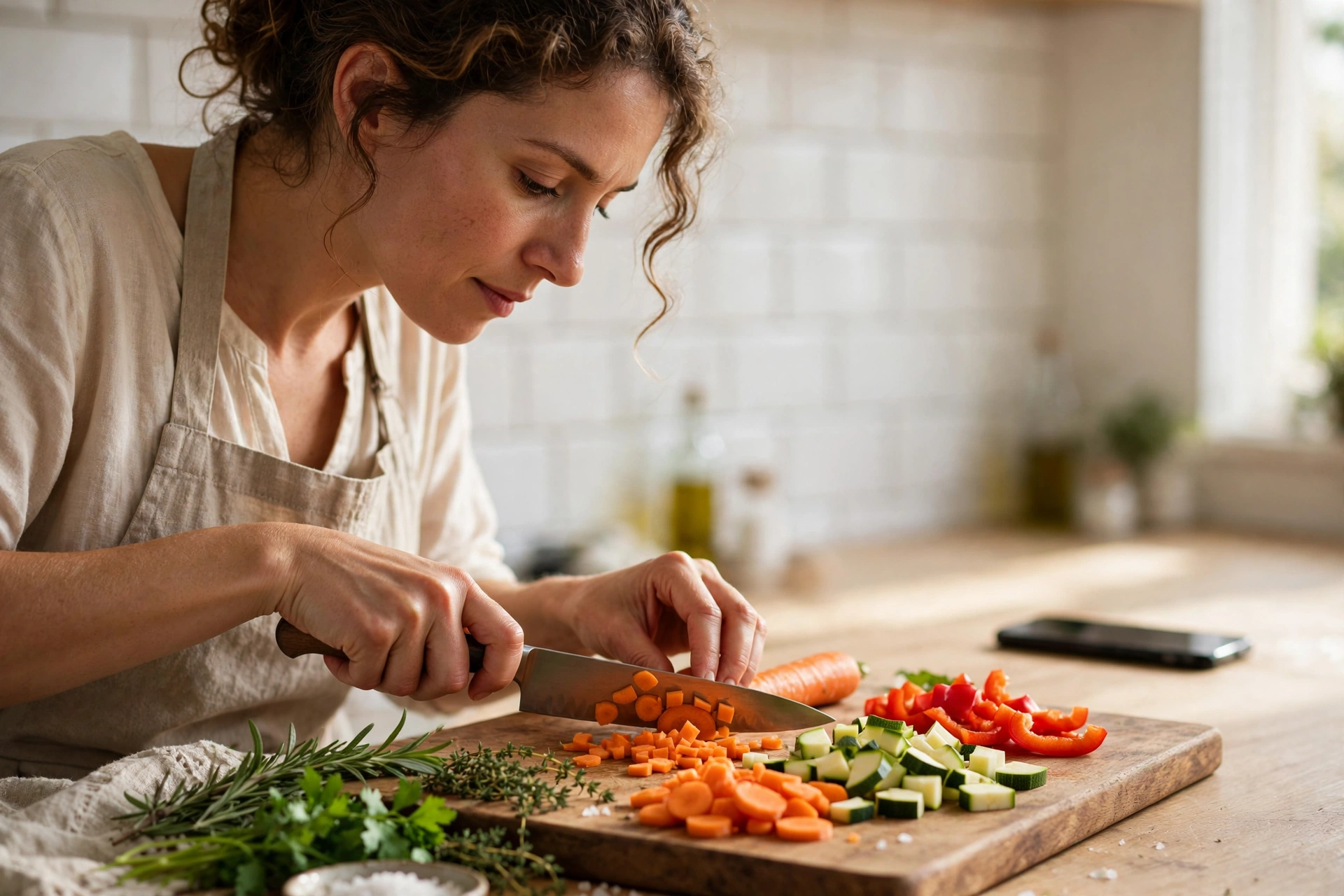
The claw grip is the most important habit for safe knife work, because it keeps your fingertips far from the blade while you cut. Curl the fingers of your guiding hand under so your knuckles face forward, and let the flat side of the knife slide gently against them. Your thumb stays tucked behind, your fingertips stay hidden, and the blade follows a steady guide through every slice. Practice slowly on a carrot first, keeping the knife close to your knuckles and your movements calm and even. Once the shape feels natural, you will chop faster and far more safely.
In my experience, the claw grip feels strange for the first few days, then becomes second nature once your hands learn the shape. The key is going slowly: cut at half your normal speed until the curled fingers feel automatic, and never rush through a pile of vegetables. If your knuckles drift forward or your fingertips peek out, stop, reset the grip, and start again calmly. A sharp knife actually helps here, because it slices cleanly instead of slipping. Soon the claw will protect every cut, and you will wonder how you ever chopped any other way.
Sharp Blade Advantage
- A sharp blade cuts cleanly with little pressure.
- Dull knives slip and cause most accidents.
- Hone your knife before each cooking session.
- Get blades professionally sharpened twice a year.
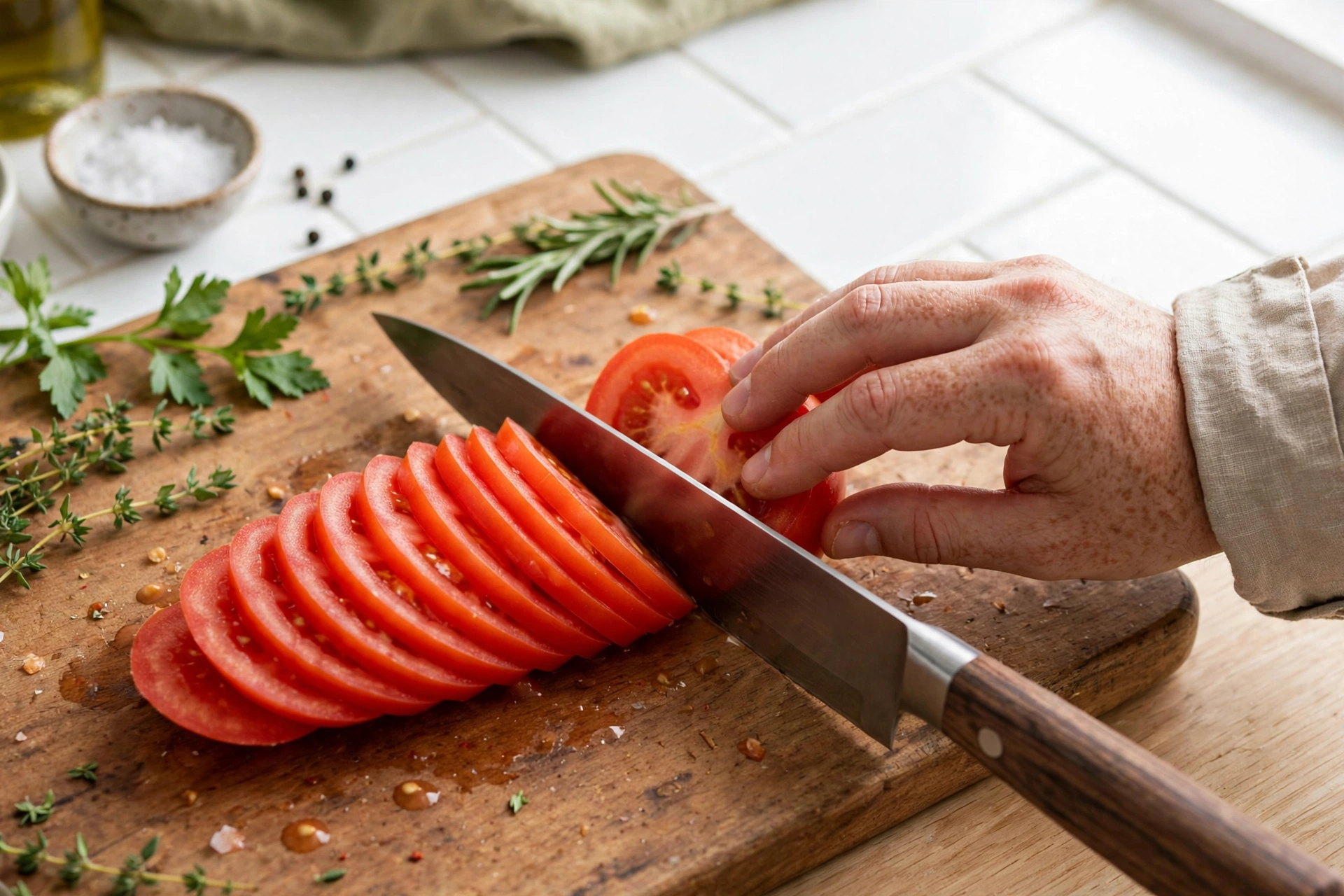
A sharp knife is a safe knife, because a keen edge slices through food with gentle pressure instead of forcing its way. When you push hard on a dull blade, it can slip sideways off a tomato skin or an onion layer and head straight for your fingers. A sharp edge bites where you aim it, giving you control over every cut. Test your blade on a tomato: if it glides through with almost no pressure, the edge is good. Keep it that way with regular honing, and your knife will feel like a trusted partner instead of a risk.
In my experience, home cooks often fear a sharp knife, yet the dull one in the drawer is the real danger. A blunt edge needs force, and force plus a slippery vegetable is how most kitchen cuts happen. Honing takes less than a minute: a few light strokes on a steel before you cook keeps the edge aligned and ready. Twice a year, have a professional sharpen the blade properly, or learn to use a whetstone at home. Treat sharpness as part of your routine, and cutting will feel calm, controlled and surprisingly easy.
Dry Hands Rule

- Dry hands and handles before every cut.
- Wet grips slip, especially with smooth handles.
- Keep a towel beside your board always.
- Wipe the handle if it gets damp mid-task.
Wet hands and a smooth knife handle are a dangerous pair, because moisture removes the friction that keeps your grip steady. Even a little water from washing vegetables can make a handle slide in your palm at the worst moment. Always dry your hands fully before picking up a blade, and keep a clean towel right beside your cutting board for quick wipes. If the handle feels damp halfway through a task, stop and dry it before continuing. This tiny habit takes seconds, yet it prevents the sudden slip that causes most small kitchen cuts.
I have noticed that busy cooks often skip drying their hands, because it feels like a waste of time during dinner prep. Yet the seconds you save are nothing next to the pain of a cut and the dinner that stops while you deal with it. Make the towel part of your station: fold it beside the board before you start, and reach for it without thinking. Choose a handle with some texture if your knives feel slippery, and wash handles with warm soapy water so grease never builds up. Dry hands, dry handle, calm cutting, every single time.
Stable Cutting Board

- A wobbly board is a common cause of slips.
- Place a damp cloth under the board.
- Use a board with rubber feet if possible.
- Never cut on a plate or bare counter.
A cutting board that slides across the counter turns every slice into a gamble, because food moves as your blade comes down. The fix costs nothing: lay a damp cloth or a piece of shelf liner under the board, and it will stay in place. Choose a board heavy enough to sit flat, and check it does not rock before you begin. Keep the board dry on top so vegetables do not slide, and work in the centre where you have the most control. A stable board lets you cut with confidence, because nothing under your knife is moving unexpectedly.
I have seen many home kitchens where the board slides around, and the cook simply holds it with one hand while cutting with the other. That habit puts your guiding hand far too close to the blade, and it never feels safe. A damp cloth solves the problem in seconds, and a board with rubber feet is even better for daily use. Replace warped boards that rock, because no cloth can fix a board that will not sit flat. Give your board a stable home, and every cut becomes calmer, cleaner and far safer.
Blade Down Carry

- Carry the blade pointing down beside you.
- Hold the handle firmly with the edge away.
- Walk slowly and announce yourself in busy kitchens.
- Never run or rush while holding a knife.
Carrying a knife across the kitchen sounds simple, yet it is when many accidents happen, because a blade at waist height meets hands, hips and curious children. Always hold the knife by its handle with the blade pointing down beside your leg, keeping the sharp edge facing away from your body. Walk at a normal pace and look where you are going, especially if someone else is moving around the kitchen. If you must pass someone, say so first and give them space. A calm, careful carry takes only a moment longer, and it keeps everyone in the room safe.
In my experience, the dangerous carry is the one done in a hurry, with the blade pointing forward like a pointer. It feels natural to hold a knife out in front of you, but a sudden stop or a bump from behind can push the edge into whoever is nearby. Keep the blade low, close to your leg, and let the handle do all the holding. If you need both hands, put the knife down on the counter first instead of juggling it. This small habit protects your family, your guests and yourself every single day.
Safe Passing Technique

- Always pass a knife handle first.
- Say “knife” clearly before handing it over.
- Wait until the other person grips the handle.
- Never toss or slide a knife to someone.
Passing a knife to someone else is a moment that deserves full attention, because two hands and one sharp edge go wrong easily. Offer the handle first, blade pointing away from both of you, and say the word knife clearly so the other person is ready. Wait for a firm grip on the handle before you let go, and never toss, slide or drop a knife toward someone. If the other person is not looking, set the knife down on the counter and let them pick it up themselves. A careful handover takes seconds and prevents accidents nobody forgets.
I have seen this go wrong in busy family kitchens, where someone holds out a knife blade-first without thinking and the other person reaches for the wrong end. It happens in a second, usually while everyone is talking and laughing, and the cut is often worse because nobody expected it. Make handle-first passing a house rule, and teach it to everyone who cooks with you, including teenagers and guests. Say the word knife every time, even when it feels unnecessary, because a clear warning costs nothing. Safe passing is a small courtesy that keeps cooking joyful instead of stressful.
Magnetic Strip Storage

- A magnetic strip keeps blades visible and safe.
- Mount it high, away from children’s reach.
- Blades stay sharp longer off the counter.
- Wipe the strip clean once a week.
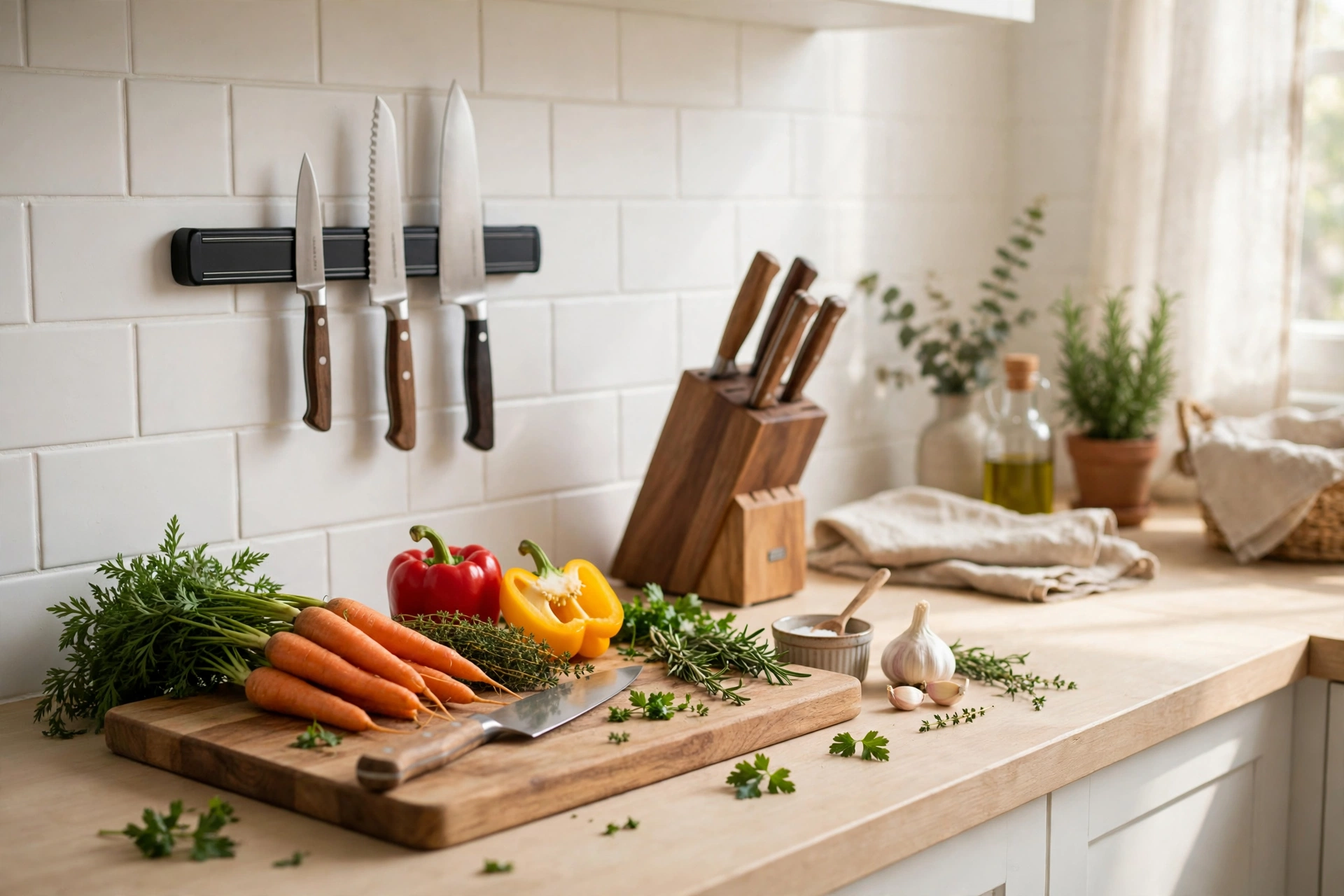
A magnetic strip is one of the safest ways to store knives, because every blade sits in plain sight instead of hiding in a dark drawer. Mount it at adult eye level, away from children’s reach, and place each knife flat, edge facing up. The blades stay sharp longer, since they never knock against other utensils, and you always know exactly where each knife is. Choose a strong wooden or metal strip that holds the knives firmly, and wipe it clean once a week. Your counter stays clear, your knives stay sharp, and grabbing the right blade takes a second.
In my experience, a magnetic strip also changes how a kitchen feels, because the knives become part of the room instead of clutter in a drawer. Guests notice the tidy row of blades, and cooking feels more organised when every knife has its own visible spot. Keep the strip away from the stove, so heat never warms the handles, and away from the sink, so splashes never reach the blades. Teach children that the strip is not a toy, and that only adults touch the knives. A strip is simple, beautiful and wonderfully safe when it is mounted with care.
Curl Fingertips Always

- Curled fingertips never meet the blade.
- Knuckles guide the knife like a rail.
- Reset the grip whenever fingers drift out.
- Slow, curled cuts beat fast, flat ones.
Your guiding hand decides whether a cut is safe, and curled fingertips are its best protection. Tuck the fingertips of your guiding hand under, press the food down with the flat of your fingers, and let your knuckles stand forward as a guide for the blade. The knife slides along your knuckles, never near your fingertips, and the food stays firmly in place. If your fingers start to straighten or drift toward the edge, stop and curl them under again before continuing. This one habit prevents more cuts than any other single rule in the kitchen.
I have noticed that new cooks often forget the curl once they speed up, because fast chopping feels impressive and the fingers relax without warning. Speed is never worth a cut, so practise at a slow, steady pace until the curled shape feels automatic. Try holding a potato with curled fingers and slicing thin rounds, watching your knuckles guide the blade each time. When the motion feels smooth, add a little speed, but never so much that the grip loosens. Curled fingertips are a quiet habit that protects you through every meal you will ever cook.
Never Catch Falling
- Let a falling knife drop, always.
- Step back and keep hands clear.
- A blade on the floor harms nobody.
- Pick it up only after it stops moving.
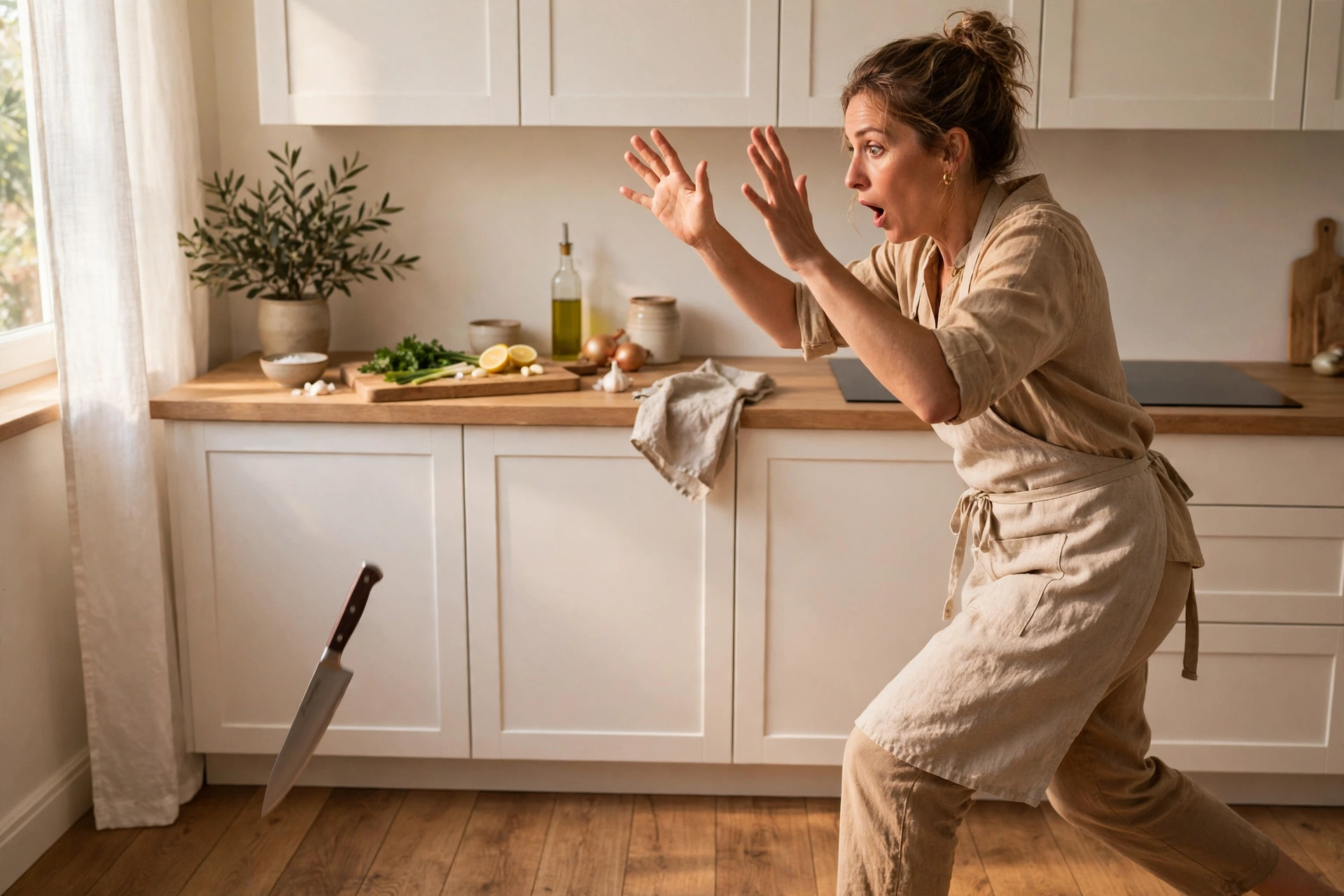
A falling knife triggers a reflex to catch it, yet catching a blade is one of the worst mistakes in the kitchen. Your hand closes around a sharp edge moving at speed, and the cut is usually deep. Train yourself to do the opposite: step back, let the knife fall, and keep your hands away until it stops moving on the floor. A knife on the floor harms nobody, and you can pick it up safely by the handle once it is still. This rule feels unnatural at first, but it is the habit that saves fingers when gravity wins.
In my experience, this is the rule people break most often, because the instinct to grab something falling is so strong. Practice the response before you need it: imagine the knife slipping, picture yourself stepping back, and repeat that image until it feels familiar. Teach the same rule to everyone in your home, especially children, who are quick to reach for anything that drops. A dropped knife is a small mess on the floor, nothing more, and it can be washed, dried and used again. Let it fall, step back, and stay safe.
Clean Blade Carefully

- Wash blades by hand, never in a dishwasher.
- Wipe from the spine toward the edge.
- Dry the blade fully before storing it.
- Never leave a knife soaking in the sink.
Cleaning a knife deserves the same care as cutting with it, because soapy water hides the edge and wet hands slip easily. Wash the blade by hand under running water, holding the handle firmly and keeping the edge pointing away from you. Wipe with a sponge from the spine toward the edge, never along it, and rinse carefully before drying the blade fully. Never leave a knife soaking in a sink full of water, where someone reaching in cannot see the blade. Clean it straight after use, dry it at once, and store it safely before moving on.
I have seen many kitchens where knives go into the dishwasher, and the blades come out dull, chipped and dangerous. The machine bangs the edge against plates and other utensils, dulling it faster than months of normal use, and the hot steam loosens handles over time. Hand washing takes less than a minute and keeps the edge keen for years. Make it part of your routine: wash, dry, store, and never let a blade sit wet in the sink. Your knives will stay sharp, your hands will stay safe, and your kitchen will feel calm and organised.
Kid Safe Zones
- Keep children away from the cutting area.
- Give little ones a safe seat at the table.
- Store knives far above a child’s reach.
- Teach older children knife rules early.
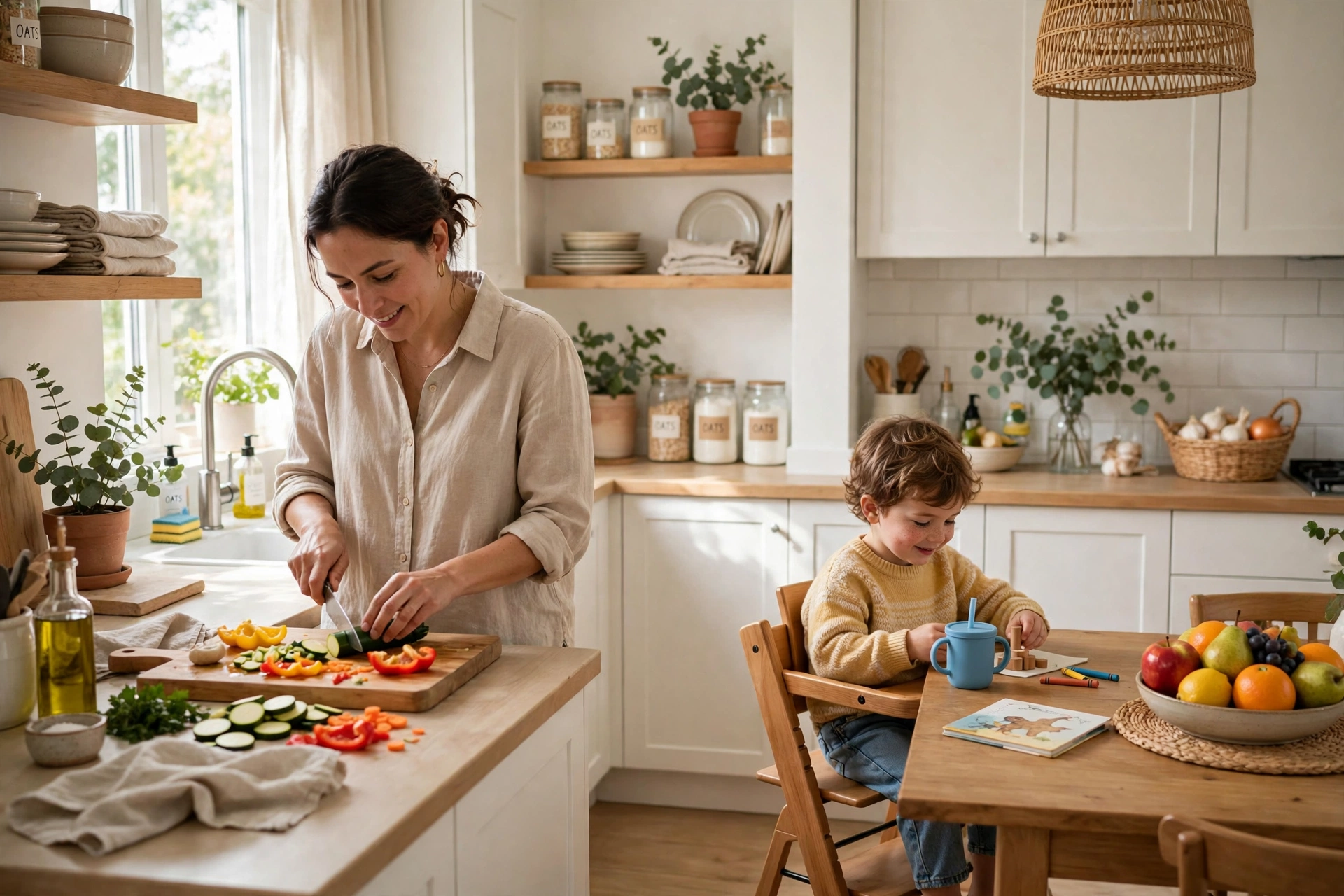
Children and sharp knives do not mix, so a clear safe zone is a loving rule in a family kitchen. Set a spot at the table where little ones can sit, watch and help with safe tasks like washing vegetables or tearing herbs. Keep the cutting area separate, and never let a child stand beside you while you chop, because a sudden reach can meet a moving blade. Store every knife well above a child’s reach, and lock away any blade a small hand could grab. A safe zone lets children enjoy the kitchen without ever being near danger.
In my experience, children love to help in the kitchen, and keeping them involved safely builds their confidence for life. Give them their own tasks away from the blades: stirring, measuring, washing fruit or setting the table. Talk to older children about knife rules early, and let them practise with a blunt butter knife on soft foods when they are ready. Praise them for staying in their safe zone, and answer their questions calmly. A child who understands why knives stay out of reach grows into a cook who handles blades with respect.
Focus While Cutting
- Put the phone away before you chop.
- Never cut while talking on the phone.
- Pause chopping if someone needs you.
- Calm, focused cutting is always faster.
A knife deserves your full attention, because a single distracted second is all it takes for a blade to slip. Put your phone in another room before you start chopping, and ask family to wait until you finish before chatting. If the doorbell rings or a child calls you, put the knife down safely and step away from the board. Never try to chop while talking on the phone or watching a screen, because your eyes and your hands need to work together. Focused cutting is calm cutting, and it is always faster than rushing with a wandering mind.
I have noticed that most kitchen cuts happen during busy, noisy moments, not during quiet cooking. The phone buzzes, someone asks a question, a pot boils over, and suddenly the blade is moving without your full attention. Build a small ritual: phone away, board steady, hands dry, then cut. When you feel rushed or tired, slow down even more, because tired hands make mistakes. A calm cook is a safe cook, and the meal will taste better when it was made with care and attention. Give yourself permission to pause, breathe and reset before the next cut.
Sheath On Storage

- A blade guard covers the edge completely.
- Use guards for knives stored in drawers.
- Guards keep edges sharp and fingers safe.
- Replace a cracked guard right away.
A blade guard is a sleeve that covers the sharp edge, turning a loose knife into a safe one. Slide the guard over the blade whenever the knife rests in a drawer, where hands reach in blindly. The guard protects the edge from chips and dings, and it protects your fingers from a surprise cut when you reach for something else. Choose a snug guard covering the full blade, and replace it if it cracks. A guarded blade is a safe blade, whether it rests in a drawer, a bag or a picnic basket.
In my experience, blade guards are the cheapest safety tool in the kitchen, yet many homes never use them. A drawer full of loose knives is an accident waiting to happen, because every reach inside risks a cut from a hidden edge. Guards cost very little, last for years, and travel well when you take a good knife to a holiday home or a friend’s kitchen. Keep a guard on every knife that does not live on a strip or in a block. It is a small piece of plastic that brings real peace of mind.
Honing Rod Safety
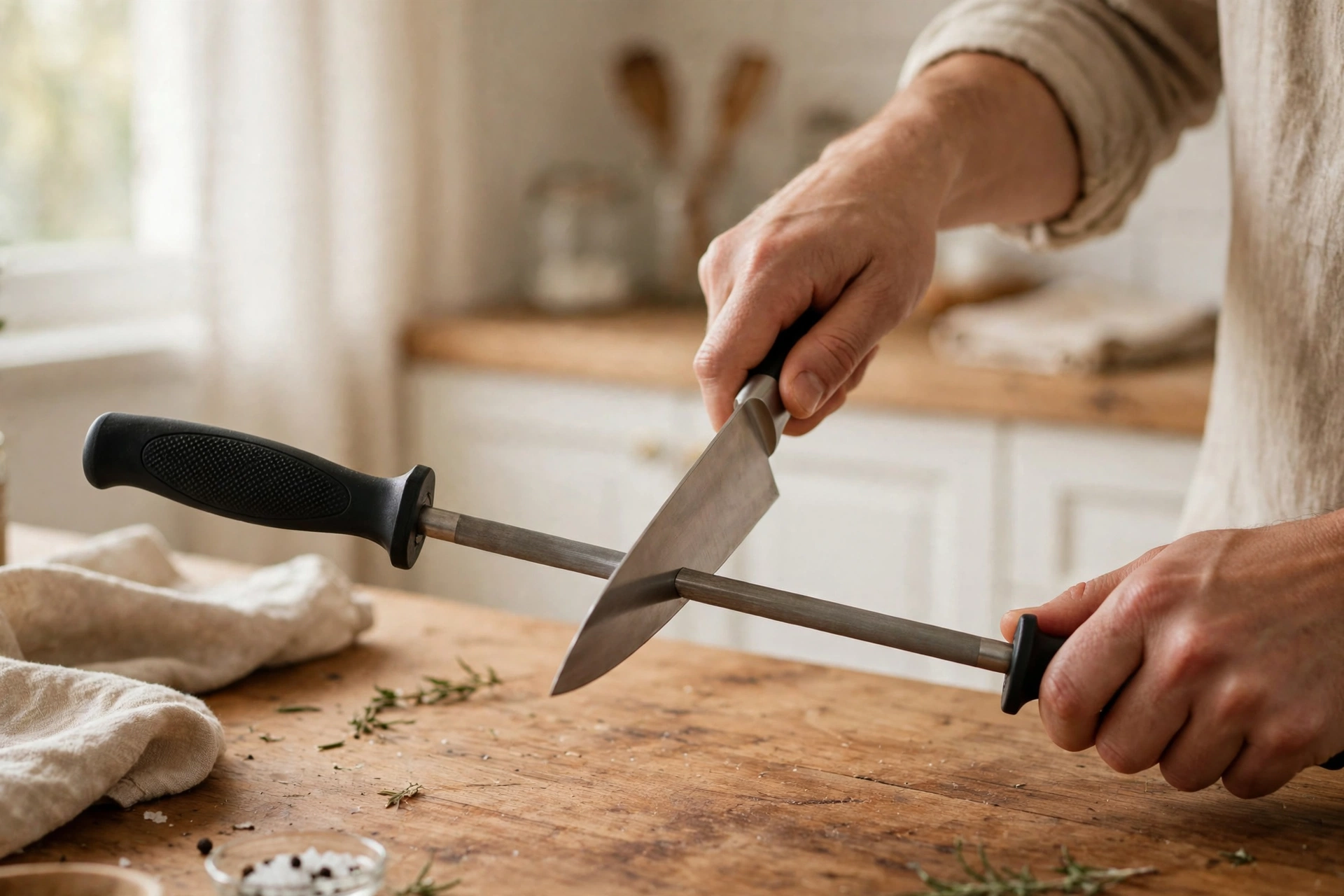
- Hold the steel upright on the counter.
- Keep the blade angled away from you.
- Use light, even strokes on both sides.
- Hone before cooking, not during a rush.
Honing keeps your blade aligned and ready, but the steel rod itself needs respect, because it is long, hard and easy to mishandle. Hold the rod upright with its tip resting firmly on a damp cloth, and keep your hand well behind the guard at the top. Draw the blade down the rod in light, even strokes, keeping the edge angled away from your body at all times. Alternate sides with each stroke, and never rush the motion or press hard. A calm, steady honing routine takes less than a minute and keeps every cut safer.
I have seen cooks wave a knife around a steel held in the air, and that is how blades slip and hands get cut. The counter method is far safer, because the rod cannot move and your hand stays behind the guard. If honing feels awkward, practise with a slow, gentle motion until the rhythm feels natural, and watch the angle of the blade as you draw it down. A well-honed knife needs less pressure, so it slips less and cuts safer. Treat honing as a small ritual before cooking, and your knives will thank you with clean, easy cuts.
Drawer Guard Rules

- Never store loose knives in a drawer.
- Use an in-drawer organiser with slots.
- Keep blades facing one direction only.
- Put guards on before the knife goes in.
A drawer is the most dangerous place for a loose knife, because hands reach in without looking and meet a hidden edge. Never toss a blade into a drawer with other utensils; instead, use an in-drawer organiser with slots that hold each knife separately and safely. Keep every blade facing the same direction, with the edge down or covered, and put a guard on before the knife goes in. The organiser also protects the edges from chips, so your knives stay sharp longer. A tidy drawer keeps fingers safe and makes the right knife easy to find.
In my experience, the drawer is where most small cuts happen, because danger hides until your hand is inside. A simple organiser changes everything: each knife has its own slot, the blades never touch, and you can see exactly what you are reaching for. Choose an organiser that fits your drawer and your longest blade, and keep it clean so crumbs never build up around the edges. Teach everyone in the house to return knives to their slots, guards on, every single time. A tidy drawer is a safe drawer, and cooking feels calm from the first reach.
Cut Away Body

- Always cut away from your body.
- Point the blade toward the board, not you.
- Keep your free hand behind the cut.
- This rule matters most with paring knives.
Cutting toward yourself is a habit that feels natural, yet it points the blade at your body. Always cut away from yourself, letting the edge move toward the board or the far side of the food, never back toward your hands or stomach. This matters most with small paring knives, where the thumb often pushes the blade toward the body without thinking. Hold the food firmly, angle the knife away, and let the blade do the work in the safe direction. A cut that moves away from you can never reach you, and that simple geometry keeps every slice safe.
I have noticed that this rule is easy to forget when peeling fruit or trimming meat, because the thumb naturally pulls the blade toward the body. Slow down for small jobs, and choose a peeler or scissors when they do the job better. If you must use a knife, rest the food on the board and cut downward and away, with your free hand well behind the blade. Teach this direction to everyone who cooks with you, and it will become a habit for life. Away from the body is the only direction a blade should ever travel.
First Aid Ready

- Keep a first aid kit in the kitchen.
- Stock bandages, gauze and clean towels.
- Know where your kit is before cooking.
- Learn basic cut care for peace of mind.
Even careful cooks get the occasional small cut, so a ready first aid kit is the final safety rule every kitchen needs. Keep a small kit near your cooking area, stocked with plasters, gauze, towels and antiseptic, and check it often so nothing is empty or out of date. Know exactly where it is before you start cooking, not after an accident happens. For a small cut, press a clean cloth firmly, rinse gently, and cover it with a plaster. Being prepared turns a scary moment into a calm one, and lets you get back to cooking with confidence.
In my experience, the kitchens that feel safest are the ones where the first aid kit is visible and everyone knows where it lives. Talk to your family about cut care, and keep your local clinic number on the fridge just in case. A deep cut that will not stop bleeding needs proper medical care, so do not hesitate to seek help when you need it. Most cuts are small, and a calm response with a clean plaster is all they need. Prepare for the worst, enjoy the best, and cook with a peaceful mind every day.
Conclusion
These kitchen knife safety tips work best when they become habits, not rules you read once and forget. Start with the claw grip and a stable board, then add one new habit each week until safe cutting feels natural. Your fingers, your knives and your confidence will all thank you, and cooking will feel calmer and more joyful every day. Save this guide on Pinterest so you can find it again, share it with a friend who is learning to cook, and try the ideas in your own kitchen tonight. Safe hands make happy meals, and a careful cook is a confident cook for life.