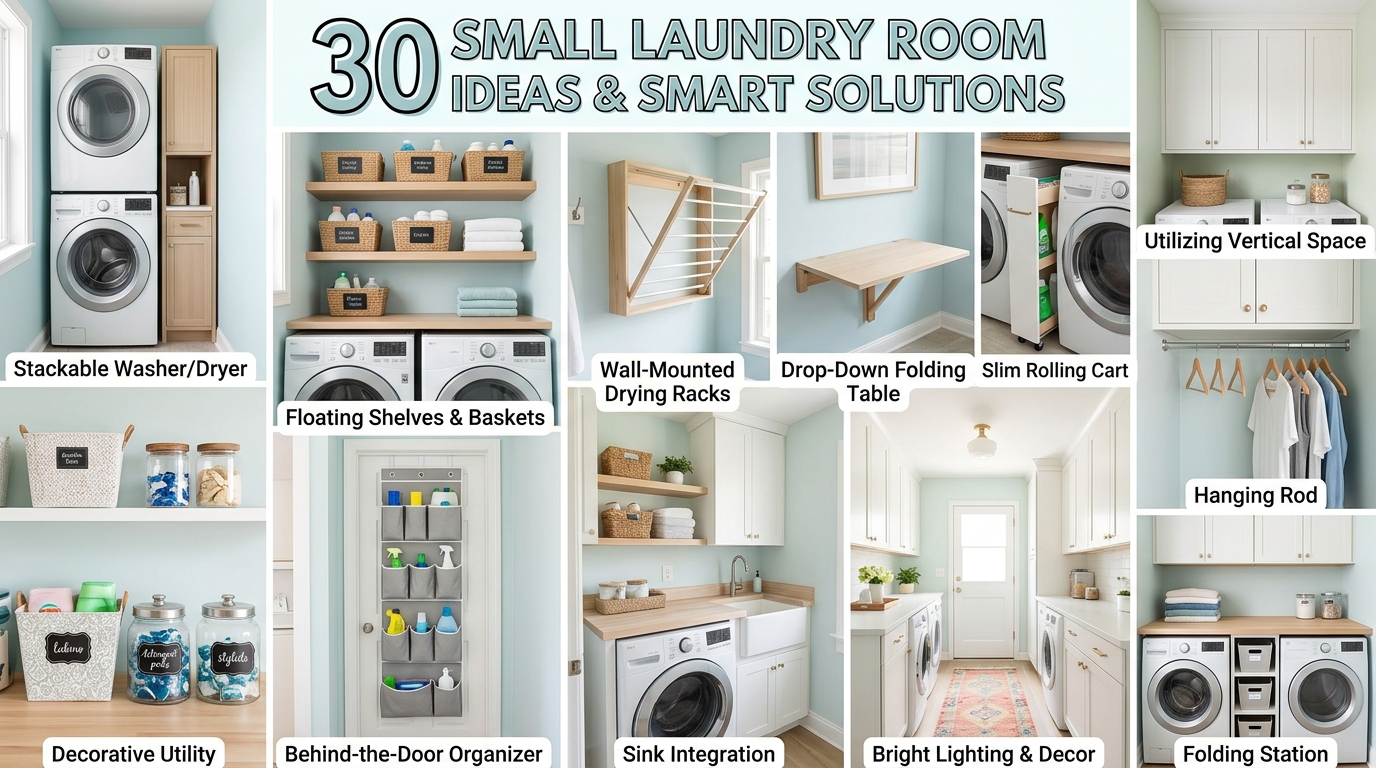
30 Small Laundry Room Ideas & Smart Solutions
A small laundry room is a compact, often awkward utility space redesigned through intentional organization, vertical storage, and spatial efficiency to function as a hardworking, visually calm room. This article gives you exactly 30 small laundry room ideas — spanning layout, storage, lighting, materials, color, and space-saving furniture — so you can transform even the tightest closet-converted laundry into something that actually works.
There’s something quietly satisfying about a small laundry room that’s been figured out. Every inch deliberate. Every basket earning its place. The hum of the machine becomes almost meditative when the space around it is orderly and considered. Here are 30 ideas worth saving — and stealing.
Why Small Laundry Room Design Works So Well
The small laundry room as a design category didn’t exist until relatively recently. For most of the 20th century, laundry rooms were purely utilitarian afterthoughts — a basement corner or a closet behind a bifold door. The shift came from two convergent forces: the rise of apartment living (which brought the laundry space into the main floor plan, often squeezed between kitchen and bath) and the broader “every room deserves design attention” movement that redefined utility spaces as extensions of the home’s overall aesthetic. Today’s small laundry room draws from Shaker minimalism, Scandinavian functionality, and the “organized home” movement popularized by professional organizers and home-edit content creators alike.
The material vocabulary of the well-designed small laundry room is specific and consistent: bright white subway tile or painted shiplap on the walls, white or warm gray MDF or painted pine cabinetry, open wire or slatted wood shelving for ventilation, matte black or brushed brass hardware, and natural fiber storage baskets in seagrass or woven cotton. Colors lean toward clean whites (Benjamin Moore “Chantilly Lace” OC-65), soft warm grays (“Repose Gray” SW 7015), or unexpected but controlled accents like dusty navy or warm sage on a single cabinet face.
The small laundry room is trending with particular momentum right now because the organizing content economy — YouTube, Instagram Reels, and especially Pinterest — has normalized aspirational utility spaces. Searches for “laundry room organization ideas” on Pinterest grew over 40% in a single year, and the concept of a “laundry shelfie” (a styled, organized open shelf above the machines) has become its own visual genre. More practically, post-pandemic homeowners who spent extended time at home confronted their worst utility spaces and decided to fix them.
Tight laundry spaces — under 35 square feet — can absolutely achieve a well-designed, high-function outcome. The hierarchy is clear: first solve the vertical wall storage, then address countertop/folding surfaces, and lastly attend to styling and aesthetics. Where small spaces genuinely struggle is with bulky additions like full-size utility sinks or large drying racks — these must be scaled to wall-mounted or compact versions to avoid consuming the floor space entirely.
Style at a Glance
| Element | Detail |
| Philosophy | Function-first, visually calm, every inch intentional |
| Materials | Painted MDF cabinetry, subway tile, seagrass baskets, wire shelving, shiplap |
| Color palette | Chantilly lace white, warm gray, dusty navy, sage, brushed brass accents |
30 Small Laundry Room Ideas & Smart Solutions
1. Stack Your Washer and Dryer to Reclaim the Floor
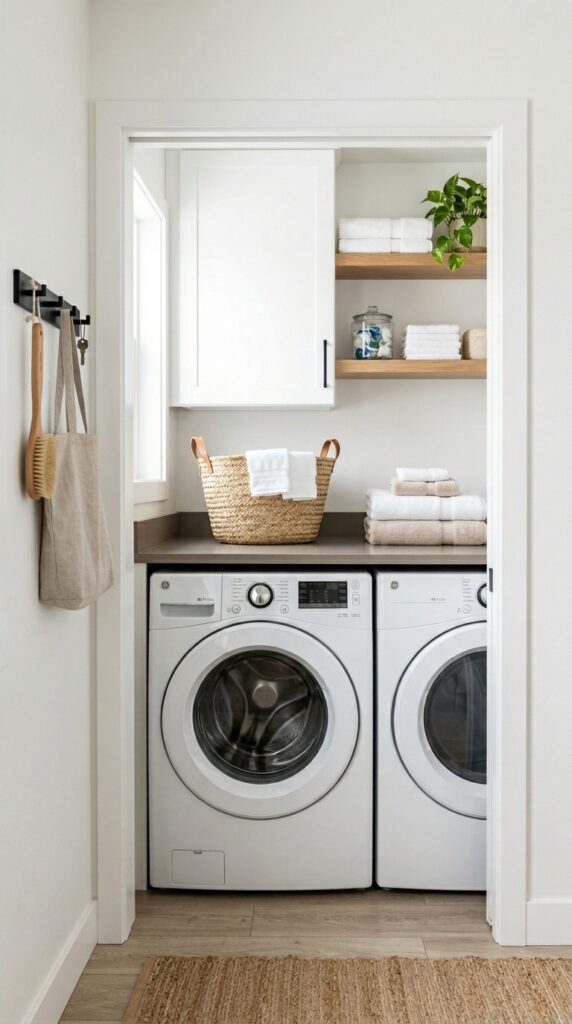
Efficient. Stacking the washer and dryer is the single highest-impact layout decision available in a small laundry room — it converts two appliances side-by-side (typically 54 inches wide) into a single column (27 inches wide), immediately freeing 27 inches of horizontal wall for storage, a folding counter, or simply breathing room.
The spatial design principle is footprint compression. Front-load machines are required for stacking (top-loaders cannot be stacked), and they offer the additional benefit of a flat top surface that functions as a folding station when kept side-by-side — though in a truly small space, the floor area gained from stacking far outweighs the loss of that flat top. A stacking kit specific to your machine brand is mandatory for safety; do not stack with improvised solutions.
Install a floating MDF shelf or countertop at chest height (around 36 inches from the floor) directly above the stacked unit to restore the folding surface. Mount upper cabinetry above that for detergent, fabric softener, and supplies storage. This three-tier vertical arrangement — machines, counter, cabinet — is the gold standard layout for stacked laundry alcoves.
💡 Quick Win: A machine-specific stacking kit ($20–60) is the most transformative single purchase in this entire article. Pair it with a $35 floating shelf above for a complete folding station.
🛍️ Shop the Look — Amazon Product Ideas
| # | Product Search Phrase | Why It Fits |
| 1 | Washer dryer stacking kit universal front load | Core functional hardware |
| 2 | Floating wall shelf laundry room white 24 inch | Counter above stacked machines |
| 3 | White laundry basket with lid compact | Fits beside the stacked unit |
| 4 | Wall cabinet with door white laundry room | Upper storage above the shelf |
| 5 | Matte black wall hook strip 4 hook | Side-wall hanging solution |
2. Install Floor-to-Ceiling Open Shelving
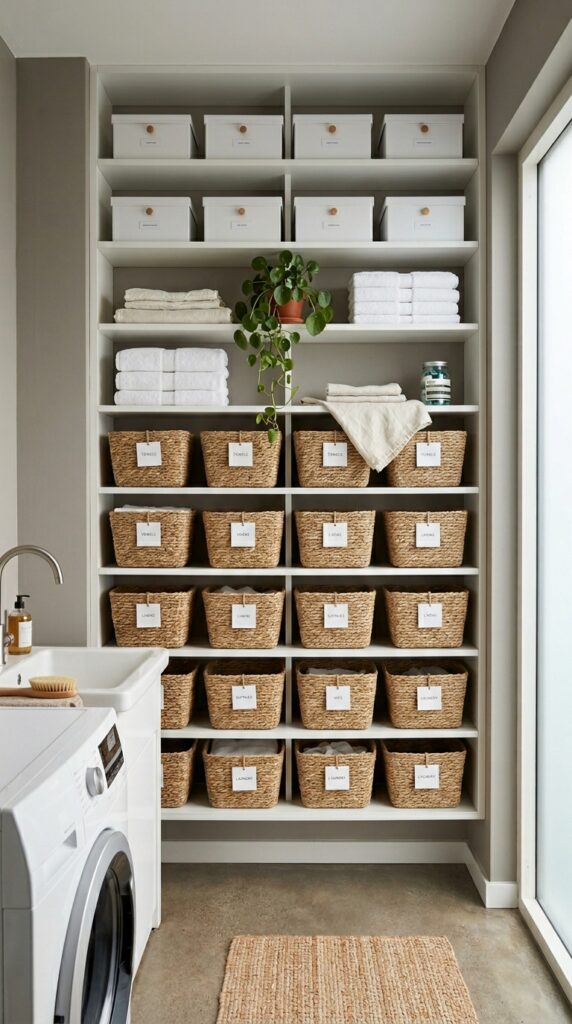
Orderly. Floor-to-ceiling open shelving on one wall converts unused vertical space — typically the most wasted dimension in a small laundry room — into a high-capacity, visually unified storage system that works harder than any combination of freestanding units.
The design principle is visual compression through repetition. When open shelves are lined with consistent, same-sized storage baskets, the visual effect is one of calm order rather than exposed clutter — the repetition of identical forms is cognitively soothing in the same way a uniform grid is. This only works with a single basket style and size; mixing basket materials, colors, or proportions on open shelving creates the opposite effect. Choose one style — all seagrass, all cotton canvas, all wicker — and buy enough of them to fill every shelf consistently.
Build shelves at 14-inch vertical intervals (generous enough for a folded stack of towels or a standard laundry basket) using 3/4-inch MDF painted with Sherwin-Williams “Extra White” SW 7006. Install with hidden keyhole brackets for a floating look, and confirm two stud anchors per shelf for load-bearing capacity.
🛍️ Shop the Look — Amazon Product Ideas
| # | Product Search Phrase | Why It Fits |
| 1 | Seagrass storage basket set 4 pack same size | Consistent basket system |
| 2 | Floating wall shelf bracket hidden hardware white | Shelf mounting system |
| 3 | MDF shelf board primed white 12 inch depth | Shelf material |
| 4 | Adhesive chalkboard labels baskets small | Labeling the basket system |
| 5 | Small white storage box with lid stackable | Upper-shelf boxed storage |
3. Add a Fold-Down Ironing Board to the Wall
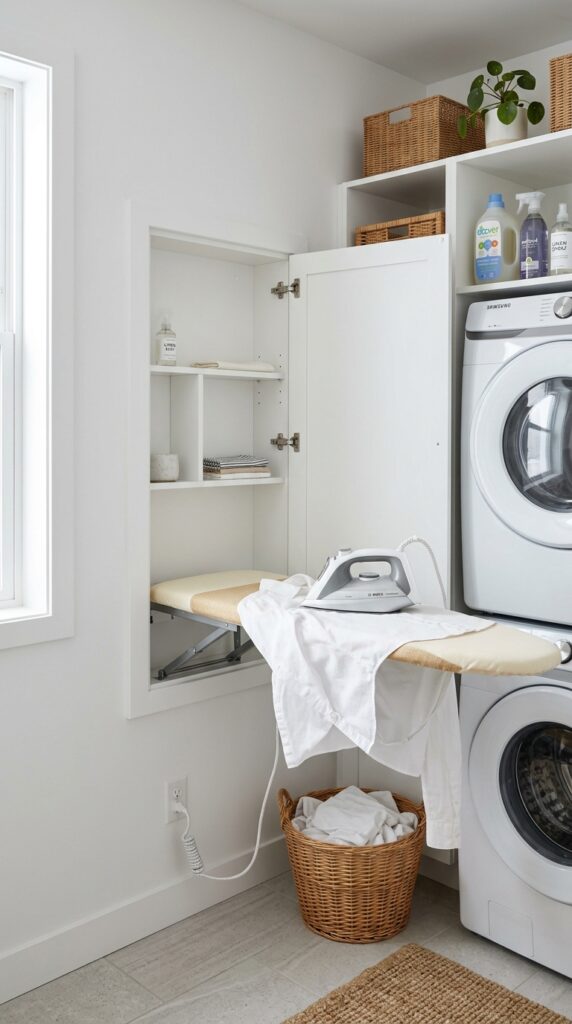
Purposeful. A wall-mounted fold-down ironing board is the most spatially intelligent single appliance upgrade available in a small laundry room — it stores completely flush to the wall (occupying zero floor space) and deploys in three seconds.
The space efficiency principle at work is conditional function: the ironing surface exists precisely when and only when it’s needed, rather than consuming a dedicated corner of the room permanently. A standard freestanding ironing board occupies roughly 3.5 square feet of floor area when stored — in a 40-square-foot laundry room, that’s nearly 10% of the total floor plan dedicated to a task that takes perhaps 20 minutes a week. Wall-mounted units reclaim that space entirely.
Most wall-mount ironing board cabinets install between wall studs and require a 14.5-inch-wide wall cavity (standard 16-inch stud spacing minus framing). The cabinet door, when closed, reads as a flat white cabinet panel — architecturally invisible. Brands like Hafele and Wallace make reliable recessed versions.
💡 Quick Win: A surface-mount fold-down ironing board (no wall cavity required, attaches directly to the wall face) installs in under an hour with four screws and reclaims the floor immediately.
🛍️ Shop the Look — Amazon Product Ideas
| # | Product Search Phrase | Why It Fits |
| 1 | Wall mounted fold down ironing board cabinet white | Core space-saving element |
| 2 | Recessed wall ironing board with cabinet door | Flush-mount upgrade version |
| 3 | Replacement ironing board cover padded cotton | Board surface maintenance |
| 4 | Iron cord holder wall mount hook | Adjacent organizing detail |
| 5 | Wall-mounted spray bottle holder laundry | Keeps ironing accessories nearby |
4. Use a Tension Rod for Hang-Dry Garments
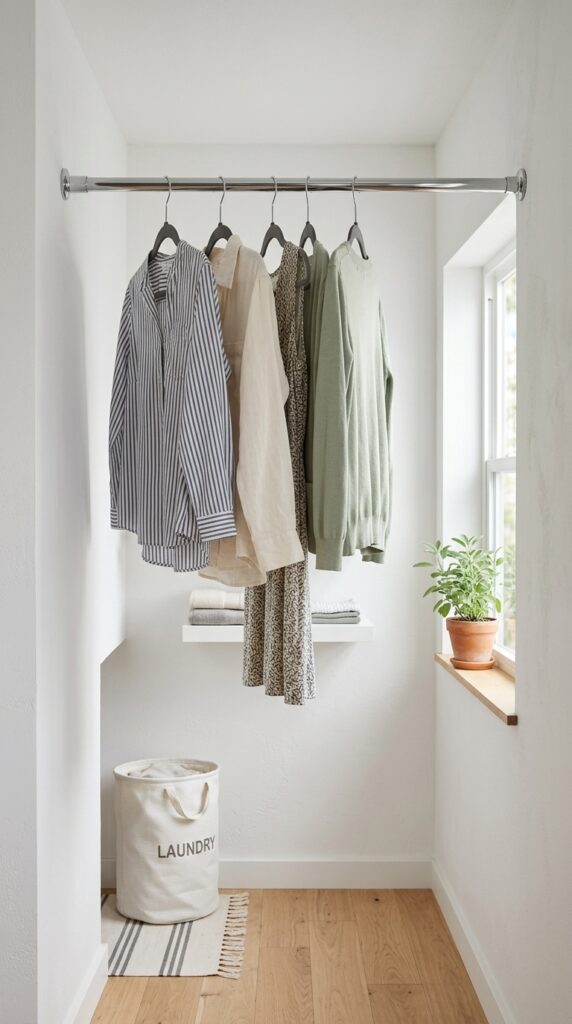
Minimal. A ceiling-height tension rod between two opposing walls costs under $20 and instantly solves the most stubborn small laundry room problem: where to hang delicates and air-dry items without a drying rack eating the floor.
The design principle is overhead utilization. The space above 6 feet in a laundry room is almost universally unused — it’s too high for shelving that needs to be accessed regularly, and too awkward for cabinets. A tension rod at 7 feet converts this dead zone into a functional hang-dry station that deploys instantly and compresses to nothing when not in use. Unlike a ceiling-mounted drying rack, it requires no drilling, no anchoring, and no tools.
Use a heavy-duty telescoping tension rod rated for at least 30 lbs (not the lightweight curtain-rod type, which will bow under wet garment weight). In a narrow alcove, install perpendicular to the machines so hanging garments don’t interfere with appliance access. Pair with slim velvet hangers to maximize the number of items that can hang simultaneously.
🛍️ Shop the Look — Amazon Product Ideas
| # | Product Search Phrase | Why It Fits |
| 1 | Heavy duty tension rod 40-72 inch closet | Core functional element |
| 2 | Slim velvet non-slip hangers 50 pack | Space-efficient hanging |
| 3 | Ceiling mounted retractable clothesline indoor | More permanent hang-dry option |
| 4 | Wall-mounted foldable drying rack white | Supplementary fold-out option |
| 5 | Laundry mesh bag delicates washing machine | Delicate garment care companion |
5. Paint the Walls a Deep, Moody Navy
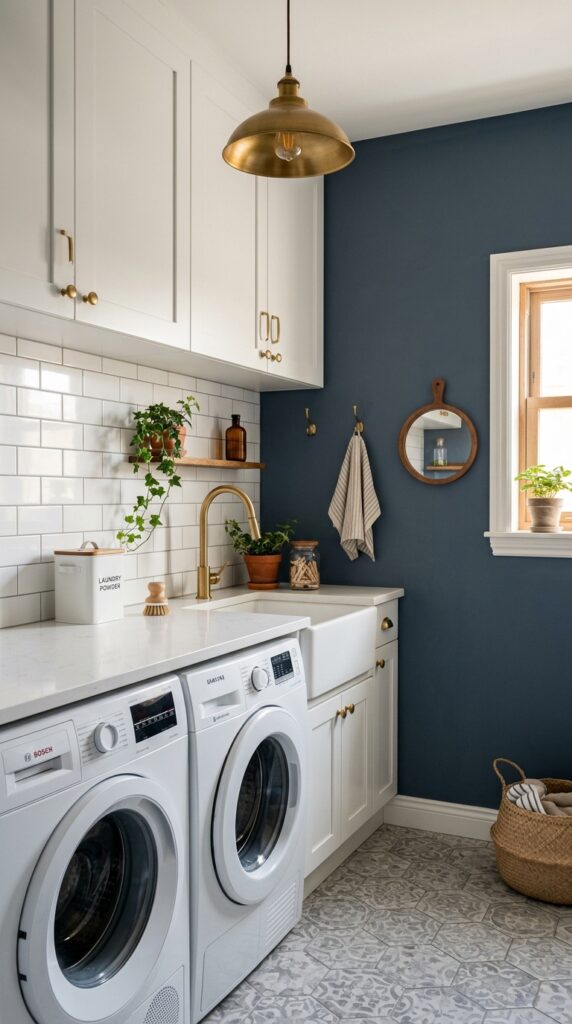
Rich. Deep navy walls in a small laundry room are one of those counterintuitive design moves that look alarming on the paint chip and extraordinary in the finished room — the darkness creates intimacy and drama, making the white cabinetry and tile sing by contrast.
The design logic is deliberate envelope darkness. The conventional wisdom says “paint small rooms white to make them feel larger” — but this advice optimizes for the wrong quality in a utility space. A small laundry room doesn’t need to feel vast; it needs to feel finished, intentional, and pleasant to be in. Deep color on the walls, paired with bright white millwork and crisp tile, creates a jewel-box quality that makes the space feel designed rather than merely functional. The contrast between the dark walls and the white machines, cabinets, and tile is visually energizing in a productive way.
Use Benjamin Moore “Hale Navy” HC-154 or Sherwin-Williams “Naval” SW 6244 in a matte finish. Paint the ceiling the same navy (the “fifth wall” treatment) for maximum drama and to visually lower the ceiling in a pleasing way.
💡 Quick Win: A single quart of sample paint in “Hale Navy” ($8) lets you test a full wall before committing — even the test swatch will likely convince you within 24 hours.
🛍️ Shop the Look — Amazon Product Ideas
| # | Product Search Phrase | Why It Fits |
| 1 | Interior matte paint dark navy blue sample | Color confirmation before commitment |
| 2 | White ceramic laundry detergent canister set | White accent against navy walls |
| 3 | Brushed brass cabinet pull hardware 5 inch | Warm metal against dark walls |
| 4 | White subway tile peel and stick backsplash | Bright contrast surface |
| 5 | Mini pendant light brass kitchen laundry | Warm overhead fixture to pair |
6. Install a Countertop Above Front-Load Machines
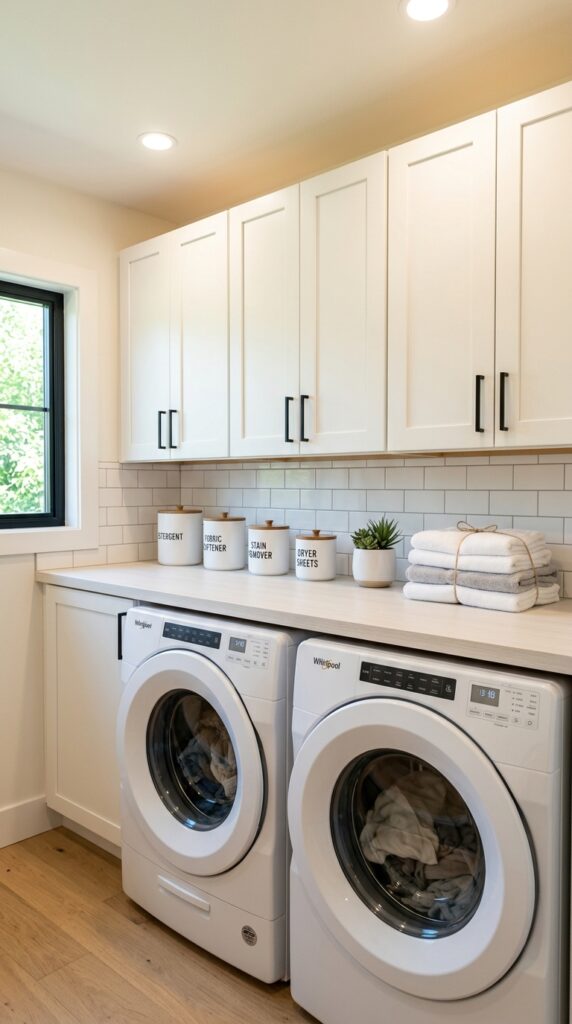
Functional. A countertop directly above the machines is the most-requested upgrade among small laundry room users because it solves the problem that no amount of shelving can: where, exactly, do you fold clean laundry?
The design principle is surface creation from existing volume. Most front-load machines are 27–30 inches tall — just below standard countertop height. A 1.5-inch-thick laminate or butcher block panel resting on top of the machine lids (secured with anti-slip cabinet liner and, on one end, a simple wall-mounted bracket) converts the unused top surface of the machines into a genuine work counter. No cabinetry construction required for a basic version.
For a polished, built-in look, have a local countertop fabricator cut a piece of 1.5-inch-thick Formica laminate (in “Calcatta Marble” pattern or “White Ice”) to the exact width of your machine pair plus 1 inch overhang on each side. Support the back edge with a continuous French cleat mounted to the wall studs.
🛍️ Shop the Look — Amazon Product Ideas
| # | Product Search Phrase | Why It Fits |
| 1 | Butcher block countertop shelf 25 inch depth | Warm countertop material option |
| 2 | Non-slip cabinet liner shelf grip roll | Stabilizes countertop on machine tops |
| 3 | Laundry canister set with labels ceramic white | Counter organization |
| 4 | French cleat wall support bracket aluminum | Countertop rear edge support |
| 5 | Under-cabinet LED strip light warm white plug-in | Lights the counter from above |
7. Use Matching Storage Jars for Detergents and Supplies
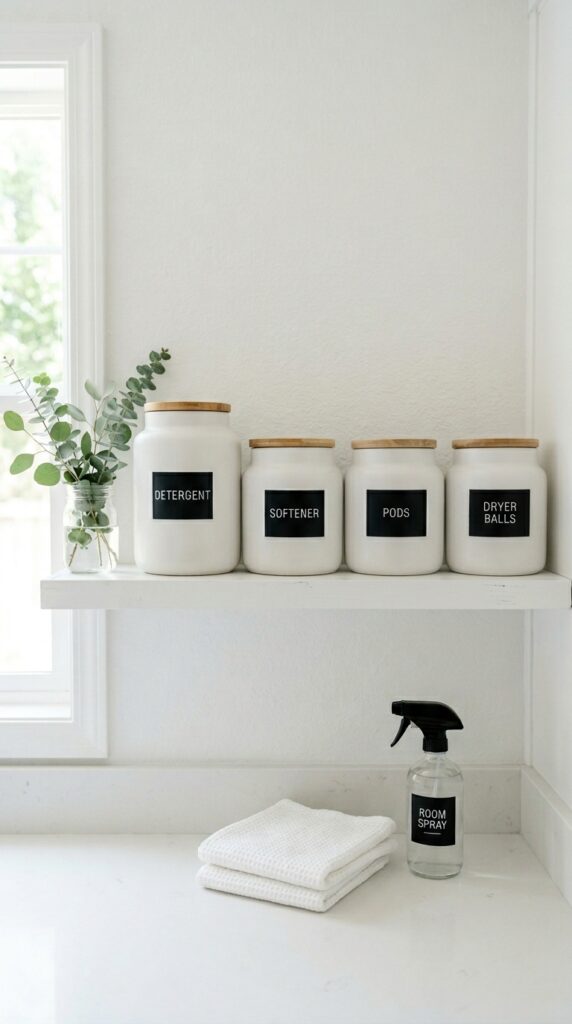
Spa-like. Decanting laundry supplies from their original plastic packaging into matching ceramic or glass jars is the single most impactful 30-minute styling upgrade available in a small laundry room — it converts a cluttered shelf into something that looks considered.
The visual principle is object unification. Laundry supplies in their original packaging — neon plastic jugs, patterned boxes, plastic pouches — vary wildly in height, width, color, and graphic design, creating constant visual noise every time you enter the room. Decanting those same supplies into a matched set of containers in one material and one color immediately reduces the visual frequency of the shelf from chaotic to calm. The labels do the organizational work; the uniformity does the aesthetic work.
Use WECK glass jars (their 1-liter cylindrical style is ideal for powder detergents), white ceramic canisters with bamboo lids for pods and dryer sheets, and a labeled amber glass spray bottle for diluted fabric refresher. Print waterproof labels with black text on clear stock — these survive the humidity of a laundry room, unlike standard paper labels.
🛍️ Shop the Look — Amazon Product Ideas
| # | Product Search Phrase | Why It Fits |
| 1 | White ceramic canister set with bamboo lid laundry | Matched storage containers |
| 2 | Clear label maker tape waterproof black text | Waterproof labels for the jars |
| 3 | Glass apothecary jar with lid large clear | For powder detergent storage |
| 4 | Amber glass spray bottle pump 16 oz | Decanted fabric refresher bottle |
| 5 | Wool dryer balls set natural 6 pack | Product to display in the jars |
8. Add a Wall-Mounted Drying Rack That Folds Flat
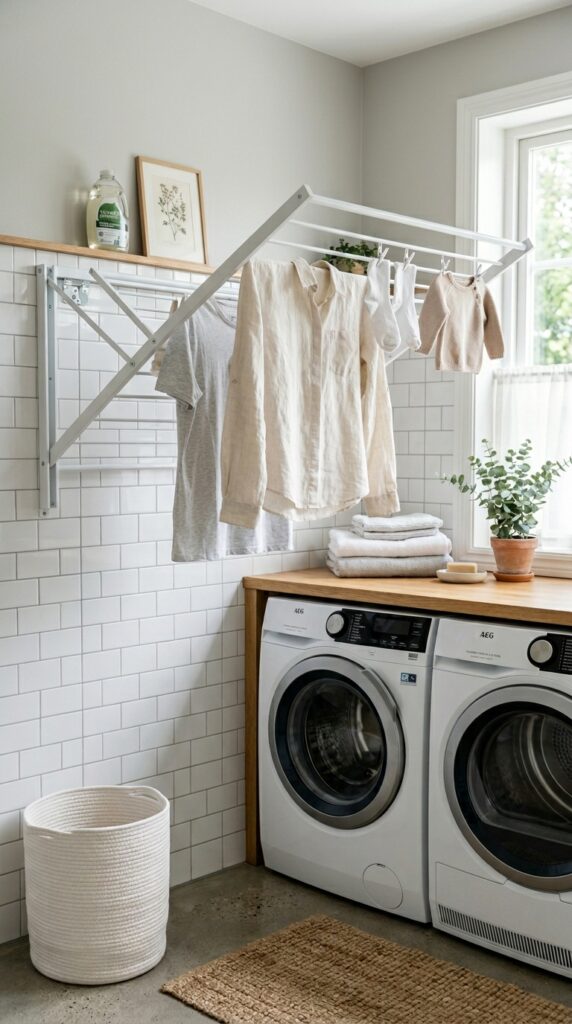
Airy. A wall-mounted fold-flat drying rack solves the small laundry room’s most persistent floor-space offender — the freestanding drying rack — by moving the function to the wall and collapsing it to 3 inches of depth when not in use.
The principle is functional fold-away. A standard freestanding drying rack occupies 4–6 square feet of floor area when open and an awkward 8×24-inch footprint when folded and leaned against a wall. A wall-mounted version takes a 6×16-inch wall footprint permanently, deploys fully in one motion, and collapses back completely flat when the laundry is dry. For a small laundry room where the difference between 32 square feet and 28 square feet is meaningful, this swap is essential.
Mount on two wall studs at 54–60 inches from the floor (high enough to clear the countertop below, with room for garments to hang without dragging). Mylands and Brabantia make well-reviewed steel versions that hold 30–44 lbs when extended.
💡 Quick Win: A wall-mount fold-flat rack ($35–65) and two drywall anchors is a 30-minute installation that permanently eliminates the freestanding rack from the floor plan.
🛍️ Shop the Look — Amazon Product Ideas
| # | Product Search Phrase | Why It Fits |
| 1 | Wall mounted folding drying rack laundry white | Core element of this idea |
| 2 | Heavy duty wall anchor kit drywall | Mounting support hardware |
| 3 | Stainless steel over-door drying rack towel bar | Over-door alternative version |
| 4 | Retractable clothesline wall mount indoor | Another fold-away alternative |
| 5 | Mesh laundry bag delicates 3 pack hang dry | Pairs with the rack for delicates |
9. Tile the Floor in a Bold Black and White Checkerboard
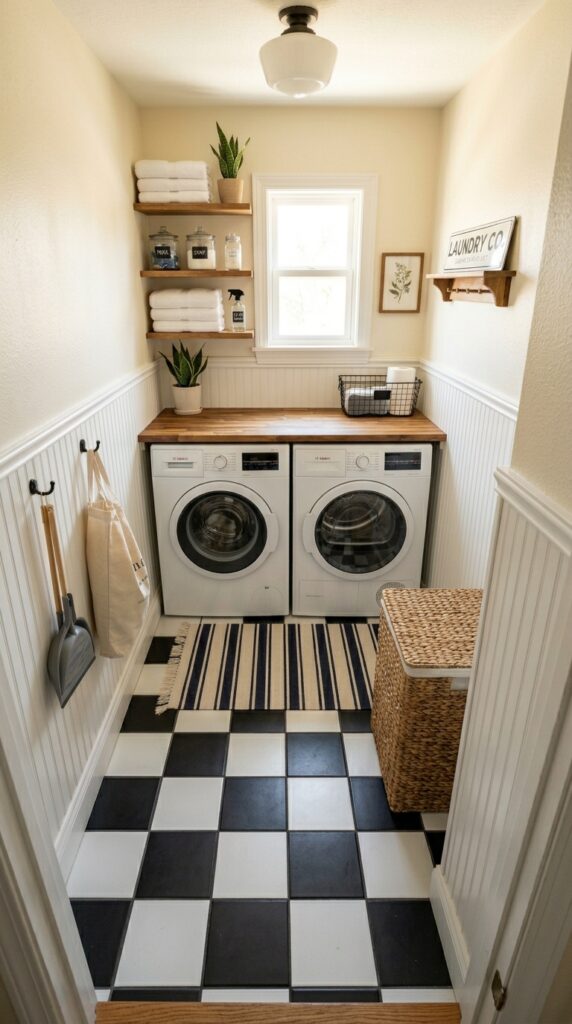
Crisp. A black and white checkerboard tile floor is the visual move that makes a small laundry room look like a deliberate design decision rather than a contractor afterthought — it signals that this space was thought about.
The design principle is patterned grounding. A patterned floor in a small room creates what designers call an “anchor layer” — a high-interest base surface that makes every element above it look intentional by association. The checkerboard pattern has centuries of design history (from Dutch Baroque interiors to mid-century kitchens) and is virtually impossible to date or make look wrong when kept in true black and white. The key material specification is matte, not gloss — gloss checkerboard in a small room can feel loud and dated; matte reads as contemporary and considered.
Use 4×4-inch Daltile “Arctic White” and “Absolute Black” ceramic tiles with a 1/16-inch black grout joint. At this scale, the pattern is graphic but not dizzying. Larger tiles (12×12) produce a less dynamic version; smaller mosaic tiles (1×1) are harder to install in a room this size.
🛍️ Shop the Look — Amazon Product Ideas
| # | Product Search Phrase | Why It Fits |
| 1 | Black and white checkerboard peel and stick tile floor | Renter-friendly floor treatment |
| 2 | Ceramic floor tile matte black 4×4 inch box | One half of the classic pattern |
| 3 | White grout unsanded tile joint small | Grout for small tile joints |
| 4 | Tile floor cleaner concentrate streak free | Maintenance for tile floors |
| 5 | Small black wire basket laundry floor | Accent that complements the floor |
10. Mount a Pegboard for Tool and Supply Organization
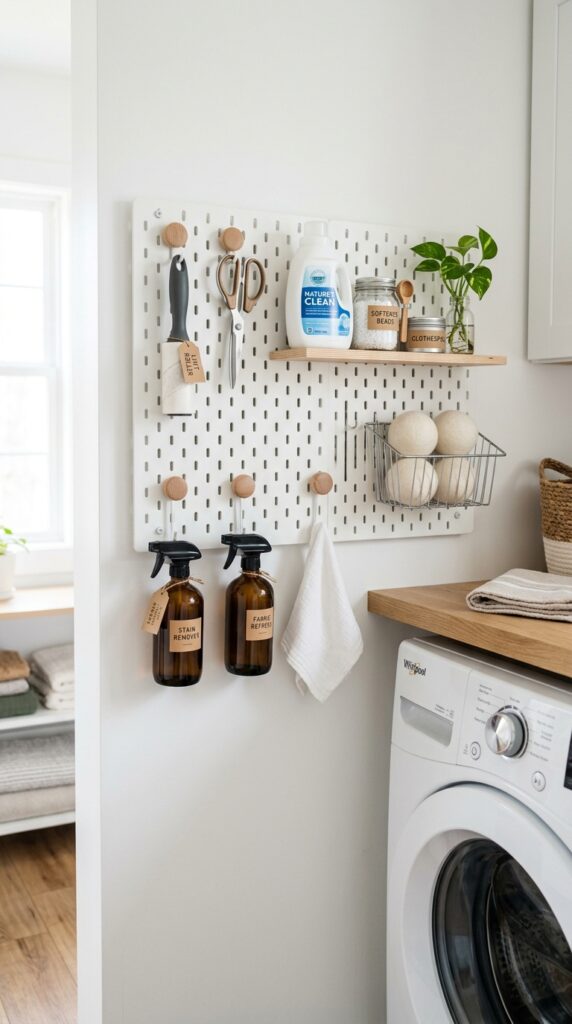
Organized. A laundry room pegboard turns the narrow wall beside or above the machines into a completely customizable, reconfigurable supply station — one that keeps frequently used items visible and reachable without consuming a single inch of counter or shelf space.
The design logic is surface-free accessibility. Lint rollers, stain pens, scissors, small spray bottles, and measuring scoops are the most frequently used laundry tools — and they’re also the items most likely to be lost in a drawer or forgotten in a cabinet. Hanging them on hooks at eye height on a pegboard means zero friction in accessing them: no opening doors, no digging through bins. The reconfigurability of pegboard also means the system evolves as your laundry routine changes.
Choose 1/4-inch tempered hardboard pegboard pre-painted in white, cut to fit the available wall section (typically 16×24 inches beside a machine column). Mount with 1-inch standoff spacers (mandatory — without them, hooks can’t insert). Use a mix of single wire hooks, wooden dowel hooks for larger items, and 1–2 small wooden shelf inserts for items that need a flat surface.
🛍️ Shop the Look — Amazon Product Ideas
| # | Product Search Phrase | Why It Fits |
| 1 | White pegboard panel 16×24 inch with hardware | Core functional element |
| 2 | Pegboard hook set mixed sizes white wooden | Hook accessories for the board |
| 3 | Small pegboard shelf insert wood | Flat surface accessory |
| 4 | Stain remover pen laundry spot treat | Tool to hang on the board |
| 5 | Spray bottle empty 16 oz fine mist | Supply to hang labeled on the board |
11. Install a Sliding Barn Door to Save Swing Space
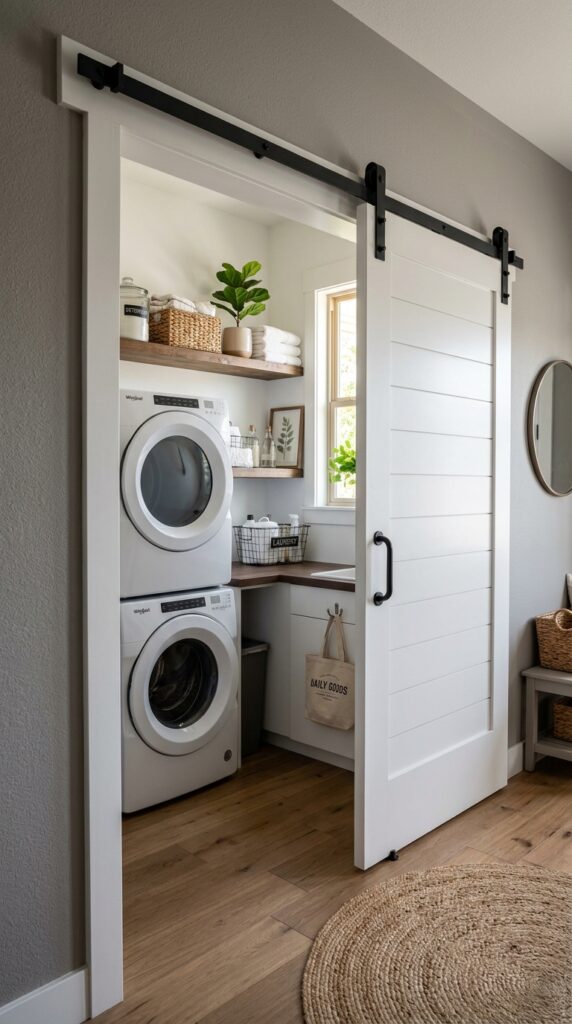
Clean. A sliding barn door on a laundry room closet or alcove solves a surprisingly significant spatial problem: every standard swing door steals 9–12 square feet of usable floor area from the approach zone every time it opens. A slider eliminates that sweep entirely.
The design principle is clearance zone elimination. In a hallway-adjacent or kitchen-adjacent laundry room — the most common configurations in apartments and smaller homes — a conventional hinged door forces a 30-inch radius of clear floor in front of it for the swing path. Remove that constraint with a sliding door and you reclaim floor space in both the laundry room and the adjacent corridor. Barn door hardware also adds a deliberate design detail that elevates a utility room into a designed space.
Use a pre-primed MDF barn door (available in kit form at most home improvement stores) painted in a low-luster white to match existing millwork. Ensure the wall beside the door opening has at least the width of the door in open wall space for the door to slide into. A bypass barn door system (two doors that slide past each other) works for wider openings.
🛍️ Shop the Look — Amazon Product Ideas
| # | Product Search Phrase | Why It Fits |
| 1 | Sliding barn door hardware kit black matte | Core functional door hardware |
| 2 | Solid wood barn door kit primed white 36 inch | Door panel to pair with hardware |
| 3 | Barn door floor guide bottom roller | Keeps the door from swinging |
| 4 | Barn door handle pull black strap hardware | Door pull detail |
| 5 | Door stop wall mount rubber laundry | Prevents door from sliding too far |
12. Create a Sorting System with Labeled Multi-Compartment Hampers
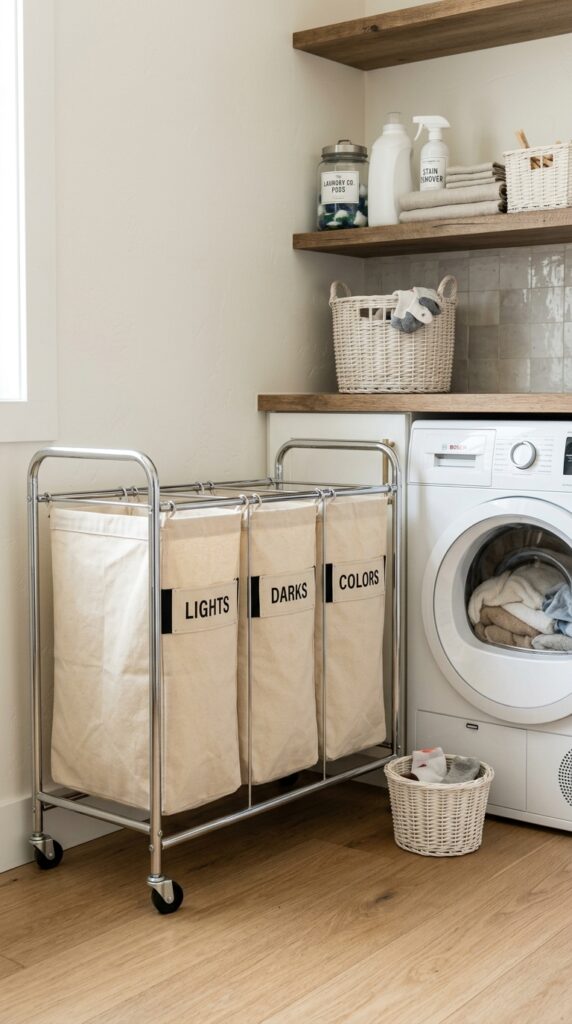
Practical. A pre-sorted laundry hamper system is the upstream solution that makes every other small laundry room efficiency work better — when clothing arrives at the machines pre-sorted by color and care, the actual washing process moves 40–60% faster.
The design and process principle is point-of-origin sorting. Most households sort laundry at the machine — which requires handling each item twice (once to put in the general hamper, once to sort at the machine). A three-compartment sorter allows sorting at the point of collection (bedroom, bathroom, hallway) so when the bag is full, it goes directly into the machine with zero secondary handling. This is the laundry equivalent of mise en place in cooking: preparation happens continuously in the background so the final execution is effortless.
Choose a slim-profile three-section sorter on wheels that can slide against the wall or into a corner when not in use. The metal frame versions with removable canvas bags are the most practical: bags can be unhooked and carried directly to the machine, then returned. Total width of most three-bay sorters is 24–30 inches — measure your corner before ordering.
💡 Quick Win: A simple set of three $5 mesh laundry bags in different colors (white, gray, dark) hanging on a triple hook strip creates a functional sorting system for under $20 before investing in a dedicated sorter unit.
🛍️ Shop the Look — Amazon Product Ideas
| # | Product Search Phrase | Why It Fits |
| 1 | Three section laundry sorter canvas bags wheels | Core sorting system |
| 2 | Laundry mesh bag set 3 colors lights darks colors | Budget sorting alternative |
| 3 | Triple hook strip wall mount matte black | Hanging the mesh bag system |
| 4 | Waterproof laundry hamper canvas removable bag | Premium individual hamper |
| 5 | Label maker machine tape black on white | Labeling the sorter sections |
13. Use the Space Above Cabinets for Basket Storage
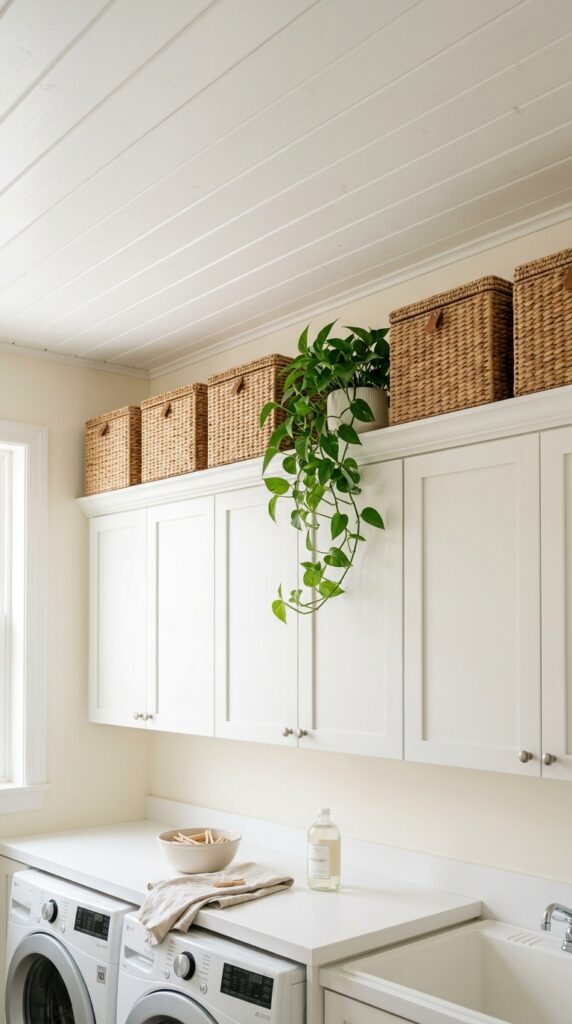
Complete. The gap between cabinet tops and the ceiling — typically 12–18 inches of dead vertical space — is the most universally ignored storage opportunity in a laundry room, and filling it with a row of matching lidded baskets immediately converts it from visual clutter magnet to organized seasonal storage.
The design principle is dead zone activation. In most laundry rooms with upper cabinetry, 12–18 inches of space above the cabinets is wasted: too small for another cabinet run, too visible to ignore, and too often colonized by dust and forgotten items. A row of uniformly sized lidded wicker or rattan storage boxes that fit the depth of the cabinet top (typically 12–14 inches) and span the width of the cabinet run creates a cohesive, architectural storage tier that reads as intentional rather than improvised.
Use lidded boxes — the lids keep dust out of rarely accessed seasonal items (extra blankets, holiday linens, winter gear) and make the top-of-cabinet row read as clean and finished. Measure the height clearance precisely: the boxes should fit within 1 inch of the ceiling so they look placed, not floating.
🛍️ Shop the Look — Amazon Product Ideas
| # | Product Search Phrase | Why It Fits |
| 1 | Lidded wicker storage box set rattan natural | Above-cabinet storage row |
| 2 | Rattan storage box with lid flat 12 inch | Size-appropriate boxes |
| 3 | Wicker lidded basket with handles set two | Individual storage units |
| 4 | Label tag hanging string kraft paper | Labeling the above-cabinet boxes |
| 5 | Step stool folding compact household | Accessing the above-cabinet tier |
14. Install a Recessed Niche Between Studs for Supplies
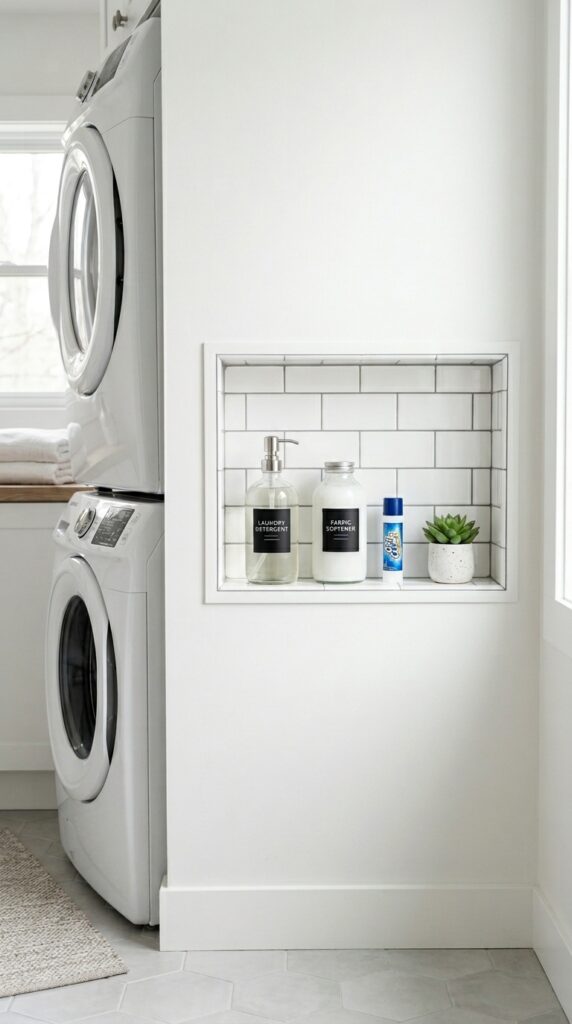
Architectural. A recessed supply niche between wall studs is the most elegant small-space storage solution in laundry room design — it stores supplies flush to the wall plane at zero floor and zero counter footprint, and it reads as a deliberate architectural detail rather than added storage.
The design principle is negative space storage: using the void already existing between studs (typically 3.5 inches deep, 14.5 inches wide) as a storage cavity rather than adding volume to the room to house supplies. The standard 16-inch stud bay is wide enough to accommodate most laundry supply bottles standing upright — detergent, fabric softener, spray starch, stain remover. At 3.5 inches of depth, items don’t protrude past the wall plane.
The construction requires removing one section of drywall (14.5 x 24 inches, between two consecutive studs), confirming no wiring or plumbing is present, adding a shelf at mid-height, finishing the interior with cement board and white subway tile (or simply prime and paint), and installing a painted MDF or tile threshold at the opening edges. This is a weekend project with basic carpentry skills.
🛍️ Shop the Look — Amazon Product Ideas
| # | Product Search Phrase | Why It Fits |
| 1 | White subway tile 3×6 ceramic box | Niche interior finish |
| 2 | Tile adhesive mastic small bucket | Tile installation material |
| 3 | White grout sanded non-sanded tile joint | Grout for the niche tile |
| 4 | MDF shelf board narrow 3.5 inch depth | Niche interior shelf |
| 5 | Stain remover spray bottle laundry small | Supply displayed in the niche |
15. Paint the Ceiling the Same Color as the Walls
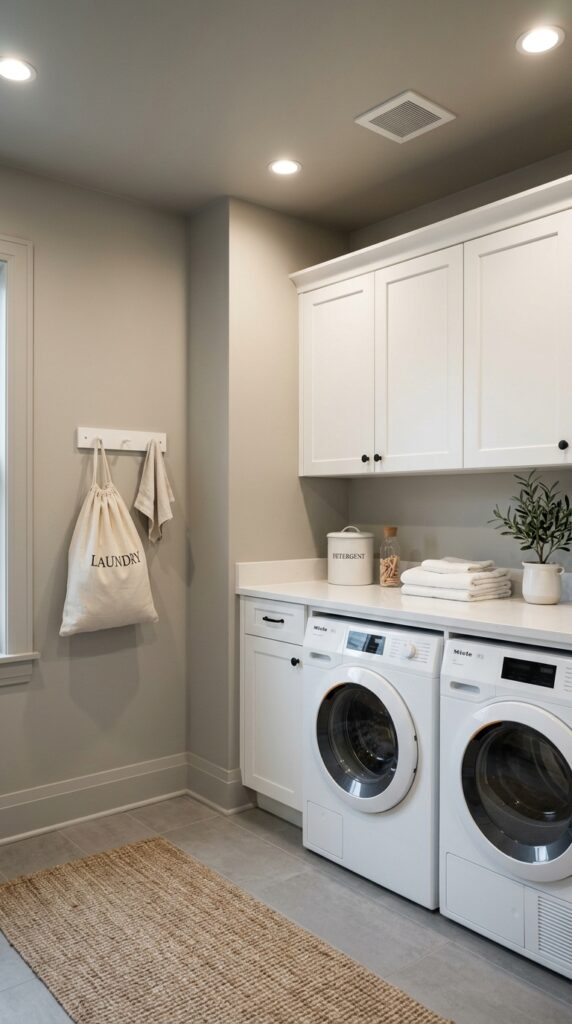
Enveloping. Painting the ceiling the same color as the walls — rather than standard white — is the most sophisticated color technique in small-room design because it eliminates the visual interruption at the wall-ceiling junction, making the room feel simultaneously more intimate and more architecturally resolved.
The design principle is visual envelope continuity. When wall and ceiling colors differ, the eye constantly reads the horizontal line where they meet, which in a low-ceiling room reinforces the sense of compression and confinement. When they match, the color wraps continuously around the room like a shell, and the ceiling line visually disappears. The room reads as an environment rather than a box. This technique is especially powerful in laundry rooms because the white machines and cabinetry become the only contrast elements — they seem to float within the colored envelope, looking crisper and more intentional than they ever would against a white ceiling.
Choose a warm gray with strong yellow undertones (Sherwin-Williams “Accessible Beige” SW 7036 or Benjamin Moore “Pale Oak” OC-20) rather than a cool gray, which reads as cold in the enclosed space of a small laundry room.
💡 Quick Win: A single gallon of paint in the same color used on the walls, applied to the ceiling as well, is a zero-cost design upgrade that takes one afternoon and dramatically changes the spatial quality of the room.
🛍️ Shop the Look — Amazon Product Ideas
| # | Product Search Phrase | Why It Fits |
| 1 | Ceiling paint warm gray interior eggshell | Matching the ceiling to the walls |
| 2 | Paint roller extension pole 4 foot | Ceiling painting tool |
| 3 | Angled paintbrush 2.5 inch wall ceiling cut in | Cutting in at the crown molding |
| 4 | Painter’s tape blue 1.5 inch roll | Clean edge at cabinets and trim |
| 5 | LED recessed light retrofit kit 6 inch warm white | Ceiling light to pair with colored ceiling |
16. Add a Sink with a Slim-Profile Cabinet Base
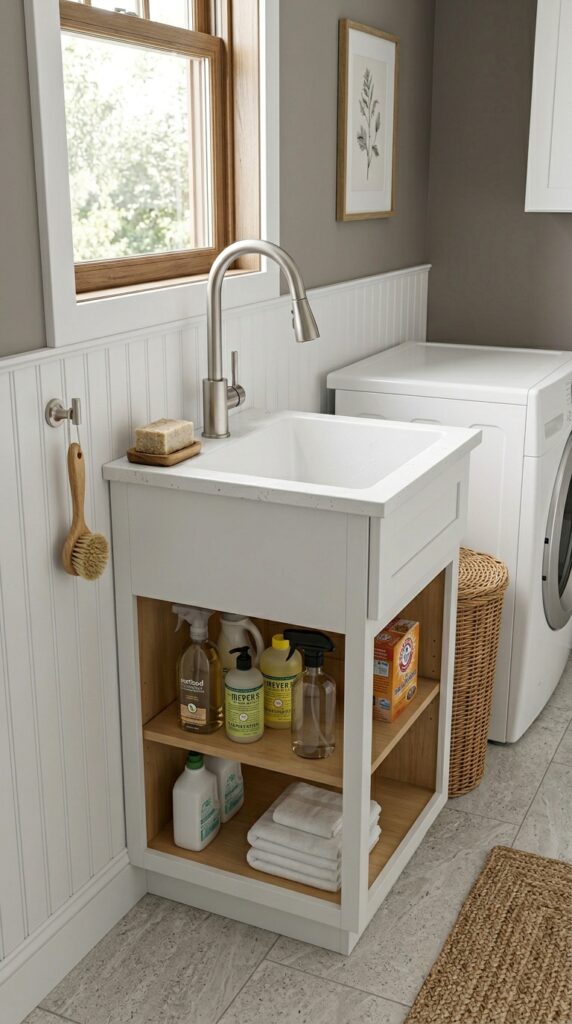
Hardworking. A utility sink in a small laundry room unlocks a range of tasks — hand-washing delicates, pre-treating stains, cleaning paint brushes, filling steam irons — that a dry laundry room simply cannot accommodate, making the entire space more genuinely functional.
The small-space adaptation principle here is depth reduction. Standard base cabinets run 24 inches deep; a standard 36-inch kitchen sink base requires significant floor footprint. Laundry utility sinks are available in 18-inch-depth configurations — a 6-inch reduction that matters considerably in a room under 40 square feet. An 18-inch-deep sink base leaves a 6-inch buffer between the cabinet face and any adjacent appliance or wall, which reads as intentional clearance rather than a squeeze.
The most compact option is a wall-mounted utility sink (no cabinet at all) — this leaves the floor beneath completely open for storage baskets. Combined with open shelving below and a simple pipe cover panel, it provides all the function with minimal footprint.
🛍️ Shop the Look — Amazon Product Ideas
| # | Product Search Phrase | Why It Fits |
| 1 | Small utility sink laundry room 18 inch cabinet | Compact sink unit for small rooms |
| 2 | Wall mount utility sink white laundry | No-cabinet floor-clearing option |
| 3 | Brushed nickel laundry faucet single hole | Sink hardware |
| 4 | Open pipe cover cabinet panel white | Conceals plumbing below wall-mount sink |
| 5 | Scrub brush hang hook stainless laundry sink | Functional accessory beside the sink |
17. Use Light-Colored Shiplap for Texture Without Weight
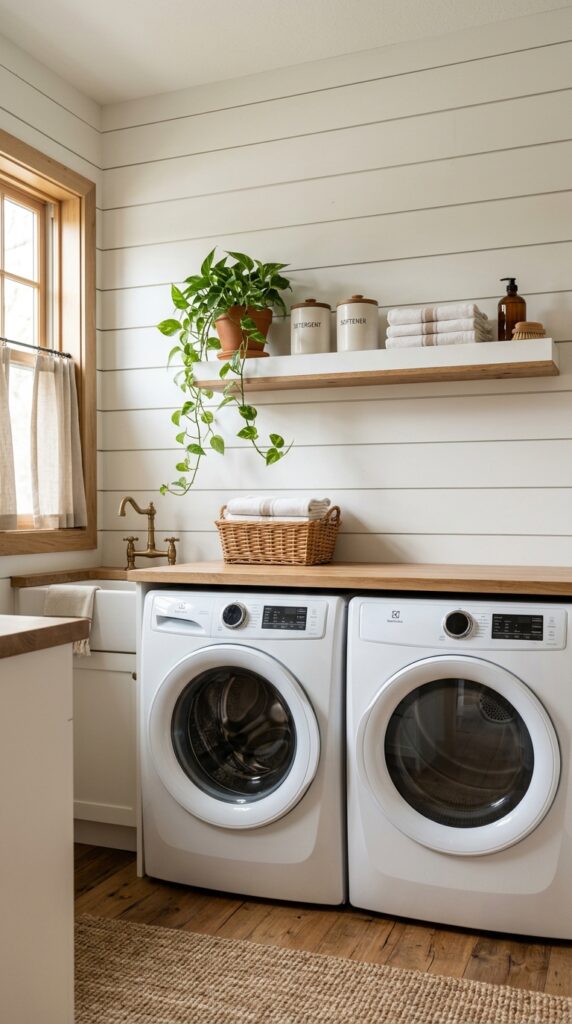
Textured. White-painted shiplap on one laundry room wall adds architectural texture that transforms a flat, blank utility space into something with character — without the visual weight of darker materials or the maintenance demands of tile.
The design principle is shadow line texture. Shiplap’s distinctive horizontal groove lines — created by the 1/8-inch gap between boards — cast subtle, consistent shadow lines that vary throughout the day as light shifts across the wall. This creates visual interest that a flat painted surface cannot replicate, while the white paint keeps the overall room light and spacious. The horizontal orientation also visually widens narrow laundry rooms — the eye follows horizontal lines to the edges of the room, making the space read as broader.
Use 1×6-inch pine boards with a 1/8-inch reveal, installed with a nail gun into the studs. Paint with Benjamin Moore “Chantilly Lace” OC-65 in an eggshell finish — the slight sheen of eggshell makes the shadow lines read more crisply than flat paint. Limit shiplap to one accent wall; all four walls in shiplap in a small room compresses rather than expands the space.
🛍️ Shop the Look — Amazon Product Ideas
| # | Product Search Phrase | Why It Fits |
| 1 | Shiplap wall paneling peel and stick white | Renter-friendly shiplap alternative |
| 2 | Pine board shiplap 1×6 primed 8 foot | Traditional installation material |
| 3 | Brad nail finish nailing gun trim work | Installation tool for shiplap |
| 4 | White eggshell interior paint gallon | Surface finish for the shiplap |
| 5 | Floating shelf bracket hidden mount | Shelf mounted on the shiplap wall |
18. Hang a Narrow Wall Cabinet for Extra Hidden Storage
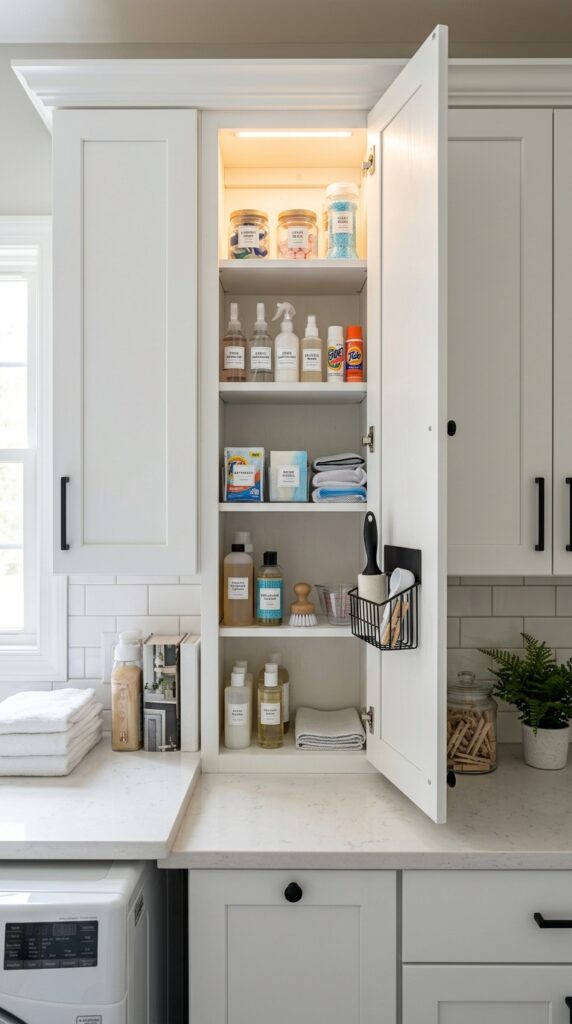
Purposeful. A shallow 9-to-12-inch-deep wall cabinet in a small laundry room provides significant hidden storage without protruding into the room as far as standard 12-inch cabinets — the 3-inch reduction is functionally meaningful in narrow-aisle laundry rooms.
The design principle is depth-matched storage. The mistake most homeowners make when adding laundry room storage is installing full-depth kitchen cabinets (24-inch for base, 12-inch for uppers) — but laundry supplies are almost universally small items (bottles, boxes, bags) that don’t require 12-inch depth. A 9-inch-deep wall cabinet holds every laundry supply you’re likely to own, while the reclaimed 3 inches of aisle width makes the room noticeably less cramped to move around in.
Customize the interior with a narrow magnetic strip for small metal items (scissors, safety pins), an over-door organizer on the cabinet door interior for spray bottles, and shallow shelves at 4-inch vertical intervals — laundry supplies rarely exceed 3.5 inches deep.
💡 Quick Win: An over-door cabinet organizer with small pockets ($12–18) added to the interior of any existing cabinet door immediately adds a hidden tier of storage for small items.
🛍️ Shop the Look — Amazon Product Ideas
| # | Product Search Phrase | Why It Fits |
| 1 | Shallow wall cabinet 9 inch depth white laundry | Core narrow cabinet element |
| 2 | Over door cabinet organizer 4 pocket small | Interior door storage add-on |
| 3 | Magnetic knife strip mini wall mount | Small metal item storage inside cabinet |
| 4 | Cabinet shelf riser adjustable white | Interior shelf spacing adjustment |
| 5 | Soft close hinge cabinet door replacement | Upgrade existing cabinet hinges |
19. Add a Warm-Toned Pendant Light as a Focal Feature
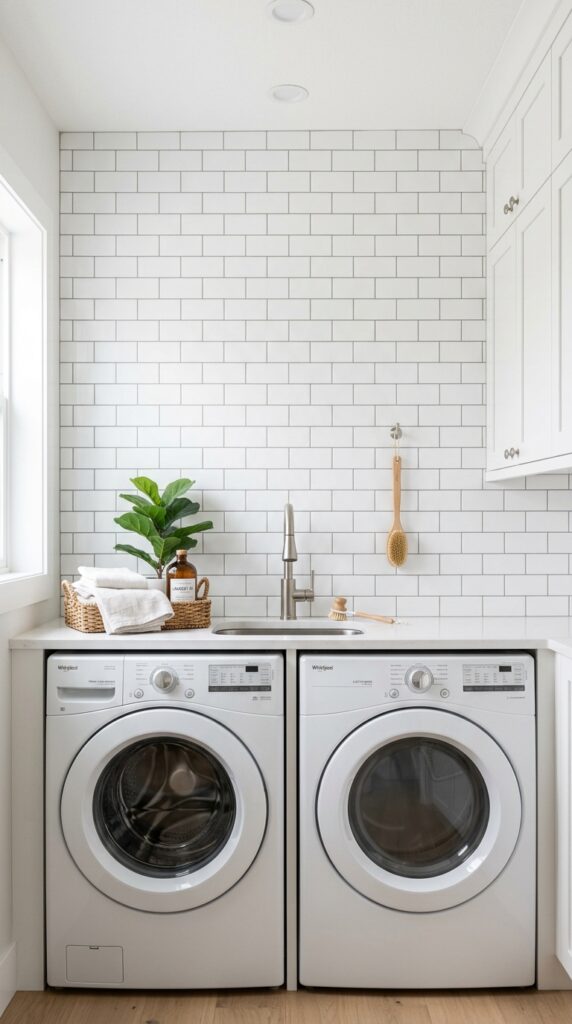
Inviting. A decorative pendant light in a laundry room is the design signal that communicates most clearly: this space was taken seriously. It shifts the room from utility closet to considered interior in a way no amount of organization alone can achieve.
The lighting design principle is task-plus-ambiance layering. Most small laundry rooms have a single overhead fluorescent or recessed fixture that provides flat, even, somewhat clinical illumination — functional, but cold. Adding a pendant above the folding counter creates a dedicated task light at the work surface while simultaneously introducing a warm, design-forward element. The pendant doesn’t replace the overhead fixture; it supplements it with a layer of warmth that transforms the room’s emotional register.
Choose a rattan, woven bamboo, or matte ceramic pendant shade with a warm white Edison bulb (2700K, 400–600 lumens). Mount directly above the countertop on a canopy plate — most plug-in pendant kits can be ceiling-mounted without an electrician by using an existing junction box.
🛍️ Shop the Look — Amazon Product Ideas
| # | Product Search Phrase | Why It Fits |
| 1 | Rattan woven pendant light shade ceiling hook | Core decorative lighting element |
| 2 | Edison bulb LED warm 2700K A19 60W | Warm bulb for the pendant |
| 3 | Pendant light cord cover fabric braided cream | Hides the pendant cord |
| 4 | Canopy ceiling mount pendant kit plug-in | Mounting hardware for pendant |
| 5 | Under cabinet LED puck light plug-in warm | Additional task lighting layer |
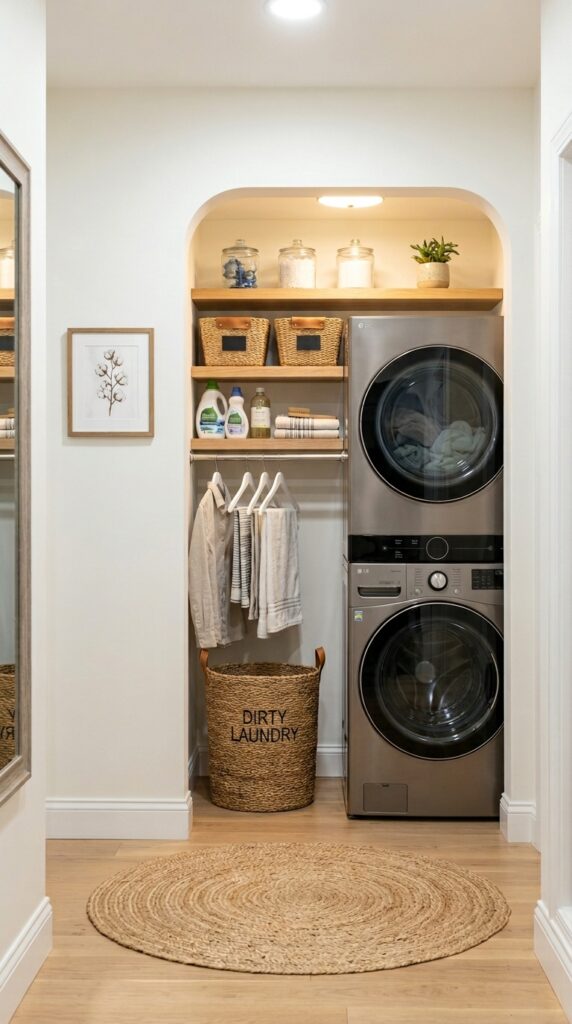
20. Create a Vertical Cleaning Supply Tower
Efficient. The 3–6 inch gap between a washing machine and the adjacent wall or dryer is one of the most overlooked storage opportunities in a small laundry room — a narrow pull-out tower unit (sometimes called a “laundry gap filler”) converts dead space into a full-height supply tower.
The principle is interstitial space recovery. Most washer and dryer installations leave a gap of 3–6 inches between the appliance and the wall for ventilation clearance — a necessary spacing that is functionally useless in its unimproved state. Pull-out tower units designed for this exact dimension are available in 3-inch, 4-inch, 5-inch, and 6-inch widths and typically extend to full cabinet height (70–80 inches). They roll in and out on smooth casters, making contents visible and accessible.
Measure the gap width precisely to the nearest 1/4 inch before ordering. These units are available at IKEA (using ALGOT/ENHET components) or as standalone products on Amazon. The most useful configurations have open shelving in the upper two-thirds and a closed or pull-out bin at the bottom for miscellaneous items.
🛍️ Shop the Look — Amazon Product Ideas
| # | Product Search Phrase | Why It Fits |
| 1 | Slim rolling laundry gap filler cabinet 4 inch | Core pull-out tower unit |
| 2 | Narrow rolling cart 6 inch storage tower | Wider gap version |
| 3 | Rolling storage cart slim 3 inch gap bathroom | Narrowest version for tight gaps |
| 4 | Small pull out bin with handle laundry | Bottom bin for the tower |
| 5 | Caster wheel swivel lock 2 inch replacement | Wheel upgrade for smooth rolling |
21. Install White Subway Tile as a Full Backsplash
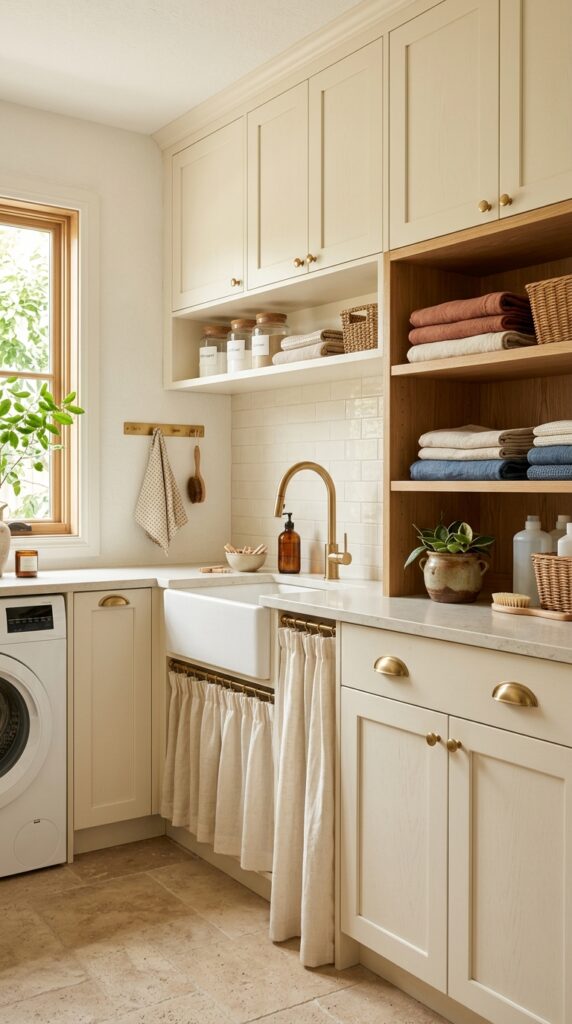
Timeless. White subway tile as a full laundry room backsplash is the single most durable, universally flattering, and resale-value-positive surface upgrade available — it provides a waterproof, splash-resistant, visually clean backdrop that makes every other element in the room look sharper.
The material principle is reflective cleanliness. The slight gloss of white ceramic subway tile reflects ambient light back into the room, brightening the overall space more effectively than flat-painted walls. The grout lines create a subtle texture and grid that reads as architectural detail without visual complexity. The combination of white tile and light gray grout (the classic specification) has been in continuous use since the early 1900s precisely because it consistently produces a clean, fresh, high-contrast result that ages without dating.
Use Daltile “Arctic White” 3×6-inch ceramic tile with Mapei “Warm Gray” unsanded grout at 1/16-inch joints for the crispest modern result. Seal the grout once at installation and annually thereafter to prevent moisture infiltration.
🛍️ Shop the Look — Amazon Product Ideas
| # | Product Search Phrase | Why It Fits |
| 1 | White subway tile 3×6 ceramic box 10 sq ft | Core tile for the backsplash |
| 2 | Light gray grout unsanded 10 lb bag | Classic grout pairing |
| 3 | Tile adhesive mastic premixed white | Tile installation adhesive |
| 4 | Grout sealer penetrating clear spray | Protection after grouting |
| 5 | Tile nipper cutter manual small | Cutting tiles for edges |
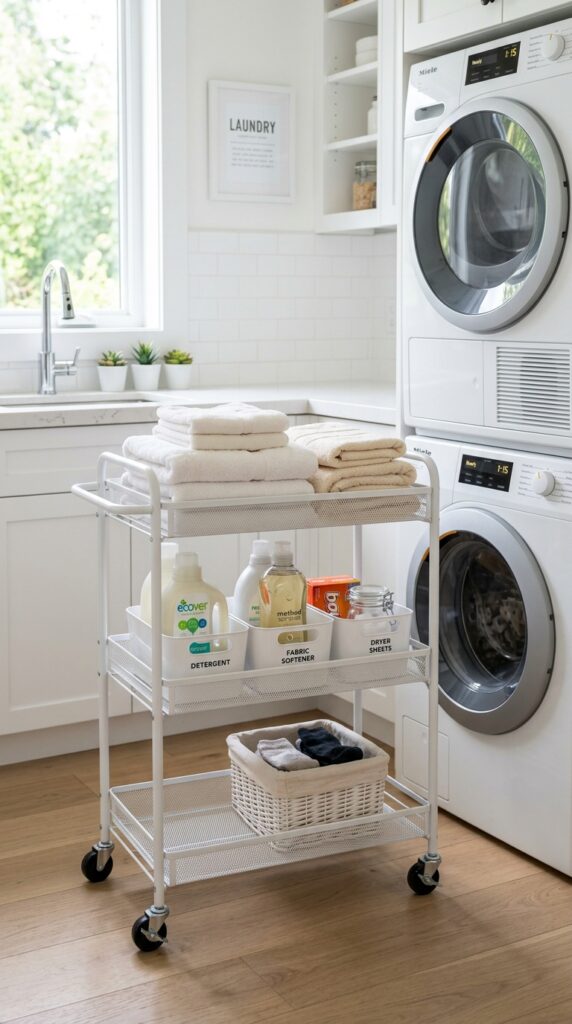
22. Use a Rolling Cart as a Mobile Laundry Station
Mobile. A rolling utility cart as a laundry station brings a level of spatial flexibility that no built-in furniture can: it goes where the work is, parks out of the way when not needed, and functions equally well as a folding surface, a supply station, or a sorted-load transport vehicle.
The design principle is portable function. In a small laundry room where counter space is limited, a cart positioned beside the machines during laundry tasks and rolled to another room for folding transforms a single square footage investment into a multi-location tool. The swivel-lock casters are critical — locking prevents the cart from rolling while in use; swivel allows it to navigate tight spaces. A cart with a solid top surface (not wire mesh) on the top tier functions as a genuine folding surface.
Look for a cart with a solid top shelf (laminate or powder-coated steel) and wire lower shelves for ventilation of laundered items. Maximum width should be 18 inches to allow it to fit between machines and walls in most laundry room configurations.
🛍️ Shop the Look — Amazon Product Ideas
| # | Product Search Phrase | Why It Fits |
| 1 | Rolling utility cart 3 shelf white kitchen laundry | Core mobile station element |
| 2 | Locking swivel caster wheel replacement 2 inch | Wheel quality upgrade |
| 3 | Wire shelf liner non-slip roll white | Surface liner for wire shelves |
| 4 | Small wicker basket for shelf cart | Sorted laundry bin for cart shelf |
| 5 | Hanging fabric bin hook small white | Over-cart-edge hanging bin |
23. Choose Warm White Over Cool White for Cabinetry
Warm. The difference between warm white and cool white cabinetry is the difference between a laundry room that feels clinical and one that feels cared for — and it costs nothing if you’re already planning to paint.
The color temperature principle is undertone awareness. Cool whites (those with blue or gray undertones, like Benjamin Moore “Decorator’s White” OC-149 or Sherwin-Williams “High Reflective White” SW 7757) read as crisp and modern in bright, south-facing rooms — but in the small, often north-facing or interior laundry room, they shift to slightly cold and uninviting. Warm whites (those with yellow or pink undertones, like “White Dove” OC-17 or “Navajo White” OC-95) hold their warmth across all light conditions, making the space feel inhabited and intentional rather than sterile.
The practical test: hold your paint chip next to your machine’s white face panel under the room’s actual lighting. If the cabinet chip looks warmer, it’s the right choice. If it looks identical or colder, go warmer.
💡 Quick Win: A single quart of Benjamin Moore “White Dove” OC-17 in satin finish ($15–20) used to paint just the cabinet doors can completely transform the warmth of an existing laundry room without touching a single wall.
🛍️ Shop the Look — Amazon Product Ideas
| # | Product Search Phrase | Why It Fits |
| 1 | Cabinet door paint warm white satin finish sample | Core color element |
| 2 | Brushed brass cup pull cabinet hardware 3 inch | Warm metal pairing for warm white |
| 3 | Foam roller small cabinet door painting | Tool for streak-free cabinet painting |
| 4 | Cabinet degreaser cleaner pre-paint prep | Prep step before repainting |
| 5 | Linen curtain panel small cream | Replaces lower cabinet doors |
24. Maximize a Closet Laundry with Bifold Door Removal
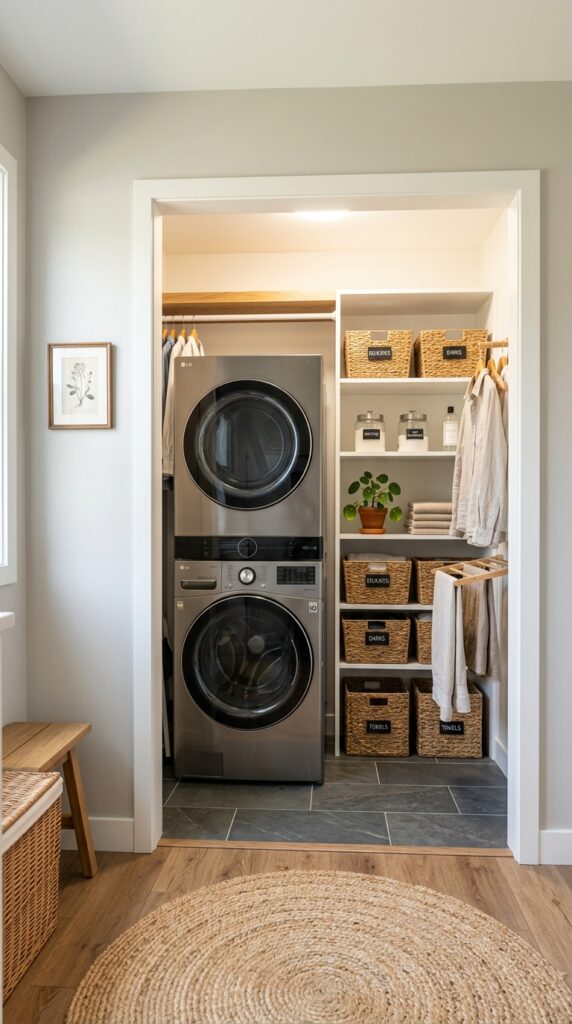
Open. Removing the bifold doors from a closet laundry and leaving the opening clean and frameless is a counterintuitive but highly effective small-space move — it trades concealment for a sense of spatial continuity that makes both the laundry space and the adjacent room feel larger.
The spatial design principle is visual extension. Bifold laundry closet doors, when closed, create a hard visual wall that stops the eye and compresses the adjacent room. When removed, the organized laundry interior becomes a visual extension of the room beyond — provided, critically, that the interior is organized and visually clean. The key condition is that what’s revealed must be worth revealing: consistent baskets, tidy shelving, a clean machine face. A disorganized laundry interior behind removed doors reads as chaos.
Replace the bifold track with a simple painted wood trim strip at the ceiling line, paint the closet interior the same color as the adjacent room, and add a small round rug in front of the opening to define the transition zone visually.
🛍️ Shop the Look — Amazon Product Ideas
| # | Product Search Phrase | Why It Fits |
| 1 | Bifold door hinge removal kit replacement | Removing the existing door hardware |
| 2 | Door casing trim kit white primed MDF | Finishing the closet opening edge |
| 3 | Small round rug cotton braided cream 2 foot | Transition zone floor treatment |
| 4 | Lightweight linen curtain rod pocket panel | Optional soft door alternative |
| 5 | Tension rod curtain mount no drill | Hanging a curtain alternative |
25. Label Everything — Consistently and Beautifully
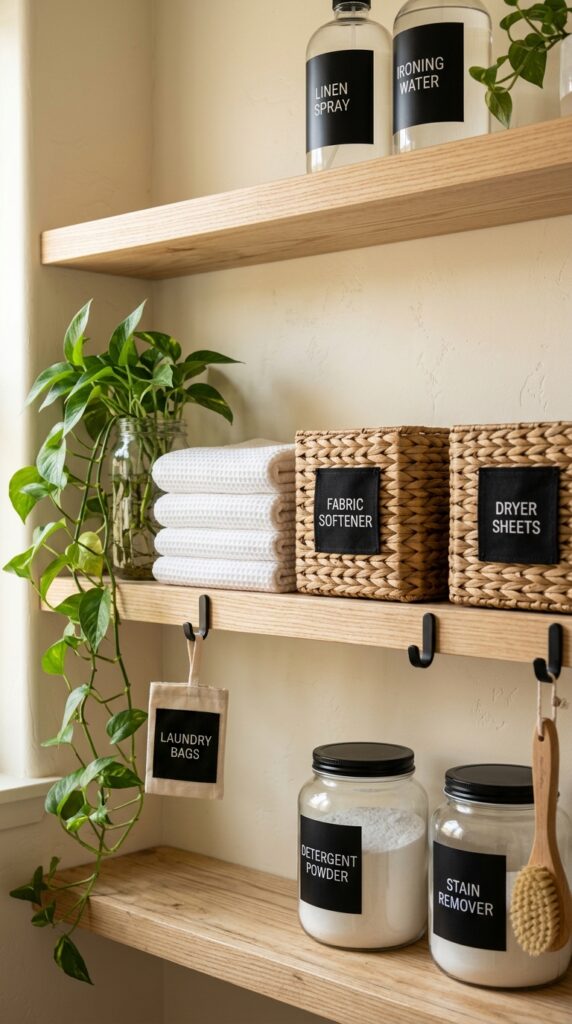
Calm. A consistently labeled laundry room — where every basket, bin, jar, and hook carries a label in the same font, the same size, and the same format — produces a visual calm that is qualitatively different from an organized-but-unlabeled space.
The cognitive design principle is recognition without search. The single biggest contributor to laundry room frustration isn’t mess — it’s friction: not knowing where something is, having to open multiple containers to find the stain remover, putting things back in the wrong place. A consistent labeling system eliminates every one of those frictions simultaneously. Labels also transfer the organizational system to any household member, meaning the system maintains itself rather than requiring constant re-sorting.
Use a DYMO or Brother P-Touch label maker with white tape and black text, or print waterproof labels through a laser printer on clear vinyl sticker stock. Choose one font (Helvetica or a simple sans-serif) and one font size for all labels. Consistency is everything — a mix of handwritten, printed, and chalk labels produces visual noise rather than visual calm.
🛍️ Shop the Look — Amazon Product Ideas
| # | Product Search Phrase | Why It Fits |
| 1 | Label maker machine tape black on white dymo | Label creation tool |
| 2 | Clear vinyl label sticker sheet waterproof printable | Print-at-home label alternative |
| 3 | Chalkboard label oval self-adhesive set | Chalk-fill label style option |
| 4 | Kraft paper hang tag string label set | Tag-style label for baskets |
| 5 | Brother P-touch label maker refill white tape | Replacement tape for label maker |
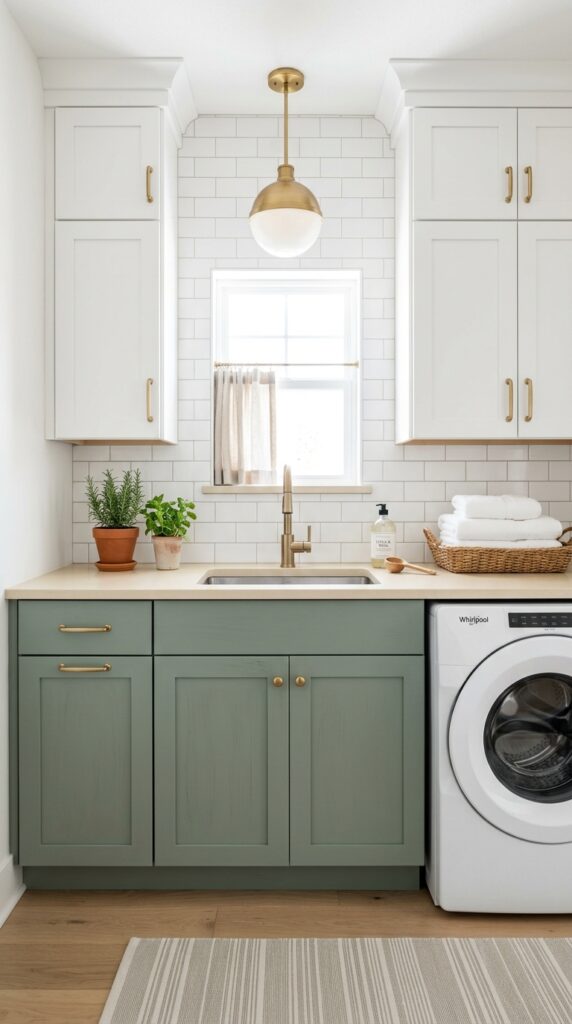
26. Use Sage Green Cabinetry as an Unexpected Accent
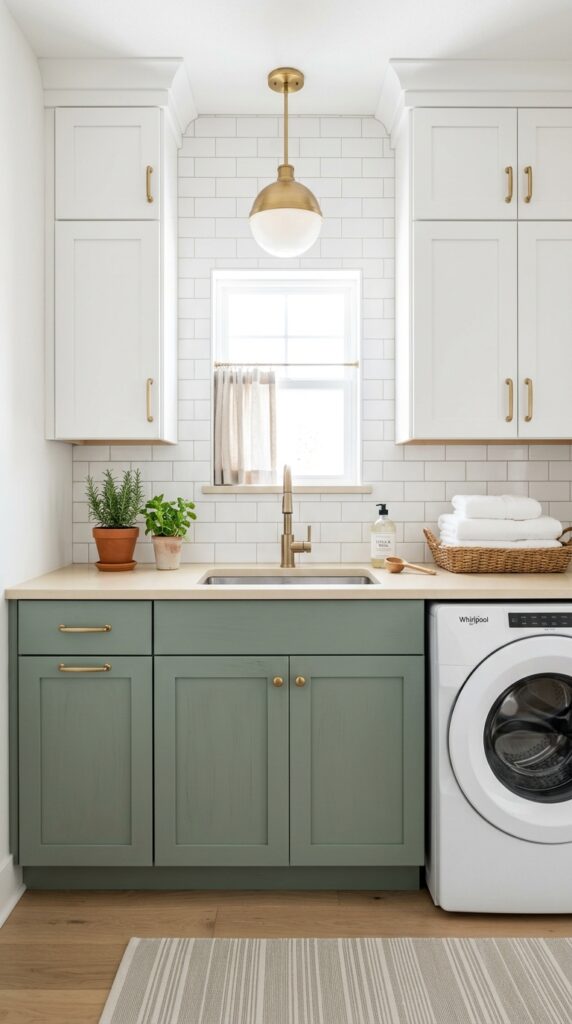
Fresh. Sage green on the lower cabinets, white on the uppers — the two-tone cabinet treatment that has defined the most shared-worthy laundry rooms of the past three years — delivers a color story that feels both unexpected and completely natural.
The design principle is grounded contrast. Two-tone cabinetry works by placing the darker, richer tone at a lower visual weight (bottom cabinets) and the lighter, airier tone at the ceiling level (upper cabinets) — mirroring the natural distribution of color in the landscape (dark earth below, bright sky above). This arrangement never reads as top-heavy or visually unstable. Sage green specifically hits the sweet spot between cool and warm, natural and designed, trending and enduring.
Paint lower cabinets with Farrow & Ball “Mizzle” No. 266 or Sherwin-Williams “Softened Green” SW 6177 in an eggshell finish. Upper cabinets in Benjamin Moore “Chantilly Lace” OC-65. Brushed brass hardware on both tiers ties the two tones together.
🛍️ Shop the Look — Amazon Product Ideas
| # | Product Search Phrase | Why It Fits |
| 1 | Cabinet paint sage green matte eggshell interior | Core color for lower cabinets |
| 2 | Brushed brass bin pull cabinet hardware | Hardware that bridges both tones |
| 3 | Cabinet painting kit roller brush foam set | Tool set for cabinet repainting |
| 4 | White interior paint eggshell gallon | Upper cabinet color |
| 5 | Small ceramic herb planter counter white | Counter accent against sage cabinets |
27. Install a Wall-Mounted Lint Trap and Cord Management System
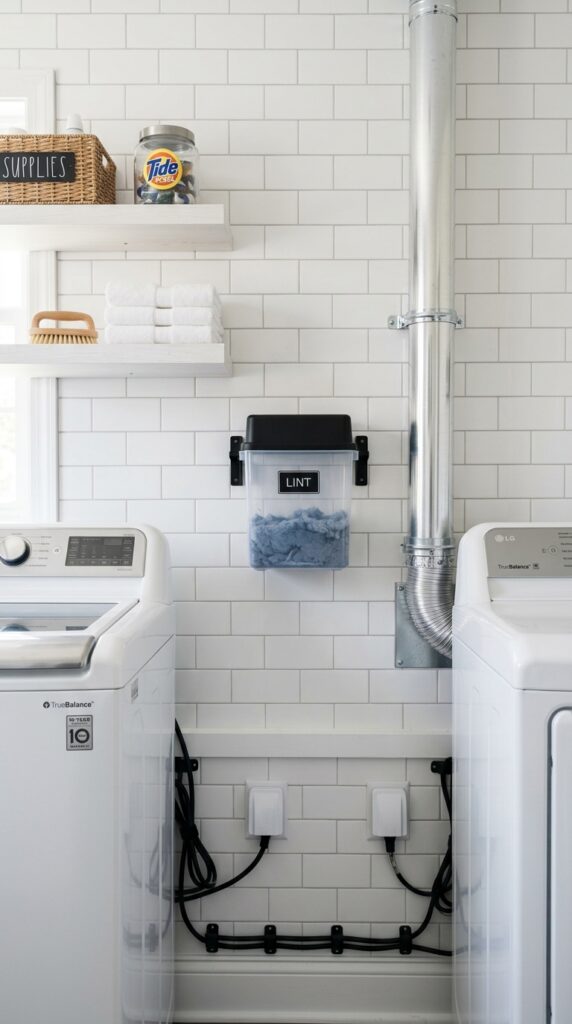
Systematic. Managing the cord and vent situation behind laundry machines — the most visually chaotic and spatially wasteful element of any laundry installation — immediately raises the perceived quality of the entire room.
The design principle is hidden infrastructure. The mess of electrical cords, water inlet hoses, dryer vent ducting, and machine feet adjustments that live behind most washers and dryers is purely a symptom of unmanaged installation. None of it is necessary. Cord management clips mounted to the baseboard behind the machines route electrical cords flush to the wall; a flat rigid dryer vent (instead of the corrugated flexible foil type) reduces the depth required behind the machine by 2–4 inches; a wall-mounted lint trap canister keeps the area beside the dryer clear. These are 2-hour fixes that make a significant visual impact.
The flat rigid dryer vent is the highest-impact single change: it allows machines to sit 2–4 inches closer to the wall, gaining usable room depth without any other modification.
💡 Quick Win: A set of self-adhesive cord management clips ($8–12) along the baseboard behind the machines takes 15 minutes to install and permanently eliminates the cord tangle that makes the back of a laundry installation look unfinished.
🛍️ Shop the Look — Amazon Product Ideas
| # | Product Search Phrase | Why It Fits |
| 1 | Flat rigid dryer vent periscope kit | Space-saving vent behind machine |
| 2 | Cord management clips adhesive baseboard | Routing cords flush to the wall |
| 3 | Wall mount lint trap canister dryer | Catches lint at the vent exit |
| 4 | Washing machine anti-vibration pad feet | Reduces machine noise and movement |
| 5 | Cable tie reusable velcro cord wrap pack | Bundling hoses and cords |
28. Add a Small Potted Plant or Trailing Herb for Life
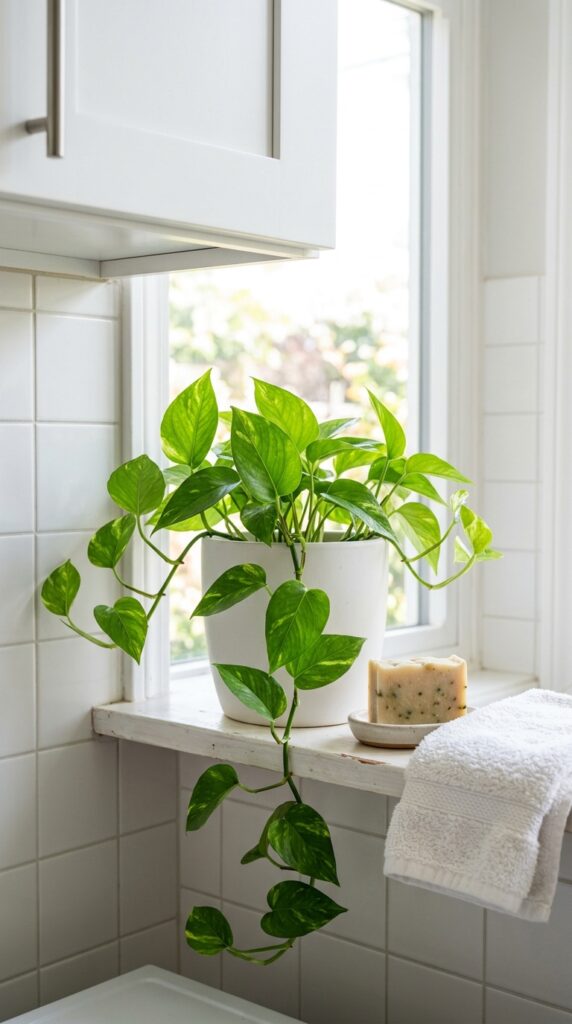
Alive. A single plant in a laundry room does something no storage solution, paint color, or tile pattern can: it signals that this is a living, tended space — not a utility closet — and it brings a quality of freshness that resonates every time you walk in.
The design principle is biophilic contrast. Green against white is one of the most universally pleasing color relationships in interior design — the vibrancy of green becomes more saturated when surrounded by a neutral white field, and the white reads as cleaner when adjacent to organic green. In a small laundry room where the palette is necessarily restrained (white, gray, natural materials), a single plant provides the only living element and anchors the entire space emotionally.
Choose a plant species that tolerates low light and high humidity: golden pothos is the most forgiving (practically indestructible, trails beautifully from a high shelf), spider plants tolerate humidity without root rot, and a small potted rosemary or mint brings both visual and olfactory freshness. Avoid plants that need high light unless there’s a real window.
🛍️ Shop the Look — Amazon Product Ideas
| # | Product Search Phrase | Why It Fits |
| 1 | Golden pothos live plant small pot | Ideal low-light laundry room plant |
| 2 | White ceramic plant pot matte small 4 inch | Simple pot that suits every style |
| 3 | Plant propagation station glass wall mount | Trailing propagation display |
| 4 | Self-watering planter insert small | Low-maintenance watering solution |
| 5 | Eucalyptus bar soap natural laundry room | Scent accent beside the plant |
29. Use a Curtain Instead of Cabinet Doors Below the Counter
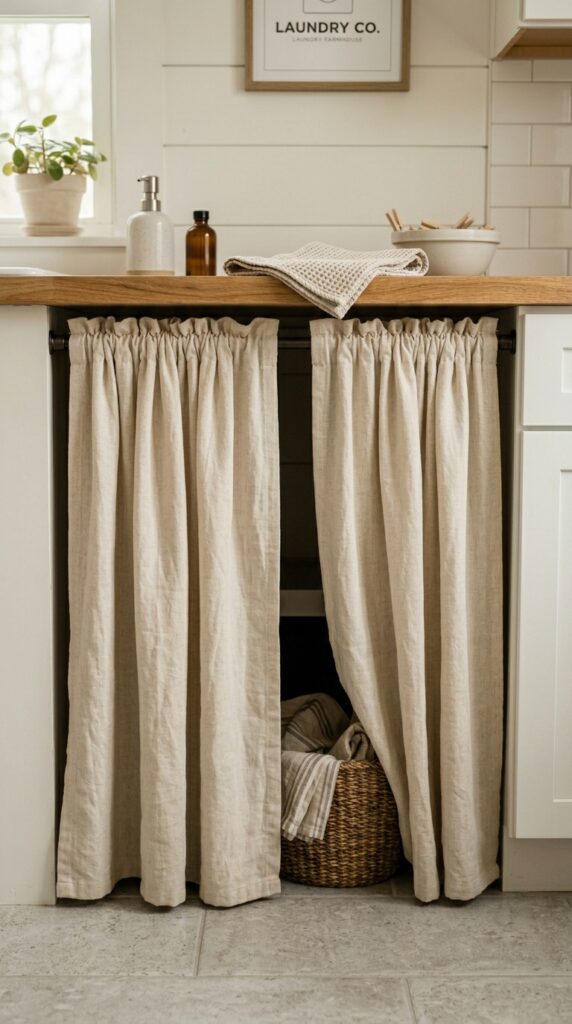
Soft. Replacing lower cabinet doors with a gathered linen curtain is the oldest storage concealment technique in the design book — and it’s still one of the most effective for small laundry rooms because it softens the space, adds textile texture, and costs under $30 to execute.
The design principle is material contrast through softness. A laundry room is typically dominated by hard surfaces — tile, machine enamel, laminate, painted MDF. A gathered fabric curtain introduces the only soft, draped, textile element in the room, which the eye reads as warmth and domesticity. It also allows hidden storage that is easier to access than hinged cabinet doors (no opening hardware, no door swing clearance required) and infinitely easier to update.
Use a 3/4-inch tension rod mounted inside the cabinet opening (no drilling, no tools), with a 45-inch-wide linen or cotton canvas panel gathered loosely onto it. The curtain should fall to 1 inch above the floor for a clean, finished hem line. Natural linen in undyed cream is the most versatile option.
🛍️ Shop the Look — Amazon Product Ideas
| # | Product Search Phrase | Why It Fits |
| 1 | Tension rod under counter curtain 24-36 inch | No-drill curtain mounting |
| 2 | Linen curtain panel cream ungrommet rod pocket | Soft concealment curtain |
| 3 | Cotton canvas fabric by yard natural undyed | DIY curtain material |
| 4 | Curtain rod clip ring set bronze | Alternative curtain mounting hardware |
| 5 | Cotton twine tassel curtain tie back | Curtain styling detail |
30. Add a Simple Framed Print or Typography Sign
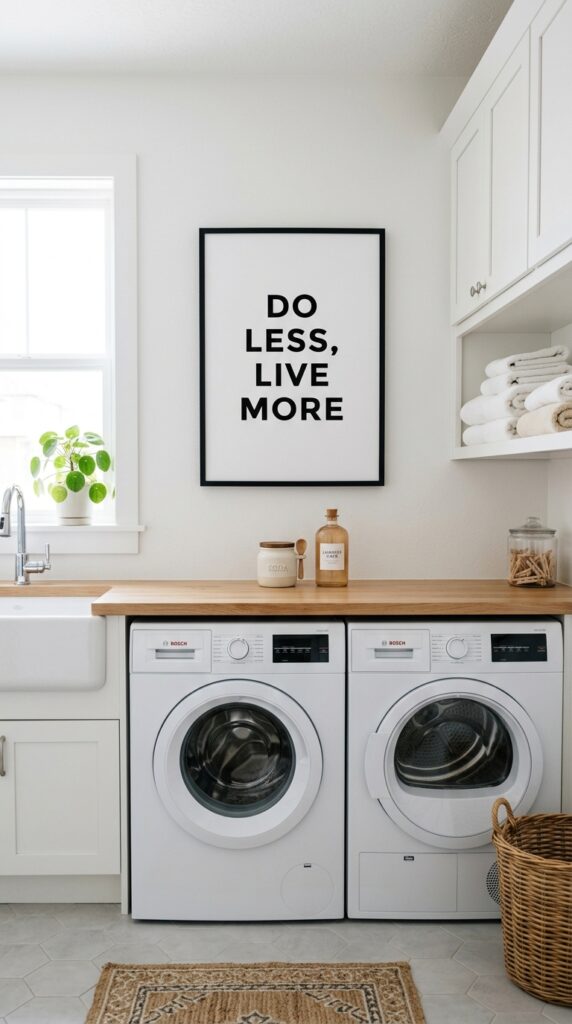
Personal. A single framed print on a laundry room wall is the detail that signals the space is finished — not merely organized — and it costs less than any other item on this list.
The design principle is completion through personality. Every well-designed interior requires at least one element that communicates something about the people who inhabit it — a color choice, a material preference, a piece of art, a motto. In a utility room where every other decision is driven by function, a single framed print provides that essential human signal. It says: someone chose this. It was considered. It’s not just a place to do laundry; it’s a room.
Choose a print in a style that matches the room’s overall palette — a clean sans-serif typography print in black and white for a modern minimalist laundry room; a botanical illustration in sage and cream for a farmhouse-style room. Keep the frame simple: a thin black steel or natural wood frame in 8×10 or 5×7 is enough. Hang it at eye height, level. That’s the entire instruction.
💡 Quick Win: A free printable art file (available through Etsy’s digital download section for $1–5) printed at a local print shop for $3–5 and placed in a $10 frame from IKEA creates a finished, styled wall moment for under $15 total.
🛍️ Shop the Look — Amazon Product Ideas
| # | Product Search Phrase | Why It Fits |
| 1 | Black thin frame 8×10 wall art display | Core framing element |
| 2 | Laundry room typography print wall art | Ready-made art print |
| 3 | Botanical print laundry room sage neutral | Alternative art style |
| 4 | Command strip large adhesive picture hang | No-nail mounting |
| 5 | Digital download print laundry room Etsy | Inexpensive customizable art source |
How to Start Your Small Laundry Room Transformation
Begin with the stacking decision. If you have front-load machines and haven’t stacked them yet, that single move — installing a $40 stacking kit — is the highest-leverage first step available, because it reconfigures the entire room’s layout potential. It’s the anchor decision that determines where the folding counter goes, where the vertical shelving lands, and how much floor space is available for everything else. Every subsequent decision in this article becomes easier to execute once the machines’ footprint is resolved.
The most common mistake beginners make is buying mismatched storage containers before establishing a system. Four different basket shapes, three different colors, and two different materials on the same shelf creates visual chaos that defeats the purpose of organizing. Fix it by choosing one basket style and buying a full set before placing anything — even if that means temporarily using cardboard boxes while the proper baskets arrive.
Three items under $50 that create immediate laundry room impact: a set of four matching seagrass baskets in one consistent size (transforms any shelf from chaotic to considered for around $40); a heavy-duty tension rod at ceiling height for hang-drying (under $20 and eliminates the floor-standing rack permanently); and a small packet of waterproof labels printed in black on clear vinyl (under $10, and labels the entire system in an afternoon).
A realistic small laundry room transformation takes one weekend for the organizing and styling work — sorting, decanting, labeling, and hanging new storage. Paint and tile work adds 2–3 days of prep, cure, and drying time. A starter version (organization, baskets, labels, one accent element) runs $100–250. A full transformation with paint, new hardware, a countertop, and lighting realistically costs $400–1,200 for a DIY approach.
Frequently Asked Questions About Small Laundry Room Design
What’s the difference between a laundry room and a laundry closet, and do the same ideas apply?
A laundry room is a dedicated enclosed room with a door, typically 35–80 square feet, that may include a sink, cabinetry, and full-size appliances side by side. A laundry closet is a recessed or alcove space, typically 15–30 square feet, often with bifold or sliding doors and stacked or side-by-side machines in a tighter configuration. Most of the 30 ideas in this article apply to both — vertical storage, tension rods, rolling carts, labeling systems, and fold-down ironing boards are all size-agnostic. The ideas that require more space (a utility sink, a full island countertop) are better suited to laundry rooms; stacking and gap-filler carts are most impactful in closet configurations.
What colors make a small laundry room feel bigger?
Warm whites — Benjamin Moore “White Dove” OC-17 or Sherwin-Williams “Alabaster” SW 7012 — are the most reliably space-expanding choices because their yellow undertone keeps them bright across all light conditions without reading as sterile. The ceiling-same-as-wall technique (painting both in the same warm tone) is more effective at visually enlarging a small room than the standard white-ceiling approach, because it eliminates the horizontal line the eye uses to judge the room’s height. Reflective surfaces — subway tile, gloss laminate countertops, chrome hardware — also bounce light and add perceived depth.
How much does a small laundry room makeover realistically cost?
A budget-tier refresh — new baskets, labels, tension rod, paint — runs $100–300 and can be completed in a weekend. A mid-range renovation with new hardware, countertop, a fold-down drying rack, and possibly a pendant light costs $400–900. A higher-end project that includes new cabinetry, tile flooring, stacked machine conversion, and a utility sink typically runs $1,500–4,000 for a DIY-managed project, or $4,000–10,000 with professional installation. The items with the best return on investment at every budget level are the labeling system, the basket organization, and the paint color — all under $150 combined.
Can these small laundry room ideas work in a rental apartment where I can’t make permanent changes?
Yes — the majority of ideas in this article require no permanent modification. Tension rods, rolling carts, peel-and-stick tile (floor and backsplash), removable wallpaper, adhesive Command hooks, fold-flat drying racks, and matching storage baskets all install and remove without wall damage. The ideas that require drilling (wall-mounted fold-down ironing boards, recessed niches, barn door hardware) are the exceptions. Even paint is possible in many rentals with landlord permission; if not, peel-and-stick shiplap panels and removable wallpaper replicate most of the same visual effects.
What’s the best flooring for a small laundry room?
Ceramic or porcelain tile is the most practical choice for a permanent small laundry room floor — it’s waterproof, highly durable, easy to clean, and resale-positive. The black and white checkerboard in 4-inch ceramic tiles is particularly well-suited to the scale of a small laundry room. For renters or those wanting a faster solution, luxury vinyl plank (LVP) in a 6-inch-wide plank format is waterproof, installs as a floating floor without adhesive, and can be removed cleanly. Avoid laminate (not waterproof), standard hardwood (warps with humidity), and carpet (impractical in a water-adjacent space).
Ready to Create Your Dream Small Laundry Room?
These 30 ideas span color strategy, spatial layout, material choices, vertical storage solutions, lighting upgrades, and small-space furniture — the complete toolkit for a laundry room that works as hard as it looks. The transformation doesn’t require executing all 30 at once; choosing the one idea that solves your most pressing friction point — the floor-space loss, the supply chaos, the dim lighting — and doing it completely is exactly the right place to start. This weekend, tackle the basket system: choose one basket style, buy a full matching set, and replace whatever mismatched containers are currently on your shelves. That single afternoon’s work will change how the room feels every time you walk in. A small laundry room that has been genuinely thought about — where the baskets match, the labels are consistent, the surfaces are clean, and at least one element makes you quietly glad to be there — turns one of the home’s most resented chores into something that feels almost effortless. Save the ideas that made you pause — the sage green cabinet, the tension rod, the checkerboard floor — those are the ones your small laundry room has been waiting for.