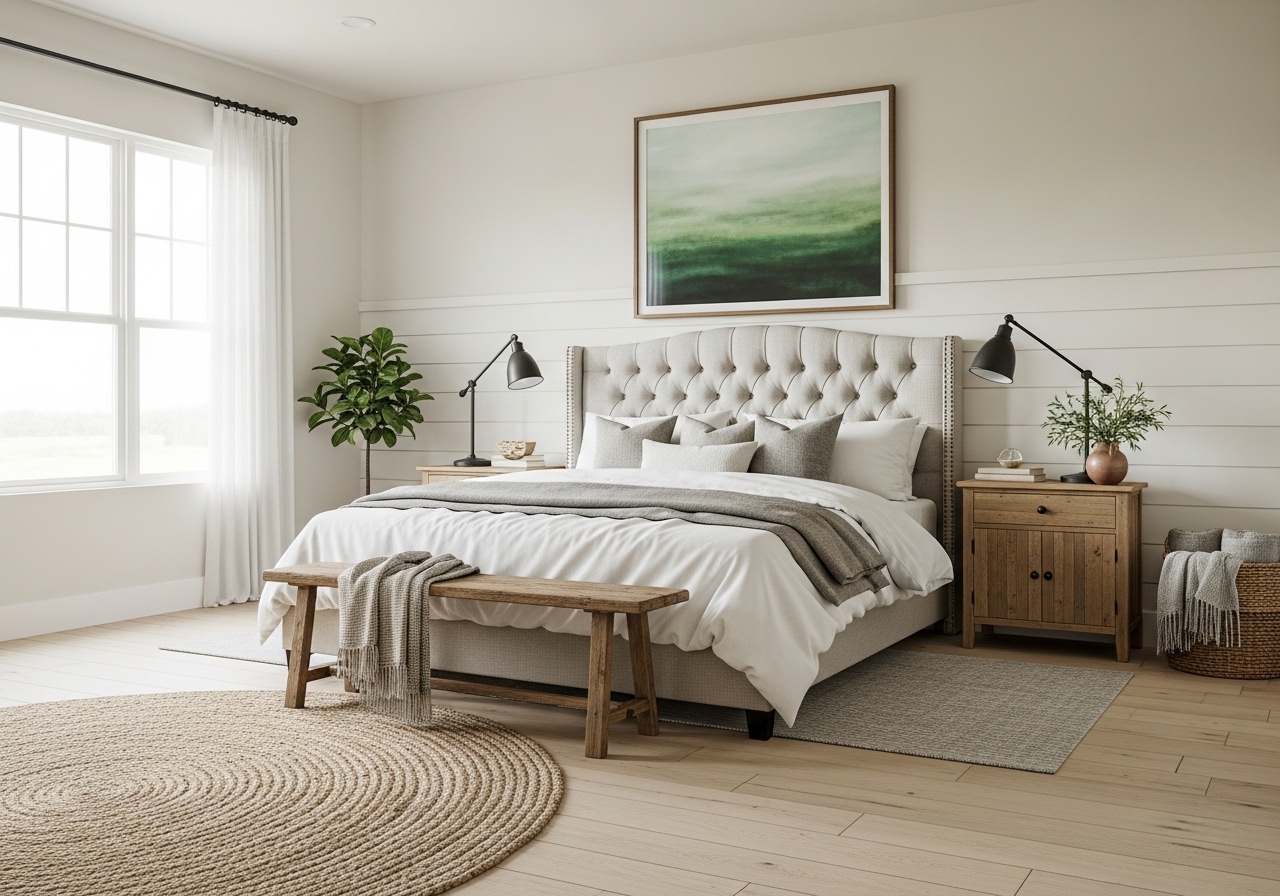
Modern farmhouse is the design style that blends rural American heritage with clean contemporary lines — think shiplap walls and linen bedding alongside streamlined furniture and matte black hardware. These 20 ideas show you exactly how to pull off that balance, from statement headboards to layered textiles, without the space feeling dated or overdone.
There’s something quietly magnetic about a modern farmhouse bedroom done right. It carries the warmth of worn wood and woven textures, the stillness of a neutral palette pulled straight from the land outside — but with enough restraint and intention that it never tips into “country cute.” Light falls softer here. Mornings feel slower. The whole room breathes.
Here are 20 ideas worth saving — and stealing.
Why Modern Farmhouse Works So Well
Modern farmhouse design emerged from the collision of two forces: the enduring American romance with rural simplicity and the mid-2010s appetite for interiors that felt livable rather than decorated. Distinct from purely rustic farmhouse (which leans heavily into antiques and raw imperfection) and from industrial farmhouse (which prioritizes metal over warmth), modern farmhouse finds its identity in the edit — keeping what feels authentic, removing what feels fussy.
The palette is anchored in warm whites and soft greiges — think Benjamin Moore “White Dove” or Sherwin-Williams “Alabaster” — layered with warm charcoal, dusty taupe, and occasional muted black accents. Materials are honest and touchable: shiplap or board-and-batten walls, unfinished white oak or reclaimed pine, undyed Belgian linen, chunky cotton-knit throws, and brushed brass or matte black hardware. These aren’t trend materials — they’re materials with history, and that’s exactly why they work.
Post-pandemic living reshaped how people think about their bedrooms. The room shifted from sleep space to retreat, and modern farmhouse answered that shift better than almost any other style. Its warmth makes the room feel genuinely restful; its restraint keeps it from feeling cluttered. Pinterest search volume for “modern farmhouse bedroom” has remained in the top 10 home decor searches consistently since 2021 — the appetite hasn’t cooled.
Small bedrooms can absolutely carry this style. Prioritize one anchor piece — a plank wall, a shiplap headboard, or a linen upholstered bed — and build outward. The style’s neutral palette is inherently space-expanding, and its reliance on texture over pattern means you can layer without visual noise.
Style at a Glance
| Element | Core Trait | Modern Influence |
| Philosophy | Warmth through imperfection | Edited simplicity |
| Materials | Reclaimed wood, linen, cotton | Matte black metal, white oak |
| Color Palette | Warm white, greige, soft charcoal | Dusty taupe, muted black accents |
1. Shiplap Accent Wall Behind the Bed
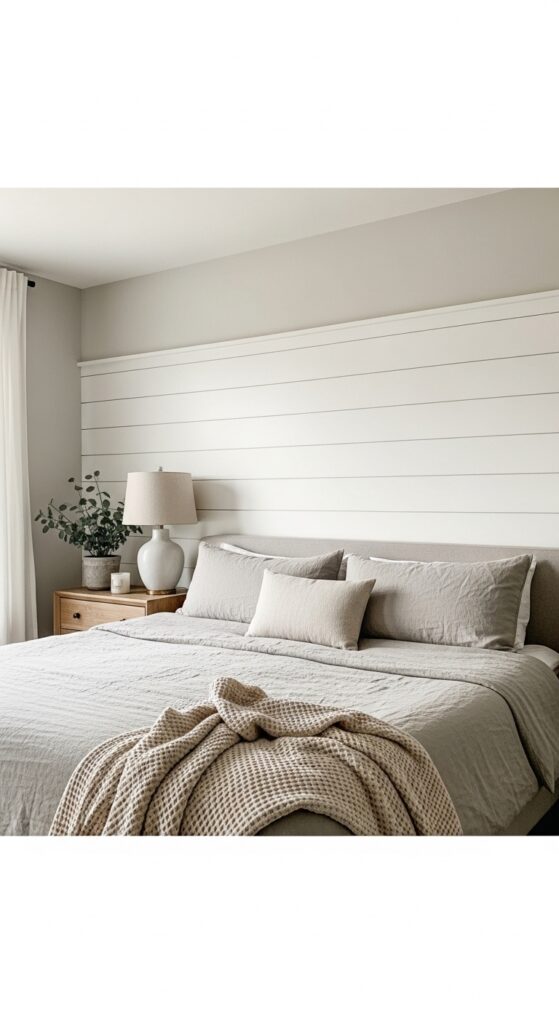
Vibe: Still and sun-warmed, the kind of wall that makes the whole room exhale.
Why it works: Shiplap introduces horizontal rhythm that visually widens a room — a principle called directional line — while the shallow shadow gaps between planks add texture without the visual weight of darker materials. Painted in a warm white like Benjamin Moore “Chantilly Lace” rather than a stark cool white, the boards glow rather than glare. The wall does the decorating so the furniture doesn’t have to.
How to get it: Install ⅜-inch pine boards with ⅛-inch gaps using a spacer; prime before painting to prevent bleed-through. If DIY installation isn’t an option, peel-and-stick shiplap panels from Amazon or Home Depot (around $40–$60 per pack) replicate the look convincingly on a rental-friendly budget.
💡 Quick Win: Paint existing shiplap in warm white rather than bright white — the warm undertone is what makes the whole palette feel cohesive rather than sterile.
2. Linen Upholstered Bed in Warm Greige
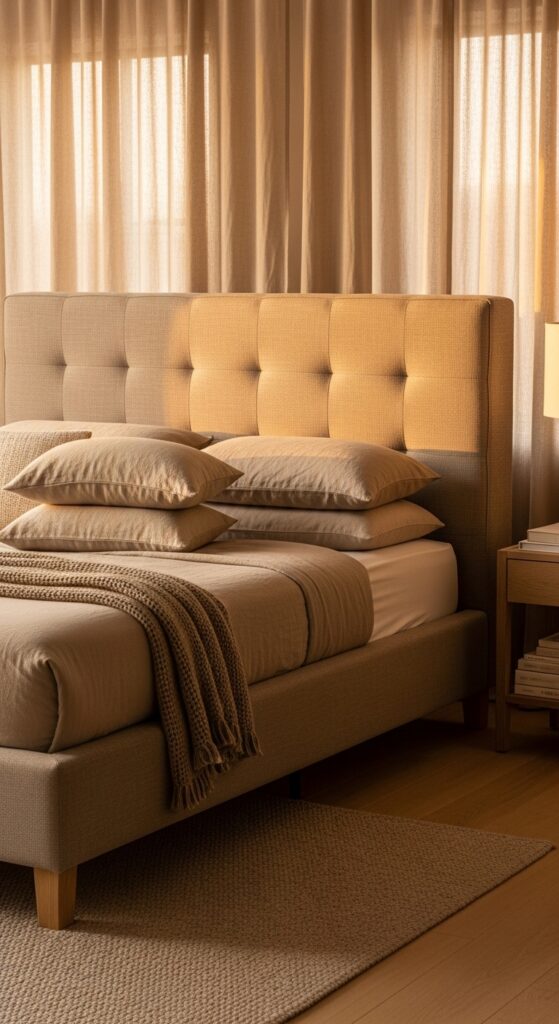
Vibe: Grounded and unhurried — a bed that looks like it belongs exactly where it sits.
Why it works: The upholstered headboard acts as a visual anchor for the whole room, giving the eye a place to land without requiring art or additional wall decor. Linen specifically works in modern farmhouse because its natural nubs and slight irregularity read as organic rather than manufactured — it carries texture without pattern, which keeps the palette calm. A tall headboard in a low-ceilinged room also draws the eye upward, adding perceived height.
How to get it: Look for beds with visible wood legs in natural oak rather than painted legs — this detail adds the material layering the style depends on. McGee & Co’s “Maren Bed” and IKEA’s TUFJORD are both strong options at opposite price points.
3. Warm Charcoal Walls With White Oak Furniture
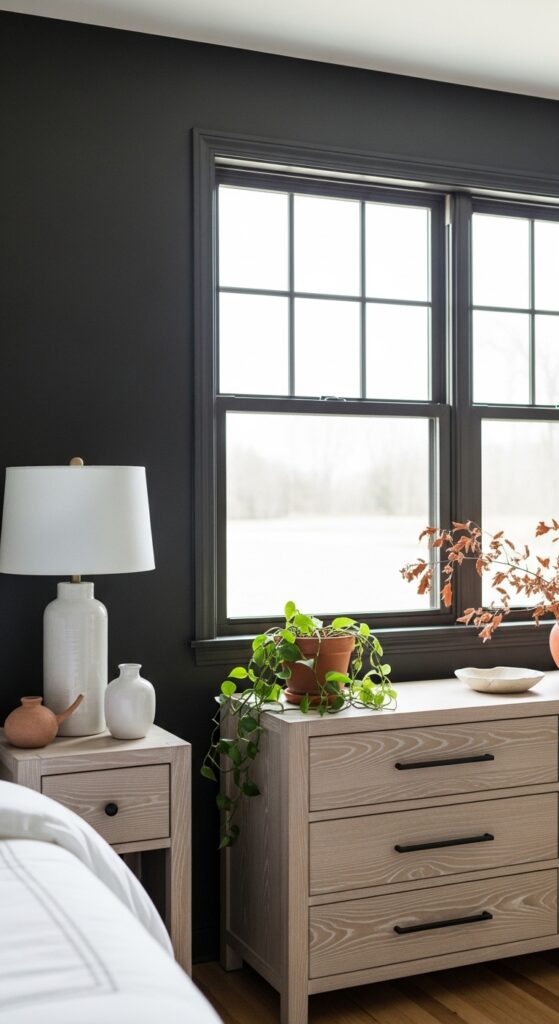
Vibe: Raw and confident — a room that commits to contrast and wins.
Why it works: Pairing a dark wall with light wood furniture exploits the design principle of tonal contrast — the warm charcoal recedes, making the white oak pieces read as lighter, almost luminous. This is counterintuitive for small rooms, but dark walls actually make dimensions less legible, which can make a room feel more expansive when done correctly. Sherwin-Williams “Urbane Bronze” is the go-to for this specific warm-without-being-gray charcoal effect.
How to get it: The key is keeping textiles white or near-white — introduce color only through natural materials like terracotta pots or a dried botanical arrangement. If the charcoal reads cold in your light, it means the wall paint has a blue or green undertone; switch to a paint with an LRV between 20–30 with a brown base.
💡 Quick Win: A single white ceramic vase on a dark charcoal wall creates more visual impact than five pieces of framed art — start there.
4. Pendant Bedside Lighting Instead of Table Lamps
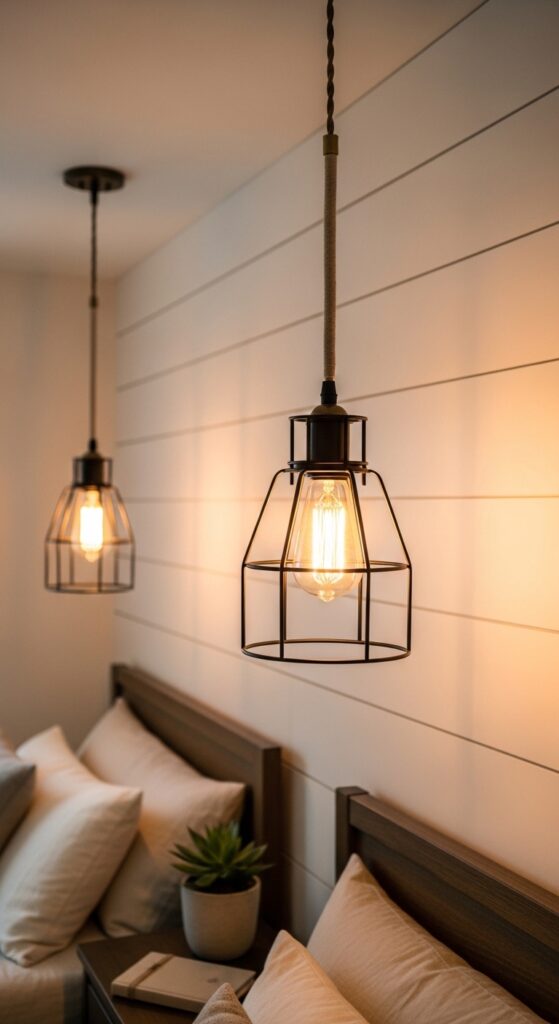
Vibe: Hushed and intimate, like a boutique hotel that somehow still feels like home.
Why it works: Pendant lights hung at bedside free up nightstand surface area — a practical win — while also drawing the eye upward and making ceilings feel taller. The deliberate contrast between matte black metal and a warm white wall is exactly the kind of tonal punctuation that gives modern farmhouse its “edited” quality. A cage pendant with an exposed Edison bulb references industrial history while keeping the silhouette light and open.
How to get it: Hang pendants so the bottom of the shade sits at approximately 60 inches from the floor, or just above shoulder height when seated in bed. Schoolhouse Electric’s “Rejuvenation” line has plug-in versions that require no electrician — a genuine weekend upgrade for under $120 per light.
5. Layered Neutral Bedding in Three Textures
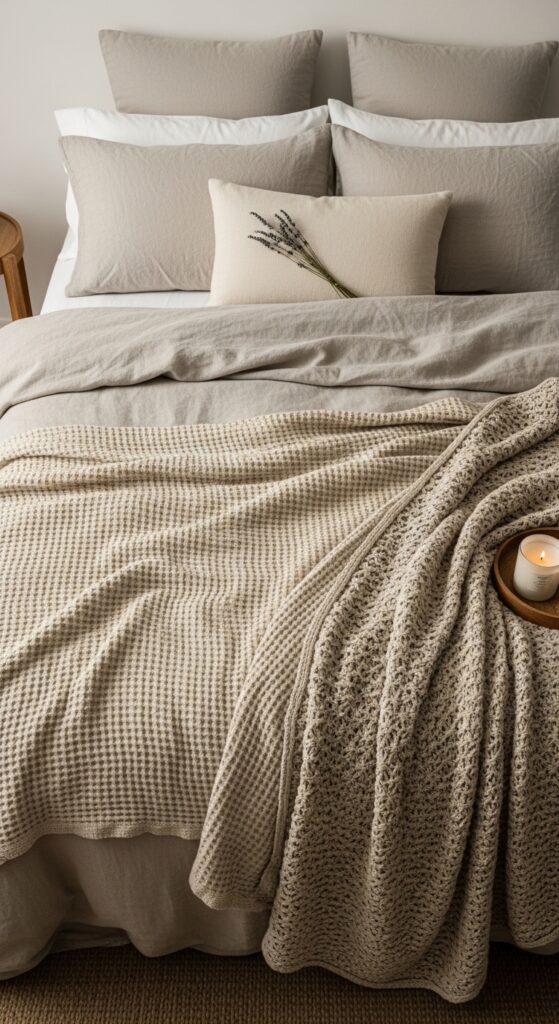
Vibe: Layered and still, like a bed that’s been slept in and lovingly remade.
Why it works: Texture layering is the cornerstone technique of modern farmhouse styling — it creates visual richness within a restricted palette, so the room feels full without feeling busy. The principle is to combine at least three distinct weave structures: something smooth (linen duvet), something woven (waffle blanket), and something dimensional (chunky knit throw). Keeping all three in the same tonal family — oatmeal to warm cream to soft charcoal — means they harmonize rather than compete.
How to get it: Start with a linen duvet cover in undyed or oatmeal tone (Cultiver and Parachute both do this well), then layer a Turkish cotton waffle blanket folded across the lower third of the bed, and drape a chunky knit throw casually over one corner. The asymmetry is deliberate — it signals relaxed rather than decorated.
💡 Quick Win: A $28 waffle-knit throw from H&M Home in “natural” instantly adds that layered texture the style depends on — fold it in thirds and drape it across the foot of the bed.
6. Reclaimed Wood Floating Nightstands
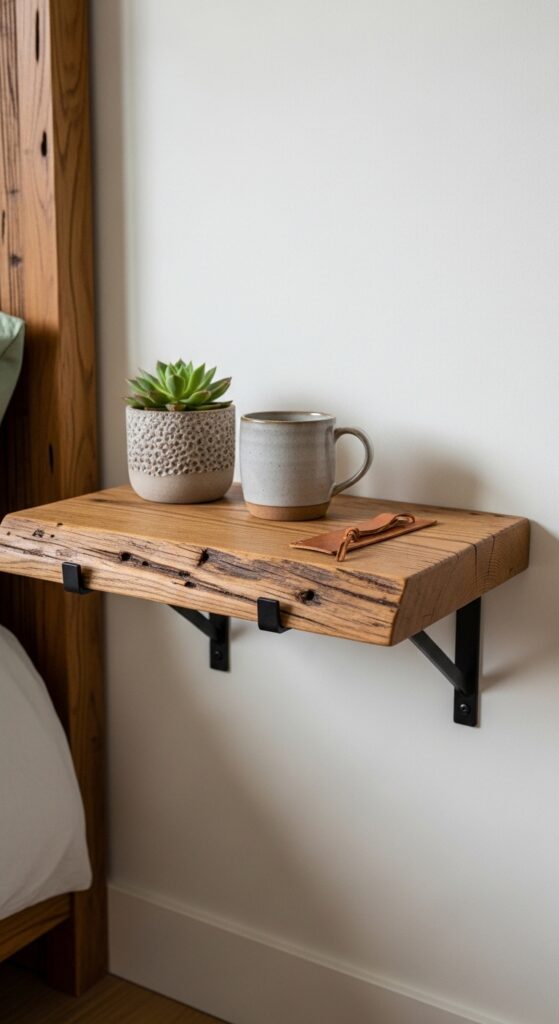
Vibe: Sun-warmed and unassuming — a piece that looks like it has a story.
Why it works: Floating nightstands create negative space below them, which makes the floor plane feel larger — a layout principle that matters especially in smaller rooms. Reclaimed wood specifically earns its place in modern farmhouse through its authentic imperfection: the knots, grain variation, and age marks are the texture. A wall-mounted bracket in matte black ties the piece to the hardware language used elsewhere in the room without adding visual bulk.
How to get it: Source reclaimed pine slabs from a local lumber salvage yard (typically $15–$40 per board) and pair with floating shelf brackets from IKEA’s SANDSHULT line. Sand lightly, apply a single coat of tung oil, and mount at elbow height from the mattress top — approximately 24–26 inches from the floor.
7. Warm White + Dusty Sage Two-Tone Palette
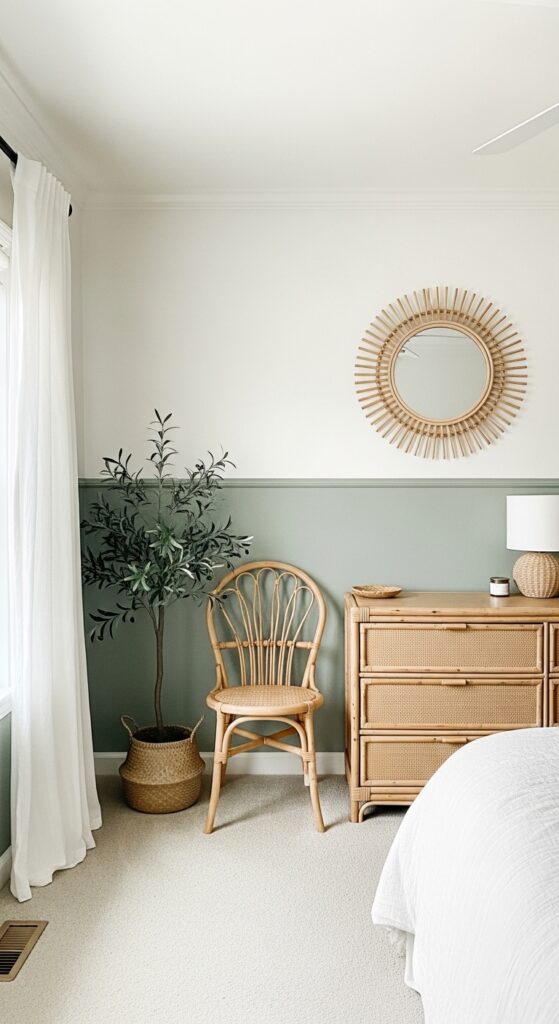
Vibe: Luminous and rooted, the color equivalent of a deep breath.
Why it works: The two-tone technique — a lighter tone above and a grounded tone below — uses the principle of visual weight to anchor a room while keeping it open. Dusty sage (try Sherwin-Williams “Privilege Green” or Benjamin Moore “Soft Fern”) works specifically because its gray undertone bridges the gap between the earthy warmth of farmhouse and the restraint of modern. It reads differently under warm versus cool light, so it shifts the room’s mood across the day without you changing a thing.
How to get it: Divide the walls at chair rail height (approximately 36 inches from the floor). Paint below the rail in your sage tone, above in warm white — but use the same finish (eggshell) on both to keep the transition subtle rather than jarring. This palette works best in rooms with south or west-facing light; without warmth in the light, the sage can read blue-green.
💡 Quick Win: Test your sage choice on a 12×12 inch poster board first, and move it around the room at different times of day — muted greens shift dramatically under artificial versus natural light.
8. Barn-Style Sliding Closet Door
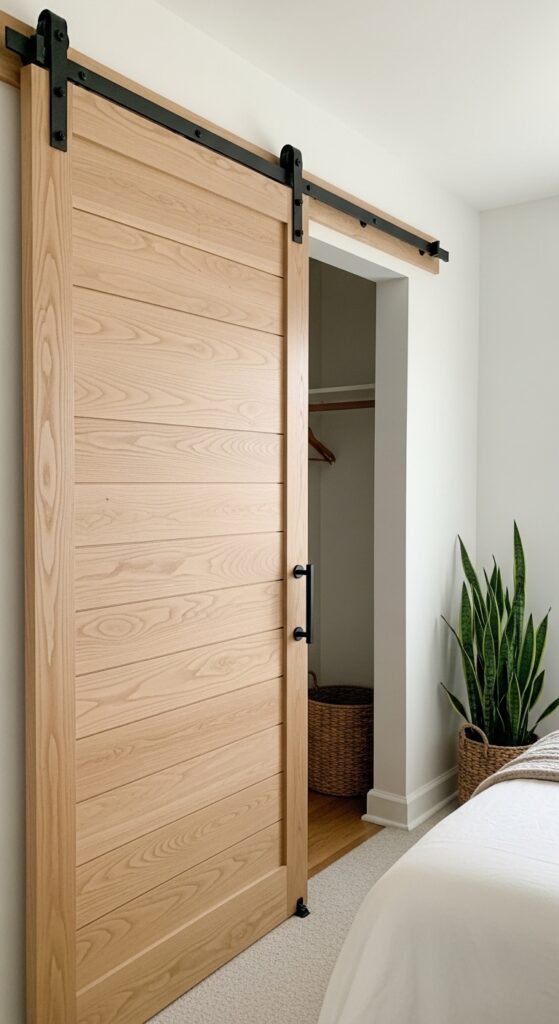
Vibe: Architectural and purposeful — a door that earns its role as a design statement.
Why it works: A barn door solves a real functional problem (swing clearance in tight spaces) while simultaneously acting as the room’s most distinctive material moment. The exposed iron track hardware adds the contrast detail that modern farmhouse depends on — raw metal against clean wood, form made visible. When the door is built in horizontal planks rather than a flat panel, it echoes the shiplap language of the style without being literal.
How to get it: Pre-built barn door kits from Amazon or Wayfair start around $180–$250 for the door panel and track hardware combined. Stain in Minwax “Early American” for a warm mid-tone oak look that photographs well and ages gracefully.
9. Rattan or Wicker Mirror as Focal Point
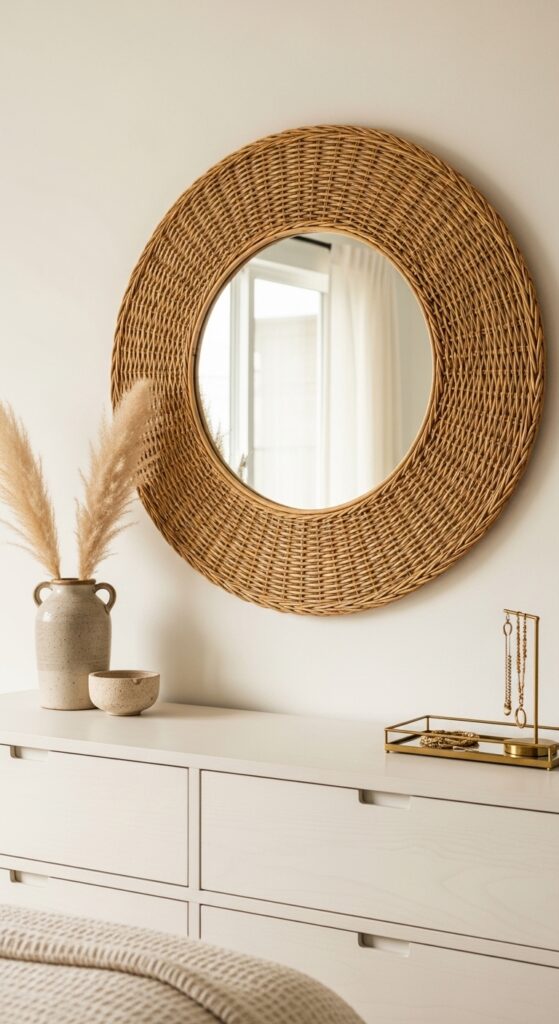
Vibe: Organic and quietly luminous — a mirror that gives as much as it reflects.
Why it works: A round rattan mirror introduces a curved organic silhouette into a room that otherwise tends toward horizontal lines — this contrast of forms is what keeps modern farmhouse from feeling rigid. Natural rattan is also a light-reactive material: it shifts from golden in warm afternoon light to soft honey in the morning, which means it actively changes the room’s warmth across the day. Functionally, a mirror placed above a dresser borrows light from the window and distributes it deeper into the room.
How to get it: Size matters here — go for a minimum 30-inch diameter, ideally 36 inches, to create real visual impact. Smaller rattan mirrors read as accessories rather than focal points. World Market and Anthropologie both carry options in the $80–$150 range that deliver the look at an accessible price point.
💡 Quick Win: Hang the mirror slightly lower than you think is correct — center it at eye level (approximately 57–60 inches from floor to mirror center) for the most flattering and proportional placement.
10. Matte Black Hardware Throughout
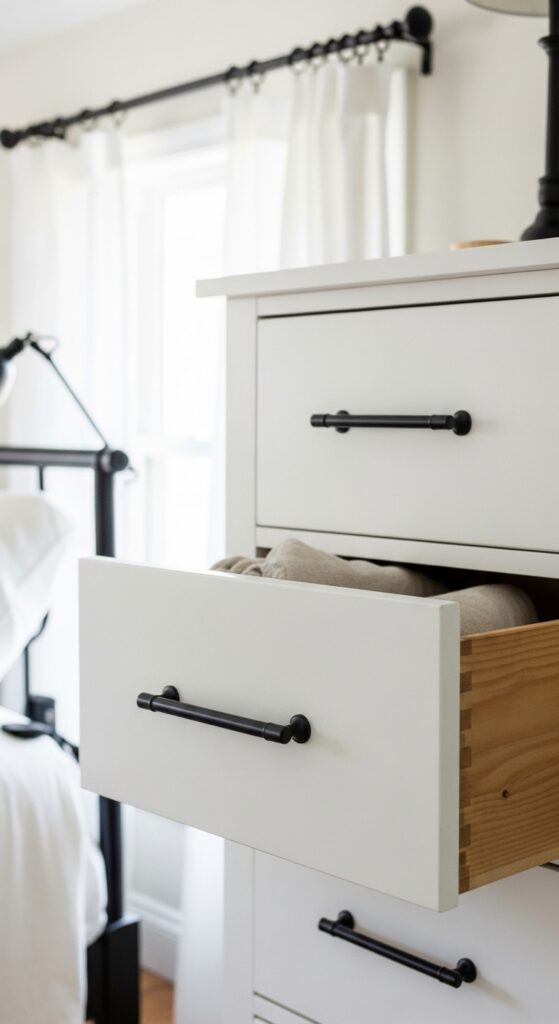
Vibe: Clean and considered — the room’s quiet punctuation marks doing real work.
Why it works: Hardware is the jewelry of a room — small, but surprisingly impactful at the room scale. Matte black works in modern farmhouse because it reads as both contemporary (sleek, non-reflective) and historical (like aged iron), which is exactly the dual personality the style requires. The design principle here is repetition: using matte black on the dresser pulls, curtain rod, lamp base, and light switch plate creates a visual thread that ties disparate pieces into a cohesive room.
How to get it: Replace all hardware in a room at once rather than piece by piece — the cohesion only works when the finish is consistent throughout. Cabinet pulls in matte black from Rejuvenation or Schoolhouse Electric run $8–$18 each; affordable alternatives on Amazon (search “matte black bar pulls”) are virtually identical at $3–$6 each.
11. Sheer Linen Curtains Floor-to-Ceiling
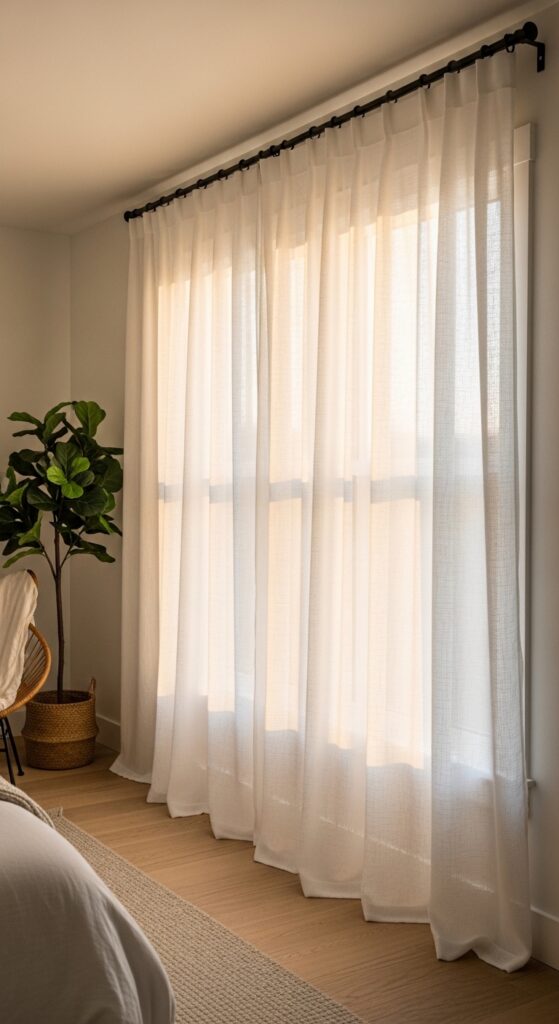
Vibe: Luminous and unhurried — curtains that make morning light feel like an event.
Why it works: Mounting curtain rods at ceiling height (rather than just above the window frame) is one of the most powerful proportion tricks in interior design — it makes windows appear taller and ceilings higher by connecting the two. Sheer linen specifically serves modern farmhouse because it diffuses rather than blocks light, keeping the room’s softness intact. The slight puddle at the floor adds a relaxed, lived-in quality that the style depends on — it signals ease over perfection.
How to get it: Mount your rod 2–4 inches from the ceiling and extend it 6–8 inches beyond the window frame on each side so the curtains clear the glass when open. IKEA’s HANNALILL sheers in white are a genuine bargain at under $20 per panel for the linen-look effect.
💡 Quick Win: Hang curtain panels 10–12 inches wider than your window frame total — the extra width creates the full, gathered look that reads expensive rather than sparse.
12. Board-and-Batten Wainscoting for Texture
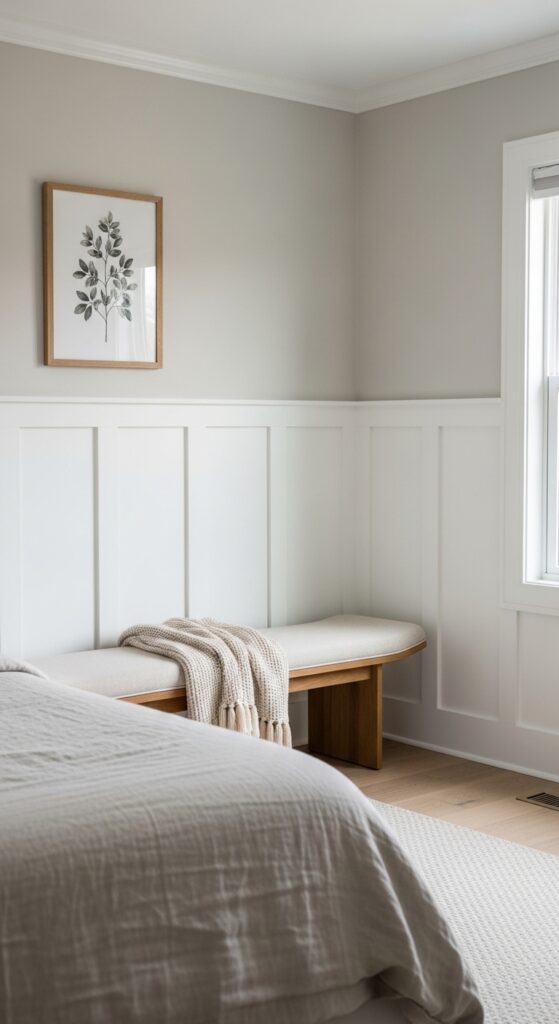
Vibe: Architectural and composed — a wall treatment that makes the whole room feel more intentional.
Why it works: Board-and-batten creates vertical rhythm that draws the eye upward, adding perceived ceiling height while also introducing the craft-quality detail that separates modern farmhouse from generic neutral bedrooms. The shadow lines cast by each batten change across the day as light moves, making the wall feel dimensional without the room needing any additional art or decoration. It’s geometry doing the work of ornament.
How to get it: Use ½-inch MDF strips as battens spaced 10–12 inches apart for a proportional look in a standard 9-foot ceiling room. Wider spacing (14–16 inches) works better in rooms with taller ceilings. Caulk all edges before painting for a seamless finish — this is the step most DIYers skip, and it shows.
13. Dried Botanicals and Pampas Grass Styling
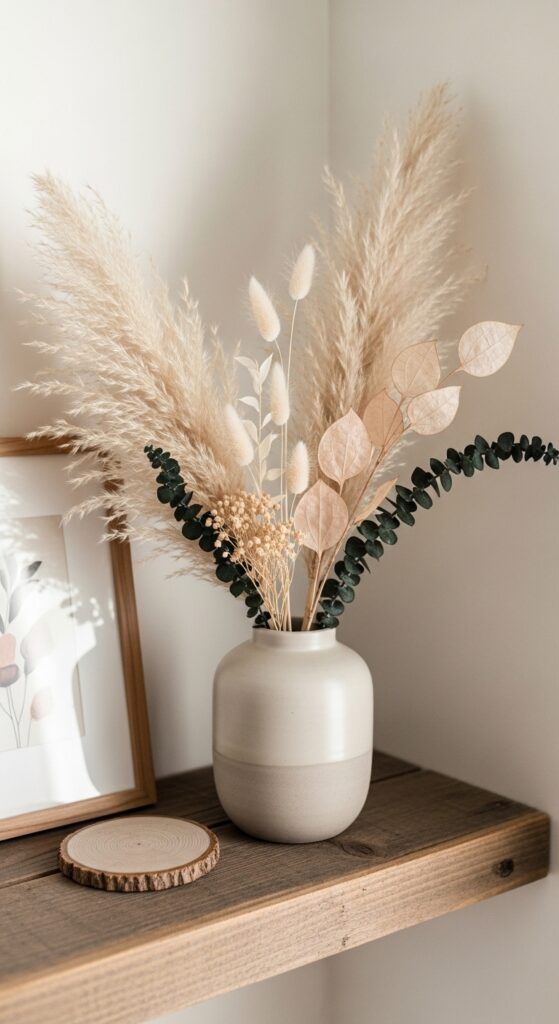
Vibe: Organic and unhurried — a corner that breathes.
Why it works: Dried botanicals work in modern farmhouse for a specific material reason: they introduce organic texture and soft movement without the upkeep of living plants. Pampas grass in particular has a desaturated palette that sits perfectly within the warm neutral range the style requires — the pale cream tones echo linen, the soft feathered tips read as softness against harder surfaces like wood and metal. Grouping three different botanical types creates visual complexity within a single tonal family.
How to get it: Build your arrangement with the rule of threes — one tall (pampas), one medium (dried allium or bunny tail grass), one low (dried eucalyptus or lunaria). Source from Trader Joe’s seasonal section, Etsy dried botanical shops, or your own garden. A single stem of pampas grass in a matte black ceramic vase from Target’s Threshold line costs around $20 total and delivers immediate impact.
💡 Quick Win: Spray dried pampas lightly with hairspray to prevent shedding — especially important in bedrooms where texture landing on bedding is frustrating.
14. Open Shelving for Functional Styling
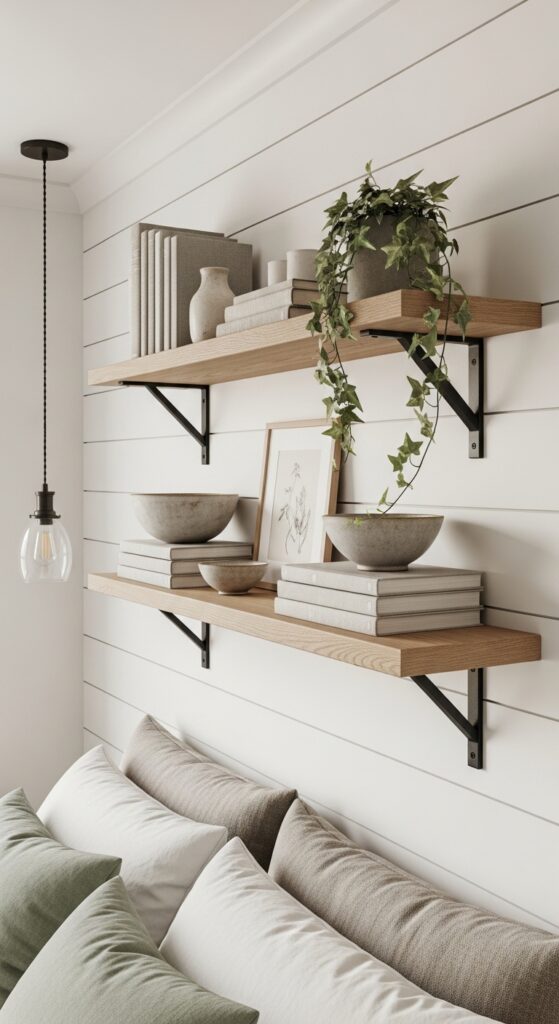
Vibe: Curated and lived-in — shelving that works for the room, not against it.
Why it works: Open shelving introduces the opportunity for material layering at eye level — mixing books (paper and cloth), ceramics (smooth and matte), and plants (organic, irregular) within a single framed zone. The key design principle is the rule of negative space: leaving approximately 30% of each shelf empty prevents the arrangement from reading as cluttered. The iron brackets tie the shelf to the hardware language already established in the room without requiring any additional decorative investment.
How to get it: Style in groupings of odd numbers (3 or 5 items per cluster) and vary height intentionally — pair a tall item with a short one rather than graduating items uniformly in height. IKEA’s BILLY floating shelves with a natural oak effect wrap run $40–$60 and carry significant visual weight for the cost.
15. Warm White Brick or Brick-Effect Wallpaper
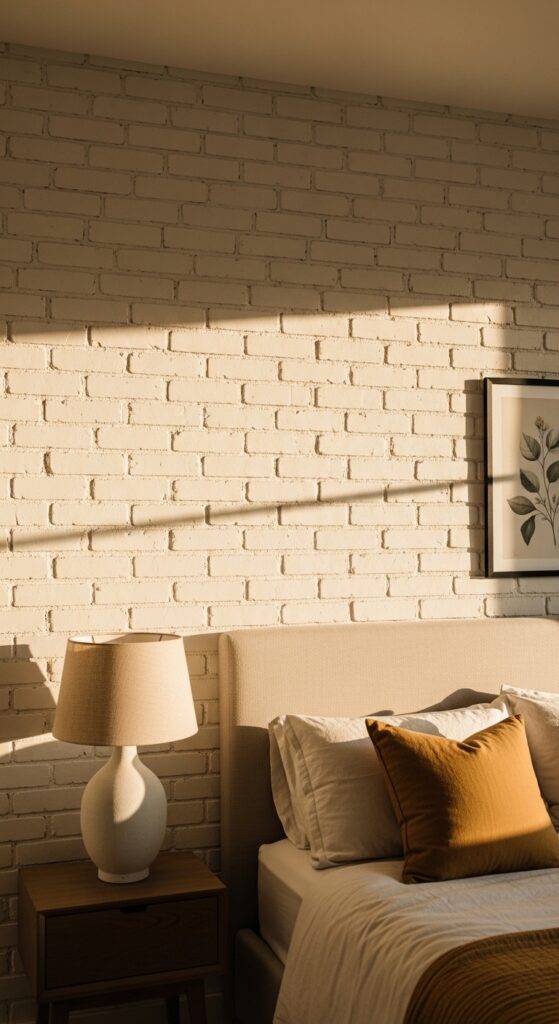
Vibe: Warm and textured — the kind of wall that makes you want to reach out and touch it.
Why it works: Brick introduces tactile texture at a scale that no other material quite matches — it’s architectural, not decorative, and that distinction matters. When painted in warm white (Benjamin Moore “White Dove” is the benchmark), brick loses its industrial harshness and becomes the softest version of itself. The light-catching quality of the mortar lines means the wall looks different at noon versus 6pm — it’s a living surface in a way flat painted drywall simply isn’t.
How to get it: For rental spaces or those not ready to commit to real brick, RoomMates’ peel-and-stick brick wallpaper in white ($38–$60 per roll) achieves a convincing effect. For one full accent wall, plan for 3–4 rolls. The key to realism is to stagger the seams exactly as real brick would be laid — don’t let seams align vertically.
💡 Quick Win: Warm white brick reads warmest in rooms with at least one south- or west-facing window. In a north-facing room, add a warm-toned lamp nearby to prevent the white from reading as cold.
16. Cozy Reading Nook With a Linen Chair
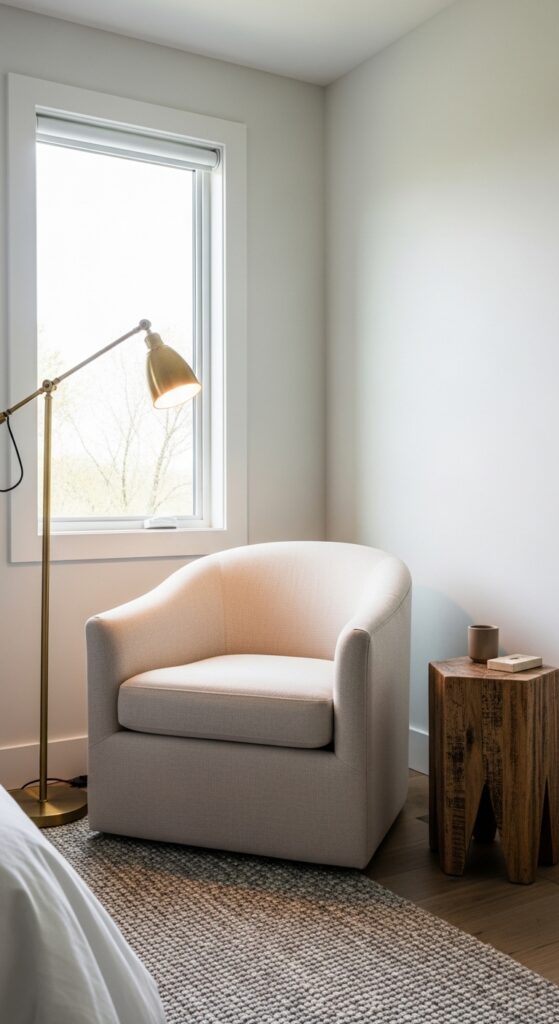
Vibe: Unhurried and wrapped — a corner that pulls you in and keeps you there.
Why it works: A reading nook within a bedroom creates zone definition — a design concept that separates sleeping space from living space within a single room. This matters because the bedroom becomes a more versatile, emotionally richer space when it has a purpose beyond sleep. The curved chair silhouette is key: curves create softness against the harder horizontal lines of beds, dressers, and windows. A handwoven wool rug underneath anchors the zone without requiring a wall or furniture divider.
How to get it: The minimum footprint for a functional reading nook is approximately 36×36 inches. Position a floor lamp so the bulb sits just above shoulder height when seated — this is the zone where warm light is most flattering and functionally effective. The ANTHROPOLOGIE “Myla Chair” in oatmeal linen and IKEA’s POÄNG in natural birch are both strong options at different price points.
17. Jute or Sisal Rug as an Anchor Layer
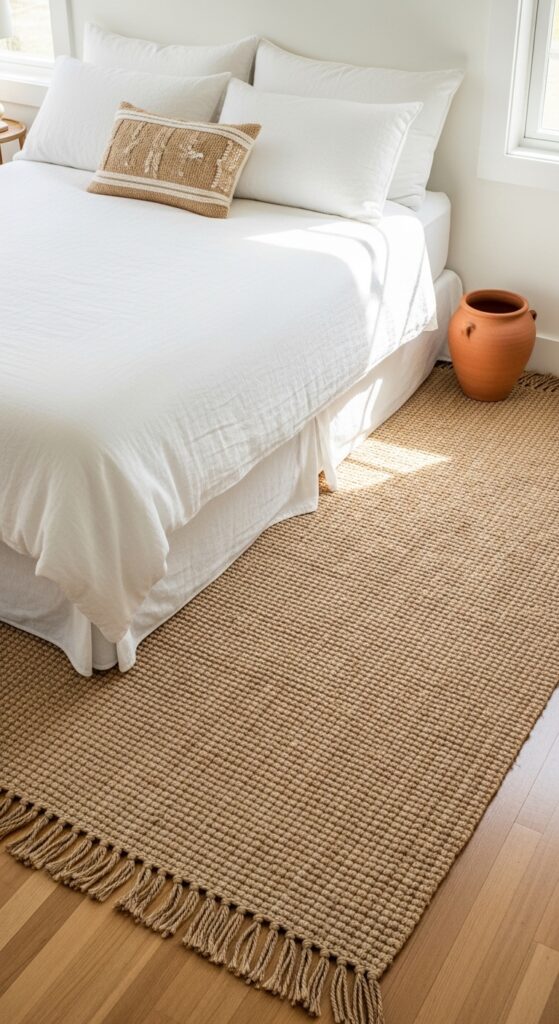
Vibe: Grounded and organic — a floor layer that makes the furniture feel like it belongs.
Why it works: A rug defines the activity zone within a room, which is a layout principle that matters as much as furniture arrangement itself. Jute specifically earns its place in modern farmhouse because it’s one of the most genuinely natural fiber options available — it smells faintly of the earth, ages beautifully, and connects the room to the agricultural roots of the style. The woven texture introduces visual interest at floor level without adding any color or pattern to the palette.
How to get it: Size is the single most common mistake with bedroom rugs — go larger than feels intuitive. For a king bed, use an 8×10 minimum; a 9×12 is often better. The rug should extend at least 18 inches beyond the sides and foot of the bed. Amazon’s Jaipur Living jute rugs are a reliable option in the $180–$350 range for the larger sizes.
💡 Quick Win: Layer a smaller, softer wool or cotton rug on top of the jute directly beside the bed — this gives your feet a soft landing in the morning while keeping the organic texture of jute as the foundation layer.
18. Minimal Gallery Wall in Black Frames
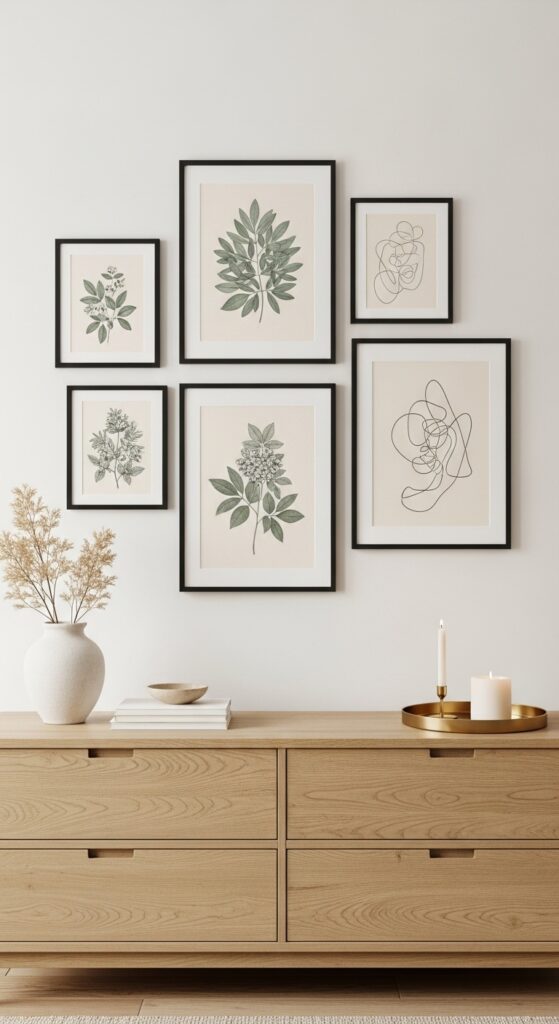
Vibe: Composed and still — art that anchors the room without overwhelming it.
Why it works: A gallery wall in a restrained modern farmhouse bedroom works only when it follows the principle of consistency — same frame finish, same mat color, tightly curated subject matter. Botanical prints and simple line-art drawings work because they carry the organic quality of the style without introducing competing color. Varying frame sizes (small, medium, large) within that consistent system creates visual rhythm without chaos.
How to get it: Before hanging, lay all frames on the floor and arrange until the grouping feels balanced — this prevents the wall from requiring multiple rounds of nail holes. Use a consistent mat board color (warm cream, not bright white) to unify frames of different sizes. Free printable botanical illustrations from sites like Etsy and Unsplash can be printed at FedEx Office for under $8 each.
19. Exposed Ceiling Beams for Architectural Drama
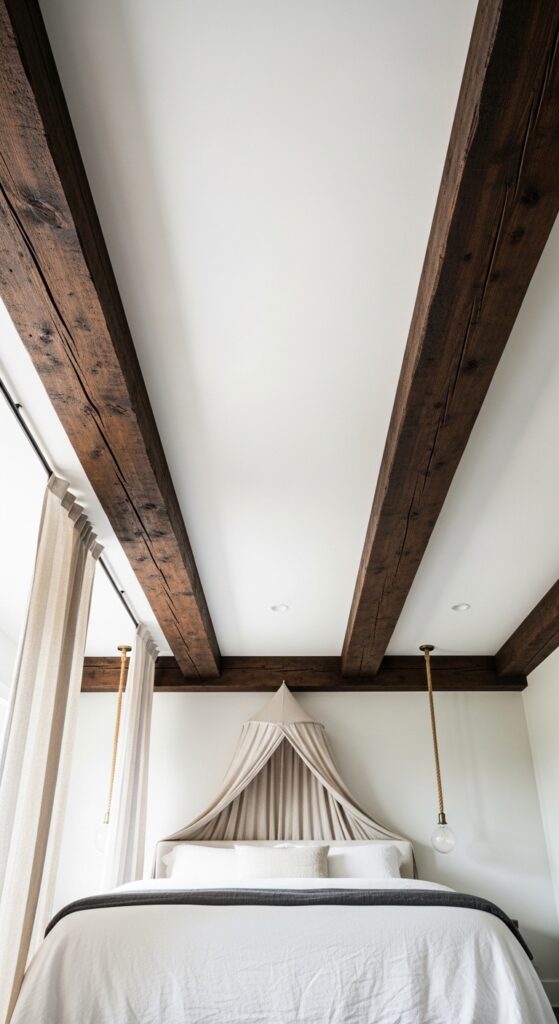
Vibe: Dramatic and earthy — the ceiling doing work the furniture can’t.
Why it works: Exposed ceiling beams are the most architecturally transformative element in the modern farmhouse vocabulary — they introduce the visual weight of history into a room without a single piece of furniture. Dark-stained beams (walnut or ebony stain over pine) against a white ceiling create a contrast that draws the eye upward and makes the room feel taller despite the visual mass added. The rough-hewn texture is essential — smooth, machined beams lose the authentic quality that makes the detail meaningful.
How to get it: Faux beam kits from Woodland Beams or DIY faux beams made from hollow MDF boxes (painted or stained) are indistinguishable from real timber in photographs and everyday living. A pair of 6-inch faux beams across a standard 12-foot ceiling span runs approximately $200–$350 installed by a confident DIYer.
💡 Quick Win: Stain faux beams in Minwax “Dark Walnut” and then dry-brush lightly with raw umber paint before the stain fully dries — this adds the aged, uneven depth that makes them look genuinely old rather than recently installed.
20. Soft Sage or Terracotta as a Gentle Accent Color
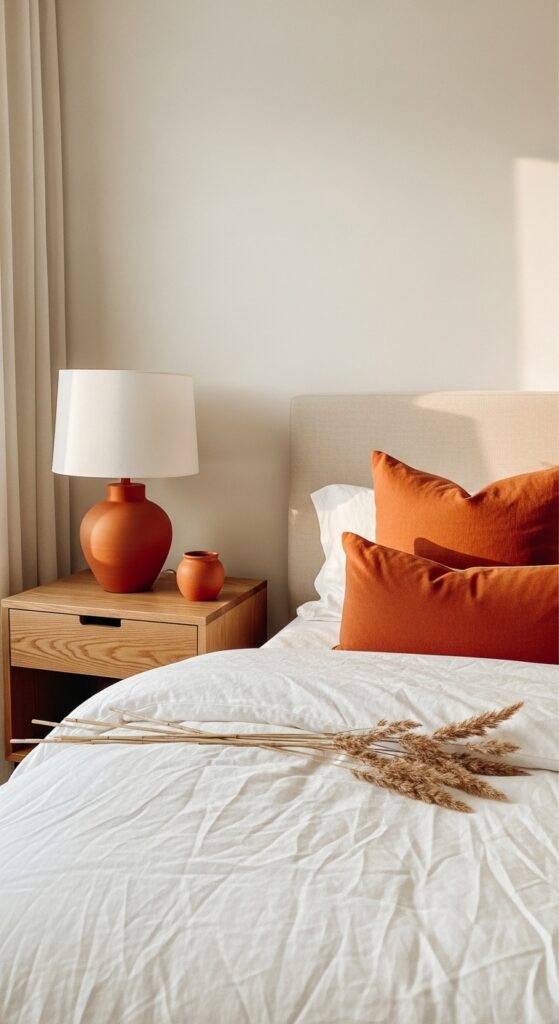
Vibe: Sun-warmed and rooted — a room that feels like late afternoon all day long.
Why it works: Accent color in modern farmhouse works when it functions as a temperature note rather than a contrast statement. Terracotta is warm, desaturated, and earthy — it extends the room’s neutral palette rather than punctuating it, which means it integrates without disturbing the rest of the composition. The principle is repetition at three scales: a small object (pot), a medium object (cushion), and a larger object (lamp base) in the same tone. This tonal threading is what makes the color feel intentional rather than arbitrary.
How to get it: Introduce terracotta first through the most replaceable items — cushion covers and a small ceramic pot. If the room absorbs it well, commit to a lamp base or a small terracotta-painted side table. Muted sage (Sherwin-Williams “Sleepy Blue” or Behr “Eucalyptus Leaf”) functions identically as an alternative if your palette skews cooler.
How to Start Your Modern Farmhouse Bedroom Transformation
Start with paint. Sherwin-Williams “Alabaster” (SW 7008) creates the warm white tonal foundation that makes every piece you add afterward feel intentional rather than random. It’s not the brightest white in the range — it has a slight yellow-cream undertone that warms under artificial light and glows softly under natural light. That warmth is the base the entire modern farmhouse palette depends on; without it, the style reads sterile rather than serene.
The most common beginner mistake is mixing too many wood tones. Modern farmhouse can carry multiple wood species in a room, but they must have the same underlying undertone — all warm (honey-brown, amber, walnut) or all cool (gray, ash, driftwood). Mixing warm and cool wood tones in the same space creates a visual dissonance that’s hard to diagnose but easy to feel. When in doubt, stick to one wood finish and repeat it across two or three pieces.
Three items under $50 that create immediate modern farmhouse impact: a single bunch of dried pampas grass in a matte terracotta pot from Target’s Threshold line (around $22 total); a waffle-weave cotton throw in natural or oatmeal from H&M Home ($28); and a set of matte black bar pulls for your dresser, available on Amazon for around $3–$6 per pull.
A realistic weekend transformation — new bedding, a throw, some hardware swaps, and a paint-test on one wall — costs $150–$300 and changes the feel of the room meaningfully. A full room transformation (furniture, rug, lighting, wall treatment) runs $800–$2,500 depending on whether you’re sourcing new or mixing vintage. Allow three to six months to curate it well — the best modern farmhouse rooms are assembled slowly.
Frequently Asked Questions About Modern Farmhouse Bedrooms
What is the difference between modern farmhouse and rustic farmhouse style?
Modern farmhouse and rustic farmhouse share DNA but diverge in execution. Rustic farmhouse leans heavily into raw imperfection — antique furniture, chunky weathered wood, and heavily distressed finishes dominate. Modern farmhouse edits those elements ruthlessly: the furniture profiles are cleaner, the hardware is deliberate (matte black or brushed brass rather than aged iron), and the palette is more controlled. If rustic farmhouse feels like a working barn, modern farmhouse feels like a barn that’s been thoughtfully renovated by someone with a very good eye.
What colors work best in a modern farmhouse bedroom?
The most successful modern farmhouse bedrooms are built on warm whites and soft greiges — Benjamin Moore “White Dove,” Sherwin-Williams “Alabaster,” and Behr “Swiss Coffee” are the three most commonly used anchor colors. From there, muted accent tones do the heavy lifting: dusty sage, soft terracotta, warm charcoal, and dusty taupe all integrate well without disturbing the calm quality the style requires. Avoid cool whites with blue or purple undertones — they fight the warmth of the wood and linen materials the style depends on.
Is modern farmhouse bedroom design expensive to achieve?
It doesn’t have to be. The style’s reliance on natural materials and neutral tones means it’s particularly well-suited to sourcing vintage and secondhand — a reclaimed wood piece from a local salvage yard or Facebook Marketplace costs a fraction of its retail equivalent and often reads as more authentic. A functional starter version of the style (new bedding, one wall treatment, hardware updates) is achievable for $200–$400. A fully designed room from scratch runs $1,500–$4,000 depending on furniture quality and whether you’re hiring a designer or DIYing.
Can I mix modern farmhouse with other design styles?
Yes, and the best versions of this style usually do. Modern farmhouse mixes particularly well with Japandi (both share a love of natural materials and restraint), coastal design (natural fibers and weathered wood overlap), and transitional design (clean furniture profiles and neutral palettes are shared territory). Where mixing fails is when the added style introduces high-gloss finishes, bold color, or heavily patterned textiles — these elements pull against the quiet, matte, organic quality that defines modern farmhouse at its best.
What textiles work best in a modern farmhouse bedroom?
Linen is the undisputed hero textile of modern farmhouse — specifically undyed or naturally colored Belgian linen for bedding, curtains, and upholstered pieces. Beyond linen, cotton waffle-weave (for throws and blankets), chunky hand-knit wool (for accent throws), and washed cotton canvas (for pillow covers) all integrate well. Avoid polyester, silk, or high-sheen fabrics — they carry a contemporary sleekness that reads as out of register with the organic quality the style depends on. For a tactile starting point, Cultiver, Parachute, and Brooklinen all make linen bedding that fits the aesthetic at accessible price points.
Ready to Create Your Dream Modern Farmhouse Bedroom?
These 20 ideas covered the full range — color palettes and wall treatments, material choices and furniture profiles, lighting approaches and layout principles — because no single element makes the style work; it’s the way they layer together that creates the feeling. Know that transformation doesn’t require doing it all at once; in fact, the most successful modern farmhouse bedrooms are assembled gradually, each piece chosen with patience rather than urgency. This week, bring one piece of raw wood into your bedroom — a tray on the nightstand, a small stool at the foot of the bed, a reclaimed shelf on the wall — and notice what it does to the room’s warmth immediately. When the space is finished, it won’t feel designed so much as discovered — warm, still, and quietly yours. Save the ideas that felt most like home, and come back to them when you’re ready — this style rewards the slow and the intentional.