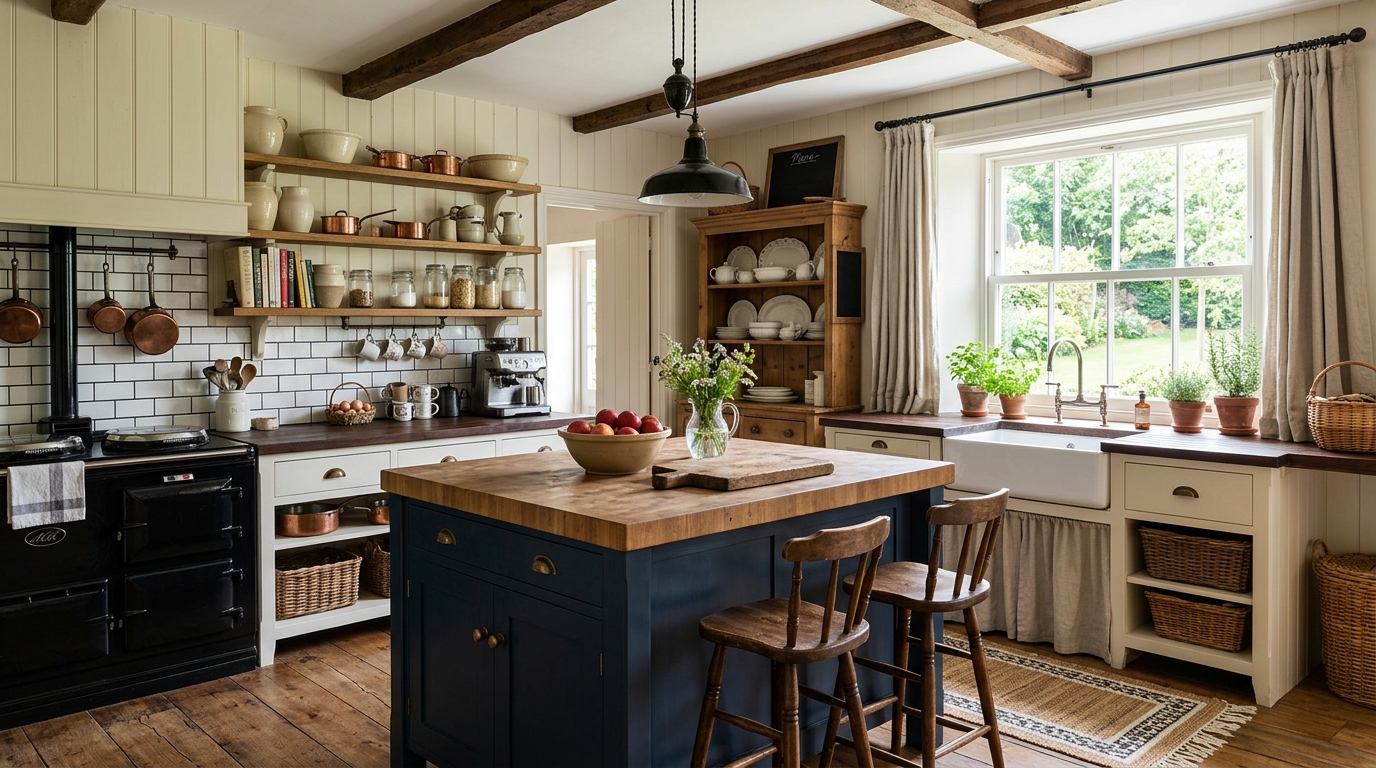
A cozy farmhouse kitchen blends the warmth of rural American living with the functionality of a modern home — think apron-front sinks, open shelving, and gathered textures that make a kitchen feel like the heart of the house. These 21 ideas show you exactly how to create that feeling, from paint choices to pendant lights to the small styling details that make all the difference.
There’s something about a farmhouse kitchen that makes people slow down. The smell of worn wood, the weight of a ceramic mixing bowl, the way morning light catches a mason jar on an open shelf — it all signals that this is a room built for living, not just cooking. Every surface has a story. Every corner earns its warmth. Here are 21 ideas worth saving — and stealing.
Why Farmhouse Style Works So Well in a Kitchen
The farmhouse kitchen has its roots in the working kitchens of 19th-century American rural homes — spaces designed for function first, where beauty emerged from honest materials and practical choices. What distinguishes it from “rustic” is intentionality: farmhouse kitchens are curated, not accidental. And what separates it from “country” is restraint — less gingham, more linen; less clutter, more warmth.
The palette is built on warm whites, creamy off-whites, and soft greiges — Benjamin Moore “White Dove” and Sherwin-Williams “Antique White” are the two most-reached-for anchors. Materials are tactile and grounded: apron-front fireclay sinks, unfinished white oak open shelving, shiplap or beadboard paneling, butcher block countertops, and matte black or oil-rubbed bronze hardware. These are materials that age well and look better with use.
The style is surging again because of how we live now. Post-pandemic, the kitchen reclaimed its status as the home’s emotional center — the room where people actually want to spend time. Pinterest searches for “farmhouse kitchen ideas” consistently rank in the platform’s top home decor queries, and the appeal is clear: the style prioritizes warmth and livability over trends or showroom polish.
Small kitchens can carry this style well. Prioritize one hero element — an apron sink, open shelving in place of upper cabinets, or a beadboard backsplash — and build the rest of the aesthetic through accessories and paint. The style’s neutral palette is inherently space-expanding, and its texture-over-pattern approach means layering never reads as cluttered.
Style at a Glance
| Element | Key Trait | Key Trait |
| Philosophy | Function-first, warmth through use | Lived-in, never overdone |
| Materials | Fireclay, white oak, butcher block | Linen, shiplap, matte black iron |
| Color Palette | Warm white, creamy greige, soft taupe | Dusty sage, terracotta, oat |
1. Apron-Front Farmhouse Sink as the Anchor Piece
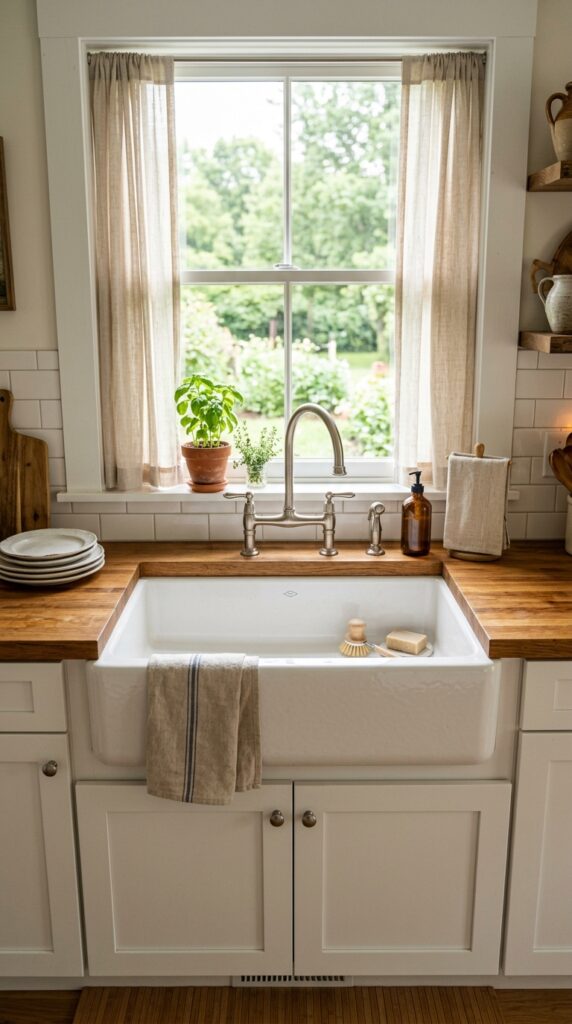
Vibe: Grounded and purposeful — a sink that makes the whole kitchen feel intentional.
Why it works: The apron-front sink is the single most recognizable farmhouse kitchen element, and it works because it’s genuinely historical — these sinks predate modern under-counter plumbing and were designed for the physical work of a real kitchen. The exposed apron face introduces a plane of material contrast (smooth white fireclay against wood or painted cabinetry) that anchors the room visually. A gooseneck faucet in brushed nickel reinforces the utilitarian-beautiful tension that defines the style.
How to get it: If a full sink replacement isn’t feasible, pair an undermount white ceramic basin with a period-correct gooseneck faucet — the faucet silhouette carries much of the farmhouse signal on its own. KOHLER’s “Whitehaven” and Ruvati’s fireclay options are both reliably well-reviewed at different price points.
💡 Quick Win: A linen dish towel in oatmeal or faded blue stripe hung over the sink edge costs under $15 and instantly reads “farmhouse” — it’s the finishing detail that photographs most convincingly.
🛍️ Shop the Look — Amazon Product Ideas
| # | Product Search Phrase | Why It Fits |
| 1 | farmhouse apron front fireclay kitchen sink white | Hero sink element |
| 2 | gooseneck kitchen faucet brushed nickel single hole | Period-correct faucet |
| 3 | linen dish towels farmhouse stripe set | Sink styling essential |
| 4 | terracotta herb pot small with drainage hole | Windowsill accent |
| 5 | wooden dish brush natural bristle kitchen | Authentic functional detail |
2. Open Shelving in Unfinished White Oak
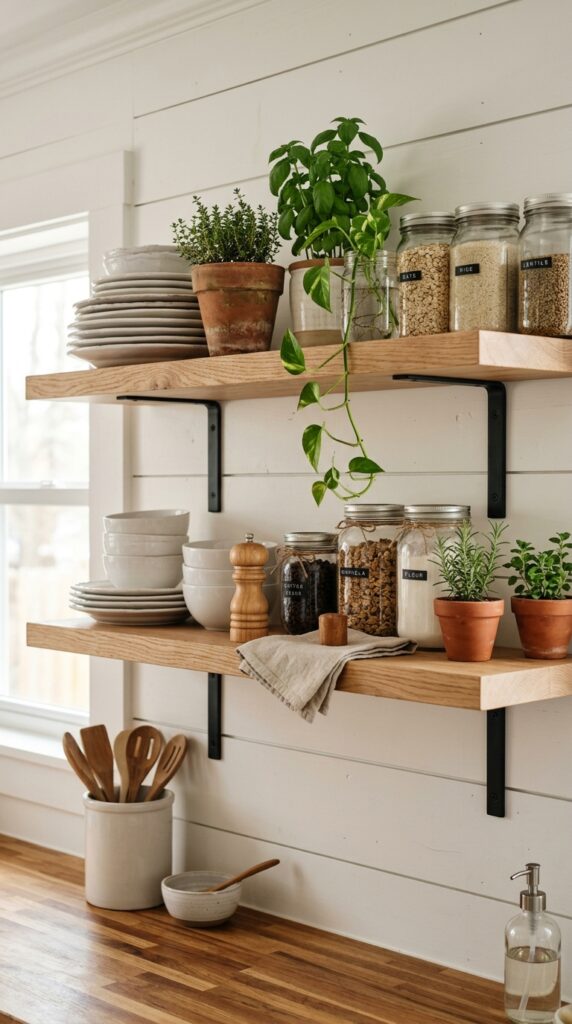
Vibe: Curated and lived-in — shelving that makes storage feel like styling.
Why it works: Open shelving removes the visual barrier of upper cabinet doors, making a kitchen feel more spacious and connected. The material choice matters enormously here — unfinished white oak reads as natural and warm rather than stark, and its grain variation introduces organic texture without pattern. Black iron brackets tie the shelves to the hardware language used on cabinet pulls and light fixtures, threading a consistent material note through the whole room.
How to get it: Mount shelves at 18-inch vertical intervals and keep the front edge of each shelf at 12 inches deep — deep enough to stack plates, shallow enough to maintain proportion against the wall. Style in groupings of three: one functional item (stacked bowls), one transitional item (mason jars), one decorative item (small plant). Leave 20–30% of each shelf as negative space.
🛍️ Shop the Look — Amazon Product Ideas
| # | Product Search Phrase | Why It Fits |
| 1 | white oak floating shelf natural edge kitchen | Hero shelf material |
| 2 | black iron shelf bracket heavy duty rustic | Hardware with style |
| 3 | white ironstone stacking plates set | Shelf-worthy ceramics |
| 4 | glass mason jars wide mouth set of 12 | Dry goods storage |
| 5 | small trailing pothos plant pot for shelf | Live green accent |
3. Warm White Shiplap Backsplash
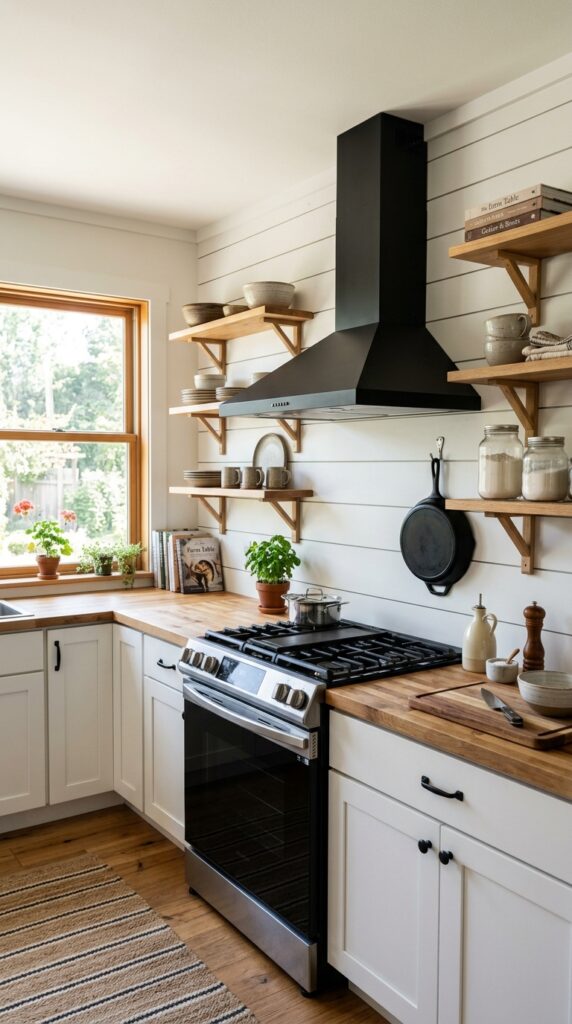
Vibe: Clean and unhurried — a backsplash that breathes.
Why it works: Shiplap as a backsplash is a farmhouse-specific choice that replaces the pattern and visual noise of tile with simple horizontal rhythm. The shadow lines between planks add dimension without color, which keeps the palette calm and makes the countertop materials the visual star. In rooms with a dark range hood or island, the light shiplap creates the tonal contrast that makes both elements read more clearly. It also reflects light better than matte tile, keeping the kitchen bright without adding fixtures.
How to get it: Use moisture-resistant MDF shiplap (not standard pine) behind and immediately around the stove — seal with two coats of semi-gloss in your chosen white for easy wipe-down. Benjamin Moore “Chantilly Lace” in semi-gloss is the most universally loved warm-white choice for kitchen shiplap.
💡 Quick Win: Peel-and-stick shiplap panels from Amazon (around $45 per pack) require no power tools and are removable — a genuine weekend upgrade for renters.
🛍️ Shop the Look — Amazon Product Ideas
| # | Product Search Phrase | Why It Fits |
| 1 | peel and stick shiplap wall panels white | Renter-friendly backsplash |
| 2 | matte black wall-mount range hood farmhouse | Statement contrast piece |
| 3 | cast iron skillet wall hook kitchen display | Functional wall decor |
| 4 | white ceramic oil dispenser kitchen counter | Counter styling accent |
| 5 | semi-gloss white interior paint quart | Finish for painted shiplap |
4. Pendant Lights Over the Kitchen Island
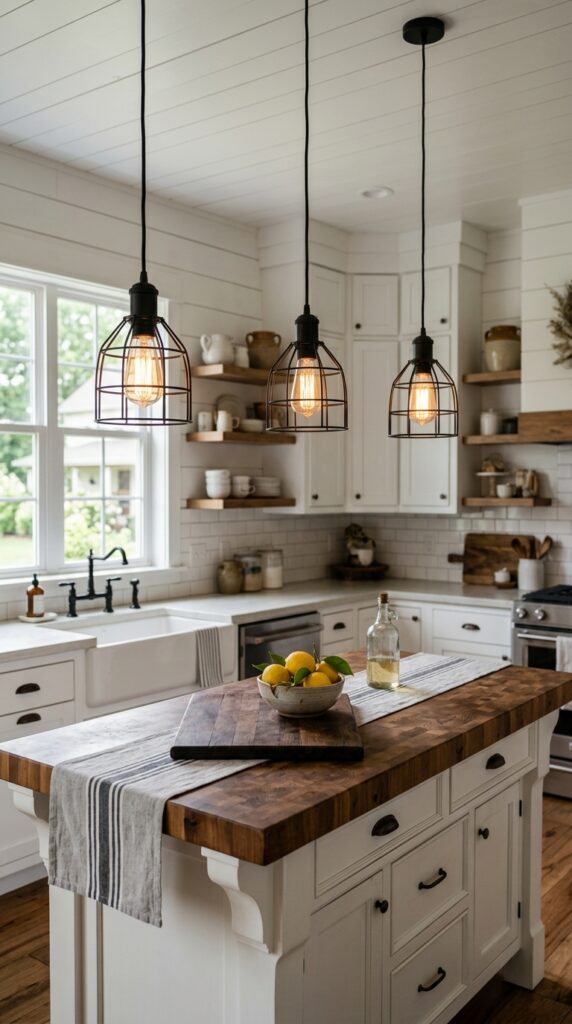
Vibe: Warm and gathered — the kind of lighting that pulls people toward the island.
Why it works: Pendant lighting over an island serves two functions simultaneously: task lighting for food prep and decorative anchoring that draws the eye and defines the zone. Three pendants in a linear row introduce the repetition principle — the eye reads pattern and feels at ease. Matte black cage pendants are specifically effective in farmhouse kitchens because they reference utilitarian industrial history while staying visually light and open; a solid shade would add visual weight the style doesn’t need.
How to get it: Hang pendants so the bottom of the shade sits 30–36 inches above the island surface. Space them evenly, dividing the island length into equal thirds. If your island is under 5 feet, two pendants will be more proportional than three. Ensure bulbs are on a dimmer — the ability to shift from bright task light to warm ambient glow is what makes island lighting genuinely livable.
🛍️ Shop the Look — Amazon Product Ideas
| # | Product Search Phrase | Why It Fits |
| 1 | matte black cage pendant light farmhouse Edison bulb | Hero lighting fixture |
| 2 | dimmer switch single pole in-wall | Lighting control essential |
| 3 | butcher block wood cutting board large | Island surface styling |
| 4 | striped linen table runner natural kitchen | Island textile layer |
| 5 | small ceramic bowl for kitchen fruit display | Counter accent piece |
5. Butcher Block Countertops for Warmth
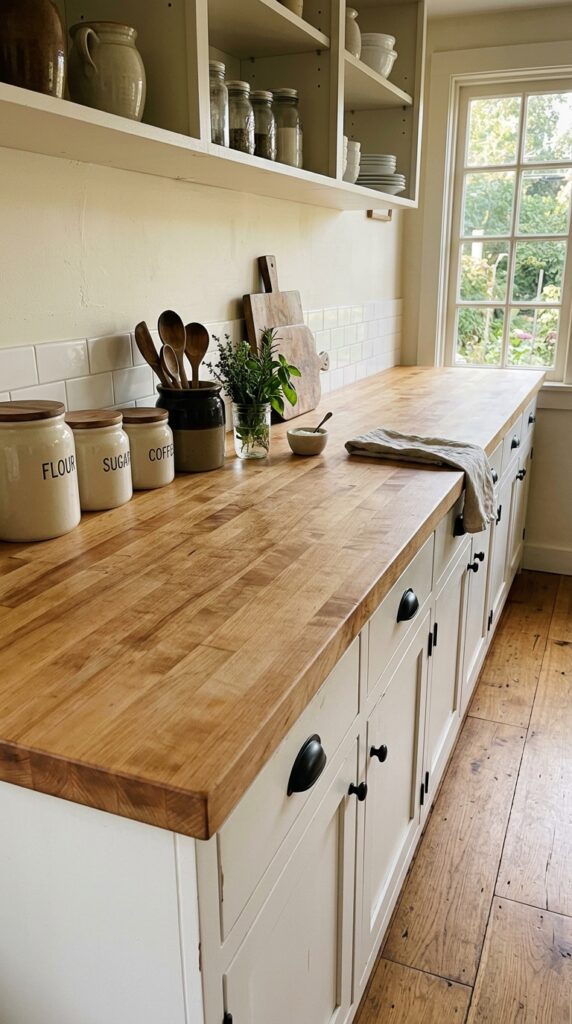
Vibe: Tactile and sun-warmed — a surface that invites you to cook.
Why it works: Butcher block introduces the warmth of natural wood at countertop scale — no other material does this with the same accessibility and impact. Unlike stone, which reads as cold and formal, wood carries the honest imperfection the farmhouse style is built on: the knife marks, the oiled patina, the way it darkens with age. Paired with white painted cabinetry, the warm maple tone creates a tonal contrast that prevents the kitchen from feeling flat or monochromatic.
How to get it: Oil butcher block countertops with food-safe mineral oil monthly for the first year, then quarterly thereafter — this prevents cracking and keeps the surface looking intentionally cared for rather than neglected. IKEA’s BADELUNDA butcher block countertops are a widely trusted entry-level option; for a more substantial edge profile, look for end-grain maple from local lumber suppliers or Lumber Liquidators.
💡 Quick Win: A small wooden utensil crock on the butcher block counter — packed with a ladle, spatulas, and wooden spoons — costs under $25 and immediately anchors the countertop with the lived-in functional-beautiful quality farmhouse kitchens depend on.
🛍️ Shop the Look — Amazon Product Ideas
| # | Product Search Phrase | Why It Fits |
| 1 | butcher block countertop maple unfinished 6 foot | Core material upgrade |
| 2 | food safe mineral oil butcher block conditioner | Essential maintenance |
| 3 | farmhouse ceramic utensil crock holder kitchen | Counter styling essential |
| 4 | wooden kitchen utensil set natural handle | Crock contents |
| 5 | black cabinet pulls bar handle set of 10 | Hardware to pair with wood |
6. Dusty Sage Green Lower Cabinets
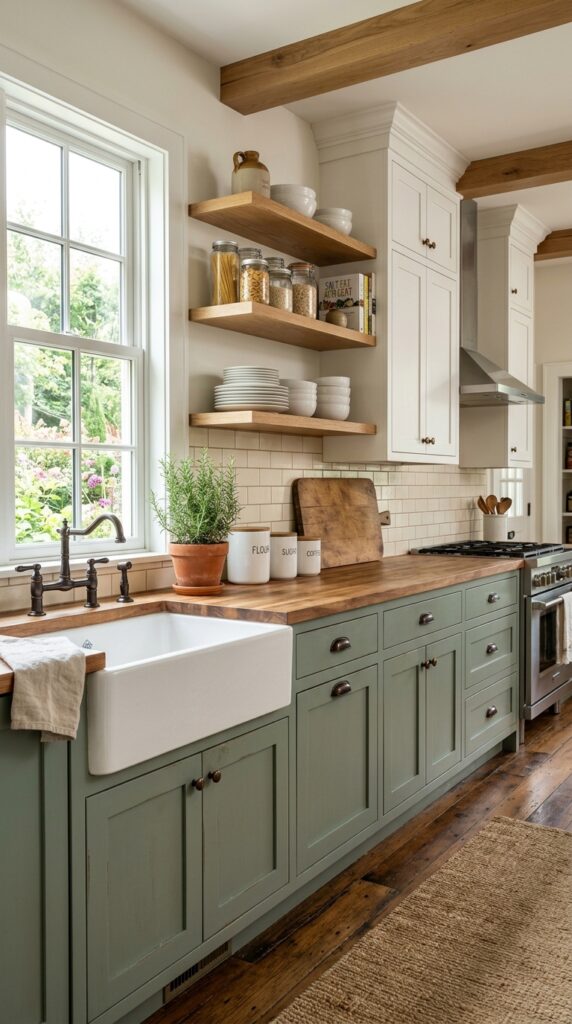
Vibe: Grounded and quietly alive — a palette that feels like it grew there.
Why it works: Two-tone cabinetry — lighter uppers, darker or richer lowers — follows the design principle of visual weight: heavier tones read as more grounded when placed lower in the room, which is how nature arranges color (earth below, sky above). Dusty sage works specifically in farmhouse kitchens because its gray-green undertone bridges the gap between earthy organic and clean contemporary. Sherwin-Williams “Privilege Green” and Benjamin Moore “Soft Fern” are both widely used for this exact effect, and oil-rubbed bronze hardware keeps the palette from reading too cool.
How to get it: Paint only the lower cabinets first — this is a lower-commitment test that can be completed in a weekend. Sand the cabinet faces lightly, apply a bonding primer, then two coats of your sage in a satin or eggshell finish. Satin is slightly easier to clean in a kitchen environment; eggshell gives a softer, more authentic farmhouse finish.
🛍️ Shop the Look — Amazon Product Ideas
| # | Product Search Phrase | Why It Fits |
| 1 | cabinet paint sage green chalk finish quart | Core color material |
| 2 | oil rubbed bronze cabinet pulls set kitchen | Hardware complement |
| 3 | bonding primer spray for cabinets | Essential prep product |
| 4 | white ceramic canister set farmhouse kitchen | Counter styling layer |
| 5 | potted rosemary herb in terracotta counter plant | Live green counter accent |
7. Wicker and Rattan Basket Storage
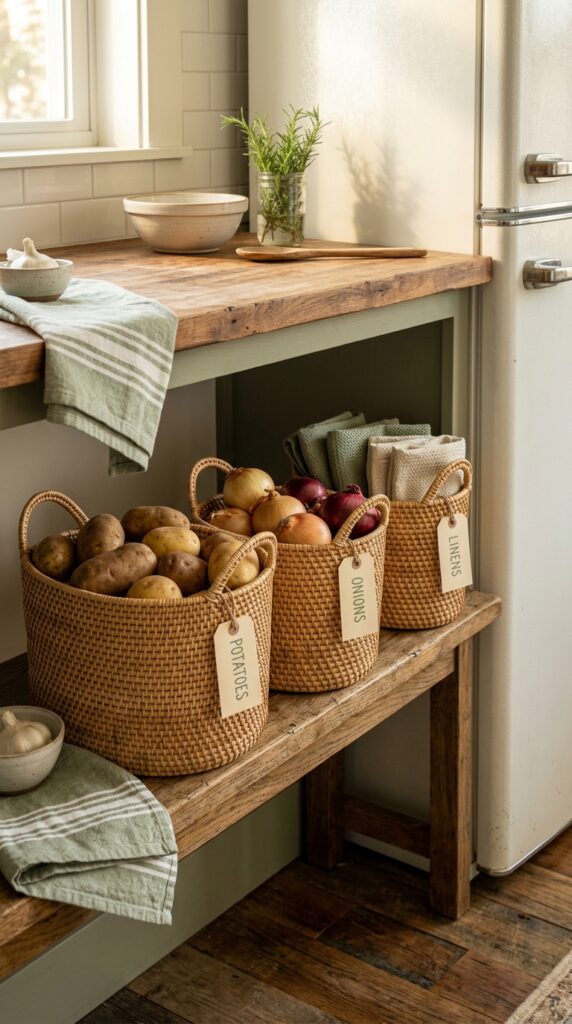
Vibe: Organic and unhurried — storage that looks better than a cabinet door.
Why it works: Rattan baskets solve a real farmhouse kitchen problem: how to store utilitarian items (root vegetables, bulky linens, canned goods) in a way that adds warmth rather than visual noise. The natural fiber material introduces an earthy, woven texture that anchors the organic quality of the style. Grouping baskets in a set of three creates visual rhythm, while varying their sizes slightly keeps the arrangement from reading as too rigid or commercial.
How to get it: Line the basket interiors with a linen or canvas fabric insert before using them for dry goods storage — this prevents smaller items from falling through the weave and keeps the interior tidy. Label each basket with a small chalk tag or leather-stamped tag for the organized-yet-casual look that photographs convincingly and functions practically.
💡 Quick Win: A set of three matching seagrass or rattan baskets from Amazon in graduated sizes runs $25–$45 and immediately transforms under-counter open shelving from cluttered to curated.
🛍️ Shop the Look — Amazon Product Ideas
| # | Product Search Phrase | Why It Fits |
| 1 | rattan storage baskets set of 3 graduated sizes | Core storage solution |
| 2 | chalk labels chalkboard tags with jute string | Basket labeling detail |
| 3 | linen fabric basket liner natural color | Basket interior finish |
| 4 | seagrass belly basket small farmhouse decor | Alternative organic option |
| 5 | root vegetable storage basket kitchen counter | Functional vegetable storage |
8. Mason Jar Pantry Organization
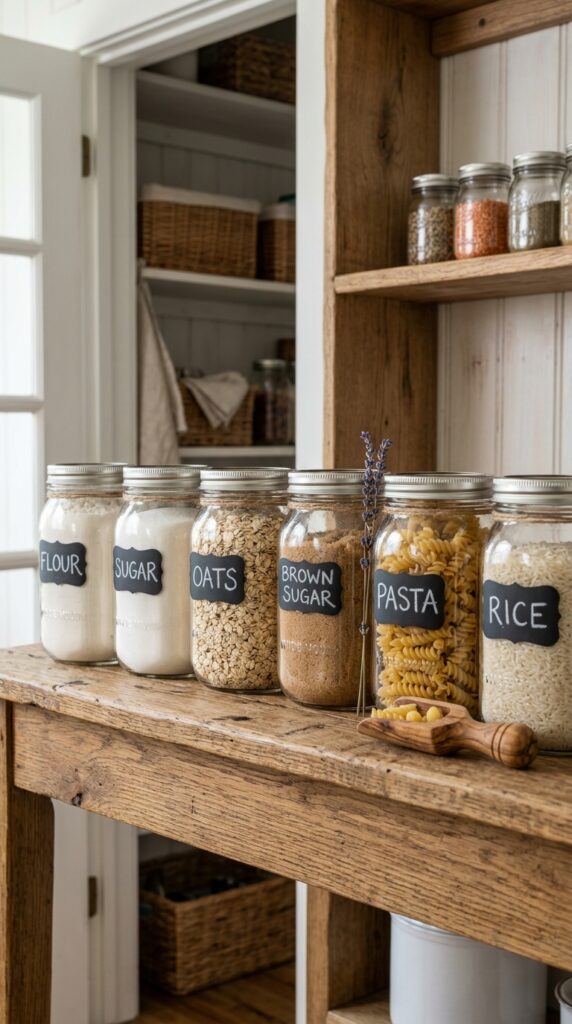
Vibe: Ordered and warm — the pantry equivalent of a deep breath.
Why it works: Uniform glass storage transforms the visual chaos of mismatched packaging into a cohesive, calm surface. The principle at work is visual repetition — the eye reads the row of identical jars as a single element rather than many competing ones, which makes the pantry feel organized even when it’s fully stocked. Glass specifically earns its place in farmhouse kitchens because it’s honest — you see exactly what’s inside, which connects to the style’s broader philosophy of transparency and authenticity over pretense.
How to get it: Use Ball wide-mouth mason jars in a single size (quart for most pantry items, half-pint for spices) and decant all dry goods immediately upon purchase. Apply chalk labels with a paint marker rather than actual chalk — it won’t smear when you run a damp cloth across it during cleaning. A complete pantry set of 12 quart jars costs approximately $20–$30.
🛍️ Shop the Look — Amazon Product Ideas
| # | Product Search Phrase | Why It Fits |
| 1 | wide mouth mason jars quart set of 12 | Core pantry storage |
| 2 | chalk paint marker white for glass labels | Non-smear labeling |
| 3 | wooden pantry scoop set | Functional pantry tool |
| 4 | airtight lids for wide mouth mason jars | Seal upgrade |
| 5 | farmhouse pantry labels chalkboard sticker set | Ready-made label option |
9. Beadboard Kitchen Island Paneling
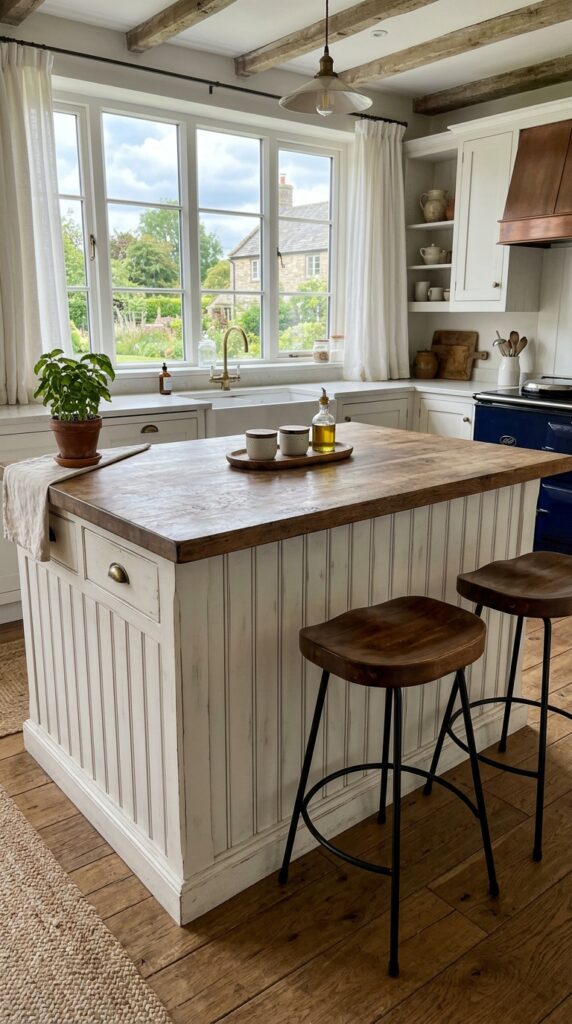
Vibe: Warm and gathered — an island that earns its place as the kitchen’s center.
Why it works: Beadboard paneling on an island side introduces the vertical rhythm and craft-quality detail that elevates a plain cabinet into a piece of furniture. The narrow groove pattern references 19th-century American millwork — it’s a historically specific detail that signals the farmhouse style without needing any additional decoration. The contrast between the textured painted island sides and the smooth butcher block top creates a material dialogue that gives the whole piece visual interest from every angle.
How to get it: Beadboard can be applied to an existing island using pre-primed MDF beadboard panels ($18–$25 per sheet at Home Depot), cut to size and adhered with construction adhesive plus finish nails. Caulk all seams before painting for a seamless built-in finish. Paint in Sherwin-Williams “Alabaster” for a warm, slightly creamy white that reads as vintage without looking dingy.
💡 Quick Win: Peel-and-stick beadboard wallpaper panels applied to island sides require no carpentry skills and cost around $30–$50 total — virtually indistinguishable from real millwork in everyday use.
🛍️ Shop the Look — Amazon Product Ideas
| # | Product Search Phrase | Why It Fits |
| 1 | peel and stick beadboard panel white self-adhesive | Renter-friendly paneling |
| 2 | farmhouse counter stool wood and black metal 24 inch | Island seating |
| 3 | small wooden tray for kitchen counter styling | Island surface detail |
| 4 | ceramic salt cellar set with spoon | Counter condiment styling |
| 5 | MDF beadboard sheet panel primed white | DIY island paneling |
10. Farmhouse Kitchen Layout: The Working Triangle
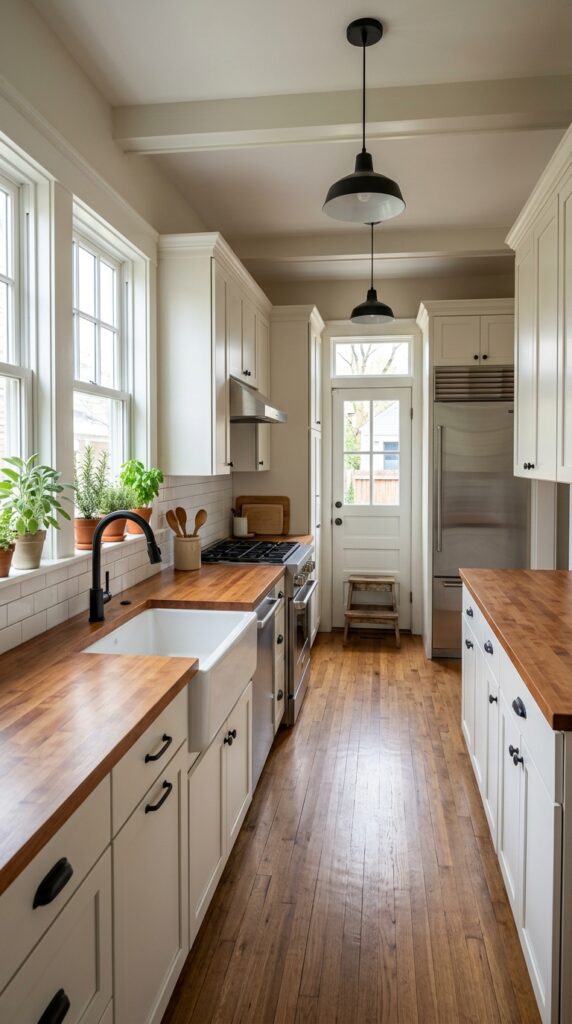
Vibe: Purposeful and clear — a kitchen that knows exactly what it’s for.
Why it works: The working triangle — the spatial relationship between sink, stove, and refrigerator — is a foundational kitchen design principle that farmhouse kitchens honor through honest layout rather than hiding it behind trendy configurations. When these three zones are within 4–9 feet of each other, cooking becomes physically easier, which is exactly the philosophy farmhouse design is built on: form following genuine use. A clear, unobstructed path between these zones also makes the kitchen feel larger and more intentional.
How to get it: Before buying any new furniture or decor, map your kitchen’s triangle on paper. If the refrigerator, sink, and stove are more than 9 feet apart in any direction, consider whether a rolling cart or additional prep surface could shorten the functional distance. In farmhouse kitchens, a butcher block rolling cart placed strategically can serve as both additional counter space and a layout correction.
🛍️ Shop the Look — Amazon Product Ideas
| # | Product Search Phrase | Why It Fits |
| 1 | butcher block kitchen cart rolling with storage | Layout helper + surface |
| 2 | wooden folding step stool kitchen farmhouse | Functional kitchen accent |
| 3 | windowsill herb garden planter tray indoor | Sink window herb display |
| 4 | under counter cabinet organizer pull-out basket | Layout efficiency tool |
| 5 | kitchen rug runner jute natural fiber 2×6 | Traffic path definition |
11. Ironstone and Ceramic Dish Display
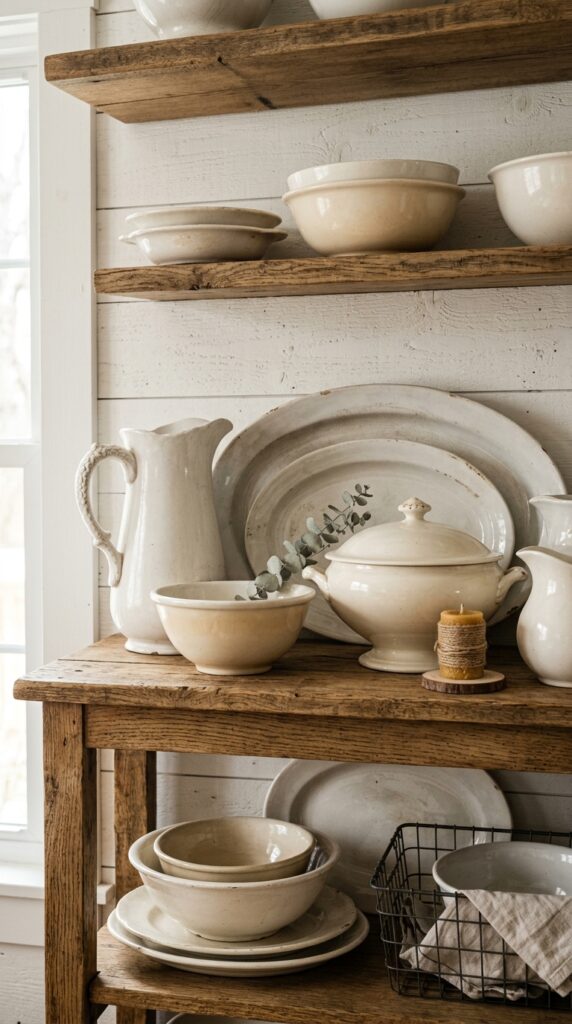
Vibe: Collected and warm — a shelf that looks like it was assembled over a lifetime.
Why it works: Ironstone has been a farmhouse kitchen staple since the mid-1800s — it was the durable, affordable alternative to fine china that actual working households used. Displaying it openly leans into the farmhouse principle of making utility visible: the pieces are beautiful because they’re functional, not despite it. The slight variation in white tones across a collected set of ironstone (ivory, antique white, warm cream) creates the layered tonal depth that a matched set of modern white ceramics never achieves.
How to get it: Build an ironstone collection from thrift stores and estate sales — a single pitcher or platter typically runs $3–$12 at Goodwill or on Facebook Marketplace. Look for embossed detailing and the characteristic warm ivory tone rather than bright white. Arrange by height, keeping the tallest pieces at the ends of a shelf and mid-height pieces in the center for visual balance.
💡 Quick Win: A single white ironstone pitcher filled with a few stems of dried wheat or dried lavender costs under $20 total and delivers the quintessential farmhouse shelf moment — instantly photographable.
🛍️ Shop the Look — Amazon Product Ideas
| # | Product Search Phrase | Why It Fits |
| 1 | white ironstone pitcher ceramic farmhouse vintage style | Core display piece |
| 2 | white ceramic farmhouse bowl set nesting | Complement to pitcher |
| 3 | dried lavender bunch for home decor | Display stem detail |
| 4 | jute wrapped pillar candle natural | Shelf accent candle |
| 5 | wall-mounted plate rack display wood kitchen | Plate display system |
12. Warm Ambient Lighting With Edison Bulbs
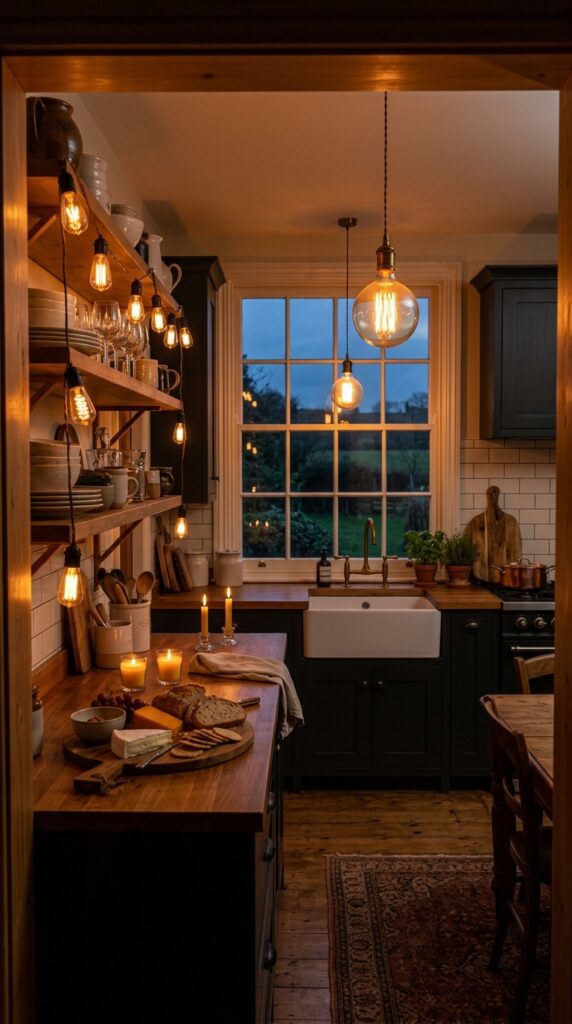
Vibe: Amber and hushed — the kitchen at its most welcoming hour.
Why it works: Edison bulbs (low-wattage, visible filament) produce light in the 2200–2700K color temperature range — the warmest end of the spectrum, which makes wood tones richer, whites creamier, and the whole space feel genuinely intimate. This matters in farmhouse kitchens because the style’s material palette — warm wood, warm whites, natural fibers — is optimized for warm-toned light. Under cool LED light, the same room reads as flat and slightly clinical; under Edison-tone light, every surface performs at its best.
How to get it: Replace all overhead kitchen bulbs with warm white LEDs rated at 2200–2700K — the bulb box will display this number. Install a dimmer switch on the primary overhead circuit so you can shift from bright cooking light to ambient evening light without changing fixtures. String lights with Edison bulbs along open shelving add atmosphere for under $30.
🛍️ Shop the Look — Amazon Product Ideas
| # | Product Search Phrase | Why It Fits |
| 1 | Edison bulb string lights warm white indoor plug-in | Shelf ambient lighting |
| 2 | vintage Edison bulb LED 2200K warm amber E26 | Pendant bulb upgrade |
| 3 | dimmer switch single pole in-wall rotary | Lighting control essential |
| 4 | candle holder set wooden base farmhouse | Counter candle styling |
| 5 | over sink pendant light black vintage style | Sink task lighting |
13. Small Farmhouse Kitchen: The One-Wall Wonder
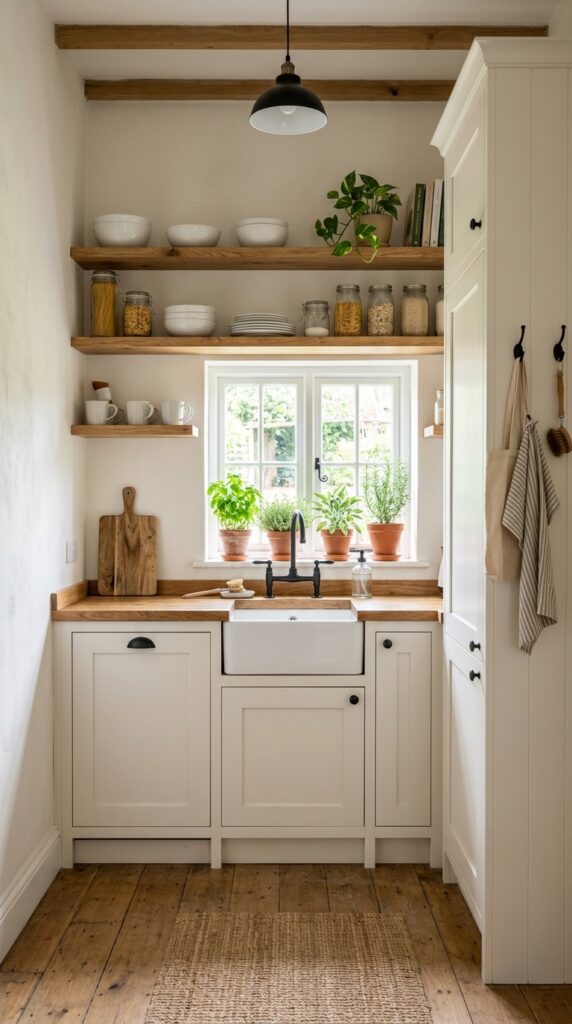
Vibe: Efficient and airy — small space, full warmth.
Why it works: In a one-wall kitchen, upper cabinets are the enemy of light and space — they block natural light, close in the ceiling, and make a narrow room feel like a corridor. Replacing them with open shelving keeps the upper half of the wall light and open while still providing storage. A tall pantry cabinet at one end recaptures the vertical storage lost from upper cabinets without the psychological heaviness of a full run of wall-mounted boxes. The farmhouse palette’s warm whites and natural wood are particularly well-suited to small spaces because they reflect light efficiently.
How to get it: In a small kitchen, commit to visual consistency above everything else — one countertop material, one paint color, one hardware finish. Every variation in material or tone costs the room a unit of perceived space. A vertical magnetic knife strip mounted to the wall frees up drawer space and adds a functional farmhouse detail without taking any surface area.
💡 Quick Win: Replace one upper cabinet with two floating shelves in white oak and an under-shelf hook rail — you’ll gain the same storage volume with twice the visual openness for under $60 in materials.
🛍️ Shop the Look — Amazon Product Ideas
| # | Product Search Phrase | Why It Fits |
| 1 | tall narrow pantry cabinet farmhouse white | Vertical storage solution |
| 2 | magnetic knife strip wall mount wood | Space-saving knife storage |
| 3 | under-shelf hook rail for kitchen storage | Vertical storage trick |
| 4 | floating shelf white oak wall mount small kitchen | Upper cabinet replacement |
| 5 | compact dish rack countertop farmhouse style | Small kitchen essential |
14. Linen Café Curtains at the Kitchen Window
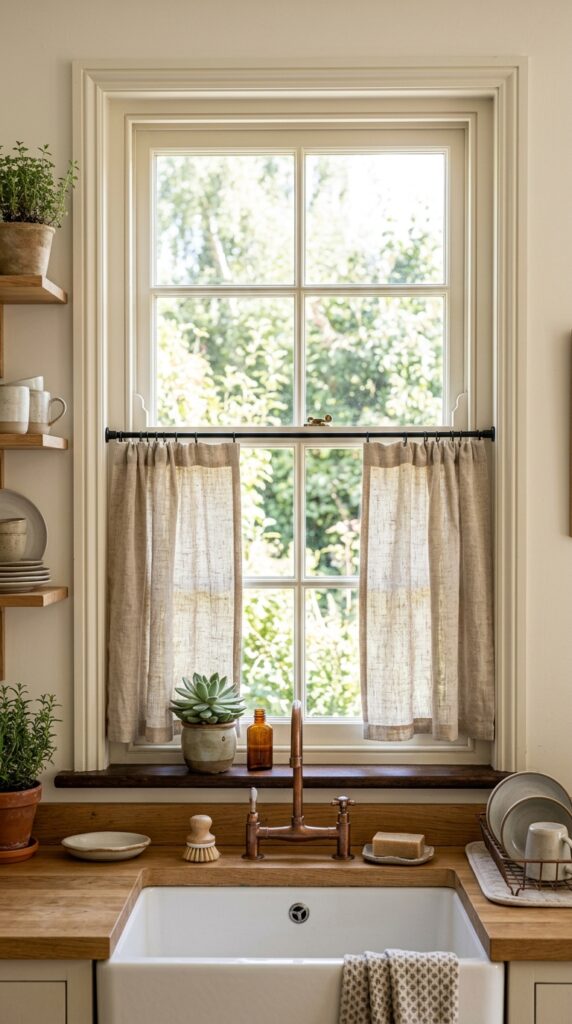
Vibe: Domestic and light-filled — curtains that feel exactly right.
Why it works: Café curtains — short panels covering only the lower half of the window — are one of the most historically accurate details in a farmhouse kitchen. They offer privacy at eye level while allowing natural light to flood in from the upper glass. Linen specifically is the right material choice here because its natural nubs and slight translucency diffuse light in a way that feels warm rather than blocked. A thin matte black rod maintains the hardware consistency the style depends on without the visual weight of a full curtain rod with finials.
How to get it: Hang the rod at the exact midpoint of the window frame — not at the top, as you would for a full-length curtain. Cut curtain panels to just below the sill for the classic café proportion. Rough linen in undyed or oatmeal is available from Etsy shops for approximately $8–$12 per yard; two 18-inch panels will cover most standard kitchen windows.
🛍️ Shop the Look — Amazon Product Ideas
| # | Product Search Phrase | Why It Fits |
| 1 | linen café curtain panels natural half window | Core curtain element |
| 2 | thin black curtain rod adjustable 28-48 inch | Period-correct hardware |
| 3 | window sill succulent small pot self-watering | Sill plant accent |
| 4 | linen curtain panel rod pocket unlined natural | Alternative curtain option |
| 5 | window lock vintage style antique brass | Authentic window hardware |
15. A Statement Farmhouse Wood Range Hood
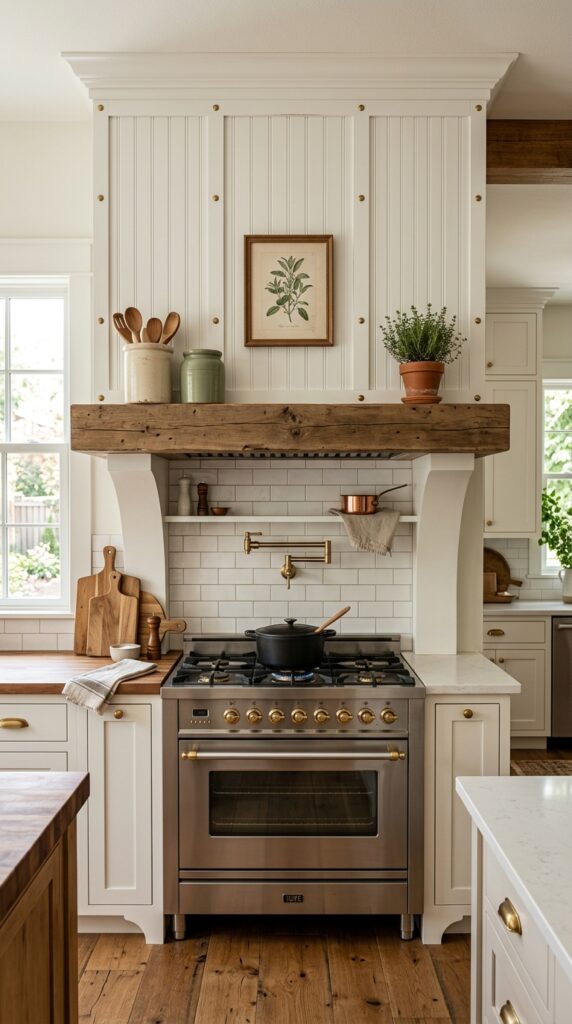
Vibe: Anchored and warm — the kitchen’s most confident design moment.
Why it works: A custom wood range hood is the single most transformative architectural element in a farmhouse kitchen — it takes what is usually a functional necessity (ventilation) and turns it into the room’s focal point. The mantle shelf below the hood acts like a fireplace mantel, creating a dedicated styling zone that anchors the entire stove wall. Beadboard paneling on the hood sides continues the material language from the island or walls, threading the craft detail through the room at a larger scale.
How to get it: A DIY faux range hood built around an existing insert can be constructed with MDF, beadboard panels, and a 2×6 pine mantle shelf for approximately $150–$300 in materials. Countless tutorials exist for this specific project; the key finishing step is caulking every seam before painting, which is what separates a professional-looking result from an obviously DIY one.
💡 Quick Win: Add a single thick wood shelf below an existing metal range hood using a 2×8 pine board painted or stained to match your cabinets — it costs under $30 and immediately reads as built-in architectural detail.
🛍️ Shop the Look — Amazon Product Ideas
| # | Product Search Phrase | Why It Fits |
| 1 | white range hood farmhouse wood vent insert | Core hood element |
| 2 | rustic wood mantle shelf for range hood | Shelf for hood styling |
| 3 | ceramic crock set farmhouse kitchen counter | Mantle shelf styling |
| 4 | botanical framed print kitchen wall art | Hood wall styling |
| 5 | brushed brass vent grille replacement kitchen | Hardware accent |
16. Chalkboard Wall or Chalkboard Panel
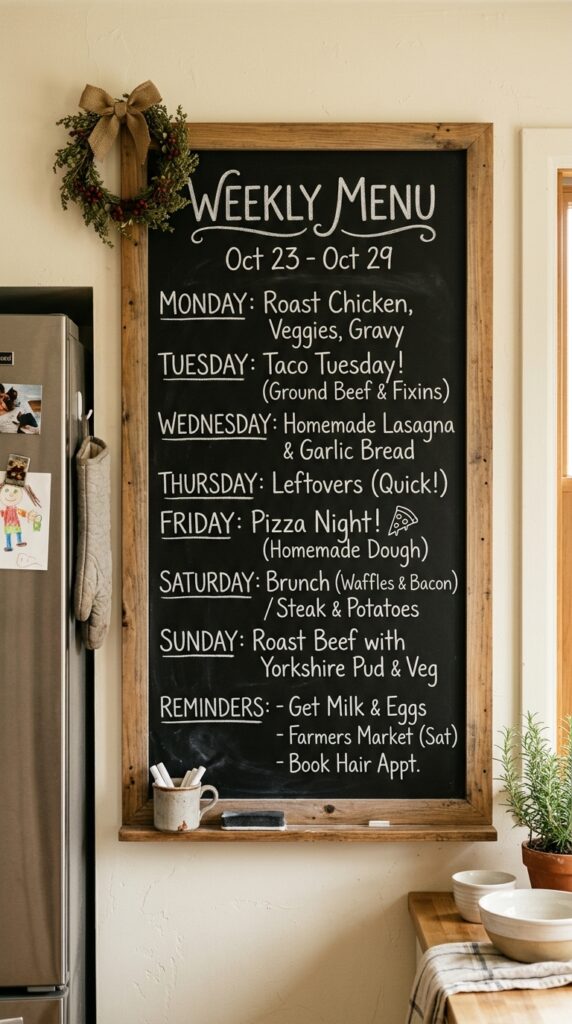
Vibe: Personal and grounded — a wall that belongs to the people who live there.
Why it works: A chalkboard surface introduces the most distinctly personal element possible in a farmhouse kitchen — handwriting. A hand-lettered menu, grocery list, or weekly schedule connects the space to the people who actually use it, which is the philosophical core of farmhouse design: making the domestic feel valued and intentional. The matte black surface also functions as a strong contrast anchor in a room dominated by warm whites and wood tones, preventing the palette from feeling too sweet or undifferentiated.
How to get it: Apply Rust-Oleum Chalkboard paint directly to a wall section using a small foam roller — two coats are sufficient. Frame the painted section with a simple 1×2 inch pine border painted in your cabinet color for a built-in look. Condition the surface before first use by rubbing the flat side of a chalk stick across the entire area, then erasing — this prevents permanent ghosting from your first inscription.
🛍️ Shop the Look — Amazon Product Ideas
| # | Product Search Phrase | Why It Fits |
| 1 | chalkboard paint black quart wall application | Core chalkboard element |
| 2 | white chalk sticks thick for wall writing | Essential chalk supply |
| 3 | small chalkboard sign farmhouse kitchen standing | Counter version option |
| 4 | ironstone cup small white ceramic | Chalk holder vessel |
| 5 | farmhouse mini wreath dried herbs kitchen | Wall corner accent |
17. Terracotta Accents as a Color Pop
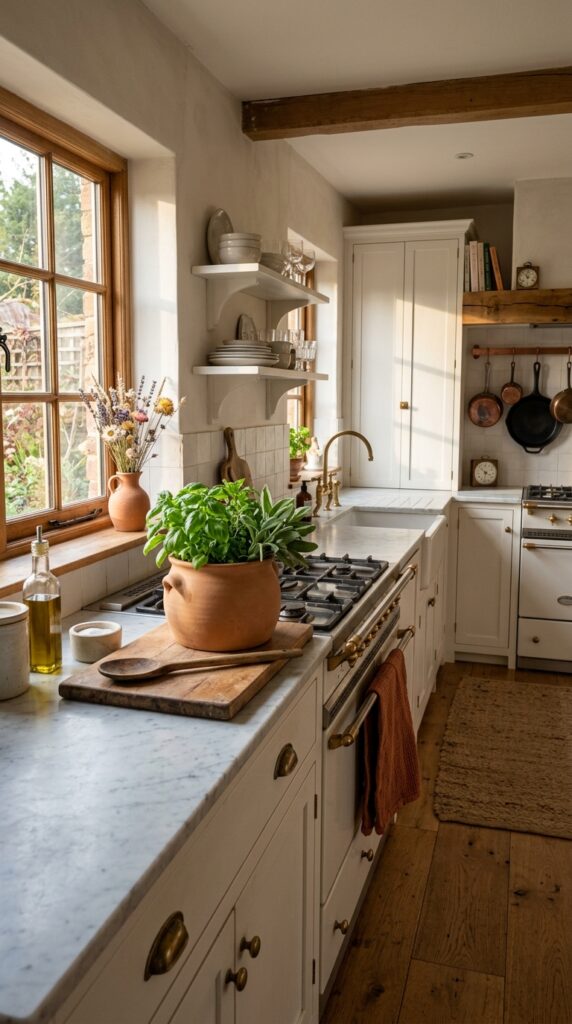
Vibe: Sun-warmed and rooted — color that feels borrowed from the earth.
Why it works: Terracotta as an accent color in a farmhouse kitchen works because it extends rather than interrupts the warm neutral palette — it’s earthy, desaturated, and historically authentic (fired clay has been a farmhouse kitchen material for centuries). The design principle is tonal threading: introduce the same terracotta tone at three different scales — a large pot, a medium towel, a small vase — so the color reads as intentional rather than coincidental. This repetition is what makes a single accent color feel like a design decision rather than an afterthought.
How to get it: Start with the most replaceable items — a dish towel and a small pot. Linen dish towels in terracotta or burnt sienna are available from H&M Home and Amazon for $8–$15 each. Commit to a larger terracotta piece (a crock, a large serving bowl, or a pendant shade) only after confirming the tone works with your existing cabinet and countertop colors in your specific light conditions.
💡 Quick Win: A single unglazed terracotta pot from a garden center (under $8) filled with a basil plant from the grocery store ($3–$5) creates the most authentic farmhouse kitchen counter moment at the lowest possible cost.
🛍️ Shop the Look — Amazon Product Ideas
| # | Product Search Phrase | Why It Fits |
| 1 | terracotta ceramic planter pot unglazed medium | Core accent material |
| 2 | linen dish towel terracotta orange earthy tone | Towel color accent |
| 3 | terracotta bud vase small ceramic matte | Windowsill detail |
| 4 | dried wildflower bundle for small vase | Bud vase contents |
| 5 | terracotta crock kitchen counter storage jar | Larger accent option |
18. Vintage-Style Open Kitchen Hutch
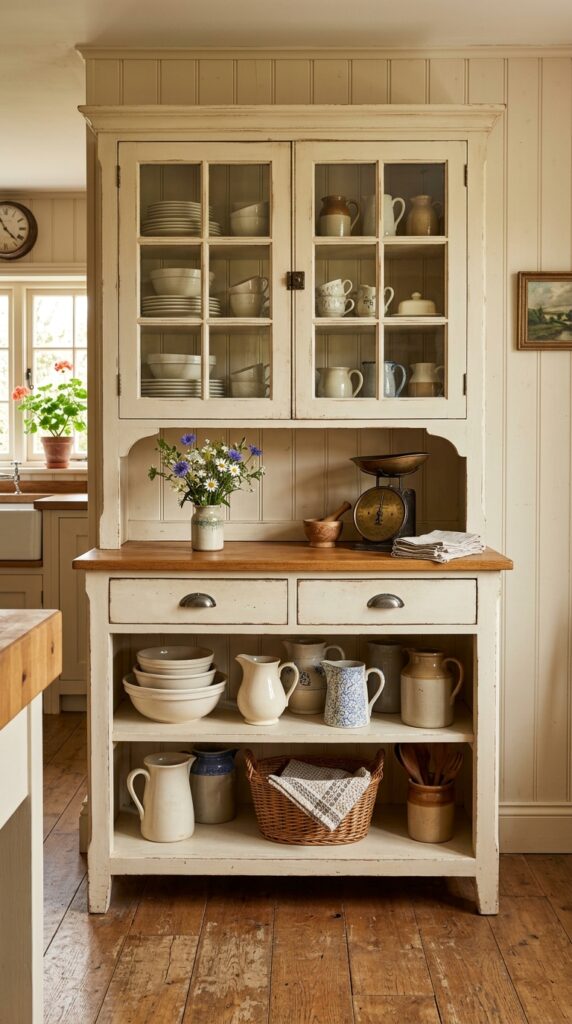
Vibe: Collected and timeworn — a piece that makes the kitchen feel like it has history.
Why it works: A freestanding kitchen hutch brings furniture-quality presence into a room that is often dominated by fixed built-ins. The visual principle at work is contrast of character: a distressed, aged hutch against more modern kitchen elements creates the intentional tension between old and new that defines farmhouse style at its best. Glass-front upper doors make the hutch’s contents part of the room’s visual story, which means the dishes and items inside need to be as intentionally styled as any open shelf.
How to get it: Distress a plain painted hutch by sanding the edges and corners after the final paint coat — focus on areas that would naturally see wear (door frame edges, corners of shelves). Apply a thin coat of dark wax or raw umber paint diluted in water, then wipe back immediately with a dry cloth, concentrating in corners and recesses. This aging technique works on any new furniture piece.
🛍️ Shop the Look — Amazon Product Ideas
| # | Product Search Phrase | Why It Fits |
| 1 | farmhouse kitchen hutch freestanding buffet cabinet | Core furniture piece |
| 2 | vintage kitchen scale decorative farmhouse | Hutch counter styling |
| 3 | small wildflower vase ceramic white round | Hutch floral accent |
| 4 | dark furniture wax paste antiquing finish | Distressing product |
| 5 | glass front cabinet knob antique brass set | Hardware for hutch update |
19. Painted Brick Kitchen Backsplash
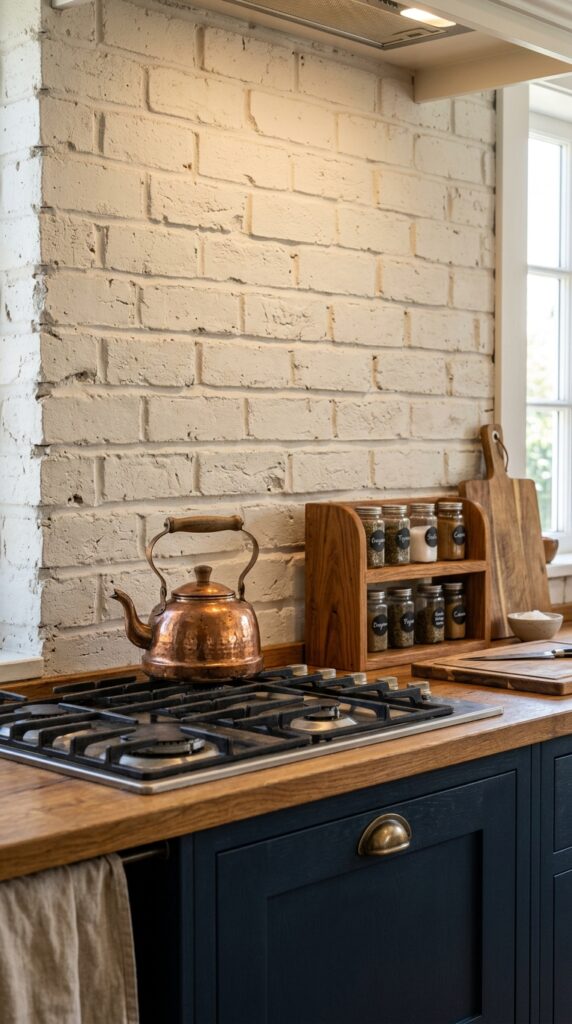
Vibe: Raw and layered — texture that makes the whole kitchen feel older and richer.
Why it works: Painted brick introduces the most honest material possible into a farmhouse kitchen — it’s structural, imperfect, and historic. When painted in warm white rather than left in natural red, brick loses its heaviness and becomes a textural backdrop that works with rather than against the neutral palette. The mortar lines read as shadow and add dimension that no flat painted wall or tiled surface can replicate. In a kitchen where everything else is relatively smooth (cabinets, countertops, appliances), brick is the textural counterpoint that makes the room feel layered.
How to get it: Paint existing brick using a masonry primer first, then two coats of a masonry-compatible flat or matte interior paint. If brick isn’t present, a high-quality brick wallpaper (Tempaper or RoomMates carry realistic options at $40–$75 per roll) achieves a convincing effect on a smooth wall. Install vertically staggered sheets, not aligned, for the most convincing result.
💡 Quick Win: A copper or brass kettle placed on the stove costs $25–$60 and is the single most impactful counter accent in a farmhouse kitchen — it catches light, adds warmth, and photographs better than any purely decorative item.
🛍️ Shop the Look — Amazon Product Ideas
| # | Product Search Phrase | Why It Fits |
| 1 | brick effect peel and stick wallpaper white | DIY brick backsplash |
| 2 | masonry primer spray white interior | Real brick paint prep |
| 3 | copper tea kettle stovetop farmhouse | Hero counter accent |
| 4 | wooden wall-mounted spice rack kitchen | Stove wall storage detail |
| 5 | navy blue cabinet paint chalk finish quart | Cabinet color for contrast |
20. Farmhouse Dining Nook Built Into the Kitchen
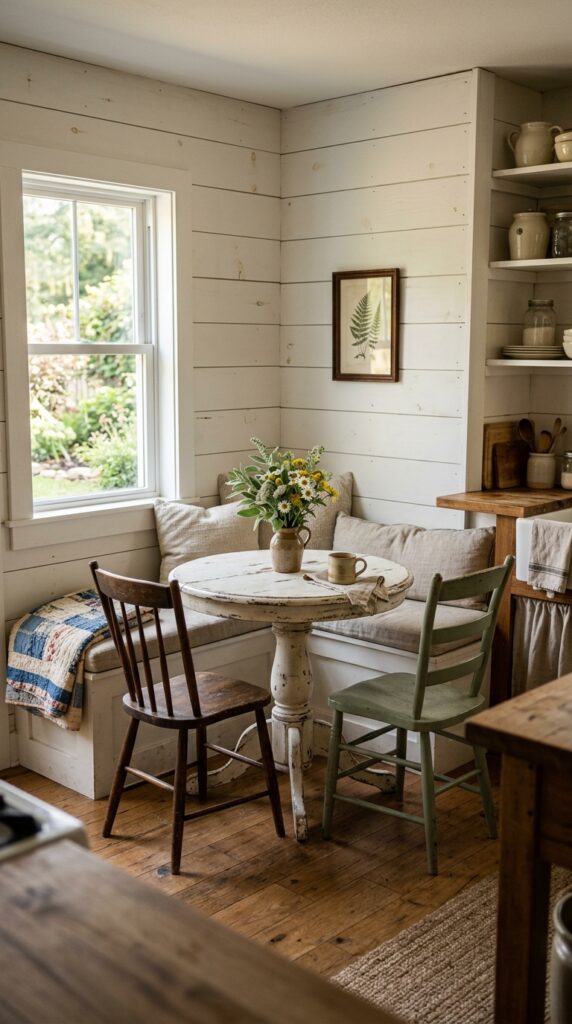
Vibe: Intimate and unhurried — the corner that makes the kitchen feel like a home.
Why it works: A built-in dining nook creates the most valuable thing a kitchen can have: a reason to linger. By carving a defined eating and gathering zone out of a kitchen corner, the nook uses the layout principle of zone definition to give the space an emotional function beyond cooking. Shiplap walls on two sides of the nook create a sense of enclosure that feels cozy rather than confined — the visual rhythm of horizontal planks at close range is actually calming, not claustrophobic, because it gives the eye a surface to rest on.
How to get it: A basic L-shaped bench nook can be constructed using two simple plywood box benches with hinged lids for hidden storage, upholstered with a foam pad and a linen or canvas cushion cover. Total material cost for a DIY nook (benches + shiplap wall treatment + cushions) runs $200–$500 depending on materials. The round pedestal table is the most space-efficient table shape for a nook — it eliminates corner crowding and makes the zone feel more relaxed.
🛍️ Shop the Look — Amazon Product Ideas
| # | Product Search Phrase | Why It Fits |
| 1 | round pedestal dining table small farmhouse white | Nook table hero piece |
| 2 | linen bench cushion 48 inch oatmeal farmhouse | Bench seating comfort |
| 3 | storage bench with hinged lid wood seat | Nook bench with storage |
| 4 | small wildflower mix vase table centerpiece | Nook table styling |
| 5 | cotton throw quilt farmhouse pattern bench | Nook textile layer |
21. Herb Garden Wall Display in the Kitchen
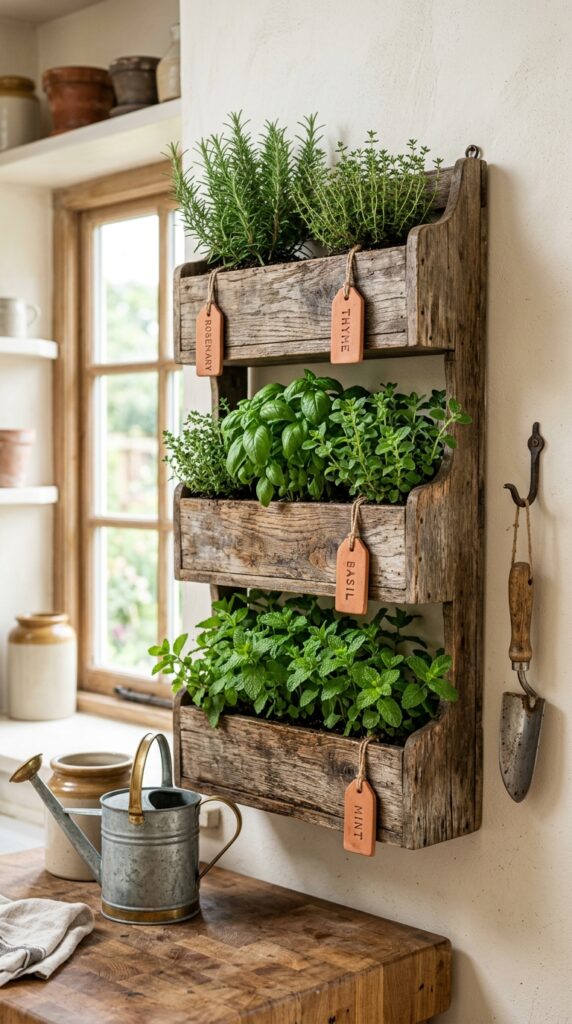
Vibe: Fresh and rooted — a kitchen that connects cooking to growing.
Why it works: A kitchen herb wall brings the farmhouse style’s agricultural roots into the room in the most literal and functional way possible — these are actual plants that you cook with, which means every time you reach for a sprig of rosemary you’re interacting with the space in a way that feels genuinely connected to the style’s philosophy. The vertical stacking of planters uses wall space rather than counter space, which makes it a particularly smart solution for small kitchens. The varied heights and textures of different herb plants add organic irregularity that no manufactured decor item can replicate.
How to get it: Wall-mounted planter boxes in weathered or whitewashed wood are available on Etsy and Amazon for $30–$60 for a set of three. Mount them on a south- or east-facing wall for the best light exposure — herbs need at least 6 hours of direct or indirect sunlight daily to thrive indoors. Label each planter with an air-dry clay tag stamped with a letter set before firing — total material cost under $10.
💡 Quick Win: A $12 three-pocket canvas wall planter hung on a single hook beside the window, filled with small potted herbs from the grocery store, creates a fully functional kitchen herb garden in under 10 minutes.
🛍️ Shop the Look — Amazon Product Ideas
| # | Product Search Phrase | Why It Fits |
| 1 | wall mounted wood planter box set of 3 kitchen | Core herb display |
| 2 | air dry clay for tags craft project small | DIY herb label material |
| 3 | letter stamp set for clay tags farmhouse | Label stamping tool |
| 4 | small watering can indoor copper or brass | Counter herb care tool |
| 5 | canvas wall pocket planter three pocket hanging | Compact herb garden option |
How to Start Your Farmhouse Kitchen Transformation
Start with hardware. Swap every cabinet pull and knob to matte black bar pulls — this single update takes an afternoon, costs $30–$80 for a full kitchen depending on cabinet count, and immediately shifts the room’s design language from generic to intentional. Hardware is the fastest and most reversible way to signal a design direction, and in a farmhouse kitchen, matte black pulls anchor the visual system that everything else will build from.
The most common beginner mistake is painting cabinets in a cool or bright white. Cool whites with blue or green undertones fight the warmth of wood, linen, and ceramic materials that farmhouse style depends on — the room ends up feeling clinical rather than cozy. The fix is straightforward: look for whites with an LRV (Light Reflectance Value) between 82–88 and a yellow or red base tone. Benjamin Moore “White Dove” and Sherwin-Williams “Alabaster” are the two most reliable choices.
Three items under $50 that immediately shift your kitchen toward farmhouse: a set of three matching seagrass baskets for open shelving or under-counter storage ($25–$40 on Amazon); a linen dish towel set in oatmeal or natural stripe from H&M Home ($15–$20 for two); and a single large unglazed terracotta pot filled with a grocery-store herb plant ($10–$15 total).
A realistic weekend transformation — hardware swap, new textiles, counter restyling, and a can of paint — costs $100–$300 and creates a room that feels genuinely different. A full farmhouse kitchen transformation (cabinets, countertops, open shelving, lighting, sink) is a 3–6 month project with a realistic budget range of $2,000–$8,000 depending on the scope and whether cabinetry is painted or replaced.
Frequently Asked Questions About Farmhouse Kitchen Ideas
What is the difference between farmhouse and cottage kitchen style?
Farmhouse and cottage kitchens share a love of natural materials and a casual, lived-in quality, but they diverge in palette and detail. Cottage style leans into soft pastels — pale blue, sage, blush — and tends toward more floral, patterned, and delicate details. Farmhouse style commits to warm neutrals and honest materials, with a stronger emphasis on texture over pattern and utility over ornament. An apron sink is farmhouse; a floral tile backsplash is cottage. Both are warm, but farmhouse is more grounded and less decorative.
What colors work best in a farmhouse kitchen?
The anchor palette is always warm whites and greiges — Benjamin Moore “White Dove,” Sherwin-Williams “Alabaster,” and Behr “Swiss Coffee” are the most widely used. From these neutral anchors, muted accent tones integrate naturally: dusty sage green (Sherwin-Williams “Privilege Green”), terracotta, soft navy, and warm charcoal all work well as cabinet or accent colors. The critical rule is to avoid cool whites with blue or green undertones on cabinets — they fight the warmth of wood and linen materials and make the room feel cold.
Is a farmhouse kitchen expensive to achieve?
The style spans a very wide budget range. A cosmetic transformation — paint, hardware, new textiles, and open shelving — can be achieved for $150–$500 and creates genuine impact. Mid-range updates adding an apron sink, butcher block countertops, and pendant lighting typically run $1,500–$4,000 depending on whether you’re hiring out or DIYing. A full renovation with custom cabinetry, fireclay sink, and professional lighting runs $8,000–$25,000. The farmhouse style’s reliance on natural and vintage materials actually makes it more thrift-friendly than almost any other design style — the best pieces are often found at estate sales and Goodwill.
Can I mix farmhouse style with modern kitchen elements?
Yes, and the modern farmhouse aesthetic is built on exactly this blend. Stainless steel appliances work well against white farmhouse cabinetry — the contrast reads as honest and functional rather than incongruous. Quartz countertops in a warm white or marble-look pattern integrate comfortably with farmhouse cabinetry when the undertones are warm. What doesn’t blend well: high-gloss cabinetry, chrome hardware, or very minimal handleless cabinetry — these read as too contemporary to sit comfortably alongside shiplap and linen. The rule is simple: if it would look at home in a sleek city apartment, it probably fights the farmhouse palette.
What lighting works best in a farmhouse kitchen?
Pendant lights over the island and sink are the most impactful farmhouse lighting choices. Matte black cage pendants with exposed Edison bulbs are the most searched and widely recognized farmhouse option — they reference industrial utility while staying visually light and open. Oil-rubbed bronze fixtures add warmth and read as more antique. For ambient lighting, always choose warm white bulbs in the 2200–2700K range — this temperature makes wood tones richer and white surfaces creamier, which is exactly the sensory quality the farmhouse kitchen depends on. Avoid recessed lighting as the only overhead source; it produces a flat light that strips the warmth from natural materials.
Ready to Create Your Dream Farmhouse Kitchen?
These 21 ideas covered the full range of what makes a farmhouse kitchen feel genuinely alive — from big architectural moves like shiplap backsplashes and apron sinks, to material choices like butcher block and ironstone, to the small styling details that make a counter feel curated rather than cluttered. Know that you don’t need to do everything at once; in fact, the farmhouse kitchens that feel most authentic are the ones built slowly, one honest layer at a time. This weekend, swap your cabinet hardware to matte black bar pulls — it takes two hours, costs under $50, and shifts the entire room’s personality immediately. When the kitchen is done, you’ll feel it before you consciously notice it: a warmth that makes you want to stay, to cook, to gather, to linger over the second cup of coffee. Save the ideas that made you stop scrolling — pin the ones that felt less like a design choice and more like coming home.