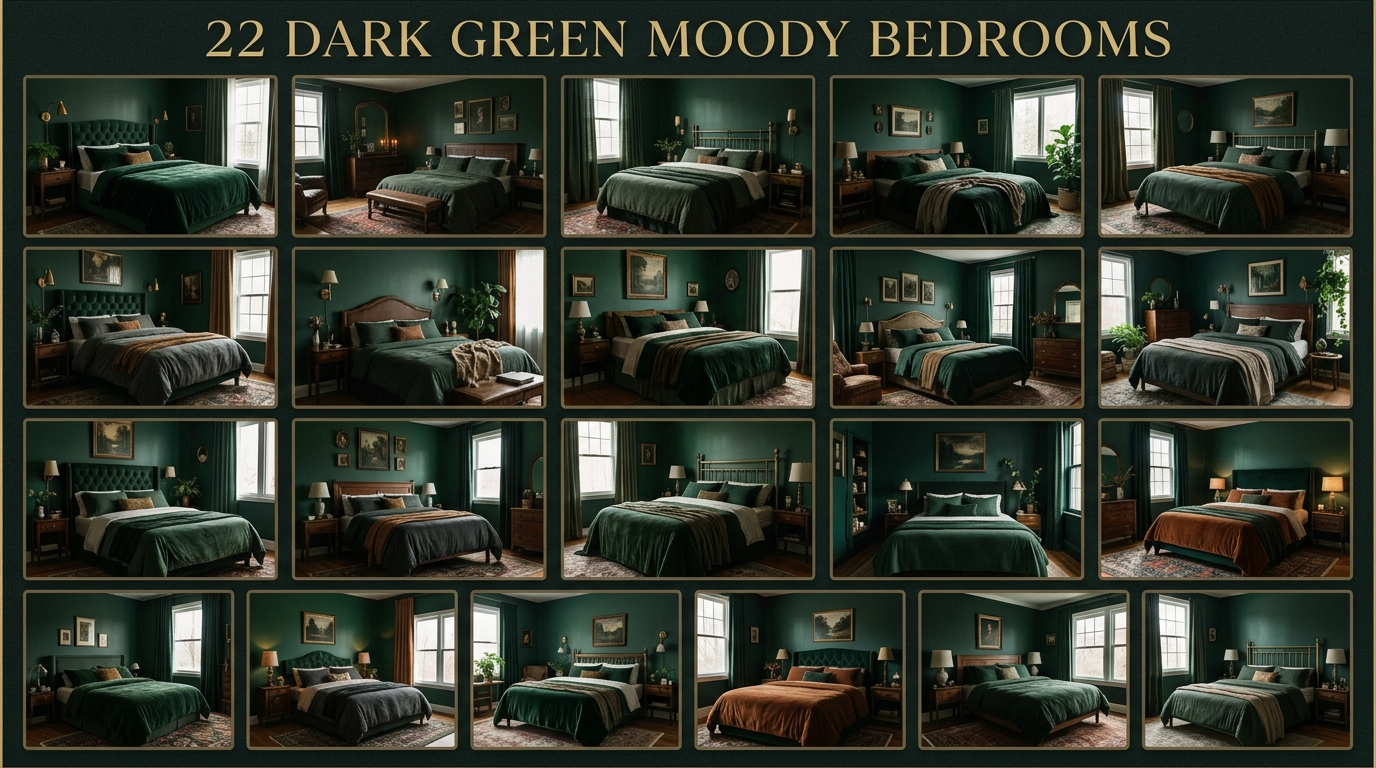
Dark green moody bedrooms are sleeping spaces designed around deep, forest-adjacent green tones — hunter, bottle, racing, and emerald greens — paired with raw or richly textured materials to create an atmosphere of enveloping, cave-like intimacy. This article gives you 22 dark green moody bedroom ideas spanning color palettes, materials, lighting, furniture, layout, accessories, and small-space applications — everything you need to design a bedroom that genuinely feels like refuge.
There is something biologically correct about sleeping inside green. The color of deep forest canopy, of moss in shadow, of lichen on stone — dark green triggers the same neural quiet that standing in old growth does. A moody green bedroom does not merely look atmospheric; it changes how a room feels to be inside, pressing calm into the walls and pulling the ceiling down to a more human scale. Here are 22 ideas worth saving — and stealing.
Why Dark Green Moody Bedrooms Work So Well
The dark green bedroom draws from a long lineage of atmospheric interior design — the jewel-toned libraries of Victorian townhouses, the bottle-green studies of English country houses, and more recently, the maximalist revival championed by designers like Luke Edward Hall and Beata Heuman, who reasserted that depth of color is not a risk but a commitment. What distinguishes the moody green bedroom from a simple “painted room” is the layering of tone on tone: dark walls paired with darker textiles, deeper accent colors, and warm but low-level light that allows the green to shift and breathe through the day.
The material palette leans heavily into texture contrast. Velvet in forest or bottle green, linen in warm ivory and deep sage, raw silk in dark olive, aged brass and unlacquered gold hardware, dark walnut and ebony-stained oak, natural rattan and cane, and unglazed ceramic in earth tones all inhabit this style’s material vocabulary. Colors within the palette extend beyond the green itself into its natural companions: deep umber, oxblood, warm terracotta, charcoal, aged brass, and the near-black of cast iron — tones that exist alongside green in every forest environment.
Dark green moody bedrooms are surging in design culture for reasons that connect to both the biophilic design movement and the broader post-pandemic reorientation toward spaces that shelter rather than display. Research from the University of Exeter linking green interior environments to reduced cortisol levels has entered mainstream design conversation, and Pinterest data shows searches for “dark green bedroom” increasing over 300% since 2022. The bedroom specifically — the room most people use exclusively for rest — is where the argument for atmospheric, enveloping color is most physiologically sound.
Small bedrooms can achieve this style powerfully, and often more effectively than large ones. In a compact room, dark green walls create total enclosure — the space becomes a capsule rather than a box. Prioritize the wall color and one quality textile first. Scale the furniture low to keep ceiling height apparent, and let a single brass or warm-toned light source do the atmospheric work.
Style at a Glance
| Element | Moody Dark Green | Botanical Warm Green |
| Philosophy | Enveloping refuge | Nature brought indoors |
| Materials | Velvet, aged brass, dark walnut, raw silk | Rattan, linen, terracotta, cane |
| Color palette | Bottle green, hunter, charcoal, oxblood | Sage, forest, warm ivory, terracotta |
22 Dark Green Moody Bedroom Ideas
1. Floor-to-Ceiling Bottle Green Velvet Walls
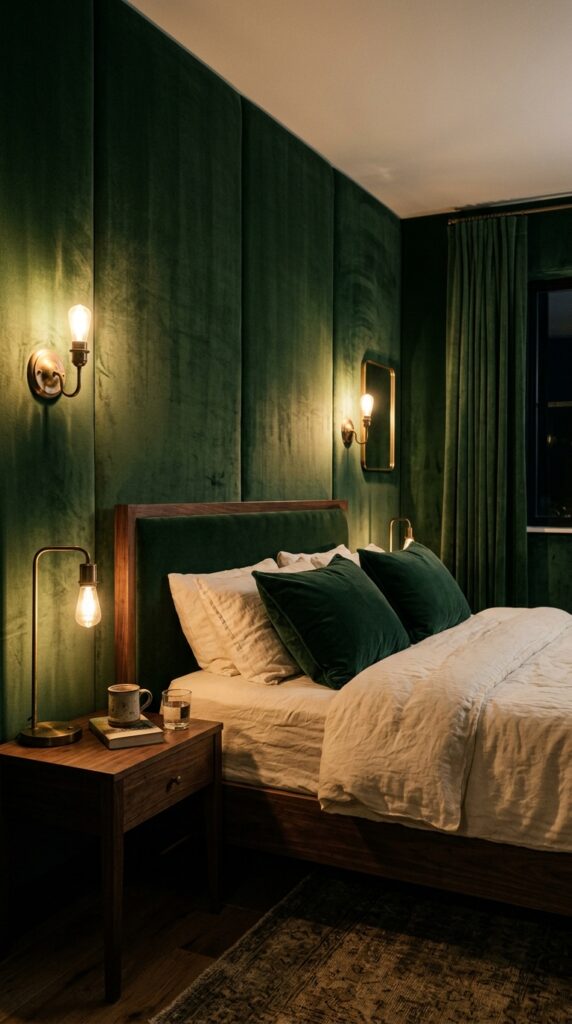
Vibe: Enveloping — velvet walls do not reflect light; they absorb it, and the room becomes warmer with every hour after sunset.
Why it works: Upholstering walls in velvet rather than painting them introduces a completely different relationship between the surface and light. Velvet pile changes tone depending on the direction it is brushed and the angle of the light source — a single bottle green velvet wall will read as deep emerald in raking light and near-black in shadow, creating tonal movement across a static surface. The material also provides meaningful acoustic dampening, making the bedroom noticeably quieter than paint or wallpaper surfaces can achieve. Velvet wall panels are mounted on a track system or directly adhered to battens at 48-inch intervals.
How to get it: Source upholstery-weight velvet in a cotton-polyester blend (pure cotton velvet crushes; synthetic-blend maintains pile recovery) in bottle green — look for 400–500 gsm weight minimum. Cut panels to ceiling height and mount using a Velcro batten system for removability, or have a upholstery specialist panel-mount directly to the wall using a French cleat track. Brush all panels in the same pile direction after installation for uniform tonal reading.
💡 Quick Win: A single dark green velvet curtain panel ($35–$50) hung floor-to-ceiling on the wall behind the bed — not over a window — creates the same visual effect as velvet wall paneling at a fraction of the cost and zero installation.
Shop The Look
| Product |
| Bottle green velvet curtain panel floor ceiling |
| Aged brass wall sconce bedroom arm single |
| Dark walnut bedside table solid wood |
| Deep green velvet throw pillow cover |
| Brass table lamp small warm shade |
2. Hunter Green Limewash Paint with Brass Hardware
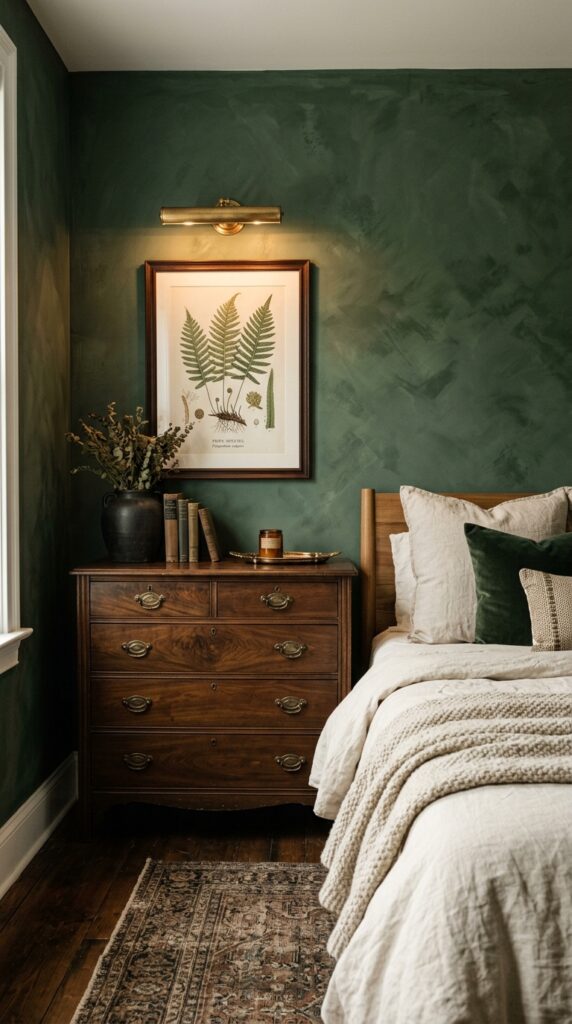
Vibe: Layered — limewash hunter green reads differently at 8am and 8pm in the same room, which is the whole point.
Why it works: Limewash paint applied in hunter green produces a surface that shifts tonal register with changing light conditions — the calcium carbonate in the lime medium reflects and refracts light differently from standard emulsion, creating depth rather than flat color. In a bedroom context, this means the walls are never the same green twice: morning light reads them as a warm olive-green, afternoon direct light bleaches them toward sage, and evening lamplight deepens them to near-forest. The aged brass hardware is the essential counterpart — unlacquered brass oxidizes toward warm amber tones that are the natural complement of hunter green in the color wheel, sitting directly opposite on the warm-cool axis.
How to get it: Use Portola Paints Roman Clay in Laurel, Pure & Original Classico in Pesto or Forest, or Bauwerk Colour Limewash in Deep Green for the most authentic tonal variation. Apply with a wide masonry brush in overlapping circular strokes — do not roll, which produces a flat finish that defeats the purpose. Two to three coats with light distressing between coats produces the ideal layered result.
Shop The Look
| Product |
| Limewash interior paint hunter green deep |
| Aged brass drawer pull set cabinet hardware |
| Brass picture light wall mount warm |
| Framed botanical print dark wood frame |
| Dark ceramic vessel medium handmade |
3. Dark Green and Oxblood Color Palette
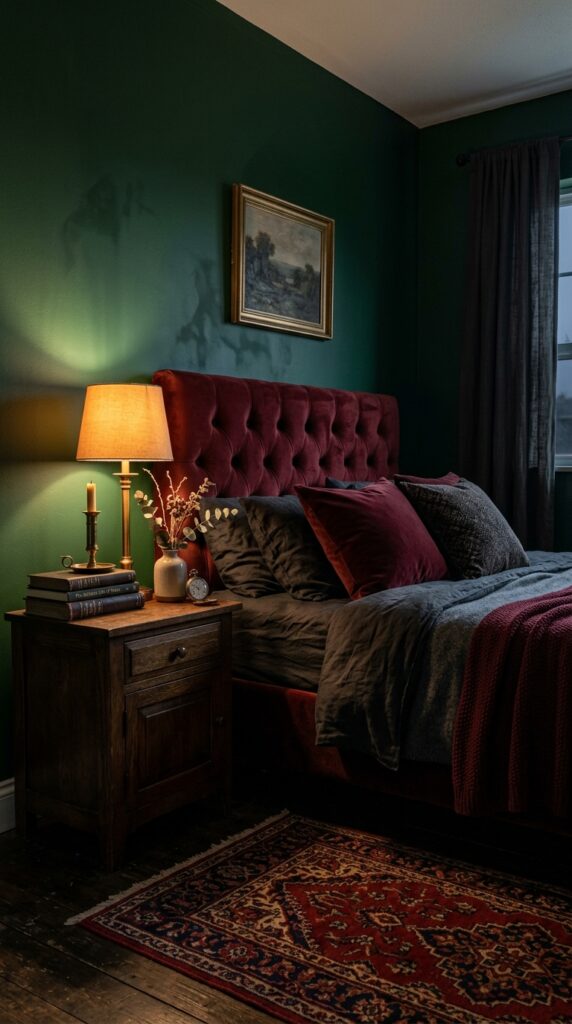
Vibe: Rich — forest green and oxblood together read like the inside of a Victorian smoking room, which is a compliment of the highest order.
Why it works: Forest green and oxblood occupy opposite positions in the warm-dark register of the color wheel — one cool and receding, one warm and advancing — creating a tension that makes both colors more vivid in each other’s presence. This is the design principle of simultaneous contrast: colors appear more saturated when placed adjacent to their chromatic opposites. Historically, this pairing appears in the libraries and drawing rooms of English country houses because the two colors together create an atmosphere of settled, masculine richness that neither achieves alone. The Persian rug anchors both tones in a single object, giving the floor the visual weight of a third dark surface.
How to get it: Apply Farrow & Ball’s Studio Green No.93 or Sherwin-Williams’ Cascades SW-6477 to the walls. Source an oxblood velvet headboard (upholster an existing headboard using Colefax and Fowler or Designers Guild oxblood velvet, or commission a custom upholstered panel). Choose a vintage or antique Persian rug with deep red as the dominant tone — even a worn or distressed rug is more effective than a new reproduction in this palette.
Shop The Look
| Product |
| Oxblood velvet throw pillow cover dark red |
| Vintage style Persian area rug deep red bedroom |
| Forest green flat interior wall paint quart |
| Brass candlestick holder tall set of 2 |
| Dark leather hardcover book set decorative |
4. Dark Green Bedroom with Canopy Bed
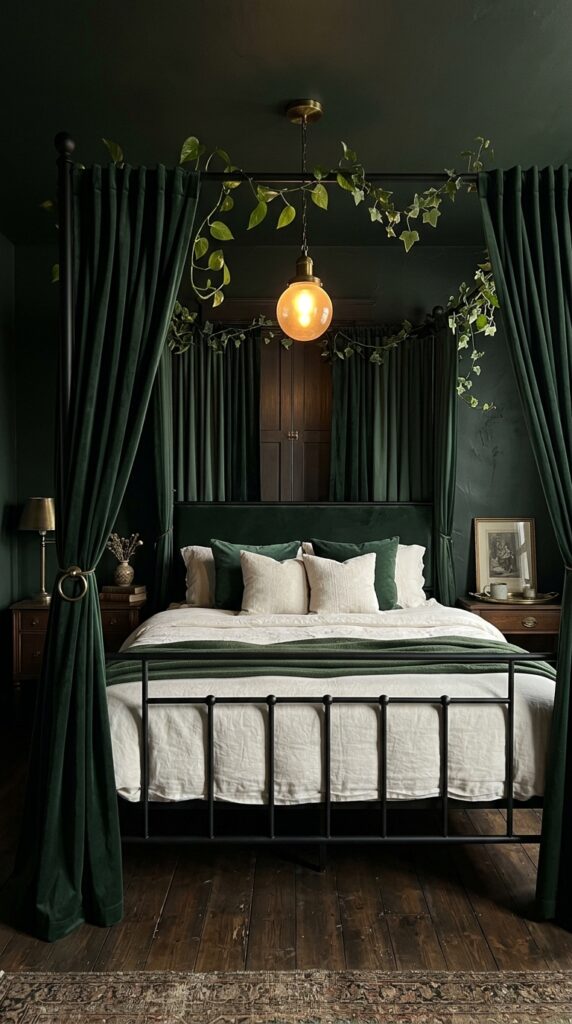
Vibe: Enveloping — sleeping inside a canopy of dark green velvet is the closest approximation of a forest floor that indoor design achieves.
Why it works: The canopy bed in dark green velvet exploits a fundamental principle of moody bedroom design: enclosure as comfort. Surrounding the sleeping zone on four sides and overhead with a soft, light-absorbing material creates a micro-room within the room — a capsule of darkness and warmth that is physiologically conducive to deep sleep. The iron frame, matte black and structurally visible at the canopy’s skeleton, provides the hard architectural line against which the velvet drapes read as deliberately soft — the contrast between rigid structure and yielding fabric is the composition’s essential tension.
How to get it: Source a square-post matte black iron canopy frame in your mattress size — look for one with clean horizontal top rails rather than decorative finials, which read as period rather than contemporary. Hang velvet panels from curtain rings on the top rail — four panels, one per post — and allow them to pool slightly on the floor for the most atmospheric effect. Leave the foot-end panels open for airflow and a view of the room.
Shop The Look
| Product |
| Matte black iron canopy bed frame four-poster |
| Dark green velvet bed curtain panel long |
| Brass curtain ring set for canopy bed |
| Ivory linen duvet cover set natural |
| Small brass pendant light bedroom overhead |
5. Deep Green Bedroom Lighting: Brass and Candlelight Only
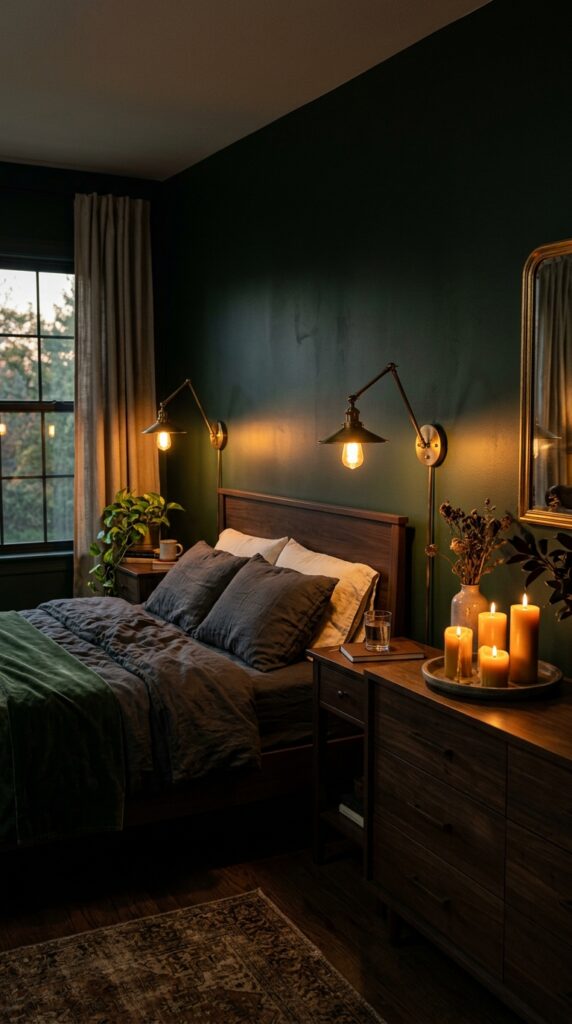
Vibe: Romantic — candlelight in a dark green room produces a warmth that no electric fixture at any wattage replicates.
Why it works: Eliminating overhead lighting in a dark green bedroom is the single most transformative atmospheric decision available. Overhead light, when directed downward from the ceiling, flattens every surface it hits — the dimensional quality of limewash paint, the pile variation of velvet, the grain of dark timber all disappear under ceiling-level illumination. Low light sources — sconces at 60 inches and candles at dresser height — illuminate surfaces from below and from the side, which is the direction that reveals texture most dramatically. The upper walls and ceiling remain in shadow, and the room’s vertical dimension compresses to its most intimate register.
How to get it: Replace or cap any ceiling fixture and install two swing-arm brass sconces on individual switches beside the bed — Rejuvenation, Visual Comfort, and Circa Lighting all offer appropriate profiles. Specify 2200K warm white LED bulbs (not 2700K — the deeper warmth reads better against dark green). Add a cluster of 3–5 unscented beeswax pillar candles on a dark lacquered tray on the dresser as a secondary light source.
Shop The Look
| Product |
| Brass swing arm wall sconce bedroom pair |
| Beeswax pillar candle set unscented natural |
| Dark lacquered wood tray large candle display |
| LED candelabra bulb 2200K warm amber E12 |
| Brass dimmer switch wall plate single |
6. Dark Green Wallpaper: Botanical and Moody
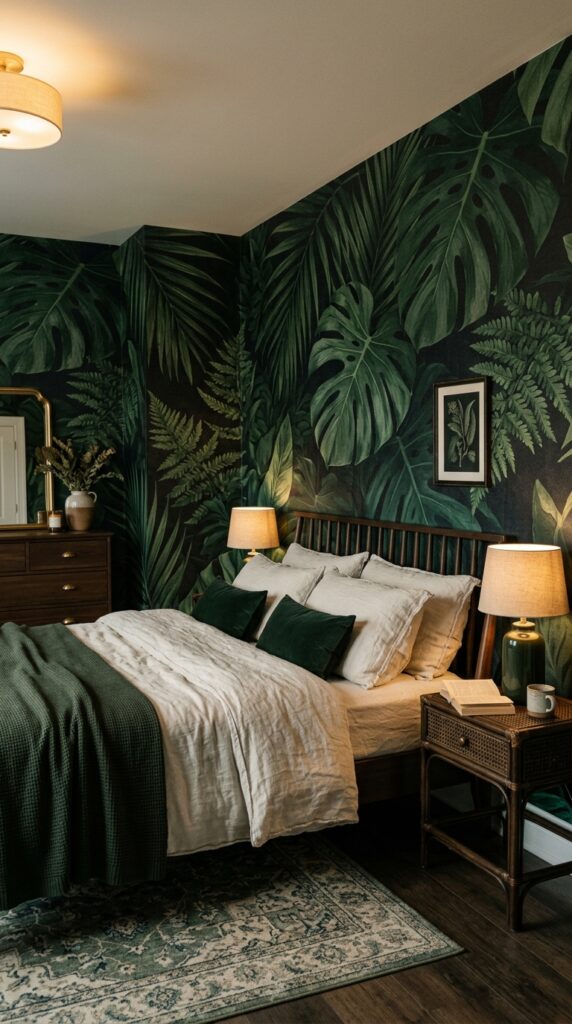
Vibe: Layered — waking up inside a wall of oversized botanical illustration is the closest thing to sleeping in a greenhouse.
Why it works: Large-scale botanical wallpaper in dark green tones works in a bedroom because it wraps all four walls in a continuous environment rather than a single statement surface — the eye has no neutral wall to rest on, which creates the total immersion that defines moody bedroom design. The pattern must be in at least three tones of green (deep forest, hunter, and olive or sage) to prevent the repeat from reading as flat. A near-black or very deep charcoal background — rather than white — integrates the botanical pattern into the moody palette and prevents the bedroom from reading as a children’s jungle room.
How to get it: Source wallpapers from Cole & Son (Botanical collection), Graham & Brown (Boutique collection), or Anthropologie’s wallpaper range — all offer large-scale botanical patterns on dark backgrounds. Specify paste-the-wall rather than paste-the-paper varieties for easier installation in a bedroom. Have a professional wallpaper hanger install on all four walls simultaneously for correct pattern matching at the corners.
💡 Quick Win: A single botanical wallpaper panel ($45–$65) applied only to the wall directly behind the headboard creates the full botanical atmosphere effect without the cost and complexity of a four-wall installation.
Shop The Look
| Product |
| Dark botanical wallpaper large leaf dark green |
| Wallpaper paste brush kit professional |
| Dark rattan bedside table natural round |
| Green ceramic lamp base tall bedroom |
| Ivory linen duvet set European square shams |
7. Emerald Green Headboard Statement Wall
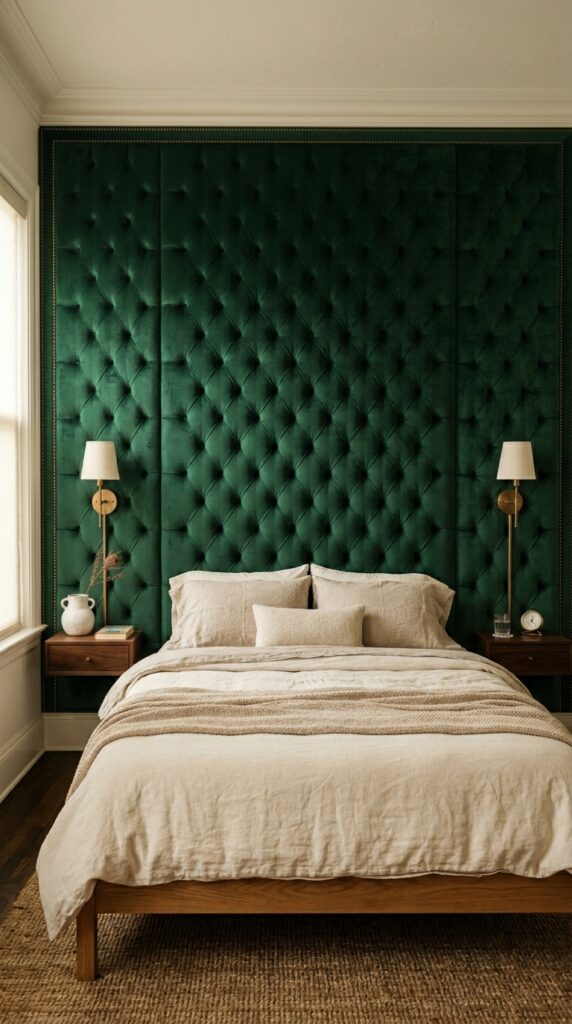
Vibe: Confident — a full-wall upholstered headboard in emerald green is a bedroom decision so complete it needs no other decoration on that wall.
Why it works: The oversized upholstered headboard panel — running full wall width and from floor to ceiling rather than just behind the mattress — transforms the headboard from furniture into architecture. The wall becomes the headboard, and the bedroom’s sleeping zone is defined without any additional structural intervention. Emerald green velvet in deep button tufting creates a grid of shadow wells across the surface that adds depth and visual movement, preventing the large surface from reading as flat. The brass nail head trim at the perimeter functions as a frame, completing the panel as an object.
How to get it: Commission a full-wall upholstered panel from an upholstery specialist — specify a 4-inch foam core at 2.2 density, wrapped in dacron, then emerald velvet with diamond button tufting at 6-inch intervals. Mount on a French cleat system for wall adhesion without visible hardware. Alternatively, assemble from three 24-inch-wide individual panels with hidden panel joints behind the tufting rows.
Shop The Look
| Product |
| Emerald green velvet fabric upholstery material |
| Tufted button kit upholstery DIY set |
| French cleat wall mounting strip set |
| Brass nail head trim strip upholstery |
| Floating wall shelf white minimal small |
8. Dark Green and Dark Walnut Material Pairing
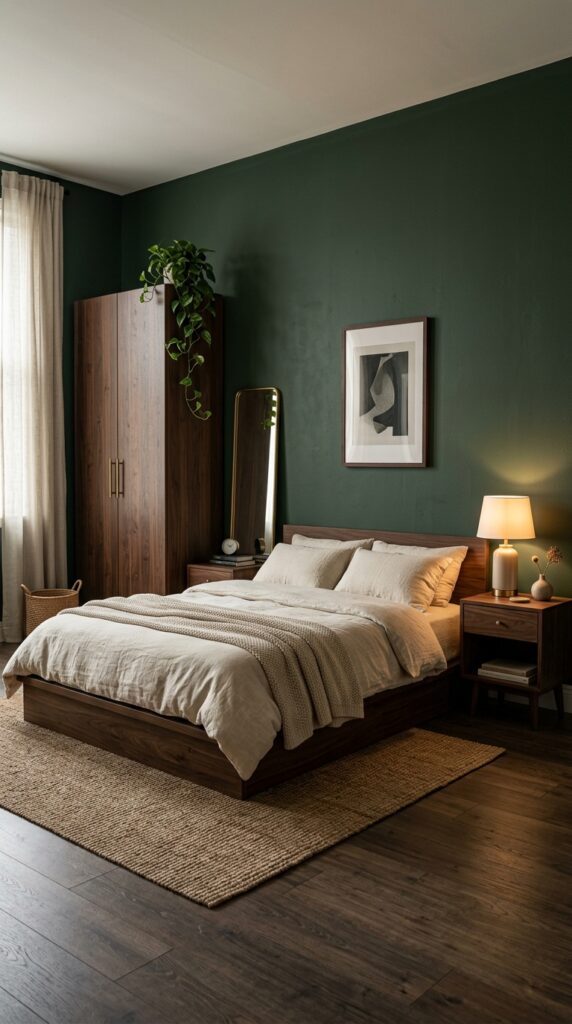
Vibe: Grounded — dark green and dark walnut occupy the same tonal depth, and a room where both inhabit the same space stops being decorated and starts being composed.
Why it works: The pairing of deep green walls and dark walnut furniture works on the principle of tonal harmony — both materials occupy the same deep, warm-dark register of the color spectrum, so neither competes for visual dominance. The distinction between them is entirely in material quality: the smooth matte flatness of the painted wall contrasts with the grain depth and natural variation of the walnut timber. This material contrast within tonal harmony is a classical interior design strategy — it creates sophistication without using color contrast to achieve it.
How to get it: Match furniture tones to the wall by selecting a walnut stain that reads in the same depth family as the green — avoid light or honey-toned walnut, which floats above dark green walls rather than settling alongside them. Rubio Monocoat in Walnut or Smoked Oak produces the correct depth on new timber. Keep bedding in warm ivory to provide the one light surface the room needs for visual balance.
Shop The Look
| Product |
| Dark walnut low platform bed frame solid |
| Dark walnut matching bedside table pair |
| Rubio Monocoat wood finish walnut tone |
| Trailing pothos plant live indoor |
| Small white ceramic bud vase minimal |
9. Moody Green Bedroom: Layered Textiles for Depth
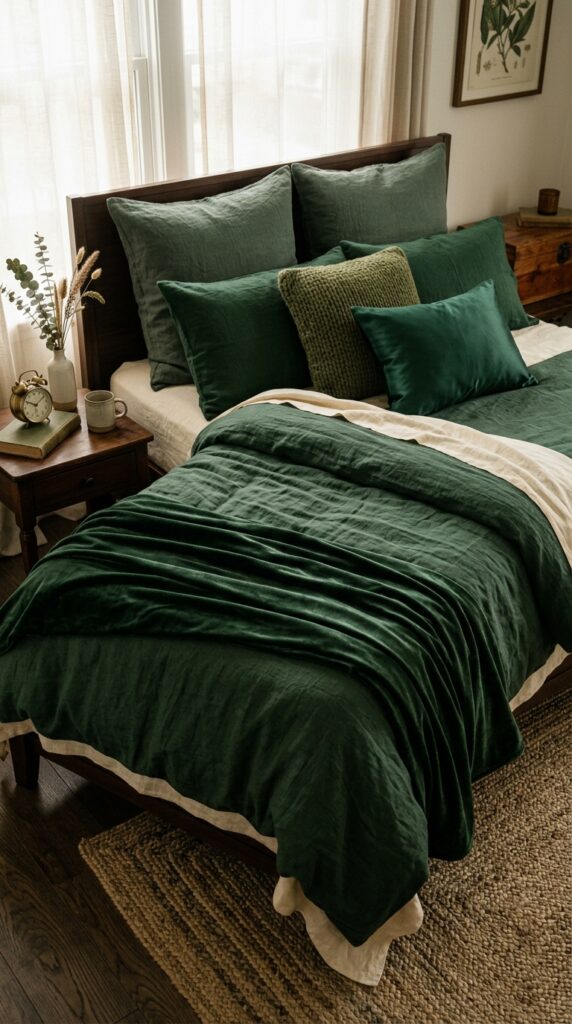
Vibe: Warm — a bed layered in five shades of the same green reads less like a color choice and more like a landscape.
Why it works: Tonal layering — using five or more values of a single hue across five different textures — is the most sophisticated textile strategy in moody bedroom design. Each green reads differently because the texture changes how light interacts with the surface: velvet absorbs light and reads deep, linen reflects diffusely and reads mid-tone, knit creates shadow within its loops and reads textural, silk catches light directionally and reads bright. The result is a bed that has visual complexity without any color contrast — all the interest comes from surface quality rather than palette variation.
How to get it: Build the textile layer from darkest to lightest, starting with a forest green duvet as the base. Add a hunter green velvet throw folded across the foot, two sage linen euro shams behind standard pillows, one olive knit cushion, and one deep emerald silk or satin accent pillow at the front. Every textile should be washable — dry-clean-only bedroom textiles are a practical failure point regardless of how well they photograph.
Shop The Look
| Product |
| Forest green linen duvet cover set washable |
| Hunter green velvet throw blanket large |
| Sage linen euro sham pair natural |
| Olive green chunky knit pillow cover |
| Deep emerald satin pillow cover accent |
10. Dark Green Bedroom with Iron and Brass Bed Frame
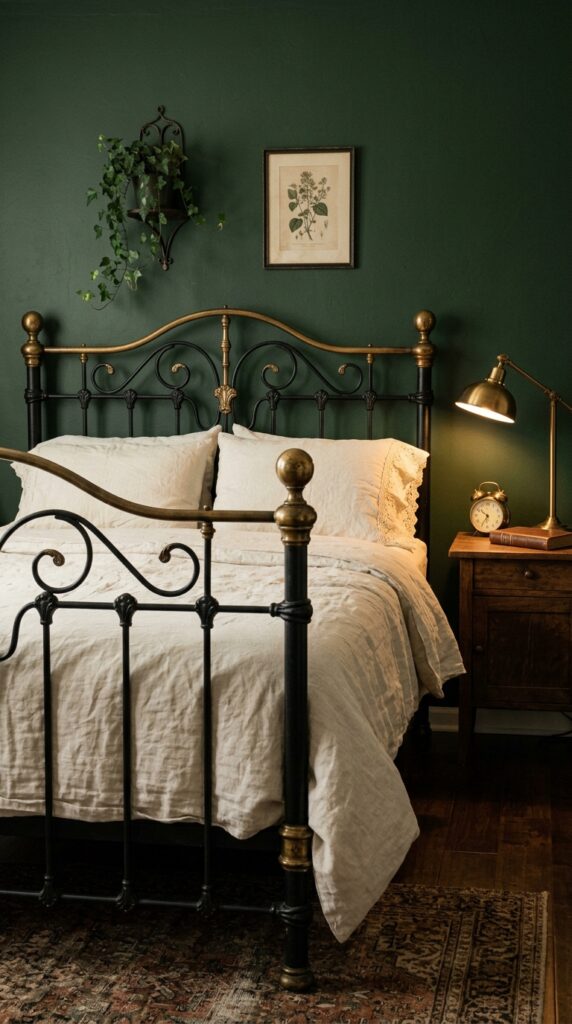
Vibe: Warm — aged brass against dark green is the bedroom equivalent of firelight through leaves — everything settles.
Why it works: The combination of iron and aged brass in a bed frame — specifically the contrast between the structural iron posts and the decorative brass finials and highlights — is the material language of Victorian and Edwardian bedroom furniture, which was designed precisely for the kind of rich, color-saturated rooms that moody green bedrooms reference. The brass does not need to be polished or lacquered; the warm amber patina of aged or unlacquered brass against deep green creates a relationship that is one of interior design’s most satisfying pairings — both materials look richer in each other’s presence.
How to get it: Source a genuine antique iron and brass bed frame from a salvage dealer or antique market — UK and European markets carry the most authentic examples in queen and king sizes. If purchasing new, specify unlacquered brass highlights on an iron frame and avoid any lacquered brass finish that will peel rather than patina. Apply Brasso sparingly to brass elements annually to clean without over-polishing — the slight oxidation should be preserved.
Shop The Look
| Product |
| Iron and brass bed frame vintage antique style |
| Brass picture light bedroom warm glow |
| Trailing ivy live plant indoor small |
| Antique brass alarm clock decorative |
| Ivory linen pillowcase set soft natural |
11. Racing Green and Charcoal Color Palette
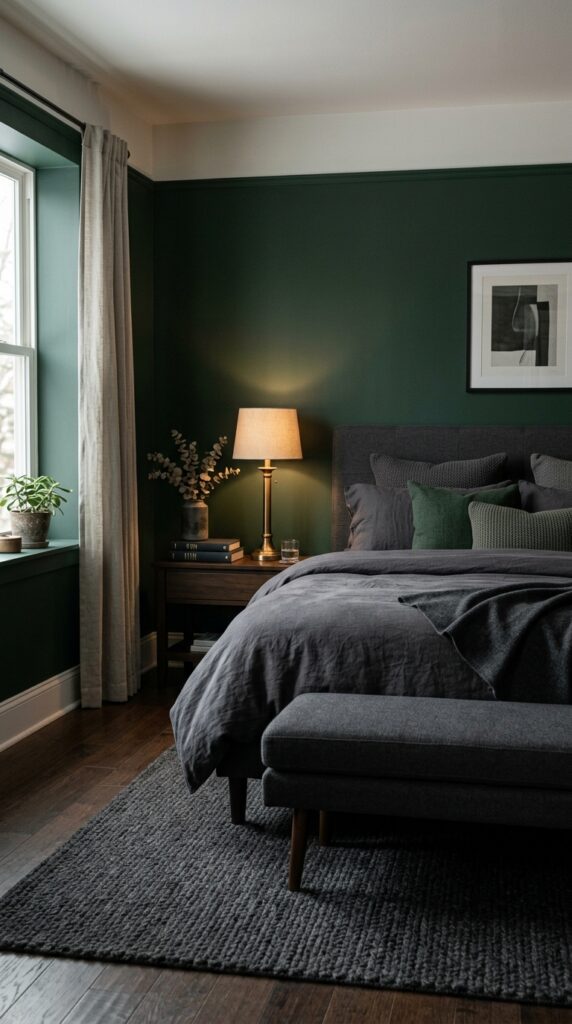
Vibe: Serene — racing green and charcoal together are the chromatic equivalent of a forest at dusk — neither competes, and both deepen.
Why it works: Racing green (the deep, slightly blue-shifted green of British motorsport tradition, closest to Farrow & Ball’s Studio Green or Valspar’s Woodland Sage deepened two values) paired with charcoal creates a cool, sophisticated moody palette that avoids the warmth of the green-and-walnut or green-and-brass combinations. This is the right palette for north-facing rooms or spaces that receive predominantly cool natural light — where warmer combinations can read flat, the cool tension between racing green and charcoal reads as intentional depth. The only warmth in the palette comes from brass — a single lamp or a pair of hardware pulls — which anchors the cool tones without overwhelming them.
How to get it: Apply Farrow & Ball Studio Green No.93 or Little Greene’s Jewel paint in a flat finish to walls. Use a charcoal wool or cotton blend for all upholstered elements — bench, cushions, and rug. The rug in particular is important in this palette: a dark charcoal wool rug on a dark timber or concrete floor creates a ground plane that reads as part of the wall palette, giving the room its total-enclosure quality.
Shop The Look
| Product |
| Racing green interior flat paint dark deep |
| Charcoal wool area rug large bedroom |
| Charcoal upholstered bench foot of bed |
| Dried eucalyptus bundle large decorative |
| Concrete decorative vessel large bedroom |
12. Dark Green Small Bedroom: Monochrome Everything
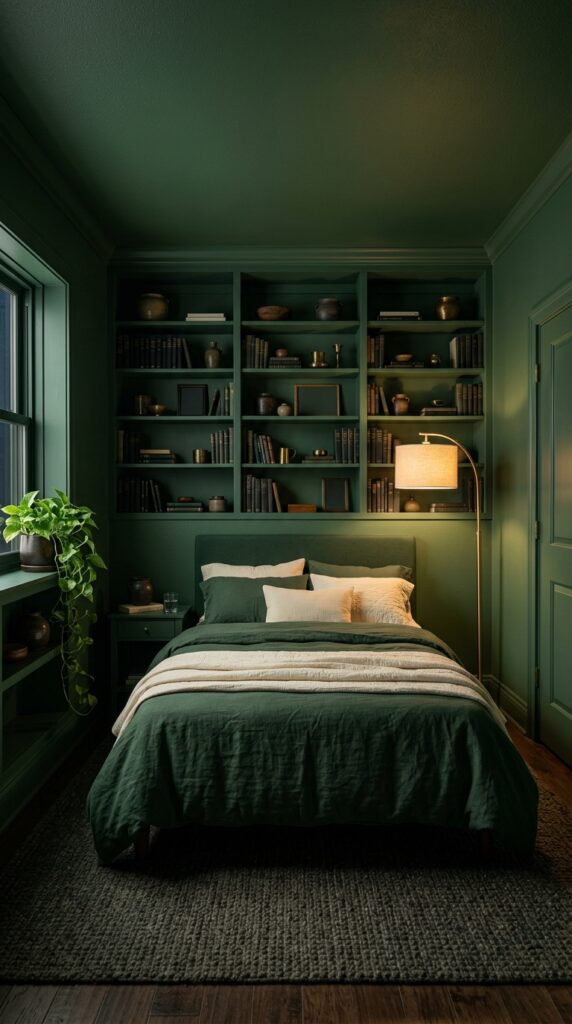
Vibe: Enveloping — painting the ceiling and trim the same green as the walls removes every boundary the eye uses to measure the room, and the space becomes larger for it.
Why it works: The monochrome technique — applying a single color to all surfaces including ceiling, skirting boards, window reveals, and built-in furniture — is the most powerful small-space strategy in moody bedroom design. By eliminating the contrast between wall and trim (which in conventional decorating defines the room’s edges and therefore its dimensions), the room loses its measured quality. The eye cannot locate the corners in the same way, the ceiling appears to rise rather than compress, and the space reads as atmospheric volume rather than square footage. This effect is strongest with flat or matte finish throughout — sheen at the trim breaks the illusion immediately.
How to get it: Use Farrow & Ball’s Calke Green No.80 or Pigeon No.25 (a grayed green for a softer version) in flat Estate Emulsion for walls, then have the same color tinted in their Modern Eggshell for skirting and trim — the slight sheen difference in person is negligible and the formulation resists scuffing better on high-touch surfaces.
💡 Quick Win: Painting just the ceiling the same dark green as an existing green bedroom wall (even with leftover paint, total additional cost near zero) immediately increases the enveloping quality of the space and the perceived height of the room by removing the ceiling/wall boundary.
Shop The Look
| Product |
| Forest green flat interior paint ceiling walls trim |
| Brass arc floor lamp warm bedroom |
| Dark green velvet bedroom cushion set |
| Warm ivory cotton bedding set soft |
| Dark jute area rug natural fiber bedroom |
13. Dark Green Bedroom Accessories: Ceramic and Brass
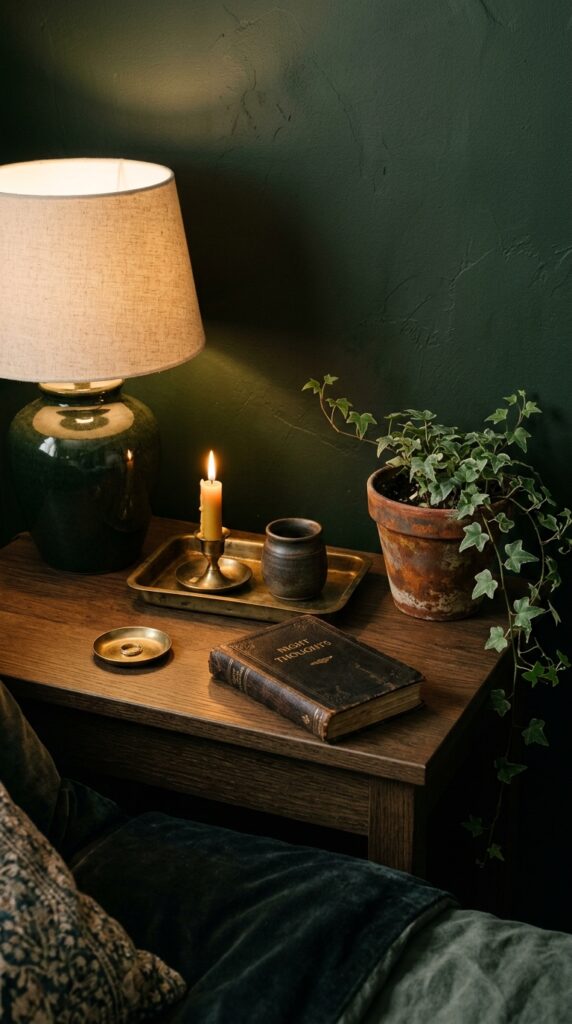
Vibe: Hushed — a bedside table arranged with this much quiet intention communicates that the bedroom is taken seriously.
Why it works: Dark green glazed ceramics — vessels, lamp bases, and vases in deep bottle, hunter, or forest green glazes — read as extensions of the wall color in three-dimensional form, giving the room’s palette volume as well as surface. The glaze on ceramics catches and reflects light differently from any painted surface, adding a material richness that flat paint cannot provide. Against aged brass — tray, ring dish, picture frame edge — the green ceramic reads more saturated and jewel-like, the brass more warm and antique. This is a pairing of complementary material qualities: the cool weight of glaze against the warm oxidation of brass.
How to get it: Source dark green glazed ceramics from independent ceramic studios — look for a glaze that reads between forest green and bottle green in natural light, with a semi-matte rather than high-gloss finish. Avoid mass-produced bright green ceramics, which read as accessory rather than material. Arrange in odd-numbered groupings (one lamp, one medium vessel, one small dish) with a brass tray unifying the arrangement rather than individual items scattered across the surface.
Shop The Look
| Product |
| Dark green ceramic lamp base glazed tall |
| Aged brass decorative tray small bedroom |
| Beeswax pillar candle unscented ivory |
| Dark green ceramic bud vase set small |
| Brass ring dish jewelry tray bedroom |
14. Dark Green Moody Bedroom: Low Platform Bed and Floor-Level Living
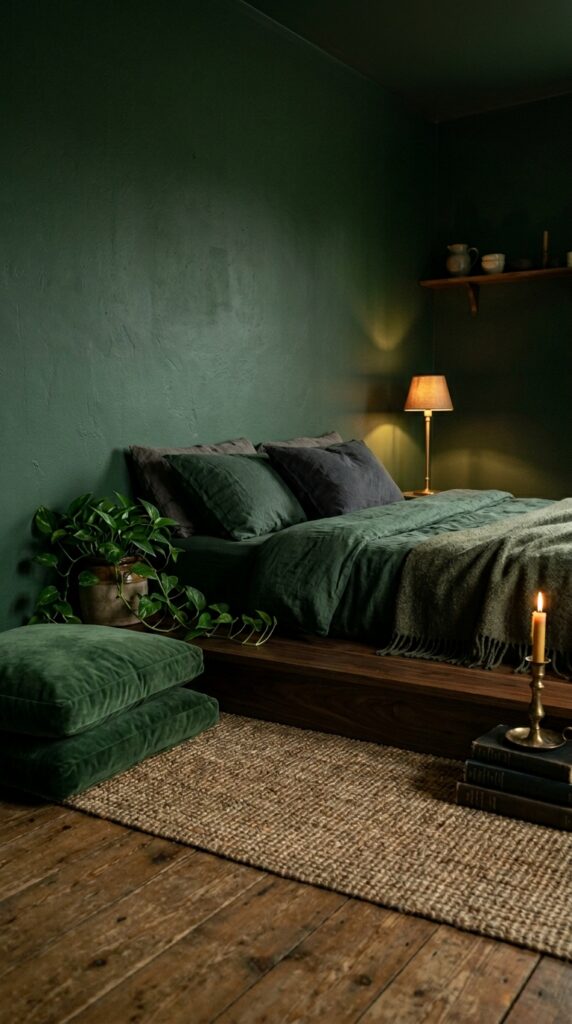
Vibe: Grounded — a low platform bed in a dark green room pushes you toward the floor and anchors you there in a way that makes sleep feel less like a transition and more like a destination.
Why it works: Lowering the bed height by using a minimal platform frame (4–6 inches off the ground rather than the standard 24 inches of a bed with a box spring) has a significant atmospheric effect in a moody green bedroom. The lower the bed, the taller the wall above it reads, and the more the room feels like a contained space with depth rather than a room with furniture in it. This is a design choice rooted in Japanese interior principles — the futon culture that keeps living close to the ground as a conscious choice of humility toward the space. In a dark green room, it concentrates the atmospheric quality where the body actually is.
How to get it: Build or source a solid timber platform in dark walnut at 4 inches of finished height — simply a framed box of 3/4-inch plywood faced with 3/4-inch walnut veneer and finished in a dark stain. The mattress sits directly on the platform with no box spring. This approach is appropriate only with a mattress rated for platform or slatted support — confirm before purchasing.
Shop The Look
| Product |
| Low platform bed frame dark wood minimal |
| Large floor cushion linen green meditation |
| Woven wool rug bedroom dark natural |
| Brass floor candle holder large low |
| Trailing indoor plant live devil’s ivy |
15. Forest Green Bedroom with Antique Mirror and Dark Frame
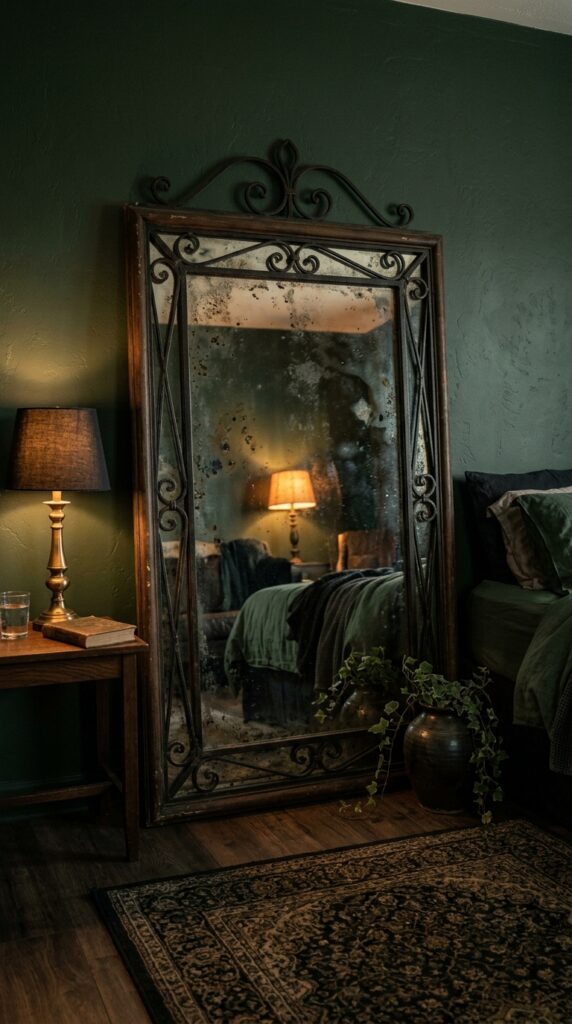
Vibe: Moody — a foxed antique mirror in a dark green bedroom does not reflect the room clearly; it reflects it atmospherically, which is better.
Why it works: An antique mirror with foxed glass — the dark spots and clouding that develop as the silver backing oxidizes — functions differently from a clear mirror in a moody bedroom. Rather than creating the conventional spatial illusion of expanded space (a clear mirror reads as a window into an identical room), foxed glass reflects a darker, warmer, more abstracted version of the space — which deepens the atmosphere rather than diluting it. Leaned against the wall rather than hung, the mirror reads as found rather than installed, which fits the collected, layered quality of moody bedroom interiors.
How to get it: Source genuine antique mirrors from salvage dealers and antique markets — original foxed glass cannot be reliably replicated by new production, and the effect is meaningfully different. Alternatively, have a glazier apply an antiqued mirror finish to a sheet of standard mirror glass using a vinegar and bleach etching technique, then frame in an ebony-stained or iron surround.
Shop The Look
| Product |
| Antique foxed mirror large dark frame |
| Dark iron frame floor mirror leaner large |
| Dark stained wood frame mirror floor |
| Green ceramic tall floor vase large |
| Trailing plant live philodendron indoor |
16. Dark Green Bedroom with Exposed Stone or Brick Feature
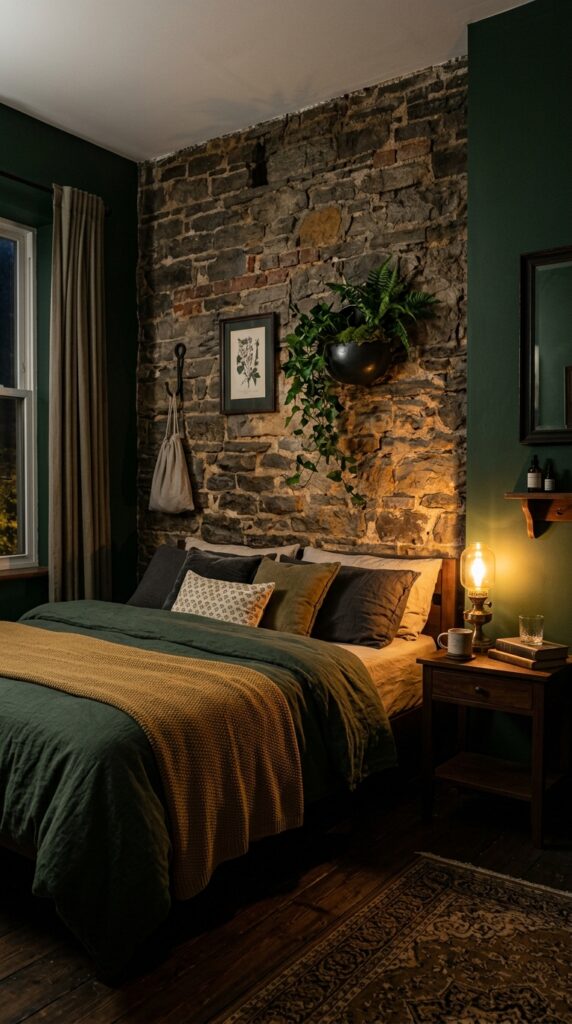
Vibe: Raw — stone and dark green together reference the geology of forest environments — the two materials that most define natural landscapes, placed in adjacency.
Why it works: Pairing an exposed stone or brick feature wall with deep green painted walls on the surrounding surfaces creates a material conversation that is more interesting than either element alone. The rough, irregular texture of the masonry contrasts with the smooth flatness of the paint, and the warm ochre and gray tones of the stone contrast with the cool depth of the green — but both belong to the same natural material family, grounding the combination in geological logic. In a bedroom context, the stone wall performs acoustically as well as visually — its mass absorbs sound and reduces thermal fluctuation, making the room quieter and more temperature-stable.
How to get it: If working with genuine existing masonry, strip any plaster or paint with a chemical gel stripper and seal with a clear penetrating stone sealer — no coating that changes the color. If applying stone veneer to an existing flat wall, use irregular ledgestone in warm gray-buff tones rather than regular cut stone panels, which read as architectural cladding rather than exposed original masonry.
Shop The Look
| Product |
| Iron wall hook set stone mount rustic |
| Dark ceramic wall planter small mount |
| Preserved moss panel wall display natural |
| Clear penetrating stone sealer masonry |
| Forest green interior flat paint gallon |
17. Dark Green Bedroom Curtains: Floor-to-Ceiling Velvet
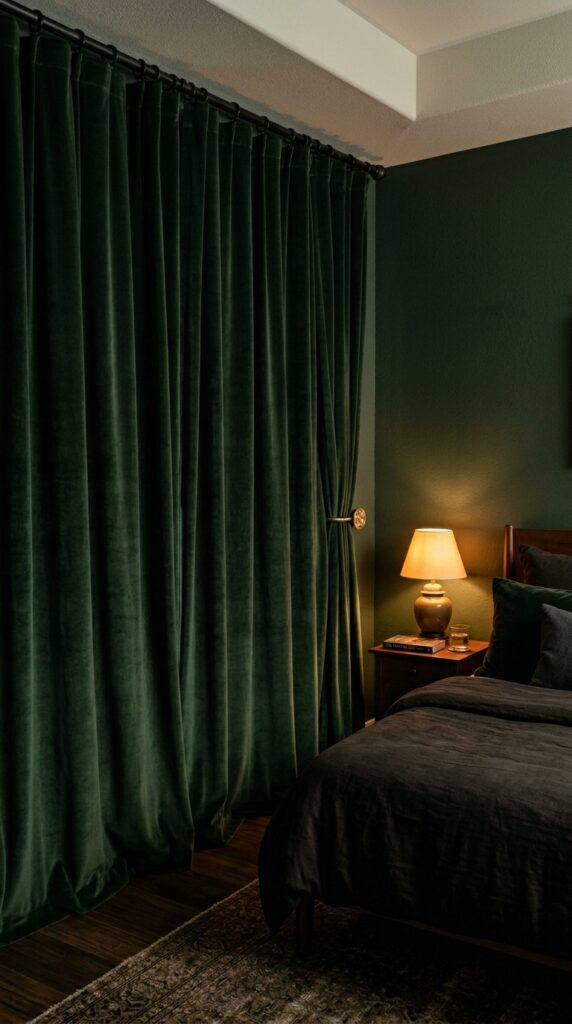
Vibe: Enveloping — floor-to-ceiling velvet curtains that pool on the floor make a window feel like a portal rather than an opening.
Why it works: Hanging curtains at ceiling height rather than at window frame height — and in fabric heavy enough to pool slightly on the floor — achieves two things simultaneously: it makes the ceiling appear taller by drawing the eye vertically from floor to ceiling height without interruption, and it creates the impression of a window far larger than the actual opening behind the fabric. Velvet is the correct fabric for moody green bedrooms specifically because its pile weight causes the curtains to hang in precise, deep folds that paint-like shadow lines down their length, adding vertical movement to an otherwise static surface.
How to get it: Purchase velvet blackout curtains at 120–130 inches in drop even if your ceiling is only 96 inches — the extra length creates the floor pool that is essential to the effect. Mount a matte black rod at ceiling height or on the ceiling itself using ceiling-mounted brackets. Use a minimum of 2.5× the window width in total fabric — velvet is a heavy fabric and requires generous fullness to hang correctly.
Shop The Look
| Product |
| Forest green velvet blackout curtain panel pair |
| Ceiling mount curtain rod black matte |
| Brass curtain tieback holdback pair |
| Velvet curtain ring clip set matte black |
| Black curtain rod ceiling bracket mount |
18. Moody Green Bedroom: Rattan and Natural Texture Contrast
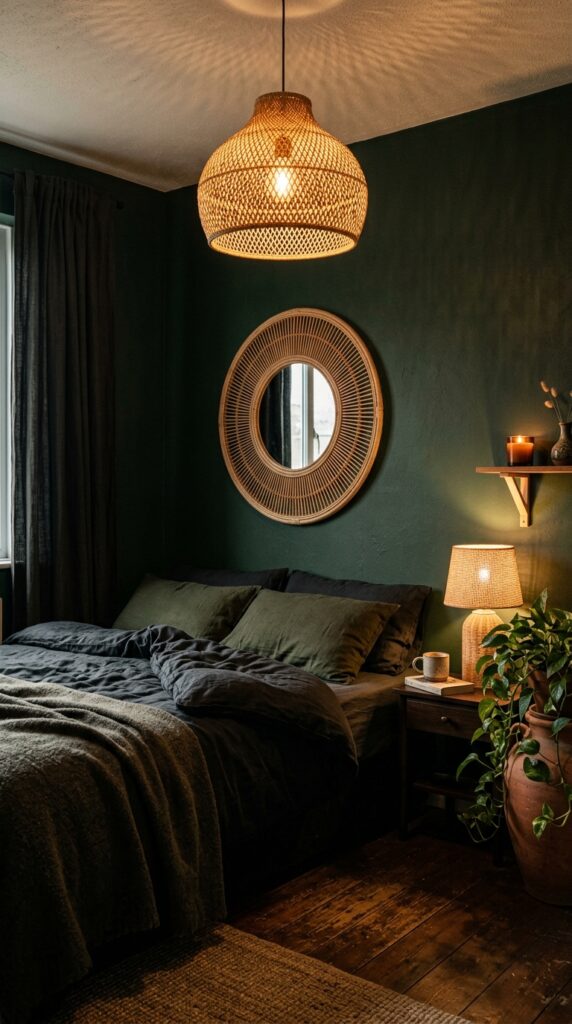
Vibe: Warm — rattan in a dark green room does not soften the atmosphere; it warms it, the way bark warms a forest interior.
Why it works: Natural rattan — in its honey-amber tone — is the most effective warm-material counterpoint to dark green walls. It sits opposite green on the warm-cool axis and introduces an organic, botanical quality that references the same forest environment the green walls evoke. The open weave of a rattan pendant shade is particularly effective: light passing through the weave creates patterned shadows on the ceiling and upper walls that animate the room’s darkest zone, introducing movement without electric complexity. Rattan works in a moody green bedroom because it looks genuinely natural — not decorative — alongside dark paint.
How to get it: Introduce rattan in three touchpoints rather than one dominant piece: a large rattan round mirror above the dresser, a rattan shade on a table lamp, and a rattan basket for storage or a plant vessel. Three points of the same material at different heights and scales create a material thread that reads as intentional rather than accidental.
Shop The Look
| Product |
| Round rattan mirror large natural frame |
| Rattan woven pendant lamp shade bedroom |
| Rattan table lamp shade replacement |
| Dark green trailing plant in rattan basket |
| Terracotta plant pot medium natural clay |
19. Dark Green Bedroom with Gallery Wall of Botanical Prints
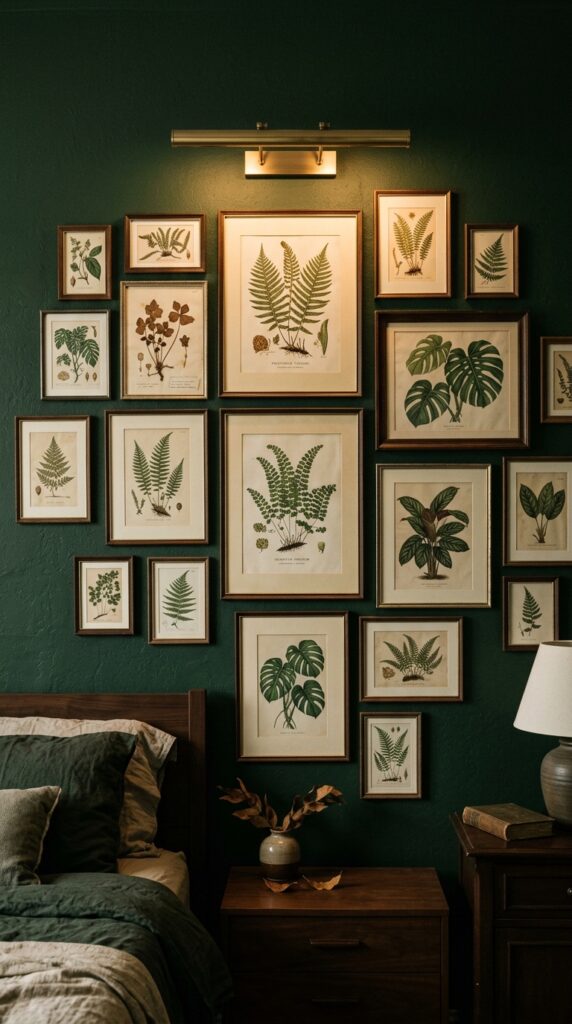
Vibe: Hushed — a gallery of antique botanical illustrations on a dark green wall is a room thinking about itself, about what green means and where it comes from.
Why it works: Botanical prints on dark green walls create a layered visual argument — the prints are illustrations of the same natural world the wall color references, making the decoration a commentary on its own palette rather than a separate design choice. Antique botanical illustrations (18th and 19th century botanical engravings hand-colored in green, ochre, and ivory) are particularly effective because their aged paper tones — warm ivory and brown — are naturally calibrated to work against dark backgrounds. Dark thin frames (matte black or ebony) on a dark green wall disappear the frame and leave only the print, as though the botanical images are pressed directly into the wall.
How to get it: Download high-resolution public domain botanical illustrations from the Biodiversity Heritage Library (biodiversitylibrary.org) or The Smithsonian’s digital archives — both offer thousands of free 18th and 19th century botanical prints at print-quality resolution. Print at A3 or A2 size on warm white archival paper and frame in standard thin matte black frames with a warm ivory mat. Arrange asymmetrically, all within a horizontal band between 36 and 78 inches from the floor.
💡 Quick Win: Three free downloaded antique fern illustrations printed at home on cream paper and placed in $8–$12 matte black frames from IKEA create a convincing botanical gallery wall start for under $35 total.
Shop The Look
| Product |
| Antique botanical illustration print framed dark |
| Thin matte black gallery frame set mixed |
| Warm picture light wall mount bedroom |
| Archival warm ivory photo paper A3 print |
| Dark green mat board picture framing |
20. Dark Green Bedroom: Minimal and Architectural
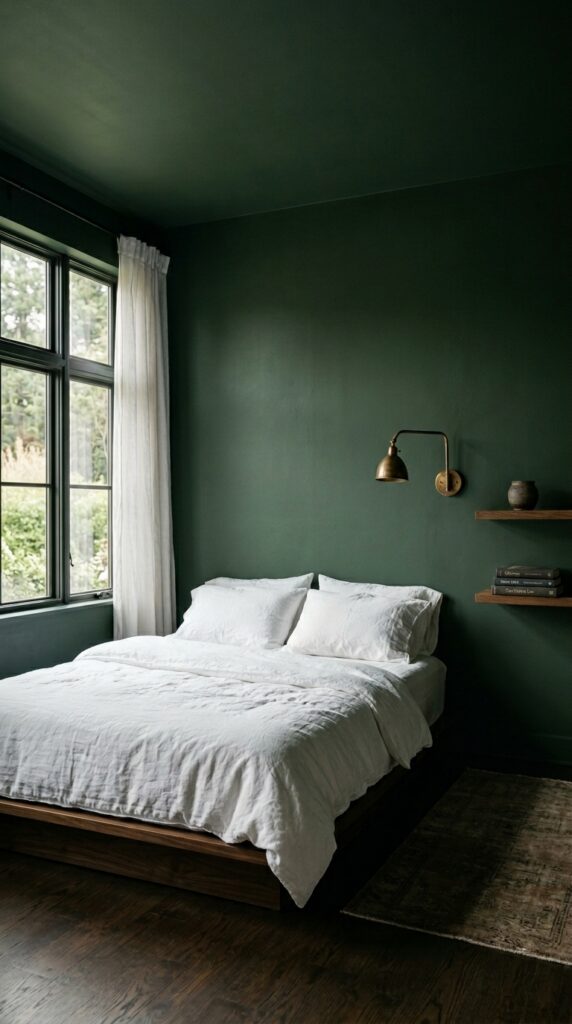
Vibe: Serene — a dark green room with almost nothing in it is not empty — it is precise, and the difference matters enormously.
Why it works: The minimal dark green bedroom inverts the conventional wisdom that moody spaces need layering and complexity to work. When the wall color is deep and rich enough, it does the atmospheric work entirely without the assistance of accessories, textiles, or decorative objects. The eye is satisfied by the depth and variation of the dark green surface itself — especially in limewash or clay plaster finishes that provide their own tonal movement — and every additional object becomes a potential distraction from the primary experience of being inside a room of that color. The single sconce and single shelf read as precisely placed rather than sparse.
How to get it: Edit ruthlessly. Remove every object from the bedroom that is not both functional and beautiful. What remains — bed, sconce, two shelves, three objects — should be the bedroom at its most essential. Apply the wall color in a finish with inherent tonal variation (limewash or clay plaster) so the wall itself provides the visual interest that accessories would otherwise supply. Allow dust-free surfaces and clean lines to define the space.
Shop The Look
| Product |
| Small dark ceramic vessel minimal set |
| Floating wall shelf dark wood minimal |
| Single brass bedroom wall sconce minimal |
| Crisp white cotton percale bedding set |
| Dark wood book stack decorative minimal |
21. Dark Green and Terracotta: Warm Complementary Palette
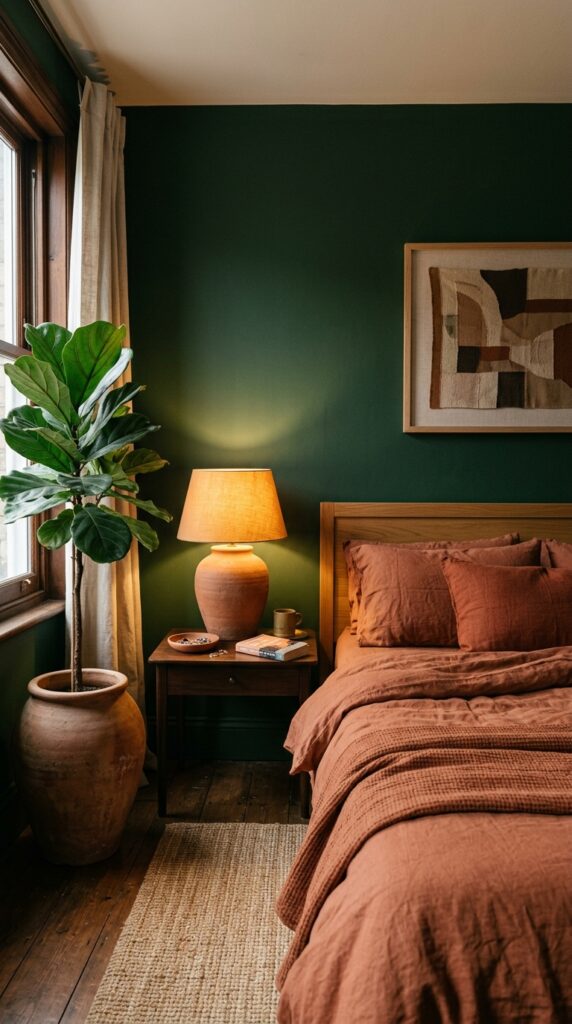
Vibe: Warm — dark green and terracotta are the colors of a summer garden in late afternoon, and a bedroom in these tones carries that warmth into the night.
Why it works: Green and terracotta are nature’s most ubiquitous color pairing — the combination of foliage and earth, of leaf and clay. In interior design terms, they sit opposite each other on a color wheel calibrated to natural rather than spectral primaries, and this opposition creates warmth and visual vitality without the high-contrast tension of complementary pairings like green-and-red. Terracotta’s warmth — red-orange clay pigment — advances visually against deep green’s receding cool quality, creating a room that feels three-dimensionally warm without any internal color conflict.
How to get it: Use terracotta exclusively in soft furnishings and ceramics rather than paint — a terracotta painted wall alongside dark green reads as two competing feature walls rather than a harmonious palette. Source terracotta linen bedding in a washed, pre-shrunk fabric (Cultiver and Bed Threads both offer excellent options) for the most authentic clay tone. A large terracotta floor pot — 14 inches or larger — at a bedside or room corner provides terracotta’s color presence at a scale that reads as architectural.
Shop The Look
| Product |
| Terracotta linen duvet cover set washed |
| Large terracotta ceramic floor pot garden |
| Terracotta lamp base ceramic large bedroom |
| Rust linen throw pillow cover terracotta |
| Small clay dish handmade ceramic bedside |
22. Dark Green Moody Bedroom: The Complete Transformation
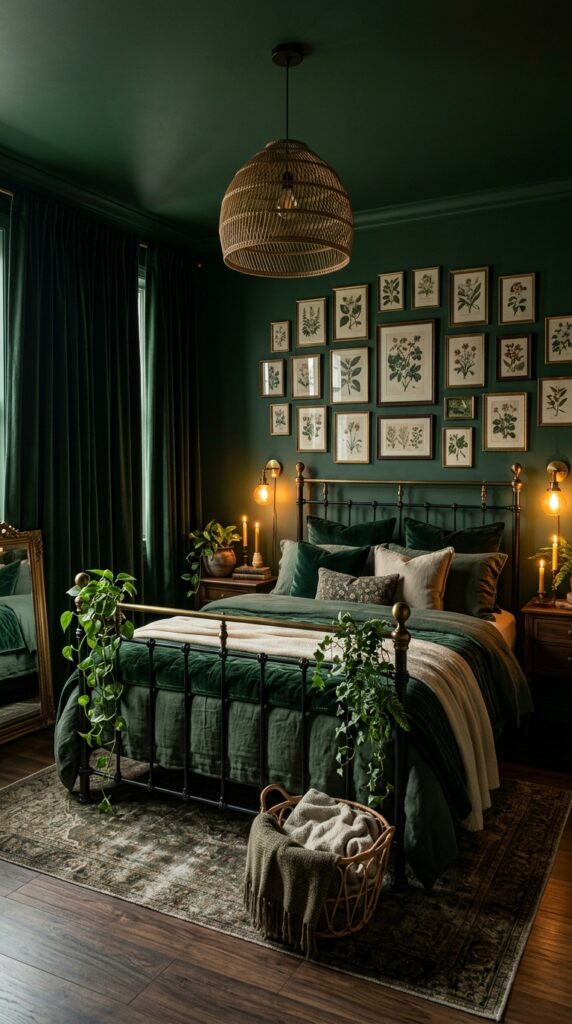
Vibe: Serene — a bedroom where every decision points in the same direction stops being a decorated room and becomes an environment, and you feel the difference the moment you walk in.
Why it works: The fully realized moody green bedroom is a demonstration of how design decisions compound — each individual element in this article works alone, but together they create something greater than their sum. The key to achieving this without the result reading as overworked is material and tonal consistency: every element shares either the deep green family (walls, ceiling, curtains, textiles, ceramics) or the warm brass and dark timber counterpoint family (hardware, frames, lamp bases, bed frame). No element comes from outside these two families. The result is a room that reads as thought through rather than accumulated — which is the signature of genuine interior design as opposed to decoration.
How to get it: Build the room in five stages rather than attempting the full transformation simultaneously. Stage one: wall and ceiling color. Stage two: bed frame and lighting. Stage three: textiles and layering. Stage four: curtains. Stage five: accessories and plants. Each stage settles before the next is introduced, allowing each element to be evaluated in context rather than lost in the visual noise of a complete room arriving at once.
💡 Quick Win: Stages one and five — wall paint and a curated accessory arrangement — achieve 70% of the full transformation’s atmospheric impact at approximately 20% of the full cost, and represent a complete and satisfying resting point if the full transformation takes months rather than weeks.
Shop The Look
| Product |
| Forest green interior flat paint 2 gallon |
| Aged brass bedside lamp pair warm shade |
| Layered green velvet linen bedroom cushion set |
| Dark walnut decorative tray nightstand |
| Trailing live plant indoor bedroom large |
How to Start Your Dark Green Moody Bedroom Transformation
The single best first move is choosing and applying your wall color — but not before ordering a physical paint sample card and living with it taped to the wall for five days across multiple light conditions. This is not optional caution; it is the difference between a successful transformation and an expensive repaint. Dark greens behave with more volatility across light conditions than almost any other color family — Farrow & Ball’s Calke Green reads as sage in morning northern light and as forest green by lamplight, while Studio Green reads near-black in shadow and deep jewel-green in direct afternoon sun. The correct green for your room is the one that works in your room’s specific light, not on a paint company’s website.
The most common beginner mistake is under-committing to the darkness of the color. Homeowners routinely choose a green two or three values lighter than their original intention because it looks “safer” in the sample pot — then end up with a sage or mid-green that reads as pleasant rather than atmospheric. A room needs at least a 70% saturated, deep-value green to achieve moody quality; anything lighter reads simply as “green room” rather than “dark green bedroom.” Go darker than feels comfortable with the sample — in context, the full room will read lighter than the sample by approximately 15–20%, because the ceiling and natural light always lift the apparent tone.
Three immediate-impact items under $50: a pair of dark green velvet throw pillow covers ($22–$35 for two), a beeswax pillar candle cluster on a dark wood tray ($18–$28), and one trailing pothos or ivy plant in a dark ceramic pot ($12–$20 from a garden center). These three things alone shift a neutrally decorated bedroom toward dark green moody atmosphere before a single wall is painted.
A weekend transformation — one wall painted in deep green, new bedside lamp bulbs replaced with 2200K Edison-style, and restyled accessories — achieves strong results for $80–$200. A complete single-bedroom transformation with wall and ceiling paint, new textiles, curtains, and lighting upgrade realistically costs $800–$2,500 depending on furniture sourcing strategy. Genuine vintage or antique pieces — an iron bed frame, an antique mirror, a real Persian rug — reduce cost significantly compared to new retail and add the material authenticity that makes the style work at its best.
Frequently Asked Questions About Dark Green Moody Bedrooms
What is a dark green moody bedroom and how is it different from a standard green bedroom?
A dark green moody bedroom uses deep-value greens — bottle, hunter, forest, racing, or emerald — combined with low, warm lighting, layered dark textiles, and raw or richly patinated materials to create an atmosphere of genuine enclosure and intimacy. A standard green bedroom uses green as a color choice within a conventionally lit, neutrally furnished room — the color is decorative rather than atmospheric. The defining difference is intent: a moody green bedroom is designed to feel like a refuge, where every material and lighting decision reinforces the enveloping quality of the deep color rather than countering it with bright light, light furniture, or contrasting accents.
What are the best dark green paint colors for a moody bedroom?
The most reliable options for genuine moody atmosphere are Farrow & Ball Studio Green No.93 (deep, slightly gray-shifted green that reads near-black by lamplight), Farrow & Ball Calke Green No.80 (a softer, more botanical green with gray undertones, ideal for rooms with limited natural light), Little Greene’s Obsidian Green or Jewel (both very deep, saturated options for maximum drama), Sherwin-Williams Cascades SW-6477 (a deep blue-green ideal for the racing green palette), and Benjamin Moore’s Forest Green 2047-10 (a classic deep forest tone with warm undertones). All should be applied in a flat or matte finish — satin or eggshell finish at this depth of color reflects enough light to undermine the atmospheric quality.
How much does a dark green moody bedroom transformation cost?
A paint-only transformation — walls and ceiling in a premium flat paint — costs $120–$250 in materials for a standard bedroom. Adding velvet floor-length curtains ($80–$200 for a quality pair), new brass sconces ($60–$150 per pair), and layered green bedding ($150–$400 for a quality duvet, shams, and throw) brings a mid-range transformation to $400–$1,000 total. A fully realized bedroom with commissioned upholstered headboard, genuine antique furniture, custom botanical wallpaper, and professional paint application can reach $4,000–$10,000 — but this ceiling is defined entirely by furniture sourcing strategy, as vintage and salvage pieces can achieve the same aesthetic at 20–40% of new retail cost.
Will dark green walls make my bedroom feel smaller?
Used correctly, no — and in small bedrooms, they often make the space feel larger. The key is applying the dark green to the ceiling as well as the walls (the monochrome technique in Idea 12), which removes the room’s visible boundaries and makes the space feel like atmospheric volume rather than measured square footage. Keeping furniture low — a platform bed rather than one with a high headboard and box spring — preserves the apparent ceiling height. The one situation where dark green walls genuinely compress a small space is when the ceiling is left white: the white ceiling then appears to float like a lid on the dark walls, which emphasizes the room’s dimensions rather than obscuring them.
What textiles and materials pair best with dark green moody bedroom walls?
The most effective material pairings are aged or unlacquered brass (for hardware, lamps, and frames), dark walnut or ebony-stained timber (for bed frames, nightstands, and shelving), velvet in complementary deep tones (forest, bottle, or hunter green, oxblood, or charcoal for cushions and throws), natural rattan in its honey-amber tone (for mirrors, lamp shades, and baskets), and unglazed or dark-glazed ceramics (in forest green, terracotta, or dark umber for lamp bases and vessels). The materials to avoid are chrome and satin nickel (too cold and reflective), light pine or pale oak (too light in tone to settle alongside deep green walls), and high-gloss lacquered surfaces of any color, which reflect enough light to break the room’s atmospheric quality.
Ready to Create Your Dream Dark Green Moody Bedroom?
These 22 ideas have moved through the full range of dark green bedroom possibilities — from all-surfaces monochrome and velvet wall paneling to oxblood color pairings, canopy beds, rattan contrast, and the complete layered transformation of Idea 22. The most important thing this style teaches is that commitment is not a risk — half-measures in moody bedroom design always produce less than the full gesture would have, and the green that felt too dark in the sample pot will feel exactly right on the ceiling at midnight. Today, order two physical paint sample cards — one shade darker than you think you want, and the shade you think you want — and tape both to your primary bedroom wall. Check them at 7am, at noon, at 4pm, and by lamplight at 10pm. The right one will reveal itself to you. Pin the ideas that made your breathing slow down — the canopy draped in forest green velvet, the all-surfaces monochrome capsule, the foxed mirror leaning against the wall — because those are the rooms your nervous system already knows it wants.