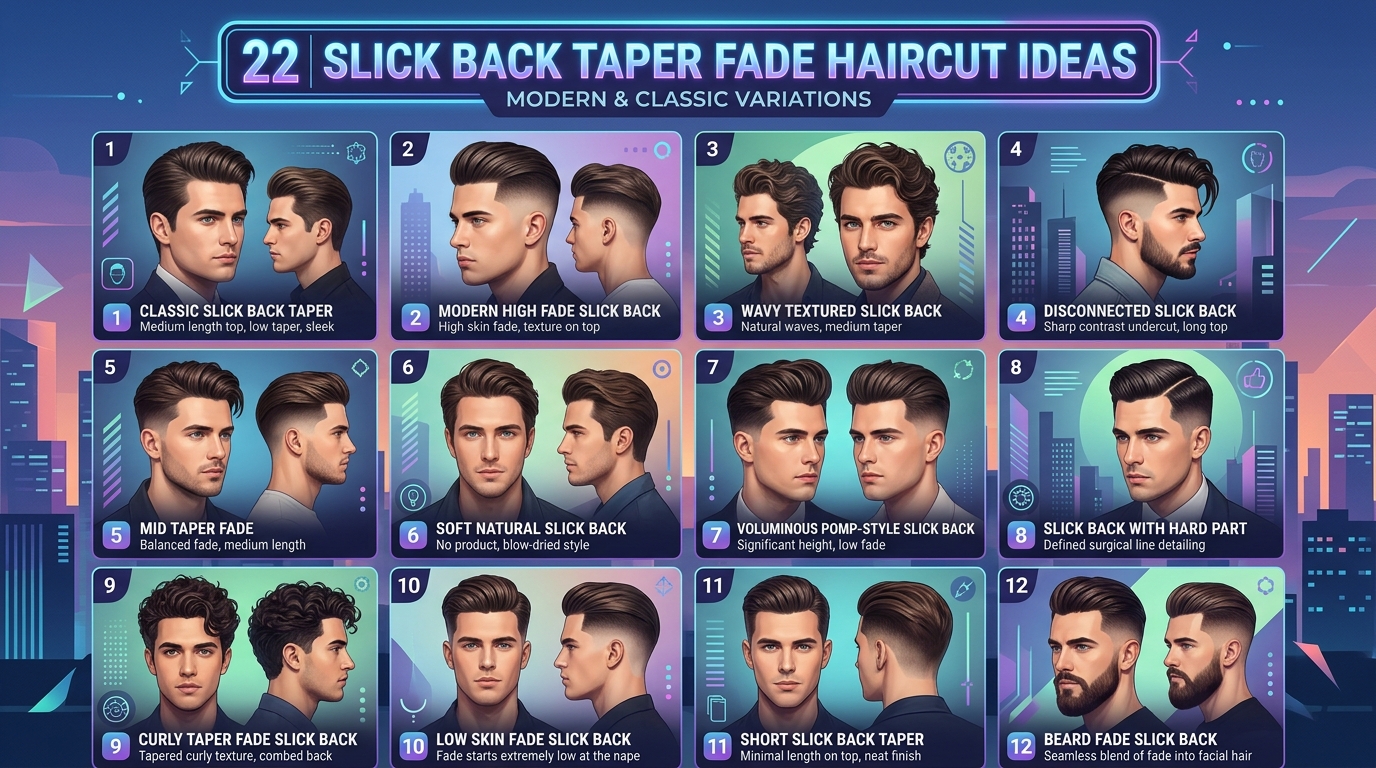
A slick back taper fade pairs short, gradually blended sides — clippered down from a longer top — with hair combed straight back for a sleek, polished finish. This guide breaks down 22 ways to wear the slick back taper fade, covering fade depth, hair texture, finish, detailing, products, face shape, and upkeep.
Worn well, this cut feels like clean lines against bare skin, a sharp line of contrast at the temple, and a top that moves with you instead of fighting you. It reads commanding in a boardroom and just as easy at a weekend dinner, because the fade does the heavy lifting while the slick-back top stays adaptable. Here are 22 ideas worth saving — and showing your barber.
Why the Slick Back Taper Fade Works So Well
The slick back taper fade traces back to two separate barbering lineages meeting in the middle. The taper fade itself grew out of mid-20th-century military and barbershop grooming, where sides were clippered short and graduated upward into the natural hairline. The slick back, meanwhile, has roots in 1920s pomade culture and was later carried through decades of tailored menswear. Combined, the cut takes the precision of a graduated fade and pairs it with a top long enough to comb back and hold — distinct from a pompadour’s volume or an undercut’s hard disconnection.
Technically, this look is built on a graduated blend — typically a 0 or 1 guard at the neckline, blending up through a 2 and 3 around the ear, and tapering into 4–6 inches of length on top. Barbers use clipper-over-comb or scissor-over-comb to soften the transition line so there’s no visible shelf. On top, the finish depends on hold: a water-based pomade gives shine and flexibility, a strong-hold gel locks a wet-look part, and a matte clay keeps texture without gloss.
This cut is having a moment because it sits at the intersection of two trends: a return to classic barbershop grooming (driven by vintage-inspired menswear and period film aesthetics) and the rise of “polished but low-effort” routines popularized on TikTok and Instagram grooming accounts. It photographs cleanly, which makes it a natural fit for both red-carpet styling and everyday office wear.
Straight and wavy hair take a slick back taper fade most naturally, since the strands lie flat with minimal resistance. Curly and coily textures can wear it too, but expect more product and more frequent restyling, since curl pattern fights a flat-back finish; a textured slick back with looser hold is usually the better adaptation for those textures.
Style at a Glance
| Element | Classic Slick Back | Modern Taper Fade |
| Philosophy | Polished, formal, vintage-rooted | Graduated, clean, barbershop-precise |
| Technique | Comb-back with high-shine product | 0–1 guard blending to 3, scissor-finished top |
| Best for | Straight/wavy hair, formal settings | All hair lengths, everyday wear |
22 Slick Back Taper Fade Haircut Ideas
1. The Classic High Taper Slick Back
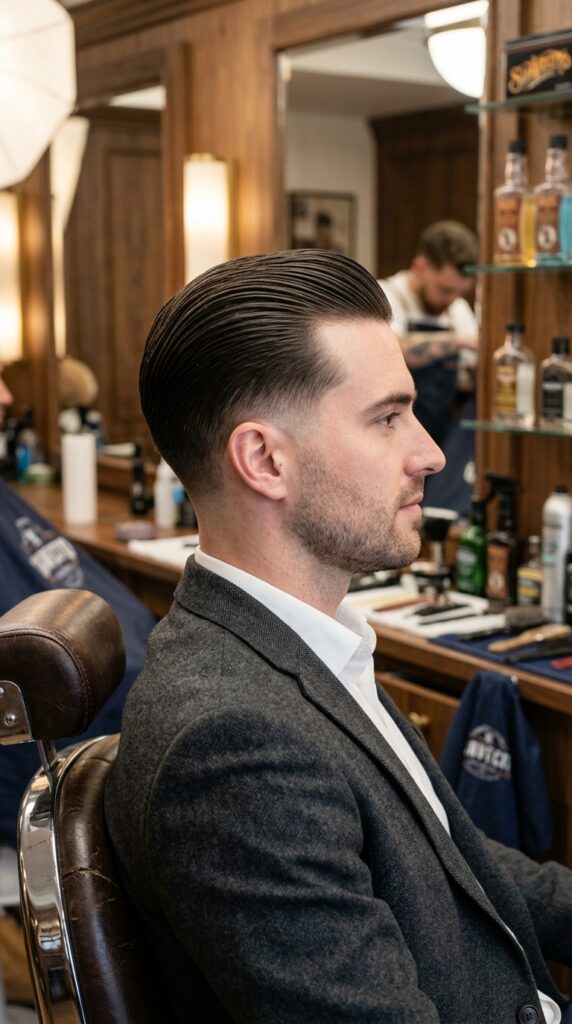
Vibe: Sharp. Why it works: The high taper creates maximum contrast between the bare sides and the slicked top, which elongates the head and sharpens the jawline. Barbers start at a 0-guard at the nape and blend upward through a 2 and 3 within an inch of the parietal ridge. The steep gradient is what separates a “high” taper from a mid or low version. How to get it: Ask your barber for “a high taper, zero to three, blended tight, with the top left long enough to comb straight back.”
Shop The Look
| Product |
| High-shine water-based pomade, 4oz tin |
| Fine-tooth metal comb for precision parting |
| Cordless clipper with adjustable taper lever |
| Barber neck duster with soft bristle |
| Pre-shave neck balm for sensitive skin |
2. Long-on-Top Slick Back Taper Fade
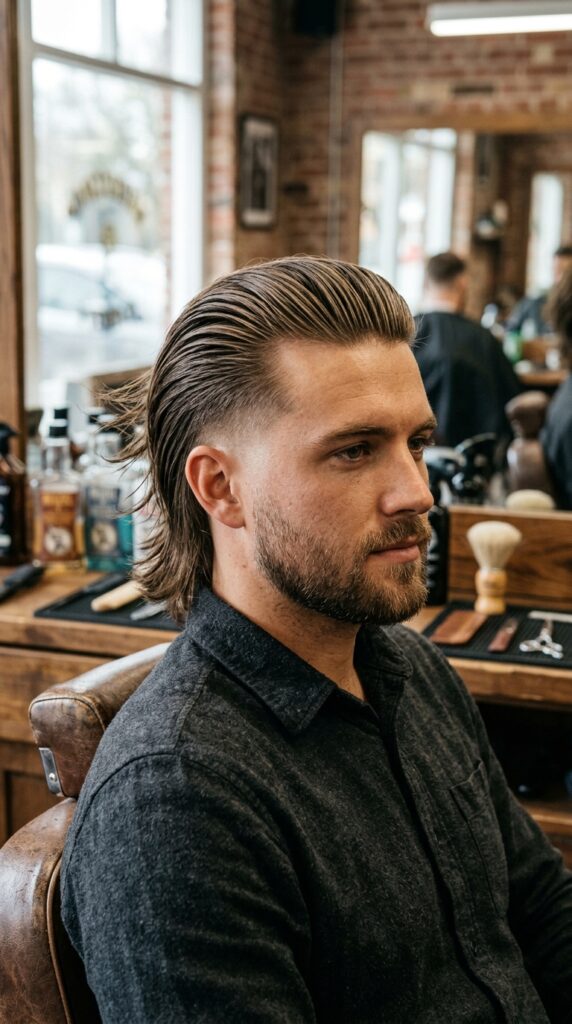
Vibe: Commanding. Why it works: Extra top length gives the slick back more sweep and movement, which balances out a lower, subtler fade. The longer the top, the more weight is needed to hold it flat — this is where hold strength becomes a styling variable, not just a finish preference. How to get it: Request a “low taper with 5 to 6 inches left on top,” and grow it out four to six weeks between cuts for the length to fully cooperate.
💡 Quick Win: A strong-hold, low-shine pomade keeps long tops flat without the greasy look that high-shine versions can give past 5 inches.
Shop The Look
| Product |
| Strong-hold matte pomade, 3.5oz |
| Wide-tooth detangling comb for longer hair |
| Boar bristle styling brush |
| Heat-protectant blow-dry spray |
| Round barrel brush for root lift before combing back |
3. Wet-Look Slicked Back Taper Fade
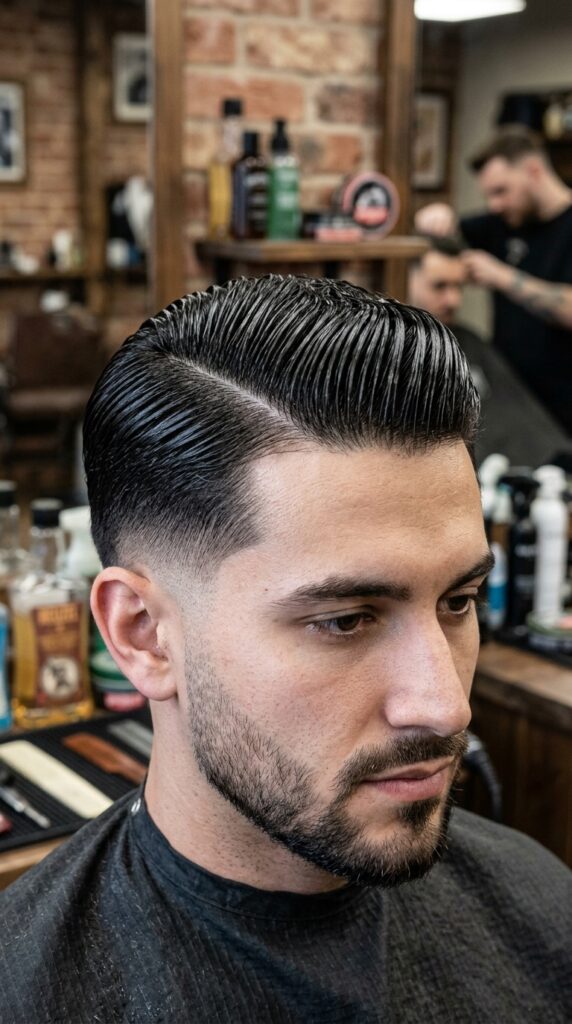
Vibe: Glossy. Why it works: A wet-look finish relies on a gel with high alcohol or polymer content that dries into a hard, reflective shell, which is what gives this version its glass-like sheen versus a pomade’s softer matte-to-medium shine. The fade stays simple so the eye goes straight to the gloss. How to get it: Apply a strong-hold gel to damp hair, comb straight back in one motion, and let it air-dry without touching it for 10 minutes.
Shop The Look
| Product |
| Clear strong-hold styling gel, 8oz |
| Fine-tooth rattail comb for sharp partings |
| Spray bottle for re-wetting hair mid-style |
| Microfiber towel for gentle drying |
| Anti-flake clarifying shampoo for gel buildup |
4. Mid Taper Fade with Slicked Crown
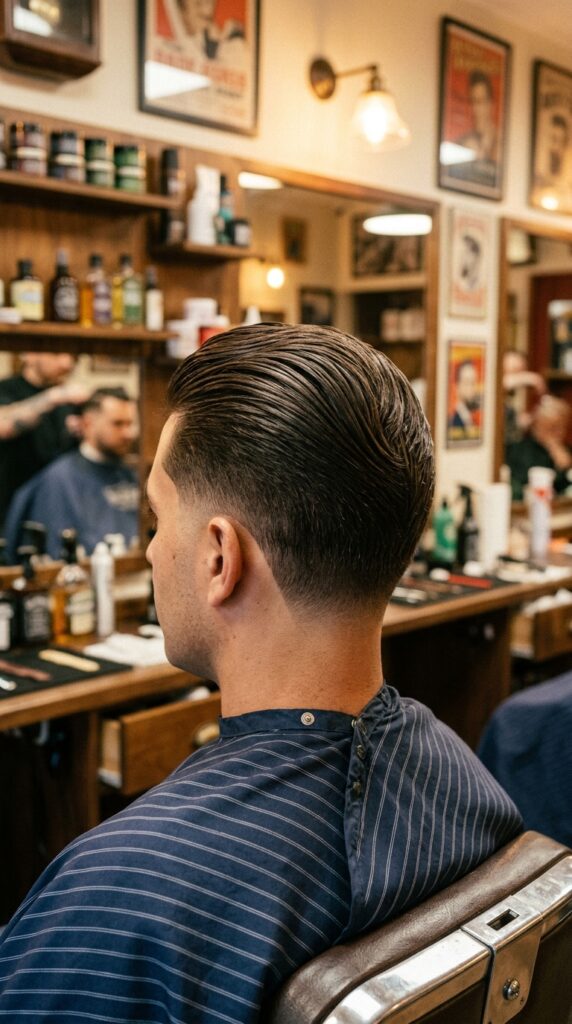
Vibe: Effortless. Why it works: The mid taper splits the difference between a dramatic high fade and a barely-there low fade, starting its blend around mid-ear height. This balance makes it the most barber-recommended starting point for first-timers, since it’s forgiving on hairline shape and head form. How to get it: Say “mid taper starting at ear level, two to four, soft blend, no hard line,” and ask for the top left at medium length for flexible styling.
Shop The Look
| Product |
| Medium-hold pomade with satin finish |
| Dual-sided fade comb |
| Cape with snap closure for clean cuts |
| Talc-free finishing powder for grip |
| Nourishing leave-in conditioner for fine hair |
5. Hard Part Slick Back Taper Fade
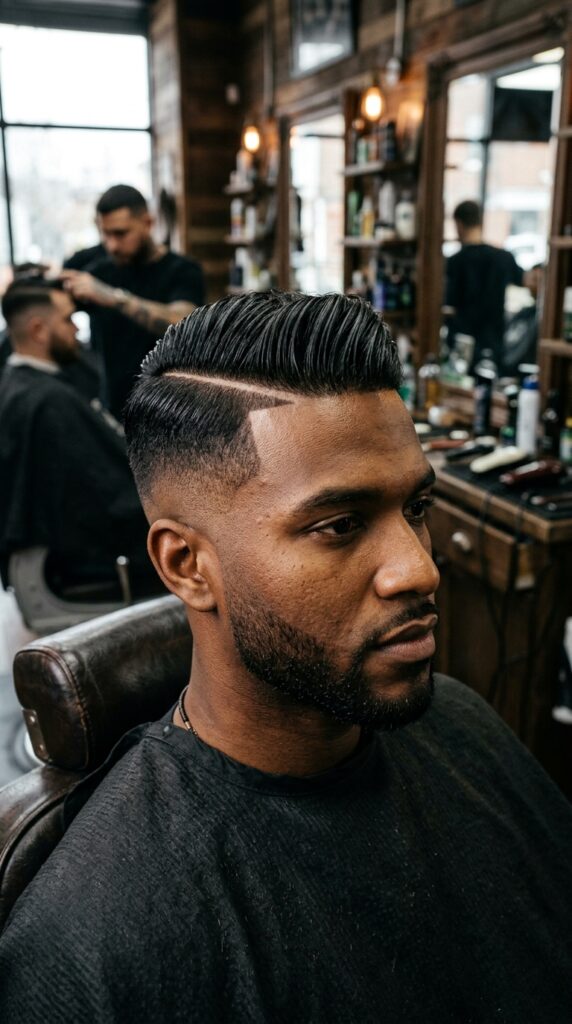
Vibe: Edgy. Why it works: A hard part is a thin line shaved directly into the scalp with a straight razor or detail trimmer, which gives the slicked top a defined starting point and adds a barbershop-detail layer that a standard side part lacks. It also reads sharper in photos because the contrast is permanent, not just combed. How to get it: Ask your barber to “shave a hard part on the left, about a finger’s width above the brow,” and have it touched up every two weeks as regrowth softens the line.
Shop The Look
| Product |
| Detail trimmer with T-blade for part lines |
| Straight razor for sharp edging |
| Styling clay for holding the part division |
| Edge control gel for crisp lines |
| Aftershave balm for razor-line irritation |
6. Medium-Length Slicked Taper Crop
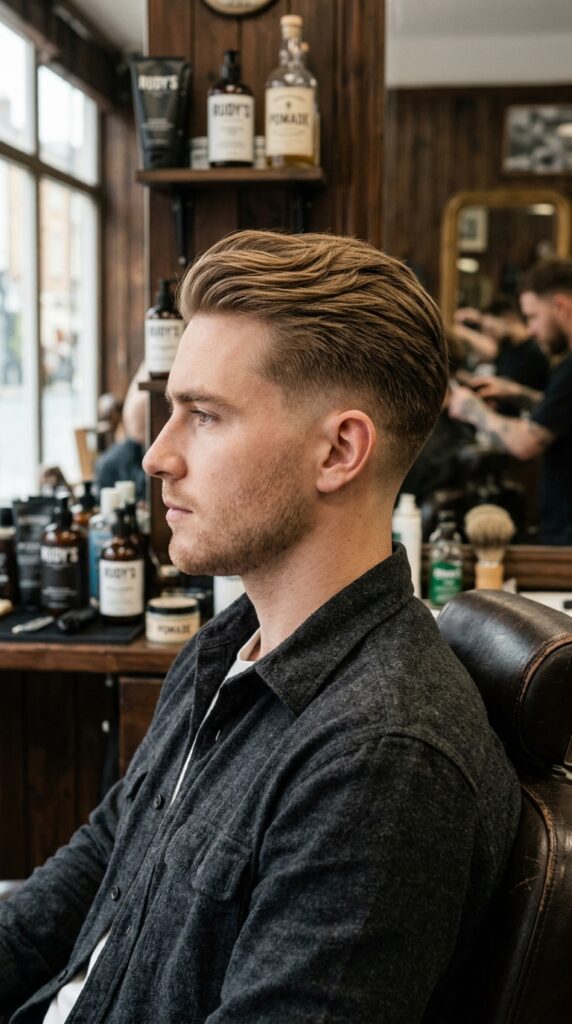
Vibe: Polished. Why it works: At 2.5–3 inches, the top is long enough to slick back but short enough to dry quickly and hold shape without heavy product, which makes this the lowest-maintenance length in the slick back family. It’s the proportion most barbers default to for everyday wear. How to get it: Request “a taper crop, two to four, top kept around three inches,” and comb back while damp using a light-hold cream rather than gel.
💡 Quick Win: Style this length right out of the shower — towel-dry to damp, comb back, and it air-dries into shape in under 10 minutes.
Shop The Look
| Product |
| Light-hold styling cream, 2oz tube |
| Travel-size detangling comb |
| Microfiber hair towel for quick drying |
| Daily-use sulfate-free shampoo |
| Lightweight finishing spray for shine control |
7. High-Shine Pomade Slick Back Taper
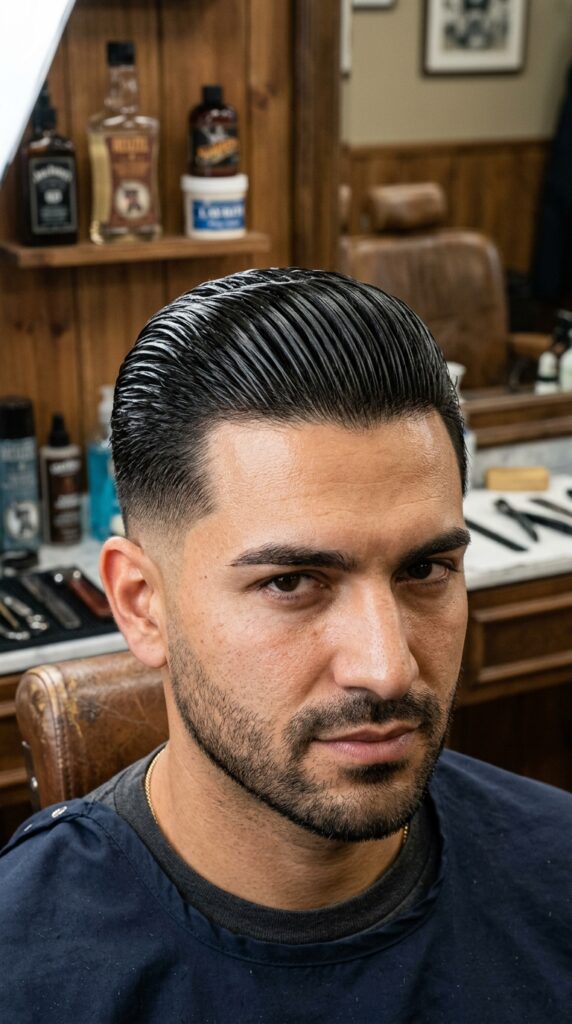
Vibe: Vintage-polished. Why it works: Oil-based pomades create the deepest, most reflective shine of any styling product because they don’t dry — they stay pliable and glossy all day, which is the hallmark of the 1940s-style slick back this idea pulls from. The tradeoff is a wash-out requiring shampoo, not water alone. How to get it: Warm a dime-sized amount between your palms, work through damp hair from root to tip, then comb straight back in one continuous pass.
Shop The Look
| Product |
| Oil-based heavy pomade, 4oz tin |
| Vintage-style barber comb, fine-tooth |
| Pomade-removing clarifying shampoo |
| Wide hairbrush for even distribution |
| Travel pomade tin for touch-ups |
8. Low Taper Fade Slick Back
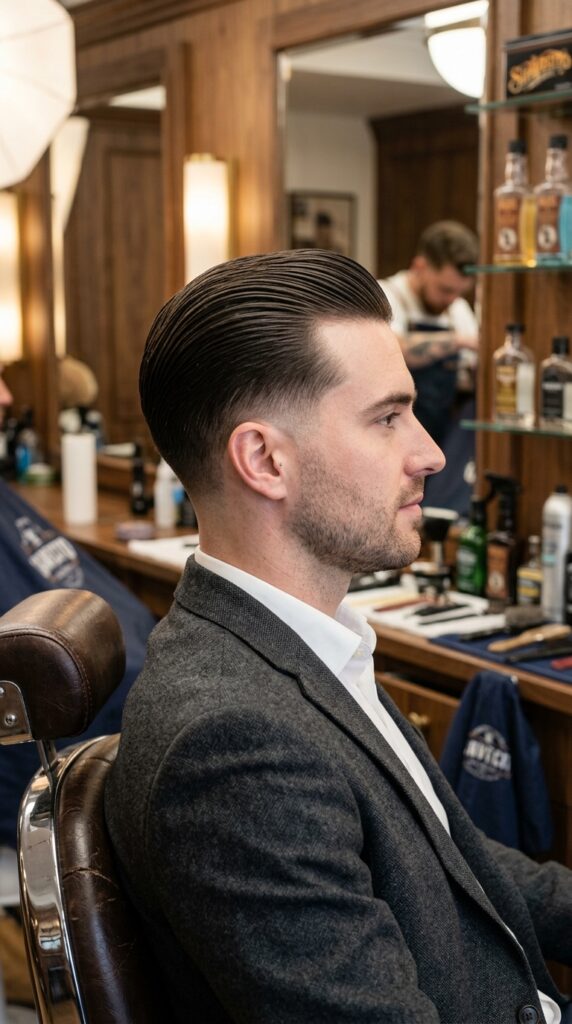
Vibe: Refined. Why it works: A low taper keeps the blend close to the ear rather than climbing the head, producing subtle contrast that reads as professional rather than trend-driven. This is the version most often requested for corporate dress codes and formal events. How to get it: Ask for “a low taper, two to five, blend kept under the ear,” paired with a medium-shine pomade so the look doesn’t appear overly done for daytime wear.
Shop The Look
| Product |
| Medium-shine styling pomade, 3oz |
| Boar bristle brush for daily upkeep |
| Compact comb for on-the-go touch-ups |
| Lightweight hairspray for hold without stiffness |
| Daily conditioning shampoo for fine hair |
9. Slick Back Taper Fade for Round Faces
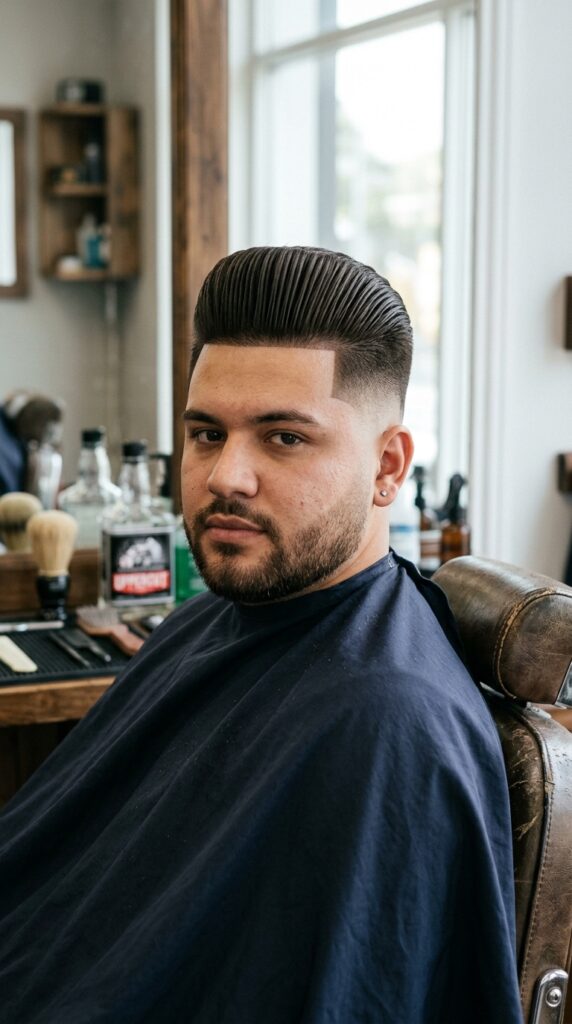
Vibe: Balanced. Why it works: Round faces benefit from added vertical height and tight, low-volume sides, since width at the temples emphasizes roundness. A high taper removes bulk at the sides while the slicked top is styled with lift at the root before being combed back, creating visual length. How to get it: Ask for a “high taper with extra height at the crown,” and use a comb to lift the root before flattening the rest back.
Shop The Look
| Product |
| Root-lifting volumizing spray |
| Vent brush for lift before slicking back |
| Strong-hold pomade for crown height |
| Texturizing powder for added root grip |
| Fine-tooth comb for precise root lifting |
10. Thick-Hair Textured Slick Back Taper
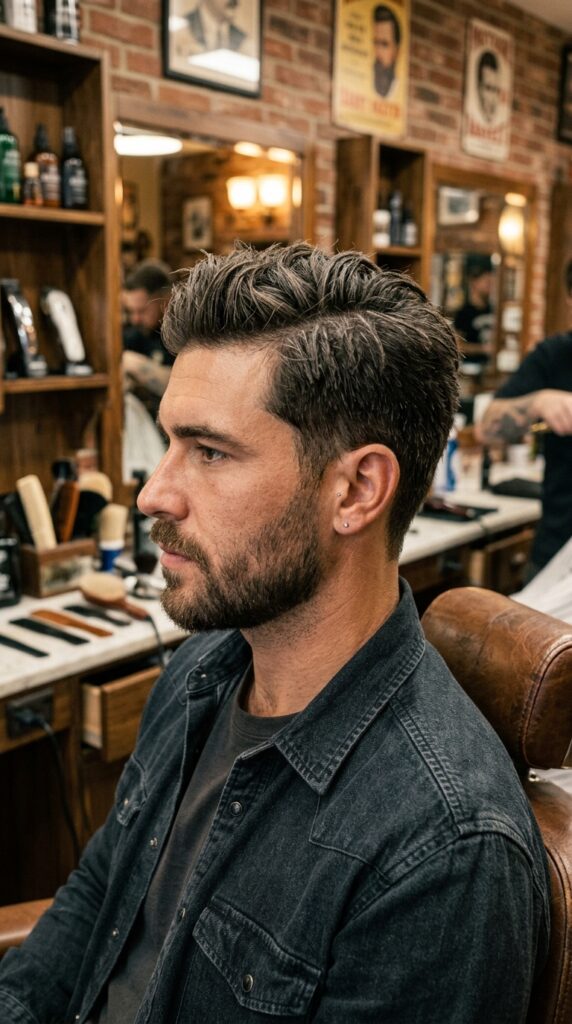
Vibe: Rugged. Why it works: Thick hair holds more volume even when slicked, so barbers often thin the top with texturizing shears to reduce bulk before styling back, preventing a helmet-like silhouette. The fade is kept tighter to offset the extra density up top. How to get it: Request “point-cutting on top to remove bulk before the slick back,” and finish with a matte clay rather than a glossy pomade to avoid excess weight.
💡 Quick Win: Blow-dry the top flat with a paddle brush before applying product — this collapses some natural volume and makes the slick-back hold longer.
Shop The Look
| Product |
| Matte texturizing clay, 4oz |
| Texturizing shears for thinning bulk |
| Paddle brush for flat blow-drying |
| Heat-protectant spray for blow-drying |
| Volume-reducing smoothing serum |
11. Slick Back Taper Fade with Full Beard Pairing
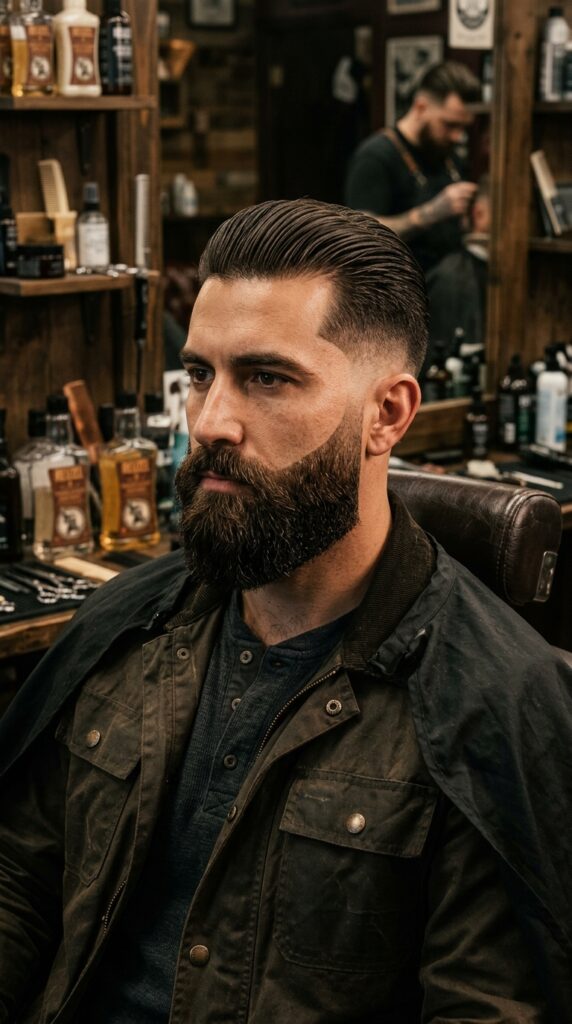
Vibe: Rugged. Why it works: Pairing a full beard with a slicked top creates intentional contrast between textured facial hair and a smooth, controlled crown, which keeps the overall look from feeling one-note. The beard line is kept crisp with a razor to mirror the precision of the fade. How to get it: Ask your barber to “line the beard with a straight razor to match the fade’s sharpness,” and condition the beard separately from the scalp since facial hair needs heavier oils.
Shop The Look
| Product |
| Beard oil with conditioning blend |
| Straight razor for beard line-up |
| Beard balm for shape control |
| Dual hair-and-beard pomade |
| Boar bristle beard brush |
12. Skin Fade Taper Slick Back Combo
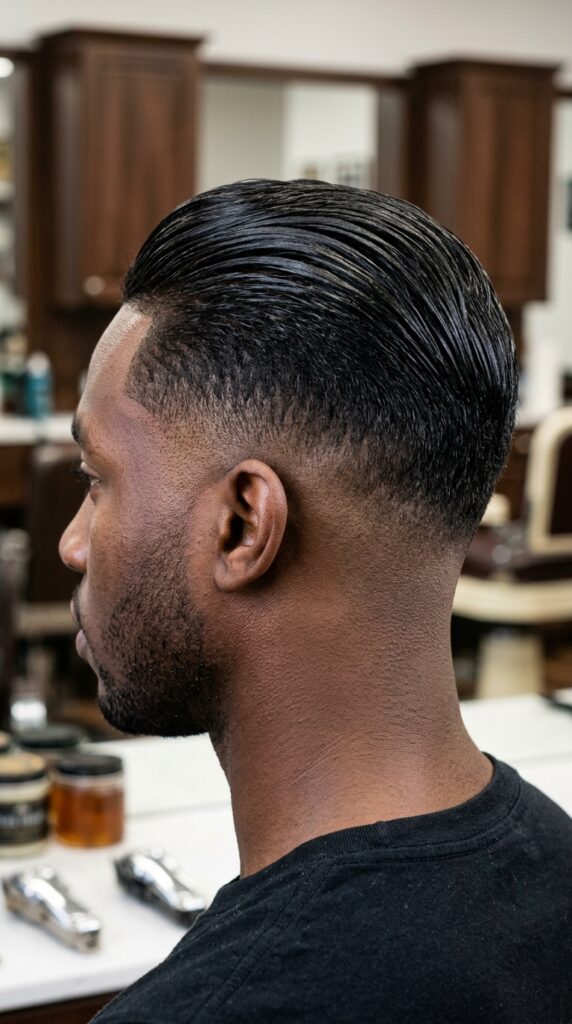
Vibe: Sharp. Why it works: This version starts with an actual skin fade — clippers taken down to bare skin at the nape — before transitioning into a standard taper blend higher up, giving more contrast than a guard-only fade. It’s a more technical cut requiring a barber comfortable with foil-over or detail-blade work. How to get it: Request “skin fade to bald at the bottom, blending into a taper by the temple,” and expect a slightly higher chair price due to the added blade work.
Shop The Look
| Product |
| Skin-safe foil shaver for clean-up |
| High-shine slicking pomade |
| Aftershave for sensitive shaved skin |
| Detail trimmer for fade blending |
| Cooling balm for post-shave skin |
13. Side Part Slick Back Taper Fade
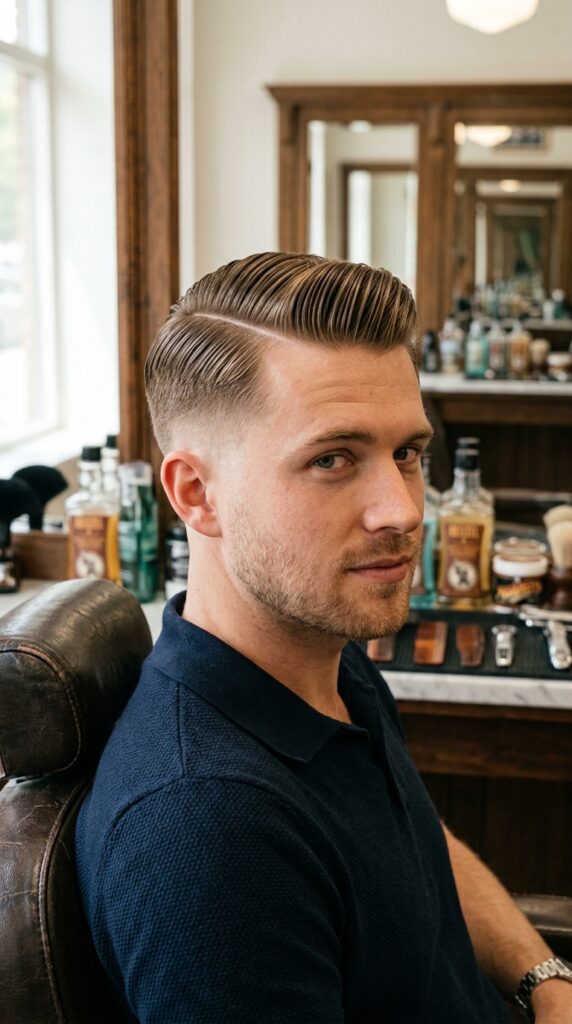
Vibe: Classic. Why it works: A combed side part — rather than a razor-shaved hard part — gives a softer, more traditional division that still channels hair back rather than forward, distinguishing it from a true pompadour or quiff. It works on most hair densities since it relies on combing technique, not cutting. How to get it: Find your natural part by combing hair straight back from wet, then redirect the top section back from that line using a medium-hold cream.
Shop The Look
| Product |
| Medium-hold styling cream, 3oz |
| Wide-tooth comb for finding the natural part |
| Lightweight pomade for soft separation |
| Hairspray for all-day part hold |
| Travel comb for part touch-ups |
14. Matte Clay Low-Shine Slick Back Taper
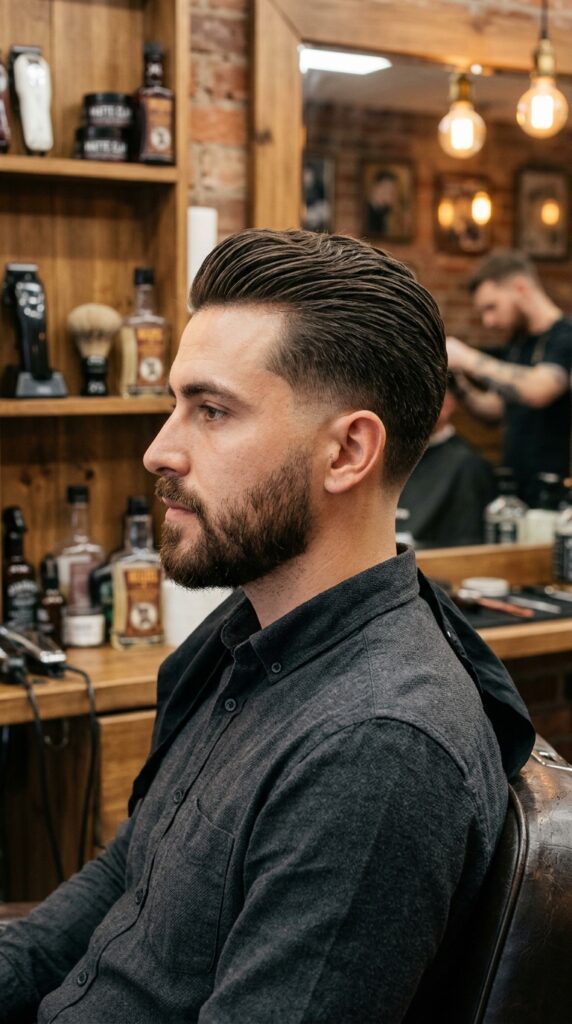
Vibe: Understated. Why it works: Matte clay is wax- and clay-based rather than oil-based, so it grips hair without leaving a glossy film, giving a slicked silhouette that reads more modern and daytime-appropriate than a high-shine pomade version. It also holds up better in humidity since it isn’t oil-reliant. How to get it: Apply matte clay to towel-dried hair and comb back while it’s still slightly damp — clay sets as hair dries, so timing the comb-back matters more than with gel or pomade.
💡 Quick Win: A pea-sized amount goes further with clay than pomade — start small and build up to avoid a chalky, overworked texture.
Shop The Look
| Product |
| Matte styling clay, 3oz tin |
| Wide-tooth comb for clay distribution |
| Mattifying finishing powder |
| Sulfate-free shampoo for clay buildup |
| Travel clay tin for on-the-go touch-ups |
15. Low-Maintenance Slick Back Taper Fade
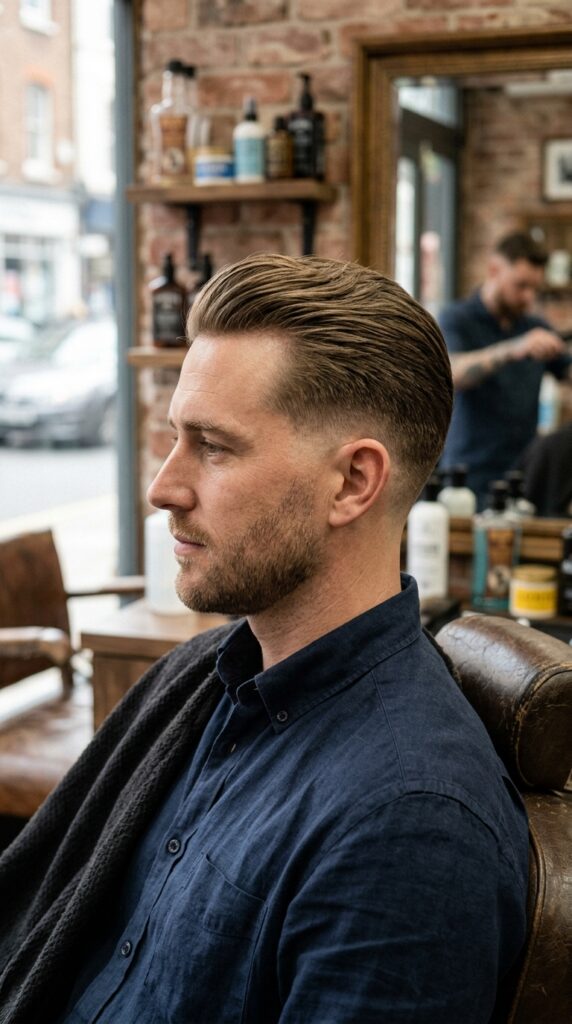
Vibe: Effortless. Why it works: Choosing a soft, gradual fade rather than a high-contrast one means regrowth is far less noticeable between cuts, which is the core trade-off behind any low-maintenance fade. A light-hold cream replaces gel or pomade so daily restyling takes seconds rather than minutes. How to get it: Ask for “a soft taper with no hard lines,” and request the fade be cut slightly longer than usual so it grows out evenly over four to six weeks.
Shop The Look
| Product |
| Light-hold leave-in styling cream |
| Wide-tooth comb for quick daily styling |
| Dry shampoo for second-day freshness |
| Lightweight finishing spray |
| Soft-bristle travel brush |
16. Curly-Top Slicked Back Taper Fade
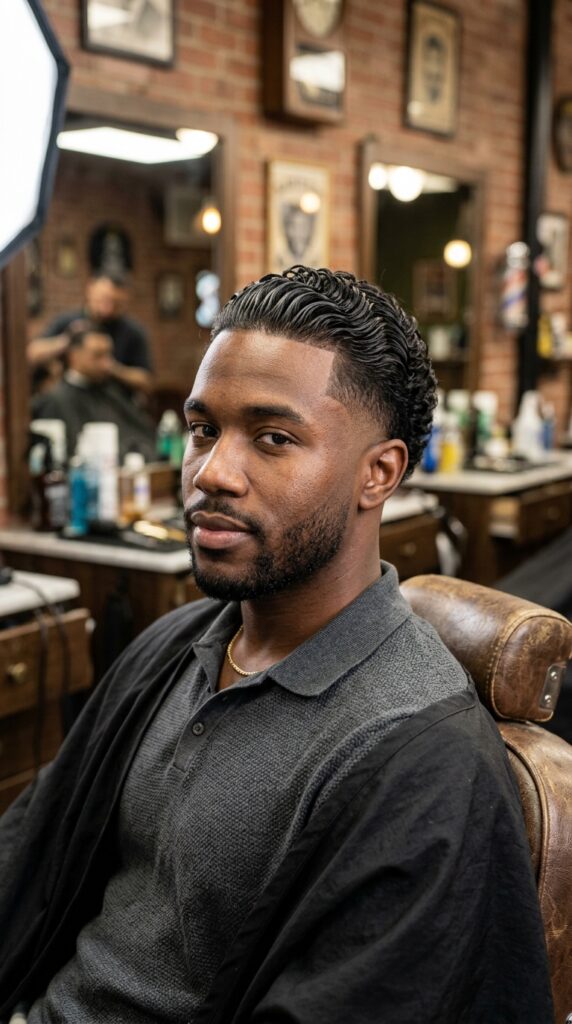
Vibe: Textured. Why it works: Curly hair resists lying fully flat, so a true slick back on curls usually settles into a textured, ridged version rather than a glass-smooth one — this is an honest limitation, not a flaw, and barbers account for it by using stronger hold and more product than they would on straight hair. How to get it: Use a strong-hold gel on soaking-wet curls, comb back firmly in sections, and let it air-dry fully before touching to lock the shape.
Shop The Look
| Product |
| Strong-hold curl-taming gel |
| Wide-tooth comb for wet curl detangling |
| Curl-defining cream for added control |
| Microfiber towel for curl-friendly drying |
| Anti-frizz finishing serum |
17. Drop Fade Slick Back Taper
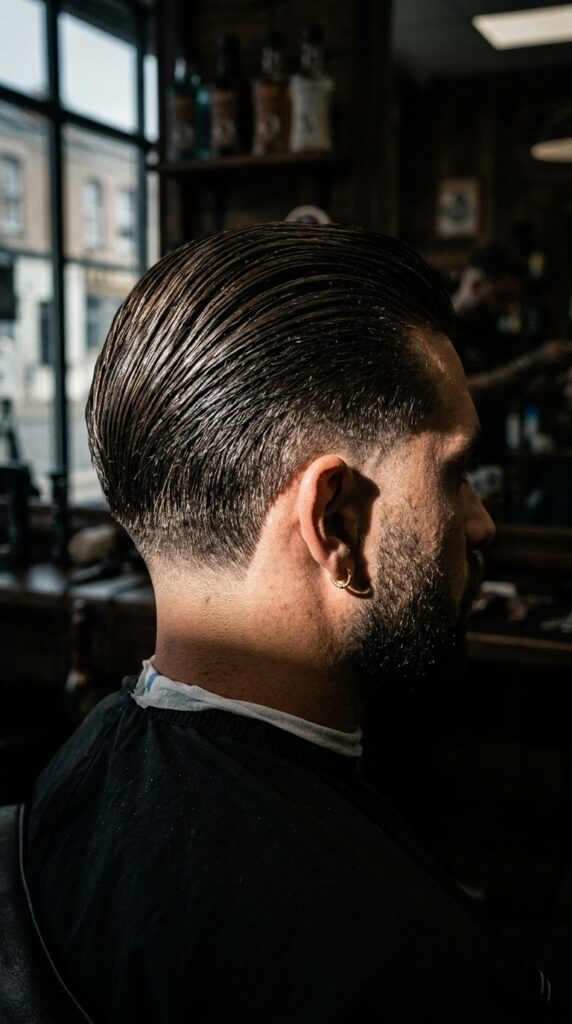
Vibe: Edgy. Why it works: A drop fade curves the blend line downward behind the ear instead of staying level, which follows the natural curve of the skull and tends to flatter rounder head shapes better than a straight taper line. It requires more freehand clipper control than a standard taper. How to get it: Ask specifically for “a drop fade, not a standard taper,” since the two are often confused — the drop is defined by its curved line, not just its guard numbers.
Shop The Look
| Product |
| Adjustable clipper with detail blade |
| Medium-shine slicking pomade |
| Edge brush for clean fade lines |
| Neck duster for post-cut cleanup |
| Fade comb with graduated teeth |
18. Sharp Hairline Detail Slick Back Taper
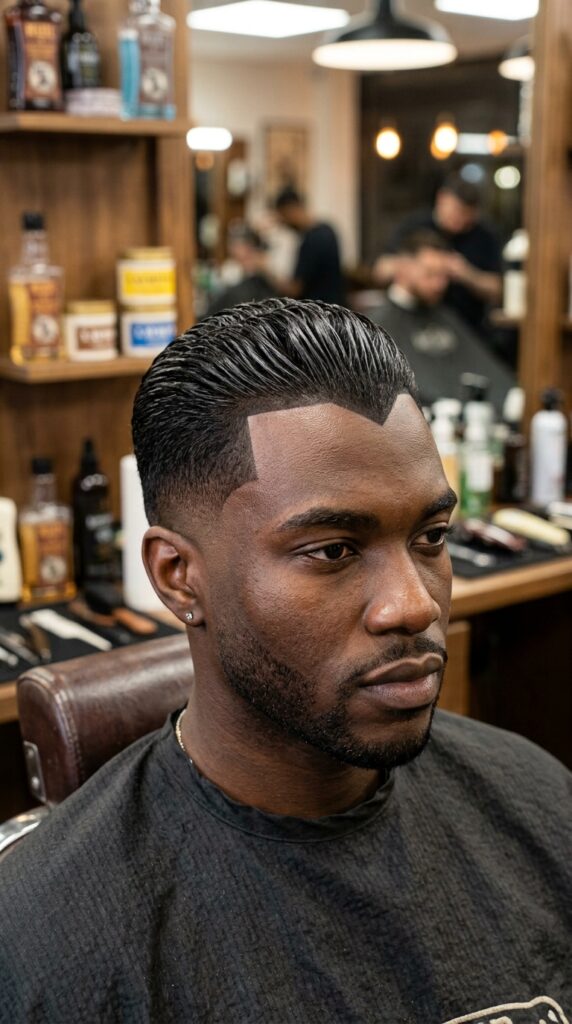
Vibe: Precise. Why it works: Edging the natural hairline with a straight razor removes the soft, fuzzy baby-hair border that’s normally left untouched, creating a crisper frame for the slicked-back top. This detail is purely cosmetic but reads immediately in close-up photos and on-camera settings. How to get it: Request a “hairline edge-up with a straight razor” as an add-on service, typically done in the final two minutes of the cut.
Shop The Look
| Product |
| Straight razor for hairline edging |
| Edge control gel for baby hairs |
| Aftershave balm for the hairline area |
| Fine-tip detail trimmer |
| Soft-bristle brush for edge clean-up |
19. Slick Back Taper Pompadour
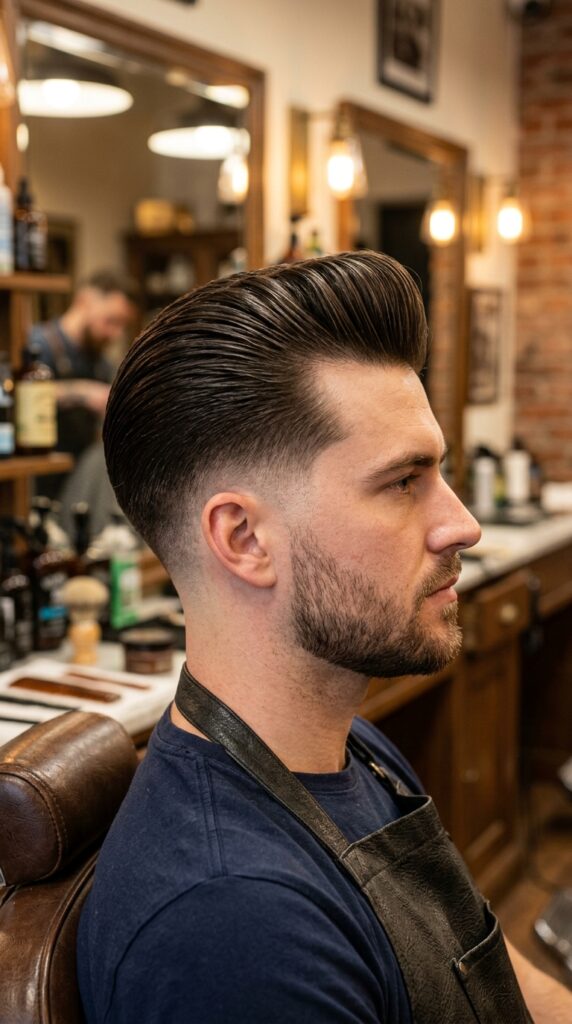
Vibe: Bold. Why it works: Unlike a flat slick back, a pompadour keeps height and volume at the front before the hair sweeps back, which is achieved by blow-drying the front section upward before combing the rest flat. The taper underneath keeps the bold top from looking top-heavy. How to get it: Blow-dry the front two inches upward with a round brush before applying product, then comb the remaining length straight back to blend into the lifted front.
Shop The Look
| Product |
| High-hold pompadour pomade |
| Round barrel brush for front lift |
| Heat-protectant blow-dry spray |
| Teasing comb for front volume |
| Finishing hairspray for hold longevity |
20. Strong-Hold Gel Slick Back Taper
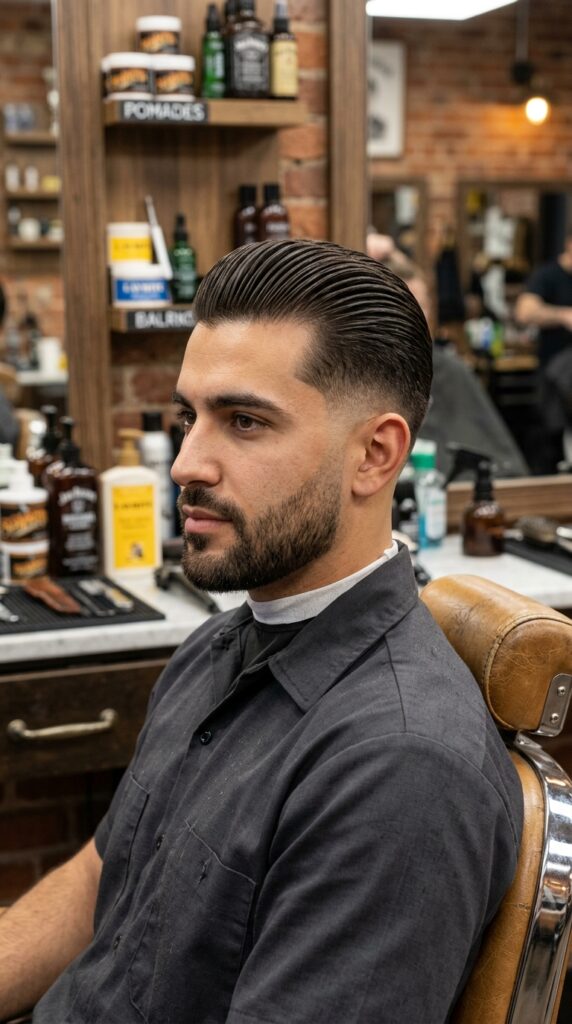
Vibe: Durable. Why it works: Strong-hold gels use a higher concentration of setting polymers than pomades or creams, which is why they survive humidity, wind, and a full workday without re-styling — the tradeoff is a stiffer feel that some find less natural than wax-based products. How to get it: Apply gel to towel-dried hair, comb back immediately while it’s still workable, and avoid touching it again until it fully sets to prevent flaking.
Shop The Look
| Product |
| All-day strong-hold styling gel |
| Fine-tooth comb for immediate setting |
| Anti-flake clarifying shampoo |
| Spray bottle for re-wetting before restyling |
| Travel-size gel tube |
21. Slick Back Taper Fade for Square & Angular Faces
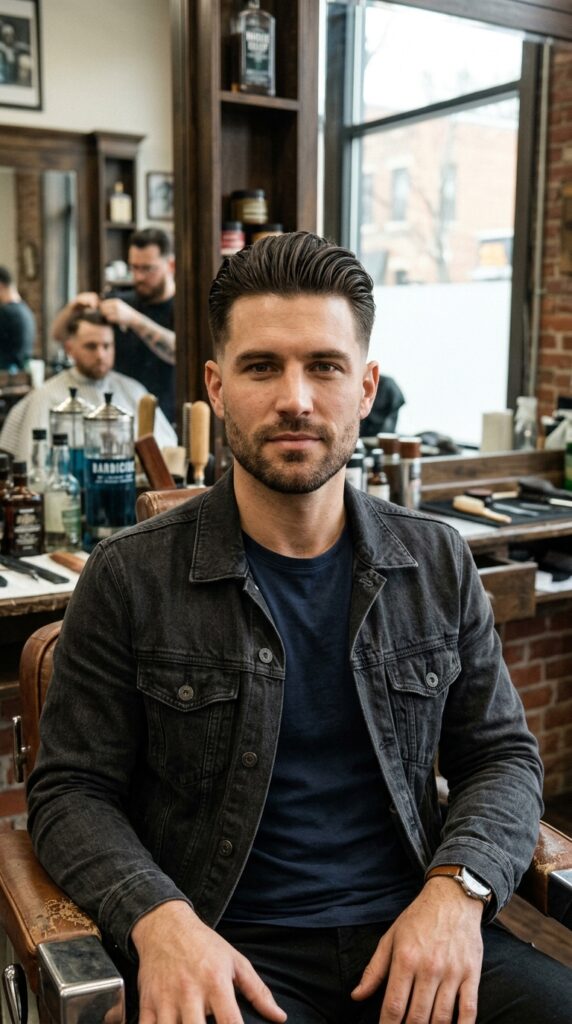
Vibe: Balanced. Why it works: Square and angular faces already carry strong jaw definition, so a fully flat, glass-smooth slick back can read overly severe — adding light texture to the top finish softens the overall silhouette without losing the cut’s structure. The fade itself stays moderate rather than ultra-high to avoid emphasizing width. How to get it: Ask for a “textured slick back, not fully flat,” using a fingers-through-product technique rather than a fine-tooth comb for the final pass.
Shop The Look
| Product |
| Texturizing pomade with soft hold |
| Wide-tooth comb for loose texture |
| Sea salt texturizing spray |
| Lightweight matte finishing cream |
| Soft-bristle brush for texture blending |
22. Grow-Out-Friendly Slick Back Taper Fade
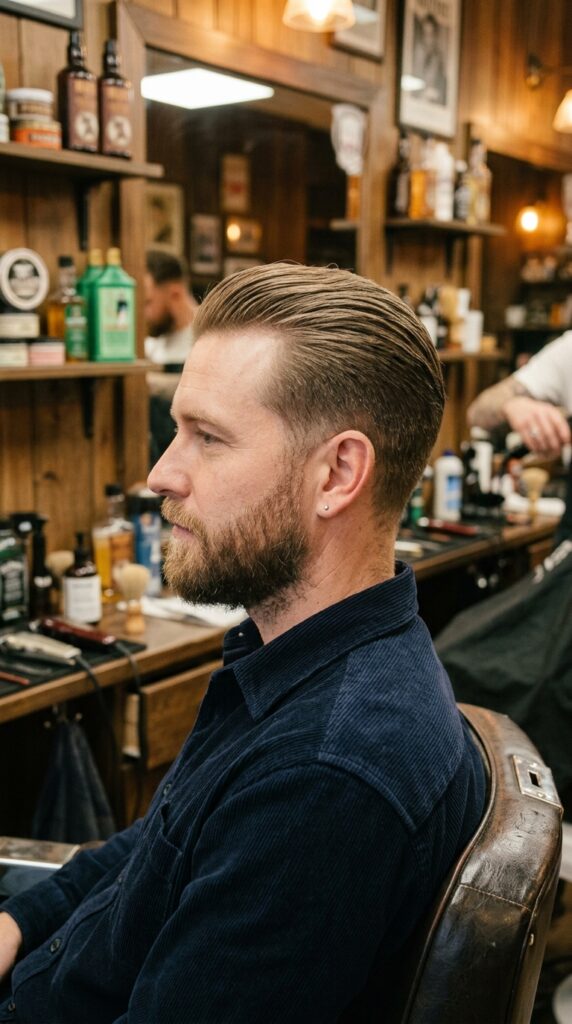
Vibe: Relaxed. Why it works: Starting with higher guard numbers (a 3 blending to a 6, rather than a 0 to a 3) means there’s less visible difference between a fresh cut and a six-week-old one, since the contrast was never extreme to begin with. This stretches the time between barbershop visits without the style looking unkept. How to get it: Request “a longer taper, three to six, nothing tight,” and plan for touch-ups every six to eight weeks instead of the usual three to four.
Shop The Look
| Product |
| Light-hold styling cream for daily ease |
| Wide-tooth comb for grown-out styling |
| Dry shampoo for stretching wash days |
| Lightweight finishing spray |
| Soft-bristle brush for daily maintenance |
How to Ask Your Barber for a Slick Back Taper Fade
Start with the fade height, not the top length — tell your barber a specific guard range, like “0 to 3” or “2 to 4,” since this single number range determines the entire silhouette and is the easiest thing to misjudge in a generic request like “taper it a little.”
The most common mistake is asking for a fade without specifying where it should start. A taper that begins too high looks like a different cut entirely, and one that starts too low barely registers — both come from skipping the guard-and-starting-point conversation, so always pair your guard numbers with a starting height (ear level, above the ear, or at the temple).
Three budget entry points under $20 each: a 2oz tin of matte styling clay with low shine, a fine-tooth metal comb for sectioning and slicking, and a travel-size strong-hold pomade for testing shine levels before committing to a full-size tin.
Expect a fade touch-up every two to three weeks for high-contrast versions, or four to six weeks for low-contrast ones. A barbershop visit typically runs $25–$60 depending on detailing, while daily restyling at home takes under five minutes with the right product.
Frequently Asked Questions About Slick Back Taper Fade
What’s the difference between a slick back taper fade and a regular slick back?
A regular slick back can be paired with any side length, including longer, untapered sides. A slick back taper fade specifically combines the comb-back top with a graduated clipper fade on the sides, typically blending from a 0–2 guard at the bottom to a 3–5 near the crown.
Does a slick back taper fade work for curly hair?
It works, but expect a textured rather than glass-smooth result, since curl pattern resists lying fully flat. Strong-hold gel applied to soaking-wet hair gives the closest approximation, but most curly-haired clients land somewhere between a slick back and a textured comb-over rather than a perfectly flat finish.
How much does a slick back taper fade cost?
A barbershop visit typically runs $25–$60 depending on detailing like hard parts or razor hairline work, while at-home upkeep with a single tin of clay or pomade averages $12–$20 per month. Skin fade variations or added beard work usually push toward the higher end of that range.
How often do you need to get a slick back taper fade redone?
High-contrast versions (0–3 guard range) need a refresh every two to three weeks to keep the fade line crisp, while lower-contrast versions (3–6 guard range) can stretch to four to six weeks. The top length itself can go longer between trims than the fade does.
What’s the best product for a slick back taper fade?
It depends on desired shine: oil-based pomade gives the deepest gloss, matte clay gives texture with no shine, and strong-hold gel gives the most durable all-day hold. Most barbers recommend starting with a medium-hold pomade as the most versatile option for first-timers testing the style.
Ready to Try a Slick Back Taper Fade?
These 22 ideas cover everything from fade depth and top texture to face-shape adjustments and product-driven finishes, so there’s a version here whether you want maximum contrast or a soft, low-maintenance blend. It’s completely normal to try a couple of variations — a guard number here, a product swap there — before landing on the exact combination that feels like yours. Start today by saving your favorite reference photo and bringing it straight to your next barbershop appointment.
There’s a particular kind of confidence that comes from a clean fade line meeting a top that does exactly what you ask of it — sharp where it should be, easy everywhere else. Pin the ones that caught your eye, and keep this list handy for the next time you’re due for a fresh cut.