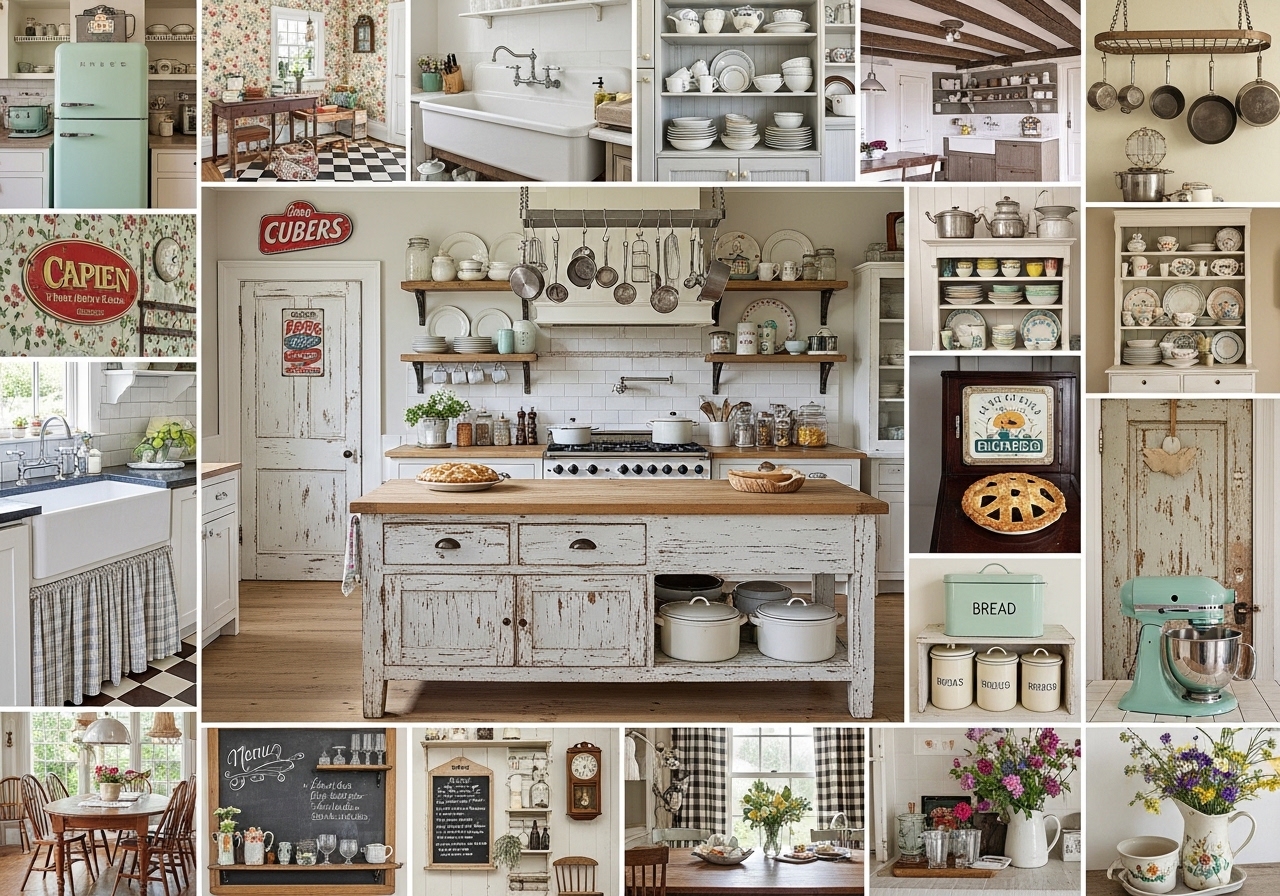
Vintage farmhouse style is the art of blending old-world rural character with the warmth of a lived-in home — think aged wood, worn enamel, and heirloom touches that feel earned rather than bought. These 23 ideas give you exactly what you need to bring that retro charm into your kitchen, from the cabinets to the ceiling.
There’s something almost gravitational about a vintage farmhouse kitchen. It pulls you in the moment you cross the threshold — the smell of warm wood, the soft gleam of a porcelain sink, the feeling that this room has stories to tell. Light filters through cotton curtains. Surfaces carry honest wear. Nothing is too precious to touch. Here are 23 ideas worth saving — and stealing.
Why Vintage Farmhouse Works So Well
Vintage farmhouse style has roots in the working kitchens of 19th-century American rural homes, where function came first and beauty was a byproduct of honest materials. Unlike modern farmhouse — which leans clean and Instagrammable — the vintage variant draws from actual antique and mid-century country aesthetics: general store signage, Depression-era enamelware, Hoosier cabinets, and hand-me-down textiles. It’s distinct from shabby chic in that the aged quality feels deliberate and rooted, not romantic and fussy.
The palette runs warm throughout. Think buttermilk cream, tobacco brown, brick red, muted sage green, and the particular off-white of old enamel — not crisp, but softened with age. Materials that anchor the look include unfinished white oak, reclaimed pine, cast iron, hand-thrown ceramic, aged brass hardware, and beadboard paneling. A reader could shop this style with those seven words as a checklist.
This style is surging right now because people are craving permanence. Post-pandemic life reshuffled priorities around the home, and the cold efficiency of minimalist kitchens started to feel hollow. Searches for “vintage kitchen decor” and “retro farmhouse” have climbed steadily on Pinterest since 2022, driven by a collective hunger for spaces that feel human, layered, and rooted in something real rather than trend-driven.
Small kitchens can absolutely achieve this look — in fact, the vintage farmhouse style often reads better in compact spaces, where a single cast iron pot rack or an open shelf of mismatched ceramics can carry the whole room. Prioritize one hero material (reclaimed wood or a painted shiplap wall) and let two or three curated vintage accessories do the rest.
Style at a Glance
| Element | Core Trait | Expression in the Kitchen |
| Philosophy | Functional beauty, honest aging | Nothing matches perfectly — and that’s the point |
| Materials | Cast iron, reclaimed pine, enamel, ceramic | Open shelving, farmhouse sink, wood counters |
| Color palette | Buttermilk, tobacco, brick red, muted sage | Layered warmth, never stark white or cool grey |
1. Open Timber Shelving With Mismatched Ceramics
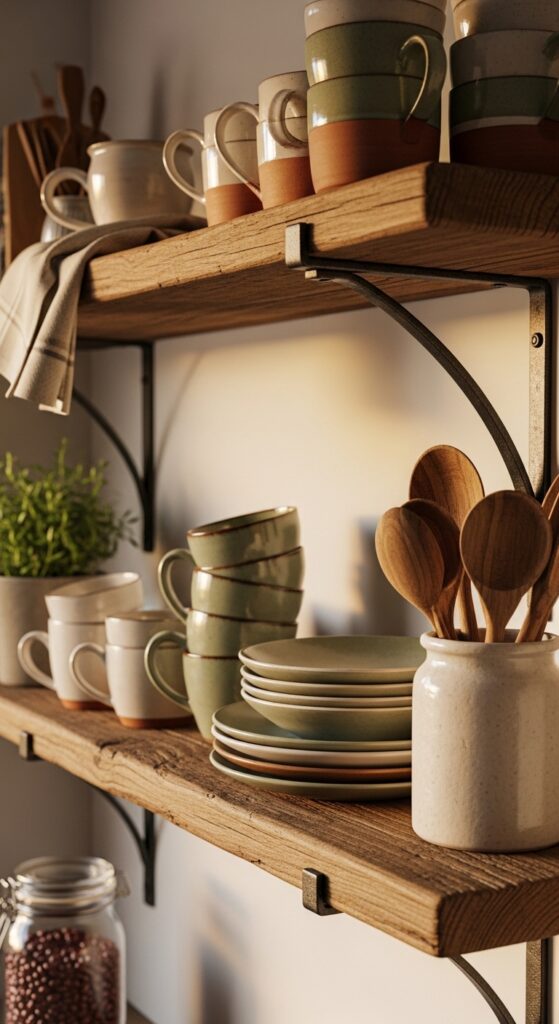
Vibe: Grounded — like a kitchen that’s been feeding people for generations.
Why it works: Open shelving removes the visual weight of upper cabinets, making even a modest kitchen feel more breathable. The real magic here is deliberate imperfection: mismatched ceramics in an analogous color family (cream-sage-terracotta) create a collected-over-time feeling that no matching set can replicate. The rough texture of reclaimed pine against the smooth glaze of handmade pottery is classic texture contrast — one of the foundational principles of layered interior design.
How to get it: Source reclaimed pine boards at least 2 inches thick from a salvage yard or Etsy woodworker — thinness reads modern and cheap. Mount on simple black iron shelf brackets from Rejuvenation or IKEA’s KUBBIS series, and start your ceramic collection with one anchor piece (a large cream crock) before filling in around it.
💡 Quick Win: Thrift stores and estate sales are the best source for mismatched vintage ceramics — look for pieces in the same tone family even if the patterns differ. A set of five mugs under $15 total can anchor the whole shelf.
2. Buttermilk Yellow Painted Cabinets
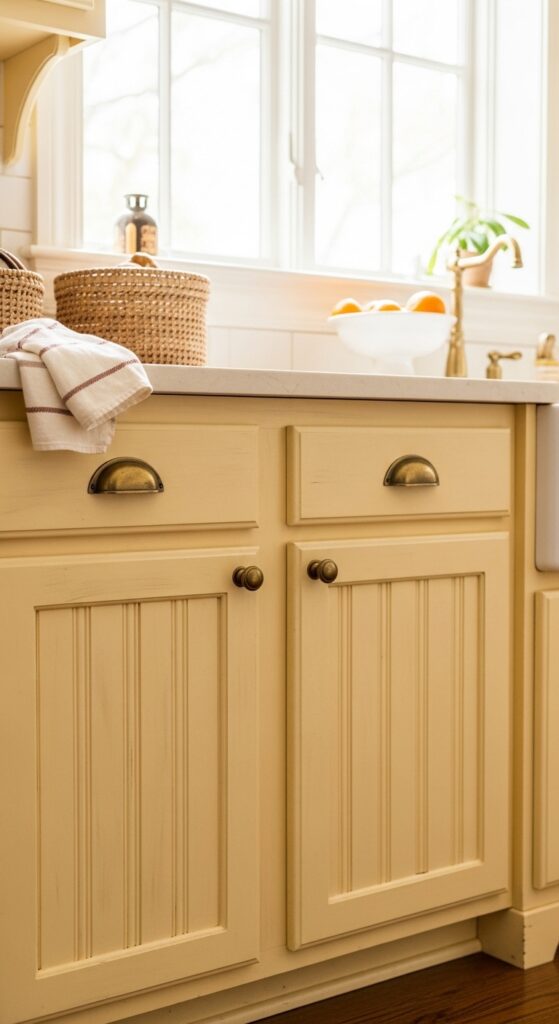
Vibe: Sun-warmed — the colour equivalent of a kitchen that gets morning light all year.
Why it works: Buttermilk yellow is one of the defining hues of vintage American farmhouse style, rooted in the actual pigments available to 19th-century rural homes. It reads warm without going orange, cheerful without feeling juvenile. Beadboard cabinet fronts add vertical texture that reinforces the period-appropriate feel, and aged brass cup pulls — not bar pulls — nail the era without a single overstatement.
How to get it: Benjamin Moore’s “Hawthorne Yellow” HC-4 or Farrow & Ball’s “Hay” are both excellent starting points. Apply with a natural bristle brush in long, directional strokes to get that intentional, slightly handmade texture that flat-roller finishes erase. Finish with a matte or eggshell topcoat — never satin, which reads too modern.
3. A Porcelain Farmhouse Sink as the Room’s Anchor
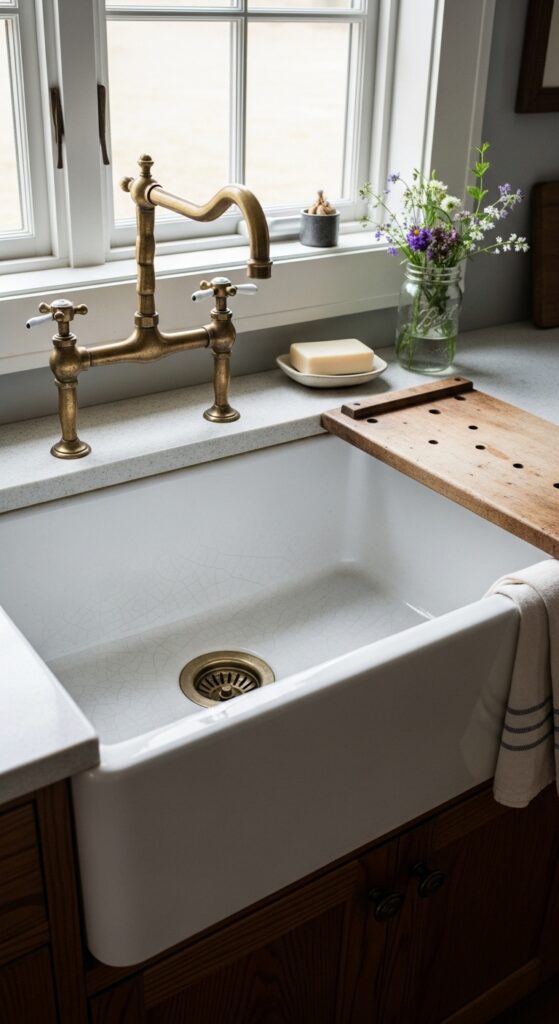
Vibe: Still — the kind of sink you actually want to wash dishes at.
Why it works: The apron-front sink is probably the single most recognizable icon of farmhouse kitchen design, and choosing a porcelain version over fireclay or stainless steel pulls the look firmly into vintage territory. Its depth and visual weight anchor the room the way a fireplace anchors a living room — everything else orbits it. Unlacquered brass faucets age naturally over months into a rich, uneven patina that no “antique brass” finish can fake.
How to get it: IKEA’s DOMSJÖ sink is an accessible entry point ($350–$450 range), but if budget allows, Kohler’s Whitehaven apron-front in Almond (not White) reads more authentically aged. Pair with a Rohl or Kingston Brass bridge faucet in unlacquered brass and skip the protective wax — let it live.
💡 Quick Win: If a full sink replacement isn’t possible, an unlacquered brass bridge faucet alone can shift a standard sink’s entire character. Swapping hardware takes under two hours and costs $80–$150.
4. Beadboard Ceiling for Instant Vintage Architecture
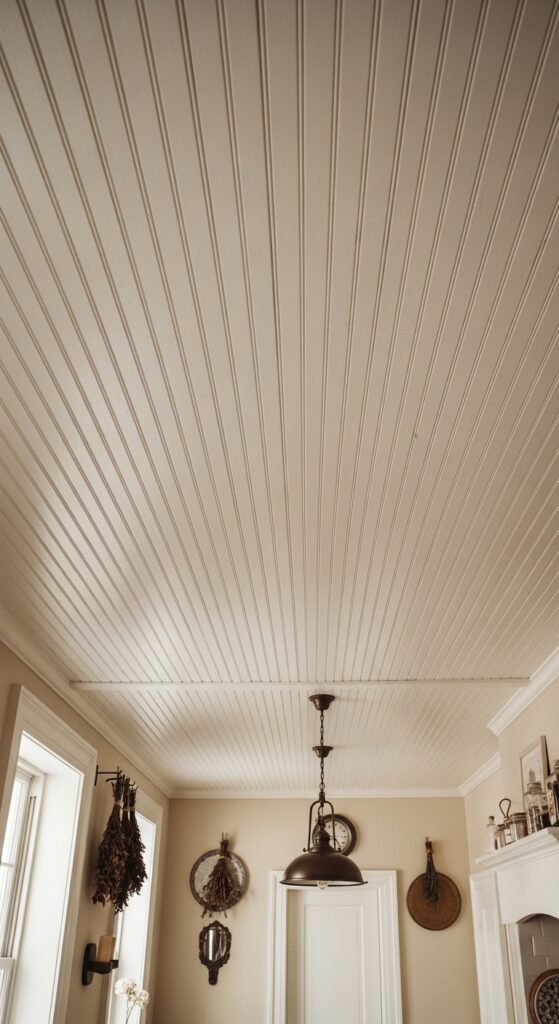
Vibe: Layered — like the room has accumulated its character slowly, over decades.
Why it works: Most vintage farmhouse kitchens focus detail at eye level and below, but bringing beadboard to the ceiling is the move that genuinely elevates the space from decorated to designed. The repeating vertical groove lines draw the eye upward and create architectural rhythm without adding visual clutter. It also reflects light softly, adding warmth that flat drywall ceilings simply cannot.
How to get it: Tongue-and-groove beadboard panels from a lumber yard can be installed over an existing ceiling by a confident DIYer in a weekend. Paint in Benjamin Moore “White Dove” OC-17 — a warm, non-stark white that won’t make the grooves read as harsh shadow lines under warm-toned artificial light.
5. Cast Iron Pot Rack Over the Island
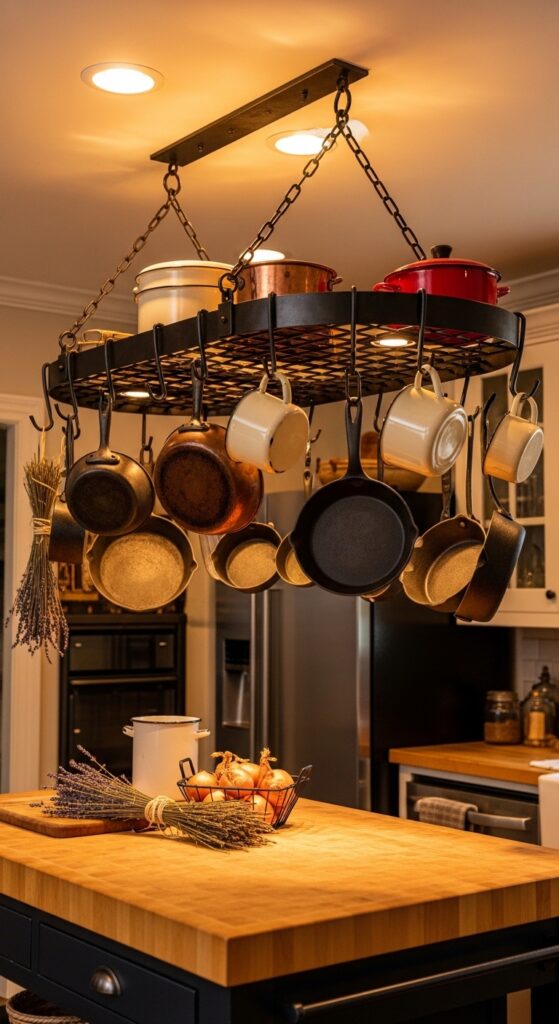
Vibe: Abundant — the visual equivalent of a kitchen that actually gets used.
Why it works: A pot rack does two things simultaneously: it solves a genuine storage problem and turns your cookware into décor. Cast iron and copper hanging overhead add visual weight to the upper half of the room, balancing the heavy base of an island below — a principle called vertical balance. In vintage farmhouse style specifically, hanging cookware signals the working-kitchen heritage that makes this aesthetic feel authentic rather than performed.
How to get it: Look for oval wrought iron pot racks from Enclume or Old Dutch — both make historically faithful designs with solid ceiling mounts. Start building your hanging collection with cast iron before copper; a Lodge 10-inch skillet ($30) looks better aged than any polished showpiece.
💡 Quick Win: Cream and red enamelware from Le Creuset’s vintage line — or genuine vintage pieces found on eBay for $10–$25 each — instantly ages a pot rack into a display that looks decades in the making.
6. Shiplap Accent Wall Behind Open Shelving

Vibe: Raw — stripped back to what the wall actually wants to be.
Why it works: Horizontal shiplap creates strong lateral lines that visually widen a wall and lend an unmistakably period-specific texture. Used as a backdrop rather than wrapping an entire room, it frames the shelving above it like a built-in piece of furniture, giving structure without overwhelming. The shadow gap between each board catches light differently throughout the day, which keeps the wall visually interesting without any additional decoration.
How to get it: Install shiplap with a 1/8-inch reveal using a nickel as a spacer between boards — this gives the precise shadow gap that makes shiplap look intentional rather than budget-renovated. Paint in Sherwin-Williams “Alabaster” SW 7008 for a warm off-white that doesn’t blue out under cool overhead lights.
7. Vintage-Inspired Pendant Lights Over the Island
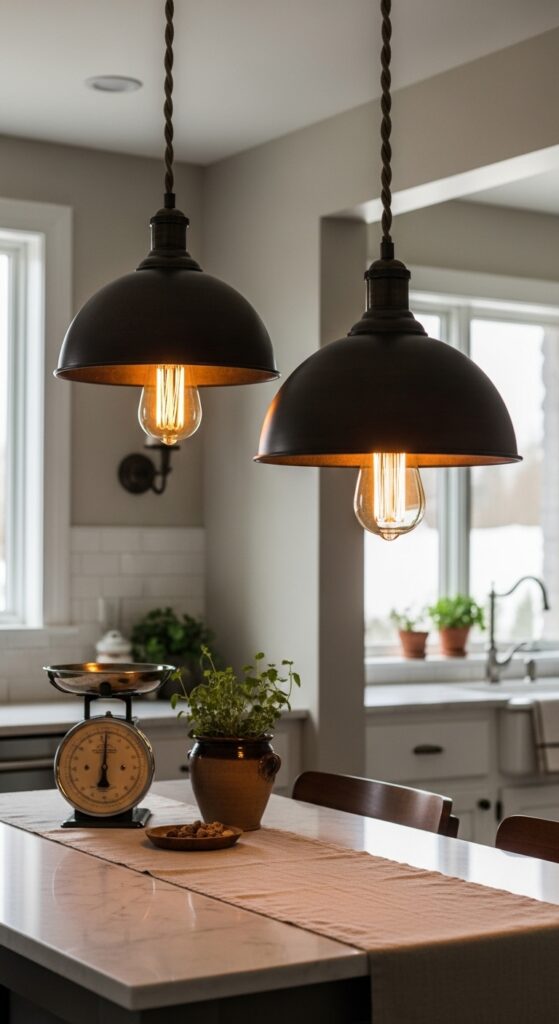
Vibe: Moody — the kind of light that makes a meal feel like an occasion.
Why it works: Pendant lighting does more aesthetic work per dollar than almost any other kitchen upgrade. Dome-shaped pendants in aged bronze reference the barn and general store fixtures of early 20th-century America, anchoring the retro farmhouse feeling in a single glance. Edison bulbs with visible filaments emit a warm 2200K color temperature — significantly warmer than standard LED — and that amber quality shifts the entire room’s mood toward the golden and nostalgic.
How to get it: Hang pendants so the bottom of the shade sits 30–36 inches above the island surface — any higher and the light pool spreads too wide to feel intimate. Schoolhouse Electric makes museum-quality reproduction pendants; for a budget version, look at the Rivet Caden series from Amazon ($45–$65 per pendant).
💡 Quick Win: Replacing standard LED bulbs with 4-watt Edison filament bulbs (Vintage Warm White, 2200K) in your existing pendants costs under $15 and immediately shifts the room’s mood. Do this before anything else.
8. A Reclaimed Wood Floating Island
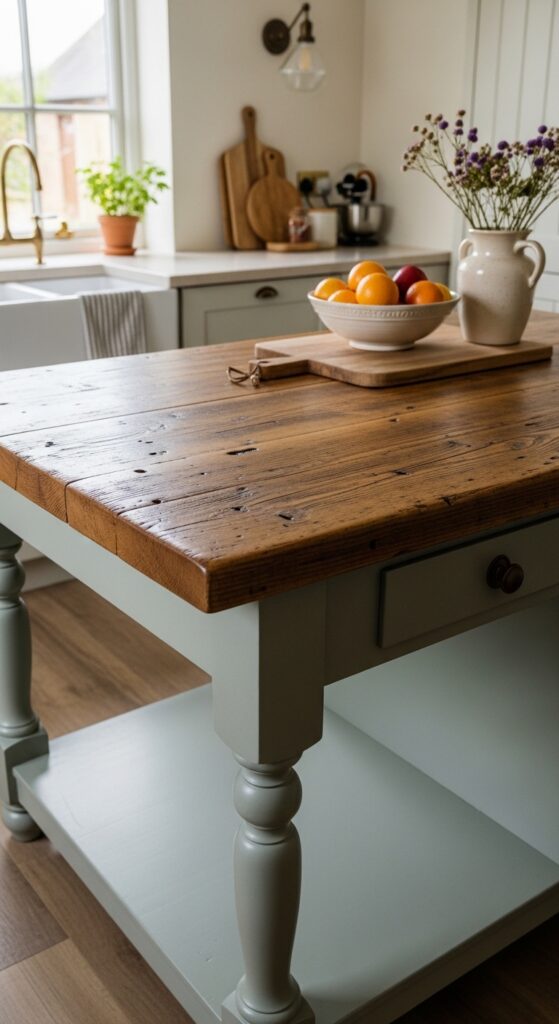
Vibe: Grounded — a piece that looks like it came with the house.
Why it works: A freestanding island with turned legs reads as furniture rather than cabinetry, which is precisely what separates vintage farmhouse style from a standard kitchen renovation. The thickness of a reclaimed wood top is critical — anything under 2.5 inches looks like a veneer imitation. Placing the island slightly off-center (rather than perfectly centered under the overhead light) creates the casual, asymmetric quality that makes a room feel genuinely lived-in.
How to get it: Etsy woodworkers selling reclaimed elm or oak slabs can often custom-size a top for under $400. Paint the base in Annie Sloan Chalk Paint in “Provence” or “Duck Egg Blue” — both sit in the muted sage-to-teal range and pair beautifully with warm wood without competing for attention.
9. Vintage Enamelware as Functional Décor
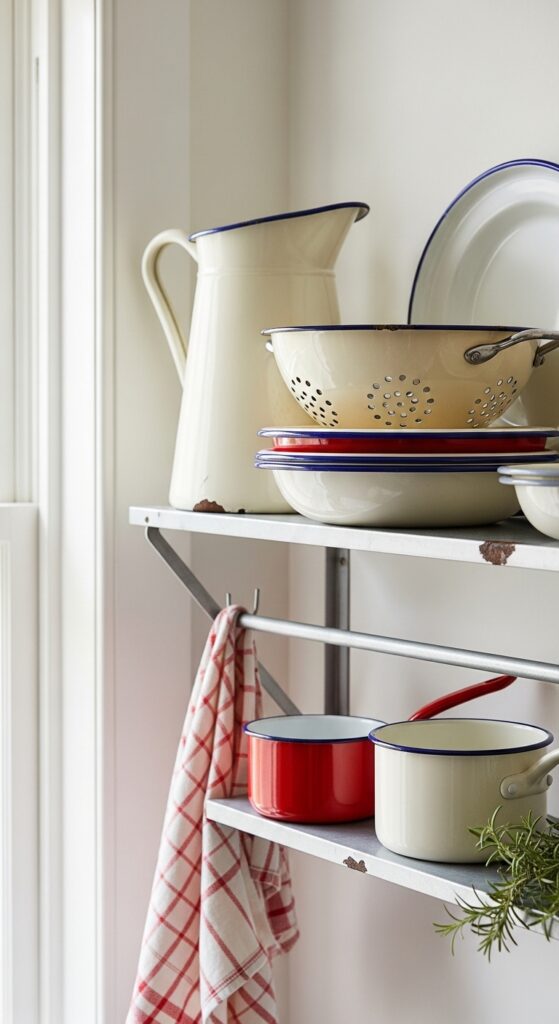
Vibe: Layered — every piece with a story, none of them matching exactly.
Why it works: Enamelware is perhaps the most authentic vintage farmhouse material you can introduce — it was a kitchen staple from the 1880s through the mid-20th century, and genuine vintage pieces carry a visual honesty that reproduction ware can’t fully replicate. The chipped edges and worn rims are features, not flaws. In design terms, this is the principle of wabi-sabi applied to a Western domestic context: the beauty of imperfection as evidence of use.
How to get it: eBay, Etsy, and local antique markets are the best sources. Shop for pieces in a consistent color story — cream body with red or cobalt trim — rather than collecting random colors. Hang or display pieces that are still functional; a pitcher used daily looks better than one retired behind glass.
💡 Quick Win: A single large cream enamelware pitcher ($8–$20 at any antique mall) placed on an open shelf or counter immediately signals vintage farmhouse in a way that three other accessories combined cannot.
10. Flour-Sack Curtains at the Kitchen Window
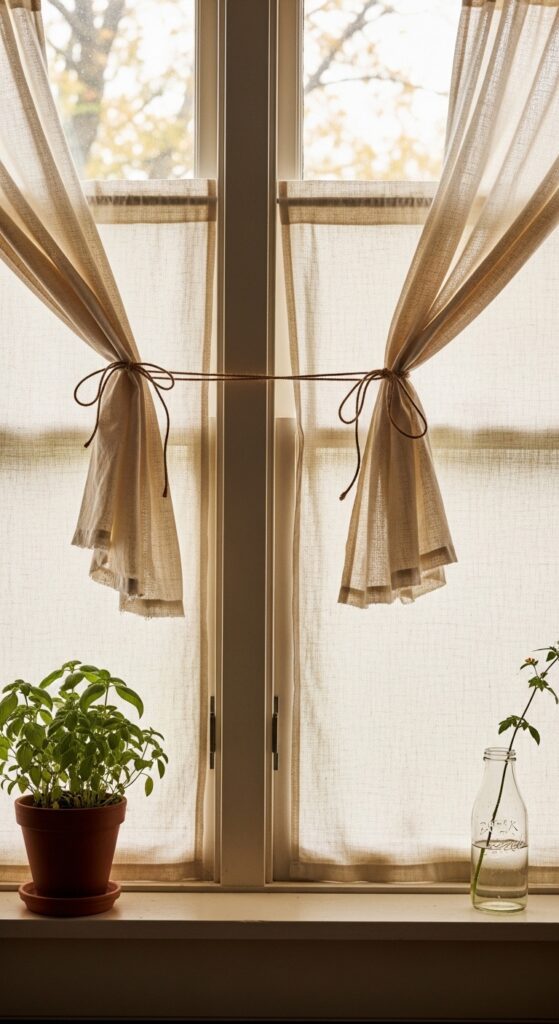
Vibe: Hushed — morning light through cotton is its own kind of quiet.
Why it works: Window treatments are often where vintage farmhouse kitchens either succeed or falter. Overly ornate curtains push the room toward country-cottage; bare windows push it toward modern. Flour-sack cotton — historically used for actual sack cloth — hits exactly the right note: substantial enough to have presence, open-weave enough to let light through, and unpretentious enough to feel authentic. The loose tie-back rather than a curtain ring maintains the casual, undone quality essential to this style.
How to get it: Riley Blake and Robert Kaufman both make reproduction flour-sack cotton fabric by the yard for $6–$10. Simply hem to length and add a rod pocket — or skip the hem and let the raw edge fray slightly over washings for an even more authentic look. Use a plain wooden curtain rod, not metal.
11. Brick Red Accents Against Cream Walls
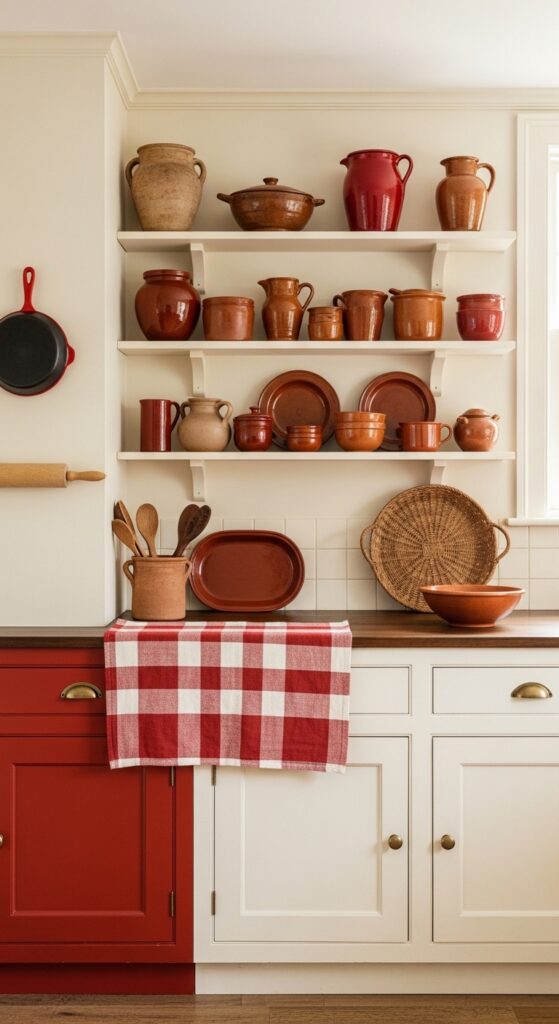
Vibe: Rooted — the colour equivalent of a kitchen that feeds people without apology.
Why it works: Brick red is the vintage farmhouse palette’s most historically accurate accent color — derived from the iron-oxide pigments widely available in rural 19th-century America. Against a warm cream ground, it creates a high-contrast, visually energizing combination that reads bold without becoming aggressive. The key is that the red must be brick — brownish and dusty — not tomato or fire-engine. That distinction is everything; the wrong red reads as a mistake rather than a decision.
How to get it: Sherwin-Williams “Antique Red” SW 0006 or Farrow & Ball “Eating Room Red” are both correctly brownish reds that age well on cabinetry. Use red as an accent color only — one cabinet section, one textile, one grouping of ceramics — rather than all three simultaneously unless the room is very large.
💡 Quick Win: A single red-and-white checked linen runner on a butcher block counter (available at most kitchen stores, $12–$25) introduces brick red into a kitchen with zero commitment and near-zero cost.
12. A Hoosier-Style Cabinet for Vintage Storage
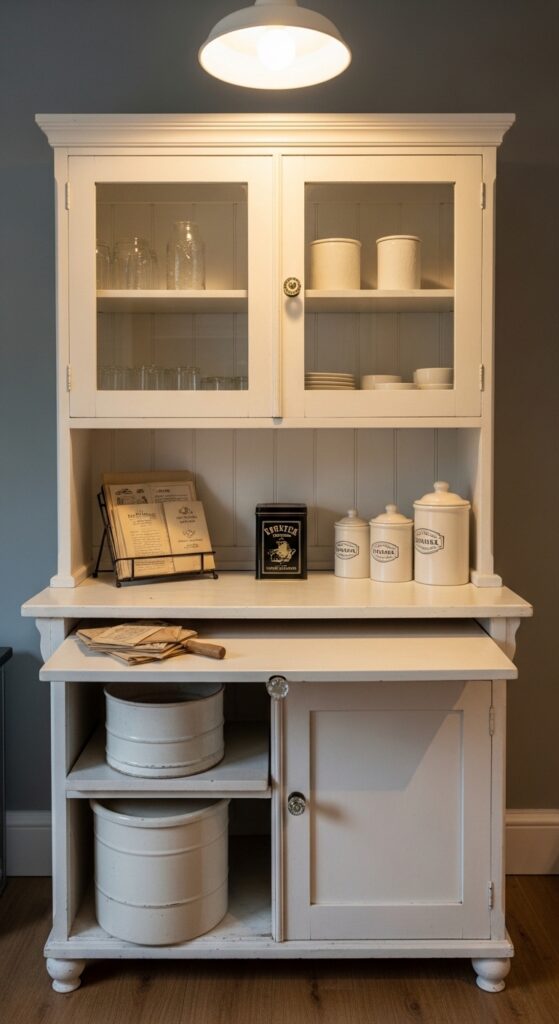
Vibe: Nostalgic — furniture with a job description built into its silhouette.
Why it works: A Hoosier cabinet is to the vintage farmhouse kitchen what a clawfoot tub is to a farmhouse bathroom — it’s a single piece that carries the entire historical narrative of the style. Originally manufactured between 1900 and 1940, these freestanding kitchen workstations combined storage, a flour sifter, and a pull-out work surface into one ingenious unit. Introducing even a reproduction version instantly gives a kitchen a functional vintage focal point that no decorative item can match.
How to get it: Genuine Hoosier cabinets appear regularly on Facebook Marketplace and Craigslist in the $200–$600 range. Reproduction versions from specialty furniture makers run $800–$1,400. Either way, the piece works hardest in a kitchen corner where it doesn’t compete with existing cabinetry — treat it as freestanding furniture, not built-in storage.
13. Galvanized Metal Accents and Storage
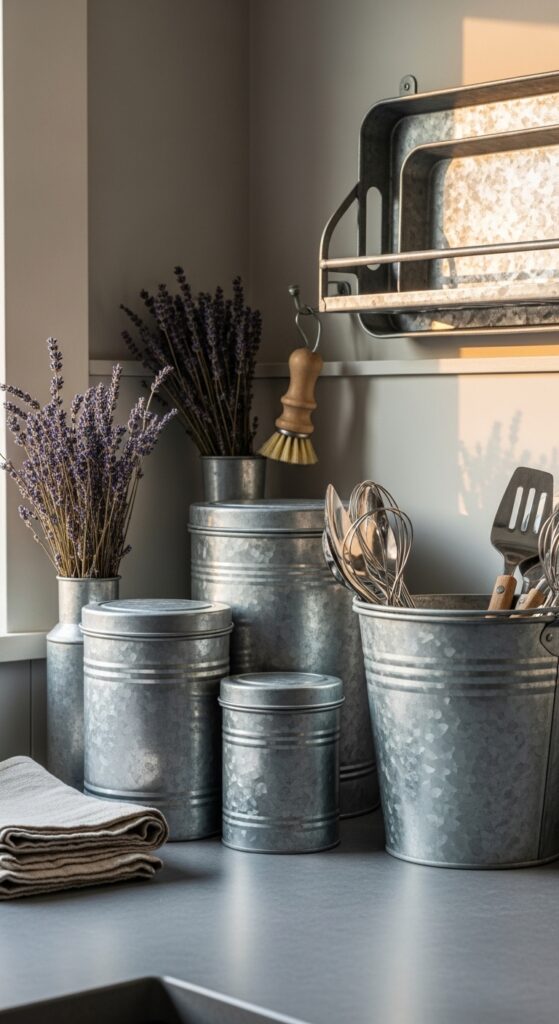
Vibe: Raw — the material honesty of a working farm translated into a kitchen.
Why it works: Galvanized metal introduces a cool silver-grey tone that acts as a visual counterbalance to the warmth-heavy palette of most vintage farmhouse kitchens. This contrast — warm cream and wood against cool metal — is exactly the kind of tonal layering that prevents the style from becoming cloying or one-note. Historically, galvanized steel watering cans, milk pails, and grain bins were working farm equipment; bringing them indoors collapses that distance between functional and beautiful.
How to get it: Mix genuine vintage galvanized pieces (flea market finds, $5–$20 each) with new reproductions from McGee & Co. or Magnolia Market. Never over-style with galvanized — three to five pieces maximum in a kitchen. Beyond that, it starts to read as a theme rather than a material choice.
💡 Quick Win: A galvanized metal utensil crock ($8–$15 at hardware stores or Amazon) placed on the counter near the stove instantly grounds the vintage farmhouse look and keeps your most-used tools visible and accessible.
14. An Antique Pie Safe as a Statement Piece
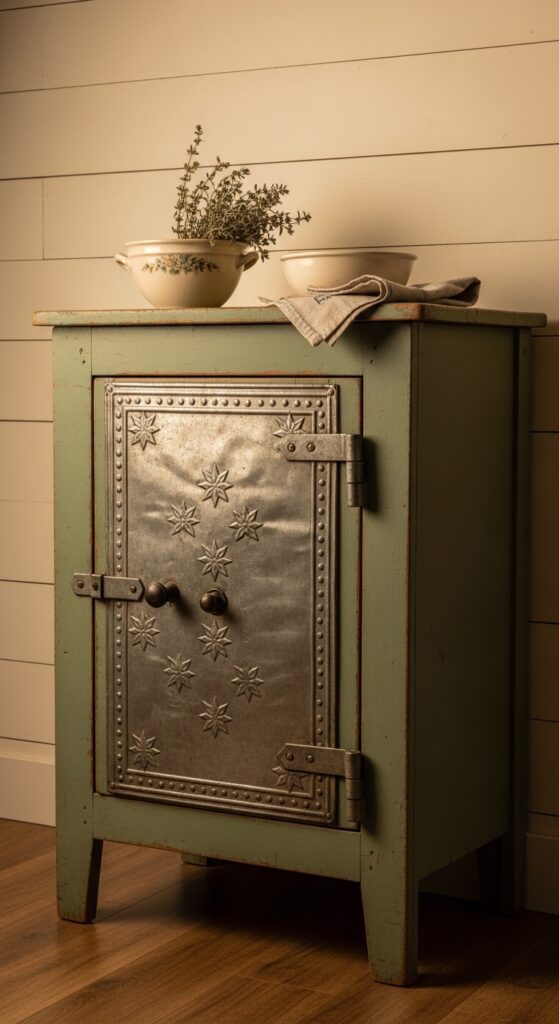
Vibe: Layered — the kind of furniture that makes a room feel like it has memory.
Why it works: A pie safe — the ventilated cabinet used in pre-refrigeration kitchens to cool baked goods while keeping flies out — is one of the most architecturally interesting pieces of vintage American furniture. The punched tin panels serve both ventilation and decoration, creating a patterned light-and-shadow play that no modern cabinet can replicate. Placed in a kitchen dining corner or against a blank wall, it acts as sculptural furniture rather than storage, changing the room’s entire character.
How to get it: Genuine antique pie safes appear at estate sales and rural antique markets for $150–$500 depending on condition and tin detail. If the existing paint is interesting — faded, layered, worn through — preserve it rather than repainting. That patina is the piece’s most valuable quality.
15. Butcher Block Countertops in Unfinished White Oak
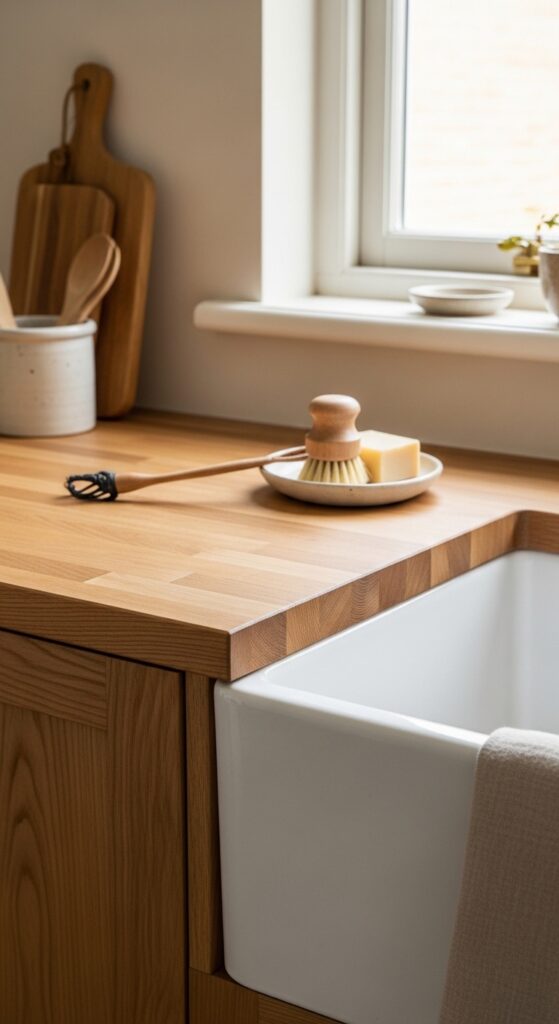
Vibe: Warm — wood that invites you to actually cook on it.
Why it works: Butcher block countertops in unfinished white oak bring the warmth, grain variation, and honest material quality that cold stone countertops — however fashionable — simply cannot provide in a vintage farmhouse kitchen. White oak specifically (rather than maple or pine) has a tight, fine grain that ages with remarkable elegance, developing a honey-to-tobacco patina over years of use and oiling. The countertop becomes more beautiful the more it’s used — a defining quality of this entire design philosophy.
How to get it: IKEA’s SKOGSÅ white oak countertop ($229–$289 per section) is widely regarded as the best accessible option. Finish with regular applications of food-grade mineral oil for the first month, then switch to a beeswax-and-oil blend like Rubio Monocoat for long-term conditioning. Avoid polyurethane — it seals the wood rather than nourishing it and looks plasticky within a year.
💡 Quick Win: Oil a new butcher block countertop five times in the first week of installation — once per day. This initial saturation period is the single most important step for long-term durability and beauty.
16. A Chalkboard Wall for Functional Vintage Charm
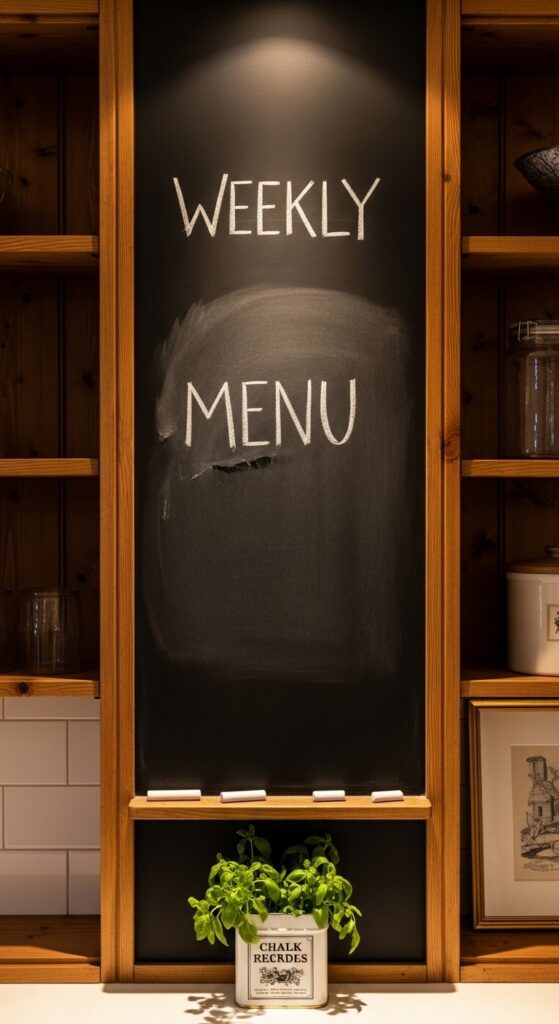
Vibe: Lived-in — a kitchen that communicates with the people who use it.
Why it works: A chalkboard wall section introduces matte black — one of the style’s important accent tones — in a form that’s both functional and historically resonant. General stores and farmhouse kitchens used chalkboards for shopping lists and daily menus throughout the 19th and 20th centuries, so the reference feels earned rather than decorative. In design terms, a matte black wall section also creates a strong visual anchor that prevents a room full of warm, soft tones from feeling too diffuse or undercontrasted.
How to get it: Apply Rust-Oleum Chalkboard Spray Paint to any smooth wall section — no primer needed on most painted surfaces. Season the surface before first use by rubbing the side of a chalk stick across the entire surface and then erasing; this prevents ghosting of your first message. A 6-foot-by-4-foot section is the sweet spot — large enough to matter, small enough not to dominate.
17. Sage Green Lower Cabinets With Cream Uppers
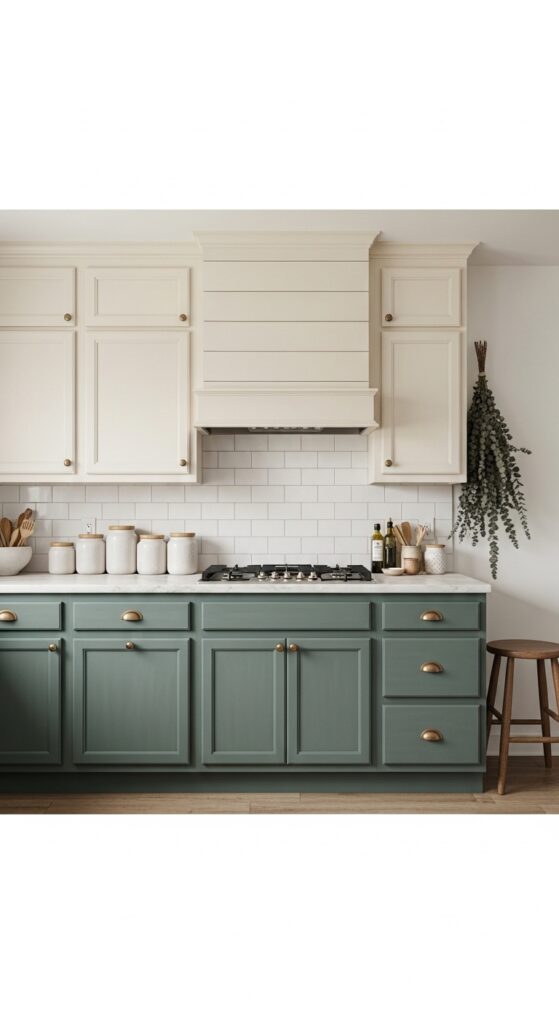
Vibe: Airy — a palette that feels like it was mixed from plants and morning light.
Why it works: Two-tone cabinet schemes — darker below, lighter above — are a well-established design principle that uses visual weight intentionally: heavier tones ground the lower half while the lighter upper half keeps the room feeling open. Sage green is the vintage farmhouse palette’s most nuanced color choice, straddling earthy and fresh without committing fully to either. The critical detail is getting the right sage — it must be dusty and grey-toned, not clean or minty, which immediately reads as contemporary.
How to get it: Farrow & Ball “Mizzle” No. 266 for the lowers and “Pointing” No. 2003 for the uppers is a combination that has earned near-universal praise from interior designers working in this style. Both colors shift beautifully under natural and artificial light without clashing.
💡 Quick Win: Paint just the lower cabinets in a muted sage and leave uppers cream — this single change can transform an entire kitchen’s character in a weekend with one quart of the right paint.
18. Vintage Glass-Front Cabinets for Display Storage
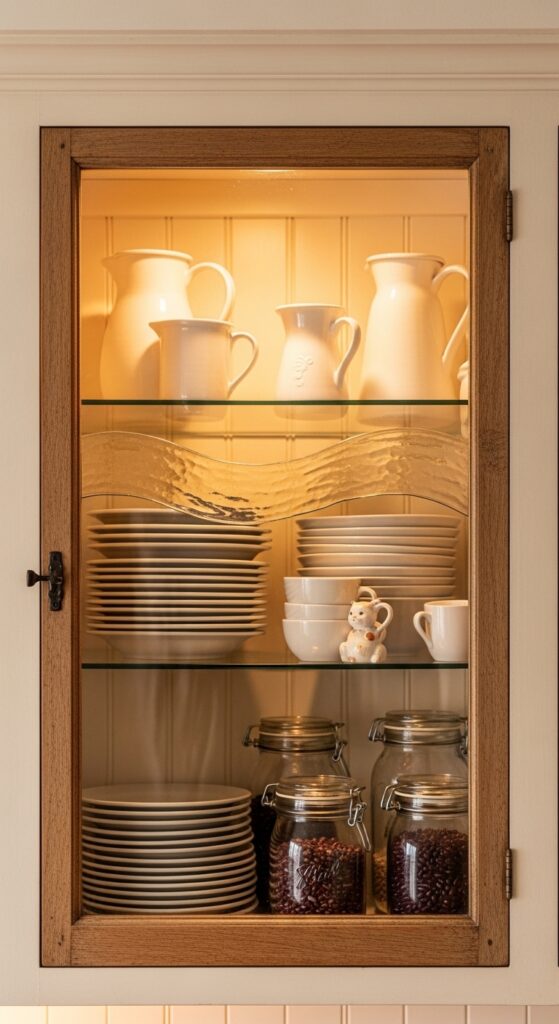
Vibe: Nostalgic — storage that wants to be seen.
Why it works: Wavy or “antique” glass — glass made with slight imperfections that create a gentle visual distortion — is one of the most authentic period details you can incorporate into a vintage farmhouse kitchen. Standard flat glass looks contemporary even in an old frame; wavy glass transforms the same cabinet into furniture with genuine historical character. The principle at work is visual softness: the imperfect glass diffuses the interior view just enough to look curated without requiring obsessive organization.
How to get it: Wavy reproduction glass is available from specialty glass suppliers like Bendheim or S.A. Bendheim for $8–$15 per square foot, and can be cut to fit existing cabinet doors. Ask a local glazier to replace existing flat glass panels — the job typically takes under an hour per door.
19. A Vintage-Style Range Hood in Hammered Metal
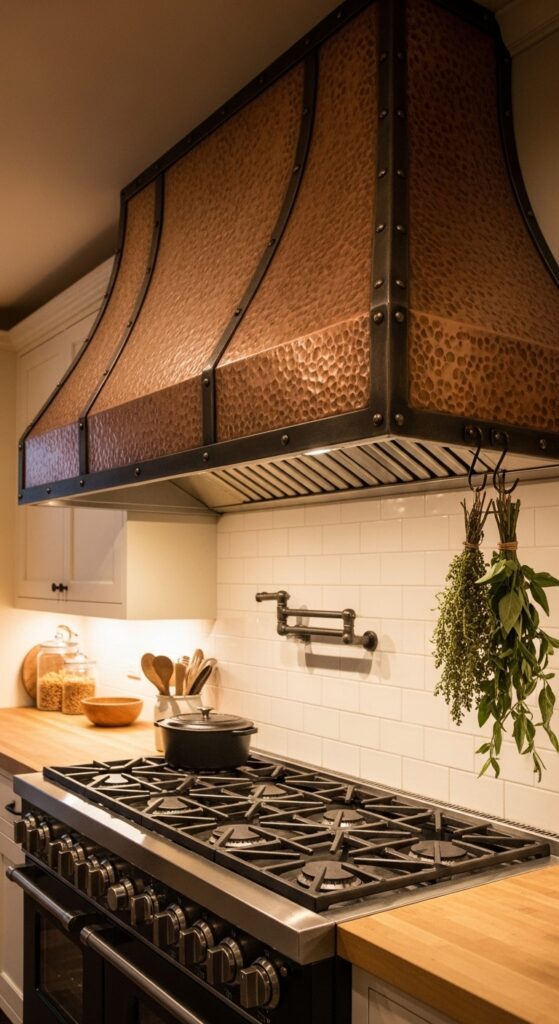
Vibe: Dramatic — the one piece in the kitchen that stops visitors mid-sentence.
Why it works: A range hood is architecturally one of the largest vertical elements in any kitchen, and most standard hoods are design afterthoughts — boring and boxy. A hammered copper or hammered iron hood transforms that architectural mass into the room’s focal point. The hand-worked surface texture catches light from multiple angles, creating a dynamic surface that changes throughout the day. Copper, left unlacquered, develops a warm patina over years that makes it look like a generational heirloom.
How to get it: Custom copper range hoods can be fabricated by metalworkers found on Etsy for $600–$1,800 depending on size and complexity — far less than showroom pricing. Specify unlacquered copper and request a light pre-patina treatment so the initial color is warmer rather than bright.
💡 Quick Win: If a full hood replacement isn’t in the budget, adding a hammered iron strap-style hood trim kit over an existing stainless hood changes its silhouette dramatically for under $200.
20. Terracotta Tile Floors With a Natural Seal
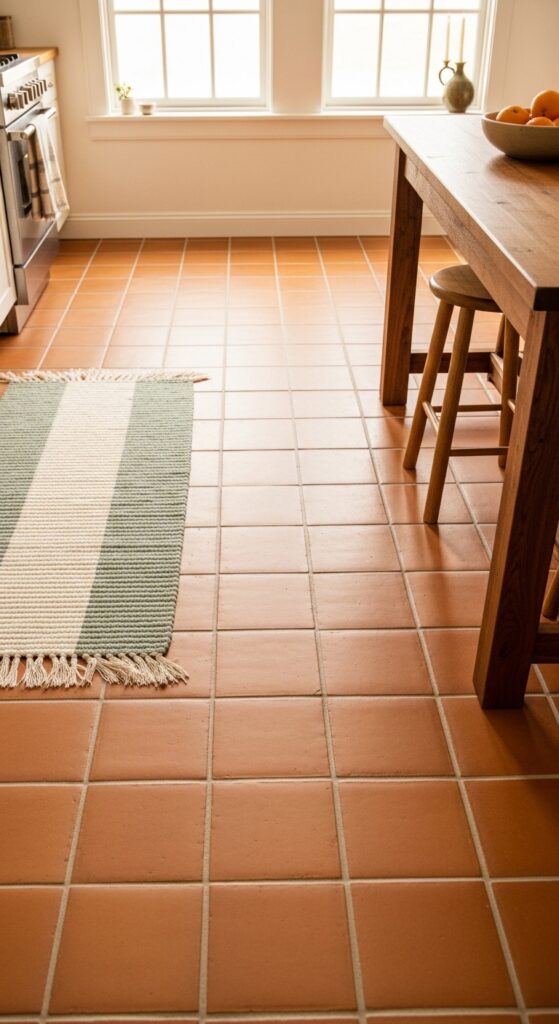
Vibe: Grounded — a floor that roots the entire room in the earth.
Why it works: Terracotta tile is the vintage farmhouse floor material with the longest global history — used in European farmhouses for centuries before appearing in American rural homes. The slight color and size variation in handmade tiles (each fired slightly differently) creates a floor surface with warmth that no uniform ceramic tile can replicate. In design terms, the warm orange-red of terracotta provides a tonal foundation that makes every color placed above it — cream, sage, brass, wood — appear richer and more grounded.
How to get it: Saltillo tiles (Mexican handmade terracotta) are the most accessible option, available from tile suppliers for $2–$4 per square foot. Seal with a penetrating natural sealer rather than a surface sealer — this preserves the tile’s matte warmth while protecting against kitchen spills. Avoid high-gloss sealers, which destroy the handmade quality entirely.
21. A Kitchen Garden Window for Herbs and Light
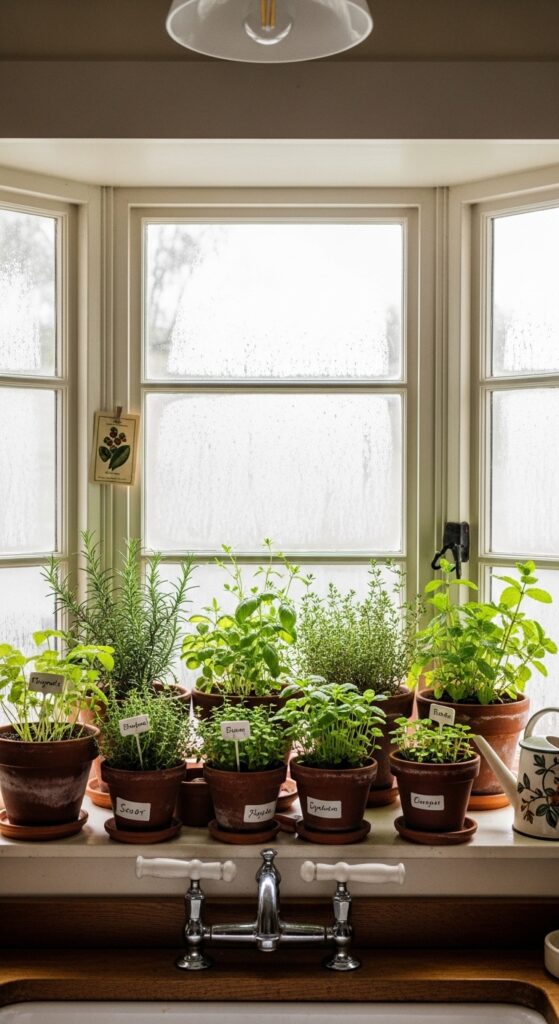
Vibe: Luminous — a kitchen that grows things.
Why it works: A garden window creates a visual connection between kitchen and outdoor growing that’s fundamental to the farmhouse aesthetic’s DNA. Beyond the philosophy, it solves a real design problem: the typical kitchen window above a sink tends to feel like a flat, utilitarian opening. A deep garden window with three glass panels transforms it into a light-filled architectural moment that doubles as a functional herb garden. The terracotta pots carry the warm material palette directly into the window’s frame.
How to get it: Garden window inserts from manufacturers like Alside or Simonton can be installed into an existing window opening in a day by a competent carpenter. Size to your opening — the deeper the box, the more planting tiers you can create. Use only terracotta pots, never plastic, and choose herbs you’ll actually use: rosemary, thyme, and chives are the hardiest.
💡 Quick Win: Even without a full garden window, a simple wooden tray on a standard windowsill with three small terracotta herb pots creates 80% of the same visual effect for under $30.
22. Vintage-Inspired Open Layout Connecting Kitchen and Dining
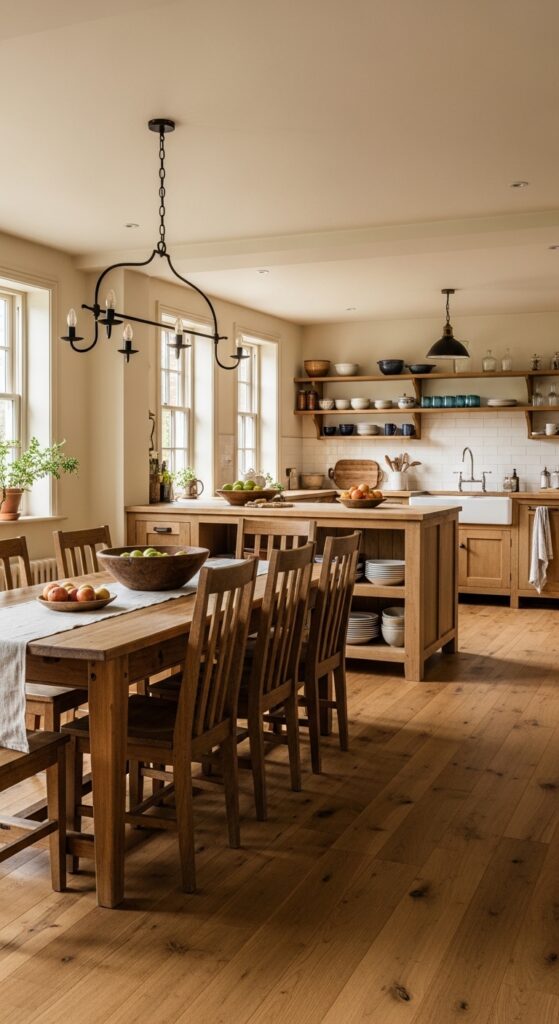
Vibe: Abundant — a room that’s designed to gather people without effort.
Why it works: The original farmhouse kitchen was always an open, communal space — cooking and eating happened in the same room because that room was where all life converged. Honoring that by creating a visual and physical connection between kitchen and dining area isn’t just historically faithful; it’s also a sound design strategy. Repeating the same wood tone (reclaimed oak in both the kitchen shelving and the dining table) creates visual unity across a large space without requiring matching furniture, which would feel too staged.
How to get it: Define the dining zone with a simple iron chandelier hung low over the table (30–34 inches above tabletop surface) rather than relying on rugs, which read contemporary in a farmhouse context. The scale of the chandelier should match the table length — a 6-foot table needs at least a 36-inch diameter fixture.
23. Heirloom-Quality Linen Textiles for Soft Layering
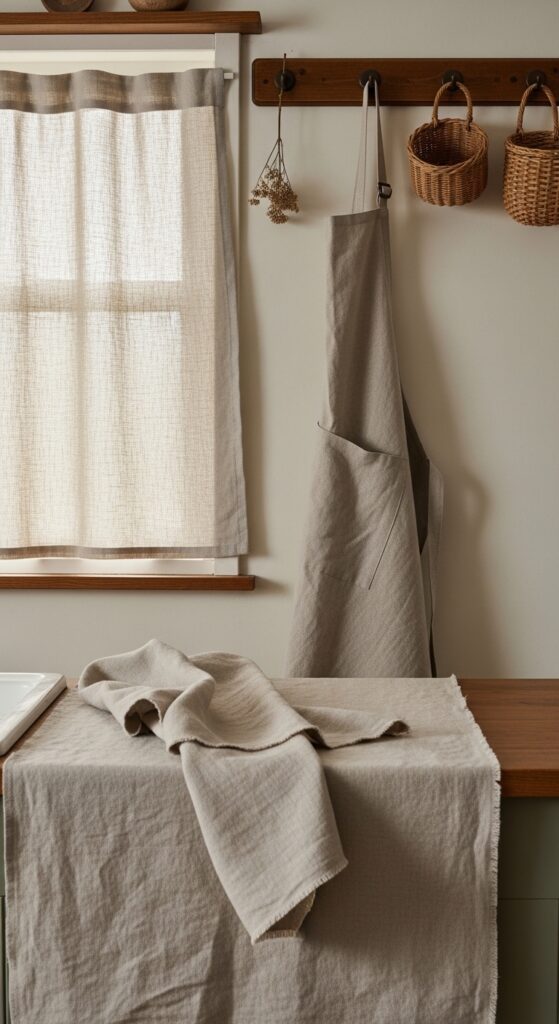
Vibe: Hushed — softness layered until the whole room exhales.
Why it works: Textiles are the fastest way to add warmth and acoustic softness to a kitchen that might otherwise feel hard and echo-y. Undyed Belgian linen — neither pure white nor beige, but somewhere in between, with visible slub and weave variation — is the most authentic vintage farmhouse textile choice. The key design principle here is tonal layering: using multiple textiles in the same color family but different textures creates depth without pattern, which would compete with the material richness already present in wood, ceramic, and metal surfaces.
How to get it: Rough Linen and Libeco both sell undyed Belgian linen by the yard ($18–$30/yard) — buy enough for a café curtain, a small runner, and a hanging tea towel and hem them all yourself with a basic sewing machine. That tonal consistency across three pieces does more visual work than any decorative textile pattern.
💡 Quick Win: An undyed linen tea towel ($12–$18 at kitchen stores or online) folded over an oven door handle introduces the texture and tone of this palette in the most casual, effortless way possible.
How to Start Your Vintage Farmhouse Kitchen Transformation
Start with paint. Benjamin Moore’s “Hawthorne Yellow” HC-4 on your lower cabinets — or if yellow feels like a stretch, Sherwin-Williams “Alabaster” SW 7008 on the walls — creates the warm tonal foundation that makes every piece you add afterward feel intentional rather than assembled. This single decision establishes the room’s temperature, and every material choice from hardware to textiles will either work with that warmth or fight it. Get the base right first.
The most common mistake beginners make is buying hardware that’s labeled “antique brass” but is actually lacquered gold — shiny, uniform, and completely wrong for this style. Real aged brass is uneven in color, slightly dull in places, and develops character over time. Look for unlacquered brass hardware specifically, or buy vintage pulls from antique markets. Installing the wrong hardware is an expensive mistake that undermines every other authentic choice in the room.
Three specific items under $50 that create immediate impact: a set of three mismatched cream ceramic mugs displayed handle-out on an open hook rail ($4–$8 each at any thrift store); a galvanized steel utensil crock from a hardware store ($10–$15); and a single large unbleached linen tea towel from Rough Linen or a kitchen specialty store ($15–$20). These three items together cost under $50 and immediately communicate the style to anyone who walks in.
A starter version of this look — paint, a few hardware changes, textiles, and accessories — is achievable in a weekend for $200–$400. A more complete transformation involving open shelving, new lighting, and countertop changes runs $1,500–$4,000 depending on how much you DIY. A full kitchen renovation with farmhouse sink, butcher block counters, and custom cabinetry is a 4–6 month project with a budget starting around $8,000. Start with the weekend version; it’s surprising how far it goes.
Frequently Asked Questions About Vintage Farmhouse Kitchen Design
What is the difference between vintage farmhouse and modern farmhouse kitchen style?
Modern farmhouse — popularized by Joanna Gaines and the Magnolia aesthetic — leans clean, symmetrical, and white-on-white, with shiplap as a graphic element rather than a historical one. Vintage farmhouse is deliberately imperfect, drawing from actual period kitchens of the late 19th and early 20th centuries. The palette runs warmer (buttermilk, terracotta, sage rather than bright white), the materials show genuine age or honest wear, and the furniture and accessories feel collected rather than curated. If modern farmhouse is a showroom, vintage farmhouse is a kitchen that’s been in the family since your grandmother’s time.
What colors work best in a vintage farmhouse kitchen?
The core vintage farmhouse kitchen palette runs warm throughout: buttermilk cream and aged white for walls and upper cabinets, muted sage green or faded teal for lower cabinets, brick red as an accent, and terracotta in tiles or ceramics. Avoid cool whites (anything with blue or grey undertones) as they immediately push the look contemporary. For specific references: Benjamin Moore “Hawthorne Yellow” HC-4, Farrow & Ball “Pointing” No. 2003 (for walls), and Farrow & Ball “Mizzle” No. 266 (for accent cabinetry) are three colors that consistently work well together in this style.
Is vintage farmhouse kitchen design expensive to achieve?
It’s genuinely one of the more budget-friendly design styles precisely because imperfection is a feature, not a flaw — which means thrift store finds, estate sale pieces, and vintage enamelware are design assets rather than compromises. A meaningful starter transformation (paint, hardware, open shelving, textiles, accessories) runs $300–$600 with careful shopping. The elements that cost more — a farmhouse sink ($350–$800), butcher block countertops ($400–$1,000), pendant lighting ($100–$300) — are all optional upgrades rather than entry requirements. Start with what you can and layer in larger investments over time.
Can I mix vintage farmhouse with other design styles?
Yes — and it often looks better when you do. Vintage farmhouse pairs naturally with cottage, bohemian, and even certain industrial elements (raw iron, exposed brick). The style becomes more personal and less thematic when it’s mixed: a vintage farmhouse kitchen with a few Moroccan ceramic pieces, or with one Scandinavian pendant light, reads as a real person’s home rather than a styled set. What doesn’t work: mixing it with sleek contemporary or minimalist elements — the visual gap between those styles is too wide to bridge without one canceling out the other.
What lighting works best in a vintage farmhouse kitchen?
Period-appropriate lighting is one of the most effective and often overlooked tools in the vintage farmhouse kitchen. Dome pendants in aged bronze or wrought iron with visible filament Edison bulbs (2200K color temperature) are the best overhead choice — Schoolhouse Electric makes excellent reproductions, and Rejuvenation’s catalog is worth bookmarking. For task lighting under cabinets, choose warm LED strips (2700K or lower) rather than daylight-temperature strips, which are too cool for this palette. Avoid recessed can lights entirely if possible — their contemporary profile is one of the hardest aesthetic mismatches to overlook in an otherwise period-authentic kitchen.
Ready to Create Your Dream Vintage Farmhouse Kitchen?
These 23 ideas have covered the full range of what makes this style work — from the foundational color palette choices and period-accurate materials to the specific furniture profiles, lighting decisions, and soft textiles that pull it all together. Transformation doesn’t happen all at once, and the most character-filled vintage farmhouse kitchens were built over years of layering — starting small is not a shortcut, it’s the correct approach. This week, swap one overhead lightbulb for an Edison filament bulb in 2200K and watch how it changes the entire room’s mood in five minutes and fifteen dollars. When a kitchen is finished in this style — warm, worn-in, honest, and layered — it creates the rare feeling that you’ve arrived somewhere worth being. Save the ideas that stopped you mid-scroll; those are the ones that match what you’re actually trying to create.