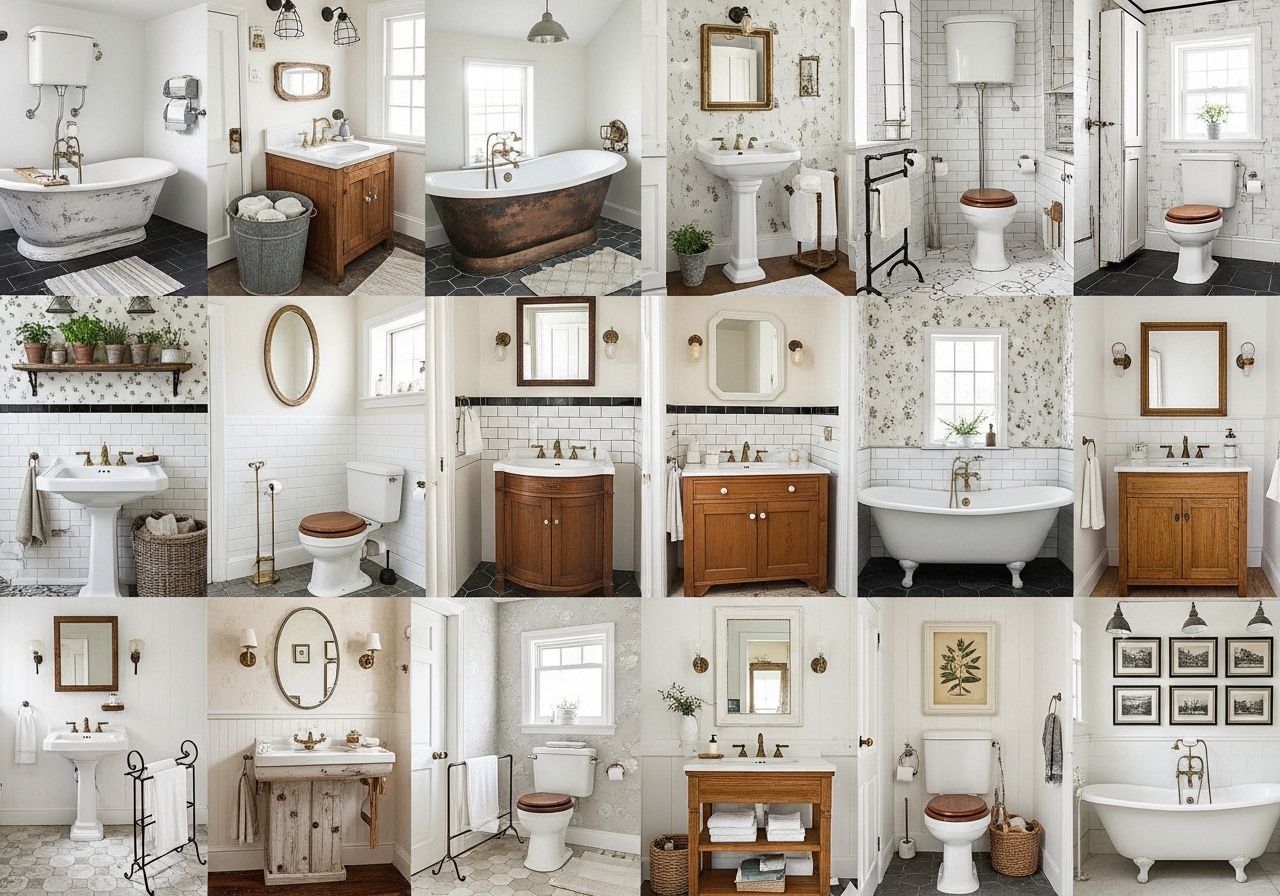
Vintage farmhouse style is the art of mixing old-world character — worn wood, aged metals, apothecary glass — with the quiet warmth of a rural home that’s been loved for generations. These 24 vintage farmhouse bathroom ideas give you exactly what you need to bring that feeling into your own space, from a single statement piece to a full room overhaul.
There’s something deeply grounding about a bathroom that doesn’t try too hard. The kind of space where the morning light catches a chippy-painted cabinet, where clawfoot tubs hold court against shiplap walls, where vintage medicine tin labels and old mason jars feel less like decoration and more like memory. Vintage farmhouse bathrooms don’t shout — they settle in. They make you want to slow down.
Here are 24 ideas worth saving — and stealing.
Why Vintage Farmhouse Style Works So Well
Vintage farmhouse isn’t a trend — it’s a revival. This style draws from the working farmhouses of late 19th and early 20th century rural America, where beauty was incidental: walls were clad in what was available (beadboard, shiplap), hardware was cast iron or porcelain because it lasted, and furnishings were functional pieces that just happened to have soul. It sits distinctly between pure rustic (which can read rough and unfinished) and cottage style (which trends sweeter and softer). The “vintage” qualifier adds layers of patina, apothecary details, and an antique sensibility that pure farmhouse sometimes lacks.
The core materials palette centers on unfinished or whitewashed wood, brushed nickel or aged oil-rubbed bronze hardware, cast iron or ceramic fixtures, and galvanized steel accents. Colors lean warm: antique white, creamy linen, dusty sage, muted slate blue, and weathered grey. Texture is everything here — beadboard wainscoting, subway tile with dark grout, crackled glaze ceramics, waffle-weave cotton, rough-hewn wood shelves. If you can shop these descriptors, you’re already halfway there.
The style is genuinely surging right now, and the reasons run deeper than aesthetics. Post-pandemic, people spent more time at home and started rejecting the cold efficiency of all-white, ultra-minimal bathrooms. There’s a cultural pull toward authenticity, toward spaces that look like they’ve been built slowly and intentionally rather than staged. Sustainability has a role too — vintage and antique sourcing, upcycled furniture pieces, and natural materials all align with how people want to spend and consume.
Small bathrooms can absolutely achieve this style — in fact, vintage farmhouse often works better in compact spaces. The key is to prioritize one or two hero materials (shiplap or beadboard on a single accent wall, plus one vintage fixture) rather than layering everything at once. In tight rooms, open shelving reads better than heavy cabinetry, and a pedestal sink preserves visual breathing room. Avoid overcrowding with too many collectibles — restraint in accessories lets the materials themselves do the work.
Style at a Glance
| Element | Farmhouse Foundation | Vintage Layer |
| Philosophy | Functional beauty, lived-in ease | Patina, memory, antique character |
| Materials | Shiplap, beadboard, cast iron | Chippy paint, aged brass, ceramics |
| Color Palette | Antique white, linen, sage | Dusty slate, weathered grey, cream |
24 Vintage Farmhouse Bathroom Ideas
1. Shiplap Walls in Antique White
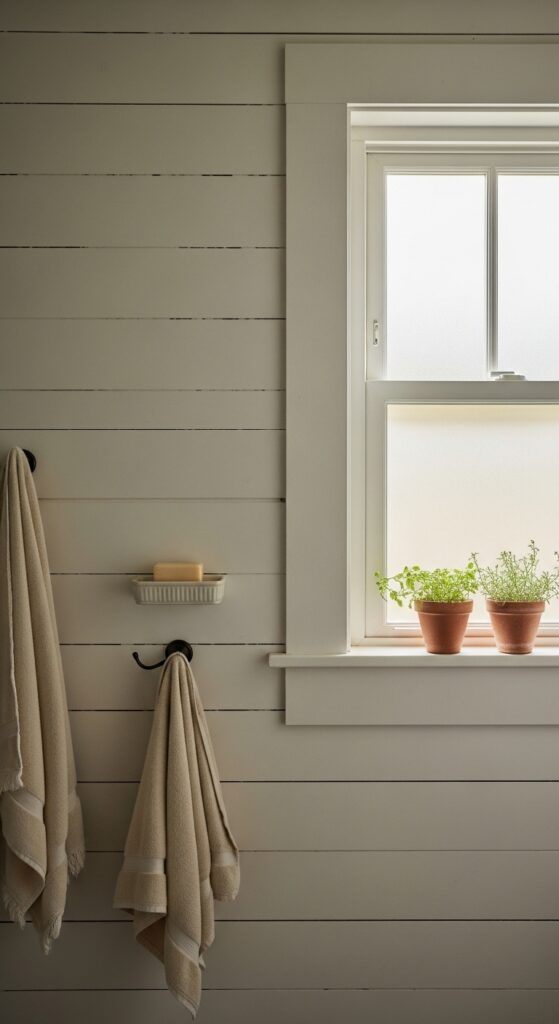
Vibe: Still and unhurried, like the walls themselves have absorbed decades of quiet mornings.
Why it works: Shiplap’s horizontal lines draw the eye across the room, making narrow bathrooms read wider than they are. The slight gap between boards creates shadow lines that add textural depth without adding visual noise. When painted in antique white rather than crisp bright white, the finish absorbs warm light rather than bouncing it — the difference is subtle but unmistakable, shifting the room from sterile to settled.
How to get it: Use Benjamin Moore “White Dove” (OC-17) rather than a cool bright white — its subtle warm undertone keeps the shiplap feeling aged and intentional. Install boards horizontally, leaving a 1/8″ shadow gap, and paint with a flat finish to emphasize the texture. Flat paint hides imperfections and reads more authentically worn.
💡 Quick Win: Buy pre-primed shiplap planks from Home Depot’s tongue-and-groove pine boards ($1.50–2.50/linear foot) — they go up fast and take paint immediately.
2. Clawfoot Tub as a Statement Piece
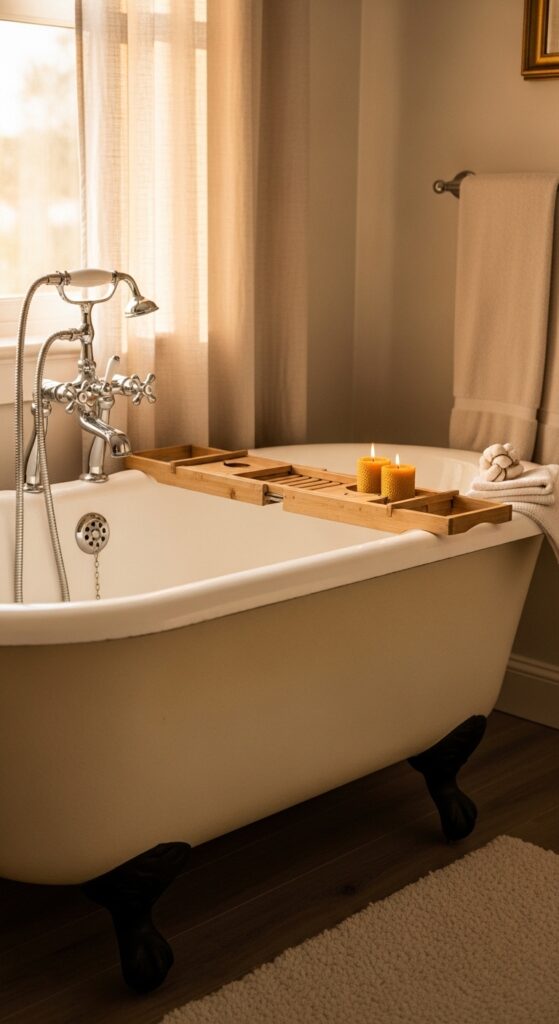
Vibe: Raw and quietly luxurious — the kind of tub that earns its place just by existing.
Why it works: A clawfoot tub’s exposed silhouette creates visual weight that anchors a vintage farmhouse bathroom better than any built-in ever could. The floor-to-ceiling visual break created by the tub’s legs gives the illusion of a larger room because you can see floor underneath the fixture — a principle called visual permeability. Original cast iron models hold heat longer than acrylic reproductions, so the experience matches the aesthetic.
How to get it: Source authentic cast iron clawfoot tubs through architectural salvage dealers (prices range $300–$1,200 depending on condition) rather than buying a new acrylic replica — the weight and porcelain quality are incomparably better. Have the exterior professionally refinished in your chosen color; matte black feet against a white body is the vintage farmhouse classic.
3. Sage Green Beadboard Wainscoting
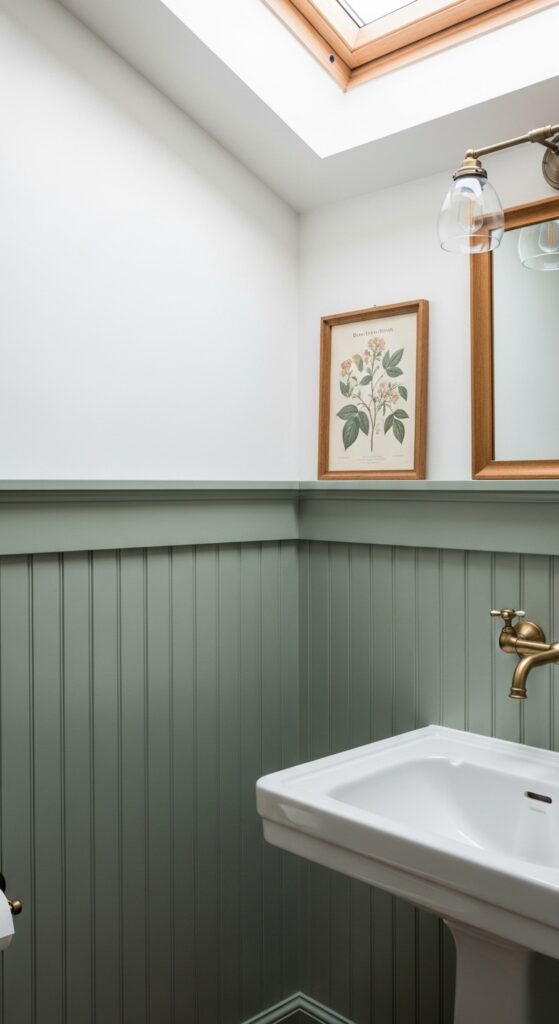
Vibe: Sun-warmed, like a greenhouse folded into a cottage bathroom.
Why it works: Beadboard wainscoting solves a classic bathroom problem: moisture. Applied to the lower 36–48 inches of wall (the zone most exposed to water splatter), primed beadboard is both practical and beautiful. The vertical ridges of classic beadboard draw the eye upward, adding perceived height. Painting it in muted sage creates a color-blocking effect that grounds the lower visual field, making the white walls above feel even airier by contrast.
How to get it: Use Farrow & Ball “Mizzle” (No. 266) or a close dupe from Sherwin-Williams for the wainscoting. The key is choosing a sage that reads warm, not cool — if the undertone pulls blue-green, the space will feel clinical. Cap the top of the beadboard with a simple 1×4 pine ledge painted to match, which doubles as display space.
💡 Quick Win: MDF beadboard paneling from Lowe’s ($25–35 per 4×8 sheet) installs over existing drywall with construction adhesive — no demo required.
4. Open Wood Shelving for Apothecary Storage
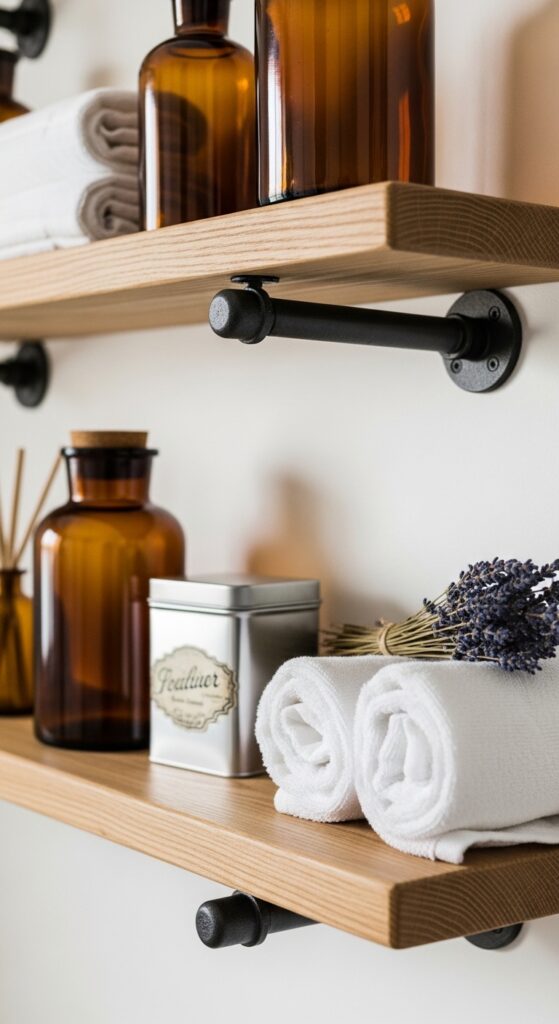
Vibe: Layered and intentional — every object earns its spot on the shelf.
Why it works: Open shelving works in a vintage farmhouse bathroom because the objects themselves become the decor. The design principle at play is visual layering: varying the height, material, and texture of items across the shelf creates compositional interest without clutter. Amber glass bounces warm light; woven cotton adds softness; raw wood grounds the whole arrangement. The combination prevents the shelves from reading as either sparse or overwhelmed.
How to get it: Mount 2-inch thick live-edge white oak slabs (check Etsy or local lumber mills for offcuts at $20–60/piece) on black iron pipe flanges with threaded pipe — it’s an easy DIY that reads far more expensive than its cost. Style in odd numbers: three heights, three textures, one repeated material to unify.
5. Black and White Hexagon Tile Floor
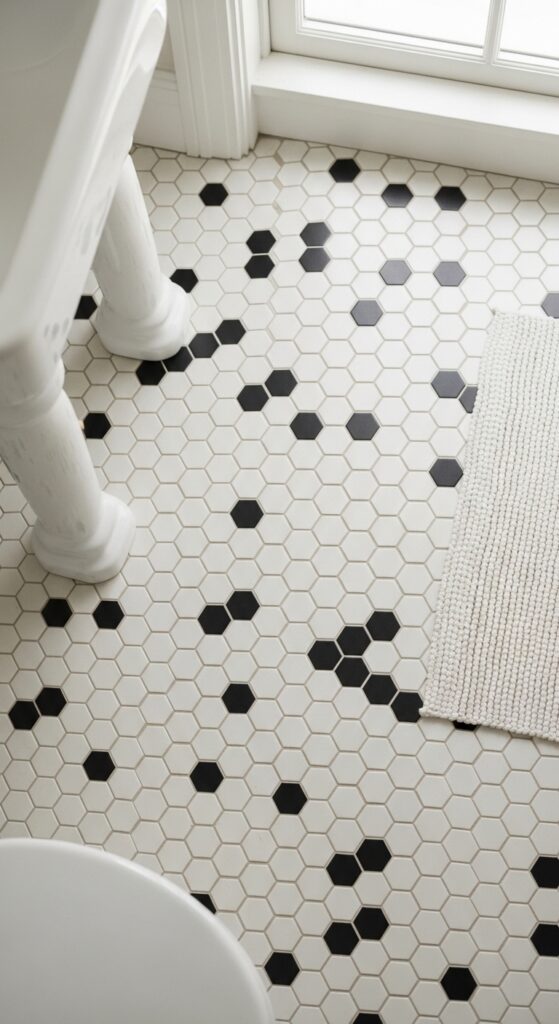
Vibe: Grounded and graphic — a floor that feels pulled straight from 1920.
Why it works: Classic 1-inch hexagon mosaic tile is one of the most historically accurate choices for a vintage farmhouse bathroom — it was the standard bathroom floor tile from roughly 1900–1940. The small scale of the hexagons makes any floor size look larger than it is, because the tile’s pattern density creates the illusion of greater surface area. Black and white with warm ivory grout avoids the harshness of bright white grout while preserving the contrast.
How to get it: Use a pre-mounted mosaic sheet (American Olean’s “Matte Black + White” hexagon mosaic runs around $6–9/sq ft) to simplify installation. Choose an unsanded warm grey or ivory grout — Laticrete “Antique White” works beautifully — and apply with a rubber float to avoid scratching the tile faces.
💡 Quick Win: For renters, removable hexagon peel-and-stick floor tiles from RoomMates run $30–45 for a small bathroom floor and are surprisingly convincing.
6. Pedestal Sink with Aged Brass Fixtures
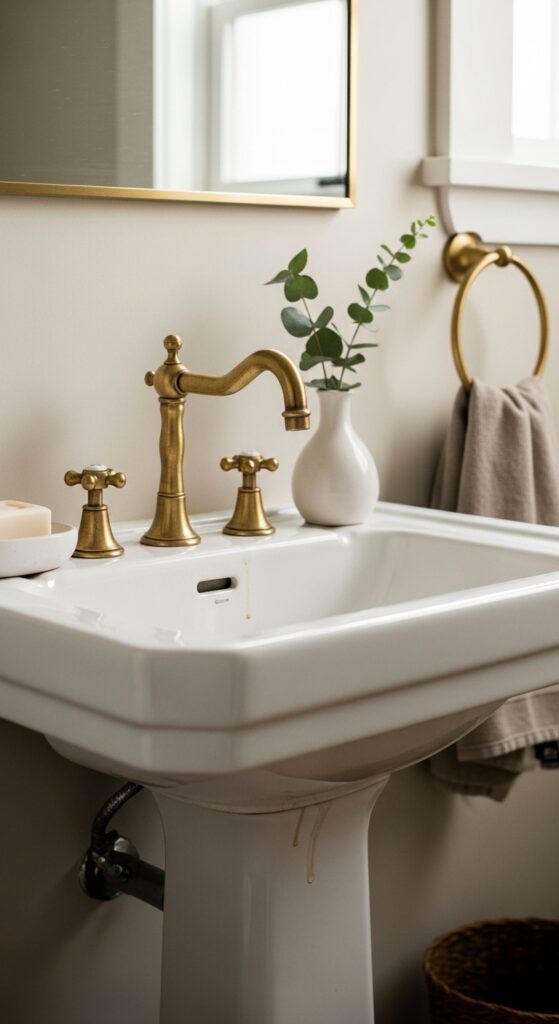
Vibe: Hushed and proper — the kind of sink you dry your hands at slowly.
Why it works: A pedestal sink’s exposed base is the opposite of visual weight — the bathroom floor remains visible, which keeps small spaces from feeling boxed in. The design principle is negative space: what you don’t fill is as important as what you do. Aged unlacquered brass hardware is the ideal pairing because it continues to patina over time, deepening in character the longer it lives in your home — a feature, not a flaw.
How to get it: Pair a Kohler “Memoirs” or American Standard “Town Square” pedestal with unlacquered brass fixtures from Rejuvenation or Waterworks. Unlacquered brass will develop a natural patina within 6–12 months. If you want to slow the process, apply a thin coat of Renaissance Wax annually; if you want to accelerate it, wipe the faucet occasionally with your bare hand.
7. Vintage Medicine Cabinet with Mirror
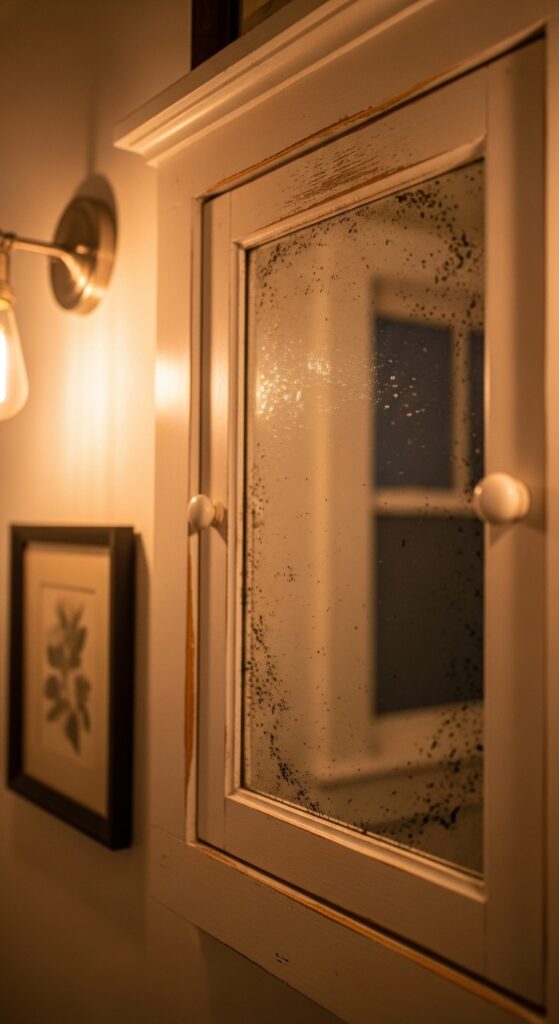
Vibe: Luminous and time-worn — like the mirror has reflected a hundred years of mornings.
Why it works: A foxed or antiqued mirror glass does something flat mirrors can’t: it adds depth through imperfection. The slight visual distortion of aged glass creates dimension and prevents the flat, glassy effect that makes modern bathrooms feel like hotel rooms. Flanking sconces positioned at eye level eliminate under-chin shadows for practical use while adding the warm wash of light that defines vintage farmhouse’s golden glow.
How to get it: Source vintage medicine cabinets at estate sales or Chairish (expect $80–250 for a good one), or DIY by applying a mirror antiquing spray to the back of float glass in a new cabinet frame. The spray is available from Rustoleum for under $12 and creates a convincing foxed effect in under an hour.
💡 Quick Win: IKEA “Godmorgon” mirror cabinets ($80–120) take paint well — prime and apply two coats of oil-rubbed chalk paint to the frame for an instant vintage farmhouse upgrade.
8. Reclaimed Wood Vanity with Vessel Sink
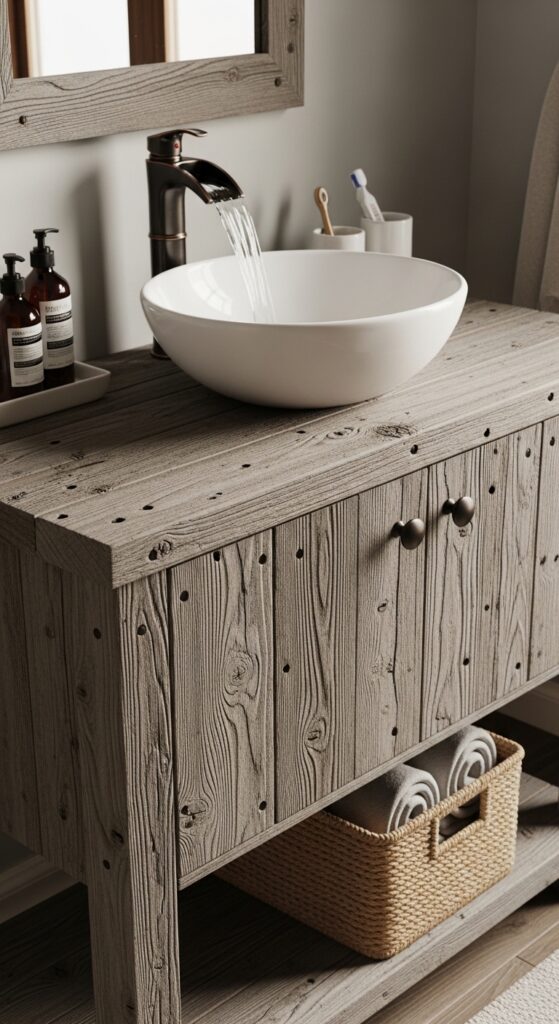
Vibe: Raw and rooted — a vanity that looks like it was built from the barn out back.
Why it works: Reclaimed barn wood carries natural pattern variation — knots, nail holes, grain changes — that gives the vanity visual interest without added decoration. The contrast principle at work here is textural: rough-grain weathered wood against a smooth porcelain vessel sink creates a tension that holds the eye. That tactile contrast is what makes the combination feel considered rather than accidental.
How to get it: Source reclaimed barn wood planks from local salvage yards or Vintage & Rustic Wood on Etsy ($3–8/board foot). Seal thoroughly with Rubio Monocoat or a food-safe hardwax oil before installing as a vanity surface — the seal protects against moisture while preserving the wood’s natural character rather than creating a plastic-like varnish finish.
9. Warm Edison Bulb Lighting Scheme
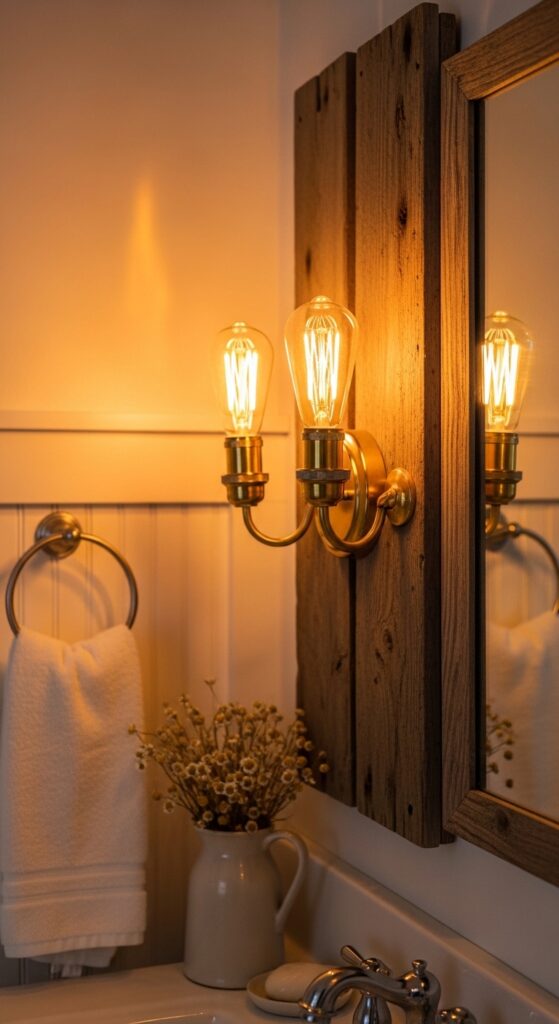
Vibe: Sun-warmed and candlelit — the hour that makes everyone look their best.
Why it works: Lighting color temperature is the single most transformative element in any bathroom. The 2200K warmth of an Edison-style filament bulb shifts the entire room toward amber and cream tones, which enriches every warm material in the space — wood reads richer, white walls read warmer, brass reads golden. Cool daylight bulbs do the opposite, pulling blue-grey undertones out of every surface and making warm materials look washed out.
How to get it: Replace any existing bathroom light fixture with wall sconces mounted at eye level (60–66 inches from floor) on either side of the mirror rather than overhead. Overhead lighting casts unflattering downward shadows. Pair with Philips’ vintage ST64 filament bulbs in 2200K for maximum warmth — they’re $12–18 per bulb and available at most hardware stores.
💡 Quick Win: Schoolhouse Electric’s “Industria” wall sconce ($85–110) mounts easily over an existing electrical box and takes any medium-base bulb — a one-hour fixture swap that transforms the room’s entire mood.
10. Galvanized Steel Accents
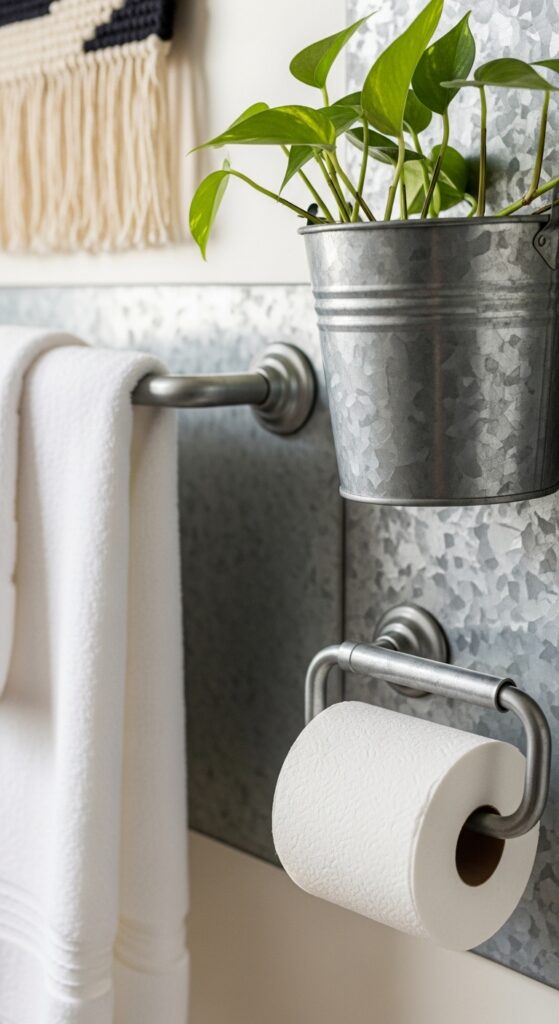
Vibe: Grounded and working — hardware that looks like it could have come off a dairy farm.
Why it works: Galvanized steel is a cohesive system material: when you use the same finish across multiple small hardware pieces — towel bar, robe hooks, toilet paper holder, even light fixture canopies — it creates a through-line that reads as intentional design even in a highly varied room. The matte grey-silver of galvanized metal also acts as a neutral, complementing both warm brass and dark oil-rubbed bronze without competing.
How to get it: Source galvanized accessories as a coordinated set from Rejuvenation’s “Industrial” line or from Walmart’s Better Homes & Gardens farmhouse hardware range ($8–22/piece). Don’t mix galvanized steel with chrome — the cool, reflective shine of chrome undermines galvanized’s matte warmth. Instead, stay within the matte metal family: galvanized, oil-rubbed bronze, and aged brass all live together harmoniously.
11. Subway Tile with Dark Grout
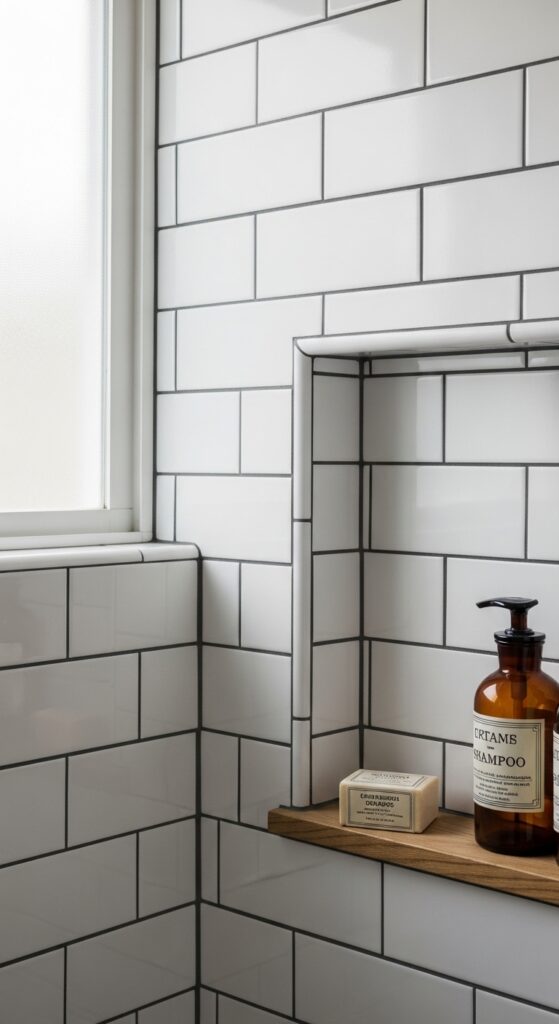
Vibe: Crisp but full of character — cleaner than brick, warmer than marble.
Why it works: Standard subway tile with bright white grout reads clinical. The same tile with dark charcoal grout reads vintage — the difference is entirely in the contrast. Dark grout emphasizes the grid pattern, giving white tile the graphic quality of turn-of-the-century institutional tile. It also hides grime better than white grout (honest, but important). The visual weight of the dark lines creates a structured field that makes even a small shower wall feel finished and deliberate.
How to get it: Use Mapei “Charcoal” or Custom Building Products’ “Pewter” unsanded grout for the joints. Install subway tile in a classic running bond pattern (each tile offset by half from the row below) rather than a stacked vertical pattern — stacked reads contemporary while running bond is historically accurate to the farmhouse era.
💡 Quick Win: American Olean’s “Beveled Metro White” subway tile runs $1.89–2.50/sq ft at Home Depot — a 40 sq ft shower surround can be tiled for under $120 in materials.
12. Vintage Ladder Towel Rack
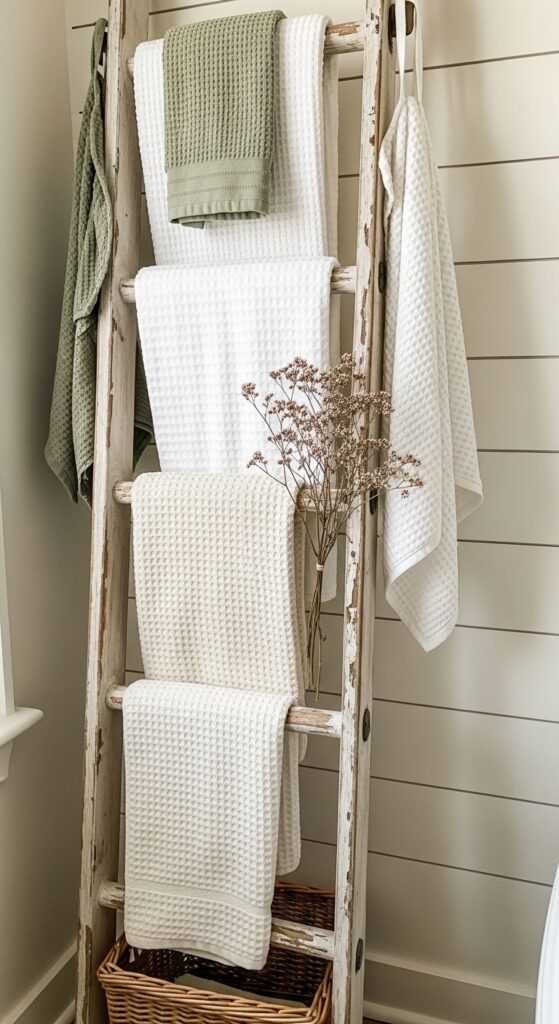
Vibe: Casual and lived-in — functional objects as honest decor.
Why it works: A leaning ladder solves a storage problem without adding visual bulk to the walls. It works in corners and against walls without mounting, which makes it ideal for renters. The design principle is purposeful imperfection: a ladder with visible wear — worn edges, chipped paint, slight lean — contributes more character than a pristine piece ever could. Cascading towels at varying heights create organic vertical movement that breaks up a flat wall.
How to get it: Distress a new wooden ladder (available at craft stores or on Amazon for $25–40) by dry-brushing one coat of chalk paint, letting it dry, then sanding the edges and rungs with 80-grit sandpaper to reveal the wood beneath. The result looks like a hundred-year-old find.
13. Mason Jar Organizers and Apothecary Details
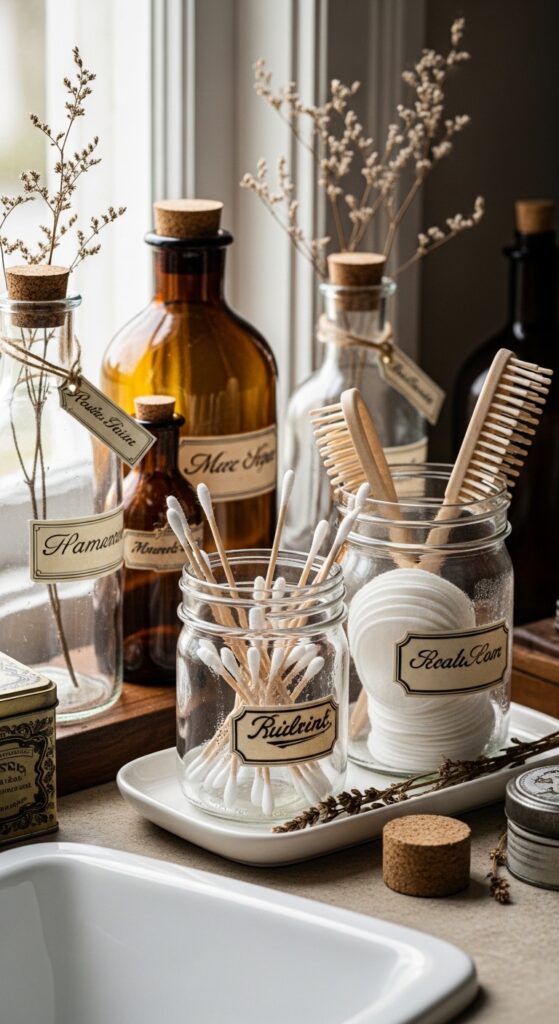
Vibe: Layered and domestic — the countertop equivalent of a well-worn recipe card.
Why it works: Mason jar organization is vintage farmhouse shorthand for a reason: the transparency of glass allows objects to become part of the visual composition rather than hidden clutter. When containers are unified in material (glass) and varied in size, they read as a curated collection rather than a random assortment. Amber apothecary bottles add color variation without introducing a new material family, keeping the arrangement cohesive.
How to get it: Download free vintage apothecary label templates on Etsy ($3–6 for a full set), print on cardstock, and apply to 4-oz and 8-oz wide-mouth mason jars. Seal the labels with a water-resistant Mod Podge formula so they survive bathroom humidity. Style in groups of three to five, varying heights and jar sizes.
💡 Quick Win: Ball 4-oz canning jars at Target come in 12-packs for $10 — buy two sets, use half for bathroom organization, and gift the rest with homemade jam for the most on-brand housewarming gift imaginable.
14. Muted Dusty Blue Accent Wall
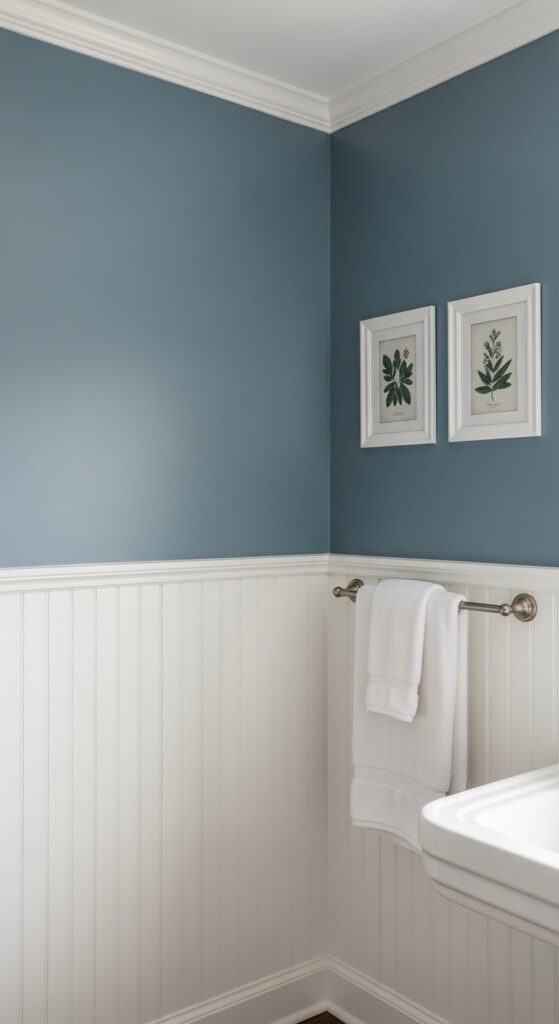
Vibe: Still and considered — the kind of room that quiets the mind before it’s even fully light.
Why it works: An accent wall in a single subdued color creates depth and zoning in a bathroom without the commitment of painting all four walls. Dusty slate blue operates as a visual anchor — it gives the eye a place to rest while allowing all white elements (fixtures, towels, tile) to pop forward. The chalk-finish quality of muted blue reads warmer than a true saturated blue, preventing the space from going cold.
How to get it: Use Farrow & Ball “Parma Gray” (No. 27) or its Sherwin-Williams match “Dusty Blue” (SW 6803) for the accent wall. Apply two coats in flat or eggshell — a higher sheen makes the color read more modern and less farmhouse. The same finish on all four walls can feel heavy; keeping three walls white and one blue is the sweet spot for a bathroom under 60 square feet.
15. Wainscoting with Vintage Picture Rail Molding
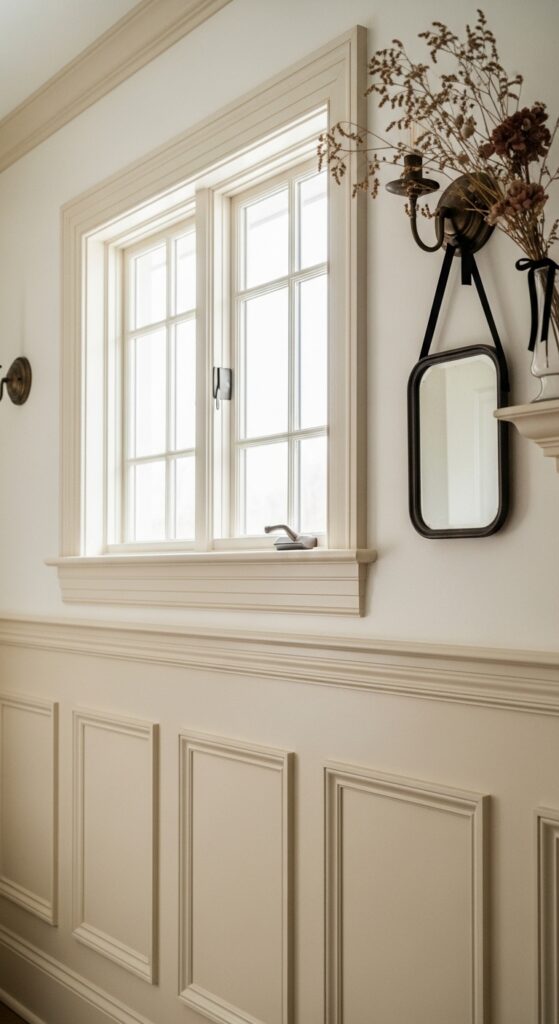
Vibe: Formal but approachable — like a house that was built with intention and lived in with ease.
Why it works: Picture rail molding is one of the most historically grounded elements you can add to a vintage farmhouse bathroom. Installed at the crown of the wainscoting or at ceiling height, it allowed the original homeowners to hang artwork without putting holes in plaster. Using it now to suspend mirrors or art from black grosgrain ribbon or brass chains adds layered, vertical dimension that draws the eye upward — effectively adding perceived height.
How to get it: Install pre-primed pine picture rail molding (available from specialty millwork shops or via Amazon, $1.50–3/linear foot) at 80–84 inches from the floor. Use picture rail hooks with 2mm black metal cable or thick ribbon for hanging, and adjust the height of mirrors or art without ever putting a nail in the wall.
💡 Quick Win: For small bathrooms, hang a single vintage botanical print from the rail using a black velvet ribbon ($4/yard at fabric stores) — it’s one of the most effective styling moves in the farmhouse playbook and takes under five minutes.
16. Clawfoot Tub with Canopy Curtain
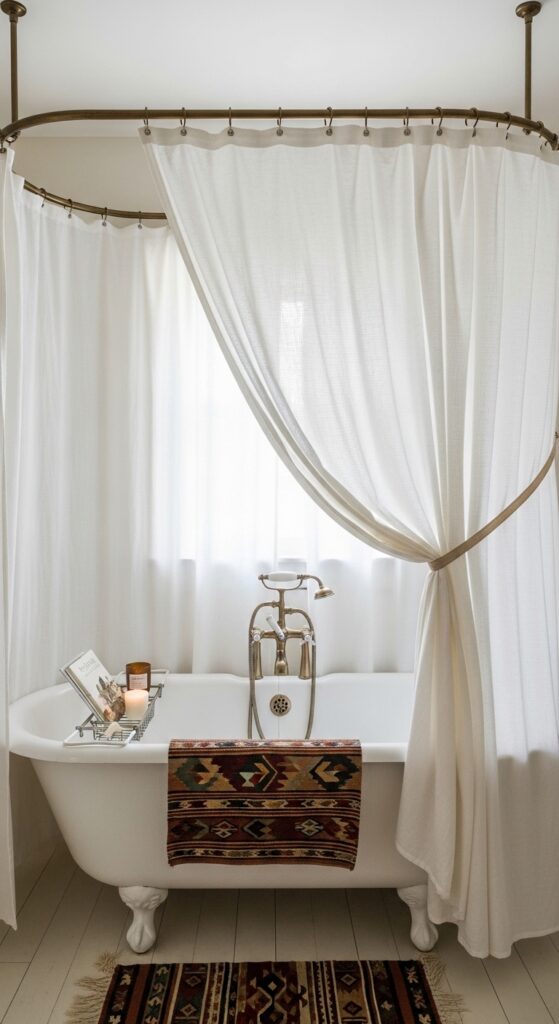
Vibe: Romantic and enveloping — a bathroom that feels like a room within a room.
Why it works: A ceiling-mounted oval curtain rod creates a sense of enclosure around a clawfoot tub without walls, which transforms the tub from a standalone fixture into an experience. The design principle is spatial definition through textile: the gathered linen curtain softens the boundary between tub and room, adding warmth and privacy without architectural commitment. Natural undyed linen is ideal because it lets light through in a warm, diffused way that no synthetic fabric replicates.
How to get it: Source oval ceiling shower curtain rods from Signature Hardware or Amazon ($90–180 for solid brass or matte black finish). Use undyed Belgian linen shower curtain panels (IKEA’s “Gjertrud” at $20/panel is a genuine bargain) rather than polyester — linen’s natural drape and light quality is non-negotiable here.
17. Vintage-Inspired Wallpaper in a Botanical Print
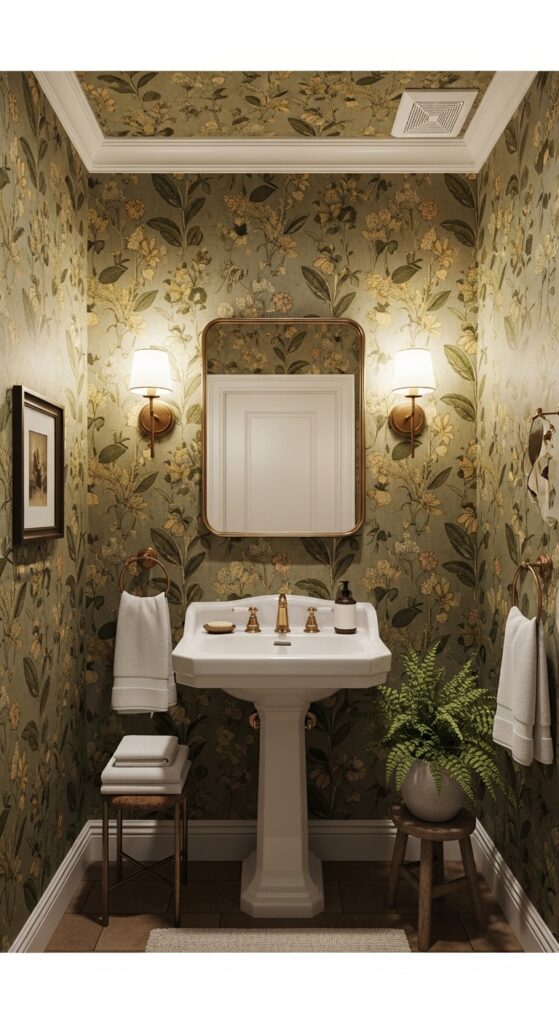
Vibe: Immersive and alive — like stepping inside an old seed catalog.
Why it works: Pattern in a small space like a powder room works because the enclosed boundaries make the design feel intentional rather than overwhelming. Botanical prints in the vintage engraving style reference Victorian herbarium illustrations, which have deep historical resonance with farmhouse aesthetics. Choosing a print in muted sage, cream, and sepia rather than saturated color keeps the pattern grounded and allows it to recede as the eye adjusts.
How to get it: Rifle Paper Co.’s “Herb Garden” wallpaper (around $198/roll) or a more affordable version via Spoonflower ($15–22/yard custom print) creates this look precisely. Apply with a clay-based or removable wallpaper adhesive in bathrooms to allow for future removal — steam from a full bath can affect standard adhesive over time.
💡 Quick Win: Peel-and-stick removable wallpaper from Chasing Paper or RoomMates in a vintage botanical pattern runs $30–50 for a small powder room — fully reversible for renters.
18. Cast Iron Farmhouse Sink in the Bathroom
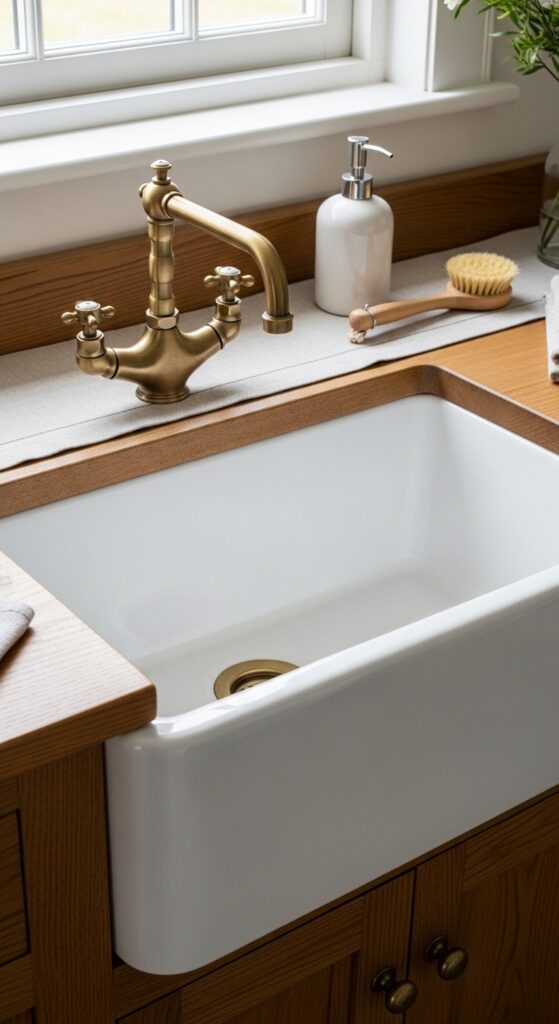
Vibe: Solid and honest — a sink that could double as a horse trough and would be better for it.
Why it works: Borrowing the apron-front farmhouse sink from kitchen design and using it in a bathroom vanity is one of the boldest and most effective signature moves in the vintage farmhouse playbook. The exposed apron front eliminates the need for a front cabinet panel, making it compatible with open-frame or console-style vanities. The depth of a true cast iron farm sink (typically 9–10 inches) also provides more practical workspace than a standard bathroom basin.
How to get it: Kohler’s “Whitehaven” apron-front sink in cast iron is the benchmark ($900–1,100) but worth the investment — the depth, sound dampening, and porcelain durability are unmatched by acrylic alternatives. Pair with a deck-mount bridge faucet in unlacquered brass from Waterstone or Rohl for a complete vintage farmhouse vanity moment.
19. Layered Vintage Rugs for Bathroom Warmth
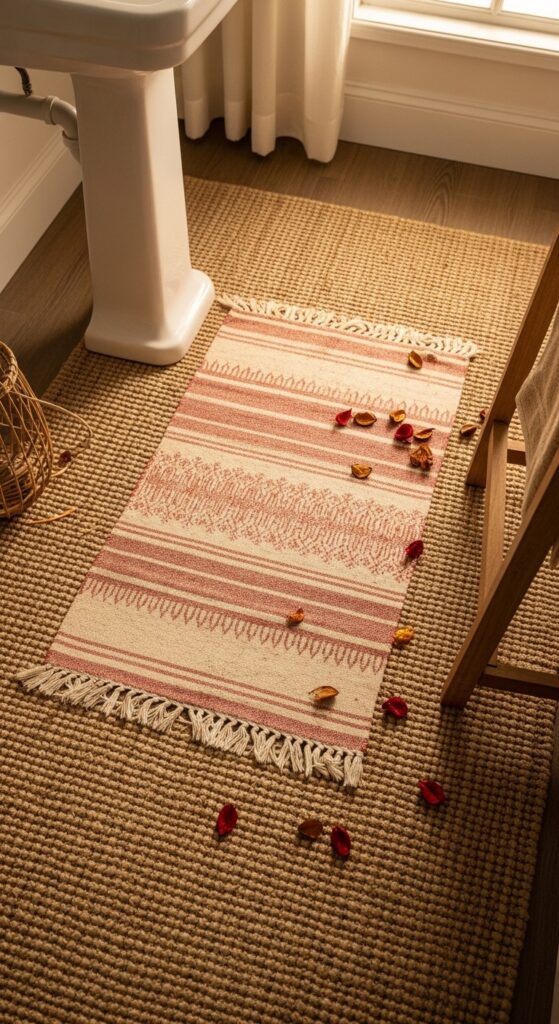
Vibe: Grounded and warm — a bathroom floor that feels like a room, not a wet tile slab.
Why it works: Layering rugs in a bathroom is an underused technique that introduces color, pattern, and tactile warmth without any construction. The key design principle is scale contrast: a large-format natural base rug (jute or seagrass) grounds the room while a smaller, more patterned runner adds personality. The base rug expands the visual floor plane; the layered piece draws the eye to a specific zone, typically in front of the vanity.
How to get it: Use a cotton or jute bath-safe rug with a non-slip backing as the base layer (H&M Home and Target’s Threshold line both carry good options at $25–60). Layer a vintage or vintage-style kilim runner on top — look for small Turkish kilims on eBay or Etsy ($30–120 for 2×4 foot size). Machine-wash both regularly to prevent moisture retention.
💡 Quick Win: A single $35–50 flat-weave cotton rug in a muted stripe from IKEA’s KORSNING line reads convincingly vintage when styled alongside the other farmhouse elements — it doesn’t need to be authentic to feel authentic.
20. Floating Vanity in Weathered Wood Finish
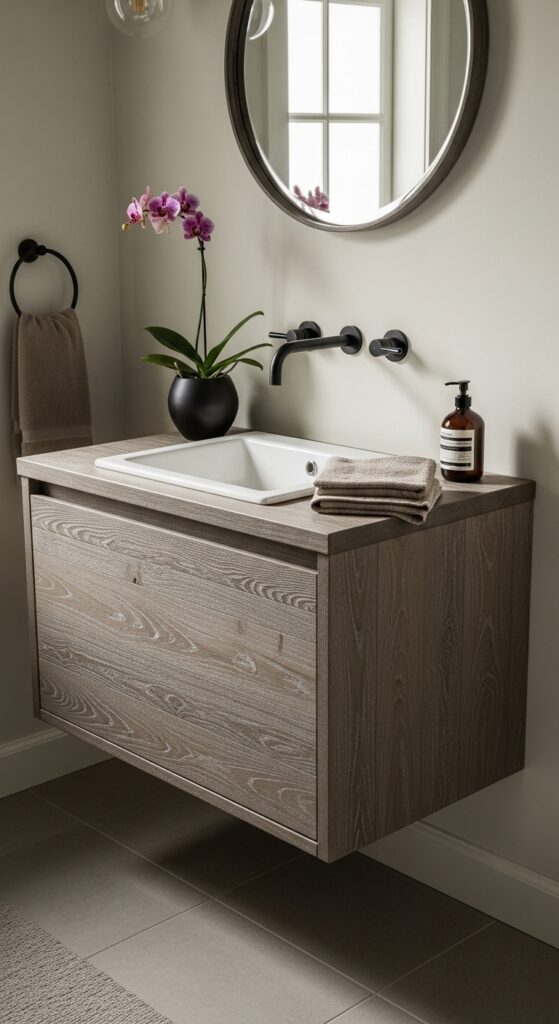
Vibe: Airy and considered — a vanity that doesn’t take up more room than it earns.
Why it works: A floating vanity mounted 16–18 inches off the floor creates visual permeability — the exposed floor beneath the cabinet makes the bathroom feel measurably larger because the eye reads the full depth of the floor plane. In a vintage farmhouse context, a weathered wood finish introduces warmth and age without the heaviness of a floor-standing cabinet. The combination satisfies both the style’s need for natural material and modern life’s need for perceived space.
How to get it: IKEA’s “Godmorgon” floating vanity ($299–379) accepts aftermarket wood fronts — Semihandmade offers custom Shaker-style fronts in a grey-washed oak finish that transforms the cabinet entirely. Mount the vanity at 16 inches off the floor rather than the standard 32 inches to maximize the floating visual effect.
21. Dried Botanicals and Eucalyptus Bundles
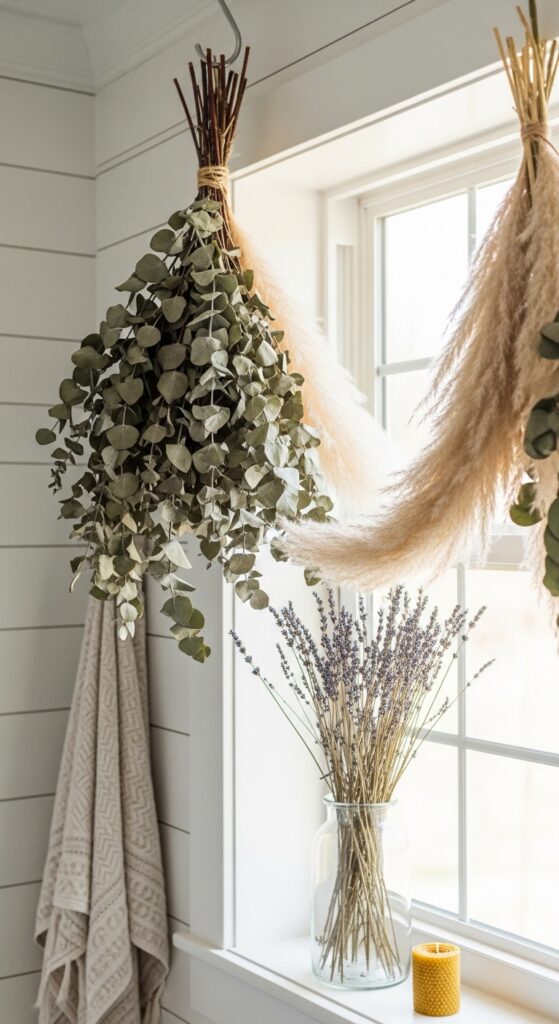
Vibe: Fresh and unhurried — a bathroom that smells like the countryside.
Why it works: Dried botanicals address one of vintage farmhouse’s key design principles: organic imperfection. Unlike fresh flowers (which are symmetrical and controlled), dried eucalyptus, pampas, and lavender have irregular shapes that introduce natural line variation. A bundle hung near a shower benefits from steam humidity, releasing essential oils and remaining supple longer than in dry rooms. The silver-green of eucalyptus complements almost every farmhouse color palette without competing.
How to get it: Buy fresh eucalyptus bundles from Trader Joe’s ($3.99–4.99), wrap with jute twine, and hang upside down for 2–3 weeks to dry. The bundle will shrink slightly and the color will deepen to a muted silver-green that’s actually more beautiful than the fresh version. Replace every 3–4 months as the scent fades.
💡 Quick Win: A pampas grass bunch from Amazon or local farmers’ markets costs $8–15, lasts 2–3 years, and is one of the most photographed elements in the entire vintage farmhouse canon.
22. Vintage-Style Light Fixtures with Cage Shades
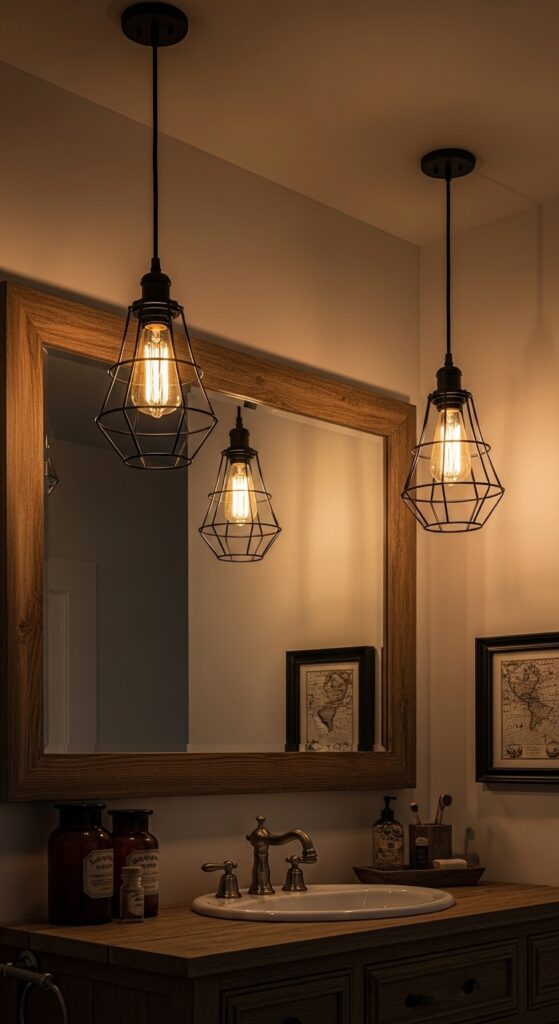
Vibe: Dramatic and grounded — bathroom lighting that earns its keep after dark.
Why it works: Cage pendant lights solve the problem of delivering both ambient and task lighting at mirror height without requiring a vanity bar fixture. The open cage design creates a play of light and shadow on surrounding walls — the grid pattern of the cage casts soft angular lines across the space, adding visual dynamism that solid shade fixtures can’t provide. This works especially well against shiplap, where the shadows echo the plank lines.
How to get it: Barn Light Electric’s “Gentry” cage sconce ($55–75 each) is designed for bathroom use with a moisture-rated socket. Buy two and flank the mirror at 60 inches from floor, centered on each side rather than above — side-mounted sconces at eye level eliminate the harsh overhead shadow that’s both unflattering and a classic vintage-era lighting hallmark.
23. Small Bathroom with Corner Clawfoot Tub
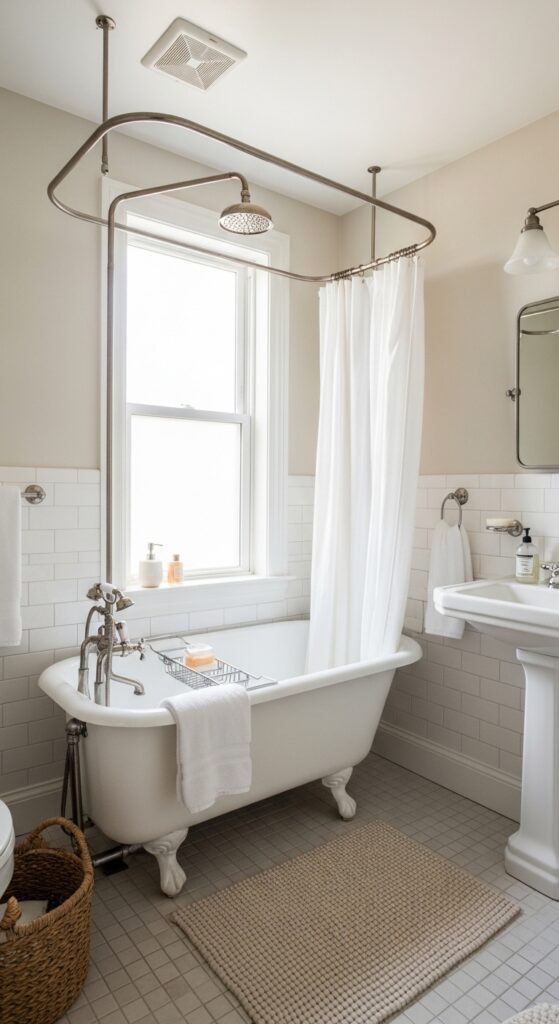
Vibe: Clever and cozy — proof that character doesn’t require square footage.
Why it works: Corner placement of a clawfoot tub is a space-planning solution that belongs on every small bathroom shortlist. Installing the tub diagonally in a corner preserves the central floor plane, making the room feel more open than a straight-wall placement. A ceiling-mounted L-shaped curtain rod (rather than an oval rod) accommodates the corner position and maintains the vintage aesthetic. The visual trade-off — gaining floor space — far outweighs the slightly more complex curtain rod installation.
How to get it: Measure your corner carefully before purchasing: a standard 5-foot clawfoot tub requires a minimum 63″ x 63″ corner installation zone. Kingston Brass’s “Aqua Eden” corner-ready models are specifically designed for diagonal placement at $900–1,400. Use a ceiling-mounted stainless L-track ($150–200 from Signature Hardware) with vinyl-backed linen curtains.
💡 Quick Win: In bathrooms under 50 square feet, trade the traditional clawfoot for a 48″ or 54″ compact clawfoot version — Japanese soaking versions from AKDY or Streamline go deeper (17–22 inches) to compensate for the shorter length.
24. Built-In Window Seat with Bathroom Storage
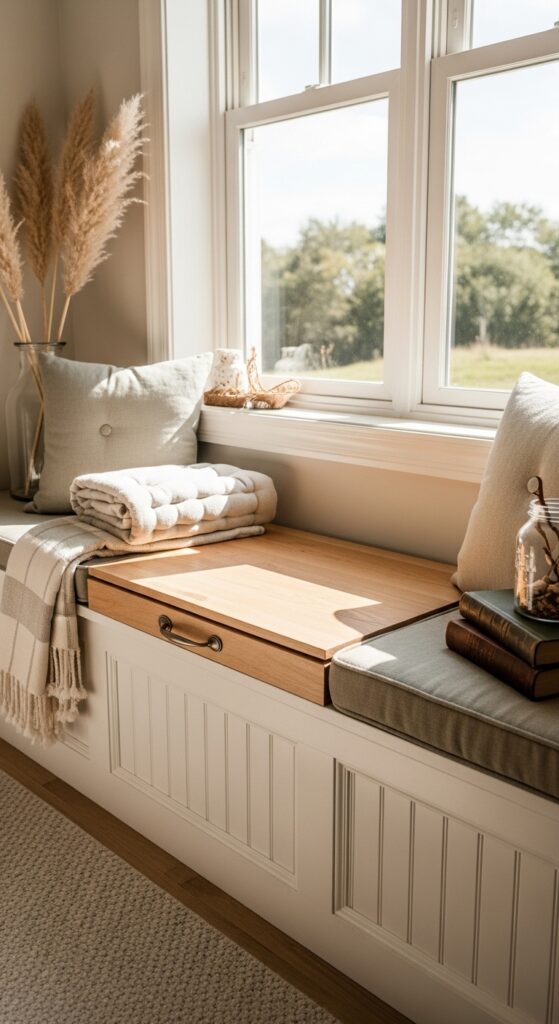
Vibe: Warm and considered — a bathroom with a place to sit, and a reason to linger.
Why it works: A window seat in a bathroom is one of the most underused layout moves in residential design. It solves three problems simultaneously: provides additional storage (lift-top access to towel and toiletry overflow), creates a visual anchor beneath what is often an architecturally awkward low window, and adds a seating surface that makes the bathroom function as a genuine room rather than just a utility space. In a vintage farmhouse context, the painted tongue-and-groove bench construction echoes the beadboard wainscoting language of the style perfectly.
How to get it: Build the bench frame from 3/4″ plywood with a tongue-and-groove pine facing, painted to match your trim color. Hinge the seat top for storage access using heavy-duty piano hinges ($10–15 from hardware stores). Top with a 3-inch foam cushion covered in Sunbrella fabric or indoor-outdoor linen — both handle bathroom humidity and wipe clean. The entire built-in can be completed in a weekend for under $200 in materials.
How to Start Your Vintage Farmhouse Bathroom Transformation
Start with paint. Apply Benjamin Moore “White Dove” (OC-17) to every surface — walls, ceiling, and trim — in a flat finish. This single move establishes the warm, creamy tonal foundation that makes every vintage piece you add afterwards feel like it was always meant to be there, rather than dropped into a mismatched room. Before you buy a single accessory, before you hang a towel bar, paint the room. It costs $50–80 for a bathroom-sized space and will do more work than any other investment.
The most common mistake beginners make with vintage farmhouse style is buying hardware in mixed finishes — pairing chrome with brass, or matte black with brushed nickel — and wondering why the room never feels cohesive. Different metals read as an oversight, not a design choice. Pick one finish family — aged brass, oil-rubbed bronze, or matte black — and commit to it across every piece of hardware in the room, from the toilet paper holder to the towel bar to the light fixture. This single discipline is the difference between a farmhouse bathroom and a bathroom with farmhouse accessories.
Three items under $50 that create immediate impact: a set of white waffle-weave cotton hand towels ($14–18 at H&M Home or Target), a single amber glass apothecary bottle with a cork stopper ($8–12 on Etsy), and a small bundle of dried pampas or eucalyptus tied with jute twine ($6–15 at Trader Joe’s or your local florist). Style all three on an existing shelf or countertop and the room already reads differently.
A complete vintage farmhouse bathroom transformation — new fixtures, vanity, tile, hardware — realistically costs $3,000–8,000 and takes 4–8 weeks including contractor time. But a “starter version” that covers paint, hardware swaps, accessories, and textile updates can be done in a weekend for $200–500 and creates 60–70% of the visual impact. Start there. Add one meaningful piece per month. By month six, you’ll have a room that feels entirely intentional.
Frequently Asked Questions About Vintage Farmhouse Bathrooms
What is the difference between vintage farmhouse and modern farmhouse bathroom style?
Vintage farmhouse leans into age, patina, and historical references: clawfoot tubs, apothecary bottles, foxed mirrors, chippy painted furniture, and antique-style hardware. Modern farmhouse (as popularized by Chip and Joanna Gaines) is cleaner and more polished — it uses shiplap and barn doors but pairs them with new, sleek fixtures and minimal accessories. The vintage version feels like a room that’s been slowly assembled over generations; the modern version feels designed. If you love warm imperfection and actual antiques, vintage farmhouse is the stronger choice.
What colors work best in a vintage farmhouse bathroom?
The most successful vintage farmhouse bathroom palettes center on warm whites — specifically Benjamin Moore “White Dove” (OC-17) or Sherwin-Williams “Antique White” (SW 6119) — paired with one accent tone: dusty sage, muted slate blue, or warm greige. Avoid cool whites (anything with a blue or grey undertone), which undermine the warmth that defines the style. Farrow & Ball “Strong White” (No. 2001) is a premium option that reads exactly right in vintage farmhouse spaces, particularly in bathrooms with south or west-facing natural light.
Is vintage farmhouse bathroom design expensive to achieve?
It genuinely doesn’t have to be. The style is one of the most budget-friendly in interior design because it embraces imperfection, welcomes vintage and secondhand sourcing, and values worn objects over pristine ones. A convincing vintage farmhouse bathroom can be created for $200–500 in accessories, textiles, and paint on top of whatever you already have. For a more complete renovation, expect $3,000–8,000, though architectural salvage yards, estate sales, and Craigslist sourcing can cut that significantly. The style’s ethos is assembly over purchase — it rewards patience and hunting more than a big one-time spend.
Can I mix vintage farmhouse style with other design styles?
Yes, and it often looks better when you do. Vintage farmhouse mixes especially well with Scandinavian simplicity (shared love of natural wood and uncluttered space), industrial elements (aged metal, factory glass, exposed hardware), and bohemian layering (textiles, botanicals, collected objects). The key is keeping one style as the dominant visual language and treating the second as an accent. A 70% vintage farmhouse / 30% Scandinavian bathroom, for example, will feel more resolved than a 50/50 split of two competing aesthetics.
What plants work best in a vintage farmhouse bathroom?
Eucalyptus, trailing pothos, and ferns are the three most compatible plant choices for vintage farmhouse bathrooms. Dried eucalyptus hung near the shower releases a gentle scent from steam heat and requires zero maintenance. Trailing golden pothos (Epipremnum aureum) suits the slightly dim light of most bathrooms and its vigorous trailing habit looks beautiful cascading from a shelf. For natural light bathrooms, a Boston fern on a simple wooden stool echoes the botanical print aesthetic perfectly. Avoid succulents and cacti — their desert character doesn’t speak the same visual language as a farmhouse that’s been soaked in rain.
Ready to Create Your Dream Vintage Farmhouse Bathroom?
These 24 ideas span the full range of what this style can offer — from color and material choices like dusty sage beadboard and reclaimed barn wood, to layout solutions like corner clawfoot tub placement and floating vanities, to the small but deeply effective moves like dried botanicals and apothecary jar organization. Every element works together because they all draw from the same honest vocabulary: natural materials, warm imperfection, and objects that tell a story.
Transformation doesn’t happen all at once, and the vintage farmhouse style — perhaps more than any other — actually rewards the slow approach. A room built piece by piece, sourced with intention, collected over time will always read more authentically than one assembled in a single weekend shopping trip.
Start this week with something concrete: swap your existing bathroom hardware for one unified finish — aged brass, oil-rubbed bronze, matte black — and watch how that single edit makes everything in the room start to speak the same language.
When this bathroom is done, it will do something that few spaces achieve: it will feel like it’s always been there. You’ll wash your face in it in the morning and feel, somehow, that the room is taking care of you back — that is the particular, unhurried grace of vintage farmhouse at its best.
Pin your favorites now — especially the shiplap and clawfoot ideas — because these are the pinboards you’ll return to every time you’re ready to add the next piece.