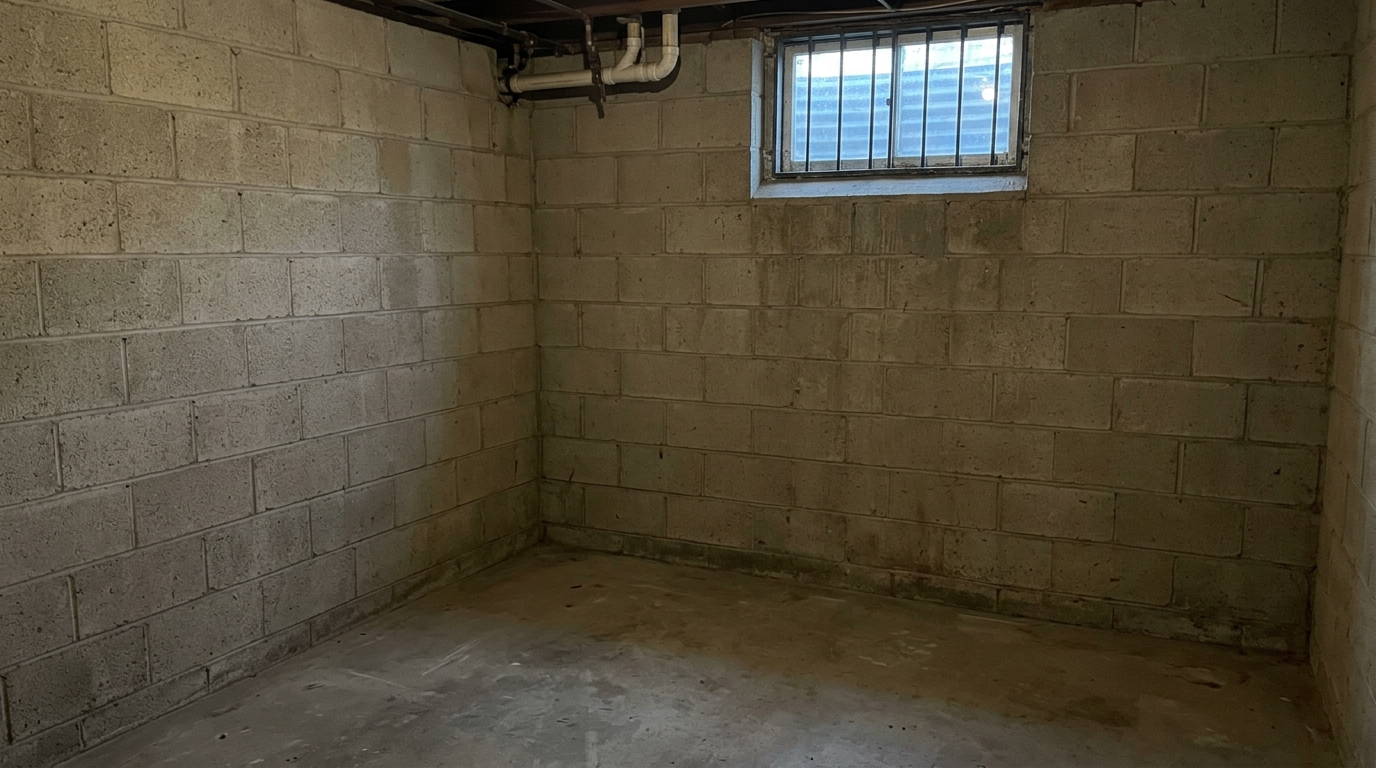
A basement bedroom is any sleeping space carved from a home’s lower level — transformed through intentional design from a forgotten utility zone into a warm, purposeful sanctuary. This article gives you 25 specific basement bedroom ideas spanning color, materials, lighting, furniture, layout, and small-space tricks, all designed to help you build a cozy retreat underground.
There’s something surprisingly intimate about sleeping below ground. The low ceilings feel less confining and more like a cocoon; the insulated quiet becomes a gift rather than a flaw. Done right, a basement bedroom wraps you in warmth and stillness that most above-grade rooms can’t match. Here are 25 ideas worth saving — and stealing.
Why Basement Bedroom Design Works So Well
Basement bedrooms occupy a distinct design territory. Unlike attic conversions that borrow from rustic or cottage aesthetics, or main-floor bedrooms that flow naturally from living spaces, basement rooms exist slightly apart — removed from foot traffic, naturally temperature-stable, and freed from the obligation to feel bright and airy at all costs. This separation is their design superpower.
The materials palette that makes basement bedrooms feel cozy is specific: unfinished white oak, warm-toned linen, concrete sealed with a matte finish, aged brass hardware, shearling, and chunky knit wool. Colors that work here aren’t the pale neutrals of an upper floor — they’re deeper and more grounded. Think warm charcoal, dusty mocha, forest sage, terracotta amber, and creamy greige. These tones absorb and reflect artificial light beautifully, which matters in a space where you’re often working without windows.
The cozy-retreat basement aesthetic is trending precisely because our relationship with home has shifted. Post-pandemic, more people are carving out intentional “away” spaces — a reading nook, a basement bedroom for guests, a private suite separate from household noise. Pinterest search data consistently shows rising interest in underground living spaces, and the wellness movement’s emphasis on dark, cool sleeping environments has reframed what once felt like a design limitation into a selling point.
Small or irregular basement spaces can absolutely achieve this aesthetic — but they require one thing above all else: prioritize warmth over brightness. Most designers make the mistake of trying to make a basement feel like a sunlit room. Instead, lean into the depth. Use warm artificial light, rich textures, and low furniture profiles. The goal isn’t to deny the basement’s nature — it’s to make that nature feel intentional and inviting.
Style at a Glance
| Element | Core Trait 1 | Core Trait 2 |
| Philosophy | Lean into depth, not fight it | Warmth over brightness |
| Materials | Unfinished oak, shearling, linen | Concrete, aged brass, chunky knit |
| Color palette | Warm charcoal, dusty mocha | Forest sage, terracotta amber |
25 Basement Bedroom Ideas for a Cozy Retreat
1. Warm Charcoal Walls with Ivory Bedding
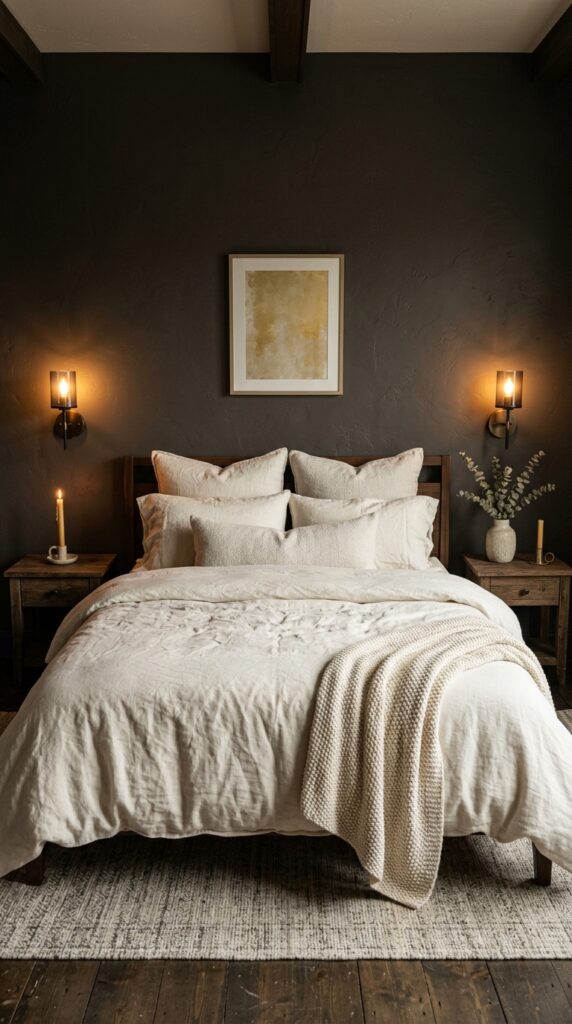
Vibe: Hushed — the way a room feels the moment you close the door behind you.
Why it works: Dark walls in a basement don’t fight the absence of natural light — they collaborate with it. Warm charcoal absorbs overhead brightness unevenly, creating the kind of soft shadow play that makes a room feel dimensional rather than flat. The high-contrast pairing with ivory bedding keeps the space from reading as heavy, while the tonal shift between wall and textile creates visual depth through contrast alone.
How to get it: Paint walls in Benjamin Moore’s “Kendall Charcoal” (HC-166) — it reads warm rather than cool-blue, which is critical in low-light rooms. Keep every textile in the ivory-to-cream family, never stark white, to maintain warmth.
💡 Quick Win: A single cream boucle lumbar pillow ($28–$40 on Amazon) instantly bridges the charcoal-ivory contrast without adding visual clutter.
🛍️ Shop the Look — Amazon Product Ideas
| # | Product Search Phrase | Why It Fits |
| 1 | warm charcoal matte interior paint sample set | Sets the wall tone |
| 2 | ivory linen duvet cover queen | Crisp warm contrast |
| 3 | cream boucle lumbar throw pillow | Texture anchor |
| 4 | matte black plug-in wall sconce | Moody ambient glow |
| 5 | beeswax pillar candles set | Warm scent + light |
2. Low-Profile Platform Bed with Hidden Storage
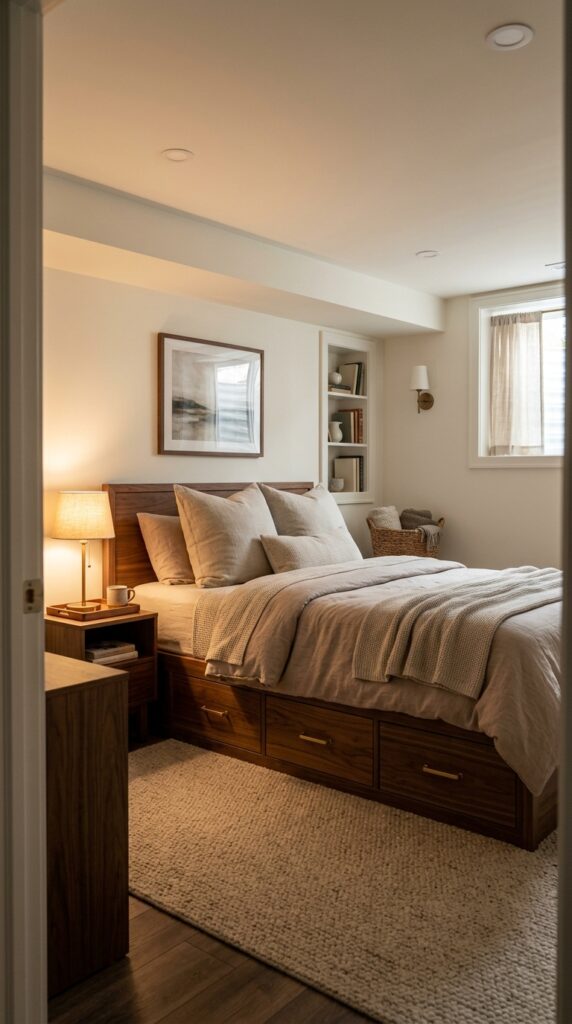
Vibe: Grounded — the furniture belongs to the floor as much as it belongs to the room.
Why it works: Low furniture profiles are a foundational technique for rooms with reduced ceiling heights. A platform bed that sits 8–12 inches from the floor instead of 24 inches visually raises the perceived height of the room by exaggerating the distance between the sleeping surface and the ceiling. The integrated storage drawer eliminates the need for a bulky dresser, preserving the negative space that makes a basement bedroom feel open rather than crammed.
How to get it: Look for platform beds with a maximum frame height of 12 inches, constructed from solid wood rather than MDF — the visual weight reads differently and holds up better in basement humidity levels. Pair with a linen-upholstered headboard in the 36-inch range for visual proportion.
🛍️ Shop the Look — Amazon Product Ideas
| # | Product Search Phrase | Why It Fits |
| 1 | low profile platform bed with storage drawers queen | Core furniture piece |
| 2 | walnut finish nightstand with drawer | Matches bed tone |
| 3 | aged brass drawer pulls set | Warm hardware detail |
| 4 | linen euro shams set of 2 | Texture layering |
| 5 | wood bedside tray organizer | Styling anchor |
3. Faux Wood Beam Ceiling Treatment
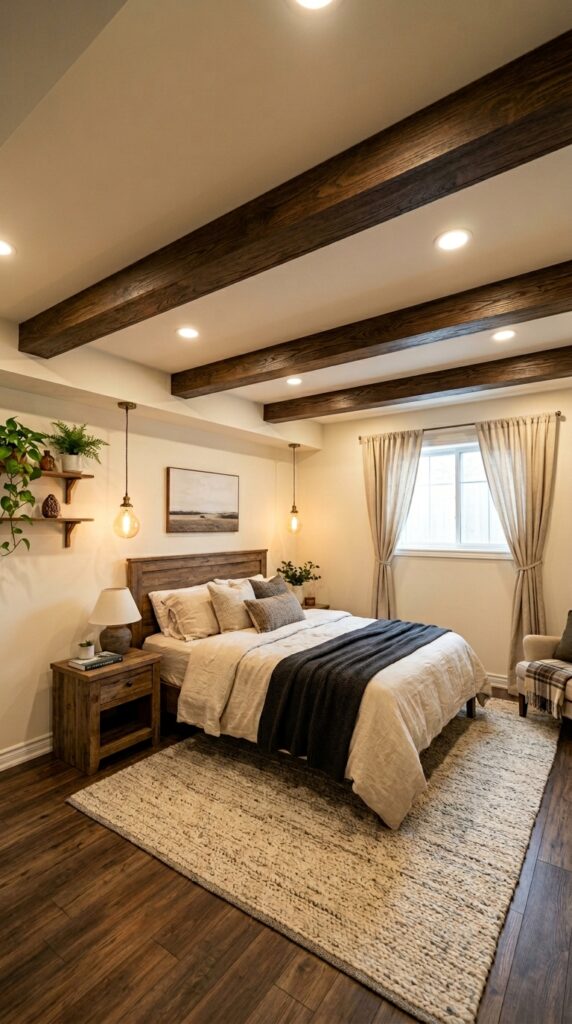
Vibe: Sun-warmed — like a cabin room in the middle of a city.
Why it works: Exposed ceiling beams redirect the eye along a horizontal axis rather than upward, which actually suits a low-ceiling basement better than a high-ceiling room. The eye follows the beam’s length and reads the room as expansive side-to-side rather than pressing downward. Dark-stained beams create a visual “lid” that feels intentional — like a coffered ceiling — rather than like a limitation. Real structural basement beams can be wrapped; decorative polyurethane versions weigh almost nothing and install with construction adhesive.
How to get it: Faux polyurethane ceiling beams (brands like Ekena Millwork carry 6-inch width profiles) can be installed in a single weekend with liquid nails and a helper. Stain them before installation in a warm walnut or dark espresso — never a red-toned cherry, which reads dated.
💡 Quick Win: A single 8-foot faux beam ($45–$75) over the headboard wall alone creates the effect without full-room installation.
🛍️ Shop the Look — Amazon Product Ideas
| # | Product Search Phrase | Why It Fits |
| 1 | faux wood ceiling beam polyurethane dark walnut | Core architectural element |
| 2 | construction adhesive heavy duty paneling | Beam installation |
| 3 | Edison bulb pendant light cord plug-in | Beam-adjacent lighting |
| 4 | linen blackout curtain panel cream | Softens room texture |
| 5 | dark walnut wood stain interior | Beam color finish |
4. Layered Rug Strategy for Warmth Underfoot
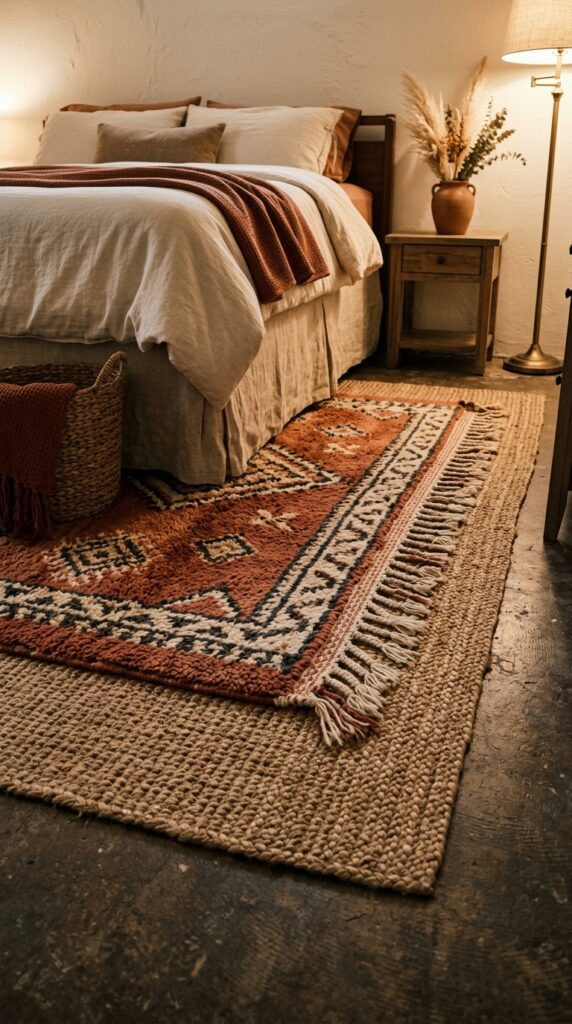
Vibe: Layered — the kind of room that reveals itself slowly.
Why it works: Basement concrete or laminate flooring is cold underfoot and acoustically flat — layering rugs solves both problems simultaneously. A large jute base rug (9×12 minimum under a queen bed) absorbs sound and provides visual grounding, while a smaller, patterned rug on top introduces color, texture, and personality. The principle is visual weight distribution: the bottom layer anchors, the top layer expresses. Together, they create the impression that the room was assembled over time with intention.
How to get it: Size the jute base rug so it extends 18 inches beyond all sides of the bed frame. The top rug should be 60–70% of the base rug’s width. Keep patterns on the top rug in the terracotta-cream-sage family for warmth.
🛍️ Shop the Look — Amazon Product Ideas
| # | Product Search Phrase | Why It Fits |
| 1 | large natural jute area rug 9×12 | Base layer anchor |
| 2 | Moroccan style wool rug terracotta cream 5×8 | Pattern top layer |
| 3 | non-slip rug pad for layering | Safety and grip |
| 4 | woven seagrass storage basket large | Textile complement |
| 5 | dried pampas grass arrangement natural | Soft decor accent |
5. Warm Edison Bulb String Lights as Ambient Canopy
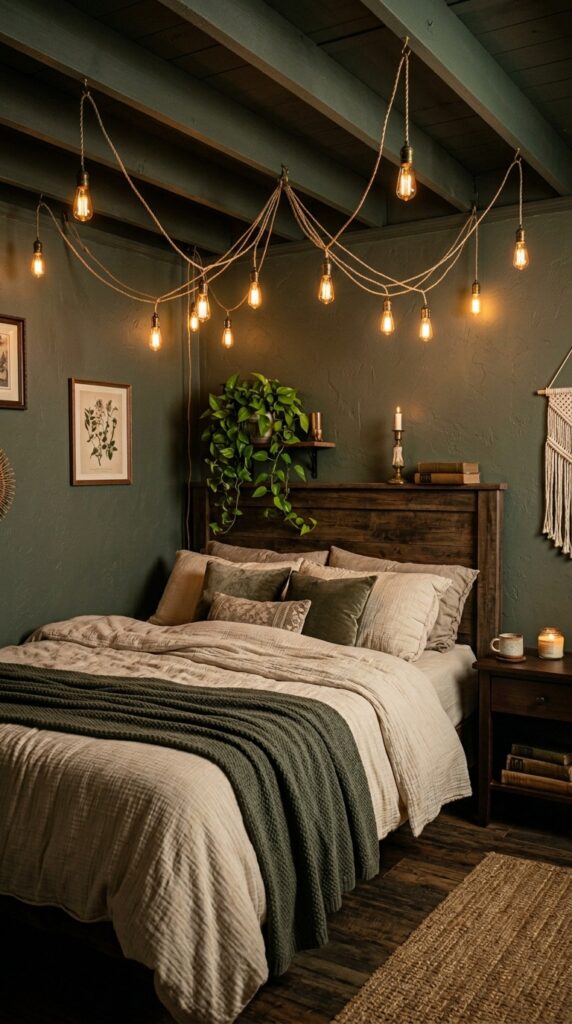
Vibe: Still — the visual equivalent of a held breath.
Why it works: Basement bedrooms often rely entirely on overhead can lighting, which casts harsh downward shadows and flattens the texture of everything it touches. String lights replace overhead directionality with diffuse, multidirectional warmth that wraps the room rather than illuminating it from above. The canopy formation specifically lowers the perceived ceiling plane to the string light line, creating a cozy vertical compression that feels intentional. Choose bulbs rated at 2200K — this is the color temperature of candlelight and firelight, not the 3000K “warm white” of most LED products.
How to get it: Use a 48-foot outdoor-rated string light set with S14 Edison bulbs and fabric-covered cord. Attach ceiling hooks rated for 10 lbs at each corner and at the midpoint for structural gathering.
💡 Quick Win: A smart plug ($12–$18) lets you control the string lights from your phone and set them on a timer — eliminating the need to reach across the room to switch them off.
🛍️ Shop the Look — Amazon Product Ideas
| # | Product Search Phrase | Why It Fits |
| 1 | 2200K Edison string lights fabric cord indoor 48ft | Core ambiance element |
| 2 | ceiling hooks swag adhesive heavy duty | No-drill mounting |
| 3 | smart plug outlet WiFi timer | Convenience control |
| 4 | dark sage matte paint color sample | Wall color match |
| 5 | trailing pothos in ceramic pot | Living texture layer |
6. Gallery Wall with Warm-Toned Botanical Prints
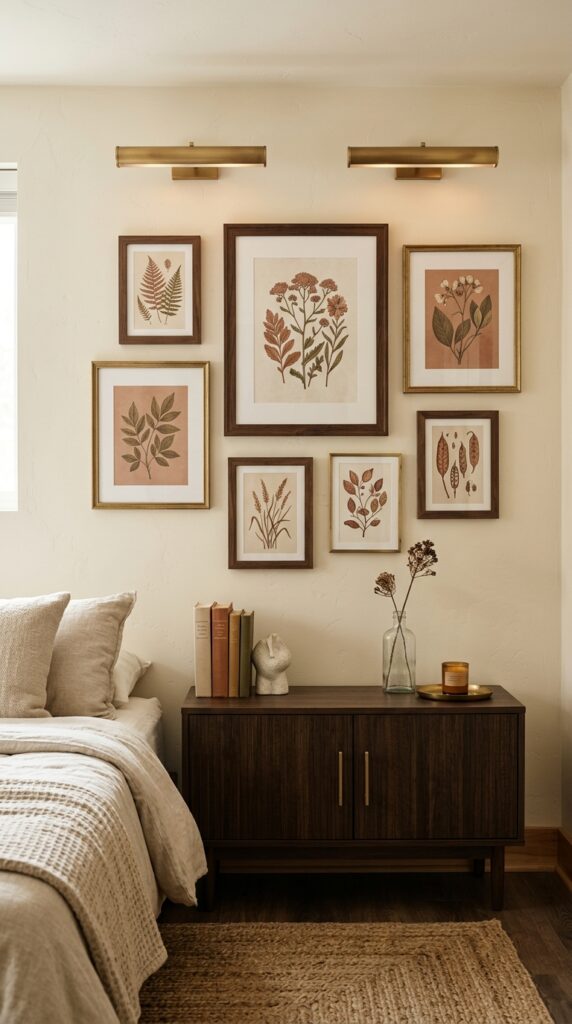
Vibe: Collected — like the wall was assembled one piece at a time over years.
Why it works: A gallery wall adds both color and visual texture to a large blank wall without committing to bold paint colors, making it ideal for renters or people still developing their basement bedroom aesthetic. Botanical prints in ochre, terracotta, and sage pull warm undertones from the existing palette and reinforce the nature-connected feeling that cozy spaces depend on. Mismatched frames — in dark walnut and thin aged brass — create the lived-in layering effect that a single matching frame set can never achieve.
How to get it: Arrange all frames on the floor first and photograph your layout. Use Command Picture Hanging Strips (medium weight) for damage-free installation. Vary print sizes — at least one frame should be 11×14 or larger to anchor the composition.
🛍️ Shop the Look — Amazon Product Ideas
| # | Product Search Phrase | Why It Fits |
| 1 | botanical print set warm terracotta downloadable 8×10 | Gallery wall art |
| 2 | dark walnut picture frame set mixed sizes | Frame variety |
| 3 | thin brass gallery frame 5×7 | Mixed metal detail |
| 4 | command picture hanging strips large weight | Damage-free install |
| 5 | ceramic sculpture small organic form | Credenza accent |
7. Shiplap Accent Wall in Warm Greige
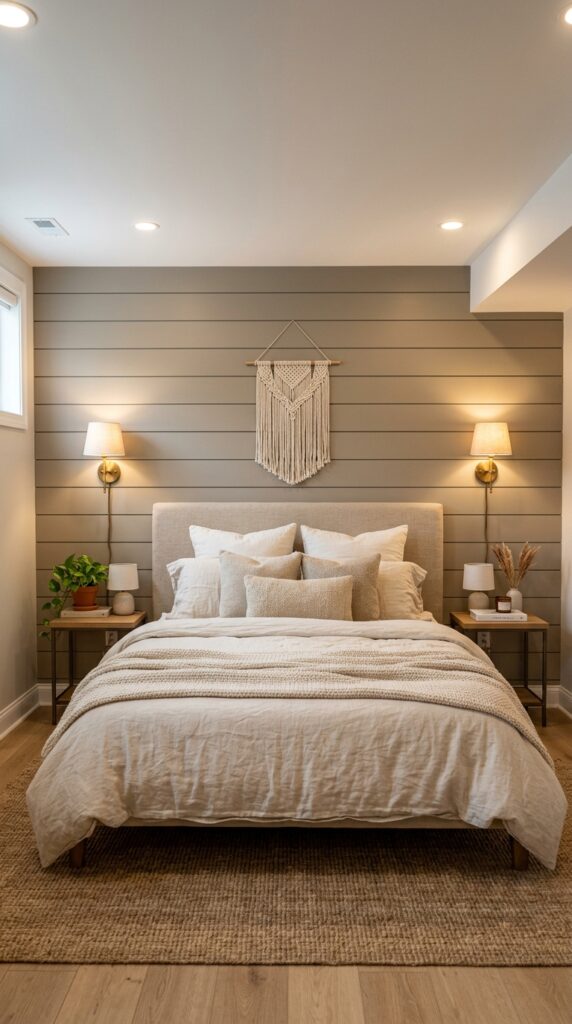
Vibe: Raw — in the way good construction always looks when it’s left to breathe.
Why it works: Shiplap introduces horizontal texture that elongates a wall visually — critical in a basement where vertical space is limited. The shadow gap between boards creates micro-shadows that shift with light, making the wall feel alive rather than static. Painting shiplap in a warm greige (think Sherwin-Williams “Accessible Beige” SW 7036 rather than a cool gray) keeps the texture warm rather than industrial. The horizontal emphasis also reinforces the low, grounded quality that defines cozy-retreat basement design.
How to get it: Install 1×6 pine boards with a 1/8-inch spacer between them. Paint in a flat or matte finish — satin catches too much light in basement rooms. Sand edges lightly before painting to soften the new-lumber hardness.
💡 Quick Win: Peel-and-stick shiplap panels ($35–$55 for a 20-square-foot pack) let renters achieve this look without construction — they’re removable and paintable.
🛍️ Shop the Look — Amazon Product Ideas
| # | Product Search Phrase | Why It Fits |
| 1 | peel and stick shiplap wall panels paintable | Renter-friendly install |
| 2 | warm greige matte wall paint sample | Wall color anchor |
| 3 | plug-in wall sconce with switch aged brass | Flanking bed lighting |
| 4 | macramé wall hanging large | Textile wall accent |
| 5 | linen upholstered headboard queen | Soft material contrast |
8. Dedicated Reading Nook in an Unused Corner
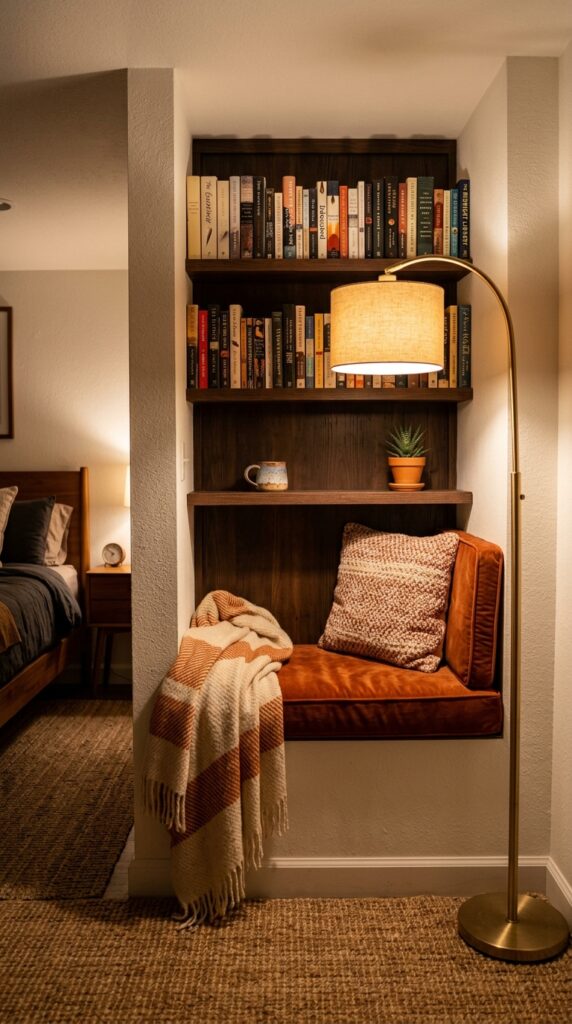
Vibe: Intimate — a room within a room.
Why it works: Basement bedrooms often have irregular corners created by support columns, utility rooms, or stair landings. Rather than treating these as obstacles, converting one into a designated reading nook creates a zone separation that makes the bedroom feel larger overall — it’s no longer just a room you sleep in, it’s a room with distinct purposes. The principle is zone definition: when a room has a clearly demarcated secondary space, the primary sleeping space feels more deliberate and spacious by contrast.
How to get it: Float two 36-inch shelves at 60 and 78 inches above a simple storage bench. Choose a bench in rust-orange or deep teal velvet — these tones warm the artificial light in a way that neutral fabrics can’t. An arched floor lamp ($80–$150 range) provides targeted reading light without ceiling installation.
🛍️ Shop the Look — Amazon Product Ideas
| # | Product Search Phrase | Why It Fits |
| 1 | arched floor lamp warm gold finish | Reading zone lighting |
| 2 | velvet storage bench rust orange | Nook seating anchor |
| 3 | floating wall shelves dark walnut set of 2 | Book display |
| 4 | hardcover coffee table books stacked decor | Shelf styling |
| 5 | small ceramic planter succulent pot | Shelf organic accent |
9. Concrete Wall Sealed with Warm Matte Finish
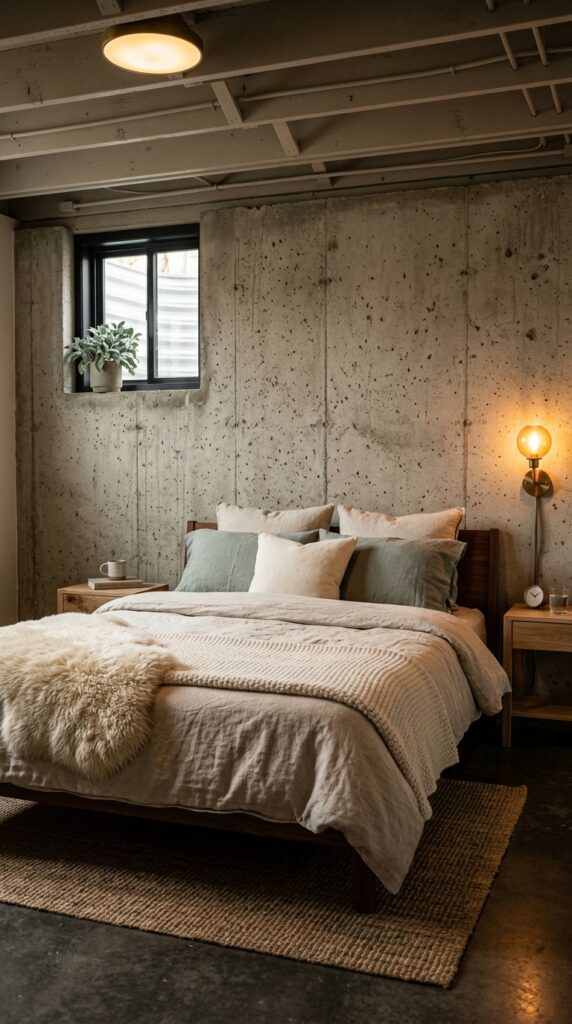
Vibe: Grounded — concrete and linen, the most honest combination there is.
Why it works: Many basement bedrooms have at least one exposed concrete foundation wall. Rather than covering it with drywall, sealing and showcasing it brings an architectural rawness that reads as intentional industrial-organic design. Matte concrete sealer (rather than glossy epoxy) preserves the natural color variation in the aggregate and eliminates the cold industrial quality that makes raw concrete feel harsh. The pairing with soft textiles like sheepskin and washed linen creates contrast through texture — hard surface against soft textile — which is one of the most effective layering techniques in interior design.
How to get it: Clean the concrete thoroughly with a TSP substitute, let cure 48 hours, then apply a penetrating concrete sealer rated for interior use. Two coats, matte finish. This costs approximately $35–$50 for a 200-square-foot wall.
🛍️ Shop the Look — Amazon Product Ideas
| # | Product Search Phrase | Why It Fits |
| 1 | interior penetrating concrete sealer matte | Wall treatment base |
| 2 | genuine sheepskin throw rug ivory | Softening textile contrast |
| 3 | chunky knit wool blanket throw natural | Warm textural layer |
| 4 | washed linen pillowcase set queen | Organic fabric anchor |
| 5 | concrete wall plug-in sconce industrial | Style-matched lighting |
10. Dusty Sage Green Walls with Warm Wood Accents
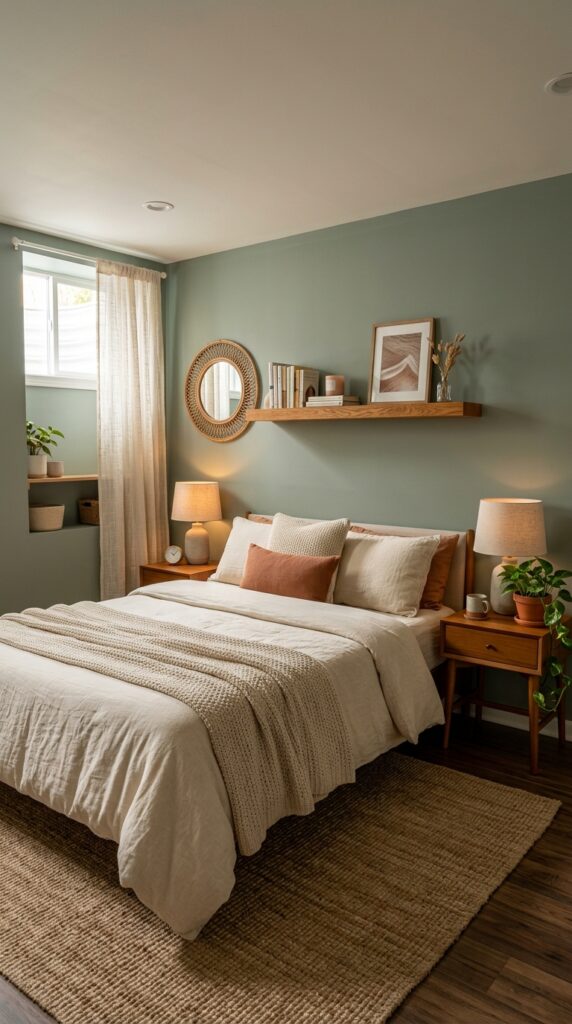
Vibe: Serene — the color of forests at dusk, brought inside.
Why it works: Dusty sage green is the rare color that reads as both cool and warm depending on its surroundings — cool against white trim, warm against honey oak wood. In a basement room, it does something white walls can’t: it gives artificial light something to reflect back with color rather than bouncing it out as flat brightness. The wood accent elements (teak nightstands, oak floating shelf) introduce the warm orange-brown undertones that balance sage’s natural coolness and prevent the room from reading as hospital-adjacent gray-green.
How to get it: The most reliable dusty sage for basement rooms is Sherwin-Williams “Oyster Bay” SW 6206 — it stays on the warm side of green under incandescent bulbs. Avoid anything with too much blue in its base, which reads cold without daylight.
💡 Quick Win: A single rattan-framed mirror ($35–$55) introduces both organic texture and reflective light amplification — two problems solved with one piece.
🛍️ Shop the Look — Amazon Product Ideas
| # | Product Search Phrase | Why It Fits |
| 1 | dusty sage matte interior paint sample | Wall color anchor |
| 2 | teak wood nightstand with drawer | Warm wood contrast |
| 3 | rattan oval wall mirror natural | Organic texture + light |
| 4 | honey oak floating shelf 36 inch | Warm wood accent above bed |
| 5 | terracotta pot trailing pothos plant | Earthy green accent |
11. Blackout Curtain Room Divider for Open Basement Plans
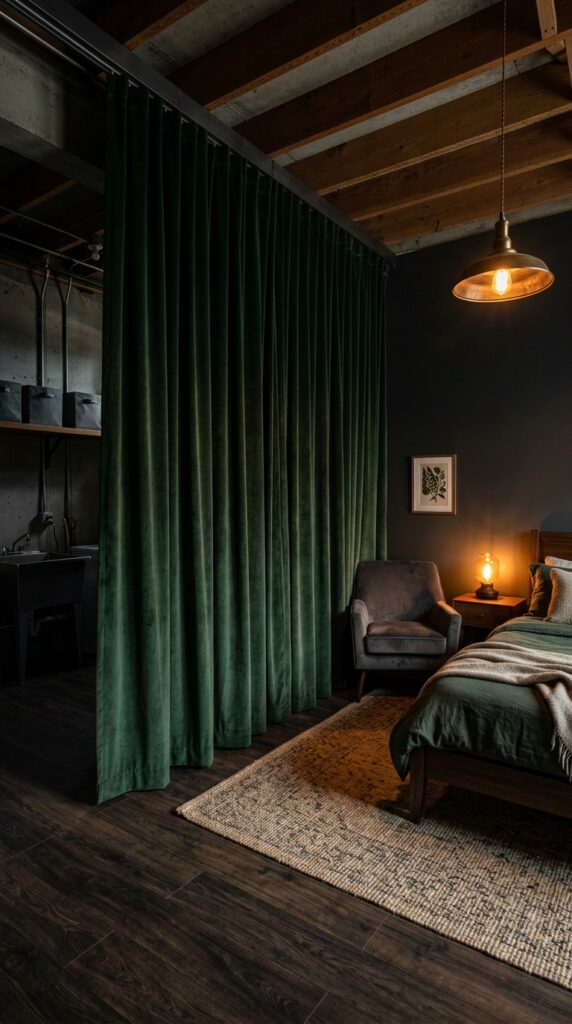
Vibe: Cave-like — in the most coveted, deliberate sense of that word.
Why it works: Open-plan basements often combine utility and living functions without real walls, which makes it nearly impossible to create the visual enclosure necessary for a bedroom to feel like a retreat rather than a sectioned-off corner. Floor-to-ceiling curtain panels hung from a ceiling-mounted track solve this without construction. The key design principle is negative space: a curtain in deep forest green or charcoal creates a visual wall that signals “bedroom begins here.” The ceiling mount is critical — any curtain that doesn’t reach the ceiling breaks the illusion of a real wall.
How to get it: Use a heavy-duty ceiling curtain track (not a rod — tracks mount flush and have no visible hardware gap at the top). Purchase blackout curtain panels at least 108 inches long. Deep forest green or plum velvet provides the most dramatic separation.
🛍️ Shop the Look — Amazon Product Ideas
| # | Product Search Phrase | Why It Fits |
| 1 | ceiling mounted curtain track system heavy duty | Structural divider hardware |
| 2 | 108 inch blackout curtain panel forest green velvet | Room divider fabric |
| 3 | woven jute area rug natural 6×9 | Defines bedroom zone floor |
| 4 | plug-in pendant light with cord | Zone lighting without wiring |
| 5 | folding reading chair compact cream | Intimate zone furniture |
12. Terracotta Linen Bedding for Warmth and Depth
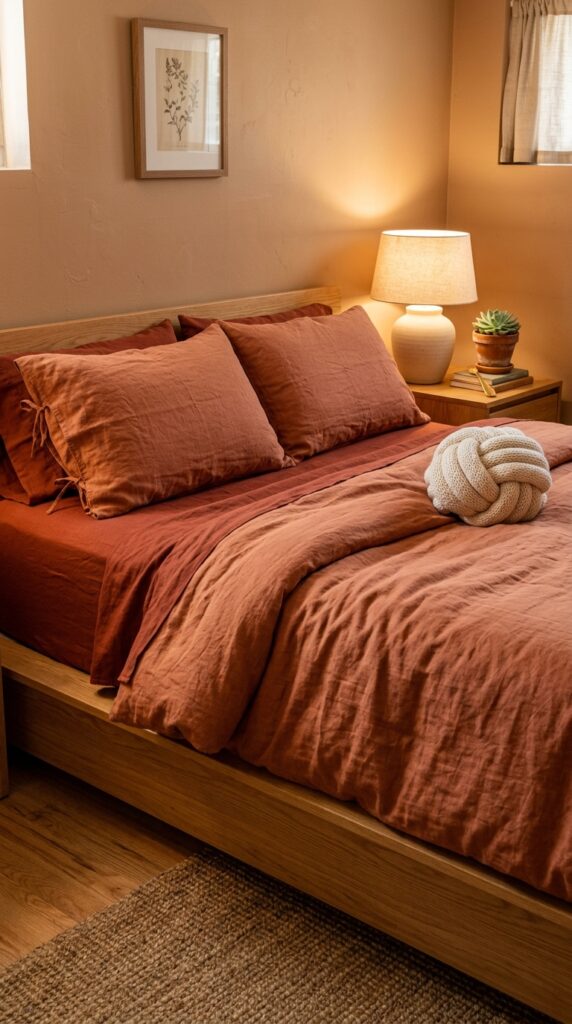
Vibe: Sun-warmed — Mediterranean afternoon light, distilled into fabric.
Why it works: Terracotta linen does something most basement bedrooms badly need: it introduces warm, saturated color without relying on paint changes. The natural slub texture of linen catches light unevenly, creating visual dimension on the bed surface that solid colors in smooth fabrics can’t achieve. Layering a slightly darker terracotta flat sheet under a lighter duvet creates tonal depth — the principle of tonal layering, which tricks the eye into perceiving more complexity in a space than actually exists. This is especially effective in rooms with limited architectural interest.
How to get it: Look for washed linen (not raw linen, which is stiff and scratchy) in the terracotta-burnt orange family. Bed stitch or stone wash processing creates the natural drape and slight texture variation that distinguishes quality linen from synthetic mimics.
🛍️ Shop the Look — Amazon Product Ideas
| # | Product Search Phrase | Why It Fits |
| 1 | washed linen duvet cover terracotta queen | Core bedding anchor |
| 2 | linen flat sheet terracotta deep rust | Tonal layering depth |
| 3 | terracotta clay plant pot small succulent | Color echo accent |
| 4 | cream knot decorative pillow | Contrast soft element |
| 5 | warm oak round side table compact | Bed-adjacent surface |
13. Integrated Recessed Shelving in Unused Wall Space
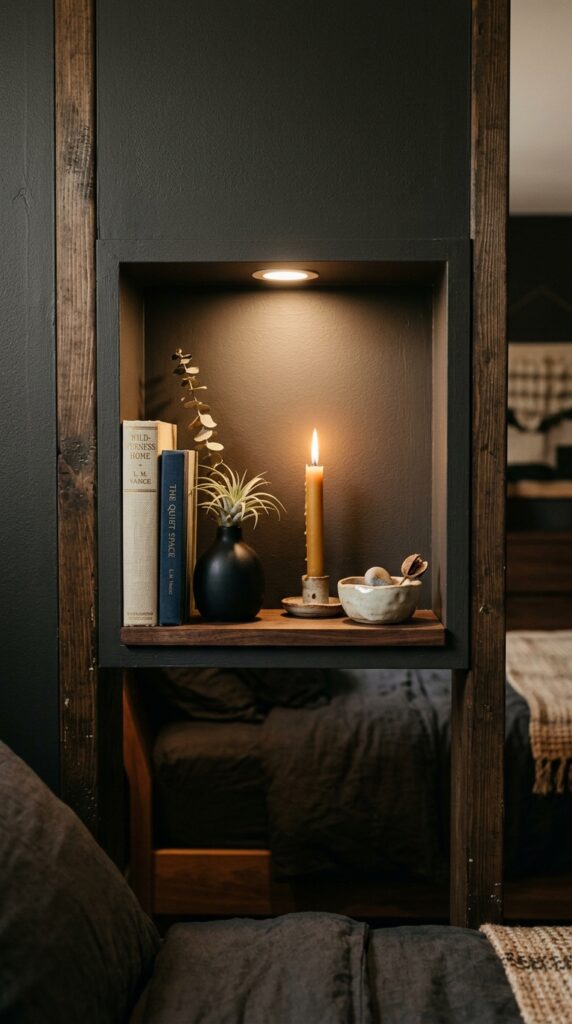
Vibe: Still — a dedicated alcove of calm within the room.
Why it works: Basement bedrooms frequently have walls with accessible stud cavities that are never utilized. A recessed shelf niche built between studs (typically 14.5 inches wide x any height you want) adds storage and display space without projecting any mass into the room — it actually makes the wall appear thicker and more permanent, adding an architectural quality that drywall alone can’t provide. Painting the interior of the niche the same color as the surrounding wall makes it appear intentional rather than improvised. An LED puck light inside illuminates the display without visible fixtures.
How to get it: Use a stud finder to locate two adjacent studs. Cut drywall to expose the cavity, install a wood shelf at the desired height, patch and sand edges smooth, prime and paint. Total materials cost: $25–$60 depending on shelf material. No structural permits required for non-load-bearing walls.
💡 Quick Win: Command Velcro strips mounted inside can hold a small USB LED puck light — no wiring needed ($8–$12 for the light, $6 for strips).
🛍️ Shop the Look — Amazon Product Ideas
| # | Product Search Phrase | Why It Fits |
| 1 | USB LED puck light warm white adhesive | Niche interior lighting |
| 2 | matte black ceramic bud vase small | Dark-toned decor anchor |
| 3 | unscented beeswax taper candles | Warm light element |
| 4 | air plant set of 3 tillandsia | Low-maintenance organic |
| 5 | floating shelf bracket hidden mount | Niche structural support |
14. Chunky Knit Throw and Layered Pillow System
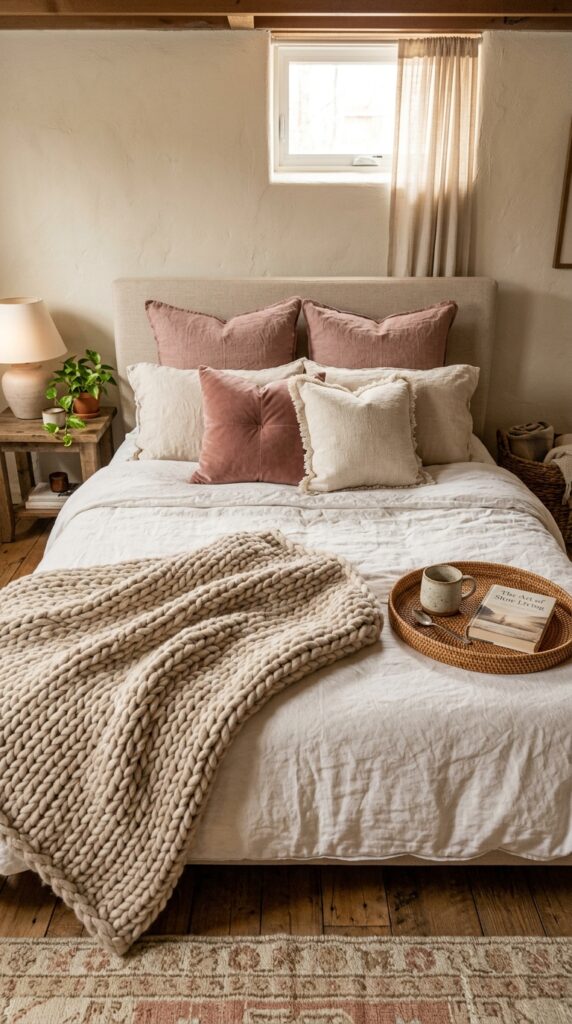
Vibe: Layered — every surface offers something different to touch.
Why it works: Texture layering on the bed itself is the most cost-effective cozy design technique available — it’s entirely independent of wall color, flooring, or furniture. The system works through tactile contrast: smooth linen Euro shams behind velvet accent pillows behind a chunky knit throw creates three distinct touch experiences that suggest warmth and comfort before anyone even lies down. The visual weight of a chunky knit throw draped casually at the foot of the bed prevents the bed from reading as stiff or hotel-like, which is critical in a basement room where clinical precision reads as sterile.
How to get it: Build the pillow system back-to-front: two 26×26 Euro shams in washed linen, two standard pillows in a slightly different tone (dusty rose or sage), then two 20-inch accent pillows in velvet or boucle. The key is tonal variation — slight differences in shade between layers create depth that matching sets eliminate.
🛍️ Shop the Look — Amazon Product Ideas
| # | Product Search Phrase | Why It Fits |
| 1 | chunky arm knit throw blanket oatmeal large | Texture anchor element |
| 2 | washed linen euro sham set 26×26 | Back pillow layer |
| 3 | dusty rose velvet accent pillow 20 inch | Front contrast layer |
| 4 | boucle throw pillow square cream | Tactile middle layer |
| 5 | woven rattan bed tray organizer | Styled bed surface detail |
15. Murphy Bed with Built-In Desk for Multipurpose Basement Rooms
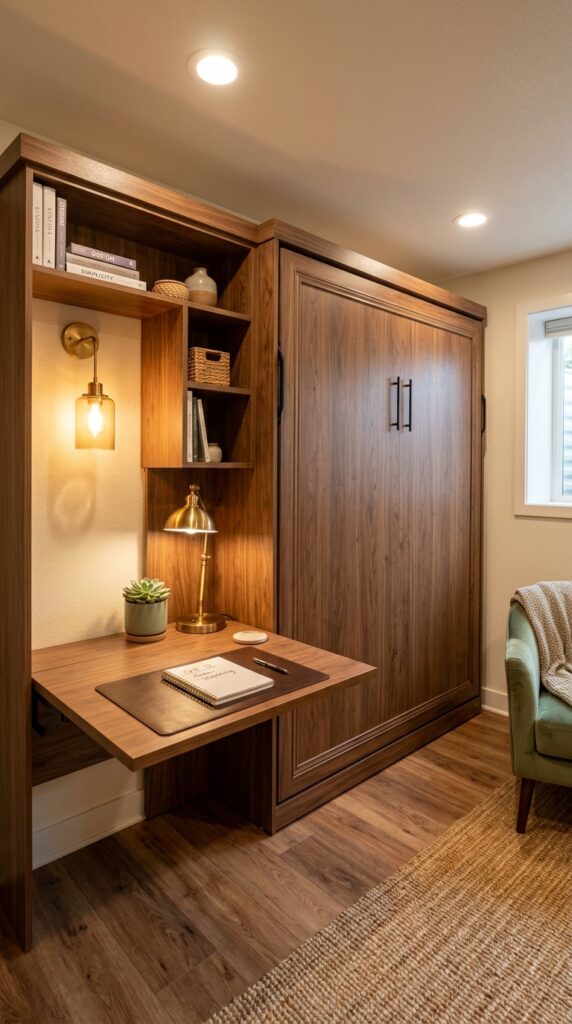
Vibe: Organized — functionality has never felt this considered.
Why it works: In a multipurpose basement — one that serves as guest room and home office or craft space — a Murphy bed is the single piece of furniture with the highest design leverage. When closed, it reads as a warm wood cabinet wall that makes the room feel intentional rather than improvised. When open, it provides a proper sleeping surface without permanently sacrificing floor space to a bed frame. The integrated desk configuration is critical: it maintains the room’s primary daytime function while keeping the sleeping function available within seconds.
How to get it: IKEA PLATSA units can be combined with a Murphy bed mechanism (available from third-party manufacturers like Expand Furniture) to achieve the built-in look at a fraction of custom cabinetry cost. Allow 60 inches of clearance from the bed mechanism to the opposite wall.
🛍️ Shop the Shop — Amazon Product Ideas
| # | Product Search Phrase | Why It Fits |
| 1 | Murphy bed mechanism kit horizontal queen | Core functional element |
| 2 | warm walnut adhesive veneer sheet | Cabinet finish upgrade |
| 3 | adjustable arm desk lamp warm light | Desk zone lighting |
| 4 | leather desk pad brown large | Desk surface anchor |
| 5 | small succulent arrangement potted desk | Organic desk accent |
16. Wainscoting Panels for Architectural Warmth
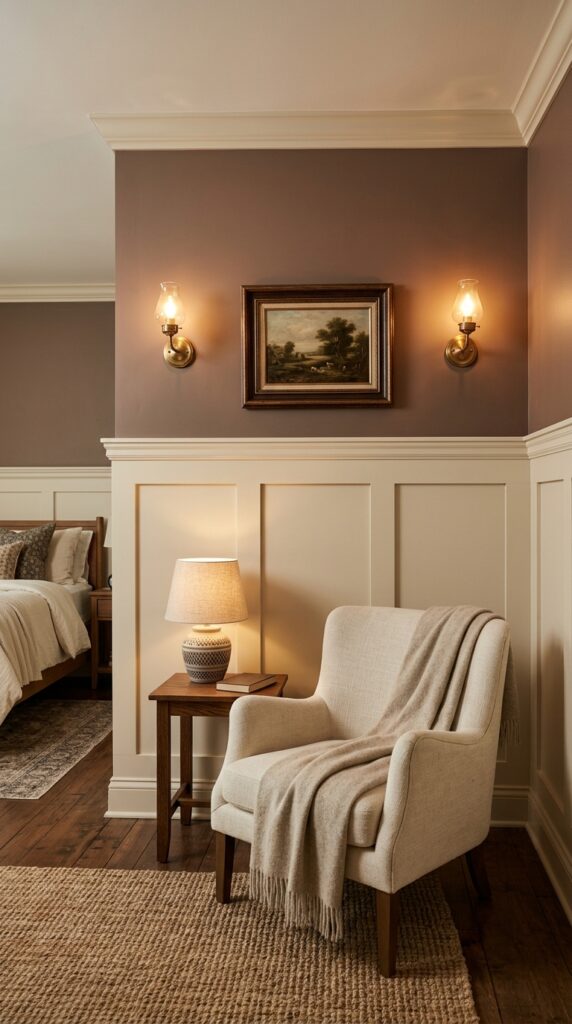
Vibe: Warm — the way a room feels when its architecture seems to have been there forever.
Why it works: Wainscoting is one of the most underused techniques in basement bedroom design. By dividing the wall into two distinct color zones — a lighter panel below and a deeper color above — it creates the illusion of a higher ceiling through visual trickery: the eye reads the light lower zone as floor-adjacent and the darker upper zone as the room’s main color field, extending the sense of height rather than compressing it. Flat recessed panel wainscoting (as opposed to raised panel, which reads more formal) suits the relaxed cozy-retreat aesthetic better and costs significantly less to install.
How to get it: MDF beadboard or flat panel wainscoting kits from home improvement stores install in a single weekend. Cut panels to 36–42 inches in height, install, fill nail holes, paint panels in a warm cream, and paint above the chair rail in a dusty mocha or charcoal tone two shades deeper.
💡 Quick Win: Peel-and-stick wainscoting panels ($40–$60 for 32 square feet) create the same visual effect without nails or compound — perfect for rentals.
🛍️ Shop the Look — Amazon Product Ideas
| # | Product Search Phrase | Why It Fits |
| 1 | peel and stick wainscoting panels white paintable | Renter-friendly install |
| 2 | warm cream interior wall paint flat finish | Lower panel color |
| 3 | dusty mocha wall paint sample matte | Upper wall contrast |
| 4 | plug-in wall sconce brushed brass | Above rail lighting |
| 5 | vintage landscape print framed warm tones | Above-rail wall art |
17. Egress Window Well Transformed into a Light Feature
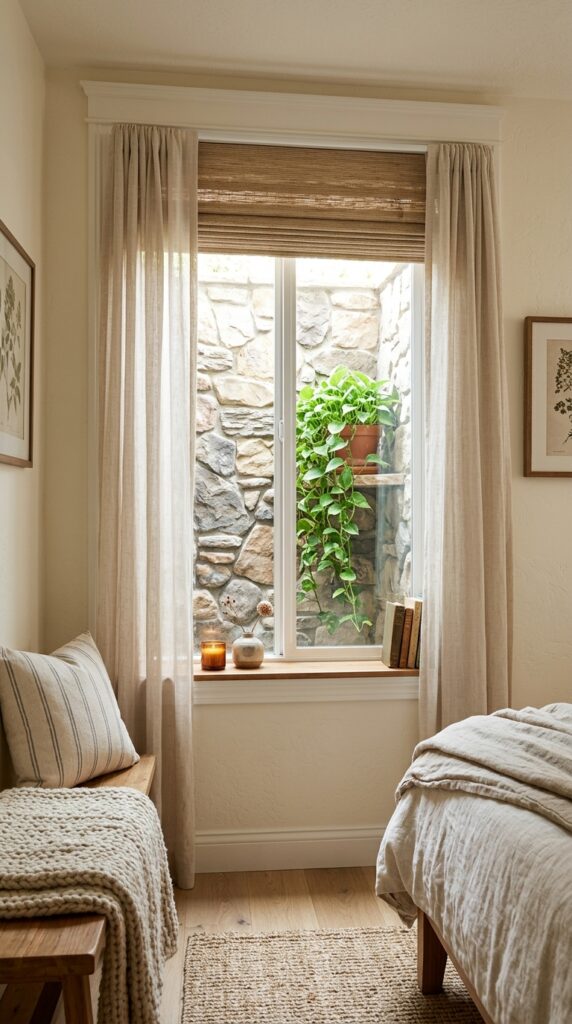
Vibe: Luminous — every photon counts and none is wasted.
Why it works: Egress windows are a legal requirement in basement bedrooms and one of the space’s only sources of natural light — which makes treating them as a design feature rather than a safety obligation a significant opportunity. Decorating the window well itself (with stone liner, small trailing plants, and river rock at the base) creates a garden-view effect that makes the basement feel connected to the outside world. Inside, layering a light-filtering sheer curtain behind a woven shade gives the window visual softness while maximizing the light it admits during daylight hours.
How to get it: Install a curved polycarbonate well cover to protect the well from debris while allowing light transmission. Add a small self-watering planter rated for outdoor use inside the well with a shade-tolerant plant like creeping jenny or mondo grass.
🛍️ Shop the Look — Amazon Product Ideas
| # | Product Search Phrase | Why It Fits |
| 1 | window well polycarbonate cover with vent | Protects + preserves light |
| 2 | self-watering planter small outdoor rated | Well plant container |
| 3 | sheer linen curtain panel natural 84 inch | Light-diffusing layer |
| 4 | woven roman shade light filtering | Behind-sheer shade layer |
| 5 | windowsill shelf floating narrow white | Light zone accent shelf |
18. Moody Forest Green and Brass Color Scheme
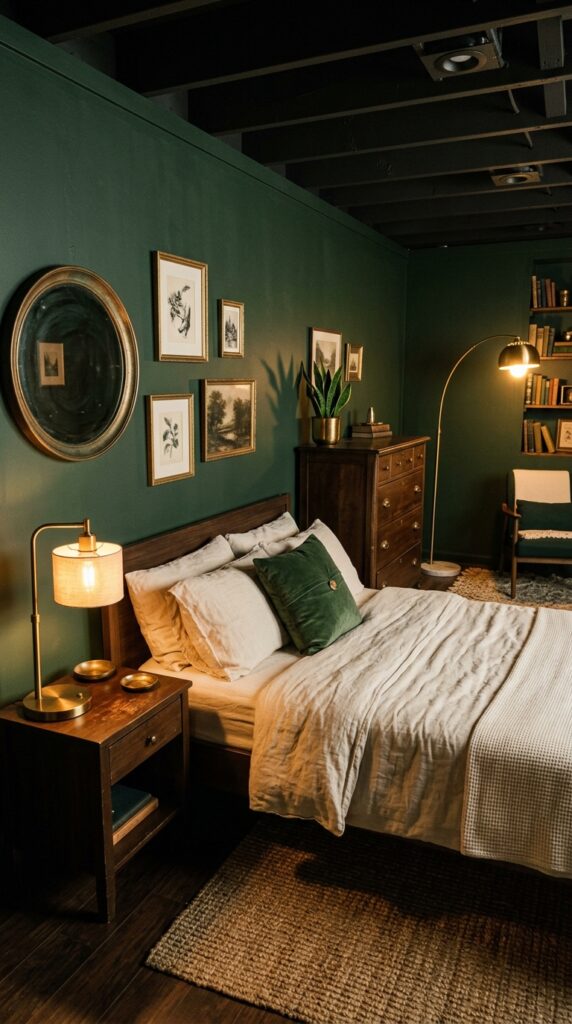
Vibe: Rich — the kind of room that earns the word without needing to explain it.
Why it works: Forest green and aged brass is one of the most effective pairings for basement rooms because both elements are naturals at absorbing and warming artificial light. Green walls eliminate the sterile quality of white or beige in a space without windows, while aged brass hardware acts as micro-reflectors that scatter warm lamp light back into the room at multiple points. The design principle here is distributed warmth — instead of one or two light sources doing all the work, every brass element becomes a secondary emitter. This technique fills the room with warmth even when only one lamp is on.
How to get it: Use Farrow & Ball “Calke Green” (No.80) or its more budget-friendly equivalent in any paint system — have your hardware store color-match from a chip. Retrofit all hardware in the room to aged brass by replacing switch plates, drawer pulls, and curtain rod rings first.
🛍️ Shop the Look — Amazon Product Ideas
| # | Product Search Phrase | Why It Fits |
| 1 | deep forest green matte interior paint sample | Wall color foundation |
| 2 | aged brass drawer pull cabinet hardware set | Brass detail layer |
| 3 | brass arch floor lamp reading light | Distributed warm glow |
| 4 | forest green velvet throw pillow | Color echo in textile |
| 5 | aged brass wall mirror oval vintage | Reflective brass accent |
19. Vertical Wood Slat Headboard Wall
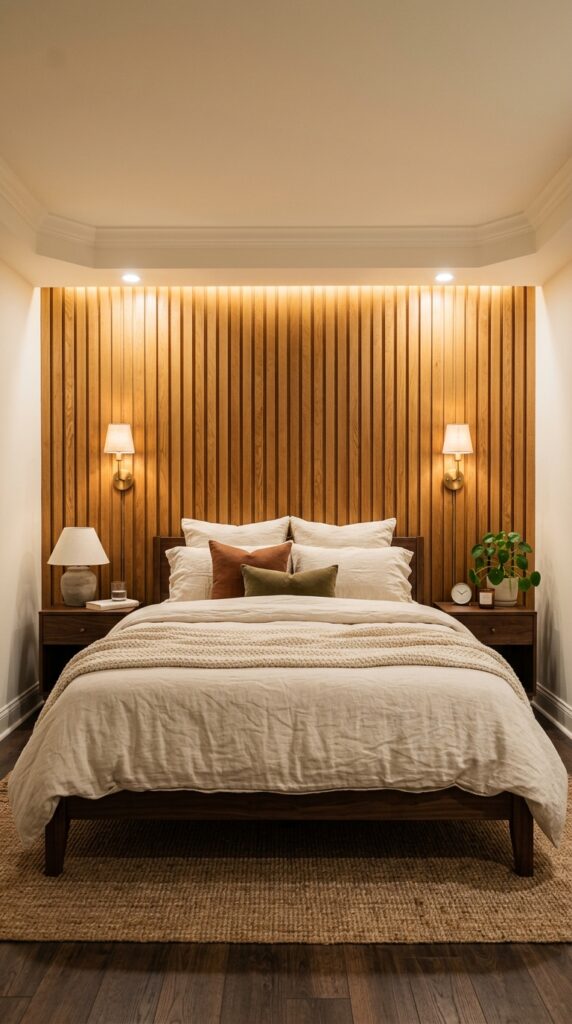
Vibe: Luminous — warm wood in strips catches light in a way solid surfaces never do.
Why it works: A vertical slat wall serves two design functions simultaneously: it creates a dramatic architectural headboard without requiring a freestanding piece, and it introduces verticality that draws the eye upward — a critical technique in any basement room where the goal is to counteract ceiling compression. White oak 1×2 boards in a honey stain reflect warm light in the gaps between slats, making the wall itself a source of visual warmth. Floor-to-ceiling height is non-negotiable — starting the slats at mattress height and stopping them short eliminates the vertical pull and makes the wall look unfinished.
How to get it: Install a horizontal 2×4 ledger board at the floor and ceiling to mount slats to. Use 1×2 white oak boards (not pine, which warps) at 1-inch spacing. Pre-stain all boards before installation. Budget: approximately $150–$250 for a 10-foot wall.
🛍️ Shop the Look — Amazon Product Ideas
| # | Product Search Phrase | Why It Fits |
| 1 | 1×2 white oak hardwood board 8ft lumber | Slat wall material |
| 2 | honey oak interior wood stain | Warm stain color |
| 3 | plug-in wall sconce set of 2 aged brass | Between-slat lighting |
| 4 | finishing nailer brad nails 2 inch | Slat installation tool |
| 5 | cream linen duvet cover king | Complement to warm slats |
20. Compact Vanity Corner for Guest or Teen Basement Bedrooms
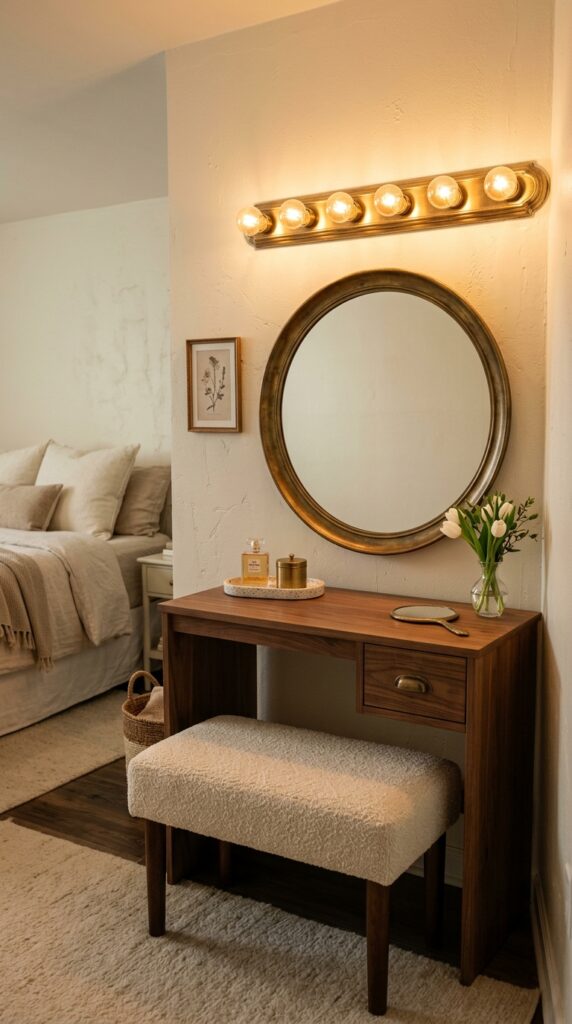
Vibe: Warm — a corner that feels genuinely prepared for you.
Why it works: A dedicated vanity corner in a basement bedroom elevates the space from “spare room” to “true guest suite” with a single furniture addition. Zone differentiation — separating sleeping, seating, and grooming into distinct areas — is the defining technique of well-designed bedrooms regardless of size. A vanity needs only 24 inches of wall width and 18 inches of floor depth, making it achievable even in compact basement layouts. The warm vanity lighting strip serves both functional and decorative purposes: it illuminates the mirror while adding a secondary warm light source at eye level, which dramatically improves any room’s atmosphere in evening hours.
How to get it: Look for vanity tables with a footprint under 40×20 inches. Pair with a plug-in Hollywood vanity light bar (2700K bulbs specifically — 3000K reads too white). A round wall mirror in 24-inch diameter balances the compact furniture scale.
💡 Quick Win: A $25 Hollywood vanity light bar with plug-in capability provides warm ambient lighting for the whole room when the mirror bounces it back.
🛍️ Shop the Look — Amazon Product Ideas
| # | Product Search Phrase | Why It Fits |
| 1 | compact vanity table with mirror small bedroom | Core zone furniture |
| 2 | Hollywood vanity light bar plug-in warm bulb | Zone lighting element |
| 3 | round wall mirror aged brass 24 inch | Mirror above vanity |
| 4 | boucle vanity stool cream small | Seating at vanity |
| 5 | ceramic makeup organizer tray small | Vanity surface styling |
21. Mushroom and Warm White Two-Tone Ceiling Treatment
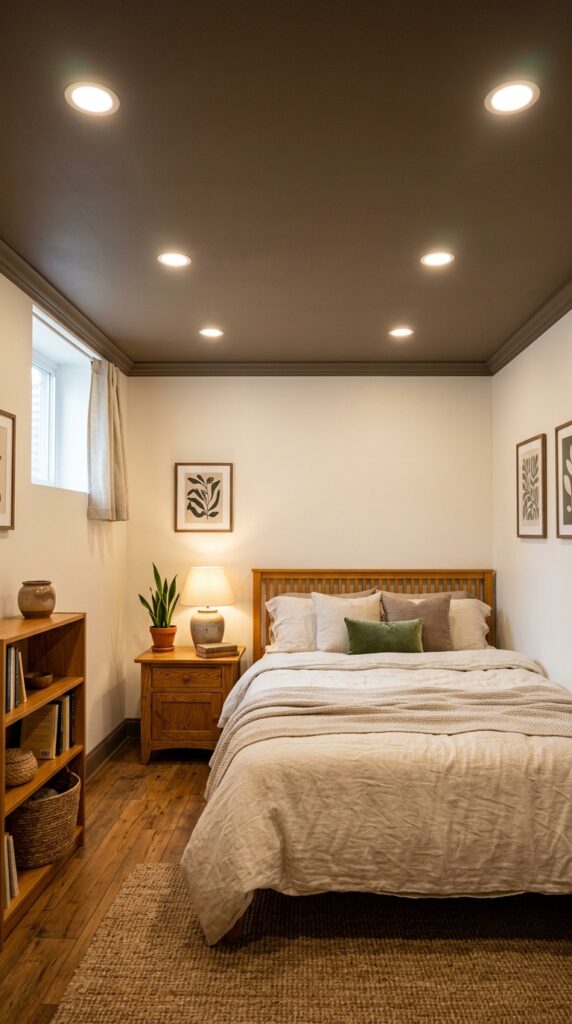
Vibe: Enveloping — the ceiling becomes part of the warmth rather than a separate plane above.
Why it works: White ceilings in basement rooms read as clinical and disconnected — the only bright surface in a room surrounded by deeper tones creates a cold contrast that fights coziness. Painting the ceiling in a warm mushroom-taupe (two to three shades deeper than the walls, not a completely different color family) wraps the room in continuous warmth. This technique, sometimes called “fifth wall treatment,” works on the principle of color immersion: when the ceiling reads as part of the room’s tonal family rather than an interruption, the entire space feels more cohesive and intentional. This is particularly powerful in low-ceiling basement rooms.
How to get it: Use the wall color, select two shades deeper on the same paint strip, and apply to the ceiling only. Benjamin Moore’s “Pale Oak” on walls pairs well with “Pale Taupe” or “Pale Brown” on the ceiling. Always paint ceiling before walls.
🛍️ Shop the Look — Amazon Product Ideas
| # | Product Search Phrase | Why It Fits |
| 1 | mushroom taupe interior ceiling paint sample | Ceiling color anchor |
| 2 | extension roller ceiling paint kit | Ceiling application tool |
| 3 | warm white matte wall paint gallon | Wall color complement |
| 4 | warm white recessed light bulb 2700K 6 pack | Ceiling light source |
| 5 | crown molding paintable foam adhesive | Wall-ceiling transition |
22. Rattan and Wicker Furniture Accents
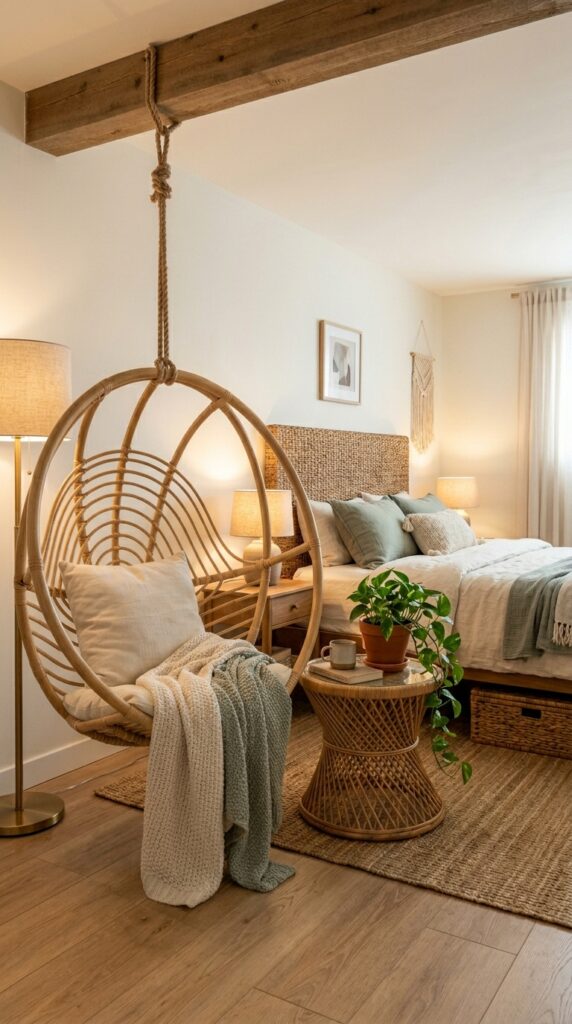
Vibe: Layered — organic material brings the outside world underground.
Why it works: Rattan and wicker introduce the one material quality that basement bedrooms most often lack: organic irregularity. Machine-made furniture has crisp edges and perfect surfaces that can feel cold and sterile in a subterranean space. Rattan’s natural variation in weave pattern, slight imperfection in curves, and warm honey-tan color add visual warmth through material character alone — without changing a single wall color or light fixture. The key is repetition of the material across multiple forms: a rattan headboard, a rattan side table, and a rattan basket at minimum, so the organic quality reads as a design choice rather than a single accent.
How to get it: Natural, unpainted rattan reads warmer than the bleached or whitewashed versions. Look for pieces with visible weave texture rather than machine-pressed rattan panels, which lack the same visual depth.
🛍️ Shop the Look — Amazon Product Ideas
| # | Product Search Phrase | Why It Fits |
| 1 | rattan hanging papasan chair indoor cream cushion | Corner organic statement |
| 2 | rattan woven headboard queen natural | Bed anchor in rattan |
| 3 | round rattan side table natural small | Repeating material form |
| 4 | wicker storage basket with lid under bed | Functional rattan accent |
| 5 | rattan pendant light shade natural | Ceiling rattan element |
23. Small-Space Mirror Strategy to Amplify Light
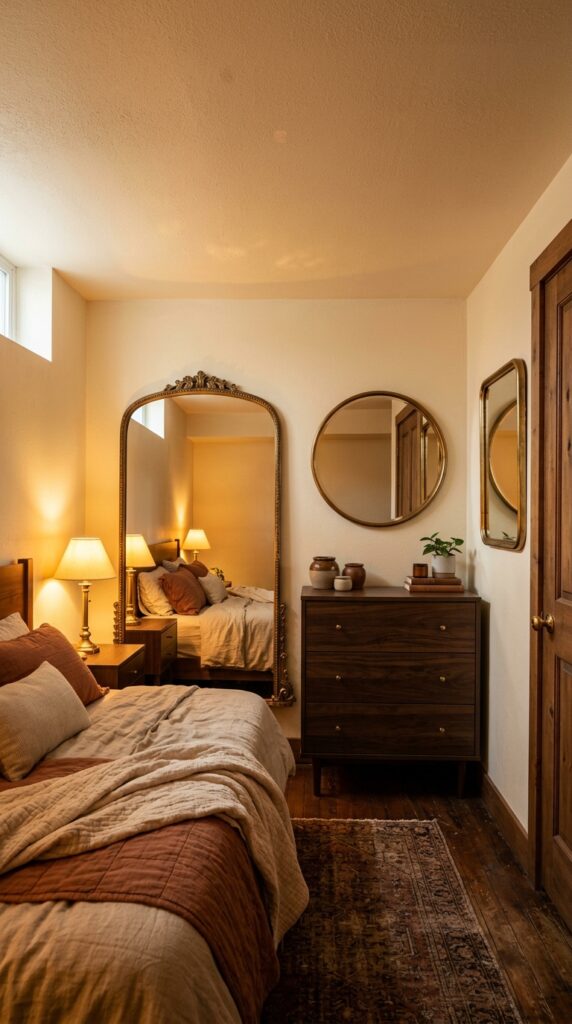
Vibe: Luminous — the light doubles without the cost of a second lamp.
Why it works: In a space with limited or no natural light, mirrors serve a functional design role beyond aesthetics: they are secondary light emitters that bounce and multiply existing warm light sources. The technique of using multiple mirrors at different heights and scales creates light behavior that feels layered and dimensional — closer to natural light’s multi-directional quality than any single lamp can achieve. Positioning mirrors opposite or adjacent to light sources (rather than opposite windows, which is the typical recommendation) maximizes their effect in windowless spaces. A mix of frame styles (arched floor mirror + round wall mirror + rectangular accent mirror) creates the collected quality of an eclectic vintage-styled space.
How to get it: The large arched floor mirror (minimum 65 inches tall) does the most work — position it opposite the room’s primary lamp. Use warm-toned brass frames throughout so the mirror trim contributes to warmth, not just reflection.
💡 Quick Win: A leaning floor mirror requires zero installation — it’s the fastest single way to visually expand a compact basement bedroom and amplify existing light.
🛍️ Shop the Look — Amazon Product Ideas
| # | Product Search Phrase | Why It Fits |
| 1 | large arched floor mirror 65 inch gold brass frame | Primary light reflector |
| 2 | round wall mirror aged gold 24 inch | Secondary mirror accent |
| 3 | rectangular brass wall mirror vintage | Door-adjacent accent |
| 4 | mirror mounting hardware adhesive heavy duty | Safe wall installation |
| 5 | warm amber table lamp ceramic base | Light source to reflect |
24. Scent and Sensory Design for the Ultimate Cozy Atmosphere
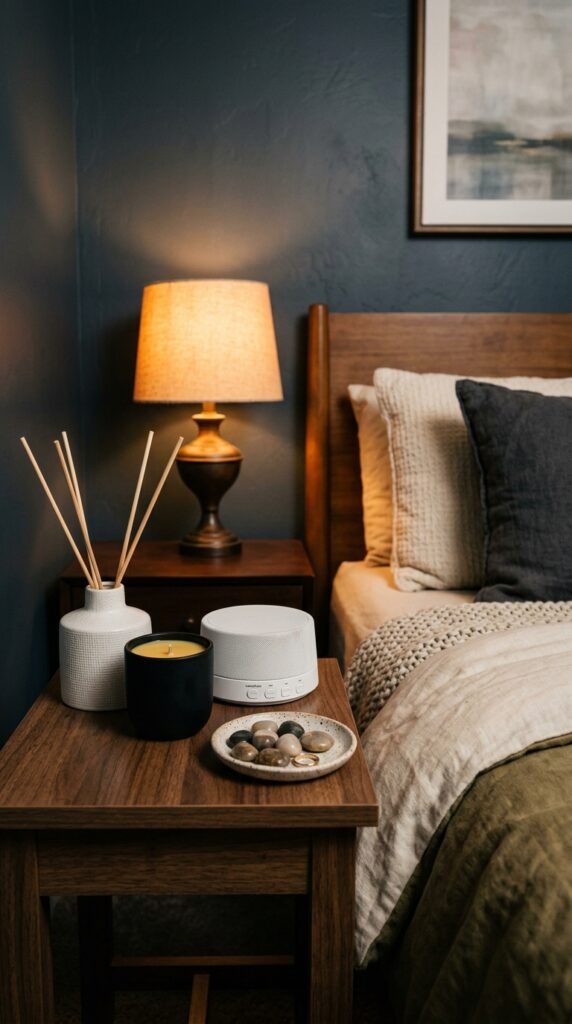
Vibe: Serene — the bedroom as a full sensory destination, not just a visual one.
Why it works: Basement bedrooms are acoustically and sensorially unique — the absence of street noise, the insulated quiet, and the cool temperature stability make them exceptional sleeping environments when the sensory design is completed. Visual coziness without olfactory or acoustic support feels incomplete. A reed diffuser in cedarwood or sandalwood engages the limbic system — the brain’s emotional and memory center — in a way that visual design cannot. Combined with a warm amber-bulb bedside lamp and a white noise machine (especially valuable in homes with HVAC noise from mechanical rooms adjacent to basements), the space becomes a full-environment retreat that the brain learns to associate with deep rest.
How to get it: Choose diffuser scents in the wood family (cedarwood, sandalwood, hinoki) rather than floral for basement bedrooms — they complement the grounded, earthy quality of the space. Replace any existing bedside bulb with a 2200K Amber bulb in the 25-40W equivalent range.
🛍️ Shop the Look — Amazon Product Ideas
| # | Product Search Phrase | Why It Fits |
| 1 | cedarwood sandalwood reed diffuser ceramic | Olfactory sensory layer |
| 2 | white noise machine sleep sound compact | Acoustic environment |
| 3 | 2200K amber LED bulb E26 small | Ultimate warm light source |
| 4 | matte black wax vessel candle | Scent + visual anchor |
| 5 | ceramic catchall dish handmade small | Nightstand organic detail |
25. Dark Velvet Accent Chair for a Luxe Bedroom Corner
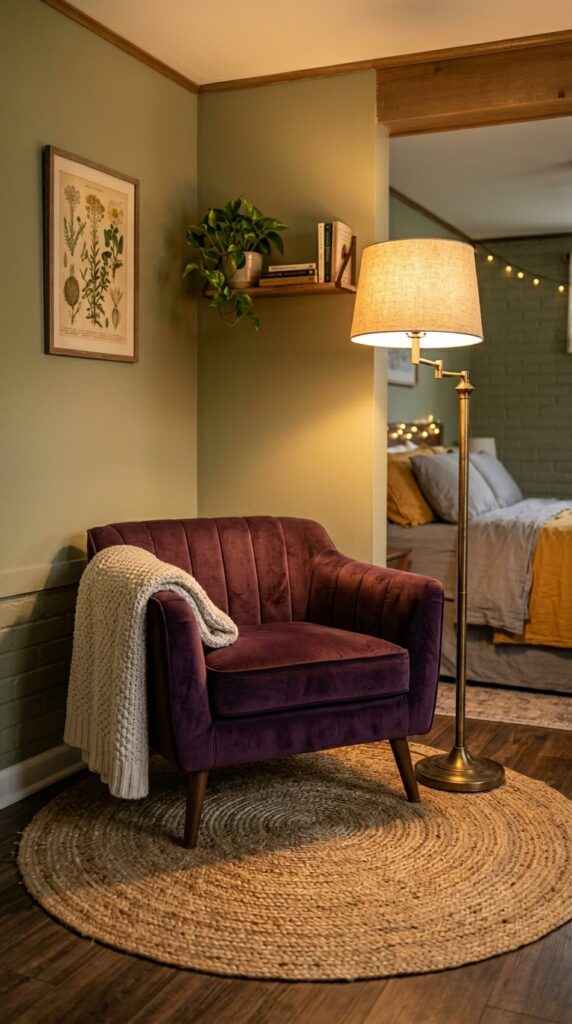
Vibe: Romantic — the corner that makes the whole room feel considered.
Why it works: A single well-chosen accent chair transforms a basement bedroom from a sleeping space to a room with purpose and character. The principle is visual anchoring: a chair in a corner creates a focal point that gives the eye a destination beyond the bed, which in turn makes the room feel complete rather than utilitarian. Deep plum velvet is particularly effective in basement lighting conditions because velvet pile reflects light directionally — as you move through the room, the chair shifts between deep eggplant and luminous aubergine, creating the impression of a living, dynamic material rather than a static color.
How to get it: Scale is critical — choose a chair with a seat height under 17 inches and an overall width under 32 inches for basement spaces. Pair with a floor lamp that positions the shade at 58–62 inches from the floor for the most flattering light-to-seating ratio.
💡 Quick Win: A cream knit throw draped over one chair arm ($22–$35) softens the formality of a velvet chair and reinforces the layered-warmth aesthetic in a single gesture.
🛍️ Shop the Look — Amazon Product Ideas
| # | Product Search Phrase | Why It Fits |
| 1 | low profile velvet accent chair deep plum | Corner statement piece |
| 2 | brass floor lamp with fabric shade arc | Chair-adjacent warm light |
| 3 | jute rug small round natural 4 foot | Chair zone definition |
| 4 | cream knit throw blanket small | Chair softening layer |
| 5 | velvet accent pillow deep plum 18 inch | Chair color echo cushion |
How to Start Your Basement Bedroom Cozy Retreat Transformation
Your single first move: Paint the walls before you do anything else — and choose warm charcoal, warm greige, or dusty sage rather than white. White walls in a basement room are the one decision that almost guarantees everything else you add will feel like it’s fighting the space. A warm, deep wall color is the foundation that makes every textile, lamp, and furniture piece work harder. Sherwin-Williams “Kendall Charcoal” (HC-166) is the most versatile starting point for basement bedrooms because it reads as dark without going cold-blue under artificial light.
The most common beginner mistake: Choosing cool-toned paint — anything with a blue, gray-blue, or cool purple base — because it “opens up the space.” In a basement bedroom, cool tones drain warmth from artificial light and make the room feel damp and clinical rather than cozy. The fix is simple: always test paint colors under the actual artificial light of the room, not by window light or in the store. A paint color that looks warm in a showroom can turn icy under recessed LEDs. Always buy a sample and paint a 12×12-inch swatch before committing.
Three specific items under $50 that create immediate cozy impact: A set of two plug-in wall sconces in an aged brass finish ($30–$45 on Amazon), a single stem of dried pampas grass in a matte terracotta ceramic bud vase ($18–$28 together), and a 2200K amber LED bulb ($8–$12) to replace any existing harsh white bedside bulb.
Realistic expectations: A weekend of focused work — painting one accent wall, hanging a sconce pair, and swapping in new bedding — can transform the visual feel of a basement bedroom in 8–10 hours. A full room transformation involving furniture, rug layering, curtain installation, and wall treatments realistically takes 3–5 weekends. Budget for a starter cozy-retreat basement bedroom: $300–$600 covers paint, two rugs, bedding, and accent lighting. A fully realized transformation with quality furniture runs $1,500–$3,000.
Frequently Asked Questions About Basement Bedroom Cozy Retreats
What makes a basement bedroom feel cozy instead of dark and depressing?
A basement bedroom feels cozy rather than dark when the design leans into depth deliberately rather than fighting it. The critical distinction is warmth: walls painted in warm charcoal, dusty sage, or warm greige (rather than cool gray or white), combined with 2200K amber-toned lighting and layered organic textiles like chunky knit throws and washed linen bedding. A basement feels depressing when it’s lit with harsh white light (anything above 3500K) against cold-toned or white walls — that combination reads clinical. It feels cozy when every warm light source is complemented by a warm wall that reflects it back.
What colors work best for a basement bedroom with no natural light?
Deep, warm tones outperform light neutrals in windowless or low-light basement bedrooms. Specific colors that work reliably: Sherwin-Williams “Kendall Charcoal” (HC-166) in warm charcoal, Benjamin Moore “Pale Oak” in warm greige, or Sherwin-Williams “Oyster Bay” in dusty sage. Avoid cool-toned paints with blue or gray-blue undertones — they read as cold and damp under artificial light. Terracotta, mocha, deep sage, and warm charcoal all perform well because they absorb and re-emit warm artificial light rather than reflecting it harshly back.
How much does it cost to turn a basement into a cozy bedroom?
A starter cozy basement bedroom — covering paint, layered rugs, new bedding, and one or two accent lighting pieces — can be achieved for $300–$600. A mid-range transformation including quality furniture (platform bed, nightstands, accent chair) runs $1,200–$2,500. A fully built-out suite with custom or semi-custom elements like Murphy beds, built-in shelving, or professional-grade shiplap installation ranges from $3,000 to $8,000+. The highest-return single investment is almost always the bed and bedding — the visual and comfort anchor of the room.
Can a basement bedroom look stylish without windows?
Yes — and the most effective approach is to stop designing around the absence of windows and instead design for lamp-lit warmth as the room’s primary visual character. Use multiple light sources at different heights (a floor lamp, two bedside sconces, and string lights create three distinct light zones), mirrors positioned opposite those light sources to multiply warmth, and deep wall colors that give the artificial light something to interact with. A room designed intentionally for artificial light can feel more atmospheric and intimate than a naturally lit room — it’s a different aesthetic, not an inferior one.
What furniture works best in a low-ceiling basement bedroom?
Low-profile furniture is non-negotiable for basement bedrooms with ceiling heights below 8 feet. Specifically: a platform bed with a maximum frame height of 12 inches (versus the standard 24-inch platform height), nightstands under 26 inches tall, and dressers or cabinets that max out at 48 inches rather than 60-inch wardrobes. Avoid four-poster beds, canopy frames, or any furniture with vertical elements that compete with the ceiling plane. Low, horizontal furniture profiles — like the Scandinavian-influenced designs common in brands like Article or West Elm — elongate the room visually and make low ceilings feel like a design choice rather than a constraint.
Ready to Create Your Dream Cozy Retreat Basement Bedroom?
These 25 ideas cover everything from the foundational decisions — wall color, lighting temperature, furniture profiles — to the finishing details that separate a well-designed room from a truly felt one: scent layering, tactile textiles, mirror strategies, and architectural treatments. Every transformation starts somewhere smaller than the full vision, and starting with a single paint color or a set of amber-bulb sconces is not just acceptable — it’s exactly how good rooms are built, one deliberate addition at a time. Today, order a sample pot of Sherwin-Williams “Kendall Charcoal” and paint a swatch on your basement bedroom wall under your existing artificial light — that single step will tell you more about the room’s potential than any amount of planning. When the full transformation is done, you’ll have created something rare: a space that the rest of the house can’t offer, a room that wraps you in stillness and warmth the moment you step off the last stair. Save your favorites from this list — the chunky knit throws, the shiplap ideas, the terracotta linen layers — because the best cozy basement bedrooms are always built from a few ideas that just wouldn’t leave your head.